



Here is a first-hand account of a visit to the old city of Jerusalem immediately after its takeover by Israel. The report was written by Dr. Dwight L. Baker, chairman of the Baptist Convention in Israel:
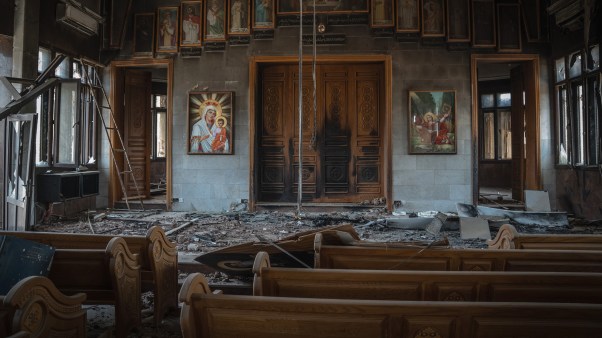
The only churches damaged in the new city were the Roman Catholic church on Mt. Zion and St. Andrew’s Church of Scotland, opposite Mt. Zion.
A shell narrowly missed the Jerusalem Baptist Church, falling just beyond the gate into the street. The apartment of Frank Hooper, a Baptist, was another near miss. It was pocked by flying shrapnel, and a two-inch shell fragment tore into his daughters’ bedroom and lodged in a book. The title of the volume: This Singing World.
Near the border, St. John’s Anglican Church was not damaged, but the Finnish Mission School across the street took two direct hits. There were no injuries.
Two days after the firing ended, the government press office arranged a tour of the old city of Jerusalem for journalists. Many Arabs wore looks of deep disappointment, but most were ready to converse. Standing opposite the Damascus Gate, the assistant postmaster of the old city, a Christian, emphasized that Jews and Arabs had lived together before and could do it again.
From the northeast, near St. Stephen’s Gate, we approached the Haramesh-Sherif, commonly known as the Dome of the Rock. What must have been a miracle of restraint and accuracy in firing left the gleaming gold dome of the mosque untouched. The day before, an Israeli Muslim dignitary had been there. He had told newsmen that the courtyard is blessed by the Koran as second in sanctity only to Mecca. Pointing to the golden dome, he had recalled that according to the Koran, it was from this very place that Muhammad rode to heaven on his white horse, Burak.
A favorite topic of speculation among Israelis is the mosque area, also believed to be the site of the once glorious Temple of Solomon. Will there be an attempt to rebuild the temple and reinstate temple worship and sacrifices? The only official comment is that complete religious freedom will be preserved for all faiths.
Outside the unscathed Church of the Holy Sepulcher, five Israeli soldiers stood guarding the entrance. They told me that although Israelis were not permitted to enter, I could go in since I was a Christian. I declined, thanking them and explaining I had visited the church many times before.
A Greek priest who had been sitting and chatting with the soldiers responded with a smile when I asked him in Arabic how the church fared. “Better than before,” he replied, “thanks to these brave soldiers.” Such pleasant statements might not reflect the true feeling of the Christians, but again they might. The key to the Church of the Holy Sepulcher has been in the hands of a leading Muslim family since the Muslim conquest. It is now not wholly unthinkable that the key might be passed to a committee of Christians who hold worship rights in the ancient church.
As I walked toward the American consulate near Mandelbaum Gate, I stopped at the Garden Tomb. The first gate, sealed long ago, had been blasted open. Inside no one responded as I called. Farther out near the center of the garden, partly hidden by thick foliage, three men were digging. I asked whether they could help me find the custodian, Solomon Matar. One of them pointed to the small gatehouse and replied, “He is in there. We are preparing to bury him.”
On the second day of the fighting, Matar had responded to persistent pounding at the gate. As he opened it, he caught a burst of machine-gun fire at point-blank range as Israeli soldiers rushed into the garden. Jordanians preparing for battle had set up a gun emplacement atop Gordon’s Calvary, overlooking the tomb. Apparently thinking the garden to be full of Jordan legionaires, the Israelis attacked. The Jordanian gun was silenced, but blood flowed again at Calvary. Three days later, an Anglican archbishop read prayers at the new grave in the garden, attended by six neighbors and the widow of the fallen keeper of the tomb.
The following reflections were written forCHRISTIANITY TODAYby Harry W. Genet, assistant executive secretary of the Arabic Literature Mission in Beirut, Lebanon:
As the smoke of battle cleared, the opponents tallied the staggering human and material costs of the four-day war. At the same time, the slender missionary force in the Arab world was involved in a similarly dreary reappraisal of its drastically altered situation. Dislocation, isolation, and a new level of hostility are the formidable fresh obstacles to missionary advance in the Middle East.
Most disturbing of all has been the hardening Arab attitude toward foreigners. Missionaries who are glad to bear the reproach of Christ find instead that they are saddled with the reproach of being an Amerki or Ingleezi.
Beirut is no doubt as restrained as any Arab capital. But a routine check at the American embassy June 6 gave me a taste of the new bitterness. Trapped inside for two hours, I watched a youthful mob wreck autos, set a lower floor ablaze, and hurl rocks at windows until tanks cleared the area. Missionaries face the hard fact that for now at least they may be as much a liability as an asset to churches they helped plant.
Against a formidable array of obvious minuses stand a few easily overlooked pluses. For one thing, recent events will prod missionaries into exploring new avenues of witness that would survive ouster of foreigners. And the misery of Arab tragedy has opened up an overwhelming opportunity to show the compassion of Christ.