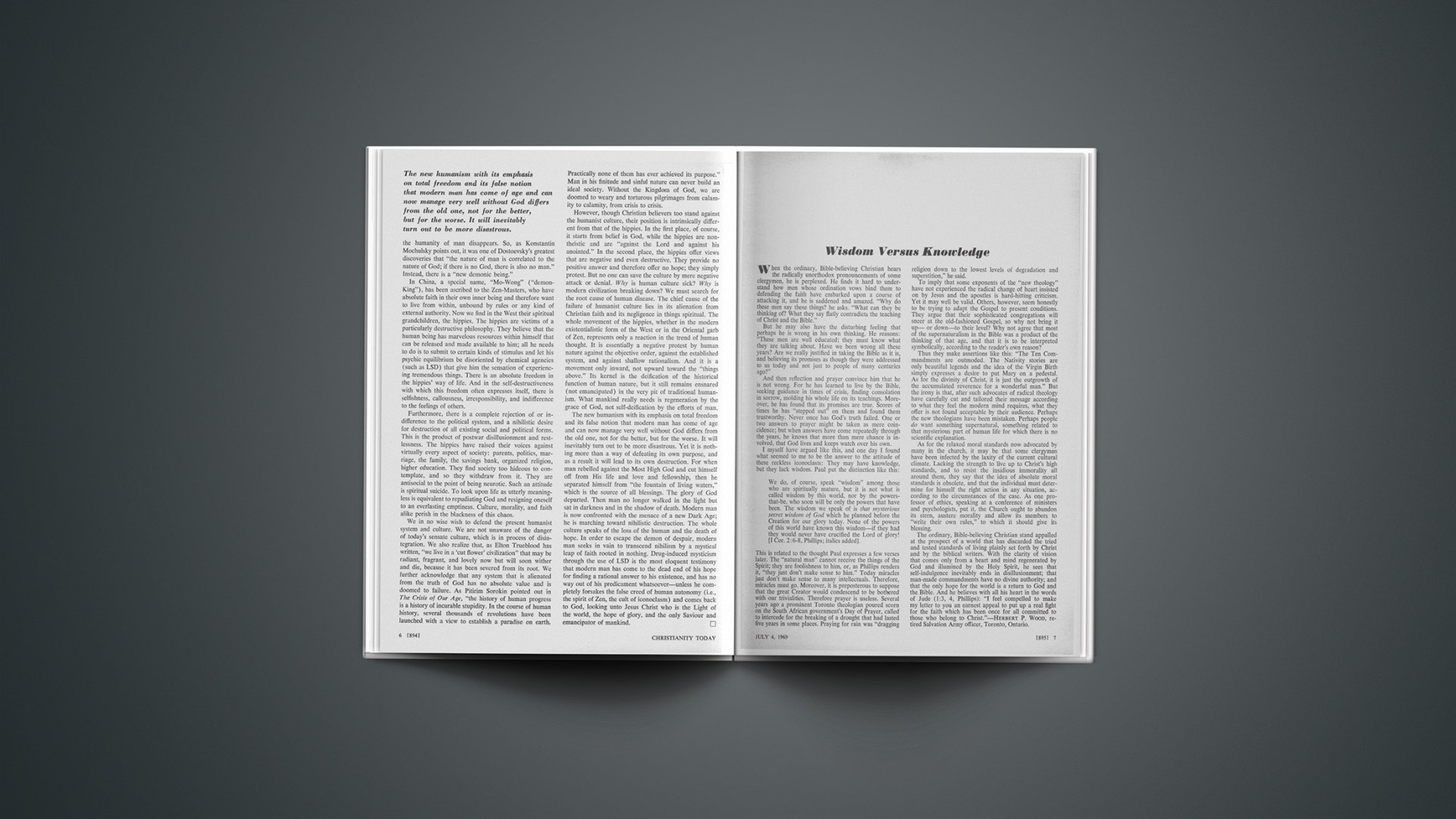

When the ordinary, Bible-believing Christian hears the radically unorthodox pronouncements of some clergymen, he is perplexed. He finds it hard to understand how men whose ordination vows bind them to defending the faith have embarked upon a course of attacking it, and he is saddened and amazed. “Why do these men say these things? he asks. “What can they be thinking of? What they say flatly contradicts the teaching of Christ and the Bible.”
But he may also have the disturbing feeling that perhaps he is wrong in his own thinking. He reasons: “These men are well educated; they must know what they are talking about. Have we been wrong all these years? Are we really justified in taking the Bible as it is, and believing its promises as though they were addressed to us today and not just to people of many centuries ago?”
And then reflection and prayer convince him that he is not wrong. For he has learned to live by the Bible, seeking guidance in times of crisis, finding consolation in sorrow, molding his whole life on its teachings. Moreover, he has found that its promises are true. Scores of times he has “stepped out” on them and found them trustworthy. Never once has God’s truth failed. One or two answers to prayer might be taken as mere coincidence; but when answers have come repeatedly through the years, he knows that more than mere chance is involved, that God lives and keeps watch over his own.
I myself have argued like this, and one day I found what seemed to me to be the answer to the attitude of these reckless iconoclasts: They may have knowledge, but they lack wisdom. Paul put the distinction like this:
We do, of course, speak “wisdom” among those who are spiritually mature, but it is not what is called wisdom by this world, nor by the powers-that-be, who soon will be only the powers that have been. The wisdom we speak of is that mysterious secret wisdom of God which he planned before the Creation for our glory today. None of the powers of this world have known this wisdom—if they had they would never have crucified the Lord of glory! [1 Cor. 2:6–8, Phillips; italics added].
This is related to the thought Paul expresses a few verses later. The “natural man” cannot receive the things of the Spirit; they are foolishness to him, or, as Phillips renders it, “they just don’t make sense to him.” Today miracles just don’t make sense to many intellectuals. Therefore, miracles must go. Moreover, it is preposterous to suppose that the great Creator would condescend to be bothered with our trivialities. Therefore prayer is useless. Several years ago a prominent Toronto theologian poured scorn on the South African government’s Day of Prayer, called to intercede for the breaking of a drought that had lasted five years in some places. Praying for rain was “dragging religion down to the lowest levels of degradation and superstition,” he said.
To imply that some exponents of the “new theology” have not experienced the radical change of heart insisted on by Jesus and the apostles is hard-hitting criticism. Yet it may well be valid. Others, however, seem honestly to be trying to adapt the Gospel to present conditions. They argue that their sophisticated congregations will sneer at the old-fashioned Gospel, so why not bring it up—or down—to their level? Why not agree that most of the supernaturalism in the Bible was a product of the thinking of that age, and that it is to be interpreted symbolically, according to the reader’s own reason?
Thus they make assertions like this: “The Ten Commandments are outmoded. The Nativity stories are only beautiful legends and the idea of the Virgin Birth simply expresses a desire to put Mary on a pedestal. As for the divinity of Christ, it is just the outgrowth of the accumulated reverence for a wonderful man.” But the irony is that, after such advocates of radical theology have carefully cut and tailored their message according to what they feel the modern mind requires, what they offer is not found acceptable by their audience. Perhaps the new theologians have been mistaken. Perhaps people do want something supernatural, something related to that mysterious part of human life for which there is no scientific explanation.
As for the relaxed moral standards now advocated by many in the church, it may be that some clergymen have been infected by the laxity of the current cultural climate. Lacking the strength to live up to Christ’s high standards, and to resist the insidious immorality all around them, they say that the idea of absolute moral standards is obsolete, and that the individual must determine for himself the right action in any situation, according to the circumstances of the case. As one professor of ethics, speaking at a conference of ministers and psychologists, put it, the Church ought to abandon its stern, austere morality and allow its members to “write their own rules,” to which it should give its blessing.
The ordinary, Bible-believing Christian stand appalled at the prospect of a world that has discarded the tried and tested standards of living plainly set forth by Christ and by the biblical writers. With the clarity of vision that comes only from a heart and mind regenerated by God and illumined by the Holy Spirit, he sees that self-indulgence inevitably ends in disillusionment; that man-made commandments have no divine authority; and that the only hope for the world is a return to God and the Bible. And he believes with all his heart in the words of Jude (1:3, 4, Phillips): “I feel compelled to make my letter to you an earnest appeal to put up a real fight for the faith which has been once for all committed to those who belong to Christ.”—HERBERT P. WOOD, retired Salvation Army officer, Toronto, Ontario.