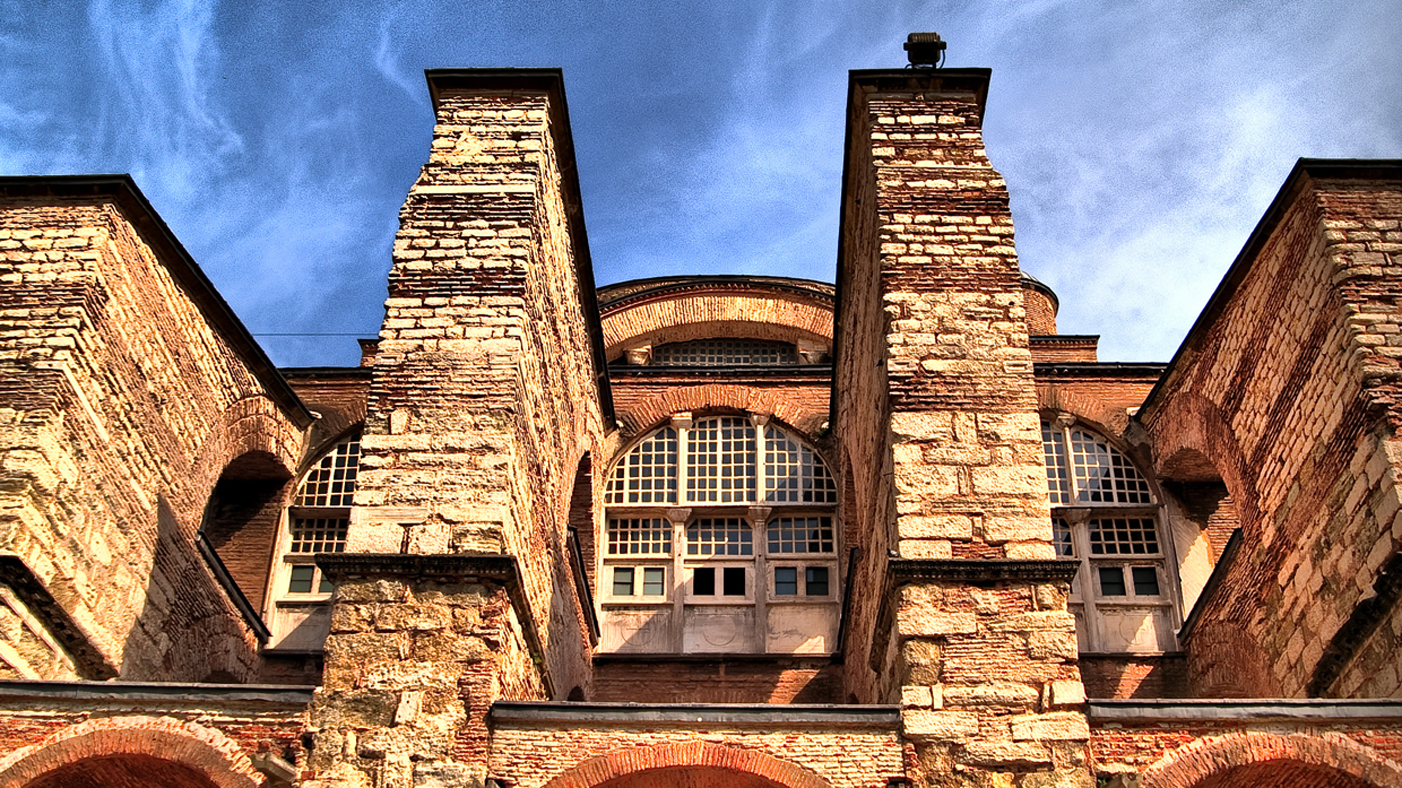

On Saturday, July 16, 1054, as afternoon prayers were about to begin, Cardinal Humbert, legate of Pope Leo IX, strode into the Cathedral of Hagia Sophia, right up to the main altar, and placed on it a parchment that declared the Patriarch of Constantinople, Michael Cerularius, to be excommunicated. He then marched out of the church, shook its dust from his feet, and left the city. A week later the patriarch solemnly condemned the cardinal.
Centuries later, this dramatic incident was thought to mark the beginning of the schism between the Latin and the Greek churches, a division that still separates Roman Catholics and Eastern Orthodox (Greek, Russian, and other). Today, however, no serious scholar maintains that the schism began in 1054. The process leading to the definitive break was much more complicated, and no single cause or event can be said to have precipitated it.
Immediate Causes of the Break
In 1048 a French bishop was elected as Pope Leo IX. He and the clerics who accompanied him to Rome were intent on reforming the papacy and the entire church. Five years earlier in Constantinople, the rigid and ambitious Michael Cerularius was named patriarch.
Problems arose in Southern Italy (then under Byzantine rule) in the 1040s, when Norman warriors conquered the region and replaced Greek [Eastern] bishops with Latin [Western] ones. People were confused, and they argued about the proper form of the liturgy and other external matters. Differences over clerical marriage, the bread used for the Eucharist, days of fasting, and other usages assumed an unprecedented importance.
When Cerularius heard that the Normans were forbidding Greek customs in Southern Italy, he retaliated, in 1052, by closing the Latin churches in Constantinople. He then induced bishop Leo of Ochrid to compose an attack on the Latin use of unleavened bread and other practices. In response to this provocative treatise, Pope Leo sent his chief adviser, Humbert, a tactless and narrow-minded man with a strong sense of papal authority, to Constantinople to deal with the problem directly.
On arriving in the imperial city in April 1054, Humbert launched into a vicious criticism of Cerularius and his supporters. But the patriarch ignored the papal legate, and an angry Humbert stalked into Hagia Sophia and placed on the altar the bull of excommunication. He returned to Rome convinced he had gained a victory for the Holy See.
Dramatic though they were, the events of 1054 were not recorded by the chroniclers of the time and were quickly forgotten. Negotiations between the pope and the Byzantine emperor continued, especially in the last two decades of the century, as the Byzantines sought aid against the invading Turks. In 1095, to provide such help, Pope Urban II proclaimed the Crusades; certainly there was no schism between the churches at that time. Despite episodes of tension and conflict, Eastern and Western Christians lived and worshiped together.
In the latter half of the twelfth century, however, friction between the groups increased, caused not so much by religious differences as by political and cultural ones. Violent anti-Latin riots erupted in Constantinople in 1182, and in 1204 Western knights brutally ravaged Constantinople itself. The tension accelerated, and by 1234, when Greek and Latin churchmen met to discuss their differences, it was obvious they represented different churches.
Underlying Causes of the Break
What caused the schism? It was not the excommunications of 1054; not differences in theology, discipline, or liturgy; not political or military conflicts. These may have disposed the churches to draw apart, as did prejudice, misunderstanding, arrogance, and plain stupidity. More fundamental, perhaps, was the way each church came to perceive itself.
The eleventh-century reform in the Western Church called for the strengthening of papal authority, which caused the church to become more autocratic and centralized. Basing his claims on his succession from St. Peter, the pope asserted his direct jurisdiction over the entire church, East as well as West.
The Byzantines, on the other hand, viewed their church in the context of the imperial system; their sources of law and unity were the ecumenical councils and the emperor, whom God had placed over all things, spiritual and temporal. They believed that the Eastern churches had always enjoyed autonomy of governance, and they rejected papal claims to absolute rule. But neither side was really listening to the other.
In addition, since the ninth century, theological controversy had focused on the procession of the Holy Spirit. In the life of the Trinity, does the Spirit proceed from the Father only, or from the Father and from the Son (Filioque in Latin)? The Western church, concerned about resurgent Arianism, had, almost inadvertently, added the word to the Nicene Creed, claiming that it made more precise a teaching already in the creed. The Greeks objected to the unilateral addition to the creed, and they strongly disagreed with the theological proposition involved, which seemed to them to diminish the individual properties of the three Persons in the Trinity. In 1439 Greek and Latin theologians at the Council of Florence, after debating the issue for over a year, arrived at a compromise that, while reasonable, has not proven fully satisfactory.
After the Byzantine Empire fell in 1453, the Eastern church lived on under Turkish rule and then in various nations. Millions of Orthodox Christians in those lands are still separated from the millions of Christians adhering to Rome. Today greater efforts are made to address the issues, but neither side seems willing to make the necessary concessions. As a result, Christians who share a common belief and accept Jesus as head of the church, feel that they cannot share his Eucharist.
Dr. George T. Dennis is professor of history at Catholic University of America in Washington. D.C., and author of several books on the Byzantine Empire.