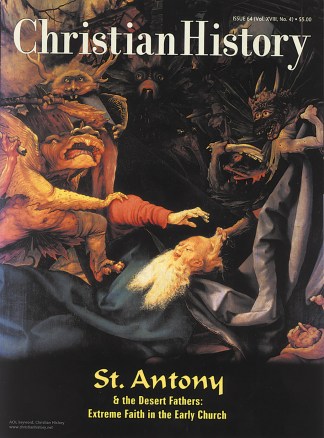
Athanasius tells us that Antony, locked in his cell, repeatedly battled noisy, foul-smelling demons that took the shapes of lions, bears, leopards, bulls, serpents, asps, scorpions, and wolves. Many visitors approaching Antony’s fortress reported hearing sounds of riotous crowds inside, wailing, shrieking, and crying, “Get out of our domain! What business have you in the desert?”—which they later surmised was the noise of demons.
We have such stories not only about Antony but other desert fathers as well. What do they mean?
To begin with, we need to understand the genre in which we find such stories. Athanasius’s Life of Antony, for example, which became a model for saints’ lives, is not a modern history or biography; rather it is a panegyric, a form of eulogistic praise common in ancient pagan literature. Panegyrics of ancient pagan prophets and philosophers routinely included miraculous tales that raised them to the status of superstars.
In early Christian circles, we find many second- and third- century apocryphal Acts of the apostles that followed these rhetorical forms, creating a fictional romance literature that embellished the historical lives of Jesus’ earliest disciples with flashy miracles (in the Acts of Paul, for example, Paul baptizes a lion, and when Paul is beheaded, milk spurts from his neck). Most of the stories of the desert monks followed these pagan models.
This is not to say that all miracles they report are fictions, only that it is difficult today to determine which stories are embellished and by how much.
More important than the genre, though, is the setting. The very word “pagan,” meaning “rural” or “from the countryside,” came to be used of the heathen customs, beliefs, and practices that still lingered in rural areas. As Christianity consolidated its position in the cities, many believed demons were forced to flee to the desert. So Antony and other monks went to the desert to do battle, much as Christ had gone into the desert and was “tempted by Satan, and was with the wild beasts” (Mark 1:13).
To the monks, the unseen spiritual powers they battled took the forms of Egyptian animal gods—Anubis the jackal god, Seckmet the lioness, or Sobek the crocodile. In this the monks were only following the lead of the apostle Paul, who himself had called the pagan gods demons (1 Cor. 10:21), and bishops like Cyprian of Carthage (c.220-258), who taught, “The demons hide within the garlanded statues and images.”
And how did the monks fight these demon hordes? Not with their own power or wisdom, as had pagan philosopher-magicians, but with prayer, Scripture, the sign of the cross, and the name of Jesus. For example, when a demon conjured up a mirage of a camel laden with “useful provisions” for the exhausted Macarius the Great (c.300-c.390), Macarius prayed “and immediately the camel was swallowed up into the ground.”
Such stories, then, intend to show ancient readers how Christians were turning back worldliness and paganism—more particularly, how Christ, through his warrior-monks, was spreading his lordship, even over the demon-filled desert.
Diana Severance is an adviser for Christian History.
For more information on this topic, see:
Medieval Sourcebook: Athanasius: Life of Antony, Full Text http://www.fordham.edu/halsall/basis/vita-antony.html
The Acts of Paul and Thecla http://www.ocf.org/OrthodoxPage/reading/St.Pachomius/Saints/thecla.html
Copyright © 1999 by the author or Christianity Today/Christian History magazine. Click here for reprint information on Christian History.