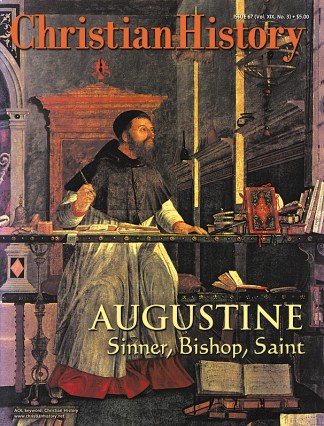
Until the 1950s scholars thought this painting depicted Jerome, as the piece is the third in a series of scenes from Jerome’s life. Then one scholar finally connected the painting with an apocryphal letter in which Augustine (purportedly) says he was writing to Jerome when “suddenly an indescribable light, not seen in our times, and hardly to be described in our poor language, entered the cell in which I was. … When I saw this, moved by amazement and admiration, I suddenly lost strength of my limbs.” Thus the figure is Augustine; the light at the window is Jerome, who has just died (note the hourglass in the lower right) but whose spirit visits Augustine to warn him against scholarly hubris.
Though Augustine and Jerome never met, they kept up a lively, albeit sporadic, correspondence. The war of words began in 394, as each attacked the other’s scholarship. But by Jerome’s death in 420, they had patched things up and were fighting side-by-side against the Pelagian heresy.
In placing Augustine in an idealized sixteenth-century study, the painter, Vittore Carpaccio, has taken liberties of which the saint surely would have disapproved. For one thing, the face is not that of a North African. The portrait likely honors Cardinal John Bessarion, a fifteenth-century scholar and statesman who lamented the fall of Constantinople (1453) as Augustine had lamented the fall of Rome (410).
Augustine would have found the astrological equipment in the room offensive. Though he had a passion for astrology in his youth, he forcefully denounced the pursuit in his Christian writings. The bronze statuette of a nude female (on the ledge at left) is also out of place in the study of a once-profligate man who later chose celibacy and would not allow a woman—even his sister—to enter his house.
The rear-center of the painting depicts liturgical items a bishop like Augustine would have known well: Scriptures, an incense boat, candlesticks, and a bishop’s miter and crozier. Ironically, Augustine never even wanted to be a priest. When Valerius, bishop of Hippo, urged him during a sermon to accept ordination, the congregation literally pushed him to the front of the church. Augustine, feeling God had “laughed him to scorn,” wept from the shame of having once mocked the church and its leaders. (The congregation thought he was disappointed at being made a priest rather than a bishop.)
The sheet music at Augustine’s feet illustrates the saint’s lifelong love of song. As he wrote of his baptism: “The tears flowed from me when I heard your hymns and canticles, for the sweet singing of your Church moved me deeply. The music surged in my ears, truth seeped into my heart, and my feelings of devotion overflowed.”
It’s appropriate that the study would be filled with books—94, to be exact. This is the same number of his own works that Augustine catalogued and corrected in his Retractions, written around 426.
Copyright © 2000 by the author or Christianity Today/Christian History magazine. Click here for reprint information on Christian History.