Christian perfection, therefore, does not imply (as some men seem to have imagined) an exemption either from ignorance or mistake, or infirmities or temptations. Indeed, it is only another term for holiness. They are two names for the same thing.
Thus everyone that is perfect is holy, and everyone that is holy is, in the Scripture sense, perfect.
Yet we may, lastly, observe, that neither in this respect is there any absolute perfection on earth. There is no perfection of degrees, as it is termed; none which does not admit of a continual increase. So that how much soever any man hath attained, or in how high a degree soever he is perfect, he hath still need to “grow in grace,” [2 Peter 3:18] and daily to advance in the knowledge and love of God his Savior [see Philippians 1:9].
In what sense, then, are Christians perfect? This is what I shall endeavor … to show. But it should be premised, that there are several stages in Christian life, as in natural; some of the children of God being but new-born babes; others having attained to more maturity. And accordingly St. John, in his first Epistle (1 John 2:12 & c.), applies himself severally to those he terms little children, those he styles young men, and those whom he entitles fathers.
“I write unto you, little children,” saith the Apostle, “because your sins are forgiven you.” Because thus far you have attained, being “justified freely,” you “have peace with God, through Jesus Christ” [Romans 5:1].
“I write unto you, young men, because ye have overcome the wicked one”; or (as he afterwards addeth), “because ye are strong, and the word of God abideth in you” [1 John 2:13-14]. Ye have quenched the fiery darts of the wicked one [Ephesians 6:16], the doubts and fears wherewith he disturbed your first peace; and the witness of God, that your sins are forgiven, now abideth in your heart.
“I write unto you, fathers, because ye have known him that is from the beginning” [1 John 2:13]. Ye have known both the Father and the Son and the Spirit of Christ, in your inmost soul. Ye are “perfect men, being grown up to the measure of the stature of the fullness of Christ” [Ephesians 4:13].
It is of these chiefly I speak in the latter part of this discourse: For these only are properly Christians. But even babes in Christ are in such a sense perfect, or born of God (an expression taken also in divers senses) as, First, not to commit sin. If any doubt of this privilege of the sons of God, the question is not to be decided by abstract reasonings, which may be drawn out into an endless length, and leave the point just as it was before. Neither is it to be determined by the experience of this or that particular person. Many may suppose they do not commit sin, when they do; but this proves nothing either way. To the law and to the testimony we appeal. “Let God be true, and every man a liar” [Romans 3:4]. By his Word will we abide, and that alone. Hereby we ought to be judged.
Now the Word of God plainly declares, that even those who are justified, who are born again in the lowest sense, “do not continue to sin;” that they cannot “live any longer therein” (Romans 6:1, 2). …
The very least which can be implied in these words, is, that the persons spoken of therein, namely, all real Christians, or believers in Christ, are made free from outward sin. And the same freedom, which St. Paul here expresses in such variety of phrases, St. Peter expresses in that one (1 Peter 4:1, 2): “He that hath suffered in the flesh hath ceased from sin … that he no longer should live to the desires of men, but to the will of God.” For this ceasing from sin, if it be interpreted in the lowest sense, as regarding only the outward behavior, must denote the ceasing from the outward act, from any outward transgression of the law.
But most express are the well-known words of St. John: “He that committeth sin is of the devil; for the devil sinneth from the beginning. For this purpose the Son of God was manifested, that he might destroy the words of the devil. Whosoever is born of God doth not commit sin; for his seed remaineth in him: And he cannot sin because he is born of God” (1 John 3:8, 9). And (1 John 5:18): “We know that whosoever is born of God sinneth not; but he that is begotten of God keepeth himself, and that wicked one toucheth him not.”
Indeed it is said this means only, He sinneth not willfully; or he doth not commit sin habitually; or, not as other men do; or, not as he did before. But by whom is this said? By St. John? No. There is no such word in the text; nor in the whole chapter; nor in all his Epistle; nor in any part of his writings whatsoever. Why then, the best way to answer a bold assertion is simply to deny it. And if any man can prove it from the Word of God, let him bring forth his strong reasons.
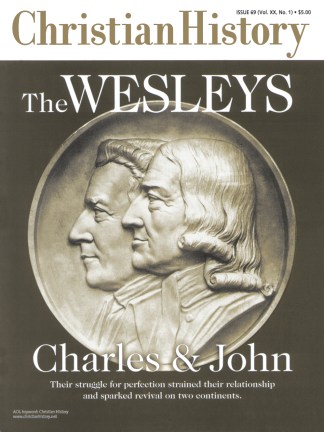
—John Wesley
Copyright © 2001 by the author or Christianity Today/Christian History magazine. Click here for reprint information on Christian History.