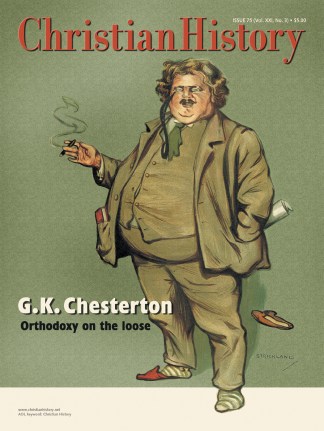
At 26 years old, G.K. Chesterton wrote that the world in 1901 was “full of the trampling of totally new forces.” One of these “new forces” was commonly called the Woman Question:
Should women be allowed to receive higher education? Should they be allowed to vote and take part in politics? What about women being employed equally with men in the business world?
Chesterton agreed with the conservative views of most of his male peers on these questions, but not always for their reasons. Chesterton was not afraid of women, and he did not consider it his God-given right to rule over them. He merely believed that, while women could achieve many things out in the world, they were at their happiest and best in the home. At least this was the case for his mother and his wife.
Chesterton did not grow up in a religious home. Nevertheless, his home provided a shelter from the outside world, and his parents (and brother, Cecil) formed a close-knit, loving family. It was here that his views of women seem to have been formed.
Cecil called his brother’s childhood “the happiest in literature.” The permissive parents let the two boys roam and play to their hearts’ content in the roomy house and garden. Mr. Chesterton ran the family real estate business, and Mrs. Chesterton busied herself with ordering the household activities. Instead of sending their sons away to boarding school, the Chestertons kept them at home. The parents refused to be separated from them.
Chesterton enjoyed a childhood in which he immersed himself in fairy tales and made puppets for a toy theater his father had made. One of Chesterton’s closest childhood friends, Edmund Bentley, remarked that “he had never met with parental devotion or conjugal sympathy more strong than they were in the exceptional woman who was his mother [or] in his father. … whose feeling for literature and all beautiful things worked so much upon his sons in childhood.”
Chesterton’s wife, Frances, was another exceptional woman. Like his mother, she kept the house in order and took care of him. She even put up with his absent-mindedness, as on the day when he wired, “Am at Market Harborough. Where ought I to be?” She answered, “Home.”
Chesterton also admired his wife’s spirituality. Her faith had been instrumental in his conversion, and even when he felt himself pulled away from her Anglicanism, he always greatly valued her opinion. She acted as his chief literary critic as well.
Chesterton’s well-documented love and respect for his mother and his wife temper the apparent misogyny in some of his writings. His writings on the Woman Question also often argue more subtle points than his critics give him credit for.
In “Folly and Female Education” (from What’s Wrong with the World), for example, Chesterton seems to suggest that women should not be admitted to day-schools or Oxford and that they should return to Victorian styles of dress. His real argument, though, is with those who think women should slavishly imitate men.
“It is all part of the same silly subjugation,” Chesterton wrote; “there must be a hard stick-up collar around the neck of a woman, because there is already a nuisance round the neck of a man.”
The essay “The Independence of Women,” on women in the workforce, picks up the same theme. He writes that the “economic independence of women is the same as what is called the economic wage slavery of men.”
Essays such as “The Drift from Domesticity” (in The Thing) strike closer to Chesterton’s larger concern for the sanctity of the family. Here he argues that if women work outside the home, they become independent of their husbands and dependent on their employers. This shift will inevitably take a toll on home life.
Chesterton has much to say on the family. He equates stepping into a family with stepping “into a fairy tale” (Heretics). The family, “a world that we have not made,” may not always be convenient or harmonious, but it is always “full of fiery possibilities.” He also compares the home to the church, calling it “the temple of the hearth.”
One Chesterton biographer, Alzina Stone Dale, suggests that what he wrote in his essays about women and the home can perhaps be summed up by reversing an old nursery rhyme: “The queen is in the counting house, counting out the money, The king is in the parlor, eating bread and honey.” Women, in Chesterton’s experience, display extraordinary skill in keeping families running. What job could be more important or rewarding?
Even though Chesterton’s writings on women appear somewhat dogmatic and outdated, today some career women are leaving their jobs and returning to the home. We can almost hear the jovial Chesterton chuckling and saying, “I knew that sooner or later you’d come around to my way of thinking.”
Bonnie C. Harvey has written several biographies of nineteenth-century figures including Carry Nation and Daniel Webster (both Enslow).
Copyright © 2002 by the author or Christianity Today/Christian History magazine. Click here for reprint information on Christian History.