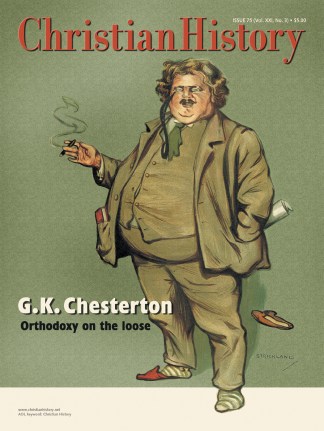



Some historical figures manage to be both famous and obscure. John Newton, the slave trader who wrote “Amazing Grace,” has been boiled down to a perennial sermon illustration. The Earl of Sandwich lives on only as a deli order. G.K. Chesterton pops up all over as the source for clever quotations, yet the American Chesterton Society leads off its website with an article titled, “Who is this guy and why haven’t I heard of him?”
The reader who approaches Chesterton through his fine phrases has taken a good first step. Chesterton celebrated the perspective of “microscopists”—people who find big truths in tiny things—and his style invites microscopist reading.
Author Philip Yancey said, “I don’t think you would study him for paragraphs. I don’t think you would necessarily study him for great prose style. But for the wit and turn of words contained in one sentence, I don’t think he has an equal anywhere.” (For more of Yancey’s thoughts on Chesterton, see page 44.)
Even so, Chesterton’s verbal gems shine with special luster when encountered in their original settings. Chesterton underwent at least two profound spiritual changes (page 10), and he lived through events that set the course for the twentieth century and beyond (page 18). Clashes with prominent peers honed his ideas about faith and society (page 41). Isolated quotations can’t capture these developments.
Quotes also can’t capture Chesterton’s fundamental bigness. He read as voraciously as he ate, and he commented on a range of subjects much wider than even himself. He was able to churn out sparkling, highly concentrated thoughts largely because he had such a profusion of thoughts to begin with.
Take, for example, the Chestertonian statement that “falsehood is never so false as when it is very nearly true.” It’s a great quote, applicable in myriad situations. But isn’t it interesting that the quote comes from Chesterton’s St. Thomas Aquinas, where it refers to an Islam-influenced philosophy that divides faith from scientific knowledge? And isn’t it absolutely amazing that, to write that biography, Chesterton gathered a stack of books on Thomas, opened the cover of the top one, shut it, and proceeded to dictate his book off the top of his head?
Think big. Think small. Think Chesterton.
With this issue, I pass the reins of the magazine to Chris Armstrong. In a sense, it’s a trade—he arrives from the graduate religion department at Duke University, and I begin doctoral studies there in the fall. We both hope to promote the kind of history that delights readers, stays faithful to the facts, and draws living water from the roots of tradition toward all branches of Christ’s church.
Copyright © 2002 by the author or Christianity Today/Christian History magazine. Click here for reprint information on Christian History.