What is it that makes ecclesial migration such an attention-getter? Is it the betrayal of one tradition in order to embrace another? Is it the dramatic Gestalt switch—seeing a duck where one previously saw a rabbit? Is it is the anxiety that greener pastures lie elsewhere?

According to a 2009 study by Pew Forum, “about half of American adults have changed religious affiliation at least once during their lives,” mostly before the age of 24. We might conclude that the evangelical herd is undergoing severe depopulation based on the prominent figures who have abandoned the savannah of low-church fellowships for the alpine air and scenery of high-church traditions—figures such as Peter Kreeft, Richard John Neuhaus, Christian Smith, Peter Gillquist, and Frank Schaeffer. But headlines exaggerate reality. The Pew study reveals that “Catholicism has suffered the greatest net loss in the process of religious change.”
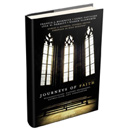
Journeys of Faith tracks four migrations: three of them are from evangelicalism to Eastern Orthodoxy (Wilbur Ellsworth), Catholicism (Francis Beckwith), and Anglicanism (Lyle Dorsett), while the other is from Catholicism to evangelicalism (Chris Castaldo). The format of the book—which includes responses by scholars from the tradition left behind and rejoinders by the converts—encourages friendliness where altercation too often prevails. Personal storytelling, as opposed to scholarly argumentation, also adds more light than heat. The narrative dimension of ecclesial migration reminds the reader that conversions are seldom the outcome of epiphanic events and never solely the outcome of a rational calculus; instead, they are quiet, mysterious, and often circuitous. Uniting all these migrations is a domestic instinct—the human need to feel at home in a church—and the tenacity to pursue the fullness of Christian truth wherever that might be found. More than aesthetic uplift, historic rootedness, or liturgical rhythm, the source of authority proves decisive in these particular migrations; therein, we discover the fault lines of the Deep Church. Converts to evangelicalism, not surprisingly, affirm Scripture as the only rule of faith and practice, whereas converts to Eastern Orthodoxy and Catholicism finesse a relationship between Scripture and Tradition.
Christopher Benson is a writer in Denver, Colorado. He earned degrees from Wheaton College, Missouri School of Journalism, and St. John’s College. His work has appeared in The Weekly Standard, Christianity Today, The Christian Century, First Things, Christian Scholar’s Review, and Image. He blogs at Bensonian.
Copyright © 2012 Books & Culture. Click for reprint information.