Books
Review

The Forgotten Founding Father

Three history books to read this month.

Three book covers on a gray background.
Christianity Today March 6, 2026
Illustration by Christianity Today

This piece was adapted from CT’s books newsletter. Subscribe here.

Jack Kelly, Tom Paine’s War: The Words That Rallied a Nation and the Founder for Our Time (St. Martin’s Press, 2026)

Many excellent books on the American Revolution will help us mark this 250th year of the country’s birth. Founders such as George Washington and Thomas Jefferson will get the most coverage this anniversary year. But our understanding of America’s independence is incomplete without considering Thomas Paine, a then-recent immigrant from England and the author of Common Sense, the most influential pamphlet arguing for American independence.

Jack Kelly’s Tom Paine’s War is a lively introduction to Paine’s critical role in the Revolution. Kelly, a novelist and history writer, doesn’t break much new ground regarding Paine, but he crafts a dramatic narrative that makes Tom Paine’s War a good introductory read.

Kelly notes that Paine is a somewhat forgotten Founding Father, though most American History courses mention Paine’s Common Sense and The American Crisis, best known for its stirring line “These are the times that try men’s souls.” Paine’s lesser status among the Founders is partly explained by his unorthodox religious beliefs. Paine had a family background in Anglicanism and Quakerism and may even have served briefly as a Methodist preacher in England. (Kelly unequivocally says he did, but the fact is not confirmed.)

During Paine’s tenure in France during the French Revolution, however, he embraced radical anti-Christian and anti-clerical ideas. This resulted in his inflammatory The Age of Reason (1794), in which he denounced the Bible and Christianity and declared that “my own mind is my own church.” Traditional Founders saw Paine as a dangerous incendiary and did not wish to associate him with America’s Revolution.

Richard Bell, The American Revolution and the Fate of the World (Riverhead Books, 2025)

A highly illuminating treatment of the Revolution’s international implications is Richard Bell’s The American Revolution and the Fate of the World. The global dimensions of the Revolution were everywhere, from the East India Company’s Chinese tea that rioters dumped into Boston Harbor in 1773 to the treaty signing in Paris that ended the war in 1783. But Americans have understandably downplayed these dimensions because of the symbolic importance the nation attaches to American “exceptionalism.”

Bell’s impressive and readable book won’t let us be satisfied, however, with the Revolution’s usual battle scenes from Bunker Hill, Massachusetts, and Yorktown, Virginia. With each chapter connected to a global-facing vignette, Bell reminds us that in the world perspective, the Revolution was really a series of interlocking gears that turned events in lands as distant as India and Australia.

Bell posits there were at least four simultaneous wars happening during the 1770s and ’80s. These began with many American colonists fighting against British imperial rule. But there was also a French gambit to weaken Britain and reconfigure the European balance of power, a similar Spanish effort to regain and protect imperial domains in the Western Hemisphere, and the undeclared but urgent efforts by Native Americans and Africans in America and the Caribbean to secure their autonomy and freedom.

Yuval Levin, The Great Debate: Edmund Burke, Thomas Paine, and the Birth of Right and Left (Basic Books, 2014)

A deeper examination of Paine’s role in the “Age of Revolutions” is Yuval Levin’s brilliant The Great Debate: Edmund Burke, Thomas Paine, and the Birth of Right and Left. Levin focuses on Burke and Paine’s clashing perspectives on the French Revolution. In Reflections on the Revolution in France (1790), the Anglo-Irish parliamentarian Burke attacked the French upheaval as precipitous and foolish. Burke’s book arguably marked the beginning of the modern conservative tradition. Paine’s response to Burke, The Rights of Man (1791), expressed great confidence in man’s ability to re-create society based on the ideals of liberty and equality.

Paine argued that progressive societies should continually pursue a return to man’s (supposed) natural state, in a society composed of individuals free from arbitrary rules and hierarchy. Virtually all churches and nations, to Paine, erect traditions designed to benefit the few and oppress the many. The people must constantly press against state and church for their natural rights. When necessary, the people should “begin the world over again” (as stated in Common Sense) by initiating revolution.

Paine was sure that when people applied reason to politics and religion, they would jettison traditional structures such as monarchy, established churches, and the historic fallacies propping up these institutions. Like Thomas Jefferson, Paine was certain that reason would eventually demolish Christian doctrinal claims such as the Trinity or the divinity of Christ.

Burke, of course, placed greater confidence in the stabilizing force of political institutions and Christian tradition. Although Burke was a British monarchist, his worries about idealistic and revolutionary social change matched those of conservative American founders, including George Washington, John Adams, and Alexander Hamilton.

Thomas S. Kidd is research professor of church history at Midwestern Baptist Theological Seminary.


History

Considering Both Sides of Church Divisions

CT hosted debates about the charismatic movement and women’s ordination.

A CT magazine cover and an image of women in church.
Christianity Today March 6, 2026
Illustration by Christianity Today / Source Images: Getty, CT Archives

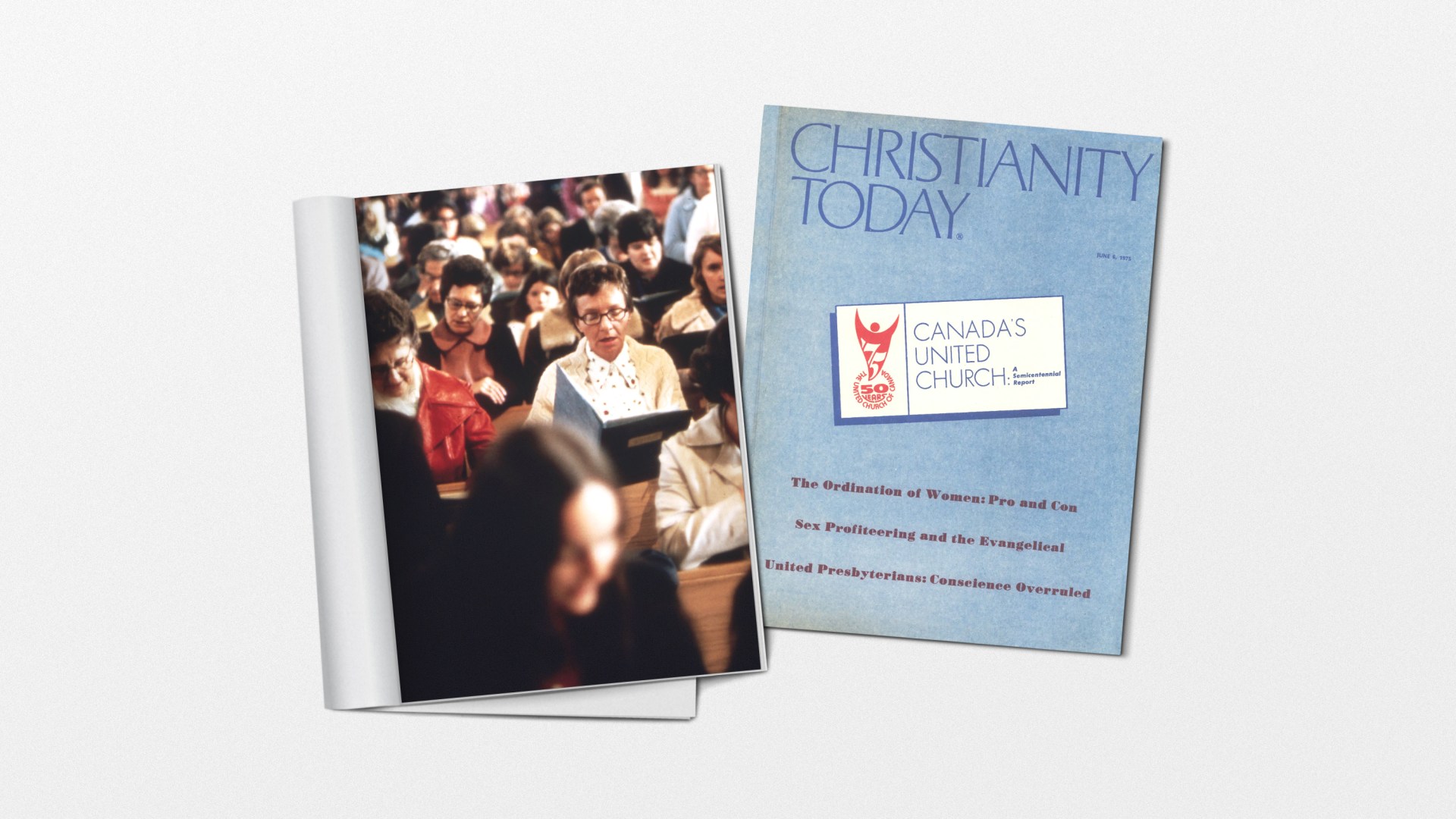
In 1975, CT tried to understand the charismatic movement. Was it evangelical? Was it biblical? Was it good for the church? The magazine published a charismatic theologian making the case for the movement in February.

As one involved in the movement for the past decade, I should like to set forth a brief profile of it. … Persons in the charismatic movement ordinarily stress first the recovery of a liveliness and freshness in their Christian faith. This may be expressed in a number of ways. For example, the reality of God has broken in with fresh meaning and power. God, who may have seemed little more than a token figure before, has now become vividly real and personal to them. Jesus Christ, largely a figure of the past before, has now become the living Lord. The Holy Spirit, who previously had meant almost nothing to them, has become an immanent, pervasive presence.

The Bible, which may have been thought of before as mostly an external norm of Christian faith, or largely as a historical witness to God’s mighty deeds, has become also a testimony to God’s contemporary activity. It is as if a door had been opened, and walking through the door they found spread out before them the extraordinary biblical world, with dimensions of angelic heights and demonic depths, of Holy Spirit and unclean spirits, of miracles and wonders—a world in which now they sense their own participation. …

All of Christian faith has been enhanced by the sense of inward conviction. Formerly there was a kind of hoping against hope; this has been transformed into a buoyant “full assurance of hope” (Heb. 6:11).

Even evangelicals who were sympathetic to ecstatic charismatic practices, like speaking in tongues, often found themselves clashing with the charismatic Christians, though. One pastor wrote of the hard conclusions he had reached.

I have tried my best to make a climate of Christian fellowship and worship that will accommodate both those who speak in tongues and those who do not. My intention was to open the doors of Christian sharing to everyone who loves the Lord Jesus as Saviour.

Having had about a dozen persons in the congregation who speak in tongues, I have come to some hard conclusions after a year of effort. These conclusions have been heart-breaking to me. …

They carried their Bibles and became a part of the congregation’s program and fellowship. However, after some months it was obvious that they had a spiritual superiority complex, and it became obnoxious. Professing to be filled with the Spirit of humility and holiness, these persons expressed the opposite. The subtle but real spiritual conceit became more and more apparent until the words “Spirit-filled” came to have a regrettable taint. …

These persons are insensitive to the concept of Christian discipline.

The magazine also looked at two sides of another debate dividing Christians of the time: the role of women in church. CT reported on a landmark meeting of evangelical feminists and the growing numbers of women going to seminary. Should they be preparing for ministry? Elisabeth Elliot, then a regular CT columnist, presented a case against women’s ordination.

Changes made by the Church merely to accommodate changes taking place in the world have resulted in a loss of power. This week’s “relevance” is next week’s irrelevance.

The question of the ordination of women has been raised inevitably because of the women’s liberation movement. The confusion wrought by this question in the Church is one of many symptoms of a general malaise. As Christians we ought always to be testing our assumptions and priorities against the Word of God, for we are daily subjected to undermining by the secular presuppositions of our age. … 

The exclusion of women from ordination is based on the order established in creation. The first chapter of Genesis gives an account of the creation of the world and its creatures. The creation of man and woman in the image of God himself was the culminating act. This act is more specifically described in the second chapter, in which it becomes clear that the man Adam was created first. When God brought to Adam all the beasts of the field and the birds of the air he named them, but among all the creatures “there was not found a helper fit for him.” It was then that God made the woman, fashioning her from Adam’s own flesh and bone. …

The principles of obedience, submission, and authority are clearly set forth in both the Old and New Testaments. Every creature of God has his appointed place, from cherubim, seraphim, archangels, and angels down to the lowliest beast. Man himself is “made a little lower than the angels,” and was commanded to have dominion over the fish of the sea and over the birds of the air and over every living thing that moves.

A Fuller Theological Seminary professor made the case in favor of ordaining women.  

The creation account … need not be thought to subordinate one sex to the other. Rather, mankind in the divine image is created a partnership of male and female. By the same token the new mankind “foreordained to be conformed to the image of his Son” (Rom. 8:29, ASV) is likewise a partnership of the sexes. Translated into the language of ecclesiology, this is to say: The Church is a universal priesthood of all believers in Christ, female as well as male. …

I conclude that women have full title to the order of Christian ministry as God shall call them. Let those who scruple consider what it has cost the Church not to use the talents of the woman. Let anyone consult the hymnbook and see what women poets—Fanny Crosby, Charlotte Elliott, Frances Havergal, Christina Rossetti, Anne Steel—have taught the people of God to sing and then ask what it would mean if such women were allowed to move beyond the relative anonymity of the hymnal to full visibility in the Church as evangelists, preachers, and teachers. 

And let all who would help them attain such visibility remember that sharing the ministry with women does not mean requiring them to think, speak, and act like men. This would be to misunderstand the meaning of our sexual complementarity. Because God made Man male and female, in the natural realm men are fathers and brothers, while women are mothers and sisters. So it must be in the spiritual realm. And when it is, then, and only then, will the Church be truly the family of God.

Carl F. H. Henry, the emeritus editor in chief, weighed in as well in several columns over several issues on the “battle of the sexes.”

The Bible nowhere teaches male superiority and supremacy and female inferiority and servility. What the Bible pattern establishes instead is the indispensability under God of man and woman to each other in the context not only of society but also of the home as its basic unit. God’s superiority is the fundamental emphasis (cf. 1 Cor. 11:11, 12, “God is the source of all”). Paul expounds this divinely intended order in a Corinthian milieu where, contrary to the practice in Christian churches, a strong effort was under way to introduce a confused equality. 

Equality in Christ, Paul insists, destroys neither apostolic authority in the Christian community as a determination of the crucified and risen Lord, nor the order that God intends.

Not every change in church life was contentious in 1975. CT looked at the explosion in sermon cassette tapes

Tape recorders and players have been around for a long time, but the bulkiness of the equipment and the vulnerability of the tapes limit their creative use by most pastors. …

Cassette-makers are sprouting up everywhere. Christians with gnostic tendencies who gather in “underground” cells glory in circulating cassettes. They have about them the aura of the clandestine samizdat without the risk of discovery. Cassettes can be made by anyone who has a little imagination and relatively simple and inexpensive equipment. They are a boon to every ism in the land. … 

Christian schools are involved in producing and distributing cassettes: Bethany Fellowship, Columbia Bible College, Luther Theological Seminary, Moody Bible Institute, and Regent College. Christian Bookseller Magazine periodically reviews the latest offerings of the major religion-market companies.

There are a growing number of cassette clubs, operating in the familiar pattern of book clubs. The Episcopalians have the Catacomb Cassette Club, and, from another part of the spectrum, Pillsbury Baptist Bible College in Minnesota will enroll you in its fiery evangelist-of-the-month.

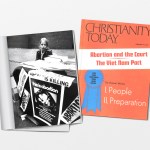
The most pressing political question was America’s responsibilities in Southeast Asia, after the military’s withdrawal from the war in Vietnam. CT reported on the dire situation missionaries faced

Seven missionaries and a child, however, were presumed to be in the hands of the Viet Cong or North Vietnamese invaders. They are:

Mr. and Mrs. Norman Johnson, both 39, of Hamilton, Ontario (Christian and Missionary Alliance); Richard and Lillian Phillips, 45 and 43, of Bloomington, Minnesota (CMA); Mrs. Archie Mitchell, 54, of Bly, Oregon (CMA); and John and Carolyn Miller and their five-year-old daughter, of Allentown, Pennsylvania (Wycliffe Bible Translators). 

All were at Ban Me Thuot in the central highlands, where the CMA operates a leprosarium and hospital. The Johnsons fled into the jungle at the outset of the attack on the town early last month and still had not been heard from as of March 26. The others, along with one or two other foreign civilians, had reportedly sought shelter in the compound of the International Commission for Control and Supervision as fierce fighting raged through the area. Radio contact with the group was lost on March 14.

President Gerald Ford urged Congress to send aid to Cambodia, another Southeast Asian country wracked by civil war. CT reported that, “politics aside,” the support would help Christians in need.

The crisis comes at a time of responsiveness to the Gospel on a scale unprecedented in the Buddhist country’s history. Last year the Khmer Evangelical Church, associated with the Christian and Missionary Alliance (CMA) and embracing nearly all the Protestant congregations in the land, experienced a 300 per cent increase in growth, according to CMA spokesmen. In the event of a Communist takeover, growth will be curtailed and Christian activities severely restricted, if the Communists follow their pattern elsewhere.

“I fully expect to be behind bars one day because of my love for Jesus Christ,” commented one young Cambodian believer.

The US government decided to accept refugees from Southeast Asia—the “biggest all-at-once influx of refugees” in American history—and asked church groups to help. CT explained the resettlement program and urged evangelicals to volunteer

When Christ saw the crowds, “he had compassion for them because they were harassed and helpless” (Matt. 9:36). But many of his followers never quite see things that way. …  

The refugees must have official sponsors before they can leave the rustic conditions of the camps and make their debut in North American society. Life in these temporary quarters is by no means luxurious: the refugees are cramped into tents and old barracks. Food is adequate, however, and recreation opportunities are provided, so that conditions are bearable. But the sooner sponsors are found the better. … All they need is some help in the transitional period. … 

Even if refugees eventually cause some problems, the compassionate Christian should not turn away from helping. These people are God’s creation as much as native North Americans are, and he will do the rewarding. The Samaritan spirit calls for making room not only in our homes but in our hearts. Whatever one thinks about the Viet Nam war, the refugees should be extended a genuine welcome as fellow human beings.

Americans ultimately helped resettle approximately 130,000 refugees from Vietnam, Laos, and Cambodia. Evangelical groups including the Christian and Missionary Alliance, the Southern Baptist Convention, the Assemblies of God, Food for the Hungry, and World Vision played an active role

Ideas

Ministering to Women Includes Physical Health

Counseling women through infertility and other medical issues may feel awkward. Church leaders have an obligation to do it anyway.

A woman's head and stomach and several red dots.
Christianity Today March 5, 2026
Illustration by Elizabeth Kaye / Source Images: Unsplash

Callie Trombley remembers the first time she considered the spiritual significance of her body. Her mom brought it up. As a chaplain in the Air Force, her mom was used to having conversations about birth control, cramps, and family planning with young airmen seeking pastoral care. So when Callie was deciding whether to take birth control for painful periods as a young adult, her mom wanted her to recognize that it was not only a medical decision but a whole-person one.

Years later, when she stumbled upon the topic of contraception while reading a book about the imago Dei, the conversation with her mom rushed back to her. “It felt like a pricking of my spirit, and I knew I needed to dig deeper,” she shared with me. So Callie and her husband, Josiah, did what many Christians would—they scheduled a meeting with their pastor. 

It’s not hard to imagine how uncertain a pastor or church leader may feel about discussing women’s health issues. Envision going to pray for a congregant who is about to have surgery and finding out the surgery is for the woman’s health condition, endometriosis. Should you mention the endometriosis? Stick with generic prayers for a quick recovery?

Addressing women’s health issues as a spiritual leader can be uncomfortable—especially if you’re not female yourself. You want to minister to women, but reproductive health comes with so many mysteries and gray areas that it feels easier to ignore or brush it aside for as long as you can. Every time this happens, though, you’ve missed out on an ideal moment to reveal the love of God.

Unfortunately, many women are used to having their concerns ignored. For a woman with endometriosis, it takes an average of seven to ten years after the first symptoms just to receive the diagnosis. Her primary symptom during those years is pain—sometimes excruciating and debilitating pain that’s overlooked and disregarded by gym coaches, medical professionals, employers, and more. The response of her faith leaders ought to be strikingly different, just as Jesus reacted in a countercultural way toward women and their health problems.

The ancient philosopher Celsus described Christianity as a religion attractive to “slaves, women and little children.” It’s true that Christianity drew women and other marginalized people in large numbers—and for good reason. Here was a faith that said men and women were both image bearers of God (Gen. 1:27) and all equally united in Christ (Gal. 3:28; Rom. 10:12–13), a Savior who welcomed women into his ministry (Luke 8:3), supported and defended them (Matt. 26:10–13; Luke 13:10–17), and healed reproductive issues specific to the female body (Luke 8:43–48).Our God does not overlook women or their health issues. So why should the local church?

Katie McMahon, cofounder of Shiloh IVF Ministry, an organization that provides spiritual support to men and women who have gone through in vitro fertilization (IVF), emphasized to me that the local church is the perfect avenue for showing Christ to women in their need.

“I think there’s a huge nonmedical component in the pastoral support of men and women and couples [with reproductive health questions],” she told me. “People aren’t necessarily looking for treatment options. They’re looking for a space to be and an acknowledgement that they exist and they’re good and they can be fruitful.”

This is what McMahon wanted for herself and her husband as they walked through years of infertility. She wanted to know that her faith could handle her questions and strengthen them as a couple, regardless of how their fertility journey ended. Instead, what she got was a printout of teachings on IVF and embryo adoption. “We really felt like our pastor wasn’t equipped to accompany us,” she said. “It was disappointing.”

Now, as she serves other women through Shiloh, she’s discovered they haven’t felt spiritually ministered to during their reproductive struggles either.

The local church has a monumental opportunity. Through my own work as a certified FertilityCare practitioner, I see firsthand that women’s health is a much-needed area of ministry not only for those facing infertility or considering IVF but for every woman.

At the end of college, I worked alongside others as a chaplain-in-training at an underserved hospital. The primary chaplain, a man mature in both faith and age, taught his mentees the value of exploring the sacred beneath the secular.

When a woman works with me to learn an effective fertility awareness method, she does so because she’s eager to make more informed decisions about birth control or fertility treatments or health diagnoses. But it’s not long before other questions bubble up from a deep well of long-held fears: Am I good enough? Am I capable? Am I broken? Am I alone?

These are not medical questions, but spiritual questions stirred by medical issues. I encounter them week after week: a woman with irregular cycles and heavy periods who has slowly come to distrust and despise her female body; a woman in her late 40s who is approaching menopause and is grieved over the transition; the married couple who is struggling with physical intimacy because of their fear of getting pregnant before they’re ready. Rarely, if ever, do they consider their faith as a resource while they struggle with their bodies, health, or reproductive design. But where else would be a better place to start?

In our increasingly virtual world, the connection between body and soul—the physical and spiritual—can get so buried that we forget the bond between them is unbreakable. In women’s health, it’s easy to focus so exclusively on the medical that we forget there’s something else significant to consider: God designed menstruation and ovulation and everything in between to proclaim his glory.

The local church may be the only place a woman ever hears that God designed all of her—even this part of her—to bear the image of God. It’s critical, then, that we say it—intentionally, frequently, and wholeheartedly.

For male leaders, though, this can feel like dangerous territory. Shouldn’t men defer to women in regard to women’s issues? Certainly. But this doesn’t relieve male leaders of significant responsibility either.

For a woman, her body and potential to conceive are not rare considerations but daily realities. For half the world’s population—for half the people sitting in your church’s pews—these realities affect how they see the world and how it sees them.

In a time when artificial intelligence strips women of their clothing and those with power traffic women like possessions, the local church has the opportunity to proclaim women’s inherent dignity as image bearers of God—dignity that’s not only for married women wondering about contraception or struggling to grow their families but for all women. Going out of our way as Christians to declare this dignity is a powerful witness to the world that women and their health issues matter.

Ministry leaders don’t need to pretend to be experts on women’s issues in order to do this. As for Callie and Josiah’s pastor, he committed to meet with them regularly to discuss, pray, and provide educational resources about family planning.

Because their pastor believed there was a sacramental nature to the human design for reproduction, he had previously wrestled with similar questions and gathered theological resources. When Callie and Josiah met with him, he could share from his own experience and empathy, which was validating for Callie: “We realized this is just as much a part of our family, our marriage, as going out on a date,” Callie said. “It’s a God-given gift. The [reproductive] cycle is actually a beautiful thing.”

At the same time, it’s bigger than that. Callie shared, “As Christians, we can see the connection between our physical bodies and our spiritual nature. And when we’re resurrected someday, we’ll be resurrected with a physical body. So it matters. It’s all connected. Reproductive issues are in fact a discipleship issue.”

Discipleship around the body doesn’t have to be complicated. Normalizing human reproductive design as a gift from God is an excellent first step. Acknowledging the care and respect women’s health issues deserve is another. Some local churches offer support groups, prayer time, or readily available resources related to family planning, chronic illness, or infertility.

Churches can lead the way by celebrating the connection between body and soul, prayerfully exploring reproductive questions and concerns, offering pastoral counseling about matters of the body, or simply risking an honest prayer over a female church member’s endometriosis surgery.

Each act is a reminder that our bodies and their concerns matter to God—and God’s people—and they won’t go unnoticed.

Caitlin Estes is a certified FertilityCare practitioner and owner of Woven Natural Fertility Care. Her book, Woven Well: A Christian Woman’s Guide to Reproductive Health, Fertility, and Wholeness, comes out in July.

Books
Excerpt

Joy Is in the Waiting

An excerpt from Savoring Childhood: Practical Wisdom for Slowing Down.

The book on a gray background.
Christianity Today March 5, 2026
Illustration by Christianity Today / Source Images: Getty, IVP

“How long till we get to the beach, Mommy?” We were about seven minutes from our driveway the first time Henry asked. He was four years old, and the two of us were headed from our home in the foothills of South Carolina down to the coast, where the rest of the family would join us at the end of the school week.

Expecting him to be disappointed that so much of the trip lay ahead of us, I framed my answer as an apology. “Sorry, buddy, but we still have more than three hours to go.”

Hours and minutes were somewhat abstract to Henry’s young mind, but he understood that three hours was a lot of time. Still, his little spirit was so full of excitement that he squealed with joy, “Hooray, hooray! Only three more hours till we get to the beach!”

His response lifted my spirits, so a short time later when he asked again, “How much longer till we get to the beach?” I cheerily reported, “Only two hours and 45 minutes to go!”

Yes!” he shouted. “We are getting closer!”

He was right. We were getting closer with every second and minute that passed. And rather than focusing on the fact that we weren’t there yet, he was focused on our movement in a good direction—and he was actually savoring the journey. He chattered away in his car seat about things he was hoping to do when we arrived. He asked me to name every cousin, aunt, and uncle who would be there. He was looking forward to building a sandcastle and was excited about what we might have for supper. As we drove, Henry was making plans in glad anticipation of his desires rather than fretting over the not yet of it all.

For the rest of the ride, he continued to ask for the countdown to arrival. Instead of feeling exasperated by his repetitive questions, I got more and more tickled by his enthusiasm.

Whenever we make the trek to the ocean, our family brings up this story. I suppose it reminds us that the journey can be part of the fun, even though it involves waiting. The memory holds out a glimmer of possibility: Children can learn to wait . . . even to wait with joy.

So much effort and innovation these days goes into speeding up the journey, whether it’s a literal journey to a physical destination or the journey from I want it to I have it. This pattern of instant fulfillment has a diluting effect on joy.

On a folded sheet of yellowing paper that my mom discovered among some family documents, there is an unpublished essay by my great-aunt Eugenia Pearson called “The Magic of Expectancy.” Eugenia writes,

The youthness of youth is due largely to fervent and undiluted expectancies. People begin to be old, regardless of birthdays, when they limit and tame down their expectancies. Of course they try to feel that this taming down and limitation are respectable by calling them “settling down.” They seem to ignore the fact that in a living, changing, and growing world there can be no settling down at any stage of life. Expectancy keeps us in the creative livingness of life, where all desires are energized.

Eugenia was from an era of waiting stoically and not getting one’s hopes up. She was a teenager during the Great Depression. To her contemporaries, she brings the message that it is good to dream big and lean into longings. It’s a beautiful reminder not to give up on expecting God to do something wonderful, even when times are tough.

We are from a different era. Today, expectancy isn’t dulled by having our hopes dashed constantly by hardship, but rather by having them fulfilled instantly, always. Like the character Veruca Salt in Willy Wonka and the Chocolate Factory, who sings, “I want the world. . .  I want it now!” children who habitually get what they want without delay are tyrannical when they have to wait. You see, entitlement is not expectancy. Impatience is not expectancy. Instant gratification has an unholy power to warp how our children think and feel. It muddies the clear, delicious water of expectancy and turns it into exasperation—a sour drink that makes waiting sheer misery.

Like a little devil on our shoulder, impatience whispers angry, fitful complaints in our ear that make us focus on what we don’t have. But there is another way to wait. A way of waiting that focuses on what we will have with confidence and enthusiasm.

As tempting as it is to try to spare our kids the pain of waiting, the best way to ease their anguish is to help them discover that waiting is not so bad. My favorite strategy for shifting a child’s perspective from exasperation to expectancy is to use countdowns. A countdown breaks up a long process into a series of small celebrations. This is not a trick to anesthetize or speed up delayed gratification. In fact, countdowns highlight rather than hide the reality of how far away you are from a desired destination or outcome. But by marking progress and celebrating milestones, countdowns make the journey feel endurable, even enjoyable. Children benefit from the way countdowns place something attainable in the foreground while giving them freedom to talk about their hopes and imagine the future.

Even if a desired outcome is very far away and progress is slow and gradual, stepping out the journey helps young people look forward with delight rather than despair. The journey itself is a fertile space for practicing patience and cultivating gratitude. Not everything a child wishes to attain is worth pursuing, but healthy desires deserve the space to gain momentum, even to reach the intensity of what we might call longing. Delayed gratification makes that crescendo possible and makes attainment all the more sweet when it finally comes. The natural byproduct is heartfelt appreciation.

If an instant lifestyle is getting in the way of your child’s ability to practice patience and savor longer processes, here are some tips for reclaiming the sweet parts of waiting.

  • Don’t avoid telling kids about good things that are far off. The further out you tell them, the longer the on-ramp for their mental preparation so that they can engage deeply and savor the experience. Start with brief countdowns for toddlers (a few hours, or one day before a big occasion). And build up to extended countdowns with big kids, for whom even a year or more should not be too long to sustain expectancy for something wonderful.
  • Loop kids in on preparations. Even if a child’s help actually makes life harder for you—and it will!—it forms something important in children to see themselves as contributors, and preparing can set their minds on the good that is to come with fresh energy and enthusiasm. Eventually kids who have taken part in preparations become truly helpful and enjoy it. We have finally reached that stage, and it is so rewarding!
  • Talk about hopes in family prayers. When you pray aloud together, thank God for opportunities that you are looking forward to. Share your own excitement, voice your frustration when waiting is hard, and encourage kids to voice their feelings honestly. “How long, O Lord?” is a biblical plea (see Psalm 13, for example). Including God in our looking forward helps kids learn that our heavenly Father cares about all the intimate details of his children’s lives. All good experiences worth waiting for are his gifts to us.

Enduring a child’s many questions and emotions is a test of endurance for grownups. If we’re honest, we could use the practice. Becoming patient is a lifelong process. So keep answering those questions, patiently and enthusiastically. Building up our own endurance helps prepare us for the long journey of shepherding young people into the childhood experiences that will help them to grow in wisdom, character, and love for God. This is the goal ahead of us, the great destination we are expectantly, or perhaps anxiously, awaiting.

“My little children,” Paul wrote to the Galatians, “I am again in the pain of childbirth until Christ is formed in you” (4:19, NRSVue throughout). Long journeys, even spiritual ones, can at times be excruciating. But with every yes we give to God, with every step we take to cooperate with his grace, even with every chapter we read and every suggestion we put into practice, we are getting closer. (You are closer now than you were before you read this sentence!)

So hold on to joyful expectancy. And “may the God of hope fill you with all joy and peace in believing, so that you may abound in hope by the power of the Holy Spirit” (Rom. 15:13).

Grace P. Pouch is content manager for Renovaré, where she curates and produces resources for spiritual renewal. She previously served as a seminary professor. She is the author of Savoring Childhood. Adapted from Savoring Childhood by Grace P. Pouch. Copyright (c) 2026 by Grace Pate Pouch. Used by permission of InterVarsity Press. www.ivpress.com

News

Q&A: Some Israelis See Esther’s Story in the Attacks on Iran

Journalist Yossi Klein Halevi speaks to CT about Jewish reflections on the US and Israel-led war.

Christianity Today March 5, 2026
Illustration by Rick Szuecs / Source Images: Envato /  US Navy / Nur Photo /Getty


Early this week, as the joint US-Israel attack on Iran began, Jews around the world celebrated Purim, the ancient feast commemorating Esther’s rescue of the Jews from Haman of Persia. The Bulletin host Mike Cosper sat down with Yossi Klein Halevi, a journalist and senior fellow at the Shalom Hartman Institute in Jerusalem, to learn more about the Jewish response to these attacks and how the biblical story Israel celebrates this week informs Jews’ understanding of Middle East conflict. Here are edited excerpts from their conversation in episode 258.

How is the mood in Israel, even as people are running to bomb shelters and getting alerts from time to time as well?

On one hand, Israel is resolved—there’s no question. People are ready to make lots of sacrifices to bring this regime down. On the other hand, there’s deep disorientation and fatigue and still a society that’s quietly grieving. We’ve lost several thousand people since October 7 [2023] and thousands wounded in a country that’s completely traumatized. Now we’re back in the trauma. 

This is a very strong country, and there’s virtual unanimity among Israelis, certainly in the political system. There’s no opposition at this moment. Everyone understands this is an existential need for Israel and for the future of the Middle East. It doesn’t make it easier on the home front. 

Last night, we had our first-ever missile falling in Jerusalem. The conventional wisdom during all of Israel’s wars, whether against Hezbollah or Hamas or Iran, was that no one would dare fire missiles into Jerusalem because they wouldn’t want to risk destroying Al-Aqsa mosque or the Dome of the Rock, the two main Muslim holy sites in Jerusalem. Last night, Iran changed the ground rules and fired a missile into East Jerusalem. 

Israel has been through this since Saddam Hussein and the first Gulf War in 1991, when Iraq fired 39 Scuds into Israeli cities. We’ve been in and out of shelters for 35 years. I raised my kids going in and out of shelters. There were certain ground rules, even to the nonconventional war, and there aren’t anymore. The regime is fighting for its life, and it’s desperate.

You’ve sought energetically in a number of your works to understand your neighbors, both Christian and Muslim. Twenty years ago, you said we can’t let this regime just sit there and build nuclear weapons. How has your understanding developed over the decades?

Being an advocate for reconciliation between Israelis and Palestinians, between Muslims and Jews, looks and works differently in the Middle East than it does, say, at Columbia University. When you’re sitting here in ground zero of radical Islamism, you very quickly understand that there can be no peace without confronting the enemies of peace. The prerequisite for reconciliation between Israelis and Palestinians, for example, is confronting and containing radical Islamism. 

Now, I’m also a fierce opponent of my own government, but there are many differences between my government and Hamas. This is a democratically elected government, and I have the option come October, which is when the next Israeli elections are scheduled for, to do everything I can to bring this terrible government down. But when I call this a terrible government, I’m still going to draw a very firm red line between Hamas and even this government. There are elements in this government that are uncomfortably Jewish echoes of radical Islamism. But that’s not true for most of this government. I loathe this government. I have spent much of my last three years actively opposing this government in the streets, sometimes every week, every other day. That, for me, is also part of my commitment to reconciliation. 

But when you’re facing radical Islamism, there’s no recourse but to go to war. That’s something a lot of people in the West have forgotten. The West, at least America, once understood that, and I understand that the cumulative impact of the forever wars have undermined the resolve of Americans. However, not to stand up to the Iranian regime when it’s at its weakest point in the last decades would be to compound the mistake of going to war when you shouldn’t have. Not to go to war when you should is not a way of compensating for having gone to war when you shouldn’t have.

What do you think comes next for Iran, especially as the bombs keep dropping, as the Islamic Revolutionary Guard Corps is defanged?

I don’t think this is going to be easy or straightforward. Probably 15 to 20 percent of the public supports the regime. That’s a recipe for regime collapse. I believe the regime will collapse, but it still has enough of its hardcore support to put up a very credible fight. This regime has, for half a century, entrenched itself in all parts of the Iranian infrastructure and suppressed opposition from the very beginning. 

Even more importantly, elements within the regime are imbued with an apocalyptic fervor that believes this is the last battle before the return of the Mahdi, the Shiite messiah. The secular West tends to downplay the significance of the theological strain in the regime calculations because the secular West doesn’t understand religion. 

In Israel and the Middle East, the lines between religiosity and the national experience are never clear-cut. For example, tonight [March 2] is Purim. The holiday of Purim is about the victory of the ancient Jews of Persia over Haman, who wanted to destroy them. Every Israeli understands the resonance of a war against modern Persia—modern-day Iran—led by a modern Haman. That’s the given language of discourse here. The politicians, the army, the chief of staff speak about it. When the commander of the Israel Defense Forces, Lt. Gen. Eyal Zamir, addressed the nation Sunday, he spoke about the story of Purim. 

Here we are 2,500 years after the Purim story. It’s like Groundhog Day except with much more lethal consequences. But there’s also something very powerful about these recurring themes in Jewish history, and sometimes not just themes but literal reenactments. For me as a religious Jew, what we’re experiencing these days gives me pause. I don’t presume to know God’s will, and I’m not sitting looking at the newspaper as if it’s the Word of God and I can interpret what’s happening. I think that there’s a real problem when religious people do that. At the same time, as a religious person, I notice certain patterns that happen in the Israeli story. And I wonder, What is this all about? What’s the message here?

There seems to be something else at work here in this very strange Jewish story. It gives Israelis generally a sense of purpose and, more than that, a framework of meaning to the story. It’s not just about survival. There’s this sense in Israel today as we’re entering Purim: Here we are back with the Persians again.

That’s the Book of Esther itself. It never mentions the name of God once in the entire book. It’s all about the hiddenness of God in providence.

There’s a rabbinic wordplay of the name Esther, which also means in Hebrew “hiddenness,” hester. The Hebrew phrase for God’s hiddenness is hester panim, “God’s face is hidden.” The divine is literally hidden in the Book of Esther. God’s name is never mentioned, yet one can discern in the Book of Esther this uncanny series of coincidences that leads to a redemptive trajectory.

The Book of Esther really works on multiple layers. On the one hand, Mordecai warns Esther that God is going to do this whether you’re part of it or not. And yes, who knows what your fate will be if you opt out? In that sense, he’s not giving her a choice, but he also says something very touching to her. He says a phrase which has become one of the best-known aphorisms in Jewish discourse. It’s been absorbed into modern Israeli discourse: Who knows if you didn’t rise to your status for a time like this? That is that sense of destiny. 

In a way, you can sum up Jewish history with everything that Mordecai has told Esther. On the one hand, it’s going to be really bad for you. On the other hand, what a wonderful opportunity. Mordecai is hitting Esther with a combination of fate and destiny. Fate is what’s imposed on you, and destiny is what you choose for yourself. Those are recurring themes both in the story of Purim and in Jewish history. What we’re experiencing now is this convergence of these themes at this moment. 

If you had polled Israelis, the decision to go to war would have won by a landslide. Even though we, along with the Iranian people, are the ones who are the most endangered by that decision, we just take it for granted that we must do this for survival. That’s fate. But we also need to do this to stand against evil, and that’s destiny. There is this convergence of fate and destiny at this moment in Israel’s history.

If the regime does fall, what might that mean for religious minorities across the Middle East, not just Jews living in Israel?

This has been a very bad period for religious minorities around the Middle East. It’s hard to say whether this is really going to turn things around in other countries. Think of the countries where the Iranian regime has had such a strong hold—in Iraq, Yemen, and Lebanon. In Yemen, a 2,500-year-old Jewish community was destroyed, and no one is left. The Iraqi Jewry goes back to Babylon, literally 2,500 years, and that community has been completely erased. Baghdad in the 1930s was one-third Jewish. It was the New York of the Arab world.

The longest-lasting Jewish communities in the world, which were in the Middle East, have experienced a massive uprooting. They were destroyed in a single generation, sometimes within a year.

There’s such rage against Shiism in Iran. During the popular uprising in January, there were something like 350 mosques that were burned by outraged mobs. They see Shiism as the reason for their oppression. If the regime falls, religiously, Iran is going to go through major convulsions. 

Within Iran, whether they rename themselves literally or reinvent themselves culturally and religiously, Persia is reemerging. I also sense there’s going to be a very strong resurgence of Zoroastrianism and the Baha’i faith, these two indigenous Persian faiths. 

I think Christianity is going to have a tremendous flowering in Iran as well. To leave Islam and convert to another faith carries with it a death sentence, so you’re looking at a heroic nucleus of a Christian resurgence there. I think there’s going to be a resurgence of the Jewish community. There’s a large Persian community in Israel, in the US. I suspect there’ll be a reawakening and people will go back, certainly on pilgrimages. I think we’re going to see a tremendous flowering of other religions. 

Church Life

Helping the Church Think Clearly

President & CEO

A note from CT’s President in our March/April issue.

Church building with a lighthouse tower instead of a steeple shining a beam of light.
Illustration by Rick Szuecs / Source images: Envato

Around two o’clock in the morning in 1953, Billy Graham awoke with an idea. The idea grew from years of conversations with Harold Ockenga, Carl Henry, and Charles Fuller. They were eager to use their gifts, networks, and insights to influence the next generation of Christian ministers and leaders. Burdened with the weight of a God-sized dream, Graham penned the document for Christianity Today

My idea that night was for a magazine, aimed primarily at ministers, that would restore intellectual respectability and spiritual impact to evangelical Christianity. It would reaffirm the power of the Word of God to redeem and transform men and women. 

After more than 70 years, we bear witness to this God-sized vision that is still vibrantly alive. From the beginning, Christianity Today has carried a singular, unshakable mission: to elevate the name of Jesus Christ. There is no greater calling. 

Long before our first issue was printed, Billy Graham envisioned a magazine to help the church think clearly, live faithfully, and bear witness to the one who holds all things together. His conviction, and the conviction of those who came after him, was that Jesus is not merely the subject of our stories. He is also the center of our hope, the heartbeat of our work, and the Lord whom we joyfully serve.

Christ is the one who brings life where death reigns. He breaks down walls, reconciles enemies, forgives sinners, and welcomes the prodigals home. He brings light where darkness gathers and hope where despair threatens. It is him alone CT seeks to magnify across continents, generations, and dividing lines. 

As we look back through the pages of CT’s history, we draw from a deep well of evangelical teaching and tradition that prioritizes the authority of Scripture, the necessity of new birth, and the beauty of Christ’s redeeming work. Our times are not unique. The gospel has always faced opposition, the church has always navigated division, and seasons of cultural upheaval are nothing new for God’s people. Through every era, Christ remains faithful. His kingdom has not faltered. His Spirit has not diminished. His people still prevail.

Our task is to glorify Jesus, the one who still saves, forgives, reconciles, and redeems. While the world may say this isn’t possible and Christ’s power is insufficient for our crises, they are wrong. The same Spirit who raised Jesus from the dead and ignited the early church is at work now—awakening hearts, renewing minds, and calling believers to bold discipleship (Rom. 8:11).

As I step into my role as CT’s president, I honor CT’s legacy and move forward with expectant hope. CT will continue to lift Christ high, make his beauty visible, and speak gospel truth with conviction and compassion. We will continue to hold fast to the gospel that invites us not to a shallow unity but to the deep, reconciling bond forged only by the crucified and risen Lord.

This is the perfect time to lean into the mission of Christianity Today. Let us journey together with our faith forged by the past and our hearts filled with joy as we steward this sacred calling until Christ comes for us again! 

Nicole Massie Martin is president & CEO of Christianity Today.

News

Churches Haven’t Forgotten Portland

Churches partner with business and city leaders in Portland’s downtown core.

Person lying on a sidewalk in a graffiti-covered Chinatown street.

A person lies on the street in the Old Town Chinatown neighborhood on January 25, 2024, following the decriminalization of drugs in Portland, Oregon.

Getty

On the descent, Portland looks like it did more than a decade ago, when I first started flying home from college for visits. The little city glimmers in light reflected between the river and the overcast sky. There’s the tallest building, iridescent pink, where my dad used to work. Still pink. There are the ubiquitous trees. Still green. There are the warehouses and houseboats and a series of bridges spaced across the Willamette River like a line of shoelaces strung through eyelets. 

My feeling of relief as the plane touches down has stayed the same as time has passed. I’m home. But in the years I’ve lived away from Oregon, Portland has reeled. A broken-glass summer of 2020 protests preceded a failed attempt to decriminalize drugs in 2021 and a record-breaking number of homicides in 2022. (The Old Town Chinatown neighborhood suffered in particular, earning the nickname “the Skid Row of Portland.”) In September 2025, riffing on a round of demonstrations outside the city’s Immigration and Customs Enforcement facility, President Donald Trump declared that living in Portland was like “living in hell” and said he was considering sending in National Guard troops. 

Later reporting revealed that the troubling footage the president had seen on Fox News was actually from Portland’s summer of 2020—not 2025. The network had mislabeled the clips and otherwise mischaracterized the most recent unrest. Yes, police had fired tear gas in those encounters, ProPublica said, but it found “no evidence of what could be termed a coordinated assault [by protestors],” and “on most of the days or nights when officers and protesters clashed, local police and federal prosecutors ended up announcing no criminal arrests or charges.”

Hell doesn’t describe the city’s tentative upward trend lines. Since “record-breaking violence” in 2021 and 2022, reports The Oregonian, homicides and shootings have decreased precipitously in Portland. So have, to a lesser extent, aggravated assaults and robberies. In 2024, legislators rolled back the drug-decriminalization legislation. By the end of 2025, under the leadership of the city’s new mayor, Keith Wilson, Portland had opened more than 1,500 shelter beds and enforced a ban on camping in public places. Last summer, downtown foot traffic was the highest it’s been post-pandemic.

But Target, REI, and other big-box stores that left the downtown core haven’t come back. From January to August 2025, Portland office-worker presence was at only 50 percent of 2019 levels. (The national average was around 73 percent.) The city’s economy is down: Last fall, an industry report ranked Portland “80th of 81 markets for the second year running for overall real estate prospects across property types,” beating out only Hartford, Connecticut.

The owner of the popular Mother’s Bistro & Bar, which serves cornflake-encrusted French toast, said her dining room is noticeably emptier: “Without weekday traffic, our city looks abandoned. It is abandoned.” (When I ate brunch at Mother’s last spring after running a popular St. Patrick’s Day 5K, I was shocked to be seated immediately.) 

Pastor Tyler Michel grew up in Portland. He left in 2011, a time when the popular comedy series Portlandia shaped public perception. Bustling breweries, a thriving art scene: Portland was the place to be. Now Michel is back to pastor the 48-year-old Greater Portland Bible Church (GPBC). He says, “The level of optimism has completely changed.” Now, graffiti urges, “Don’t give up on Portland.” 

While pastoring, Michel is also working on a doctorate at Wheaton College focusing on how churches can partner with civic and business organizations—and Portland is a living laboratory. He wants his congregants to skip the outrage about the state of their neighborhoods and focus on practical, local interventions. GPBC runs a food pantry that serves 150 guests every weekend, and the church is hoping to host a tool library in its space. 

The church is also thinking through plans to use its property—a former dairy farm sprawling over 14 acres—as a community gathering hub. Recently, it sold two acres to Habitat for Humanity to build affordable housing. GPBC tries to support local businesses by ordering in food from nearby Thai and Mexican restaurants. Michel dreams of helping would-be entrepreneurs start their own shops and micromanufacturing outfits.

“Devastation leads to desperation that leads to transformation,” Michel said. “Sometimes churches choose either gospel proclamation or community development.” He wants to do both: “maintain a commitment to the gospel, which is the ultimate way people can thrive personally” and also “step into areas of common grace.” Michel wants churches like his to “take a seat at the table” with business and civic leaders while recognizing that, especially in a secular city, the table doesn’t belong to them. 

Tim Osborn takes the same approach. He’s pastored on both the east and west sides of Portland for almost 20 years, planting five churches along the way. He’s seen the city shift as job security—especially at big employers like Intel and Nike—has risen and fallen and housing costs soared past income levels. 

Osborn said the church has to help with those common-grace concerns. Young married couples need coaching on how to make budgets. A friend in the restaurant industry needs support as he crafts drinks for a brand-new eatery, working late-night shifts. A Christian can “revitalize the city” by “being a good manager … being faithful in whatever vocation you’re in.”

Mayor Keith Wilson recently gathered pastors into a room to share his shelter-bed vision. Osborn found the outreach encouraging, that “12, 13, 14 years, they said, was the last time a mayor actually opened up and said, ‘Yeah, I want to hear from and … partner with pastors and churches.’” 

Osborn also teaches at Western Seminary and sees “a new wave of leaders coming … young men and women [who still have] a vision for church planting … caring about the inner core of the city.” And that seat at the table? Yes, take it!

Perhaps literally. Last fall, a prayer room called Garden Space PDX set up a long table along Burnside Street in beleaguered Old Town—bedecked with donated flowers and laden with salmon and chocolate mousse. The group sold some tickets in advance but also left chairs for unpaid guests and anyone who walked by, including those in vulnerable situations. Hungry people who didn’t want to take a seat simply filled their plates and hung out around the block.

The Garden Space prayer team recalled “Scripture that talks about Go out to the highways and the byways” (Matt. 22:8–10), said Renee Boucher, a member of the Garden Space lead team who’s done ministry in Portland for nearly 40 years. Old Town is “still so dark,” she acknowledged. “It’s a place people are afraid to go.” But for three years now, the ministry has led prayer walks around the district. And they’re getting results.

“I see the same language that we’re using in our prayers coming out of our mayor or business owners. … There’s a desire to see Old Town revitalized in a way that actually allows for the flourishing of all people,” Boucher said. 

In the midst of more plans for 2026—prayer campaigns against human trafficking, workspace for artists in the “urban abbey” (as Garden Space is known), more dinners—she’s relying on a “phrase that seems to be a tagline for many of us now: Hope blooms in the City of Roses.” 

“We’re believing that for downtown,” she declared. “We’re believing that for the city.” 

Kate Lucky is a senior features editor at Christianity Today.

Theology

This Easter, Let’s Lose Our Hope

Columnist

We need more than reassurance, punditry, or prediction.

Illustration of a silhouette of a pile of debris with a flower growing from it.
Illustration by Ben Hickey

Once, I had to help someone lose her faith. Kind of. 

She was coming out of a prosperity gospel background in which people used the admonition “Have faith” to manipulate her into giving more money to the ministry. It was her lack of faith, they told her, that was to blame for her sickness and poverty. At one point, after listening to this woman lament her lack of faith, I said, “Why don’t we forget faith for a little while and just trust Jesus?” 

Trusting Jesus is, of course, what the Bible calls faith. And in the fullness of time, I told her that. But before she could understand the reality by which she could live, she had to let go of the illusion by which she was swindled. As soon as she stopped worrying about how much faith she had and looked to Christ, she was, in fact, exercising faith. Lately I’ve wondered if the same is true for most of us in regard to another good word that has lost its meaning: hope

My fellow evangelical Christians love the word hope almost as much as a pastor exposed as an adulterer loves the word grace. In almost every setting in which I speak, one of the first questions people ask is “What gives you hope?” or “Where do you see signs of hope?” When pressed to define what they mean, they ultimately describe what they’re seeking as measurable reassurance—the calming word from an authority that everything will turn out okay. 

If I were braver, I would simply respond, “An evil and adulterous generation seeks for a sign, but no sign will be given to it except the sign of the prophet Jonah,” (Matt. 12:39, ESV throughout). But I am made of squishier stuff than Jesus, so I usually give some signposts of good things to come. When I do that, though, I am giving them punditry or prediction, not hope.

By definition, whatever statistics I could give about Bible sales or church attendance would not be hope, even if these numbers were much better than they are. “Now hope that is seen is not hope,” the apostle Paul told us. “For who hopes for what he sees?” (Rom. 8:24). 

Still, we want that visible, quantifiable reassurance, don’t we? I suppose everyone does, but perhaps evangelical Christians want it more than most. Even those of us who reject a prosperity gospel easily fall into a kind of “prosperity providence,” if not with our own lives then with the church itself. When the church is growing and successful, we seem to think this proves the gospel is worth believing. Somehow, even those who believe that the call to Christ is the call to come and die still think claiming health and wealth is okay, as long as it is for the mission and not just for us. 

The problem, though, is that this kind of hope disappoints. When visible institutions and articulable ideas fall apart—and they will—those who thought hope meant upward progress feel duped and disillusioned. But if this cheap sort of hope appeals so much to our human frailty, then how can we move beyond it? Perhaps the season of Easter is a good time to remind ourselves that our Lord has already shown us the way out of the false hope and the way into the real. 

The resurrection accounts of the apostles give us hope in the context of what seems to be utter despair. Perhaps no one described this more pointedly than Luke, in his account of the travelers on the road to Emmaus. They encountered a stranger whom we know (but they did not) to be the resurrected Jesus. Luke wrote that Jesus “drew near and went with them,” inviting them to express their dashed hope (24:15). Describing the Crucifixion, the pilgrim Cleopas said, “But we had hoped that he was the one to redeem Israel. Yes, and besides all this, it is now the third day since these things happened” (v. 21).

At this moment, a Jesus who was more like me would have levitated in a burst of glory, saying, “How do you like me now?” But that Jesus would have already done that in Pilate’s courtroom or Caesar’s palace. Thanks be to God, that is not the Jesus we have. Instead, Jesus went back to where he always did: the promises found in the Word of God. And “beginning with Moses and all the Prophets, he interpreted to them in all the Scriptures the things concerning himself” (v. 27). He then made himself known—as he does to us—in the breaking of bread. 

And then he was gone. “And their eyes were opened, and they recognized him. And he vanished from their sight” (v. 31). 

Faith, hope, and love abide after everything else has collapsed, the apostle Paul wrote (1 Cor. 13:13). Faith itself, the Bible tells us, is “the assurance of things hoped for, the conviction of things not seen” (Heb. 11:1). It’s the “not seen” part that troubles us—especially in a machine age in which we expect to control everything. The Resurrection, though, doesn’t “evolve” like a machine to be better and stronger. Jesus truly joined us in death. Hope seemed to be gone, except for God’s word in Christ that he would keep his covenant promises. 

Christ is raised—physically, bodily, really. On the basis of the testimony we have received from witnesses, by the Spirit, we believe. For now, though, we see death everywhere. As I write this, children in Africa are gasping in agony as AIDS ravages their bodies. Between the time I type this and the time you read it, chances are that some horrible tragedy will be in the news—a tsunami, an earthquake, civil unrest, an epidemic. We believe the church will prevail against the gates of hell, but that’s because Jesus told us so, not because the scorecard of wins demonstrates it to us. 

My impulse is to rush to the kind of hope that takes shortcuts around the suffering, endurance, and character by which real hope is produced (Rom. 5:1–5). 

But genuine hope does not disappoint us, Paul wrote, “because God’s love has been poured into our hearts through the Holy Spirit who has been given to us” (v. 5). The same Spirit who raised Christ from the dead is the Spirit who prompts us to groan inwardly as we wait (8:23). And in that groaning, sometimes too deep for words, the Spirit creates a different kind of longing, so that “if we hope for what we do not see, we wait for it with patience” (v. 25). 

That’s not what I naturally want. I want the hope that comes with observable signs. But that kind of hope is not focused on the resurrected Christ at the right hand of the Father. That kind of hope cannot survive the hearse ride from the funeral home to the cemetery. And that means that if I am really to have hope, I need to stop asking for signs and remember the sign of Jonah. But that one sign is enough. A tomb in Jerusalem is still empty. He is risen, just as he said. That’s real hope—the kind that, just like our lives, we must lose before we can find. 

Somebody will probably ask me this week, “So where is the hope?” And I will try to give the person reasons not to despair. I will point to the younger generation, to what’s happening in the global church, to all kinds of statistics and anecdotes and optimistic predictions. But maybe what I need is for someone to take me aside afterward and tell me that’s all prosperity gospel bluster. Maybe I need that person to point out that even if nothing optimistic is happening, Jesus is still raised from the dead. Maybe that person can remind me of what I’ve sung since I was a toddler but keep forgetting: My hope is built on nothing less than Jesus’ blood and righteousness. All other ground is sinking sand. 

Maybe that person could even say it this way: “Why don’t we forget hope for a little while and just wait for Jesus?” 

Russell Moore is editor at-large and columnist at Christianity Today as well as host of the weekly podcast The Russell Moore Show from CT Media. 

Ideas

The Vigil of Birth

Staff Editor

For low-risk pregnancies, midwife care can offer mothers the birth resources they need: patience, attention, and time.

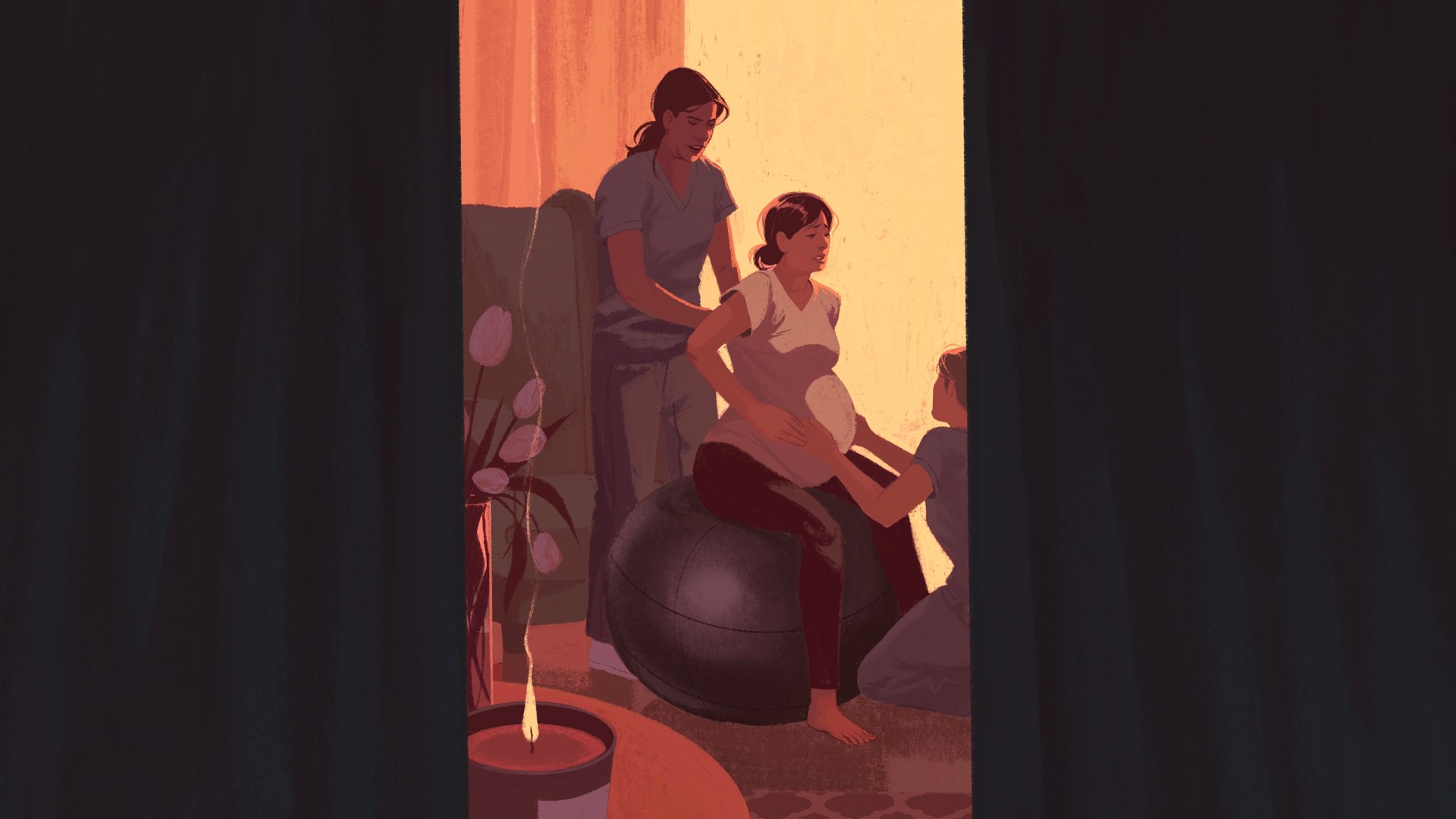
Pregnant woman sitting on a birthing ball while two caregivers support her during labor.
Illustration by Tara Anand

So much of pregnancy is numbers. How many days since your last menstrual period? How many babies are in there? How long is the femur? How thick is the placenta? What’s the angle of the nasal tip? How many centimeters is your fundal height? How many weeks? How many more weeks? Are you sure it’s that many weeks? Are you sure it’s just one in there?

With labor comes a new metric: hours. This is the worst number of all. You’ll hear tantalizing tales, intended as encouragement, of labors measured in minutes. I myself know a baby who made a sudden appearance at home after a short spell of light contractions spaced 15 minutes apart.

Alas, that was not my baby. My first pregnancy was twins. They were delivered—unusually for multiples—without a C-section or epidural, by a doctor who specialized in complicated births with few medical
interventions. At a prenatal visit, I asked about the longest time gap he’d seen between babies. Two hours, he said. I was reassured.

After my delivery, I assume that doctor has revised his approach to this query, because my gap between babies was four hours and 45 minutes. That’s not reassuring at all.

But it was instructive. It taught me how time matters in birth—and how much a provider’s posture toward time can reveal about the nature of their care. My doctor was on no schedule but mine. Those 285 minutes were very uncomfortable but never unsafe or uncertain. 

In a more conventional hospital setting, however, they wouldn’t have been allowed. I’d most likely have been bundled off to the operating room, then tasked with caring for two infants while recovering from both kinds of delivery at once.

My second birth reinforced the time-and-care lesson, albeit on the other end of the timescale. I went to our midwife-run birth center at 8 a.m., had the baby at 5 p.m., and by 10 that night was at home in my own bed.

Everything was different, yet the philosophy of care was the same. And though the primary provider at my first birth was an ob-gyn, his team was heavily populated with midwives and his style of care more resonant with theirs than with many of his medical peers. That was exactly why we’d sought him out.

Midwife-attended deliveries like mine are uncommon in America, and that’s a shame. Of course, midwifery isn’t appropriate for all pregnancies. There are many women and babies for whom hospital care, up to and including a scheduled C-section, is the right and prudent choice. Freestanding (not hospital) birth centers are only equipped to handle low-risk, uncomplicated deliveries, which means some women will “risk out” of their care, as midwives tend to phrase it. Twin pregnancies like mine are automatically high-risk.

But most pregnancies aren’t multiple, and far more births could be safely handled in birth centers than the 12 percent attended by midwives today. Not only could, in fact, but should, because midwife care in low-risk births correlates with better outcomes for mothers and babies alike.

Midwifery is the default option for low-risk deliveries in countries other than the US with the safest maternity care, and in America, peer-reviewed research shows that states with more midwife integration see “significantly higher rates of spontaneous vaginal delivery, vaginal birth after cesarean, and breastfeeding, and significantly lower rates of cesarean, preterm birth, low birth weight infants, and neonatal death.” There’s even evidence suggesting that expanding use of midwives could slow the worrisome decline in American birthrates by making pregnancy and its aftermath less of an ordeal.

This all might seem counterintuitive, I realize. Wouldn’t the greater resources of a hospital mean greater safety? For high-risk pregnancies, yes. But for low-risk pregnancies, a midwife-led birth center is more likely to avoid unnecessary medical interventions—like a C-section, which, being a major abdominal surgery, is good to avoid if it’s safe to do so—while offering women a greater supply of the resources needed most: patience, attention, and time.

“During my long labor in the hospital with my first, the doctor would stop by periodically to see how I was doing. The labor-and-delivery nurse on duty was also spread thin,” recalled Margaret St.Jean, a retired teacher in Virginia who also happens to be my mother-in-law. In the hospital, “I didn’t feel personally supported by anyone except my husband for hours of labor,” she said, but “when you opt for midwifery care, they act as their title describes. They are ‘with woman,’” as per the etymology of the term.

Following that difficult first birth, which ended in a C-section she’s long believed could’ve been avoided with more attentive care, Margaret sought out midwives for the delivery of her six subsequent children. 

“Midwives keep their eyes on the laboring woman, not on machinery spitting out information,” she recalled of those births. “In later stages of labor, you cannot ask for what you need. A good midwife’s skills of observation guide her to help you. The obstetrician is trained as a surgeon. Sometimes their skill is essential to saving lives, but they don’t spend hours by your side.”

For Margaret, the practical advantages of midwifery are linked to her duty as a mother before God. Today, a birth-center delivery is often more affordable than a hospital birth—that, as well as “transparent, upfront pricing,” was “a huge selling point” for Austin Gravley, a youth ministry director in the Texas panhandle whose wife chose midwife care. But 30 years ago, midwives were the more costly option for my in-laws. Their decision was born of the biblical conviction that “children are a heritage from the Lord” (Ps. 127:3), and parental responsibility a weighty trust.

Most other parents and providers I interviewed didn’t see quite so direct a connection between their faith and their choice of midwifery. But many described a real resonance. 

“My perspective as a Christian leads me to view bearing and birthing children both as a blessing and a part of normal life, but also as something cursed and difficult,” said Elisabeth Young, who works at a Christian nonprofit in Maryland. Though her choice of midwife care was mostly about its demonstrated benefits, she appreciates that midwives don’t treat “pregnancy and birth as an illness,” she told me. That’s not a theological position, exactly, but it makes good theological sense.

Ann Ledbetter, a certified nurse-midwife in Wisconsin who attends 40 to 60 births a year, said her faith “definitely” shaped her choice of work. “I have always felt in a weird way that I was guided toward midwifery,” she said, recounting a college-era pledge to God at the University of Notre Dame—made in a moment of desperation over an organic chemistry class—to “honor [God] with my work, whatever it may be.”

The Reformer Martin Luther famously entered ministry under similar circumstances—though his distress was over a lightning storm rather than sophomore-year o-chem—so perhaps it’s appropriate that Ann is a Lutheran today. Still, she’s held on to the Catholic idea of a “preferential option for the poor,” which means following Jesus in prioritizing the “least of these” (Matt. 25:34–40).

For Ann, that’s meant working at a community health clinic where 8 in 10 patients are low-income. “It has always been my dream to provide high-quality maternity care to people who often have very few choices when it comes to childbearing,” she told me, “and I feel so lucky to have ended up in a job where I can do this every day.”

Midwife care isn’t infallible, of course. Some midwives are incompetent, as are some members of any field. And sometimes things go awry—even dangerously awry. 

Austin, the youth ministry director, initially preferred a hospital delivery “out of an anxious sense of ‘What if?’ ” His wife, Melissa, had been intrigued by home birth with a midwife’s help, but for Austin, this was simply too much risk. (It’s too much for me as well, though I know several women who’ve had midwife-attended deliveries safely at home.) Austin and Melissa settled on a birth center as a middle ground.

After delivery, their son was doing well, but Melissa was losing too much blood and needed surgical repair. An ambulance rushed her to the hospital. “At first I was deeply angry about the whole ordeal,” Austin said, because “this was the exact ‘What if?’ that I had feared.” But the midwife in attendance “proved her trustworthiness,” he continued. “I respected the fact that she made the call for help and would not leave Melissa’s side until she was safe.” Their second baby, due in April, will be delivered at the same birth center.

The midwife’s assistant at that birth, Austin noted, was “a super-crunchy, progressive woman who was not a Christian,” whereas he and his wife are “theologically conservative Reformed evangelicals.” Melissa and the assistant “had some fascinating conversations about Jesus, the gospel, and church,” he said, and the couple was able to “pray for her and show to her a confidence in Christ throughout, especially after the birth when the medical emergency began.”

This pairing—of theologically conservative Christians with crunchy, often-secular progressives—is a birth-center distinctive I’ve noticed as well. Sometimes, sitting in a waiting room for a prenatal appointment, I’d marvel at who else was there with me: a homeschooling mom of five in skeins of denim next to a first-timer with grown-out purple hair and a pronouns pin. Where else in this polarized country would we all so naturally, intimately, and congenially converge?

“Most midwives I have seen, I would guess, do not align with me politically or religiously,” said Hallie Skansi Toplikar, a nurse in Central Texas who’s observed this pattern too. “Yet the friends I have that are most likely to use a birth center or even home birth are my Catholic mom friends.”

Christine, a nurse in Pennsylvania who wanted to be identified by only her first name given the sensitivity of her work, sees this unusual social mix as an asset. “One of the really beautiful parts about a birth center is that it’s a place where maybe not all of your values or all of your ideals overlap” with the people you’ll encounter, she said. “But your ideal for a low-intervention, natural birth is what brings everyone together.” 

At her birth center, staff and patients alike vary widely in their views. “Certainly, I fit into that Christian-mom demographic, but we have staff from lots of different perspectives,” Christine said, and they work to serve every mother well.

My mother-in-law Margaret saw this three decades ago. “I think there may be a ‘fellow traveler’ feeling that links the conservative Christian and the crunchy progressive,” she mused—“the value of principle above convenience. These principles may not be exactly matched—for instance, on the issue of abortion. But I think there is a shared value of independence and personal responsibility.” 

In her experience of midwife care, “people got along in a very comfortable way” across wide ideological and demographic divides, Margaret said. “Pregnancy, labor, and delivery are ties that bind women deeply together.”

Supporting his wife through labor can bind a man to good fatherhood, too, by offering an intensive tutorial in the long, often weary yet lovely responsibility of raising children. 

“I definitely sympathize with husbands who are concerned” about risk in nonhospital births, Austin reflected. “But even after my wife’s situation, the birth center was a genuinely beautiful and unique experience, and I don’t think that’s something to take lightly if it’s something your wife wants and it’s safe to do. It pushed me completely out of my comfort zone,” he added, “but if your midwife is trained and trustworthy, the upsides are valuable.”

That value extends beyond any one family. Birth deserts—places where women have no nearby facility offering maternity care—are an urgent and dangerous problem in America. It’s a lot more feasible to start and support a freestanding birth center than an entire hospital. Even so, it’s not easy. 

Some states maintain unfriendly legal environments for midwives, with limited licensure options or onerous and counterproductive supervision requirements. Birth centers often operate on thin margins, organized as nonprofits to accept much-needed grants and other charitable giving. They try to keep costs low to make midwife care as accessible as possible, yet even with a small sticker price, insurance companies can be obstructive and reimbursements too few. 

Money woes are common, Christine said, telling me that the sole freestanding birth center in Philadelphia closed in February. After nearly half a century and 16,000 babies, rising “financial and regulatory challenges” finally made it impossible to continue.

Talking about delivery practices can be difficult, because even dispassionate conversation about birth centers might feel like judgment for women who of necessity or choice took a different route to motherhood. It’s a prickly subject, and understandably so. But I have no qualms in saying that this facility closure is a severe loss for the women of Philly. That’s not because midwife care is right for every birth but rather because it’s a blessing for many.

“My midwives were strong Christians, and I did feel God was very present and active in my births with them,” said Carrie Stallings, a writer and tutor in West Texas who chose midwife care for its practical benefits. “But he was also present and active in my hospital birth.” 

We know that God will be attentive either way, but if you want a birth provider ready to stand vigil, consider calling a midwife. 

Bonnie Kristian is deputy editor at Christianity Today.

Books
Review

Congress Is Overwhelmed and Incompetent

Self-interested and self-loathing, it’s unable to represent the American people well. A new book suggests solutions.

Illustration of politicians in congress, running and falling as a cracked divide splits the ground beneath them.
Illustration by Ronan Lynam

Representative Chip Roy was staring at me, baffled. I had sidled up to the Texas Republican while he was leaving the House chamber one afternoon last spring to ask him about the tech billionaire Elon Musk. Roy was used to me pestering him as he walked to and from votes—all Hill reporters do it—but this question was particularly outlandish to him.

“Do you feel like Congress,” I’d wondered aloud, “needs to be leading the audits here instead?”

At the time, Musk was at the height of his cost-cutting paroxysm. With President Donald Trump’s thumbs-up, he’d been unilaterally canceling congressionally approved spending. But Roy wasn’t worried about encroachments on the power of the purse. He was just glad that someone was looking at outlays.

“I have 14 people in my office,” Roy told me after he’d recovered from my question. “How the frick am I going to go through every report of every dollar that’s being spent?”

Musk’s short-lived initiative, the Department of Government Efficiency, wasn’t quite the picture of independent, dedicated oversight. But Roy’s answer was telling nevertheless. How indeed might a member of Congress today conduct any meaningful oversight when lawmakers can’t hire enough staff, aren’t able to hold on to the employees they do have, and keep retiring themselves?

A few months after our conversation, Roy announced he would leave the House to run for a state-level office. If he wins, he’ll have far more resources at his disposal as Texas attorney general than he ever did as one measly member of the world’s greatest deliberative body.

Roy’s answer that day encapsulated a problem that gnawed at me throughout the nine years I spent as a journalist on Capitol Hill. In those years, almost every article I wrote about lawmakers’ foibles and triumphs could be tied into the same overarching story: Congress is on the verge of being a failed institution.

And that’s a charitable way of putting it, placing failure at a vague point in the future. (Chatting with close friends, I’ve sometimes stated my verdict in the past tense too.) My disillusionment isn’t just some jaded outsider’s view, nor is it particularly rare. People from both parties who work in Congress often feel the same way.

House members are drowning in constituent casework, with district sizes that have ballooned and are far too large for them to actually represent. Congress can barely keep track of the gargantuan executive branch’s public activities, let alone its inner workings. And members can’t even tell if the laws they pass are being implemented correctly. On multiple occasions in the course of my reporting, I had to tell congressional staff that the agencies they were supposed to be keeping track of had ignored the plain meaning of laws to entirely sidestep congressional oversight. Overburdened with other work, the staffers hadn’t noticed.

This decay is largely a capacity problem. Congress isn’t investing in itself enough to be able to represent the American people well or to provide meaningful checks and balances. 

Many Republican lawmakers have taken this broader trend of congressional disempowerment to absurd new heights over the past ten years—committing themselves to the president so devotedly that they’ve shrugged off rightful powers to declare war, set economic policy on matters like tariffs, and control the purse strings. 

A new book from Johns Hopkins University Press, Stuck: How Money, Media, and Violence Prevent Change in Congress, explains that this situation isn’t just a this-decade disaster. It’s the result of many decisions by lawmakers to treat Congress as a scapegoat for America’s political woes. For more than 30 years, members have slashed their own resources and frozen staff and member salaries, motivated by a desire for short-term political wins. If most Americans hate Congress, those lawmakers reason, perhaps they can win votes if they act as if they also hate Congress.

Glaring ethics violations by members have demanded reform throughout US history. But largely freezing the Hill’s resources has left the place a lot more dysfunctional in the long run.

Much of the brokenness I witnessed while reporting on the Hill sprang from this self-interested self-loathing. Congressional staff are overwhelmed and often leave for jobs with better benefits. Smart lawmakers who earnestly want to work on some of the nation’s most pressing problems burn out and quit. And committees bumble through hugely important investigations with just a handful of dedicated staff members. 

These aren’t sustainable working conditions, especially when you factor in the death threats faced by members and staff. A review of employment data last year found that the “probability of a staffer departing the House and Senate in a given year is 13% and 17%, respectively,” a rate far higher than the rest of the federal government at an average of roughly 6 percent. A record number of lawmakers have, like Roy, already announced they won’t run for reelection in 2026.

Throughout Stuck, Maya Kornberg—a researcher at New York University’s Brennan Center for Justice—describes how members allowed the legislative branch to stagnate, gutting nonpartisan research agencies that provided technical information and blocking their own cost-of-living pay increases. The book is at its most useful for newcomers when Kornberg identifies the structural changes Newt Gingrich implemented to push most power into the House speaker’s office, changes she notes Democrats simply turned around and kept in place later. 

“Before the change in ’94, for fifty years the chairs ran things,” a former Democratic lawmaker told Kornberg, referring to congressional committees. Gingrich, a Republican, instead told the chairs “what bills he wanted and in many instances gave the specifics of what he wanted in the bills,” the representative said. “When we retook the House in 2006, because at that point most people had only been under the Republicans and that’s the way it was done, they said f— ’em. We will do it that way too. And we did it exactly the same way.”

This style of top-down legislating has led to some of the most toxic moments in recent congressional history. And it has also prompted a quiet atrophy among rank-and-file members, many of whom now don’t have the muscle memory or expertise to legislate on their own. 

To Roy’s credit, he ardently fought that trend while he was in the House, demanding more power for regular members. But it’s a red flag when even the lawmakers who most want to cut spending and conduct oversight feel they have to outsource that job to the executive branch.

“Our committees do some of it,” Roy said of oversight during that interview about Musk, “but that takes a while to get through the system.”

The answer is not just to kick Congress over and over again until it repents but instead to give regular lawmakers the tools they need to do their jobs. Those rank-and-file members are from our communities, sent to DC to represent us. Representative democracy can be a beautiful system when carried out in earnest—and with the right resources.

Kornberg urges tweaks to empower new members, including more robust rules training so they can navigate the Hill without marching in lockstep with party leaders. She also calls for Congress to spend more on itself, growing its staff and offering salaries competitive enough to draw talent.

Her ideas make sense; plenty of political scientists have argued for similar changes. But a more ambitious plan—expanding the number of members in the House itself—would do a lot more to revive the institution.

George Washington once envisioned a ratio of one representative for every 30,000 constituents. But for more than a century, while America’s population has grown, the House has been frozen at 435 members. Each House member today instead represents an average of 760,000 people. 

In one stroke, expanding the House would bring members closer to the communities they work for, reduce their casework to more manageable levels, and make it harder for party leaders to insist on their hyperpartisan, top-down machinations. 

But even considering a change like this one seems far outside the realm of possibility for this Congress. Today’s lawmakers can hardly keep the government’s lights on.

Still, throughout Stuck, Kornberg strikes a hopeful tone.

“Congress is always changeable,” she writes, “shaped and reshaped by the people who walk its halls.”

It’s true: Congress really is just people. I’m reminded, whenever I think about Capitol Hill, of Augustine’s quote about bad times. “We make our times,” he said. “Such as we are, such are the times.”

That sort of admonition is what I wished for most while reading Stuck. Much of this malaise raises questions of virtue and courage. Members broadly agree Congress is broken, but they can’t seem to will themselves to rebuild it.

Someone—perhaps a former lawmaker or a longtime Hill reporter—should write a more uninhibited, prophetic version of this book, reminding members of what Congress ought to be.

It won’t be me. After nine years, I found I couldn’t keep spending so much of my time around an institution that respected itself far less than I did. Like so many others, I quit. 

Haley Byrd Wilt is a writer based in the DC area. Her reporting has been published in Foreign Policy, The New York Times, NOTUS, and CNN.

addApple PodcastsDown ArrowDown ArrowDown Arrowarrow_left_altLeft ArrowLeft ArrowRight ArrowRight ArrowRight Arrowarrow_up_altUp ArrowUp ArrowAvailable at Amazoncaret-downCloseCloseellipseEmailEmailExpandExpandExternalExternalFacebookfacebook-squarefolderGiftGiftGooglegoogleGoogle KeephamburgerInstagraminstagram-squareLinkLinklinkedin-squareListenListenListenChristianity TodayCT Creative Studio Logologo_orgMegaphoneMenuMenupausePinterestPlayPlayPocketPodcastprintremoveRSSRSSSaveSavesaveSearchSearchsearchSpotifyStitcherTelegramTable of ContentsTable of Contentstwitter-squareWhatsAppXYouTubeYouTube