Books
Review

Emotions Don’t Just Happen to You

Our society tends to treat feelings as inevitable and authentic. A new book explores an older understanding in the Bible and the church.

The book on an orange background.
Christianity Today February 17, 2026
Illustration by Christianity Today / Source Images: Getty, Eerdmans

What does it feel like to be a Christian? For some, this will sound like precisely the wrong question to ask. But say all you want about “happy clappy” Christianity or a toxic emphasis on positive feelings in church life: Feelings seem to be an undeniable aspect of Christian identity.

Joy, love, grief, fear—these may not only be emotions, but they often include or involve emotion. We know what grief and joy feel like. And all of these stand out in Scripture not only as part of the human experience but as part of the Christian life. 

In his new book, Emotion in Early Christianity, historian Andrew Crislip explores what exactly these emotions are doing in Scripture and in the life of the believer. His work is largely descriptive and stops short of considering what it entails to follow biblical commands about emotion in a contemporary culture that rejects the very idea of such commands. But it provides important historical and scriptural insights for anyone seriously thinking about how Christians feel.

Much recent attention to Christian identity has turned to questions of intellect and action, treating Christian life as a matter of confession and discipleship and not feeling. And for many years, emotions received either negative attention or inattention in theological circles. Emotions were treated as either untrustworthy markers of the Christian life or simply beside the point. Presbyterian J. Greshem Machen summed up a key concern when he wrote that “if religion consists merely in feeling the presence of God, it is devoid of any moral quality whatever.” 

Machen’s criticism of feeling as a marker of faith had in mind early 20th-century theological liberalism, which emphasized feelings of piety and compassion as the marks of Christian faith. Some of this traces back to the great German theologian Frederich Schleiermacher, who described faith as an experience of “absolute dependence” in which feelings of piety would rise up as an indicator of encounter with God. But what Machen rejected was not only an emphasis among liberals: 20th-century evangelicals likewise tended to link awe, wonder, and lament as signs of a person’s commitment to God and spiritual growth.

Yet whatever misguided ideas Christians may have about emotion in faith and worship, Crislip shows that this link between being a Christian and having certain emotional experiences—far from being a corruption brought on liberalism—is a deep part of the early Christian story. Whether we look to John 15 (where Jesus connects being his disciple to love), to any number of Paul’s letters, or to early Christian writings, there is a persistent assumption that following Jesus involves not just thinking certain things but feeling certain things as well. 

Crislip’s concerns lie with uncovering how “Christians understood themselves from the start as an intentional emotional community” and how constellations of emotions form the backdrop of the Christian life. Examining joy, sadness, anger, disgust, and envy, Crislip takes the reader through scriptural and early Christian sources to show the range of ways in which Christians linked discipleship and the emotional life. The five emotions mentioned above form the backbone of the book, and though not always the most dominant ones of early Christianity, they correspond to several decades of psychological research about core emotions people tend to experience across cultures.


Crislip draws from a variety of theories of emotion, but his own approach is closest to the constructivist view, which understands emotion as a “concept constructed by humans to make meaning out of the complex interaction between bodily affect and the experiencing of perceiving and predicting the world.” That is, emotions are not free-floating mental passions, waiting to erupt, but neither are they purely a biological reality, a mechanistic product of our brains. Rather, emotions are ways we navigate the world, the process of interpreting various feelings as anger, joy, sadness, and the like. 

One of the key insights of Crislip’s work, then, is that emotions are not described in the Bible as spontaneous events in the life of the Christian but as “a form of practice, a way of being, a stance, an orientation, an action to be cultivated, which can transform the self and the world.” Our bodies certainly affect what we feel, but feelings do not only happen to us because of chemical changes in our brain. Crislip finds that in the New Testament and early Christian writings, rightful emotional states—like joy, mournfulness over sin, or opposition to envy—are presented as cultivated responses to which Christians can and should aspire. 

Crislip also traces the history of emotions as a part of community formation, building an impressive body of evidence. Together, we are commanded to rejoice. We train together in how to grieve—or when to feel disgusted. Crislip’s handling of envy is among the most compelling portions of the book, as it takes the usual place of pride as the chief of sins. 

Less clear in this work is how the historical context of the early church plays into how early Christians’ emotions were formed. The ways these Christians disciplined their emotional lives were not the only games in town. Other religions and movements in their society, especially the early Stoics, also treated emotions as rationally controllable. Part of Crislip’s aim is to establish how Christians differ from their neighbors on this score, but it’s not always clear what exactly the stakes are in this distinction. 

Also unclear—but this would in some ways require a very different book—is how emotions contribute to the larger architecture of the Christian life in our quite-different social context. Our society, unlike the world of the early church, is deluged in a psychological discourse that’s likely to see something nefarious in deliberately cultivated emotions in a church setting. Contemporary Americans tend to think of emotion as something that simply happens to you—not quite uncontrollable, perhaps, but generally to be accepted and validated as a matter of personal authenticity. The attitude toward emotion we find within early Christianity—and even Scripture itself—could be labeled emotionally coercive in our day. Commanding someone to rejoice is suspicious, maybe even gaslighting or manipulative. 

Crislip doesn’t address that shift in the zeitgeist, and such are the limits of the descriptive project he has put together. Though an excellent retrieval of the complex and nuanced ways in which emotions are part of Christian discipleship, the book leaves open the question of how these emotions should be understood as part of a whole life of worship.

The great benefit of Crislip’s work, however, is that he provides a much more robust and textured understanding of our emotions than is commonly exhibited in the flurry of recent work appealing for a more emotionally healthy Christianity. Urging Christians to have emotional health is all fine and good. But we must also contend with how Scripture and the early church call our emotions—as varied as they are—into the orbit of our worship. 

Crislip has shown that there’s often a normative direction for our emotional lives, that God wants and requires us to steer our feelings toward righteousness. This is a challenge other Christians thinking and writing about emotion must now take up with care.

Myles Werntz is the author of Contesting the Body of Christ: Ecclesiology’s Revolutionary Century. He writes at Taking Off and Landing and teaches at Abilene Christian University.

Books
Excerpt

How the Lord’s Supper Heals Church Hurt

Communion makes us face our relational conflicts.

The book on an orange background.
Christianity Today February 17, 2026
Illustration by Christianity Today / Source Images: Getty, IVP

In my church tradition, we never share Communion without first “passing the peace.” This is a moment in the service when we celebrate God’s forgiveness by extending it to each other. By grace, we enjoy peace with God. This reality then compels us to seek peace with each other. Usually on Sundays, passing the peace feels more like a halftime stretch break than anything else: The extroverts among us shake as many hands as possible, and the introverts sneak off to the bathroom.

But this ancient practice is more than a liturgical palate cleanser; it is essential preparation for the Lord’s Supper. In the early church, Christians who were at odds with each other were expected to reconcile before receiving the Eucharist.

They understood this as obedience to Jesus’ teaching that our relationship with God is connected to our relationship with others: “So if you are offering your gift at the altar and there remember that your brother has something against you, leave your gift there before the altar and go. First be reconciled to your brother, and then come and offer your gift” (Matt. 5:23–24, ESV throughout).

Sharing table fellowship with Christ means being ready to share that same fellowship with his people, including those who have offended us. It also means that if we want to commune with Jesus, we don’t get to do that apart from our brothers and sisters. As Fleming Rutledge said, “There is no other way to be a disciple of Jesus than to be in communion with other disciples of Jesus.” He invites us to a family table. Even though it might feel a lot less complicated, there is no option for a “just Jesus and me” Christianity.

At the same time, coming to the family table does not imply that we excuse or deny sin for the sake of our fellowship. Passing the peace allows us to name our disillusionment with each other as part of our worship. And it prevents us from papering over conflict or wrongdoing, because it reminds us that reconciliation costs something. It requires that we recognize how we have failed each other, and it requires that we forgive.

Of course, some sinful behaviors are so grievous that forgiveness can only happen from a safe distance. In cases of abuse or chronic mistreatment, when it becomes clear that the larger community is either unable or unwilling to address the wrongdoing, the godliest thing to do might be to leave one church and worship somewhere else. This, too, can be an outworking of God’s peace.

After we’ve done all that depends on us in pursuit of restoration, we are free to find a different community where healthier relationships can take place. Whatever shape it takes, passing the peace is hard work. It takes courage to name offenses and seek reconciliation. It takes humility to apologize and ask forgiveness. It takes discernment and grit to leave a church we’ve loved and open our hearts to a new one. It’s much easier to sweep our grievances under the rug—or to walk away from church altogether.

But Jesus’ own example shows us a different way. In righteous anger against religious corruption, he flipped tables in the temple. He was unafraid to tell the truth about sin even when it made a scene. Despite what we often see in Christian circles today, Jesus never concealed or even downplayed his peoples’ wrongdoing. If anything, he called attention to it—for the sake of their healing and growth. And then, before ascending to heaven, he promised to never leave or forsake them.

Throughout the church’s history, Jesus hasn’t left. He has stayed present among us—without condoning our sin. This is the legacy we are each learning to follow, in small and big ways. We will never do it perfectly; we are apprentices of grace and truth. Our fellowship will be fraught as long as sin remains.

But in this way our life together is an expression of the gospel. We fall short, we discover grace, and we are reconciled—to God and to each other. Confessing our sin and passing the peace are requisite practices for Christians—whether we enact them liturgically on Sundays or not—because none of us will ever graduate from needing grace.

The reality is that, from top to bottom, the church is a family full of fledgling, wayward children. And it raises the question: What if the people leading us in confession and peace are also the ones who are committing sins against their people and are unwilling to recognize it? What if the whole process of reconciliation breaks down because those with religious authority refuse to be held accountable?

As a leader in the church, I am haunted by this question. And I am challenged by the fact that God has baked accountability into the meal I serve his people.

In the very earliest description we have of the Lord’s Supper being celebrated in church, the apostle Paul warns those who partake of the bread and wine to examine themselves and “[discern] the body”—to ensure that they are treating each member of the community with the same respect they would give Jesus’ own body—lest they eat and drink judgment on themselves (1 Cor. 11:17–34).

In the Corinthian church that Paul was addressing, there was a pattern of inequity between the wealthy and poor members of the congregation: Those who had plenty to bring to the eucharistic celebration ate in excess, while the poor members of the church who had nothing to contribute to the feast went hungry. Paul condemns this as antithetical to the example of Jesus, who gave up what he had—his very body—for others.

As Jesus’ followers, we must come to the Table with the same spirit of self-giving love for our brothers and sisters. We must be ready to acknowledge where we’ve fallen short of this and to repent. To fail to do so is to eat the Supper in an “unworthy manner” (v. 27) and to be guilty concerning the body Jesus gave up for us.

This means, as Methodist theologian Laurence Stookey wrote, that “at the Table of the Lord the church is both judged and strengthened by Christ, the Host. The assurance of forgiveness, so often associated with the Eucharist, is legitimate only when we know that forgiveness is for the penitent, and penitence is literally a ‘turn-around’ that involves change.”

Without repentance, the bread we break is not to our comfort. It is to our chastisement (Heb. 12:5–6; 1 Cor. 11:32). I don’t understand exactly what it means to eat and drink judgment on myself. But I know that as a church leader, I am not exempt from it. Pastors and leaders who refuse to see their sins against Christ’s body will still be held accountable for them—whether we witness it in our lifetimes or not. Jesus himself has promised to do this.

For those who have been harmed by Christians without apology, this is a strange consolation. Regardless of the cost, Jesus will do right by his body. Each time we come to the Table, we are called to do the same.

As I’ve grown in my appreciation for the Lord’s Supper over the years, I’ve become aware of another aspect of the church’s failure to experience it as God intended: In our denominational divisions, we have failed to remain in communion with each other at one shared table.

Growing up Baptist in the South, I didn’t think much about different denominations. But after high school, two of my siblings converted to Roman Catholicism. Suddenly, the Protestant Reformation was being relitigated in my family. During the first few years that we worshiped in different traditions, I became painfully aware of the fact that we could no longer take Communion together. Since then, I’ve come to know and love other Roman Catholic Christians, whose tradition restricts them from celebrating Communion with Protestants. And I’ve witnessed church divisions within Protestantism that have created deep relational rifts between Christians with differing convictions.

Even when separation happens for important reasons, it remains something to lament. Whenever and however Jesus’ family is divided, we fail to experience the unity and fellowship that he died to give us. His body, already broken for our sins, is further torn apart by infighting and schism. There aren’t easy answers to this. But in my own life, I might not have even become aware of the problem if I had not been in relationship with Christians from different theological traditions.

Though I cannot share Communion with all of them, I can learn to love them as my brothers and sisters, and I can pray for the day when all divisions will end. Despite my disappointment with the church’s sins, despite my disillusionment with myself as a Christian and a leader, I remain grateful to belong to Jesus’ family. And as I come to terms with our dysfunction, I begin to understand what it is to profess, as the ancient creeds do, I believe in the church.

Some of us have named grievances with Christian siblings in search of true peace and had our concerns dismissed as inordinate or imagined. Some of us have fought to stay in churches that pushed us out through their unwillingness to pursue truth or protect the vulnerable. Some of us have worked tirelessly for leadership reform, seeking to correct the abuses of the previous generation, only to witness a new expression of corruption take root during our tenure. Some of us have courageously called attention to problems in our midst, speaking out against patterns that are destroying us from the inside—and have been labeled as naysayers or saboteurs. Some of us struggle every Sunday to trust pastors or church leaders because of past hurts that were never acknowledged.

Because of unacknowledged harm, unreconciled relationships, or unprocessed disillusionment, many of us live with a deep ambivalence about what it means to belong to God’s family. As beautiful as the church is, it remains dysfunctional and broken. Sometimes the cognitive dissonance this creates is more than we can hold, so we self-exile—longing to share the family meal but choosing to stay hidden from view. Or we remain with the majority of the fellowship but live with a vague sense of regret about those estranged siblings who’ve come and gone from our sight.

One day, Jesus will gather up his broken body into one communion where all divisions are healed and all relationships are restored. On that day, we will feast at the longest table in the world, in the presence of peace himself. Until then, we take and eat in anticipation.

In an ancient collection of church teachings called the Didache, there’s a prayer that looks forward to this once-and-future unity of God’s people: “As this broken bread was once scattered on the mountains, and after it had been brought together became one, so may thy Church be gathered together from the ends of the earth unto thy kingdom; for thine is the glory, and the power, through Jesus Christ, for ever.”

For the first Christians, this prayer largely anticipated the evangelistic work of the church in calling all nations to follow Jesus as Lord. They knew the Good News belonged to the whole world and their fellowship would one day reflect that. But for modern Christians who have only ever known a fractured church, splintered by schism and fraught with corruption and conflict, this ancient prayer also speaks to a future reunification and healing for God’s people.

Sometimes, when I celebrate the Lord’s Supper, I think of those relationships in my own life that remain broken and seem unresolvable. I think of my father, whose death robbed him and others of greater reconciliation and wholeness in this life. I think of members in my family and my faith family, some of my closest Christian friends who cannot receive Communion from me or with me. I think of people I know who love Jesus but have left the church or who are struggling to feel safe within it.

Presiding at this Table reminds me of the myriad ways we are not okay and don’t know how to fix it. Then I break the bread, putting my trust again in the one who has allowed himself to be torn apart so that he might somehow put us back together.

Hannah Miller King is a priest and writer in the Anglican Church in North America. She is associate rector of The Vine Anglican Church and author of Feasting on Hope: How God Sets a Table in the Wilderness.

Adapted from Feasting on Hope by Hannah Miller King. ©2026 by Hannah Miller King. Used by permission of InterVarsity Press. www.ivpress.com.

Church Life

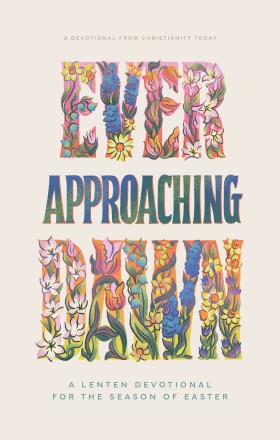
Introduction: Ever Approaching Dawn

This Lenten season, we wait with hope.

Ever Approaching Dawn
Illustration by Jill DeHaan

The Lenten season arrives before spring, just as old man winter begins his few remaining sweeps over the frigid landscape. Many of us enter this season with a heightened sense of our own internal barrenness. We pursue prayer and fasting as we prepare our hearts for the spiritual renewal that will unfold on Good Friday and Easter Sunday.

Once again, we are made to wait.

We do well to remember the story of Lazarus, who died while his sisters, Mary and Martha, wondered why Jesus had waited until it was too late to heal him. It is not until we hear Jesus’ words to Martha—“I am the resurrection and the life”—that we get an inkling of Jesus’ purpose for their waiting. Lazarus would live again, but it was necessary that he die for Jesus to demonstrate his power over life and death.

Is this not the hope we embrace as we enter the Easter season?

This is my hope for you as you immerse yourself in these timely devotionals—that even if you end another day feeling numb to the lingering effects of winter, you may remember that waiting through the night is the only way to experience the ever-approaching dawn. And not just any dawn. A past and future dawn that will make every dark night worth enduring for the hope that will be revealed in the face of Jesus Christ.

Ronnie Martin is Director of Leader Care & Renewal for Harbor Network, and Pastor-In-Residence at Redeemer Community Church in Bloomington, IN. He has written several books, including In the Morning You Hear My Voice (B&H, 2025), and co-hosts The Heart of Pastoring podcast with Jared C. Wilson.

Church Life

Safety in Our Weakness

In this fast, Christ is my lifeline.

Lent 2026 - Ash Wednesday
Illustration by Jill DeHaan

What if there had only been two fish and one loaf of bread? Could Jesus still have fed the 5,000?

These are the questions my dusty flesh asks on days when I am rundown and out of breath. We know that, yes, of course Jesus could have performed the same miracle with a smaller lunch basket. But so often, deep down, we assume that if the numbers change, there is no longer hope for bread.

“Then Jesus was led by the Spirit into the wilderness to be tempted by the devil. After fasting forty days and forty nights, he was hungry” (Matt. 4:1–2).

I suppose it is only appropriate that, on a day like Ash Wednesday, we feel our weakness more than usual. My weakness often takes the shape of forgetfulness. I forget that God will sustain me, and so I reach for food as though it is my only source of strength. I check my phone for a brief hit of dopamine. I list off all my worries to my husband in a fit of anxiety, without stopping to take a breath. I assume, wrongly, that I am my own savior or that God’s grace has run out.

Then I remember the Red Sea.

I remember the feeding of the 5,000.

I recall those fluffy wafers that miraculously appeared in the wilderness each morning to sustain the Israelites.

And I think about that time, on the wooden steps outside my apartment, when I cried out for mercy and Jesus met me there. My heart was breaking, but he was catching every tear in his bottle (Ps. 56:8, ESV).

“The tempter came to him and said, ‘If you are the Son of God, tell these stones to become bread’ ” (Matt. 4:3).

What happened to Jesus during those 40 days in the wilderness?

We know that Satan waited until Jesus was starving to pounce. But what happened before that? I have so many questions. Did Jesus spend time with the animals, talking to them instead of catching them for supper? Did he, perhaps, pray in the middle of the night, when hunger pains woke him? Did he bathe in rivers, letting the ice-cold water shock his system and distract him, at least momentarily, from his desire for food?

What did Jesus do with his tired, dusty feet on day 38?

Lord Jesus Christ, Son of God, have mercy on me, a sinner. Were these stones bread, I would not cry out to you. I would feast. But in this fast, I see you are my lifeline. I am tempted in this wilderness, but I am not alone. You walked on dry sand, stumbled from fatigue, rumbled from hunger, and still you clung to the truth of your Father. Still you denied Satan the satisfaction of owning you. Surely, through your example and the power of the Holy Ghost, I can press on this day.

“For he knows how we are formed, he remembers that we are dust” (Ps. 103:14).

Rachel Joy Welcher is a poet, author, and book editor living in South Dakota with her husband, pastor Evan Welcher, and their two children, Hildegaard and Richard.

Church Life

Feasts Amid Fasting

Even in our deepest sadness, we experience deep breaths of grace.

Lent 2026 - First Sunday
Illustration by Jill DeHaan

The Sundays of Lent have traditionally stood apart from other days of this season. While we spend the rest of the week fasting and pondering our mortality, Sunday is different. Sundays are usually feast days, highlighting the coming resurrection—small flashes of worshipful hope along the darker 40-day Lenten road.

Sundays are miniature feasts among the weeks of prolonged fasting because they are the Lord’s Days. As the people of God come into the house of God, they gather around the Word of God and the Lord’s Table. And in the presence of the Bridegroom, the wedding guests cannot fast. But the rest of the week? They remember his death and their own impending demise and return to fasting, awaiting the glorious feast of Easter and the foreshadowed supper of the Lamb. (Yes, yes, Jesus is always with us. But you understand the larger point.)

Initially, this seems like a great deal of trouble. Why have miniature feasts in the midst of such a great fast?

In my estimation, the best answer is not in the church calendar but in our own lives. Life is rarely entirely a fast or a feast. It is instead something far more complex. Even in our darkest seasons, the light occasionally breaks through. Even in our deepest sadness, we experience deep breaths of grace. Life is layered. It is rarely all good or all bad at any given moment. Often, it is instead an ill-distributed mixture of the good and the bad—blessing and stumbling, hurt and healing, profound loneliness and beautiful encounters.

Twenty-five years ago, I discovered I had heart failure caused by a virus. I was 24 years old at the time, a newlywed brimming with optimism. In one single doctor visit, it all seemed to vanish. I was given a grim prognosis—two years of life. My wife of just months was newly pregnant. I was a full-time student. We were poor, and I was dying.

Yet glimpses of hope—often on Sundays—refused to acknowledge my circumstances. We would attend worship, and the beauty of the music in our church would soar, creating something akin to rapturous delight in my soul. We would sit with friends, and I would still find myself laughing at stories and jokes. Family sent gifts, sometimes surprising me with their generosity. Everything within me wanted to retreat into an all-enveloping darkness, but glimmers of grace insisted on brightening things up, forcing me to resist despair.

This is what it means to live, to walk as a child of God in this world. We experience the deepest of pains and greatest of joys. And Jesus is there through it all. He never leaves us. He never forsakes us. He is with us, even as we walk through the valley of the shadow of death.

This is why on the Sundays of Lent, as we prepare to worship the God who never leaves, we set the fasting aside, even if just for a day. How can we fast as we gather with the people of God, those living layered lives like us—a holy recipe of love and loss? How can we fast as we encounter power through prayer, glory in song? How can we fast when we take the broken loaf and shimmering cup, remembering what our God has done? How can we fast as we celebrate the presence of the Bridegroom who never leaves?

We cannot. And so for these Sundays, as we return to the good truth of the gospel even in the midst of longing and hurt, the Bridegroom joins us, embraces us, receives us, and loves us.

And that is an occasion to feast.

Steve Bezner (PhD) is associate professor of pastoral ministry and theology at Truett Seminary at Baylor University and the author of Your Jesus Is Too American. He is heavily involved with GlocalNet and writes regularly on his Substack.

Church Life

The Sweet Seriousness of Lent

How shall we express this paradoxical gladness and sadness of Lent?

Lent 2026 - Second Sunday
Illustration by Jill DeHaan

While tackling a recent home repair project, I taught my son how to remove a screw. It’s counterintuitive. You’ve got to push in hard so you don’t strip the screw. You bear down to bring it up; you push in to bring it out. The downward pressure and upward rise are simultaneous and productive.

The Christian life is like that. According to Jesus, the way up is down (Luke 18:14), the path to comfort is mourning (Matt. 5:4), and the means of forgiveness is confession (Luke 11:4). There’s a downward pressure and an upward rise.

When I lead my church family in receiving the Lord’s Supper, I remind them that it’s a paradoxical meal. We shed solemn tears as we confess our sins and grieve Christ’s excruciating death. But because we know that his sacrifice was sufficient payment for our sin (Isa. 53:5), that he died out of love for us (Gal. 2:20), that he was raised on the third day (1 Cor. 15:4), and that he is coming again (1 Cor. 11:26), we celebrate and give thanks. (The word Eucharist comes from the Greek word for “thanksgiving.”) Our sorrow and joy are mingled. We smile through tears. We sob a glad “Hallelujah.” There’s a downward pressure and an upward rise.

Some years ago, my family visited Omaha Beach in Normandy, France. During the D-Day invasion of June 6, 1944, German snipers rained bullets on Allied soldiers who were wading ashore at several landing sites with nowhere to shelter. Thousands were killed amid terrible carnage. As my family walked along the beach seven decades later, we felt sober awe and earnest gratitude. We were on holy ground. Simultaneously, our time at the beach was sweeter than an ordinary beach day. The sun was brighter, the sky was bluer, and the laughter was more joyful because we knew these gifts were costly. The awesome sacrifice of those heroic soldiers produced in us a mingled sadness and gladness, a downward pressure and an upward rise.

Lent gathers and concentrates our Christian experience. We grieve our sin and Jesus’ suffering. And paradoxically, the grief brings gladness because we know that the suffering Savior saves sinners and that confessed sin is forgiven (1 John 1:9). As Thomas Watson said, “Till sin be bitter, Christ will not be sweet.” There’s a downward pressure and an upward rise.

How shall we express this paradoxical gladness and sadness of Lent? I’ve found some words from Henry Martyn especially helpful here. Martyn was a brilliant scholar at the University of Cambridge who, in 1805 at the age of 24, sailed from England to India as one of the earliest modern missionaries. He died in 1812, having accomplished a staggering amount of Bible translation work in his brief years on the mission field. Martyn once wrote in his journal about a day of prayer: “My soul was soon composed to that devout sobriety, which I knew by its sweetness, to be its proper frame.” That’s a powerful description of Lent, which is a time of sweet seriousness. John Piper expresses the same mingled reality with the phrase “serious joy.”

This Lent, let’s not choose between being glad and being earnest. We were made for both—not sequentially (one, then the other) but simultaneously. Let’s embrace sweet sobriety, holy joy, and glad gravity. God designed us to smile through tears, to weep with joy, to press down and be lifted up.

Stephen Witmer (PhD, University of Cambridge) is the lead pastor of Pepperell Christian Fellowship in Pepperell, Massachusetts, and a Council member of The Gospel Coalition. He is the author of A Big Gospel in Small Places and In All Things Thee to See: A Devotional Guide to Selected Poems of George Herbert.

Church Life

Brokenness Does Not Have the Final Say

The Resurrection is the declaration that death did not hold Jesus because it could not hold Jesus.

Lent 2026 - Third Sunday
Illustration by Jill DeHaan

A childhood friend dies of cancer in his 40s, leaving behind a wife and three children. A minor shoots and kills an 18-year-old in a local library. A newborn of friends remains in the hospital, daily fighting for his life and unable to come home. A fellow pastor laments the weight of leaders in his church serving as first responders to teen gang violence in his small rural town due to insufficient police resources. A longtime friend and Indigenous Bible translator in West Africa grieves his nephews being kidnapped and shot at by jihadists. All of this happened over the course of a couple of weeks.

You have your stories as well. Despair constantly calls for us. Hopelessness is the easiest and most logical posture. The weight of surviving, much less flourishing, in a world where no realm is untouched by the rot and stench of the Fall is overwhelming. What are we to do?

Two responses are the most common to this reality of the human experience. We can either be crushed by the weight of sin and brokenness in the world or hope away despair by isolating and ignoring for fear of being crushed. Neither approach leads to flourishing.

Scripture points us toward a different path.

This path does not run from brokenness but calls it by name. As Christians, we know what was in Genesis 1–2. Our theology provides a depth to lament unavailable outside the Christian worldview. We know what was lost in human sin and rebellion. We know what could have been. Our hearts long for it. To be a Christian is to name the devastating effects of the Fall. We do not call good what God calls evil. Death is evil. Distortion of every sphere of creation is a constant reminder of the reality of our ancestors’ sin and rebellion and our willingness to follow in their footsteps. To ignore this truth is to place a cloak over the biblical story.

Yet we do not lament as those without hope. We traverse the brokenness of our lives and world with the knowledge of the cross and empty tomb 2,000 years ago. Christ was crushed so that we may not be. It is the evidence that God does not turn a blind eye to injustice, ours or others’. The Resurrection is the declaration that death did not hold Jesus because it could not hold Jesus. It is the reversal of the effects of the Fall—the promise of what could be and one day will be with God’s creation.

The resurrection of Christ is the surety of our own future resurrection. This is the argument Paul makes in 1 Corinthians 15. The resurrection of Jesus is the assurance that whatever chapter of despair we may find ourselves in today, it is not the final word.

Paul ends this beautiful chapter with these words: “Stand firm. Let nothing move you. Always give yourselves fully to the work of the Lord, because you know that your labor in the Lord is not in vain” (v. 58).

What would I tell my kids Paul is saying? Do not fear tears. They are the evidence of knowing the world is not as it should be and the hope of what it shall one day be. Jesus’ resurrection promises this.

Cory Wilson (PhD) is president of Emmaus Theological Seminary and associate professor of global Christianity and intercultural studies.

Church Life

Laetare!

The theme of finding joy even in grief is at the core of the Christian vision of life.

Lent 2026 - Fourth Sunday
Illustration by Jill DeHaan

Blessed are you when people insult you, persecute you and falsely say all kinds of evil against you because of me. Rejoice and be glad” (Matt. 5:11–12).

“Consider it pure joy, my brothers and sisters, whenever you face trials of many kinds” (James 1:2). “But rejoice inasmuch as you participate in the sufferings of Christ, so that you may be overjoyed when his glory is revealed” (1 Pet. 4:13).

The command to practice joy in the midst of loss, grief, and hardship often feels impossible to do and heartless to hear. Yet it is found repeatedly throughout the Bible, including in these quotes from Jesus and two of his closest followers, James and Peter. If we found these words tucked away in some obscure place in the Scriptures, they would be easy to ignore.

But far from being a random idea, the theme of finding joy even in grief is arguably at the core of the Christian vision of life. It not only drives the content of much of Jesus’, James’s, and Peter’s teachings; Paul’s life and writings also constantly sing this same tune. Paul speaks of rejoicing in our sufferings (Rom. 5:3; Col. 1:24) and was known as a man of gentleness and joy (2 Cor. 7:4; 1 Thess. 2:7, ESV), though his life was peppered with hardship, loss, and anxiety (2 Cor. 11:23–28).

The paradoxical reality of rejoicing in suffering—an experience that must be felt to be fully understood—is concentrated in the season of Lent. Lent, which the Eastern Orthodox tradition describes as “bright sadness,” leans into the unexpected and seemingly unnatural experience of joy in the midst of grief. Of all the days of Lent, this paradox is foremost on the fourth Sunday, traditionally called Laetare Sunday, based on the sung command “Rejoice!” Laetare Sunday sits exactly at the halfway point between Ash Wednesday and Easter Sunday, and it intentionally punctuates this season of memorial suffering with required rejoicing.

Why? Far from being insensitive to our grief, God knows what he is doing with this Lenten command. In hearing and trying to obey it, we align our hearts to a profound truth: Grief and joy are sisters, not enemies. Loss and delight can live in harmony, and indeed, they give each other life and energy. As Francis Weller astutely notes, to be alive and to love means we will also experience sorrow and loss. “Acknowledging this reality enables us to find our way into the grace that lies hidden in sorrow. We are most alive at the threshold between loss and revelation.”

Jesus models for us a fully human life that denies neither the world’s joys nor its griefs. Jesus both laughed and wept. His teachings are very much concerned with what it means to thrive and flourish and, paradoxically, that flourishing often looks like loss. (See the Beatitudes in Matthew 5:3–12.)

So here is the invitation of Laetare Sunday: Open yourself to the griefs and losses that Lent reminds us of. Yet just as much, lean into rejoicing at this mid-Lent point. There is a unique grace we can experience only when we honestly acknowledge our losses, needs, disappointments, and unmet desires yet still look upward and forward to a time of full rejoicing to come. This extended period of Lent helps us pay attention to our griefs. Laetare Sunday reminds us that there is deep joy to be had even now and that these griefs are not the end of our story. Jesus’ suffering will lead to his resurrection, which will lead to ours as well. “In all this you greatly rejoice, though now for a little while you may have had to suffer grief in all kinds of trials. . . . Though you have not seen him, you love him; and even though you do not see him now, you believe in him and are filled with an inexpressible and glorious joy, for you are receiving the end result of your faith, the salvation of your souls” (1 Pet. 1:6, 8–9).

Jonathan Pennington is a professor of New Testament at Southern Seminary in Louisville, Kentucky, and serves as a teaching pastor and elder at Sojourn East Church. He is the author of many books, including The Sermon on the Mount and Human Flourishing, Come and See: The Journey of Knowing God Through Holy Scripture, and Jesus the Great Philosopher: Rediscovering the Wisdom Needed for the Good Life.

Church Life

Sometimes We Just Do the Next Thing

Faith does not insist on a map. Faith asks only that we do the next thing.

Lent 2026 - Fifth Sunday
Illustration by Jill DeHaan

The women who had come with Jesus from Galilee followed Joseph and saw the tomb and how his body was laid in it. Then they went home and prepared spices and perfumes. But they rested on the Sabbath in obedience to the commandment” (Luke 23:55–56). The cross of Jesus stands at the heart of history—the hinge on which the door of eternity swung wide for you and me. Yet on that Friday, as darkness cloaked the land and the temple curtain tore, it must have seemed to those watching that the world itself had fractured.

Luke’s account of the Cross and Resurrection portrays not only the cataclysmic events of Jesus’ death but also the varied human responses to it—responses that echo through time. In the midst of despair, the women simply did the next thing. And in doing so, they bore quiet witness to something greater than grief.

In his final hours, Jesus’ 12 disciples deserted and fled. But the women remained. They stood at a distance, watching, waiting. Love held them there as their world unraveled. The one they followed, trusted, and hoped in now hung among criminals, bloody, naked, and dead.

They had walked with him from Galilee, heard his words, served him, and loved him. And now, in confusion and loss, they did not turn away. They did not desert or flee. Despite seeming futility, they marked the tomb. Then they went home and prepared spices and perfumes. Strange ingredients, echoes of an earlier life. Gifts of worship—fit for a royal child, now fit for a corpse.

It seems so small, so ordinary. But in their sorrow, they simply did what they could. They obeyed the Sabbath command, waiting when they must have longed to act. And when the time came, they returned to the tomb—not in anticipation of an empty grave but rather prepared to love their dead Lord.

Faithfulness in the dark is often quiet, unseen. Simple, daily obedience. Keeping the Sabbath. Tending to the small and the sacred. Preparing for what lies ahead, even when the road is shrouded.

It is easy to praise God in clarity, to act boldly when conviction burns bright. But what of the in between? The silence between Friday and Sunday? Between despair and resurrection? Between death and dawn? The women show us the quiet strength of obedience in uncertainty.

They were not strategizing for a resurrection. They were not waiting for an empty tomb. They simply loved Jesus, and so they did the next thing.

Our world too often feels like that space between the shroud of Good Friday and the dawn of Easter Sunday. Confusion. Uncertainty. Questions. Darkness falls, hope wavers, and the way forward is unclear. But the women remind us that faith does not demand we see the end from the beginning. Faith does not insist on a map. Faith asks only that we do the next thing.

Like the women, we remain faithful in the ordinary, trusting that Sunday morning will come.

Perhaps you are in a waiting season—in a lull, looking for clarity, uncertain of what comes next. Could it be that you are not meant to see too far ahead? Perhaps you are meant simply to trust, one step at a time. Perhaps you’re meant simply to do the next thing.

Jesus committed his spirit to his Father, trusting beyond the veil of death. And so must we, in our own moments of darkness, in our own confusion and questions and waiting. The Cross is not the end of the story.

The darkness does not have the final word. We know this in a way the women who faithfully waited on the Sabbath rest did not.

And so we do the next thing, and we wait for the dawn.

Dan Steel is a UK-based pastor and church planter. He is currently the principal and ministry program director at Yarnton Manor, just outside Oxford.

Church Life

Let There Be Light!

Palm Sunday reminds us that the light of the world does not worry about the dark.

Holy Week 2026 - Palm Sunday
Illustration by Jill DeHaan

Palm Sunday holds memories for me, such as waving fern branches as my Sunday school class marched down the church aisle shouting “Hosanna! Hosanna!” Little boys would whack each other with them like swords, and the girls would turn them into fans. We’d hear the story about Jesus and the donkey that had never been ridden—the story of Jesus’ march into Jerusalem. I always wore my second-best dress on Palm Sunday, then my best dress on Easter. Palm Sunday and Easter were intrinsically paired in my mind.

As I study this story as an adult, I now realize how closely it connects to Jesus raising Lazarus from the dead too. It’s the story that tells of Jesus going to the outskirts of Jerusalem, to a little town called Bethany, just before Palm Sunday. Of course, the disciples expressed their fears about getting that close to Jerusalem, where Jesus was nearly killed last time they were there. Jesus tried to calm their fears by saying the Light of the World doesn’t worry about the dark.

It’s the story where Jesus told Lazarus’s sisters, Mary and Martha, that he is the resurrection. He didn’t simply say that he could resurrect someone; he said he is the resurrection. Just like light overcomes darkness, the resurrection overcomes death.

After he raised Lazarus from the grave, Mary anointed Jesus’ feet, they feasted, and then Jesus got on a donkey and rode into Jerusalem. This is the ramp-up. This is the Resurrector!

He was celebrated by the people while their leaders plotted to put this Resurrector to death. At the time, there was a peaceful equilibrium between the Jews and the Romans. What would the Zealots do if they knew someone who could raise the dead was coming to Jerusalem? Imagine how a Zealot could recruit for a revolution with a general who could make it so soldiers wouldn’t stay dead!

I wonder whether the people cheering for Jesus were cheering for all the wrong reasons. Did they think he was coming to take over Jerusalem from the Romans? Were they excited to have one of their people finally in power? None of them suspected that the glory of God would be revealed through a cross. Did any of them suspect he was coming to save the Jews and the Romans?

I can’t help but feel bittersweet when I see children waving branches and showing their excitement on Palm Sunday. It’s like watching a movie I’ve seen many times before—I know the characters don’t know what’s coming next and I want to warn them. They’re so blissfully happy. What comes next is betrayal, trial, torture, and death. Holy Week has so much destruction. Jesus curses a fig tree. He turns tables over and cleans out the temple. He says he’ll tear it all down and rebuild it in three days.

This is the week of re-creation. Since Jesus was there, God at Creation, he walks in its path. The sun rose and the sun set each of those days of Holy Week, in Creation’s footsteps.

During Creation week, God separated the land from the seas, while during Holy Week, Jesus cleared out his temple.

The day when God created all the plants in the world correlates to Holy Week when Jesus examined the fig tree he condemned.

In harmony with the day God created all the animals, Jesus ate the slaughtered lamb of the Passover.

On the sixth day, in which God created humanity, Jesus himself died on the cross.

On the seventh day, God rested, and Jesus lay in the tomb.

And on the eighth day, Resurrection Day, there is new life. A new creation begins.

This timeline would make Palm Sunday the first day of re-creation. Now when I think of Jesus riding into Jerusalem, I can’t help but think, Let there be light.

This Light of the World does not stumble in the dark.

He who has eyes, let him see. Jesus is about to remake the world.

Gretchen Ronnevik is an author and speaker living in Fergus Falls, Minnesota. She’s the author of Ragged: Spiritual Disciplines for the Spiritually Exhausted and The Story of Katie Luther. She is also the cohost for the Freely Given podcast.

addApple PodcastsDown ArrowDown ArrowDown Arrowarrow_left_altLeft ArrowLeft ArrowRight ArrowRight ArrowRight Arrowarrow_up_altUp ArrowUp ArrowAvailable at Amazoncaret-downCloseCloseellipseEmailEmailExpandExpandExternalExternalFacebookfacebook-squarefolderGiftGiftGooglegoogleGoogle KeephamburgerInstagraminstagram-squareLinkLinklinkedin-squareListenListenListenChristianity TodayCT Creative Studio Logologo_orgMegaphoneMenuMenupausePinterestPlayPlayPocketPodcastprintremoveRSSRSSSaveSavesaveSearchSearchsearchSpotifyStitcherTelegramTable of ContentsTable of Contentstwitter-squareWhatsAppXYouTubeYouTube