Ideas

Artemis II Showed Us What Integrity Looks Like

Staff Editor

Four astronauts remind us that our humanity is both a gift from God and a joy.

The Artemis astronauts hug as they are welcomed back to Houston at Ellington Airport on Saturday, April 11, 2026.

The Artemis astronauts hug as they are welcomed back to Houston at Ellington Airport on Saturday, April 11, 2026.

Christianity Today April 17, 2026
Houston Chronicle / Hearst Newspapers / Contributor / Getty

On April 10 at 5:07 p.m. Pacific Daylight Time, Integrity, the crew-named Artemis II spacecraft, splashed down off the coast of San Diego after its ten-day mission around the moon and back. Driving on a freeway a few hundred miles north of their landing spot, I listened live to NASA’s radio broadcast. The crew—which is the first to return to the moon since 1972’s Apollo 17 mission—splashed down after their 694,481-mile journey, concluding Artemis II.

I honked my horn in celebration, wondering if other drivers were similarly glued to the mission. After entering Earth’s atmosphere at approximately 24,000 miles per hour, its heat shield enduring up to 5,000 degrees Fahrenheit, the capsule splashed into the Pacific Ocean at just 19 miles per hour.

Some had questioned the heat shield’s efficacy, so after six minutes of radio silence (as the capsule was engulfed in plasma), I exhaled in relief the same way I do when one of my teenagers who has been out of cell-service range makes it home. Reid Wiseman, Victor Glover, Christina Koch, and Jeremy Hansen were home. My tears fell unexpectedly.

Some of the trepidation is familiar for Gen Xers. I am a bit too young to remember what many older Gen Xers remember—how teachers rolled TVs into students’ elementary school classrooms so they could watch history on January 28, 1986. But that day proved disastrous as, 73 seconds into the flight, the Challenger shuttle exploded, killing all seven passengers (one of whom was a teacher under the Teacher in Space Project).

In the days since the Artemis II astronauts’ safe arrival, I’ve wondered about my sudden emotion and the proliferation of chatter on social media under #moonjoy. From doing group hugs and working while a floating jar of Nutella stole the spotlight to wearing eclipse sunglasses like ’80s kids and recreating the Full House TV show intro, the four astronauts were full of joy.

While NASA’s social media team made their updates fun and effective—like by producing a video of the crew’s playfulness, smiles, group hugs, and joy in their work as evidence of “moon joy [noun]”—I think it’s more than marketing prowess or Saturday Night Live sketches that have people still talking about the mission. It’s also more than the crew’s scientific discoveries, the stunning photographs from the back of the moon, or even the mission’s historic firsts.

What has kept us following Artemis II is simple: It has been a constant reminder that being human is a gift and being human together is a joy.

During the week of the Artemis II mission, what was happening around the moon and what was happening in our earth-bound politics was a study in contrasts. President Donald Trump threatened to wipe out a civilization—threats from which he has since backed away for at least a time—while Glover, a Christian and Integrity’s pilot, told those back on earth, “I can really see Earth as one thing.” He continued, “When I read the Bible and I look at all of the amazing things that were done for us, who were created … You are special in all of this emptiness. … We are the same thing, and … we’ve got to get through this together.”

About a week before Trump posted both an AI-generated picture of himself as Jesus (since deleted) and a diatribe against Pope Leo, Glover reminded us that the globe is a sort of spacecraft—that we’re on mission together in the middle of the cosmos. Glover’s message is far more compelling and rarer in our moment of mudslinging.


Glover’s words are also a message of integrity—in keeping with the crew’s character. The astronauts, after all, named their craft Integrity for the “trust, respect, candor, and humility” they shared with the engineers, planners, and others involved with the mission, and they recognized how many people they needed for success. The word integrity at its core also means “wholeness.” We act in accordance with who we are. Four people at the pinnacle of their careers, rather than being puffed up with pride, felt their own smallness and pointed us back to one another.

Every small decision places us on a path toward either pride or humility. Luke’s gospel tells us, “A good man brings good things out of the good stored up in his heart, and an evil man brings evil things out of the evil stored up in his heart. For the mouth speaks what the heart is full of” (6:45).

With their giddy awe and humility in space’s vastness, the astronauts modeled we are more than tribal infighting, wars, an unstable economy, and the countless daily burdens of life in a fallen world. No matter our circumstances, it is a gift to be on earth, and it is a gift to be human together.

It’s tempting to think the only world is one defined by a harsh law of survival of the fittest. It’s easy to believe that the vileness of political rhetoric is all there is. It can even be intoxicating to believe ugliness is how we get things done. But these four astronauts reminded us there is a better way.

Christians especially live by a new narrative: For those who are in Christ, the utter goodness and beauty of Jesus will snuff out blinding pride in ourselves and others that leads to death and destruction. Even now God invites us to live out this better story together.

In much the same way age brings perspective—we see that the things that upset us decades ago are much smaller than they appeared—space brings perspective too. In the astronauts’ first press conference, Koch spoke about her vantage point from space and how her understanding of a crew had grown: “A crew is a group that is in it all the time no matter what, that is stroking together … with the same purpose, that is willing to sacrifice silently for each other, that gives grace, that holds accountable. A crew has the same cares and the same needs, and a crew is inescapably, beautifully, dutifully linked.”

She noted, observing our planet, “Earth was just this lifeboat hanging undisturbingly in the universe. … There’s one new thing I know, and that is, Planet Earth, you are a crew.” May the church lead the way, modeling being a crew for the sake of our neighbors.

Glover has already started. Back on the ground, the pilot gathered with his neighbors and told them from his driveway, “Some of us have never met before. And you know whose fault that is? Ours. So let’s choose to do this. … Let’s be neighbors. I don’t know if you heard me say it, but God told us to love him with all that we are and love our neighbors as ourselves. I love you.”

Ashley Hales is editorial director of features at Christianity Today.

Culture

Church-Crisis Content Didn’t Help Me

Contributor

It offered the certitude of a pat narrative when what I needed was music and literature to interrogate myself.

A pair of glasses with blurry churches in the lenses.
Christianity Today April 16, 2026
Illustration by Elizabeth Kaye / Source Images: Getty, Unsplash

The year after my church dissolved, I listened to SZA’s “Good Days” on repeat. Lyrically, the song is about SZA cutting her losses after a relationship that has amounted to nothing: She wants to deliberately forget the past, “get right,” and keep it “always sunny inside.” But her declarations of resolve feel uneasy, and the track ends with a thickly layered instrumental outro suggestive of emotions she cannot bring herself to name. Looping beneath the instrumentation, low and barely distinguishable, is a voice murmuring “always in my mind, always in my mind.” 

At the peak of my obsession with “Good Days,” I was trying to stanch my grief for a church I loved, an evangelical congregation that had tasked me with leading a racial justice ministry before abruptly ending its racial justice commitments. The pain of having the ministry dismantled was compounded by rumors that I had purposefully aggravated the church’s racial tensions to seed division in the community. After the congregation’s fractures finally led to its dissolution, I spent months scrolling through online content about church crises and their aftermaths.

The stories were plentiful. Podcastsmemoirsreported accounts, and dedicated video channels have proliferated to allege and document the failures of evangelical institutions—and to promise guidance through the existential wilderness that rises up before you once you leave church or a church leaves you. I compiled a library’s worth of content, trying to find something that could tell me what to do.

Most of what I found seemed useless. Regardless of the medium, the narrative was basically the same: An origin story demonstrates the content creator’s familiarity with religious institutions. The content creator then encounters some variety of racism, misogyny, political extremism, or corruption embedded in the church community in question. Eventually, the content creator leaves behind the point of origin and arrives at a state of disillusionment, becoming—ostensibly—the church’s clear-eyed, objective critic, newly qualified to prescribe a remedy for its dysfunctions. 

The church should never be exempt from critique, but popular exvangelical discourse seems extremely limited in its value. For those of us who are already aware of the church’s complicity with racism and systemic injustice, what is the use of proving, again and again, what we’ve long known to be true? For those of us who have personally watched church communities undertake the slow, painful work of repentance—only to be halted by the unpredictable frictions of real life—what good are arguments from content creators who evaluate our circumstances from a distance? 

And it must be said: For those of us who have worked for racial justice and reconciliation as minorities within the majority-white evangelical church, why should we absorb recommendations from an exvangelical genre that remains, by all appearances, overwhelmingly and impenetrably white? 

When I review this content now, I think of what theorist Dipesh Chakrabarty calls the “indispensable and inadequate” dimensions of social reckoning: While we ought to examine our surroundings and try to make sense of what has befallen us, we should also consider the limited scope of our perspective and the vastness of what we are trying to appraise. And so as much as I think it is good for the church to be subject to criticism, I’m mistrustful of critique delivered via these popular forms, which often trade in certitude when I’m looking for engagement with complexity. 

This is why I found “Good Days” so arresting. Having already considered my own disappointing relationship with the church, I had little use for content that confirmed what I already knew. The ambiguity at the end of SZA’s song came as a relief. Rather than allowing herself closure, SZA tries to excavate the questions she has not yet asked. Listening to her, I realized I was seeking not absolution in my relationship with the church, but interrogation. 

I found my interrogator in Vinson Cunningham’s Great Expectations. The novel is oriented around David, a young man mourning the loss of his father and his pastor. He’s recruited to work for a charismatic Black politician from Illinois referred to as “the Senator.” Given the title of the book and the institutions it deals with—family, church, government—Great Expectations seems positioned to indict all varieties of systemic failure. 

Yet Cunningham never offers the conclusions that I, and anyone fed on internet exvangelical content, have been trained to anticipate. This is particularly jarring because he seems to fit the profile of other content creators grappling with their experiences in the church. He has written prolifically about his Christian upbringing and has also discussed his work on the Obama campaign, as well as his experiences of family and parenthood. Consequently, for anyone who has been wounded by the church, the novel’s most compelling drama lies in its relationship to Cunningham’s life: How will he judge the organizations and people who shaped him? 

Great Expectations shows the difficulty of answering these questions, for Cunningham and his readers alike: David becomes a careful observer of the Senator and his campaign—only to realize he’ll never be able to view the man clearly. The Senator is occluded by a miasma of public opinion, by the historically laden anticipation of his victory. Those who suppose they’re interacting with the Senator are often meeting only a projection of their own desire. 

“People half-heartedly tried to engage him in deep policy discussions or rounds of pontification about the mood of the country,” observes David, “but in the end they did treat him like a sign.” 

By the end of the novel, David suspects his understandings of his father and his pastor are similarly distorted. These kinds of men, he thinks, occupy such symbolically fraught roles that they can only be“ciphers, names that survived in our minds because of how deftly they evaded stable meaning.”

In the book’s final pages, David senses that he is on the verge of becoming the same kind of looming, influential figure other men have been for him. His life is changing. The Senator has won the presidency, foreordaining David’s own ascendance, and David is growing into his role as father to a young daughter. All this brings him to question how he will appear to the people who will one day look to him with expectation. He wants to be “real” for them in a way that other leaders have not been for him, but he doesn’t “yet know how, couldn’t fathom where to begin.”

This is why I read Great Expectations as a book about church: It is about believing yourself ready to indict a person or institution, ready to do better than those who have gone before, only to find yourself subject to the same vortex of desire, insecurity, and inherited circumstances that you imagined you had escaped.

Cunningham easily could have produced an insider’s critique of politics and religion. He could have demanded only the reader’s indignation and self-congratulatory assent. Instead, Great Expectations says something that is virtually unsayable in shallower works of direct criticism. When we are confronted with the institutions and people who raised us and harmed us, nurtured us and disappointed us, Cunningham suggests none of us are as clear-eyed as we think.

Should that limited perspective keep us from openly discussing the church’s flaws? I don’t think so. 

SZA and Cunningham aren’t making an argument for ignoring the painful fissures running through our relationships and communities. Like the creators of exvangelical church-crisis content, they’ve generated their work out of disappointment with things they found sacred. But what makes their approach interesting to me is their willingness to consider human subjectivity and the ways it ought to complicate every story we tell. 

Journalist Eliza Griswold also takes this approach in Circle of Hope, her reported account of a Philadelphia congregation’s total collapse. Consequently, her book does not offer the predictable conclusiveness of popular church-failure content. 

Griswold is forthcoming about the congregation’s problems: Succession challenges, theological conflicts, racist power dynamics, and generational differences tore the community apart. She writes clearly about these institutional failings but blurs the resulting portrait by asking us to consider how these weaknesses were linked to people who loved the church earnestly yet inadequately. 

The men and women who hired one of the church’s few Black leaders were both “the kindest people [she’d] ever met,” Griswold writes, and the most foolishly obstinate when confronted with the implications of racial difference. The church’s most zealously welcoming evangelist, with his charisma and ambition, became its most divisive figure. The congregation is easiest to understand when viewed at a distance, framed in terms of its enormous, intractable problems. It is nearly incomprehensible when examined at an intimate scale. 

These people in Circle of Hope were at once tenderhearted and calculating, well-intentioned and catastrophically unwise. It is hard to reconcile their conflicting stories, harder still to form a coherent theory about what they meant to each other as a community of believers. Griswold examines the church through their competing perspectives, pushing us to recognize the fundamental questions animating virtually every piece of church criticism: What do people actually think a church should do? How, in the end, is the church supposed to function? 

Maybe, Griswold says, the people of this church “humbled each other, or perhaps ‘harrowed’ is the better word: raking one another’s souls, like fields.” At the end of their time together, this mutual harrowing was what the congregation finally achieved.

Christ calls the Father a pruning gardener (John 15:1–2), so the image of the church as a harrowed field is evocative. It implies that the church is, among other things, a site of denuding and exposure. Perhaps one of its fundamental roles is to offer us a confrontation with ourselves—with our finitude, our vulnerability, our internally fragmented state. Part of the church’s work, Griswold’s reporting suggests, is showing us the magnitude of our own need. 

Since my own church crisis, I’ve joined a different local congregation, this time with the assumption that I cannot predict what will happen between us, but I can expect an encounter with my frailty. If SZA, Cunningham, and Griswold are correct, there’s often a great distance between what we say and what we believe, what we intend and what we produce, what we aspire to do and what we accomplish—and we will see proof of this in every human relationship and institution. The church, in this view, primes us to yearn for a God whose redemptive power meets our insufficiency (1 Cor. 1:26–31), whose Spirit reaches depths within us that we cannot plumb on our own. 

Cunningham seems to intuit this idea in a sequence of Great Expectations that has David mulling over the conversation between Jesus and Nicodemus. David is agitated by Christ’s strangely phrased responses to Nicodemus’s questions. But he begins to understand Christ’s seeming indirectness as a necessity, a form of artful, oblique engagement that leads us to consider truths we would otherwise find unthinkable. 

Jesus’ rhetorical feints, his provocations, his assertion that we must be born again, come to sound to David “like something from a sonata—a restatement by way of deepening, distortion, distention, modulation. The sentence isn’t necessarily easier to understand, but it is somehow, by way of image, more precise.” 

Yi Ning Chiu writes Please Don’t Go, a newsletter about the pain and indispensability of communal life. Previously, she was a columnist for InkwellChristianity Today’s creative Next Gen Initiative project.

News

Strait of Hormuz Closure Is Hurting Global Aid

Christian aviation and relief groups say increased fuel costs and shipping disruptions make it difficult for them to help the world’s most vulnerable.

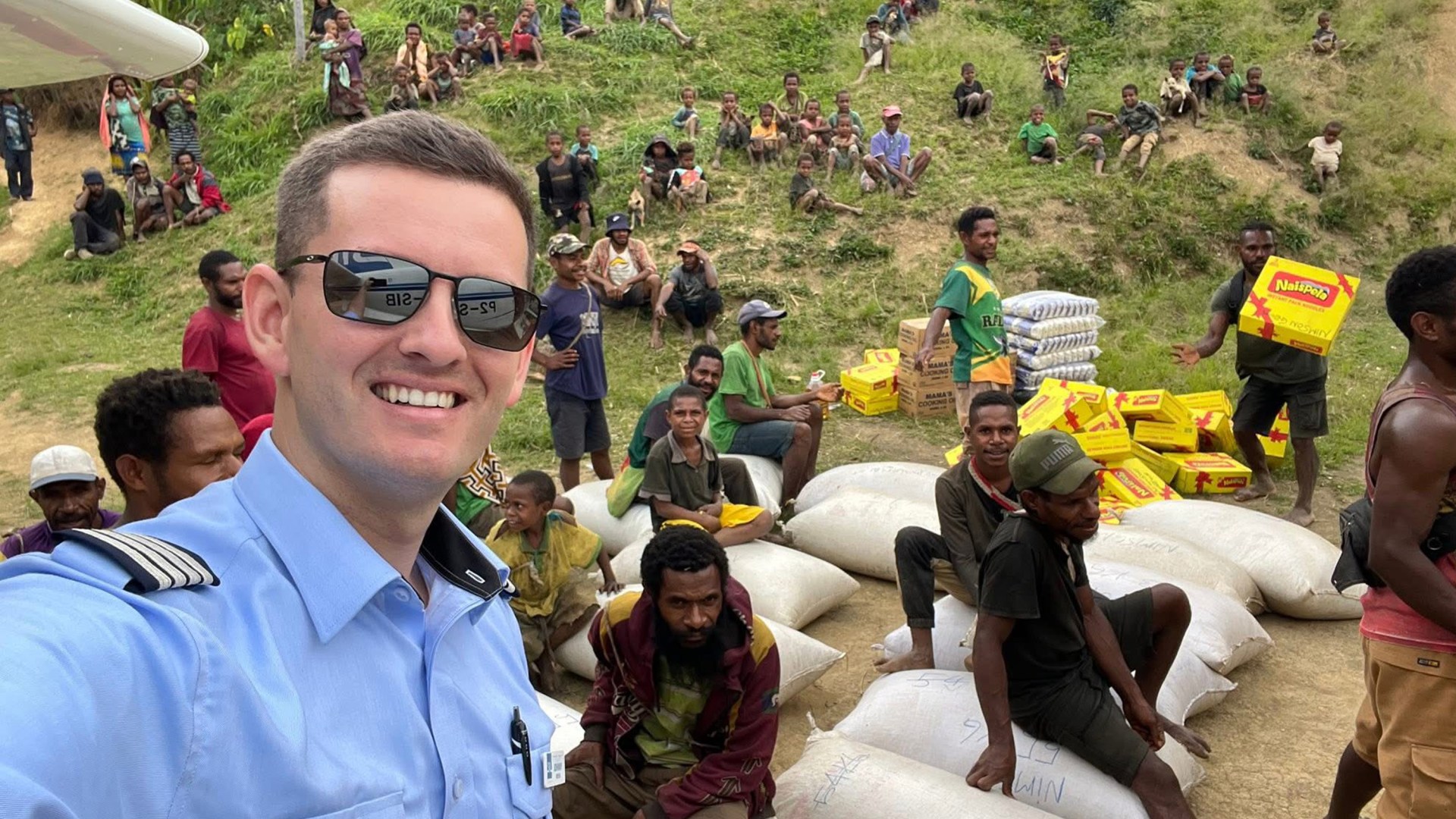
Johnny Reeves, a JAARS Pilot in Papua New Guinea, bringing in supplies.

Johnny Reeves, a JAARS Pilot in Papua New Guinea, bringing in supplies.

Christianity Today April 16, 2026
Image courtesy of JAARS

When Iran began severely restricting access to the Strait of Hormuz in early March, Jungle Aviation and Relay Service (JAARS) felt the impact almost immediately. The Christian nonprofit has 48 aircraft and 75 pilots in its alliance and flies missionaries to every major rainforest on the globe.

During the past few weeks, the organization has weathered an “astronomical increase” in aviation fuel costs, according to Steve Russell, president and CEO of JAARS. It’s one of the most significant increases he can recall.

Now, instead of spending $600 an hour on fuel for a turboprop aircraft, JAARS is paying 25 percent more on average—an extra $150 per hour—and facing increased costs for parts and labor due to supply chain disruptions.

“You budget for 2.5 percent or 3 percent for inflation maybe in a year, but not 25 percent. That’s huge,” Russell told Christianity Today.

That’s in addition to the overall increase in operational costs in the aviation industry since 2019 and the tariff challenges JAARS faced last summer. “There are huge impacts that people don’t even imagine would affect missions,” Russell said.

JAARS transports missionary translators into some of the world’s most remote villages where they learn local languages, translate Scripture, and promote literacy. Several weeks ago, Russell sent a memorandum to members of the alliance to begin thinking through, as he said, “an awful lot of issues that normally we might take for granted in times of peace.”

So far, JAARS has not been forced to cut flights, but it is considering asking fuel companies for price breaks and may also reach out to Christians for additional donations.

JAARS isn’t the only Christian ministry facing increased costs related to disruptions in the strait. CT spoke with another aviation ministry and four Christian relief organizations concerned about rising operational costs and how their trickle-down effects could disproportionately affect the world’s most vulnerable people.

Iranian and US negotiators agreed to a two-week cease-fire on April 7 yet failed to negotiate a deal during peace talks in Pakistan over the weekend. On Monday, the US imposed a blockade on Iranian ports in an attempt to choke off Tehran’s oil revenues—raising concerns of renewed fighting.

The war began at the end of February after decades of Iranian nuclear and ballistic missile expansion and deadly attacks by Iranian proxy groups on US forces, Israel, and other regional allies. The joint US-Israeli operation has destroyed most of Iran’s navy, air defense system, naval mines, and nuclear industrial base, according to General Dan Caine, chairman of the Joint Chiefs of Staff. It has also “devastated” Tehran’s command and control networks.

Iran responded by attacking oil tankers and cargo ships, laying mines, and charging tolls as high as $2 million for safe passage through the Strait of Hormuz, creating a backlog of ships in the crucial waterway—including 425 oil and fuel tankers and around 20 vessels carrying liquefied natural gas.

Around 20 percent of the world’s oil—sourced from Kuwait, Saudi Arabia, and Iraq—transits through the strait during normal operations.

The conflict has dealt a serious blow to global economies. Willie Walsh, director general of the International Air Transport Association, told The New York Times it will take months for global jet fuel supplies to stabilize—even if traffic in the strait returns to normal levels in the coming weeks—due to disruptions to refineries.

That’s difficult news for mission organizations already feeling the hit to their pocketbooks.

“There are acts of God, and you can budget for those a little bit, but this kind of an issue has a systemic impact, raising costs significantly,” said Chris Palombo, CEO and president of Medicine for All People (MAP) International, a Christian organization that provides medicine and medical supplies to people in 100 countries around the world. “So when will we feel it? We’re feeling it now.”

Palombo said fuel prices have increased 25 to 35 percent, and shipping quotes that were once good for 30 days are now only good for five. Shipments are delayed one to three months—a significant setback for donated medicine with expiration dates or refrigeration requirements.

“We are constantly fighting the clock,” Palombo said. “If you lose a couple of months going from a port to a warehouse to a clinic to a mass unit clinic at the far edges of some country, nine months of usable life just became six or five.”

Much of the medicine MAP receives is donated because of looming expiration dates, he added, noting that MAP hasn’t been able to calculate the future impact of the delays and rising fuel costs. “It’s one of those things we’re going to know retrospectively, and the challenge with that is it’s very hard to plan,” Palombo said.

MAP was already feeling the increased global need for medical care in the wake of USAID cuts, delivering more than $1 billion in medical supplies and medicine last year against an $860 million budget. Increased donations bridged the gap.

Now Palombo is praying for the crisis to end quickly because “the poor suffer disproportionately.” As global conflicts ignite, the needs of the vulnerable increase—but so do shipping costs. Meanwhile, air shipments are not only less efficient because of smaller containers, but also more expensive due to increased demand.

Mission Aviation Fellowship (MAF) also began to feel the impact of Iran’s waterway disruptions in recent weeks. According to Brock Larson, MAF’s vice president of global operations, since April 1, MAF has faced a 67 percent increase in jet fuel in Indonesia, where it has the greatest number of flight operations. In Africa, MAF has observed a 40–43 percent increase in fuel costs.

Larson said fuel costs are MAF’s second or third highest expense behind labor and sometimes maintenance. MAF and its sister organizations operate a fleet of 135 airplanes that serve 1,500 churches, nonprofits, and humanitarian organizations in 37 countries. MAF is currently under budget and able to pay the extra costs, Larson said, but may need to send an appeal to donors if the conflict continues another three to six months.

Compassion International is also seeing rising flight costs and is exercising caution with its travel budget. Yet one of the organization’s primary concerns is the current instability in marketplaces, said Matt Ellingson, Compassion’s principal humanitarian advisor.

“Right off the bat, vendors are going to raise the cost of the things they have on the shelves because they’re not sure when they’re going to be able to be restocked,” Ellingson added.

For instance, delayed fertilizer deliveries could limit future harvests since each planting season requires a different type of fertilizer. This compounds the suffering in sub-Saharan Africa and South and Southeast Asia where people are already very vulnerable. Countries dependent upon Middle Eastern oil are also highly vulnerable, including the Philippines, Bangladesh, and Sri Lanka, he added.

“Fuel rations mean expensive fuel at the pump, but it actually means that day laborers will have less opportunity to work, and they will have to spend more money for their basic needs for their families, and so they’re the ones that will experience the hardship first,” Ellingson said.

Parents could soon be making some difficult decisions between consuming what they have and hoping for a future resolution or withholding food to try to survive a long-term shortage. “I’m a dad, and it always rips me apart,” Ellingson said.

Hannah Chargin, World Vision’s director of advocacy, said many regions of the world are close to entering their planting season. Within 6–12 months, reduced fertilizer application could result in a 5–15 percent decline in harvest yields, triggering sustained price increases, Chargin said. 

In Sudan, the crisis could impact access to water. “The country is heavily reliant on borehole drills, and these drills are run by diesel generators that suck the water into tanks,” Chargin said. “And currently, it’s the hot season in Sudan, so when diesel prices rise, that means the price of water increases.”

Adula Gemta, regional director of international programs for World Relief, said the Hormuz crisis has not yet significantly affected his organization, but he anticipates greater consequences if it continues for several more weeks. World Relief’s programs are concentrated in Africa, which relies on Middle Eastern supply routes. His organization maintains some stocks of fuel in warehouses since they use fuel for lighting and transportation.

Fragile countries have limited fuel stock, so a larger fuel shortage may be visible within two months, Gemta added. These countries have increased vulnerability because suppliers can drive up prices. Some parts of Sudan have already seen a 60 percent increase in fuel costs, he said.

Amid the uncertainty around fuel prices, changing shipping lanes, and the rising cost of food, Russell of JAARS finds encouragement in Paul’s teaching in Acts 17:26 about God determining the boundaries of nations.

“These events don’t escape God’s notice,” Russell said. “And if he wants his kingdom to advance, and he wants to use us in the ministry of reconciliation to be ambassadors for Christ, then he will resource his work through his people.”

Theology

What Is Godly Resistance?

Contributor

Exodus’s midwives can teach us a lot about how to fear God more than the king.

Paintings from Exodus.
Christianity Today April 16, 2026
WikiMedia Commons / Edits by CT

Judging by current public discourse, one might think the Bible only addresses politics once, in Romans 13. “Let everyone be subject to the governing authorities, for there is no authority except that which God has established,” the apostle Paul wrote (v. 1). But are we to understand this as the only model for Christian political witness? Is Paul’s instruction a universal mandate for believers, even in situations where earthly rulers indeed terrorize “those who do right” (v. 3)?

Peter seems to support this approach when he says, “Submit yourselves for the Lord’s sake to every human authority. … Honor the emperor” (1 Pet. 2:13–17). However, he goes on to emphasize that we should be willing to endure unjust suffering ourselves. Inflicting injustice on others is another question altogether.

One of my heroes is Corrie ten Boom, a Dutch woman who resisted the Nazi regime by hiding Jews in her home and falsifying ration cards to feed them. I read her memoir, The Hiding Place, several times as I was growing up. Keeping the Jews safe required daily deception—a vigilant disobedience to the governing authorities. Her choice to resist the regime resulted in her capture and imprisonment at a concentration camp, where she suffered much. But mercifully, she survived the war and went on to write and speak about the power of forgiving her enemies.

Perhaps her story meant so much to me because my own grandmother, Barbara Brinkman (later Barbara Camfferman), a contemporary of ten Boom, worked for the Dutch Underground. She and her brothers attended clandestine meetings where, with fellow Christians, they devised ways to undermine the Nazis. They kept radios even though Hitler had banned them. They blew up bridges, stole equipment, and forged ID cards. My grandmother broke curfew to deliver messages, rolled up in the handlebars of her bicycle, for Allied soldiers. Once she was detained and nearly arrested.

An American fighter jet was shot down out of the sky above their farm, and the pilot parachuted into their back field. She and her brothers hid him and helped him escape. One of her younger brothers spent the war hiding in the attic of a kind family some distance from home to avoid conscription. For several long years, they all held their breath and did what they could. Miraculously, my grandmother and her siblings all survived the occupation.

They did not submit to the governing authorities. My grandmother resisted repeatedly. Was she wrong to do so? Should Corrie ten Boom have surrendered her Jewish friends to the Third Reich?

I think not. And the Bible offers strong precedent for their resistance—defiant behavior that earned God’s approval. Rahab hid the Israelite spies from local government officials (Joshua 2). Jael violated a clan allegiance by offering hospitality and then murdering an army general for Israel’s sake (Judges 4). Obadiah—a government official himself!—hid prophets of Yahweh in a cave and provided them food and water so the queen couldn’t kill them (1 Kings 18).

Isaiah and Jeremiah wouldn’t toe the party line when it would have been politically safer to say what itching ears wanted to hear. Isaiah was put in stocks and Jeremiah thrown in a cistern—they indeed suffered for doing and saying what was right. Daniel refused to stop praying to Yahweh, and his friends refused to bow down to a state-sponsored idol (Dan. 6:13; 3:18).

But the women who have captured my heart more than any other defiant Bible characters are the Hebrew midwives in Exodus. Pharaoh tried to enlist their help to eliminate his rivals: “When you are helping the Hebrew women during childbirth on the delivery stool, if you see that the baby is a boy, kill him, but if it is a girl, let her live” (Ex. 1:16). Pharaoh also stoked fear in his nation until the Egyptians felt disgust toward the Hebrew foreigners.

The women refused to comply. At great risk to themselves, they spared the baby boys. Exodus tells us why: “The midwives, however, feared God, and did not do what the king of Egypt had told them to do; they let the boys live” (v. 17).

Were the women afraid of the consequences of their defiance? Perhaps, but their fear of God outweighed their fear of Pharaoh. They understood that the judgment that mattered most was God’s. Their obstinance saved a generation. The text makes clear that God rewarded them for their work (vv. 20–21).

We don’t know much about these women, other than their names, Shiphrah and Puah. But in a story where the villain is never named (“Pharaoh” is a title, not a name), these named women stand out as significant and worth remembering. Scholars debate whether or not they were Hebrew themselves, whether they were the only midwives or the chief midwives, and whether they lied to Pharaoh about the early deliveries or told the truth.

Their retort to Pharaoh exhibits a cleverness worthy of Brer Rabbit or High John the Conqueror: “Hebrew women are not like Egyptian women; they are vigorous and give birth before the midwives arrive” (Ex. 1:19). The word vigorous is related to the Hebrew word that means animal. Pharaoh treated the Hebrews like beasts, and their strength made them impervious to his plan.

The midwives, Moses’ mother and sister, the daughter of Pharaoh, and her servants, each conspired to defy the king and his orders. Each one worked within her sphere of influence to birth, nurture, and rescue a child under threat of death.

Imagine if they had looked at one another and said, “What choice do we have? The king says we must put him to death.” We would have no Moses, no deliverance from slavery, no trip to Sinai, no Ten Commandments, no Tabernacle. In short, we would have no covenant and no Messiah and no blessing for all nations—at least not in the way the Scripture describes.

Later in Exodus, we discover that the actions of Pharaoh’s daughter anticipated what God would do. He saw the Hebrews, heard their cries, had compassion on them, and sent someone to draw them out of Egypt (2:23–25; 3:7–8). And Moses is like his sister Miriam. He takes his stand on the banks of the Nile to confront Pharaoh on his way to the river and request that he “let my people go” (7:15–16). We can find the same vocabulary in the story of the young girl who negotiated the deliverance of her baby brother (2:3–4, 7). If you want to learn about God in Exodus, watch the women—they behave most like him.

The ethical dilemmas of our own day are no less complex. Do we employ undocumented immigrants? Do we educate them? Do we assist those lawfully present in our country to avoid ICE raids because we are not confident that they will be treated lawfully? Do we vote for a candidate who has pledged to support gender transition surgery for minors without parental approval? Do we take a stance on the wars in Gaza and Iran?

Do we vote for candidates of either major party when both are committed to making abortion more accessible? Do we comply with government regulations that require us to offer services that violate our consciences? Do we align with our president in condemning the pope?

We must develop the moral discernment to know when to invoke Exodus 1 as our model and when to lean into Romans 13—whether the governing authorities are requiring us to disobey God’s commands or to keep them. Knowing good from evil is the most urgent need of our age and of any age.

But as in the beginning, we must seek the Lord for this wisdom and not attempt to define it for ourselves (or let government leaders define it for us) in the spirit of the times. The Scriptures are the most powerful material gift we have—the self-revelation of God that shows us how to embody his character in our worship, in our work, and in our witness. Parroting one verse without reading the whole counsel of God can result in the malformation of our ethics.

Sadly, our collective knowledge of the Scriptures has faltered. We’ve fixated on vague memories from Sunday school or isolated passages that seem relevant for the current moment. We’ve allowed ourselves to be swayed by leaders who cite Bible verses to justify their actions. But we’ve lost the moral discernment that arises from seeing the bigger picture and understanding how the stories are meant to fit together.

Today, we need the courage of the midwives, who feared God more than the king and knew that what Pharaoh was asking was entirely immoral. We’re in desperate need of a renewed scriptural vision and a fresh commitment to participate in work that honors God’s character and God’s mission, no matter what it may cost.

Carmen Joy Imes is an associate professor of Old Testament at Biola University and an author. Her latest book is Becoming God’s Family: Why the Church Still Matters.

Theology

Trump’s AI Jesus Might Be the Messiah We’ve Been Looking For

Columnist

Perhaps this blasphemous image can expose what we’ve become—and, ironically, lead the way back to what’s real.

Trump's AI Jesus image.
Christianity Today April 15, 2026
Illustration by Christianity Today / Source Image: Google

This piece was adapted from Russell Moore’s newsletter. Subscribe here.

In the past few weeks, the president has posted an Easter message that used profanity and threatened civilizational genocide, has issued threats to the pope, and has posted an AI-generated image of himself as Jesus. (He now says he was portraying himself as a doctor.) After all this, even some of the president’s supporters feel humiliated and angry. I think it’s worth asking what exactly is coming to light in this moment and whether it could disrupt a means-to-an-end cultural Christianity.

For years, some evangelicals have told us Donald Trump might be the disruptor we need to bring us back to Jesus. For the first time, I think they might be right—just not in the way they thought. Maybe “Trump AI Jesus” is what we’ve been waiting for to show us what we’ve become. And oddly, that just might be a point of hope.

After all, the now-deleted Truth Social post was not some break from the usual pattern. Just two weeks before, the senior adviser of the White House Faith Office compared the president to Jesus Christ, with specific references to his betrayal, arrest, and crucifixion. If that’s not blasphemy, the word has no meaning. But her comments were met with applause in the East Room and yawns most other places. A week or so before that, the president posted images of his proposed presidential library in Miami, including a gold statue of himself pictured before a crowd of attendees.

But the Trump-as-Jesus (excuse me, as Florence Nightingale) post was so tawdry and public that it was humiliating. The humiliation it caused was not about Trump. Who did not already know his high view of himself? It was about us: The president is so confident in evangelical and white Catholic support that he is willing to stand on Fifth Avenue and point the metaphorical gun at the first commandment, confident he will not lose any support.

Many times over the past decade, I’ve quoted an editorial in The Guardian, published shortly after the 2016 presidential election, that explains American evangelicalism to a secular British audience. “A religion that is responsive to the pressures of the market will end up profoundly fractured, with each denomination finding most hateful to God the sins that least tempt its members, while those sins that are most popular become redefined and even sanctified,” the editors wrote. “In the end, a market-driven religion gives rise to a market-driven approach to truth, and this development ultimately eviscerated conservative Christianity in the US and left it the possession of hypocrites and hucksters.”

Two thousand years of Christian history should have taught us the church needs to be both an institution and a movement, or else it becomes unmoored. During the Reformation, institutionalization was the problem. The church’s authority was so unquestioned it could use people’s fear of pain in purgatory to enrich itself with the selling of indulgences. That problem could not be corrected from the inside—it needed some theses nailed to the door.

We need reformations and revivals to keep the church from becoming just one more institution. But we need institutions to keep the church from becoming an entrepreneurial populist mob tossed to and fro by the passions of the moment.

When the problem is ossified institutionalism, only an outsider—a Martin Luther or a Roger Williams—can address the problem, because those on the outside cannot be bought with position or power. But when the problem is market-driven populism, the opposite is sometimes the case: We need an institution to call out our wrongs.

Perhaps this is why Pope Leo has been able to speak in ways that don’t fit the “movements” of the moment—he’s pro-life on abortion and euthanasia, solid on the traditional Christian emphases on marriage and family, unflinching in opposition to the mistreatment of migrants and to unjust war-making and war crimes, and—perhaps most counterculturally—against the idolatry of politics. Maybe what enables him to hold all these views is that he knows he represents a 2,000-year-old structure that predates and will postdate all these political movements, including the American republic.

Quests for institution without renewal or for movements without structure ultimately lead to the same place: back toward whatever we already want, now reimagined as the gospel itself. And there will always be people who want to commandeer that kind of gospel, to mobilize voters or to sell products.

The problem is not that Trump can’t tell the difference between himself and Jesus. It’s that too many of us can’t. That’s why many people’s test of loyalty right now is not whether you hold to the gospel or to the mission or to the creeds or to the transformed life but whether you are sufficiently “in line” on politics. And almost every leader, in government and the church, knows that any show of ambiguity summons an angry mob of outrage.

But we’ve seen all this before.

In the Book of Acts, Paul went into Ephesus preaching the gospel, and that became a problem. He said handmade gods were no gods at all. The guild of silversmiths who made miniature shrines to the goddess Artemis—led by a man named Demetrius—saw their revenue stream was about to dry up. But Demetrius was savvy enough to know that “our profit margins are suffering” wasn’t going to fill the streets. So he reframed it, saying Paul was disrespecting and threatening the great goddess Artemis and the city’s identity as her dwelling place, the center of one of the most powerful cults of the ancient world (Acts 19:27). That framing worked. He mobilized the crowd.

The people were in the streets, chanting, “Great is Artemis of the Ephesians!” (v. 28, ESV throughout) for hours. Acts notes that most of the people didn’t even know why they were there or why they were so impassioned (v. 32). They just knew what side they were on. The economic grifters counted on the tribalistic mob, and they knew the way to get at them was nationalist frenzy. These were not three separate things—they were one system, each element feeding the others, all of it needing an identity large enough to die for and an enemy visible enough to hate.

But the moment ended. A town clerk came to himself and said the frenzy had gone on too long and would destroy the city. This low-level Roman bureaucrat looked at what his city had become and flinched.

More importantly, Paul would later write to the city’s little, seemingly irrelevant church to tell them they were at the epicenter of the new thing God was doing: gathering all things together in Christ (Eph. 1:10), who is before all things and in whom all things hold together. Paul told them “the course of this world” and “the prince of the power of the air” and “the passions of our flesh” (2:1–3) are what Jesus came to undo.

Paul wrote that the dividing wall, the thing that makes tests of loyalty and tribal identity feel ultimate, has been broken down by a body, not a better politics (v. 14). He showed them that the real battle is against principalities and powers, not flesh and blood—which means chanting the name of any earthly figure, however loudly and however long, is fighting the wrong war with the wrong weapons.

The mystery of Christ—hidden for ages, now made known—is that the answer to every Ephesus in every century is not a counter-mob or a reformed silversmith guild or a smarter political coalition. It is the same thing it always was: something that looks too small for the moment. Sometimes that starts with people who, while polishing silver, look into the dead eyes of an idol and ask, Is this what we’ve become? To see it close-up is humiliating. Sometimes the humiliation leads people to double down. But sometimes it leads back to what’s real.

Maybe we’re in that kind of moment. I don’t know. But perhaps the craziness and grossness of this blasphemous time will cause us to look at the Jesus images we’ve made for ourselves—to really look at them—and ask, “Are you the one who is to come, or shall we look for another?”

Russell Moore is editor at large and columnist at Christianity Today as well as host of the weekly podcast The Russell Moore Show from CT Media.

History

Changing Times and Technology

In 1981, CT helped evangelicals navigate debates over Ronald Reagan, genetic engineering, television, and male headship.

A CT magazine cover from 1981 and an image of a person in front of a tv.
Christianity Today April 15, 2026
Illustration by Christianity Today / Source Images: Getty, CT Archives

Was Billy Graham out of step with evangelicalism? In the article “Candid Conversation with the Evangelist,” CT asked the magazine’s founder if he had drifted to the left while the grassroots movement was moving toward the Religious Right. Graham had a different view of what was happening:

I do not agree with that observation. … There are, perhaps, some differences on social and political questions that are more evident today because of our visibility. The pendulum swings back and forth on some of the social, economic, and political issues. But most evangelicals recognize they have responsibilities in these areas in certain contexts. I have been called “liberal” in some areas because of my stand on certain social issues; I have been called “conservative” theologically. I accept both labels, and believe that I stand in the mainstream of evangelicalism.

CT also profiled Moral Majority leader Jerry Falwell, asking whether he was “bandit or crusader.” The magazine noted that, as a fundamentalist, Falwell would not cooperate with Graham on evangelistic events, and asked Falwell whether the Moral Majority was fundamentalist. He said:

The most aggressive leaders in Moral Majority are fundamentalist pastors. That isn’t necessary, because Moral Majority is not a religious organization; it’s political. There is no theological agreement in Moral Majority. At the same time, fundamentalists like me were taught to fight before we were taught to read and write. There is no lack of courage among fundamentalists. Fortunately, fundamentalists like me have been growing up over the past 20 years. We have been finding we can fellowship only in truth, but that we can have friendship in many other affinities. … 

My definition of a fundamentalist is one who, first, believes in the inerrancy of Scripture, and second, is committed to biblical separation in the world and to the lordship of Christ. …

What we’ve said from the beginning is that the Moral Majority is a political organization. You’re not going to hear doctrine there. We are not going to try to witness to you there. You come as an American who shares the moral views of the membership, and to fight together on a prolife, profamily, promoral, pro-American position.

Pro-life Christians faced political setbacks in 1981. Elected leaders told them banning abortion was politically impossible

That route requires two-thirds approval of each house of Congress and ratification by 38 states. Advocates of a constitutional amendment have been unable to agree on wording or strategy, and none of the many versions has been reported out of committee.

Ardent antiabortion activists themselves are hopelessly split: some want exceptions for such reasons as rape and incest included in the wording; others are holding out resolutely for no exceptions. And some Catholics among them have blended their opposition to unnatural contraception with their antiabortion views, further clouding the amendment cause. …

Proabortionists generally see little chance of an amendment being passed in the near future, but a statute is conceivably within easy reach since both houses are ruled by a conservative majority. Some antiabortionists fear that debate over a statute, whose continued existence would be subject to the ideological whims of future congresses, will distract from efforts to win an amendment. Others—including some stalwart antiabortionists on Capitol Hill—believe [North Carolina Jesse Helm’s proposed legislation defining an unborn child as a person] is unconstitutional.

Then, President Ronald Reagan nominated Sandra Day O’Connor to the Supreme Court. She had long called abortion a right that should be legally protected. CT reported the response of Christian activists who had mobilized pro-life support for Reagan. 

Prolife leaders gathered in Dallas … a week before Senate confirmation hearings were to begin in Washington on O’Connor’s nomination, to proclaim their chagrin and do what little they could to fight the confirmation. It became clear during the long day of speeches and sermonizing that whatever their hopes for defeating O’Connor, the prolifers were not yet ready to give up on Ronald Reagan. It was the day’s most surprising development.

“Ronald Reagan is the greatest president we’ve had in my lifetime, and history may record that he’s the greatest president ever,” declared evangelist Jerry Falwell. Falwell promised Reagan he would withhold all comment on O’Connor until after the confirmation hearings. He turned down repeated opportunities provided by the press to denounce Reagan because of O’Connor.

When Carolyn Gerster, an Arizona physician and long-time leader in the prolife movement, met with candidate Reagan early in his campaign, he convinced her of his commitment against abortion. The interview led her organization, the National Right to Life Committee, to endorse him for president. During the Dallas rally, she spoke heatedly against the O’Connor nomination, but she was steadfast in her belief in Reagan. She believes Reagan was misinformed about O’Connor’s abortion record, either by O’Connor herself, or by a Justice Department staff member who researched her record.

In 1981, CT looked at another way Christians could demonstrate commitment to the value of life, publishing multiple articles on the need to include disabled people in church. A pediatrician wrote about why churches should welcome children with Down syndrome.

In my work with developmentally delayed children, I have seen and attended creative and innovative church school programs where there was an environment of love and acceptance. But in many churches, which find themselves faced with children like Jason for whom they have no program and whose very presence evokes strong feelings, rejection results. … 

The act of rejection … is based on the notion that because of his retardation, Jason could not comprehend “church,” and, therefore, could not benefit from it. That is a very dangerous attitude, yet it is one that pervades our society and characterizes many of the attitudes toward retarded individuals. …

But the church has not only a commitment to accept, but the opportunity to provide a specific ministry. It is the ideal place to establish the fact that functional and intellectual abilities are not synonymous with acceptability as a person—nor, most certainly, acceptance into the kingdom of God.

CT called attention to a “new area of responsibility” in 1981 with an editorial on “genetic engineering.” 

Having witnessed how Congress has handled, or mishandled, abortion, the energy crisis, the post office, Amtrak, and the economy, one is not given to much optimism about how our legislators will do with biotechnology and a definition of what constitutes “life.” There is no doubt that the lines of battle are already being drawn. Those who were not alarmed by the Supreme Court’s decision played down fears by noting that the oil-eating bacterium was not life, but matter. The invention was a manipulation of matter, not the creation of life in a godlike sense, they explained. 

On the other hand, a strong cry of protest arose from others in both science and philosophy (not necessarily Christians, by the way), who warned against a dangerous “foot in the door” situation. Their argument is that genetic engineering makes no distinction between life and matter. They warn that the ultimate conclusion is that all of life’s properties can be reduced to the “physico-chemical.” …

What to do about splicing genes, it seems to us, will be decided on the same basis as abortion and euthanasia. If “life” is purely material, then anything goes; there are no moral boundaries. The trend in public policy in recent decades decidedly has been away from a definition of life as something special and sacred and toward a definition that is “physico-chemical.” We agree with the alarmists on this point.

Evangelicals embraced another kind of activism in the early 1980s: boycotts. CT noted one apparently successful effort to convince television networks to stop airing offensive material.

If you want to do something to rid television of profanity, sex, and violence, switch off your set, write protest letters to network officials, or join a PTA lobby. But if you really want to do something, pull together a large group of people (three to five million will do), get backing from the Moral Majority, and plan a boycott. Threaten to stop buying products of companies that sponsor offending programs—and watch the fur fly.

That’s just what Donald B. Wildmon, founder of the Coalition for Better Television, did. He proposed a one-year boycott of products from sponsors of television shows marked offensive by 4,000 volunteer monitors during a three-month period. … The monitors produced a list of sponsors—but Wildmon never used it to effect his boycott. One week before the scheduled announcement of his list, Wildmon met with advertisers in Memphis and made an eleventh-hour decision to hold off on the boycott.

Justifying the boycott, Wildmon, a United Methodist clergyman, had said, “Our values, our principles, our morals—those things which are very dear and meaningful to us—have been ridiculed, belittled, mocked, and insulted by the networks. We feel the boycott will be criticized very loudly by the networks and the companies, but that’s nothing new to us. The only thing that matters to them is money and we’re ready to see the boycott through to prove our point.”

Christians concerned about the quality and morals of television in 1981 were also exploring the use of a new technology, the video cassette recorder, or VCR. CT said it might be the “key to taming the TV monster.” 

Our family decided it was time to stop talking about television’s potential for harm and do something about it. … We looked for a workable alternative that would let our preteens feel privileged, not punished. For us the answer is a video cassette recorder (VCR). We play what we judge the very best programs. Add an occasional rented videotape, and a birthday party or slumber party becomes special. …

Saturday morning cartoons, often called TV’s most violent hours, once kept our children entranced. Now they usually give way to a replay of Sound of Music, “Little House on the Prairie,” “Star Trek,” or “Those Amazing Animals.” …

Taping costs are not unreasonable. We record six hours of material on a $15 videotape. We paid $850 for a fully portable A.C./battery-operated, 11-pound VCR. Used standard table-top models go for $350 and up. As a result of our new control over TV, we watch it less and we watch it constructively.

CT told readers their churches should also consider VCRs.

Video—specifically, prerecorded videocassette programming—could become the church’s “now and future” audio-visual tool. … While newer, lighter, portable VCR units are becoming increasingly available (remember those ads?), even carting an older machine to the home of a shut-in, plugging it into the TV, and turning on, say, John Stott, would add a new dimension to home visitation. 

If you start thinking about the possibilities that exist when you possess your own VCR camera, the sky is suddenly the limit. Now you can take last Sunday morning’s service or the Sunday school Christmas program to that shut-in. Or, add a five-foot projection screen to the TV set at church: John Stott or Chuck Colson or John Mac Arthur or Oswald C. J. Hoffmann or a host of others can teach your congregation—almost in person—for a relatively small tape rental fee.

Evangelical media had its own big controversy in 1981 after CT investigated the story behind Jack Chick’s Christian comic book Alberto

It purports to be the true story of a Jesuit priest named Alberto Rivera, who was raised and trained in a Spanish Jesuit seminary, and whose job was to infiltrate and destroy Protestant churches. … A year ago, Alberto Rivera himself issued a sworn statement defending the allegations. He declared in part that, “Alberto is a true and actual account and I will face a court of law to prove the events actually took place.” …

This reporter’s investigation shows that not only was Rivera not a Jesuit priest, but also that he had two children during the time he claimed to be living a celibate life as a Jesuit. Neither, it seems, does he have a sister in England who was a nun. Rivera has been sought by police for writing bad checks in Hoboken, New Jersey, and for stealing a credit card in Florida. Those revelations taint the credibility of the fantastic stories Rivera tells in the comic books.

Evangelicals were also debating the issue of male headship in the home in 1981. CT published multiple female authors sharing personal stories of how they submitted to their husbands. A woman in Pennsylvania wrote about how she navigated a difference of preference in holiday decor. 

Hale and I have varying tastes in music, literature, hobbies, home decorating—and even in Christmas trees. He doesn’t like Christmas trees, and wouldn’t care if we never put one up. My family always had real trees that scraped the ceiling and filled the house with their fragrance. The conflict came when we were given an artificial tree as a wedding present.

For the first several years we had more than just a “discussion” on real versus artificial trees. Finally, my husband said he didn’t want to hear about it any more. So, during some years when the children were temptable babes, we didn’t put up any tree; the rest of the time I have had to be satisfied with an artificial tree, with no mention of a real one at all. … I know there is no substitute for the peace and security of having a biblically ordered home.

Ideas

My Family Resisted Iran’s Regime. My Hope Is Not in Foreign Intervention.

Jesus spoke peace to his disciples as they hid. Iranian Christians modeled for me that same resistance with grace.

A closed door, an image of Jesus, and smoke from missiles in Iran.
Christianity Today April 15, 2026
Illustration by Elizabeth Kaye / Source Images: Getty, WikiMedia Commons

On Saturday, February 28, just a few hours after the start of the US–Israel war against Iran and before the internet went dark, my sister called from Yazd in central Iran. Her voice was calm.

“Don’t worry,” she said. “We have supplies. We’ll stay home. We’ll lock the doors.”

Then the line went silent.

By the next evening, reports emerged that her area had been bombed. After that, nothing. No messages. No calls. No confirmation. Just silence.

Days later, she managed to call again briefly, just long enough to say the family was alive. Alive—but still behind locked doors.

In recent weeks, Iran has been plunged deeper into war. Airstrikes have hit cities, energy infrastructure, and residential areas. Reports—fragmented and difficult to verify—suggest widespread destruction of homes, hospitals, and public spaces. Communication blackouts have made it nearly impossible to know what is happening on the ground.

For those inside—and for those of us with family there—fear, uncertainty, and waiting are a lived reality.

And in the middle of that waiting, I found myself returning to a familiar passage: “On the evening of that first day of the week, when the disciples were together, with the doors locked for fear of the Jewish leaders, Jesus came and stood among them and said, ‘Peace be with you!’” (John 20:19).

John’s gospel does not hide the fear of the disciples. After the Crucifixion, they are not bold or triumphant. They are hiding. Their fear is a reasonable response to violence. They have seen what power can do, so they lock the doors.

That image, behind locked doors, has followed me in the weeks since the war began. It is one Iranians are familiar with. In societies shaped by prolonged authoritarian rule, closing the door is not simply retreat; it is learned wisdom. Private space becomes a fragile shield against surveillance, detention, and violence. And yet even locked doors do not—and did not—always protect us.

My childhood unfolded in the shadow of prison. Visiting my siblings in prison was part of ordinary life. I remember one visit when my brother was weeping. He had tried to save a prostitute sentenced to execution by asking to marry her, hoping to spare her life, but his request came too late.

“I couldn’t save her,” he said. The system was swift and unforgiving.

Yet even within prison, there were signs of dignity. I remember the handbags and handicrafts prisoners made, which we bought to support them. As a child, I loved those heavy handbags: their stitching, their colors, their weight. Only later did I understand that they were more than objects. They were quiet acts of resistance, beauty created under constraint.

Our home was never entirely private. At least once a month, we burned books in our backyard tanur—the bread-baking oven—after warnings that the Islamic Revolutionary Guard Corps was coming to search the house. A neighbor, both a friend and an informant, would give us a narrow window of time. We burned books to protect ourselves, then slowly bought them again. Buying and burning, concealing and reclaiming.

Even home was negotiated space, never fully secure.

My journey adds another layer. As a young student leader, I identified as a Communist and atheist. I believed structural injustice required structural change. When I once told my mother that I might be arrested, she said, “If it is for your ideology, I will be proud of you. But if it is for immorality, I won’t forgive you.” That distinction shaped me deeply. When I later became a Christian, my concern for justice was reoriented. Faith did not silence political awareness; it deepened its grounding.

As older teenagers, my friend, my brother, and I searched for the unmarked graves of dissidents executed in the early 1980s. We found two beneath a large tree. We sat there in silence then read a poem to them.

These memories shape how I respond to the present geopolitical moment. As a family, we did not support the Iranian regime. My story is marked by resistance to its coercive practices. Yet opposing domestic authoritarianism does not automatically mean embracing foreign intervention. Sovereignty, even when misused by regimes, remains a serious moral concern. The history of the region reminds us that external military action often fractures societies rather than restores them.

When Jesus appears in John 20, Rome has not fallen. The empire remains intact. The disciples remain vulnerable. And the risen Christ shows them the scars in his hands and side. The scars remain visible, a reminder of the violence. Yet resurrection carries it forward in transformed form.

I too have seen scars caused by interrogation and torture, even more vividly after I became a Christian. I have seen cigarette burns on a friend’s side, leaving small holes in his flesh because of his faith. I have seen another friend’s shoulders damaged simply because he believed in Christ. I have seen my brother’s back torn by lashes. I have also known detention and questioning myself.

John’s narrative resists two temptations: It does not deny fear. (The doors remain locked.) Nor does it promote retaliation. Instead, Christ speaks peace into a room shaped by fear. This peace is an invitation to a different way of being present. “As the Father has sent me, I am sending you” (v. 21). The disciples are commissioned to embody power rather than taking it.

Today, responsibility cannot be reduced to simple alignment with a regime or foreign power. It calls for discernment. As part of the Iranian diaspora, I am conscious that those inside the country have endured sustained repression in ways many of us outside have not. Our voices must therefore be careful: How do we speak responsibly about a country we no longer live in—but still belong to?

Iran today feels like a locked room, a place filled with the sounds of aircraft, explosions, ambulance sirens, fear, rumors, and unanswered questions. Perhaps my own heart feels like that room too. I now know that my family are alive. But many others have died, and many more have been made homeless. New scars are forming—on bodies, on cities, on memory.

Part of me wonders, Could this mean change? Could I return? Another part asks, What will be the cost? Will sovereignty be lost? Will Iran become another fractured country in the Middle East?

When Jesus says, “Peace be with you” (v. 19), it is not the peace of empire. It is not the peace of silence. It is the peace of wounded hands that did not retaliate.

I am Iranian. I am Christian. I carry scars.

John 20 also speaks of breath. Jesus breathes on the disciples and says, “Receive the Holy Spirit” (v. 22). Breath recalls creation: a new beginning. It suggests that renewal begins with interior transformation and shared vocation rather than dominion. Applied to Iran, it suggests that lasting change emerges from dignity, accountability, and resistance. It resists the reduction of our future to pure power calculations.

Christ enters the locked room without dismantling the door. He does not rebuke the disciples for their caution. He neither glorifies fear nor demands reckless exposure. He stands among them, shows his scars, and speaks peace.

I do not know how Iran’s political future will unfold. Power will shift. Narratives will compete. Nearly five decades of accumulated scars will not disappear overnight.

What remains is a posture shaped by memory and faith, resistance and grace—resistance without cruelty, critique without surrender to empire, hope without romanticizing collapse. The inheritance of my childhood—prison corridors, burned books, hidden fugitives, unmarked graves—does not demand vengeance. It calls for moral seriousness and responsibility.

The passage in John does not offer escape from uncertainty. Peace is spoken into fear, not after fear is gone. Scars are acknowledged. Commission follows encounter. The locked room becomes not only a place of confinement but also a place from which vocation begins.

Behind locked doors, the gospel reminds us, Christ is present.

A version of this article was published on the Oxford Centre for Mission Studies’ website.

Ideas

Partying in Joy and Sorrow

Contributor

Christ has freed us to be a party people, even in grief and pain.

A glowing party hat.
Christianity Today April 15, 2026
Illustration by Elizabeth Kaye / Source Images: Getty, Unsplash

We need to throw more parties.

At least, that’s what my husband and I decided last year in an attempt to beat back the sorry shroud of despondency that had settled over us. Many of the parties we hosted were small gatherings, some were medium, and two were big. All of them were splendid.

Our parties were splendid for happening at all. On paper, you see, we had no business celebrating: In fact, we were in the trenches, facing serious problems trying to care for our children. All three of them had come to us through foster care and adoption. They are precious and talented—and have significant health issues. We were spending hours each week getting treatment and adjusting medications. Our desks held piles of bills. We were in the middle of court proceedings for an insurance appeal. All the while, our kids were doing worse. Our prayers were mostly laments. The household was hardly a party playground.

Yet our conviction grew nonetheless: We needed to party.

We were inspired by several friends who had shown us sweet care by inviting us to their shindigs. My favorites were the impromptu occasions. One friend asked us the day of his birthday to come over and celebrate that evening. He was late in planning and had a hankering for croque-monsieur, a sandwich his wife had volunteered to make. We had never heard of such things and were tickled to our toes. We shuffled over to their house, where they greeted us with lively welcomes, bubbly drinks, and chips and dip. Weary and lackluster though we appeared, we still saw a glimmer of hope. We were loved and not lost; merrymaking was still possible and within our reach.

Merrymaking is rare, however. Americans attend parties about half as often as they did in 2003. Only about 4 percent of us have a get-together on the calendar for a given upcoming weekend. Almost three-quarters of us have no plans for a party on our birthday. Who would we gather with?

Our friend pools are small—only 64 percent of us say we have more than one good friend—and expanding our circles is hard since we’re hesitant to talk with new people.

We need more parties, and fast. When my husband and I came to that realization in our own lives, my sister suggested I read Priya Parker’s wonderful book The Art of Gathering.

Any gathering, Parker declares, can strengthen our bonds to one another. When we understand why we’re gathering, we become leaders in human connection. The guests we invite, the conversations we have, and the space we arrange are all an art form of love and meaning.

In other words, parties are ministry—a ministry of joy for host and guest alike.

I’ve always loved the opening lines of the marriage ceremony in the Book of Common Prayer: “Jesus Christ adorned this manner of life by his presence and first miracle at a wedding in Cana of Galilee.” It strikes me that Jesus was also adorning parties. His contribution to the proceedings, after all, was more wine—the best yet. He could have given a sermon or a practical gift, but instead he replenished the “wine that maketh glad the heart of man” (Ps. 104:15, KJV).

Jesus’ sober-minded loyalty to his Father’s purposes is clear in every New Testament scene. Yet parties were a major part of his ministry, and many of his parables of the kingdom are set at fancy banquets. He describes God as a rejoicer, celebrator, party-thrower extraordinaire. Jesus was also present at so many dinners that his detractors called him “a glutton and a drunkard” (Matt. 11:19). Many guests with him were tax collectors and sinners, sellouts and down-and-outs who perhaps had no business celebrating either, except for one reason: Christ was come.

Christ is come. He is bringing about a salvation the prophet Isaiah equated to a magnificent banquet:

The Lord Almighty will prepare
a feast of rich food for all peoples,
a banquet of aged wine—
the best of meats and the finest of wines.
On this mountain he will destroy
the shroud that enfolds all peoples,
the sheet that covers all nations;
he will swallow up death forever. (Isa. 25:6–8)

Our prayers of lament are an important response to the reality of sin and death, and fasting pushes us to rely on God. But parties have their place, too, telling of the corresponding reality of God’s mighty salvation. To gather round and make merry, to flaunt our finery, dance, sing, and celebrate, is to witness to the hope that is ours in Jesus Christ. Brought into God’s household, we become a party people.

My family had plenty to celebrate even as we wrestled with insurance and health problems. We had friends to invite, food to share, a home to open, family who loves us, and a God who takes our grief in hand and turns it to songs of joy (Ps. 10:14; 126:6). Our own parties mimic, in our small way, the grace and generosity of the King who is forming for himself a people who love him and each other.

We planned our first big party for after Easter.

Our croque-monsieur friends loaned us a handy little book called The 2-Hour Cocktail Party by Nick Gray, a guide for giving a simple, sweet party. We followed the steps: We printed invitations and passed them to friends, acquaintances, and as many neighbors as possible. We told people to wear festive attire. We bought provisions, extra glasses, and a new tablecloth. We moved chairs around and sent enthusiastic reminders.

The morning of the party, though, my daughter woke up with severe side pain. By noon she was in the emergency room.

As I sat with her, the hospital-room door opening and closing—first for the intake nurse, then the medical assistant, the registrar, the doctor, the nurse again, the transport aides, the doctor again, and the snack lady in slow progression—I alternately prayed and fretted. Maybe this was a sign that we really did have no business trying to give a party. Look at us! The afternoon we needed to prepare was swallowed up. Our guests might arrive and find us unprepared, flustered, clearing clutter and tossing ice into bowls.

Was it faithless to cancel? Was it foolish not to?

I thought of Jesus at dinners with friends and strangers, tranquil and attentive to those who gathered with him to eat and drink. A supernatural calm settled over me. A long ER visit was cartoonishly discouraging, but it was also a way we might see God’s love in action. He might have something wonderful in store.

And so he did.

I went home a couple times to check with my husband, put out a few things, and jot down some to-dos. I changed into my fancy outfit and went back to the ER to wait.

Our party was scheduled for 7 p.m. At 6:15, the hospital staff seemed to be moving toward discharging my daughter. At 6:35, we got all our paperwork and clearance to leave. We got home 15 minutes before the party’s start time. I hurriedly got out the ice and the small plates.

A good friend was one of the first to arrive—she had brought beautiful platters of sliced vegetables, translucent red, white, and golden discs arrayed around creamy spreads. She took them into the kitchen to unwrap. I spilled my news.

“Guess where we’ve been all day,” I blurted.

“Where?” she asked.

“The emergency room,” I said, blinking and smiling through tears.

“Oh, Wendy,” she said. She looked me in the eye and squeezed my shoulder.

We took the platters to the table with the other food, then filtered toward the center room, where a pleasant hum of guests shrugged out of their coats and stepped forth in nice clothes. We poured our drinks and clinked. It was splendid.

A month later, the weather had warmed. My family and I were invited to a barbecue at the neighbor’s house. We were standing in the yard chatting with a newcomer when our croque-monsieur friend walked up.

I went to say hello. “It’s good to see you,” I said. “But how do you know the hosts?”

He gave me an odd look. “I met them at your party,” he said. “We exchanged numbers.”

I remembered now: They had struck up a conversation in our dining room after everyone had said their names and answered the icebreaker question. Both had new babies, liked to listen to podcasts, and apparently now were also friends.

Throwing parties is an exercise in hope, a phrase I love from Esau McCaulley. Because of our hope in Christ, we as his church can be a party people. We can lay the table and watch the ruler of the feast adorn it. We and our guests can celebrate together, even in life’s sorrows, that we are loved and not lost. What a splendid gift!

Wendy Kiyomi is an essayist who writes on the trials of faith, complexities of adoption, and delights of friendship. She lives in Tacoma with her family and is a 2023 winner of the Zenger Prize for journalistic excellence.

News

A New Approach to Native Missions Starts with the Past

A painful history with church-run schools has many Indigenous people wary of Christianity. Native ministries are working to share the real Jesus.

An old photo album.
Christianity Today April 15, 2026
Illustration by Christianity Today / Source Images: Martha Craft, Getty

When Martha Craft looks at the class photo from her First Communion in 1979, she contrasts the children’s smiles with their futures. Craft is a member of Alaska’s Iñupiat and Athabaskan peoples, as were many of her classmates, and nearly all would go on to experience profound tragedy, their lives marred by addiction, suicide, and more. Some, she told me, “have lost their faith completely.”

Craft herself was abused by a Catholic priest, she said, one of the known offenders whom the church hierarchy nevertheless assigned to remote Alaska Native villages in the 1960s and 1970s. She believes the priest abused her classmates too. In the years that followed, Craft’s path meandered through alcoholism and eventually to healing in and through her faith in Christ. 

Over the past three decades, she has helped child after child through her work: first as a teacher, then as a counselor. Her searing personal history, she explained, has helped her connect even with children “with the most aberrant behavior.” And today, she tells her story in trauma-healing seminars across the United States, primarily working with Native Americans, many of whom have little other—or little positive—contact with the church.

It was through the seminar that Craft met Ryan O’Leary, an Ojibwe Christian who was then completing his doctoral dissertation on trauma among Native populations. O’Leary’s research had ignited his curiosity about his own family’s history and its effects across generations: His paternal grandparents were both students of Indigenous residential boarding schools, institutions in the United States and Canada that many Native children in the 19th and 20th centuries were coerced to attend. Though arrangements varied, often these schools were established by the government and managed by Christian churches and denominations. 

In the 1910s, O’Leary’s grandmother Susie Day was forcibly taken from her family by an unknown party to Hayward Indian School in Wisconsin. (Unlike many such institutions, Hayward was run not by a church but by a government agency.) O’Leary’s family doesn’t know who took her, but they’ve passed down the gutting stories she told of her time at the school. When caught speaking her native—and only—language, Ojibwemowin, Susie’s small hands were beaten with the sharp edge of a ruler until they bruised and bled. Students at similar schools were subjected to electric shock or needles piercing their tongues. 

Susie’s brother Willie, then 9 years old, was also taken to a residential school in Minnesota. While there, Susie said, he was pushed down the stairs by a staff member attempting to discipline him. The fall was fatal.

Craft and O’Leary alike are careful not to downplay the reality of personal sin in any culture, including those of their tribes. But neither are they willing to downplay the massive and multigenerational damage these institutions wrought.

The boarding schools’ aftershocks are felt in modern tribal life in the United States and Canada to this day. Periods of mandatory attendance in both nations meant that at the schools’ height, a staggering 83 percent of Native school-age children attended hundreds of such boarding schools in the United States, reports David W. Adams in Education for Extinction. The Canadian government likewise funded 139 schools housing more than 150,000 children, many forced from their family homes. 

Some tribes put up fierce resistance, and many residential school administrators and teachers believed their work to be a Christian ministry. But the schools were often brutal. They removed Native children from their homes, sometimes taking them hundreds of miles away from their parents for forced assimilation. 


Often children’s hair was symbolically cut and their names changed in accordance with what in many schools was an explicit policy: “save the man; kill the Indian.” In some schools, children were habitually neglected, starved, and abused. Some children committed suicide, and sanitation and ventilation were often poor, so significant numbers of children died of disease. Tuberculosis deaths in 1930s residential schools in Canada, for example, were 10 times the national rate at the time.

A 1928 report determined “frankly and unequivocally that the provisions for the care of the Indian children in boarding schools are grossly inadequate,” and a 2024 Washington Post investigation found more than 3,000 Native children died in boarding schools between 1828 and 1970. Other contemporary research similarly shows that the school conditions led to above-average child mortality compared to wider populations at the time. One Canadian report found that the odds of a child dying in the country’s residential schools were the same as the odds of a Canadian soldier dying in World War I.

For all that, these schools’ stories are not exclusively those of abuse. Canada’s Frontier Centre for Public Policy notes that some former students have recognized a measure of good in their experiences. Some boarding school alumni reported developing self-discipline and a strong work ethic, acquiring trade skills, and gaining new ability to interact with the majority culture. Others met friends and spouses or found relief from poverty. In multiple cases, Native communities advocated for a school, particularly for children with no other place to stay. And later in the system’s history, some schools became tribal-run institutions, incorporating Indigenous languages and traditional knowledge into their curricula.

On balance, however, it seems evil outweighed virtue in these institutions—and again, many were administered or supported by churches. Presbyterian, Congregational, Catholic, Episcopal, and Baptist churches sponsored approximately half of the schools in the US, and in Canada, most of such schools were run by Catholic, Anglican (Church of England), Methodist, and Presbyterian (Church of Scotland) churches until 1969.

This is not a history long past. The last residential schools closed in the 1980s and 1990s. Many of the schools’ students are still alive today, and many more families were shaped by this trauma in their recent history.

Last year, Craft took her seminar to two Alaskan villages still only accessible by plane. Every resident over 60, so far as she could tell, had been a residential student because there was no other option in the area when they were young.

Craft and her team prayed as they walked through the first town, she told me, wondering if many people would turn up. They expected a group of around 10. Instead, between the two seminars, dozens arrived and stayed for all three days. Cultural norms of silence and nonverbal communication slowly yielded to honest, open conversation, Craft said. Fearful faces came to express “softness, joy, peace,” she recalled.

At the end of the second day, while the group gathered for a meal, a tribal elder in his 70s stood to say, “This is the first time I’ve talked about what happened to me at that school.”

Native Christians like Craft and O’Leary regularly grapple with the recency of this history and its lack of resolution. Church involvement in the residential schools poses a tremendous—and understandable—obstacle to sharing Jesus with Native people to this day. “Many tribal people associate Christianity with phrases like ‘cultural genocide’ and ‘forced assimilation,’” O’Leary explained. 

Dennis LaSarge is an Ojibwe Christian I interviewed who was brought up to despise Christianity for exactly these reasons. But he said he’s learned to distinguish that history of grotesque evil from the God revealed in Jesus. “What are the fruits of the Spirit? It’s love, joy, peace. Look at the people who committed those crimes. Does that sound like Jesus Christ?” LaSarge asked. “You have to get to know him. We can move forward and find out who he is.” 

O’Leary’s late grandmother Susie was a believer in Jesus too, he told me. Even so, she tended to talk “about fear. I never heard her talk about the goodness of God.” O’Leary suspects this is because she was evangelized at her school but never truly discipled, and “when people go through deeply traumatic experiences, particularly as children, as a result of professing Christians not acting like Christians, it creates deep and often long-lasting trauma in them, including a distorted view of God.”

Craft has seen that same pattern in her life and ministry. “The Catholic church was not representing God when they sent that priest” to her town, she said. She’s passionate about distinguishing human abuses from “the name of God” and helping people understand “what should have happened and who God really is.” Pastors she meets in some of the most remote Alaska Native villages “comment how much hope they now have as the pain and trauma in these villages is now being addressed.” 

In O’Leary’s experience, helping Native peoples get to know Jesus requires pairing the gospel and discipleship with biblical justiceactive reconciliation, and a robust theology of God’s true character, including his profound goodness. Once Native church members are equipped by seminars from the First Peoples Initiative to navigate their own trauma, he said, they’re able to share the same the training with others on their reservations—a self-replicating, disciple-making ministry he prays will reach those who need it most. 

Beyond the seminars, which use much of the same material as Craft’s programs, the initiative is also supporting church planting and revitalization in Native communities, building safehouses with discipleship resources for Indigenous women who flee sex trafficking, connecting Christian mentors to Native entrepreneurs and discipling through business development, and educating Native families in relational and spiritual health.

This work of rebuilding is overwhelming and too often overlooked by other American Christians, who don’t think of tribes in North America as unreached people groups and may not be aware of the historical traumas underpinning high rates of addictionbroken family structuressuicide, and homelessness among Indigenous people. 

Yet the power of the Cross can overcome even this trauma, for “by his wounds we are healed” (Isa. 53:5). And today, in places where those acting in Christ’s name once killed, stole, and destroyed, O’Leary’s First Peoples Initiative works to show Indigenous people “what true Biblical Christianity looks like” so “these tribal people come to meet, know, and follow a Jesus who came from the tribe of Judah.”

Janel Breitenstein is a freelance writer on emotionally healthy relationships. She is the author of How to Stop Yelling Up the Stairs: Keeping Your Cool While Raising Your Kids, among other books.

News
Wire Story

Beth Moore Is Leaving Her Ego Behind

Eyeing retirement, the prolific Bible teacher still longs for discipleship in a fractured church.

Beth Moore, photographed at Living Proof Ministries in 2026
Christianity Today April 14, 2026
Annie Mulligan / RNS

For Beth Moore, leaving the Southern Baptist Convention was like falling off a cliff and not knowing if anyone would catch her.

At times, she’d walk the woods near her Texas home and have candid conversations with Jesus.

“I would say to him over and over, I hope you know where we’re going,” Moore said in a recent interview. “I hope you know where we’re going, because I don’t have a clue where we’re going, and I don’t know where I’ll ever belong again.”

It’s been five years since Moore, bestselling author and Bible teacher, left the nation’s largest Protestant denomination, a church that had been her refuge while growing up in a troubled home and that gave her a life she loved. Since then, Moore has found a new church home as an Anglican, rebuilt her ministry, written a memoir, recovered from spinal surgery, and kept doing what she’s always done—helping women learn to dig deep in the Bible.

But last month, Moore announced she’d begin winding down Living Proof Ministries, the nonprofit she’s run for 30 years, and will stop hosting major public events. Next spring, she’ll hold her last major event, in Nashville, Tennessee. She still plans to accept some speaking engagements, but it’s the first step toward retirement for Moore, who will turn 70 next year.

“I could not turn back the hands of time,” said Moore, who said she wants to pass the baton on to younger leaders and to cheer them on.

“I’m getting closer and closer to the day that I’ll see his face,” she said, referring to Jesus. “What are we going to do? Take our big old egos with us?”

On a sunny Tuesday afternoon in Houston in mid-March, Moore sat in the study at Living Proof, its walls lined with Bibles and commentaries and scholarly reference works. By her side were her Christian Standard Bible and a cup of Starbucks.

Moore said she was undone by the decision to walk away from the Southern Baptist Convention. She worried she was betraying the people she loved, even as church leaders and former friends turned against her—mainly because of her outspoken criticism of President Donald Trump and her advocacy for survivors of abuse. 

“It’s such a strange thing to have known people so well, and to look across the table at one another, and I mean this both ways, and truly not be able to understand what the other is thinking,” she said. “Honestly, you can’t wrap your mind around it. I thought we were all on the same side.”

Moore has spent a lot of time thinking about the things that divide her fellow Christians in recent years, how she has seen conservative evangelicals grow suspicious of others when they cite Jesus’ commands to love God and their neighbors.

“What has happened to us?” she said. “We have lost all sense of nuance. Everything is so polarized.”

She said she longs for more focus on discipleship—the idea that being a Christian is not just to be saved but also to be changed and to behave more like Jesus.

“We’ve gotten so brutal and so mean and turned into bullies from every side and certainly every extreme. And that could not be more oppositional to carrying a cross and following Jesus,” she said.

Moore’s search for a new church was difficult. Though women from all kinds churches had attended her events and read her books, Southern Baptists were Moore’s people. The rhythms and songs of the Baptist world helped her make sense of the world.

There are times when her Baptist heart still stirs. Like the Sunday when the congregation at her new church home church sang “Blessed Assurance,” a beloved hymn of her childhood.

It took Moore back to sitting with her grandmother and other family members in the pews at First Baptist Church in Arkadelphia, Arkansas, where she had grown up.

“The things that were dear are mine forever,” she said. “I refuse to give it up.”

Still, she’s not been able to escape the past. About a year and a half after she left the SBC, someone tracked Moore down and found her on a livestream from her new church. She was in a robe and had been the lector that day, reading the Scripture. Frames from the livestream went viral. She feared her past troubles would haunt her new church.

“I thought I found a safe place,” she said.

Moore called church leaders, who she said tried to reassure her that things would be all right. She recalled one woman in the congregation taking her aside and telling her that the church had her back. “You will never, ever have to fight for yourself here,” she recalled the woman saying.

That incident reminded her of what she lost. She had so many friends in the SBC and felt no one had stood up for her.

“Sometimes you leave a place, not because you don’t love them anymore, but because you do,” she said.

Even as she plans to close out Living Proof, Moore says there’s still nothing better than cracking open a good Bible resource and digging in. She believes there’s a difference between teaching the Bible and being a preacher, something she has no desire to do.

“What I love and feel most called to do is open those pages with a group, encourage them to get into it with me,” she said.

She laughed at all the props she employed in the past—like the model brain she used to haul on airplanes with a note for curious TSA agents, or the skeleton she brought out when teaching about Ezekiel 37, a passage about dry bones coming to life.

Julie Salva first heard Moore teach in the 1990s, when Salva was visiting her cousin in Jacksonville, Florida, and found herself in church, listening to “some lady named Beth.” Salva was hooked from the moment she showed up.

“I was like, my goodness—seriously, my goodness—this woman is a teacher,” Salva said.

Salva, who has taught the Bible to adults at Hermitage Hills Baptist Church, said Moore helped her realize she could study the Bible on her own. And she hopes to be in attendance in 2027 when Moore’s ministry hosts its final event in Nashville.

A few years ago, she met Moore at a book signing and was beside herself with joy.

“It’s not a fan girl thing. It has nothing to do with that,” she said. “Her teaching changed my life, and as a result, I’m able to pour into other people.”

Moore’s love for the Bible is contagious, said Megan Lively, who plans to go see Moore in April at the Cove in Asheville, North Carolina, a famed retreat center started by Billy and Ruth Graham that’s a few hours from her home.

“There are two people I know who truly love Jesus and bear fruit,” she said. “That’s my mother-in-law and Beth Moore.”

Lively, who has a master’s degree from a Southern Baptist seminary, said that in the evangelical world, there are lots of opportunities for men to get advanced education in the Bible and theology, but not as many for women. Moore’s studies, she said, help fill that void.

Lively, a whistleblower and advocate for SBC abuse victims, recalled sitting with Moore and other advocates during the 2019 SBC annual meeting, as the denomination’s abuse crisis was becoming public. A year earlier, Lively had come forward, accusing SBC leader Paige Patterson of covering up a sexual assault when she was a student.

The women ended up hanging out with Moore all afternoon and finding laughter amid their frustrations with the SBC.

“In the midst of a crisis, she brings joy,” Lively said.

Kristin Du Mez, a historian at Calvin University, said Moore’s move toward retirement is the end of an era. Moore, like Bible teachers Joyce Meyer and Kay Arthur, was a superstar of women’s ministries for decades—and helped create space for evangelical women to thrive on their own terms.

“It was at women’s ministry events where they really felt seen, where they felt included, where they felt like the messaging really was directed to them personally,” said Du Mez, who writes about Moore in a forthcoming book about the lives of Christian women.

Du Mez said some church leaders have underestimated the power of what happened during women’s Bible studies. There was a lot of laughter and pink Bibles at those events, but also serious study and engagement with biblical scholarship. Moore, she said, was known for her humor, her ability to connect with an audience, and the depth of her teaching.

“That was part of Beth’s brand,” Du Mez said. “She was approachable, she was likable, but I think many women were drawn to the fact that they got something of substance from those Bible studies.”

Du Mez has also watched Moore’s struggles to make sense of the current political moment and her loss of belonging. The evangelical movement, she said, is built not just on belief but also on deep and meaningful friendships. But for some, those friendships have shattered in the Trump era and those ties have proved fragile.

The past few years, Moore said, have taught her about the power of love, even for our enemies. Jesus taught his disciples to love God and to love their neighbors. There are no exceptions to those rules, she said — Christians may disagree or fight with one another, but they are never allowed to hate.

“We cannot get comfortable with our hate,” she said. “It is poison to us. We may feel it. It may overwhelm us at times, but that cannot be a place we stay. We have to fight. We have to fight for the right to love and not let someone drag us into hate.”

When she finally stops teaching, Moore hopes she will be remembered for her devotion to Jesus, not her flaws. “I would hope they would be able to say, well, you know, that girl was a mess,” she said. “But she loved Jesus and she wanted us to love him.”

addApple PodcastsDown ArrowDown ArrowDown Arrowarrow_left_altLeft ArrowLeft ArrowRight ArrowRight ArrowRight Arrowarrow_up_altUp ArrowUp ArrowAvailable at Amazoncaret-downCloseCloseellipseEmailEmailExpandExpandExternalExternalFacebookfacebook-squarefolderGiftGiftGooglegoogleGoogle KeephamburgerInstagraminstagram-squareLinkLinklinkedin-squareListenListenListenChristianity TodayCT Creative Studio Logologo_orgMegaphoneMenuMenupausePinterestPlayPlayPocketPodcastprintremoveRSSRSSSaveSavesaveSearchSearchsearchSpotifyStitcherTelegramTable of ContentsTable of Contentstwitter-squareWhatsAppXYouTubeYouTube