The Hope of the World

In the time of England’s struggle against Napoleon, Timothy Pickering, Secretary of State in President John Adams’s cabinet, offered a toast to “the world’s last hope—Britain’s fast-anchored isle.” During World War II, in his speech at the Lord Mayor’s dinner in London, Winston Churchill said of the British Empire, “Here we are, and here we stand, a veritable rock of salvation in this drifting world.… British and American forces continue to prosper in the Mediterranean. The whole event will be … a new hope for the whole world.”

But the world’s true hope—its last and only hope—is to be found in no earthly power. The prophet Isaiah thus expresses the true hope of the world: “For to us a child is born, to us a son is given; and the government will be upon his shoulder, and his name will be called Wonderful Counselor, Mighty God, Everlasting Father, Prince of Peace” (9:6, RSV). The background of this prophecy is the disastrous reign of King Ahaz, when pure religion became contaminated with idolatry and when the pillars of the social structure were tottering. Clouds were lowering on the political horizon of Judah; at her frontiers she was threatened by Assyria, the most brutal nation that had ever turned earth’s garden into a battlefield. In such a time the prophet announced a hope centering in the divine gift of a child. And this hope has long since transcended its national limitations and become the hope of the world.

To Isaiah it was given to see the dawn of a new age with such vividness and certainty that he described future events as if they had already taken place: “The people who walked in darkness have seen a great light”; “for to us a child is born, to us a son is given.” When the light dawns upon the people who dwell in darkness, they will rejoice with the joy of the harvest, for the light will bring freedom. “Thou hast broken the yoke of his burden … the rod of his oppressor” (9:4). The hope of Israel, as that of the world, lies not in the triumph of abstract ideas, nor in the progress of civilization, nor in the development of intercontinental missiles, but in a Person incarnating in himself all righteousness, both individual and national.

The names of the child—“Wonderful Counselor, Mighty God, Everlasting Father, Prince of Peace”—could be applied to none but a divine person. How is he a Wonderful Counselor? The greatest problem of mankind and of every individual is sin. The wonder of his counsel is manifested in the Atonement, whereby the sinner can be pardoned without the condoning of sin. Only divine love, the fulfillment of justice, could make practical such a plan of the divine counsel. To those who in trust and submission acknowledge their sinful state and accept him as Saviour, Christ is, as Isaiah’s Hebrew can also be rendered, “A Wonder of a Counselor.” When grief and sorrow threaten to crush us or when the remorse of awakened conscience overtakes us, let us heed Christ’s counsel, “Come to me, all who labor and are heavy-laden, and I will give you rest” (Matt. 11:28).

The names “Mighty God,” “Everlasting Father,” transcend the bounds of imagination. What an amazing wonder! God became incarnate and manifested himself to the world in the form of a child! “Everlasting Father” suggests that God is intimately related to the believer, guiding him and providing for his needs, and that, like no earthly father, whose loving care must come to an end when death beckons, he remains our Father to all eternity. The last name, “Prince of Peace,” goes to the heart of the Messiah’s work. In settling the question of our sin, he brings peace with God, inner harmony, tranquil security amid whatever storms may rage round about us. More than this, the Messiah also will bring peace to the nations.

“And the government will be upon his shoulder.” When the Wise Men came from the East, they asked, “Where is he who has been born king of the Jews?” (Matt. 2:2). So long as government rests upon human shoulders, the prophet sees no hope for the nation. The principles guiding Israel then were rooted in selfishness, and everywhere corruption prevailed. The same can be said of the principles guiding nations today. It is common knowledge, admitted by many of our leading statesmen, that the last world conflagration was brought about in no small measure by national greed, selfishness, and lust for power.

“Prince of Peace”! What depth of comfort is wrapped up in this name! The roll of men who have sought to build great empires is long—Rameses, Cyrus, Alexander, Caesar, Charlemagne, Tamerlane, Ghengis Khan, Napoleon, Hitler, to name but a few. From the proud Pharaoh to the madman of Berchtesgaden, these have wrought with fire and sword. Even the story of the British Empire, perhaps the most just the world has known, led the laureate Robert Bridges thus to address George V in a coronation ode:

Remember all the blood and all the tears

That slowly have thine empire soldered sure.

Must empires always be built on blood? Let us go back to the words of Isaiah, “For to us a child is born, to us a son is given; and the government will be upon his shoulder.…” These words tell the Christmas story of the birth of a child, then lead us across the ages from Bethlehem’s manger to a throne. After nearly a score of years, the world has emerged from the bloodiest war in history with ominous clouds still on the horizon. Hydrogen bombs and intercontinental missiles threaten destruction on a scale and with a speed unthought of in the past. With weapons of such power, all life could be annihilated. Even the hearts of Christians are fearful! But let those who are looking for the Second Coming of the Lord Jesus Christ lift their hearts to the future and rejoice that the kingdoms of this world shall pass away, and that the Prince of Peace will in his own good time give to earth a government of righteousness.

Then there will be no troubles with segregation or desegregation, no problems of nationalism, no tears of the oppressed, no cry of the poor to God. For nineteen hundred years Christ’s followers have rejoiced in that peace of spirit which was his dying bequest. But in his Messianic kingdom there will be a new peace—such peace that even the beasts of prey will be friends of little children; such peace that “they shall beat their swords into plowshares” and shall not “learn war any more” (Isa. 2:4). But this peace will come only with that Prince who is also the “Wonderful Counselor, Mighty God, Everlasting Father.” He is the world’s last, best, and only hope.

T. Leo Brannon is pastor of the First Methodist Church of Samson, Alabama. He received the B.S. degree from Troy State College and the B.D. from Emory University.

‘A’ in History and ‘F’ in Morals

The greatest sins are neither the most spectacular nor the most fun. Dishonesty operates under cover and bears no necessary relation to pleasure. Yet no sin is more destructive of morality. The dishonest person has lost his integrity. And when this is lost, all is lost. Integrity is an ingredient of all morality, a fiber woven into every virtue; without it, every virtue becomes a form of hypocrisy.

The Dean of Boston University’s Marsh Chapel said recently in a sermon that studies suggest that 40 to 80 per cent of college students cheat—some more and some less. They cheat, said the Reverend Robert H. Hamill, to outwit the professor, to beat the system (when grades count too much), and to please overly ambitious parents. But even more significant is Dean Hamill’s assertion that college students also regard cheating in school as a good preparation for the kind of society they will soon enter to compete for success. “When they see public officials grafting from public funds, citizens cheating on income taxes, loose law enforcement, … students conclude they must train themselves for sophisticated skulduggery in the future, and the campus seems a good place to practice!”

On or off campus, dishonesty ought to be recognized for what it is: moral suicide, a disintegration of the moral self. The dishonest person is morally fractured. He is double-minded. He has lost his integrity, his wholeness, for dishonesty is by definition the deceptive act in which one attempts to appear to be what he is not. And the conscious attempt to appear to be what one is not is hypocrisy. It is often said that you cannot trust a Communist. But neither can you trust a dishonest American. If 40 to 80 per cent of the future leaders of America practice cheating on our campuses and adopt it as a mode of getting on in life, we will soon have to find a better argument against the Communist.

Dishonesty is hypocrisy, and the most religious and moral people of the day received Christ’s most scathing denunciations. Not to the drunkard or to the woman of the street but to the Pharisees (whom everyone regarded as very respectable) did Jesus utter his “Woe unto you hypocrites!” Devoid of integrity, the religion and morality of the Pharisees were more provoking to Christ than the more spectacular and pleasurable sins engaged in by others. Why? Because even the best religion and morality are nothing without integrity.

For all their insistence on the supreme demand of love, the advocates of the “new morality” leave us with no external norm against which we can check our behavior. Unless the Christian Church calls men back to the external biblical moral norms, we can expect moral disintegration to go on apace. And it will be an unhappy world indeed when none of us can trust another because each of us lives by a private morality that is of the self, by the self, and for the self.

James knew it long ago: A double-minded man is unstable in all his ways.

Sword For Sword

In a lead article in the United Church of Canada’s Observer, the Rev. George W. Goth of Hamilton, Ontario, assails “right-wing fundamentalists.” In essence he wants no ecumenical involvement or dialogue or contact with these people. His decision apparently derives from unpleasant correspondence in which he has been called “a whited wall, a sepulchre full of all uncleanness … a child of Satan … on [his] way to Hell on a bob-sled.” “I will not,” he comments, “for the sake of a questionable unity, join hands with these people.…”

No one can justify or condone this kind of letter-writing. But the language of the fundamentalists—to whom as a class Mr. Goth imputes his correspondent’s diatribes—appears by comparison almost pale alongside the language of Mr. Goth. He reciprocates by labeling them as “Neanderthal types who spread their poisonous vapor and hate in the name of Jesus.” They are “human dinosaurs” who “sympathize with their perverted brethren in the Southern states who believe in, and practise segregation.” One can hear the “sanctimonious belching,” listen to the “sickening slogan,” observe the “slanted vision,” of these “pied-pipers.” Mr. Goth says he has more in common “with a Radhakrishnan of India, a Martin Buber of Israel, and even a Bertrand Russell, than … with those whose fanaticism would make God over in their own puny image.” He must oppose these “lilliputian creatures whose arrogance and onesidedness would reduce everyone to the level of an ant heap.”

Certainly the attitude of extremists described by Mr. Goth holds out little hope for fruitful conversation. The best answer to this kind of attitude is to let it speak for itself. Anti-ecumenism spawned upon such terrain must die aborning. But similarly, any ecumenical dialogue built upon the spirit of Mr. Goth’s reply appears as sterile and extreme as the viewpoint he attacks. In the light of the biblical ethic and the express commandment to love friend and enemy alike, hate begotten by hate is as much a betrayal of the Gospel as the hate that provoked such a response. The New Testament enjoins Christians to manifest a spirit of love and compassion. No one who names the name of Christ ought to forsake his deepest convictions. But there are better ways of expressing those convictions than by name-calling and bitterness.

Red Is Red After All

John C. Bennett’s verdict that “Polish ‘red’ is different from Chinese ‘red’ ” may not be so true as he thinks. The president of Union Theological Seminary, New York, holds that the free world should be more discriminating in its hostility to Communism and not list all Soviet satellites in the same category. But the Polish government’s trial and sentencing of Polish-American writer Melchior Wankiwucz is continuing evidence that there is no true freedom under Communism wherever it prevails.

Writer Wankiwucz’s crime was that he joined thirty-four other intellectuals in a letter to the premier complaining about censorship and restriction of publications and persons critical of the Communist regime.

Eternal vigilance against movements that can lead only to the loss of freedoms inherent in the Christian faith is a daily necessity. Free men must continue to warn against those who would restrict freedom. That some men look with a degree of equanimity on those dark certainties inherent in Communism is in itself a warning. Red may not be red in some sectors of New York, but evidence persists that it remains red in Poland no less than in Russia.

Stripped To The Foundations

Asia commands increasing attention on the front pages, and CHRISTIANITY TODAY will devote an entire issue next July to evaluation of that great continent from a Christian perspective. Soon to return from a six-weeks’ tour, Co-Editor Frank E. Gaebelein has addressed Christian leaders in India and Pakistan and has conferred with missionary statesmen in key Asian cities.

From a political perspective there is little encouragement in Red China’s detonation of a nuclear device, in the worsening war in Viet Nam, in the leftward look of Indonesia and Cambodia. But what of the missionary enterprise, supernational and superracial in its stance? Here too some missionary observers find scant ground for optimism. Not only has one-third of the globe fallen under Red banners, but Christians in Asia are outnumbered and outfought in the greatest onslaught since the Muslims wiped out Christianity in North Africa thirteen centuries ago. Communist leaders believe in their false faith more intensely than some Christian leaders seem to believe in the true faith. In the present time of trouble in Asia, says Dr. Samuel H. Moffett, distinguished Presbyterian missionary in Korea, the faith of the Christians “is stripped to the foundations, and they are either standing there, or they fall away.”

But not all is dark in Asia. There are stirring narratives of Christian advance, new chapters of spiritual devotion. If anything, the sense of urgency about the task of missions has multiplied abroad, while in America some observers detect a loosening of that sense of urgency even in the Christian colleges and seminaries. “Precisely where the Church is growing fastest,” says Dr. Moffett, “it most needs the American missionaries.” It may well be that the spiritual fate of Asia depends as much upon the courageous dedication of evangelical youth in America as upon the perseverance of Asian task forces on the other side of the globe.

How To Compute A Minister’s Salary

The first comprehensive survey of clergymen’s incomes reveals that 81 per cent of them are subsidizing their own ministries by paying a portion of their auto expenses incurred in church business. A guidebook for local churches issued by the National Council of Churches, which conducted the survey, states, “No responsible institution but the church charges part of its business costs against the salaries of its staff members.”

The 5,623 ministers who responded to the survey, from fifteen predominantly white Protestant denominations, traveled an average of 13,468 miles each year on church business at a cost of $1,212. But they received an average car allowance of $649.

In revealing this and other data, such as an increase in personal debts over the past five years and an income that falls “below salesmen and public school teachers, and only a little above clerical workers, craftsmen and factory workers,” the NCC has performed a valuable service. It has done for the minister what he can hardly do for himself.

Yet the distinction between salary and “car allowance” points up the erroneous thinking that so often goes into the determination of ministerial salaries. A minister’s salary should be determined by his need to live and function as a minister in a given community. Since he needs his car to buy groceries, take vacations, and go fishing as much as to make sick calls, a distinction is made between salary and “car allowance.” But this rests on a false premise that projects size of salary in view of such matters as size of the church and ministerial success in gaining members and bringing in money. Too many congregations buy ministers, and too many ministers sell their services. The result is that salaries are determined as are prices in the market place.

A Test Of Moral Courage

The detention of sixty-three American citizens as “prisoners of war” and the threatened execution of a missionary doctor as a “spy” by fanatical, Communist-inspired Congolese rebels in Stanleyville confronted the United States with a new burden of responsibility. The issue at stake was not colonialism or military aggression but the moral responsibility of the American government to let the world know that her citizens abroad are truly citizens, not orphans.

We do not urge unilateral punitive action against rebels who defy their own government. Were American forces to move into Stanleyville with guns blazing, they would give needless credence to the Communist gossip about Western “colonial conquerors.” A basic premise of counter-insurgency is that military effort is ventured within the framework of indigenous forces that we advise rather than control.

But the United States is obliged to provide protective action for citizens who, in the pursuit of their legitimate occupations, find themselves pawns in the internal strife of an “emerging” nation. We bemoan wars of “containment” that seem to contain only us, and to confer needless advantage upon our enemies. American soldiers die daily in South Viet Nam in a war we have no intention of winning.

America became a great nation because of high moral and spiritual principles and, in this greatness, has been a blessing to the world. At no time more than today do we need a firm return to right above compromise and principle above expediency. Any concept of a “Great Society” must include moral resolve at a time when accommodation to evil is the easier course.

To Tell The Truth

Martin Luther King Jr.’s slur that F.B.I. agents have been slack in civil rights responsibilities was met head-on by Director J. Edgar Hoover’s reply that King is “the most notorious liar in the country.” Mr. Hoover was answering Dr. King’s reported charge that F.B.I. agents in Georgia had failed to act on Negroes’ civil rights complaints because the agents were Southerners. A spokesman for the F.B.I. added that four out of five agents in the Albany, Georgia, office are Northerners and, moreover, that “Mr. King knew it.” Dr. King subsequently denied that he had ever made the charge.

Since Dr. King is a Baptist minister and a Nobel peace prize recipient and has been editor-at-large of the Christian Century, any criticism is lightly dismissed as “white backlash.” But concern over King’s actions has widened far beyond his efforts to prod F.B.I. agents into the role of civil rights agitators. Some of his associates and advisers have been under close scrutiny, and reports abound that certain developments might seriously impair the moral image of some civil rights crusaders and hence of the cause itself. No stable solution can be found to the vexing social problems of our age apart from a sustained dedication to the whole range of spiritual priorities—truth, righteousness, and love included.

Theology

Current Religious Thought: December 4, 1964

“To Interpret the Christian Faith in a direct and personal way by asking how it is related to the basic structures of human life as we know them today” is the commendable aim of Dr. F. W. Dillistone in his new book entitled The Christian Faith (J. B. Lippincott Co., New York, 188 pp., $2.95). More particularly, he has endeavored to communicate the relevance of the doctrine of the Trinity “through the medium of four perennial symbolic forms,” namely, security, freedom, order, and meaning, which together comprehend the abiding needs of man in the existential situation. “In presenting a personal interpretation of the Christian faith,” says Dr. Dillistone, “nothing, I believe, should be allowed to distract the attention from the central doctrine of the Trinity and its relation to the basic structures of human life.” We applaud this conviction.

Equally welcome is the author’s rejoinder to those who wish to draw a sharp distinction between doctrine and ethic and advocate the abandonment of all doctrinal statements or systems of belief, as though some kind of morality were the whole essence of Christianity. To such persons the reply comes that “nothing could be clearer from the New Testament than the fact that its ethic is derived directly from its doctrine”; indeed, that “so far as the New Testament is concerned it would be unthinkable that its ethic could ever be divorced from its doctrine or that the one could be left vague and optional while the other was made clear-cut and obligatory.” One of the things that most needs emphasizing in our world today is that “the Christian ethic is the corollary of Christian doctrine,” that “Truth is in order to Goodness,” and that “it is in and through action that faith or belief reveals its true nature.”

There is much that is illuminating in this book, and occasionally something that is memorable—such as the epigram: “After the frontier, the city.” Christians are called to be frontiersmen. They should always be pushing the boundaries of the Kingdom outward and forward. Their abiding city is not yet. Like Abraham, they are challenged to turn the back on earthly security, moving onward in obedience to the divine will as pilgrims and strangers in this world—God’s frontiersmen—looking ahead to the city with firm foundations, whose architect and builder is God, eternal in the heavens. And in that city the security, freedom, order, and meaning that they have sought and found in Christ will have their everlasting consummation.

All this is involved in God’s new creation in Christ Jesus. Moreover, it is effected by the working of the Holy Spirit in the hearts of men—the Spirit who (as Dr. Dillistone says in a notable passage) “delights to weave the pattern of Jesus’ own life into the very fabric of human existence.” This means, further, as Paul shows us, that the priority of divine grace must never be forgotten. “The Grace of God is primary, the faith of man follows. This faith would have been impossible, unless God in His royal grace had taken the initiative. Yet this faith is a willed response to what God has done. And it is faith energized by the Holy Spirit. No form of words can entirely resolve the paradox that in every response I make to the initiative of God it is I who respond, and yet it is not I but the grace of God working with me: it is I who seek to be united with Christ in His death and resurrection and yet it is not I but the Holy Spirit bearing witness with my spirit. Faith is ultimately a mystery and no analysis of a philosophical or psychological kind can exactly define its operation. Yet faith is a reality and the citizens of the city of God are those who have transcended all natural structures by committing themselves to the Christ in trust and obedience through the directing agency of the Holy Spirit.”

Our attention is drawn to the term reconciliation, employed by Paul, as “perhaps the most comprehensive word of the New Testament, for it tries to gather within its embrace the original creation, the estrangement caused by evil in all its forms, and the restoration brought about through the work of God in Christ.” With reference to First Corinthians 2:7–13, Dr. Dillistone observes that “the whole context of this remarkable passage shows that the revelation of God’s wisdom in history has been made in Christ and His Cross,” but that “the interpretation of that event, the unveiling of its innermost truth, the relating of it to the essential nature of God Himself—this is the work of the Spirit. The Spirit illumines men’s minds and gives them means to bear witness to what they have seen. In this area of imagery the Church is the company of those who have received the Spirit of truth and are being led by Him to an ever deepening apprehension of God’s revelation in Christ.”

Again, he stresses the significance of the expression in Christ. “Eternal life is simply an existence in Christ. No phrase is more characteristic of Paul’s understanding of the Christian revelation than these two simple words. In Christ all the fulness of God was pleased to dwell. In Christ the eternal purpose of God has been realized. In Christ the meaning of the whole creation is brought to focus.… In Christ the alienation of man from man is resolved within a creative reconciliation. In Christ death is overcome and life reigns supreme. Those who are in Christ have already died to self, to sin, to death itself. In Christ they have been raised to fulness of life, a life which is hid with Christ in God.”

This is not a large book, and almost inevitably this means that there are some things left unsaid which we would have wished said, and other things said which we would have wished said differently or more fully. For instance, when Dr. Dillistone tells us that the truth that “life and love are identified in the eternal relationship which exists between the Father and the Son” may be expressed in another way, namely, that “the Spirit who unites the Father and the Son in perfect relationship is the Spirit of a life of unbroken love,” he seems to approximate to Augustine’s unsatisfactory definition of the place of the Spirit within the Trinitarian Godhead—a place little better than that of a quality or attribute or relationship. This, no doubt, is one of the dangers of analogical description; and, to be fair, elsewhere Dr. Dillistone seems as anxious as was Augustine to safeguard the full “personality” of the Holy Spirit. Moreover, he recognizes that the framework within which he has chosen to express his thoughts may seem to some to be “a dangerous narrowing down of the Christian faith.”

Be that as it may, this book reflects the personality of its author, and that means it is marked by graciousness and gentleness. The charm and kindliness with which it is informed can hardly fail to commend the Christian faith to those who read it. At the same time, however, there are points where the presentation would, we feel, have been enhanced by greater vigor and boldness. Yet such an essay at understanding in the light of God’s revelation of himself in his Son Christ Jesus cannot fail to stimulate us to be faithful ambassadors in our own day.

A Minority Is Overruled

Three high school biology textbooks that had been protested by Texas religious groups because of alleged atheistic implications have been accepted for use in the state’s public schools. The State Board of Education, final authority on textbook adoption, approved the texts by a 14 to 6 vote on November 9, after months of controversy and public hearings.

Critics contended that the books present human evolution as a valid assumption and ignore the biblical version of creation. The books were prepared by a federally financed committee under sponsorship of the National Science Foundation.

The disputed texts are: High School Biology, published by Rand McNally; Biological Science: An Inquiry Into Life, Harcourt, Brace and World; and Biological Science: Molecules to Man. Houghton Mifflin.

They were recommended for adoption by the State Textbook Committee on October 16 after a hearing attended by about 200 persons. Ruel Lemmons of Austin, a Church of Christ evangelist, charged that the volumes were “textbooks in complete atheistic materialism,” and declared: “As for the theory of evolution, it is not only anti-God and anti-Bible, it is also unscientific.” The scientific validity of the theory also was questioned by Dr. Jack Wood Sears, chairman of the science department of Harding College, Searcy. Arkansas, and Dr. Douglas Dean, biology professor at pepperdine College in Los Angeles. A legal question was injected by Vernon L. Decker, an El Paso attorney, who said adoption of the books would violate a Texas constitutional provision against state interference in religious matters. The Rev. Hulen L. Jackson, Dallas Church of Christ minister, said it was doubtful whether high school students are intellectually mature enough to receive instruction in evolutionary theory, especially from books that present evolution “to these young, impressionable minds as fact—not theory—and above criticism.”

In the final hearing before the State Board of Education, the scientific basis for the books was further challenged by Dr. Thomas G. Barnes, professor of physics at Texas Western University at El Paso, and Dr. Lloyd V. Berkner, of the Dallas Graduate Research Center. Dr. James Morgan, a Southern Baptist pastor from Fort Worth, said the textbooks “downgrade faith in God.” adding: “We’ve had enough of that in the last few years. We’re playing into the hands of the Communists.”

The publishers of the texts presented three witnesses. Gordon Hjalmarson, science editor for Houghton Mifflin, contended that teaching from the books need not clash with the religious beliefs of students. Don Myer, representing Harcourt, Brace and World, stated that many of the authors of the books are church leaders. He said one of the main issues was whether the rights of the majority should be abrogated by “minority groups in a position of faith.” A biology teacher who participated in the textbook project, Mrs. Joyce Thompson of the University of Houston, said it “will do our high school students a grave injustice” to deprive them of the scientific material in the books.

Opposition to the textbooks began to develop early this year. In July the Texas Education Agency was besieged by letters of protest against the books. A spokesman for the agency said the letters were primarily from members of the Church of Christ.

Protestant Panorama

Five of the ten Baptist bodies eligible for membership in a proposed North American Fellowship of Baptists have voted to join. One more member is needed before the fellowship can become operational.

An official of the United Church Board of World Ministries warned last month that acute shortages of medical personnel may force closing of overseas clinics and hospitals. Pickets marched outside the American Baptist Convention building at Valley Forge Pennsylvania, last month. A strike called by the International Typographical Union followed failure to reach a contract agreement. American Baptist spokesmen says the union wants to extend its jurisdiction among employees.

Miscellany

Canada came out with its first Christmas stamps this year. The design features a family gazing at a star and is available in blue (five-cent) and red (three-cent). American Christmas stamps are available only at the five-cent level so as to attract more revenue by encouraging use of first-class mail. There are four American designs for 1964, one showing a sprig of mistletoe, one with a poinsettia bloom, another of holly, and the fourth picturing a cluster of pine cones.

The 3,500,000-member Evangelical Church of Westphalia in West Germany voted to admit women to the ministry. It was the fifteenth of the twenty-seven member churches of the Evangelical Church in Germany (EKID) to permit ordination of women.

The World Council of Churches, whose $5,000,000 program in sixty-seven countries reportedly swamped its accountants, hired the Washington, D. C., consulting firm of Klein and Saks to prescribe a computerized system for keeping tab. The changeover, now nearing completion, cost the WCC some $40,000.

An overwhelming number of Christian Herald readers who responded to a poll conducted by the magazine endorsed regular prayer and Bible reading in public schools. The 72,000 replies produced a 27-to-1 ratio in favor of such devotional exercises.

Pennants proclaiming “One Nation Under God” flew beneath the American flag on several municipal flagpoles in New Jersey last month, despite protests from members of Americans for Democratic Action and the American Civil Liberties Union. Catholic organizations initiated the pennant movement.

A new group of editors-at-large, including, for the first time, a Roman Catholic and a Jew, was announced by the Christian Century. The magazine said that Dr. Martin Luther King’s “increasingly heavy schedule” made it impossible for him to continue as an editor-at-large.

Personalia

Dr. Howard W. Ferrin, president of Barrington College for nearly forty years, was named its first chancellor. Charles E. Hummel will succeed him as president.

Father Joseph H. Fichter, S. J., was named to a three-year term as Harvard University’s Charles Chauncey Stillman guest professor of Roman Catholic theological studies.

The Rev. James L. Barkenquast was appointed Protestant chaplain of the English-speaking community in Moscow. Barkenquast has been editing educational materials for the Lutheran Church in America.

Dr. Wolfgang Sucker will succeed Dr. Martin Niemöller as president of the Evangelical Church of Hesse and Nassau. Niemöller, who is retiring, has held the post since 1947.

The Rev. Frederick Howard was elected president of the Fellowship of Evangelical Baptist Churches in Canada.

The Rev. and Mrs. George C. Klein, missionaries of the Christian and Missionary Alliance, were inducted into the National Order of the Equatorial Star of Gabon, representative of the Gabon republic’s highest award.

They Say

“Most gambling in the United Kingdom is now a response to commercially offered opportunity and does not spring from an absolute inward impulse. Parliament intended to legalize gambling without increasing it, but the increase has been immediate and considerable.”—The Rev. Gordon E. Moody, general secretary of the British Churches’ Council on Gambling, in an address before the first National Consultation on Legalized Gambling.

Evangelist Come of Age

Evangelist Come Of Age

Five months remain before the Church of England must make a decision on the proposed merger with the Methodists in Britain. The scheme’s chances of acceptance were boosted last month when the Archbishop of Canterbury addressed the Church Assembly at Westminster. “If it is not possible to secure unity between Anglicans and Methodists,” declared Dr. Ramsey, “it is not possible to achieve Christian unity anywhere.” Making a typically wistful reference to the Eastern Orthodox Church, the Primate added that union with the Methodists would not hinder other aspects of Christian unity.

Thereafter one of the Anglican signatories to the report, Canon E. W. Kemp, Oxford University, touched briefly on a matter about which officialdom is generally reticent and nervous. Stating that no Anglicans looked upon disestablishment as part of their brief, he underlined the need for changes in the terms of that establishment.

The presence of the Primate of the Anglican Church in Canada, the Most Rev. Howard H. Clark, led Dr. Ramsey to say a word of welcome to the distinguished guest, who was on a flying visit to London, and provided a moment of welcome relief. It is not every day that an Archbishop of Rupert’s Land wanders in, which point was well taken by the lady member who exclaimed eagerly:

“May we see him?”

After a singularly dull debate on the Nottingham Faith and Order Conference (see “British Church Merger by 1980?,” CHRISTIANITY TODAY, News, October 9), the assembly endorsed the general line of the resolutions passed there.

At the very end of the three-day sessions a private member’s motion was put to the remnant still in attendance. In this Mr. J. F. Wallace, London, asked that the assembly commend to the prayers of all Christians the Billy Graham crusade planned for London in 1966. Singing “Fight the Good Fight” was all very well, said Mr. Wallace, but how could a lot of corpses fight? What was needed was revival within the Church. The principal of a theological college, an army general, and a north-country lawyer warmly supported the motion. The widow of a bishop, recalling her favorable impression of Dr. Graham, who visited the Church Assembly nine years ago, pointed out that since then the evangelist had read noted theological works and had deepened his knowledge of the Bible. The usual tepid misgivings were expressed half-heartedly, but the assembly finally invited members of the Church of England (it was considered presumptuous to include all Christians) to give their prayer support to the Graham meetings. A gathering that had just advocated church unity could do no less.

The Road To The Isles

The mainlander who ventures over the sea to Skye on a Saturday will seek vainly to get off that delectable Hebridean island on the Sabbath. The ferry is a rigid observer of the Fourth Commandment, and the 400-yard stretch between Kyleakin and Kyle of Lochalsh has treacherous currents to deter the strongest swimmer.

Now, however, modernism has launched a two-pronged attack on one of the last strongholds of the traditional Scottish Sabbath. The Caledonian Steam Packet Company proposes to deprive the ferry of its Sabbath rest, and an audacious English bus company (a Scots one having retired defeated from the fray) is arranging Sunday bus tours.

So serious has the threat become that the Free Kirk and the Free Presbyterians have joined with the national church (generally referred to scornfully on normal occasions as “the Establishment”) in organizing petitions to be sent to the offending companies. “It requires no prophetic foresight,” declared the Rev. John Colquhoun, “to visualize the devastating effect that the opening of the ferry on the Sabbath would have on this community.… We cannot assess the demoralizing influence, the loss of spiritual values, and the judicial blindness that inevitably follow the desecration of the Sabbath.” The layman who seconded one of the petitions said: “Even if you are among the Mohammedans you have to respect their religion, so why should we be ruled by incomers?”

One of the ferrymen, defying ministerial wrath, stated that Sunday operations would relieve congestion on Saturdays and Mondays, and that he had no objection to working on Sunday if he got his day off during the week. Neither of the commercial interests so far shows signs of a change of heart.

In Canada, a Climate of Ecumenicity

Within the awesome sight and sound of thundering cataracts that symbolize a harmony of two nations, the Canadian Council of Churches met under two flags at the Sheraton-Brock Hotel in Niagara falls. Ontario, and became absorbed chiefly with questions of greater church unity and closer cooperation. This fifteenth meeting of the twenty-year-old council, which now meets every two years, commenced in rain, proceeded in sunshine, and concluded in snow—signaling the onset, if not the onslaught, of Canadian winter—but the bright aspects of ecumenical progress outshone the passing clouds.

The council embraces about 85 per cent of Canada’s Protestants and Orthodox.1Included are the Anglican Church of Canada, Baptist Federation of Canada, Churches of Christ (Disciples), Evangelical United Brethren, Greek Orthodox Archdiocese of North and South America, Presbyterian Church in Canada, Reformed Episcopal Church, Russian Orthodox Greek Catholic Church of America, Salvation Army, Society of Friends (Quakers), Syrian Antiochian Orthodox Church of Canada, and the United Church of Canada. The National Councils of the YMCA-YWCA and the Student Christian Movement in Canada are affiliated members, while the Armenian Apostolic Church and the Lutheran Church of America are “friendly associates.” The Lutheran Church participates in the council’s department of ecumenical affairs.

The council has no administrative or legislative authority over its members. Its objectives are to give expression to the communions’ unity in Christ by providing them with an agency for conference, for consultation, and for common planning and action in a variety of fields, including political, economic, social, and moral areas.

The council’s department of ecumenical affairs functions “to promote the Ecumenical Movement and to further the work” of the World Council of Churches, “including inter alia the promoting of studies of questions of Faith and Order.” In Niagara Falls considerable debate swirled around the composition of the department’s study commission on faith and order, which saw its hopes to control nominations to its membership vanish in a whirlpool of objections from the floor and an overwhelming vote. The delegates voted not only to enlarge the commission and make it more geographically representative but to open its membership to all Christian churches in Canada—not simply, as before, to member churches of the council. Though commission fears were expressed concerning the prospect of admitting members who wished the destruction of the ecumenical movement, the Right Reverend G. N. Luxton of London. Ontario, Bishop of the Anglican Diocese of Huron, said he would like to sec the “net thrown as widely as possible” to include “evangelical groups” outside the council and such bodies as Jehovah’s Witnesses.

Canada’s most agonizing current problem is the threat of national disruption along the lines that divide French Canada from the rest of the country. Coupled with differences of national origin, language, and culture is the protestant-Roman Catholic line of religious division. Current controversy over the national flag seems particularly poignant as Canada moves toward the centennial celebration of its confederation of 1867. Thus it was of peculiar significance that the council heard “tentative” plans from a Roman Catholic priest for a “Christian Pavilion” at the 1967 Montreal World’s Fair. There is a “probability,” said the Reverend John Martucci of Montreal, that Roman Catholic, Orthodox, and Protestant churches will cooperate in the pavilion’s program. Father Martucci, secretary-general of the pavilion, described it as follows: “It is not a chapel where all Christian groups will hold their services either in common or successively. It is not a large building where each denomination would have its own space for its own propaganda. The Christian Pavilion wishes to express the Christian meaning of the theme of the exhibition: ‘Man and His World’.… [It] wants to make clear to all that God is among us and with us, from the beginning of the world to its end, there in our hopes as well as our anxieties. Artistic works from all civilizations of the world will express these hopes and anxieties (through painting, sculpture, music, photography, film …), while the Word of God will be proclaimed by all churches together as a light guiding human life. In this Pavilion, churches will not preach themselves but Christ. They will show neither their divisions, which are a scandal to all, nor their perfect unity, which would be a lie and an illusion, but the Gospel that makes us one beyond our unfaithfulness.”

Father Martucci was one of four Catholic observers at the council meeting. Another, the Reverend Kenneth Dietrich, who is studying ecumenism at the University of Ottawa, made history by being the first Catholic priest to address the council. He said he was speaking as an individual, and some of his remarks seemed to a Greek Orthodox bishop present to be shockingly concessive. Father Dietrich said that Christian disunity had had injurious effects on the church of Rome, but he saw the possibility of Christendom’s reunion in such a way as “may transcend our present theological concept of unity.”

He said his church had admitted that it was largely responsible for the birth in Germany of the Protestant movement during the sixteenth century. While the church’s hierarchy is today moving toward rule by pope and bishops together, there is “no guarantee” that history will not repeat itself and again give rise to power-hungry popes. However, because the trend now is toward joint rule of the church by pope and bishops, the possibility that corruption will again smite the hierarchy is remote, he said.

A “ghetto mentality” arose, continued Father Dietrich, within the Roman church after the eleventh-century breakaway by the Greek segment and the sixteenth-century Protestant and Anglican Reformations. “We are beginning to admit that prophets exist outside the canonical boundaries of the Roman church.”

“Many of the questions which now are being considered in Rome by the Second Vatican Council are the same constructive ones asked 450 years ago by the Protestant Reformers,” he declared.

He said later in an interview that one example is the current study of the papacy and the role of the pope in the church’s government. Later, M. L’Abbe Paul Marceau of the Academie de Quebec told the council: “The fact that Pope Paul VI last week laid his crown upon the altar at the Vatican Council, a crown which symbolized his temporal powers, meant that never again would a pope wear it.… There is a new freedom. Our bishops know we are here, and we are speaking.”

The Canadian Council voted unanimously to send warm greetings and a prayer for success to the Second Vatican Council.

There are signs that the Canadian Council, which does not command a lot of publicity in Canada, will under new leadership be engaging in more controversial subjects than in the past, including attempts to thresh out theological differences among its members.

Its two largest churches, the three and a half million-member United Church of Canada and the two and a half million-member Anglican Church of Canada, have been conducting union talks since the latter communion issued an invitation in 1943. The real stumbling block has been and yet remains the differing concepts of the ministry held by the two churches. Anglican bishops will not recognize the ordination of the United Church ministers, which is outside the succession of the historic episcopate, and the United Church refuses reordination for her ministers.

At present, joint committees are working on a merger plan to be ready, it is hoped, for consideration by the Anglican General Synod meeting next August. But on the eve of the council meeting, a suggested plan of union was released by a voluntary joint committee meeting in London, Ontario. The plan included a proposal that reordination of United Church ministers would not be required. Its “premature” release drew sharp criticism by ranking Anglican bishops, and leaders on both sides spoke pessimistically of its chances. However, proponents hoped it would spark some acceleration in the long drawn-out talks.

In the ecumenical climate of Niagara, it seemed somewhat surprising to encounter some ecumenical discontinuity, even if backstage. Involved were the United Church of Canada and Canadian Baptists, both of which groups have invested in a new church school curriculum prepared by United Church personnel. The Rev. E. J. Bailey, president of the Baptist Federation of Canada, indicated to the press that the Baptist Convention of Ontario and Quebec would next year probably vote to withdraw from use of the new curriculum, thus following previous action by the two other groups of Baptists who comprise the federation—the United Baptist Convention of the Maritime Provinces and the Western Baptist Union. Dr. Bailey declared that there “are several very major theological and biblical differences between us and the United Church” in connection with the curriculum. While granting that Canadian Baptist scholars agree that the first eleven chapters of Genesis are myth, he said that the United Church has explained away all miracle. “Demythologizing the Bible as the United Church has done,” he continued, “explains away all the insights the Bible provides, and leaves nothing in its place. Take away the words that are used to express a thought and you are left with nothing but an incommunicable thought. Bultmann is obsolete. This makes the United Church theology which depends heavily on Bultmann obsolete also.”

The Right Reverend Ernest M. Howse, moderator of the United Church, responded:

“I hope the Baptist convention will not accede to the request. But if it does, I hope many local congregations will choose to adopt the curriculum.”

Between the hotel and the falls, a memorial arch bears aloft these words: “The floods have lifted up, O Lord, the floods have lifted up their voice.” By the end of last month’s four-day meeting, despite occasional strains, that voice bore an unmistakable Greek accent which kept repeating, “Oikoumene.”

Roman Foci

With the third session of the Second Vatican Council now history, the focus of Roman Catholicism swings this week to the scheduled trip to India of Pope Paul VI. The pontiff was slated to fly to Bombay December 2 to participate in the thirty-eighth International Eucharistic Congress.

The council fathers wound up their third session with significant decisions on episcopal collegiality and the Jewish role in the crucifixion of Christ. Both decisions were hailed as great victories for Roman Catholic liberals.

The liberals left Rome with heavy hearts, however, having failed to bring to a council vote a declaration on religious liberty. More than a thousand council fathers were said to have signed a special plea to Pope Paul, asking him to overrule the decision of the twelve-member council presidency to hold the declaration over until the next session (which will probably convene late 1965 or early 1966). The Pope refused, saying that he felt more study was needed.

The pontiff was to fly to India aboard a specially equipped, American-built Boeing 707 jet owned by Air India. His itinerary may include a visit to the former Portuguese colony of Goa.

There has been speculation that Pope Paul also is planning to visit the Philippines, Mexico, and perhaps even the United States in coming months.

Pope Paul’s first official function in Bombay was to take place December 3 in the consecration of five bishops from five continents to symbolize the universality of the Roman Catholic Church. Later he was to attend ceremonies of the Eucharistic Congress and deliver an address. He was expected to be back at the Vatican on either December 4 or 5.

It was reported, meanwhile, that a group of Indian taxpayers had requested a court injunction prohibiting the federal government and the state of Maharashtra—which includes Bombay—from spending public funds in any way aiding the Eucharistic Congress.

Postponing A Dialogue

Eastern Orthodoxy’s fourteen churches reiterated last month a desire for dialogue “on equal terms” with Roman Catholicism but put off for an indefinite time any action leading to inter-church discussions.

The third Pan-Orthodox Conference, in a statement which stressed Orthodoxy’s desire to “cultivate good relations with all Christian churches and confessions.” held that dialogue with the Vatican required “new preparations and creation of the right conditions.”

In completing the conference, held on the island of Rhodes in the Mediterranean, representatives of the Orthodox churches also gave endorsement to conversations with the Church of England (Anglican) and the Old Catholic Church, and nominated committees to prepare the groundwork for each.

Some reports indicated that action on discussions with Catholicism had been put off for two years. Actually, it would have required that amount of time had the conference given a definite “go-ahead” to dialogue. The consensus of delegates held that it should not be initiated until the close of the Second Vatican Council, which probably will not come before the end of 1965 and which could be well into 1966.

Religious News Service reported it noteworthy that churches from the Communist bloc nations had been most hesitant to act on the Roman Catholic question. Some observers held this was a result of the recent change in Soviet leadership. They said the Soviet bloc churches were marking time until the policies of the new rulers were made more apparent. Soviet-Vatican relations also were considered a factor.

A Cold Front?

Protestants in Spain expressed concern last month over two developments that they fear may affect the “thaw” recently discernible in the attitude of Spanish authorities toward the non-Catholic minority.

In Cartagena, two Spanish Protestant pastors were each fined $83 on charges of illegally distributing Scripture. In Madrid, authorities refused permission for a luncheon party planned by parishioners of an American Baptist chapel on the ground that “proselytizing” was involved. A similar gathering was held last year without official objection.

Two evangelical ministers in Italy, meanwhile, appealed $25 fines, imposed belatedly following a trial in absentia and subsequent conviction by a court in Foggia. The Rev. Royal Peck, an American, and the Rev. Bernard Oxenham, a Canadian, were arrested last February for holding a street meeting. At that time they were left with the impression that no charges would be pressed. Both are employees of the Greater Europe Mission.

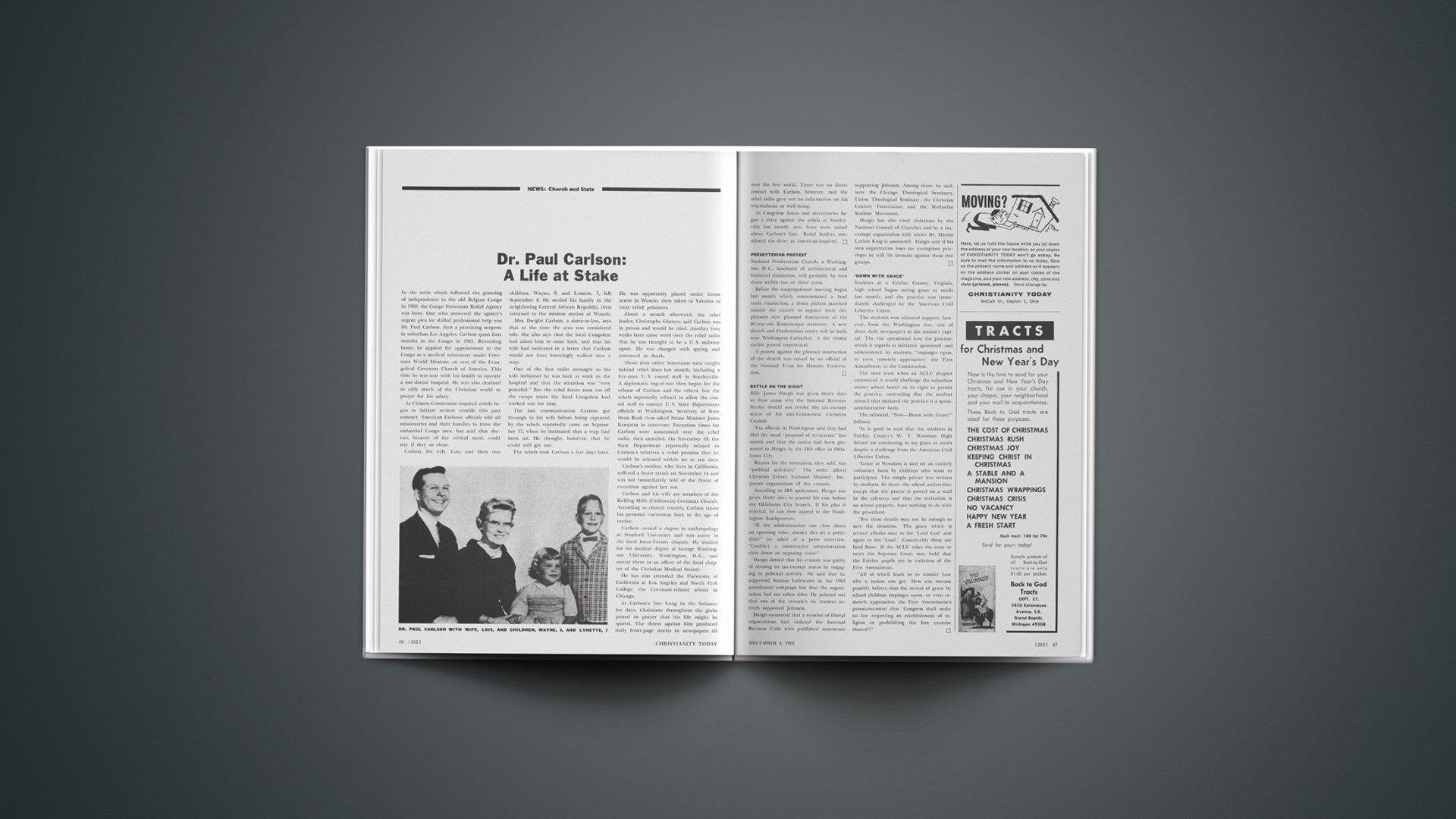
Dr. Paul Carlson: A Life at Stake

In the strife which followed the granting of independence to the old Belgian Congo in 1960, the Congo Protestant Relief Agency was born. One who answered the agency’s urgent plea for skilled professional help was Dr. Paul Carlson, then a practicing surgeon in suburban Los Angeles. Carlson spent four months in the Congo in 1961. Returning home, he applied for appointment to the Congo as a medical missionary under Covenant World Missions, an arm of the Evangelical Covenant Church of America. This time he was sent with his family to operate a one-doctor hospital. He was also destined to rally much of the Christian world to prayer for his safety.

As Chinese-Communist-inspired rebels began to initiate serious trouble this past summer, American Embassy officials told all missionaries and their families to leave the embattled Congo area, but said that doctors, because of the critical need, could stay if they so chose.

Carlson, his wife, Lois, and their two children, Wayne, 9, and Lynette, 7, left September 4. He settled his family in the neighboring Central African Republic, then returned to the mission station at Wasolo.

Mrs. Dwight Carlson, a sister-in-law, says that at the time the area was considered safe. She also says that the local Congolese had asked him to come back, and that his wife had indicated in a letter that Carlson would not have knowingly walked into a trap.

One of the first radio messages to his wife indicated he was back at work in the hospital and that the situation was “very peaceful.” But the rebel forces soon cut off the escape route the local Congolese had worked out for him.

The last communication Carlson got through to his wife before being captured by the rebels reportedly came on September 17, when he intimated that a trap had been set. He thought, however, that he could still get out.

The rebels took Carlson a few days later. He was apparently placed under house arrest in Wasolo, then taken to Yakoma to treat rebel prisoners.

About a month afterward, the rebel leader, Christophe Gbenye, said Carlson was in prison and would be tried. Another four weeks later came word over the rebel radio that he was thought to be a U. S. military agent. He was charged with spying and sentenced to death.

About sixty other Americans were caught behind rebel lines last month, including a five-man U. S. consul staff in Stanleyville. A diplomatic tug-of-war then began for the release of Carlson and the others, but the rebels repeatedly refused to allow the consul staff to contact U. S. State Department officials in Washington. Secretary of State Dean Rusk then asked Prime Minister Jomo Kenyatta to intervene. Execution times for Carlson were announced over the rebel radio, then canceled. On November 19, the State Department reportedly relayed to Carlson’s relatives a rebel promise that he would be released within six to ten days.

Carlson’s mother, who lives in California, suffered a heart attack on November 14 and was not immediately told of the threat of execution against her son.

Carlson and his wife are members of the Rolling Hills (California) Covenant Church. According to church records, Carlson traces his personal conversion back to the age of twelve.

Carlson earned a degree in anthropology at Stanford University and was active in the local Inter-Varsity chapter. He studied for his medical degree at George Washington University, Washington, D. C., and served there as an officer of the local chapter of the Christian Medical Society.

He has also attended the University of California at Los Angeles and North Park College, the Covenant-related school in Chicago.

As Carlson’s fate hung in the balances for days, Christians throughout the globe joined in prayer that his life might be spared. The threat against him produced daily front-page stories in newspapers all over the free world. There was no direct contact with Carlson, however, and the rebel radio gave out no information on his whereabouts or well-being.

As Congolese forces and mercenaries began a drive against the rebels at Stanleyville last month, new fears were raised about Carlson’s fate. Rebel leaders considered the drive as American-inspired.

Presbyterian Protest

National Presbyterian Church, a Washington. D. C., landmark of architectural and historical distinction, will probably be torn down within two or three years.

Before the congregational meeting began last month which consummated a land trade transaction, a dozen pickets marched outside the church to register their displeasure over planned destruction of the 80-year-old Romanesque structure. A new church and Presbyterian center will be built near Washington Cathedral. A site chosen earlier proved impractical.

A protest against the planned destruction of the church was voiced by an official of the National Trust for Historic Preservation.

Battle On The Right

Billy James Hargis was given thirty days to show cause why the Internal Revenue-Service should not revoke the tax-exempt status of his anti-Communist Christian Crusade.

Tax officials in Washington said they had filed the usual “proposal of revocation” last month and that the notice had been presented to Hargis by the IRS office in Oklahoma City.

Reason for the revocation, they said, was “political activities.” The order affects Christian Echoes National Ministry, Inc., parent organization of the crusade.

According to IRS spokesmen. Hargis was given thirty days to present his case before the Oklahoma City branch. If his plea is rejected, he can then appeal to the Washington headquarters.

“If the administration can close down an opposing voice, doesn’t this set a precedent?” he asked at a press interview. “Couldn’t a conservative administration close down an opposing voice?”

Hargis denied that his crusade was guilty of abusing its tax-exempt status by engaging in political activity. He said that he supported Senator Goldwater in the 1964 presidential campaign but that the organization had not taken sides. He pointed out that one of the crusade’s six trustees actively supported Johnson.

Hargis countered that a number of liberal organizations had violated the Internal Revenue Code with published statements supporting Johnson. Among these, he said, were the Chicago Theological Seminary, Union Theological Seminary, the Christian Century Foundation, and the Methodist Student Movement.

Hargis has also cited violations by the National Council of Churches and by a tax-exempt organization with which Dr. Martin Luther King is associated. Hargis said if his own organization loses tax exemption privileges he will file lawsuits against these two groups.

‘Down With Grace’

Students at a Fairfax County, Virginia, high school began saying grace at meals last month, and the practice was immediately challenged by the American Civil Liberties Union.

The students won editorial support, however, from the Washington Star, one of three daily newspapers in the nation’s capital. The Star questioned how the practice, which it regards as initiated, sponsored, and administered by students, “impinges upon, or even remotely approaches” the First Amendment to the Constitution.

The issue arose when an ACLU chapter announced it would challenge the suburban county school board on its right to permit the practice, contending that the student council that initiated the practice is a quasi-administrative body.

The editorial, “Now—Down with Grace!” follows:

“It is good to read that the students in Fairfax County’s W. T. Woodson High School are continuing to say grace at meals despite a challenge from the American Civil Liberties Union.

“Grace at Woodson is said on an entirely voluntary basis by children who want to participate. The simple prayer was written by students. In short, the school authorities, except that the prayer is posted on a wall in the cafeteria and that the recitation is on school property, have nothing to do with the procedure.

“But these details may not be enough to save the situation. The grace which is recited alludes once to the Lord God’ and again to the ‘Lord.’ Conceivably these are fatal flaws. If the ACLU takes the issue to court the Supreme Court may hold that the Fairfax pupils are in violation of the First Amendment.

“All of which leads us to wonder how silly a nation can get. How can anyone possibly believe that the recital of grace by school children impinges upon, or even remotely approaches, the First Amendment’s pronouncement that ‘Congress shall make no law respecting an establishment of religion or prohibiting the free exercise thereof’?”

The Man, The Flame, And, The Oak

An eternal flame, lighted by Mrs. Jacqueline Kennedy on November 25, 1963, is the central symbolic feature of the design selected for the grave of the late President John F. Kennedy.

The design was unveiled last month by Secretary of Defense Robert S. McNamara, whose recollections of the late President’s comments about the beauty of the area just below the Custis-Lee Mansion overlooking the Potomac River and the city of Washington led Mrs. Kennedy to select it as a gravesite for her husband. Designer John Carl Warnecke said the President’s grave in Arlington Cemetery is also a private grave and should express “the belief and faith in God of John F. Kennedy.”

Robert F. Kennedy expressed appreciation to Warnecke and told the press that the design had the approval of Mrs. Kennedy and the entire family.

The sculptured font from which the flame emerges is an abstract form of a triangle, symbol of the Trinity. The triangular font rests on a circular form with a square base. This combination of triangle, circle, and square symbolizes pure oppositions, suggesting “the universal antitheses of life versus death, body versus soul, mortality versus immortality, finite versus infinite.” The flame emerges from its sculptured, triangular font in constantly changing forms, as if in flight. It symbolizes the resurrection and eternal life.

The grave itself is a simple rectangular grass plot. In front of the eternal flame is a marker on which is etched only: “John Fitzgerald Kennedy, 1917–1963.” A small cross is incised above the name. Behind the flame is a long low marble wall, with a seal of the President of the United States. The truncated triangular form of the wall is a symbolic expression of the Trinity.

The circular twelve-foot-wide walk by which visitors will approach the gravesite is said to be representative “of unity, completion, entirety, universality—symbolizing the unity of man.”

The grave design blends into the surrounding hillside area. It is simple in its classic, clean lines, more a landscape construction than a sculpture of marble. It is intended to be a grave, not a monument.

Most of the estimated cost of $2,000,000 will be spent on approaches, landscaping, and facilities to handle the visitors. It is estimated that almost 8,000,000 persons have visited the Kennedy grave in the past year. During the summer the average was 50,000 a day. The Kennedy family has offered to pay the total cost but will probably pay only for the immediate grave area, an amount estimated to be between $200,000 and $400,000. Congress will be asked to follow its custom and appropriate the rest.

The young President lies and the eternal flame burns near a large oak with a ninety-foot spread, estimated to be 140 to 150 years old.

Bcc Under Fire

Intense indignation was aroused in South Africa by what was described there as a “sensational statement” issued by the British Council of Churches. A BCC unit had prepared a report on “The Future of South Africa,” and the offending statement came after discussion of this report in full council. The BCC thereafter requested the British government urgently to consider what measures were required to ensure that Britain no longer acted “in such a way as to encourage apartheid,” and asked for an early meeting with the Foreign Secretary for discussion on British policy toward South Africa. In addition, the council instructed its international department to express itself further following the report of the U. N. committee that is considering “the feasibility, effectiveness and implications of measures which could … be taken … under the United Nations’ Charter,” and following the judgment of the International Court of Justice concerning Southwest Africa.

A South African opposition newspaper, the Cape Times, forecasts that the BCC deputation to the Foreign Secretary will “urge cutting the flow of capital to the Republic, prohibiting all arms, ending sterling advantages, insisting that South African visitors to Britain have visas, and penalising all immigrants to South Africa.” The same paper asks what similar action the BCC proposed some years ago against “the bloody suppressors of Hungary or the bloodier subjugators of Tibet.”

The Moderator of the Dutch Reformed Church. Dr. A. J. van der Merwe, describing the strictures of the BCC (of which the Archbishop of Canterbury is chairman) as irresponsible, said it was no part of the Church’s task “to suggest measures that must necessarily lead to naked aggression.” The (evangelical) Church of England in South Africa publicly dissociated itself from the BCC’s “evil proposals.”

Dr. Michael Ramsey, Archbishop of Canterbury, finally issued a statement that expressed his “concern at the misrepresentation” of the council’s proceedings. He pointed out that the report had been composed by a group of Christians “having deep knowledge of South Africa and love for all her people,” contained “a careful analysis of the effects of apartheid,” and “examined what attitude the Churches in Britain should urge Her Majesty’s Government to adopt.”

Theology

Living above the Snake Line

Text: Isaiah 40:9–11, 28–31.

1. Naturalists tell of an invisible line—real, definite, unchangeably fixed, at a given altitude above sea level—known as the “snake line.” We are told that in certain mountainous areas in New England one of the first questions of a prospective purchaser of a farm is likely to be: “Is this farm above the snake line?” Below that line there may be deadly reptiles, imperiling man and beast; above that line no snake can live. Below that line an unsuspecting child or an unwary adult might fall victim to one of these deadly reptiles; above, they may move about in untroubled security.

The upper altitude is kept securely inviolate, not by visible defenses of man-made barriers, but by an immutable mandate of the living God, dating back to the creation of the reptile world, in which God said in effect, “Hitherto shalt thou come, but no farther!” Security is purely a matter of altitude: pitch camp below the snake line, and invite possible disaster; pitch camp above the snake line, and be safe!

2. Scripture suggests a line similar to the “snake line” of the naturalists, which marks the division between a lower and an upper spiritual altitude. Below, the soul is never secure against the molestations of Satan, that wily reptile, that deceiver and destroyer of souls; above, Satan cannot come. Below, there is spiritual depletion, spiritual poverty, weariness, exhaustion, and collapse; above, there is spiritual replenishment, abundance, security, and endurance.

The upper altitude is suggested in Paul’s reference to the blessedness of sitting “in heavenly places in Christ Jesus” (Eph. 2:6) and in his exhortation: “If ye then be risen with Christ, seek those things which are above, where Christ sitteth on the right hand of God. Set your affections on things above, not on things on the earth” (Col. 3:1, 2).

Similarly, the Prophet Isaiah speaks of God as dwelling “in the high and holy place, with him also that is of a contrite and humble spirit … (Isa. 57:15). There, near to the heart of God, “they that wait upon the Lord shall renew their strength; they shall mount up with wings as eagles; they shall run, and not be weary; and they shall walk, and not faint” (Isa. 40:31). This text is an invitation not merely to spend a holy hour in the upper altitude, above the spiritual snake line, but to pitch camp and abide. “Waiting upon the Lord” means more than an occasional coming up for air, or an occasional flight to the upper altitude for refuge. Instead, it calls for trustful abiding like that of the babe nestled in its mother’s arms. The text suggests that there are two levels on which the Christian life may be lived or attempted, and draws attention to the results to be expected:

1. Security Of The Upper Altitude

“They that wait upon the Lord shall renew their strength … mount up with wings as eagles … run, and not be weary … walk, and not faint.”

1. Here is the promise of more strength to endure the strains, temptations, and irritations of life.

(1) Those inclinations of the flesh, those creeping things—like fear, hate, envy, wrath, impurity—that thrive in the lowlands, disappear in the open sunlight of the divine presence. One of the vivid recollections of my boyhood is that of walking barefooted with others along the banks of the creek, finding a large, flat rock on the warm ground near the water’s edge, and discovering the fantastic aggregation of tiny wriggling creatures that stirred underneath. There, hidden from the sunlight, the slimy surface of the muck was alive with innumerable creeping things. But when the stone was lifted there was a frantic scurrying for cover, and in a moment every creature had burrowed into the darkness beneath the surface. To catch these creatures and dispose of them one by one would have been unthinkable; yet, to dispose of the whole aggregation required only a moment of open sunlight.

The way to deal with our many sins is not to struggle with them singly but to let the light of heaven into the soul. The way to acquire the Christian graces is not to strive for them one at a time but to open the heart and life to the Holy Spirit. Then, simultaneously, the nine-fold “fruit of the Spirit” makes its appearance: “love, joy, peace, longsuffering, gentleness, goodness, faith, meekness, temperance” (Gal. 5:22, 23).

(2) Those breakdowns that are so common in the lowlands are no problem in the upper altitude. “They shall run and not be weary,” though others are falling exhausted by the wayside. “They shall walk and not faint,” though others are breaking down. Those who lived through the great depression of the early thirties know something about hard times and fainting spirits. New York papers reported that on a single day, on Manhattan Island alone, eighty-eight persons had taken their own lives. In dark despair some had taken poison; others had turned on the gas; still others had leaped from tall buildings or cast themselves in front of on-rushing subway trains. But in the midst of the human misery of those days there were those who bore their losses and sorrows without breaking under the load.

One prosperous businessman in the metropolitan area had lost his business, his home, and his liquid assets, and was left deeply in debt besides. He was a deacon in his church, a Sunday school teacher, and head usher. On Sunday mornings he continued in his place with the usual cheerful greeting, and he did the same on Sunday evening and at the midweek services. Casual acquaintances would never suspect that he had suffered financial reverses, and close acquaintances never ceased to marvel at the fortitude with which he faced economic disaster. How could he do it? The answer lay in his close fellowship with his Lord and the daily renewal of his strength. He was like that spring in the desert valley which never ceases to flow, even through the longest drought, because it is mysteriously fed by the inexhaustible waters of some distant mountain lake.

2. Here is the promise of more calmness of soul in the time of trial. The strong do not tremble. Fortified by continuous “renewal,” the soul is adequate. “The Lord is the strength of my life; of whom shall I be afraid?” (Ps. 27:1b).

“In quietness and in confidence shall be your strength” (Isa. 30:15b). But how can a person be quiet and confident walking in the fog of the lowlands, out of step with God, alone in his struggles, conscious of the disapproval of God, and apprehensive of His descending judgments? Is not our want of serenity the index to our spiritual altitude, the reflection of our unbelief and want of commitment?

In total commitment, and nothing less, is complete serenity to be found. “I beseech you therefore, brethren, by the mercies of God, that ye present your bodies [present yourselves bodily] a living sacrifice, holy, acceptable unto God, which is your reasonable service” (Rom. 12:1). Accept the total pattern of godly living. Live by principle—not by convenience, emotion, or the mood of the moment. No commitment means no serenity: partial commitment means partial serenity; full commitment means full serenity.

3. Here is the promise of more freedom from struggle. The strong do not struggle.

(1) Most of our struggles and consequent failures are due to low altitude. There were saints in the wicked city of Ephesus (Eph. 1:1), and there were sinners in the Garden of Eden (Gen. 3). In a given environment one person finds serenity while another is kept in constant agitation and struggle. The one lives on the high altitude, where “it is well with my soul”; the other is living below the “snake line.” A little girl coming in from the flower garden with soiled hands, dress, and shoes made this refreshing observation: “Mother, I know why flowers grow; they want to get up out of the dirt.” Saints grow spiritually tall by stretching toward higher and higher altitudes.

(2) Most of the characteristic triumphs of believers are achieved not in combat but in the avoidance of combat. Even the Archangel Michael would not venture into combat with Satan, but said, “The Lord rebuke thee!” (Jude 9). Occasionally an unseasonable frost will strike when fruit orchards are in full bloom. Fruit farmers may struggle day and night to save the crop, by means of smudge pots and smoke screens. But, as one experienced fruit farmer pointed out, the freeze that kills the fruit in the valley will often leave the blossoms on the uplands Completely unharmed. The “freeze line” and the “snake line” seem to have something in common.

There is a better strategy than the strategy of struggle. One of our famous airmen, near the close of World War I, landed his frail craft at Kobar, Arabia. Here a large rat managed to get into his airplane. The airman became aware of its presence when he was in mid-air and heard the sound of gnawing behind him. Alarmed by the threat of disaster, he remembered that rats cannot live in high altitudes. Accordingly, he nosed his plane upward until breathing was difficult. When at length he descended to a lower level the gnawing has ceased, and upon landing he found that the rat had died.

Truly, “they that wait upon the Lord shall renew their strength.” But what about those who do not “wait upon the Lord,” and do not “renew their strength.” and do not “mount up with wings as eagles”? The alternative is a grim one indeed:

II. Insecurity Of The Lower Altitude

1. The eagle is well aware of the perils of the lowlands. While he may have to forage for a living in the lowlands, he builds his nest in the high cliffs beyond the reach of invasion from the reptile world. He does not needlessly expose himself and does not spend his leisure time defending his life against hazards from which the upper altitudes are free.

2. The aviator is constantly warned against the peril of low flying. Want of alertness at this point has accounted for many disasters. An army bomber, flying over fog-shrouded New York City at about four miles a minute, crashed into the seventy-ninth floor of the Empire State Building. Thirteen persons were killed, and in addition to the destruction of the airplane there was property damage of about half a million dollars. After an exhaustive inquiry into the cause of the crash, there was only one answer: The plane was flying too low! There was no adverse weather, no malfunctioning of the plane; but the required altitude had not been maintained.

3. The Christian needs to realize the peril of low altitude.

(1) A man’s associations generally reveal his spiritual altitude. Kindred spirits gravitate together, and on each level a person will find himself in associations congenial to his own spirit. Wholesome associations raise favorable presumptions as to what a man is, while unwholesome associations raise correspondingly unfavorable presumptions. Although such presumptions are not always valid, and “guilt by association” has rightly been condemned as a basis of judgment, unwholesome associations often provide important clues in the detection of crime. “Blessed is the man that walketh not in the counsel of the ungodly, nor standeth in the way of sinners, nor sitteth in the seat of the scornful” (Ps. 1:1).

(2) A man’s associations may determine his conduct, his character, and his destiny. Those are our best friends in whose presence we can be our best selves. And when a good man gets into bad company, he generally ceases to be a good man. A heartbroken mother, appealing to the judge on behalf of her son who had been convicted of crime, kept repeating, “He is such a good boy; he just got into bad company!” She did not realize that when a good boy gets into bad company, he ceases to be a good boy; and when a good girl gets into bad company, she ceases to be a good girl. “Evil communications corrupt good manners” (1 Cor. 15:33b). Even so stalwart a saint as the Apostle Peter could not maintain his spiritual integrity while sitting among the enemies of Christ but shamefully denied his Lord (Mark 14:66–72).

(3) A man’s associations may be his making or his undoing. For the aspiring Christian who has moved up to high ground, the fellowship of kindred spirits is one of the choicest gifts of God and one of the most powerful safeguards to Christian living. But the old associations, below the “snake line.” must be forever broken. One man who had been redeemed from a life of drunkenness and sin, and who had set an inspiring example of Christian living for more than a year, fell back into his former loathsome state, to the astonishment and dismay of his Christian friends. They would not have been surprised if they had known that he was still parking his car every day in the same old place, and walking past the open door of the same saloon that had been his downfall before. One moment of weakness, one more drink, and he was back in the old life!

There is something highly suggestive in one little phrase often overlooked in the biblical account of the shipwreck of the Apostle Paul by the Island of Melita (Acts 28:1–6). Because of the cold, a fire was built for the comfort of the shipwrecked.

As the Apostle Paul was laying a bundle of sticks on the fire, a deadly viper sprang out and fastened itself on his hand. By a miracle, Paul escaped harm; and he shook off the viper “into the fire”! There was finality in that gesture, and that viper would never jeopardize another life. Only by such finality can the defeated Christian move up from his precarious existence to the security “above the snake line.” He cannot drift to higher ground; there must be finality in his break with the old and his commitment to the new.

The appeal of our text is not an appeal to make a few minor adjustments, to improve our manners, to lay aside a few vices that can be conveniently spared, or to develop a few minor virtues, but to move the whole of life to higher ground. Thus in one sweeping gesture a thousand problems are solved. Near to the heart of God there is one decisive principle: “Lord, what wilt thou have me to do?” Life built around this principle is life at its best. The divine imperative is not merely to “lay aside the sin which doth so easily beset us,” but to lay aside “every weight” as well (Heb. 12:1). The “weights” may often be as damaging to the Christian life as the “sins.”

Some boys climbing in the high cliffs along the shore of Nova Scotia came upon an eagle’s nest. In it were some tiny baby eagles. One of these they took home with them and placed with a mother hen and her tiny chicks. Here the little pet grew; but, becoming more and more unlike the chicks, he began to stand alone in the barnyard looking up toward the sun. In the course of time he would try his wings, flopping along the ground. One day as he was standing in the sunlight as usual, another eagle flew over the barnyard. The pet eagle became strangely agitated. Standing on tiptoes, he unfolded his wings, and with a strange cry he rose from the ground, higher and higher, and presently disappeared from sight. It was a great day in the life of that eagle when he discovered that he was not made to be an ordinary barnyard fowl, to spend his life scratching in the dirt, but that his place was up there in the heavenly blue. And what a day for the defeated Christian when he comes into his true inheritance and takes his place in the intimate fellowship of the Heavenly Father, in the sweet security of those who truly “wait upon the Lord,” living above the “snake line.”—Chapter 3 from Sermons Preached without Notes, by Charles W. Koller (Grand Rapids. Mich.: Baker Book House, 1964). Used by permission.

Minister’s Workshop: December 4, 1964

MEMORIZATION AND NOTE-FREE PREACHING

In preparing for the pulpit, as in all areas of learning, there is no escape from a certain amount of pure memorization. Perhaps half of the total effort is expended in “saturation”; another 40 per cent in “organization”; and a final 10 per cent in “memorization.” The observance of a few simple rules will help enormously toward efficient memorization.

1. The use of visual aids in outlining. With most people, the visual memory is stronger than the oral memory, and perhaps stronger than the logical memory.

(1) Indentation. Subordination is instantly recognized by indentation. Let the sub-point be set to the right, about six spaces, beneath the point which it supports or elaborates. And let the illustration be similarly set in, as an addendum to the particular point that it illustrates.

(2) Underscoring. This is generally reserved for the title of the sermon, the “Intr.,” the “Concl.,” and the main points. Some have favored the use of different colored pencils for keeping the outline clearly in mind. Others definitely prefer one color. Too much underscoring will blur the visual image.

(3) Numerals, not letters. Use a Roman numeral for a main point, an Arabic numeral for a sub-point, and an Arabic in parentheses for further subordination—I, 1, (1). In enumerating points, the mind functions, not in terms of “Reason A,” “Reason B,” and “Reason C,” but in terms of “the first reason,” “the second reason,” and “the third reason.”

(4) Handwriting, not typewriting. For concise notation, handwriting affords greater flexibility, especially in getting a point on one line. Besides, the handwritten page, by the added effort involved and by its irregularities in penmanship, gives a stronger visual image.

(5) Points and cues, not paragraphs. A “cue” is a word or phrase which aims to bring a complete thought to mind; a “point” is the expression of the thought itself. A cue is often adequate for recalling an illustration, but for other uses a point is preferable.

2. Brevity of statement. Every line represents a paragraph; a paragraph normally runs to about one hundred words; and an outline for a thirty-minute sermon would run to about thirty or thirty-six lines. Abbreviations may be freely used, provided the meaning is clear; and words like “and,” “the,” and “soon” may often be omitted without obscuring the sense.

Brevity is not only a convenience; it is also an element of force. “Whatever can be said in fifty words and is said in seventy-five is weakened by about fifty per cent.” The preacher who disciplines himself to the use of one side of one sheet of paper (8½ x 11 inches) for a sermon outline is not only helping himself toward a note-free pulpit delivery; he is at the same time developing two additional qualities that are desirable—accuracy and force.

Where the preacher is saturated with his subject, the sermon outline does not need to be elaborately spelled out. The briefest reference will bring back the full thought, much as a “cue” of two or three words will bring to mind an illustration, the telling of which requires two or three minutes.

3. Statement of parallel points in parallel form, wherever possible without obscuring the thought.

4. Limitation of points to a maximum of five in a series. There is no merit or sacredness attaching to any particular number of points, but the memory tends to bog down when there are more than five points in a series.

5. Observance of the natural laws of memory. The long-familiar formula calls for impression, association, and repetition.

Of superlative importance is the law of distributed effort or spaced learning. “The man who sits down and repeats a thing over and over until he finally fastens it in his memory is using twice as much time and energy as is necessary to achieve the same results when the repeating process is done at judicious intervals.”

A practice that could be decisive in the attainment of freedom from notes, at least for Sunday mornings, is that of preaching the sermon to oneself the very last thing before going to sleep on Saturday night. Then, immediately upon awakening, think the sermon through again. It is often amazing how the whole sermon comes back.

One further precaution: Just before the time of speaking, go over the notes once more to refresh the memory; then trust God and go ahead!—Adapted from Expository Preaching without Notes, by Charles W. Koller (Grand Rapids. Mich.: Baker Book House, 1962). Used by permission.

Books

Book Briefs: December 4, 1964

No New Morality: Christian Personal Values and Sexual Morality, by Douglas Rhymes (Bobbs-Merrill, 1964, 155 pp.,$3.50), is reviewed by James Daane, assistant editor, CHRISTIANITY TODAY.

The “No” in the title is not a rejection of the new morality espoused by John A. T. Robinson and others, but a declaration that it is not new at all. It is, contends Rhymes, as old as the Gospels, for it is the teaching of Christ. Christ indeed has “respect for codes and for moral laws, but … He refuses to accept that there are codes and moral laws which permit of no exceptions.” Christ taught that only the demand of love is unconditional, says Rhymes.

It was Paul who taught another view of morality. Under Greek influence, the Apostle dualistically regarded man as “flesh” and “spirit” and, viewing flesh as the lower aspect of man, summoned men to live not by “the law of the flesh” but by the “law of the spirit.” The Church, asserts Rhymes, strangely followed Paul rather than Christ and, thus misled, adopted a legalistic system of ethics that defines the good as the right relation to law, rather than as a right relation to persons. This is, says Rhymes, “an attitude for which St. Paul, not Christ, must take the blame.”

Today some voices in the Church, and, it seems, the world with almost one voice, are rejecting this impersonal legalistic morality. “This long-standing traditional morality, based upon authoritarian law and suspicion of the flesh,” asserts Rhymes, “is today being rejected on all sides, and especially among the younger generation.” Apparently the world “on all sides” is more perceptive of what constitutes a proper ethic than the Church has ever been since the days of Paul. (It is amazing what liberating theologians ask one to believe!)

Where does Rhymes’s substitution of a “standard of personal responsibility” to love one’s neighbor for a legal “external standard” lead him? In fairness, it must be said that his discussion of the nature of love and of the difference between love and lust is ethically sensitive and highly perceptive. After reading this, one feels it is superfluous to say that Rhymes is not in favor of rape. Yet it is fair to point out that he, on the basis of his ethics, cannot always be opposed to rape (or child abuse, or sexual perversion), because of his basic contention that there can be no moral law or code which allows for no exceptions. To think that the one demand of love can ever be so codified that it unconditionally forbids rape, for example, is to depart from the ethics of Christ and, according to Rhymes, to fall into the error of Paul. Rhymes’s morality, which is older than Paul if it stems only from Christ, would at least seem new to many pagans, who often practice a higher morality than Christ seemingly taught. Pagans have had laws against rape that allowed for no exceptions, least of all exceptions in the name of ethics.

How does Rhymes’s ethics affect his counseling? He reports being asked by a boy why he could not “have sex” if his girl friend were willing. Rhymes’s whole answer was a series of questions asked to sensitize the boy’s feeling of responsibility; “at the end.” says Rhymes, “I told him that no one could really answer his question but himself.” This is the best answer Rhymes could give within his ethical position. If it is the best the Church can give youth, then the Church has no word for the moral decline of our time.

If the demand of love can never take the form of a law that allows no exceptions, then Rhymes (though he seems reluctant) must confess that “it is possible to conceive of situations where such self-giving outside of marriage might have to be judged in the light of all the circumstances rather than be met with outright condemnation.”

Again, it is the substitution of “internal disposition” for a moral law in which some things are always wrong that leads to his view on homosexuality. He frankly asserts that from the standpoint of the morality of his book, homosexuality should be approached from the position that “homosexual affection can be as selfless as heterosexual affection.” If the act is an expression of selfless love for another, it is then a moral act. Such a view of the occasional permissibility of homosexuality, and indeed of any other conceivable sin, is not incidental to Rhymes’s ethics; it is of its very fabric. Indeed, such “proper” exceptions must be regarded not only as permissible but, being an expression of love, as obligatory!

There is in the Christian ethical tradition a recognition of exceptions to moral laws; for example, the right of revolution. But it is one thing to leave moral room for the possible exception and another to recognize exceptions after one has removed that quality from moral law which makes them exceptions.

Rhymes strives for a morality in which love is, without exception, the one absolute requirement. Yet he finishes with a morality of love in which no act is, without exception, always wrong. Very obviously, something has gone wrong in his attempt to relate law and love; he has failed to prove his thesis that love is of such a nature that it cannot regard any act as always evil, without falling into legalism.

Rhymes decries the fact, and with some right, that the Church is often more indignant about sexual immorality than about other forms. Yet something similar is occurring in the reaction to this so-called new morality. Many people are troubled by what they regard as the undermining of morality by such men as Rhymes and Robinson; yet few decry the doctrinal aberrations on which this morality rests. Rhymes’s easy rejection of biblical authority; his faith in the salvific power of self-awareness; his belief that Christ calls us to know ourselves and thereby to gain that sense of personal responsibility which reduces moral laws to a merely pedagogical function; his contention that Jesus confronted man “with the possibilities which lie within” and revealed to the Centurion “his capacity for faith”; his belief that there is an ethic that “can win acceptance,” one “where Christians and humanists can stand on common moral ground”; and his claim that such an ethic is “entirely in accord with the mind of Christ and the attitude of Christ”—all these doctrinal aberrations should concern us at least as much as does the “new morality.” For the latter is built on the former. Indeed, it is these unbiblical views that lend the air of credence to the grand illusion that this new morality is not new at all but as old as the mind of Christ.

I say there ought to be at least an equal concern; for where your theology is, there will your ethics be also.

The Obstacle To Communism

Religion Can Conquer Communism, by O. K. and M. Moore Armstrong (Nelson, 1964, 258 pp., $4.95), is reviewed by Harold B. Kuhn, professor of philosophy of religion, Asbury Theological Seminary, Wilmore, Kentucky.

The subtitle of this work, The Spiritual Struggle Behind the Iron Curtain, is more dearly indicative of its contents than the title itself. This volume brings within a readable compass a chronicle of the steps by which Soviet imperialism entrenched itself in the great land-mass of eastern Europe and northern Asia and thereby established a frightful hegemony over a belt of countries in the middle of Europe from the Baltic to the Mediterranean. The writers trace the rise of Marxism, the establishment of the bridgehead of tyranny in Russia in 1917, and the expansionist tactics that have marked Communism’s career during the past forty-seven years. In general, the facts presented are well known and reasonably well documented.

One of the outstanding features of the work is the conciseness of its presentation of a formidable mass of material. The record of cruelty and mendacity by which this “experiment” in the remaking of mankind has been carried forward is presented within the rationale by which it was prosecuted and justified, namely, the materialistic view of man, the rigidly pre-determined dialectic of history, and the relativism of all morality.

The writers speak “from within,” having been involved in politics through elected office, and having served on one of the denominational committees at the San Francisco meetings that organized the United Nations. The tone of the work is moderate when measured against the massive brutalities and cynicism of the Red masters in the achievement of their goals. Chapters four through twelve might well be entitled, “Lest We Forget,” for they are painful reading to a nation whose leaders appear to have thrown away, to a large extent, the fruits of victory in World War II at the conference table.

The volume is basically one with a spiritual orientation. The authors recognize that the application of Marx’s “Total War Upon Mankind” involves a fundamental (as opposed to the claim of some liberals that it is incidental) assault upon the principles and organs of religion. One of the book’s merits is that it unmasks the superficial view that coexistence implies abandonment by the men of the Kremlin of all save economic forms of conflict. It is shown that religious faith has proved to be the one unpulverizable obstacle in the way of Communist planning and a major target for continuing warfare.

Red opposition to the Christian religion is shown in its varied phases: in the U. S. S. R. as initially an all-out frontal assault, coupled with some tactical adjustments (particularly during World War II); outside the Soviet Union, as unbending at the core and pragmatic in some of its methods. The authors see clearly the strategy of the Marxist imperialists and alert us to the major tactical features of the struggle, ranging from attacks with the broadaxe to the somewhat subtle insinuation of secular counterparts for every Christian usage.

The authors utilize their exposition to project their major thesis, namely, that there is something that can be done by the free world, and that this “something” must utilize spiritual resources. Whereas Communist leaders prostitute truth and utilize the Great Lie as a weapon, Christianity possesses within her arsenal forces of truth that can be brought to bear upon the situation in eastern Europe.

Reading for Perspective

CHRISTIANITY TODAY’S REVIEW EDITORS CALL ATTENTION TO THESE NEW TITLES:

A Survey of Old Testament Introduction, by Gleason L. Archer, Jr. (Moody, $6.95). A serviceable treatment of Old Testament problems, written from the evangelical perspective as a text for college, seminary, and other serious students.

The Old Testament, by Robert Davidson, from the “Knowing Christianity” series (Lippincott, $2.95). A deeply satisfying biblical interpretation of Old Testament theology that does not jump too quickly to the fuller disclosures of the New Testament.

The Right to Silence: Privileged Communication and the Pastor, by William Harold Tiemann (John Knox, $4). A discussion of a minister’s legal and theological right to withhold from the courts evidence received in pastoral confidence.

The book promotes no easy optimism, no panaceas. The expositions are made with instruction in mind. No one whose heart beats with the suffering and the oppressed can lay the book down and be the same.

Every work of this type incurs the risk of appearing facile in its proposals. The authors have, however, shown an awareness of the difference between strategy and tactics: their faith is that, in the long pull, Communism’s war of attrition upon the Christian faith will be recorded in history for the ephemeral thing it is. Tactically, they make modest proposals, including the use of information, tourism, and interpersonal contacts to modify public policy in Communist lands. Faith is expressed that the embodiment of the Christian message in human lives may ultimately undermine the cruelty of the system, and finally preside in triumph over the forces of Marxist enslavement.

HAROLD B. KUHN

Who Is The Rebel?

Rebels With a Cause, by Frank S. Mead (Abingdon, 1964, 160 pp., $2.75), is reviewed by William B. Williamson, rector, Church of the Atonement, Philadelphia, Pennsylvania.

From a “Letter from Jerusalem,” in which the Roman Brutus gives an informal, first-hand account of St. John the Baptist, Jesus, and Paul, to “The Big Bass Drum,” the story of the founder of the Salvation Army, Frank S. Mead, relates little-known facts concerning “a rebel’s-eye view of the church and church history.”

The style of Rebels With a Cause is informal and narrative, which makes for fascinating reading. This informality and high readability can be seen in the following quote from Letter from Jerusalem”: “He [Jesus] has become Public Enemy No. 1 in every Foreign Office in this part of our world.… Could you believe that any one man could cause such commotion?” In a similarly easy-to-read manner, Simon and his followers are described as the greatest magicians of them all. Simon was recognized in his day as “the sorcerer” and was thought of by some as the father of Christian Gnosticism. In any event, Simon and his followers contributed much to the “source of the developing debate in the church over the person and place of Jesus Christ.”

Rebels With a Cause sheds light on little-known “rebels” as well as on the well-known ones. “It is concerned with men and women who heard the beat of a different drum and broke step to travel a different road to the kingdom.… They are the imps of God scampering among us as we struggle up the holy hill, jabbing at us with their little darts of ridicule and righteous anger.…” This refreshing book, which covers many branches of Christendom, gives insight into history’s religious rebels and enables us to understand more fully the Christian non-conformist of today. Indeed, each story in Rebels With a Cause makes us think more clearly about those who are considered rebels today. It also shows us that it takes time and understanding to evaluate “rebels” and to see whether they are simply rebels or “rebels with a cause.”

WILLIAM B. WILLIAMSON

The Names And The Issues

Introduction to Theology, by Marianne H. Micks (Seabury, 1964, 204 pp., $4.95), is reviewed by Samuel J. Mikolaski, professor of theology, New Orleans Baptist Theological Seminary, New Orleans, Louisiana.

This book derives from an expansion of lectures that the author gave to a conference on Christian ministries in the Episcopal Church last year. It bears unmistakably the stamp of its purpose, which is to range over certain names and issues of classical and contemporary theology in an introductory fashion. The fifteen chapters are grouped evenly under three heads, corresponding roughly to biblical theology, historical theology, and contemporary theology.

Useful discussions occur on crucial biblical passages that undergird such doctrines as the Incarnation. There are splendid short introductions to Athanasius, Augustine, Anselm, Abelard, Luther, Cranmer, and the Thirty-nine Articles, among others. In these are reflected the strong incarnation theology of the writer, her perceptive insights into the nature of human sin and guilt, and the need of divinely provided redemption. An interesting feature of the book is its treatment of Luther. Continental writers sometimes complain that Episcopalians ignore the Reformation, but that cannot be said of the author of this volume.

Some notations may be made. For example, is “universalism” the best theological term to express what the author probably intends as the “universality” of the Church (p. 59)? Does the author really mean “pietism” when she uses the infelicitous term “spiritualism” (p. 73)? Certain definitions like those of “body” (p. 62), “matter and spirit” (p. 71), and the “divine image” in man (pp. 148, 149) require sharpening. Did Luther say that Galatians is an epistle of “straw” (hence worthless) or a “strawy” epistle (hence hard to chew) (p. 68)? Should the impression be left that for Augustine evil is privation, when deprivation or defection of the will also figures prominently in his theology against the Manicheans (cf. Confessions, Bk. VII, chaps. 3, 12, 16)?

While the threefold division of the book into biblical, historical, and contemporary theology is helpful, it succeeds least, I feel, in the crucially important last section. Contemporary theology is employed as the foil for the function of reason in theology, and as a base for an attempt to provide a theological rationale for faith. I have wondered whether the theologians chosen match the terms of the earlier discussion. I have tried but failed to understand how the need of man in his sin (admittedly requiring atonement) can be met in the categories of Kierkegaard and Tillich. Nor have I been able to see (in the appeal to Bultmann) why we should not de-mythicize the eschatology of Jesus or the Cross, which are claimed by Bultmann to be so crucial (pp. 52, 145). With such a splendid thrust made for the doctrine of salvation (p. 120), it is hard to see how the warm personal categories of early Christianity follow from the uncertain existential leap of Kierkegaard or the ontological truisms of Tillich. How can we “limit” (theologically and philosophically) the undifferentiated diffusion of Tillich’s “ultimate concern” with the Gospel of Jesus Christ?

This volume can serve a very useful purpose: to introduce important names and issues of Christian history. It combines the delicacy of Episcopal interest in early confessional theology with interest in certain strands of modern Continental and American dogmatic perspectives.

SAMUEL J. MIKOLASKI

No Heaven For Me!

Hellbent for Election, by P. Speshock (Zondervan, 1964, 183 pp., $2.93), is reviewed by Frank E. Gaebelein, co-editor, CHRISTIANITY TODAY.

Mr. Speshock has written a lively allegory somewhat on the pattern of C. S. Lewis’s Screwtape Letters. The main character is a Christian whose suicide was motivated by his disillusionment at the failure of Christians to live in accord with their beliefs and by his desire to spend eternity with his unbelieving sister. Preferring her company to that of Christians he has known, he arrives in heaven determined not to stay there and doggedly persisting in his endeavor to be sent to hell. The book tells of his journey back to earth in immaterial form with Alexis, the Individual Counselor assigned to him. Hellbent recalls crucial experiences of his youth and adult life culminating in his violent death, which is described in harrowing detail.

The book is largely dialogue, at which the author is expert. It is almost always lively and at times brilliant. The inconsistencies and hypocrisies of Christians are unsparingly displayed. The satire is often biting. But there is also a real sense of the joy of the redeemed, conveyed especially through the character of Alexis, the Individual Counselor.

Finally, Hellbent is allowed a visit to hell. Here the picture is terrifying. Those who know May Sinclair’s appalling story, “Where Their Worm Dieth Not,” will recognize the similarity between the concept of hell she sets forth and that of Mr. Speshock. This glimpse of what lostness really is, coupled with the revelation that his atheist sister was converted through his death, reconciles Hellbent to heaven.

The book is astringent and even disturbing. Its chief value is that it shows with a real measure of power the pursuing love of God that will not let his own go. On the other hand, the concept of what constitutes a Christian seems over-rational and almost antinomian. Moreover, the treatment of suicide has questionable implications.

Mr. Speshock is a gifted writer, although obviously no C. S. Lewis. Many will read Hellbent for Election with enthusiasm; others will be perturbed by it.

FRANK E. GAEBELEIN

Between Hostility And Enthusiasm

Psychiatry and Religious Faith, by Robert G. Gassert, S. J., and Bernard H. Hall (Viking, 1964, 171 pp., $3.95), is reviewed by Orville S. Walters, director of health services, University of Illinois, Urbana.

Although this book is written primarily for priests and nuns, it is addressed to the Roman Catholic laity as well. And in a brief foreword, Karl Menninger commends it also to his fellow Presbyterians. The authors are a Jesuit priest and a Catholic psychiatrist.

Disclaiming any intent to deal with the broader theoretical issues between psychiatry and religion, the authors first confront the widespread notion that psychiatry is irreligious. This attitude is characterized as “wholesale presumptuousness,” since psychiatry as a medical discipline is neither more nor less religious than any other science. However, they acknowledge that psychiatry must be distinguished from the practice of particular psychiatrists, which may be dangerous and harmful to the faith of their patients. Needed is a sober medium between an unexamined hostility and an uncritical enthusiasm.

The book is deeply committed to the orthodox Freudian dual-instinct theory and to the controversial unitary concept of mental illness long advocated by Karl Menninger. In a strongly defensive section, the authors discuss a query commonly put to psychiatrists, “Are you a Freudian?” The question is made to appear naïve and irrelevant. “The psychiatrist is embarrassed, not for himself, but for the questioner,” the authors declare, and they then proceed to defend Freud’s place in science. The authors do not recognize that the question usually refers, not to Freud’s psychology, but to his atheistic philosophy; in this context the question is highly pertinent.

The authors’ statement that “the psychiatrist himself cannot be sectarian in his work with patients” asserts an unrealizable ideal. The professed neutrality of the psychotherapist is now generally recognized as wishful self-deception, since every psychiatrist inevitably reveals his personal philosophy in the course of the verbal and non-verbal intercommunication of the therapeutic situation.

The chapters on psychiatric treatment trace the diagnostic process and subsequent management of a patient by a graphic case history, touching upon most of the common methods of therapy. The latter third of the book will be especially helpful to Catholic priests and supervisors, since it deals specifically with psychiatric referral, selection of religious candidates, and the delicate problem of confidentiality involving the patient who is a member of an order, his superior, and the psychiatrist.

This book, described by its authors as “only a primer,” fulfills well its declared purpose of seeking to convey an enlightened attitude toward the mentally ill and the mental health professions. An undeclared objective seems to be to buffer some of the opposition among Catholics to psychoanalysis and psychiatry.

ORVILLE S. WALTERS

A Primer

An Introduction to New Testament Textual Criticism, by J. Harold Greenlee (Eerdmans, 1964, 160 pp., $3.50), is reviewed by John H. Skilton, professor of New Testament language and literature, Westminster Theological Seminary, Philadelphia, Pennsylvania.

Professor Greenlee’s manual is a serviceable introduction to the textual criticism of the New Testament. It is designed as a primer for beginning students but can be read by others with enjoyment and benefit. It offers a brief treatment of such essential subjects as paleography, the sources of the New Testament text, the transmission of the text, and the printed text (with a survey of the history of the textual criticism of the New Testament in modern times), and it furnishes some guidance in the practice of textual criticism. Special features of the work include instruction both in the use of critical apparatuses found in various editions of the Greek New Testament and in the collation and classification of manuscripts.

Naturally, opinions will differ on what subjects should be covered in a primer and how extensive the coverage should be. The reviewer would favor, for example, a longer treatment of Streeter’s theories of textual criticism and of eclecticism. It would also seem desirable to set forth clearly the sharp distinction between the two kinds of internal evidence of readings made by Westcott and Hort (see pp. 78 f.). But appreciation is due Professor Greenlee for the useful information he has included.

JOHN H. SKILTON

Crackling Fresh

From Prison in Rome: The Letters to the Philippians and Philemon, by E. M. Blaiklock (Pickering & Inglis [Glasgow], 1964, 300 pp., 9s. 6d.), is reviewed by A. Morgan Derham, editorial secretary, The Scripture Union, London, England.

Dr. Blaiklock’s academic disciplines have made him so familiar with the world of the New Testament that if he were transported back in history and set down in ancient Rome, probably he would hardly notice that he was no longer in his native New Zealand; he would slip easily into a toga and be only too ready to show you the way to the Forum! Moreover, his knowledge of classical studies makes him rightly critical of the excesses committed in the name of New Testament scholarship, and his position as a layman makes him sharply aware of the realities of life in the non-clerical world in which the great majority of Christian readers (as opposed to writers) live.

The result of all this is a commentary, paragraph by paragraph, that crackles with fresh and informative comment, throws unexpected light on familiar passages, and makes shrewd thrusts at the easy-going Christianity that flourishes today. Furthermore, Dr. Blaiklock commands a wide vocabulary and a vivid writing style, so that the book is both educational and delightful.

The translation used is Dr. Blaiklock’s own, and not the least among the attractions of the book are the paragraphs in which he shows us the translator at work and gives his reasons for a particular rendering.

A. MORGAN DERHAM

Like No Other

The History Of Education, by John E. Wise, S. J. (Sheed & Ward, 1964, 494 pp., $5), is reviewed by Cornelius Jaarsma, professor of education, Calvin College, Grand Rapids, Michigan.

Here is an interpretative history of education written from a Christian point of view. That the author is of Roman Catholic conviction is clear from his analysis of facts, men, and movements. In the preface he states that “history is the narration of facts in perspective,” and he is true to this conception of history throughout his work. The book, whose subtitle is An Analytic Survey from the Age of Homer to the Present, is comprehensive, analytic, and interpretative, and a welcome addition to the historical accounts of developing theory and practice in education. I know of no other history-of-education textbook in the English language that seeks to evaluate educational ideals and theories from a Christian perspective.

The author tries to be objective in selecting and describing movements, events, and ideas, and he largely succeds. Psychological movements in education beginning with Pestalozzi and continuing through Herbart and James are clearly and objectively set forth. Rarely does one find an author of Christian persuasion expounding John Dewey’s views with such fairness and with such an effort at understanding. A Protestant will differ with Wise’s interpretation of Luther and Calvin, but he must admit that the author’s desire to be fair and historically accurate is very much in evidence. The origin of the American public school, with Horace Mann and others, and the development of secularism in American education are accurately and cautiously portrayed.

Among the outstanding features of the book are the selections quoted from educational classics. They are well chosen, set apart in blocks of bold type, and appropriately placed. A comprehensive bibliography is included also.

Christian teachers will study this book with great profit, especially if their reading in the history of education has been confined to secular textbooks. Although Protestants will at times take issue with the author’s views, they will appreciate Wise’s attempt to be Christian in his interpretation of educational theory and practice.

CORNELIUS JAARSMA

Book Briefs

The Story of the Wise Men (Holt, Rinehart and Winston, 1964, 42 pp., $4.95). The story of the Magi as recorded by Matthew, accompanied by pictures of the same story as carved in four stone capitals in the Cathedral of Autun in Burgundy by Gislebertus, who, though but little known until recently, was one of the greatest sculptors of the Middle Ages. A book of disturbing beauty.

The House of Christmas, by H. Harold Kent (Eerdmans, 1964, 123 pp., $2.95). Short essays on Christmas themes. Biblical material in fine style. A lovely gift, to give or receive.

The Christian Year: Sermons of the Fathers, Volume I, edited by George W. Forell (Nelson, 1964, 384 pp., $6.50). Sermons by men who range from Pope Leo to Jonathan Edwards, from Bernard of Clairvaux to Schleiermacher, arranged in the sequence of the church year.

The Douglass Devotional, by Earl L. Douglass (Evans-Lippincott, 1964, 385 pp., $2.95). An excellent daily devotional reader that will help shift thoughts from the cares of the day to the concerns of the spirit.

The Growth and Decline of the Cuban Republic, by Fulgencio Batista (Devin-Adair, 1964, 300 pp., $6.50). The author is the Batista who once ruled Cuba.

The Searching Wind, by Ruby A. Jones (Warner, 1964, 112 pp., $2.50). Devotional material in which nature and grace are blended in exquisite style.

Architects of Conservative Judaism, by Herbert Parzen (Jonathan David, 1964, 240 pp., $5.95). A critical study of the lives of the founders of the Conservative movement, one of the three major Jewish denominations.

World Communism: The Disintegration of a Secular Faith, by Richard Lowenthal (Oxford, 1964, 296 pp., $6). The author, who is at the Free University of West Berlin, traces the inner logic and historic developments of that process in which world Communism is coming apart at the seams.

The Scope of Grace, edited by Philip J. Hefner (Fortress, 1964, 320 pp., $4.95). Learned essays on the wide-ranging subject of nature and grace in which the authors roam from Robert Frost to the morality of God. Compiled in honor of Joseph Sittler, professor of theology at the Divinity School of the University of Chicago.

The God We Seek, by Paul Weiss (Southern Illinois University Press, 1964, 258 pp., $5.50). The God for whom Yale University Professor Weiss seeks is one for whom Christianity is only a species of religion in general. As the title suggests, such a God has not yet been found.

The Twentieth Century Atlas of the Christian World, by Anton Freitag, S.V.D. (Hawthorn, 1963, 200 pp., $20). The story of Christian missions, Roman Catholic version; with maps, pictures, and illustrations, and one chapter on Protestant missions. An educational volume of fine craftsmanship.

The World’s Cardinal, by M. C. Devine (Daughters of St. Paul, 1964, 356 pp., $5.75). The first full-length biography of Richard Cardinal Cushing.

The Layman’s Bible Commentary: Vol. V, Deuteronomy, Joshua, by Edward P. Blair; Vol. VII, I and II Kings, I and II Chronicles, by Robert C. Dentan; Vol. X, Proverbs, Ecclesiastes, Song of Solomon, by J. Coert Rylaarsdam; Vol. XI, Isaiah, by G. Ernest Wright (John Knox, 1964, 124, 155, 160, 159 pp., $2 each). With these four volumes the Layman’s Bible Commentary, a product of the Presbyterian Church in the U. S., is completed.

God’s Glory: Romans 14:13–16:27, by Donald Grey Barnhouse (Eerdmans, 1964. 202 pp., $4.50). Volume X in the “Exposition of Bible Doctrines” series, taking the Epistle to the Romans as the point of departure.

The Collect’d Writings of St. Hereticus, edited by Robert McAfee Brown (Westminster, 1964, 153 pp., $3.95). Humorous writing.

The Art and Thought of Michelangelo, by Charles de Tolnay (Pantheon, 1964, 194 pp., $7.95). An unencumbered study presenting a cross section of Michelangelo’s ideas as they appear in his writings and in his artistic works.

Suicide of the West: An Essay on the Meaning and Destiny of Liberalism, by James Burnham (John Day, 1964, 312 pp., $5.95). The author argues that the contraction of the West on the world’s scene is due to the inadequacies of the liberal political faith, which is the weakness by which the West may commit suicide. Delightful reading.

Bible Encyclopedia for Children, by Cecil Northcott (Westminster, 1964, 176 pp., $3.95). A useful, very attractive presentation of the chief people, events, and ideas of the Bible for children—from about ten years and up.

Dramatic Personages, by Denis de Rougemont (Holt, Rinehart and Winston, 1964, 170 pp., $4.50). Perceptive essays that are to be savored by the religious connoisseur, rather than gulped down by the unknowing. Translated from the French.

Paperbacks

Money, Mania and Morals: The Churches and Gambling, by Lycurgus M. Starkey, Jr. (Abingdon, 1964, 128 pp., $1.50). This book explores all aspects of gambling, including the arguments for and against legalization, and comes to the verdict: No dice! Starkey argues that gambling is wrong in principle, not merely in excess.

The Meaning of Sanctorum Communio, by Stephen Benko (Alec R. Allenson, 1964, 152 pp., $3.85).

Spirit of Power, by Paul W. F. Harms (Concordia, 1964, 94 pp., $1).

Audio-Visual Resource Guide 1965, edited by Janet Isbell (Department of Audio-Visual and Broadcast Education, National Council of Churches, 1964, 524 pp., $3.95). For use in religious education. Classified evaluations of more than 3,750 current, church-related A-V materials.

David Brainerd: Beloved Yankee, by David Wynbeek (Eerdmans, 1964, 256 pp., $2.25). First published in 1961.

Positive Preaching and the Modern Mind, by P. T. Forsyth (Eerdmans, 1964, 270 pp., $1.95). By an author who believes that Christianity stands or falls with its preaching. First printed in 1907. Very worth reading.

Corporate Personality in Ancient Israel, by H. Wheeler Robinson (Fortress, 1964, 40 pp., $.75). A study of the concept that throws light on the oscillation between the individual and the group in the biblical designation of Israel.

Theologians of Our Time, edited by Leonhard Reinisch (University of Notre Dame, 1964, 235 pp., $2.25). Five distinguished critics evaluate the thought of a dozen great contemporary theologians, both Roman Catholic and Protestant. Good reading for students and studious ministers.

addApple PodcastsDown ArrowDown ArrowDown Arrowarrow_left_altLeft ArrowLeft ArrowRight ArrowRight ArrowRight Arrowarrow_up_altUp ArrowUp ArrowAvailable at Amazoncaret-downCloseCloseellipseEmailEmailExpandExpandExternalExternalFacebookfacebook-squarefolderGiftGiftGooglegoogleGoogle KeephamburgerInstagraminstagram-squareLinkLinklinkedin-squareListenListenListenChristianity TodayCT Creative Studio Logologo_orgMegaphoneMenuMenupausePinterestPlayPlayPocketPodcastprintremoveRSSRSSSaveSavesaveSearchSearchsearchSpotifyStitcherTelegramTable of ContentsTable of Contentstwitter-squareWhatsAppXYouTubeYouTube