A Helping Hand for Soviet Jewry

A call for a “highest level” meeting between American Jewish leaders and Soviet authorities on the problem of anti-Semitism in Russia was issued by some 500 representatives of twenty-four major Jewish religious and other groups that met in Washington this month.

The unprecedented meeting, if the invitation is approved by the Soviet Union, will be part of an extensive national campaign by the American Jewish Conference on Soviet Jewry to safeguard the religious and cultural life of about 3,000,000 Jews in the Soviet Union.

Concluding a two-day meeting, the conference also urged Soviet leaders to take eighteen specific steps to end anti-Semitism in that Communist nation.

The conference set into motion plans to enlist the help of all Americans in speaking out on “the fate of our brothers in the Soviet Union.” It called for a National Day of Prayer in all American synagogues to dramatize the plight of Soviet Jewry, and for the use of mass media to bring to the attention of the world the conditions of Soviet Jewish life.

Republican Senator Jacob Javits of New York said he had “no objection” to serving as part of an American Jewish delegation to confer with U. S. S. R. leaders on the Jewish problem. Other representatives suggested included Supreme Court Justice Arthur Goldberg and Democratic Senator Abraham Ribicoff of Connecticut. All three spoke at the Washington meeting.

Javits, who recently returned from a European trip, said the Soviet government “is not impervious to world opinion,” and could be expected to give ground in its deprivation of the Jews.

“What we need is general and universal protest—constantly reiterated,” he stressed. He added that “Soviet anti-Semitism is a threat not only to Jews—though they are the first victims—but to all religious minorities in the U. S. S. R.”

In a reference to the recent confiscation of matzoh by the Soviet government, Javits said:

“It is hard to believe that in this decade a major world power like the Soviet Union, with its nuclear capability and space exploration achievements, would stoop to this kind of petty but cruel and repressive official harassment of a helpless minority.”

The conference’s national program will include efforts to enlist the cooperation of President Johnson in communicating “America’s official concern to the Soviet government,” and to have the Republican and Democratic National Conventions and Congress adopt statements condemning anti-Semitism.

Among other phases in the campaign are: Urging religious bodies and “international Christian forums such as the World Council of Churches” to include discussion and action on the plight of Jews in the Soviet Union:

Enlisting the support of civic, labor, educational, religious, veterans’, women’s, and other groups to express their concern for the plight of the Jews;

Conducting a special drive to get statements from “prominent religious leaders, winners of honors and awards in scientific and human fields, outstanding intellectuals, and others … in behalf of Soviet Jewry.”

The eighteen-point program urged on Russia includes the eradication of anti-Semitism by a “vigorous educational effort by the government and party”; permission for the “free functioning” of all synagogues and private prayer meetings; and the production and distribution of religious articles, such as Hebrew Bibles, religious texts, calendars, matzoh and kosher foods.

The Soviet Union also was asked to eliminate discrimination against Jews “in all areas of Soviet public life,” end anti-Semitic campaigns in the press, and stop the “discriminatory application of the death penalty and other severe sentences imposed against Jews for ‘economic crimes’ against the state.”

Educational Crossroads?

A group of Roman Catholic educators voted this month to raise $40,000 to answer arguments in a book challenging the value of the Roman Catholic school system in America.

The action was taken by the Primary Education Department of the National Catholic Educational Association at its sixty-first annual meeting in Atlantic City, New Jersey. The money is to come in five-dollar donations from the NCEA’s 8,000 elementary school members.

Proposed by Msgr. William E. McManus, president of the department and superintendent of schools in the Chicago archdiocese, the defense plan was approved by some 5,000 members of the department.

The book in question, published several weeks ago, is Mrs. Mary Perkins Ryan’s Are Parochial Schools the Answer? In it, Mrs. Ryan, a Roman Catholic, contends that the parochial school system is obsolete and hinders the preparation of the lives of pupils. She urges her church to leave the field of general education and to concentrate on the religious training of children.

A number of Catholic educators have sharply criticized Mrs. Ryan’s views. Msgr. McManus said that she “writes about our children when she doesn’t know anything about educating them.” He declared that the $40,000 drive would “expose the book as simply the example of poor writing it really is.” The money, he added, will be used to hire an author to make an intensive year’s research of all phases of Catholic schools throughout the country. The author will then put together what he has found in repudiation to Mrs. Ryan’s observations, he said.

“We want to prepare a definite statement,” Msgr. McManus said, “of the validity of the Catholic schools as educational means for our children. Mrs. Ryan is not just challenging the quality of our education, but the very idea of having our children educated in Catholic schools.

“We want to show that we are smart, well educated people, blessed with abundant talent. The Blessed Lord is not about to abandon his Catholic schools.”

At a press conference the consensus of four priests who commented on the book was that although it was thought-provoking and accurate in some parts, generally the volume was confusing, self-contradictory, irrelevant, and harmful to the cause of education.

Informed observers feel that Roman Catholic elementary and secondary education may currently be at a crossroads. Lack of adequate funds is preventing the expansion of facilities to meet growing needs. Some programs are being curtailed.

Church and State magazine, in its May issue, has urged a progressive reduction of the Catholic educational program in the elementary grades along with a commensurate expansion of the public school system.

The magazine, published by Protestants and Other Americans United for Separation of Church and State, notes that “Catholic leaders have, in fact, already embarked upon such a program. [It] will constrict the swollen classes in Catholic schools with a gradual transfer of enrollments to the public schools. The Catholic operation thus becomes manageable and also of a size which can be sustained by the voluntary gifts of Catholic members.… It has been estimated that every 1,000 students transferred from parochial schools to public schools represent a saving of $500,000 to the Catholic membership.… As this process continues and the savings increase, the necessity for public aid to Catholic schools will disappear even as the clamor for it subsides.”

A Bishop’S Rationale

Episcopal Bishop James A. Pike held up a Gideon Bible borrowed from his hotel room and told a federal judges’ panel in Delaware, “There are a lot of verses I don’t buy at all … but it does no violence to me to read them.” If he can read something he disagrees with, the bishop said, so can an agnostic teacher or student.

Pike was supporting his contention that a Delaware law requiring the Bible to be read at the start of each school day is constitutional. He was chief defense witness called by state Attorney General David Buckson (see CHRISTIANITY TODAY, March 13, 1964, p. 42).

Pike said required Bible readings are not a service because “no religious response or assent is required.” For example, fundamentalist listeners may believe the words “were said by God on a Dictaphone and brought down to earth by a dove,” he said; others may not.

Pike considers study of the Bible a legitimate part of cultural and literary study. The Bible’s absence, he said, would leave the philosophical field open to secularism by default and would therefore represent a position farther from the Supreme Court’s desire for religious neutrality.

The Delaware law also suggests recitation of the Lord’s Prayer, but does not require it. Compulsory, it would be unconstitutional, the bishop said, but it “is not a sectarian prayer, not even a Christian prayer in the specific sense.… It is a summation of Jewish piety.” There was nothing original, the bishop asserted, in the teachings of Jesus.

The judges’ panel told lawyers in the case that they should continue their arguments on May 19.

DICK OSTLING

Silent Meditation

A bill requiring a moment of meditation in public schools won approval from the Maryland General Assembly last month, but only on the understanding that teachers may not hold or read from Bibles during the period of silence.

Maryland Attorney General Thomas B. Finan said that the part of the bill permitting a teacher to hold a Bible as she directed her students to begin a “moment of meditation” was unconstitutional. However, he held that this portion was “severable” from the bill as passed, and that the governor could sign, as constitutional, the remaining portions of the measure.

As passed by the General Assembly, the bill states:

“Principals and teachers in every public elementary and secondary school in this state may require all students at these schools to be present and participate in opening exercises on each morning of a school day and to meditate silently for approximately one moment; provided that no student or teacher shall be prohibited from reading the Holy Scripture or praying.”

Prayer For A Son

A prayer composed by the late General Douglas MacArthur will live on as a spiritual legacy to his 26-year-old son, Arthur. The prayer, written when the soldier-statesman was heading outnumbered U. S. forces in the Philippines in early 1942, was said many times at morning devotions, according to his longtime military aide and biographer, Major General Courtney Whitney. Following is the text:

“Build me a son, O Lord, who will be strong enough to know when he is weak, and brave enough to face himself when he is afraid; one who will be proud and unbending in honest defeat, and humble and gentle in victory.

“Build me a son whose wishes will not take the place of deeds; a son who will know Thee—and that to know himself is the foundation stone of knowledge.

“Lead him, I pray, not in the path of ease and comfort, but under the stress and spur of difficulties and challenge. Here let him learn to stand up in the storm; here let him learn compassion for those who fail.

“Build me a son whose heart will be clear, whose goal will be high, a son who will master himself before he seeks to master other men, one who will reach into the future, yet never forget the past.

“And after all these things are his, add, I pray, enough of a sense of humor, so that he may always be serious, yet never take himself too seriously. Give him humility, so that he may always remember the simplicity of true greatness, the open mind of true wisdom, and the meekness of true strength.

“Then I, his father, will dare to whisper, ‘I have not lived in vain.’ ”
Witness to the World

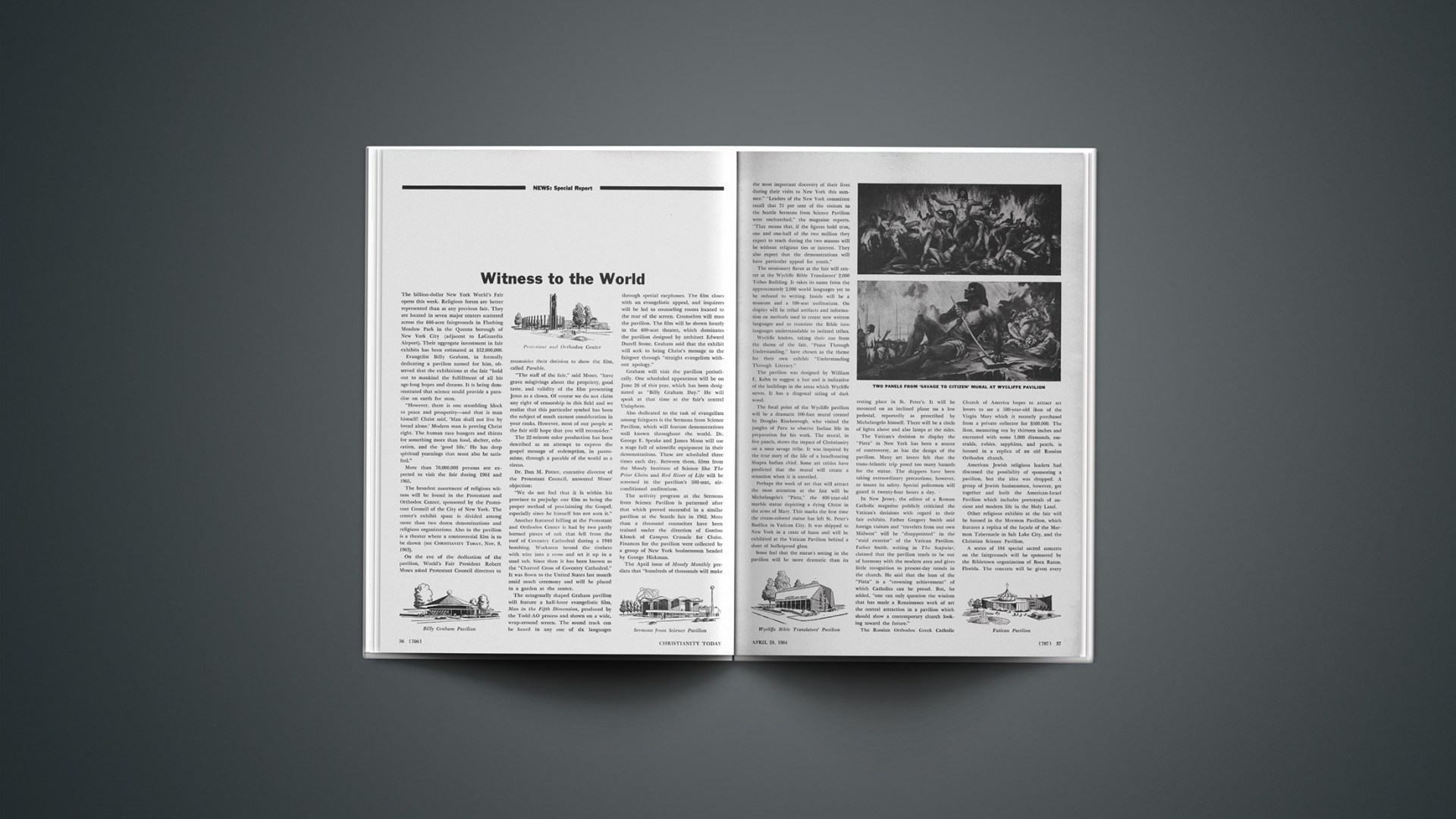
The billion-dollar New York World’s Fair opens this week. Religious forces are better represented than at any previous fair. They are located in seven major centers scattered across the 646-acre fairgrounds in Flushing Meadow Park in the Queens borough of New York City (adjacent to LaGuardia Airport). Their aggregate investment in fair exhibits has been estimated at $12,000,000.

Evangelist Billy Graham, in formally dedicating a pavilion named for him, observed that the exhibitions at the fair “hold out to mankind the fulfillment of all his age-long hopes and dreams. It is being demonstrated that science could provide a paradise on earth for man.

“However, there is one stumbling block to peace and prosperity—and that is man himself! Christ said, ‘Man shall not live by bread alone.’ Modern man is proving Christ right. The human race hungers and thirsts for something more than food, shelter, education, and the ‘good life.’ He has deep spiritual yearnings that must also be satisfied.”

More than 70,000,000 persons are expected to visit the fair during 1964 and 1965.

The broadest assortment of religious witness will be found in the Protestant and Orthodox Center, sponsored by the Protestant Council of the City of New York. The center’s exhibit space is divided among more than two dozen denominations and religious organizations. Also in the pavilion is a theater where a controversial film is to be shown (see CHRISTIANITY TODAY, NOV. 8, 1963).

On the eve of the dedication of the pavilion, World’s Fair President Robert Moses asked Protestant Council directors to reconsider their decision to show the film, called Parable.

“The staff of the fair,” said Moses, “have grave misgivings about the propriety, good taste, and validity of the film presenting Jesus as a clown. Of course we do not claim any right of censorship in this field and we realize that this particular symbol has been the subject of much earnest consideration in your ranks. However, most of our people at the fair still hope that you will reconsider.”

The 22-minute color production has been described as an attempt to express the gospel message of redemption, in pantomime, through a parable of the world as a circus.

Dr. Dan M. Potter, executive director of the Protestant Council, answered Moses’ objection:

“We do not feel that it is within his province to prejudge our film as being the proper method of proclaiming the Gospel, especially since he himself has not seen it.”

Another featured billing at the Protestant and Orthodox Center is had by two partly burned pieces of oak that fell from the roof of Coventry Cathedral during a 1940 bombing. Workmen bound the timbers with wire into a cross and set it up in a sand tub. Since then it has been known as the “Charred Cross of Coventry Cathedral.” It was flown to the United States last month amid much ceremony and will be placed in a garden at the center.

The octagonally shaped Graham pavilion will feature a half-hour evangelistic film, Man in the Fifth Dimension, produced by the Todd-AO process and shown on a wide, wrap-around screen. The sound track can be heard in any one of six languages through special earphones. The film closes with an evangelistic appeal, and inquirers will be led to counseling rooms located to the rear of the screen. Counselors will man the pavilion. The film will be shown hourly in the 400-seat theater, which dominates the pavilion designed by architect Edward Durell Stone. Graham said that the exhibit will seek to bring Christ’s message to the fairgoer through “straight evangelism without apology.”

Graham will visit the pavilion periodically. One scheduled appearance will be on June 26 of this year, which has been designated as “Billy Graham Day.” He will speak at that time at the fair’s central Unisphere.

Also dedicated to the task of evangelism among fairgoers is the Sermons from Science Pavilion, which will feature demonstrations well known throughout the world. Dr. George E. Speake and James Moon will use a stage full of scientific equipment in their demonstrations. These are scheduled three times each day. Between them, films from the Moody Institute of Science like The Prior Claim and Red River of Life will be screened in the pavilion’s 500-seat, air-conditioned auditorium.

The activity program at the Sermons from Science Pavilion is patterned after that which proved successful in a similar pavilion at the Seattle fair in 1962. More than a thousand counselors have been trained under the direction of Gordon Klenck of Campus Crusade for Christ. Finances for the pavilion were collected by a group of New York businessmen headed by George Hickman.

The April issue of Moody Monthly predicts that “hundreds of thousands will make the most important discovery of their lives during their visits to New York this summer.” “Leaders of the New York committee recall that 75 per cent of the visitors to the Seattle Sermons from Science Pavilion were unchurched,” the magazine reports. “That means that, if the figures hold true, one and one-half of the two million they expect to reach during the two seasons will be without religious ties or interest. They also expect that the demonstrations will have particular appeal for youth.”

The missionary flavor at the fair will center at the Wycliffe Bible Translators’ 2,000 Tribes Building. It takes its name from the approximately 2,000 world languages yet to be reduced to writing. Inside will be a museum and a 100-seat auditorium. On display will be tribal artifacts and information on methods used to create new written languages and to translate the Bible into languages understandable to isolated tribes.

Wycliffe leaders, taking their cue from the theme of the fair, “Peace Through Understanding,” have chosen as the theme for their own exhibit “Understanding Through Literacy.”

The pavilion was designed by William E. Kohn to suggest a hut and is indicative of the buildings in the areas which Wycliffe serves. It has a diagonal siding of dark wood.

The focal point of the Wycliffe pavilion will be a dramatic 100-foot mural created by Douglas Riseborough, who visited the jungles of Peru to observe Indian life in preparation for his work. The mural, in five panels, shows the impact of Christianity on a once savage tribe. It was inspired by the true story of the life of a headhunting Shapra Indian chief. Some art critics have predicted that the mural will create a sensation when it is unveiled.

Perhaps the work of art that will attract the most attention at the fair will be Michelangelo’s “Pieta,” the 400-year-old marble statue depicting a dying Christ in the arms of Mary. This marks the first time the cream-colored statue has left St. Peter’s Basilica in Vatican City. It was shipped to New York in a crate of foam and will be exhibited at the Vatican Pavilion behind a sheet of bulletproof glass.

Some feel that the statue’s setting in the pavilion will be more dramatic than its resting place in St. Peter’s. It will be mounted on an inclined plane on a low pedestal, reportedly as prescribed by Michelangelo himself. There will be a circle of lights above and also lamps at the sides.

The Vatican’s decision to display the “Pieta” in New York has been a source of controversy, as has the design of the pavilion. Many art lovers felt that the trans-Atlantic trip posed too many hazards for the statue. The shippers have been taking extraordinary precautions, however, to insure its safety. Special policemen will guard it twenty-four hours a day.

In New Jersey, the editor of a Roman Catholic magazine publicly criticized the Vatican’s decisions with regard to their fair exhibits. Father Gregory Smith said foreign visitors and “travelers from our own Midwest” will be “disappointed” in the “staid exterior” of the Vatican Pavilion. Father Smith, writing in The Scapular, claimed that the pavilion tends to be out of harmony with the modern area and gives little recognition to present-day trends in the church. He said that the loan of the “Pieta” is a “crowning achievement” of which Catholics can be proud. But, he added, “one can only question the wisdom that has made a Renaissance work of art the central attraction in a pavilion which should show a contemporary church looking toward the future.”

The Russian Orthodox Greek Catholic Church of America hopes to attract art lovers to see a 500-year-old ikon of the Virgin Mary which it recently purchased from a private collector for $500,000. The ikon, measuring ten by thirteen inches and encrusted with some 1,000 diamonds, emeralds, rubies, sapphires, and pearls, is housed in a replica of an old Russian Orthodox church.

American Jewish religious leaders had discussed the possibility of sponsoring a pavilion, but the idea was dropped. A group of Jewish businessmen, however, got together and built the American-Israel Pavilion which includes portrayals of ancient and modern life in the Holy Land.

Other religious exhibits at the fair will be housed in the Mormon Pavilion, which features a replica of the facade of the Mormon Tabernacle in Salt Lake City, and the Christian Science Pavilion.

A series of 104 special sacred concerts on the fairgrounds will be sponsored by the Bibletown organization of Boca Raton, Florida. The concerts will be given every Saturday night and every Sunday afternoon at several auditoriums and arenas. The Bibletown organization, headed by Dr. Ira Lee Eshleman, owns and operates a resort conference in Boca Raton and an adjacent housing community.

The New York Bible Society has printed a million copies of the “World’s Fair Edition” of the Gospel of John for distribution at the fair. The society’s exhibit is located in the Hall of Education.

The Billy Graham Evangelistic Association, in addition to operating its own pavilion, will lease 400 square feet of exhibit space in the Protestant and Orthodox Center.

The largest exhibits in the Protestant and Orthodox Center will be those sponsored by The Methodist Church, the Churches of Christ, and the Lutherans (a composite exhibit of the Lutheran Church in America, the Lutheran Church—Missouri Synod, and the American Lutheran Church).

Other exhibitors at the Protestant and Orthodox Center: the Protestant Episcopal Church; the Greek Orthodox Archdiocese of North and South America; Guideposts Associates, Inc.; Seventh-day Adventists; General Council of Assemblies of God; New York Association of the New Church (Swedenborgian); Salvation Army; Evangelical Covenant Church of America; Aramaic Bible Society, Inc.; Association for a United Church of America, Inc.; John A. Dixon Co. (publishers of the New Analytical Bible); John Milton Society; National St. George Association; and Protestants and Other Americans United for Separation of Church and State.

A Baptist display at the center will be jointly conducted by the American and Southern Baptist Conventions, the National Baptist Convention, U. S. A., Inc., the North American Baptist General Conference, the Seventh Day Baptist General Conference, and the Baptist Federation of Canada. A Presbyterian exhibit is sponsored by the United Presbyterian Church in the U. S. A. and the Reformed Church in America.

Billy Graham In Birmingham

Legion Field is a football stadium in Birmingham, Alabama, located at the foot of “Dynamite Hill,” a Negro residential section that has been rocked repeatedly by the bombs of the Negroes’ white neighbors.

To this stadium on Easter Sunday came Billy Graham to speak to an integrated audience, and the white supremacists were aroused. “If violence occurs, the blood will be on the hands of the rulers of Birmingham,” said a spokesman for the segregationist “Citizens Council.”

The Citizens Council had pressed for the canceling of the meeting. The Birmingham City Council rejected the request.

“Why have you come to Birmingham?” Graham was asked at a news conference before the rally. “To preach the Gospel,” he replied.

On Easter Sunday at Legion Field, not only was there no violence; people went out of their way to be friendly. The crowd of 35,000 that gathered to hear Graham was the largest integrated audience in the history of the city and the state. Over 300 policemen were on hand, some with truncheons; but no incidents were reported.

“During the waiting period, Negroes and whites chatted informally with those nearby,” wrote Mrs. William McMurry for the Southern Baptist Press. “One woman who was having her first experience sitting by a Negro said later, ‘When she put out her hand to shake mine and smiled, I couldn’t refuse.’

“A white usher responded to a friendly greeting from a woman sitting next to him with, ‘Well, some folks said there wouldn’t be many here, and I just told them maybe those who do come will get a good dose of religion.’ ”

To this audience Graham preached a simple message on John 3:16. “Integration was not the issue at Legion Field,” said Dr. Sherwood Wirt of the Billy Graham Evangelistic Association. “The issue was the claim of Jesus Christ upon the individual heart.”

Some 3,000 to 4,000 people—about 10 per cent of the audience—came forward at the end of the message to respond to that claim. “I have never seen this [great a] proportion in America,” said Walter Smyth, crusade planning director.

“What a moment and what an hour in Birmingham,” said Graham. “Let’s make this the beginning of a spiritual awakening in Birmingham.”

The reaction of many observers was one of almost stunned surprise. Time magazine put the story in its lead civil rights article, which concluded, “And if it could happen in Birmingham, it could happen anywhere, a fact of which the debating senators might take notice.”

“Rev. Billy Graham has brought out the very best in us,” said Mayor Albert Boutwell.

The mayor sat on the platform during the meeting, as did the president of the Birmingham Ministerial Association and the presidents of the city’s three colleges: Howard, Miles, and Birmingham Southern.

Many Roman Catholics and Jews cooperated, and almost all the evangelical denominations in the city, white and Negro, supported the rally.

More than 1,000 prayer groups had been meeting in advance of the service.

Graham has already been invited back for a full-scale crusade, and he has said the team would be “delighted” to return.

Evangelicals And The Ymca

The Young Men’s Christian Associations seek to unite those young men who, regarding Jesus Christ as their God and Saviour according to the Holy Scriptures, desire to be his disciples in their faith and in their life, and to associate their efforts for the extension of his Kingdom among men.

With these words delegates to the first YMCA world conference, on August 22, 1855, laid the basis for the admission of new associations. The YMCA movement went on to become part of community life the world over. But the religious leg of its traditional body-mind-spirit triangle eventually sagged (see CHRISTIANITY TODAY, November 11, 1957, “Will the ‘Y’ Recover Its Gospel?”).

Paul L. Hershey, 28-year-old community work secretary for the Central Y in Washington, D. C., is challenging the notion that evangelicals should write off the movement. A letter-writing campaign over the past year has netted him a list of dozens of Y secretaries around the country who are concerned about the movement’s spiritual outreach. Hershey has encouraged them to start prayer meetings and Bible study sessions.

“We seek to see a new power in the YMCA fellowship as we relate to a changing society,” he says. “We still believe that the only way to build a Christian society is through transformed lives.”

As a step in coordinating evangelical efforts in behalf of the Y, Hershey spearheaded sponsorship of a day-long conference in Washington last month that drew some twenty-five Y secretaries and an equal number of interested laymen from several Eastern states. One speaker predicted that the Y’s greatest days were still ahead, but that the movement needed more of a “cutting edge” in Christian convictions. Conferees agreed to press their cause on local fronts and to report back in a year. Hershey hopes that the next conference will have a national scope.

Hershey, who attended Philadelphia College of Bible and graduated from Grace College, declares he has no intention of creating a divisive bloc in the Y movement. The role of the evangelicals, he says, should be one of service consistent with the existing framework.

The Y movement is currently active in seventy-five countries. The nearly 6,000 associations have 6,000,000 members.

Medium For Missions

Establishment of a new non-profit organization to disseminate missionary news was announced in Washington this month. The Evangelical Missions Information Service was incorporated as a joint enterprise of the Interdenominational Foreign Mission Association and the Evangelical Foreign Missions Association. First project: publication of a periodical to be known as The Evangelical Missions Quarterly.

James Reapsome, editor of The Sunday School Times, will also edit the new quarterly. First issue is due by late 1964. The journal will be designed to report on events and trends vital to the cause of missions, interpreting them in the light of the evangelical position.

A Plan Of Union

Two conservative Presbyterian bodies took the first formal step in St. Louis this month toward merging into one denomination. After years of moving together through sharing academic facilities and exchanging ministers, the Reformed Presbyterian Church in North America (General Synod), meeting in its 141st General Synod, and the Evangelical Presbyterian Church, meeting in its twenty-eighth General Synod, “were all with one accord in one place.”

The forty commissioners of the RPC adopted the Plan of Union unanimously, the 103 commissioners of the EPC by an 80 to 4 vote. Only the selection of a name for the united church aroused lively discussion. Pride of tradition and sense of identity raised the question whether the united church would be a new church requiring a new name, and whether the 28-year-old EPC would suddenly become 141 years old. In the end both groups unanimously adopted the name “The Reformed Presbyterian Church, Evangelical Synod” for the united church.

If the plan is ratified by three of the RPC’s four presbyteries and by eight of the EPC’s twelve presbyteries, the merger can be consummated in April of 1965, when the two synods are scheduled to meet in Chattanooga, Tennessee.

There seemed little doubt that the merger will take place. According to Paul Gilchrist, pastor of the Evangelical Presbyterian Church of Levittown, Pennsylvania, “The spirit toward union both before and during the 1964 meetings of our respective synods was exceedingly promising. I have little doubt that the merger will be ultimately consummated.”

The EPC has 8,000 communicant members, the RPC 2,000.

If the merger occurs, it will be the first organizational merger within the twentieth-century “separatist” movement. The EPC separated from the Orthodox Presbyterian Church in 1938 and was known as the Bible Presbyterian Church until the defection in 1956 of Carl McIntire and his churches (Bible Presbyterian Church, Collingswood Synod); since that time it has borne its present name.

The Plan for Union includes acceptance of the Westminster Confession, and of the Shorter and the Longer Catechisms. The confession was modified to eliminate the Westminster assertion that the pope of Rome is the “Antichrist.” Modifications and deletions of the Larger Catechism were made in order not to exclude any millennial view that includes belief in a visible, personal return of Christ and does not otherwise violate the teaching of the confession and the catechisms.

The plan also includes resolutions renouncing the various forms of pornography, and warning against the use of tobacco and liquor and against the moral dangers involved in movies, dancing, television, and the sin of gambling. Although the resolutions are included in the Plan of Union which must be adopted to effect the merger, the plan states that “they do not constitute an attempt to legislate.” How such resolutions could be the basis for union and yet be without binding legislative power, seemed to trouble no one.

A resolution about the proper nature of a resolution asserted that resolutions “should bear on the religious and moral issues rather than the strictly political or social issues of the day, or should pertain at least to the moral or religious aspect of any social or political issue,” and that such a resolution “should be aimed primarily at our own constituency … rather than at the high councils of government or at society at large.” Nevertheless, the Resolutions Committee was mandated, immediately upon the conclusion of the synod, “to notify news media of the approved resolutions.”

JAMES DAANE

Books

Book Briefs: April 24, 1964

The Glory And The Shame

The Brazen Serpent, by Poul Hoffmann, translated by David Hohnen (Fortress, 1964, 288 pp., $4.95), is reviewed by Kenneth E. Williams, assistant professor of English, Trenton State College, Trenton, New Jersey.

The Brazen Serpent is the final volume of a trilogy on the Exodus by Poul Hoffmann, a Danish lawyer. It begins with the arrival of the Israelites at Hazeroth and concludes with the death of Moses.

This novel is not simply an expanded or imaginative version of the biblical narrative intended primarily for devotional use. Instead, it is a theologically oriented attempt to portray the forces at work in the history of Israel and its changing relationship to God. It uses the two wives of Joshua, Judith and Tamar, whose names are the titles of the two halves, as a mirror to reflect the changes brought about when the desert wanderers enter the Promised Land. As a book presenting part of the history of salvation, it begins with a curiously sensuous description of the cosmos and presents our planet as a dark star, “sick, doomed, pregnant with its own destruction.” The author uses the sense of mystery created by his description to suggest that what was happening at Hazeroth in the camp of Israel was related to Jahveh’s cure of the blighted world. The book ends by stating that the life and resurrection of Christ were a continuation of the work God had been doing in the days of Moses.

One of the ways the author captures vividly the passions and motivations of some of the people whose names dot the history of the Exodus is to echo various religious ideas from non-biblical sources. For example, the book begins with the dispute between Moses and Aaron and Miriam concerning the presence of Gentiles in the Israelite camp, especially Moses’ wife, Zippora. By a skillful use of dialogue the author creates an atmosphere that points up how severe the crisis was for Moses.

The most important character in the book is really Joshua, the military commander of the people. In a chapter written as a letter from Joshua to Moses during the visit of the spies to Canaan, Joshua is presented as a man of strong passion who falls into sin through a pagan orgy only to feel such a sense of revulsion that he feels compelled to wipe out such a depraved race. Later Joshua dreams of Adam and Eve in a way that is filled with countless Jungian overtones; this occurs just before Israel is confronted with the plague of the snakes, to which Joshua himself nearly succumbs. The author tries to show later how Joshua suddenly sensed that Moses was now a very old man who was about to leave Joshua in command of the people, and the effect this awareness had on him. He does it fairly convincingly.

One of the virtues of the book is the way it attempts to fit into some consistent pattern some of the various minor events and to capture the spirit of some of the secondary characters. By presenting the spies as virtual buffoons, the author is able to make their dissuading of their countrymen from invading a truly ironic event.

In summary, the book captures well the sense of mystery that must have pervaded the camp of Israel during those days when the cloud and the pillar of fire led them onward. Readers who are used to thinking of God in terms of the fuller revelation of later Old Testament history and the final revelation in Jesus Christ may find it hard to accept the almost irreverent attitudes of the Israelites, to whom he seemed to be less than the High and Holy One. Most of all, readers may find it difficult to accept the strong sexual drives that seem to be the basic motivation for Joshua’s deeds unless they are used to thinking in such a Freudian frame of reference.

KENNETH E. WILLIAMS

Philosophers On Parade

Faith and Philosophy, edited by Alvin Plantinga (Eerdmans, 1964, 225 pp., $4.95), is reviewed by Arthur F. Holmes, associate professor and director of philosophy, Wheaton College, Wheaton, Illinois.

Philosopher W. Harry Jellema retired last summer at the age of seventy, after thirty years of teaching at Calvin College, plus twelve years at Indiana and visiting professorships at Haverford and Harvard. A number of his former students and colleagues have collaborated to produce a Festschrift in his honor. That he should have occasioned a volume of this caliber is both a sterling contribution in itself and a significant reminder of the lasting influence of the Christian teacher and scholar.

All of the contributors are professional philosophers in their own right, and their essays are a credit to Christian scholarship. There are two historical studies. Jesse DeBoer of the University of Kentucky provides fascinating insights into the mysticism of the Upanishads, while Henry Stob of Calvin Seminary presents a careful exposition of Jonathan Edwards’s ethics in the light of his idealism. The remaining seven essays represent the constructive role of philosophy done from a Christian perspective.

Nicholas Wolterstorff of Calvin College keynotes the volume with his analysis of the relation of faith to philosophy. “Few, if any, philosophical arguments are proofs—strict, rigorous, deductive proofs,” because in the final analysis a philosophical position is the elaboration of a perspective, a way of seeing things, “an interpretation of our human condition.” Moreover, man’s faith, whether or not directly religious, also affects his outlook on life. Consequently, “there is every likelihood of conflict between one man’s philosophy and some other man’s faith, and between one man’s faith and some other man’s philosophy.” Just as the loyalties of a philosophical outlook keep it from being neutral with respect to faith, so the loyalties of faith keep us from being neutral with respect to philosophical outlooks. Consequently the choice we face is never ultimately between rationality and irrationality, between philosophy and faith; it is a choice between faiths, a choice between philosophies. Christian faith does not inhibit philosophy, and need not be inhibited by it. Rather it provokes philosophic endeavor, and can be enriched thereby.

This is clearly seen in the remaining essays. Francis Parker of Haverford College argues for the traditional view of reason stemming from Aristotle, as against the epistemological cul-de-sac of British empiricism. If these are the only alternatives, his point is well taken; but an overgeneralized classification is apt to leave the impression that we have to be pure Aristotelians or nothing at all. Editor Alvin Plantinga of Wayne State (currently on leave to teach at Calvin), who has previously published on other aspects of philosophical theology, analyzes the use of the phrase “necessary being,” and concludes that its function is to set forth “the unique role played by the assertion of God’s existence in the conceptual scheme of theism.”

The last four constructive essays are on ethics. Henry Veatch of Indiana rejects the contemporary stress on meta-ethics engendered by G. E. Moore in favor of a cognitive approach to normative ethics. Dewey Hoitenga of Juniata College considers the place of Christian ethics in the debate between motivational and deontological theories, and Fred Brouwer of Washington and Jefferson College develops “a restricted motive theory.” Finally Michigan’s William Frankena appeals to proponents of theological ethics to take into account the best philosophical thinking of the time. Agapistic ethics, he believes, has not done so. He accordingly enumerates alternative kinds of rule-agapism, act-agapism, non-agapism, and mixed agapism, and urges theologians to think through Christian ethics in this light. This would be an exciting and rewarding bridge between faith and philosophy.

ARTHUR F. HOLMES

Few Dull Pages

Global Odyssey, by Howard A. Johnson (Geoffrey Bles, 1963, 435 pp., 45s), is reviewed by Oliver R. Barclay, secretary for international relations, Inter-Varsity Fellowship, London, England.

Canon Johnson from the Protestant Episcopal Cathedral in New York began a two-year tour of the Anglican communion in October, 1959. This book records what he saw, heard, and experienced. There are very few dull pages in this lively compound of travel journal, anecdote, and comment upon the political and religious situations of the countries visited. Its aim is to give a fresh vision of the Anglican communion and to describe its situation all around the world.

Although the book is very interesting reading, it is in many ways disappointing. The author has some shrewd summaries of the political and psychological situations of the churches in different countries (e.g., a good survey of the Church of Ireland), but he has almost nothing to say about the spiritual strengths and weaknesses. Evangelistic outreach, supply of men for the ministry, missionary concern, devotional and practical Christian living, are hardly mentioned. Inevitably, perhaps, institutions and the work of bishops and a few other leaders steal the canvas. One sees the churches as organizations rather than fellowships of believing people. The result is an apparent preoccupation with efficiency, organization, and public status. He admits at one stage that he described his outstanding impression of the church by the word “ineptitude.” This is not fair to himself or to the book, but it describes the kind of judgment he most often makes.

Nevertheless, if one accepts the relative superficiality of all judgments of this kind, there is much of interest in the broad sweep of these descriptions, which cover every continent. The writing does give a fresh impression of a great worldwide communion and a fresh humility as one contemplates the vast missionary efforts of the past.

OLIVER R. BARCLAY

Popular But Unplanned

Christian Belief and Christian Practice, by William J. March (Eerdmans, 1964, 219 pp., $3.50), is reviewed by Robert G. DeMoss, consultant, DeMoss Associates, Inc., Valley Forge, Pennsylvania.

This new book by a prominent Canadian minister seeks in impassioned tones to awaken the Church to the present low state of our religious life and to motivate it to a more vital expression of the faith to which it is committed. Gibbon’s description of the moral corrosion of Rome that prefaced its “fall” is cited as having a modern-day parallel in our own private and national lives.

March understands both the cause and the cure of our present plight to reside in two simple truths: (1) We must go back to the actual teachings of Jesus as foundational to an understanding of the moral basis of individual and societal living; and (2) an understanding of Christian doctrine is without value unless it is practiced in daily living.

It is healthful and indeed necessary that every generation be reminded of this simple but foundational concept, in season and out of season. Dr. March’s sincere and impassioned words are therefore welcome. However, as a book this one leaves much to be desired. The almost complete absence of any structure or development in the more than two hundred pages gives evidence of lack of planning. The hortatory style is rambling and verbose, and lacks precision. There is a great deal of repetition; the contents of the book could have been expressed in less than half the words used.

The work is popular not only in the sense that the language and style are simple or that there is no index or footnotes, but, more importantly, in the sense that almost no cognizance is taken of any current theological or exegetical discussions. Although the author’s sincere desire to awaken the Church is commendable, a written expression of this desire cannot be effective if it exhibits such shortcomings as these.

ROBERT G. DEMOSS

Unique

The Vocabulary of Communism, by Lester De Koster (Eerdmans, 1964, 224 pp., $3.50), is reviewed by Harold B. Kuhn, professor of philosophy of religion, Asbury Theological Seminary, Wilmore, Kentucky.

In his earlier volume, Communism and Christian Faith, Professor De Koster sought to present the visible structures of the Marxist system. In this present volume he sets forth the anatomy of the Communist movement, utilizing the method of carefully written and closely articulated definitions. About 170 pages are devoted to clear-cut expositions of the major themes, historical phenomena, and clichés relating to the Sino-Soviet system(s). Three extended and highly useful bibliographies complete the volume.

A survey of the definitions, some of which occupy from one-half to a whole page, reveals that the author has done a massive piece of research, covering not only the theory of Marxism but the political embodiment of the movement as well. There can be noted, of course, significant omissions. For example, one sees no entry for Molotov, nor for the infamous pact between him and Ribbentrop.

Two particular features of the work commend it to the reader. First, the articles are non-epithetical, and as objective as can reasonably be expected. It goes without saying that the author avoids the “good God, nice devil” attitude toward the movement which was fashionable in the thirties. Second, the meticulous cross-referencing makes its systematic use easy. The work is likely to stand unique in its field for some time.

HAROLD B. KUHN

Genesis And Science

Creation Revealed, by F. A. Filby (Pickering & Inglis, 1964, 160 pp., 17s. 6d.), is reviewed by Alan Millard, librarian, Tyndale House, Cambridge, England.

The “conflict” between the Creation account in Genesis and science does not cease to inspire in earnest Christians a desire to harmonize the two. Dr. Filby, a lecturer in chemistry, has not followed the usual pattern. He takes Genesis 1 verse by verse, endeavors to establish its meaning, then investigates the results of scientific discovery bearing upon the topic, not insisting upon one to the exclusion of the other, for often the two sides are seen to be complementary.

This book can be criticized in sections not concerned with the author’s specialty; the Hebrew words are not always represented, and too literal an interpretation is pressed upon some. That the Babylonian Creation stories actually refer to the Flood and Babel rather than to Creation is implausible. The existence of chaos at the beginning of Creation is assumed in several places; but did God “progress from disorder to order”? For pp. 121–139 in note 1, p. 57, read pp. 21–24, 34–37.

This book should be of help to those Christians who find in scientific discovery a stumbling block, while others will gain a stimulus to more abundant praise of Him in whom “all things consist.”

ALAN MILLARD

Symbol And Ceremony

Liturgy Is Mission, edited by Frank Stephen Cellier (Seabury, 1964, 159 pp., $3.95), is reviewed by John T. Malestein, pastor, Richfield Christian Reformed Church, Clifton, New Jersey.

Gather at a liturgical conference such men as the Rev. W. Moelwyn Merchant, Shakespearean scholar and head of the Department of English, Exeter University, England; the Rev. C. Kilmer Myers, director of the Urban Training Center, Chicago; the Rt. Rev. James A. Pike, former lawyer, now Bishop of the Protestant Episcopal Diocese of California; the Rev. William G. Pollard, executive director of the Oak Ridge Institute of Nuclear Studies and priest-in-charge at St. Albans Chapel, Clinton, Tennessee; the Rev. Massey H. Shepherd, professor of liturgies at the Church Divinity School—together with the pastor of the Roman Catholic parish, Galena, Kansas, the Rev. Joseph T. Nolan—and you will indeed have, as the editor describes it, a conference “addressed by men of singular distinction, all of them with the invigorating wind of the Liturgical Movement blowing full in their faces.” The six chapters of this book contain an address, a sermon, and several papers that were delivered at the third National Liturgical Conference in Wichita, Kansas, in 1962.

In the introduction the editor makes the somewhat startling claim that the liturgical movement, though “much less spectacular … [is] in many ways as significant as the Reformation of the sixteenth century.” By the time one has finished this book he is likely to concede that within the Church there are stirrings that possess the potential of a mighty leaven. Cellier is quick to allay the hasty judgments of those who might dismiss liturgical renewal as being concerned only with meaningless symbols and empty ceremonies: “… the Liturgical Movement has its roots very deep in the soil of … ecclesiology … and in the soil of sacramental theology” (p. 21). Though one encounters on succeeding pages a modest disavowal of theological capabilities, there is to be found, nevertheless, a profound theological concern for arriving at answers to the question: How can liturgy, resting foursquare on biblical foundations, continue to be the supreme channel of God’s grace to the individual?—and further, how may the individual reflect the efficacy of his reception of God’s grace by the way he confronts the society in which he lives?

Both Shepherd and Myers confront a society that is fragmented and hungry for unity. The sacrament of baptism, avers Myers, is the sacrament of unity and therefore the “beginning of the divine strategy” in the Church’s mission to urban society. Shepherd cautions that before the Church can effectively mend the breaches in a society “out there” she had better heal the wounds of division within. The irrefutable existence of racial division in the Church is a denial of the Gospel, a blasphemy against the Holy Spirit, and a mockery of holy liturgy; for racial division “rejects the divine grace that works to make us one Body and one Blood in the Lord” (p. 47). In the almost hopeless fragmentation of the Church, Shepherd finds one of the great obstacles to an effective mission throughout the world.

In the sermon-chapter the Rt. Rev. James A. Pike contrasts “two different meanings of life and work, depending on whether one is caught in the time-space continuum—in a secular view of reality—or whether one is caught up into the eternal view of reality and purpose and calling” (p. 128). Pike, like Pollard, sees real meaning and finds a way out of this time-space continuum through worship, but he seems to allow a more significant place for the Word: “We adore God in both his Word and his Sacrament.… Christ is truly and really present in the Word of God; and the Service of the Word is something that, having its own authenticity, can stand on its own feet” (p. 129).

An ecumenical dimension is added to the book in the chapter submitted by Father Nolan. His presentation includes a brief but valuable historical summary followed by an analysis of the present status and significance of liturgical renewal in the Roman Catholic Church. His proposal that Catholics, Anglicans, and other Christians publish a joint hymnal as well as a joint Bible translation expresses a wholesome irenics. His observation—“It seems obvious that as Catholics get more scriptural and Protestants more liturgical, they are bound to meet each other”—embraces more than a modicum of ecumenical truth.

Although primarily of concern to liturgical churchmen, this book merits wide reading by all churchmen. Liturgy Is Mission alerts the universal Church “to the one test by which all worship and prayer is laid under judgment, namely the sense of mission that they evoke among the faithful.” To those who would like to be initiated into the thinking of the proponents of liturgical renewal, to those who would like to engage in a bit of mental sparring with the sacramental theologian, to those who would like to gain deeper insights into the Church’s mission, this book is recommended. The reader may be jolted by some frank criticisms. It would seem, however, that ecclesiastical and theological torpidity demand this very kind of rude awakening.

JOHN T. MALESTEIN

The Changing Family

What’s Happening to Our Families?, by Wallace Denton (Westminster, 1963, 222 pp., $4), is reviewed by Andre Bustanoby, pastor, Arlington Memorial Church, Arlington, Virginia.

According to Denton, our families are being swept off their feet by the changing tides of social and psychological forces, and he discusses these forces in the first part of of his book. The second part covers “some emerging problems of the family that have been provoked by these changes.” But there are signs of hope: part three discusses “some areas of strength in the modern family.” The final section gives some “conclusions for the church and family.”

Denton’s approach to the family is basically “socio-psychological,” and this approach produces a good discussion on “Longer Years of Retirement.”

The last part of the book is its weakest. Two paragraphs are devoted to the relevance of the Bible (pp. 204, 205). Denton admits that the Bible is relevant to family problems. But although he speaks of “an underlying truth [that] is applicable to the modern couple,” he doesn’t say what this truth is. This weakness permeates the entire book. The author writes on the assumption that the patriarchal pattern of family life is a vestige of a past society rather than a divine pattern that transcends all societies. He misses the significance of the primacy of man’s creation and woman’s deception in the Fall.

While the book’s approach is socio-psychological, any attempt to relate the Church to family problems raises the expectation of a sound biblical rationale. This is disappointingly absent.

ANDRE BUSTANOBY

Attractive

The Eternal Legacy from an Upper Room, by Leonard Griffith (Harper & Row, 1963, 192 pp., $3), is reviewed by C. Ralston Smith, minister, First Presbyterian Church, Oklahoma City, Oklahoma.

Successors to notable men usually have difficult times. They so often have to dwell in the shadow of their predecessor and endure the odious comparisons so easily made. Here in the man who follows Leslie Weatherhead we have a splendid exception. Leonard Griffith in this devotional treatise of the pre-arrest events gives ample evidence of his own stature. What is immediately significant is his strong yet simple belief in the Gospel. Noting the various bypaths well worn by seekers, he nevertheless stays on the main road of the biblical teaching.

Direct style, vivid language, and comparatively simple wording all combine to make the book readable. The illustrations are of some substance, drawn from a wide variety of experiences. None of them seems awkward or “dragged in by the heels.” It is also refreshing to find an author who does not feel obliged to have numerous long involved quotations from contemporaries to make his point authoritative.

Tough subjects are touched, and existing problems are probed. A stronger note might have been sounded on the singularity of Christ as the only Way. And one could disagree with the author’s conviction about the necessity of organic union among the churches. However, these items require lengthier treatment than the compass of the book intends or permits. It is an attractive volume in both makeup and content.

C. RALSTON SMITH

Book Briefs

In Sight of Sever, by David McCord (Harvard, 1963, 287 pp., $5.95). For Harvard alumni, particularly those whose college days are several decades in the past, this book of essays by one who has spent forty years in the service of his alma mater brings with its reading a gentle nostalgia. Non-Harvard readers will glimpse through Mr. McCord’s well-bred prose something of the ineffaceable charm the oldest of American universities holds for its sons.

The Uses of the University, by Clark Kerr (Harvard, 1963, 140 pp., $2.95). The president of the University of California devotes his Godkin lectures at Harvard to a discussion of the “multiversity,” such as that over which he presides in California with its 58,000 students on seven campuses. The book is of interest to all who are concerned with higher education. Dr. Kerr writes with precision and prescience about the forward movement of university education in America.

The Age of the Scholar, by Nathan M. Pusey (Belknap Press, 1963, 210 pp., $4.50). The subtitle, “Observations on Education in a Troubled Decade,” describes this book of essays by the president of Harvard University. Included are Dr. Pusey’s famous address at the Harvard Divinity School shortly after his inauguration, when he said of the moralistic religion of his great predecessor, Charles William Eliot, “… this faith will no longer do,” and also his widely quoted baccalaureate sermon of 1958, taking issue with secularism (“Secularism and the Joy of Belief”).

The Destruction of Dresden, by David Irving (Holt, Rinehart and Winston, 1963, 255 pp., $4.95). On February 13, 1945, Allied bombing of Dresden took about 135,000 lives—almost twice the toll at Hiroshima. A specialist in modern German history gives here the results of his three-year research on the subject, seriously questioning this Allied action, and showing to the new nuclear generation the appalling tragedy of man’s inhumanity to man. Introduction by Gen. Ira C. Eaker.

The Christian Book of Mystical Verse, selected by A. W. Tozer (Christian Publications, 1963, 152 pp., $3). The selections are mystical in a wide sense of the term.

Pathways to Happiness, by Leonard Griffith (Abingdon, 1964, 128 pp., $2.50). The Beatitudes explained as “pathways to happiness.” Very readable.

Devotions from a Grateful Heart, by Sybil Leonard Armes (Revell, 1964, 127 pp., $2.50). Religious themes discussed with literary charm, spiritual grace, and a lively spirit.

Mountain Doctor, by LeGette Blythe (William Morrow, 1964, 221 pp., $4.50). The odyssey of Gaine Cannon, M.D., who has put the philosophy of Albert Schweitzer to work in the remote regions of North Carolina.

Consecration of the Layman, by Max Thurian (Helicon, 1963, 118 pp., $2.95). The Protestant monk of Taizé studies the meaning of confirmation. Is it vitally related to baptism? If so, is it sacramental? An important study.

Paperbacks

A Study of History, Vol. 12: Reconsiderations, by Arnold J. Toynbee (Oxford, 1964, 740 pp., $2.95). In this volume added to his Study of History, Toynbee responds to his critics and shows how his thought has changed on many matters, including religion. First published in 1961.

Religious Conflict in America: Studies in the Problems Beyond Bigotry, edited by Earl Raab (Doubleday, 1964, 232 pp., $1.25). A dozen men write on religious conflict in the United States; with an introduction by Raab. Many of the writers believe that this conflict lies deeper and is more durable than racial conflict, yet paradoxically believe that the religious conflict is more national and sociological than religious.

The Story of the Reformation, by William Stevenson (John Knox, 1964, 206 pp., $1.95). A very popular and readable short history of the Reformation.

Trinitarian Faith and Today’s Mission, by Lesslie Newbigin (John Knox, 1964, 78 pp., $1.25). Newbigin insists that missionaries must remember the trinitarian character of Christianity; by the Spirit, God can deal with pagans prior to the coming of the Gospel—consequently missionaries must sometimes listen to pagans before they preach to them. First American edition.

Bells Still Are Calling, by Kristofer Hagen (Augsburg, 1964, 177 pp., $3). A view of missions that Christians should get to know better in order to recognize and effectively challenge it.

Adventures in Evangelism, by Elmer A. Kettner (Concordia, 1964, 133 pp., $1.50). A popular discussion about how actually to “get started” with the task of Christian witnessing.

Man in Community, by Russell Phillip Shedd (Eerdmans, 1964, 209 pp., $1.95). A study of St. Paul’s application of Old Testament and early Jewish conceptions of human solidarity.

The Pattern of Religious Authority, by Bernard Ramm (Eerdmans, 1963, 117 pp., $1.50). A probing into the biblical teaching of the reality of religious authority and a critique of some of the competitive ways in which it has been misunderstood and erroneously structured. A valuable study. First printed in 1957 under the title, The Pattern of Authority.

Authority in the Church, by Thomas Coates (Concordia, 1964, 98 pp., $1.50). A very readable, popular discussion about the reality of church authority and how it ought to operate on local and synodical levels. The book speaks to an area of confusion and ignorance. A fine book for group discussion.

Sea Rations, by John Kenneth Bontrager (The Upper Room, 1964, 88 pp., $.50). Thirty-seven meditations written with a pronounced flavor of the sea by a man who served as an enlisted man and is now a Navy chaplain. Excellent for the young serviceman at sea.

The Three R’s of Christianity, by Jack Finegan (John Knox, 1964, 125 pp., $1.75). A discussion of: Revelation, Redemption, Redeemer. Competently done; to be read with questions.

Theology

The Christian and His Conscience

Fundamental to the liberties of man is that faculty of the soul termed “conscience.” Today that term connotes for most people only a moral monitor—a twinge of mind that indicates a moral judgment of right or wrong. But to the mid-seventeenth-century British Presbyterians and Independents who drew up the Westminster Confession (which was to become the definitive statement of Presbyterian doctrine throughout the English-speaking world and strongly influence other Protestant bodies as well), the concept of conscience went far deeper. These men were in the midst of a battle for religious liberty, and they wrestled with the concept in order to determine its real and biblical meaning. They realized that conscience had a major role in determining the liberty of man. Their estimation of the value of this faculty is reflected in such statements as these:

There cannot be imagined a higher contempt of God than for a man to despise the power of his own conscience which is the highest sovereignty under heaven, as being God’s most immediate deputy for the ordering of his life and ways [Robert Saunderson, Twelve Sermons, 1621].

God hath given it more force and power to work upon men, than all other agents [Samuel Ward, Balm from Gilead to Recover Conscience, 1616].

To the Westminster divines the conscience was more than a moral monitor; it was a spring of action. Conscience was a man’s persuasion of what he was to believe and practice, especially concerning things known only by divine revelation. They spoke of “doing one’s conscience,” by which they meant to act according to one’s sense of right. Their evaluation of the term is seen from definitions they gave:

Conscience is considered … as a principle of our acting in order to do what God commanded us in the law and the Gospel [Samuel Rutherford, A Free Disputation Against Pretended Liberty of Conscience, 1640].

Conscience is a faculty or habit of the practical understanding, which enables the mind of man, by the use of reason and argument, to apply the light which it has to particular moral actions.… The object of a man’s Conscience is a moral act; that is, something actually done, or to be done, or actually omitted, or to be left undone [Robert Saunderson, Lectures on Conscience and Human Law].

The Westminster divines considered conscience a faculty of the human soul implanted by God to rule one’s actions. It was inherent and was not to be considered a habit that might be acquired. It was one of the endowments natural to man and universal with the race. Thus Samuel Ward asserted:

Conscience is a noble and divine power planted of God in the soul, working upon itself by reflection.… A faculty I call it, because it produceth acts, and is not got and lost as habits are, but is inseparable from the soul, immovable from the subject [Samuel Ward, Balm from Gilead to Recover Conscience, 1616].

The divines recognized that the human conscience was subject to earthly influences, but they sought to free it from the authority of man. It may seem commonplace to some that the human conscience is not subject to man’s authority, but this was a revolutionary concept at the time of the Reformation. In the Middle Ages either the church or the state dictated a man’s beliefs, worship, and actions. His social, economic, political, and religious life was under the control of state and church. In their fight to establish the liberty of conscience regarding faith and worship, the Reformers laid a foundation for all liberties.

Even in the seventeenth century it was still the accepted principle: cuius regio eius religio—“whose is the government, his is the religion.” The English king or parliament, for example, considered it a rightful power to rule over both church and state and to determine the religion of the people. It was therefore revolutionary for the Westminster Assembly of Divines to determine in the session of March 30, 1645: “They who require absolute and blind obedience unto superiors for conscience’ sake, do destroy liberty of conscience and reason.”

The divines articulated this position in articles and sermons. Consider, for example, this statement:

To do God and ourselves right, it is necessary we should with our utmost strength maintain the doctrine and power of that liberty wherewith Christ hath endowed his church, without usurping the mastery over others, or subjecting ourselves to their servitude: so, as to surrender neither our judgments or consciences to be wholly disposed according to the opinion or wills of men, though of never excellent piety or parts [Thomas Taylor, Concerning the Right Use of Liberty, 1634].

Although members of the Westminster Assembly saw clearly that conscience must be liberated from ecclesiastical dictatorship and the absolute state, they placed a definite limitation to liberty of conscience. There are modern theologians who would free the conscience from some of the laws enunciated by Christ in the Gospels; but these divines stated clearly that the rights of liberty of conscience are limited by the divine law. Christ did not release the Christian from all laws, nor did he give his followers the right to believe whatever doctrines they pleased; for then assent could be given to falsehood and error, instead of that truth which alone can “make us free.” God of course requires men to believe the truth, as well as to obey his commands. He has given us a rule of faith, as well as of practice, and requires us to think and act according to it. Therefore, it is only at our peril that we allow ourselves the contrary. Limitation of liberty by God’s authority is clearly reflected in the writings of the divines:

The Word of God, and God in his Word, the Scripture, and God in Scripture, is the only infallible, supreme, authoritative Rule and judge of matters of doctrines and worship, of things to be believed, and things to be done [Samuel Bolton, The True Bounds of Christian Freedom, 1645].

God alone has a proper and direct power of command over the Consciences of men; so that none but He alone has a power to impose a law upon the Conscience of any man which it is bound to obey.… He who alone knows the inward motions of the Conscience, He only has a power of prescribing a law to it, but God only, the Searcher of hearts, can discover the inward motions of the Mind and Conscience.… The proximate and immediate Rule of the Conscience is the light of the mind, and the principle and supreme rule is the written Word of God.… The man who designs the Glory of God to be the end, must propose likewise the Law of God to be the rule, of his actions (Isaiah 8:20) [Robert Saunderson, Lectures on Conscience and Human Law].

Because men have ignored the proper limitation of liberty by the authority of God, they have deified conscience. They rebel against the authority of God and refuse any limitation of the freedom of conscience. The Triune God is not considered Lord of the conscience. The individual’s reason, emotion, or habit controls his life, and this he justifies under the authority of freedom of conscience. The divines warned against deification of conscience:

Conscience is hereby made every man’s rule, umpire, judge, Bible, and his God, which if he follow, he is but at the worst, a godly, pious, holy heretic, who feareth his conscience more than his Creator.… Hence, conscience being deified, all rebuking, exhorting, counter-arguing, yea all the ministry of the Gospel must be laid aside [Samuel Rutherford, A Free Disputation Against Pretended Liberty of Conscience, 1640].

Even though a perverted use of liberty of conscience is to be abhorred, true Christian liberty must be preserved at all costs. Samuel Bolton warns that one of the ways liberty may be lost is by the pressure of a controlling hierarchy. Policies formulated by a few are forced upon an acquiescent majority who little realize that they are forfeiting a heritage of liberty. Ministers have been known to shy away from following their true convictions for fear of giving offense. Some accept without question “policies” formulated by leaders of the Church. They seem not to realize that in so doing they are surrendering a liberty of conscience for which the servants of Christ suffered dearly in the past. Bolton pleads:

Give not up yourselves to the opinions of other men, though never so learned, never so holy, because it is their opinion (1 Thess. 5:21). It often falls out that a high esteem of others for their learning and piety, make men to take up all upon trust from such, and to subject their judgments to their opinions, and their consciences to their precepts [Samuel Bolton, The True Bounds of Christian Freedom, 1645].

Each minister has a responsibility before God to determine His will as revealed in Scripture. Every decision in a church assembly must be confronted by the individual’s own conscience as enlightened by the Spirit of God through the Word. Yielding to ecclesiastical pressure is a betrayal of liberty. This is a lesson too often overlooked by large segments of twentieth-century Protestantism that have enjoyed liberty long enough to have forgotten the high price past generations paid for it.

Civil liberty is very much to the forefront in today’s news. The freedom to vote and deliverance from civil bondage have been purchased with the blood of patriots. But an even greater liberty is that which has been purchased with the blood of Jesus Christ. Jesus established truth when he entered into the world and was crucified. No sacrifice can be too great to maintain the truth by which Christ set the human spirit free. As Bolton emphasizes, it is worth far more than civil liberty, precious though that may be:

You esteem your civil freedoms the better, in that they cost so much of the blood of your ancestors to compass them. It is baseness to be careless of that which they endured the loss of so much blood to compass. How much more should we esteem our freedom, which was purchased by the blood of Christ? You are redeemed not by silver and gold, but by the blood of Christ, saith the Apostle. So that it is a freedom dearly purchased; yea, and freely bestowed; and mercifully revealed; fully conveyed unto us by the Spirit of Christ; and therefore how should we endeavor the maintenance of it? “To stand fast in the liberty wherein Christ hath set us free, and be not entangled again with yoke of bondage” (Gal. 5:1) [Samuel Bolton, ibid.].

The Apostle Paul was here contending for the precious truth of justification by faith alone. He feared that the Galatian Christians might be entangled with human traditions and human wisdom. For the precious truth of justification through which men are set free, all Christians should be willing to strive as sacrificially as have patriots for civil freedom. Christ shed his precious blood for this freedom, and that is of itself more than ample motivation for Christians to safeguard the truth by which Christ sets men free.

For the Westminster divines, conscience was more than a mere moral monitor; it was a faculty implanted by God in the human soul that enables man’s mind to apply the light that it has to particular moral actions. The divines claimed freedom for this conscience—freedom from the dictates and authority of man; freedom toward fulfilling God’s commands in Scripture. Liberty of conscience is not an end in itself; it is a means to glorify God by a life of obedience.

Ideas

Abstinence Makes Sense

Three acute problems relating to the public welfare—automobile accidents, cigarette smoking, and alcoholism—are exacting an enormous toll in human suffering. Of them, alcoholism is the oldest, the most complex, and in its effects the most far-reaching with a national total of more than five million alcoholics, a number that is increasing at the rate of 200,000 each year. Moreover, 25 million others—families and friends of alcoholics—are affected; and the problem also reaches extensively into such areas as crime and accidents.

What man does with drink has been a problem since the dawn of history. Compared with it, cigarette smoking and the misuse of automobiles are the most recent of newcomers. Yet apart from obvious dissimilarities, there is a kinship among the three problems in that each is to some extent controllable by human volition. And wherever human suffering is preventable or controllable, there Christian concern must be manifest.

According to the American Medical Association and the World Health Organization, alcoholism is a disease. (From a purely medical standpoint this is true; but the Bible speaks too emphatically of drunkenness as sin to relieve alcoholics of all moral responsibility.) Yet the etiology and exact nature of this disease are still imperfectly known, as Dr. E. M. Jellinek’s study, The Disease Concept of Alcoholism (Yale Center of Alcoholic Studies, New Haven, 1962), shows. The strange paradox is that hundreds of millions of dollars are spent annually to persuade people to run the risk of contracting a devastating malady that ruins personality and shortens by an average of twelve years the life-span of those who have it. The decision of WQXR, the radio station of The New York Times, to accept advertising of hard liquor in violation of the code of the National Association of Broadcasters points to the need for more active government concern with the present state of advertising of alcoholic beverages.

It may be that alcohol has so long been surrounded by an aura of social respectability that it has truly become what Dr. Jellinek calls “the domesticated drug.” But its domestication has not mitigated its dangers. And because its use is so intimately related to social customs, attitudes toward alcohol are all-important. Christians differ about its use, and the Bible does not condemn all drinking. Thus problems relating to it must be considered both with care and with charity.

Nevertheless, the plain facts about alcoholism need to be faced. Whether or not one thinks drinking permissible, 75 million Americans are using alcoholic beverages and one out of fifteen of these drinkers is suffering from alcoholism. Thus the United States with its multitudes of alcoholics shares with France the leadership of the world in the incidence of this malady. Teenage drinking is soaring. According to the National Safety Council, special studies have indicated that in fatal highway accidents as many as half of the victims had been drinking. The annual cost of alcoholism to our society is well over $1 billion, and the yearly expenditure of $12 billion for intoxicating beverages far exceeds what is given the churches of the nation. Other statistics implicating alcohol in mental and physical diseases of various kinds and showing the enormous loss to business and industry occasioned by problem drinkers are well known.

The foregoing stands as essential background for reconsideration of a solution that has long been known and practiced by a significant minority and yet is strangely slighted in many current discussions of alcohol and its perils. That solution is voluntary abstinence.

With all that is being written about alcoholism and with the sociological, medical, physiological, and psychological research being devoted to its cause and cure, there is no secret whatever about a sure method of preventing it. No one who does not drink will ever become an alcoholic. Moreover, those who do not drink, while not exempt from highway accidents, will not be subject to accidents resulting from impairment of their own faculties by even very small amounts of alcohol in the body.

Surely the time has come for a careful, persistent, and persuasive presentation of the fact that abstinence makes sense. Regardless of differing religious traditions and varying interpretations of what Scripture says about drinking, youth today—and they are the future drinkers of tomorrow—have the right to hear the plain case for abstinence as a valid and socially acceptable answer to the alcohol problem. Unfortunately this answer is not being given as widely as it should be in literature about alcohol. Too often the gratuitous assumption is made that youth are bound to drink anyway and that therefore they need only to be taught how to drink and how to diagnose signs of trouble in their drinking. One wonders whether this attitude is indicative of adult reluctance to set forth a solution many have themselves rejected and whether it may reflect a covert hostility of the drinker to the non-drinker.

Quite apart from the biblical argument that rests upon consideration for one’s weaker brother, there are compelling reasons why abstinence is a valid answer to the question (To drink or not to drink?) with which our society confronts youth today.

What, then, are these reasons? They are related to an enormously significant fact about alcohol and its use. There is no way of knowing who among any group that begins to drink will become an alcoholic; no medical or psychological research can accurately predict the victims of alcoholism. Estimating conservatively the number of American drinkers as 75 million and dividing a similarly conservative estimate of 5 million alcoholics into this number, the chance of a beginning drinker’s becoming an alcoholic is at least one in fifteen.

Someone has put it this way. Suppose a man goes to an airline counter to book a flight. The ticket is purchased, and the attendant delivers it with these words: “You should know, sir, that on this plane, seating seventy-five passengers, five seats at some time during the flight will suddenly give way and drop their occupants out of the plane.” The purchaser replies, “Don’t put me in one of those seats.” “But,” says the attendant, “that’s impossible; we don’t know the seats that will give way. Have a good flight, sir.”

Youth need to be told that drinking is a gamble and that the stakes are high—not indeed instant calamity, as in the illustration, but personal disaster that might involve loss of work, marriage, children, friends, self-respect, and, if not checked, life itself. (Remission is possible, but only in about 50 per cent of the cases.)

This is the risk against which the oft heard advantages of alcohol as a social lubricant, a means for relaxing tension, an aid to gracious living, and a compliance with prevalent custom, must be weighed. For there is no way of choosing these without running the unavoidable risk of being the one out of fifteen to become an alcoholic. Let youth be told this plainly, factually, and emphatically. Along with this, let them be told also that they are going to live in a society that wants them to drink with it and that will make every effort by social pressure and the unremitting impact of advertising to get them to drink with it.

Nothing short of this is fair to youth. Theirs is the hazard, and they must be informed. The reasonableness of abstinence rests on considerations of responsibility, example to others, and the danger of alcohol itself. Many of those who advocate abstinence find their warrant in Paul’s words, “All things are lawful unto me, but all things are not expedient …” (1 Cor. 6:12; 10:23), and in his principle of restricting one’s liberty in consideration of the weaker brother: “It is good neither … to drink wine, nor anything whereby thy brother stumbleth, or is offended, or is made weak” (Rom. 14:21). Abstinence can only be voluntary. Enforced group abstinence cannot succeed. Nevertheless, to refrain from a practice so fraught with danger and to do so not only for self but also for the sake of others is a true Christian answer to one of the great social problems of our time. Consequently it must be presented unashamedly and unequivocally.

In other periods, such as Bible times, the problems about alcohol were different from today. But these are not Bible times. The stresses of living in this space age make the human organism more susceptible to the perils of alcohol than in ancient Palestine. The driver of an oxcart or the traveler by horse or donkey faced different demands for instant decision than the man at the wheel of over a ton of metal propelled by a multihorsepower engine. God expects of us the adjustment of maturity to current problems and holds us responsible for indulgences that may imperil our own lives and the lives of others. In a day like this, voluntary abstinence to the glory of God and for the sake of others is a reasonable and safe solution to the problem of alcohol. It requires the courage of conviction. Let individual Christians earnestly consider it for themselves. And let parents, schools, and churches examine their obligation to teach their youth that abstinence makes sense.

General Of The Army Douglas A. Macarthur

A great warrior has fallen. Slain not on a distant battlefield, General Douglas MacArthur passed peacefully from this life after a last heroic struggle.

His memory readily evokes the West Point motto: “Duty, Honor, Country.” His noble figure seemed to epitomize the words. Yet he also transcended them, for the vertical dimension loomed large in his life. Bypassing a hundred battlefields and a thousand campfires in favor of his mammoth contribution to postwar Japan, he hoped he would be remembered as “the one whose sacred duty it became, once the guns were silenced, to carry to the land of our vanquished foe the solace and hope and faith of Christian morals. Could I have but a line a century hence crediting a contribution to the advance of peace, I would yield every honor which has been accorded by war.”

The general once told Billy Graham that the Emperor of Japan had offered to make Christianity the state religion of his nation. Episcopalian MacArthur said he rejected the offer on the basis that “no nation must be made to conform to any religion …; it must be done voluntarily.” Yet in his own view, progress in the Japanese occupation rested “more upon the application of those guiding tenets of our Christian faith—justice, tolerance, understanding—which without yielding firmness, have underwritten all applied policy, than upon the power or threat of Allied bayonets.”

MacArthur’s personal convictions were reflected in his prayer for his son, which included the words, “Build me a son … who will know Thee …” (see News, p. 43). In a 1949 letter to Glenn Wagner, foreign secretary of the Pocket Testament League, the general said that a plan to distribute New Testaments in Japan had his “hearty endorsement,” and added: “I urgently request that the Pocket Testament League make available to the Japanese people ten million portions of the Scriptures, rather than the one million which have been in the original plan.” Some years later at West Point when an evangelical leader expressed appreciation to MacArthur for his action, the general brightened and responded that he wished it might have been many, many more.

While fighting his last battle and rallying from his second major operation in seventeen days, the old warrior said: “I am going to do the very best I can.” The words simply characterized his life throughout. In his passing America has lost a measure of greatness. But she yet retains it in her heritage.

Anti-Semitism In The Soviet Union

If one were looking for something kind to say about Communism in Russia, there was a time when he could point to the Soviet stand against anti-Semitism in contrast to the awful record of czarist Russia, particularly in the late nineteenth century. But by 1953 there could be no doubt that anti-Semitism had become official Soviet policy. At the ad hoc American Jewish Conference on Soviet Jewry in Washington early this month (see News, p. 40), Supreme Court Justice Arthur Goldberg listed some of the Soviet limitations on the 2½ to 3 million Jews in the U. S. S. R.:

… the teaching of Hebrew, the biblical language, is banned …; Yiddish, the tongue of 450,000 Soviet citizens, is discouraged; Jewish schools virtually prohibited and non-existent; … and Jewish literature and publications sharply curtailed.

The religious freedom of Soviet Jews is severely limited—more so than any other religious group; increasingly synagogues are closed and private worship restricted; both Bible and prayer books are denied printing; … the training of Seminarians hampered and religious exchanges discouraged.

… there is also evidence that an undue proportion of Jews is being prosecuted and executed for economic crimes.

We salute this conference and strongly support its goal of greater freedom for Soviet Jewry. We also fervently hope the same for other religious groups in Russia.

To Abraham God said: “I will make of thee a great nation, … and I will bless them that bless thee, and curse him that curseth thee.…” Along this line, perhaps the Soviet leaders should consider the fate, not only of Pharoah’s Egypt and Hitler’s Germany, but also of the Czar’s Russia.

Hopeful Development In Birmingham

The many thousands of Negroes and whites who sat side by side in a stadium in Birmingham on Easter Sunday represented a remarkable and hopeful development in racial relations there (see the news story on page 38). We feel it especially significant that it was the preaching of the Gospel that brought these people together. For Alabama it was a first in terms of such numbers and such a wide cross section of society.

We salute the evangelist Billy Graham and his team and the ministers and laymen of the Birmingham area who showed the courage necessary to bring about such a development. Their confidence in the power of the Word to heal was vindicated. Christians everywhere share the hope that this meeting in Birmingham may have been the beginning of better things for that Southern city.

Liberalism’S Time Of ‘Turning Away’

The significant essay from the pen of the Rev. Jesse J. Roberson provides readers of CHRISTIANITY TODAY with a remarkably frank criticism of Protestant theological liberalism. Evangelical Protestants have long made similar charges. But the fact that these charges now come from within liberal circles is telling evidence of the breakup of what was once a formative theological movement on the American scene (cf. “Liberalism in Transition,” Dec. 20 issue).

Plainly and candidly Mr. Roberson declares that as a formal theological and operational force liberalism neglected the baser components of human nature; that it has been impotent to achieve social objectives proportionate to its numerical strength; that its demise is to be welcomed because of its lack of theological-Christological substance; that it specialized in semantic legerdemain aimed to conceal from the laity its negation of biblical positions; that it is guilty of intellectual dishonesty and moral cowardice; that it turned its freedom from biblical authority into intellectual license that created “almost as many Jesuses and Gods as there were interpreters” and substituted humanism for historic Christian faith. Nonetheless, Mr. Roberson notes, some liberals cling to their liberalism quite unaware that it has been invalidated. “It will be interesting, and perhaps revolutionary,” he adds, “to see what happens to liberalism and its blandness.”

These are blunt charges indeed, and the one in seven Protestant ministers in the United States who prefers to designate his theological position as liberal (see CHRISTIANITY TODAY, NOV. 10, 1961, p. 11) will scarcely find them palatable. Some details may, in fact, appear debatable, particularly the tendency to minimize liberalism’s social penetration; yet it must not be forgotten that even here the fruit of the “social gospel” was the result of an idealistic humanism rather than of anything discernibly Christian. Taken as a whole, there is much in this essay to stir “second thoughts” in Protestant liberal circles, especially among the growing number who share the conviction that evangelical journals like CHRISTIANITY TODAY are effectively dealing with certain essential problems that magazines of liberal persuasion have evaded and are continuing to evade.

It is apparent, however, that Mr. Roberson lacks understanding of the one sound alternative to liberalism—namely, evangelical Christianity. And it would also seem that, for all his sharp insights into the predicament of theological liberalism today, he does not see that its fatal weakness lies in its sacrifice of the authority of the Word of God. Perhaps in this respect he reflects lack of exposure to the cohesive claim of biblical theism, as do a great many other liberal ministers who, as he himself puts it, “attended seminaries that … presented liberalism as a live option, and often offered little if anything else.” The growing momentum of evangelical Protestantism springs not from such concessions to acceptance of liberal positions as Mr. Roberson’s essay imputes to it, nor simply from emotional reaction against the crudities he finds in liberalism, but from the inherent truth and power of biblical supernaturalism. Moreover, the distinctives of conservative Christianity (the plenary authority of the Bible, acceptance of the fact of heaven and hell according to Scripture, the organic union of humanity on the ground of the creation and fall of Adam, the vicarious work of Christ, and so on) simply point to the liberal tradition of compromises which, in giving up one truth after another, robbed theological liberalism of inner consistency and led it into confusion. What Mr. Roberson says so eloquently and so unsparingly is that liberalism’s time of “turning away” has come. What remains to be made known very widely and just as plainly is that the evangelical undertow is continuing to cut a deeper shoreline along the coasts of contemporary American Protestantism.

Twentieth-Century Jericho Road

The New York Times has printed a blood-chilling account of some modern-day non-Samaritans. The scene is not this time the lonely road from Jerusalem to Jericho, nor does it concern reaction to the victim of an unwitnessed assault. The new non-Samaritans live in a well-to-do residential area in Queens, New York City. And thirty-eight of them have admitted to witnessing the murder of a young woman at night by a man who attacked her with a knife three different times, having left her intermittently because of observers’ turning on lights and opening windows. Once he was shouted at. The twenty-eight-year-old woman cried for help, screamed that she had been stabbed, recognized one onlooker and called him by name. He gave no reply. During the bloody thirty-five-minute period of the assault, there was not enough of a Samaritan spirit at hand even to provoke a phone call to the police, who were about two minutes away and could very possibly have prevented the murder had they been immediately called. Not all the witnesses realized what was going on, but some did. One finally phoned the police after the victim was dead.

In reflecting upon the unbelievable event, some have spoken of the depersonalizing influence of big-city life. The excuse most often heard from the immobile witnesses was that they didn’t want to get involved, a mentality that has been used to explain why a Nazi party can come to power.

Yet in this brilliant flowering of unconcern there is the plaintive cry for help of a lost and loveless humanity. In less obvious ways we are all non-Samaritans. And we Christians often pass by our neighbors seemingly unconcerned about souls in peril, when all the while there is a crying need for the Saviour who gave his lifeblood for the salvation of men, a salvation which points them to a love that has as much concern for the neighbor as for the self.

Tragedy In Cleveland

Perhaps it could have been predicted that when a minister was killed in the course of a Cleveland civil rights demonstration, he would be young, white, lovable, deeply committed to principle, a gentle worker with university students, married, and the father of several children.

And perhaps it could have been further predicted that the tragedy would be the result of a mechanical mishap rather than a deliberate act of hostility. Instead of turning the key, the operator shoved his bulldozer into reverse, and the Rev. Bruce William Klunder, 26, was ushered into eternity.

We pray for the young widow and her children. We pray for the hapless driver, John White. We pray for the Negroes who wanted an end to public school segregation and sought to halt construction where the incident took place. We pray for the harried school authorities, and for the students who knew and loved Mr. Klunder. And we pray for America, that she may learn how to solve her problems without such sacrifice.

D. L. Moody once described Christ as saying to the man who thrust the spear into his side, “There is a nearer way to my heart than that.” May it be so in Cleveland, and in all our cities.

Religion And The Peace Corps

American Peace Corps workers in West Africa are making a constructive contribution in many areas, particularly public administration and education. But there are some signs of tension, and Peace Corps directors will do well to take full note of these and to make remedial action.

In the matter of religious commitment, some Peace Corps workers are violating the preliminary understanding of their vocational role. Assurances were given that Peace Corps personnel would not engage in sectarian religious teaching as part of their vocational activity; yet in Liberia a teacher at St. Joseph’s School told us that she is teaching “the entire curriculum, religion included.”

Peace Corps workers were instructed not to obstruct the religious purposes of any institution to which they were assigned, but to maintain the religious atmosphere. In West Cameroon, Peace Corps workers are creating mounting tensions, particularly since a number of recent appointees have been registering a counter-Christian influence in mission schools; their diluting effect is resented by African Christians as much as by the missionary task force. One secondary-school teacher told native students that he didn’t believe in Christ and questioned the Resurrection, and he added that he “came to Africa only ‘for kicks.’ ” Missionary leaders complain that too many Peace Corps workers have joined the effort in order “to find themselves,” and that though they are talented and well-intentioned, they are not qualified for school leadership roles. Some recent appointees in mission schools not only withhold themselves from chapel attendance but violate the campus moral code. Mimbo drinking is one of the cultural vices against which evangelical Christians have long protested, yet on one mission compound a Peace Corps teacher invited his friends for a drinking party that lasted almost until dawn. The diluting effect of such activities upon the campus atmosphere is easy to gauge.

In West Cameroon, where many of the early Peace Corps workers are rendering welcome service, a variety of developments is prompting many mission leaders to protest a growing tendency to “dump” Peace Corps workers where they are not requested, and to insist on the right to dictate the terms on which the workers will be acceptable. When Peace Corps personnel arrive and displace foreign personnel, or American Peace Corps personnel displace Africans whom the missionaries have long groomed for their posts, simply because the Peace Corps workers have superior training, many problems arise. African nationals in educational work now speak of the threat the Peace Corps poses through the replacement of Africans in schools where American missionaries have long labored to turn the institutions over to Africans. They emphasize that while some of these Africans have less training, many of them have taught for years, whereas Peace Corps workers are often novices; and the Africans are wholly dedicated to the spiritual and moral purposes of the mission institutions.

In the realm of education, many West African nations are now giving large subsidies to religious schools for buildings, scholarships, and salaries of qualified teachers of non-religious subjects. The connection of eligibility with academic qualification has the effect of strengthening the secular offerings in religious institutions, while instruction in Christian truth tends to maintain a less comprehensive and less effective role on the margin of the curriculum. The coming of Peace Corps workers uncommitted to Christian truths and ideals to these faculties can result only in a further secularizing of erstwhile Christian institutions. It is little wonder that Christian educational leaders in West Cameroon—and they are not alone—are taking a second look at Peace Corps benefits, and are calling for conversations with Peace Corps administrators.

Theology

Recognizing the Distinctives

In Purchasing an automobile one may have a definite preference for one particular make, but he also knows that there are basic similarities about all makes that bring about general dependability and usefulness.

There are also similarities between Roman Catholicism and Protestantism. But we live in a time when Protestants should learn to know those distinctives of their faith that have made it a blessing to countless millions since the days of the Reformation, distinctives that can be surrendered or blurred only at great cost.

There are historical, doctrinal, and political differences between Protestantism and the Roman Catholic Church that are of vital importance, and there is no indication that councils, present or future, will remove those differences. If out of these consultations there can emerge a deeper appreciation of the Protestant position, good can be done and tensions eased; but this happy eventuality should in no way diminish the essential Protestant witness to the world.

Protestantism was born by faith, founded on convictions, sustained in adversity, nurtured in Christian doctrine, and propagated by Spirit-inspired courage. Its distinctives are so clear that they themselves erect a wall between those spiritually free and those ecclesiastically bound.

The distinctives of Protestantism have been so clear and their effect on the world so great that any tendency to ignore their validity or question their worth must be viewed with the gravest misgivings. Any answering spirit of tolerance or indifference that is evoked by the apparently new tolerance on the part of Rome must be guarded in order to maintain positions that must not be conceded.

Basic to these distinctives is the authority of the Holy Scriptures above that of men and ecclesiastical organizations. This distinctive motivated Martin Luther when alone before the Diet of Worms he said, “Here I stand.” This was not a dramatic appeal to the gallery but an affirmation of his faith in the full and final authority of the Bible.

Confronted by the organization, scholarship, and power of Rome and ordered to recant, he said, “Unless I am convinced by the testimony of Scripture, or by an evident reason (ratione evidente)—for I confide neither in the pope nor in a council alone since it is certain that they have often erred and contradicted themselves—I am held fast by the Scriptures adduced by me, and my conscience is taken captive by God’s Word, and I neither can nor will revoke anything, seeing that it is not safe or right to act against the conscience. God help me.”

This stand is equally imperative today. Otherwise we who call ourselves Protestants are in gravest danger of forfeiting the liberty that has been ours—a liberty that rests deep in the written Word of God, a liberty for which men crossed seas and for which they were willing to die, because without it life would not be worth living.

This final authority of the Bible as over the final authority of the Church is a distinctive many Protestant leaders are themselves forgetting in our time, for whenever the Church imposes her will and power over the conscience of the individual she is assuming a Romish stance and not that of her own historical setting.

The Church has the duty to instruct, but when she claims infallibility in interpreting God’s Word she has too often shown her own fallibility. Historically Protestantism has shunned such claims. For the Protestant his conscience is free to receive and act on the leading of the Holy Spirit as God speaks through his Word. Not so in the church of Rome, where there is interposed between man and his God an organization that claims for itself, independent of the Scriptures, a divine authority and power over the minds, consciences, and wills of men.

Another distinctive of Protestantism is the separation of church and state. Whereas Rome regards the state as the temporal arm of the church and therefore, per se, an agency of the church, Protestantism has historically kept the church clear of political entanglements, exercising only the right of humble petition in the name of the church and leaving to Christian citizens the responsibility for putting into practice the Christian ethic.

The increasing involvement of contemporary Protestantism in political, social, economic, and other governmental matters in the name of the Church is a reversal to tactics of Rome that have proven disastrous to her essential spiritual mission and that will involve Protestantism in ultimate disaster.

The distinctiveness of Protestantism is nowhere more in evidence than in her doctrine of justification by faith alone—a doctrine firmly rooted in the Scriptures that is a source of freedom and comfort to all who rest therein.

This doctrine must not be surrendered, for it is the basis of man’s hope of salvation. Add to this any doctrine of works, and the full and complete work of Christ is made conditional on something man does for himself. Protestantism has never demanded conformity to an interpretation of the Church, nor has she imposed interpretations and disciplines that in themselves negate the glorious fact that “the just shall live by his faith.” This Rome does.

Again, Protestantism has stood firm in its affirmation of the sole mediatorship of Christ. It is in him that we believe, to him that we turn, in his name that we pray, his merit that we claim, his cleansing that we receive, and his blood that atones; and between us and him there is no intermediary—ecclesiastical or personal.

When Protestantism emerged with the Reformation, men began to enjoy freedom of soul and liberty in matters of their faith. There came the unshackling of body, mind, and spirit which is a part of the liberty that is in Christ.

History has shown Protestantism far more capable of Christian tolerance than Rome, for, while maintaining her distinctives, she has always claimed as Christian brothers all who believe in Jesus Christ as the Son of God and Saviour from sin, knowing that within the Roman Catholic Church also there are millions who so believe. But Rome has not accorded Protestants a like status; and if welcome changes may now be in the making, they nevertheless do not overcome the basic assumptions of that faith.

Within the ecumenical movement there are trends having to do with doctrine, polity, and organization, all suggesting varying degrees of accommodation to Rome. These are ominous, for the distinctive witness of Protestantism is involved.

The Church is always in danger where her ecclesiastical structure takes precedence over her message. That danger exists today. A monolithic organization may be outwardly impressive, but it is the message that brings life.

Obviously Rome would gladly welcome us back on her terms. But the distinctives are such, and have been so richly blessed of God, that they cannot be relinquished.

Should this happen, God will raise up others to carry the banner.

Eutychus and His Kin: April 24, 1964

ASLEEP IN THE DEEP

Whilst I was munching away at my daily assignment of Girl Scout Cookies, my mind turned to deeper things. I state that everybody, and I mean everybody, is reading or is at least aware of that book, Honest to God. I try not to be jealous of its marvelous sale. I try to criticize objectively. But most of all I try to figure out its enormous appeal.

I can go along with the next fellow in any argument in favor of turning the truth loose, and so I see no reason why anybody who wants to shouldn’t read Honest to God; but I am constantly amazed at the people who read that book who haven’t touched another book on religion in the last twenty years. It is as if I should get into an argument about the wave theory as against the corpuscular theory of light without ever having read a book on physics, and that I should then argue one phase as against another just as if I knew what I were talking about. Here is a writer who moves around easily among some of the most esoteric scholars of our day, and people who don’t know a chancel from infralapsarianism are ready to discuss the contributions of Honest to God to modern religion.

I have been wondering what the book will do to church architecture, because good church architecture is supposed to follow good theology. Since God is not up there, we can remove the pointing finger of the steeple. Maybe the church of the future will have us sitting around a pit looking into the ground of being and singing, “Go down, Moses.”

Most of us never had any real trouble with transcendent and immanent, nor with the God up there versus the God down here; but there you are. “He that sitteth in the heavens (wherever they are) shall laugh” (if you will pardon the anthropomorphism).

EUTYCHUS II

SHRINK FROM A SLPENDID HEIGHT

Thank you for Howard Carson Blake’s “ ‘The New Morality’ ” (Mar. 27 issue). He says what I would like to say and see proclaimed repeatedly until it overwhelms the “Big Lie” which has been, is being, and will no doubt be propagated by those who have seized upon Darwin, Freud, and any other pretext to excuse their unwillingness to deny themselves and take up a cross; in so doing, they have, as the Apostle Paul told the Romans, begun to “think up silly ideas of what God is like and what he wanted them to do” (Rom. 2:21, Living Letters).

Without being a “calamity howler” and recognizing that it is sometimes difficult to see the trees for the woods and vice versa, anyone who has made a study of the rise and fall of civilizations over the centuries should be able to see that this drive to put immorality into a respectable position is typical when a social order, having reached a splendid height, shrinks from the responsibility this entails, and, refusing to accept the challenge, degenerates into effete sentimentalism.…

HARRY L. DODGE

Canton, Ohio

As illuminating as many of his comments are, … Blake has failed utterly to discern what Bishop Robinson means by [“the new morality”] in his chapter in Honest to God. Most assuredly it is not the idea that “everything goes,” including fornication and homosexuality, or that everything is relative and nothing is wrong per se. Mr. Blake has won a pitiful triumph over a caricature.

Bishop Robinson points out that the Christian ethic is exemplary rather than legislative; it is not to be taken “either as literal injunctions for any situation or as universal principles for every situation” (Honest to God, p. 111). To do this would ultimately make Christ’s ethic as set forth in the Sermon on the Mount a second rigorous law taking the place of the old law which Christ, by coming to fulfill, set aside. “You cannot define in advance situations in which [love] can be satisfied with less than complete and unreserved self-giving.… Jesus … is content with the knowledge that if we have the heart of the matter in us, if our eye is single, then love will find the way, its own particular way in every individual situation” (p. 112). The so-called new morality attempts to show that what really counts in Christian ethics is love—love for God and the love for my brother whom God has given me—and that once this basic orientation is established, it is not necessary to be legalistically consistent or repetitive in all that I do. Rather, I will be called upon to act in different ways in different situations because love of Christ and of my neighbor precludes my insisting rigorously upon the same exact patterns and procedures for every given situation. Rightly understood, this position never says that “everything is relative” or “anything goes”.…

EDWARD A. JOHNSON

St. Peter’s Evangelical Lutheran

Hay Springs, Neb.

I was struck by his paragraph questioning the motives of Westminster Press in publishing an American edition of Robinson’s book.…

The question is not, “How much money we make?”—though financial solvency surely is an issue for any publishing house, sacred or secular. The true question, however, is, “Is the purpose of the Church to indoctrinate or to engage in honest and open search for truth?” …

LEROY C. HODAPP

First Methodist

Bloomington, Ind.

There is, and should be, much disagreement with Bishop Robinson’s thesis, but somehow I find his understanding of God’s Word and God’s world more spiritually penetrating and true than Mr. Blake’s article.…

I find it very comforting to remember God is still on his throne and not nearly so inclined to be upset by heresy as we are. He must roar with laughter over our pettiness. It seems to be part of the depravity of man to take himself too seriously.

B. G. MUNRO

First Presbyterian Church

Thomasville, Ga.

It is high time someone had the courage and skill to nail down and label for what it is the sort of demonic claptrap which has been plaguing the religious press for these many years.

There is, of course, as Pastor Blake points out, no new thing in Robinson’s rehash of some very old and very fruitless attempts to lower Christian standards and discredit the Word of God.

CHARLES MENOUGH

Nova Methodist

Nova, Ohio

They speak of their intellectual honesty, thus explaining their non-biblical ideas, but if they are really honest, let them admit in simple, easy to understand language that they do not believe in New Testament Christianity, the Old or New Testament God, or in Christ; let them abandon the pulpit and find a convenient soap box from which to propound their “wonderful” philosophies. I for one will still disagree with them, but at least I’ll be able to have a little more respect for them than I do at present.

W. W. COSTICK

The Evangelical United Brethren Church

Wellsville, Pa.

TRAGIC DRAMA

Dr. James Daane’s article, “The Anatomy of Anti-Semitism” (Mar. 13 issue), is not only excellently written, but may be considered as an important “stitch in time.” I think that it should be published far and wide in the hope that it may avert some serious crisis in Jewish-Christian relationships.…

Instead of condemning the New Testament as an anti-Semitic book, Jewish leaders would do better if they would carefully study the New Testament and show to all concerned that anti-Semitism is incompatible with the spirit of the New Testament.

And there are ample evidences in the New Testament that the Jewish people are still God’s people, that he still loves them, that he has still a glorious future for them, and that a Christian who loves Christ must likewise love and respect them.…

I wish herewith to point out at least one untruth which is generally held as a truth, … that the Jews had no authority at that time to put a man to death; only the Roman procurator had that authority.

According to Josephus, Philo, and certain other Roman writers, the Jews had full authority to execute people whom they had found guilty of a capital sin or crime.

They had executed James, Stephen, for example, without delivering them first to the Romans. We find in the Mishnah (Talmud) examples of execution by Jewish courts of law. In the case of Jesus, the rulers were afraid of the people who would avenge the death of their beloved Master, so they shoved responsibility on the Romans whom the Jews would not dare to attack. Pilate told the accusers to take Him and do with him according to their law (the Jewish law), and instead of blasphemy for which they themselves could condemn him, they now charged him with sedition against the Roman rule—a charge which belonged more to Roman jurisdiction. We may imagine that Pilate did not believe them. But the life of a man, especially of a Jew, did not bother the conscience of that cruel ruler.

Who is more to blame, Caiaphas or Pilate? Jesus said that those who delivered him to Pilate were more culpable.

But what does it matter now? All the participants in that tragic drama are now dust. Only Jesus arose to life again, and it is he that matters.

JACOB GARTENHAUS

President

International Board of Jewish Missions, Inc.

Atlanta, Ga.

For the most Part I was in agreement with the article. However, I feel that Mr. Daane completely fails to understand the Jewish mind on this matter. His statement: “A Jewish denial of history is, as any denial of history, in the long run futile. There is no justification for a denial of the recorded history of Christ’s death, for the authenticity of the records is not doubted by responsible scholarship,” is at this point arguing in a circle, and his misunderstanding of the Jewish position is typical of that shown by Gentiles in the past. He accepts the Jewish involvement in the death of Christ as historically true because it is recorded in the Gospels. He would make it seem that the Jewish people and the Anti-Defamation League in particular are turning their backs on what they know to be true for the purpose of taking a convenient position. I should like to point out that most Jewish leaders believe the New Testament books to be spurious propaganda documents for the purpose of proving the Messiahship of Christ. It is true that many historians after the time of Christ attest to those details surrounding the death of our Saviour, but they were committed to the position that the New Testament was true.… If all Jewish people accepted the historical accuracy of the New Testament, … they would be Christians, and the problem of the death of Christ would not bother them so much.…

MARTIN MEYER ROSEN

Minister in Charge

Los Angeles Dist. Hdqrs.

American Board of Missions to the Jews

Hollywood, Calif.

Please allow me to comment on Mr. Daane’s violent anti-Semitic article.…

His “facts” derived from the New Testament are unfortunately only theological dogma and doctrine, not history. There are grave and serious discrepancies in the four Gospels—discrepancies, contradictions, and omissions which Christian scholars have long known, and even concerning the Crucifixion. The trial of Jesus as described in the Gospels is pure fiction.…

No reputable historian regards the four Gospels as history. In the New Testament, legend and myth are intermingled with fact, and theology not history is decisive.…

The Jewish role in the Crucifixion was precisely nil. Jesus was only one of many Jews Pilate crucified for sedition and rebellion against Rome. If the religious leaders cooperated as he claimed they did, they did so purely out of fear. What is most important to remember, however, is the trial as portrayed in the New Testament violates every single provision of Jewish legal procedure.

In placing responsibility on the Jews for the Crucifixion, the New Testament authors not only display malice, but a desire to conciliate, and to curry favor with, Rome. To blame Rome for murdering Jesus would have had disastrous consequences. To accuse the Jews, hated and despised by Rome, was safe and advantageous.

Is not the issue of responsibility irrelevant and blasphemous? His theology holds that God wanted to redeem mankind from sin, and that to achieve this redemption, he ordained that his only Son should be crucified as an atonement. Why a loving God and father should demand such a bloody and cruel sacrifice of his only child, remains to me incomprehensible. If his theology however is valid, then God and he alone is the murderer of Jesus. Since God ordained his death, and demanded that his blood be shed as an atonement, is he not the ultimate murderer?

If his theology is valid, should not he and the Christian world be grateful to the Romans and to the Jews for having collaborated with the Deity in executing his divine plan for the race?…

That the ultimate responsibility for the death of Jesus rests upon God who decreed his death when he created the world, is incontrovertible. Blaming the Jews is merely perpetuating anti-Semitism.

THEODORE N. LEWIS

Progressive Synagogue

Brooklyn, N. Y.

[It] is great and says what needs to be said with a loud voice in these days of weak compromise.

A. GORDON MACLENNAN

Westmount South, Nova Scotia

As for guilt over the Crucifixion itself, we cannot blame all Jews even of that generation, for at most just a few thousand people were in that mob scene. The issue is not whether the Jews can dismiss Judas any more than whether the Christians can dismiss Benedict Arnold. “Consciousness of unity” does not mean responsibility for every wrong doer, in every generation, ever vaguely affiliated with the group involved.

HOWARD N. COOPER

New York, N. Y.

Being a Hebrew-Christian myself, having worked in Jewish missions for years, and now in a pastorate I read your article with considerable interest.…

My own observations substantiate the finding of the survey that more fundamentalist church members blame Jews for crucifying Jesus. I noticed that in this context Matthew 27:24, 25 is quoted, not taking into account that this mob had no authority to speak for the Hebrew people; just as a mob worked up by the police of some country to throw stones at a U. S. embassy is no indication of the feeling of the people themselves.…

MAX DORIANI

Christian Church of Big Run and Gipsy

Big Run, Pa.

Just a note of appreciation for your article on anti-Semitism.…

G. W. BROMILEY

Prof. of Church History

Fuller Seminary

Pasadena, Calif.

Christians, and I speak as one of them, have been guilty of every conceivable atrocity.… Christians have loved and love; Christians have hated and hate. Is it proper to say that “the” Christians hate? Of course not!…

Some Gentiles had the power of capital punishment and executed Jesus. Are “the” Gentiles to be damned forever? Some Christians of the past introduced slavery into the Western world. Are “the” Christians to be damned forever? Let us declare a moratorium on the use of the definite article in reference to religious and ethnic groups. For God’s sake, let all this talk about “the” Jews and “the” Negroes and “the” whites, and “the” anything else stop!

LEE A. BELFORD

Chairman, Dept. of Religious Education

New York University

New York, N. Y.

Your discussion … concerning Jewish responsibility for the death of Christ was out of the top drawer, and I certainly appreciated it tremendously. I was glad to see that The New York Times gave it some publicity also.

PAUL WOOLLEY

Prof. of Church History

Westminster Seminary

Philadelphia, Pa.

ODESSA AND MOSCOW

I … like to acknowledge, with appreciation, a good treatment of a matter especially when in various quarters misunderstanding about it has developed. I consider your report on the Odessa-Moscow consideration of religious liberty (News, Mar. 27 issue) objective and helpful and want to thank you for it.

O. FREDERICK NOLDE

Director

Commission of the Churches on International Affairs

The World Council of Churches

New York, N. Y.

CROSS … OUT

Re: March 27 issue News item, “Pulpit Meditations on ‘Fanny Hill.’ ” At the risk of adding to Mr. Glenesk’s popularity or notoriety, I must comment. Any church that will put up with that kind of “service” deserves just what they have. If the church and minister could agree on crossing out all but the first name of their church name, it would be most fitting.

T. R. SISK, JR.

The Highlawn Baptist Church

Huntington, W. Va.

• Named after its first paster, The Rev. Ichahod S. Spencer, the church is officially called Spencer Memorial Presbyterian Church.—ED.

THAT FEDERAL AID QUESTION

Congratulations on your articles on “Federal Aid to Christian Education: Yes and No” (Feb. 28 issue). The thesis was so worded that two entirely different subjects were included: governmental aid to Christian schools and federal (as opposed to state or municipal) aid. De Koster directed himself largely (but by no means exclusively) to the first question, whereas Edman dealt with the second but not the first one. In my estimation the discussion could be made more pointed, clear, and profitable if the pros and cons on each of these theses could be presented in separate symposia.

EDWIN H. PALMER

Westminster Theological Seminary

Philadelphia, Pa.

Let me congratulate you on the very excellent issue on February 28—especially the article by Dr. Raymond Edman on “Federal Aid to Christian Education: No,” and the article by David McKenna on “Evangelical Colleges: The Race for Relevance.” I thought so much of these two articles that I am sharing a copy with each of our faculty and board here.…

M. NORVEL YOUNG

President

Pepperdine College

Los Angeles, Calif.

Professor De Koster certainly presented the most convincing case “for” federal aid that I have ever read. He did it by calling attention to the many ways in which we are already receiving such monies.

Dr. Edman rode the same horse that has already been ridden to death. I feel that there are many better reasons for “not” accepting federal aid. However, let any who are opposed admit the inconsistency of philosophy and practice.

I am “against” federal aid to religious institutions when the cause of one denomination is given better advantage. The students who populate our nation’s colleges, whether state or religious, are citizens of the United States. Any aid they receive should not be interpreted as federal aid to a religious institution.

JIM LOFTON

Parkdale Baptist Church

Harlingen, Tex.

BOTH HAVE CHANGED

I must confess that Professor Hope’s article (Feb. 28 issue) on Roman Catholic-Protestant relations was totally inadequate and displayed much confusion and ingenuousness on his part in regard to the actual situation.…

I am convinced that an accurate historical investigation will show very clearly that the chief reason for the “change in relations” between “Protestants and Catholics” in these days is that since the Reformation and the Counter-Reformation there have been deep and fundamental changes in the actual beliefs of both Protestantism and Roman Catholicism. Due to the influence of rationalism and [Hegelian] thought on Protestant theology in the eighteenth and nineteenth centuries it is no longer possible to state honestly that “Protestants in general” still believe in the biblical concept of Christianity that was reaffirmed and rediscovered by the Reformers.…

Likewise it can be shown that the same rationalistic and relativistic thought has now penetrated and conquered a good part of the Roman Catholic Church in the twentieth century. For instance the theological position held by the “modernists” during the struggles in the Roman Catholic Church from 1893–1907 and which then was condemned by Pius X and the Pontifical Biblical Commission is now fully accepted by the Roman church and her leading theologians.…

W. HURVEY WOODSON

Milan, Italy

THE PROTESTANT DOLLAR

Reference is made to a letter.… over the signature of Chaplain Cary J. Rote of Letchworth Village (Feb. 28 issue) in which he complains that during the past six years he has not received a single dollar from Protestant churches for the retarded children under his care at the village.

I have been at the Wassaic State School for retarded children since March 28, 1957. In that time I have received in excess of $25,000 in gifts from Protestant churches including Mr. Rote’s.

The past Christmas Protestant churches from almost every state in the union gave our children more than 2,000 crosses valued at more than $1,000 and a vast amount of New Testaments, books, games, toys, and all kinds of religious books and papers.…

PAUL R. ASHBY

Chaplain

Wassaic State School

Wassaic, N. Y.

BOTH PLUMBERS AND PROFESSORS

Especially did I like Harold B. Kuhn’s protest against Toynbee’s brand of theology (Feb. 28 issue).

However, I must chide Mr. Kuhn for his theological snobbery and his resentment of “the hidden assumption that an author’s proficiency in one specialized area qualifies him to speak in other fields.”

Conversely, Toynbee might resent Kuhn’s trying to be an author.…

As a professional journalist, with a B. J. degree and a quarter of a century in the field, I have yet to meet anyone—from plumber to professor—who did not think he could spring fully clad as a writer out of the head of some Jupiter. And some have.…

So, disassemble Toynbee’s theology all you will—and more power to you—but, please, let us not erect professional walls between God and man. There are enough walls in the world as it is.

MIDGE SHERWOOD

San Marino, Calif.

REPUDIATION DENIED

On page 21 of your February 28 issue, under the heading “Woe” (Eutychus), there appeared a statement which we wish to contradict.

The Sanctuary Awakening Fellowship has never in any way repudiated the Brinsmead Brothers or the message they are presenting to the SDA Church. There is a continued and friendly correspondence maintained.

Actually, however, since the SAF is a completely nebulous group with no organization besides a mailing list and the SAF Newsletter, or any individual or group which can repudiate or affirm support of any individual or group, it would seem obvious that E. A. Crane is completely misinformed as to the situation which exists in our denomination today.…

GEORGE HARVEY RUE

Editor

SAF Newsletter

Summit, Calif.

TOO BUSY TO TELL

Was it your planning or divine guidance that placed the testimony (God’s Sword Thrusts) regarding Nehemiah 6:3 (“I am doing a great work, so that I cannot come down”) right after Dr. McKenna’s sharp article on the question, “Are small Christian colleges obsolete?” (Feb. 28 issue).

While I rejoiced over the writer’s fighting spirit, there kept nagging me a sense of omission. Even more logically than the Christian liberal arts college, the Bible college stands in the gap against the floodtide of secularized mass training. We know that, humanly speaking, we are in a hopeless minority; we know that the remedy we have for the deepest needs of our time is laughed at; we know we cannot “keep up with the Joneses”; but we give our students more than a smattering of biblical foundation, well-taught, and enough to stand its ground in graduate school, in professional life, in an embattled ministry that reaches to the uttermost parts of the earth.

Are we obsolete? Can we survive? Too busy to answer!

RENE FRANK

Chairman, Dept. of Music and Fine Arts

Ft. Wayne Bible College

Ft. Wayne, Ind.

In the biographical note on David L. McKenna, you printed that he holds the B.D. degree from Asbury College. I call to your attention that Asbury College is a liberal arts institution, not officially related to any denomination of the church, awarding only the A.B. degree.

If Dr. McKenna has a B.D. degree from Asbury, it is surely from the Asbury Theological Seminary which is in no way officially connected with Asbury College even though it is located across the street from the college campus. The facts are that many persons are alumni of both institutions; similar theological points of view are stressed in both institutions; but each institution has its own board of trustees and is financially independent.…

ELDON R. SMITH JR.

Chaplain, Captain, NSAF

Bunker Hill AFB, Ind.

• Chaplain Smith is correct; Dr. McKenna’s B.D. is indeed from Asbury Theological Seminary—ED.

C. S. LEWIS AND ORTHODOXY

It was with a great deal of distress that I read the letters anent C. S. Lewis (Feb. 28 issue), particularly those commenting on Martin Lloyd-Jones’s report that Lewis “was an opponent of the substitutionary and penal theory of the Atonement” (Dec. 20 issue). It is apparent from one or two of the letters that this report has upset some Christians and caused doubt in their minds. If this should dissuade some Christians from using and recommending Lewis’s writings, it would be a tragedy of the first order, because in his writings Lewis definitely taught this central and essential doctrine of the Christian faith. Evidence for this statement may be found in the following places. The clearest evidence is in the first of the Narnia Chronicles, The Lion, the Witch, and the Wardrobe. Edmund, having passed through the Wardrobe, finds himself in Narnia and is befriended by the White Witch, who holds all Narnia in a spell of perpetual winter. Edmund chooses to go over to the side of the White Witch, and oppose himself not to his own brothers and sisters, but also to the inhabitants of Narnia, and of course to Aslan the Lion himself. The White Witch then publicly claims the life of Edmund because he has become a traitor to Aslan. Aslan acknowledges the validity of her claim upon Edmund’s life, but he himself allows himself to be slain in Edmund’s place so that Edmund may live. The White Witch’s power is broken and Edmund is restored to fellowship with Aslan and the others when Aslan comes to life again after having been slain as a penal substitute for Edmund. Again, in The Great Divorce, when the big, blustery Ghost complains, “I only want my rights. I’m not asking for anybody’s bleeding charity!” the Spirit replies, “Then do. At once. Ask for the Bleeding Charity. Everything is here for the asking and nothing can be bought.” Finally, in the Space Trilogy, the hero of all three books is Dr. Elwin Ransom, and it is made perfectly clear in the second book, Perelandra, that the choice of the word Ransom is by design and intended to signify that men cannot be redeemed except by a ransom; and although Dr. Ransom does not actually die in the book, he descends to the very depths of the planet in a life-and-death struggle with the villain, and finally emerges above the ground having destroyed the Evil One, but bearing until his last day alive a wound in his heel received in the conflict. In the first book, Out of the Silent Planet, the idea of Atonement is clearly suggested by the remark of the Oyarsa of Mars, “We think that Maleldil [God] would not give it [the earth] up utterly to the Bent One, and there are stories among us that He has taken strange council and dared terrible things, wrestling with the Bent One in Thulcandra [the earth].”

These are the most outstanding incidents. Those who read all seven of the Narnia books will discover a whole world of biblical theology on a child’s level, stretching from Creation through Redemption to the Anti-Christ and the Second Coming and Last Battle, with all the main departments of biblical theology set forth in between. Perhaps Lewis personally did not distinguish as carefully as he ought to have the Satisfaction view of Atonement from various man-made theories which have weakened the doctrine through the years, but in his writings he certainly does “preach Christ, and him crucified.”

WILLIAM J. RANKIN

Mediator Orthodox Presbyterian Church

Philadelphia, Pa.

Congratulations.…

Perhaps those who complained about a conservative evangelical paper including these tributes, because Professor Lewis did not accept all the doctrines they themselves accept, would do well to remember that the basic “evangelical” doctrine is that we are saved by grace alone, and not by subscribing to a series of doctrinal statements, however sound they may be.

J. HAMILTON-BROWN

Nottingham, England

At present I do not think that anyone has mentioned his [Lewis’s] contempt of evolution and his love for the truth of our Lord’s return. Ten years ago there appeared an article by him in an English magazine stressing these points, entitled “Let’s Face the Difficulties.” The main problem, according to Lewis, was that Christ although divine did not know the time of his return. I wrote to Lewis telling him of a businessman who refused to be intrusted with a great secret because his wife was not allowed to be “in” on it. I thought that Christ could refuse to know something of which we, his Bride and Body, were to know nothing. Dr. Lewis replied with a very gracious letter, written in his terrible crabbed handwriting, thanking me for my “fruitful idea”—among other things. If a man loves the Second Coming of our Lord I feel that he is a Christian brother, even if he smokes and likes a glass of ale.… After all, did not Spurgeon and Campbell Morgan relish their pipes?

O. T. BRYANT

Fillmore, Calif.

Smoking pipe or cigar, and drinking beer or wine may disqualify American Christians from the evangelical camp, but on the continent of Europe amongst the strictest evangelicals smoking and drinking (beer or wine) is not considered a theological weakness.

TH. SNITSELAAR

Haut-Rhin, France

The recent attacks made upon some of the late C. S. Lewis’s beliefs ought to be answered lest the eminent reputation and influence of this noble man of God be damaged and so injure the Body of Christ (Acts 9:1, 5; 1 Cor. 12:12–26).…

The only charge against any of his beliefs that could fall into the category of “saving truths” (belief necessary to salvation) is the one regarding the substitutionary atonement. Let his words speak for him (Mere Christianity, Chapter 4): “The central Christian belief is that Christ’s death has somehow put us right with God and given us a fresh start. Theories as to how it did this are another matter.… We are told that Christ was killed for us, that His death has washed out our sins, and that by dying He disabled death itself. That is our formula. That is Christianity. That is what has to be believed. Any theories as to how Christ’s death did all this are, in my view, quite secondary.…” Mr. Lewis believed that Christ, God in the flesh, “paid the penalty” … “the bill” (compare Rom. 6:23a) of our sins, and was not persuaded that “God wanted to punish men.” Certainly it was rebellious, “fallen” men that God so loved, while at the same time abhorring their sins, which required his expiating.

I think that sometimes in his enormously successful attempts to express himself in clear, modern language, he has … so simplified theology as to startle the superficial reader and the one who is unfamiliar with any but the King James Version of the Bible.…

MRS. TOM DODSON

Fairfax, Va.

CORRECTION

In the letter by Otha B. Holcomb (Feb. 28 issue) he states the cantata “The Greatest Story Yet Untold” as one of John W. Peterson’s. However, the correct composer and arranger of the great missionary cantata is Eugene L. Clark of Back to the Bible Broadcast, Lincoln, Nebraska.…

E. ROBERTS

Chicago, Ill.

THE HOLLYWOOD CHRISTIAN GROUP

I wonder who told you (News, Feb. 14 issue) that Mesdames Jane Russell, Connie Haines, and Beryl Davis are “active in the Hollywood Christian Group.”

It was my privilege to be a co-founder with the late Dr. Henrietta Mears of this group in 1949. My recollection is that the ladies mentioned were active in the group during its first couple of years, but that they became inactive more than ten years ago. The group majority found itself in official disapproval of a strange mixture of spirituality and carnality in a minority, which later arranged unofficial, occasional, and private meetings dubbed by some “the Hollywood Christian Group.” No one resigned or was expelled, and none of the majority wished to take legal action to protect its name.

I myself am no longer “active” in the group, but attend occasionally as a visitor or speaker. The Hollywood Christian Group draws a hundred or more weekly in a well-known hotel in Hollywood with invitations restricted to card-carrying members of the entertainment guilds. To my knowledge, the three mentioned have attended less than once annually in the past ten years. They are heartily welcome, for even those who deplore a “public image” can hold its owner in affection and regard for … zeal.

The Hollywood Christian Group is not a church. It has strict rules for its active membership, including avoiding any appearance of evil regarding liquor and sex. It endeavors to avoid publicity, but now and then gets a black eye through the reporting of the activities of those who once attended. Too readily forgotten are the choice converts of the group’s evangelism, some in prominent places in Christian ministry.

J. EDWIN ORR

Chaplain at Large

Mission to the Academic Community

Los Angeles, Calif.

NO INSULT INTENDED

I cannot refrain from writing to protest your editorial on “A House Divided” (Feb. 14 issue). It is a gratuitous insult to a part of the Church, the Church in the Province of South Africa, which is one of the glories of the Anglican communion in a day when it is not everywhere glorious. It is furthermore an entirely unwarranted and offensive slur on one of the Church’s greatest and most courageous prelates in modern times, the Most Rev. Joost de Blank, archbishop of Cape Town and Metropolitan of the Church in South Africa.

ROBERT V. LANCASTER

Trinity Church

Lancaster, N. Y.

I must protest that you have gotten the facts all wrong as to the difficulties of Anglicanism in South Africa; your history is not factual. Granting that the Province of South Africa is predominantly Anglican Catholic (which tolerance should tell us is nothing wrong), the fact remains that it is the only recognized Anglican body there. The bishops of the CESA body are not in communion with the Archbishop of Canterbury, who has said so, nor are they in communion with any other Anglican church. They do not, e.g., send bishops to Lambeth, and inclusion in this council of the Anglican communion is the final test of orthodoxy.…

Finally, elsewhere you suggest that the wearing of the eucharistic vestments is illegal in the Church of England. You are saying that the Archbishop of Canterbury is then acting lawlessly. In this case as well as that of the Colenso affair you are basing your opinions on the almost 100-year-old rulings of the Privy Council of the British government, which the Church of England has ignored and by which the rest of the Anglican communion is in no way bound or even affected. Such petty legalism is the letter that killeth.

ROBERTS E. EHRGOTT

The Church of the Nativity

Indianapolis, Ind.

DIVINITY AT CHICAGO

In writing of her “Pilgrimage from Liberalism to Orthodoxy” (Dec. 6 issue) Rachel H. King asserts that the Divinity School of the University of Chicago had successfully undermined her faith and that she had never hated anything with [more] permanent passion than her Chicago experience.

After reading such an article the Christian public is left with the impression that the Divinity School must be the headquarters of infidelity.…

I am about to receive my B.D. degree from the Divinity School of the University of Chicago, and I have not lost my faith by attending this intellectual center, but rather have had my faith increased. The student is made aware of the theological problems and the viewpoint of the great theologians of the past and present, but there is no attempt to force a particular theological position.

The orthodox positions of Augustine, Luther, and Calvin are given adequate and fair treatment. I appreciate my heritage from these great men because of the Divinity School. When the orthodox position is presented, the plan of salvation is taught much clearer than is being taught in many so-called evangelical churches. Instead of hating my Chicago experience as Rachel King did, I have enjoyed my experience and thank God for it.

I believe I have a right to speak about experience with some authority having graduated from the pastor’s course of the Moody Bible Institute in 1939 and having been in the pastorate ever since. I have taught Bible courses at the Milwaukee Bible College (now Grace at Grand Rapids) for over twelve years. I have been made more aware of the theological problems of the past and of the present at Chicago, but I still am as Calvinistic and orthodox as [I] was when I entered Chicago.

I have appreciated my experience at the Divinity School of the University of Chicago so much, that I recommend that more mature orthodox men attend this great school.

DONALD C. ELIFSON

Norwood Bible Church

Chicago, Ill.

• Quite apart from considerations of the present situation at the University of Chicago Divinity School, Rachel King’s article told of her experience at that institution nearly forty years ago.—ED.

Books

Three Christians in Literature: Browning, Kierkegaard, Heine

The three writers considered in this essay were contemporaries: the English crusader for Christianity lived longest (1812–1889); the Dane who fathered existentialism had the shortest span (1813–1855); and the German lyricist, born sixteen years before Kierkegaard, outlived the latter by one year (1797–1856). Kierkegaard and Heine were baptized as Lutherans; Browning received his youthful Christian training in the London chapel attended by his devout Scotch-German mother. All of them became recognized as Christians with deep biblical roots.

The voice of each of these protesters against the spirit of the age was raised with vehemence for the “old-time religion,” and raised with power and beauty. William Lyon Phelps called Robert Browning the greatest secular ally of Christianity in modern times. Heinrich Heine was to write some of his finest poetry in the Romanzero (1851) composed in his faith period, during the dark decade of almost unbearable pain on his “mattress-grave” (Matratzengruft) in Paris. But through his reading of the Bible and above all his “conversations” with God during the long night-watches, his spirit had come to a glorious reawakening. His own testimony reads of a conversion as dramatic as that of Augustine and as sure: “The reawakening of my religious feelings I owe to that Holy Book [the Bible], and it became for me both a source of salvation and an object of the most pious admiration.” Romano Guardini in telling of St. Augustine’s conversion stresses the “new attitude befitting the new station,” which is that of humility. Heine expressed that new attitude in the following words:

Strange! After I had jumped about all my life on all the dancing-floors of philosophy, had given myself over to all the orgies of the spirit, and had wooed all possible systems without being satisfied … now I find myself on the same foundation on which Uncle Tom stands, that of the Bible. And I kneel down beside the black praying brother in the same devotion.

Hegel’s former disciple was to prove the genuineness of his conversion by burning a work he had been long in preparing explaining the Hegelian philosophy; and he also wrote a long preface to a new edition of an earlier book wholly recanting parts in such words as these, “I confess without reserve that everything here which has reference to the great question of God is just as false as indiscreet.” But his about-face regarding Christianity has been played down. To the German mind of the period, his denunciation of the specific doctrines of Hegel as having been put into a few words by the serpent of Eden (“When you have eaten of the tree of knowledge, you will be as gods”) was quite unthinkable.

Lone Knights Of Faith

Both Browning and his Danish twin, Sören Kierkegaard, were profound religious psychologists. From the start, each acted as a “lone knight of faith,” to use Kierkegaard’s term. Moved alike by a strong sense of sure Christian mission, each writer brought the Christian message to his readers by way of a series of dramatic monologues. Here the characters speak for themselves; and they speak most eloquently as they exemplify life’s business as the “terrible choice” between good and evil. For they make that choice (as well as excuses to themselves for it) over and over in their everyday lives. Indeed the high purpose of the English poet and the Danish seer was to make clear to an age they saw treating Christ more and more cavalierly that, as St. John says in Browning’s A Death in the Desert,

The acknowledgement of God in Christ … solves for thee

All questions in the earth and out of it.

Thus in open defiance of the German philosophers, notably Hegel, whose doctrine manifestly exalted philosophy over religion, the Briton and the Dane conducted their lone literary crusades for Christianity. As heirs of Luther, these two highly gifted men—both of whom were endowed with minds, like Luther’s own, among the sharpest the world has known—did not so much play down man’s reason (as they were accused of doing) as refuse to enthrone it above man’s faith. What actuated Browning and Kierkegaard was the spirit of Christian living as set over against the letter of formalism—the same cry, in fact, as that of their spiritual ancestor for sincerity toward God. We find Kierkegaard in his own rebellion against the Danish state church in 1854, the year before his death, appealing to that sincerity in these desperate words:

Whoever thou art, whatever thy life may be, my friend—by ceasing to take part (if in fact thou dost) in the public performance of divine worship as it now is, thou has one guilt the less, and a great one, that thou dost not take part in holding God to be a fool, and in calling that the Christianity of the New Testament which is not the Christianity of the New Testament.

For on such Luther-like terms Kierkegaard stressed the need for “reine Innerlichkeit” (absolute inwardness).

Certainly when Kierkegaard launched his psychological faith-campaign in 1843 with the famous Either / Or, basing it, on the one hand, on a flat denial of man’s reason to arrive at the true knowledge and, on the other hand, on the acceptance of the Christian revelation, he was following directly in Luther’s footsteps. So far from faith’s being the outgrowth of knowledge, the opposite is true: knowledge is the fruit of faith. The German rationalism that developed in the centuries following Luther is as false to his teaching as the Sartrian type of existentialism is false to Kierkegaard’s. As the seventeenth-century mystic Isaac Penington declared of the rationalism he saw developing rapidly in Europe, such trust in the autonomy of man’s reason is a harking back to the sin of Eden, the taking over by what the Quaker philosopher called “the darkness within.”

When Penington wrote, the movement was just beginning; at the time of Kierkegaard and Browning, both of whom saw it for what it was, the tide of rationalism was at its height. Both England and Denmark became fertile soil for Hegelianism, as it swept from Germany throughout Europe. It is interesting to note that Heine, who had studied with Hegel as a young man, in the epochal thorough-going repudiation of his philosophy, referred, as had Penington two centuries before, to the diabolism of the reason doctrine. The German poet even had a statement in his will to the effect that for four years he had abdicated all philosophic pride—and this will had been written five years before his death in 1856. In the writings of his last decade, Heine tells further of the way he had been entrapped by the gray spider webs of Hegelian dialectic which he declared were traceable to the Evil One, whom he called “the bluestocking without feet” in the Garden of Eden. In another figure, the poet wrote (in the epilogue to his Romanzero, 1851): “Yes, I have returned to God like the prodigal son after I had herded the swine for a long time with the Hegelians.”

Sincerity In Question

Some German critics doubted Heine’s sincerity in that greatest act of his life, his profession of faith—for the mockery of the gifted ironist had become so ineradicable a hallmark that a number of persons questioned, alas, his good faith here, even in the face of his agonizing, constant physical suffering at the period of his recantation of rationalism. Yet the noted Harvard Germanist, Kuno Francke, did not doubt the sincerity of Heine’s conversion but rather made it the basis of an attack upon the poet. In his History of German Literature, a volume going through a number of editions at the turn of the century, the German scholar at Harvard wrote that “of all the writers of his time Heine is the saddest example of the intellectual degeneration wrought by the political principles of the Restoration.” Calling him “an unworthy disciple of Goethe,” Francke refers to Heine’s theism of his last years (a theism so heartfelt that he incorporated in the will mentioned above an appeal to “the one God, single and eternal, creator of the world” to have mercy on his immortal soul) as “blasphemous godliness.” Here the adjective “blasphemous” is evidently intended for Heine’s desertion of what Francke called “the modern ideal of humanity” as represented in Goethe, Hegel, and others. The German historian thus dismisses him as “from the beginning—religiously, politically, and even artistically a renegade.”

But the Francke indictment of Heine, precisely like the scorn both Browning and Kierkegaard met in their own circles because of their forthright defense of Christianity, is the price paid by the knight of faith in an unbelieving age. It is only the later ages who see the worth of those Kierkegaard called “the sacrificed ones” in the cause of truth. The point, however, to be made here is that the type of reason inveighed against by the Christian writer is what Isaac Penington, referred to earlier, called “the corrupted reason.” It was this type of reason that Luther, trained in Occam’s school, fought; and it was also this corrupt form of rationalizing that Browning, Kierkegaard, and Heine came to see in its proper perspective.

And earlier than any and all of these Christian seers we have St. Augustine’s own coming to “the Truth of man as by God first spoken,” and coming to this Truth via the one only Way, that which Christ Jesus offers us. For the “paradox of faith” is paradoxical only on the surface; but in the war on humanist rationalism, where it is necessary to fight it on its own terms, only the truly faith-filled can see below that surface. In God’s light only do we see light. “He who knows the truth knows that Light,” said Augustine, “and he who knows the Light knows eternity.” And, he adds, “Charity knows it.” As Romano Guardini wrote in his exegesis on St. Augustine’s Confessions, titled The Conversion of Augustine (Newman, 1960):

Such knowledge of the spirit cannot be acquired abstractly; it must be personally experienced, and in such a way that the person experiencing it is drawn into a living relationship with it: I was created by Him “up” there, or rather, by Thee up there; Thou art He-who-tums-to-me, He-who-creates-me. And still the depths of the soul are unplumbed; still this does not suggest the existentiality that Augustine means. Only love can do that because it is the only fitting response to God’s creative act, its reflection of the Creator in the creature. The motion with which love places itself within the I-thou, with which it unfolds, takes fire, ventures, flings itself across and surrenders, thereby finding itself—this is what first renders one capable of seeing that which should be seen: “Charity knows it”—namely, the Light which to know is to become an entity [p. 220].

Here is spelled out unequivocally the true philosophy of faith in all eras.

For, as Guardini has made very clear in the above work on Augustine, universal truths are what exist, not, as rationalism falsely holds, as autonomous knowledge, but as a gift. They appear, that is, “in their proper place, namely, behind the banners of grace, as revelation.” What Guardini has to say in the matter is well worth hearing:

The realities of the spiritual God, of creation, of good and evil and of the soul now assume their true form with all the authority of sacred truth. With this the knower too finds his place: from one who has recognized mere philosophically grounded truth, he becomes one who has heard the word of God and gained a new attitude befitting his new station: that of humility.

Paul Brockelman, writing on Kierkegaard’s “Philosophy of Existence” (Koinonia, December, 1962), makes this point about this “Christian philosopher”: “His concept of existence and his notion of Christian faith mutually define one another.” The same thing may be said with equal justice and succinctness of Browning and Heine. Not only so, but it may also be said of every articulate seer from the dawn of Christianity down to our own day: “He who knows the Light knows eternity.”

Two Hands

I saw two hands

In nowhere

Before sometime and somewhere that

Clapped

And a blacksmith’s shower of stars

Bespangled

Everywhere.

I saw two hands

In sometime

Roll up the clouds and

Wring

A thirsty river’s rain from them

While lightnings leap from snapping fingers

And Milky Way’s walls reverberate.

I saw two hands

In somewhere

By a muddied river’s bank that

Pinched

A piece of clay and

A man stepped forth

Who had two fateful hands.

I saw two hands

One time

In ancient Egypt’s land

Cleave

The carmine sea and

Push a wall of water on either side

To set a people free.

I saw two hands

In fullness of time

On a mystery-laden night

Begrace

An ox’s strawy crib

While a wistful mother wondered

At what rustic sheepmen see.

I saw two hands

At that time when

Time held its breath

Clutching

At the spikes in the tree

On a place of a skull.

‘Come unto me.…”

ROBERT J. REAM

M. Whitcomb Hess, a member of Phi Beta Kappa and a graduate of the University of Kansas (A.B.) and of Ohio University (A.M.), has written more than 100 essays on philosophical and literary themes, and also many poems. Among the publications in which her work has appeared is the London “Contemporary Review.”

Try Them with Truth

The modern teen-ager may not be the best or the worst the world has ever known, but both the male and the female of the species are the most publicized in human history. From sub-teens to late teens this age group is the favorite example—both positive and negative—of everything and everyone from the advertising agency to the agonized parent. The care and feeding of the adolescent is the choice topic for columnists, sociologists, psychologists, anthropologists, and theologians. Columns in the public press and hours in the public forum are devoted to the eating, drinking, sleeping, studying, dressing, driving, and dating habits of the contemporary teen-ager.

This attention is concerned not always so much by curiosity as by concern. There is, if you will, an élan, even a mystique, about this segment of the population that, in the light of statistical studies and current trends, has caused both wonder and alarm on the part of the bystander (who, incidentally, is not always so innocent).

We are told, for example, that one of every five children born today will become a juvenile delinquent. In the five-year period between 1955 and 1960, the crime rate for those under eighteen years of age increased 61 per cent for larceny, 49 per cent for robbery, 41 per cent for sex offenses, 39 per cent for aggravated assault, 37 per cent for murder, and 26 per cent for auto theft. It is important to realize that these are not percentages of occurrence but percentages of increase. In June of 1962, 58 per cent of those reporting for preinduction physical examinations failed to meet the minimum standards. Similarly shocking statistics reflect a disturbing increase in high school “drop-outs,” narcotics addiction, illegitimate births, and venereal disease.

Statistic-hardened though we have become, these figures become alarmingly significant when placed in context. The rapid rate of increase in crime for this age group, for example, must be set against an increase of only some 33 per cent for the entire population. The fact that 21 per cent of the unemployed in Los Angeles and 18 per cent in New York are under twenty-one years of age in a time when the gross national product of the richest nation on earth is at an all-time high gives added reason for our concern. The soaring increase in various forms of illegitimate actions and addictions must be seen against the backdrop of an unprecedented surge of church building, church attendance, and religious publication.

Obviously there is a disparity between the two sides of our cultural coin. It must be recognized for what it is because only then is there hope of a redemptive reconciliation. When this does occur, however, it will be at the level of involvement rather than indignation, and it will take the form of personal action rather than well-intentioned avowal of general purpose.

Those who live and work with adolescents, particularly those scarred victims of a world they never made—conveniently called juvenile delinquents—appreciate and applaud genuine concern. They are, however, skeptical of the “crash” program, aimed at the symptom rather than the disease. They are seasoned enough to see the juvenile delinquent as but the focus of the adolescent dilemma in a culture that preaches purity but practices opportunism, that proclaims piety but protests sacrifice, that advocates maturity but acts with irresponsibility.

Signs In All Strata

Juvenile delinquency is a symptom of a person or an age out of time. The seeds and signs of the symptom are present in every stratum of society; they are not restricted to any geographical areas, economic levels, or ethnic backgrounds. Therefore the problem cannot be resolved in isolation or merely by intention. It can be recognized in its reality and overcome only by realization of the true nature of relationship and acceptance of the personal consequence of involvement.

The adolescent is a human being, a member of the race of man and the family of God. Therefore he or she is a creature of response. That is to say, the teenager, like any other person, reacts positively or negatively to available stimuli. Juvenile delinquency is not an isolated blemish on the skin of society. It is related—in the sense of reaction or response—to adult delinquency.

If the rate of automobile accidents involving adolescents has increased, can this be separated from the fact that by parental provision and consent more adolescents have cars than at any other time in our history? Can the immorality of the teen-ager be divorced from the moral climate in which he or she is raised? Can “cribbing” on examinations be distinguished in either practice or principle from the amateur fraud annually perpetrated on the Internal Revenue Service by the same righteous parents?

Statistics on the contemporary adolescent group reveal at the same time a good bit about the homes and the society that have nurtured this segment of the population. Teen-agers live not in a vacuum but in a context. They adapt to and adopt the dominant patterns of the nurturing society at the level of their ability and interest. No child is an entity, “an island entire of itself.” The poetic and prophetic words of John Donne thus take on new meaning for the contemporary adult: “Never send to know for whom the bell tolls; it tolls for thee.”

The Threefold Guilt

There are three prime areas for recovery and redemption, and each is related to the other two. The home, the school, and the church have all shared in conducting the experiment with the contemporary teenager. Each must therefore accept a due portion of the present consequences. The home, for example, has increasingly abdicated its central place in the life of the individual. The school and the church have been not merely allowed but encouraged to assume many of the parental functions. Parental absenteeism—whether a fact or an effect—leaves a vacuum of affection and example in the matrix out of which emerges the developing personality.

Sometimes this dereliction of responsibility is acknowledged but is rationalized on the basis that “it is good for them to learn to stand on their own feet.” More often, however, it is not recognized, but a vague sense of guilt seeks relief by exorbitant allowances and a variety of gifts. Consumer surveys indicate that in 1959 adolescents controlled some ten million dollars worth of purchasing power. This was not money they had earned but money they had been given, and it was not only derivative of an affluent society but also indicative of an unsought power. The teen-age culture is not a myth; it is a fact. It is, for some, a terrifying step-child of the economy containing the seeds of its own destruction.

The plight of the school is perhaps most clearly dramatized, not in the problem of drop-outs, but in the problem of adequate parking space for student automobiles. Confronted by a demand only distantly related to its purpose, the school has had little choice but to settle for mediocrity in instruction as the norm and the lowest common denominator as satisfactory. The highly touted “pursuit of excellence” is too seldom seen as an individual goal and too often asserted to be a public “right.” It is small wonder our schools have become centers of custodial care rather than the quest for learning, for the constitutional concept of equality has been misconstrued to mean conformity.

Contemporary churches, under the demand to “do something for our young people,” have too often geared their programs of religious education to standards and activities that are no more religious than many present school practices are educational. Confronting a time-centered culture with a timeless theology, many of the churches have taken a lien on their birthright for a serving of adolescent acceptance. Thus they find themselves merely in competition with other social agencies and activities instead of in contradistinction to them. By presenting no clear call to commitment, no direct and relevant summons to an eternal service in which alone freedom is found, many a local church has forsaken the end of its being for a temporary means to the achievement of that end.

We can, perhaps, take comfort from the fact that not all adolescents are represented in the statistics given earlier. Certainly there are many who are sound, contributing, positive personalities. But cognizance must be taken of those who are “lost,” and a greater effort must be expended on their behalf. The statistical summary clearly reveals that the experiments of parental abdication, educational equality, and ecclesiastical popularity have failed. We have tried the device of early independence, the camaraderie of conformity, and the evangelistic “gimmick” of recreation—and these have not succeeded. Is it not perhaps time to try the contemporary adolescent with his due—the truth?

Family Reciprocity

Consider, first, the truth of the Christian family as it informs and is informed by the responsibilities of relationship. The truth of relationship is that each party is both contributor and beneficiary. Indeed, a case could be made for the direct ratio between the two, for this is the truth implicit in the biblical injunction to “love thy neighbor as thyself”—the keystone of meaningful human relationships. The truth of the Christian family, therefore, is that each member bears both a privilege from and a responsibility toward the other members. To avoid or disguise this essential reality is to deny to the family as a whole, the individual members, and the larger society of which they are a part, the vital element for constructive development and contributory living.

Second, the truth of education is that it is a quest to which one commits oneself. It is not an alms asked of the affluent or demanded of the body politic. It is highly individualistic and by any measure successful only to the degree to which the strength of intention meets the full breadth and depth of information. Whether this be the nuance of a poetic phrase or the knack of carburetor repair is immaterial to the point under discussion. Is it not the proper function of an educated society to stimulate and nurture in truth the variety of latent talents or abilities? Is it not the responsibility of the educator to distinguish in truth between potential and preference, to advise and counsel in truth rather than in accord with popular wish, to present the demand as well as the delight of education, and to define as best he can both the purpose and the pleasure?

Third, the truth of Christian discipleship is that it is a discipline of response. In the words of St. John, “We love him because he first loved us.” This central fact colors and conditions all we do, for Christian responsibility can significantly be interpreted as the response to the God who in Christ was “reconciling the world unto himself.” The proclamation of this truth in word and deed is the task of the Church in every age and through all its members. Those who are marked with the mark of God’s Christ are thenceforth called to discipline themselves in his Way, by the light of his Truth, and the strength of his shared Life. The call to the Christian, then, in this or any age, is a call, not to convenience or to comfort (in the popular sense of the term), but to commitment, to conflict, and to eventual consummation in the Kingdom prepared “from everlasting.” The faithful communication of this truth is the solemn responsibility of the existing Church, and only then can there be the saving opportunity for relevant response.

At the risk of over-dramatizing, but with the support of statistical evidence, it is not amiss to suggest that as far as our teen-agers are concerned, “the night is far spent, the day is at hand” to release them from the bondage of disdain, neglect, and superfluity, and allow them to walk on their own feet in the promised freedom of truth. No less than this is their due. No more than this can we give.

The Shepherd And His Dog

They were helping the shepherd to deal with a lot of very active sheep and lambs, to persuade them into the right pastures, to keep them from rushing down the wrong paths. And how did the successful dog do it? Not by barking, fuss, ostentatious authority, any kind of busy behavior. The best dog I saw never barked once; and he spent an astonishing amount of his time sitting perfectly still, looking at the shepherd. The communion of spirit between them was perfect. They worked as a unit. Neither of them seemed anxious or in a hurry. Neither was committed to a rigid plan; they were always content to wait. That dog was the docile and faithful agent of another mind. He used his whole intelligence and initiative, but always in obedience to his master’s directive will; and was ever prompt at self-effacement. The little mountain sheep he had to deal with were amazingly tiresome, as expert in doubling and twisting and going the wrong way as any naughty little boy. The dog went steadily on with it; and his tail never ceased to wag.

What did that mean? It meant that his relation to the shepherd was the center of his life; and because of that, he enjoyed doing his job with the sheep, he did not bother about the trouble, nor get discouraged with the apparent results. The dog had transcended mere dogginess. His actions were dictated by something right beyond himself. He was the agent of the shepherd, working for a scheme which was just that which was the source of the delightedness, the eagerness, and also the discipline with which he worked. But he would not have kept that peculiar and intimate relation unless he had sat down and looked at the shepherd a good deal.—From Collected Papers of Evelyn Underhill, Lucy Menzies, ed., Longmans, Green and Co., New York. Courtesy of David McKay Company, Inc.

Allen F. Bray III is chaplain and director of religious activities at Culver Military Academy, Culver, Indiana. He holds the A.B. (Trinity College, Hartford, Connecticut), the B.D. (Virginia Theological Seminary), and the S.T.M. (Seabury-Western Theological Seminary).

Theology

The Curse on Canaan

There is hardly an Old Testament passage more difficult to interpret than the curse on Canaan described in the closing verses of Genesis 9. Study readily reveals the diversified views prevailing among biblical students today; yet many persist in seeing only one possible interpretation of the story. This Scripture was the favorite text of Southern preachers during the Civil War, as they asserted the right of white men to enslave the Negro. Often used even today to defend segregation by earnest, Bible-loving Christians, it is the unrecognized source of the common saying, “A Negro is all right in his place,” by which is meant that his proper position is secondary to that of the white man.

The passage begins by mentioning the three sons of Noah in their usual order, Shem, Ham, and Japheth, of whom all men are regarded as descendants (vv. 18, 19). Difficulties in interpretation begin with verse 20. The King James Version reads, “And Noah began to be an husbandman, and he planted a vineyard,” which presents no problem to the English reader. However, he is immediately jolted by the Revised Standard Version, “Noah was the first tiller of the soil. He planted a vineyard.” This is in direct contradiction to the earlier passages in Genesis asserting that Adam was a gardener and Cain a farmer. Those who support this translation readily admit this but see the verse as coming from a different source. They claim that the Hebrew can allow no other translation. What are the facts? A literal rendering would be: “And Noah, the farmer, began and he planted a vineyard.” Before the flood, vineyards were probably in existence; but until this time, Noah apparently had not grown one himself. It is even possible that he cultivated vineyards before the flood. The Scripture does not settle this question but implies a new venture for Noah. He is called the farmer because some readers may conclude that he was only a navigator or carpenter by trade! His father, Lamech, was a farmer, and this was probably Noah’s occupation before his call to prepare for the flood (Gen. 5:29).

We are not told whether Noah was familiar with the effects of wine. Certainly he should have been. Jesus asserts that there was “eating and drinking” before the flood (Matt. 24:38), a phrase probably referring to the drinking of wine (cf. 1 Sam. 30:16; Matt. 11:18, 19). Perhaps the temptation to taste the product of his own labor was too strong for Noah and he soon became quite drunk, revealing that he was not accustomed to the habit. A man who gets drunk only once is not a drunkard. He emerges as a chastened man but not a drunkard, who is an addict.

The scene that unfolds is a familiar one. Righteous Noah had been the means of God’s triumph over the forces of evil in the world. The wicked had been destroyed, and Noah and his family had been spared to build a new world. But the man who had weathered the ridicule of his neighbors and every storm of the flood could not meet the challenge of the time of peace. With the opportunity to start an ideal new society, Noah was found drunk in his tent.

Some commentators note that there is not a word of condemnation of Noah for his drunkenness; all the blame seems to fall on Ham. Yet one can hardly ignore verses 28 and 29 in the light of 6:9, where it is said Noah “walked with God.” In the previous chapter the same expression is used of Enoch, whose reward was translation to heaven. Would this have been Noah’s experience also if he had not sinned?

What was the sin of Ham? Some would suggest that verse 24 implies that he had committed some carnal act with his father. This interpretation is quite unfounded and reveals a lack of understanding of the Hebrew attitude toward nakedness. The modern world is influenced so strongly by the Greek glorification of the body that it is quite difficult for us to grasp the attitudes of the ancient Hebrews. In the Garden of Eden the fig leaves could not sufficiently cover the nakedness of Adam and Eve, and God clothed them with skins. When the prophets describe the horrors of exile, one of the most terrible is the enforced nakedness of the captives. During the late Maccabean age the pious Jews were greatly disturbed by the appearance in Jerusalem of a Greek gymnasium where naked men exercised.

What did Ham do to his father? He disgraced him by exposing his shame to the world. Ham could not have been blamed for stumbling on his drunken father, but he was blamed for reporting on his father’s condition. What his brothers did he should have done: he should have covered his father.

Noah’S Enlightenment

How did Noah know what Ham had done to him? Did Shem and Japheth tell him? This is doubtful, for had they done so they would have been guilty of exposing their brother’s shame, even as he had reported on their father. The Scripture implies that this knowledge came by intuition, presumably by divine enlightenment.

Some commentators emphasize that Noah was in a drunken stupor or in the midst of a terrible hangover when he uttered his famous words. The remarks of a man in such a condition should not be taken seriously, they observe. However, Noah seems to be well enough in command of himself to receive divine enlightenment. He is aware of what has happened, and this knowledge could have come only from Shem and Japheth or from intuition beyond himself. Thus it is evident that Noah was in command of all of his faculties when he uttered his oracle. Even had he not been, his words would have been taken seriously by the Hebrews. As S. R. Driver remarks in his Westminster Commentary on Genesis, “It was an ancient belief that a father’s curse or blessing was not merely the expression of an earnestly felt hope or wish, but that it exerted a real power in determining a child’s future.”

More scholars are now suggesting that Genesis 9:20–27 is a unit independent of the other material around it. It is Palestinian in its scheme, whereas the other passages are more universal. The Shem, Ham, Japheth references are here replaced by a new trio: Shem, Japheth, Canaan. The latter are the inhabitants of Palestine rather than of the entire world.

Some see in 9:18 and 22 the hand of a redactor tying the more general list to the Palestinian one by claming that Ham is the father of Canaan, inserting the phrase into each of the verses. In the original story Canaan rather than Ham is the one who exposed his father. This theory solves two major problems at once. It explains why the offending son is called “the youngest” (RSV), for it is Canaan who is guilty rather than Ham; and it unties the knotty question that has always perplexed students of the Old Testament: Why was Canaan cursed for a sin in which he had no part, while Ham escaped unscathed?

Those who espouse this view consider that it solves all the problems of the passage. Shem represents Israel in the story, and Japheth the Philistines. Canaan is to be subservient to both the others because of his obvious involvement in immorality. This is an etiological story, contrived to justify what was already happening in Palestine, the subjection of the Canaanites by the Hebrews and the Philistines. It was originally told at the great festivals of Israel to encourage the conquest and to rationalize what had already been performed.

This interpretation is not without its problems, however. Von Rad admits that the use of the name Shem for Israel is “unusual, indeed singular, in the Old Testament” (Genesis, Westminster Press, 1961). He is under great duress also in attempting to prove that Japheth is to be equated with the Philistines. It is obvious that if Ham is permitted to remain in the passage, the references to Shem and Japheth are more easily explained.

Conservative scholars explain the reference to Ham as the youngest son either by insisting upon the dubious translation “younger” or by contending that the familiar listing Shem, Ham, and Japheth (Gen. 6:10; 7:13; 9:18; 10:1) is not chronological. Some suggest that Shem and Ham are listed together because their descendants lived in close proximity. This writer suggests that the names were preserved by oral tradition for centuries, thus explaining their frequent repetition. The arrangement is euphonic rather than chronological. It was the form in which the names were preserved in the popular stories. The names are not arranged chronologically in Genesis 10: Japheth comes first (v. 2), then Ham (v. 6), and Shem last (v. 21). It is quite possible that Ham was the youngest son of Noah.

Why Curse Canaan?

The most perplexing task confronting the traditional interpretation of the passage is to give an adequate explanation for the curse’s falling upon Canaan rather than upon Ham. There are several approaches to this enigma, one being to regard the oracle of Noah as a prediction of a curse. Noah, given insight into the future of the nations, sees the consequences of Ham’s sin issuing in the fate of his son. With a father like Ham the son is doomed.

Another possibility is that the story of Ham’s sin was told for many years among the Semites and Hebrews. After the Hebrews settled in Palestine and became familiar with the Canaanites, they perceived that the sins of Ham were being fulfilled in Canaan. The consequences of Ham’s sins were being felt by his descendants in Palestine. Verses 25–27 were composed under divine guidance to express this fact in immortal poetry. The displeasure of Noah had fallen upon Canaan.

Were the Canaanites actual descendants of Ham? We know little about their origin, but it is certain that either ethnically or politically or both, they were descendants of Ham. Another thing is clear: they were not Negroes. The curse on Canaan in no way has a bearing upon the Negro-white problems of our times. Some expositors insist, however, that Noah’s curse must have fallen upon all of Ham’s descendants. Canaan was singled out by Noah; but obviously, they say, Ham himself must have been cursed if his son had such a blow, else God was not just. Therefore the Negro as Ham’s descendant must still bear the curse!

Obvious objections to such a stand arise. First, although it is apparent that Ham bore blame for his sin, we do not know what that punishment was. Scripture is silent here, and conjecture is dangerous. Second, does this mean that the other Hamitic peoples—Egyptians, Libyans, South Arabians—also should serve the Indo-Europeans and Hebrews? In other words, should one white man enslave another white man? Few would contend for that. Thirdly, if in the times of ignorance God permitted such servitude, the implication of the New Testament would eliminate such a relationship for the Christian today.

The study of the closing verses of Genesis 9 is involved and complicated, and many of the issues will continue to be roundly debated. But one obvious conclusion can be made: This passage in no way relates to the present tensions between the races; when made to do so it has been misinterpreted and misapplied. It makes no reference to the Negro in any way. Whatever the reason, the curse of servitude was on Canaan, not Ham, and the modern Negro is not one of Canaan’s descendants. The use of the passage to foster racial superiority is an obvious attempt to prove by the Bible a position previously held for quite different reasons. The Bible should be studied in order to correct our attitudes and judge our prejudice, not to reconfirm our previous misconceptions.

Genesis 9:18 and 19 proclaims that all men are descended from Noah and thus have the same common ancestor. If all men belong to the same family, they should be able to live together in that one family in peace. May God help us in our time to find that way in Jesus Christ our Lord.

Clyde T. Francisco is John R. Sampey Professor of Old Testament at Southern Baptist Theological Seminary in Louisville, Kentucky. He holds the B.A. and D.D. degrees from the University of Richmond, and the Th.M. and Th.D. from Southern Baptist Theological Seminary. His latest book is “Studies in Jeremiah.”

addApple PodcastsDown ArrowDown ArrowDown Arrowarrow_left_altLeft ArrowLeft ArrowRight ArrowRight ArrowRight Arrowarrow_up_altUp ArrowUp ArrowAvailable at Amazoncaret-downCloseCloseellipseEmailEmailExpandExpandExternalExternalFacebookfacebook-squarefolderGiftGiftGooglegoogleGoogle KeephamburgerInstagraminstagram-squareLinkLinklinkedin-squareListenListenListenChristianity TodayCT Creative Studio Logologo_orgMegaphoneMenuMenupausePinterestPlayPlayPocketPodcastprintremoveRSSRSSSaveSavesaveSearchSearchsearchSpotifyStitcherTelegramTable of ContentsTable of Contentstwitter-squareWhatsAppXYouTubeYouTube