The Living Plus Sign

2 Corinthians 5:14–20

The Preacher:

Long one of the American Baptist Convention’s outstanding preachers, Dr. Charles W. Koller became third president of Northern Baptist Theological Seminary, Chicago, in 1938. He is presently on leave. A native of Texas, he served in World War I. Dr. Koller holds the A.B. degree from Baylor University, Th.M. and Th.D. from Southwestern Baptist Theological Seminary, and the honorary D.D. from Eastern Baptist Theological Seminary. During the eleven years (1927–38) he ministered to Clinton Hill Baptist Church in Newark, its membership doubled and led Baptist churches in New Jersey in numerical net growth. Dr. Koller’s sermon is based on his favorite passage of Scripture (2 Cor. 5:14–20) and unfolds his favorite theme, the Cross.

The Text:

For the love of Christ constraineth us; because we thus judge, that if one died for all, then were all dead: And that he died for all that they which live should not henceforth live unto themselves, but unto him which died for them, and rose again. Wherefore henceforth know we no man after the flesh: yea, though we have known Christ after the flesh, yet now henceforth know we him no more. Therefore if any man be in Christ, he is a new creature: old things are passed away; behold, all things are become new. And all things are of God, who hath reconciled us to himself by Jesus Christ, and hath given to us the ministry of reconciliation; to wit, that God was in Christ, reconciling the world unto himself, not imputing their trespasses unto them; and hath committed unto us the word of reconciliation.

Now then we are ambassadors for Christ, as though God did beseech you by us: we pray you in Christ’s stead, be ye reconciled to God.

On a hill far away stood an old rugged cross,

The emblem of suffering and shame.

But I love that old cross, where the dearest and best

For a world of lost sinners was slain.

We have not really seen the cross of Christ until we have seen it as a great plus sign by which God and man are drawn together in holy reconciliation.

Above that cross, a loving Heavenly Father bends down from his throne and offers the hand of reconciliation to an estranged human family. Beneath that cross is the great, confused mass of blundering, sinning, suffering humanity, alienated from God, lost in ways of its own choosing, and divided by those innumerable barriers which sin sets up. Upon that cross, in the form of a Living Plus Sign, is the quivering, bleeding body of the Son of God, the Great Reconciler, who has “broken down the middle wall of partition between us … that he might reconcile both unto God in one body by the cross” (Eph. 2:14, 16).

We have not really seen Christ until we have seen him as the Christ of the cross. Thus we see him through the eyes of Peter who knew him so well and so devotedly, and who emphasizes not his prepossessing personality, superior mind, magnificent character, lofty ethics, or flawless life, but his atoning death (1 Pet. 1:18f.). We see him through the eyes of Paul who emphasizes not the Christ of the wayside, of the seaside, the synagogue, or the market place but the Christ of the cross (1 Cor. 2:2). It is in the cross, primarily, that Christ himself desires to be remembered. How did he spend the last evening with his disciples before his death? Did he devote those brief and precious moments to a review of his life, or to the Sermon on the Mount? On the contrary, he gave a preview of his death, of the Sacrifice on the Mount.

“This is my body which is given for you: this do in remembrance of me … This cup is the new testament in my blood, which is shed for you” (Luke 22:19–20). Thus it is the Christ of the cross, primarily, whom we memorialize in the Lord’s Supper “till he come.”

We have not really seen our earthly mission or our heavenly destiny until we have seen it in the light of the cross, that great plus sign on the sky line of Calvary. There, suspended between heaven and earth, is the Living Plus Sign, the throbbing, outstretched form of the Son of God with hands uplifted in a holy prayer of reconciliation: “Father, forgive them, for they know not what they do” (Luke 23:34). Beyond the cross, we behold the gates of Paradise swung open, and the angels singing their welcome to the returning, crucified, yet resurrected and glorified Son of God! And who are those that follow in his train? Are they not sinners, cleansed, forgiven, reconciled? We as the people of God move toward a high destiny, but all around us are the lost, the unreconciled, in whom we have a great uncompleted mission to fulfill. Nowhere is the earthly mission of God’s people more perfectly expressed than in the words of the apostle, “Now then we are ambassadors for Christ, as though God did beseech you by us; we pray you in Christ’s stead, be ye reconciled to God” (2 Cor. 5:20). To the reconciled and unreconciled alike, the great plus sign speaks.

TO THE UNRECONCILED

1. The atoning work of Christ is finished. The chasm between the sinfulness of man and the holiness of God has been bridged. The way is thrown open for the lowliest of sinners to come to the throne of grace and receive cleansing and forgiveness.

It was a great day in American history when the first transcontinental railway was completed. A memorable occasion was planned for the laying of the last rail and last tie, and the driving of the last spike along the border between Colorado and New Mexico. A laurel wood tie had been provided, and two silver spikes which represented the two adjoining states. At the appointed moment the two governors stepped forward, and each in turn drove one of the silver spikes into the laurel wood tie. When the last spike had been driven, the assembled crowd broke into applause, while reporters who had tapped the telegraph wires flashed the good news to the world. The great feat had been accomplished which spanned the continent from coast to coast! It was indeed a great day. But it was a far greater day when the reconciling Christ, with spikes driven through his hands and feet, cried out from the cross, “It is finished!” Now angels could flash the news to the ends of the earth, and sinners could forever rejoice, “It is finished!”

2. The great plus sign is still adding! It continues to add souls to the household of God. It makes men brothers through the only means by which the brotherhood of man is ever to be achieved, namely, through the fatherhood of God. There is a sense in which all the sons of men are the sons of God; but in the prevailing New Testament sense not all the sons of men are sons of God by any means. Only “as many as received Him, to them gave he power to become the sons of God” (John 1:12). And when, through the new birth, two men have become sons of God, they have by the same token become brothers to one another. To a mixed company of believers, Jesus said, “all ye are brethren … one is your Father, which is in heaven” (Matt. 23:8–9). To a group of unbelievers, Jesus said, “Ye are of your father, the devil” (John 8:44).

The Living Plus Sign unites hostile elements by the only tie that truly binds. After World War I, the Arabs in Palestine and the British soldiers of the army of occupation generally regarded one another as mortal enemies. One of the British soldiers, a devout Christian, visited the reputed tomb of Jesus. As he approached the tomb he was startled to note, just inside the opening, a tall, swarthy Arab warrior with hands folded in deep meditation. The British soldier waited, not wishing to intrude, and not knowing what might happen next. When finally the Arab warrior turned to leave the tomb, their eyes met. The Englishman extended his hand and uttered one word, “Jesus!” The Arab took his hand and responded with the Arabic equivalent of “Jesus.” It was a warm, lingering handshake. Not one further word was spoken, but both men realized that they were brothers, sons of the same Father, servants of the same Master.

3. The reconciling Christ is still at work. The ancient invitation still stands: “Be ye reconciled to God!” He purifies as he reconciles. The sinner could never, in the filthiness of his unforgiven state, be lifted to the holy bosom of the Heavenly Father. Helpless and hopeless, he must look to the reconciling Christ. Dr. Samuel Chadwick of Leeds, England, once announced a service for infidels only. A large crowd came. They would not sing or join in prayer, and the preaching was under constant heckling. After the service, Dr. Chadwick invited any who were interested in further discussion to meet him in the vestry. Nineteen men followed. After long and apparently fruitless discussion, Dr. Chadwick said, “Suppose we grant your philosophy to be sufficient for the man who has moral character, social position, economic sufficiency, and domestic happiness; what will you do for the man who has none of these, whose life has been wrecked by the ravages of wrong living, and from whom all hope has departed?” The lawyer who had become spokesman for the group arose, offered his hand to the minister, and said, “I would bring him to you, Dr. Chadwick, for you have his only hope.” What a tribute to the redeeming, reconciling Christ!

He pays as he reconciles. What the sinner in his bankrupt state could never do for himself, Christ does on his behalf. He gave his life “a ransom for many” (Mark 10:45). A pastor came to a new realization of this fact through an almost fatal illness. When he had recovered to the point where he could walk again, he became concerned about the staggering bills that had accumulated. There had been two nurses and two or three doctors, costly prescriptions, and other extraordinary expenses. But in all those weeks of illness he had of course paid nothing. He walked to the nearby business district of his little town and stopped first at the druggist. When he asked about his account, the druggist opened the old fashioned ledger and showed him a long list of items. “You see, it’s a big bill,” said the druggist. “Yes,” said the preacher, weakly, “I was afraid of that. I can’t pay now, but I will pay just as soon as I can.” Then the druggist removed his hand from the bottom of the page, and the preacher saw in big, red letters the word PAID. His deacons had paid the bill. He went to two other places where huge bills had been accumulating. Every debt had been paid. As he walked home, overwhelmed with gratitude, he began to sing in his heart, “Jesus paid it all, all to Him I owe; sin had left a crimson stain, He washed it white as snow.”

The great plus sign on the sky line of Calvary speaks again.

TO THE RECONCILED

1. “He hath reconciled us,” says the text. We are “redeemed,” says the apostle Peter, not with “corruptible things, as silver and gold … but with the precious blood of Christ, as of a lamb without blemish and without spot” (1 Pet. 1:18–19). We are “cleansed,” says the apostle John, not by the exemplary life of Christ, but by his sacrificial death, not by his lofty teachings, but by “the blood of Jesus Christ” (1 John 1:7).

In speaking of our redemption, the apostle Paul borrows from the vocabulary of the slave market of his day. Some of us have vivid memories of the old market place of horse and buggy days. The first Monday of each month was the traditional “Trade Day,” when every farmer with livestock to sell or trade would bring it to the public square in the county seat. Here, a mule offered for sale would be tied to the hitching rail, where he might stand for hours in the broiling sun. Prospective purchasers might open his mouth to determine his age, prod him in the flanks, drive him around in a gallop to make sure that he was sound of wind, and then perhaps decide that he would not do. This might be done repeatedly before a purchaser was found, and next year the mule might be returned to the same place, and subjected to the same experience. In the slave traffic of Paul’s day, the usual word for such a purchase was “agoradzo” (from “agora,” meaning “market place”). But, in speaking of our redemption, Paul uses the much stronger term “ex-agoradzo,” which suggests the finality of our redemption, our permanent removal out of the market place (Gal. 3:13).

2. He hath committed unto us the word of reconciliation. Our supreme task is to interpret the Living Plus Sign and to introduce our unreconciled, unforgiven friends to the reconciling Christ. Our motivation is that of the first century: “We cannot but speak the things which we have seen and heard” (Acts 4:20). The great divine embarrassment is the prevailing shortage of dedicated men and women to bear witness. How shamefully casual we are! “I don’t want to be tied down.” How familiar that sounds! Our Lord was willing not only to be tied down but to be nailed to a cross for our redemption. “Love so amazing, so divine, demands my soul, my life, my all!” The most rewarding of all human endeavors is that of introducing others to the reconciling Christ. “He that winneth souls is wise” (Prov. 11:30), and “they that be wise shall shine as the brightness of the firmament, and they that turn many to righteousness, as the stars for ever and ever” (Dan. 12:3). Without a doubt, the sweetest music in heaven will be reserved for those who have directed others into the great heavenly chorus of the redeemed. There is something intensely personal about the Cross. From each of us, it calls for a response. To the unreconciled, it says, “Come, be reconciled!” To the reconciled, it says, “Go, tell others!” There are said to be 31,102 verses in the Bible, but not one could be more important than this: “Now then we are ambassadors for Christ, as though God did beseech you by us; we pray you in Christ’s stead, be ye reconciled to God” (2 Cor. 5:20). For the unreconciled, nothing could be more urgent than to heed this invitation. For the reconciled, nothing could be more urgent than to convey the invitation to others. It is the world’s only hope.

Comment On The Sermon

The sermon “The Living Plus Sign” was nominated forCHRISTIANITY TODAY’SSelect Sermon Series by Dr. Faris D. Whitesell, Professor of Homiletics in Northern Baptist Theological Seminary. Dr. Whitesell’s overcomment follows:

A perfectionist in all he does, Dr. Koller’s homiletical work is virtually flawless. Having taught senior preaching in his seminary for some twenty years, he has perfected a plan of untold blessing to hundreds of his students now out in the preaching ministry. His homiletical principles clearly appear in this sermon.

Along with its major virtues of being expository, evangelical, and evangelistic, this message reveals unity, order, proportion and mastery of details in its organization; thoughtfulness, urgency and warmth in its spirit; and clarity, precision, energy and elegance in its style.

The title captures the reader’s interest by painting a unique picture, “The Living Plus Sign.” The introduction holds that interest by three powerful affirmations concerning the centrality of the cross in Christianity and in life. The introduction moves to its climax in a controlling statement or thesis, “To all alike, the reconciled and the unreconciled, the great plus sign speaks.” The rest of the sermon develops the thesis.

Following the two-point sermon pattern of F. W. Robertson, Dr. Koller’s message has two main points each in the form of a question: 1. What does the cross say to the unreconciled? 2. What does it say to the reconciled? To the first question he furnishes three answers which constitute his subpoints: 1). The atoning work of Christ is finished; 2). The great plus sign is still adding; 3). The reconciling Christ is still at work. To his second main question, he suggests two answers: 1). Christ has reconciled us; 2). Christ has committed unto us the word of reconciliation. Thus the outline for this sermon cuts a deep and straight channel for the flow of the preacher’s vigorous thoughts.

This sermon speaks to the average American congregation for it addresses both professing Christians and those who make no profession.

Its five major illustrations do their work of changing the pace of thought, illuminating truth, arousing the emotions, and appealing for response. This message leads the hearer to encounter God and creates the mood for decision, whether he be a Christian who should witness to the good news of reconciliation, or whether he be a lost sinner needing reconciliation with God. This is the supreme test of any sermon.

F. D. W.

Samuel M. Shoemaker is the author of a number of popular books and the gifted Rector of Calvary Episcopal Church in Pittsburgh. He is known for his effective leadership of laymen and his deeply spiritual approach to all vital issues.
The Voice of Many Waters

In a day when everyone’s cause is a “holy crusade,” when a cacophony of voices shrills the latest “ism” continually through the mass media, when no one can finish a sentence without being interrupted, and when false christs appear on five continents at once, there remains a constraining and compelling need for one more voice. It is the voice of God which, Scripture tells us, is as the voice of thunder and of many waters.

“So long as the Church pretends or assumes to preach absolute values, but actually preaches relative and secondary values, it will merely hasten the process of disintegration (of our civilization). We are asked to turn to the Church for our enlightenment, but when we do so we find that the voice of the Church is not inspired. The voice of the Church today we find is the echo of our own voices.… When we consult the Church we hear only what we ourselves have said.… There is only one way out of the spiral and the way out is the sound of a voice, not our voice, but a voice coming from something beyond ourselves, in the existence of which we cannot disbelieve. It is the duty of the pastors to hear this voice, to cause us to hear it, and to tell us what it says.” This comment is from one of the most provocative editorials ever published in Fortune magazine (gauged by reader response), appearing in January, 1940. It dealt with the churches and the tensions of peace and war, and the basic tenet of the editorial is as valid today as it was at the beginning of World War II. When all maxims of Christian education, techniques, of visitation evangelism, skills of linguistics and other forms of outreach have been exhausted, the truth remains that it is by “the foolishness of preaching” that men believe and the Church is built. The hearing of man’s word will not transform but only deform, as our century bears eloquent testimony. If a life-changing Word is to be heard, it must be a supernatural Word, the Word that was in the beginning and that will outlast the universe. Nothing else is powerful enough to shake man loose from sin and self-obsession.

It is not easy to preach the Gospel in America in the year A.D. 1961. Problems of communication are mounting. How, to put it in the idiom of some of the younger set, does a “square” reach a “cat”? How is the Gospel made relevant to the modern issue, then attuned to the modern ear? Many a day has passed since the United States government was concerned about the moral turpitude of the Countess of Cathcart; and Mrs. Grundy’s ghost seems to have been laid forever. So completely have the mores of society been tipped upside down that, as Dean Robert E. Fitch suggests, more sympathy exists for the murdered than for his victim, and more for the adulterer than for the one whose love is betrayed.

Who speaks for God in such a time? Who points the way to Christ and his cross? Confident that the apostolic preaching of the Word of God is the Church’s paramount commission, CHRISTIANITY TODAY presents in this issue the first of a series of sermons, chosen by outstanding homileticians throughout the nation for brilliant effectiveness in proclaiming the message of Jesus Christ, and here published for the first time. Dr. Andrew W. Blackwood, many years professor of homiletics at Princeton Theological Seminary and author of many books on preaching, heads the list of able teachers of homiletics in seminaries and Bible schools engaged in this effort. The others will analyze sermons they themselves have nominated; Dr. Blackwood will comment on the analysts and their analyses.

Faithful preaching is one of the high and holy traditions of the Church. From the apostles Peter and Paul down through John Chrysostom, Ambrose, Savonarola, Knox, Whitefield, Wesley, and on into our own time, God has raised up voices to speak his truth. May the series to follow plant seeds that will reap rich harvests for the Lord of glory in 1961.

Turn the page for the first of the sermons nominated for CHRISTIANITY TODAY’SSelect Sermon Series by a dozen professors of preaching in American seminaries. Each month CHRISTIANITY TODAY will print a sermon representative of evangelical preaching in America, with comments by a leading homiletician.

Turn to the News Section for a feature on “the pursuit of good preaching”—and discover the practical difficulties faced by the divinity professors CHRISTIANITY TODAY assigned to make these nominations.

Next month: A sermon chosen from the preaching tradition of the Reformed Church in America.

Review of Current Religious Thought: December 19, 1960

If the season of Advent holds cheer that delights and dazzles a child’s heart, it holds challenge also that probes and haunts the most scintillant of learned minds. In his Cambridge Lectures on Christian Doctrine, Professor J. S. Whale makes the observation that “the Christological debates of nineteen centuries are a monument to the uniqueness of Him whom Christians know as the Incarnate Son of God.” A moment later he goes on to say that Jesus is inexplicable just because He cannot be put into a class. His uniqueness constitutes the problem to be explained. It is impossible to describe Him without becoming entangled in paradoxes. The great merit of the Creeds is that they left the paradox as such.

It is this uniqueness, in which the event of the atoning Cross is linked with the event of the incarnational Birth, that gives to us what Professor H. R. Mackintosh long ago called The Originality of the Christian Message. (The phrase is actually finer and firmer than the too subjectivistic theology with which the author supports it.) The fitness of the phrase is due partly to the telling appropriateness of the word “message.” No theology, least of all a Christology, is worthy of the New Testament that is merely treatise or discourse: it must be message.

For this reason I find particular stimulus in the theological writings of such contemporaries as Lutheran T. A. Kantonen, Presbyterian John A. Mackay, Methodist Edwin Lewis, and Anglican Stephen Neill. Their Christological concern is acute and their evangelical commitment at this point is unambiguous.

Consider Bishop Stephen Neill’s recent books, The Unfinished Task and Creative Tension. They are skillful attempts to bring into fresh focus the redemptive solitariness of Christ the Lord. Neill’s concern is not that of the theologian per se but of the missioner: he would insist (like Kantonen) that the theology of the New Testament is beyond all else kerygmatic. As a doctrinal commentator, therefore, he has always before him the missionary perspective.

In The Unfinished Task he “debunks” the myth that “each great World Christian Conference marks an advance on the one that has gone before.” As between “Edinburgh” in 1910 and “Jerusalem” in 1928 Neill holds that the direction was down rather than up. “A case could be made out,” he says, “for regarding the Jerusalem meeting in 1928 as the nadir of the modern missionary movement. This was the moment when liberal theology exercised its most fatal influence on missionary thinking, the lowest valley out of which the missionary movement has ever since been trying to make its way” (p. 151).

What Bishop Neill has in mind becomes abundantly clear to anyone who will acquaint himself with Re-Thinking Missions, produced under the editorship of Professor Hocking in 1932. An attentuated Christology evolved from an emasculated New Testament had so distracted, if not dominated, the Jerusalem Conference that the so-called “Laymen’s Inquiry” took the Hocking group around the world and crystalized its findings in the “Re-Thinking” volume. Here it was stated that “The relation between religions must take increasingly hereafter the form of a common search for truth” (p. 47). It was the crowning hour for the “comparative religion” school of thought. Christianity was still superior but it was not incomparable.

This influence, stemming from Jerusalem, has led Professor Wilhelm Andersen, a German Lutheran, to say in his recent Towards a Theology of Mission that what the dominant voices of the Conference were really asking was: “Is Christian faith, perhaps, only one particular form of the mystical experience of the divine which is the common groundwork of all religions? Should not Jesus, Buddha, Confucius, Mohammed and the rest be considered simply as different branches on the single tree of the religious experience of mankind? Are the differences between the various religions perhaps only relative differences between a more perfect or a less perfect stage of evolution?” (p. 23).

How this way of construing, and thereby betraying, the Gospel has played into the hands of the now resurgent non-Christian faiths may be illustrated from the opening paragraph of D. T. Niles’ The Preacher’s Task and the Stone of Stumbling. Niles quotes a Hindu friend of his who one day said to him, “We shall put an image of Christ into every Hindu temple and then no Hindu will see the point of becoming a Christian.” On which Niles makes the observation, “It was a remark perfectly revealing the Hindu mind. For the Hindu attitude to Jesus Christ is to accept him and make him at home in Hinduism. It is also an attitude which refuses to accept either the validity or the necessity of a Hindu becoming a Christian.”

Since the Jerusalem Conference many a theological voice has been raised in protest against the erosion of the Church’s Christology and the dilution of the Church’s message. It was in protest against the viewpoint of Re-Thinking Missions that Robert E. Speer wrote his glorious book on The Finality of Jesus Christ. It was in connection with the Madras Conference of 1938 that Hendrik Kraemer wrote his The Christian Message in a Non-Christian World, with its rejection of the “comparative religion” approach and its insistence on the uniqueness of the person of Christ and of the saving action of God in His birth, death, and resurrection on behalf of all men. It is to reaffirm, albeit with fresh and constructive relevance, the sovereignty of Christ over all of life that Stephen Neill now tells us, in Creative Tension, that even religious systems represent those human aspirations and pretentions which the Cross must first reduce to ashes that so, from the rubble of human pride, might arise the new man of faith to whom Jesus Christ is Saviour indeed.

The issue is not now, nor ever has been, one religion in comparison with another, one philosophy as against another: the issue is Christ—God incarnate, God on a Cross.

Book Briefs: December 19, 1960

Background Of The Reformation

Erasmus and the Humanist Experiment, by Louis Bouyer (Geoffrey Chapman, 1959, 220 pp., 18s.), is reviewed by Gervase E. Duffield, Secretary to the Tyndale Fellowship for Biblical Research, Tyndale House, Cambridge.

Few people today know much about the humanism of the Renaissance but a knowledge of it is an essential prerequisite for grasping the background and context of the Reformation. To most, humanism has come to mean a system of morality and thought based solely on man’s ideas to the exclusion of everything divine. In the Renaissance era it had an element of this, but it was more a realization of man’s potentiality, his wonder and his achievements. The age was everywhere one of discovery, with Vasco da Gama and Christopher Columbus finding new lands, and Galileo and Copernicus exploring the mysteries of the universe; but though these were part of the whole movement, the main impact of humanism was in art and literature. The fall of Constantinople in 1453 had driven the Greek scholars westward and sparked off the Renaissance in Italy. Its artistic aspect, the paintings of Raphael and the sculptures of Michelangelo, and so on, are well enough known, so Bouyer concentrates on its literary side. He shows us the changing attitudes of the Popes to the new learning, as it began with the classical studies of Petrarch and the speculative mysticism of Nicholas of Cusa. The author traces it through the education reforms of Vittorino da Feltre, and the brilliant but eccentric cabalism of Pico della Mirandola and so on to Erasmus, the central figure.

There were in fact two humanisms, related but yet distinct. The writer at times seems aware of this, but it is not brought out with sufficient clarity. The Alps were the dividing line intellectually as well as geographically. To the south the emphasis was more secular, more artistic, and permeated by a greater scepticism. To the north it was more religious and educational, and linked with a pietism that had grown weary of scholastic dogma. The chief reason for the difference lay in the Brethren of the Common Life, who originated in the Low Countries.

Bouyer gives us much useful information about Erasmus, going through his Method of True Theology and his Colloquies. In the process he expounds his way of writing, his patristic interests, and his commentating, together with some of his political and moral ideas. The author takes issue with the French scholar Renaudet, who explained Erasmus in terms of the undogmatic approach of the 19th century Liberalism, and made him the virtual founder of the Renan type of Modernism. This is fair criticism, but we must ask if Bouyer himself is not guilty of some preconceptions in his analysis of the great Rotterdamer. Renaudet is accused of vagueness and lack of supporting references on p. 139, but what of Bouyer? Can we explain away The Praise of Folly as a mere verbal pleasantry from a select group and the result of a long chat with Sir Thomas More (p. 99)? Did Erasmus never attack monasticism as such? Did he not say some very strong things about the Pope? Later on, when he saw the way the Lutherans were moving, he drew in his horns, and, wishing to stay within the Roman fold, he claimed he had been misinterpreted, but all this does not mean he never made the attacks in the first place.

What, then, was the historical Erasmus like? His roots were in northern humanism, and he shared its concern for moral improvement and the pietist’s unconcern with dogma. He had more faults than Bouyer mentions, for he loved flattery and was too ambitious for the uninfluential circles of his monastery at Steyn. He advocated a conciliatory policy towards the Lutherans till he was coerced into attacking Luther. Our book passes lightly over this contest and total victory for Luther in The Bondage of the Will, and mentions only Erasmus’ moderation and Luther’s violence (p. 132). It is clear Erasmus was at best a poor theologian, and that his real milieu was the literary world where he could edit texts and write satires. In fact he used the same flippancy in attacking Luther’s view of predestination as he had earlier in his Praise of Folly, and we imagine Bouyer would not deny he really meant to attack Luther. The author places Erasmus between the ultra-conservative Catholics and the Protestant innovators (p. 98), and while this is very convenient, we must note that Trent later decided what Romanism was, and the Tridentine Fathers were certainly ultra-conservative. Further it would be more accurate to say that Erasmus, like his great hero Origen before him who tried to be a Platonist and a Christian, sought to be an orthodox Roman and a Humanist. Formally he was always a Roman, for it hardly occurred to him to be anything else: he hated division and strife of any sort, and though he had inherited the methods of historical and literary criticism from Lorenzo Valla, he was not a critical theologian and did not think theologically. His method of assailing the decadence around him was that of satire, but it breathed a different spirit from the Council of Trent.

Bouyer’s uneasiness with humanism appears towards the end of the book, when he discusses Pope Paul Ill’s three humanist cardinals: Contarini the Italian reformer, Sadoleto the commentator who sought to steal Geneva back from the Protestants, and Pole the Archbishop of Canterbury who so nearly became Pope. “The Christian spirit in these dedicated Churchmen still retained and embraced the humanist spirit, but could not penetrate it” (p. 218). The pietistic humanism of the north had some influence on the Counter-Reformation, but much of it was rejected by Tridentine rigidity. The Reformers had set aside the general man-centred view of life with its Pelagian tendencies and took up the literary tools of humanism, the study of philology, texts, grammar and syntax, historical criticism exposing frauds, and linguistic, classical, and patristic research. When these things ceased to be the domain of satirists and literary dilettantes—well, we know what Bucer, Melanchthon, Calvin, Zwingli, and Peter Martyr did, and they all came from humanist backgrounds.

The book is well written and printed in a large type which helps the reader. An index would have been an improvement, but the work is packed with valuable information, even if the Roman Catholic viewpoint is in evidence at times.

In expressing his opinion of the work of Renaudet Bouyer says that, though his “judgment seems untenable, his book is a valuable guide through a maze of events” (p. 251). We venture to suggest that this appraisal may be applied with equal appropriateness to the work of Bouyer himself.

GERVASE E. DUFFIELD

A Living Faith

The Royal Route to Heaven: A Study in First Corinthians, by Alan Redpath (Revell, 1960, 256 pp., $3.50), is reviewed by Richard C. Halverson, pastor Fourth Presbyterian Church, Washington, D. C.

Alan Redpath accomplished his purpose, to provide “both food and fire for the hungry heart to which God has revealed the shallowness and ineffectiveness of the church in the world today.” In language notably free from the stereotypes so deadening to familiar truth, he writes as though First Corinthians was meant for twentieth century Christians. Fundamental ideas such as peace, perishing, salvation, mystery, carnality, separation are redefined in a way that stimulates new appreciation for the relevance of ancient truth to contemporary life. Difficult matters like schism, judgment, Tongues are handled with great care and delicate matters such as immorality, sex, marital relations, chastity bear the touch of reverence and wisdom. Discussions on the centrality of the Cross and the ministry of the Spirit commend this book to every reader who seeks to be all he believes Christ intends him to be.

RICHARD C. HALVERSON

Russian Christianity

The Russian Religious Mind, by George P. Fedotov (Harper, 1960, 431 pp., $1.95), is reviewed by Georges Florovsky, Professor of Eastern Church History, Harvard Divinity School.

The standing value of this volume is in its rich documentation. The author surveys in turn all basic writings of the early Russian literature up to the Mongol invasion, in the first quarter of the thirteenth century, and endeavors to discern behind the documents living persons, with their beliefs and convictions, their hopes and achievements, their disappointments and failures. He seeks to show, by a kind of case analysis, the variety and the growth of Russian Christianity, in its first formative age. This task is accomplished superbly.

The author has an unusual insight into the human soul. According to his own admission, Professor Fedotov was interested mainly in the “subjective side” of religion. Not only does he distinguish between the “subjective” and “objective” sides, but he opposes them. He writes as an historian, not as a theologian. This approach has its advantages, but also grave inconveniences. The author is actually interested in the “religious man,” not in the “objective” values to which this man is committed and dedicated. Yet, in the last resort, he does not, because he cannot, abstain from judgment, and this takes him beyond psychology.

The book is a kind of special pleading for a particular type of Christianity, which, according to the author, was characteristic of the Russian mind. He labels it as “Kenotic” (from the Greek word kenosis—self-humbling, humiliation). He contrasts it with the Byzantine pattern, dominated, as he believes, by the attitude of dread and fear. This section of the book is not only the weakest, but is a complete failure. The author does not know Byzantium well enough, and utterly dislikes its religion. The book should be widely read as an introduction to Russian religious psychology, but the reader must be cautious in adopting Professor Fedotov’s theological conclusions. In any case, the Christ of the Russian faith was not only “the Humiliated Christ,” but also the Risen Lord, and the Judge to come. This was also the Christ of the Byzantine.

GEORGES FLOROVSKY

Refined Wellhausenism

A Christian Theology of the Old Testament by George A. F. Knight (John Knox, 1959, 381 pp., $5), is reviewed by Earl S. Kalland, Dean and Professor of Old Testament, Conservative Baptist Theological Seminary, Denver, Colorado.

G. A. F. Knight, lecturer in Old Testament and Hebrew in St. Mary’s and St. Salvator’s Colleges of St. Andrew’s University, in this work, has given to those interested in Biblical studies a positive, modern view of Old Testament theology.

Methodologically, the twin excellences of historic-grammatical analysis and positive presentation grace the book even though many of the historical and grammatical judgments might not be accepted as true.

With almost unfaltering consistency the alleged writers or editors of every section of the Old Testament are chronologically fitted into a somewhat refined and modernized Graf-Wellhausen scheme of authorship. Without a complete committal to this modern reconstruction of Old Testament formation the developmental order of Old Testament theology here espoused cannot be accepted.

An evolutionary historical approach leads Professor Knight to confuse the religion which Israel practiced with the religion which God revealed.

The ancient Near Eastern myths and the terminology which they have in common with the Old Testament have been taken much too seriously in this book.

While corporate Israel often stands out in the Old Testament, here corporate Israel becomes what the New Testament and what many writers since New Testament times interpreted as a prefigurement of Christ Himself. Extremely limited mention is made of the prophecy of an individual Messiah.

For one who is equipped to read it critically, this “theology” should afford some interesting reading but it is not a book for beginners.

EARL S. KALLAND

Backgrounds Of Freedom

Christian History of the Constitution, Volume I, a compilation by Verna M. Hall, edited by Joseph Allan Montgomery. Introduction by Felix Morley (American Christian History Press, 481 pp., no price given), reviewed by Stewart M. Robinson, pastor Second Presbyterian Church, Elizabeth, New Jersey.

It is like finding “pieces of eight” to be able to see some of the monuments of our Anglo-Saxon freedom through the photographic skill which brings the ancient page under our eye. The volume is an organized selection of some great chapters out of our national past, from original sources and later historians, indexed and illustrated by pictures of men and places of early days. Other volumes are promised. This is a book to read and ponder. Every portion of our history cost fortune, ease and even life itself to stalwart folk who scattered the seed of a free civil life under God.

Joseph Story, in his Commentaries on the Constitution of the United States, wrote: “The promulgation of the great doctrines of religion, the being, and attributes, and providence of one Almighty God; the responsibility to him for all our actions, founded upon moral freedom and accountability; a future state of rewards and punishments; the cultivation of all the personal, social, and benevolent virtues;—these never can be a matter of indifference in any well ordered community. It is indeed difficult to conceive how any civilized society can well exist without them. And at all events, it is impossible for those who believe in the truth of Christianity, as a divine revelation, to doubt, that it is the especial duty of government to foster and encourage it among its citizens and subjects,” (Paragraph 1871). This and many other quotations from historic documents make this volume eminently valuable to patriotic Americans.

STEWART M. ROBINSON

Study In Patristics

A Guide to the Teachings of the Early Church Fathers, by Robert R. Williams (Eerdmans, 1960, 224 pp., $4), is reviewed by Earle E. Cairns, Professor of History, Wheaton College.

Those who are interested in the theological, ecclesiastical, and political problems of the Old Catholic Church between A.D. 100 and 400 and the solutions suggested by the Fathers of the Church will find this book quite useful. The title seems to be slightly misleading because the book is really the historical theology of the era with emphasis upon the teachings of the Fathers. These teachings are set forth by pertinent, brief quotations from their writings. Helpful primary and secondary bibliography opens the way for further study. The author’s evangelical treatment of this subject is a welcome addition to the history of the early church.

EARLE E. CAIRNS

Faith And Science

Protestant Thought and Natural Science, by John Dillenberger (Doubleday, 1960, 300 pp., $4.50), is reviewed by Bernard Ramm, Professor of Systematic Theology, California Baptist Theological Seminary.

This work by a professor in Drew University who is already a recognized scholar in historical theology sketches the reactions of some of the more important theologians and scientists of Christian faith to the critical problems modern science has raised in its course through the past four hundred years. It is a book based upon considerable research in continental libraries and is carefully and clearly written. If there is any over-all thesis to be deciphered from the book it is this: it took the theologians four hundred years to learn to differentiate between a theological sentence and a scientific one. The principal blunder by those who defended the Scriptures and by those who attacked the Scriptures was that the statements in Genesis 1–3 were interpreted as literal statements of scientific facts instead of literary statements of theological truth.

The book has two great values: (1) it is a good history for any professor or preacher or student who wishes to inform himself of the subject, its historical roots, and the essential issues. (2) It can serve as an eye-opener to the person who thinks his own views on Scripture and science are impeccably orthodox. By reading Dillenberger’s work he will discover that some of the opinions held today as constituting orthodox faith are very heretical compared to those of his predecessors. For example, the immobility of the earth was once considered established by very sound exegesis and any view that the earth moved was judged as heretical and contrary to God’s truth!

On the other hand I would question two features of the book:

(1) Barth, Tillich, Niebuhr, and Bultmann are treated as if they are more or less on the same team—they just take “a different stance at bat.” Whatever Barth may have in common with the other men is dwarfed into insignificance when we note his differences from them. Barth, for example, devotes four huge volumes of his Dogmatik to the doctrine of creation and treats the creation account with a seriousness which is far beyond anything found in the works of the other theologians.

(2) The author states that his theological opinion is “neither to the right of Barth nor to the left of Tillich. This is another way of saying that no single interpretation is assumed, but that Protestant orthodoxy, forms of Protestant liberalism, and fundamentalism are rejected” (p. 15). Certainly from such a theological stance no great new interpretation or no great new synthesis can come. It is this standing in three places at once which cripples the concluding part of the book. Dillenberger does admit that the important part of the volume is the longer historical section and with this we concur. While not contributing anything new in the science-theology debate it nevertheless is a most substantial historical contribution which no person who wishes to be completely informed on the subject can afford to overlook.

BERNARD RAMM

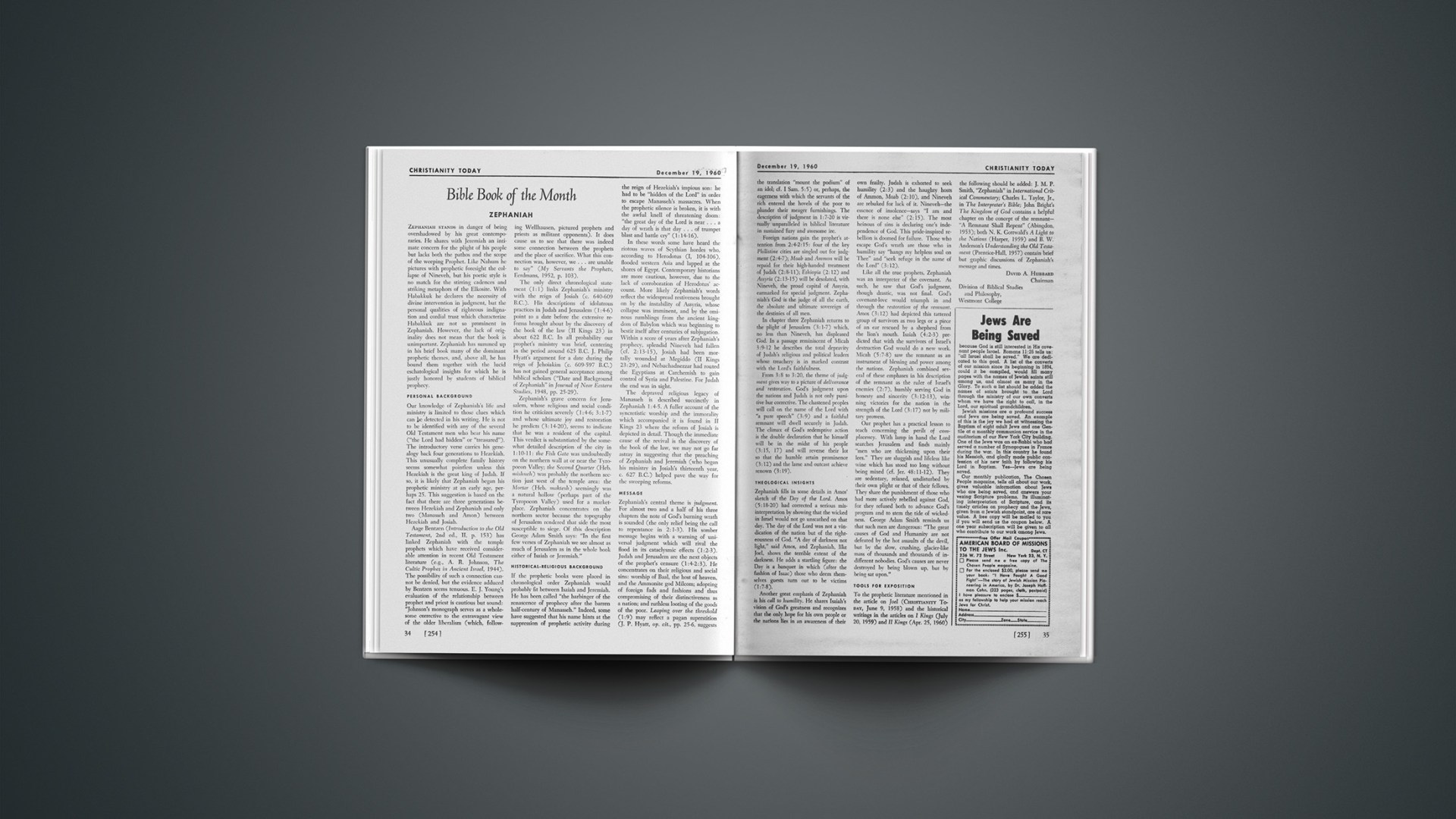
Bible Book of the Month: Zephaniah

Zephaniah stands in danger of being overshadowed by his great contemporaries. He shares with Jeremiah an intimate concern for the plight of his people but lacks both the pathos and the scope of the weeping Prophet. Like Nahum he pictures with prophetic foresight the collapse of Nineveh, but his poetic style is no match for the stirring cadences and striking metaphors of the Elkosite. With Habakkuk he declares the necessity of divine intervention in judgment, but the personal qualities of righteous indignation and cordial trust which characterize Habakkuk are not so prominent in Zephaniah. However, the lack of originality does not mean that the book is unimportant. Zephaniah has summed up in his brief book many of the dominant prophetic themes, and, above all, he has bound them together with the lucid eschatological insights for which he is justly honored by students of biblical prophecy.

PERSONAL BACKGROUND

Our knowledge of Zephaniah’s life and ministry is limited to those clues which can be detected in his writing. He is not to be identified with any of the several Old Testament men who bear his name (“the Lord had hidden” or “treasured”). The introductory verse carries his genealogy back four generations to Hezekiah. This unusually complete family history seems somewhat pointless unless this Hezekiah is the great king of Judah. If so, it is likely that Zephaniah began his prophetic ministry at an early age, perhaps 25. This suggestion is based on the fact that there are three generations between Hezekiah and Zephaniah and only two (Manasseh and Amon) between Hezekiah and Josiah.

Aage Bentzen (Introduction to the Old Testament, 2nd ed., II, p. 153) has linked Zephaniah with the temple prophets which have received considerable attention in recent Old Testament literature (e.g., A. R. Johnson, The Cultic Prophet in Ancient Israel, 1944). The possibility of such a connection cannot be denied, but the evidence adduced by Bentzen seems tenuous. E. J. Young’s evaluation of the relationship between prophet and priest is cautious but sound: “Johnson’s monograph serves as a wholesome corrective to the extravagant view of the older liberalism (which, following Wellhausen, pictured prophets and priests as militant opponents). It does cause us to see that there was indeed some connection between the prophets and the place of sacrifice. What this connection was, however, we … are unable to say” (My Servants the Prophets, Eerdmans, 1952, p. 103).

The only direct chronological statement (1:1) links Zephaniah’s ministry with the reign of Josiah (c. 640–609 B.C.). His descriptions of idolatrous practices in Judah and Jerusalem (1:4–6) point to a date before the extensive reforms brought about by the discovery of the book of the law (2 Kings 23) in about 622 B.C. In all probability our prophet’s ministry was brief, centering in the period around 625 B.C. J. Philip Hyatt’s argument for a date during the reign of Jehoiakim (c. 609–597 B.C.) has not gained general acceptance among biblical scholars (“Date and Background of Zephaniah” in Journal of Near Eastern Studies, 1948, pp. 25–29).

Zephaniah’s grave concern for Jerusalem, whose religious and social condition he criticizes severely (1:4–6; 3:1–7) and whose ultimate joy and restoration he predicts (3:14–20), seems to indicate that he was a resident of the capital. This verdict is substantiated by the somewhat detailed description of the city in 1:10–11: the Fish Gate was undoubtedly on the northern wall at or near the Tyropoeon Valley; the Second Quarter (Heb. mishneh) was probably the northern section just west of the temple area: the Mortar (Heb. maktesh) seemingly was a natural hollow (perhaps part of the Tyropoeon Valley) used for a marketplace. Zephaniah concentrates on the northern sector because the topography of Jerusalem rendered that side the most susceptible to siege. Of this description George Adam Smith says: “In the first few verses of Zephaniah we see almost as much of Jerusalem as in the whole book either of Isaiah or Jeremiah.”

HISTORICAL-RELIGIOUS BACKGROUND

If the prophetic books were placed in chronological order Zephaniah would probably fit between Isaiah and Jeremiah. He has been called “the harbinger of the renascence of prophecy after the barren half-century of Manasseh.” Indeed, some have suggested that his name hints at the suppression of prophetic activity during the reign of Hezekiah’s impious son: he had to be “hidden of the Lord” in order to escape Manasseh’s massacres. When the prophetic silence is broken, it is with the awful knell of threatening doom: “the great day of the Lord is near … a day of wrath is that day … of trumpet blast and battle cry” (1:14–16).

In these words some have heard the riotous waves of Scythian hordes who, according to Herodotus (I, 104–106), flooded western Asia and lapped at the shores of Egypt. Contemporary historians are more cautious, however, due to the lack of corroboration of Herodotus’ account. More likely Zephaniah’s words reflect the widespread restiveness brought on by the instability of Assyria, whose collapse was imminent, and by the ominous rumblings from the ancient kingdom of Babylon which was beginning to bestir itself after centuries of subjugation. Within a score of years after Zephaniah’s prophecy, splendid Nineveh had fallen (cf. 2:13–15), Josiah had been mortally wounded at Megiddo (2 Kings 23:29), and Nebuchadnezzar had routed the Egyptians at Carchemish to gain control of Syria and Palestine. For Judah the end was in sight.

The depraved religious legacy of Manasseh is described succinctly in Zephaniah 1:4–5. A fuller account of the syncretistic worship and the immorality which accompanied it is found in 2 Kings 23 where the reform of Josiah is depicted in detail. Though the immediate cause of the revival is the discovery of the book of the law, we may not go far astray in suggesting that the preaching of Zephaniah and Jeremiah (who began his ministry in Josiah’s thirteenth year, c. 627 B.C.) helped pave the way for the sweeping reforms.

MESSAGE

Zephaniah’s central theme is judgment. For almost two and a half of his three chapters the note of God’s burning wrath is sounded (the only relief being the call to repentance in 2:1–3). His somber message begins with a warning of universal judgment which will rival the flood in its cataclysmic effects (1:2–3). Judah and Jerusalem are the next objects of the prophet’s censure (1:4–2:3). He concentrates on their religious and social sins: worship of Baal, the host of heaven, and the Ammonite god Milcom; adopting of foreign fads and fashions and thus compromising of their distinctiveness as a nation; and ruthless looting of the goods of the poor. Leaping over the threshold (1:9) may reflect a pagan superstition (J. P. Hyatt, op. cit., pp. 25–6, suggests the translation “mount the podium” of an idol; cf. 1 Sam. 5:5) or, perhaps, the eagerness with which the servants of the rich entered the hovels of the poor to plunder their meager furnishings. The description of judgment in 1:7–20 is virtually unparalleled in biblical literature in sustained fury and awesome ire.

Foreign nations gain the prophet’s attention from 2:4–2:15: four of the key Philistine cities are singled out for judgment (2:4–7); Moab and Ammon will be repaid for their high-handed treatment of Judah (2:8–11); Ethiopia (2:12) and Assyria (2:13–15) will be desolated, with Nineveh, the proud capital of Assyria, earmarked for special judgment. Zephaniah’s God is the judge of all the earth, the absolute and ultimate sovereign of the destinies of all men.

In chapter three Zephaniah returns to the plight of Jerusalem (3:1–7) which, no less than Nineveh, has displeased God. In a passage reminiscent of Micah 3:9–12 he describes the total depravity of Judah’s religious and political leaders whose treachery is in marked contrast with the Lord’s faithfulness.

From 3:8 to 3:20, the theme of judgment gives way to a picture of deliverance and restoration. God’s judgment upon the nations and Judah is not only punitive but corrective. The chastened peoples will call on the name of the Lord with “a pure speech” (3:9) and a faithful remnant will dwell securely in Judah. The climax of God’s redemptive action is the double declaration that he himself will be in the midst of his people (3:15, 17) and will reverse their lot so that the humble attain prominence (3:12) and the lame and outcast achieve renown (3:19).

THEOLOGICAL INSIGHTS

Zephaniah fills in some details in Amos’ sketch of the Day of the Lord.Amos (5:18–20) had corrected a serious misinterpretation by showing that the wicked in Israel would not go unscathed on that day. The day of the Lord was not a vindication of the nation but of the righteousness of God. “A day of darkness not light,” said Amos, and Zephaniah, like Joel, shows the terrible extent of the darkness. He adds a startling figure: the Day is a banquet in which (after the fashion of Isaac) those who deem themselves guests turn out to be victims (1:7–8).

Another great emphasis of Zephaniah is his call to humility. He shares Isaiah’s vision of God’s greatness and recognizes that the only hope for his own people or the nations lies in an awareness of their own frailty. Judah is exhorted to seek humility (2:3) and the haughty hosts of Ammon, Moab (2:10), and Nineveh are rebuked for lack of it. Nineveh—the essence of insolence—says “I am and there is none else” (2:15). The most heinous of sins is declaring one’s independence of God. This pride-inspired rebellion is doomed for failure. Those who escape God’s wrath are those who in humility say “hangs my helpless soul on Thee” and “seek refuge in the name of the Lord” (3:12).

Like all the true prophets, Zephaniah was an interpreter of the covenant. As such, he saw that God’s judgment, though drastic, was not final. God’s covenant-love would triumph in and through the restoration of the remnant.Amos (3:12) had depicted this tattered group of survivors as two legs or a piece of an ear rescued by a shepherd from the lion’s mouth. Isaiah (4:2–3) predicted that with the survivors of Israel’s destruction God would do a new work. Micah (5:7–8) saw the remnant as an instrument of blessing and power among the nations. Zephaniah combined several of these emphases in his description of the remnant as the ruler of Israel’s enemies (2:7), humbly serving God in honesty and sincerity (3:12–13), winning victories for the nation in the strength of the Lord (3:17) not by military prowess.

Our prophet has a practical lesson to teach concerning the perils of complacency. With lamp in hand the Lord searches Jerusalem and finds mainly “men who are thickening upon their lees.” They are sluggish and lifeless like wine which has stood too long without being mixed (cf. Jer. 48:11–12). They are sedentary, relaxed, undisturbed by their own plight or that of their fellows. They share the punishment of those who had more actively rebelled against God, for they refused both to advance God’s program and to stem the tide of wickedness. George Adam Smith reminds us that such men are dangerous: “The great causes of God and Humanity are not defeated by the hot assaults of the devil, but by the slow, crushing, glacier-like mass of thousands and thousands of indifferent nobodies. God’s causes are never destroyed by being blown up, but by being sat upon.”

TOOLS FOR EXPOSITION

To the prophetic literature mentioned in the article on Joel(CHRISTIANITY TODAY, June 9, 1958) and the historical writings in the articles on I Kings (July 20, 1959) and II Kings (Apr. 25, 1960) the following should be added: J. M. P. Smith, “Zephaniah” in International Critical Commentary; Charles L. Taylor, Jr., in The Interpreter’s Bible; John Bright’s The Kingdom of God contains a helpful chapter on the concept of the remnant—“A Remnant Shall Repent” (Abingdon, 1953); both N. K. Gottwald’s A Light to the Nations (Harper, 1959) and B. W. Anderson’s Understanding the Old Testament (Prentice-Hall, 1957) contain brief but graphic discussions of Zephaniah’s message and times.

DAVID A. HUBBARD

Chairman

Division of Biblical Studies and Philosophy,

Westmont College

Eutychus and His Kin: December 19, 1960

’TWAS THE NIGHT …

’Twas the night before Christmas

and all through the church

Not a creature was stirring

to halt my research.

As I sat in my study,

my sermon half done,

The electronic chimes struck

the hour of one,

When out in the narthex

there came such a clatter

I rushed through the nave

to see what was the matter.

As I dashed down the aisle it

began to be clear

That a crisis of major

proportions was here,

For out of the darkness

and down toward the choir

Came Santa Claus running,

his whiskers on fire.

With a presence of mind that

I blush to recall,

I seized the extinguisher

there on the wall,

And, directing the foam with

an aim sure and quick,

In the wink of an eye I

had put out St. Nick.

Over coffee and pie in

the kitchen downstairs

I tried to catch up with

the state of affairs,

While Santa was drying

the coat of his suit

And emptying foam frosting

out of his boot.

“Just how did it happen?”

I ventured to say,

“And why did you not throw

your whiskers away?

You’ll pardon my finding

this incident droll:

You nearly were carried

away with your role!”

But Santa replied with

a quizzical gaze,

While feeling the fringe that

remained from the blaze,

“Your little jest isn’t

without its appeal,

But what makes you think that

my beard is not real?”

Then laying his finger

aside of his nose,

He winked and was gone—to

his job, I suppose.

One must not prejudge

even foliage lush;

The alarm isn’t false when

there’s fire in the brush.

Don’t condemn all the holiday

sham equally, since

The flaming-haired beauty

may not use a rinse.

EUGENE IVY

VATICAN AND WHITE HOUSE

I fear November 8, 1960 was the U. S. A.’s darkest hour to date when a Roman Catholic became President of our beloved country. Not the man himself but the fact that we are now under the power of a foreign state (the Vatican) and as a result are, in reality, under totalitarian rule. Where are the great men in our generation, that our pilgrim fathers and the statesmen of Washington’s day could claim to be?… Our clergymen have proved weak and spineless and the golden opportunity missed by both Roman Catholic and Protestant clerics alike, to voice what they stood for, will only spell defeat for both.

The handful of brave Protestant clergy, who weren’t afraid to speak out like … yourselves with the best article I’ve read anywhere “Bigotry or Smear?” (Feb. 1 issue) will, in the end, come out on top, for courage is secretly admired by all mankind.…

MRS. E. W. CORNELL

Mamaroneck, N. Y.

One can understand, if not appreciate, that a majority of Catholics voted for the new President-elect. It is, however, most disheartening to note that he was also just as certainly placed in office by a majority of un thinking, undedicated Protestants (as well as the uncommitted, religiously and politically). Except for the minority, the former great evangelical witness of Protestantism in our land is apparently but a fading memory.

VERDUN LACHANCE

Lucerne Valley, Calif.

Protestants in the south have demonstrated that for the office of President of the United States they impose no religious test—an example for Catholics that they impose no religious test for the office of mayor in the big cities.

Methodist Parish

Hartford, S. Dak.

HENRY RATLIFF

I wonder if Americans now are not in a position a bit similar to the one Israel was in during the reign of Rehoboam. Taxes on Americans have been burdensome to the point of confiscation or legalized robbery. Now a leader (?) has been able to obtain the position of the Presidency, who is advised by men who propose more taxes and debts.… It may even be in harmony with Lenin’s plan for bankrupting Uncle Sam.…

Rehoboam was about the age of this nation’s choice of future leadership. During his reign Judah did evil in the sight of the Lord, and they provoked him to jealousy with their sins which were above all that their fathers had done, for they built high places and standing images … and there were sodomites in the land; and they did all the abominations of the nations which the Lord cast out before the children of Israel.…

Rehoboam’s decision to trust advice of young men proposing higher taxes (higher usury rates probably also) in my Bible is called foolish.

O. L. WILLSON

Monmouth, Ill.

This is a request for earnest prayer—in meetings and individually—that the President-elect might personally know the full meaning of redeeming grace through our Lord Jesus Christ, and that the Lord might use this means to win many Catholic souls to Christ.

VIRGINIA SCOTT

Seattle, Wash.

If the Protestant view of Church and State is to survive, the average church member must be given an articulate understanding of our position.

Catholics teach their people their view through the civics and history courses in the parochial schools. Our children get most of their instruction along this line from the secular courses offered in the public schools.… Our young people … cannot hold their own in the face of secularism or Catholicism.

… Denominational and independent publishing houses should produce graded courses on the Protestant view of Church and State.

… Church libraries should be stocked with some authentic Catholic civics texts and some of the books on Communism recently recommended in CHRISTIANITY TODAY.

OLIVER W. PRICE

Oklahoma City, Okla.

During Senator Kennedy’s campaign a little group of people in Chicago tittered with laughter on hearing the quip: “Worship in the church of your choice now—while there is still time!”

One of the group did not laugh. When asked why, he quietly but impressively replied, “I have just come back from a year in Catholic Spain.”

H. H. LIPPINCOTT

Morristown, N. J.

THE DIALOGUE

I particularly wish to thank you and Mr. Lowell for his very fine article, “The Protestant-Catholic Dialogue” (Oct. 24 issue). With the many distortions that have come to this question in recent months, it surely is helpful to see such an article bringing things back into focus.

FRANK J. VOTH

Bethel Baptist

Greeley, Colo.

It is to be regretted … that he should apparently ignore the fact that the Luther-Eck debate was possible in the 16th century because there was a common community of the church, whereas today there is no common community to support a debate. This is why any realistic conversation must begin with rather awkward and tentative dialogues in order to discover a basis for continuing the conversation.

W. THOMAS APPLEBEE

Community Congregational Church

Manchester, Iowa

The writer says that I favor “state subsidies to church schools.” This is quite erroneous. My most recent published statement on the subject appears in Religion and the Schools, a symposium sponsored by the Fund for the Republic.

I do favor the inclusion of parochial school children among the recipients of so-called “fringe benefits”—for example, free bus transportation—the constitutionality of which the U. S. Supreme Court has explicitly upheld. But I do not advocate subsidies to parochial schools and would not personally support such a proposal.

F. ERNEST JOHNSON

New York, N. Y.

Why is it that you refer to the Church of the Pope as “catholic” and not either Roman Catholic, or—as it should be called since the Lateran Treaty between the Pope and Mussolini, both dead—Vatican Catholic? For almost two years I have in vain looked for accuracy in describing the international Church of Popes by its proper name.… As yet—to my understanding, that is—there is not in existence a visible true Catholic Church for which our Saviour prayed before His death. The numerous and rich and influential Church of Popes is but a branch of Christianity and is one of the main obstacles of true unity among and of Christians.

ANTONI M. TURKIEWICZ

Miami, Fla.

CHRIST AND MARX

You should mail reprints of J. Edgar Hoover’s second article entitled “Communist Propaganda and the Christian Pulpit” (Oct. 24 issue) to every preacher in the United States.

CURTIS H. WILLEY

Terre Haute, Ind.

• Reprints of the entire series are available at ten cents per copy or $4 per hundred.

—ED.

The purpose of the Church’s ministers does not include condemnation of the Communist ideology (or for that matter, of praising a materialistic American style of life) but rather, it is the privileged duty of the Church’s ministers to proclaim the Gospel, the good news that Jesus is the Christ and all persons (not just America and her allies) can be saved through him.

A national culture whose claims of freedom and equality under the law are refuted by religious bigotry (even in a Presidential election where neither of the candidates have, by their actions, revealed that they are Christians), segregation of races, business dishonesty excused by the term “shrewdness,” unscrupulous advertising which is justified by the resulting sales, political lies which are described as “diplomatic necessities,” and a host of other atrocities—has no right to point to the log in his brother’s eye when the speck in his own has, through a loss of Judaic-Christian values, also become a log.

ROBERT M. HENDRICKSON

Chicago, Ill.

In 1945–1946 the United States was the strongest nation on earth. She had unprecedented prestige. If at that time we had used good judgment our nation would now be prosperous, free of debt, stable, secure, and at peace.

We did not use good judgment.… We felt insecure and fearful.…

In 1946 we made a series of far-reaching concessions to Russia. We were asked to believe these concessions were necessary to induce Russia to become a member of United Nations. They were not necessary. Russia was eager to become a member. She could use United Nations to further the cause of Communism-Atheism.

We all knew the nature of Communism-Atheism. We all knew Russia was Communistic-Atheistic. In our right minds we would not have accepted Russia as a member of United Nations. It was madness. With Russia as a member and with the far-reaching concessions we had made to her, United Nations can never fulfill the purposes for which it was created. United Nations will inevitably become a Communist-Atheist dominated organization.

In the autumn of 1946 I wrote: “This is the greatest folly in human history. The immorality of it is appalling. Never before has a people so knowingly chosen the wrong course. We are forsaking In God We Trust. We are saying In The Honor of Communist-Atheist Russia We Trust. This may well be the beginning of the end of our nation. We are planting a very malignant cancer deep in its vitals.”

LEE A. SOMERS

Champaign, Ill.

NUMERALS IN REVERSE

I am puzzled by … references to the Episcopalians in the October 10 issue.… On page 28 you say that only 97 per cent of Episcopal clergy believe that the Bible is the authoritative rule of faith and life …, a rather overwhelming percentage.…

An Episcopal ordinand must “subscribe and make in the presence of the Bishop a declaration that he believes the Holy Scriptures of the Old and New Testament to be the Word of God and to contain all things necessary to salvation.”

JAMES L. JENKINS

St. Paul’s Episcopal Church

Virginia, Minn.

• The report on “The American Clergy and the Basic Truths” included a proofreading error involving the figure corrected below:

“Episcopalian ministers also showed up most poorly with respect to the Bible as the authoritative rule of faith and life. Baptists and Lutherans supported the doctrine’s importance for church unity by 97 per cent; Methodists and Presbyterians by 95 per cent; Episcopalians by only 79 per cent.”

—ED.

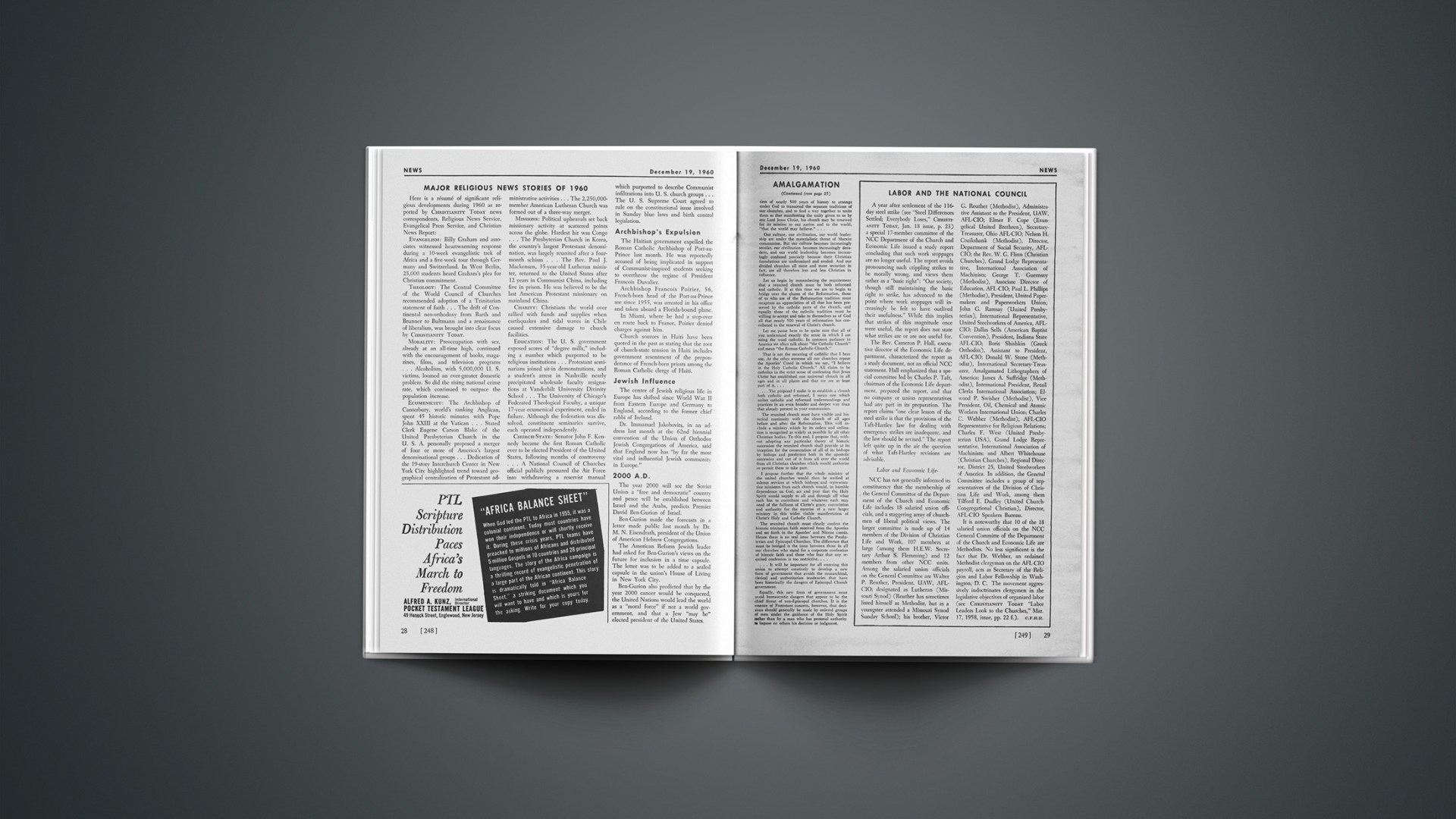
Major Religious News Stories of 1960

Here is a résumé of significant religious developments during 1960 as reported by CHRISTIANITY TODAY news correspondents, Religious News Service, Evangelical Press Service, and Christian News Report:

EVANGELISM: Billy Graham and associates witnessed heartwarming response during a 10-week evangelistic trek of Africa and a five-week tour through Germany and Switzerland. In West Berlin, 25,000 students heard Graham’s plea for Christian commitment.

THEOLOGY: The Central Committee of the World Council of Churches recommended adoption of a Trinitarian statement of faith … The drift of Continental neo-orthodoxy from Barth and Brunner to Bultmann and a renaissance of liberalism, was brought into clear focus by CHRISTIANITY TODAY.

MORALITY: Preoccupation with sex, already at an all-time high, continued with the encouragement of books, magazines, films, and television programs … Alcoholism, with 5,000,000 U. S. victims, loomed an ever-greater domestic problem. So did the rising national crime rate, which continued to outpace the population increase.

ECUMENICITY: The Archbishop of Canterbury, world’s ranking Anglican, spent 45 historic minutes with Pope John XXIII at the Vatican … Stated Clerk Eugene Carson Blake of the United Presbyterian Church in the U. S. A. personally proposed a merger of four or more of America’s largest denominational groups … Dedication of the 19-story Interchurch Center in New York City highlighted trend toward geographical centralization of Protestant administrative activities … The 2,250,000-member American Lutheran Church was formed out of a three-way merger.

MISSIONS: Political upheavals set back missionary activity at scattered points across the globe. Hardest hit was Congo … The Presbyterian Church in Korea, the country’s largest Protestant denomination, was largely reunited after a four-month schism … The Rev. Paul J. Mackensen, 35-year-old Lutheran minister, returned to the United States after 12 years in Communist China, including five in prison. He was believed to be the last American Protestant missionary on mainland China.

CHARITY: Christians the world over rallied with funds and supplies when earthquakes and tidal waves in Chile caused extensive damage to church facilities.

EDUCATION: The U. S. government exposed scores of “degree mills,” including a number which purported to be religious institutions … Protestant seminarians joined sit-in demonstrations, and a student’s arrest in Nashville nearly precipitated wholesale faculty resignations at Vanderbilt University Divinity School … The University of Chicago’s Federated Theological Faculty, a unique 17-year ecumenical experiment, ended in failure. Although the federation was dissolved, constituent seminaries survive, each operated independently.

CHURCH-STATE: Senator John F. Kennedy became the first Roman Catholic ever to be elected President of the United States, following months of controversy … A National Council of Churches official publicly pressured the Air Force into withdrawing a reservist manual which purported to describe Communist infiltrations into U. S. church groups … The U. S. Supreme Court agreed to rule on the constitutional issue involved in Sunday blue laws and birth control legislation.

Archbishop’s Expulsion

The Haitian government expelled the Roman Catholic Archbishop of Port-au-Prince last month. He was reportedly accused of being implicated in support of Communist-inspired students seeking to overthrow the regime of President Francois Duvalier.

Archbishop Francois Poirier, 56, French-born head of the Port-au-Prince see since 1955, was arrested in his office and taken aboard a Florida-bound plane.

In Miami, where he had a stop-over en route back to France, Poirier denied charges against him.

Church sources in Haiti have been quoted in the past as stating that the root of church-state tension in Haiti includes government resentment of the preponderance of French-born priests among the Roman Catholic clergy of Haiti.

Jewish Influence

The center of Jewish religious life in Europe has shifted since World War II from Eastern Europe and Germany to England, according to the former chief rabbi of Ireland.

Dr. Immanuel Jakobovits, in an address last month at the 62nd biennial convention of the Union of Orthodox Jewish Congregations of America, said that England now has “by far the most vital and influential Jewish community in Europe.”

2000 A.D.

The year 2000 will see the Soviet Union a “free and democratic” country and peace will be established between Israel and the Arabs, predicts Premier David Ben-Gurion of Israel.

Ben-Gurion made the forecasts in a letter made public last month by Dr. M. N. Eisendrath, president of the Union of American Hebrew Congregations.

The American Reform Jewish leader had asked for Ben-Gurion’s views on the future for inclusion in a time capsule. The letter was to be added to a sealed capsule in the union’s House of Living in New York City.

Ben-Gurion also predicted that by the year 2000 cancer would be conquered, the United Nations would lead the world as a “moral force” if not a world government, and that a Jew “may be” elected president of the United States.

Labor And The National Council

A year after settlement of the 116-day steel strike (see “Steel Differences Settled; Everybody Loses,” CHRISTIANITY TODAY, Jan. 18 issue, p. 23) a special 17-member committee of the NCC Department of the Church and Economic Life issued a study report concluding that such work stoppages are no longer useful. The report avoids pronouncing such crippling strikes to be morally wrong, and views them rather as a “basic right”: “Our society, though still maintaining the basic right to strike, has advanced to the point where work stoppages will increasingly be felt to have outlived their usefulness.” While this implies that strikes of this magnitude once were useful, the report does not state what strikes are or are not useful for.

The Rev. Cameron P. Hall, executive director of the Economic Life department, characterized the report as a study document, not an official NCC statement. Hall emphasized that a special committee led by Charles P. Taft, chairman of the Economic Life department, prepared the report, and that no company or union representatives had any part in its preparation. The report claims “one clear lesson of the steel strike is that the provisions of the Taft-Hartley law for dealing with emergency strikes are inadequate, and the law should be revised.” The report left quite up in the air the question of what Taft-Hartley revisions are advisable.

Labor and Economic Life

NCC has not generally informed its constituency that the membership of the General Committee of the Department of the Church and Economic Life includes 18 salaried union officials, and a staggering array of churchmen of liberal political views. The larger committee is made up of 14 members of the Division of Christian Life and Work, 107 members at large (among them H.E.W. Secretary Arthur S. Flemming) and 12 members from other NCC units. Among the salaried union officials on the General Committee are Walter P. Reuther, President, UAW, AFL-CIO; designated as Lutheran (Missouri Synod) (Reuther has sometimes listed himself as Methodist, but as a youngster attended a Missouri Synod Sunday School); his brother, Victor G. Reuther (Methodist), Administrative Assistant to the President, UAW, AFL-CIO; Elmer F. Cope (Evangelical United Brethren), Secretary-Treasurer, Ohio AFL-CIO; Nelson H. Cruikshank (Methodist), Director, Department of Social Security, AFL-CIO; the Rev. W. G. Flinn (Christian Churches), Grand Lodge Representative, International Association of Machinists; George T. Guernsey (Methodist), Associate Director of Education, AFL-CIO; Paul L. Phillips (Methodist), President, United Paper-makers and Paperworkers Union; John G. Ramsay (United Presbyterian), International Representative, United Steelworkers of America, AFL-CIO; Dallas Sells (American Baptist Convention), President, Indiana State AFL-CIO; Boris Shishkin (Greek Orthodox), Assistant to President, AFL-CIO; Donald W. Stone (Methodist), International Secretary-Treasurer, Amalgamated Lithographers of America; James A. Suffridge (Methodist), International President, Retail Clerks International Association; Elwood P. Swisher (Methodist), Vice President, Oil, Chemical and Atomic Workers International Union; Charles C. Webber (Methodist), AFL-CIO Representative for Religious Relations; Charles F. West (United Presbyterian USA), Grand Lodge Representative, International Association of Machinists; and Albert Whitehouse (Christian Churches), Regional Director, District 25, United Steelworkers of America. In addition, the General Committee includes a group of representatives of the Division of Christian Life and Work, among them Tilford E. Dudley (United Church-Congregational Christian), Director, AFL-CIO Speakers Bureau.

It is noteworthy that 10 of the 18 salaried union officials on the NCC General Committe of the Department of the Church and Economic Life are Methodists. No less significant is the fact that Dr. Webber, an ordained Methodist clergyman on the AFL-CIO payroll, acts as Secretary of the Religion and Labor Fellowship in Washington, D. C. The movement aggressively indoctrinates clergymen in the legislative objectives of organized labor (see CHRISTIANITY TODAY “Labor Leaders Look to the Churches,” Mar. 17, 1958, issue, pp. 22 f.).

C.F.H.H.

Blake Merger Proposal Enlivens NCC Assembly

The National Council of Churches, which like its predecessor the Federal Council was a creation of the denominations, made abundantly clear through its fifth General Assembly in San Francisco this month that the denominations are now virtually creatures of the ecumenical movement.

Four Major Denominations Nominated For Amalgamation

A prominent Presbyterian stepped into an influential Episcopal pulpit this month and made a far-reaching proposal: amalgamate United Presbyterians, Episcopalians, Methodists, and members of the United Church of Christ (Congregational Christian-Evangelical and Reformed).

Dr. Eugene Carson Blake, Stated Clerk of the United Presbyterian Church in the U. S. A. and former president of die National Council of Churches, made the proposal in the pulpit of Grace Cathedral, San Francisco, on the threshhold of the NCC’s fifth General Assembly.

Merger mechanics might consume 10 years, said Blake.

A name? Possibly the “Reformed and Catholic Church in the U. S. A.”

Size? Twice as large in membership as any single U. S. denominational organization now in existence. Total membership of the new church could easily reach 20,000,000, especially if other denominations joined with the four named (Blake left the way open for such a development).

Despite the fact that Blake is a noted champion of ecumenicity, his proposal came as a surprise to many. It caused some evangelical observers to conclude that super-church plans are moving along even more rapidly than had been generally supposed.

Blake projected immediate implementation of his plan. He suggested action by the United Presbyterian General Assembly in the spring and the Episcopal General Assembly next fall.

Here are excerpts from Blake’s sermon:

Led, I pray, by the Holy Spirit, I propose to the Protestant Episcopal Church that it together with the United Presbyterian Church in the U. S. A. invite the Methodist Church and the United Church of Christ to form with us a plan of church union both catholic and reformed.…

… God requires us to break through the barriers of nearly 500 years of history to attempt under God to transcend the separate traditions of our churches, and to find a way together to unite them so that manifesting the unity given to us by our Lord Jesus Christ, his church may be renewed for its mission to our nation and to the world, “that the world may believe.” …

Our culture, our civilization, our world leadership are under the materialistic threat of Marxist communism. But our culture becomes increasingly secular, our civilization becomes increasingly decadent, and our world leadership becomes increasingly confused precisely because their Christian foundations are undermined and eroded. And our divided churches all more and more sectarian in fact, are all therefore less and less Christian in influence.

Let us begin by remembering the requirement that a reunited church must be both reformed and catholic. If at this time we are to begin to bridge over the chasm of the Reformation, those of us who are of the Reformation tradition must recapture an appreciation of all that has been preserved by the catholic parts of the church, and equally those of the catholic tradition must be willing to accept and take to themselves as of God all that nearly 500 years of reformation has contributed to the renewal of Christ’s church.

Let me pause here to be quite sure that all of you understand exactly the sense in which I am using the word catholic. In common parlance in America we often talk about “the Catholic Church” and mean “the Roman Catholic Church.”

That is not the meaning of catholic that I here use. At the other extreme all our churches repeat the Apostles’ Creed in which we say, “I believe in the Holy Catholic Church.” All claim to be catholics in the strict sense of confessing that Jesus Christ has established one universal church in all ages and in all places and that we are at least part of it.…

… The proposal I make is to establish a church both catholic and reformed, I mean one which unites catholic and reformed understandings and practices in an even broader and deeper way than that already present in your communion.

The reunited church must have visible and historical continuity with the church of all ages before and after the Reformation. This will include a ministry which by its orders and ordination is recognized as widely as possible by all other Christian bodies. To this end, I propose that, without adopting any particular theory of historic succession the reunited church shall provide at its inception for the consecration of all of its bishops by bishops and presbyters both in the apostolic succession and out of it from all over the world from all Christian churches which would authorize or permit them to take part.

I propose further that the whole ministry of the united churches would then be unified at solemn services at which bishops and representative ministers from each church would, in humble dependence on God, act and pray that the Holy Spirit would supply to all and through all what each has to contribute and whatever each may need of the fullness of Christ’s grace, commission and authority for the exercise of a new larger ministry in this wider visible manifestation of Christ’s Holy and Catholic Church.

The reunited church must clearly confess the historic trinitarian faith received from the Apostles and set forth in the Apostles’ and Nicene creeds. Hence there is no real issue between the Presbyterian and Episcopal Churches. The difference that must be bridged is the issue between those in all our churches who stand for a corporate confession of historic faith and those who fear that any required confession is too restrictive.…

… It will be important for all entering this union to attempt creatively to develop a new form of government that avoids the monarchical, clerical and authoritarian tendencies that have been historically the dangers of Episcopal Church government.

Equally, this new form of government must avoid bureaucratic dangers that appear to be the chief threat of non-Episcopal churches. It is the essence of Protestant concern, however, that decisions should generally be made by ordered groups of men under the guidance of the Holy Spirit rather than by a man who has personal authority to impose on others his decision or judgment.

Ecumenical aggression was typified most strikingly in a move reported by Religion Editor George Dugan of The New York Times, a development which despite its failure was perhaps even more significant than the highly-publicized denominational merger proposal advanced by Dr. Eugene Carson Blake.

Dugan said in a dispatch from San Francisco that the rejected move would in effect have made the NCC a super church.

“It was learned,” he reported, “that at least two highly-placed churchmen had proposed that the National Council be permitted to ordain clergymen, administer the sacraments and accept individuals and denominations into membership.”

Dugan declared that the recommendation was turned down after heated debate in a closed Message Committee session.

Personal dissent to assembly message explained. See “Dissenting Duo” on p. 30.

Editor G. Aiken Taylor of the Presbyterian Journal, who provided on-the-spot coverage of the NCC assembly for CHRISTIANITY TODAY, said it was evident that the powers of a super-church had begun to take shape “even while interest in a super church was being publicly disavowed.”

Dominant theme of the Assembly was “comprehensive long range planning” for greater unity among the churches. Reports were saturated with references to “constantly enlarging areas of agreement” and to “increasingly effective denominational oversight.” Delegates listened to a bevy of speakers blaming the present ineffectiveness of the Church in a revolutionary world on a “fragmented witness,” an “inadequate sense of wholeness,” and the “scandal of our divided churches.” They heard repeated calls to “widen the base of ecumenical discussions,” to “go beyond togetherheit” (togetherness) in our relationship, to “reject denominational, racial, national or any other kind of division,” and to “shed the blood of our denominational separateness.”

The NCC’s Division of Foreign Missions suggested that unity must come in response to rising ecumenical desires of the churches. The Division of Christian Education announced plans to overhaul curriculum planning in the light of emerging ecumenical concepts. The Division of Home Missions indicated that its chief emphasis would now become one of reorganization in order to bring a new unity to program planning and execution. The Division of Christian Life and Work implied that solution to current problems depends on willingness to submit to bold and venturesome steps in united communication and implementation of the Gospel.

Uppermost in delegates’ thoughts was the pre-assembly proposal delivered in a sermon by Blake, Stated Clerk of the United Presbyterian Church in the U. S. A., that his church join with Episcopalians, Methodists, and the United Church of Christ in working out a plan of organic union patterned after the United Church of South India. The proposal, offered by Blake as an individual and not in his official capacity, was warmly endorsed by Bishop James A. Pike of the Episcopal Church, Bishop John Wesley Lord of The Methodist Church and Drs. Fred Hoskins and James E. Wagner, co-presidents of the United Church of Christ.

An indication of the temper of the assembly was afforded by interest shown in a faith and order luncheon. The Commission on Faith and Order was created three years ago explicitly to deal with theological and polity differences between the churches and to promote their unity. Five hundred tickets to the luncheon were sold out well in advance of the assembly. Guests heard Bishop Lesslie Newbigin of the Church of South India and Dr. William A. Norgren, NCC director of faith and order studies, reiterate the substance of remarks made earlier by Faith and Order Chairman James I. McCord, President of Princeton Seminary, to a plenary session of the assembly: “Cooperation is not enough.… It is a luxury now that we can no longer afford.… We must take a radical step forward in our quest for visible, corporate unity.” This theme appeared in the opening address by retiring President Edwin T. Dahlberg, who declared, “An effective Gospel for the whole world needs a united church.” It was echoed by General Secretary Roy G. Ross, later re-elected, who suggested in his decade report that the churches want the council to give them leadership in “depth thinking” and to articulate their common theological convictions and provide leadership in implementing these. Dr. A. Dale Fiers, chairman of the General Program and Field Operations Committee, said “the churches must be willing to lose their lives for the Church.”

Mixed Feelings Greet Merger Proposal

Dr. Eugene Carson Blake’s proposal to merge four or more major Protestant groups into a single denomination drew a variety of comments from highly-placed churchmen.

Bishop Gerald Kennedy, president of the Council of Bishops of The Methodist Church, said there was “nothing new” in the proposal.

He said “there is nothing specific enough in the proposal … to suggest a new approach to the problem [of church union] or the possibility of the elimination of difficulties involved …”

Kennedy noted “there are a large number of churchmen who are committed to closer cooperation but are not at all enthusiastic about organic union that would make a Protestant Church top heavy with administration and machinery.

“Certainly we believe in the value of the variety of our tradition, while at the same time we want to consider carefully every proposal leading to increasing Christian cooperation.”

Charles P. Taft, prominent Episcopalian and former president of the Federal Council of Churches, said he had no major objection to the plan but feared that many laymen preferred a diversity in forms of worship to the uniform liturgy which was likely to result from the amalgamation of national church bodies.

He expressed a preference for the unity in diversity approach of the World Council of Churches, saying that it encouraged but did not require union at the congregational level.

Dr. Fred Hoskins, general secretary of the General Council of Congregational Christian Churches and co-president of the United Church of Christ, expressed fear that Blake’s proposal will be “widely misunderstood in many places as a specific plan rather than as a proposal for a procedure.”

Dr. James E. Wagner, president of the Evangelical and Reformed Church and the other co-president of the United Church of Christ, said “there was a danger that those looking for an opportunity to criticize or minimize the National Council of Churches would seize upon this and say this [the Blake proposal] is what the National Council of Churches is doing.”

The Rt. Rev. Arthur C. Lichtenberger, presiding Bishop of the Protestant Episcopal Church, said, “It is the opening of a very significant move. Out of this might come a plan that would be acceptable to all the people involved.”

The most enthusiastic endorsement of Blake’s plan came from Episcopal Bishop James A. Pike, who called it the “most sound and inspiring” ever offered in the United States.

“I hope and pray,” said Pike, “that his plan will be received by the four churches—and others—in the Christian spirit in which it has been offered and that definite action toward its fulfillment will soon be forthcoming.”

Dr. Ramsay Pollard, president of the Southern Baptist Convention, characterized the possible merging of four denominations as “a fine thing for those who want to do it.” He added, however, that “I don’t think Southern Baptists would be interested.”

Dr. John W. Behnken, president of the Lutheran Church-Missouri Synod, lamented lack of attention to a doctrinal basis. “There should be agreement in matters of doctrine,” he asserted, in any projection of mergers.

Dr. C. T. Caldwell, noted senior minister (now retired) of the Presbyterian Church in the U. S., said he was “not impressed” with the merger idea. Fie said he feared that the plan might face so much opposition that it would itself cause division.

Church unity discussion occupied nearly two-thirds of the total “Message to the Churches,” adopted as the mind of the assembly.

As a practical way to begin implementing the desired unity at the local level, Pike suggested that denominations immediately begin establishing new churches on a cooperative basis, in a sort of “federated” operation within local congregations. According to the Pike proposal, a single congregation might well be fully a part of several denominations. In Pike’s thinking this could include multiple ordinations if necessary. “I envision a single congregation with multi-denominational connections as a practical step preliminary to church union,” he told a news conference.

Paralleling the theme of increasing unity was the theme of increasing NCC influence and direction in the life of the churches. It was made abundantly clear that the time has passed when the council should be viewed as an organ of expression of the fragmented (or even cooperative) will of the churches. The time has come—it was repeatedly insisted—when the council must increasingly provide leadership which the churches will follow, when comprehensive long range planning will be done on the behalf of the churches in areas of curriculum development and programming.

Speaking to consultants and alternate delegates, Dr. H. Conrad Hoyer of the NCC Division of Home Missions noted that the council is now being viewed less as an agency accomplishing work for the denomination and more as an agency coordinating and directing the work of the denominations.

In Christian education, papers prepared by NCC consultants are even now being used by numerous denominational bodies as material upon which these denominations are building their own curricula, according to reports submitted by the division. The Department of Higher Education sees itself charged with unifying the interests and programs of all who are interested in Christian higher education. And the Division of Education expects to formulate new patterns for training the Christian ministry within the denominations in cooperation with the American Association of Theological Schools. “Something newer and more creative is needed than the addition of new courses to the theological curriculum or the maintenance of present percentages,” said a departmental report.

The Division of Foreign Missions already is producing, through Friendship Press, study literature used by many member denominations. This service will be enlarged. A report to the assembly indicated that new avenues are continuing being explored to see “what can be produced interdenominationally to be fully used denominationally.”

Dissenting Duo

Following adoption of the “Message to the Churches” by the NCC General Assembly, two leading figures called newsmen together to explain their dissent.

Dr. Henry P. Van Dusen, chairman of the Message Committee, and Dr. Truman B. Douglass, who wrote the first draft of the message, objected to the deletion of a statement relating to the “churchly” nature of the NCC. Van Dusen and Douglass assert that the council needs to make more specific the nature of its own integrity as a church.

To meet this alleged deficiency, they had proposed (1) to extend the denominations’ surrender, for instance, of their missionary obligations to the NCC, (2) to commission laymen to special ecumenical service in what many interpreted to be tantamount to ordination, (3) to ask churches to alter ordination procedures to include references to a broader church, and (4) to arrange for the observance of the sacraments by council units.

The proposals were deleted in committee because some felt that the matter belonged within the purview of other committees and others questioned the strategy and propriety of using the message as the medium for a drastic move.

Van Dusen and Douglass made clear that they would pursue their plans later.

Assembly Actions

Here is a summary of actions taken by the fifth General Assembly of the National Council of Churches:

• Admitted as a new member the Syrian Antiochian Orthodox Church, with a membership of 110,000.

• Elected J. Irwin Miller, vice chairman of Division of Christian Life and Work, Disciples of Christ layman and wealthy banker from Columbus, Indiana, as president for the ensuing triennium.

• Re-elected Dr. Roy G. Ross as general secretary and Dr. R. H. Edwin Espy as associate general secretary.

• Adopted and ordered sent down to the churches a message dealing largely with the need for more unity between the churches and less self-sufficiency. The message also called for greater lay participation in the life of the churches; for the support of the aims of the emerging new nations of the world; for increasing zeal in evangelism; for the elimination of racial, national or personal distinctions; for the elimination of economic inequities; for a strengthening of family ties and individual integrity; for labor towards the establishment of a community of nations. In addition, the message (1) called on churches (1) to help in struggle to secure peace and world order in view of ever-present threat of annihilation, and (2) to “move forthrightly and more speedily to eliminate racial discrimination,” condemning all opposition to this goal, especially the use of violence.

• Adopted a resolution affirming Christian responsibility for world community which (1) acknowledged the tragic “turbulence of this revolutionary, nuclear-space age;” (2) affirmed that God calls Christians “to live and work” for “that real community which he had created through Jesus Christ;” (3) called on the churches to support the United Nations; (4) urged the support of reliable and realistic programs of disarmament; (5) urged the repeal of the Connally Amendment; and (6) urged the U. S. to ratify the Genocide Convention.

Ecumenical Student

Lutheran Bishop Anders Nygren, noted theologian of the Swedish “agape school,” is due to arrive in Chicago January 3 to spend 14 months at the Ecumenical Institute in suburban Evanston.

Nygren is the second research scholar to join the institute through a grant from the Danforth Foundation of St. Louis, joining Canon Theodore Wedel, warden emeritus of the College of Preachers in Washington, D. C.

The 70-year-old Nygren has been one of the top leaders in the ecumenical movement.

A New Interpreter

A political scientist who has been operating the United Presbyterian Office of Information for the last three years will become “general director of interpretation” for the National Council of Churches, effective January 1.

He is Dr. Murray S. Stedman, Jr., a 44-year-old Presbyterian layman who succeeds James W. Wine. Wine’s position was that of an Associate General Secretary for Interpretation until he resigned last August to join the campaign staff of Senator John F. Kennedy.

A 1939 graduate of Williams College, Stedman earned a Ph.D. from Columbia University in 1957. He had been elected a Rhodes scholar but World War II prevented his attendance at Oxford.

Stedman has taught political science at Swarthmore College, Brown University, and Columbia. He also served for a time as political science specialist with UNESCO in Paris.

People: Words And Events

Deaths: Dr. William Wistar Hamilton, 91, former president of the Southern Baptist Convention; in New Orleans … Dr. P. P. W. Ziemann, general secretary of the Baptist Convention of Ontario and Quebec … Dr. Frederick Bronkema, 62, former head of the department of theology at the University of Dubuque.

Retirement: As president of Maryville College, Dr. Ralph Waldo Lloyd, effective next summer.

Appointments: As president of the Board of Missions of the United Lutheran Church in America, Dr. Paul L. Graf … as executive secretary) of the Board of World Mission of the Presbyterian Church in the U. S., Dr. Thomas Watson Street … as secretary of the American Board of Commissioners for Foreign Missions of the Congregational Christian Churches, the Rev. B. Kenneth Anthony … as director of interpretation for the International Convention of Christian Churches, the Rev. James C. Suggs.

Elections: As president of Drew University, Dr. Robert Fisher Oxnam … as Anglican Archbishop of Uganda and Ruanda Urundi, Dr. Leslie Brown … as president of the Fellowship of Evangelical Baptist Churches in Canada, the Rev. J. F. Holliday … as president of the Association of the Statisticians of American Religious Bodies, Otto K. Finkbeiner.

Evangelism Endeavors

San Francisco’s Grace Cathedral, where Eugene Carson Blake delivered his now-famous merger sermon, played host to evangelist Billy Graham and his team later the same day.

Graham spoke to the Christian Men’s Assembly, which for the first time met concurrently with the NCC General Assembly. He had made the engagement at the urgent request of an old personal friend, Dr. S. J. Patterson, secretary of the Christian Men’s Assembly.

The evangelist went on immediately to Las Vegas, Nevada, where two days later he addressed a special rally sponsored by the Clark County Ministerial Association. Some 7,300 persons turned out in near-freezing temperatures (highly unusual for Las Vegas), including a 350-voice choir. About 400 registered decisions for Christ. A planeload of movie stars from Hollywood were on hand.

‘Homage and Courtesy’

Dr. Geoffrey Francis Fisher, Archbishop of Canterbury, paid his much-heralded visit to Pope John XXIII on December 2.

The Pope received Fisher in his private library in the Vatican Palace. They talked for 45 minutes or more. The only other person present was Archbishop Antonio Samore, Secretary of the Sacred Congregation for Extraordinary Ecclesiastical Affairs, who acted as interpreter.

Neither reporters nor photographers were permitted to be on hand for the meeting, which opened with handshakes.

Fisher later said that the Pope had expressed “his great desire—as he did on many other occasions—to increase brotherly feelings among all men.”

The Vatican subsequently issued a communique which said in part: “His Holiness Pope John XXIII this morning received in audience Dr. Geoffrey Francis Fisher, Anglican Archbishop of Canterbury, who, as announced, had asked to make a visit of homage and courtesy.”

Congo Cannibalism

Two Protestant missionaries are believed to have become victims of cannibalism in North Katanga last month. Reported missing were Elton George Behrent Knaus, 50, of New Zealand, and Edmund Hodgson, 62, of England. Both men served under the Congo Evangelistic Mission. Knaus has a wife and three children. Hodgson was a widower.

U. N. troops relayed accounts of tribesmen who said they had witnessed the missionaries being hacked to death by machetes.

Missionary Totals

The world-wide Protestant missionary force now numbers 42,250, an increase of 3,644 in the last two years, according to newly-released statistics from the Missionary Research Library.

Of the 42,250 overseas personnel, 27,219 represent North American agencies.

Protestants in the United States and Canada gave almost 170 million dollars to foreign missions in 1959. The U. S. portion averages about $2.75 per capita.

Independent missionary societies showed substantial personnel gains. A slight decrease was recorded for agencies working through the Division of Foreign Missions of the National Council of Churches.

The statistics were released by Dr. Frank Price, director of the Missionary Research Library.

Protestant Panorama

• The Evangelical Union Church, in a statement read from pulpits throughout Communist East Germany this month, urged Christians not to flee to the West even though they are obliged to suffer afflictions. The Church comprises six “united” churches that are among members of the Evangelical Church in Germany (EKID). The appeal showed special concern over the loss of vitally needed church and professional workers in East Germany.

• American Baptists plan to establish a standard educational requirement for ordination of four years of college and three years of seminary.

• The Roman Catholic president of Honduras, Ramon Villeda Morales, attended a Protestant worship service in Comayaguela last month. It is said to have been the first time that the country’s head of state had ever entered a non-Roman Catholic church.

• An aggregate of nearly 1,000 persons, some on crutches or in wheel chairs, witnessed a three-day spiritual healing mission at All Saints’ Episcopal Church in Chicago last month. Services were conducted by Dr. Alfred W. Price, Episcopal rector who is warden of the Order of St. Luke the Physician, interdenominational society stressing Christian healing.

• Student demonstrators wrecked the homes of two American administrators of Yonsei University, interdenominational mission-supported school in Seoul, Korea, last month.

• The Rev. Alexander Karev, secretary of the All-Union Council of Evangelical Christians in Moscow, says he wishes Christians everywhere would be “permeated with a peace-loving spirit toward my country and seek the means of improving relations between our nations and easing international tension.” The Soviet churchman recently returned from meetings on cold-war tensions at Dartmouth College, Hanover, New Hampshire, organized by editor Norman Cousins and financed by the Ford Foundation.

• Methodists are erecting a new office building in Chicago to house seven boards and agencies. The three-level neo-Gothic structure is tentatively scheduled for occupancy by next winter … Construction of the Minnesota Protestant Center, five-story church office building in Minneapolis is expected to begin in 1961.

• Radio advertising paid off quickly for Lutheran churches in Copenhagen. Broadcasting stations had hardly begun special programs aimed at persuading Danes to attend pre-Christmas services when pastors began to report increased church attendance.

• The Church of God plans to build a 12,000-seat auditorium in Anderson, Indiana, to replace the one wrecked by snow last year.

• A slight drop in Southern Baptist seminary enrollment this year was attributed to a variety of factors (including secularism of society and expiration of G. I. benefits) by President Sydnor L. Stealey of Southeastern Baptist Theological seminary.

• The World Literature Crusade organization plans to inaugurate missionary programs for children over U. S. and Canadian broadcasting stations beginning in January.

• American and European Lutheran theologians comment on the forthcoming Roman Catholic Ecumenical Council in a book due to be published next fall. Editor is Professor K. E. Skydsgaard of Copenhagen.

• Milligan (Tennessee) College, Disciples of Christ school, won full accreditation last month from the Southern Association of Colleges and Secondary Schools.

• A $13,000 federal government grant will enable two Union Theological Seminary students to participate in a pilot project aimed at giving spiritual help to the disabled. The program is being established at the Institute of Physical Medicine and Rehabilitation at the New York University Medical Center.

• Hardin-Simmons University plans a $15,000,000 development program that will nearly double the Southern Baptist school’s size in 10 years.

Questions on Doctrine: A Cleft in Seventh-Day Adventism?

Since the current controversy over the classification of Seventh-day Adventists (denomination or cult?) was first initiated in 1956, one interesting factor in the conflict has gone largely unnoticed. The Adventists apparently have been faced by growing internal tension and division as a result of the publication of their definitive volume, Questions on Doctrine, and of Walter Martin’s new book, The Truth About Seventh-day Adventism.

The rumblings, first beneath the surface, can now be heard audibly in not a few quarters. The fact that there has been a marked change or redefinition of certain facets of Seventh-day Adventist theology, was pointed out by The Gathering Call, published by ex-Seventh-day Adventists. An article entitled “Moving the Landmarks” considers the Adventists’ volume, Questions on Doctrine, and articles published in Eternity magazine by Donald Grey Barnhouse and Walter R. Martin. The editors of the Call point out that some of the old Adventist landmarks have been moved, notably the alleged inerrancy of Ellen White, the vicarious nature of the scapegoat translation of Leviticus 16, and the literal interpretation of the Heavenly Sanctuary doctrine. According to The Gathering Call, historic adventism stands repudiated in these areas, a charge supplemented by other interesting considerations. A. L. Hudson, former elder in a large Adventist church in Oregon, in company with retired yet powerful Adventist leader Dr. M. L. Andreasen, has spearheaded a move to have those responsible for the publication of Questions on Doctrine censured for “misrepresenting the historic position” of the Adventist church. From as far away as Australia and New Zealand letters have reached us concerning the small but apparently vocal segment of Adventism that still wants to brand Sunday keepers with “the mark of the beast,” teach a literalistic sanctuary and scapegoat transaction, and hold Ellen White in esteem as an infallible “prophetess.” Dr. Andreasen at one time was professor of theology at the Adventists’ seminary in Washington, D. C.

Leaders of the Seventh-day Adventist denomination have, however, discounted this faction as unrepresentative of the views of the major constituency of the Church. This affirmation is apparently underscored by the fact that the book, Questions on Doctrine, authorized by the General Conference as the denominational position, has had the widest circulation and general approval of the denomination of any volume of recent years. But the fact remains that there is a segment of Seventh-day Adventists vocal and apparently powerful enough to reverse some of the trends originally undertaken in good faith by the leadership of the denomination in 1956.

It is significant to note that The Signs of the Times and These Times, major Adventist publications, have identified themselves for the first time as publications of the Seventh-day Adventist Church, only to have the identification rescinded and withdrawn from the masthead. Certain publications which allegedly did not represent the position of the denomination are still widely circulated despite the assurance of the leadership of the Seventh-day Adventist denomination that “plans were already operative” to dispense with such inconsistencies in Adventist publishing houses. (Adventist spokesmen assert that, in a sense, each of their publishing houses is autonomous, having its own board of control, and that the reasons for masthead changes lie with the editors.)

Another interesting fact is the Adventist denomination’s attitude toward Mr. Martin’s book, which leaders endorsed as accurately representing their views. Martin’s book was to be stocked by Adventist publishing houses according to commitments made by top Adventist officials. Authorization to place his book on sale was not forthcoming, however, despite the fact that two non-critical non-Adventist publications were accepted for distribution. (Adventist spokesmen point out that their book and Bible houses are set up as retail outlets for their own publishing houses, and only occasionally is the sale of outside books authorized. “Martin’s book sets forth our views accurately,” said one leader, “but that’s only half the story. It also attempts to expose as fallacious the most distinctive of these views. Why should a religious body promote books that seek to refute these teachings?”)

The cleft in Seventh-day Adventism seems, however, to be deeper than appears on the surface. Some Seventh-day Adventist officials seem not to welcome any investigation of their views due to their divergence from what the church maintains as its true position.

One thing, however, is certain. Certain elements in the theology of Seventh-day Adventism are in flux; some of the old landmarks have apparently been moved; and some old errors have been or are being rectified. Perhaps the Adventist denomination would be wiser to admit these faults publicly. By so doing they would probably escape the growing conviction in some circles that they cannot control irresponsible, unrepresentative elements within the church, and are content to remain silent where decisive action would settle the issue. Such action would promote stronger ties of fellowship and respect for the integrity of Adventism among Christians of other denominations.

Ideas

The Challenge of the Cults

Since the advent of Christian missionary activities on an organized scale some two hundred years ago, the proclamation of the Gospel message has faced many problems. Obstacles of language, culture, race, militant nationalism and the competition between missionaries of differing doctrinal persuasion have contributed a stormy atmosphere to world missions.

In addition to these difficulties, major non-Christian religions (such as Islam, Buddhism, Hinduism, Taoism, Shintoism) have actively opposed Christian missionaries so that progress has been slow not in a few areas and in some instances hardly recognizable.

Beyond this aspect, however, looms another formidable adversary, the rise of non-Christian American cults. Some of these movements have lately invaded established missionary fields and have proselytized new converts with startling success. Utilizing some methods reminiscent of early Christianity, these groups cater to the culture patterns of those they proselytize, provide literature in the language of the people and in one way or another keep a certain emphasis on the Bible in the forefront of their work. In many instances they preach a militant “separatism” from tobacco, alcohol, and other practices classified as worldly and unspiritual. All these activities are bolstered by their so-called revelations (all of nineteenth century vintage), with an appeal to which they wage unceasing warfare against all religions and against Christian denominations in particular. It is significant that they first approach known Christians. Seldom do they attempt to reach the unevangelized, which should be the first step in any genuine missionary program.

We are not suggesting that the activities of these movements be curtailed by law, or that they should become the target of an evangelical barrage of abuse. Full freedom of worship and the right to promulgate one’s convictions are historic planks in the platform of Protestant evangelism. Even such terms as “sect” or “cult” seem more appropriate in lands with a state church than in an open religious situation. But Christianity will need to preserve the distinction between truth and heresy if it is to have a future.

Some groups, particularly Jehovah’s Witnesses, by their demonstrated hostility to governmental authorities, have frequently jeopardized the reputation and efforts of others of genuine Christian persuasion. As a result there has been great friction between their workers and Christian missionaries. It is difficult indeed for Christian missionaries successfully to compete with such divisive forces in a positive way, and to evangelize missionaries of such zealous groups as the Mormons, Jehovah’s Witnesses and virulent indigenous groups.

Foremost in the missionary programs of the cults is an emphasis upon the Bible. Despite the prominence given the Scriptures, however, the cults, without exception, place themselves in the role of infallible interpreters of the Word of God with a vengeance rivaled only in dogmatism by Roman Catholicism. The Mormons, for instance, insist that the Scriptures be interpreted in the light of the Book of Mormon, The Pearl of Great Price, and Doctrine and Covenants, the supposedly inspired oracles of the Church of Jesus Christ of Latter-Day Saints. Jehovah’s Witnesses elevate the Watchtower and Awake magazines and other publications of the Watchtower Society to the position of supreme interpreter. Christian Scientists subject the Scriptures to the vagaries of Mary Baker Eddy’s writings. Instead of being “the infallible rule of faith and practice,” the Bible is relegated to a secondary position. This is accomplished almost subliminally, so that the convert is unaware that his primary authority is not really grounded in Scripture but rather in the interpretation of Scripture by the respective cults.

The Living Word of God, the Lord Jesus Christ, is treated similarly in the theologies of the major cults. For Jehovah’s Witnesses he becomes a super angel (Michael) and during his earthly ministry a “perfect man.” In the theology of the Mormons our Lord becomes in his pre-existence a “brother” of Satan and one of many gods which occupy the worlds scattered throughout the celestial galaxies. Among the gnostic cults (Christian Science, Unity, Christ Unity Science, Religious Science, New Thought, and so on) the Son of God becomes the “Christ idea” an emanation or projection from the Divine Mind, a partaker of the essence of God (the I Am) of which all men are the possessors because they are “God’s children” and “the reflections of the divine idea.” The cults know no triune God, no incarnate Word, no vicarious sacrifice and no risen Saviour in the sense of historical biblical theology. And, sad to say, their views are being promulgated on every major mission field with a steady flow of literature.

Consider the fact that Jehovah’s Witnesses alone has ventured a major offensive against almost all other missions, and that their magazine, The Watchtower, has grown from 6,000 in 1879 to over 3 million copies per month in 46 languages in 1960. The Watchtower’s second largest publication, Awake, has reached 22 million copies per year in 18 languages. Their growing mission force of full and part-time workers is reliably estimated in excess of 200,000 persons actively propagating the theocratic kingdom of “Pastor” Russell and the late Judge Rutherford. During the years 1942 to 1952 membership in Jehovah’s Witnesses doubled in North America, multiplied fifteen times in South America, twelve times in the Atlantic islands, five times in Asia, seven times in Europe and Africa, and six times in the islands of the Pacific. Now, the close of an eight-year period, the Watchtower’s membership has far exceeded these figures, and indications reveal stronger missionary threats yet to come.

In South America, particularly Brazil, we have seen a resurgence of Spiritism on an unprecedented scale. Time magazine devoted its religious section not long ago to comments by a Roman Catholic missionary deploring the inroads of the Spiritists on the Roman Catholic church. Unfortunately the same can be said also in respect to some Protestant agencies.

Added to the major American-based cultic systems are certain indigenous cults with strong nationalistic overtones, particularly in Africa and Asia. These groups amalgate some of the teachings of Christianity with the older pagan religions, particularly Animism and Spiritism, and come equipped complete with their own special revelations and messiahs. This situation is particularly true in the Philippine Islands, Japan, and Africa where Christianity is caricatured as the “white man’s religion,” a Western “import” superimposed on native cultural and religious patterns. Such an approach has been disastrously successful.

Another major cult gaining tremendous prestige and publicity throughout the world is Moral Rearmament, better known and advertised as MRA. Headed by the now aging Dr. Frank Buchman, and emphasizing a five-fold platform for the moral rehabilitation of mankind as opposed to the atheistic ideology of communism, MRA cuts across denominational and even major religious boundaries to enlist support against the atheistic materialism of communism. MRA in many quarters has become a rallying point for those who wish to oppose communism and still maintain religious affiliations and fellowship with like-minded sympathizers regardless of race or creed. It is conveniently forgotten that MRA is the evolution of the old Oxford group movement which started out as an essentially Christian movement of extreme mystical character. It eventually degenerated into an homogenization of all religions in which the exclusive claims of Jesus Christ, whose gospel Dr. Buchman in his Lutheran ordination vows (never renounced) swore to preach and defend, are conveniently lost in the shuffle or else totally rejected. Those who eagerly embrace MRA chiefly for its religio-political opposition to communism might do well to look into the political history of this movement, which has numbered among its most faithful supporters some of the most militant fascists in England, Europe, and America.

Another force on growing mission fields is that of the Seventh-day Adventist denomination which, while giving large emphasis to Christian truth, tends to proselytize on a large scale, using the so-called “special truths” of the Advent message as a lever to pry Christians of other denominations away from their place of fellowship. Reports from world mission fields indicate that although the Adventists are attempting to meet this problem on a high level, so-called “grass root” adherents are guilty of divisive practices and still wield considerable authority in certain areas. Answers must therefore be provided to Sabbatarianism, soul sleep and the annihilation of the wicked, the prophetic office of Ellen G. White, the investigative judgment and the sanctuary doctrines, dogmas which are actively promulgated by Seventh-day Adventism.

On the basis of past performance, it is safe to prognosticate that within the next decade, all things remaining constant, the cults will intensify their propaganda and their “sheep stealing” activities three to four times their present rate. The question is, will the Church of Jesus Christ rise to the occasion while there remains time? The Church must be prepared to defend the claim, of Scripture, interpreted by the Holy Spirit, that it alone is “inspired by God and profitable for doctrine, for reproof, for correction and for instruction in righteousness” (2 Tim. 3:16), and that the Holy Spirit thereby bringing to our remembrance “all things” that Christ has commanded us, is a far safer guide than the extra-biblical revelations of cult leaders.

The Christian Church must also be ever ready to remind indigenous nationalistic sects that Christianity is an Eastern religion, that Christ was born, died, rose, and ascended in Asia, and that his return will be to the Mount of Olives in Asia from which he ascended to the right hand of the Father as our advocate.

Finally, if the cults are to be effectively combatted at home and on the foreign mission fields of the world, missionaries, pastors, educators, and interested laymen must press for strong curricula in our educational institutions. Christians must be taught not only what they believe but why they believe, that they may be able, as Scripture admonishes us, “to give to everyone that asks of you a reason for the hope that is in you” (1 Pet. 3:15).

The teachings of the major sects must be codified and indexed, and a running commentary provided for all interested parties. It will then be possible to understand the methodology of the cults at home and abroad, to note the areas of their doctrinal emphasis and their use and abuse of the Word of God. The Church of Jesus Christ has nothing to fear from the zeal and competition of the cults. She has much to fear from her own apathy and lethargy in this vital area of missionary concern. The means to evangelize and to combat adherents of the cult is available. On every front the Church is faced with unrelenting and mounting pressures from anti-Christian forces. “The night is coming wherein no one can work.” The challenge is here, the time is now.

EARTHLY RULERS, CHURCH HEADS PONDER MAJOR MOVES

The last days of 1960 seemed to correlate many vital secular and sacred developments for an approaching grand or inglorious modern climax. Who can tell what the immediate future holds in times that seem increasingly apocalyptic?

In Moscow, Soviet and Chinese spokesmen for the most potent anti-Christ philosophy of our times planned for the Communist inheritance of the earth. Their week-long debate was doctrinal (whether all-out war is necessary for their objective, the defeat of capitalism). The conference ended without healing a schism which has widened since 1957, but with Sino-Soviet confidence unshaken over the inevitable triumph of the Marxist cause. The momentary commitment is to Khrushchev’s strategy of world conquest by cold war.

In Rome, the Primate of England and the Primate of Italy, heads of the Anglican and Roman Catholic churches, talked for 45 minutes. It was the first such meeting since Protestantism broke with Roman apostasy in the sixteenth century Reformation. Its announced objective was “to increase brotherly feelings,” not doctrinal discussion. The Primate of England the Rev. Dr. Geoffrey Fisher, had previously visited Eastern Orthodox patriarchs in Jerusalem and Istanbul, and there is talk of future exchange visits between Pope John XXIII of Rome and Ecumenical Patriarch Athenagoras I of Istanbul, first among equals of the Eastern Orthodox patriarchs. This would be the first such meeting between the Western (Latin) church and the Eastern church since their cleft in 1054 A.D., climaxing disputes over papal supremacy and the filioque clause. The modern maneuvers reflect an awareness of growing ecumenical momentum so evident in the structural merging of Protestant denominations.

NCC leaders in San Francisco heard exploratory proposals for merging the Presbyterian, Episcopal, and Methodist churches and United Church of Christ. Again the initiative came from the leadership, albeit as a personal gesture and not from grass roots. It was noteworthy that a churchman who stresses that the Holy Spirit speaks through the Church prefaced his private vision with the words: “Led, I pray, by the Holy Spirit, I propose.…” American ecumenism is less theological than bureaucratic, and advances through doctrinal indifference more than doctrinal dedication. While the World Council of Churches’ Central Committee is recommending that the 1961 New Delhi assembly strengthen the confession from Christological to Trinitarian ground, a Methodist minister (Dr. Garland Evans Hopkins of Walker Chapel in Arlington, Virginia), for example, sent an announcement to newspapers, timed for release during Sunday morning service, that “a Methodist may still be a good Methodist and not accept the historic doctrine of the Trinity.” Could earnest Communist doctrinal examination disclose more strength than ecumenical tolerance of unbelief?

The confusing political scene in America, now the modern bulwark against Communist world domination, has strange religious overtones also. A Roman Catholic president who repudiates his communion’s historic positions in Church-State relations was elected on a party platform weighted with quasi-socialistic principles. The 1960 Roman Catholic Bishops’ Statement (after Mr. Kennedy’s election) championed voluntarism so strongly that some observers called it a criticism of the Democratic platform. Yet back in 1919 the Bishops’ Statement strutted toward New Dealism long before the Roosevelt era. Direct church pressures upon the State are undesirable, whether conservative or liberal. Protestant ecumenism has established some untidy American patterns and precedents. We hope that the Kennedy administration will get full cooperation from Protestant and Catholic churchmen alike in the new president’s expressed desire to honor American traditions of Church-State separation. That is the way to keep America strong, to keep churches at their true mission, and to unite the people in reaffirming national distinctiveness and meeting the Communist threat.

LESSONS FROM HARVARD: MYTHS AND HOW TO USE THEM

Only an occasional report of the Loch Ness monster reminds us of the large place mythical monsters once occupied in our ancestors’ minds. Myths as such are not dead, however. They have only changed shape and taken on a more utilitarian role. Instead of frightening bad children, they now are skillfully used to disconcert thoughtless adults. Modern myth is a highly useful propagandists’ tool capable of befuddling even intellectuals.

An outstanding recent example of such use of myth to distort real issues is supplied by the religious dispute which upset the faculty, students, and alumni at Harvard University in the Spring of 1958. The attempt of Dr. George Buttrick to restore some small measure of distinctive Christian witness to America’s oldest institution of higher learning was seriously hampered, and in fact set back by the marshalling of myth against him. The Harvard incident takes its place with Elmer Gantry and Inherit the Wind as a striking use of propaganda to discredit Christianity by misrepresentation instead of by facing it openly and fairly.

The Harvard controversy resembles the great Iconoclastic crisis in the East Roman Empire in the eighth century. It too was caused by the threat (real or fancied) posed by religious zeal at the apex of the administration. Emperor Leo III was opposed by fanatical and unlettered monks, whereas President Pusey of Harvard was set upon by learned and sober professors. These professors were just as willing as Leo’s monks to allow themselves to be blinded to the real issues, and to blind others, in order to secure popular support. As did the monks in the Iconoclastic Controversy, the Harvard professors directed their greatest vehemence against mythical positions—not those held by President Pusey nor by his embattled theologians, Buttrick, Wild, and Tillich, but those which certain aggressors had themselves created in order to have a thoroughly horrible and objectionable monster to assail. Because the real conflict was concealed by a myth, local historians now speak of Harvard’s Chimaeroclastic Controversy.

Touching off the incident was a thought-provoking but highly misleading article in the daily Harvard Crimson by a member of the class of ’56, a sometime graduate student of philosophy and divinity. Not the substance of his long article, but a single insinuation alone supplied the myth used to lame Dr. Buttrick’s and President Pusey’s attempt to provide a more hospitable hearth for Christianity at Harvard. The Crimson article implied off-hand that, in denying use of the University’s Memorial Church for non-Christian services, Dr. Buttrick was showing not Christian commitment but anti-Semitism. This allegation was sure to inflame the sensitivities of Harvard’s numerous Jewish alumni and indeed of all Harvard men rightly suspicious of racial prejudice and religious bigotry. Because the accusation was manifestly false, being disproved by countless facts, it could not long be upheld in its original form. But it did endure long enough to create the mythical monster which soon dominated the discussion. Unethical as it is to slander someone with the unsavory charge of anti-Semitism, the intimation proved extremely effective in the prevailing Harvard atmosphere. The cast of mind which regards any trace of prejudice with religious loathing and existential dread is now a predominant one in intellectual circles, however much or little this may be concerned with truth.

The Chimaeroclastic Controversy at Harvard proceeded on the allegation that non-Christians were being denied use of the Memorial Church. It is not generally known that shortly before the rise of the Chimaeroclasts Dr. Buttrick had been reproached for giving too much scope to non-Christians in what many persons then thought to be a Christian Church. A committee of divinity school students, regular worshipers in the church, tried to convince Dr. Buttrick that services should be conducted only by persons of recognized Christian convictions, and not a motley variety of Christians, Sub-Christians, and even anti-Christians, as was then and still is the case. It is rather ironic that shortly after rejecting this proposal, Dr. Buttrick was attacked from the other side as a dragon of dogmatism.

It is a curious fact that orthodox Protestantism, swiftly suspected as the villain because it promotes the plea for a distinctive Christianity, has itself never had a hearing in Memorial Church (the present Church was dedicated in 1932). Amidst American, English, European and Asian divines of many persuasions, there was not until the Fall of 1960 a single orthodox Protestant minister from this country in the Harvard pulpit. By a strange paradox, the conservative right wing in theology is made the victim of charges of exclusiveness, narrow-mindedness, and prejudice in a situation in which for years they have had nothing to say.

Thus we have, in the religious sphere, a sort of reverse censorship directed against the specifically New England-Calvinist-Protestant line of our tradition, right in its very homeland. A religious conservative may, on occasion, be heard, provided he is sufficiently exotic (a Greek, a Roman, or even an English Anglican), but not a home-grown American conservative, lest he perhaps remind too many people of the positive values for which an institution like Harvard once stood. Such a reminder, too often tolerated, might endanger the current intellectual liberalism, which is willing to consider questions of absolute value only on the condition that they do not interfere with the way one lives one’s life. What is dismaying is the fact that the programmatic liberals, contrary to their stated ideals, will not deal fairly and honestly with the positive affirmations of their opponents. Instead, the Chimaeroclasts, by erecting an objectionable myth (in this case the image of anti-Semitism) have at least temporarily set back the attempt to provide even a hearing for conservative or truly Protestant theology at Harvard. (Recent developments, too new and sparse to be greeted as definitive, indicate that R. J. Gibson, Dr. Buttrick’s successor pro tem, is quietly providing more scope for committed Christian witness in an otherwise extremely chilly atmosphere.)

Chimaeroclasts are not only active in the theological field, of course. Elsewhere at Harvard (and at other places) these vigorous proponents of “intellectual liberalism” are raising up other chimaeras to be overthrown, and usually involving valuable aspects of our tradition in their fall. It is one thing to disagree with Jonathan Edwards (or Adam Smith), but it is quite another to deprive them and their contemporary representatives of any hearing whatsoever, or to greet them with derision which would be thought too impolite to direct at a representative of similarly dogmatic Communist ideology. This new and peculiarly selective censorship, which seems especially pronounced in the most exalted citadels of learning, is depriving New England intellectuals of a vital strand of our religious and intellectual heritage. It would be unsound to make icons of every tradition of the past, but it is equally unsound to make chimaeras caricaturing and subverting concepts which have contributed so significantly to the moral and spiritual of the American scene.

addApple PodcastsDown ArrowDown ArrowDown Arrowarrow_left_altLeft ArrowLeft ArrowRight ArrowRight ArrowRight Arrowarrow_up_altUp ArrowUp ArrowAvailable at Amazoncaret-downCloseCloseellipseEmailEmailExpandExpandExternalExternalFacebookfacebook-squarefolderGiftGiftGooglegoogleGoogle KeephamburgerInstagraminstagram-squareLinkLinklinkedin-squareListenListenListenChristianity TodayCT Creative Studio Logologo_orgMegaphoneMenuMenupausePinterestPlayPlayPocketPodcastprintremoveRSSRSSSaveSavesaveSearchSearchsearchSpotifyStitcherTelegramTable of ContentsTable of Contentstwitter-squareWhatsAppXYouTubeYouTube