Cover Story

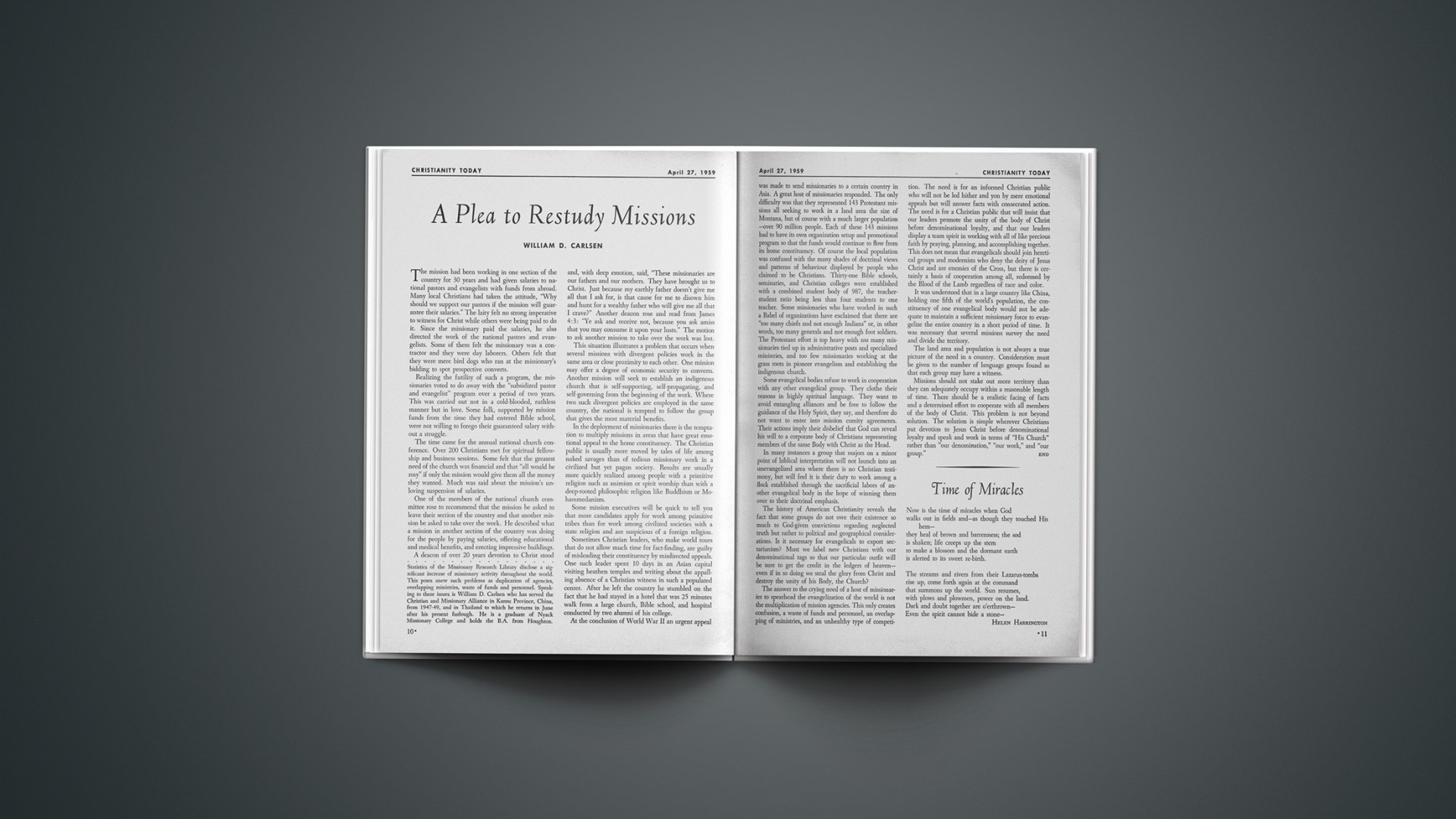
A Plea to Restudy Missions

The mission had been working in one section of the country for 30 years and had given salaries to national pastors and evangelists with funds from abroad. Many local Christians had taken the attitude, “Why should we support our pastors if the mission will guarantee their salaries.” The laity felt no strong imperative to witness for Christ while others were being paid to do it. Since the missionary paid the salaries, he also directed the work of the national pastors and evangelists. Some of them felt the missionary was a contractor and they were day laborers. Others felt that they were mere bird dogs who ran at the missionary’s bidding to spot prospective converts.

Realizing the futility of such a program, the missionaries voted to do away with the “subsidized pastor and evangelist” program over a period of two years. This was carried out not in a cold-blooded, ruthless manner but in love. Some folk, supported by mission funds from the time they had entered Bible school, were not willing to forego their guaranteed salary without a struggle.

The time came for the annual national church conference. Over 200 Christians met for spiritual fellowship and business sessions. Some felt that the greatest need of the church was financial and that “all would be rosy” if only the mission would give them all the money they wanted. Much was said about the mission’s unloving suspension of salaries.

One of the members of the national church committee rose to recommend that the mission be asked to leave their section of the country and that another mission be asked to take over the work. He described what a mission in another section of the country was doing for the people by paying salaries, offering educational and medical benefits, and erecting impressive buildings.

A deacon of over 20 years devotion to Christ stood and, with deep emotion, said, “These missionaries are our fathers and our mothers. They have brought us to Christ. Just because my earthly father doesn’t give me all that I ask for, is that cause for me to disown him and hunt for a wealthy father who will give me all that I crave?” Another deacon rose and read from James 4:3: “Ye ask and receive not, because you ask amiss that you may consume it upon your lusts.” The motion to ask another mission to take over the work was lost.

This situation illustrates a problem that occurs when several missions with divergent policies work in the same area or close proximity to each other. One mission may offer a degree of economic security to converts. Another mission will seek to establish an indigenous church that is self-supporting, self-propagating, and self-governing from the beginning of the work. Where two such divergent policies are employed in the same country, the national is tempted to follow the group that gives the most material benefits.

In the deployment of missionaries there is the temptation to multiply missions in areas that have great emotional appeal to the home constituency. The Christian public is usually more moved by tales of life among naked savages than of tedious missionary work in a civilized but yet pagan society. Results are usually more quickly realized among people with a primitive religion such as animism or spirit worship than with a deep-rooted philosophic religion like Buddhism or Mohammedanism.

Some mission executives will be quick to tell you that more candidates apply for work among primitive tribes than for work among civilized societies with a state religion and are suspicious of a foreign religion.

Sometimes Christian leaders, who make world tours that do not allow much time for fact-finding, are guilty of misleading their constituency by misdirected appeals. One such leader spent 10 days in an Asian capital visiting heathen temples and writing about the appalling absence of a Christian witness in such a populated center. After he left the country he stumbled on the fact that he had stayed in a hotel that was 25 minutes walk from a large church, Bible school, and hospital conducted by two alumni of his college.

At the conclusion of World War II an urgent appeal was made to send missionaries to a certain country in Asia. A great host of missionaries responded. The only difficulty was that they represented 143 Protestant missions all seeking to work in a land area the size of Montana, but of course with a much larger population—over 90 million people. Each of these 143 missions had to have its own organization setup and promotional program so that the funds would continue to flow from its home constituency. Of course the local population was confused with the many shades of doctrinal views and patterns of behaviour displayed by people who claimed to be Christians. Thirty-one Bible schools, seminaries, and Christian colleges were established with a combined student body of 987, the teacher-student ratio being less than four students to one teacher. Some missionaries who have worked in such a Babel of organizations have exclaimed that there are “too many chiefs and not enough Indians” or, in other words, too many generals and not enough foot soldiers. The Protestant effort is top heavy with too many missionaries tied up in administrative posts and specialized ministries, and too few missionaries working at the grass roots in pioneer evangelism and establishing the indigenous church.

Some evangelical bodies refuse to work in cooperation with any other evangelical group. They clothe their reasons in highly spiritual language. They want to avoid entangling alliances and be free to follow the guidance of the Holy Spirit, they say, and therefore do not want to enter into mission comity agreements. Their actions imply their disbelief that God can reveal his will to a corporate body of Christians representing members of the same Body with Christ as the Head.

In many instances a group that majors on a minor point of biblical interpretation will not launch into an unevangelized area where there is no Christian testimony, but will feel it is their duty to work among a flock established through the sacrificial labors of another evangelical body in the hope of winning them over to their doctrinal emphasis.

The history of American Christianity reveals the fact that some groups do not owe their existence so much to God-given convictions regarding neglected truth but rather to political and geographical considerations. Is it necessary for evangelicals to export sectarianism? Must we label new Christians with our denominational tags so that our particular outfit will be sure to get the credit in the ledgers of heaven—even if in so doing we steal the glory from Christ and destroy the unity of his Body, the Church?

The answer to the crying need of a host of missionaries to spearhead the evangelization of the world is not the multiplication of mission agencies. This only creates confusion, a waste of funds and personnel, an overlapping of ministries, and an unhealthy type of competition. The need is for an informed Christian public who will not be led hither and yon by mere emotional appeals but will answer facts with consecrated action. The need is for a Christian public that will insist that our leaders promote the unity of the body of Christ before denominational loyalty, and that our leaders display a team spirit in working with all of like precious faith by praying, planning, and accomplishing together. This does not mean that evangelicals should join heretical groups and modernists who deny the deity of Jesus Christ and are enemies of the Cross, but there is certainly a basis of cooperation among all, redeemed by the Blood of the Lamb regardless of race and color.

It was understood that in a large country like China, holding one fifth of the world’s population, the constituency of one evangelical body would not be adequate to maintain a sufficient missionary force to evangelize the entire country in a short period of time. It was necessary that several missions survey the need and divide the territory.

The land area and population is not always a true picture of the need in a country. Consideration must be given to the number of language groups found so that each group may have a witness.

Missions should not stake out more territory than they can adequately occupy within a reasonable length of time. There should be a realistic facing of facts and a determined effort to cooperate with all members of the body of Christ. This problem is not beyond solution. The solution is simple wherever Christians put devotion to Jesus Christ before denominational loyalty and speak and work in terms of “His Church” rather than “our denomination,” “our work,” and “our group.”

END

Time Of Miracles

Now is the time of miracles when God

walks out in fields and—as though they touched His hem—

they heal of brown and barrenness; the sod

is shaken; life creeps up the stem to make a blossom and the dormant earth

is alerted to its sweet re-birth.

The streams and rivers from their Lazarus-tombs

rise up, come forth again at the command

that summons up the world. Sun resumes,

with plows and plowmen, power on the land.

Dark and doubt together are o’erthrown—

Even the spirit cannot bide a stone—

HELEN HARRINGTON

Statistics of the Missionary Research Library disclose a significant increase of missionary activity throughout the world. This poses anew such problems as duplication of agencies, overlapping ministries, waste of funds and personnel. Speaking to these issues is William D. Carlsen who has served the Christian and Missionary Alliance in Kansu Province, China, from 1947–49, and in Thailand to which he returns in June after his present furlough. He is a graduate of Nyack Missionary College and holds the B.A. from Houghton.
Cover Story

Exclusive Interview: Rising to the Missionary Task

By the famed Boston Common stands Park Street Church, whose congregation has taken the whole wide world to its heart. From the hub of New England, which is pervaded by Roman Catholicism, Christian Science, and Unitarianism, the 2,200 members of this historic church bear witness to historic Christianity in the five continents.

What spirit of sacrifice animates this great missionary congregation? What explains its designation of more than a quarter of a million dollars annually to foreign missions? For an authentic account, CHRISTIANITY TODAYinterviewed Dr. Harold John Ockenga, whose ministry at Park Street Church has become a symbol of devotion to the foreign missions enterprise. Questioners included 1. Dr. L. Nelson Bell, 25 years a missionary surgeon and hospital administrator in China, and for a decade a member of the Board of Foreign Missions of the Presbyterian Church, U. S., and Executive Editor ofCHRISTIANITY TODAY; and 2. Dr. Cary N. Weisiger, one-time missionary to India whose own congregation in Mt. Lebanon (Pa.) U. P. Church has increased missionary giving five-fold in 10 years.

DR. BELL: What is the secret of a great missionary church?

DR. OCKENGA: It rests in the New Testament program given to the Church by the Lord Jesus Christ. When I discovered that program, it revolutionized my ministry.

DR. WEISIGER: Can you spell it out for us?

DR. OCKENGA: As outlined by the Lord Jesus Christ in commandments given to his disciples after the resurrection, the first point of emphasis is that of the world missionary enterprise, repeated at least six times in the resurrection appearances and teachings of our Lord.

DR. WEISIGER: Where does evangelism fit in?

DR. OCKENGA: There is no distinction, of course, between evangelism at home and evangelism abroad. Nevertheless, I believe that the world missionary enterprise receives the primacy for our Lord refers to “every creature, every nation.”

DR. BELL: What else is entailed in such a program?

DR. OCKENGA: Another emphasis is applying the teachings of our Lord Jesus Christ to every realm of life, so that in economics or politics or entertainment or family relations or education, the Gospel must be applied as we teach the principles and standards of life given by our Lord. Finally, there is the humanitarian application of these things, emphasized by Christ in his great Olivet Discourse, by Paul in numerous places, and by John in the third chapter of his first epistle.

DR. WEISIGER: What is the result in the local churches?

DR. OCKENGA: If you take missions, evangelism, Christian education, and humanitarianism, and bring your church together on that basis, then you are bound into a fellowship that doesn’t need many of the things on which people depend today for Christian fellowship. You have the fellowship of suffering, of sacrifice, of service, and this is the kind of thing that makes a local church tick and really prosper.

DR. BELL: What has actually happened at Park Street Church as a result of this missionary emphasis?

DR. OCKENGA: In the direct percentage our missionary work has enlarged, so all aspects of our church have been blessed, prospered, and increased. We started in 1936 by giving $2,200 a year to missions. Each year the total has gone higher. Last year we raised $258,000. In the last 20 years we’ve given about $2,750,000 for missions. Whereas in 1936 our budget was only $20,000 for the entire church, including gifts for missions, last year our budget was $465,000. What I’m pointing out is that all other things are blessed as we catch the missionary vision and apply it.

DR. BELL: Has your church seen a corresponding increase in the offering and dedication of lives?

DR. OCKENGA: When we started we had only two or three church members who were missionaries—and we did not support them. Today we have 123 missionaries on the field, 61 of whom are members of our church, most of whom were our own young people, and we support all of them.

DR. WEISIGER: How can we make the people back home more aware of foreign missions developments?

DR. OCKENGA: By annual church missionary conferences in which the major speakers are missionaries.

DR. BELL: Your church regularly sponsors such a conference. Could you tell us about it?

DR. OCKENGA: We hold a missionary conference each spring. For a whole week we have services from morning to night featuring 70 or 75 missionaries. The climax of the conference is a pledge offering for foreign missions and an appeal for young people who are willing to become missionaries.

DR. WEISIGER: Dr. Ockenga, do you feel that the congregational form of government in your church affords an essential advantage over old line denominational churches in the selection of guest missionary speakers.

DR. OCKENGA: A vast number of pastors in America serve denominational churches which for the most part are not autonomous. And I feel that money ought to be channeled to denominational work which is worthy of support. But I also think that it is wise to supplement such efforts with support for some of the interdenominational movements, because in some instances these can work more effectively than denominational efforts.

DR. WEISIGER: Do you support denominational missionaries?

DR. OCKENGA: We support a number of Congregational and Presbyterian missionaries, as well as others who work under independent and interdenominational boards.

DR. WEISIGER: Have you detected any recent loss of interest in foreign missions because of increased restrictions in various countries? Are people saying, “What’s the use?”

DR. OCKENGA: Difficulties experienced in some foreign missionary work may change the emphasis in methodology, but they will not alter the content of the message. We believe that the second coming of the Lord Jesus Christ may be imminent. We also feel that the changing world scene stimulates us to a greater evangelistic endeavor than before.

DR. BELL: In view of the changing world and resulting problems for missionaries and national churches, how do you feel about necessary transitions which will preserve world evangelization while at the same time discarding methods or policies which are no longer wise?

DR. OCKENGA: The time has come for a new look in missions that would adjust to the changing day.

DR. BELL: Will you explain?

DR. OCKENGA: Yes. Our missionary enterprise today should give priority to the reaching of foreigners studying in American schools. That’s the first point.

DR. BELL: And the others?

DR. OCKENGA: This new look should also include a new emphasis on more missionary literature, more evangelical radio broadcasts, and the establishment of indigenous churches.

DR. WEISIGER: Is there an immediate prospect for the use of television on the mission field?

DR. OCKENGA: That’s highly debatable. The prospect differs from nation to nation. But soon will come the day when we can bounce beams off satellites and send television pretty well around the world.

DR. BELL: Is it within the province of the free world to do more to reach Russia and Red China through radio?

DR. OCKENGA: I think that is a good possibility and a real responsibility. We could undoubtedly evangelize more behind the Iron and Bamboo Curtain. Take Radio Tangier, for instance. For something like $22 a half-hour program can be purchased. This will carry all through European Russia and will take in the satellite nations where people can hear the Gospel—and in their own languages—if only the money were available!

DR. WEISIGER: Don’t you think we can exploit air travel more effectively? Some churches send young people to work camps abroad during vacation time, or they have some of their young people suspend college courses for a year to help out at a mission station.

DR. OCKENGA: I think that can all be used as a means of recruitment, provided you don’t become wasteful of resources, for we have so many desperate needs on the mission field. I hear of a church that sends 25 young people to the foreign field for a summer yet has a roster of only 10 permanent missionaries. That’s all out of balance. We never sent anyone on a trial basis. Our young people got to the mission field by listening to the Word of God and seeing the need.

DR. WEISIGER: In your view, do you hold the opportunity before young people who are trained for technical professions to go into other lands under something like Point Four or in the foreign offices of American companies—with a missionary motive yet circumventing hostile entrance requirements of various governments?

DR. OCKENGA: Yes. A high official from India has told us that the future of missions there lies in just the thing of which you are speaking. We were told that the Indian government is not going to encourage sheer proselytizing, but that missionaries with practical skills will be welcomed and will not be prevented from propagating their faith.

DR. BELL: What is the greatest threat to the advance of Christian missions today?

DR. OCKENGA: Probably it’s a multiple threat. Communism is a great threat, but I suspect that spiritual indifference, love of ease, or the embrace of materialism can be just as hazardous to the missionary cause.

DR. WEISIGER: From a pioneer missions standpoint, what area in the world presents the greatest missions challenge?

DR. OCKENGA: Well, I’m told that there are more than 500,000 villages in India and that only a small portion of them have been reached with the Gospel. Then, of course, there are areas in Central Asia, New Guinea, and South America that have not been reached.

DR. BELL: Is there a danger in over-subsidizing national churches to the point where they will depend on outside help permanently?

DR. OCKENGA: There is a two-fold danger in looking to the outside for finances that should come properly from inside the church. Any church subsidized from America will be looked upon with great suspicion in the event a communistic philosophy takes over. Moreover, there is a danger in the atrophying of initiative if a church is subsidized from without.

DR. WEISIGER: How does a mission become a self-supporting church?

DR. OCKENGA: It is a gradual process. Brazil illustrates how every type of mission work can be going on in one country. There is a large, completely self-supporting, self-propagating church in city and urban areas. In the hinterlands is where the missionaries work mostly sometimes alone and sometimes with a few Brazilian aides. As a small congregation is formed, it is turned over to the national Brazilian church. The missionary and the missions relinquish all control when congregations find themselves able to have even a part-time pastor.

DR. BELL: What are the implications of ecumenism for foreign missions?

DR. OCKENGA: Today there is a new emphasis among foreign missions boards. We now have the fraternal worker policy and the stress upon the equality of all branches of the church. In a measure it seems a very good tendency, one which will recognize the dignity and equality and efficiency of the national or indigenous church. On the other hand, if we place belief in the ecumenical church to the curtailment of pioneer missionary work, I think it is a mistake! And if we tone down the essence of the Gospel and abandon evangelical Christianity, then again I think that the ecumenical emphasis in missions can be a menace rather than a blessing.

DR. WEISIGER: Can conservatives and liberals cooperate in the missionary enterprise?

DR. OCKENGA: That’s always been a great question. I feel there should be cooperation wherever there is faithfulness to the Lord Jesus Christ as the Son of God and Saviour as presented in the Bible. Otherwise I could not conscientiously support cooperation.

DR. BELL: Is it becoming easier to be a foreign missionary in terms of increasing conveniences at out-of-the-way places?

DR. OCKENGA: There are two basic kinds of missionaries. Some people believe that we should go to the mission field and live on the level that we do in this country. Others think they should empty themselves and live on the level of the local individuals. My opinion is that ultimately the only way of effectively evangelizing any nation is through the indigenous Christian who speaks the language without a foreign accent and who expresses the culture of the people to whom he ministers. It’s for this reason that I think our greatest work as American missionaries lies in training the national Christian to become the preacher of the Gospel.

DR. WEISIGER: To your way of thinking how do home missions compare with foreign missions?

DR. OCKENGA: In America we are near the time when a billion dollars will be spent on church building annually. In itself that is fine. But when it is compared with the paltry sum that is given for world evangelism it should condemn the American church before God. It seems to me that there are just multitudes of churches that have very little interest in the missionary enterprise. We need to get on fire and catch the vision of the New Testament! If I didn’t have a missionary church I think I’d just have to resign and go to the mission field myself.

DR. BELL: What can the individual minister do to challenge young people to carry the Gospel abroad?

DR. OCKENGA: He should proclaim the Gospel, then present the challenge of consecration, urging that young people be willing to accept the call of God if it comes. I might say that a call for a young person would consist of the understanding of the message of the Gospel which will meet the need, the knowledge of the need, and the internal impulse which is the drive of the Spirit calling him to the field.

DR. BELL: Should a minister count on getting missionary volunteers from among his young people?

DR. OCKENGA: When we get into the position of obedience and we place all that we have in our own hands into the Hands of our Lord Jesus Christ, then there will be placed upon some young people the internal drive that God wants them in the mission field.

DR. WEISIGER: Do you regard the pastor as the one primarily responsible for implementing a promotional program for missions in a local church?

DR. OCKENGA: The pastor is the key to the whole program.

DR. BELL: What can the layman do, specifically, for individual missionaries?

DR. OCKENGA: I hold up to my people that wherever possible a layman should support his own missionary on the field. If a person doesn’t have that much money, then a group should band together to support a missionary. This pattern has been a great impetus to missionary work in our church—in prayer, correspondence, and material help.

DR. WEISIGER: How is lay enthusiasm essential?

DR. OCKENGA: To put a missionary program across, all you need is a few laymen who are thoroughly sold on the idea. In our church I was indebted to a Harvard law professor who had taken a trip around the world. Passionately interested in missions, he led our whole missions program for 10 years before his death.

DR. WEISIGER: What is the implication of the Park Street missionary program for local churches in North America?

DR. OCKENGA: I feel that Park Street Church has performed one of its greatest services in setting a pattern for many other churches. Literally scores of churches look to us for that pattern. Many send delegations to our missionary conferences to study it and duplicate it for their own congregations. Many pastors write, asking information and guidance in conducting a missionary conference. I have dozens of invitations to conduct missionary conferences for other churches. All this shows to me that the ramifications are wide.

Cover Story

1900–1950 Survey: Religious Trends in the United States

The rapid growth in the membership of American religious bodies in the first half of the twentieth century has given rise to analysis, evaluation, interpretation, and even outright speculation.

The statistics of growth are impressive. Membership of the religious bodies in the United States more than tripled between 1906, the year of the United States “Census of Religious Bodies,” and 1956, with a rise from 32,936,445 to 100,162,529.

Statistics, of course, never tell an entire story. Frequently they are incomplete and have little to say about intangible factors which may be of major importance. Always they must be interpreted on the basis of information which they do not directly provide.

The study of the statistics relating to the membership of the nation’s religious bodies is complicated by the fact that the various groups employ different criteria in determining their membership figures. Some report every baptized individual, others report only baptized adults, and several count adherents who are not actual members. Since there is no way of reconciling these variations, figures must be accepted as they are given, unsatisfactory as such a procedure may be.

In spite of the limitations of statistics, they are an important record and tell an interesting story.

Statistics indicate that religious bodies are more than holding their own in view of population growth. In 1906 the population of the United States was 84,246,252; by 1956 it was estimated 168,091,000. The rate of the increase in these 50 years was 99.5 percent. In that same period membership in religious bodies rose from 32,936,445 to 100,162,529, or 204 percent. The rate of increase, therefore, in church membership was more than twice the growth in population.

These same figures afford interesting information about the percentage of the American people who have some religious affiliation. In 1906 slightly more than 39 percent belonged to a religious body; by 1956 that percentage had risen to 59.5 percent.

The statistics also say something about the relative advances of the Roman Catholic and non-Roman segments of the population in this 50-year span. The 12,079,142 Roman Catholics of 1906 represented 14 percent of the population. In 1956 the 33,574,017 Roman Catholics were 20 percent of the population, a rise of six percent in 50 years. The non-Roman bodies numbered 20,857,303 members in 1906, or 24 percent of the population, but by 1956 they accounted for 66,788,512, or 40 percent of the population, a rise of 16 percent. If the Jewish adherents are removed from the non-Roman figure, that figure falls to 61,178,512 in 1956, 36 percent of the population, an advance of 12 percent.

The same figures show the growth rate of the Roman Catholic church to have been 177.9 percent, and that of the non-Roman Christian groups to have been 195.4 percent between 1906 and 1956.

Division And Union

It is frequently charged that American Christianity is badly splintered and that the splintering process is accelerating. At two points the statistics seem to condition these charges.

First the statistics indicate that the increase in the number of religious bodies is comparatively slight in relation to the increase in church membership. In 1906 there were 186 organizations; in 1956, 258, making an advance of 72 bodies, or 38.7 percent. However, the 186 organizations of 1906 averaged 177,077 members, while the 258 bodies of 1956 averaged 388,227 members.

Statistical evidence is more significant at the second point. In 1956 11 Christian denominations numbered 1 million or more members and accounted for 92 percent of all the Christians in the United States. These 11 denominations contained 104 of the 258 groups listed for that year, or 40 percent. In 1906 these same denominations held 30 of the 32 million Christians, or 90 percent, and included 81 of the 186 groups, or 43.5 percent. In compiling the figures for 1906 those organizations which have merged since that time have been added together. For example, the memberships of the Congregationalists, the Evangelical Protestant Church of North America, and the Christian Church (General Convention) have been added together and listed as in 1956—Congregational-Christian.

While there were more religious bodies in 1956 than in 1906, a larger percentage of the people belonged to these 11 strong bodies listed below than was the case in 1906. The proliferation of small groups, which has received so much attention in past years, has tended to obscure the rising increase in the larger denominations. The growing, consolidating strength of these denominations is quite as worthy of attention as is the fragmentation of smaller groups.

Notable shifts with regard to size have taken place among the 11 large denominations since 1906:

Growth Of Denominations

These figures seem to indicate that merger or division have no definitive role in denominational growth. The Baptists added 10 divisions at a time when they were moving from third to second place, while the Methodists dropped from second to third place when they were adding six. Lutherans and Presbyterians held their rank but eliminated six and two divisions respectively. The Eastern Orthodox church advanced from eleventh to seventh, adding 14 divisions. The Latter-day Saints dropped one rank while adding four divisions, but the Congregationalists dropped three ranks while eliminating two divisions. The Disciples dropped from sixth to eighth place and the Churches of Christ advanced one degree while retaining the same number of divisions. Thus, neither merger nor splintering can be considered a criterion of strength or weakness. Other factors must be adduced to help explain the varying degrees of growth seen in these 11 groups.

A chart depicting the relative growth rate is a good starting point.

A common denominator for all these denominations is not easy to find. The phenomenon of immigration does not serve, for while that has played a large role in the growth of the Eastern Orthodox Church, it has not, as might have been expected, played an equal part in Roman Catholic growth. For some years it has had no effect upon the increase of Lutherans, and has played no appreciable part in the growth of the other denominations. Cultural and economic alignments also prove inadequate. Episcopalians, Presbyterians, and Congregational-Christians are generally regarded as upper income people, yet the growth rates of these three denominations are diverse. Methodists and Lutherans are considered to be of the middle class, but the gap in their growth rates is relatively wide.

The extent or lack of denominational organization and program failed to explain growth rates. Probably no other denomination can equal the Methodist in its closely-knit organization, and few can equal the Churches of Christ or the Baptists (especially the Southern Baptist Convention) in their absence of this. Yet, while these latter two with relatively little organization and program had a markedly larger growth rate than the Methodists, the Disciples of Christ, who also have comparatively little overhead organization, had a considerably lower growth rate than the Methodists.

A number of gaps are noticeable in the growth rates on the chart. The Eastern Orthodox, the Churches of Christ, and the Latter Day Saints stand out by themselves. Lutherans, Baptists, and Episcopalians are grouped fairly close with a 34 point spread. Then there follows a gap of 33 points before we reach the Roman Catholics, after which comes a gap of 67 points before we arrive at the Presbyterians, Methodists, and Disciples with 17 points spread among them. A final gap of 35 points brings us to the Congregational-Christians.

The break of 67 points between the Roman Catholics and the Presbyterians gives the first clue of a possible common denominator. If it could be shown that the four denominations immediately above this, namely, the Lutherans, Baptists, Episcopalians, and Roman Catholics, share some common attribute which does not mark the four denominations below the gap, the Presbyterians, Methodists, Disciples, and Congregational-Christians, then we may have discerned a possible adequate common denominator. If further investigation reveals this attribute to be shared by the top three denominations, then, whether applied pro or con, the common denominator may be found.

The high growth rates of the top three denominations are in part due to the fact that each of them had a small start in 1906. This is not true of the other eight denominations, however. Immigration is a special factor with the Eastern Orthodox, and an aggressive missionary program that requires active service of every male member helps to explain the growth of the Latter-day Saints. The Churches of Christ, on the other hand, possess no similarly unique mark. Something more must be involved in the high growth rate of these bodies.

Theological Moods

The attribute which distinguishes the Lutherans, Baptists (especially Southern Baptists), Episcopalians, and Roman Catholics from the Presbyterians, Methodists, Disciples of Christ, and Congregational-Christians is what may be called the mood of conservatism. This applies equally well to the Eastern Orthodox, the Churches of Christ, and the Latter-day Saints. Presbyterians, Methodists, Disciples of Christ, and Congregationalists are usually considered liberal in mood, although each of them contains conservative elements.

It is in the area of doctrine that we see most clearly the characteristics of conservatism or liberalism, though these elements may also be observed in relation to traditions of worship or in the idea of the Church.

Some of these 11 denominations are conservative at all three points. Others are generally considered liberal on all three points. Some are conservative in one or more aspects and liberal in another. A chart of the general, relative positions of each denomination may be useful. “C” stands for conservative, “L” for liberal.

Attitudes and positions of the Eastern Orthodox, Lutherans, and Roman Catholics are so well known they need no elaboration. Much the same is true of the Congregational-Christians and the Disciples of Christ, although minorities in these bodies will protest a sweeping application of the attribute of liberalism.

The Churches of Christ declare they are conservative. Until 1906 they were within the Disciple fellowship and were known as “the Conservatives.” Theirs is a biblicist conservatism which extends into their entire church life, including the refusal to use musical instruments not mentioned in the Bible. They are right-wing conservatives in doctrine, “emphasize the ‘divine sonship of Jesus’,” and consider the church as “a divine institution.”

The Latter-day Saints have a unique body of doctrine, drawn from the Bible, to be completed by the Book of Mormon and possible subsequent revelation. Worship is according to a denominational pattern and is comparatively uniform throughout. They recognize no other religious body as part of the fully true church. Their organization pattern is unique, and has no parallel among the other denominations.

Baptists are heavily conservative in doctrine, save for the American Baptist Convention which is considered predominantly liberal with a strong conservative element. Their congregational polity permits relative liberty in the conduct of worship, but in membership the church is composed, with few exceptions, only of immersed adults who have openly professed their faith.

The Protestant Episcopal Church no longer requires acceptance of the Thirty-nine Articles “as a creed” and “allows great liberty in non-essentials” while expecting “loyalty to the doctrine, discipline and worship of the one holy Catholic Church, in all the essentials.” Therefore, a considerable measure of liberty is possible with regard to doctrine, but in liturgical practices and the concept of episcopal government the church remains central and constant.

The Presbyterian Church U.S.A. suffered from a doctrinal strife in the early years of the century and has gradually assumed a comparatively liberal attitude with regard to strict Calvinist doctrine. A number of minor schisms have occurred involving doctrinally conservative groups. The Presbyterian Church U.S. describes itself as “strictly Calvinist” and “requires strict creedal subscription from all its ministers and office bearers”. This body has not joined, largely for doctrinal reasons, in the recent Presbyterian merger. The ancient Genevan, Psalm-centered Calvinist worship has been largely replaced by considerable liberty in the ordering of worship. Among all Presbyterians the presbyterian form of church structure remains intact and is the denominational core of unity.

Methodists have been somewhat divided on the point of doctrinal conservatism, and as a result holiness and perfectionist schisms have occurred. The main strand of American Methodism, The Methodist Church, takes an open position on doctrine and is able to comprehend both liberal and conservative elements. Virtually complete liberty is permitted in worship practices, but most of the Methodist groups are adamant on the structuring of the church along the lines of historic American Methodist polity.

Conservative Gains

If it may now be agreed that the top seven bodies listed in the chart are considerably more conservative than the four bodies at the lower end of the chart, then the gap of 67 points between the growth rate of the Roman Catholics (177.9) and that of the Presbyterians (110.7) may indicate something about the relative appeal of conservatism and liberalism to the American religious public in the first half of the present century.

The more conservative groups have had greater success in enlisting members than have the more liberal groups. For example, The Protestant Episcopal Church, probably the most liberal of the denominations designated as conservative, and the Congregational-Christians, probably the least conservative of the denominations specified as liberal, entered the 50-year period with nearly equal memberships, 886,942 to 845,301. By 1956 the Episcopalians had added 1,873,002 members to the Congregational-Christians’ 476,744. The notably conservative Lutherans and the Presbyterians, the most conservative of the groups designated liberal, began fairly close together, 2,112,494 to 1,830,555. After 50 years the Lutherans had outgained the Presbyterians 5,175,095 to 2,028,154. The Methodists and Baptists, both mixed with regard to conservatism and liberalism, had virtually identical memberships in 1906 with 5,749,838 to 5,662,234. At the close of the period the Baptists had gained 13,503,546 to the Methodists’ 6,025,893.

The success of the conservatives in securing members may be observed also within the denominations themselves.

The American Baptist Convention is much more liberal than the Southern Baptist Convention. In 1906 the Northern Baptist Convention had a little over one million members, while the Southern Baptist Convention held slightly more than two million. By 1956 the American Baptists had added 476,000 to reach more than one and one half million, but the Southern Baptists had added almost six and one half million to reach below eight and one half million. The growth rate of the American Baptists was 45.2 percent, that of the Southern Baptists 321.7 percent.

The more conservative Lutheran Church (Missouri Synod) outgrew the somewhat more liberal United Lutheran Church 237.6 to 191 percent, and the self-styled “conservative” Presbyterian Church U. S. outgrew the relatively liberal Presbyterian Church U. S. A. 204.4 to 124.2 percent.

A comparison of such clearly conservative denominations as the Mennonites, Brethren, and Adventists (especially the Seventh-Day Adventists) with outstandingly liberal denominations in the same statistical category, such as the Universalists, Unitarians, and Quakers tells the same story.

The one growth rate which tends to condition the application of the common denominator of conservatism versus liberalism is that of the Roman Catholic Church. This consistently conservative body is 33 points below the relatively conservative Protestant Episcopal Church and 66.5 points below the consistently conservative Lutherans.

Since the Roman Catholic Church shared with the Eastern Orthodox a large potential growth via immigration, the relatively low growth rate of the Roman Catholics becomes a question mark.

The answer lies in the fact that in the case of the Roman Catholic Church we must take into account at least one factor unique to that body and unshared by any of the other bodies under study. This unique factor is the autocracy and totalitarian authority of the Roman Catholic hierarchy which does not coordinate readily with the American democratic ideals of personal, social, and political motivation, structure, and action. Consequently this consistently conservative denomination has not appealed to new members as strongly as some of the other conservative bodies not in any way hindered by similar traditional and cultural impediments.

Admittedly such a statistical study cannot say anything precise about the relative impacts which the various denominations have made upon the nation’s religious life. Nevertheless the study has value in the degree to which it throws light on some trends which have marked the American religious community, especially the Christian segment of that community, in the first half of the twentieth century.

END

Preacher In The Red

WINDBAGS

The president of the Wesleyan Service Guild, an organization of employed and professional women of the Methodist Church, asked permission to use one of our Sunday night services for the presentation of their program. I readily agreed to the arrangement and made a note of it in my date book. When the time came, I had forgotten about the date and neglected to inform the church secretary who makes out the weekly bulletins. The ladies were present to give their program on the night agreed upon but the only announcement in the bulletin which had been distributed to the congregation was my sermon topic which unfortunately happened to be “Windbags.”—The Rev. R. T. RICHARDSON, Minister, College Park Methodist Church, Orlando, Florida.

For each report by a minister of the Gospel of an embarrassing moment in his life, CHRISTIANITY TODAY will pay $5 (upon publication). To be acceptable, anecdotes must narrate factually a personal experience, and must be previously unpublished. Contributions should not exceed 250 words, should be typed double-spaced, and bear the writer’s name and address. Upon acceptance, such contributions become the property of CHRISTIANITY TODAY. Address letters to: Preacher in the Red, CHRISTIANITY TODAY, 1014 Washington Building, Washington 5, D. C.

Richard C. Wolf is Associate Professor of Church History in the Graduate School of Theology, Oberlin. His study of changes in American religious life has occupied him, on and off, for the past seven years. He holds the A.B. degree from Gettysburg College, the B.D. from Lutheran Theological Seminary (Gettysburg), and the Ph.D. degree from Yale.

Review of Current Religious Thought: April 13, 1959

The Christian Century of April 2, 1958, carried an interesting editorial entitled, “A Choice of Miracles.” The choice was between the Virgin Birth and the Resurrection of Christ; between “the Womb and the Tomb.” Men like Bultmann reject both, but not so our writer. For him only the Virgin Birth needs to be rejected, “because it is so radically out of character with the rest of the manner and the matter of Christian revelation.” It is beside the point; not an impossibility, but an irrelevancy. What does it prove? Only that Jesus was “half and half”—half God and half man. And this cannot be because Christ “is not God in his structure.”

Since this editorial represents a modern and fashionable way of disposing of the Virgin Birth it calls for comment. It seems to have the great advantage of permitting a person to eat his cake and have it too. We will not disprove the Virgin Birth, it argues, for that is not the point—proven or unproven it is irrelevant. But then we are told in the next sentence that it is not so much irrelevant as untrue. “Christ is not God in his structure.” This is very slippery apologetics—a theological legerdemain almost faster than the reader’s eye.

But let us go over this reasoning in slow motion. First, we are told that the Virgin Birth cannot be disproved but it need not be because it is irrelevant. Then, we are told that the Virgin Birth, if true, would prove that Christ is God and man. But to be told that Christ is God is false because Christ “is not God in his structure.” If the Virgin Birth is true, and our writer does not deny it, then, according to him, it proves that Christ is of the structure of God. But this he does not reject because it is irrelevant but because it is untrue. How he knows that it is untrue he does not inform us.

This Virgin Birth, if true, proves, it is conceded, that Christ is of the structure of God. As far as this present writer is concerned, we do have undeniable evidence that Christ is of the structure of God. The only consideration which is offered against this conclusion (that Christ is of the structure of God) is the ex cathedra deliverance of the editor of the Century. I should think that all readers of the argument and the writer himself would be inclined to favor miraculous evidence when put in the balance against sheer dogmatism.

So, we try the evidence against the Virgin Birth and it is found wanting. Let us now notice the evidence which is given for the Resurrection. The Century editorial is moderate; it does not reject all miracles. Its writer is selective; he picks and chooses among his wonders. He refuses to take his stand with the all or nothing theologians who say that we must accept all of the Biblical miracles or none of them. With respect to the Virgin Birth he will stand with the unorthodox who accept none of the miracles, but when it comes to the Resurrection he will stand with the orthodox who accept all of them.

“As Easter reminds us, we cling to the Resurrection as miracle that extends and confirms the revelation of God in Christ.” Why is the Resurrection to be believed? Because—apparently—it “is the full center of the New Testament and is what the first preaching was all about.” Furthermore, the meaningful message of Easter is this: “God certifies his creation. He says of his world and of his people: I made you and I can remake you.… Death be damned. I did it, and I can do it again.”

But these reasons for this miracle are as arbitrary as the reasons advanced against the other miracle. It would seem that the writer has no better argument for accepting the Tomb than for rejecting the Womb.

If we accept the Resurrection because it is the full center of the New Testament preaching, then, presumably, we accept it because it is part of the New Testament witness. But as the writer admits, the Virgin Birth, although far more obliquely and less centrally taught by the New Testament nonetheless is therein taught. If the New Testament argument is valid for one miracle it is valid for another. And the deduction from the fact that the Resurrection is more emphasized than the Virgin Birth would be that we also, while believing both, should emphasize the Resurrection more.

Consider the second reason for accepting the Resurrection—its meaning. If it says or means that God will remake us, does the miraculous birth of Jesus not say that God will re-bear or re-create or remake us? If we are to “demythologize” the miracles should we not demythologize both of them? all of them? I, of course, do not advocate this type of hermeneutics but I do urge those who do so to be thorough about it and not to exercise a choice in hermeneutics as well as in miracles.

Rather, I believe that the New Testament is to interpret the events as well as relate them for us. And, incidentally, when we do look to the New Testament for interpretation we find Paul saying that the Resurrection proves the very thing which our author supposes that the Virgin Birth did; namely, that Christ was of the structure of God: “… the gospel concerning his Son, who was descended from David according to the flesh and designated Son of God in power according to the Spirit of holiness by his resurrection from the dead” (Rom. 1:3, 4).

Book Briefs: April 13, 1959

Theology And Sociology

The Society of the Future, by H. van Riessen (Presbyterian and Reformed, 1958, 320 pp., $4.95), is reviewed by Vernon C. Grounds, President of the Conservative Baptist Theological Seminary, Denver, Colorado.

As a Christian faces the problems of our twentieth century civilization, problems which are of appalling magnitude and baffling complexity, can he offer anything more than pious advice and daily prayer? He has a sustaining eschatology, to be sure, but does he have a viable sociology, a program of action grounded in his theology? Without degenerating into an advocate of an untheological social gospel, can he show that the Gospel is socially relevant? And can he show this relevance specifically in terms of education, government, law, economics, racism, and morals? This is of course the threadbare issue of the relationship between Christianity and culture. So much has been said about it that seemingly nothing of value has been left unsaid. Yet Dr. H. van Riessen clothes this threadbare issue in the stout homespun of his Calvinistic Biblicism, leaving it far from a thing of rags and tatters.

Though he does not call his position critical interactionism, that is in fact the viewpoint he advocates. A Christian cannot withdraw from secular activities into a desert or a cloister; neither can he practice a world-accommodating compromise, forgetful of his world-transcending principles. While enmeshed in the world, he must nevertheless stand above it, participating wisely and redemptively in its affairs. A doctor in both engineering and philosophy, Riessen is admirably equipped for the task of stating the position of critical interactionism. He has written extensively, produced a major work on Philosophy and Technique, and engaged vigorously in the political, economic, and intellectual life of the Netherlands. An evangelical who adheres to the tradition of those Dutch titans in theology and philosophy—Kuyper, Bavinck, Dooye-weerd, and Vollenhoven—Dr. Riessen seeks to relate his faith to the totality of human existence, developing what the Germans call a Weltanschauung, a coherent view of things.

The Society of the Future is an analysis motivated by “a deep sense of alarm” (p. 13) with respect to the course which Western civilization is now taking. For today, Riessen states, we face a crisis which is “more than serious” (p. 211). “The secularization of life, its nihilism and collectivism, give ample reason for anxiety” (p. 223). Moreover, a strange inevitability, a benumbing fatalism, characterizes our portentous era (p. 33). But his confidence in God’s sovereign ordering of history prevents a Christian from yielding to fatalism. Relatively a pessimist, he is ultimately an optimist because he knows that in the end all enemies will be conquered by his Lord (p. 236).

Caught up in the appalling situation of the twentieth century, what can a Christian do except resign himself passively to the fervent hope of the Second Advent? Riessen denounces such passivity as a shameful “neglect of our vocation” (p. 308). A Christian is called upon to work with God for the liberation and fulfillment of life; and a Christian believes God “has appointed men who, as stewards of reality, exercise freedom in their decisions” (p. 19). Hence “with the Bible and history as aids” (p. 20) a Christian must give thought to the future as it is being shaped by the present.

The principle which Reissen follows is that of sphere sovereignty, a concept worked out by Dooyeweerd and Vollenhoven. This rather abstruse theory can be quite simply explained. All authority is derived from the absolute authority of God who has created the various orders of existence—the family, the state, and the church—each with its own distinctive laws and responsibilities. This pivotal fact furnishes us with a clue to the relationship between authority and freedom.

“Each sphere of authority is limited by its own societal relationship. The relation of authority and freedom exists within such relationships and not externally (e.g., not between them).

“Parents have authority over their children within the family; they do not have authority over the school. Therefore, insofar as children are pupils they are under the authority of the principal, their teachers, and the school board. The government has authority insofar as its subjects are citizens; it does not rightly control economic activity and enterprises; the latter are subject to the owner, the director, the board of trustees, and the stockholders. The session or consistory of a church has authority over the congregation, but not over other forms of association, even if composed only of church members; the exercise of authority in such other groups rests with their independent committees.

“The social relationships exist together on a basis of equality; the one is not subordinate to the authority and control of the other. Subjection to authority exists only within a relationship. Societal relationships properly stand in a coordinate relation to each other, not in a preferred or subordinate position” (p. 71).

Reissen believes it is at this juncture in the freedom of each sphere of life to exercise authority within its God-created boundaries “that the decisive battle will be fought against totalitarianism and in the contest for a Christian society” (p. 73). For the central issue of our time, as he sees it, is human freedom. Can it be preserved and regained in face of the spurious blessings promised by a collectivism which in the outworking of its implicit logic must become increasingly tyrannical? Communism is unquestionably a towering issue, yet even “Communism is rather insignificant, when we consider what it is that we have to combat. Our struggle is concerned with the social development in the countries that are still free, where the conditions for communism or something like it are developing. If we lose this battle, loss or victory in the struggle against a Communistic bloc will be of little significance” (p. 239).

Our transcendent problem, therefore, is the development of a society “in which through a proper balance of authority and freedom there is an earnest endeavor to leave every one a maximum of free responsibility” (p. 240). Needless to say, a society which provides maximum freedom for each man to fulfill himself in work and worship is impossible unless it is founded upon faith. For without faith life is bereft of meaning, and consequently people flee for refuge from meaninglessness into the delusive security of totalitarianism. Thus faith is indispensable; indeed, “the attitude of faith is the condition for free choice, for free formative activity, for enterprise and adventure, chances and risk, the inseparable accompaniments of a life of faith and trust” (p. 237).

Convinced that the freedom which faith makes possible must be preserved and regained, Riessen subjects to pulverizing criticism the predetermined society of “democratic” collectivists like Karl Mannheim. He attacks the Utopian dream of social engineers who, from an hierarchical apex and governmental center, would control the activities of people—and yet leave them free! An hierarchical and centralized planning, Riessen argues, will prove to be not only economically inefficient but also socially disastrous. Regardless of all its noble intentions, it will simply verify Holderlin’s aphorism, “What has always made the state a hell on earth has been precisely that man has tried to make it his heaven.” And how will this work out?

“The defenders of planning operate with the shadow of what man ought to be. They would establish a stable society that would make man forget that his life is a continuous death, a fact understood even by the existentialist Heidegger. By providing man with security, he can take a nap and abandon the security of the faith in Jesus Christ. What is desired is a planned world that is no longer in need of God’s providential guidance.

“On the basis of the Christian faith, breaking through their science and serving as the basis of our own social principles, we reply that such an image of man is defective; that the way of planning does not end in stability but in the liability of wars and rumors of wars, in a reign of terror and the threat of terror; that instead of security, they will reap unrest, confusion, and agony (John 14:27). Such a planned society will not become a fellowship but a monstrosity without any resemblance to what God purposed in his majestic scheme of creation. And we base our prediction on the Christian faith that God is a jealous God who avenges himself on idolatry and permits man to destroy himself by his own sins” (p. 185).

From a Christian standpoint, then, what is to be done? “Diagnosis is but half of the work; therapy, a method of cure, is also needed” (p. 35). Riessen’s therapy, aside from urging a revitalized faith in the Gospel, consists in specific suggestions for creating an industrial system which will implement decentralization as defined by Fourastié: “Decentralization is the placing of authority and responsibility as close as possible to the scene of action and permitting a wide range of discretion to those at each level in the system” (p. 277). Rather than centralizing everything in the hands of a remote managerial elite, industry must so arrange its functionings that the individual is enabled to “carry the full measure of his responsibility in the enterprise” (p. 261). In short, guided by the principle of sphere sovereignty, it must keep the individual from becoming an emotionally uninvolved automaton: instead it must help him to become a responsible participant. This may necessitate revolutionary changes, a few of which Riessen mentions as he discusses the relationship between management and labor.

Riessen, it must not be forgotten, is a Biblicist who believes that Antichrist will eventually dominate the world. He does not hesitate to say that “the building stones of the structure of the society of the antichrist are for the first time in evidence” (p. 33). Neither does he hesitate to say: “The antichrist will not just fall out of the blue sky. He will start with exactly such good intentions as Mannheim’s elite. And God will punish him in the very practice of his planning. God will transform his unbelief and relativism into a false myth, lying propaganda, and a nihilistic view of life. And because of their unbelief the masses will also be punished” (p. 219). Our civilization, Riessen further asserts, “is moving to a final catastrophe. Kuyper understood how far humanity had advanced on that road. He knew that the parousia is drawing near and that humanity is wrestling through her mortal agony, unless a reawakening shall come through the Gospel. A religious revolution, a revival of faith, is needed, Brunner said. Should this not come, then a total collapse is not to be averted. Europe is dying, because it has no God” (pp. 235–236).

It is impossible in this sketch to give more than an insubstantial impression of the depth, range, and power of Riessen’s study. What an encouraging experience to find an evangelical who, with an impressive background of knowledge, demonstrates that his faith is relevant to the concrete problems of our age!

VERNON C. GROUNDS

Influence Of Form Criticism

Essentials of New Testament Study, by Eric Lane Titus (Ronald Press, 1958, 261 pp., $3.75), is reviewed by Walter W. Wessell, Professor of New Testament at North American Baptist Seminary.

This book was written as a textbook in the introductory New Testament field by the professor of New Testament in the Southern California School of Theology, formerly of the University of Southern California School of Religion. As a text it has many good features. It is written in short sentences and in simple, understandable English. The material is treated in a systematic fashion with suggestive discussion questions and a list of selective readings at the conclusion of each chapter. More background information would have been desirable, but, of course, the book has much material to cover in a relatively small space.

Although the arrangement is commendable, this book leaves much to be desired as an adequate interpretation of the New Testament. Far too much credence is given to form criticism: “The tendency was to ascribe to Jesus the Church’s own beliefs …” Thus “the historian of the life of Jesus must exercise the utmost caution in his attempts to get behind the incrustation of ecclesiastical thought to information about Jesus of Nazareth” (p. 26). “What Jesus ‘would have said,’ becomes ‘what Jesus said.’ ” A. M. Hunter’s criticism of Formgeschichte applies here: “Reading the form critics, we easily get the impression that when the Gospel tradition was taking shape, all the eyewitnesses of Jesus had either ‘fallen asleep’ or were in safe hiding.”

Dr. Titus is far too skeptical of New Testament history. For example, Luke 2:41–51 is dismissed as “probably legendary,” since it has all the earmarks of a wonder child story. He makes no attempts at reconciling apparent discrepancies in accounts, and one gets the impression that he considers such attempts dishonest! The author considers it “highly improbable” that the gospel saying concerning taking up one’s cross originated with Jesus, because “the Cross became a symbol of dedication only after Jesus died upon it” (p. 33). It hardly seems necessary to say that the Cross is not only a symbol of dedication but of suffering and death, and this meaning of it was known to all in Roman-controlled areas before our Lord’s crucifixion.

The treatment of Acts and the Pauline corpus is no more satisfactory. The genuineness of the accounts of Paul’s conversion in Acts is open to suspicion because Paul in his letters is “most reluctant to speak with deliberation about his conversion experience” (p. 111)! As for the letters of Paul, only I Thessalonians, Corinthians, Galatians, Philippians, Philemon, and Romans escaped unscathed.

Mention has been made of the bibliographies which occur at the end of each chapter. These are entitled “Selective Readings.” How “selective” they are is revealed by the fact that such authors as Case, Colwell, Fosdick, Branscomb, Enslin, McCasland, Goodspeed, and Harnack are repeatedly listed, whereas little mention is made of mediating New Testament scholars, and no mention is given of those of a conservative viewpoint.

Essentials of New Testament Study will not provide the student with the essentials for an adequate understanding of the New Testament.

WALTER W. WESSEL

Sermonizing

Preaching for the Church, by Richard R. Caemmerer (Concordia, 1959, 352 pp., $4.50), is reviewed by Andrew W. Blackwood, Professor Emeritus of homiletics, Princeton Seminary.

The able professor of homiletics at Concordia Seminary of the Lutheran Missouri Synod has written the largest and weightiest of recent textbooks about preaching. Like most authors with a German background, he stresses homiletics as a science rather than preaching as an art. He deals with many aspects of his subject, and has done a work both sound and admirable which will be especially helpful for Lutherans.

The author bases everything he says on Holy Scripture. Often he cites chapter and verse references as he guides the student into a sound philosophy of preaching and an understanding of the conventional forms that sermons assume, including separate sermons, sermons in a series, in courses, and throughout the Christian Year. Toward the end of the book he devotes 60 pages to a discussion of the preacher.

A distinctive feature of the work is the often searching proposals “For Further Thought,” given at the end of each of the 12 main sections. At the end of the book there is an unusually complete annotated list of selected books “For Further Reading.”

As to literary form, Dr. Caemmerer writes with simplicity of thought and clarity of expression. If the written word seldom gets off the ground, the same holds true of most homiletical works which are aimed to inform, not to inspire. If the various chapters do not include examples of master sermons from earlier times, the reason may be that such an inclusion would call for a book twice this size. Dr. Caemmerer has done well in what he has set out to do, and this volume should take its place among the few available standard evangelical works in this field. Especially among Lutherans will it win primacy as the basic seminary textbook.

ANDREW W. BLACKWOOD

Dated But Relevant

Fairbairn’s Imperial Standard Bible Encyclopedia, edited by Patrick Fairbairn (Zondervan, 1957, $29.70 a set of 6 vols., $4.95 ea.), is reviewed by R. J. Rushdoony, Author of By What Standard?

This important reprint of an 1891 publication is of interest not only in terms of its still valuable contents but also for its notable contributors, who included Franz Delitzsch, A. B. Davidson, Horatius Bonar, and Gustav Oehler in the work. Its usefulness can best be evaluated by comparing it on a number of representative listings to another major work of the same era, A Dictionary of the Bible (5 vols., 1898), edited by James Hastings. Here are three topics:

1. Abomination of desolation. Hastings’ description, as in most cases, is longer than Fairbairn’s; and though he gives extensive data, it is inconclusive. Fairbairn gives an excellent and closely developed analysis of this topic and concludes: “The abominations which were the cause of the desolations are ever spoken of as springing up from within, among the covenant people themselves, not as invasions from without. They are so represented in Daniel also, ch. 11:30, 32; 12:9, 10; and that the Jews themselves, the better sort of them at least, so understood the matter, is plain from 1 Mac. 1:54–57, where, with reference to the two passages of Daniel just noticed, the heathen-inclined party in Israel are represented, in the time of Antiochus, as the real persons who ‘set up the abomination of desolation and built idol altars;’ comp. also 2 Mac. 4:15–17.” It is such conclusive interpretations that give the Fairbairn encyclopedia its high quality.

2. Election. Hastings’ dictionary is concerned with demonstrating at length that “no scheme of election which assumes the doctrine of everlasting punishment as one of its fundamental postulates, can claim to rest on the authority of St. Paul” (J. O. F. Murray), and is thus universalistic. In the Fairbairn encyclopedia Robert Frew is concerned with a presentation and defense of the Reformed point of view.

3. Marriage. William Lindsay’s article in Fairbairn cannot rival the study by W. P. Paterson in Hastings. Here, as usual, Hastings provides more data which, when it is brought to focus, is decisive; when it is not, it is but a mass of undigested data. Fairbairn does not possess massive data, nor the extensive correlation or contrast to nonbiblical cultures and data of Hastings, but he does provide the biblical data.

Fairbairn contains valuable introductory articles on inspiration by Ryle and Waller as well as a long study on the subject in volume three. The theological consistency which is characteristic of the encyclopedia makes for a dependability as well as directness in writing. Its republication is an event to be welcomed, and, despite the new research and extensive archaeological advance that has taken place since then, it has value and is a useful tool. Perhaps its weakest point is that it is dated at times, and reflects too strongly the temper and thinking of the day in its discussions. This does not alter the value of the conclusions.

R. J. RUSHDOONY

Relevant Exegesis

I and II Timothy and Titus, by William Hendriksen (Baker Book House, Grand Rapids, 1957, 404 pp., $6), is reviewed by Wick Broomall, author of Biblical Criticism.

Here is no “dry-as-dustdom” commentary; nor does it effervesce with foam and froth. Hendriksen is now well established as a thoroughly reliable exegete. His star, already approaching the first degree of theological acumen, shines even brighter with each addition to the “New Testament Commentary” series, of which he is the sole author. This series has already been enriched by contributions on the Gospel of John and on I and II Thessalonians.

Although much more of the New Testament remains for him to conquer, we can pause here, at this favored position, and wish him well with God’s special blessing as he makes the still higher ascent of his Mount Everest.

It is perhaps needless to say that Hendriksen is conservative in critical matters and Calvinistic in theological questions. His defense of the Pauline authorship of the Pastorals, as presented in the volume under review, is perhaps as persuasive as will be found anywhere in modern criticism.

One will find in Hendriksen that rare combination of astute scholarship, which never loses sight of the grass roots, and evangelical fervor, which never evaporates into nebulosity. Our commentator always remembers that truth is not a mere academic search: it is for our souls—for our sanctification and growth in holiness. There are, therefore, many outlines, illustrations, summaries—all designed to make the inspired page more real and relevant to our present age. What more could the reader expect?

We should not overlook another commendable feature of this commentary: its citation of theologians (e.g. Warfield and Berkhof) as well as many previous commentators. On the whole, theologians have often been ignored by exegetes; and, sad to say, theologians have sometimes minimized exact exegesis. But Hendriksen brings the theologian and exegete together in sweet fellowship in the work of exposition.

Typographical errors in this excellent commentary are almost non-existent. There are a few slight ones, however, affecting Hebrew and Greek words (pp. 71 and 379).

WICK BROOMALL

Bible Text of the Month: Isaiah 2:2–5

And it shall come to pass in the last days, that the mountain of the Lord’s house shall be established in the top of the mountains, and shall be exalted above the hills; and all nations shall flow unto it. And many people shall go and say, Come ye, and let us go up to the mountain of the Lord, to the house of the God of Jacob; and he will teach us of his ways, and we will walk in his paths: for out of Zion shall go forth the law, and the word of the Lord from Jerusalem. And he shall judge among the nations, and shall rebuke many people: and they shall heat their swords into plowshares, and their spears into pruninghooks: nation shall not lift up sword against nation, neither shall they learn war any more (Isaiah 2:2–5).

In all these prophecies (Is. 2:2–4; 42:1, 7; 60:1–3) the conversion of the Gentiles to a religion proceeding from Judea is unequivocally foretold. For that such expressions as, a law, judgment, covenant, light, in the prophetic volume, are descriptive of some doctrine, or revelation of a religious nature, is no more to be doubted than that the phrases of Euclid relate to the subject of Geometry. “The law going forth from Zion, and the word of the Lord from Jerusalem,” is therefore a definite and unambiguous description of a religious doctrine thence communicated to the world. And “The influx of all nations into the mountain of the Lord’s house in Zion,” is no less definite in describing the conversion of the Gentiles to a faith or worship of the true God, originating in that mountain, as the place where it should be first instituted or taught.

He who appeared in the preceding verse as the lawgiver and teacher of the nations, is now represented as an arbiter or umpire, ending their disputes by a pacific intervention, as a necessary consequence of which war ceases, the very knowledge of the art is lost, and its implements applied to other uses. This prediction was not fulfilled in the general peace under Augustus, which was only temporary; nor is it now fulfilled. The event is suspended on a previous condition, viz., the confluence of the nations to the church, which has not yet taken place; a strong inducement to diffuse the gospel, which, in the meantime, is peaceful in its spirit, tendency, and actual effect, wherever and so far as it exerts its influence without obstruction.

This does not make all war absolutely unlawful among Christians, nor is it a prophecy, that in the days of the Messiah there shall be no more wars. The Jews urge this against Christians, as an argument that Jesus is not the Messiah, because this promise is not fulfilled. But, (1) it was in part fulfilled in the peaceableness of the time in which Christ was born, when wars were in a great measure ceased. (2) The design and tendency of the Gospel are to make peace and to slay all enmities. (3) Jews and Gentiles were reconciled and brought together by the Gospel. (4) The Gospel of Christ, as far as it prevails, disposes men to be peaceable, soften men’s spirits and sweetens them. (5) The primitive Christians were famous for brotherly love. (6) We have reason to hope that this promise shall yet have a more full accomplishment in the latter times of the Christian Church, when the Spirit shall be put out more plentifully from on high.

Calvin’S Exegesis

In the last days—When he mentions the end or completion of days, let us remember that he is speaking of the kingdom of Christ; and we ought also to understand why he gives to the kingdom of Christ this appellation. It was because till that time everything might be said to be in a state of suspense, that the people might not fix their eyes on the present condition of things, which was only a shadow, but on the Redeemer, by whom the reality would be declared. Since Christ came, therefore, if that time be compared with ours, we have actually arrived at the end of ages.

And shall say, come—By these words he first declares that the godly will be filled with such an ardent desire to spread the doctrines of religion, that every one not satisfied with his own calling and his personal knowledge will desire to draw others along with him. And indeed nothing could be more inconsistent with the nature of faith than that deadness which would lead a man to disregard his brethren, and to keep the light of knowledge choked up within his own breast.… This points out to us also the ordinary method of collecting a Church, which is, by the outward voice of men, for though God might bring each person to himself by a secret influence, yet he employs the agency of men, that he may awaken in them an anxiety about the salvation of each other.

And he will teach us his ways—He shows, first, that God cannot be worshipped aright until we have been enlightened by doctrine; and, secondly, that God is the only teacher of the Church, on whose lips we ought to hang. Hence it follows that nothing is less acceptable to God than certain foolish and erring services which men call devotion; and likewise, that though he employs the agency of men in teaching, still he reserves this as his own right, that they must utter nothing but his word.

All nations shall flow unto it—Now, though this was never fulfilled, that the nations of the whole world, each of them leaving their native country, made a journey into Judea; yet, because the doctrine of the gospel, by which God gathered to himself a Church indiscriminately out of all nations, proceeded from Mount Zion, he justly says that they will come to it who having, with one consent of faith, embraced the covenant of eternal salvation, have been united into one Church. We must also observe the harmony between the figures of the law and that spiritual worship which began to be introduced at the coming of Christ.

For out of Zion shall go forth the law—This is an explanation of the former verse, in which he said that Mount Zion will be placed above all mountains; that is, that she will be raised to the highest pitch of honor, when she shall become the fountain of saving doctrine, which shall flow out over the whole world. He calls it the law; for (torah) means instruction, and the most complete of all kinds of instruction is contained in the law. He speaks, therefore, after the manner of the prophets; for since the rule of godliness was to be obtained from the law, they were wont, by a figure of speech (Synecdoche,) in which a part is taken for the whole, to include under the word law all the instruction which God has given; just as under the word altar they include the whole worship of God. Hence, the term is applied, without limitation, to the word of God.

END

Gospel and Tomb: Watch on the Periphery

As Easter came and went, Protestant interest turned to a document purportedly containing new words of Jesus, while Roman Catholics gave attention to professedly new evidence for the burial place of the Apostle Peter.

Somewhat perturbed by the “sensational” treatment given a lecture of his by the American press was Professor Oscar Cullmann of the University of Basel and Paris’ Sorbonne. The well-known New Testament scholar was lecturing at New York’s Union Theological Seminary, where he is visiting professor, on the 1946 discovery of the self-designated “Gospel of St. Thomas,” one of 44 Coptic treatises contained in thirteen leather-bound papyrus books found in a tomb about 60 miles from Luxor in Upper Egypt. Described as a Gnostic library, the manuscripts were written in about the third or fourth century, says Dr. Cullmann, but “they surely go back to Greek originals which are much older—some parts probably from the first half of the second century.”

Most important part of the discovery was the Gospel of St. Thomas, in reality not a gospel at all but rather a collection of 114 sayings, including parables, attributed to Jesus and lacking any narrative framework. Only 14 of these had been known heretofore. “Comparable in importance to the Dead Sea Scrolls and of even greater significance to students of the New Testament,” was how Cullmann described the logia.

They fall into four categories: those which are word-for-word the same as in the canonical Gospels, those which provide independent variants to their canonical counterparts, those absent from the Gospels but known through citations in writings of the church fathers, and those completely unknown.

One of the unknown sayings: “Jesus said: If those who lead you say to you: Behold, the kingdom is in heaven, then the birds of heaven will precede you; if they say to you that it is in the sea, then the fish will precede you. But the kingdom is within you and it is outside of you.”

Beleaguered by phone calls, Dr. Cullmann patiently points out that though the American public may have been unaware of the discovery, such was not the case with specialists and others. He himself has been in possession of the text since 1956 and a book has already been published on the subject, albeit its inferior quality limited its sale. However, this state of affairs will soon be corrected by Cullmann’s Paris colleague Henri-Charles Puech and others who will publish a good illustrated text and translation. Cullmann feels that the question is not yet sufficiently mature for the widespread publicity given his lecture, about which he declares the only new thing was his assessment of the significance of the find.

Has it reopened the question of the canon? No, says Cullmann. It cannot be said for sure whether any of the “words of Jesus” are authentic, though some of them could be as old as or older than canonical material. About half the “gospel” is Gnostic, the reviser producing the present form being a Gnostic of the middle of the second century who put the work under the authority of the Apostle Thomas, though probably more than half of it originated in his own day.

Cullmann concludes: “Our four canonical Gospels are the only ones on which we can rely.… In the language of theology we must say that the Holy Spirit has been actually at work in the formation of the canon.… On the other band, it is possible for previously unknown and yet genuine sayings of Jesus to be found in other documents which are not in the canon, sayings which, even when they bring no fundamentally new revelation, are capable of enriching and furthering our understanding of the canonic gospels.”

Certain Roman Catholic scholars wasted little time in deprecating the sayings as belonging to a type of literature both fraudulent and puerile. But at the same time widespread publicity attended an announcement by Dr. Margherita Guarducci, professor of Greek epigraphy at Rome University, that new evidence had been found for the Roman Catholic belief that the Apostle Peter was buried under the spot where the papal altar of St. Peter’s Basilica now stands. Though many non-Romans question whether Peter was ever in Rome, Pope Pius XII in 1950 announced that “the tomb of the Prince of the Apostles has been found.”

For twenty years Vatican archeologists have been excavating under St. Peter’s, uncovering beneath the papal altar several tombs bearing no identification, only graffiti—ancient inscriptions roughly scratched on stone or other masonry. Five years of Vatican-sponsored study of the graffiti have convinced Professor Guarducci that they embody a mystical cryptography developed by persecuted second-century Christians and that she has unlocked the cipher. According to her interpretation, one inscription dating to about 160 A.D. read, “Peter is buried here.”

Professor Cullmann flatly rejects Dr. Guarducci’s conclusions, dismissing them with a curt “All that she wrote is false.” But he waxes enthusiastic over something he considers more newsworthy at the present time than either the Gnostic library or the graffiti—a plan of his for improving Protestant-Roman Catholic relations.

In Europe, some Roman and Protestant theologians meet regularly for study. And one week of each year is recognized by members of both communions in many European countries as a time of prayer for Christian unity. Lutheran Cullmann would add another step toward “improving the atmosphere”: yearly collections by Protestant churches for Roman Catholic poor and vice versa. He has been preaching this for two years in Europe and some churches have taken it up, amidst praise and criticism. The idea was suggested to Cullmann by the offering taken by Paul among the Gentiles for the poor in Jerusalem.

Certain requirements must be met for the plan to work, declares Cullmann. Protestants and Catholics must recognize each other as brothers in Christ but must also see that church unity is impossible in “the modern situation.” The two doctrines of the church are irreconcilable—for church unity one of the churches would have to disappear. The pope would cease to be the pope were he to sit down to negotiate with an oriental patriarch or the Archbishop of Canterbury without presiding. Only the “naive ones” saw hope for unity in the recent papal announcement concerning an ecumenical council.

Though the “ecumenical offering” cannot be a symbol of unity, it can be one of “solidarity, of brotherhood among all who invoke the name of Christ.” Were this proposal adopted in Spain and Colombia, the persecutions would become “impossible.” Would this plan ever lead to missionary cooperation between the churches? Says Cullmann, “That would be difficult.”

Two of the other difficulties which present themselves: the problematical Vatican disposition toward any implications of equality involved in the reciprocal nature of the plan; and certain Protestant reservations as to the efficacy of Roman Catholic soteriology, raised by the question of Christian brotherhood—it may be asked, “How necessary was the Reformation, anyway?”

Ecumenical Movement

Statement Of Faith

Presented as a “testimony and not a test of faith,” the proposed statement of faith for the United Church of Christ was made public last month.

The 231-word document will be presented in July to the second General Synod of the United Church, which is being formed out of the General Council of Congregational Christian Churches and the Evangelical and Reformed Church.

Dr. James E. Wagner, co-president of the United Church, said creeds are part of the “poetry” of religion rather than its “systematic rational exposition.”

Some evangelical Protestants viewed the statement as a vague adumbration of the Apostles’ Creed if not a travesty on basic Christian doctrine. The Virgin Birth, for instance, is not mentioned.

Here is the text of the statement, said to be the first of its kind in the United States for merging denominations with differing theological, sociological, and ecclesiastical backgrounds:

“We believe in God, the Eternal Spirit, Father of our Lord Jesus Christ and our Father, to whose deeds we gladly testify:

“He calls the worlds into being, creates man in His own image, and sets before him the ways of life and death.

“He seeks in holy love to save his people from aimlessness and sin. He judges men and nations by His righteous will declared through prophets and apostles.

“In Jesus Christ, the man of Nazareth, our crucified and risen Lord, He has come to us, shared our common lot, conquered sin and death, and reconciled the world to Himself.

“He bestows upon us His Holy Spirit, creating and renewing the Church of Jesus Christ, binding in covenant faithful people of all ages, tongues, and races.

“He calls us into his Church to accept the cost and joy of discipleship, to be His servants in the service of men, to proclaim the gospel to all the world and resist the powers of evil, to share in Christ’s baptism and eat at His table, to join him in His passion and victory.

“He promises, to all who trust Him, forgiveness of sins and fullness of grace, courage in the struggle for justice and peace, His presence in trial and rejoicing, and eternal life in His kingdom which has no end.

“Blessing and honor, glory and power be unto Him. Amen.”

Lutheran Fellowship

A retraction from the head of Missouri Synod Lutherans prompted new unity overtures from fellow church leaders.

Ecumenically-minded Lutheran officials apparently were encouraged by Missouri Synod President John W. Behnken’s withdrawal of statements charging that doctrines of three bodies now merging as the American Lutheran Church were in a “state of flux.”

Cooperative talks with the National Lutheran Council would include doctrinal discussion, Behnken was assured. He was asked, moreover, to initiate doctrinal discussions with merging Lutherans “toward the ultimate aim of church fellowship.”

Behnken withdrew his “state of flux” remarks when he felt they had been misinterpreted as “unwarranted judgment.”

Clergy And Industry

Moral Concern

Eighteen prominent clergymen—Protestant, Catholic, and Jewish—constitute an advisory council newly formed by the National Association of Manufacturers, the representative body of U. S. industrial management.

An NAM announcement said its “Clerical Advisory Council” is to meet three times a year, jointly with the association’s advisory committee of industrial leaders. Chairman of the council is Dr. Edward L. R. Elson, minister of the National Presbyterian Church in Washington.

The program was described as having a “dual objective: (1) To.alert the association’s members to major trends of thought in religious circles regarding moral and ethical problems affecting American business, and (2) to present industry’s point of view on such questions to the clergy and lay people of the nation’s churches and synagogues.”

Centenary Observances

Ratio: 200 To 1

This is the 100th year of Protestant missions in Japan. Out of a population of more than 90,000,000, there are reportedly less than 400,000 Protestant Christians divided among some 70 or more denominations. Broken down, it indicates that fewer than one in two hundred Japanese citizens are evangelical Christians.

The Evangelical Missionary Association of Japan hopes to use the centennial observance to make a stronger impact for Christianity. Biggest prospect: Buddhism, which claims a majority of the people.

EMAJ’s executive committee has prayerfully set a goal of seeing at least 2,000 evangelistic campaigns in 1959. Two major Bible conferences are planned as well, one in Tokyo and the other in Osaka, both in October.

Next month, World Vision will begin a three-week evangelistic campaign in Osaka with a team of distinguished American preachers and musicians. Principal speaker will be World Vision President Bob Pierce. Also on the team are Dr. Paul S. Rees, vice-president-at-large of World Vision; Dr. F. Carlton Booth, professor of evangelism at Fuller Theological Seminary; Ralph Carmichael, noted Gospel composer and conductor; and Jack Conner, famed marimba player.

Norman Nelson, singing missionary from the Philippines, will join the team.

From Haili Kulamanu

Haili Church of Hilo, founded by pioneering Congregational missionaries to Hawaii, is observing its 100th year in the same Colonial wooden edifice.

Fearing earthquakes, original builders chose in place of stone the timber of a nearby forest called “Haili Kulamanu,” which means “Paradise of the Birds.”

The church has become one of the most famous in the Hawaiian Islands. Repairs have kept the building in shape.

People: Words And Events

Deaths: Dr. Harold Lundquist, 64, pastor of the First Mission Covenant Church of Chicago and a distinguished evangelical leader, in Chicago … Miss Edith Torrey, 76, daughter of famed revivalist R. A. Torrey and former Wheaton College professor, in Santa Barbara, California … Dr. Eric Sauer of Wiedenest, Rhineland, author of Dawn of World Redemption.

Nomination: For general secretary of the American Baptist Convention, Dr. Edwin H. Tuller.

Appointments: As president of the new Methodist Theological School at Stratford, Ohio, Dr. John W. Dickhaut; as dean, Dr. Van Bogard Dunn … as president of the American Baptists’ Keuka College, Dr. William S. Litterick … as first president of the Methodists’ North Carolina Wesleyan College, scheduled to open in the fall of 1960, Dr. Thomas A. Collins … as associate executive secretary for American Baptist Men, Hermon C. Dilmore … as professor of systematic theology at Central Conservative Baptist Theological Seminary, Dr. Ernest Pickering … as superintendent of the Church of the Nazarene’s Hawaiian district, Dr. Joseph E. Purinton.

Elections: As chairman of the board of trustees of Southern Baptist Theological Seminary, Dr. Lamar Jackson … as chairman of a joint committee working for a merger between the United Evangelical Lutheran Church and the Evangelical and American Lutheran churches, Dr. William Larsen … as president of the Seventh-day Adventists’ Washington Missionary College, Dr. Charles B. Hirsch … as president of the National Association of Christian Broadcasters, Darrel Malcom … as president of the Protestant Church-Owned Publishers’ Association, Birger Swenson.

‘Year Of Grace’

Northern Ireland is marking the 100th anniversary of its revival of 1859, often referred to as the “Year of Grace.” A series of lectures, teaching missions, and evangelistic crusades were scheduled in commemoration of the event, which owed much to the 1857 revival experienced in the United States.

One of the first anniversary observances was a luncheon meeting at Belfast which drew 400 ministers and laymen. Guest speaker was Dr. J. Edwin Orr, author of The Second Evangelical Awakening in Britain, a history of the “Year of Grace.”

Orr said various parts of the world are now experiencing what they could regard as the Third Evangelical Awakening. He cited Brazil, referring to an admission from a Roman Catholic source that more attended Protestant services than could be found in Catholic masses.

Orr said he believed that the Spirit of God had raised up Billy Graham to lead evangelism and to serve the whole church of God. He asserted there had been a considerable change in evangelical emphasis which he described as a “moving to the center” combining a sense of unity, social reform and brotherly love with more objective features of the orthodox Christian faith—authority of the Bible, creeds, and biblical evangelism.

Seminary Rescinds Firings, Asks Resignations

NEWS

CHRISTIANITY TODAY

Southern Baptist Theological Seminary trustees sought to close debate on one of the most embarrassing squabbles in the annals of U. S. theological education when, climaxing a dramatic March 30–31 meeting, they rescinded dismissals of 12 professors. The professors were asked, instead, to resign.

In a resolution, the trustees admitted procedural “mistakes” in dismissals last June which followed a long-standing feud between nearly half the 27 School of Theology professors and Dr. Duke K. McCall, scholarly seminary president.

The Louisville institution, mother seminary of the second largest U. S. denomination, is observing the 100th anniversary of its founding this year.

Dissident professors have consistently charged McCall with maladministration. McCall, in turn, claims that the major issues have revolved on whether the faculty is largely independent, both academically and administratively.

One of the dismissed professors who is now pastor of the First Baptist Church of North Wilkesboro, North Carolina, Dr. Heber F. Peacock, has been acting as spokesman for the dissident group. All now have churches or are teaching or studying elsewhere.

Seminary trustees called their latest meeting after a special committee of Southern Baptist Convention presidents laid groundwork for what had been billed as a possible “reconciliation.” The dismissed professors replied that their interest was the welfare of the seminary. They made clear that they did not seek reconciliation.

The March 30–31 proceedings, which began with a 6 p. m. supper and did not adjourn until 4:30 a. m., were influenced by a warning last December from the American Association of Theological Schools, which threatened to withdraw accreditation. Present were the entire seminary staff, trustees, members of the special presidents committee, as well as the dismissed professors.

Here is the text of the resolution:

“Whereas, the action of the Board of Trustees of Southern Baptist Theological Seminary on June 12, 1958, when thirteen faculty members were dismissed, has been criticized by the AATS Accrediting Commission; whereas, the Board of Trustees has made a restudy of its action and its procedures; whereas, the Board of Trustees desires to repair damage done to the former faculty members and to the seminary, and to any other persons involved; whereas, there was neither precedent nor procedure by which the Board of Trustees might have been better guided; therefore, be it resolved by the Board of Trustees of Southern Baptist Theological Seminary, meeting in extraordinary session in Louisville, Kentucky, on March 31, 1959:

1. That we express appreciation to the committee of Convention presidents for its prayer, efforts, and leadership for the extraordinary session.

2. That we express appreciation to the former faculty members for their willingness to be present for the extraordinary session, and for their desire to be helpful.

3. That we express appreciation to the faculty for its presence in the extraordinary session, and for its fine statement and spirit.

4. That we assure the former faculty members that there is no bitterness in our hearts toward any one or all of them; we love each of them.

5. That we admit errors in the dismissal procedure followed, and express our regrets for such errors.

6. That we rescind the June 12, 1958 action in which the former faculty members were dismissed; and, that we respectfully request the resignation of each as of this date.

“7. That the faculty and the president are at liberty to consider by current faculty acquisition procedures any person deemed appropriate for faculty membership.

8. That we encourage the trustee subcommittee on faculty acquisition … to continue its work, looking to adoption in May of improved faculty acquisition and tenure procedures.”

The resolution notwithstanding, issues were not resolved. Many felt that the disputants merely “agreed to disagree.”

The dispute at the Louisville seminary dates back to May 4, 1943, when its board of trustees adopted a committee report which began, “The president of the seminary shall be recognized as the executive head of the institution.…”

In reviewing the controversy for the board last year, McCall noted that although the 1943 report removed the seminary from faculty control, the change never was “fully accepted” by the faculty. He said the rejection caused tension during the administration of his predecessor as well as his own, adding, “The ability of the wisest board of trustees, made up of those not engaged in theological education, to determine the [seminary life] is questioned by some.”

After smouldering inconspicuously for nearly 15 years, the dispute was given formal expression in March of 1958 when a School of Theology faculty report noted “low morale” among professors and asserted that “it is virtually impossible for seminary teachers to provide their families with adequate housing, educational opportunities and an acceptable standard of living without the assistance of outside remunerative activity.”

McCall confirmed “regretfully” the existence of the situation, but insisted that “the occasion for such a situation is temporary disappointment, frustration, and depression.” He asked the board to state “clearly and unequivocally precisely what is the trustee position on the problems and questions raised by the faculty.”

The board gave McCall a vote of confidence. “We do not believe it necessary to alter the structure of the seminary or any instructions given to the seminary administration,” a board statement said.

Last April 28, 13 School of Theology professors presented to a special trustees committee a “supplementary report” which the seminary administration subsequently labelled “libelous.” The report questioned McCall’s honor, charged him with “deceit,” and asserted that he “attempted to rule the faculty by coercion and threat.”

Direct negotiations between McCall and the dissidents failed.

On June 12, the board of trustees voted 32 to 9 to dismiss the 13 faculty members. A special reinstatement committee was named and authorized to reinstate “any one or more of these 13 men upon the basis of full confidence of the committee that the reinstated member can cooperate with the administration and work harmoniously within the framework of the charter and by-laws of the seminary and serve in good conscience as part of the faculty.” Salaries of the dismissed professors were extended.

The reinstatement committee invited the 13 professors to a meeting July 9 in hopes of effecting a reconciliation. Only one came, Dr. J. J. Owens, who was reinstated retroactively to June 12.

During the same committee meeting, Dr. Charles Taylor, executive director of the American Association of Theological Schools, appeared. He had but one request: that financial provisions for the dismissed professors be extended. Accordingly, the seminary continued to pay the dismissed professors and is still making up any differences in earnings.

Five months later, the Louisville seminary was visited by an investigating committee of the AATS, the recognized accrediting authority among U. S. seminaries. At its annual meeting in December the AATS put the seminary on virtual probation for a year, warning that another inspection would be made within twelve months. The implicit threat was that accreditation might be withdrawn. McCall was asked to resign his AATS vice presidency and his membership on the Commission on Accrediting.

The AATS never has specified how the seminary is to “repair the damage.”

Protestant Panorama

• Design of the Air Force Academy Chapel is being simplified to cut construction costs. The Air Force rejected all contractors’ bids, observing that they were “far in excess of official estimates of construction costs,” originally about three million dollars.

• One of every four younger clergy of the Anglican Church of Canada was discouraged from entering the ministry by one or both parents, according to a survey run by the denomination’s recruitment commission.

• HLKT, first Christian relay station in the southern part of the Republic of Korea, went on the air in Taegu shortly before Easter. The new 250-watt transmitter will be operated by HLKY, Christian broadcasting station in Seoul, in cooperation with Taegu’s Keimyong Christian College.

• A ceremony was scheduled for April 15 in Beirut to initiate the merging of Protestant mission work in Syria and Lebanon. Control and ownership of American missionary facilities, development of which was fostered by Presbyterians and Congregationalists, will pass to the National Evangelical Synod of Syria and Lebanon, the indigenous Protestant church.

• Preferred Risk Mutual Insurance Company of Des Moines, Iowa, last month became the first company in the United States to write fire insurance exclusively for non-drinkers.

• Midwest Bible and Missionary Institute is changing its name to the Midwest Bible College.

• Among first refugees to arrive last month under a new U. S. law which admits displaced Dutch citizens from Indonesia were a young couple sponsored by the Christian Social Relations Department of the Episcopal Church’s Diocese of Colorado.

• The Graduate School of Theology at Oberlin College is beginning an internship and field work program in cooperation with the Cleveland Inner-City Protestant Parish. The program is designed to train ministers for service in urban areas characterized by large proportions of low-income people, racial and minority groups, and overcrowded substandard housing.

• President Eisenhower was on hand to see his wife receive an honorary doctor of laws degrees from Roman Catholic St. Joseph College at Emmitsburg, Maryland, last month.

• The Church Council of the Evangelical Lutheran Church, in a resolution passed last month, expressed disapproval of congregation-sponsored social dancing.

• The Pennsylvania Baptist Convention is purchasing a 205-acre private resort near Stroudsburg, Pennsylvania, for some $250,000. The property will be used for a year-round camp and conference grounds.

• Beginning in June, the Billy Graham Evangelistic Association will produce a monthly publication for distribution among those particularly interested in world evangelism. Editor is Dr. Sherwood E. Wirt, who resigned as minister of Hillside Presbyterian Church, Oakland, California, to take the post.

• More than 60 U. S. television stations have shown “Martin Luther,” according to Robert E. A. Lee, executive secretary of Lutheran Church Productions, distributors of the film. Another 60 stations, Lee said, will televise the movie within a year.

• Eight stations of the United Christian Missionary Society (Disciples of Christ) in the Belgian Congo will soon be linked by a radio network if the government approves the plan.

• Three major Protestant denominations now have their largest congregations in Dallas. Highland Park Presbyterian Church is the largest in membership in the Presbyterian Church in the U. S. First Baptist Church of Dallas is the largest in the Southern Baptist Convention. Highland Park Methodist Church holds a similar distinction.

• The Bible Institute of Los Angeles broke ground last month for a $125,000 student commons building on its La Mirada, California, campus site.

Mass Evangelism

Bad And Mad

Billy Graham’s Australian timetable called for the start of a month-long crusade in Sydney, the continent’s largest city, this week.

Graham was to fly into Sydney after concluding short series of meetings in principal cities of New Zealand. On the eve of the New Zealand campaign, he reported that his vision was “the best it has been in nine months.” Doctors had ordered him to get as much rest as possible to relieve a rare affliction which caused blurring in his left eye. The evangelist relaxed at a seaside resort following his climactic Melbourne meeting which drew a crowd estimated as high as 150,000 for a new record in Christian evangelistic efforts.

“After Melbourne,” many were asking, “what was the prospect for Sydney?”

Melbourne is a relatively conservative city, while Sydney’s population of nearly 2,500,000 is called “bad and mad.” Sydney has seen its share of a church building boom, but the average congregation attracts little more than 50 worshippers per service. Known as Australia’s most cosmopolitan city, Sydney generally represents indifference to religion. Materialism seems to prevail.

Graham’s meetings were scheduled to begin Sunday afternoon, April 12, in the Sydney Showground, which was being modified to accommodate 80,000. Chairman of the Sydney crusade executive committee, Bishop R. C. Kerle, said that the governor of New South Wales, Lieutenant General Sir Eric Woodward, has granted his patronage to the crusade and expressed willingness to chair the opening meeting.

The actual start of the crusade was preceded by weeks of prayer and training among volunteers. More than 10,000 people were crowding into Sydney’s largest buildings six days a week for counsellor training. Thousands of cottage prayer meetings were also held daily.

In New Zealand, likewise, Graham found that great preparations had been made, even though an extended campaign had not been planned. “It is a raid,” wrote Professor E. M. Blaiklock, CHRISTIANITY TODAY correspondent in Auckland, “an all-out brief attack on evil things for which the church has made magnificent preparations.” Rugby football grounds were booked for the Graham rallies.

“New Zealand has never known the genuine breath of religious revival,” Blaiklock said. “The witness of evangelical Christianity is strong, the church is not without life and vigor, and in common with the rest of the Anglo-Saxon world in this decade, there has been a stirring of activity. But over the century or more of history, no one voice has moved the country, no sudden fervor ever came.

“Hence it was with astonishment that experienced observers watched Graham. The sanity and relevance of his preaching won the interest of a folk so averse to emotional demonstration that they are content to clap, rather than cheer, even at the sight of royalty.”

Communism Vs. Buddhism

No Surprise

A former missionary to Tibet says he was not surprised at an anti-Communist revolt in the capital city of Lhasa.

Marion Duncan, who served at the Tibetan-West China border for 13 years with the Disciples of Christ, declared that Communists could have expected trouble from devoted Buddhists in the sparsely-populated, mountain country.

“It was a natural gesture of mountain people,” he said.

He speculated that the insurrection had its roots with wealthy nobles who oppose distribution of their lands under the Communist system. Peasants would have fought on orders from their lords, he observed.

Duncan said Communists have had great difficulty in setting up communes in Tibet. A contributing factor, he noted, was the small population scattered over a wide area.

Tibet has little more than token Christian witness, he added, and there is little hope that the revolt will result in any missionary opportunity.

Duncan now works as a consultant with the U. S. government.

World Religious Populations

The world’s major religions gained numerical strength last year largely in proportion to increases in population, according to the Encyclopedia Britannica Book of the Year for 1959, out this month.

The Britannica’s figures show no unusual spurts in numbers of adherents. All the statistics are estimates gathered from authoritative surveys.

Last year, the Britannica yearbook listed 835,564,542 Christians in the world, including Roman Catholics, Eastern Orthodox, and Protestant. This year, the figure was 848,659,038.

Here is the Britannica breakdown: Roman Catholic, 509,505,000; Eastern Orthodox, 129,192,755; Protestant, 209,961,283; Jewish, 12,035,774; Moslem, 424,813,000; Zoroastrian, 140,000; Shinto, 30,000,000; Taoist, 50,053,200; Confucian, 300,290,500; Buddhist, 150,310,000; Hindu, 325,929,809; Primitive, 121,150,000.

Weather Phenomenon

History Repeating

It was now about the sixth hour, and there was darkness over the whole land until the ninth hour, while the sun’s light failed …—Luke 23:44–45

Metropolitan Washington experienced a Good Friday this year which alluded meteorologically to the day Christ died.

Rain-laden skies suddenly grew wholly dark over the U. S. capital and surrounding suburbs at 3 p. m., the time generally associated with the Bible’s “ninth hour” and the suffering Christ’s last words. Matthew, Mark, and Luke record three hours of darkness immediately preceding the climactic cries of Jesus.

Worshippers emerging from traditional 12–3 p.m. services found a nightlike atmosphere. Most who stayed home or worked took up vigils at windows. Telephone lines were flooded with calls, many of them directed to the Weather Bureau.

The intense, midafternoon darkness, which lasted for several minutes, was reported to have stretched over an area 50 miles wide. Skies gradually took on an eerie, pale yellow glow, then turned into the ordinary gray of rain clouds. A heavy thunderstorm followed.

Four flights at Washington National Airport were delayed in the squall.

The Weather Bureau explained that the darkness was the result of an unusually heavy cloud build-up accompanying a cold front. The ceiling was zero, a spokesman said, and the cloud layer was estimated to have extended to an altitude of 30,000 feet.

The spokesman described the phenomenon as very unusual for the eastern part of the United States. He added that such blacking-out does occur, however, in advance of tornadoes and is seen more frequently in plains states.

Religious Assemblages

The Issue: Red China

U. S. attitudes toward Red China claimed the floor of debate last month at the annual meeting of the National Council of United Presbyterian Men.

Dr. Will W. Orr, president of Westminster College, called on 3,000 delegates to repudiate a recommendation by the Fifth World Order Study Conference in Cleveland last fall. A message from the conference urged steps toward recognition of Red China and its admission to the United Nations.

Taking issue with the message, Orr said he found himself “sick at heart at some of the statements made by prominent churchmen regarding what should be our country’s relationship to Communism.”

Dr. Eugene Carson Blake, stated clerk of the United Presbyterian Church in the U. S. A., stood to the defense of the controversial Cleveland recommendations. Blake asserted the “present political stalemate in Asia is, month by month, making democracy weaker—not stronger—in East and Southeast Asia.”

He charged that “one of the results of the present policy is that during the last six months, repressions and persecutions of the Christian churches in China have increased in scope and severity.”

Representing 400,000 members, the council is the laymen’s organization of the United Presbyterian Church in the U. S. A.

Missionary Enterprise

The World Scene

The most encouraging aspect of today’s world-wide missionary scene is a surge of activity among lay Christians, according to Dr. Clyde W. Taylor, executive secretary of the Evangelical Foreign Missions Association, who returned March 27 from an 80-day, 35,000-mile global tour which took him to 18 countries.

Taylor said lay participation in church work is the outstanding feature of missionary work in many areas. He added that layman zeal often matches or surpasses that of the clergy.

Taylor urged more attention toward evangelizing youth around the world.

He called present ministries among youth “inadequate,” adding that young people are “most receptive to the Gospel.”

He said latest on-the-spot surveys indicate that the number of Christians in the Far East has increased by nearly 100 per cent during the past five years.

These studies show, according to Taylor, that there are now 5,200,000 Christians in Formosa, Korea, Japan, Hong Kong, and the Philippines, compared to 2,600,000 five years ago.

The missions expert noted that Japan is lagging behind other Far Eastern countries in numbers of converts. He blamed this largely on cultural patterns which limit church activities of laymen. Another contributing factor, he said, was the Japanese custom to regard marriage as a secular matter. Such attitudes inevitably lead to a large number of marriages between pagans and Christians, he said.

World Of Islam

A Holy War?

Sheikh Mahmud Shaltut, a top Moslem leader, is calling upon the world of Islam to declare a jihad, or holy war, against communism.

The rector of Cairo’s 1,000-year-old Al Azhar University, Islam’s chief theological seminary with an enrollment of more than 2,000 students, has previously said that “Arab soil will not bear Communist feet.”

Sheikh Shaltut’s appeal climaxed a war of words between stations in Cairo and Baghdad which developed after Communists in Mosul, Iraq, were reported to have burned Korans and murdered a number of learned Moslems.

Moslem sources in Cairo said that a call for a holy war—only one has been declared since the days of the Crusades in the Middle Ages—would ordinarily come from the Caliph of Islam. But they said since the caliphate was abolished by Ataturk of Turkey, the declaration of a jihad now rests with the governing body of Al Azhar.

Baghdad Radio denied that incidents in Mosul were organized by the government and asserted that “the freedom of religious beliefs in Iraq is safe.”

The Baghdad station charged United Arab Republic President Gamel Abdel Nasser’s regime with “committing the ugliest crimes in the name of religion, at the same time hypocritically pretending to show concern for religion in Iraq.” Religious leaders in Iraq, the station added, have often denounced “the attitude of the Egyptian rulers.”

Wives’ ‘Decalogue’

Mrs. John Osborn, whose husband is pastor of the world’s largest Seventh-day Adventist congregation (Sligo Seventh-day Adventist Church in Takoma Park, Maryland) has a list of “Ten Commandments” for clergymen’s wives.

Addressing wives of delegates to a church meeting in Atlantic City last month, Mrs. Osborn gave this list:

1. Thou shalt love all your members at all times and under all circumstances.

2. Thou shalt learn to live as the most observed woman in the church.

3. Thou shalt always remember your family obligations first of all.

4. Thou shalt learn to develop a remedy for loneliness for the many nights your husband is away from home.

5. Thou shalt learn to live on a limited income and a strict budget.

6. Thou shalt learn how to meet discouragement.

7. Thou shalt learn how to be adaptable and willing to learn.

8. Thou shalt develop your natural talents and abilities.

9. Thou shalt have a definite interest in the daily work and program of your preacher husband.

10. Thou shalt often renew your personal consecration to the task of the church.

Ideas

The Peace Drive in the Churches

In the plenary session of the controversial NCC World Order Study Conference, delegates from major denominations projected a year-long peace offensive in the 144,000 churches to which Cleveland conferees addressed recommendations that the U.S. recognize and the U.N. admit Red China. The peace drive, it was said, would begin in June and would cost $35 million in manpower alone. A Rockefeller Foundation grant is to underwrite staff personnel coordinating the drive with American higher education.

Sweeping plans were announced by key denominational delegates. This summer, leadership training gets underway in conferences, camps, and assemblies under denominational and ecumenical sponsorship. In September and October, state councils of churches will sponsor leadership training institutes. In November and December, local councils of churches will promote leadership training institutes. From January to June, 1960, an education and action program is projected for every church across the nation. The sponsoring agency is NCC’s Department of International Affairs, which arranged the World Order Study Conference.

The peace drive, it was noted, would be thrust into the mainstream of the separate denominational programs, the Cleveland conference and other ecumenical sources supplying study materials. The Methodist Church, giving special attention to students and youth, a representative reported, will sponsor schools of missions nationwide, plus thousands of study units on the role of the U.N. in world affairs. In addition to cooperating with a steadily expanding program of U.N. seminars, Methodists will emphasize certain legislative objectives, including repeal of selective service and increase of foreign economic aid. United Church of Christ (formerly Evangelical and Reformed, and Congregational), steadily enlarging interest in international affairs through denominational journals and pulpits, and through Asian interpreters of world events making an American tour, will then hold regional five-day social action institutes to train seminar leaders in cooperation with local councils of churches. The Southern California-Nevada Council of Churches has arranged a pilot-project with two major universities. Indiana Council of Churches will promote an institute and discussion groups for high school and college students, foreign students, denominational leaders, World Federalists, and representatives of International Fellowship of Reconciliation, with advance assurances of special interest from press, radio and television media.

Announced objective of the peace program is action, and not mere discussion. In this respect, the city of Denver is to serve as an example. Not only will study materials be distributed from Social Science Foundation and adult education sources, and special emphasis be given the theme of the Christian faith and peace during the Religion in Life program at University of Denver, but the peace drive will be geared to community political action. Instead of one central meeting, the peace program will be promoted in church institutes in each of nine aldermanic divisions of the city. Special peace rallies will precede the election of a mayor, so that Christian social action is fully meshed with political decision.

It would be tragic indeed if the Christian concern for peace in our time were either to fade away or to miscarry. The problem of war remains one of the terrifying social issues of our era. In the face of it the Christian movement dare not remain silent, nor dare it say the wrong thing.

George V. Allen, director of U.S. Information Agency, recently told the North Carolina Council of Churches that he would like to see the churches “take over” America’s foreign relations by working for peace. The determination of some Protestant spokesmen to dictate American foreign policy seems to be shaping new opportunities of direct ecclesiastical intrusion into state affairs.

The tide of opposition to NCC World Order Study Conference commitments on crucial issues discloses a growing spirit of anxiety over ecumenical positions and pronouncements in international affairs. In a leading editorial titled “Who Says 38,000,000 Protestants Want to Recognize Red China?,” The Saturday Evening Post recently commented that “American Protestantism has been taken for a propaganda ride by a group of ‘progressive’ leaders whose titles suggested that they represented more Protestants than they did.” In the aftermath of the Cleveland commitments, American Protestants will critically review the presuppositions of the peace drive projected in the churches by NCC’s Department of International Affairs.

We must clear the air of propaganda sallies by left-wingers who boldly identify social progress (“Christian social action”) with their private aims, and disparage all opposition as uninformed, reactionary, fundamentalist, separatist. The facts are that World Order positions on foreign policy do not reflect the majority conviction of NCC’s own constituency; that critics of these positions are stationed in diverse theological traditions; that on these issues these critics are more informed and less reactionary than most of the Cleveland delegates.

The Christian Century bluntly dismisses criticism of World Order commitments this way:

Catholics are joining Protestant fundamentalists and ‘Formosa Firsters’ in condemning the Cleveland action. The differences which prevent a united front go to the roots of our beliefs about the nature of society and the nature of the church. Liberal Protestantism is firmly committed to the principle of reconciliation: in its own household, among the races, among the peoples of earth. It will continue in the prophetic tradition to offer its considered judgments on foreign policy matters (Feb. 18, 1959, issue, p. 189).

The first sentence is so transparent that further comment would waste precious space. The third sentence does not, we hope, carry any implication that evangelical Protestantism is disinterested in reconciliation—central as this doctrine is in biblical theology—although evangelicals are often wary, and with good reason, of liberal dilution of redemptive facets of this sacred term and of liberal injection of social and politico-economic overtones not infrequently borrowed from quite debatable social philosophies. The fourth sentence—if it implies that the Cleveland plea for recognition and admission of Red China authentically reflects “the prophetic tradition”—leaves us wondering just which biblical prophets justify the corporate Church’s promotion of this particular foreign policy as a divinely-imposed duty. The heart of the matter lies in the second sentence, reminding us that liberal Protestantism indeed has its own special view of “the nature of society and the nature of the church.”

In coping with problems of world order and peace, modern formulas of “reconciliation” show the outlines of speculative theories of man and society, and betray their neglect of the biblical view of the Church and its sacred task in the world. Recent issues of CHRISTIANITY TODAY have pinpointed the peril to the Church of neglecting its basic commission to call out a new race of twice-born men, of relying on world systems (softened by religious idealism) for reconciliation and redemption, of pragmatic pursuit of social change. Corporate Protestantism stumbles into these unhappy lines of thought and action through its indifference to the great principles and precepts of revealed religion. In this issue CHRISTIANITY TODAY makes available a series of significant articles relevant to current discussions of Christianity and war and peace. They are written by men who have earned a right to speak on their respective themes. Churches will do well not to ignore their plea for a profounder and more biblical approach to the problem of reconciliation.

The Christian religion, above all others, is on the side of peace. Its faith is fixed upon “the Prince of Peace” who in turn has pronounced a special benediction upon the peacemakers.

Repugnant to Christianity, however, and contradictory of it, is the “peace at any price” philosophy that infects a self-indulgent people too often, bent on immediate ends.

The blood of the Cross is a reminder that peace, in Christian dimensions, carries its distinctive price. War is no Christian weapon for world conversion, nor is foreign aid. The world’s predicament is moral and spiritual; this calls for moral and spiritual redemption.

The Christian revelation strikes deeper than modern notions of social order based on sentimental theories of brotherliness and love. It elevates the timeless demand for love of God and of his holy commandments. Almost all foibles of ecclesiastical “social actionists” today spring from their neglect of justice as the cardinal problem of society, and their substitution of some other center of primary social concern. Some crusaders elevate “elimination of poverty” into social objective Number One; others exalt “elimination of war.” This disregard of the fundamental importance of righteousness works great havoc in the sphere of social ethics. The restriction of war, the promotion of peace, is then unwittingly pursued to the advantage of unjust nations and to the disadvantage of decent nations. Unless justice is honored as the primary social concern, peace and plenty become canopies beneath which perverse powers promote their evil ends.

Dr. Russell Kirk, editor of Modern Age, recently stated that the United States is rapidly losing any class capable of just leadership qualified to make the great choices in national life. The reason is our misunderstanding of justice—due in large measure, Dr. Kirk thinks, to the impact of Dewey’s philosophy upon American intellectuals. Whether Dewey is the fountainhead or not, there can be little doubt of our modern loss of the vision of justice as the primary social problem of our era. That this vision should be lost by the churches, or at least by those who profess to speak for the churches to the nation and to the world, marks this as America’s saddest hour, and gives reason for great anxiety as Protestant ecumenical leaders move the corporate Church more and more into direct political commitment and action.

END

Simple Paths Through A Complex Age

Confronting the technical terrors and challenges of the nuclear age, churchmen are sometimes tempted to contrive new systems and even novel doctrines to command the attention of the populace. And some of them have yielded. But there are also churchmen like the rector of Calvary Episcopal Church, Pittsburgh, the Rev. Samuel M. Shoemaker, in 1957 and 1958 speaker for the national “Episcopal Hour” and in 1955 named by Newsweek one of the ten greatest preachers in the United States.

Speaking recently in Washington, Dr. Shoemaker noted that man does indeed face the question of extinction or survival. In answer, he affirmed the primacy of the organic over the organizational and declared man’s real need to be a great awakening through the Holy Spirit. Calling for a new reformation, he named three rediscoveries the church needs to make: the Holy Spirit as the “life and soul of the Church,” the fellowship of the Spirit through oneness in Christ, the obligation of Spirit-impelled witnessing to Christ. “There is a simple law,” said the preacher: Aim first at spiritual conversion, gather into fellowship, and thrust forth witnesses. “I think the Holy Spirit will go on using these simple ways.”

And so do we. These ways led to the first century accusation that the apostles were turning the world “upside down.” The correct term was “right side up.” These simple ways alone are profound enough to right us and to save us.

END

Those In Peril On The Sea

The inexorable movement of time continues to pull a reluctant world closer to the potential May 27 showdown decreed by the Kremlin. No amount of feet-dragging will avert its arrival, though Communist backtracking may. Some leaders wonder out loud whether this is to be the ultimate showdown. Although the Communist strategy of proceeding from crisis to crisis is well known, one may now muse whether June will hear the song of birds mockingly echoed back by the ruins of Western civilization, or whether there will be any birds.

Through a current film, the tragedy of the Titanic has gripped the public imagination once again. The 1912 disaster displays a microcosm of society, the rich and the poor, how they lived their last hours and how they died. The vulnerability of man’s “unsinkable”.… But the Titanic taught its lessons, and transport on the high seas subsequently became safer.

The question is now asked whether any will survive the world’s next lesson—one not of water but of fire. Or has mankind been too delinquent in its study of such lessons as Nagasaki, Buchenwald, Munich, Sarajevo, and Pompeii, Carthage, Marathon, Philistia, but most of all—Calvary.

In light of the possible approach of humanity’s “moment of truth,” what better time for a Presidential call for nationwide prayer?—perhaps on May Day, when the Kremlin will parade its missiles and might. Not that there should be a parade of piety, but rather a proclamation of this nation’s sources of strength. In the balances are the cannons of destruction and death, and the canons of faith and of life.

The early Celtic May Day symbolized the defeat of winter and the return of life. It was thus associated with human sacrifice, and only two hundred years ago the customs of leaping over fire and of driving cattle between two fires yet persisted.

If the symbolism appear depressing, and if a fiery cataclysm is near, the Christian may lift up his head in the assurance that his redemption draws nigh. But he dare not be flippant in the face of human events of truly titanic dimensions. The human sacrifice of body and breath may well be prevented by the hard human sacrifice of prayer and repentance. It would avail this country little to provide as its only counterpart to the Kremlin’s May Day militarism a day of preoccupied materialism. Official prayer day or no, let the populace pray!

END

A Plea For Morality In American Fiscal Policy

Taxation and morality would seem to have a growingly tenuous relationship in American government.

In recent weeks we have seen pari mutuel betting, liquor addiction, bingo gambling and public lotteries proposed as sources of new tax revenue by states and municipalities.

Such proposals dignify these evils and tacitly approve them. Furthermore, they take unfair advantage of human weakness to fill the public treasury and balance the budget.

Take gambling as an example. To the rising generation a law authorizing a tax on games of chance says, in effect, that government approves the achievement of success without merit and the acquirement of wealth without labor. Gambling is thus recognized as legally respectable and justifiable. It is classified with vindicable luxuries and accustomed pleasures.

The state thus contributes to the moral delinquency of its citizens and puts the halo of good citizenship on the brow of its taxpaying sinners.

The church with a social conscience should speak out against this travesty on justice and morality and plead for a new respect for basic moral principles in the fiscal policies of government.

END

Peace

The potentials of destruction in nuclear warfare are such that there is a crescendo of demand for some type of organization or machinery that will insure peace in our time.

But these appeals for peace on the part of political and ecclesiastical leaders involve considerations which few people are prepared to face.

Peace is not something that man can will for himself. It is a God-conferred blessing based upon obedience to God-ordained moral laws. Man cannot defy these laws and claim the blessings of peace.

Furthermore, while self-preservation may be the first law of nature, it is not so for the Christian. His chief end is to glorify God and enjoy him forever, regardless of the consequences on earth. Once a man makes peace the prime goal of human existence, other things of infinitely greater worth are sacrificed in the process.

Someone has said: “When for truth man should die, it is his perdition to be safe.” The demand for peace at any price, so much the part of certain current philosophies, is a far cry from the righteousness that should be man’s highest goal.

Part of man’s confusion today is due to his failure to understand what peace really means. The average person of the world desires peace only so he may continue, unharmed and uninterrupted, in serving the devil.

Our Lord made it plain that the peace of which he spoke had little in common with that concept of peace held by the world. He affirmed that he had come not to bring peace but a sword and that the peace he gives is foreign to, cannot be understood by, nor conferred at the behest of the world. And an understanding of this is possible only to those who are taught by the Holy Spirit.

Peace is an inclusive term. There is peace with God which is the foundation of all true peace, and is acquired solely by faith through the merits of the redeeming work of the Lord Jesus Christ.

The immediate corollary of this peace with God is the peace of God which dwells in the hearts of believers. This is a peace of conscience which stems from our knowing that all is right between us and our Creator because of the finished work of Christ. It is an inner sense of peace emanating from the fact that all is well, not because of anything we have done but through that which our Lord has done for us.

Finally there comes to our hearts a peace with our fellow men. This is twofold. We share an abiding love and consideration for those who love Christ with us. And then we have a peace of compassion for those who do not believe—peace which is a love for their temporal and eternal good.

This is what the Bible means when it speaks of peacemakers. Paradoxical as it may seem, however, this peace may involve strife on our part against evil. In fact it is this paradox that can cause us to misconceive the character of true peace.

In the Sermon on the Mount, our Lord said: “Ye have heard that it hath been said, An eye for an eye, and a tooth for a tooth: But I say unto you, That ye resist not evil: but whosoever shall smite thee on thy right cheek, turn to him the other also.”

However, when struck by one of the officers of Pilate’s court, Jesus did not turn the other cheek but rather said: “If I have spoken evil, bear witness of the evil: but if well, why smitest thou me?”

Had our Lord changed his attitude? Assuredly not. How then do we explain his injunction—“turn the other cheek,” and his refusal to do so in protest against unlawful and unjust action?

Is not the answer to be found in the implications of two unrelated matters? The Christian ought to suffer in silence when the matter is one of personal affront. But where the question is one of basic righteousness, he should protest.

Christianity must bring conflict into the world, for it is antagonistic to the world order. Because the principles of right, freedom, and justice flow from it, there are times when forces, encroaching on these principles, must be resisted. Our Lord’s action in cleansing the Temple is an example.

We see a robber attack a woman on the street. We hasten to her aid and do not hesitate in using force to drive off or capture the criminal. Police are employed for the very purpose of enforcing our protection.

If our homes are invaded, our loved ones attacked, we use every force at our command to protect and deliver them.

On the international scene, there have been times when we have engaged in wars with the only consideration of delivering weaker nations from the oppression of stronger powers. No one would affirm that all wars are justified; but to deny there is ever any justification for war is to deny the reality of righteousness itself, and to play directly into the hands of the most evil force in the world.

It is significant that our Lord said we can have peace in the midst of tribulation, and that the Apostle Paul tells of a time when men will boast of a peace and safety of their own devising only to have sudden destruction fall upon them.

James tells us that wars come from the lust to have, which lurks in every human heart. Men fight and war to obtain power and things, but such wars can only generate more strife.

Much of the agitation for world peace today stems from a deep but misplaced concern. We see loss of life, property, and moral and spiritual values on every hand and conclude that there surely must be a better way. And there is, but it is a way that the world has rejected—the way of Jesus Christ and his Cross of redemption. The unbelieving world continues to fight and strive for the things which satisfy not, that they may consume them on their own lusts.

Paul gives a perfect description of the peace which belongs to the Christian: “And God’s peace (be yours, that tranquil state of soul assured of its salvation through Christ, and so fearing nothing from God and content with its earthly lot of whatsoever sort that is, that peace) which transcends all understanding, shall garrison and mount guard over your hearts and minds in Christ Jesus” (Phil. 4:7, Amp. N. T.).

addApple PodcastsDown ArrowDown ArrowDown Arrowarrow_left_altLeft ArrowLeft ArrowRight ArrowRight ArrowRight Arrowarrow_up_altUp ArrowUp ArrowAvailable at Amazoncaret-downCloseCloseellipseEmailEmailExpandExpandExternalExternalFacebookfacebook-squarefolderGiftGiftGooglegoogleGoogle KeephamburgerInstagraminstagram-squareLinkLinklinkedin-squareListenListenListenChristianity TodayCT Creative Studio Logologo_orgMegaphoneMenuMenupausePinterestPlayPlayPocketPodcastprintremoveRSSRSSSaveSavesaveSearchSearchsearchSpotifyStitcherTelegramTable of ContentsTable of Contentstwitter-squareWhatsAppXYouTubeYouTube