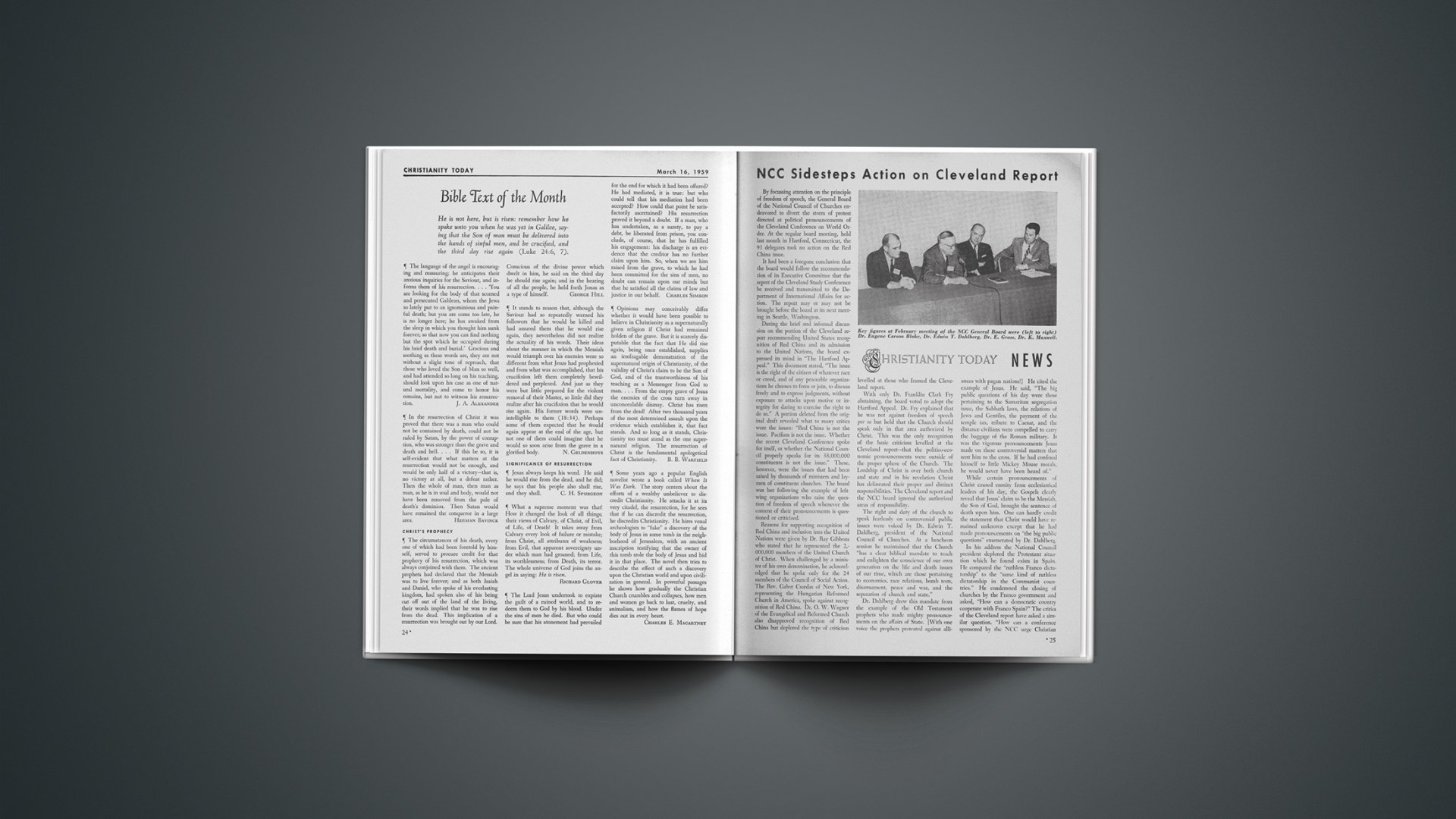
NCC Sidesteps Action on Cleveland Report

NEWS

CHRISTIANITY TODAY

By focussing attention on the principle of freedom of speech, the General Board of the National Council of Churches endeavored to divert the storm of protest directed at political pronouncements of the Cleveland Conference on World Order. At the regular board meeting, held last month in Hartford, Connecticut, the 91 delegates took no action on the Red China issue.

It had been a foregone conclusion that the board would follow the recommendation of its Executive Committee that the report of the Cleveland Study Conference be received and transmitted to the Department of International Affairs for action. The report may or may not be brought before the board at its next meeting in Seattle, Washington.

During the brief and informal discussion on the portion of the Cleveland report recommending United States recognition of Red China and its admission to the United Nations, the board expressed its mind in “The Hartford Appeal.” This document stated, “The issue is the right of the citizen of whatever race or creed, and of any peaceable organizations he chooses to form or join, to discuss freely and to express judgments, without exposure to attacks upon motive or integrity for daring to exercise the right to do so.” A portion deleted from the original draft revealed what to many critics were the issues: “Red China is not the issue. Pacifism is not the issue. Whether the recent Cleveland Conference spoke for itself, or whether the National Council properly speaks for its 38,000,000 constituents is not the issue.” These, however, were the issues that had been raised by thousands of ministers and laymen of constituent churches. The board was but following the example of left-wing organizations who raise the question of freedom of speech whenever the content of their pronouncements is questioned or criticized.

Reasons for supporting recognition of Red China and inclusion into the United Nations were given by Dr. Ray Gibbons who stated that he represented the 2,000,000 members of the United Church of Christ. When challenged by a minister of his own denomination, he acknowledged that he spoke only for the 24 members of the Council of Social Action. The Rev. Gabor Csordas of New York, representing the Hungarian Reformed Church in America, spoke against recognition of Red China. Dr. O. W. Wagner of the Evangelical and Reformed Church also disapproved recognition of Red China but deplored the type of criticism levelled at those who framed the Cleveland report.

With only Dr. Franklin Clark Fry abstaining, the board voted to adopt the Hartford Appeal. Dr. Fry explained that he was not against freedom of speech per se but held that the Church should speak only in that area authorized by Christ. This was the only recognition of the basic criticism levelled at the Cleveland report—that the politico-economic pronouncements were outside of the proper sphere of the Church. The Lordship of Christ is over both church and state and in his revelation Christ has delineated their proper and distinct responsibilities. The Cleveland report and the NCC board ignored the authorized areas of responsibility.

The right and duty of the church to speak fearlessly on controversial public issues were voiced by Dr. Edwin T. Dahlberg, president of the National Council of Churches. At a luncheon session he maintained that the Church “has a clear biblical mandate to teach and enlighten the conscience of our own generation on the life and death issues of our time, which are those pertaining to economics, race relations, bomb tests, disarmament, peace and war, and the separation of church and state.”

Dr. Dahlberg drew this mandate from the example of the Old Testament prophets who made mighty pronouncements on the affairs of State. [With one voice the prophets protested against alliances with pagan nations!] He cited the example of Jesus. He said, “The big public questions of his day were those pertaining to the Samaritan segregation issue, the Sabbath laws, the relations of Jews and Gentiles, the payment of the temple tax, tribute to Caesar, and the distance civilians were compelled to carry the baggage of the Roman military. It was the vigorous pronouncements Jesus made on these controversial matters that sent him to the cross. If he had confined himself to little Mickey Mouse morals, he would never have been heard of.”

While certain pronouncements of Christ caused enmity from ecclesiastical leaders of his day, the Gospels clearly reveal that Jesus’ claim to be the Messiah, the Son of God, brought the sentence of death upon him. One can hardly credit the statement that Christ would have remained unknown except that he had made pronouncements on “the big public questions” enumerated by Dr. Dahlberg.

In his address the National Council president deplored the Protestant situation which he found exists in Spain. He compared the “ruthless Franco dictatorship” to the “same kind of ruthless dictatorship in the Communist countries.” He condemned the closing of churches by the Franco government and asked, “How can a democratic country cooperate with Franco Spain?” The critics of the Cleveland report have asked a similar question. “How can a conference sponsored by the NCC urge Christian churches to influence the United States government to recognize and cooperate with Red China which, according to a NCC news release, has closed 188 churches in Shanghai and 61 in Peking?” One observer noted that hardness towards Spain and softness to Red China may be due to the fact that United States has military bases in Spain—a fact that grieves pacifists.

Resolutions Adopted

The board adopted a resolution urging Congress to repeal the provision of the National Defense Education Act requiring students to affirm that they are not subversive or members of subversive organizations in qualifying for financial assistance. The resolution noted “that the American political system rests firmly on trust in the integrity and loyalty of its free uncoerced citizens—a trust fully justified.” The board made clear that its chief objection springs from a religious standpoint, “our commitment to the God whose service is perfect freedom, a commitment solemnly expressed in the Declaration of Independence.” Evidently the board feels that students supported by public funds should have perfect freedom to belong even to a subversive organization if they so choose.

Also adopted was an eight-point resolution to work vigorously for adequate housing for all without regard to race. Churches were urged to encourage their members to “sign and make public covenants which commit them to support open occupancy housing in their neighborhoods.”

Authorization was given to representatives of the board to testify at legislative hearings in support of the extension of minimum wage legislation to economic groups not now covered.

The board voted that the proposed pronouncement on union membership as a condition of employment be sent back to the Division of Christian Life and Work for withdrawal.

Failure To Dispel Protests

By forthright action the board could have dispelled criticism of the Cleveland report. The call to the constituent churches said explicitly that the conference “will present its findings to the General Board, NCC, for further consideration.” The conference by-passed the board and delivered a message to the churches. And the only consideration given by the board was to return it to the very department under whose sponsorship and guidance the Cleveland report was prepared.

J. M. K.

Protestant Panorama

• Contemporary lines with Gothic undertones will characterize the Idlewild Airport Protestant chapel planned by the Protestant Council of the City of New York.

• Concordia Seminary of St. Louis plans an $870,000 library designed to eventually house 250,000 volumes … Milligan (Tennessee) College will get a new library in memory of Dr. P. H. Welshimer, for nearly 50 years the pastor of the First Christian Church of Canton, Ohio, whose congregation of 7,000 members is the communion’s largest in America.

• The West Indies Bible Institute of Port-of-Spain, Trinidad, dedicated a new chapel last month. The institute was established by the Church of God.

World Challenge, monthly missionary publication of the Assemblies of God, merges with the weekly Pentecostal Evangel, April 1.

• A group of new hymns, “suitable for use in gatherings related to Christian education,” is being sought by the Hymn Society of America (297 Fourth Avenue, New York 10, N. Y.), which wants to publish a new compilation later this year in cooperation with the International Journal of Religious Education.

Christian Life magazine’s ninth annual Sunday School attendance contest was won by the Oliver Presbyterian Church of Minneapolis, which saw a 74 per cent increase in Sunday School attendance with the aid of Charles Schulz’ “Peanuts” comic strip, used in most of the 8,400 pieces of prospect mailing.

• Religious enterprises received the majority of philanthropic gifts in the United States last year, according to the American Association of Fund-Raising Counsel. Religious contributions made up 51 per cent of the $7,100,000,000 1958 total, the agency said.

• Theodore Schaefer, for 20 years the organist and choirmaster of National Presbyterian Church, was found dead in his Washington apartment last month, his hand still clutching a telephone receiver through which he had been talking to a friend in New York. An autopsy failed to disclose the cause of death. The District of Columbia coroner withheld a certificate of death pending further investigation.

• The first Protestant parade in the history of Nicaragua was conducted through the streets of Managua last month as part of the fifth biennial congress of the Central American Mission. Some 12,000 to 15,000 persons witnessed the parade.

• Investment in downtown housing developments by Protestant bodies is being urged by an urban specialist of the National Council of Churches as a means of building up congregations in these areas. Dr. Meryl Ruoss, who directs urban church study for the NCC, said at a convocation in Dayton, Ohio, last month that “federal legislation makes it possible for churches and other nonprofit organizations to invest in housing with little risk.”

• The Methodist church in Finland, which numbers about 3,200 out of a national population of 4,333,000, is celebrating its 100th anniversary this year. Methodism began in Finland in 1859 when Gustaf Lervik, a sailor, returned to preach in his homeland after being converted in America.

• Rome Betts, outgoing chairman, urged before a meeting of the National Council of Churches’ Broadcasting and Film Commission last month that five to ten million dollars be raised over a 15–20 year period among individuals and foundations to improve Protestant radio and TV programs.

• The Berean Baptist Church of Grand Rapids, Michigan, issued a leaflet last month pointing out the number of Catholics who were candidates in a primary election campaign. The leaflet brought the church an official rebuke from the state Fair Election Practices Commission, which charged that religious bias had thus been injected into the contests. The Evangelical Ministerial Union of Grand Rapids rallied to the support of the Baptist congregation.

Australia And Asia

A Tall American

The meetings in Melbourne were still pressing toward a climax when it became evident that the biblical message had proven a great evangelistic rallying point for another continent. This time the locale was Australasia and the messenger was a tall American named Billy Graham who had a difficult time seeing out of his left eye.

Graham’s scheduled month-long crusade in Melbourne began at an indoor stadium seating 10,000, then moved to the Myer Music Bowl, an outdoor amphitheater which drew more than 65,000 on Sunday afternoon, February 22. The next shift was to another outdoor arena which promised unlimited accommodations. Still another move had been scheduled to the world-famous Olympic Stadium for a climactic March 15 rally.

This week Graham and his team were to visit the island state of Tasmania for two meetings, one in Launceston and the other in Hobart.

North Americans had the opportunity of getting in on the crusades via network television films and radio tapes which were beamed weekly.

The first 18 days of the Melbourne crusade drew an aggregate attendance of 420,000 with 14,838 recorded decisions for Christ. Both these figures represented all-time highs for a Graham crusade, according to one of his aides. The records were set despite the fact that rain proved a deterrent to attendance for several of the meetings.

After the first week of the crusade, Graham reported that his left eye was bothering him to a greater degree, that “it felt tired all the time.” After a sermon the evangelist said his vision in that eye was considerably blurred. Several specialists in the United States were consulted by telephone. They directed him to a Melbourne ophthalmologist who prescribed daily treatments. Special medicine was flown to Graham from the United States.

Graham was suffering from angio-spastic edema of the macula, a rare ailment (as reported in the February 2 issue of CHRISTIANITY TODAY). He limited his speaking engagements to nightly public meetings. He was to preach no longer than 35 minutes.

How was Australia in general reacting to Graham?

CHRISTIANITY TODAY Correspondent Dr. Leon Morris reported that “people all over Melbourne were beginning to discover that religion is a topic that men may discuss without a sense of embarrassment.”

“Protestant Christianity is united as never before,” he added.

“In opening addresses Graham strongly emphasized the place of God’s law, and the serious consequences of disobeying it. He made plain the accountability of man, and referred often to the Ten Commandments as the basis of all moral law.”

Morris said that in some respects the most impressive Melbourne meeting was a ministers’ assembly on Monday morning, February 16. He describes it thus:

“A thousand ministers of all denominations poured into the Town Hall of suburban St. Kilda to hear Mr. Graham explain his methods and his aims. He did not mention the criticisms that are sometimes given of the crusades, but his thoughtful, humble and careful outline of what he and his team proposed to do left the group of pastors in no doubt that this crusade was to be Christ-centered and very definitely church-related. ‘That was masterly,’ said one Anglican clergyman at the close of the meeting. ‘If that is what Billy Graham does, then nobody should feel the least disquiet.’ ”

Another appraisal of the evangelist came from the Right Rev. N. Faichney, moderator of the Presbyterian Church of Victoria, who was quoted as saying:

“Not only does his vivid personality commend him, his quiet sincerity, his real humility and his dependence on the Holy Spirit speak of the manner in which he has placed himself in the hands of God.”

The first highly-placed criticisms came from Anglican Bishop Ernest H. Burgmann of Canberra, where Graham scheduled a meeting for April 27.

Burgmann challenged the evangelist’s campaign methods and charged that his use of the Bible in preaching was “idolatrous.” Criticizing the great crowds that attend the crusade meetings, Burgmann asserted that they “do not provide the atmosphere for decision involving truth vital for the strain of daily living.” He declared that in the course of studying the Scriptures he had ceased to hold the Bible “infallible.” He said he found “some things in it hard to believe and many others quite unintelligible.”

Graham found Burgmann’s attack “interesting” since he had been personally invited to preach in Australia by the late Archbishop H. W. K. Mowll, Anglican Primate of Australia.

Morris commented: “Increasing numbers of clergymen seem to be recognizing that the crusade can be made an effective means for extending the work of the church, even where men differ widely from the evangelist.”

Methodists Unite

Korean Methodists ended a five-year-old church split last month when nine delegates representing two Methodist groups affixed seals to an “unconditional merger” agreement.

The accord, which was to be ratified this month at a joint annual conference, heals a small division in which about twenty churches separated from the Methodist Church, second largest Protestant body in Korea, in a dispute over constitutional procedures in the election of a bishop. They formed the Constitutional Methodist Church. The united Methodist Church will number some 1200 churches with a total constituency of 250,000.

Observers welcome the event as a turn for the better in Korea’s schism-marred Protestant circles. But the problem of Korea’s major church schisms, which have fractured the country’s 800,000 Presbyterians, remains unsolved.

The Presbyterian. Church in Korea with 550,000 adherents remains the largest denomination. But in 1951 a group now numbering 150,000 and affiliated with the International Council of Christian Churches withdrew to form the Koryu Presbyterian Church, charging that the parent body was too liberal and too ecumenical. In 1954 a group connected with the United Church of Canada withdrew to form the Presbyterian Church, R.O.K., with 170,000 adherents, charging that the parent body was too conservative.

S. H. M.

Evangelical Alliance

Distressed by theological deviations of its church leaders, a conservative element within the Mar Thoma communion of India is pressing evangelistic efforts through the newly-formed Bharat Evangelical Alliance.

The evangelical group had brought suit against Metropolitan Juhanon Mar Thoma, charging deviation from beliefs of reformers who broke with the Jacobite Syrian Church more than 100 years ago to form the Mar Thoma church.

Having failed in court, it was reported, evangelicals then formed the alliance to avert loss of the evangelistic vision which the reformers sought to recapture.

Some observers saw in the alliance the makings of a Mar Thoma church split, but officials denied any such move.

Mission To Calcutta

An unusual measure of revival among Christians in India was the fruit of World Vision’s “Mission to Calcutta,” conducted by Dr. Paul Rees during the 150th anniversary of Carey Church.

Rees, vice-president-at-large of World Vision, Inc., said God was present “in power” for the 14-day mission in which Christian leaders of many Calcutta churches took an active part.

Rees said the breakthrough by God’s Holy Spirit was a vital answer to prayer in view of a “resurgence of Buddhism, Mohammedanism and Hinduism.”

After the Calcutta services, Rees and World Vision President Bob Pierce spoke before 40,000 delegates at a Mar Thoma church convention in South India.

World Of Judaism

Who Is A Jew?

For months, Israel has been divided on how to categorize children of mixed marriages. Orthodox rabbis insisted that the children be considered Jewish only if their mothers were Jewish or if they had undergone proper ritual. Government leaders contended that a person should be listed as Jewish on his word.

Last month, a compromise was reported whereby identity cards of children of mixed marriages would list only the separate religions of the parents. No decision on the child would be made until the child is 16 years old.

Meanwhile, the influx of European Jews which originally brought on the crisis (see March 2 issue) continued. The United Jewish Appeal of Greater New York announced last month that it had arranged for bank loans totalling $30,000,000 to help speed resettlement in Israel of 100,000 or more immigrants from Eastern Europe. An airlift was instituted to transport several hundred Jews daily from Communist Romania.

Arabs have charged that the new influx will lead to Israeli expansionist moves. The U. S. State Department reportedly views release of Romanian Jews as a Soviet move to stir trouble in the Near East.

Europe And Africa

Church And Politics

“The part the Church should play in an independent nation is to keep out of politics and actively preach the Gospel,” Dr. Kwame Nkrumah, prime minister of Ghana, said during a state visit to Nigeria a few weeks ago.

On the second anniversary of Ghana’s independence, March 6, Christian missionaries enjoyed continuing liberties. Some have even expanded their work. Nkrumah seemed happy with missionaries who help to develop his country, as long as they stay clear of politics.

Raised a Roman Catholic, the prime minister now belongs to a Protestant church. “I’m an undenominational Christian and a Marxist socialist,” he wrote in his autobiography.

Fixing Easter

The ecumenical council to convene in Rome in 1961 may discuss a change in the pattern which determines when Easter Sunday is celebrated.

The present system, which provides that Easter be celebrated on the first Sunday after the full moon following the first day of spring, was established by the Council of Nicea in 325 A.D.

There have been many proposals in years past urging a more fixed date for Easter. As it is now determined, the date for Easter can vary as much as 35 days.

If the 1961 council makes a change, the issue will be raised as to whether Protestants should follow suit.

Easter was not generally observed in the United States until about the time of the Civil War. Puritans in England had refused to celebrate Easter because of their distaste for Catholic ritual which often accompanied religious festivals. Early U.S. settlers felt similarly.

Shift In Emphasis

The death last month of Dr. Daniel F. Malan, a chief architect in years past of South African race policies, came at a time when church attitudes toward apartheid were undergoing a major shift in emphasis.

Malan, 84, served as prime minister of South Africa from 1948 to 1954. A member of the Dutch Reformed clergy, he defied world-wide condemnation to enforce apartheid and he was generally considered the dominating voice for Afrikaner nationalism.

In recent months, separate South African assemblies of Anglican and Reformed churches have spoken out strongly against racial discrimination.CHRISTIANITY TODAYCorrespondent Ben J. Marais reports on the significance of resolutions passed last August by the Reformed Ecumenical Synod:

The race resolution, if compared with the general theological approach of the Dutch Reformed churches of even three years ago constitutes a major shift of emphasis, far removed from former statements like “segregation in state and church is not only permissible—it is obligatory according to Scripture.”

Two years ago, however, the four branches of the Dutch Reformed church (the major South African church) accepted a new basis. This major progress made in the Dutch Reformed church itself is well reflected in this latest statement of the Reformed Ecumenical Synod. The latest statement goes further, however, in its pronouncements on mixed marriages.

That even the new policy does not mean quite the same thing to different churches within the synod, was very obvious in discussions, which centered on use of the term “associate with” in the original draft. Some churches objected violently to the term, and after more than two hours of debate, a change was made. The final statement read, “The church should, through its teaching and example, educate and prepare its members for the exercising of Christian communion with believers of the other races, while at all times exercising the greatest care, love and responsibility towards its own members.”

Late in 1958, the Synod of the Anglican Church of the Province of Cape Town took steps to apply anti-segregation principles. A motion was adopted calling for establishment of a church school which would be integrated from the start, “if such a school is feasible.” Correspondent Marais, a professor of Christian history at the University of Pretoria, gives this reaction:

The Anglican church and the present government have been at loggerheads about the problem of apartheid ever since the Nationalist Party took over the government in 1949.

In general, the Anglican church has taken a stand for integration, over against the government’s policy of apartheid or stringent segregation.

During the past decade many broadsides were fired either by Anglican bishops or nationalist ministers of state.

Whenever the Anglican church or an Anglican bishop attacked apartheid or labelled it anti-Christian, the government was sure to point out that the stand of the Anglicans seemed hypocritical in the light of the historical fact that the church schools of the Anglicans admitted white students exclusively.

Time and again the Anglican church was told by nationalist politicians that the government would not seriously consider the objections of the Anglicans while they refused to admit colored children into their fashionable schools.

Now the Anglican church has decided to start a mixed school if the necessary permission is granted. This amounts to a bold decision. It remains to be seen, however, whether it can be realized.

Everyone who knows the racial situation in South Africa is aware of the fact that great difficulties face the Anglicans in the implementation of this decision.

The implication of this challenge is the clear question: Will white Anglican church members allow integration or will there be a revolt within the Anglican church itself on this issue?

Appeal For Indians

An appeal to “every responsible Christian” in South Africa to investigate “injustices” to the country’s Indian community threatened by proposed amendments to the Group Areas Act is being made by Professor Ben J. Marais in his role as a highly-respected Dutch Reformed scholar.

One of several amendments to the nine-year-old act, which provides for “exclusive racial areas,” would oust Indian businessmen from commercial premises in non-Indian quarters.

Writing in Die Kerkbode, official Dutch Reformed organ in South Africa, CHRISTIANITY TODAY Correspondent Marais said the proposals are “totally unacceptable on the grounds of common humanity, without even talking of Christian ethics based on the love of God and our fellow men.”

He described as “dangerous” the attitude he said was expressed by a well-known Dutch Reformed clergyman who, when approached on the problems of Indians in South Africa, remarked “I am not interested. I will support any of the government’s legislation to force them back to India in stream.”

“I am not influenced,” Religious News Service quoted Marais as saying, “by the sense of satisfaction some English-speaking as well as Afrikaans-speaking businessmen derive from the proposed removal of Indian businessmen.”

The eviction plan, he noted, “embraces old established trading rights and sites involving millions of pounds sterling which the Indian group has built up, in many instances, over 60 years.”

A popular argument often heard, Marais observed, is that there are too many Indians in trade.

“Could it then be argued there are too many Jews in trade and too many Englishmen in industry?” he asked.

Calling on Christians to put themselves in the place of the Indian group, Marais said he had “sufficient faith in the Dutch Reformed church to believe we will not sit still while injustice is taking place.”

Dominion Of Canada

Advice From The East

In Toronto, a conference of 27 Anglican bishops and 17 priests and laymen recommended last month that the advice of Ceylonese and North India church leaders be sought on the proposed merger of the Anglican Church of Canada and the United Church of Canada.

At a three-day conference, the Anglicans also suggested that representatives of United Church mission areas in india should be invited to come to Canada to consult with leaders of both Canadian denominations.

Also proposed was cooperation by Anglican and United theological colleges in programs of social action, and the setting up of a “League of Prayer for Church Unity” to encourage daily prayer for union of the two denominations.

United States

Atheism At Smu?

Four east Texas legislators charge that atheism is being taught at some prominent colleges of their state, including Southern Methodist University.

The lawmakers seek passage of a bill requiring “belief affidavits” of faculty members in state-supported colleges.

Freedoms Awards

For the second consecutive year, Dr. L. Nelson Bell, Executive Editor of CHRISTIANITY TODAY, is among winners of Freedoms Foundation awards. The foundation announced last month that Bell was to receive a second prize of $100 and a special medal for an editorial entitled, “What Shall It Profit?” which appeared in the Southern Presbyterian Journal. Another Journal editorial, “What of Tomorrow?” won for him a top Freedoms Foundation award last year. “What of Tomorrow?” was reprinted in the March 3, 1958, issue of CHRISTIANITY TODAY.

In this year’s competition, two Protestant clergymen won top awards of $1,000 in cash. They are the Rev. Harry B. Schultheis of the Freedom Memorial Church (undenominational), Sacramento, California, for a sermon entitled “Our Beloved America—Will She Survive?”; and the Rev. Feltham S. James of Bethel Methodist Church, Charleston, South Carolina, for a public address, “For God and Country.”

Also announced by the foundation last month were the names of more than 700 individuals, groups and schools who won cash or medal prizes in some 20 categories for outstanding contributions to freedom during 1958. The total awards were valued at about $100,000.

The foundation’s top honor—the $5,000 George Washington Award—went to Dr. Arthur A. Schuck, chief executive of the Boy Scouts of America for “forthright patriotism, skilled administrative works and leadership by example in character building.”

The top award in radio was given the Jewish Theological Seminary of America for “The Case of the Glastonbury Cows,” a program on “The Eternal Light” series produced by the seminary and aired by the National Broadcasting Company.

A second place winner with Bell was Dr. Frederick Brown Harris, chaplain of the Senate, who was cited for a syndicated column, “A Street to Shun.”

Social Security

April 15 is the deadline for a number of clergymen who may want to file for Social Security benefits. Ministers desiring coverage should file a “Form 2031” with the Social Security Administration.

April 15 is the final day for filing this form, which is actually a waiver certificate, for clergymen who received net earnings from self-employment of $400 or more (some part of which was from the exercise of his ministry or the performance of duties required by a religious order) during any two years of 1955, 1956, 1957, or 1958.

After April 15, 1959, waiver certificates may be filed by new clergymen and by any clergyman who, as of the close of his second taxable year after 1956, has less than two taxable years (ending in 1954) in which he has net earnings of $400 or more from self-employment.

Further information about social security taxes and waiver certificates can be sought from local district directors of the Internal Revenue Service. Also, a booklet entitled “Social Security for Clergymen,” is available from the Superintendent of Documents, U. S. Government Printing Office, Washington 25, D. C., for five cents.

People: Words And Events

Deaths: Dr. John Wood Hatch, 94, retired Methodist president of Montpelier, Vermont, Seminary, at St. Petersburg, Florida … the Rev. Walter D. Knight, 67, director of the student field service of the San Francisco Theological Seminary, at San Anselmo, California … Dr. W. F. Marshall, 70, Presbyterian clergyman and noted authority on the Ulster speech, at Castlerock, County Derry, in Northern Ireland … Captain Charles V. Ellis, Navy chaplain for 32 years, in Alexandria, Virginia … Dr. H. H. McMillan, 73, Southern Baptist emeritus missionary to China … Dr. John D. Bigger, 78, retired Presbyterian medical missionary in Korea, in Bradenton, Florida … Miss Adelaide Browne, 101, retired Presbyterian missionary in India, at Columbus, Ohio … Mrs. Robert Wellwood, 95, retired missionary to China, at Penny Farms, Florida … Mrs. Edward J. Parker, 89, wife of a former national commander of the Salvation Army in the United States.

Appointments: As Greek Orthodox Archbishop of North and South America, Metropolitan James of Melita … as moderator of the Presbyterian Church in Ireland, the Rev. Thomas Smyth … as executive director of the

Lutheran Church—Missouri Synod Foundation, Dr. Eugene R. Bertermann … as dean of the faculty at Moody Bible Institute, Dr. Alfred Martin.

Elections: As acting president of Owosso College, Dr. Paid F. Elliot … as executive vice president of the American Unitarian Association, the Rev. Malcolm R. Sutherland … as president of the Southern Baptist Public Relations Association, J. Marse Grant, editor of Charity and Children, Baptist weekly.

Resignations: As secretary of the Church of England Council on Foreign Relations, Canon Herbert Montague Waddams, to accept an appointment to the parish of Manotick in the Diocese of Ottawa, Canada … as Dean of Westminster, the Very Rev. A. C. Don.

Retirement: As pastor of Trinity Augustana Lutheran Church in Moline, Illinois, the Rev. Walter A. Tillberg, after serving the congregation, the only one he ever had, for 43 years.

Inauguration: As president of Honolulu Christian College, Dr. Robert C. Loveless.
Bible Text of the Month: Luke 24:6, 7

He is not here, but is risen: remember how he spake unto you when he was yet in Galilee, saying that the Son of man must be delivered into the hands of sinful men, and be crucified, and the third day rise again (Luke 24:6, 7).

The language of the angel is encouraging and reassuring; he anticipates their anxious inquiries for the Saviour, and informs them of his resurrection.… ‘You are looking for the body of that scorned and persecuted Galilean, whom the Jews so lately put to an ignominious and painful death; but you are come too late, he is no longer here; he has awaked from the sleep in which you thought him sunk forever; so that now you can find nothing but the spot which he occupied during his brief death and burial.’ Gracious and soothing as these words are, they are not without a slight tone of reproach, that those who loved the Son of Man so well, and had attended so long on his teaching, should look upon his case as one of natural mortality, and come to honor his remains, but not to witness his resurrection.

In the resurrection of Christ it was proved that there was a man who could not be contained by death, could not be ruled by Satan, by the power of corruption, who was stronger than the grave and death and hell.… If this be so, it is self-evident that what matters at the resurrection would not be enough, and would be only half of a victory—that is, no victory at all, but a defeat rather. Then the whole of man, then man as man, as he is in soul and body, would not have been removed from the pale of death’s dominion. Then Satan would have remained the conqueror in a large area.

Christ’S Prophecy

The circumstances of his death, every one of which had been foretold by himself, served to procure credit for that prophecy of his resurrection, which was always conjoined with them. The ancient prophets had declared that the Messiah was to live forever; and as both Isaiah and Daniel, who spoke of his everlasting kingdom, had spoken also of his being cut off out of the land of the living, their words implied that he was to rise from the dead. This implication of a resurrection was brought out by our Lord.

Conscious of the divine power which dwelt in him, he said on the third day he should rise again; and in the hearing of all the people, he held forth Jonas as a type of himself.

GEORGE HILL

It stands to reason that, although the Saviour had so repeatedly warned his followers that he would be killed and had assured them that he would rise again, they nevertheless did not realize the actuality of his words. Their ideas about the manner in which the Messiah would triumph over his enemies were so different from what Jesus had prophesied and from what was accomplished, that his crucifixion left them completely bewildered and perplexed. And just as they were but little prepared for the violent removal of their Master, so little did they realize after his crucifixion that he would rise again. His former words were unintelligible to them (18:34). Perhaps some of them expected that he would again appear at the end of the age, but not one of them could imagine that he would so soon arise from the grave in a glorified body.

N. GELDENHUYS

Significance Of Resurrection

Jesus always keeps his word. He said he would rise from the dead, and he did; he says that his people also shall rise, and they shall.

C. H. SPURGEON

What a supreme moment was that! How it changed the look of all things; their views of Calvary, of Christ, of Evil, of Life, of Death! It takes away from Calvary every look of failure or mistake; from Christ, all attributes of weakness; from Evil, that apparent sovereignty under which man had groaned; from Life, its worthlessness; from Death, its terror. The whole universe of God joins the angel in saying: He is risen.

RICHARD GLOVER

The Lord Jesus undertook to expiate the guilt of a ruined world, and to redeem them to God by his blood. Under the sins of men he died. But who could be sure that his atonement had prevailed for the end for which it had been offered? He had mediated, it is true: but who could tell that his mediation had been accepted? How could that point be satisfactorily ascertained? His resurrection proved it beyond a doubt. If a man, who has undertaken, as a surety, to pay a debt, be liberated from prison, you conclude, of course, that he has fulfilled his engagement: his discharge is an evidence that the creditor has no further claim upon him. So, when we see him raised from the grave, to which he had been committed for the sins of men, no doubt can remain upon our minds but that he satisfied all the claims of law and justice in our behalf.

CHARLES SIMEON

Opinions may conceivably differ whether it would have been possible to believe in Christianity as a supernaturally given religion if Christ had remained holden of the grave. But it is scarcely disputable that the fact that He did rise again, being once established, supplies an irrefragable demonstration of the supernatural origin of Christianity, of the validity of Christ’s claim to be the Son of God, and of the trustworthiness of his teaching as a Messenger from God to man.… From the empty grave of Jesus the enemies of the cross turn away in unconcealable dismay. Christ has risen from the dead! After two thousand years of the most determined assault upon the evidence which establishes it, that fact stands. And so long as it stands, Christianity too must stand as the one supernatural religion. The resurrection of Christ is the fundamental apologetical fact of Christianity.

B. B. WARFIELD

Some years ago a popular English novelist wrote a book called When It Was Dark. The story centers about the efforts of a wealthy unbeliever to discredit Christianity. He attacks it at its very citadel, the resurrection, for he sees that if he can discredit the resurrection, he discredits Christianity. He hires venal archeologists to “fake” a discovery of the body of Jesus in some tomb in the neighborhood of Jerusalem, with an ancient inscription testifying that the owner of this tomb stole the body of Jesus and hid it in that place. The novel then tries to describe the effect of such a discovery upon the Christian world and upon civilization in general. In powerful passages he shows how gradually the Christian Church crumbles and collapses, how men and women go back to lust, cruelty, and animalism, and how the flames of hope dies out in every heart.

CHARLES E. MACARTNEY

Ideas

The Resurrection and Modern Life

The intellectuals in ancient Athens were much like intellectuals today—a newshungry lot, bent upon modernity, interested only in the up-to-date. It is said of the Athenians that they “spent their time in nothing else, but either to tell, or to hear some new thing” (Acts 17:21). The market place was their daily beat, and there they scooped up morsels of current gossip. They had a news flash complex even about God and the spiritual world. They prattled about spiritual things as if the ways of God were as changing and contrary as the ways of men.

Consequently, the Greek philosophers expected from the Apostle Paul only another tidbit for the day’s debate. They welcomed him as “a setter forth of strange gods” who brought “new teaching” to their ears. If Saul of Tarsus had a word for them, that was sufficient for today. Somebody else would be tomorrow’s guest reporter. Certainly they never expected from Paul a mind and heart transforming Gospel, a message of eternal significance.

How wrong they were! When God speaks through his chosen prophets and apostles the changing news bulletins are pushed aside. The Gospels displace the gazettes. Jesus Christ becomes the permanent center of human interest and destiny. Paul pointed the philosophers beyond Athens to Bethlehem and to Jerusalem, to the Incarnation and to the Atonement. “He preached unto them Jesus and the resurrection” (Acts 17:18). As in Athens in the A.D. 50s, so in America in the 1950s, Paul would exalt Jesus and his resurrection.

The United States, young and virile, has come to world prestige and power. The stripes flutter in our flag blood-red and cloud-white. No star has ever yet tottered from that field. Our eyes are in future focus. On the threshold of the atomic age, on the brink of interplanetary travel, eager for the novel and the strange—we live for tomorrow.

But storms of judgment will overtake any culture or nation which disregards the incarnation, the atonement, and the resurrection of Jesus Christ as the axis of human history. Lose Christ, and the world lives in a distored past and in a disastrous future. Tomorrow’s newspapers may miss it, but the inspired New Testament writings unveil this pivot point of history. Not the modern genius but the historic incarnate Jesus unravels the destiny of man. The always up-to-date is the eternal, and the eternal is disclosed crystal-clear in Jesus Christ. God has “appointed a day”—so Paul warns the philosophers of the first century and us of the twentieth century. The Jesus of the resurrection is not only the active agent in the primal creation but also the ultimate arbiter in the final judgment to come. God has appointed a day “in which he will judge the world in righteousness by that man whom he hath ordained; whereof he hath given assurance unto all men, in that he hath raised him from the dead” (Acts 17:31). The living God who orders the mid-point of history orders, likewise, its culmination.

Christ arose! Let the Pontius Pilates ready themselves for judgment. Christ arose! Let secular cultures anticipate the hollow tread to death valley. Christ arose! Let totalitarian rulers cower before One greater than Hitler and Stalin. Christ arose! Let every dying sinner, while he may, flee for refuge to the saving Cross where life begins.

Our generation is word hungry yet stranger to the Word become flesh. We have a zest for news, yet how incredibly ignorant we are of the timeless good news that “Christ died for our sins … and rose again the third day” (1 Cor. 15:4). Tass, Associated Press, Reuters, United Press International—none will ever carry more momentous news than this: “Christ died for our sins … and rose again the third day.” This message alone has the power to rescue a pagan, perishing generation from the dregs of certain doom.

END

Recovering Evangelism And Blurring The Evangel

Recovery of evangelistic emphasis in some major denominations is heartening. Clasping hands across American and Southern conventions, for example, Baptist ministers are engaging in a united evangelistic crusade, April 12 to 26.

Contemporary evangelistic effort sometimes carries strange overtones, however. Denominational evangelism may become a means not simply of reaching the unenlisted but of dissolving denominational distinctions, promoting ecumenical inclusivism, and even advancing alien theological ideas.

Markus Barth’s The Broken Wall, a commentary on Ephesians, is in many ways a penetrating if provocative book. It was prepared by request as the American Baptist Convention’s current study book on evangelism. Son of the famous European theologian, Barth, a Presbyterian, is on the teaching staff of the Federated Theological Faculty of University of Chicago in which the Baptist professorial contingent has tended to be less conspicuous than Baptist financial investment.

Despite their historic emphasis on the autonomy of the local church, Baptists may good-naturedly overlook the fact that in their study of evangelism, a Presbyterian will be critical of “all talk about the church’s autonomy and democratic constitution, whether it be at the denominational or local level” (p. 77). After all, Barth shares his father’s conversion to “believer’s baptism.” A Barthian concession on baptism may deserve a Baptist concession on ecclesiology. Theological ping-pong is a popular theological sport with vast ecumenical potentialities.

More significant is Barth’s exposition of the doctrine of hell and the subject of universalism which inevitably colors a treatment of evangelism. In this he follows the controversial views of his distinguished father. While Barth’s work on Ephesians is probably too abstruse in many places to provide a popular study source book for Baptist lay leaders, laymen in all denominations will have little difficulty grasping implications of the closing section on “The Gospel for All.” Barth brushes off “the warmhearted and openhanded universalist who wants to have the world saved” (p. 261); he says bluntly, “We cannot be universalists” (p. 265). Were this the whole story there would be no controversy. But Barth extinguishes the flames of hell, making hell simply a disciplinary aspect of the disobedient believer’s experience instead of the final abode of the impenitent; moreover, he argues that the orthodox doctrine inevitably dissolves evangelistic passion! He contends that God in Christ is filling “all in all,” is subjugating “all to his love.” The unbelievers’ plight is therefore not that they face a Christless eternity in hell, but rather that they do not know that “the reconciliation includes them from the beginning” (p. 257).

While the wrath of God is asserted with neo-orthodox vigor, it is clear that the old liberal subordination of the righteousness and justice of God to his love is retained, albeit in a more subtle way. Like his distinguished father, Markus Barth falters at the biblical revelation of the justice and holiness of God. For the view that all men are already in Christ, and that they simply need to become aware of their inclusion, runs counter to the biblical witness. It is John “the apostle of love” who brings before us the teaching of Jesus Christ in this matter: “… he who hears my word and believes him who sent me, has eternal life” (John 5:24); “He who does not believe is condemned already, because he has not believed in the name of the only Son of God” (John 3:18). The indispensability of personal decision is not in doubt. But what Barth’s view inevitably destroys is the dread seriousness, yea, the peril, of unbelief. The Gospel is hardly the news that hell is irrelevant to the unbeliever, nor that his predicament is merely ignorance of “universal election.” That is a modern gnosis made in Basel and reproduced on the Chicago midway, but it is hardly the authentic and authoritative witness of biblical theology.

END

Off-Track Betting Proposed In New York

New York is mulling over the idea of legalizing off-track betting. The idea originated in tax-hungry New York City and is now being considered by the State legislature. It is estimated that this new racket may add as much as 100 million dollars to the city’s income and a similar amount to state revenue.

There is an increasing tendency in American states and municipalities, because of the ever-increasing cost of government and the antipathy of the citizenry to income tax increases, to adopt gambling control laws for tax purposes. Antigambling laws in the United States are varied due to the fact that the power to regulate gambling is reserved to the respective states. Las Vegas is symbolic of the looseness of New Mexico law and the immense success of this devilish counterpart of Monte Carlo is tempting other states to accommodate the law to similar ventures.

The people of the United States have long opposed legalized gambling on moral grounds but the ethical climate of the nation is not what it once was. Polls in New York indicate that 86 per cent of the city dwellers approve the proposed law and, surprisingly enough, so do a majority of the rural denizens polled.

New York State recently legalized bingo gambling under pressures from the Roman Catholic church and many fraternal and charitable organizations. State fiscal authorities anticipate some 4,500 bingo licenses may be granted on a 10-dollar-a-game tax basis with a net yield of 71½ million dollars a year.

Strong Protestant opposition is being voiced against the off-track betting law on moral grounds but the impact of the protest is psychologically somewhat nullified by the fact that there is also strong resistance by the racing interests and the illegal bookmakers. The Roman Catholic church is keeping mum.

Unless the forces of righteousness in New York unitedly and vigorously oppose the proposal, it may well be adopted. If the bill becomes law the government will in effect be contributing to the moral delinquency of its citizens. To the rising generation such a law cannot but seem to approve the achievement of success without merit and the acquirement of wealth without labor. It will be capitalizing on human weakness to fill its coffers and at the risk of pauperizing many a home. Once the principle of legalized gambling is approved, government promoted lotteries and other forms of gambling will follow in the foreseeable future. New Yorkers will then discover a resultant moral lag together with a whole flock of social abuses including bribery and the corruption of public officials. Now is the time for decent citizens in the Empire State to speak up.

END

Newspaper Contribution To Modern Pornography

Parents in various communities have worked diligently to remove obscene literature from view of youngsters. The success of this effort in some communities has been offset by a steady increase of insinuative film publicity in family newspapers. In text and picture, some advertising has approached the pernicious character of objectionable “sex” magazines. For example, the half-nude body of Brigitte Bardot confronts the vision of newspaper readers along with the caption “the hottest thing on film today.” A secular magazine states that this girl “has become the very incarnation of unbridled sexuality.” Whatever evil influence this type of advertising has on the adult mind, it is double-fold on the impressionable youth whose mind is extremely active and highly imaginative. Film ads exaggerate lurid features that may not appear in the actual showing of the picture but this nonetheless exerts an insiduous influence on the mind of the reader.

Family newspapers agree editorially on the harmful influence of pornographic material, but their own advertising departments disregard editorial norms. Letters from parents to family newspapers protesting this divergence would prove helpful in combating salacious film publicity.

END

Journey Backward Through Church History

The papal announcement of a coming “ecumenical council” recalls names like Trent, Constance, Florence, and Lyons. These are not to be confused with Nicaea and Chalcedon where ecumenical and not Roman councils were held. Misgivings are justified, as a Lutheran public relations leader, the Rev. Philip A. Johnson, has pointed out, over “uncritical acceptance” by some news media “of Roman Catholic views on the nature and history of the church of Christ.”

But early news reports contained a unique twist, at which the Church Fathers would surely have boggled, in mentioning speculation that Jewish leaders may be invited to the forthcoming council, thus indicating how broadly the much maligned term “ecumenism” is conceived in some quarters. Some wish to return to pre-Reformation days despite grave soteriological divergences. Can it be that some men long for the undivided church of pre-Apostolic days and are even prepared to go behind Christ and the cross to heal the Christian-Jewish split?

And what next, if one may speak as a fool? Back to the pre-Abrahamic days? One does hear ecclesiastical leaders murmuring occasionally about all the religions “coming together.” If the Hindu God is admitted, what about communism, often called a religion and whose deity is man?

Or is all this a paradoxic “growth of retrenchment”—a despairing grasp for size and power in compensation for failures in evangelistic outreach?

END

Rome Has No Monopoly On Aversion To Communism

One of the astute devices of the Roman Catholic church is its pose as the world’s greatest bulwark against communism.

This seems to be authenticated by the clear and unequivocal statements often issued by Catholic leaders. It is further enhanced by the strange actions and positions of some Protestant groups and leaders. Furthermore, membership of Communist sympathizers and protagonists in high echelons of the World Council of Churches gives justified and serious concern over the inclusiveness of the world-wide ecumenical movement.

Left wing affiliations and pronouncements of some of Protestantism’s most vocal leaders are a constant source of embarrassment and irritation to other Protestants and grist for the Roman Catholic propaganda mill.

A true perspective will disclose, however, that in many countries which are predominantly Catholic, the largest Communist minorities are to be found. The ignorance, superstition and corruption of the dominant church in these countries prove fertile soil in which communism itself spawns.

Recent polls among Protestant ministers of every theological hue reveal that only about 12 per cent even approve the recommendation of the National Council-sponsored World Study Conference in Cleveland that America recognize Red China and that she be admitted to the United Nations. But this small minority has placed American Protestantism in a false light before the world. It is for this reason that repudiation of this and similar actions is so important if the true position of Protestantism in current international affairs is to be made plain.

Wherein and wherever the Roman Catholic church has proven herself a bulwark against communism we welcome her concern and influence. But she has no monopoly on this position—and the world should know it.

The overwhelming majority of Christians, be they Roman Catholic or Protestant, are against communism and all that this monstrous evil presents. Catholicism has no monopoly on this position, nor should Protestants permit its exploitation.

END

The Atonement

This is being written to comply with a specific request that a layman discuss the meaning of the Atonement in terms a layman can understand. Definitions will be limited to terms that are more or less familiar to laymen, and discussion will be kept within the framework of the teachings of the Bible.

On the legal level, atonement means a satisfactory reparation for an offense or injury. Unjust as some awards may be, payment for injury to persons and property resulting from an automobile accident carries with it the implication of atonement to the one injured.

In the realm of theology, the Atonement means “at-one-ment” between God and man which is made possible by Christ’s death on the cross for our sins and by all of the implications of that death.

Let it be said at the outset that no one definition of the Atonement can possibly cover all of the marvelous implications of this wonderful act of God’s love for sinful man. Nor can it cover all that is involved in Christ’s coming into the world, living, dying, and being raised again.

Our concern is therefore with some of the immediate and eternal effects which the Atonement has on those who believe in Christ as the Son of God and as Saviour from sin, and who make him the Lord of life.

The need for the atonement goes back to the basic problem of sin.

Sin is described as “any want of conformity unto or transgression of the law of God.” It is a universal disease affecting all men everywhere. Our newspapers recount multiplied acts of overt sin. Our world unrest is due to the failure of men to keep God’s holy laws. Our own hearts convict us of sins of thought, word, and deed—sins of commission and of omission. The Bible tells us that “all have sinned and come short of the glory of God,” and we see evidence of this on every hand every day,

The effect of sin is separation from God—spiritual death.

Man’s need for the Atonement can only be understood in the light of God’s holiness. Because of that holiness, it is impossible for sinful man to have fellowship with God, for there exists between unregenerate man and this holy God a gulf of separation across which no man could pass and live.

The atonement of Christ, designed in the counsels of eternity and carried out on the Cross of Calvary, is God’s marvelous way of combining in one glorious act his holiness, righteousness, and justice with his love, mercy, and forgiveness. It is the bridging of a chasm.

Here we have the eternal Son of God, also the perfect Son of Man, becoming the one person who has ever lived who could take on himself the guilt, the penalty, and all of the implications of sin and its effects now and for eternity, and make it possible for the believer to be transformed into a righteous person in God’s sight.

These are not my ideas, nor could any man think up, much less make effective, such a remedy for mankind.

These truths are so clearly taught in the Bible that to evade them requires an act of rejection and repudiation of words capable of no other honest interpretation.

The first objection usually raised is that this makes God a vengeful being, full of hate and only requited by the sacrifice of his Son. Actually, the very opposite is the case. It is because he loves so very much that he has provided a way of escape for the sinner.

The actual stumbling block is man’s unwillingness to admit the awfulness of sin on the one hand and the holiness of God on the other. Admit these two truths and all of the other implications of the Atonement fall into a glorious and perfect pattern.

Another objection frequently expressed by humanists and others who reject clear biblical teaching is that this, in their opinion, makes of God a bloody tyrant, willing to forgive only on the basis of the sufferings of a sacrificial victim. These speak of the doctrine of the blood Atonement as a “slaughterhouse religion.”

But if God loves us enough to send his Son to redeem us, there must have been a valid reason. Certainly it did not lie in the realm of tyranny, but in the light of the magnitude of the offense of sin to be found in all human hearts and in the magnitude of the atoning sacrifice necessary to cleanse from that sin.

Who is man that he should argue with God? Who is the creature that he should debate with the Creator over his sinfulness? Who is man that he should question the God-designed and given method whereby he may be freed from the guilt and penalty of that sin?

Not long ago, the writer thoughtlessly went into the offices of the Pennsylvania Railroad in Washington to buy a Southern Railway ticket. There was nothing arbitrary or unreasonable in my being informed that they did not sell tickets for the Southern Railway.

God is neither arbitrary nor unreasonable in requiring that man shall accept redemption for his sins through the means and on the terms he has provided. Someday those who have willfully rejected his loving way of salvation, purchased at such terrific cost, will experience more than a mere sense of embarrassment.

In the Atonement Christ has done something for us which we could not do for ourselves. Salvation becomes a matter of receiving, not achieving; of accepting God’s gracious gift by faith, not going about to earn something which can never be earned.

The result: one of the marvels of the Atonement is that our sins are imputed to Christ—he has become sin in our stead. He has borne the penalty and guilt. At the same time, his glorious righteousness is imputed to us so that we become righteous in God’s sight. Impossible? No. Unbelievable? Not when viewed in the light of God’s love. Unacceptable? Only to those who reject it—and who are thereby lost.

“And He personally bore our sins in His own body on the Cross, so that we might be dead to sin and be alive for all that is good. It was the suffering that He bore that has healed you” (1 Pet. 2:24, Phillips).

“For I passed on to you Corinthians first of all the message I had myself received—that Christ died for our sins, as the Scriptures said He would; that He was buried and rose again on the third day, again as the Scriptures foretold” (1 Cor. 15:3, 4, Phillips).

The writer of the epistle to the Hebrews speaks of the danger in rejecting God’s provision: “Of how much sorer punishment, suppose ye, shall he be thought worthy, who hath trodden under foot the Son of God, and hath counted the blood of the covenant, wherewith he was sanctified, an unholy [common] thing, and hath done despite unto the Spirit of grace?”

Eutychus and His Kin: March 16, 1959

ISAAC

Is humor worldly and unchristian? The Preacher “said of laughter, It is mad; and of mirth, What doeth it?” There are not many jokes in the Bible. A merry heart may be good medicine, as psychosomatic therapists continue to assure us; but after a sober look at our human predicament we may turn to a double dose of drugs instead.

The sneers, snickers, giggles, guffaws, and belly laughs we hear about us are not reassuring. Laughter seems lewd, or mocking, or hollow—more hellish than heavenly. We hear echoes of the jeering on Golgotha. Shrill laughter, taut with fear and hatred, greeted the jokes at the foot of the Cross. They ridiculed the absurdity of this man who made himself equal with God, this crucified Messiah.

Yet they were the fools. In the irony of divine judgment their wicked jests preached the Gospel: “He saved others; himself he cannot save!” These rulers who set themselves against the Lord’s Anointed became the objects of the dreadful laughter of God’s derision. Satan became a laughingstock at Calvary, for his triumph there was his destruction.

Ever since that moment the foolishness of the Cross has been the power of God to salvation. Men still laugh at the Cross and scoff at “butcher shop theology,” but heaven’s laugh is last.

The irony of sin’s complete frustration, dark with God’s wrath, is not heaven’s greatest triumph over sinful folly. There is also the ineffable humor of grace; the joy in heaven over one sinner who repents. Here is unimaginable absurdity; mighty angels are hilarious because old John Smith is crying. All of grace is like that—incongruous, unthinkable, amazing. The son of the promise is Isaac—laughter! Abraham laughed that he should be a father; Sarah laughed that she should bear a son—how absurd! And when he was born, she found a new laughter: “God has made me to laugh; every one that hears will laugh with me.”

The joy we share with Sarah, and the virgin Mary, and Mary Magdalene may be more than laughter, but it is not less. So marvelous is the wonder of His redemption that our old sorrows seem ludicrous, as ludicrous as Mary’s weeping before the empty tomb and taking the risen Lord for a gardener!

It is amusing to think of a camel’s going through the eye of a needle; but it is divine comedy indeed, amazing, laughable, wonderful—to be a redeemed sinner entering heaven’s feast!

CONCERNING NCC PRESTIGE

I have read your “Why Is NCC Prestige Sagging” (Feb. 2 issue). Here at Christian Herald, we agree that it is a particularly timely, challenging and convincing statement of the case. Nothing equal to it has been done up to now. It should make ecumenical leadership stop, look, and listen. Frankly, however, I see no indication that they are ready to stop. They are going forward under a full head of steam, but definitely they are inviting greater disaster.

Christian Herald

New York, N. Y.

After reading your editorial …, I wondered if it was really based on fact or wishful thinking …

Cascade Christian Church

Grand Rapids, Mich.

While you are praying for Communist China you might slip in a word for the National Council of Churches. It could even be that the Holy Spirit could work through this sinful organization, or maybe you wouldn’t want that.

First Congregational

Isabel, S. Dak.

I have evidently been laboring under the misapprehension that the NCC’s mission is to promote unity in the Protestant Church. Is U. S. foreign policy a primary concern of the Church? We Protestants are already fairly well represented in foreign policy matters by the executive branch of our government, over which we as voters exercise considerable control (much more than we obviously exercise over the NCC).

Tokyo, Japan

The answer to your question is really prior to it—the prestige of the National Council of Churches is not sagging.…

The sources you offer as proof of the claim implied in the question have never been fervent in their connection with the NCC and some have been downright hostile.… The World Order Study Conference was just that, a study conference, not a group acting for the denominations who work within the NCC. Its message was to the churches, not from the churches to the world.

The Saugatuck Congregational Church

Westport, Conn.

I joined the Methodist church some forty years ago because I believed the Bible to be the inspired Word of God. This belief I still hold. Now I have been herded along with 37 million church members into a political organization whose influence and aims, I believe, are unchristian and unpatriotic and are directly opposed to my beliefs. I am wondering what proportion of that 37 million, who are contributing their numerical strength and their monetary backing, are doing it wholeheartedly.

Birch Run, Mich.

If you had confined your article to a carefully considered criticism of the particular branch of the National Council responsible for the Cleveland statements, you would have been on stronger grounds.

First Presbyterian Church

Wakeeney, Kans.

It is my earnest conviction that history will prove the prophetic nature of the National Council of Churches voice. Of course, it has always been dangerous to be prophetic. The broad and smooth path of shallow and selfish nationalism is, of course, the way of the crowd.

First Christian

Blue Springs, Mo.

Have a big fit and fall in it over the NCC and China!…

Claremont, Calif.

Catholics everywhere, from Pope John XXIII down, are praying for the success of ecumenism within Protestantism. A Catholic negative reaction to one statement of NCC can in no way be considered as disparaging the ecumenism which NCC is striving to promote. Bureau of Information

Dir.

National Catholic Welfare Conf.

Washington, D. C.

The power drive which exists in varying degrees in all humans makes Protestant leaders try to speak for us all, and in vain. “Protestants” will never have an united voice, and our ecumenicists should cease wasting their energies in this direction. The dilemma of corporate Protesrtantism, wherever manifested, comes out of the failure of its leaders to understand the basic nature of group organization. They cannot speak for the whole. In the last analysis, no one ought to attempt to speak for the thing called “American Protestantism” in controversial matters, because it is impossible for American Protestantism to have an united voice and be Protestant. Roman Catholicism can speak unitedly only because Roman Catholics give assent to the hierarchical concept, in which one is elected from time to time to speak ex cathedra in behalf of the whole church.

In “Protestantism” individuality in thought and action is at least implied. This individuality is both the glory and the despair of our tradition: our glory, for it puts a premium upon the personal relation between a man and his Maker; our despair, because no way can be found for anything but the broadest sort of united expression in its behalf.

Those who have given their lives for the promotion of the kind of united action which can be presumed to speak for all of “Protestantism” are to be pitied. This means that many of the most prominent churchmen of the day are to be pitied.

The Lancaster Presbyterian Church

Lancaster, N. Y.

The position you espouse may have a very legitimate case—but, it is never possible to equate one position with the good and all alternatives to the ungodly. This is as unrealistic as it is unchristian.

First Presbyterian Church

Hector, N. Y.

As for myself, your prestige, not that of the NCC, has sunk to a new low. Interboard Council

Ohio Conference—Methodist Church

Columbus, Ohio

Your article says just what a great many of us laymen would like to say but are not as articulate as we should be.… I have served on both boards of my church which is one of the bodies belonging to the National Council and World Council.… I am strongly opposed to some person or group speaking for me on unauthorized topics. The church has no business mixing in politics. We criticize pressure groups and then our elected delegates become one.…

Washington, D. C.

The message of the Cleveland Conference to the churches … is a sincere effort to bring to discussion a most vital issue before the American Christians.

St. Paul’s Evangelical and Reformed Evansville, Ind.

You “guess” that the Cleveland Conference does not have the support of the majority of church people, as if truth were ever determined by majority vote. Did Jesus have majority support?

First Congregational Church

Detroit Lakes, Minn.

At the meeting of the Christian Social Action Committee of the Northern California Congregational Conference, held in San Francisco on Monday, February 9, 1959, the following motion was voted unanimously: “The Christian Social Action Committee of the Northern California Congregational Conference hereby records its full support of the position taken by the Fifth World Order Study Conference of the National Council of Churches regarding recognition of the Communist Chinese People’s Government by the United States and by the United Nations.”

Northern Calif. Congregational Conf.

San Francisco, Calif.

I ask you to prove by Scripture that when groups “try to promote legitimate humanitarian objectives” through legislation that they are “in violation of divine moral law,” as quoted in your February 2 issue.

St. John’s Immanuel Parish

American Lutheran Church

Bancroft, S. Dak.

• What Christianity Today said was: “… Promotion of legitimate humanitarian objectives through objectionable means such as government intervention and compulsion … has sometimes ranged social action not only in competition with the spiritual mission of the Church, but in violation of divine moral law.” If our correspondent will offer Scripture proof to refute this position we shall be glad to print it.—ED.

It is implied in your handling of the conference that the matter of Communist China was inadequately considered. As one of the delegates … and one of the members of Section II, I would voice disagreement. The majority of members …, lay or clergy, were persons who were chosen to attend because they have a tremendous concern for World Order and because they were known to have given considerable thought to problems of World Order. Furthermore, many of us who were present consider ourselves relatively well-read in the field as contrasted to most Protestant people.

The De Ruyter Federated Church

De Ruyter, N. Y.

I myself am very much against the action of the Cleveland Conference on World Order urging recognition of Red China. They had absolutely no right to take such an action and because of such an action that Commission should be discontinued.

Winchester, Va.

Although I am not greatly informed on this issue …, I am amazed that any publication such as yours could show in one article such a complete state of moral and intellectual bankruptcy as is apparent to the reader.… The way it is handled by your magazine makes it quite clear that you are not only violently opposed to the NCC, but also the ecumenical movement in general.

The United Church of Christ

Mazon, Ill.

• Some negative letters, avoiding issues raised by the article on NCC’s sagging prestige, dismiss it as an attempt “to destroy the ecumenical movement.” But CHRISTIANITY TODAY is firmly committed to the unity of the body of Christ as a fellowship of regenerate believers of whom the crucified, risen, ascended and exalted Christ is head. The article makes clear what is opposed: passion for inclusive unity more than for theological fidelity; top level commitment of denominations to specific social programs and actions while revealed biblical principles are disregarded; tilting to the left in social pronouncements; and indifference to convictions of clergy and laity at the local level.—ED.

The First Easter: Two Views

I

BARABBAS

It’s strange to have been so close to death.…

Of course! Me, Barabbas. Why do you stare?

Barabbas still, by the skin of my teeth—

Or by the skin of another man’s carcass.

Sit down, do—but hold your tongues.

It’s strange to have been so close to death.

No, no more wine; I am drunk enough.

The Guv’ners aren’t fair. They leave a man sit

To grow cold in his bones and hear the hammers

And look at the sun while he waits for death.

Roman justice, they call it. Give me the hot knife,

A rip of swift metal in the cool senseless dark

In the rubbish and clamor of Potter’s Row.

Enough Roman justice. I like the lightning.

But oh, his eyes, did you see his eyes?

—This man called Jesus—the one they did hang.

You there! More wine!

Those deep, dark eyes …

They burned me from the cross—with pity, not hate.

And his face …

Wine!

Huh! Pity for me!

And that poor wretch dying between bungling thieves

On a rotting hill crawling with bones

With fishers and beggars and whores looking on!

Because justice took him and let me free!

And yet, it was strange. Maybe death still infested,

Or the cry “Free Barabbas!” still rattled my senses,

Or the figs and the fish and life unhinged me

Coming so soon after fear of … nothing.

But I felt a force in that sad-eyed rabbi

Like the force that drives through all living things:

Stronger than anger, yet sweeter than justice—

What that odd slut Magdalene now calls love

As though he could have leaped down, but wouldn’t.

And then the earth shook.

(Did the earth really shake?)—

Where is that bitch with her brackish wine?—

The fisherman says he came out of the grave.

I wish that he had, and I could find him.

I cannot understand a thing that has happened.

The rabble see me and turn their faces.

It’s strange to have been so close to

Life.

II

MARY MAGDALENE

As a child in Magdala I knew the stars.

We laughed through the soft fields of golden grain

And drank warm goats’-milk and sang old songs:

Peasant children: strangers to fear

and knowledge.

At sixteen, a woman, I looked to the south.

The hills of Galilee held nothing for me.

I looked down dizzy at a spinning dream

Of rich wine, cadence, cool night air,

Wild pear of a world bursting with joy,

Tuning every sense to sound, and life,—

And love. To Jerusalem then I came.…

But the rest, old man, the rest you know—

The glittering despair that I am forgetting,

Forgetting as the dark streets have forgotten my sandals.

I found only hate.

Then Love found me

And sang through my veins like a choir of angels:

It bathed my dried-up eyes in fresh tears

And spun me around to squint at the Light.

“Aren’t you Mary,” they ask, “the wench from Magdala?”

Then they lower their eyes. What can I say?

My body is old for its twenty-six years

But this day is the first day that I am a child.

Once more, old man, I’ll tell you the news:

(Weep not for our Jesus, He is not dead!)

When last we saw him on that barren hill,

Pitched white and lifeless against the black sky,

The clouds crying out to match our grief

And hiding the sun from the cold, mad earth,

Not one of us knew the thing that we saw.

But this morning burst open in brilliant sun,

Its splendor burning my simple tears:

The tomb, I tell you, was an empty husk,

Its flower scattered through all of nature

To recreate the once-ashen world!

I could dance as in childhood I never danced

In the sunlight I no longer hoped to find:

For this morning I talked with our risen Jesus

And beheld that he was the Lamb of God!

Cover Story

The Conclusive Laughter of God

Give place: for the maid is not dead, but sleepeth (Matthew 9:24).

The majestic calm of these words is pregnant with the coming laughter of God. Spoken to an unsympathetic crowd wallowing in gloom, the Master’s words sound as though he is deliberately exposing himself to ridicule. Actually they are carefully chosen by One who, knowing the end from the beginning, is preparing the way for his enemies to see that the joke is really on them. The story contains in dramatic form the Advent truth of Psalm 2: “He that sitteth in the heavens shall laugh” at his enemies’ puny efforts to wreck his advancing Kingdom. History will culminate in God’s turning the wrath of man to His praise.

From the record of Scripture, Christ is never known to have laughed aloud, but a great deal that he did and said is imbued with transposed laughter as he deals in his unique saving way with the inadequacies of his friends and the enmity of his adversaries. Thus he helps a sorrowing father and afflicted woman to an experience of salvation beyond all expectation, and enables unbelieving crowds to see the reversal of “normal,” “incurable” evils. He tackles the forces that oppose him derisively by conquering them redemptively. So he presages the fulfillment of the Psalmist’s preview of God’s laughing best because he laughs last.

The story of the raising of Jairus’ daughter with its parenthetic story of the woman in the crowd adumbrates aspects of the divine laughter in the course and at the conclusion of history. The parenthesis illustrates the hidden divine laughter in the overruling of adverse circumstances—delay, and the inadequacies of the human equation—so that they serve the purposes of His Kingdom. The main story, the raising of the dead girl, illustrates the laughter of “him that sitteth in the heavens” in relation to the misplaced laughter of the unbelieving, and is an acted parable of God’s redemptive “turning of the tables” at the conclusion of history.

First, then, let us view the picture of how God, in the course of history, overrules circumstances adverse to his Kingdom’s progress. The opening incident is one of delay and interruption. Jesus has accepted an urgent invitation from the warden of a local synagogue to come and heal his dying twelve-year-old daughter. The faith of the distraught father was just about adequate to the situation if Jesus could hurry and not be delayed. Jesus is now walking through the crowded streets on the way to the child’s home. Suddenly an unusual incident breaks in upon his progress. The delay is followed by the arrival of bad news. The child is already dead, and the Master need not trouble to come further. What could be the meaning of this? Suffice it to say that Jesus did not consider the occurrence to be one of chance but to be part of the providence of God. The father’s wavering faith needed strengthening to survive this test. “Be not afraid,” came the answer, “only believe.” Delay causes things to get worse before they can get better; but it also makes possible, as in this story, a fuller victory in the end. Interruptions, however unwelcome, should be integrated into the scheme of things: for they make possible a wider scope for Christ’s redemptive work and a larger answer to prayer.

We watch next the parenthetic incident itself. Here too there are circumstances contrary to the known interests of God’s Kingdom. A woman with a longstanding disease seeks healing from Jesus by secretly touching the fringe of his coat while she is in the midst of a jostling crowd. Her womanly modesty and the nature of her disease prevents her from a more public approach. The difficulty of her situation, from Jesus’ point of view, is that salvation for either body or soul cannot be stolen: it must be applied for by a person-to-Person approach, and its reception must be acknowledged. Again, the woman’s faith needed education and redirection before it could be trusted with the desired gift: at first it contained elements of superstition. Her prayer—the prayer implicit in her intention—cannot be answered in the way she wants it: if answered at all, it will be answered above all that she asked or thought. Her soul as well as her body must be healed. While she seeks a partial healing, God intends a whole salvation. And there is the temptation to get away without avowing the faith that saves. To approach God at all means to take the risk of finding ourselves in touch with One who means to give more than we mean to receive, and who will challenge us to come out openly and wholly on his side. This is one way in which God has the last laugh; it is also a laughter in which the Christian can join cheerfully, since there is nothing but grace in it. The victory of God over ourselves and our present inadequacies is one which gives us just cause to say with the Psalmist: “When the Lord turned again the captivity of Zion … then was our mouth filled with laughter, …” (126:1–2).

The Church is the community of men and women who are learning with increasing gaiety that the joke is on them, that God has redeemed them in spite of themselves and their “human equation.” It is the interim community, the community of those who are saved in the course of that history which is the arena for Christ’s achievement of the final redemption—the transfiguration of the temporal norm of sin and death into the eternal norm of life and peace.

The arrival at the house of Jairus introduces us to actions which prefigure this conclusion of history when Christ consummates his saving victory over the Kingdom’s enemies. The first enemy to be dealt with is the world of unbelief. Christ meets it as the spirit of scorn. His entrance into the courtyard arrests the dismal discords of professional mourners with the majestic calm of One who has the secret of assured victory. He commands them to get out of the way with their unseemly gloom and states: “the girl is not dead, but asleep.” The declaration is pure Gospel, spoken in the confidence of a victory to be won on the Calvary road.

Christ treats the enmity of unbelief proleptically; that is, he exhibits that quiet confidence and majestic authority which will be vindicated at history’s conclusion when the Sun of Righteousness will rise to scatter all unbelief as he heralds the dawning of the Eternal Day. Behind that quiet lies the sublimated laughter of which the Psalmist speaks: “The kings of the earth … take counsel … against the Lord, and against his anointed … He that sitteth in the heavens shall laugh.” The laughter of men arises out of the funny pictures made by life’s jigsaw puzzle where some of the pieces are missing. The laughter of God, however, comes from the fact that he knows the end from the beginning. The first is tentative and provisional; the second is permanent and conclusive. The strategy behind God’s sublimated laughter is, by simple and clear proclamation of the paradox of the Gospel, to invite unbelief’s fullest self-expression, in order, in the fullness of time, to lead it on to the completest self-condemnation.

The effectiveness of this strategy appears in the story of the miracle. Let us look at Christ’s treatment of this last and most stubborn enemy—death. Death is the key member of a complex of evils which the coming of Christ was designed to conquer. On this side of eternity death is still inescapable. But by the Gospel of his mighty acts Christ has already removed from death the aspect of doom, He has “brought life and immortality to light.” Look next at Christ’s method in dealing with death. First he makes personal contact with death: “he took her by the hand.” Christ is not only himself undefiled by his contact with death; he removes the defilement of death altogether as he removes its sting. Next he raises her up to life again. The creation of free creatures in God’s image made sin, and with it death, possible: the redemption wrought by Christ brought about the death of death and the conquest of its related evils. Christians therefore can now say that in the deepest sense of the word there is no death, just a falling asleep, and from this sleep there is an awakening to life eternal. The raising of the girl was an acted parable of this. Finally, Christ commanded that “something be given her to eat,” and then he quietly made his departure. Tidings of the miracle soon spread far and wide in spite of all efforts to keep it quiet.

Thus does Jesus bring about the vindication of his Gospel. His declaration before the miracle brought forth unbelieving laughter. Jesus knew it would. He could foresee how those jeers could be drafted to further the truth of the Gospel and exemplify the truth of the conclusive laughter of God. The unbelieving scoffers were made the unwitting allies of the Gospel by being made to give incontestable evidence of the reality of the death from which the girl was raised, and hence also of the reality of the miracle and the saving truth of which it is a dramatic manifestation. They have also provided undesigned testimony to the credibility of the narrative. Their greatest interest, in view of their preconceived hostility to the Gospel, was actually against the fact that the girl was dead, since, on her being raised from the dead, no one could halt the growing fame of Jesus and his Gospel. One can imagine how they must have wished they had accepted literally the statement of Jesus at which they had laughed. Now nothing can check the contagion of the gospel of resurrection. So it is that the Providence that brings about history’s conclusion also brings about the turning of the wrath of men to God’s praise.

The presence and activity of the Redeemer among us even now makes saving inroads into the earthly prevalence of disease and death, ignorance and unbelief. Each of those inroads acts as a guarantee and foretaste of the cosmic consummation when the historic process will be completed and life and immortality will take over permanently.

“The maid is not dead, but sleepeth.” Let us adore the mystery in the words and works of God when they contain things beyond our ken. Let us trust Christ even when we see nothing ahead of us. For soon we shall see “the great awakening, and the end of toil and gloom.” Meanwhile the first installment of final victory is already with us. Already we can share that quiet confidence which is imbued with the conclusive laughter of God. Already we can sing: “They that sow in tears shall reap in joy” (Ps. 126:5).

END

John W. Duddington is Episcopal chaplain at Stanford University. Born in England, he holds the B.A. and M.A. from Durham University. In 1924–25 he was tutor and chaplain at St. Ardan’s Theological College, Birkenhead, and lecturer in Hellenistic Greek at Liverpool University. He served as missionary to China from 1928–48, and in 1950 transferred to the (American) Episcopal Church, serving parishes in California and Manila before his present post at Stanford.

Cover Story

The Essence of the Gospel

I declare unto you the gospel … that Christ died for our sins according to the scriptures, and that he was buried; and that he rose again the third day according to the scriptures: and that he appeared … (1 Corinthians 15:1, 3–5).

There are some words in the vocabulary of the Christian Church which are like old coins. They still are passed for their value, but through constant usage they have become so worn that their original stamp has become hard to ascertain. One of these words is “gospel.” It is applied to everything nowadays from theology to politics. Men talk of the “gospel of this” and the “gospel of that.” It has become a synonym for propaganda of every kind. Properly speaking, one can apply it only to the good news that God offers salvation to sinners through Jesus Christ, for the New Testament uses it exclusively in this sense.

The fullest statement of the meaning of this Gospel is found in the fifteenth chapter of Paul’s first epistle to the Corinthians. The church at Corinth was confronted by an active paganism which took nothing for granted, and which demanded a practical answer to its questions. Corinth was one city of the Roman world that prided itself most on being “modern.” When Paul preached there it had barely celebrated its first “Century of Progress” after its destruction and rebuilding since the wars of Roman conquest. Its shrines, stores, markets, taverns, its public water supply, and its very pavements were the most improved that the times could afford. Art, commerce, and social life flourished in this cosmopolitan junction point between imperial Rome in the West and luxurious Antioch of the East. The Corinthians wanted to be up-to-date in their thinking as well as in their living, and they challenged the Christian preacher to produce for them a message with a new ring of reality.

To this challenge Paul brought the gospel of Christ. He knew that for active and enterprising Corinth this message must have living appeal. As he defended the Gospel, he made plain its essence in a threefold answer which is as valid today as it was then.

The Gospel Is History

At the very outset, the heart of the Christian message is tied to the events of history. God in the person of Christ has entered our world, and has participated in human life within the framework of time. He has not remained, to the arena of human action, a disinterested spectator, sitting comfortably at a distance in the galleries where the world’s sins and miseries cannot affect him; nor does he deal with human life by remote control. From the very beginning God has taken an active part in the life of men, and now in Christ he has become a sharer in it. It is this action that Paul sums up in four great facts.

The first is, “Christ died.” Outside the walls of Jerusalem, beneath a lowering April sky, Jesus hung on a cross between two thieves. One of his disciples had betrayed him, and the rest, disheartened and fearful, had scattered in every direction. The priesthood of his nation had repudiated him as a heretic and lawbreaker, and had agitated for his removal. The Roman governor, though he pronounced Jesus innocent of any crime, was finally compelled to order his execution for reasons of expediency. There was no logical reason for his death, except that men had borne hatred and malice toward him.

The manner of his death was strange. Darkness covered the earth while he was on the cross. An earthquake shook the ground when he expired, and the thick veil of the temple was tom in two from top to bottom. The centurion who commanded the execution squad on duty at the cross, and who had witnessed many such scenes, was moved to say, “Truly this man was the son of God.”

The Gospels emphasize the physical realities of his death. Pain, thirst, and loss of blood weakened his frame until at last he expired; and after death the blood and serum that flowed from his side when the soldier pierced it attested the fact that he really had died.

The second fact of the Gospel is that Christ was buried. This statement seems like a truism, for dead men are generally buried. Paul, however, was not simply multiplying words. The burial is an attestation of the reality of Jesus’ death. His body would never have been given to his followers if Pilate had not been satisfied that he was no longer alive. Those who prepared it for burial also were sure of this, or they would have done their utmost to revive it. They simply realized that Jesus had suffered the common lot of all men.

These two facts can be accepted by all persons without a qualm because they occur in the normal realm of things. All die and all are buried. There is thus far no exception for Christ, and one wonders why participation in these experiences should be included in a Gospel of hope. The third statement, however, removes the question: “he rose again the third day.”

The fact of the Resurrection is stated as calmly and as certainly as the events of death and burial. The inspired writer does not put it in a different category; he reckons it to be equally as certain as the other two, in spite of its seeming improbability. Can such a phenomenal statement be true?

The fact of the Resurrection was verified by the empty tomb. All of the records agree that on the morning of the third day after the crucifixion the tomb of Jesus was open and empty. Who had a motive for entering it? Not Jesus’ enemies; for if they could show that his body was still mouldering in the tomb under the Roman seal, they would be able to give the lie effectually to any idea that he was supernatural. His friends could not have removed the body, for they were not psychologically prepared to overpower the guard and take it; or, if they had done so, some rumor of their action would have leaked out later into the Church and eventually to the world at large.

The only alternative is that the Resurrection took place as the Gospels say it did. The stone was rolled away by angelic power, disclosing that the tomb was vacant except for the graveclothes which Jesus had laid aside for the robes of glory.

The fourth fact is that he appeared to a number of persons after the Resurrection. Six different occasions are listed in this passage. The first was a private appearance to Cephas, or Peter. Peter should have known Jesus if he saw him, for he had been intimately associated with him and had not been separated from him more than a few days. Besides, Peter had special business to transact with Jesus. The denial rankled in Peter’s mind, and he wanted an opportunity to tell Jesus of his repentance. Surely he would not have been satisfied to talk to an apparition, or to confide his repentance to an illusion.

“The twelve” is a collective term for the band of disciples, whether all of them were present together or not. The reality of the risen Christ did not depend on the testimony of one man but was verified by the majority of the original twelve, some of whom did not believe in the possibility of his resurrection and were boldly critical of the reports that the women and others had given about his appearances.

The testimony of the 500 brethren provided adequate numerical witness; for if the majority of them were still surviving in Paul’s day, there would be no lack of corroboration for the historical fact. If a court of law will accept the united testimony of two or three witnesses, the testimony of three hundred or more living men certainly ought to be convincing.

The appearance to James was specially significant. This James was undoubtedly the Lord’s brother who became the moderator of the church in Jerusalem. During Jesus’ life he was an unbeliever like the rest of the brethren, but a change had come over him at the time of the Resurrection. Some very compelling reason must have made him change his attitude. Had the Cross been the terminus of Jesus’ life, James and the other brothers might well have felt that their lack of confidence in Jesus was justified. To them he would have been a misguided dreamer who made embarrassing promises, attempted to pose as a Messiah, and who came to an unfortunate end because of his own lack of political sense. When he appeared to James he gave convincing proof of the truth that he had spoken, and James could not resist belief in him.

The final witness is Paul himself, for he says, “he appeared to me also.” Paul’s conversion on the road to Damascus was effected by a direct contact with the living Christ who spoke to him from heaven. The appearance differed from these others because Jesus was not standing immediately by him, nor was he visible to Paul’s companions. In Paul’s life, however, this was the pivotal experience that reversed his whole course of action. Its reality is unquestionable.

These four statements indicate that God has done something in history which cannot be accounted for by the ordinary laws of cause and effect. History is not a closed circuit of action in which God cannot intervene. In Christ eternity has intersected time. While the ensuing events are as historical as the defeat of Rommel at El Alamein, they are also supernatural in quality. Looking back on them, we can see that by them God has done the unusual.

The Gospel, then, is founded on facts which are verifiable by human testimony, but which are not of human causation. As the late Dr. J. Gresham Machen once said, “The Gospel is not something that was invented, but something that happened.” It is not an ingeniously contrived complex of thought which produces its effect by influencing men’s minds in a historical vacuum. The Gospel is tied in with the total process of history. It cannot be disregarded by any consistent student of human life.

The Gospel Is Theology

Facts, however, are of small use unless they are interpreted. A chemist may fill his notebooks with observations from his experiments, but his work is of little value unless he can correlate the results and deduce from them principles that will guide his thinking for further scientific advance. In similar fashion these facts of the Gospel call for an interpretation that we call theology. Theology is the orderly formulation of the meaning of God’s revelation to us in Christ. The facts tell us what the basis of the Gospel is; theology tells us why God acted as he did.

The theology of the Gospel is stated very simply in this text: “Christ died for our sins according to the scriptures … and … he rose again the third day according to the scriptures.” The qualifying phrases state the main theological content.

The first of these, “for our sins,” gives the reason for the death of Christ. What is the relation between a man who died on a Roman cross in Palestine 19 centuries ago and the inhabitants of the modern world? What possible relevance can there be between the vast organization of human life today and the obscure execution that took place outside the walls of Jerusalem? The answer is that this person was not merely a Jewish prophet who fell afoul of the civil authorities, nor a visionary who was ahead of his time, nor a social reformer who suffered an unfortunate martyrdom. He was the Son of God who came into history that he might take upon himself our sins, and make himself an offering for them to God. “God was in Christ, reconciling the world unto himself” (2 Cor. 5:19).

Sin is man’s central problem. His disobedience has cut him off from the fellowship of God because God cannot tolerate evil in His presence. His very nature is contrary to it. Unless some way is found of removing this obstacle, man will be sundered from God forever. Since his very life depends upon contact with God, separation from God will mean the frustration of all his efforts, and the. dilution of existence into utter meaninglessness.

Reconciliation to God must be made on some basis which will remove the old guilt and which will open the door once again to fellowship. Who can take the initiative? Here is a paradoxical situation. Nobody can represent man adequately who is not human, and who cannot speak as one of our race. On the other hand, who of our race is adequate to stand before God as our representative? If all are tainted by sin, no one of us would be acceptable before him.

Furthermore, how can God reveal himself satisfactorily to men? Through what medium can he make plain his love and his judgment, his removal of sin and his program for those whom he saves? How can he speak to man with the voice of deity in the language of humanity? If he wrote his message in the sky, man would not have the knowledge to comprehend it. If he spoke by an audible voice, it would be misunderstood. If he used only some supernatural sign, it would be discounted by unbelief. How could the paradox of atonement and the paradox of revelation be solved at the same time?

God has found a way to resolve these difficulties: “Christ died for our sins.” In him deity and humanity united perfectly. His perfection provided a representative acceptable to God and adequate for men. His voluntary assumption of suffering with us and for us, and his participation in our alienation from God atoned for our sin. From the divine standpoint, his action revealed the love and justice of God: love in the sacrifice, justice in the penalty of death that he endured for us. No theology, however profound, can plumb the depths of this complex relationship; yet the simple statement of the text provides the answer for it.

The second half of our theology is stated in verse 4: “He rose again the third day according to the scriptures.” A dead Christ would be impotent to accomplish any good for us, however great his sacrifice might have been. The Resurrection demonstrated his supernatural character, for he could not be held by death. It proved that the divine righteousness had prevailed over the worst that sin could do, and that Jesus still lives to carry out the results of what he accomplished by his death. God accepted his work of revelation and reconciliation and endorsed it by bringing him back to life.

If these theological implications of the facts are to be known, how are they to be communicated? If they are only inferences made by witnesses, inferences drawn by others might be equally valid. There would be no norm of interpretation; each man would decide for himself what the death and resurrection of Christ would mean. Paul uses the phrase, “according to the scripture.” The revelation spoken by God through the prophets has given to us a sure key to the explanation of the revelation given in the life and works of his Son. Isaiah (53:5) said, “he was wounded for our transgressions, he was bruised for our iniquities; the chastisement of our peace was upon him; and with his stripes we are healed.” The Old and New Testaments both bear authentic witness to Christ and interpret his work for us. The Scriptures preserve the facts of God’s salvation and set the mold of their interpretation.

The Gospel Is Power

When Einstein propounded his world-famous formula, E = MC2, he deduced it from the observed facts of the universe by a mathematical process. Not until it was applied did it bring in the scientific developments that produced our atomic age. A correct theology may be based on historic reality, and may follow all the laws of logic, but it will remain only a formula if it is not put to work. The writer of this passage spoke not only as an historian who was recording accurately events that happened, nor only as a theologian who was seeking to explain the events in terms of the relation of God to man, but he spoke as a Christian on whose life these events had a profound effect. “He appeared to me” Paul said, and he insisted that Christ died for our sins. The death and resurrection of Christ were to him an intense personal concern.

As he reviewed his career he remembered how he had begun it with bitter enmity in his heart toward Christ. He had persecuted the church of God unmercifully, and had hounded the Christians from Jerusalem to Damascus, dragging them to trial before religious authorities and flinging them into prison. At the time of writing these words he was engaged in propagating the very faith which he once destroyed. The old hardness and hatred had vanished. He had become warmly devoted to Christ and was an outstanding champion of His cause. What had made this tremendous change?

The knowledge of the Gospel had effected this transformation. He said in the later epistle to the Romans, “I am not ashamed of the gospel of Christ; for it is the power of God unto salvation to every one that believeth; to the Jew first, and also to the Greek” (Rom. 1:16). The grace of God in Christ transformed this persecutor into a preacher. It gave the dynamic for his almost unbelievable labors that took him by land and sea through the length of the Mediterranean world as a preacher and missionary. It was the power that transformed other lives also, so that their united witness produced the conquering Church.

In Today’S World

Neither human nature nor human circumstances have altered radically since Paul first proclaimed this Gospel in the streets and market places of Corinth. The sensuality and materialism of that city, its commercial enterprise and activity were essentially no different from the world of today. There may be new facilities for sin, but there are no new sins. Lust, greed, envy, hatred, and unbelief have not changed. The same Gospel that was valid in Corinth applies to America: “Christ died for our sins according to the scriptures, and he rose again.” It is written indelibly in history, for the stark Cross and the empty tomb, however they be explained, are undeniable facts. It is the core of Christian theology, for God has not rescinded his revelation in the Scriptures, and their words are of final authority in interpretation. It is still the power of God unto salvation, as hundreds whose lives have been redeemed from evil and from wretchedness can testify.

Merrill C. Tenney is Dean of the Graduate School of Wheaton College. He has authored numerous books, among which are Philippians: The Gospel at Work and Interpreting Revelation.

I Too Arose

When Jesus rose on Easter morn He did not rise alone; For all the ransomed Heaven-born Ordained to flank His throne Arose in Him that Eastertide Eternal praise to give— For, as in Adam all had died, In Christ all now should live.

Yes, even I was in that throng Whose number none can count; I, too, shall sing the victors’ song On Zion’s glorious mount. Our Second Adam, Christ our King, Had conquered all my foes; Now, resurrected, I can sing, In Him I, too, arose!

HARRISON PALMER

Cover Story

The Glory of the Cross

Who his own self bare our sins in his own body on the tree, that we, being dead to sins, should live unto righteousness: by whose stripes ye were healed (1 Peter 2:24).

Here is Simon Peter’s theology of the Cross. It is impossible to read these verses and not realize that the apostle is reliving those last tremendous hours of his Master’s passion. All through the chapter he has been urging his congregation to fulfill the law of Christ. He has been beseeching them to live “as strangers and pilgrims.” He summons them to prove the reality of their life in Christ by the quality of their love for God and men. And then he undergirds his appeal in precious and princely words as he recalls the suffering and submission of his Lord. “… Christ also suffered for us, leaving us an example, that ye should follow his steps: Who did no sin, neither was guile found in his mouth: Who, when he was reviled, reviled not again; when he suffered, he threatened not; but committed himself to him that judgeth righteously: Who his own self bare our sins in his own body on the tree, that we, being dead to sins, should live unto righteousness: by whose stripes ye were healed. For ye were as sheep going astray; but are now returned unto the Shepherd and Bishop of your souls” (1 Pet. 2:21–25). It is at the Cross that Peter rests his case. The inspiration to a holy life is found only in a Saviour’s death. And the glory of the Cross is there seen in a life that is “crucified with Christ.”

All this is Peter’s theme. To him, Christ is all and in all. And as he recalls so vividly the road from Gethsemane to Golgotha, with Spirit-given inspiration he stresses the elemental things. Let us note his emphases.

The Suffering Of Christ

First, Peter recalls the suffering of Christ.

“Christ also suffered for us,” he writes, and goes on to describe the suffering. “Who, when he was reviled, reviled not again; when he suffered, he threatened not.” And as he sums up the work of his Lord upon the cross, he says: “By his stripes—by the wounds he suffered—ye were healed.”

When Jesus died upon a cross, he died as a common criminal. The Romans considered death by the cross as “teterrimum et crudelissimum”—that is, the most cruel death possible and the most terrible and the most terrifying of all departures from life. It was to this death that Christ came. He died upon the gallows and was put to death by a public executioner. The Lord of Glory by cruel hands was crucified.

And in the hours immediately preceding crucifixion, we are made to see something of the nature and extent of his sufferings. Think of them for a moment. “They bound him.” Three of the evangelists refer to this fact. They bound the hands that had blessed the little children. They bound the hands that had toiled on the yoke for the sturdy oxen or on the village plough for the farmer at Nazareth. They bound those healing hands. They bound those hands of tenderness and compassion. They bound the hands that broke and distributed the bread to the disciples with the words: “Take, eat: this is my body, broken for you.” But that is not all. “They spat at him.” This most degrading insult was offered to the majestic person of Christ. Out of the darkened hearts of Jewish priests and Roman soldiery, the poison of their hate leaped up and “they spat upon him.” And then this also they did. “They blindfolded him.” Could they not bear those eyes of holiness? Could they not stand the flashing light that smote their conscience like a flame of fire? Who can tell? The awesome record reads that they blindfolded him, and thus, without those eyes continually upon them, they were able to continue their cruel and vulgar jesting around him. All this is part of the infinite suffering of the Saviour of the world. He is bound. He is spat upon. He is blindfolded.

But there is more. “The soldiers led him into the hall, called Praetorium, and they called together the whole band. And they clothed him with purple, and platted a crown of thorns, and put it about his head, and they mocked him.” Can anything go beyond this sin? Man must have his sport even though it be with his God. Here is worship offered in the reverse. Here is a crown of thorns—hard steellike spikes—crushed down upon his forehead, and he is smitten with a reed and mocked.

Is it any wonder that one of the early liturgies of the passion, after all the particular pains of our Saviour upon the cross have been recounted and by every one of them mercy has been sought, closes with these words:

By thine unknown sorrows and suffering

felt by Thee upon the cross but not

distinctly known to us, have mercy

upon us and save us.

All this Christ suffers. All this and more. All the indignity that perverse and diabolical minds can conjure up is heaped upon him. “He is despised and rejected of men.” “He is reviled.” “He endures the contradiction of sinners.” Truly we can say: “We may not know, we cannot tell, what pains he had to bear.” Rejected by his own, numbered with transgressors, stripped of his raiment, mocked by men, denied and forsaken by his disciples, betrayed by a traitor’s kiss, he thus trod the winepress alone to redeem the world.

The Submission Of Christ

Peter also recalls the submission of Christ.

“When he was reviled, he reviled not again; when he suffered, he threatened not; but committed himself to him that judgeth righteously.” It is in Gethsemane that Christ’s yieldedness, submissiveness, and final sacrifice of surrender are best seen. Scarcely had Jesus with his three disciples reached the garden than he began “to be sorrowful and very heavy.” Obviously, something unheard of before now had come before him and upon him. Mark depicts more graphically the Saviour’s distress in these words: “He began to be sore amazed.” In writing thus, he uses a word that implies a sudden and horrifying alarm in the face of a terrible object. Something evidently draws nigh which threatens to rend his nerves and the vision of which is enough to make him sweat as it were great drops of blood. “He was in an agony,” we are told, or, as other translators have it, “He wrestled with death.” And it was then that he prayed: “Abba, Father, all things are possible unto thee; take away this cup from me: nevertheless not what I will, but what thou wilt.” We are in the presence of impenetrable mystery. But this much is clear. He accepts the cup which is given him. He submits himself. He does not draw back. He commits himself to him that judgeth righteously. He yields himself in the absolute voluntariness of his perfect personality. He therefore comes to the Cross not as victim but as victor. One of the great mystics, musing upon the yieldedness of his Lord, declares:

Not defenceless but undefending: not

vanquished but uncontending: not helpless

but majestic in His voluntary self-submission

for the highest purpose of love—thus

He submitted Himself to the Righteous One.

And here it is that we begin to see the glory of the work of Christ. He suffers. But he does so actively. “The death and suffering of Christ,” says P. T. Forsyth, “was something very much more than suffering, it was atoning action.” After all, it was for this cause that he was born. It was for this cause that he came forth into the world. And now at the last the prince of the world finds Him as he had ever been—delighting to do the will of his Father. Thus he endures the Cross and despises the shame.

The Substitution Of Christ

But here is a third emphasis of the apostle. He declares the substitution of the Sinless One in the place of sinners.

“[He] did no sin, neither was guile found in his mouth.” And then he writes: “Who himself bare our sins in his own body on the tree.”

In writing thus, Peter is at one with the whole New Testament. It is the universal, testimony of evangelists and apostles that the death of Christ was vicarious. He, the Sinless One, presses past all obstacles on the road in order that he might stand in the place of sinners. James Denney once said that the heart of the biblical doctrine of Atonement was perfectly reached in the simple lines of a popular hymn:

Bearing shame and scoffing rude,

In my place condemned He stood;

Sealed my pardon with His blood

Hallelujah!

And the same writer declares: “The simplest truth of the Gospel and the profoundest truth of theology must be put in the same words—He bore our sins.

In a way that is beyond human understanding—the sin of the world being laid upon him. All the darkness and lust of the ages, all the pride of Nineveh and of Rome, all the scarlet sin of Babylon and Egypt, all the horror of Hiroshima and the beastliness of Belsen, all the betrayals of Judas and the denials of Peter, the pride, anger, sloth, greed, envy, impurity, and gluttony of mankind, all the rebellion and waywardness of Israel and the Gentiles, all the sins of mankind, past, present and future, in some way altogether beyond our understanding, were laid upon him and for our sins he died.

If this is not substitution, I know not what it is. I cannot explain it. Neither dare I try to explain it away. It is the truth of the New Testament. It is the heart of the holy Gospel. Without this, there is no redemption. But because of this, there is forgiveness, full and free and everlasting.

The Good Shepherd

One final word Peter would say. He would point us to the Good Shepherd of all who have found salvation.

“Ye were as sheep going astray; but are now returned unto the Shepherd and Bishop of your souls.”

And here Peter finds the ultimate insurance that the redemption of the Cross will issue in holy living. The Good Shepherd gave his life for the sheep; but he rose again, triumphant and glorious. And he leads his people in the ways in which he delights.

This is the glory of the Cross. It is the story that will never grow old. It is the hope of the world. Still the Cross towers over the wrecks of time. And still at the Cross the Saviour meets the sinner. Come then and let us worship him and him alone. For:

This he hath done and shall we not adore Him?

This shall He do and can we still despair?

Come, Let us quickly fling ourselves before Him,

Cast at His feet the burthen of our care.

Flash from our eyes the glow of our thanksgiving,

Glad and regretful, confident and calm;

Then through all life and what is after living,

Thrill to the tireless music of a psalm.

END

William Fitch is Minister of historic Knox Presbyterian Church, Toronto, Canada. He holds the M.A. degree from Glasgow University, the B.D. and Ph. D. from Trinity College, Glasgow. Formerly he served the Springburn Hill Parish Church in Scotland where he was a leader among evangelicals and head of the Scottish Evangelistic Council.

Cover Story

God’s Justification of Sinners

The basic fact of biblical religion is that God pardons and accepts believing sinners (cf. Ps. 32:1–5; 130; Luke 7:47 ff.; 18:9–14; Acts 10:43; 1 John 1:7–2:2). Paul’s doctrine of justification by faith is an analytical exposition of this fact in its full theological connections. As stated by Paul (most fully in Romans and Galatians, though also in 2 Cor. 5:14 ff.; Eph. 2:1 ff.; Phil. 3:4 ff.), the doctrine of justification determines the whole character of Christianity as a religion of grace and faith. It defines the saving significance of Christ’s life and death by relating both to God’s law (Rom. 3:24 ff.; 5:16 ff.). It displays God’s justice in condemning and punishing sin, his mercy in pardoning and accepting sinners, and his wisdom in exercising both attributes harmoniously together through Christ (Rom. 3:23 ff.). It makes clear what at heart faith is—belief in Christ’s atoning death and justifying resurrection (Rom. 4:23 ff.; 10:8 ff.), and trust in him alone for righteousness (Phil. 3:8 f.). It makes clear what at heart Christian morality is—law keeping out of gratitude to the Saviour whose gift of righteousness made law keeping needless for acceptance (Rom. 7:1–6; 12:1 f.). It explains all hints, prophecies, and instances of salvation in the Old Testament (Rom. 1:17; 3:21; 4:1 ff.). It overthrows Jewish exclusivism (Gal. 2:15 ff.), and provides the basis on which Christianity becomes a religion for the world (Rom. 1:16; 3:29 f.). It is the heart of the Gospel. Luther justly termed it articulus stantis vel cadentis ecclesiae: a church that lapses from it can scarcely be called Christian.

The Meaning Of Justification

The biblical meaning of “justify” is to pronounce, accept, and treat as just, as, on the one hand, not penally liable, and, on the other, entitled to all the privileges due to those who have kept the Law. It is thus a forensic term, denoting a judicial act of administering the Law—in this case, by declaring a verdict of acquittal, and so excluding all possibility of condemnation. Justification thus settles the legal status of the person justified. (See Deut. 25:1; Prov. 17:15; Rom. 8:33 f. In Isa. 43:9, 26, “be justified” means “get the verdict.”) The justifying action of the Creator, who is the royal Judge of his world, has both a sentential and an executive, or declarative, aspect: God justifies first by reaching his verdict, and then by such sovereign action which makes his verdict known, and secures to the person justified the rights which are now his due. What is envisaged in Isaiah 45:25 and 50:8, for instance, is specifically a series of events which will publicly vindicate those whom God holds to be in the right.

The word is also used in a transferred sense for ascriptions of righteousness in nonforensic contexts. Thus, men are said to justify God when they confess him just (Luke 7:29; Rom. 3:4; Ps. 51:4), and themselves when they claim to be just (Job 32:2; Luke 10:29; 16:15). The passive can be used generally of being vindicated by events against suspicion, criticism, and mistrust (Matt. 11:19; Luke 7:35; 1 Tim. 3:16). In James 2:21, 24, 25, its reference is to the proof of a man’s acceptance with God which is given when his actions show that he has the kind of living, working faith to which God imputes righteousness.

James’ statement that Christians, like Abraham, are justified by works (vs. 24) is thus not contrary to Paul’s insistence that Christians, like Abraham, are justified by faith (Rom. 3:28; 4:1–5); rather it is complementary to it. James himself quotes Genesis 15:6 for exactly the same purpose Paul does—to show that it was faith which secured Abraham’s acceptance as righteous (vs. 23; cf. Rom. 4:3 ff.; Gal. 3:6 ff.). The justification which concerns James is not the believer’s original acceptance by God, but the subsequent vindication of his profession of faith by his life. It is in terminology, not thought, that James differs from Paul.

There is no lexical ground for the view of Chrysostom, Augustine, the medievals, and Roman theologians that “justify” means, or connotes as part of its meaning, “make righteous” (sc. by subjective spiritual renewal). The Tridentine definition of justification as “not only the remission of sins, but also the sanctification and renewal of the inward man” (Sess. VI, chap. vii) is erroneous.

Paul’S Doctrine Of Justification

The background of Paul’s doctrine was the Jewish conviction, universal in his time, that a day of judgment was coming in which God would condemn and punish all who had broken his laws. That day would terminate the present world order and usher in a golden age for those whom God judged worthy. This conviction, derived from prophetic expectations of “the day of the Lord” (Amos 5:19 ff.; Isa. 2:10–22; 13:6–11; Jer. 46:10; Obad. 15; Zeph. 1:14–2:3) and developed during the inter-testamental period under the influence of apocalyptic, had been emphatically confirmed by Christ (Matt. 11:22 ff.; 12:36 f.). Paul affirmed that Christ himself was the appointed representative through whom God would “judge the world in righteousness” in “the day of wrath and revelation of the righteous judgment of God” (Acts 17:31; Rom. 2:16). This, indeed, had been Christ’s own claim (John 5:27 ft.).

Paul sets out his doctrine of the judgment day in Romans 2:5–16. The principle of judgment will be exact retribution (“to every man according to his works,” vs. 6). The standard will be God’s Law. The evidence will be “the secrets of men” (vs. 16); the Judge is a searcher of hearts. Being himself just, he cannot be expected to justify any but the righteous, those who have kept his Law (Rom. 2:12, 13; cf. Exod. 23:7; 1 Kings 8:32). But the class of righteous men has no members. None is righteous; all have sinned (Rom. 3:9 ff.). The prospect, therefore, is one of universal condemnation, for Jew as well as Gentile; for the Jew who breaks the law is no more acceptable to God than anyone else (Rom. 2:17–27). All men, it seems, are under God’s wrath (Rom. 1:18) and doomed.

Against this black background, comprehensively expounded in Romans 1:18–3:20, Paul proclaims the present justification of sinners by grace through faith in Jesus Christ, apart from all works and despite all demerit (Rom. 3:21 ff.). This justification, though individually located at the time at which a man believes (Rom. 4:2; 5:1), is an eschatological once-for-all divine act, the final judgment brought into the present. The justifying sentence, once passed, is irrevocable. “The wrath” will not touch the justified (Rom. 5:9). Those accepted now are secure forever. Inquisition before Christ’s judgment seat (Rom. 14:10–12; 2 Cor. 5:10) may deprive them of certain rewards (1 Cor. 3:15), but never of their justified status. Christ will not call in question God’s justifying verdict; he will only declare, endorse, and implement it.

Justification has two sides. On the one hand, it means the pardon, remission and nonimputation of all sins, reconciliation to God, and the end of his enmity and wrath (Acts 13:39; Rom. 4:6 f.; 2 Cor. 5:19; Rom. 5:9 ff.). On the other hand, it means the bestowal of a righteous man’s status and a title to all the blessings promised to the just, a thought which Paul amplifies by linking justification with the adoption of believers as God’s sons and heirs (Rom. 8:14 ff; Gal. 4:4 ff.). Part of their inheritance they receive at once. Through the gift of the Holy Spirit, whereby God “seals” them as his when they believe (Eph. 1:13), they taste that quality of fellowship with God which belongs to the age to come and is called “eternal life.” Here is another eschatological reality brought into the present. Having in a real sense passed through the last judgment, the justified enter heaven on earth. Here and now, therefore, justification brings “life” (Rom. 5:18), though this is merely a foretaste of the fullness of life and glory which constitutes the “hope of righteousness” (Gal. 5:5) promised to the just (Rom. 2:7, 10), to which God’s justified children may look forward (Rom. 8:18 ff.). Both aspects of justification appear in Romans 5:1–2 where Paul says that justification brings, on the one hand, peace with God (because sin is pardoned) and, on the other, hope of the glory of God (because the believer is accepted as righteous). Justification thus means permanent reinstatement of favor and privilege as well as forgiveness of all sins.

The Ground Of Justification

Paul’s deliberately paradoxical reference to God as “justifying the ungodly” (Rom. 4:5)—the same Greek phrase as is used by the LXX in Exodus 23:7; Isaiah 5:23, of the corrupt judgment that God will not tolerate—reflects his awareness that this is a startling doctrine. Indeed, it seems flatly at variance with the Old Testament presentation of God’s essential righteousness as revealed in his actions as Legislator and Judge—a presentation which Paul himself assumes in Romans 1:18–3:20. The Old Testament insists that God is “righteous in all his ways” (Ps. 145:17), “a God … without iniquity” (Deut. 32:4; cf. Zeph. 3:5). The law of right and wrong, in conformity to which righteousness consists, has its being and fulfillment in him. His revealed Law, “holy, just, and good” as it is (Rom. 7:12; cf. Deut. 4:8; Ps. 19:7–9), mirrors his character, for he “loves” the righteousness prescribed (Ps. 11:7; 33:5) and “hates” the unrighteousness forbidden (Ps. 5:4–6; Isa. 61:8; Zech. 8:17). As Judge, he declares his righteousness by “visiting” in retributive judgment idolatry, irreligion, immorality, and inhuman conduct throughout the world (Jer. 9:24; Ps. 9:5 ff., 15 ff.; Amos 1:3–3:2). “God is a righteous judge, yea, a God that hath indignation every day” (Ps. 7:11, ERV). No evildoer goes unnoticed (Ps. 94:7–9); all receive their precise desert (Prov. 24:12). God hates sin and is impelled by the demands of his own nature to pour out “wrath” and “fury” on those who complacently espouse it (cf. Isa. 1:24; Jer. 6:11; 30:23 f.; Ezek. 5:13 ff.; Deut. 28:63). It is a glorious revelation of his righteousness (cf. Isa. 5:16; 10:22) when he does so; it would be a reflection on his righteousness if he failed to do so. It seems unthinkable that a God who thus reveals just and inflexible wrath against all human ungodliness (Rom. 1:18) should justify the ungodly. Paul, however, takes the bull by the horns and affirms, not merely that God does it, but that he does it in a manner designed “to shew his righteousness, because of the passing over of the sins done aforetime, in the forbearance of God; for the shewing, I say, of his righteousness at this present season: that he might himself be just, and the justifier of him that hath faith in Jesus” (Rom. 3:25 f., ERV). The statement is emphatic, for the point is crucial. Paul is saying that the Gospel which proclaims God’s apparent violation of his justice is really a revelation of his justice. So far from raising a problem of theodicy, it actually solves one; for it makes explicit, as the Old Testament never did, the just ground on which God pardoned and accepted believers before and since the time of Christ.

Some question this exegesis of Romans 3:25 f., and construe “righteousness” here as meaning “saving action,” on the ground that in Isaiah 40–55 “righteousness” and “salvation” are repeatedly used as equivalents (Isa. 45:8, 19–25; 46:13; 51:3–6). This eliminates the theodicy; all that Paul is saying, on this view, is that God now shows that he saves sinners. The words “just, and” in verse 26, so far from making the crucial point that God justifies sinners justly, would then add nothing to his meaning and could be deleted without loss. However, quite apart from the specific exegetical embarrassments which it creates (for which see Vincent Taylor, The Expository Times, 50,295 ff.), this hypothesis seems groundless for these reasons: (1) Old Testament references to God’s righteousness normally denote his retributive justice (the usage adduced from Isaiah is not typical), and (2) these verses are the continuation of a discussion that has been concerned throughout (from 1:18 onward) with God’s display of righteousness in judging and punishing sin. These considerations decisively fix the forensic reference here. “The main question with which Paul is concerned is how God can be recognized as himself righteous and at the same time as one who declares righteous believers in Christ” (Vincent Taylor, art. cit., p. 299). Paul has not (as is suggested) left the forensic sphere behind. The sinner’s relation to God as just Lawgiver and Judge is still his subject. What he is saying in this paragraph (Rom. 3:21–26) is that the Gospel reveals a way in which sinners can be justified without affront to the divine justice which condemns all sin.

Paul’s thesis is that God justifies sinners on a just ground, namely, that the claims of God’s Law upon them have been fully satisfied. The Law has not been altered, or suspended, or flouted for their justification, but fulfilled by Jesus Christ, acting in their name. By perfectly serving God, Christ perfectly kept the Law (cf. Matt. 3:15). His obedience culminated in death (Phil. 2:8); he bore the penalty of the Law in men’s place (Gal. 3:13) to make propitiation for their sins (Rom. 3:25). On the ground of Christ’s obedience, God does not impute sin, but imputes righteousness to sinners who believe (Rom. 4:2–8; 5:19). “The righteousness of God” (i.e., righteousness from God: cf. Phil. 3:9) is bestowed on them as a free gift (Rom. 1:17; 3:21 f.; 5:17, cf. 9:30; 10:3–11). That is to say, they receive the right to be treated, and the promise that they shall be treated, no longer as sinners, but as righteous by the divine Judge. Thus they become “the righteousness of God” in and through him who “knew no sin” personally, but was representatively “made sin” (treated as a sinner, and punished) in their stead (2 Cor. 5:21). This is the thought expressed in classical Protestant theology by the phrase “the imputation of Christ’s righteousness,” namely, that believers are righteous (Rom. 5:19) and have righteousness (Phil. 3:9) before God for no other reason than that Christ their Head was righteous before God, and they are one with him, sharers of his status and acceptance. God justifies them by passing on them, for Christ’s sake, the verdict which Christ’s obedience merits. God declares them to be righteous because he reckons them to be righteous; and he reckons righteousness to them not because he accounts them to have kept his Law personally (which would be a false judgment), but because he accounts them to be united to the One who kept it representatively (and that is a true judgment). For Paul, union with Christ is not fancy but fact—the basic fact, indeed, in Christianity; and the doctrine of imputed righteousness is simply Paul’s exposition of the forensic aspect of it (cf. Rom. 5:12 ff.). Covenantal solidarity between Christ and his people is thus the objective basis on which sinners are reckoned righteous and justly justified through the righteousness of their Saviour. Such is Paul’s theodicy regarding the ground of justification.

Faith And Justification

Paul says that believers are justified dia pisteos (Rom. 3:25), pistei (Rom. 3:28), and ek pisteos (Rom. 3:30). The dative and the preposition dia represent faith as the instrumental means whereby Christ and his righteousness are appropriated; the preposition ek shows that faith occasions, and logically precedes, our personal justification. That believers are justified dia pistin, on account of faith, Paul never says and would deny. Were faith the ground of justification, faith would be in effect a meritorious work, and the gospel message would, after all, be merely another version of justification by works—a doctrine which Paul opposes in all forms as irreconcilable with grace and spiritually ruinous (cf. Rom. 4:4; 11:6; Gal. 4:21–5:12). Paul regards faith, not as itself our justifying righteousness, but rather as the outstretched empty hand which re-receives righteousness by receiving Christ. In Habakkuk 2:4 (cited Rom. 1:17; Gal. 3:11) Paul finds, implicit in the promise that the godly man (“the just”) would enjoy God’s continued favor (“live”) through his trustful loyalty to God (which is Habakkuk’s point in the context), the more fundamental assertion that only through faith does any man ever come to be viewed by God as just, and hence as entitled to life at all. The apostle also uses Genesis 15:6 (“Abraham believed God, and it was reckoned unto him for righteousness,” ERV) to prove the same point (cf. Gal. 3:6; Rom. 4:3 ff.). It is clear that when Paul paraphrases this verse as teaching that Abraham’s faith was reckoned for righteousness (Rom. 4:5, 9, 22), all he intends us to understand is that faith—decisive, wholehearted reliance on God’s gracious promise (vs. 18 ff.)—was the occasion and means of righteousness being imputed to him. There is no suggestion here that faith is the ground of justification. Paul is not discussing the ground of justification in this context at all, only the method of securing it. Paul’s conviction is that no child of Adam ever becomes righteous before God save on account of the righteousness of the last Adam, the second representative man (Rom. 5:12–19); and this righteousness is imputed to men when they believe that Jesus is the Christ, the Son of God.

Theological Misconceptions

Theologians on the rationalistic and moralistic wing of Protestantism have taken Paul to teach that God regards man’s faith as righteousness (either because it fulfills a supposed new law, or because, as the seed of all Christian virtue, it contains the germ and potency of an eventual fulfillment of God’s original Law, or else because it is simply God’s sovereign pleasure to treat faith as righteousness, though it is not righteousness); and that God pardons and accepts sinners on the ground of their faith. In consequence, these theologians deny the imputation of Christ’s righteousness to believers in the sense explained, and reject the whole covenantal conception of Christ’s mediatorial work. The most they can say is that Christ’s righteousness was the indirect cause of the acceptance of man’s faith as righteousness, in that it created a situation in which this acceptance became possible. (Thinkers in the Socinian tradition, believing that such a situation always existed and that Christ’s work had no Godward reference, will not say even this.) Theologically, the fundamental aspect of all such views is that they do not make the satisfaction of the Law the basis of acceptance. They regard justification, not as a judicial act of executing the Law, but as the sovereign act of God who stands above the Law and is free to dispense with it or change it at his discretion. The suggestion is that God is not bound by his own Law: its preceptive and penal enactments do not express immutable and necessary demands of his own nature, but he may out of benevolence relax and amend them without ceasing to be what he is. This, however, seems a wholly unscriptural conception.

The Doctrine In History

Interest in justification varies according to the weight given to the scriptural insistence that man’s relation to God is determined by Law, and sinners necessarily stand under his wrath and condemnation. The late medievals took this more seriously than any since apostolic times. They, however, sought acceptance through penances and meritorious good works. The Reformers proclaimed justification by grace alone through faith alone on the ground of Christ’s righteousness alone, and embodied Paul’s doctrine in full confessional statements. The sixteenth and seventeenth centuries were the doctrine’s classical period.

Liberalism spread the notion that God’s attitude to all men is one of paternal affection, not conditioned by the demands of penal law; hence interest in the sinner’s justification by the divine Judge was replaced by the thought of the prodigal’s forgiveness and rehabilitation by his divine Father. The validity of forensic categories for expressing man’s saving relationship to God has been widely denied. Many neo-orthodox thinkers seem surer that there is a sense of guilt in man than that there is a penal law in God, and tend to echo this denial, claiming that legal categories obscure the personal quality of this relationship. Consequently, Paul’s doctrine of justification has received little stress outside evangelical circles, though a new emphasis is apparent in recent lexical works, the newer Lutheran writers, and the Dogmatics of Karl Barth.

Cinquain: Easter Morning


One dawn
held all of life
as sunshine touched the tomb
to find it empty, and the dead
alive.

TERENCE Y. MULLINS

James I. Packer’s essay is taken from the forthcoming Dictionary of Theology (Everett F. Harrison, editor-in-chief, and G. W. Bromiley, associate editor) by permission of the publishers, Baker Book House. The work is to appear in September, with 150 contributors of 900 entries, and will run about 400,000 words. Dr. Packer, Tutor at Tyndale Hall, Bristol, England, contributes this article on “Just, Justify, Justification,” from which bibliography of necessity has been deleted.

addApple PodcastsDown ArrowDown ArrowDown Arrowarrow_left_altLeft ArrowLeft ArrowRight ArrowRight ArrowRight Arrowarrow_up_altUp ArrowUp ArrowAvailable at Amazoncaret-downCloseCloseellipseEmailEmailExpandExpandExternalExternalFacebookfacebook-squarefolderGiftGiftGooglegoogleGoogle KeephamburgerInstagraminstagram-squareLinkLinklinkedin-squareListenListenListenChristianity TodayCT Creative Studio Logologo_orgMegaphoneMenuMenupausePinterestPlayPlayPocketPodcastprintremoveRSSRSSSaveSavesaveSearchSearchsearchSpotifyStitcherTelegramTable of ContentsTable of Contentstwitter-squareWhatsAppXYouTubeYouTube