Review of Current Religious Thought: March 02, 1959

MAN, AS GOD’S CREATURE, is essentially a religious being, and, try as he will, he cannot escape being brought face to face with both facts and mysteries which throw into relief the finite inadequateness of his own comprehension of things. This is true of every man, whatever his station or mental capacity. By his own creaturely constitution, as well as by the unmistakeable testimony of the created order which surrounds him, man knows that eternal power and godhead belong to the Creator alone, however much he may wish rebelliously to suppress this knowledge (Rom. 1:18 ff.). The secrets of the universe, of which he himself is part, are inexhaustible and to his questing mind unfathomable in their ultimate depths. The increase of knowledge is always accompanied by the increase of mystery. New acquisitions of comprehension open up new vistas of incomprehension. Hence the inability of the scientist as he probes the structure and significance of our world to dispense with hypothesis and speculation. This is true whether he is investigating through the lens of the microscope the microcosm of the infinitesimally small, or through the lens of the telescope the macrocosm of the vast unimaginable distances and quantities of astronomical space: despite all the amazing advances of our modern age, there are always tantalizing horizons beyond the range of his instruments of detection. Is it surprising that, in attempting to offer an explanation of the paradoxical manifestations of the new physical world into which he is now feeling his way, he finds it necessary to make use of terms which would not be out of place in a volume of theology? Basically, indeed, it is theology which confronts him every time he rounds a fresh scientific corner. Turn where he will, his Creator is standing to meet him.

These things are well illustrated by the fascinating series of Reith Lectures on “The Individual and the Universe” (published by the Oxford University Press, Feb., 1959; price 7s. 6d.) recently given on the B.B.C. by Dr. A. C. B. Lovell, F.R.S., who is Professor of Radio Astronomy at Manchester University and Director of Jodrell Bank Experimental Station, Cheshire. To look into space is to look into the past, because of the time it takes for light from other bodies in space to reach us here on earth. Thus Professor Lovell bids us remember “that at any moment we see the sun as it existed eight minutes ago, the nearest star as it existed four years ago, and that for our nearer neighbors in extragalactic space the light and radio waves by which we study them have been travelling for millions of years and our information is that much out of date.” But it is precisely the possibility of this study of the conditions which existed so long ago that he regards as “of crucial importance to the inquiry into the origin of the universe and to speculation about its future history.” At the same time he frankly admits that as the modern watcher of the skies seeks through his observations to arrive at an explanation of the origin of our universe he must pass “from physics to metaphysics, from astronomy to theology.”

Although Dr. Lovell computes that by means of a giant telescope such as that on Mount Palomar it is possible for an observer to penetrate to a distance of about two thousand million light years, yet he advises us that “there is no indication that we are seeing anything but a small part of the total universe.” There are depths beyond which he avidly wishes to penetrate, if only because the farther out into space man sees the farther back into the past he is gazing, and the greater his hope of viewing things at an early stage of their development. It may be, as Dr. Lovell thinks, that the limits of man’s visual penetration of the universe from his earth have practically been achieved. The earth’s atmosphere forms a tiresome visual barrier. But it is a barrier which he expects soon to be surmounted, by the setting up of new observational posts on a man-made satellite or on the surface of the moon, where there will be freedom from this barrier and the possibility accordingly of seeing much greater distances.

There is, however, another obstacle of a more intractable nature which results from the modern concept of the universe as a constantly expanding system of galaxies. “Unfortunately,” says Professor Lovell, “there are fundamental difficulties introduced by the recession of the galaxies which no device of man will ever surmount. At the present observable limit of the large optical telescopes the galaxies are receding with a speed of about one-fifth of the velocity of light. From this aspect alone we face a limit to future progress. Even if no other effects intervened we could never obtain information about those further regions of space where the velocities of recession of the galaxies reach the speed of light. The light from the more distant galaxies will never reach us.” Once again, then, the creaturely finitude and insufficiency of man become apparent.

As things are, two rival theories of the origin of the universe are in fashion with scientists. The first, which Professor Lovell favors, supposes that all has developed from a huge “primeval atom,” or “gigantic neutron,” which “contained the entire material of the universe” and whose density “must have been inconceivably high—at least a hundred million tons per cubic centimetre.” But it is, he says, “when we inquire what the primeval atom was like, how it disintegrated, and by what means and at what time it was created,” that we “begin to cross the boundaries of physics into the realms of philosophy and theology.”

The second theory is that of the continuous creation of matter in the form of atoms of hydrogen. According to this view, the universe is in a steady state, since it is supposed that as distant galaxies recede beyond the limits of our vision their place is continuously being filled by others which are coming into being. According as a telescope, say, on the moon was able to determine whether ulterior space is less densely populated with galaxies than nearer space or whether the density does not vary, it might be possible to decide which of these rival views is to be discarded. On the other hand it might well show that both are erroneous. We venture to ask, for example, whether it may not be discovered that light travels through outer space at a velocity incomparably different from that at which it travels through our planet’s atmosphere.

In any event, man can never escape the ultimate questions of the origin of matter, the origin of the energy which underlies matter, the origin of life, and the origin of man himself. The only answer, and it is well known to every man, is that all is the exuberant handiwork of the Almighty Creator. Meanwhile, in this earthly existence, man, however much he advances in the knowledge of God’s universe, will never cease to know in part and to see imperfectly.

Book Briefs: March 2, 1959

Nineteenth Century Survey

Christianity in a Revolutionary Age, Vol, I—The Nineteenth Century in Europe, Background and the Roman Catholic Phase, by Kenneth Scott Latourette, (Harper, 1958, 498 pp., $6), is reviewed by Paul Woolley, Professor of Church History, Westminster Theological Seminary.

With this volume Dr. Latourette begins the publication of a great new work in a field where comprehensive surveys are sorely needed, namely, the history of the Christian church in the nineteenth and twentieth centuries. His intention is to produce five volumes, three on the nineteenth century (to 1914) and two on the twentieth to date. The first half of the current volume is, however, devoted to setting the stage and describing the background. It provides a masterly survey of the eighteenth century (would that it had begun in the mid-seventeenth), which is well-balanced and comprehensive.

“The Storm of Revolution” is considered in its bearing upon both Protestantism and Roman Catholicism. This study of the revolutionary movements of the late eighteenth and early nineteenth centuries has the merit of bringing events widely separated in space, and somewhat less so in time, together in an illuminating summation. The survey of the effect of the French Revolution on the Roman Catholic church is particularly valuable to Protestants who are less likely to be familiar with this story than they are with their own history.

The account is divided by rather sharp chronological divisions. The preparation for the Revolution is separated from the Revolution itself. This makes for orderliness, but one wonders whether it really promotes clarity. Is not one of the major objectives of the historian to encourage people to distinguish tendencies in cultural movement? One event leads to another, and the influences that tie matters together are worthy objects of study. Anything that hinders such study may be a disadvantage.

The work is based upon a wide use of authorities. In an undertaking of this tremendous scope, such authorities must, of course, be largely secondary. Those upon which Latourette has drawn are broad and unprejudiced. Perhaps, on occasion, better sources than those used are available, but the reviewer has not noted any serious deficiencies in the overall work of this important volume.

The book is particularly to be commended for its insight into causes and intentions. While Latourette is properly cautious in this matter, he does not avoid all judgments as to cause and effect relations. He sees a fountainhead of Anglo-Saxon democracy in Puritanism. He believes that Christianity was one source of the great revolutionary movement of the late eighteenth century. He holds that the primary source of these contributions was the Puritan-Pietist-Evangelical stream of Protestantism. These are valid and useful generalizations.

The second half of the present volume presents the Roman Catholic church in the nineteenth century. The subjects dealt with in turn are the papacy, the orders and congregations, devotional life, theology and dogma, followed by a country-by-country survey. This is an excellent comprehensive panorama of the life of the Roman church. Occasional comparisons are introduced between individual Roman Catholics and individual Protestants. In the final summary, Protestantism is also brought in for comparative purposes. The work makes an especially valuable contribution in its brief but careful study of the individuals like Alfred Loisy and George Tyrrell who were accused in the Roman church of “modernism.” These character sketches are superb in the deft way in which, within very small compass, a vivid impression is given of the personality in question. Another valuable feature is the inclusion in the country-by-country survey of the smaller nations of Europe. Information is thus made available which would otherwise be difficult to locate with ease.

A bibliography of 18 pages, with brief comments on most of the items, precedes the index at the end of the volume. The footnotes are very happily placed where they belong at the bottom of the page to which they refer.

The work cannot be too highly recommended both for reading and for the reference shelf.

PAUL WOOLLEY

Devotional Study

The Life of David, by Arthur W. Pink (Zondervan, 1958, 2 vols., 764 pp., $9.90), is reviewed by Walter W. Wessell, Professor of New Testament, North American Baptist Seminary.

These two volumes by the well-known Bible expositor, the late Arthur W. Pink, consist of an almost interminable number of devotional studies on the second king of Israel. Each incident of David’s life is treated from a deeply devotional but often overly-pious point of view, and little attention is given to historical or critical problems. Frequently, a spiritualization of the text is carried to extremes. Thus “Goliath pictures to us the great enemy of God and man, the devil.… His prodigious size … the great power of Satan. His accoutrements … the fact that the resources of flesh and blood cannot overcome Satan. His blatant challenge … the roaring of the lion, our great adversary, as he goes about seeking whom he may devour,” etc. The reader will need much patience in wading through material like this, and although there are undoubtedly spiritual and devotional nuggets to be mined here, few will consider it worth the time or effort.

WALTER W. WESSEL

Growth Of Human Ideas

Know Your Faith Series: I Believe in God, by Costen J. Harrell (62 pp., $1.25), I Believe in the Bible, by Joseph R. Sizoo (80 pp., $1.25), and I Believe in the Holy Spirit, by Ernest F. Scott (92 pp., $1.25, Abingdon Press, 1958), are reviewed by John R. Richardson, Minister of Westminster Presbyterian Church, Atlanta, Georgia.

These are three in a series of eight little books being written in simple, nontechnical language. It is claimed that they are designed to help the reader understand and strengthen his faith. Many of the major denominations are promoting the sale of this series through letters and brochures mailed directly to ministers. From the standpoint of evangelical Christianity, there is much to be desired in the pages of these books, for they will probably weaken and confuse, rather than help or strengthen, the faith of some readers.

Take Harrell’s book—a specimen of weak theology. Starting with a low view of the Bible as “containing a divine message,” he goes on to place David, Judas, and Lady Macbeth side by side and on the same literary level to show that all human beings have within them an “inner light,” a “little spark of celestial fire called Conscience” which can be fanned into saving faith. By living daily according to the light he has, any individual may “build his temple of faith.” Human belief becomes a saving power in a religion of self-effort. Harrell’s ordo salutis is: belief, commitment, venture, and

faith. It seems that total depravity is not part of the “divine message contained in the Bible” as envisioned by the author.

The chief weakness of this book is its lack of any definite statement concerning the Trinity. In fact, the Trinity is not mentioned. Instead, Jesus is spoken of as “being aware of God,” and God himself is spoken of as “suffering to cure sin’s hurt.” And good old-fashioned Methoaist “enabling grace,” a work of the Holy Spirit, is left out entirely.

Sizoo’s book is somewhat better than Harrell’s. Sizoo does state quite clearly that “the Bible is the Word of God.”

His chapter on the practical value of the Bible is worth the price of the book.

Other sections of the book, however, are disappointing. For example, the author’s view of biblical theology seems to be that of “gradual development” and “unfolding ideas” in the minds of chosen people.

Thus is depicted an “unfolding revelation of God” from a tribal deity to a national god of the Hebrew people to a war God to a spiritual and moral Person to a God of loving kindness who finally in Christ loves, forgives, redeems, and suffers for us (patripassianism here and later when the author declares, “Calvary is the picture of man’s wounded God”).

A suffering (therefore limited) God never has been good Reformed theology, but a suffering Saviour has!

The author’s “unfolding drama” approach to revelation leads him into an “unfolding idea of sin” and an “unfolding idea of sacrifice.” It seems to this reviewer that a sensible reader of the Scriptures does not have to wait until he comes to the New Testament to find out what sin really is or what propitiation really means. In this connection Sizoo should hear his fellow countryman Geerhardus Vos on the organic nature of the historic process observable in revelation. “It is sometimes contended that the assumption of progress in revelation excludes its absolute perfection at all stages. This would actually be so if the progress were non-organic. The organic progress is from seed-form to the attainment of full growth; yet we do not say that in the qualitative sense the seed is less perfect than the tree. The feature in question explains further how the soteric sufficiency (italics ours) of the truth could belong to it in its first stage of emergence: in the seed-form the minimum of indispensable knowledge was already present” (Biblical Theology, pp. 16, 17).

Then Sizoo sounds like a novice in theology when he declares, “Christ is the final revealing of God, and therefore nothing below the standard of Jesus is binding upon us” (italics ours). Of course, this is true, but this is also a dangerous oversimplification of biblical truth. The author’s entire theory of “levels of unfolding” of revelation seems strained and superficial.

The author goes on to speak of Jesus as the “founder of a faith.” Jesus should more properly be spoken of as the object of saving faith. The accumulation of little inaccuracies and the presentation of half-truths and cliches can only disappoint the careful and discerning reader. Evangelical Christianity should expect better theology from one of Protestantism’s most popular leaders.

Equally disappointing and dangerous is Scott’s book. In the very first chapter he has the Holy Spirit emerging from the ideas of men! He has the Old Testament prophets in a class with Handel and Tennyson, or at least it seems that way. Nowhere in the book is the Holy Spirit defined properly or adequately. Rather the third Person of the blessed Trinity is constantly referred to as a force or a power or “it.” The personality of the Paraclete is nowhere predicated in these pages.

This reviewer deplores the evolutionary, humanistic approach of this whole series of books. The Christian faith never has been nor shall it. ever be a growth of human ideas as this series seems to imply. How can such writings possibly “aid in strengthening one’s faith”? Certainly this is not evangelical Christianity at its best.

JOHN R. RICHARDSON

Horizontal And Vertical

The World Is Learning Compassion, by Frank C. Laubach (Revell, 1958, 251 pp., $3.50), is reviewed by Arthur H. De Kruyter, Minister of the Christian Reformed Church, Western Springs, Illinois.

In the 23 chapters of this book, Mr. Laubach outlines the work being done to relieve the hunger, distress, and illiteracy across the world. The book extols the movements and foundations which are acting to alleviate these burdens. The United Nations and related organizations, i.e., WHO, UNICEF, FAO, and UNESCO are all reputed to be Christlike channels of compassion. The book is extremely persuasive and elaborately documented. If one did not know better, he might be convinced that the human race is at last awaking from a long slumber and now stands on the threshold of a man-made utopia.

By becoming compassionate, says Laubach, we shall have “the greatest bargain from the viewpoint of ultimate gain that Americans or the world ever made!” “The greatest illness on earth today is hunger and distress.” On page 34 we read a judgment against Paul for not preaching a social gospel. Since Laubach does not seem to recognize that the greatest problem of man is the depravity of the human heart and alienation from God, he also advances a new look for the missionary: “Sam Higginbottom, who went to India with … a degree in theology … found they had all the philosophy they needed! What they lacked was food, and this was because the illiterate peasants used primitive agricultural methods.… So Sam Higginbottom returned to Cornell University and majored in animal husbandry and agriculture” (pp. 42–43).

The reviewer does not believe that philosophy and theology are ever on a par. When the church sells out to rationalism and denies special revelation, she will have little to offer the world. India needs help horizontally; but the church has a vertical message, and until all men are reconciled to God in Christ, she has no right to turn her back upon the gospel of the Cross.

About the middle of the book, Laubach quotes zealously the humanistic Declaration of Human Rights of the United Nations. But he does not consider the fact that human rights, having no orientation in God, are hollow and false. Humanism will discover that sinners, individually and collectively, will ultimately finish their race in failure unless Christ is first crowned King.

The impression which Mr. Laubach leaves with the reader is that the savior of the world is compassion. But Scripture teaches that if compassion does not proceed from a true faith in Christ, and is not prompted by a desire to glorify God through compassion for God’s image bearers, it will prove to be no true blessing for mankind. If Laubach believes this, he does not say so.

ARTHUR H. DE KRUYTER

For Confirmation

Faith and Its Problems, by Paul G. Schrotenboer (Pro Rege Publishing Co., Toronto, 1958, 98 pp.), is reviewed by William S. Smith, Minister of Zachary Presbyterian Church, Zachary, Louisiana.

Here is a volume written especially for young people about to make their public profession of faith (these may be a bit older in the author’s denomination—Christian Reformed—than in most others). It admirably meets the prerequisites of the pastor looking for something to place in the hands of inquiring members: it is small, sound, and written in the language of today.

In eight compact chapters, the subject of faith is treated in its relation to such topics as doctrine, the Bible, the Church, and confession. Various basic questions vexing the ordinary thoughtful believer are introduced and dealt with in a clear and helpful way.

The author points out how there can be no neutral attitude toward the Bible: “One approaches this problem from the watch tower of grace or from the sandy wastes of doubt and unbelief” (p. 30). In other words, personal decision—for, or against—is an imperative at the very outset. Saving faith is a supernatural gift. Though in many people it is weak, this does not mean it is to be condemned as insincere. A vital faith will be confessed, in the church and without. In a timely chapter, the author shows how the “Faith That Saves The Soul” is God-centered and salvation-centered.

Chapter two turns largely about questions raised by neo-orthodoxy. This section may prove a bit difficult for those of “tender years.” But then, neo-orthodoxy is inherently difficult for most of us.

A number of well-phrased epigrammatic phrases occur throughout. For instance, “Faith can be a victory only after faith has become a surrender” (p. 50). The author is at his best in his use of Scripture to illustrate a point. The same kind of reliance upon Scripture by ministers would make for more biblical—and more interesting—preaching.

WILLIAM S. SMITH

More Than Earthly Life

The Life of Our Divine Lord, by Howard F. Vos (Zondervan, 1958, 223 pp., $3.50), is reviewed by John K. Mickelsen, Minister of Canoga Presbyterian Church, Seneca Falls, New York.

This book is a valuable survey of more than the earthly life of our Lord. This is shown by the chapters entitled, “The Nature of the Person of our Lord,” “Our Lord’s Present Ministry,” “Our Lord’s Future Activity” (premillennial), and “Walking as He Walked.” Its usefulness as an introduction to our Lord’s earthly life is indicated by such chapters as, “The World into Which Our Lord Came,” “The Message of Our Lord,” and “The Narrative of the Life of our Lord.” The other five topical studies are equally helpful. An easy-to-read map is included. As an introductory work this book deserves a wide circulation, and should also find a place in the church library; it will be profitable reading especially for Sunday School teachers and lay leaders.

Three things would add to the usefulness of this work: an index of Scripture passages which are discussed, a more detailed table of contents or a subject index, and a chapter on the four Gospels.

The use of textually uncertain words and phrases in John 3:13 (p. 34) and 1 Timothy 3:16 (p. 39) is unfortunate, although—regrettably enough—such seems to be a too-frequent practice among evangelical writers. The Authorized Version of Luke 2:49 is repeatedly (pp. 111, 211, 212, 216) made the basis of argument even though the better rendering seems to be “in my Father’s house.” When the writer refers (p. 10) to Millar Burrows’ What Mean These Stones? he should keep in mind Burrows’ other statement (op. cit., p. 114) that II Peter is usually dated about the middle of the second century. A quotation mark is missing on p. 9, a “not” has been omitted on p. 36, and a period has been misplaced on p. 47. On the whole, this book is the result of competent and dependable evangelical scholarship.

JOHN K. MICKELSEN

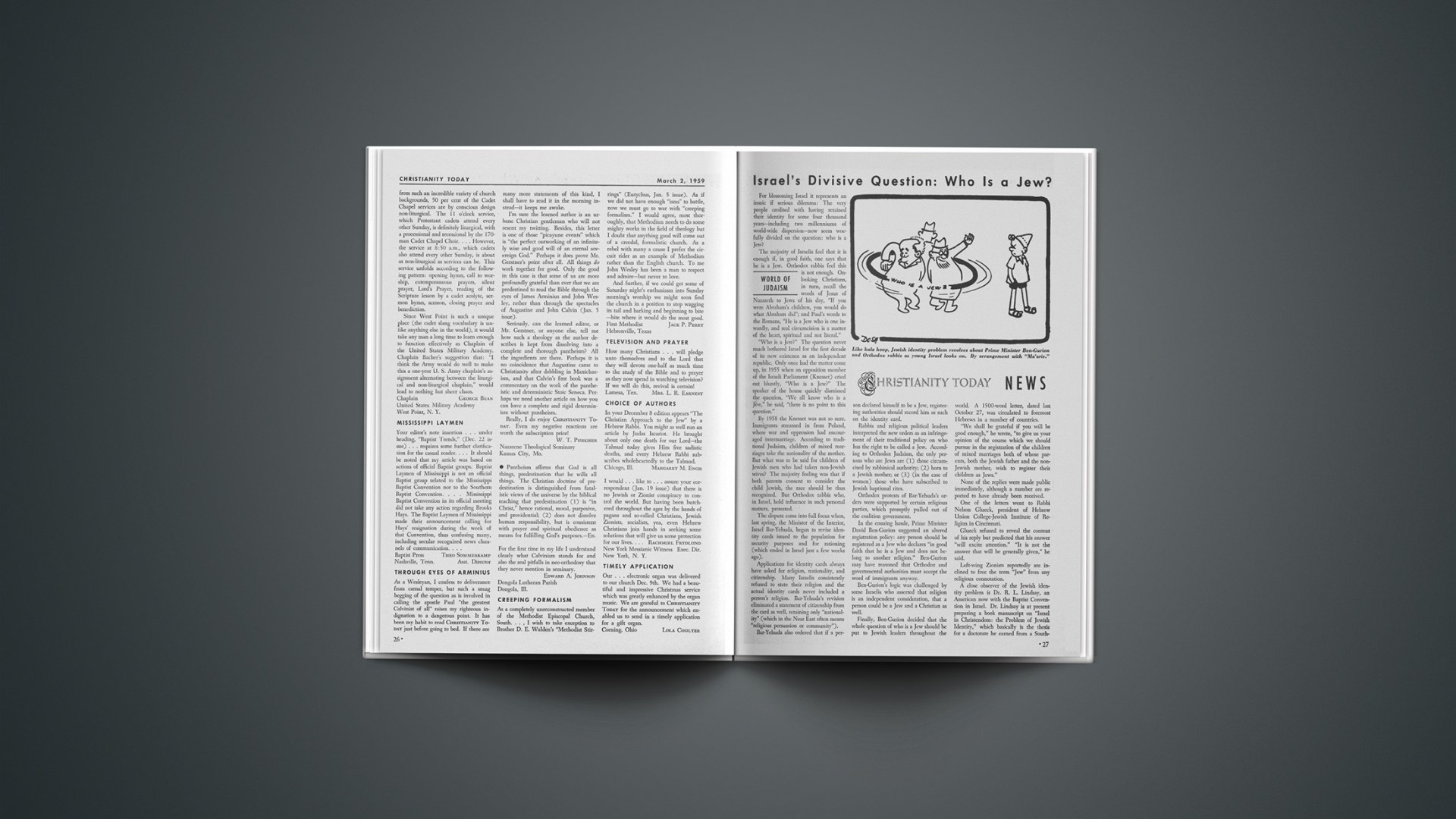
Israel’s Divisive Question: Who Is a Jew?

For blossoming Israel it represents an ironic if serious dilemma: The very people credited with having retained their identity for some four thousand years—including two millenniums of world-wide dispersion—now seem woefully divided on the question: who is a Jew?

World Of Judaism

The majority of Israelis feel that it is enough if, in good faith, one says that he is a Jew. Orthodox rabbis feel this is not enough. Onlooking Christians, in turn, recall the words of Jesus of Nazareth to Jews of his day, “If you were Abraham’s children, you would do what Abraham did”; and Paul’s words to the Romans, “He is a Jew who is one inwardly, and real circumcision is a matter of the heart, spiritual and not literal.”

“Who is a Jew?” The question never much bothered Israel for the first decade of its new existence as an independent republic. Only once had the matter come up, in 1955 when an opposition member of the Israeli Parliament (Knesset) cried out bluntly, “Who is a Jew?” The speaker of the house quickly dismissed the question, “We all know who is a Jew,” he said, “there is no point to this question.”

By 1958 the Knesset was not so sure. Immigrants streamed in from Poland, where war and oppression had encouraged intermarriage. According to traditional Judaism, children of mixed marriages take the nationality of the mother. But what was to be said for children of Jewish men who had taken non-Jewish wives? The majority feeling was that if both parents consent to consider the child Jewish, the race should be thus recognized. But Orthodox rabbis who, in Israel, hold influence in such personal matters, protested.

The dispute came into full focus when, last spring, the Minister of the Interior, Israel Bar-Yehuda, began to revise identity cards issued to the population for security purposes and for rationing (which ended in Israel just a few weeks ago).

Applications for identity cards always have asked for religion, nationality, and citizenship. Many Israelis consistently refused to state their religion and the actual identity cards never included a person’s religion. Bar-Yehuda’s revision eliminated a statement of citizenship from the card as well, retaining only “nationality” (which in the Near East often means “religious persuasion or community”).

Bar-Yehuda also ordered that if a person declared himself to be a Jew, registering authorities should record him as such on the identity card.

Rabbis and religious political leaders interpreted the new orders as an infringement of their traditional policy on who has the right to be called a Jew. According to Orthodox Judaism, the only persons who are Jews are (1) those circumcised by rabbinical authority; (2) born to a Jewish mother; or (3) (in the case of women) those who have subscribed to Jewish baptismal rites.

Orthodox protests of Bar-Yehuda’s orders were supported by certain religious parties, which promptly pulled out of the coalition government.

In the ensuing hassle, Prime Minister David Ben-Gurion suggested an altered registration policy: any person should be registered as a Jew who declares “in good faith that he is a Jew and does not belong to another religion.” Ben-Gurion may have reasoned that Orthodox and governmental authorities must accept the word of immigrants anyway.

Ben-Gurion’s logic was challenged by some Israelis who asserted that religion is an independent consideration, that a person could be a Jew and a Christian as well.

Finally, Ben-Gurion decided that the whole question of who is a Jew should be put to Jewish leaders throughout the world. A 1500-word letter, dated last October 27, was circulated to foremost Hebrews in a number of countries.

“We shall be grateful if you will be good enough,” he wrote, “to give us your opinion of the course which we should pursue in the registration of the children of mixed marriages both of whose parents, both the Jewish father and the non-Jewish mother, wish to register their children as Jews.”

None of the replies were made public immediately, although a number are reported to have already been received.

One of the letters went to Rabbi Nelson Glueck, president of Hebrew Union College-Jewish Institute of Religion in Cincinnati.

Glueck refused to reveal the content of his reply but predicted that his answer “will excite attention.” “It is not the answer that will be generally given,” he said.

Left-wing Zionists reportedly are inclined to free the term “Jew” from any religious connotation.

A close observer of the Jewish identity problem is Dr. R. L. Lindsay, an American now with the Baptist Convention in Israel. Dr. Lindsay is at present preparing a book manuscript on “Israel in Christendom: the Problem of Jewish Identity,” which basically is the thesis for a doctorate he earned from a Southern Baptist seminary five years ago.

“Despite the distinct political coloring the whole subject has taken,” Lindsay says, “the debate doubtless is of major significance to Jewish history. Jews have traditionally been both an ethnic and religious body, a kind of religio-national body which the Jews themselves now find hard to explain.”

‘Advanced’ Religion

A new center of scholarly religious study, under Jewish auspices but interfaith in scope, is planned with the aid of some 20 of the most prominent university professors in the United States.

The new center, to open in the fall of 1960, is being projected as a religious counterpart to the Institute for Advanced Studies in Science at Princeton, New Jersey, “with one very serious difference,” according to Rabbi Nelson Glueck, president of Hebrew Union College—Jewish Institute of Religion.

The difference, said Glueck, is that at the Princeton Institute invited professors can “lock themselves up in their rooms and talk to nobody and see nobody for the years of their stay there.”

“Ours is different,” he explained, “not in the caliber of the professors, but in the fact that the five to 15—eventually—who will be invited for a year or more are supposed to be in constant, regular, seminar communication with each other. There is to be no seclusion.”

The center will be located on the Hebrew Union campus in Cincinnati, but Glueck emphasized that it will be independently operated. It is to be named the Frank L. Weil Institute for Advanced Studies in Religion and the Humanities. Weil was chairman of the board of governors of Hebrew Union until his death about a year ago.

Glueck said the center will be operated under a yearly budget of between $250,000 and $1,000,000, to be acquired in gifts from individuals and possibly foundations.

Professors will be invited “on the basis of competency,” he added, “irrespective of creed, color or what have you … to apply particular disciplines to a central religious problem which has an impact on modern life. What we’re concerned about is the fact that we see this huge world outside of us outstripping our moral behavior.”

Among the approximately 20 members of the center’s board of advisors, including several from Hebrew Union, are Dr. Perry Miller, professor of American literature at Harvard, and Chancellor Harvie Branscomb of Vanderbilt.

Protestant Panorama

• Foreign missions functions of the Congregational Christian Churches and the Evangelical and Reformed Church will be merged into a unified program, according to an announcement made last month at a mid-winter meeting of the Congregationalists in Buck Hill Falls, Pennsylvania. The missions program merger was hailed as a major step in formation of the United Church of Christ.

• Communist authorities in East Berlin are demanding adherence to regulations which have set forth principles and methods in promoting Red rites as substitutes for Christian ceremonies. Church sources say the regulations reveal for the first time in detail the East German regime’s plans to develop Communist ideology into an atheistic “counter church.”

• The Board of National Missions of the United Presbyterian Church in the U. S. A. plans to more than double its urban church renewal program. The board’s annual appropriation for faltering city churches is being raised from $800,000 to $1,800,000.

• A new Catholic directory claims a 10 per cent jump in the number of priests serving England and Wales—from 2,677 in 1956 to 2,964 in 1957.

• After a year and a half absence Auxiliary Bishop Fulton J. Sheen returns to television this month with a new series called the “Life of Christ.”

• The Lutheran Church—Missouri Synod may use a newly purchased 140-acre tract in the Detroit area for establishing an additional college.

• Highlight of the 1959 United Appeal by Church World Service will be the “One Great Hour of Sharing” observance on Sunday, March 8. Special offerings are planned in thousands of churches. American Protestant and Eastern Orthodox churches are being asked to raise $11,250,000 this year for overseas relief and rehabilitation.

• The newly-organized Presbyterian Church in Hawaii held its first services Sunday, February 15. Pending erection of a church building, services are being held in the Honolulu YWCA. The Rev. William E. Phïfer, Jr., formerly of Monrovia, California, and the Rev. Philip Y. Lee, former Congregational pastor in Honolulu, are ministers of the new church.

• Queen Elizabeth, the Queen Mother of England, is expected to be received by Pope John XXIII when she visits Rome next month.

• The Swedish church of Lye on the Island of Gotland in the Baltic Sea recently marked its 900th anniversary, according to the American-Swedish News Exchange.

• The Episcopal Diocese of Michigan will be subdivided into three districts. Plans for the split were announced last month at the 126th annual convention of the diocese. The move follows a reorganization report described as the most thorough study ever made of an Episcopal diocese.

• Miss Darina Bancikova is the first ordained woman to be placed in full charge of a Slovak Lutheran congregation. The church has been ordaining women for several years, but until now their appointments have been limited to assistant pastorates.

• The Metropolitan Dayton (Ohio) YMCA is sponsoring a 15-week “Faith Appreciation Seminar.” Public meetings feature talks by various religious leaders, among them Baptists, Lutherans, Methodists, Greek Orthodox, Mormons, Jews, Quakers, and Unitarians.

• “Forward in the Faith of our Fathers” is the theme of this year’s 75th diamond jubilee anniversary of the Evangelical Free Church.

• A breakfast meeting in Grand Rapids, Michigan, marked the placing of the 40,000,000th portion of Scripture by the Gideons.

• Music for America is sponsoring a spring sacred music tour featuring well-known Gospel artists. April concerts are planned for Denver, Colorado, Des Moines, Iowa, and Lincoln, Nebraska.

Australian Crusade

Billy Graham’s Australian crusade opened before some 10,000 persons packed into the largest stadium in Melbourne February 15. Another 5,000 stood outside in the rain.

Graham, a rare affliction still causing discomfort in his left eye, used John 3:16 for his text for the opening Sunday afternoon meeting. More than 600 responded to his invitation.

Mass Evangelism

The evangelist donned a raincoat and spoke for five minutes to milling throngs which had been turned away from the stadium. Another 100 responded to his plea for decisions for Christ.

The meeting inside had begun early as crowds quickly occupied all available seats once doors were open. Even an annex auditorium, where proceedings were relayed by television, was filled. People waiting to get into the stadium lined up eight deep around an entire block and stretched a half mile away.

Graham’s welcome to Australia was described as overwhelming. Crowds jammed airports at both Melbourne and Sydney, where the evangelist had arrived after a three-week vacation in the Hawaiian Islands. Crowds gathered in streets outside his hotel, singing and cheering.

Graham was officially welcomed by Sir Edmond Herring, lieutenant governor of Victoria. Sharing in the opening program were the Right Rev. N. Faichney, moderator of the Presbyterian Church in Australia, and Dr. A. H. Wood, president general of the Methodist Church.

“Sunday was a deeply moving and deeply impressive commencement to the crusade,” said Dr. Stuart Barton Babbage, noted Australian theologian.

Wood said he was “very deeply impressed. Dr. Graham deserves the full support of all churches.”

The stadium in which the crusade opened had been rebuilt for boxing and wrestling events of the 1956 Olympics. Later, meetings were to be held in the Myer Music Bowl, on which construction workers were putting finishing touches.

Graham said on his arrival in Australia that “I have not come to point a self-righteous finger at the sins of Australia. I have come to preach the message that every clergyman gives from his pulpit every Sunday. The message is the same as it has been for 2,000 years.”

Church support of the crusade was considered unprecedented.

“This crusade has evoked a wider cooperation than anything else in my lifetime,” said Dr. Leon Morris, vice principal of Ridley College, Melbourne. “The worst that can be said is that there are a number of clergy who are standing aloof, and would probably be not sorry if the crusade failed. Against this is the fact that prominent representatives of every major denomination have linked themselves with the crusade.”

The Melbourne meetings were slated to continue for four full weeks, with the closing meeting Sunday, March 15. Following these meetings, Graham and his associates are to visit the island state of Tasmania for two meetings: in Launceston on March 16 and in Hobart on March 17.

Associate evangelists will begin week-long crusades in the three principal cities of New Zealand and Graham is scheduled to speak at two concluding services at each place. The New Zealand schedule includes the Rev. Grady Wilson as the evangelist in Auckland from March 20 to April 4; the Rev. Leighton Ford in Wellington from March 30 to April 6 and the Rev. Joseph Blinco in Christchurch from April 1 to 8. Graham will speak in Auckland on April 3 and 4, in Wellington on April 5 and 6, and in Christchurch on April 7 and 8.

The Sydney crusade will begin Sunday, April 12, and is to run four or five weeks.

Associate evangelists also plan to conduct meetings in other cities of Australia, beginning in Brisbane, where Ford will be speaking from May 17 to 31. Blinco will conduct the crusade in Adelaide from May 21 to June 4 and Wilson will be in Perth from May 30 until June 7. Graham himself will address meetings in Brisbane on May 29, 30, and 31; in Adelaide on June 2, 3, and 4 and in Perth on June 6 and 7.

Wcc Executives At Geneva

The Executive Committee of the World Council of Churches, meeting in Geneva last month, voted to withhold formal comment for the time being on the Vatican’s announced intention of calling an ecumenical council.

The committee nevertheless appointed a small group to keep it posted on “implications and developments” in connection with the proposed Roman Catholic gathering, to take place in Rome in 1961.

In the committee’s judgment, the lack of sufficient information about the ecumenical council made it impossible to make any specific statement at the present time.

The members, meanwhile, voiced general approval of a statement regarding the planned Catholic assembly issued by Dr. W. A. Visser ’t Hooft, general secretary of the WCC.

Ecumenical Movement

“Much depends,” said Visser ’t Hooft, “on the manner in which the council is called and the spirit in which the question of Christian unity is approached. The question is, how ecumenical will the council be in composition and spirit.”

The announced view of the Executive Committee was that the experience of the ecumenical movement as expressed by the WCC indicates that “progress towards unity is made when churches meet together on the basis of mutual respect with full commitment on the part of each church to the truth of the Gospel, to charity, and to a faithful interpretation of its deepest convictions.”

Actual cooperation among churches in service, in working for “a responsible society” and a durable peace, and in theological discussions were listed as “fruitful first steps” to inter-church relations. Efforts to secure religious liberty for “all people in every land” were also named.

WCC officials still are interested in setting up a formal link with Orthodox churches in Russia. They say they have received no word of reply after talks last summer, but they are hoping for a representative of the Moscow Patriarchate to be present at the next Central Committee meeting.

A Vatican Radio broadcaster indicated last month that Protestants would not be invited to take part in Rome’s coming council, but that talks with Protestants might be sought in connection with it.

Dr. Herbert S. Mekeel, president of the National Association of Evangelicals, said favorable attitude of liberal Protestants toward Protestant-Catholic cooperation ignores “mighty gains of the Reformation and, thus, fails the great Protestant public.”

Motion Pictures

Contrasting Roles

Last November, Washington’s Playhouse sponsored a two-week run of “The Mark of the Hawk.” The 80 minute color film produced for release in commercial theaters represented an effort by the pre-merger Presbyterian Church in the U. S. A. to create public interest in Christian missions. Actress Eartha Kitt played a lead role. (CHRISTIANITY TODAY reviewed “The Mark of the Hawk” in its July 7, 1958 issue.)

Three months later, Miss Kitt was back on the Playhouse screen in a different picture. This time she played the role of a prostitute in United Artists’ “Anna Lucasta.”

After Luther, Pius

The late Pope Pius XII will appear on movie screens across North America this month in the first dramatic feature film ever made showing extensive scenes of the Vatican. The film, titled “Embezzled Heaven,” was completed shortly before his death. Produced by Rhombus Productions in Vienna and Rome, the full-length color picture is scheduled for Easter release by Louis de Rochemont Associates, which in 1952 made the film “Martin Luther” for Lutheran Church Productions.

Christian Witness

Motivating Men

A new national men’s organization, Christian Men, Inc., has been formed in Corpus Christi, Texas, to “conduct attitude and opinion studies and encourage Christian witnessing.”

Howard Butt, Jr., vice president of a grocery chain and noted lay evangelist, is president. Leonard L. Holloway, public relations director for the Baptist General Convention of Texas for the past six years, is executive secretary.

The group will sponsor motivation studies, prepare and distribute literature for business and professional leaders, conduct Christian influence workshops, schedule laymen-led crusades and coordinate activities with other men’s groups.

The Bible Vs. Communism

Has distribution of Communist literature outstripped the Bible? The American Bible Society, after a study, thinks not. The society estimates the Bible publishers around the world have turned out at least 1,500,000,000 Bibles since 1917. The society says its investigation shows that publication of Communist literature fell short of Scripture publication total for the same period.

Theological Education

Alumni Protest

Loss of accreditation in the American Association of Theological Schools by Temple University School of Theology was branded an “arbitrary” move by leaders of the interdenominational seminary’s alumni organization last month. The group denounced the AATS accrediting commission for failing to give a bill of particulars with its action.

Special Report

There is reason to believe that Martin Luther would be pleased with the good works of American Lutherans, who since 1939 have contributed more than 147 million dollars for spiritual and physical relief the world over. But what the Reformer would designate as a basis for inter-Lutheran cooperation and organization is at present subject to debate among his American progeny. This was pointed up in Milwaukee’s Astor Hotel where the National Lutheran Council gathered February 3–6 for its 41st annual meeting—the first to be convened in the Badger State where Lutherans constitute almost two-thirds of all Protestants.

Organized during World War I as a cooperative agency to further U. S. Lutheran interests, the NLC’s domestic program includes the fields of social welfare, student work on college campuses, immigration services, public relations, research and statistics, radio and television, home missions planning, and service to military personnel. Overseas activities embrace foreign missions cooperation, material relief, refugee resettlement, and “theological cooperation.” Many of the programs abroad are channeled through the Lutheran World Federation, membership of which includes 50 million of the world’s 70 million Lutherans.

The NLC is made up of eight church bodies with constituencies totaling five million members—about two-thirds of American Lutheranism. Three of the groups—The Evangelical, American, and United Evangelical Lutheran churches—will unite in 1960, to form The American Lutheran Church, known already as TALC. The Lutheran Free Church voted to remain outside this union but may join later. Another planned merger may be realized by NLC’s four remaining members—the United, Augustana, American Evangelical, and Finnish Evangelical (Suomi Synod) Lutheran churches. The latter grouping is considered by many to be the more liberal theologically although some Protestants would equate it with rank conservatism, the general position of Lutheranism in the American theological spectrum being as it is.

Though the number of Lutheran bodies once hovered around 200, due to mergers it is now reduced to 16. NLC’s most obvious omission is the large, robust and theologically-conservative Lutheran Church-Missouri Synod (2,228,000 members), an omission which was dramatized the first day of the conference. Though the Missouri Synod cooperates in several phases of the NLC program, notably, in world relief, refugee aid and service to armed forces members, she had been approached further about possible membership in the NLC and the Lutheran World Federation—during “this time” of “remoulding” of Lutheran “organizational life.” Missouri Synod President J. W. Behnken’s negative reply, read aloud for “its importance,” affirmed the vital importance of doctrinal agreement to organization unity and pointed to “a state of flux” in the doctrinal positions involved in the aforementioned NLC mergers. He also spoke of the efforts of the Synodical Conference—comprising the Wisconsin Synod, Slovak Church, and Norwegian Synod along with Missouri Synod—“toward greater Scriptural harmony in doctrine and practice.” Relations between the Wisconsin and Missouri synods have only recently improved after a period of strain. The former is said to be even more firmly committed against membership in NLC than the latter, which differentiates between cooperation in spiritual areas and in “physical” matters such as relief contributions.

Upon hearing the Missouri reply, councillors (there were 37, including 12 laymen and two women) looked at one another with exasperated smiles. An NLC rejoinder expressed the regret, which was obviously felt, and hopes for future conversations, though the Council would now proceed with its own reorganization in view of pending mergers.

At a dinner celebrating NLC’s 40th anniversary, efficient and effervescent Franklin Clark Fry, called American Lutheranism’s most influential figure, saw the 40 years as a reproach to NLC for not having become one church body. Dr. Carl E. Lund-Quist, executive secretary of the Lutheran World Federation, praised the Council for “encouraging Lutheran churches to participate in the ecumenical movement.”

NLC meetings deal largely with routine matters and produce relatively little debate. Most councillors know by now the points of agreement and difference among the various bodies, and they are restricted in action by certain guidelines of competence laid down by the churches.

But lively debate did accompany approval of a document called “Toward a Statement of National Policy,” though its form was questioned more than its content. Aimed at the American citizen for discussion, it called for advancement of the “international interest” and the sharing of American resources as expressions of “love and justice.” More adequate international organization was advocated, though total commitment to the U. N. for “international equilibrium” was lacking.

The Council also: endorsed plans of Lutheran Film Associates for a sequel to “Martin Luther” on the church’s struggle behind the Iron Curtain; heard of effective Lutheran action to halt army camp adoption of patron saints.

Dr. F. Eppling Reinartz, retiring president of NLC (his successor: the Rev. Norman A. Menter of the American Lutheran Church), hailed as genuinely important the unanimous adoption of a plan for closer cooperation with other Protestants in placement of new churches, with safeguards for each denomination’s right of final decision.

Historic Lutheran “apartness” in America has been due partially to language and liturgical distinctions and in part to desire for maintaining the purity of the Lutheran confessional heritage. Only three of the eight NLC bodies belong to the National Council of Churches—five to the World Council.

Evangelicals see hope for a strong conservative witness by Lutherans to American Protestantism, looking for Lutheran insight to distinguish between an end to isolation and an accommodation to the theological dilutions of much of modern Protestantism—which would mean the exchange of a marvelous Reformation heritage for something less than pottage.

And with more than 86 million dollars reported spent last year by all Lutheran health and welfare agencies in America, the burden of proof was still on Luther’s opponents to show that the doctrine of justification solely by faith militated against good works.

F. F.

Hispanic Countries

Martyrs Of 1959

Protestants in Colombia have suffered long and hard at the hands of intolerant Roman Catholics. Missionaries now report a new wave of violent persecution which began with the loss of three lives.

On a coffee plantation near San Vicente the Rev. Luis Ignacio Rovira, 24, led a small congregation in song. “How many of you are ready to die for Jesus?” he asked. “I am ready to die for Jesus, even if it is tonight.”

That was January 24. After the service Rovira and his Christian friends were sitting on a porch when shots rang out of the darkness. As the believers scattered they heard one of the attackers cry, “We are going to do away with these Protestants.”

After spending the night in nearby caves and fields, the Christians returned to find Rovira dead. A four-year-old boy also died from gunshot wounds. Two other persons were injured. A missionary counted 150 bullet holes in the walls.

Several days before, a mob had broken up a Protestant funeral service in San Vicente and had stolen the body.

Another report from southern Colombia told of a young Indian Christian being clubbed to death while witnessing to a group of Roman Catholics.

Prayer For Spain

Christians the world over are being urged to set aside March 15 as a day of prayer for Spain, where Roman Catholic influence is subjecting Protestants to many kinds of persecution.

The call to prayer was issued by the Washington office of public affairs of the National Association of Evangelicals, which charges that 20 Spanish Protestant churches were closed in 1957 and another six in 1958. Moreover, many young people in Spain have found it virtually impossible to secure marriage licenses, according to an NAE statement.

Late Winter Walk

Winter had come early to Washington and by February the cold seemed to have been spent. What frosty air was left made for an invigorating walk between agencies where developments significant to the Christian conscience broke frequently.

In the House, a resolution calling for “immediate establishment of diplomatic relations with the Vatican through appointment of a United States envoy” was introduced by Democratic Representative Victor L. Anfuso, a Roman Catholic from Brooklyn, New York.

A few days later, Senator John F. Kennedy, also a Roman Catholic, was quoted in Look magazine as being against appointment of an ambassador to the Vatican. Kennedy announced himself in favor of continued separation of church and state. He said, moreover, that he was “opposed to the Federal government’s extending support to sustain any church or its schools.”

“As for such fringe matters as buses, lunches and other services, the issue is primarily social and economic and not religious,” he said. “Each case must be judged on its merits.…”

Nation’S Capital

Many churchmen looked to the U. S. capital with new concern as the Eisenhower administration announced a legislative bid to guarantee loans for construction of educational buildings. One observer, worried about the bill’s church-state implications, said it appeared to have “as many mouse traps as a granary.”

A large number of church-related colleges, Bible schools and seminaries already are in line for help from the government-sponsored student loan fund established under the National Defense Act of 1958.

Other bills introduced in Congress would exempt clergymen from revealing in Federal court communications made to them as ministers; increase from five to ten per cent allowable corporation tax deductions for charitable gifts; legalize mailing of church bingo advertising; make it a federal offense to cross a state line to avoid prosecution for destruction of educational or religious structures; strengthen a District of Columbia law against pornography; and authorize government subsidies for transportation of Washington school children.

And, in the Senate, appropriations were doubled for a special subcommittee studying juvenile delinquency. In the House, resolutions were urged to call on the United Nations to open sessions with specific prayer and to designate February 3 of each year as “Chaplains’ Day.”

The Supreme Court rejected appeals from three Jehovah’s Witnesses who claimed that draft calls violated their freedom of religion.

Interest in governmental affairs prompted 250 denominational representatives to gather for a “Churchmen’s Washington Seminar” sponsored by the National Council of Churches. Methodists, in turn, were thinking about setting up a “legislative office for social issues” in Washington while Protestants and Other Americans United for Separation of Church and State drew 1200 registrants to a St. Louis conclave.

Mobilizing opinion on social issues, the American Society on Christian Social Ethics was founded January 30–31 in Washington by 50 teachers, mostly at the seminary level. After meeting ten years as a small informal study group (Dean Liston Pope of Yale was one of the founders), the movement emerged from “the baling-wire stages of improvization” to become a national society. Dr. Henry Kolbe of Garrett Biblical Institute was named first president.

Two Panels Featured

The organizing convention mirrored an already established slant of interests. Dr. Das Kelley Barnett of Episcopal Theological Seminary of the Southwest in Austin, Texas, who had acted as the group’s president pro tem, indicated that the Hazen Foundation, long a subsidizer of religious books on economic themes, had supplied funds toward travel expenses of those attending, and that the American Association of Theological Schools had secured $3,000 to assure the new movement’s vigorous start.

Two panels featured the Washington program, one on economics, the other on race relations. Both left theological concerns far in the background.

A panel on “A Christian Ethics for an Affluent Society” censured John Kenneth Galbraith’s The Affluent Society. With Dr. Douglas E. Jackson of Perkins School of Theology, Southern Methodist University, as chairman, panelists were Dr. John C. Bennett of Union Theological Seminary, New York; Leon Keyserling, chairman of President Truman’s Council of Economic Advisors; and Robert B. Wright, chief of the Economic Defense Division, U. S. Office of International Resources.

Charge of Inadequacy

Bennett held that Galbraith’s work inadequately depicts U. S. responsibility as a rich nation in a world of poverty, and also ignores areas of poverty still existing in the U. S. Although he said he had “long left behind the confident, dogmatic socialism of 20 years ago,” Bennett nonetheless urged expanded state activities in housing, schools, health and transportation.

Keyserling protested Galbraith’s “plague on both your houses,” that is, the economic left and right. He urged full production, full employment, higher unemployment benefits, and shared Bennett’s criticism of the “traditional economist” who makes “the demand for his goods” the criterion of “the limits of production.” But whereas Bennett conceded that full employment may lead to cheap products and to work lacking in meaning, and spoke of it rather as “a necessary evil,” Keyserling—frequently thundering the words “moral” and “immoral”—saw nothing evil about it. “If unemployment is the best way to fight inflation, it would still be evil to avoid full employment,” he contended.

Wright Backs Keyserling

Wright said that needy foreign nations must get help either from the Soviet bloc or from the United States. American society, he added—agreeing with Keyserling—is “not affluent” (Webster: affluent: adjective, “wealthy; abounding in goods or riches”; noun, “a stream or river flowing into a larger river or into a lake”). Russia has given many nations economic aid, technicians, and trade. In contrast with other lands, poverty in America is the exception, not the rule.

Wright rather ineffectively met criticisms of American foreign policy. But his reference to Communist “slave states” drew a protest from Professor John Howes of Wesley Theological Seminary, the host campus. Several participants concurred with Howes, until Professor Edmund Smits of Luther Theological Seminary, St. Paul, related his forced imprisonment and brainwashing by Communists in Latvia. “There are injustices on both sides,” he said, “but we must see the qualitative difference—two positions on human rights, two ways of life—and not close our eyes to an order that tends to annihilate the Church.”

A New But Indefinable Order

Panel and audience seemed to assume that Christian ethics requires an economic levelling of society. Mr. Keyserling emphasized that “any kind of inequality is indefensible”; “the only pure morality gives everyone the same thing.” This prompted a question by Editor Carl F. H. Henry of CHRISTIANITY TODAY: “Do the members of the panel hold that it is sinful or immoral for one person to have less than another; where is a just line to be drawn objectively in terms of an ideal ‘more’ and ‘less’ by what dynamism is such a balancing to be achieved?”

Mr. Wright dismissed the question as outside his specialization. Dr. Bennett, long a free enterprise critic and advocate of expanding state activity, implied that inequalities are sinful, but adduced no fixed line of justice and, rather curiously, appealed to spiritual rather than legal solutions. “There is a burden of proof on all who have more, which gives them an advantage over others. Is this a right? We must promote self-judgment. There is no objective norm, but a regulative principle, a progressive judgment upon all who have this advantage over others. We must rely on pressure of conscience; it is quite impossible to advocate equality through laws of regimentation.” Mr. Keyserling defended absolute equality, but said “This system in the American economy would be unworkable; it would reduce production and give each person less than now.”

What Is Alternative?

Professor Don Smucker of Bethany Biblical Seminary, Chicago, then asked Dr. Bennett for a fixed statement of position. “Fifty years ago the alternatives in economic debate were materialistic capitalism and simple socialism. Today’s discussion assumes a ‘pluralistic mixed economy.’ Precisely what is this alternative?”

Dr. Bennett declared “the old dichotomy no longer relevant. One important development in Christian ethics since the World Council assembly in Amsterdam is the renunciation of both Christian capitalism and Christian socialism. But one wing in the United States would absolutize capitalism. We must get rid of the identification of Christianity with any absolute or system.”

Asked whether he has “any vocabulary” to describe the new alternative, Bennett demurred: “Any vocabulary gets outmoded very quickly.” He heaped abuse, however, on defendants of capitalism, as reactionaries motivated by vested interest.

Although Bennett refused to distinguish his “third way” from socialism, his revolt against free enterprise distinctives was apparent. Social discussion among participants was clearly sympathetic to a pluralistic economy in which free enterprise policies are progressively narrowed through state controls. Only here and there could one detect an open doubt. But at the dinner table talk one delegate thought it strange that Dr. Bennett’s Union Theological Seminary should cling so fast to its wealthy endowments and properties, and that Christian ethics professors should mobilize their criticisms of a free economy in comfortable new divinity quarters made possible by a million dollar gift from the Kresge Foundation.

C. F. H. H.

Eutychus and His Kin: March 2, 1959

LIKE IT MEANS NOTHING

No Beatniks have yet appeared in our split-level community. We read about them, though, with morbid fascination. According to Time (February 9) this cult of the beat generation is now the rage of the literary upper crust.

The studied dishevelment in dress and speech which appears to be the rigid norm of Beatnik conformity will no doubt furnish another high school fad. In fact, samples of beat babble suggest that its incoherence is an aggravated form of prevailing adolescent jargon. Some statements are a little ponderous for a high school senior to bring off: “Fried shoes. Like it means nothing. It’s all a big laughing bowl and we’re caught in it.” Those shoes are presumably French fried in the existentialist manner. But the “crazy like a daisy” phrase, and the “drag-creep” vocabulary are standard speech at the American secondary level.

I therefore shudder to note the publicity given a leading Beatnik who has never combed his hair. After the duck-tail and the flat-top, the beat-mop!

Beatnik exhibitionism may be juvenile as well as delinquent, but its very superficiality makes it a thin disguise of real demoralization. The bleary irrelevance of Beatnik verse is more significant, and more human, than the sharp lyrics of a TV commercial. Awareness of despair can be the first step toward the kingdom.

But compassion for sinners lost in despair does not require wearing their fried shoes. I observe with shame that, although my hair is combed, my desk is sheer Beatnik. Disorder and despair go together in the disruption of sin. God is not a God of confusion, but of peace; in the church of Christ all things must be done decently and in order.

The glory of the new order in Christ is that it is an order of the Spirit. Beatnik slovenliness is an understandable reaction to the inhuman precision of secularized science, but both lack the joy of the Holy Spirit. God’s order is not mechanistic, nor is His freedom chaotic.

We are called to walk in the Spirit where joy casts out despair and replaces sloppy living and loose thinking with sobriety, theology, and worship!

RACE TENSIONS

In your latest fence-straddling treatise on the race question, “Race Tensions and Social Change” (Jan. 19 issue), which is chiefly a pro-integrationist article, you flatly contradict the Scripture from my letterhead which you quote: “He (God) hath driven asunder the nations (the Bible word for race is always “nation”). His ways are everlasting” Hab. 3:6. Then you say: “By creation—we are told in segregationist propaganda—God made the black, yellow, red, brown and white man, thus intending and designating their perpetual segregation.” Pray tell me, by what argument from either Scripture or reason can you prove that God has ever intended for these races to be merged—especially after having just quoted one of the many Scriptures which say that he intends for them to stay apart?

I also resent your comparing me in that article with the advocates of slavery who sought a biblical justification for their views. We segregationists do not believe what you and the N.A.A.C.P. teach or imply—that the Negroes are still being enslaved and will continue to be until they are given full social equality (which of course includes marriage equality). But we do believe what God’s Word teaches, that the Lord himself assigned the Canaanites, the servile division of the Hamitic, or Negro race a place of servitude, not slavery (cf. Gen. 9 and Josh. 9). And woe be to any white man who tries to take the Negroes out of the place where God put them.…

You also say in your recent article that the charge that “integration is Communist-inspired” is a “slander.” Race-mixing is itself godless communism and … our present racial trouble in this country is largely the result of a plot that was hatched in Moscow 31 years ago.

Dallas Church Chapter

White Citizens’ Council of America

Dallas, Tex.

While I do not have time at the moment to comment in detail on your editorial “Race Tensions and Social Change,” I do want you to know that I liked it and think you are to be strongly commended for taking a stand for Christian moderation in this difficult area of human relations.

Austin, Tex.

POLISH AND POWER

The article by a fellow alumnus, Carlos Greenleaf Fuller, on “How to Preach with Power” (Jan. 5 issue) was very helpful. It reminded me that polish is not enough.… And yet … why must we undercut the importance of polish when we argue for power? Must truth compete against beauty? I am told that some Barthians glory in small crowds at church because it is a sign of preaching with power in truth! To preach with power should not even imply that we ought to be sloppy.

First Methodist Church

Loomis, Calif.

PLACE OF THE PULPIT

My disappointing experience of the past few years as a hearer rather than a preacher, leads me to conclude that one of our greatest needs today is a revival of fervent, inspirational preaching.

With the modern emphasis on counseling, psychiatry, and religious education, the art and power of preaching is losing out. Not denying the value of personal work, and the need of study and instruction in the same, it still holds true that the pulpit is the center of the life of the Church, or should be.

No matter how we build additions to our edifices for the purpose of Christian education, the people need to hear the Word of God proclaimed and expounded from the pulpit, and the fact remains that the only way the majority of adults can know the truth about themselves and God, the only way they can receive the light and power of the Gospel, is by preaching in the Church.

Athol, Mass.

THEY DON’T WANT HIM

Recently the Roman Catholics have selected a man who is about 77 years of age to be … pope. This man will reign over 500,000,000 people with a power and influence no king on earth has or ever will have unless it’s the antichrist when he comes. On the other hand I question if you can find a Protestant church in America that would call a pastor if he is much past 50 years of age, even though that church may have only 150 members. I figure if a man can’t preach better at 70 than he could at 30, … he never should have preached at all. Why do we waste man power like this?… It looks like when the minister has lost his sex appeal they don’t want him.

Huntington Beach, Calif.

INDISCRIMINATE AGAPE

I am thankful for the review of my book Christ and the Christian in CHRISTIANITY TODAY (Jan. 5 issue). Your review helps break down barriers and demonstrates the Christian spirit.… Fundamental to Christ and the Christian is the contention that we must start with Christ himself, not with personal experience, nor with the Bible, nor with history, but with the Bible interpreted through Christ, with experience judged and interpreted by Christ, and with Christian history insofar as it is fulfilled and receives its standard from Christ. I have tried to give Christology positive interpretation at its center: the fullness of God in the fullness of man in the fullness of time. Edmund Schlink has said that my position stands halfway between a dynamic monarchianism and a dynamic adoptionism. I believe that halfway point is the Godman who can be interpreted only as the true presence and power of God in Jesus Christ, and as the true man, both by development and fulfillment. I have been inspired and am constantly thankful to God for the vision of how Christ, interpreted at the very center of the Christian affirmation, gives meaning to life, judges our sins, and offers us fullness of salvation.

The reviewer does not give my several pages of definition of Agape that start with the God of the Old Testament and the God of the New Testament, the living God who is Creator and Lord and whose judgment is at the center of human experience and history. Agape is unconditional concern and universal concern, but the holiness of God must, under no circumstances, be compromised the slightest bit. God is completely holy because he is completely Agape. Agape is to be seen in the Cross and the Resurrection.

Never have I rejected a doctrine of hell. My contention is that hell eternally is inconsistent with the final and full victory of God. The reviewer also complains that I cannot do justice to the problem of evil. Everything that I do and think springs out of my conviction that in Christ and his cross we have the central approach to the problem of evil. Only there can there be both an understanding of evil and an overcoming of it.

I am genuinely happy for the review in CHRISTIANITY TODAY because I want to gather all people who believe at the depths of their lives and commitments in the God who came in Christ, the living, personal God who answers prayer. Our day, and all days, are too dangerous for quibbling about minor issues. The main affirmation must join us together. God was in Christ reconciling the world unto himself.

Andover Newton Theological School

Newton Centre, Mass.

Re Dr. Ferré’s letter: It is true that I did not quote the several pages in which Dr. Ferré describes Agape. I tried to select the main unambiguous statement, viz. that Agape is indiscriminate kindness to all. This implies universalism and is inconsistent with the existence of hell.

Dr. Ferré says that he has never rejected a doctrine of hell. He has, however, rejected the doctrine of hell; for hell in all orthodox forms of Christianity continues forever.

What he calls hell is not the biblical doctrine of hell; what he calls Agape is not the particularizing love of God that is the good news of the Bible; and the Jesus whose ego is not the second person of the Trinity is not the Jesus of the Gospels (who was born of a virgin).

I grant that the review was too brief, though longer than CHRISTIANITY TODAY asked.

Butler University

Indianapolis, Indiana

ADVICE FOR ANGLERS

Pastor Max A. Greene (News, Jan. 5 issue) ought to remember that fishermen do their best work right at the water’s edge, without the frustration of bargaining to get the fish to leave their environment and attend church. That will naturally come later.

Deeper Life Publications

Warrenville, Ill.

CHAPEL AT WEST POINT

There is … a fundamental misstatement of fact involved in Chaplain Jack R. Bacher’s letter (Jan. 5 issue).

Chaplain Bacher asserts that “the only type of service these men learn to worship under is the ‘liturgical’ service.” If Chaplain Bacher had been to West Point or spoken to a graduate of West Point within the last five years, he would have known that this statement is untrue. Because cadets at West Point come from such an incredible variety of church backgrounds, 50 per cent of the Cadet Chapel services are by conscious design non-liturgical. The 11 o’clock service, which Protestant cadets attend every other Sunday, is definitely liturgical, with a processional and recessional by the 170-man Cadet Chapel Choir.… However, the service at 8:50 a.m., which cadets also attend every other Sunday, is about as non-liturgical as services can be. This service unfolds according to the following pattern: opening hymn, call to worship, extemporaneous prayers, silent prayer, Lord’s Prayer, reading of the Scripture lesson by a cadet acolyte, sermon hymn, sermon, closing prayer and benediction.

Since West Point is such a unique place (the cadet slang vocabulary is unlike anything else in the world), it would take any man a long time to learn enough to function effectively as Chaplain of the United States Military Academy. Chaplain Bacher’s suggestion that: “I think the Army would do well to make this a one-year U. S. Army chaplain’s assignment alternating between the liturgical and non-liturgical chaplain,” would lead to nothing but sheer chaos.

Chaplain

United States Military Academy

West Point, N. Y.

MISSISSIPPI LAYMEN

Your editor’s note insertion … under heading, “Baptist Trends,” (Dec. 22 issue) … requires some further clarification for the casual reader.… It should be noted that my article was based on actions of official Baptist groups. Baptist Laymen of Mississippi is not an official Baptist group related to the Mississippi Baptist Convention nor to the Southern Baptist Convention.… Mississippi Baptist Convention in its official meeting did not take any action regarding Brooks Hays. The Baptist Laymen of Mississippi made their announcement calling for Hays’ resignation during the week of that Convention, thus confusing many, including secular recognized news channels of communication.…

Asst. Director

Baptist Press

Nashville, Tenn.

THROUGH EYES OF ARMINIUS

As a Wesleyan, I confess to deliverance from carnal temper, but such a smug begging of the question as is involved in calling the apostle Paul “the greatest Calvinist of all” raises my righteous indignation to a dangerous point. It has been my habit to read CHRISTIANITY TODAY just before going to bed. If there are many more statements of this kind, I shall have to read it in the morning instead—it keeps me awake.

I’m sure the learned author is an urbane Christian gentleman who will not resent my twitting. Besides, this letter is one of those “picayune events” which is “the perfect outworking of an infinitely wise and good will of an eternal sovereign God.” Perhaps it does prove Mr. Gerstner’s point after all. All things do work together for good. Only the good in this case is that some of us are more profoundly grateful than ever that we are predestined to read the Bible through the eyes of James Arminius and John Wesley, rather than through the spectacles of Augustine and John Calvin (Jan. 5 issue).

Seriously, can the learned editor, or Mr. Gerstner, or anyone else, tell me how such a theology as the author describes is kept from dissolving into a complete and thorough pantheism? All the ingredients are there. Perhaps it is no coincidence that Augustine came to Christianity after dabbling in Manichaeism, and that Calvin’s first book was a commentary on the work of the pantheistic and deterministic Stoic Seneca. Perhaps we need another article on how you can have a complete and rigid determinism without pantheism.

Really, I do enjoy CHRISTIANITY TODAY. Even my negative reactions are worth the subscription price!

Nazarene Theological Seminary

Kansas City, Mo.

• Pantheism affirms that God is all things, predestination that he wills all things. The Christian doctrine of predestination is distinguished from fatalistic views of the universe by the biblical teaching that predestination (1) is “in Christ,” hence rational, moral, purposive, and providential; (2) does not dissolve human responsibility, but is consistent with prayer and spiritual obedience as means for fulfilling God’s purposes.—ED.

For the first time in my life I understand clearly what Calvinism stands for and also the real pitfalls in neo-orthodoxy that they never mention in seminary.

Dongola Lutheran Parish

Dongola, Ill.

CREEPING FORMALISM

As a completely unreconstructed member of the Methodist Episcopal Church, South …, I wish to take exception to Brother D. E. Walden’s “Methodist Stirrings” (Eutychus, Jan. 5 issue). As if we did not have enough “isms” to battle, now we must go to war with “creeping formalism.” I would agree, most thoroughly, that Methodism needs to do some mighty works in the field of theology but I doubt that anything good will come out of a creedal, formalistic church. As a rebel with many a cause I prefer the circuit rider as an example of Methodism rather than the English church. To me John Wesley has been a man to respect and admire—but never to love.

And further, if we could get some of Saturday night’s enthusiasm into Sunday morning’s worship we might soon find the church in a position to stop wagging its tail and barking and beginning to bite—bite where it would do the most good.

First Methodist

Hebronville, Texas

TELEVISION AND PRAYER

How many Christians … will pledge unto themselves and to the Lord that they will devote one-half as much time to the study of the Bible and to prayer as they now spend in watching television? If we will do this, revival is certain!

Lamesa, Tex.

CHOICE OF AUTHORS

In your December 8 edition appears “The Christian Approach to the Jew” by a Hebrew Rabbi. You might as well run an article by Judas Iscariot. He brought about only one death for our Lord—the Talmud today gives Him five sadistic deaths, and every Hebrew Rabbi subscribes wholeheartedly to the Talmud.

Chicago, Ill.

I would … like to … assure your correspondent (Jan. 19 issue) that there is no Jewish or Zionist conspiracy to control the world. But having been butchered throughout the ages by the hands of pagans and so-called Christians, Jewish Zionists, socialists, yea, even Hebrew Christians join hands in seeking some solutions that will give us some protection for our lives.…

Exec. Dir.

New York Messianic Witness

New York, N. Y.

TIMELY APPLICATION

Our … electronic organ was delivered to our church Dec. 9th. We had a beautiful and impressive Christmas service which was greatly enhanced by the organ music. We are grateful to CHRISTIANITY TODAY for the announcement which enabled us to send in a timely application for a gift organ.

Corning, Ohio

Ideas

Have We Passed the Summit?

Although no Christian is able absolutely to analyse the whole course of events, nevertheless even the most casual student of human affairs is forced by the drama of one age succeeding another in man’s story to conclude that there is a rhythm to history. This is not the cyclical interpretation of history ridiculed centuries ago by Augustine of Hippo, but rather what one might call a historical undulation. History seems at times to reach a high point from which it descends rapidly or slowly to its nadir and thence again it rises to another high point. What some might term the “high point” someone else might term a low point. But that divisions or ages appear in man’s story most would accept, and it would seem that the processes through which each age goes are similar enough to suggest parallels between them.

If this be the case, the natural question which arises is: where do we stand in our own age? We in our day are probably witnessing some of the most important events which man has seen in his whole history. What is their significance? What do they indicate concerning our place in history? If we are to understand our own age and day it is important that we should make an attempt to grasp the significance of the point of time in which we stand.

To resolve this mystery, or at least to attempt a resolution of it, about our only resource is to turn back the pages of history to see if there are any historical parallels to our own day. In doing this, however, a personal, subjective element always enters in which, coupled with superficiality in our judgment, may well lead us astray. An adequate delineation, covering every avenue of approach, would require a multi-volume work similar to Toynbee’s Study of History. Space and knowledge limit our comments to two or three examples in an endeavor to interpret the historical position of our own day and age: one biblical, the period ending at the Tower of Babel; one ancient, reaching its climax in the Roman Empire; and the Renaissance which closed the Middle Ages.

When mention was made above of the “high point” of an age, it was thought of primarily in cultural terms. That is, the high point is a time when an historical culture reaches its climax technically and sociologically. The man of the age has both reached a point of mechanical proficiency, particularly in building techniques, never before attained by his predecessors, and has also organized his social and political relationships in such a way that society has gained greater efficiency in the distribution of the benefits of the material advance. Along with this we usually find a considerable increase in human assurance, confidence and anticipation of the glories of the days to come. In general, these seem to be the characteristics of an age’s climax.

At the same time, however, each age seems to have been characterized by fundamental spiritual weakness. Whether one talks in terms of Genesis, of imperial Rome, or of the Renaissance, there was relatively little humility in the presence of God. Rather, the characteristic point of view seems to have been that of self-confident rationalism and aggressive materialism which produced a breakdown of individual and social ethics. Concomitantly we see a deep underlying sense of insecurity which belied the apparent self-assertiveness, and which forced men to seek their security in a multitude of gods which were projections of themselves.

As one looks at this state of affairs at the time of a cultural peak, one naturally wishes to know how a civilization comes to this position. It would seem, generally speaking, that at the beginning of an age when the material and societal conditions are difficult, men are deeply conscious of their relationship to God. The sense of God, as Calvin calls it, is very strong. The result is a conception of a covenant relationship with the deity, whatever that deity may be, which gives man a sense of calling and purpose in life. The outcome of this is hard work, concentration and frugality usually resulting in an improved standard of living, both materially and socially, which leads to cultural expansion. But as the culture rises towards its high point it tends to discard its “spiritual values.” The covenant concept disappears in an overflow of rationalism and materialism.

Then comes judgment. This was the story of Babel, and this was Augustine’s basic interpretation of the collapse of the Roman Empire under the blows of the Franks, the Anglo-Saxons, the Vandals and others. When man attempts to exalt himself to the position of God, God brings him crashing to the ground. This judgment he accomplishes through and by history, in changing the language, in the onslaught of barbarian hordes, or by some other means. Thus condemnation comes upon the pride and the self-exaltation of man.

The downfall of the culture may be rapid or it may take centuries, but eventually it comes. The basic religious beliefs disintegrating, social unity and integration break down. Internecine conflicts then develop as a result of the struggle for an increasing portion of this world’s goods. With this comes a loss of other cultural gains, particularly in the sphere of the technical and mechanical arts. Knowledge contracts drastically resulting in barbarism and leading into a time of “Dark Ages.” As man loses the idea of the basic covenant with his god and with his fellow man, the one sure result is other widespread cultural disintegration.

What historians for the past four hundred years have been pleased to call the Middle Ages were apparently headed in this direction. If one makes any study of the fourteenth and fifteenth centuries one will quickly realize that secularism, particularly in Italy, was largely gaining the day. The church was riddled with a purely materialistic point of view, amoral political programs found their exponent in a Machiavelli and their executors in a Louis XI of France or a Henry VII of England. Art, literature, economic activity, and social relations generally seem to have all succumbed to the same forces. And yet this secularist movement seems to have suddenly slowed, if not actually come to full stop.

The reason for this sudden change would seem to have been the eruption in western European society of what is called the Protestant Reformation. With its renewed stress upon man’s covenant relationship to God through Jesus Christ, and to his fellow man, it gave new direction to the thought of the day. The shock of its appearance even forced the very much secularized medieval church to attempt some drastic reforms. The result was that humanistic rationalism and materialism received a temporary setback which probably saved Western civilization of that day from collapse.

During the past four hundred years, however, the tide of secularism has gradually moved in again upon the beach of our culture. In the seventeenth and eighteenth centuries rationalism with its trust in man’s brains became the dominant philosophy. But at this point rationalism could not stop, for its presuppositions pushed it on into a scientific materialism which eventuated in Marx, Communist Russia, and the materialistic Western world. The result today is that never have men been prouder of their accomplishments, never have men cared less for the supernatural, and never have they been more afraid of the future. In these circumstances is it not relevant to ask: have we reached the high point of our age?

As we look at the world today, there would seem to be little prospect before us of anything but atomic destruction. Man has now reached the point where, if he starts a fight with his fellow man, the weapons he uses may well be as dangerous to himself as to his foe. The consequences, therefore, of another major international conflict would seem to be inevitable destruction of both sides, and with them even those who would remain neutral. At the same time tensions between East and West seem to be increasing at such a rate that there is today little hope of anything like peace for more than a few years, if even that. Here is man’s fear. Here is his insecurity.

In the face of this situation, many seem to think that this is the end. To the Christian, however, history is not mechanical, for God still reigns and rules. This is the Christian’s hope. The sixteenth century saw a mighty change take place over a large part of Europe as a result of the liberating power of the Christian Gospel, and it might well be that if Christ tarries this is the answer in our own day and generation. The Reformation called men back to the covenant God in whom is peace and truth. If men by God’s grace in this century follow the same course there is ever the likelihood that we would see a revolution in contemporary thought and attitude which would presage a new age for mankind.

But if we are thus standing at the threshold of a new age either of darkness or of greater light, what is the Christian’s responsibility? Some would say that he has none for he is not of the world and must await Christ’s return. This would hardly seem to be the biblical answer. Even in the days of the Roman Empire, the Church was given two fundamental pieces of work. It was first of all to pray for all classes of men including even pagan rulers, that peace might prevail (1 Tim. 2:1 ff.). Then it was to witness with all its power and strength to the sovereign call of God to repentance and faith in Jesus Christ (Matt. 28:19). The same responsibility remains today, and if Christians will redouble their efforts as intercessors for and witnesses to, men, it may well be that God in his grace will counteract the evil which we seem determined to bring upon ourselves.

Are we approaching the end of an age? It may well be. What this new age will bring forth may well depend as fully upon the faithfulness of God’s people in the present time as upon the promise and prospect of the Lord’s return.

END

The Dangers Of Social Engineering

Thoughtful Christian citizens need to consider more seriously the modern phenomenon of “social engineering” which proposes to remake human society.

This little-known social movement utilizes the new science of “sociometry” to achieve its ends. Sociometry compounds a variety of techniques and concepts from psychology, social and cultural anthropology, psychiatry and biology in planning programs which manipulate individuals and groups to accept certain predetermined conclusions. Key words in the social engineer’s vocabulary are “sociogram,” “sociodrama,” “psychotherapy,” “psychodrama,” “telephonomena” and “inter-personal relations.”

In its “mental health” phase sociometry equates certain political and religious opinions with sanity and right thinking. Dr. H. A. Overstreet, in his The Great Enterprise—Relating Ourselves to Our World, says:

A man, for example, may be angrily against racial equality, public housing, the TVA, financial and technical aid to backward countries, organized labor, and the preaching of social rather than salvational religion.… Such people may appear normal in the sense that they are able to hold a job and otherwise maintain their status as members of society; but they are, we now recognize, well along the road to mental illness.

If its apparent dangers be real, sociometry could, in the hands of humanist or Communist social engineers, undermine our Judeo-Christian moral code and make it a crime to be a Christian without ever raising the question of the rightness or the wrongness of our beliefs. Our convictions would merely be branded as neuroses inconvenient to society and government. No one would blame us for being Christians, no one would hate us. We would simply have to submit to therapy as persons ideologically unsound. Should we fail to respond satisfactorily to treatment, we might vanish overnight into institutions for the detention of incurables. Men would be considered mentally incompetent if they champion the great traditions of free enterprise, and if they resist the encroachments of collectivistic political theory.

At present there is little accurate data upon which to determine the effectiveness of the new “science” in “brainwashing” the American people, but enough has been written and said to make it clear that its ideologies should be ruthlessly scrutinized.

END

The Ncc General Board And Protestant Commitments

The deluge of mail since the World Order Study Conference (CHRISTIANITY TODAY received some 1400 letters and cards) reflects widespread criticism and uneasiness over NCC political commitments at Cleveland. By the time this issue reaches our readers, NCC’s General Board will have held its February meetings. It may be hoped that this Protestant leadership has candidly acknowledged the impropriety and indefensibility of the Cleveland formula of Christian imperatives.

Participating World Order Conference delegates still insist doggedly that their action (including U.S. recognition and U.N. admission of Red China) articulates Christian duty. Yet it may be asked wherein the ecumenical affirmation that “Jesus Christ is Divine Saviour and Lord” requires political deference to Communist China as a divine imperative. Some delegates now contend the Cleveland conference urged “eventual” rather than “prompt” recognition and admission, implying thereby that the advocated positions somehow gain appropriateness from temporal more than spiritual considerations. Others emphasize that unanimity in Cleveland was more parliamentary than actual—an interpretation difficult to reconcile with the notion that Cleveland really achieved a divine sense of things. The fact is that delegates now offer such diverse appraisals of the significance of study conference agreements as to suggest that their common action was ventured for conflicting reasons.

Many delegates chafe privately under the NCC General Board’s disavowal of any official NCC commitment in the Cleveland Message to the Churches. Since the World Order Conference was convened by NCC mandate, with delegates presumably representing NCC constituent denominations, and since many NCC leaders attended and participated, and NCC’s public relations staff publicized the conference to the world, to announce that the conference did not speak for the NCC seemed like a kiss of death.

Certain implications of the General Board’s attitude toward Cleveland, consistently applied, seemed plain enough. Hereafter any major conference, although convened by NCC mandate, attended by NCC leaders, publicized by NCC press agents, and approved privately and publicly by some NCC spokesmen, does not on that account carry official significance. Though issuing in a unanimity of hundreds of denominational delegates, it remains simply a marginal dialogue. Only the hierarchy of the General Board is to be recognized and respected as the official voice of NCC. NCC official positions on world order, or on anything else, are to be defined not by the voice of delegates attending conferences officially convened by NCC mandate, but simply by the centralized hegomony of the General Board, which can withhold approval of the unanimous commitments by its study conferences. Centralization of ecumenical power has here advanced to determinative levels; the General Board in effect is the NCC.

But if the General Board has this power, it was in a position to reject the Cleveland recommendations. But this it failed to do. Some leaders even expressed public approval. Consequently the study conference, although not “official,” remained an effective propaganda force, a sounding board by which radical leadership advanced its positions while immune from official rebuke. The past record of both the Federal Council and National Council makes the reason clear; pronouncements in the realm of social action have consistently looked left whether at the commission or the General Board level.

Denominational groups unaffiliated with NCC lost little time in repudiating Cleveland commitments. Southern Baptist leaders acknowledged their “shock” over World Order positions and repudiated them. Southern Presbyterian leaders deplored the actions. Many leaders in NCC-affiliated denominations also spoke out in criticism, and presbyteries, local churches and other groups took official action that reflected widespread dissent.

That Cleveland delegates supported positions contrary to the convictions of the vast majority of their constituencies is evident from independent surveys in which opinion at the local levels ran 7 to 1 and 8 to 1 against the delegates’ views. Yet NCC-affiliated denominational leaders maintained public silence or, at most, curiously emphasized that the conference did not speak for NCC, while ignoring the question whether the delegates authentically represented their respective denominations. This was less than fair to the rising tide of local indignation over the Cleveland commitments.

NCC’s General Board defended the delegates’ right to speak on the issues, but sidestepped a public stand on what they said. Hence it left to denominations which the delegates professed to represent the approval or disapproval of Cleveland actions. In this climate of affairs, denominational silence will inevitably be taken for acceptance.

The National Council of Churches is a creature of its affiliated denominations. Denominations dissatisfied with its actions, or with the pronouncements of conferences it convenes, are free to accept or to repudiate those actions. The Cleveland Message, commended to the 144,000 NCC churches for study by the NCC General Board, calls for more than evasive silence. Representative principles will be best guarded if the convictions of these constituencies are not left in doubt.

Profaning God’S Name On Sunday Television

A threefold profanation of the name of God smudged “The Third Commandment,” a play written by Ben Hecht for NBC’s Sunday afternoon series “Kaleidoscope,” with Charles Van Doren, permanent presider. The first profanation was the plot itself, portraying a drunken gag-writer who crashes a revival meeting and makes a cynical speech about the evil of riches. Over a hundred “conversions” from this impromptu “sermon” convince the hero that by commercialized revivalism he can obtain wealth. The pseudo evangelist uses God’s name as a vehicle to make himself rich, while expressing bitterness and contempt for religion.

The second profanation resounded in the overtones of the play. The actor’s gestures, intonations, and sentence structure suggested to the viewer the clear image of Billy Graham. Both actor and author thereby implanted the contemptible suggestion that Graham’s evangelism is of this commercial variety. When scribes attributed the miracles of Jesus to Satan, Christ spoke of blasphemy against the Holy Spirit. False judgments concerning the ministry of sincere evangelists profane the name of God. Later in the play the fraudulent evangelist emerges as a faith healer, and many viewers detected a thinly disguised portrayal of Oral Roberts.

A more shocking profanation of God’s name emerged at the conclusion of the play in the discussion between Van Doren and Hecht. The author said that the sin of the pseudo evangelist was infinitesimally small and “if it was wrong, it was wrong only to himself.” Van Doren appeared shocked and expressed his judgment that it was “a great sin.” The most appalling profanation was Hecht’s statement: “God is a man’s character.… God is a human being.” Can one imagine a greater insult to the living God, creator of heaven and earth?

RCA has recorded an evangelistic message by Billy Graham and the gospel music of his associates, and has advanced the modern interest in great hymns. Why it has employed an author of known atheistic leaning to flaunt the Third Commandment is a mystery. Christians would do well to protest this profanation of the name of their God.

END

Free World’S Top Diplomat Incapacitated As Cancer Recurs

The shift of major diplomatic duties to other hands following the serious illness of Secretary of State John Foster Dulles will in time reveal this great statesman’s realistic appraisal of Communist aims and his courageous resistance to them.

Mr. Dulles has repeatedly shown an uncanny ability to see through Communist proposals and to recognize them for what they are. The full magnitude of their danger has not always been sensed throughout the country, not even by some leaders in Washington, and at times he has stood quite alone. Awareness of the Communist rejection of objective morality and truth, alongside an espousal of naturalistic social theories, has sped him on exhausting missions around the globe.

As Secretary of State, Mr. Dulles has been propelled into a role of world leadership. Firmly committed to a just peace, he has carried to his task a measure of Christian idealism difficult to implement in non-Christian surroundings. Christians will pray that Mr. Dulles’ enforced and greatly needed rest will bring healing if it be God’s will. They need to pray also that those to whom some of his responsibilities will be entrusted may undertake them in the sure service and strength of the Lord. Diplomacy without the vision of God is folly. Should spiritual indifference mark America’s approach to world affairs, we would further demean the motto “In God We Trust” still imprinted on our foreign aid currency.

END

Prayer

It has remained for scientists of our generation to discover the unbelievable power locked up in the atom. Now we know that the potentials of such power are so staggering they defy imagination.

But the greatest power in the world is not to be found in the atom. Rather it is present in that amazing provision of God’s loving concern—prayer.

Through prayer man can enter the portals of eternity, have communion with the sovereign God of the universe, and bring his infinite power to bear on any and every human experience.

Prayer is a God-given privilege, something so wonderful that it defies adequate description. At the same time it is so simple and real that a little child can experience its blessings.

While it is a vital part of public and private worship, it is also an attitude of heart and mind through which man may be in unceasing communion with the Creator and Ruler of the universe.

The writer was recently in the cockpit of a plane flying over an area with which the pilot was unfamiliar. His frequent requests for information brought immediate and clear data from control towers along the way.

When the apostle Paul admonished the Thessalonian Christians to pray without ceasing, he was affirming that we should at all times have an attitude toward God which keeps us spiritually and practically attuned to him through faith in his Son.

The many aspects of prayer are so varied, so breath-taking in the vistas which they open up, that rare indeed is that believer who makes full use of what God has placed at his disposal.

With many it seems trite to say that prayer changes things. But it does. It changes the one who with an honest heart engages in it; and it also changes external situations through divine intervention. That prayers may be answered in the negative, or in ways beyond our understanding should bring joy and comfort, for in this is demonstrated that prayer is a divine, not a human institution.

In an article such as this it is impossible to do more than touch on a few of the aspects of prayer.

Prayer has been defined as the offering up of our desires to God, in the name of Christ, by the help of the Spirit, and with full acknowledgment of his mercies.

In the practice of medicine there are certain vital signs for which an alert watch is always kept. For example, any change of pulse, respiration, or blood-pressure could be of grave import to the patient.

For the Christian there are also vital signs which are indicative of spiritual health, or lack of it, such as prayer, Bible study, and personal witnessing.

Prayer has been likened to spiritual respiration, or breathing, and like its physical counterpart, it may be absent, shallow, convulsive, or deep, regular, and life-sustaining.

Here we have a divine institution provided for human need, a two-way system of communication between God and man that serves as the means of releasing divine power and effecting changes where such would otherwise be impossible.

Prayer is one of the most practical things in this world, but we must know its requisites, and what must be avoided.

A right preparation for prayer calls for stillness of soul. The Psalmist says, “Be still, and know that I am God,” and this requires of us an attitude of mind and heart which recognizes the holy presence of the living God. This strips us of every vestige of subterfuge, pretense, and pride, so that we come to God with boldness, but never in flippancy.

A basic element in effective prayer is confession. Again the Psalmist says, “If I regard iniquity in my heart the Lord will not hear me.” Too often we think we can hide our sins from the searching eye of the One with whom we have to do. Confession of and turning away from sin through faith in the atoning work of our Saviour places us squarely on praying ground.

With confession, of course, must come restitution. This may be to God; it may be to our fellow man. Jesus said, “Therefore if thou bring thy gift to the altar, and there rememberest that thy brother hath ought against thee: leave there thy gift before the altar, and go thy way; first be reconciled to thy brother, and then come and offer thy gift.”

In prayer there must also be surrender, a willingness to give up anything which may stand between us and God. Through his willingness to obey God and to give up the son of God’s promise, Abraham was blessed of God. Today there are thousands of Christians who will testify to the peace of heart and power in prayer which has come to them through unconditional surrender to God.

Prayer also involves faith. Do we believe that the prayer-answering, miracle-working God of the past is the same God today? In our sophistication and increasing involvement in the world in which we live, it is frighteningly easy to forget that in the shadows there yet stands the sovereign God. We like Israel of old may find it said of us: “Yea, they turned back and tempted God, and limited the Holy One of Israel. They remembered not his hand, nor the day when he delivered them from the enemy.”

Importunity is a test of sincerity and is a part of prevailing prayer. Our Lord commended the importunity of the widow appealing to the unjust judge. And he commands us to “ask,” “seek,” and “knock” with the promise that we will receive. These all involve an act of faith and an attitude of expectancy.

One other important part of prayer is thanksgiving. “In nothing be anxious; but in everything by prayer and supplication with thanksgiving let your requests be made known unto God.”

Prayers need not be long, nor is there a set place from which alone our petitions should ascend. Nehemiah confronted with an emergency prayed in a split second—and his prayer was heard.

One of the lessons we Christians need so much to learn is that we can and should pray at any time. How often during the day we need special guidance and wisdom. It may be a business decision, an incoming phone call, an unexpected problem, or some happy experience. In these and any contingency of our daily lives, prayer should be our instantaneous and natural reaction. How many frustrations could be avoided, how many heartaches turned to joy, or defeats turned into victories!

One of the great mysteries of divine love is seen in Christ’s prayers of intercession for us. He prays for us according to the will of God and in the light of his infinite wisdom.

On our part it can be reverently and truthfully said that through prayer we turn the switch which releases God’s almighty power and blessings. And in that release our hearts know the peace of God which passeth understanding—and also misunderstanding.

Bible Book of the Month: Romans

That the apostle Paul wrote the epistle to the Romans is not a matter of dispute. But when we recognize that Paul is the author we must not fail to appreciate what this involves in relation to the contents of the epistle. No one can read the epistle with any degree of attention without noting the emphasis which falls upon the grace of God and, more particularly, upon justification by grace through faith. In this Gospel Paul gloried, and to this Gospel he was separated (1:1). When he says “separated” he means that all bonds of interest and attachment, alien or extraneous to the promotion of the Gospel, had been rent asunder and all his interests and ambitions had become dedicated to the cause of the Gospel. This consecration must be placed against the background of what Paul had once been. He had been the archpersecutor of the Church of God and had thought with himself that he ought to do many things contrary to the name of Jesus of Nazareth (Acts 26:9). Behind this opposition was religious zeal for a way of acceptance with God that amounted to the antithesis of grace and of justification by faith. Hence when Paul writes this greatest polemic in exposition and defence of the Gospel of grace, it is as one who had known to the fullest extent in the depths of his own experience and blinded zeal the character of that religion which now as the bondservant of Jesus Christ he must expose as one of sin and death. “For I through law died to law that I might live to God” (Gal. 2:19). “From works of law no flesh will be justified” before God: “for through the law is the knowledge of sin” (Rom. 3:20; cf. 7:9, 10).

Occasion

There are sufficient indications given in this epistle and in the book of Acts to determine with reasonable certainty the place and time of writing. In the epistle it is made plain that as he was writing he was on the eve of departure for Jerusalem with a contribution having been made in Macedonia and Achaia for the poor among the saints at Jerusalem. This would imply that he was proximate, at least, to Macedonia and Achaia (15:25–29). The reference to Cenchreae (16:1), the port of Corinth, and the recommendation of Phoebe, a servant of the church there, who apparently was about to depart for Rome, are further indications of the apostle’s whereabouts when he wrote the letter. He speaks of Gaius as his host (16:23), and in 1 Corinthians 1:14 he speaks of Gaius as one of those whom he baptized in Corinth. This would indicate that he was resident in Corinth.

In Acts 20:2, 3 we are informed that Paul on his third missionary journey came to Greece and spent three months there, after which he departed to go to Jerusalem and passed through Macedonia. After the days of unleavened bread he sailed from Philippi (Acts 20:6) and he was hastening to be at Jerusalem on the day of Pentecost. This would mean that he had left Corinth not later than March of that year. Referring to this journey to Jerusalem in his speech before Felix, Paul says that he came to bring alms and offerings to his own nation (Acts 24:17). There is every good reason to identify this presentation of offerings with the contribution of Romans 15:26.

Hence the evidence would indicate that the epistle was written from Corinth towards the end of Paul’s three months stay in Greece on his third missionary journey. Although an earlier year has been proposed, this is generally computed as 58 A.D.

Outline

The epistle conveniently falls into the following broad divisions:

Salutation—1:1–7;

Introduction—1:8–15;

Theme—1:16, 17;

Universal Condemnation—1:18–3:20;

The Gospel of God’s Righteousness—3:21–31;

Old Testament Vindication—4:1–25;

The Fruits of Justification—5:1–11;

The Parallel between Adam and Christ—5:12–21;

Sanctification—6:1–8:39;

The Question of Israel—9:1–11:36;

Practical Duties—12:1–15:13;

Retrospect, Greetings, Doxology—15:14–16:27.

Content

Paul has not yet visited Rome. It is this fact that explains the length of the introduction—he is jealous to inform the Church at Rome of his earnest desire and determination to go thither (cf. also 15:22–29). But it also accounts in part for the character of the salutation. In 1:3, 4 we have a summary of the Gospel and we cannot overestimate the significance of this definition. The same is true of the theme stated in 1:16, 17. In one way or another the latter comprehends all that is unfolded in the rest of the epistle—its various elements have the closest connection with the main subdivisions which follow.

This Gospel is meaningless apart from sin, misery, condemnation, and death. This is why the apostle proceeds forthwith to demonstrate that the whole world is guilty before God and lies under his wrath and curse (1:18–3:20). If the Gospel is for all without distinction, it is because all are in the same predicament in respect of sin and its curse. We might think that the apostle would have drawn the curtain of concealment over the squalor of iniquity and degradation depicted in 1:18–32. Is it not a shame to speak of those things? Verily so. But, instead of drawing the curtain of concealment, the apostle draws it aside and opens to view the degeneracy of human reprobation. Why? It is upon that degradation that the righteousness of God supervenes, and it is a righteousness that meets the situation created by human sin. It is because this righteousness is revealed in the Gospel that the Gospel is the power of God unto salvation to everyone that believes.

The righteousness contemplated is God’s righteousness. It is a righteousness, therefore, with divine quality, not indeed the attribute of justice but nevertheless a righteousness with divine attributes and properties. It is contrasted not merely with human unrighteousness but with human righteousness. On that aspect of the Gospel with which Paul is dealing in the early part of the epistle, it is human righteousness that is the epitome of the religion of this world. Only a God-righteousness can measure up to the desperateness of our sinful situation.

It is this theme that is unfolded in 3:21–26: “But now the righteousness of God without the law is manifested … the righteousness of God which is by faith of Jesus Christ unto all and upon all them that believe.” Here it is made clear that justification with God is that which this righteousness secures, and it is a righteousness that comes through the redemption which is in Christ and the propitiation which he accomplished. Propitiation is God’s own provision to show forth his justice to the end that he may be just and the justifier of the ungodly.

This theme is brought to its focal point in 5:15–19 where it is set forth as the free gift of righteousness to us and consists in the righteous act and obedience of Christ (vss. 17, 18, 19). It is by his obedience that we are constituted or reckoned righteous. Thus grace reigns through righteousness unto eternal life through Jesus Christ our Lord (5:21).

Paul places sustained emphasis upon faith—the Gospel is “the power of God unto salvation to every one that believeth,” “the righteousness of God revealed from faith to faith,” “the righteousness of God which is by faith” (1:16, 17; 3:22). It is not therefore a righteousness efficient unto the salvation of all indiscriminately. But it is one invariably efficient wherever there is faith. There is signal congruity here. If it is a God-righteousness, it is also a faith-righteousness. These are mutually interdependent because of their respective natures. It is faith that places us in the proper relation to this righteousness because faith is receiving and resting—it looks away from itself, it rests entirely in God and Christ, it is self-renouncing and finds its all in Christ.

This doctrine of grace might seem to give license to sin—let us continue in sin that grace may abound (cf. 6:1). It is to the refutation of this false inference that chapter 6 is devoted. The falsity is disclosed by the consideration that if we died to sin we can no longer live in it (6:2). And our death to sin is guaranteed by our union with Christ in his death and resurrection (6:3–5). By union with Christ we have come under the reign of grace, and sin can no longer exercise the dominion (6:14). The strength of sin is the law and to die to sin is the same as to die to the law—“ye also are become dead to the law by the body of Christ” (7:4). This is the basis and assurance of sanctification. Christ died for us—this is our justification. But if he died for us, we died with him—this is the guarantee of sanctification.

Are believers, therefore, entirely quit of sin? Paul corrects any such misapprehension in 7:14–25. There is the contradiction arising from surviving and indwelling sin. It is not the conflict of despair, however. Paul admits: “O wretched man that I am! who shall deliver me from the body of this death? I thank God through Jesus Christ our Lord” (7:24, 25). There is the note of triumph in hope. “Hope maketh not ashamed” (5:5). Are believers quit of conflict with adversaries? Chapter eight is the certification that they are not. But the same chapter teems with assurance that they are more than conquerors through him who loved them. The span of God’s grace is an ellipse bounded by two foci which are none other than eternal election and glorification—they were predestinated to be conformed to the image of the Son, and they will be glorified with Christ (8:17, 28–30).

In enunciating his theme Paul had said “to the Jew first” (1:16). The rejection of the Gospel by Israel as a whole might seem to make this mockery, and the promises of God might seem to have come to naught. With this the apostle deals in chapters 9–11. His conclusion is that God has not cast off his people whom he foreknew (11:1, 2), that although Israel has been cast off for a while, although the people have grievously trespassed and suffered defeat (11:12, 15), yet this is but a hardening in part (11:25), that one day there will be their fullness in contrast to their trespass and defeat (11:12), their reception into divine favor and blessing in contrast to their rejection (11:15), and a universality of salvation in contrast to their temporary hardening (11:26). It is the promise of a restoration of Israel commensurate with the rejection which their unbelief entailed.

Grace does not waive responsibility; it calls to a high and holy vocation. The latter part of this epistle deals with the manifold duties of this vocation. The call to duty and privilege is summed up in 12:2, and the basic criterion of virtue is the ten commandments (cf. 13:9) the fulfillment of which is love (13:10). Here the question and answer of 3:31 are brought to the fullest vindication—“Do we then make void the law through faith? God forbid: yea, we establish the law.” Grace does not abrogate the law as a standard of life.

Literature

The commentaries by Charles Hodge, Robert Haldane, E. H. Gifford, John Calvin, W. S. Plumer, H. C. G. Moule, and Floyd E. Hamilton will be helpful to the lay leader as well as the minister. For those interested in a more exacting study of Paul’s Epistle to the Romans, the following list of authors of commentaries may be consulted: H. A. W. Meyer, Sanday and Headlam, F. A. Philippi, F. Godet, Anders Nygren, A. Schlatter, Th. Zahn, Henry Alford, C. K. Barrett, and J. P. Lange. All commentaries must be used with discrimination as they reflect different views of interpretation and theology.

JOHN MURRAY

Professor of Systematic Theology

Westminster Theological Seminary

Cover Story

More Light on the Synoptics

Few biblical problems are more complex than the relationship between the first three Gospels. In two recent contributions to CHRISTIANITY TODAY (Nov. 10 and 24, 1958 issues), John H. Ludlum, Jr. contends that the modern solution of the synoptic problem is a critical shibboleth uncritically held by critical scholars. He dismisses the alleged priority of Mark as an unproven theory and suggests that the linguistic facts are satisfactorily explained by the hypothesis of the priority of Matthew in an Aramaic form. He believes this is necessary to restore the relative independence of the three Gospels. He states that he has found no “single, unequivocal piece of internal evidence” which indicates that Mark was the earliest Gospel.

Let us admit that modern form and source criticism have often been used to the detriment of the authority of the Gospels and historicity of their record. Because the present author accepts the Bible witness to itself, that it is the inspired Word of God, he has been willing to accept critical theories only when the facts seem to demand them. Weighty internal evidence pointing to the priority of Mark, however, exists not only in the linguistic minutiae of the Gospels but even more impressively in the selection and arrangement of the material.

To gain perspective for such a study, we must place the literary facts against the background of historical probability. All will agree that none of the Gospels purports to give a complete account of the words and works of our Lord. John indicates that libraries could be filled with books if all that Jesus said and did were recorded (John 21:25). Each of our Gospels gives us a limited and controlled selection from the tradition of Jesus’ life and ministry.

Suppose that on the day after the Ascension, four of the apostles wrote four 75-page thumbnail sketches of the life of Christ independently of each other, the bulk of our Lord’s words and deeds fresh in their minds. What is the possibility that the four authors would select basically the same materials? Probably some “highlights” would be reported by all: the baptism and temptation, the confession at Caesarea Philippi, the transfiguration, the triumphal entry, the last supper, the betrayal, trial, crucifixion, and resurrection. This basic agreement we might expect. But the omission of several of these events in John proves that a valid Gospel does not require the inclusion of even these mountaintop experiences.

Aside from these critical events, we would surely expect great variety in the words and deeds of Jesus selected in illustration of his ministry. Matthew tells us that Jesus went about all Galilee teaching in the synagogues and healing all kinds of diseases (Matt. 4:23–25). Similar summaries indicating an extensive ministry are recorded in Matthew 9:35; Mark 1:39; 3:7–8. When a limited selection must be made from such a vast wealth of material, we would surely expect four writers to choose very different materials.

The Common Core

The fact is, however, that out of the 82 units of Markan material in Burton and Goodspeed’s Harmony of the Synoptic Gospels, only two units do not appear, in one form or another, in one of the other Gospels. These are the parable of the seed growing by itself (Mark 4:26–29) and the healing of the blind man of Bethsaida (8:22–26). This fact points to one obvious conclusion: the synoptic Gospels made use of a common core of tradition, either written or oral. No other theory explains the appearance of the same selection of material in all three Gospels.

Let us illustrate this from the first paragraphs of Mark. Why did Mark in 1:14–38 choose this particular day in Capernaum? Does he relate everything that happened on this day? Why is Capernaum chosen? Mark 1:38, 39 tells us that Jesus visited many towns in Galilee preaching and teaching, and John chooses to pass by Capernaum with a word (John 2:12) and relates an event which occurred in Cana.

Why is this particular cleansing of a leper recorded (Mark 1:40–45) when other such miracles occurred (Matt. 11:5)? No special significance is attached to this event; it is cited, as it were, as “Exhibit A” of Jesus’ power and fame, and any other similar miracle would have served the same purpose. Why do the three Gospels relate the same few incidents when there were so many more to choose from, unless they deliberately follow a fixed tradition embodying Jesus’ words and deeds?

The Common Arrangement

A second fact has to do with the way in which the evangelists arrange their materials. Our modern method of writing biography attempts to arrange materials in accurate chronological order and to describe all events in their proper setting in time and place. Biography is interested not only in what happened, but in where and when it happened. However, the evangelists were not twentieth century biographers, and to evaluate them in terms of modern biographical writing invokes an improper criterion. The evangelists were interested in what happened but were often unconcerned about when or even where it happened. Many of the words and deeds of our Lord are arranged from editorial rather than chronological considerations. Form Criticism has seized upon this fact and has unnecessarily discredited all chronological notes, attributing them to the evangelists and not to the facts of history. This goes altogether too far. In his early paragraphs, Mark sometimes follows chronological considerations but sometimes ignores chronology. “And immediately he left the synagogue” (1:29), “That evening” (1:32), “And in the morning” (1:35) show that Mark 1:21–38 purports to relate a day’s ministry in Capernaum. But the following paragraphs omit such specific references to time; the several events of Mark 1:40–3:6 could have occurred and probably did occur on different occasions. Mark groups them to illustrate our Lord’s person and ministry without indicating that they occurred in sequence or that they belonged together temporally. Jesus returned to Capernaum “after some days” (2:1) and healed a paralytic. He went out beside the sea (2:13) and called five to discipleship. He was at dinner in the house of Levi when Pharisees criticized his conduct (2:15). The discussion about fasting (2:18–22) is related without reference to time and place. The controversy about Sabbath-keeping occurred “one Sabbath” (2:23). The healing of the man with the withered hand took place when he again entered the synagogue (3:1).

This is not biography in any proper sense of the word but a series of vignettes portraying the kind of person Jesus was. A Gospel is a portrait, not a biography giving the life story of its central character. Mark could have selected many other events to serve his purpose of portraying Jesus Christ as the Son of God (1:1), and he could also have arranged many events in different order without being untrue to either history or his purpose. Mark made this particular selection of material and grouped much of it as he did because it was typical and because it adequately illustrates Jesus’ divine power and person. This is not to suggest that his record is unhistorical or undependable, as extreme form critics contend. It merely recognizes Mark’s own purpose and the character of his composition. In short, Mark selects and groups much of his material not because “it happened that way” but to make an impression on his readers. Often this Gospel writer is disinterested in the questions when or where the various incidents took place; even when he includes such references, they are usually secondary to his purpose.

Recognition that the selection and arrangement of events in Mark are in part editorial is basic for our understanding of the literary relations of the Gospels. It is universally recognized that the first half of Matthew is even less interested in chronological arrangement than is Mark. However, not only does most of the same material appear in all three Gospels, but the same basic order is also preserved even when this order does not purport to be one of chronology. There is no historical or theological reason why the same basic selection of materials should appear in all three Gospels or why the events should be arranged in the same basic order if the Gospels were written in relative independence of each other. The reason must be literary. The selection and arrangement of material require a theory of relatively close interdependence.

Which Gospel Came First?

We must now go a step further and ask if there is any objective criterion for discovering whether one of the three Gospels is prior to the other two. Do agreement and disagreement in the arrangement of material fall into any pattern?

If the Gospels were written in relative independence, we would expect that each Gospel would at times agree with each of the other two against the third. The pattern should appear as follows:

Sometimes A will agree with B against C; sometimes A will agree with C against B; sometimes B will agree with C against A.

If the Gospels derive their order of events from a common source—either a fixed oral tradition or a lost primitive Gospel—we would expect a similar pattern. (Note: a line without arrows means agreement; a line with arrows, disagreement.)

Sometimes all three will agree in following X and will therefore agree with each other (1); sometimes all three will depart from X and will therefore disagree with each other (5); and every other possible combination of agreement and disagreement might be expected: A with B against C (2); A with C against B (3); B with C against A (4).

If however one of our present Gospels provided the basic order of events which is followed by the other two, the pattern to be expected is this:

The pattern will be: B and C agree with A and therefore with each other (6); or B agrees with A against C (7); or C agrees with A against B (8). We will not expect to find agreement between B and C against A (9), for they are not dependent upon each other but upon A.

In other words, if Matthew (either the Greek or Aramaic Gospel) is the earliest Gospel, we will not expect to find Mark and Luke in agreement against Matthew; but if Mark is the earliest Gospel, we will not expect to find Matthew and Luke in agreement against Mark.

A Test Case

We may test this pattern by Matthew 4–12 where there is the greatest variety in the arrangement of material, and we may use the units which appear in Burton and Goodspeed’s Harmony. It will be obvious that we need discuss only the units recorded by all three Gospels.

An analysis of the units appearing in the three Gospels leads to the following conclusions:

1. The three Gospels agree in their arrangement.

5. Matthew places the healing of the leper immediately after the Sermon on the Mount and just before the healing of the centurion’s servant. Luke, which also records the Sermon on the Mount, diverges from Matthew by placing it (together with the account of the Call of the Four) between the preaching tour in Galilee and the healing of a leper. Mark has the same order as Luke. Luke and Mark thus agree against Matthew.

7. Matthew places the healing of Peter’s mother-in-law after the healing of a centurion’s servant in Capernaum. Luke departs from Matthew by placing the miracle between the healing of a demoniac and a preaching tour in Galilee. In this Luke agrees with Mark against Matthew.

8–10. Matthew relates the stilling of the tempest after the healing of Peter’s mother-in-law. Mark departs from Matthew and places this incident on the evening of a day of parables. Luke also departs from Matthew, placing this miracle immediately after the parables, thus agreeing with Mark against Matthew. Furthermore, Matthew relates at this point an incident with three prospective disciples. Luke relates this incident in a different context, failing to follow Matthew but rather following the arrangement of Mark.

11. The three Gospels agree in placing the incident of the Gadarene demoniac after the stilling of the storm.

12–14. Matthew next records three incidents in and around Capernaum. Mark departs from Matthew by recording these three events after the healing of a leper (5); and the arrangement in Luke follows Mark rather than Matthew. Again, Mark and Luke agree against Matthew.

15. Matthew next relates the raising of Jairus’ daughter. Mark has a different arrangement, placing this event after the Gadarene demoniac. Luke has Mark’s order rather than Matthew’s. Again, Mark and Luke agree against Matthew.

16–20. These five units follow the same basic outline with several notable variations. Matthew relates (16) two miracles not recorded in the other Gospels. We have inserted the rejection at Nazareth (17) in the outline because it stands in Mark between the raising of Jairus’ daughter and the sending of the apostles. The three Gospels agree in placing the mission of the apostles shortly after the raising of Jairus’ daughter, but Matthew and Luke place the rejection at Nazareth in different contexts from Mark. Here, the three Gospels disagree with each other, although Matthew and Mark agree against Luke in placing the rejection after the day of parables.

22–24. After the discourse of chapter 10 and the visit of John’s disciples (21), Matthew records three incidents: the plucking of grain on the sabbath, the healing of a withered hand, and the fame of Jesus. Mark has this same grouping of material but arranges it differently, placing it after the question about fasting. Luke follows the arrangement of Mark rather than Matthew. Again, Luke agrees with Mark against Matthew.

25–26. Matthew next relates the Beelzebub controversy and the question about Jesus’ kindred. Mark adjoins these two units but between them and the fame of Jesus inserts the record of the choosing of the twelve (Mark 3:13–19a)—an incident omitted in Matthew. Luke records the choosing of the twelve with Mark’s arrangement. But Luke departs from both Matthew’s and Mark’s order in the Beelzebub controversy and the question about fasting, relating them separately and in different contexts.

A clear pattern emerges from this analysis. Luke frequently agrees with Mark against Matthew; but Luke and Matthew do not agree with each other against Mark. Therefore since the priority of Luke is not a live option, we must conclude that Mark is the earliest Gospel, that Luke follows Mark’s arrangement of material quite closely while Matthew follows it more freely. Only the priority of Mark can satisfy these literary facts.

What Are The Consequences?

If Matthew and Luke knew and used the Gospel of Mark, must we not draw conclusions damaging to the historicity of our Lord’s ministry and to the authority of the witness of the first and third Gospels? Have we not exchanged three independent witnesses for a single witness repeated three times? So the argument often runs. This conclusion is however quite unnecessary. If we were to think of “Matthew” and “Luke” as two men sitting at a desk in their studies who had no living contact with the events they recorded except through written records and who pieced various documents together like college freshmen writing their first term papers by compiling a string of quotations, some such conclusion might follow. But such a “scholarly” picture is utterly unrealistic. The unanimous external tradition, beginning with the Muratorian Fragment (ca. 200 A.D.) attributes the third Gospel to Luke, the companion of Paul. Luke was in Palestine during the two years of Paul’s Caesarean imprisonment (Acts 24:27). Here was an opportunity to talk with people who had known and seen the Lord and to investigate the origins of the Gospel. Luke himself tells us of written records in which the traditions about Jesus had been handed down by eyewitnesses (Luke 1:1–4). Luke’s language indicates that he was no passive recipient of either oral or written traditions but had personally looked into these things. Therefore if Luke knew and used Mark’s Gospel, he did so because he was convinced it contained an accurate and trustworthy record of the words and works of Jesus; and since Mark’s Gospel embodied the testimony of the apostle Peter (Eusebius III 39, 15), why should not Luke make use of the apostolic witness, thereby making it also his own testimony?

A similar line of thought illuminates Matthew’s use of Mark. It is frequently thought that the theory of the priority of Mark excludes the possible apostolic authorship of the first Gospel, for it is held to be unreasonable for an apostolic eyewitness to make extensive use of a Gospel written by one who was not an eyewitness (Mark) when he had his own personal experiences and memories to draw upon.

To this two things are to be said. First, the first Gospel does not claim Matthean authorship. Matthean authorship is derived from a critical evaluation of the external evidence or witness of the early Church to the Gospels. Second, if this external evidence to the Matthean authorship is sound, is it incredible that an historical situation actually existed justifying Matthew’s use of the witness of the second Gospel even though it was not the work of an eyewitness?

Such a situation is entirely possible, and we possess a number of facts from which we may derive a clue. First, the witness of the early Church attributes the tradition embodied in the second Gospel to the apostle Peter and makes it of Roman provenance. Second, the external witness to the first Gospel places its origin in Antioch. Third, Papias tells us that Matthew wrote “the oracles” in Aramaic which had been interpreted (translated) in various ways. This suggests a subsequent normative translation which replaced these earlier Greek translations. Fourth, strong tensions existed between the Jewish and Gentile wings of the early Church (cf. Acts 21:17–21). The first theological controversy, reflected in the Galatian epistle, arose over the question of whether Gentiles must become Jews in order to become Christians. Fifth, Antioch was a center of this tension (cf. Acts 15:1–2; Gal. 2:11 ff.).

If Matthew wrote a first edition of his Gospel in Aramaic for the Jewish-Christian community in Antioch and Mark wrote a Gospel in Rome embodying the Petrine tradition, it is entirely credible that when Matthew later produced a second edition in Greek, he made free use of the Petrine Gospel, thereby adding his own testimony to its authority and proving that the apostolic witness to Christ was not divided. Why is it incredible, in view of the tensions which existed in the early Church, that one apostle should make use of the witness of another, especially a work coming from one of Peter’s pre-eminence? The fact of the matter is that we do not know the precise historical situations which gave rise to the several Gospels nor can we exactly date them. Therefore our theories must come far short of dogmatism or proven fact, whether they are theories which seem to support or weaken the authority of the Gospels. Suffice it to say that the usual solution to the synoptic problem does not necessarily mitigate against either the authority, the apostolic origin, or the inspiration of the Gospels. Inspiration has not occurred in the sort of historical vacuum attributed by the Jews to the translation of the Septuagint. Inspiration operated through living men and actual historical literary processes; and all of our critical skills are necessary to try to recover the historical processes through which the spirit of God has given us the inspired Scriptures.

END

WE QUOTE:

EDWARD L. R. ELSON

Minister, National Presbyterian Church, Washington

During this first week of the new Congress, what word ought to be said to those who undertake service in our national government?

After more than 12 years in this pulpit, covering four Presidential terms and seven Congresses, I am moved to offer some propositions in heeding our Lord’s injunction: “Render to Caesar the things that are Caesar’s and to God the things that are God’s.”

First of all, find a church in Washington which is clearly committed to the eternal gospel of Jesus Christ. Attend that church in season and out. To the extent you are permitted by your presence here, enter with the family into its fellowship, its organization and witness. Put your Sunday church service on your calendar and make it your most important regular weekly appointment.…

There are many great tasks and some lesser ones in Washington. There are some greater and some lesser challenges. But the highest challenge to a man in Washington this new year is to be God’s man—to be sensitive to God’s Spirit, to maintain the spiritual disciplines of prayer and common worship, to heed the message of God’s word and to have a commitment higher than one’s self, nobler than one’s office, beyond the pull of partisanship, reaching to God’s very throne.…

Many a man who has been an officer of his home church and a leader in religious endeavor in his home district, has discovered while continuing these pious practices in Washington that he is lampooned by his adversaries who allege that he now plays politics at prayer meetings and goes to church to get votes. Of course, this is only negative exploitation of religion by the accuser and is to be dismissed as such. A Christian in Washington official life must be … great enough to take all this and turn it into a testimony for Christ.…

Based upon what you are likely to hear or read from some Protestant sources, it may seem to you that American Protestantism is anti-Washington, anti-national, and sometimes even anti-patriotic. Most frequently you will hear from the church in rebuke and condemnation; seldom in Christian affection, encouragement, or commendation.… American Protestantism has not yet learned how to speak to the Capital scene in love, in concern, in spiritual solicitude, in assurance, and when merited, in genuine commendation.…

Let every Protestant in politics remember that he, too, is a Protestant Christian, that the right of private judgment is his, that he, too, has a conscience, that his conscience is responsible to God in the same manner as the conscience of any other Church spokesman, and that his moral judgment may be as highly refined and as ethically sensitive as the moral judgment of any other Christian. Let him keep his judgment under God’s scrutiny and his conscience receptive to all the light God gives him, and let him make his own decision as he is personally accountable to God.

You are a Protestant Christian and part of the Protestant heritage and you, too, are committed to its genius. Some Protestants may speak to you, but you must realize that you are part of the church yourself and can speak for yourself. Give heed to what is said. Evaluate what is said. Sometimes it is necessary to evaluate the evaluators. Sometimes religious people appear to be incredibly naive about the ideological conflict of our age. Sometimes in their zeal for an international order which does not yet really exist, and in their eagerness to promote the broader aspects of the kingdom of God, churchmen forget they are also citizens of the United States and provide both weapons for enemies of religion everywhere and moral missiles for the cold war ideological adversaries of the United States.—In a sermon, “Eyes and Ears on Washington,” on the first Sunday after the convening of the Eighty-Sixth Congress.

George Eldon Ladd holds the B.A. from Gordon College, B.D. from Gordon Divinity School, and Ph.D. from Harvard University, where he pursued graduate studies under Dr. H. J. Cadbury. He has studied in Heidelberg, Germany, as well as in America, and is the author of several books. At present he is Professor of New Testament at Fuller Theological Seminary.

Cover Story

Christian Surrender to Communism

The news release from the World Council of Churches’ Central Committee meeting in Nyborg, Denmark, last August to the European press made understandable headlines, particularly that portion which indicated that a segment of the Committee went on record as favoring a free world surrender on the terms of the enemy in case of a threat of hydrogen warfare. No indication was given, in the German press at least, of the percentage of the Committee that went thus on record. Coming at the same time as the discussion of “Planning for Surrender” in Washington, it could hardly have failed to excite some comment, both on the Continent and in the United States.

In considering such a matter, we must separate the two questions, namely whether the military (which presumably must consider all eventualities) should give serious thought to the question of what terms and conditions, if any, should prompt a surrender on the part of the United States; and whether the Christian Church herself should make plans to advocate national surrender if hydrogen warfare was threatened. The answer to the first question must be left to others; the answer to the second vitally concerns us as Christians.

Among thoughtful Christians, opinions vary as to whether the Red World could be influenced by the growth of such Free World sentiment to the point of seeking control of the West by a master stroke of blackmail. Some feel that the danger lies not here but upon whether our policies may lead to disaster of another kind. Others feel that in a time in which, it is said, the older concepts of courage and freedom are not relevant, some considerable number might advocate the course of surrender under blackmail, as the only alternative to obliteration of the race. Those who might, now or in the future, propose such a surrender would doubtless do so upon idealistic grounds. The ideal of passive resistance, and of love-the-enemy-into-returning-love is sometimes held to be the only real outcome of the application of the principles of the Gospel. Taken in isolation, such idealism may appear as both noble and ultimately workable.

Pacifism And The Nation

But before any individual or group of individuals should propose this as a national policy, he or they should weigh with the utmost realism the meaning of such a surrender. In fairness it ought to be recognized, first of all, that such idealism will never appeal to more than a minority. When this minority recommends to a nation that it adopt a policy of far-reaching significance for all, it is in danger of forgetting that a government has obligations to its nonpacifist majority too. It is doubtful whether even a tiny percentage of our population could consistently follow a pacifist strategy during a period of foreign occupation. Certainly as a nation we have no background for so doing.

Communism And Peace

The advocates of planned surrender under a threat of obliteration warfare forget also that the very existence of such a “peace movement” in the West may afford the greatest possible encouragement to the “peace loving” Soviet universal state and to the so-called people’s democracies to develop a program of international blackmail. They operate in a cynical and highhanded disregard of any standard of integrity like that which we have known in the West. It would be helpful for our theorists to read “the Communist Bible” a bit. Many once refused to take Mein Kampf at face value—it was too monstrous. Will our people make a mistake with respect to the writings of Marx, Engels, Lenin, and Stalin? (It goes without saying that the “peace” theorists are inconsistent in even suspecting that the “peace loving” people of the Red-dominated world would ever consider waging hydrogen warfare!)

The peace-at-any-price movement also rests upon a romantic view of human nature. Love, say its advocates, impresses even the hardest and most disciplined of aggressors. Can it be that such people have no knowledge of what Red imperialism is, or of the manner in which it systematically roots out of its human instruments considerations of humaneness and decency? They seem to forget that in Soviet expansion in Europe, rape and physical violence have been systematically utilized to break the spirit of invaded peoples. They forget that for years people in the Soviet state and of the people’s democracies have been virulently conditioned to hate America. In the case of occupation after a pacifist surrender, this hatred would be vented against our population, particularly women and girls, to a degree which we cannot now comprehend.

From India To Hungary

Again, the planned surrender of the theorists rests upon a romanticizing of the work of Gandhi in India, and latterly of integrationists in the Montgomery bus controversy. Without minimizing the achievements of either of these, we would point out that there is simply no proper parallel between the British administration in India on the one hand, and what would occur if the Soviet Union or Red China were allowed to occupy the United States on the other. Great Britain governed India through agreements with the local princes, and Great Britain had a conscience which was profoundly touched by Christian principles—however far removed her imperialism might seem at times from Christian ideals. Gandhi and his Indian countrymen operated within a framework of civil liberties which compared favorably with our own, and within which free expression was possible. This kind of situation would vanish at the moment of Communist occupation of America.

It must be observed that there was communication between London and Delhi over ideals which is utterly lacking between national ideals in America and those of Communist expansionists. We need expect to find no ally in the conscience of the Soviet-type man as Gandhi found in the traditions of Great Britain, or as Martin Luther King found in the municipality of Montgomery. And in the face of these facts, the success of Gandhi’s program of passive resistance to British rule is pathetically irrelevant to the consideration of resistance to a Red-occupied United States. Hungary, not India, should be the example to study as the prototype of Communist reaction to resistance. It was there, not in India, that Red tanks demonstrated their ability at murderous revolt in the streets.

Dealing With Masters Of Deceit

The ideal of “passive resistance” is one which has been grossly overglamorized. Peace theorists dream of a role of sitting cross-legged in the American equivalent of a loin cloth, and bringing the Communist aggressor to heel. They forget, however, that in our civilization there is little of the passivity which India has developed over tens of centuries. What it would mean in the United States is that most of the nation would be forced into a vast underground. This is not a pretty picture. The author has known members of the Dutch, French, and Belgian underground. Some of them have privately testified to the erosion of character that acted upon them as they were forced to lie, to steal, to sabotage, and to kill. Such would perforce be the situation in a Red-occupied United States of America in the face of pyramiding murders and enslavement.

It is the profound conviction of this author that to doom an entire people to years of such activity would be no less damaging than to expose them to the horrors of actual modern warfare. Moreover, no minority could depend upon carrying the majority with them. The number of morally nondiscerning and opportunistic persons who joined the Communist party in America in the “thirties,” simply because times were difficult, leads us to expect that large numbers of people would take the opportunist way again were there an occurrence of surrender and occupation. Some have already developed means of protecting themselves and their associates, and this has often been under the protection of our courts. With the existence of “people’s courts,” all manner of ethical deviations for self-protection would arise.

Those who advocate a planned surrender romantically assume that occupying Communists would reverse their oppressive tactics when they saw a morose and unco-operative people. But they forget that the Soviet universal state has had 41 years of experience with sullen peoples. They know how to wait, how to starve millions, bludgeon countless more, and deport masses of peoples and import others. How long is it going to take us to learn the lessons of Latvia, Estonia, Lithuania, and Hungary?

The Victory Of Our Era

But, say the theorists, if the American people refused to obey any Communist directives, the occupation of industrial America would bog down, and the whole Red strategy would fail. These speculators forget that the so-called people’s democracies do not measure success as we do. To capture the United States intact without dropping a bomb would be the major victory of this millennium! This would be the grand prix, and after getting it, the Red occupiers could afford to muddle through a generation or two of inefficiency, until they could import their own corps of technicians (complete with chauffeurs and bootblacks) and their own labor force from those ‘democratic’ areas where the population is threatening to explode.

Peace theorists further their argument by claiming that an occupying nation could only engage in so much imprisonment and mass executions, and, with a passive population, they would soon become satiated with bloodletting. Now, as the tally of unnatural deaths continues to come in from “curtained countries,” it is clear that the number of murders for which the Soviet state and people’s democracies are guilty runs into scores of millions.

Advocates of planned surrender assume the false premise that survival is the greatest human value. This is to be expected among those in whose thinking the Christian faith has no profound place. But to those who reckon with the realities of life as the Christian knows them to be, that value does not stand. It is better to come to the end of one’s life with integrity than to mark time with temporal survival, while eternal values are eroded away under a régime of absolute materialism. Families who have fled the so-called German Democratic Republic (East Germany) are discovering this the tragic way. We would be wise to learn from them and at the same time remember that they have a refuge to which they can flee. Planned surrender, under blackmail, of the United States of America would leave no haven of refuge under the sun for these millions of hopeless victims of the hammer and sickle.

END

Harold B. Kuhn is Professor of Philosophy of Religion at Asbury Theological Seminary. A member of the Ohio Yearly Meeting of Friends, he has ministered in France in the mission to Russian emigres maintained by Irish Friends, in the Netherlands to Hutterite Brethren in exile. Since 1947 he has been active in Christian refugee work in West Germany and Austria.

A Carol for Palm Sunday

A Prophet you declare? When only peasants cry And wave some blighted palm leaves in the sky; When children scream “Hosanna!” at some homeless Nazarene? That silent fellow Never came from God!

A Prince you say? A Son of David’s seed? A borrowed ass’ colt his only steed? Can sweaty garments Tossed hysterically upon the dusty way Become a carpet? You cannot form a prince Of just a man!

A King you cry? This lowly carpenter of Galilee Who walked with fishermen beside the sea And smiles sadly from a throne of coats While fools scream raw their parching throats To bless the Lord? How can you make a King To bring you peace, And gain from Rome immediate release From just a man?

You call Him “thief?” Who made the blind to see And set the lifelong cripple free To leap for joy? Who offered life unto a widow’s boy, And now walks bleeding up the blackened road Bent with a cross of curses And a crown of hate? I call Him great!

“Traitor” you cry? And lift His agony into the raven sky That cannot weep for shame? You curse His name And sell the innocence of love For tarnished silver and a noose above Eternity? I weep your chosen end And hear His whisper echo through the stillness, “Friend?”

You thunder “Liar!” In a brazen acid choir While laughter rolls intentional His mocking, grim recessional From deep corroded throats To blind your ears As through His bloody tears He gasps, “Forgive!”

“A Man,” you echo From your hollow song As from his patient eyes there rolls A sad cascade of broken love To mingle with His crimson blood.

“A man,” you drone? Who fashions from a cross a throne And forms a coronet from thorns Transposing thunder into horns That echo triumph through the gloom? You cannot fashion out of God A man!

CHARLES WAUGAMAN

The Angry Young Men and Christ

There are only two choices, that we force ourselves into the effort of imagination necessary to become what we are capable of being, or that we submit to being ruled by the office boys of big business or social bureaucrats … and the end of submission is that we shall blow ourselves up.”

This interpretation of the plight of the civilized world supplies the common motive for the writings of a group of young authors and dramatists that have been called the “Angry Young Men.” To find a further common factor is almost impossible. For example, the above quotation comes from the pen of a woman, Doris Lessing, not a young man. These writers strongly object, moreover, to being called Angry Young Men, for it groups them with other writers with whom they have little desire to associate; one protests that he is not young, and that his neighbors think him mild. Many people, in trying to assess the “movement,” as it may be described, have said that all these writers have come from the lower classes and are bitter with the way life has treated them. But this is true only of some; others have been to Cambridge and Oxford, and come from a background that is middle class or even higher. So here is a group of young writers, mostly under 35, both men and women, who represent a fair cross section of society, with a desire expressed in their books and plays to force people to face the danger that threatens civilization and do something about it.

This is, of course, no new aim among writers. But the fact that mankind is “haunted by the image of an idiot’s hand pressing down a great lever … as the fiery dance of death spreads over the earth” gives a new element of desperation, urgency and anger at the supineness of most people in the face of this danger.

These writers point out at length what aspects of life they believe to be at the root of the modern predicament, and what accounts for this supineness. John Osborn notices a lack of feeling, so he wants to teach people to feel. He wrote the play “Look Back in Anger” to make people feel the triviality of the lives they live, especially those of the upper classes: “Mozart, good manners, conventional religion, academic insulation from the world, the drabness of the Welfare State.” In contrast, the play reveals the reality of life, poor housing conditions, the boredom, the struggles and pressures of life which drive the hero and his wife (who couldn’t bear the pain of living as human beings any longer) to “retreat into an unholy priest hole and become little furry creatures with little furry brains …”

Colin Wilson, in a symposium called Declaration, enlisting many of these writers, gives a good insight into their thought. Man is pictured as trying to escape from present reality, but also as having a thirst for the meaning and purpose of life. Unable to find the answer, some people seek to simplify life by living as if they were animals, free of moral complications, but most will flock to the films and football matches, or go to hear the latest crooner, to forget their troubles. This escapism is fostered by the press and by national leaders. The view given by the Times and the New Statesman “is debilitated by a habit of languid conformity that is attacking Britain like dry rot.” Our leaders are “those little half men we see on the news reels with their self-consciously democratic faces.” They regard government as a game of cricket and treat the H-bomb as a new toy. It used to be men of genius that shaped our thinking; now it’s the advertising kings, radio, television, films and magazines.

Symptoms such as these the so-called Angry Young Men see as indicative of a nation of people who in the last 50 years have run a marathon race and found that no trophies are to be won. People are now physically and mentally exhausted and alas, the blood, sweat and tears have achieved nothing, for now there is even a greater threat. Hence “the dry taste of futility lingers in the mouth of all.”

A Marathon Race

What is it these last 50 years that has made the people a marathon race, a race which has exhausted the nation? Why do people find that they are unable effectively to meet the demands of twentieth century living? Some say it is due to the persistence of irrational beliefs, such as that Christ is Son of God, a belief in a sense of guilt and original sin and St. Paul’s views on marriage. But some, interestingly, advocate a return to some form of religion as the only solution, and so regard the lack of religion in England as the cause of this predicament. Religion, they say, has been stifled by the domination of the nation’s thinking by rationalism and materialism. Man, it was believed, could be explained totally in terms of Darwin’s and Freud’s theories.

Logical Positivism tends to degrade man into merely a tool who functions in the interests of knowledge, which makes for a detached view of life completely unaware of the crisis of human existence. This domination by reason has reduced man in stature, in fact, to “an ingenious little animal.” Thus we need something more than reason. Bill Hopkins says we must envisage “man as possessing an inner compass of certainty beyond all logic and reason and ultimately more valid.” If man is not more than rational he is finished, for, he maintains, “belief is an instrument for projecting oneself beyond one’s innate limitations; reason on the other hand will have us acknowledge them even when this recognition is disastrous, as now.” Stuart Holroyd blames rationalism for increasing the trivialization of our lives “and subsequent upon this, a loss of relationship with anything beyond ourselves; alienation from God.” With a loss of religious dimension, a person fails to have a true understanding of himself, for he becomes a social or political animal, a mere member of the crowd, no longer standing “absolutely responsible for his actions before God.”

Expanding The Ego

Though these particular writers see a real need for religion, it is because they regard it as the only means for increasing the importance of the individual. For it will make him feel more important if he knows that God is interested in him, make him realize that he is unique and immortal and therefore should “with all his power will to be immortal.” Thus, in spite of frequent references to God and religion, ultimately the solution still lies for them in the ability of man to save himself. Some hope that desperation will drive man into saving himself, others that an existential analysis of human experience will provide man with beliefs that will change his life.

Surely the beliefs that alone can change a man’s outlook and life need to be of such a radical nature that they must come from outside human experience. For once the validity of logic and reason is denied, there is only intuition or a “hunch” left for guidance. This possibly is the reason why some of these writers put forward no solution at all, as they have lost faith in the ability of man to save himself. John Osborn makes his hero say “there aren’t any good, brave causes left. If the big bang does come, and we get killed off, it won’t be in aid of the old-fashioned, grand design—it’ll just be for the Brave New-nothing-very-much-thank-you.” It is not enough to bring God in just to give the individual a bigger sense of his importance, for I believe that unless God is conceived of as acting in men to change their lives and as intervening to alter the course of history, the future will precisely be a “Brave New-nothing-very-much-thank-you.”

The Wonderful Prospect

I find myself agreeing with the basic assumptions of this “movement,” that we do live in crisis times which are driving people into seeking various forms of escape and making them lose faith in the religious and moral foundations upon which so much of Western civilization has been built. I accept, too, the observation that the rationalism of the age and the pressures of life have exhausted mankind, making him virtually an animal, a “smashed radio set”—to quote Colin Wilson. But if my radio set does go wrong I take it to the maker who will remake it. “And the vessel was marred in the hand of the potter and he made it again … And the Lord said … cannot I do with you as this potter?” This is the wonderful fact of Christianity that “if any man be in Christ, he is a new creation.” A man can have the renewing power of Christ in his life as “an inner compass of certainty.” He can have the belief and also the strength of Christ which over-came even death itself, to enable a man living today to “project himself beyond his innate limitations.”

But why do these so-called Angry Young Men fail to realize that Christianity can remake people, a need which they regard as man’s greatest, and prefer to put their hopes on a new religion yet to be devised?

John Wain observes that in order to communicate, a “touch” must be found that will reach society. To find this touch we must become involved in the flux of life. Judging by the success of some of the books and plays of this “movement,” we who endeavor to communicate Christianity might well be able to learn from the criticism these men make of the Church’s witness.

Colin Wilson admits that in previous centuries Christianity did provide the ordinary man with a meaning and purpose for his life, but though Christianity is still widely accepted and believed, “it is no more accepted nowadays than the Greek gods were in the time of Socrates or the Roman gods in the time of Marcus Aurelius.” This, I think, reflects on the weakness of the witness of the Church over the main lines of communication.

It means that Wilson has never heard, read or seen a Christian who has convinced him that God to him is more than a fairy story. John Osborn gives a reason for this. He finds Christianity as presented to the public in the press, on radio or television, as insincere and unconvincing because after “half a century of watching groups of wealthy theologians publicly turning their backs on Jesus,” the British public slowly began to realize that Christianity was just another “word game like politics.” Emil Brunner has said that “the fate of the Bible is the fate of Christianity,” and surely the giving way to certain aspects of biblical criticism has taken the conviction and the power out of the Church’s witness.

Stuart Holroyd says people regard Christianity as a series of actions—do good, love your neighbor—which do not spring from an inner condition. Hence he sees the exhortation to the good life, so common in pulpits today, as applying a “lotion to the body in order to cure a deep rooted inner disease.” Yet Christ himself said “except a man be born again, he cannot see the kingdom of God.” Though the new birth I believe, is the vital message for our modern predicament, it is apparently not getting through to the people.

Bill Hopkins says that “the Church died after the passing of its first visionaries” because soon orthodoxy, tradition and custom crucified the once living statements of Christ. The Church does not rely on tradition and the efforts of men to preserve its life, but upon the action of the risen Christ and his life-giving Spirit. The Church should be the most alive community on earth, yet according to Hopkins this life is not much in evidence.

Even if the diagnosis and the above criticisms of these writers and dramatists are only partly right, they give us a picture of a world full of uncertainty, bewilderment and fear, a world where the strength, the presence and guidance of Christ are not only not known, but are also regarded as quite irrelevant. The only way to make him relevant is to present the Gospel with the authority and conviction that come from knowing that it is the Word of God and that our churches become akin to the potter’s house where men may see God at work in remaking the lives of men, women and children.

END

Preacher in the Red

It was a raw November Sunday night in London, and the Men’s Lodging House common room was crowded with the flotsam and jetsam of the metropolitan streets. Most were dozing or talking. A few were listening to the service conducted by a Mission Band based on Methodism’s West London Mission, Kingsway Hall. As an exceedingly raw but earnest teenage recruit to the ranks of “local preachers,” it was my turn to attempt the address. With ambition only equalled by an entire lack of discretion, I had chosen the well-known text “Thou art Peter, and upon this rock, etc.” “Of course,” I asserted with more assurance than learning, “Jesus was in fact punning upon the word “Peter,” which in the Hebrew tongue is ‘petros,’ a rock.” Came a sudden commotion. A man in a rusty black suit, by the fireplace, shook himself and called loudly “No!” I felt the blood rush to my face. My interrupter continued with unabated vigor, to shake his head and disagree vocally, throughout the rest of what rapidly became a foreshortened and increasingly incoherent attempt at preaching. The service finished hurriedly, and my critic bore down authoritatively upon me. His suit was in tatters, he was an authentic down-and-out, but his voice had overtones of much better days gone by. “You’re quite wrong,” he said decisively. “It’s not Hebrew at all, it’s Greek. And it’s not ‘petros’, it’s ‘petra’. And you really shouldn’t talk about things you know next to nothing about.” I’ve tried to avoid doing so, ever since.—The Rev. LEONARD P. BARNETT, Methodist Youth Department, Ludgate Circus House, London, England.

Peter Hudson is a divinity student at Westcott House, Cambridge. He is training for the Church of England ministry, following the steps of his father, Dr. A. W. Goodwin Hudson. He completed the B.D. at King’s College, London University.

addApple PodcastsDown ArrowDown ArrowDown Arrowarrow_left_altLeft ArrowLeft ArrowRight ArrowRight ArrowRight Arrowarrow_up_altUp ArrowUp ArrowAvailable at Amazoncaret-downCloseCloseellipseEmailEmailExpandExpandExternalExternalFacebookfacebook-squarefolderGiftGiftGooglegoogleGoogle KeephamburgerInstagraminstagram-squareLinkLinklinkedin-squareListenListenListenChristianity TodayCT Creative Studio Logologo_orgMegaphoneMenuMenupausePinterestPlayPlayPocketPodcastprintremoveRSSRSSSaveSavesaveSearchSearchsearchSpotifyStitcherTelegramTable of ContentsTable of Contentstwitter-squareWhatsAppXYouTubeYouTube