Culture

Taylor Swift Makes Showgirls of Us All

Something compels us to perform our relationship with the pop star’s music. Maybe that’s her secret to success.

Taylor Swift's album covers.
Christianity Today October 8, 2025
Tibrina Hobson / Stringer / Getty

This past weekend, the internet was overrun by takes—thoughtful takes, sloppy takes, bad takes, lazy takes about Taylor Swift’s new album The Life of a Showgirl. By Saturday, the discourse had devolved into fragmented skirmishes over the Max Martin vibes, the Motown callouts and modulations, and the lyrics. “Is Taylor Swift becoming a trad wife?!” “This song is so clearly a rip-off of ____.” “This is dull, mid pop.” “This is an album by an artist who obviously isn’t hungry anymore.” (I concede that the title track does sound a lot like “Cool” by The Jonas Brothers.)

This collective bonding ritual happens on social media every time Taylor Swift drops an album, bringing together fans and anti-fans alike. When we publicly perform our relationship to the pop star, it’s at least in part about our own self-construction.

I used to be a vocal anti-Swiftie, an obnoxiously performative one. In college, as a DJ at an alternative radio station, I would have confidently told you, “I don’t listen to Taylor Swift.” I was insufferably concerned with crafting a contrarian persona, and this disavowal was a quick way of identifying myself as cool. I scoffed at Swift’s 2014 pop pivot, though I couldn’t deny that “Shake It Off” was irresistibly fun (except for that bridge).

I should mention that I was trying to impress my co-DJ, who was in a metal band. It worked. We now have three kids.

My objection to Swift, at the time, was that she stood for a dominant culture I didn’t want to be associated with—mainstream pop. My rejection of her music was based on my own interest in identity construction. I wanted to be the sort of person who listened to bands my friends hadn’t heard of. (I was a real pleasure to be around.)

Over the years, my aversion to Swift’s music has mellowed. In part, this is because I grew out of the insecurity that drove me to meticulously curate playlists and a collection of hipster band T-shirts.

I’m now a casual and friendly listener: When Swift’s language gets too crude for the kids in the back seat, I play the clean versions of her songs. What’s the point in trying to resist the magnetism of “Style,” “Cruel Summer,” “Anti-Hero,” and “The Fate of Ophelia”? I used to think it was admirable to refuse to see their merits. Now I sing their praises and belt them out in the car.

(At this point, a content warning for Christian readers: Showgirl is an explicit album, full of bad language and raunchy jokes. Many of the songs are earworms, so if you do listen, be prepared to be stuck with them for a few days. Clean versions are always a good option.)

As I listened to The Life of a Showgirl last weekend, I found myself thinking a lot about performance and identity construction. Swift, like all of us, has a version of herself she wants to craft for public consumption. For a celebrity of her fame, curating a public persona is necessary. Even though Swift is famously good at cultivating parasocial relationships with her fans, she also performs for them.

Most of us will never know what it’s like to have a public persona evaluated by millions we will never meet. Most of us are called to a quiet, humble life in which only those we most care about have access to our unfiltered selves. Endless performing gets in the way of knowing, and of being known. This kind of public pressure is the antithesis of the intimate knowing we experience from God—the Maker who searches and knows us—and long to find in loving human relationships.

The Life of a Showgirl is a continuation of Swift’s public self-construction. This is what it sounds like when she is having fun—cracking dumb jokes and singing hummable melodies. While people on the internet perform their reaction to her, Swift is owning the cringe, the silliness, the sex, the feuds, and it seems that she’s enjoying herself.

The album’s opening track, “The Fate of Ophelia,” plunges listeners into a moody, dance pop trance that contrasts sharply with the more plodding, melancholy opener for 2024’s The Tortured Poets Department, “Fortnight,” in which Swift laments, “I love you, it’s ruining my life.”

Love is no longer ruining Swift’s life; she’s been rescued. She’s trying on a new version of herself, apparent from the first release of Showgirl’s album artwork. The rhinestone showgirl getup Swift wears on the album cover is uncharacteristically revealing.

No surprise then that Showgirl is a self-conscious performance. It’s “sexy” in the way a Vegas showgirl is “sexy”; there’s safety in the very obvious conceit of it all. There’s a lot of razzle-dazzle, rhinestones, and feathers, but the performer has the security of the stage, and she doesn’t seem all that interested in seduction.

“Wood,” an audible homage to the Jackson 5 with a few vocal moments reminiscent of ’90s Mariah Carey, is lyrically an endless series of double entendres about sex and male anatomy. It feels like a bachelorette party joke. It’s the phallic cake your sister-in-law brings to shock your unmarried sisters. It’s a hyperpalatable pop song that just isn’t that serious.

 Christians should still consider whether Paul’s injunction to think on whatever is “noble, right, pure, and lovely” precludes listening to this track (Phil. 4:8). But understanding the song as more bawdy than erotic does tell us something about what Swift is trying to achieve with this album—successfully or otherwise. 

“Actually Romantic,” Swift’s diss track apparently aimed at fellow pop artist Charli XCX, is similarly lighthearted, poking fun at negative attention with a Weezer-esque guitar-driven groove. “CANCELLED!” is a Reputation-reminiscent, prickly statement of devotion to scandal-plagued friends: “Good thing I like my friends canceled.”

Despite writing songs about love and sex and adding more free-flying expletives to her catalog, Swift has managed to preserve a veneer of “good girl” innocence. Unlike some of her pop princess forebears—Britney, Christina, Mariah—Taylor has always performed her sexuality somewhat awkwardly. Even when she’s slinking across the Reputation tour stage in a one-legged catsuit, she seems like she is trying on a character rather than embodying the pop bad girl. 

A decade ago, Swift said publicly that she doesn’t think of herself as “sexy.” Her ambivalent relationship with her perceived sex appeal perhaps endears her to her female fanbase. Videos of her clumsy dancing seem to only strengthen Swifties’ devotion: She’s just like us!

There’s a strong contingent of Christian women on the internet—lots of millennial moms like me—who unapologetically wear the label of “Swiftie” with no caveats about the lyrical content of her music. They participate in the fandom with zero-irony gusto. I spoke with some of them about their spiritual experiences at the Eras Tour.

Perhaps millennial women are the quickest to forgive Swift’s overuse of cringe internet-speak (“Did you girl-boss too close to the sun?”) because many of us are moms who spend at least some of our waking hours listening to the “Spidey and His Amazing Friends” soundtrack. We’ve learned that sometimes it feels better to enjoy something than it does to be cool.

But I also get the impression from some of these peers that the embrace of Swift, along with her sex-positive anthems and salty language, is an act of self-construction. It’s shorthand for “I’m a cool Christian mom,” or “I’m a former evangelical good girl spreading my wings and freely enjoying the pop culture I was denied as a child.”


Many of these women probably grew up hearing sermons with illustrations from movies like Braveheart and The Matrix. If men are free to find inspiration or feel understood through these violent films (as books like John Eldredge’s best-selling Wild At Heart suggest they should), women wonder: Why can’t we feel free to find the same thing in the music of a pop star singing about love and sex and the trials of womanhood?

Braveheart and Showgirl overidentification is risky. American Christians, often intentionally, look to films and music to construct individual identities and to find examples of masculinity and femininity. Powerful and sometimes moving, mass media falls short when it comes to offering models for what it looks like to move through the world in a Christlike way. Movie and pop stars aren’t the kinds of “icons” a Christian can rely on to better understand themselves.

Instead, a healthy relationship with pop culture requires a certain amount of “disinterested interest,” of observation without asking too much of it. Our self-definition comes through a life “hidden with Christ in God” (Col. 3:3)—less concern with how the world is asking us to sort ourselves, more prayer about who the Lord is calling us to be.

Swift tries on a few different personas on The Life of a Showgirl—the rescued “Ophelia,” a “Father Figure,” a fragile starlet (“Elizabeth Taylor”), a world-wise “Eldest Daughter.” The throughline is the performer, the showgirl, the persona that Swift can’t put away at this point in her career.

Swift has just wrapped up one of the most extravagant, lucrative tours in history. She’s in a very public relationship, now engaged. The 35-year-old superstar has probably never been more aware of how much her life requires an endless performance. Under the weight of that knowledge, what’s a girl to do?

Perhaps Swift is surviving by finding ways to take the spotlight less seriously. The Life of a Showgirl is more party than diary. She’s not doing it with a broken heart anymore, but there’s no doubt that she is performing. The Eras Tour is over, but the show goes on.

Kelsey Kramer McGinnis is the worship correspondent for Christianity Today. Her book The Myth of Good Christian Parenting: How False Promises Betrayed a Generation of Evangelical Families, cowritten with Melissa Burt, will be released this October.


Theology

The Loss of One Forgotten Virtue Could Destroy the Country

Columnist

We’ve all become numb to this unserious, trivializing age.

An image of a sad clown.
Christianity Today October 8, 2025
Illustration by Christianity Today / Source Images: WikiMedia Commons

This piece was adapted from Russell Moore’s newsletter. Subscribe here.

Last week, many people commented on a group of American generals and admirals for what they did not do. They were gathered at Quantico, Virginia, for live-televised speeches by the president and the secretary of defense. The military leaders did not cheer and shout as if at a political rally, nor did they boo and jeer. They stood and listened with discipline and dignity. Many people who watched this event, regardless of political viewpoint, were struck by this. And yet in no other generation would Americans consider this remarkable. The spirit of the age was highlighted here by the strangeness of the exception to it.


These generals and admirals included Republicans, Democrats, and independents. The striking thing about their demeanor is that their posture would have been exactly the same in every imaginable circumstance. If, in some alternate reality, a President Bernie Sanders had addressed them about how he would use the military to deal with the billionaires, they would have looked no different than they did that day.

What these military leaders demonstrated is a quality we all intuitively recognize but find hard to put into words. Indeed, this characteristic might be best described by what some older English versions of the Bible translated as grave. The reason we hardly ever use that word now is probably because it feels like it should mean “dour” or “harsh.” The word is closer, though, to what we mean when we say someone has gravity.

This characteristic is one that the apostle Paul commanded for church leaders—that they be “sober-minded” (1 Tim. 3:2, ESV throughout) and “dignified” (v. 8). The recognition of our need for this quality in leadership is not unique to Christianity. When someone thinks, for instance, of George Washington, this trait is one of the first that comes to mind. He was a serious man.

What does this gravity mean, and why do we need it?

One aspect of its meaning is clarity. To say a person is “sober-minded” conveys this. The mind is clear. To press the metaphor a little further, think of what comes to mind with the word drunk. Inhibitions are lowered. Judgment is skewed. If, while sitting on a plane to take off, you hear your pilot through the intercom with slurred voice, announcing, “It’s 5 o’clock somewhere!” you will likely react differently than you would if you overheard someone in the seat across the aisle saying the exact same thing in the exact same way. On a flight, you understand the stakes are high. You want someone whose judgment is unclouded.

The opposite of this kind of clarity is not ignorance, really, but silliness. In addition to telling Timothy to appoint only “sober-minded” leaders, Paul warned him to avoid those who were “desiring to be teachers of the law, without understanding either what they are saying or the things about which they make confident assertions” (1:7), and he also cautioned Timothy to avoid “irreverent, silly myths” (4:7).

Gravity also means maturity. This trait is inseparable from clarity because both are related to wisdom. Sometimes new readers of the Bible are thrown by what they believe is a contradiction between the repeated commands to be childlike and commands to have maturity. But this is no contradiction at all. One assumes the other. Wisdom begins, the Scriptures say, with “the fear of the Lord” (Prov. 1:7)—that is, genuine wisdom starts with a sense of dependence, a recognition of what we do not know.

Solomon received wisdom because he first confessed, “I am but a little child. I do not know how to go out or come in” (1 Kings 3:7). Wisdom includes, the Scriptures tell us, the discernment to know the difference between good and evil (Heb. 5:14). But when Adam and Eve attempted to grasp this knowledge on their own, apart from childlike dependence on their Father, the result was not wisdom but folly.

The New Testament pairs two statements about the young boy Jesus: He was with his parents and submissive to them (Luke 2:51), and he “increased in wisdom and in stature, in favor with God and man” (v. 52). He embraced both childlikeness and maturity. Indeed, the Bible says this process was essential to our salvation: In his human nature, Jesus “learned obedience through what he suffered” (Heb. 5:8).

A final aspect of this gravity is something harder to convey. It’s what we might call a sense of responsibility. The person takes seriously what’s at stake. This facet is bound up with the other two. The “LOL nothing matters” mentality of trolling—on social media or in the pulpit or in public office—is about much more than the person who does such things. Immaturity is selfishness.

Solomon recognized the stakes and knew they were not about him. He was to lead other people, and part of what they needed was more than his years or experience could give him (1 Kings 3:8–9). The writer of Hebrews lambasted the immaturity of his readers, those who should have matured from “milk” to “meat,” because living off milk imperils their own integrity (Heb. 5:14) and also because “by this time you ought to be teachers” (v. 12).

Many times over the past several years, I have heard people—believers and unbelievers—wonder when “the grownups” are going to show up to save us. Sometimes the “us” they are talking about is the country; sometimes it’s the American church. The problem with this is similar to what the late Willie Morris, my fellow Mississippian, described as the rebuke he received from his supervisor at the University of Oxford while defending his thesis in history. “My next-to-last sentence said, ‘Just how close the people of England came to revolution in 1832 is a question that we shall leave with the historians,’” he wrote. “I read this to my tutor, and from his vantage point in an easy chair two feet north of the floor he interrupted: ‘But Morris, we are the historians.’”

No grownups are coming to save us. We are the grownups. When our leaders—in the church and out—are unserious people, people we don’t even expect to bear the weighty authority of trust, we are not playing a game. People are counting on us. Lots of them haven’t been born yet.

We’ve all become numb to this unserious, trivializing age. And many of us have fallen to entertaining ourselves with the clownishness of it all. But think about the people who shaped you, who most turned your life around when you needed it. Were they winking and nodding their way through lies or bluster? Were they gullibly falling for untruths? I imagine they had a clarity, a maturity, a responsibility that gave them weightiness. They were serious people. They were sober-minded. They were grave. We are defying gravity. But sometimes what feels like flying is just falling, except for that sudden stop at the end.

Russell Moore is editor at-large and columnist at Christianity Today and leads its Public Theology Project.

News

Amid Floods and Heat Waves, Indian Church Fights Climate Change

Christ Church in Kerala tends to its garden while helping its parishioners and neighbors live sustainably.

Members of Christ Church in Kerala, India.

Members of Christ Church in Kerala, India.

Christianity Today October 8, 2025
Image courtesy of M. John Kuruvilla / Edits by CT

Each morning, as M. John Kuruvilla unlocks the wooden gates of Christ Church in Thiruvananthapuram, Kerala, the sweet smells of wild citrus greet him as he steps into the shade of towering mango and neem trees on the five-acre campus of the 166-year-old Victorian church building. It’s a living tapestry decades in the making.

He starts the day by walking through the campus, checking labels, pruning trees, and watering flowers. As the church’s warden and steward, he oversees daily maintenance of the grounds and tends to the congregation’s environmental stewardship initiatives.

These efforts began soon after Kerala faced devastating floods in the summer of 2018, killing more than 350 people. Kerala churches in the same denomination saw their sanctuaries flood. “That moment, seeing not just the damage but the faces of our parishioners made us realize climate change wasn’t just news headlines. It was now. It was us,” Kuruvilla said.

Stories of repeated monsoon floods and searing summer heat waves began to dominate church conversations. The number of extreme rainfall events has tripled across the country over the last 70 years, according to the Indian Institute of Tropical Meteorology. In January, Kerala saw unusually high temperatures, reaching into the upper 90s. Those heat waves typically arrive in March and April.

This sense of urgency led Christ Church, which is part of the Church of South India (CSI), to start actively tackling climate change in 2019 through its Ecological Forum. The group initially started in 2008 to protect the campus’s more than 119 tree varieties and champion creation care.

“Our church campus is not just a sacred space for worship but a sanctuary for nature,” he said, pausing under a 100-year-old mango tree that survived the 2018 deluge. The forum’s early years focused on cataloguing each tree in the church compound, launching an annual sapling drive that encouraged each family in the parish to plant a tree, and distributing 150 “eco kits” of compost and saplings to homes. Along the church’s garden path, members of the Ecological Forum planted different trees named in Scripture.

As head of the initiative since 2023, Kuruvilla steered Christ Church toward further sustainability, switching from single-use plastics to compostable materials at church gatherings and overseeing the installation of a 15-kilowatt solar energy system in 2022 that now powers the entire church and parish house.

“When the first [electricity] bill hit zero, we held it up at Sunday service,” he said, laughing. “That’s when people wanted to know how we do it.”

At first, many congregants feared the solar scheme was out of reach. “A few older members said, ‘That’s fine for the rich but not for us,’” Kuruvilla said. “But we brought in energy advisers, negotiated discounts for group buys, and showed neighbors our experience. Slowly, even skeptics came on board.”

Today, more than half of the 1,200 church households have solar panels set up on their homes, thanks to guidance and support from the church.

Every December, the vicar, Alex P. Oommen, visits church members’ homes for a “green audit”—evaluating energy use, water conservation, home gardening, and recycling. Families installed rooftop rainwater-catchment systems, cutting their municipal water use by 40 percent. The church celebrates the most sustainable examples on Sundays.

Support also goes out to the broader community. The church arranges study tours with agricultural university scientists; buys organic produce in bulk from local farmers to support regional livelihoods; and mobilizes a campus and neighborhood cleanup every Gandhi Jayanti (a national holiday), inviting locals of other faiths.

“Our greatest ministry isn’t in the pews; it’s in how the church campus inspires the city,” Kuruvilla said. Schoolchildren visit the church’s garden, learn about the church’s waste management system, or join workshops run by the youth group’s “green ambassadors.” “We’ve tried to be a demonstration site for sustainable city life. If even nonmembers learn how faith and ecology fit, we’ve succeeded,” Kuruvilla said.

Parishioner Elsie Mathew’s family joined the first solar-power workshop in 2022, but she admits they still had doubts. “The upfront cost scared us,” she said. “But the church helped with research and a group discount.” They saw their electricity bill fall by nearly 40 percent.

Their resolve further strengthened when they saw the church leading. Mathew started volunteering at tree-planting drives, which have placed more than 4,000 saplings across the city since 2019, and then became a green-audit advocate herself. “The year after our install, our neighbor signed up too.”

Mathew now coordinates the church’s school-outreach program, training youth to teach composting, organic gardening, and climate awareness to local students. “My daughter’s school even started a mini tree nursery,” she said. “These changes ripple out.”

Over the past two years, Christ Church reports a 35 to 40 percent reduction in water use across green-audited parish households, and its Ecological Forum has twice taken top honors in the CSI Diocese’s Green Parish competition. Their efforts inspired seven neighboring churches to start similar ecological ministries in the past year, with 2,700 households now involved.

Churches in other parts of India are also seeking to combat climate change. For instance, in the northeast state Nagaland, the Ao Baptist Arogo Mungdang is reimagining how faith communities steward rural land through the Tuli Farm project. Started in the early 2000s, the 130-acre farm is used as an eco-conscious retreat center, an agricultural innovation center, and the Canaan Farmers School. Here, local farmers, many of whom are from Indigenous tribes, receive hands-on training in organic cultivation and sustainability, coupled with regular spiritual retreats.

Sameer Bora, a farmer based in Nagaland, credits the program for changing his mind about modern farming. “I used to burn stubble and use chemicals,” he said, referring to pesticides. “Now, after seeing what good compost does and after prayer and discussion, I switched to techniques [I learned from the school].”

The practice of burning straw stubble after harvesting grains is banned in India, as it is a major cause of air pollution around the country and has caused a massive public health crisis. Local governments have fined farmers who continue to burn stubble and have even sent some to jail.

Bora said that since making the change, “my yields are better, and my heart is lighter too.”

Sustainability pushes against traditional farming practices and requires farmers to trust their trainers. The goal, said the school’s director, Chubatola Aier, in a January speech, is not just crop yields but a culture of sharing, care, and resilience that matches the gospel’s vision for creation.

Back in Kerala, Kuruvilla hopes to see in the next few years every household in the church using solar power, every child understanding composting before turning 10, and five other small parishes start similar projects. 

More immediately, he’s working on building a biodiversity map to share online so others can learn, and maybe even replicate the model. “Floods and droughts may keep coming, but if each church becomes a wellspring, spiritually and ecologically, hope can keep spreading.”

Mathew echoes the feeling: “Caring for creation isn’t optional for us—it’s how our faith takes root in the world. Faith without works really is dead.”

Correction: An earlier version of this article misstated that Christ Church flooded in the 2018 Kerala floods.

Culture

The Manosphere Gets Discipline Right and Dependence Wrong

Contributor

Young men are right to want agency, clarity, and strength. But grit alone cannot carry them.

Christianity Today October 8, 2025
Jean-Daniel Francoeur / Unsplash

When Timothée Chalamet accepted an award at the 2025 Screen Actors Guild ceremony for his performance as Bob Dylan in A Complete Unknown, the crowd expected the usual humility: an expression of shock over his win or maybe overwhelmed, rambling gratitude.

Instead, Chalamet was blunt. “I know the classiest thing would be to downplay the effort that went into this role and how much this means to me. But the truth is, this was five-and-a-half years of my life.”

He pushed further. “The truth is, I’m really in pursuit of greatness. I know people don’t usually talk like that, but I want to be one of the greats.” He named his inspirations: Daniel Day-Lewis, Marlon Brando, Viola Davis, Michael Jordan, Michael Phelps. “I want to be up there.”

Some praised the ambition. Others were hesitant. But Chalamet’s words struck me as more than ego. They signified a larger shift. Many award speeches, like actress Hannah Einbinder’s at the most recent Emmys, perform virtue. They gesture toward saving the world. Chalamet wanted to talk about saving the self.

That shift from public causes to private discipline isn’t just happening in Hollywood. It’s been going on for years in a corner of culture that’s often mocked but won’t go away: the manosphere. To be clear, Chalamet isn’t part of that world. But his cadence echoed its ethos, formed in reaction to some of the loudest admonitions of the past decade.

In 2018, Greta Thunberg cried, “Everything needs to change, and it has to start today.” In 2020, Ibram X. Kendi cried, “Saturate the body politic with … antiracist policies.” More recently, Donald Trump cried, “Fight!” Different voices, same refrain: The system is broken, the elites are corrupt, and everything must change.

For many young men, that refrain has grown tired. When every problem is global, every solution systemic, and every crisis urgent, exhaustion sets in. Eventually a young man throws up his hands. What do they expect me to do? I’m not in Congress. I don’t run an oil company. I don’t control the global supply chain or the prison system. How, NFL, am I supposed to “end racism”?

Chalamet didn’t sound like the culture warriors exhorting us to be advocates. He sounded more like Rule No. 6 from psychologist Jordan Peterson’s 12 Rules for Life: “Set your house in perfect order before you criticize the world.”

This, I’d argue, is the misunderstood message of the manosphere. In a culture paralyzed by crises too big to solve, it offers, as Peterson’s subtitle put it, an “antidote to chaos.” It begins not with governments or movements but with something more manageable: the man in the mirror.

Peterson, a clinical psychologist, didn’t set out to lead a movement. But with the release of 12 Rules in 2018—alongside podcasts, YouTube lectures, and theater tours—he became an unlikely father figure to a generation of disoriented young men. His lectures mix Carl Jung, Friedrich Nietzsche, and the Book of Genesis but always circle back to the practical: Make your bed, “stand up straight,” befriend “people who want the best for you,” “be precise in your speech.” He doesn’t mock young men, but he doesn’t excuse them either. He calls them to grow up, to become competent, dependable, truthful, and—in his words—“the strongest person at your father’s funeral.”

The manosphere, of course, is bigger than Peterson. Men want the perseverance of David Goggins, who preaches toughness through suffering. They want the structure of James Clear’s Atomic Habits, the curiosity of Joe Rogan’s long conversations, the honesty of Theo Von’s humor.

And yes, some want Andrew Tate. His vision of masculinity is troubling, loud, and often toxic. He teaches young men to be ruthless for power, to treat women as property, and to see wealth and sexual conquest as markers of success. He has been arrested on rape and sex trafficking charges, allegations that underscore just how destructive his message can be for those who listen. But Tate’s popularity also reveals something we can’t ignore. He offers a path, however flawed, that promises strength and control in a world that feels uncontrollable.

All this to say, some of the manosphere messages are good. And it’s not fair to lump Goggins, Peterson, or Rogan in with Andrew Tate. A world where more men took responsibility for what’s within reach—their bodies, their work, their families—would be a better one. But the gospel of the manosphere is still incomplete.

Scripture affirms discipline: “Like a city whose walls are broken through is a person who lacks self-control” (Prov. 25:28). Paul told Timothy, “Train yourself to be godly” (1 Tim. 4:7). Even Jesus, who said, “My yoke is easy,” still offered a yoke (Matt. 11:30). Formation, obedience, and effort matter. But the Bible adds a counterweight: “Unless the Lord builds the house, the builders labor in vain” (Ps. 127:1). Discipline without dependence is just another version of self-salvation. It may make you productive, even impressive, but it cannot make you whole.

No number of reps in the gym, journal entries, or ice baths can heal the rot in the human heart. After all, “it is by grace you have been saved, through faith—and this is not from yourselves, it is the gift of God” (Eph. 2:8). Grace is not only forgiveness that wipes the slate clean and leaves you to scribble on it again but also the power that helps you make fewer marks in the first place.

Grace is the kindness of God that leads to repentance (Rom. 2:4), the Spirit who works in us “to will and to act in order to fulfill his good purpose” (Phil. 2:13). Without grace, self-improvement ends in exhaustion or arrogance. With grace, even small steps of faith become acts of eternal significance.

That’s the tension Christian formation must hold. Men are right to want agency, clarity, and strength. They’re right to desire lives that matter. But grit alone cannot carry them. “Can an Ethiopian change his skin or a leopard its spots?” (Jer. 13:23). No. And neither can young men change their character with a self-help book.

The gospel of the manosphere demands endless performance and offers no rest. The gospel of Christ begins with mercy. It isn’t a more disciplined self-improvement plan. It is an utter transformation that begins, counterintuitively, with acknowledging the limits of the self.

So how can the church call young men to this kind of agency? Two notable Christians come to mind as presenting possible paths forward.

First, there’s John Mark Comer, who has popularized a sort of “formation” path. His “Rule of Life” calls young men to silence, Sabbath, Scripture, and community—not as productivity tricks but as practices of abiding. His emphasis is on spiritual disciplines, drawn from monastic rhythms but adapted for everyday believers. His work resonates in churches, contemplative circles, even the wellness world. But wherever it lands, the point is the same: You become whole not by trying harder but by making space for God. As Jesus said, “Abide in me, and I in you” (John 15:4, ESV).

Charlie Kirk, by contrast, embodied more of a “family” path. Known for his political combat, he increasingly emphasized the household as the true foundation for cultural renewal. He urged men to get married, stay married, raise children, and be present as fathers. Read your Bible. Build something lasting with your work. Provide stability where the world offers chaos. His vision wasn’t about dominance but responsibility—responsibility carried not in pride but in reliance on God. This is “As for me and my household, we will serve the Lord” (Josh. 24:15).

These approaches reach different audiences but share something vital: They refuse to separate discipline from dependence. Both invite men to take responsibility not for the whole world but for what God has entrusted to them. And both remind us that true change doesn’t begin with the man in the mirror; it begins with the man on the cross.

If the church wants to reach young men, it must continue to hold out precisely this message in a world offering two competing stories. One says, “Save the world”—an impossible burden for any man to carry, a burden that more often than not leads to disengagement and despair. The other says, “Save yourself”—which is crushing. The church must name both as counterfeits and announce the only true gospel. We cannot save the world, and we cannot save ourselves. Christ must save us, and he has.

At Charlie Kirk’s memorial service, his wife, Erika, vowed to carry on his mission to reach “the lost boys of the West, the young men who feel like they have no direction, no purpose, no faith, and no reason to live. The men wasting their lives on distractions, and the men consumed with resentment, anger, and hate.” And how did she begin that mission? By forgiving the boy who murdered her husband.

That is what can save the lost boys of the West, even one as lost as Tyler Robinson. Not the gospel of the world. Not the gospel of the self. Not performance, self-help, or sheer willpower. Only the undeserved, transforming grace of God. Only Christ—and him crucified.

Luke Simon is the Co-Director of Student Ministries at The Crossing in Columbia, Missouri, and an MDiv student at Covenant Theological Seminary. He has written on Gen Z, technology, masculinity, and the church. You can follow him on X.

Ideas

A Civil War of Words

Staff Editor

Evangelical factions can increasingly be identified by our speech. We agree on big issues yet insult and talk past each other.

Two microphones with angry red lines coming from them.
Christianity Today October 8, 2025
Illustration by Kate Petrik / Source Images: Getty

Jesus said people would know we are his disciples if we love one another (John 13:35), but increasingly they know evangelical factions by our speech. There are many Christians in America who are united on major ethical and theological issues but divided by our moral language, and this chasm between culturally moderate and conservative evangelicals is only widening. 

We agree, for instance, that racial reconciliation is biblical but clash over whether diversity sounds aspirational or woke. And we agree that abortion is evil and helping unexpectedly pregnant women is important but break ranks over phrases like baby killers (too harsh?) or caring for women (too soft?). And we agree on a sexual ethic that rejects same-sex marriage and gender transition, but we differ on how to describe it: Is it a “biblical” ethic? An “orthodox” ethic? A “traditional” ethic? And do we describe someone as a “trans-identified male” or a “man pretending to be a woman”? Our ethical destinations may be the same, but our language can be miles apart.

Much of this difference may come from location, as Aaron Renn observed in Life in the Negative World. Because they often live and work in more urban areas, culturally moderate evangelicals tend to “face more risk and a greater social cost when they run afoul of the current secular progressive line,” he wrote, a risk that “is often under-appreciated” by evangelicals in more conservative and Christian-friendly environments.

But this difference is not merely a matter of culture. Paul wrote that our conversation should “be always full of grace, seasoned with salt” (Col. 4:6), a pairing that suggests we can err in either direction. Is there a role for hyperbolic, crude, or even demeaning language in moral leadership? When is strong language necessary to wake people up to wickedness—and when does it become sinful itself?

These questions have repeatedly come up in recent years. In early September, for instance, apologist Gavin Ortlund hosted theologian Joe Rigney on his podcast to hash out a disagreement they’d had about use of coarse language and swearing by Christians generally, young men specifically, and even more specifically, pastor and author Doug Wilson, who is Rigney’s colleague.

When confronting grave sin, Rigney argued, Christians can and perhaps should use satire—including crude or even sexualized language—“to reveal the great evil, the great wickedness that’s being celebrated and yawned at by evangelicals,” to rebuke “both evangelical apathy” about wrongdoing and the wrong itself. Over an hour of conversation, Ortlund pushed back, agreeing with the underlying sentiment that strong language could be used to morally awaken people but denying that disparaging women (and particularly specific female body parts) is ever acceptable.

A similar conversation arose in the wake of Charlie Kirk’s assassination. A political activist and debater, Kirk was known for speaking provocatively—something many saw as admirable and worth imitating and others deemed distracting or even hateful.

Or consider President Donald Trump’s use of political hyperbole. His book Trump: The Art of the Deal popularized the phrase “truthful hyperbole,” which Trump defined as “an innocent form of exaggeration—and a very effective form of promotion.”

It’s also a very effective tool of division. This kind of hyperbole is surely part of why conservatives don’t take “the climate crisis” seriously and progressives won’t productively engage “the border crisis.” As Damon Linker observed at The Week, we now use existential threat far more often and easily than we should. This kind of hyperbole, Linker argues, “is the rhetorical equivalent of screaming at the top of your lungs in a room echoing with noisy arguments and teeming with seductive distractions.”

Insults like Big EvaBig Pharma, and Big Fertility provoke strong feelings, but they rarely move us closer to truth or understanding. Slapping the label liberal or right-wing on any given position immediately raises walls. Calling people “sodomites” or saying they’re full of “reckless, indefensible, racial rhetoric” might technically be true, but is it necessary or persuasive? Calling anything we dislike trauma, tyranny, or fascism, waters down the realities of those words. 

There’s often some truth in these statements. Calling out sin is certainly necessary—and can be done quite persuasively. But hyperbole and other alienating language is risky whatever the speaker’s cultural alignment. It might draw attention, but it also raises blood pressure with mixed results. 

“The more we shout, the less we hear. The more we exaggerate, the less we believe,” concludes Linker. “And the more we hype the truth as we perceive it, the less likely we are to think anyone else has anything valuable to say.” Christians care about truth and about people, and our relationships with fellow evangelicals should be marked by love, not division. We can persuade, rebuke, and care through reason without adding to the drama (John 8:7).

I am certainly not making a case for watered-down language. It’s not that the middle way is always best. A winsome apologetic doesn’t have to be soft. Any reader of Scripture will recognize the strong and forceful language Jesus, Paul, and Peter used in their attacks on immorality—especially inside the church (Matt. 7:6; 16:23; Phil. 3:8; 2 Pet. 2:12). Ortlund and Rigney discussed God’s condemning language through the prophet Ezekiel in calling Israel “dry bones” (37:1–4).

Yet Proverbs reminds us often that frequent and foolish words are ruinous (10:10; 12:18). And Paul’s instruction about grace and salt in his letter to the Colossian church is given “so that you may know how to answer everyone” (4:6). It is grounded in Paul’s desire to “proclaim the mystery of Christ … clearly, as I should” (vv. 3–4).

Clear does not usually mean harsh or exaggerated. It means command of the facts, specificity, and the argument-through-questions method of Jesus and Socrates. If we know the truth, we can hold it out bare and trust that it will pierce the hardest of hearts.

Kara Bettis Carvalho is a features editor at Christianity Today.

News
Wire Story

Tony Evans Will No Longer Pastor Dallas Megachurch After Restoration

Oak Cliff Bible Fellowship announced that its pastor of 48 years won’t return to leadership. The church expects son Jonathan Evans to succeed him.

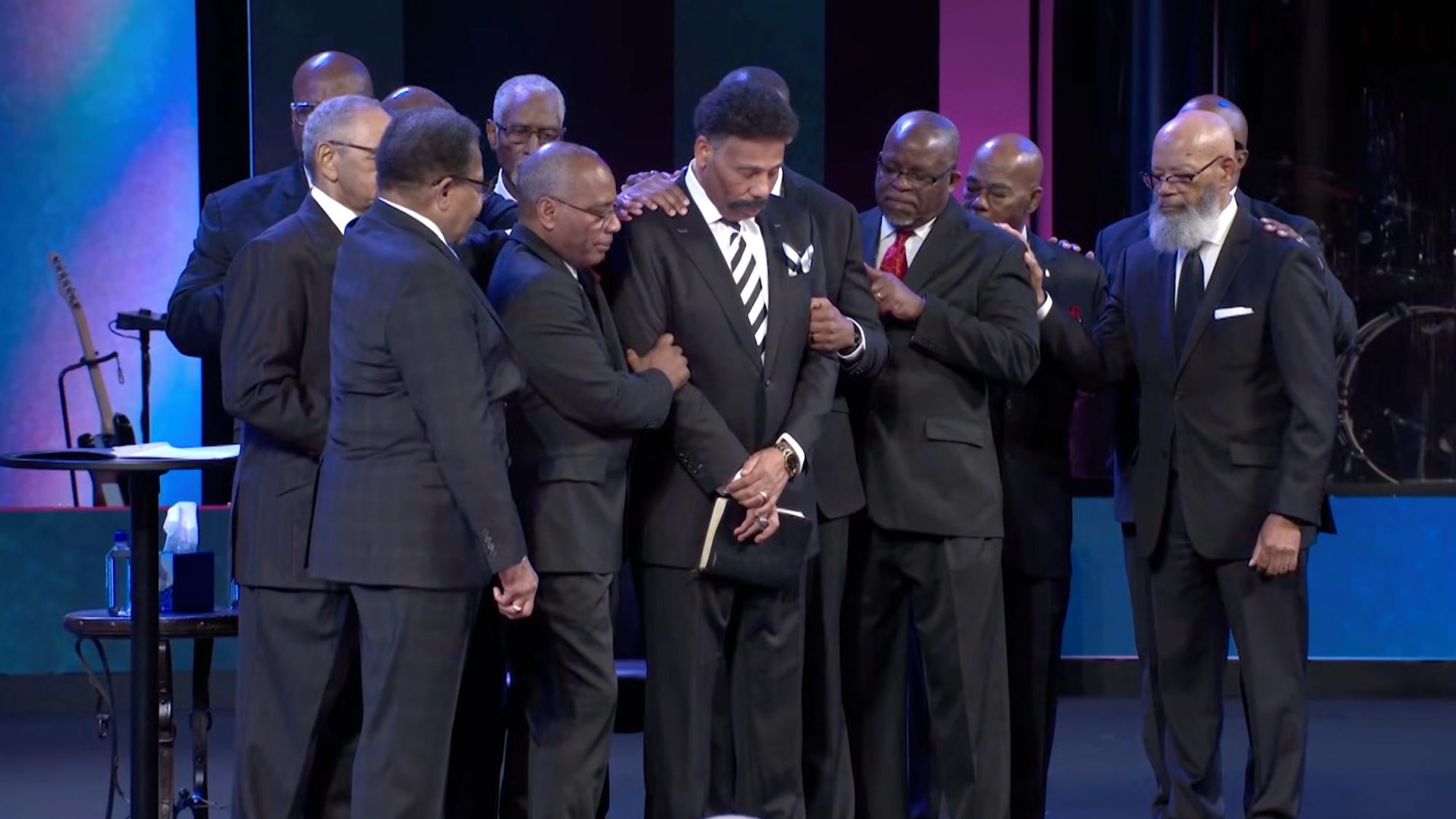
Men in suits surround Tony Evans to pray for him.

Oak Cliff Bible Fellowship prayed for Tony Evans after he completed a year-long restoration process.

Christianity Today October 7, 2025
Oak Cliff Bible Fellowship / Screengrab

Dallas megachurch founder Tony Evans, who stepped back from leading his church due to an undisclosed “sin” he announced last year, apologized to his congregation and his family on Sunday, after the elder board of his Oak Cliff Bible Fellowship announced the pastor had completed a “restoration process” and will not return to leadership of the church.

“To the flock, to the congregation, for the consternation I may have caused you with questions and wondering and uncertainty, I’m sorry,” he said as he sat on the church’s stage during a worship service and answered questions from his son, Jonathan Evans, who has been preaching regularly at the church. “I apologize sincerely for any instability that this season has caused you because you are my treasure.”

Evans, who abruptly announced he was “stepping away” in June 2024, is the first African American to have both a study Bible and a full-Bible commentary bearing his name. In addition to his church, he founded the Christian Bible teaching ministry The Urban Alternative, which continues to air his messages on radio outlets worldwide.

During the “Restoration Sunday” service, which lasted an hour and 40 minutes, neither Evans nor Chris Wheel, OCBF associate pastor of outreach, disclosed the sin that Evans described in June 2024 as requiring “the same biblical standard of repentance and restoration” he had applied to other people.

“While I have committed no crime, I did not use righteous judgment in my actions,” Evans, now 76, said at the time. “In light of this, I am stepping away from my pastoral duties and am submitting to a healing and restoration process established by the elders.”

Some churches offer or demand a restoration process of their leaders to overcome what they consider a violation of the Bible. During the worship service at the nondenominational, predominantly Black church, Wheel said Evans’s “discipline and restoration process” included counseling with professionals outside the church’s staff, “evidence of genuine repentance and godly sorrow” and pastoral mentoring.

Citing the Bible’s Epistle to the Galatians’ guidance about restoring a sinful person, Wheel said: “In keeping with this biblical framework, the elder board exercised deliberate and prayerful discretion regarding the timing, the manner of disclosing specific details throughout the restoration process. This was not done to conceal wrongdoing, but rather to uphold the integrity of the process, to protect the dignity of all involved, and prevent unnecessary speculation or sensationalism,” adding that Evans “fully submitted” to the restoration process.

Wheel said Evans also took a 12-month absence from pulpit ministry to “focus on personal growth.”

“In alignment with biblical principles and unanimous affirmation of the elder board, Dr. Evans has successfully completed this restoration journey,” Wheel said. 

As the congregation applauded and cheered, Evans entered the stage.

“While he will not be returning in a staff nor leadership role at OCBF, we joyfully look forward to seeing how God uses Dr. Evans’s gifts and calling to proclaim the truth of Scripture with clarity and conviction for the strengthening of the body of Christ,” Wheel said.

Evans made a major public appearance shortly after his yearlong absence concluded, speaking at the July summit of The Family Leader, a Christian organization known for its conservative evangelical stances, in Des Moines, Iowa.

Wheel said more details about the future plans for the church will be announced at a “Vision Sunday” service, set for October 12.

“Key steps include Jonathan Evans has been appointed as an elder,” he said. “Our expectation is that he will formally be installed as the lead pastor of Oak Cliff Bible Fellowship.”

As soon as Wheel concluded speaking, Jonathan Evans led the congregation in a brief Communion service.

“Somebody celebrate our Lord for restoration, forgiveness and reconciliation,” Jonathan Evans said.

The service then pivoted to him sitting with his father for a 20-minute discussion in which the two men expressed their pride in each other, and the elder Evans thanked the church, his family and friends for their endurance and described the “bittersweet” period that had just concluded. He said those days often were filled with depression, loneliness and tears.

“It’s certainly bitter when you’ve done something for 48 years every day, every week, and then you’re no longer doing it — and it’s your fault,” Evans said. “I had to search for God, but not for a sermon.”

Asked about the hardest part of the yearlong process, Evans said, “the most important and hardest was disappointing the Lord, who had given me so much and in such a unique way.”

He said he was particularly thankful for the support of his wife, the former Carla Crummie, whom he married in December 2023, after Lois Evans, his first wife of 49 years, died in 2019.

“The way we came together was shared loss,” he said. “Our mates died a few days apart as she and her late husband were on their way to my wife’s funeral.”

Evans said he was concerned about “many things that were not true being said” on social media.

“The way they beat up on my wife who knew nothing about any of this, and then the way they came after my children and then came after the Lord,” he said. “And I was the reason why all of that was happening, on a worldwide scale.”

Speaking directly to the congregation, he said, “For anything that has hurt you from me, I’m sorry, but I’m so glad I have you and you have me.”

Theology

You Don’t Have to Be Radical

Most Christians aren’t monks, missionaries, or martyrs. We’re unimpressive and unsatisfactory—yet saved by God’s scandalous grace.

A mom and son gardening.
Christianity Today October 7, 2025
Dorothea Lange / Unsplash

Last year, I found myself making the rounds of Christian podcasts to publicize a couple of new books I’d written. Most of these conversations were similar, but one ended with an exchange that caught us both off guard. 

The interviewer asked whether I’ve changed my mind on any big theological questions. What I took him to be asking was what I’d tell my younger theological self. To which I replied, “You don’t have to be radical to be a Christian.”

After I blurted out my answer, I had to ask myself what I meant. I didn’t have in mind the perennial vigor, earnest energy, and guileless naiveté of youth—or the renewal movements and prophetic indictments of elders these tend to generate. The “radical” trend I meant is a more specific phenomenon, one I expect is familiar to many American Christians around my age. 

When we were in high school and college, to be radical for Jesus was presented as the goal of any serious Christian. The message came from youth pastors, from books like David Platt’s Radical and its many offshoots, and from earnest lyrics in Christian pop. As best as I can reconstruct it, the concept had four parts.

First, it held that Jesus’ teachings are the heart of the gospel. If you want to know what it means to be a Christian, look neither to the Old Testament nor to the apostles. Look instead to Matthew, Mark, Luke, and John, and the red letters contained therein.

Second, the radical gospel revealed that Jesus’ teachings are not what you’ve heard at church. Really, Jesus isn’t even particularly interested in church except as a place where people who are committed to living out his teachings gather to support one another. If you were raised in church, most likely Jesus’ teachings were downplayed, muted, or otherwise sanded down to keep their rough edges from drawing blood.

Third, Jesus’ radical teachings are necessarily at odds with the American way of life. At the very least, this meant some mix of individualism, consumerism, secularism, nationalism, and militarism. But it could also include elements of a standard-issue adult life in America: marriage, children, a rewarding job, a mortgage, a safe neighborhood, a decent education, savings in the bank, and paid vacation—the proverbial white picket fence. To be radical for Jesus meant sacrificing all this for his sake. You could follow Jesus or the American way, but not both.

Finally, the radical alternative to the picket fence was the kind of life you read about in church history: the lives of saints, monks, missionaries, and martyrs. Saint Francis selling all his possessions. Dorothy Day founding the Catholic Worker Movement. Martin Luther King Jr. marching in Selma and Washington. Dietrich Bonhoeffer being executed in a Nazi concentration camp.

The preeminent living example was Shane Claiborne. His 2006 book The Irresistible Revolution detailed how he’d helped establish an intentional Christian community in a poor neighborhood of Philadelphia. Claiborne had spent time in Calcutta with Mother Teresa and in Baghdad with a peacemaking team during the US-led bombardment of the city. This is what it means to follow Jesus, would-be radicals concluded (whether that was the message Claiborne intended to communicate or not). Ordinary American Christians had to wake up.

Young, impressionable, precocious believers like me took that message seriously. I learned that there are Christians and there are Christians—people who profess Christianity versus people whose lives manifest their faith. 

I wanted to be the latter. I wanted to be an impoverished pacifist and member of an intentional community. That’s what a plain reading of the Gospels required—I was convinced of it—and I certainly didn’t want to want to be a hearer but not a doer of Jesus’ teachings (James 1:22–25). As Jesus warns at the end of the Sermon on the Mount, “Not every one who says to me, ‘Lord, Lord,’ shall enter the kingdom of heaven, but he who does the will of my Father who is in heaven” (Matt. 7:21, RSV throughout).

So I spent summers overseas doing mission work. I interned at a homeless shelter. I looked for ways to give, to sacrifice, to suffer. Newly married—clearly already a compromise with the world and the flesh!—my wife and I lived in an old, ugly one-bedroom apartment outside of Atlanta. One day we were driving through a wealthier neighborhood, and my wife wondered aloud what kind of house we would buy one day when we had kids and real jobs. Uh oh. I replied, with somber spiritual gravity, that I’d be happy to live in our apartment for the rest of my life.

I was promptly informed that I’d be welcome to live there as long as I was also happy to live alone.

I wish I could say that this was a wake-up call, but my self-serious piety took a long time to deflate. Now teaching at a Christian university, a husband and father of four—with a mortgage and a salary and, yes, paid time off—I can only smile when I see a similar piety in my students. So much of it is good, full of sweet sincerity and worthy of nothing but honor and encouragement. Some of it is simply developmental: This phase must be lived. It’s not meant to be circumvented, for the way is not around but through.

Nevertheless, there is something in the lure to the radical that’s worth interrogating. Why was the radical path such an attractive proposition to me and to so many others? Why do similar movements, well-meant but misguided, sometimes go wrong?

The basic appeal is obvious enough: Middle- and upper-middle-class teens could reach for something beyond their parents’ domesticity. Did Jesus come to earth and die on the cross so that suburbanites could have swimming pools and charcuterie boards? Unlikely. Surely there’s more.

The urge to be radical also played into the mild conspiracism of so much American religiosity: Jesus preached peace, but Constantine baptized the sword. Paul proclaimed martyrdom, but Augustine justified war. Peter distributed possessions to all in need, but the pope gloried in his glittering golden pomp.

In this view, the church is a corrupt or, at best, merely human institution, unworthy of our trust. If Jesus’ original teachings have been rejected or corrupted by “organized religion,” then you need to turn from your local congregation to Jesus alone—or more precisely, to the Jesus you personally find in the Gospels.

There’s an instinct here that is undeniably right. Jesus’ teachings really are hard, both to hear and to put into practice. The church really is full of flawed sinners who utterly fail to live out the way of Christ. Christians really are, in the phrasing of theologian Nicholas Healy, “unsatisfactory.” The salvation God offers us in the gospel really isn’t about earthly possessions, blessings, and happiness. And there really are features of American life that are inimical to Jesus’ life and teachings.

In this sense, the radical message is correct: Wherever churches have compromised the faith and followed other gods—mammon or Mars or any worldly idol—the call to return to Jesus is not just apt but urgent. Return to the Lord, no matter the cost. “Remember then from what you have fallen, repent and do the works you did at first” (Rev. 2:5).

Yet in practice, the radical message reliably comes to an unhappy (if unadmitted) conclusion: Almost no one on earth is a “real” Christian. Almost no body of believers is a “real” church. The folks sitting in the pews and preaching from the pulpits simply are not sufficiently serious or committed. (In truth, the conclusion is usually comparative: not as die-hard in comparison to me, the radical sitting in judgment on them.)

Rather than accepting this grim implication, I’d like to propose an alternative: Yes, radicals are faithful believers. But their path is not the only path for the Christian life. In fact, it is so far outside the norm for most believers in most times and places that I propose that we delete radical from our Christian vocabulary.

As it happens, that’s not a novel idea. For centuries, Christians did not exhort one another to be “radical.” The word’s usage, particularly as a term of approval, exploded only in the last 50 years. Many Christians don’t realize that among the sources of this use are far-left and reactionary politics, though it has migrated toward mainstream and even centrist usage since the 1970s. In the American church, I suspect one could trace the word’s movement from political left and Anabaptist contexts via the influence of theologians like John Howard Yoder and Stanley Hauerwas at the end of the last century.

But whatever the genealogy of the term, we should abandon it for two reasons. One is that by using it loosely and frequently, we’ve drained it of its meaning. In this usage, anything can be radical, provided you really mean it. But if it can be radical to curate that cheese board or listen to Bach, to vote for a certain candidate or buy a painting from a Christian artist, then the word has gone on holiday. Suddenly, being radical has swung back to the very white-picket-fence lifestyle we earnest young Christians were trying to avoid in the first place.

Like most Christians, I know some truly radical disciples of Jesus. I’m thinking, for example, of a longtime friend who for two decades has worked in a major American city to alleviate the plight of the homeless. If we reserved radical for people like him, you’d hear no objection from me. But if that’s not on the table, it’s better to do away with it entirely.

The second reason is that most Christians are neither true radicals like my friend nor self-styled radicals like those I’ve critiqued. The vast majority of all Christians, everywhere, at all times are normies

They are unimpressive. Unsatisfactory. Barely getting by. They don’t claim to be saints or heroes. They succeed if they make it to church on Sunday and pray before meals and bedtime. They believe in God, confess their sins, and look to Jesus for grace. And if we’re honest, that’s about it.

They are not the rich young ruler, who walked away from Jesus sad (Matt. 19:22), nor Simon of Cyrene, who carried Jesus’ cross (Mark 15:21). They are more like the other Simon, called Peter, who refused to carry a cross and denied even knowing Jesus. They are Thomas, who would not believe until he saw the risen Lord with his own eyes. They are the unnamed father in Mark 9, who cried out to Jesus, “I believe; help my unbelief!” (v. 24). 

In Paul’s words, they “lead a quiet and peaceable life,” and they’re fortunate if it’s “godly and respectable in every way” (1 Tim. 2:2). Often they are failures, screw-ups, and dropouts—ordinary people muddling through. They are not what I’ve elsewhere called “spiritual Navy SEALs.” They are everyone who has called on the name of the Lord and—just as he promised—was saved (Rom. 10:13; Joel 2:32). 

Christianity might be more impressive if we were all true radicals. But it would be a faith for heroes rather than sinners. It would cease to be good news for the desolate and helpless. It would be a message for the few, not for the whole world (1 John 2:2). It would be a lesser faith in quantity and quality alike.

My younger self was on fire to be radical like Jesus. That was good and right. But what I missed was the weight of sin in the world—and with it, death, suffering, affliction, sorrow, and pain. What I missed was the scope of grace, the gospel, and the church. I didn’t understand that here was offered a liberation deep enough, a healing strong enough, a forgiveness wide enough to comprehend everything fallen humanity needs.

Christianity is not reserved for radicals. The Lord does not help those who help themselves. By a miracle, he helps the utterly and pathetically helpless—of whom I am chief. That’s truly good news. It’s also a terrible scandal. And that’s the point.

Brad East is an associate professor of theology at Abilene Christian University. He is the author of four books, including The Church: A Guide to the People of God and Letters to a Future Saint.

Church Life

From a Village of Bandits to a Village of the Gospel

Stuartpuram in India’s Andhra Pradesh was once known for its armed robbers. Then the gospel changed them.

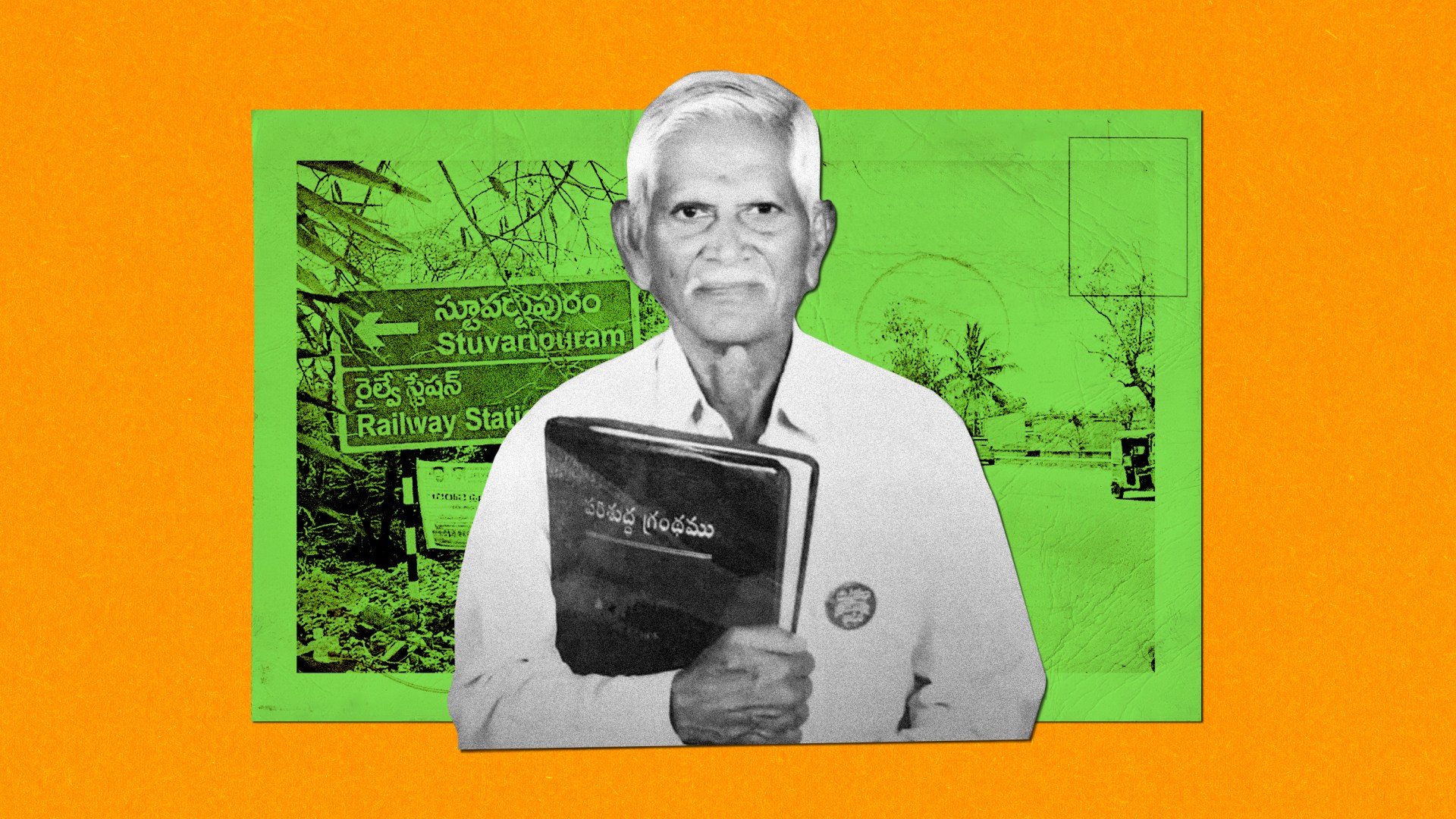
Pastor Issak and a picture of Stuartpuram.
Christianity Today October 7, 2025
Illustration by Elizabeth Kaye / Source Images: Youtube

Over the past four decades, octogenarian Bollaku Issak has preached hundreds of sermons. The diminutive pastor with white hair and a knock-kneed gait ends each service with the same altar call.

“If God can save a wretched sinner like me, he will definitely save you,” he says, his voice softening. “You are no different. You are loved. Just surrender. Repent and be saved.”

Often as he utters those words, tears well up in his eyes, transporting him to his life before Christ. He once lived as an armed robber, or dacoit, in Stuartpuram, an infamous village in Andhra Pradesh considered a “reformatory colony” by the British colonial government. Families lived off banditry for generations and passed it on to their children as an inheritance. In the aftermath of any major theft in the region, police invariably suspected Stuartpuram gangs.

Bollaku himself led a band of nine men, breaking into houses, trains, banks, and government offices, he recalled in a recorded testimony. He earned the moniker Bangaru Pichchuka(“Golden Sparrow”) for absconding with gold worth millions of rupees and for going on thrilling escapades. Yet years of living in hiding to escape the police robbed him of peace. Every time he tried to go straight, he slipped back into banditry with greater force. Weighed down by criminal life, he even tried to chop off his own arms, he said.

To evade arrest and charges, Bollaku bribed the police. Authorities finally outwitted him after four decades, booking him under charges amounting to seven years of imprisonment. His numerous attempts at jailbreak proved unsuccessful. The thought of spending seven years inside the fortified walls of prison, away from his children, left him feeling hopeless. 

In prison, a fellow convict who had recently became a Christian explained the gospel to Bollaku. Hearing about the love of Christ and the promise of salvation reinvigorated his spirit. Over the next two months, he prayed, sobbed, repented of his sins, and learned about the Bible. He prayed persistently that somehow his prison term would be shortened to a year.

“It was a miracle!” he said in the testimony about the trial. “The prosecution could not gather evidence. The court struck down the charges against me. I was completely set free.”

After walking out of prison, he spent the next 14 years serving as a volunteer at a local church—sweeping floors, cooking, and cleaning dishes. As a spiritual life of prayer and service took root, he never returned to his old ways. One morning as he prayed, Bollaku had a vision: Jesus laid hands on him, instructing him to testify about the Good News that had turned his life around. Since then, Bollaku has sought to follow this calling. 

Bollaku’s testimony is not uncommon in Stuartpuram, which in the past four decades has seen a revival as nearly all its 5,000 residents have become Christians. The “Village of Dacoits” has become Suvarthapuram, Telugu for “Gospel Village.”

“People here live out Christianity, be it in personal or professional lives,” Bollaku told CT. “God has become the center of our pursuits today. This was unheard of a generation back.”

About 20 churches dot the lanes and alleys of the village. The days of police officers descending on the village after every major theft are long over.

Today, Stuartpuram is known for its accomplishments rather than its crimes. The village has produced two weightlifting gold medalists, as well as doctors, engineers, teachers, lawyers, civil servants, government ministers, and even a state police chief. Villagers owe it to Salvation Army missionaries for laying the groundwork for lasting change.

The British initially founded Stuartpuram in 1913 as a “reformatory colony” under the Criminal Tribes Act of 1871. The act designated certain nomadic and seminomadic tribes as “born criminals” who made a living through banditry. The Yerukulas, a gypsy community that resides in Stuartpuram, were branded as a criminal tribe. Colonial authorities visited prisons to identify Yeruluka convicts and settle them in the newly formed village. The village is named after Harold Stuart, a British civil servant who pioneered the model of resettlement colonies.

Later research revealed that equating ancestry with criminality was solely based on colonial prejudice. Yerukulas originally traded salt and grain, riding donkeys to different villages to earn a living. They made and sold brooms, mats, and baskets to supplement their income. The introduction of railway transport in the 1850s replaced traditional traders, including the Yerukulas. Then the enactment of the Indian Forest Act of 1878 cut them off from the forests where they sourced materials for their handicrafts. Illiterate, landless, and scorned by the upper caste, many of them felt they had no choice but to turn to crime.

After moving to Stuartpuram, many continued to live as bandits. In 1913, Stuart decided to turn to the Salvation Army, which had already gained a reputation for transforming criminals. Frederick Booth-Tucker, Salvation Army’s special commissioner for India and Ceylon (now Sri Lanka), wrote at the time, “The Gospel remedy has lost none of its ancient power when applied by those who have themselves experienced its revolutionizing and soul-reforming influence.”

Under the Salvation Army, life in the settlement was restricted. Leaders required roll call for all the residents, day and night, and banned villagers from venturing out of Stuartpuram. They established an elementary school where children learned about Bible stories and moral education, and they provided adults with employment opportunities like cultivating land or working at the Indian Leaf Tobacco Development Company Limited (ITC Limited) in nearby Guntur.

After India’s independence from the British in 1947, homegrown movements such as Laymen’s Evangelical Fellowship and the secular nonprofit Samskar Organisation continued this work, driving change through education, job opportunities, and moral reform.

Yet the stigma around Stuartpuram remained. Popular Telugu historical dramas bearing the name Stuartpuram cemented the image of its residents as dacoits. In Christian circles, however, testimonies of transformed lives began to alter the popular perception. For instance, Abba Khan Yesudas was a dreaded dacoit for 45 years. While doing time in Madras Central Prison, he—like Bollaku—heard the gospel from a fellow inmate. After his release, he became an evangelist. Another well-known figure is Christian songwriter Stuartpuram Sudhakar, whose popular Telugu songs capture his criminal past as a bandit and the new life he found in Christ. 

Today, the Christians of Stuartpuram are sharing the gospel with neighboring villages. The village hosts annual gospel conventions that draw about 2,000 people from nearby towns such as Guntur, Bapatla, and Chirala, as well as distant cities like Hyderabad and Chennai. Six young people from the village recently translated the New Testament into the Yerukula language, aiming to distribute it to Yerukula communities across India, according to Chukka Paul Raju, president of Stuartpuram Grama Abhivrudhi Mariyu Sankshema Samithi, a community organization advocating for the village.

Residents have asked authorities to officially change their village’s name to Suvarthapuram to shed their reputation from the past, Raju said.

“We are no more Stuartpuram and whatever it represents,” Raju said. “Suvarthapuram alone captures the transformation that Christ has brought into this place.”

Books

Four Truths About God for Children Who Can’t Sleep

And for the grownups—that’s all of us—who never outgrow their need for his presence around the clock.

The book cover on a purple background.
Christianity Today October 7, 2025
Illustration by Christianity Today / Source Images: Getty, IVP Kids

My husband got into a bicycle accident on his ride home from work two years ago. Wet grass caused his front wheel to slip, and he crashed into the handlebars. It broke one of his ribs, which sliced into his spleen, but he didn’t know because he was in shock. He came home with a small head wound, and I fussed at him about a possible concussion. But like a typical Midwestern boy, he replied, “I’m fine,” so I settled for bringing him a bag of frozen peas for his forehead, then I left to pick up some pizza.

When I returned, he was passed out on the floor, and my toddler, Hilde, was sobbing. I got my husband to the hospital, but it was hours before they figured out that his belly was filling up with blood. Our summer plans vanished, and I spent weeks going back and forth from the hospital to our home, where our confused toddler kept asking, “Where is Daddy?”

In between hospital visits and comforting our kids, I received an email confirming that I would be a children’s book author. A year before, I had finally decided to write about Psalm 121, a passage which meant a great deal to me as a child. I wrote a simple story about a boy named Charlie who, for various and relatable reasons, can’t fall asleep. Charlie’s parents comfort him with the truth of God’s omnipresence—that he is everywhere at all times. They read Psalm 121 aloud, finding reassurance in the God who “will neither slumber nor sleep” as he “watches over” his people (v. 4).

At the time, I couldn’t have known how much I would need this story myself. I couldn’t have predicted the night when I first returned home from the hospital, put our daughter to bed, and waited until 1 a.m. for the night nurse to call and tell me whether my husband was still alive.

My young daughter, Hilde, didn’t sleep well during those weeks either. We both tossed and turned, our schedules thrown off and our hearts anxious. The following truths are for your children, but they are also for you, because we never outgrow our need for God at all times—especially at night.

1. God never sleeps.

“Behold, He who watches over Israel will neither slumber nor sleep” (Ps. 121:4, NASB).

I tell my daughter, “Even when everyone else in the house is asleep—me, Daddy, and Richard—God is still awake. You can talk to him. You can know you’re not alone. He doesn’t get tired like we do.”She’s read my book—even keeps it in her bed on the top bunk—and now she wants a Bible there too, like Charlie. She can’t read yet, but she already understands that God’s Word brings comfort, that his truth is her night-light.

We have a picture of Jesus—an artist’s imperfect rendering, anyway—carrying a lamb on his shoulders. It hangs on the wall just above where Hilde places her head on her Winnie-the-Pooh pillow each night. She points to the lamb sometimes and says, “That’s me!”

I want her to know that she is never alone, even in the middle of the night when our old house, built in 1920, is settling with its creaks and moans and when the dark silhouettes of her stuffed animals look like monsters. I want her to know that prayer reaches God at any hour. As David testifies in Psalm 55, “As for me, I call to God, and the Lord saves me. Evening, morning and noon I cry out in distress, and he hears my voice” (vv. 16–17).

2. God carries our burdens.

“Cast your cares on the Lord and he will sustain you” (Ps. 55:22).

Right now, Hilde’s favorite way to pray is listing the things she is thankful for. For example, a recent prayer at dinner included thanking God for butter, trees, barbecue sauce, the Holy Spirit, and houses. But there will come a day, and sooner than I’d like, when she will have more than just thanks to lay at Jesus’ feet. She will have worries, regrets, and shame. She will have fear, confusion, and questions. I want her to know that God is not only always awake but also always willing to listen to whatever is on her heart.

In my book, I write about how Charlie is frustrated that he is supposed to pray to a God he can’t see. His mom responds with understanding, noting that she struggles with the same thing and that her solution is to tell God all about it. She invites Charlie not only to pray but also to pour out his heart before God, questions and all.

When our children realize they can talk to God about anything, they will talk to him about everything. And that’s just what we want. Of course, we’d love it if they would confide all their thoughts and fears in us, but there will be times when they whisper those words to God alone. And we can trust that God knows how to hold our children and their precious hearts.

3. God shows his love through Jesus.

“But God demonstrates his own love for us in this: While we were still sinners, Christ died for us” (Rom. 5:8).

The gospel isn’t just for the daytime. For many of us, including our children, nighttime is when our thoughts settle and we ask our biggest questions. We think back over our day, remembering the joys but also the ways we failed.

Even at age three, Hilde has such a tender conscience. While she might zip around all day like a hummingbird from flower to flower, at night she often wants reassurance. Sometimes what our children need most before they can fall asleep is forgiveness. Especially after a hard day of correction and consequences, our children need reminders that they are still loved, that their performance isn’t what determines their value in God’s sight.

It is in these quiet hours, when the sky dims and we put our pajamas on, that we can curl up beside our children—or hug them to our chests—and remind them that God’s love for his children is a “Never Stopping, Never Giving Up, Unbreaking, Always and Forever Love,” as Sally Lloyd-Jones put it in The Jesus Storybook Bible. The gospel is always the right story to tell, especially at bedtime.

4. God’s mercies are new every morning.

“The steadfast love of the Lord never ceases; his mercies never come to an end; they are new every morning; great is your faithfulness” (Lam. 3:22–23, ESV).

I don’t know how things are at your house, but despite the absolute delight parenting is, my husband and I are bone-tired at the end of each day, often barely making it to bedtime with our patience intact. The idea that there will be a fresh start in the morning—that God’s mercies are new with each sunrise—is incredibly important to our little family.

New mercies definitely speak to us as parents and caregivers, but our children also need them. In fact, my daughter and I have stolen the concept of “fresh starts” to use throughout the day. When things go downhill for whatever reason, after we’ve practiced our deep breathing, I sometimes like to declare a fresh start over our house. We don’t have to wait until morning for mercy, but it really does help us sleep when we know that mercy is on the way. 

Another practice I have with my little girl is letting her list some of the things she is looking forward to, come daylight. I might get her started with something like “We can make banana pancakes for breakfast, watch some Bluey, run in the sprinklers, check the garden, and teach Richard how to say new words.”Her body visibly calms down as she remembers that morning will indeed come again, and this often transforms her fear of missing out into joyful anticipation. She takes over with “And we can bake cookies and then play in the front yard, where I am the ambulance and you are the fire truck!”

It’s been two years since that bike accident, and we’ve moved on and lived through other delights and trials since, but Hilde will still occasionally ask me to tell her the story. I’m not sure how much she remembers, but I know she likes the part where I tell her that the doctors told Daddy not to lift anything but that when he finally came home and saw her, he scooped her right up.

No matter how old we are, falling asleep can take courage. It sometimes requires that we first work through what is keeping us awake, causing anxious thoughts, or disrupting our peace. Our kids need to know that they never have to work through these thoughts alone.

Even when everyone in the house is asleep, God is always awake. Even if they wake up in the dark, the darkness is not dark to him (Ps. 139:12). God is listening. He is able to carry any burden on his strong shoulders. He reminds us of his love for us through the death and resurrection of Jesus. And he can’t wait to give us a fresh start tomorrow morning.

Rachel Joy Welcher is an author and an acquisitions editor at Baker Books. Her children’s book is Charlie Can’t Sleep!: Trusting God When You’re Afraid of the Dark.

Apple PodcastsDown ArrowDown ArrowDown Arrowarrow_left_altLeft ArrowLeft ArrowRight ArrowRight ArrowRight Arrowarrow_up_altUp ArrowUp ArrowAvailable at Amazoncaret-downCloseCloseEmailEmailExpandExpandExternalExternalFacebookfacebook-squareGiftGiftGooglegoogleGoogle KeephamburgerInstagraminstagram-squareLinkLinklinkedin-squareListenListenListenChristianity TodayCT Creative Studio Logologo_orgMegaphoneMenuMenupausePinterestPlayPlayPocketPodcastRSSRSSSaveSaveSaveSearchSearchsearchSpotifyStitcherTelegramTable of ContentsTable of Contentstwitter-squareWhatsAppXYouTubeYouTube