Books
Review

Tim Keller Preached the Superiority of Christianity, not Christians

A new book shows how he contended for a faith whose followers are always seeking substitute saviors.

Tim Keller preaching
Christianity Today May 19, 2025
Illustration by Christianity Today / Source Images: Redeemer City to City

Matt Smethurst has written a clear and concise book on Tim Keller, who died two years ago today. Its title—Tim Keller on the Christian Life: The Transforming Power of the Gospel—summarizes well what made a non-shouting pastor exceptionally effective in reaching the ears of educated and elite New Yorkers for nearly three decades.

Some Manhattanites saw religion is a good thing for personal peace and social coherence, but Keller went against the go-along tendency of theologically liberal churches and emphasized the peculiarity of the gospel. Keller preached that “Jesus isn’t one more teacher, come to tell you how to save yourself and find God. He is God himself, come to save and find you.” In this, he was not only greater than Buddha or Mohammed but also comprehensively different.

Smethurst rightly calls Keller “a three-dimensional voice in a two-dimensional world.” That well-roundedness pervaded his public ministry, not least in his cautions on partisan politics, which attracted criticism from the left and right alike. Until a decade ago, I tended to see danger mainly on the left. But Keller had a well-calibrated warning system that detected idolatrous pretensions across the board. He preached that all alternatives to the gospel are idolatry. Smethurst’s good summary: “Nobody is truly an unbeliever. Either you trust the real God or you’re enslaved to something you treat as a god.”

This doesn’t mean that Christians should be at war with other religions or that Christianity should be governmentally privileged above other beliefs. Keller was for a pluralism that could occasionally involve interreligious collaboration, but his basic posture was one of peaceful but persevering competition. Keller: “Every other savior but Jesus Christ is not really a savior.” Smethurst’s summary: If Christians “fail to explain different forms of works-based righteousness—different substitute saviors—we risk muting the depth of their slavery, the horror of their sin, and the wonder of God’s grace.” 

This means Christians should not assume that having faith in some religion is a plus: Keller was pro-Christianity, not pro-religion. He was strongly pro-life, but not pro–our natural life. We are all made in God’s image, but we should admit that our natural heart is, as 16th-century theologian John Calvin said, “a perpetual factory of idols.” It’s hard to admit that. Keller, a modern Calvin, noted in Counterfeit Gods that “we look to our idols to love us, to provide us with value and a sense of beauty, significance, and worth.”

That’s why it’s so hard to accept the gospel and why we cannot do it apart from God’s grace. Keller made this clear in every sermon. (I still listen to examples each week, while walking my dog, via the Gospel in Life podcast.) He used a five-point structure: Here’s what we face. Here’s what we must do. Here’s why we can’t do it. Here’s how Jesus did it. Here’s how, through faith in Jesus, we should live. Smethurst aptly summarizes Keller’s challenge to high-achieving worshipers of success, sex, ideologies, or non-Christian religions: “Every substitute god is a taskmaster that will enslave you.”

The grammar is important: A substitute god is a that, but Christians worship a who, and every Keller sermon came back to the person of Christ. My wife and I sat in his congregation from 2008 to 2011 and never fell asleep as he sometimes wandered far afield but always made what we came to call “a Jesus turn” at the end: We sometimes whispered to each other, “Wait for it; wait for it,” and exchanged nudges when it happened.

We also learned from Keller our tendency toward pharisaism, which he diagnosed most clearly when explaining that the parable of the Prodigal Son is a misnomer: Christ speaks of two wayward sons: a younger brother who lived wastefully and an elder brother who wallowed in anger and pride rather than attending the celebratory feast. Keller had congregants like himself who had come from small towns to the fleshpots of Manhattan, but he neither indulged the tendency to squander nor expressed superiority to those who went astray. Christianity is superior, but Christians aren’t—and those who put on the airs of the elder brother may be even further from God than the younger.

This brings us back to Smethurst’s title, Tim Keller on the Christian Life, which evokes Francis Schaeffer’s How Should We Then Live? Neither pastor said we Christians should stay in the pasture and style ourselves superior to those who wander. Smethurst summarizes well how Keller preached about the most famous chapters of Matthew’s gospel: “The Sermon on the Mount is a warning against rebellion dressed up as religion. … Apart from Jesus Christ, flagrant lawbreaking and fastidious rule keeping are dead ends. … When it comes to pleasing God, both the rebellious path and the religious path are dead ends.”

Smethurst also does readers the favor of amply quoting from some of Keller’s most succinct tropes. Here’s one:

Christianity teaches that, contra fatalism, suffering is overwhelming; contra Buddhism, suffering is real; contra karma, suffering is often unfair; but contra secularism, suffering is meaningful. There is a purpose to it, and if faced rightly, it can drive us like a nail deep into the love of God and into more stability and spiritual power than you can imagine. Suffering—Buddhism says accept it, karma says pay it, fatalism says heroically endure it, secularism says avoid or fix it.

We learn from suffering. Keller had a good Christian life, with a long marriage to his wife, Kathy, and the blessings of family. Then he, like all of us eventually, had to face death, in his case from cancer. With an end in 2023 looming, Keller said he could “sincerely say, without any sentimentality or exaggeration, that I’ve never been happier in my life, that I’ve never had more days filled with comfort. But it is equally true that I’ve never had so many days of grief.”

This was part of Keller’s consistent honesty, and also his ability to see God’s goodness. As Keller numbered his days, he observed that “the joys of the earth are more poignant than they used to be.” From everything I’ve heard, Smethurst’s summary (based on 1 Thessalonians 4:13) is accurate: “Despite Keller’s terminal diagnosis, the promise of resurrection was powerful enough to keep him and Kathy from ‘grieving like the rest of mankind, who have no hope.’”

Marvin Olasky is executive editor of news and global at Christianity Today.

Correction: An earlier version of this review mischaracterized the book as a biography.

News

The Nicene Church Disappeared from Nicaea

The creed set the standard for orthodoxy for 1,700 years. But no one professes the faith today in the ancient Turkish town where it was written.

Ruins of the ancient church of Nicaea in the modern town of Iznik
Christianity Today May 19, 2025
Sercan Ozkurnazli/ dia images via Getty Images

All the Christians will be tourists.

This year people will flock to the ancient city of Nicaea in Turkey to celebrate the 1,700th anniversary of the church council and creed that set the standard for orthodoxy. 

One Christian group has planned a trip with professors from Beeson Divinity School, Bethel University, and Hillsdale College. Another is going with leaders of the Southern Baptist Convention, Reformed Theological Seminary, and 9Marks. Smaller groups have booked scores of commercial tours to the town about 90 miles southeast of Istanbul and lots of Christians have planned private, individual trips too.

But when they get there, they will not be joined by Christians from Nicaea itself. 

İznik, as the place is known today, is a town of about 44,000 people. None of them hold to the creed. None profess belief in “one Lord Jesus Christ, the only-begotten Son of God, begotten of the Father before all ages.” None gather on Sundays to worship him who “was crucified for us under Pontius Pilate, and suffered and was buried; And … rose on the third day, according to the Scriptures.” 

There is no church in İznik.

“It is a pity,” said Behnan Konutgan, translator of the New Turkish Bible and the author of the first history of Christianity in Turkey. İznik “is the place where they wrote one of the most important documents in history for Christians. … But there is no church there now.”

Christians are a tiny minority in Turkey. Altogether, Eastern Orthodox, Catholic, and Protestant believers make up less than 0.5 percent of the population, and maybe less than 0.2 percent.

Some of their neighbors say that’s still too many. Nationalists, including President Recep Tayyip Erdoğan, link ethnic, religious, and civic identity. They say Turkish Christians aren’t really Turkish and may actually be an “enemy within.”

The country is legally secular, with constitutional protections for freedom of religion and worship. There’s a caveat, though. Turkey allows religious liberty only as long as it doesn’t “violate the indivisible integrity of the State.” Officials have interpreted that to mean no new Christian worship spaces, no Christian schools, no seminaries or ministry training programs, and no right for Christians to share their faith and lead people to Christ.

At the same time, the Turkish government has put a lot of energy into religious tourism. Turkey encourages Christians from all over the world to visit the seven churches of Revelation, follow the path of Paul’s missionary journeys, and see the sites of the early ecumenical councils, including Nicaea. 

Visitors to İznik today can look at the ruins of the 33-foot walls that once ringed the city and what’s left of an ancient church, submerged in the lake. They can visit another church that was turned into a mosque, a Roman theater that was turned into a church, ancient tile and porcelain workshops, and the archaeology museum, which includes artifacts from the Christians who once lived and worshiped in the city.

Promoting İznik

In 2011, culture minister Ertuğrul Günay said he was working to double the annual number of religious tourists. He touted investment in hotels and archaeological discoveries—especially in İznik. 

“İznik really has the potential to draw a lot of interest,” he told The New York Times. “So we are trying to promote İznik.”

Günay also supported a waiver allowing religious services in churches that have been turned into state museums so people can join in spiritual communion with the ancient church, going back to the time of the apostles.

The first congregation in Nicaea may have actually been founded by Peter. His first epistle is addressed to “God’s elect, exiles scattered throughout the provinces” (1:1) and specifically mentions the province of Bithynia. Nicaea was the capital of Bithynia. Peter could have traveled there on his way from Jerusalem to Rome, so perhaps when he mentioned “those who have preached the gospel to you by the Holy Spirit sent from heaven” (v. 12), he was including himself.

A later tradition attributes the founding of the church to the apostle Andrew. The apocryphal Acts of Andrew says he drove seven demons from Nicaea in Jesus’ name after the people cried out, “We believe that Jesus Christ whom thou preachest is the Son of God.”

Historians know little about the many generations who put their trust in Christ after that. Most lived, prayed, and died in complete anonymity. But the testimony of their faith still shines through the fragments of the historical record. 

Archaeologists have discovered tombs from the first century bearing the name of Christ. Ancient funerary inscriptions depict communion: a table set with bread marked with the sign of the cross.

A Persecuted Church

Roman authorities sporadically persecuted the Nicene church. Pliny the Younger, who became governor of the province in the year 111, reported that he forced people accused of being Christian to worship an image of the Emperor Trajan and curse the name of Christ—or be killed.

Still, he said, the Christians kept meeting in secret. He tortured two enslaved women who were deaconesses to find out what happened at their gatherings. The women said the Christians would “sing responsively a hymn to Christ” and gather to “partake of food.” 

The governor thought it was obvious that all this was “depraved, excessive superstition,” but he couldn’t stamp it out. When Christians died for their faith, their deaths encouraged faith in others. 

The congregation in Nicaea remembered the names of their martyrs, lifting them up as examples. There was Tryphon, a goose-herder who cast a demon out of the emperor’s daughter but was beheaded; Theodota, a devout widow who refused to marry a Roman official and was burned to death; and Neophytos, a teenager who wouldn’t stop talking about Jesus, even when the soldiers gave him 500 lashes and put salt and vinegar in his wounds.

When Emperor Constantine finally made Christianity legal in 313, the Christians in Nicaea built their first church building where Neophytos was buried, outside the city, next to the lake. The best evidence suggests it was a wooden structure, according to scholar Mark R. Fairchild, who wrote a book about the excavation of the worship site.

Researchers believe that might be where Christian leaders first assembled when they met in Nicaea to discuss the Trinity and the correct understanding of the nature of Christ, 1,700 years ago. 

Constantine had a palace by the lake. He summoned the bishops of the church and told them to settle their theological differences. He had united the Roman Empire at the Battle of Chrysopolis in 324. Now he would unite the church—making it a universal or catholic church—in 325. Bishops came from as far away as Cordoba, Rome, and Athens in the West, and Alexandria, Antioch, and even Persia in the East. There were about 300 of them in a church that was 60 feet wide and a bit more than 130 feet long.

“Suffice it to say,” Fairchild writes, “the place would have been crowded.”

Eusebius, a bishop who was there from the province of Syria-Palaestina, wrote that the Nicene worship space seemed to grow, “as if extended by God,” until it “took them in all together.”

The bishops debated for a little more than two months. Then they gathered at Constantine’s palace and declared it official orthodoxy that Christ was, in fact, “God from God, Light from Light, true God from true God, begotten not made, of the same being as the Father, by whom all things were made.”

And then the bishops left. The Christians in Nicaea returned to their regular lives. They prayed their prayers, sang hymns, heard the Word, and took communion. Christians everywhere would call themselves Nicene Christians after that, but the Christians in Nicaea were mostly unknown, quietly faithful, going about their days putting their faith in Christ.

The wooden church was rebuilt with stone, and there were other churches—14 total in the town. A new Christian emperor named Justinian built one in honor of the council and called it Hagia Sophia, which means “holy wisdom.” Another council was held there, the seventh, to settle a debate about icons and their use in prayer. In the city’s Roman theater, someone painted a fresco of Jesus’ mother Mary on a throne, holding the infant Son of God, which historians say may be the first of its kind.

Empires Rise and Fall and Change

History moved on. There were some hard times. An earthquake destroyed the church where Neophytos was buried, and the lake rose to cover the ruins. A Turkish Muslim prince conquered the city in 1075, taking a big bite out of the Byzantine Empire and founding his own, a Sunni Muslim state that he called “the Sultanate of Rome.” 

Crusaders took Nicaea back for Christendom a few decades later. But then Western Christians fought Eastern Christians, and one of the Eastern Christians allied with another Sultan of Rome to set up a new empire, the Empire of Nicaea. That lasted three generations before it fell apart. 

When the Ottomans seized Nicaea  in 1331, they changed its name to İznik. They took the Hagia Sophia and turned it into a mosque. 

“O Lord, help,” one of the Christians wrote on a wall in the city, where it is preserved today. “There is no other name.”

Christians in İznik continued to gather, though. The Ottoman Empire allowed them some latitude as a minority religion. So, in the city whose old name was synonymous with orthodoxy, they would come together on Sundays and confess again their Nicene faith. 

Then came the 20th century and disaster. 

The Ottoman government collapsed with the conclusion of World War I, and the Greeks sent an army to reclaim the territory of the Byzantine Empire. Turkish nationalists rose up to stop them. And as they fought back, the Young Turks also started driving out Christians. The nationalists said it was time to cleanse the land. 

In İznik, in August 1920, they killed the Christians.

Corpses Found Mutilated

The Greek army arrived three weeks later. One soldier wrote in his diary that when they went through the city, the Christian neighborhood was “terrifyingly quiet.” Then they found the corpses.

“We saw heads, hands, legs and other body parts scattered all over the place,” the soldier wrote. “We saw three wells filled with bodies from top to bottom. Then finally we found the cave where we saw roughly 400 bodies of varying ages, piled up, slaughtered in different ways. We couldn’t stay even a single minute as we began feeling dizzy and on the verge of being sick.”

The Christians who survived the massacre fled. The writer Ernest Hemingway, who reported on the conflict for the Toronto Star, recalled that the country seemed to be full of refugees. At the end of the war in 1923, the new Turkish state deported 1.2 million Christians to Greece. 

İznik has not had a church since then.

Today, Turkey has around 300,000 Christians. The largest group is Eastern Orthodox. There are only 8,000 to 10,000 evangelicals. None of them are in İznik.

The Turkish church-planting network Kurtulus (Salvation) has started more than 50 evangelical congregations across the country in the last 30 years, director İhsan Özbek told Christianity Today. But as far as Özbek can recall, no one has ever discussed trying to plant one in İznik. 

“It would be difficult,” Özbek said. “İznik is a very conservative small town. People are hostile against Christians. People have heard anti-Christian propaganda for many years—‘Christians are Westerners,’ ‘they want to hurt this country,’ and things like that.”

Evangelicals in Turkey nevertheless look to İznik with affection, Özbek said. That’s where the creed was written. And the creed is all about Jesus—who he is and how he’s God.

Jesus Still Faithful

Turkey’s evangelicals know Jesus continues to seek and find the lost, even in their country, even in places where the church has ceased to exist. 

Özbek himself had an encounter with God on a public bus in 1982, when he saw a light and heard a voice saying, “I am God, and I exist.” He went and found a Bible, and when he read it, he was surprised to find that same voice speaking in the New Testament. He wrote a letter to the Turkish Bible society with a million questions, he said, and later learned about the Light from Light, begotten not made.

He is delighted that Christians from around the world will remember the Nicene council and creed after 1,700 years. Turkish people are hospitable, he said, and will be eager to show tourists their culture, art, food, and history. Özbek hopes, though, that visiting Christians will notice the church that isn’t there—and pray for the one that is.

“Thank you for thinking about Turkey,” he said. “Pray for us to be bold enough to share our faith.”

News
Wire Story

Can the Southern Baptist ERLC Survive Trump 2.0?

Critics who say the denomination’s public policy agency no longer reflects their convictions could once again put its future up for a vote.

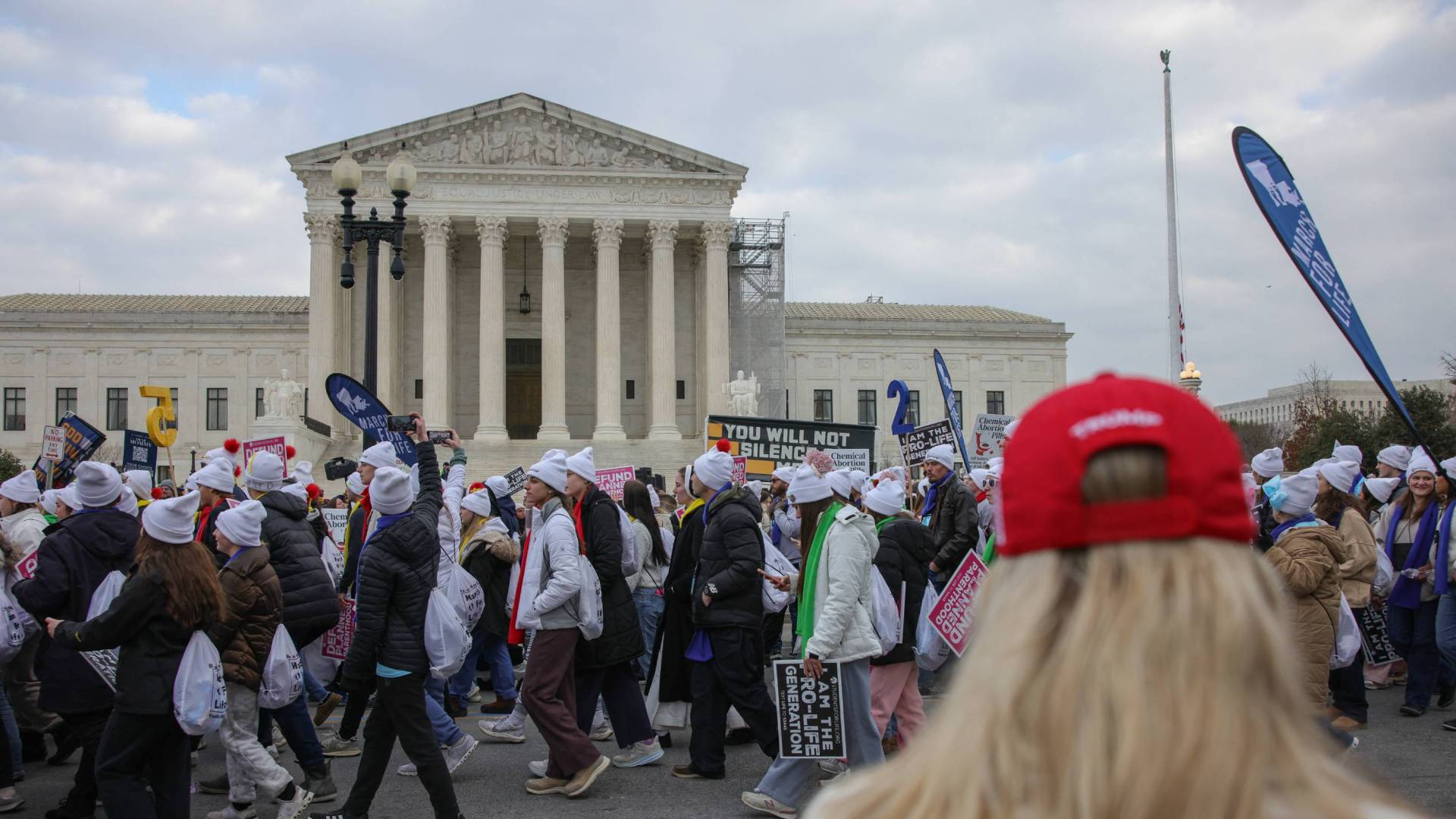
March for Life participants demonstrate in front of the Supreme Court in Washington, DC
Christianity Today May 19, 2025
Bryan Dozier / Middle East Images / Middle East Images via AFP via Getty Images

During their annual meeting in Dallas next month, Southern Baptists will sing, bless missionaries, pass a budget, listen to sermons, and engage in lively debate about a host of issues.

Among those issues: what to do with the denomination’s Ethics and Religious Liberty Commission (ERLC). For nearly a decade, the ERLC has been a source of controversy as the nation’s largest Protestant denomination has navigated the cultural and political divides of the Trump era.

While Southern Baptists, like many evangelicals, have been strong supporters of President Donald Trump in the voting booth, some of the president’s policy decisions and personal conduct have clashed with Baptist ethics and beliefs.

That’s left the ERLC, which speaks to ethical issues and public policy debates, occasionally at odds with the denomination’s 12.7 million members, leading to three attempts to disband or defund the agency over the past decade.

Clint Pressley, president of the Southern Baptist Convention, said he has spoken to a number of Southern Baptists about the ERLC— including Texas megachurch pastor Jack Graham, a past critic of the agency.

Some like what the agency is doing, he said. Others don’t.

While he suspects there will be a motion to close the agency at the denomination’s annual meeting in June, Pressley said the future of the ERLC is not up to him. Even if he had concerns about it, he’s got no power to make a decision. Instead, that power rests with church representatives known as messengers.

“I think those concerns about the ERLC will be answered by the messengers,” said Pressley, pastor of Hickory Grove Baptist Church in Charlotte, North Carolina. “I can’t do anything about the ERLC.”

Pressley added that his role as chair of the SBC’s annual meeting means he cannot take sides in any debate over the ERLC.

In recent months, both the ERLC and its critics have engaged in an online public relations war over the agency’s reputation and future. The Center for Baptist Leadership, a startup activist group with ties to American Reformer magazine, has run a series of articlespodcast episodes, and social media posts critical of the ERLC—primarily for its stances on immigration reform and lack of close ties to the Trump administration.

The ERLC has promoted its ties to House Speaker Mike Johnson, a former ERLC trustee, and its support for defunding Planned Parenthood, as well as its opposition to gender-affirming care for minors and “radical gender ideology.”

“The ERLC team has been diligently working to advocate for Southern Baptist beliefs in the public square while also providing meaningful resources that help our churches navigate today’s cultural challenges and gospel opportunities,” Scott Foshie, chair of the ERLC’s trustees, told RNS in an email. “Southern Baptists have supported an ethics and public policy entity for over a hundred years. We need an effective, responsive ERLC now more than ever.”

Discontent with the ERLC has been festering for years—and much of it dates back to the tenure of former ERLC President Russell Moore, who led the agency from 2013 to 2021. (Editor’s note: Moore is now editor in chief at Christianity Today.)

A popular figure at first, Moore faced intense backlash from Trump allies such as Graham, a former SBC president and pastor of Prestonwood Baptist Church near Dallas, when he refused to back Trump’s first run for presidency and criticized him instead. In 2017, Prestonwood and about 100 other churches withheld their donations to the SBC’s Cooperative Program in protest of Moore’s action. A pair of leaders of the SBC’s Executive Committee also clashed with Moore over his criticism of Trump.

While Moore resigned in 2021, tension over the ERLC has remained a constant in SBC life. The agency has also faced internal conflict — last summer, a former ERLC chair announced that the agency’s president, Brent Leatherwood, had been fired after a social media post praising then-President Joe Biden for dropping his reelection bid. The following day, that chair was ousted and the entity’s board announced Leatherwood was still on the job.

There have been three votes to defund or disband the ERLC since Trump took office the first time—all of them have failed but between a quarter and a third of messengers at the 2024 annual meeting appeared to support closing the agency. The SBC’s rules require two votes in successive annual meetings to shut down an entity such as the ERLC.

Randy Davis, executive director of the Tennessee Mission Board, told Religion News Service in an interview that he still believes the ERLC plays a helpful role for Southern Baptists. He said the ERLC, for example, had worked closely with Tennessee Baptists on issues such as sexuality and gender—Tennessee Baptists, like the ERLC, support a state law that bans gender transition surgery for minors.

Davis doesn’t think the convention floor is the best place to decide the future of the ERLC. Instead, he’d rather a commission be set up to discuss the SBC’s ministry as a whole—and where the ERLC fits into that mission.

“I think Southern Baptists would appreciate that kind of careful collaboration and consideration, rather than being divided on the floor of the convention,” he said.

The ERLC set up a church engagement office after the vote at the 2024 SBC meeting—and encouraged staff to abide by a set of guidelines in deciding what issues the entity should speak to.

“We have sent surveys requesting feedback, hosted pastor calls, led groups of pastors to meet with elected leaders in DC, and intentionally attended events where pastors and other ministry leaders were gathered,” Miles Mullin, an ERLC vice president, said in an email.

Albert Mohler, a former ally of Moore and the ERLC and president of the SBC’s largest seminary, is now among those who have doubt about the entity’s future. Mohler, a former “Never Trumper” turned supporter of the president, told a popular SBC podcast recently that he had “grave doubts” about the usefulness of the ERLC—and that having an entity that addresses controversial cultural issues is “a risky proposition.”

“Other entities and the churches themselves have grave doubts about the utility of the ERLC,” Mohler told the Baptist 21 podcast last month. Mohler added that as the head of an SBC entity, he could not lead any effort to disband the ERLC.

Texas pastor Andrew Hebert said he’d like to see the ERLC limit itself to speaking only about issues that are directly addressed in the denomination’s statement of faith—known as the Baptist Faith & Message—or in recent resolutions passed at the SBC’s annual meeting. He outlined that proposal in a recent article on The Baptist Review, a website that discusses SBC issues and theology. Those boundaries, he said, could help the ERLC from stepping on land mines.

Hebert admits his solution isn’t perfect. For example, the SBC has passed a series of resolutions on immigration that call for both border security and humane treatment of immigrants—praising churches that assist immigrants and refugees—as well as calling for “a just and compassionate path to legal status.” Yet the ERLC has been criticized for its involvement in immigration reform— as well as for refusing to back legislation that would jail women who choose abortions. 

The ERLC will deal with some controversy, Hebert said. But he hopes that for the most part, the ERLC will speak on issues where Southern Baptists have a “broad consensus.”

Something has to change for the ERLC to continue, he said.

“I think the writing is on the wall that there is a trust and credibility issue,” he said. “My motion is an attempt to provide a solution without defunding or disbanding the ERLC.”

Books
Review

Great Books Need More Than Good Apologists

Even the ablest defenses of classical Christian education can lose sight of what gives it life.

A hand pulling a book off of a shelf
Christianity Today May 16, 2025
Illustration by Christianity Today / Source Images: Getty

On a recent weekend, my wife and I found ourselves in an odd place—a library. We’re used to public libraries and used bookstores, but this was different: coffered ceilings; rich built-in shelves filled with aging books; a fireplace framed by gargoyles, settees, and armchairs; and the gentle clink of fine china and cocktail glasses.

Ill at ease, I surveyed the formal scene until I spotted something that made me feel right at home: a portrait of a schoolboy lighting a firecracker with his cigar!

Boys have wanted to blow up classic libraries since the days of Augustine. In his Confessions, the bishop marvels, “Why did I dislike Greek literature? … Homer, as well as Virgil, was a skillful spinner of yarns and he is most delightfully imaginative. Nevertheless, as a boy, I found him little to my taste.”

For generations, schoolteachers have managed to curb naughty students like young Gus. Who’d have predicted the educators would come around to tossing the firecrackers themselves, burning centuries of Western heritage nearly to the ground? Luckily, Louis Markos has a plan to rebuild. In Passing the Torch: An Apology for Classical Christian Education, he defends old books from those who regard them as irrelevant or actively harmful.


Markos, an English professor at Houston Christian University, has tackled a wide range of topics in his books, from Tolkien’s Middle-earth (in On the Shoulders of Hobbits)to Greek philosophy (in From Plato to Christ). In Passing the Torch, he takes on the American education system, which he describes as “broken, ineffective, and in crisis.” His effort begins with two foundational questions often overlooked: What is a student? And what exactly is a student for?

His lengthy introduction characterizes students as many things, including noble creatures, moral agents, and habitual beings. Markos then turns to methods that will “allow us to pass down the wisdom of our culture to our children.” What is meant by “our culture” and “our children”? More on that later.

Part 1 is adversarial, pitting various emphases in classical education against their progressive replacements. In his chapter “Canonical Versus Ideological,” Markos’s argument gathers steam. “The works that are to be learned and propagated,” he writes, “are not to be chosen for their utilitarian or propagandistic value but as ends in themselves.” In this, his perspective echoes Charlotte Mason, a 19th- and 20th-century British education reformer. He describes her philosophy like this: “The teacher must invite the student to feast on the book, to live through its characters, to participate in its struggles and victories. … Children must be taught to love reading for its own sake.”

Entertainment, food, technology, and images all influence a society, but in Markos’s estimation, words have the greatest power to fashion culture. He writes, “A vigorous reading and wrestling with the Great Books provides the best paideia”—a Greek term that suggests comprehensive training in knowledge and character—“for shaping virtuous, morally self-regulating citizens.”

Markos’s best chapter is “Books Versus Textbooks.” It is short, surgical, and desperately needed. It also happens to be the most practical—a small course correction, even for public schools, that would guide educators back toward classical principles. Markos writes,

Too often, schools pay lip service to the canon and then quietly replace the books themselves with textbooks. … In all cases, [textbooks] replace a direct encounter with the Great Books of the past with an ideological filter that ensures that no student or teacher will be confronted or transformed by the wisdom of our ancestors.

It is a question of conviction: Do the Brontës and Jeffersons and Platos of history have the best words? If so, there is no shame in filling class lessons with their words instead of teachers’ words. Basically every classroom and course of study “would be improved,” Markos argues, “if they devoted more time to reading and discussing the actual works.”

Interestingly, Markos believes more time spent in vigorous reading of the Western canon could help cure certain societal ills: “The Greco-Roman, Judeo-Christian tradition … set a high bar for freedom, law, and human dignity. It often fell short of that bar, but when it did it possessed the resources to try again.” A written canon outlives bad actors, giving the next generation a chance to choose more wisely.

In part 2, Markos interacts with several great books, showing how they illuminate the issues at stake when we debate the purpose of education. The greatest benefit of this section is that it provides a catalog of authors and works for educators to prioritize in their own reading—the aforementioned Charlotte Mason, as well as Mortimer Adler, Dorothy Sayers, C. S. Lewis, John Dewey, Neil Postman, and others.

“For students to be engaged fully in their education,” writes Markos, “they must have instilled in them a love and joy for learning. But that instilling can only be accomplished by teachers (and professors) who themselves take love and joy in what they teach.” Do we want students who love reading and writing? It begins with rediscovering our own love.

When was the last time you sat down with a dusty old copy of Augustine’s De Doctrina Christiana or Plato’s Republic? Teaching is an ancient profession, and some of the best thoughts on its practice are waiting on yellowed pages. As Markos puts it, “Rather than fixating on the latest pedagogical trends and technical innovations, we would serve our students best if we exposed them daily to authors and books where eloquence goes hand in hand with truth, with piety, and with love.”

Teaching is a demanding profession, and settling for the predigested opinions of educational authorities can save valuable time. But as the philosopher Jean-Jacques Rousseau warns us in a passage Markos quotes, “If ever you substitute authority for reason in [a person’s] mind, he will stop reasoning and become the victim of other people’s opinions.”

This principle applies even as we consider Markos’s own interpretation of great thinkers. Take John Dewey, for instance, a noted progressive who wrote extensively on the goals of education in democratic societies. We could content ourselves with Markos’s reading of “Dewey’s intent,” “the logical and inevitable upshot of his vision,” and “the clear implication that underlies” a particular piece of his writing. Or we could allow the block quotes in Passing the Torch to direct us toward Dewey’s own words, from which we can make up our own minds. After all, as Markos notes, “if we are virtuous of mind,” his words “can no more hurt us than food can hurt a healthy body.”


Although Markos models lively engagement with a host of educators and texts, my guess is many readers of this apology for Christian education will be struck by the stark absence of scriptural engagement. The omission is deliberate. As Markos explains his approach, “I will follow the model of The Abolition of Man and draw on the wisdom of a wide range of Christian, non-Christian, and pre-Christian thinkers.”

In leaving the Bible largely to one side, Markos aims for broad-minded guidance that both public and private schools can usefully apply. However, I wonder whether this choice to pursue a middle way could narrow his readership, leaving Christians wanting something more scriptural and non-Christians wanting something more general.

This attempt at broad appeal also leads to some confusion when Markos uses pronouns like we and our. Some readers might reasonably assume he means “we Christians,” while others—also with good reason—might infer “we Americans” or “we educators.” Only as Markos’s argument develops does it become obvious that his primary focus is preserving American culture and heritage.

Given how Markos affirms the “centrality of definition to the educational enterprise,” it is surprising to find him largely assuming the meanings of foundational concepts—like the liberal arts, the humanities, and even goodness, truth, and beauty—rather than carefully defining them. One fascinating assumption he seems to share with John Dewey himself is that schools are the gatekeepers of culture. Readers wondering what role families and churches might play in the educational endeavor will need to look elsewhere.

At times, Markos drives so hard at the rational mind that he appears to forget that his readers, like students, have hearts and imaginations waiting to be reached by illustration and story. This imbalance is especially odd given his stated willingness to complement rational appeals with “romantic methods of pedagogy that emphasize experience and the cultivation of imagination, wonder, and awe.” Elsewhere, he doubles down: “Across time and place, the most effective way to teach children to pursue virtue and forsake vice has been to tell them stories.”

Is this not true for adults as well? After all, to use Markos’s words, “We are grown children.” For Passing the Torch to make its best apology, it would spend less time analyzing texts and more time telling stories.


Markos’s book is a worthy introduction to the modern movement for Christian classical education. As I see it, any deficiency in his latest work is common to the movement itself. We’ve reached the point, anyhow, of having more than enough apologies for its approach to forming minds. What the movement needs, most urgently, are habits of dwelling richly within the classical tradition and bringing it alive for others.

Consider an analogy from the realm of baking. I can study famous cookbooks. I can know all the ingredients, understand the logic of combining them this way or that, and memorize the exact internal temperature of a well-baked loaf. I can even study the history of recipes and chefs, learn the science of yeast and gluten structure, and research the best kitchen tools. But if I never put my fists in the dough, I am not a baker.

Cookbooks drive us to cook. Living books drive us to live. Classical circles love analyzing what Markos repeatedly calls the “Great Books,” but when culture is merely studied—even appreciated—it still remains functionally dead. Only when we live within it does it remain an active, burning torch we can pass to the next generation.

This brings us back to where we started—an old library with a cigar-toting schoolboy. It’s located on the second floor of a historic business club in downtown Pittsburgh. Clubs like these are libraries of rituals, patterns, tastes, appreciations, and relationships—in short, culture. How does an old club avoid becoming a museum? By continuing to live in those libraries, trusting they can handle the use.

Will we live in these old books? Specifically, what rituals, patterns, appreciations, and relationships will they cultivate in our homes, churches, and schools? Can 21st-century classical Christian education graduate from writing apologies to becoming communities that walk in the virtues, habits, and “excellencies” of God (1 Pet. 2:9, ESV)?

Homer will outlive our current educational moment. Generations to come will dust off Dante and rediscover his genius. And the Word of God needs no apologies. The question is not whether these Great Books will endure—but whether the classical movement is a firecracker or a flame.

Chad C. Ashby is the founding head of school at The Oaks Academy in Washington, Pennsylvania.

News

Brazilian Evangelicals’ Favorite Politician Accused of Assassination Plot

As former president Jair Bolsonaro heads to trial, Christian nationalist supporters continue to see him as part of a redemptive breakthrough.

Brazil's former president Jair Bolsonaro speaks during a rally in Rio de Janeiro, Brazil.

Brazil's former president Jair Bolsonaro speaks during a rally.

Christianity Today May 16, 2025
Mauro Pimentel / Getty

More than two years after mobs attacked the capital to protest election results, Brazil’s Supreme Court accepted charges last week against seven individuals accused of plotting a coup to overthrow President Luiz Inácio Lula da Silva, who’s commonly known as “Lula.”

In all, 21 people face charges, including military commanders, former ministers, police, and Lula’s predecessor, Jair Bolsonaro, whom investigators have identified as the leader and main beneficiary if the coup had succeeded.

The alleged plot included plans to assassinate then-president-elect Lula, Vice President–elect Geraldo Alckmin, and Supreme Court justice Alexandre de Moraes. If found guilty, Bolsonaro could spend more than 30 years in prison.

So far, the legal proceedings have had little effect on Bolsonaro’s popularity among evangelicals: 44 percent continue to define themselves as “bolsonarists,” compared to about a third of the country overall.

“This almost-messianic shielding of a political figure borders on what theology defines as idolatry,” said theologian Gutierres Fernandes Siqueira, author of Igreja polarizada (Polarized Church).

Many evangelical leaders stop short of declaring Bolsonaro as anointed by God but still see his leadership as good for the church and want him back in power. The court’s verdict, expected by the end of the year, could set the tone for Brazilian politics ahead of the 2026 general elections.

A previous ruling had already rendered Bolsonaro ineligible for public office for eight years, barring him from running next year. But his supporters in Congress have introduced bills to grant amnesty to demonstrators, specifically those charged with crimes related to the attempted coup.

Back on January 8, 2023, Clayton Nunes was one of thousands of Brazilians who broke into the Praça dos Três Poderes—Plaza of Three Powers—to challenge alleged election fraud after Bolsonaro’s reelection defeat. The crowds smashed glass doors and windows, ransacked offices, destroyed artwork, and flooded halls with fire hoses, causing an estimated $4.3 million in damage.

When police began deploying tear gas, Nunes sought shelter inside the Senate. There, he found fellow evangelicals. “I saw people praying and singing the national anthem,” he said. “I ended up joining them.”

In 2018, Bolsonaro won 55 percent of the country’s votes for president, with a backing of 69 percent among evangelicals. The next race, in 2022, Bolsonaro gained 63 percent of the evangelical vote but lost to left-wing Lula.

Authorities detained at least four pastors the day of the January 2023 coup and arrested additional church leaders and a Christian singer after further investigations. Most evangelicals claimed that they were there to pray and intercede for their country and that the violence had been carried out by infiltrators

Nunes pleaded guilty to five charges, including attempted coup and destruction of public property. Last year, a judge ruled the 41-year-old barber from Brasília would spend the next 16 years and six months in prison.

Brazil’s capital attack parallels a similar response by President Donald Trump’s supporters in the US on January 6, 2021. Each riot took place to defend a politician who refused to accept election results, and each drew support from extreme elements of Christian nationalist movements.

Raimundo Barreto, a professor of world Christianity at Princeton Theological Seminary, sees both sets of supporters as motivated by different versions of dominion theology. Some of the Brazilians he interviewed following the 2023 insurrection were striving to gain authority over areas of society they saw as controlled by territorial demons and to redeem what they perceived as a corrupted moral order.

While US Christian nationalism imagines the restoration of the country’s Christian identity, the Brazilian version emphasizes redemption of what some Christian Brazilians see as a “cursed and corrupt nation, estranged from God both spiritually and morally,” Barreto said. “For those who hold this view, the nation’s redemption requires breaking those curses through submission to the lordship of Jesus,” not only spiritually but also politically.

Because of these larger narratives, Trump and Bolsonaro have a level of invincibility among their evangelical bases, even when institutions attempt to hold them accountable.

In response to the growth of Bolsonarism in the churches, a small minority of young people in Brazil began to leave, Barreto said, “because they can’t reconcile their reading of the Bible and their faith with the behavior of those who reject democratic processes, science, and the exercise of secular justice.”

The Brazilian public sees Bolsonaro’s sustained popularity in the wake of controversy, including the coup charges, and blames him for manipulating evangelicals, said anthropologist Juliano Spyer, author of two books on evangelicalism’s growth in Brazil.

“But I’ve been hearing something different from some pastors,” Spyer said. “They acknowledge he’s controversial but believe he’s championing the right causes.”

Similar to some supporters of Trump, the leaders equate Bolsonaro with “the biblical figure of King Cyrus of Persia—who wasn’t part of Israel’s people but was used by God to protect them,” said Barreto.

When he speaks with Christian leaders, Barreto frequently asks them whether Bolsonaro is anointed by God. “Many reply, ‘No, but he is someone who protects the values of the church,’ usually defining those values in a narrow way, mostly focusing on a particular view of family and sexual morality.”

Pastors

Why Choose the Path of the Pastor?

Despite fewer pursuing pastoral roles today, the vocation provides the unique privilege of making a profound impact by sharing oneself with others.

CT Pastors May 15, 2025
SolStock / Getty Images

Who would want to be a pastor these days? We see publicized pastoral malpractice and abuse, religious decline, growing demands upon clergy, and vitriolic division all around us. Studies show increasing pressures on ordained ministers related to burnout, congregational criticism, social isolation, financial strain, diminishing respect for church ministry, overall low vocational satisfaction, and increased risk of anxiety and depression. With these challenges, many clergy feel disillusioned and desire a change in vocation. While some religious groups still hold ordination in high regard, it seems that for many in secularizing western societies, pastoral and parish ministry retains less of the appeal it once offered.

I live in St. Andrews, a coastal village filled with young, aspiring, cosmopolitan students for nine months each year. They come to study at Scotland’s oldest university. In recent years, our church noticed a surprising trend. In the past, we made a point to teach that ordained ministry is no more valuable than other vocations. Following Luther’s example, we proclaimed that God is every bit as much at work in the vocation of the milkmaid—or investment banker—as through ordained clergy. I still believe this, but we made a pastoral miscalculation. 

Prior, pietistic generations needed to hear that all of life, even the portions that seem “secular,” is a theater wherein the glory of God is displayed. But the ambitious young people I meet now are all too aware. Those keen on influence enter into politics. Those passionate about activism enter the nonprofit sector. Those aiming to transform lives enter therapeutic practice. Those who want a clear connection between their faith and work pursue medicine. Year after year, very few graduates from our privileged context pursue ordained ministry. 

Upon reflection, this isn’t surprising. Among all the reasons we have noted for the decline in respect and appeal of pastoral ministry, we might add one more: We have forgotten what pastoral ministry actually is. Yes, we have seen people with titles such as minister, vicar, priest, or reverend performing pastoral and liturgical functions, but many of us have lost a sense of what a minister uniquely does in distinction from others. We might have firmer views regarding what ministers should not do. Common statements include: Ministers aren’t trained counselors or therapists. They aren’t academics who should lecture regarding scholarly consensus. They should not fancy themselves political policy experts. And if they do speak on matters of public life, they must do so in a manner that confirms rather than challenges our political views.

Given all we expect a minister not to do, what is a pastor uniquely—or essentially—qualified to do? What separates a minister from a biblical scholar, therapist, spiritual director, or any other Christian called to a life that witnesses to God?

A pastor is ordained to the ministry of Word and sacrament. This somewhat antiquated and potentially confusing phrase cannot be avoided if we want to explain the spiritual—and therefore theological—essence of ordained ministry. Ministry shouldn’t be defined pragmatically, as if a pastor were merely a hyperproductive Christian, missional entrepreneur, purveyor of social care, or motivational speaker. Yet a minister’s role isn’t limited only to presiding at the Lord’s Table or preaching sermons. Being ordained to the ministry of Word and sacrament means serving as a guardian of the church’s very existence. 

For traditions descending from the Reformation, the church is a creature of the Word. As Karl Barth says, it’s the “crater” formed by the explosive arrival of God’s grace in Jesus. The church consists of those who, touched by God’s gracious acts in Christ and the Spirit, live as redeemed pilgrims and witnesses to a coming city where all things are made new (Rev. 21:5). That’s what the church is: God’s sign set in the midst of this “sad world,” as the Heidelberg Catechism says, that “everything sad might come untrue,” as Samwise Gamgee says. A line of persons, stretching back to the apostles, have been set apart by God—or “called”—to safeguard this grace which is the church’s lifeblood. 

These guardians are not lords but servants, lovingly keeping the church true to her task of being a place where the grace of God is offered and received in a broken world. This is the heart of the ministry of Word and sacrament, because Word and sacrament are where God graciously gives himself to a needy world.

There are few better exemplifications of the unique essence of pastoral ministry than the end of Marilynne Robinson’s Gilead. The prodigal, Jack Boughton, is leaving town as his father is dying. No one among Jack’s family or friends can comprehend this insensitive act of abandonment, except his father’s friend and fellow minister, Ames. Why can Ames, who throughout the story disapproves of Jack the most, possess this capacity for empathy? Jack and his father cannot seem to understand one another despite their best efforts. Yet Ames, at the end, understands that Jack’s puzzling departure is not an act of moral insanity but of duty to a new family of his own, shrouded in scandal and secrecy. Ames also possesses insight into the heart of Jack’s father. He perhaps alone understands that if Jack’s dying father could, he 

would abandon all those handsome children of his, mild and confident as they are, and follow after that one son whom he has never known, whom he has favored as one does a wound, and he would protect him as a father cannot, defend him with a strength he does not have, sustain him with a bounty beyond any resource he could ever dream of having. If Boughton could be himself, he would utterly pardon every transgression, past, present and to come.

How does Ames know all this? Not because of an abundance of virtue, but because Ames doesn’t just know about the people in this family conflict—he truly knows them.

The minister John Ames, for all his faults, is called to something a therapist is not just discouraged but forbidden to do. He must perform a duty no doctor or social worker is allowed to do according to the rules of their profession, though countless films invariably show them doing precisely this. A pastor must be willing to say with the apostles: “We were delighted to share with you not only the gospel of God but our lives as well” (1 Thess. 2:8). 

If ministers of Word and sacrament have a unique call to keep the church faithful to the divine grace which is its very essence, then part of the minister’s calling is to keep the Father’s heart for prodigals central to church life. Yet the tools ministers employ in this task do not allow them to serve from a distance, as if they were only shepherds and not also among the sheep under the care of the One who is “the great Shepherd” (Heb. 13:20). 

Living among people and having the courage and discernment to insist—sometimes to the point of offense—that Christ’s grace remains central over-and-against all the subtle ways we displace it requires opening one’s home, heart, and very life to others. Only by sharing one’s very self can a minister, like Ames, truly “understand” one’s fellows.

It has always been this way. Pastoral ministry involves many days when nearly anything else sounds better than what Eugene H. Peterson calls “long obedience in the same direction.” Yet pastors must keep going, hoping they might be an Ambrose to some young Augustine. 

Augustine, on his torturous pilgrimage to faith says that he “was led to him by you, unaware that through him, in full awareness, I might be led to you.” What made the bishop Ambrose an essential way station on Augustine’s restless passage to faith? It was not his rhetorical finesse or academic rigor. No, as Augustine says: “I began to like him, at first indeed not as a teacher of the truth, for I had absolutely no confidence in your Church, but as a human being who was kind to me.” Ambrose shared himself with Augustine, which made what he preached worth attending to.

This is what ministers offer: The grace of God distilled through the “crooked timber” of our all-too-human lives. Only when we have shared our very selves is there any plausibility to our sharing of Word and sacrament.

At the end of Gilead, Ames meets Jack on his sad journey out of town to his secret family, seemingly abandoning his dying father. In a moment of inexplicable, uncharacteristic honesty, Jack takes up the role of parishioner to pastor. He does something our hearts long to do with a minister, even in a secular age: Jack confesses. 

He confesses that despite all his legitimate justifications and rationalizations, he cannot help feeling, “I’m doing the worst possible thing again.” Ames does the one thing only a pastor can do in response to such a confession. He offers this prodigal God’s blessing. Jack takes off his hat, falls to a knee in the street, and as Ames places his hand on Jack’s head, he “did bless him to the limit of [his] powers,” pronouncing the Aaronic blessing: “The Lord bless thee and keep thee.” Ames concludes: “I’d have gone through seminary and ordination and all the years intervening for that one moment … This is why we have lived this life!” 

While I suspect most ministers sometimes wish they could do something else, I cannot deny that when my eyes fall upon an old saint, whose loss and heartache I know too well, and those familiar words roll off my tongue—”the body of Christ given for you”—I cannot help but feel, at least for a moment: “This is why I have lived this life.”

Jared Michelson is a Presbyterian minister and a research fellow in the divinity school at the University of St Andrews (Scotland).

Pastors

Three Counterintuitive Shifts to Move Your Church from Decline to Renewal

Ministry momentum doesn’t always come from working harder. Sometimes it starts with thinking differently.

CT Pastors May 15, 2025
jayk7 / Getty Images

Don’t let your church go the way of Blockbuster.

Two decades ago, Blockbuster’s physical stores dominated the movie rental business.

Along came a startup named Netflix. Blockbuster had every advantage—resources, reputation, reach—but they couldn’t adapt.

While Netflix leaned into new approaches, Blockbuster clung to the old. 

Today, the former video rental giant is nearly out of business. Meanwhile, Netflix is a multibillion-dollar company. 

It’s not that people stopped watching movies. They just changed how they were watching them. 

And Blockbuster, once an industry giant, faded fast.

While your church may not be in freefall, many are struggling to gain altitude. The typical US church is shrinking in size, with median worship declining from 137 people in 2000 to 75 in 2023.

In the midst of this numerical decline, 53 percent of religious leaders seriously considered leaving pastoral ministry in 2023, up from an already astonishing 37 percent in 2020.

Perhaps you’ve felt it too.

As suggested in a 2021 Harvard Business Review article, your burnout may not be because of too much work. It might be because of too little impact.

Leaders like you need a better plan that offers practical hope. Maybe what you and your church need is a few months of fresh congregational momentum. Or perhaps, a more dramatic turnaround is required—either across the board or in a few key areas.

After all, turnaround is core to the good news of Jesus Christ. Two thousand years ago, when Jesus was crucified and sealed in a tomb, hope seemed dim. But in the most potent turnaround in all of history, Jesus was resurrected three days later and now offers us, and all of humankind, new life. As Christians, we are turnaround people. 

Inspired by hard-working leaders like you, our Fuller Youth Institute team spent the past decade journeying with over 1,000 diverse churches who sought minor, moderate, and major changes. We also analyzed the top research on organizational change and studied noteworthy biblical leaders who successfully brought about transformation. 

As a result, we’ve mapped how churches who successfully move into the future discern not just what needs to change, but how to bring about change. We call these Future-Focused Churches.These churches didn’t find revival by trying harder—but by trying differently. Here are three counterintuitive shifts they made:

Future-Focused Shift #1: Don’t start with why; start with who 

We are fans of Simon Sinek’s work, and have often quoted his well-known “start with why” principle—the idea that organizations should begin by clearly identifying their purpose or mission. As we’ve spent time with churches who have successfully turned around, we agree: knowing your church’s mission is vital. It’s just not the first step. 

You can’t really know your why if you don’t start with who. Knowing the gifts and passions of those who will accompany you helps you better discern why you’re on the journey in the first place. 

Not only that, but you weren’t meant to lead change alone. People tend to support what they create, so you will have greater buy-in and momentum if your core team and congregation prayerfully discern your church’s future with you. 

One large congregation in southern California who wanted to better love and serve young people felt stuck because of the age siloization typical in churches its size. Wanting to gather the right who, they assembled a diverse Transformation Team to help revive their struggling ministry with young adults. While they knew they needed a few young adults to help steer their journey, the bulk of the team were congregants over 30 who could help young adults intersect across the entire church. 

As their pastor later reflected on what helped them become a Future-Focused Church, this Transformation Team enabled them to accomplish their goal of integrating young adults across the church and move from being program-driven to discipleship-driven. 

Their story is a good reminder: Don’t just clarify your purpose—gather your people.

Future-Focused Shift #2: Don’t charge forward; first get your bearings

Once leaders gather the right who for the turnaround, they often default to quickly figuring out where they need to head and step on the gas pedal. While that might get some quick results, it doesn’t usually get the best results.

We agree with our Fuller Seminary colleague, Scott Cormode, that “leadership begins with listening.” When you are trying to bring new energy and direction to your community, it’s more important that people feel understood by you than that they understand you

During our research on Future-Focused Churches, we studied a largely immigrant congregation with 100 members, only five of whom were children and teenagers. After assembling a Transformation Team to turn around their ministry with young people, that group next listened, both to God through prayer, and to congregants across the generations. A primary theme they heard from adults, especially their church board, was a lack of confidence that young people could truly lead or hold positions of real influence. 

Empowered by new prospects opened by the Transformation Team, young people’s roles started small and then grew—sometimes unexpectedly. One adult leader, congratulating a teenager on great work as a church greeter, half-jokingly offered, “Maybe next you should preach a sermon.” 

This adult wasn’t expecting the teen’s reply: “I’d love to do that!”

That adult had a choice—brush it off, or take the teen seriously. And in that moment, he leaned in. He approached the pastor and the teen’s parents, advocating for the young man to preach. He even offered to coach the teen himself.

It would’ve been easier to laugh it off. But he didn’t. He listened—and responded with belief.

That sermon—one of the shortest sermons in recent church memory—sparked something. It helped open the door for other young people to preach and lead churchwide, not just watch.

Five years later, not only has the church grown, they’ve raised up a new generation of leaders. They now have 40 children and teenagers who are active members shaping the life of the church. These young congregants aren’t just halfhearted attendees; they’re active contributors who lead prayer sessions, participate in worship services, guide multimedia, and even give input in board meetings. This isn’t just youth engagement—it’s youth ownership.

Future-Focused Shift #3: Don’t aim for massive changes in the middle; experiment on the edges

It’s tempting to assume turning around a church means seeking reform in the highest-profile ministries—like the worship service. Based on our research with Future-Focused Churches, we recommend resisting that temptation and instead pursuing “experiments from the edges,” meaning initial (often smaller) changes in less public areas to test what works and gain crucial momentum.

Keegan, a youth pastor with limited authority, wanted to make his church more intergenerational. He started where he could—the church’s beloved summer mission trip to Guatemala. Starting with this trip wouldn’t catalyze immediate widespread change, but generating energy at the edges of the church was better than no momentum.

Keegan and another pastor intentionally recruited a diverse blend of sixty participants—19 teenagers and 41 adults over 30. At every training meeting, Keegan explained why and how all generations were going to serve together, but few adults caught the vision. 

In the third preparation meeting, Bill, a mission trip adult skeptical of working with teenagers, raised his hand and asked, “Keegan, how much time will I have to spend with teenagers before you stop bugging me about it?”

Everyone laughed, but the resistance was real. Keep in mind, he asked this in front of 19 teenagers! 

Not a very promising sign.

By the time the group boarded planes for Guatemala, Keegan figured only five out of the 41 adults truly grasped why intergenerational relationships mattered. But even five was a start. As the trip unfolded, their enthusiasm became contagious. 

By the end of the third service day, the leader at one of the building sites raised his hand to commend the teenagers. The teenagers had been so amazing that he wanted more of them assigned to his group.

That construction leader was Bill.

God used this enthusiasm from Bill and the rest of the adults on the Guatemala trip to catalyze intergenerational turnaround when they returned back home. An out-of-the-box idea became central to the fabric of the church as threads of the mission trip wove their way through the relationships, programs, and culture of the entire congregation. 

You don’t have to overhaul everything at once. But you do have to take a step. Ask: Who are the right people to start this journey with? Where do we need to pause and listen? What small, faithful experiment could open up to a larger work of renewal?

These shifts aren’t easy. But they’re doable. And they’re worth it—because the church isn’t just surviving history. In Christ, we’re part of the greatest turnaround story the world has ever known.

Pastors, remember: The same Spirit who raised Jesus from the dead is alive in you and in your church (Rom. 8:11). You don’t lead in your own strength alone. The God who brings life out of tombs is still in the business of resurrection. 

So take heart. Renewal isn’t just a strategy. It’s our story. 

Your church doesn’t need to go the way of Blockbuster. Whatever the type and size of change your church needs, you hope in the God of all turnarounds. With God leading you forward, the best days of your church are still ahead.

Kara Powell is the chief of leadership formation at Fuller Theological Seminary, the executive director of the Fuller Youth Institute, and the founder of the TENx10 Collaboration.

Jake Mulder is the assistant chief of leadership formation at Fuller Seminary, executive director for the non-degreed online Christian leader training platform FULLER Equip, and senior adviser for the Fuller Youth Institute and TENx10 Collaboration.

Raymond Chang is the executive director of the TENx10 Collaboration (part of Fuller Seminary), which is a collaborative movement that is geared toward reaching ten million young people over ten years with the gospel.

This article is adapted for CT Pastors by the authors, from their book Future-Focused Church (Grand Rapids: Baker Books, 2025).

News

Indian and Pakistani Christians Fear War, Not Each Other

South Asian believers prayed for peace as violence between their countries escalated.

The wreckage of an aircraft launched by India that crashed in Wuyan Pampore in Kashmir.

The wreckage of an aircraft that crashed in Wuyan Pampore in Kashmir.

Christianity Today May 15, 2025
Basit Zargar / Getty

Last Thursday night around 3 a.m., a deafening explosion rocked the city of Gujranwala, Pakistan, a two-hour drive away from the Attari-Wagah border crossing.

As the entire city seemed to tremble, cries of confusion filled Sharaz Sharif Alam’s home. His four sons and his elderly parents felt shaken and wondered if they were safe. The city had been in a nationwide blackout for two days, and the streets lay eerily silent.

The family huddled together in a room lit only by battery-powered lights and held each other’s hands as they prayed. Alam started checking in with his church congregants to find out how they were doing.

“There was a strong sense of vulnerability and a quiet fear that something more serious might follow,” said Alam, the general secretary of the Presbyterian Church of Pakistan.

“We prayed—not just for ourselves but for every child left sleepless, for every mother clutching her children, for every Muslim and Christian family across this wounded land longing for dawn.” 

A two-hour drive from the same border crossing, in the city of Pathankot, India, Shiji Benjamin felt as if she was living in a war zone.

The government imposed a strict night curfew last Thursday, ordered shops to shut their doors by evening, and plunged the entire city into a blackout for four nights in a row—no streetlights, no lights at home, nothing.

At night, Benjamin saw bright flashes in the sky followed by loud, “heart-shaking” booms as the Indian military shot down incursive drones. Sometimes, debris from the drones crashed and burned nearby.

“Each sound, each rumble, made our hearts skip a beat,” said Benjamin, the national coordinator for women’s ministry at Indian Evangelical Team. “We didn’t know what would come next or if we would even wake up safe the next morning.” She kept praying with her family and neighbors for protection over their city and for peace to reign.

Fierce clashes between India and Pakistan broke out last week after gunmen from a little-known group, the Resistance Front, killed 26 people, mostly Indian tourists, and wounded a dozen others in India-controlled union territory Jammu and Kashmir on April 22.

India accused the Resistance Front of linkages to Pakistan-based terrorist groups Lashkar-e-Taiba and Jaish-e-Mohammed, but Pakistan dismissed these claims.

In retaliation for the attack, India launched “Operation Sindoor,” a series of military strikes on targets across Pakistan’s Punjab province and Pakistan-administered Kashmir, killing dozens of civilians and destroying infrastructure linked to Pakistani militants. Pakistan struck back with shelling and killed and injured dozens more Indian civilians.

Drone strikes from both countries rained down on homes and neighborhoods over the next few days as fighter jets scrambled in the air to intercept threats amid an increasing civilian casualty count. 

Both countries agreed to a cease-fire brokered by the US last Saturday, with each claiming victory over the other. Several diplomatic measures, such as the suspension of a water-sharing treaty and the closure of airspace and certain border crossings, remain in effect.

​​The mountainous Kashmir region is at the center of this decades-long conflict between the countries—a conflict that began with Partition in 1947, when Britain divided its then colony into Hindu-majority India and Muslim-majority Pakistan.

An estimated 3 million people died from violence, hunger, suicide, and disease when Partition took place, with reports of communal massacres, forced conversions, arson, and sexual violence in Indian provinces like Punjab and Bengal.

Britain’s plan, however, did not specify which country Kashmir would belong to. Both newly independent nations laid claim to the disputed territory, and tensions escalated to an all-out war in 1949. Thereafter, the two countries arrived at a cease-fire, with India taking two-thirds of Kashmir and Pakistan taking the other third. 

Christians in India and Pakistan have also experienced a tumultuous history because of Partition. Prior to this division, roughly half a million Christians lived in the Punjab region. American Presbyterian missionaries established high schools, colleges, and medical dispensaries there in the 19th century.

When Partition occurred, Christians had to choose which part of Punjab to live in: the west, mainly occupied by Muslims, or the east, dominated by Hindus and Sikhs. For Christians, “the decision to opt for either of the new provinces was certainly very daunting,” Pakistani historian Yaqoob Khan Bangash wrote.

In newly formed Pakistan, the government arrested hundreds of Christians on charges of espionage during the 1965 war between India and Pakistan over Kashmir and the 1971 war that led to Bangladesh’s formation as a nation. Muslims in the country often treated Christians harshly, and Christians had to take on menial jobs like city sweeping, left vacant after the Hindu Dalits moved to India.

Christians in India endured similar adversities. Attacks against Christians, from the killing of leaders to the destruction of institutions like churches and schools, grew after the Hindu nationalist Bharatiya Janata Party came into power in 1998, persecuting Christians for their faith and forcing thousands to convert to Hinduism.

Altercations between the two countries have continued to flare up in Kashmir. The last major conflict occurred in 2019 when Pakistan-based extremist group Jaish-e-Mohammed bombed Indian-controlled Kashmir and killed 40 Indian soldiers.

But the small minority of Christians in the majority-Muslim region mostly existed “peaceably” with people of other faiths there, Indian apologist Jacob Daniel wrote in 2020. In the post-Partition era, for instance, author Angela Misri shared that her cousins living in Kashmir received lessons from Hindu, Muslim, Sikh, and Christian teachers.

Nevertheless, Christians in both countries continue to face persecution for their beliefs. Pakistan is ranked second, and India third, on this year’s World Watch List of 20 nations where violence against Christians is more severe.

Meanwhile, tensions between Christians arose in Kashmir a decade ago when foreign missionaries in Kashmir led local Muslims to Christianity, as the locals felt that these conversions were drawing unwanted attention from the government and putting their lives at risk. Rising Hindu nationalism has also prompted attacks against Christians in the region in recent years.

Ujala Hans, who lives in Lahore, Pakistan, has felt the effects of Partition firsthand, as her great-uncle still lives in India. Her parents also lived through the post-Partition years of political turmoil and instability as India and Pakistan grappled for control over Kashmir.

During last week’s conflict, Hans’s mother declared that if God had protected them from harm in the 1971 war between the two countries, he would also protect them this time. But Hans, a pastor, still warned her father not to answer any calls from her great-uncle across the border, fearing that the Pakistani government would think they were spying on behalf of India.

Despite these recent tensions, relationships between Pakistani and Indian Christians have not soured, say the believers CT interviewed.

Hans has cultivated friendships with Indian pastors through her international travels. “We cannot go and visit each other’s country, but when we go to other countries, we are like one family,” she said, citing a shared knowledge of the Urdu and Hindi languages as a way that Christians often establish common ground with one another.

“What I have seen is this: that the Indian church fervently pray[s] for the Pakistani church and they love the Pakistani Christians,” Hans said. 

Recognizing their shared identity in Christ can help Pakistani and Indian Christians to “love beyond borders,” Benjamin said. “When the world sees enmity, we can choose to see shared suffering, shared faith, and shared humanity.”

A sense of solidarity between Indian and Pakistani Christians is not the only unexpected fruit arising from last week’s conflict. The battle has also brought people of different faiths together in Pakistan, Alam said.

Sharaz Sharif Alam (fourth from left) walking shoulder to shoulder with fellow pastors and Muslim imams.Sharaz Sharif Alam
Sharaz Sharif Alam (fourth from left) walking shoulder to shoulder with fellow pastors and Muslim imams.

Although missiles had struck close to Gujranwala and the neighboring city of Muridke, Alam knew he couldn’t remain locked up at home in fear. The day after the explosion rocked his city, he joined an emergency meeting with Christian pastors, Muslim imams, and civil society leaders. They decided to hold an interfaith peace procession last Thursday.

The two-kilometer walk kicked off at 1:30 p.m. local time, beginning and ending at Swift Memorial First Presbyterian Church. Along the way, Alam and a 200-strong crowd shouted slogans like Hum aman chahte hain (“We want peace”) and Pak army zindabad (“Long live Pakistan Army”).

Alam walked shoulder to shoulder with fellow pastors and Muslim imams while Muslim and Christian youth toted large yellow banners bearing messages of interreligious solidarity. He shared Bible verses like Romans 12:18 (“If it is possible, as far as it depends on you, live at peace with everyone”) and Jeremiah 29:7 (“Seek the peace and prosperity of the city to which I have carried you into exile”).

“It was a glimpse of the beloved community, a foretaste of God’s kingdom, where swords are beaten into plowshares and enemies become neighbors,” Alam said.

The day after both countries agreed to a cease-fire, Alam co-led another procession, this time proclaiming thanks to God for preserving Pakistan.

As approximately 200 people marched out from Ghakkar Mandi Presbyterian Church, Romella Robinson, Alam’s wife and an ordained Presbyterian pastor, prayed, “O Lord, let the nations not walk the path of destruction but the path of reconciliation. Teach us to seek peace and pursue it.

Church Life

Anyone Can Bless the Food

Contributor

Sometimes the pastor needs to lead a prayer. But sometimes, ask the new convert or the shy student to talk to God in public.

Young child looking up towards light on a purple background.
Christianity Today May 15, 2025
Illustration by Abigail Erickson / Source images: Getty

The other night I attended a book-launch event for a buzzy new title. As I sat on a fold-down chair in the stands, I felt my mind wander as the president of the sponsoring organization introduced a dean at the university hosting the event, who in turn introduced yet another dignitary, who at last introduced the authors I’d paid $70 to squint at from 500 feet away.

I try to appreciate formal displays of gratitude, and I’ve come to expect pomp and circumstance at highfalutin events. Showing off your friends is a way to show off your influence. 

But I’m troubled by how often I see this kind of thing transpire at Christian gatherings, specifically when it comes to public prayer—before services, Bible studies, congregational meetings, potlucks, missionary sendoffs, or blessings of new ministries.

It happens when leaders extend public invitations to pray. More often than not, the most “qualified” person in the room turns directly to the other most “qualified” person in the room.

Qualified can mean “most spiritual,” and the honor goes to other pastors, worship leaders, or small group heads (in that order). Other times, qualified is synonymous with “upstanding family men,” who are almost always both husbands and dads.

It’s rare, at least in my experience, for a leader to hand the microphone to someone without any title, seminary degree, or personal connection.

There might be good reason for that. Public prayer overlaps with public speaking. Whether by standing in front of a congregation or holding hands at a dinner table, talking to God out loud sets a tone and reiterates theological convictions. Pastors may not want to put someone on the spot—or they might be nervous about what that someone might say.

But when it’s clear that official leaders only trust official leaders to pray for a community, that runs the risk of communicating a value judgment: that the people whose prayers are worthy of being heard aloud must be carefully vetted and possess authority.

Unfortunately, our judgment of who’s worthy often tangles with God’s judgment. The prophet Samuel set his eyes on David’s seven brothers before he realized who God had selected as the future king.

This is not an appeal to relax character standards for Christian leaders. It’s a reminder of our own tendency to have a much narrower view than God does of who he can use. By being intentionally diverse—and thoughtfully “subversive”—in who we ask to pray in public, we help remind others to see people’s potential with God’s eyes.

This kind of inclusivity might make public prayer less of a pious performance, because “regular Christians” don’t have the same burden to prove their pastoral qualifications. Performing is a learned skill, but prayer is not. In one parable, Jesus extols the tax collector who notably would not look to heaven “but beat his breast and said, ‘God, have mercy on me, a sinner.’” That tax collector—not the self-satisfied Pharisee praying at the temple—would go home justified (Luke 18:9–14).

More democratic prayer might also offer a window into the challenges and joys affecting a wider variety of individuals and communities—challenges and joys which may or may not match up with what leaders understand their congregants’ priorities to be.

Theological truths and the unchanging attributes of God resonate with each of us differently. Hearing more people proclaim the particular truths that are viscerally affecting them offers an opportunity for both familiar reminders and new insights.

I was reminded of this while reading a recent essay from a prison chaplain. She recounts inviting a man with burns so severe the guards snidely called him Deadpool to pray for his fellow inmates at the end of a service. The prisoner’s words stunned the room—and left him glowing.

Of course, many people in our congregations who we might ask to pray are shy, or uncertain, or don’t speak the dominant language fluently enough to be confident in their ability. A sporadic invitation to a “regular” Christian might just put pressure on them to master the Christianese of the credentialed believer.

The answer here is prewritten prayers: prayers penned by saints of yesteryear, prayers from contemporary theologians, prayers that are simply passages of Scripture.

I grew up with exclusively extemporaneous prayer, and I used to think written prayers were less genuine—that is, until I realized that written prayers often allow for the formation of a more focused, complete idea. (The Prayer of Saint Francis convicts me each time I read it.)

More importantly, when we need someone to pray over a child before dedication or a Christian before baptism, written prayers help fight the very tendencies that Jesus rebukes when he tells us to talk to God in our rooms, behind closed doors, rather than in synagogues and on street corners (Matthew 6:5–8). At its best, extemporaneous prayer allows a speaker to address the needs and emotions of particular people. But praying off-the-cuff also allows the speakers to make it more about themselves—droning on out of anxiety, quoting Scripture to show off their Bible fluency, raising their voices to heighten the drama and get a reaction.

Scripted prayers, meanwhile, decenter a speaker. They’re more accessible to new believers and second-language learners. They act as a safeguard, preventing any of us from blurting out erroneous theology. It’s all too easy to inadvertently preach the prosperity gospel: We know, God, that this church has been faithful, and because of our faithfulness, you’ve blessed us with a big tithe today and this great meal.

In every church, who prays in public should not depend on gender, title, position, length of time as a Christian, education level, or perceived spiritual depth—because prayer is open to anyone who wants to connect with God. Certainly, leaders pray. But so do the poor, the sinful, the helpless, and the broken.

And hearing even prewritten words in an unfamiliar voice—the shaky voice of a new convert, the surprising timbre from the person who always sits in the back, the oscillating pitch of a teenager—matters. It symbolizes that the church is a different kind of place, in which God uses “the foolish things of the world to shame the wise” (1 Cor. 1:27), establishing a kingdom that doesn’t abide by traditional hierarchies.

Public prayers are opportunities for us to hear the cries of the Christians we are in community with, to demonstrate a different way of doing things. Let’s not squander that.

Morgan Lee is the global managing editor at Christianity Today.

Ideas

One Cheer for Donald Trump

Reflections on the necessity of disruption—and rule of law—from a former White House domestic policy adviser.

A supporter holds up a flag of Donald Trump.
Christianity Today May 15, 2025
Adam Gray / Stringer / Getty

Like many Americans, I was mortified by developments during the Obama and Biden administrations, when government became more controlling, more crusading, and more coercive than anything previously seen in the US. Throughout my career, I have strongly preferred governance that is as unintrusive on daily life as possible. But the recent radicalization of our culture, economy, and government made me much more open to the pugnacious actions of the Trump administration.

For the chaotic moment in which we find ourselves, Trump’s disruptive strategy feels necessary. Destructive cultural radicalism, strangled freedoms, economic decline, and overseas dangers left even many temperamentally conservative citizens like me ready for a dramatic break with the past. Anything to shake off societal sickness and give our body politic a chance to start over in fresh and healthy ways.

Trump is a highly unlikely savior, unanticipated by any of the solons running our country before he arrived, and a sharp break from all prior presidents. He embodies many of the personal qualities our mothers warned us against. But he seems the only contemporary figure capable of clearing blockages, cutting out tumors, and resetting our national health.

Yet burn-it-down approaches to governance are not sustainable over the long run. At some point the government needs to exercise authority in ways that are less jarring and disruptive, more temperate, more deferential to precedent and continuous rule of law. So when common-sense policies and more responsive institutions return in our nation’s capital, sensible Americans of all stripes will say a prayer of gratitude and then hope that our nation’s capital can become a much quieter and more boring place.

A reformed and restored America will need people who respect consensus. People averse to radical change, utopias, or life in armed camps. People who want the state to avoid encroaching on the organic community life of citizens and families. Then we can stop focusing on events in our capital and pour energy instead into our traditional projects of building enterprises and interacting with our neighbors with restraint and forgiveness and generosity.

Government “is force! Like fire, it is a dangerous servant, and a fearful master,” as a quote widely attributed to George Washington puts it. Thomas Jefferson urged that federal rule should be deliberately mild: never high-handed, arrogant, or imperious; modest in scope; and light in its press upon people. “That government is best which governs least,” as the famous Jeffersonian line has it.

There are scads of cautionary examples from history warning that even the most noble and necessary crusades can swing too far into purity campaigns, personality cults, vengefulness, self-indulgence, and tyranny. The most welcome reformers can inadvertently create a terrible mirror image of the wrongs they arrived to overturn. The guillotines in Paris sliced many innocent necks. The Bolsheviks became far more abusive than the czars.

Disrupt and replace is the right mantra when pushing through reforms for which society is starved. But once beyond the national emergency, leaders must shift to more restrained, disciplined, and respectful ways of operating. If there isn’t eventually a transition of this sort, the Trump era could end in flaming hubris and overreach.

Many people are grateful to today’s disruptor in chief for jolting us away from a dangerous abyss. Next we must hope that he and his successors will evolve into more lasting leaders. Our presidents must avoid the arrogance that will eventually undo any leader in a representative republic.

Niccolo Machiavelli was a jaded political strategist in Renaissance Italy who prescribed manipulation, ruthlessness, and deceit to win political battles. He dismissed Christian ethics. His win-at-all-costs, might-makes-right philosophy has been attractive to strongmen like Henry VIII and Joseph Stalin. 

Machiavelli has never been an American favorite. Every political leader, however, has to be more interested in results than theory, so I’m neither surprised nor troubled that there is a spurt of interest in Machiavellian strategy today in Washington. With sensible Americans losing over and over in the culture wars, you can see why rummaging through Italian utilitarianism to find ways of leveling the playing field might have some attraction. Yet I suggest the men and women who govern in America should never do more than dip occasionally and tactically into Machiavelli’s toolbox. 

Administrators of our great representative government must mesh the practical imperatives of princes of power with the deep wisdoms of the Prince of Peace. That is excruciatingly hard. But the unremittingly bellicose have been humbled again and again by the opposing approach of the world’s most successful revolutionary creed: “Do good to those who hate you, bless those who curse you, pray for those who mistreat you. … Do to others as you would have them do to you” (Luke 6:27–28, 31). In a popularly ruled nation, that is the path to lasting trust and authority.

Karl Zinsmeister from 2006 to 2009 was George W. Bush’s chief domestic policy adviser. His new book, My West Wing, expands on these views of Washington resistance to reform.

Apple PodcastsDown ArrowDown ArrowDown Arrowarrow_left_altLeft ArrowLeft ArrowRight ArrowRight ArrowRight Arrowarrow_up_altUp ArrowUp ArrowAvailable at Amazoncaret-downCloseCloseEmailEmailExpandExpandExternalExternalFacebookfacebook-squareGiftGiftGooglegoogleGoogle KeephamburgerInstagraminstagram-squareLinkLinklinkedin-squareListenListenListenChristianity TodayCT Creative Studio Logologo_orgMegaphoneMenuMenupausePinterestPlayPlayPocketPodcastRSSRSSSaveSaveSaveSearchSearchsearchSpotifyStitcherTelegramTable of ContentsTable of Contentstwitter-squareWhatsAppXYouTubeYouTube