
News
Wire Story

Billy Graham’s US Capitol Statue Unveiled

The late evangelist is one of just four Americans who have received the nation’s three highest congressional honors.

Franklin Graham speaks at a ceremony where a statue of his late father Billy Graham was unveiled on Thursday.

Franklin Graham speaks at a ceremony where a statue of his late father Billy Graham was unveiled on Thursday.

Christianity Today May 17, 2024
Kent Nishimura / Getty Images

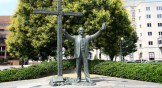
Salvation in Christ Jesus was offered in National Statuary Hall May 16 at the unveiling of a statue of the iconic late global evangelist Billy Graham, which has John 3:16 and John 14:6 carved in its base.

“Friends, God’s grace is undeserved, but through Christ it is freely given. And it is by trusting in God’s sacrifice that we are saved,” US Sen. Ted Budd (R-NC) said in the unveiling ceremony. “If you’ve not made a decision for yourself, I hope, I pray, that you will.”

US House Speaker Mike Johnson (R-LA), North Carolina Gov. Roy Cooper and members of Graham’s family joined the North Carolina Congressional delegation in unveiling the statue that replaces that of early 20th-century North Carolina governor and staunch white supremacist Charles Aycock.

“Today, we acknowledge that he is a better representation of our state than the statue it replaces, which brought memories of a painful history of racism,” Cooper said. “Not that Rev. Graham was perfect—he would have been the first to tell us that. … But he believed, as many of us do, that there is redemption, and he gave his life to remembering that message.”

US Sen. Thom Tillis (R-NC) honored Graham as a trailblazer in race relations.

“During an era in the 1950s when leaders in the South openly embraced segregation, it was Billy Graham who spoke out against it,” Tillis said, describing Graham as having been a staple in the Tillis family. “He insisted in his sermons that they be integrated. He shared his platform with Black ministers, including one named Martin Luther King Jr.

“Rev. Graham was blessed with the gift that bridged differences,” Tillis said, “and brought us all together.”

In his prayer, US Senate Chaplain Barry Black described Graham’s life as “the light of morning at sunrise on a cloudless day, and like the brightness after rain that brings the grass from the earth.”

Billy Graham statue in the US CapitolKent Nishimura / Getty Images
Billy Graham statue in the US Capitol

The late evangelist’s son Franklin Graham, president of the Billy Graham Evangelistic Association and Samaritan’s Purse, said his father would have been uncomfortable with such laud, but thanked leaders for bestowing the honor.

“He would want the focus to be on the one he preached,” Franklin Graham said. “He would want the focus to be on Jesus Christ the Son of God.”

His father believed the Scripture inscribed on the statue’s base, Graham said, and indeed the entire Bible “cover to cover. He didn’t understand it all, but he certainly believed it all, every word of it.”

The Southern Baptist evangelist led hundreds of thousands to Christ through a decades-long global ministry of evangelistic crusades, authored 33 books and counseled several US presidents. He and Ruth, his wife of 64 years until her death in 2007, had five children and numerous descendants.

Speakers extolled Graham’s life and legacy, remembering him as the “leading ambassador of the Kingdom in our lifetime,” as Johnson put it, and as a man, in Cooper’s words, who “treated all with dignity and respect.”

Sculpted by Charlotte-based artist Chas Fagan, Graham’s remarkable likeness stands 7 feet tall, bronzed and holding an open Bible in his left hand, his right gesturing palm-down above the page.

“His Bible is open specifically (to) Galatians 6, verse 14,” said Johnson, who himself held Billy Graham’s study Bible during his closing remarks.

The Southern Baptist from Louisiana noted that imprisoned men at Angola in his home state made the plywood casket Graham was buried in after his death in February 2018 at the age of 99.

“Rev. Graham humbled himself to care for the poor, and prisoners, the forgotten, the lost and the least of these, exactly what the Scripture tells us to do,” Johnson said. “He believed that even the poorest sinner could be a co-heir with Christ. And those men who made his casket had come to believe that message too. And they believed it through the influence of Billy Graham and the Graham family.”

The North Carolina General Assembly approved the statue in 2015. Graham joins Civil War-era N.C. Gov. Zebulon Vance in comprising North Carolina’s Statuary Hall statues. Each state is allotted two.

Graham joins three other Americans who have received the nation’s three highest honors of the Congressional Gold Medal, lying in state and having a statue in the Capitol, Johnson noted. Others are Presidents Gerald R. Ford and Ronald Reagan, and Civil Rights leader Rosa Parks.

News

Brazilian Pop Stars Are Praising God with Their Voices. What About with Their Hearts?

As Brazilian gospel music’s popularity soars, artists with little Christian background are releasing worship songs. Does it matter why?

Christianity Today May 16, 2024
Illustration by Abigail Erickson / Source Images: AP Images, Unsplash

“Dwell in me, Jesus,” sings Ana Castela in “Agradeço” (I Thank You), a single the 20-year-old Brazilian pop star released in December. The lyrics resemble words that evangelical congregations sing in contemporary church services across the country: “I surrender, I trust, I accept, and I thank you.”

Castela emerged on Brazil’s music scene two years ago and is also known as “the Boiadeira” (Cowgirl), the title of her first hit, which features lyrics like, “She gave up wine for beer, the preppy girl became a cowgirl.” The majority of her music focuses on relationships, betrayals, and drinking (themes common in sertanejo, a local genre that somewhat resembles American country music).

Though she grew up Catholic and occasionally sang at evangelical youth services as a teenager, Castela broke into the industry as a mainstream pop star. “Agradeço” is her first Christian single as a solo artist. (It also marked the debut of Agropraise, a Christianized branch of the sertanejo label Agromusic.)

The Boiadeira is one of an increasing number of mainstream artists crossing into the Christian market and debuting gospel and worship tracks over the past decade. In 2022, Simone, from the sertanejo duo Simone and Simaria, sang “Sobre as Águas”(Over the Water) with Christian contemporary artist Davi Sacer. In 2021, forró singer Wesley Safadão performed with the band Casa Worship in “Deus tem um plano” (God Has a Plan). In 2018, pop singer Luan Santana and the CCM duo Marcos & Belutti recorded versions of well-known gospel songs.

Since 2015, Brazilian gospel music—gospel referring in this context to a generalized popular Christian genre, not the gospel tradition in the US rooted in the Black church—has grown substantially in popularity. According to Spotify, the genre’s listenership grew on average 44 percent each year between 2015 and 2020. And while Western worship artists like Hillsong are popular with Brazilian Christians, Brazilian gospel artists are carving out their own niche and creating some of the most listened-to Christian music globally. This year, from January to March alone, the number of gospel music listeners on Spotify grew an additional 46 percent.

Currently, gospel music accounts for 20 percent of the Brazilian music industry’s revenue, and major international record labels have noticed. In 2010, Sony Music Group made Brazil its first region outside the US to have a branch dedicated exclusively to gospel music and began hiring professionals from Christian labels. Universal Music Group followed in 2013.

Historically, as in the US, contemporary Christian music (CCM)—both gospel and worship—in Brazil exists in its own subculture apart from the mainstream, with its own stars, record labels, and award shows. Over the years, a few American Christian music artists have found mainstream success as crossovers, but in the US and Brazil, crossover success stories have been rare. Now, self-identified evangelical artists in Brazil are climbing mainstream charts, and gospel music has a much greater market share than CCM ever had in the US. This expansion, and the crossover success of artists like Castela, is almost certainly related to the explosive growth of Brazil’s evangelical church.

“In the past, evangelicals were a modest minority,” said Joêzer Mendonça, the author of Música e Religião na Era do Pop (Music and Religion in the Pop Era). “Brazilian evangelicals no longer hide themselves. Actually, they like to show off their faith, and this is reflected in the way they listen to music.”

Labels and music marketers see opportunities in the shifting religious landscape. “Businesspeople, agents, record labels, all of them are saying, ‘We have to record this!’” said Mendonça.

Wary of sexually explicit lyrics and profanity in mainstream music, many Christians support the proliferation of gospel music and its potential impact on secular stars. But, aware of the economic incentives artists may have to release gospel tracks, some pastors and theologians are asking the church to show discernment.

“We can’t say someone is now a Christian just because they sang a song,” said Carlinhos Veiga, a Presbyterian pastor and singer-songwriter. “But you also can’t say it’s just opportunism.”

The fear of limiting the audience

Though mainstream artists often present public images that don’t align with the expected profile of a “Christian artist,” many grew up in Christian homes and attended churches where they first learned to sing or play a musical instrument.

Some denominations, such as the Assemblies of God, Congregação Cristã no Brasil (Christian Congregation in Brazil) and Seventh-day Adventists, have built a reputation on making instrument instruction available for all congregants. Whereas private music lessons are largely only accessible for the wealthy, churches may have classes where everyone can learn the trumpet, trombone, or French horn for free. Many also offer singing lessons, and most small churches have their own choirs.

“Many [artists] have family members who are evangelical, and they themselves enjoy being in the church, but frequently, they also have a complicated relationship with faith since they aren’t frequent churchgoers,” said Renato Marinoni, a pastor and founder of the Instituto de Adoração, Cultura e Arte, a ministry training school focused on worship and the arts. “It’s not uncommon for some to get starstruck when they achieve success. They start to think the church is too small for their talent.”

Some singers may start in the gospel music industry but move away from faith-forward music in order to build a successful career in the mainstream. Conventional wisdom has long dictated that making gospel music limits a musician’s audience.

“For a long time, the interaction between gospel and secular music wasn’t seen sympathetically—the market thought it would limit the audience,” said Marcell Steuernagel, director of the master of sacred music program at Southern Methodist University in Dallas, who grew up leading worship in the Brazilian Lutheran church before moving to the US.

Now, seemingly, artists are no longer forced to decide between making music for the church or finding commercial success.

“Some of these artists will sing worship music out of nostalgia,” said Veiga. “On the other hand, we have artists that will sing gospel music because they are truly Christians and they know that, now, they will have an audience if they sing worship music.”

This phenomenon isn’t necessarily unique to Brazil, says Steuernagel. In Brazil and in the US, sacred songs have provided a familiar repertoire that artists can pull from for a variety of reasons, whether because of personal interest or the perceived interests of their audience. Popular American musicians like Elvis Presley or Aretha Franklin recorded hymns or gospel songs. Carrie Underwood regularly performs “How Great Thou Art” in shows during her Vegas residencies. Justin Bieber posts videos on social media of himself participating in worship or singing a praise song in his home.

The demand for gospel music further suggests a shift in the public’s relationship with spirituality. Christian music seems to hold appeal for its potential therapeutic effects, even for listeners who don’t consider themselves to be practicing Christians.

“There are people who don’t attend evangelical services, don’t live by Christian values, but listen to this musical style,” said Marinoni. “They say it brings peace.”

The problem of endorsement

Though they haven’t made their way into the corporate worship of Brazilian churches, many mainstream artists’ worship songs have been embraced by Christian radio and show up on worship music streaming playlists. While the majority of these worship songs have mainstream writers, Christian artists have participated in a number of collaborations, which has at times generated fierce pushback.

In 2022, Christian singer-songwriter Kleber Lucas released a duet with Caetano Veloso, an atheist pop star and activist. After their performance won an award, one evangelical congressman mocked the announcement, while a Christian influencer called it “Christianity accepted by the world.”

Last year, Priscilla Alcântara, a popular gospel music star, joined Carnival with secular singers in a trio elétrico (a truck equipped with a massive sound system that drives through the streets as partygoers follow—a Carnival staple). Evangelicals, who generally eschew the holiday, attacked Alcântara for seemingly compromising her Christian values.

Gospel singer Fernandinho criticized partnerships between Christian and secular artists and accused gospel singers of downplaying the gospel in their interactions. In 2021, he posted a video where he used 2 Corinthians 6:14–15 to say that there can be “no communion” between the two.

“How can I walk side by side and sing with an enemy of God?” he said. “Jesus doesn’t turn a blind eye [to sin].”

https://www.instagram.com/p/CTShekID2qm/

For most of these secular artists, forays into Christian music are just part of their performances and track lists.

“The secular artist isn’t attached to what the church sings—they are only interested in expressing themselves,” said Marinoni. “It’s the church’s responsibility to be close to the artist and disciple them if they are willing.”

For Castela, recording “Agradeço” was a way of “thanking God for all the things he has done.”

“I love to sing worship music, but I don’t think that is my thing. My thing is sertanejo, and I also really like pop music,” she told Correio Braziliense. “If one day God allows me to enter the gospel scene, I’ll be right here with open arms and a warm heart.”

How Christianity Today Helped a Brazilian Missionary Create an Action Plan During the Pandemic

“Christianity Today was the tool God used to give us direction, practical inspiration, and a clear strategy.”

How Christianity Today Helped a Brazilian Missionary Create an Action Plan During the Pandemic
Alef Ministry

If you do a quick online search for Natal, Brazil, you’ll find pictures of beautiful bright blue waters and white sandy beaches with vacationers from all over the world scattered along the shoreline.

But hidden from the tourists’ view is a dissonant reality of impoverishment and violence. Half of the population lives in poverty in northeastern Brazil.

When the pandemic hit the region in March 2020, the situation only became worse. Within days, businesses closed and the streets appeared desolate. In an area where most of the population depends on tourism and people work in small businesses just to make enough money to afford their next meal, hunger and lack of health protection supplies brought the community to the brink of collapse.

At this time, Leandro Silva, a missionary for the Brazil-based organization Alef, prayed fervently that God would lead him to find answers. Providence led him to Christianity Today.

“I felt the Lord leading me to a three-day retreat where I was going to dedicate myself to study what COVID-19 was and seek God for direction to give answers to this reality. In all the research I did, the only solid and biblical guidance I found was in Christianity Today in Portuguese.”

As in the rest of the world, after the outbreak of the pandemic, Natal became a ghost town. Churches were forced to close their doors, and pastors were filled with anxiety, torn between government mandated closures, experts’ advice to avoid social gatherings, and a faith-filled desire to continue church ministry as usual. No one in the area knew how to cope with the looming chaos.

Alef emerged in 2003 as a missionary movement with the goal of mobilizing Natal’s churches to work together, serving the poorest, most violent, and most marginalized neighborhoods. Silva, as Alef’s president, felt compelled to provide the pastors with guidance in the midst of one of their greatest challenges.

“I remember coming across an article in Christianity Today that talked about what the churches in Singapore had done to respond to the pandemic,” he said. “The churches in Singapore had responded courageously in the midst of fear, and through many uncertainties they testified of the love of Christ. They did not allow fear to guide them. I felt that was exactly what we needed to do. That article was a very bright light because it had clear and practical information.”

In 2020 alone, CT published more than 250 articles in English related to the pandemic, seeking to provide answers and Christian perspectives at a time when believers were in mandatory lockdowns yet were looking for answers on how to face the pandemic with a Christ-honoring response.

It was also at the beginning of the pandemic that the team at Christianity Today felt God was guiding them to further its translation efforts in order to expand this content to the church around the world. The pandemic accelerated CT’s vision to become a central nervous system for the global body of Christ. Since 2020, over 4,000 translations of articles have been published in 19 languages.

In May 2020, CT published an article by renowned pulmonary doctor, epidemiologist, and public health specialist Daniel P. Chin with detailed explanations of the disease-spreading risks of common church activities in different possible scenarios.

“This article made a huge difference for us,” Silva said. “It analyzed the risk factors, step by step, with charts. It was very relevant material for every problem we were facing, and it was impressive for me to discover that Christianity Today had all these articles available in my language.”

Silva created a COVID-19 strategy manual for Alef, all based on CT articles. “What we did was to contextualize it for our reality and design a project.”

Soon after the manual was ready, Alef set out to provide training, starting with the two poorest areas of Natal.

“Inspired by what we read in Christianity Today about how we should not flee the pandemic, but stay and serve the needy wisely, we raised funds to distribute food to families,” Silva said. “We also designed posters that explained in simple terms what people should do to prevent the spread of Covid. We did training in churches and also house to house, providing them also with sanitary kits.”

Silva’s efforts were just the beginning of a chain reaction that God unleashed to help the communities of Natal.

“When other organizations and foundations in the area heard about what we were doing, they started to donate funds for the mission,” Silva shared. “Even a bank that normally does not allocate funds for Christian or faith-based organizations . . . did so because we had a well-structured project on a solid foundation.”

CT’s coverage of the pandemic also helped Silva notice something he had not seen before: Frontline medical and health workers were physically and emotionally drained.

“After I read stories on how others were helping these sanitary workers around the world, we began recording video devotionals seeking to encourage them in specific ways, and we shared them among the staff of one local hospital,” Silva said. “Later we learned that they themselves were forwarding them to other medical employees in all the hospitals in Natal.”

Within the first six months, Alef went from doing ministry with 50 families to a little over 1,000, and by the next year over 100 churches were involved serving over 3,000 families.

The greatest outcome from this ministry was that whole communities that previously had been closed to the gospel opened their hearts to hear the message of Christ.

“When we didn’t know what to do, when we had no idea how to respond,” Silva said, “Christianity Today was the tool God used to get direction, practical inspiration, and a clear strategy.”

Church Life

Police Officers Are Burning Out. Can Chaplains Help?

Spiritual care is essential as stressors among law enforcement rise.

Christianity Today May 16, 2024
Illustration by Mallory Rentsch Tlapek / Source Images: Getty

Sitting in the front row of a supervisor training in 2016, Stamford Police Sgt. Sean Boeger raised his hand every time the instructor asked who had dealt with a particular experience, including homicides, fatal accidents, and child deaths.

During his nearly 30 years as a police officer, 48-year-old Boeger had helped with body recovery efforts at Ground Zero after 9/11. When 20 children were killed by a lone shooter in 2012 at Sandy Hook Elementary School in Newtown, Connecticut, just 40 miles from Stamford, Boeger volunteered to help the small Newtown police department. He covered midnight shifts as officers took time to recover.

The instructor at the training triggered something in Boeger. Until that class, he had never dwelt much on the effect of witnessing so much trauma. Driving home that evening, he also thought back to another incident, when he responded to a report of a small child falling out of an eighth-story window.

“I felt overwhelmed, kind of panic-stricken,” he recalled of that evening. “I think I was more in shock from the stuff I’d never contemplated and the trauma impact it had on me. Because you don’t stop to think about it.”

So Boeger did something he had never contemplated previously: He sought help from John Revell, a chaplain who had recently been spending time with his department.

“I don’t know what’s going on with me, but I feel like I need to talk to you,” Boeger recalls telling Revell, whom he calls “the Rev.” Revell invited him over, interrupting his family dinnertime, and the two spent an hour or so talking. It opened the door to a longer-term relationship, and an eventual appreciation for the Rev’s consistent presence around the department.

Given the increased stress police have been experiencing around the country, chaplains are needed more than ever to aid officers in their work. They’re serving police departments, not just to show up for departmental ceremonies and funerals but to build relationships and provide counsel for the traumatic incidents police so often face.

In the wake of the death of George Floyd in 2020, rising racial tensions and calls for reform have increased the pressure surrounding law enforcement behavior and performance in the past four years. A Police Executive Research Forum survey found that from 2020 to 2021, police departments nationwide saw a 45 percent increase in the retirement rate and a nearly 20 percent increase in resignations compared to the previous year.

Due to repeated exposure to high-stress and even life-threatening incidents, US police officers in particular have high rates of depression, suicide (and suicide ideation), alcohol use, divorce, and domestic violence, according to a 2023 study published in the Journal of Police and Criminal Psychology. More officers reportedly die of suicide than any other cause, including by firearms or traffic-related accidents.

But much research, including one 2023 study, suggests that access to chaplains benefits police officers’ mental health and that spirituality contributes to resilience in the face of PTSD symptoms.

In earlier decades, most chaplains were local pastors. But in recent years, there has been a significant increase in the use of chaplains specifically trained for police or with law enforcement background, in both large and small agencies across the United States and in numerous other countries.

One of the largest networks, The International Conference of Police Chaplains, represents nearly 2,500 law enforcement chaplains across 15 countries. The North American Mission Board, a Southern Baptist organization, sponsors more than 500 public safety and first responder chaplains.

While Boeger, like many officers, doesn’t consider himself particularly religious, his experience with the Rev and the local chaplaincy program has convinced him of chaplaincy’s value. Meeting with the Rev offered much-needed outside support—just to have someone listen to him and help him not feel alone, he said.

“It’s not like [the Rev] has magical powers or a special technique, it’s having someone who understands,” Boeger said. “Most people want to talk about [their trauma] and express it, they don’t always realize they just need to talk about it and have someone who’s nonjudgmental to listen to them. It’s kind of simplistic, but it’s not an easy job.”

Revell doesn’t see his role as a magical solution either. It’s about building relationships. “In those kinds of situations, mostly what I do is listen,” he said. “I ask questions and give [officers] a chance to unburden themselves.”

In some jurisdictions, police chaplains are hired for ceremonial reasons or to respond to major crisis events such as a mass casualty event. But Revell and his team follow what they call “deployment chaplaincy,” which imitates military chaplaincy by sending ministers to domestic frontlines. The Christian idea behind this, Revell says, is incarnational ministry.

Revell, 68, runs Life Line Chaplaincy and is welcomed as an official chaplain for four Connecticut departments, including the state department, and as an unofficial on-call chaplain for several others.

In these roles, law enforcement chaplains don’t only show up after an officer dies in the line of duty or to support officers who have responded to grisly scenes. They also attend to officers’ personal lives: the birth of a stillborn, the death of a parent, ongoing support of a spouse, and, sometimes, speaking at an officer’s funeral.

“Especially with police officers, you can’t just pick a random person and unload all that stuff,” Boeger said. “When you open up to someone, you’re placing a burden on [them].”

For Stamford Police Lt. Doug Deiso, a chaplain like the Rev offers a comforting spiritual aspect to their work. “People in law enforcement are type A personalities and think they can deal with issues on their own,” Deiso said. “But it’s not always serious or stern with him. You can give him a hug. And when he comes around and sees I’m busy, he doesn’t try to box me in a corner.”

Certainly, a chaplain’s role also involves aiding officers in their high-stress field. Revell, for example, maintains a presence through officer “ride-alongs” in their vehicle, informal breakfast meetings, and showing up regularly at their department headquarters. He also responds to emergency incidents to care for officers when a police chief requests it.

“There’s a long-term career buildup of trauma and stress as a first responder,” Boeger said. “If you work in a busy area, you’re going to build up microtraumas over the years.”

While chaplaincy is a strong resource for police agencies, it’s not the only factor for helping officers cope. Now, police academies are teaching officers more about how to respond well to the job stressors and to cope better. But two decades ago, that was not available, and the police culture is still shifting. Expressing feelings is seen as a sign of weakness, multiple officers said. Female officers especially feel the pressure to be perceived as strong and unemotional.

Law enforcement agencies have always addressed physical health, but in the last few years they have increasingly addressed mental health and trauma, said Connecticut state trooper Rodney Valdes, a peer support and chaplaincy programs coordinator with the state.

“We are made of mind, body, and spirit/soul,” Valdes said. “We’re attending body and mind but often neglecting the third—the spirit. How do we introduce spirituality to a police culture that is very anti-[religion]?”

This injury to the spirit after participating in or witnessing an event that violates the conscience—such as cruel behavior or a crime—is now known in chaplaincy circles as moral injury. It can result in deep shame, guilt, or even despair. Chaplains have a unique role to offer in addressing this wound in ways a medical doctor or therapist might not be able to.

Police departments do not always welcome chaplains. Even with increasing awareness around emotional support, it’s hard to gain trust and for law enforcement personnel to see the point in receiving spiritual or holistic care. Revell spent years with multiple consecutive police chiefs, gaining trust for himself and his work by showing up and spending time at the departments.

Now, in addition to chaplaincy, complementary resources like peer-to-peer support and employee assistance programs offer counseling. This spring, Revell organized an inaugural first-responder wellness conference for nearly 300 participants.

Revell and many others see their spiritual leadership as merely a humble obedience to the biblical command to “carry each other’s burdens” (Gal. 6:2).

“They’re forced to face all of this darkness. It’s easy to be overwhelmed with all of this darkness,” Revell said. “My goal is to be a source of light for them. The whole goal is to see the light of Christ tangibly in my ability to walk with them.”

It is not only Revell’s endurance that makes an impact, Deiso added, but his open-door policy—and his wife’s chili and cookies.

For Boeger and Deiso, the chaplain’s vocation of presence is sustenance enough.

“The biggest thing for me is that [the Rev] stood next to me when we’ve had people lose their lives,” Deiso said. “He’s stood next to me in the rain, in the cold, and didn’t at one point complain about it. He mourned for us and with us. I’ve seen him stand in five-degree weather during funerals. He did that for many hours. That’s powerful.”

Kara Bettis Carvalho is ideas editor at Christianity Today. This article was supported by a grant from the Chaplaincy Innovation Lab at Brandeis University in partnership with Templeton Religion Trust.

News

The Caregiving Boom Needs Spiritual Support

By calling or circumstance, millions in the “sandwich generation” feel the weight and cost of tending to aging relatives.

Christianity Today May 16, 2024
Edits by Christianity Today / Source Images: Getty

Shanoah Bruner is among the quarter of American adults who find themselves in the “sandwich generation,” raising children under 18 and supporting aging parents.

At her home in the Indianapolis suburbs, the 40-something mom lives with her husband, tween and teen daughters, mother-in-law, and biological father.

The caretaking role comes naturally to Bruner. She was raised in a family that regularly opened their home to others and served their church and community. Plus, she worked in assisted living, memory care, and skilled nursing for over 20 years.

“I grew up in a very Christian home where, you know, people meant more than possessions,” she said. “So that’s just how I look at it, and it’s definitely rewarding for me, though that’s not the case for everybody.”

As baby boomers descend into their twilight years, their kids are taking them in or helping manage care from afar. Sixty-six percent of caregivers are women like Bruner, most of them in their mid-to-late 40s, who also work outside the home.

The demanding needs of caregivers and their loved ones offer believers a chance to provide support and gospel hope. Churches, nonprofits, and government and parachurch organizations have resources, and individual Christians can provide personal, tangible love in action.

In 2022, the first Bible study specifically for dementia caregivers was published. Some churches are implementing caregiver workshops. The Caregiving Support Network hosts a program to “sponsor a caregiver,” and there’s even a dedicated “Caregiver’s Prayer.”

Richard Gentzler Jr., an expert in ministry for aging adults, paraphrased former First Lady Rosalynn Carter when he wrote that there are only four kinds of people in the world: those who have been caregivers, are currently caregivers, will be caregivers, or will need caregivers. In other words, no Christian is exempt from participating in care for the caregiver.

“I do think there’s a lot of opportunity for the church to minister to the emotional needs of this community, which could just be somebody to talk to,” said Bruner. “Someone to just listen, because there’s a lot of emotions when you’re taking care of a parent.”

Most caregivers are adult children, but sometimes, an aging spouse or a distant relative is thrust into the position. Stress and overwhelm characterize the life of a caregiver as they frequently juggle work, parenting, and the job of taxi driver for multiple weekly doctor’s appointments. They’re also babysitters for in-home care or around-the-clock check-ins at senior facilities.

“The statistics show that caregivers have a higher rate of mental illness and depression than even the loved ones they’re caring for,” said Lauren Guynn, executive director of the Shepherd’s Center, a nonprofit organization for independent seniors in Hamilton County, Indiana. “They have a higher rate of physical health problems … and they’re dying sooner.”

Multiple factors result in worsening caregiver health, including lower income, sole provision, co-residence, intensity of health problems, and race. African American and Latino caregivers are more likely to report declining health. Those caring for parents with Alzheimer’s disease report the highest stress levels.

Sole caregivers without assistance fare the worst, and the higher the level of need, Guynn said, the more “caregiver burnout, stress, and health issues.”

Studies show that religious values do contribute to the demographics of caregivers. Guynn’s Christian faith certainly guides her work at the Shepherd’s Center, where she directs programs aiding caregivers and seniors, offering counseling, transportation, visitation, yard work, social activities, and guardianship services.

“It’s taking action,” she said. “If we all made an effort to help the people we see caregiving, I’m guessing it would not only impact their lives but, from a kingdom perspective, the impact would also be huge.”

This work is vital, especially because, as Guynn said, many seniors struggle most due to poor caregiver support. The cost of care is a primary issue.

Getting old is expensive, with full-time memory care facilities charging an average of $7,000 a month. Medicaid doesn’t cover room and board, though it can help with other necessary support services like grooming, bathing, and medication management.

Because of the expenses, many families have no choice but to become full-time caregivers in their homes, while others offer care to relatives who live on their own or in institutional care.

Bruner didn’t grow up with her dad, instead living with her aunt, who ran a food pantry, and uncle, who served as a chaplain at the local jail. It’s their legacy of Christian service and sacrifice that inspired her to care for her biological father as he ages.

Bruner’s father requires regular appointments with an Alzheimer’s specialist, a neurologist, a urologist, a podiatrist, and a brain and spine doctor. Maintaining his care and appointments is a full-time job that Bruner and her husband prayerfully weighed before agreeing to it. She feels lucky to have the means to hire outside help, because many others cannot.

During her work in professional senior care, Bruner said she witnessed adult children who were bitter about caregiving responsibilities for neglectful parents. Because of this mentality and the heavy burden of caregiving, elder abuse is quite high.

For Bruner, caring for the father who did not raise her is “sort of like a restoration.” Though she views her role as a ministry, she said it would be nice to have more supportive programs for caregivers from the church.

Even without dedicated senior support programs, Guynn believes local churches are “uniquely qualified” to offer support for caregivers.

“They just need to feel like they're not alone,” said Guynn. “And I feel like the church has an opportunity to reach people who I think the devil is isolating.”

Guynn finds that caregivers resist support from organizations but have a level of built-in trust with churches. She said that smaller churches are doing some of the best work in this area.

“These churches may have only 100 people, but every single person there knows each other,” she said. “When someone has surgery, they bring meals, and they know if someone needs help going to the doctor. … It’s a sense of community that comes with a small church that naturally lends more support to caregivers.”

This kind of ministry still often falls to parachurch organizations, which can raise money to offset costs and implement specific programs to help.

The Caregiving Support Network, launched in 2022, offers financial assistance to unpaid caregivers through an application process. Rebecca Dowhy founded the organization after years of caring for her mother, who suffered from multiple sclerosis.

“My physical, mental, and spiritual health suffered tremendously in seasons of burnout and depression,” she wrote. “The relentless nature of disability forced us to continually pour from an empty cup with no way to recharge our energy.”

Churches may hold fellowship nights or events specifically for caregivers to gather. In Dothan, Alabama, the Respite Care Ministry team at First United Methodist Church launched Rosemary House, a place for refreshment for memory loss caregivers.

“Sometimes, caregivers just need someone to listen to them,” said ministry director Katie Holland. “We just want to have a haven for them where they can come get support, education, and training.”

The American Heart Association is one of many organizations that pushes caregivers to consider their well-being even as they support their loved ones. In one resource, they remind caregivers of their right to care for their health, accept help, utilize community resources, express emotions, and tend to other parts of their life.

The Family Caregiver Alliance helps caregivers find outside support, including things like care management, transportation assistance, support groups, legal and financial counseling, respite care, adult daycare options, and more.

Gospel Hope for Caregivers, a ministry created by Marissa Bondurant, encourages people to see caregiving primarily as a ministry. After caring for her (now healthy) young daughter with cancer, Bondurant identified a gap in support for Christian caregivers.

“As I started writing about our experience—about some of the things that were challenging, and the ways that God provided for us—our story started resonating with both ends of that caregiving spectrum,” said Bondurant, who went from posting on CaringBridge to a public site.

“A lot of it had to do with the theology of suffering. I think people needed to hear something that was really going to address the questions they had in their heart and wasn’t going to just be this Band-Aid the church sometimes puts on with a little happy-face sticker.”

Bruner pointed out that churches already have people dedicated to praying for and supporting those with other issues, like poverty, single parenthood, addiction, and divorce. She said showing up for caregivers in the same way would “be like a light” in the darkness.

Those familiar with the caregiving space say proactive, tangible support brought directly to the home is the optimal way for others to help, because many caregivers will never ask for or accept help. They say to just show up, bring food, do their yard work, bring Bible study to them, or offer to sit with their parents so they can run errands.

“In those really dark and difficult situations, having someone to offer spiritual guidance can help them see grace and find healing,” said Guynn. “This is going to help them start to see that God can turn these situations into good and figure out how they can really allow him to work in their lives.”

Ideas

The Miracle of the Ear

Contributor

Speech was not God’s only miracle at Pentecost. The Spirit also gave the gift of understanding, overcoming division and contempt.

Christianity Today May 16, 2024
Illustration by Mallory Rentsch Tlapek / Source Images: Unsplash

Tongues of fire, everywhere. In this loud and furious age, a time of protests and counter-protests, words come burning, singeing, scalding, stinging.

“Everyone should be quick to listen, slow to speak and slow to become angry,” James wrote, “because human anger does not produce the righteousness that God desires” (1:19–20). But few of us—even those of us who follow Christ—seem to believe that listening more than we speak could possibly meet the reality of these days.

We give into the temptation of “thinking the times require using the tools of the enemy,” as Michael Wear says in The Spirit of Our Politics. We justify our tongues of fire as “just the way you play the game,” disregarding our trail of destruction—great forests put to waste by the sparks from our lips (3:5–8).

Of course, there’s nothing new under the sun. Rage travels more quickly by gigahertz than messenger, but our era is not uniquely chaotic or tumultuous. The church has lived through worse, not least the dangerous early days after Christ’s resurrection and ascension.

“[I’ve] been jailed … beaten up more times than I can count, and at death’s door time after time,” recounted the apostle Paul of his ministry in that time. “I’ve been flogged five times with the Jews’ thirty-nine lashes, beaten by Roman rods three times, pummeled with rocks once. … I’ve had to ford rivers, fend off robbers, struggle with friends, struggle with foes. I’ve been at risk in the city, at risk in the country, endangered by desert sun and sea storm, and betrayed by those I thought were my brothers” (2 Cor. 11:23–27, MSG).

That was the cultural moment in which the Holy Spirit had come to the disciples in Acts 2 and unleashed a different sort of fiery tongue upon the world—one that brought connection, edification, and clarity instead of division, destruction, and confusion. This is the spiritual inheritance we remember and celebrate on Pentecost Sunday. And it is an inheritance we need to grasp anew, for our moment is just as desperate for these gracious tongues of fire and the miracle of understanding that attended them.

In the churches of my youth, any discussion of the “rushing mighty wind” (Acts 2:2, KJV) blowing into that room of gathered disciples focused on tongues in one sense or another. At my charismatic youth group, church elders—believing in the second blessing or second baptism of the Holy Spirit—said teens couldn’t serve on the youth leadership team if we didn’t speak in a glossolalia prayer language, also called tongues. (I didn’t.)

Meanwhile, the decidedly not charismatic church I attended on Sunday mornings didn’t talk about the Holy Spirit much at all. We made Pentecost a nice memory, turning the Holy Spirit’s appearance into a museum exhibit complete with Renaissance-style art of dainty flames dancing over calm, saintly heads. Maybe things were a little strange in those early days, but we were orderly. Reasonable. Normal and predictable. (This interpretation had the added perk of soothing my ego, reassuring me that I wasn’t less spiritual than my youth group peers.)

Despite their very different conclusions, both churches started with the same question: How do we make sense of Pentecost’s miracle of the tongue? The focus was so singular that it wasn’t until adulthood that I learned there was a second miracle at Pentecost: Alongside the miracle of the tongue was the miracle of the ear.

In a world beset with the confusion of Babel, God sent his Spirit to restore mutual understanding. Pentecost Sunday marks a miracle of listening as much as a miracle of speaking. And in our day—when everyone is shouting and no one is listening, when we know much more of James’s blistering tongues of fire than the healing tongues from Acts—Pentecost’s miracle of reciprocal communication is what a scorched world needs the church to embody once again.

In The Wolf Shall Dwell with the Lamb, a small book on leadership in multicultural contexts published in 1993, the Chinese-American Episcopalian priest Eric H. F. Law unpacks this “miracle of communication” by framing the Acts 2 account with the social, economic, and political power dynamics of the day.

In Acts 2, Law writes, we see two groups of people gathered. The first is the disciples, mostly fishermen and laborers from Galilee—roughnecks and rednecks, we might say today, with country accents to boot. As we learn later in Acts, early Christian leaders like Peter and John were known to Jewish elders and scribes to be “uneducated and untrained” (Acts 4:13, NASB), while to the Roman occupiers, Law says, they “were just another sect of Judaism whose leader had been executed.”

The second group is a large gathering of “God-fearing Jews from every nation under heaven” (Acts 2:5). Relative to the disciples, many of these people were members of the Jewish elite. Some had managed to make very long and expensive journeys to Jerusalem. Probably some were Sadducees, the religious aristocrats with seats on the Sanhedrin council, political influence, and connections to powerful people in the Roman government. Some may even have joined in demanding that Pilate crucify Jesus just a few weeks before.

In short, Law argues, this second group could have made trouble for followers of Jesus, and perhaps some of them already had. Yet it is to this group that the Holy Spirit gave “the gift of listening and understanding even though what was said by the disciples was in another language.” Not everyone in the crowd seemed to accept the gift—some thought the disciples were drunk, after all (v. 13)—but many did understand and were amazed at what they heard (v. 7).

At Pentecost, “God chose the foolish things of the world to shame the wise” and brought “righteousness, holiness and redemption” (1 Cor. 1:27–30). The weak, ignorant, and powerless were understood by the strong, educated, and powerful. The ordinary way of the world was upended by Christ’s upside-down kingdom. The Spirit’s tongues of fire brought illumination, not harm.

Where do we—American evangelicals—find ourselves in this story today? Are we powerful or powerless? That question is complicated by factors of race, education, and class, and it’s central to so many of our culture war battles, as the same behaviors and fears play very differently if they come from an embattled minority rather than a paranoid majority.

My own background is white, rural, and working-class. Today my husband and I are solidly middle-class, but I was the first person in my family to go to college—and I barely fumbled my way there, neglecting to sign up for the SAT because I didn’t understand its importance for admissions. My hometown isn’t Galilee, but it’s arguably an American equivalent.

I know and love many white working-class evangelicals carving out a life in dying towns, trying to imagine what future their children have in hollowed-out communities. None of them feel privileged or powerful, but all of them resent being told they are. And depending on your news source, these people—my people—are either aggrieved, forgotten, and rightfully resentful or ignorant puppet fascists who pose an existential threat to American democracy.

Those dueling characterizations are, in part, a communication problem. We talk and talk but do not listen, and as a result we do not understand one another, even within the church. We name others’ sins and fall silent about our own (Matt. 7:3). We ignore the complex nuances at play in others’ communities and return bitterness for bitterness, joining the chorus of clanging cymbals (1 Cor. 13:1).

This is the stifling space in which the church needs a fresh wind from the Holy Spirit. We must repent of all the ways we’ve become “a church that fears the power of cultural and political circumstances more than it fears the power of God,” as Wear contends. And we must ask God to help us, by the Spirit, seek both miracles of Pentecost.

This is what our moment requires of us—and that’s true whether we most easily see ourselves as the Galileans or their more sophisticated hearers. I suspect I’m not alone in seeing myself in both groups: In some situations, considerable advantage is afforded to me by the color of my skin or the sound of my speech; and in others, I’m a country bumpkin unsure of how to navigate the halls of power. But in every case, I’m a follower of Jesus, and my identity is found in him, in humble submission to Christ’s call to consider others more highly than myself (Phil. 2:3). In every case, I am to pray for God to give me what I need.

I think that’s true for all of us followers of Jesus. Sometimes we need the gift of the tongue: a resolve that empowers us to stand where we need to stand, resist what we must resist, and say what needs to be said. But sometimes we need the gift of the ear, as God asks us to quiet down, listen, and tame our tongues.

Sometimes we’ll have power. Sometimes we’ll have none. Sometimes we’ll be in need. Sometimes we’ll have plenty. Sometimes we’ll be privileged and revered. Sometimes we’ll be reviled and scorned. Sometimes we will need to defend what we hold dear. Sometimes we will need to lay down our lives. But in all seasons, we will have the Holy Spirit, always eager to work in and through us to produce the righteousness that God desires.

Carrie McKean is a West Texas–based writer whose work has appeared in The New York Times, The Atlantic, and Texas Monthly magazine. Find her at carriemckean.com.

Theology

The Sustaining Breath of God

As a physician, I witness countless first and last breaths. As a Christian, I am constantly reminded of how God breathes life into us through his Spirit.

Christianity Today May 16, 2024
Illustration by Elizabeth Kaye / Source Images: Getty, Unsplash

The scalpel sliced through the uterine wall. The amniotic sac ruptured, and fluid flowed across the blue surgical drapery toward me. The obstetrician’s fingers curled around the baby’s head while my gloved hands pressed firmly against the mother’s abdomen. The baby was larger than we had expected. I shifted my full body weight against the mother’s belly, and, at last, the newborn’s head slipped through. Her shoulders quickly followed, and there she lay, eyes taking in the bright world for the first time.

Before she could cry, she took her first breath. Air rushed in, pushing aside fluid that had filled her lungs from six weeks of gestation. The oxygen diffused through the blood vessels of the alveoli, tiny air sacs within her lungs, relaxing the pulmonary arteries and allowing blood to course through her lungs for the first time. The short vessel connecting her lung arteries and heart began to close. Pressure built in her heart, causing the tiny hole between its chambers to snap shut.

She breathed more vigorously than anyone else in the operating room, her purple hue softening to a rich pink. Squinting against the glaring light above, she cried again. What a foreign world this is—where air becomes breath, and then breath returns to air.

Ruach is a Hebrew word meaning breath, wind, or spirit. (In the Septuagint, an ancient Greek translation of the Old Testament, it is rendered as pneuma or pneumon, the roots from which we get many English words pertaining to lungs.)

In Genesis, ruach is both the Spirit of God bringing light and order into an unordered world (1:1–4) and the breath of life that God breathes into Adam (2:7). Psalm 33:6 says, “By the word of the Lord the heavens were made, and by the breath (ruach) of his mouth all their host,” and Job affirms that “the spirit (ruach) of God is in my nostrils” (27:3, ESV throughout).

We also see God’s ruach animating and energizing all of creation, including us. Breathing in God’s ruach shapes us into his image, and just as the newborn’s internal anatomy was physiologically shaped by her first breath, so too does God’s ruach change us and give us new life. In the Old Testament, the Spirit of God promised the future salvation and renewal of all of God’s people, and at the Last Supper, Jesus promised the Spirit would come to his followers as “the Helper” to teach, guide, and “be with you forever” (John 14:16, 26).

When “the goodness and loving kindness of God our Savior appeared, he saved us,” Paul wrote to Titus (3:4–6), “not because of works done by us in righteousness, but according to his own mercy, by the washing of regeneration and renewal by the Holy Spirit, whom he poured out on us richly through Jesus Christ our Savior.”

We are constantly reminded of that need for renewal. Just moments after returning from that C-section—still marveling at the miracle of first breaths—I crowded into a cramped ICU room, trying desperately to palpate a femoral pulse on a patient between chest compressions. No breath. No pulse. I watched her chest rise and fall with each compression and heard the rush of oxygen as the respiratory therapist artificially filled her lungs. But it was not a true breath. It was not her own ruach.

Time began to blur. Two minutes. Ten minutes. Twenty. “Please, don’t stop!” the patient’s daughter cried from behind me. But 45 minutes later, there still was no pulse. No matter how hard we tried, her ruach would not return.

Ecclesiastes says that “all are from the dust, and to the dust all return” (3:20), but that as “the dust returns to the earth as it was,” the “spirit (ruach) returns to God who gave it” (12:7). Without the context of Christ’s incarnation, death, and resurrection, the fact that God takes away his ruach can be a very somber thought. Yet the rich news is that because God himself experienced a first breath and a last, we are offered renewed life in the Spirit to restore and sustain us.

Christ too was forced from the familiar rest of his mother’s womb into a bitter, cold world, his body contorting as air reeking of manure and sour hay poured into his lungs. To think, God’s ruach poured into Christ’s own flesh.

It left his body too, as he took his last breath as our perfect and righteous Savior on the cross. “Jesus called out with a loud voice, ‘Father, into your hands I commit my spirit (ruach)!’ And having said this he breathed his last” (Luke 23:46).

Following his resurrection, Christ appeared to the disciples. His own ruach restored by God, in vindication of his sacrifice, he “breathed on them and said to them, ‘Receive the Holy Spirit (ruach)’” (John 20:19–22). Then, at Pentecost, there was “a sound like a mighty rushing wind (ruach) … and they were all filled with the Holy Spirit (ruach)” (Acts 2:2, 4). As God breathed life into Adam at Creation, so too Christ breathes the Spirit into his disciples.

This was the promised renewal. God promised that he would give us a new heart and put a new spirit within us. He promised to remove our hearts of stone and give us hearts of flesh—that he would put his Spirit within us and move us to follow his decrees and laws (Ezek. 36:26–27). At last, David’s plea in Psalm 51:10—“Create in me a clean heart, O God, and renew a right spirit within me”—was fulfilled, and the prophesy of the Old Testament rulers was made complete. Now, all people are offered the sustaining breath of the his Spirit through the death and resurrection of God’s own son.

How then shall we respond? Every breath, every gust of wind, every act of the Spirit—in all of these may the ruach of God remind us to do what the final psalm commands (150:6): Let everything that has breath praise the Lord!

Mariellen Van Nieuwenhuyzen (MD, UC Davis School of Medicine) is a family medicine resident physician who writes for several online Christian publications and literary magazines.

News

Died: KODA, the Ghanaian Gospel Star Who Sang Hits Rebuking Pastors

The highlife musician challenged the materialism and extortion he encountered too often in the church.

Christianity Today May 15, 2024
Illustration by Christianity Today

Kofi Owusu Dua-Anto, a Ghanaian gospel musician who challenged church leaders with his catchy songs, died last month at the age of 45. Known professionally as KODA, the artist passed away suddenly on April 21 after a yet-undisclosed short illness.

KODA won awards for his vocal and musical finesse and production skills, but he used the platform his music offered him to speak out against the materialism and self-promotion he believed had overtaken his country’s church leaders.

“What is being preached from the pulpit? If it’s just the aesthetics of Christianity … the flashy things of how the man of God has visited 20 churches in the UK or the US and how he stood in T. D. Jakes’s church … if that’s the vision … then that’s what [Christians will] chase,” he said in 2021.

In 2013, KODA put these concerns to music when he released “Nsem Pii” (Many Issues).

“Fifteen ways to be successful, 13 ways to make much money, but the one way to make to heaven, preacher man, you don’t preach about it,” he sang in both Twi, a Ghanian local language, and English. “Listen, last Sunday I heard you preach; I must confess, I was confused, was that church or GIMPA?” (GIMPA or Ghana Institute of Management and Public Administration, is a prestigious public university in Ghana.)

The track surprised many in the local Christian community, one that traditionally practiced unquestioned reverence toward pastors and church leaders, and the gospel music industry, which generally only sang about God and commented little on culture.

KODA credited the Bible as his inspiration for his lyrics.

“I was reading the Acts of the Apostles from [chapters] 1 to 4 and realized some churches are veering off their godly activities,” he said. “As for the song, it is a great song and he who has ears should listen and listen carefully before judging.”

‘A Miracle’

KODA was born on December 15, 1978, in Takoradi, a city in western Ghana considered to be the home of highlife, a West African musical genre that mixes local sounds with pop, rock, hip-hop, and jazz. Raised in a Catholic home, he never forgot a visit he made at an early age to an Assemblies of God church, where he saw a musician playing a bass guitar.

“There was this old man that would pluck a string. … It was like, ‘What is the man playing?’” he said. “That is my first memory of being in church and being in love with music.”

It was a couple more years before KODA began playing music, an event he later referred to as a “miracle,” and one that occurred around age 10, when a new music teacher arrived at his church. When KODA told him that he wanted to play the guitar, the man told him that he wanted to pray for him.

“He put his hands on my head and said, ‘God, give this young man a double portion of what I carry,’” KODA said.

After receiving this blessing, which KODA believed came true in his life, his mother soon enrolled him in guitar lessons.

KODA’s musical education continued when he attended the prestigious all-boys’ Mfantsipim School in central Ghana as a teenager. There, he met future Ghanaian gospel singer Nii Okai, who offered the junior student musical opportunities and leadership positions—and something far more lasting.

In Okai, KODA saw someone who “you could tell God was with.”

“I said, ‘If I’ll get what this senior has, I want to give my life to Christ,’” he said.

After graduating from secondary school, KODA continued his education at the Kwame Nkrumah University of Science and Technology (KNUST), one of Ghana’s leading universities. Despite the STEM focus of the school, KODA continued to seek out the arts, serving as his university’s choir director and as a music director and instrumentalist for a campus ministry and joining a jazz troupe.

‘Why can’t we care for each other?’

While in university, KODA joined Da Project, an acclaimed Ghanaian contemporary gospel group, and later won Male Vocalist of the Year from the Ghana Music Awards, the country’s equivalent to the Grammys. He later released several gospel jazz albums, produced instructional DVDs on lead and bass guitar, and collaborated with world-renowned Nigerian trumpeter Nathaniel Bassey.

Back in his home in Takoradi, KODA opened a state-of-the-art studio and wrote, produced, and played music that often became commercially successful. Though his songs often focused on Christians’ relationship with God or Christ’s victory over Satan, several interactions left him wondering if his music might be a good place to challenge the church.

At one point, a friend told KODA that he had resorted to alcohol because he was too poor to buy food, and he took food from public funerals he attended to give to his family. At another point, a woman from his church stopped KODA as he was leaving and told him she didn’t have money to buy food. KODA gave her the money he had.

“She bought just a sachet of water with some … short biscuits that they give you when you are on the plane,” he said. “It broke my heart. … Why can’t we care for each other like the way that the first church cared for each other?”

These experiences helped stir KODA to release “Nsem Pii,” his musical critique of pastors who made their congregants “the target for the next harvest.” “For how else can we buy the preacher’s dream car?” he sang, noting that many of those attending couldn’t even afford to eat three meals a day.

Three years later, KODA doubled down on this message by releasing “Adooso” (Too Much), writing this time about pastors extorting money from unsuspecting Christians seeking prayer. He later criticized church leaders for telling their congregations that they had to “sow a seed” (or financially contribute) before they could access deliverance.

“That almost sounds like extortion in the name of Jesus. Freely have we received; freely should we give,” he said, referencing Jesus’ words in Matthew 10:8.

Despite the sober messages, KODA’s songs found a wide audience.

“He told his message in a manner most musicians will not have the courage to, with an accompaniment of world-class tunes you just can’t resist,” wrote GhanaWeb.

Some dubbed KODA the “Preacher’s Preacher” after releasing songs with messages that “most preacher men have shuddered to mention from their pulpit in recent times,” wrote Harvest Praise Official.

“God gave me the gift of songwriting. … If I’m not careful, I can write a song without even praying because I studied songwriting,” KODA said. “So now, I’m careful what to write. I’m careful to wait till I hear before I write. … I’ve been so gifted; I need to be careful I don’t run ahead of the Holy Spirit.”

KODA is survived by his wife and fellow gospel singer, Ewurama Dua-Anto, and their three children.

Theology

Would Tim Keller Care If We Weren’t Still Talking About Him? Probably Not.

For all his greatness, we should most seek to imitate the late pastor’s humility and indifference to fame.

Tim Keller

Tim Keller

Christianity Today May 15, 2024
Photography by Arianne Ramaker / Courtesy of Redeemer City to City

In spring of last year, many of us saw a photo of the late Timothy Keller sitting on a park bench. The photo was used on the cover of Collin Hansen’s biography of Keller, and it circulated around the internet in May when he passed away—on social media, blogs, and even Keller’s personal website.

What most of us didn’t see, however, was the banana peel lying on the bench only a couple feet from Keller. The peel has been cropped from most versions of the photo, and understandably so. Who wants to see an ugly brown bit of organic waste in an author’s photograph?

I confess that if I were a world-famous pastor and best-selling author having my picture taken by a professional photographer, I would most certainly have moved the banana peel before someone took my picture. Who wouldn’t? But Keller didn’t seem to care.

I believe this points to a deeper character trait of Keller’s, which many observed during his lifetime of ministry: an indifference to fame and to curating an image—something many of us struggle with in the social media era. This is also part of why, I believe, he finished his race so well.

Finishing well in life and ministry has been historically difficult for believers, especially for those in positions of leadership. Think of Gideon or Solomon in the Old Testament, Demas in the New Testament, or, of course, the many church leaders today who have infamously failed to persevere.

The esteem that leaders receive from the Christian community can allow for hidden flaws to grow like rust on the hull of a ship, unnoticed and unaddressed at first. But as these leaders reach greater influence, greater weight is placed on these flaws—which can reach dangerous levels of corrosion—and can often be enough to sink the whole ship of their character and legacy. Yet Keller’s neither corroded nor sank.

As Keller wrote in his best-selling booklet on self-forgetfulness, “Friends, wouldn’t you want to be a person who does not need honor—nor is afraid of it? Someone who does not lust for recognition—nor, on the other hand, is frightened to death of it?” As someone who seemed neither to lust for recognition nor to be frightened by it, this description seemed to fit Keller well.

Arianne Ramaker, who took the original image in Paris while photographing Keller for an article, wrote in our email correspondence, “Because the theme of the article was ‘being a Christian in the city’ and because I like documentary photography, I didn’t change anything about the environment. … To me, such a banana peel makes it real and unpolished, as life is.” She added, “I am … totally surprised that my photo has been used so much.” I think Keller probably felt the same surprise about the success of his own ministry.

In our day of fracturing alliances and shifting loyalties—particularly with respect to how Christians should best engage culture—it’s no surprise that a Christian leader like Keller, who often spoke about cultural engagement, had critics who wished he was stronger on one issue or another. Yet people rarely condemn his character, which remains generally acknowledged as inimitable.

“You won’t find leaders close to Keller who idolize him,” Collin Hansen writes in his biography. “But they do admire him for his character.”

When Jesus noticed how religious and political leaders in his own time often “chose the places of honor,” he told a parable. “When you are invited by someone to a wedding feast,” he said, “do not sit down in a place of honor, lest someone more distinguished than you be invited. … But when you are invited, go and sit in the lowest place.” He added, “For everyone who exalts himself will be humbled, and he who humbles himself will be exalted” (Luke 14:7–11, ESV).

Francis Schaeffer comments on this parable in his famous sermon “No Little People, No Little Places.” He writes,

Jesus commands Christians to seek consciously the lowest room. All of us—pastors, teachers, professional religious workers and non-professional included—are tempted to say, “I will take the larger place, because it will give me more influence for Jesus Christ.” Both individual Christians and Christian organizations fall prey to the temptation of rationalizing this way as we build bigger and bigger empires.

The rationale that bigger is always better, Schaeffer argued, was taking Jesus’ words backward. “We should consciously take the lowest place,” he said, “unless the Lord himself extrudes us into a greater one.” This idea of “extruding” comes from manufacturing: “Picture a huge press jamming soft metal at high pressure through a die so that the metal comes out in a certain shape,” Schaeffer said. “This is the way of the Christian: He should choose the lesser place until God extrudes him into a position of more responsibility and authority.”

This was Keller’s way. Although he stood well over two feet taller than Frodo Baggins, the beloved character in J. R. R. Tolkien’s Lord of the Rings trilogy—books he never stopped reading—Keller remained just as unlikely and unassuming of a character on an important quest. No one who starts his first pastorate with a rural church of just 90 people in Hopewell, Virginia, could be expected to become a household name among confessing evangelicals only a few decades later.

Even when Keller moved to Manhattan in 1989 to start Redeemer Presbyterian Church, Collin Hansen notes, “he deliberately avoided publicizing the church, especially to other Christians.” Why? Because “he wanted to meet skeptics of religion in the Upper East Side more than he wanted to sell books in Nashville.”

I’ve never been to Nashville, but in the same way I would have moved the banana peel, I confess my heart too often feels more excited to sell books in Nashville than to love the people God has placed around me. These temptations with ministry ego go back some time. Unchecked, I’m more of a Boromir than a Baggins.

Tim Keller sitting next to a banana peel.Photography by Arianne Ramaker / Courtesy of Redeemer City to City
Tim Keller sitting next to a banana peel.

When I interviewed for my current ministry role, I remember standing in the basement, chatting with the pastoral search team. It would be an understatement to say the kitchen looked more dated than I would have preferred. Ditto for the whole building. And the neighborhood hadn’t aged well either. For context, I was leaving a large church with a brand-new building in a growing part of the city. That church kitchen had a giant stainless-steel commercial dishwasher. I didn’t know how to use it, but it sure looked cool.

To use Schaeffer’s word, when I came to our church, I felt the Lord extruding me—but downward, not upward.

Over ten years have passed since then, and I’m still here. I’m not famous, and I doubt I’ve sold many books in Nashville because I haven’t sold many books anywhere. But I can testify in a hundred ways to the kindness of God. In the words of Jesus, our church has experienced good measure, pressed down, shaken together, running over, in our lap (Luke 6:38). The temptation to seek great things still lingers, but I continue to learn that the way of life is found in dying to our sin.

In Keller’s last video message to his church before passing away, he spoke to this, reflecting on Jeremiah 45, a lesser-known passage about a scribe named Baruch who, evidently, began to think too highly of himself. “Do you seek great things for yourself?” God asks rhetorically. “Seek them not” (v. 5).

Keller used quoted his passage as he told his church, “Ministers very often come to New York to make a name for themselves.” After living 34 years in the city, I’m sure this was not a hypothetical scenario for him. He continued, “Ministers, don’t make your ministry success your identity. … Hallowed be Thy name. Forget yourself, forget your reputation.”

This advice came from someone who had a stellar reputation—as a pastor, theologian, evangelist, and author. And I’m thankful that God extruded Keller to a place of prominence. I’m thankful for the church-planting empire that the Lord built through him and for the many resources he’s published that continue to help people like me and churches like mine today. But had Keller not finished well the race marked out for him (Heb. 12:1), none of that would have mattered.

Which is why I’m most thankful for the reminder left by Keller’s legacy—one that so many church leaders need today—that humility and self-forgetfulness are godly virtues that ensure the impact of our ministry far outlasts our lives.

Benjamin Vrbicek is the lead pastor at Community Evangelical Free Church in Harrisburg, Pennsylvania, the managing editor for Gospel-Centered Discipleship, and the author of several books.

Books
Review

Pascal Is More Than His Most Famous Argument

The wager only scratches the surface of his relevance to a post-Christian era.

Christianity Today May 15, 2024
Illustration by Elizabeth Kaye / Source Images: Unsplash

It is a common lament that we live in a post-Christian era. This fact raises challenges to our witness to the world. Most of our audience thinks that, in G. K. Chesterton’s words, Christianity has been tried and found wanting (rather than found wanting and left untried). It is not considered a live option. How do we bear witness well in this cultural context? We might do well to reconsider one of the most enigmatic thinkers in Christian history, Blaise Pascal.

Beyond the Wager: The Christian Brilliance of Blaise Pascal

Beyond the Wager: The Christian Brilliance of Blaise Pascal

IVP Academic

224 pages

Pascal suffers from a public relations problem. As the source of Pascal’s wager, he is often considered a gambling man. He urges the non-believer to bet that God exists. What does one have to lose? In Beyond the Wager: The Christian Brilliance of Blaise Pascal, philosopher Douglas Groothuis shows that there is more to Pascal’s life and thought than his most famous argument. Groothuis demonstrates that we have much to learn from this brilliant thinker. Pascal, he argues, is a crucial thinker for our time.

Essential writings

Pascal came on the scene in the 17th century, during the early years of the Scientific Revolution. Several of his works contributed to this movement, including treatises on the geometry of conic sections, theories of probability, and conclusions to extensive experiments he had done to test the possibility of a vacuum. He invented the first functional calculator, which he had built to help his father with his work of assessing taxes.

His best-known works, however, focus on Christianity. In the Provincial Letters, Pascal defends the Jansenist movement, which was condemned by the Catholic church, against the Jesuits. The Jansenists emphasized that the depth of human sinfulness required a work of God for our salvation. The Christian life required sincere faith and obedience. His commitment to the Jansenists reveals the depth of his devotion to Christ.

The Pensées consisted in notes that were left unpublished at Pascal’s death. He was aiming to write a book on the defense of Christianity. These fragments include his criticisms of natural theology, reflections on other religions, insights about the condition of the human soul, and his famous wager.

Groothuis unpacks the breadth of Pascal’s work in 13 chapters. He adds a conclusion and an appendix with a delightful fictional dialogue between Pascal and Descartes (often credited as the father of modern philosophy) that takes place as they meet in heaven.

As one would expect, Groothuis devotes a chapter to Pascal’s wager. He places the wager in the context of Pascal’s broader project and answers a variety of objections. He also devotes chapters to Pascal’s thoughts on Judaism and Islam, political and social matters, and skepticism of faith. Central to Pascal’s thought, and to this book, is the “excellence of Christ.” Although this phrase is the title of chapter 10, the theme permeates the entire book. Groothuis has provided an excellent introduction to Pascal the man, his world and thought, and his importance for today.

Three kinds of knowing

Three themes in Groothuis’s presentation are worthy of specific mention. The first is the “three orders of being and knowing.” Each of these orders concerns what we can know and how. Pascal agreed with Descartes that the mind is distinct from the body. While Descartes thought that all knowing was due ultimately to the mind, Pascal held that we know physical things through the senses, and the senses are physical capacities. Thus, the body is the first order.

The second, the order of the mind, “concerns rational principles and calculations,” writes Groothuis. This order focuses on rational calculation that is often expressed in deductive arguments. The third order is that of the heart. There are things that cannot be grasped by reason and senses alone. According to one of Pascal’s better-known sayings, which comes from the Pensées, “The heart has its reasons of which reason knows nothing.”

The order of the heart is not opposed to reason or experience. It is a reliable path to knowledge. It is in this way that we know the first principles of things like arithmetic, space, and time. In addition, it aids our knowledge of God. Groothuis makes clear that the apologetical method of Pascal involves each of the orders of existence. Reason, experience, and the heart all have roles to play in displaying the compelling nature of the gospel.

The three orders lead to a second theme that the book develops well: Pascal’s criticisms of natural theology. This branch of theology involves attempting to establish the existence of God through rational arguments. Most such arguments begin with observations from the world around us.

Pascal rejected this project for a variety of reasons. First, the conclusions of the very best arguments in natural theology leave one far from the kind of knowledge that brings saving faith. The God of the philosophers turns out to be something less than the God revealed in Scripture. In a poem sewn into the lining of his jacket and found after his death, Pascal wrote, “‘God of Abraham, God of Isaac, God of Jacob,’ not of the philosophers and scholars.”

Another concern with natural theology is that the knowledge it produces may also produce pride. In Groothuis’s words, even a successful theistic argument could “lead one to think that a sufficient knowledge of God is available apart from the work of the mediator.” It is a dangerous thing to try to reach God on our own terms without an awareness of our need for repentance and forgiveness.

Pascal’s rejection of natural theology leads to a third major theme in Beyond the Wager. Pascal’s own apologetic method focused largely on what Groothuis calls “the anthropological argument.” This argument highlights the plight of human beings. We are both wonderful and wretched. We are, to cite one of Groothuis’s chapter titles, “deposed royalty.”

The state of humanity is one of paradox. Even a quick skim through the Pensées shows Pascal juxtaposing our exalted status as divine image bearers and our miserable condition as fallen rebels. This paradox cries out for an explanation. Only the Christian story, with its beginnings in Creation and the Fall, has the resources to make sense of the human condition. Only the work of Christ in the Incarnation and Atonement can rescue human beings from this predicament. Once a person embraces her own condition, she is ripe to experience her need for a savior.

Throughout the Pensées, one finds passages reflecting on the futility of life. Some commentators have taken these passages to indicate that Pascal was actually a kind of a skeptical existentialist. Groothuis argues, wisely in my view, that Pascal was developing dialogues for his apologetic work. These passages, then, were likely being prepared to issue from the mouth of a skeptic. Apart from the saving work of Christ, the human condition is one of futility.

A thinker for our time

Groothuis is not afraid to part ways with Pascal along the way. One area of disagreement is with Pascal’s wholesale rejection of natural theology. I agree with Groothuis that there is a place for the use of traditional arguments for God’s existence. I also agree that Pascal teaches us that there is much more to our defense of the gospel than establishing the fact that God is real.

Pascal is a thinker for our time. A new horizon in apologetics is emerging that reflects the distinctives of Pascal’s own methodology. This horizon begins with the human condition. It aims to raise questions about the place of goodness, truth, and beauty in human life and to point to the Christian story as the most compelling answer. This approach takes up Pascal’s notion that the heart, too, has its reasons.

Beyond the Wager is simply an excellent book. It is a well-written, compelling introduction to an outstanding, but often overlooked, thinker.

Gregory E. Ganssle is professor of philosophy at Talbot School of Theology. He is the author of Our Deepest Desires: How the Christian Story Fulfills Human Aspiration.

addApple PodcastsDown ArrowDown ArrowDown Arrowarrow_left_altLeft ArrowLeft ArrowRight ArrowRight ArrowRight Arrowarrow_up_altUp ArrowUp ArrowAvailable at Amazoncaret-downCloseCloseellipseEmailEmailExpandExpandExternalExternalFacebookfacebook-squarefolderGiftGiftGooglegoogleGoogle KeephamburgerInstagraminstagram-squareLinkLinklinkedin-squareListenListenListenChristianity TodayCT Creative Studio Logologo_orgMegaphoneMenuMenupausePinterestPlayPlayPocketPodcastprintremoveRSSRSSSaveSavesaveSearchSearchsearchSpotifyStitcherTelegramTable of ContentsTable of Contentstwitter-squareWhatsAppXYouTubeYouTube