Books

5 Books on the Witness of the Old Testament Prophets

Chosen by Andrew Abernethy, professor of Old Testament at Wheaton College, coeditor of “The Prophets and the Apostolic Witness,” and author of “Savoring Scripture: A Six-Step Guide to Studying the Bible.”

Illustration by Christianity Today / Source Images: WikiMedia Commons

The Prophets

Abraham J. Heschel

Heschel (1907–1972) was a Jewish rabbi and theologian from Poland who escaped the Holocaust, lived in the US during the civil rights era, and taught for decades in New York City. The Prophets brilliantly captures how the Old Testament prophets offered an “exegesis of existence from a divine perspective.” Heschel also daringly probes the pathos of the Prophets’ God, whose involvement in history evokes divine love and anger.

The Book of Isaiah (2 vols.)

John N. Oswalt

Whenever students or pastors ask me to recommend a commentary on Isaiah, I always mention this one. Oswalt offers a remarkable blend of attention to small exegetical details and the broader organization of the book, leaving readers with a strong sense of the thrust of each passage. Having gotten to know Oswalt, I can clearly see how his worship of Isaiah’s God has infused this commentary with richness.

The Lord Roars: Recovering the Prophetic Voice for Today

M. Daniel Carroll R.

For years, I’ve used Walter Brueggemann’s The Prophetic Imagination in the classroom. It powerfully captures how prophetic hopes and critiques speak into current realities. But I have been dissatisfied with his examples from Scripture. Carroll repackages the best of Brueggemann and invites us to experience the prophetic word through powerful samplings from Isaiah, Amos, and Micah, all while drawing upon his experience living for years in Central America.

Interpreting the Prophetic Word: An Introduction to the Prophetic Literature of the Old Testament

Willem A. VanGemeren

In the academy, it is common to study the prophets through historical and literary lenses. In popular Christianity, it is common to ignore such matters and just talk about Jesus. VanGemeren brings these elements together. He invites us to study the prophets within their original contexts, while also considering how the prophetic word speaks to future generations and fits into a redemptive-historical timeline that orbits around Jesus and retains hope for Israel.

The Cost of Discipleship

Dietrich Bonhoeffer

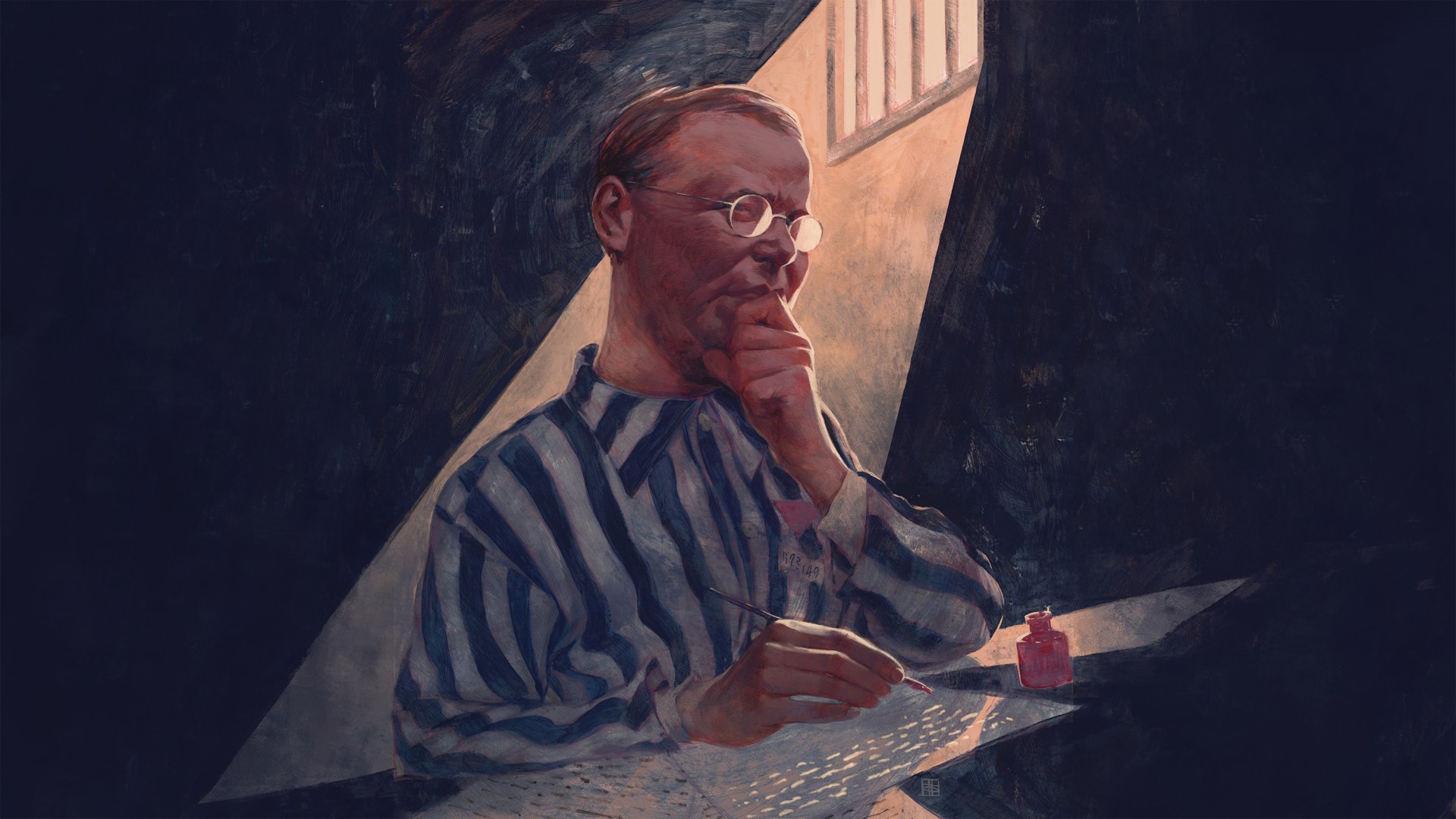
Bonhoeffer, of course, wasn’t an Old Testament scholar. But in 1937, writing to a church caving to the Nazi agenda, he put on the prophetic mantle and cast an uncompromising vision for following Jesus. He is a contemporary example of how the Prophets risked their lives to hold forth God’s Word.

Books

New & Noteworthy Fiction

Chosen by Rachel Hauck, author of “The Best Summer of Our Lives”.

Positively, Penelope

Pepper Basham (Thomas Nelson)

In this epistolatory romantic comedy, the delightful Penelope Edgewood plans to save fictional Skymar’s historic theater with her hard work, fueled by optimism, baked goods, and a local theater troupe. Love also takes center stage when two brothers vie for Penelope’s heart. After being offered a dream job, she must choose between returning home and a romantic happily-ever-after in Skymar. While the email and text exchanges between Penelope and her family and friends are lighthearted and fun, Basham weaves depth and truth into the characters’ journeys. Skymar is enchanting, a place you’ll want to visit again.

Ned

Susan May Warren (SDG Publishing)

Susan May Warren entertains with fast-paced, high-action novels dealing in strong characters and spiritual truths. In this third installment of her successful Minnesota Marshalls series, Navy SEAL Ned Marshall wants to settle down and marry his true love, Shae Johnson. He proposes in Geneva, but her yes is not as simple as it seems. Instead of making wedding plans, Ned and Shae find themselves embroiled in intrigue. Warren is a skilled storyteller with powerful prose, and she leans on her 10 years spent in Russia as a missionary, as well as her experiences in France and Alaska.

Dedicated to the One I Love

Beth K. Vogt (independently published)

Kylie Franklin left her successful career as a romance author under the pen name Veronica Hollins the day her husband died. Joe Edwards goes by Tate Merrick in his literary life as a military suspense author. Even with his success, Joe can’t hit the bestseller list. When his publisher suggests working with Veronica to add a touch of romance, resentment is the name of the game. But there’s a twist. Kylie/Veronica and Joe/Tate are actually good friends in an online game. When the truth comes out, sparks fly. Vogt’s book captures what we love about rom-coms: humor, irony, and a path toward happily ever after.

Books
Review

Sticking Out and Fitting In as an Asian American Believer

Theologian Michelle Lee-Barnewall reflects on her ethnic identity and her identity in Christ.

Ocamproductions / Lightstock

We live in a world where race relations receive near-constant attention. Conversations about race permeate our politics, schools, universities, sporting events, concerts, health services—and our churches as well. And yet in public discourse, complex and wide-reaching issues of race are often reduced to the simple binary of Black versus white.

A Longing to Belong: Reflections on Faith, Identity, and Race

A Longing to Belong: Reflections on Faith, Identity, and Race

224 pages

$7.98

But where does this leave other ethnicities that don’t fit into this reigning dichotomy? Asians, to take one example, make up around 7 percent of the American population and around 10 percent of the British population. Yet the public discourse about race often overlooks them.

As a British Singaporean, I am therefore grateful for Michelle Lee-Barnewall’s new book A Longing to Belong: Reflections on Faith, Identity, and Race. A New Testament professor at Biola University, Lee-Barnewall weaves her personal story as a South Korean growing up and living in the United States with a practical exploration of the Bible’s themes of identity, community, and diversity.

Part 1, “Created to Belong,” begins with Lee-Barnewall’s childhood, emphasizing her struggles to fit in at school as a South Korean growing up in Minnesota. I’m sure many children can relate to her experience of desiring to been seen as “normal,” fearing classroom mockery, and enduring the pain of rejection by peers.

Lee-Barnewall then dovetails her autobiographical anecdotes with the Bible’s teaching that we are created as intrinsically relational beings who are wired to yearn for community. Furthermore, as she points out, Christians are called to something greater than personal repentance and discipleship; we are called to be interdependent and united as the very body of Christ. Lee-Barnewall notes that in Paul’s teaching about the body of Christ in 1 Corinthians 12, there are very few imperatives. The body of Christ, in this sense, is not something we actively do or make but is the reality of who we are in Christ.

Part 2, “Belonging Together,” is the longest section of the book, and it focuses on what it should look like to live as a community of believers. Lee-Barnewall begins by reflecting on how her identity was shaped by her family’s ethnicity and history as Korean immigrants to the United States. She goes on to show that our identity in Christ is necessarily and indispensably corporate. As she puts it, being the body of Christ “is more than a nice image to encourage us to cooperate and get along . … Paul is talking about something real and true, something that has already happened. This is who we are, and who we are has real substance.”

Lee-Barnewall spells out several implications of this statement. Being Christ’s body means existing as a community that cares for, and is affected by, the well-being of members, just as a human body is affected when one part is injured. It means that the church should be characterized by bonds of love and loyalty akin to those within a biological family—bonds that compel radical personal sacrifices for the sake of others. And it means that the church should be a place of repentance when our hearts harbor prejudice or suspicion toward people of different racial or ethnic backgrounds.

Part 3, “Belonging to God,” closes the book by turning our eyes to heaven, where people “from every nation, tribe, people and language” are gathered in worship before the throne of the Lamb (Rev. 7:9). Lee-Barnewall notes that heaven’s ethnic diversity is held together not through human effort or innovation but by communal worship. There is a place, she acknowledges, for seeking to build intentionally multicultural churches, but “being before the throne may be the position—the only position—that allows us to overcome all the pettiness and meanness that causes our division and pain.”

There are several reasons to commend Lee-Barnewall’s book, including her rich theological insights into the Bible’s themes of community and identity. Her call to radically display the unity and love of Christ in our churches, especially across ethnic boundaries, is a challenge to us all.

Furthermore, I am especially grateful to see Lee-Barnewall touch upon racial matters that often go neglected, even as they affect millions of Asians living in Western countries. For example, she recalls occasions when strangers assumed she was from a different East Asian country and the bizarre conversations that sometimes followed. She also discusses the fact that first- and second-generation immigrants to Western countries often lack close networks of extended family, which can breed feelings of isolation when friends speak about family gatherings and relationships. Lee-Barnewall even raises the issue of visas being tied to secure employment, and the persistent fear of deportation that hangs over immigrants with any sort of job insecurity.

Yet if I have one criticism, it would be the book’s tendency to shy away from some of the wider political discussions around race. A thoughtful and nuanced contribution from an Asian American theologian could have been helpful, particularly when Asians are often overlooked in modern political discourse.

Take, for instance, the recent US Supreme Court decision that ruled against Harvard University’s race-conscious admissions policy. Reaction to the decision appeared to be largely (if not exclusively) focused on the implications for Black and white students. But this overshadows the fact that the lawsuit was filed by a group of Asian American students, who maintained that Harvard’s policies were resulting in artificially low Asian admission rates. Lee-Barnewall’s purpose in writing, of course, isn’t to weigh in on every secular political debate that intersects with race. But her book might have been enriched, at various points, by greater attention to our wider political landscape.

This criticism notwithstanding, A Longing to Belong is profoundly biblical, helpfully practical, and movingly personal. Readers of all races will discover a great source of nourishment, encouragement, and welcome provocation.

Ben Chang is a writer and speaker. He is the author of Christ and the Culture Wars: Speaking for Jesus in a World of Identity Politics.

Books
Review

The Gospel Is Greater Than Its Greatest Proclaimers

That fact should bring humility to our evangelism, even as it spurs us to keep sharing the Good News.

Illustration by Adrián Astorgano

I have a recurring argument with a friend who is a musician. In a songwriting class that he teaches, he tells students that songs should be less like sermons and more like prayers. As a preacher of sermons, I am always slightly offended, even if I understand what he means.

Evangelism: Learning from the Past (The Eerdmans Michael Green Collection (EMGC))

Evangelism: Learning from the Past (The Eerdmans Michael Green Collection (EMGC))

Wm. B. Eerdmans

184 pages

$19.31

The lesson is “show, don’t tell.” When it comes to art, struggling with questions is more compelling than telling someone the answers. It is not for nothing that contemporary Christian music is often criticized for its rush to resolve things prematurely.

My rejoinder is that there are some truths that claim us, answers that offer stable ground on which to stand. Christian faith compels us to show and to tell, not least because the gospel of Jesus is a message to be proclaimed.

My friend usually grants my point. But he also reminds me that living the truth is a complicated project and that people who proclaim truth are often not as sure as they seem.

The tension between the sure answer of the gospel and the sometimes-questionable character of its proclamation returned to my mind as I read Evangelism: Learning from the Past by the late Michael Green (1930–2019), who wrote prolifically on the subject of sharing the Good News. Published posthumously from a draft manuscript, the volume is emblematic of Green’s lifelong passion.

Green’s legacy is evident from the first page: “My purpose in life has been to pass on, as best I can, good news. It is the best news anyone could ever hear: that there is a living God, who cares enough about us to become one of us, who dealt at great personal cost with the evil in the world, who is alive to make us into a renewed community, and who invites us to share his home after death.”

“The best news anyone could ever hear” has been entrusted to every follower of Jesus, and Green tells stories of evangelism throughout the history of the church. He notes early on that he is telling a selective story, focused on “the evangelical tradition and particularly its outworking in Britain.” Rather than creating a composite picture of evangelism from the many streams of church history, Green is particularly interested in highlighting historical precedents of the evangelistic model that has come to characterize the evangelical movement.

That is to say, Green is interested in evangelism that leads to conversion: an encounter with the person of Jesus Christ that reorients individual lives and, through them, the larger society. As he writes: “The criterion for authentic evangelism is not whether it increases the numbers in church, nor whether it makes a person more moral, but whether it impacts society for good.”

My fellow evangelical Protestants will resonate with many of these intuitions. But those looking for a more comprehensive account of the history of evangelism should look elsewhere. Green shows little interest in the medieval period and moves quickly from the church fathers to proto-Reformation movements, the Reformers, and 18th-century revivalists like George Whitefield and John Wesley, before finishing with the crusades of Billy Graham. Green’s story thus focuses on what we might call “evangelical evangelism,” and two themes emerge that reveal tensions in the larger movement Green sought to serve.

First, there is a tension between proclamation and embodiment. “For what we preach is not ourselves,” wrote Paul to the Corinthians, “but Jesus Christ as Lord” (2 Cor. 4:5). Jesus, Green notes, is “God’s good news in person … who proclaimed and embodied the kingdom of God.” In the early church, the person of Christ became the message, even as the church continued to testify to God’s kingdom in communities of radical discipleship. When telling the story of evangelism in the second through fourth centuries, Green notes how often Christian lives served as evidence of the gospel’s power. As the Greek philosopher Athenagoras put it, “They do not rehearse speeches, but exhibit good works.”

And yet, the struggle to contextualize the gospel amid new challenges leads to failures of cultural sensitivity. Green laments, for instance, how early evangelistic efforts “failed to make credible to the Jews that they were in fact the community of the Messiah.” As the story of the church continued, this pathology took tragic forms, as in the antisemitism of Martin Luther.

Green recounts a similar failure in the story of Celtic evangelism (drawing from George Hunter’s The Celtic Way of Evangelism). For a time, “The gospel was presented not as something entirely new, but as the fulfillment of all that was best in indigenous culture.” But imperial (Roman) Christianity “squashed the free-flowing initiative, imagination, and cultural sensitivity of the Celtic Christians.”

Green might have gone further and set failures of cultural capitulation alongside failures in contextualization. Whitefield’s evangelistic work is celebrated without reference to the slave labor at his orphanage. (The book’s publisher, Eerdmans, added a note that Green might have accounted for recent scholarship, including one of its own titles, Peter Y. Choi’s George Whitefield: Evangelist for God and Empire.) In a similar vein, Green might have said more about the compromise of racial segregation in Billy Graham’s early crusades before giving Graham credit for his later work in integration. The point is not to cancel the work of these evangelists, but rather to complicate the story and to humble us as we continually seek closer alignment with the gospel.

Of course, we can also complicate the story in positive directions, and Green does so. He notes how early monasteries were quite effective in evangelism, and how Calvin’s Geneva generated extraordinary evangelistic activity: “He and his colleagues sent no less than eighty-eight missionaries [to France alone]. … It is high time that this myth about Calvin’s disinterest in evangelism is laid to rest.”

This brings us to a second tension in the story of evangelical evangelism—between the work of lay evangelism and “superstar evangelists.” Green celebrates the “every member ministry” of the early church as the heart of its mission. At its core, he writes, “evangelism is not rocket science. It comes down to one person who knows Christ relating to one person who does not.”

And yet, the larger narrative sometimes reads like a collection of hero stories. This feature can make us devalue unsung work of unnamed Christians, as when Green sets the work of Whitefield and Wesley against a low estimation of 18th-century clergy in general.

Indeed, telling the story of great evangelists may make us think that the work of evangelism is mostly carried forward by charismatic individuals who are willing, in Green’s words, to “burn out for God”—and who almost always do. I worry about descriptions like this one of Evan Roberts, the notable name from the Welsh revival of the early 20th century: “God picked this man up, used him phenomenally for less than a year, and then laid him aside. Evangelists need to remember they are dispensable, and that is a painful lesson.” Does our Lord really treat his ministers so disposably?

There is undoubtedly a place for remembering the heroes of church history, as demonstrated by the “hall of faith” in Hebrews 11. But the “great cloud of witnesses” ultimately draws our gaze to Christ, faith’s “pioneer and perfecter” (Heb. 12:1–2). Our problem, as Katelyn Beaty’s recent book Celebrities for Jesus has shown, is that we often fail to lift our eyes high enough.

Any account of evangelism in the digital age must reckon with the media-fueled phenomenon of celebrity. Evangelicalism’s fervor in employing new media tools to share the message has gotten it entangled with celebrity from its earliest days.

Green draws this connection as he reflects on one of Billy Graham’s crusades, in which 52,253 recorded decisions for Christ only resulted in 3,802 people joining a local church. He asks, “Did concentration on big, exciting crusades tend to encourage churches to pay too much attention to the special event, to the detriment of year-long local evangelism? The jury is out on these questions.”

Over 3,000 new members for local churches is still something to celebrate. Yet the habit of seeking ever-larger audiences through new technologies always runs the risk of trivializing the message, fueling the culture of celebrity, and losing sight of the everyday work of evangelism.

Green, whose best-known books include Evangelism Through the Local Church, would undoubtedly agree. His other writings give a fuller picture of the larger project of evangelism. He wants us to look to the past, not to lionize those who have come before us but to learn from them. Indeed, this desire is evident on nearly every page. Each chapter ends by posing questions, not just about the historical figures in question, but also about the person reading the book. (“Am I content,” reads one example, “for God to do his own work in his own way, not mine?”) It reminds us that even as we examine the work of those who have gone before, we must examine ourselves as we continue that work.

The last time I talked with my musician friend about writing songs and sermons, he reminded me of a quote from Flannery O’Connor: “People without hope not only don’t write novels, but what is more to the point, they don’t read them. They don’t take long looks at anything, because they lack the courage.”

Hope is required to take a long look at anything, and that’s true about the history of evangelism. As we follow Green, we see things we have forgotten as well as things we might not want to remember. And yet, the same hope that helps us squarely face this history also pushes us to keep sharing—as imperfectly as ever—the best news anyone could ever hear.

Justin Ariel Bailey is associate professor of theology at Dordt University. He is the author of Interpreting Your World: Five Lenses for Engaging Theology and Culture.

Books

Take a Risk and Make a Friend

With God’s help, a little intentionality can go a long way toward healing our loneliness.

Illustration by Rick Szuecs / Source images: Skylar Kang / Pexels / Envato

The surgeon general of the United States recently named loneliness as America’s top health problem, revealing that nearly half of the country’s adults report feelings of isolation and deteriorating mental health. In Made for People: Why We Drift into Loneliness and How to Fight for a Life of Friendship, Justin Whitmel Earley advocates a recovery of “covenant friendship,” marked by commitment, vulnerability, and intentional rhythms and rituals. Aaron Damiani, author of Earth Filled with Heaven and pastor of Immanuel Anglican Church in Chicago, spoke with Earley about making friendship a priority within the church.

Made for People: Why We Drift into Loneliness and How to Fight for a Life of Friendship

What motivated you to write about friendship?

As a high schooler, I had a lot of acquaintances but no real friends. Then, on a youth retreat, I met a guy named Steve while playing Hacky Sack. We discovered a common passion for skateboarding and playing the drums.

A huge turning point came when one of us—I forget who—took a risk and asked an awkwardly intentional question: “Do you want to be best friends?” We agreed we would—and this simple commitment changed my whole life. Suddenly I was facing the world with the strength of a friend. I can see now that the anxiety I had thought was baked into life is actually baked into loneliness.

What exactly is a “covenant friendship”?

The word friend has become diluted in our social media–driven culture. That’s why I use “covenant friendship”—a relationship where someone fully knows you and loves you anyway, just as Jesus does. Covenant friendships are not some elite class; they are just friendships marked by vulnerability and a commitment to stick around. They are characterized by a mutual desire to truly know and support each other, grounded in intentional commitment.

Do you worry that this kind of vulnerability and intentionality might scare off men, in particular?

Regardless of gender, people often find it scary to live with the intentionality that friendship requires, because we’re afraid to admit we’re sinners. But if the Bible is clear that we all are, then why not talk like it? In the end, it’s our flaws, not our virtues, that draw us to grace and to each other. Which is why confession, telling secrets, or just being honest—whatever you want to call it—catalyzes friendship.

I’m familiar with the stereotype of men being hesitant to move beyond common interests and talk about anything real. But in my day-to-day life, I see so many guys longing for vulnerability and a freedom to express themselves genuinely. It’s hard, so we need rituals and activities that pull that out of us. It takes a willingness to sacrifice your own self-image, yet like Christ’s sacrifice for us, it bears fruit.

You use a few metaphors from nature—rivers, plants, and fires—to describe the dynamics of friendship. Which one resonates the most with you?

I would say the fire of friendship, with its inviting warmth. Like a good bonfire, my friendship with Steve brought light into our lives while drawing others in.

I remember a fellow student named Matt who expressed a desire to join our band outings. At first, we merely tolerated him like a third wheel. But true friendship thrives when we invite others in rather than shutting them out. I had to repent and apologize for pushing him away. Surprisingly, despite our mistreatment, Matt eventually became a Christian during that time. It was a powerful testament to God’s grace and providence.

When I reflect on the fire of friendship, I am reminded of God’s offer of a deep and intimate relationship. The Trinity could have remained a closed circle, but God chose to extend his love and invite us in. When we exemplify true Christian friendship, we become like a warm fire that others are naturally drawn to, seeking solace and companionship. In our secular age, many people are coming to Christ not solely through logical arguments, but because they are captivated by the relationships they witness among Christians.

Today’s friendships can seem polarized and homogenous. How can the ideal of covenant friendship break this cycle?

Technology-mediated friendships tend to be tribalized. It’s well documented that social-media algorithms reinforce our preferences and opinions, creating echo chambers. But the beauty of embodied friendships lies in their ability to bridge barriers or race, class, political persuasion, or whatever might otherwise divide us. We can disagree on theology, current events, or presidential politics while still cherishing each other.

In the realm of committed friendships, how can we address toxic people and patterns while promoting forgiveness, reconciliation, and healing?

All friendships have two ingredients: a sinner and a sinner. So they have to navigate the collisions and disagreements that naturally arise when two sinners live in close community. If we can’t do forgiveness, then we can’t do friendship.

That said, it’s important to recognize that while we imitate Christ in our friendships, we are not Christ himself. While friendship should involve a willingness to walk alongside others during difficult times, there may come a point where leaving is necessary. In such cases, it takes bravery and humility to say, “I’ve reached the end of what I can do. I can only pray now for what Christ will do.” I’ve witnessed this in situations involving addictions, for example, where you acknowledge your limitations and seek outside help.

Friendships sometimes drift apart naturally due to life circumstances, and that’s okay. Friendship isn’t marriage. The goal is just to keep moving toward commitment, toward vulnerability.

Most pastors are aware of deep loneliness within their congregations. How can they foster covenant friendships without holding parishioners’ hands?

The churches that foster the best friendships operate like a funnel that moves from big to small. You take people from Sunday gatherings and guide them into small groups or accountability relationships. However, even within small groups, there is a need for more intimate connections. Small group leaders should encourage individuals to cultivate deep and enduring friendships with one or two people, whether it be through accountability groups, covenant friendship circles, or regular front-porch get-togethers.

Also, to state the obvious, it’s completely unrealistic for a pastor or ministry leader to be friends with everyone in the church. Nonetheless, pastors have the opportunity—even the responsibility—to embody covenant friendships in their personal lives. They bear an enormous weight of spiritual authority and responsibility, and they aren’t meant to carry those burdens alone.

What encouragement would you offer to someone who is deeply lonely yet drawn to this vision of covenant friendship?

I’d say welcome to the club! But here’s the amazing thing: A little bit of intentionality goes a long way, which is really another way of saying God is gracious, and he honors our small, half-baked efforts with enormous rewards.

Step one could be clearly voicing your desire for deeper connections. While some may find it odd or push you away, life is like a high-school dance: Most of us are just waiting to be asked. Step two could be making time in your schedule. I recommend an hour a week devoted to covenant friendship—which honestly is very little. But it’s amazing how God uses that time to completely reshape the rest of our week.

In the end, what we’re doing is essentially looking at Jesus and saying, “What a friend to sinners he is!” I want to be more like that.

Theology

The Cost of Creativity: Bonhoeffer Set Aside Ethics For Art. Did He Choose Well?

The theologian set aside his nearly finished magnum opus while in prison, investing instead in creative writing.

Illustration by Nate Sweitzer

“When Christ calls a man, he bids him come and die.”

“A Christian’s secular vocation receives new recognition from the gospel only to the extent that it is carried on while following Jesus.”

You may have heard these calls to a radical Christian life before, as well as other quotations from Dietrich Bonhoeffer. Bonhoeffer is one of the most-quoted Christian theologians of the last 100 years, inspiring generations of believers. What you may not have heard is that Bonhoeffer spent his final months in Tegel Prison creating art.

Bonhoeffer was arrested by the Gestapo at his parents’ home in Charlottenburg, Germany, in April 1943. He had broken many German laws by helping Jewish neighbors and by using his position as a government intelligence officer to evade service in the Nazi army. Bonhoeffer was jailed until October 1944 at Tegel Prison north of Berlin in relative comfort, allowing him the time and space to read and write prolifically for most of his imprisonment.

After his participation in the now-famous Hitler assassination plot was exposed, Bonhoeffer was convicted of new crimes and was moved from Tegel to Prinz-Albrecht-Strasse, then to Buchenwald concentration camp, and finally to Flossenbürg, where he was hanged with six others on April 9, 1945, just one month before Germany’s surrender to the Allied forces. Bonhoeffer’s short life came to a premature end.

A question haunts us: Did Bonhoeffer waste the last months of his life in prison by spending time on creative writing instead of finishing his best book, the much-anticipated Ethics? The Bible invites us to “number our days” (Ps. 90:12) and warns, “You are a mist that appears for a little while and then vanishes” (James 4:14). The haunting brevity of life, pictured in the Bible and illustrated in the lives of many like Bonhoeffer, raises more questions than it answers about how we spend our time.

Hardly any of us know the final result of our daily choices. And while many readers of Christian-living bestsellers love Bonhoeffer’s wisdom about true satisfaction in The Cost of Discipleship and Life Together, we can only guess at how the theologian would evaluate his own life or his last days. Did he make the right choices?

Devotees may have read Letters and Papers from Prison and reasonably supposed that theology was Bonhoeffer’s primary preoccupation in his final days. What most don’t know, however, was that Bonhoeffer spent just as much time in prison writing poetry, working on a play, and starting a novel.

His poetry explored spirituality. His most famous poem, Who Am I? (Wer bin ich?), raises existential questions and answers them with an emphatic “O God, I am thine!”

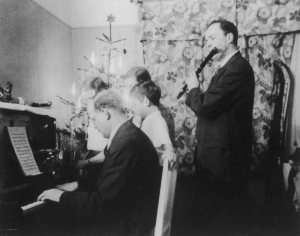
Bonhoeffer at the piano accompanied by Eberhard Bethge during Christmas 1940Courtesy of dietrich-bonhoeffer.net
Bonhoeffer at the piano accompanied by Eberhard Bethge during Christmas 1940

Bonhoeffer also began writing a play, then turned its content into a novel. Both focused on middle-class characters and themes of life and death, family, and everyday life set against a backdrop of war. He used the projects to examine work, rest, worship, and the implications of their interplay in every person’s life.

According to Bonhoeffer, in a letter to Eberhard Bethge, there would be a mayor, a teacher, a pastor, a doctor, and an engineer. These characters all correlate to spheres of culture where the Christian life as lived out in Germany after the war would have to be reimagined. How would a kindergarten teacher teach in a classroom previously adorned with Nazi flags? How would doctors and pastors carry out their roles in a community so devastated by death and grief when Germany was defeated? These kinds of questions drove Bonhoeffer’s fiction, but they are clear in Letters and Papers and Ethics as well.

Many of Bonhoeffer’s family members believed these fictional works were autobiographical and pointed toward the struggles he had in trying to live out a beautiful life in such contrastingly ugly times.

But how could he choose such “frivolous” endeavors when his major work was unfinished?

Bonhoeffer began writing his magnum opus Ethics in 1940. He would likely have finished it had he not been arrested in 1943, as he had made substantial progress. He had also communicated to his friend Bethge his vision for the direction he would take to complete Ethics, which is why Bethge was entrusted to publish what we have available today.

Excerpt from
The Past by Dietrich Bonhoeffer


You left, beloved bliss and pain so hard to love.
What shall I call you? Life, Anguish, Ecstasy,
my Heart, of my own self a part—the past?
The door slammed shut and locked,
I hear your steps depart, resound, then slowly fade.
What remains for me? Joy, torment, longing?
I know just this: You left—and all is past.

Do you feel how I reach for you now,
how I clutch you as with claws,
so tightly that it must hurt?
How I wound your flesh
till your blood oozes out,
just to be assured you are near,
you bodily, earthly fullness of life?

By all accounts, this was the book the world was waiting for from Dietrich Bonhoeffer. Ethics was the culmination of ideas stretching back to his earliest writings, a synthesis of major themes he had approached but never fully addressed, such as ecclesiology, divine and natural revelation, and the sociology of religion. Yet in 1943, Bonhoeffer chose his art. Was it irresponsible to neglect such a book to spend time in self-expression?

It is unfair, even if useful, to reduce historical figures to their most well-known achievements. Theologians are, like all historical figures, rarely as one-dimensional as we might imagine. History is always more complex than a caricature. This is the case with Bonhoeffer.

None of us is only a theologian or pastor, any more than anyone is only a farmer, a graphic designer, a cab driver, a bond trader, or a social media influencer. In a global culture that overemphasizes individual identity, we somehow forfeit the complex beauty embedded in God’s creative masterpiece: humanity. By reducing people to just one thing, we denigrate the beautiful and varied multitudes we each contain.

When we treat historical figures as just one thing, everybody loses. People remember Winston Churchill for his political leadership but rarely for his paintings. Thomas Merton is more often heralded for The Seven Storey Mountain than for his photography.

And while Christians might remember Bonhoeffer first as a theologian or for his association with a failed assassination plot against Adolf Hitler, we wonder if there is any room to remember him as a gifted artist with grand visions but too little time to pursue them. Not surprisingly, Bonhoeffer’s commentators consume his art mostly for its historical or theological value. It would be harsh to judge the artistic merit of these creative ventures on their own terms; though Bonhoeffer was a world-class theologian, he was not a world-class artist. Why would anyone take a theologian seriously as an artist anyway?

What scholars don’t seem to be asking is whether Bonhoeffer was harboring deep regret about the course of his life. He must have felt his talents were wasted in that jail cell. Had he, in fact, chosen the wrong life—one that led him to prison and regret? Today’s readers can surely relate. From time to time, most of us ask the same agonizing questions. Have I chosen the right path? Is this the meaningful life I was looking for? These are questions Bonhoeffer wrestled with.

A different path seemed possible. Before his homeland transformed into the Nazi Germany of popular memory, young Dietrich had an opportunity at a normal childhood.

He was one of eight children (including his twin sister, Sabine) born to Karl and Paula Bonhoeffer in what was then Breslau, Germany, in 1906. When he was six, his family moved to Berlin, where his father served as a university professor of psychology.

One example of his early artistic bent is his piano lessons. Dietrich excelled beyond expectation. According to Bethge, both his best friend and principal biographer, his sense of rivalry with his seven siblings drove him to surpass them in musical ability. In fact, his parents thought he was so unusually gifted that he might become a professional classical musician.

We know he prioritized music throughout his life. Bonhoeffer’s love of it is everywhere in the remembrances of friends and in photographs of him providing accompaniment with piano or guitar. He loved all kinds of music. He collected records of Black spirituals in Harlem as a postdoctoral student in 1930 and 1931 and attended a performance of Don Giovanni after he sprang a former student from prison in Germany.

As Bonhoeffer’s former student Johannes Goebel recalled in “When He Sat Down at the Piano,”

While he was sitting at the piano something which I had not known in him and have never seen again, an expression of natural force, of something primeval, came over him, a Dietrich different from the one known to us. It was not just his natural freshness, his energy, his will-power. … I do not, unfortunately, remember the musical style of his improvisation, probably because it fascinated me more to witness the native human quality breaking through his personality, than to pay attention to his music. And suddenly he stopped as abruptly as he had begun.

Music was also there for him at the end of his life. In his letters from prison, he often spoke of music—his desire to enjoy it, play it, and learn more—when he indulged his hopes of liberation. In a June 14, 1943, letter, he wrote, “Being able to make music with [friends and family] again will be one of the most special moments after I am released.” This hope would come and go until the end.

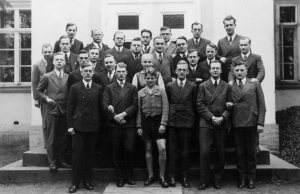
Bonhoeffer (top row, second from left) with students in October 1935, including Johannes Goebel (front row, second from right)Courtesy of dietrich-bonhoeffer.net
Bonhoeffer (top row, second from left) with students in October 1935, including Johannes Goebel (front row, second from right)

In a letter almost a year later, Bonhoeffer returned to his knowledge of music to illustrate how the Christian life should be lived faithfully amid many competing demands. In that letter, he described this array of demands as the “polyphony of life.”

How can we navigate such a potentially cacophonous array of voices? Bonhoeffer employs another musical term: cantus firmus, which is the melodic basis for a polyphonic composition. Just as the cantus firmus provides the grounding musical theme to which all other melodies must orient themselves, so also one’s love for God orients every other commitment in one’s life.

Then, not unlike the complexities of symphonic composition, there can be a clear meaning among so many diverse expressions. Bonhoeffer explained, “Only this polyphony gives your life wholeness, and you know that no disaster can befall you as long as the cantus firmus continues.” We must remember that things seemed utterly disastrous for him at the time of this letter, so we can be grateful that his love of music gave him hope amid the worst.

Perhaps Bonhoeffer should have chosen music earlier in life. He certainly loved it, and music gave him so much.

In his parents’ Charlottenburg home, now a preserved historical site, visitors can view Bonhoeffer’s desk and recall the important works drafted there , including parts of Ethics. Next to that prodigious desk sits a small clavichord piano. Perhaps their side-by-side preservation in the Bonhoeffer home speaks to the harmony of theology and music in his life.

Although Bonhoeffer’s artistic foundation was in music, his creative preoccupations in prison were not musical; they were literary. Bonhoeffer was shaped profoundly by his journeys as a voracious reader.

Apparently, his literary appetites remained with him to the end, because the list of literature mentioned in his prison correspondence includes not only Barth, Bultmann, and Harnack but also Dante, Dostoyevsky, and Goethe. When Bonhoeffer wrote to his parents, he reflected at length on what fiction he was reading alongside his requests for theology texts.

These great works spoke to the plight of his own time. In a letter dated February 21, 1944, Bonhoeffer compared the efforts of the German church’s struggle to that of Don Quixote, a work that troubled him. It is telling that literary figures came to mind, rather than allusions to the Bible or the life of Martin Luther.

Amid the stifling isolation of prison, Bonhoeffer found friends and comrades on the literary page. His mind hosted a diverse salon of writers each night in his dark, quiet cell. Perhaps it is not surprising to witness his own earnest attempt to join them.

Bonhoeffer wrote nonfiction in prison, too, of course. Many know of his prolific efforts in academic theology, his many sermon manuscripts, and his important contributions to ecumenical statements and confessions, such as the Barmen Declaration, the After Ten Years letter, and more.

Under the heading “Literary Attempts,” biographer Bethge assesses his friend’s efforts. Interestingly, Bonhoeffer’s friend saw them as quite a natural turn. Such creative endeavors were both a source of joy and a means of hopefully overcoming his sense of isolation. But despite his admiration of masterful playwrights and novelists, Bonhoeffer’s emulations could not escape the trappings of contrivance, and his characters’ soliloquies registered as too thinly veiled for even their author.

While his grander ambitions led to artistic dead ends, Bonhoeffer found more success—and likely more consolation—in writing poetry. Bethge indicates that simple verse proved more direct and better suited to the angst and longing that burdened him. We find such a picture in lines like these from Who Am I?:

Am I really what others say of me?
Or am I only what I know of myself?
Restless, yearning, sick, like a caged bird,
struggling for life breath, as if I were being strangled,
starving for colors, for flowers, for birdsong,
thirsting for kind words, human closeness,
shaking with rage at power lust and pettiest insult,
tossed about, waiting for great things to happen,
helplessly fearing for friends so far away,
too tired and empty to pray, to think, to work,
weary and ready to take my leave of it all?
… Who am I? They mock me, these lonely questions of mine.
Whoever I am, thou knowest me, O God, I am thine!

While much of the poetic texture may have been sacrificed in translation, the most poignant content remains. Poems like The Past, Sorrow and Joy, and Stations on the Way to Freedom were intended for his family, friends, and himself, yet we benefit from his laments all the same.

Bonhoeffer’s letters from prison provide readers with otherwise rare insight into his mind during a constrained time frame. It is certainly possible that Bonhoeffer spent time in his working years on creative pursuits that have gone undocumented. But it is hard to imagine, given his documented travels and various demanding responsibilities, that Bonhoeffer devoted much, if any, time to the focused creative efforts he turned to in prison. Did the prison walls help Bonhoeffer finally unlock the creative life that was always trying to be free?

Perhaps now we can imagine that his internal dialogues with Jesus and Jeremiah, Luther and Barth, included Goethe and Mozart too. We must allow that the same imagination that crafted The Cost of Discipleship from meditations on the Sermon on the Mount also crafted the aching lines of poetry above.

Rather than just a welcome distraction during his imprisonment, these pursuits can be traced back to the burgeoning creativity of young Dietrich and can be seen in almost every season of his short life.

Let us return to the fascinating account from Bonhoeffer’s former student Goebel. He learned something profound about his friend that fateful night:

I was interested in his playing perhaps more than he thought agreeable or important. I asked him whether he had ever tried, or was trying, to compose anything. In a distinctly reserved tone he said he had stopped doing so since he had become a theologian, or something to the effect. This seems to me a typical trait of his nature. Bonhoeffer was a passionate preacher and theologian, as Bethge confirms. To sit down at an instrument and improvise or even compose—and not just play Mozart with exactitude … this can only be done in passion, and out of passion. Bonhoeffer cast this passion out of his life for the sake of the call to a greater “passion.” This too is a contribution to the theme of “Call and Discipleship.” Bonhoeffer studies have always struggled to sort through the many versions of Bonhoeffer in popular discourse. The portraits range from conservative to liberal, hero to everyman. Holocaust scholar Victoria Barnett warned on the 70th anniversary of Bonhoeffer’s killing that “popular hagiography has lifted him far beyond [the] historical record.” Biography and theology are so naturally connected in his case that theological analysis of Bonhoeffer’s writing is nearly impossible without understanding his personal narrative. In light of these narratives, we see that what we have gained from his public witness came at the cost of his personal dreams.

Stations on the Way to Freedom
by Dietrich Bonhoeffer

Discipline
If you set out to seek freedom, then you must learn above all things
discipline of your soul and your senses, lest your desires
and then your limbs perchance should lead you now hither, now yon.
Chaste be your spirit and body, subject to yourself completely,
in obedience seeking the goal that is set for your spirit.
Only through discipline does one learn the secret of freedom.

Action
Not always doing and daring what’s random, but seeking the right thing,
Hover not over the possible, but boldly reach for the real.
Not in escaping to thought, in action alone is found freedom.
Dare to quit anxious faltering and enter the storm of events,
carried alone by your faith and by God’s good commandments,
then true freedom will come and embrace your spirit, rejoicing.

Suffering
Wondrous transformation. Your hands, strong and active, are fettered.
Powerless, alone, you see that an end is put to your action.
Yet now you breathe a sigh of relief and lay what is righteous
calmly and fearlessly into a mightier hand, contented.
Just for one blissful moment you could feel the sweet touch of freedom,
Then you gave it to God, that God might perfect it in glory.

Death
Come now, highest of feasts on the way to freedom eternal,
Death, lay down your ponderous chains and earthen enclosures
walls that deceive our souls and fetter our mortal bodies,
that we might at last behold what here we are hindered from seeing.
Freedom, long have we sought you through discipline, action, and suffering.
Dying, now we discern in the countenance of God your own face.

What he wrote in those poems matters for us, but arguably why he wrote them matters a great deal more. What appears to us as such a curious choice must have been a desperate attempt to hang on to his own humanity. In the midst of threatening death, creativity allowed him some recovery of his most authentic self.

Here, we must let the man interpret himself. In a letter from January 23, 1944, Bonhoeffer puts creaturely goods, such as one’s love of the arts, friendships, and even play, in the context of Christian freedom. He wonders, “Who in our time could, for example, lightheartedly make music, nurture friendship, play, and be happy? Certainly not the ‘ethical’ person, but only the Christian.”

In other words, only the Christian life possesses the generative freedom to pursue such joyous things as they were intended by God. Like friendship or play, creative expression has the power to attune the human soul to a divine frequency. They are not necessary to be a “good” person but are likely required for what Bonhoeffer calls “full human being.”

Nor does such creativity have to be museum- worthy. Conventional artistic achievement is not the only standard by which Christians might judge a poem, a play, a novel, or a painting. Making—creating and imitating the Creator—is a form of discipleship. We “follow after” God when we make anything. Art is a spiritual discipline as much as it is anything else.

We experience such fullness amid the glorious overflow of human creativity all around us. Beauty is undeniable but far from automatic; we cause it to flourish when we heed the creative call of God.

So, like we read in Bonhoeffer’s poems—and like Goebel saw in his improvisations at the piano—creative expression is our life-giving cry of freedom. When his life was most threatened, his indelible humanity, touched by Christ’s restorative grace, found an unlikely way to shine through.

Maybe such joys are less a privilege of leisure and more the affirmation of the grave-denying power of God at work within us.

Bonhoeffer’s desk in his homeCourtesy of Devin Maddox
Bonhoeffer’s desk in his home

Human beings—all of us—were made to create. Somewhere along the way, many of us received the destructive message that artistry is simply a waste of time, especially when there are tradeoffs with more clearly practical endeavors. We’ve heard rebukes like “How will you make a living from that?” and “What’s the point if you aren’t going to be the best at it?” Some of us have even heard these messages in the churches we’ve attended.

Poignantly, many of us were confronted with our own regrets and questions during the long days of pandemic lockdown that started in 2020. Such doubts must certainly have played a part in “The Great Resignation” and are still hard to get away from. As many, including pastors, wonder whether to quit, we also wonder how many might have survived the burnout epidemic if their churches had had a richer vision of what sustains whole persons—the freedom to create.

Bonhoeffer didn’t waste his life, nor did he rob the world of something good. Let the last days of Bonhoeffer’s life serve as a witness to how crude, shortsighted, and false such messages are.

His life shows an abiding love of the arts. We must remember what Bonhoeffer teaches us from within those prison walls: “If the Son sets you free, you will be free indeed ” (John 8:36).

So whether we find ourselves desperately scratching out verses behind prison bars or simply carving out a space for some playful creativity in our harried, overproductive lives, we must never let go of our creative impulse. It’s ours by virtue of the Creator’s image. It’s why we garden, labor over grand meals, and write beautiful thank-you notes. We can’t help it; it’s in our nature.

Bonhoeffer shows us that we can’t stop at mere appreciation for the creativity of others; we are instead compelled by our common humanity to participate.

In other words, it’s time to pick up the pen or the paintbrush or the sheet music again. If an imprisoned theologian can do it, there’s hope for burned-out church leaders, fatigued parents, and desperately busy workers like us.

Devin Maddox is books publisher at B&H Publishing Group and lives with his family of five in Middle Tennessee. Taylor Worley is visiting associate professor of art history at Wheaton College and the author of Memento Mori in Contemporary Art: Theologies of Lament and Hope.

Ideas

Do Not Conform to the Work Habits of AI

Staff Editor

Robots will come for our jobs if we do our jobs like robots.

Created using AI / Edits by Abigail Erickson / Source Images: Getty

In the heat of summer, a 19-second video from the World Economic Forum gathering in Davos, Switzerland, made the rounds on Twitter (now X). “The big political and economic question of the 21st century will be: What do we need humans for?” said Israeli historian Yuval Harari. “At present, the best guess we have is keep them happy with drugs and computer games.”

Harari’s broader writing suggests he wasn’t endorsing the future he publicly envisioned, and 19 seconds isn’t fair context for his fuller meaning. But whatever Harari’s intent, the question is a pressing one as artificial intelligence technology progresses to more useful stages.

What are humans for? What is AI for? What problem—as author and Grove City College professor Jeffrey Bilbro recently asked in Plough—do we want ChatGPT and other AI toys and tools to solve? And will AI serve us well? Or will we conform to the machine?

I’ve been thinking about this in the context of my own work, because readers keep asking me if I think generative AI programs like ChatGPT will replace journalists. A few media companies, most notably BuzzFeed, have already announced they’ll use AI to pump out digital bagatelles at an even higher volume and lower cost than before. Will more serious outlets that produce hard news and careful analysis do likewise?

At the risk of sounding Pollyannaish, I don’t think so. AI will take over some journalism work, yes, but not the kind we should have been reading anyway. It won’t replace the war correspondent, the reporter at the school board meeting, the omnivorous public intellectual, the conversation-driving personal essayist. My guess is human writers will become a hallmark of high-quality and prestige media (which aren’t necessarily one and the same), much as intensive human service is a hallmark of luxury restaurant and hotel experiences now.

AI, meanwhile, will handle cheap digital news aggregation, scraping facts from human reporting and reassembling them in a stale, low-quality synthesis. It will produce content that is bad—but, crucially, it will be content that was already bad when it was harvested from a human content farm.

“AI is especially adept at displacing human labor … in situations wherein humans had already conformed, willfully or otherwise, to the pattern of a machine,” Christian tech critic L. M. Sacasas has observed. “Build a techno-social system which demands that humans act like machines and, lo and behold, it turns out that machines can eventually be made to displace humans with relative ease.”

What it means to be conformed to the pattern of a machine in our work will vary, of course, according to the jobs we do. For me, machine-like malformation might look like laziness in language, sloppiness with facts, sleight of hand in argumentation—anything for a shortcut, to increase volume and lessen costs.

In other lines of work, the specifics will differ, but guiding values of ruthless speed, bureaucratic adherence to formulae, ease over expertise, and alienation from normal human goods will be the same. Most machines are morally neutral tools, but they should tend to human needs and patterns, not the reverse.

To be conformed to the pattern of a machine is, I suspect, a characteristically modern way to “conform to the pattern of this world,” which is to say, to be oblivious to God’s “good, pleasing and perfect will,” lacking in “sober judgment,” forgetful of God’s mercy, and lethargic in worship and service alike (Rom. 12:1–13).

Being transformed by the renewing of our minds isn’t newly difficult because of AI and related technologies—as C. S. Lewis put it in Mere Christianity, we were always “in for a rough time” in the process of sanctification, “because we have not yet had the slightest notion of the tremendous thing He means to make of us.” But AI will bring new challenges to the imitation of Christ, new incentives to behave in subhuman ways, strange new ways to malform ourselves.

The promise of AI, as with many machines, is that it’ll free us from human labor to do better things. Some labor is good to skip, but some of it is the “disciplined, effortful struggle,” in Bilbro’s words, that shapes and strengthens us and aids in our sanctification. Bypassing it won’t bring greater freedom but rather a weakness that can lead to vice.

Ideas

Christian Imagination Can Change Our Culture Wars

Staff Editor

Stories and parables can heal division.

Illustration by Sergey Isakov

Political division and “culture wars” are alive and well in the pews of American churches, and while some ministry leaders have joined a side, others are trying to remain faithful without capitulating to the Right or the Left. Many feel alone, worried about keeping their jobs, and ill-equipped for the decline of both church attendance and self-identifying Christians.

How do leaders model a life of Christian faithfulness, fruitfulness, and resilience when many of those we lead are primarily formed apart from Christian virtues? Many times, it seems easier and safer to choose a side culturally or politically rather than walk in Christ’s footsteps. But living by the rules of the culture wars robs the church of its power and witness. To effectively lead through cultural change, pastors and leaders need a renewed Christian imagination for both themselves and their congregations.

Christians are people of the Book, and as such, we are meaning-making and story-inhabiting creatures. Several writers, such as Karen Swallow Prior, Tim Keller, and Austin Carty, have argued that a redeemed imagination creates fertile soil not just for Christian conversion but also for keeping us in the faith. And it is the job of pastors and church leaders to lead the way.

This pastoral call and challenge is not new. Yet as pastors do the work of Christian imaginative formation—the slow weekly work of the liturgy, frequent conversations, meals brought, prayers prayed, a quickness to repent and mourn—we reckon with newer obstacles. While desiring unity within and among our churches, we are increasingly distracted by technology, angered by media, and heartbroken or cynical over the church’s failures. The long, slow work of spiritual transformation can appear too tame and ineffective in contrast to picking a side in the culture wars.

What does it look like to develop a renewed Christian imagination? This idea can feel a bit squishy or hard to define, especially since so many of our Christian resources and discipleship programs tend to focus primarily on acquiring knowledge or changing our thinking rather than on following what Jesus’ disciples called “the Way.”

But more information hasn’t helped us find a path toward transformation. Knowing more facts hasn’t changed us into more fruitful Christians. More information does not help a pastor or church member become more resilient or live as a non-anxious presence in an anxious world. Our imaginations need reformation. Our affections must be retuned.

Augustine’s famous words that “our hearts are restless till they find their rest in Thee” remind leaders that we, too, are tempted to turn to lesser loves to tell us who we are. When we do, we reap the consequences of restlessness: self-deception and incongruity between our outer and inner lives.

It’s no surprise then that, as Peter Wehner recently wrote in The Atlantic, when we are afraid, we also deceive ourselves and fail to repent and change. “What we human beings don’t do nearly enough,” he said, “is change our behavior so that it aligns with values that are estimable and ennobling.” Instead, we distract ourselves from our moral turpitude.

Others may emphasize emotion as key to fostering a renewed Christian imagination, believing that expressing ourselves emotionally is how we might grow and lead well. Therapists, counselors, and spiritual directors are invaluable third parties to advise, listen to, and care for those who care for others.

But we often approach self-examination with the same emphasis on mental change: “If I can just think rightly about X, Y, and Z … ” or “If I can just understand the wounds of my childhood, then I can change.” While naming our wounds is important and feeling our feelings can provide relief, these alone cannot lead us toward repentance or resilience. These efforts may help us understand our malaise, but they will not cure it.

Stories and parables can feel superfluous or expendable when we face pressing, concrete concerns. But they might lead us closer to the cure. Simeon Zahl writes in Mockingbird about spiritual change happening best through “technologies of the heart,” in “novels, stories, movies, illustrations.” Consider the number of stories Jesus told, how he’d stop to listen to the stories of those who needed healing, how he inhabited the stories of the Torah so much that when he was at his lowest, he spoke words of poetry from Scripture.

Cultivating a renewed Christian imagination means steeping ourselves in the scriptural text—giving ourselves to reading, praying, and meditating on Scripture—as we might steep a tea bag in a cup of hot water. The text becomes embedded in us as we not only study but also simply read, sit with, and let the words become ours.

Stories are the mode of a Christian imagination; biblical stories can provide a framework for how we can live and lead well in our time. The culture wars in much of America attempt to see the nation’s past as a sort of promised land. But if we are marinating ourselves in Scripture, we see that the scriptural motif of exile can be a powerful imaginative reframing for our lives.

We see this theme of exile throughout the stories of Scripture, from the exodus from Egypt to the world’s redemption by Jesus to the coming of the Holy Spirit and our final union with Christ that is to come.

We might find a solution to culture warring, disunity, and restlessness in the paradigm of exile and the paradigm of the Exodus, Mark Labberton, former president of Fuller Seminary, told my husband and me on The Cartographers podcast. The Exodus paradigm is always headed toward a promised land, while the exilic pattern in Scripture emphasizes God’s goodness and grace even as he leads his people into exile.

Jeremiah 29 shows God’s vision—a renewed imagination—for living in exile: God’s people are to plant gardens, have children, and live for the shalom of their enemies (vv. 4–7). “Seek the peace and prosperity of the city to which I have carried you into exile. Pray to the Lord for it, because if it prospers, you too will prosper,” Jeremiah prophesies.

Culture-war faith believes we’ve already arrived in the promised land, or that we are trying to return to it—functionally equating the comfort of American culture with God’s blessing. But I believe exile is a more profitable way to think about living and leading in this cultural moment.

Exile means we live as strangers in a strange land. Exile means our lives don’t go up and to the right (or left), but down and to the cross. Exile means that as leaders we will likely be misunderstood, viewed as strange, and probably passed over. But exile also means that living a resilient life independent of our circumstances is possible. As Labberton put it, “When circumstances have decimated your identity, now who will you be?”

The only way that we can sustainably live in exile is for our imaginations to be steeped in Scripture as we attend to the stories of our cultures, our neighbors, ourselves, and our congregations. This cultivation can seem like boring, slow work. But it will reap a harvest generationally. This is what fruitfulness and resilience look like. It is what our 21st-century culture war tendencies desperately need as an antidote.

We are to follow God’s instructions for his people in exile, what Jesus describes as the life of discipleship in the Sermon on the Mount. We retell the exilic stories in Scripture and we practice their wisdom.

Build houses, plant gardens. Rather than trying to win a culture war, living faithfully in exile enables pastors and Christian leaders to help their people settle into a place. We are to care for people, places, and things. We build things that will last. We commit to staying. We care for the earth. This has been part of the creation mandate from the beginning.

Settle down, marry, have families. Rather than building brands and platforms, faithful presence within an exilic paradigm means we do the mundane place-making tasks well. We commit to a long, generational view of faithfulness. We might commit to a spouse; we raise our children in the faith. And nuclear families expand to include those on the margins and those who are single, widowed, or divorced in a new household of faith.

Pray for your place and seek its prosperity and its peace. When we commit to praying for our place and act for its good, we get a little less detached from depending on metrics of ministry success to measure our worth. As Gregory the Great wrote in his sixth-century Book of Pastoral Rule,

[Prosperity] often corrupts the heart through pride, while adversities purge it through suffering. In the one, the soul becomes conceited; while in the other … it humbles itself. In the one, the man forgets who he is; while in the other, he is recalled, even unwillingly, to know what he is.

Knowing who we are as pastors and Christian leaders isn’t just knowing information or our emotions. It is born of a renewed imagination. It comes through the slow work of generational story-making and place-making, as we help shape congregants in the way of Jesus amid the culture wars. It’s small work and yet, like seeds or yeast, it changes everything it touches.

Ashley Hales is an author, a podcast host, and a cofounder of The Willowbrae Institute, a new religion and culture think tank. She is also the producer of The Russell Moore Show, a CT podcast. Speaking Out is Christianity Today’s guest opinion column.

Ideas

The Middle Ground Leads to Nowhere

Neutrality doesn’t work in church. But we can recover the heart of our faith.

Illustration by Sergey Isakov

I’m a textbook middle child. I’ve spent a lifetime perfecting the art of placation, walking fine lines and threading needles. For years as a pastor, I relied on such diplomatic instincts to shepherd a politically and theologically diverse congregation.

In our current era of heightened polarization, it has become more challenging to carve out a place where people with serious differences can fellowship and worship together. Still, carving leaves a void. You keep everyone in the same room, but to what end? Neutrality suppresses incendiary topics and calls it peace.

Most people with strong beliefs distrust middle ground, especially when convinced that their perspective is biblical truth that must be fiercely defended. Decades ago, Sen. Barry Goldwater observed this tendency: “Frankly, these people frighten me. Politics and governing demand compromise. But these Christians believe they are acting in the name of God, so they can’t and won’t compromise.”

To the purists, the middle is where hard truth gets watered down, making it more palatable and less meaningful. Even God shows a disdain for the lukewarm in-between (Rev. 3:16). Be hot or cold, but don’t be tepid.

No wonder many congregations have homogenous viewpoints. Half of US Protestant churchgoers say they’d prefer attending a church where people hold similar political views, Lifeway Research found, and more than half think the members of their church already do. Sometimes, this unity is obtained through attrition, as unwelcome voices simply leave.

Of course, not all arguments are equally valid. Truth isn’t relative and sin matters. And when it comes to the most essential, common Christian convictions, there is not room for debate. Christian orthodoxy remains orthodox.

But here is the paradox: In many matters that polarize believers, there is at least a grain of theological truth in the views we personally—perhaps adamantly—oppose. We cannot abandon that truth without also compromising our witness.

Rather than adopting a “middle child” approach of minimizing very real conflicts or retreating to our corners, what if we embraced the tension? Could we allow for the existence of conflicting views in a manner that better testifies to the gospel we profess to share?

The way forward, I believe, lies in rediscovering the center rather than chasing the “middle.” Though they sound similar, these ideas are not synonymous. We arrive at the middle by beginning at the extreme positions and finding the point equidistant from both. Or we track where the majority lands and follow suit. To seek the middle is to seek the median or the mean.

In contrast, the center is better thought of as the center of gravity. In this sense, being centered means remaining with what is essential. Pressure from all sides forces you to drill deeper into that crucial core. To paraphrase preacher and theologian P. T. Forsyth, the center is not the place from which we calculate the middle, it’s the place from which we live.

For the church, the center is not an ideology or even a doctrine. It is Christ himself. And we find the center of his work on the cross. That is where the church derives its existence. It is also where we see tension personified as Jesus held his human and divine natures in a perfectly incomprehensible union.

Though interpretation of the Atonement itself can be a source of conflict, the Cross is far bigger than the box we build around it. It is where we see God work through paradox and where we see the cost of doing so. Christ exercised true freedom on the cross by choosing complete submission to the authority of his Father, and he demonstrated his power through refusing to access it to escape.

“The function of a paradox is not to solve opposition but to be transformed by living in the middle mystery of them,” performance artist Scott Erickson wrote on Instagram.

In his church history classes for Fuller Seminary, Charles Scalise often noted that God’s character encompasses the two paradoxical pillars of holiness and love, but his children cannot readily do the same. As limited human beings, we have trouble grasping both qualities simultaneously. Holiness is by nature exclusive, where love is inclusive.

One separates God from all that is impure or imperfect, while the other invites his impure, imperfect creatures to draw near and find grace. We need both a holy God worthy of worship and a loving God full of mercy and compassion. Yet in our fallen, finite state, each of us tends to emphasize either holiness or love, which generates conflict when we come together.

This sort of conflict was present in the earliest days of the church. Consider Paul and Barnabas in Acts 15, clashing over whether to include Mark on their second missionary journey. Paul leaned toward holiness and drew tight boundaries based on Mark’s past record. Mark had abandoned them previously; why repeat the same mistake? Barnabas showed a preference for love, believing in second chances and extending grace. Hadn’t Paul himself needed an opportunity for redemption? Wasn’t his present ministry the result of receiving the benefit of the doubt?

Both men had legitimate concerns, the tension may have felt insurmountable, and they could not find a compromise. Holiness and love reached a stalemate, humanly speaking, and the two men parted ways.

Looking to Jesus, though, we see he often refused to reduce the tension in order to appease his listeners—even when faced with seemingly clear immorality. The story of the woman caught in adultery shows Jesus steadfastly holding to both holiness and love as he tells the woman, “Neither do I condemn you; go and sin no more” (John 8:11, NKJV).

Today, there are those who insist, “The church needs to take a stand for truth” and others who remind us, “Christ said the world will know us by our love.” Yet if both holiness and love equally exhibit God’s character, and if Christ held both intact on the cross, then to overemphasize one and neglect the other is to misrepresent his nature.

“The single story creates stereotypes,” author Chimamanda Ngozi Adichie famously said. “And the problem with stereotypes is not that they are untrue, but that they are incomplete.”

The extremes are where our Christian witness suffers—not the center. Churches are often tempted to draw lines of demarcation. Yet doing so ignores an important truth: Other committed Christians have valid theological and missiological reasons for standing on the opposite side of some of the lines we draw. When we grasp for control, we shut off opportunity for dialogue and growth.

The intensity in our conflicts often stems from fear. Fear that the church is abandoning Scripture and accommodating culture. Fear of excluding someone. Fear that associating with the church makes us bigoted and judgmental. Fear of offending or causing someone to stumble.

But Christ stepped into dread. Taking a simplistic stance on an issue minimizes conflict, dressing the wound as if it were not serious (Jer. 6:14). Building a cross-centered church means responding to every thorny issue via the paradoxes of Calvary. The crucified Jesus has profound capacity and creativity to address each one.

The Cross is the great corrective of all our lopsided certainties. It humbles and reproves us when we are sure of our own rightness and graciously pardons us when we admit our arrogance and failings.

Our desire for others to change and come around to our position on essential matters may be biblically sound. But that doesn’t mean their pathway into truth will be instant or direct. To again paraphrase Forsyth, we can’t press the full light of the Cross on those who are only starting to feel its dawn.

The middle child in me always prefers peacekeeping; my adult self is learning to allow tension. While the middle settles for a ceasefire, the center offers the unity only Christ creates. As we see ever-increasing reasons for division, the Cross erases the distinctions with our common need for redemption (Gal. 3:28). It insists we share “one God and Father of all” (Eph. 4:6).

Being centered is neither extreme nor watered down, but rather grounded and full of conviction—a daily pursuit of the one who invites us to pick up our own crosses and follow him.

J. D. Peabody pastors New Day Church in Federal Way, Washington, and is the author of Perfectly Suited: The Armor of God for the Anxious Mind. Speaking Out is Christianity Today’s guest opinion column.

Ideas

How to Handle Toxic Friendships

3 tools to help us develop empathy.

Illustration by Sergey Isakov

Eight years ago, my younger brother, Timothy D. Kim, was murdered. Tim and I didn’t always get along or agree on everything; we were very different. But Tim had so many good qualities. We shared lots of laughs and love. My heart grieves whenever I hear that siblings are no longer on speaking terms.

Even within nuclear families, we are divided over every topic under the sun—politics, science, immigration, gender, race, climate—to the point where we no longer speak to each other. Is any disagreement important enough to “cut off” our flesh and blood? Similarly, can we dismiss friends so easily on account of disagreements, as is the trend today? Aren’t treasured relationships with our family members and friends worth fighting for?

Over the past year, I’ve begun to see a Christian psychologist and psychiatrist about longstanding traumas and related mental health concerns.

One afternoon, my psychologist and I were bemoaning today’s society. He observed something so simple yet notoriously difficult for people to embrace: “God never intended for us to agree on everything. A basic human ethic is that people can have different opinions.”

People will disagree and are expected to disagree with each other. Why, then, is it so difficult to overlook differing opinions and remain civil toward one another? On nonessential issues, why can’t we disagree and still be friendly? Why are we so fearful of “the other”?

Why do we so nonchalantly dismiss or end relationships within the family of God—whose spiritual blood we share? Whether the debate is over women in pastoral leadership, Christian nationalism, or racism, vitriolic conflicts lead to relational malaise and demise within the church.

Satan’s primary mission is to divide people from each other and from God, whether by isolating us during COVID-19 or by splintering us into factions through social media.

The Accuser takes ordinary disagreements in life and raises them to toxic proportions. And whenever we stoke the flames of anger and antagonism, we are advancing Satan’s plan to divide and conquer Christians rather than sowing peace and loving others well.

In the foreword to Helen Riess’s The Empathy Effect: 7 Neuroscience-Based Keys for Transforming the Way We Live, Love, Work, and Connect Across Differences, actor Alan Alda asks,

What allows us to connect to others? What helps us to build things together? To collaborate unselfishly? What is this powerful force that can push us over into our best selves? … How can we get hold of that very fundamental thing that helps us thrive?

Literally translated from the Greek for “in” (em) and “feeling” (pathy), empathy involves “the ability to imagine and understand the thoughts, perspective, and emotions of another person,” according to Oxford’s Concise Medical Dictionary. Empathy helps us feel seen and be known.

Of course, empathy is not an easy endeavor. Biblically speaking, it’s the extension of putting into practice Paul’s relational ethic:

Do nothing out of selfish ambition or vain conceit. Rather, in humility value others above yourselves, not looking to your own interests but each of you to the interests of the others. (Phil. 2:3–4)

Three practices can help us engage in empathy, in order that we might look more like Christ than the culture.

First, empathy requires laying down our idols. “You shall have no other gods before me” is the first commandment (Ex. 20:3). If something, someone, or some ideology is so significant to us that we feel we must “cancel” or terminate interaction with another person, then we might be committing idolatry. Nothing is more important than God and what God desires. And God wants us to love others, even when we disagree.

What are the ideologies, identities, or practices that cause us to fight and quarrel with others? “Don’t they come from your desires that battle within you?” James 4:1 suggests.

To empathize with another, I must be willing to acknowledge that the elements that divide us may be due to my idolatry. Am I willing to listen to another’s views or experiences and suspend any interjections? Am I willing to tear down my idols for the unity of the church and God’s people and to maintain fellowship? Will I confess these idols regularly to the Lord and to others? Will I eradicate them from my life? Idols that destroy relationships need to be acknowledged and put to rest.

Second, empathy requires listening to others, whether we deem them to be right or not. Too many of us value rightness over relationships.

Several years ago, I watched in horror as a pastor and one of his congregants battled publicly on social media over the issue of baptism. Rather than prioritizing the relationship, the pastor berated the church member and called her a heretic for disagreeing with him. This unfiltered and heartbreaking exchange was on display for the world to see. I suspect the church member left the congregation, but I pray she didn’t leave the faith.

Nobody wants to be wrong and few of us enjoy being challenged. But we can show kindness even when we think we’re right, because our calling as Christians is to be agents of grace. First Peter says, “Each of you should use whatever gift you have received to serve others, as faithful stewards of God’s grace in its various forms” (4:10). We can inventory our friendships over the past two or three years and ask ourselves, Have I lost friends on account of “being right”? Will I choose relationships over rightness going forward?

Third, empathy needs multiple perspectives. Like most people, I enjoy reading books, journal articles, and reviews where I’m essentially told I’m right. It’s comforting to read authors who champion our claims. But as my colleague Scott M. Gibson has pointed out to me, the more we read the same authors, the same publishing houses, the same journals and magazines, the same denominational pamphlets, and the same news outlets, our thought universe shrinks, fortifies, and becomes hermetically sealed.

Can we try to read one whole book this year from an author in another camp or with a totally different perspective? It may make us mad. We may disagree. We may absolutely hate the book. But could we try to jot down several commendable insights or “pros” of the book?

If we read only our theological heroes, Christian writers, and beloved novelists, it truncates our appreciation for and ability to see the world from another’s experiences. Is it possible that they’re saying something we haven’t considered, noticed, or experienced ourselves? Reading within a positive feedback loop arrests the ability to think for ourselves. Empathy emerges when we read and digest opposite perspectives, even when it may feel infuriating.

I think Alan Alda is right that empathy is the much-needed “secret sauce” that eludes our cultural moment. We can and should pursue empathy with intentionality and prayer. That doesn’t mean we become anxious doormats. Rather, “perfect love drives out fear” (1 John 4:18).

At the end of our lives, I pray we won’t look back on these polarized days and wonder, Should I have cared more about putting people in their place or about the very people for whom Jesus died?

So, Lord, please give us a spirit of empathy. May it start with me. May it start with us “little Christs.” It’s the very thing the world needs just about now.

Matthew D. Kim is professor of practical theology and the Hubert H. and Gladys S. Raborn Chair of Pastoral Leadership at Truett Theological Seminary (Baylor University) as well as author of the forthcoming book Becoming a Friendlier Church (Lexham Press, 2024). Speaking Out is Christianity Today’s guest opinion column.

Apple PodcastsDown ArrowDown ArrowDown Arrowarrow_left_altLeft ArrowLeft ArrowRight ArrowRight ArrowRight Arrowarrow_up_altUp ArrowUp ArrowAvailable at Amazoncaret-downCloseCloseEmailEmailExpandExpandExternalExternalFacebookfacebook-squareGiftGiftGooglegoogleGoogle KeephamburgerInstagraminstagram-squareLinkLinklinkedin-squareListenListenListenChristianity TodayCT Creative Studio Logologo_orgMegaphoneMenuMenupausePinterestPlayPlayPocketPodcastRSSRSSSaveSaveSaveSearchSearchsearchSpotifyStitcherTelegramTable of ContentsTable of Contentstwitter-squareWhatsAppXYouTubeYouTube