







News
Excerpt

From Dialogue to Devastating Murder

Russell Moore and Mike Cosper discuss Charlie Kirk’s alternative to civil war.

People aglow in red holding up signs in remembrance of Charlie Kirk.

Mourners gather outside the Turning Point USA headquarters in Phoenix.

Christianity Today September 15, 2025
Eric Thayer / Getty Images

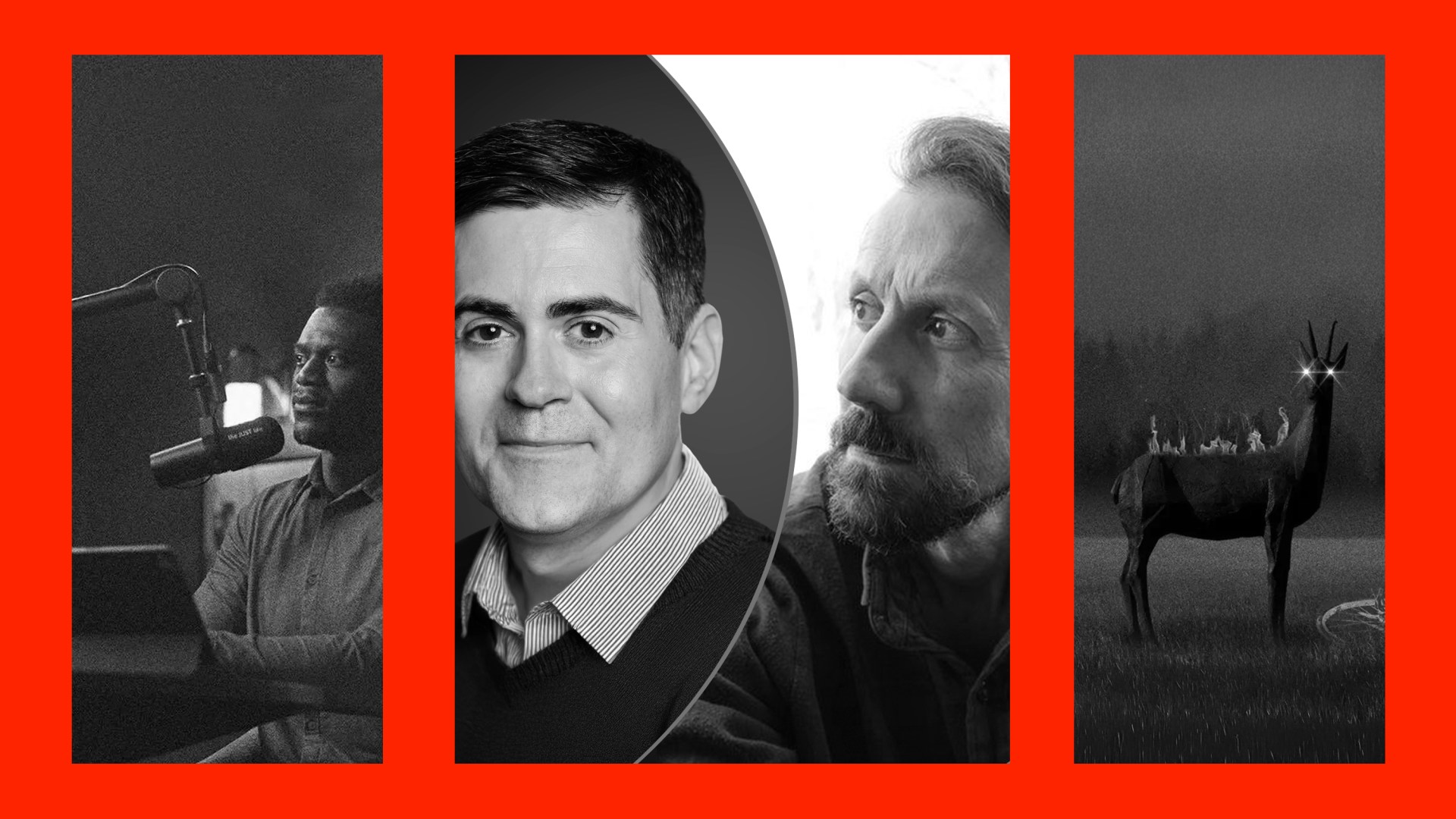
Here are edited excerpts of a conversation between Russell Moore and Mike Cosper on CT’s The Bulletin podcast.

Mike Cosper: Look, his murder has really bothered me. If you’re a dad—I don’t care how you feel about Charlie Kirk—look back on the days of your life, the days of your marriage, when your kids were little. There’s something so beautiful in those years, and they not only robbed that from him; they robbed that from his kids. They robbed that from those kids’ grandparents, from his wife. I’m gutted by this regardless of how I feel about Kirk’s politics. This is gutting. 

Looking at Kirk’s videos that his most ardent fans liked the most—the ones that have the most views, the most likes—it’s not necessarily the “Charlie Kirk Destroys Progressive” or “Charlie Kirk Destroys Trans Activist” or anything like that. A lot of those videos are Charlie responding to people and preaching the gospel. He articulates a very straightforward and compelling understanding of the gospel. 

Another video I watched was one where a college student comes to him and says, “One of my parents is very liberal. One of my parents is very MAGA. I don’t find myself agreeing with either one of them. How am I supposed to navigate this?” He basically says, “Love your parents. Show up. Stop talking about politics. Don’t let politics drive a wedge between you and your parents.”

I found that admirable when I immersed myself in it. I could delineate plenty of differences in political rhetoric and ideology between myself and Kirk. I just don’t feel this is the day for that. It’s worthy to celebrate the ways where we were arguing for the same things and advocating for the same things, whether it was the importance of marriage, the importance of gender, the importance of the gospel.

I’m emotionally moved by this because, on the left and right, Kirk’s death is already being leveraged for political ends in ways that are incredibly gross.

Russell Moore: What makes that all the more striking are places where there’s an exception to that. Last night I was watching a couple of very young, very progressive mirror images of Charlie Kirk—Dean Withers and Parkergetajob. These people are doing similar things to what Kirk was doing. Both had debated Charlie Kirk quite a bit, and both were openly weeping in a way that was genuine. 

What I heard in that was what we’ve been talking about here. This is a human being, and there is a sense of shock and outrage at what could happen to a human being’s life. And fear for the country when you have a situation that seems to be unraveling and people start to see murder as a response to political rhetoric. 

That entire world is built on “Here’s a video of me humiliating someone”: Fill in the blank, so-and-so gets “owned.” It’s easy to start to see people as YouTube avatars.

Both of these young guys were shaken by the fact that this isn’t a game: There’s a human being here. Even as angry and upset as I am, it was a little glimmer of hope that people can see sometimes what really matters and what doesn’t.

Mike Cosper: One thing I genuinely respected and admired about Kirk—and on lots of things he and I differed—was his willingness to sit across the table on a small scale, on a large scale, on camera, in real life and everything else. He was willing to engage people who thought his ideas were retrograde and evil. 

There’s this wonderful clip of an encounter where he shows up at a college campus and puts up a sign that says something like “Tell me where I’m wrong” or “Debate me.” The mother of a student comes to the table and basically says, “What are you doing? What is this?” 

He explains, “Look, I do this for a couple of reasons. One is that I think there’s a lot of people who think like I do, and they’re afraid to share their ideas because they get shouted down when they do. I also do this because if we can’t maintain the capacity to talk to one another, the only alternative is civil war and violence. And so I think it’s an important exercise for us and for civility to just show up and say, ‘Let’s have a conversation. Let’s build a relationship.’”

Kirk did that as imperfectly as any human being would do in terms of showing civility to the people he debated, but it was a value he articulated and aspired to. More often than not, he’s showing respect to the people he’s arguing with.

Russell Moore: One thing that fuels political violence is the sense that—once and for all—“I’m definitively going to deal with my opponents.” Then they’re gone, and we move on. That is not only immoral and satanic but an insane and irrational way of thinking. 

We have to pay attention to what Jesus said to Peter: Those who live by the sword will die by the sword. What he means by that is that these cycles of revenge just continue to feed off of each other unless the revenge cycle is broken.

What ends up happening is not only the harming of whoever one’s enemies are but the harming of oneself, because it’s the deadening of a soul to the point of thinking, The way I’m going to respond is murder. That is itself a kind of self-harm. 

We must have a sense of the value and dignity of human life apart and beyond from somebody’s gifts and somebody’s set of beliefs—and that there is a different way to be from retaliation and revenge: the Sermon on the Mount. Those ways of shaping our consciences are going to be necessary.

Mike Cosper: Modernity, especially since the French Revolution, has had this idea that violence was somehow going to purge society of its evils and heal it, that it would come out the other side because we killed all the right people.

Whether the purges in the French Revolution or the Bolsheviks, the starvation of the kulaks, or the Nazis’ attempt to eradicate Jews from Europe, there was this belief that efforts would bring us much closer to utopia. 

Obviously this is a sin. Every human being is made in the image of God, and every murder is asin against the image of God. But the other reality that history should show us in all this is that all those attempts at violence, all those violent revolutions, resulted in more violence. 

Russell Moore: Usually we’re talking into our own ecosystems. We’re trying to get the cheers of whoever we’re already with, rather than thinking we could persuade someone. A few figures tried to persuade. Charlie Kirk was one of them.

The Bulletin closing: Our hearts are heavy today for the family of Charlie Kirk. We mourn his death. We grieve for his wife, Erika, and their two precious little children. It is our prayer here that this deep loss will become a catalyst for new and lasting change in our country’s political life for the common good.

Listen to the full episode, which released Friday, September 12.

Church Life

Come to Office Hours, Be Humble, and Go to Church

Contributor

As a professor, I know you’re under pressure. Let me share what I’ve learned in 20 years in the classroom.

A girl praying with a laptop, clock, graduation cap, and planner flying around her head.
Christianity Today September 15, 2025
Illustration by Elizabeth Kaye / Source Images: Getty, Unsplash

College comes with many pressures: pressure to perform. Pressure to fit in. Pressure to find your people, to graduate on time, to choose the right major and career (and sometimes spouse). 

But beneath all these pressures is what I believe to be the purpose of higher education: to grow in wisdom, knowledge, and skills so you can glorify God, love your neighbor, and delight in God’s creation. That purpose is hard to remember with these pressures tugging at your sleeve—telling you to worry about grades or about why someone hasn’t texted you back already—and your task as a student is to discipline yourself to remember it anyway. Set aside your distractions and focus on the calling God has laid before you today. 

So how do you develop this discipline? What can you do practically as you go or go back to college this fall? My experience teaching college students for 20 years has taught me the key is humility. 

All wisdom begins with humility. We see this in Scripture: “The fear of the Lord is the beginning of wisdom” (Prov. 9:10), and fearing God requires a posture of humility. Learning wisdom—or knowledge, skills, or anything else—requires it too. You must open yourself up, become vulnerable to the opportunity to grow. This means admitting ignorance, admitting that when you enter a classroom, however confident you are in the subject, you have something to learn. 

Allow your professors to guide your journey toward wisdom in their subjects. Trust them in humility. Trust that their years of study and discipline have made them experts in their fields. It’s not that they aren’t human and capable of mistakes. They are. But trust that they have something precious to share with you. 

When students become prideful, they become unteachable. There is no wisdom a teacher can impart to a prideful student, because a prideful student sits cross-armed and confident. A wall has gone up. 

I understand that sometimes students have to take classes they believe they should be able to skip. This is frustrating, but each class is nevertheless an opportunity to grow in wisdom—even if that growth is less in factual knowledge than in attention, patience, and humility. I can tell you from experience that these virtues will serve you well in life and are in short supply in the contemporary world. 

I also understand that some students are skeptical of trusting professors because there are so many stories of professors who take advantage of their positions to promote ideological views irrelevant to their subjects. I understand this concern: I once had a professor at a secular university who taught grammar by criticizing President George W. Bush, the Iraq War, and creation science. But despite his ideological bent, I did learn grammar from him—and discerningly ignored the ideology.

All this talk about students being humble may sound a bit patronizing. What about professors? Is it only students who have to be humble? 

You’ll be glad to know that we professors require humility just as much as students do. We need it if we’re to continue to grow in wisdom and be effective teachers. In humility, we professors must open ourselves up to the advice and admonition of our colleagues, our administrators, and other scholars in our fields. And in humility, we must read books that challenge us and our assumptions. Everyone who wants to grow in wisdom remains humble. Any professor who is not humble inevitably becomes a fool.

But what about those pesky pressures? Let’s say you get to college with your heart set on walking into class with humility and an openness to learn for the glory of God. Won’t you still be distracted by grades and that person who left your text message on “read” for an hour? 

Maybe, but not necessarily. If you truly understand education as pursuit of wisdom, you’ll be better able to accept poor grades or high grades for what they are—and move on. 

Grades aren’t measures of your personhood. They don’t prove you are a failure (or a success). They may show you need to study more for a particular class. And if so, fine. You can accept that with humility. Or if you receive high grades, also fine. In humility, you can accept them without inflating your pride.

Other pressures can’t be so directly addressed by humility (though even there I think a humble heart is part of the solution). Pressures to fit in, find the right career path, and snag a spouse can be overwhelming. 

My advice is this: Wherever you are and whatever kind of school you attend, find a local congregation and get plugged in—immediately. I know it can be difficult being the one young adult in a room full of parents or older adults. I know it can be hard to coordinate rides on Sunday morning. But you must do it. 

Take the initiative. Show up on Sundays. Join a small group or a college ministry. Find some kind of Christian support. 

The college years can be very challenging for young people. This is a period of enormous change, of scrutinizing your childhood, of making major decisions with long-term ramifications—all while you are taking tests. You need a Christian community to ground you. And I suppose that does take a lot of humility to accept and practice. It certainly takes vulnerability and courage. 

If you are attending a Christian college or university, then I highly recommend using your professors’ office hours (in addition to your church or ministry community) whenever you have questions about faith, life, and challenges in class. 

Giving you this support is exactly why your professors are there. Indeed, one of the great benefits of teaching at a Christian liberal arts university is that I have time to meet with students and mentor them. I always try to approach these meetings with humility myself, knowing it is an honor to have someone come seeking counsel. Your visits are never an imposition.

And even if you don’t attend a Christian school, having the humility and courage to visit your professor during office hours will only benefit you. Being willing to raise questions about a course and its material is a strong indicator of academic success. 

In this school year—and the next, and all your years after graduation too—the decision to pursue wisdom, knowledge, and skill is up to you. We like to hedge and say some people are just born intelligent, but Proverbs makes clear that wisdom is open to anyone who truly desires it. Whatever our innate abilities, we can all seek a posture of humility before God. 

The pressures won’t go away. Various distractions will continue to come. But your duty is to glorify God, love your neighbor, and delight in God’s creation by submitting yourself to the work of questing for wisdom, knowledge, and skill. With a community of believers to support you, professors to encourage you, and a God who loves you and wants you to know him, you can learn well.

O. Alan Noble is associate professor of English at Oklahoma Baptist University and author of four books:  To Live Well: Practical Wisdom for Moving Through Chaotic TimesOn Getting Out of BedYou Are Not Your Own, and Disruptive Witness

News

Brazilian Evangelicals Call for Reconciliation After Bolsonaro Convicted of Coup Plot

The former president received a 27-year prison sentence for orchestrating an uprising to take over the government after his defeat.

Supporters of former Brazilian president Jair Bolsonaro participate in a protest in his support on August 3, 2025.

Supporters of former Brazilian president Jair Bolsonaro participate in a protest in his support on August 3, 2025.

Christianity Today September 12, 2025
Anadolu / Contributor / Getty

On Friday, the Brazilian supreme court sentenced former president Jair Bolsonaro to more than 27 years in prison for plotting an attempted coup after losing the 2022 election. The landmark ruling marks the first time the country has tried and convicted a person for trying to overthrow an elected government.

For days ahead of the verdict, Bolsonaro’s evangelical supporters took to the streets in demonstrations and held vigil praying outside of the politician’s condo in Brasília.

The court found Bolsonaro guilty of leading a group of high-ranking officials involved in a January 8, 2028 uprising and plotting the assassinations of his political opponents. Calling the election rigged and declaring incoming president Luiz Inácio Lula da Silva illegitimate, protestors occupied and vandalized congressional headquarters, the supreme court building, and Planalto Palace, which contains the president’s offices.

Bolsonaro denies the charges, claiming that he was not even in Brazil on January 8—he boarded a Brazilian Air Force plane bound for Orlando, Florida, on December 30, 2022, two days before the handover, and remained there until March 30, 2023. He told the court that those who took to the streets calling for a military coup were crazy.

Evangelicals participated in the riots, with at least four pastors among the 1,400 people arrested, and they continued to back him as he and others faced charges for their involvement. 

Pastor Silas Malafaia, leader of Vitória em Cristo, part of the Brazilian Assemblies of God, organized street demonstrations and advocated for amnesty for all arrested protesters. Last month, he was targeted by police and charged with obstruction of justice. 

Malafaia, in turn, has called for the arrest of Supreme Court Justice Alexandre de Moraes, who is in charge of the Supreme Court’s investigation of Bolsonaro. 

“This almost indiscriminate support that evangelicals gave to Bolsonarism is one of the clearest fingerprints of the coup movement,” said political scientist Carla Ribeiro Sales, who belongs to a Baptist church in Recife. “I confess that I am ashamed—not of the gospel, but of this mess we have gotten ourselves into.”

Clashes over Bolsonaro have polarized Brazilian churches, echoing America’s splits around President Donald Trump.

“It’s terrible to see people hurt, families divided, churches sick because of this polarization,” said Cynthia Muniz, pastor of Igreja Anglicana Porto in São Paulo. “There were entire families who left churches because they thought their leader should take a stand in favor of one candidate or another.”

Brazil elected Bolsonaro in 2019, backed by 69 percent of the country’s evangelical minority, but that support slipped. He lost reelection in 2022 by a margin of 2.1 million voters, or 1.8 percent of the electorate.

“Bolsonaro certainly would have no relevance at all if it weren’t for evangelicals,” said theologian Jacira Monteiro.

Some evangelical leaders hope the former president’s conviction might spur a reckoning among evangelicals. Theologian Valdir Steuernagel points to the challenge for the church to recover the ministry of reconciliation, as described in 2 Corinthians 5.

“We have been so captured by political polarization that we have lost the ability to listen to the Scriptures, which call us to encounter, not to distance ourselves,” he told CT. “Our calling is to reconcile.”

It won’t be an easy task. Some Brazilian evangelicals remain loyal to Bolsonaro and have joined public demonstrations, such as the demonstration held on September 7th (Brazil’s Independence Day) in São Paulo. The protesters called for amnesty for all those accused of a coup d’état, including Bolsonaro.

One of the most strident spokespersons is Malafaia. “The constitution, the laws, and the justice system were thrown into the trash by those who should be the greatest example of upholding the law: the Supreme Court,” he said in a video released after the conviction.

Ed René Kivitz, pastor at Igreja Batista da Água Branca in São Paulo, said that churches have three challenges: to defend democracy and the secular state, to promote peace and reconciliation among all people, and to multiply signs of justice and solidarity. 

“We need to prevent the hijacking of the thinking of evangelical communities by political ideologies, whether on the right or the left,” he said.

Bolsonaro’s trial, though criticized by the former president’s supporters, has been seen as exemplary in its aim to curb anti-democratic initiatives in Western nations.

“Our concern as pastors is not to allow this to happen again,” said Muniz, who also emphasizes the superiority of biblical ethics over ideologies and the polarization that arises from them. 

She uses Jesus’ words to Pontius Pilate in John 18:36 as a reference for addressing political polarization: “My kingdom is not of this world.”

For Muniz, the kingdom has a real impact on the world, bringing justice, goodness, and hope. “God cannot be reduced or co-opted by political parties or figures,” she said. 

The former president remains under house arrest, now convicted of coup d’état, violent abolition of the rule of law, armed criminal organization, aggravated damage to public property, and deterioration of a listed building. 

He and his former aides may be in prison soon—Brazilian law allows them to stay free while they appeal the sentence. The supreme court is expected to rule on all appeals by the end of the year.

Pastors

How Should Pastors Respond to Charlie Kirk’s Assassination?

After the tragic assassination of Charlie Kirk, how do pastors lead well in a fractured, reactive age? Here are five pastoral questions for this moment.

CT Pastors September 12, 2025
TWP / Getty

I was waiting for my lunch appointment to arrive when I saw the video on X. In my gut, I knew Charlie Kirk was going to die. The brutality—and grim clarity—of the clip made my heart drop. My first thought: His wife. His Kids. 

My second thought: My congregation.

What do they need? How many will be heartbroken? How many will be haunted by the clips that are circulating? How many have no idea who he was? How many loved him? How many didn’t like him? What should our pastors and staff do? How should we prepare them? 

Then my heart returned to the cold facts: Charlie Kirk—husband, father, friend, conservative activist, and brother in Christ—had been assassinated. 

For many, myself included, he was a bold witness—unashamed of the gospel of Jesus Christ and willing to champion countercultural truths, whether by advocating for the unborn or upholding a Christian vision of marriage and sexuality. To others, his brash style and controversial remarks made him hard to hear. Some saw a prophetic voice; others saw a provocateur. Some saw a man growing in grace and maturity; others saw a culture warrior who played too close to the edge. 

As pastors, we carry the weight of shepherding people who often see these things very differently. Some in our churches admired Kirk’s courage. Others were concerned by his tone. Most feel confused, grieved, or simply weary by the continued fracturing of our world. But no matter how we perceived him, we now face a discipleship question: How do we shepherd our people faithfully in the wake of such a moment? 

In the second century, when reflecting on the unjust and unprovoked killing of Christians, Tertullian wrote, “[Christians] are not a new philosophy but a divine revelation. That’s why you can’t just exterminate us; the more you kill the more we are. The blood of the martyrs is the seed of the church.” What do we do with that seed when it falls not in the arena, but in the age of algorithms, outrage, and moral confusion? What are we called to plant, and what fruit do we hope to see?

Consider these five questions that may help us as pastors—first to reflect personally, and then to shepherd our congregations in how we respond to this tragic act of evil.

Who gets to narrate the world?

God rules the whole universe; his perspective on history is ultimate, final, and perfect. 

Robert Webber’s book Who Gets to Narrate the World? argues that the Christian story is true—not just as a personal opinion among many, but a divine revelation that sits over and against the postmodern assumption that all worldviews are equally plausible. This basic evangelical perspective also reminds us that there is no such thing as secular neutrality.

People who do not know, love, and follow Jesus cannot fully account for what was done to Kirk. If you let “the fool says in his heart, “There is no God’” (Psalm 14:1) describe and narrate to you what is unfolding, you will lose touch with reality, because they are already out of touch with it. To follow Jesus is live soberly within the grain of the Creator’s story. As in The Chronicles of Narnia, the narrative offered by the White Witch cannot make sense of the fact that Aslan is on the move.  We will be discipled by someone’s story; the secular humanist account of the world is not just different, it is insufficient—and wrong.

I’ll offer one simple example out of the many that have emerged in the hours after Kirk’s murder. Before he was even officially pronounced dead, an MSNBC commentator said, “You can’t have awful thoughts and say awful things and not expect awful actions.” We don’t know exactly which of Kirk’s comments he was referencing. But many evangelical Christians hear those words as an attack on their own basic Christian beliefs—a biblical view of marriage, saying abortion is murder, believing that a woman is an adult human female, and confessing that salvation is found only in Jesus Christ. 

Why label basic evangelical beliefs as “awful”? Perhaps to shame believers into silence. To suggest that speaking biblical truth incites violence is to place the blame in the wrong place. Awe-filled reverence for the Lord of all is not awful. What is awful is the judgment of God against those who set themselves against him.

Whom shall I send?

The primary way we honor Charlie Kirk’s legacy is to be like him—to walk unashamed of the gospel of Jesus Christ, to say what we believe, to speak plainly, and to do so even in environments hostile to the authority of God. 

Too often, many of us are content to delegate evangelism to evangelists, preaching to preachers, and truth-speaking to pundits while comfortably sitting in the shadows of those who risk their reputations and relationships. We may not be policymakers in the Capitol or elders in our congregations, but we are nonetheless the missionary people of God, the light to the nations, and the image bearers of God who bear incredible responsibility. 

In Isaiah 6, the question God asks the prophet should ring in our ears, not just the ears of prophets and public figures: “Whom shall I send? And who will go for us?” 

And our right response ought to echo Isaiah’s, “Here Am I, Send me!” 

We are sent ones, every one of us sent to our neighborhoods, institutions, families, and friends to announce the good news of the reign of God in history through the death and resurrection of Jesus. We are ambassadors—God making his appeal through us—who do our best to defend the young and vulnerable from sub-Christian, murderous, and oppressive ideologies.

Is Jesus Lord of all?

You do not have to agree with every detail of how Charlie Kirk attempted to integrate his faith with his politics, but you must agree that one’s faith cannot be separated from one’s politics. There are many Christians who didn’t like what Kirk was doing. Brash. Not winsome enough. Argumentative. Too political. Some who critique Kirk may do so out of genuine concern for over his tone or method. Others, however, are tempted to retreat into a private faith that never risks public witness. 

But the call of Christ presses us to move beyond either silence or cynicism—to bring our whole selves, including our convictions, into the open. If you want hits, you must swing at pitches. And when you swing, you’ll sometimes miss. But some Christians swing at nothing—content to sit in the dugout, then stand at a distance and criticize those who are in the game. 

Notice how one of his political (not personal) opponents, Ezra Klein at The New York Times, described him after his passing:

“Kirk was practicing politics in exactly the right way. He was showing up to campuses and talking with anyone who would talk to him. He was one of the era’s most effective practitioners of persuasion…Kirk and I were on different sides of most political arguments. We were on the same side on the continued possibility of American politics.” 

May we conduct ourselves in such a manner that even our opponents see our integrity, consistency, and our commitment to right means—not just right ends. 

If Jesus is Lord of all, then it follows that his instruction and social teaching are good for all. We must “seek the peace and prosperity of the city to which I have carried you into exile” (Jer. 29:7), and the ground and standard of that peace and prosperity is God’s word. 

Submission to and respect for the Ten Commandments would have helped here: “You shall not murder” is a command we can no longer take for granted (Exodus 20:13).  A recent report from Network Contagion Research Institute found that 55% of “left of center” people think assassinating Donald Trump would be “somewhat justified.” Include all the surveys respondents, regardless of political leaning, and it is still at 38%. The brokenness we’re witnessing is not random. It reveals how sick we are as a nation.

Will I love my enemies?

Can I bless those who persecute me? Will I not revile when reviled? Will I turn the other cheek? Will I love my enemies? If I can’t, then I’m living in contradiction to God’s law. 

Ephesians 6:12 a verse Christians are too slow to believe: “For our struggle is not against flesh and blood, but against the rulers, against the authorities, against the powers of this dark world and against the spiritual forces of evil in the heavenly realms.” The image bearers on “the other side” of the aisle or the issue at hand are not the enemy. They may be held captive by human tradition and demonic influence, but they are not our ultimate enemies. If we cannot walk in step with the fruit of the Spirit, we too have been taken captive by the spirit of the age. 

The collective rage at the killing of Charlie Kirk is understandable. But often, that rage shields something deeper: our grief. The world is not as it should be. People are not as they should be. The government is not as it should be. The government, the media, and even we—Christ followers—are not as we should be. 

The suffering and decay we see around us are the fruit of sin and demonic power in a broken and fallen world. Our capacity to push back on the darkness is frustratingly limited. We pray, preach, disciple, advocate, and labor toward the things of God. Yet the myth of progress—that modern belief that humanity is steadily improving and can save itself—is shattered time and time again. 

In that place of discouragement, the temptation to act sinfully in response to sin is real—to match outrage for outrage, or to harden into cynicism. But we’re called to react; we’re called to endure. We’re called to cling to holiness—not through gritted teeth, but by staying rooted in Christ, walking by the Spirit, and obeying God’s Word, even when it costs us. Not because it’s easy, but because that’s what faithfulness looks like in the dark.

What should I do next?

Yesterday, and today, I felt shepherded by Charlie Kirk’s own words: 

“When things are moving very fast and people are losing their minds, it’s important to stay grounded. Turn off your phone, read scripture, spend time with friends.”

That’s not just personal advice. It’s pastoral guidance. And it’s needed now more than ever.

In these reactionary times, we must be the ones who remain rooted. Grounded. Present. We must immerse ourselves in the visible people of God. Cling to God in Christ. And then lead others to do the same. 

Do today what Charlie Kirk cannot: Hug your spouse, hold your kids, invest in your local church, and call a friend who is struggling. 

And do today what Charlie Kirk is doing now: Praise the risen Lord, pray to the Father, and immerse yourself in the life of the Spirit. 

“The blood of the martyrs is the seed of the church.” 

May his death not make us shrink back in fear, but stand up in faith. Preach clearly. Shepherd faithfully. And lead your people to live holy lives in the midst of a crooked generation—the kind of lives that bear fruit from the seeds he planted.

Seth Troutt is the teaching pastor at Ironwood Church in Arizona. His doctoral studies focused on Gen Z, digitization, and bodily self-concept. He writes about emotions, gender, parenting, and the intersection of theology and culture. Seth and his wife, Taylor, have two young children.

Ideas

Charlie Kirk Is Not a Scapegoat

Contributor

When we instrumentalize violence, we side with the accuser rather than with Christ.

Charlie Kirk speaking at an event.
Christianity Today September 12, 2025
Rebecca Noble / Stringer / Getty

French Catholic sociologist René Girard argued that ever since the crucifixion and resurrection of Jesus Christ, violence has been robbed of its sacred legitimacy and ancient power—but you wouldn’t know that by scanning some corners of the internet today.

Over the past few days, a slew of violent events has erupted in our nation, including the senseless stabbing of Ukrainian refugee Iryna Zarutska on a train in Charlotte, another school shooting in Colorado, and Wednesday’s brutal assassination of political activist Charlie Kirk. News of Kirk’s death exploded not only due to his celebrity-like status but also because it appeared to be a clear act of political violence, which experts have long warned would result from the increasing polarization on both sides of the political divide.

For instance, a 2023 study found that 40 percent of both Biden and Trump supporters “at least somewhat believed the other side had become so extreme that it is acceptable to use violence to prevent them from achieving their goals.”

But what should be equally concerning to us is how our nation responds to violent incidents like these. Most Americans are in shock, grieving, and rightly concerned for the future of our nation. Yet there are outliers on both ends of the ideological spectrum who seem inclined to assign a deeper meaning to Kirk’s murder—one that instrumentalizes it to galvanize further support for their respective camps and causes.

On the far left, some talk as if Kirk deserved what happened to him for his past comments on subjects like race, sexuality, guns, and even empathy, which critics have deemed deeply dehumanizing. Kirk is someone who died on the hill he chose and whose death can thus be weaponized against his own rhetoric and ideology. By contrast, some on the far right speak of Kirk’s death as advancing a holy cause in enemy territory. Kirk is a slain saint and hero whose murder is a rallying cry and call to arms for conservatives and Christians like him. In short, in a mutual display of selective outrage and empathy, the far left blames Kirk’s death on the right and the far right blames his death on the left.

Ironically, these impulses draw from the same source and therefore cause the same effect by casting Kirk as a scapegoat. In each case, Kirk’s murder is assigned a kind of sacred significance that unites each faction around their respective ideologies—in such a way that his death becomes ammunition for further partisan violence.

Societies use scapegoats to avoid their deeper problems, which, Girard says, stem from “mimetic contagion”—an escalating rivalry that spreads as people imitate one another’s desires. Instead of embracing true concern for victims “from the standpoint of the Christian faith,” which leads “the way into God’s new community of love and nonviolence,” Girard observed that pagan forms of “victimism” use victims to “gain political or economic or spiritual power.”

More to the point, by resorting to scapegoating, we wind up affirming that violence actually works as it is intended—a reality that Girard says stopped being true the moment Jesus gained victory over the power of death.

According to Girard’s anthropology, Jesus was the scapegoat to end all scapegoats—an innocent victim whom the political and religious establishment of the first century viewed as the culprit of their communal crisis, leading them to believe that killing him would restore the status quo. Yet because Jesus embodied true innocence—the only perfectly innocent person to walk this earth—he exposed the scapegoating mechanism for what it was, thereby defeating the devil and defanging death.

In Girard’s thinking, “the Lamb who was slain from the creation of the world” (Rev. 13:8) disarmed violence itself, uncovering a hidden mystery which “none of the rulers of this age understood, for if they had, they would not have crucified the Lord of glory” (1 Cor. 2:8).

Ever since Jesus, violence lost the cohesive force it once exerted to unite communities around the deaths of their victims and thus relieve their tensions. Now, any positive effects that result from acts of violence—like the national unity after 9/11—will always be temporary and ultimately self-defeating. This also explains why, according to Girard, violence has grown increasingly chaotic in its nature, decentralized in its manifestation, and ineffectual in its aims.

In short, to instrumentalize Kirk’s murder, whether by painting him as a martyr or a miscreant, sanctions his status as a scapegoat and so affirms the essential function of violence—which in turn denies the reality that Jesus conquered death’s demonic power.

The scapegoating mechanism, which is at work in all forms of brutality, plays right into the hands of the enemy of both God and humanity. That is because, Girard argued, it is the primary operating system of Satan himself. As the accuser, Satan supplies the core impulse behind scapegoating, which is assigning blame. Thus, whenever we blame each other for the violence of our times, we end up aligning ourselves with the accuser (Rev. 12:10).

Christians across the political spectrum should be disturbed by the increasing violence that seems to be taking over our country. Yet as followers of Jesus, we also have a unique opportunity to direct our anger in the right direction—for only then can ours be a righteous rage. When we target and attack one another as the enemy, it distracts us from our real enemies: sin, death, and the devil.

In Scripture, Satan is called “a murderer from the beginning” (John 8:44) and the one who “holds the power of death” (Heb. 2:14). While Jesus broke the power of death by defeating the devil, the reality of death still exists and is thus “the last enemy to be destroyed” (1 Cor. 15:26).

Too often, Christians aren’t mad enough at death, as my colleague Kate Shellnutt has pointed out. Perhaps that’s because we’re far too busy getting mad at one another. We forget the words of the apostle Paul, who writes that “our struggle is not against flesh and blood, but against the rulers, against the authorities, against the powers of this dark world and against the spiritual forces of evil in the heavenly realms” (Eph. 6:12).

As Christians, we are uniquely poised to combat the lie that violence still has its uses in our world. In fact, the more inevitable and inescapable violence seems to become in our culture, French theologian Jacques Ellul argued, the more important it is for Christ’s followers to prove otherwise: “The role of the Christian in society … is to shatter fatalities and necessities. And he cannot fulfill this role by using violent means.”

Not only is violence unnecessary, but it is also counterproductive—it creates a literal death loop that does nothing more than reinforce itself. This is why Girard said that the kingdom of darkness is a house divided against itself, for eradicating violence with violence is like Satan casting out Satan (Matt. 12:25).

Instead, the Good News of the gospel is that Jesus now holds power over death, binding the work of the enemy and causing Satan to fall like lightning (Luke 10:18, John 12:31). As Christians, we have access to that same supernatural power through Christ’s sacrifice—who conquered not by being death’s instrument but by being its willing recipient for the sake of the world. That is, we overcome Satan’s schemes “by the blood of the Lamb and by the word of [our] testimony” (Rev. 12:11).

As citizens of Christ’s now-and-coming kingdom, we must refuse to sacralize murder and thus return to death its scepter. Now is the time for every Christian, regardless of our political affiliation, to beat our swords into plowshares and do the hard work of uprooting the false necessity of violence in our nation. We must demonstrate that the new operating principle of Christ’s kingdom is a divine love that is even stronger than death (Song 8:6).

Christ’s “resurrection is the guarantee that God can cure every wrong and every hurt,” writes Catholic priest Jacques Philippe. “Love, and only love, can overcome evil by good and draw good out of evil.”

Now is the time to prove to the world that death has, in fact, lost its sting—and that only the sacrificial love of Jesus Christ prevails against the violent forces of hell.

Stefani McDade is the theology editor at Christianity Today.

Pastors

Kingdom Friendship in a Divided World

What if the relationships that sustain pastors also showed the world a better way?

CT Pastors September 12, 2025
SolStock / Getty

Do you remember the excitement and sense of purpose when you first felt called by God to vocational ministry?  Like the disciples on the mountain with Jesus just before he gave them their commission, you may have wrestled with some nervous jitters or doubts.  But beneath those anxious thoughts there was a genuine excitement—a holy thrill at the chance to make a kingdom impact in the lives of others.   

For many pastors, that early sense of calling eventually gives way to an unexpected reality: feeling lonely and isolated. The weight of ministry and the expectations of our people can sometimes feel exhausting, even crushing. In our efforts to be faithful to our calling, we often crowd our calendars and deny ourselves the very things that help us endure and thrive—personal care and meaningful relationships.

And yet, it’s precisely these kinds of relationships—honest, sustaining, kingdom-minded friendships—that many pastors need but ultimately lack.

Created in the image of God, we are fundamentally relational by nature, created to live in meaningful relationship with God and in authentic community with others We are meant to live out of our union with Christ and his body, offering a quiet testimony to an unbelieving world. We are at our best when we cultivate healthy and integrated relationships in our communities where we serve. In his earthly ministry, Jesus modeled these relationships by refusing to distance himself from either the religious or the irreligious, choosing instead to share meals with both religious leaders and sinners.

If churches are to have influence in the world, they must be led by healthy pastors. Charles Spurgeon once observed, “I believe that one reason why the church of God at this present moment has so little influence over the world is because the world has so much influence over the church.”  When today’s church leaders parrot the world’s habits by working in isolation, staying guarded and siloed, we miss the very call Spurgeon was urging us to heed. 

One of the most overlooked key ingredients in a thriving and flourishing ministry life is safe and transparent friendships. It is a paradox: We spend our days being with people and yet many of us feel isolated, lonely, and disconnected. Rather than experiencing the beauty of friendship that Jesus offers (John 15:15), we begin to feel like hired help and respond by distancing ourselves from the people around us. Our busy schedule leave us exhausted and with the perception that we have no time to invest relationally. Our calendars grow full, but our souls run empty.

If you are feeling isolated or lonely, you are not alone.  A 2024 study by the Hartford Institute of Religion found that half of pastors say they often or frequently experience loneliness.  A separate Barna study (also from last year) showed a significant decrease in how satisfied pastors are in terms of having “true friends.” 

In my own life and ministry, I (Chip) have walked through several seasons of deep depression and anxiety. In those times, my temptation has been to isolate and withdraw. Fortunately, the Lord has given me a small circle of trusted, long-term friends who played a key role in restoring me. 

We (Chip and Robert) have learned over 60 combined years in ministry that “life is all about relationships!”  God designed us this way!

We are made for meaningful community and deep authentic friendships—with God (vertical) and with others (horizontal). Jesus summed up all the law when he said that the two greatest commandments are to “love the Lord your God with all your heart and with all your soul and with all your mind” and to “love your neighbor as yourself” (Matt. 22:37-40) .

God is our perfect model for community—namely, in the Trinity. Even before creation, the Father, Son, and Holy Spirit had perfect community and perfect loving relationships with each other. They didn’t need to create us for their own relational desires but to share the loving relationship they eternally have with each other. “Let us make mankind in our image, in our likeness… God created mankind in his own image, in the image of God he created them” (Gen. 1:26-27). Being made in God’s image explains our desire and need for relationships and community. As Genesis 2:18 reminds us, we are not meant to be alone.

In his classic Mere Christianity, C.S. Lewis described the Trinity as “a dynamic, pulsating activity, a life… almost, if you will not think me irreverent, a kind of dance.” While you might occasionally see a person dancing alone, it is something else to behold the beauty of loved ones moving together in step. 

Now contrast that with the oft-quoted observation that “the Sunday morning worship is most segregated hour in America.” That’s like watching a beautiful tango dance with one partner missing. 

To live and lead in isolation—or to only have friends who are just like us—is a bit like looking at one facet of a diamond. The classic round brilliant cut diamond has 57 or 58 facets. In order to see and experience the beauty of the diamond, you have to see it from many sides. The same is true in our relationships. We need others—different from us, shaped by different histories—in order to see the other facets. 

We have also learned that some of our most life-giving friendships are those that reflect God’s unity in diversity. From the beginning, the Lord has pointed us toward a beautifully multiethnic future. The day is coming when Jesus will return, and there will be “a great multitude that no one [can] count, from every nation, tribe, people and language, standing before the throne and before the Lamb… [crying out] in a loud voice: ‘Salvation belongs to our God’” (Rev. 7:9-10).

God set apart a people through Abraham and his family—not just for themselves, but to be a blessing to all the nations and families of the earth (Gen. 12:1-3). And when Jesus came, he came to unite and heal what sin had divided: people, cultures, nations, and families that had long been at odds.

Paul puts it plainly in Ephesians 2:14–16: 

“For he himself is our peace, who has made the two groups one and has destroyed the barrier, the dividing wall of hostility… to create in himself one new humanity out of the two, thus making peace, and in one body to reconcile both of them to God through the cross, by which he put to death their hostility.”

Here, the apostle is speaking about Jews and Gentiles—two groups who hated each other.  Jesus doesn’t just save individuals; he reconciles enemies. He creates one new people. 

Near the time of his death, Jesus prays a prayer that this unified body (the beautifully diverse body of Christ) would become one. “Then the world will know,” he said, “that you sent me and have loved them even as you have loved me” (John 17:23). That kind unity isn’t decorative. It’s missional. It’s a compelling witness to the gospel of Jesus Christ, particularly as we consider what it means to love our neighbor.    

Over the last 20 to 30 years, our “neighbors” in Atlanta have become ethnically and culturally more diverse. And it’s not just here. In nearly every major metropolitan area and even across rural communities, the nations are now at our doorsteps.

The unity Jesus prayed for in John 17, when put into practice, gives a greater opportunity for the gospel to impact these changing demographics.  Rather than lamenting the loss of homogeneity, if we become intentional in cultivating intercultural friendships our witness for Christ will be far more effective.  The gospel becomes more visible. Instead of boarding planes to serve in faraway places, each of us has the opportunity to become a missionary right in our own neighborhood. 

The beauty in developing intercultural relationships and friendships is analogous to the richness of a well-played piano. In 2016, Android released a commercial featuring a master pianist performing Moonlight Sonata on two different pianos. One was a traditional piano with all 88 keys tuned to their specific notes and another piano had every key tuned to the key C. The difference was startling. One played a beautiful masterpiece that anyone could appreciate. The other? Monotone and flat.   

The tagline for the advertisement was “Be together. Not the same.” It is striking that even Android marketing picked up on this beautiful truth: Diversity is not a threat to unity but the texture that gives it beauty.

We need friendships in our lives that play their own note, rather than merely echoing ours. When each friend plays his specific note, we hear the symphonic richness of the body of Christ. It is not enough to say we want diverse relationships; it is important to recognize that we need these relationships to hear, see, and understand things that we can’t from our own experiences.   

In the articles that follow, we will share how we have celebrated this in our own contexts and the impact it has had on our lives.  

For the pastor or ministry leader feeling the weight of loneliness, our prayer is that you will be both encouraged and challenged to step out in building diverse kingdom relationships—the kind that will allow you and your ministry to flourish. 

Don’t be surprised if those life-giving relationships are already within reach.  

Chip Sweney serves on the executive leadership team at Perimeter Church, where he has been a pastor for nearly three decades. He is also the executive director of the church’s Greater Atlanta Transformation Division, which leads Perimeter’s outward-focused ministries across the metro Atlanta area.

Robert Kim serves as an associate professor of applied theology and church planting at Covenant Seminary and the director of church planting at Perimeter Church in Atlanta. He planted churches during his pastoral career and currently serves as a board member for the missions organization Serge. 

Books
Review

The Flickering Flame of Intelligent Design

A new study asks why the ID movement hasn’t left a more enduring mark on scientific or religious thought.

Mockup of a book cover "Designer Science" on a dark blue background
Christianity Today September 12, 2025
Illustration by Christianity Today / Source Images: Getty, NYU Press

Like a brightly burning candle in the wind: That’s how C. W. Howell depicts the brief history of the American intelligent design movement in his new book, Designer Science.

Howell, a researcher based at Duke University, seeks to show where intelligent design (“ID”) fits alongside more established frameworks for relating the Bible’s account of Creation with the findings of modern evolutionary science. Young-earth creationism, he suggests, has gained a popular following and left its stamp on 21st-century Christian thought. So too, he observes, has its chief philosophical rival, theistic evolution (or its newer cousin, evolutionary creationism).

By contrast, Howell presents ID as more a brief flicker than a lasting force. In his telling, it emerged on the national stage with the 1996 Mere Creation Conference at Biola University and largely faded from view after the 2005 Kitzmiller v. Dover Area School District trial in Dover, Pennsylvania, which ended with a federal judge ruling that teaching ID in public schools amounts to promoting a religious belief.

When Howell and others refer to “ID,” they do not mean age-old arguments for God rooted in the evidence of intricate, purposeful design in nature. Nor are they invoking the narrower natural theology of late 18th-century English cleric William Paley, best known for proposing that an ordered universe presupposed a “divine watchmaker” who set it into motion.

Instead, the term ID encompasses specific ideas first advanced in the 1990s by American law professor Phillip Johnson, philosopher William Dembski, biologist Michael Behe, and others associated with the Discovery Institute think tank. ID theorists coalesced around the philosophical position that science should not arbitrarily exclude supernatural explanations for physical phenomena. Over time, they added arguments suggesting that “irreducible complexity” in biology—systems too intricately arranged to be broken into separately evolved parts—points toward intelligent design in nature.

As such, Howell writes, ID became “a broad, ideologically diverse, and theologically accommodating approach to anti-evolution” that at first drew an array of intellectual theists under its “big tent.” According to Howell, however, the movement’s initial strength proved its ultimate weakness. As he suggests, the thin gruel of its “ideological minimalism” could not sustain the allegiance of partisans for whom ideas carried deep meaning.

Whenever ID theorists sought to add meat to the broth, they alienated some faction. Without a robust scientific component, ID remained an ideological critique of evolutionary science that blurred methodological with philosophical naturalism to make its case that Darwinism went hand in hand with atheism.

Regarding questions of human origins, survey data from recent years suggests that American Christians fall into two camps of roughly equal size. Each takes faith seriously and posits a divinely majestic Creator crafting the physical universe.

Young-earth creationists look for evidence in nature supporting a literal reading of the early chapters of Genesis. Shaped by the mid-20th century work of Baptist engineer Henry Morris and apologetics organizations like Ken Ham’s Answers in Genesis, they emphasize a six-day creation occurring less than 10,000 years ago, a theologically significant fall from grace, and a worldwide flood. Theistic evolutionists (and evolutionary creationists) see a preexisting God creating non-mechanistic laws of nature and superintending them to shape the course of creation. Their views draw from earlier efforts by Christian thinkers to address 19th-century developments in science—efforts now carried on by the BioLogos Foundation, figures like Francis Collins (its founder), and various Catholic scholars working in the tradition of Thomas Aquinas.

Both groups eventually turned against ID, Howell writes. Young-earth creationists objected to ID because it failed to support their theological presuppositions. Meanwhile, theistic evolutionists and evolutionary creationists despaired of ID’s embrace of “a highly mechanical and modernist conception of reality” that partakes of “the very reductionism it claims to be resisting” and postulates “a modern conception of divine action in the world.” In short, young-earth creationists regarded ID as insufficiently creationist, while religious evolutionists regarded it as overly naturalistic.

Perhaps because Howell places himself in the latter camp, Designer Science is especially insightful in presenting the theistic-evolutionist and evolutionary-creationist critique of ID. In a notable moment of candor appended to the book’s introduction, Howell states that he “grew up in a young-Earth creationist setting” and became “interested in ID as a high school and college student” before migrating to theistic evolution and becoming an Eastern Orthodox Christian. Designer Science is based on his PhD dissertation in religion from Duke.

Given Howell’s religious background and his book’s academic origins, it is not surprising that Designer Science is a dense exposition of intellectual ideas with lots of citations. It draws mostly on published writings by thought leaders in the three camps, with an occasional nod to atheistic adversaries like Richard Dawkins. But it makes little mention of either the biologists who greeted ID with withering rebuttals or the tepid response from Christians generally.

However, Howell does note the appeal of ID to political conservatives, who carried it into the culture wars of the 1990s and early 2000s after the Supreme Court’s 1987 ruling against teaching creation science in public schools. They offered ID as a nonsectarian critique of evolution that could pass muster under the establishment clause. Indeed, Howell suggests that young-earth creationist leaders initially warmed to ID precisely for this strategic reason even as they questioned its heft as an evangelistic tool.

After ID concepts began appearing in state and local public-education policies, culture-war dynamics led to the showdown at Dover. Local young-earth creationists and Discovery Institute officials pushed the Dover school board to adopt ID-friendly policies in 2004. Local citizens, many of them churchgoers, brought suit against those policies.

Howell presents theistic evolutionists as leading the opposition. “At Dover,” he writes, “ID was roped into a conflict by the creationist wing of its big tent, and it wilted under the spotlight—because it could not offer a positive scientific alternative but also because it could not cleanly separate itself from its creationist allies.” After the federal court ruled that teaching ID in public schools also violated the establishment clause, Howell reports, leading young-earth creationists saw less reason to promote ID than before.

After the Dover decision, public and academic interest in ID began waning. Howell depicts embattled ID theorists “doubling down” on “the same general arguments that had failed to win the day in court” but with “a far more conspiratorial tone and air of grievance.” Along with a “sense of persecution,” he writes, came a growing “hostility toward the scientific world.”

Such an anti-expert attitude had been there from the beginning, Howell notes, “but it came to the forefront after 2005.” ID theorists increasingly questioned “the prevailing scientific wisdom about vaccines, climate change, astrophysics, and AIDS.” Within the ID movement, Howell writes, distrust of the scientific establishment became “the basis for a worldview deeply skeptical of scientific progress and knowledge.”

If ID began as an “ecumenical anti-evolutionary movement,” Howell concludes, it eventually became “just one of many highly skeptical attacks on contemporary science.” He views this as ID’s lasting legacy. “Even though it did fail to achieve its goal of remaking contemporary science,” he writes, “intelligent design both planted the seeds and nurtured the growth of extreme skepticism in the world of US conservatism.”

But this assessment likely overstates ID’s role in furthering these trends. It fails to consider other strong forces seeding and nurturing suspicion of scientific expertise, such as political polarization over issues involving science, the effects of COVID-19-era restrictions on public trust, and the explosion of anti-expertise conspiracy theories on the internet.

A question remains after reading Howell’s book. Was ID ever more than an attack on science that blurred methodological naturalism with philosophical naturalism to make its case against evolutionary biology? Both young-earth creationism and theistic evolution are rooted in deep religious sentiments that are intrinsic to their lasting appeal. They continue to influence modern American Christianity. Howell’s book is insightful in suggesting reasons why intelligent design hasn’t attained a similar stature.

Edward J. Larson is a historian and legal scholar teaching at Pepperdine University. He is the author of Summer for the Gods: The Scopes Trial and America’s Continuing Debate over Science and Religion.

News

Died: Charlie Kirk, Activist Who Championed ‘MAGA Doctrine’

With a debate style honed for college campuses and social media, the Turning Point USA founder sought to renew America.

Charlie Kirk Photograph
Christianity Today September 11, 2025
Nordin Catic / Getty / Edits by CT

Conservative political activist Charlie Kirk died on Wednesday after he was shot at a public event at a college campus in Utah. He was 31.

Kirk built a massive political movement with viral video clips of sharp comebacks and quick counterarguments in all-comers debates. He described himself as a disruptor and argued disruption was the only way to make America great again. Adopting Donald Trump’s signature political slogan, Kirk called it “the MAGA doctrine, which is a doctrine of American renewal, revival … that America is the greatest country in the history of the world.”

Promising to “play offense against the secular left,” he launched hundreds of chapters of his youth organization, Turning Point USA, and taught a generation of grassroots activists to court controversy. The groups invited him to their schools, where he would engage crowds with entertaining, argumentative melees.

Clips of his “dunks” and “owns” reached, by some counts, billions of people. Kirk became, in the process, a leading proponent of the confrontational style of political engagement that he and others believed was necessary to bring about a conservative reclamation of American culture. 

“Directly confronting the left, and promising to fight their illiberal ideology with state power when necessary, is the key to winning everyday Americans,” he said in 2021.

Kirk became a trusted adviser in the Trump administration. Many, including Trump himself, credited him with rallying youth support for Trump’s reelection in 2024.

The president broke the news of Kirk’s death on social media. 

“The Great, and even Legendary, Charlie Kirk, is dead,” Trump wrote. “No one understood or had the Heart of the Youth in the United States of America better than Charlie. He was loved and admired by ALL, especially me, and now, he is no longer with us.”

The governor of Utah called Kirk’s death a political assassination. Some Christian leaders, including the former pastor of the Chicago-area megachurch that Kirk attended in high school, said the political activist should be seen as a martyr. 

“So grieved /shocked for the world to lose our dear friend Charlie Kirk,” James MacDonald wrote on X. “He is a martyr, of the cause to take America back from the evil one. … Charlie exhausted himself for righteous causes and was unashamed of his saving faith in Jesus Christ.”

The senior pastor of the Phoenix-area megachurch that Kirk regularly attended as an adult added that Kirk was killed because of his biblical views of truth.

“What the enemy has tried to do today is silence the people of God, silence the men and women of God,” Luke Barnett explained in his Wednesday-night sermon. “Well, you just unleashed the dragon.”

Charles James Kirk was born on October 14, 1993. His mother, Kimberly, was a mental health counselor, and his father, Robert, was an architect. 

Kirk grew up in the suburbs north of Chicago. He first got interested in politics listening to conservative commentator Rush Limbaugh on the radio. As a teenager, he tuned in to debates about President Barack Obama’s plan to reform health care and discussions about the Tea Party movement’s efforts to oppose elected Democrats more effectively than the Republican Party was doing.

“I was like, This guy is unbelievable!” Kirk told The New York Times. “I would never forget: on my lunch break, from like 12:17 to 12:55, I’d listen. Just me. I went all in on Rush.”

In 2010, at 16, he volunteered for the Republican campaign to fill Barack Obama’s vacant Senate seat, knocking on doors and passing out fliers for a fiscally conservative, socially liberal candidate. 

Kirk got his first taste of running his own political campaign the following year, when he rallied fellow students to protest the high school cafeteria’s hike of the price of cookies. He started a Facebook group and challenged Prospect Heights, Illinois, teenagers to “show the establishment the power of our generation.”

According to the Chicago Tribune, it was “more of a prank than serious political action,” but just because Kirk was having fun, that didn’t mean he wasn’t also serious.

“I never say anything I don’t mean,” he told the paper. “I wouldn’t say it if I didn’t mean it.”

In 2012, Kirk made a critical political connection that changed his life. He spoke at a Youth Government Day event at a Catholic University and used his time to argue against the Occupy Wall Street movement. He said the left-wing protesters were divisive and, besides, had terrible ideas. What America needed, according to Kirk, was fiscal responsibility and limited government.

Kirk captured the attention of the students in the room and retired restaurateur Bill Montgomery. They listened to him and seemed compelled to engage his arguments. Montgomery, who was 72 at the time, approached Kirk after and urged him not to go to college.

“You’ve gotta get involved in politics,” Montgomery said

Kirk had hoped to go to the US Military Academy in West Point, New York, but hadn’t gotten in. He was looking at Baylor University, but activism seemed more exciting and important. 

With Montgomery’s help and financial backing, Kirk launched Turning Point USA. The incorporation papers said, “Turning Point USA believes that every young person can be enlightened to true free market values.”

Kirk soon found he had a gift at connecting with donors. Older conservative men found him charismatic and compelling and were eager to give him financial support. 

“He’s phenomenal,” evangelical businessman Peter Huizenga said. “At his age, he is one of the most accomplished, one of the most mature, and one of the most organized and intelligent guys that I have ever met. You just don’t meet guys like this.”

At the Republican National Convention in 2012, Kirk bumped into conservative evangelical megadonor Foster Friess. He’d never met him before but decided to pitch Friess on his vision for Turning Point. A few days later, a check from Friess for $10,000 arrived in the mailbox of his parents’ home.

Kirk also proved remarkably adept at connecting with college students. Turning Point added dozens of chapters every year and soon rivaled or even surpassed older, more established conservative groups on many college campuses, including the Young Republicans, Young Americans for Freedom, and Young Americans for Liberty. 

Young people were not always interested in the economic arguments Turning Point was launched to advocate, but Kirk was quick to find issues that would pull students into the movement. 

He frequently set up “Tell Me I’m Wrong” tables at campus events, inviting students to debate him. He homed in on the hottest topics. He found debates over free speech and censorship were particularly effective. Conservative students regularly clashed with left-leaning instructors and often felt their professors were trying to indoctrinate them. Turning Point launched a watch list, stirring controversy that raised the group’s profile.

Kirk connected with the Trump campaign in 2016, working closely with Donald Trump Jr. and acting as a youth director. Kirk continued to offer advice after the election, frequently going to meetings at the White House. He became a regular fixture of the right-wing media ecosystem and had a high profile on social media, where he often stoked controversy.

Kirk’s political activism became more overtly religious in 2019. He and Liberty University’s president at the time, Jerry Falwell Jr., cofounded a think tank they called the Falkirk Center. Kirk said the center would “explain the link between the gospel of Jesus Christ and American founding freedom” and help mobilize conservative evangelicals in the upcoming election.

He became more convinced during the COVID-19 pandemic that political battles and spiritual battles were deeply intertwined. In lockdown he read The Founders’ Key by Hillsdale College president Larry P. Arnn, Dominion by British historian Tom Holland, and The Age of Entitlement by conservative author Christopher Caldwell. The three titles taught him that all the political clashes and cultural conflict were really one big fight between opposed worldviews.

“I saw the wokies appealing to a moral order that they said was true and good,” he told The New York Times. “And I said, Well, we think ours is.”

When churches temporarily shut down to stop the spread of the coronavirus, Kirk became alarmed that Christians would surrender to government mandates without protest. This, he thought, could easily be the first step toward authoritarianism—and he wanted Christians to fight.

“While we’ve been doing budgets and baptisms and bigger buildings,” he said, “the secular humanists, they’ve been taking terrain. … This is the time for us to rise and stand. And the Bible says very clearly to ‘occupy till I come’” (Luke 19:13, KJV).

Rob McCoy, a Calvary Chapel pastor who clashed with California governor Gavin Newsom over pandemic mandates, mentored Kirk, who began to call McCoy his pastor. The two of them started Turning Point Faith together in 2021, holding events in church, working to organize pastors and mobilize conservative Christians.

“I realized that there is a desire for revival in this country, that there is a yearning for a different type of Christianity,” Kirk said. “It is about preaching a hot gospel and bringing a nation to repentance, which will then lead to revival.”

Kirk described the 2020 election as a spiritual battle and in one speech declared that the Democrats “stand for everything God hates,” before leading the crowd in a chant of “Christ is King! Christ is King!”

Kirk mobilized church and college groups for Trump in 2024, spending a year and a half focused on the election. When Trump won a surprising number of young voters, Kirk took credit. 

“We registered tens of thousands of new voters and delivered the youth vote in record numbers,” he said. “The youth vote won Trump the White House.”

Despite his success, Kirk showed no desire to rest on his laurels or even slow down. His appearance at Utah Valley University was meant to be the first stop in a new campus tour, dubbed the “American Comeback Tour.”

The fatal bullet struck Kirk as he and a student were debating.

Kirk is survived by his wife, Erika Frantzve Kirk, and their two children, ages 1 and 3.

Church Life

What the Loneliness Conversation Misses

It’s often easier to be alone.

An open skylight with light pouring in and two birds in the sky.
Christianity Today September 11, 2025
Illustration by Xinyue Chen

I’d imagine few Americans are so lucky as to be unaware of our cultural afflictions. We know everything that’s wrong with us, don’t we? We see the headlines. We understand our fatal flaws. We’re addicted to our phones, scrolling away to our doom. We’re unable to maintain thriving social lives or strong work ethics, overall incapable of contributing to the “real world” in meaningful ways.

The marriage rate is down. The divorce rate is up. We don’t read anymore. We can’t navigate anywhere without Apple Maps. We’re obsessed with presenting a persona to the world while wholly unable to cultivate a compelling inner life. We’re anxious, we’re depressed, we’re burned out, and we’re all sick and tired of hearing about it.

Above all, we’re lonely, which is somehow both the source and the symptom of all this malaise. In his May 2023 “U.S. Surgeon General’s Advisory on the Healing Effects of Social Connection and Community,” Vivek Murthy called isolation an epidemic. His opening letter references research that “in recent years, about one-in-two adults in America reported experiencing loneliness” and that this loneliness “harms both individual and societal health.” Murthy sees relationships as “an untapped resource—a source of healing hiding in plain sight” that “can help us live healthier, more productive, and more fulfilled lives.”

In the two years since he published that report, the loneliness conversation has continued apace. While many voices have proposed different approaches to our alienation, they often center around the same solution—more real, offline human connection, whether through parties or standing breakfast dates or recurring visits to libraries and parks or mushroom foraging and block parties.

On the one hand, making friends is often just a matter of putting yourself out there and reaping the rewards. As a recent college graduate who has moved to a new city and started attending a new church over the course of the past year, I’ve been learning how to make friends all over again. I’ve tried to take first steps by saying hello to the person sitting next to me at church and asking that person to coffee. Recently, I got sick while my roommates were out of town. Multiple new friends from the congregation were quick to offer to bring me anything I might need. Friendship really can be that simple.

And also—friendship is so hard. It’s easy to announce it as the quick-fix answer to our menagerie of societal problems. But that’s idealistic. Friendship, as any friend knows, also comes with suffering and sin. Sometimes—oftentimes—it would be easier to stay home alone. Our encouragements to friendship must be honest about that.

Put another way, the desire to belong is straightforward. But belonging takes work. Trust must be earned. Sometimes people have natural synergy; sometimes they don’t. Sometimes a friend is going through a hard season. Sometimes that season lasts for years, and that friend needs significant support. Sharing life means not just easy company and inside jokes but someone else’s hardships, trauma, and personality quirks. A friend comes asking for help moving or processing a breakup. Friends come needing grace after grace. They come, like me, sick and in need of Pedialyte. 

When I’m navigating relational strain or having a hard time loving someone well, I often return to the Seamus Heaney poem “The Skylight” for spiritual encouragement. 

In this poem, the speaker narrates a conflict between himself and his second-person audience, presumably his wife. She thinks it would be a good idea to cut a skylight into their roof. He likes their home as it is; he does not want to change. Despite his list of reasons why the house is perfectly cozy, no changes needed, he trusts her. They make the cut.

The outcome is wonder: “When the slates came off, extravagant sky entered and held surprise wide open.” The home opens to the heavens. The speaker references the familiar story from Mark 2, in which the friends of a man who has paralysis lower him through the roof of a house where Jesus is teaching. Jesus heals the man’s physical body and forgives him. 

Interestingly, the speaker doesn’t identify himself with the man with paralysis or even his friends. Instead, he is “like an inhabitant / of that house” where this miracle occurred. He isn’t the main character, but as is the case in much of the New Testament, he finds himself marveling at what he has seen and changed as a result.

Why do I look to this poem for spiritual encouragement when I have a hard time in friendship? Heaney’s words remind me that I too am a creature of habit; I like what I like, and I get set in my ways. Sometimes I need to make space for my friends or roommates to think differently than I do; this sort of perspectival hospitality is a spiritual discipline. Creating space for people in the fullness of who God made them to be is a way of loving them. Like Heaney, I too have found these pains of accommodation often give way to great wonder. Relationships create opportunities for God to surprise me in ways I never thought possible.

All the voices I hear calling for us to make friends as the solution to the loneliness epidemic are dipping their toes into a much deeper sea. They are scraping the surface of a much deeper truth. Friendship is as easy as taking the first step to say hello, and it is as hard as forgiving someone who has hurt you. It is as simple as asking if someone wants to grab lunch after this, and it is as challenging as inviting someone into the mess of your own life. While the work and risk and sacrifice of friendship can (and inevitably will) cause pain, it is far surpassed by the joy of genuine love.

Kathryn Ryken works for the Council for Christian Colleges & Universities, located in Washington, DC. She is a recent graduate of Wheaton College.

Apple PodcastsDown ArrowDown ArrowDown Arrowarrow_left_altLeft ArrowLeft ArrowRight ArrowRight ArrowRight Arrowarrow_up_altUp ArrowUp ArrowAvailable at Amazoncaret-downCloseCloseEmailEmailExpandExpandExternalExternalFacebookfacebook-squareGiftGiftGooglegoogleGoogle KeephamburgerInstagraminstagram-squareLinkLinklinkedin-squareListenListenListenChristianity TodayCT Creative Studio Logologo_orgMegaphoneMenuMenupausePinterestPlayPlayPocketPodcastRSSRSSSaveSaveSaveSearchSearchsearchSpotifyStitcherTelegramTable of ContentsTable of Contentstwitter-squareWhatsAppXYouTubeYouTube