Books
Review

If We Can’t Reason Together, How Can We Worship Together?

The knowledge crisis afflicting American society poses even greater dangers for the church.

Chris Gash

“American society has a knowledge crisis,” Bonnie Kristian tells us in the first sentence of her timely new book, Untrustworthy, “and the American church is no exception.” Our chaotic information environment is systematically eroding Americans’ trust in public institutions and in each other. It makes us simultaneously more cynical and more gullible—no simple feat—and so isolated that “we begin to lose touch with reality.”

Untrustworthy: The Knowledge Crisis Breaking Our Brains, Polluting Our Politics, and Corrupting Christian Community

Untrustworthy: The Knowledge Crisis Breaking Our Brains, Polluting Our Politics, and Corrupting Christian Community

Brazos Press

240 pages

$8.40

If the implications for American democracy are grim, Kristian argues, the consequences for American Christianity are darker still. The crisis that plagues us “risks grave damage to our church communities, our public witness, and our individual faith,” she writes. Oh, that we might have ears to hear.

Kristian’s book, subtitled “The Knowledge Crisis Breaking Our Brains, Polluting Our Politics, and Corrupting Christian Community,” begins with a layman’s introduction to epistemology: the philosophical study of the nature of knowledge that asks if we can know things and how we can know them. Few of us waste much time on such questions because they seem so esoteric and impractical. Whatever academic philosophers might theorize, the rest of us intuitively recognize that we can’t function in our daily lives without making two assumptions: first, that it’s possible to gain knowledge about reality that is objectively true for all; and second, that it’s possible to communicate that truth intelligibly to others.

But this is precisely Kristian’s point. When it comes to the public square, these assumptions are under attack, and our public life reels from the assault. A half century ago, most Americans acquired news about the world from two major wire services and three television networks, all of which said pretty much the same thing. Since that time, the sheer quantity of information has exploded. Even more importantly, so have the number and range of information sources. The hard truth is that few are equipped to think critically about this cacophony, with the result that we no longer agree about even the most basic facts. As Kristian puts it, “Our epistemology is a mess—and we don’t even know we have an epistemology.”

Epistemic fog

In the first two thirds of Untrustworthy, Kristian focuses on the mess we’re in and explores how our ignorance of epistemology renders us vulnerable to manipulation, dishonesty, and self-deception. She stresses that our knowledge crisis “is not a single-party phenomenon,” although the Right and the Left generally contribute to the problem in different ways.

From the Right, former President Donald Trump made “fake news” a household phrase, Kellyanne Conway gave us “alternative facts,” and Rudy Giuliani blithely declared that “truth isn’t truth.” Collectively, says Kristian, such phrases “cast an epistemic fog” across the information landscape, encouraging us not only to dismiss what is specious but to discredit even accurate claims reflecting poorly on Us or positively on Them.

Voices from the Left, on the other hand, have insisted that our ability to know reality is inseparable from our racial, ethnic, and sexual identities. While our experiences and social situations undoubtedly influence how we see the world, when taken to an extreme, this view can bring meaningful conversation to a halt. Effectively, it says, You can’t see what I see, so you can’t know what I know or challenge what I believe. Like the Right’s emphasis on “fake news,” the Left’s stress on identity denies that constructive communication across social and political boundaries is even possible.

Most of us have encountered the crisis of knowledge primarily through traditional and social media, and Kristian devotes considerable attention to both. As a longtime journalist (and a frequent CT contributor), Kristian defends traditional media without being defensive. She concedes and laments the liberal bias of most mainstream print and television news outlets, but she stresses that it shows up primarily through emphasis—in other words, through editorial decisions about which stories to highlight and which to soft-pedal or ignore. Responsible news outlets—despite their implicit (and probably inevitable) bias—don’t intentionally disseminate falsehoods.

The same can’t be said for social media, where truly fake news abounds. But more insidious than the outright fabrication that flourishes online is what Nicholas Kristof once called “the Daily Me”—the succession of news items and opinion pieces exquisitely tailored by algorithms to reinforce what we already believe while making us furious at those who think differently. Social media “runs on human emotion,” Kristian reminds us, and its most powerful fuel is “political outrage.” If we live in “the Age of Outrage,” as Ed Stetzer has christened our polarized moment, it owes in large measure to our self-imposed exile from inconvenient facts and challenging perspectives. Withdrawing into echo chambers, we become progressively more ignorant—and more dogmatic in our ignorance.

Kristian examines some of the most egregious examples of this poisonous combination, like the effects of “cancel culture” and the alarming popularity of conspiracy theories. Neither phenomenon is new. Nearly two centuries ago, Alexis de Tocqueville found that the moral authority of popular opinion was often “tyrannical,” erecting such “a formidable barrier around thought” that freedom of opinion “does not exist in America.”

Fascination with conspiracy theories is also a staple of the American past. Federalist statesmen in the late 18th century feared the machinations of a secret society of anti-Christian “Bavarian Illuminati.” Before the Civil War, Republicans warned voters about a “Slave Power conspiracy.” The Populist Party of the 1890s detected a plot for world domination coordinated by Jewish bankers.

In sum, we’ve always canceled social transgressors. We’ve always been drawn to simple answers to complex questions. We’ve always been susceptible to emotional manipulation. What is new is the speed with which vast volumes of information—true and false, balanced and distorted—can be generated with such astonishing ease. This trend only magnifies tendencies to which we are already prone. Gradually remade by the devices that mesmerize us, we become less and less willing to listen, less and less tolerant of dissent, less and less able to engage constructively and charitably with others in pursuit of a common good.

In recent years, writers across the spectrum have noted the detrimental effect of social media on our politics and connected political dysfunction to a larger epistemic crisis. Christian observers like Stetzer and Daniel Darling are among those examining how social media is corrupting Christian witness. What distinguishes Kristian is the sheer comprehensiveness of her examination and, above all, her demonstration that the knowledge crisis may harm the church even more than democracy.

At the heart of Untrustworthy is a clarion call for Christians to awaken to how this crisis is wreaking havoc on our churches and tarnishing our testimony. Kristian grieves over the division of churches; the estrangement of families; and, most poignantly, her pain while watching helplessly as a Christian colleague succumbed to the power of “fearmongering falsehoods.” When we can’t agree on basic facts, conversation becomes futile, intimate connection impossible, and real Christian community unattainable. “If we can’t talk to one another,” Kristian asks plaintively, “how do we worship together?”

Admonishing without scolding, Kristian exhorts us to think Christianly about our information environment. Our tendency to shut ourselves off from those who think differently should bring to mind Paul’s warning about people demanding teachers “to say what their itching ears want to hear” (2 Tim. 4:3). The vitriol we encounter on our favorite cable news outlets and Facebook pages should remind us of James’s lament that the same mouths that praise God too often curse those made in God’s likeness (3:9). When we’re tempted to join in an online shaming, we should ask ourselves how we are putting away “rage and anger, brawling and slander, along with every form of malice” (Eph. 4:31).

Although the technology that undergirds our current information environment is not intrinsically evil, Kristian reminds us of its capacity for unspeakable harm. Using it responsibly requires relentless discernment. As she says of her smartphone, “The thing in my right hand isn’t always a lie, but it is amply capable of transmitting lies, and it is by design manipulative of me, of knowledge, and of reality.” Ignorance of this potential—or worse, indifference to it—is a sure path to cultural conformity and the corruption of Christian witness.

Epistemic virtues

Kristian concludes with a host of practical suggestions designed to help readers evaluate their habits and reform them where necessary. Echoing Christian philosopher Jay Wood’s insight that “God cares about how you think, not just what you think,” she reviews key “epistemic virtues” such as studiousness, intellectual honesty, and a love of truth, offering a “building plan” for nurturing the sorts of habits that will sustain those virtues over time.

The questions she poses are guaranteed to make us uncomfortable. They include: “Are you addicted to your phone? Do you enjoy cable news? Do you like dunking people on Twitter? Can you still hear yourself think? Do you ever have time for introspection? Are you making anyone’s life better” with your online activities?

On the first page of Untrustworthy, Kristian warns that the current knowledge crisis may well be “the most pressing and unprecedented challenge of discipleship in the American church.” Can we rise to the challenge? I confess I have doubts, but this I am sure of: Unplugging our devices and reading this fine work, slowly and prayerfully, would be a great place to start.

Robert Tracy McKenzie is Arthur F. Holmes Chair of Faith and Learning and a professor of history at Wheaton College. He is the author of We the Fallen People: The Founders and the Future of American Democracy.
Books

The Rise of the Pentecostal Fusionists

They’re uniting Spirit-led worship with the riches of historic church tradition, says a leading charismatic bishop.

Illustration by Abigail Erickson / Source Images: Getty

Pentecostalism emphasizes the dynamic workings of the Holy Spirit. As a result, it often carries a reputation of being liberated from the dead hand of the past, rather than rooted in historic Christian orthodoxy. Emilio Alvarez, presiding bishop of the Union of Charismatic Orthodox Churches, looks to fuse his own Pentecostalism with the riches of church tradition in his book Pentecostal Orthodoxy: Toward an Ecumenism of the Spirit. Dale Coulter, a professor at Pentecostal Theological Seminary, spoke with Alvarez about forging a closer bond between Pentecostalism and the church throughout the ages.

Pentecostal Orthodoxy: Toward an Ecumenism of the Spirit

Pentecostal Orthodoxy: Toward an Ecumenism of the Spirit

IVP Academic

192 pages

$15.36

Tell us about your journey into Pentecostal orthodoxy and what led you to write the book.

As a minister with the Church of God, a Holiness Pentecostal denomination based in Cleveland, Tennessee, I began to wrestle with certain questions: Why do we believe, for instance, that Catholics are going to hell? What are saints? And what is the Eucharist? As I explain in the book, I had an epiphany during a service as we celebrated Communion. As I stood there behind a makeshift table, I froze and wondered, Is this the body and the blood of Jesus Christ? It was like the Holy Spirit placed a yearning in me.

I started connecting with folks involved in what was called the Convergence-Worship movement. These were evangelicals, like Robert Webber or the theologians behind the Chicago Call of 1977, who were interested in recovering the Great Tradition of Christian faith in its historical and liturgical fullness. Meanwhile, I started reconstructing my own church’s worship around liturgical practices observed in other traditions, like Anglicanism, Eastern Orthodoxy, or Catholicism. I wondered whether I should change denominations, but I concluded that God was not calling me in that direction. Instead, I thought there might be a way of being Pentecostal while also recovering the classical Christian consensus and the liturgical and sacramental spirituality of the church.

While thinking this through, I had a conversation with my father, who is a bishop in the Church of God. We were discussing Brant Pitre’s book Jesus and the Jewish Roots of the Eucharist. As my father was going into his house, he turned, shook his key, and asked, “Would you consider me orthodox?” This caused me to ask whether I even considered myself orthodox, in the sense of embracing a classical consensus around theology, liturgy, and sacraments. And that’s when I really started exploring whether there could be such a thing as a Pentecostal orthodoxy. This book represents an attempt to understand what it means.

So, you remained Pentecostal and asked, How can I bring orthodoxy to my Pentecostalism? With that in mind, define Pentecostal orthodoxy.

I define Pentecostal orthodoxy as a segment within the broader Pentecostal movement that is recovering the doctrinal consensus and the liturgical and sacramental worship of the early church. The exciting part about that definition is that it is incomplete if we do not retain our Pentecostal spirituality and theology. The consensus of the historic church and its liturgical and sacramental spirituality must be viewed through a Pentecostal framework.

In the book, I explore places like the Joint College of African American Pentecostal Bishops, where there are efforts at recovering base elements. What I mean by “base elements” is parts of historic liturgy or vestments. However, I don’t know of many self-identified Pentecostal congregations that have tried fully integrating these ancient elements. In the Convergence-Worship movement, you can find an integration between the evangelical, sacramental, liturgical, and charismatic, but I make a distinction between the charismatic movement and the Pentecostal movement. Aside from what we’re doing at the Union of Charismatic Orthodox Churches—where we celebrate the Eucharist every week, believe in the real presence of Christ, and follow the liturgical calendar—I haven’t found any places that embrace all of that while identifying as Pentecostals.

In the book, you explore the testimonies of those living out Pentecostal orthodoxy, much like John Wesley did in his book A Plain Account of Christian Perfection. How do these testimonies build a bridge between Pentecostals and Christians in other traditions?

I was thinking about how Wesley used spiritual biographies as tools for Christian formation. There are people who find themselves in other traditions who are saying, “We are Pentecostals. We just didn’t have a map. We didn’t know anyone who was doing this in the Pentecostal tradition.”

The decision to include testimonies was a way of saying I’m not the only one fusing Pentecostalism and orthodoxy, and that it’s happening more than anyone really knows. Within our own churches, this experience of looking at spiritual biographies—not only from Scripture but also from accounts of the saints and other historic Christian figures—gave us models to imitate. I wanted to bring all these pieces together and produce a kind of map for readers.

How do you address the perception, in certain Pentecostal circles, that being a small-c catholic Christian means being white?

The main issue people had with me when I began pursuing the idea of Pentecostal orthodoxy was, “Hey, that’s Catholic.” I kept trying to figure out what they meant by it. I realized that most of my Black and brown brothers and sisters saw it as equal to “That’s white.” Which meant colonialism, among other things. The dominant thought was that Christianity was the white man’s religion.

I use books from scholars like Antipas Harris and Vince Bantu to demonstrate that Christianity existed on the Western shores of Africa before colonialism. Also, the type of Christianity that existed in North Africa, Egypt, and Syria was a liturgical and sacramental Christianity that retained a rich ethnic diversity. I’m trying to tell my African American and Latino brothers and sisters that we are missing part of our heritage. There is also so much in the lives of African or Syrian saints that could enrich African American and Latino spirituality.

You criticize certain Pentecostal leaders for misusing elements of ancient church tradition. How do you believe they have erred?

My criticism is that instead of diving into this fullness of our Christian heritage, we engage in mimicry. We mimic and politicize. Part of that politicization has to do with the Black and brown experience of identity. For some, wearing a religious collar or vestments is more about having a rank or a title. The result is that we politicize titles and vestments as a way of making us feel like we are somebody.

In most of our African American or Latino contexts, we have people wearing chasubles—a historically Eucharistic garment—but without celebrating the Eucharist. Because we haven’t recovered the elements of the Great Tradition having to do with the church’s rich ethnic diversity, we’re left mimicking things. We don’t have to mimic. We can be fully Pentecostal, fully African American, and fully Latino while recovering the Great Tradition.

In the final chapter, you talk about an “ecumenism of the Spirit.” What do you mean by this?

What I mean is that we don’t do things together, as the church, and then invite the Spirit to join us. Instead, it is the Spirit who creates a yearning for unity, liturgy, sacraments, and the fullness of the Christian tradition. An ecumenism of the Spirit is when people from the orthodox tradition wonder, “What is Pentecostalism?” Or when Pentecostals ask, “What is orthodoxy?” This is a grassroots ecumenical movement occurring in parking lots, bodegas, and supermarkets, with Christians of all traditions coming together and sharing. The point is not to leave your tradition, but to come together with others on this wonderful journey.

News

Migrants to Europe Are Changing Churches

Study finds new immigrants in about half of hospitable congregations.

Source: Getty / Sean Gallup

The apartment buildings were built for workers in the waning days of the East German Republic—formidable buildings assembled from prefabricated concrete slabs. But today, the Plattenbauen, as they are often called, are home to migrant families from Ukraine and Eritrea, Afghanistan and Romania, Nigeria and Syria.

“Each apartment block has its own community, its own dynamics, its own culture,” said Ute Paul, a German Christian, as she walked through the Gotha, Germany, suburb.

As she reached Coburger Place, a central square with shops and a small casino that serves as the neighborhood’s main hangout spot, Paul pointed out another sign of change and new life.

There was a small storefront with words written across the window: “From dark to light.”

The shop is the principal gathering place for the Mustard Seed District Mission. There, for the past seven years, Michael Weinmann and his wife, Christiane, have been “experimenting with new forms of community in Gotha-West,” Paul said. She and her husband, Frank, joined the Weinmanns last year.

Since the Mustard Seed team started trying to minister to new arrivals in Gotha, they’ve had to relinquish a lot of what is assumed about mission and adapt to the everyday realities of those God has given them to serve. Now, they focus less on events and more on “relationships, ‘accidental’ encounters, and natural life in the district,” she said.

The result, Paul said, has been the creation of “a vibrant network of relationships between people of different backgrounds and origins from across the world.”

Mustard Seed is just one example of how the movement of asylum seekers, economic migrants, and internally displaced people is changing evangelical ministries in Europe. Christian organizations have had to reshape their institutions and rethink their understanding of ministry.

Migration to Europe is not new. But since 2013, some 17.2 million migrants from outside the European Union have come to Europe. They have arrived in ones and twos and whole families, often traumatized and stripped of their worldly possessions, to try to make new homes for themselves in Germany and Spain, the United Kingdom and Italy.

As they arrived, they sparked debates around European culture, values, and religious identity.

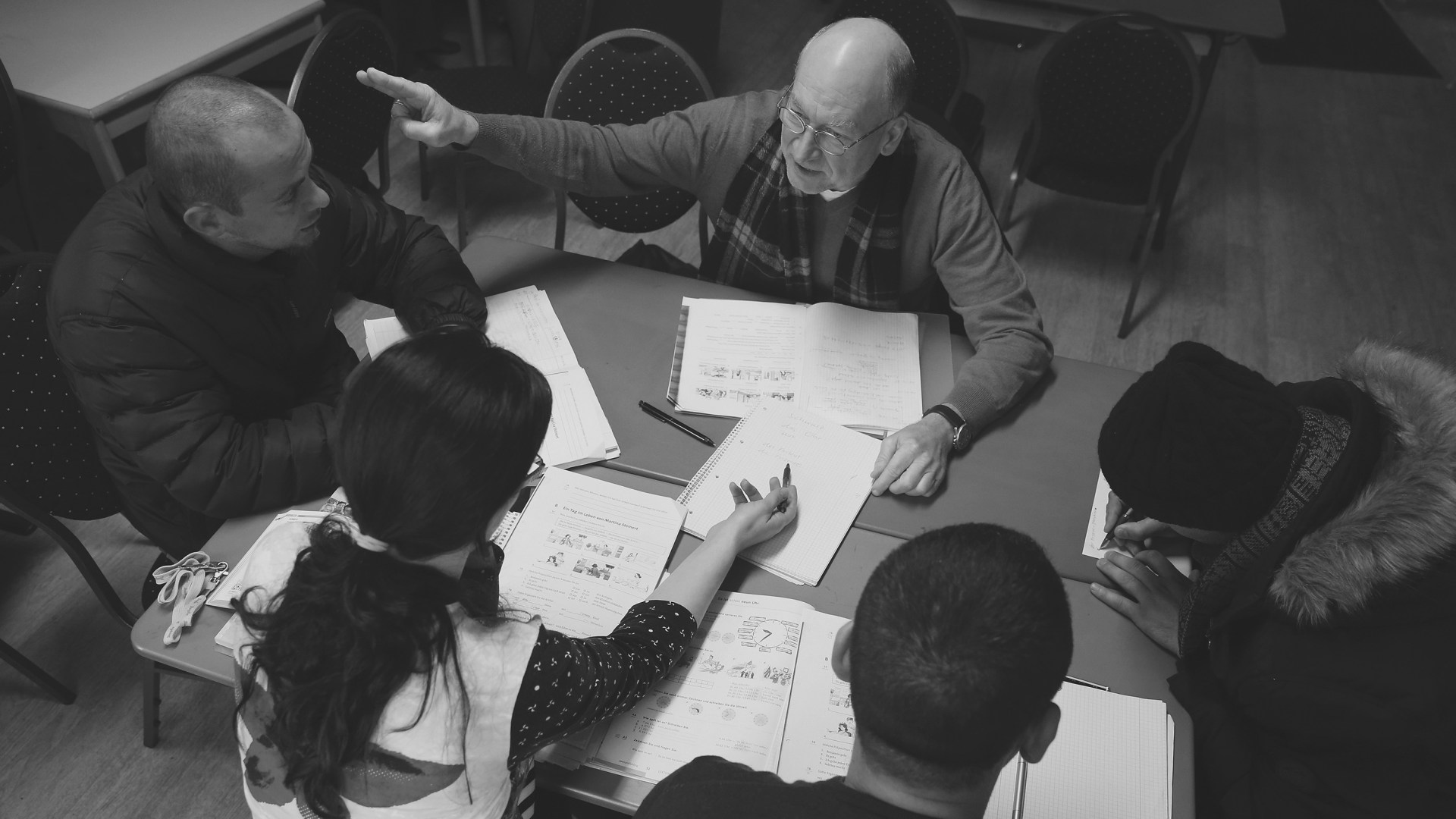
Many churches have played key roles in integration. Christians have welcomed immigrants, supplied them with winter coats and basic necessities, helped them learn a new language, and navigated them through the bureaucracies necessary to start their new life.

It was more than just hospitality, according to a 2018 study by the Churches’ Commission for Migrants in Europe (CCME). In addition to helping with crucial social services, the Christians’ welcome provided “symbolic resources for positive self-identification and opportunities for interaction.”

But that process also led to a transformation of European churches.

The CCME surveyed 74 Protestant congregations, ranging from state-privileged or “mainline” churches to evangelical and Pentecostal churches, that ministered to migrants in 22 countries. It found that migrants had started attending half of those churches by 2020. In about a quarter, the migrants are now a notable minority of the church. In another 20 percent, the recent migrants had become the majority.

This has meant a shift in not only what European churches look like, but how church is done, said Israel Oluwole Olofinjana, a Baptist minister from Nigeria now serving in Essex in the southeast of England.

As churches have witnessed the influx of migrants into their pews and local populations, Olofinjana said they “have had to rethink who is planning, who is speaking, who is leading.”

It’s not optional, he said.

“You cannot be talking about dynamic gospel work in Europe and not think of migrant and diaspora Christ-ians as a key element of what you think and do,” he said. “They are becoming central to European theology, wrestling with issues around Christian social ethics, migration issues, and the mission of the church at large.”

As the migrants do that, they are bringing a fresh perspective to what it means to be Christian in Europe.

“We’ve been described as ‘missionaries from below,’ because we come from contexts of suffering and trauma, crippling economic struggles and persecution,” Olofinjana said. “We have all these challenges and chaotic stories, but amid it all, God’s Spirit is moving. We are here for such a time as this—to help Europe to see what God’s kingdom can look like in the 21st century.”

Part of that means planting new churches and building new institutions to meet changing needs.

For example, in Rome, the Chinese Christian Church in Italy (CCCI) decided to refurbish an old hotel near Tor Vergata University to start a new seminary. Inaugurated in April, the Italian Chinese Theological Seminary (ICTS) is a joint project of 57 CCCI churches, Ma Baptist in Hong Kong, and 22 churches across Italy and Europe.

John Kwok, a Chinese pastor in Canada and principal of the ICTS, said there has been an explosion of Chinese churches across Europe in recent years. That created the need for a seminary.

“For a long time, hundreds of church leaders did not receive formal or complete theological training or had to travel to Hong Kong to get it,” Kwok said, “but now, because the world is changing, more people require the professional service of pastors. They know the previous model is a limitation to reaching more people.”

The ICTS will be able to serve Chinese churches in Italy and beyond by providing pastors with theological education and a network to “train missionaries, improve pastoral care, promote evangelical work, and complete the Great Commission,” Kwok said.

For now, the training will be focused on Mandarin- and Cantonese-speaking pastors and congregations. In the future, the plan is for the seminary in Rome to become a hub of multicultural mission work on the continent.

Back in Germany, missiologist Detlef Blöcher, chair of the Working Group for Migration and Integration of the Evangelical Alliance in Germany, said new initiatives like this are a “blood infusion to the church in Europe.”

Blöcher points to missions such as Mustard Seed in Gotha-West, where people like Ute Paul and her fellow missionaries are cooperating with migrants to create new forms of church and Christian community.

“We need their contribution to be a witness to our post-Christian society,” Blöcher said.

Amid the towering apartment blocks—as migrants face discrimination, unfair work conditions, and the everyday difficulties of learning a new language and navigating a new context—Paul said they are asking questions about the way of Jesus. The key for her and other Germans, she said, is to listen and learn, dialogue and discern what God is doing among them.

“It’s a simple, daily process of being close to people and being sensitive to their strengths and the possibilities God is presenting them,” she said.

For Paul, that means leaving behind paternalistic models, mindsets, and methods of mission and discovering an alternative style of walking alongside people, giving priority to newcomers’ experiences and strengths.

“The reality is, I am the guest here in Gotha-West,” she said. “This is their home, not mine.”

Ken Chitwood is a writer and scholar of global religion living in Germany.

News

What the First Black Death Victim Wanted the World to Know

New research traces plague to historic Syriac Christian community.

Illustration by Abigail Erickson / Source Images: Getty Images

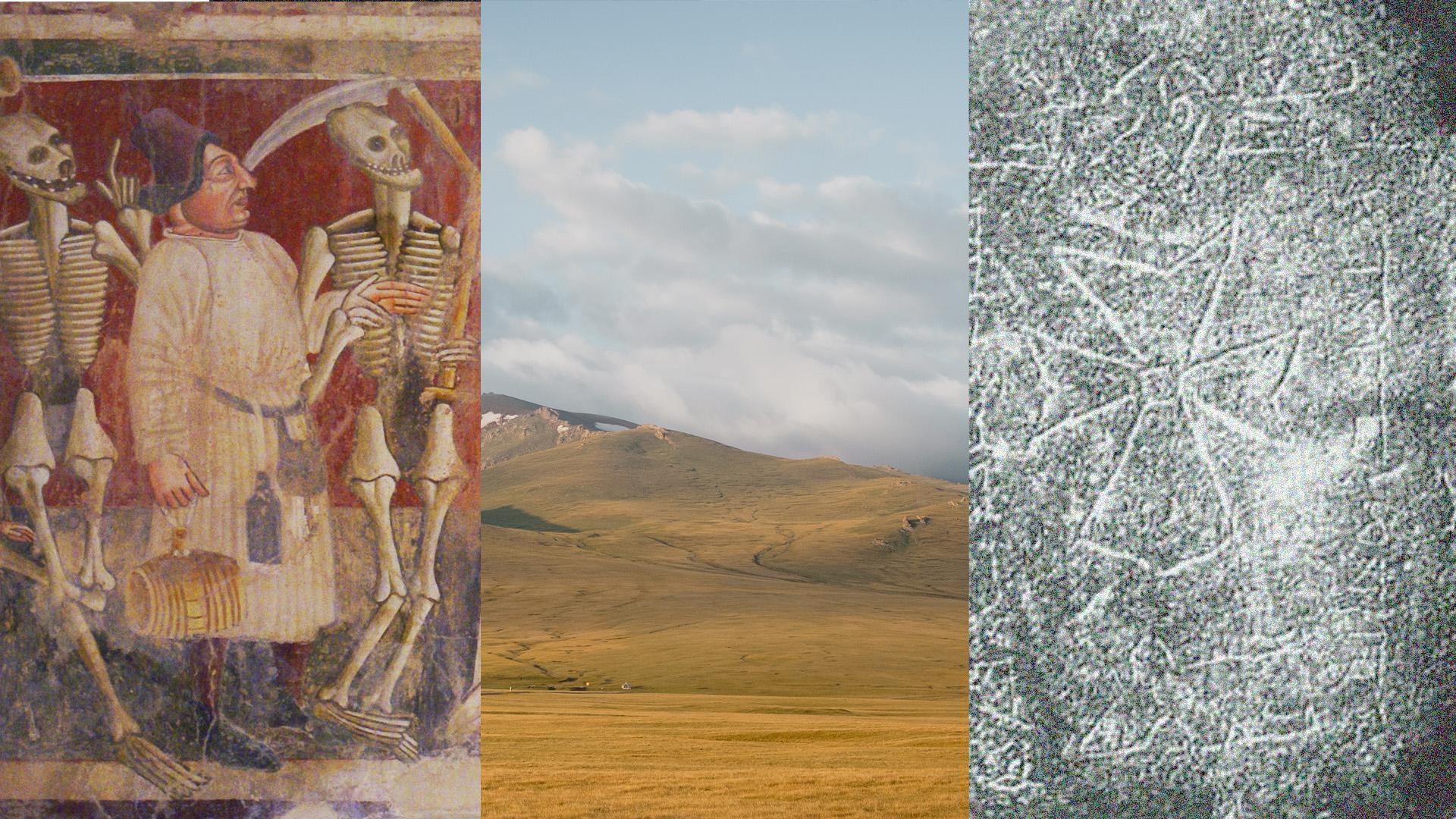
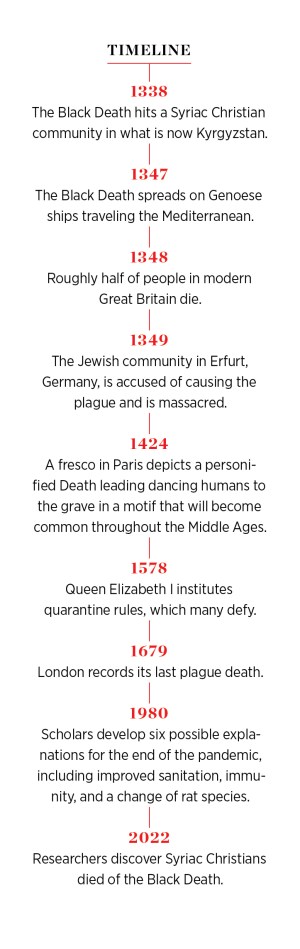
Up in Kyrgyzstan’s Tian Shan mountains, the grave markers tell the story of a bad year in a Christian community. There are 467 headstones, and 118 of them mark burials that happened in 1338 and 1339. And some of those bear a message in Syriac: pestilence.

A recent study published in Nature suggests these Christians were the first known victims of the Black Death. Philip Slavin, one of the researchers who has been studying the material that was excavated from near Lake Issyk-Kul since 2017, reported that he and his colleagues examined seven teeth excavated from the graves and three of them contained the plague bacterium.

Through an examination of the DNA, they “established that phylogenetically these strains are situated at the very beginning of the Black Death wave, before it came to Europe,” Slavin said.

This may mean that Christians, who have been accused—sometimes correctly—of spreading every disease from smallpox to COVID-19, were partly responsible for the pandemic that devastated so many in the Middle Ages.

Slavin estimates there were about 1,000 Syriac Christians in this community on the eve of the Black Death. They were part of an organized church, known then as the Church of the East, which was governed by a bishop in Baghdad—about as far from Issyk-Kul as Chicago is from Los Angeles. The faith spread along the Silk Road, the trade route that linked China with Constantinople, and drew diverse converts.

“They appear to be immigrants from other regions in Central Asia,” Slavin said, including “a rich mixture of Turkic, Chinese, Mongol, and Armenian individuals.”

Those cultural and geographical links could explain the devastating spread of the Black Death, which killed about a third of everyone in Europe by the mid-1350s, according to contemporary observers. But Monica Green, a medical historian, thinks it is unlikely the Syrian Christian community is to blame. The plague didn’t travel long distances in human hosts, since they got sick fairly quickly and either recovered or died in a few days.

Most people who caught it from other people were caring for the sick, not traveling the Silk Road. Unlike with COVID-19, there is no record of seemingly healthy people infecting others.

Rodents and their parasites spread the bubonic plague to humans. In Kyrgyzstan, it was probably marmots.

The new research on the DNA doesn’t show that they were the origin point for the spread, said Thomas A. Carlson, a historian of the Medieval Middle East at Oklahoma State University. The most likely carriers were traders or armies who inadvertently transported rats, fleas, and contagious disease westward.

The Syriac Christians may, nevertheless, have been devastated by the Black Death. By 1500, Christianity had all but died out in Central Asia, and that might have been hastened by the plague. There were other pressures, though. Some may have converted to Islam or Buddhism, which were on the rise in the region, either by choice or by force.

It’s difficult to know much about these believers. The site was excavated in the 1880s and then converted to a collective farm by Soviet authorities in the 1930s, changing its topography beyond recognition. Historians have reconstructed bits and pieces, but the record is hardly robust.

“We first hear of Christians in Bactria, now northern Afghanistan, in the late second century,” said historian Mark Dickens, at the University of Groningen, in the Netherlands, “followed by a metropolitan bishop in Merv, now Turkmenistan, in the mid-sixth century. Not long after, in the late sixth or mid-seventh century, we have a metropolitan bishop north of there … and we start to hear stories of Turks converting to Christianity about this time too.”

The diversity of the Christian community has been well established. “Syriac” doesn’t refer to an ethnicity, but a language used in worship. The Christians probably spoke Turkic languages in their daily lives but prayed and sang in Syriac. Grammatical errors on the tombstones indicate the language wasn’t in regular use.

“Syriac was a language with a great spiritual pedigree,” Dickens said. “It is after all a dialect of Aramaic, Jesus’ mother tongue.”

Scholars have recovered more than a thousand Christian manuscript fragments from similar communities in what is now western China. They’re written in Syriac, Sogdian, and Old Uyghur. The records show an orthodox church that revered the Bible, held Jesus to be fully human and fully divine, and affirmed the Nicene Creed as the statement of orthodox belief.

“We do have fragments of a sermon written in Old Uyghur, a Turkic language spoken in what is now western China, which shows us that at least some Christians during the Mongol era were listening to sermons in their native tongue,” Dickens said. “What we can assume is that they worshiped together on Sundays, using the Syriac liturgy, and when they died, they were buried in Christian graveyards.”

For the community near Lake Issyk-Kul, those headstones are the only text that survives. The evidence left from their lives includes the record of the word pestilence, testifying to the impact of the bad years of the Black Death.

But Dickens argues that modern scholars shouldn’t miss the more important testimony that the Christians in Kyrgyzstan left engraved for future generations to read.

One marker says, “May she please the Lord in his kingdom.”

Another, “The aim of life is Jesus our Savior.”

A third, right above “Died of pestilence,” says, “This is the tomb of the believer Sanmaq.”

Their deaths were cause to remember and reaffirm their hope in the one who conquered death.

“These members of the Church of the East, like their coreligionists all along the Silk Road, believed in the hope of the resurrection,” Dickens said, “a hope that would have carried them through the grief and mourning associated with death, whether by plague or other causes.”

Funeral liturgies from the manuscripts recovered are likely very similar to the words the Christians in Kyrgyzstan prayed when their brothers and sisters were laid in the earth. Dickens, thinking about that bad year from 1338 to 1339, said that to him, one line especially stood out.

“A soul that has taken refuge in your cross,” it says, “will see your grace on the day of your coming.”

Susan Mettes is an associate editor for Christianity Today.

What Does the End of ‘Roe v. Wade’ Require of Us?

Responses to our July/August issue.

Source image: Envato Elements

Christianity Today president Timothy Dalrymple’s editorial “At the End of ‘Roe’” (updated on our website in the wake of the Dobbs v. Jackson Supreme Court decision) affirmed the ruling as a win for the sanctity and dignity of all human life. He also encouraged not just adoption but early and ongoing support for families in crisis. Many readers responded with a resounding “Yes … and.”

In emails and comments on social media, they brought attention to the United States’ high maternal mortality rate and lack of paid parental leave. They suggested universal preschool, subsidized childcare, and government food assistance. Linda Morey in Greensboro, North Carolina, called for more support in the church for intellectually disabled children and adults, like her son.

Some wondered why the church hasn’t done more, in their eyes, to support these kinds of policies already (although, in the US, the church does adopt and foster at higher rates than the general population, and ministries have long supported single mothers).

Some worried about the ruling’s impact on vulnerable families:

The end of Roe will not deliver children “safely” into the world. It will simply ensure they are delivered. It will not just “bring real hardships for many mothers.” It will cost some of them their lives. I am not pro-abortion, but an article like this ought to carefully detail the heartbreaking realities of this situation. Better yet, it ought to have been written by a mother.

Abby Thompson
Atlanta

Sometimes the narrow vision of pro-life advocates to simply bring a baby into the world and think their work is done has legitimized pro-choice criticism of the church for being unwilling to follow through and alleviate suffering which caused the mother to contemplate abortion in the first place.

Carol Galambos
Colorado Springs

Some also expressed hope that the pro-life movement could evolve:

I hope sincere Christians have the courage in coming weeks and months to acknowledge that churches and ministries will not be able to meet the increased demand for services, and will rethink their beliefs about the role of government in supporting women and children.

Naomi Hunter
Redwood City, CA

We’ve also explored Dobbs’s ramifications in online-exclusive stories at ChristianityToday.com. Writer Megan Fowler explained international hopes in “Could Roe’s Reversal Slow Global Trends to Legalize Abortion?” CT news writer Emily Belz, though, reported from New York that “The Pro-Life Movement Faces Blue State Backlash.”

Sharing her reflections in “I Was Pro-Life in Theory. It Took Much More to Actually Help,” Jen Pollock Michel said,

Time is the modern widow’s mite, the currency that is incredibly hard to sacrifice. In truth, I could have given money far more easily. But not time. Not interruption. Not long-haul life-on-life investment. Not birthday cakes and weekly groceries. … If we should ask women to give nine months of their lives to bear a child into the world … we must be ready to give that much and more to ensure that child’s well-being.

And in “Post-Roe America Needs a Forward-Looking Church,” Russell Moore argued,

Indeed, we need policy changes to better care for vulnerable women and children. … The longer term, though, will require more than even the best solutions policy can bring. It will require convicted consciences that care for the vulnerable people in need—both born and unborn.

The Unexpected Parenting Comfort of Ecclesiastes

Yes! We struggle and times are scary and hard, but they have always been scary and hard! The difference is we know the outcome of the insane fears from years gone by and we don’t know the outcome of today’s fears. It makes it easy for us to look back and always think of those days as the good ol’ days.

@irene.smith.67 (Instagram)

The early church was established in significantly worse circumstances, so I think God can carry my kids through whatever the next decades bring.

@breezyteacher (Instagram)

Can We Resurrect Expertise?

As a physician watching the pandemic unfold, it was clear to me that the “experts tasked with crafting public health guidance” were universally doing the best they could, amid uncertainty, to manage a crisis for which everyone was unprepared. But their best efforts were met with anger, rage, malice, and slander. Most disturbing was that the chief accusers were my fellow evangelical congregants and their pastors. And the most grievous fallout is not our broken trust in the experts, but rather the experts’ broken trust in us.

Nathan Robison Los Angeles

Who Will Pay for Africa’s Medical Bills?

I know where that hospital is and served as a Peace Corps volunteer in Malawi at a hospital just like it. They really do have severe financial challenges. It’s very concerning and not a sustainable model.

@rpcvwarmheart (Instagram)

News

Evangelical School Strikes Deal with Chick-fil-A Franchises

And other news briefs from Christians around the world.

Source: Getty / Google

An evangelical school in Georgia has seen a dramatic increase in online enrollment from a cooperative agreement with Chick-fil-A franchises. The owners of the fast-food chicken resturaunts pay a flat fee that allows all their employees to attend online classes for college credit at Point University. Chick-fil-A then uses that as an incentive to recruit and retain workers. Chick-fil-A CEO Andrew Cathy is on Point’s board, but the arrangement is not with corporate. The program is being expanded to other businesses as well. When the program launched this fall, Point’s online enrollment increased from about 500 to more than 1,200. Sixty-five percent of evangelical colleges have seen enrollment numbers drop since 2014.

United States: Religious objectors to COVID-19 vaccine get $10 million

An Illinois health care system is settling a lawsuit with employees who were denied religious exemptions to COVID-19 vaccines. More than 500 employees requested religious exemptions but were told NorthShore University HealthSystem did not grant them, per a university policy. Nearly 300 resigned or were fired. If the terms of the $10.3 million agreement are approved by a federal court, those who complied with the vaccination requirement to keep their jobs will receive about $3,000 each, while those who lost their jobs will get around $25,000. This is the first class action settlement for health care workers claiming discrimination in COVID-19 mandates.

Source: BarnaInfograph by CT
Source: Barna

Chile: Problems raised with proposed constitution

A group of evangelical leaders and pastors objected to the proposal of a new constitution in Chile. They say it includes “extreme ideology” and increases division by recognizing 11 different groups while not acknowledging evangelicals. The new constitution would guarantee seats in parliament to LGBT people, secure land for indigenous people, and grant rights to sentient animals. It would also restrict religious freedom and eliminate parental rights over the education of children. If ratified, the constitution would replace the charter established by the dictatorship of Augusto Pinochet.

European Union: Catholic to champion religious liberty

The European Union (EU) has a new special envoy on religious freedom or belief. Mario Mauro, a Roman Catholic, has previously worked as a history professor and a representative to the European Parliament, where he made a name for himself defending religious freedom. Human rights groups and the European Evangelical Alliance have argued the EU does not pay enough attention to religious liberty.

United Kingdom: Statue to honor Baptist who resisted colonial racism

A statue of Malawian anticolonial leader and Baptist pastor John Chilembwe will be placed in Trafalgar Square, London, for two years. The artwork restages a 1914 photo where Chilembwe did not take off his hat in front of a white missionary, violating British law. Chilembwe died the following year leading the first pan-African uprising that united people across tribal lines. Chilembwe was trained at a Baptist seminary in the US and inspired by egalitarian Baptist theology.

Sudan: Repealed apostasy law enforced in Darfur

Four Christians were arrested for apostasy in the Darfur region, even though the law criminalizing apostasy was repealed in 2020. The four men converted from Islam and were holding church services. Police seized their Bibles and loudspeakers and, after releasing them from jail, ordered the believers to leave the area. The Islamist dictatorship of Omar al-Bashir ended in 2019, and the transitional government has instituted some religious reforms, including ending the death penalty for conversion. But Christians fear some officials will try to reinstate the oppressive religious laws. Christians make up about 4.5 percent of the population in Sudan.

India: Stolen Bible found in London

Police have traced the first Tamil-language Bible, stolen by foreign visitors in 2005, to the King George III Museum in London. They have reported the theft of the cultural heritage to the UN and hope the Scripture will be returned soon. The Bible was translated and printed by Danish missionary Bartholomäus Ziegenbalg in the 1710s and subsequently given to Tulaji Rajah Serfoji, ruler of Tanjavur. The “Idol Wing” of the state police took over the investigation in 2020 and tracked down the 250-year-old Scripture by doing internet searches for museums with Ziegenbalg’s name in their holdings.

News

Moral Middle Candidates Want to Save America (But They Keep Losing)

Christians concerned about division, disinformation, and democratic norms are straining to reestablish the political center.

Chris Gash

Phil Heimlich didn’t throw a party the night of the primary election. The Republican candidate didn’t gather his volunteers to watch the results come in, toast each other’s hard work, and crack inside jokes one last time as they waited to see how badly they’d lose to the incumbent congressman who props up election conspiracies.

He just went home.

He watched a movie with his kids and checked the vote tally on his phone as the ballots in Ohio’s Eighth Congressional District were counted.

His defeat didn’t surprise him. That didn’t make it taste less bitter.

“The problem, frankly, is that most evangelicals are on the wrong side,” Heimlich told CT.

Heimlich, a former Cincinnati city councilman and the son of the doctor who invented the Heimlich maneuver, was once a proud representative of the Religious Right. He still considers himself a conservative. And he’s still an evangelical. He attends Crossroads, a multisite megachurch.

But he’s not part of the Religious Right anymore.

Heimlich—along with a mostly unorganized group of candidates, activists, and operatives across the country—is straining to establish a religious middle. He likes the phrase “radical middle,” a term he learned from a Vineyard pastor.

Whatever it’s called, these are Christians who want to defend democratic norms against the partisanship that warps people into election deniers. They’re against the polarization that helps politicians win gerrymandered districts but doesn’t prioritize solving problems. They want the country to work. And they’re tired of toxic, trolling, apocalyptic politics.

Heimlich ran on support for Ukraine and the January 6 hearings and lost the May 3 primary by more than 40 points to his Donald Trump–endorsed opponent, Warren Davidson.

“We’re in the minority,” he said.

A lot of the art of politics is finding the right moment. The moral middle doesn’t seem to have found its time yet. But some organizers say they can see it on the horizon, a day coming for a new coalition of religious voters who reject culture-war metaphors and see politics as a way to love their neighbors.

“I believe there’s a massive realignment going on among what I call the deeply committed, Jesus-following, Bible-believing folks who do not embrace the Christian nationalism that has infected so much of the church,” said Joel Searby, an evangelical campaign professional who got out of politics during the Trump years but came back to focus on moral-middle candidates.

At the start of the midterm election cycle, Searby hoped that as many as 12 Republican candidates would seriously challenge some of the most extreme Trump-supporting incumbents. He thought they might draw Democrats and Independents, combine that support with Republicans disgusted by the mob that stormed the US Capitol on January 6, and at least get close in the polls.

Most, like Heimlich, lost badly.

“We’re in the early stages,” Searby said. “People are figuring it out—‘What do I do?’ ‘What do I do next?’”

Congressional races might be too tough, given gerrymandered districts, local party machines, and difficulties reaching disengaged voters. Senate races might present more of an opportunity. Searby has worked with two Independent candidates in statewide races this fall: Evan McMullin, a former Republican running with Democratic support in Utah, and John Wood, a former prosecutor and special counsel to the congressional January 6 committee, running in Missouri.

According to polling analysis done by the data journalism site FiveThirtyEight, McMullin has a 2 percent chance of winning. Wood had less than 1. He dropped out of the race in August.

One of Wood’s backers was former Republican senator John Danforth, who contributed $5 million to a super PAC. He is concerned by campaign ads flirting (and worse) with violence.

“I think the political need is simply to hold the country together, and that means rebuilding the center,” Danforth told CT. “Holding things together is a religious concept—the Hebrew word is shalom. … ‘Love your neighbor’ really is what it is, and politically that means respect and friendship, breaking bread and building community.”

Danforth, who is also ordained in the Episcopal Church, believes six or eight senators in the moral middle could change things. He is encouraged by polling that shows many Americans share his concerns about division.

Sociologist Katie Gaddini cautions that concerns about division will not necessarily push evangelical voters to embrace a new kind of politics. During participant-observer studies of two congregations, she has seen people stop talking about issues. But they didn’t change their minds.

“The concern about division means more people feel an obligation … to back away from discussing anything controversial,” Gaddini said. “They get off Facebook. They don’t talk to anyone in their churches about what they think. That does not change their ideas. That doesn’t change voting patterns.”

Trying to avoid division may actually make things worse, according to Gaddini. Discussing differences can counteract polarization, as people work to build bridges. But when the risk of conflict seems so high that people stop talking, the division hides underneath, waiting to erupt in a moment of crisis.

And if people want politicians who will say the things they can’t, they’ll keep backing people good at sticking it to the other side.

That’s why Michael Wear, an evangelical campaign strategist who works with moderate Democrats, thinks the really troubling issue is not the failures of political leaders but the morality of American voters.

“If voters are satiated by performance—by theatrical performance—that’s the easiest thing for a politician to give them,” Wear said. “Politicians are, at a really important level, responding to the American people. That’s why I’m so insistent the state of our politics reflects the state of our souls.”

Chris Butler, a Chicago pastor and a leader of the And Campaign, found himself trying to explain politics and souls to his young kids after he lost a Democratic primary race for a seat in Congress.

Butler’s staff and volunteers knew he was a long shot. He was a pro-life candidate who talks a lot about his faith in a party that increasingly relies on the votes of religious “nones” and treats abortion access as nonnegotiable orthodoxy. They saw his moment evaporate like a mirage when the weak incumbent dropped out and the field filled with 22 candidates competing for time. Then the Supreme Court decision on abortion made that a defining issue for Democrats in every race.

But his children, all under 10, didn’t know their dad might lose.

“On election night, I realized it never even entered their minds,” said Butler, who came in fifth. “I’m still trying to explain about the politics of division and corruption and how I want to work to counteract that evil, but … it’s not that easy.”

Butler doesn’t know where he’ll be on election night November 8, but he’s hoping to shift his focus for the rest of the campaign cycle to voter registration, voter engagement, and the organization of a radical middle. He’d like to watch the election results with a group of volunteers committed to building up a bloc of voters who don’t see politics as war, but rather as a way to love their neighbors.

He’d like his kids to be there too.

“We have to build,” he said he’ll tell them. “If you don’t have staff and fundraising and support, you can’t win elections. … The most important thing right now is to build.”

Daniel Silliman is news editor for Christianity Today.

News

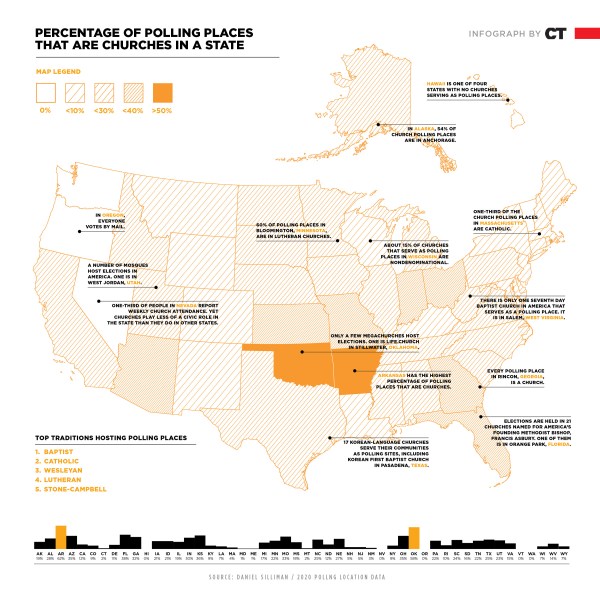
20% of Polling Places Are in Churches. We Mapped Them.

Here’s where 12,875 houses of worship serve democracy.

Getty / Spencer Platt

When Americans go to the polls, they go to town halls, high school gyms, fire stations, and churches. There are more than 60,000 polling places in America, and roughly one out of every five is located in a church.

Conflicts over the correct relationship between religious communities and the state frequently grab headlines. But church polling places are rarely controversial. Here, governments rely on churches to be safe, trusted civic spaces. And 12,875 houses of worship extend hospitality to their neighbors, opening their doors for elections.

Data by Daniel Silliman | Infograph by Jared Boggess
Ideas

Online Seminary Isn’t B-League

Virtual degrees are affordable and accessible. They can even be rigorous.

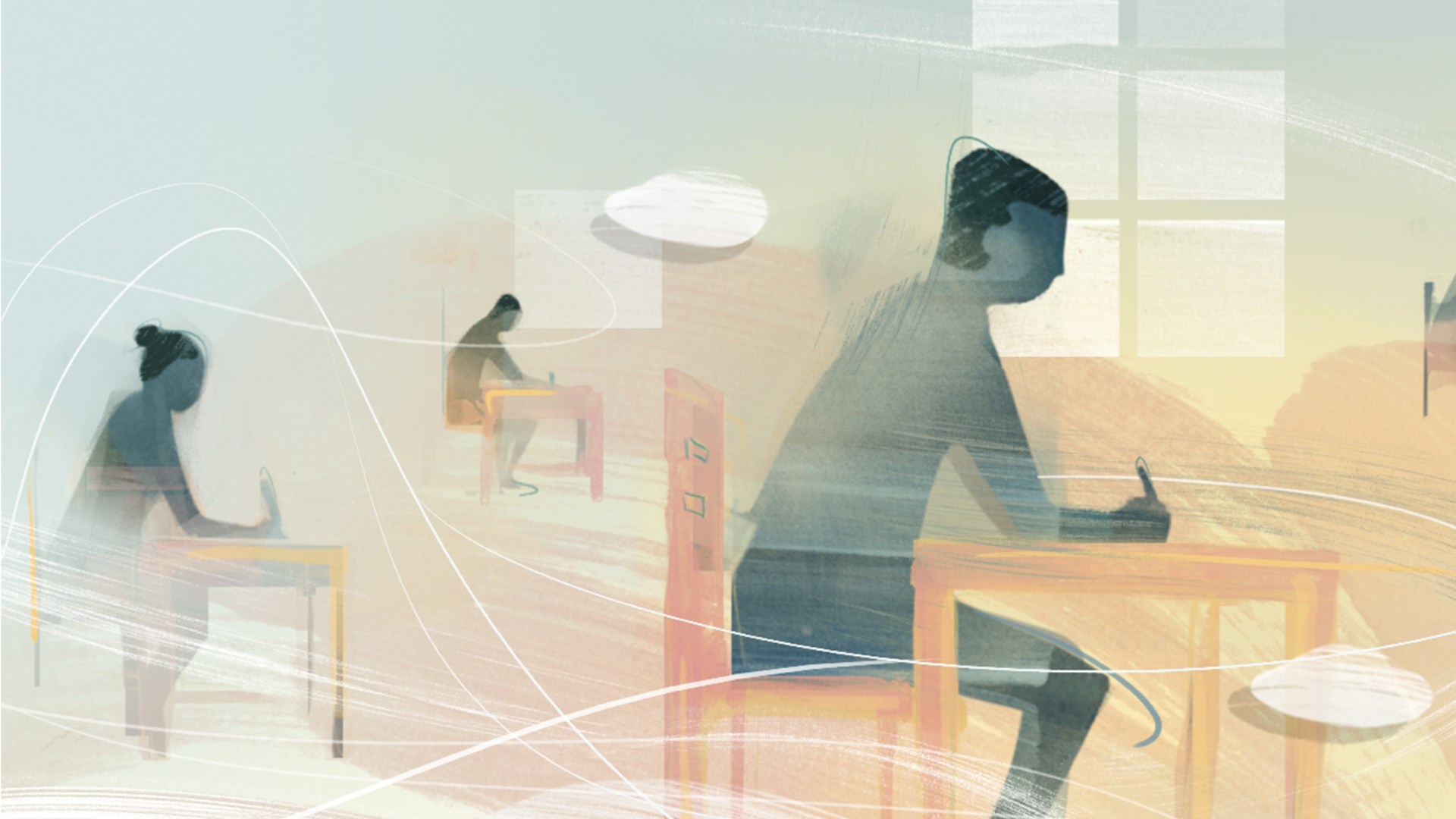
Illustration by Mary Haasdyk

In 2008, I was a full-time missionary in Haiti in desperate need of seminary education. I didn’t want to leave the field, but I didn’t think there were any other options. As I prayed for direction, the then-president of Wesley Biblical Seminary, a family friend, invited me to apply at a new online program.

I was cautious. I viewed online degrees as B-league degrees. Plus, our satellite internet was extremely slow and spotty. And I didn’t need just Greek, systematic theology, and inductive Bible study. I needed heart-shaping relationships—friends, faculty, and fellow students. Would an online program suffice? I prayerfully trusted my friend. If he said it was worth it, I was in, especially if it meant I could stay on the field.

The following August, I sat in my mud-brick home in the sweltering Haitian heat with an icy bottle of cane-sugar Coke, reading through my first syllabus and feeling daunted.

The course was Discipleship and Spiritual Formation with Matt Friedeman. To pass, I had to do devotionals—a minimum of an hour daily to qualify for an A—and keep a journal. Required reading included Dallas Willard, Thomas à Kempis, the church fathers, and of course, Scripture.

In addition to participating in rigorous online discussion forums with the professor, students had to engage in volunteer ministry at a local prison, an abortion clinic, or some ministry serving the poor. I began preaching in a Haitian prison.

This class set the trajectory for the rest of my life. It also began to chip away at my skepticism toward online education.

The world of America’s evangelical seminaries has seen a seismic shift. Over the past few years, several leading seminaries have looked to sell their main campuses, including Reformed Theological Seminary, Fuller Theological Seminary, and Gordon-Conwell Theological Seminary.

Mostly, they are selling due to financial exigency. But they are also looking for ways to make seminary education more accessible, more affordable, and cheaper to deliver.

Why are American seminaries struggling? The obvious reason is that America is now a post-Christian nation. A cultural shift has sizably downsized the market for the product that seminaries offer: degrees required for ordination.

There are other reasons, however. Seminary education is expensive. The average seminary degree is somewhere between $45,000 and $55,000, a prohibitive price tag, especially as students leave their undergraduate programs with a pile of student debt.

With a shrinking market and increasing costs, the long-standing model for theological education is becoming unsustainable, especially for schools without denominational backing or a sizable endowment.

Wesley Biblical Seminary (WBS), where I now serve as president, was somewhat ahead of the trend. It sold its main campus nearly ten years ago for the same reasons. For years, school leadership could only guess why we struggled to maintain on-campus enrollment.

Leadership at the time pointed to two causes: We did not have a mainstream denomination feeding us students, and students did not want to relocate to a poor, rural state like Mississippi.

Urgency necessitated innovation. In 2007, administrators persuaded accreditors that WBS could deliver its program almost entirely online without compromising its standards. It was clunky, but the online approach tapped into an entirely new market of prospective seminary students. The move probably saved the seminary.

Soon, WBS had more online students than it did on-campus students, which led leadership to liquidate its largely unused and expensive facility six years after launching its online program. In a move that halved the annual budget, WBS downsized from a 110,000-square-foot campus to a 9,000-square-foot building for office space, two classroom studios, and a library.

Yet, WBS enrollment for graduate programs last year was five times what it was eight years ago. We have students from 28 states and 16 countries and one of the most racially and gender-balanced seminary student bodies in the nation (about 50 percent nonwhite and 40 percent female).

Even as seminaries now recognize the necessity of online programming to pay the bills, most seminary educators still view online as the B-league. Residential schools boast of the superiority of learning in “incarnational Christian community.”

In-person learning is invaluable. Jesus, the incarnate and divine Son, dwelt among us. He came in person to redeem the world—not on Zoom. There is something sacred about sharing a physical space. The COVID-19 pandemic taught us that virtual church isn’t the same as in-person church.

At the same time, I’m convinced virtual learning offers benefits with which in-person learning cannot compete.

For one, online education today need not be asynchronous. During pandemic disruptions to K–12 schooling, parents across the country discovered polysynchronous learning. We use this model at WBS. Students can join a live Zoom classroom for a real-time lecture and peer interaction. But if conflicts prevent students from attending, sessions are recorded for students to watch (and rewatch) at their convenience.

And WBS student evaluations suggest that seminarians love their experience. Recent graduate Edward Williams shared that, even as his professors were not afraid to critique lackluster performance, they accommodated his family demands after his wife experienced postpartum challenges.

“I have been called and emailed by staff and faculty to see if I needed any assistance, all while ending these calls in prayer for my semester’s success,” Williams wrote.

Of course, seminary education is about making disciples, not just transmitting data. Residential programs claim that forming Christian community over meals in the cafeteria or visiting faculty in their offices is a crucial part of seminary education lost in an online format. But there are ways an online program can compensate for the lack of embodied disciple-making.

The primary influence on students’ hearts is the institution’s personality, culture, and pursuit of holiness—not the mode of program delivery. Are faculty genuinely interested in the personal lives of students? Do students stay cooped up studying, or do they participate in spiritually vibrant community?

Dormitories are not guarantors of institutional health. I have heard graduates of residential seminaries relay how their in-person experience was not only fellowship-deficient but also dysfunctional. A healthy institution online, I would argue, is better than an unhealthy institution in person.

There’s another benefit to online learning that we cannot overlook: The majority of the world’s Christians are now in the developing world. With the increasing difficulty and costs of visas, travel, and a mountain of other obstacles, online education has made training globally accessible and will only continue to reach the Global South.

That is possible in no small part because online education is affordable. The annual expense of educating a student at a peer residential seminary is $41,000. At WBS, it is less than half of that. This means that we can charge less, which in turn drives more students to enroll and means there will be more pastors to serve churches. The harvest is plentiful but the workers are few, and seminaries charging more than double the world’s average annual income have some soul searching to do.

Online seminary education is here to stay, and it is a win. What could be interpreted as a desperate move for survival should be seen instead as innovative program expansion. We freed ourselves by believing that God could do something new and by having the courage to explore a vision for seminary in a post-Christian culture.

Matt Ayars is president of Wesley Biblical Seminary.

Speaking Out is Christianity Today’s guest opinion column and (unlike an editorial) does not necessarily represent the opinion of the publication.

Ideas

Bring Back Altar Calls

Columnist

They could foster the worst in evangelical spirituality. But the best of it, too.

Pearl / Lightstock / Edits by Rick Szuecs

“Every head bowed and every eye closed.” If you recognize those words, you probably grew up in a church much like the one I did, where every worship service ended with an altar call or an invitation hymn. The pianist or organist played “Just As I Am” or “Softly and Tenderly” while those wanting to profess faith in Christ, rededicate their lives, or seek prayer could slip out of their pews and walk down the aisle to the front of the sanctuary.

The altar call is out of step with almost every sector of American Christianity right now, and it’s easy to see why. After all, an altar call can, at its worst, represent our key vulnerabilities as evangelicals, such as the confusion of an emotional experience with the gospel. How many nominal Christians in America, with hearts just as once-born as ever, have reassured themselves that they “prayed the sinner’s prayer”?

These practices also can appeal to our weakness for the quest of bigness, with pastors judged each week by how many people went forward. And an altar call can represent our tendency to be drawn toward novelty and away from the history and liturgy of the church.

Growing up, I almost assumed that altar calls were happening at the Council of Nicaea, or that Augustine of Hippo filled out a card noting his profession of faith (though he kind of did). I was a bit startled to learn that the invitation hymn the way I knew it—though rooted in older forms of revivalism—was mostly influenced by the Billy Graham crusades of the startlingly recent mid-20th century.

And yet.

In this publication a generation ago, historian Martin Marty argued that evangelical churches of that day were growing at least in part because they met the human longing for the right kind of crisis: an ever-present opportunity for people to hear a call to start over, to leave behind the old self for the new one.

The altar call at its best balanced the individual and the community.

That was true not just for “seekers” but for all of us. Every week, with rhythm and regularity, we were reminded of who we were—sinners Jesus loved. No matter how short I had fallen, the Lord received me, “just as I am, without one plea, but that thy blood was shed for me.” And every week, at least for those few moments, we were reminded of those around us who had not yet embraced the Good News—that Jesus loves them too and we shouldn’t give up on anyone who might walk the aisle one day.

We often criticize ourselves for our evangelical individualism (rightly, in some ways), but the altar call at its best balanced the individual and the community. The invitation was that Jesus died not just for humanity abstractly but for you. At the same time, no one walking down that aisle was alone—a silently cheering cloud of witnesses was all around (and sometimes we kept an eye open to watch). More than that, at least in my church, that time at the end of the service was when people would go and silently kneel at the front. Sometimes this petitioner had a spouse grappling with alcoholism. Sometimes they had received a devastating prognosis from a doctor. No matter—there were always those who would slip out of their pews, gather around that person, and pray.

Those of you in more liturgical traditions will note that all of this you already have: the weekly confession of sin followed by absolution, the weekly coming forward to receive the Eucharist. You’ll get no argument from me, except to say that maybe you can bear with the baby steps of the rest of us, that you might see that low churchers need liturgy, too.

Invitation hymns, like tent crusades and spring revivals, probably aren’t coming back. But as we look at an American Christianity adrift—with a pull for some to self-righteous self-confidence and for others to the despair of an uneasy conscience—perhaps we should ask how we can remind ourselves every week that Christ Jesus died for the ungodly. That the whosoever of John 3:16 does not come with the caveats of our commercial advertisements: “Void where prohibited; some restrictions apply.” Perhaps we should ask how we can remind ourselves—all the time—that all of life is a call to repentance and that the gospel really is good news. That’s what’s best about evangelical Christianity, even in times like these.

So maybe an altar call every now and then isn’t a bad place to start.

Apple PodcastsDown ArrowDown ArrowDown Arrowarrow_left_altLeft ArrowLeft ArrowRight ArrowRight ArrowRight Arrowarrow_up_altUp ArrowUp ArrowAvailable at Amazoncaret-downCloseCloseEmailEmailExpandExpandExternalExternalFacebookfacebook-squareGiftGiftGooglegoogleGoogle KeephamburgerInstagraminstagram-squareLinkLinklinkedin-squareListenListenListenChristianity TodayCT Creative Studio Logologo_orgMegaphoneMenuMenupausePinterestPlayPlayPocketPodcastRSSRSSSaveSaveSaveSearchSearchsearchSpotifyStitcherTelegramTable of ContentsTable of Contentstwitter-squareWhatsAppXYouTubeYouTube