Ideas

Why Shamelessness Is a Superpower

Columnist

In a performative age, brazenness gives an illusion of strength.

Steffen Wienberg / Unsplash / Edits by Rick Szuecs

For most of the year, a friend in England and I have debated whether his country’s politics are becoming more American. Much of it had to do with the roiling scandals around Prime Minister Boris Johnson. My friend was constantly telling me, “This time, Boris is done for,” but I was never quite sure. Ultimately my friend was right, and Johnson’s Conservative Party forced his resignation. But critics agreed that he stuck it out as long as he did because, as many put it, “Shamelessness is a superpower.”

A sense of personal disgrace used to lead those whose scandalously bad character was exposed to voluntarily step aside in contrition. When the tabloid publishes pictures of the senator with a model on his lap, he would announce that he was going to spend more time with his family. When the tobacco company CEO’s notes are found about how to conceal the addictiveness of nicotine, he would “seek other opportunities.”

This was about more than just a public sense of right and wrong. Most people couldn’t bear the humiliation of the public knowing about their sexual exploitation of an intern or hearing their own recorded voice bragging about how their star power allowed them to grab women by the genitals.

But then the people with this sort of shame were sorted out, leaving behind those who didn’t blush when they said, “It depends on what the meaning of is is” or “This is just locker-room talk.” Those who don’t feel shame have learned that, eventually, most people will be exhausted and move on while their hard-core “base” will learn to normalize whatever the character flaw is.

This is not just in government. If Billy Graham or Mother Teresa had been found to be using donor money to purchase luxury jets, the scandal would have been in the first paragraph of their obituaries. When Kenneth Copeland muses that he can’t do devotions while flying commercial, people shrug and think nothing more of it. In a performative age, brazenness gives an illusion of strength. After all, to apologize or to repent is to look weak. And when people expect their leaders to be avatars of vicarious power, weakness is the only unforgivable sin.

In such an environment, by sheer Darwinian measures, the shameless are always going to have an advantage. If a lack of shame is what it takes to succeed, sociopaths will proliferate. This is not only in leaders without character but also in followers who come to see character as itself a lack of the strength needed to fight whoever one deems one’s enemies. Those who will shamelessly employ internet troll tactics—whether on the actual internet or in church congregational or denominational meetings—have an advantage over those who would feel shame if they were to employ falsehood or rancor or what the Bible calls “an unhealthy craving for controversy” (1 Tim. 6:4, ESV). Those who can still feel shame, whose consciences are still vulnerable to conviction by the Holy Spirit, will then step back or step away. The shameless will inherit, if not the earth, then at least the political party leadership or the congregation or the school board or the social media feed.

But shame never really goes anywhere but underground. Those who can’t feel it still bear it. They find fig leaves to cover it, even as they project their shame elsewhere (Gen. 3:7–13). Behind those quivering bushes, there are men and women scared of the presence of God—a fear they can easily translate into hostility toward those less shameless (Gen. 4:5–8) or boasting in their shameless dominance over those still weak enough to feel shame (Gen. 4:23–24).

In the short run, shamelessness works. Eventually, though, one must stand before God—naked and unable to fight one’s own conscience with bravado. What is necessary, then, is not what looks strong now, but what looks very weak—the Cross. Against a pagan valorization of power, the apostle Paul delivered the gospel of a naked and tormented man, seemingly “owned” by the torture rack of Caesar, and said of that gospel, “I am not ashamed” (Rom. 1:16).

In a world ashamed of suffering, the Spirit tells us to glory in weakness but to guard character (1 Pet. 4:16). That doesn’t win arguments or gain influence. Those who taught us that ended up in prison or in exile or in borrowed tombs. But the Christian gospel tells us there’s something on the other side of all of that, someone on the other side of all of that, and that he is not ashamed of those who wait without winning by the world’s terms (Heb. 11:16).

Shamelessness is a superpower, unless there’s a God.

Russell Moore is Christianity Today’s chair of theology.

History

How Americans Got Away with Abortion Before ‘Roe v. Wade’

Looking ahead, Christians should focus less on enforcement than on changing cultural attitudes.

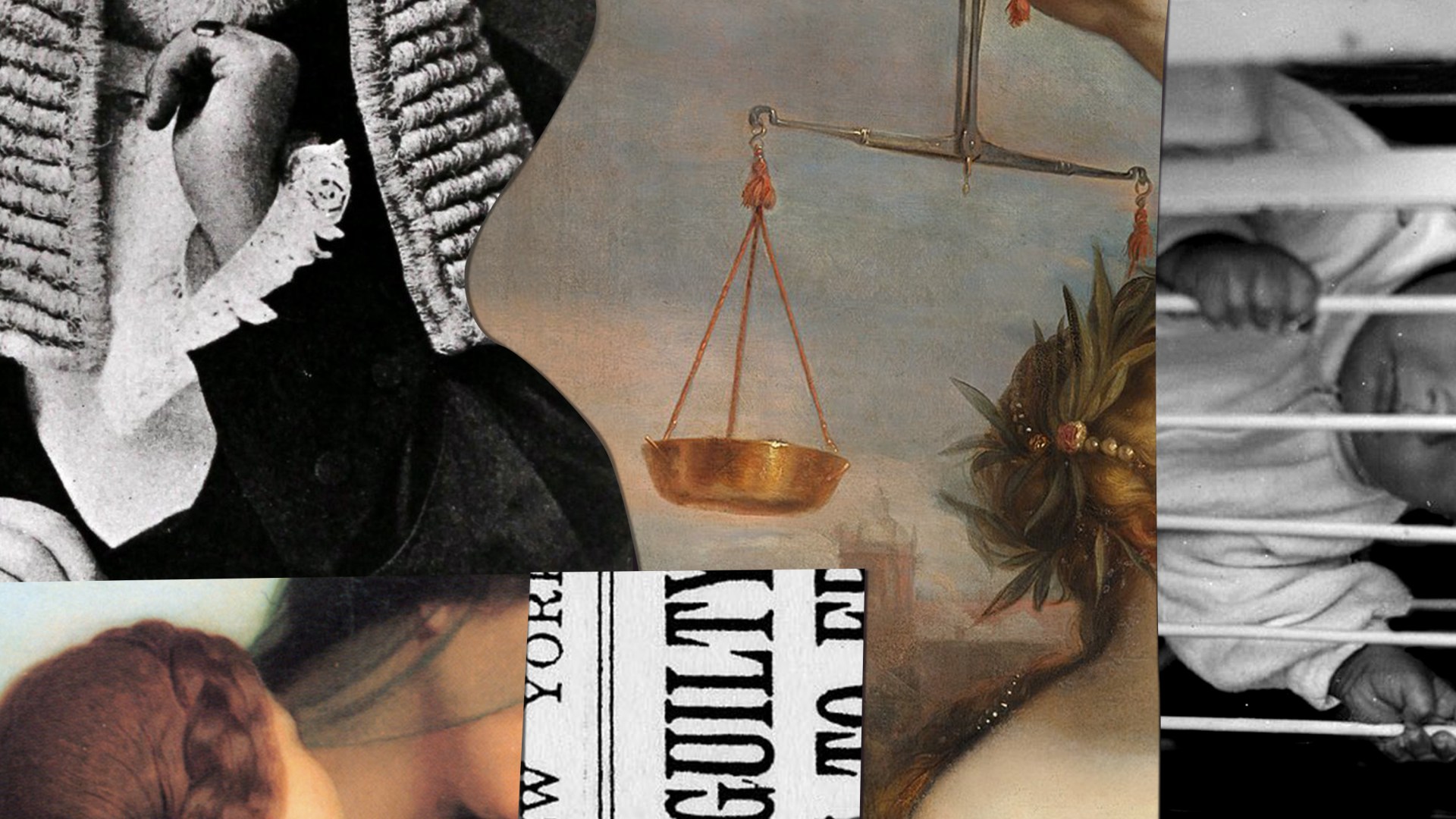
Illustration by Mallory Rentsch / Source Images: WikiMedia Commons

What does the history of abortion tell us to expect, now that the Supreme Court has decided to give states the option of protecting unborn children? If half the states have protective laws, will the laws be enforced? Or will abortion statutes in many places have as much effect as Section 10-501 of Maryland law (which reads: “[a] A person may not commit adultery. [b] A person who violates this section is guilty of a misdemeanor and on conviction shall be fined $10”)?

I cannot find any indication that the state of Maryland is enforcing this law, or that its treasury is bulging from infidelity fines. Enforcement of many laws is disappearing in cities nationwide. For instance, voters in a May referendum in Austin, Texas, where I live, decided in an 86 percent landslide that city police will not arrest anyone found with fewer than four ounces of marijuana.

Initial press coverage of the Dobbs v. Jackson Women’s Health Organization decision ominously suggested that governments would prosecute women and even use data from apps that millions of women use to track menstruation. Journalists rarely told stories of instances when an unexpected pregnancy didn’t ruin a life but enriched it. On the other hand, some of my fellow pro-life advocates were triumphalistic, foreseeing an era in which abortions vanish.

Here’s the historical reality: From the 1840s through the 1940s, public opinion concerning abortion was more negative than it is now, but even during that era, enforcement of abortion bans was rare. Millions of abortions occurred during that century, but only a tiny percentage of doctors did prison time. It was hard to get police to arrest, juries to convict, or judges to support jury decisions and turn down appeals.

A case study

Abortion was a crime in New York in 1846, so on February 23, several hundred New Yorkers gathered in front of the home of New York City’s most infamous abortion provider, Madame Restell. They called her a “wholesale female strangler”; shouted, “Hanging is too good for the monster”; and asked, “Where’s the thousand children murdered in this house?”

The demonstrators cheered when 40 policemen arrived—but instead of arresting Restell, the police surrounded her home to protect her.

When it came to abortionists of the era, bribes beat protests. Even when arrests occurred, prosecutors were rarely able to prove guilt to the satisfaction of all 12 jurors. The New York Herald emphasized “the insuperable legal difficulties in the way of obtaining a conviction. The professional abortionist is able to command the most eminent legal talent that money can secure to interpose technical objections, which often befog juries and thus lead to a disagreement, which is tantamount to an acquittal.”

The law was not impotent. Restell, whose real name was Ann Lohman, did spend one year in jail. When she emerged, she said news reports of her trial and imprisonment were easily worth $100,000 to her in advertising. She spent the next 30 years jail free and continued providing abortions before being arrested again and dying by suicide in 1878.

In Massachusetts, 32 abortion trials between 1849 and 1857 produced zero convictions. A Maine jury in 1849 found abortionist James Smith guilty, but the state’s chief justice said the prosecutor had not proven that Smith had “intent to destroy” the unborn child.

The most-used medical jurisprudence textbook in 1855, Francis Wharton and Moreton Stille’s Treatise on Medical Jurisprudence, was pessimistic about curtailing abortion through legal action: It is “easier to pass laws against abortion than to make them work.” The rarity of convictions did not mean laws were useless: In 1857, Wisconsin physician Henry Brisbane wrote concerning abortion, “It is not probable that any law could be enforced, [yet] the existence of a law making it criminal, would probably have a moral influence to prevent it to some extent.”

Problems of enforcement are all the more reason to keep trying to lower demand and change public sentiment by teaching biblical truth.

Legal frustration but moral influence continued throughout the next four decades. During the 1870s and 1880s, newspapers ranging from The Boston Post to the Oshkosh Daily Northwestern reported that abortion aroused “intense feeling.” Yet with all the intensity, one or two jurors usually held out, or politicized judges overturned verdicts.

A Milwaukee jury in 1883 found former mayoral candidate Dr. C. H. Orton guilty in the deaths of his mistress, Kitty O’Toole, and their unborn child: “We consider his double crime of abortion and murder more than ordinarily brutal and deserving the severest sentence of the law.” But municipal court judge James Mallory, an Orton ally, ignored the jury’s decision and dismissed all charges against him.

Impossible to enforce

Today’s prosecutors, like their predecessors, will have trouble proving their cases. In an 1896 issue of the American Medico-Surgical Bulletin, attorney Robert Taylor dealt with the question “Why Do Abortions Go Unpunished?” His answer: “Every person involved in the affair … is, for his or her own sake, pledged to secrecy.”

Even in the relatively small number of cases involving maternal death, prosecutors faced a “practical impossibility of securing convictions [due to] the secrecy with which this crime in its very nature is committed. … Such proofs as are attainable rarely do more than cast a strong suspicion of guilt upon the person charged with the offense.”

Early in the 20th century, Dr. M. S. Iseman offered an acidic city-by-city tour of how laws were not working at street level. In Washington, DC, thousands of abortions led to “only nine indictments for abortion and three convictions—not enough to do more than to slow down slightly the traffic to abort.”

In New York City, abortion was rampant, but “in some years not a single indictment follows. … It is difficult to say which is the stronger attraction for the lady visitors to the metropolis—the horse-show, the opera, or the gynecologist.” In Atlanta, “after years of suspended animation, the police made a solitary arrest for the crime of abortion.”

What could be done? Chicago had a brief rise in arrests following an 1888–1889 investigative series in The Chicago Times, but by 1904, abortion was again rampant. That year, obstetrician Rudolph Holmes told the Chicago Medical Society, “As infanticide is murder, so should feticide be murder.” He convinced the society to create a Committee on Criminal Abortion. Holmes became chairman and pushed his colleagues to try “influencing the daily press to discontinue criminal advertisements.” In 1905, the Chicago Tribune, visited by Holmes’s committee, agreed to ban ads. Other newspapers followed.

Abortion doctors came up with a new way of advertising their services: They printed business cards and distributed them at brothels and rooming houses. During the first third of the century, Chicago averaged 60 investigations per year and 25 arrests, but only a handful of criminal prosecutions and one or two convictions each year.

Still, Holmes looked for prosecutable cases. When abortion doctor Lucy Hagenow killed a mother and an unborn child in 1907, a quick burial seemed to dispose of the evidence, but Holmes had Chicago coroner Peter Hoffman order the body disinterred. Holmes did a postmortem examination and then testified against Hagenow. His expertise sufficiently convinced all 12 jurors to send Hagenow to the state prison in Joliet for 10 years.

Later, a depressed Holmes explained to colleagues that Chicago abortion doctors had their own legal department, with witnesses on tap and ready to swear “the young woman had an operation elsewhere and the doctor was merely performing a life-saving operation.” So doctors lobbied the US Post Office to crack down on illegal mailings (including abortifacients) in 1912, and that helped for several years. Then Hagenow got out and went straight back to her practice. The cost of limiting abortion was eternal vigilance.

When public opinion moved in a pro-life direction, some district attorneys saw political advantage in responding. Inez Burns was San Francisco’s leading abortionist from the 1920s through the 1940s, but district attorney Edmund “Pat” Brown went after her in 1946 and gained publicity that propelled him into the governorship of California and helped him create a political dynasty. (His son, Edmund G. “Jerry” Brown Jr., served four terms as governor.)

Ambitious district attorneys were persistent when public opinion was on their side. The elder Brown put Burns on trial: The jury, after 85 ballots, was 11–1 for conviction, but juror 12 would not budge. A second trial also ended with a hung jury. Brown was successful the third time, and Burns went to prison for almost three years.

In 1949, back in San Francisco, Burns began aborting babies again and earning big bucks, but she had to spend nearly half of her profits on payoffs and bribes: $6,000 per week to downtown officials, $12,000 per month to San Francisco police, $5,000 “to every politician running for office,” writes Lisa Riggin in San Francisco’s Queen of Vice. In 2022 dollars, that’s more than $6 million per year.

With local officials silenced, another way for pro-lifers to shut down Burns was to use the charge that had put Al Capone behind bars: tax evasion. In May 1951 Burns went to jail even as her attorney pleaded for delay, saying, “Next Sunday is Mother’s Day.” In 1955, Burns settled with the IRS by paying a fine valued at $8 million in today’s dollars.

‘Public sentiment is everything’

Other creative enforcement options have sometimes worked. For example, state licensing authorities can crack down on doctors and others who violate state law. But willingness to do that also depends on public opinion. Abraham Lincoln’s adage in 1858 remains true:

Public sentiment is everything. With public sentiment, nothing can fail; without it nothing can succeed. Consequently, he who molds public sentiment goes deeper than he who enacts statutes or pronounces decisions. He makes statutes and decisions possible or impossible to be executed.

Public opinion had changed enough by 1970 that tens of thousands of women could journey to abort in New York or California, while others had abortions in their own states as laws went unenforced. In one sense, after the Dobbs decision, we are heading back to that era as women travel to abortion-positive states.

But this time, some corporations are paying for the trips as employee benefits. Another difference is that abortion pills by mail are widely available. But just as in the late 1960s, some medical professionals will deliberately break the law in states where abortion is illegal.

As long as the only two choices for many women are abortion or becoming a single mom, pressure to allow abortions legally or illegally will remain.

Unlike in the 19th century, when newspapers generally villainized abortion providers, many today will proclaim the lawbreakers heroic. But after a few hung juries, prosecutors will be less likely to bring cases to trial.

In some states, attorneys general could step in, but that would not lead to frequent convictions: For example, it would be astonishing if all 12 members of a jury in cobalt-blue Austin would find an abortion provider guilty. Besides, the Austin City Council recently decriminalized abortion, making enforcement of the state abortion law its lowest priority.

Smaller cities, particularly in the South, may see some effective enforcement, and pro-life state laws will also have an educational impact. But if we expect the death of Roe v. Wade to lead to an enormous decrease in the deaths of unborn children, we will be disappointed.

Laws helpfully affect the supply side, but problems of enforcement are all the more reason to keep trying to lower demand and change public sentiment by teaching biblical truth, showing compassion to desperate women, and using pictures to show the humanity of unborn children.

Public sentiment on abortion has been amazingly stable over the decades, with some temporary fluctuations. Some pundits have made a big deal about recent polling that shows decreased pro-life support, compared with public reaction to the Obergefell decision, when support for gay marriage increased. Those changes are not surprising, given the biased reporting of both rulings, in different directions, but the larger polling consistency shows how abortion differs from other controversies: It’s about life or death.

We do need to develop child-friendly public policies and corporate practices. We can learn something from discussions of structural racism during the past several years: American society now has what I’d call structural abortionism. The frequent corporate response to Dobbs—we’ll pay travel costs to legal-abortion states for employees in pro-life states—shows how embedded abortion is.

Let’s face it: Our economy is built on two-earner households. Executives expect college graduates to be career-minded rather than family-minded, and many women have no children or delay giving birth. We need more career and work-time flexibility. Governments and corporations should have childcare stipends and generous maternity leave policies.

Besides those top-down changes, we must better support those who provide one-to-one help to women in crisis. States such as Missouri and Arizona are trying to reduce abortion demand by creating tax credits for contributions to pregnancy-resource centers. Tax credits could also help adoption nonprofits, but that will require more hope among women who choose abortion over “giving away” a child.

As long as the only two choices for many women are abortion or becoming a single mom, pressure to allow abortions legally or illegally will remain.

Here again we can learn from the past. Pro-life advocates 100–150 years ago created crisis pregnancy refuges in dozens of cities. Some had noneuphemistic names like the Erring Women’s Refuge in Chicago, where superintendent Helen Mercy Woods wrote in 1886 that a young woman,

to be saved, must come in contact not with a system or rule, but with another woman. Not only Christlike charity must go out to meet her, but careful, shrewd sagacity and knowledge of human nature. And underneath all must be faith, downright and absolute, now as in the days of the first Magdalene, in a power above earthly effort.

In New York City circa 1901, the Heartsease Home took in unhappily pregnant women and recognized that only Christ “can relieve them of their burden.” Founder Annie Richardson Kennedy wrote it was vital to “work from the inside out.” She said of one young woman, “She came to our home. Though a member of church she did not know what it meant to be ‘born again.’ She knows now.”

Marvin Olasky is the coauthor with Leah Savas of the upcoming book The Story of Abortion in America: A Street-Level History, 1652–2022 (Crossway, 2023), from which this essay is partially adapted.

Ideas

The Grain of Truth Grows Slowly

Columnist

To become who God is making us takes time and trust.

Abigail Erickson

I bought my Santa Cruz acoustic guitar a few years ago at a used music shop in Tennessee. As I pulled it down, the sunny Adirondack spruce face smiled back at me. It is sturdy and well made, crafted by hand.

A close look at the grain of the wood of my guitar reveals a catalog of past experiences. Similar to a Steinway piano or an heirloom violin, the instrument’s smoothed surface is a visual timeline, tiny stripes shaped by years of rain and drought. An instrument’s sound tells us something of its origin, whether it is made from new or old or sunken or recycled wood.

Some luthiers and others still construct instruments the old-fashioned way. Ben Niles’s 2007 documentary Note by Note follows the making of a single Steinway concert piano from the Alaskan forest to the concert hall. Technicians from New Jersey describe their work on concert grand No. L1037, which, at one stage of the manufacturing process, rests on its side for 12 patient months as the wood of its frame conforms into a piano-shaped curve.

In the film, we appreciate that wood from a forest is beginning a new chapter, being refined in form and function. But in real life, transition can foster impatience, like wearing braces or anticipating a wedding after a proposal. During the slow work, we may wonder who we are as we wait for what’s yet to be revealed in us.

But there is a grain written in our design, and we have a skillful designer who first made us and is now forming us into who we are meant to be. During our gradual transformation, we become acquainted with God, who personally and graciously tends to us. He is both the creator and luthier, shaping instruments of his glory. “We are God’s handiwork, created in Christ Jesus to do good works, which God prepared in advance for us to do” (Eph. 2:10).

Sometimes the unfamiliar scenes we pass through cause us to doubt who we are becoming, but there is meaning and mystery to it all. “God has chosen to make known…the glorious riches of this mystery, which is Christ in you, the hope of glory” (Col. 1:27).

When I patch or hide my own imperfections, I often make things worse. Magical thinking will not fix a warp or a fracture. But God measures just how much bend is required to bring about his finished work, and he gives us a simple part to play: patient effort. “Lift your drooping hands and strengthen your weak knees, and make straight paths for your feet, so that what is lame may not be put out of joint but rather be healed” (Heb. 12:12–13, ESV).

It took patience in the years I practiced for my piano lessons. It took years before I could play Chopin or accompany our high school choir. Repetition and memory have been woven together to create the chords and melodies that make up my life’s work.

I’ve made mistakes and forgotten lyrics. I’ve sung for all the wrong reasons and missed cues. But through discomfort and discipline, God has made something of my failures and my half-hearted affections. A song of praise has emerged from those broken places. The brokenness within and around me is still evident, but all the more is God’s blessing.

Our pastor, Billy Barnes, says that “the love of God is not meant to make us a storehouse but a distribution center.” God has poured his love into our hearts so that we will resonate like instruments of praise (Rom. 5:5). God resounds his purposes. We have been shaped with great intention, made to one day resonate his glory in perfect wholeness.

If, decades ago, we had been there in the forest where my Santa Cruz guitar began, if we had witnessed a tiny Adirondack spruce seed sprouting, vulnerable to every storm and footstep, we would surely doubt that the guitar I now hold in my hands could ever be made. Yet here it is, slowly formed and beautiful. And this gives me hope.

God will one day cause us to resonate his love like a well-tuned instrument—not on the merits of our performance but through God’s own hands, skillfully activating within us the melody of heaven.

Our September Issue: Modeling Home

Can Christians show the world better forms of community?

Abigail Erickson

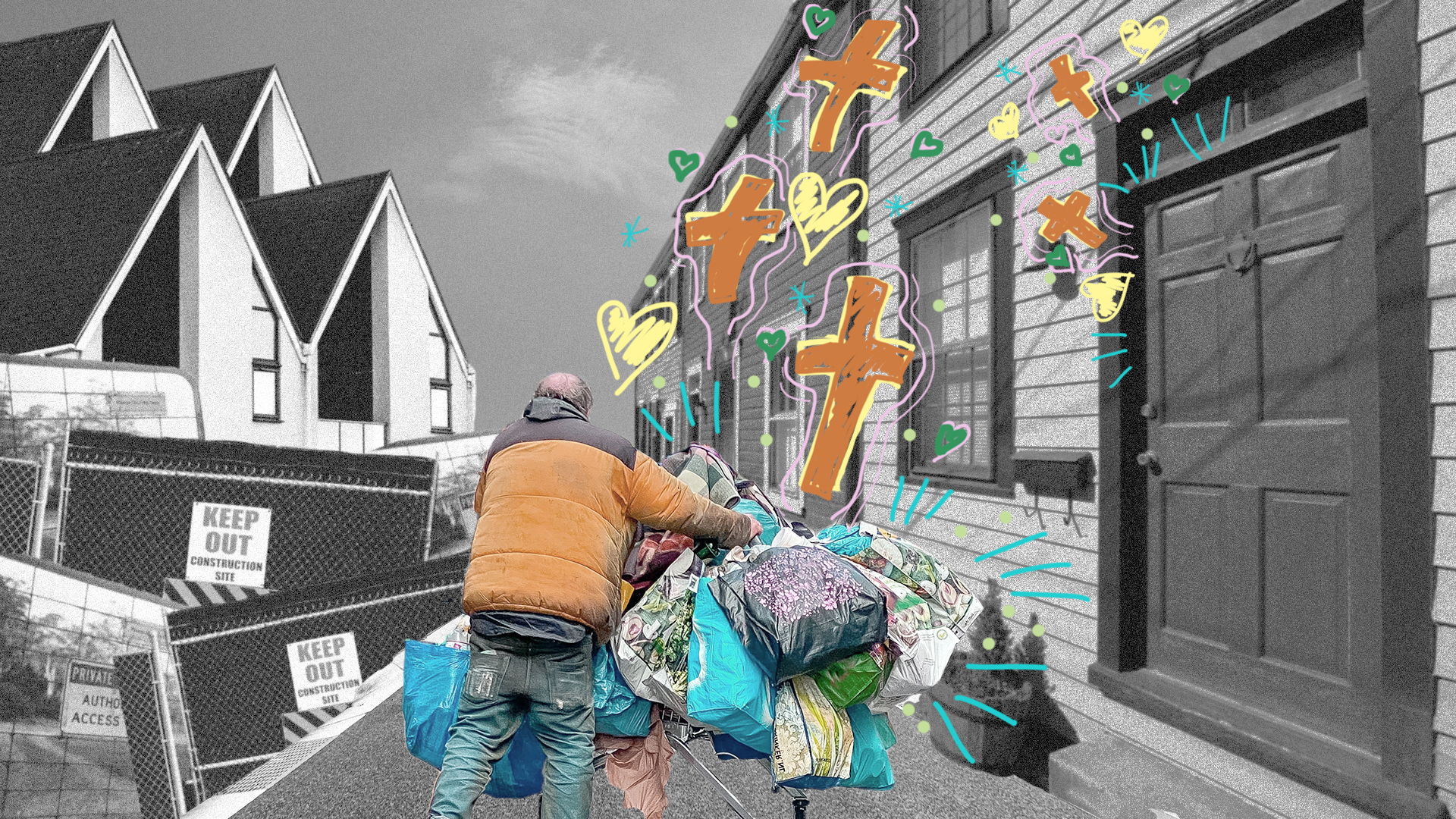
Lexington Rescue Mission is the largest evangelical ministry serving homeless and formerly incarcerated people in Lexington, Kentucky, the city where I live. It’s a growing organization working with a growing population. But at the start of last year, things weren’t looking great.

LRM desperately needed a bigger office space. It needed more room to provide clients with career counseling, training, Bible studies, and prayer. Its outreach center, the building where LRM cooked and served meals six days a week, had caught fire and had been sitting closed for months as it underwent repairs.

In April of 2021, the mission hoped to relocate its administrative offices, meeting spaces, and food service to a historic office building. But residents in the surrounding neighborhood protested. They didn’t want LRM’s clients coming around, they said at a city hearing. What if they were dangerous? Or sex offenders? The city rejected the mission’s request to move in.

This year has been kinder. Sort of. The ministry purchased a large office building in a different downtown neighborhood, where it needs no special permission to run its outreach programs or expand its services. Nevertheless, neighbors resisted. They called special meetings and voiced concerns about loitering and litter. One resident threatened to move away if LRM moved in.

Laura Carr, the mission’s executive director, reminded them at a forum that, according to Census data, more than a third of their neighborhood lives in poverty. Many of their neighbors were in fact already LRM’s clients. The goal of the mission “is to create a beautiful community,” Carr said. “And part of the beauty of the community is caring for those who are most vulnerable. That’s what a community is ultimately judged on.”

Our cover story argues that Christians have a unique opportunity, in our difficult housing market, to model for the watching world better kinds of community—not only inside our homes, but also out in the towns and cities where we live. The irresistible beauty of the communities Christians build will not be in how well ensconced are the comfortable, but in how welcomed are the little children and the stranger—and maybe even the millennial renter unable to afford a mortgage down payment.

We should of course prize beauty and safety and mirth. Those are gifts from God. But they are not the criteria Jesus used to cull the sheep from the goats (Matt. 25:31–46), and Christians should not settle for a culture that makes them the ultimate aim of the places we call home. As we work to make our dwellings better reflect heaven, may we do the same for our neighborhoods. Litter and loitering and all.

Andy Olsen is print managing editor of Christianity Today. Follow him on Twitter @AndyROlsen.

Books

New & Noteworthy Books

Compiled by Matt Reynolds.

Bioethics for Nurses: A Christian Moral Vision

Alisha N. Mack and Charles C. Camosy (Eerdmans)

Alisha Mack (an evangelical nurse and nursing professor) and Charles Camosy (a Catholic ethicist) believe they’ve written a book that goes doubly against the grain. As they observe, most books on bioethics tend to prioritize doctors over nurses. Plus, they often marginalize Christian moral perspectives. In chapters covering the Christian origins of nursing and bioethics and casting a theological vision for nursing in the contemporary medical field, Mack and Camosy aim at a resource that leaves working (and aspiring) nurses “feeling more grounded and confident in refusing to choose between [their] faith and [their] profession.”

Workers for Your Joy: The Call of Christ on Christian Leaders

David Mathis (Crossway)

When Christian leaders abuse their power and fall into patterns of sin and corruption, they give leadership itself a bad name. In Workers for Your Joy, pastor and Desiring God editor David Mathis lifts up the biblical model, instructing would-be pastors and elders on the moral standards God demands and explaining what churchgoers should expect of their shepherds and overseers. “God made you to be led,” Mathis writes. “He designed your mind and heart and body not to thrive in autonomy but to flourish under the wisdom and provision and care of worthy leaders and, most of all, under Christ himself.”

Wrestling with Job: Defiant Faith in the Face of Suffering

Bill Kynes and Will Kynes (IVP Academic)

More perhaps than any other biblical text, the Book of Job provokes, unsettles, and baffles its readers. In this volume, father-and-son authors Bill (a pastor) and Will (a biblical scholar) Kynes walk through the poetic elements, interpretive puzzles, and spiritual dilemmas that give Job its power and mystery. “The first encouragement we need from Job,” they write, “is the encouragement to persevere in faith to the end. We will be taken down a road of intense suffering—with all of the emotional and spiritual turmoil that creates—to come to a new appreciation of the God who is there all along.”

News

Christian Nonprofit Buys Luxury Yacht

And other news briefs from Christians around the world.

Yacht image courtesy of GBA Ships

The first modern cruise line to focus on Asia has closed down following the financial difficulty brought by COVID-19 and has sold the last of its fleet of luxury yachts to a German Christian organization. Genting Hong Kong’s Star Cruises’ other ships were sold for scrap. But The Taipan, docked in Malaysia, was acquired by GBA Ships (formerly Gute Bücher für Alle), which works in partnership with Operation Mobilisation. GBA Ships visit 15 to 18 port cities per year, providing aid and access to Christian books. Restoration of the 31-year-old, 85.5-meter yacht is expected to take 12 to 18 months. It will be renamed Doulos Hope.

China: Christian man escapes internment

A 43-year-old Christian man who was detained in the Xinjiang internment camps alongside two dozen Muslim Uyghurs has escaped the country and come to the US with his wife and son. Ovalbek Turdakun, an ethnic Kyrgyz who worked as a Kyrgyz-Mandarin translator, became a target of the Chinese government’s brutal assimilation program after he married a Kyrgyzstan native. He was detained for 10 months then suddenly released. The family fled to the US with the help of a research fellow at the Victims of Communism Memorial Foundation, a Canadian surveillance expert, a McKinsey Group analyst, a family of American Christians, and China Aid founder Bob Fu. Human rights lawyers will submit his firsthand account of Chinese government repression to the International Criminal Court.

Australia: Many baptized at cross raising

A record of 130 aboriginal people were baptized by family elders and tribal leaders at a cross-raising ceremony on West Arnhem Land, in the northeast corner of Australia’s Northern Territory. Cross raisings have become significant to First Nations Christians as a time to renew a covenant between the land and God and prepare people for immersion. The practice dates back to the homeland movement of the 1970s, when many indigenous families returned to ancestral lands.

Ghana: Churches plant trees

The Christian humanitarian aid organization Compassion International and 17 churches came together to plant 4,000 trees to combat the effects of climate change. The group hopes to plant 15,000 more acacia, moringa, avocado, and other species of trees in 20 locations across the country. Abraham Satunia, an Assemblies of God leader, said burning fossil fuels has disrupted the environmental order, becoming a threat to human life. The mean annual temperature in Ghana has gone up by one degree Celsius since 1960, according to the World Bank, and now there are about 48 more hot days and 12 more cold days every year. Continued climate change is expected to increase the mean annual temperature one to three degrees by 2060, resulting in a 20 percent decrease in rain and causing cyclical droughts.

Nigeria: Gospel singer’s cause of death disputed

Gospel singer Osinachi Nwachukwu died suddenly at age 42, and her family is disputing the cause of death. Her husband and manager, Peter Nwachukwu, said she suffered secretly from throat cancer. Her four children, however, told police she was the victim of domestic violence. Peter Nwachukwu is now in jail, facing 23 charges of domestic violence and “culpable homicide.” One of Nigeria’s best-known gospel singers, Osinachi Nwachukwu’s hit “Ekwueme” has 77 million views on YouTube.

Norway: Neighbors quarrel over illuminated cross

A 72-year-old man claims an Evangelical Lutheran church’s illuminated cross is a health risk, because it may “tear open old wounds” for people who attended the church’s schools between 1955 and 1990. The Evangelical Lutheran Church Society, a small denomination with about 3,300 members, has apologized for the corporal punishment practiced at its schools but says that has nothing to do with the cross on the Skien church built in 2021.

Italy: Andy Warhol brings Romans to church

An evangelical church in Italy attracted hundreds of visitors by displaying a minor work by the late pop artist Andy Warhol. The church, Chiesa Evangelica Breccia di Roma, offered its space for an art exhibit titled Prints & Multiples as a way to love its neighbors and invite people to notice the active evangelical congregation operating in the heart of Rome. Warhol’s screenprint of flowers—signed on the back with a stamp that says “Fill in your own signature” with a blank line—sold at auction for about $10,000.

Dominican Republic: Pentecostal bishop wants church review of privacy law

The head of the Pentecostal Churches of the Dominican Republic called on the legislature to have experts in his congregation review a proposed bill on the right to privacy, honor, good name, and image. Bishop Reynaldo Franco Aquino said the bill has not had proper public vetting, “which is why a controversy has been unleashed that seems endless.” The proposed legislation, opposed by free-press advocates, would make it easier to sue for libel. It is not clear if it will also apply to social media users and platforms.

United States: Few women lead egalitarian Baptist churches

Ordained women lead only about 7 percent of churches in the Cooperative Baptist Fellowship, which separated from the Southern Baptists in 2002 over the issue of women in ministry. A study presented at the 2022 general assembly showed the total number of women in senior or copastor positions in the denomination’s 1,400 congregations has actually declined since 2015. Women in the study said they faced obstacles including higher standards, lower pay, sexual harassment, inappropriate interview questions, and men getting credit for their work. “After my first sermon,” one Baptist pastor said, “a congregant asked my husband if he wrote my sermon.”

News

Something Old, Something New. Something Borrowed, Something Pew.

Traditional church seating gets a second life at outdoor weddings.

Illustration by Iker Ayestaran

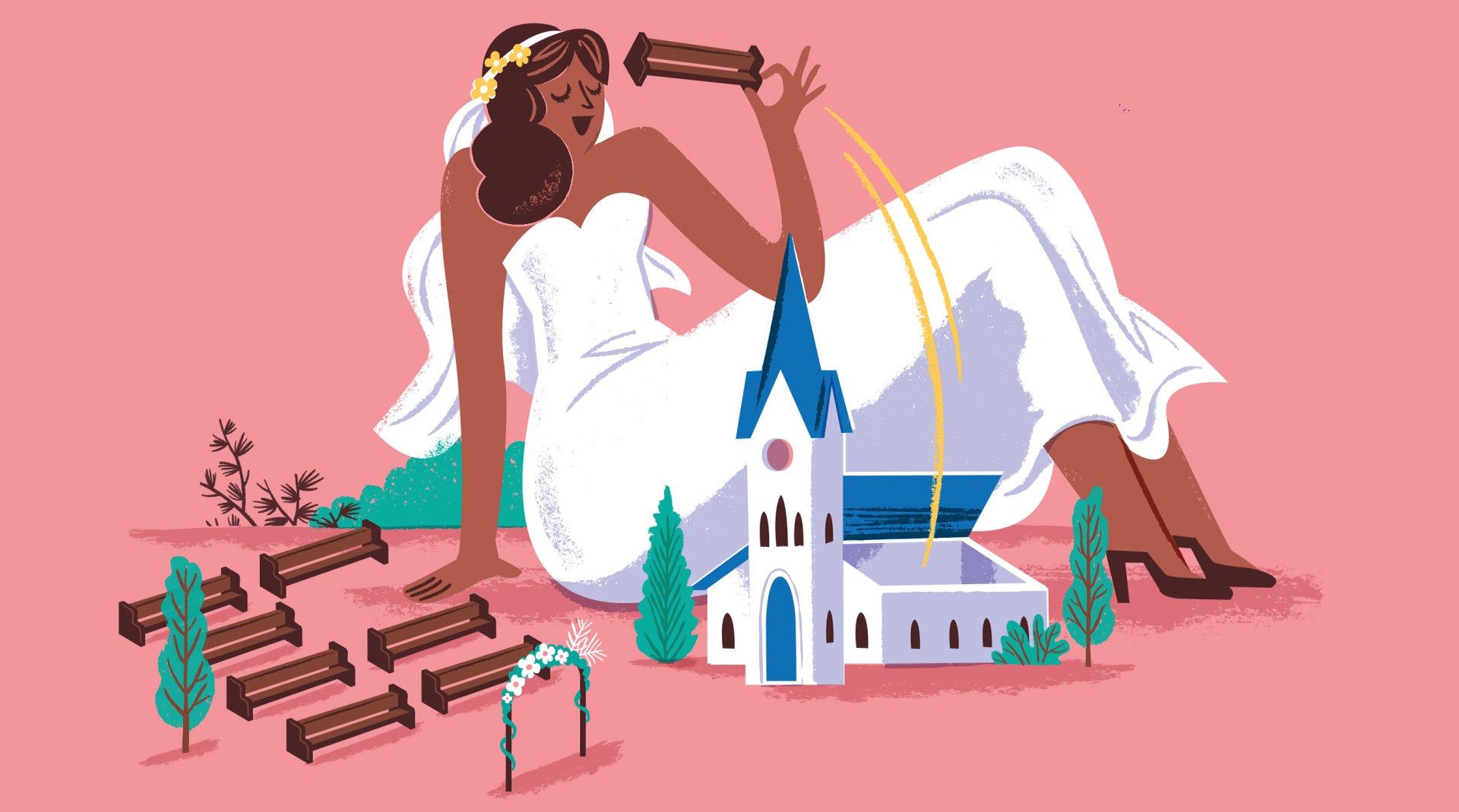
The bride wanted a rustic aesthetic.

The mother of the bride wanted the wedding in a church.

Sean Strelec, who runs VIP Weddings and Events with his wife, Sanya, realized he had the answer. It came to him—like some answers to prayer do—on the internet. There was a Craigslist ad from a Northern California church that was moving. The congregation had to get rid of its 125-year-old pews.

“I ended up buying the entire lot,” Strelec said. “Loaded them up and brought them down to Orange County.”

Strelec moved the pews to an outdoor venue and arranged them in rows for the ceremony, giving the wedding a vintage feel with just a touch of religiousness. Both the bride and her mother were pleased. And Strelec discovered a new service he could offer as part of his wedding venue business.

Today, he and his wife rent pews to seat up to 180 wedding guests.

“For the Avant-garde couple with the family that revels in tradition,” the company website says, “there is no better option for ceremony seating than vintage church pews.”

From California to Colorado, New York to North Carolina, and many points in between, wedding vendors are offering pews for rent.

“Having our authentic church pews creates an elegant foundation that sets the scene for the whole day,” one company promises. “The guests will be pleasantly surprised by the beauty and thoughtfulness that our pews bring to the ceremony.”

Nearly 2.5 million weddings will take place in America in 2022, according to industry estimates. Most will not be held in churches. As recently as 2009, more than 40 percent of weddings were held in churches, but today houses of worship don’t even rank in the top three preferred wedding venues—which are, in order, banquet halls, barns, and the grounds of historic homes.

Almost 7 out of 10 weddings take place outdoors. During the two peaks of wedding season, October and May, the percentage is even higher.

But some of those outdoor ceremonies will have a hint of old-time religion in the seating arrangements. Wedding planners will invoke a sense of solemnity through rented pews.

Although pews evoke a sense of tradition today, the history of pews in churches is rather haphazard. According to Katherine French, a medieval historian at the University of Michigan and author of People of the Parish, pews came into common use in the 1400s.

“We think they came out of a growing importance of sermons and the recognition that people just aren’t going to hang around for a long sermon if they can’t sit down,” she said. “Before the advent of pews, there were benches built into the masonry that would be built around columns and along the walls.”

Right about the same time that pews became common, medieval churches developed another innovation: pew rentals. In market towns and urban centers, people started paying to reserve their seats. Prices in England ranged from fourpence to 80 pence—the cost of about 30 ears of corn up to the cost of a cow.

“Families want status, visibility, and security, and they want to know that they’re going to have their seat in the church,” French said. “Parishes need money.”

By the 17th century, many churches put boxes around special pews, separating the seating space from the rest of the church. A family box could be passed down from generation to generation.

When the practice of pew rentals made its way to America, it became a main source of church funds. Records from one Baptist church show annual rents came out to $407 a few years before the Civil War. In the 1870s, a Baptist church in Westchester County, New York, rented a pew for $5 every quarter, while the German Evangelical Lutheran Church in Charleston, South Carolina, rented pews for $4.

Despite the financial security brought by the practice, some Christians started to critique it. Revivalists and evangelism-minded churches started arguing it prevented people from hearing the gospel.

According to historian Jeanne Halgren Kilde, an emphasis on equality before God and in worship swept through evangelical churches in the 19th century. They embraced what they called “free worship,” allowing white people to sit wherever they liked, regardless of social status. The well-off had to find their seats with everyone else.

Catholics and Protestants who put more emphasis on respectability continued to practice pew rentals into the 1940s. Pew rentals largely vanished in evangelical churches by the end of the 1800s.

Evangelicals still mostly had pews, though, until the 20th century, when a new emphasis on being “seeker sensitive” led many churches to opt for more comfortable seating. Pews—even ones where anyone was free to sit—came to signify tradition and formality, which made them bad for churches attempting to appeal to baby boomers in the 1980s and ’90s.

But the same connotations work perfectly for millennial and Gen Z weddings in the 2020s.

Monique Gonzalez Koyias wanted pews for her outdoor wedding in Colorado in 2021. When she couldn’t find a vendor to provide pews for her marriage ceremony, she bought some from a church closing in Bennett, Colorado. Today, as owner of Now and Forever Vintage Furniture & Church Pew Rentals, she provides pews for ceremonies and events across the state.

“I feel it’s an honor and privilege to provide our church pews for rent,” she said. “It’s keeping a part of history and tradition alive that otherwise would be lost.”

Photos of rustic wedding decor on Pinterest and other social media platforms fuel the demand for pews. The website WeddingWire urges brides to “look for repurposed church pews from vintage event rental companies if you want an eclectic, shabby chic aesthetic.”

As the popularity of outdoor weddings increased because of COVID-19, the demand for church pews went up too. The average cost for a venue in 2022 is about $10,000, so couples planning their weddings are encouraged to evaluate every aspect of the space, including the seating. Pews rent from anywhere between $100 and $300 each, not including delivery and setup fees.

Pews seem to be especially popular in the South. Stephen and Joanne Kramer, who run I Do Pew Rentals in North Georgia, have posted hundreds of photos of their pews at weddings in the South. The pews appear at waterfalls, wineries, mountain overlooks, and historic plantations. Sometimes the seats are in the background, behind kissing couples and celebrating wedding parties, and sometimes the camera focuses directly on the pews.

“They’re the original pews out of an old Kentucky church built in 1890,” one photo caption says. “Imagine the celebrations, events, and stories.”

Back in California, Strelec says that people who rent out pews have to think about their history for more practical reasons, too. They weren’t built to be transportable, and they have to be handled with care.

“The more you move the pews, the more likely they are to be damaged,” he said. “Being that they are historical, we do our best to take care of them.”

He doesn’t mind being a caretaker, though. He thinks of all the weddings he’s made a little better with his pews. The brides and families who were happy. And what would have happened to the church seating if he hadn’t answered that internet ad.

“These little pews that were destined for the landfill have traveled around the world,” he said, “and have been involved in a lot of different things.”

Susan Fletcher is director of history and archives for The Navigators.

News

The Curious Case of Coronavirus Contagion in Church

Pandemic impact was not as predictable as expected, sociological study finds.

Illustration by Mallory Rentsch / Source Images: Pearl / Lightstock

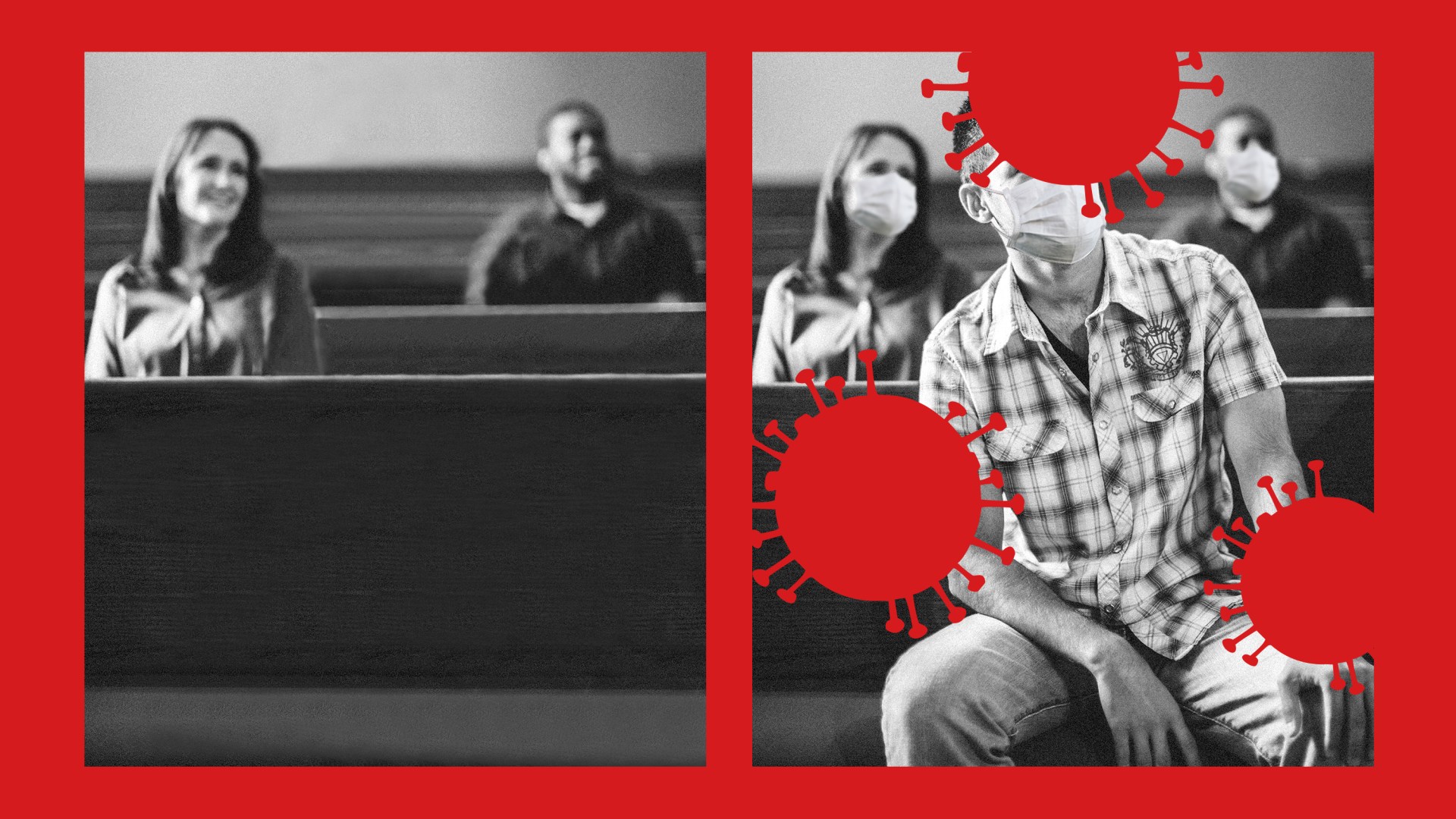
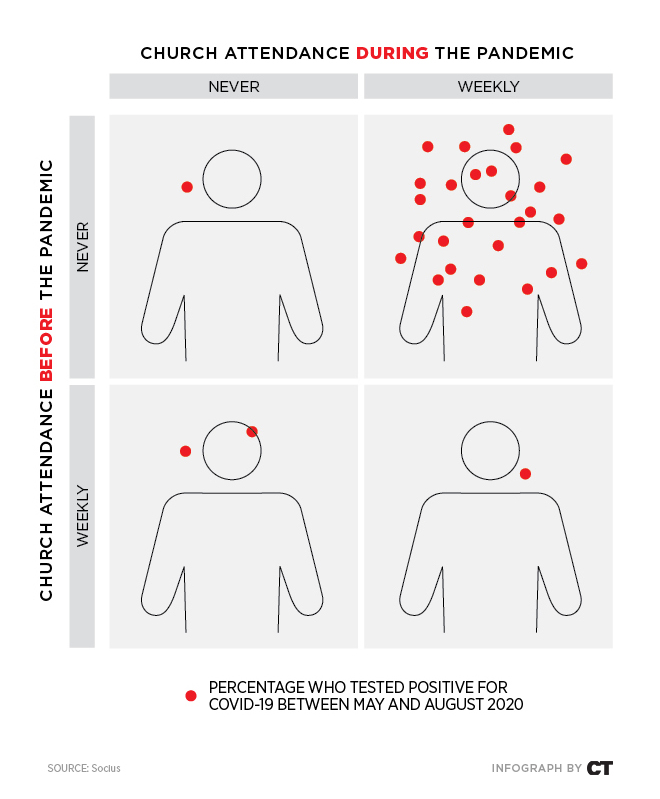
People who went to church during the height of the COVID-19 lockdowns were generally more likely to catch COVID-19. This is fairly straightforward. Yet look a little closer, and the facts get a bit more perplexing.

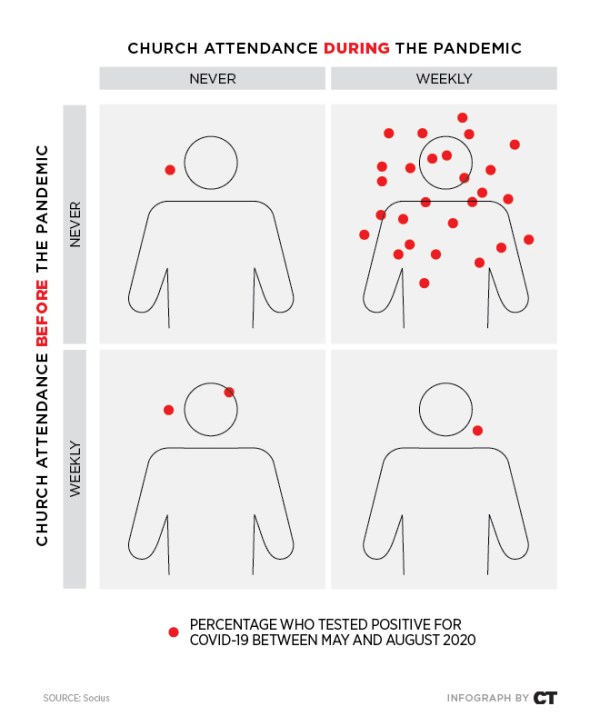
The “association between attending in-person worship during lockdown and later testing positive for COVID-19 was limited primarily to those who were not previously frequent worship attendees,” according to a study published in the American Sociological Association journal Socius.

Sociologists Samuel Perry and Joshua Grubbs looked at a survey of 1,200 people during COVID-19 lockdowns in the spring and summer of 2020. They found that people who attended weekly church before the pandemic and continued attending, sometimes against health department recommendations, did not notably increase their risk of catching the coronavirus. But those who seldom attended before COVID-19 and started going weekly during the lockdowns did increase their chances. About 17 percent caught the coronavirus between the spring and summer of 2020.

The rates were even higher for those who had never attended before and started going weekly: 28 percent. The reasons are not clear. Perry and Grubbs say it doesn’t seem to be connected to age, race, or safety practices such as mask wearing. The only statistical difference was newly increased church attendance.

Ideas

Stopping Abuse Is Sexual Ethics 101

Christian efforts to protect the body often fail to protect women.

Illustration by Iker Ayestaran

As the abuse crisis roils American evangelicalism, church leaders are finally paying attention, if only because the accretion of cases is now impossible to ignore.

Commentators on the Left have eyes on it too. Among the various cries, some progressives are calling out Christian conservatives for policing the issue of sexual orientation and gender identity (SOGI) while simultaneously dismissing abused women in their own midst.

“Youth leaders were fondling us and raping us and shaming us into silence,” said Julie Rodgers at the beginning of the #ChurchToo movement. “Meanwhile, we heard the gays were the greatest threat to the church and society.”

“If the SBC hated abusers as much as they do gay people … we literally wouldn’t be having this conversation today,” tweeted Matthew Manchester in response to the recent Southern Baptist Convention report revealing widespread abuse and coverup. Others have voiced similar concerns about “a perverse double standard.”

Although the Left’s view of sex is misguided, their critique still carries weight. Christians should not complain about the sexualization of culture while simultaneously ignoring the sexualization of women inside the church.

We’re looking at “the largest crisis of institutional religion in the United States,” according to Washington Post columnist Michael Gerson, and that crisis has been caused in part by Christians losing sight of the fundamentals.

While biblical sexual ethics most definitely apply to SOGI—as well as marriage and singleness—they start with the simple act of protecting women and men from exploitation. Everything else follows from that.

Put another way: Abuse prevention is the most basic form of faithfulness to God’s edicts about the body.

Inversely, taking advantage of others for sexual gain is an egregious violation of divine law because it dehumanizes those made in the image of God (Gen. 1:27). Paul issues repeat warnings about the misuse of our own and others’ bodies (Gal. 5:19; 1 Cor. 6:12–20; Rom. 6:12) and the danger of giving in to “even a hint of sexual immorality” or “any kind of impurity” (Eph. 5:3).

These specific injunctions against various forms of abuse are accompanied by broad moral principles as well. One of the most profound comes from Proverbs 9:10. “The fear of the Lord is the beginning of wisdom”—and also the beginning of ethics.

Fearing God means respecting his precepts and dreading his judgment when we don’t follow those precepts. As a church, then, our breach of sexual ethics goes right to the heart of our disposition toward him.

The abusers, enablers, and fixers lurking in our pulpits and pews have no healthy fear. As a result, they take their sins to the closet instead of the altar and lose the ability to discern good from evil. A simple request to help abuse survivors ends up looking like “a satanic scheme to completely distract us from evangelism,” according to a lawyer for the Southern Baptist Executive Committee.

On the flip side, when Christian leaders fear God, they pursue holiness, not self-preservation. They put their confidence in the gospel rather than in their own ministries or denominations. They’re humble enough to name personal sins and systemic evils. And their ethics on sex are consistent across the board: The act of safeguarding women from abuse draws from the same moral well as promoting traditional marriage, encouraging fidelity for couples, and supporting chastity for singles.

Those responses are unified. But again, everything follows from that first safeguarding action. It’s absolutely foundational. Fearing and respecting God requires fearing and respecting those who bear his image—and seeing violations of their bodies as violations of him and his created order. There’s no way to get around that direct corollary.

“I needed someone who could have told me this is what abuse was and this was not the heart of God,” said Naghmeh Panahi in a recent CT profile about her domestic violence case.

As stories like hers proliferate, we should listen to the calls for integrity coming from both inside and outside the church and feel sobered by our failed witness to the world. More importantly, we need to submit to God’s righteous judgment, which calls wicked leaders to account and calls us to account for what we’ve done to sanction or dismiss their behavior.

The good news is that we’re not going it alone. After issuing the Ten Commandments from a mountaintop, Moses tells the Israelites: “The fear of God will be with you to keep you from sinning” (Ex. 20:20).

That promise applies to the American church today—if only we’d listen.

Andrea Palpant Dilley is online managing editor at CT.

Ideas

If God Is Your Father, You Have Seven Mothers

Columnist; Contributor

His care and compassion come from a surprising variety of sources.

Abigail Erickson

We all have seven mothers, according to Scripture. Besides our birth mothers, there are at least six individuals or entities the Bible describes as a “mother” to God’s people: Eve, the earth, the church, pastors, Christ, and God himself. Each example has theological implications.

Scripture describes Eve as “the mother of all the living” (Gen 3:20). In Hebrew, she is havah, the source of breath, the life-giver for humanity. Given that her main achievement at this point is eating the forbidden fruit and passing it to her husband, that is a fairly remarkable statement, but her name is given as a promise of hope. Adam is a dust-man, whose sin brings death. Eve is a life-woman, whose seed will make war on the Serpent and crush its head.

Later on, the Old Testament introduces another mother reference: Job’s statement that he will “return” naked to his mother’s womb (1:21, ESV). As Jonathan Edwards noted three centuries ago, this cannot be his biological mother; it must instead be “the bowels of his mother earth, out of which every man is made.” Today, the idea of Mother Earth sounds pagan to our ears. In many contexts it is. But it has deep biblical roots, and not just in Job. Paul later described creation as a mother in childbirth, laboring to bring forth the new world where our bodies are redeemed and the curse is lifted (Rom. 8:22).

Elsewhere, Paul makes the most explicit maternal connection in Scripture: “The Jerusalem that is above is free, and she is our mother” (Gal. 4:26). This is a famously dense statement. It comes as Paul is exploring multiple layers of connection between Ishmael and Isaac, Hagar and Sarah, Sinai and Zion, flesh and promise, slavery and freedom. At its heart, however, is a simple contrast. If we long to be under the law, we are acting like slaves—like Hagar’s son Ishmael, conceived naturally through the flesh. But we are children of Sarah, like Isaac, conceived supernaturally through God’s promise. Our mother is a freeborn woman—the Jerusalem that is above, the church—which means we are free too. The North African bishop Cyprian of Carthage saw the implications: “He cannot have God for his father who has not the Church as mother.”

That is a corporate image, but there is an individual dimension as well. In the preceding verses, Paul presents himself as a mother to the Galatians: “My dear children, for whom I am again in the pains of childbirth until Christ is formed in you…” (Gal. 4:19). To the Thessalonians he wrote, “Just as a nursing mother cares for her children, so we cared for you” (1 Thess. 2:7–8). As much as Paul characterized himself and his fellow pastors as fathers, protecting and training their children, he also employed maternal imagery like labor, breastfeeding, and nurture. In that sense, our “mothers” are our pastors: those who bring us to birth in the gospel, care for us when we are sick, and feed us when we are hungry.

Viewed from yet another angle, our mother is the Lord Jesus Christ. He says so himself: “Jerusalem, Jerusalem…how often I have longed to gather your children together, as a hen gathers her chicks under her wings, and you were not willing.” (Luke 13:34). Anselm is beautiful on this: “Christ, my mother, you gather your chickens under your wings. … For by your gentleness the badly frightened are comforted, by your sweet smell the despairing are revived, your warmth gives life to the dead, your touch justifies sinners.”

Finally, and most powerfully, our “mother” is God the Father. Few passages in Scripture are more emotionally resonant than Isaiah 49:15–16: “Can a mother forget the baby at her breast and have no compassion on the child she has borne? Though she may forget, I will not forget you! See, I have engraved you on the palms of my hands; your walls are ever before me.” As we know, God is addressed as “Father” throughout the New Testament (including by Jesus), and that is rightly how the church has always referred to him. But no image better expresses God’s compassion for his people than a nursing mother, cradling her newborn and promising lifelong devotion.

May we all honor our father and mothers.

Andrew Wilson is teaching pastor at King’s Church London and the author of God of All Things. Follow him on Twitter @AJWTheology.

Apple PodcastsDown ArrowDown ArrowDown Arrowarrow_left_altLeft ArrowLeft ArrowRight ArrowRight ArrowRight Arrowarrow_up_altUp ArrowUp ArrowAvailable at Amazoncaret-downCloseCloseEmailEmailExpandExpandExternalExternalFacebookfacebook-squareGiftGiftGooglegoogleGoogle KeephamburgerInstagraminstagram-squareLinkLinklinkedin-squareListenListenListenChristianity TodayCT Creative Studio Logologo_orgMegaphoneMenuMenupausePinterestPlayPlayPocketPodcastRSSRSSSaveSaveSaveSearchSearchsearchSpotifyStitcherTelegramTable of ContentsTable of Contentstwitter-squareWhatsAppXYouTubeYouTube