Jesus Is Our Peace

An Advent reading for December 10.

Stephen Crotts

Week 2: The Prince of Peace


Amid the pain and violence of our world, we hold fast to this hope: One day Jesus will usher in true and ultimate peace. He also brings us spiritual peace in the here and now as we experience redemption and live by the values of his kingdom. Jesus is the Prince of Peace.

Read John 14:27; 16:33; and Ephesians 2:14–18

Two truths can be in conflict, and yet if they are true, we need to affirm them both.

First, our world is filled with genuine pain and trouble. As the Old Testament prophets warned, our rebellion against God has twisted us and our world. To pretend otherwise is to be naive at best or hard-hearted at worst. God doesn’t ask us to lie about the hardships of life.

Second, Jesus is our peace—not in a cheap or cheesy way but in an earthy, knowing, cosmos-altering way. He is the only answer to this pain and trouble. Sent by the Father in the power of the Spirit, the Son of God became fully and truly human. This God of peace breaks into our broken world as one of us and starts a renewed world, realizing the ancient prophetic hope. “He himself is our peace,” since “in his flesh” he breaks down the “dividing wall of hostility”—not just between the sinner and God, but also between Jew and Gentile, male and female, rich and poor, heaven and earth (Gal. 3:28; Col. 1:15–22).

And these two truths clash.

Jesus is our peace, not merely in some psychological manner, but also in a concrete, whole-life way. He is our peace, not by numbing us, but by forgiving and healing us and enfolding us into his love and life. Even in the darkness of night and when confusion, doubt, and chaos swirl, Jesus still says, “Do not let your hearts be troubled and do not be afraid,” and “Peace I leave you; my peace I give you” (John 14:27).

We recognize trouble and brokenness as painful and problematic because they don’t resemble shalom. Whereas shalom brings harmony, goodness, and a flourishing world, we live amid wars, betrayal, and our own suffocating self-absorption. But in response to our rebellion and chaos Jesus brings his peace, his shalom. “I have told you these things, so that in me you may have peace. …Take heart! I have overcome the world” (John 16:33). By connecting us to God, he is our shalom. He is Israel’s hope and thus the hope of the world.

This is how we have peace in a genuinely troubled world: God, from beyond our world, has given us himself as our peace. Christ, the God-man, is our peace: He doesn’t depend on our fluctuating emotions and circumstances. God doesn’t ask us to lie about pain and problems or about his goodness and presence in Christ. Both are true. Beloved, there is trouble, but Christ is our peace amid trouble, and he gives us refuge, strength, and direction to extend his peace to this hurting world.

Kelly M. Kapic is a theologian at Covenant College and the author or editor of numerous books, including Embodied Hope and You’re Only Human.

Meditate on John 14:27; 16:33; and Ephesians 2:14–18.
How is Jesus your peace in a concrete, whole-life way—even amid the very real hardships of life?

News

‘Nondenominational’ Is Now the Largest Segment of American Protestants

US Religion Census finds independent congregations have surged in the last decade.

Christianity Today November 16, 2022
Tyler Milligan / Unsplash

Call it the rise of the nons.

Not the “nones,” who have commanded attention for years, as the number of Americans who don’t identify with a specific religious tradition has grown from just 5 percent during the Cold War to around 30 percent today. This is the nons—nondenominational Christians, people who shake off organizational affiliations, disassociate from tradition, and free themselves from established church brands.

The number of nondenominational churches has surged by about 9,000 congregations over the course of a decade, according to new decennial data released by the US Religion Census. Little noticed, they have been quietly remaking the religious landscape.

There are now five times more nondenominational churches than there are Presbyterian Church (USA) congregations. There are six times more nondenominational churches than there are Episcopal. And there are 3.4 million more people in nondenominational churches than there are in Southern Baptist ones.

If “nondenominational” were a denomination, it would be the largest Protestant one, claiming more than 13 percent of churchgoers in America.

“The two biggest stories in American religion are the nones and the nons,” said Ryan Burge, professor of political science at Eastern Illinois University and an expert in religious demographic data. “We are in a transitional period for Protestant denominations.”

Nondenominational Christians don’t show up in the polls that sample and survey American religion, because people don’t think of “nondenominational” as an identity. They are more likely just to say “Christian,” or perhaps “Protestant.” If prompted, they might specify whether or not they think of themselves as evangelical or born again. But few if any say “nondenominational.”

The US Religion Census catches the growing number of nondenominational Christians, however, because it is an actual census, with teams of people counting congregations and collecting reports of the number of people attending particular churches. Since the National Council of Churches started the project in 1952 and the Association of Statisticians of American Religious Bodies revived it in 1990, the decennial tally has become the most official count of religious groups in America.

In 2010, the US Religious Census identified 35,496 independent congregations without any formal denominational affiliation. The lead researcher, Scott Thumma, told CT there were almost certainly more than that, but it was the most precise count anyone had done to that point.

Using the same method in 2020, the US Religious Census team found 44,319 nondenominational congregations, with an estimated 21 million adherents. That makes nondenominational Christians the first or second largest group of Protestants in America, depending on how one counts. The Southern Baptists have about 7,000 more churches, but 3.4 million fewer people.

The next largest Protestant group, the United Methodists, can only claim about half the number of people as Southern Baptists, and the denomination has lost a number of congregations in an ongoing church split since the Religion Census tallied at total of 30,051 in 2020.

Thumma, one of a few experts and close observers who have noted the nondenominational growth over the past decade, said he thinks there are several factors driving what he describes as “individualism at the congregational level.”

It’s an expression of “organizational individualism that parallels personal individualism,” he said, and allows churches to slip out from under the burden of some cultural baggage.

“It is an evangelistic advantage,” Thumma said. “A potential attender at a nondenominational church doesn’t have cultural expectations of what they might find inside the way they do if the brand is Episcopalian or Assemblies of God or Southern Baptist. Rather, the visitor has to experience the worship firsthand.”

That may be especially helpful for evangelicals who are concerned the term evangelical has become toxic.

“Whether this is due to ties with Christian nationalist rhetoric or [former president Donald] Trump and the Republican party, I’m hearing folks all over trying to find more suitable language to describe themselves than evangelical,” Thumma said. “As if the brand is tarnished beyond a repolishing.”

The growth of the nons has also been supported by an ecosystem of publishers and parachurch organizations that produce nondenominational religious content. Historically, denominations supplied churches with music, Sunday school curricula, and Bible study curricula. They also arranged mission and service trips. But that has changed, and congregations are more likely now to shop around.

Today even some denominational churches end up being “functionally nondenominational,” Thumma said, “defecting in place or quiet quitting … and crafting their own local brand.”

That doesn’t mean evangelical denominations are disappearing, though. According to the US Religion Census, a lot of evangelical denominations saw a slight decline but their numbers didn’t plummet.

The Christian and Missionary Alliance lost about 200 congregations between 2010 and 2020. The Churches of Christ lost about 700; the Foursquare church, 400; Free Will Baptists, 350; the Church of God (Cleveland, Tennessee), 180; the Wesleyan Church, 150; and the Vineyard, about 50.

The Anglican Church in North America, despite emerging as the most prominent of the many groups that separated from the Episcopal Church, declined from 913 churches to 873.

Other denominations grew, but also not by a lot. The Southern Baptist Convention and the Assemblies of God increased by about 500 congregations each. The Presbyterian Church in America added about 100; the Church of the Nazarene, 100; and the Evangelical Free Church, 250.

Some Black Protestant churches have seen modest growth too. The Church of God in Christ added more than 300 congregations between 2010 and 2020. The Christian Methodist Episcopal Church grew by about 150, and the Full Gospel Baptists by about 100.

The census data captures the religious landscape right at the start of the COVID-19 pandemic, according to Cliff Grammich, chair of the statisticians’ association committee that undertakes the decennial count. Some information may have come in a little before and some after religious organizations started to feel the impact of pandemic. The 2020 report will serve as a benchmark for later studies of any long-term effects.

“Increasing affiliation or disaffiliation in response to the pandemic and its aftermath will take time,” Grammich said.

Because the census counts congregations, the data also shows regional differences more clearly that most religious polls. Roman Catholicism, for example, which has grown at least in part with immigration from Latin America, has shifted south and west. There are individual congregations in Nevada, Arizona, and California that claim 6,000 to 10,000 adherents, though those people likely don’t show up at every Sunday mass.

Florida and Texas have both seen growth in the number of religious people, which seems related to their increase in population. On the other side of the country, religious adherence is declining in the Upper Midwest.

The data shows that many counties have seen about a 5 percent decrease in actively religious people in the course of a decade.

“Which is probably not perceptible to the average resident,” Burge said. “For most of America, it’s relative stability.”

As the nones and nons continue to grow, though, observers may be forced to revisit some of the common explanations for changes in religious affiliation. The late Rodney Stark’s idea about “cultural tension,” for example, has been used a lot to explain the decline of left-leaning Protestant churches and the numerical success of evangelical congregations. But that thesis—long met with skepticism by experts in the field—doesn’t fit with county-level data about religious diversity or account for the recent evangelical fluctuations and the many Christian congregations slipping free of denominational identity.

Whatever the explanation, it’s clear the nons are growing, just like the nones. And in the coming years, it’s likely more Protestant churches will leave denominational names behind.

News

The Real Miracle on the Set of ‘The Chosen’ Is Christians Coming Together

People around the world have found a passionate community in the hit show about Jesus. With a new season, can it keep navigating fan, investor, and religious demands?

Screenwriter Tyler Thompson snapped Polaroids on The Chosen's Texas set.

Screenwriter Tyler Thompson snapped Polaroids on The Chosen's Texas set.

Christianity Today November 16, 2022
Edited by Christianity Today / Polaroids Courtesy of Tyler Thompson

Andrew Cheng and Catherine Williams had their impromptu wedding near craft services, right before shooting a scene in The Chosen of the feeding of the 5,000. The extras­—like so many Christians on the set and so many viewers around the world—were surprised at the close community they found in the hit show.

“It was just bonkers,” Cheng told CT after his wedding to Williams. “Everything was great, except Jesus wasn’t there to turn water into wine.”

In June, The Chosen wrapped filming the scene for its third season that premieres Friday, with about 10,000 fans serving as extras for the multiday shoot in Texas.

Maybe not since Mel Gibson’s Passion of the Christ has there been a biblical hit like this. Other Hollywood projects like Noah or The Young Messiah flopped with Christian audiences for various reasons. But because this show is financed through fans, it has a following unlike any studio project.

The first season debuted in 2019 as a massive crowdfunding success, raising $10 million. Now it has a devoted following all over the world and has been translated into more than 50 languages. The showrunners are planning seven seasons and fundraising $100 million. People often encounter the show with low expectations of didactic Christian content and are surprised to find something more compelling.

Distributor Angel Studios is trying to continue The Chosen’s success in other projects. The first season of Andrew Peterson’s Wingfeather Saga will begin streaming in December. It also drew millions in crowdfunding. Angel Studios founders, brothers Jeff and Neal Harmon, have described The Chosen as their House of Cards, the show that launched Netflix.

The show still operates like a budget version of a Hollywood production in many ways. All of the thousands of extras for the feeding of the 5,000 shoot made their own costumes, with specific instructions from The Chosen’s costume designer Leila Heise. People around the Midlothian area lent ATVs for shuttling people around the production area—900 acres of a Salvation Army camp.

But the show isn’t a simple homegrown product anymore. It just held its first splashy premiere at the Fox Theater in Atlanta. Angel Studios, the distributor, now has venture capital funding. A Chosen Christmas special in theaters last year raked in nearly $14 million, by far the largest gross for Fathom Events. (Even with all of that, the show’s first two seasons were not reviewed by Hollywood trade press like Variety.)

In addition to handling funding and marketing pressures, the show’s creators must navigate the inherent weightiness of reproducing the Gospels. To this point, they have threaded through controversies when they arise to keep making a show that many types of Christians love–theatrical showings for the new season on Friday night were sold out in blue New York City and red Tampa, Florida. Can The Chosen keep that “miracle” going?

Cheng and his fiancée registered to play extras in the feeding of the 5,000—or “F5K” as everyone called it—as soon as they heard about it. Fans could be extras either by donating to the show or winning a raffle. Cheng and Williams had thought about whether to try to get married on set, but the forecast was hitting 100 degrees and they initially put the idea aside.

“Feeding of the fried thousand,” one extra joked.

On the morning of the shoot, the couple was sitting under a big tent in first-century costumes, talking with some other extras, and mentioned that they had considered getting married there. One woman at their table stood up and loudly asked the crowd in the tent if there were any pastors in the vicinity.

Are people born with a homosexual orientation? Or is such orientation acquired through socialization? In society at large, the debate over homosexuality revolves largely around this issue. And so does a smaller debate on the merits of chapter 9 of sociologist Tony Campolo’s book 20 Hot Potatoes Christians Are Afraid to Touch (Word, 1988).

In the July newsletter of the New York City-based ministry LIFE (Living in Freedom Eternally), which counsels people trying to overcome homosexual orientation, ministry directors Ron and Joanne Highley maintain that Campolo’s ideas on homosexuality are unbiblical and harmful. In the four-page newsletter article, they allege that Campolo “has given ‘aid and comfort to the enemy’ by distorting and avoiding the truth.”

Throughout the disputed chapter, Campolo affirms that homosexual behavior is sinful. He states that all were “meant to be heterosexual,” but that some are homosexual because “all nature is fallen.”

Campolo claims, however, that more and more research “suggests that in a great number of cases, if not in an overwhelming majority, homosexual orientation is inborn.”

In challenging this statement, the Highleys wrote that four “ ‘gay’ activists” who appeared on the “Donahue” show earlier this year admitted there is no proof that homosexuality is biologically based.

The implication of Campolo’s position on the cause of homosexuality is that counseling to overcome it is useless to many, perhaps most, homosexuals.

In contrast, LIFE, along with several other organizations that make up the umbrella group known as Exodus (see CT, Aug. 18, 1989, p. 16ff.), maintains that nurture—not nature—is responsible for all cases of homosexual orientation. They cite such factors as sexual abuse and a deficit in the relationship with the same-sex parent, shortcomings they say can be overcome through counseling and prayer.

The Highleys applaud Campolo for his “eloquent, much-needed statements about the church’s failure to reach out in love, compassion and truth to those caught in this sin.” But while acknowledging that there are Christians who struggle with homosexuality, they object to Campolo’s use of the term “evangelical homosexual,” arguing that people should derive their identities primarily from their Christian faith, and not from their homosexual condition.

In addition, the Highleys’ newsletter article faults Campolo’s tacit approval of “homosexual covenants,” wherein homosexually oriented Christians make a lifelong vow to live with each other in celibacy. Campolo views this as a remedy for the loneliness encountered by homosexuals who are in a Christian setting.

“Any erotic/romantic feelings between persons of the same sex indicates a disorder,” the Highleys write, “and if we accept it, we are cooperating with the problem and disputing God’s design.”

In a brief statement responding to the article, Campolo said he agrees with the Highleys “that people can be delivered from homosexuality by the grace of God and through the power of the Holy Spirit.” But he said to assume that all homosexuals who seek such deliverance find it “is to set up many for disillusionment and despair.”

Campolo said he was saddened by the “vehemence of [the Highleys’] condemnation.” He added, “I think I understand a little better why homosexuals remain concealed and suffer in silence.”

By Randy Frame.

Indeed, there were pastors. One pastor from Louisiana had just done a wedding and still had the liturgy on his phone, so he said he could officiate the ceremony. Cheng showed that he had the marriage license ready to go.

One extra made Cheng a boutonniere out of antibacterial wipes on hand for COVID-19 precautions. Another extra had brought a harp as part of his costume for the shoot and started playing. Two women showed up with shofars. A woman made a flower headpiece for Williams, and someone appeared with two pots of flowers.

The pastor performed the ceremony, and then someone procured a “wedding cake” from the craft services table: a banana nut muffin and a chocolate chip muffin.

Though Cheng and Williams didn’t have family and friends there, Cheng said it reminded him of “an old-time biblical wedding … when the whole town came and brought something. A community wedding.”

The “community” of extras that showed up for the shoot hailed from 36 countries and ranged in ages from 91 to seven weeks, according to the organizers.

Nicholyn Chang, from Malaysia, lives in Washington, DC, and came to the filming with her homemade first-century costume. Her roommate in DC is from Uruguay and got all of her friends in Uruguay to start watching the show too.

Between takes on the blistering day, a Catholic couple from Brazil was fanning themselves, and one of their two children was playing in a diaper under an umbrella. Friends had told them about the show many times.

“We were somewhat resistant. I thought it would be cheesy or preachy,” said Carlos Crestana. But by episode 5, he said, “We were all in. We told all our friends.”

The Chosen’s writer and director, Dallas Jenkins (son of author Jerry Jenkins), always insists that the show is not a replacement for church, nor is it a ministry.

Fans disagree: “It is a ministry, in a totally different way. It’s affecting so many different people,” said Cheng, who wears Chosen swag everywhere and says it “starts a conversation” about Christianity.

Jenkins has said his goal is to create art that reflects a world where faith exists, which he thinks is underrepresented in film.


Whether dealing with poison-tainted grapes, drugs to treat AIDS, or new methods of contraception, U.S. Food and Drug Administration Commissioner Frank E. Young is frequently confronted by tough issues. A trustee at Fourth Presbyterian Church in Bethesda, Maryland, and a newly appointed World Vision board member, Young recently talked with CHRISTIANITY TODAY about his faith and his job.

All the ethical scandals in Washington are prompting many to wonder if something is inherently corrupting about politics.

Some of the problems that Washington produces can lead to corruption because power is very hard to hold and use correctly. But you always have to guard against corruption in any area of potentially high and unaudited power. The issues facing a pastor or university official are no different from those facing a public official: money, sex, greed, and pride. The difference in government is that the opportunity for exposure is much greater than in the private sector. The political process is so intense, people have made a business of finding fault. You deal not only with the concept of wrongdoing, but also the perception of wrongdoing.

How do you deal with the conflicting pressures put on you as a government official?

I go to the third chapter of 1 Kings where Solomon was asking for wisdom to make decisions. He asked for an understanding heart to discern between good and bad. Every day I try to discern between good and bad and to follow through with my perspectives on what belongs to God and what belongs to Caesar. I can’t decide public policy with theology, but I do pray for wisdom.

Have you received criticism from people who are uncomfortable because you don’t leave your faith outside your government door?

My faith has become more visible in the past three years since the accident of my son. [Young’s son Jon was paralyzed from the neck down in a wrestling accident in 1986.] People asked, “Commissioner, how do you cope?” And I told them what my core values were. We lived our lives before the city of Washington and said that life is a parenthesis with eternity on either side. We adopted Jon’s motto of Romans 8:28. I don’t think there is a substantial amount of animosity here about my faith, but if there is, so what?

How did that accident affect your family and your faith?

I was videotaping the match when it happened. The first morning, he was in very bad condition. We thought he’d die. The next morning, his brother and I went in to see him. His brother asked, “Have you cried your two buckets of tears yet?”

Jon said, “Yes, I have and more, but you know, if one person becomes a Christian through my paralysis, it’s worth it all.” That had not been as visible before in this 17-year-old kid, but God gave him the strength.

We’ve had so many miraculous things through this experience. It was really the first time we had gone through a lot of adversity. We felt the power of prayer, the upholding presence of God as we never did before. A week or two before graduation, Jon’s Jewish teammate, a very close friend, became a Christian.

You’ve spoken out recently on the church’s role in ministering to AIDS victims. How is the church doing on this?

I think the church is finally beginning to be awakened and involved in a variety of forms. I’ve seen people open their hearts to adults and children who have been afflicted. It’s not easy for the church to help people with diseases that are generally associated with drug addicts or homosexuals. In the past, the church has sometimes moved away from hurting people to the point where we have isolated and sanitized death. But I think it’s really beginning to turn around. If the church can’t show the same compassion that Jesus taught, it fails.

On set one of the screenwriters, Tyler Thompson, was taking Polaroid photos. His parents, Steve and Morene Thompson, had come to play extras, and his mom started crying looking at the crowds, overwhelmed at what the project had become.

Tyler Thompson told CT he sees two kinds of Bible movies. There are either Hollywood studio-backed projects like Noah that have “a twist,” which tends to flop with church audiences because they “feel betrayed by some deviation from the source material.” Or there’s “extremely poorly funded, didactic, basically propaganda, [with] terrible actors who are white,” he said. “That flops with everybody.”

Unlike many other biblical epics, The Chosen intentionally cast people with the ethnicities of the story—Middle Eastern, Jewish, and African. Jordan Ross, who plays the disciple known as “Little James” in the show, has cerebral palsy and scoliosis that makes him limp.
The disciples and Jesus (Jonathan Roumie) have enthusiastic and sometimes overzealous fans.

“I love you, Matthew!” screamed a girl when the crowd of extras and actors, including Paras Patel who plays Matthew, were between takes.

Jenkins reminded the extras not to touch the actors or try to take selfies with them as they were going through the crowd during filming.

“It's never been on the job description for writing before that you’ll end up in a spot with 5,000 extras,” said Ryan Swanson, one of the other screenwriters, who has experience working on other Hollywood projects.

The show has had its controversies, but nothing has killed its momentum thus far. Jenkins often responds to complaints on livestreams like he did recently when people claimed a line Jesus says in the show—“I am the law of Moses”—was quoting from the Book of Mormon.

“Jesus makes many ‘I am’ statements and is called the ‘Great I Am.’ So no, I didn’t pull this quote from anywhere else,” Jenkins said.

Fans have brought up the possible Mormon influence on the show because Angel Studio executives the Harmon brothers; the president of Chosen Productions Brad Pelo; and the CEO Derral Eves are all Mormon. Jenkins and his cowriters, Swanson and Thompson, insist that they are the only ones who decide what goes in the show creatively.

The show’s marketing this year also took some big swings—putting up Chosen billboards that looked like they had been defaced, causing confusion among even the fans and eliciting an apology from Jenkins. But the show kept the ads going. With that ad campaign, The Chosen’s head of branding Jeremiah Smith told CT the show was looking for “more of a psychographic than a demographic. People who were jaded with church…We thought humor and sarcasm would be a way to get a different audience in.”

Controversies and overzealous fans aside, Jenkins reminded the thousands under a hot Texas sun of the main thing: They were recreating “one of the greatest moments in human history.”

Being able to experience a moment like that, even a shadow of it, helps explain why Christians from Brazil to Malaysia love this show and want to be a part of it. Though the weather for the shoot was blistering, maybe this is what a day on a hot Galilean hill felt like. People sweated and sought cover under trees or umbrellas, but—even when told they could leave—stayed for hours. Children ran to and from the bushes to take bathroom breaks or pet the Roman soldiers’ horses. The disciples handed out real bread to the crowds, and after the sun went down and the shoot wrapped, Roumie recited the Lord’s Prayer to the crowd in Aramaic.

Ruthie Ross came from Denver, Colorado, with her 23-year-old son Miles Ross, who has Down Syndrome and is in a local acting program. The two of them had been planning this trip since August of last year.

“I’ve been thinking about something like this for 20 years,” she said. “I want Jesus to be more real to people.”

The first two episodes of the third season of The Chosen will be in theaters Friday, for five days. All episodes, as usual, will be free and available on The Chosen ’s app.

This article has been updated to reflect that Angel Studios founders Jeff and Neal Harmon are distributors not producers of the show.

Theology

Commending God’s Works to the Next Generation in China

A Chinese house church pastor reflects on the similarities of reaching Gen Z in China and the United States.

Christianity Today November 16, 2022
Edwin Tan / Getty

While Americans talk about millennials and Gen Z, people in China refer to the post-90 (those born after 1990) or post-00 generation. Chinese Christians have found that much like in the United States, churches need to find new ways to relate to this generation of believers who have grown up in the digital age.

This is an area of focus for Sean Long, formerly a pastor at Beijing Zion Church who is now pursuing a doctorate in theology at Wheaton College. Long, 37, joined the well-known house church in 2010 and was ordained in 2017. He was responsible for a number of ministries, including worship, discipleship, and pastoral care, but ministering the post-00 generation was—and still is—the heart of his calling.

The following is an edited transcript of a 2021 interview between Sean Long and Pastor David Doong, general director of the mission organization Chinese Coordination Center of World Evangelism (CCCOWE).

Conversion and calling

Doong: Can you share with us your faith journey and calling to serve the Lord?

Long: I am the first Christian in my family. When I look back on my spiritual journey, it’s as the apostle Paul said, “By the grace of God I am what I am” [1 Cor. 15:10]. It is only by God’s grace that our lives experience incredible reversals. I went from being a “proud heir of the dragon” to a disciple of the Lord, from an atheist to the pastor of a church, from a Communist to an evangelist—a 180-degree turnaround.

My parents and grandparents were all Communists, and I grew up listening to the heroic stories of revolutionary martyrs. At the age of 17, I went to college in Beijing where I met an English teacher and campus missionary from the United States. Through him I first heard the gospel and then started to attend an underground church led by a Korean missionary. So I am the spiritual fruit of overseas missionaries. But I didn’t start going to church as a seeker—I was there to debate with Christians.

Ironically, to win the debate with Christians, I began to read the Bible very carefully, and this became a turning point in my life. During a prayer meeting, I unexpectedly saw my sins of pride and greed in a very real way. All the sins that I did not want to admit were presented to me one by one, then washed away by the blood of Jesus, leaving my heart white as snow.

I prayed for five years before my mother came to Christ and for eight years until my father also became a Christian. Then in 2008, the Wenchuan earthquake took place. When I watched news reports of the disaster, I couldn’t help but weep. I felt God touching my heart and calling me to serve him full time.

But for a young Christian in mainland China, this also meant an invisible earthquake in my personal life and within my family. I struggled for two years until in 2010, when in the midst of praying, I suddenly experienced a heartache that was spiritual, emotional, and physical. It was a supernatural experience. In that moment, I suddenly realized that my whole person, my whole heart, and my whole life did not belong to me but to the Lord who created me and redeemed me. At that moment I gave my heart to the Lord. I quit my job as a software engineer and started studying at an underground seminary in Beijing.

Doong: You studied theology first in China, then in Hong Kong, and now in the United States. Can you tell us about the different experiences of studying theology in China versus overseas?

Long: I wanted to study theology right away when I was called to full-time ministry in 2010. But that year I met Pastor Jin Mingri, the founding pastor of Beijing Zion Church. Pastor Jin advised me to stay in China and study theology while pastoring the church to strengthen my roots in the local church. So I stayed and did not go abroad to study. When the church faced persecution in 2018, I did not want to leave because I felt a great need in the church, but God told me to go abroad for theological study. God’s timing is very different from ours.

There are big differences between theological education in China and in the United States. The advantage of theological education in China is that it is closely linked with church practice. The disadvantage is the limited academic standards and lack of resources. Conversely, a great challenge to theological education in the West is the split between theology, church, and mission. In the Bible, the apostle Paul’s theology, his church, and his mission were inseparable because otherwise you would have a hard time understanding any of them properly. I believe that every Christian should be a missionary with a calling, as well as a disciple and a theologian.

From one generation to another

Doong: What do you think about young people leaving the church in North America, Asia, and Europe? What are some similarities and differences between Gen Z in mainland China and in the United States?

Long: The great need for strategy and prioritization of ministry to the next generation is unquestionable to the global church. My observation about young people in China and elsewhere is that their differences are shrinking as globalization increases.

It is expected that by 2050, almost 70 percent of the global population will be living in cities. As the world becomes more connected and digital, the cultural tensions of the post-95 or post-00 generations in Beijing or Shanghai are becoming increasingly similar to Gen Z in New York and Tokyo. Of course, at the same time, we cannot deny that there is still a huge political, social, and ideological gap between China and North America. The recent wave of nationalism that has emerged in different parts of the world has also created more barriers that prevent young people from different regions from listening to each other. This is a great challenge we face.

Doong: In a 2019 article, Holly Schroth, a professor at the University of California, Berkeley, mentions that members of Gen Z in the United States are entering the workplace with less work experience than the baby boomers of the past. They are also more likely to be diagnosed with depression or anxiety. Do you see something similar with the post-95 and post-00 young people that you have come across in mainland China?

Long: Basically, they are very similar. The psychological situation of teenagers and college students in China is very worrisome. I have seen data that 13% of Chinese teenagers have suicidal thoughts. The number one cause of unnatural death among teenagers and college students is suicide. They can’t find meaning and direction in life. Secondly, the challenge of broken families is also a universal issue, whether for the church in China, Hong Kong, Korea, or North America.

I often remind myself that many from the next generation who leave the faith do so because of what happens not in school or church but in the family. From a sociocultural perspective, we can discuss many things, such as the absence of fathers. However, I also think that Christian parents struggle to authentically teach their children about the faith. Parents often have the appearance of godliness and can speak about faith but not act out their faith. Thus, they lack the power to influence their children’s lives through example and witness.

Traditional discipleship in the Chinese church is especially lacking in the area of emotional health. But the spiritual life cannot be truly mature if there is no emotional maturity. I have observed that the next generation is still going to church, praying, and serving the church. But the problems of addiction, depression, and violent tendencies that exist underneath the iceberg have not been transformed by the gospel. The Chinese house churches often suppress and neglect emotional needs because in their tripartite view (which believes the body, spirit, and soul are distinct components), they don’t see it as a spiritual issue. We need to pay special attention to this in our disciple making for the next generation.

Doong: On the surface, different generations seem to have different concerns. But if we are willing to do some translation, perhaps we can help the two generations have a better understanding of each other. For example, we need to understand why many young people are so concerned about environmental issues. For today’s youth, environmental issues are not just about protecting the earth but also about survival. Today’s younger generation is also concerned about the gap between rich and poor and not just about whether they can live comfortably themselves. To them, the issue of wealth and poverty is actually a question of whether life is respected and whether it has meaning.

Perhaps people from different generations and different regions can have more empathy for each other so they can work together to consider what the gospel of Jesus Christ has to say about these issues.

Long: When we talk about missional discipleship and missions, we have to deal with not just the cross-regional and cross-cultural issues but also the cross-generational concerns. That’s why I love the line “One generation commends your works to another” in Psalm 145:4. Our next generation is searching for answers to environmental, political, gender, and social justice issues. Unfortunately, the older generation in the church is unable to give them satisfactory answers. We often just urge them to pray, read the Bible, and go to church. The more this happens, the more the young people resent it, and it drives them to leave the church.

The really good answers are in God’s revelation, but the question is how we present the answers. The key is that the church must tell the good story and the big story of the Bible. Before we can tackle specific ethical issues like gender and abortion, we first need to answer “How do we view the whole world? In the midst of the grand narrative, what is our view of the origin and future of humans?” The Bible provides us the most holistic worldview through the one big story.

But we often read the Bible in fragments, just memorizing golden sayings and telling Sunday school stories while ignoring the whole big story. In this generation, especially in the postmodern era, all grand narratives have been dissolved, creating a vacuum of meaning. This is the opportunity for the church to get the grand biblical narrative right. This ultimate answer is more crucial than the fragmented answers that young people can find elsewhere.

David Doong is general secretary of the Chinese Coordination Center of World Evangelism (CCCOWE) and host of the Missional Discipleship podcast.

Translation by Sean Cheng

News

Samaritan’s Purse Gives Away 200 Millionth Christmas Shoebox

Operation Christmas Child spokeswoman recalls the power of a yo-yo she received in a Ukrainian orphanage.

Elizabeth Groff packs a doll in a shoebox for Operation Christmas Child.

Elizabeth Groff packs a doll in a shoebox for Operation Christmas Child.

Christianity Today November 15, 2022
Courtesy of Samaritan’s Purse

God’s love entered Elizabeth Groff’s life in the form of a yellow yo-yo packaged inside a shoebox.

She remembers the feeling of light—in sharp contrast to the darkness that surrounded her for so much of her childhood.

At the time, she didn’t know anything about Samaritan’s Purse or Operation Christmas Child, which sends shoeboxes of gifts to children in need around the world. Groff was born in a small town in Southern Ukraine. Both of her parents were alcoholics and her father was killed in an alcohol-related accident when she was just a year old, she said.

Her mother wasn’t able to properly care for her on her own, so they went to live with her grandparents. While there, her mother gave birth again to a little girl named Tanya. Their mother was rarely home, so even though she was just a child herself, Groff took on much of the responsibility of caring for her little sister.

“I kind of had to grow up and become the head of the household at a very young age,” she told CT.

Her mother gave birth to a third girl and Groff’s load increased.

Then tragedy struck. Groff’s mother fed the new baby alcohol instead of milk and the little girl died at seven months old.

“That was really hard for me. I was taking care of her,” Groff recalled. “I felt like I did something wrong.”

Although she was only seven, Groff decided in that moment that she needed to find a better life for her sister Tanya. She impulsively decided to run away with the four-year-old.

“I just took her by the hand and got on the bus and we left,” she said.

They didn’t get very far, but it would turn out to be the gateway to a better life for both of them.

The police spotted the two girls hanging out by the bus station at the neighboring town and took them to a detention center while officials investigated. The situation at home was so dire, the detention center seemed amazing to Groff.

“Life was much better because we didn't have to worry about food, we didn't have to worry about having shelter and we had kids we could play with there our age,” she said.

Officials decided that she should not be in her mother’s custody. Groff was, she said, officially classified as an orphan and sent to an orphanage. It was a good place that met all her physical needs, but Groff still felt the darkness around her. At the Orthodox church services the orphans attended, she learned of God and started to cry out to him.

“What's the purpose of my life?” she begged. “Why am I here?”

She remembers the day her prayers were answered.

The director of the center where she was staying called her and a group of other children into a small room. They were told they were going to receive gifts from people who wanted them to know how much God loved them.

“I just remember being so excited about this gift because that was the first gift that I had ever received in my life,” she said.

Inside the box were coloring books and little girl accessories, but her favorite item was a yellow yo-yo. As she held it, she thought about the idea that God loved her and she believed it. The darkness in her life was flooded with light.

“I just remember in that moment realizing that I'm not alone,” she recalled. “Some stranger somewhere in this world packed that shoebox just for me. And I realized that God has been with me this whole time and that he's not going to leave me broken.”

For her, the shoebox was God saying: “You are not an orphan. You are my daughter.”

A couple of years later Groff was adopted into an American family and from then on has tried to spread that same message of hope to others with shoeboxes, which she would learn was an initiative of Samaritan’s Purse.

While a student at Virginia Tech, Groff led a team of fellow students to pack shoeboxes for Operation Christmas Child—an annual tradition.

Now 28, Groff lives in Texas with her husband and is a national spokesperson for Operation Christmas Child.

This year is a special year for the organization as they are preparing to deliver the 200th millionth shoebox. Groff will have the opportunity to deliver that special box to a Ukrainian refugee.

“All I can say is that we serve a faithful God,” Groff said.

Edward Graham, son of Samaritan’s Purse founder Franklin Graham, is equally excited about this year’s milestone.

Edward was just a small child when Operation Christmas Child started, but he remembers going down and helping process the shoeboxes.

He’s watched it grow from 11,000 delivered to Bosnia the first year of Operation Christmas Child in 1993 to an expected 11 million, this year, delivered all over the world. Samaritan’s Purse has delivered the gifts to children in 170 countries.

“To make a kid smile and have joy is a wonderful thing,” he told Christianity Today. “For many of them, this is the first gift they have ever received.”

But as much joy as the gifts bring, Graham believes most important is the chance to share God’s love to them through the gospel message.

“Each kid gets a gospel presentation in his or her language,” he said. “We train our team and volunteers in churches how to do the kid’s presentation, so they understand the gospel at their level.”

Over time, Samaritan’s Purse has also seen the Christmas gift program open doors for humanitarian work. When Russia invaded Ukraine in the spring, for example, Samaritan’s Purse had contacts in the country dating back to the delivery of shoeboxes in 1996. That gave them a place to start the conversation about helping those in need.

Graham, who spent 16 years in the US Army, believes it’s fitting that this 200 millionth shoebox should go to a Ukrainian child.

“There's been so much destruction, has been so much hurt and turmoil, especially at the cost of children,” he said. “I spent years in combat and I've seen what happens to children in war and conflict and it's horrible and it's ugly. No child should go through that. There are so many kids that have been either displaced or have lost their loved ones.”

Graham hopes that through shoeboxes, Samaritan’s Purse can ship God’s love and hope to those children.

“Samaritan's Purse goes to the ditches of the world, just like the Good Samaritan,” he said.

He doesn’t believe God would want them to pass these children by without doing something.

“Where other people may not have the resources, the ability to go or the network to go to serve in Ukraine, God has given us that,” Graham said. “I think he wants us to go there and deliver this 200 millionth shoebox.”

Groff, for her part, is thrilled to be part of it all.

“Being able to receive one and then now being able to deliver one to a Ukrainian child that has been impacted—it’s an incredible opportunity and I'm just so thankful.”

Samaritan’s Purse is collecting shoeboxes from November 14 through 21. Locations and information about how to donate are available at samaritanspurse.org.

Church Life

On the Streets of China, the Cross Shone Bright

Chinese Christian posters boldly proclaimed salvation, freedom, and hope amid a tumultuous political period.

Christianity Today November 15, 2022
Illustration by Christianity Today / Sources: Unsplash / Posters Courtesy of the Special Collections, Yale Divinity School Library, New Haven, Connecticut and the World Gospel Mission Archives, Marion, Indiana

Between 1927 and 1949, millions of Christian posters appeared on the streets of China.

These posters challenged, co-opted, and subverted political messages in circulation and daringly portrayed an alternative vision of national salvation.

Chinese Christian artists used familiar techniques and symbols to proclaim that the kingdoms of this world, whether Nationalist or Communist, would fade before the kingdom of Christ.

From clocks and masks to roads and floods, Christians deployed common propaganda symbols of their day to point people toward Jesus Christ, China’s only true hope for salvation.

A clarion call

The Chinese Nationalists bulldozed their way to power in 1927, rumbling north to Beijing behind a phalanx of pamphleteers. Their leader, Chiang Kai-shek, and his lieutenants preferred posters and handbills over bullets and bombs. They placarded the country with posters of the Nationalists liberating China from calamity and exploitation. The Nationalist Party wanted to win the heart of the nation, not merely browbeat it into submission.

J. Sidney Helps, the general secretary of the Religious Tract Society for China (RTS), a major producer of Christian literature and evangelistic tracts, watched in amazement as the revolution was achieved “using our means and improving upon them.”

Propaganda established the new masters of the Middle Kingdom, he concluded. Could not Christians use the same tactics to inaugurate the kingdom of God?

“Do propaganda work for [your] Lord and Master,” Helps challenged fellow believers that same year.

Christian publishing houses across China heeded his call.

Millions of Protestant propaganda posters entered the Chinese market. Copied onto the cheapest paper and plastered on walls using starch and brooms, the large (109 cm x 76 cm), brightly colored posters briefly attracted attention before they dissolved in the rain or were covered by a more current notice.

These “silent preachers” filled the busy streets of China’s cities and appeared in tearooms and on temple gates throughout the countryside.

Freed by Christ

During Chiang Kai-shek’s push to power in 1927, the National Christian Council of China (NCC) created propaganda posters and sent them to roughly one-third of all Protestant congregations in China that fell under its umbrella.

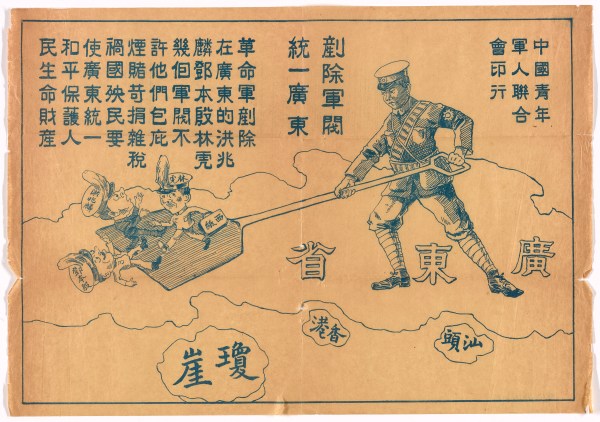
“Eradicate Warlords and Unite Guangdong,” unknown artist, c. 1926. Published by the United Society of Chinese Youth and Military.Courtesy of the Special Collections, Yale Divinity School Library, New Haven, Connecticut.
“Eradicate Warlords and Unite Guangdong,” unknown artist, c. 1926. Published by the United Society of Chinese Youth and Military.
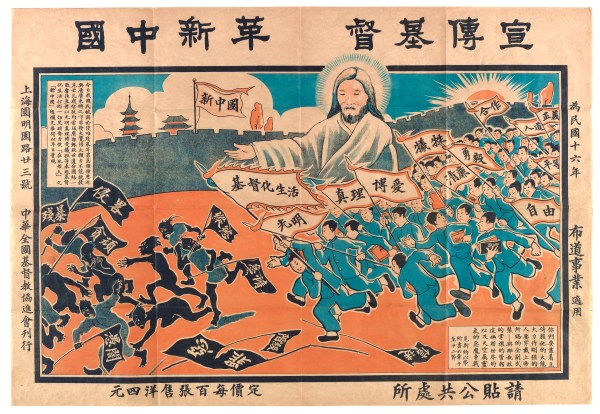
“Preach Christ, Reform China,” unknown artist, 1927. Published by the National Christian Council of China.Courtesy of the Special Collections, Yale Divinity School Library, New Haven, Connecticut.
“Preach Christ, Reform China,” unknown artist, 1927. Published by the National Christian Council of China.

Arriving in bundles of 100 prints, the Christian posters mounted their own campaign for the hearts and minds of the people. These posters were not for use in Sunday school or designed to decorate a sanctuary. The bottom of each poster provided very clear instructions: “Please hang in a public place.”

The NCC posters modified the Nationalist Party’s imagery so it was no longer the Nationalist Army that was rooting out evil and corruption but Jesus and his troop of modern evangelists.

Christ, not Chiang, is the one who frees China from foreign aggression, ignorance, class differences, and superstition.

Behold, now is the day of salvation

Other Christian posters in China expressed a deep sense of urgency.

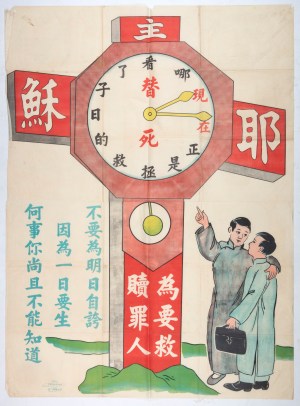
“Decision Time,” artist and date unknown. Published by the Jiangxi China Inland Mission Bible School.Courtesy of the World Gospel Mission Archives, Marion, Indiana.
“Decision Time,” artist and date unknown. Published by the Jiangxi China Inland Mission Bible School.

China had been carved up by imperial powers. For 70 years, every effort to resist had failed. To keep trying the same things—the same old political solutions, military strategies, or economic adjustments—or even adhering to the same old religious beliefs or following the same moral rules was tantamount to surrender.

To many in China, the track record was obvious: If China did not change, then there would be no China at all.

“Decision Time,” a poster with a clock superimposed over a cross, honed that message. Not only was the wording on the clock clear—“Now is the day of salvation”—but its imagery was also jolting.

Clocks are associated with death in China, and this poster struck a particularly time-sensitive note: Unless change happens immediately, the end is here.

Sin no more

Chinese Christian posters were attention grabbing and worked to persuade viewers of their own moral and spiritual crisis. But they also communicated that more was at stake than personal salvation.

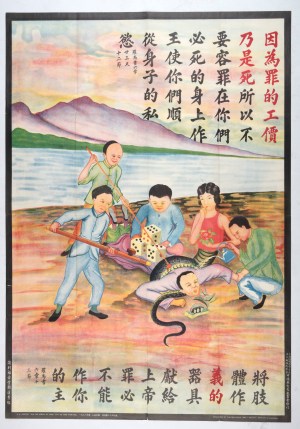
In subtle yet clear ways, these posters referred to China’s desperate situation. At first glance, the poster “Sin the Enemy of Man” appeared to address an individual’s rather standard vices—alcohol, opium, prostitution, and gambling.

Chow Chih Chen, “Sin the Enemy of Man,” 1936. Published by the Religious Tract Society of Hankow (and Shanghai). Courtesy of the World Gospel Mission Archives, Marion, Indiana.
Chow Chih Chen, “Sin the Enemy of Man,” 1936. Published by the Religious Tract Society of Hankow (and Shanghai).

However, the poster’s audience at the time would have recognized the man ensnared by these sins not just as an individual susceptible to sinning but as a metaphor for China.

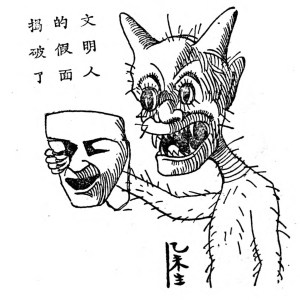
At the back, wearing a green shirt and holding a spear to the neck of the poor man, is a masked figure. Beginning in the 1920s, images inspired by Marxist-Leninist teachings circulated in China depicting such masked men. (The Nationalists weren’t the only political movement that believed in the power of posters.) They always conveyed a clear message: Westerners, especially missionaries, could present themselves as “civilized” men and women, but they were “monsters” in reality.

Western missionaries were particularly sinister, so this Marxist-Leninist propaganda went, because their treachery was hidden behind high-minded ideals. What appeared to be an offer of assistance to China through education, agricultural modernization, and medicine was in fact a ploy, nothing more than a cover for cultural imperialism and economic exploitation.

According to Communist propaganda, then, national salvation began by recognizing the reality of foreign aggression hidden behind the mask and expelling such “evil” forces from the country.

Chow Chih Chen, the Religious Tract Society artist who composed “Sin the Enemy of Man,” responded to this notion by making his poster a parable of China’s present condition.

“Unmasking the Uncivilized Person,” unknown artist. From Dongfang Zazhi 22, no. 13 (July 1925): 63550.1/23/18 – Boston, Massachusetts Chinese propaganda posters Photo by Carl Peer for Boston University Photography
“Unmasking the Uncivilized Person,” unknown artist. From Dongfang Zazhi 22, no. 13 (July 1925): 63550.

Chow used the iconographic clue of a masked man to help viewers realize that his poster was not simply about an individual’s moral shortcomings. In his drawing, the entire nation was chained and ensnared by what many would assume to be harmless leisure activities and various kinds of amusements. In its epicurean reverie, China had rendered itself incapable of resisting the foreign powers that held a deadly spear to its neck.

This poster sent both a biblical and geopolitical message to the country: “The wages of sin is death.”

For those who had eyes to see, national salvation did not lie in modernization, Communist revolution, or the Nationalists’ military strength.

Something deeper must transpire, because China had become a helpless captive, easy prey for foreign powers to eliminate. The nation must turn to Jesus now, for he alone could break the bonds that enslaved the nation, the poster urged.

Two roads diverged

Few things communicated the necessity of changing direction like posters with two different roads.

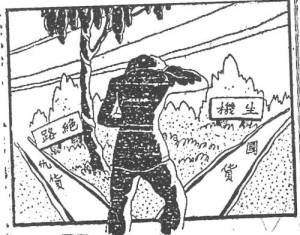
Shenbao, May 4, 1933, reprinted in Weipin Tsai, Reading Shenbao: Nationalism, Consumerism and Individuality in China, 1919–1937 (London: Palgrave Macmillan, 2010), 123.

This was a common visual tool used by political activists in the 1920s and 1930s to simplify a person’s choices. Cartoons, like this one that appeared in the newspaper Shenbao, put people at a crossroads.

To the left is a road marked “enemy products” with a sign explaining that buying imports—even if they were cheaper—was the straightest path to China’s collapse. To the right is a road named “national products,” with a sign pointing toward “national survival.”

Everything hinged on a person’s choice. Which way to go?

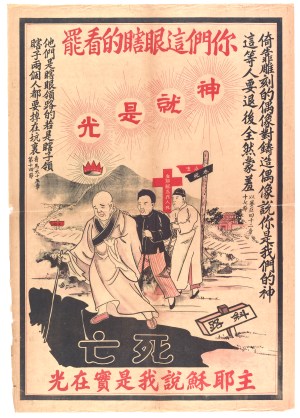
Christian posters only slightly modified the scene. Seldom were people precisely at the crossroads. Rather, they tended to have mindlessly wandered past the fork in the road, continuing in their selfsame direction. If they did not become alert to the signs around them, the results would be catastrophic, these posters cautioned.

“Look, You Blind!” shows a Buddhist monk, a farmer, and a scholar (a cross-section of China itself) following the “wrong road.” They are a half step away from going over a cliff and about to plummet to “eternal death,” as the sign warns.

“Look, You Blind!,” unknown artist, date, and publisher.Courtesy of the Special Collections, Yale Divinity School Library, New Haven, Connecticut.
“Look, You Blind!,” unknown artist, date, and publisher.

Yet even at this last moment it may not be too late. If people would just heed the signs, things could turn out much differently. An alternative path exists—an ascending road that leads to an eternal reward. Those looking for salvation just need to pivot, and a crown of glory will be theirs.

The life-saving cross

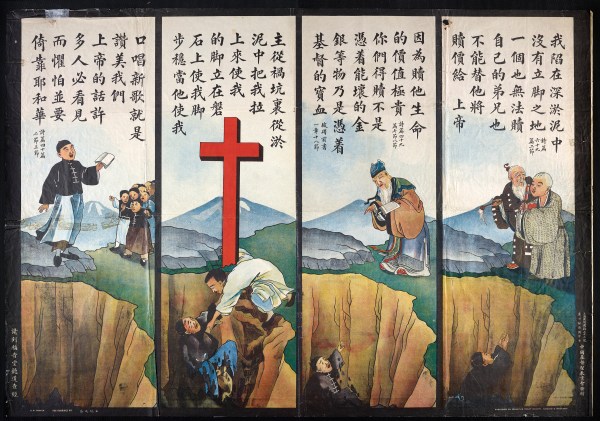
Many Christian posters also warned that China and its people were on the verge of disaster, their feet dangling on the edge of the Abyss.

But other posters went further. They conveyed how the people of China had passed a critical moment and did not need to make a choice. Rather, they needed to be rescued.

In the 1920s, a drought pushed 20–30 million Chinese people toward starvation and claimed the lives of 500,000. A decade later, floods displaced 52 million people while the waters swallowed two million lives.

In between those catastrophic events, China endured almost a dozen civil wars, withered under crippling economic sanctions, was stripped by the worldwide Great Depression, and watched helplessly as Japan annexed Manchuria.

The following decades were arguably worse, as the Nationalist and Communist armies turned regional conflicts into a national battle and turned a national battle into a world war.

China, in the heyday of Christian poster propaganda, was a nation teetering on the brink of an abyss.

“The Horrible Pit,” unknown artist, 1929. Published by the Religious Tract Society of Hankow (and Shanghai). Courtesy of the Special Collections, Yale Divinity School Library, New Haven, Connecticut.
“The Horrible Pit,” unknown artist, 1929. Published by the Religious Tract Society of Hankow (and Shanghai).

No wonder viewers felt that they needed something to hang on to.

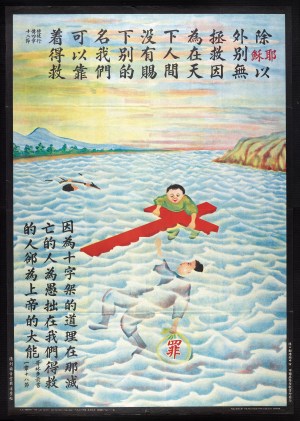
Time and again, Christian propaganda posters provided that sense of hope and assurance concretely. The cross of Jesus became the one firm anchor or life raft in an otherwise dangerous and destructive world. Its auspicious red color promised viewers not only a new beginning but also a blessing. Their ill fortunes and the collapse of China could be reversed if they would just cling to the cross.

Timeless truths

Whether the solutions to China’s many crises at the beginning of the 20th century were easy to solve or not, Christian posters allow us to view what Chinese Christians believed about their faith and how they tried to make it attractive to their compatriots.

Chow Chih Chen, “The Life Saver,” 1936. Published by the Religious Tract Society of Hankow (and Shanghai).Courtesy of the Special Collections, Yale Divinity School Library, New Haven, Connecticut.
Chow Chih Chen, “The Life Saver,” 1936. Published by the Religious Tract Society of Hankow (and Shanghai).

In the hundreds of posters collected at ccposters.com, one can see how Chinese Christians crafted their own message of national salvation in the face of Nationalist and Communist propaganda. Protestants believed Christ could transform China, and they depicted his marvelous acts of salvation in a variety of ways.

It is no wonder, therefore, that when the Communists rose to power in 1949, almost all these Christian posters were destroyed. Surviving posters, carried out by missionaries and refugees, are now being tracked down by the Center for Global Christianity and Mission at Boston University, and they reveal some of the creative ways Christians in China vied for the soul of their nation.

Daryl Ireland is research assistant professor of mission at Boston University School of Theology and editor of the forthcoming book Visions of Salvation: Chinese Christian Posters in an Age of Revolution.

A previous version of this piece was published on ChinaSource.

News

Ukraine’s Prison Fellowship Extended to Russian POWs

Chuck Colson–linked ministry has long served Ukrainian inmates but is pushed to the limit by wartime realities—and gospel requirements.

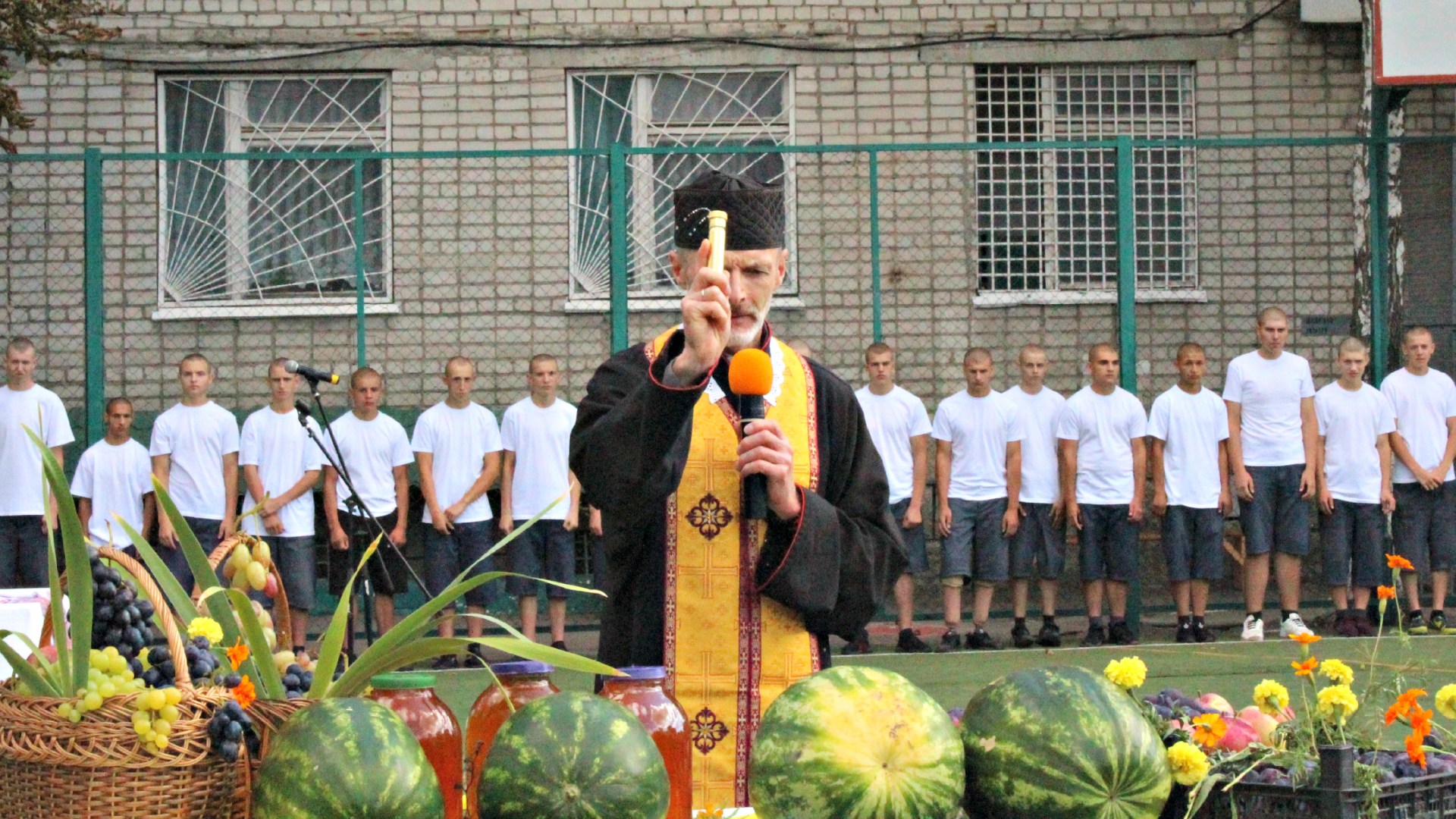
A priest prays for food for Ukrainian prisoners.

A priest prays for food for Ukrainian prisoners.

Christianity Today November 14, 2022
Courtesy of Prison Fellowship Ukraine

Vyacheslav Kogut was so angry he could spit.

The Russian invasion once again drew him out of his normal ministry as executive director of Prison Fellowship Ukraine (PFU) and into relief work. The military counterattack had just liberated another village on the eastern front, where several civilians had been shot.

The source of his ire, however, was his summons back to prison.

“We have Russian prisoners of war who need clothing,” informed the warden.

“I’ll bring them skirts and dresses,” Kogut shot back, grumbling.

Internally seething at having to leave his injured compatriots, he then remembered his Bible: If your enemy is hungry, feed him—as well as, I needed clothes, and you clothed me.

He went into the storehouse that collected goods for displaced Ukrainians and took the best of its donated items. Security guards at the prison were amazed at the quality. And in addition to the regular food and supplies they offer to Russian POWs in ongoing weekly visits, his team now adds candy and sweets.

“It is a way to show many people, besides these prisoners, that God is love,” said Kogut. “And when they go back to Russia, they can never again return with guns and hatred.”

Affiliated with the international network of the Chuck Colson–founded ministry, PFU began work in Ukraine in 2002. The nation is home to a prison population of 48,000 in 85 still-surviving jails, and Kogut says his team ministers in all of them.

It was not always so. Despite its ecumenical approach from the beginning, PFU’s evangelical orientation worried some prison officials. But consistent ministry to inmates and guards alike won favor, as did the scope of entertainment options presented.

Soccer teams visited from Brazil, Eurovision stars put on performances, and—dearer to the hearts of the prisoners—summer camps were held to care for their children.

And in 2008, PFU began teaching courses on chaplaincy, receiving certificates from the central government to enter any prison in Ukraine. Within two years, Kogut said, the prejudice was overcome.

“Our mission is dependent on unity,” said Constantin Panteley, PFU secretary and a priest in the Ukrainian Greek Catholic Church. “We only bring misunderstanding about Christianity if we are divided.”

Many prisons now have separate chapels for Orthodox, Catholic, or Protestant services. But inmates often are a product of Soviet irreligion and have only nominal attachment to a denomination. Panteley has seen many converted, who then choose their favored service.

“We will win this war because of our unity of differences,” he said, drawing contrast to the persecution meted out to non-Orthodox in occupied areas of Ukraine’s eastern Donbas region. “Unlike Russia, we appreciate freedom.”

For instance, a priest may serve as a substitute if a Pentecostal pastor is not available to minister to an inmate. Even clergy from the Ukrainian Orthodox Church, which did not cut ties with Moscow until May this year, have stepped in when needed. Their cooperation survived the damage from the 2014 Russian-backed separatist movement in Donbas and the annexation of Crimea.

The strife, however, severed 20 percent of Ukraine’s prisons from the central government. But even in the contested region, PFU maintained connections with prisoners. Some hid cell phones to continue counseling. Sympathetic local citizens secretly delivered Bibles.

It all came to a halt with the Russian invasion.

“The war resulted in a severe breakdown of the supply chain for food and medicine into prisons,” said James Ackerman, president of Prison Fellowship USA. “And as you might imagine, prisons and halfway houses are at the bottom of the food chain.”

The US board, Ackerman said, donated $1 million to repair the supply chain.

Through PFU, PF Romania, and local churches, over 2,500 volunteers are delivering essential food and medicine to inmates, while working with authorities to repair remote, dilapidated structures and expand facilities to accommodate prisoners evacuated from elsewhere. At least five facilities have been hit by Russian shelling, though inmates in each had already been transferred to safer areas.

And recently, the US branch of Prison Fellowship approved funding to buy generators. Since Ukraine began its surge on the battlefield, President Volodymyr Zelensky said that Russian drones have destroyed one-third of the nation’s power stations.

At the start of the invasion, all jails were closed to outsiders for security. The minister of justice, responsible for the prison system, said civilian evacuations should be prioritized. Guards were left behind as their families fled.

The fear was palpable, Kogut said. Even the transfer of inmates and officials alike weighed heavily on their souls. Eventually, PFU regained access, and the existing indifference to regular chapel services was replaced by fervency. A mini-revival is underway.

So is an ad hoc reform PFU proposed at the highest levels. The ministry agreed in principle to implement a probation system to sentence those convicted of lesser crimes to a rehabilitation center rather than prison. The invasion sidelined official implementation, but now by necessity these halfway houses are bursting at the seams.

“Some come to us with diseases, broken in body and spirit,” said Mikhail Dren, who oversees a center in Lviv. “But we help restore them and bring them into a relationship with God.”

Some centers are run by the government; others, by churches. Church facilities usually house 10–12 people, although Dren’s can accommodate 100. Pastor of the Pentecostal New Life Church in nearby Boryslav, he said room and board costs $3,000 monthly. And this is in addition to the extra 120 families they care for, internally displaced by the war.

But the results are worth it. Only 5 percent of Ukrainian convicts eligible for rehabilitation can find housing, he said, but 70 percent of those in PFU centers remain in church and contribute to society after their release. Over 20 formerly incarcerated persons, now with wives, children, and jobs, attend New Life.

Responsible for all prison ministry in western Ukraine, Dren’s efforts place him in close communication with the national Ministry of Justice. And as a result, he was tapped to lead the spiritual outreach to Russian POWs. A reported 51 small detention facilities are scattered throughout the country’s regions, along with one large center in an undisclosed area in the west.

It has not been easy.

While Dren was serving as a frontline chaplain in 2015 during the separatist struggle, his good friend was shot in the groin by a Russian sniper. Under fire and unable to evacuate, he watched his friend bleed to death.

More recently, Dren delivered aid to the family of a killed soldier. The soldier’s young boy, distraught from the war and his father’s long absence ran up and clasped Dren around the legs, crying out, “I finally found Dad.”

From there he went to the POW camp.

“First, it is God’s grace; and second, it is impossible,” said Dren. “But we are Christians, and we must share the gospel.”

The Russian prisoners are a captive audience, he said, and listen politely. Initially, they kept quiet, assuming chaplains to be part of Ukraine’s security apparatus. But over time they engaged more, as “huge numbers” of them realized these volunteers were ordinary people who were treating them well.

By contrast, the UN has documented cases of torture, dire health conditions, and denying family communication to Ukrainian POWs in Russia. Ukraine has been criticized for lesser violations of the 1949 Geneva Convention governing treatment of prisoners of war, hosting press conferences with confessing soldiers and posting videos in which soldiers reveal personal details.

Conditions in the prison camp cannot be disclosed for security reasons. But an official visit to one facility, granted to Agence France-Presse, pictured steel-framed bunks with wafer-thin mattresses. A television and outdoor recreation are made available, while prisoners are assigned work to contribute to Ukraine’s well-being.

“Given that we didn’t exactly come here for a [tourist] visit, it’s what you’d expect,” said one. “They feed us, water us, do not offend us.”

PFU kindness gets through to some. Dren said that POWs have broken down in tears and apologized. Others, as he can tell in their eyes, connect with the spiritual lessons. He has yet to meet a POW with evangelical faith, and upon the frequent prisoner swaps, they say goodbye without emotion.

Around 800 Ukrainians have returned home from Russia in roughly 20 prisoner swaps, said an intelligence official. The number of Russians exchanged has not been disclosed.

Dren is confident there is an impact, but the greatest transformation is internal.

“I have no desire to go to them, to give hugs and kisses,” he said. “But agape love, above our understanding, does exist.”

Yet many Ukrainians warn that it should not be demanded of them.

“Only those who have personally seen the war, seen hellfire in the flames, and seen the enemy in the face have the right to admonish,” said Taras Dyatlik, regional director of Overseas Council, United World Mission (Ukraine). “The call to love your enemies comes from the cross, not from a Jerusalem pub or temple.”

Within the last month, at least three evangelicals have died in the war. Andrey Zhuravel, a Presbyterian from Kharkiv, died defending the frontlines. Ernest Skalun, a member of Renewal Church in Mariupol, died in the shelling. And so did Mikhailo Makhnyk, a deacon in the Baptist church in Siversk, killed while delivering humanitarian aid.

Dren pleads for more Western military support. Panteley agrees, though he emphasizes that Ukrainian love of freedom will win the war. And while Kogut also concurs, his sense of victory comes from the highest cause.

“The evil of Russia can only be stopped by force—this is what our soldiers do,” he said. “But it can only be defeated by love.”

News

Wiser than Solomon: Can Evangelicals Lead the Middle East Toward Creation Care?

As Egypt hosts COP27, a few pioneering believers struggle to transform the region most at risk of climate change yet demonstrating the least concern.

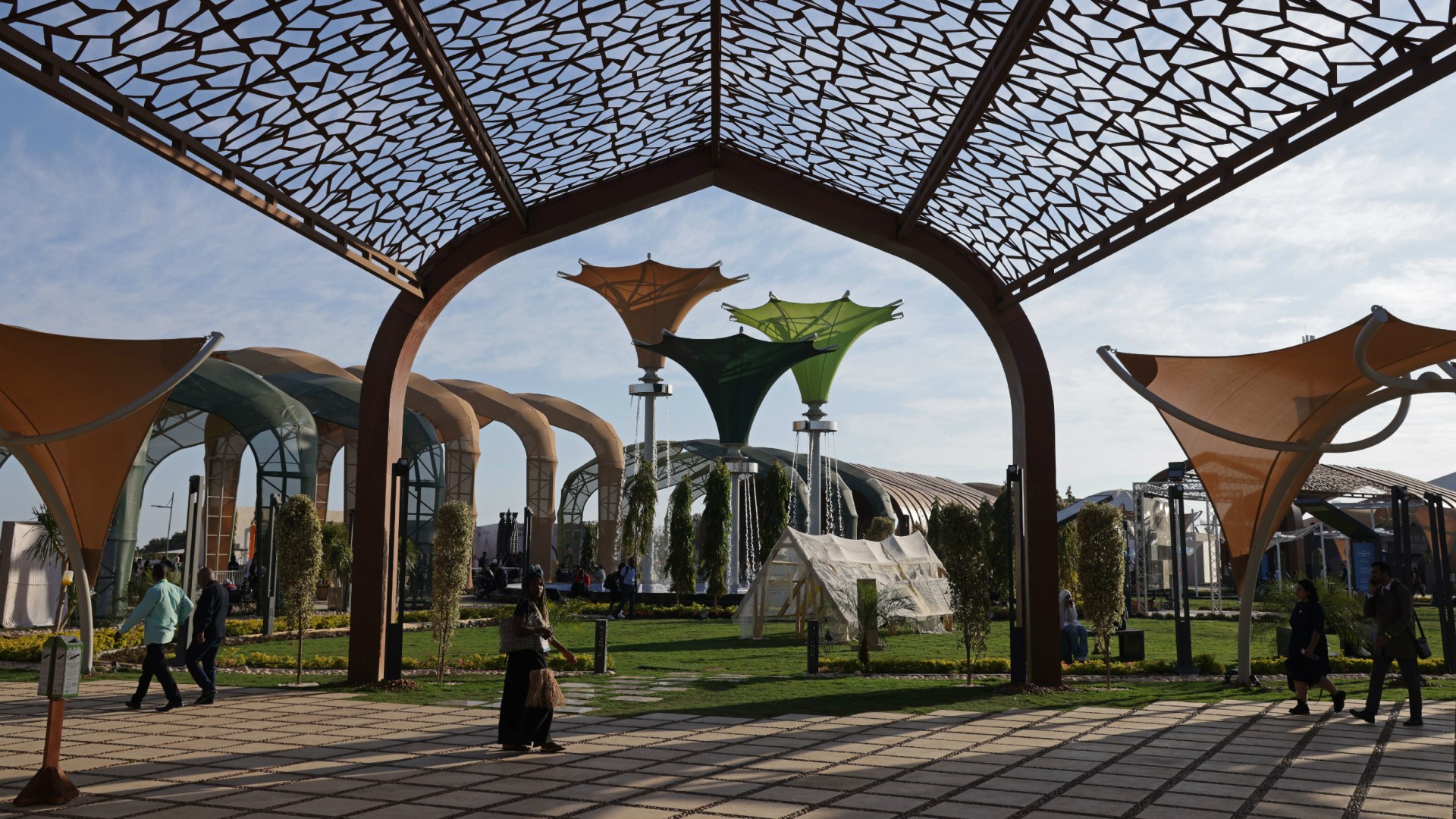
Visitors walk in the Green Zone of the COP27 climate conference on November 10, 2022 in Sharm El Sheikh, Egypt.

Visitors walk in the Green Zone of the COP27 climate conference on November 10, 2022 in Sharm El Sheikh, Egypt.

Christianity Today November 14, 2022
Sean Gallup / Getty Images

“Wisdom,” said Jesus, “is proved right by all her children” (Luke 7:35). But sometimes it takes generations to judge, as demonstrated by a new research study that threatens to tarnish the reputation of a legendary biblical paragon.

According to archaeologists at Tel Aviv University, King Solomon disregarded the environment.

Today, his spiritual descendants largely follow in his footsteps.

“We have so many working in evangelism, church planting, and leadership development,” said Michael El Daba, the Lausanne Movement’s regional director for the Middle East and North Africa (MENA). “Almost no one is working in creation care.”

Evangelicals are not alone. According to a 2021 report by the Institute for Economics and Peace, the MENA region demonstrated the least concern for climate change, including 10 of the 20 lowest-scoring nations. Only 18 percent of those surveyed in Egypt, for example, recognized it as a “very serious threat”—even as it exacerbates food insecurity.

Arab Barometer, a regional pollster, found that 68 percent of Egyptians reported running out of food before being able to get more. In half of the other MENA countries surveyed, majorities stated the same. And in 9 out of 10, majorities worried it might happen to them.

Temperatures in the region are rising twice as fast as the rest of the world, according to a study published last June in the Reviews of Geophysics. At current rates, Egypt will be nine degrees hotter by the end of the century. Iraq has already increased three degrees in the last 30 years.

Some of the damage is self-induced. The study identifies MENA as a “dominant emitter” of greenhouse gases, overtaking Europe and India. Resource extraction—as necessary as the hydrocarbons are for national economies and modern society—comes with a cost.

Just as it did with King Solomon’s mines.

Although his mines are not specifically mentioned in the Bible, copper is known to have been extracted from the Timna Valley, north of the Gulf of Aqaba in ancient Edom, a region conquered by his father David. Solomon used the minerals in the construction of the temple.

Over 4,000 acacia trees and 185,000 white broom bushes were cut down to smelt the copper, according to charcoal evidence located by the Tel Aviv researchers and published in the Scientific Reports journal. Their removal “irreversibly affected” the soil’s ability to retain moisture, sparking the desertification that continues today.

Some researchers question the association with Solomon, but contemporary abuses ensure the region grows only drier. To the north, the Jordan River’s historic discharge of 1.3 billion cubic meters of water into the Dead Sea has been reduced to as low as 20 million, according to a 2013 UN study.

A joint Israeli-Jordanian project to lessen pumping in favor of desalination aims to increase flow by up to 40 million cubic meters, but the region suffers everywhere. According to the World Resources Institute, MENA is home to 12 of the 17 most water-stressed nations in the world—and again, some of the harm is self-inflicted.

According to the World Bank, only 18 percent of wastewater in the region is reused.

“Preserving water is fundamental,” said Georges El Copti, pastor of St. Paul’s Anglican Church in Amman, Jordan. “We are part of creation, and we have to care for it.”

Copti was interviewed last month as part of the Middle East Council of Churches’ effort to promote the international “Season of Creation,” sponsored in part by the Lausanne/World Evangelical Alliance Creation Care Network (LWCCN). He spoke not only of the importance of raising awareness but also about the rainwater harvesting project at his church.

Collecting even the minimal yearly rainfall in the desert kingdom can supply 30 percent of a household’s annual water need, stated the Jordanian Ministry for Water and Irrigation. Copti’s efforts are contributing to his congregation becoming an “Eco church,” a recognition awarded by A Rocha International, an evangelical environmental organization active in 20 countries.

Since its beginning in the United Kingdom, A Rocha has led thousands of churches to commit to embedding creation care into their preaching, worship, and facility management. Spinoffs are developing in France, Ghana, New Zealand, and Switzerland—though not yet in the Middle East.

“Matter reveals God,” said Dave Bookless, director of theology at A Rocha International. “If we destroy nature, we are ruining opportunities for evangelism.”

Bookless, also a creation care catalyst for LWCCN, spoke last month in Jordan, concluding a 12-region tour to promote the Lausanne Congress conviction, ratified in 2010, that “creation care is a gospel issue within the Lordship of Christ.”

The message has been slow to circulate.

“I know all the pastors,” said a Christian leader from Algeria. “This will be a revolution.”

Requesting anonymity due to social and governmental discrimination against Kabyle converts, the 26-year pastor said he is a rare environmentalist in his country. Partly it comes from experience: His church meets outdoors in nature, denied a permit to open a building.

When authorization comes, he plans to install solar panels—and expects grumbling from the congregation. Why bother, he anticipates their objection being, when the government offers such a steep subsidy on fossil fuels? As of 2021, OPEC member Algeria is the world’s 19th-largest oil exporter and a European target for increase given the disruptions caused by the Russia–Ukraine war.

Already aligned with the conference aims, the pastor still praised Bookless.

“I knew about recycling,” he said, “just not the Bible verses.”

Others in the region have gone further than reduce and reuse.

A Rocha Lebanon won acclaim for restoring the Aammiq Wetland in the Bekaa Valley. In the 1970s, authorities drained the area to combat malaria, unintentionally destroying an important transit point for north-south bird migration. The evangelical ecologists began restoration work in the early 2000s, and today the area is home to 53 species of butterflies, among other returning wildlife. And to the consternation—but not infection—of locals, even the mosquitoes are thriving again.

A current project, slowed by Lebanon’s financial crisis, is transforming a civil-war-era Syrian army landfill into a garden, complete with roses, fig trees, and a prayer labyrinth.

And outside Bethlehem, the Tent of Nations has turned the century-old Nassar family farm into an international peace and environmental center. Victim to attacks by both Jewish settlers and fellow Palestinians, the Lutheran family’s property is also claimed by the Israeli government, which uprooted many trees.

The Nassar slogan proclaims to all, “We refuse to be enemies.”

“Many evangelical churches preach, ‘Our home is in heaven,’” said Salim Munayer, founder of the Musalaha reconciliation ministry, in Jerusalem. “But as Arabs, our identity is very much connected to a geographical location, with the land itself as a fifth gospel.”

The identity is reflected even in many people’s name, he said. Many Arabic surnames end in i to connect to a traditional city or village, just as Iraqi or Yemeni denotes the national adjective.

But for those in the Holy Land, the attachments are often even stronger. And the environment is frequently one more avenue for politics within the Israeli-Palestinian conflict.

Bedouins in Galilee fear a wildlife corridor planned by the government is a disguised land grab that will limit the grazing of their livestock. And Jack Sara, general secretary of the MENA Evangelical Alliance, said that when early Zionists cleared Palestinian villages, they planted olive trees above them to hide their aggression.

He also addressed the common evangelical suspicion in spiritual terms.

“When we hear phrases like ‘creation care,’ it brings to mind someone hugging a tree,” Sara told LWCCN conference attendees. “But whenever I walk in a forest, I feel like I want to pray, don’t you?”

But none of the belonging, conflict, or meditation has been enough to rally evangelical concern for the environment, which is often seen as a “luxury topic” amid scarce resources and donor interest. Daba said that while Middle Eastern believers have largely joined social action to their verbal witness, the third pillar of the gospel—creation care—is still lacking.

He has a strategy.

“If we show them how ecology will also help the poor, they will pursue it,” he said. “We must incentivize social work to become environmental.”

A former business executive, Daba said his world once revolved around effectiveness, efficiency, and profitability. But when he became director for funding and investment for the Coptic Evangelical Organization for Social Services (CEOSS), he saw a reality once wholly alien to his church experience—shifting his concern to equality, poverty, and human rights.

It is an uphill battle to change mentalities, he said. But as his native Egypt is hosting the 27th session of the Conference of the Parties (COP27) to the UN Framework Convention on Climate Change, there has never been a better time to rally local concern—or to make it practical.

Increased salinity from the rising Mediterranean will impact the Nile River, from which Egypt draws 95 percent of its water. At current levels, crop yields will decrease 10 percent by 2050.

One Egyptian project can serve as Daba’s model.

Since its opening in 2012, the Health and Hope Oasis (HHO) in Wadi el-Natroun has provided free residential cancer care to over 10,000 children. The facility is located halfway between Cairo and Alexandria, a region which is home to some of Egypt’s most famous once-remote monasteries.

Today, the green pastures are gone—a victim of urbanization and its overreliance on precious groundwater.

“I’ve seen the effects of the loss of agricultural land in Egypt,” said 72-year-old cofounder Magda Iskander, a trained radiologist. “I am connected to the land and a peasant at heart.”

Her vision is more than ecological. To sustain the hospital’s charitable services, its 40 acres of farmland produce food for the housed families—including mangoes, dates, bread, beans, and vegetables. Water buffalo provide milk and meat, while cafés in Cairo donate used coffee grounds for fertilizer.

And whenever there are excess funds, the charity adds to its many trees.

Running a secular organization primarily serving Egypt’s Muslim majority, the lifelong Presbyterian cofounder encourages Christians to overcome their ghetto mentality. How else will society know you are different?, she asked, noting that HHO has drawn more than 1,200 cross-faith volunteers.

“Sometimes we forget what Jesus did,” said Iskander. “Create a team, and get them to share your vision.”

This charitable model may soon be increasingly in demand. According to the World Bank, by 2050, water scarcity in the Middle East will reduce regional GDP levels by up to 14 percent.

Despite his alleged environmental failing, the wisdom of Solomon remains necessary today. But as the Gospels state, now one “greater than Solomon is here.” Jesus, as head of the Middle East church, is present in all its challenges.

“Evangelicals have always been a forward-looking beacon of change in our region,” said Daba, referring to the schools and hospitals they’ve established and sustained—and even the taboo on smoking. “Now we need to lead in care for creation.”

Ideas

Should We Cancel Luther and Calvin?

The Reformers believed in burning heretics. Making sense of that grave mistake means looking first at ourselves.

Christianity Today November 14, 2022
Illustration by Mallory Rentsch / Source Images: Unsplash / WikiMedia Commons / Getty

Cancel culture knows no bounds, even historical ones. Based on some un-Christlike writings by Protestant reformers John Calvin and Martin Luther—along the lines of burning heretics—there have been some recent discussions about “cancelingthese paragons of church history. The debates sound similar to conversations we’ve had about secular historical figures being canceled for owning slaves, for example.

Unfortunately, it seems every generation of Christian leaders and teachers has had its own problems and blind spots. We should seize these opportunities for self-reflection, to determine if we ourselves might have similar weaknesses.

In 200 or 300 years (if there are still 200 or 300 years of history left ahead of us!), what are we going to look back on as seriously problematic? It’s only recently that most Christians I know have given up smoking, for instance.

There have been great social changes since the 16th century, a time when most Christian leaders considered burning heretics an acceptable practice. In their view, heresy on key issues of the faith was such a serious problem that genuine apostates could not be allowed to live and had to be put to death as a lesson to others.

I live in the middle of Oxford, a few hundred yards down the street from the Memorial to the Martyrs Ridley and Latimer, who were burned at the stake in the 1550s. Those were terrible times. We look back and say, “How could they possibly have done that out of misplaced zeal and loyalty to God and the gospel? What was that about?”

From their point of view, burning heretics was about trying desperately to keep the church and society pure from the devastating, corrupting influence of heterodox teaching. Now we would say they were wrong in taking those actions. But that’s where leaders were at the time.

For me, what Calvin and Luther wrote or said in these questionable instances doesn’t negate all of their teaching. It merely means that they, like the rest of us, got something seriously wrong. In fact, Luther himself developed the theology that we are at the same time both righteous and sinful. He knew perfectly well that he was still a sinner, even though in Christ and by faith, God had declared him righteous.

We must look at the larger picture, as well, and see that in every generation, there are people (including myself) who invoke God in Christ but whose lives, habits, and larger policies are not blameless. There are many theological issues that subsequent generations will look back at and say, “We see something different than what they taught.”

If you start where Luther and Calvin started—with the Roman Catholic theology of the late 15th and early 16th centuries—then you see how church problems were playing out in terms of the sale of indulgences and other issues. They were forced to give fresh answers to questions of their time. And they did the right thing by going back to the original sources of Scripture to retranslate or reinterpret the Greek and Hebrew of the New and Old Testaments.

The problem with canceling them, at least from my perspective, is that they were trying to give biblical answers to late Medieval questions. From where I sit, both Luther and Calvin were largely unaware of the different nuances of first-century questions at the heart of Scripture. And so I applaud their method of going back to the original sources and learning fresh wisdom.

They were concerned enough to critique Medieval abuses. But that didn’t mean they had no abuses of their own.

Instead of canceling them, let’s honor their method by reading Scripture in the original and doing our best to find out what it means. That will help us understand what questions early Christians were seeking to answer. It will also give us a new set of answers to questions we’re facing in our own day.

Ultimately, we can go to these characters from the past and celebrate what’s good in their theology without idolizing them or their actions. They were as human as anyone, and I think they themselves would have insisted upon it.

N. T. (Tom) Wright is one of the world’s leading New Testament scholars and the author of many academic and lay-level books on theology and the Christian life. This piece was adapted from a live conversation on the Ask NT Wright Anything podcast from Premier Unbelievable?

Speaking Out is Christianity Today’s guest opinion column and (unlike an editorial) does not necessarily represent the opinion of the publication.

News

Interview: The Growing British Concern for Religious Freedom for All

Bishop of Truro continues advocacy after groundbreaking UK government report on the persecution of Christians wins wide acceptance.

The UK government's Truro Report on the persecution of Christians was presented at The Church House on July 15, 2019 in London, England.

The UK government's Truro Report on the persecution of Christians was presented at The Church House on July 15, 2019 in London, England.

Christianity Today November 12, 2022
Dan Kitwood / Getty Images

The American government has long committed itself to supporting religious freedom worldwide.

In 1998, the International Religious Freedom Act obliged the State Department to compile an annual report and designate offending nations as Countries of Particular Concern. It established an ambassador-at-large, created an independent bipartisan commission, and placed a special advisor on the National Security Council.

What about the British? Three years ago, the UK government asked itself the same question.

The answer was delivered by Philip Mounstephen, the Anglican bishop of Truro, within the province of Canterbury. The UK’s foreign secretary tasked him specifically to study persecution of Christians, and the 22 recommendations of the Truro Report were accepted in full by the government.

That does not mean they were all implemented.

This past summer, an independent review found good progress, with five points suffering “constraints” and only three with “no substantial action.” As it was released, London hosted the third in-person ministerial which gathered governments and civil society around the cause, following two ministerials hosted in Washington and an online-only one hosted by Poland amid the pandemic. (The UK event used the European nomenclature of “freedom of religion or belief” (FORB) instead of the Americans’ “international religious freedom” (IRF).)

Last month, Mounstephen visited Lebanon to deliver a lecture entitled “Why Our Religious Freedom Matters.” Hosted by the Middle East Council of Churches, the Bible Society, and Saint Joseph University, he presented an outline of Truro Report findings, broadened to include the persecuted of all religious traditions.

CT spoke with the bishop about his government’s commitment to the cause, whether Americans help or hurt, and how to overcome the younger generation’s rejection of Christian advocacy as an expression of white privilege and neo-colonialism:

Bishop of Truro Philip Mounstephen presents the FCO Persecution of Christians report at The Church House on July 15, 2019 in London, England.

CT: Our readers know that within the Anglican church there is a spectrum of evangelical and mainline faith, to use the American terms. How do you fit in?

Mounstephen: One of my roles is to be a pastor to the whole of the diocese. I can’t pick and choose and have favorites. But in British terms, I would be defined as an “open evangelical.” I believe in the authority of Scripture, in the finished and all-sufficient work of Christ on the cross, and the glorious grace of God that brings life to the dead.

And you have lived it out in your institutional service.

I was chief executive of Church Mission Society, which was an amazing opportunity to go to some of the most out-of-the-way parts of the world and see the people of God ministering with such love and care and commitment to people often very much on the margins. That was such a huge privilege.

You are a bishop, but you also have a role in global advocacy.

Yes. And I had no expectation when I took it on that it would be so. Before I officially started, I was called by the bishop of Canterbury who asked if I would undertake this work at the request of the then-foreign secretary to review how the UK Foreign Office responded—or not—to the question of the persecution of Christians.

Our team had a strong sense of the wind of the Holy Spirit leading us on. And to my great surprise, the government accepted the recommendations in full, repeatedly affirming it in documents since. It is often referred to in the House of Commons and Lords, holding the government to account for implementation.

I feel this is something God has laid on my heart to do, absolutely convinced that it is one of the major big-ticket items in the world that we must address—for the good of all humanity.

How does your advocacy continue since the publishing of the report?

I thought I would do it for six months, set it aside, and the report would gather dust on some government shelf. But I was very aware that there was no forum for civil society organizations to meet, of which there are many in the UK. So we set up the UK Freedom of Religion or Belief Forum, which I chaired for its first year of operation. It now gathers about 90 different groups, modeled on the International Religious Freedom Roundtable that has been meeting in the US for a long time.

The UK hosted the Ministerial Summit on FORB this summer, and I was involved in that. Today I am here in Lebanon because I want to continue to advocate internationally, and I am due to go to Greece to meet with members of the foreign ministry and the Orthodox church.

Because I am the bishop of Truro, and the report is known as “the Truro report,” it has a currency that is associated with me. So this is a responsibility, and I want to push forward and advocate as best I can.

And because we have this strange system in the UK, in which the 26 most senior Church of England bishops sit in the House of Lords, I will probably take my seat in a year or so, depending on turnover. This will also be a continuing platform for advocacy.

Without making your parishioners jealous, how much time can you give to the issue?

[Laughed] I have to say, people have been very supportive and encouraging. Part of my agenda for the diocese is that I want us to have more of an international perspective. Cornwall is in the far southwest of the British Isles, and it can be quite isolated, including in mentality. Helping the church in Cornwall look outwards with a generous heart to the rest of the world is intrinsic to my calling as Bishop of Truro as well.

Your report mentions the lack of interest Western politicians give to the issue. How has society changed in the three years since?

There is a formula: The bigger the country, the less internationally aware it is. By this standard the most globally aware nation would be Luxembourg. The kind of domestic political issues we have faced in the UK since the European Union referendum has tended to turn the country inwards, and I would say in an unhealthy manner.

There has been a real struggle for the UK to think about what its post-imperial role is in the world. There has been a sense that because we interfered uninvited in the past, we shouldn’t do so again now. That is understandable, but it sounds like washing your hands of responsibility—not in the least because some of the problems the world faces are still the legacy of colonial involvement.

The West has economic power that it can use for good or ill. Isolation is not a good look for any country, and international responsibility lies on the shoulders of every state.

In the younger generation, attuned to this sentiment, how do you promote FORB?

I think this is a problem, and particularly in the European context this understanding of Christianity as an expression of white privilege is quite prevalent. But Christian faith these days is a phenomenon of the Global South, and therefore overridingly an expression of the global poor. So if you care about the global poor, you should absolutely care about the persecution of Christians, and of FORB more broadly.

At lunch with the Lebanese ambassador, he made the point to me that pluralist states, where FORB is respected and diverse communities can flourish, are better trading partners and present less of a security threat. So even to a very pragmatic Western mind, there are good reasons to support FORB.

I am also keen to show how FORB intersects with other key human rights issues that, overall, Western nations are unequivocally committed to, such as poverty and food security. And if you are a woman and a member of a religious minority, you are more likely to suffer human trafficking, forced marriage, or modern slavery. There is a significant intersection with the issue of gender rights.

And frankly, some expressions of the violation of FORB are manifestly racism.

The foreign office must understand how religious the world is. Religious literacy is savvy, even if you don’t believe. Because if you look at the world as if you are looking into a mirror, you won’t do your job well.

Does this framing resonate with public officials?

I am amazed to hear myself say this, but I genuinely believe that the work of the Truro report has reframed the conversation. I know how often it is referenced in parliament by all political perspectives and faith traditions—and by those of no faith. There is a significantly greater awareness of Christianity as a world religion, and the significance of religious faith more generally.

At the same time, while there has been a growing global movement of nations and civil society actors getting behind FORB, undoubtedly the world has gotten worse since my report came out. It is not getting better.

The UK independent review on implementing your report was very positive, with most of the recommendations accomplished, in progress, or addressed in other ways. Do you agree with this assessment?

Yes. There has been significant progress. It is not a done deal, and in some sense it will never be. There are some recommendations that are very hard to implement—such as winning a UN security council resolution championing the rights of Christians and other minorities in the Middle East.

How did you see the description of “constraints?” Has the government committed itself sufficiently in these categories?

In many ways it is the world of practical politics. Some things have been difficult to progress in, and the UK has undoubtedly been in a turbulent time these past few years, and still is.

One of my heroes is Fiona Bruce, the prime minister’s special envoy for FORB, and she is a doughty campaigner on these issues. Lord Ahmed, the foreign office minister for human rights has also done an outstanding job. I want to say no more than that there has been significant progress made, there is more to be done, and a lot of the credit goes to these two individuals.

One recommendation not implemented is making permanent the special envoy.

This is a tricky one. The US Commission on International Religious Freedom (USCIRF) and the ambassador-at-large position were something of a model for us, and we don’t have statutory hardwiring in the way both are in the US. The recommendations call for the post to be made permanent, but don’t argue about how it should be.

In a sense, the government committing itself to implementation has made it so. Would it help to pass a law? It wouldn’t do any harm, but legislative timetables get crowded. The challenge in the coming years, and goodness knows how politics in the UK will pan out, is to keep this issue front and center.

The report also lists a constraint about committing to FORB training for every foreign office employee. A laudable goal; it also costs money. Was this simply a matter of financing?

I suspect it is not just a budgetary constraint. All things require resources, but also willpower. In general terms, I said we have to put this front and center in operations. Clearly, ensuring that key staff members and diplomats are religiously literate is absolutely essential. There is more to be done here.

You have spoken about the importance of persecution being a multifaith concern. Many Christian organizations have begun speaking more broadly about religious persecution—about the Yazidis, Rohingya, and Uyghurs, for example. Have you seen this result in more concern about Christian persecution from secular individuals and other religious believers?

That is a good question, and how would you know if it has? There is a real risk that if you don’t advocate for FORB for all—and not everyone does—you can unintentionally make Christian communities appear as being stooges of the West. This is the last thing desired by the ancient communities in India, Egypt, and Lebanon. They have been there since the time of Jesus, or shortly thereafter.

Yes, it is an easier sell in a secular Western context, but above all else, it is our Christian duty. We must take Jesus’ words about our neighbor as the radical teaching that it is, a command to care for those who are different from us, and distant to us.

Does it work? I hope so. Should we do it? Absolutely.

We now find organizations like Human Rights Watch and Amnesty International showing much more interest in us than before, and these are significant players internationally. I think it has gained us important credibility, and without any sacrifice of integrity, we should make common cause with all we can, for the common good.

In the US the term used is “international religious freedom,” as opposed to FORB. To what degree are Americans helping or hurting the cause?

[Laughed] There is a new coalition of states called the International Religious Freedom or Belief Alliance—a deliberate merging of the language—and I think it is a smart move. I am well aware of “religious freedom” as part of the US founding narrative, so it is entirely understandable that you would use it.

But it is important for us to be as broad as possible, that nonreligious people can feel that it includes them also. There is a difference in language, but not a difference in heart.

One of the first things I did was to go to the States and meet people on Capital Hill, from USCIRF, and learn something of the architecture—that we might draw lessons for our context. I was also very aware of your bipartisan commitment, and I remember Frank Wolf and Nancy Pelosi sharing the stage together at the 2019 Ministerial. It was powerful and symbolic.

There is a synergy and shared mind with leading US advocates. What do you see from the evangelical church?

With love, I see the biggest risk that evangelicals face in the US is in confusing the interests of the kingdom of God with the interests of the United States of America. Uncoupling them would be wise.

I want to be very careful, because we are all far more deeply enculturated than we realize. But there is an uncritical narrative among some to support whatever the US does. It is “might is right,” and a sense that the US has a messianic role to play in the world. As followers of Jesus, we must be good citizens, but we have to keep critical distance from the powers that be—so we can speak truth to power.

How does this apply to the role of the government in the Truro report? Someone asked in your lecture if it is just another tool of neo-colonialism.

[Laughed] I’m glad he asked that question. One of the reasons to continue to engage internationally is that Western countries—and I include America—need to recognize that our past involvement has produced significant problems for many. We can’t wash our hands of the whole thing. We have to be engaged, alert, and morally committed players who are true to our values.

I frame FORB in terms of Western liberal democracy, because I believe in it, and believe the Christian faith has broadly shaped these values. But a key Christian value is humility, to admit you might be wrong, and have been wrong. It should not be domineering neo-colonialism, but servant-hearted service, addressing the ills affecting some of the world’s most vulnerable people.

Somewhat similarly, King Charles has called himself a “defender of faith,” while his oath makes him a “defender of the faith.”

He used this phrase several years ago, but he would definitely say he is a defender of the faith, making this clear at his accession. The Church of England is the established church by law, and when people sometimes say to me “the state church,” I say, well not really. We certainly have leeway to speak truth to power and I would always want us to. One of our responsibilities is to be there for everyone. We are not just there for our own, but for all our communities, to care for them.

Part of my role is to be a defender of the faith, as a teacher of the apostolic faith. But I also want to defend everyone’s right to FORB, in the UK and internationally, to regard the vulnerable wherever they are.

The UK is a plural society with a clear Christian foundation—and this is just the right approach. Any onlooker to the queen’s funeral would realize how deeply Christian faith is embedded in our society. There are major challenges concerning belief in the UK, but there is still much present, woven into the warp and woof of British culture.

Archbishop Welby has made statements demonstrating international concern for FORB, and specifically toward the Middle East. Your report said persecution was “perhaps at its most virulent in the region of the birthplace of Christianity.” How do you assess things today?

Yes, it is, and this is one reason I wanted to come to Lebanon. It is the only country in the region with a genuine studied commitment to religious plurality. And yet Christians are still under pressure, and the economic situation has only made things worse.

In some ways Christians are a victim of their own success. They tend to be more international, so there are places for Christians to go when they are faced with dire economic circumstances. What that does to changes in the demographics of Lebanon is a real concern.

Christian communities in the Middle East don’t need to be safeguarded simply as part of the heritage, but because they are a vibrant part of society and have much to offer it. These countries would be much poorer off without them. They need to be supported, and this is in everyone’s interest.

I want Christian communities to flourish, to grow, and have the freedom to practice and share their faith with other people. And I want them to love their neighbors as themselves, and be good citizens in their nations.

How do you see issues related to FORB in terms of traditional Christian communities, and those of converts to the faith?

Careless talk speaks of “freedom to worship.” It is much more. Article 18 of the Universal Declaration of Human Rights—framed by Charles Malik, the Lebanese Christian—includes the right to change your belief. This is absolutely vital and must be safeguarded, alongside the rights of the traditional communities.

While here, someone showed me pictures—and I won’t say from which country—of a woman brutally assaulted by her husband, with limbs black and blue, and her face scarred by acid. This is the face of persecution in today’s world.

I found this very humbling. It is one thing to give an interview and spout out theories about key issues, and what governments should do. But it is always about individual people, sometimes of life and death. It really matters.

Many evangelicals have a missionary spirit toward the world, sometimes offensive to secular people who say religion should just be left alone. Is there a tension here in advocacy of FORB?

Friendship is crucial. There are people in the world of FORB who are very different from me, but I count them as friends. In my Christian lifetime we were still using the language of “crusade,” with remarkable insensitivity to how deeply offensive this is to many parts of the world.

We have to learn to share our faith from a position of humility, and deep personal engagement with other people, in friendship. It is the loving sharing of what we value, open to hear the other person also.

addApple PodcastsDown ArrowDown ArrowDown Arrowarrow_left_altLeft ArrowLeft ArrowRight ArrowRight ArrowRight Arrowarrow_up_altUp ArrowUp ArrowAvailable at Amazoncaret-downCloseCloseellipseEmailEmailExpandExpandExternalExternalFacebookfacebook-squarefolderGiftGiftGooglegoogleGoogle KeephamburgerInstagraminstagram-squareLinkLinklinkedin-squareListenListenListenChristianity TodayCT Creative Studio Logologo_orgMegaphoneMenuMenupausePinterestPlayPlayPocketPodcastprintremoveRSSRSSSaveSavesaveSearchSearchsearchSpotifyStitcherTelegramTable of ContentsTable of Contentstwitter-squareWhatsAppXYouTubeYouTube