An Alchemy of Paint

How does a German painter approach his nation’s past—particularly when it includes a subject as immense and awful as the Holocaust? For Anselm Kiefer, it has meant a continuing exploration of German history and mythology. Furthermore, it has meant coming to terms with the Third Reich and the Holocaust—willfully penetrating a subject most of his countrymen would rather avoid. It is no safe subject.

As a result of his work, some people in Germany have accused Kiefer of crypto-Nazi sentiments. But as Time magazine’s Robert Hughes noted in The Shock of the New, the visual arts have been largely ineffectual in confronting the Holocaust, because “reality had so far outstripped art that painting was speechless.”

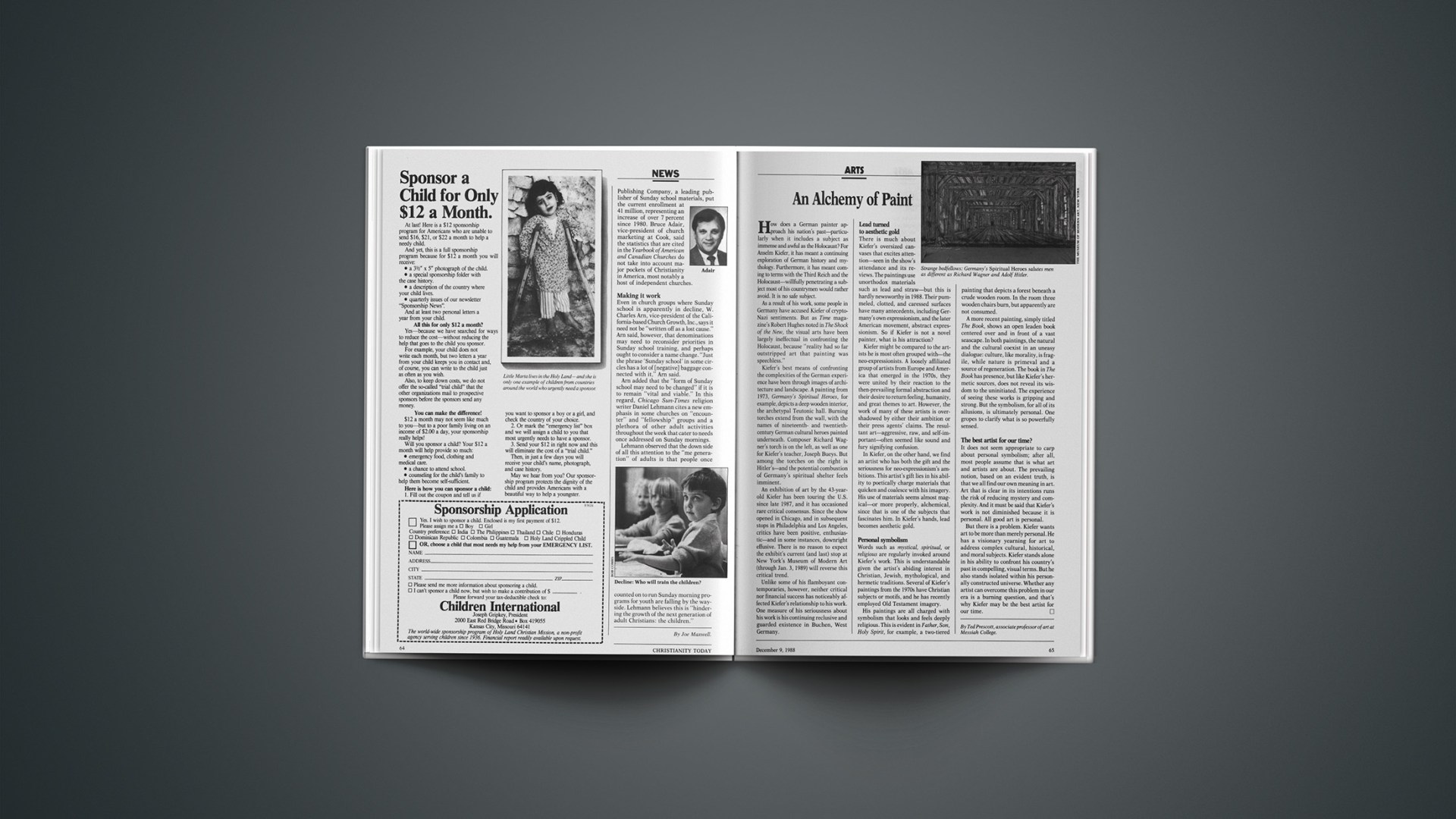
Kiefer’s best means of confronting the complexities of the German experience have been through images of architecture and landscape. A painting from 1973, Germany’s Spiritual Heroes, for example, depicts a deep wooden interior, the archetypal Teutonic hall. Burning torches extend from the wall, with the names of nineteenth- and twentieth-century German cultural heroes painted underneath. Composer Richard Wagner’s torch is on the left, as well as one for Kiefer’s teacher, Joseph Bueys. But among the torches on the right is Hitler’s—and the potential combustion of Germany’s spiritual shelter feels imminent.

An exhibition of art by the 43-year-old Kiefer has been touring the U.S. since late 1987, and it has occasioned rare critical consensus. Since the show opened in Chicago, and in subsequent stops in Philadelphia and Los Angeles, critics have been positive, enthusiastic—and in some instances, downright effusive. There is no reason to expect the exhibit’s current (and last) stop at New York’s Museum of Modern Art (through Jan. 3, 1989) will reverse this critical trend.

Unlike some of his flamboyant contemporaries, however, neither critical nor financial success has noticeably affected Kiefer’s relationship to his work. One measure of his seriousness about his work is his continuing reclusive and guarded existence in Buchen, West Germany.

Lead Turned To Aesthetic Gold

There is much about Kiefer’s oversized canvases that excites attention—seen in the show’s attendance and its reviews. The paintings use unorthodox materials such as lead and straw—but this is hardly newsworthy in 1988. Their pummeled, clotted, and caressed surfaces have many antecedents, including Germany’s own expressionism, and the later American movement, abstract expressionism. So if Kiefer is not a novel painter, what is his attraction?

Kiefer might be compared to the artists he is most often grouped with—the neo-expressionists. A loosely affiliated group of artists from Europe and America that emerged in the 1970s, they were united by their reaction to the then-prevailing formal abstraction and their desire to return feeling, humanity, and great themes to art. However, the work of many of these artists is overshadowed by either their ambition or their press agents’ claims. The resultant art—aggressive, raw, and self-important—often seemed like sound and fury signifying confusion.

In Kiefer, on the other hand, we find an artist who has both the gift and the seriousness for neo-expressionism’s ambitions. This artist’s gift lies in his ability to poetically charge materials that quicken and coalesce with his imagery. His use of materials seems almost magical—or more properly, alchemical, since that is one of the subjects that fascinates him. In Kiefer’s hands, lead becomes aesthetic gold.

Personal Symbolism

Words such as mystical, spiritual, or religious are regularly invoked around Kiefer’s work. This is understandable given the artist’s abiding interest in Christian, Jewish, mythological, and hermetic traditions. Several of Kiefer’s paintings from the 1970s have Christian subjects or motifs, and he has recently employed Old Testament imagery.

His paintings are all charged with symbolism that looks and feels deeply religious. This is evident in Father, Son, Holy Spirit, for example, a two-tiered painting that depicts a forest beneath a crude wooden room. In the room three wooden chairs bum, but apparently are not consumed.

A more recent painting, simply titled The Book, shows an open leaden book centered over and in front of a vast seascape. In both paintings, the natural and the cultural coexist in an uneasy dialogue: culture, like morality, is fragile, while nature is primeval and a source of regeneration. The book in The Book has presence, but like Kiefer’s hermetic sources, does not reveal its wisdom to the uninitiated. The experience of seeing these works is gripping and strong. But the symbolism, for all of its allusions, is ultimately personal. One gropes to clarify what is so powerfully sensed.

The Best Artist For Our Time?

It does not seem appropriate to carp about personal symbolism; after all, most people assume that is what art and artists are about. The prevailing notion, based on an evident truth, is that we all find our own meaning in art. Art that is clear in its intentions runs the risk of reducing mystery and complexity. And it must be said that Kiefer’s work is not diminished because it is personal. All good art is personal.

But there is a problem. Kiefer wants art to be more than merely personal. He has a visionary yearning for art to address complex cultural, historical, and moral subjects. Kiefer stands alone in his ability to confront his country’s past in compelling, visual terms. But he also stands isolated within his personally constructed universe. Whether any artist can overcome this problem in our era is a burning question, and that’s why Kiefer may be the best artist for our time.

By Ted Prescott, associate professor of art at Messiah College.

Will Sunday School Survive?

CHURCH LIFE

As an institution, Sunday school is almost as old as the United States. And with old age have come some questions about the movement’s health.

Close to 96 percent of all local churches have some form of Sunday school. But according to the 1988 issue of the Yearbook of American and Canadian Churches, enrollment over the last decade and a half has plunged 34 percent, from 40.5 million in 1970 to 26.6 million in 1986. And Gallup polls reveal that the number of adults reporting no Sunday school training during their childhood rose from 10 percent in 1970 to 27 percent in 1986.

Figures from denominations yield more of a mixed picture. Some, such as the Nazarenes, Free Methodists, and the Mennonites, have experienced lapsed enrollment during the 1980s. But others, including the Christian and Missionary Alliance Church, Southern Baptists, the Evangelical Free Church, and the Assemblies of God, report increases.

Statistics compiled by David C. Cook Publishing Company, a leading publisher of Sunday school materials, put the current enrollment at 41 million, representing an increase of over 7 percent since 1980. Bruce Adair, vice-president of church marketing at Cook, said the statistics that are cited in the Yearbook of American and Canadian Churches do not take into account major pockets of Christianity in America, most notably a host of independent churches.

Making It Work

Even in church groups where Sunday school is apparently in decline, W. Charles Arn, vice-president of the California-based Church Growth, Inc., says it need not be “written off as a lost cause.” Arn said, however, that denominations may need to reconsider priorities in Sunday school training, and perhaps ought to consider a name change. “Just the phrase ‘Sunday school’ in some circles has a lot of [negative] baggage connected with it,” Arn said.

Arn added that the “form of Sunday school may need to be changed” if it is to remain “vital and viable.” In this regard, Chicago Sun-Times religion writer Daniel Lehmann cites a new emphasis in some churches on “encounter” and “fellowship” groups and a plethora of other adult activities throughout the week that cater to needs once addressed on Sunday mornings.

Lehmann observed that the down side of all this attention to the “me generation” of adults is that people once counted on to run Sunday morning programs for youth are falling by the way-side. Lehmann believes this is “hindering the growth of the next generation of adult Christians: the children.”

By Joe Maxwell.

Mending God’s Lonely Warriors

MISSIONS

Ed and Kathy Moroney were completing their first term as urban church planters in the densely populated island of Taiwan when they decided they needed counseling. With stresses from work and poor communication pulling them apart, Kathy put her foot down. “I told Ed we get counseling or else.”

Ed and Kathy are not alone. Because of a growing dropout rate among missionaries, counseling centers have become an integral part of missions.

“We are disturbed with the high dropout rate of missionaries and want to help minimize that rate as much as we can,” said Ken Royer, pastor to missionaries at Link Care in Fresno, California.

According to Jim Reapsome, director of the Evangelical Missions Information Service, that dropout rate can be devastating. “While it varies from board to board,” Reapsome says, “in some cases the dropout rate for missionaries is as high as 30 percent.”

Marriage And Missions

The need for ministries for troubled missionaries is great. Last year, Link Care counseled 116 missionaries from 29 mission boards, sending 70 percent back to the field. The organization’s counselors help missionaries with marital problems, cross-cultural stress, conflicts with mission boards, and an inability to work with nationals.

According to Royer, the most common struggle for missionaries is marriage, particularly a couple’s inability to communicate.

“With a lack in communication between the couple, things such as tropical weather, cross-cultural pressures, language barriers, and overwork or burnout intensify, making the relationship very stressful,” says Royer.

It was that kind of stress that sent the Moroneys to Link Care. They admit they “won’t go back perfect and all fixed up.” But they are going back.

Link Care, founded 25 years ago, is one of several centers ministering to the special needs of missionaries. Marble Retreat in Marble, Colorado, offers a two-week program for missionary couples. Louis McBurney and his wife, Melissa, lead therapy sessions for ministry leaders dealing with burnout.

“We offer a spiritual approach to psychology,” says McBurney. “We started this ministry at the suggestion of various mission boards who found their missionaries were needing help with relational problems and marital or family struggles.”

Mission boards are also addressing emotional needs of missionaries and the subsequent high dropout rate. Many have established counseling programs of their own.

Wycliffe Bible Translators and their Summer Institute of Linguistics, which oversees 6,000 missionary adults and 4,000 missionary children, currently has 20 members who are trained as counselors and therapists, seven of whom counsel full-time.

Laura May Gardner, international coordinator of counseling ministries at Wycliffe, says marital stress, isolation, fatigue, and language or cultural barriers sometimes develop to the point where a missionary’s career is in jeopardy. When that happens, Gardner generally recommends counseling at one of Wycliffe’s regional centers.

Wycliffe’s counseling program was created when field administrators requested counselors with mission-field experience. “Although nonfield-experienced counselors can be of significant help, it was felt that those who had experienced field stress would be in a better position to understand the field-related problems of their colleagues,” said Gardner.

Merv Heebner, personnel director of OMS International, said his organization plans to add two full-time counselors to minister to the 527 missionaries on Asian fields. Said Heebner, “The needs are definitely there, and we want to be sensitive to them.”

Meanwhile, the Christian and Missionary Alliance’s assistant vice-president of overseas ministries, Arnie Shareski, said his denomination handles missionary burnout in two ways. The board may send a stateside pastor to the field to offer counseling and resources to help the family. If warranted, the pastor may also encourage the missionary to take an early furlough and get longer-term, professional counseling at a place such as Link Care.

Concerning Link Care’s popularity with several mission boards, Royer added, “The reason a lot of mission boards use Link Care is because we are independent, and missionaries have a feeling of anonymity. They can be very honest and not jeopardize their standing with a mission board.”

By Jeff Williams.

Judge Hits Bakker with Fine, Bible

UPDATE

Former PTL owners Jim and Tammy Bakker got a dose of Scripture with their bankruptcy verdict last month. According to an Associated Press report, Federal Bankruptcy Judge Rufus Reynolds quoted 1 Timothy 6:10 to help explain why he ordered the Bakkers and a former top aide to repay $7.7 million to PTL.

“James Bakker either overlooked or ignored parts of the Bible, including 1 Timothy 6:10,” the judge said, going on to quote the passage: “For the love of money is the root of all evil; which while some coveted after, they have erred from the faith, and pierced themselves through with many sorrows.”

Reynolds’s judgment, filed November 10 in the Federal Bankruptcy Court in Columbia, South Carolina, marks the first time any court has ruled that Bakker or other PTL leaders used PTL donors’ money improperly.

PTL sued the Bakkers and its former vice-president, David Taggart, for $52 million in February, alleging they mismanaged the ministry by taking large sums of donated money for personal use from 1984 to 1987 while PTL could not pay its bills. In the suit’s trial in September and October, PTL dropped its claim to all but $7.7 million.

According to the order, Bakker must pay PTL $4.9 million, his wife must repay $677,397, and Taggart must put slightly more than $1 million back into the ministry.

Reynolds said expenditures under the Bakker administration were “unbelievable” and a waste of PTL money. He also accused the administrators of “gross mismanagement” and “total disregard for reality.” He said Bakker and Taggart “approached the management of the corporation with reckless indifference to the financial consequences of their acts.”

Attorney Ryan Hovis, representing the Bakkers, said Bakker was “obviously disappointed,” and would appeal the ruling.

PTL is under the administration of the bankruptcy court. Earlier this fall, Canadian financier David Mernick successfully submitted a bid to purchase the ministry (CT, Nov. 18, 1988, p. 60). Completion of the sale of PTL to Mernick is expected by the end of this month. His plans for PTL will be announced at that time.

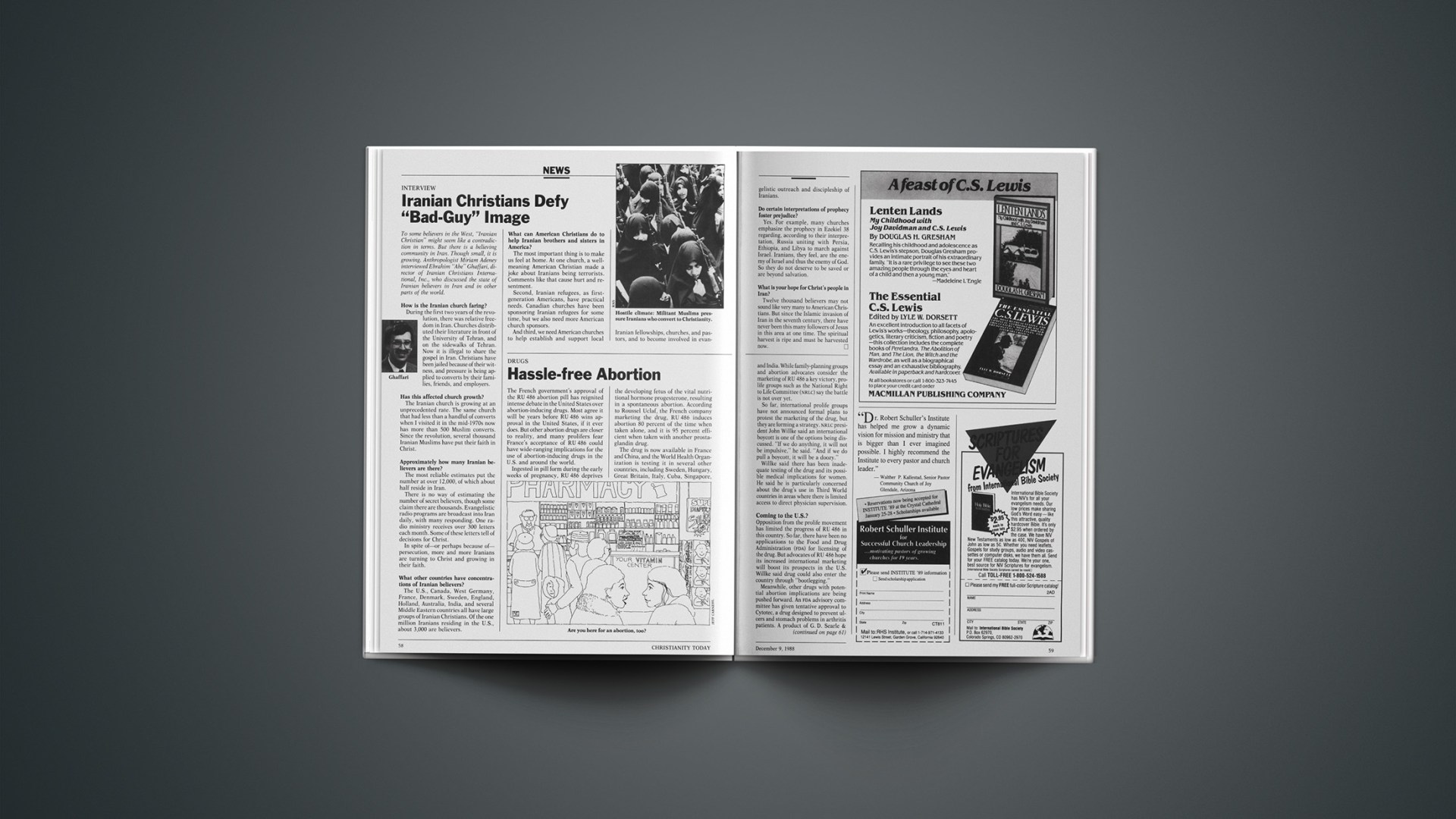
Hassle-Free Abortion

DRUGS

The French government’s approval of the RU 486 abortion pill has reignited intense debate in the United States over abortion-inducing drugs. Most agree it will be years before RU 486 wins approval in the United States, if it ever does. But other abortion drugs are closer to reality, and many prolifers fear France’s acceptance of RU 486 could have wide-ranging implications for the use of abortion-inducing drugs in the U.S. and around the world.

Ingested in pill form during the early weeks of pregnancy, RU 486 deprives the developing fetus of the vital nutritional hormone progesterone, resulting in a spontaneous abortion. According to Roussel Uclaf, the French company marketing the drug, RU 486 induces abortion 80 percent of the time when taken alone, and it is 95 percent efficient when taken with another prostaglandin drug.

The drug is now available in France and China, and the World Health Organization is testing it in several other countries, including Sweden, Hungary, Great Britain, Italy, Cuba, Singapore, and India. While family-planning groups and abortion advocates consider the marketing of RU 486 a key victory, prolife groups such as the National Right to Life Committee (NRLC) say the battle is not over yet.

So far, international prolife groups have not announced formal plans to protest the marketing of the drug, but they are forming a strategy. NRLC president John Willke said an international boycott is one of the options being discussed. “If we do anything, it will not be impulsive,” he said. “And if we do pull a boycott, it will be a doozy.”

Willke said there has been inadequate testing of the drug and its possible medical implications for women. He said he is particularly concerned about the drug’s use in Third World countries in areas where there is limited access to direct physician supervision.

Coming To The U.S.?

Opposition from the prolife movement has limited the progress of RU 486 in this country. So far, there have been no applications to the Food and Drug Administration (FDA) for licensing of the drug. But advocates of RU 486 hope its increased international marketing will boost its prospects in the U.S. Willke said drug could also enter the country through “bootlegging.”

Meanwhile, other drugs with potential abortion implications are being pushed forward. An FDA advisory committee has given tentative approval to Cytotec, a drug designed to prevent ulcers and stomach problems in arthritis patients. A product of G. D. Searle & Co., Cytotec has not been developed as an abortion drug, but is known to have abortion-inducing effects.

Proponents of the drug testified at the FDA hearing that Cytotec should be clearly labeled as dangerous to pregnant women, and that physicians would have to be educated about its abortion-inducing properties. The NRLC and other prolife groups oppose the drug. “Once it is known that [Cytotec] aborts babies,” said Willke, “there will be people using it, wanting it, and prescribing it.”

Prolife groups are also keeping an eye on Epostane, a drug that at one time was being developed by Kodak-owned Sterling Drugs. Like RU 486, Epostane targets the hormone progesterone. Sterling has announced it is no longer researching the drug and thus has no intentions of marketing it. Willke said the NRLC wants to make sure that doesn’t change.

By Kim A. Lawton.

World Scene

CUBA

Restricted, But Growing

Despite pressure characterized more as annoyance than persecution, Christians in Cuba continue to report progress.

For example, Ecuadorian missionary Rodrigo Zapata spent 11 days in Cuba last summer conducting Bible studies and workshops for more than 60 pastors. He says there is no “organized persecution” of the evangelical church, but “for an active Christian, it is difficult to obtain a job.” Zapata, whose trip was sponsored by HCJB World Radio, estimates 5 there are 30,000 evangelical Christians (.3 percent of the population) in Cuba.

This fall John Huffman, Jr., pastor of Saint Andrew’s Presbyterian Church in Newport Beach, California, preached at a weekend series of meetings in a local church in the interior of Cuba. Huffman’s father, John, Sr., had pioneered a radio ministry in Cuba in the 1940s. Both Huffmans were invited back to Cuba by B. G. Lavastida, who had helped with the radio ministry. “I preached … to people eager to hear the Word of God declared by a brother from another culture, but one who was trusted by a fellow believer in Jesus Christ,” Huffman told his congregation.

JAPAN

Where Abortion Is Routine

A very small prolife movement in Japan is trying to counter the almost universal acceptance of abortion in that nation. According to Pro-Life Japan (PLJ), for every live birth in Japan there are three abortions, totaling more than five million per year.

In a report published in Japan Update, PLJ attributes the high abortion rate to several factors: scarcity of birth-control pills, the high cost of raising children, and the Buddhist practice of offering memorial rituals for parents of aborted fetuses.

Japanese law allows abortion through the twenty-third week of pregnancy. Also, a woman’s official family registration must record any children to whom she has given birth, even if those children are given up for adoption. Since such a record could mar the reputation of single women, abortion becomes an easier option.

Recently, a Christian physician was barred from medical practice for six months because he assisted a patient in putting her baby up for adoption, rather than perform an abortion. The case went to the Japanese supreme court, which ruled his behavior “violated medical ethics.”

COLOMBIA

Missing Missionary

Veteran missionary and Bible translator Bruce Olson was apparently kidnapped late in October by leftist guerrillas in Colombia. According to a report by International Media Service (IMS), the independent missionary and five Indian companions were ambushed in the “drug trafficking corridor” of Northern Colombia. It is unclear what prompted the incident.

In a prayer letter sent to the U.S. in late August, Olson said the Colombian army had warned him that he might be the target for some type of violence. “… I am in danger due to the imposing presence of guerrilla forces in … areas that I must pass through …,” he wrote.

The U.S. State Department is monitoring the situation, but is limited because the American-born missionary renounced his citizenship earlier this year. Olson’s situation is further complicated because he was not sent out by any particular denomination or mission group.

Olson has been working in Colombia since 1961, and has written a book, Bruchko, about his experiences. According to IMS, he has translated all of the New Testament and part of the Old Testament into the Motilone language, set up educational and medical facilities, and has spread the gospel to many unreached regions.

CHINA

Hudson Taylor’S Grave Found

For several years, the family of J. Hudson Taylor, pioneer missionary to China, has tried to find his place of burial. This past August, a Chinese pastor escorted Taylor’s greatgrandson, James H. Taylor III, to a former Protestant cemetery in Zhenjiang where the graves of Hudson Taylor, his first wife, and four of their children are intact.

The cemetery caretakers still live nearby. They told Taylor, currently general director of Overseas Missionary Fellowship, that in 1957 the gravestones were removed. Later in their visit, Taylor and his wife, Leone, discovered dismantled sections of Hudson Taylor’s monument behind the Zhenjiang Museum. Museum staff gave the Taylors rubbings of the engraved sections of the monument.

Authorities have asked the Taylors for a formal proposal to re-erect the monument.

PEOPLE AND EVENTS

Briefly Noted

Honored: For his 28 years of medical missionary service in Africa, Robert L. Foster. World Vision presented Foster, international director of the Africa Evangelical Fellowship, with the Robert W. Pierce Award for Outstanding Christian Service.

Announced: By population experts, that Asia may have just crossed the three billion population mark. China marked the occasion with speeches urging citizens to practice birth control.

By England’s oldest Anglican home missionary society, the Church Pastoral Aid Society, that retiring general secretary David Bubbers will be replaced by John Moore.

By archeologist James H. Charlesworth, “sensational, breathtaking” discoveries in Israel of the apostle Peter’s house in Capernaum where Jesus stayed.

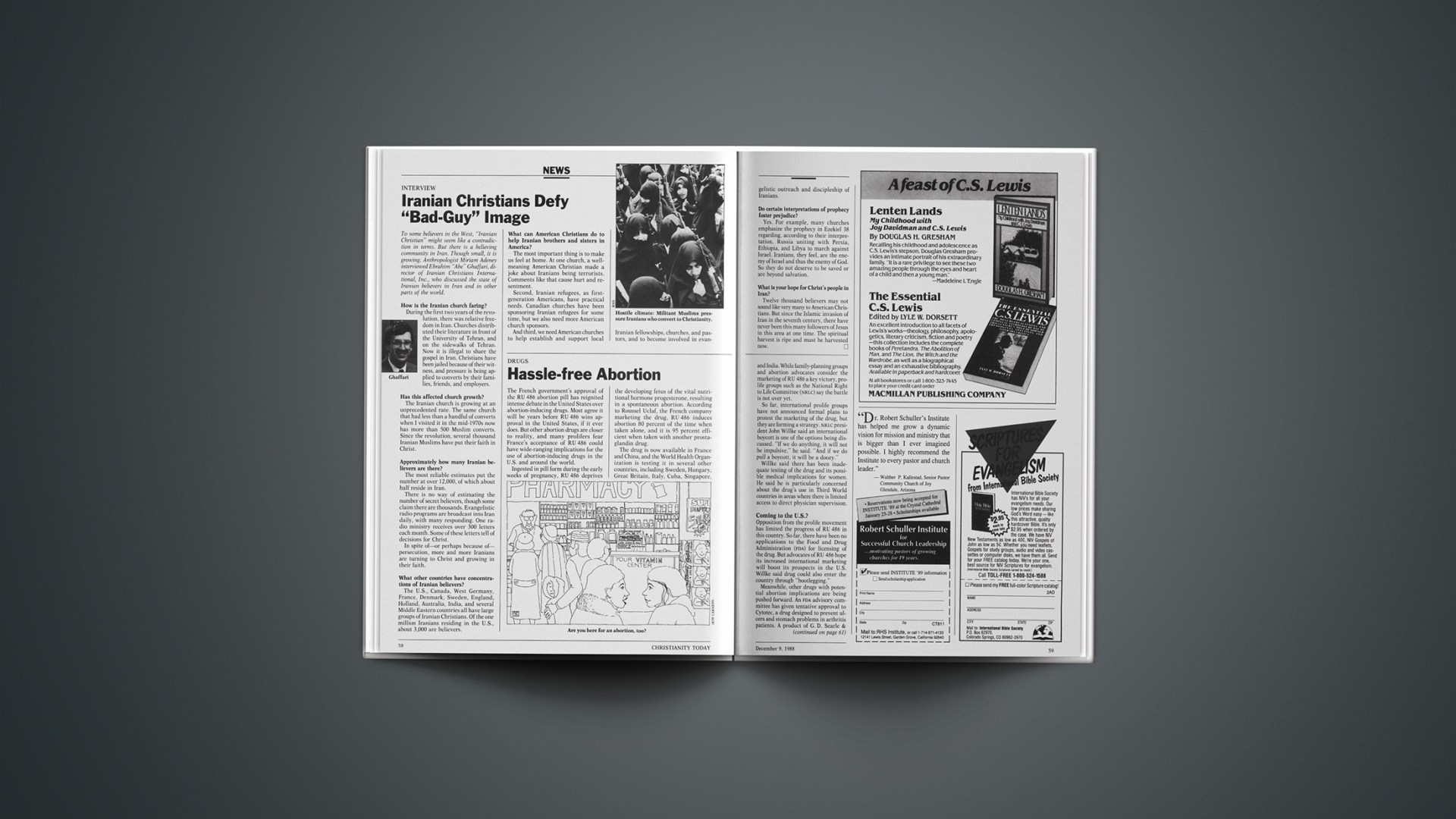
Iranian Christians Defy “Bad-Guy” Image

INTERVIEW

To some believers in the West, “Iranian Christian” might seem like a contradiction in terms. But there is a believing community in Iran. Though small, it is growing. Anthropologist Miriam Adeney interviewed Ebrahim “Abe” Ghaffari, director of Iranian Christians International, Inc., who discussed the state of Iranian believers in Iran and in other parts of the world.

How is the Iranian church faring?

During the first two years of the revolution, there was relative freedom in Iran. Churches distributed their literature in front of the University of Tehran, and on the sidewalks of Tehran. Now it is illegal to share the gospel in Iran. Christians have been jailed because of their witness, and pressure is being applied to converts by their families, friends, and employers.

Has this affected church growth?

The Iranian church is growing at an unprecedented rate. The same church that had less than a handful of converts when I visited it in the mid-1970s now has more than 500 Muslim converts. Since the revolution, several thousand Iranian Muslims have put their faith in Christ.

Approximately how many Iranian believers are there?

The most reliable estimates put the number at over 12,000, of which about half reside in Iran.

There is no way of estimating the number of secret believers, though some claim there are thousands. Evangelistic radio programs are broadcast into Iran daily, with many responding. One radio ministry receives over 300 letters each month. Some of these letters tell of decisions for Christ.

In spite of—or perhaps because of—persecution, more and more Iranians are turning to Christ and growing in their faith.

What other countries have concentrations of Iranian believers?

The U.S., Canada, West Germany, France, Denmark, Sweden, England, Holland, Australia, India, and several Middle Eastern countries all have large groups of Iranian Christians. Of the one million Iranians residing in the U.S., about 3,000 are believers.

What can American Christians do to help Iranian brothers and sisters in America?

The most important thing is to make us feel at home. At one church, a well-meaning American Christian made a joke about Iranians being terrorists. Comments like that cause hurt and resentment.

Second, Iranian refugees, as first-generation Americans, have practical needs. Canadian churches have been sponsoring Iranian refugees for some time, but we also need more American church sponsors.

And third, we need American churches to help establish and support local Iranian fellowships, churches, and pastors, and to become involved in evangelistic outreach and discipleship of Iranians.

Do certain interpretations of prophecy foster prejudice?

Yes. For example, many churches emphasize the prophecy in Ezekiel 38 regarding, according to their interpretation, Russia uniting with Persia, Ethiopia, and Libya to march against Israel. Iranians, they feel, are the enemy of Israel and thus the enemy of God. So they do not deserve to be saved or are beyond salvation.

What is your hope for Christ’s people in Iran?

Twelve thousand believers may not sound like very many to American Christians. But since the Islamic invasion of Iran in the seventh century, there have never been this many followers of Jesus in this area at one time. The spiritual harvest is ripe and must be harvested now.

Teens May Be Answer to Apartheid

SOUTH AFRICA

Despite increasing racial tensions, an ambitious high-school ministry is finding success in a multiracial effort to evangelize the next generation of South Africans. According to Ted Carr, national director of Youth for Christ/South Africa (YFC), more than 27,000 teens have accepted Christ since the April launching of “Youth Harvest,” a six-year program to send evangelistic teams into the nation’s 3,100 high schools.

Using teams of unpaid volunteers, YFC h as already held evangelistic assemblies in 504 high schools. In addition to the young people hearing the gospel and responding, Carr says many teachers are being saved.

Carr believes the church can be most effective in South Africa by embracing evangelism rather than politics. “We walk a tightrope,” he says. “We want to be culturally relevant, yet we cannot polarize by aligning ourselves with a given ideology. Once we take sides, we lose credibility and would never have access to the schools,” he says, adding that the nature of a ministry can in itself be a strong political statement.

“Our teams are fully integrated,” says Carr, “because we are opposed to an apartheid system. The nonracial nature of our program provides a model for the students we are ministering to.”

Angry And Anxious

In addition to being angry, South African teens, says Carr, are disoriented. “The blacks, especially, are angry at the system of apartheid, while all young people are anxious about the future.” Employment is a major concern, given the prospect of increased economic sanctions. “If the [international boycott] is only 20 percent effective, 343,000 blacks and 90,000 whites will lose their jobs,” he says. Carr adds that South African youths know their country is the focus of international attention, and, he says, their uncertainty about the future makes them more open to the gospel.

It is amid this backdrop that YFC is trying to reach high schoolers. Nearly all of the schools are segregated, so the appearance of blacks, coloreds, and whites performing skits, singing, and giving testimonies always commands attention. Team members spend two months training, then travel to schools for the remainder of the year. Currently seven teams are in place.

Local churches conduct follow-up efforts, and school principals often invite the teams back. The teams also perform on city streets, parks, and in local auditoriums in an effort to reach the entire community.

Though South Africa’s YFC staff are pleased with the results of the first seven months of “Youth Harvest,” they are concerned about its future. A major hurdle is finances, primarily scholarship money to help blacks who cannot afford the training and have difficulty raising their support.

Although South African churches contribute to “Youth Harvest,” their donations do not cover the expenses of the program, Carr says. To compensate, as well as to recruit team members, Carr has sought help from U.S. Christians. Last year, six Americans joined “Youth Harvest,” and next month 18 will leave for South Africa, according to Earl Schultz, vice-president of YFC/USA’S world outreach office, YFC/USA is a cosponsor of “Youth Harvest.”

North American Scene

POVERTY

Poor Are Still With Us

Two new studies suggest that poverty remains a major problem for many American families—particularly black families.

A report released by the Washington-based Urban Institute found that among eight Western industrial democracies, the United States had the highest level of children living in poverty. According to the report, which was based on 1979 data, 17.1 percent of American children lived in families with incomes below the government’s official poverty line. At the same time, Switzerland and Sweden had the lowest numbers, with only 5.1 percent each.

A second study, done by the nonprofit Center for Budget and Policy Priorities, reported that income gaps between black and white families in America appear to be widening. Center director Robert Greenstein said most families suffered sharp economic setbacks during the 1981–82 recession, but in the following five years of economic recovery, white families recovered the lost ground while black families did not. “As a consequence, the gap between black and white median family income is now wider than in the late 1970s,” Greenstein said.

HIGHER EDUCATION

Christian College Kudos

Five Christian College Coalition members were included in U.S. News and World Report’s list of the nation’s top colleges. Under the category of small comprehensive colleges, Messiah College placed eighth, while Azusa Pacific University was twenty-fifth. Taylor University and Dordt College ranked twentieth and twenty-first respectively in the regional liberal arts category, while Oral Roberts University was ranked fifteenth among comprehensive colleges.

U.S. News and World Report rated the nation’s colleges according to five criteria: quality of the student body as determined by the school’s selectivity, strength of the faculty and teaching, extent of resources, ability to retain students through graduation, and reputation for academic excellence. In all but the last category, objective data were used to quantify a school’s performance.

“We think this reflects the good job all our colleges are doing in focusing on the quality of undergraduate teaching, concern for students, and an interdisciplinary approach to education,” said Karen Longman, vice-president of the Christian College Coalition.

CHURCH AND STATE

No School Prayer In Canada

The Ontario Court of Appeals has struck down a section of a provincial education act that required a recited prayer and Bible reading in public schools. According to a report in Religious News Service, the court rejected the Ontario government’s argument that, since students could be excusedfrom the religious exercises, the law was constitutional.” The reality is that it imposes on religious minorities a compulsion to conform to the religious practices of the majority,” the court said of the law. The ruling said the mandatory religious exercises are “inconsistent with the multicultural nature of our society as recognized by the Charter [of Rights and Freedoms].”

Brian Stiller, executive director of the Evangelical Fellowship of Canada, called the decision “unfortunate, but not surprising.” “For those of us who have observed the increased secularization of our culture,” he said, “to plead multiculturalism is nothing less than a smoke screen.” The larger agenda, Stiller believes, is to exclude the Judeo-Christian base from public education.

AIDS MINISTRY

Camp And Campolo Team Up

Christian musician Steve Camp and noted speaker and author Anthony Campolo have formed a new foundation that will attempt to provide a Christian response to AIDS. The purpose of AIDS Crisis and Christians Today (ACCT) is to educate Christians about AIDS as well as “provide a way for them to get involved” in reaching out to AIDS victims and their families, according to Camp.

The two are planning a series of meetings that will combine music and AIDS information. They hope the events will lead Christians to organize local hospices specifically for AIDS victims.

UPDATE

In Search Of A Seminary

When the American Lutheran Church and Lutheran Church in America merged to form the Evangelical Lutheran Church in America last year, a handful of conservative Lutherans formed their own denomination: the American Association of Lutheran Churches (AALC). At its recent first convention, the new group voted to halt the process of beginning a formal relationship with Fuller Theological Seminary, partly over an inerrancy issue.

Robert Meye, dean of Fuller’s school of theology, acknowledged that some in the denomination felt Fuller’s longstanding view of the infallibility of Scripture was not strong enough. But he also pointed out that an executive committee of the denomination had unanimously recommended to the larger body to affiliate with Fuller.

PEOPLE AND EVENTS

Briefly Noted

Died: Elmer A. Frink, general overseer of Elim Fellowship, a Pentecostal fellowship of churches, ministers, and missionaries.

Resigned:As pastor of one of the fastest-growing Southern Baptist churches, Bill Weber, after confessing he had committed adultery. In 11 years, his Prestonwood Baptist Church in Dallas grew from a handful of people meeting in private homes to 10,000 members.

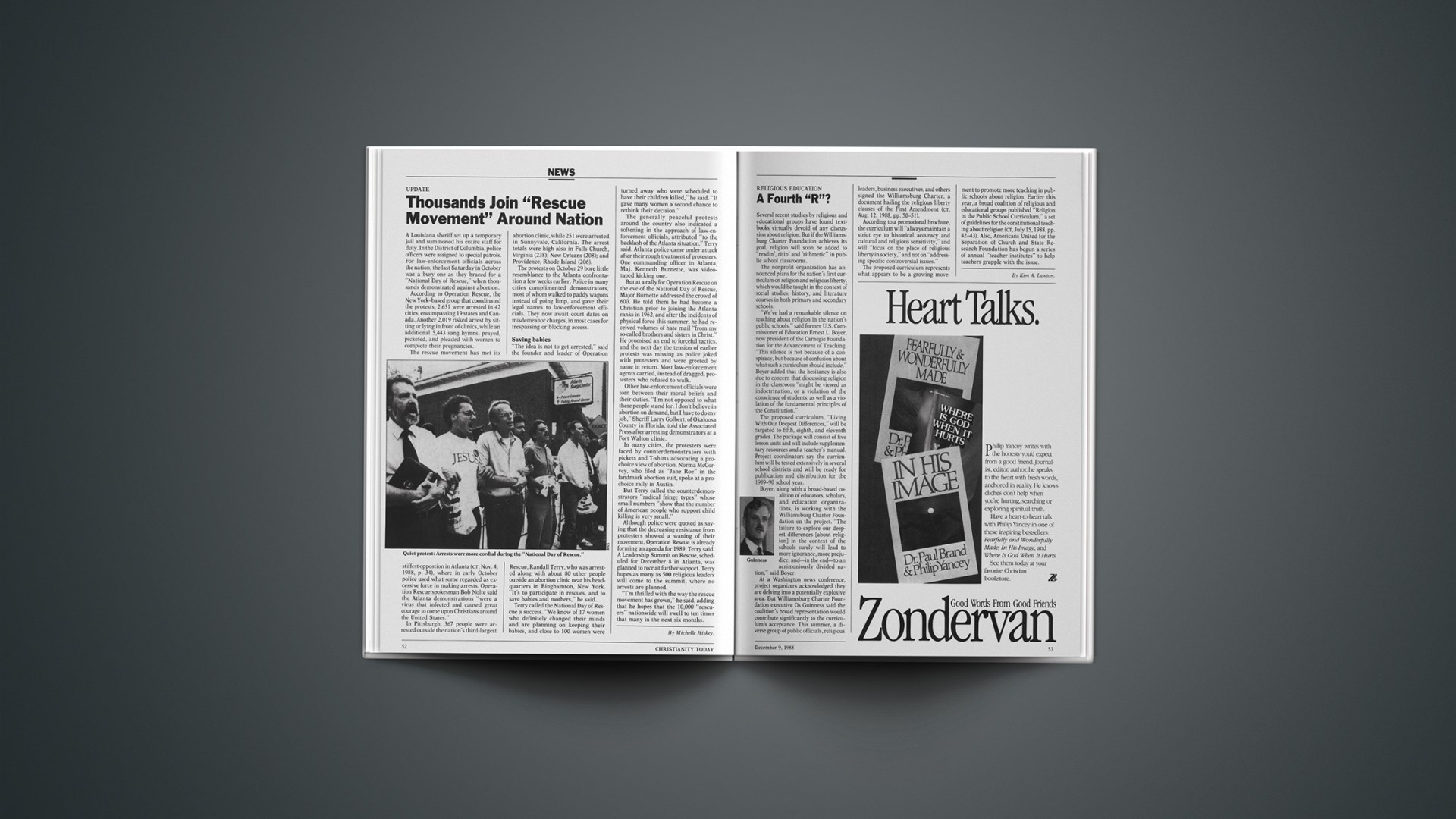
A Fourth “R”?

RELIGIOUS EDUCATION

Several recent studies by religious and educational groups have found textbooks virtually devoid of any discussion about religion. But if the Williamsburg Charter Foundation achieves its goal, religion will soon be added to “readin’, ritin’ and ‘rithmetic” in public school classrooms.

The nonprofit organization has announced plans for the nation’s first curriculum on religion and religious liberty, which would be taught in the context of social studies, history, and literature courses in both primary and secondary schools.

“We’ve had a remarkable silence on teaching about religion in the nation’s public schools,” said former U.S. Commissioner of Education Ernest L. Boyer, now president of the Carnegie Foundation for the Advancement of Teaching. “This silence is not because of a conspiracy, but because of confusion about what such a curriculum should include.” Boyer added that the hesitancy is also due to concern that discussing religion in the classroom “might be viewed as indoctrination, or a violation of the conscience of students, as well as a violation of the fundamental principles of the Constitution.”

The proposed curriculum, “Living With Our Deepest Differences,” will be targeted to fifth, eighth, and eleventh grades. The package will consist of five lesson units and will include supplementary resources and a teacher’s manual. Project coordinators say the curriculum will be tested extensively in several school districts and will be ready for publication and distribution for the 1989–90 school year.

Boyer, along with a broad-based coalition of educators, scholars, and education organizations, is working with the Williamsburg Charter Foundation on the project. “The failure to explore our deepest differences [about religion] in the context of the schools surely will lead to more ignorance, more prejudice, and—in the end—to an acrimoniously divided nation,” said Boyer.

At a Washington news conference, project organizers acknowledged they are delving into a potentially explosive area. But Williamsburg Charter Foundation executive Os Guinness said the coalition’s broad representation would contribute significantly to the curriculum’s acceptance. This summer, a diverse group of public officials, religious leaders, business executives, and others signed the Williamsburg Charter, a document hailing the religious liberty clauses of the First Amendment (CT, Aug. 12, 1988, pp. 50–51).

According to a promotional brochure, the curriculum will “always maintain a strict eye to historical accuracy and cultural and religious sensitivity,” and will “focus on the place of religious liberty in society,” and not on “addressing specific controversial issues.”

The proposed curriculum represents what appears to be a growing movement to promote more teaching in public schools about religion. Earlier this year, a broad coalition of religious and educational groups published “Religion in the Public School Curriculum,” a set of guidelines for the constitutional teaching about religion (CT, July 15, 1988, pp. 42–43). Also, Americans United for the Separation of Church and State Research Foundation has begun a series of annual “teacher institutes” to help teachers grapple with the issue.

By Kim A. Lawton.

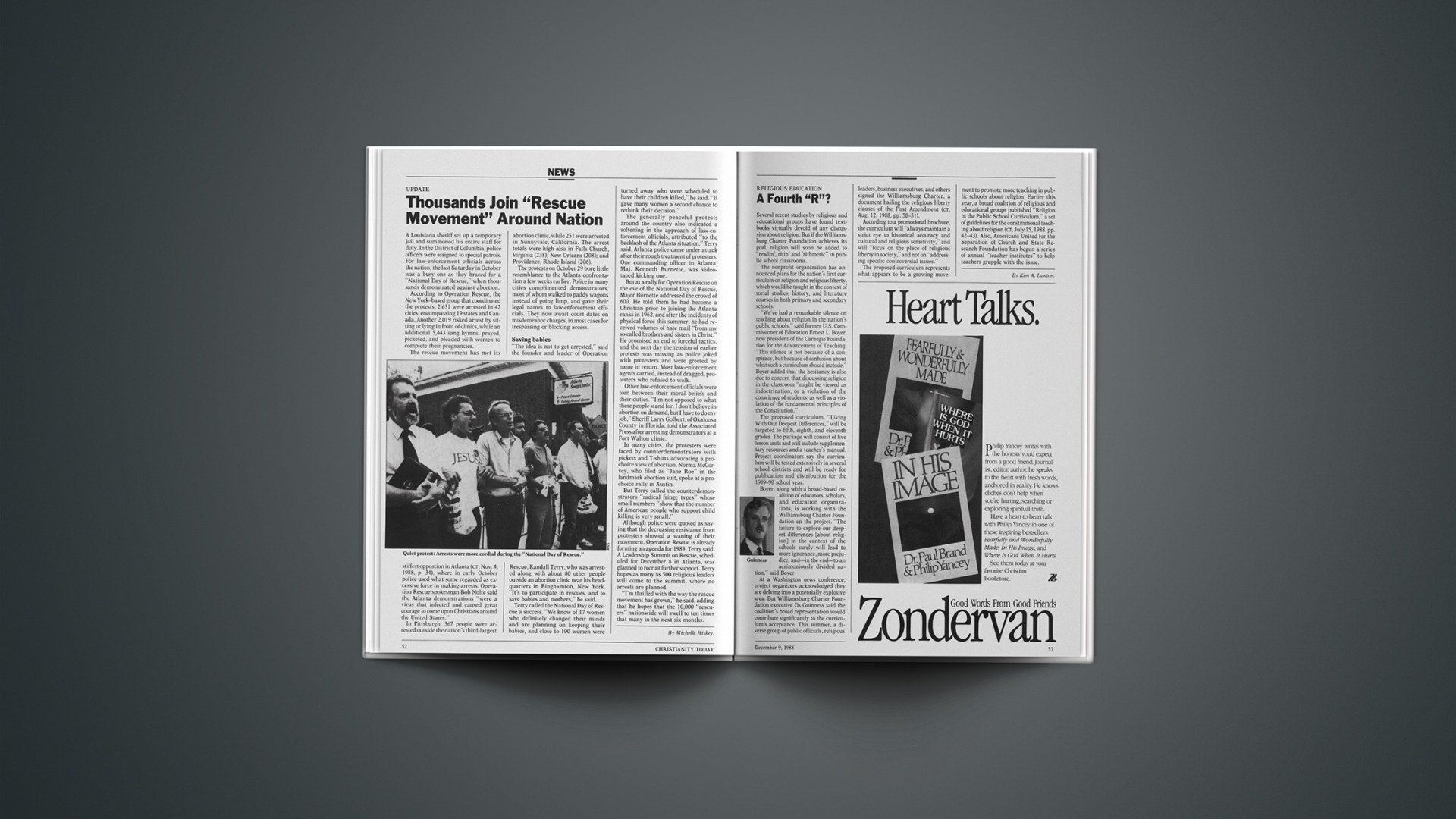
Thousands Join “Rescue Movement” around Nation

UPDATE

A Louisiana sheriff set up a temporary his entire staff for duty. In the District of Columbia, police officers were assigned to special patrols. For law-enforcement officials across the nation, the last Saturday in October was a busy one as they braced for a “National Day of Rescue,” when thousands demonstrated against abortion.

According to Operation Rescue, the New York-based group that coordinated the protests, 2,631 were arrested in 42 cities, encompassing 19 states and Canada. Another 2,019 risked arrest by sitting or lying in front of clinics, while an additional 5,443 sang hymns, prayed, picketed, and pleaded with women to complete their pregnancies.

The rescue movement has met its stiffest oppostion in Atlanta (CT, Nov. 4, 1988, p. 34), where in early October police used what some regarded as excessive force in making arrests. Operation Rescue spokesman Bob Nolte said the Atlanta demonstrations “were a virus that infected and caused great courage to come upon Christians around the United States.”

In Pittsburgh, 367 people were arrested outside the nation’s third-large stabortion clinic, while 251 were arrested in Sunnyvale, California. The arrest totals were high also in Falls Church, Virginia (238); New Orleans (208); and Providence, Rhode Island (206).

The protests on October 29 bore little resemblance to the Atlanta confrontation a few weeks earlier. Police in many cities complimented demonstrators, most of whom walked to paddy wagons instead of going limp, and gave their legal names to law-enforcement officials. They now await court dates on misdemeanor charges, in most cases for trespassing or blocking access.

Saving Babies

“The idea is not to get arrested,” said the founder and leader of Operation Rescue, Randall Terry, who was arrested along with about 80 other people outside an abortion clinic near his headquarters in Binghamton, New York. “It’s to participate in rescues, and to save babies and mothers,” he said.

Terry called the National Day of Rescue a success. “We know of 17 women who definitely changed their minds and are planning on keeping their babies, and close to 100 women were turned away who were scheduled to have their children killed,” he said. “It gave many women a second chance to rethink their decision.”

The generally peaceful protests around the country also indicated a softening in the approach of law-enforcement officials, attributed “to the backlash of the Atlanta situation,” Terry said. Atlanta police came under attack after their rough treatment of protesters. One commanding officer in Atlanta, Maj. Kenneth Burnette, was videotaped kicking one.

But at a rally for Operation Rescue on the eve of the National Day of Rescue, Major Burnette addressed the crowd of 600. He told them he had become a Christian prior to joining the Atlanta ranks in 1962, and after the incidents of physical force this summer, he had received volumes of hate mail “from my so-called brothers and sisters in Christ.” He promised an end to forceful tactics, and the next day the tension of earlier protests was missing as police joked with protesters and were greeted by name in return. Most law-enforcement agents carried, instead of dragged, protesters who refused to walk.

Other law-enforcement officials were torn between their moral beliefs and their duties. “I’m not opposed to what these people stand for. I don’t believe in abortion on demand, but I have to do my job,” Sheriff Larry Golbert, of Okaloosa County in Florida, told the Associated Press after arresting demonstrators at a Fort Walton clinic.

In many cities, the protesters were faced by counterdemonstrators with pickets and T-shirts advocating a prochoice view of abortion. Norma McCorvey, who filed as “Jane Roe” in the landmark abortion suit, spoke at a prochoice rally in Austin.

But Terry called the counterdemonstrators “radical fringe types” whose small numbers “show that the number of American people who support child killing is very small.”

Although police were quoted as saying that the decreasing resistance from protesters showed a waning of their movement, Operation Rescue is already forming an agenda for 1989, Terry said. A Leadership Summit on Rescue, scheduled for December 8 in Atlanta, was planned to recruit further support. Terry hopes as many as 500 religious leaders will come to the summit, where no arrests are planned.

“I’m thrilled with the way the rescue movement has grown,” he said, adding that he hopes that the 10,000 “rescuers” nationwide will swell to ten times that many in the next six months.

By Michelle Hiskey.

Voters Make Choices on Issues

NATIONAL ELECTION

Despite criticism that both George Bush and Michael Dukakis failed to discuss substantive issues, voters went to the polls with issues on their minds. For example, one-third of voters interviewed by ABC News said abortion was the most important issue in making their choice for President. According to ABC, those citing abortion as the number-one issue voted for George Bush.

Other issues cited to ABC as key were the drug problem, the death penalty, education, and social security. Voters also faced issues at the state level:

Abortion. In Michigan and Arkansas, voters approved measures banning Medicaid-financed abortions for the poor, except when the life of the mother is in danger. Included in the Arkansas referendum was protection of life beginning at conception. Prolife forces were also victorious in Colorado, where an effort to resume state financing of abortion was defeated.

AIDS. Californians passed a measure requiring AIDS testing for sex offenders and persons who assault law-enforcement officials or medical personnel. However, voters in the state also defeated Rep. William Dannemeyer’s (R-Calif.) proposal to permit AIDS testing for insurance or employment purposes. Dannemeyer’s proposal would also have required doctors to report the names and addresses of people who tested positive for AIDS and would have required health officials to trace the sexual contacts of infected people.

Gambling. State lotteries were approved in Kentucky, Indiana, Minnesota, and Idaho, and Virginians voted to legalize pari-mutuel betting at horse tracks. Church groups formed the largest opposition to Virginia’s pari-mutuel measure, and with the help of Jerry Falwell, churches contributed two-thirds of the money used to fight the measure. Last year Virginians approved a state lottery.

Gun control. Maryland voters approved a state gun-control law banning the sale of inexpensive guns, often called “Saturday Night Specials.”

Nuclear energy. Voters in Massachusetts defeated an initiative to close two nuclear power plants, and Nebraska voters rejected an effort to withdraw from an interstate nuclear-waste compact. Under the compact, Nebraska will begin receiving low-level nuclear waste from surrounding states.

Apple PodcastsDown ArrowDown ArrowDown Arrowarrow_left_altLeft ArrowLeft ArrowRight ArrowRight ArrowRight Arrowarrow_up_altUp ArrowUp ArrowAvailable at Amazoncaret-downCloseCloseEmailEmailExpandExpandExternalExternalFacebookfacebook-squareGiftGiftGooglegoogleGoogle KeephamburgerInstagraminstagram-squareLinkLinklinkedin-squareListenListenListenChristianity TodayCT Creative Studio Logologo_orgMegaphoneMenuMenupausePinterestPlayPlayPocketPodcastRSSRSSSaveSaveSaveSearchSearchsearchSpotifyStitcherTelegramTable of ContentsTable of Contentstwitter-squareWhatsAppXYouTubeYouTube