Editor’s Note from October 11, 1968

The summer has ended, and autumn and harvest time are upon us. But there is no end to the troubles that are plaguing our national life. Anyone who thought the confrontation of the radical left with the Chicago police signaled the last outbreak and a return to normalcy was wrong. Since then the smoldering student feud at Columbia erupted again. New York City schools were kept from opening by a teachers’ strike. Cardinal O’Boyle of Washington cracked the knuckles of priests whose ideas of liberty of conscience conflicted with the Pope’s encyclical on birth control. The Senate voted a gun-control bill that didn’t control guns. And the aspirants for the presidency stalked up and down the land trying to whip up enthusiasm among apathetic citizens whose minds, for the most part, were already made up.

The bright spot was the wealth of news for the journalists. Their big problem was choosing what stories they should highlight. Among newsworthy items to which the press gave little attention was Billy Graham’s Pittsburgh campaign and his nationwide telecast of earlier San Antonio meetings. Yet the thousands of decisions registered at the ball park and in letters that flowed from every state in the union may have been the biggest news of all.

We suggest that readers take a hard look at the last editorial, “The Christian and the World.”
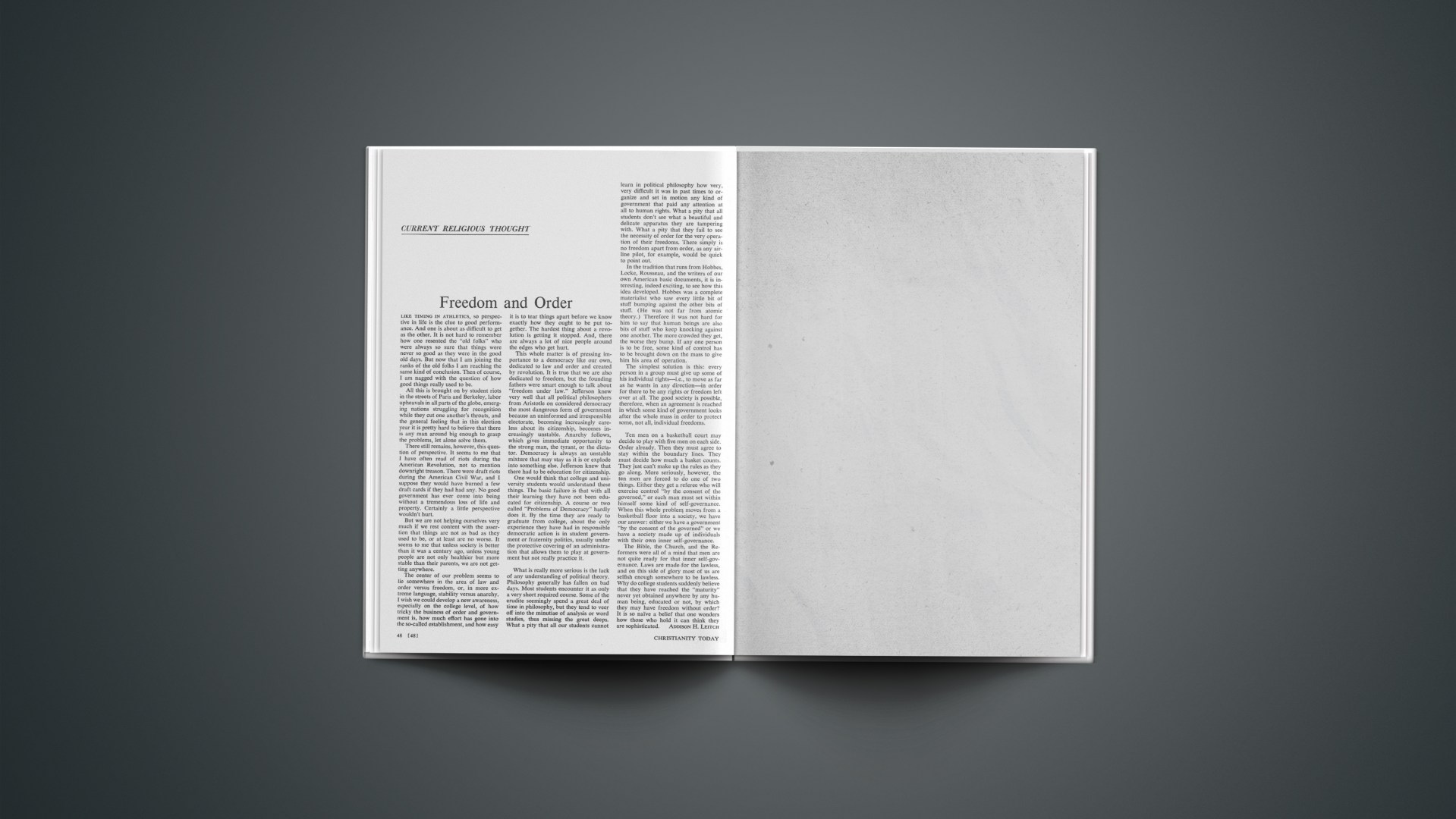
Freedom and Order

Like timing in athletics, so perspective in life is the clue to good performance. And one is about as difficult to get as the other. It is not hard to remember how one resented the “old folks” who were always so sure that things were never so good as they were in the good old days. But now that I am joining the ranks of the old folks I am reaching the same kind of conclusion. Then of course, I am nagged with the question of how good things really used to be.

All this is brought on by student riots in the streets of Paris and Berkeley, labor upheavals in all parts of the globe, emerging nations struggling for recognition while they cut one another’s throats, and the general feeling that in this election year it is pretty hard to believe that there is any man around big enough to grasp the problems, let alone solve them.

There still remains, however, this question of perspective. It seems to me that I have often read of riots during the American Revolution, not to mention downright treason. There were draft riots during the American Civil War, and I suppose they would have burned a few draft cards if they had had any. No good government has ever come into being without a tremendous loss of life and property. Certainly a little perspective wouldn’t hurt.

But we are not helping ourselves very much if we rest content with the assertion that things are not as bad as they used to be, or at least are no worse. It seems to me that unless society is better than it was a century ago, unless young people are not only healthier but more stable than their parents, we are not getting anywhere.

The center of our problem seems to lie somewhere in the area of law and order versus freedom, or, in more extreme language, stability versus anarchy. I wish we could develop a new awareness, especially on the college level, of how tricky the business of order and government is, how much effort has gone into the so-called establishment, and how easy it is to tear things apart before we know exactly how they ought to be put together. The hardest thing about a revolution is getting it stopped. And, there are always a lot of nice people around the edges who get hurt.

This whole matter is of pressing importance to a democracy like our own, dedicated to law and order and created by revolution. It is true that we are also dedicated to freedom, but the founding fathers were smart enough to talk about “freedom under law.” Jefferson knew very well that all political philosophers from Aristotle on considered democracy the most dangerous form of government because an uninformed and irresponsible electorate, becoming increasingly careless about its citizenship, becomes increasingly unstable. Anarchy follows, which gives immediate opportunity to the strong man, the tyrant, or the dictator. Democracy is always an unstable mixture that may stay as it is or explode into something else. Jefferson knew that there had to be education for citizenship.

One would think that college and university students would understand these things. The basic failure is that with all their learning they have not been educated for citizenship. A course or two called “Problems of Democracy” hardly does it. By the time they are ready to graduate from college, about the only experience they have had in responsible democratic action is in student government or fraternity politics, usually under the protective covering of an administration that allows them to play at government but not really practice it.

What is really more serious is the lack of any understanding of political theory. Philosophy generally has fallen on bad days. Most students encounter it as only a very short required course. Some of the erudite seemingly spend a great deal of time in philosophy, but they tend to veer off into the minutiae of analysis or word studies, thus missing the great deeps. What a pity that all our students cannot learn in political philosophy how very, very difficult it was in past times to organize and set in motion any kind of government that paid any attention at all to human rights. What a pity that all students don’t see what a beautiful and delicate apparatus they are tampering with. What a pity that they fail to see the necessity of order for the very operation of their freedoms. There simply is no freedom apart from order, as any airline pilot, for example, would be quick to point out.

In the tradition that runs from Hobbes, Locke, Rousseau, and the writers of our own American basic documents, it is interesting, indeed exciting, to see how this idea developed. Hobbes was a complete materialist who saw every little bit of stuff bumping against the other bits of stuff. (He was not far from atomic theory.) Therefore it was not hard for him to say that human beings are also bits of stuff who keep knocking against one another. The more crowded they get, the worse they bump. If any one person is to be free, some kind of control has to be brought down on the mass to give him his area of operation.

The simplest solution is this: every person in a group must give up some of his individual rights—i.e., to move as far as he wants in any direction—in order for there to be any rights or freedom left over at all. The good society is possible, therefore, when an agreement is reached in which some kind of government looks after the whole mass in order to protect some, not all, individual freedoms.

Ten men on a basketball court may decide to play with five men on each side. Order already. Then they must agree to stay within the boundary lines. They must decide how much a basket counts. They just can’t make up the rules as they go along. More seriously, however, the ten men are forced to do one of two things. Either they get a referee who will exercise control “by the consent of the governed,” or each man must set within himself some kind of self-governance. When this whole problem moves from a basketball floor into a society, we have our answer: either we have a government “by the consent of the governed” or we have a society made up of individuals with their own inner self-governance.

The Bible, the Church, and the Reformers were all of a mind that men are not quite ready for that inner self-governance. Laws are made for the lawless, and on this side of glory most of us are selfish enough somewhere to be lawless. Why do college students suddenly believe that they have reached the “maturity” never yet obtained anywhere by any human being, educated or not, by which they may have freedom without order? It is so naïve a belief that one wonders how those who hold it can think they are sophisticated.

ADDISON H. LEITCH

The Grape Debate

By refusing to eat California grapes, National Council of Churches leaders hope to help the state’s allegedly exploited farm workers. A resolution adopted by the NCC General Board last month tacitly accuses California grape-growers of willfully perpetuating the farm workers’ plight. In protest, the churchmen vow not to buy or use California table grapes.

Dubious strategy? The grape issue divided the board sharply. It produced the juiciest debate of a two-day meeting in Houston, and some amusing moments. Someone wanted to know how much of the forbidden fruit the council had previously budgeted.

“We can be laughed out of court,” said the Rev. Alford Carleton of the United Church of Christ. “Terribly symbolic,” countered another board member. Somewhere in between was the Rev. R. H. Edwin Espy, NCC general secretary, who questioned the efficacy of a reference-committee version of the resolution, terming the banning of grapes within the NCC “a very narrow application.” A farmer from New Mexico who is a member of the Episcopal delegation to the board complained that the growers had not been given equal time to present their case.

The reference committee’s recommendation was a resolution “that the General Board as a matter of Christian conscience and witness directs the administration of the National Council of Churches to refrain from the purchase or use of California table grapes.…” No one seemed to be quite sure exactly who constituted the NCC administration. So the resolution was amended. The final vote on the two-page document was 74 for, 23 against, and one abstention. For passage, 66 votes were needed (two-thirds of those present). The amended resolution reads:

“That the National Council of Churches, including its several units, refrain from the purchase or use of California table grapes until such time as union recognition and assurance of good faith collective bargaining are granted by the California growers.”

By limiting the ban to “table grapes” the NCC excludes those growers and pickers involved in the culture and harvest of grapes for wine, juice, canning, and raisins. These sectors of the industry are apparently thought to have achieved an adequate level of social justice. Together they market more than 3,000,000 tons of California grapes each year.

The grape ban was the first implementation of a controversial new NCC methodology. A day earlier, after some two years of study, the board officially adopted a major policy statement that endorses the principle of economic boycott as a legitimate church instrument for effecting social change.

The NCC has been warned that it could run afoul of federal anti-trust laws and risk being sued by spurned businesses. But the language of the 400-word resolution has been carefully screened by New York lawyers to minimize the danger of litigation. The thrust is to encourage business with firms with wholesome policies rather than to call for withholding of patronage from undesirable dealers.

The policy statement marks a key step, because until now the NCC has relied primarily upon the political dynamic to bring about social progress. Political activity will continue, however, and doubtless will be stepped up. One report said church leaders are seriously considering establishment of a new interdenominational agency in Washington that would register officially as a church lobby. A number of denominations and church-related agencies now have offices in Washington, but their political activities are limited because they fear loss of tax exemption. The report of the proposed new lobby prompted NCC President Arthur S. Flemming to remark, “It’s worth looking into.”

The economic clout, meanwhile, can be expected to add support to the political efforts. In a positive way, the NCC is also investing small sums in various enterprises located in ghettos and economically depressed rural areas.

Selection of the grape industry for the first boycott will probably be a disputed decision for some time. The industry is one whose output cannot be easily regulated. Grapes continue to grow whether or not there is consumer demand; thus any measurable boycott will inevitably result not only in loss of employment and income but also in fruit decay and consequent waste. Moreover, because grapes are not an essential commodity, wage increases granted to the workers are not passed on to the consumer nearly as easily as they are in other industries.

How the NCC might enforce its grape edict was left hanging. Presumably, even secretaries at New York’s Interchurch Center will not be allowed to put California grapes in their lunch bags. Procedures for determining the origin of the fruit were not spelled out. Neither were disciplinary measures for infractions.

The grape debate took so long that the board barely found time to consider the moral issues in the Soviet-led invasion of Czechoslovakia. After an impassioned “warning to the free world” by Czech-born Blahoslav Hruby, an NCC employee, the board passed a resolution condemning the Soviet military intervention. The same resolution, however, called for efforts “to increase trade” with the U. S. S. R. The strategy directly contradicts the approach in the grape matter, which seeks to penalize those held to be responsible for social injustice by withholding trade.

As usual, only half the board’s 250 members were on hand for the meeting. And by the time they got around to a proposed resolution on justice, law, order, and freedom, they had lost a quorum. Flemming declared a seven-minute recess during which enough proxies were registered to make the last vote count. Without mentioning Chicago, the resolution charged that “some police seem on occasion to be out of control. There are instances where the police have provoked and even initiated violence, venting their fury on blacks, hippies, students, newsmen, passive bystanders, or unresisting arrestees.” Other policemen were commended for “heroic service to the public.”

Major policy statements also were adopted condemning capital punishment and calling for reduction in national defense spending. Neither aroused any substantial opposition, but a minor floor fight developed over the pro-Arab report of an NCC deputation to the Middle East. The NCC staff was described as “split right down the middle on this issue.”

The lack of a quorum at the last session marked the second time in eighteen months that an NCC General Board meeting has ended on the perimeter of legality. This may suggest growing indifference toward NCC even on the part of its constituency. Financial support from denominations is as hard to get as ever. The council had asked its thirty-four member denominations for $300,000 for a summer “Crisis in the Nation” priority program. Fifteen—among them the one to which the program’s coordinator belongs—gave nothing. The NCC’s 1969 budget is being trimmed, another hint that the organization may be experiencing crisis fatigue.

Interchurch Circuit

Consultation on Church Union executive Paul Crow, Jr., who is setting up an office in Princeton, New Jersey, said the real opponents of the giant merger proposal may be not conservatives but radicals who think the Church is not on the frontier.

Southern Baptist Convention President W. A. Criswell said his group is deeply concerned about Christian unity but is unlikely to become involved in the National Council of Churches or the Consultation on Church Union because of their liberal-leaning leadership.

The first statewide Catholic-Protestant council is expected to form in Texas by January from a union of the Council of Churches and the state Catholic conference. Several denominations have yet to vote on the proposal.

Mutual recognition of clergy has been asked of their groups by the stated clerks of the United, Southern, Cumberland, and Associate Reformed Presbyterian Churches and the Reformed Church in America.

Church Panorama

The Fresno (California) Council of Churches, facing a $6,000 deficit on a $20,000 budget, dismissed its only two staff members. Economic and other pressures have followed council support of the area grape-pickers’ strike.

Answering protests from a Southern Baptist Convention official, heads of the three TV networks promised they will try to cut down excessive violence in this year’s programs. Denominational executives recently spent six hours discussing progress members are making in race relations and in implementing a landmark “Crisis in Our Nation” Statement the convention adopted in June.

The Evangelical Committee for Urban Ministries in Boston, with local church support, is giving scholarships to nine Negroes to attend four New England evangelical colleges. Buffalo concrete manufacturer Frederick Reinhold is giving Houghton College (Wesleyan Methodist) $250,000 to endow scholarships for poor minority students.

Approach, which served as the weekly newspaper of the National Council of Churches’ urban-crisis program, reverts to United Presbyterian sponsorship this month. Another ecumenical venture. Edge, youth monthly put out by the three major Lutheran bodies, goes out of business October 10.

Starting salary for Lutheran Church in America missionaries was raised from $5,040 to $5,460—not counting housing or special allowances.

Personalia

By late September police in Granada Hills, California, had no clues after a month-long investigation of the disappearance from Hillcrest Christian Church of 20-year-old Dixie Arensen. bride of two months of its pastor, Jonathan Arensen. Mrs. Arensen was editor of the Westmont College paper last year. Her father, a missionary in Kenya who flew home to aid the search, said, “I’ll bet 100,000 people are praying.”

Los Angeles Methodist Bishop Gerald Kennedy, 60, plans to become senior minister of Pasadena’s First Church while holding his bishopric—a first in the denomination’s history. He is a noted preacher.

Episcopal Bishop Joseph Minnis of Colorado—recently beaten and robbed of $2,770 in cash and jewelry in a Denver parking lot—suffered at the hands of fellow bishops September 24. A panel tried him on misconduct charges, stripped him of church authority, and banished him from the state. Minnis, reportedly hospitalized, did not testify.

The Rev. A. D. King, brother of the late Rev. Martin Luther King, Jr., is moving from Louisville to his brother’s Atlanta pulpit.

Disciples of Christ elder Marvin Osborn, former development director of Washington University, was named interim president of St. Xavier College, a Roman Catholic girls’ school in Chicago.

Attorney Robert G. Mayfield, for sixteen years executive of the Methodist lay-activities board, will direct a $5 million development campaign for Asbury Theological Seminary in Kentucky.

United Methodist appointments: Tracey K. Jones, Jr., as general secretary of the missions board; President J. Lem Stokes III of Pfeiffer College, North Carolina, to run the special $20 million race-poverty “reconciliation” program; Iowa Bishop James S. Thomas to head a commission to write a new social-issues credo.

The Rev. W. Ernest Jackson, deputy executive of the Anglican Communion, will head the newly merged missionssocial service agency of the Anglican Church of Canada.

Gerhardt W. Hyatt has been named top chaplain of the U. S. Command in Viet Nam, and Henry C. Wolk, Jr., head chaplain at the U. S. Air Force Academy. Both are colonels and Missouri Synod Lutherans.

The Southern Baptist home-missions board is sponsoring the Rev. H. Wesley Wiley, a Negro, to help Washington, D. C., Baptists plot general strategy for ministering to the city.

Dr. Robert F. Crawford, science-math chairman at Biola College in California, was named college dean. He was formerly research-development manager of U. S. Borax.

Governor Winthrop Rockefeller named the Rev. Clyde Hart, Arkansas Baptist race-relations director, to head the state anti-poverty program.

United States Episcopal Presiding Bishop John E. Hines revealed that the recent meeting of the world’s Anglican bishops considered a statement that Anglicans might accept the Pope’s “primacy of love” in a reunited Church. The phrase was dropped, though a statement recognized the “historic reality” of the papacy.

Miscellany

The FBI reports crimes of violence rose 21 per cent during January–June, 1968, compared to the same period in 1967, and crimes against property rose 20 per cent.

A General Electric study shows the typical non-white American father with three children must spend $5,500 a year for basic housing, while a comparable white family pays $4,200. The difference is the restricted housing market for Negroes.

Wise County, Virginia, officials charged four members of a snake-handling cult with manslaughter after a member died of a rattlesnake bite in a service.

A bipartisan Ontario legislative committee recommends that churches pay taxes on 20 per cent of the assessed value of their property after taxes are gradually increased over ten years.

First replies to a poll show 850 of 1,200 evangelical Church of England clergymen oppose current proposals for union with England’s Methodists.

A new edition of the Revised Standard Version of the Bible is in the works, with a target date of 1977. The project is under direction of a committee of the NCC’s Division of Christian Education. Professor Herbert G. May is chairman.

DEATHS

J. B. LAWRENCE, 97, who became executive of the Southern Baptist Home Mission Board after a 1929 scandal, erased a $2.5 million debt, and led the board for twenty-five years; in Atlanta.

THOMAS C. RIGIA, 56, shot to death near the entrance of St. Dimitri Rumanian Orthodox Church, Bridgeport, Connecticut, after an argument with a Democratic leader over renting the church hall to the Republicans.

You Have Been Elected …

Congratulations. The American Academy of Clergymen, a “Mount Everest for those who seek the highest pinnacle of excellence in their pastorial [sic] work,” has elected you a Fellow. “Many are nominated but few are chosen and given the horror of using the Academy Seal,” says the four-page brochure.

Oh, yes. Life dues are $90 for the first year.

One of the startled Fellows, former American Baptist Convention President Clarerice W. Cranford of Washington, D. C., said “it sounded just a little bit like a racket. I didn’t think it was sufficiently established—on the up and up.”

Academy Founder-President William A. Dyson, Sr., turns out to be a 33-year-old, lively, articulate former pastor of several small churches. He now works as a waterfront superintendent in Norfolk, Virginia, tb provide a better life for his family. In his dark but clean living room, Dyson, with one or another of his six children on his knee, talked eagerly of his hopes for the academy. But his face fell in “dismay” that only two dozen of the 100 prominent clergymen tapped as fellows by his “board” has accepted.

Despite the brochure’s apparent status appeal, Dyson revealed resentment against the church establishment: “The more degrees some pastors get, the less they seem to want fellowship. Statusseekers do not want to join our organization.” The academy doesn’t necessarily want Ph.D.s or Th.D.s, but pastors “who are truly concerned about their laymen.”

Until this summer Dyson’s academy had about 125 members, “mainly acquaintances I and others have made through the years.” Most, like Dyson, are Negroes, and he says the idea is to promote inter-racial fellowship and raise standards.

Laughing ruefully, Dyson said “if the brochure was misleading it was all my fault. It was an amateur effort.” Pressed with questions about the academy he exclaimed, “I feel like John the Baptist in the wilderness when the committee of priests came out to ask him, ‘Who are you and what are you doing?’ ” “You could ruin a life’s work,” he added.

Dyson said he and the four other academy founders (names not revealed) filed a notarized statement with Virginia last year as a “learned association,” but officials said they could find no such charter.

He said he studied the equivalent of three years at the University of Bordeaux while in the military in France, then got an M.A. from Christ Institute, Philadelphia, in 1963. State and federal officials, however, said no school of that name is accredited to give degrees.

Dyson was ordained first in a small Baptist group and then in the Christian Methodist Episcopal Church. Later he went Baptist again. He says “a pastor doesn’t seem to count unless he has a huge church and lots of degrees.

“A preacher should be such a strong carrier of Christianity that like a germ it can’t help but infect you.… When a man realizes that there is no other way but Christ, he’s home.”

Dyson declined to provide a list of academy members or financial details. But he released samples of sermon materials he said are mailed monthly to members in return for their $90. A quarterly journal is supposed to start this month.

BARBARA H. KUEHN

The Bad-Risk Churches

Some churches active in anti-draft efforts have become hot potatoes for insurance companies. The possibility of arson or bombing makes them too great a risk for coverage, the companies think.

Two Unitarian churches suddenly lost more than $1.5 million in fire coverage after they served as “sanctuaries” for draft-protestors.

Arlington Street Church in Boston still can’t get new insurance for its huge $1,400,000 property. American Employers Insurance, its protector for more than sixty years, lowered the boom right after the church became the first to open its doors to draft-protestors.

The Church of the Mediator in Providence, Rhode Island, managed to get $256,000 in coverage from the Hartford Group after Westchester Fire backed out, but only after five other firms refused to touch it, according to the church’s insurance agent. The pastor, the Rev. Albert Q. Perry, called the cancellation “a direct reprisal” for its anti-war and civil-rights activities.

Both companies said they would reconsider cancellation if the churches promised to stop serving as sanctuaries, but the churches refused, according to Perry and Arlington’s Rev. Jack Mendelsohn.

First Unitarian Church, South Bend, Indiana, lost all its insurance in August after arsonists destroyed half the building. The Rev. Joseph Schneiders’s flamboyant political activities there caused loss of half the members last year after an effort to oust him failed.

By contrast, the more traditional First Church of Boston (Unitarian) has had no trouble retaining its coverage though its facilities were gutted by a fire of unknown origin last March. “We have made an effort to stay outl of way-out things,” said its pastor, the Rev. Rhys Williams. “We are concerned about community issues, but we try to make a religious witness.”

No insurance problems have hit St. Andrew’s Presbyterian Church, Marin City, California, where nine AWOL servicemen who chained themselves to clergymen were arrested this summer. The church is covered by a group policy that includes a large number of Presbyterian churches.

In New York City, the Greenwich Village Peace Center has been unable to get liability insurance requested by the Washington Square United Methodist Church, which houses it. The church, another “sanctuary,” has retained its insurance without any difficulty.

Peace Center insurance broker Robert Boyar said liability-insurance firms view any community-action agency with “great trepidation” because liability suits after “a melee or riot could be heavy beyond anything imagined.” Peace Center board chairman John Daar said the companies won’t “touch radical groups with a ten-foot poleespecially since Chicago.”

BARBARA H. KUEHN

A BLOW AT APARTHEID

The South Mrican Council of Churches issued the strongest religious attack yet against the nation’s racial separation policies. The 2,500-word document was signed by representatives of Anglican, Presbyterian, Lutheran, Methodist, and Baptist churches, plus non-official signers from two Dutch Reformed bodies and the Roman Catholic Church.

The churchmen argue that apartheid is “a demonstration of unbelief in the power of the Gospel,” which shows that “God’s grace has overcome our hostilities.” Apartheid “rejects as undesirable the reconciliation which God gives us through His Son. It reinforces distinctions which the Holy Spirit calls on God’s people to overcome. It calls good ‘evil’ ”.…

“Christians betray their calling if they give highest loyalty, which is due to God alone, to one group or tradition, especially where that group demands self-expression at the expense of other groups. Christ is inevitably a threat to much that is called ‘the South Mrican way of life.’ ”

The churchmen asked all Christians to ponder whether their first loyalty is to an ethnic group, a political idea, or Christ. It noted “increasing rigidity” in apartheid, which many see as “a necessary and permanent expression of the will of God.”

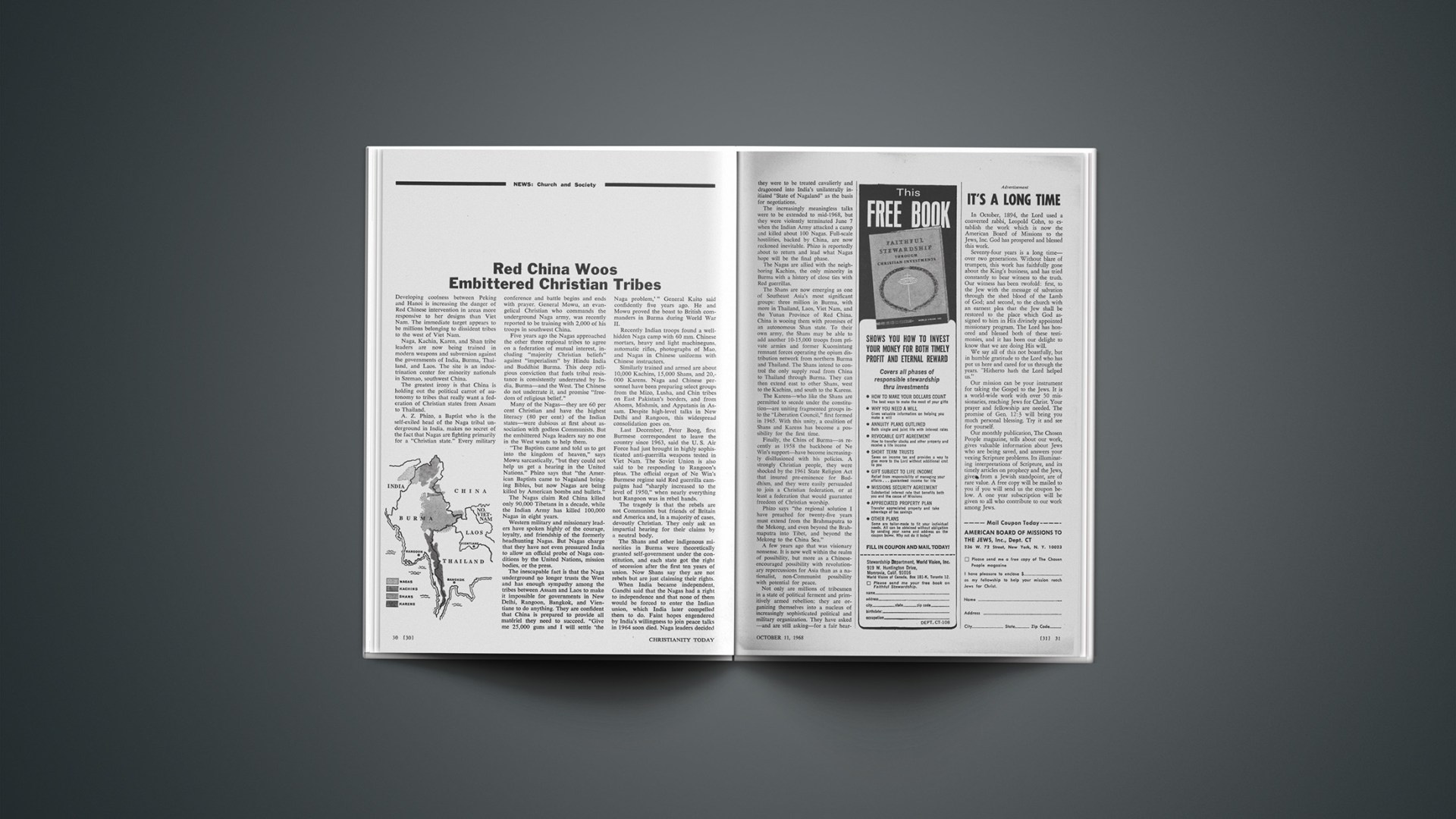
Red China Woos Embittered Christian Tribes

Developing coolness between Peking and Hanoi is increasing the danger of Red Chinese intervention in areas more responsive to her designs than Viet Nam. The immediate target appears to be millions belonging to dissident tribes to the west of Viet Nam.

Naga, Kachin, Karen, and Shan tribe leaders are now being trained in modern weapons and subversion against the governments of India, Burma, Thailand, and Laos. The site is an indoctrination center for minority nationals in Szemao, southwest China.

The greatest irony is that China is holding out the political carrot of autonomy to tribes that really want a federation of Christian states from Assam to Thailand.

A. Z. Phizo, a Baptist who is the self-exiled head of the Naga tribal underground in India, makes no secret of the fact that Nagas are fighting primarily for a “Christian state.” Every military conference and battle begins and ends with prayer. General Mowu, an evangelical Christian who commands the underground Naga army, was recently reported to be training with 2,000 of his troops in southwest China.

Five years ago the Nagas approached the other three regional tribes to agree on a federation of mutual interest, including “majority Christian beliefs” against “imperialism” by Hindu India and Buddhist Burma. This deep religious conviction that fuels tribal resistance is consistently underrated by India, Burma—and the West. The Chinese do not underrate it, and promise “freedom of religious belief.”

Many of the Nagas—they are 60 per cent Christian and have the highest literacy (80 per cent) of the Indian states—were dubious at first about association with godless Communists. But the embittered Naga leaders say no one in the West wants to help them.

“The Baptists came and told us to get into the kingdom of heaven,” says Mowu sarcastically, “but they could not help us get a hearing in the United Nations.” Phizo says that “the American Baptists came to Nagaland bringing Bibles, but now Nagas are being killed by American bombs and bullets.”

The Nagas claim Red China killed only 90,000 Tibetans in a decade, while the Indian Army has killed 100,000 Nagas in eight years.

Western military and missionary leaders have spoken highly of the courage, loyalty, and friendship of the formerly headhunting Nagas. But Nagas charge that they have not even pressured India to allow an official probe of Naga conditions by the United Nations, mission bodies, or the press.

The inescapable fact is that the Naga underground no longer trusts the West and has enough sympathy among the tribes between Assam and Laos to make it impossible for governments in New Delhi, Rangoon, Bangkok, and Vientiane to do anything. They are confident that China is prepared to provide all matériel they need to succeed. “Give me 25,000 guns and I will settle ‘the Naga problem,’ ” General Kaito said confidently five years ago. He and Mowu proved the boast to British commanders in Burma during World War II.

Recently Indian troops found a wellhidden Naga camp with 60 mm. Chinese mortars, heavy and light machineguns, automatic rifles, photographs of Mao, and Nagas in Chinese uniforms with Chinese instructors.

Similarly trained and armed are about 10,000 Kachins, 15,000 Shans, and 20,000 Karens. Naga and Chinese personnel have been preparing select groups from the Mizo, Lusha, and Chin tribes on East Pakistan’s borders, and from Ahoms, Mishmis, and Appatanis in Assam. Despite high-level talks in New Delhi and Rangoon, this widespread consolidation goes on.

Last December, Peter Boog, first Burmese correspondent to leave the country since 1963, said the U. S. Air Force had just brought in highly sophisticated anti-guerrilla weapons tested in Viet Nam. The Soviet Union is also said to be responding to Rangoon’s pleas. The official organ of Ne Win’s Burmese regime said Red guerrilla campaigns had “sharply increased to the level of 1950,” when nearly everything but Rangoon was in rebel hands.

The tragedy is that the rebels are not Communists but friends of Britain and America and, in a majority of cases, devoutly Christian. They only ask an impartial hearing for their claims by a neutral body.

The Shans and other indigenous minorities in Burma were theoretically granted self-government under the constitution, and each state got the right of secession after the first ten years of union. Now Shans say they are not rebels but are just claiming their rights.

When India became independent, Gandhi said that the Nagas had a right to independence and that none of them would be forced to enter the Indian union, which India later compelled them to do. Faint hopes engendered by India’s willingness to join peace talks in 1964 soon died. Naga leaders decided they were to be treated cavalierly and dragooned into India’s unilaterally initiated “State of Nagaland” as the basis for negotiations.

The increasingly meaningless talks were to be extended to mid-1968, but they were violently terminated June 7 when the Indian Army attacked a camp and killed about 100 Nagas. Full-scale hostilities, backed by China, are now reckoned inevitable. Phizo is reportedly about to return and lead what Nagas hope will be the final phase.

The Nagas are allied with the neighboring Kachins, the only minority in Burma with a history of close ties with Red guerrillas.

The Shans are now emerging as one of Southeast Asia’s most significant groups: three million in Burma, with more in Thailand, Laos, Viet Nam, and the Yunan Province of Red China. China is wooing them with promises of an autonomous Shan state. To their own army, the Shans may be able to add another 10–15,000 troops from private armies and former Kuomintang remnant forces operating the opium distribution network from northern Burma and Thailand. The Shans intend to control the only supply road from China to Thailand through Burma. They can then extend east to other Shans, west to the Kachins, and south to the Karens.

The Karens—who like the Shans are permitted to secede under the constitution—are uniting fragmented groups into the “Liberation Council,” first formed in 1965. With this unity, a coalition of Shans and Karens has become a possibility for the first time.

Finally, the Chins of Burma—as recently as 1958 the backbone of Ne Win’s support—have become increasingly disillusioned with his policies. A strongly Christian people, they were shocked by the 1961 State Religion Act that insured pre-eminence for Buddhism, and they were easily persuaded to join a Christian federation, or at least a federation that would guarantee freedom of Christian worship.

Phizo says “the regional solution I have preached for twenty-five years must extend from the Brahmaputra to the Mekong, and even beyond the Brahmaputra into Tibet, and beyond the Mekong to the China Sea.”

A few years ago that was visionary nonsense. It is now well within the realm of possibility, but more as a Chinese-encouraged possibility with revolutionary repercussions for Asia than as a nationalist, non-Communist possibility with potential for peace.

Not only are millions of tribesmen in a state of political ferment and primitively armed rebellion; they are organizing themselves into a nucleus of increasingly sophisticated political and military organization. They have asked—and are still asking—for a fair hearing and just decisions. But the time for these is rapidly ending. And the time for the tribes to be an embittered pro-Communist threat to Southeast Asia is very near.

Nigeria: What After War?

War is the highest form of struggle for resolving contradictions

This is the first pearl of wisdom in Mao Tse-tung’s famous Red Book of sayings, which can be picked up cheap at any bookstall in Nigeria. But not many Nigerians today subscribe to this view of war. They have tried it for over a year and it hasn’t resolved anything.

The tragedy of the civil war is not only the lives lost but also the fact that most of the Ibos in breakaway Biafra were trained in mission schools, while 80 per cent of the federal soldiers are at least nominal Christians. There has been talk that it is a religious war with Muslims trying to wipe out Christians, but a visit to Nigeria soon shows there is no evidence for this.

The truth is even harder to take: a packed Sunday-morning congregation in Enugu of soldiers with rifles in one hand and Bibles in the other. These were men with a simple faith in Christ, attending worship in the Hausa language and ready to aim those guns at men of like faith. Occasionally a soldier has refused to pull the trigger when faced with an Ibo he went to school with.

The task facing Nigeria when the war ends is frightening, and the need for help from governments and the Church will increase greatly. First there is resettlement of Ibos, whose homes all over Nigeria are occupied by others. A reporter can’t escape a sense of guilt when he spends the night in a home that an Ibo family fled recently.

There is firm belief that Ibos will be welcomed back, but the warmth of welcome will vary in different parts of the country. Governor A. P. Diete-Spiff, 26, of Rivers State, whose family has suffered at the hands of the Ibos, estimates 100,000 of the region’s people were forcibly taken into Biafra by the Ibos. “If the Ibos try guerrilla tactics, we will learn to become cannibals. The Ibos will be welcomed back. But we know their tricks now, and they will not return to be masters,” he vows.

Ibos fear that when they return home they will be second-class citizens. They have always been keen and successful businessmen, leading the nation’s trade and controlling its markets—now taken over by other Nigerians.

Resettlement of Ibos will be a long process during which Nigerians must win their confidence. Homes must be refurnished, crops planted, businesses set up. Other nations must be prepared to do more than just supervise the ending of the war.

One issue has been whether it is better to prolong peace talks while masses die from starvation, or to encourage General Yakubu Gowon’s federal forces to stop holding back and achieve a quick military victory so needed aid can be brought to Biafrans. Trapped in last month’s cruel political-military stalemate, an estimated 6,000 Biafrans were starving to death each day.

A message to Nigerian Christian leaders from the World Council of Churches urged them to press peace negotiators in Addis Ababa to put relief supplies first on the agenda—before the possibility of a ceasefire. Many questioned the wisdom of this, since only after a ceasefire would there be hope of getting in enough supplies to meet needs.

In an interview, the 33-year-old Gowon, head of state as well as military chief, described his decision for an all-out drive to win the war and said he had ordered food stockpiles taken into each area as the troops advance. In the discussion Gowon outlined his faith in Christ and his sense of dependence upon Christ in every decision he makes. He prays for guidance daily.

J. ERIC MAYER

More Czech Reaction

As the situation in Czechoslovakia following Soviet occupation remained fluid, reports of Iron Curtain church reaction continued to filter to the West.

After the Warsaw Pact troops invaded, forty pastors of the Evangelical Church of Czech Brethren called it “brute force” and vowed “passive resistance against falsehood and injustice.… We must not be governed by the idea of our own safety or conformist resignation.… Christ was always on the side of the oppressed, the betrayed, the deceived, and the defenseless.”

The same week the Ecumenical Council of the nation and its Roman Catholics issued a softer “message” urging prayers and moderation in the tense situation. Loyalty to the continuing regime of Alexander Dubcek was vowed, since “in a democratic socialist society, much of the Christian program of the Gospel of Jesus Christ is being realized.”

Early last month the Ecumenical Council summoned two dozen Protestant, Catholic, and Orthodox leaders to issue a statement of gratitude to Czech government leaders for their handling of the situation. It praised them for saving Czech honor and lives by “gradually consolidating the situation.”

One of the most poignant documents came from the pen of Lenin Peace Prize winner Josef Hromádka, theologian and Christian Peace Conference leader. He noted his long efforts for friendship with the Soviet Union and development of international socialism and expressed “disappointment, regret, and shame” at the Soviet “occupation.” He said he feared the Czechs’ “love will be changed into hatred and that our closest friends will appear to us as enemies,” and said only a quick troop withdrawal could salvage the situation.

Patriarch Alexei of the Russian Orthodox Church dismissed Hromádka’s protest and that of officials of the World Council of Churches. He said the sending of troops was not an occupation but a result of the Soviet treaties of “cooperation and friendship” with Czechoslovakia. In fact, the patriarch argued that the Soviet troop action “saved the world from a serious conflict and prevented bloodshed.”

In neighboring Hungary, the Lutheran weekly said that Western visitors had “provoked the current situation” in Czechoslovakia and that the troublemakers were in no position to “raise questions.” A more sympathetic statement was printed in the journal of the Reformed Church of Hungary.

In Rumania, where the Communist government criticized the invasion, a statement from leaders of all Christian groups was read from all pulpits last month urging Rumanian unity and demanding for Czechoslovakia “the sacred right to free development and independence.” The Evangelical Church of Berlin-Brandenburg in East Germany sent the Czech churches a message of mourning over the use of military force, despite reported Red regime pressure to keep silent.

Olympics: Over Sacred Site

If the student rebellion hasn’t closed everything down by then, the nineteenth Olympic Games will open October 12 near Mexico City. The Olympic Village has been built over the site of Cuicuilco, a sacred pagan ceremonial center that was buried by a volcano 2,000 years ago. But in 1968 a variety of Christian activities are planned.

Campus Crusade for Christ has teamed up with the ecumenical Centro Audio Visual Educativo to produce a series of daily five-minute radio programs featuring well-known Christian athletes. The programs are scheduled on 100 Latin American stations, forty Spanish-language stations in the United States, the Armed Forces Radio Network, and evangelical stations. Crusade’s Latin evangelism center at Chula Vista—forty minutes from the Olympic site—will house many Olympic officials and dignitaries.

Evangelical churches in Mexico City have planned a city-wide Evangelism-in-Depth campaign during the Olympics. Among those helping it will be two dozen U. S. Free Methodists, whose men’s fellowship arranged a $450-per-person Olympics caravan from Arizona to Mexico City.

Formal religious festivities were to include a big “Service for Peace” in the Stadium, sponsored by the city’s Protestants, Catholics, and Orthodox. Local clergy will also offer multilingual services in a non-denominational chapel at Olympic Village with a seating capacity of 450. The modernistic church is the first major inter-Christian structure ever built in Mexico. Pope Paul planned to send a number of works for an Olympic culture exhibit, plus a message to the participating athletes.

Contraception And Damnation

Like a feisty fire-and-brimstone preacher, Patrick Cardinal O’Boyle is telling Roman Catholics they might be damned if they use artificial means of birth control.

The Washington, D. C., prelate’s warning in a pastoral letter spurred more than 200 worshipers to walk out of Sunday Masses. They were also protesting his disciplinary action against thirteen of forty-four parish priests who publicly disagree with his strict enforcement of the Pope’s contraception ban.

The adamant cardinal took a clear slap at Catholic liberals who uphold married couples’ right to freedom of conscience on the issue. His proof text was Deuteronomy 29:19, 20:

“… If after hearing these sanctions a man should bless himself in his heart and say, ‘I will follow the dictates of my own heart …,’ the Lord will not pardon him. The wrath and the jealousy of the Lord will blaze against such a man, every curse written in this book will fall on him and the Lord will blot out his name from under Heaven.”

“My dear friends in Christ,” the cardinal continued, “can you understand that I am impelled to act because I cannot stand by and let you be misled by an idea of freedom of conscience that could bring down on you so horrible a curse?”

Like a torch, the warning exposed with glaring light the growing gap between conservatives and liberals in the Roman church. It also seemed to lessen the possibility that compromise could smooth over this issue, which some see as the greatest challenge to Catholic authority since the Reformation.

Lest anyone be confused, O’Boyle added that no one can be a “faithful Catholic” and keep on using contraceptives, nor should a user take communion.

This stand is in direct contrast to positions taken about the same time by English and Austrian bishops. The English defended the right of individual conscience, while the Austrians went a step further and declared that Catholics did not have to confess their use of contraceptives or stop taking communion because of it.

In his pastoral letter O’Boyle took such bishops to task. He accused dissident priests and “even a few of my brother bishops in other lands” of seeming to adhere to the “new morality.” “According to this moral theory,” he said, “objective standards always may be subordinated to the individual’s decisions about his own unique situation.”

Opposing priests reacted strongly to that label. They said the cardinal badly “misstated” their position and added that no responsible theologian supports this theory.

O’Boyle then added insult to injury by rejecting—without even seeing—a new demand that he submit to arbitration his dispute with the forty-four dissident clerics in his diocese.

The National Federation of Priests’ Councils, which made the request, accused the cardinal of dealing with it “in bad faith.” The federation met in a two-day emergency session over the birth-control crisis, at the request of the Association of Washington Priests. The association, headed by the Rev. John E. Corrigan, Catholic University moral theologian, has led national opposition to strict interpretation of the Pope’s ban.

O’Boyle repeated his position that “because this is a doctrinal matter, it is not subject to arbitration or mediation.” But federation officials said they mainly wanted “due process” for the two priests whom O’Boyle suspended and the eleven others who received lesser penalties.

They hoped the dispute would go to the Committee on Abitration and Mediation of the National Conference of Catholics, chaired by the liberal Lawrence Cardinal Shehan of Baltimore. Shehan served on the Pope’s birth-control commission, which in its majority report advocated relaxation of the church’s ban on contraception.

A new tidbit about the commission: The fourteen bishops who were members voted nine to three, with two abstentions, that contraception is not necessarily sinful, according to the National Catholic Reporter. Until now, only the votes of the participating theologians were known. They reached the same conclusion by a fifteen-to-four vote. Names of the nine bishops were not known.

The Kansas City-based Reporter, which last year scored the coup of publishing the full theological report to the Pope in favor of a new doctrine of contraception, printed last month the text of the bishops’ statement. Its tone is pastoral, and its rhetoric not as commanding as that of the theologians. But the bishops’ refusal to go along with previous teachings on birth control indicates that there may be some ferment among the hierarchy as well as among the clergy and laity.

The bishops’ document to the Pope said:

“So the means chosen should be suitable for exercising a healthy and responsible parenthood, in the light of certain guiding principles: besides being effective, they should have regard for the health of the parents and their eventual offspring; they should not violate respect for the personal dignity of either husband or wife, who must never be treated as objects—this applies to women, who are still kept in a state unworthy of them in many countries, as much as to men; they should pay attention to any possible psychic consequences they might entail, depending on the person and circumstances; and finally they should not hinder the power of expression of an increasingly close union between two persons.…”

The national association won its first major strategic advance September 25 when 148 members of the Boston association urged O’Boyle to withdraw sanctions against the offending priests. The Bostonians also urged the bishops of the United States “and other brethren in Christ to express their concern to the Archbishop of Washington.”

Birth control got little mention at a meeting of diocesan priests called by O’Boyle the day of the Boston statement, but a full-dress meeting of the Washington priests’ Senate this week is expected to produce more commentary. In addition, the semi-annual meeting of the nation’s bishops is scheduled for Washington later this fall.

Along with the continuing birth control ferment, there are rumblings of further Catholic doctrinal discipline. Reports from the Vatican say an investigation is in process of the work of landmark Dutch liberal theologian Edward Schillebeeckx. Schillebeeckx was one of the major framers of the controversial “Dutch Catechism,” and a 1961 Dutch bishops’ manifesto which was banned in Italian bookstores. He was prominent at Vatican II.

Vatican sources denied to United Press International a liberal charge that a heresy trial was in preparation. Other reports held that eminent German theologian Father Karl Rahner had been selected to defend Schillebeeckx and would visit Rome on the matter sometime this month.

Flamboyant Twins Indicted

The flamboyant twin-brother pastors of the First Baptist Church of Fort Worth, Texas, the Rev. Homer and the Rev. Omer Ritchie, were among thirteen men indicted by a federal grand jury last month on charges of swindling twenty-one churches from Texas to New York of about $5 million. Arraignment is expected next month, with a Dallas trial in January.

Among those accused of fraud were prominent Churches of Christ contractor Glenn Paden, Sr., a former state securities executive, and a former state representative.

The Ritchie twins, who gained unanimous consent from their 5,000-member downtown church to remain in the pulpit, are charged with making a secret agreement to receive a percentage of room rental from a corporation that planned to build a motel on land that belongs to the First Baptist Church.

Assistant U. S. Attorney Robert Travis of Fort Worth said the churchmen also made an agreement with two other defendants to induce Mid-City Baptist Church in New Orleans to turn over about $4 million in bonds and cash in return for a new church building, which was never built. For their part, the Ritchies were said to have received $48,000.

Fourteen of the swindled churches were Churches of Christ, three Baptist, three Christian Science, and one Assemblies of God.

The Ritchies denied the charges and said they were “ridiculous, without basis.” “Omer and I are completely innocent; the facts have been twisted out of context,” Homer Ritchie told his congregation. The church responded with a resolution of love and devotion, full support and assistance, and earnest prayer. At Homer’s request, the church prayed for Travis and the federal grand jury that indicted the preachers.

This was not the first time First Baptist has been involved in a scandal. The Ritchies were preceded by the renowned J. Frank Norris, who was acquitted on a charge of murdering a wealthy Fort Worth lumberman and later on a charge of starting a fire in his church and perjuring an anonymous letter of threat against himself. Norris withdrew his church from the Southern Baptist Convention in 1952 and organized the Baptist World Fellowship Church in a dispute over teaching of evolution at Southern Baptist-related Baylor University.

Homer Ritchie caused a small uproar himself when he divorced his wife, remarried, and filed a legal petition against his ex-wife for not letting him visit his daughter. There was a commotion in 1963 and in 1964 over handling of church finances. Each time the scandal blew over.

Under Norris the church membership reached 8,000. Under the Ritchies, membership has declined to about 5,000, but the church property is worth about $3.5 million.

MARQUITA MOSS

‘Sacred Cows’ On Alcohol

The first U. S.- and Canada-wide poll done by Alcoholics Anonymous shows 41 per cent of those who join stop drinking at once and another 23 per cent stop within a year. The remarkable results from a survey of 11,355 members this summer were reported at an international alcoholism conference in Washington, D. C.

At the conference, Methodist Bishop James K. Mathews of Boston attacked “sacred cow” concepts on drinking that churches usually support, such as minimum-age laws. The role of the Church, he said, “is not so much to provide missing services in a community” such as pastoral counseling, but to encourage the society to undertake healing programs.

Iowa Governor Harold Hughes, now a Senate candidate, spoke to the meeting as an ex-alcoholic. The Methodist layman said that if the country can’t meet the alcohol problem, “we aren’t likely to meet the great problems of war and peace, mass poverty, racism, and the estrangement of youth …”

The Kid On His Knees

Nobody ever knocked out Kid Gavilan in 144 professional fights during a ring career that included three years (1951–54) as world welterweight champion. The boxer was knocked down only twice before he hung up his gloves ten years ago and retired to a small farm in his native Cuba.

Today, the once happy-go-lucky Kid is on his knees. He was dropped there by nine cruel blows from Fidel Castro’s Communist government. That position, however, is not a symbol of defeat for the 42-year-old Negro, who is partially blinded by cataracts. It represents a kind of victory to the Kid, who, as Gerardo Gonzales, arrived in Miami last month aboard one of the regular refugee flights from Cuba.

“I owe Him [God] everything,” declared the soft-spoken Kid, whose religious practices led the embarrassed Red regime to jail him nine times in nine years since he became one of Jehovah’s Witnesses. “I am on my knees to say thanks because I am in the United States and because my family is going to be together.” He plans to settle in New York where his third wife and three children are awaiting him.

“It is a crime to be religious in Cuba,” declared the still trim fighter, who was jailed for preaching on the streets. “They don’t want anybody talking to the people about religion or anything else except Communism, or you go to jail.”

“I have to work for Jehovah,” he went on. “I have to go any place where human beings are to tell them about Jehovah’s purpose. I have to tell them not to hate, but that people are to live together in love. I have to tell them that Jehovah is for everyone—not just the rich, and no matter what color they are.” “But you can’t say that in Cuba,” Gavilan added. “They call it political. The police started chasing me. They called me a Yankee CIA spy who was hiding behind religion.”

Gavilan, a former Catholic, said harassment and persecution of religious groups is not limited to Jehovah’s Witnesses. It applies to anyone who undertakes any public religious activity outside the routine indoor Sunday services. Pentecostals, two groups known as Gideons (not the famous Bible-placing organization), and the Trinitarians in particular have run into trouble for attempting street preaching, he said.

Even regular services at Catholic, Methodist and Baptist churches suffer, Gavilan noted. “They make the people be on jobs when it’s time for church services,” he reported.

The people of Cuba are suffering economically and also in health, said the champ, whose farm was nationalized. They have been living on Communist promises, “but nobody can give promises that equal God’s,” he said. Now that he does not have even his little farm left from the two million dollars he earned as a fighter, Kid Gavilan is not worried about getting along. “I just want to learn to live for the future Jehovah promises. Preaching, for me, now is the first thing in my life.”

ADON TAFT

It Didn’T Suit

It would have been a neat trick—but it didn’t work. A pastor hoped to “work for the reconciliation of men” by filing a suit to stop the bussing of Negro school children from Washington, D.C., to his Maryland suburb.

“But people didn’t understand,” said the Rev. Kenneth H. Okkerse, pastor of the Episcopal Church of the Redeemer, explaining why he withdrew as coplaintiff. “They thought I was doing just the opposite. They saw it as a divisive effort.”

Okkerse said he wanted to test the constitutionality of bussing and, through “dialogue” with citizens involved in the issue, to show that “the answer to unrest in our hearts is not social reform, but Christ. He is the only one who can unite men, as each comes to know him.”

“But I found that people couldn’t understand what I meant,” said the frustrated minister. “I’ve never been involved in anything political before, and I don’t understand the jargon.”

An evangelical who is prominent in the local charismatic movement, he said he felt he’d be “more effective in the discipline of the church than the courts.” But he emphasized that he had “no pressure” from anyone to get out of the suit.

Okkerse said he had “no objection” to inter-racial classrooms. But along with the constitutional question, he wondered whether bussing was the best way to solve educational problems.

A Man Called Peter Jr.

A man called Peter has done it again. Like a late-night movie rerun, the Rev. Peter Marshall Jr. has followed in his famous father’s footsteps by nearly getting fired from a church because of a booming ministry.

But by a vote of sixty-nine to sixty-two, members of the East Dennis Community Church on Cape Cod overrode efforts to oust the dynamic 28-year-old. The pastor’s opponents, mainly older New Englanders, complained, “We have a small country church here—and we want to keep it that way.” Since Marshall took the pulpit last December, average Sunday attendance has more than doubled. Many newcomers, especially in the summer, are youths.

All this sounds like the elder Marshall, who risked dismissal by jarring stand-patters in New York Avenue Presbyterian Church, Washington, D. C., and won fame as a preacher, author, and U. S. Senate chaplain. Ironically, a Washington area presbytery committee recently advised a congregation not to call Peter Jr., who was student president at Princeton Seminary, because he is too controversial.

The young Marshall says his parishioners’ gripes about crowds are symptomatic of a desire “to keep this church a nice little country club. This is obviously not what I want, or what I think the Lord wants.”

“I would run into this resistance wherever I am,” he added. “It happens wherever you preach the Gospel. But the basic unwillingness to change was made more difficult by the older age of many of our members. I can understand it—in comes a young guy preaching all this stuff about sin and love.”

Before the vote, he said attempts by some members to “control the ministry … make it impossible for me, or any other minister, to do any effective work.” But now he thinks things are “resolved pretty well.… No one is trying to derail the train.”

Relevant or Irrelevant?

Much is being said to the effect that the Church is no longer being relevant to the world in which we live. Only recently I heard a prominent entertainer say that the Church has no meaning to young people because it has no answers, either for their personal problems or for the problems of the world.

Where this is actually the case, may not the reason be that the modern Church is abandoning its God-ordained role in the world to become involved in areas to which it is not called and for which its leaders are not qualified?

The Church is truly relevant only when it faithfully witnesses to a message—a message from God to man; when it gives itself to the preaching, teaching, and living of Christ, the one and only Mediator between God and man; when its primary concern is to point men to God’s Son as Saviour from sin and Lord of life.

It becomes utterly irrelevant when it preaches a Christ who is not the Christ of the Bible but has been divested of his supernatural and miraculous nature; when its primary concern is with the condition of the Prodigal in the Far Country, trying to make him happy, comfortable, and prosperous rather than to bring him home to his Father; when its leadership has shifted from a spiritual task to one that is largely political, economic, and social.

The Church is rendered ineffectual and irrelevant when it cuts loose from the anchor of faith in the Holy Scriptures and substitutes for that faith an attitude of criticism of divine revelation, setting up its programs with little or no reference to the plain teachings of that revelation. This becomes an ever increasing problem as seminaries turn out more and more men who have no idea of preaching the Gospel but rather use their training and calling for secular ends.

What could work more against effective leadership than catering to the changing foibles of a “lost generation” instead of offering them a faith to follow, a living Christ to believe in?

I am convinced that the turmoil among young people today has come about largely because we elders have failed them and the Church has failed them. Our homes, churches, and schools are so materialistically oriented, our outlook so fixed on the immediate situation in the world, that young people are crying in vain for something to satisfy their spiritual hunger, though they are not sure what it is they want.

We have lost them in the home by failing to place Christ at the center of every phase of life, and in the Church by increasingly emphasizing this world and its problems without reference to the solutions found alone in Christ. Our schools have become entirely secular and, under the guise of a separation of education from all religious influences, have in fact become hotbeds of anti-God and anti-Christian teaching.

In shifting the emphasis from the central to peripheral and secondary matters, the Church seems to have forgotten that it is possible to gain the whole world and yet lose one’s soul. It has apparently forgotten that man does not live by bread alone, and that God has faithfully promised to supply every material need if we will put him first in our lives.

In its search for contemporary relevance, let the Church acknowledge that neither science nor human achievement in any realm has changed the nature of man one whit. The human heart is the same today as in the day of Noah, when “the earth was corrupt in God’s sight, and the earth was filled with violence” (Gen. 6:11), or the time when our Lord himself observed that “out of the heart come evil thoughts, murder, adultery, fornication, theft, false witness, slander. These are what defile a man” (Matt. 15:19, 20a).

The Church must face up to the question of sin in the human heart and God’s remedy for that sin; it must abandon the attempt to wash the outside of the cup with no thought of the rottenness inside.

Man and this world must be viewed in the light of eternity. In the words of the Apostle Paul, we must “look not to the things that are seen but to the things that are unseen; for the things that are seen are transient, but the things that are unseen are eternal” (2 Cor. 4:18).

To put it as clearly as possible: The Church is relevant when it recognizes its spiritual calling, message, and mission, and irrelevant when it attempts to become an agency for social reform.

To the immediate rejoinder that the Church belies its calling if it is not concerned about the plight of men enmeshed in poverty, blighted by discrimination, and suffering from the age-old problem of ‘man’s inhumanity to man, let me say that it is the Christian’s duty to be concerned about these things and to use every legitimate means to help. A Christian without compassion in his heart is unworthy of the name he bears. A Christian who does not translate compassion into works of mercy is like those who passed by on the other side in our Lord’s story of the Good Samaritan.

But Christians do not just happen. They are people who have come into a vital personal relationship with Jesus Christ. By accepting him as Saviour and making him Lord of life, they themselves become “salt” in a festering society and “light” in a darkened world. This is the Church’s primary task.

The social order will never be changed by pronouncements of church courts; nor should the Church, in the name of the Church, hope to change it merely through programs of reform.

It is impossible to effect any great or lasting change in society without first changing the hearts of those who compose it. And who but the Church has the necessary message of personal redemption? What other organization is called to summon men to be reconciled to God through faith in his Son and then to be reconciled one to another through the living presence of the Holy Spirit in their lives?

But one is forced to the reluctant conclusion that many who would speak for the Church no longer hold to those basic matters of the Christian faith that have made it separate and distinct from the world order. The transition from spiritual death to spiritual life, which our Lord called being born again, centers in and depends on faith in Jesus Christ as Son of God—crucified, buried, and risen from the dead.

Also involved is the question of conviction of sin, repentance for sin, and conversion. Why is so little said about repentance today, even though Jesus made it a prerequisite for salvation? In fact, why is so little being said about salvation? The only possible explanation is that many who are speaking for the Church no longer believe in the relevance of Jesus Christ for man’s predicament.

Where the Church is irrelevant to the world and its needs, the reason is that it must be it has lost its vision and its message.

L. NELSON BELL

Ideas

The Religion of Change

The Fourth Assembly of the World Council of Churches chose for its theme “All Things New.” At the United Methodist Conference a caricature of the old prophet’s solemn warning was posted: “Prepare to meet thy Change.” In the patois of some radical activists in the church, God is change. Odd innovations are embraced and dubbed “evangelism,” even though they may be completely foreign to anything in the New Testament.

Speaking at the Senate Breakfast Group in Washington, Senator Frank Carlson said, “Today there is a widespread devotion to the idea that nothing, absolutely nothing, can remain the same. All things must change, and there is practically no consideration given as to whether the change is good or bad—right or wrong—easy or difficult—necessary or unnecessary.… But irresponsible, erratic, violent change only for the sake of making things different is as illogical and as unreasonable as it is unspiritual” (U.S. News And World Report, July 1, 1968).

Change is caught on the wheel of time and at its turning things rot, rust, break, disentegrate; earth dies and is reborn. Society, politics, religion—everything is affected. In the twenty-four volume Collier’s Encyclopedia, 13,624 pages—the equivalent of nineteen volumes—have been revised since 1965 to keep the work abreast of our swift-changing times. “The old order changeth,” and sometimes we are staggered, sometimes amused or delighted.

Scripture opens with a majestic sentence: “In the beginning God created the heaven and the earth.… And the Spirit of God moved upon the face of the waters.” Cosmic transition took place. The human race appeared and moved forward into vastly varied experiences. Israel was thrust into time. Christ came—and what a change that brought! The Church moved out into the world, undergoing structural changes through the shifting decades.

The early Christians knew that change was not only inevitable but often needful as well. They insisted that their mission not become static, their individual spiritual lives not remain still. “We are being transformed into the same likeness as himself, passing from one glory to another,” said the Apostle Paul (2 Cor. 3:18, Moffat). Anticipating the return of Christ he exclaimed: “We shall all be changed” (1 Cor 15:52). And Scripture never suggests that transitions will not continue into eternity.

Yet, despite the apparent close link between existence and mutation, let us not be carried away with the doctrine of change. Things may not be changing as much as we suppose. Numerous elements in the universe have a stubborn immobility. None of the many protest marchers in our time have demanded that the sun be remodeled, or that the atomic structure of things be revolutionized. Nobody votes to modify our breathing in and out of air. Nobody suggests that the heartbeat be stepped up to a hundred beats a minute or that the earth be remade as a cube rather than a sphere. Women readily change the color of their hair and the design of their dresses; but few would choose to change their natural femininity. More things are constant on earth, and perhaps in heaven, than some radical pundits care to consider.

The cry is loud for change in religion, for the revolutionizing of historic creeds, curriculums, even the very Word of God. Jesus himself is sometimes presented as an unfamiliar socialist or secularist. Apostolic authority suffers unbelievable diminution. The Church’s most hallowed foundations feel the crowbars of the revolutionaries. Change at times becomes a frightening Dagon venerated by awestruck masses.

Change, as we have said, is inevitable; but some changes could be ruinous beyond reciting. Would-be truth-changers may be mankind’s deadliest enemies, bringing the Almighty’s anger upon the earth. They made themselves fools, exclaimed Paul, when they changed the glory of God into the image of things that creep and crawl, and wove a lie from the fabric of truth (Rom. 1:23–25). There is a sense in which we had better let God be; tampering with him can be man’s most dangerous game. “He does not change, nor does he cause darkness by turning” (Jas. 1:17, Good News for Modern Man).

Contemplate the folly of changing some things associated with the Christian faith. Take the Cross, for instance: with what sign shall we replace it? In heaven or on earth what substitute could there be for forgiveness? Or mercy? Or compassion? Or justice? Who offers anything to supplant the effects of divine grace? How shall we modify the Spirit’s work of regeneration, or his dynamic for evangelism? Mutation of the essential elements of the Christian faith would mean their extinction.

The supreme folly, perhaps, is the theologians’ attempt to change Christ every few years. They simply cannot let him be what the New Testament claims he is. They will not let the Word be made flesh. They cannot accept the contention of the early Church that he is “the same yesterday, and today, and for ever.” With Jesus’ own warning ringing in their ears that worlds will be scattered ruins on cosmic night before his Word passes away, they take a chance on his being wrong in his witness regarding himself. They feel compelled somehow to recast the image of divine infallibility; Christ must be invested with human uncertainty. He must be brought down from his transcendent position and made as unregenerate as those whom he came to regenerate.

But Christ is not subject to change. He is God, and God is love; love cannot suffer mutation without being invalidated. It admits of no room for improvement. It cannot undergo alteration. Christ’s changelessness guarantees his essential sovereignty.

God has signed a gentleman’s agreement; he has made a pact with his Creation—“I am the Lord; I change not.” We can forever trust his immutability. “The counsel of the Lord stands forever, the plans of his heart throughout the ages” (Ps. 33:11, Smith-Goodspeed).

Students On The Rampage

Coming out of summer hibernation, the ugly monster of student revolt is beginning to prowl again. The angry, rebellious mood of radical students was strikingly illustrated at the recent meeting of the International Assembly of Revolutionary Student Movements. After taking over a building and disrupting registration on the Columbia University campus, students gathered in McMillin Theater, where red flags were prominently displayed. When the National Liberation Front flag was brought forward, the group rose and began chanting, “Ho, Ho, Ho Chi Minh.” A Canadian youth was applauded when he told of injuries to policemen during a clash with young people in Montreal. And when it was reported that students had seized the University of Nanterre, on the outskirts of Paris, the crowd cheered again while French students chanted, “This is only the beginning. We’ll continue to fight.”

Meanwhile, in Mexico City an army takeover of the National University led to a bloody clash with militant students, who then planned further retaliation by extending their activities to other universities. Rumblings of revolt began to spread in many parts of the world as administrators began sweating out the opening day of the fall term.

The generally acknowledged leader of the American campus revolt is the national organization called Students for a Democratic Society. Since its beginning in 1962, SDS, which numbers among its ranks activists of many political varieties, has shifted its tactics from non-violent sit-ins and marches to what it calls “resistance.” This sometimes involves violent confrontation. Whatever issue may serve as a decoy—the draft, the Viet Nam war, racial matters, academic freedom or greater student control of university affairs—the real SDS purpose is to crush the Establishment.

While these radical students grab for headlines, we cannot forget that they are only a very tiny segment of our university population. We ought not to condemn the majority of American youth (see article this issue, p. 3) because of this small but loud minority. Most of our college students are genuinely concerned about the world in which they live. They want to discuss and deal with issues that their elders have swept under the rug. These students, whose concerns and activism are commendable, are themselves victimized by the rampagings of the radicals. Their opportunity for an education is hindered when the SDS-type minority hypocritically uses the cry of “academic freedom” to trample on the rights of the majority.

Even in this ferment there are encouraging signs for the Christian Church. Many students have found the cause to which they can give themselves unreservedly in the living person of Jesus Christ. Knowing him in a personal way, they have become a different breed of revolutionary, determined with God’s help to effect world change through the power of the Gospel of Jesus Christ. We must not fail these young people who honestly seek meaning for their lives. Nor should we bury our heads in the sands of self-righteous non-involvement when confronted with the social issues they raise. We cannot ask them merely to profess a creed or promote an institution. We must show them by our words and deeds the power of the living Christ, who can make this an entirely different world.

Ncc: At Odds With Itself

Consistency has never been the chief virtue of the ecumenical movement. But the peculiar disparity that characterized the actions of the National Council of Churches’ General Board in its meeting in Houston last month is especially noteworthy.

For one thing, the National Council committed itself for the first time to the principle of economic boycott as a means of achieving social justice. The wording of a major policy statement adopted by the board sets the stage for such financial pressure tactics. In the initial implementation of the statement, the board passed a resolution vowing not to buy and eat California table grapes. The resolution was presumably designed to induce California grape-growers to recognize a farm workers’ union that has been campaigning for a better deal for workers. The rationale seems to be that justice for one social group is achieved by depriving another.

To make matters worse, the NCC board took a directly opposite tack with regard to the Soviet-led oppression of Czechoslovakia. On the same day, board members adopted a resolution condemning the Soviet action but calling upon the West to increase trade with the U. S. S. R.

Thus the board says that on the domestic front those thought to be guilty of fostering social injustice must be penalized financially. On the foreign front it says that the Communists should be rewarded for cruelty. Is it any wonder the NCC has the ear of so few and the hearts of even fewer?

Harvest Is Here

Missionaries and servicemen returning home see America from a wholly different perspective. Their long absence sharpens their awareness of America’s moral decline as they gaze with bewilderment on a scene marked by riots, strikes, racial tensions, obscenity, sexual license, and spiritual atrophy. The façade of affluence cannot conceal the desperateness of our plight and the speed with which we seem to be approaching the end of our nation’s greatness.

In 1965, American mothers gave birth to 300,000 illegitimate babies. By 1975, it is estimated, fully 10 per cent of our babies will be born out of wedlock. Divorce is common in and out of the churches. Premarital sex and marital promiscuity are endemic, and, strange to say, the voices of clergymen encourage this “freedom,” even in the pages of Playboy. Prostitutes, lesbians, and homosexuals parade and solicit openly and are pruriently interviewed on TV.

J. Edgar Hoover has just released the latest statistics on crime, and once again they show an alarming increase. Car thefts, rape, housebreaking, assault, and murder occur with the regularity of a ticking clock. Policemen are killed, and city streets are unsafe both day and night. To avert hold-ups and slayings, bus drivers in the nation’s capital now carry no cash and make no change.

More than five million Americans are alcoholics. The “man of distinction” advertised by the liquor industry is a far cry from the drunken husband who beats his wife and children, or the housewife whose children must suffer the taunts of schoolmates who know about their sodden mother.

Hollywood has reached new moral lows in film production, a feat though impossible a few years ago. Male prostitution, lesbianism, homosexuality, nudity and gutter language are now stock fare in both movies and plays. Producers argue that they give Americans only what they want, and that they would go out of business if they didn’t.

Books and magazines of the worst sort are peddled above and under the counter all over the land. Within two blocks of the White House are found some of Washington’s most obnoxious pornographic outlets. People wallow in this cesspool of putrescence legally, because recent Supreme Court decisions serve to protect those whose pockets are filled with the filthy lucre of this abominable trade. From the day the constitution was adopted until a few years ago, Congress and the courts had some control over pornography. But recently the high court has overturned long-standing safeguards laid down by earlier courts, and has altered what had been the moral guidelines in America for almost two hundred years. If a meat-packer canned and sold rat flesh, he would be out of business the next day. But the packers and peddlers of moral sewage not only have freedom but also the protection of the law to poison the minds of young and old.

The moral foundations of America are not crumbling; they have crumbled. And the churches have contributed to the disaster. Infiltrated by relativistic liberalism that has faulted the Scriptures, denigrated the ten commandments, and taught as the word of truth the philosophy of the natural man, countless churches have lost their message. The prophetic voice now proclaims social action and revolutionary political change, while men die of spiritual hunger for want of the bread of life.

We are already reaping what we have sown, but the full harvest has not yet come. While we wait, the voice of the true prophet must not be stilled. The prophet must cry. But what shall he cry? “Repent America! Repent! Why will you die? O God, remember mercy and visit us again with thy great salvation!”

Fruit For All Seasons

There’s a crispness in the air these fall mornings. Birds sense it, and their migrations stitch dark patches on blue skies and white clouds. Animals sense it and store up provisions for leaner months ahead. Man feels it, too, and harvests the ripened blossoms of spring. “Season of mists and mellow fruitfulness,” John Keats called it,

Close bosom-friend, of the maturing sun;

Conspiring with him how to load and bless

With fruit the vines that round the thatch-eaves run.

And at twilight, yellow corn shocks and crimson berries, orange pumpkins and purple grapes, steep in the bountiful light of the plump harvest moon.

This is a season to relish the earth’s richness, divine handiwork that declares the glory of God. This is a time to review the heart’s fruitfulness as well, for by spiritual fruit, Jesus said, the Father is glorified. And the fruit of the Spirit—love, joy, peace, patience, kindness, goodness, faithfulness, humility, self-control—is for all seasons.

A Country At The Crossroads

Americans are an angry people in 1968. They approach Election Day in an almost bitter mood. They see a nation in torment, drifting leftward into anarchy. A growing number of citizens are demanding radical changes to get the country out of its trouble.

As never before, Christians need to implore God to move the hearts of men to vote for the best candidate as God knows him, “for promotion cometh neither from the east, nor from the west, nor from the south. But God is the judge; he putteth down one and setteth up another.”

One big danger in this present upheaval is that on November 5 voters will respond emotionally rather than rationally. The results could be tragic. The crisis demands that Americans exercise the right of franchise, reasonably and responsibly.

These are the basic questions voters should ask before they act:

Who among the candidates will best perpetuate the Judeo-Christian principles upon which this nation was founded and under which it has prospered?

Who will provide the kind of leadership needed to inspire Americans to a new respect for constitutional processes and, for laws that serve the interest of all the people and ensure equal rights and justice for majority and minority groups alike?

Who seems most likely to put an end to riots, lawlessness, and civic disorder, not playing on fear?

Who is able above the others to bring an early and honorable settlement to the tortuous problem of Viet Nam?

Who will halt the inflationary wage-price spiral?

Who will inspire the people to more voluntary concern about one another?

Who offers the most constructive options for dealing with the great problems of urban overcrowding, air and water pollution, and conservation of national resources?

Who is best qualified to confront the Communist world in a way that will prevent nuclear holocaust and ensure at least a tenuous peace?

Who best comprehends the intricate political and economic problems of the underdeveloped countries and offers helpful and workable solutions?

Who will nominate Supreme Court justices who will close the doors to pornography and not coddle criminals?

Who will choose the most competent men in America, free of conflict-of-interest entanglements, to serve on his Cabinet?

Who will work best with Congress (and perhaps with a Congress dominated by an opposition party)?

Who by past actions has shown himself to be the most far-sighted in statesmanlike conduct and concern for national unity?

Who has shown the greatest degree of personal integrity and discipline, and who promises to look not to his own strength but to divine guidance?

Choose carefully. Judge the candidates not by the evasions and code words of campaign oratory but by their full record. You can help preserve the greatest land of all.

A Crucial Man

Billy Graham, the world’s foremost preacher of the Gospel, will celebrate his fiftieth birthday next month. He has been a crucial man, one whom the world has needed and God has blessed. It augurs well for the Church that as he approaches this milestone he maintains his vigor and vitality.

Church history surely will record the remarkable magnetism of Graham’s preaching ministry. There is little doubt that he has seen more people come to faith in Jesus Christ than any other evangelist in history. Christians too should be thankful for this man who has united them in the common task of evangelization. His crusades have been mighty demonstrations of faith, labor, and sacrifice on an interdenominational scale.

The Pittsburgh crusade last month provided the latest evidence of the Spirit’s work. Particularly memorable was the service in which 16,000 people came and sat through a drenching rain. More than 500 sloshed forward to record decisions for Christ.

Two weeks later the city of Charlotte, North Carolina, honored the evangelist as part of its bicentennial celebration. A remarkable assemblage of people gathered for the day, which began with a breakfast for high-school classmates and ended with an amphitheater tribute attended by 50,000 for the man Mayor Stanford Brookshire called Charlotte’s “most illustrious son and the world’s greatest preacher.”

Graham’s ministry may not even yet have reached its crest. He and his team have committed themselves to tackle again that city of cities, New York, next June. The meetings will be held in the new Madison Square Garden. They could well prove to be a prelude to international spiritual awakening and renewal.

The Believer And The World

Because the Christian is in the world but not of the world, he faces two temptations. One is to withdraw, to disentangle himself from the world’s problems, its sins, its issues and concerns. This approach has been tried again and again and has proved to be self-defeating. By shunning personal involvement, the Christian abdicates in favor of the forces of evil. The other temptation facing him is to yield to the pressures of the world, to conform himself to it. This ensures spiritual catastrophe.

We can think of the Christian life as a boat; the boat should be in water, but water should not be in the boat. When the boat is out of water, it is useless; but water in the boat will sink it. Christ told his followers that they must be in the world, but he warned them against letting the world be in them. This is the tension in which every believer must live.

The Apostle John shows us the way to victory over the world. “Do not love the world or the things in the world,” he says. “For all that is in the world, the lust of the flesh and the lust of the eyes and the pride of life, is not of the Father but is of the world.” Scripture abounds with examples of those who violated this precept and suffered harmful consequences. Samson was laid low by the lust of the flesh; David’s lust of the eyes for Bathsheba brought adultery and murder in its wake; King Uzziah, “when he was strong.… grew proud to his destruction.”

But Scripture also speaks of many who conquered the world and its enticements. Jesus and Paul are triumphant examples. Jesus was very much in the world. He associated with publicans and sinners and talked with a prostitute at a village well. He delivered men from demon possession. He allowed an “unclean” woman with an issue of blood to touch him. But in all this he was not defiled. Although he was in the world and deeply involved with it, he did not succumb to its temptations.

Paul never took himself out of the world. He traveled extensively, associated with all kinds of people, faced all sorts of pagan wickedness. Yet no one had a heart more set on Jesus Christ and more divorced from the love of the world. With the help of the Holy Spirit, Paul overcame the lust of the flesh, the lust of the eyes, and the pride of life.

So many of us are in love with the world. The boat is in the water, and water is in the boat. It’s time to bail out the water and become what God wants us to be—hardy believers sailing a straight course.

Book Briefs: October 11, 1968

Evangelicals: A Vital Force

The New Evangelical Theology, by Millard Erickson (Revell, 1968, 250 pp., $4.95), is reviewed by Richard N. Longenecker, associate professor of New Testament history and theology, Trinity Evangelical Divinity School, Deerfield, Illinois.

Writing in the popular idiom, Millard Erickson, chairman of the Department of Bible and Philosophy at Wheaton College (Illinois), has done for “new evangelicalism” what William Hordern, his doctoral mentor, did for the various forms of neo-liberalism and neo-orthodoxy in A Layman’s Guide to Protestant Theology. And like Hordern’s book, The New Evangelical Theology ought to be on the required reading list of every Christian layman and beginning theological student who wants to understand the theological lines and issues as they are drawn today.

After broadly describing the threat to orthodoxy that has arisen during the past two centuries in the natural sciences, philosophy, and biblical criticism, Dr. Erickson focuses his attention upon five men who have been in large measure the spokesmen of new evangelicalism since 1946: Harold J. Ockenga, Carl F. H. Henry, Edward J. Carnell, Bernard Ramm, and Billy Graham. A few others are identified, but only in passing. Taking these five as the forefront of a distinguishable movement, Erickson describes their motivating concerns, their commitment to Scripture as formal authority, their doctrinal system, the type of apologetic they employ, and their efforts to develop a Christian ethic. He concludes by speaking of trends within the movement, reactions from the right and left, strengths and weaknesses, and the future.

His thesis is that new evangelicalism is a vital factor on the American scene today; that it is carrying on both the content and the spirit of vital orthodoxy of an earlier day; and that it continues to emphasize scholarship and a positive statement of its position, and accepts a certain latitude within its ranks—while, at the same time, it deals with some problems that continue to cling to it and also with certain issues it has not yet adequately faced—then its future should be one of continuing strength and growth. Erickson develops his thesis fairly and well.

One point that I found somewhat disturbing was his use of “evangelical.” Now certainly this word has a diversity of meaning in the world of theology. But in America it seems to be (or, at least, should be) used with two somewhat varying ideas in mind: (1) a set of concerns and attitudes related to the needs of the present day, in continuity with vital orthodoxy of the past, and generally distinguishable from later fundamentalism, coupled with an orthodox Christology and an orthodox view of the Scriptures; and (2) a somewhat loosely fitted system of conservative theology, probably “a Calvinism [more] of mood than of system,” to be distinguished in part from such other systems as Reformed, Lutheran, Wesleyan, dispensational, or Pentecostal. Erickson uses ‘evangelical’ to mean both, ostensibly because the men who he is presenting are evangelical by both definitions (as he himself probably is also). But these definitions, though certainly not mutually exclusive, cannot be assumed to be automatically identical. Is it not somewhat misleading to speak of new evangelicalism primarily along the lines of the second definition, as do chapters 3 (“Doctrinal Content”) and 4 (“Apologetic Orientation”)? New evangelicalism has greater doctrinal diversity within it than is here represented. Although I myself follow Erickson in his doctrinal explication (though not his apologetic), I wonder what a new evangelical (as in definition one) who is also Reformed, for example, will make of that third chapter. Would it not be better to define new evangelicalism along the lines of the first definition, and recognize the second as a sub-category within the movement? I propose that Erickson really has two topics going: (1) new evangelicalism, definition one, which he treats in chapters 1, 2, and 6, and (2) evangelical theology, definition two, which he considers in chapters 3, 4, and 5.

I also have a question about the breadth of selection in the work. Without doubt, the five men presented must appear at the head of any listing of prominent new evangelicals. Certainly they are among the most vocal, and all who espouse like concerns stand heavily in their debt. But what of their predecessors? What of their colleagues? And what of the stimulation from certain like-minded scholars in Britain and on the continent? Personally, I would have appreciated a fuller treatment along. these lines; though perhaps it is up to each of us to complete the record—as to both details of the past and the future task.

Finally by way of criticism, there seems to be some problem in the presentation of an evangelical position on the inspiration of the Bible, for in certain statements Erickson appears to be both more rigid and more flexible than any of the five he seeks to represent. To define verbal inspiration as “God so controlled the Scripture writer that each word he chose was precisely that which God would have him write, and no other” (p. 63, italics mine) is to relegate Ramm’s insistence on the “dynamic or flexible” relation between thoughts and words to the category of “one possible variant” (p. 65) and to verge extremely close to a theory of dictation. On the other hand, to say repeatedly that plenary inspiration means that even incidental statements bearing on science are true, and then, without further interaction, to identify as a possibility within evangelical thought the view that inerrancy relates to matters pertaining only to salvation, and no more, is to insert some ambiguity.

With these few qualifications—and some are relatively minor in comparison with the work’s general excellence—this volume is highly commended. Not all readers will agree with the doctrinal and apologetic explications of chapters 3 and 4, but all with profit immensely from Erickson’s description and evaluation of new evangelicalism. It will be most helpful to its intended audience: the general Christian public and neophyte theological students.

Theology In Fiction

Adversity and Grace, edited by Nathan A. Scott, Jr., (University of Chicago, 1968, 269 pp., $7.95), is reviewed by Ann Paton, associate professor of English, Geneva College, Beaver Falls, Pennsylvania.

Adversity and Grace is aptly titled: the reader here encounters adversity and needs grace. These eight critical essays on contemporary fiction viewed from a theological perspective were each written by a different hand and hence exhibit a variety of styles—pungent and pedestrian, lucid and merely loose. And the title implies a unity that just isn’t there.

I can’t see why Nathan Scott, Jr., the editor, devotes so much of his introduction to defending what needs no defense: the theologian’s scrutiny of literature. After all, does not Christianity take all life as its province? Scott develops two main ideas: (1) that interest in humanistic studies is an outgrowth of modern theology; (2) that theology can learn something about itself from literature. Taking Bonhoeffer as “the great weathervane of contemporary theology,” he states Bonhoeffer’s position that the time of “religion” is gone and God must be spoken of in “non-religious” ways. So Christ is witnessed to in all apprehensions of truth, wherever they may arise, in whatever intellectual or cultural form. Fine. But can Scott really think that this conclusion, so tortuously arrived at, is the exclusive possession of the new theologies?

He then goes on to say that while the arts reflect the times, they do more than that. Fiction is the experimental arm of theoretical theology. The novelist, the dramatist, the poet show how a particular faith looks under the stress of experience. Again, to teachers of literature, this is nothing new.

Still, it is very useful to have these ideas set down systematically. Scott can write incisively and lucidly. About literature, he does so. But when he explains theology, his vocabulary floats out of sight, trailing his tangled syntax behind.

Two of the essays deal specifically with grace. Implicitly, grace is Saul Bellow’s theme. Scott convincingly shows that, though Bellow is not indebted to any dogmatic tradition, his deepest engagement is with a fundamentally religious posture: that there is a dimension of human experience where striving and strain are of no avail, and that “in returning and rest we shall be saved.” Grace is explicitly Salinger’s concern. James T. Livingston identifies religious tensions in Salinger’s work, his treatment of the sacred, the nature of his religious vision, and the perversions of Christian faith in Franny and Zooey.

Of the essays not particularly tied to either adversity or grace, two are brilliant. Norman Mailer commands attention because he is a conspicuous novelist and now also claims to be a philosopher. Mailer may think he is a Moses, but he looks more like Goliath here when David Hesla lays him flat with the hard truth: as a novelist, Mailer stands tall; as a thinker, he flops. Preston Browning’s analysis of Flannery O’Connor shows her crusading against shallow secularism in modern Christianity. Her tactic: to unleash in story after story twisted, God-haunted criminals who, being without veneer, lay bare ingrained evil.

Other essays deal with writers Heller, Pynchon, Powers, and Styron. Henry Rago’s end-piece on the theory of poetry gets lost in clouds of sign, symbol, and metaphor until finally three of his own poems do what he could not adequately describe.

All the scholars who contribute to this volume are well versed in both theology and literature. May their tribe increase, so that eventually pulpit and classroom alike can awaken the educated public to awareness of the vital relation of faith to literary works.

High View Of The Bible

The Bible—The Living Word of Revelation, edited by Merrill C. Tenney (Zondervan, 1968, 288 pp., $6.95), is reviewed by J. Murray Marshall, pastor, First Presbyterian Church, Flushing, New York.

Merrill C. Tenney, dean of the Graduate School of Wheaton College, has enlisted a top-flight team of evangelical scholars to grapple with what is probably the most basic theological issue of the century. On the team, along with Tenney himself, are Packer of Oxford, Kantzer and Montgomery of Trinity (Deerfield, Illinois), Harris of Covenant, Young of Westminster, Woudstra of Calvin, Pinnock of New Orleans, Gerstner of Pittsburgh, and Walvoord of Dallas. Their subject: the inspiration and authority of the Bible.

For a majority of theologians this issue has long been deemed settled—but not in favor of the high view of Scripture associated with orthodox Christianity. Contemporary theology usually accords the Bible a place of esteem but denies that it is a communicated disclosure from God valuable as objective in and of itself and therefore worthy of the implicit confidence of man. Because it has thus discredited the authority of Scripture, modern theology is susceptible to such excesses as the “death of God” expressions and to tragic confusion in faith and morals.

Yet a remnant of scholars argue vigorously and cogently that the Bible is God’s Word written, thoroughly trustworthy and binding in authority. The complexity of their task is evident in the wide variety of approaches used in this symposium. These include examining what the Bible says about itself, spelling out the philosophical concept of revelation, tracing the relation of revelation to theology as a whole, evaluating the forms of current thought on revelation and authority, and dealing with questions (such as inerrancy) that arise within the framework of the general evangelical position.

When ten men work independently on the same general subject, some repetitiveness and unevenness in style are bound to occur. On the whole, however, Tenney has pulled the team together well, producing not just a succession of stabs at the problem but an over-all impact that raises the issue to the place of prominence it must have. Evangelical scholars must not let liberal scholars get away with their devaluation of scriptural authority.

Tenney and his confreres have shown us that the case can be argued, but this book by its very character as a symposium shows us that more must be done. Pinnock puts it this way: “The moment is right for a careful restatement of the evangelical position on the inspiration of the New Testament, true to the deepest currents of Biblical teaching.” It is to be hoped that from among this group of evangelical theologians or others of their kind one will arise who will state the case for the evangelical view of the Bible comprehensively and convincingly for our times.

Montgomery feels not only that the time is right but also that there might be a receptive mood. He cites the conclusions of Ludwig Wittgenstein, a twentieth-century philosopher who said “the sense of the world must lie outside the world.” Montgomery’s words are important: “Today, as never before, philosophical thought manifests a passion for objective, empirical truth, and the ordinary-language philosophers, whose work stems from Wittgenstein’s Philosophical Investigations, are stressing the importance of verbal expression in conveying truth. Evangelicals of the second half of the twentieth century have an unparalleled opportunity to affirm the philosophical relevance of their high view of Scripture.”

One hopes that these essays will get a wide reading, not just among evangelicals but also among others who are compelled to see the poverty of any theological system that denies a revealed theology. And one hopes also that some evangelical scholar will pick up the challenge laid down by Pinnock and Montgomery. Meanwhile, “the Word of the Lord endureth forever.”

‘Fair And Honorable’ Apartheid?

A Plea For Understanding: A Reply to the Reformed Church in America, by W. A. Landman (Dutch Reformed Church in South Africa, 1968, 144 pp., $1.50), is reviewed by Howard G. Hageman, minister, The North Church, Newark, New Jersey.

In 1967 the General Synod of the Reformed Church in America sent a communication to its sister church in South Africa expressing concern over the racial policies of that country and their apparent support by the church. Dr. Landman, director of the information bureau of the Dutch Reformed Church, wrote a reply that, together with a number of appendices, has been published as a booklet.

This exchange is a good illustration of how many discussions of the South African question miss the central point. The American letter was written in ignorance of many of the facts of the situation and made its case largely on the reports of witnesses whose impartiality and creditibility can often be called into question. In his reply Landman has no difficulty in challenging the misconceptions and exaggerations that characterize the American appeal, in impugning its witnesses, and in ending his case with a flourish by asking what the Reformed Church in America was doing about racism between 1937 and 1954.

If it were just a matter of keeping score, there would be no question that the South African has won on points. Unfortunately, however, the main question remains to be asked and answered. Not that there are not other minor questions one would like to ask. If, for example, one accepts the South African thesis that “separate development” is dictated purely by cultural and linguistic differences, then what accounts for the systematic divorce of the Cape Colored (who have nothing but the pigmentation of their skin to distinguish them from the white) from white society? What does Landman’s church say about this?

But here is the real question. The Dutch Reformed Church has officially declared that it approves the official policy of the government “provided that it is applied in a fair and honorable way, without affecting or injuring the dignity of the person.” Then will Dr. Landman please tell what share the Bantu has had in planning his own destiny in his own country, what share the representatives of the new Bantustans will have in determining the policies of South Africa? How many representatives from Trans-Kei, the much advertised Bantustan, sit in the parliament in Cape Town, for example? What has his church had to say about questions like these, which surely involve “the dignity of the person” at its most sensitive point?

Instead of concentrating on the weaknesses of the American appeal, one wishes that Landman had fully exegeted his own text in the light of the actual situation. When the Liberal Party must disband because racially mixed meetings are impossible, when people are detained under a polite form of house arrest without so much as a trial, one still has to ask what the Dutch Reformed Church understands by “a fair and honorable way” that does not affect or injure “the dignity of the person.”

Hope For Political Conservatism

The Future of Conservatism by M. Stanton Evans (Holt, Rinehart and Winston, 1968, 304 pp., $5.95), is reviewed by C. Gregg Singer, chairman, Department of History, Catawba College, Salisbury, North Carolina.

This latest contribution by Stanton Evans, the very able editor of the Indianapolis News, to the growing bulk of conservative literature is timely and valuable. Evans’s basic thesis is that conservatism must be a powerful force in the future of the nation. But he does not stop there. He advances to the next logical argument, that it not only must be a patent factor in American political life but also can be. He then launches into a study of how conservatism can make itself felt in the 1968 election. This involves him in a long discussion of the relation between conservatism in general and the Republican party in particular from the election of 1940 through the election of 1964. This historical approach to the problems involved in this year’s conventions and election leads Evans to arrive at some very interesting conclusions and to offer some unusual suggestions for conservatives both inside and outside the Republican party.

The basic argument of this book is fairly simple: The Republican party is the true home of conservatism, and its future is closely tied to the conservative cause. Evans admits that there is a tension between the party’s legislative leadership and its recent presidential candidates. The one exception to this was Barry Goldwater. Evans offers some interesting insights into the 1964 campaign and indicts the American press and TV for flagrant misrepresentation of the conservative cause and the candidacy of Barry Goldwater. In this campaign the battle between the liberal and conservative forces within the Republican party came to a head, according to Evans, and this battle is important because it reflects the battle that is taking place within the country as a whole today. Thus what happens within the Republican party is of great importance for the future of American freedom under the Constitution.

On the basis of his quite thorough analyses of the 1964 and 1966 elections, Evans concludes that in 1968 (1) only a conservative can truly unite the Republican party, and (2), a conservative Republican nominee can successfully attract the large number of conservatives in the country. The argument is quite convincing. This book will give conservatives in all the parties a new feeling of solidarity and a realization that they do not stand alone. Evans would replace the feeling of defeatism with the conviction that victory is within the conservative grasp if only the right strategy is used in 1968.

Book Briefs

From the Rock to the Gates of Hell, by Andrew W. Blackwood, Jr., (Baker, 1968, 127 pp., $3.95). Blackwood examines the Church—a divine society and a human organization—in the light of Scripture and with the assistance of Bonhoeffer, Calvin, George MacLeod, and Gregor Siefer.

Stir What You’ve Got!, by Raymond E. Balcomb (Abingdon, 1968, 160 pp., $3.50). Well-written sermons on stewardship.

From Boxcar to Pulpit, by Robert Sandidge Weldon (Exposition, 1968, 146 pp., $5). A penetrating autobiographical account of a man’s journey from the hopeless valleys of alcoholism to the meaningful summits of Christian ministry.

The New People, by Charles E. Winick, (Pegasus, 1968, 384 pp., $7.50). A professor of anthropology and sociology offers a popular appraisal of the desexualization trend in America in which many masculine and feminine differences are being blurred.

Eutychus and His Kin: October 11, 1968

Dear Humans With Hang-Ups:

On a jagged outcropping of California’s breath-taking Big Sur coastline, the Esalen Institute offers experimental workshops to help free its well-heeled patrons of their hang-ups. Named after an Indian tribe that formerly roamed its 110-acre site, Esalen explores “trends in the behavioral sciences, religion, and philosophy which emphasize the potentialities and values of human existence.” A main objective: to break down people’s inhibitions and replace them with joy.

When I strode upon the institute’s grassy knoll, I saw three men and a woman huddled in one gigantic embrace with eyes closed and hands caressing one another’s heads and bodies. Nearby, a bearded man gently led a closed-eyed girl down a rocky path to the hot spring mineral baths. All were involved in new types of human encounter and sensitivity training. Such activities are a part of Esalen’s emphasis on touching and cuddling, exposure of one’s deepest secrets and dreams, psychodrama, sharpening of the senses, and exploration of the sexual, communicative, and mystical realms.

The seminars held in Big Sur and San Francisco draw heavily upon the meditative principles of Eastern religions and the interaction emphasis of Gestalt psychology. Most five-day workshops including lodging and meals cost $165; two-day, $65. The fall line-up of over 100 courses includes some dandies. “Psychological Karate” will increase one’s tolerance for conflict, anxiety, and frustration (a chop to the super-ego, a lunge at the id?). “Couples and Lovers’ Marathon” will involve participants in a 24-hour day-night group session. “The Scientific Study of Reincarnation” will study fifty reincarnation cases and disembodied consciousness. “The Hang-ups and Hopes of Emergent Global Man” conducted by United Church of Christ executive Willis Elliott will focus on a new global life-style.

Esalen’s efforts to unmask hypocrisy, establish authentic human relations, and bring joy to life are admirable. But the irrational road of humanistic mysticism leads to a dead end. The only real way to overcome life’s hang-ups is through Him who is the way, the truth, and the life.

Your Emerging Global Man,

EUTYCHUS III

Probing Soft Spots

Your September 13 issue was superb from cover to cover!… Dr. Kuhn’s article on Marshall McLuhan presented some thoughtful probings that reveal the soft spots in a highly lauded, but unproved, theory.

Associate Pastor

Memorial

Methodist Church

Austin, Tex.

Ringing The Bell

Carl Henry has “socked it to us.” Man, his article on “Demythologizing the Evangelicals” (Sept. 13) was great. We evangelicals have too long been on defense, all gathered behind our correct doctrines and creeds, while, out yonder, the world of non-Christians goes miserably on its way to damnation. Man, we need to generate some offense!… Hooray for Henry, the bell-ringer!

St. Elmo Presbyterian Church

Chattanooga, Tenn.

It was like a breath of fresh air in this day of theological negatives and defensiveness.

Midwest Bible Church

Chicago, Ill.

In a time when so many people seem to be asking the questions that just beg for the Gospel as the answer, I would submit with Dr. Henry that our best defense is an offense. Now is the time to infuse our evangelism with the strategy of joy.

Princeton, N. J.

Such an excellent and affirmative statement buoys my spirit.

The Palma Ceia Presbyterian Church

Tampa, Fla.

Shake On That

Of all the editorials since I have been a subscriber of CHRISTIANITY TODAY, “The Kings Are Coming” (Sept. 13) is the masterpiece, and I would like so much to shake the hand of whoever wrote it and to say “thank you.”

Chaplain

International Order of St. Luke the Physician

Cortez, Fla.

Gratifying Progress

I’m glad CHRISTIANITY TODAY was generous to insert a favorable article of the International Council of Christian Churches (“Fundamentalists on the Beach,” News, Sept. 13) … It is gratifying to learn of the progress of this conservative fundamentalist movement … The Rev. Dr. Carl McIntire is labeled as a “happy warrior” … There should be a definite union between the ICCC and the National Association of Evangelicals. “The things that are impossible with men are possible with God.”

First Covenant Church

Los Angeles, Calif.

Chicago And Charlie Brown

I think the evaluation of the demonstrations in Chicago (“Chicago as Armed Camp,” News, Sept. 13) is, although brief, a fair assessment. I was not personally involved in any of the confrontations … but was in attendance at meetings where “recruitment” was made.… It was stressed that only those persons who could be counted on to be respectful and orderly were to participate in these physical manifestations that would reflect desired change in the present political process.

I do not think the majority of the participants were either intentionally mean, criminal in motive, or stupid in belief. Neither were they trained in any kind of tactics to violently disrupt the convention. Those with whom I am familiar were no more terrorists then Charlie Brown. They represented students who had spent the summer working in Neighborhood Houses, camps for disadvantaged children, and the like.…

Some of those in the large gatherings that numbered in the thousands were no doubt of another stripe.… If these commit foul deeds they are to be justifiably held responsible. But to judge the many by a few is unwarranted.

Director, Wesley Foundation

St. Cloud State College Campus

St. Cloud, Minn.

On Witnessing

Thank you for publishing the excellent and thought-provoking article by Howard E. Butt on witnessing (Aug. 30). I pray that pastors, lay ministers, and people everywhere will give the essay careful attention. The cause of Christ will be edified when all Christians decide to become witnesses through the power of God, and stop this nonsense of playing church and judge.

Highland Crest Baptist Church

Green Bay, Wis.

Out Of The Book

Your news article on “Disciples Turn Corner” (Aug. 30) was effective. There is no doubt but what the yearbook has lost at least 1,500 church listings and will lose many more as soon as the people realize that they are losing their freedom of conscience in the connectional relationship of restructure.

Director-Evangelist

National Association of Free Christians Center, Tex.

It is difficult to “lose” something that has not been possessed. By and large this article is very true and interesting. However, the implication is that the 1,124 churches which have already withdrawn their names from the Disciples of Christ Year Book actually belonged to the Disciples of Christ. For most of the churches involved this is not true. Most were listed, not out of choice, or membership, but because at some time they had contributed to an organization (such as a school or home) currently associated with the Disciples of Christ. Most of these institutions were begun, not by the organization, but by cooperative efforts of individual churches.…

The allusion to a listing by the North American Christian Convention is misleading to say the least. The North American Christian Convention has no official relationship to any of the churches cooperating in its yearly assembly … [It] was begun as a “preaching convention” and has remained that.

Christian Church

Athens, Ill.

I have no idea where you obtained your information, but your deductions are inaccurate and misleading … The provisional design of the Christian Church to be voted on at Kansas City in September does not deny local church autonomy … The statement that all churches appearing in the present year book would be recognized as a part of the new denomination is false, and misleading. First, the denomination is not “new.” What is really happening is that what has been done for years is being put on paper. Each church will determine its own relationship to the Christian Church.…

You say that the provisional design will have its authority in a general assembly dominated by clergy and professional churches. The design calls for all ministers to be delegates, but it calls for two delegates from each church and an extra delegate for each 500 members over the first 500 … The laymen will outnumber the ministers about 2 to 1, unless they just do not attend and participate.

I cannot speak for the Disciples, of course, so what I have said here is my own interpretation of the facts.

Bethany Christian Church

Evansville, Ind.

No Sunday Disappointment

You would rightly expect some reaction from your large and loyal group of Seventh-day Adventist readers to Dr. Armerding’s excellent article on the Lord’s Day (Aug. 16), and I wouldn’t want to disappoint you. The point that neither the day nor the commandment is “passé” is well made, but how tragic for the human finger to write “one day in seven” where the finger of God wrote “the seventh day.”

Glendale, Calif.

Hargis’S Heartache

Imagine my surprise and heartache when I read in the review of The American Far Right (Aug. 16) that my Christian anti-Communist organization … “is not actually Christian and … may be as dangerous to the country as … Communism.” Every Communist publication in the world has attacked me and Christian Crusade. The National Council of Churches has done a good job attacking me because of my opposition to their theological liberalism and Marxist-inclined political internationalism.…

The writer of this anti-Hargis and anti-anti-Communist vicious diatribe is guilty of everything that he would accuse me of name-calling, character assassination, guilt by association.… I have always stood in defense of the faith.… I believe that America is God’s greatest nation under the Living Son.… I am so opposed to Communism that I feel led of God to expose it. In twenty-one years, I have never been sued for libel. No one has questioned the veracity of my remarks. Not even the most vicious liberal publications in the country that have run articles against me and Christian Crusade have dared suggest that my minisery is as bad as Communism. Have the editors of CHRISTIANITY TODAY sold out to the Communists? Does this [book review] truly represent the philosophies of the editors and owners of CHRISTIANITY TODAY? Do the editors of CHRISTIANITY TODAY sincerely believe that they share no blame for this vicious, satanic article which likens Christian Crusade to godless, anti-Christ communism?

I shall take steps to broadcast the unfairness of this article to the American people via our radio stations and our publications. I will do the best that I can to answer these unfair attacks in your publication by the use of mass communications afforded us.… I can only say, “Father, forgive them. They know not what they do.”

Tulsa, Okla.

That Czech Freedom

I am one of those who attended the All Christian Peace Assembly last spring in Prague. I was overjoyed to see the evidences of new freedom and the atmosphere of hope contrasted with the police-state atmosphere seen in a visit in 1963 and attending the assembly in ’64.…

I believe your editorial, “The Czech Caterpillar Keeps Stirring” (Aug. 16), is correct in stating that the liberalization moves more slowly in the churches than elsewhere—but it does move. The Methodist Church, for instance, refused to confirm a government-nominated leader this year and waited until it could elect its own.

It is a shattering experience to stand by and watch the use of military force to destroy freedom. We can pray and work toward further peaceful developments of freedom there and in other places and keep our own policy clean so that in future developments our moral bankruptcy, such as Viet Nam, will not prevent us from bringing to bear the moral influence which should be ours.

St. John’s Methodist Church

Seaford, Del.

Sown In Atlanta

The forty ministers who met at Atlanta (are you sure they were of the Church of Christ?) could not have spoken for anyone but themselves (Church Panorama, News, Aug. 16). Whoever they were, they could have saved their breath for their own congregations, instead of sowing to the wind. I pray these were not of the Lord’s church!

Church of Christ

Ore City, Tex.

What’S In A Name

A slight correction should be made in my review of The Situation Ethics Debate (July 19). “John C. Bennett (Baptist)” should read “Henlee H. Barnette (Baptist).” The correction is relatively minor unless one’s name is Bennett or Barnette.

Guelph, Ont.

Cover Challenge

I would like to comment upon the excellence of most of your cover designs. It seems that in our days, the idea of Christian editors in general is to make their cover designs as unattractive and old-fashioned as possible. Your magazine can be counted among the few which make an effort, at least most of the time, to present to the eye a challenge together with a build-up of expectations. Your artist knows how to use space well, has fresh ideas and approaches, is contemporary and even daring. Allow me to express my sincere gratitude and appreciation for your attitude of caring and concern with the modern mind that is demonstrated already in the cover designs of your magazine.

Bethany Baptist Church

Vancouver, B. C.

Prime Rhyme

I have been impressed by the general quality of poetry in Christianity Today. The level seems to me generally to surpass that of most other religious periodicals, not only in poetic skill and ability, but also in theological insight.

Greenville, Ill.

I have enjoyed reading … the magazine … Many articles are certainly most timely, even for us in the Eastern Orthodox world, which is, in a cultural sense at least, quite removed from the general tone of American Protestantism.

Eastern Orthodox pastor

New Fairfield, Conn.

addApple PodcastsDown ArrowDown ArrowDown Arrowarrow_left_altLeft ArrowLeft ArrowRight ArrowRight ArrowRight Arrowarrow_up_altUp ArrowUp ArrowAvailable at Amazoncaret-downCloseCloseellipseEmailEmailExpandExpandExternalExternalFacebookfacebook-squarefolderGiftGiftGooglegoogleGoogle KeephamburgerInstagraminstagram-squareLinkLinklinkedin-squareListenListenListenChristianity TodayCT Creative Studio Logologo_orgMegaphoneMenuMenupausePinterestPlayPlayPocketPodcastprintremoveRSSRSSSaveSavesaveSearchSearchsearchSpotifyStitcherTelegramTable of ContentsTable of Contentstwitter-squareWhatsAppXYouTubeYouTube