Looking Ahead: September 13, 1968

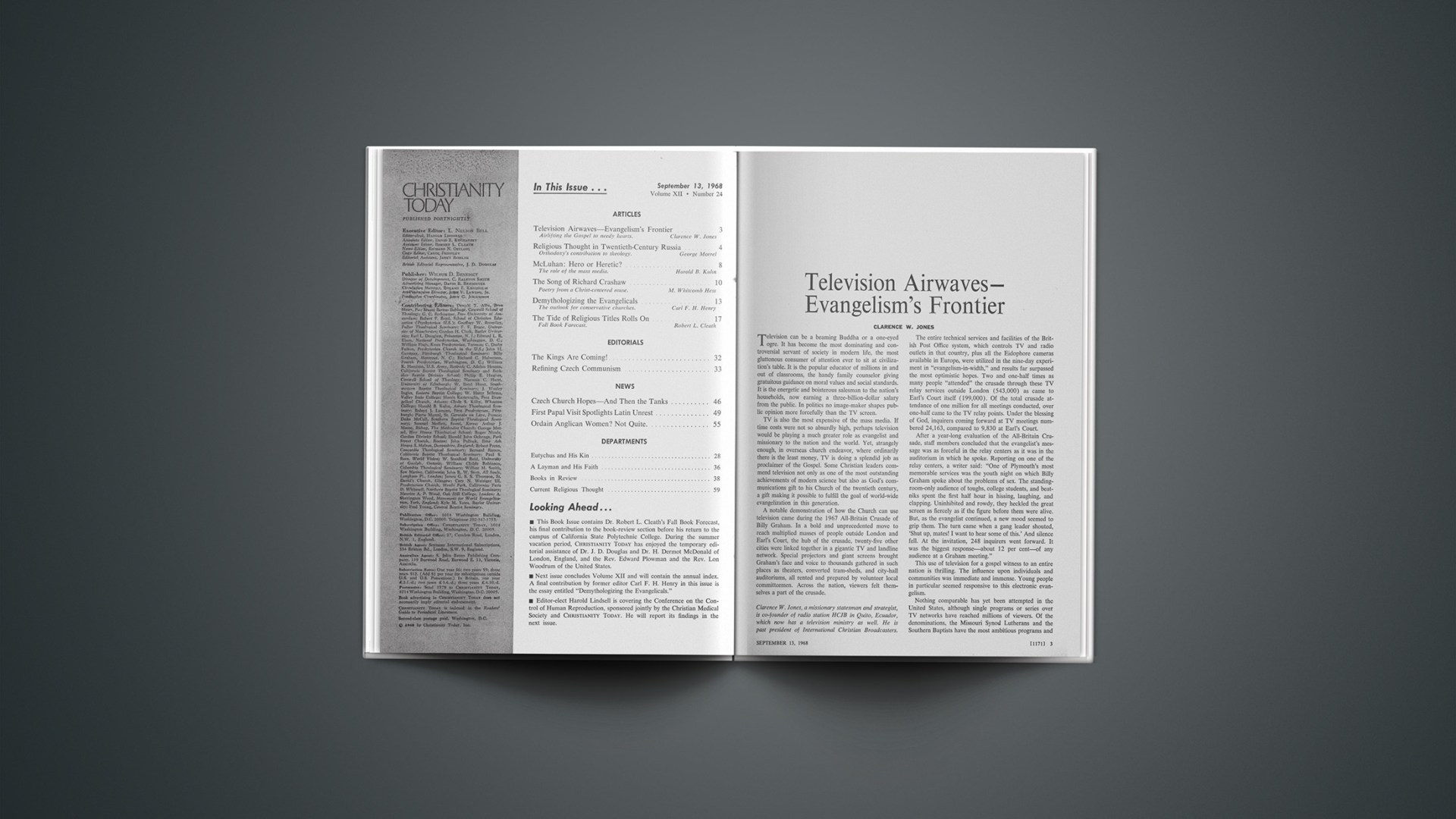
■ This Book Issue contains Dr. Robert L. Cleath’s Fall Book Forecast, his final cintribution to the book-review section before his return to the campus of California State Polytechnic College. During the summer vacation period, CHRISTIANITY TODAY has enjoy ed the temporary editorial assitance of Dr. J. D. Douglas and Dr. H. Dermont McDonald of London, England, and the Rev. Edward Plowman and the Rev. Lon Woodrum of the United States.

■ Next issue concludes Volume XII and will contain the annual index. A final contribution by former editor Carl F. H. Henry in this issue is the essay entitled “Demythologizing the Evangelicals.”

■ Editor-elect Harold Lindsell is covering the Conference on the Control of Human Reproductuon, sponsored jointly by the Christian Medical Society and CHRISTIANITY TODAY. He will report its finding in the next issue.
Atheism: The Old and the New

Atheism has been a tempting option to man at many points of his intellectual career. The term “atheist” as employed during much of the past two centuries has covered a mixed bag of thinkers—agnostics, social and political radicals, freethinkers, humanists, and intellectual anarchists. But all shared one feature that tended to distinguish them from our contemporary atheists: they moved against the prevailing intellectual and moral currents of the West.

Until fairly recently, it was commonly held within Western Christendom that reason could bring a fair degree of assurance that the origination of all things rested with an eternal and necessary personal Being. Even when Kant insisted to men of his day that the so-called proofs for God’s existence rested upon personal interpretations of reality and of thought, and upon prior commitments to life that were no longer tenable, thoughtful persons stood with him in awe before “the starry heavens above and the moral law within.”

If under the impact of the Kantian revolution men of the post-Enlightenment period found the speculative road to belief in God blocked, they still found the way of religious experience open and usable. Religious romantics stood in awe before the great psychologically impressive qualities of the universe. This, reinforced by social pressures favorable to the acceptance of religion, sustained theistic belief as a widespread option until well into the 20th century.

By the second quarter of our century, however, most of the supports of traditional theism were under major attack. The stellar world came to involve, seemingly, no necessary view of God. It began to appear rather as a collection of physical data to be reduced to order, and later as a realm for human conquest. The “moral law” came to be understood, not as an eternal something within man, but as a system of convention resting upon human usage.

With the rising influence of scientific discovery upon education, the younger generation assimilated modes of thought that almost imperceptibly veered them away from Christian belief and practice. Among their elders, social pressures favoring the practice of the Christian faith weakened and in some cases disappeared altogether. Thus many of the factors sustaining Christian belief and practice began to disappear, and a vast vacuum was created.

It is not surprising that a new genre of atheism should emerge at our midcentury as a serious competitor for intellectual allegiance. New options have been sought by those who have found many or most of the traditional routes of access to God closed, and who have inherited a weakening of biblical faith from a generation of scholars who came to regard the Christian Scriptures as no longer normative or historically reliable. Atheism has thus assumed a new base and a new rationale.

Men of our times scan the heavens, and where their ancestors could trace the features of God, they find only gaping holes. The study of comparative and cultural anthropology seems to tell them that no viable sanctions for general human behavior exist. Experiments in human government, good and bad, suggest to modern man that he is entirely on his own and need not appeal to any divine ordination for conduct of his corporate life.

The newer atheism grafts itself to these roots. It finds a climate hospitable to its denial of any transcendental realm or norms. It insists that the only world of which we have any reliable knowledge is that of our everyday existence, so that even if it could be shown that a God exists, such knowledge would be irrelevant.

While the newer atheism is closely tied to scientific and technological development, it has also deep psychological and sociological roots. Forms of empirical research and techniques of systems analysis do, of course, suggest that man is master of his universe rather than the subject of a higher Being. But this is not the sole explanation for the so-called Christian atheism that has made its appearance within the past decade.

Certainly this trend, especially in its more spectacular “God-is-dead” form, is the heir of the modern epistemological revolution (with its rejection of abstract and deductive thinking) and of the contemporary emphasis upon human freedom and human autonomy. Quite evidently it is nourished by theological attitudes toward the Christian revelation that regard the Bible simply as an anthology of man’s best thoughts about God.

But it speaks to us of more than these. It comes as a rebuke to some forms of rigidity and inertia within segments of the Christian community. Parts of the church, say the avant-garde, are so bound to traditional interpretations that many worthy human achievements have been accomplished in spite of the theologians, rather than because of the basic convictions that they held. Again, it is argued that evangelicals have so stylized God’s action that what they have left is “not really a God at all.”

In any case, the existence of what is called Christian atheism is indicative of broader attitudes present within our society. If the traditional Christian has been naïve in finding God too easily accessible, the secularist feels that all the roads traditionally thought to lead to him are blocked. If the evangelical believes that the ethical demands of the Gospel are easily grasped and applied, the newer atheist and his intellectual relatives will insist that rather than allowing reality to impose rules upon him, man is to make his own rules and if possible to impose his own wishes and desires upon the world.

Certainly the newer atheism finds support in many of the major assumptions of today’s society—perhaps more so than at any time in recent history. Again, the new atheist’s awareness of history gives him some reason to assert that belief in God has at times been used as a weapon for intellectual repression and as a justification for conduct that falsifies Christian love.

How shall the evangelical react to the newer atheism, particularly that which calls itself Christian? Certainly he should recognize theological faddism for what it is. He may even note with interest that the “God-is-dead” theology was almost immediately displaced in the headlines by a “theology of hope.” But he lives in a fool’s paradise if he imagines that we will not have any form of contemporary atheism around much longer.

Could it be that the living God is using even those who deny him, or who imagine that they can accept Christ as the supreme ideal of humanity while rejecting his deity, to challenge believers to a new and vital form of witnessing faith? Perhaps he is calling the Church to a new and radical demonstration of the quality of faith and the radiance of life that belongs to those who are in union with him who was at the same time in the world and not of the world.

Evangelicals to Launch Satellite Campus

To circumvent the isolation and expense of Christian colleges, six evangelicals meeting in Wisconsin August 15 announced incorporation of Skyline Christian Institute, a satellite residential-study center for students attending secular colleges in San Diego, California. It plans to open next fall.

The idea originated with the Rev. Derric Johnson, college and music director of the Skyline Wesleyan Church in suburban San Diego, biggest in The Wesleyan Church. The head of the institute is the Rev. George Failing, 55, who has been editor of the Wesleyan Methodist and public-relations director of Houghton College.

A statement said most Christian colleges suffer from a “sterile, isolated atmosphere.” Under the plan, students would take twelve hours a semester at San Diego State College, the University of California at San Diego, or one of the six other schools in the area. These schools have not yet been consulted on the plan. Students would live in apartment houses near the Skyline church and take four to six hours of work each semester in Christian thought and service. Completion of a B.A. program would take five years. The institute will offer no credit and give no grades. No tuition will be charged and Failing said interested laymen are expected to provide the financial backing. The design limits students to 200. The first-year faculty is seven or eight.

The institute’s seven-part “Commitment of Faith” expresses evangelical doctrines while avoiding the Calvinist-Arminian controversy, though all six founders are from conservative Wesleyan circles. There are no student rules such as most Christian colleges apply, but Failing said students will be expected to behave like those preparing for Christian leadership.

As plans for 1969 proceed, these new colleges will open in September, 1968:

Palm Beach Atlantic College. Opens September 3 with an expected enrollment of 125. To be housed in what used to be the main building of the First Baptist Church in West Palm Beach, Florida. The Rev. Jess C. Moody, pastor of the 4,300-member church, is serving as college president on a $1-a-year salary.

The first-year budget of $480,000 includes $200,000 for renovation of the church educational facilities and purchase of 40,000 books. Six of the thirteen full-time faculty have earned doctorates.

College plans began nearly four years ago with offer of a campus tract outside West Palm Beach to the Florida Baptist Convention. The Palm Beach Baptist association began a $1.5 million fundraising campaign. Plans were held up temporarily last year when evangelist Billy Graham considered founding a school in the area. This year the “Florida Baptist College” got its new name, since it has only local sponsorship. But within four to ten years the school plans to move and to seek affiliation with the state convention.

Business Manager A. H. Phillips said he hopes the college will be out of debt by the end of its first year, including the cost of renovation. If not, he plans to catch up by the second year, and two banks have agreed to offer credit for any debt. One $90,000 gift came in this spring, and the locally-based Professional Golfers’ Association gave $10,000.

The new college hopes to make the most of its unusual location, directly across from the Palm Beach yacht basin and a few blocks from the Atlantic Ocean. One of the prominent faculty members is oceanographer Riley Smith, who will cooperate with the Rebikoff Institute of Underwater Technology in Fort Lauderdale.

Atlanta Baptist College. Opens September 18 on a 562-acre campus twelve miles from downtown Atlanta valued at $7.5 million. By mid-August 125 students had signed up (including six Negroes), and the school was hoping for 200. In addition, a sizable enrollment is expected at evening classes. Most of the students are from the Atlanta area, since no dormitories will be available until next year. Of the faculty and staff of twenty-five, three-fourths hold earned doctorates.

The college, first proposed eighteen years ago, is affiliated with the 152-church metropolitan Baptist association, not the Georgia or Southern Baptist Conventions. The school has been approved for federal aid but—after heated controversy—is putting off applying for it. If the current $1.5 million drive for first-year operating funds is successful and support by Christians seems forthcoming, a spokesman said, the aid will not be necessary. During the first year the board will decide on whether to apply. Another task: finding a president. The Rev. Monroe Swilley, noted Atlanta Baptist pastor, is acting president for the first year.

Colorado Baptist Junior College. Plans a modest beginning September 22 with a faculty of ten and student body of about forty, all part-time. Classes will be held in the late afternoon and evening in the First Southern Baptist Church of Westminster, a Denver suburb. College president and spearhead of the project is Huitt Barfoot, Baptist layman who is a suburban school superintendent.

Eisenhower College. Ailing former President Dwight D. Eisenhower won’t be at the opening of the $7 million college named in his honor. But at least 250 students and twenty-six faculty members will. The college in Seneca Falls, New York, was first sparked by a $ 100,000 grant from the First Presbyterian Church, and “spiritual insight” is one of its goals. A spokesman said a chapel building and chaplain are future “possibilities.”

PERSONALIA

Sharon Terrill, 21, California’s entry in next week’s Miss America contest, said on statewide TV that the most important example parents can set for their children is “a personal relationship with Jesus Christ.” Meanwhile, Episcopal priest Kenneth E. MacDonald of Atlantic City became the first Negro elected to the pageant’s board.

William DuBay, 33, the Roman Catholic priest who was suspended for writing The Human Church and forming a clergy labor union, married Mrs. Mary Ellen Wall, 29, an Episcopal divorcee and mother of four. The Rev. D. D. Harvey, a Presbyterian, conducted the ceremony, after a rabbi withdrew.

The Rev. Edward R. Black of New Providence Baptist Church in Buckeye, Arkansas, dropped charges against nine parishioners he had accused of “beating and stomping” him in a dispute after a service last month.

Lieutenant Colonel James P. Smith, 34, will soon become the first man in 123 years to graduate from Mary Hardin-Baylor College, a Texas Baptist women’s school.

A Trillion-Dollar Legacy

In a report that is of major interest to churches and other charitable agencies, the U.S. Internal Revenue Service estimates that more than five million Americans now living will leave estates large enough to be subject to federal inheritance tax. These estates will total more than one trillion dollars, the study indicates.

“Not only the very wealthy, but many individuals in the middle-income brackets, will leave a gross estate worth more than $60,000, the minimum amount for which an estate-tax return must be filed,” the Internal Revenue Service said.

Federal inheritance tax is imposed directly on the estate, while state inheritance tax levies are made on individual beneficiaries.

The IRS has issued a new bulletin, “A Guide to Federal Estate and Gift Taxation,” which reminds taxpayers that nearly all a person’s assets, including his home, car, stocks, bonds, and life-insurance proceeds, are includable in his gross estate for tax purposes. It also advises taxpayers how to make charitable bequests that will be tax exempt.

Captain Charles E. Wolfe, first Southern Presbyterian chaplain wounded in the Viet Nam war, has been awarded the Bronze Star and Purple Heart.

Paul Gibson, a June Harvard graduate, is the first Negro staffer recruited by Inter-Varsity Christian Fellowship in several years. He will work in the Los Angeles area.

The Rev. Dr. Edwin H. Palmer, Christian Reformed pastor in Grand Rapids, was named full-time executive secretary of the Committee on Bible Translation, under which 100 scholars are working on a new evangelical version of the Bible. The project is sponsored by the New York Bible Society.

Vice-president Lawrence Schoenhals of Seattle Pacific College has been elected president of Roberts Wesleyan College in New York. He succeeds Ellwood A. Voller, new president of Spring Arbor College in Michigan, who replaced David L. McKenna, new president of Seattle Pacific. All are Free Methodist schools.

Frank L. Hieronymus, dean of faculty at Westmont College, California, was named acting president.

The Rev. Dr. Stanley D. Toussaint, New Testament professor at Dallas Theological Seminary, was named president of Western Bible Institute, Denver.

Colonel Chester R. Lindsey, former paratrooper and Baptist pastor, was named command chaplain of the U.S. Army, Pacific.

Bishop Philippos, former Orthodox leader in northern Greece, was sentenced to fifteen months in jail for charging that most of the leading Greek bishops are homosexuals. He was the first bishop ever tried by a military court. Also sentenced at the secret trial were two priests and an editor.

Three captured U. S. pilots were released by North Viet Nam and escorted back to America by Quaker Stewart Meacham and two other anti-war leaders.

PROTESTANT PANORAMA

No sooner had A Fellowship of Concern, liberal lobby in the Southern Presbyterian Church, disbanded than former members started an unnamed movement by getting more than 200 persons to sign a statement of purpose. It opposes such “idols” as “racism, nationalism, regionalism, capitalism, communism, and denominationalism.”

The United Presbyterian Church is producing two TV spot advertisements promoting racial understanding.

New York City’s Protestant Council urged ministers of its 1,700 member congregations to aid in registration of all rifles and shotguns with police before the August 13 deadline set by a new law.

After study of a report from a guild of Episcopal lawyers, the New York diocese stated that the “vague” right of a fugitive from justice to sanctuary in a church has never existed in American law and was rejected long ago in Europe.

The Sawyer EUB Church in Bradford. Pennsylvania, decided to stay outside the United Methodist merger and reports that fourteen other congregations in the region have similar feelings.

To beat those long summer weekends. Calvary Evangelical Lutheran Church (LCA) in Louisville is offering an 8 P.M. Thursday service identical to the Sunday one.

Annual assemblies of the Church of Ireland, Presbyterians, and Methodists declared intent to merge. An outline plan is expected by 1970.

The 100-member Anglican Church of the Holy Trinity, Toronto, has torn out ten pews and moved in bunk beds to handle U. S. draft-dodgers who come to the church, at the rate of about thirty a day, for help.

The triennial general assembly of the Greek Evangelical Church petitioned the government to reinstate the Rev. Argos Zodhiates, once pastor of the group’s largest church and now in exile in America. The church will rewrite its constitution and consider a proposed draft at a special meeting next year. The Rev. Nicholas Landrou of Nicea was elected moderator.

MISCELLANY

Despite cutoff of War on Poverty funds after sensational Senate hearings (July 19 issue, page 54), the Rev. John Fry of Chicago’s First Presbyterian Church vows his work with the Blackstone Rangers gang will continue, with private funds.

The Baptist Standard said a Texas convention committee will recommend outright sale of Howard Payne and Wayland Colleges to the state, self-determination for the University of Corpus Christi, and less drastic changes for the state’s other five Baptist colleges. Debate on the proposals is intense.

Gideons International distributed 5.5 million Bibles and New Testaments in 1967.

Gus Hall, secretary of the U. S. Communist Party, said “our fight is not with God,” since liberal churches have goals “almost identical” to those of the party: end to the Viet Nam war, elimination of poverty, and freedom for blacks.

Deaths

GRANT REYNARD, 80, devout Baptist artist whose paintings and etchings are represented in the Metropolitan Museum and other major collections; winner of the 1951 National Academy Prize; in New York, of cancer.

WILBUR E. HAMMAKER, 92, retired Methodist bishop of the Rocky Mountain states; in Denver, after a stroke.

DAVID E. NELSON, first trainee to die in the twenty-two years of Moody Bible Institute’s missionary aid pilot program; two training planes collided in midair near Woodbine, Tennessee.

MR. AND MRS. WILLIAM JOINER, and CHERRIE JOY BLEDSOE, 21, Southern Baptist home missionaries; in a head-on car collision near Paducah, Kentucky.

THOMAS K. SHARP, 87, Presbyterian who in 1908 was elected executive secretary of the Student Volunteer Movement; in Black Mountain, North Carolina.

After his radical views were said to have a “Third World’ ” tone, Princeton Seminary Professor Richard Shaull, 48, was chosen chairman of the World Student Christian Federation over an Indian layman. There was a fuss at the Finland meeting when WSCF seated one delegate from secessionist Biafra and two from federal Nigeria.

Spurred by “our obligation to preach the Gospel,” the Rev. Dean Ford and two others from the West Indies Mission reached the Wayarekule jungle tribe in Surinam, South America, last contacted in 1938 and thought to be extinct.

The Chicago Daily News said the Central Intelligence Agency has made systematic use of some U. S. missionaries for years. One recently refused an offer of $250 a month for regular reports on prospects of violence in Zambia.

Worldwide Evangelization Crusade hopes to open Indonesia’s first evangelical radio station within six months.

South Korean orphan Chi Sun Ai is the 25,000th child cared for by World Vision. Her $12 monthly support is provided by Mr. and Mrs. C. W. Barber of Darlington, South Carolina.

A special thirteen-man panel at Harvard University recommended that death be defined by condition of the brain, even if the heart continues to beat. It noted the issue is vital in increasing use of organ transplants.

The U. S. Department of Transportation said use of alcohol by drivers and pedestrians leads to 25,000 deaths and 800,000 crashes in America each year. The 1 to 4 per cent of Americans who are heavy drinkers are said to be responsible for almost half the fatal accidents.

Ailing Muslim and Christian pilgrims are thronging to a Coptic church in Zeitoun—a suburb of Cairo in the United Arab Republic—where an appearance of the Virgin Mary was reported three months ago.

A Gallup Poll showed most Europeans believe in heaven but not in hell. In Sweden, the least orthodox nation, only 60 per cent believed in God. Other conclusions: morals, honesty, happiness, and peace of mind are all on the wane.

The new Greek constitution, which may be up for a vote next month, makes “insults” against the Orthodox Church a major offense.

Vague New Creed for Canadians

From the theological test tube of the embattled United Church of Canada a vague new creed will be poured this week. The ninety-word statement (see text below) may cause a fresh wave of disappointment and dissent among members of Canada’s largest Protestant denomination.

The new document, billed by spokesmen as a contemporary expression that “says enough without attempting to say too much,” comes from the United Church’s Committee on Christian Faith. It will be formally examined for the first time at the twenty-third General Council, the denominational legislature.

The ten-day biennial session of the council begins August 27 in the Ontario port city of Kingston.

A new service book is being suggested also, to contain the newly drafted creed along with the Apostles’ and Nicene Creeds and the statement of faith drawn up by the United Church of Christ in the United States about ten years ago.

A Canadian church official said the committee formulated the new creed upon request of a previous General Council. He expressed surprise that the wording had been made public, saying he thought it was to have been kept secret until the council convened. He said about thirty attempts were made at a creed before the present wording was adopted.

United Church leaders have been under severe criticism in recent years because of the denomination’s marked theological drift to the left. A church education curriculum and other literature coming out of the denominational publishing house stirred a major crisis, and an undetermined number of members left the denomination and withdrew financial support. Some congregations have left virtually as a whole.

The initial reaction of conservative theologians in the church indicates that the new creed will encourage further dissension and might even jeopardize proposed merger with the Anglican Church of Canada, which tends to take creeds very seriously. Most Anglican leaders were attending the Lambeth Conference in London and were unavailable for comment.

For more than two decades there have been on-again, off-again merger talks between the United Church and Canadian Anglicans. The two denominations are reportedly planning joint publication ventures, including a new journal by 1970. Speculation is that final organic union will take place by 1974.

Dr. Kenneth Hamilton, a theologian who serves on the United Church negotiating team, said the group had “not the slightest inkling” that a new statement of faith was being prepared. He called it “tendentious,” “extremely superficial,” and “slightly ridiculous.” Hamilton is associate professor of systematic theology at the University of Winnepeg.

Dr. R. C. Chalmers, professor of theology at the United Church’s Pine Hill Divinity Hall in Halifax, described the new creed as “theologically thin.” He added, however: “It will have no authority in the church, so we’re not getting very excited about it. I wouldn’t use it.”

The United Church’s doctrinal stand is officially a document upon which the denomination was founded. The United Church of Canada, North America’s most ambitious experiment in ecumenicity, came into being with a merger of Methodist, Congregational, and Presbyterian churches in 1925.

The use of the new creed, if any, will be decided by the General Council. Spokesmen in advance stressed its “experimental” character.

BIRTH-CONTROL FALLOUT

“It is not our law; it is the law of God,” pleaded Pope Paul VI this month in yet another defense of his new decree against “artificial” birth control (August 16 issue, page 41).

Ramifications have been far-reaching, but makers of oral contraceptive pills expressed confidence that sales would not dip. Millions of otherwise loyal Roman Catholic women use the pills and undoubtedly will continue to do so. An important moral “out” was the encyclical’s explicit provision that the church “does not at all consider illicit the use of those therapeutic means truly necessary to cure diseases of the organism, even if an impediment to procreation, which may be foreseen, should result therefrom, provided such impediment is not, for whatever motive, directly willed.” Contraceptive pills are also widely prescribed by doctors for regulation of menstrual cycles, thus making moral judgment highly subjective.

An anti-poverty agency in predominantly Catholic Rhode Island stopped plans for a planned-parenthood program. Four University of Wisconsin botanists urged Catholic candidate Eugene McCarthy to protest the Pope’s decision. United Nations leaders were privately upset. British prelate John Cardinal Heenan said those who continue birth control should still partake of the sacraments.

The New York Times offered inside details on preparation of the encyclical: A largely conservative group of twelve theologians worked on the statement through last October. Then the Pope wrote a draft and showed it to a dozen churchmen. Belgian Jesuit Gustava Martelet is widely reported to be the chief author of the final encyclical text.

Enhancing the Vatican credibility gap, L’Osservatore Romano’s English edition published two columns of reactions to the encyclical—all favorable. Not that favorable comments were lacking. In response to a campaign that got 420 U. S. theologians and canon lawyers to oppose the decree,1Among signers: Father David Bowman, first Catholic on the National Council of Churches staff, and Father Bernard Haring, perhaps the world’s most eminent Catholic moral theologian. Detroit Archbishop John Dearden, president of the U. S. bishops’ conference, announced a united front of the 265 bishops behind the Pope. The heads of the Catholic Theological Society and the U. S. Catholic Conference denied that members are free to follow their own consciences on the matter.

The bishops of Puerto Rico unanimously supported the Pope, even though the ruling Popular Democratic Party is considering inclusion of government birth-control programs in its 1968 platform. At the Vatican, Monsignor Ferdinando Lambruschini, who announced the Pope’s decision to the world, said Catholics must accept it with “complete submission.” Embattled Polish primate Stefan Cardinal Wyszynski said his flock accepted the decree “with great relief,” though the Communist government was announcing plans to begin production of contraceptive pills. In Paris, a group of scientists announced plans to form a Humanae Vitae Center, named for the encyclical’s title, to work for a more accurate version of the papally approved rhythm method.

Among non-Catholic supporters was Liberia’s President William V. S. Tubman, a Methodist. Methodist Bishop Fred Pierce Corson of Philadelphia and Denis Duncan, editor of the British Weekly and a member of the Church of Scotland, praised the Pope’s courage in standing for what he believes is right. In South Africa, one of the three major Reformed churches revealed that a birth control ban may be proposed at its 1970 synod.

On the negative side, the 12,000-member National Association of Laymen said the decree asserts “irresponsible parenthood.” Twenty of twenty-four U. S. delegates to last year’s Vatican laity congress signed a critical statement. Dr. John Rock, 78, Catholic layman who invented the pill, said. “I was scandalized.”

In the Netherlands, where liberal trends are worrying the Vatican, the nation’s bishops said the encyclical can help members form their consciences, along with other factors such as conjugal love, family relations, and social circumstances. Although the Dutch bishops’ statement was carefully phrased to appease Rome, it is considered a sharp rebuke of the Pope. Tübingen scholar Father Hans Küng said that those who thoughtfully decide they cannot be guided by the encyclical should follow their own consciences. The archbishop of Capetown, South Africa, Denis Hurley, admitted, “I have never felt so torn in half.”

Prelates, Pigeons, Pills

Last century the first Lambeth Conference brought to London a mere seventy-six bishops of the Anglican Communion. The figure had grown to 460 this year when the decennial assembly began its month-long deliberations. The number would have been larger if a number of U. S. bishops had not canceled plans to attend, presumably because of possible racial troubles in their dioceses. American-born Robert Mize, Bishop of Damaraland, which takes in South-West Africa, faced a different problem: on arrival in London he was told that the South African government had refused to renew his residence permit.

Theme of the conference was “The Renewal of the Church.” Much of the discussion was shrouded in secrecy. It is known, however, that two separate plans from Canada have been put forward for changing Anglicanism’s top structure. One calls for an annual meeting of fifty bishops, clergy, and laymen to discuss church problems. The other wants a governing body of 500 elected representatives in order to ensure “that in all our Anglican world mission we … should speak with one voice … and establish unity in administration, finance, and personnel.”

As if to offset an ill-considered section in the conference booklet which, inter alia, directed the prelates to a restaurant which offered “ludicrously large helpings of wood pigeons in wine,” the bishops went without lunch one day and gave the money saved to War on Want. This gesture was appreciated by “Church,” a new radical organization that sent members dressed as beggars to various places where the bishops have been gathering and distributed leaflets asking them to give up their “palaces” and garden parties and live as Christ did.

The conference, which included twelve Roman Catholics and observers from other churches, heard the assembly endorse the Archbishop of Canterbury’s criticism of the papal encyclical on birth control. The encyclical would be a great disappointment to many people, said Anglican executive officer Ralph Dean of British Columbia. He added that it was “entirely possible” that some Roman Catholics would seek to come into the Anglican Communion on this issue. The conference (which can act only in an advisory capacity) disagreed with the Pope’s belief that birth control violates any “order established by God.”

In view of this, it is interesting to note that the first formal action of the assembly was a unanimous vote to support the Anglican Center in Rome, the purpose of which is to disseminate full information about the Anglican Communion for scholars and others.

J. D. DOUGLAS

ANGUISH OVER BIAFRA

Controversy surrounded church relief efforts to save thousands in starving secessionist Biafra (see August 16 issue, p. 46), as Nigerian troops pressed to crush the last rebel bastions.

Anti-Roman Catholic demonstrations erupted in federal territory, and some Catholics said they planned to cut their churches loose from Vatican ties. In Rome, Pope Paul huddled with John Garba, Nigerian ambassador to Italy, who blamed the outbursts on papal speeches sympathetic to Biafra and on Vatican relief airlifts to the rebels. The Pope later appealed to negotiators of both sides to give priority to the saving “of thousands and thousands of innocent persons menaced by hunger and disease.” Meanwhile, the Catholic relief agency scheduled nightly relief flights from off-shore islands.

World Council of Churches officials argued over the use of Henry A. Wharton’s air charter company for church relief flights. Wharton’s gun-running operations were being subsidized, claimed critics, by church funds. The WCC decided “for moral reasons” to switch from Wharton to another charter service, operated by Lucian Pickett, an inactive Baptist who flew airlifts in the Congo crisis.

Pickett signed a substantial contract with Church World Service, relief agency of the National Council of Churches, to haul food and medicine past the Nigerian blockade. CWS officials declined to state figures, but charter operators were said to be charging about $3,000 per hour for mercy flights. (In Washington, Pickett aides said they did not know if any CWS flights had yet been made. In July, Pickett and others set up the Biafran Relief Foundation in Washington; spokesmen said they did not know how much money BRF had received or how it was spent.)

NCC official Jan van Hoogstraten criticized the WCC decision as well as hesitant International Red Cross moves. Both, he said, were too sensitive to political considerations “while thousands of children are starving.”

Frustration over the crisis surfaced elsewhere. WCC head Eugene Carson Blake blamed both Nigeria and Biafra “equally” for failure to allow relief supplies to flow. Interfaith groups of religious leaders met with Secretary of State Dean Rusk and, with some political figures, urged that the United States apply more pressure. Others wired Ethiopian Emperor Haile Selassie, who replied that negotiations “could bear fruitful results only if the almighty God guides the deliberations.”

Canadian Presbyterian refugee worker Ron McGraw, 30, who was in Port Harcourt when it was retaken by federal troops, charged that Nigerians bombed a hospital and leper colony and that they killed 400 wounded Biafrans. He also claimed that Nigerians were withholding “abundant supplies” from Biafrans in recaptured territory. A Red Cross leader admitted he had heard other similar reports which “perplexed” him.

EDWARD E. PLOWMAN

WORLD VIEW FROM BOSSEY

At Bossey, Switzerland, the World Council of Churches’ Ecumenical Institute, sixty persons from thirteen nations gathered last month to discuss what the Bible teaches about Christian responsibility in the world. Some participants had just come from the WCC’s assembly at Uppsala. A sizable contingent of evangelicals was there, and the full spectrum of non-Catholic theology was represented.

On the issue of universalism, evangelicals divided from others on the possibility that all men will eventually be reconciled and saved. Largely, evangelicals hold that the atonement is sufficient—but not efficient—for all.

The issue of Christ’s lordship over the unregenerate world reflected the theological positions taken on the reconciliation effected by Christ’s incarnation, crucifixion, and resurrection. Those emphasizing the Bible’s universalistic strain tended to give primacy to the working of God in the social, political, and economic spheres. Those holding to the Bible’s emphasis on human responsibility and the power of decision tended to give primacy to the inner spiritual life, with implications for the social areas. Yet the Gospel was recognized as good news for both individual and social reconstruction. In this view, the Christian generally sees God’s power and work in the struggle for justice for the poor, exploited, and hungry. But he does not identify all change and revolution with God’s work, since some of it only intensifies human misery.

Whatever difficulties evangelicals may have had in getting exposure for their position at Uppsala, they had an open hearing in the frank, high-level dialogue at Bossey.

HAROLD JOHN OCKENGA

Disciples Turn Corner, Lose 1,124 Churches

A major group of American churches turns its most crucial corner this month. The move may eventually mean loss of nearly half the congregations previously associated with the once-prosperous International Convention of Christian Churches (Disciples of Christ).

Forcing the issue is proposed restructure of the “brotherhood” begun by Thomas and Alexander Campbell in the early nineteenth century. Opposition to the plan has already prompted withdrawal of more than a thousand churches in ten months. A climactic vote on the “provisional design” for restructure is scheduled to take place in Kansas City during the Disciples’ annual assembly there September 27-October 2.

A few years ago the Disciples were one of America’s top ten Protestant denominations, boasting nearly two million members. They still list in their latest yearbook 7,965 congregations with a combined membership of 1,875,400. But 3,218 of these churches are described as “non-participating,” which means they turn over no offering to officially recognized causes. Only 1,061,844 members are counted as “participating.” and opponents of restructure claim the new denomination, to be known as the (singular) Christian Church (Disciples of Christ), will end up with no more than 700,000.

Restructure is feared by conservatives and cheered by ecumenists as a prelude to ultimate Disciple dissolution into the biggest of all American merger plans, the one now being written by the Consultation on Church Union.

Under the restructure plan, every church appearing in the present yearbook will be recognized as part of the new denomination. As a result, a drive is on among foes of restructure for a mass exodus of congregations. Disciples officials publicly admitted this month that 1,124 names of congregations had been dropped from the rolls in the past ten months. Of this number, 129 were reported to be financially involved in some phase of the brotherhood’s world operations, contributing about $40,000 in the past fiscal year.

Religious News Service reported that about 900 of the defecting congregations were found to be listed also by the North American Christian Convention, the yearly meeting around which theologically orthodox Disciples churches have rallied (see August 16 issue, page 48).

A restructure feature that is particularly distressing to conservative Disciples is that they will be obliged to compromise their traditional principle of complete local-church autonomy. The creedless brotherhood had its beginning in the Restoration movement, with spiritual revival driving churches back to New Testament principles. And the New Testament was interpreted as calling for the right of self-determination among congregations. There is historic evidence that this principle aided considerably the tremendous growth of the movement. But today’s liberal Disciples leaders demean congregational polity as “anarchy,” and vow to institute more connectional church government even if it means schism.

Most experienced churchmen, whatever their theology, agree that in today’s mass culture some measure of coordination among congregations benefits all. The desirability of cooperation for evangelistic effectiveness and economic efficiency is recognized even among the most extreme devotees of local autonomy. But modern ecumenists want cooperation for considerably broader purposes, often including political lobbying of a sort hardly representative of the constituency.

Disciples restructure has its roots in theological liberalism entrenched in the denominational leadership. Once Scripture is rejected as a firm source of church authority, the concept of the need for a return to New Testament principles collapses. The 10,000-word provisional design includes two references to the Bible. One says, “Within the universal church we receive the gift of ministry and the light of scripture.” The other refers to the expression of “the ministry of Christ made known through scripture.”

The provisional design does not do away with local autonomy, but it greatly facilitates the possibility of such a step in the future. It provides for a constitution that could be adopted by national convention without ratification by individual congregations. The constitution is expected to pave the way for Disciples to join COCU.

Opponents of restructure thus far have waged a free-swinging campaign featuring sweeping accusations with minimal documentation. Such tactics have to a degree played into the hands of the pro-restructure forces. Dr. Howard E. Dentler, yearbook editor, charges that the campaign against the plan has used a “deceptive, malicious, and false” argument.

The big question involving dissident congregations is: What happens to the church property if they pull out? The answer may be affected by litigation now before the U. S. Supreme Court. Disciples churches can remove themselves from the yearbook before the Kansas City assembly by submitting sworn statements that this is the desire of the congregation. How they might withdraw afterwards is not altogether clear, and lawyers have reportedly been devising ways in which the denomination can shake a legal stick at balking congregations.

If the provisional design is adopted, top legislative authority will be vested in a general assembly dominated by clergymen and professional churchmen, as is the case in most denominations. The assembly will meet every two years. Previously, the massive Disciples international convention has been a purely advisory body with minimal authority. Last year’s convention was the first to have elected delegates.

EXCERPTS FROM DISCIPLES DESIGN

“As members of the Christian Church, we confess that Jesus is the Christ, the Son of the living God, and proclaim him Lord and savior of the world. In his name and by his grace we accept our mission of witness and service to mankind.…

“In order that the Christian Church through free and voluntary relationships may faithfully express the ministry of Christ made known through scripture, may provide comprehensiveness in witness, mission and service, may furnish means by which congregations may fulfill their ministries with faithfulness in Christian stewardship, may assure both unity and diversity, and may advance responsible ecumenical relationships, as a response to God’s covenant, we commit ourselves to one another in adopting this provisional design for the Christian Church.…

“The Christian Church manifests itself in congregations, both in the historic form of the local church and in new corporate structures for mission, worship and service which the Christian Church may establish or recognize.…”

“Among the rights recognized and safeguarded to congregations are the right: to manage their affairs under the Lordship of Jesus Christ; to adopt or retain their names and charters or constitutions and bylaws; to determine in faithfulness to the gospel their practice with respect to the basis of membership; to own, control and encumber their property; to organize for carrying out the mission and witness of the church; to establish their budgets and financial policies; to call their ministers; and to participate through voting representatives in forming the corporate judgment of the Christian Church.…

“While congregations are responsive to the needs of general and regional programs established with the participation of the congregations’ representatives in the general and regional assemblies, all financial support of the general and regional programs of the Christian Church by congregations and individuals is voluntary.”

FUTILE BOOST FOR HATFIELD

Mark O. Hatfield, 46, got the news from Billy Graham, the only non-politician at the wee-hours conference August 8 where preliminary decisions were made: Richard M. Nixon would not choose Hatfield as his running-mate.

After the meeting, at the Republican National Convention in Miami Beach, the evangelist phoned Hatfield, U. S. Senator from Oregon, who was staying with Mr. and Mrs. Robert Green. Mrs. Green—singer Anita Bryant—had performed for the Republicans and, like Hatfield, has also participated in Graham crusades.

Graham was invited to the caucus by longtime friend Nixon to make observations on the kind of man who should be nominated for vice-president. The evangelist made a strong pitch for Hatfield as a man who is not only “young and charismatic but a man of God.” He said Christians across the nation would rejoice if such a committed believer were on the ticket.

But politicians such as Barry Goldwater and Senator Strom Thurmond were opposed to Hatfield’s dovish view on the Viet Nam War, participants said. Thurmond would also have wanted Hatfield to lay off civil rights, according to one account. Later that morning Nixon decided on Governor Spiro T. Agnew of Maryland, an Episcopalian and the first Greek-American to run on a national ticket.

After the meeting, Graham, who is a registered Democrat, emphasized that he was not entering politics as such or endorsing any candidate. He noted that he would give a prayer at the Democratic Convention, as he had for the Republicans. Graham said, however, that he felt obliged to use his influence as much as possible with both major parties to assure consideration of moral and spiritual problems at this point in the nation’s history.

On the convention floor itself, little of religious impact turned up. The Republicans’ 1968 platform pledges support of Israel as a means of promoting peace in the Middle East.

Some controversy may stem from the platform’s church-state position. It proposes tax credits for expenses of higher education—whether at a religious or a public institution. More importantly, the party is pledged to “urge the states to present plans for federal assistance which would include state distribution of such aid to non-public school children and include non-public school representatives in the planning process.… Where state conditions prevent use of funds for non-public school children, a public agency should be designated to administer federal funds.”

Among Protestant1The liberal Ripon Society studied half the convention delegates and found 82 per cent were Protestants. churchmen testifying before the Republican platform committee was President Arthur S. Flemming of the National Council of Churches. The former Eisenhower Cabinet member said the party should shun “glittering generalities” on Viet Nam, and endorse the Kerner Commission report on riots.

ADON TAFT

Czech Church Thaw

Hardline anti-church policies are melting in the heat of Czechoslovakia’s changing political climate, and it appears that churches in nearby Soviet satellites are getting warmer weather, too.

Since January, the Czechoslovak supreme court has overturned “espionage” convictions of scores of clerics and has “rehabilitated” several Roman Catholic bishops jailed in the fifties on political charges. Bishop Frantisek Tomasek, 69, of Prague, reports the best “climate for religious freedom” since the country went Communist in 1948.

“The Party is resolved to oppose attempts to make religious beliefs the subject of political demagoguery,” says a mimeoed handout of the regime of Alexander Dubcek, liberal Communist boss.

As a result, says Tomasek, Czechs are showing “new signs of religious fervor; we are no longer a silent church.”

One of the most piercing shatterings of silence came from the nation’s Lutheran leaders, who presented Dubcek with a list of grievances and desired changes. They lashed out at oppression under past regimes, then called for corrective measures. The Lutheran list included:

End of government interference in church affairs; cessation of legal harassment of the clergy and revision of unjust court decisions; removal of atheism from the Czechoslovak constitution as a state doctrine; constitutional room for freedom of conscience; punishment of those who discriminate against Christions; the right to provide religious instruction for children; lifting of censorship from pulpits and religious writings; freedom of assembly for worship; end of atheistic attacks against religion in the media.

The statement, delivered to Dubcek months ago and made public only this month, drew attacks by Blahoslav Hruby, an exiled Czech who edits Religion in Communist Dominated Areas for the National Council of Churches. The changes called for are mild, he said, in comparison to radical proposals by younger churchmen, who are challenging the older clergy for leadership in the freedom struggle. The statement’s signers, he charged, once declared that “everything was wonderful under the old regime.”

In another development, thirty pastors met in Prague with aides of evangelist Billy Graham to discuss possibilities of a future Graham crusade there.

Elsewhere, Rumanian Baptists are this month circulating 5,000 copies of their first new hymnal since 1941. For the first time in years the two top leaders of the 120,000-member Rumanian Baptist Union were permitted to attend Baptist World Alliance sessions, held recently in Liberia. Baptist exile Jeremie Hodoroaba, who beams gospel broadcasts to Rumania from Paris, is negotiating for a new printing of Bibles.

Unitarians were allowed this month to celebrate publicly the 400th anniversary of their faith in Rumania and Hungary. And it is likely that Hungary will grant requests by Lutheran and Reformed churches for continued government subsidies of about $2.5 million in the face of “urgent and inevitable economic needs.”

BOURBON STREET BEAT

Southern Baptist evangelist Bob Harrington, 41, former playboy businessman now billed as “The Chaplain of Bourbon Street,” took his “Wake Up America” crusade to the nation’s capital last month. But he failed to rouse his intended audience of “press, politicians, and preachers,” who declined engraved invitations to hear his sermons at a plush hotel ballroom. (Only a week earlier, 50,000 persons had turned out to hear him in Newport News, and hundreds had made decisions.)

Harrington, who feels as much at home preaching in a bar as at church, was also turned away by Washington go-go joints and nightclub operators.

He vows to return in October.

Harrington’s “chaplain” title was bestowed six years ago by New Orleans mayor Victor Shiro, who cited the city’s Bourbon Street nightclub evangelist for preaching the Gospel “with love and wit and good humor.”

He has been featured in secular magazines, on television shows, and even on stage with star Dean Martin at the Sands in Las Vegas. Doubleday will publish a book about him this year, and Warner Brothers is dickering for a motion picture on his life (he insists on playing the lead role himself).

A football star in high-school days, Harrington graduated from the University of Alabama. After his conversion in 1958 he left his successful insurance business to “learn how to preach” at New Orleans Baptist Theological Seminary.

He chose a street ministry “where the sinners are” rather than a church, and decided to set up “shop” in a former liquor store to beam his ministry at Bourbon Street’s show people and night-life patrons. Besides, he quips, “you never hear about a honky-tonky splitting; the devil’s crowd is very cooperative.”

His big break occurred in 1964, when he led reputed regional Cosa Nostra head Carlos Marcello to profess Christian commitment. Marcello, operator of the Sho Bar club on Bourbon Street, became Harrington’s key to nightclub doors across the nation.

Once inside and on the program (always by permission), he unleashes an old-time gospel message sparked with humor. Crowds roar with laughter (many claim he’s funnier than any comic they’ve heard), then lapse into a hush broken only by sobs as he presses a revivalistic invitation. No compromiser, Harrington asks inquirers to raise their hands, then prays for them on the spot. Over the years, hundreds have responded.

He often enlists showgirls and jazz musicians for his “good old-fashioned Baptist services.” Stripper Patti White, a former Presbyterian soloist, says she hasn’t returned to the Sho Bar since she read Scripture and sang “What a Friend We Have in Jesus” during one such service.

Harrington reassures club-owners wary about his effects on their trade that they will always have “a fresh batch of sinners” the next night. So popular is he that attendance at some of his nightclub appearances is by invitation only.

In hippie haunts he leads with, “If cleanliness is next to godliness, then this must be the most ungodly crowd this side of hell!” The hippies love it. His rapid-fire delivery, disarming humor, and genuine sincerity preclude heckling. And he gets the same kind of results as elsewhere.

Whenever Harrington lands in town for church or city-wide meetings, he visits the nightclubs with an eye for gospel prospects. Although he travels widely, he confesses partiality for his Bourbon Street beat.

Harrington hopes to begin similar works in New York’s Greenwich Village, Las Vegas, and Paris when he finds “the right kind of staffers.”

While surveying the Las Vegas scene, he told a club doorman he aimed to bring revival to town. “I’ll lay you ten to one you can’t do it,” said the doorman.

Harrington is tempted to take his bet.

EDWARD E. PLOWMAN

MASQUERADE UNMASKED

Though given to hospitality and free speech, Britain decided this month that Scientology was just too much. Home Secretary James Callaghan refused to allow the cult’s American leader, Lafayette Ron Hubbard, to enter Britain. There is already a ban that prevents the movement’s foreign adherents from entering or remaining in the country, either as staff or as students.

Said Health Minister Kenneth Robinson: “The Government are satisfied, having reviewed all the available evidence, that scientology is socially harmful. It alienates members of families from one another and attributes squalid and disgraceful motives to all who oppose it.” The National Council for Civil Liberties professed itself “gravely concerned” at Robinson’s statement and called for an official inquiry.

Meanwhile, from his yacht in Tunisian waters, Hubbard cabled the cult’s English headquarters at East Grinstead that though he was owed $13 million by the organization, this debt had been “forgiven.”

To obtain a definition of Scientology proved difficult. According to the movement’s Washington, D. C., office, it is “an applied religious philosophy … a way of life—entirely workable—to produce results for the betterment of each man, (and) has no restrictions on nationality, color, or economic status.”

The spokesman was more forthright when it came to refuting the Minister of Health’s statement. The case against Scientology, she asserted, had been manufactured by means of phone-tapping “and similar methods normally associated with a police state rather than a democracy.”

The Australian state of Victoria banned Scientology within its borders some three years ago. The decision was taken after a government board’s report had said: “The theories of Scientology are fantastic and impossible, the principles perverted and ill-founded, and the techniques debased and harmful.” The report further described it as “an evil … a form of psychology practiced in a perverted, dangerous way by people lacking qualifications,” and as “the world’s largest organization of unqualified persons practicing dangerous techniques under the masquerade of mental therapy.” The report found adherents “sadly deluded and often mentally ill,” and said that the movement posed a grave threat to family life, caused financial hardship, and sowed dissension and suspicion among members of the family.

A membership drive, however, is currently reported from the neighboring state of New South Wales. Propaganda literature has been distributed and invitations given to attend free introductory lectures.

Four years ago Britain’s previous administration refused to exclude “Big Jim” Taylor from Britain after his Exclusive Brethren movement had been described in the House of Lords as “the antithesis of Christianity.” Though compared unfavorably with Lenny Bruce, who had been refused entrance as an undesirable alien, Taylor was not excluded when the Home Secretary pointed out that he had broken no law.

J. D. DOUGLAS

Book Briefs: August 30, 1968

Evangelicals’ Racial Paralysis

My Friend, The Enemy, by William E. Pannell (Word, 1968, 131 pp., $3.95), and Black Power and White Protestants, by Joseph C. Hough, Jr. (Oxford, 1968, 228 pp., $5.75), are reviewed by Dirk W. Jellema, professor of history, Calvin College, Grand Rapids, Michigan.

Many evangelicals seem to have difficulty understanding the charge of the younger generation that the Church is “irrelevant.” These two books, each in its own way, should help.

Commenting recently (in the evangelical civil-rights-oriented periodical Freedom Now) on the assassination of Martin Luther King, William Pannell spoke of the “good people” whose “eloquent silence has contributed most to this ghastly problem.” This impassioned book elaborates. Pannell, a black evangelical, describes his boyhood in southern Michigan (where racism was polite) and his joy at enrolling in an evangelical college. Disillusionment followed; he soon felt that “Bible school” and white evangelical ethics had “nothing to do with justice” for the black man. He now concludes that “most of the major evangelical concerns are effectively paralyzed by racism,” which emasculates the Christian message, and charges that white evangelicals indirectly support a “bondage so pervasive as to leave a man stripped of his humanity”—the bondage imposed by white racism. A stinging and slashing attack on white complacency, hypocrisy, paternalism, and smugness, the book sharply attacks white evangelicals in particular for failing to practice what Jesus taught. How can men who claim to follow Christ so blatantly deny the clear teachings of the Gospel?

Pannell’s heated essay is emotion-packed, somber, written from the heart, a compound of sadness and bitterness and love, a desperate appeal to “my friend the enemy.” It deserves an audience.

In its own dispassionate way, Joseph Hough’s study of black power—with which he is sympathetic—is also disquieting. It presents a sober review of recent sociological and theological discussion that helps one understand this movement. With less jargon than is usual in such works, Hough introduces the reader to the background and the goals of black power, which he sees as a largely legitimate attempt to establish black self-respect. The movement rejects any “paternalistic” help from well-meaning whites, and is willing to use violence to gain “racial justice” and equality. The moderates in the movement feel that an independent power base, gained through violence if necessary, will make later effective cooperation possible. There seems little doubt that more violence will come before the racial problem is settled. White Protestant churches have lagged behind many other institutions in recognizing the dimensions of the racial problem. They have not seen its theological implications. They have, by and large, followed a course of complacency and inaction. And there is no convincing evidence that they are about to change.

This study, then, is a readable introduction that calmly tells us that we have a tremendous problem in America, and that white Protestantism has failed to come to grips with it. (Incidentally, Hough gives only a sketchy historical background; it can be argued that our current troubles are merely the delayed final stages of a revolutionary movement. Its first phase was the abolitionist era, its second the Civil War and Reconstruction, and now—after the revolutionary wave temporarily receded—we are seeing the final phase, accompanied, naturally, with some violence.)

Neither author touches on a current hang-up among evangelicals—the question of how far the Church, as Church, can act in social issues. That whole tangled question could perhaps be avoided if we considered the biblical duty given especially to the deacons as well as generally to all believers: namely, to help the unfortunate. Surely, at this late date, few would suppose that real help for our black Christian brethren can mean a charity turkey at Thanksgiving. Surely it would seem that real help would mean working for racial justice, perhaps exercising political clout, perhaps demonstrating and marching.

A white evangelical board of deacons carrying signs in a protest march? Hard to imagine? Indeed. But then, “many evangelicals seem to have difficulty understanding the charge of the younger generation that the Church is irrelevant. These two books.…”

Reading For Perspective

CHRISTIANITY TODAY’S REVIEW EDITORS CALL ATTENTION TO THESE NEW TITLES:

• Soli Deo Gloria, edited by J. McDowell Richards (John Knox, $5). A battery of top scholars—Cullmann, Bruce, Jeremias, Ladd, and others—offer provocative New Testament studies in honor of Professor William Childs Robinson.

• Christianity and the World of Thought, edited by Hudson T. Armerding (Moody, $5.95). An evangelical “brain trust” brings biblical convictions and broad scholarship to bear on contemporary issues in sixteen areas of study.

• A Leopard Tamed, by Eleanor Vandevort, with an introduction by Elisabeth Elliot (Harper & Row, $5.95). A Presbyterian missionary presents an honest account of thirteen years of service in the Sudan, highlighted by her friendship with Kuac, a boy who later became a minister.

An Uncommon Boston Church

Brimstone Corner, by H. Crosby Englizian (Moody, 1968, 286 pp., $4.95), is reviewed by Jack M. Chisholm, associate minister, First Presbyterian Church, Pittsburgh, Pennsylvania.

The Boston Journal of July 1, 1903, made an astute observation about churches: “We suspect churches are not unlike folks. If they have the goods, it doesn’t make much difference where they are—people will find them. If they haven’t the goods, it doesn’t matter where they are, either.” H. Crosby Englizian has made use of historical records to provide an enjoyable account of Boston’s Park Street Church, which prospered when it had the goods and suffered when it did not.

Every generation likes to think its problems are unique. But the records of Park Street seem to show that neither the basic theological problems, nor the struggle of the Church to be relevant to the changing cultural scene, nor the basic nature of man, has changed. When the congregation and its pastor were open to the power and guidance of the Holy Spirit, they were able to meet the demands of the day and remain true to their witness. But when either the congregation or the pastor allowed personal ambition or reputation to interfere, the church side-stepped its witness and became only one of many voices clamoring to be heard.

Perhaps the most common criticism of evangelical churches is that they do not have a social conscience. Park Street is one that will not support this generalization. Since its inception in 1809 it has been involved with the needs of Boston and of the nation. The congregation has to its credit major social contributions in such areas as prison reform, the founding of the American Temperance Society, firm opposition to slavery, and participation in the beginning of the Boston chapter of the NAACP. But always coupled with this ministry has been a strong voice in evangelism and missions. Park Street’s contribution to missions has been fantastic. It is worth the price of the book to learn how greatly God has used a single congregation in promoting, sending, and supporting missions and missionaries.

Pastors who read this book will see how God used various men to proclaim the Gospel to a congregation, a city, and a world; I especially recommend the chapters that deal with William Murray, John Witherow, Arcturus Conrad, and Harold Ockenga. Laymen will see how the people of a congregation can make or break a ministry. And those who are members of pulpit committees will learn that it pays to be patient in finding the right man.

The effectiveness of this book suggests that other great churches might well be subjects of “biographies” like this.

U. S. Policy In Viet Nam

A Chaplain Looks at Vietnam, by John J. O’Connor (World, 1968, 256 pp., $5.95), is reviewed by John E. Bishop, captain, United States Marine Corps, Arlington, Virginia.

War is tragic evidence of man’s inability to live in harmony with his neighbor. Now the United States finds itself embroiled in what is perhaps the most confusing, misunderstood, divisive war of its history. Chaplain O’Connor is an ardent supporter of our involvement in Viet Nam. His book, however, is not an emotional, hawkish presentation. He considers the arguments against our Viet Nam policy as well as those for. Then, quietly, almost matter-of-factly, he confronts the arguments with the factual data. Under his careful scrutiny, the weaknesses and strengths of both sides are revealed.

He begins with what he believes to be the basic question, “Does the United States have the moral right or the obligation to engage in the conflict in Viet Nam?” Then he systematically tackles each major criticism of present policy. “Moral judgments are only as valid as the facts on which they are based,” he says, and he has very carefully researched the documents, agreements, and papers that have become the basis both for policy and for dissension.

For example, he points out that two documents resulted from the meeting in Geneva in 1954. The first was an “Agreement on the Cessation of Hostilities in Viet Nam” signed by Ta-Quang Buu, representing North Viet Nam, and Brigadier General Delteil, representing France. The day after this document was signed, the “Final Declaration of the Geneva Conference” was issued. O’Connor states: “This document was signed by no one.” His careful research is one of the book’s strengths. He allows the facts to speak for themselves, and the reader is made to feel a part of the search for the truth about Viet Nam.

At great length, O’Connor presents the criticism and views of such men as Senators Fulbright and Morse, the late Bernard Fall, and Jean Lacouture, and also criticism from such publications as I. F. Stone’s Weekly, America’s Vietnam Policy: The Strategy of Deception by Herman and DuBoff, and Vietnam: Crisis of Conscience by Brown, Heschel, and Novak. He carefully attempts to place before the reader the complete spectrum of views, devoid of the emotional clamoring of either the hawk or the dove.

The critical need, says O’Connor, is that we “read in depth, think, study, try to analyze carefully the data available on the conflict in Viet Nam.” He continues:

To deny the right of dissent would be foolish indeed. But to demand that we know wherein we dissent and why, to dissent on the basis of fact, and not fancy, to dissent because of reasoned conviction and not because it’s fashionable, to speak when we know whereof we speak, to be able to support our statements with reasonable evidence, to evaluate the rightness or wrongness of the war on its own merits, not in relation to poor housing or racial conflicts or satellite programs or medical research—certainly to demand this is merely to demand responsible behavior.

Readers will find this a candid, thoroughly objective, and excellent presentation of the experiences of one man who has had an intimate association with the warriors and people of Viet Nam.

A Theological Southpaw

The Bible’s Authority Today, by Robert H. Bryant (Augsburg, 1968, 235 pp., $4.40), is reviewed by Stanley D. Toussaint, assistant professor of New Testament literature and exegesis, Dallas Theological Seminary, Dallas, Texas.

Here is a nerve problem operated on by a skillful left hand and a rather inept right. Robert H. Bryant, a professor from United Seminary in Minnesota, discusses the contemporary theological scene as it relates to biblical authority.

His study is meant for those with theological training; others will find it hard going.

Bryant discusses hermeneutics (biblical interpretation) and then four questions growing out of a revival of biblical theology: the historical nature of the Scriptures; the unity of the Bible; the relative authority of the Bible, tradition, and the Church; and the relevance of the Bible in this scientific age. In his concluding chapter he considers the nature of authority generally and biblical authority in particular.

He is obviously well read in the more liberal writers; he cites and pointedly summarizes the views of a wide range of these scholars. Commendable also is his recognition that belief in a form of verbal inspiration is essential (though his view of this is a great deal different from that of a conservative or fundamentalist).

But Bryant totally surrenders the classical Protestant position of sola scriptura. He accuses Protestants of saying that this means interpreting the Bible in a vacuum, without regard for its setting and historical context and the tradition of the Church. But a genuine student of the Scriptures in the classical Protestant tradition would firmly deny this and still look to the Scriptures as the sole ultimate authority of the Church. He would say the Bible is to be interpreted in the light of its meaning when it was written.

A second and perhaps more basic problem is Bryant’s refusal to accept plenary inspiration. The inevitable result is a personal picking and choosing of what is authoritative and what is not. Even his substitution of “controlling word-symbols” becomes a matter of personal subjectivism.

A third problem is that there is very little exegesis in the volume. When we are dealing with the subject of authority, we must begin with a view that is in harmony with the Bible’s view of itself. Bryant’s lack of biblical interpretation shows his failure to give adequate consideration to Scripture’s view of its own authority.

The fourth flaw in the book is the subjection of the Bible to human presuppositions. There is such a capitulation to the modern viewpoint that in certain areas the Bible is made to become the servant of theologians.

Finally, Bryant equates belief in plenary inspiration with taking all parts of Scripture with the same authority. For instance, the fact that the lex talionis of Exodus 21:23ff. does not have the same authority as Matthew 5:38 ff. is in his view a problem for those who believe in plenary inspiration. This is a false argument. Any conservative recognizes overruling progress in God’s revelation. This certainly does not mean the earlier was not inspired at the time it was given. In fact, there may be superior alternative in contemporaneous attitudes and actions (cf. Hosea 6:6).

In brief, Bryant with his left hand presents an excellent summary of the position of biblical authority in contemporary theology, but with his right he fails to grasp and set forth adequately the conservative outlook.

Needed: New Life

The Local Church Looks to the Future, by Lyle E. Schaller (Abingdon, 1968, 239 pp., $2.75), and The Integrity of Church Membership, by Russell Bow (Word, 1968, 133 pp., $3.95), are reviewed by Charles Ellis, pastor, Knox Orthodox Presbyterian Church, Silver Spring, Maryland.

Here are two authors who are not ready to give up on the local church. Both realize, however, that the institutional church in America needs an infusion of new life.

Schaller, director of a church-planning office that serves fourteen denominations in the Cleveland area, has had wide experience in analyzing the factors that make for life or death in a congregation’s structure. His eight chapters deal with such questions as: “What Is Our Purpose?,” “How Can We Reach Out?,” and “What Is Ahead for Old First Church? An alert reader will gain much useful information.

The book suffers, however, from an uncritical acceptance of the prevailing theological climate. It is COCU-oriented. One cannot help wondering what vast competence, let alone authority, the church as church must claim in order to involve itself productively in such crucial issues as “poverty, unemployment, the struggle for social and legal justice, race relations, peace, urban renewal, housing, education, and pollution of the environment,” as Schaller says it must. Nowhere does he suggest that the renewal we so much need must stem from a theology and ministry far more Bible-based than that which generally prevails.

In The Integrity of Church Membership, Russell Bow, a Methodist pastor in Kentucky, deals with a basic weakness in the church today: easy membership. Says Bow, “The church requires less of its members than is expected of a good luncheon club.” Too many people are “paper members” only.

In seven lively chapters Bow deals with such matters as “Renewal from Within,” “The Basis for Integrity,” “Integrity at the Point of Entrance,” and “The Painfulness of Discipline.” When church membership really means something, he says, then the Church will be what it ought to be. For valid church relationship he stresses the necessity of being “born anew.”

From my Reformed viewpoint, Bow’s theology seems a bit fuzzy at points, among them regeneration and the perseverance of believers. But his over-all thrust is wholesome and much needed. If renewal is to come within the present structures of old-line churches, it will have to come in the way he describes. Certainly there is a need for better church planning, as Schaller maintains; but the real future of the local church depends far more upon fresh commitment to the authority of the Word of God and vigorous proclamation of the redeeming grace of Christ.

The Driving Force Of A Great Life

Rudolph James Wig, by Clifford M. Drury (Arthur H. Clark, 1968, 320 pp., $6.50), is reviewed by Ilion T. Jones, professor emeritus of practical theology, San Francisco Theological Seminary, San Francisco, California.

Sooner or later most ministers and committed laymen are likely to be asked by some young person, possibly with a note of hopefulness or even cynicism, “What can one man do?” “What good can come from living a Christian life?” These questions are answered well in this biography of Rudolph James Wig, fascinatingly written by Clifford Drury, a prominent church historian.

Rudolph James Wig was the son of a Hungarian immigrant who settled in Chicago. R. J., as the author speaks of him, managed by diligent effort to secure a high school and college education. He went on to hold various manufacturing and governmental positions and became an important figure in research connected with the building of concrete ships in World War I.

After the war, this Presbyterian layman left government employment and became associated with several private enterprises, working at various times with celite, kelp, frosted wood, dehydration of petroleum oil, and aircraft. He had unusual abilities as a business executive and accumulated a small fortune. During these years he married and became the father of three children. He also became very active in various charitable and educational enterprises. In addition, as a devout layman he served his denomination in many positions and also worked in interdenominational organizations.

R. J. Wig’s personal Christian faith was the driving force of his productive life. His parents were deeply religious, and from his boyhood R. J. himself was an ardent Christian believer. He believed that God had a definite plan for him and that it was his responsibility to fulfill it. To a group of young people he once said, “If we get a grip on God, nothing can defeat us. Life cannot help but be a great experience.”

In a statement of his faith that he left to his family, R. J. said: “As I look back upon my boyhood days and the charmed life I have been permitted to live, I am convinced that there is a Guiding Spirit, for it was not the whim and caprice of chance but Guiding Hands that led me through High School and College days, followed by continued opportunity for thrillingly interesting work.” His hopes, dreams, purposes, ideals, and inner resources were the fruits of his religious faith. Readers will enjoy his biography.

Cross-Cultural Communication

Winning a Hearing, by Howard W. Law (Eerdmans, 1968, 162 pp., $3.95), is reviewed by Charles R. Taber, research consultant in the Translations Department of the American Bible Society and editor of “Practical Anthropology,” Hamden, Connecticut.

Professor Howard W. Law of the University of Minnesota, who formerly was with Wycliffe Bible Translators in Mexico, has written this little book to explain to laymen what is involved in the communication of the Gospel in a foreign setting. In doing so, he calls upon the disciplines of anthropology and linguistics.

His book has many excellent qualities. It contains, for instance, a lucid and objective treatment of race and culture, a substantial chapter on “Ideology and Cultural Values,” and a suggestive summarizing section on “Culture as Changing Behavior.” The treatment of world view, religion and culture, religion and magic, impersonal powers, spirit beings, and religious practitioners is on the whole very good. (It is not accurate, though, to say that shamans are part-time practitioners and priests full-time. Nor is it enough, in talking of the functions of religion, to say baldly that it may be symbolic.)

The sections on cultural invention and diffusion are developed well also. Law makes the point that culture traits are reinterpreted as they pass from one culture to another, and that when cultures come into contact, both change. This section of Chapter 5 is a more effective treatment of culture change and cultural dynamics than the concluding chapters.

But in spite of these qualities, this is a disappointing book. Instead of selecting from anthropology those aspects that are directly relevant to his avowed subject (communication), Law gives us a brief course on what anthropology is, complete with simplistic but space-consuming treatments of archaeology and prehistory and material culture. And he too often fails to focus effectively on what is really relevant, and leaves gaps in important places.

But it is the treatment of language that is the weakest. Law seems to lose sight of his lay audience completely and presents, complete with exercises, a twenty-seven page course on phonetics and phonological analysis and an eleven page course on grammatical analysis. Yet these are not developed enough to be put to use; the field linguist will have at his disposal Pike’s Phonemics, Nida’s Morphology, Gleason’s Workbook, and Smalley’s Manual of Articulatory Phonetics (the last three missing from the bibliography). The layman has no need of these technical details. In contrast, meaning is simply passed by with a few lines! And no mention is made of the communicative functioning of language in society, of the socio-economic and situational variations that play such an important role in the functioning of language. Almost nothing, in fact, is said about linguistic communication!

Along with the omissions already mentioned, the bibliography neglects such crucial works as Nida’s Customs and Cultures (mentioned in passing on p. 43), E. T. Hall’s The Silent Language, and Joos’s The Five Clocks.

In short, while this provides part of the needed introduction to cross-cultural communication, the serious reader will find what he needs in other books, especially those of Eugene A. Nida.

People-Centered Approach

Focus on People in Church Education, by Lois E. LeBar (Revell, 1968, 256 pp., $4.95), is reviewed by C. Leslie Miller, director of publications, Regal Books, Glendale, California.

Lois E. LeBar has given us a comprehensive program for Christian education in the local church. Usually such materials are available only in outline form for the few church people who are able to attend major Sunday-school conventions.

The unusual feature of this book is that it founds Christian education upon people rather than methods, materials, organization, and facilities. All these important facets are covered, but always in relation to the people involved. Unfortunately, this refreshing emphasis is not found in Dr. LeBar’s definition of Christian education as “a bridge from the Word to the World.” This is fine alliteration but deals in generalities that have plagued the Sunday school since its birth.

I was disappointed to discover in the book the usual implication that the total responsibility of Christian education is to bring a knowledge of “the Word to the World.” According to this view, a knowledge of the Word will inevitably bring to the student a redemptive relationship and personal knowledge of the person of Jesus Christ. The total emphasis upon the learning experience (content learning) leaves untouched the necessity of the student’s experience with Christ as the true aim of Christian education.

The section dealing with graded lessons is, unfortunately, so brief that it contains only enough information to be misleading. In “Balanced Programs of Christian Education,” evangelism and outreach are conspicuously absent.

The chapter on administrative problems will provide much help for churches looking for guidance in efficient organization. The suggestions are workable, and the organizational pitfalls are clearly defined. The book is rich is charts and diagrams that offer valuable visual guidance in every area of organization. Salient points in the text are well illuminated by contemporary illustrations. The bibliography is far above the average found in other books on Christian education.

Those who are concerned about Christian education in the local church will find that this book will answer many questions:

What qualifications are required?

How should we organize our program?

What facilities do we need?

What is a total program?

How can we involve more people?

Science And The Christian Faith

The Encounter Between Christianity and Science, edited by Richard Bube (Eerdsmans, 1968, 318 pp., $5.95), is reviewed by C.P.S. Taylor, associate professor of biophysics, University of Western Ontario, London, Ontario.

If we Christians are to continue to declare with integrity that the universe is created by Christ, the Word of God, and is thus one in its dependence on him, we must show it by allowing science, its attitudes and results, to interact with our faith. Six scientists who do this—Richard H. Bube, Owen Gingerich, F. Donald Eckelmann, Walter R. Hearn, Stanley E. Lindquist, and David O. Moberg—share the results with us in this book. In my judgment, the result is a more biblical Christian faith and a more accurate appreciation of science. If my experience with Christian students is a fair guide, most evangelicals, hold a world view based on eighteenth- and nineteenth-century science. This surely is the result of refusing to let science interact fully, and dangerously, with one’s faith. The Encounter Between Christianity and Science will, I hope, help many Christians free themselves from bondage to outmoded views that are neither biblical nor currently scientific.

The writers are, in order, a physicist, astronomer, geologist, biochemist, psychologist, and sociologist. All are responsible contributors to their own fields and hold positions of some eminence. All are churchmen and are involved in the wider Christian community. And all prove themselves skillful writers, making the book a pleasure to read.

You may go to this book for three things:

1. a discussion of science—its nature, and how its results affect our understanding of theory, our understanding of the origins of the universe, the earth, man, and all living things, and our appreciation of the nature of man individually and in society;

2. a presentation of the nature and content of the Christian faith, with a most helpful discussion of natural and biblical revelation;

3. examples of what happens to a man’s pattern of thought when he permits the encounter between science and Christianity to occur in his daily living, in his own person. I travel a similar road, and I was fascinated to find how much I agree with these fellow Christians and scientists. Since each chapter has a helpful bibliography, I saw that this agreement does not come simply from reading the same books.

Christians should study both content and vocabulary in Bube’s chapter on Christianity. It is without benefit of “Protestant Latin,” and eminently quotable. His discussion of miracles is excellent, as is his suggestion that problems of natural vs. supernatural, body vs. spirit, can be dealt with from the standpoint that the whole is greater than the sum of its parts, not because something extra is added from outside, but because of the interaction of the parts. Science has banished the God-of-the-gaps. Instead, “God does not appear in history only or even primarily in the events that we call miracles, but God manifests Himself and His power in every detail of the natural course of history. It is because God is there, that it is natural.”

I found Bube’s section on biblical interpretation less satisfactory. Although he is most helpful, he failed to come right out and state that, since I must decide what the revelational content is by considering the author’s (and God’s) purpose, there remains an element of personal decision that cannot be avoided. Perhaps it is an authoritarian note absent elsewhere that bothers me. I think he can do better.

The authors’ views on evolution and Genesis deserve mention. They distinguish carefully the biological theory from “grand,” speculative extensions, and accept it for all living things including man. (Eckelmann’s presentation of current knowledge of fossil men is fascinating.) Clearly they believe the Creator can use this mechanism if he wants to. This view questions the common traditional interpretation of Genesis 1 and the authors face this and explain themselves. Since the common, quasi-scientific interpretation of the Creation Hymn clearly violates the canons of hermeneutics (Bube presents these), they see no biblical reason for retaining it. I hope we shall swiftly relieve our young people of this burden. Calvin spoke against deriving scientific information from Scripture, using the derogatory term “Mosaic Science.” The authors follow him in this, as well as in accepting the Bible wholeheartedly as the Word of God.

This is a book for Christian and non-Christian alike, but it is a must for Christians dealing with young people, and for pastors.

The Lastness Of All Things

In the End God, by John A. T. Robinson (Harper & Row, 1968, 148 pp., $1.95), is reviewed by Boyd Hunt, chairman, Department of Theology, Southwestern Baptist Theological Seminary, Fort Worth, Texas.

According to Martin Marty and Dean Peerman in New Theology No. 5, “eschatology, prophecy, future-talk, hope: these are not postscripts or last words or subthemes but first words and dominant notes in the new theology” of today. For this reason alone, it is not surprising that Harper & Row should republish J. A. T. Robinson’s twenty-year-old germinal work in eschatology, In the End God.

Chapters 3–11 of the book remain essentially the same as in the 1950 British edition. Chapters 1, 2, and 12 are new. The first two set Robinson’s older discussion in a contemporary context. Chapter 1 argues for a new approach to God that redefines transcendence not in spatial terms of “beyond” but in historical terms of “ahead,” and chapter 2 calls for an open humanism, one for which nothing theological hangs on the results of any of the sciences and for which this life is decisive rather than death or the life beyond. Chapter 12 is a concluding summary. Eschatology is not “teaching about the last things after everything else but rather the teaching about the relation of all things to the ‘last things’ or, as it were, about the lastness of all things.” Its first concern is with “the true eschatological depth of this world” and not with “something going on in a separate supernatural order above or behind our own, nor something merely that will take place one day—a ‘last’ thing.” And since we do not now live in an apocalyptic situation, hope for us today must “be translated into terms of ongoing secularity.”

Those who are familiar with the stress on the realized aspect of eschatology in the writings of such biblical theologians as C. H. Dodd, Oscar Cullmann, and Joachim Jeremias will recognize Robinson’s key ideas. Probably they will also agree with F. F. Bruce who, speaking about the first edition of this book, said, “there is no more stimulating thinker of this school than John Arthur Thomas Robinson.”

Robinson’s work can be seen as a necessary corrective to an eschatology that is out of touch with the present world and overly informed about the details of the end of the world and of the life beyond. Its weakness lies in his questionable assumptions: a dogmatic insistence that all men will ultimately freely receive God’s love in Christ, a minimizing of the significance of death, a radical separation of theology and science, and an understanding of transcendence that leaves New Testament references to such entities as the “principalities and powers” without any real significance.

Chasing A Phantom

Communication for the Church, by Raymond W. McLaughlin (Zondervan, 1968. 228 pp., $3.95), is reviewed by J. Daniel Baumann, associate professor of pastoral ministries, Bethel Theological Seminary, St. Paul, Minnesota.

A book on communication ought to communicate—and happily enough, this one does it well. The author, a teacher of preachers at Conservative Baptist Seminary in Denver, advances the proposition, “Perfect communication is a phantom.… Accurate and adequate communication, however, is certainly possible, and this ought to be the constant objective.” He admirably outlines the process, wrestles with the problems, and offers some sane advice. The Church he loves could benefit from taking him seriously.

The format is logical. You know where you are going, and that is a plus for any book. Chapter 1 establishes the direction as it discusses the “Will to Communicate.” Chapters 2 and 3, “The Fundamentals of Communication” and “The Process of Communication,” popularize communication theory and dispense a few “ejaculatory” applications for the church along the way. Chapter 4 discusses “Barriers to Communication,” including such villains as overgeneralization, invalid cause and effect, lying with statistics, distorted definitions, false analogy, name calling, and guilt or innocence by association. Chapter 5, “Group Communication,” discusses the nature, condition, and renewal of the church group. A concluding chapter on the “Power to Communicate” speaks of the role of the Holy Spirit and the power of love.

It is disappointing to find a new volume on communication that fails to reckon seriously with Marshall McLuhan. Three of McLuhan’s works are listed in the bibliography, but that is as close as the author comes to a confrontation. In fact, most of the documentation throughout the book is at least a decade old. Although one finds it hard to argue with McLaughlin’s basic thought, it certainly seems wise to hammer out ideas upon a contemporary anvil.

McLaughlin’s book should serve as a stimulus for additional studies. For example, we need a thorough treatise on the Church’s use of mass media as well as a definitive work on the role of the Holy Spirit in preaching. The present volume simply outlines these dual assignments.

The reader will find himself nodding in silent agreement and adding an occasional “of course” to the writer’s helpful applications to church life. The book is worthy reading and begs for immediate implementation.

Paperbacks

Evolution and the Reformation of Biology, by Hebden Taylor (Craig, 1967, 92 pp., $1.50). An excellent study of the creationist biological thought of Herman Dooyeweerd and J. J. D. de Wit that reflects the need to recognize “God’s Word as the ordering principle of our scientific work.”

Citizen Power and Social Change, by Meryl Ruoss (Seabury, 1968, 142 pp., $2). A discussion of patterns of community organization for social change that resulted from an Episcopal conference where Saul Alinsky was the chief lecturer.

Treat Me Cool, Lord, by Carl F. Burke (Association, 1968, 128 pp., $1.75). Prayers by “some of God’s bad-tempered angels with busted halos.” Sample: “God, why is we always willing / To hate the fuz—when most / Of the time they ain’t that bad?”

The Creative Society, by Ronald Reagan (Devin-Adair, 1968, 143 pp., $2). An articulate spokesman for political conservatism sensibly confronts problems facing America.

Questions and Answers About the Bible, by George Stimpson (Funk & Wagnalls, 1968, 510 pp., $2.50). Fascinating facts, folklore, and biblical history that will stimulate and enrich Bible study.

The Infallible Word, by members of the faculty of Westminster Theological Seminary (Presbyterian and Reformed, 1967, 308 pp., $3.95). Reprint of a significant symposium by Westminster Seminary faculty members that upholds the historic doctrine of Scripture enunciated in the seventeenth-century Westminster Confession of Faith.

Turn the Switch

Recently i had occasion to go into a house that had been unoccupied for nearly a year. The curtains were drawn, it was dark and damp, and there was a musty odor throughout.

Even though I thought the current had probably been cut off, I flipped a switch on the wall. Immediately the room was filled with light. After I raised the curtains and opened the windows to bring in fresh air, what had been dismal and forbidding became light and pleasant.

In every home there are switches to enable us to make use of electricity. We turn on lights, and perhaps cook with electricity; we use it to run the appliances in our homes, and to provide us with radios and TV entertainment.

What about these switches? We use them so often that perhaps we forget their significance. They are controlled by simple pressure of a finger. Even though the wiring is installed, the power lines and transformers are in place, the power station is ready and the generators are operating, still the switch must be turned to bring the power where it is needed.

Why does one turn a switch? There is first a sense of need. One needs power to operate equipment, or to provide light in the darkness, and he believes that somewhere there is a source of power and light. He knows that the conditions necessary for bringing current into the building have been met, because the necessary outlets and switches are present. By faith, then, he turns the switch. And light and power come rushing in.

In a spiritual sense, this is all true of prayer. When we pray we admit a number of things: that we are in darkness and need light and guidance; that we lack power in our lives and need God’s power to operate in us, in the lives of others, and in situations that we desperately need to solve. We pray with the assurance that there is a source of power, wisdom, and guidance beyond us, in the One who created the world and preserves it today.

We believe, too, that the line of communication is open, waiting only for an act of faith on our part—the act of prayer. We pray according to the will of God, and what happens? Spiritual light floods the situation; spiritual power is brought to bear on it.

For the Christian there are four sources of power: the power of the Gospel, the power of the Holy Spirit, the power of the written Word, and the power of prayer. Here we will concentrate on the last of these.

In his infinite love and wisdom, God has given us the privilege, responsibility, and power of prayer. He has seen fit to make prayer the means of releasing his power. But, strange to say, many Christians have never learned to pray. Others have ceased to pray, and some do not even believe in prayer.

In a world beset with dangers, in a time when the Church often seems bent on adding to the confusion, in an age when personal problems conspire to overwhelm—in such a time Christians should pray, and pray with confidence.

Confidence in prayer springs from certain things that we believe about God. First, he is all-knowing. Nothing in time or eternity is beyond his comprehension, whether it be a million years ago or a million years hence—all men and events are within the panorama of his knowledge and understanding.

He is all-loving and kind. He is our Heavenly Father, and we turn to him with no fear of being rebuffed. Furthermore, he is aware of our weakness and is always willing to accept us just as we are, and then to make us what he wants us to be.

He is all-powerful. The psalmist says: “Once God has spoken; twice have I heard this: that power belongs to God” (Ps. 62:11). And our Lord says, “All power is given unto me in heaven and in earth” (Matt. 28:18).

He is all-wise. All true wisdom resides in him: wisdom to see through to the end; wisdom to evaluate things and events in relation to what is right and best; wisdom to see the effect of our prayers on the whole.

He is utterly faithful. That which he has promised he will perform. He never makes mistakes. He never lets us down. Because of his very nature, he is worthy of our complete confidence as we pray.

Like a properly cut diamond with its many facets—each separate but all part of the overall beauty—so prayer has many aspects, all of them important.

There is worship, bowing the mind, the heart, and the will to God, acknowledging him as worthy of all honor and glory. And closely akin to worship is adoration, in which our spirits recognize him as infinite, eternal, and unchangeable, King of kings and Lord of lords (but at the same time as the One who loved us enough to die for us), and our hearts respond. Worship, adoration, and thanksgiving generate praise. In the Psalms praise is uttered in the language of the Spirit, and in the Revelation we find that the major note of the redeemed is thanksgiving and praise.

Then there is petition. Many think of prayer almost solely in terms of asking God for things. This is a perversion of prayer. But petition is a very real element in prayer. We pray about our problems and our needs. We pray for others in the same way. We pray for the work and coming of God’s kingdom. And we make all these prayers on the authority of our Lord’s words: “Ask, and it will be given you; seek, and you will find; knock, and it will be opened to you” (Matt. 7:7).

We are to pray in faith—faith based on the character of God, his requirements, his promises, and his faithfulness. Our attitude should be that of Abraham, of whom it is said, “No distrust made him waver concerning the promise of God, but he grew strong in his faith as he gave glory to God, fully convinced that God was able to do what he had promised” (Rom. 4:20, 21).

One other element that must not be neglected is confession. Just as a tiny piece of dirt can inactivate an electric switch, so unconfessed sin can obstruct our prayers. “If I had cherished iniquity in my heart, the Lord would not have listened” (Ps. 66:18).

And don’t forget the signature! I recently had two checks returned to me because in my haste I had forgotten to sign them. We pray solely in the name of Jesus Christ. He specifically tells us to pray “in my name.” It is his name that enables us to come with boldness. It is because of him that we become righteous in God’s sight, and through fellowship with him we can “pray without ceasing”—keep on God’s wave length.

Finally, we do not pray alone. Jesus prays for us (Rom. 8:34), and the Holy Spirit interprets our prayers (Rom. 8:26, 27).

Amazingly, God often answers our prayers before we utter them: “Before they call I will answer” (Isa. 65:24). As we pray he often speaks to our hearts by his Spirit, and we know that he is saying, “This is the way, walk ye in it.”

God has placed at our disposal a two-way system of communication. It is ready, open, and effective. It brings power and light, and in the bringing there is wisdom and understanding.

Any person to whom electricity is available would be stupid to ignore the switch that makes the connection. When we fail to pray on God’s terms and in his way, how utterly foolish we are.

Turn the switch and let God work.

Ideas

Does Work Make Sense?

As we advance deeper into the technological age, one thing becomes increasingly clear: modern man is caught in a labor quandary, and he cannot—or will not—program himself out of it.

In their annual Labor Day messages this year, agencies of both the National Council of Churches and the U. S. Catholic Conference single out equal-employment opportunity as “a matter of urgent concern.” But the church statements, while underscoring an issue important in the current racial context, ignore a far more serious condition: a virtual crisis in work at bedrock level, where our social underpinnings are being chipped away. A paper by the Synagogue Council of America comes closer, yet fails to probe deep enough, when it cites pride and concern as “two values missing from American life on this Labor Day; and without them, our foundations will never be securely set.”

There is no shortage of component parts to the overall question: inflationary wage-price spirals, effects of computerized automation on the job market, controversial labor-management practices. The basic problem, however, involves not economics, skills, or employment rates but the current philosophy of work. Work (which Webster defines as “the exertion of strength or faculties to accomplish something”) is interlocked with the very meaning of life, and modern man is unsure of that meaning.

It is an indisputable fact that millions of persons—rich and poor, black and white—are unhappy in their work. They blame their dissatisfaction on a host of conditions that range from “menial jobs” to “mean bosses.” They tend to live only for pay days and leisure-saturated weekends, to view the interim as barren wasteland redeemed by an occasional after-five oasis, which may be little more than refuge in family or peer-group companionship. Work is interpreted as but a necessary and sometimes painful means to financial ends.

Such wage-earners are not alone in their discontent with work; their ranks are swelled by inclusion of unpaid-labor categories: the housewife washbasket-deep in Monday chores, the student, even the volunteer church worker in the midst of a Sunday countdown. The retired and the disadvantaged, too, are vulnerable to the work-related displeasure of purposelessness or drudgery.

Solomon, a master craftsman who produced both quantity and quality, long ago mirrored this modern mood. Never really satisfied in his quest for a sense of meaningful vocation, he paused late in life for evaluation:

Then I looked on all the works that my hands had wrought, and on the labor I had labored to do: and, behold, all was vanity and vexation of spirit, and there was no profit under the sun.… Therefore I hated life: because the work that is wrought under the sun is grievous unto me.… Yea, I hated all my labor (Eccl. 2:11, 17, 18).

Solomon’s depression was the outcome of his self-centered conception of work. Lacking a perspective that included the person and purposes of God, he touched on the heart of things when he observed, “I made for myself …” (v. 4, Hebrew).

A worker in this predicament has several options. He may resign himself to gloomy emptiness and live out his work days in that forlorn condition. Or he may select a route of escape (alcohol, the vagabond life, change in environment or vocation, suicide). He may delude himself into thinking that enough money, enough things, enough pleasure and thrills, and enough friendships will deaden the anguish of life and otherwise compensate for work as a wasteland.

Multitudes in our midst have opted for these. Evidence is everywhere: from the sidewalks of Haight-Ashbury to the labor-management bargaining table, from the psychiatric interview room to the dimly lit bar, from the weekend hideaway to the basement bargain counter and the bank vaults.

Solomon’s echo seems to be getting louder in our day: “I made for myself.”

To the distressed worker there remains, of course, still another option. He may press for an answer, its starting point suggested by Solomon’s conclusive advice, “Remember now thy Creator.…”

Our churches can encourage the worker’s recovery of spiritual and moral realities by numerous ministries, among them the following:

1. Engage vigorously in evangelism. Jesus Christ offers rest that transcends the fatigue of workaday endeavors, and he endows existence with abundant meaning and purpose. To a sense of calling or vocation that Integrates all of life he adds his enablement. And he unveils refreshing alternatives to self-centered objectives.

2. Expound the biblical meaning and value of work. Too many Christians think that work is either a curse or, at best, only a practical necessity. Purposeful activity is reflected through the whole creation, and it is forecast as part of the believer’s future state. The one who was a carpenter for more years than he was an itinerant messenger of God’s truth displayed the meaning of work from his “I must be about my Father’s business” of childhood to his “it is finished” of the cross and his final “go ye.” His work not only glorified his Father but also had as its object the welfare of others.

3. Endorse work as an opportunity for Christian service and witness. For the janitor and waitress as well as for the electrician and lawyer, high-quality performance is an indispensable tool for cultivating those parts of the labor world which they are called to evangelize. Lunchtime prayer and discussion cells could be valuable by-products.

4. Enlist and equip available manpower for the Church’s particular tasks. As a result of recent legislation, more long weekends are ahead—a situation that will be drastically compounded if the four-day work week becomes a widespread reality. Many churches will be forced to shift from a mostly Sunday schedule to a balanced total-week agenda, which will require more lay workers. Long weekends can be used for stepped-up retreat and conference programming that blends worship and leisure with work (development of abilities in the arts, for example, with effective communication of the Gospel as the goal). Also, Christians who are often “out of town” on weekends can be recruited and outfitted for various resort and campsite ministries, thus broadening the Church’s evangelistic strategy as well as strengthening its own members. Church members must be confronted with their responsibilty to function in the body of Christ.

5. Encourage and help those hurt by problems relating to work. Inflation, strikes, business failures, discrimination, and unemployment all take their toll. The Church must maintain its Good Samaritan vigil, especially in those realms untouched by social agencies. Correspondingly, the labor and business communities must be exhorted to strive responsibly for society-wide economic justice in their negotiations. Self-serving drives by these groups for higher wages and larger profits tend to become millstones around the necks of low-income persons already struggling desperately to keep their heads above water.

The Gospel is good news; it is good news from God in the face of bad news about man. The Gospel assures the utmost grace of God for the desperate need of man. It is this that makes its proclamation so urgent. Christ receives sinful men so that, being accounted righteous by faith, they may enjoy peace with God. Here is the center and soul of the Christian Gospel, the quintessence of its message and appeal, the essence of its challenge and demand. The Gospel is a multicolored word matching itself to every mood and need of man. Testimonies to how it captures and cures human hearts are as varied as men’s hopes, fears, and aspirations.

The Gospel engages the individual at the deep recesses of his life, in the inner-city area of his heart and mind. It is not firstly or primarily concerned with suburban affairs. We do not therefore commend the Gospel merely on account of its by-products, or its pragmatic results. To do this would be to make it far less exacting and exciting than it is. We do not therefore call men to Christian faith so that they might be happy; man’s deepest need is not for sustained enthusiasm. The Gospel is not just a tonic for jaded spirits or a drug for bored lives. It is something more exacting than that, something to which one comes with “infinite passion,” with a passion that has its own peculiar pleasure-tone.

Nor does the Christian faith magically charm away all one’s problems. To claim that would make the Gospel far less exciting than it is. The Gospel does have an answer for life’s questions and quests. But its very greatness and glory is that it awakens faith to an understanding of itself. Far from demanding the abandonment of intellect, true faith sharpens one’s wits. It is not a blind leap into a dark abyss but an open-eyed move toward the light. The superlative wonder of the Gospel is not in its being a sort of hedonistic humanism or a closed-eyed believism. It is much more exacting and exciting than that. It comes both to cure the soul and to quicken the mind.

What is to be disclosed by and discovered in the Gospel of the grace of God can be seen in a bringing together of two New Testament passages. These express in summary form the essence of the Good News. In a testimony passage the Apostle Paul refers, with mind renewed, to “the gain of knowing Christ Jesus my Lord” (Phil. 3:8, NEB), and in a doxology passage he expresses thanks, with heart aglow, to God “for his gift beyond words” (2 Cor. 9:15). Here, then, are the discoverable realities of the Gospel, a gain beyond reckoning and a gift beyond words—the gain of knowing and the gift of possessing. The Gospel, then, has something for the total man. It comes as truth to the mind and grace to the heart. The Gospel sharpens the reason and renews the life. It challenges the mind to high thinking, to adventurous thinking, to thinking coram Deo; and it calls the life to new living, to the sort of living that counts in the world, to the type of life that bears “fruit in active goodness of every kind” (Col. 1:10). The Gospel shapes men for present life amid the stark realities of human need and wretchedness, among the publicans and sinners, in the ghettos and in the vice-dens.

Precisely what is it that the Gospel of Christ can do for men? What are the essential notes of its message? What makes possession of it a gain beyond reckoning and a gift beyond words?

The Gospel comes, in the first place, bringing a sure sense of forgiveness. This—not happiness, nor a new purpose, nor a cause—is man’s most fundamental need. The first and the final meaning of the Cross is that Christ died so that we might be forgiven. All through the New Testament this was what the gospel message was held to offer, and all through the New Testament this was what gospel faith was seen to assure. Central in the experience of redemption in Christ is the sure sense of forgiveness, the realization that somehow one’s past has been lost in the great atonement. Thus is the Gospel radical in its inward effectiveness. Here is no Freudian adjustment of infantile fantasies. In the Cross, God has met and mastered human sin and shame, and in the Gospel of the Cross man is assured a divine forgiveness that delivers the human heart from the frustrating awareness of wrong done against ultimate Goodness.

Moreover, the Gospel gives the believing man a new sense of dignity. The novelist George Meredith formulated an eleventh beatitude: “Blessed are they who give us back our self-respect.” This is precisely what comes to the faith-committed soul as part of the gain beyond reckoning and the gift beyond words. There is a new awareness of being of worth to God, of having value in his world. The forgiven man can lift his head high.

And with this new sense of dignity there comes an inspiring sense of hope. Thomas Hardy’s Jude the Obscure failed because he had lost hope. Had he had any sort of hope to sustain him, he would have gone on with his face toward daylight. The Gospel has a hope that is sure and steadfast. The believer has indeed the proverbial pie in the sky, and there is nothing wrong with that. The Gospel has an eschatology in keeping with its whole great redemptive message. It does not bring to man a sure sense of forgiveness and a new sense of dignity only to leave him on the scrap heap of history. We therefore, as Paul says, “do not lose heart” (2 Cor. 4:16).

The Gospel also gives a refreshing sense of courage. This is an authentic possession of a man in Christ. Such a one can square himself for all eventualities and in life and death be more than conqueror. This is no escapism but part of the gain beyond reckoning and the gift beyond words. The last entry made by the British politician Harold Nicholson in his 1948 diary contains the pathetic admission: “It is now evident that I have not been a successful man but a failure; and this is owing to lack of courage.” That is not the New Testament note. That is not the confession of faith but the frustration of disbelief. Svetlana Alliluyeva tells of the “difficult and terrible death” of her father, Josef Stalin. At the moment of passing he opened his eyes and cast a glance over everyone in the room. “It was,” she says, “a terrible glance, insane or perhaps angry and full of the fear of death.” He then “suddenly lifted his left hand as though pointing to someone above and bringing down a curse upon us all. The gesture was incomprehensible and full of menace.”

Very different is the moment of death for those who through faith can look beyond to the Kingdom immortal and eternal, who have come under the uplifted hands of blessing of the risen Christ. For them there is no night and no curse. They can sing the hallelujah song of triumph unto him who loves them and has rescued them in his own blood, making them a kingdom of priests for ever. Theirs is the gain beyond reckoning and the gift beyond words. Theirs is the faith that acknowledges, in the words of the Spanish philosopher Miguel de Unamuno: “Without you, Jesus, we are born only in order to die; with you we die in order to be born.” To everyone is the call made (2 Thess. 2:14): “Possess for your own the splendor of our Lord Jesus Christ.”

WORLD COUNCIL AND EVANGELICAL RENEWAL

Dr. John A. Mackay, president emeritus of Princeton Theological Seminary, declares that “the supreme need in the Christian churches of our time is an evangelical renaissance.” Dr. Mackay makes this observation in the summer bulletin of the World Presbyterian Alliance theology department. He says that an evangelical renaissance is inseparably related “to a rediscovery of the full dimension of the Evangel, the Kerygma, regarding which there is so much current confusion. This rediscovery becomes possible when the Bible is taken seriously as the supreme spiritual source from which man learns about God, and the ultimate authoritative standard by which he makes judgments regarding his relations with God and his fellow men.” He adds that “it should be hailed with satisfaction and hope that Christian conversion is becoming a subject of serious discussion in gatherings sponsored by the World Council and by national councils, and is not being left to the exclusive consideration of Christian brethren called ‘Conservative Evangelicals’.”

It is indeed gratifying to learn of any genuine attention being given the Evangel, particularly when it occurs in quarters not normally known for such emphases. But it is distressing to compare the stated openness of the World Council with its actual deeds. At Uppsala the council appointed nine Roman Catholics to its Faith and Order Commission. And, what about evangelicals? It invited them, not so much to help form commitments of Faith and Order, but to engage in a series of conversations when the Uppsala assembly was all over. This sort of after-meeting at Bossey, Switzerland, in which evangelicals indeed had full opportunity to state their views, suggests that the council’s position is still that it wants evangelicals to serve its interests but not to influence it.

Ronald Knox once pointed out how shocking it was that in Muslim lands a fellow should bawl from the top of a minaret the controversial statement that Allah is great. The essay in which Knox made this observation (it should be required reading today) was entitled “Reunion All Round,” and was regarded four decades ago as satire of a high order. Not so today, when atheists in certain areas have ensured the minimum public reference to the deity, great or not, lest their non-faith be put in jeopardy.

The greatness of God is further muted and emerges as no more than a whisper in the United Church of Canada’s suggested new creed (see News, page 43). Omitted altogether from the latter, moreover, are some of historic Christianity’s most significant tenets. Says an observer in Canada: “This creed now proposed as an adequate confession of faith for believers of all denominations by its silences denies the necessity of Jesus Christ as the one Mediator between God and man, and affirms a new gospel—salvation by God’s omnipresence.”

Proposed Creed For United Church Of Canada

Man is not alone; he lives in God’s world. We believe in God: who created and is creating, who has come in the true Man, Jesus, to reconcile and renew, who works within us and among us by his Spirit. We trust him. He calls us to be his Church: to celebrate his presence, to love and serve others, to seek justice and resist evil. We proclaim his Kingdom. In life, in death, in life beyond death, He is with us. We are not alone; we believe in God.

“As the forehead of man grows broader,” writes Don Marquis, “so do his creeds.” If the UCC’s intention is to let sleeping dogmas lie and provide the theological lowest common denominator, the result in this case is doubtless considered most effective. It even goes beyond the Encyclopaedia Britannica statement that one of the UCC’s distinctive marks lies in its endeavor “to be tolerant of all shades of doctrinal opinion consistent with the acceptance of Jesus Christ as Lord.” A revised version of the EB article is apparently overdue, for the new creed astonishingly does not even proclaim Jesus Christ as Lord. Some might consider that this omission automatically disqualifies the UCC from membership in the World Council of Churches.

The primary motive of creeds, according to patristics scholar J. N. D. Kelly, was “to set forth saving truths.” The refutation of heresy and the safeguarding of orthodoxy were other factors to be considered, and creeds were usually wrought out of the heat of theological battle. One might legitimately ask what heresy is corrected, what orthodoxy upheld in this UCC statement that begins with a negative which is reiterated in its conclusion. There is nothing here of sin and judgment, nothing of Christ’s death and resurrection, nothing of God’s holiness, his omnipotence, or his transcendence. Many will conclude that a creed largely preoccupied with what God does, and which has little to say about what God is, is lamentably deficient.

The UCC statement is, in fact, more an accommodation to the temper of the times than a courageous and resounding affirmation of a faith by which a man can live and die. Its approach to doctrine is sloppy, and it lacks urgency. “If God has really done something in Christ on which the salvation of the world depends,” declared James Denney, “… then it is a Christian duty to be intolerant of everything which ignores, denies, or explains it away.”

Where is the biblical basis for a creed that neglects vital factors such as the majesty of God, the atoning death of Christ, and the sinfulness and accountability of man? This new creed will build no one up in the faith. Only “strong beliefs win strong men, and then make them stronger.”

Eutychus and His Kin: August 30, 1968

Dear Friends of Israel:

Rabbis, claims author Bill Adler, need “the patience of Job, the humor of Harry Golden, the tenacity of Charles DeGaulle, the oratorical splendor of Adlai Stevenson, the charm of Douglas Fairbanks, the financial acumen of Bernard Baruch, the tenderness of an angel, and the strength of Hercules.”

In a non-book for nebbishes, Dear Rabbi (Morrow, $2), Reformed Jew Adler presents some pungent demands and delightful moments that crowd rabbis’ lives. Children write:

• “Can a cheater and a liar go to heaven? I am writing for my brother Freddy.”

• “Class 4 needs all the information you have on God in a hurry.”

• “If we are all made in God’s image, why is it some of us are pretty and some of us are ugly?”

• “Please answer this question for me. I would like an honest answer. Is it fun to be Jewish?”

• “I keep praying and praying and nothing good ever happens to me.”

• “Jesus was my favorite Jew.”

The Dear Rabbi letters from grown-ups include these:

• “Do you think I should tell my fiancé that I had a nose job before or after the wedding?”

• “For your next sermon would you preach on infidelity and look straight at my husband?”

• “Thank you … for your wonderful words at Robert’s funeral. You said such nice things about him that for a few minutes I wasn’t sure you were talking about Robert.”

• “My boyfriend and I would like to find out if Reform Jews believe in trial marriages.”

• “Could you please make sure our wedding ceremony doesn’t take longer than thirty minutes, as my financé and I are anxious to leave right away on our honeymoon?”

Of his many published collections of letters and wit, Adler considers this his most enjoyable. It shows that for rabbis—and all other clergymen—a sense of humor is indispensable.

Shalom,

EUTYCHUS III

BLESSING FROM HEAVEN

“How To Be Good—And Mad” (July 19) was almost a direct blessing from heaven. I recently became a grandmother and though one is supposed to mellow with age, I seem to be going in the other direction. I shall try to follow the three points and will pass [the article] on to others. I am sincerely appreciative to finally hear concern can be a Christian attitude.

JANICE M. KAMPERSCEL

Holliston, Mass.

The subject of anger and hostility and what to do with it is generally shunned by Christians. I have had many people in therapy who believed the most spiritual Christian was the one who always smiled, was always cheerful, and never became angry. The result, in most cases, has been that the anger becomes repressed but is still present, and the person feels guilty over the anger and often becomes depressed.

Dr. Hope has many good points, especially his third … However, I disagree with his first two premises.… His basis for [the first] rests, not on any positive statements of Christ, but rather on the absence of any statement as to how Christ was feeling in a given situation. Scripture simply does not tell us if he was mad at certain individuals because of their mistreatment of him, and it doesn’t tell us he was glad either. To build a premise upon absent statements is dangerous.… His second premise—that anger should be directed against deeds, institutions, and so on, but never against the person—can often apply, but I do not think it always does by any means. I have met many people in life whom I do not really like. I am still concerned about them, and interested in their welfare, but I don’t like them. And when Christ states we should love everyone, I believe he is talking about being concerned for them, not necessarily liking them.

JOHN D. GEISLER. M.D.

Rochester, Minn.

Excellent article.… Long overdue. It is my judgment that he missed a vital point in not directing anger against our true foes, the “principalities and powers” and so on of Ephesians 6:12. Campbell, Calif.

O. H. BUBLAT

BREATHE DEEP

“Sex in a Theological Perspective” (July 19) is like a breath of fresh air on a sultry day. A copy should be in the hands of every Christian preacher of the Gospel, and certainly it should be important for the liberal clergymen, laymen, and teachers in colleges and seminaries to read this fine article.

WILLIAM J. DEIN

Snyder, N. Y.

PEAK—AND PECK

“Theology at the Vulture Peak” by Don Neiswender (July 19) was excellent. Having been to this peak on many occasions, I found that all the arguments were very familiar. But rarely have I seen them better portrayed in a single short article. Both the sides—liberal vs. conservative or humanistic vs. fundamental—were there and both were adequately covered. It was almost as if I were involved—again—in one of the numerous debates that I have had.

C. A. SWANSON

Cincinnati, Ohio

“Theology at the Vulture Peak” was for the birds. First, it is difficult to follow any train of thought (taking it for granted that there was one). Secondly, to say that it is the plan of salvation that repels modern pagans (referring to liberals) is pure polemic. Thirdly, the author seems to define verbal inspiration as historical and scientific accuracy in terms of twentieth-century knowledge, leaving out the human element in Scriptures. This latter view is all right if you want to hide in your own little nest.

WILLARD MEYER

St. Paul Lutheran Church

San Antonio, Tex.

POWERFUL PRESCRIPTION

Kenneth W. Linsley, in “First Aid for Spiritual Corpses” (July 19) writes refreshingly like a New Testament Christian. Despite the insistence of those who press the social gospel as a panacea to cure the ills of the world, the Gospel of Jesus Christ is still God’s power to all who believe.…

Mr. Linsley’s advocacy of greater dependence on the word of God in pursuing the work and worship of the Lord’s church is admirable.

J. EDWARD MEIXNER

Pittsburgh, Pa.

JOY FOR GUILT

I was pleased that among the many incisive articles in the July 19 issue the editorial on “The Power of Joy” was followed by “The Removal of Guilt” (Minister’s Workshop). Too often, we Christians are guilt-burdened because we fail to realize that in Christ there is now for us full redemption—not only wisdom and righteousness, but also sanctification (1 Cor. 1:30). The result: Lamentation instead of jubilation!

PAUL DE KOEKKOEK

Seattle, Wash.

Having read and enjoyed Norman Hope’s fine article on “How To Be Good—And Mad,” I got a chance to use it a couple of pages further on!

One section of Willard Harley’s otherwise fine article (“The Removal of Guilt”) deeply disturbed me. Such statements as “God also pronounces the man in Christ righteous apart from his behavior” (including present and future behavior in context) and, “The good news of the Gospel is that man can be perfect in God’s sight without being good” are all right in their place, but that place is Hell, not in the writings of a man of God!…

I strongly protest also the “fact” that a conscious desire to please God “may be used to help him realize that his heart is right with God.” Unfortunately the Bible does not sanction man’s acceptance with God on his desires to please God. I have worked with narcotic addicts, alcoholics, gang fighters, prostitutes, and young killers as well as church people. Not one I have talked with did really hate himself for the things he did wrong.… Sinners may approve righteousness in others, and even desire it themselves, without actually choosing it.… Any sinner strongly presented with the claims of the Gospel and the love of Christ may “feel” strongly like doing right. But unless that desire is translated into right action through choice from selfishness to the Lord Jesus, he will still go to Hell.… Removal of true guilt is the way of confession, repentance and saving faith in Christ’s atoning sacrifice.

WILLIAM PRATNEY

Training Youth for Discipleship

Anaheim, Calif.

CAPABLY DISSECTED

It was with great joy that I read the review of The Situation Ethics Debate (July 19). It was gratifying to see the Rev. Dr. Joseph Fletcher’s erroneous and specious theories taken apart by capable men in the field of … ethics.

Some twenty-seven years ago this summer I sat under Dr. Fletcher at the (Episcopal) Graduate School for Applied Religion in Cincinnati. In those days he was a basically sound Christian churchman and a great inspiration to those of us seminarists who studied under him. But certainly something has happened to the poor man since those early days!

GERALD L. CLAUDIUS

St. John’s Episcopal Church

Kansas City, Mo.

ISSUES AND FRIENDSHIPS

Your news article, “Religion and the ’68 Candidates” (July 19), was at best irrelevant and at worst very misleading. A man’s friendship with Billy Graham and some chance comments he may have made about religion are a poor basis for making judgments about his spiritual fitness to be president of the United States. Certainly your article did not say that such judgments should be made, but for what other purpose could the average reader use the facts you cited?

We have seen a great deal of “guilt by association.” Now we have the potential for “sanctification by association.”

GEORGE VAN ALSTINE

Evangelical Baptist Church

Sharon, Mass.

I think this report is unfortunate in its implication that the primary religious factors, and seemingly, then, the most important factors for Christians to consider in the ’68 political scene, are:

Prayer in the public schools;

Divorce status of a candidate;

A strong stance on Viet Nam;

Whether a candidate knows Billy Graham or not.

I should think that what Christians, especially, should look for in a candidate are his abilities to cope with the national and international problems facing the nation, such as the war in Viet Nam; the inner-city situation, including the whole problem of the black community; foreign aid; welfare programs, including help for the aged and poverty programs; crime; and the defense budget. The issues described in the article do not seem to be related to the ability of a candidate to suggest programs to deal with these problems. I can’t believe that we ought to honor a candidate who is not Roman Catholic, not divorced, and supports prayer in the public schools while neglecting the weightier matters of the law.

ROBERT B. IVES

Minister to Students

Boston, Mass.

Park Street Church

Somebody “goofed”.… May I invite you to turn on your television …; read the AP press write-ups in your daily papers; pick up any recent copy of U. S. News and World Report—and you are in for a surprise! Since you obviously haven’t been tuned in during the past three months, may I remind you that there is another candidate running for the presidency of the United States—his name is George Wallace, and he is a member of St. Marks Methodist Church, Montgomery, Alabama.

MANGET HERRIN

Bethel Baptist Church

Dothan, Ala.

Missing … is all reference to George Wallace. Oversight? Or underestimate?

FRANK C. MORGRET, JR.

Memphis, Tenn.

RACE, DOCTRINE, DOLLAR

James Daane’s report on the Synod of the Christian Reformed Church (News, July 19) is marred by a number of misleading expressions and inaccuracies that can hardly go uncorrected.

In the first place, the report states that the matter of race relations was brought before the Synod because of “the exclusion of Negro Christian children by a CRC school in Chicago.” There is no “CRC school in Chicago,” except Sunday schools. The school referred to is owned and operated by a society of Christian parents.… The school is not under church control.…

Secondly, the report asserts that the delegates to Synod “unanimously rejected the attempt to reopen the 1967 case” in the doctrinal question involving certain published views on the love of God and the atonement. The unanimous action came in the adoption of a clarifying declaration which stipulated that the decision of 1967, whose vaguely inconclusive language brought six protests to Synod 1968, should not be interpreted in any way as to allow for deviation from or compromise of basic Reformed principles.…

Thirdly, the report says that the CRC had not officially participated in the Theological College of Northern Nigeria because of “fear that the Africans would not be ‘soundly Reformed.’ ” This is quite incorrect. The reason for the unwillingness of the CRC to participate was that the school involved is a “union” school with the teaching of theological viewpoints other than those which the CRC can in loyalty to its creeds support.…

Finally, the report says that “the synod reduced its budget for Calvin College—by one dollar.” The facts are these. In the current year Calvin College and Seminary receive a quota allotment of $24.60 per family. They asked for $27 per family for 1969. They got $26 per family.

EDWARD HEEREMA

The Bradenton Christian Reformed Church

Bradenton, Fla.

COCU AND THE GIANT

I am simply elated with … America’s foremost evangelical magazine.…

I especially appreciate the issue of July 5.… “There’s a Better Way Than COCU” by Mr. Conn was especially good in these days of avid ecumenicity. How much simpler things would be to learn once again the fine art of “Holy Spirit dependence.” “Can We Awaken the Sleeping Giant?” by Mr. Spargur is most timely in a time when we seemingly have forgotten the real message of the Church. The Church’s weakest link can truly be strengthened when men show an interest in their fellow-men by sharing with them the redemptive Gospel.

PAUL H. CLEMONS

Spring Hill United Presbyterian Church

Spring Hill, Fla.

My congratulations on … Ronn Spargur’s excellent and timely article.…

I have been an expository preacher for thirty years, but last Sunday I departed from my usual approach to read this article in its entirety to a congregation of about 400. The response was excellent. People expressed concern and a desire for the leadership to do more toward directing them into areas of personal service. I received many volunteers [for] a new youth rescue camp we are about to begin.

ROY F. OSBORNE

Church of Christ

San Leandro, Calif.

EDITORIAL WORDS

I find the use of derogatory expressions in so much of today’s religious literature, and I believe it sells Christianity short.

I have no complaint about your editorial (“Hope in a Time of Despair,” July 5); it is good. My objection is over the use of the word “despair”; and in the following editorial, the word “plight.” Webster uses these definitions: “grief and hopelessness” “a condition or state now usually qualified as bad,” “abandon all hope, give up, yield to despair”.…

“Hope in Our Time” might have been a more appropriate theme for your editorial. Hope is an everlasting attribute of the true believer, not only at any particular time when the road is rough.

“Faith is the assurance of things hoped for, the conviction of things not seen.” No “despair” or “plight” here.

H. B. COLLIER

South Pasadena, Calif.

“Plight of the Evangelicals” was greatly appreciated. How many times I have expressed the same thoughts to my friends in the ministry here in Chicago. As an organization we are attempting to move in the direction suggested.

DAVID R. MAINS

President

Evangelical Ministers Association of Greater Chicago

Chicago, Ill.

MINISTERS’ THANKS

For some time now I have been wanting to convey my thanks for CHRISTIANITY TODAY and its provocative articles. I must confess to being a theological liberal, but I have been deeply concerned over some of the things which have been happening within the Church, not the least of which has been the seeming complete abandonment (on the part of some) of even the most basic foundations on which the Christian faith has been built and on which it has stood through the centuries.

GERALD R. ACKERMAN

Saint Andrew’s Methodist Church

Bethesda, Md.

Just a few words to tell you how grateful am I for the ministry that CHRISTIANITY TODAY is fulfilling.…

I am a Methodist minister leading a local congregation and a student center in a university of 10,000 students. Radical theology has helped us to understand many issues of today’s world, but at the same time we need a serious reflection of the Christian theology that can pay attention to the biblical standards of God’s revelation in Jesus Christ. I believe that the theological approach of CHRISTIANITY TODAY does justice to both the new situation in a changing world and the requirements of the Christian revelation.

VICENTE J. TRIPPUTI

Tucumán, Argentina

Negative Thoughts about Ecumenism

Let me clarify my title right away by saying that I am not opposed to the ecumenical movement. I believe that in many ways this movement, rightly understood, is the hope of Christianity, and in the long run even of the world itself. However, I am concerned over some facts and trends that ecumenism should take into account if it is to avoid serious distortions and perversions. There is a real need for some negative thinking about ecumenism for the sake of ecumenism itself.

One of the concepts that has been a source of strength to the ecumenical movement is encounter, the encounter that takes place when a Christian meets Christ in another Christian. A common love, faith, and loyalty engender an instant kinship, a joyful mutual recognition, that leaps across all national, racial, social, political, ideological, and denominational differences. Differences continue to exist, but they no longer irritate and divide.

Unfortunately, much that is regarded as encounter seems to be something actually quite different. It is rather a phenomenon that occurs as ecclesiastical bureaucrats associate with one another. Are you acquainted with TAUPCE and UMHE? Do you know Dr. Esel of Marburg and Monsieur Lemoine of Brussels? Have you ever met Bishop Satsuma of Japan? Are you familiar with that fine report on the inner city by Moderator Igreja of São Paulo? Some people think that if you can answer yes to these and similar questions, you have had an “encounter” in the authentic sense. Sometimes that may be so, but more likely the “encounter” is really only a superficial acquaintance among veterans of much briefing programming, scheduling, and budgeting, a relationship in which there is nothing specifically Christian. These veterans come to enjoy a professional camaraderie that is warm because of what they endured together but shallow because procedure has been allowed to crowd out substance. In this way there develops an international and interdenominational set that feels it embodies the ecumenical movement. But surely the Kingdom of God is not to be measured by the number of people we know on five continents nor by the extent of our immersion in the religious alphabet soup.

A major emphasis of the ecumenical movement is, of course, church merger. The text usually quoted in support of merger is Christ’s prayer that his disciples “may be one … that the world may believe.…” This is generally interpreted to mean that unless the Christian denominations unite in a single structure, the world will not believe.

Few Christians would deny that an effective witness in the world may require some mergers. There is no reason why denominations that have lost their vitality must be continued, why structures developed to meet conditions that no longer exist are sacrosanct, why new challenges should not lead to the unification or reunification of church structures when we can accomplish our purposes better jointly than separately. But these truths are not so simple as they seem, nor so one-sided.

One need not assume that when Christ prayed for oneness among his disciples, he meant that we should be housed in a single organization. Unity and uniformity are not synonymous. To “be one” does not necessarily mean to be all alike. The record of history shows that the same Holy Spirit who unites churches also divides them for the sake of a purer faith, a more vital spiritual life, and a more effective witness.

The existence of one organization rather than several is no guarantee that the world will believe, this has been amply demonstrated. For instance, the Roman Catholic Church has had a monopoly in South America for several centuries, but the Christian witness on that continent has been notorious for its feebleness, corruption, and ineffectiveness. In the United States, however, where we have had a great number of denominations, the Christian witness has been much more vital and effective. And who would doubt that the dissenting churches in England have been a real asset to Christianity in that nation, and that the spiritual life of the people has been enhanced by the fact that not everyone was in the Church of England. The reasons why mergers will not necessarily accomplish what many ecumenists so uncritically expect are not hard to see. The larger and the more encompassing an organization is, the bigger its bureaucracy becomes. As we know only too well from secular life, large bureaucracies nearly always mean red tape, inflexibility, resistance to change and new ideas, and a separate corporate spirit alienated from and unresponsive to the constituents.

In arguing for merger, ecumenists often point to the weakening of denominational loyalties in this country. The fact cannot be denied. Most church members are quite ignorant about the doctrines of their denomination, unacquainted with their denominational history, insensitive to the ethos that is—or was—characteristic of their church. They know little about their denominational structures and programs. In a mobile society, people shop around and change from one denomination to another for quite frivolous reasons—this church has a popular preacher, the next has a fine choir, another is conveniently close, still another has “the best people in town.” The issues that excite and divide church members, such as conservatism vs. liberalism, are not denominational issues; they cut across all denominations. And this lack of concern over denominational differences is, of course, even stronger among the non-affiliated.

It is not the fact that is wrong, then, but the conclusion that ecumenists draw from it, namely, that denominational merger is the remedy. The weakening of denominational loyalty is lamentable chiefly because it signifies a weakening of the Christian faith itself. It is mainly in the context of the great traditions that the individual Christian understands and shares in the treasures of the faith. From the ecumenical viewpoint, Christians who lack distinctive church ties have little to contribute. It is those who are well grounded in their denominational heritage who contribute the most—Baptist emphasis on personal decision, Episcopal sense of beauty and continuity in liturgy, Lutheran emphasis on doctrinal purity, and so on. If we are all alike, what do we have to give to one another? So long as there exists an appreciation for the common core of Christian truth through the ages and among all churches, so long as a strong sense of spiritual kinship pervades the churches, Christendom is actually strengthened by its differences. The total witness of the Church is made impressive and beautiful by the harmonious blending of many different notes.

Closely related to ecumenism is the problem of theology. One sometimes feels that the theological issues are ignored. It is true, of course, that man is not saved by orthodoxy alone. It is also true that too detailed and meticulous an insistence on doctrine can be undesirably divisive. Nevertheless, to ignore theology is dangerous. Theology is the attempt of men to worship God with their minds, as Christ instructed them to do. There is a danger that creeds will become watered-down doctrinal statements developed much as political party platforms are. This essentially political way of arriving at truth is out of place in the Christian Church. The rightness of a doctrine is not measured by the number of those who subscribe to it. The United Presbyterian Church has tried to get around the difficulty by lumping together a number of creeds without bothering about inconsistencies and contradictions. Were all the denominations to handle the theological problem this way, the members of the merged church would be subscribing to a library. The compendium idea shirks the responsibility of facing and attempting to solve theological problems. A faith without content, or whose content is full of contradictions, cannot be the Christian faith.

Finally, ecumenism has taken an increasingly interventionist stance. Ecumenical bodies are taking strong stands on race, war, poverty, housing, integrated schools, and many other social matters. Whether church bodies should properly tangle with political issues is hotly debated among Christians. My own position is that some intervention is necessary and proper. The Church should minister to all the needs of men, and that includes those political, economic, and social needs that are so desperately central to human welfare.

But the danger of this interventionist stance is that church bodies will make pronouncements and engage in political activities that are inadequately grounded in theology and Scripture, hastily decided upon without the assistance of technically competent advisers, and categorical when they should be tentative. There are signs that the ecumenical movement has gone too far. Having justly criticized the Church for complacently accepting the status quo, many ecumenists have leaned toward an uncritical endorsement of revolution. If one-sided political conservatism is wrong, it does not follow that one-sided liberalism is right. A new intolerance is born that can be just as undiscriminating as the old, and it extends to vocabulary as well as persons. Words like “sin,” “salvation,” “sanctification,” and “justification” are regarded as outworn and irrelevant. But “dialogue,” “interaction,” “open end,” “cutting edge,” “responsible,” and others are supposed to be precise, relevant, and full of meaning. In short, the ecumenical movement is threatened with a loss of Christian balance, the sort of balance that enfolds in the household of faith Christians who not only make many mistakes but make different kinds of mistakes. Some ecumenists need to be reminded that, while the Gospel is relevant to political and social issues, it is not identical with even correct solutions to these issues but transcends them all.

All of us who have high hopes for the growth and success of the ecumenical movement should seriously consider the dangers that threaten it, and do what we can to eliminate them.

John 17:21 And Church Union

In church synods and interdenominational conferences on church union, John 17:21 (“that they all may be one.…”) is frequently quoted. But it is seldom if ever interpreted in the light of its immediate context nor in the light of the whole Gospel of John. The ardent champions of union quote the words as if they were the final sanction or even the absolute command of our Lord that the churches, as we know them in the twentieth century, should unite.

Furthermore, this text is almost never interpreted in relation to the higher unity explicitly stated in John 10:30, “I and my Father are one.”

It must be pointed out, to begin with, that John 17 is a prayer for the unity of the disciples of Christ. There is in this chapter no specific mention of church (ekklesia) or churches. Only by inference or extension, which may or may not be valid, can the prayer be applied to the Church. Obvious though this fact is, it is generally ignored in discussions on church unity.

Supposing, however, that we accept the assumption that the prayer, as a prayer for the unity of the disciples, is also, by implication, a prayer for the unity of the Church, we must then ask what is meant by, “that they all may be one.” Do these words mean that Christ desires that there be one Church in a unity of administration and organization? Such an interpretation is certainly not warranted from a study of the text.

In each of the three places in John 17 where Jesus prays for the unity of his disciples, he qualifies this unity by comparing it with the unity he has with the Father. The three passages are these (italics added): “… that they may be one, as we are” (v. 11); “that they all may be one; as thou, Father, art in me, and I in thee, that they also may be one in us …” (v. 21); “that they may be one, even as we are one; I in them, and thou in me, that they may be made perfect in one …” (vv. 22, 23). Thus if we would know the nature of the unity that Christ desires his disciples to have, we must look beyond it to the unity he has with his Father. And there is no doubt that in these verses there is a reference back to John 10:30, “I and my Father are one.” The interpretation of John 17:11 and 21–23 depends—as Tertullian, Novatian, and especially Athanasius made clear—upon the interpretation of the unity stated in John 10:30.

And so the early Church found in this far-reaching claim of Jesus (“I and my Father are one”) the clue to the secret of the relationship between the Father and the Son. In it they found the assertion of the distinction between the Father and the Son that the Sabellians denied, and also the assertion of the unity of the Father and the Son that the Arians denied. The unity of the Father and the Son is one in which there are “personal”—or, to use the technical theological term, “hypostatic”—distinctions. This is the kind of unity that is to be the pattern for the unity of Christ’s disciples.

Therefore, if we want to apply John 17:21 to church unity, we must postulate a unity in which are distinctions and allow for distinction-within-unity. William Barclay says,

What was that unity for which Jesus prayed? It was not in any sense an ecclesiastical unity. It was a unity of personal relationship. It was a unity of love for which Jesus prayed [The Gospel of John, Philadelphia, 1955, p. 255].

And William Temple, the former Archbishop of Canterbury and great leader of the ecumenical movement, wrote as follows:

The way to the union of Christendom does not lie through committee-rooms, though there is a task of formulation to be done there. It lies through personal union with the Lord so deep and real as to be comparable with His union with the Father. For the prayer is not directly that believers may be “one” in the Father and the Son. The prayer is “that they may be in us.” It is not our unity as such that has converting power; it is our incorporation in the “true Vine” as branches in which divine life is flowing [Readings in St. John’s Gospel, London, 1940, p. 327],

This type of unity is explicit, also, in the Pauline doctrine of the Church as the Body of Christ—“one body, many members” (Rom. 12:4, 5; 1 Cor. 12:4–31; Eph. 4:4–16). By using the term “body,” Paul is able to include the concepts of organic wholeness, the interrelationship of the members, and the self-identity of each individual.

This idea of unity made it possible to speak of one Church in the era of the Fathers, when each church was autonomous, yet all were united in the one Church of Jesus Christ. The unity of the Church is a unity-with-distinctions.

It is certain that discussion about church union will continue. It is equally certain that there may be cases where distinctions between “churches” are invalid or where, through the passing of time or because of the missionary situation in which the “churches” are set, the distinctions will become meaningless and a hindrance to the Church’s mission. At such times let those churches unite. But let us be honest enough to stop trying to argue for church union by false exegesis of the high-priestly prayer of our Lord.—The Rev. JOHN H. JOHANSEN, pastor, Bruderfeld Moravian Church, South Edmonton, Alberta, Canada.

Milton D. Hunnex is professor and head of the department of philosophy at Willamette University, Salem, Oregon. He received the B.A. and M.A. degrees from the University of Redlands and the Ph.D. in the Inter-collegiate Program in Graduate Studies, Claremont, California. He is author of “Philosophies and Philosophers.”

addApple PodcastsDown ArrowDown ArrowDown Arrowarrow_left_altLeft ArrowLeft ArrowRight ArrowRight ArrowRight Arrowarrow_up_altUp ArrowUp ArrowAvailable at Amazoncaret-downCloseCloseellipseEmailEmailExpandExpandExternalExternalFacebookfacebook-squarefolderGiftGiftGooglegoogleGoogle KeephamburgerInstagraminstagram-squareLinkLinklinkedin-squareListenListenListenChristianity TodayCT Creative Studio Logologo_orgMegaphoneMenuMenupausePinterestPlayPlayPocketPodcastprintremoveRSSRSSSaveSavesaveSearchSearchsearchSpotifyStitcherTelegramTable of ContentsTable of Contentstwitter-squareWhatsAppXYouTubeYouTube