Faces of ‘88

The CT news staff tracked down several individuals who appeared on our pages in 1988:

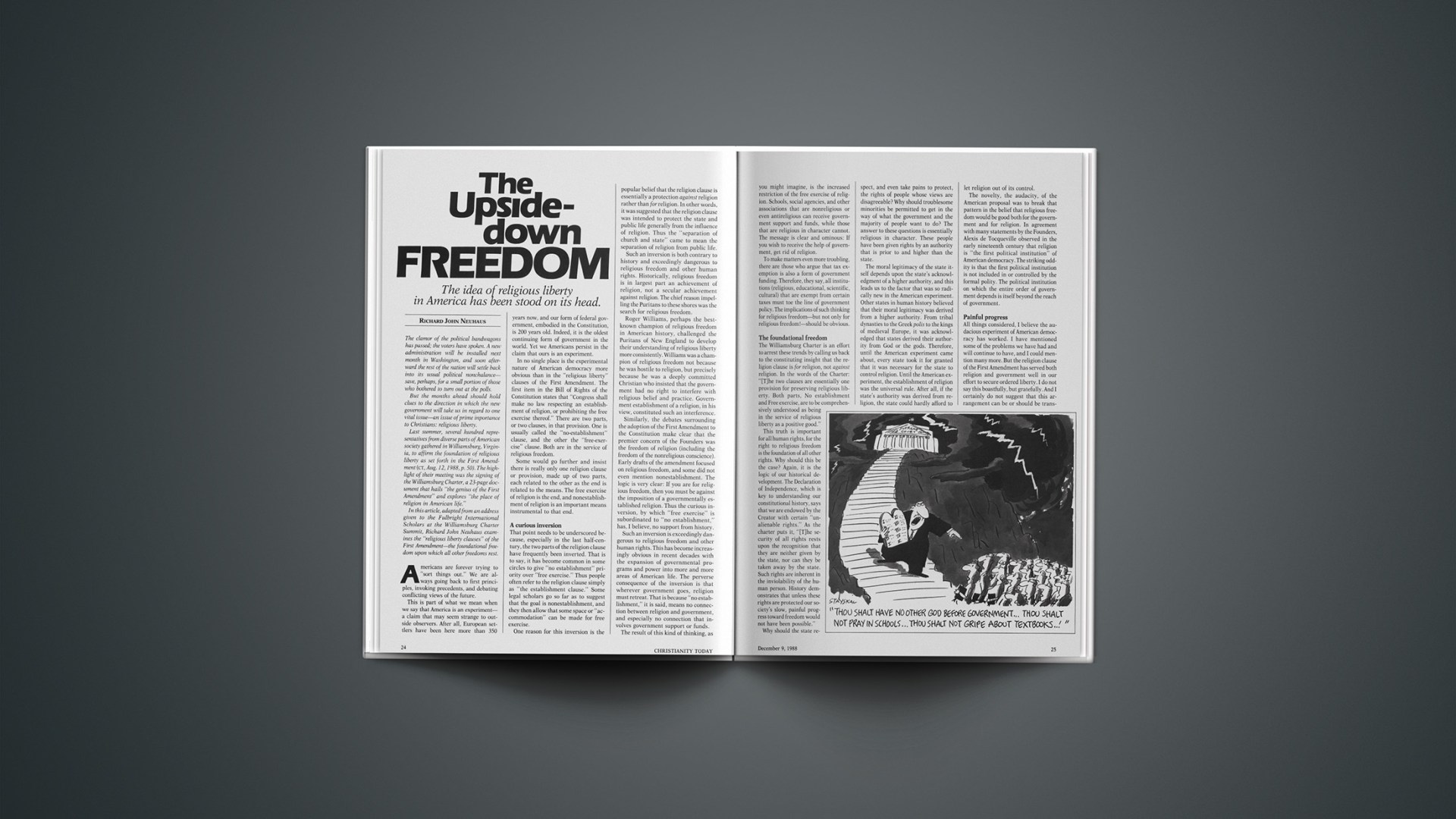
Former detective Joe Daniels’s Christian stance against abortion (CT, June 17, 1988, p. 63) led him to resign from the Jackson, Mississippi, Police Department last May. It was an act of repentance, he said, for arresting three abortion protesters participating in an Operation Rescue rally.

Since that time, Daniels has applied for membership in the Jackson chapter of Right to Life and expects to participate in future Operation Rescue missions. Daniels has temporary work as a truck driver and plans to re-enter Mississippi College, a Baptist liberal arts college located in the Jackson area, to pursue a major in church music.

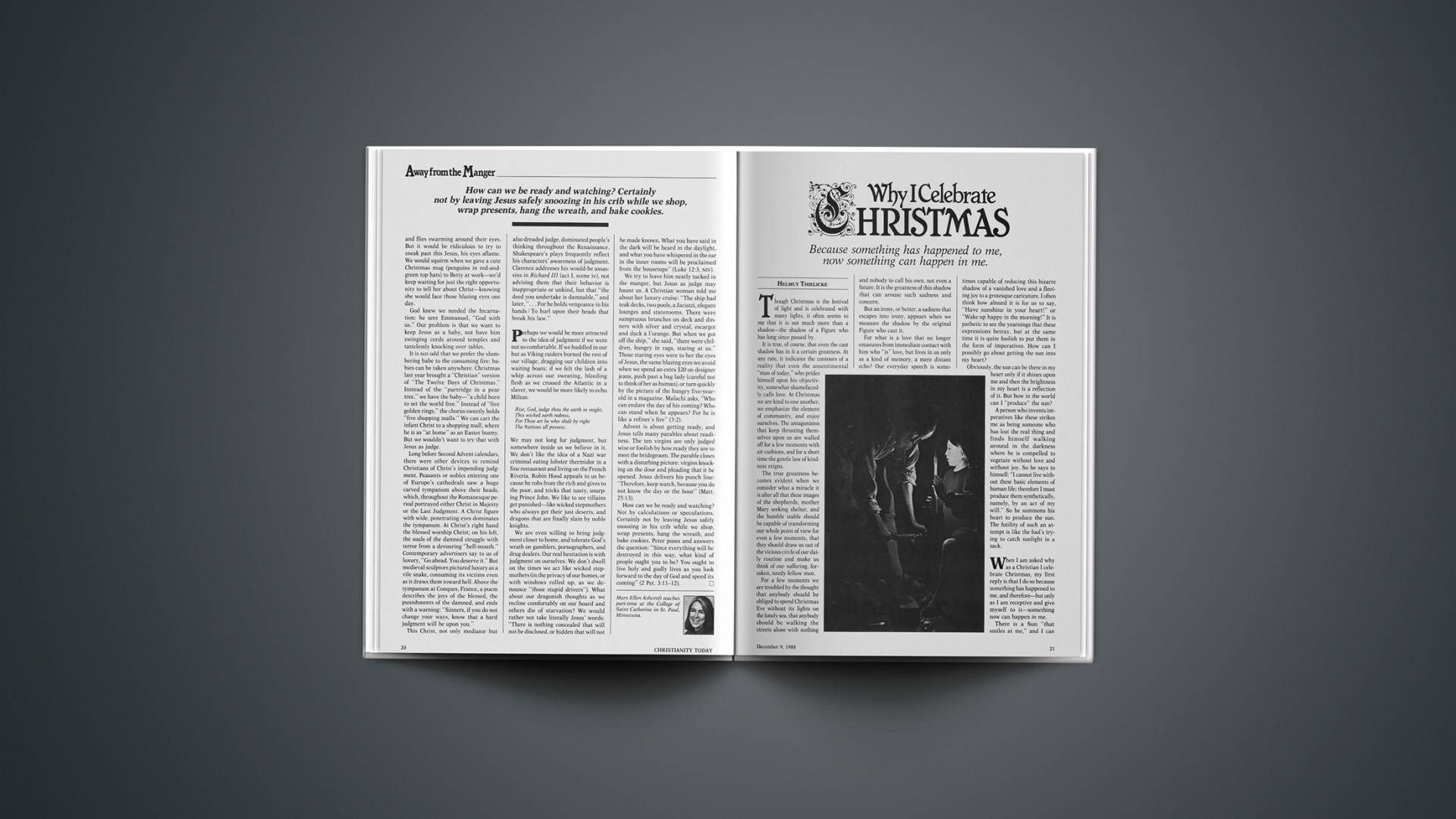
Edgar Whisenant (CT, Oct. 21, 1988, p. 43), the former space engineer and current Rapture prognosticator, continues his end-times studies from his Arkansas home. His booklet, On Borrowed Time, predicted Christ’s return between September 11 and 13 of 1988.

Though unwilling to make a specific prediction, Whisenant told CHRISTIANITY TODAY he believes his former prediction was a “shout for the Bridegroom,” to prepare God’s loved ones for Christ’s imminent return. Revised calculations, he said, indicate the Rapture should occur approximately a year from his original prediction.

When Steve Hiatt (CT, June 17, 1988, p. 69) refused to implement a careertraining program allegedly based on New-Age concepts, his boss fired him. Hiatt filed a civil suit against his former employer last February in an attempt to set a legal precedent against government financing of such programs. His case goes to trial this month.

Since his initial suit, the Equal Employment Opportunity Commission issued new guidelines protecting employees’ rights against New Age training. Hiatt now owns a thriving cardealership in Tacoma, Washington.

Sandinista police broke up a peaceful opposition rally in the Nicaraguan village of Nandaime last July 10, arresting over 40 participants. One was Roger Guevera Mena (CT, Aug. 12, 1988, p. 60), secretary of the Democratic Coordinator, a coalition of opposition groups.

Guevera’s initial six-month prison sentence by a police court was suspended, but he remains in prison along with 37 other opposition members, awaiting a retrial set in civil court. Human-rights observers caution that since the new presiding judge recently served as an officer in the Sandinista military, Guevera could receive the maximum 30-year sentence.

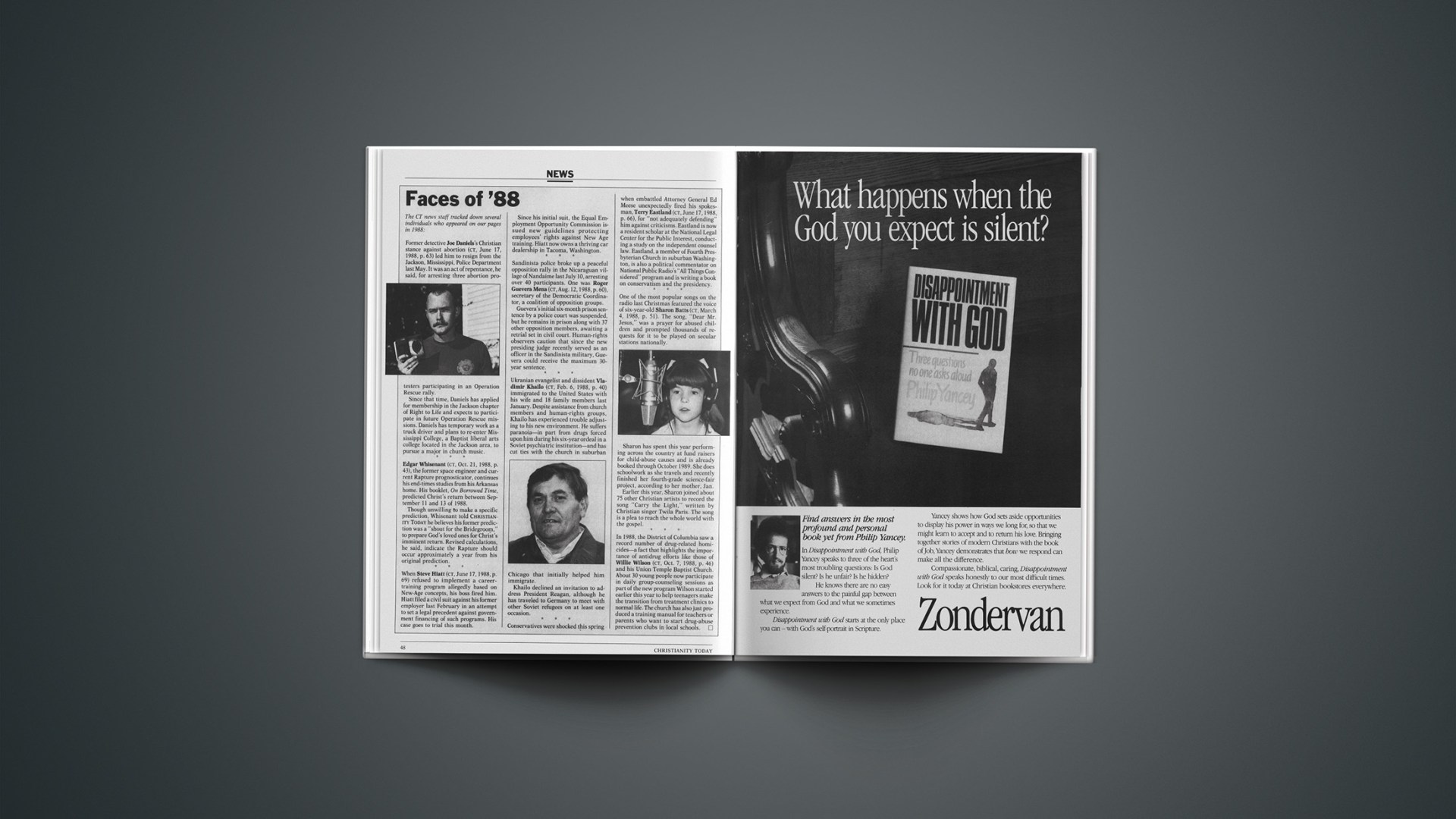
Ukranian evangelist and dissident Vladimir Khailo (CT, Feb. 6, 1988, p. 40) immigrated to the United States with his wife and 18 family members last January. Despite assistance from church members and human-rights groups, Khailo has experienced trouble adjusting to his new environment. He suffers paranoia—in part from drugs forced upon him during his six-year ordeal in a Soviet psychiatric institution—and has cut ties with the church in suburban Chicago that initially helped him immigrate.

Khailo declined an invitation to address President Reagan, although he has traveled to Germany to meet with other Soviet refugees on at least one occasion.

Conservatives were shocked this spring when embattled Attorney General d Meese unexpectedly fired his spokesman, Terry Eastland (CT, June 17, 1988, p. 66), for “not adequately defending” him against criticisms. Eastland is now a resident scholar at the National Legal Center for the Public Interest, conducting a study on the independent counsel law. Eastland, a member of Fourth Presbyterian Church in suburban Washington, is also a political commentator on National Public Radio’s “All Things Considered” program and is writing a book on conservatism and the presidency.

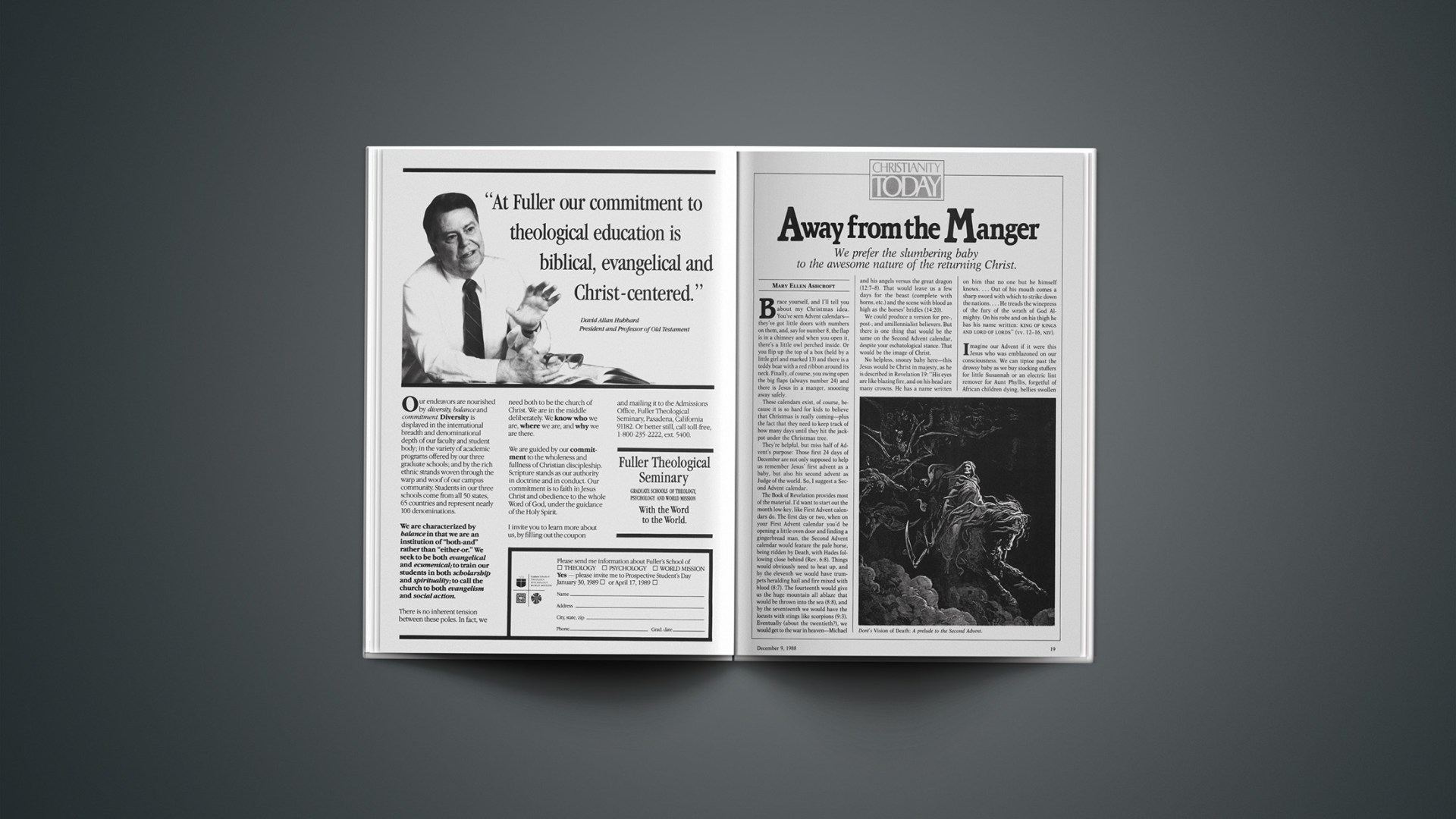
One of the most popular songs on the radio last Christmas featured the voice of six-year-old Sharon Batts (CT, March 4, 1988, p. 51). The song, “Dear Mr. Jesus,” was a prayer for abused children and prompted thousands of requests for it to be played on secular stations nationally.

Sharon has spent this year performing across the country at fund raisers for child-abuse causes and is already booked through October 1989. She does schoolwork as she travels and recently finished her fourth-grade science-fair project, according to her mother, Jan.

Earlier this year, Sharon joined about 75 other Christian artists to record the song “Carry the Light,” written by Christian singer Twila Paris. The song is a plea to reach the whole world with the gospel.

In 1988, the District of Columbia saw a record number of drug-related homicides—a fact that highlights the importance of antidrug efforts like those of Willie Wilson (CT, Oct. 7, 1988, p. 46) and his Union Temple Baptist Church. About 30 young people now participate in daily group-counseling sessions as part of the new program Wilson started earlier this year to help teenagers make the transition from treatment clinics to normal life. The church has also just produced a training manual for teachers or parents who want to start drug-abuse prevention clubs in local schools.
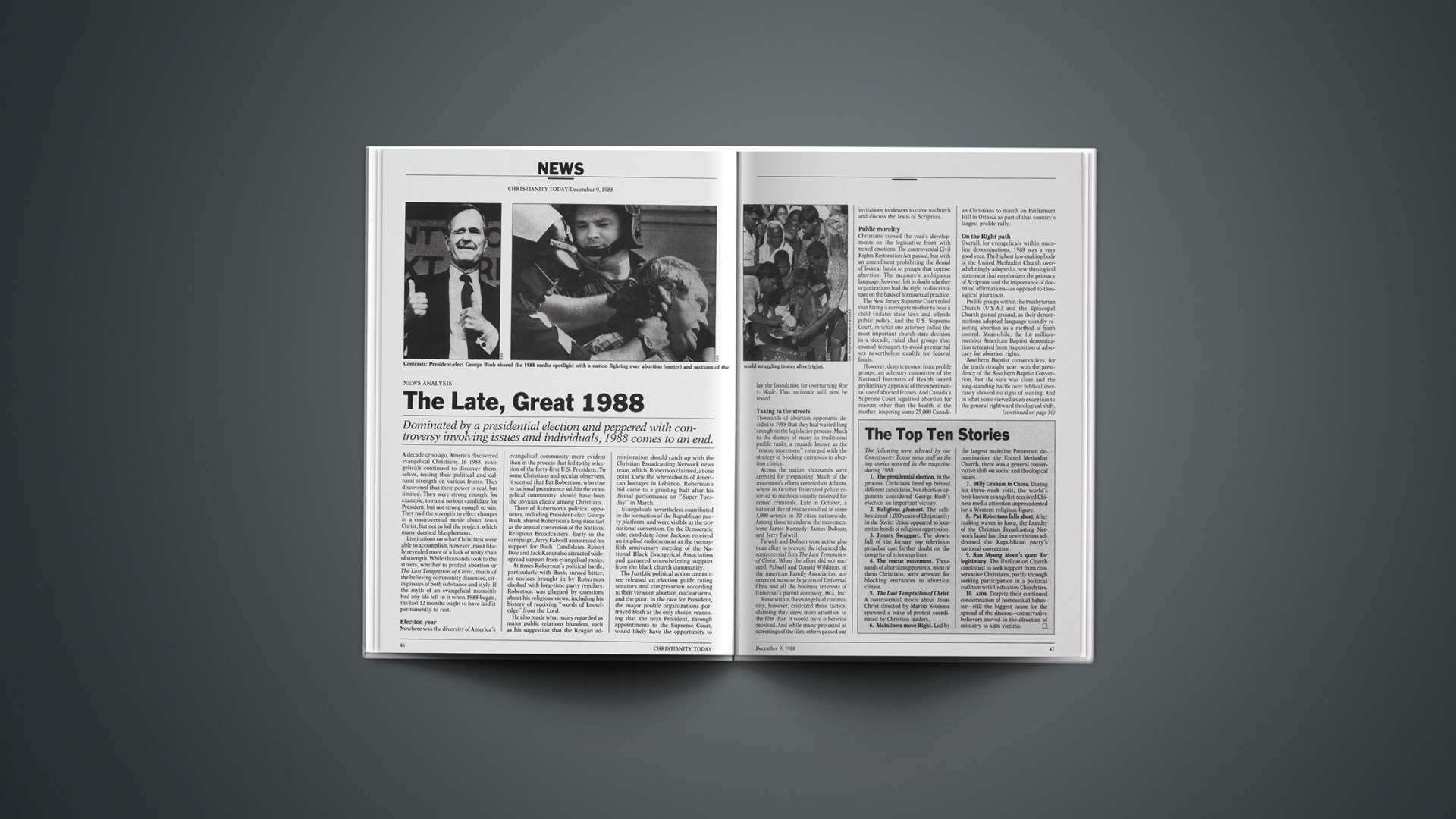
The Late, Great 1988

NEWS

NEWS ANALYSIS

Dominated by a presidential election and peppered with controversy involving issues and individuals, 1988 comes to an end.

A decade or so ago, America discovered evangelical Christians. In 1988, evangelicals continued to discover themselves, testing their political and cultural strength on various fronts. They discovered that their power is real, but limited. They were strong enough, for example, to run a serious candidate for President, but not strong enough to win. They had the strength to effect changes in a controversial movie about Jesus Christ, but not to foil the project, which many deemed blasphemous.

Limitations on what Christians were able to accomplish, however, most likely revealed more of a lack of unity than of strength. While thousands took to the streets, whether to protest abortion or The Last Temptation of Christ, much of the believing community dissented, citing issues of both substance and style. If the myth of an evangelical monolith had any life left in it when 1988 began, the last 12 months ought to have laid it permanently to rest.

Election Year

Nowhere was the diversity of America’s evangelical community more evident than in the process that led to the selection of the forty-first U.S. President. To some Christians and secular observers, it seemed that Pat Robertson, who rose to national prominence within the evangelical community, should have been the obvious choice among Christians.

Three of Robertson’s political opponents, including President-elect George Bush, shared Robertson’s long-time turf at the annual convention of the National Religious Broadcasters. Early in the campaign, Jerry Falwell announced his support for Bush. Candidates Robert Dole and Jack Kemp also attracted widespread support from evangelical ranks.

At times Robertson’s political battle, particularly with Bush, turned bitter, as novices brought in by Robertson clashed with long-time party regulars. Robertson was plagued by questions about his religious views, including his history of receiving “words of knowledge” from the Lord.

He also made what many regarded as major public relations blunders, such as his suggestion that the Reagan administration should catch up with the Christian Broadcasting Network news team, which, Robertson claimed, at one point knew the whereabouts of American hostages in Lebanon. Robertson’s bid came to a grinding halt after his dismal performance on “Super Tuesday” in March.

Evangelicals nevertheless contributed to the formation of the Republican party platform, and were visible at the GOP national convention. On the Democratic side, candidate Jesse Jackson received an implied endorsement at the twenty-fifth anniversary meeting of the National Black Evangelical Association and garnered overwhelming support from the black church community.

The Just Life political action committee released an election guide rating senators and congressmen according to their views on abortion, nuclear arms, and the poor. In the race for President, the major prolife organizations portrayed Bush as the only choice, reasoning that the next President, through appointments to the Supreme Court, would likely have the opportunity to lay the foundation for overturning Roe v. Wade. That rationale will now be tested.

Taking To The Streets

Thousands of abortion opponents decided in 1988 that they had waited long enough on the legislative process. Much to the dismay of many in traditional prolife ranks, a crusade known as the “rescue movement” emerged with the strategy of blocking entrances to abortion clinics.

Across the nation, thousands were arrested for trespassing. Much of the movement’s efforts centered on Atlanta, where in October frustrated police resorted to methods usually reserved for armed criminals. Late in October, a national day of rescue resulted in some 3,000 arrests in 30 cities nationwide. Among those to endorse the movement were James Kennedy, James Dobson, and Jerry Falwell.

Falwell and Dobson were active also in an effort to prevent the release of the controversial film The Last Temptation of Christ. When the effort did not succeed, Falwell and Donald Wildmon, of the American Family Association, announced massive boycotts of Universal films and all the business interests of Universal’s parent company, MCA, Inc.

Some within the evangelical community, however, criticized these tactics, claiming they drew more attention to the film than it would have otherwise received. And while many protested at screenings of the film, others passed out invitations to viewers to come to church and discuss the Jesus of Scripture.

Public Morality

Christians viewed the year’s developments on the legislative front with mixed emotions. The controversial Civil Rights Restoration Act passed, but with an amendment prohibiting the denial of federal funds to groups that oppose abortion. The measure’s ambiguous language, however, left in doubt whether organizations had the right to discriminate on the basis of homosexual practice.

The New Jersey Supreme Court ruled that hiring a surrogate mother to bear a child violates state laws and offends public policy. And the U.S. Supreme Court, in what one attorney called the most important church-state decision in a decade, ruled that groups that counsel teenagers to avoid premarital sex nevertheless qualify for federal funds.

However, despite protest from prolife groups, an advisory committee of the National Institutes of Health issued preliminary approval of the experimental use of aborted fetuses. And Canada’s Supreme Court legalized abortion for reasons other than the health of the mother, inspiring some 25,000 Canadian Christians to march on Parliament Hill in Ottawa as part of that country’s largest prolife rally.

The Top Ten Stories

The following were selected by the CHRISTIANITY TODAY news staff as the top stories reported in the magazine during 1988:

1. The presidential election. In the process, Christians lined up behind different candidates, but abortion opponents considered George Bush’s election an important victory.

2. Religious glasnost. The celebration of 1,000 years of Christianity in the Soviet Union appeared to loosen the bonds of religious oppression.

3. Jimmy Swaggart. The downfall of the former top television preacher cast further doubt on the integrity of televangelism.

4. The rescue movement. Thousands of abortion opponents, most of them Christians, were arrested for blocking entrances to abortion clinics.

5. The Last Temptation of Christ. A controversial movie about Jesus Christ directed by Martin Scorsese spawned a wave of protest coordinated by Christian leaders.

6. Mainliners move Right. Led by the largest mainline Protestant denomination, the United Methodist Church, there was a general conservative shift on social and theological issues.

7. Billy Graham in China. During his three-week visit, the world’s best-known evangelist received Chinese media attention unprecedented for a Western religious figure.

8. Pat Robertson falls short. After making waves in Iowa, the founder of the Christian Broadcasting Network faded fast, but nevertheless addressed the Republican party’s national convention.

9. Sun Myung Moon’s quest for legitimacy. The Unification Church continued to seek support from conservative Christians, partly through seeking participation in a political coalition with Unification Church ties.

10. AIDS. Despite their continued condemnation of homosexual behavior—still the biggest cause for the spread of the disease—conservative believers moved in the direction of ministry to AIDS victims.

On The Right Path

Overall, for evangelicals within mainline denominations, 1988 was a very good year. The highest law-making body of the United Methodist Church overwhelmingly adopted a new theological statement that emphasizes the primacy of Scripture and the importance of doctrinal affirmations—as opposed to theological pluralism.

Prolife groups within the Presbyterian Church (U.S.A.) and the Episcopal Church gained ground, as their denominations adopted language soundly rejecting abortion as a method of birth control. Meanwhile, the 1.6 million-member American Baptist denomination retreated from its position of advocacy for abortion rights.

Southern Baptist conservatives, for the tenth straight year, won the presidency of the Southern Baptist Convention, but the vote was close and the long-standing battle over biblical inerrancy showed no signs of waning. And in what some viewed as an exception to the general rightward theological shift, Episcopalians from the Diocese of Massachusetts selected Barbara Harris as the first female bishop in the history of the worldwide Anglican Communion.

More Questions Of Integrity

On the heels of the televangelist scandals of 1987 came television preacher Jimmy Swaggart’s confession in February of having visited a prostitute. Swaggart was subsequently dismissed by the Assemblies of God for refusing to submit to church discipline. Meanwhile, fallen evangelist Jim Bakker unsuccessfully attempted to buy back the PTL empire he founded.

But the controversial book On Thin Ice revealed that theological conservatives may not have the corner on this market. Written by Roy HowardBeck, formerly of the United Methodist Reporter, the book disclosed allegations from unnamed sources of sexual misconduct in the upper ranks of mainline denominations.

Questions of financial integrity also surfaced in 1988. The Evangelical Council for Financial Accountability dismissed three organizations, including a charter member. And amid protests from students who said they were misled, the Oral Roberts University School of Medicine canceled, then later redefined, its medical-scholarship program. School officials refused to answer questions of how some $8.4 million raised for the program was spent.

Finally, more than three million copies of the book On Borrowed Time, in which the rapture of God’s people from the Earth was set for September, were distributed. The book’s author, Edgar Whisenant, later revised his prediction to October 3, and will likely finish the year 0 for 2.

The Road To Freedom

The millennial celebration of Christianity in the Soviet Union focused international attention on religious freedom there. And in the minds of many, Soviet leadership responded favorably, loosening restrictions on the flow of religious literature and the Christian education of children, and releasing some Christians from psychiatric hospitals.

Some observers remained skeptical, given the Soviet government’s official view that Marxist communism and religion are ultimately incompatible. But Josef Tson, a widely known Baptist pastor and refugee from Romania, told World magazine that the current restructuring in the Soviet Union represents the end of the U.S.S.R.’s communist experiment.

Meanwhile, despite continued persecution in some areas of China, Christians there generally reported a greater openness to religion, as illustrated by the increased publication of Christian literature within the country. During the visit to China of evangelist Billy Graham, who turned 70 this year, a high-ranking Chinese government official admitted publicly to past mistakes regarding the treatment of Christians.

The spiritual and physical challenges to the worldwide body of Christ in 1988 were many and varied. In some parts of Africa, including Mozambique, the Sudan, and Ethiopia, drought and civil strife contributed to widespread human suffering. The spread of AIDS complicated missionary efforts in Central Africa, while Christians in South Africa continued to weigh alternatives in the struggle against apartheid.

The small Christian population in the island nation of Sri Lanka sought to mediate ethnic tensions between Buddhists and Hindus, while the perennial violence between Protestants and Roman Catholics in Northern Ireland persisted. And a major Palestinian uprising in the Israeli occupied territories heightened concern among Palestinian believers about Western Christians’ apparent uncritical support for Israel.

In some countries, including El Salvador and the Philippines, fragile democracies were tested. Meanwhile, Christians offered differing interpretations of the truce between warring factions in Nicaragua and the ensuing attempts at consolidating power on the part of that country’s Marxist leaders.

In Burma, there was social revolution, in Haiti another coup. But in virtually all the cultural contexts around the globe, Christians, often amid political disagreement, pressed on with the work of determining how best to be salt and light in a fallen world.

By Randy Frame.

Classic & Contemporary Excerpts from December 09, 1988

Classic and contemporary excerpts.

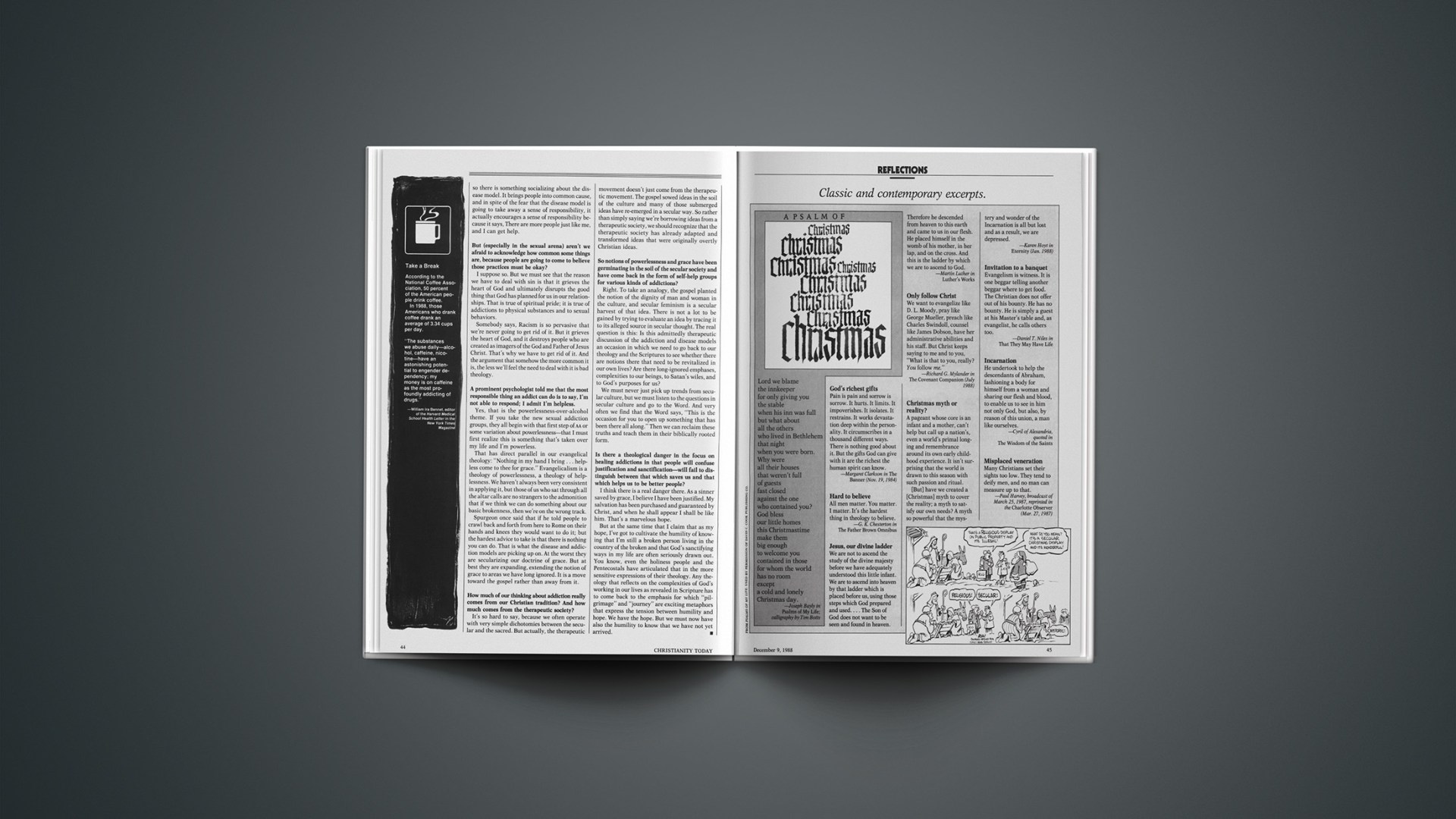
A PSALM OF CHRISTMAS

Lord we blame the innkeeper for only giving you the stablewhen his inn was full but what about all the others who lived in Bethlehem that nightwhen you were born. Why were all their houses that weren’t full of guests fast closed against the one who contained you? God bless our little homes this Christmastime make them big enough to welcome you contained in those for whom the world has no room excepta cold and lonely Christmas day.

Joseph Bayly in Psalms of My Life; calligraphy by Tim Botts

God’s richest gifts

Pain is pain and sorrow is sorrow. It hurts. It limits. It impoverishes. It isolates. It restrains. It works devastation deep within the personality. It circumscribes in a thousand different ways. There is nothing good about it. But the gifts God can give with it are the richest the human spirit can know.

Margaret Clarkson in The Banner (Nov. 19, 1984)

Hard to believe

All men matter. You matter. I matter. It’s the hardest thing in theology to believe.

G.K. Chesterton in The Father Brown Omnibus

Jesus, our divine ladder

We are not to ascend the study of the divine majesty before we have adequately understood this little infant. We are to ascend into heaven by that ladder which is placed before us, using those steps which God prepared and used.… The Son of God does not want to be seen and found in heaven. Therefore he descended from heaven to this earth and came to us in our flesh. He placed himself in the womb of his mother, in her lap, and on the cross. And this is the ladder by which we are to ascend to God.

Martin Luther in Luther’s Works

Only follow Christ

We want to evangelize like D. L. Moody, pray like George Mueller, preach like Charles Swindoll, counsel like James Dobson, have her administrative abilities and his staff. But Christ keeps saying to me and to you, “What is that to you, really? You follow me.”

Richard G. Mylander in The Covenant Companion (July 1988)

Christmas myth or reality?

A pageant whose core is an infant and a mother, can’t help but call up a nation’s, even a world’s primal longing and remembrance around its own early childhood experience. It isn’t surprising that the world is drawn to this season with such passion and ritual.

[But] have we created a [Christmas] myth to cover the reality; a myth to satisfy our own needs? A myth so powerful that the mystery and wonder of the Incarnation is all but lost and as a result, we are depressed.

Karen Hoyt in Eternity (Jan. 1988)

Invitation to a banquet

Evangelism is witness. It is one beggar telling another beggar where to get food. The Christian does not offer out of his bounty. He has no bounty. He is simply a guest at his Master’s table and, as evangelist, he calls others too.

Daniel T. Niles in That They May Have Life

Incarnation

He undertook to help the descendants of Abraham, fashioning a body for himself from a woman and sharing our flesh and blood, to enable us to see in him not only God, but also, by reason of this union, a man like ourselves.

Cyril of Alexandria, quoted in The Wisdom of the Saints

Misplaced veneration

Many Christians set their sights too low. They tend to deify men, and no man can measure up to that.

Paul Harvey, broadcast of March 25, 1987, reprinted in the Charlotte Observer (Mar. 27, 1987)

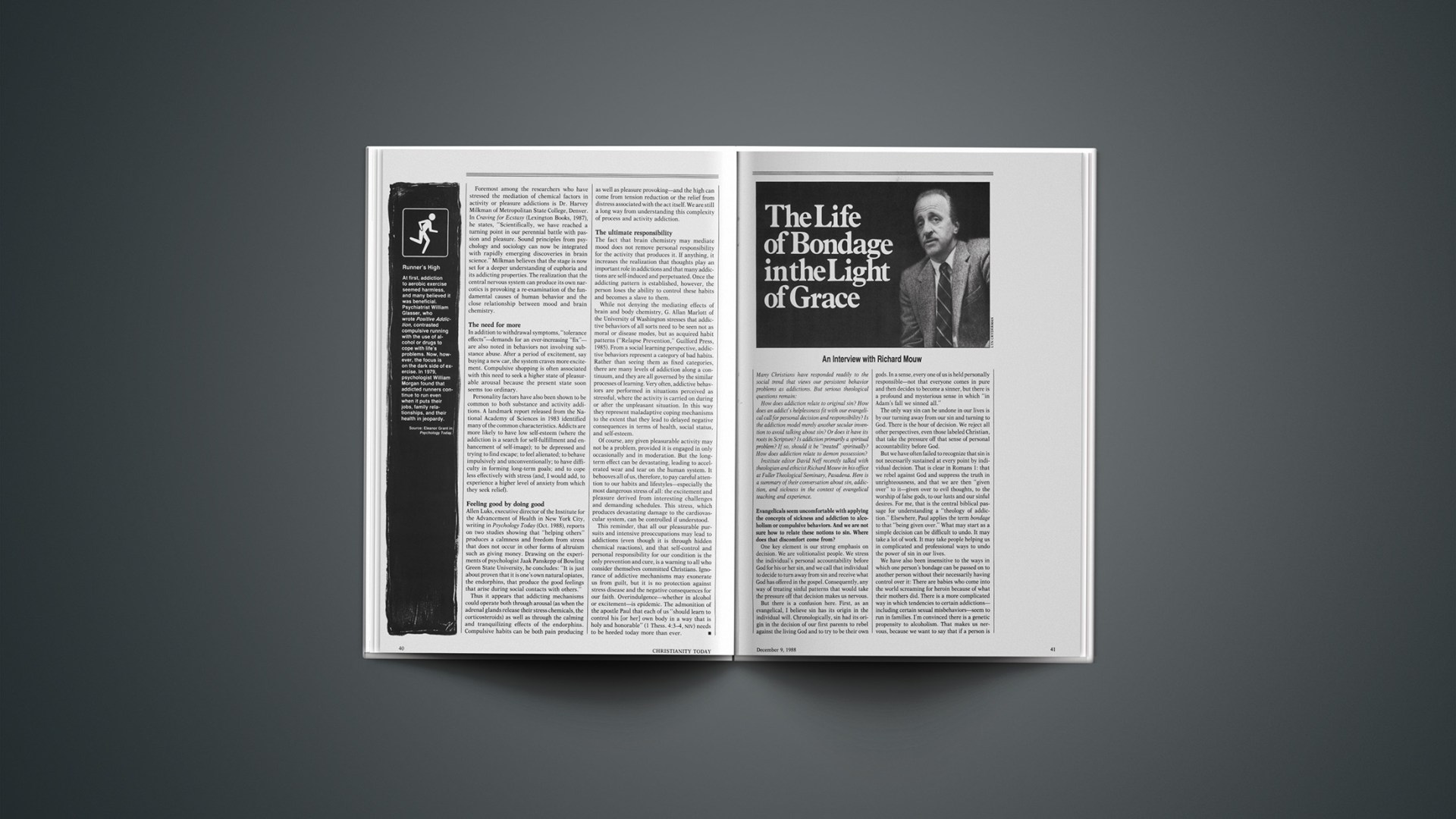
The Life of Bondage in the Light of Grace

Many Christians have responded readily to the social trend that views our persistent behavior problems as addictions. But serious theological questions remain:

How does addiction relate to original sin? How does an addict’s helplessness fit with our evangelical call for personal decision and responsibility? Is the addiction model merely another secular invention to avoid talking about sin? Or does it have its roots in Scripture? Is addiction primarily a spiritual problem? If so, should it be “, treated” spiritually? How does addiction relate to demon possession?

Institute editor David Neff recently talked with theologian and ethicist Richard Mouw in his office at Fuller Theological Seminary, Pasadena. Here is a summary of their conversation about sin, addiction, and sickness in the context of evangelical teaching and experience.

Evangelicals seem uncomfortable with applying the concepts of sickness and addiction to alcoholism or compulsive behaviors. And we are not sure how to relate these notions to sin. Where does that discomfort come from?

One key element is our strong emphasis on decision. We are volitionalist people. We stress the individual’s personal accountability before God for his or her sin, and we call that individual to decide to turn away from sin and receive what God has offered in the gospel. Consequently, any way of treating sinful patterns that would take the pressure off that decision makes us nervous.

But there is a confusion here. First, as an evangelical, I believe sin has its origin in the individual will. Chronologically, sin had its origin in the decision of our first parents to rebel against the living God and to try to be their own gods. In a sense, every one of us is held personally responsible—not that everyone comes in pure and then decides to become a sinner, but there is a profound and mysterious sense in which “in Adam’s fall we sinned all.”

The only way sin can be undone in our lives is by our turning away from our sin and turning to God. There is the hour of decision. We reject all other perspectives, even those labeled Christian, that take the pressure off that sense of personal accountability before God.

But we have often failed to recognize that sin is not necessarily sustained at every point by individual decision. That is clear in Romans 1: that we rebel against God and suppress the truth in unrighteousness, and that we are then “given over” to it—given over to evil thoughts, to the worship of false gods, to our lusts and our sinful desires. For me, that is the central biblical passage for understanding a “theology of addiction.” Elsewhere, Paul applies the term bondage to that “being given over.” What may start as a simple decision can be difficult to undo. It may take a lot of work. It may take people helping us in complicated and professional ways to undo the power of sin in our lives.

We have also been insensitive to the ways in which one person’s bondage can be passed on to another person without their necessarily having control over it: There are babies who come into the world screaming for heroin because of what their mothers did. There is a more complicated way in which tendencies to certain addictions—including certain sexual misbehaviors—seem to run in families. I’m convinced there is a genetic propensity to alcoholism. That makes us nervous, because we want to say that if a person is drinking too much, it’s her own fault; or if a person habitually commits adultery, that’s because of a decision he made.

There are also ways in which societies promote addictions. Our sin begins in our individual choices, but those choices get woven into certain societal stimuli. We are surrounded by the lure to materialism, to infidelity, to harmful substances, so that our behavior is not just completely dependent upon our wills. Its relation to our choices is much more mysterious than that.

The will is part of our spiritual and psychological selves. But many addictions are bodily. Are we being too simplistic in focusing on the will?

We often have a reductionist view of human problems, wanting to attribute complex disorders solely to spiritual difficulties.

Take alcohol addiction. It functions on at least three levels. There is chemical dependency—a physical thirst in the body crying out for that stuff. But it’s also a psychological addiction that has to do with compulsive behaviors and rescuing patterns. Third, it’s a spiritual addiction. It’s idolatry. The drunk who wants whiskey more than anything else, who says, “Let goods and kindred go, this mortal life also; I’m going to drink,” has put that at the center of his life. That is simply idolatrous. I’m convinced that you really cannot heal the alcoholic unless you deal with all three of those levels.

There is a strong tendency to say, “Well it’s all really chemical.” And there are people who want to see it as purely psychological, something you can deal with through behavior modification. And then there are those who offer simple-minded spiritual solutions: “Just trust in Jesus and it will all go away.” But we’ve got to deal with alcoholism on all three levels. Alcoholism is a multilevel and complicated disease because we’re multilevel and complicated persons.

Are these addictions in different proportions in different people?

You have to start the healing at a different point with different people, because one level of addiction may be more dominant in one person, and another level more dominant in someone else. There are people for whom the key is to go to the rescue mission and accept Jesus, although accepting Jesus means they will have to begin to address the other two levels—they have to be resocialized and go through a physical withdrawal period. For others, physical, “cold turkey” withdrawal works. And others must go to AA and become resocialized. I know a person who went to AA and was so hostile toward religion that for a long time he just couldn’t handle the “Higher Power” idea. But he became, as it were, addicted to the group. Only later could he begin to deal with the spiritual dimension.

Is there something in our theology or in Scripture that should have clued us in much earlier to that multilevel character of addictions?

Well, yes and no. When you go back to the rich discussions of the theologians in the Reformed, Lutheran, Anglican, and Wesleyan traditions, you find that every one of them gives a framework that can handle and even encourage this multidimensional understanding—and that puts certain kinds of nuances and limits on our thoroughgoing volitionalism (“The reason that guy is drunk right now is because he decided right now to be drunk”).

But alongside that theological richness is a tendency in pietism (and I identify with the pietist tradition) to insist on the centrality of the spiritual. Addiction to pornography is a spiritual issue; it’s idolatry. Alcoholism, too, is a form of rebellion before the face of God. But remember that rebellion can take the Romans 1 form of being “given over” to where it’s not enough to “just say no.” By emphasizing the spiritual, we’ve often gone from a spiritually centered view to a spiritually monistic view, from putting the spiritual at the center to reducing everything to spiritual decisions or spiritual relationships.

It is important to have the spiritual in the center without denying that it’s at the center of a rich and complex nature, and that our spirituality can manifest itself in a number of ways in the different dimensions of our nature.

It is easy for us to confuse spirituality with morality, to think that doing things the right way is what it means to be spiritual. Can you help us distinguish moralism from true spirituality?

It’s very difficult to distinguish the two biblically because the language of the New Testament isn’t always technically uniform. But if I had to give a simple account of the New Testament sense of what it means to be spiritual, it is to be living the whole of our lives in the service of God. The “spiritual” is to respond obediently to God in our wholeness, and the “fleshly” is to orient our lives around the creaturely, to direct our service toward something other than God. Thus doing mathematics could be “fleshly,” and eating can be “spiritual.” Those two general categories of the spirit and the flesh don’t refer to body and mind or body and soul. They have to do with our basic orientation. Unfortunately, we have had a dualism that identifies the spirit with the rational, the nonmaterial, and eternal; and then the fleshly with the material. Those categories are more platonic than biblical. The next step, of course, is to say that abstaining from something material is somehow more spiritual than learning to use that created good to the glory of God.

People in the temperance movement used to talk about “demon rum.” Is there a sense in which alcoholics are serving “the powers,” some spiritual beings? How does spiritual warfare enter into the healing of addiction?

I think we’re surrounded by spirits. Saint Andrew of Crete wrote a hymn, “Christian, Dost Thou See Them?” in which he talks about the spirits “goading,” “luring into sin.” The evil powers are very real in our lives (although we don’t want to fall into a simplistic “the Devil made me do it”). Nonetheless, my soul has an enemy, and that enemy wants to lure me into sin, and that enemy is very flexible. He will pick up on whatever point of weakness is mine. It could be spiritual pride; it could be professional pride; it could be a chemical or sexual weakness; or it could be food or political ideology or racial pride or gender pride. The Devil has got a lot to work with in luring us into sin. There is no question: one of the ways in which Satan lures people into sin is through dependency upon alcohol. But we must not treat that as a very special and unique kind of “possession” (as over against what possesses the academic who places professional advancement over all things, or the teenager who is obsessed with pleasing the crowd).

Some in the charismatic movement take this “demon” terminology just a little further. They would try to cast out the demon of alcoholism or the demon of sexual obsession.

If addiction is a manifestation of the spiritual bondage Paul talks about in Romans, then in some lives it may be necessary to have a dramatic release from that bondage. An exorcistic approach is probably okay, as long as we recognize there still may be chemical and social psychological dimensions that need to be dealt with. The persons who have been released spiritually from bondage, so that they now have given their lives over to God in the area of their addiction, may still have to work on the problem with a counselor, a nutritionist, a medical doctor, or a support group. There is an important role for spiritual warfare ministries that help people to be released from bondage—as long as the ministry doesn’t reduce everything to demon possession.

The scriptural words for salvation have overtones of health. Saving and healing, being whole and being saved—these are closely related concepts. The flip side, of course, is to look at sin as some kind of sickness.

This is where our language in dealing with addiction is not adequate. I think the notion of disease is helpfully applied to a phenomenon like alcoholism. But there is still something metaphorical about it.

It goes something like this: Take an unbeliever who later becomes a Christian—say C. S. Lewis or Chuck Colson. They will say, “Back in the days before I was a Christian, if you had asked me, I would have sincerely told you that I didn’t believe in God. I would sincerely tell you that I thought the gospel was a bunch of nonsense. That was my sincere, conscious belief. But after I came to believe, I saw that I had somehow been responsible for my unbelief, that there had been a kind of self-deception.”

I think something analogous happens in the lives of alcoholics, drug addicts, or sexual addicts. They are given over to their addictions and are caught up in them. They’re not thinking clearly and really don’t understand their situation. In that sense, a “disease” has taken over.

But in their recovery stage, they go back and say, “I was kidding myself about a lot of things. There was a lot of self-deception going on.”

So it’s not just like having cancer or a toothache. It feels the same, in that it takes over your life, it’s something that happens to you, and it isn’t merely the result of an immediate decision that you can easily reverse. Yet there is an element of responsibility: those who have these addictions, when they look back, acknowledge their responsibility.

People who do not like the disease notion want to emphasize the element of responsibility, but they don’t see how complicated that is. And people who want to go completely with a disease model want to emphasize the sense in which people are legitimately taken over by their condition—but often without acknowledging the responsibility that is present. We are mysterious beings.

Why do some people cling so tenaciously to the idea that their addiction is a disease?

We’ve got to listen carefully to the ways in which alcoholics, for example, celebrate alcoholism as a disease. I’ve heard it said many times: “I thought my relationship to booze was a deep, dark, unique thing; that I was the weirdest person on the face of the Earth; and that if anybody ever knew the compulsions that I felt inside they would see that I was a despicable creature. And then I found out there are thousands and thousands of people who have exactly the same experience. And so it’s a common syndrome—we have a sickness together.”

These are comforting words, saying essentially there is help, and that this pain is not unique, it has a name. And in calling it by name, you can join a group of people with a common struggle.

This idea of a shared affliction is especially helpful in the area of sexuality. While we have offered simple-minded solutions, there have been people living in terror before their own sexual energies and impulses. I had a minister say to me once, “If my sexual laundry were hung out to dry, there would be nothing I have done that would have been a matter of serious discipline in my church. But, oh, I would be so ashamed; I would be so ashamed.”

And we all would; I would be, too. It is freeing to bring that stuff out in the open with other people because we are going to find out these are not unique experiences—that I am not the only despicable person on the face of the Earth. And so there is something socializing about the disease model. It brings people into common cause, and in spite of the fear that the disease model is going to take away a sense of responsibility, it actually encourages a sense of responsibility because it says, There are more people just like me, and I can get help.

But (especially in the sexual arena) aren’t we afraid to acknowledge how common some things are, because people are going to come to believe those practices must be okay?

I suppose so. But we must see that the reason we have to deal with sin is that it grieves the heart of God and ultimately disrupts the good thing that God has planned for us in our relationships. That is true of spiritual pride; it is true of addictions to physical substances and to sexual behaviors.

Somebody says, Racism is so pervasive that we’re never going to get rid of it. But it grieves the heart of God, and it destroys people who are created as imagers of the God and Father of Jesus Christ. That’s why we have to get rid of it. And the argument that somehow the more common it is, the less we’ll feel the need to deal with it is bad theology.

A prominent psychologist told me that the most responsible thing an addict can do is to say, I’m not able to respond; I admit I’m helpless.

Yes, that is the powerlessness-over-alcohol theme. If you take the new sexual addiction groups, they all begin with that first step of AA or some variation about powerlessness—that I must first realize this is something that’s taken over my life and I’m powerless.

That has direct parallel in our evangelical theology: “Nothing in my hand I bring … helpless come to thee for grace.” Evangelicalism is a theology of powerlessness, a theology of helplessness. We haven’t always been very consistent in applying it, but those of us who sat through all the altar calls are no strangers to the admonition that if we think we can do something about our basic brokenness, then we’re on the wrong track.

Spurgeon once said that if he told people to crawl back and forth from here to Rome on their hands and knees they would want to do it; but the hardest advice to take is that there is nothing you can do. That is what the disease and addiction models are picking up on. At the worst they are secularizing our doctrine of grace. But at best they are expanding, extending the notion of grace to areas we have long ignored. It is a move toward the gospel rather than away from it.

How much of our thinking about addiction really comes from our Christian tradition? And how much comes from the therapeutic society?

It’s so hard to say, because we often operate with very simple dichotomies between the secular and the sacred. But actually, the therapeuticmovement doesn’t just come from the therapeutic movement. The gospel sowed ideas in the soil of the culture and many of those submerged ideas have re-emerged in a secular way. So rather than simply saying we’re borrowing ideas from a therapeutic society, we should recognize that the therapeutic society has already adapted and transformed ideas that were originally overtly Christian ideas.

So notions of powerlessness and grace have been germinating in the soil of the secular society and have come back in the form of self-help groups for various kinds of addictions?

Right. To take an analogy, the gospel planted the notion of the dignity of man and woman in the culture, and secular feminism is a secular harvest of that idea. There is not a lot to be gained by trying to evaluate an idea by tracing it to its alleged source in secular thought. The real question is this: Is this admittedly therapeutic discussion of the addiction and disease models an occasion in which we need to go back to our theology and the Scriptures to see whether there are notions there that need to be revitalized in our own lives? Are there long-ignored emphases, complexities to our beings, to Satan’s wiles, and to God’s purposes for us?

We must never just pick up trends from secular culture, but we must listen to the questions in secular culture and go to the Word. And very often we find that the Word says, “This is the occasion for you to open up something that has been there all along.” Then we can reclaim these truths and teach them in their biblically rooted form.

Is there a theological danger in the focus on healing addictions in that people will confuse justification and sanctification—will fail to distinguish between that which saves us and that which helps us to be better people?

I think there is a real danger there. As a sinner saved by grace, I believe I have been justified. My salvation has been purchased and guaranteed by Christ, and when he shall appear I shall be like him. That’s a marvelous hope.

But at the same time that I claim that as my hope, I’ve got to cultivate the humility of knowing that I’m still a broken person living in the country of the broken and that God’s sanctifying ways in my life are often seriously drawn out. You know, even the holiness people and the Pentecostals have articulated that in the more sensitive expressions of their theology. Any theology that reflects on the complexities of God’s working in our lives as revealed in Scripture has to come back to the emphasis for which “pilgrimage” and “journey” are exciting metaphors that express the tension between humility and hope. We have the hope. But we must now have also the humility to know that we have not yet arrived.

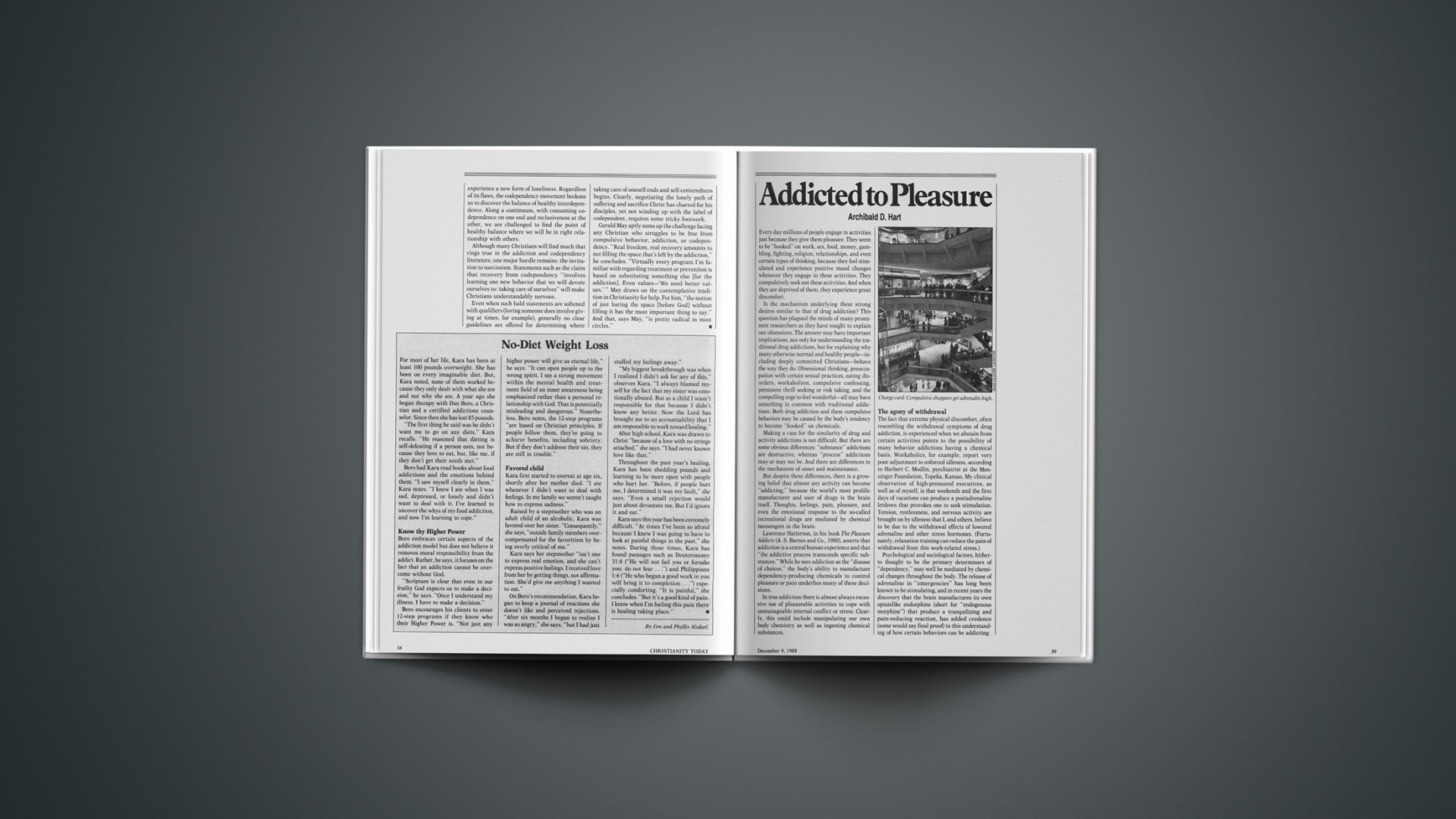
Addicted to Pleasure

Every day millions of people engage in activities just because they give them pleasure. They seem to be “hooked” on work, sex, food, money, gambling, fighting, religion, relationships, and even certain types of thinking, because they feel stimulated and experience positive mood changes whenever they engage in these activities. They compulsively seek out these activities. And when they are deprived of them, they experience great discomfort.

Is the mechanism underlying these strong desires similar to that of drug addiction? This question has plagued the minds of many prominent researchers as they have sought to explain our obsessions. The answer may have important implications, not only for understanding the traditional drug addictions, but for explaining why many otherwise normal and healthy people—including deeply committed Christians—behave the way they do. Obsessional thinking, preoccupation with certain sexual practices, eating disorders, workaholism, compulsive confessing, persistent thrill seeking or risk taking, and the compelling urge to feel wonderful—all may have something in common with traditional addictions: Both drug addiction and these compulsive behaviors may be caused by the body’s tendency to become “hooked” on chemicals.

Making a case for the similarity of drug and activity addictions is not difficult. But there are some obvious differences: “substance” addictions are destructive, whereas “process” addictions may or may not be. And there are differences in the mechanism of onset and maintenance.

But despite these differences, there is a growing belief that almost any activity can become “addicting,” because the world’s most prolific manufacturer and user of drugs is the brain itself. Thoughts, feelings, pain, pleasure, and even the emotional response to the so-called recreational drugs are mediated by chemical messengers in the brain.

Lawrence Hatterson, in his book The Pleasure Addicts (A. S. Barnes and Co., 1980), asserts that addiction is a central human experience and that “the addictive process transcends specific substances.” While he sees addiction as the “disease of choices,” the body’s ability to manufacture dependency-producing chemicals to control pleasure or pain underlies many of these decisions.

In true addiction there is almost always excessive use of pleasurable activities to cope with unmanageable internal conflict or stress. Clearly, this could include manipulating our own body chemistry as well as ingesting chemical substances.

The Agony Of Withdrawal

The fact that extreme physical discomfort, often resembling the withdrawal symptoms of drug addiction, is experienced when we abstain from certain activities points to the possibility of many behavior addictions having a chemical basis. Workaholics, for example, report very poor adjustment to enforced idleness, according to Herbert C. Modlin, psychiatrist at the Menninger Foundation, Topeka, Kansas. My clinical observation of high-pressured executives, as well as of myself, is that weekends and the first days of vacations can produce a postadrenaline letdown that provokes one to seek stimulation. Tension, restlessness, and nervous activity are brought on by idleness that I, and others, believe to be due to the withdrawal effects of lowered adrenaline and other stress hormones. (Fortunately, relaxation training can reduce the pain of withdrawal from this work-related stress.)

Psychological and sociological factors, hitherto thought to be the primary determiners of “dependency,” may well be mediated by chemical changes throughout the body. The release of adrenaline in “emergencies” has long been known to be stimulating, and in recent years the discovery that the brain manufactures its own opiatelike endorphins (short for “endogenous morphine”) that produce a tranquilizing and pain-reducing reaction, has added credence (some would say final proof) to this understanding of how certain behaviors can be addicting.

Foremost among the researchers who have stressed the mediation of chemical factors in activity or pleasure addictions is Dr. Harvey Milkman of Metropolitan State College, Denver. In Craving for Ecstasy (Lexington Books, 1987), he states, “Scientifically, we have reached a turning point in our perennial battle with passion and pleasure. Sound principles from psychology and sociology can now be integrated with rapidly emerging discoveries in brain science.” Milkman believes that the stage is now set for a deeper understanding of euphoria and its addicting properties. The realization that the central nervous system can produce its own narcotics is provoking a re-examination of the fundamental causes of human behavior and the close relationship between mood and brain chemistry.

The Need For More

In addition to withdrawal symptoms, “tolerance effects”—demands for an ever-increasing “fix”—are also noted in behaviors not involving substance abuse. After a period of excitement, say buying a new car, the system craves more excitement. Compulsive shopping is often associated with this need to seek a higher state of pleasurable arousal because the present state soon seems too ordinary.

Personality factors have also been shown to be common to both substance and activity additions. A landmark report released from the National Academy of Sciences in 1983 identified many of the common characteristics. Addicts are more likely to have low self-esteem (where the addiction is a search for self-fulfillment and enhancement of self-image); to be depressed and trying to find escape; to feel alienated; to behave impulsively and unconventionally; to have difficulty in forming long-term goals; and to cope less effectively with stress (and, I would add, to experience a higher level of anxiety from which they seek relief).

Feeling Good By Doing Good

Allen Luks, executive director of the Institute for the Advancement of Health in New York City, writing in Psychology Today (Oct. 1988), reports on two studies showing that “helping others” produces a calmness and freedom from stress that does not occur in other forms of altruism such as giving money. Drawing on the experiments of psychologist Jaak Panskepp of Bowling Green State University, he concludes; “It is just about proven that it is one’s own natural opiates, the endorphins, that produce the good feelings that arise during social contacts with others.”

Thus it appears that addicting mechanisms could operate both through arousal (as when the adrenal glands release their stress chemicals, the corticosteroids) as well as through the calming and tranquilizing effects of the endorphins. Compulsive habits can be both pain producing as well as pleasure provoking—and the high can come from tension reduction or the relief from distress associated with the act itself. We are still a long way from understanding this complexity of process and activity addiction.

The Ultimate Responsibility

The fact that brain chemistry may mediate mood does not remove personal responsibility for the activity that produces it. If anything, it increases the realization that thoughts play an important role in addictions and that many addictions are self-induced and perpetuated. Once the addicting pattern is established, however, the person loses the ability to control these habits and becomes a slave to them.

While not denying the mediating effects of brain and body chemistry, G. Allan Marlott of the University of Washington stresses that addictive behaviors of all sorts need to be seen not as moral or disease modes, but as acquired habit patterns (“Relapse Prevention,” Guilford Press, 1985). From a social learning perspective, addictive behaviors represent a category of bad habits. Rather than seeing them as fixed categories, there are many levels of addiction along a continuum, and they are all governed by the similar processes of learning. Very often, addictive behaviors are performed in situations perceived as stressful, where the activity is carried on during or after the unpleasant situation. In this way they represent maladaptive coping mechanisms to the extent that they lead to delayed negative consequences in terms of health, social status, and self-esteem.

Of course, any given pleasurable activity may not be a problem, provided it is engaged in only occasionally and in moderation. But the long-term effect can be devastating, leading to accelerated wear and tear on the human system. It behooves all of us, therefore, to pay careful attention to our habits and lifestyles—especially the most dangerous stress of all: the excitement and pleasure derived from interesting challenges and demanding schedules. This stress, which produces devastating damage to the cardiovascular system, can be controlled if understood.

This reminder, that all our pleasurable pursuits and intensive preoccupations may lead to addictions (even though it is through hidden chemical reactions), and that self-control and personal responsibility for our condition is the only prevention and cure, is a warning to all who consider themselves committed Christians. Ignorance of addictive mechanisms may exonerate us from guilt, but it is no protection against stress disease and the negative consequences for our faith. Overindulgence—whether in alcohol or excitement—is epidemic. The admonition of the apostle Paul that each of us “should learn to control his [or her] own body in a way that is holy and honorable” (1 Thess. 4:3–4, NIV) needs to be heeded today more than ever.

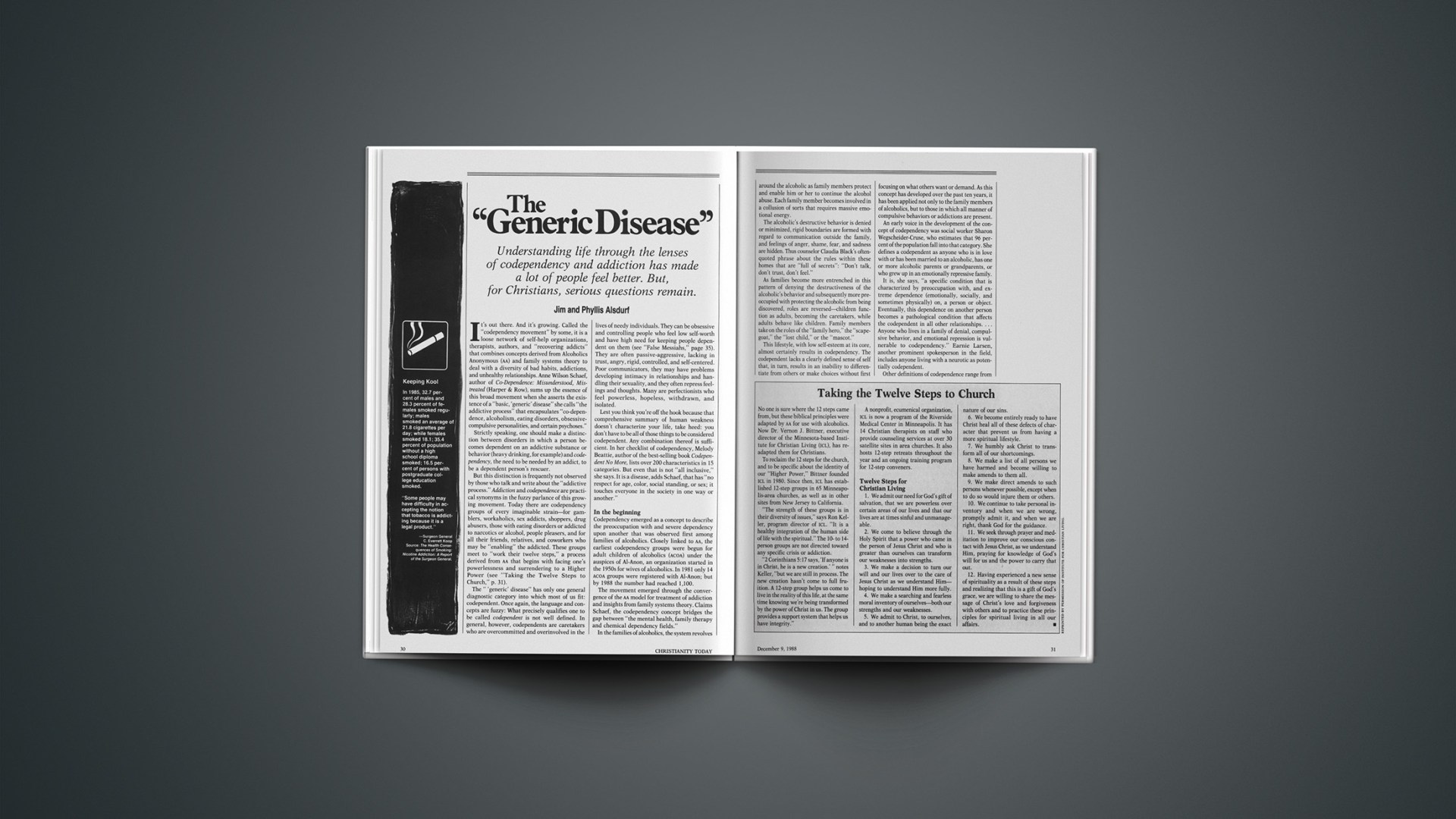
“The Generic Disease”

Understanding life through the lenses of codependency and addiction has made a lot of people feel better. But, for Christians, serious questions remain.

It’s out there. And it’s growing. Called the “codependency movement” by some, it is a loose network of self-help organizations, therapists, authors, and “recovering addicts” that combines concepts derived from Alcoholics Anonymous (AA) and family systems theory to deal with a diversity of bad habits, addictions, and unhealthy relationships. Anne Wilson Schaef, author of Co-Dependence: Misunderstood, Mistreated (Harper & Row), sums up the essence of this broad movement when she asserts the existence of a “basic, ‘generic’ disease” she calls “the addictive process” that encapsulates “co-dependence, alcoholism, eating disorders, obsessive-compulsive personalities, and certain psychoses.”

Strictly speaking, one should make a distinction between disorders in which a person becomes dependent on an addictive substance or behavior (heavy drinking, for example) and codependency, the need to be needed by an addict, to be a dependent person’s rescuer.

But this distinction is frequently not observed by those who talk and write about the “addictive process.” Addiction and codependence are practical synonyms in the fuzzy parlance of this growing movement. Today there are codependency groups of every imaginable strain—for gamblers, workaholics, sex addicts, shoppers, drug abusers, those with eating disorders or addicted to narcotics or alcohol, people pleasers, and for all their friends, relatives, and coworkers who may be “enabling” the addicted. These groups meet to “work their twelve steps,” a process derived from AA that begins with facing one’s powerlessness and surrendering to a Higher Power (see “Taking the Twelve Steps to Church,” p. 31).

The “ ‘generic’ disease” has only one general diagnostic category into which most of us fit: codependent. Once again, the language and concepts are fuzzy: What precisely qualifies one to be called codependent is not well defined. In general, however, codependents are caretakers who are overcommitted and overinvolved in the lives of needy individuals. They can be obsessive and controlling people who feel low self-worth and have high need for keeping people dependent on them (see “False Messiahs,” page 35). They are often passive-aggressive, lacking in trust, angry, rigid, controlled, and self-centered. Poor communicators, they may have problems developing intimacy in relationships and handling their sexuality, and they often repress feelings and thoughts. Many are perfectionists who feel powerless, hopeless, withdrawn, and isolated.

Lest you think you’re off the hook because that comprehensive summary of human weakness doesn’t characterize your life, take heed: you don’t have to be all of those things to be considered codependent. Any combination thereof is sufficient. In her checklist of codependency, Melody Beattie, author of the best-selling book Codependent No More, lists over 200 characteristics in 15 categories. But even that is not “all inclusive,” she says. It is a disease, adds Schaef, that has “no respect for age, color, social standing, or sex; it touches everyone in the society in one way or another.”

In The Beginning

Codependency emerged as a concept to describe the preoccupation with and severe dependency upon another that was observed first among families of alcoholics. Closely linked to AA, the earliest codependency groups were begun for adult children of alcoholics (ACOA) under the auspices of Al-Anon, an organization started in the 1950s for wives of alcoholics. In 1981 only 14 ACOA groups were registered with Al-Anon; but by 1988 the number had reached 1,100.

The movement emerged through the convergence of the AA model for treatment of addiction and insights from family systems theory. Claims Schaef, the codependency concept bridges the gap between “the mental health, family therapy and chemical dependency fields.”

In the families of alcoholics, the system revolves around the alcoholic as family members protect and enable him or her to continue the alcohol abuse. Each family member becomes involved in a collusion of sorts that requires massive emotional energy.

The alcoholic’s destructive behavior is denied or minimized, rigid boundaries are formed with regard to communication outside the family, and feelings of anger, shame, fear, and sadness are hidden. Thus counselor Claudia Black’s often quoted phrase about the rules within these homes that are “full of secrets”: “Don’t talk, don’t trust, don’t feel.”

As families become more entrenched in this pattern of denying the destructiveness of the alcoholic’s behavior and subsequently more preoccupied with protecting the alcoholic from being discovered, roles are reversed—children function as adults, becoming the caretakers, while adults behave like children. Family members take on the roles of the “family hero,” the “scapegoat,” the “lost child,” or the “mascot.”

This lifestyle, with low self-esteem at its core, almost certainly results in codependency. The codependent lacks a clearly defined sense of self that, in turn, results in an inability to differentiate from others or make choices without first focusing on what others want or demand. As this concept has developed over the past ten years, it has been applied not only to the family members of alcoholics, but to those in which all manner of compulsive behaviors or addictions are present.

An early voice in the development of the concept of codependency was social worker Sharon Wegscheider-Cruse, who estimates that 96 percent of the population fall into that category. She defines a codependent as anyone who is in love with or has been married to an alcoholic, has one or more alcoholic parents or grandparents, or who grew up in an emotionally repressive family.

It is, she says, “a specific condition that is characterized by preoccupation with, and extreme dependence (emotionally, socially, and sometimes physically) on, a person or object. Eventually, this dependence on another person becomes a pathological condition that affects the codependent in all other relationships.… Anyone who lives in a family of denial, compulsive behavior, and emotional repression is vulnerable to codependency.” Earnie Larsen, another prominent spokesperson in the field, includes anyone living with a neurotic as potentially codependent.

Taking The Twelve Steps To Church

No one is sure where the 12 steps came from, but these biblical principles were adapted by AA for use with alcoholics. Now Dr. Vernon J. Bittner, executive director of the Minnesota-based Institute for Christian Living (ICL), has readapted them for Christians.

To reclaim the 12 steps for the church, and to be specific about the identity of our “Higher Power,” Bittner founded ICL in 1980. Since then, ICL has established 12-step groups in 65 Minneapolis-area churches, as well as in other sites from New Jersey to California.

“The strength of these groups is in their diversity of issues,” says Ron Keller, program director of ICL. “It is a healthy integration of the human side of life with the spiritual.” The 10 to 14 person groups are not directed toward any specific crisis or addiction.

“2 Corinthians 5:17 says, ‘If anyone is in Christ, he is a new creation.’ ” notes Keller, “but we are still in process. The new creation hasn’t come to full fruition. A 12-step group helps us come to live in the reality of this life, at the same time knowing we’re being transformed by the power of Christ in us. The group provides a support system that helps us have integrity.”

A nonprofit, ecumenical organization, ICL is now a program of the Riverside Medical Center in Minneapolis. It has 14 Christian therapists on staff who provide counseling services at over 30 satellite sites in area churches. It also hosts 12-step retreats throughout the year and an ongoing training program for 12-step conveners.

Twelve Steps for Christian Living

1. We admit our need for God’s gift of salvation, that we are powerless over certain areas of our lives and that our lives are at times sinful and unmanageable.

2. We come to believe through the Holy Spirit that a power who came in the person of Jesus Christ and who is greater than ourselves can transform our weaknesses into strengths.

3. We make a decision to turn our will and our lives over to the care of Jesus Christ as we understand Him—hoping to understand Him more fully.

4. We make a searching and fearless moral inventory of ourselves—both our strengths and our weaknesses.

5. We admit to Christ, to ourselves, and to another human being the exact nature of our sins.

6. We become entirely ready to have Christ heal all of these defects of character that prevent us from having a more spiritual lifestyle.

7. We humbly ask Christ to transform all of our shortcomings.

8. We make a list of all persons we have harmed and become willing to make amends to them all.

9. We make direct amends to such persons whenever possible, except when to do so would injure them or others.

10. We continue to take personal inventory and when we are wrong, promptly admit it, and when we are right, thank God for the guidance.

11. We seek through prayer and meditation to improve our conscious contact with Jesus Christ, as we understand Him, praying for knowledge of God’s will for us and the power to carry that out.

12. Having experienced a new sense of spirituality as a result of these steps and realizing that this is a gift of God’s grace, we are willing to share the message of Christ’s love and forgiveness with others and to practice these principles for spiritual living in all our affairs.

Other definitions of codependence range from seeing it as a pattern of learned behaviors, feelings, and beliefs that “make life difficult” to “an emotional, psychological, and behavioral condition that develops as a result of an individual’s prolonged exposure to, and practice of, a set of oppressive rules.” Physician Charles Whitfield asserts that codependency affects individuals, families, communities, businesses, states, and countries. Schaef takes that all-encompassing definition a step further to propose that society itself is an “addictive system.” She concludes, “When we talk about the addictive process, we are talking about civilization as we know it.”

Oversimplified Complexity

Critics point out that one danger of the blanket application of codependency is that serious psychological disorders are easily misdiagnosed. Minneapolis psychiatrist Carl Malmquist charges that the concept of codependency “doesn’t do justice to the complexity of problems that are often present. I think it is applied too widely, too indiscriminately. Many of the people using it have not had exposure to other kinds of training that would fit it into the broader realm of the interpersonal school of psychotherapy.… I have seen people who have been treated that way, gotten some temporary help and then slipped into much more subtle patterns of what I would call masochistic behavior.”

It is not that codependency is erroneous, he continues, but that it fails to encompass the complexity of human nature. “Someone may seem to be addicted to food, but I want to get in and see what’s the source of this eating disorder. Some bulimics are depressed; some are schizophrenic. Diagnostically we want to be very clear on that. Just to say they are all addictive people doesn’t tell me enough. It’s not sufficient.”

This oversimplification can be a particular problem, notes Minneapolis child psychiatrist Richard Miner, in the parent-child relationship when the legitimate dependency needs of children and adolescents are viewed as “manipulative or destructive.” The parent may end up seeing “all dependency behavior as pathological when it is simply nurturance-seeking behavior on the child’s part,” says Miner.

Because this model developed through work with adults, specifically adults from alcoholic families, it is especially weak in giving consideration to the developmental needs of children or adolescents for healthy dependency. The model also fails to acknowledge the full range of individual psychopathology, states Miner. Unreasonable expectations for change often result.

Another psychologist cited two cases in which juveniles were inappropriately identified as codependent when in fact one was manic-depressive and the other schizophrenic. Each was told to leave home by parents who refused to have a “codependent relationship” with their child.

Psychiatrist Timmen L. Cermak has attempted to qualify the wide-reaching application of the codependency label by advocating codependence as both a “legitimate psychological concept and an important human disorder.” In Diagnosing and Treating Co-Dependence (Johnson Institute Books), Cermak notes that codependency has not provoked much interest within the mental health community because there exist no “generally accepted definitions” of codependency. Most definitions of codependency have been “anecdotal or metaphoric and neither … stands up well under scientific scrutiny.”

Calling for a definition at a level of sophistication at least equal to standards set forth for diagnosing other psychiatric disorders, Cermak faults the “apparent ubiquity” with which codependence has been applied. He rejects the broad definition of those who have called codependence “a condition of the twentieth century.”

Cermak does recognize, however, that when such traits become “enduring patterns of perceiving, relating to, and thinking about the environment and oneself,” they result in a personality disorder. Codependency is at that point a definable, clinical entity that must be taken seriously, he contends. While we may all at various points act codependently, to argue that almost everyone is codependent, Cermak says, discredits the useful application of this concept by oversimplification.

The Ultimate Addiction

For Christians, the all-inclusive definition of codependency may sound like another way of identifying the universal human problem of sin. Such a view is held by J. Keith Miller, who postulates that addiction is endemic to the human condition; it is just another word for sin. Specific sinful acts are not what constitute Sin (with a capital S), he claims in his book Sin, the Ultimate Deadly Addiction (Harper & Row), but are only “symptoms of a basic and all-encompassing self-centeredness, an attitude that colors every relationship, including our relationship with God. It is this deeper, more central attitude that leads to all the thoughts and actions we call sins. And it is the underlying attitude that is Sin.… Sin, in this view, is about our apparent inability to say no to our need to control people, places, and things in order to implement our self-centered desires.”

The “blinding self-absorption called Sin,” Miller continues, is the same underlying dynamic at work in the life of the chemical addict. “Sin is the universal addiction to self that develops when individuals put themselves in the center of their personal world in a way that leads to abuse of others and self. Sin causes sinners to seek instant gratification, to be first, and to get more than their share—now.”

While even secular leaders in the movement agree that embracing one’s spirituality is fundamental to the task of getting “unhooked” from codependency, they generally have a less than charitable view of the church and traditional Christianity. Schaef, for instance, sees the family, school, and church as equally guilty of “cultural co-dependence training.” She charges: “They teach us to think what we are told to think, feel what we are told to feel, see what we are told to see and know what we are told to know.… In training us to be ‘nice,’ the church actively trains us to be co-dependents.”

In Colorado Springs: A Church Reaches Out

Twice a year. First Presbyterian Church of Colorado Springs offers an eight-week workshop entitled “Freedom from Codependency.” Started as a ministry to adult children of alcoholics, the workshop is now open to anyone struggling with a relational dysfunction.

Each year attendance has swelled. What began as a group of 45 in 1984 has mushroomed within four years to attendance of over 600. This year registration was limited to 550 and filled to capacity.

The workshop is the brainchild of Dennis Chambon, a local businessman and a member of First Presbyterian who has been in recovery from chemical dependency for several years. It meets for two and one-half hours each session and is designed to help participants face their own codependency. Drawing upon his experience as a counselor at a local chemical dependency treatment center, Chambon teamed up with Marilyn LeVan, associate for singles ministry at the church, to begin a small support group for adult children of alcoholics.

Chambon and LeVan make it clear that the workshop is not for onlookers who are merely interested in learning about codependency. “We talk about what codependency is and tell them they are not there to fix anyone else,” says LeVan. “Each person is there because they’ve got codependency. We hope it will lead them into a 12-step group when the eight weeks are done.”

Through the use of movies, lectures, role playing, and personal testimonies, the workshop explores codependency as an addiction, its impact on family members and other relationships, and points the way to recovery.

Seeking spiritual answers

LeVan and Chambon do not hesitate to share the importance of their relationship with Christ as they have worked through their own problems with codependency. But they make an effort not to be “offensively Christian” inasmuch as the workshop attracts most of its members from outside the church.

“We’ve got a way of communicating that slips into people’s lives,” Chambon says. “We know their defenses and try to come at it from another angle. A lot of people are beginning to understand they have problems in relationships and are seeking spiritual answers.”

LeVan concurs: “Our approach is to focus first on people’s powerlessness. But when it fits and is appropriate, we are free to share who our Higher Power is. Were there to help people understand how powerless they are so that they are ready to turn to God for help.”

Church growth and staff growth

What has the impact of this workshop been for the church? Executive minister Jim Smith is one of three pastors on the staff who have completed the workshop, Dennis Chambon and he praises it on several levels. “Personally, it was very good for me to look at my upbringing, to begin to discover things about myself,” he says. “It has stimulated real growth in my own life.”

“ ‘Freedom from Codependency’ has been a tremendous outreach into the community,” he says. “It’s evangelism.” But the workshop has also been attended by church members. “People who have been Christians for 20 or 30 years are finding that examining the past is freeing them from dysfunctional patterns of relating,” Smith notes. “It is a workshop where lives are changed. Here is a tool that the Lord is using to bring a newness, an intimacy in their relationship with Christ.”

Smith also refers many of those who come to him for counseling through the workshop. “Here we have an opportunity to plug people into an ongoing ministry. I now see their lives in a new perspective, through the lens of codependency.”

LeVan acknowledges that a number of people have joined the church whose initial exposure to First Presbyterian was through the workshop. “Perhaps more important,” she says, “are the staff members and professional people from the church who have gone through the program and found it to affect their ministry in significant ways. The more into recovery they are from their own codependency, the less likely they will relate to people in a care-taking rather than care-giving manner.”

Do Chambon and LeVan see people latching onto the codependency movement itself as a panacea for all of life’s problems? “I trust God in the process,” says LeVan. “If people are falling into false gods, including 12-step groups, that too will fail. I trust that God will bring each one of us to where we need to be. God weeds out our false gods until we find out who he really is.”

For the future, LeVan and Chambon have a dream of training church leadership. “Every single minister, counselor or psychiatrist needs it for themselves in order to do what God has called them to do even better,” says LeVan, articulating her vision. “But the only way to train others is for them first to experience it themselves, for them to deal with their own insecurities. Then it will change lives.”

By Jim and Phyllis Alsdurf.

Christian author Melody Beattie disagrees: “Codependency is learned behaviors that are passed on from one generation to another. Certainly if you do a biblical study you see the importance of family of origin, the sins of the fathers being passed on. And the goal of recovery and of Christianity are the same: healthy human behaviors that work. Certain behaviors have certain consequences; there are certain laws. Recovery is about learning those laws. Hating yourself doesn’t work. Taking care of others and not yourself doesn’t work.”

Colorado Springs psychologist Joseph Hammock agrees that some scriptural truths are echoed in the message of codependency, but feels that its proponents don’t go far enough. “Codependency says that human beings have problems because we don’t exist in the right relationships with each other—we either get too close, or enmeshed, or we are too far away, and we become disengaged,” he says. “But if we become disengaged from people, it’s because we’re enmeshed with something else—because all human beings are made with a need to become involved, to have intimacy.

“That is close to what the Bible says, in that we need a relationship with God to be all that we can be, to be in balance. The world is full of people who are trying to fill that ‘God-shaped vacuum’ with one thing or another, and hence compulsions arise. The cure for codependency is that one moves into a right relationship with God, and as a result—in part, both as a cause and an effect—into right relationships with people in your life, with yourself, and with your natural environment.”

Hammock cautions, however, that while codependency experts have the right idea about the fundamental problem of humanity, “they are missing the key ingredient as to what the solution is. Leaders of codependency groups, even those who are Christian, don’t emphasize that fact, often saying they are trying to appeal to a broad variety of people. But at a certain point, if you go too far in trying to reach the lowest common denominator, you give away too much of what in the end is required to solve the problem.”

Taking The Morality Out

Another critical issue Christians face in assessing the codependency/addiction movement is the concept of moral responsibility. Writing about sexual addiction in his book Out of the Shadows (CompCare Publishers), psychologist Patrick Carnes advances the popular perspective that the sexual addict has “no choice. The addiction is in charge.” Similarly, in Fat Is a Family Affair (Harper & Row/Hazelden), psychologist Judi Hollis says that “the addictive model takes morality out of eating disorders.”

What is being crafted in this deterministic outlook is a view of the individual as having no control over choices because of the presence of an insidious disease/addiction/codependency. The irony, of course, is that the addict is expected to make the choice to admit that he or she is powerless to control the addiction and to place his or her faith in a Higher Power.

Psychiatrist Gerald May specifically addressed the issue of addiction and moral responsibility in a telephone interview from his office in Washington, D.C. “We are absolutely responsible,” he asserted, “and our addictive patterns don’t change that.” He defines codependency as “one person’s addictive patterns aligning themselves with another’s or others’ so that there is some degree of systemic collusion or addictive pattern.”

May, the author of Grace and Addiction (Harper & Row), makes the following distinction concerning the neurological, spiritual, and psychological factors in addiction: “If you look at the addictive pattern in terms of nerve cell interaction, those patterns are something we can’t change. But, how and when we act or behave in response to those patterns, we are responsible for such acts. There is always choice.” While the existence “of the thing itself [compulsion or obsession] is not something we can control, we do control how we respond to it. There is always a level of freedom to that, and that’s the bind, and that’s why grace is so essential.”

Acknowledging that it is “a bit devastating” to recognize the “global nature of how addicted we are,” May rejects the notion that addiction and disease are synonymous. “If you’re looking at it from the standpoint of understanding what really goes on with the basic nature of human beings and the addictive process,” he said, “then you don’t want to be thinking in terms of disease, abnormality, or anything like that. It’s just theological anthropology, just the way things are.”

The Disease Myth

Without a doubt, one of the most disconcerting aspects of the codependency/addiction movement is the freedom with which the term disease is applied to every imaginable compulsion. Building on the assumption that alcoholism is a disease, spokespersons in the field are often cavalier in applying this concept to a host of other behaviors. But because codependency fails to meet even the physiological, genetic, and metabolic criteria that might qualify alcoholism as a disease, codependency as a disease is all the more called into question.

“You have a disease when you are not at ‘ease,’ ” claims Judi Hollis. “Alcoholism is a disease and so are eating disorders.” Arguing for the concept of a “basic disease underlying all of the addictions and addiction-related diseases,” Anne Schaef says, “Everyone who works with, lives with, or is around an alcoholic (or a person actively in an addictive process) is by definition a co-dependent and a practicing co-dependent. This includes therapists, counselors, ministers, colleagues, and the family.… These people are not just being affected; they are also slipping into their disease and losing their own sobriety.”

Researchers P. Nathan and A. Skinstad note that the disease mode “has been no more productive of positive therapy outcomes than have any of the countless, unidimensional views of alcoholism that coexist with it.” In his controversial new study on the subject, internationally recognized addictions expert Herbert Fingarette argues that the disease concept of alcoholism stands on a precarious foundation, at best. It is a simplistic, outdated, and “arcane” concept, he charges in Heavy Drinking: the Myth of Alcoholism as a Disease (University of California Press), a book that is “bitterly resented in alcoholism circles,” he said in a phone interview. Such a view rests not on scientific or psychological support but largely on the powerful influence of certain economic concerns, says Fingarette (referring perhaps to the large degree to which many alcoholism treatment programs depend on patients’ medical insurance for income).

Fingarette sees the disease model as “a harmful notion” because it removes the problem from the realm of the human, “where humans are acting responsibly, even though unwisely, destructively, foolishly and there ascribing it to some simple, though unknown, physical process or breakdown in a piece of inner machinery.” Such a shift in conceptualizing the matter “distorts the nature of the problem and makes it into a technical thing where experts are to be called on.”

“It’s really a human problem, and it comes down to that when you push people to the wall,” he stated. “They say, ‘Well it’s not just physical, but a psychological and spiritual problem, a cultural problem. That’s the kind of disease it is.’ What they are doing is using medical-sounding language to talk about these matters, which disguises the fact that they don’t have a medical account of it. They are constantly withdrawing the person’s attention from what is the person’s dilemma and trying to turn it over to medical experts, when in fact the evidence is against it.” The disease model “undermines a person’s resolution to handle this problem responsibly,” he continued. “And it also insidiously incites more of the behavior.… Objectively speaking, it’s an encouragement to continue if you let people know they are not responsible, that they will be excused for it.”

False Messiahs

Four years ago Carmen Berry burned out. A social worker who generally devoted six days a week to her job, she volunteered at her church, served on committees, and saw clients before the Sunday morning and evening services. She was indispensable. Until she burned out. “My relationships were unsatisfying,” Berry recalls, “I was absolutely exhausted. I was alienated from other people.”

Physically sick and emotionally spent, Berry took a year off—quit her job, stopped going to church, and began a spiritual journey of prayer and therapy. “God really met me in that year,” she says. “My relationship with God was the basis of my recovery.”

Out of that experience and her work with numerous driven clients emerged Berry’s concept of the “Messiah Trap,” which she outlines in her book When Helping You Is Hurting Me: Escaping the Messiah Trap (Harper & Row). “Messiahs” are so busy taking care of other people that they don’t take care of themselves, she says. “Messiahs neglect themselves because they feel that they are supposed to sacrifice their own well-being for the sake of others. This is the Messiah definition of love.… [It] is an odd combination of feeling grandiose yet worthless, of being needed and yet abandoned, of playing God while groveling.”

Berry feels that the church has contributed to the problem. “In my background the church overemphasized helping others to the neglect of one’s own growth,” she said in a phone interview from Los Angeles. “There is a heavy emphasis on helping other people without struggling with what it means to really love people. This attitude is almost considered a virtue in the Christian subculture. Rarely have I heard a sermon that perhaps you should go home and take time for your family. The attitude is that we are basically selfish and need to be pushed into more service.”

Judging by the frequent calls she gets from Christians who are “absolutely desperate—marriages falling apart, leaving the ministry,” Berry sees the problem as a serious one. She cautions that in any healthy, loving relationship “there are disciplines that go with the relationships.” Self-sacrifice and submission are part of genuine love, she notes. Messiahs, however, are “very narcissistic.” By promoting themselves as superhuman beings, they avoid real intimacy: “I’m helping you, but I’m also using you for status, for money, or to gain power.”

“My faith and trust in God are significantly deeper now,” Berry notes. “I used to struggle with evil in the world. Here I was doing an enormous amount, and I didn’t see God doing anything. I had a skewed attitude.

“Now I have this wonderful sense that he is active and in control, not that he is trying to keep up with me. I have a sense of peace I never had before. Before I was too busy for God to see him.”

What are some precautions, some safeguards against becoming a Messiah? “You need to be connected to your internal signals,” she says. “If you are helping in such a way that you feel angry, exhausted, and guilty—and that no matter what you do you aren’t doing enough—then you’re probably falling into the Messiah Trap.”

Balance is the key for Berry. “Jesus illustrated in a balanced way how to minister,” she concludes. “He took time to pray, time for his personal relationships. He didn’t respond to every need.… He knew when to say no.”

By Jim and Phyllis Alsdurf.

No Pigeonholes

Fingarette also dismisses the view that if “it isn’t a disease then it’s a matter of just will or choice.” “We have to get rid of the very simplistic notion that it’s simply a matter of will or sin and replace it with the sense that gradually, over the years, whatever it may be—sex, drinking, adventure, money, or power—with some people it becomes more and more central to them.… Gradually it becomes the central activity in a person’s whole way of life. It is true for anyone, unrelated to disease or symptoms, that if your whole life is shaped in such a way, it is very difficult for anyone to make radical changes even if they think rationally they should.”

The concept of a person’s way of life is “purposely broad,” he said, because just to look at the problem of addiction as primarily physical or psychological is inadequate. An “overarchingconcept” is needed that emphasizes “the entire being.” “It’s a human problem, which involves the physical, mental, cultural, and so forth,” said Fingarette. “We can’t put it in one pigeonhole or another. It will vary from person to person. I don’t believe that one disease with one cause and one process will explain it.”

The acknowledgement of the spiritual dimension within alcoholism treatment and codependency is “a move in the right direction,” he said. “Although AA allows you to mean anything you want by it, it’s a gesture in that direction. But it doesn’t give any real guidance.”

The church, on the other hand, should be nothing but “fundamentally opposed” to the disease concept, contended Fingarette. “I just don’t understand why any churches would go for the disease idea, except insofar as they are taken by the notion that we have to be enlightened and that seems to be the enlightened view. The disease approach denies the spiritual dimension of the whole thing. People in the church may be afraid to take a different stand because it will be labeled antiscientific, antimodern, or old-fashioned. I think that’s all misguided.”

Help For The Sexually Addicted

It was time to come clean. Twenty-five-year-old “James” had made a searching moral inventory of his life. He could no longer live the lie. As his young wife, “Sarah,” the mother of his two children, sat numb, James spelled out forher a story of secret betrayal and bondage that even the most exploitative checkout-stand tabloids would have found difficult to print.

He started with foggy memories of being molested by a male schoolteacher at age nine. And he ended with a tearful account of stalking two adolescent girls and trying to lure them into his car in order to seduce them.

In between, James described a complex web of symptoms of his own sexual compulsivity: fascination with hard-corepornography for as long as he could remember; habitual masturbation; dozens of sexual encounters as a teenager with girls, other boys, older women; anonymous sodomy with other men inside X-rated “peepshow” booths; “binging” on prostitutes during work trips; seducing a church teenager while serving as a youth sponsor; and the syphilis and herpes he had brought home to the marriage bed.

“I was the consummate Dr. Jekyll and Mr. Hyde,” James would recall a year later, from the small, Colorado town in which he lives. “I had a good job, expense account, company car, house, and was active in the local church. Two years later, I was bankrupt, the furniture was gone, the house was in foreclosure. During those months, I spent $20,000 on my habit … grocery money, shoe money for the kids.

“It got so bad at one point I had to stop changing my little girl’s diapers because of the thoughts that would come into my head,” he confesses. “I didn’t care who it was with. I just had to have my fix.”

Ten million “sexaholics”

James is an example of what a growing number of psychologists are calling the “compulsive sexual addict.” Or, in the vernacular of one of the 12-step recovery groups that has emerged in the last two decades, a “sexaholic.”

He is one of an estimated 10 millionplus Americans suffering from a personality disorder that is sending many psychologists back to school for further training, and leaving sociologists shaking their heads in disbelief.

In the promiscuous shadow of the sixties and seventies, the psychological world has been slow to view sexual compulsion as an addiction as serious and destructive as alcoholism or other chemical dependencies. Unlike the pathology of physical addiction to drug or drink, which for decades has been considered a medical illness, the victims of sexual and other behavioral addictions (such as compulsive eating and gambling) have struggled to find much professional sympathy.

Sociologists, on one hand, continue to regard sex as a relative human experience, in which notions of normality drift with the ebb and flow of culture. Some argue that stigmatizing sex outside of marriage as mental illness is a dangerous precedent—a legitimizing of the Judeo-Christian view of sexual sin as a pathology needing treatment by professional psychology. They point to Scandinavian countries and other cultures, where many practice recreational sex apparently free of guilt, as evidence that deviations from strict monogamy occur naturally.

“We sociologists take a real jaundiced view of the degree to which some psychotherapists have pathologized the world,” says Martin Levine, associate professor of sociology at Bloomfield College in New Jersey, who presented a paper entitled “The Myth of Sexual Compulsivity” to the American Psychological Association Convention in 1986.

“There are people who talk now about being addicted to jogging—where’s it all going to stop? The Christian fundamentalist camp, both politically and through its ministry, is now using the sexual-compulsion model in its antipornography crusade. Some are even using the 12 steps to deal with members of their congregations they call sinners,” Levine adds.

Psychotherapists, on the other hand, are trying to make up for decades of indifference. Picture the multicolored “Rubik’s Cube,” and you have some idea of the complex matrix sexual behavior has become for researchers.

Not waiting for science

Meanwhile, sexual addicts have not waited for the behavioral sciences to catch up. In the mid-1970s, a recovering alcoholic on the East coast began experimenting with the 12 steps—pioneered decades earlier by Alcoholics Anonymous (AA)—for his own sexual compulsion. Soon he had formed what is believed to be the first support group for sexual addicts, Love and Sex Addicts Anonymous. At the same time, similar movements were taking shape in Minneapolis and Southern California under the names Sex Addicts Anonymous and Sexaholics Anonymous.

More recently, another program, Sexual Compulsives Anonymous, was started in Los Angeles by a group of homosexuals. They were uncomfortable with the “no sex outside of heterosexual marriage” tenor and Judeo-Christian concept of God found in AA’S traditional 12-step program.

Leaders of the four organizations estimate there are hundreds of meetings reaching thousands of sexual addicts each week around the country. In Los Angeles, for instance, there are now 30 meetings of SA, SAA, SCA or LSAA held each week, drawing more than a thousand participants. This is not particularly large when compared to the 2,000 AA meetings taking place in Los Angeles. However, leaders point out the sex-recovery movement is growing far faster than did AA during its infancy.

The 12 steps of AA and those for most of the sexual rehabilitation programs are virtually the same. They require a willingness to acknowledge powerlessness over sexual compulsion, submission to God, or “God as we understand Him,” and the need to make amends with others who have been harmed by the behavior.

The bible of sexual sobriety

One of the relatively few psychologists who have specialized in the field of sexual addiction is Minneapolis’s Patrick Carnes. In 1978 Carnes established the nation’s first treatment center for sexual dependency. His Golden Valley Health Center integrates the 12-step program in an inpatient program that includes group therapy and family counseling.

Bucking professional trends, Carnes made his treatment ideas public with the release of a book in 1983, which has become a sort of bible for many of the sexual-sobriety groups. Out of the Shadows: Understanding Sexual Addiction (CompCare Publications), says Carnes, grew out of his experiences treating a group of sex offenders in prison.

In his book, Carnes describes the theory of “addictive progression,” in which some people with compulsive tendencies climb the ladder of sexual deviation a rung at a time. Starting, for instance, with pornography, the subject then seeks out more and more taboo forms of sexual experience, sometimes crossing the line from legal to illegal sexual behavior.

In the introduction to his book, Carnes describes the moment when one realizes he or she is a sexual addict: “When you have to tell yet another lie which you almost believe yourself … when the money you have spent on the last prostitute equals the amount for the new shoes your child needs … when your teenage son finds your pornography … when you see a person on the street you had been sexual with in a restroom … when you make business travel decisions on the basis of the affair you are having … when you have to leave your job because of a sexual entanglement … when you cringe inside because your friends are laughing at a flasher joke, and you are one.…”

Many in his field initially criticized Carnes’s book as “pseudoscience.” But as more and more sexual addicts seek help, a growing number of therapists are seeing the book as an important foray into a new frontier.

And for James of Colorado, Out of the Shadows was his last hope. “I went to a psychologist for help, and he tried to tell me I didn’t have a problem,” James remembers. “In a small town you don’t have a lot of choices, so Carnes’s book has been my only source of help.”

By Brian Bird, a journalist and screenwriter living in Southern California.

Flight From Loneliness

It is important to note that something need not qualify as a disease in order for it to be a legitimate and significant human concern. Certainly the mere popularity of the codependency movement indicates that it strikes an important chord with countless individuals who feel trapped in unsatisfying patterns of relating to others.

One cannot help wondering, however, if the prominent voices within the codependency movement who tell us that almost everyone is codependent are merely describing human nature. Could codependence be that part of the human condition in which the search for connectedness and the avoidance of loneliness have gone awry? Codependency may well represent desperate attempts to avoid aloneness. It reflects the struggle of humankind from the Garden onward not to be alone. Certainly this search is more a statement of what it means to be human than a symptom of some medical condition.

The ontological reality of being human is that in any attempt to avoid loneliness we may give away too much of ourselves—to a chemical substance or to an unhealthy relationship—and so experience a new form of loneliness. Regardless of its flaws, the codependency movement beckons us to discover the balance of healthy interdependence. Along a continuum, with consuming codependence on one end and reclusiveness at the other, we are challenged to find the point of healthy balance where we will be in right relationship with others.

Although many Christians will find much that rings true in the addiction and codependency literature, one major hurdle remains: the invitation to narcissism. Statements such as the claim that recovery from codependency “involves learning one new behavior that we will devote ourselves to: taking care of ourselves” will make Christians understandably nervous.

Even when such bald statements are softened with qualifiers (loving someone does involve giving at times, for example), generally no clear guidelines are offered for determining where taking care of oneself ends and self-centeredness begins. Clearly, negotiating the lonely path of suffering and sacrifice Christ has charted for his disciples, yet not winding up with the label of codependent, requires some tricky footwork.

Gerald May aptly sums up the challenge facing any Christian who struggles to be free from compulsive behavior, addiction, or codependency. “Real freedom, real recovery amounts to not filling the space that’s left by the addiction,” he concludes. “Virtually every program I’m familiar with regarding treatment or prevention is based on substituting something else [for the addiction]. Even values—’We need better values.’ ” May draws on the contemplative tradition in Christianity for help. For him, “the notion of just baring the space [before God] without filling it has the most important thing to say.” And that, says May, “is pretty radical in most circles.”

No-Diet Weight Loss

For most of her life, Kara has been at least 100 pounds overweight. She has been on every imaginable diet. But, Kara noted, none of them worked because they only dealt with what she ate and not why she ate. A year ago she began therapy with Dan Bero, a Christian and a certified addictions counselor. Since then she has lost 85 pounds.

“The first thing he said was he didn’t want me to go on any diets,” Kara recalls. “He reasoned that dieting is self-defeating if a person eats, not because they love to eat, but, like me, if they don’t get their needs met.”

Bero had Kara read books about food addictions and the emotions behind them. “I saw myself clearly in them,” Kara notes. “I knew I ate when I was sad, depressed, or lonely and didn’t want to deal with it. I’ve learned to uncover the whys of my food addiction, and now I’m learning to cope.”

Know thy Higher Power

Bero embraces certain aspects of the addiction model but does not believe it removes moral responsibility from the addict. Rather, he says, it focuses on the fact that an addiction cannot be overcome without God.

“Scripture is clear that even in our frailty God expects us to make a decision,” he says. “Once I understand my illness, I have to make a decision.”

Bero encourages his clients to enter 12-step programs if they know who their Higher Power is. “Not just any higher power will give us eternal life,” he says. “It can open people up to the wrong spirit. I see a strong movement within the mental health and treatment field of an inner awareness being emphasized rather than a personal relationship with God. That is potentially misleading and dangerous.” Nonetheless, Bero notes, the 12-step programs “are based on Christian principles. If people follow them, they’re going to achieve benefits, including sobriety. But if they don’t address their sin, they are still in trouble.”

Favored child

Kara first started to overeat at age six, shortly after her mother died. “I ate whenever I didn’t want to deal with feelings. In my family we weren’t taught how to express sadness.”

Raised by a stepmother who was an adult child of an alcoholic, Kara was favored over her sister. “Consequently,” she says, “outside family members overcompensated for the favoritism by being overly critical of me.”

Kara says her stepmother “isn’t one to express real emotion, and she can’t express positive feelings. I received love from her by getting things, not affirmation. She’d give me anything I wanted to eat.”

On Bero’s recommendation, Kara began to keep a journal of reactions she doesn’t like and perceived rejections. “After six months I began to realize I was so angry,” she says, “but I had just stuffed my feelings away.”

“My biggest breakthrough was when I realized I didn’t ask for any of this,” observes Kara. “I always blamed myself for the fact that my sister was emotionally abused. But as a child I wasn’t responsible for that because I didn’t know any better. Now the Lord has brought me to an accountability that I am responsible to work toward healing.”

After high school, Kara was drawn to Christ “because of a love with no strings attached,” she says. “I had never known love like that.”

Throughout the past year’s healing, Kara has been shedding pounds and learning to be more open with people who hurt her. “Before, if people hurt me, I determined it was my fault,” she says. “Even a small rejection would just about devastate me. But I’d ignore it and eat.”

Kara says this year has been extremely difficult. “At times I’ve been so afraid because I knew I was going to have to look at painful things in the past,” she notes. During those times, Kara has found passages such as Deuteronomy 31:8 (“He will not fail you or forsake you; do not fear …”) and Philippians 1:6 (“He who began a good work in you will bring it to completion …”) especially comforting. “It is painful,” she concludes. “But it’s a good kind of pain. I know when I’m feeling this pain there is healing taking place.”

By Jim and Phyllis Alsdurf

Getting Free

Addiction and codependency in Christian perspective.

The notions of addiction, disease, and therapy seem to be replacing sin and sanctificaiion in our society and our churches.

Addiction is potent and real. Destructive behaviors (such as heavy drinking, smoking, gambling, and certain sexual practices) as well as the good things in life (personal relationships, food, and exercise) can enslave even Christians. That we find ourselves In bondage is a puzzle. How to find our way out is a conundrum. For many believers, “Just trust in Jesus” has not been completely effective advice.

Various physical and psychological therapies have been helpful. But the devotees of the therapeutic approach would like to label every experience of bondage a “disease” and sign us up for treatment. The disease and addiction model have helped many who would otherwise be too ashamed to seek help. But some believe the role of human will and responsibility has been minimized.

This CT Institute report examines this trend and helps us evaluate it.

• Journalist Phyllis Alsdurf, former editor of Family Life Today, and her husband, Jim Alsdurf, forensic psychologist for the Bureau of Community Corrections. Hennepin County, Mi nnesota, describe the broad outlines of this trend and offer a professional critique of the “codependency movement,” a spin-off of Alcoholics Anonymous’s work with family and friends of the chemically dependent.

• Brian Bird, a screenwriter in Southern California, takes us into the shadowy world of sexual addiction.

• Archibald Hart, dean and professor of psychology at Fuller Theological Seminary’s graduate school of psychology, helps us understand how behaviors like compulsive jogging, shopping, and gambling can be physically addictive.

• And in an institute interview, Richard Mouw, professor of Christian philosophy and ethics, Fuller Theological Seminary, explores the Christian doctrines of sin, grace, and human nature as they relate to these lives of bondage we are now calling “addictions.”

The Upside down Freedom

The idea of religious liberty in America has been stood on its head.

The clamor of the political bandwagons has passed; the voters have spoken. A new administration will be installed next month in Washington, and soon afterward the rest of the nation will settle back into its usual political nonchalancesave, perhaps, for a small portion of those who bothered to turn out at the polls.

But the months ahead should hold clues to the direction in which the new government will take us in regard to one vital issue—an issue of prime inportance to Christians: religious liberty.

Last summer, several hundred representatives from diverse parts of American society gathered in Williamsburg, Virginia, to affirm the foundation of religious liberty as set forth in the First Amendment (CT, Aug. 12, 1988, p. 50). The highlight of their meeting was the signing of the Williamsburg Charter, a 23-page document that hails “the genius of the First Amendment” and exploresthe place of religion in American life.”

In this article, adapted from an address given to the Fulbright International Scholars at the Williamsburg Charter Summit, Richard John Neuhaus examines the “religious liberty clauses” of the First Amendment—the foundational freedom upon which all other freedoms rest.

Americans are forever trying to “sort things out.” We are always going back to first principles, invoking precedents, and debating conflicting views of the future.

This is part of what we mean when we say that America is an experiment—a claim that may seem strange to outside observers. After all, European settlers have been here more than 350 years now, and our form of federal government, embodied in the Constitution, is 200 years old. Indeed, it is the oldest continuing form of government in the world. Yet we Americans persist in the claim that ours is an experiment.

In no single place is the experimental nature of American democracy more obvious than in the “religious liberty” clauses of the First Amendment. The first item in the Bill of Rights of the Constitution states that “Congress shall make no law respecting an establishment of religion, or prohibiting the free exercise thereof.” There are two parts, or two clauses, in that provision. One is usually called the “no-establishment” clause, and the other the “free-exercise” clause. Both are in the service of religious freedom.

Some would go further and insist there is really only one religion clause or provision, made up of two parts, each related to the other as the end is related to the means. The free exercise of religion is the end, and nonestablishment of religion is an important means instrumental to that end.

A Curious Inversion

That point needs to be underscored because, especially in the last half-century, the two parts of the religion clause have frequently been inverted. That is to say, it has become common in some circles to give “no establishment” priority over “free exercise.” Thus people often refer to the religion clause simply as “the establishment clause.” Some legal scholars go so far as to suggest that the goal is nonestablishment, and they then allow that some space or “accommodation” can be made for free exercise.

One reason for this inversion is the popular belief that the religion clause is essentially a protection against religion rather than for religion. In other words, it was suggested that the religion clause was intended to protect the state and public life generally from the influence of religion. Thus the “separation of church and state” came to mean the separation of religion from public life.

Such an inversion is both contrary to history and exceedingly dangerous to religious freedom and other human rights. Historically, religious freedom is in largest part an achievement of religion, not a secular achievement against religion. The chief reason impelling the Puritans to these shores was the search for religious freedom.

Roger Williams, perhaps the best-known champion of religious freedom in American history, challenged the Puritans of New England to develop their understanding of religious liberty more consistently. Williams was a champion of religious freedom not because he was hostile to religion, but precisely because he was a deeply committed Christian who insisted that the government had no right to interfere with religious belief and practice. Government establishment of a religion, in his view, constituted such an interference.

Similarly, the debates surrounding the adoption of the First Amendment to the Constitution make clear that the premier concern of the Founders was the freedom of religion (including the freedom of the nonreligious conscience). Early drafts of the amendment focused on religious freedom, and some did not even mention nonestablishment. The logic is very clear: If you are for religious freedom, then you must be against the imposition of a governmentally established religion. Thus the curious inversion, by which “free exercise” is subordinated to “no establishment,” has, I believe, no support from history.

Such an inversion is exceedingly dangerous to religious freedom and other human rights. This has become increasingly obvious in recent decades with the expansion of governmental programs and power into more and more areas of American life. The perverse consequence of the inversion is that wherever government goes, religion must retreat. That is because “no establishment,” it is said, means no connection between religion and government, and especially no connection that involves government support or funds.

The result of this kind of thinking, as you might imagine, is the increased restriction of the free exercise of religion. Schools, social agencies, and other associations that are nonreligious or even antireligious can receive government support and funds, while those that are religious in character cannot. The message is clear and ominous: If you wish to receive the help of government, get rid of religion.

To make matters even more troubling, there are those who argue that tax exemption is also a form of government funding. Therefore, they say, all institutions (religious, educational, scientific, cultural) that are exempt from certain taxes must toe the line of government policy. The implications of such thinking for religious freedom—but not only for religious freedom!—should be obvious.

The Foundational Freedom

The Williamsburg Charter is an effort to arrest these trends by calling us back to the constituting insight that the religion clause is for religion, not against religion. In the words of the Charter: “[T]he two clauses are essentially one provision for preserving religious liberty. Both parts, No establishment and Free exercise, are to be comprehensively understood as being in the service of religious liberty as a positive good.”

This truth is important for all human rights, for the right to religious freedom is the foundation of all other rights. Why should this be the case? Again, it is the logic of our historical development. The Declaration of Independence, which is key to understanding our constitutional history, says that we are endowed by the Creator with certain “unalienable rights.” As the charter puts it, “[T]he security of all rights rests upon the recognition that they are neither given by the state, nor can they be taken away by the state. Such rights are inherent in the inviolability of the human person. History demonstrates that unless these rights are protected our society’s slow, painful progress toward freedom would not have been possible.”

Why should the state respect, and even take pains to protect, the rights of people whose views are disagreeable? Why should troublesome minorities be permitted to get in the way of what the government and the majority of people want to do? The answer to these questions is essentially religious in character. These people have been given rights by an authority that is prior to and higher than the state.

The moral legitimacy of the state itself depends upon the state’s acknowledgment of a higher authority, and this leads us to the factor that was so radically new in the American experiment. Other states in human history believed that their moral legitimacy was derived from a higher authority. From tribal dynasties to the Greek polis to the kings of medieval Europe, it was acknowledged that states derived their authority from God or the gods. Therefore, until the American experiment came about, every state took it for granted that it was necessary for the state to control religion. Until the American experiment, the establishment of religion was the universal rule. After all, if the state’s authority was derived from religion, the state could hardly afford to let religion out of its control.

The novelty, the audacity, of the American proposal was to break that pattern in the belief that religious freedom would be good both for the government and for religion. In agreement with many statements by the Founders, Alexis de Tocqueville observed in the early nineteenth century that religion is “the first political institution” of American democracy. The striking oddity is that the first political institution is not included in or controlled by the formal polity. The political institution on which the entire order of government depends is itself beyond the reach of government.

Painful Progress

All things considered, I believe the audacious experiment of American democracy has worked. I have mentioned some of the problems we have had and will continue to have, and I could mention many more. But the religion clause of the First Amendment has served both religion and government well in our effort to secure ordered liberty. I do not say this boastfully, but gratefully. And I certainly do not suggest that this arrangement can be or should be translated wholesale to other countries and cultures. In some other societies, the problems of religion and government are painful, and progress in resolving those problems is not only slow, but may seem imperceptible.

Despite all the talk about secularization, most societies of the world are pervasively religious, and that may be increasing rather than decreasing. Although this reality is often overlooked, the empirical evidence indicates that this is also the case in American society (see Unsecular America, edited by Richard John Neuhaus [Eerdmans]). The Williamsburg Charter takes note of this important fact: “Highly modernized like the rest of the First World, yet not so secularized, American society largely because of religious freedom remains, like most of the Third World, deeply religious. This fact, which is critical for possibilities of better human understanding, has not been sufficiently appreciated in American self-understanding, or drawn upon in American diplomacy and communication throughout the world.”

Yet in some societies, religion is perceived as a source of conflict and divisiveness. It is seen as an obstacle to progress, especially by those who are eager for modernization. The notion is still prevalent that there is a necessary connection between modernization and secularization. Whether or not there is such a necessary connection is the subject of much theoretical debate.

We can say with considerable certainty, however, that the American experience does not support such a connection. It is at least worth pondering whether the key to the American difference in contrast with, for example, societies of Western Europe, is our way of securing religious freedom. In societies where religion is seen as an obstacle to progress, the temptation is to ignore, banish, or control religion. Generally speaking, where governments have given in to that temptation, the results have been very unhappy both for government and religion. The evidence strongly suggests that the institution of religious freedom is the better way.

The ideas and institutions of religious freedom must have their source not only in government policy but in religious belief and devotion. As noted earlier, religious freedom is in largest part a religious achievement. Respect for those of different religions and protection of those who dissent from all religions must be religiously grounded, if such respect and protection is to be secure. In other words, religious freedom cannot be secured by law alone. Religious freedom requires a religious rationale.

The great goal is to secure an order of religious freedom that permits citizens to engage their deepest differences in a manner that does not destroy, but strengthens, civil society. The achievement of that great goal is at least as much the task of theology and religious leadership as it is the task of social science and political leadership. That task is never completed. It is not completed here in the United States of America. Our task and our experiment continue.

Richard John Neuhaus is director of the Rockford Institute Center on Religion and Society in New York.

Why I Celebrate Christmas

Because something has happened to me, now something can happen in me.

Though Christmas is the festival of light and is celebrated with many lights, it often seems to me that it is not much more than a shadow—the shadow of a Figure who has long since passed by.

It is true, of course, that even the cast shadow has in it a certain greatness. At any rate, it indicates the contours of a reality that even the unsentimental “man of today,” who prides himself upon his objectivity, somewhat shamefacedly calls love. At Christmas we are kind to one another, we emphasize the element of community, and enjoy ourselves. The antagonisms that keep thrusting themselves upon us are walled off for a few moments with air cushions, and for a short time the gentle law of kindness reigns.

The true greatness becomes evident when we consider what a miracle it is after all that these images of the shepherds, mother Mary seeking shelter, and the humble stable should be capable of transforming our whole point of view for even a few moments, that they should draw us out of the vicious circle of our daily routine and make us think of our suffering, forsaken, needy fellow men.

For a few moments we are troubled by the thought that anybody should be obliged to spend Christmas Eve without its lights on the lonely sea, that anybody should be walking the streets alone with nothing and nobody to call his own, not even a future. It is the greatness of this shadow that can arouse such sadness and concern.

But an irony, or better, a sadness that escapes into irony, appears when we measure the shadow by the original Figure who cast it.

For what is a love that no longer emanates from immediate contact with him who “is” love, but lives in us only as a kind of memory, a mere distant echo? Our everyday speech is sometimes capable of reducing this bizarre shadow of a vanished love and a fleeting joy to a grotesque caricature. I often think how absurd it is for us to say, “Have sunshine in your heart!” or “Wake up happy in the morning!” It is pathetic to see the yearnings that these expressions betray, but at the same time it is quite foolish to put them in the form of imperatives. How can I possibly go about getting the sun into my heart?

Obviously, the sun can be there in my heart only if it shines upon me and then the brightness in my heart is a reflection of it. But how in the world can I “produce” the sun?

A person who invents imperatives like these strikes me as being someone who has lost the real thing and finds himself walking around in the darkness where he is compelled to vegetate without love and without joy. So he says to himself: “I cannot live without these basic elements of human life; therefore I must produce them synthetically, namely, by an act of my will.” So he summons his heart to produce the sun. The futility of such an attempt is like the fool’s trying to catch sunlight in a sack.

When I am asked why as a Christian I celebrate Christmas, my first reply is that I do so because something has happened to me, and therefore—but only as I am receptive and give myself to it—something now can happen in me.

There is a Sun “that smiles at me,” and I can run out of the dark house of my life into the sunshine (as Luther once put it). I live by virtue of the miracle that God is not merely the mute and voiceless ground of the universe, but that he comes to me down in the depths. I see this in him who lay in the manger, a human child, and yet different from us all.

And even though at first I look upon it only as a lovely colored picture, seeing it with the wondering eyes of a child, who has no conception whatsoever of the problem of the personhood of God and the Trinity and the metaphysical problems of time and eternity, I see that he, whom “all the universe could not contain,” comes down into the world of little things, the little things of my life, into the world of homelessness and refugees, a world where there are lepers, lost sons, poor old ladies, and men and women who are afraid, a world in which men cheat and are cheated, in which men die and are killed.

Crib and cross: these are the nethermost extremes of life’s curve; no man can go any deeper than this; and he traversed it all. I do not need first to become godly and noble before I can have part in him. For there are no depths in my life where he has not already come to meet me, no depths to which he has not been able to give meaning by surrounding them with love and making them the place where he visits me and brings me back home.

Once it happened, once in the world’s history it happened, that someone came forward with the claim that he was the Son of God and the assertion “I and the Father are one,” and that he proved the legitimacy of that claim, not by acting like a supernatural being or stunning men with his wisdom or communicating knowledge of higher worlds, but rather by proving his claim through the depths to which he descended. A Son of God who defends his title with the arguments that he is the brother of even the poorest and the guilty and takes their burden upon himself: this is a fact one can only note, and shake one’s head in unbelief—or one must worship and adore. There is no other alternative. I must worship. That’s why I celebrate Christmas.

What, then, is the good of all the usual religious froth? What do these pious sentimentalities actually accomplish? Aren’t they really “opium”? What difference does it make if I see in God the Creator of the galaxies and solar systems and the microcosm of the atom? What is this God of macrocosm and microcosm to me if my conscience torments me, if I am repining in loneliness, if anxiety is strangling me? What good is that kind of a God to me, a poor wretch, a heap of misery, for whom nobody cares, whom people in the subway stare at without ever seeing?

The “loving Father above the starry skies” is up there in some monumental headquarters while I sit in a foxhole somewhere on this isolated front (cut off from all communication with the rear), somewhere on this trash heap, living in lodgings or a mansion, working at a stupid job that gives me misery or at an executive’s desk that is armored with two anterooms—what do I get out of it when someone says, “There is a Supreme Intelligence that conceived the creation of the world, devised the law of cause and effect, and maneuvered the planets into their orbits?” All I can say to that is, “Well, you don’t say! A rather bold idea, but almost too good to be true,” and go on reading my newspaper or turn on the television. For that certainly is not a message by which I could live.

But if someone says, “There is Someone who knows you, Someone who grieves when you go your own way, and it cost him something (namely, the whole expenditure of life between the crib and the cross!) to be the star to which you can look, the staff by which you can walk, the spring from which you can drink”—when someone says that to me, then I prick up my ears and listen. For if it is true, really true, that there is Someone who is interested in me and shares my lot, then this can suddenly change everything that I hoped for and feared before. This could mean a revolution in my life, at any rate a revolution in my judgment and knowledge of things.

In other words, I should say that all the atheists, nihilists, and agnostics are right at one point, and that is when they say that the course of history gives us no basis whatever for any knowledge of God and the so-called higher thoughts that govern our world. But Christmas teaches us that, if we wish to know God, we must in our relationship to the world begin at a completely different end, namely, that we do not argue from the structure of the world to God, but rather from the Child in the manger to the mystery of the world, to the mystery of the world in which the manger exists.

Then I see in this Child that in the background of this world there is a Father. I see that love reigns above and in the world, even when I cannot understand this governance, and I am tormented by the question of how God can permit such tragic things to happen.

But if the manifestation of love conquers me at one point, namely, where Jesus Christ walked this Earth and loved it, then I can trust that it will also be the message at those points in the story of life that I cannot understand. Even a child knows that his father is not playing tricks on him in a way that is seemingly incompatible with love. The highest love is almost always incognito, and therefore we must trust it.

Let me put it in the form of an illustration. If I look at a fine piece of fabric through a magnifying glass, I find that it is perfectly clear around the center of the glass, but around the edges it tends to become distorted. But this does not mislead me into thinking that the fabric itself is confused at this point. I know that this is caused by an optical illusion and therefore by the way in which I am looking at it. And so it is with the miracle of knowledge that is bestowed upon me by the Christmas event: If I see the world through the medium of the Good News, then the center is clear and bright.

There I see the miracle of the love that descends to the depths of life. On the periphery, however, beyond the Christmas light, confusion and distortion prevail. The ordered lines grow tangled, and the labyrinthine mysteries of life threaten to overwhelm us. Therefore our sight, which grows aberrant as it strays afield, must recover its perspective by returning to the thematic center. The extraordinary thing is that the mystery of life is not illuminated by a formula, but rather by another mystery, namely, the News, which can only be believed and yet is hardly believable, that God has become man and that now I am no longer alone in the darkness.

That’s why I celebrate Christmas.

The late theologian Helmut Thielicke was a highly respected preacher and writer. As a Lutheran pastor, he ministered in Germany both before and throughout World War II. He later taught at the University of Hamburg in West Germany.

Away from the Manger

We prefer the slumbering baby to the awesome nature of the returning Christ.

Brace yourself, and I’ll tell you about my Christmas idea. You’ve seen Advent calendars—they’ve got little doors with numbers on them, and, say for number 8, the flap is in a chimney and when you open it, there’s a little owl perched inside. Or you flip up the top of a box (held by a little girl and marked 13) and there is a teddy bear with a red ribbon around its neck. Finally, of course, you swing open the big flaps (always number 24) and there is Jesus in a manger, snoozing away safely.

These calendars exist, of course, because it is so hard for kids to believe that Christmas is really coming—plus the fact that they need to keep track of how many days until they hit the jackpot under the Christmas tree.

They’re helpful, but miss half of Advent’s purpose: Those first 24 days of December are not only supposed to help us remember Jesus’ first advent as a baby, but also his second advent as Judge of the world. So, I suggest a Second Advent calendar.

The Book of Revelation provides most of the material. I’d want to start out the month low-key, like First Advent calendars do. The first day or two, when on your First Advent calendar you’d be opening a little oven door and finding a gingerbread man, the Second Advent calendar would feature the pale horse, being ridden by Death, with Hades following close behind (Rev. 6:8). Things would obviously need to heat up, and by the eleventh we would have trumpets heralding hail and fire mixed with blood (8:7). The fourteenth would give us the huge mountain all ablaze that would be thrown into the sea (8:8), and by the seventeenth we would have the locusts with stings like scorpions (9:3). Eventually (about the twentieth?), we would get to the war in heaven—Michael and his angels versus the great dragon (12:7–8). That would leave us a few days for the beast (complete with horns, etc.) and the scene with blood as high as the horses’ bridles (14:20).

We could produce a version for pre-, post-, and amillennialist believers. But there is one thing that would be the same on the Second Advent calendar, despite your eschatological stance. That would be the image of Christ.

No helpless, snoozy baby here—this Jesus would be Christ in majesty, as he is described in Revelation 19: “His eyes are like blazing fire, and on his head are many crowns. He has a name written on him that no one but he himself knows.… Out of his mouth comes a sharp sword with which to strike down the nations.… He treads the winepress of the fury of the wrath of God Almighty. On his robe and on his thigh he has his name written: KING OF KINGS AND LORD OF LORDS” (vv. 12–16, NIV).

Imagine our Advent if it were this Jesus who was emblazoned on our consciousness. We can tiptoe past the drowsy baby as we buy stocking stuffers for little Susannah or an electric lint remover for Aunt Phyllis, forgetful of African children dying, bellies swollen and flies swarming around their eyes. But it would be ridiculous to try to sneak past this Jesus, his eyes aflame. We would squirm when we gave a cute Christmas mug (penguins in red-and-green top hats) to Betty at work—we’d keep waiting for just the right opportunity to tell her about Christ—knowing she would face those blazing eyes one day.

God knew we needed the Incarnation; he sent Emmanuel, “God with us.” Our problem is that we want to keep Jesus as a baby, not have him swinging cords around temples and tastelessly knocking over tables.

It is not odd that we prefer the slumbering babe to the consuming fire: babies can be taken anywhere. Christmas last year brought a “Christian” version of “The Twelve Days of Christmas.” Instead of the “partridge in a pear tree,” we have the baby—“a child born to set the world free.” Instead of “five golden rings,” the chorus sweetly holds “five shopping malls.” We can cart the infant Christ to a shopping mall, where he is as “at home” as an Easter bunny. But we wouldn’t want to try that with Jesus as judge.

Long before Second Advent calendars, there were other devices to remind Christians of Christ’s impending judgment. Peasants or nobles entering one of Europe’s cathedrals saw a huge carved tympanum above their heads, which, throughout the Romanesque period portrayed either Christ in Majesty or the Last Judgment. A Christ figure with wide, penetrating eyes dominates the tympanum. At Christ’s right hand the blessed worship Christ; on his left, the souls of the damned struggle with terror from a devouring “hell-mouth.” Contemporary advertisers say to us of luxury, “Go ahead. You deserve it.” But medieval sculptors pictured luxury as a vile snake, consuming its victims even as it draws them toward hell. Above the tympanum at Conques, France, a poem describes the joys of the blessed, the punishments of the damned, and ends with a warning: “Sinners, if you do not change your ways, know that a hard judgment will be upon you.”

This Christ, not only mediator but also dreaded judge, dominated people’s thinking throughout the Renaissance. Shakespeare’s plays frequently reflect his characters’ awareness of judgment. Clarence addresses his would-be assassins in Richard III (act I, scene iv), not advising them that their behavior is inappropriate or unkind, but that “the deed you undertake is damnable,” and later,” … For he holds vengeance in his hands / To hurl upon their heads that break his law.”

Perhaps we would be more attracted to the idea of judgment if we were not so comfortable. If we huddled in our hut as Viking raiders burned the rest of our village, dragging our children into waiting boats; if we felt the lash of a whip across our sweating, bleeding flesh as we crossed the Atlantic in a slaver, we would be more likely to echo Milton:

Rise, God, judge thou the earth in might,

This wicked earth redress,

For Thou art he who shall by right

The Nations all possess.

We may not long for judgment, but somewhere inside us we believe in it. We don’t like the idea of a Nazi war criminal eating lobster thermidor in a fine restaurant and living on the French Riveria. Robin Hood appeals to us because he robs from the rich and gives to the poor, and tricks that nasty, usurping Prince John. We like to see villains get punished—like wicked stepmothers who always get their just deserts, and dragons that are finally slain by noble knights.

We are even willing to bring judgment closer to home, and tolerate God’s wrath on gamblers, pornographers, and drug dealers. Our real hesitation is with judgment on ourselves. We don’t dwell on the times we act like wicked stepmothers (in the privacy of our homes, or with windows rolled up, as we denounce “those stupid drivers”). What about our dragonish thoughts as we recline comfortably on our hoard and others die of starvation? We would rather not take literally Jesus’ words: “There is nothing concealed that will not be disclosed, or hidden that will not be made known. What you have said in the dark will be heard in the daylight, and what you have whispered in the ear in the inner rooms will be proclaimed from the housetops” (Luke 12:3, NIV).

We try to leave him neatly tucked in the manger, but Jesus as judge may haunt us. A Christian woman told me about her luxury cruise: “The ship had teak decks, two pools, a Jacuzzi, elegant lounges and staterooms. There were sumptuous brunches on deck and dinners with silver and crystal, escargot and duck a l’orange. But when we got off the ship,” she said, “there were children, hungry in rags, staring at us.” Those staring eyes were to her the eyes of Jesus, the same blazing eyes we avoid when we spend an extra $20 on designer jeans, push past a bag lady (careful not to think of her as human), or turn quickly by the picture of the hungry five-year-old in a magazine. Malachi asks, “Who can endure the day of his coming? Who can stand when he appears? For he is like a refiner’s fire” (3:2).

Advent is about getting ready, and Jesus tells many parables about readiness. The ten virgins are only judged wise or foolish by how ready they are to meet the bridegroom. The parable closes with a disturbing picture: virgins knocking on the door and pleading that it be opened. Jesus delivers his punch line: “Therefore, keep watch, because you do not know the day or the hour” (Matt. 25:13).

How can we be ready and watching? Not by calculations or speculations. Certainly not by leaving Jesus safely snoozing in his crib while we shop, wrap presents, hang the wreath, and bake cookies. Peter poses and answers the question: “Since everything will be destroyed in this way, what kind of people ought you to be? You ought to live holy and godly lives as you look forward to the day of God and speed its coming” (2 Pet. 3:11–12).

Mary Ellen Ashcroft teaches part-time at the College of Saint Catherine in St. Paul, Minnesota.

Apple PodcastsDown ArrowDown ArrowDown Arrowarrow_left_altLeft ArrowLeft ArrowRight ArrowRight ArrowRight Arrowarrow_up_altUp ArrowUp ArrowAvailable at Amazoncaret-downCloseCloseEmailEmailExpandExpandExternalExternalFacebookfacebook-squareGiftGiftGooglegoogleGoogle KeephamburgerInstagraminstagram-squareLinkLinklinkedin-squareListenListenListenChristianity TodayCT Creative Studio Logologo_orgMegaphoneMenuMenupausePinterestPlayPlayPocketPodcastRSSRSSSaveSaveSaveSearchSearchsearchSpotifyStitcherTelegramTable of ContentsTable of Contentstwitter-squareWhatsAppXYouTubeYouTube