Ideas

The Human Pesticide

Controversial abortion pills are a form of chemical warfare against our own species.

Will the availability of an “abortion pill” in this country make abortion a nonissue? That’s what leaders of prochoice and population control organizations are hoping and leaders in the prolife movement are fearing.

Those who pin their hopes on the introduction of an “abortion pill” believe it will render moot the question George Bush stumbled over in a presidential debate last fall. When asked whether, after making abortion illegal, his administration would send women who have abortions to prison, he had to admit he hadn’t thought about the penalties. Although, according to Laurie Ramsey of Americans United for Life, it is highly unlikely that in a post-Roe environment women who abort would be imprisoned, proabortion activists nevertheless want an at-home abortion pill. Such a device would make it extremely difficult to put teeth into antiabortion legislation. After all, it is nearly impossible to enforce criminal penalties on any activity carried on in the privacy of one’s own bathroom and for which any conceivable evidence could be routinely flushed down the toilet.

Removing early-term abortions from the clinic to the boudoir would make the abortion option seem just too easy. Thus, Richard Glasow of the National Right to Life Committee told National Public Radio that his organization would consider a boycott of any company that test marketed an abortion pill in the United States. Indeed, such a drug is a threat to the unborn that should be fought, as in the past, with education, economic pressure, and political persuasion.

Public Displeasure, Government Greed

An abortion pill was marketed in France this fall under the trade name of Mifepristone. Widely referred to as RU 486, it had been approved for distribution by the Chinese government, and was expected to be released in three additional countries. But in a surprise announcement a month after the drug’s release, Roussel Uclaf, the French pharmaceutical company that developed and distributed Mifepristone, announced that it would suspend worldwide distribution of the pill. A spokesperson for Roussel said the decision came in response to “the outcry of public opinion at home and abroad” against the drug. (According to one source, 20,000 people marched on the French Ministry of Health last spring to show their displeasure with the government’s role in licensing the drug.)

That France should have approved even the experimental use of such a drug is indeed curious considering that the government fights the country’s decline in population by paying cash bonuses to families that have more children. But then that same government is also part-owner of Roussel Uclaf (a 36.25 percent share). We have seen the enemy, and it is our greed.

Not surprisingly, the French government has, as of this writing, demanded that Roussel Uclaf put RU 486 back on the market (as have the World Health Organization and other prestigious medical power groups). Thus, the future of this particular drug remains to be seen. Yet one thing is certain. Proabortion groups in the United States and elsewhere will continue to work for an easier, less clinical abortion. Even as the French ministry of health was licensing RU 486 in France, the New England Journal of Medicine was reporting about Epostane, a similar drug from Holland used for early abortions.

No doubt there will be more.

The Next Thalidomide?

RU 486 is a synthetic steroid that blocks progesterone, the hormone that allows a fertilized ovum to implant in the womb. When taken in the first seven weeks following the onset of the last menstrual period, it causes a miscarriage accompanied by a heavy menstrual flow that lasts from 5 to 17 days. Studies rate its effectiveness in the early termination of pregnancy at about 80 percent. When followed up with an injection of prostaglandin E, the effectiveness jumps to over 95 percent.

But RU 486 is not the easy, at-home, do-it-yourself technique that proabortion groups had been hoping for. In France it is administered through only about 100 licensed hospitals, and is made available to a woman only after she has signed a document acknowledging her awareness of the benefits and risks of the drug. The warnings and medical supervision are apparently necessary because extended and heavy bleeding took place in a number of cases, requiring transfusions in 13 women and surgical intervention for one woman who hadn’t stopped bleeding after 30 days.

But there is more. Not only is the pill potentially dangerous to the woman, it may be potentially catastrophic to the developing embryo if the abortion is not successful. The hormone suppressed by the drug is essential to the proper formation of the organs. If the procedure fails and a woman goes on to have her baby, there is a high probability of severe fetal defects. Moreover, some have suggested that RU 486 may be the next Thalidomide. It has a chemical structure very similar to DES (Diethyl stilbesterol), which was administered to women to prevent miscarriage. The side effects of that medicine (genital malformations and vaginal cancers) did not show up for 20 years. Because this drug can react to form a free radical in the body that can interact with maternal or fetal DNA, we could suspect that it, like DES, could be a chemical time bomb.

At Home And Alone

Those who supported the licensing of RU 486 hoped to avoid some of the possible complications of surgical abortions (perforation of the uterus and eventual sterility). But the development of an early abortion pill does something else. It transfers the act of abortion to the woman. In the surgery, there is little for a woman to see as she is draped and anesthetized. There is only the raucous roar of the vacuum aspiration, as medical personnel serve as buffers between a woman’s decision and the act of abortion. But in front of the bathroom mirror, alone with her conscience, a woman will have to watch the worry lines in her face deepen and, by herself, will have to dispose of what might have been. Whether an abortion pill is administered in a hospital setting or becomes available for home use, it may be that women will be less likely to opt for this chemical abortion if they bear a greater psychological burden.

But there is another, perhaps deeper, evil beyond the sheer wrongness of ending a life that has barely begun. That evil is the increasing tendency to treat human beings as mere biochemical machines. Abortion pills are part of a small group of pharmaceuticals that were not designed primarily to cure a disease or relieve pain. The birth control pill, it is said, was the first such noncurative medication. But the advent of RU 486 is another manifestation of the theme of much of today’s biotechnical research—that human beings are biological machines needing not only occasional repair, but improved design as well. In the case of RU 486, we must resist the “technological imperative,” the compulsion to do something simply because it is possible. And we must resist it in order to preserve our sense of the creaturely dignity of the human race.

By David Neff.

Stoned Logic

Even though such luminaries as William Buckley and Ted Koppel have advocated the legalizing of drugs such as cocaine, heroin, and marijuana, 90 percent of Americans oppose it. Add CHRISTIANITY TODAY to that 90 percent. Legalized drugs would be a physical and moral disaster.

Two principle arguments are raised in favor of legalized drugs. One, of course, is the libertarian position that people should be allowed to do whatever they want with their lives, as long as they don’t hurt other people.

The second argument is economic. We would save millions in law-enforcement costs, proponents say, if proscribed drugs were made legal and sold along with aspirin and laxatives on drug store shelves. Crimes such as drug smuggling and drug pushing would be eliminated, they say, and drug-related crimes such as robbery and murder would be sharply reduced.

Both arguments are woefully weak. Psychologists and counselors who work with drug addiction throw their hands up in horror at the prospect of legalized drugs. Addicts hurt far more than themselves as a result of their addictions. Families are torn apart, neighborhoods are devastated with drug-related crimes, and community values are weakened as the cumulative stores of self-discipline and abstinence are depleted.

The economic argument is even more laughable. Legalized drugs may save some law enforcement dollars in the short run, although even that is debatable. But in the long run, legalized drugs would increase the number of addicts. (If nothing else, our experience with prohibition taught us that legalization of a proscribed substance does increase consumption.) The expense to our country in terms of health costs for the rise in the number of addicts would be astronomical. Doctor and hospital fees, insurance costs, and the cost of lost hours of productive work would run the drug bill up quickly. It is ironic that even as we bemoan the billions of dollars rampant alcoholism costs our country, we are considering going down the same road with drugs.

As convincing as these practical arguments against legalization are, the decisive argument is theological. The Bible teaches that people are important to God because they carry the image of God. Any practice that defaces that image, as unregulated use of hard drugs surely does, cannot be considered consistent with Christian faith. As concerned Christians we must fight for laws that help preserve the sacred nature of individual human lives.

Such laws do far more than stop law-breaking behavior—they are indicators of what a society considers important. We consider the quality of individual human life worth fighting for.

Let’s add our Christian voice to the majority of Americans who oppose the legalization of drugs. Then let’s get to work as a church and a society and attack the pains and disappointments of life that drive people to drugs in the first place.

By Terry C. Muck.
Ben Johnson, Role Model?

Patriotism is a mixed blessing for the Christian. I relearned this when I watched the Seoul Olympics on TV a few months ago. I relearned it especially while watching the men’s 100-meter finals, the race where Canada’s Ben Johnson was pitted against America’s Carl Lewis, not just for a gold medal but for the informal title of “World’s Fastest Man.” Despite the fact that as a Christian my primary identification is with the church universal and not with any nation-state, I found I really wanted the gold to go to my Canadian compatriot.

Picture, then, my satisfaction when Johnson not only won the race, but broke the 9.8-second barrier as well. The world’s fastest man was a black immigrant Canadian, and I, a Canadian living in America, had watched live coverage of the historic event.

So what was my reaction two days later when I learned that Ben Johnson’s post-race urine sample had tested positive for drugs and that he would be stripped of his title? Regret, yes; disappointment, yes. But in the end I am too much of a Calvinist to exempt my own compatriots from the effects of pervasive depravity. And as I read detailed postmortems of the scandal, I could only grieve over the way greed and subterfuge had produced only losers in this sad business. Even Carl Lewis must feel that his belated victory is, at best, a Pyhrric one.

There is an old blues song whose refrain goes, “Nobody knows you when you’re down and out.” That’s quite true. As one Canadian magazine put it, only the story of the scandal has any sales value for Johnson now. But it’s also true, though the song doesn’t say it, that everyone wants to know you when you’re up and in. And it’s clear that many people stood to gain from Ben Johnson’s success, so much so that we may never know whether he took steroids knowingly or unknowingly, or how much time, money, and subterfuge went into masking them—in the end unsuccessfully.

Can anything redemptive come out of such a mess? I have a hope that someone from Ben Johnson’s entourage will come down with a case of old-fashioned foxhole religion. When the Watergate scandal broke in 1974, and everyone involved was frantically engaged in damage control, a Christian legislator quietly slipped Charles Colson a copy of C. S. Lewis’s Mere Christianity. The seed fell on fertile ground: having nowhere to look but up, Colson turned to God.

“Foxhole religion,” the press called it, and predicted it wouldn’t last beyond the royalties someone would pay for Colson’s life story. But while in prison Colson learned firsthand about the despair and cynicism of “forgotten men” behind bars. After his release he realized that he, too, couldn’t just forget them. Fourteen years later Prison Fellowship, which Colson founded, is an international agency involved in prison evangelism and efforts aimed at reforming the penal system.

So my word to Ben Johnson and company—in case any of them are hearing a still, small voice from God—is simply this: There is nothing shameful about foxhole religion, as long as you take it out of the foxhole and let it bear fruit. Is it impossible to imagine a Ben Johnson, four years hence, more involved in the Special Olympics than the Summer Olympics? Role modeling a life of service to the Canadian children who still stand around his home chanting, “We love Ben”? Or serving on the Canadian government Commission for Fair Play (a body formed to work against escalating violence in hockey and to reverse the win-at-all-costs attitude that threatens to eclipse skill, camaraderie, and honesty in every other sport)?

With God all things are possible. And if Ben Johnson responded to God’s call, he would be my brother three times over: first, as a fellow Canadian; second—and more basically—in what Dietrich Bonhoeffer called “the solidarity of sin” that affects us all, and because of which none of us dares throw stones at another; and third, and most happily, he would be my brother in Christ in the family of God, which knows no national boundaries. And indeed, a welcome addition to the family.

MARY STEWART VAN LEEUWEN

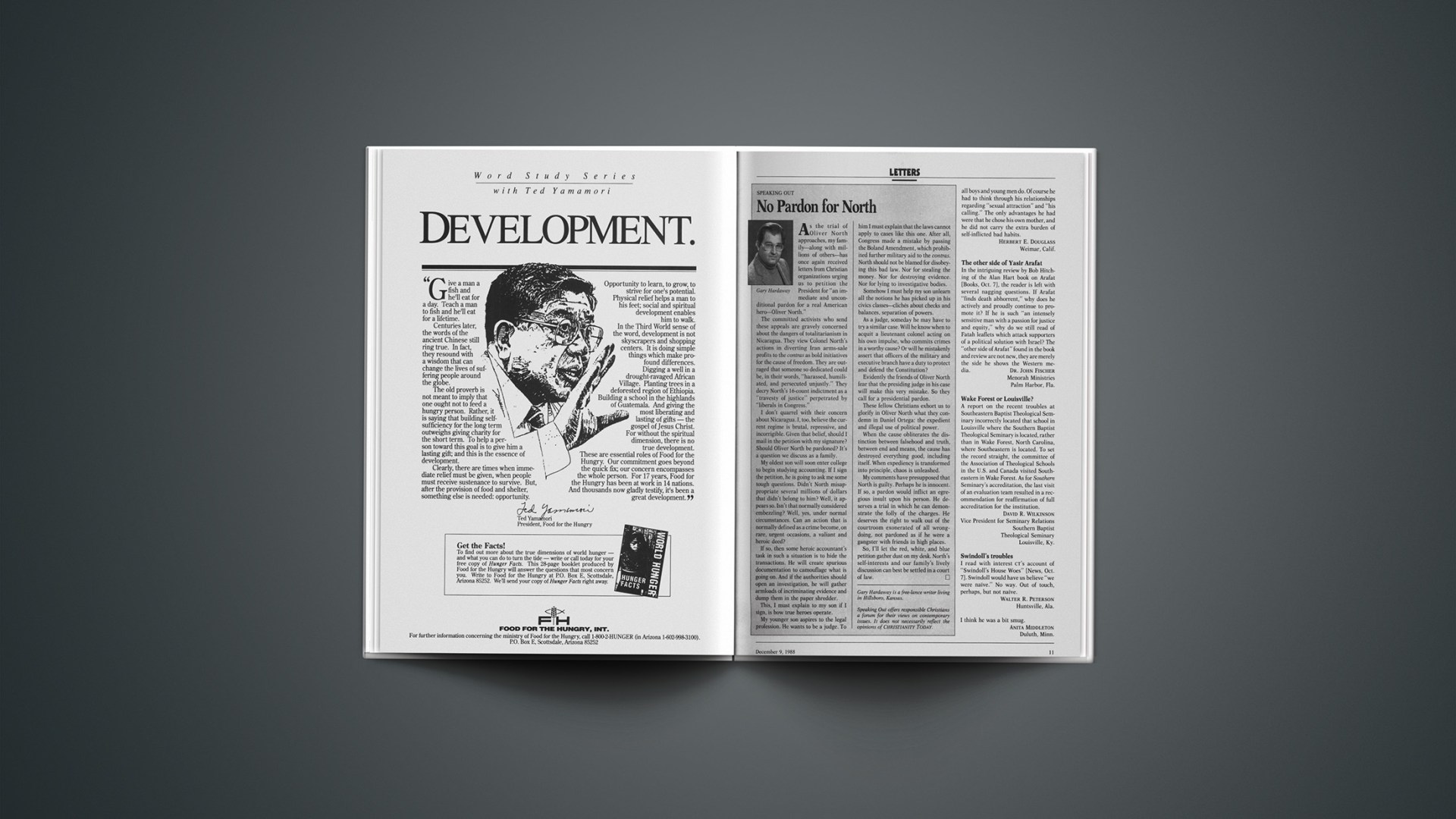
No Pardon for North

SPEAKING OUT

As the trial of Oliver North approaches, my family—along with millions of others—has once again received letters from Christian organizations urging us to petition the President for “an immediate and unconditional pardon for a real American hero—Oliver North.”

The committed activists who send these appeals are gravely concerned about the dangers of totalitarianism in Nicaragua. They view Colonel North’s actions in diverting Iran arms-sale profits to the contras as bold initiatives for the cause of freedom. They are outraged that someone so dedicated could be, in their words, “harassed, humiliated, and persecuted unjustly.” They decry North’s 16-count indictment as a “travesty of justice” perpetrated by “liberals in Congress.”

I don’t quarrel with their concern about Nicaragua. I, too, believe the current regime is brutal, repressive, and incorrigible. Given that belief, should I mail in the petition with my signature? Should Oliver North be pardoned? It’s a question we discuss as a family.

My oldest son will soon enter college to begin studying accounting. If I sign the petition, he is going to ask me some tough questions. Didn’t North misappropriate several millions of dollars that didn’t belong to him? Well, it appears so. Isn’t that normally considered embezzling? Well, yes, under normal circumstances. Can an action that is normally defined as a crime become, on rare, urgent occasions, a valiant and heroic deed?

If so, then some heroic accountant’s task in such a situation is to hide the transactions. He will create spurious documentation to camouflage what is going on. And if the authorities should open an investigation, he will gather armloads of incriminating evidence and dump them in the paper shredder.

This, I must explain to my son if I sign, is how true heroes operate.

My younger son aspires to the legal profession. He wants to be a judge. To him I must explain that the laws cannot apply to cases like this one. After all, Congress made a mistake by passing the Boland Amendment, which prohibited further military aid to the contras. North should not be blamed for disobeying this bad law. Nor for stealing the money. Nor for destroying evidence. Nor for lying to investigative bodies.

Somehow I must help my son unlearn all the notions he has picked up in his civics classes—clichés about checks and balances, separation of powers.

As a judge, someday he may have to try a similar case. Will he know when to acquit a lieutenant colonel acting on his own impulse, who commits crimes in a worthy cause? Or will he mistakenly assert that officers of the military and executive branch have a duty to protect and defend the Constitution?

Evidently the friends of Oliver North fear that the presiding judge in his case will make this very mistake. So they call for a presidential pardon.

These fellow Christians exhort us to glorify in Oliver North what they condemn in Daniel Ortega: the expedient and illegal use of political power.

When the cause obliterates the distinction between falsehood and truth, between end and means, the cause has destroyed everything good, including itself. When expediency is transformed into principle, chaos is unleashed.

My comments have presupposed that North is guilty. Perhaps he is innocent. If so, a pardon would inflict an egregious insult upon his person. He deserves a trial in which he can demonstrate the folly of the charges. He deserves the right to walk out of the courtroom exonerated of all wrongdoing, not pardoned as if he were a gangster with friends in high places.

So, I’ll let the red, white, and blue petition gather dust on my desk. North’s self-interests and our family’s lively discussion can best be settled in a court of law.

Gary Hardaway is a free-lance writer living in Hillsboro, Kansas.

Speaking Out offers responsible Christians a forum for their views on contemporary issues. It does not necessarily reflect the opinions of CHRISTIANITY TODAY.

Letters

A Missed Opportunity

I enjoy reading Robert Coles and I appreciate what Joseph Sobran writes. Thus I greedily turned to these and others’ reflections on the impact of the Reagan White House on religion and society [“Sizing Up the Reagan Revolution,” Oct. 21]. The pieces were too “nice.”

Coles and Sobran disagree, as do Neuhaus and Reynolds. For the sake of understanding, CT missed a golden opportunity to let them disagree with each other, to criticize each other, and thus clarify each’s position and help readers come to better understanding and appreciation of the complexity of the religion-in-society issues.

REV. DAVID K. WEBER

Montana State University

Bozeman, Mont.

Robert Coles’s evaluation of President Reagan based on how well he has led the American people, with Jesus as a model, seems to forget that Reagan is not an ordained minister but the head of state—which, in the U.S., is not the church. He seems to forget further that if the church is in God’s right hand, the state, in its nature, is in his left and should serve God as such.

I did not start out with many expectations of Reagan in this presidency, but I and millions have been heartened over his release of many of our economic, political, and inalienable liberties that had become dangerously trammeled.

E. D. REED

Boston, Mass.

Of Mormons and geography

I just read “Rising Star at the Twirling Tomato” [Church in Action, Oct. 21]. At first reading I was annoyed that Rob Wilkins knows little about Utah geography—the people of American Fork may be surprised to find out they are so near to the people of Roy. As I continued, the phrase “Christianity that relies on the Bible as its sole authority is practically nonexistent” hit me. Ah, here we go again. There is a plethora of churches in Utah that exist solely to bash the Mormons. There seems to be a habit among many fundamentalist preachers and believers in Utah to seek out fulfillment for their own prophecies of oppression and fear. It seems an odd way to live for people who claim that Jesus won rather than lost the battle.

REV. GREG B. ANDERSON

Zion Lutheran Church

Salt Lake City, Utah

Wilkins did an excellent job in describing Lofquist’s ministry without the typical snide innuendos so often directed towards other denominations.

T. R. POCOCK

Fairfax, Va.

Discerning protest

Terry Muck’s editorial regarding well-publicized protests is insightful and provocative [“Holy Indignation,” Oct. 21]. Christian spokespeople often have been self-appointed individuals without clear motive, babbling rebuttals devoid of substantiation or offering a complete contextual misinterpretation of the issues at hand. Muck’s closing remarks are timely. The boiling point of protest isn’t a duel between activeness or passiveness, but of choosing to discern how I can be the most effective. God will be glorified amidst our limited, futile efforts.

DAN SCHERLING

Tacoma, Wash.

The word protest inaccurately describes what has been taking place in Atlanta and across the nation. A more accurate word would be rescue, from God’s command, “Rescue those being led away to death …” (Prov. 24:10–12, NIV). Because the goal is to save lives and not simply protest the killing, we should not use the word protest, which is the language of the media, but rather rescue, which accurately describes what is being done.

DANIEL R. DUFFY, JR.

Atlanta, Ga.

Two Western seminaries

I read the news article on seminary education with interest [Oct. 21]. But Joe Maxwell has confused Western Evangelical Seminary (Portland, Oreg.) with Western Theological Seminary (Holland, Mich.). The former is Wesleyan, while the latter is Calvinist.

REV. SIMON CHOU

Evangelical Chinese Church

Seattle, Wash.

Debatable Wisdom

My church took a lesson from the 1988 presidential campaign to help us call a new pastor. After the search committee narrowed the list to two names, we scheduled a debate.

Moderator (to the congregation): Please refrain from expressing your support for either candidate during our limited time together.

Panelist: Candidate #1, you have said you are tough on sin. How can we be sure this is not an empty promise?

Candidate #1: My record speaks for itself. In the past year I preached on sin 14 times. I believe sin is the most original problem the church has ever faced. My administration will do everything possible to fight sin right here in your community.

Candidate #2: We are all aware that last year my opponent’s Sunday school secretary redirected funds from the junior high bake sale to the purchase of vacation Bible school craft materials. So we must ask, Is he really tough on sin, or does he just talk tough?

Panelist: Candidate #2, you changed the rules at your last church so that saying the Lord’s Prayer was no longer mandatory. Why did you do that?

Candidate #2: I love the Lord’s Prayer as much as the next guy. My wife and I say it together after our devotions every morning. I simply believe it should not be imposed on a whole congregation.

Candidate #1: I am one who believes the Lord’s Prayer brings a church together. This is an issue on which my opponent and I have a very fundamental difference of opinion. This is a clear indicator of his stand on tradition, values, and ideology.

As you can see, nothing beats a debate for clarifying the important issues. I’m off to vote.

EUTYCHUS

Real bliss or real agony?

I did not appreciate “Rumors of Heaven” [Oct. 7]. I decided the point of the article was to portray the views of a book that minimizes hell. In the end, there is apparently no question about personal destiny. To say “It will be overwhelming bliss” really upsets me, because Satan’s favorite trick is minimizing what is really important in life.

Second, the article does not do justice to the orthodox Christian response, which would primarily be centered on the words of Christ in his story of the rich man and Lazarus (Luke 16). Does Christ’s after-death account sound like overwhelming bliss? It doesn’t even sound like underwhelming bliss to me. Let’s hear it for real agony.

DAVID G. TOUSSAINT

Fishers, Ind.

Infallibility and the true Jesus

I very much appreciated Kenneth Kantzer’s article “Why I Still Believe the Bible Is True” [Oct. 7]. I have one question: Kantzer stated that belief in the infallibility of the Bible was not absolutely necessary. However, if we are to believe in the true Jesus who reveals himself in the Word, and not in a Jesus of our conception, and if the fact that Jesus is really Lord means we are to live our lives for him as he says, isn’t the infallibility of the Bible necessary so that we know the true Jesus and know what he says about how we should live our lives?

REV. WM. G. BROUWERS

The Christian Reformed Church

Wisconsin Rapids, Wis.

A flaw in biblical inerrantism is revealed in the very illustration by which Kantzer seeks to demonstrate its validity. He feels that upon investigation, the two diverse accounts of an elderly lady’s death were satisfactorily harmonized so that both of them could be described as “inerrant.” If one wishes to allow that the Bible includes minute errors in reporting such as this, as it rather clearly does, and still describe it as “inerrant,” he may do so. He must be prepared, however, to realize that others of us will find in the use of this word just the slightest hint of dishonesty, which we cannot harmonize with our submission to the lordship of Jesus Christ.

REV. BURRELL PENNINGS

North Haledon, N.J.

False accusation

Your news report [Aug. 12] falsely accused me of charging Murray Harris of Trinity Evangelical Divinity School with “heresy” because he teaches that Jesus did not rise in a physical, material body. While I believe his view is unbiblical and inconsistent with the doctrinal statement he signs, I never called it “heresy.”

Then, although you apologized in a letter for not contacting me for comment, in the very issue in which you published an edited version of my letter of complaint [Oct. 21] you also published another letter right after it from Mike Andrus that repeats the false claim that I charged Harris with “heresy.” Doesn’t your right hand know what your left hand is doing?

Furthermore, the same letter contains the false and slanderous charge that I was under “disciplinary procedures” by the Evangelical Free Church. The truth is that no such procedures ever occurred. That was merely a personal threat by Mr. Andrus if I did not desist in my attempt to inform my fellow Free Church pastors of the denial of the physical, material nature of the resurrection body by one of their seminary professors.

Publishing defamatory evangelical garbage about a fellow Christian leader, especially without checking out its truthfulness, is inexcusable. Consider the very words you printed [Oct. 7] in the way another magazine handled the Swindoll issue: “We do not want to appear to be slanting the news, especially against those we know to be credible.” And “it would seem that the responsible thing for a journalist to do would be to check out the story he or she decides to print.” I fully agree.

NORMAN L. GEISLER

Dallas Theological Seminary

Dallas, Texas

We apologize for not contacting Dr. Geisler for comment before publishing this material.—Eds.

Changing views of Judaism

It was with much appreciation that I read the articles in the CT Institute, “Changing Views of Judaism” [Oct. 7]. As a Jewish believer in Yeshua, I have been touched on a personal level by virtually every issue therein discussed. Perhaps the greatest lesson I have learned over the years, through participation on a grassroots level in this “task of reconciliation,” is that we (Jews and Gentile church) need each other. The reconciliation of God’s people is more than mere pleasantry or moral rectitude; it is God’s purpose and heart that his people be one.

S. G.

El Toro, Calif.

David Rausch perpetuates an inaccurate accusation when he mentions Martin Luther and the Holocaust in the same breath, at least implicitly suggesting some level of cause and effect. Luther was not anti-Semitic. A careful reading of the sources will show that he made a distinction between Jewish people, who are fellow travelers on the road of life, and the Jewish religion, which tragically rejects the only Way to eternal life. The church today should have the conviction to do the same.

LAWRENCE O. OLSON

Loves Park, Ill.

Censorship vs. moral indignation

David Neff’s editorial “Scorsese’s Christ” [Oct. 7] neatly exposed the difference between “censorship” and moral indignation, while carefully analyzing the weakness of both liberals and evangelicals whenever Jesus is not accepted as our pre-existing Lord. Of course Jesus grew, learned, and made decisions as all boys and young men do. Of course he had to think through his relationships regarding “sexual attraction” and “his calling.” The only advantages he had were that he chose his own mother, and he did not carry the extra burden of self-inflicted bad habits.

HERBERT E. DOUGLASS

Weimar, Calif.

The other side of Yasir Arafat

In the intriguing review by Bob Hitching of the Alan Hart book on Arafat [Books, Oct. 7], the reader is left with several nagging questions. If Arafat “finds death abhorrent,” why does he actively and proudly continue to promote it? If he is such “an intensely sensitive man with a passion for justice and equity,” why do we still read of Fatah leaflets which attack supporters of a political solution with Israel? The “other side of Arafat” found in the book and review are not new, they are merely the side he shows the Western media.

DR. JOHN FISCHER

Menorah Ministries

Palm Harbor, Fla.

Wake Forest or Louisville?

A report on the recent troubles at Southeastern Baptist Theological Seminary incorrectly located that school in Louisville where the Southern Baptist Theological Seminary is located, rather than in Wake Forest, North Carolina, where Southeastern is located. To set the record straight, the committee of the Association of Theological Schools in the U.S. and Canada visited Southeastern in Wake Forest. As for Southern Seminary’s accreditation, the last visit of an evaluation team resulted in a recommendation for reaffirmation of full accreditation for the institution.

DAVID R. WILKINSON

Vice President for Seminary Relations

Southern Baptist Theological Seminary Louisville, Ky.

Swindoll’s troubles

I read with interest CT’s account of “Swindoll’s House Woes” [News, Oct. 7]. Swindoll would have us believe “we were naïve.” No way. Out of touch, perhaps, but not naïve.

WALTER R. PETERSON

Huntsville, Ala.

I think he was a bit smug.

ANITA MIDDLETON

Duluth, Minn.

Beyond Where Are They Now?

In this, our last issue for 1988, we review the major issues, events, and personalities that were the journalistic mainstay of CT News for the past 12 months. In addition to offering the “Top Ten” news stories of the year (as selected by the CT news staff), we are, for the first time, presenting a second look at some of the men, women, and children whose stories were a part of CT News (and church life) in 1988.

“This is more than a simple ‘where are they now’,” says associate news editor Randy Frame, who led this project. “Take Vladimir Khailo, for instance” (a celebrated Soviet immigrant who has now returned to Europe, unable to cope with life in the U.S.). “The follow-up to his triumphal entry into this country should serve the church notice that more help is needed to insure that people like him can survive the culture shock, foreign lifestyles, and, yes, the basic freedoms we so quickly take for granted.”

In addition to Khailo, CT also pays a return visit to drug-busting pastor Willie Wilson of Washington, D.C.; Sharon Batts, whose Top 40 prayer for abused children, “Dear Mr. Jesus,” took the country by storm late last year; and former Mississippi policeman Joe Daniels, who left the force rather than arrest picketing prolifers. Special thanks go to news intern Joe Maxwell, who telephonically tracked down the individuals in the writing of these interesting (and at times, sobering) vignettes.

HAROLD B. SMITH, Managing Editor

Cover illustration by Paul Turnbaugh, with reproduction of The Vision of Death by Gustave Doré

Integrity You Can Afford

“It’s Smart to Be Ethical—Integrity Pays!” proclaimed the lavish, gold-inked advertisement in Publishers Weekly. How clever—promoting ethical business practices by appealing to the profit motive!

Actually, The Power of Ethical Management, by coauthors Kenneth Blanchard (The One-Minute Manager) and Norman Vincent Peale (The Power of Positive Thinking), delivers more and better than its ad promises. Under its superficial tone, the book, which is due to reach bookstores next month, hides a fairly sophisticated analysis that set us thinking.

Is it possible to be ethical and survive in the business world? According to one consultant in corporate ethics education, most managers in aerospace and defense industries have a strong sense of right and wrong. And those managers feel guilty much of the time. The incredible pressures of doing business—especially in industries that rely heavily on large government contracts—brings the survival instinct to the surface. One branch of our government puts pressure on these companies to deliver honest bids and compete fairly. Another branch pressures them to promise more and faster and for less than they can reasonably expect to deliver.

The Peale and Blanchard message may be just what these managers need to hear: Operating in a fair, legal, and self-respecting manner will not ruin you or your company. And in the long run, it will probably help. This message is pitched perfectly for the functionally pragmatic mood of American business. We are, after all, a nuts-and-bolts kind of nation that does not want to be bothered very much with theories. Just tell us what works.

But there is something else managers (and the rest of us) need to grasp. Our consultant reports that the very managers who have a solid sense of right and wrong are reluctant to defend their convictions. The tolerant ethic of relativism has so permeated our culture that even those who believe in right and wrong will apologetically explain that their ideas of morality are, after all, just preferences (like one person’s taste for broccoli or another’s preference for slasher movies), and that they certainly would not want to impose them on anyone else.

It is that kind of thinking that surrenders to the inevitability of deception, payoffs, and kickbacks even before the first blast of the battle horn has been sounded.

Fighting these two ideas—that integrity is an unaffordable luxury and that morality is mere preference—is imperative. And we are glad that the 60-second positive thinkers are leading the charge. Beyond that, we need to help people build moral fiber so they can choose to do right even when it is not profitable. And we must help them understand the message of grace: The Grand Outcome is not in their control after all, so they are free to ignore the pressure to subordinate ethics to the bottom line and free to shed the guilt as well.

By David Neff.

Low Pay, Long Hours, No Applause

“A dam is a 25-year-old man who cannot speak, cannot dress or undress himself, cannot walk alone, cannot eat without much help. He does not cry or laugh. Only occasionally does he make eye contact. His back is distorted. His arm and leg movements are twisted. He suffers from severe epilepsy and, despite heavy medication, sees few days without grand-mal seizures. Sometimes, as he grows suddenly rigid, he utters a howling groan. On a few occasions, I’ve seen one big tear roll down his cheek.

“It takes me about an hour and a half to wake Adam up, give him his medication, carry him into his bath, wash him, shave him, clean his teeth, dress him, walk him to the kitchen, give him his breakfast, put him in his wheelchair and bring him to the place where he spends most of the day with therapeutic exercises.”

Three years ago, author Henri Nouwen moved from his post at Harvard University to a community called Daybreak, near Toronto. There he took on the daily, mundane chores related above: a ministry not to intellectuals, but to a young man who is considered by many a vegetable, a useless person who should not have been born. Yet in a recent article in World Vision magazine, Nouwen insisted that he, not Adam, is the chief beneficiary in this strange, misfitted relationship.

From the hours spent with Adam, Nouwen says, he has gained an inner peace so fulfilling that it makes most of his other, more high-minded tasks seem boring and superficial by contrast. As he sat beside that silent, slow-breathing child-man, he realized how violent and marked with rivalry and competition, how pervaded with obsession, was his prior drive toward success in academia and in the Christian ministry.

From Adam he learned that “what makes us human is not our mind but our heart, not our ability to think but our ability to love. Whoever speaks about Adam as a vegetable or animallike creature misses the sacred mystery that Adam is fully capable of receiving and giving love.” From Adam, Henri Nouwen learned—gradually, painfully, shamefully—that the way up is down.

My career as a journalist has afforded me opportunities to interview diverse people. Looking back, I can roughly divide them into two types: stars and servants. The stars include NFL football greats, movie actors, music performers, famous authors, TV personalities, and the like. These are the ones who dominate our magazines and our television programs—yes, our Christian magazines and Christian television programs, too. We fawn over them, poring over the minutia of their lives: the clothes they wear, the food they eat, the aerobic routines they follow, the people they love, the places they go, the toothpaste they use.

Yet I must tell you that, in my limited experience, these our “idols” are as miserable a group of people as I have ever met. Most have troubled or broken marriages. Nearly all are hopelessly dependent on psychotherapy. And in a heavy irony, these larger-than-life heroes seem tormented by incurable self-doubt.

I have also spent time with servants. People like Dr. Paul Brand, who worked for 20 years among outcasts—leprosy patients, the poorest of the poor, in rural India. Or the health workers who left high-paying jobs to serve with Mendenhall Ministries in a backwater town in Mississippi. Or relief workers in Somalia, Sudan, Ethiopia, Bangladesh, or other such repositories of world-class human suffering. Or the Ph.D.’s scattered throughout jungles of South America translating the Bible into obscure languages.

I was prepared to honor and admire these servants, to hold them up as inspiring examples. I was not, however, prepared to envy them. But as I now reflect on the two groups, stars and servants, the servants clearly emerge as the favored ones, the graced ones. They work for low pay, long hours, and no applause, “wasting” their talents and skills among the poor and uneducated. But somehow, in the process of losing their lives, they have found them. They have received the “peace that is not of this world” such as Henri Nouwen described in his article, a peace he discovered not within the stately quadrangles of Harvard, but by the bedside of incontinent Adam.

During the past two years, I have winced at the snidely jubilant tone that has often characterized media coverage of the televangelists’ scandals: See, those Christian superstars are no better—no, worse—than the rest of us. I have grieved over reports that contributions to almost all Christian organizations have fallen dramatically in the wake of the scandals. I consider my gifts to such organizations as World Vision, American Leprosy Mission, World Concern, Wycliffe, and Mendenhall Ministries as the highest-returning investment I can possibly make.

Maybe the underlying problem behind the scandals is that we have distorted the kingdom of God by training our spotlight not on the servants, but on the stars. As Henri Nouwen said in his article,” Keep your eyes on the one who refuses to turn stones into bread, jump from great heights or rule with great temporal power. Keep your eyes on the one who says, ‘Blessed are the poor, the gentle, those who mourn and those who hunger and thirst for righteousness; blessed are the merciful, the peacemakers and those who are persecuted in the cause of uprightness.’ … Keep your eyes on the one who is poor with the poor, weak with the weak and rejected with the rejected. That one is the source of all peace.” In other words, keep your eyes on the servant, not the star.

The Gospels repeat one saying of Jesus more than any other: “Whoever wants to save his life will lose it, but whoever loses his life for my sake will find it.”

Truly, the way up is down.

Protecting the Lord’s Canvas

INTERVIEW

Calvin DeWitt is professor of ecology and environmental studies at the University of Wisconsin in Madison, and a leading figure in the fledgling Christian ecological movement.

Why do you consider it urgent for Christians to address environmental problems?

If people at an art gallery saw Rembrandt’s paintings being destroyed they would try to prevent the destruction. Similarly, the Earth is the canvas of our Lord and Creator, and his masterpieces are being destroyed.

We’re losing to extinction more than one species of plants or animals every day. Judging by how Christians treat creation, I would have to conclude that many no longer believe in God as Creator.

What change are you calling for?

Churches need to become creation-awareness centers, where the Creator God is honored. A church could reflect this by reclaiming the immediate environment of their building, perhaps purchasing adjacent land as a preserve to show it respects God’s creation.

Individuals can also reflect their awareness of creation in their stewardship. When we say the Lord’s Prayer, we ask for daily bread. But our visible prayer is, “Give us this day enough for ten years”; we’ll consume it today, and tomorrow we’ll ask for another chunk. When we go beyond what we need, not only do we often add misery to our own lives, but we also add misery to the lives of God’s creatures.

Aren’t there more important concerns for Christians to devote their time and energy to such as abortion and pornography?

All these are part of the same problem: the abuse of God’s creatures, the abuse of life. To view the recent flooding in Bangladesh simply as a natural disaster, for example, is to take too narrow a view. The flooding was largely due to the removal of trees, thus limiting the earth’s capacity to hold water that will be needed to avert drought during the dry season.

Likewise, world hunger and environmental degradation go hand in hand. Our impulse is to feed hungry people, and it’s a good impulse. But food doesn’t come from bags or cans; it comes from the land. If the land is treasured, kept in the sense of Genesis 2:15, it will continue to pour forth its bounty.

Aren’t you bothered that the ecology movement is so closely identified with the agenda of non-Christian religions?

The Ku Klux Klan uses the cross; we haven’t removed crosses from our churches. Some in the New Age movement use the sign of the rainbow. That doesn’t mean we no longer respect the rainbow as a symbol of God’s covenant. As we try to call people to faith in God, we might be called fundamentalists. Likewise, as we reach out to heal the Earth, we might be called New Agers. People who strive to be obedient will be called every name in the book, including Christian.

I find it sobering that some of our greatest prophets are scientists, many of whom do not profess the Lord, but they are nevertheless compelled to bring him honor. They are calling attention to the degradation of the Earth, pronouncing the sinfulness of man without using the word sin. And many Christians are rebelling against being called sinners.

In emphasizing nonhuman creation, isn’t there a danger of losing sight of humanity’s unique standing?

There is not even a hint of that danger among those who testify to God as Creator. It’s like thinking that putting up a bird feeder means we’ll wind up worshiping robins. As people continue to try to harmonize with nature without professing God, we’ll see an increase in satanic approaches to revering the Earth. The solution to this problem is not further isolation from God’s creation, but a powerful witness to the one true God. If we stand back and no longer profess God as Creator, we will see a resurgence of paganism from those in the environmental movement we’ve abandoned.

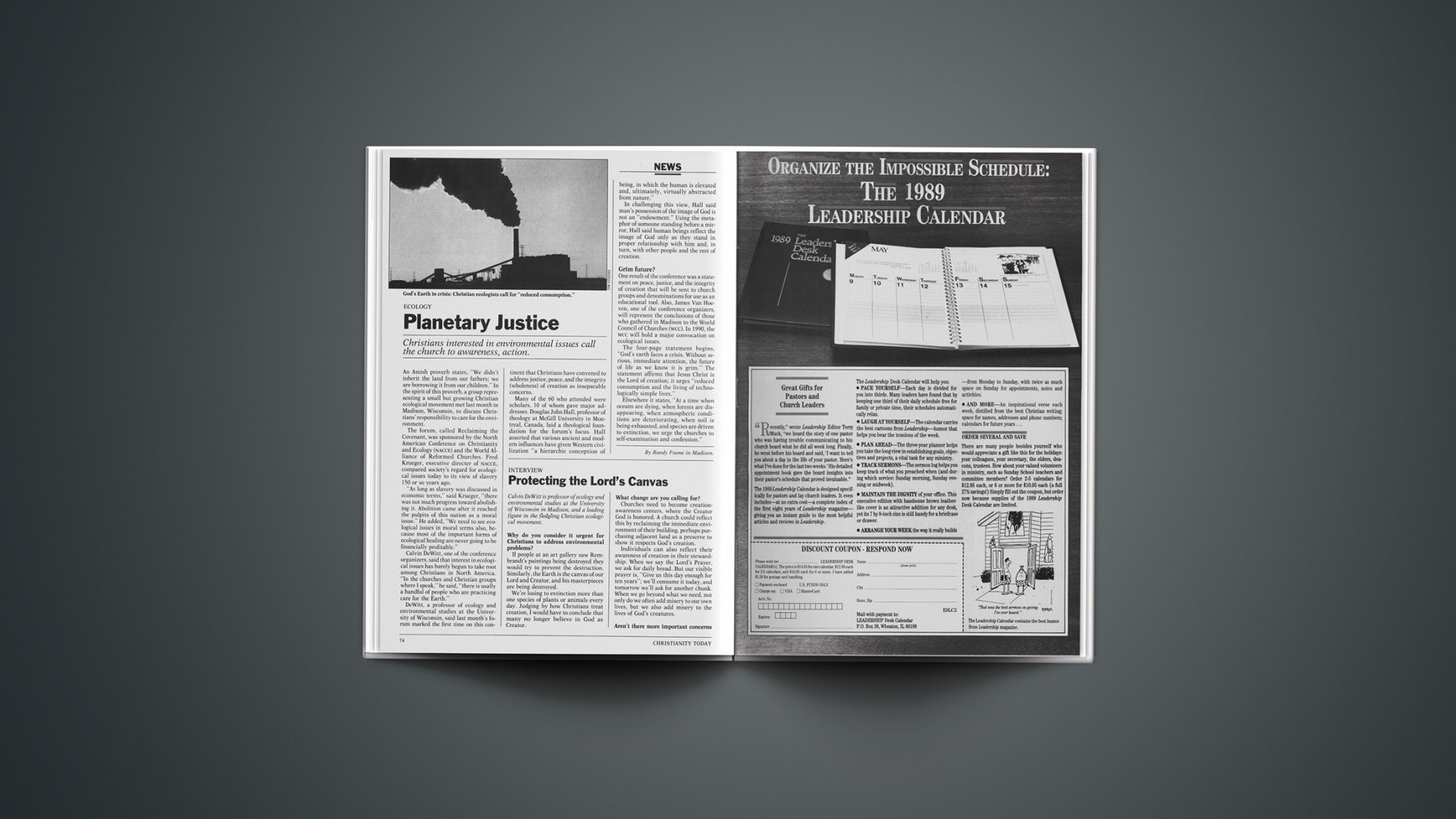
Planetary Justice

Christians interested in environmental issues call the church to awareness, action.

An Amish proverb states, “We didn’t inherit the land from our fathers; we are borrowing it from our children.” In the spirit of this proverb, a group representing a small but growing Christian ecological movement met last month in Madison, Wisconsin, to discuss Christians’ responsibility to care for the environment.

The forum, called Reclaiming the Covenant, was sponsored by the North American Conference on Christianity and Ecology (NACCE) and the World Alliance of Reformed Churches. Fred Krueger, executive directer of NACCE, compared society’s regard for ecological issues today to its view of slavery 150 or so years ago.

“As long as slavery was discussed in economic terms,” said Krueger, “there was not much progress toward abolishing it. Abolition came after it reached the pulpits of this nation as a moral issue.” He added, “We need to see ecological issues in moral terms also, because most of the important forms of ecological healing are never going to be financially profitable.”

Calvin DeWitt, one of the conference organizers, said that interest in ecological issues has barely begun to take root among Christians in North America. “In the churches and Christian groups where I speak,” he said, “there is usally a handful of people who are practicing care for the Earth.”

DeWitt, a professor of ecology and environmental studies at the University of Wisconsin, said last month’s forum marked the first time on this continent that Christians have convened to address justice, peace, and the integrity (wholeness) of creation as inseparable concerns.

Many of the 60 who attended were scholars, 10 of whom gave major addresses. Douglas John Hall, professor of theology at McGill University in Montreal, Canada, laid a theological foundation for the forum’s focus. Hall asserted that various ancient and modern influences have given Western civilization “a hierarchic conception of being, in which the human is elevated and, ultimately, virtually abstracted from nature.”

In challenging this view, Hall said man’s possession of the image of God is not an “endowment.” Using the metaphor of someone standing before a mirror, Hall said human beings reflect the image of God only as they stand in proper relationship with him and, in turn, with other people and the rest of creation.

Grim Future?

One result of the conference was a statement on peace, justice, and the integrity of creation that will be sent to church groups and denominations for use as an educational tool. Also, James Van Hoeven, one of the conference organizers, will represent the conclusions of those who gathered in Madison to the World Council of Churches (WCC). In 1990, the WCC will hold a major convocation on ecological issues.

The four-page statement begins, “God’s earth faces a crisis. Without serious, immediate attention, the future of life as we know it is grim.” The statement affirms that Jesus Christ is the Lord of creation; it urges “reduced consumption and the living of technologically simple lives.”

Elsewhere it states, “At a time when oceans are dying, when forests are disappearing, when atmospheric conditions are deteriorating, when soil is being exhausted, and species are driven to extinction, we urge the churches to self-examination and confession.”

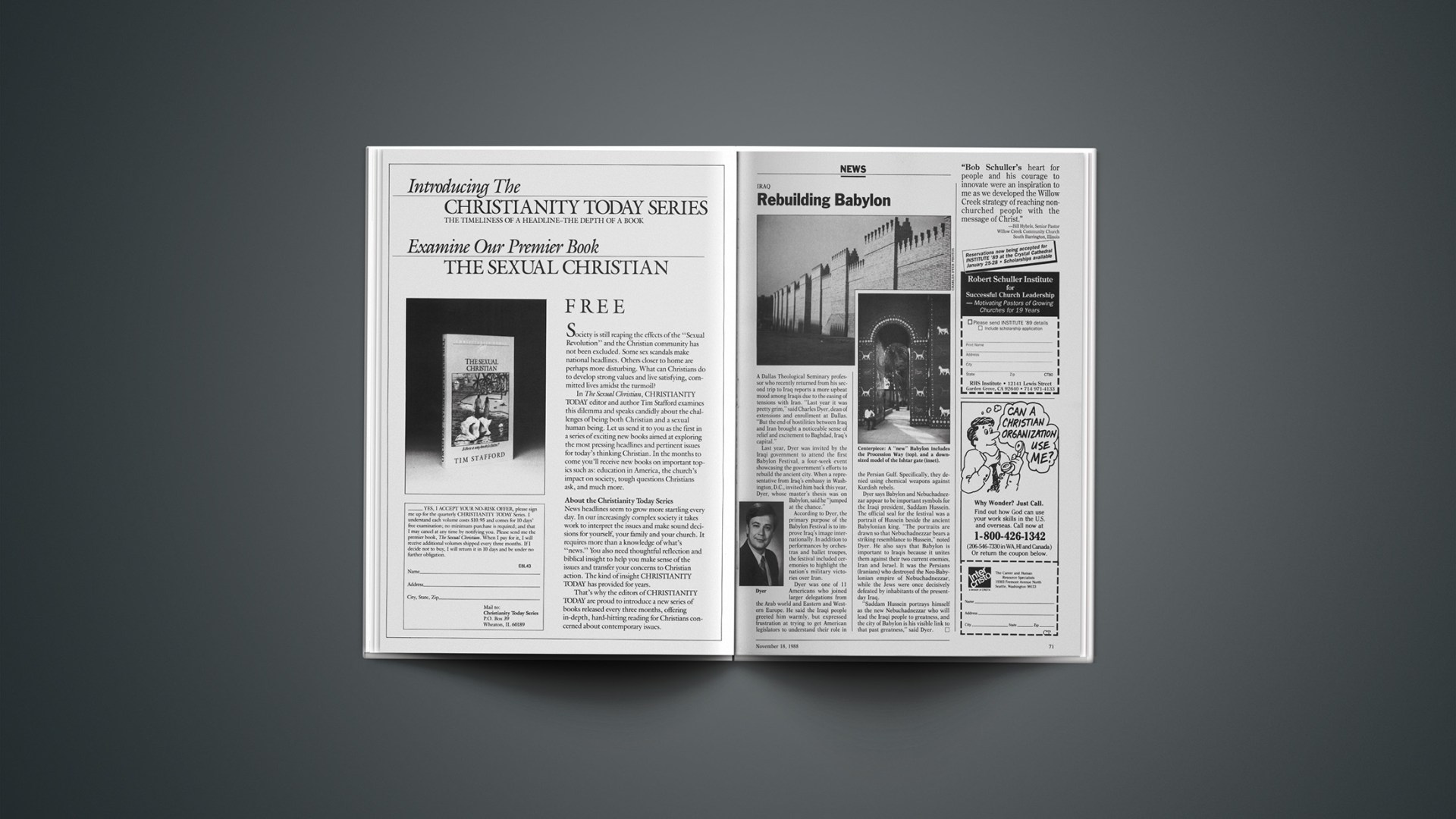
Rebuilding Babylon

IRAQ

A Dallas Theological Seminary professor who recently returned from his second trip to Iraq reports a more upbeat mood among Iraqis due to the easing of tensions with Iran. “Last year it was pretty grim,” said Charles Dyer, dean of extensions and enrollment at Dallas. “But the end of hostilities between Iraq and Iran brought a noticeable sense of relief and excitement to Baghdad, Iraq’s capital.”

Last year, Dyer was invited by the Iraqi government to attend the first Babylon Festival, a four-week event showcasing the government’s efforts to rebuild the ancient city. When a representative from Iraq’s embassy in Washington, D.C., invited him back this year, Dyer, whose master’s thesis was on Babylon, said he “jumped at the chance.”

According to Dyer, the primary purpose of the Babylon Festival is to improve Iraq’s image internationally. In addition to performances by orchestras and ballet troupes, the festival included ceremonies to highlight the nation’s military victories over Iran.

Dyer was one of 11 Americans who joined larger delegations from the Arab world and Eastern and Western Europe. He said the Iraqi people greeted him warmly, but expressed frustration at trying to get American legislators to understand their role in the Persian Gulf. Specifically, they denied using chemical weapons against Kurdish rebels.

Dyer says Babylon and Nebuchadnezzar appear to be important symbols for the Iraqi president, Saddam Hussein. The official seal for the festival was a portrait of Hussein beside the ancient Babylonian king. “The portraits are drawn so that Nebuchadnezzar bears a striking resemblance to Hussein,” noted Dyer. He also says that Babylon is important to Iraqis because it unites them against their two current enemies, Iran and Israel. It was the Persians (Iranians) who destroyed the Neo-Babylonian empire of Nebuchadnezzar, while the Jews were once decisively defeated by inhabitants of the present-day Iraq.

“Saddam Hussein portrays himself as the new Nebuchadnezzar who will lead the Iraqi people to greatness, and the city of Babylon is his visible link to that past greatness,” said Dyer.

Apple PodcastsDown ArrowDown ArrowDown Arrowarrow_left_altLeft ArrowLeft ArrowRight ArrowRight ArrowRight Arrowarrow_up_altUp ArrowUp ArrowAvailable at Amazoncaret-downCloseCloseEmailEmailExpandExpandExternalExternalFacebookfacebook-squareGiftGiftGooglegoogleGoogle KeephamburgerInstagraminstagram-squareLinkLinklinkedin-squareListenListenListenChristianity TodayCT Creative Studio Logologo_orgMegaphoneMenuMenupausePinterestPlayPlayPocketPodcastRSSRSSSaveSaveSaveSearchSearchsearchSpotifyStitcherTelegramTable of ContentsTable of Contentstwitter-squareWhatsAppXYouTubeYouTube