Sex in a Theological Perspective

From copywriters on Madison Avenue to teen-agers in the junior-high locker room, everybody is talking about sex. The copywriters sell it big, offering it as a bonus with everything from cigars to mouthwash. The kids play it cool, swapping half-truths with a titter or a smirk. But truthfully or twistedly, blandly or blatantly, directly or indirectly, everybody is talking about sex.

Television commercials, billboards, and magazines assure us endlessly that some sort of sexual reward comes with every wise purchase. Mass man soaks up the message, unabashedly approves, but all the while suffers a growing sense of disillusionment. In spite of their prattle, neither Madison Avenue nor the locker room can give man what he needs to make sense out of sex. It is a theological perspective that is needed, one that considers sex in its ultimate relationship, and this can come to us only out of the Christian Scriptures.

Not surprisingly, that theological word confronts us at the very portals of the Bible. Of God’s creation of man, Genesis one says, “Male and female created he them.” In the first chapter of the Bible we have the first reference to sexuality, and the second chapter elaborates it with the story of Adam and Eve. Those who are tempted to think this account naïve should remember that both Jesus and Paul referred back to it as in some way normative for the human race (Matt. 19:3–9; 1 Cor. 6:16; Eph. 5:31). Five guidelines in chapter two are helpful today.

First of all, human sexuality is the result of God’s fatherly concern. “Then the Lord God said, ‘It is not good that the man should be alone: I will make him a helper fit for him’ ” (2:18). Eve was God’s benevolent provision for Adam, and Adam, in turn, for Eve. Sexuality is therefore a feature of God’s creation, bearing his approval. Pride and self-will may trick us into yielding it to evil ends, leading to results that are often unbelievably twisted and gross. Nevertheless, far from being evil, sex is God’s provision for the good of mankind, and every Christian discussion of the subject must begin here.

Do not underestimate the force of this theological point of view. Recently I listened to an anguished young man confess that he was aroused by the presence of men but completely indifferent to girls. Even so, he was not ready to face his problem seriously until a few days later he heard a sermon on the biblical theme of creation. He then returned to say, “If that’s the way it is, I’ll pay any price to be God’s man.” He had caught a glimpse of God’s purpose behind every feature of life, including his sexuality, and this had motivated him to seek help in earnest.

Secondly, sex belongs to the Christian mysteries, and its ultimate meaning is known only by revelation. The Lord God caused Adam to be in a “deep sleep,” and therefore Eve’s origin could be known only as God chose to make it known. The new relationship was beyond Adam’s rational powers to comprehend. He knew only that Eve was God’s gift to him and that her coming had made all of life different. Sexuality is still beyond rational explanation but can be accepted in faith for what it is, a feature of God’s creative concern.

Adolescents who are given extensive biological information about sex as though this were the whole of it are deprived, however sophisticated they may appear. If they are not given a sense of the ultimate meaning of sex, if they are led to view it only as a biological function, they are likely to become what Grace and Fred M. Hechinger have called “little old technicians.” This is a sure path to disillusionment. On the other hand, adolescents who are taught to accept their sexuality as an endowment from God have a framework within which to place the biological facts, and they are more likely to manage those powerful impulses wholesomely.

In the third place, the account of Adam and Eve confronts us with what Helmut Thielicke has called the “wonder of recognition.” When God presented Eve to Adam, Adam said, “This at last is bone of my bone …; she shall be called Woman.” He recognized in Eve both likeness and dissimilarity: she was bone of his bone but needed a name something like “she man” to mark the difference between them. Here is the polarity of the sexes, the ground of Adam’s sudden awareness that in Eve he had found his other half.

It is wise to remember that the story of Adam and Eve answers questions people ask today. It speaks cogently to youth who marvel at the idea that somewhere in the world lives their “other half.” Why not tell them, then, on the strength of this account, that their moment of recognition can come under the watchful eye of God, that finding a life’s partner can be a theological experience for those who will make it so? Is not the Lord God as concerned for the welfare of his creatures today as he was for Adam?

In the fourth place, the term “one flesh” reflects the unique nature of marriage. The current notion of marriage is strong on romance but weak on commitment, as shown by America’s nearly 500,000 divorces a year. By contrast, the Scriptures consistently hold that marriage is a relationship so profound and enduring that only the term “one flesh” can adequately characterize it.

“Flesh” in Hebrew thought stands for the whole of a man’s mortal life, including his feelings, aspirations, strengths, and weaknesses. Much more than the merging of two bodies, “one flesh” implies the merging of two persons, and no human relationship is more intimate. Within this intimate relationship, sexual intercourse becomes a sacramental act symbolizing the union’s completeness. Apart from the totality of a “one flesh” relationship, it leads only toward disillusionment, and no amount of glib talk can refute this. Only yesterday I listened to the confession of a modern sophisticate who had scrapped the “one flesh” conviction and had tried intercourse for kicks. Her grim countenance bore the strain of several months of self-loathing, and she is still far from regaining her emotional balance.

Finally, we are told that Adam and Eve were naked and were not ashamed. If this account is to stand as a paradigm of marriage at its best, then marriage is to be a relationship of complete openness between husband and wife. Later, after Adam and Eve had rebelled against their Maker, they tried to hide from each other. Not uncommonly, spouses today reflect this same state of affairs. “We just can’t talk to each other,” they say. “We’re like two strangers in the same house.” Openness nevertheless remains the ideal to be sought after. When Jesus answered questions about the collapse of marriages in Moses’ time, he reminded his questioners that “from the beginning it was not so,” thus affirming for all time an ideal never to be forgotten. The closer spouses come to this ideal of openness, the nearer they are to marital fulfillment.

In a word, the account of Adam and Eve teaches that sex is sacred and that marriage is the normative relationship for one man and one woman. That is, God has created man as a sexual being and has ordained marriage as the institution within which that sexuality can be fully expressed.

But what about those who agree with this theology but whose marriages are nevertheless racked with destructive tensions? Often a person brings to marriage the causes for such tensions: strong negative feelings from his childhood, fears that have never been aired, confusion about his marital role, inadequate commitment to the relationship, serious immaturity, and sometimes personal guilt. These, not unrealistic theology, place stresses upon marriage. Often pastoral counsel and sometimes the best psychiatric services are needed to resolve the tensions and strengthen the bond.

Nevertheless, those who hold a theological view of marriage are in the best position to face their problems. Their conviction that marriage is for keeps gives them a steady foundation on which to work. Their conviction that it is ordained by God orients them toward the source of aid and forgiveness. In a word, Genesis 2 is a backdrop against which they can work out the implications of their own marriage under the watchful eye of God.

The idea that marriage is the normative relationship in human life may seem to be disproved by a new group of free, affluent, “swinging” single people, sometimes called the “swingles.” After describing them, Time, in an essay on “The Pleasures and Pain of the Single Life” (Sept. 15, 1967), put its finger on their loneliness: “Ultimately, the singles devoutly wish that they weren’t.” But they are, and many will remain so. Our ministry to them, besides understanding their loneliness, is to help them find personal fulfillment through surrender to a worthwhile cause. It is also to help them acknowledge to themselves the reason for their not marrying, a reason more often related to fear than to the unavailabilty of a mate.

In a culture that is rapidly losing the conviction that marriage is ordained by God and in harmony with man’s nature, how can Christians be helped to implement a wholesome theology of sex and marriage? The Church can perform a powerful ministry, first of all, by making the theological view of marriage a part of the fabric of congregational life. There is no better place to start than with the Christian wedding. Every congregation should be led periodically to take a hard look at all the features of weddings performed within its facilities. Are the songs sentimental or Christian? Is the focus of the event on the bride or on Christ? Does the ceremony express Christian convictions about marriage in a lofty way, or has it become corrupted by merely romantic sentiments? The congregation that takes its responsibilities seriously at this point is likely to find the same high views of marriage coming to permeate all other areas of its corporate life.

Christians must also be helped to cultivate wholesome feelings about sex. The frightened, confused, and guilty in every congregation should hear the subject discussed in a wholesome way, much as Paul discussed the matter with the troubled Corinthian church (1 Cor. 7). There is all the more reason to do this when secular voices like Playboy seem to be issuing the same call for open discussion. The difference is enormous, however, for Playboy regards sex as an impulse of nature related to nothing ultimate, while the Church sees it as a gift from God to be expressed according to his laws. Wholesome feelings about sex can exist only where the Church makes its theology clear and Christians align their lives in accordance with it.

Above all else, the Lordship of Jesus Christ must be declared over the realm of sex as over every other realm. After I began writing this paragraph, a young couple appeared at my door seeking help. They confessed that their relationship had become “much too physical,” and their story was one of lust breeding confusion and hate. Both were from Christian homes and were sincere in their appeal for help. They were in immediate need of forgiveness, to be sure; but if they are to cope successfully with their problem, they will have to reckon with the Lordship of Jesus and work their problem through in terms of this allegiance. The Lordship of Jesus is the alpha and omega in solving the problem of lust.

This tormented couple are only two of a faceless throng both inside and outside the Church who are caught in a sexual crisis. The embarrassed silence of the Church only deepens their guilt and confusion. They will get no help from the propaganda of Madison Avenue, and the word from the locker room serves only as seeds of confusion for the next generation. What they need is a clear, patient biblical word—a word that bites into the contemporary situation with authority, realism, and compassion. The Church that speaks that word will be speaking a relevant word for Christ.

Break The Time Barrier!

Time is the scarcest resource for ministers. A minister continually feels that there is simply not enough time for him to do everything his people demand of him. Business executives face a similar problem, and one student of executive behavior, Peter D. Drucker, has developed a set of simple guidelines to help solve it. These guidelines, presented in The Effective Executive (Harper & Row), apply as well to the time-squeezed minister as to the business man.

In applying them to a minister’s use of time, however, there are a few important principles to keep in mind. First, a minister’s time is not really his own; he is just the one appointed to manage it. It does not even belong to the people he serves. In the final sense it belongs to God.

Second, God gives a man enough time to do everything He wants him to do. This includes fulfilling his responsibility to his family and to his own health. For Him to do anything else would be illogical and inconsistent.

The third principle is stated by the Apostle Paul: “I can do all things through Christ, who strengthens me.” Paul meant simply that God would give him the strength to do everything He wanted him to do.

Here then is the framework: God gives us time; he gives us enough time to do all that he assigns; and he has promised us the strength we need. What we are left with is the problem of how to become a good steward of that time.

Drucker’s guidelines are simple to apply:

1. Record your time.

2. Prune the time-wasters.

3. Consolidate your discretionary time.

4. Build a flexible schedule.

To manage your time better you must first know where it is going, and the only way to know is to keep a written record. This may seem like a needless suggestion; most people think they already know where their time goes. However, tests have shown that usually they do not. Not even the highly paid executives know. Tests of dozens of these men at this very point reveal that almost without exception, though they think they know how they are spending their time, they really do not.

Once you know where your time is going, then you must prune away activities that simply waste time. For the minister, these are the things that do not contribute to the real work God has called him to do—that is, his work of preaching and teaching, visitation and counseling, and so on. You must be ruthless with these non-essential activities that clutter up the day and simply stop doing them. This demands boldness. On the surface most of them seem important; if they did not, you would not be doing them. The best way to decide is to ask this question about every item on your time record: “What would happen to the work God has called me to do if I stopped doing this altogether?” If the answer is “nothing,” then stop doing it.

Pruning the time-wasters will not really create free time; no minister has that. However, it will give you more time over which you can exert some control. This “discretionary” time comes in small blocks, and the more of these you can consolidate, the better chance you will have of really getting something done. Most ministerial activities demand fairly large blocks of time; a minister needs to be alone for long periods to prepare a sermon or lesson, to plan his future program, to keep himself spiritually refreshed. The way to get these large chunks of time is to put your scattered bits of discretionary time together.

These steps lead directly to the last one: Build a flexible schedule. A good schedule is a pathway, not a prison. There are good reasons for breaking a schedule; but without having one in mind, you will be unable to remain on a sound course. You will fall back into time-wasting without knowing it.

All this does not imply that you must turn your service for God into a mechanical process. Our Lord himself gives us the best example of balance in this matter. He always had time for the important things, and to him the important things involved people. Their souls and their well-being were his great concern. He had time for people because he made time for them.

Ministers share Christ’s objectives. To accomplish them they must, like him, be careful stewards of their time—LAWRENCE H. MERK, assistant professor of economics and management, University of Idaho.

Milton D. Hunnex is professor and head of the department of philosophy at Willamette University, Salem, Oregon. He received the B.A. and M.A. degrees from the University of Redlands and the Ph.D. in the Inter-collegiate Program in Graduate Studies, Claremont, California. He is author of “Philosophies and Philosophers.”

The Secular and the Sanctified

A misconception of Christianity arises from a supposed antithesis between the religious and the secular that has much more in common with medieval Christendom than with the New Testament. The Church is indeed described in the New Testament as a “holy nation” and its members as those “called to be saints,” and Christians are constantly exhorted to “follow after holiness” and to shun the ways of a wicked world. But the Church and its members are nonetheless required to get out into the world and involve themselves in its affairs, and this in no way contradicts New Testament Christianity.

In the great days of medieval Christendom, the whole of life, secular as well as religious, was in one way or another under the control of the Church. To be more precise, it was under the control of organized religion, which meant that it was essentially under clerical control. Hence, although the secular sphere was regarded as in itself unhallowed, it was given at least a veneer of sanctity through its association with religion; and what was more important, its resources could be used in the service of religion. Already in the Middle Ages there were the beginnings of revolt against this state of affairs; yet something very like it continued even after the Reformation, not only in Roman Catholic countries but also—mutatis mutandis—in large parts of Protestantism. But the revolt continued, too, and gained momentum, and an increasing number of areas of life became emancipated from ecclesiastical control. Now, in large parts of what used to be Christendom there is little or nothing left for the churches to control but their own private enterprises of education and charity.

In this connection, it is often said today that Christendom is dead, and it is fashionable in some quarters to add: Thank God! But a more appropriate comment would be: God forgive us! For in Christendom God gave his Church, and especially its leaders, the clergy, privileges it had not had since the days of David and Solomon. Failure to rise to the accompanying responsibility resulted in the division of the kingdom and the increasing erosion of its privileges, until now the Church is again going into exile—not in an alien land but in an alienated world. The alienation of the world, however, is not wholly the Church’s fault, nor is it simply or primarily a matter of the secularization of life, in the sense of its emancipation from ecclesiastical control. It has to do, rather, with the secularization of thought and feeling about life that has been going on in the West with increasing tempo for the past four or five centuries. This process began with the Renaissance and was powerfully reinforced by the Enlightenment, and it is now spreading rapidly round the world.

The Renaissance was marked by a dramatic turning of interest away from the supernatural world to the natural, from heaven to earth, and from God to man. Both it and the Enlightenment were what may be called world-affirming movements—so much so, that in affirming this world they succeeded in denying any other. Both no longer reckoned seriously either with a “higher world” or with an “age to come”; they recognized no order of reality, no powers or resources other than those of what is commonly called “nature.” They were strongly prejudiced against the “supernatural”—a prejudice that in large measure was, no doubt, a quite understandable and not unjustifiable reaction to the excessive emphasis put on the supernatural and the claims made for it in ecclesiastical circles. But in consequence they lived in a one-story universe, which was the theater of a one-act play. It was a theater of incredible vastness, but without windows or doors; and the play was of enormous length, but the curtain was rung down on it by death. This is the outlook of secularism. It is utterly alien, not only to Christianity, but to all genuine religion.

We must distinguish, however, between secularism and secularity. Secularism implies a negative and even hostile attitude toward religion, but secularity does not. Secularity stands for what is simply non-religious, not anti-religious, and it implies neutrality in religious matters. The most obvious structures of secularity are the modern secular state and the system of secular education that goes with it. Here no special privileges are accorded to any religious group, and non-religious and even anti-religious groups share equality under the law with the religious. The same is true of other structures of secularity: science and the arts, industry and commerce, medicine, and a whole host of charitable and welfare enterprises both public and private that bear no religious label. In all these structures, Christians are or may be involved, and we now have to consider the possibility of holiness with them.

On this it might not be amiss to remark that we have every reason to be thankful that our environment is secular and not anti-religious or pagan. If it grants us as Christians no special privileges, neither does it put us under disabilities like those our forefathers endured in the ancient world, or those that multitudes of our brethren have endured and still endure in various parts of the world today. Nor is there anything defiling about secularity; it is not “unclean.” Although politics, for example, is often “dirty business,” it does not have to be; and when it is, the fault is with the politicians whose motives and methods are dirty—a point that suggests the urgent need for truly sanctified Christians in politics. The unholiness of men engaged in politics or any other secular business is no good reason for Christians to hold themselves aloof; for unholiness is not contagious, as Christ has shown by his association with all sorts of sinners.

Christians should not make the mistake of thinking that because secularity is neutral in matters of religion, secular affairs are of no concern to God. Here we might learn something from the early Church, which held that even the rulers of the Roman Empire, pagan and far from neutral though they were, had their authority from God and were (unknowingly) servants of God and subject to the authority of Christ. That was why Christians were to pray for them and to obey them, as long as they commanded nothing incompatible with loyalty to Christ and obedience to God; if the rulers transgressed this, Christians were to disobey and take the consequences. Similarly, the structures of modern secularity are subject to the lordship of Christ, for this is no less a reality in a world emancipated from the control of his Church than it was in a world not yet under such control. With or without Christendom, Jesus Christ is Lord. His lordship, moreover, extends to the whole of life, not just to some religious fraction of it; it belongs to weekdays as well as Sundays. Christians therefore are called to bear witness to it, both with their lips and with their lives, amid the structures of secularity as well as in the Church.

Then what is there to prevent Christians from living holy lives today within the structures of secularity? Apparently nothing at all, provided they keep constantly in touch with the Divine Source of holiness through the means of grace he furnishes, and are open to receive from him the Spirit of holiness, which is the Spirit of Christ. This they are free to do, since the religious neutrality of the secular world demands no such neutrality on their part. They are also free to give expression to the Spirit, whether in doing or in suffering, as they meet the demands of daily life and fulfill their various vocations in faith toward God and love for their neighbors. There may be nothing outwardly very distinctive about them, for they will cultivate no peculiarities of speech or dress or behavior to mark them off from other decent citizens; yet there will be something in their whole way of living that bears witness to the mystery of a life that is hid with Christ in God. They will not be infallible, though they will be honest and reliable and will try to do everything in the light of their commitment to Jesus Christ as Lord. Nor will they be exempt from trials and temptations; but they will have the resources to meet them. They will know how to rejoice in tribulation, and like John Wesley’s Methodists they will “die well.”

They will also rejoice in all the wonder and beauty and riches of the world, and the marvel of man’s mind; for the Spirit of Holiness is no disparager of God’s creation. William Temple used to say that Christianity is the most materialistic of the world’s great religions, and he was right. For with its three great dogmas of creation, incarnation, and resurrection, it affirms the essential goodness of the world, in spite of the corruption of sin and the ravages of Satan and the universal, ineluctable fact of death. With a vision, moreover, that is far wider than that of the world-affirming secularist, it dares to believe in a future for the world, from which not only sin but death itself, the last enemy of God and man, shall have been abolished. It can do so because it has had a vision of the glory of God in the face of Jesus Christ, and has learned from him to see the divine fire that flames in every common bush. It cannot therefore simply sit around plucking blackberries, not even the very luscious blackberries that grow on the structures of secularity in our modern affluent society. Yet these two are gifts of God, to be received with thankfulness and used with reverence.

How to Be Good—And Mad

“Be ye angry, and sin not” (Ephesians 4:26).

Clarence E. Macartney, for many years the distinguished minister of the First Presbyterian Church of Pittsburgh, writes that “anger is one of the most common sins, yet one of the most dangerous and injurious to the peace and well-being of man. More than any other sins, it blasts the flower of friendship, turns men out of Eden, destroys peace and concord in the home, incites to crime and violence, and turns love and affection into hatred” (Facing Life and Getting the Best of It, p. 47). He goes on to cite illustrations from the Bible of the havoc brought on by anger, making mention of Cain, Balaam, Moses, Naaman, and the elder brother in the parable of the prodigal son.

No one—certainly no Christian—will deny that Dr. Macartney is entirely right in what he says about the devastating effects of human anger, which the Church has rightly regarded as one of the seven deadly sins. But there is another side to it. There is such a thing as righteous and even Christian anger. All profound moralists have agreed with the dictum of Thomas Fuller, that “anger is one of the sinews of the soul; he who wants it hath a maimed mind.”

The clinching illustration and proof of this are to be found in Jesus Christ himself. The gospel records make it perfectly plain that he could on occasion feel blazing anger and, feeling it, could and did give emphatic expression to it. For example, in Mark, chapter 3, the story is told of his healing on the Sabbath a man with a withered hand. When some protested that it was altogether improper to heal a man on the Sabbath, Jesus was indignant at their stubbornly perverted sense of values. The Scripture says that he “looked round about on them with anger, being grieved for the hardness of their hearts.” In Matthew 23, the account is given of Jesus’ blasting the scribes and Pharisees, whom he describes as “hypocrites” for the revolting contrast between their high religious profession and their low irreligious practices. And in John 2 it is recorded that Jesus cleansed the Temple of its money-changers, insisting that his Father’s house must not be made a house of merchandise.

The Apostle Paul too was capable of righteous indignation. He says quite frankly that when Peter came to Antioch, he (Paul) withstood him to the face, “because he was to be blamed” (Gal. 2:11). Peter had wobbled, wavered, and trimmed over what to Paul—and to all subsequent vital Christianity—was a crucial issue, namely, the view that the Jewish law was in no sense to be considered binding upon Gentile converts to Christianity, since Jesus Christ alone was fully sufficient for man’s salvation. Paul was deeply angry with Peter for betraying this fundamental principle, and he had the courage to tell him so.

Yet Paul also exhorts his Ephesian fellow Christians to “be angry and sin not.” Just what does this mean? What constitutes righteous Christian anger? In other words, how is it possible to be both good and mad?

The first characteristic of righteous anger is that it is properly motivated; that is, it is inspired and animated by unselfish considerations. Far too often our anger is rooted in selfishness, however we may try to hide this under noble motives. It is, at bottom, little more than personal resentment born of some private injury or slight. It is personal pique, caused by something that damages us in pocket, or prestige, or self-esteem.

Remember how Shylock, the Jewish money-lender, says of Antonio in Shakespeare’s Merchant of Venice:

I hate him for he is a Christian;

But more for that in low simplicity

He lends out money gratis, and brings down

The rate of usance here with us in Venice.

If I can catch him once upon the hip,

I will feed fat the ancient grudge I bear him.

He hates our sacred nation, and he rails,

Even there where merchants most do congregate,

On me, my bargains, and my well-won thrift,

Which he calls interest. Cursed be my tribe

If I forgive him!

That is the usual character of our anger: It is motivated by basically selfish considerations.

But righteous anger, the kind that is not sinful, is not animated by personal motives at all. Jesus Christ never spoke one angry word when he was personally mistreated—not even at Calvary, when he was unjustly put to an excruciating death as a common criminal. His indignation was aroused only over wrong done to others, particularly the weak and helpless. For example, in Luke 17 he says that “it were better for [a man] that a millstone were hanged about his neck, and he cast into the sea, than that he should offend one of these little ones.”

A fundamental mark of righteous and Christian anger is that it boils over, not at wrong done to self, but at wrong done to others. The incident that inspired the career of the great English philanthropist Lord Shaftesbury took place when he was about fourteen. One day he was startled to hear a great shouting and yelling in a side street and the singing of a bacchanalian song. Presently the noisy party neared the comer, and to his horror he saw four or five drunken men carrying a roughly made coffin containing the body of one of their fellows. Staggering as they turned the corner, they let their burden fall and then broke out into foul language. The horrified young boy stood spellbound as the bizarre funeral procession passed. Then he exclaimed, “Good heavens! Can this be permitted, simply because the man was poor and friendless?” Before the sound of the drunken songs had died away in the distance, he had determined that, with the help of God, he would from that time on devote his life to pleading the cause of the poor and friendless (Life of Shaftesbury, by Edwin Hodder, I, 47).

The biographer of Frederick W. Robertson, one of the greatest preachers of the nineteenth century, says this about him:

The indignation with which he heard of a base act was so intense that it rendered him sleepless. His wrath was terrible, and it did not evaporate in words. But it was Christ-like indignation. With those who were weak, crushed with remorse, fallen, his compassion, long-suffering and tenderness were as beautiful as they were unfailing. But falsehood, hypocrisy, the sin of the strong against the weak, stirred him to the very depths of his being [Life and Letters of Frederick W. Robertson, by Stopford A. Brooke, p. 106].

An almost contemporary American illustration is to be found in the well-known story of Abraham Lincoln who, on seeing the slave market at New Orleans for the first time, reportedly said: “Let’s get out of this, boys. If I ever get any chance to hit this thing, I’ll hit it hard.”

The second characteristic of righteous Christian anger is that it is properly focused and directed. That is to say, if it is really righteous and not sinful, it is directed not against persons, wrong though they be, but against wrong deeds, things, institutions, and situations. The commandment of Jesus Christ is clear and plain, that we who call ourselves Christians should love all persons, even the most sinful and unlovely. What we have to be angry against is not the wrong-doer but his wrong, not the sinner but his sin.

If we are morally in earnest, we sincerely lament and even hate our own wrong-doing, for which we make confession to God and crave his divine forgiveness. But this does not prevent us from loving ourselves, sinners though we are. C. S. Lewis puts the matter this way:

For a long time I used to think this a silly, straw-splitting distinction: how could you hate what a man did and not hate the man? But years later it occurred to me that there was one man to whom I had been doing this all my life—namely myself. However much I might dislike my own cowardice or conceit or greed, I went on loving myself. There had never been the slightest difficulty about it. In fact the very reason why I hated the things was that I loved the man. Just because I loved myself, I was sorry to find that I was the sort of man who did these things. Consequently, Christianity does not want us to reduce by one atom the hatred we feel for cruelty and treachery. We ought to hate them.… But it does want us to hate them in the same way in which we hate things in ourselves; being sorry that the man should have done such things, and hoping, if it is anyway possible, that somehow, sometime, somewhere, he can be cured and made human again [Mere Christianity, pp. 92, 93].

The third characteristic of righteous Christian anger is that it is properly implemented—that is, followed up by every possible kind of positive and constructive action to end the wrong that occasioned the anger.

A bit of verse quoted by Hubert Simpson in Put Forth by the Moon says it well:

We do not see the vital point,

That ’tis the eighth most deadly sin,

To wail, “The world is out of joint,”

And not attempt to put it in.

It is not enough to register indignation against admitted evils. The Christian must do everything he can to channel that indignation into appropriate remedial action.

For after all, real Christian anger is always the reverse side of Christian love. We as Christians should hate wrong deeply because we love the right so deeply. Our Christian love impels us to believe, as Jesus did, that every human life is infinitely precious in the sight of God; and therefore we are in duty bound, not merely to protest against whatever evils prevent human beings from reaching their full God-intended stature, but to do all in our power to end such evils.

For instance, it was characteristic of Jesus’ righteous indignation that he not only was angry at flagrant wrongs but also went about doing good, healing the sick of all sorts of diseases and offering that fullness of life which comes from entering the Kingdom of God and living as his redeemed children. Paul did not merely protest against Peter’s wavering and hedging on that crucial issue of the non-applicability of the Jewish law to Gentile converts; he also preached and practiced a Christianity in which Jesus Christ was all in all, and in which his sacrifice on Calvary was the all-sufficient remedy for human sin and acceptance of his finished work the one essential condition of eternal life.

Shaftesbury, angry at the exploitation of the poor, the young, and the underprivileged, advocated concrete measures in Parliament for ending that exploitation and worked incessantly and sacrificially until appropriate legislation was passed to humanize conditions in mines, factories, and workshops throughout Britain. Not only did Abraham Lincoln register his vow to hit slavery hard; when he had the opportunity, in 1863, he issued the Emancipation Proclamation. It is always characteristic of righteous anger that it not only protests but also proposes, that it not only raises its voice to object but also raises its hand to remedy.

The immediate relevance of this is illustrated by a passage from The Temptation to Be Good, by A. Powell Davies:

That is one of the truly serious things that has happened to the multitude of so-called ordinary people. They have forgotten how to be indignant. This is not because they are overflowing with human kindness, but because they are morally soft and compliant. When they see evil and injustice, they are pained but not revolted. They mutter and mumble, they never cry out. They commit the sin of not being angry.

Yet their anger is the one thing above all others that would make them count. If they cannot lead crusades, or initiate reforms, they can at least create the conditions in which crusades can be effectual and reforms successful. The wrath of the multitude could bring back decency and integrity into public life; it could frighten the corrupt demagogue into silence and blast the rumor-monger into oblivion. It could give honest leaders a chance to win [p. 119].

George Matheson, the Scottish hymn-writer and preacher, once said this: “There are times when I do well to be angry, but I have mistaken the times.” It is our Christian duty to be angry at the right times, in the right way, and against the right things, that right may triumph and wrong be put to flight.

Milton D. Hunnex is professor and head of the department of philosophy at Willamette University, Salem, Oregon. He received the B.A. and M.A. degrees from the University of Redlands and the Ph.D. in the Inter-collegiate Program in Graduate Studies, Claremont, California. He is author of “Philosophies and Philosophers.”
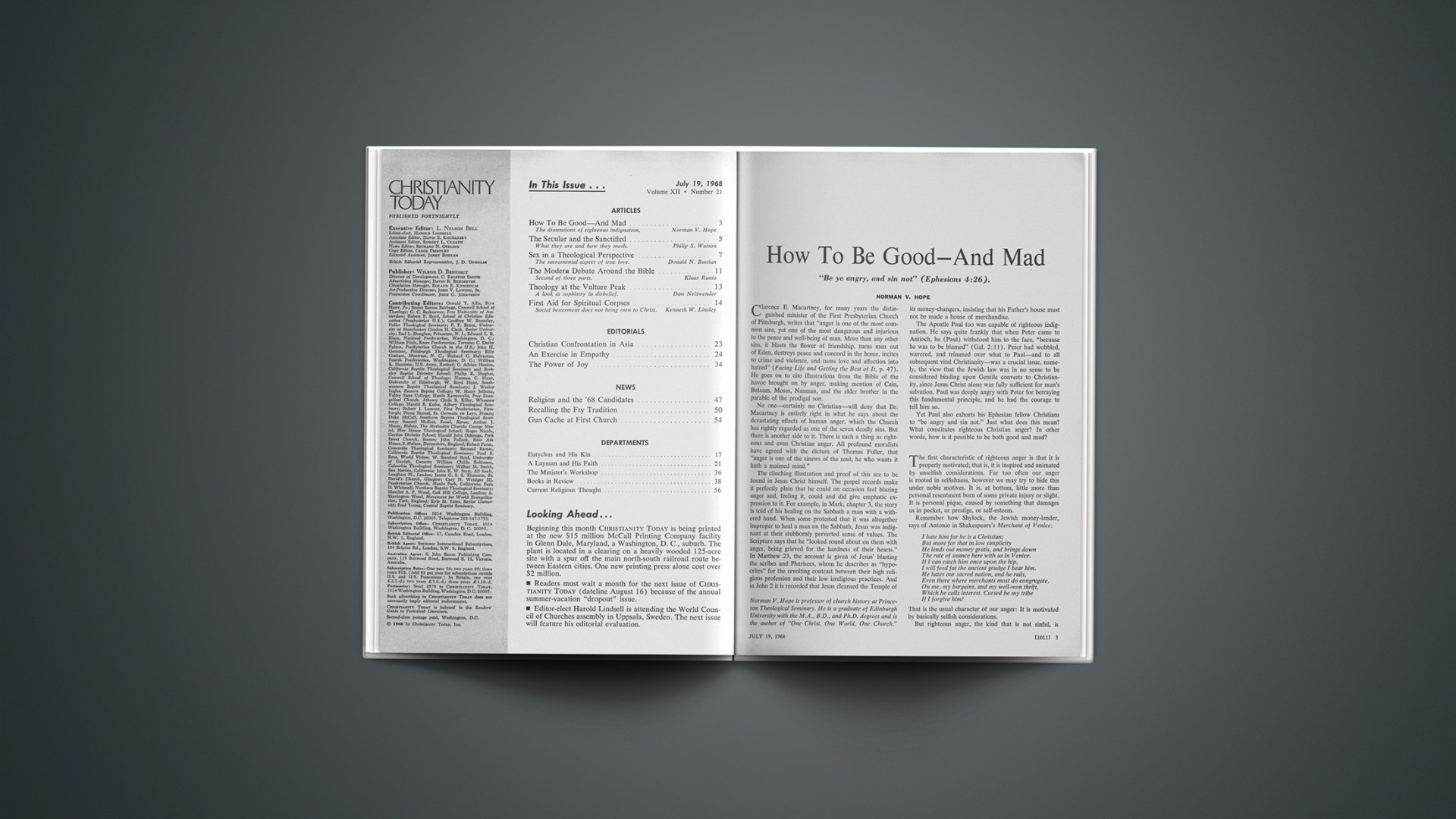
Looking Ahead: July 19, 1968

Beginning this month CHRISTIANITY TODAY is being printed at the new $15 million McCall Printing Company facility in Glenn Dale, Maryland, a Washington, D. C., suburb. The plant is located in a clearing on a heavily wooded 125-acre site with a spur off the main north-south railroad route between Eastern cities. One new printing press alone cost over $2 million.

■ Readers must wait a month for the next issue of CHRISTIANITY TODAY (dateline August 16) because of the annual summer-vacation “dropout” issue.

■ Editor-elect Harold Lindsell is attending the World Council of Churches assembly in Uppsala, Sweden. The next issue will feature his editorial evaluation.

The Old Philosophical Puzzle

“Is Life Just a Chemical Reaction?” Joseph Wood Krutch asks this question in an excellent article in the Saturday Review (May 4, 1968). He faces the developments scientists think they see growing out of DNA and the possibility of the creation of living organisms in a test tube. And he also faces an old, old philosophical puzzle.

As all philosophers know, Plato was a realist. What most people do not know is that Plato was not “realistic” in the way we use the word today. A man today prides himself on being realistic when he deals with the here and now, the material at hand, things evident to the five senses. But Plato was realistic in an entirely different way. For him, the real was beyond the realm of the senses. He was more interested in the eternal than in the temporal and found those things immediately before the senses as only passing illustrations of The Real. He believed that The Real had to do with such things as the Beautiful, the True, the Good. One may speak glowingly of a beautiful woman, a beautiful sunset, a beautiful horse, or even a beautiful double play, but these are merely passing instances of the abiding reality that is Beauty itself.

Aristotle threw an emphasis on the individual cases and pointed out that what Plato would call The Real is simply a name to cover a group of similar things. Thus the word “dog” is a useful name for all the dogs we ever see. Because of this approach, Aristotle was rightly called the first scientist. Generally speaking, the scientist likes induction, though he is not limited to this method, and the Platonist likes deduction.

The debate between the reality of the seen and the unseen has never downed in either religion or philosophy. It appeared again in the dualism of Descartes and was answered in one way by the mechanism of Hobbs and in another way by the idealism of Berkeley. It was the genius of Kant to attempt to pull these two worlds together, at least in our ways of knowing. Closely related to this perennial debate have been arguments about the natural and the supernatural, or the body and the mind, flesh and spirit, matter and thought.

Back in the twenties, many people thought behaviorism had had its day. (Behaviorism was an effort, primarily by Watson and his school, to reduce man to nothing but matter; “the brain produces thought as the liver produces bile.”) But it has returned, allying itself with the philosophy of logical positivism, and it is hard to find any great university center where behaviorism in psychology and logical positivism in philosophy are not in control. In a popular way, this has sifted down into what is called scientism.

The climate and atmosphere of opinion in our day is the scientific one. The emphasis is on material, on induction as a method. “Everybody knows” that no knowledge is valid unless it can be proven in the laboratory or drawn out of laboratory testing by necessary inference. This sort of thinking plays havoc with much that we call religious. Talking about God is talking nonsense. Anything like metaphysics is dismissed as absurd. This set of mind adjusts easily to the notion that science can now take over man because he is nothing more nor less than matter that can be handled mechanically, if only we know enough. The “hidden persuaders” in advertising and the use of propaganda in national and international affairs illustrate how neatly all this sort of thing works. By 1984, any Big Brother who is smart enough will probably be able to control mankind by computer. In this situation, such ideas as freedom and moral choice would seem to be illusions.

It is of such things that Krutch writes. Like others, he has been led to believe that all our answers can be found scientifically. But the old debate is on. If we accept matter as the clue to reality (and science likes matter because it is always scientifically controlled), we have still, as Krutch says, those nice questions of “pleasure or pain, interest or boredom, love or hate, and all those other phenomena which depend upon that consciousness which will remain for us the most important consequence of being alive, even if it is ultimately dismissed as nothing but a chemical reaction.” Krutch finds it too easy “to define the living in terms that will enable” the scientist to ignore many of the obvious characteristics of life that make it worth living—and, of course, what will we do with the word “worth”? Is a completely materialistic answer enough to down the traits and values of which man is capable? A man might argue this in a class in philosophy and then go home and kick the cat viciously or play with his children gladly just like someone who does not know any better.

Krutch quotes with approval a McGill biologist, N. I. Berril: “If mind and spirit grow out of matter, they are nonetheless what they have been thought to be. It is our conception of matter which needs revision.” This indeed may be the solution to the whole matter and may lead us right back to the dualism that Descartes supported. If behaviorists and others are going to insist on “nothing but” matter as the proper view of man, then matter becomes something far more complex and, indeed, interesting than merely stuff. I have always wondered about that first molecule that came alive out of the primordial slime, supposedly through millennia of accidental combinations. Allowing for the appearance of this molecule at some point in time, we must allow that potentially there was bound up in this molecule and its environment everything that has come out of it—such as Michelangelo’s art and Bach’s music. If you prefer the idea of accidental molecules to the idea of God, then you have to posit some molecule. Most mechanists fail to realize that even if we start with “nothing but” a live molecule, we still have to decide where all the laws of its relations to its environment arose. I think they did not arise out of the molecule.

By the same token, if we are going to insist on “nothing but” conglomerations of atoms constantly bumped by other conglomerations of atoms, then we shall have to allow in those atoms and their relationships what awkwardly keeps pushing itself to the fore, namely, all those things that are finally put under the heading of “consciousness.” So nothing material has changed.

With the increasing reduction of the atom to something more akin to energy than stuff, perhaps what has finally happened in our day is an awareness that stuff is much more than stuff. Maybe the whole universe is dust, but might it not be dust “inbreathed with the breath of life”? Will Durant quoted Bruno with approval:

Every particle of reality is composed inseparably of the physical and the psychic. The object of philosophy, therefore, is to preserve unity in diversity, mind in matter, and matter in mind; to find the synthesis in which opposites and contradictions meet and merge; to rise to that highest knowledge of the universal unity which is the intellectual equivalent of the love of God.

It seems to me that the second chapter of Genesis is dead right. Man is matter, sure enough, but matter “inbreathed with the breath of God.” This can well mean that every single cell in him is alive with something more than matter. In the last analysis, all life may well be sacramental, “visible signs of invisible spiritual realities.”

Back to Violence as Usual?

1968 may go down as the year in which the world tried to cope with a rising tide of violence while ecumenical assemblies sought to encourage it.

In Uppsala, Sweden, this week, the Fourth Assembly of the World Council of Churches will weigh the pros and cons of violent protest. The National Council of Churches has already adopted a policy statement giving dignity to the use of physical force to achieve social change (see page 43).

Meanwhile, countless Christian clergy and lay leaders pledged themselves anew to principles of law and order, to a more urgent ministry of reconciliation, and to the task of sensitizing consciences toward recognizing social problems and finding solutions within democratic processes.

It seemed to be left to politicians to devise ways of subduing civil unrest and the violent climate that has seen the assassination of a number of American political leaders.

Among the components and causes of today’s climate of violence are the breakdown of American home life, the popularity of murder mysteries and spy stories, the prevalence of TV and movie violence, the traffic in toy guns, and the use of alcohol and drugs. But after the murder of Senator Robert F. Kennedy, attention centered upon the ease with which irresponsible persons can still get guns and ammunition. There was an immediate public outcry for more stringent laws on firearms control. As usual, churchmen differed on the issue.

President Johnson has told Congress that guns are used in more than 6,500 murders in the United States each year. The most frequent victims are policemen, bus and taxi drivers, and small shopkeepers. But it can happen to anyone. In January, two Roman Catholic nuns were wounded and another narrowly missed by a woman with a gun in Columbus, Ohio.

Proponents of stricter gun control point out that the United States has less regulation of firearms and more misuse of them than any other country. Moreover, riots in U.S. cities have spurred gun sales. The gun used to shoot Senator Kennedy was originally purchased during the Watts riot in 1965, presumably for defense.

The feeling seems to grow that the American society is a sick society. Both liberals and conservatives hold this view, though for somewhat different reasons.

Methodist Bishop Eugene M. Frank contends that “our nation rages with anger” and notes the teaching of Jesus that anyone who is angry with his brother is already guilty of murder in his heart.

The Rev. Raymond Ortlund of Lake Avenue Congregational Church in Pasadena, California, asserts that even Christians are often guilty of intense bitterness. “Some Christians talk of our leaders in such vulgar ways that it makes me sick,” he says. Ortlund urges evangelicals to start anew to contribute to solutions instead of to the problems.

For one Los Angeles area minister, the Kennedy killing brought memories of another assassination, that of American Nazi leader George Lincoln Rockwell. The Rev. Andre Bustanoby, now of Fullerton, California, was then pastor of a church in Arlington, Virginia. Rockwell was shot across the street from the Arlington church while Bustanoby was readying a message for the funeral of his mother.

Bustanoby thinks Americans have lost their capacity to be outraged by violence. “We are so jaded that it takes the murder of a national figure to shock us,” he declares. “Perhaps in time we can get used to the murder of national figures, too.”

After the immediate shock of Kennedy’s murder wears off, will it be back to violence as usual?

THE SIRHANS’ RELIGIOUS ROOTS

The head of the Armenian Orthodox Church in Jerusalem says that the “psychological background” of the assassination of Senator Robert F. Kennedy is found in the years of Arab-Israeli hatred. Bishop Shahe Ajam Ajamian, in the United States on a fund-raising drive, said he had known the family of Sirhan Bishara Sirhan, the 24-year-old assassination suspect, before the family left Jordan in 1957.

Bishop Ajamian suggested that the Sirhan family left Jerusalem when Arab hatred for the State of Israel, created in 1948 in the face of strong Arab opposition, was at a high point. Religious News Service said the prelate noted that the Sirhans were not members of his Armenian congregation. They were Christians of Greek Orthodox background, though the suspect attended a school maintained by the Lutheran Church of the Savior in the former Jordanian sector of Jerusalem.

The Sirhans have had connections with a wide range of religious viewpoints. The suspect, his mother and father, and three of their other children came to Pasadena eleven years ago under the sponsorship of Dr. and Mrs. Haldor Lillenas, members of the First Nazarene Church there. The late Dr. Lillenas was a noted composer of gospel music. The Sirhans attended the church briefly and later went to First Baptist Church in Pasadena, which brought the two oldest sons to this country. Mrs. Sirhan has been employed by Westminster Presbyterian Church and also has expressed interest in a Seventh-day Adventist church. Her husband, who went back to Palestine some years ago, has reportedly had dealings there with Jehovah’s Witnesses. Young Sirhan, the accused slayer, is listed as a member of the Rosicrucian Order and is said to have asked that some of his confiscated money be sent to the group’s headquarters.

PERSONALIA

Famed interdenominational Riverside Church in New York City called as pastor the Rev. Ernest T. Campbell of First Presbyterian Church, Ann Arbor, Michigan. Campbell, 44, a graduate of Bob Jones University and Princeton Theological Seminary, is successor to Robert J. McCracken and Harry Emerson Fosdick, both Baptists. Campbell believes “it is not enough to say that if you know God personally you will automatically do the right thing in personal and public life. But there will be no substantial change in society unless individuals are changed.”

Dr. Paul A. Crow, Jr., 36, church historian at Lexington Theological Seminary (Christian Churches), was named the first full-time general secretary of the Consultation on Church Union. Crow has been a part-time executive of COCU, which seeks merger of nine Protestant bodies.

Dean John B. Coburn, 53, of Episcopal Theological School, Cambridge, Massachusetts, is resigning to join a New York Urban League program to help high-school dropouts qualify for college admission.

William Pannell, Negro evangelist with Youth for Christ, has resigned to join Tom Skinner Crusades.

Deaths

ARCHBISHOP CHRYSOSTOMOS, 92, once the youngest Greek Orthodox bishop; nearly executed for alleged involvement with rebels while a prelate in Turkey; primate of Greece 1962–67 but ousted by the new military government as too old under a series of church reforms; foe of ecumenism; in Athens, of gastritis.

JOSEPH D. BLINCO, 56, British Methodist pastor who became an associate evangelist with Billy Graham in 1955; for the past two years director of Forest Home Christian Conference; in Loma Linda, California, ten months after brain-tumor surgery.

Burton W. Marvin, for two years a communication staffer for the National Council of Churches and a former journalism dean of the University of Kansas, was named a journalism professor at Syracuse University.

The Henry W. Luce ecumenics chair at Princeton Theological Seminary has been given to Professor M. Richard Shaull, noted for his espousal of revolutionary social change.

The Rev. David Randolph, preaching teacher at Drew University, was appointed director of the United Methodist department of evangelists.

The Rev. Paul C. Empie, general secretary of the U. S. committee of the Lutheran World Federation, was named president of Lutheran World Relief in place of the late Franklin Clark Fry.

CHURCH PANORAMA

After an Athens meeting with Archbishop Hieronymos, General Secretary Eugene Carson Blake of the World Council of Churches announced June 13 that the Greek Orthodox Church would be represented at this month’s WCC assembly by a group of lay theologians. The Greeks had boycotted the assembly three months ago after the WCC complained about treatment of Greek political prisoners.

Contributions to Methodist World Service in the fiscal year ending May 31 totaled $17,469,840, a 1 per cent drop.

When the 181-member Second Congregational Church of Warren, Maine, withdrew from the United Church of Christ because of political resolutions at the state conference, the pastor received more than 100 calls and letters in support from all over the state.

The Presbyterian Church in the U.S. voted to abolish listing of honorary degrees after names in official publications, but decided not to require ministers to delete them from local church publications after one D.D. asked, “Does this mean I must remove the stripes from my robe, too?”

MISCELLANY

New York City’s Lindsay administration is thinking of charging churches and other tax-exempt institutions for water, garbage removal, sewerage, and other direct city services.

The U. S. Patent Office granted Latin America Mission exclusive right to use of its term “Evangelism-in-Depth” for organization and promotion of evangelistic campaigns.

As a result of territorial gains in last year’s Arab-Israeli war, the Christian population of Israel has risen from 56,000 to 105,000, the government said.

Soviet Baptists, who cannot hold Sunday schools, have won permission to teach Bible correspondence courses to 100 persons—the first time it has been possible since 1929.

This September a graduate-level theology school tentatively called the Discipleship Training Center will open in Singapore, headed by David Adeney, Far East director of the International Fellowship of Evangelical Students. The three-year course is sponsored by Overseas Missionary Fellowship and Singapore Bible College.

A week-long crusade in Duluth, Minnesota, by Canadian evangelist Barry Moore drew attendance of 27,900 and resulted in 643 spiritual inquirers.

Supreme Court Weighs Churches’ Stand

A national legal showdown now looms over the theological drift of the big American denominations and their increasing involvement in social issues. The U.S. Supreme Court announced June 10 that it would hear the case involving two Savannah congregations that pulled out of the Presbyterian Church in the U. S. (Southern), charging “revolutionary, fundamental, unlawful, and radical diversion from the Presbyterian faith.”

The immediate question is whether the two churches are entitled to retain their properties. Under Presbyterian, Methodist, and Episcopal government, properties in congregational defections normally are forfeited to the ruling denomination.

But much more significant issues are at stake. These revolve around how far a denomination can deviate from its originally stated purposes and still expect allegiance from its constituency. Indirectly, corollary questions arise over the mission of the Church and its role in the world. The two Savannah churches, Hull Memorial and Eastern Heights, have objected very strongly to Southern Presbyterian involvement in civil rights, civil disobedience, and the war in Viet Nam.

When the case first went to court, few outside observers thought very much of the churches’ chances. As Edward B. Fiske of the New York Times has pointed out, the most important legal precedent is an 1871 Supreme Court decision involving Walnut Street Presbyterian Church in Louisville, which tried to sever ties with its denomination in a dispute over slavery. The Supreme Court ruled in favor of the parent body. The precedent was set that civil courts accept as binding the judgments of top ecclesiastical judicatories. Those who unite with a national denomination are recognized as giving “implied consent” to its government.

In 1907, however, a Georgia decision declared that the “implied consent” can be invalidated if the denomination is found guilty of “absolute” departure from its founding tenets. This decision has now been invoked in behalf of the two Savannah churches. A local court and the Georgia Supreme Court have ruled in favor of the congregations, and the denomination now seeks to have the U. S. Supreme Court overturn the ruling.

The case has sent some shudders through the American Protestant hierarchy. Should the decision be upheld, it would probably produce a rush of church withdrawals. Numerous congregations throughout the country are at odds with their denominations over theological issues, social concerns, and ecumenism. Even a reversal could produce new precedents and possible legal loopholes for dissenting churches.

The U. S. Supreme Court will hear testimony after it reconvenes this fall. Other similar cases are pending.

Before the justices recessed for the summer, they also handed down a pair of important rulings affecting church schools. In a six-to-three decision, they upheld a New York law requiring local school districts to offer parochial-school students the loan of textbooks. In a separate case, the justices with only one dissent ruled that taxpayers under certain circumstances have a right to challenge acts of Congress on grounds of violation of the religion clause of the First Amendment; the case now goes back to a trial court.

Previously, on the basis of a 1923 court ruling in Frothingham v. Mellon, taxpayers had little or no standing in a federal court to challenge the constitutionality of federal expenditures. As Baptist Press put it, the new ruling did not nullify the Frothingham doctrine against taxpayers’ suits challenging federal spending, “but it did say that this ruling does not prohibit some cases in which the establishment and freedom of religion are involved.… So while loosening the rules on First Amendment court cases, the Supreme Court made it clear that it felt that government could provide public services to students in all schools without thereby furnishing aid to church schools or agencies.”

Spokesmen for Protestants and Other Americans United for Separation of Church and State hailed the standing-to-sue ruling but minimized the significance of the textbook-loan decision and made no public comment on it.

In yet another pre-vacation ruling, the Supreme Court upheld by a 7–2 vote a Reconstruction Era law that extends equal rights to Negroes and other racial minorities in purchase, sale, and rental of housing. The case involved an interracial couple who say they were victims of discrimination when they sought unsuccessfully to buy a home in suburban St. Louis. Supporting the couple in friend-of-the-court briefs were the National Council of Churches and a group of high-ranking Roman Catholic prelates.

LEFTWARD HO FOR N.C.C.

As 150,000 people filed sadly past the casket of Senator Robert F. Kennedy in St. Patrick’s Cathedral, the National Council of Churches’ General Board held sessions nearby in New York City that signaled their desire for closer contact with the Roman Catholic Church and their commitment to liberal policies on the racial crisis and civil disobedience. Had Kennedy been present, he undoubtedly would have appreciated the hearty response the 119 board members gave their guest speakers, Archbishop Terence J. Cooke of New York and Poor People’s Campaign leader Andrew Young, whose rousing speeches highlighted the June 6 and 7 meetings.

The NCC appearance of Cooke, celebrant the next day at the Requiem Mass for Kennedy, marked the first time a member of the Roman Catholic hierarchy had addressed the General Board. After a warm tribute to the late Senator (“We know that the soul of Robert Kennedy is with God but his spirit lives on …”), Cooke expressed his concern for Christian unity. “We are to our own sorrow divided,” he said. “Surely, then, we need to ask ourselves, Why? How? For how much longer? If Christ unites us in faith, hope, and love—as he surely does—then something other than Christ must occasion our division.” He commended the NCC for its “Crisis in the Nation” and “Priority Program for Peace” activities. Both before and after his address, he received a standing ovation.

Earlier, General Secretary R. H. Edwin Espy had reported that exploratory and long-range discussions on possible membership of the Roman Catholic Church in national councils of churches were under way in the United States and in eight other countries. He also referred to “the projection with the Roman Catholic Church of a major joint program on world development which if it materializes will mark another forward step in National Council-Roman Catholic cooperation.”

Interfaith cooperation was further seen in the board’s passage of a statement on sex education, jointly formulated by Roman Catholic, Jewish, and Protestant-Orthodox representatives.

Coming straight from Resurrection City, Andrew Young of the Southern

Christian Leadership Conference commended the churches for being “our one ally in society” in support of the Poor People’s Campaign. He asserted, “Most of our government programs destroy the poor. Most government programs are genocidal. It is a genocide of the spirit, a crushing of the mentality of a people, denying them of their humanity. That is genocidal.” Young’s speech, which climaxed a day of reports on implementation of the NCC crash program on the “Crisis in the Nation,” was greeted with thunderous applause.

Dr. Charles S. Spivey, Jr., general executive of the Crisis program initiated by the board in February, told of NCC efforts to reduce tensions and deal with “white racism,” identified by the Kerner Commission Report on Civil Disorders as “a root cause” of recent riots. (NCC President Arthur S. Flemming called the Kerner Report “the most significant public document of my lifetime.”) Programs now in operation to combat white racism, said Spivey, include distribution of NCC curriculum materials in thirty-three denominations, other racial-crisis educational and publication efforts carried on by various denominations, financial aid programs for autonomous local civil-rights organizations, investment programs to help change “racial patterns in the church and community,” and selective buying projects by churches to influence hiring practices.

United Methodist John P. Adams told of extensive NCC involvement in the Poor People’s Campaign. In addition to building a shanty in Resurrection City, NCC representatives have accompanied every caravan march and have been present at every demonstration in the campaign, to aid in communications. They have provided direct telephone and radio communication among SCLC strategists and organizers and also have published materials interpreting the campaign to the public.

Immediate objectives of the Crisis program, outlined by United Methodist Dr. Richard Nesmith, are congressional appropriation of funds to finance enacted legislation, passage of guaranteed-annual-income legislation, informing the citizenry on key election-year issues, improvement of police-community relations and reduction of the misuse of police power (“the white form of violence in our communities,” asserted Nesmith), support of local action organizations, particularly among blacks and other minorities, support for black churchmen, and development of emergency measures for urban crisis.

The General Board’s only sharp debate came after Dr. Truman Douglass of the United Church of Christ presented for ratification a policy statement on civil disobedience. The statement set forth the various courses “men seeking to obey God’s will have followed,” including “action in revolution against an entire system of government.” It said: “We recognize that when justice cannot be secured either through action within existing structures or through civil disobedience, an increasing number of Christians may feel called to seek justice through resistance or revolution.”

Episcopalian Peter Day offered an amendment to strike the “revolutionary” sections, claiming that they would “contribute to the atmosphere of violence in the United States.” He was opposed by black churchmen, including the Reverend James L. Cummings of the Christian Methodist Episcopal Church, who argued, “This is a means by which men can alleviate causes that make them suffer.” Dr. L. Doward McBain, immediate past president of the American Baptist Convention, pointed out the inconsistency between the civil-disobedience policy statement and prior NCC resolutions condemning the use of violence in Viet Nam. Nevertheless, Day’s amendment was defeated by a two-thirds vote. The policy statement was adopted, 81–6, with 15 abstentions, mainly from among Episcopal and Orthodox churchmen.

The board also ratified a raft of other resolutions and measures:

Viet Nam—plea for a ceasefire by all belligerents;

Firearms Control—support of federal legislation to ban mail-order sales of all guns to individuals, set age limits for purchase of rifles (18 years) and pistols (21 years), require gun permits, and outlaw bombs, firebombs, bazookas, and other such destructive devices;

Telegram to President Johnson—commendation for his appointment of a commission to study the causes of violence, and support for a program to implement recommendations of the Kerner Commission Report.

The board also heard first readings of controversial policy statements on abolition of the death penalty, defense and disarmament, and selective purchasing by the church.

In the conference’s waning moments, a discussion of new directions in Faith and Order found three theologians differing in their selection of the principal theological issues that the Church should now confront. Boston University’s placid Professor J. Robert Nelson claimed studies should probe the meaning of human nature and consider an overall view of God’s relation to man, history, and nature. Fiery Paul Lehmann of New York’s Union Seminary disagreed, stressing that the Church shouldn’t “take the long look—God, man, history, nature—but look at where the bite is.” He felt the nip now comes in the issues of (1) the identity of a Christian in society, (2) power, and (3) the relation between piety and justice (“Justice and reverence—not law and order—is what is important”). United Church of Christ minister Lawrence Durgin doggedly called for development of a theology of corporate responsibility.

When NCC President Arthur S. Flemming initially convened the General Board meeting, members were bunched on one side of the room. He said, “I would like to convince some of those on the right to move to the left.” He may have succeeded more than he realized. The movement throughout the two-day session was leftward ho, all the way.

ROBERT L. CLEATH

SOLIDARITY DAY: RELIGIOUS MOTIF

Occasional breezes and passing clouds brought relief from the hot sun beating on Poor People’s Campaigners gathered for their Solidarity Day March June 19. Sitting, standing, and lying on the grass at the Washington Monument, they laughed, sang, and clapped through more than two hours of entertainment, mostly by Negroes. While helicopters buzzed overhead and planes approached National Airport, additional busloads of marchers arrived and police reinforcements stood by.

Despite the sun, singer Don Leace thought the crowd was too slow warming up. He told them to “start acting like” the Baptists many of them said they were. By the time a Detroit minister and Southern Christian Leadership Conference worker appeared, the crowd was hanging loose. The Rev. Esquire Hamilton called them to “love one another” and “let God rule in our hearts.” Then he crooned, “This little light of mine, I’m gonna let it shine,” as the audience clapped in rhythm.

Hemisfair Crusade To Be Televised

The compact HemisFair Crusade with evangelist Billy Graham drew a total of 94,900 persons to four services in the Alamo Stadium of San Antonio. Three of the services will be televised in color throughout North America in the late summer.

Some 4,326 persons recorded decisions for Christ during the weekend series in June. As in other crusades, young people made up a high percentage of the audiences. Many servicemen and their families attended also; there are several military bases in the San Antonio area.

Texas Governor John Connally, mentioned by some observers as a possible vice-presidential candidate this year, attended the first service with his wife and two sons. Coach Tom Landry of the Dallas Cowboys professional football team also participated.

Graham’s television specials from his May crusade in Portland, Oregon, were shown on more than 300 U. S. stations last month, the most he has ever scheduled. The evangelist conducts two television series a year, one at the beginning of the summer and one toward the end. Each costs his organization more than $1,000,000 but brings a flood of mail and financial support and, infinitely more important, reports of thousands of decisions for Christ.

The Portland series was also scheduled to be shown over about twenty-five stations in Australia. One of Graham’s associate evangelists, Leighton Ford, is planning to do a similar television series in Canada.

The ten-day Portland crusade drew a total turnout of 227,797. More than 7,000 stepped forward to indicate a new Christian commitment.

Almost on schedule, the Rev. Jesse Jackson, SCLC official, herded the estimated 50,000 people to the Lincoln Memorial. Led by the SCLC president the Rev. Ralph David Abernathy, Resurrection City residents, those who accompanied a mule train, representatives of ethnic groups, and Father James Groppi, campaigners walked the mile singing “We Shall Overcome” and “The Battle Hymn of the Republic.” It was a varied crowd that included young and old, hippies and businessmen, clergymen and nuns, Boy Scouts, teachers, and Negroes with African hair styles and dress. Many families came with small children in strollers or strapped to parents’ backs.

Marchers carried signs prepared by SCLC; “I Have a Dream” was one of the most popular. Washington’s Church of the Saviour delegation proclaimed, “Let not our wealth divide us; rather let us divide our wealth.” A nun from Minnesota, wearing a colorful Indian shawl over her habit, carried a sign declaring, “I care. But I do something about it.” Jewish groups carried signs in Hebrew and English; one quoted Leviticus 19:18: “Thou Shalt Love Thy Neighbor.” Another sign said, “Let’s March into Hell for the Heavenly Cause.”

At the Lincoln Memorial, the program employed several clergymen. It began with an invocation by Rabbi Jacob Philip Rudin of the Synagogue Council of America. Later, Washington’s Patrick Cardinal O’Boyle prayed for “the courage of religious convictions in race relations.” He petitioned, “Teach us how to live together.”

Other ministers on the program were SCLC staff members. High point of the program was the appearance of Mrs. Martin Luther King, Jr., who was greeted with a standing ovation. The widow of the slain civil-rights leader called for “woman power” and love to combat the three evils of racism, poverty, and war.

Abernathy concluded the speeches with what he called a “mandate from God” in which he called for furtherance of human rights and asked for donations to the Poor People’s Campaign. He acknowledged the $50,000 gift of the United Presbyterian Church, presented by Dr. Edler Hawkins, former United Presbyterian moderator and first Negro to hold that post.

Solidarity Day was frequently compared to the 1963 march when King made his “I have a dream” speech from the Lincoln Memorial steps. Twice during the day’s events, silence memorialized civil-rights workers killed since 1963, once just before Mrs. King spoke in honor of her husband. Other tributes to King included a song during the entertainment period: “Didn’t the angels sing … as they welcomed the soul of Martin Luther King!”

One difference was noted about this year’s march. “Five years ago we stood here and pleaded,” Abernathy said. “Today we stand here and demand.”

Throughout the day, care was taken to include the needs of Puerto Ricans, Indians, and Mexican-Americans, as well as Negroes. Mrs. Martha Grass, an Oklahoma Indian, accompanied her speech with war whoops. Two New York Indians said the Creator, the Great Spirit, “is here with us today.” In fact, said Mad Bear, a “sign may appear today in the sky to show the Creator is here with us.”

The march almost got off to a bad start when violence flared the night before. Several arrests were made at the White House as a group from Resurrection City marched to Congressman Wilbur Mills’s apartment. And at Resurrection City several people were injured in unrelated incidents. Although Solidarity Day was for the most part orderly, two incidents marred the calm. A Negro stabbed a white youth and another young man was arrested for carrying a gun at the monument.

On the morning of Solidarity Day several Washington churches held services, with attendance at many reported in the hundreds.

The National Council of Churches reported no estimate of the number of people who responded to their call for support for the march. But church banners proclaimed the attendance of many religious groups, including the United Methodist Church, American Lutheran Church, Christian Methodist Episcopal Church, American Baptist Church, Society of Friends, Baptist Peace Fellowship, Catholic Interracial Council of Boston, and Seminarians Organized for Racial Justice.

JANET ROHLER

After French Turmoil: Fresh Spirit Lifts European Scholars

Street barricades. Alternate singing of the Internationale and the Marseillaise on the Champs-Élysees. Near-total paralysis of the economy. Near-anarchy everywhere. This was Paris during the already historic “days of May.”

For church history, a Paris Congress of Evangelical Theology attended by 140 theologically sophisticated persons from the French-speaking areas of Europe may be no less significant. The meeting, projected in February by a committee of stellar French theologians and pastors, was providentially scheduled for the days immediately following the end of the three-week general strike that reduced transportation and communication to zero.

Organizers made the aim clear: to affirm to Christians and the general public “the sovereign authority of the Bible as the Word of God. After the assaults of Modernism at the end of the last century and the early part of the present century, currents of still another New Theology are now disturbing the minds of many. The Congress will be a reminder that there is only one Gospel, and that to believe it and to preach it does not presuppose either ignorance or obscurantism.”

The three intensive days focused on the necessity of an unadulterated biblical theology and the relevance to the problems of our day that results only when such a message is proclaimed. The Paris congress came like a fresh breeze in a Europe where for a century theology has been characterized by rationalistic dogmatism and the changing fashions of the German professorial caste. It was as if the spirit of the Monods, d’Aubigné, and Gaussen—those firebrands of early nineteenth-century orthodoxy—was once again animating the life of the Church.

In the opening address, General Secretary Pierre Marcel of the French Bible Society argued that the post-Bultmann “new hermeneutic” is by no means new, since it rests squarely on rationalistic presuppositions expressed (more clearly) by Semler in the eighteenth century. For the critical interpreter past or present, “the Holy Spirit is dead,” since the Bible is a product of its human authors and not, as it claims for itself, the work of a single Divine Author. The result: a “pathological state of jesiology” where the interpreter, caught by his own debilitating humanistic presuppositions, speaks only of “Pauline thought,” “Petrine thought,” and, by extension, “Jesine thought”—never of the Word of God. Marcel said reports he receives from all parts of the world show beyond question that the Bible is “not merely the opinions of human writers, for whenever it is placed in men’s hands, regardless of their cultural diversities, it speaks to them, and it speaks the same unequivocal message.”

Henri Blocher, young, dynamic professor at the new government-approved Faculty of Evangelical Theology at Vaux, presented the concept of myth developed by Eliade, Ricour, and Gusdorf, then demonstrated that on no single count could the New Testament message, centering on the death and resurrection of Christ, be regarded as mythical. The Bible’s stress on historical localization (versus the timeless quality of myth), on removal of the sacred-profane distinction, on salvation once-for-all accomplished in Christ (versus the “eternal return”), and on the specific power of the Gospel to free men from ritualistic myth—all this demands that man’s fall and Christ’s redemptive work be faced as historically true, he said. “The natural man prefers myth to history because he can thereby avoid facing his own historical responsibility for sin.”

Rector Hans Rohrbach of the University of Mainz, a mathematician, said today’s biblical critics assume that science is still operating in closed nineteenth-century categories that exclude the miraculous, a view that fell by the wayside in the Einstein revolution. And they erroneously assume that the Bible presents a primitive three-story cosmology. Rohrbach told how he found the reality of the biblical world-view and personal salvation in Christ during the chaos of Germany as the war ended.

Professor Frank Michaëli of the Protestant Theological Faculty at Paris stressed the amazing relevance of the Old Testament in terms of re-establishment of the State of Israel, progress in biblical archaeology, and rediscovery of a unified Old Testament theology after years of efforts to fragment its message.

Marc Lods, dean of the Theological Faculty, and Editor René Lovy of Positions Luthériennes agreed that neither the Church Fathers nor the Reformers would allow any other authority than Holy Scripture as the ultimate norm in the Church. Lods asserted that in spite of the cultural diversity among patristic writers spanning seven centuries, “none of them allowed any other final authority than Scripture.”

Professor Jacques Ellul of the Law Faculty at Bordeaux posed again Jesus’ question, “When the Son of Man comes, will he find faith on the earth?” Ellul said we have no guarantee of any given amount of faith or church success, or of personal well-being. We are guaranteed only his Coming.

“We are tempted to be conformed to this world in our theology and in our lives,” he said. “It’s up to us to give the full evidence that God is alive before the bar of this world. We cannot live in the past, not even in our great confessional traditions. We must help society out of the secularistic prison it has made for itself, and this is only possible when the authenticity of Christianity is seen in the authenticity of our faith.”

This idea of relevance was reinforced by Walter Martin of the United States, who drew rapt attention as he presented Christian Research Institute’s ideas for dissemination of theological and apologetic insights through world-wide computer networks.

Underlying all such evidences of the supreme vitality of orthodox theology was the congress theme, repeated in magnificent French hymnody: “Thy Word, Lord, is our strength and our life; the torch that illumines the darkness of our path; the sun that enlightens our way.”

SEMINARIES FOR THE ’70s

Design for seminaries of the ’70’s: a small number of major ecumenical clusters of schools in big cities near universities, with a more diverse curriculum providing training in many types of ministries and making direct use of community institutions and social-action agencies.

The design came in a 35,000-word report to last month’s biennial meeting of the American Association of Theological Schools. The St. Louis delegates discussed the report for the better part of a day, then sent it without specific endorsement to the 156 member schools.

AATS Executive Director Jesse Ziegler, who initiated the “Resources Planning Commission” study more than two years ago, said his concern was to find ways in which seminaries could survive in the face of mushrooming costs, enabling the Church to keep control of religious education rather than losing it to secular universities.

The report says that “isolated seminaries can go it alone” and still make some contributions but that big cooperative efforts are the major need. The St. Louis discussions showed, however, that a significant number of seminaries will stay in the go-it-alone camp.

Such tokenism as putting one Protestant on a Catholic seminary faculty, or cross-registration between schools, is inadequate, says the report. It specifies that the new clusters should have a common campus, incorporating at least three Protestant and three Roman Catholic seminaries—and if possible Orthodox and Jewish schools as well.

As for courses, the eight-member commission thinks students must interact with emerging social issues rather than just learning “theological and doctrinal material formulated by others.”

The report says one major obstacle to radical change is lack of lay enthusiasm. So “building broadly based constituency support” is a major task for seminary administrators. The report characterizes “many” seminaries as “extremely stimulating and interesting places, alive with concern about a wide spectrum of issues ranging from the ‘secular city’ to ‘situation ethics,’ … in which almost any layman would be likely to find himself at home in terms of his own interests and concerns.”

In other business, the AATS elected as its new president the chairman of the study committee, Dr. Arthur R. McKay, head of Chicago’s McCormick Seminary (United Presbyterian).

The AATS granted full accreditation to: Concordia Seminary, Springfield, Illinois (Missouri Synod Lutheran); North American Baptist Seminary, Sioux Falls, South Dakota (North American Baptist General Conference); and Woodstock, Weston, and Maryknoll—the first three Catholic schools to gain full membership.

SQUABBLE WITH A LANDLORD

In facilities rented from the University of Chicago, the Winona Institute for Continuing Theological Education opens a summer graduate program this week. A contract cancellation had threatened to keep “America’s unique summer seminary” out of the plush quarters of the university’s Center for Continuing Education.

John A. Huffman, president of the Winona enterprise, has announced that eight top evangelical scholars will be on hand to teach courses said to be geared to the post-B.D. level. Among faculty members scheduled are Dr. Stuart Barton Babbage, president of Conwell School of Theology, and Dr. James G. S. S. Thomson, noted Old Testament scholar from Glasgow.

Huffman says he was informed on Good Friday that a contract for use of the University of Chicago center signed last December 2 would not be honored. He appealed to university President George W. Beadle who intervened and assured Huffman that the facilities would be made available as originally agreed.

Spokesmen for the center had cited misleading advertising that left the impression that the center facilities were actually those of the Winona Institute. A Winona brochure carries color photographs of the center with captions like: “This four million dollar air-conditioned neo-Gothic structure houses Winona Institute for Continuing Theological Education.” Copies were distributed that gave no hint that the pictured facilities were actually those of the University of Chicago. Huffman said the center had approved the brochure, but he agreed to add imprints stating that the institute was being held at the University of Chicago center and that the photographs were of the center.

In addition to the dispute over the brochure, pressure was reportedly brought to bear by Dr. Jerald C. Brauer, dean of the University of Chicago Divinity School. Brauer is a Lutheran described as a one-time theological conservative who now demeans evangelicals.

The Winona episode recalls a major academic dispute at the University of Chicago when Dr. Robert M. Hutchins was president during the thirties and forties. Hutchins fell into disfavor with his philosophy professors because he insisted that if a philosophy department is to be justified, it must be devoted to metaphysics. But the philosophy faculty was dominated by naturalists, so they moved to the divinity school and called Hutchins a fascist. Today the divinity school has moderated its antagonism toward metaphysics, but not toward evangelical Christianity.

Northern Baptist Theological Seminary was founded in 1912 as a protest against the University of Chicago Divinity School, which itself had been founded as an evangelical Baptist seminary but had subsequently became interdenominational and liberal in its theological orientation. The divinity school for a time tended to admit only those Ph.D. candidates who subscribed in advance to its naturalistic philosophy.

The Winona summer seminary also stages an annual series of courses at Winona Lake, Indiana, a place that became well known for Billy Sunday’s meetings many years ago.

Southern Presbyterian, Reformed Churches Vote to Merge

It took only twenty minutes for the 108th General Assembly of the 960,000-member Presbyterian Church in the U. S. (Southern) to say yes to marriage proposals involving the smaller Reformed Church in America (see story following).

Commissioners (delegates), meeting last month at Montreat, North Carolina, voted 406–36 in favor of a plan to create the Reformed Presbyterian Church in America. Ratification by three-fourths of the seventy-nine PCUS presbyteries and by next year’s assembly, with similar acceptance on the RCA side, must precede the constituting session, set tentatively for Memphis in 1970.

Upon final agreement, a new confession of faith and liturgy will be drawn up and a twenty-four-member joint commission will be given four years to set up housekeeping structures. Meanwhile, a syncretistic “Plan of Union” will guide household government and liturgy.

Liberals and conservatives voted harmoniously, the liberals “for the ecumenism of it,” the conservatives in the hope of picking up strength “at top levels.”

Everyone agreed that the most crucial issue, from a PCUS viewpoint, had to do with a denomination on the sidelines: the 3.3-million-member United Presbyterian Church in the U. S. A. Deluged with pleas from PCUS “border” states, commissioners facilitated formation of “union” synods and presbyteries with UPUSA bodies. But many, though they favor such ecumenical moves, fear they will result in worse strain on PCUS support, described as “lagging badly” by outgoing Moderator Marshall C. Dendy.

Dendy’s cousin, conservative, congenial Patrick D. Miller, 68, who is guest professor at Columbia Theological Seminary in Decatur, Georgia, was elected moderator 240–207 over Dr. Warner L. Hall of Charlotte, North Carolina. Sporting a thirty-nine-cent corn-cob pipe, Miller told newsmen he was “just a country boy who has come to town.”

Dendy celebrated his relative’s arrival in town by dumping a sack of PCUS ills on the assembly floor. Among them: “tension” and “hurting witness” from strife between the liberal Fellowship of Concern and the conservative Concerned Presbyterians1The FOC, numbering 500 members, says it formally disbanded in May but will continue to deal with issues on an ad hoc basis. Concerned Presbyterians, with “over 500” ruling elders, vows to continue to lobby for conservatism in the PCUS. It has five staffers, a $72,000 budget, and a monthly bulletin mailed to 50,000.; racial hang-ups in Mississippi churches; “unrest and dissatisfaction” over board policies.

Commissioners nevertheless upheld most of those prickly policies. They said no to numerous overtures demanding the end of contributions to non-PCUS causes, such as the Southern Christian Leadership Conference ($750) and striking Memphis garbage-collectors ($5,000), but they specified that “ordinarily” such funds should come from non-budget sources. They dodged dealing with the much criticized liberal editorial stance of Presbyterian Survey, the official denominational journal, and asked only for “continued discretion” by staffers. In their closest vote—211–208—they gave the PCUS Council on Church and Society permission to make pronouncements between annual assemblies—a decision that may lead to deeper cleavages.

Amid battering emotional debate, commissioners backed abolition of clergy draft deferments, but they declined to recognize conscientious objection to “particular” wars. When they refused also to endorse the SCLC Solidarity Day March in Washington, 115 commissioners paraded to the clerk’s desk to register their minority vote.

Assembly page James Graves, student-body president at Richmond’s Union Theological Seminary, was allowed to read a statement he and other students had hastily drafted. It scorched commissioners for their frown on selective conscientious objection and for alleged “insincerity” on race issues. It questioned whether ministerial students’ “intellectual, leadership, and pastoral abilities could be used in the church in the next few years.” National Ministries board executive John F. Anderson, Jr., added his scathing rebuke. In a bid for funds for the nation’s crisis, he accused: “White racism is still in this assembly tonight!” But an irate delegate shot back: “We are as a church lacking in spiritual insight!”

A lengthy split-conclusion report on the new morality was referred to the churches for study. The commissioners strongly endorsed gun-control legislation and open-housing measures but took vaporous positions on civil disobedience and on exertion of church economic power.

They voted to maintain PCUS membership in the National Council of Churches (272–118) and in the Consultation on Church Union (278–83). COCU Plan of Union draft chairman William A. Benfield, Jr., a PCUS pastor, assured delegates that “we are not in the midst of de facto union,” and that only their action could authorize anything beyond the talking stage.

A $9.05 million budget was adopted along with a “challenge” goal of $900,000, “urgently needed” for World Missions board capital and operational expenses.

Some observers believe that the PCUS-RCA wedding is a must for PCUS vitality. They cite ominous reports showing a shortage of ministers (4,002 churches, 2,681 pastors) and a steady five-year decline in professions of faith, baptisms, Sunday-school enrollment, and number of churches. New geographical vistas, they say, may help enliven PCUS outreach efforts. The PCUS had its roots in Scotland but has operated exclusively in the U. S. South. The Dutch-background RCA is in the North and West.

The honeymoon may well start with a spat, however. The constituting assembly must determine “ecumenical relationships” of the new church while “taking into account those previously sustained by the two uniting churches.” The RCA has rejected COCU, and it may have second thoughts about PCUS groups in “union” with UPUSA counterparts. The RCA might just feel like a third party to its own marriage.

EDWARD E. PLOWMAN

GREAT DEBATE OF ’68?

Delegates to the Reformed Church in America General Synod took hours to do what commissioners to the Presbyterian Church in the U. S. Assembly did in minutes.

By finally approving the proposed plan of union for the two denominations, the RCA’s top judicatory only set the stage for what one delegate called “the great debate of ’68” in the lower courts. Forces on both sides of the question are organizing for the encounter. Approval of two-thirds of the judicatories (called classes) will be required for merger. The most optimistic predictions say the vote will be close.

Although the RCA’s top court and the Presbyterian assembly met simultaneously, they were separated by distance and by extent of debate over union, as well as by stands on some other issues. Site of the Reformed churchmen’s gathering was the University of Michigan, Ann Arbor. It was the group’s first meeting on a secular campus.

Negotiating committees of the two churches kept in touch over a “hot line” telephone hookup. Agreement was reached on nine proposed amendments to the plan, but the RCA delegates took nearly four hours to approve the nine and to debate other suggested changes.

Of the proposals failing to win approval, the one discussed the longest called for including the office of deacon in the new church. Both denominations now have deacons, but the plan provides only the offices of minister and elder. By a vote of 103 to 124 the General Synod declined to alter the plan by adding deacons.

After the discussion of amendments, another three hours were spent on the main motion to submit the plan to the classes for their vote. With only a simple majority necessary for approval, it passed 183 to 103.

Drawing some fire during the debate was the plan’s provision for women officers. During the past year an amendment to allow women to be ordained deacons and elders had failed to receive the necessary approval of two-thirds of the classes. (It got twenty-six pro votes and nineteen con.) An attempt to send the issue down for another constitutional vote, independent of the plan of union, lost 129 to 138.

The court also refused to send down to the lower judicatories a proposal for union classes (presbyteries) and union synods with the United Presbyterian Church in the U. S. A. and the Presbyterian Church in the U. S. It did send down for a vote a proposal to allow union congregations with the other two denominations.

Still another issue on which the General Synod stand differed from that of the Southern Presbyterians was participation in the Consultation on Church Union. In an overwhelming voice vote, the court again declined to join COCU. One of the principal speeches against COCU was made by New York pastor Norman Vincent Peale, who had spoken earlier for union with Southern Presbyterians (“our own family”). Calling himself a conservative and noting that he had chosen to come into the Reformed Church from a Methodist background, he declared, “If we flirt with COCU, we flirt with the episcopacy.” He also took issue with COCU’s doctrinal stance.

Peale, widely known pastor of New York’s Marble Collegiate Church, was named vice-president of the General Synod early in the session. If precedent is followed, he will become president next year. Taking over this year as president, after a term as vice-president, was Raymond Van Heukelom, a pastor in Orange City, Iowa, who has served on the committee negotiating union with the Presbyterians.

Money matters also came in for a share of the court’s attention. Peale, who has served as chairman of a capital-funds drive seeking $6 million, reported that pledges total just over $5 million. Although this amount set a national record for campaigns of this sort and although the RCA continues to lead members of the National Council of Churches in per-capita giving, the percentage of contributions flowing into denominational headquarters fell off last year. Agencies said they had to curtail programs and dip into reserves.

The Board of North American Missions requested and, after extended debate, received permission to establish priorities for the use of its limited resources. They are: (1) mission to the city; (2) renewal of the church in town and country; and (3) development of new churches. The same recommendation, as passed by the court, also asks all RCA groups to reconsider current building plans in favor of “projects of highest priority.”

In another action related to the urban situation, the General Synod asked its investment agents to consider putting as much as 15 per cent of unrestricted investment funds into low-cost housing. The recommendation finally adopted was a substitute for one directing that 15 per cent of all agency investments be assigned to “investments of social significance.”

Plans of all the agencies were contingent not only on future receipts but also on the reorganization now in process. All the boards are being combined, and the General Synod took steps to elect one program council to govern them all. The single agency will formally begin operations next January 1, with the church’s stated clerk, Marion de Velder, as its general secretary.

Also reinforced at this meeting of the court was last year’s decision to put both denominational seminaries (New Brunswick in New Jersey and Western in Michigan) under one board.

ARTHUR H. MATTHEWS

NEW RULES FOR PRESBYTERIANS

“I still really can’t believe it happened,” the Rev. Stuart Coles of Toronto told reporters after the Presbyterian Church in Canada voted overwhelmingly to modernize the 300-year-old rules of the denomination.

Coles is a member of the Congress of Concern, a group within the church that recently called for freedom to change traditional forms of worship. He will now head a panel of three to recommend revisions.

The Presbyterian assembly asked that the Canadian government try to stop Britain’s shipment of arms to Nigeria in its civil war with rebel Biafra.

The government also was asked to set up suicide-prevention centers.

NAZARENES NAME OVERSEERS

For the first time in its sixty-year history, the 383,000-member Church of the Nazarene on June 18 replaced three of its six policy-setting general superintendents. Vacancies were created by action of the 1964 quadrennial assembly that set 68 as the retirement age.

As about 10,000 Nazarenes looked on in Kansas City, the 676 delegates chose evangelism Secretary Edward Lawlor, 61, Nazarene Theological Seminary President Eugene Stowe, 46, and home-missions Secretary Orville Jenkins, 55. All three men are former district superintendents who were raised in other denominations. Lawlor, a convert from Roman Catholicism who was something of a dark horse, was the first elected. Eliminated in the fifth and final ballot was foreign-missions Secretary E. S. Phillips, despite his prominence in the missions-minded church.

SOUTHERN BAPTISTS TAKE SIDES

Will the Southern Baptist Convention survive without schism its deepening evangelism-versus-social-involvement rift?

Yes, according to random polling of “messengers” (delegates) among the 15,000 attending annual SBC meetings in Houston last month.

Social-action advocates went home boasting a newly struck “progressive” stance on race, violence, and Viet Nam. Convention resolutions acknowledged a “climate of racism” in the nation, backed gun-control legislation, and called for “immediate” ceasefire by “all sides” in Viet Nam.

Evangelism enthusiasts were happy, meanwhile, over virtually unanimous commitment to ambitious new goals. “Their” man—president-elect W. A. Criswell of the 15,000-member Dallas First Baptist Church—vowed to immerse the SBC more deeply in evangelistic endeavors during the next two years. His pledge was praised by evangelist Billy Graham, who also said he was “proud” of the SBC’s “historic actions” socially.

Things began cooking less than one month before the convention when North Carolina collegian Terry Nichols formed “Baptist Students Concerned” to “wake up” the SBC to “the vital issues.” Next, seventy top-rank SBC staff leaders released a controversial 1,000-word “Crisis in Our Nation” statement2Architects were: SBC Executive Secretary Porter Routh; Foy Valentine, Christian Life Commission head; Clifton J. Allen of the Sunday School Board; Baker James Cauthen, Foreign Missions Board secretary; and C. Emanuel Carlson, of the Baptist Joint Committee on Public Affairs. they asked the SBC to adopt and implement. Confessing, “As Southern Baptists … we have come far short of our privilege in Christian brotherhood,” it went on to affirm, in part, “We will personally … welcome to the fellowship of faith and worship every person irrespective of race or class.” It recognized the SBC’s “obligation to work” for social betterment, and it bade Southern Baptists “engage in Christian ventures in human relationships, and to take courageous actions for justice and peace.” Convention agencies were asked to “take the leadership” in devising remedial action. All things considered, it was the SBC’s strongest social-conscience stand ever.

While Nichols’s students staged a “silent vigil” outside, the fifty-eight-member SBC Executive Committee during pre-convention deliberations toned down the document’s “confession” section and added a favorable “review” of past SBC efforts to make it more palatable to critics, among them Texas Executive Secretary T. A. Patterson, who objected that the SBC was being “put on the spot.” Quizzed about the paper’s origin, Clifton J. Allen, one of the framers, declared: “We did not create the situation; it exists. The ends of the ages have come down on us. We would have spoken by our silence.”

Debut Of A Denomination

When Methodist and Evangelical United Brethren churches merged to become the United Methodist Church in April, some Pacific Northwest EUB members were distressed. They considered the old Methodist Church too liberal. It “just isn’t compatible with my conservative theological position,” said one former EUB district superintendent. So last month another denomination was born: the Evangelical Church of North America.

Fifty-one of the fifty-four Washington and Oregon EUB churches that withdrew from the United Methodist Church sent representatives to Portland to organize the new denomination. They paid $75 rent to meet for three days in the Lents EUB Church, which under church law belongs to the parent denomination.

Meanwhile, the twenty area EUB churches that are going along with the union met in Portland’s Milwaukie EUB Church to carry out merger actions. The Milwaukie congregation was among those seceding.

The new church, said its organizational statement, “is orthodox in its beliefs, evangelical in its emphasis, and Wesleyan-Arminian in its interpretation of the scriptural meaning of salvation. Thus its mission is to proclaim the glad tidings of a free and full salvation to all men in this present life.”

The property problem loomed large over the new denomination, especially when the UMC claimed the property of three of the seceding congregations. (The following Sunday fewer than a dozen people appeared at the three churches, designated as UMC mission works.) The withdrawing congregations offered to settle the question with a lump sum based on property value, home-mission help, pension obligations, and other factors.

Despite unanswered questions, observers saw little evidence of bitterness at the June 3 meeting in which the withdrawal became official. And the committee sent by the parent denomination to each of the withdrawing churches commended “the generally good attitude of the respective congregations.”

During the meetings, representatives of the new, 6,500-member denomination elected a secretary, the Rev. R. L. Morris; two superintendents, the Rev. V. A. Ballantyne and the Rev. George K. Millen; a board of trustees; and directors of evangelism, stewardship, and Christian social action. They also established several boards, among them missions, Christian education, and evangelism. And they resolved to maintain the old EUB Discipline until a committee can draft a new one.

WATFORD REED

Former SBC President Herschel Hobbs and other respected luminaries voiced support, and 197 SBC foreign missionaries meeting nearby unanimously urged its passage. The committee, with only three dissenting votes, approved it and sent it to the messengers, who fought off crippling amendments and delay tactics, finally passing it 5,687 to 2,119. Passage led one flustered ministerial opponent to move—unsuccessfully—that “all in sympathy with this statement be given a one-way ticket to Resurrection City.”

The Sunday School Board and Christian Life Commission introduced new study materials on race and the nation’s crisis, and SBC religious educators formally requested even more in their call for “educational experiences … designed to help our church members overcome their [prejudices and closed minds] so that they can truly be a part of the answers … and not a part of the problem.”

While most convention speakers stressed a “both-and” approach to evangelism and social action, the former got precedence. Criswell, a backer of the crisis paper, nevertheless warned of the “dangers” of preoccupation with social affairs. To repeated applause, New Orleans Seminary Professor Clark H. Pinnock charged that “an early-stage drifting away” by the SBC from “biblical, Christ-centered” theology “is apparent” and that “millions” of Christians are “forsaking the biblical Christ for a false Christ of process philosophy and revolutionary social action.” And Graham warned: “We’ve made the mistake of going too far in the other direction.… We need to get back to preaching the Gospel, to evangelism.”

Some SBC leaders privately express uneasiness. Seminaries reported a decline in the number of ministerial students; this is due, say some liberal academicians, to the SBC’s “unattractive” conservatism. Others put the blame across the hall. Also, a goal of 1.6 million baptisms for the next four years is only slightly more than the expected junior-department enrollment of SBC Sunday schools in that time.

On other fronts, SBC messengers:

• looked unfavorably on proposed congressional legislation to fix certain national holidays on Monday, fearing more weekend exoduses;

• urged “stronger” highway-safety legislation.

EDWARD E. PLOWMAN

Book Briefs: July 5, 1968

Beware Of Soviet Ecumenism

Nikolai—Portrait of a Dilemma, by William C. Fletcher (Macmillan, 1968, 230 pp., $6.95), is reviewed by Blahoslav Hruby, managing editor, “Religion in Communist Dominated Areas,” National Council of Churches, New York.

The world situation into which this new book comes makes it even more timely than it was at its conception. For one thing, there is the growing spiritual ferment among intellectuals and churches in the Soviet Union and the persecution of those who struggle for greater freedom. Even more striking is the present non-violent revolution in Czechoslovakia, which with an unheard-of openness has demythologized twenty years of brutal and immoral rule and in so doing has brought to light the manipulation and infiltration of churches by the Communist party. This revolution is probably the best illustration of the problems raised in William Fletcher’s excellent study of Nikolai. Thus this book about the violent conflict between the Soviet state and the Russian Orthodox Church, personified by the tragic and enigmatic Metropolitan Nikolai of Krutitsy and Kolomna, transcends the Soviet scene. The questions Fletcher raises about church life in a totalitarian Soviet state apply to other Communist countries as well.

Fletcher does not attempt to write a biography of this controversial figure. To do so would be extremely difficult, for free research is impossible in this nation that, despite de-Stalinization, still remains a close society. What he offers is a scholarly, fascinating portrait. Nikolai was able to preach sermons arising from a deep Christian faith, nurtured by centuries of Russian Orthodox tradition and history, without paying any attention to the Communist state. Yet this same man indulged in the most lavish praise of Stalin and in the service of Soviet propaganda uttered violent attacks against the United States and the Vatican. He also served the Soviet interests in occupied territories. His accommodation to the regime brought many temporary advantages to the Orthodox Church, but at the same time, many clergymen suffered in prisons and concentration camps. And whatever Nikolai gained for the church from the Soviet state in return for his services “vanished almost overnight,” says Fletcher. “By the criterion of lasting results achieved, Nikolai’s career was an almost total failure.”

Fletcher is not trying to defend his subject, but neither is he passing judgment on him. Nikolai was considered by many as one of the leading Russian agents and by many others as a Christian martyr murdered by the Soviet secret police. Fletcher’s last sentence is the last sentence of Patriarch Alexei’s eulogy of Nikolai, echoing a phrase in the Russian Orthodox litany for the dead: “Though he sinned, yet he did not depart from Thee.”

At a time of confusion and division in our churches, when clichés and fads often seem to be more welcome than cold facts (some people do not want to hear “horror stories” and seem insensitive to the suffering of fellow Christians), we are deeply grateful to the author and publisher for this study. Nothing is more dangerous for our understanding of religion under Communism than the ignorance, superficiality, and arrogance of instant experts. Nothing is more misleading than their statements that churches are now safe and that we can stop worrying about Christian churches in Communist countries because Communism is no longer monolithic. Nor should we take comfort in the dialogue now going on between Christians and Marxists.

Reading For Perspective

CHRISTIANITY TODAY’S REVIEW EDITORS CALL ATTENTION TO THESE NEW TITLES:

• What’s New in Religion?, by Kenneth Hamilton (Eerdmans, $3.95). An incisive explication and critique of the new theology that reveals its antisupernaturalism, humanism, and immature concern with newness for its own sake.

• Jesus—God and Man, by Wolfhart Pannenberg (Westminster, $10). The English translation of a scholarly work in Christology that contends for the historical resurrection of Christ and sheds light on Jesus’ deity and humanity.

• Dying We Live, edited by Helmut Gollwitzer, Kathe Kuhn, and Reinhold Schneider (Seabury, $2.75). Touching and inspiring letters and other writings of faith and courage by Germans who valiantly resisted Hitler and suffered triumphant martyrdom during World War II.

Seen in the context of the growing dissent in the churches and among the intelligentsia in the Soviet Union and other Communist countries, and in the context of revelations about the ordeal of church life during the past twenty years of Stalinist rule in Czechoslovakia, Rumania, and elsewhere, Fletcher’s study leads to a suggestion that the time has come to reappraise ecumenical relations with the churches in Communist countries. The problem of living in a meaningful fellowship with churches that in many cases are manipulated and infiltrated by the Communist party must not be ignored. Nor can it be swept under the rug of “ecumenical accommodation.” Our Christian brothers who struggle for the freedom of the Church of Jesus Christ, for “democratization,” “liberalization,” “humanization,” or whatever words they use, must not be forgotten by Christians in the free world.

A Chunk Of Life

Journey Inward, Journey Outward, by Elizabeth O’Conner (Harper & Row, 1968, 175 pp., $4.95), is reviewed by Keith Miller, author and Christian layman, Austin, Texas.

Elizabeth O’Conner has done a great job of writing. As I finished her book I felt I had seen beyond its pages into the world about which she has written. A thousand miles from a depressed area in the nation’s capital, I heard the horns in the five o’clock traffic she describes, smelled the rotting back steps of a tenement, saw a little black princess with a rag for a cape as she paraded down a trash-littered alley. I could see small groups of Christians sitting around a table at night in a coffeehouse church, trying to love one another in spite of the bitterness that had arisen as they argued about the right way to love other people for Christ’s sake.

This is a real book about the real world. Its subject is life—life within each one of us as it gropes for meaning and love and creative expression, life that often hides beneath the surface of our religious habits. And yet this is also a book about life out in the street, beyond the tight, brittle boundaries of many of our church meetings and programs. Miss O’Conner vividly describes the problems and meanings people found as they tried to restore run-down tenements, help culturally crippled Negro children in a ghetto, and bring group therapy into their own congregational life.

Of all the books I have read on church renewal, I think this one best presents the built-in paradoxes confronting those who honestly try to be God’s persons. There is no question here that a Christian must be involved in the world. And yet the author feels that the outward relating needs to have its roots in a deeper inner relatedness with God and one’s self.

I like this book very much and recommend it strongly to anyone who seriously wants to become involved in the world … because of Christ.

Jesus As A Secular Contemporary

Secular Christ, by John J. Vincent (Abingdon, 1968, 240 pp., $4.95), is reviewed by Robert L. Reymond, visiting lecturer and administrative assistant, Covenant Theological Seminary, St. Louis, Missouri.

Here is a contemporary interpretation of Jesus that contends for his “essential secularity.” Joining those who are convinced that a meaningful Christology is yet to come, Vincent, who holds a Basel Th.D. in New Testament studies, rejects the traditional assessment of Jesus.

He divides his book into three main sections. In Part I, he confronts the Cambridge “radicals” and the secular theologians with the question, What is Christ for man today? Agreeing in many respects with both in what they make of Jesus, he nevertheless argues that they “do not take seriously the Gospel picture of Jesus” nor do they “depend explicitly on the ‘one word’ of God to man in Jesus Christ.” He concludes this part by setting his own effort within the context of recent gospel studies. He is not uncritical of scholars who separate the Jesus of history from the Christ of faith, believe that the “Gospel” dates only from the resurrection, and fear that the words of Jesus have little historical reliability.

In Part II, he re-examines (mainly) Mark’s picture of Jesus and concludes that his is a “secular gospel” about a secular event within this world. Vincent projects Christ in activist terms and hangs Christology upon the actions of Jesus and the ability of the seeker to see in them “the actual living presence of that which is messianic.” Jesus’ healing and teaching ministries are seen as supporting this secular messianism, and human response to Jesus is seen always and only in deeds, in involvement in God’s actions, and as the continuation of Jesus’ work.

Vincent does not think that the story of Jesus’ resurrection adds “anything new” to this picture; it merely points to the contemporaneity of Jesus’ secularity. The task of New Testament theology today is to show how Jesus, our contemporary, now conducts his secular ministries in our midst. And by participating in these ministries, today’s man finds guidance for living and true significance (salvation).

In Part III, Vincent seeks to develop a new “dynamic” theology in which concern for Jesus’ actions has priority. By interpreting Christian discipleship within this theology as “ethical existentialism,” he can regard all men as “secular Christians” participating in Christ’s “hidden lordship” in the world.

Vincent shows a very thorough acquaintance with all the recent existentialist and secularist sources. His criticisms of Bishop Robinson and the Bultmannians are indeed cogent. But the orthodox Christian must conclude that, operating with a view of Scripture that permits him to pick and choose among the Evangelists’ descriptive statements about Jesus, Vincent fails to do justice to the biblical Christ. The Synoptics alone, not to mention John’s Gospel, yield a far different picture of him. Need we say he is depicted precisely as Chalcedon describes him?

Finally, existential involvement in the political, ethical, and personal decisions of the secular realm utterly fails as a description of biblical soteriology, which portrays man as fallen, lost, deserving of hell, and desperately in need of the redemptive merits of Christ’s atoning work applied to him through faith.

Preachers At Their Best

Best Sermons, Volume X, edited by G. Paul Butler (Trident, 1968, 409 pp., $7.95), is reviewed by Evelyn K. de Voros, professor of speech and English, California State Polytechnic College, San Luis Obispo, California.

Best Sermons contains fifty-two addresses by leading American religious spokesmen delivered during 1966–68. Although we cannot here mention all the speakers who have selected topics suitable to the times, presented dynamic ideas that inspire and persuade, and used satisfactory rhetorical methods to reach their listeners, the few singled out in this review will show the merit of the collection.

Perhaps the most significant sermon is Joseph R. Sizoo’s “How to Handle Doubt,” in which he takes doubt, man’s deep fear in his most alone hours, and leads his listener toward assurance in seeking a “satisfying God.” Sizoo counsels:

Do not be afraid of doubt … Doubt implies the presence of faith.…

Religion is not a formal garden with carefully arranged beds of petunias, lilies, violets, and roses and well-manicured lawns, but a wild, windblown field with pools so deep they cannot be fathomed, with fruit so unusual it has never been classified, and with flowers so rare they have never been catalogued.

This timeless sermon, with its rhythmic sentences, simplicity of style, and abundance of biblical references, is indeed a memorial to the greatness of the man who until his recent death was director of university chapel at George Washington University.

Also outstanding are two sermons based on extended analogies. Carl F. H. Henry’s “Mars Hill and Modern Myths” shows how Paul’s address to the Athenians, with little change in terminology, is in every respect most timely today. John McClanahan’s “The Ecstasy and the Agony” (the title comes from Irving Stone’s book on Michelangelo) presents discipleship as a combination of vision (derived from vital worship) and work. With beauty of expression he summarizes:

God doesn’t want men on the mountain who are not willing to go to the valley.

God doesn’t need men in the valley who have not been on the mountain.

God wants men to live in the valley with the mountain in their hearts.

This is the ecstasy and the agony of Christian discipleship.

Pointing a finger directly at a special ill of the times, Robert James McCracken, in “The Human Touch,” reiterates: “We have achieved propinquity, not community.” The use of a slogan method also helps make impressive Lynn Harold Hough’s “The Glory of the Christian Church”; a line from Ezekiel about healing “waters” issuing “out of the sanctuary” is repeated for transition from one main idea to another and is effective until the final point, which centers on the Church in the modern world.

A number of the speakers who have worthwhile messages do not completely fulfill their purposes. The reasons vary. They place too much emphasis on negative ideas, make unproved controversial statements, violate the tone by intermingling commonplace material with elevated expression, lose unity and clarity by shifting from the message seemingly intended to one perhaps more readily acceptable, or allow method to dominate rather than idea. Among those using poetry as a medium, for example, only one successfully subordinates the form to the message: Thomas W. Kirkman, Jr., in “Twelve Inches from God.”

Much variety of method and material is contained in this volume. And, more important, the speakers whose sermons Dr. Butler has selected for his 1968 collection show such a fine appreciation of language and unusual depth of thought in advancing the Christian message that few readers will remain unmoved.

Rumblings In Dutch Catholicism

A New Catechism: Catholic Faith for Adults, by the Higher Catechetical Institute, Nijmegen, The Netherlands, translated by Kevin Smyth (Herder and Herder, 1967, 510 pp., $6), and Those Dutch Catholics, edited by Michel Van Der Plas and Henk Suer, translated by Theo We stow (Macmillan, 1967, 164 pp., $4.95), are reviewed by M. Eugene Osterhaven, professor of systematic theology, Western Theological Seminary, Holland, Michigan.

In all the change going on within Roman Catholic theology these past years, Dutch Roman Catholicism has been second to none, as these two books clearly show.

During the Reformation, the Roman Catholic Church in the Netherlands was reduced to a minority with an inferiority complex. Not until 1853, when the hierarchy was reconstituted in the country, did Catholicism begin to play a part in Dutch social and political life commensurate with its size. Today it includes over 40 per cent of the population and shows remarkable vigor.

The Dutch church, strongly influenced by Calvinism, was an irritation to conservative circles in Rome even before Vatican II. It had a strong sense of independence from Roman control, insisted on going pretty much its own way in many matters, and was characterized by progressive theological thinking, often strongly biblical. Evidences of the Dutch spirit are its challenge to remove the celibacy requirement for priests, its questioning of traditional hierarchical structure, its attitude toward birth control, its numerous experiments in liturgy, ecumenics, catechetics, training for the priesthood, and religious life, and its inclination to consider the code of canon law a “moldering monument.” Although Rome has warned of impending schism, Dutch Catholics deny the probability (though in the next breath they affirm their determination to go their own way).

A New Catechism is the only published translation of a Dutch work that has sold half a million copies in the Netherlands in the two years since it appeared. The Vatican has held up its publication in other languages until the controversy in the Netherlands has subsided, misunderstandings have been cleared up, and, according to reports, certain passages have been rewritten. It is no ordinary book of questions and answers but rather a down-to-earth discussion written for the thinking adult. Its purpose is to further the renewal now going on within Roman Catholicism.

The text has five parts: the mystery of existence; the way to Christ; the son of man; the way of Christ; the way to the end. The writing is a skillful blending of apologetics, history, and biblical exposition, with a good deal of theological acumen and psychological insight thrown in. The authors try to meet man where he is, show him who he is and what his existence means, and lead him to Christ.

The reader who has not kept abreast of developments in Roman Catholic theology will find many surprises. For example, he will note that:

1. Evolution—superintended by God, of course—is accepted without question.

2. A considerable amount of higher criticism of Scripture is adopted.

3. The Reformation is seen as partly the fault of Rome, which was corrupt at the time. “It is impossible to estimate the immense amount of goodness and holiness which the Reformation, even in what is most peculiarly its own, has to offer all Christianity. The Catholic Church cannot do without the Reformation.”

4. Transubstantiation is not mentioned in the discussion of the Mass. Although the bread “becomes something quite different,” the mystery is left unexplained; the only sacrifice is the one which “has already been offered” at Calvary. The one element in the Eucharist that should never be lost from sight is “the memory of what our Lord did.”

5. Teachings on indulgences and the treasury of merits of the saints are called “antiquated customs,” and the authors consider them an embarrassment. The limbus patrum, moreover, is relegated to limbo.

6. Persons are advised to consult a doctor about birth control.

One of the finest things in the book is the support it gives to family and private devotions. At a time when many Protestants regard the family altar as something that died with Grandma, it is both frightening and heartening to learn of the surge of interest in the devotional life among lay Roman Catholics. The Bible must be read in the home, the authors say. Moreover, Christians should kneel in prayer before retiring at night; and they should have daily periods of prayer and meditation, especially before and after meals.

The book by Van Der Plas and Suer is a symposium describing in some detail the background and spirit of the renewal going on. The authors, all avant-garde Roman Catholics, know their church well and speak honestly. May their tribe increase!

Involvement In ‘Worship Drama’

Words, Music, and the Church, by Erik Routley (Abingdon, 1968, $4.95), is reviewed by Donald P. Hustad, professor of church music, Southern Baptist Theological Seminary, Louisville, Kentucky.

Since 1950, we have come to expect that about once every two years Erik Routley will publish a book on church music or hymnology. Most of his books have been worthy contributions to long-neglected fields. In this latest one there are, as usual, good ideas, often expressed brilliantly. But the total result does not come up to Routley’s usual standard of lucidity.

The volume’s subtitle, “The Drama of Worship in a Changing Society,” should be printed in large letters at the top of each page; for it is a sign the reader needs to keep constantly in view as he is led through a maze of musicological discussion, some of which seems to head down the garden path of irrelevancy. Church music is indeed Routley’s basic concern, but only as it is an integral part of the “worship drama.” As he says in the foreword, this is a theological approach to the analysis of contemporary church music he outlined in Twentieth Century Church Music (Oxford. 1964).

Worship is drama, says Routley, designed not for the amusement but for the involvement of the audience, as demonstrated in Thornton Wilder’s play Our Town and Benjamin Britten’s Let’s Make an Opera. This kind of worship involves dialogue (between minister and worshiper as well as between man and God) in statements of faith and in prayer. Its central act is the reading of Scripture “as poetry, history, legend and gospel”—not the exposition of Scripture. In another day, a Jonathan Edwards or a Joseph Parker was able to provide most of the action through eloquent preaching. But today, even if a minister in the non-liturgical church had that degree of talent, his culture would not receive it with grace and understanding.

Basic to the concept of worship drama is the drama of the liturgical year. The entire “drama of redemption” must be evident in the inclusion of both Old and New Testament truth in Scripture readings and hymnody. Worship symbolism and verbiage should also be clearly related to the drama of contemporary life. We must not eschew physical action—processions, genuflection, perhaps even ballet. Finally, the use of modern “miracle and mystery” plays may be one of the best ways to preach the Gospel today.

The music for Routley’s “worship drama” must be chosen to fit the context. To perform an anthem because it is “good music” is not enough. It must be judged principally by its text and carefully integrated into the worship script. Its musical setting should be the expression of the total “congregation of artists,” and in our day this may mean that the folk-song style is the best new medium.

Routley seems unaware that the liturgical revival of the 1950s has already brought these ideas into the worship life of many American congregations. He does give polemical and musicological support (I found little that was truly theological) for this new trend, and for this many readers will be enthusiastically grateful. Others will agree that new forms of communication are desirable but may still wonder whether the divine office of the “prophet” is really so outmoded.

This reviewer must express his approval of Routley’s attack on the myth that “art lovers” should be entrusted with the choosing of music for the worship of God. Church music must not be “romantic”—an evoker of emotion alone. It must not be “pedagogic”—a slave to correctness and tradition. As the author says, a true work of art will “involve a listener or a beholder in response to things which he and the artist agree to be fundamental data of life.” “Good church music” is truly existential; it speaks directly to the worshiper where he is, culturally and spiritually.

The Church’S Effect On Environment

The Impact of the Church upon its Culture, edited by Jerald C. Brauer (University of Chicago, 1968, 396 pp., $8.50), is reviewed by Geoffrey W. Bromiley, professor of church history and historical theology, Fuller Theological Seminary, Pasadena, California.

This book of essays is not, as its title might suggest, an examination of the general interaction of church and culture. Rather, it is devoted to a series of specific themes, men, and movements, ranging from the use of the prefix auto-in the early Church, by way of Grossetete and the Anabaptists, to Hurban and Hamack in the modern period. The general aim is to show that the Church has affected its environment; in this respect the book is complementary to an earlier one, Environmental Factors in Church History (1939), in which a previous generation of Chicago scholars stressed the influence of environment upon the Church.

In general one may say that despite its multiplicity of theme and authorship, this is a useful and stimulating work. Although some of the topics are perhaps too esoteric for the ordinary reader, they are on the whole aptly chosen. The writers maintain good standards of scholarship, insight, and composition, and, though some of their judgments are debatable, they avoid overemphasis and rash generalization. If there are criticisms, the first is the one common to works of this type: unevenness in the merit of the various essays. More serious is the fact that some of the articles hardly indicate what was the specific cultural contribution of the man or movement presented. The title and introduction promise more than the performance warrants.

But there are brilliant exceptions. While it is perhaps invidious to single out one essay for special attention, that by B. A. Gerrish on “The Reformation and the Rise of Modern Science” might serve at least as an example. Here is a theme of indisputable importance, both intrinsically and because of the confusion and misinformation relating to it. The author takes the opportunity to bring some order into the material. He also engages in an enjoyable and effective refutation of myths based on Luther’s isolated judgment on Copernicus and the persistent Calvin “quotation” that no one has yet been able to find in his works. More positively, he argues cogently that Luther’s idea of “multiple discourse” and Calvin’s doctrine of accommodation both allow for scientific research and discovery, though one should take with a grain of salt the suggestion that Calvin is perhaps a father of demythologization.

In view of the general excellence of the book, one notes with some regret that its own contribution to culture includes in places some very peculiar English; there are even one or two dangling participles!

Scripture Is The Foundation!

Revelation and Theology, Volume I, by Edward Schillebeeckx, translated by N. D. Smith (Sheed and Ward, 1967, 266 pp., $5.95), is reviewed by Lynn Boliek, assistant minister, First Presbyterian Church, Burlingame, California.

This collection of articles comes from the hand of an influential representative of the new Rheological viewpoint within the Roman Catholic Church. The man whose name even Karl Barth found “difficult,” E. Schillebeeckx, is professor of dogmatic theology at the Netherlands University of Nijmegen. The articles date from 1945 to 1962 and have the definitive character of contributions to theological dictionaries, which a number of them are.

Schillebeeckx is deeply concerned to avoid any shrouding or obscuring of the revelation of God in the history of Israel and in Jesus Christ as made explicit in the word of Scripture. It is this desire to hear God’s word that ties these essays together. Behind the theological discipline we see a man in search of the living God and responding to him in faith.

The reader will see clearly that Schillebeeckx represents the new theology in rejecting any resting of dogma, including Mariology, upon some unwritten tradition. All dogma must grow out of Scripture itself—not as logical conclusions but, at the minimum, as the implicit sense of the Scripture. The church in its living tradition is only reflecting upon the biblical authority, sometimes in its fuller meaning (sensus plenior) for its Mariology and Christology. This kind of explicit submission to scriptural authority has opened up new possibilities of discussion between Catholics and Protestants.

The Protestant will do well to understand the deep evangelical motive in the new Catholic theology. With theologians such as Berkouwer, he should see that the objection to Mariology in the Reformation derived not from docetism but rather from the fact that the biblical presentation of the work of Christ was obscured by a non-biblical intrusion of a work of Mary. Also, the Reformation was not rejecting the offices within the church when it rejected the tension between faithful biblical exegesis and the “infallible teaching authority of the church,” says Schillebeeckx. But he does not make it clear how he feels he can avoid a tension here. Out of evangelical motivation, the Reformation insists that no static or abstract concept of an infallible teaching office should be permitted to interfere with the dynamic quality of the church’s submission to the God of Scripture.

Beyond the questions of inter-church discussion, this book opens up rich insights into problems to us all. To me, Schillebeeckx is refreshing in his candid statement that theology results in an overview or system of biblical truth. There is not just one possible system, and all systems have some contributions to make, though not all systems are equally good. No system is final; all reflect the social and intellectual climate of their times, as they should. Nevertheless, they are systematic structures of understanding. Protestants who have always had systems but are sometimes reluctant to say so might be helped by this section. Schillebeeckx shows that it is not necessary to play systematic (speculative) theology against exegetical (positive) theology. Both are grounded in biblical authority.

Another fascinating area of remarks has to do with the way philosophy and theology converge. Schillebeeckx rightly sees the parallel between Bultmann’s doctrine of Vorverständnis and the Catholic concept of the praeambula fidei. He is aware that philosophy is not neutral on the question of God and man. His brief remarks leave us with the hope that his evangelical motivation might lead to a critique more profound than Bultmann’s of the religious influence upon philosophy. He realizes that philosophy untransformed by the Gospel will obscure it.

This book is an appeal to us all for theological responsibility. It brings to us careful reflections within the broad area of theological method and authority. It particularly challenges us to work along with Schillebeeckx’s deepest motivation: to let theology become in our time a servant to the church as it seeks full obedience to the God of Scripture.

Book Briefs

Kierkegaard on Christ and Christian Coherence, by Paul Sponheim (Harper & Row, 1968, 332 pp., $9.50). A systematic treatment of the fragmentary writings of the Dane who criticized theological system-building.

The Broadman Minister’s Manual, by Franklin M. Segler (Broadman, 1968, 154 pp., $3.50). A guide for ministers: orders of worship, special services, church organizational principles, visitation, other helpful materials.

The Lord’s Supper, by William Barclay (Abingdon, 1968, 128 pp., $2.75). The history, liturgy, and meaning of the Lord’s Supper are discussed by a scholar who views it as a sacrament.

Atheism Is Dead, by Arthur J. Lelyveld (World, 1968, 209 pp., $5.95). A Jewish scholar contends not only that atheism’s day is past but also that the secularizing of theology is moving the Church toward the basic position of Judaism.

Paperbacks

Man in God’s Milieu, by Bastian Kruithof (Baker, 1968, 144 pp., $1.95). Brief but incisive considerations of the relation of the Christian faith to such theological and cultural questions as revelation, science, history, secularism, evil, beauty, and morality.

The Sermon: Its Homiletical Construction, by R. C. H. Lenski (Baker, 314 pp., $2.95). If your pastor’s sermons lack analysis and organization, give him this paperback reprint of a classic in homiletics. From the “Notable Books on Preaching” series.

Evangelical: What Does It Really Mean?, by Ernst Kinder (Concordia, 1968, 105 pp., $2.75). A German systematic theologian stresses that true evangelical Christianity is based on the New Testament Gospel as reclaimed by the Reformers.

addApple PodcastsDown ArrowDown ArrowDown Arrowarrow_left_altLeft ArrowLeft ArrowRight ArrowRight ArrowRight Arrowarrow_up_altUp ArrowUp ArrowAvailable at Amazoncaret-downCloseCloseellipseEmailEmailExpandExpandExternalExternalFacebookfacebook-squarefolderGiftGiftGooglegoogleGoogle KeephamburgerInstagraminstagram-squareLinkLinklinkedin-squareListenListenListenChristianity TodayCT Creative Studio Logologo_orgMegaphoneMenuMenupausePinterestPlayPlayPocketPodcastprintremoveRSSRSSSaveSavesaveSearchSearchsearchSpotifyStitcherTelegramTable of ContentsTable of Contentstwitter-squareWhatsAppXYouTubeYouTube