Season’s Readings

The fall harvest of books is in. The fruits of many talented writers and illustrators are stacked on the shelves, just in time for Christmas giving. Here are a few of the most interesting offerings: they range from novels and family sagas to poems and illustrations and songs.

Memories And Mercies

• Images of grace sprinkle the compact story line of Remembering, a novel by Wendell Berry (North Point, $14.95). The action is simple: Andy Catlett, a Kentucky farmer caught up in the frenzied world of agribusiness, comes home from San Francisco. But this is no routine return from a business trip; it is the final return of a prodigal from a long journey. It is the culmination of several stages of return, of repeated memories of a father’s call and touch.

Berry uses water as a particularly striking symbol. For example, during a punishingly hot day of chopping corn, two of Andy’s forebears sink themselves in the cool creek whenever they get too hot. “It was there all the time,” one of the characters muses. “Redemption, a little flowing stream.” This and other family memories draw Andy back to the land. Later, he walks about a farm he intends to buy until he finds a cool, clear spring; he drinks deeply of the water and feels the hurry of his busy life flow out of him.

The motions of grace in this story occur in ordinary life. Reconciliation is both a believable and startling mercy, coming with jet-plane swiftness.

• In Born Brothers (Farrar, Straus and Giroux, $18.95), author Larry Woiwode extends the crisis of grace over the whole of another young prodigal’s life. Woiwode’s complex plot and writing style portray a different conversion: in one sense, it is all so simple, like “Jesus Loves Me”; yet it is as complex and as confusing as Job or Ecclesiastes.

• The Old Testament characters of Jacob and Laban sometimes seem like two real estate tycoons on the make, swindling each other at every turn. Yet in Madeleine L’Engle’s poem, “Leah”—wife, daughter, and pawn in Jacob and Laban’s game—finds grace even in the family pattern of deceit in which she and Rachel have joined: “… yet, from our deceit / and from our love / we gave to Jacob/twelve sons, twelve nations / and, in the end, / one God.”

“Leah” is one of 70 poems by L’Engle drawn from biblical characters and events and collected in Cry Like a Bell (Shaw, $8.95). The title piece celebrates the birth of Jesus: “The Child’s first cry came like a bell: / God’s word aloud, God’s Word in deed.”

• Mining from the rich lode of Celtic lore, Stephen Lawhead has written Merlin (Crossway, $10.95), a richly textured reimagining of the Arthurian legends of ancient Britain, set during the time of Roman emperors Gratian and Theodosius (367–95).

The tensions between the old Druid religion and the claims of Jesus are a recurring theme during the life of the young Merlin, who later becomes the wizard of Arthur’s court. It is a picture of grace in the days when Western civilization was just emerging from paganism; it is one that may help us in these days of resurgent paganism.

Through The Generations

• Artist Rien Poortvliet has in the past given us Gnomes; He Was One of Us: The Life of Jesus of Nazareth; and Noah’s Ark. His latest effort, In My Grandfather’s House (Abrams, $39.95), stems from a boyhood visit to his uncle’s house on an island in the south of Holland. It takes us back through ten generations to 1610, but concentrates on the decades around the turn of the twentieth century.

Although the text is fascinating, the paintings and drawings make this a superior book. Working in a variety of media, Poortvliet shows the people, the buildings, the animals, and the countryside of his homeland in their many seasons and moods. Daily work patterns, the font where generations were christened, hymns composed by Valerius, the efforts of church elders to discipline one of his forebears, childhood games and toys, gossiping old men on the square, and the incursions of Napoleon and other invaders are all woven into the family chronicle.

Influenced by Dutch genre and landscape traditions, particularly Rembrandt and Ruisdael, Poortvliet treats us to sharp, clear memories. Color, light, and line combine and move beyond mere illustration to express joy, pain, contentment, and struggle. One smells the odors, feels the wind, and hears the old folks singing psalms.

• If you have not read the story of the Wesley brothers, A Heart Set Free: The Life of Charles Wesley, by Arnold A. Dallimore (Crossway, $13.95), is a good place to start. Born into a large family, seeking to be saved by works and then discovering grace, John and Charles Wesley eventually had great impact on England and America. Their ministry and the development of early Methodism are chronicled in clear prose.

The Wesley Hymns, by John Lawson (Zondervan, $14.95), provides annotation for about 140 of Charles and John Wesley’s hymns. After a brief introduction that places the Wesleys in the history of Christian worship, the hymns are grouped under 53 topics covering the whole of theology. Commentary includes a summary of each doctrine, Scripture references for every line of the printed hymn texts, and a complete Scripture index.

Sight And Sound

• Some themes can be visited many times without tiring. Such is the case with Noah and the Ark, with the biblical text illustrated by Pauline Baynes (Henry Holt, $14.95). Created mainly for those ages 6–10, it provides any adult with new insights and joy.

Baynes, who illustrated Lewis’s Narnia series and Tolkien’s Farmer Giles of Ham, echoes the flattened perspective and delicacy of Oriental prints and medieval illuminated manuscripts. A comparison of the hurried entrance of the animals into the ark with their joyful, pell-mell exit shows that she has captured both the urgency and the celebration of God’s redemption.

• Can a hymnbook be more than words and music? Songs of Praise, collected and arranged by Kathleen Krull and illustrated by Kathryn Hewitt (Harcourt, Brace, Jovanovich, $16.95), offers 15 favorite hymns that are illuminated as a devotional book suitable for all ages.

Following the tradition of a medieval Book of the Hours, the border art moves from spring through winter. Rural peasant scenes provide an apt setting for “Christ the Lord Is Risen Today” (by Charles Wesley), “Amazing Grace,” “O God Our Help in Ages Past” (Watts’s version of Psalm 90), and “We Gather Together” (tune from Valerius’s Collection).

By Larry Sibley, who teaches practical theology at Westminster Theological Seminary in Philadelphia. He is the author of Matthew: People of the Kingdom (Harold Shaw).
The Obsessions of Two Remarkable Women

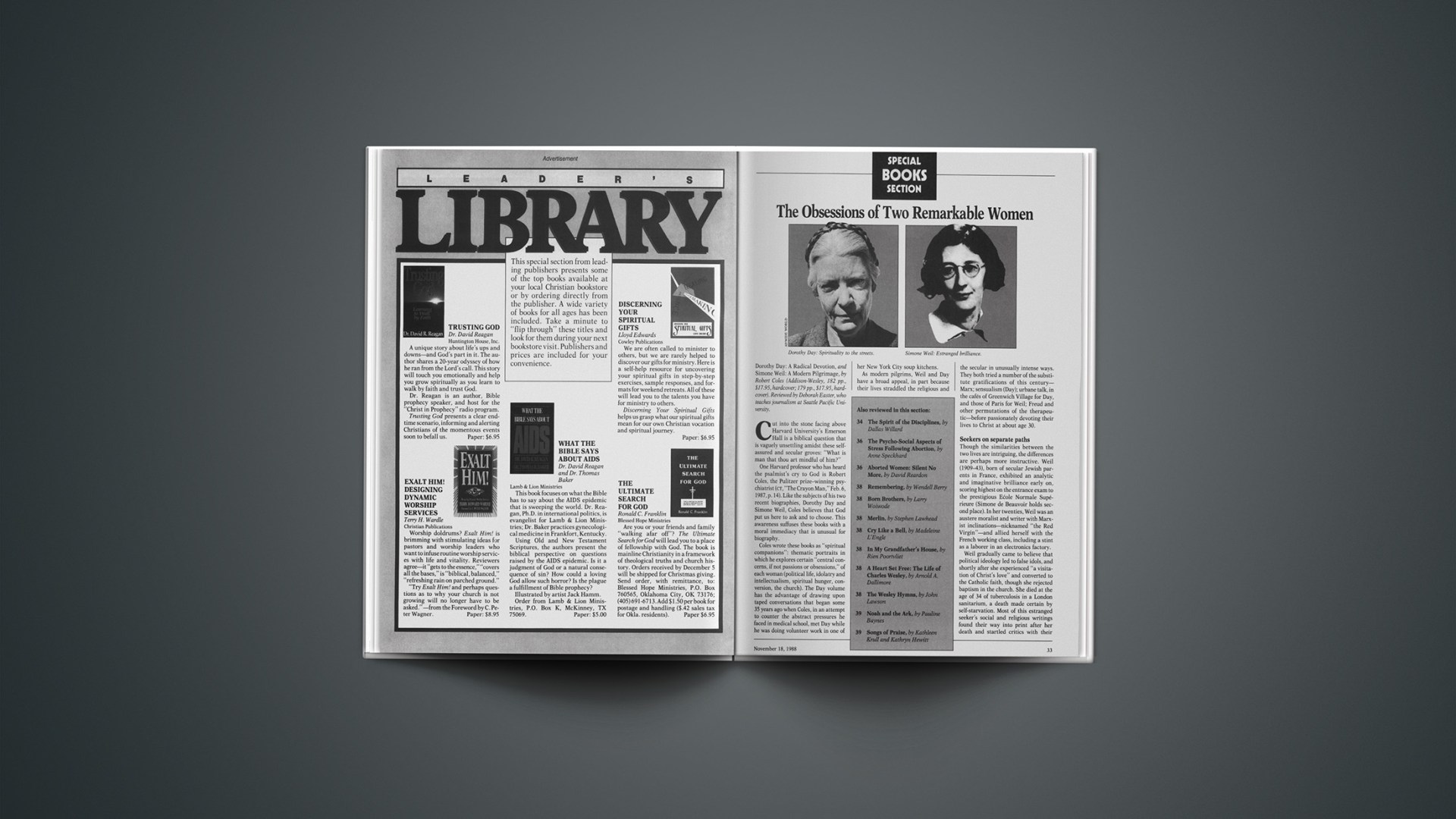
Dorothy Day: A Radical Devotion, and Simone Weil: A Modern Pilgrimage, by Robert Coles (Addison-Wesley, 182 pp., $17.95, hardcover; 179 pp., $17.95, hardcover). Reviewed by Deborah Easter, who teaches journalism at Seattle Pacific University.

Cut into the stone facing above Harvard University’s Emerson Hall is a biblical question that is vaguely unsettling amidst these self-assured and secular groves: “What is man that thou art mindful of him?” One Harvard professor who has heard the psalmist’s cry to God is Robert Coles, the Pulitzer prize-winning psychiatrist (CT, “The Crayon Man,” Feb. 6, 1987, p. 14). Like the subjects of his two recent biographies, Dorothy Day and Simone Weil, Coles believes that God put us here to ask and to choose. This awareness suffuses these books with a moral immediacy that is unusual for biography.

Coles wrote these books as “spiritual companions”: thematic portraits in which he explores certain “central concerns, if not passions or obsessions,” of each woman (political life, idolatry and intellectualism, spiritual hunger, conversion, the church). The Day volume has the advantage of drawing upon taped conversations that began some 35 years ago when Coles, in an attempt to counter the abstract pressures he faced in medical school, met Day while he was doing volunteer work in one of her New York City soup kitchens.

As modern pilgrims, Weil and Day have a broad appeal, in part because their lives straddled the religious and the secular in unusually intense ways. They both tried a number of the substitute gratifications of this century—Marx; sensualism (Day); urbane talk, in the cafés of Greenwich Village for Day, and those of Paris for Weil; Freud and other permutations of the therapeutic—before passionately devoting their lives to Christ at about age 30.

Also Reviewed In This Section:

The Spirit of the Disciplines, by Dallas Willard

The Psycho-Social Aspects of Stress Following Abortion, by Anne Speckhard

Aborted Women: Silent No More, by David Reardon

Remembering, by Wendell Berry

Born Brothers, by Larry Woiwode

Merlin, by Stephen Lawhead

Cry Like a Bell, by Madeleine L’Engle

In My Grandfather’s House, by Rien Poortvliet

A Heart Set Free: The Life of Charles Wesley, by Arnold A. Dallimore

The Wesley Hymns, by John Lawson

Noah and the Ark, by Pauline Baynes

Songs of Praise, by Kathleen Krull and Kathryn Hewitt

Seekers On Separate Paths

Though the similarities between the two lives are intriguing, the differences are perhaps more instructive. Weil (1909–43), born of secular Jewish parents in France, exhibited an analytic and imaginative brilliance early on, scoring highest on the entrance exam to the prestigious Ećole Normale Supérieure (Simone de Beauvoir holds second place). In her twenties, Weil was an austere moralist and writer with Marxist inclinations—nicknamed “the Red Virgin”—and allied herself with the French working class, including a stint as a laborer in an electronics factory.

Weil gradually came to believe that political ideology led to false idols, and shortly after she experienced “a visitation of Christ’s love” and converted to the Catholic faith, though she rejected baptism in the church. She died at the age of 34 of tuberculosis in a London sanitarium, a death made certain by self-starvation. Most of this estranged seeker’s social and religious writings found their way into print after her death and startled critics with their radiant originality and depth.

Day (1897–1980), a daughter of middle-class Chicago, also had a turbulent early adulthood, which in her case combined Left-leaning journalism, prison stays connected with women’s suffrage and the Wobblies (an early labor movement), and a common-law marriage that broke up soon after the birth of her daughter and her conversion to Catholicism.

Unlike Weil, who feared the church would stand between her and Christ, Day decided to marry Christ and the church—but with her eyes wide open. Day often felt that priests were “more like Cain than Abel,” but spent her life praying and fighting for the institution’s true spirit. She took her spirituality to the streets and founded the Catholic Worker movement and her Houses of Hospitality for the vulnerable.

Day once told Coles that “what the Lord wants from us is as many steps as we can manage.” It is this arduous, inchlike process that one senses when reading about the fully human complexities of these two lives.

Both women grappled with pride. Weil was given to occasional self-dramatization (pleading with French authorities to parachute her into the war zone so she could aid French resistance fighters) and a willful blindness and hostility to her Jewish heritage.

Day, whose life was embodied (and balanced) in religious community and service, knew well the underbelly of charitable action (the thoughts that say, “You’re God’s gift to humanity”). Yet her wry self-scrutiny did not turn to self-hatred, though she felt the grip of the latter when young. She once became “obsessed” with destroying every copy of her early novel The Eleventh Virgin because it spelled out her youthful hedonism. Her priest reminded her that God does the forgiving.

Living With Reverent Attention

In the conclusion to the final volume of Coles’s award-winning psychological study, Children in Crisis, he describes an eight-year-old girl who lives in a mansion in New Orleans’s Garden District. To her parents’ discomfort, she has begun gazing out her bedroom window at an above-ground cemetery across the street. The tombs cast late afternoon shadows, and the child asks repeatedly about “who those people, who the departed were.”

The family’s black maid, troubled by the mother’s unwillingness to hear her child’s questions, tells Coles: “I’m poor, but at least I know that I should ask myself everyday: where’s your destination, and are you going there, or are you getting sidetracked?”

Coles gives the maid the last word in his five-volume study. He observes that, like the child, she knows how to wonder, how to take notice, how to think about “the end of things,” and how to pray all the while.

What stays with one after reading Coles’s searching reflections on these two lives is this: his deep respect for the individual ways in which each of these women struggled to live with reverent attention.

Where Do The Disciplines Fit?

The Spirit of the Disciplines, by Dallas Willard (Harper & Row, 224 pp.; $14.95, hardcover). Reviewed by Larry Burtoft, pastor of Valley Vista Christian Community, Sepulveda, California.

The past decade has witnessed the stirring of a renaissance of interest in spiritual disciplines. Beginning in 1978 with Richard Foster’s Celebration of Discipline, an increasing number of books, periodicals, and even radio programs have urged the recovery of such practices as fasting, prayer, solitude, silence, meditation, and study as a means to a more vital spiritual life.

Unfortunately, this movement has remained peripheral to the primary activities of most churches. Few, if any, have programs structured around a concept of discipleship that focuses on spiritual disciplines. Perhaps one reason is that few Christian leaders are convinced of the essential importance of such exercises for the life of the church. Such discipline may be highly recommended, to be sure, but not essential.

What has been needed is a powerful apologetic, grounded in the biblical witness, which demonstrates the necessity of spiritual disciplines. In this respect, Dallas Willard’s The Spirit of the Disciplines is a tour de force. Willard, an ordained Southern Baptist minister and professor of philosophy at the University of Southern California, has written a significant book that deserves a serious and wide reading.

Willard believes that a major problem facing contemporary Christianity “is one of misunderstanding how our experiences and actions enable us to receive the grace of God.” There is confusion regarding the content of salvation, the nature of the spiritual life, the place of the human body in salvation, and the part we are to play in our redemption. In this confusion, it is not clear where, if at all, the spiritual disciplines fit.

Questions abound: If the disciplines are so important, why are we only lately becoming aware of them? Aren’t they a form of ascetic works righteousness refuted by Luther and the Reformation? Did Jesus or Paul or anyone else in the New Testament practice them? Aren’t we saved by grace through faith alone?

Essentials For The “Easy Yoke”

With penetrating and enlightening analysis, Willard clarifies the central issues involved and builds a most impressive argument for “the absolute necessity of the spiritual disciplines for our faith.” Rather than curious historical artifacts or optional exercises for super-Christians, he says, the disciplines are shown to be the essential activities that allow individuals to experience the “easy yoke” of Christ and to follow him in concrete ways into the gospel’s kingdom.

Although Willard’s argument is strengthened by drawing from a wide spectrum of authors and disciplines, the convincing power of the book lies in his handling of the scriptural evidence. The New Testament’s conception of salvation is shown to be far more than forgiveness, including substantial and progressive transformation of the individual’s moral character, and an increasing power to do good and resist evil.

Chapter 6, dealing with the significance of the human body as it is involved in the process of salvation, will be enlightening for many, as will chapter 7, an analysis of Paul’s understanding of the psychological dynamics of redemption.

While the book is expressly not a practical guide, it includes a helpful chapter describing the most common and time-tested disciplines, presented under two basic headings: “Disciplines of Abstinence,” including solitude, silence, fasting, frugality, chastity, secrecy, sacrifice, and “Disciplines of Engagement,” including study, worship, celebration, service, prayer, fellowship, confession, submission.

In what may be the most controversial chapter in the book, “Is Poverty Spiritual?” Willard attacks what he sees as “one of the most dangerous illusions of Christians in the contemporary world … the idealization of poverty.” This and the final chapter on “The Disciplines and the Power Structures of This World” are must reading for socially conscious Christians seeking to integrate the inner and outer journeys of discipleship.

A thoughtful reading of this book provides a theologically and psychologically sound understanding of the way into vital, life-changing contact with the living Christ and his kingdom. If Willard’s plea for placing the disciplines front and center on the church’s agenda were instituted, the results just might be revolutionary.

The Women Of Abortion Speak Out

The Psycho-Social Aspects of Stress Following Abortion, by Anne Speckhard (Sheed and Ward, viii + 134 pp.; $7.95, paper), and Aborted Women: Silent No More, by David O. Reardon (Loyola, xxvi + 373 pp.; $9.95, paper; $15.95, hardcover). Reviewed by James T. Burtchaell, professor of theology at the University of Notre Dame, and author of Rachel Weeping: The Case Against Abortion (Harper & Row).

Anne Speckhard writes as a social scientist who is critical of traditional abortion studies in her discipline. These studies commonly inquire into the psychic turbulence women incur by using abortion to deal with what they felt were overwhelming problems. But such studies tend to look at abortion only as a coping device and ignore the possibility that it may also be a new source of stress in its own right.

Speckhard finds their accounts too individualistic. By examining only the emotional aftermath wrought by abortion in the mothers themselves, scholars have been too ready to ignore how it may have estranged these women from their crucially important natural support communities.

Speckhard conducted extensive interviews with 30 women for whom abortion had been a highly stressful memory. The typical woman had become pregnant while in a longstanding sexual partnership, which then unraveled; she was 15 to 24 years old at the time of the abortion, and still in the process of achieving independence from her family; and she was knowledgeable about birth control but did not use it.

The women reported emotional reactions already well described in earlier literature: intense guilt, anger (primarily at the abortion providers), depression, fear of discovery, loss of ability to experience emotions, and painful reactions when encountering pregnant women or small children.

More original is Speckhard’s report of behavioral aftereffects not well noticed in other studies: eating disorders, extreme weight loss or gain, drug or alcohol abuse and addiction, sexual promiscuity, a prompt repeat (or “compensatory”) pregnancy, flashbacks, nightmares, hallucinations, and “visitations” by the aborted child.

Attitudes also had changed. At the time of their abortions, 35 percent of these women considered abortion as their right, while another 27 percent had not even regarded it as a moral issue. But in the aftermath, 96 percent now regarded it as wrong.

Facing Crisis In Isolation

Speckhard’s most valuable finding, however, is that abortion compounded the stress of those women by estranging them from their most important loyalties. Fearful that their sexual activity and pregnancy would strain their parents’ loyalties beyond the breaking point, they confided neither in them nor in any friends they thought might tell their families. Thus these women underwent both the crisis and its aftermath isolated from their closest natural supports.

They did find emotional companionship in other friends who supported their choice of abortion, but that support went bad later. “Many subjects reported that friends who had been enthusiastic supporters of the abortion decision were unwilling to listen to any accounts of the stress produced by the abortion. It appeared to be a protective strategy on the part of friendship systems to avoid having to deal with the pain of abortion.”

The decision to abort meant they were refusing to make a commitment to their sexual partners or their children, and the decision to do it furtively hid them from their original families. Their isolation from family was therefore stark and complete.

Abortion was also religiously alienating. The typical subject, religiously inactive, had thought of God as punitive and vengeful. “Such a perception led to a great deal of fear and anxiety, as it was not uncommon for these subjects to report a fear that God would punish them for the abortion by denying them future fertility.”

These women were to find eventual peace in surprising company: not with their families or their friends, but in prolife groups or in ardent religious communities. “In these social systems subjects found members who allowed them to discuss freely their feelings of grief, guilt, loneliness, anger, and despair. They also found that members of these systems were not adverse [sic] to discussing the details of the abortion experience, particularly with reference to concerns over pain that the fetus may have experienced and damage that may have occurred to the subjects’ reproductive organs. In other social systems these concerns had not been validated.”

The women found religious reintegration by accepting the church’s negative appraisal of extramarital sex and abortion, by embracing a greatly modified view of God (as cherishing rather than punishing), and by discovering the possibility of forgiveness as a final resolution for their fault and the stress that had followed.

Speckhard’s findings seem to confirm this reviewer’s earlier observation that women at risk for irresponsible pregnancy and abortion have tended to be too weak either to confront their sexual partners or to reveal themselves in crisis to their dissenting families and friends. They have tended to be acquiescent and passive, victimized by families that turned a blind eye towards what was going on, and victimized by partners who wanted sex but not commitment.

The Most Exploited

Aborted Women: Silent No More is built on a survey David Reardon conducted of 252 women who have had abortions and who are members of a national support group known as Women Exploited by Abortion (WEBA). Typical in most respects of all women reported as aborters in America, they stand out in one way: They all have come to deplore their action.

The accounts of their experiences are remarkably parallel to what Speckhard found in her interviews. Most of the women had been familiar with contraception but had not been using it when they became pregnant. The decision to abort had been made quickly—often within hours of detecting pregnancy. Most women felt they had been “forced” to abort by pressure from others, and 90 percent claimed they had been given incomplete information by the abortion providers. They remembered the abortion not as an act of emancipation, but as a yielding to the preferences of others. The aftermath effects include what Speckhard discovered: “atonement” pregnancies, eating disorders, alienation from family and from God.

Of first-hand value are 20 extensive and well-written profiles, edited from extensive interviews. The women represented here narrate some of the most complex situations: they are victims of coerced abortions, women who chose to be weak and others who made abortion a take-charge moment, women who had therapeutic abortions or illegal ones, those who aborted after rape and incest, women who were hustled into abortion because of economic or racial disadvantage.

The hard cases are chronicled here in the women’s own words. They are angry now, not weak. And they are articulately persuasive that abortion had been a way for women to be used, not an occasion of self-governance.

Courses Of Destruction

Of what significance are these studies for a Christian moral understanding? Those in the community of faith should appreciate that one of the primary gifts of the Spirit is insight into what various courses of moral behavior do to people. One of the primary sources of moral teaching is our communal insight into how certain actions tend to destroy us personally: those who lie, or embezzle, or seduce, wither. They are enfeebled in their characters, their persons.

These recollections by women who destroyed their children and were later transformed are a valuable source for reflection by those who believe we have nothing better to do with our lives than to make room for the most helpless. This is not merely social science research. It offers us insight into one of the ways that those who kill, themselves die—and can be raised to new life.

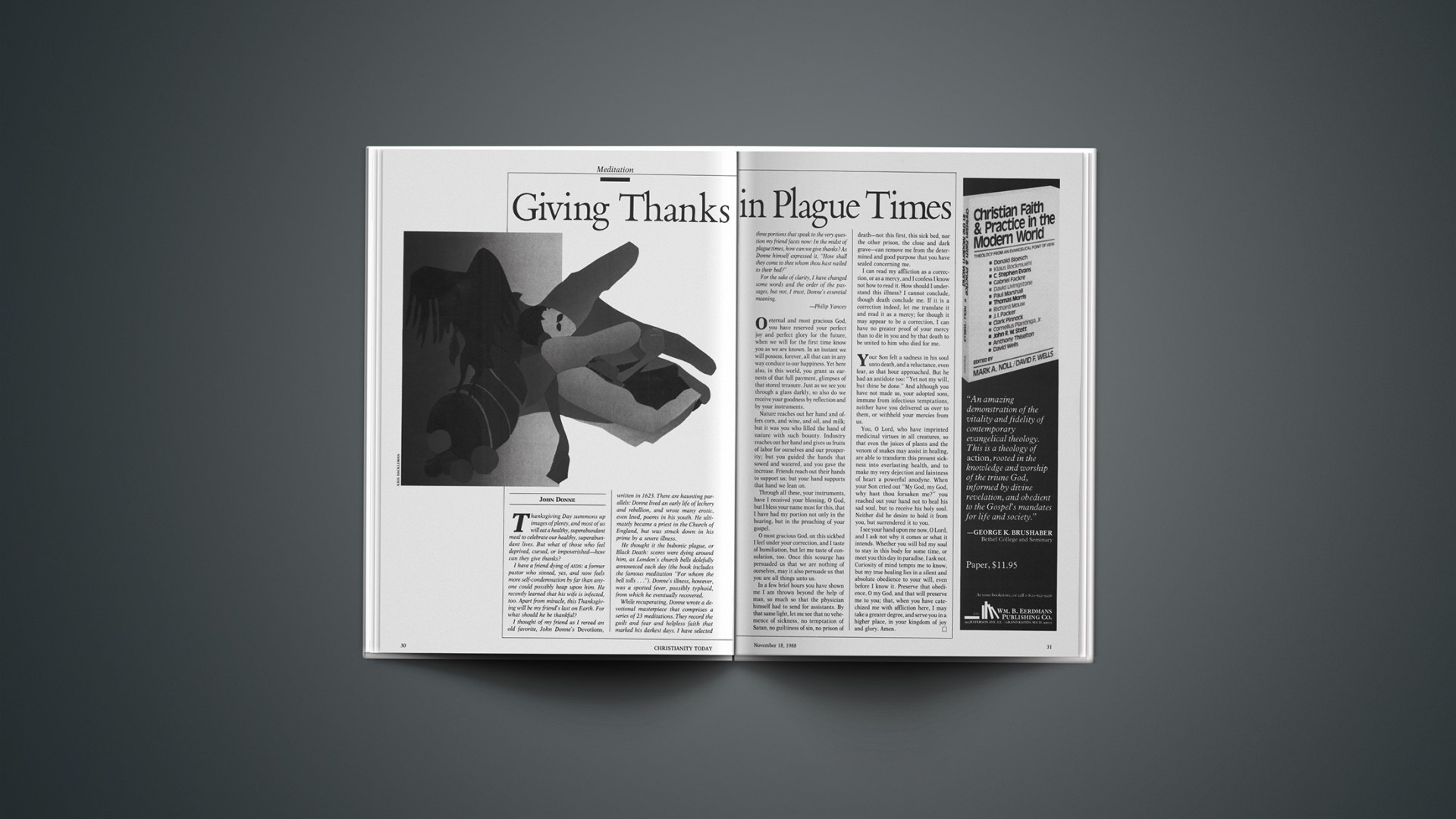
Giving Thanks in Plague Times

Thanksgiving Day summons up images of plenty, and most of us will eat a healthy, superabundant meal to celebrate our healthy, superabundant lives. But what of those who feel deprived, cursed, or impoverished—how can they give thanks?

I have a friend dying of AIDS: a former pastor who sinned, yes, and now feels more self-condemnation by far than anyone could possibly heap upon him. He recently learned that his wife is infected, too. Apart from miracle, this Thanksgiving will be my friend’s last on Earth. For what should he be thankful?

I thought of my friend as I reread an old favorite, John Donne’s Devotions, written in 1623. There are haunting parallels: Donne lived an early life of lechery and rebellion, and wrote many erotic, even lewd, poems in his youth. He ultimately became a priest in the Church of England, but was struck down in his prime by a severe illness.

He thought it the bubonic plague, or Black Death: scores were dying around him, as London’s church bells dolefully announced each day (the book includes the famous meditation “For whom the belî tolls …”). Donne’s illness, however, was a spotted fever, possibly typhoid, from which he eventually recovered.

While recuperating, Donne wrote a devotional masterpiece that comprises a series of 23 meditations. They record the guilt and fear and helpless faith that marked his darkest days. I have selected three portions that speak to the very question my friend faces now: In the midst of plague times, how can we give thanks? As Donne himself expressed it, “How shall they come to thee whom thou hast nailed to their bed?”

For the sake of clarity, I have changed some words and the order of the passages, but not, I trust, Donne’s essential meaning.

Philip Yancey

O eternal and most gracious God, you have reserved your perfect joy and perfect glory for the future, when we will for the first time know you as we are known. In an instant we will possess, forever, all that can in any way conduce to our happiness. Yet here also, in this world, you grant us earnests of that full payment, glimpses of that stored treasure. Just as we see you through a glass darkly, so also do we receive your goodness by reflection and by your instruments.

Nature reaches out her hand and offers com, and wine, and oil, and milk; but it was you who filled the hand of nature with such bounty. Industry reaches out her hand and gives us fruits of labor for ourselves and our prosperity; but you guided the hands that sowed and watered, and you gave the increase. Friends reach out their hands to support us; but your hand supports that hand we lean on.

Through all these, your instruments, have I received your blessing, O God, but I bless your name most for this, that I have had my portion not only in the hearing, but in the preaching of your gospel.

O most gracious God, on this sickbed I feel under your correction, and I taste of humiliation, but let me taste of consolation, too. Once this scourge has persuaded us that we are nothing of ourselves, may it also persuade us that you are all things unto us.

In a few brief hours you have shown me I am thrown beyond the help of man, so much so that the physician himself had to send for assistants. By that same light, let me see that no vehemence of sickness, no temptation of Satan, no guiltiness of sin, no prison of death—not this first, this sick bed, nor the other prison, the close and dark grave—can remove me from the determined and good purpose that you have sealed concerning me.

I can read my affliction as a correction, or as a mercy, and I confess I know not how to read it. How should I understand this illness? I cannot conclude, though death conclude me. If it is a correction indeed, let me translate it and read it as a mercy; for though it may appear to be a correction, I can have no greater proof of your mercy than to die in you and by that death to be united to him who died for me.

Your Son felt a sadness in his soul unto death, and a reluctance, even fear, as that hour approached. But he had an antidote too; “Yet not my will, but thine be done.” And although you have not made us, your adopted sons, immune from infectious temptations, neither have you delivered us over to them, or withheld your mercies from us.

You, O Lord, who have imprinted medicinal virtues in all creatures, so that even the juices of plants and the venom of snakes may assist in healing, are able to transform this present sickness into everlasting health, and to make my very dejection and faintness of heart a powerful anodyne. When your Son cried out “My God, my God, why hast thou forsaken me?” you reached out your hand not to heal his sad soul, but to receive his holy soul. Neither did he desire to hold it from you, but surrendered it to you.

I see your hand upon me now, O Lord, and I ask not why it comes or what it intends. Whether you will bid my soul to stay in this body for some time, or meet you this day in paradise, I ask not. Curiosity of mind tempts me to know, but my true healing lies in a silent and absolute obedience to your will, even before I know it. Preserve that obedience, O my God, and that will preserve me to you; that, when you have catechized me with affliction here, I may take a greater degree, and serve you in a higher place, in your kingdom of joy and glory. Amen.

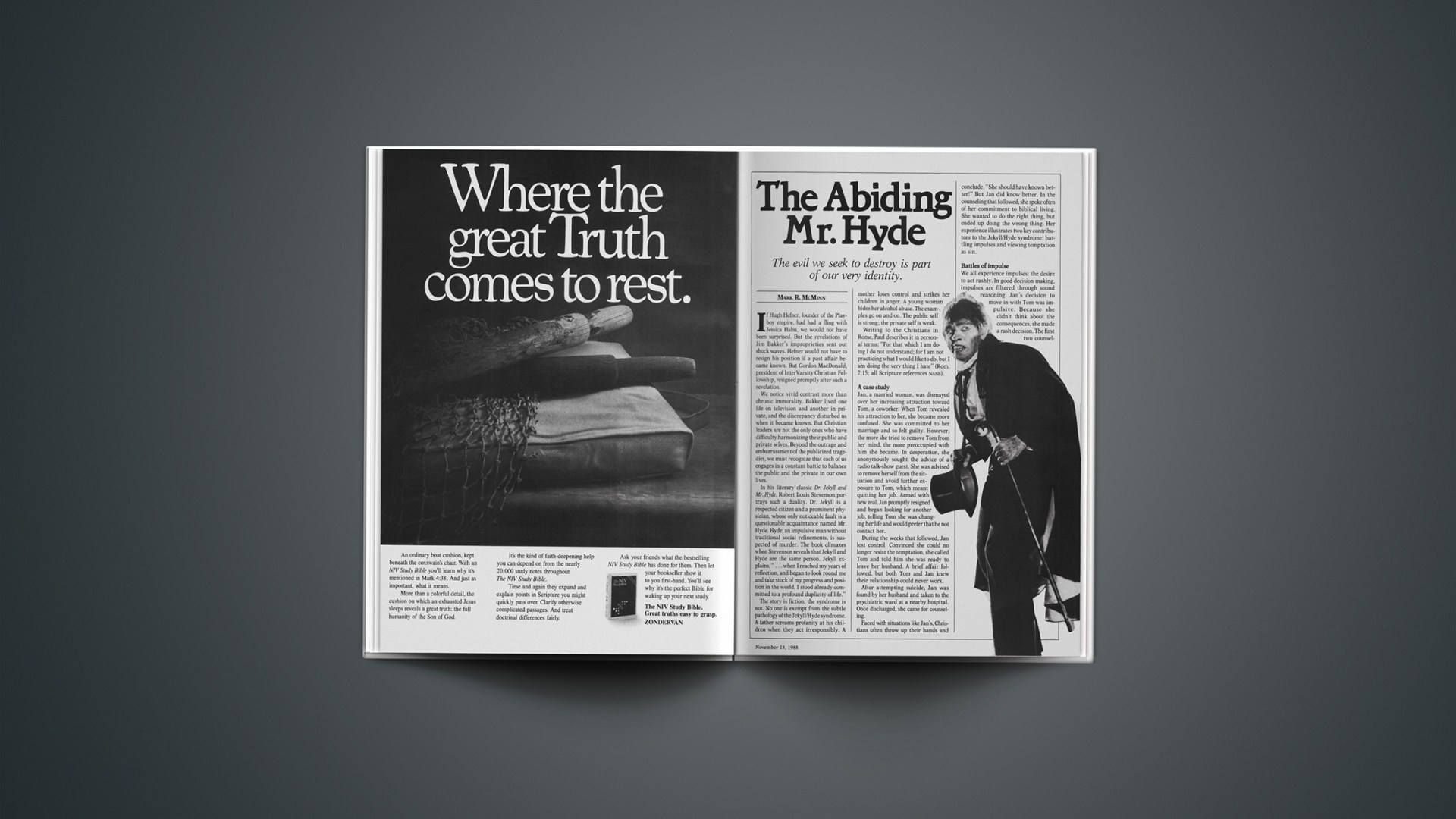
The Abiding Mr. Hyde

The evil we seek to destroy is part of our very identity.

If Hugh Hefner, founder of the Playboy empire, had had a fling with Jessica Hahn, we would not have been surprised. But the revelations of Jim Bakker’s improprieties sent out shock waves. Hefner would not have to resign his position if a past affair became known. But Gordon MacDonald, president of InterVarsity Christian Fellowship, resigned promptly after such a revelation.

We notice vivid contrast more than chronic immorality. Bakker lived one life on television and another in private, and the discrepancy disturbed us when it became known. But Christian leaders are not the only ones who have difficulty harmonizing their public and private selves. Beyond the outrage and embarrassment of the publicized tragedies, we must recognize that each of us engages in a constant battle to balance the public and the private in our own lives.

In his literary classic Dr. Jekyll and Mr. Hyde, Robert Louis Stevenson portrays such a duality. Dr. Jekyll is a respected citizen and a prominent physician, whose only noticeable fault is a questionable acquaintance named Mr. Hyde. Hyde, an impulsive man without traditional social refinements, is suspected of murder. The book climaxes when Stevenson reveals that Jekyll and Hyde are the same person. Jekyll explains, “… when I reached my years of reflection, and began to look round me and take stock of my progress and position in the world, I stood already committed to a profound duplicity of life.”

The story is fiction; the syndrome is not. No one is exempt from the subtle pathology of the Jekyll/Hyde syndrome. A father screams profanity at his children when they act irresponsibly. A mother loses control and strikes her children in anger. A young woman hides her alcohol abuse. The examples go on and on. The public self is strong; the private self is weak.

Writing to the Christians in Rome, Paul describes it in personal terms: “For that which I am doing I do not understand; for I am not practicing what I would like to do, but I am doing the very thing I hate” (Rom. 7:15; all Scripture references NASB).

A Case Study

Jan, a married woman, was dismayed over her increasing attraction toward Tom, a coworker. When Tom revealed his attraction to her, she became more confused. She was committed to her marriage and so felt guilty. However, the more she tried to remove Tom from her mind, the more preoccupied with him she became. In desperation, she anonymously sought the advice of a; radio talk-show guest. She was advised to remove herself from the situation and avoid further exposure to Tom, which meant quitting her job. Armed with new zeal, Jan promptly resigned and began looking for another job, telling Tom she was changing her life and would prefer that he not contact her.

During the weeks that followed, Jan lost control. Convinced she could no longer resist the temptation, she called Tom and told him she was ready to leave her husband. A brief affair followed, but both Tom and Jan knew their relationship could never work.

After attempting suicide, Jan was found by her husband and taken to the psychiatric ward at a nearby hospital. Once discharged, she came for counseling.

Faced with situations like Jan’s, Christians often throw up their hands and conclude, “She should have known better!” But Jan did know better. In the counseling that followed, she spoke often of her commitment to biblical living. She wanted to do the right thing, but ended up doing the wrong thing. Her experience illustrates two key contributors to the Jekyll/Hyde syndrome: battling impulses and viewing temptation as sin.

Battles Of Impulse

We all experience impulses: the desire to act rashly. In good decision making, impulses are filtered through sound reasoning. Jan’s decision to move in with Tom was impulsive. Because she didn’t think about the consequences, she made a rash decision. The first two counseling sessions with Jan revealed that her life was full of impulse. These impulses came in two forms, one resembling Dr. Jekyll, the other Mr. Hyde.

First, Jan was filled with impulses from the “dark side” of her nature. Swiss psychiatrist Carl Jung called it the “shadow” of personality. Jung’s personality theory must be interpreted cautiously by Christians since he derived much of his theory from readings in the occult, alchemy, and parapsychology. Nonetheless, his “shadow” is an undeniable part of human personality, consistent with the Christian teaching about our fallen nature. Impulses from the dark side are egocentric, seek immediate gratification, and avoid responsibility.

Sexually attracted to Tom, Jan was convinced she could never be fulfilled without him. She craved Tom just as an alcoholic craves drink. And she was so preoccupied with impulse that she overlooked her family.

Jan’s impulse also came from what I call the “glossy side,” that part of personality that always wants to look good in public. Jesus confronted the religious leaders of his day many times about their excessive desire for respect and approval from others. They were ruled by glossy-side impulses.

Because Jan believed good Christians do not face sexual temptation like hers, she kept her battle private, constantly fearing what others would think if she were discovered. Like Dr. Jekyll, she wrapped her fragile self-image in the glossy self that she presented to others. Jan had learned to appear spiritual in order to avoid disapproval from other Christians.

The dark side and the glossy side are synergistic; the two combined are far more dangerous than either one alone. Dark-side impulses evoke glossy-side impulses. Whenever Jan felt attraction toward Tom, she felt tremendous guilt and told herself that “good Christians don’t face temptations like this.” Similarly, glossy-side impulses evoke dark-side impulses. Whenever Jan told herself, “Good Christians aren’t attracted to other men,” she became overwhelmed with her attraction toward Tom.

The two sides feed each other. As one grows, so does the other, resulting in hypocrisy and duality: an ageless battle of impulses. Jesus identified the pattern with the scribes and Pharisees (Matt. 23:27), and Paul noted a similar pattern in the gnostics of the early church (Col. 2:20–23).

Destroying The Dark Side

In The Empire Strikes Back, the great Jedi master, Yoda, is training Luke Skywalker to become a Jedi knight. The young Skywalker fears the dark side will become too strong if not destroyed immediately, and he feels drawn to fight a symbolic battle with it in a nearby cave.

Entering the cave with light saber drawn, the would-be Jedi faces the evil Darth Vader. Luke lops off Vader’s head during a brief fight. But as Vader’s black helmet lies on the ground, Skywalker’s own face gradually appears beneath the face shield. Has Luke killed part of himself?

Potential evil is as dissonant for us as it is for Skywalker in the movie fantasy. We want to destroy evil and live in spiritual peace. We want to remove temptation and live in clarity. So we take up our swords impulsively to purge evil by destroying it. We use arbitrary “shoulds” and easy answers, and the judgmental perspectives of the glossy side.

We strike down our dark side and feel immediate relief, as Jan did when she quit her job. But gradually we become aware that we have attempted to eliminate a part of ourselves that cannot be done away with, a part that only returns with greater force. And in the process of trying to defeat temptation and evil, we short-circuit growth.

We cannot destroy dark-side impulses; they are part of our human experience. But we can understand and then manage impulses.

Temptation As Sin

Most Christians would say temptation is not sin, but that giving in to temptation with inappropriate thoughts or actions is sin. Jesus was tempted (Mark 1:12–13), yet was without sin. Therefore, temptation is not sin.

But our reactions and our theology may be incongruent. If we could take those same Christians and put guilt meters on their foreheads, we might be intrigued by the results. In the presence of temptation like Jan’s, many meters would register significant guilt feelings.

The thoughts that produce guilt feelings are predictable. “Good Christians aren’t tempted to have extramarital relationships.” “If I were focusing on the Lord, I wouldn’t be noticing attractive men at the office.” “If others knew about this temptation, I would be asked to resign from the church leadership committee.” And so on. These thoughts are based on approval seeking, and on arbitrary rules without biblical basis. The Bible addresses adultery and sexual fantasy, but romantic attraction is not prohibited in the Bible.

Temptation is not sin. Temptation can be used for evil or good. If temptation causes sin, then the outcome is clearly evil. But temptation can also be productive. “Consider it all joy, my brethren, when you encounter various trials, knowing that the testing of your faith produces endurance. And let endurance have its perfect result, that you may be perfect and complete, lacking in nothing” (James 1:2–4). The same Greek word translated trials in verse 2 is translated temptation in verse 13. The source of temptation is internal (vv. 13–14), from within our character, but that temptation can be used to produce growth.

If temptation is viewed as evil, we will respond by trying to eliminate it, rather than manage it. The result is a battle of internal impulses that actually makes the temptation stronger. In fact, the more Jan tried to push the temptations from her mind, the more impulsive and irresponsible she became. In looking for ways to eliminate our dual nature, we only make the duplicity stronger.

Because Christians are well-trained at hiding temptation, many are left feeling alone and unspiritual. Temptation is fertile in the private life of one who cannot discuss it with Christian friends. Temptation plus isolation often produces sin.

When we do see the dark side of another, we are often so shocked that we respond reflexively. Gordon MacDonald resigned when his past infidelity became known, even though he had undergone a period of supervised restoration. He knew how Christians would respond: We rightly expect purity in our Christian leaders, but our shock in reaction to sin is sometimes excessive. If we allowed the open discussion of temptation and sin, we could learn many lessons from sincere Christians who have remorsefully acknowledged their errors. God uses broken servants when we allow him to. Remember King David.

Jan did well in therapy, progressing beyond her battle of impulses and her depression in just a few months. In the process, she learned two valuable lessons about herself, her spirituality, and her family: Life is difficult, and grace is the indispensable answer.

The Hard Life

Duality, in a sense, is an attempt to escape the difficulty of life. Because it is difficult to remain faithful in marriage, many resort to secret relationships. Because it is difficult to cope with hectic schedules and impoverished self-esteems, many resort to substance abuse, seeking to make life more bearable.

Tragically, efforts to make life less difficult end up making it more difficult. Secret relationships eventually produce marital crises; substance abuse produces greater stress and poorer self-esteem. As M. Scott Peck concludes in The Road Less Traveled, accepting life as difficult makes life more bearable. It also makes duality less necessary.

Articles and books on effective Christian living are often insightful and significant, but we must be cautious not to communicate that Christianity is a Band-Aid for all emotional hurts. Some things in life are meant to be difficult, and no easy answer will remove the pain. In an essay on intellect, Ralph Waldo Emerson wrote, “God offers to every mind a choice between truth and repose. Take which you please, you can never have both.”

No Place For Impulse

The road away from duality is paved with grace. Grace makes love unconditional, pain bearable, and hope substantive. When Paul was discouraged about his duality in Romans 7, he responded by recalling God’s grace: “There is therefore now no condemnation for those who are in Christ Jesus. For the law of the Spirit of life in Christ Jesus has set you free from the law of sin and of death” (Rom. 8:1–2).

Grace and impulse are completely incompatible. Impulse, whether from the dark side or the glossy side, focuses on self. Grace transcends self, because we do not deserve grace.

Many of us speak of grace as if we understand it, but we live by investing effort in earning God’s favor, condemning ourselves when we fail, and focusing on how evil our hidden desires are. David Seamands, in his excellent book Healing for Damaged Emotions, writes: “We read, we hear, we believe a good theology of grace. But that’s not the way we live. We believe grace in our heads but not in our gut level feelings or in our relationships. There’s no other word we throw around so piously.”

Why is grace so important in managing duality? Because we all have dual natures, we inevitably fail. Responding to failure becomes important in avoiding future battles of impulse. When we fully understand grace, we respond differently to failure. Rather than focusing on self (“I’m such a bad Christian”), we focus on God (“It is amazing that God loves me despite my tendency toward evil”).

Jan learned from her error. She appreciated God’s grace more as she realized God still loved her. Her life became more obedient as she began responding to God’s grace, rather than living her life by a glossy-side list of rules of behavior.

Goodbye, Mr. Hyde

What we need today is individuals who understand that life is difficult but that God’s grace transcends all of life’s trials and our failures. We simply need sincerity. We need Christians who live obediently in response to limitless grace.

Because God accepts us and loves us despite our sin, we know his grace does not depend on our performance. We can be whole before God, assured of his love. Recognizing our completeness in God gives us peace and enables us to act with consistent obedience. It allows us to look beyond the unworthiness of humankind and to focus on God.

Jan made a tragic mistake in her life. But as she moved beyond duality, she abandoned the battle of impulses, began to experience God’s grace, and allowed temptations to become stepping stones to greater understanding and wholeness.

Mark R. McMinn is associate professor of psychology at George Fox College, Newberg, Oregon, and author of Your Hidden Half (Baker).

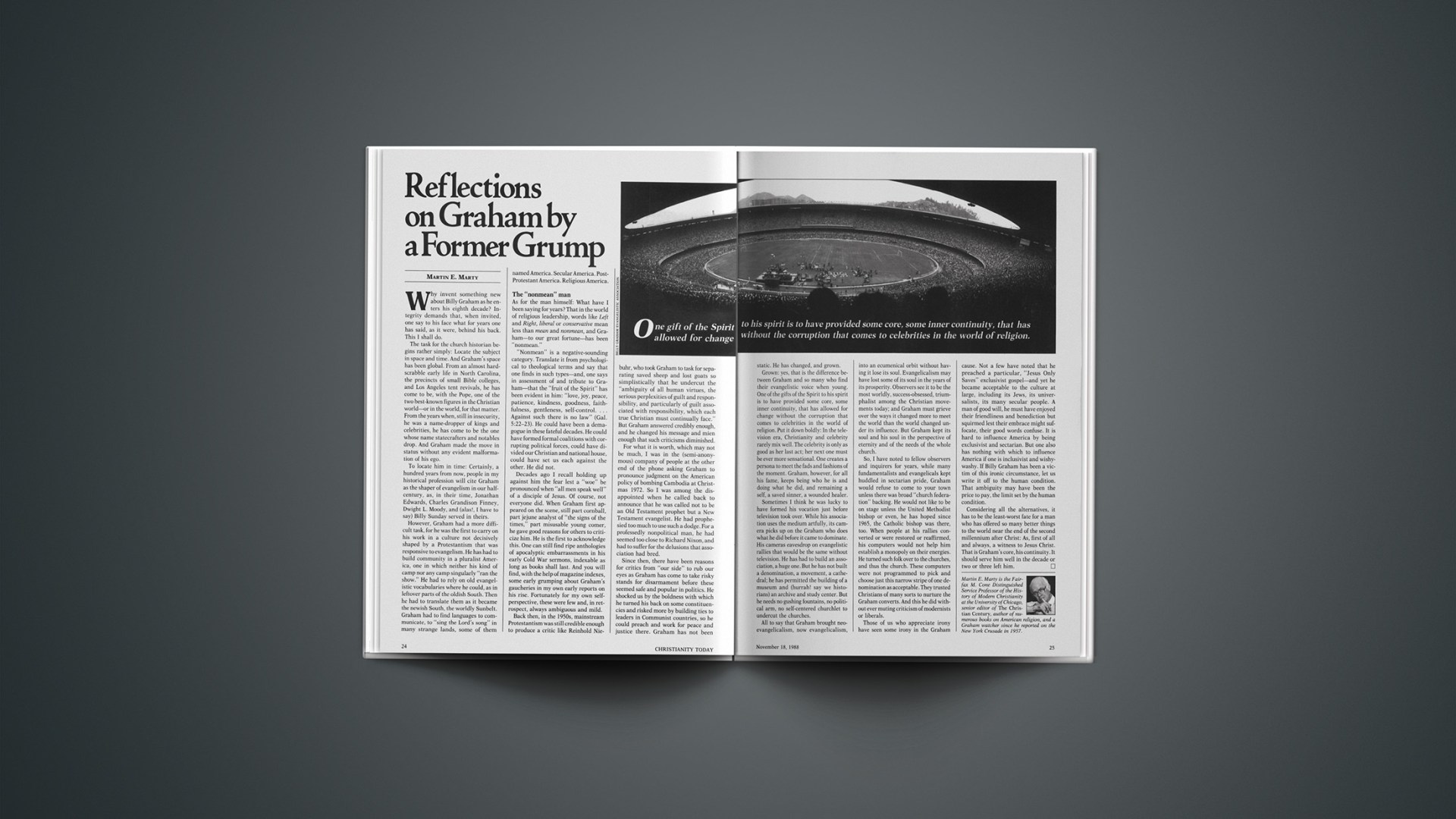
Reflections on Graham by a Former Grump

Why invent something new about Billy Graham as he enters his eighth decade? Integrity demands that, when invited, one say to his face what for years one has said, as it were, behind his back. This I shall do.

The task for the church historian begins rather simply: Locate the subject in space and time. And Graham’s space has been global. From an almost hardscrabble early life in North Carolina, the precincts of small Bible colleges, and Los Angeles tent revivals, he has come to be, with the Pope, one of the two best-known figures in the Christian world—or in the world, for that matter. From the years when, still in insecurity, he was a name-dropper of kings and celebrities, he has come to be the one whose name statecrafters and notables drop. And Graham made the move in status without any evident malformation of his ego.

To locate him in time: Certainly, a hundred years from now, people in my historical profession will cite Graham as the shaper of evangelism in our half-century, as, in their time, Jonathan Edwards, Charles Grandison Finney, Dwight L. Moody, and (alas!, I have to say) Billy Sunday served in theirs.

However, Graham had a more difficult task, for he was the first to carry on his work in a culture not decisively shaped by a Protestantism that was responsive to evangelism. He has had to build community in a pluralist America, one in which neither his kind of camp nor any camp singularly “ran the show.” He had to rely on old evangelistic vocabularies where he could, as in leftover parts of the oldish South. Then he had to translate them as it became the newish South, the worldly Sunbelt. Graham had to find languages to communicate, to “sing the Lord’s song” in many strange lands, some of them named America. Secular America. Post-Protestant America. Religious America.

The “Nonmean” Man

As for the man himself: What have I been saying for years? That in the world of religious leadership, words like Left and Right, liberal or conservative mean less than mean and nonmean, and Graham—to our great fortune—has been “nonmean.”

“Nonmean” is a negative-sounding category. Translate it from psychological to theological terms and say that one finds in such types—and, one says in assessment of and tribute to Graham—that the “fruit of the Spirit” has been evident in him: “love, joy, peace, patience, kindness, goodness, faithfulness, gentleness, self-control.… Against such there is no law” (Gal. 5:22–23). He could have been a demagogue in these fateful decades. He could have formed formal coalitions with corrupting political forces, could have divided our Christian and national house, could have set us each against the other. He did not.

Decades ago I recall holding up against him the fear lest a “woe” be pronounced when “all men speak well” of a disciple of Jesus. Of course, not everyone did. When Graham first appeared on the scene, still part cornball, part jejune analyst of “the signs of the times,” part misusable young comer, he gave good reasons for others to criticize him. He is the first to acknowledge this. One can still find ripe anthologies of apocalyptic embarrassments in his early Cold War sermons, indexable as long as books shall last. And you will find, with the help of magazine indexes, some early grumping about Graham’s gaucheries in my own early reports on his rise. Fortunately for my own self-perspective, these were few and, in retrospect, always ambiguous and mild.

Back then, in the 1950s, mainstream Protestantism was still credible enough to produce a critic like Reinhold Niebuhr, who took Graham to task for separating saved sheep and lost goats so simplistically that he undercut the “ambiguity of all human virtues, the serious perplexities of guilt and responsibility, and particularly of guilt associated with responsibility, which each true Christian must continually face.” But Graham answered credibly enough, and he changed his message and mien enough that such criticisms diminished.

For what it is worth, which may not be much, I was in the (semi-anonymous) company of people at the other end of the phone asking Graham to pronounce judgment on the American policy of bombing Cambodia at Christmas 1972. So I was among the disappointed when he called back to announce that he was called not to be an Old Testament prophet but a New Testament evangelist. He had prophesied too much to use such a dodge. For a professedly nonpolitical man, he had seemed too close to Richard Nixon, and had to suffer for the delusions that association had bred.

Since then, there have been reasons for critics from “our side” to rub our eyes as Graham has come to take risky stands for disarmament before these seemed safe and popular in politics. He shocked us by the boldness with which he turned his back on some constituencies and risked more by building ties to leaders in Communist countries, so he could preach and work for peace and justice there. Graham has not been static. He has changed, and grown.

Grown: yes, that is the difference between Graham and so many who find their evangelistic voice when young. One of the gifts of the Spirit to his spirit is to have provided some core, some inner continuity, that has allowed for change without the corruption that comes to celebrities in the world of religion. Put it down boldly: In the television era, Christianity and celebrity rarely mix well. The celebrity is only as good as her last act; her next one must be ever more sensational. One creates a persona to meet the fads and fashions of the moment. Graham, however, for all his fame, keeps being who he is and doing what he did, and remaining a self, a saved sinner, a wounded healer.

Sometimes I think he was lucky to have formed his vocation just before television took over. While his association uses the medium artfully, its camera picks up on the Graham who does what he did before it came to dominate. His cameras eavesdrop on evangelistic rallies that would be the same without television. He has had to build an association, a huge one. But he has not built a denomination, a movement, a cathedral; he has permitted the building of a museum and (hurrah! say we historians) an archive and study center. But he needs no gushing fountains, no political arm, no self-centered churchlet to undercut the churches.

All to say that Graham brought neoevangelicalism, now evangelicalism, into an ecumenical orbit without having it lose its soul. Evangelicalism may have lost some of its soul in the years of its prosperity. Observers see it to be the most worldly, success-obsessed, triumphalist among the Christian movements today; and Graham must grieve over the ways it changed more to meet the world than the world changed under its influence. But Graham kept its soul and his soul in the perspective of eternity and of the needs of the whole church.

So, I have noted to fellow observers and inquirers for years, while many fundamentalists and evangelicals kept huddled in sectarian pride, Graham would refuse to come to your town unless there was broad “church federation” backing. He would not like to be on stage unless the United Methodist bishop or even, he has hoped since 1965, the Catholic bishop was there, too. When people at his rallies converted or were restored or reaffirmed, his computers would not help him establish a monopoly on their energies. He turned such folk over to the churches, and thus the church. These computers were not programmed to pick and choose just this narrow stripe of one denomination as acceptable. They trusted Christians of many sorts to nurture the Graham converts. And this he did without ever muting criticism of modernists or liberals.

Those of us who appreciate irony have seen some irony in the Graham cause. Not a few have noted that he preached a particular, “Jesus Only Saves” exclusivist gospel—and yet he became acceptable to the culture at large, including its Jews, its universalists, its many secular people. A man of good will, he must have enjoyed their friendliness and benediction but squirmed lest their embrace might suffocate, their good words confuse. It is hard to influence America by being exclusivist and sectarian. But one also has nothing with which to influence America if one is inclusivist and wishy-washy. If Billy Graham has been a victim of this ironic circumstance, let us write it off to the human condition. That ambiguity may have been the price to pay, the limit set by the human condition.

Considering all the alternatives, it has to be the least-worst fate for a man who has offered so many better things to the world near the end of the second millennium after Christ: As, first of all and always, a witness to Jesus Christ. That is Graham’s core, his continuity. It should serve him well in the decade or two or three left him.

Martin E. Marty is the Fairfax M. Cone Distinguished Service Professor of the History of Modern Christianity at the University of Chicago, senior editor of The Christian Century, author of numerous books on American religion, and a Graham watcher since he reported on the New York Crusade in 1957.

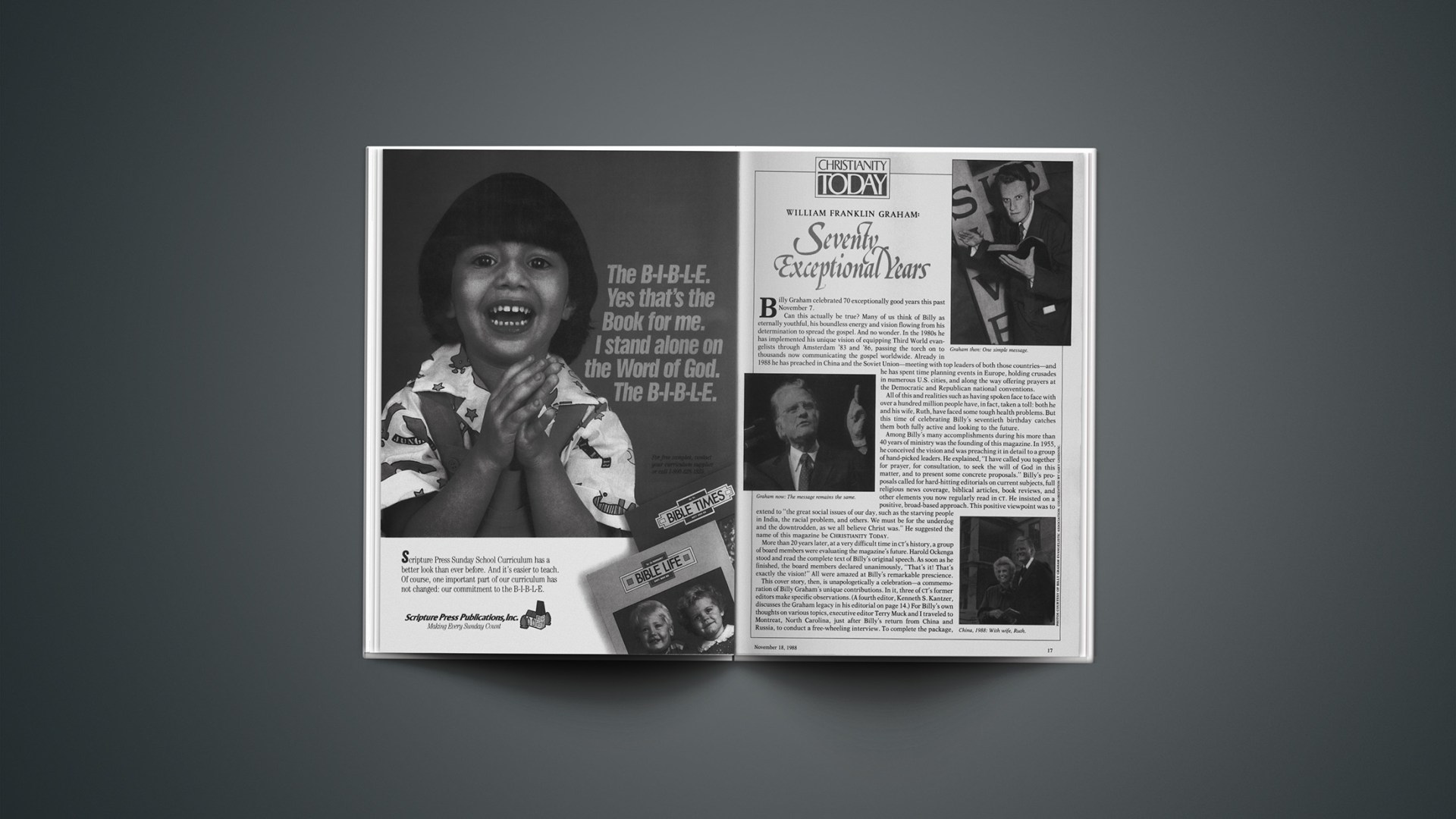
William Franklin Graham: Seventy Exceptional Years

Billy Graham celebrated 70 exceptionally good years this past November 7.

Can this actually be true? Many of us think of Billy as eternally youthful, his boundless energy and vision flowing from his determination to spread the gospel. And no wonder. In the 1980s he has implemented his unique vision of equipping Third World evangelists through Amsterdam 83 and 86, passing the torch on to thousands now communicating the gospel worldwide. Already in 1988 he has preached in China and the Soviet Union—meeting with top leaders of both those countries—and he has spent time planning events in Europe, holding crusades in numerous U.S. cities, and along the way offering prayers at the Democratic and Republican national conventions.

All of this and realities such as having spoken face to face with over a hundred million people have, in fact, taken a toll: both he and his wife, Ruth, have faced some tough health problems. But this time of celebrating Billy’s seventieth birthday catches them both fully active and looking to the future.

Among Billy’s many accomplishments during his more than 40 years of ministry was the founding of this magazine. In 1955, he conceived the vision and was preaching it in detail to a group of hand-picked leaders. He explained, “I have called you together for prayer, for consultation, to seek the will of God in this matter, and to present some concrete proposals.” Billy’s proposals called for hard-hitting editorials on current subjects, full I religious news coverage, biblical articles, book reviews, and other elements you now regularly read in CT. He insisted on a positive, broad-based approach. This positive viewpoint was to extend to “the great social issues of our day, such as the starving people in India, the racial problem, and others. We must be for the underdog and the downtrodden, as we all believe Christ was.” He suggested the name of this magazine be CHRISTIANITY TODAY.

More than 20 years later, at a very difficult time in CT’s history, a group of board members were evaluating the magazine’s future. Harold Ockenga stood and read the complete text of Billy’s original speech. As soon as he finished, the board members declared unanimously, “That’s it! That’s exactly the vision!” All were amazed at Billy’s remarkable prescience.

This cover story, then, is unapologetically a celebration—a commemoration of Billy Graham’s unique contributions. In it, three of CT’s former editors make specific observations. (A fourth editor, Kenneth S. Kantzer, discusses the Graham legacy in his editorial on page 14.) For Billy’s own thoughts on various topics, executive editor Terry Muck and I traveled to Montreat, North Carolina, just after Billy’s return from China and Russia, to conduct a free-wheeling interview. To complete the package, University of Chicago historian Martin Marty writes a personal retrospective.

Throughout our interview in Montreat, it was clear as Billy responded to questions that his world impact has been no fluke, that he still has the same broad spirit seen in that original call to create CHRISTIANITY TODAY. His natural responses to questions reveal a lifetime of action and thinking shaped by involvement with a great cross section of concerned ministers, scholars, and world leaders.

By Harold L. Myra, publisher.

What should be the Christian’s role in our complex world?

We live in a volatile world. About 15 nations have the atomic bomb. An accident could drag the whole world into war.

Even without war we’re in danger of planetary destruction. A recent Newsweek article told about how the greenhouse effect is heating up the world. It took from 1980 to 1988 for our average temperature to go up a degree, and this past year alone it’s heated up a half a degree. Newsweek showed the devastating implications of that for the future if the trend continues.

It’s a situation beyond man’s ability to cope. Only God can intervene and help us. Christians ought to be on the vanguard speaking out and calling people to prayer that God’s will be done. We need to especially emphasize the coming again of Christ, because he’s the hope we should be looking toward.

How can Christians avoid spending so much energy on infighting and project a common front to the world?

I would like to see a conference held to see if we could uncover some more C. S. Lewises or Francis Schaeffers, people of that caliber.

They’re out there, because in our travels we meet people with tremendous intellectual ability. But they’re not known. They’re in the East as well as the West. A conference could bring together 300 or 400 of these bright minds and encourage them to work on the world’s problems from a Christian point of view. The whole world would listen to a group like that.

When we were in China we met with scholars in different places. During the question-and-answer periods I noticed that the Americans who were there (mostly exchange students) asked questions about what they have read about politics and the scandals back home. But the Chinese asked philosophical and religious questions. You couldn’t help but see the difference. The Chinese are thinking very seriously about the meaning of life and death. I’ve found that true in so many countries around the world—an emptiness among the youth, especially.

Five years ago you returned from the Soviet Union and were savaged by the American press for the reconciliatory approach you took, trying to be salt and light to Soviet Christians. Now, with glasnost, everyone seems to favor cooperation. How do you handle such a changeable press reaction—daggers one minute and …

Well, the daggers didn’t bother me in the slightest because I knew we were in the will of God. Once that has been settled in one’s heart, then nothing bothers you.

But I remember agonizing over whether to take that first Russian trip. I asked several people’s advice, including Henry Kissinger and Richard Nixon. Nixon said, “Let me do some thinking about it.” Finally he called me from Jamaica, and he said, “Billy, you know I believe in taking big risks. This is a big risk, but I believe that in the long run it will be for the benefit of the gospel that you preach. You’ll be criticized, but take the long view.”

But at the core of my deliberations I went over and over the ninth chapter of 1 Corinthians where Paul said he became all things to all men that he might win some. The Lord just seemed to bring a peace in my heart that we were to go.

We went with the understanding that we’d be invited back. The Russians kept their word, and we were invited back. Our purpose in going had nothing to do with political or even peace problems—it was just the chance to preach the gospel.

We went from church to church and the people opened up beautifully to us. I remember the last day that we preached in Moscow, in the cathedral of Patriarch Pimen. He introduced me, and I got up and preached on “you must be born again.” When I finished, he stood up and said, “This is what we need in our churches. I would like to see Billy Graham go to all parts of our country and teach our pastors and teach our students how to communicate the gospel that way.”

You describe the spiritual hunger in countries like China and the Soviet Union. Are you optimistic about world evangelism as we move into the next century?

I read recently that there are about 100 organizations planning to evangelize the whole world by the year 2000.1 wish them the best; but no matter how good a job they do, there will still be more. Every generation needs reevangelizing.

I am optimistic, though. Some say parts of the world are closing to evangelism. But I don’t think evangelization of the world is necessarily dependent on political conditions. I’ll give you an illustration. I was sitting beside a top Chinese Communist leader at a luncheon hosted by the American ambassador. I asked him, “Why is Christianity growing so fast in China?” He said, “Persecution. If you want to evangelize China, just persecute Christians. The more they are persecuted, the faster the church grows.”

The Lord is moving in a tremendous way, from what I am told, in Africa south of the Sahara. New converts are being won at amazing rates. Old churches are coming alive again. Those I’ve talked to say the Lord is moving greatly even in southern Africa, despite the political problems—among whites as well as blacks. People are coming to know the Lord in a remarkable way.

Firm On The Fundamentals

Not much in Billy Graham’s theological outlook is conspicuously “new,” and Graham himself would doubtless be gratified that it is not. When modernist and humanist critics accused him of turning back the clock of theological progress by a generation, he offered to escort them back 19 centuries to Jesus and the apostles.

Graham is not simply an evangelist, but is expressly an evangelical evangelist, and that implies at once an irreducible theological content and commitment to a complex of Bible doctrines. He has never vacillated on the fundamentals that evangelical orthodoxy championed against theological liberalism.

Graham did not shape recent evangelical doctrine as much as he proclaimed it. He was a student at Wheaton College when the National Association of Evangelicals arose in 1942 with its definitive theological affirmations. He pursued no formal theological studies beyond the A.B. degree, a circumstance that some critics of seminary trends—rightly or wrongly—consider a blessing that may have preserved his evangelistic zeal. From 1947 to 1952 he served as president of Northwestern College in Minneapolis, where, in 1951, he graciously invited me to give the W. B. Riley Memorial Lectures to a student body more alert to evangelism than to theology.

Graham’s weekly “Hour of Decision” radio program, inaugurated in 1950, featured powerful sermonic evangelism more than structured theological exposition. And to this day his monthly sermon in Decision magazine is oriented more to a popular mass-media audience than to cognitively oriented theologians. Yet almost from the beginning of his nationwide evangelistic campaigns in 1949, many of Graham’s sermons incorporated more theological content than did much past-generation fundamentalist preaching.

The evangelist would, of course, hurriedly deny that he is a theologian in the primary dictionary sense. Yet he surely meets the secondary criterion of a “student of” and “writer on” theology. He has often preached on one or another of the Bible doctrines, although not in a systematic way. His books include volumes on Angels (1976) and The Holy Spirit (1979). Even these texts are intended more for the laity than for seminarians, although theological beginners often find them helpful. His books tend to gloss over doctrinal divisions within evangelical circles; like his preaching, his writing insistently hews to mainline evangelical emphases.

Graham is not at home in professional academic societies or their journals; he is not a member of the Evangelical Theological Society. But his personal role in relation to Fuller Theological Seminary, CHRISTIANITY TODAY, and the Billy Graham Center has theological implications. He continues on the boards of these enterprises, although not always in a theologically decisive way, despite his commitment to the inerrancy of the Bible.

Indeed, evangelical theologians applaud Graham for his unhesitating proclamation of a fully reliable Scripture, his focus on the Christological center of the Bible, his demonstration of the converting power of the gospel, his fervent vision of the duty of global evangelism, and his insistence that the fallen human race faces an awesome dual destiny in eternity that only belief in Christ can infuse with hope. For a nontheologian, that is a hefty contribution, and we may all be grateful to God for it.

By Carl F. H. Henry, editor, 1956–68.

I’m not a prophet; I can’t predict what’s going to happen in the next century. But I am encouraged.

At the same time, I must admit to some discouragement at times. When you look at the world you see a tremendous increase in Islam and the reawakening among Buddhists and Hindus. It seems to me that the whole world, regardless of culture and religious tradition, is searching for something spiritual.

I’ll give you one illustration.

We met an American woman teaching English in China. She told us of taking a little holiday in the mountains of southern China. As she went up the mountains to the place they were going, she passed an older man sitting alongside the road. “The Lord spoke to me about speaking to him about Christ,” she said, “but I didn’t do it.” She prayed the whole time she was up on the mountain on holiday that the old man might be there when she came back. She felt guilty. So on the way down she saw him. She went over and told him about Christ. The old man said, “You know, I’ve prayed to him all my life, but I didn’t know his name.”

I think that’s happening all over the world. The Holy Spirit is pre-evangelizing in tremendous ways that we can’t reduce to formulas or restrict to certain groups or denominations. It’s just the Holy Spirit working worldwide.

What changes in evangelistic methodology do we need to consider?

Evangelism’s like an arrow. There’s a sharp point, which is the gospel. But then an arrow broadens in many different styles. There are many effective methods in evangelism. But they all depend on the Holy Spirit. And we often have difficulty measuring the relative effectiveness of each, at least right away.

I was in Moscow’s Red Square on a walk. And out of the thousands of visitors wandering around Red Square, two Koreans came up to me, and one of them said he had accepted the Lord in one of our meetings in Korea. Another man walked up to me. He was a clergyman from Nairobi who had been converted when I was preaching there. A third, one girl in a group of American students, came up and said, “You know, it was in one of your meetings that I accepted Christ as my Savior.” Three in Red Square in just a short time. You never know what effect your efforts at evangelizing will have. And yet I feel we’ve accomplished so little. I feel the terrible inadequacy of it.

What do you recommend to young people who want to be evangelists?

I recommend they get all the training they can. At Wheaton I had this urgency to go and win people to the Lord. Yet the Lord said to me, through some wise counselors, “Study now. If you ask for it, God will give you grace to study now, and then, when you go out he’ll give you the grace for evangelism.” So I say get all the training you can.

Go to Bible school or an evangelical college or a university—there’s a right place for everyone. I have two sons, each one took a separate route. My youngest graduated from Pacific Lutheran in Tacoma, and now he’s an assistant minister in a Conservative Baptist church. My oldest son went to a secular school, and he is also a preacher and has a burden for missions.

What role do you see in the future for television evangelism?

I don’t have the answers to that. A couple of big names have crashed. But it’s like the thousands of flights at O’Hare in Chicago. The overwhelming majority don’t crash. We have so many television evangelists doing marvelous work for God. There are the Jim Kennedys, Ben Hadens, Charles Stanleys, and people like that who are on television blessing millions. And there are the pastors on television: Jerry Falwell and Bob Schuller, to name just two.

I think there has been a wound, but I don’t think it’s a deadly wound. It may be a cleansing wound. A cleansing is taking place. It’s making everybody look to their financial integrity and responsibility. And to their personal lifestyles. Public evangelists must watch themselves very carefully.

What safeguards have you taken over the years to protect yourself and maintain personal spiritual purity?

Well, first of all, I have a marvelous wife. She reared our children while I traveled. She travels with me most of the time now, at least, because our children are all gone from home. It’s good to have her with me.

Also, as a young man I heard about two or three classic examples of moral failure. One was an official of a Christian school. It was frightening to see how quickly a man’s ministry could be destroyed that way. Those were object lessons the Lord allowed me to see to warn me.

I decided there were three areas that Satan could attack in—pride, morals, and finances. Over the years I tried to set up safeguards against the dangers of each.

Take the third one, finances. In the early days I, like most other traveling evangelists, financed crusades by receiving love offerings. After a crusade like Los Angeles, Portland, or Atlanta, the people would give a love offering. After the Atlanta crusade, though, one of the Atlanta papers printed a picture of me getting into a convertible and waving my hat. Next to that was a photo of a great big bag of money—my love offering. Cliff [Barrows] and I used to divide the love offering. I think the highest amount I ever got was $18 thousand. But that was big money in those days for two people just out of school. I knew I had to do something to protect us against misunderstandings about the love offerings.

So I went to Jesse Bader, who was then secretary of evangelism with the Federal Council of Churches. I said, “Dr. Bader, I want your advice. How should we handle our finances?” He said, “Billy, you’re going to have to do something that will take tremendous courage. But if you do it you could set an example for all evangelists in the years to come. Form a board of trustees, let them pay you a salary comparable to the salary of a large-church pastor, and then let the board handle the financing of all your crusades and expenses.”

That’s exactly what we did. I asked him to do one other thing: “Will you and the council of churches’ evangelism committee set my salary?” He said yes, and set my salary at $15,000 a year.

A Vision For Kingdom Growth

Billy Graham has been gifted with the ability to identify and gather around him men and women of great skills who can execute and bring to pass the things he envisions. He has also benefited from, and has brought to fruition, ideas that have come from the fertile minds of these many associates and friends. The list of organizations that have come into being directly and indirectly through his ministry is extensive and impressive; only a few of them can be mentioned here.

First on the list is the Billy Graham Evangelistic Association (BGEA). More than a billion dollars have been contributed across the years to this multifaceted organization, money that has been used with care and discernment to advance the cause of worldwide evangelization. Hundreds of talented people have been associated with this one enterprise as trustees and as colaborers carrying out the visions of the founder.

The BGEA, as it is known popularly, publishes Decision magazine, with millions of copies circulated around the world in English and other languages. In addition, hundreds of millions of books published by the BGEA’s World Wide Publications have helped individuals either come to Christ for salvation or build them up in the holy faith.

World Wide Pictures also sprang out of the BGEA. Its films have been shown in neighborhood movie outlets and in thousands of churches, as well as in homes and small-group gatherings. The Corrie ten Boom film alone connotes the greatness of this particular enterprise brought into being by Graham.

The Billy Graham Center, located on the campus of Wheaton College, again illustrates the genius of Graham in working for the completion of the Great Commission. The center houses the artifacts connected with Graham’s crusade history as well as those related to other significant evangelists and their ministries. It also houses a vital missionary research library widely used by scholars from around the world. The center has a missionary training program, offers graduate study, and is a repository for the effects and papers of a host of well-known scholars.

CHRISTIANITY TODAY magazine was another Graham idea that came to fruition quickly. It has become the largest evangelical conglomerate by adding to its roster of magazines LEADERSHIP, MARRIAGE PARTNERSHIP, TODAY’S CHRISTIAN WOMAN, CAMPUS LIFE, SUNDAY TO SUNDAY, and LAY LEADERSHIP, as well as a host of ancillary products that are having a positive impact on the minds and hearts of so many.

Graham also played a major role in the merger of Gordon Divinity School and Conwell School of Theology, now Gordon-Conwell Theological Seminary. Here men and women are trained for the parish ministry and for overseas services as missionaries. CUME in Boston is a multiracial instructional offshoot of Gordon-Conwell and exists to train minority leaders. It has become a model effort that is being replicated in other large metropolitan cities in America.

Billy Graham goes on dreaming dreams and is now engaged in developing and seeking to endow the Billy Graham Training Center at the Cove, in the mountains of North Carolina. Here laypeople and clergy can come for training in fruitful Christian service.

All of these endeavors (and so many more!) were brought into being through the vision, leadership, and businesslike gifts of a man whose blameless life, financial integrity, and loyalty to the Word of God is unexampled. His wife, Ruth, has shared and contributed to those dreams. Without her prayers, counsel, and support, it is hard to believe that all of this could have taken place. Together they have had one aim—to glorify God, advance the work of the church, and finish the task of world evangelization.

By Harold Lindsell, editor, 1968–78.

Was that a struggle for you at all? Were there any temptations?

No. Not at all. It was a great relief, because already the Lord was speaking to me about it. I was very uncomfortable, especially after that picture came out.

And there were some tight times financially. Sometimes we didn’t have money enough. When I went to England in 1954, for example, everybody who worked for us took a half-salary during that whole period. In fact, we all paid our own expenses. And we took another cut, I think, when we went to New York in 1957. We all took half-salary. It was marvelous that the team was willing to make that kind of sacrifice at that time in order to save money.

Integrity Intact

Without question, the public thinks of Billy Graham as “Mr. Clean.” Even those with ideology and lifestyle 180 degrees from his consider him untainted. How does he do it?

Like so many other subjects, integrity is more easily recognized than defined or analyzed. It is easy to identify a person of integrity, but it is not so easy to pinpoint what makes him so. Billy Graham is “Mr. Clean” because he and his associates have determined that he will live beyond reproach. It’s not merely a creed, but a commitment. Graham lives privately what he preaches publicly. He is consistent. What he believes, says, and does are the same. There is only one Billy Graham, not a public one and the private one.

Moreover, Graham has held himself accountable to his associates. We all need strong friends who will lovingly slam doors in our faces. Some of the most visible breaches of integrity this past year have come from a lack of accountability; no one was there to say, “I won’t let you do this, because I care.”

But integrity is what we do more than what we don’t do, what we are more than what we are not. Those close to Graham will tell you he is who he is because he practices the presence of God, and it is this, more than the fear of public criticism, that keeps him in line.

In July of 1984 my wife and I were observers at Mission England, the Billy Graham crusades in Great Britain. While in Liverpool, I needed to talk with Graham for an hour or two concerning some matters at CHRISTIANITY TODAY. Because of time restraints, he graciously invited Arlie and me to ride with Ruth and him to the next crusade site. We would leave immediately after the closing crusade in Liverpool.

Sitting that night on the platform in Liverpool, I sensed how easy it would be for a preacher to be seduced with the sweet taste of power, to begin to think that he really is somebody. The press reported that almost 90 percent of the people in Great Britain recognized Graham’s name. Only a handful of national leaders had stronger name recognition. Thousands traveled for hours to come to this crusade. Most would have given anything to meet him. Newspapers, magazines, and TV sent their best reporters to interview him. How would I respond if I were subjected to so much adulation—not for a night, but for 40 years? This is the stuff of which corruption is made. After the service, Arlie and I quietly slipped out of the stadium and went to the appointed place. A modest gray Ford sedan waited for us, driven by a young volunteer.

Graham had not had dinner, so about an hour beyond Liverpool we stopped at a short-order restaurant along the expressway and ordered hamburgers and fries and went to a quiet corner to eat. I didn’t think much about it then, simply because this is the way you and I travel with our families.

But I have since reflected on that event. The man sitting there eating hamburgers and fries with us was just an ordinary guy. That’s not profound, but it is profound that 40 years of worldwide public attention have not convinced him otherwise. People have shouted at him from every corner that he is a great man; but he’s stone deaf. He just doesn’t hear what they are saying.

Graham and his associates could have engaged a limousine to take him across England, instead of a modest Ford with a young volunteer. He could have made earlier reservations at the finest restaurant in Liverpool for his postcrusade dinner. Instead, we munched hamburgers and fries in a comer of an expressway oasis. He probably never thought anything about it.

Integrity listens when wise friends say no. Integrity avoids the appearance of evil while seeking the approval of God. Integrity recognizes how very ordinary we are, and refuses to believe anyone who says otherwise.

By V. Gilbert Beers, editor, 1982–85.

How have you built safeguards in the other two areas: pride and morals?

Pride is an insidious thing. Sometimes I’ve never quite known whether I was proud or humble. The Scripture says humble yourselves. The Lord gave me some associates like Grady Wilson to help keep me humble. If they sensed any pride creeping in, they’d have a way of knocking me down.

And then concerning morals: I’m sure I’ve been tempted, especially in my younger years. But there has never been anything close to an incident.

I took precautions. From the earliest days I’ve never had a meal alone with a woman other than Ruth, not even in a restaurant. I’ve never ridden in an automobile alone with a woman. Those kinds of precautions can lead to some misunderstandings.

There was a time when Ruth thought I was too cold to women. But I always had this in the back of my mind. There is always the chance of misunderstanding. I remember walking down the street in New York with my beautiful blonde daughter, Bunny. I was holding her hand. I heard somebody behind us say, “There goes Billy Graham with one of those blonde girls.”

We had another experience on our first crusade to Germany. The meetings went well, but the East Berlin press just tore into us from every angle. They even ran editorial cartoons with me flying through the air like an angel, with atomic bombs under my arms. Bev Shea, Cliff Barrows, and I went out to eat at a restaurant. The next day the papers reported that “Billy Graham ate at a restaurant last evening in the company of a woman named Beverly Shea.”

I’ve never had anybody seriously question me in the area of morals, and I’m thankful. I have to get on my knees and say Thank you, Lord, because I know he has surrounded us by his Spirit, and angels have protected me.

What are your dreams for the future?

One is the Cove, our new conference center we’re developing down here on the edge of Asheville. We plan on turning it into a place where laypeople can come to study nothing but the Bible—perhaps a speech course on how to teach the Bible, or how to witness one on one. That’s the core of our vision. We are looking at some other ways to enhance it as a conference center, too. But as a retreat and training center for lay leaders—that vision started with us seeing people like Chuck Colson and Eldridge Cleaver come to the Lord and then need training. Sometimes they get it and sometimes they don’t. Chuck Colson, fortunately, was in with the right group who helped him grow rapidly. But not all have that. We hope the Cove will be a place where they can go and spend six weeks or a month or a year if necessary and be quiet, and nobody would come for autographs.

Are you optimistic or pessimistic about the next generation?

I’m very optimistic. We put on these two Amsterdam conferences, and the average age of those attending was about 40. I told them that they were the new leaders of Christianity. I hear of great things happening on Christian college campuses. At my alma mater, Wheaton, for example, I’m told that on Sunday nights hundreds of students come to a missionary and prayer group. In my Wheaton days we would be lucky to get 100 to a meeting like that. I’m even optimistic when I go to the universities; I always find fired-up Christian young people there.

What do you read to keep up on what you need to know about the world?

I take several daily newspapers: the New York Times, Washington Post, Charlotte Observer, Asheville Citizen, Wall Street Journal, London Times—daily as well as the Sunday Times. I also take the [London] Mail, which gives me more of the other side of British political thinking. Then I take the Telegraph and the London Observer, which is a weekly.

Of course, people here help me read them and check things they think I ought to read. But I get the whole paper, and most days I at least thumb through them all. Ruth reads everything, too. She’s my number-one source of knowledge in some areas.

And then, of course, we get Time, Newsweek, and U.S. News & World Report. The only Christian magazine that I really read is CHRISTIANITY TODAY; I also take the Christian Century.

Every night Ruth and I watch the evening news. We never go out to eat—we’re not socializes. While we’re watching the news we have a bowl of soup and a salad for dinner.

What message would you bring to the pastors of America?

Keep preaching.

Ideas

The Evangelist of Our Time

Campaigns will be shorter, but they will not cease. For Billy Graham, to live is to preach Christ.

History will remember Billy Graham as the world’s greatest missionary-evangelist. No other person has preached the gospel face-to-face to so many—over 100 million. No other person has led so many to make explicit spiritual decisions, usually to accept Jesus Christ as Lord and Savior—over two million. And no other person has traveled to so many countries to preach the gospel—more than 65.

How could it ever have happened? How could a shy country boy from the foothills of North Carolina sway millions and stand before kings?

Some have suggested that, at root, Billy Graham is a supreme opportunist. At a crucial point in Los Angeles in his early ministry, media tycoon William Randolph Hearst ordered his chain of newspapers to “Puff Graham.” The media took over and created Billy Graham, his evangelistic career, and its worldwide success—or so the story goes.

However, Billy Graham’s own answer to this puzzle is “the hand of God.” The Spirit of God fell on this unpromising material and called him to be an evangelist. And who can deny the evangelist is right?

From the very first, Graham’s unswerving purpose has been to carry the message of the gospel to all the world—to everyone everywhere by whatever means—so that some might be saved from the guilt and burden of their sins and others aroused and strengthened to live obedient and useful lives for the glory of God. From that goal, he has never deviated.

In his early mission, no doubt the heavy hand of William Randolph Hearst was laid upon him and gave him welcome advertising in his attempts to reach a wider public hearing. But even a superficial reading of Graham’s ministry before that Los Angeles crusade (1949) will show a rising young evangelist of exceptional promise. Without Hearst, nationwide and worldwide acceptance might have proved slower in coming, but God’s special call upon Billy Graham became clearly evident from the earliest days of his public ministry.

Critics Answered

Graham never lacked critics both of his message and his method. They came from Right and Left. Some charged him with the worst kind of opportunism: He warped the biblical gospel to whatever people wished to hear. He taught an “easy believism” so it was alleged: Make a decision for Christ and you will be saved. Others reversed the charge and accused him of legalism: Come forward, turn over a new leaf, and live a life separated from the world.

More serious was a charge by liberals and some evangelicals that he neglected the social implications of the gospel. The fact is, from his earliest days he stressed holy living and the duty of the regenerate believer to serve humankind. The piece of truth in this charge is that Graham laid less stress on political action—to build a better society by passing laws—than he did on right social conduct. The responsibility of the Christian to change society by legal action was always there, but he insisted that we shall never introduce a perfect society by passing laws (however necessary they are). The most important thing is to change people so they will want to structure society rightly and live for the good of others.

Particularly in the early days of his crusades, many fundamentalists and some evangelicals objected to the participation of liberal churches in his campaigns. Moreover, he did not challenge the distinctives of Roman Catholics; this his critics interpreted as ignoring the Reformation.

It is true, Graham rarely confronted liberals with their liberalism or attacked Roman Catholic distinctives. It was not that these teachings were unimportant to him, but they were clearly secondary. His call was and continues to be to preach the gospel and the free grace of Christ, receivable on the condition of faith and faith alone. Graham believes that the good fruit born by this preaching is ample confirmation that his method of presenting the truth positively is right. Countless disillusioned and spiritually starved liberals have found life in the Savior through his crusades. And today Roman Catholics usually make up the largest single denominational group attending his citywide crusades.

As to his methodology, most criticism has focused on the mass psychological appeal of his meetings, with their exuberant singing, intense testimonies by past converts, emotional appeal of the message, and the urgent pressure to come forward and “decide for Christ.” Yet what strikes most people who actually attend his crusades and listen to his “invitations” is his lack of emotional tactics. Particularly in recent years, his voice is calm, the words are simple, and the appeal reasonable. Most who object to what is done really believe there is no legitimate role for an appeal to the will based on emotions, and are thus forgetting the wholeness of the human person.

Objections to the financial management of the crusades and the financial integrity of the crusade committee, especially of the Graham Team, are almost nonexistent. The Graham organization has kept meticulously accurate and detailed accounts that can be checked by all who make any contribution. Citywide committees are required to publish carefully audited accounts in local newspapers. And no one has ever seriously questioned the financial integrity of Graham or those who have worked with him.

A serious question raised by some, including a number of evangelicals, is the wisdom of citywide campaigns and the use of TV and radio to communicate the gospel. Are not these modern media-dominated events so expensive and, at the same time, so impersonal that they represent a misuse of kingdom resources?

However, in an increasingly secular society, some can be reached through mass evangelism who would never darken the door of a church. Who can measure how much the crusade “Schools for Evangelism” have built up the body of Christ? Or what spiritual blessings have come on the “Hour of Decision” through radio and television? The Christian works on the principle that everywhere and always, by all possible means, we seek to win the lost and strengthen the church.

A Successor?

This month Billy Graham turned 70. Where will he go from here? With no crystal ball in which to gaze, we can safely say he will go on as he has in the past so long as physical and mental strength remain. Campaigns will be shorter and less frequent, but they will not cease until God lays him flat on his back or takes him home to glory. For Billy Graham, to live is to preach Christ.

And who will be his successor? No one! Jonathan Edwards had no successor. Neither did Whitefield or Wesley or Finney or Spurgeon or Moody or Billy Sunday or Walter Maier or Charles E. Fuller.

Billy Graham is an evangelist. In some ways he is “the evangelist.” Certainly he is the evangelist of our time. God raised him up. And when he has gone, it will be up to God to raise up another evangelist for another day.

By Kenneth S. Kantzer, editor, 1978–82.

Aids: Evangelical Attitudes

Aids is a many-headed monster that keeps attacking society and the church from different directions. We are all concerned with the raw physical threat, of course. But the moral, theological, economic, and pastoral “heads” all take turns in gnawing at our spiritual and institutional complacency.

A first step in controlling the monster is to dispel confusion and isolate the issues that need addressing. To this end, we surveyed a cross section of readers of this magazine, asking them to agree or disagree with a series of statements about AIDS. Almost half responded (a hopeful sign that evangelicals are concerned).

The majority demonstrated a good knowledge of the known facts of the disease: that transmission can be through both homosexual and heterosexual contacts, and that handshakes, mosquito bites, and toilet seats do not transmit the disease.

They agreed that the church should be involved by showing compassion to the afflicted and educating our people, focusing especially on abstinence and fidelity as ways of combating the spread of AIDS.

They took the middle road when it came to evaluating many of the issues regarding the interplay of human rights and government control: most felt mandatory AIDS testing for marriage licenses and prospective employees was a good idea, affirming the concept that some loss of personal freedom was inevitable in order for adequate steps to be taken to control the spread of the disease. But they showed concern that those suspected of having AIDS not be fired or faced with loss of health insurance.

They strongly disagreed with the statement that the government, as part of its program of control and education, should distribute condoms and clean hypodermic needles.

And only 25 percent felt it was safe to have a blood transfusion because of fear of HIV-contaminated blood—this in spite of the medical community’s reassurances.

By their responses to one critical statement, however, readers showed sharply divided opinion:

“AIDS is a judgment from God on homosexuals and drug users.” Thirty-seven percent agreed, 39 percent disagreed, and 24 percent weren’t sure.

This question is, first, theologically important. It gives us an opportunity to explore the mysteries of God’s judgment in the context of a nationwide debate. We can proclaim to our secular culture that our God is a fair yet merciful judge. Or we can feed the damaging caricatures of him as either a vengeful “hanging” judge or a dispassionate observer.

But this question is also political. It reflects an underlying desire for a just order in which actions have consequences, and those who violate nature (by constitution or by design) do not escape scot-free. We pray this desire is not built on a dislike of those who are different from us, but is grounded in a belief in an orderly creation in which morality is more than mere taste and preference.

By Terry Muck.

The Rehabbing of 807 Pascagoula

The sound of pounding hammers reverberated in the steamy, 95-degree air of Jackson, Mississippi’s ghetto district. Residents peered out of their windows, puzzled by the sight of unfamiliar workers—white workers—sweating through the noonday heat to renovate the dilapidated house at 807 Pascagoula Street. Something was happening, to be sure—something more than a simple construction project. In some small way, perhaps, a past was being torn down and a future was being built.

The unlikely laborers had come from Minnesota, 1,500 miles to the north, to stay two weeks in Jackson. Hosted by Voice of Calvary (VOC), a 28-year-old ministry that serves the medical, housing, and spiritual needs of Jackson’s poor, this work crew of 18 men, mostly upper-income professionals from Presbyterian churches in suburban Minneapolis/St. Paul, had paid their own way to Mississippi. And they had raised $10,000 to cover the cost of materials needed to rehab the one-story, six-room house on Pascagoula, the sixth of 14 similar homes VOC plans to renovate and sell to low-income families through its Adopt-A-Home program.

In spite of the tight work schedule, the volunteers found time for fun and games, with no less constructive results. In the vacant lot next to 807, several youngsters were throwing a basketball at a wobbly hoop on a worn-out backboard. Two men from the crew paused in their duties, got a ladder, unbolted the backboard, and started repairing it. Soon a dozen youngsters were eagerly looking on.

A four-by-eight-foot plywood sheet (intended for the renovated house) became a new backboard. While the Minnesotans held the ladder and passed tools up, neighborhood residents repositioned the hoop and bolted the backboard to its 10-foot post.

Marcus, a boy of 12, watched with ever-widening eyes. He wore a baseball cap with a colorful emblem that said, “If Only I Had a Job to Shove.” As the backboard was bolted securely in place, he dribbled the basketball on the dusty “court” for a lay-up. Then he joined the many blacks and whites who were talking, joking, laughing, and celebrating—with uncommon togetherness—their common achievement.

What’S The Difference?

As the rebuilding of 807 Pascagoula Street continued, other activites took on new meaning, too. For the workers from “up north,” even riding in the back of a pickup truck to and from the job site was fun—a welcomed diversion from their office routines back home. For the dozens of residents in Jackson’s ghetto, a group of whites riding in a pickup driven by a black was reason to take a second look and smile.

Still, the reminders of the past and its hold on the future were never far away. One Minnesotan rode with his Mississippi foreman to the local lumber yard for supplies. After the truck was loaded, a white worker from the lumber yard approached him: “Just want you to know how much we respect what y’all are doin’, what a good thing it is. But,” the local worker paused, “we don’t want you gettin’ no ideas it’ll make a difference. Nothing will change. Y’all have a good day, hear?”

That evening, as they returned to their dormitory and cooked supper for themselves, the workers’ conversation centered on their hopes to improve living conditions, for meaningful change.

“We wanted to believe that the results of our efforts would be lasting,” said John DeJong, who is an insurance broker and served as one of two volunteer leaders for the group from Minnesota. “We had hoped interaction between races and a role reversal or two might just turn the tide. We wanted the same compassion Christ showed for the less fortunate to mean a strong witness to the world.”

On the eve of the volunteers’ departure, VOC’s president, Lem Tucker, said: “Blacks have had half the good and twice the bad as their brothers. Change won’t have occurred until there is a balance. No amount of wanting equality without acting to make it happen will bring about that balance. Your being here is the kind of action we need more of.”

Tucker, who grew up in Virginia and returned to his parents’ roots in Mississippi, explained that he was inspired by VOC’s founder, John Perkins, whose activism forged ties between blacks and whites in the strife-torn 1960s. But housing progress alone might not be enough, Tucker added, “not unless the attitudes of those who resist equality also change.”

Single Souls

The volunteers expressed to Tucker their hopes that progress, even in small steps, would mean change. They had seen it happen, they said, referring to Marcus and the neighbors of the new owners at 807 Pascagoula. DeJong, who couldn’t ignore the irony of meeting that evening in what was once a whites-only restaurant, insisted that “inch by inch, like a glacier, something is shaking.”

“Like our Savior,” said DeJong, who grew up in Colorado, away from overt forms of racial segregation, “we [volunteers] relocated from our vastly positive environment to reach hurting men and women and children one by one, by name, as individuals. Not as mass numbers, but as single souls.”

Did the handful of volunteers dare to believe they were making a difference?

Their comments ran the gamut:

• “The problems are so much bigger, broader, and longer-ranged than I’d imagined.”

• “The world says, ‘Nothing will change.’ The people we’re close to say, ‘Actions will make it happen.’ Little by little, I think, is better than nothing at all.”

• “Yeah, ask Marcus. Ask the new owners of 807 Pascagoula Street. Ask those who waved to us riding in the back of a pickup. Ask our own families who waved to us when we left home.”

• “Ask him who said, ‘Inasmuch as ye have done it unto one of the least of these my brethren, ye have done it unto me.’ ”

The difference? On the final day, while a volunteer was hanging plasterboard at 807 Pascagoula, four preschool kids asked him for water from the cooler. “They’ll be grandparents one day. They’re only four to six years old right now, but they drank from the same water supply and Styrofoam cups that we’d drunk from. Would any of their grandparents have dared do the same?”

By John Prin, a freelance writer in Minneapolis, Minnesota.

Faith on the Fault Lines

Political earthquakes are shaking China and the Soviet Union, and it has been a fascinating personal experience for me to visit both countries recently within a few weeks’ time.

Although they share common Marxist roots, in many ways they are very different. But in one important respect they are similar: Both are in the midst of vast changes that would have been unimagined a decade ago.

The Soviet Union’s experiments with glasnost and perestroika have been much in the public eye recently and are widely known. However, the political earthquake has been going on longer in China, beginning in 1976 with Mao Zedong’s death and the demise of the disastrous Cultural Revolution (which, among other things, closed every church in China). Within a few years, China’s leaders had embarked on a wholesale reversal of Mao’s policies, coupled with a commitment to allow nothing (including doctrinaire Marxism) to get in the way of modernization.

Although there are significant differences in their policies, both governments intend to bring about fundamental economic and social changes. Neither country is merely engaged in window dressing to improve its foreign image; every Chinese and Soviet citizen senses that the winds of change are definitely blowing.

But will the changes bring new opportunities for the gospel in China and the Soviet Union?

The answer depends, in part, on the future course of reform. It is by no means certain that either government will avoid triggering reactions or upheavals that will reverse the whole process. Nor is it certain that believers will necessarily fare better in this new climate of economic expansion and political openness. Nevertheless, there is room for guarded optimism in light of six trends, common to both countries, that bear close watching. Taken together they may point to a new era for Christians there.

First, in both countries there is a growing spiritual vacuum, brought about especially by disillusionment with the past. The vacuum is more obvious in China, where there have been so many ideological shifts that the average citizen no longer knows what to believe. And one of the most noticeable things about Moscow these days is the almost complete absence of propaganda posters.

Second, both governments now admit that many past policies against religion were wrong. Chinese Premier Li Peng told Billy Graham, “The Chinese constitution guarantees freedom of religious belief. But in the past we didn’t practice it in full. We are trying to correct the past.” Most significant was the fact that his words were featured prominently by the Chinese media. (Such statements do not ensure China’s unofficial house churches will face less difficulty, however.) Soviet officials have made similar statements.

Third, with the changes has come a new tolerance of diversity. Antireligious attitudes have hardly vanished, but the new toleration of diversity in economic and social areas is gradually being extended to religious believers as well. Repeatedly I heard, “I am no longer afraid to admit I am a believer.”

Fourth, officials increasingly say the church has a legitimate place in society because it encourages honesty and diligent work. Mrs. Gorbachev’s presence at the Russian Orthodox Church’s 1000th anniversary celebration was a symbol of this new attitude.

Fifth, both China and the Soviet Union are in the process of drafting new regulations governing church-state relations. While governmental oversight of church affairs will continue, they will almost certainly be less restrictive than present regulations.

Sixth, and finally, the church in both countries is not only alive but growing. The number of Christians in China has grown anywhere from ten to fiftyfold since the 1949 revolution. For the first time in decades, Soviet young people are flocking to churches.

Let us pray fervently for our fellow Christians in these two countries, that they may be equal to the new opportunities God may give them in the exciting days ahead.

JOHN N. AKERS

Letters

Defending an Infallible Bible

Kenneth Kantzer’s article [“Why I Still Believe the Bible Is True,” Oct. 7] adds to my puzzlement as to why theologians continue to seek to justify the concept of an infallible Bible. He grants that the Bible can only be understood as a “thoroughly human book,” and that belief in an infallible Bible is not necessary for “either salvation or godly living.” Yet he claims this belief is essential for “consistent Christianity,” when the idea that the Bible is infallible in all its parts has been used—and is still used—to validate practices inconsistent with Christianity.

I once took a course in Old Testament. Since then, as a layman, I have not found it necessary to defend or explain away historic, scientific, or other flaws in the Bible in order to use it as a never-ending source of understanding what God requires and promises. I admit I sometimes have problems, but they can be contained in much less space than Kantzer says he needs for his.

E. ROBERT BROOKS

Wake Forest, N.C.

Debate or shifting position?

Charles Colson’s provocative column “It’s Not Over, Debbie” [Oct. 7] suggests how “debate,” making the unthinkable become commonplace, has been used as a strategic political tool in creating movements for social reform. He relates this to the subtly, yet swiftly emerging, issue of euthanasia. His discussion of the infamous “mercy killing” confession raises a compelling question.

Why promote as an issue for public consideration an illegal act the American Medical Association itself condemns—the administration of a lethal drug with the intention to kill? Where in “Debbie” could there possibly be a springboard for meaningful debate? The story fails to address the kind of truly difficult questions that merit discussion—such as whether or not extraordinary means to prolong life should be withdrawn.

It seems to be a curious political decision for the AMA on one hand to waive its stated position opposing direct killing by a physician, yet on the other hand to encourage the public to talk about it. Could it be that publishing the “Debbie” story is not so much about “stirring a debate” on mercy killing as about preparing for a shift in the AMA’s position?

LAURIE ANNE RAMSEY

Americans United for Life

Chicago, Ill.

Is Swindoll inconsistent?

The expenditure of $1 million for a second home by Chuck Swindoll may not seem inappropriate to him or his board of elders, but to me it seems totally inconsistent with everything I have heard him teach, preach, and write [News, Oct. 7]. However he and his elders may justify such extravagance really doesn’t matter. The real tragedy is that he has given the poor, the oppressed, and a generally skeptical secular world just one more reason not to believe the message of the gospel.

REV. GREG GALLAHER

Summerfield United Methodist Church

Cookeville, Tenn.

Nobody would be upset if a Christian layman built a $1 million home. So to hold a clergyman to a different standard of conduct is really an insidious form of clericalism. I refuse to expect a pastor to refrain from an activity I wouldn’t be willing to refrain from myself. Swindoll’s words have ministered to me often. To read Living Above the Level of Mediocrity is to know he doesn’t believe in doing things halfway. That philosophy extends from vacation homes to helping the homeless. So please give the guy a break.

DAVID E. SUMNER

Knoxville, Tenn.

No perfect families—or churches

I appreciated Rodney Clapp’s article, “Is the Traditional Family Biblical?” [Sept. 16]. However, another question needs to be answered before accepting the church as “first family”: Is the traditional church biblical? Clapp mentioned dysfunctional families where children and adult children of those families cannot get their needs met because of present or past abuse. Often when these people select a church they select a dysfunctional “first family,” with rigidity, control, and manipulation. Just as there are no “perfect families,” there are no “perfect churches.” However, functional nuclear families and local expressions of the church can be found. These are places where Matthew 22:34–40 (love of God, self, and others) is of primary concern for at least the majority of the members.

GARY F. CAMPBELL

Olympia, Wash.

Fly The Friendly Pews

For most visitors, going to church is like getting on an airplane. They take their seats nervously, look straight ahead, and hope nothing extraordinary happens.

So, in an effort to help first-time attenders feel as comfortable as possible, my church made a few program adjustments. At the beginning of our service, the ushers move into the center aisle, and the head usher says, “Thank you for choosing Second Church, with nonstop, 60-minute service. Your ushers today will be Hank, Wilbur, and George.”

Hank, Wilbur, and George then demonstrate the “crash prevention position”—which enables worshipers to pull the hymnal from below the pew in front without crashing their heads into the seatback. “In the unlikely event of your experiencing some doctrinal discomfort during the sermon,” the head usher explains, “there are safety outlines in your bulletin. These explain the scriptural basis for each point.”

Three safety exits are pointed out—two in the main sanctuary and one in the choir loft—should the anthem by the soprano soloist cause a sudden rise in ear pressure.

“Once we reach worship altitude, we will be coming down the aisle to take an offering,” the usher continues. “And according to traditional regulations, raising hands is not permitted, except during the invitation. And clapping is prohibited. Please sit back, relax, and enjoy the service.”

The response has been great. In fact, we had to turn away visitors one Sunday morning when we overbooked the service. But we gave them two free passes to any church activity, including potlucks.

EUTYCHUS

Some simple facts of life seriously challenge the notion that the church should be the sphere of our highest commitment. In other spheres we judge commitment by one’s use of time, treasures, and energy—the only resources available to people. So, to what do we give more time week after week? Let’s face it, only a fraction is given to the church, the rest to the family. To what do we give the bulk of our income? At best the church gets 10 percent and the family the rest. And whose cries do we attend to at three in the morning? For whom do we sacrifice? For whom do we mourn most, and who is our greatest source of comfort? Day in and day out, it is the family.

But we needn’t pit devotion to Christ against devotion to family. This focus on family is not disloyalty to Christ, but the first place where we demonstrate discipleship

REV. MARK J. GALLI

Grace Presbyterian Church

Sacramento, Calif.

Clapp’s portrayal of the Gospels and Paul as somehow seeking the subordination of family life to church life, as if the Christian mission of kingdom-building did not begin in the home, are proof-text teaching that would make the most fatuous fundamentalist red-faced. As in everything, if family (or anything else) pits itself against the kingdom, then Christians must choose Christ’s rule. However, establishing “Christian” homes is the basis of the biblical revelation about the kingdom as early as the Pentateuch!

At a time when American Christian institutions are crumbling under the all-out assault on the family by pagan forces, how can CT justify “weighing in” on the side of “the destroyers” with a questionable popularized concept of “the kingdom”?

REV. TOM PRATT

Calvary Baptist Church

Brighton, Colo.

Clapp will undoubtedly meet some backlash from the evangelical community. But it is good to have a “sneaking suspicion” validated by other believers. So often the local church family is kept afloat by a weary few who sacrifice their own families on the altar of service, playing all the positions. This, while the great preponderance of the congregation worships at the temple of family. (Translation: Watching television together.)

MICHAEL O. WEBB

Sierra Vista, Ariz.

Clapp came dangerously close to endorsing the idolization of the church at the expense of the family. A call to serve Christ in his kingdom is not always synonymous with serving in the local church. It may mean forgoing attendance at another church committee meeting, or saying no to being in the choir, so that I can make time for my neglected family in an already overburdened schedule.

REV. CRAIG L. DIBENEDICTIS

Brick, NJ.

Clapp’s statement that “singles have the missionary advantage of mobility, but marrieds have the missionary advantage of hospitality” is shortsighted. Many singles (myself included) do not have the advantage of mobility. Just because we are without family does not mean that we do not have to support ourselves. The cost of living for a single adult is not one-fourth of that of a family of four. Until the church is willing to support us in ministry, it will never be easy for singles to have ministry as their dominant activity in life.

HEIDI YODER

Denver, Colo.

Clapp is to be commended for his suggestion of making celibacy a credible option for homosexuals. Evangelicals, he emphasizes, must make it clear that singles are “in no sense second best.” This is an especially welcome comment at a time of discrimination because of the (somewhat mistaken) belief that singles are more susceptible to AIDS, and, more important, that they don’t carry their obligations in society. Real personal freedom and emotional security comes from faith in God, not roles.

BILL BOUSHKA

Arlington, Va.

Who is a prophet?

Wayne Grudem’s article “Why Christians Can Still Prophesy” [Sept. 16] has an interesting concept of the meaning of prophecy in the New Testament. I wonder if he considered that the gospel writers consistently used “prophet” in the same sense as did the O.T. writers. There were many O.T. prophets (Gad, Nathan, etc.) who added nothing to the Scriptures. Why should we believe that Paul demoted the gift of prophecy to merely human words and not that revealed by the Spirit of God?

CARROLL V. BRAUER

Westminster, Colo.

Grudem’s careful exegesis seems rooted in his failure to observe a more biblical distinction—between the “work of the Lord” and the infallible measuring stick of Scripture. Since the Old Testament often mentions prophets whose prophecies are not recorded, we may be sure that many things—including our witness for Christ—may be to varying degrees the “word of the Lord,” without belonging to the Canon.

CRAIG S. KEENER

Durham, N.C.

I found Grudem’s article to be a well-managed approach to a difficult and controversial subject. It was helpful.

REV. NICK DESMOND

First Christian Church

inslow, Ariz.

Christianity or Republicanism?

I was disappointed with your article “Republicans or Reaganites?” and with Kim Lawton’s attempt to equate Republicanism with Christianity [News, Sept. 16]. Reagan can joke that when he gets to the “home of the saints, they’d all be Republicans.” However, the Republican party’s platform is not the platform Jesus established while on Earth. In fact, any examination of the Gospels will find Jesus condemning the Pharisees for considering themselves to be more righteous than anyone else as a more grievous and oft-mentioned sin than all of his other teachings combined.

KAL USMAN

Knoxville, Tenn.

Letters are welcome. Brevity is preferred, and all are subject to condensation. Write to Eutychus, CHRISTIANITY TODAY, 465 Gundersen Drive, Carol Stream, Illinois 60188.

Apple PodcastsDown ArrowDown ArrowDown Arrowarrow_left_altLeft ArrowLeft ArrowRight ArrowRight ArrowRight Arrowarrow_up_altUp ArrowUp ArrowAvailable at Amazoncaret-downCloseCloseEmailEmailExpandExpandExternalExternalFacebookfacebook-squareGiftGiftGooglegoogleGoogle KeephamburgerInstagraminstagram-squareLinkLinklinkedin-squareListenListenListenChristianity TodayCT Creative Studio Logologo_orgMegaphoneMenuMenupausePinterestPlayPlayPocketPodcastRSSRSSSaveSaveSaveSearchSearchsearchSpotifyStitcherTelegramTable of ContentsTable of Contentstwitter-squareWhatsAppXYouTubeYouTube