View from the Choir

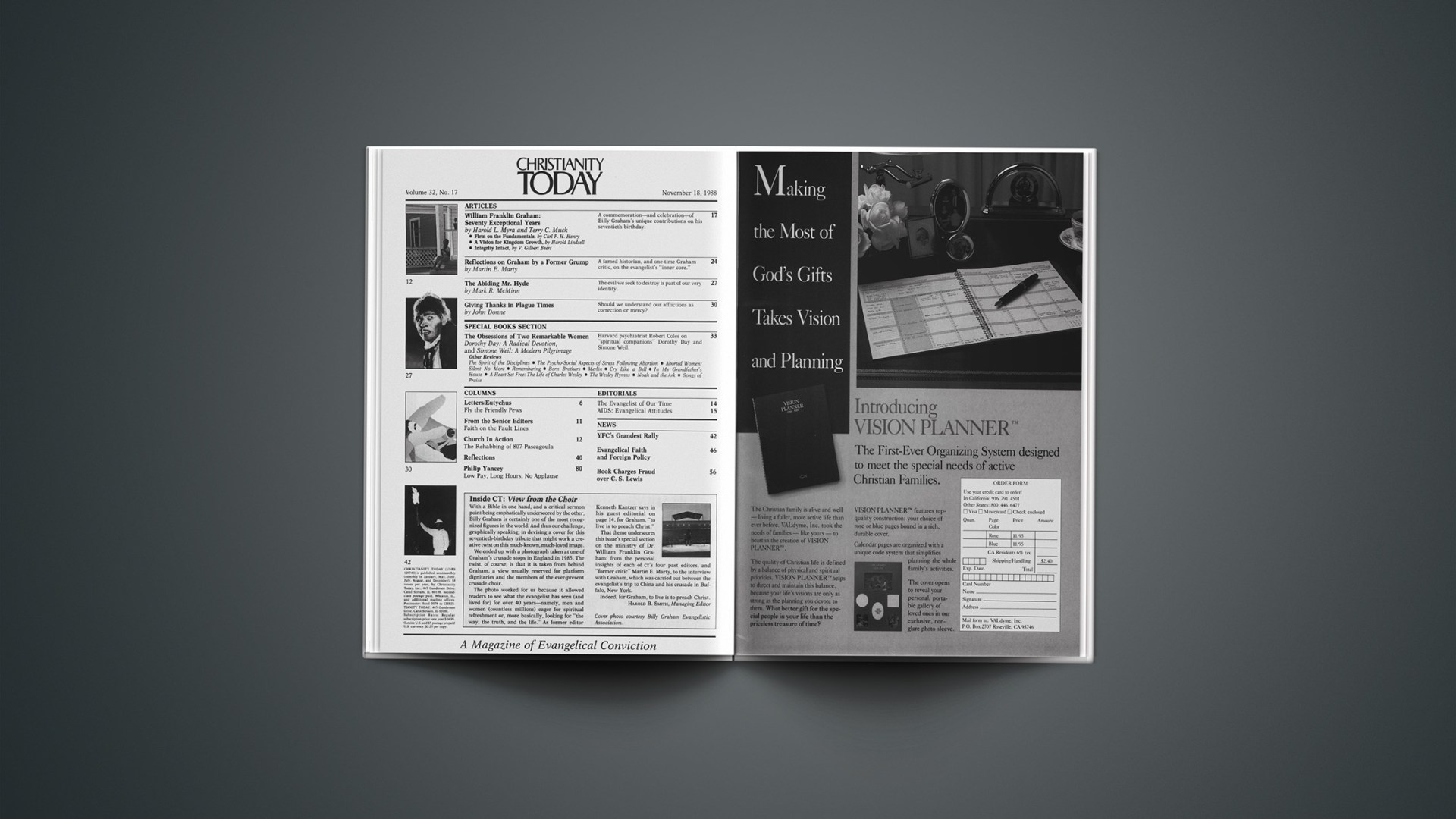
With a Bible in one hand, and a critical sermon point being emphatically underscored by the other, Billy Graham is certainly one of the most recognized figures in the world. And thus our challenge, graphically speaking, in devising a cover for this seventieth-birthday tribute that might work a creative twist on this much-known, much-loved image.

We ended up with a photograph taken at one of Graham’s crusade stops in England in 1985. The twist, of course, is that it is taken from behind Graham, a view usually reserved for platform dignitaries and the members of the ever-present crusade choir.

The photo worked for us because it allowed readers to see what the evangelist has seen (and lived for) for over 40 years—namely, men and women (countless millions) eager for spiritual refreshment or, more basically, looking for “the way, the truth, and the life.” As former editor Kenneth Kantzer says in his guest editorial on page 14, for Graham, “to live is to preach Christ.”

That theme underscores this issue’s special section on the ministry of Dr.

William Franklin Graham: from the personal insights of each of CT’S four past editors, and “former critic” Martin E. Marty, to the interview with Graham, which was carried out between the evangelist’s trip to China and his crusade in Buffalo, New York.

Indeed, for Graham, to live is to preach Christ.

HAROLD B. SMITH, Managing Editor

Cover photo courtesy Billy Graham Evangelistic Association.

Seamless Garment or Straitjacket?

This has been a particularly poor century for being human. Already more than 100 million men, women, and children have suffered violent death as a result of war, genocide, forced collectivization, inhuman prison conditions, and state-induced famine. Millions more have died as a result of “private” actions—decisions to abort unborn children, to withhold treatment from handicapped newborns, to hasten the death of elderly parents.

Traditional restraints on inhumanity seem to be crumbling—in the courts, the laboratory, the operating room, the legislature. The very idea of an essential dignity to human life seems but a quaint anachronism, no match for ideology or convenience or progress.

But when it comes to human life, Christians can’t concede any ground. We are called to take up the cause of the weak, the helpless, the defenseless. It is our duty; that which, in large part, defines us as citizens of the kingdom of God. Christians, in short, must be unequivocally, resolutely, and unapologetically prolife.

Few Christians would have trouble accepting that label. But the real issue is more problematic; how one defines the term makes all the difference in one’s focus and agenda. If, for example, “prolife” means respect for both life and the natural process that creates it, one would naturally oppose contraception. If one defines it to include some minimum level of income, one would be led to support welfare programs for the poor.

What concerns me is that one popular definition of “prolife,” in spite of the best intentions of those who espouse it, is fundamentally flawed, even dangerous.

In a February speech, Joseph Cardinal Bernardin of Chicago attacked those who call themselves prolife because of their stand against abortion, but who don’t support what he calls a “consistent ethic of life.” “We must refute decisively,” he argued, “claims that we are a ‘one issue’ constituency.”

What are the neglected prolife issues according to Bernardin? Racial tension, homelessness, Reagan administration economic policies, and, above all, nuclear deterrence. “We are committed to reversing the arms race and reversing Roe v. Wade.” he concluded.

Bernardin has labeled his argument “the seamless garment”—the idea that to be consistently prolife one must oppose both abortion and nuclear deterrence, euthanasia, and the economic exploitation inherent to industrial capitalism—anything, in short, that its proponents believe threatens human life and dignity.

A growing number of evangelicals, particularly on the “evangelical Left,” echo this approach. After all, on the surface it seems plausible enough, offering a comprehensive alternative to a culture whose respect for life has become alarmingly selective. And it successfully avoids the charge of hypocritical attention to one life issue at the expense of others.

But herein lies the danger: this sweeping definition of the seamless garment leads some, logically indeed, to conclude that deterrence is immoral, and a few even to argue for unilateral nuclear disarmament. Even those who don’t go that far convey the impression, by picking up the rhetoric, that no Christian could support deterrence.

I have always taken the term “prolife” to mean that all human life, unborn or elderly, mentally or physically handicapped, should be given the same high value. But the effect of radical applications of the seamless garment is to push this definition much further. In spite of a range of nuance and sophistication among its advocates, some transform respect for life into veneration of life. Biological life becomes the principal, overriding human value. Anything that threatens it must be resisted. Thus, we have the opposition to taking life in the abortuary or on the battlefield.

The question then naturally arises: What price are we prepared to pay to preserve biological life? If we are willing to protect life at any cost, then the price we pay will be high. If the preservation of life is worth any sacrifice, any concession, any compromise, then the result, in a hostile world, can only be slavery.

Some things, such as justice and freedom, must be more important than life if life is to be worth anything at all. If we lack the moral resolve to die, and even to kill, so as to preserve these principles against those who assault them, then we will end up both betraying our principles and losing our lives.

The painful fact is that Christians are not exempt from agonizing conflicts of conscience. Taking a life or even many lives may be justified to prevent a far greater evil. It is for this very reason, I believe, that one cannot label nuclear deterrence immoral; in a world of brutal ideologies and vicious tyrannies, where justice and liberty are scarce and growing scarcer, the existence of nuclear weapons can be, as has been demonstrated for 40 years, a powerful restraint on an intolerable evil.

C. S. Lewis wrote, “… it is part of our spiritual law never to put survival first: not even the survival of our species. We must resolutely train ourselves to feel that the survival of Man on this Earth, much more of our own nation or culture or class, is not worth having unless it can be had by honorable and merciful means.”

That may sound fatalistic, but Lewis thought it was quite the opposite. “The sacrifice is not so great as it seems. Nothing is more likely to destroy a species or a nation than a determination to survive at all costs. Those who care for something else more than civilization are the only people by whom civilization is at all likely to be preserved.”

In this light, the distinction between respect for life and veneration of life is as wide as the chasm between civilization and barbarism. Paradoxically, venerating life is life negating, not life affirming. It holds every other human value hostage, and then, one by one, executes them.

We are called to be prolife. But when we worship biological life we betray our principles and our lives. The only truly seamless garment, in the end, is a straitjacket.

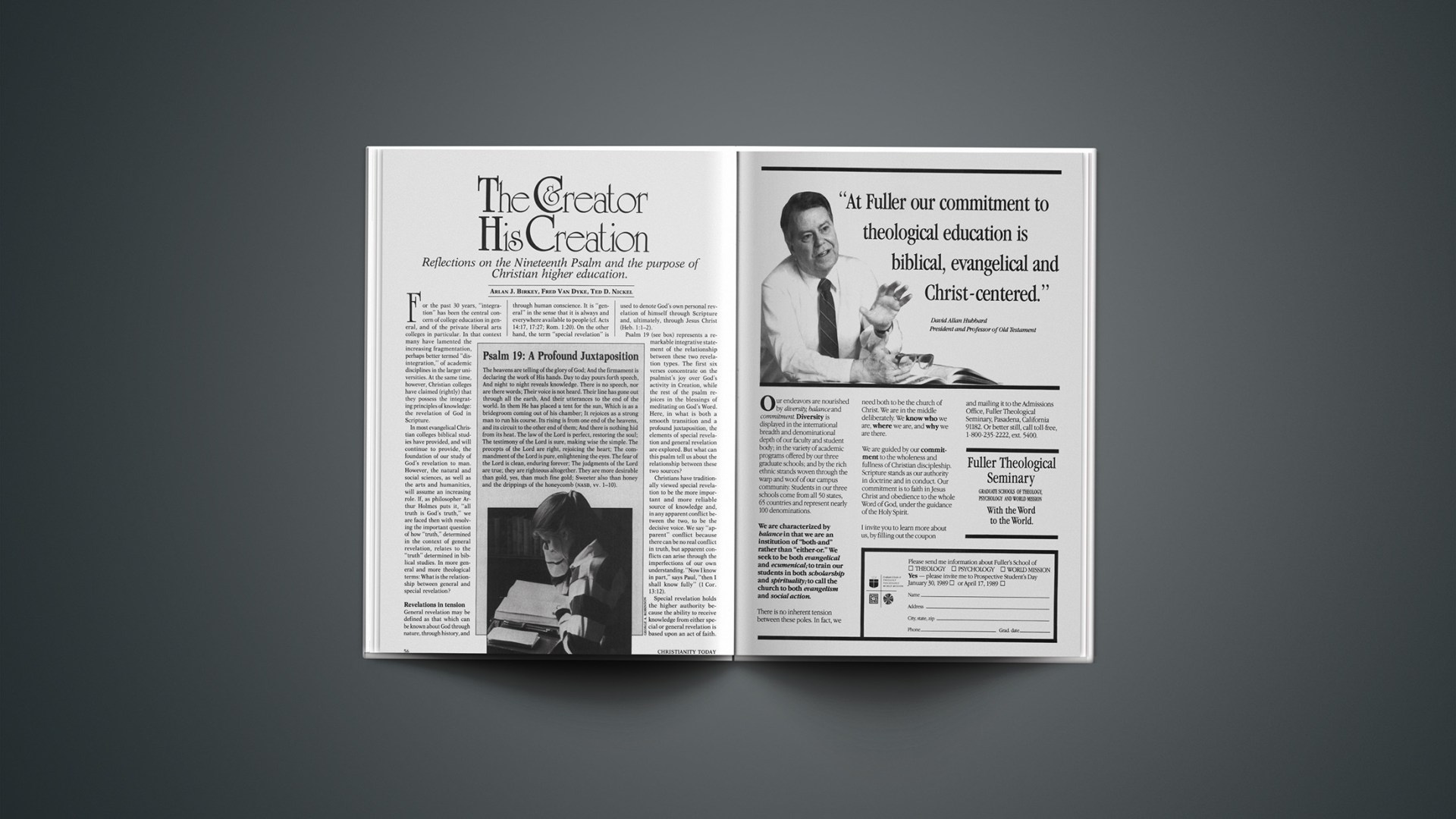
The Creator His Creation

Reflections on the Nineteenth Psalm and the purpose of Christian higher education.

For the past 30 years, “integration” has been the central concern of college education in general, and of the private liberal arts colleges in particular. In that context many have lamented the increasing fragmentation, perhaps better termed “disintegration,” of academic disciplines in the larger universities. At the same time, however, Christian colleges have claimed (rightly) that they possess the integrating principles of knowledge: the revelation of God in Scripture.

In most evangelical Christian colleges biblical studies have provided, and will continue to provide, the foundation of our study of God’s revelation to man. However, the natural and social sciences, as well as the arts and humanities, will assume an increasing role. If, as philosopher Arthur Holmes puts it, “all truth is God’s truth,” we are faced then with resolving the important question of how “truth,” determined in the context of general revelation, relates to the “truth” determined in biblical studies. In more general and more theological terms: What is the relationship between general and special revelation?

Revelations In Tension

General revelation may be defined as that which can be known about God through nature, through history, and through human conscience. It is “general” in the sense that it is always and everywhere available to people (cf. Acts 14:17, 17:27; Rom. 1:20). On the other hand, the term “special revelation” is used to denote God’s own personal revelation of himself through Scripture and, ultimately, through Jesus Christ (Heb. 1:1–2).

Psalm 19: A Profound Juxtaposition

The heavens are telling of the glory of God; And the firmament is declaring the work of His hands. Day to day pours forth speech, And night to night reveals knowledge. There is no speech, nor are there words; Their voice is not heard. Their line has gone out through all the earth, And their utterances to the end of the world. In them He has placed a tent for the sun, Which is as a bridegroom coming out of his chamber; It rejoices as a strong man to run his course. Its rising is from one end of the heavens, and its circuit to the other end of them; And there is nothing hid from its heat. The law of the Lord is perfect, restoring the soul; The testimony of the Lord is sure, making wise the simple. The precepts of the Lord are right, rejoicing the heart; The commandment of the Lord is pure, enlightening the eyes. The fear of the Lord is clean, enduring forever; The judgments of the Lord are true; they are righteous altogether. They are more desirable than gold, yes, than much fine gold; Sweeter also than honey and the drippings of the honeycomb (NASB, vv. 1–10).

Psalm 19 (see box) represents a remarkable integrative statement of the relationship between these two revelation types. The first six verses concentrate on the psalmist’s joy over God’s activity in Creation, while the rest of the psalm rejoices in the blessings of meditating on God’s Word. Here, in what is both a smooth transition and a profound juxtaposition, the elements of special revelation and general revelation are explored. But what can this psalm tell us about the relationship between these two sources?

Christians have traditionally viewed special revelation to be the more important and more reliable source of knowledge and, in any apparent conflict between the two, to be the decisive voice. We say “apparent” conflict because there can be no real conflict in truth, but apparent conflicts can arise through the imperfections of our own understanding. “Now I know in part,” says Paul, “then I shall know fully” (1 Cor. 13:12).

Special revelation holds the higher authority because the ability to receive knowledge from either special or general revelation is based upon an act of faith. However, each act of faith has a different object. In special revelation, the object of faith is God himself. God has declared that not only is his word true, but that his record of that word is also true. In general revelation, the object of our faith is the rationality of our own minds.

This assumption of rationality is supported by Scripture, personal experience, and logic. However, even the most rational mind may draw false conclusions from natural revelation. And although rationality has both its place and its use, it is an inadequate foundation upon which to build an understanding of God. Paul succinctly summarizes where all such theorizing ends up: “The world by its wisdom knew not God” (1 Cor. 1:21).

Apart from man’s own mental limitations, general revelation is itself, even if perfectly observed and interpreted, an inadequate data source for our understanding of God. As Psalm 19 indicates, the “witness” of nature to God is pervasive (“Their line has gone out through all the earth, and their utterances to the end of the world.”), and yet inarticulate (“There is no speech, nor are there words. Their voice is not heard.”). Nature can provide powerful illustrations of that which Scripture teaches as concept; but, by itself, nature can teach nothing precisely.

If you want to understand the concept of “glory,” you must study your Bible; but once you have learned the concept, nature can give you a picture—vivid, splendid, and real—of what “glory” might be like. By itself, however, general revelation does not afford an adequate basis for any religion in general (no religion is based solely on general revelation) or for Christianity in particular, because it can convey neither reliable nor specific information about God.

General revelation may become, then, a kind of idol that can show some characteristics of God, but omits or distorts others, and so, in fact, dishonors God. Nature can teach one about divine wrath, for the universe can be a terrible and savage place, but nature will teach nothing of mercy.

Nature suggests both the omnipotent and the omniscient, for the universe is vast, intricate, and well ordered; yet it knows of no God who would be a friend of man. Fallen nature strikes us at every turn in its rages and takes no notice of us in its raptures. We are humbled by nature in our littleness, but never exalted by it. And yet we long for nature to recognize us.

To the inadequacy of natural revelation, the special scriptural revelation—God himself—speaks. Some evolutionists have asked what the next step in human evolution will be. The Christian, in all honesty, must reply that it has already occurred. It is the regenerate person, the spiritual person, the person in Christ.

The apostle Paul tells us plainly that “all creation waits expectantly (and longs earnestly) for the revealing of the sons of God; … nature itself will be set free from its bondage to decay and corruption into the glorious freedom of the sons of God” (Rom. 8:19–21).

This proposition is as staggering as it is true. So when the psalmist speaks of trees bowing down and mountains leaping and clapping their hands, he is not indulging in primitive, simple-minded musing, but sharing the glorious revelation of an actual future event when nature acknowledges both us and her sovereign. On that day all the streams of truth will run together, and God will be revealed in nature as he is now revealed only in Scripture. For that day we eagerly wait, guided to it by the authority of Scripture, leading us through a fallen universe to a perfect Creator.

From Revelation To Education

With this understanding, the issue of integration comes into focus. Dictionaries of education have columns of definitions for integration; all those dealing with curriculum focus upon the merging of an academic discipline with the wholeness of life. In our view, the spiritual dimension is the most important component of integrated learning. We find Kenneth Gangel’s definition of integration the best: “The learning of all subjects as part of the total truth of God; thereby enabling the student to see the unity of natural and special revelation” (emphasis ours).

Most educators agree that real integration must occur within the student himself. If the student does not internalize the broad generalizations of God’s truth to the world around him, integration has not occurred.

Given this understanding, we think C. S. Lewis is right to point out that the older and better name for integration is virtue, and that the correct aim of education is to make the pupil like and dislike what he ought. Integration merges the world of facts with the world of values. Lack of integration creates the dichotomy of two unreconciled worlds, one of facts and one of values. The former is seen as objective and the latter as subjective, and no reconciliation is possible.

All instructors face two extremes in integration that must be avoided. One is to avoid the whole subject because it is difficult and controversial. The other is to trivialize integration to “preachiness”; to find a Scripture verse for every fact of the physical world, and, in turn, to impose this upon the student. In either case, learning will be superficial and integration will not occur.

However, if students learn the discipline of investigating and thinking through an important issue of today’s world in integrative terms, drawing both from biblical revelation and the general revelation of related academic disciplines, they are more likely to internalize the total truth of God and see the unity of truth to which both general and special revelation testify.

The integration between general and special revelation, then, must take place at four different levels: (1) in individual courses; (2) within the courses offered in a given discipline; (3) in the total college curriculum; and (4) in the total campus experience. Note here an important aspect of the integration achieved in Psalm 19. First the psalmist assumes a posture of praise. There is no hint of any apologetic or defensive stance. He does not attempt to prove the existence of God from nature, but rather assumes God’s existence and rejoices in the power and splendor that God displays in his creation.

Second, the joy of the psalmist in creation is a natural expression of his love for God. It in no way exhibits the characteristics of the forced and mechanical exercises that sometimes pass for integration on Christian college campuses. It is free, joyful, and fervent.

Finally, the psalmist magnifies the glory of God, not the contrivance of human genius. The focus of the psalmist’s attention throughout is the greatness and glory of God himself. This stands in sharp contrast to much writing by Christian intellectuals on “integration” that seems to focus instead on the cleverness of its authors.

The secular educator Theodore Greene wrote in Liberal Education Reconsidered that “the goal of education is to prepare each individual … to live well in his society and in the universe in which he finds himself; that that educational process is best which advances us most efficiently towards this goal, and that that academic community is best which best initiates and sustains this educational process.”

Perhaps, as Christian educators, we can put things more simply: the goal of a truly integrated Christian education is to bring the student to maturity in Christ. C. B. Eavey notes that the seventeenth-century Protestant scholar Comenius saw this task as threefold: (1) man must know all things, including himself; (2) man must master all things, including himself; and finally, (3) man must direct all things, including himself, toward God. It should not surprise us that we find this task so successfully accomplished in the nineteenth psalm.

The issues of integration in Christian education, specifically focused in the relationship between general and special revelation, will continue to be with us for some time. We shall always be constrained (on this side of heaven) by a physical universe that will limit us in space and time, and by our relationships with other persons who share that universe with us. To reach our full potential as human beings we must specifically understand both the nature of the environment itself and the God who created it. We must come to grips with the relationship between general and special revelation, for it is the linchpin of all subsequent efforts at integration.

Christian colleges have historically been leaders in defining and developing curricula that express the nature, content, and purpose of such integration. H. W. Byrne’s five distinctives of Christian philosophy are well remembered here: (1) the coordination of various spheres of life as a whole; (2) the systematic relation of knowledge; (3) the examination of presuppositions, methods, and basic concepts of each discipline and of groups of disciplines; (4) the search for coherence, the formulation of the world view; and (5) the consultation of data from total experience.

Christian institutions of higher learning must continue to take the initiative in these areas, and to offer boldly what their secular counterparts no longer believe possible—an integrative view of truth and life. Perhaps the answers are not so far from us as we might have thought. The simple elegance of genuine integration modeled in Psalm 19 may be the very place to start.

Fred Van Dyke is associate professor of science at Fort Wayne Bible College, Fort Wayne, Indiana, where Arlan J. Birkey is associate professor of Greek and Bible, and Ted D. Nickel is professor emeritus of teacher education. A fuller version will appear in The Best in Theology, volume 3, to be published in Jan. 1989.

Praise the Lord and Pass the Salsa!

ARTBRIEFS

Mainstream and mellifluous, singer Steve Green does little to expand the artistic boundaries of contemporary Christian music. But Green, who grew up in Argentina, the son of missionaries, is working to push back the cultural frontiers of Christian music.

In 1987, Sparrow released Tienen Que Saber (“They Need to Know”), Green’s first Spanish-language album. The record, a mix of Hispanics’ favorite hymns and translations of selected songs from earlier Green albums, was the easy part. Getting it to the potential audience is another matter. No distribution and promotion channels exist in the Hispanic market comparable to the way Christian pop reaches English speaking listeners. “The album has not yet broken through in distribution,” says David Green, Steve’s brother and manager. “The English-language ministry financially supports his ministry to Hispanics.” Lucy Diaz, a product/marketing manager at Sparrow, says any Christian record company that bankrolls Spanish music is clearly doing it for the ministry, not the money.

In late July, Green was a featured soloist at Congresso Hispano, an international gathering of 6,000 Spanish-speaking evangelists. Green also attended this largest-ever gathering of its kind to establish contacts for his coming 1989 Latin American tour.

Does The Choir Wear Leather?

Heavy metal music is everything early critics said of rock n roll: Loud, repetitive music, obsessed with sex, drugs, and the occult. Somehow “Christian heavy metal” still seems like a misnomer, even though bands such as Stryper have established the genre and ministered to leather-clad young people.

With the development of Christian metal (or “white metal”) has come a need for ministry to metal musicians. The Sanctuary, in Redondo Beach, California, is a church devoted not only to reaching and discipling these youth, but also in deepening the spiritual lives and lyrics of white metal bands. According to an article in Media Update, six bands held firmly accountable to the Sanctuary have recently produced an album to benefit the church’s 24-hour counseling hotline.

The Sanctuary is spreading. Franchises are now located in five southern California locations and in Puerto Rico.

More Than Wombscapes

An aquamarine tricycle is parked on the steps of the Supreme Court. Visible in this 14-by-17-inch oil painting is the inscription, “Equal justice under the law.” Unknown Child, by Daniel Michael Canavan, is one of 41 works of art in a juried show called the Life Exhibit.

When we heard about this exhibit, assembled by North Carolina artist Annie Mackey, we expected to see mainly shock art and dreamy wombscapes. But a visit earlier this year to the Paul VI Institute for the Arts in Washington, D.C., yielded a fascinating array of serious art committed to the sacredness of all life—young, old; born, unborn; able-bodied, disabled.

Friends, by Mark Weber, shows an obviously disturbed man with uncombed hair and furrowed brow. On his shoulders rest two strong hands, a symbol of caring for the afflicted.

The Boost, by Lee Richardson, is a 24-inch bronze statue of a kneeling mother holding up her child, who in turn reaches higher. Says the artist: “The essence … of motherhood is that a mother, in trying to help boost her child to reach higher goals, finds that the effort has given a special boost to her own spiritual growth.”

The exhibit winds up its national tour this month, but it is available to groups in either slide or VHS format.

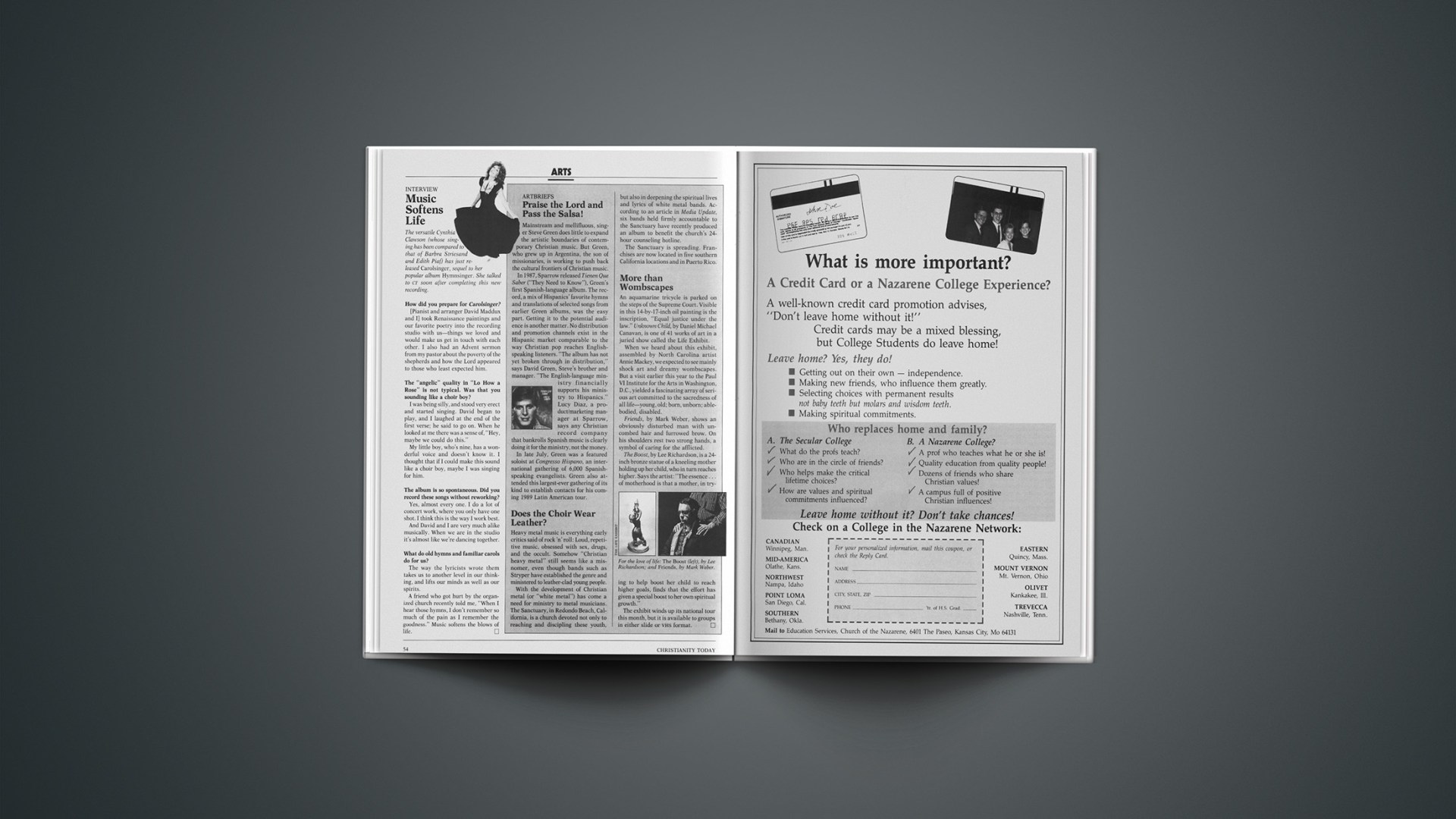
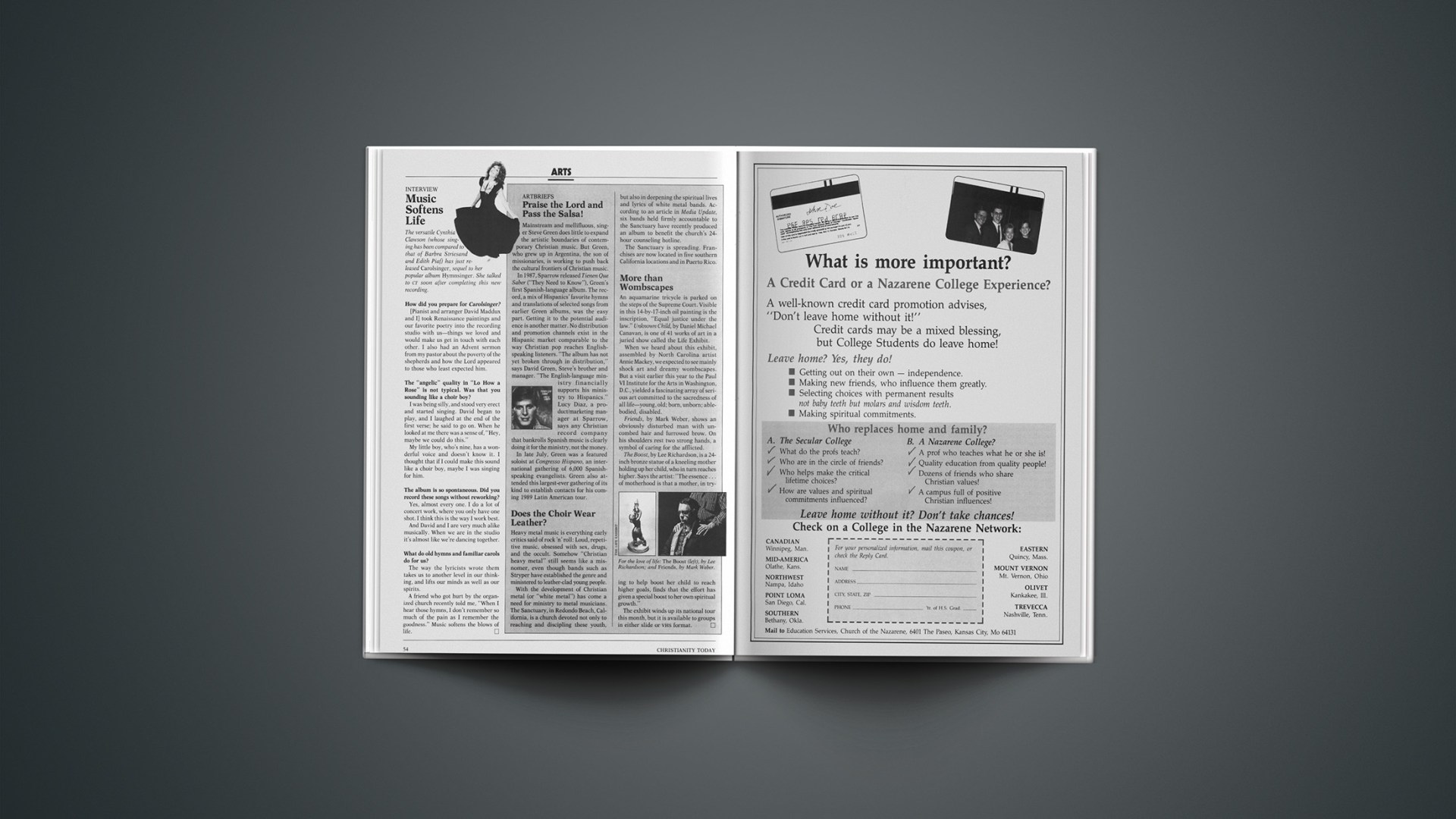
Music Softens Life

INTERVIEW

The versatile Cynthia Clawson (whose singing has been compared to that of Barbra Striesand and Edith Piaf) has just released Carolsinger, sequel to her popular album Hymnsinger. She talked to CT soon after completing this new recording.

How did you prepare for Carolsinger?

[Pianist and arranger David Maddux and I] took Renaissance paintings and our favorite poetry into the recording studio with us—things we loved and would make us get in touch with each other. I also had an Advent sermon from my pastor about the poverty of the shepherds and how the Lord appeared to those who least expected him.

The “angelic” quality in “Lo How a Rose” is not typical. Was that you sounding like a choir boy?

I was being silly, and stood very erect and started singing. David began to play, and I laughed at the end of the first verse; he said to go on. When he looked at me there was a sense of, “Hey, maybe we could do this.”

My little boy, who’s nine, has a wonderful voice and doesn’t know it. I thought that if I could make this sound like a choir boy, maybe I was singing for him.

The album is so spontaneous. Did you record these songs without reworking?

Yes, almost every one. I do a lot of concert work, where you only have one shot. I think this is the way I work best.

And David and I are very much alike musically. When we are in the studio it’s almost like we’re dancing together.

What do old hymns and familiar carols do for us?

The way the lyricists wrote them takes us to another level in our thinking, and lifts our minds as well as our spirits.

A friend who got hurt by the organized church recently told me, “When I hear those hymns, I don’t remember so much of the pain as I remember the goodness.” Music softens the blows of life.

The American Dream: All Tuckered Out?

In the general banality and greed of our culture, both in and out of the church, it is nice to be reminded of what humanity can be, of how fine and wondrous are its hopes and deeds. A happy reminder last summer was Francis Ford Coppola’s roaring tale of automotive nobody Preston Tucker, an innovator whose new kind of car took on Detroit and almost won. (Though the movie has mostly departed first-run theaters, check for availability of the video release sometime in the early months of 1989.)

Tucker is an invigorating film, full of high spirits and hope, an anthem to the enormous creativity, stretch, and drive of the human imagination. The film exudes a robust love of the great American dream that things can and should be better.

In the person of Preston Tucker that passion was both consuming and renewing. While Tucker’s enterprise did not approach “utopia,” his grand passion for dreaming and making says something about what lingers still, however shrunken and distorted, of the image of God. And for that we may be glad and take heart.

In Tucker, Coppola tills the fertile soil of American success mythology, of which his hero is the larger-than-life incarnation for which every American is a sucker. Coppola summons the myth, and a lot of period atmospherics, by mixing the style and perspective of the forties newsreel and “This Is Your Life.” As such, to match and even ennoble the myth, Tucker built his car less for profit than for challenge, fun, helping out—and, probably, to prove something.

Coppola’s Tucker (Jeff Bridges) embodies the brighter side of most every strand of twentieth-century American success ideology: natural ingenuity, democratic opportunity, hard work, home as inspiration, corporation as family, and business as service. And we believe it all as well—or we wish we could. Living in our own jaded time, and seeing what evil befell Tucker, we are not sure whether his protean gullibility makes him a dreamer, saint, fool, or victim—or maybe all four.

Of Machines And Dreams

In Tucker, Coppola seems again to have found a subject that fully warms his skills. His movie is the mostly true account of Preston Tucker, who, as a postwar designer-entrepreneur, set out to supply America with a very different and improved automobile. Possessed of a wild and loving effervescence, an enormous relish for life and challenge, Tucker tinkered with machines and dreamed of how they could help people. In short, his wish was to do Henry Ford all over again—supplying war veterans and factory workers with a car technologically advanced (disc brakes, rear engine, fuel injection), safe (seat belts, pop-out windshields, and shatter-proof glass), and cheap ($1,000). Starting in the garage out back, helped by his buddies and inspired by his family, it looked for a long time as if Tucker really would make it—all the way. That is, until the Big Three also thought he was going to make it, and the monopolistic demons of Washington and Detroit loosed their strength against him.

Whether a hero or the dupe of his own dream, Tucker’s mettle was sorely tested. Audience sympathy increases when they see the Detroit automakers start to play hardball with his upstart venture. They colluded first to inflate the price Tucker had to pay for steel. Then their ire was further roused when he suggested their neglect of seat belts amounted to criminal negligence. Moreover, the car Tucker finally produced was just plain “too good,” threatening to cost the competition millions in redesign. Tucker’s weak spot would come in his seat-of-the-pants financing, helped by friend Karatz (Martin Landau), a down-and-out investment banker. Just when he actually came close to marketing the auto he promised, Tucker was indicted on enough securities fraud to put him in jail for 20 years.

As a movie, Tucker runs like the man Tucker and the car he built: fast, sleek, fresh, and daring. For those who simply like to watch movie magic, Tucker dazzles. In nearly every frame, director Coppola shows ingenuity and mastery. Not since the midseventies (The Godfather saga, The Conversation, Apocalypse Now) has he shown such bravura and control. Tucker may be the flip side of those early dark films, but it is no less serious or taut. Most of all, Tucker works because it is a good story that, in good American fashion, celebrates and inspires hope, integrity, and vision.

The Rock Of Human Malice

In the end, it seems, dreams, grit, and tenacity could only carry so far, and then the dream smashes on the rock, not of technological limitation, but human malice. The dark underside of the rags-to-riches mythology—shrinking opportunity, monopoly, and greed—stands implacable and devouring. Once again, in the refrain of our century, moral progress has not been commensurate with technological advance. In the end, Tucker wins—sort of—a battle, if not the war. He built a better car that no one then would make, though most of his innovations are now standard. He is disappointed, but not discouraged; singing still, ever hopeful; and he dreams of new projects.

In the holy story in which we live, we should do as well.

By Roy M. Anker, currently a research fellow at Calvin College’s Research and Study Center (on leave from Northwestern College, Orange City, Iowa).

Book Briefs: November 4, 1988

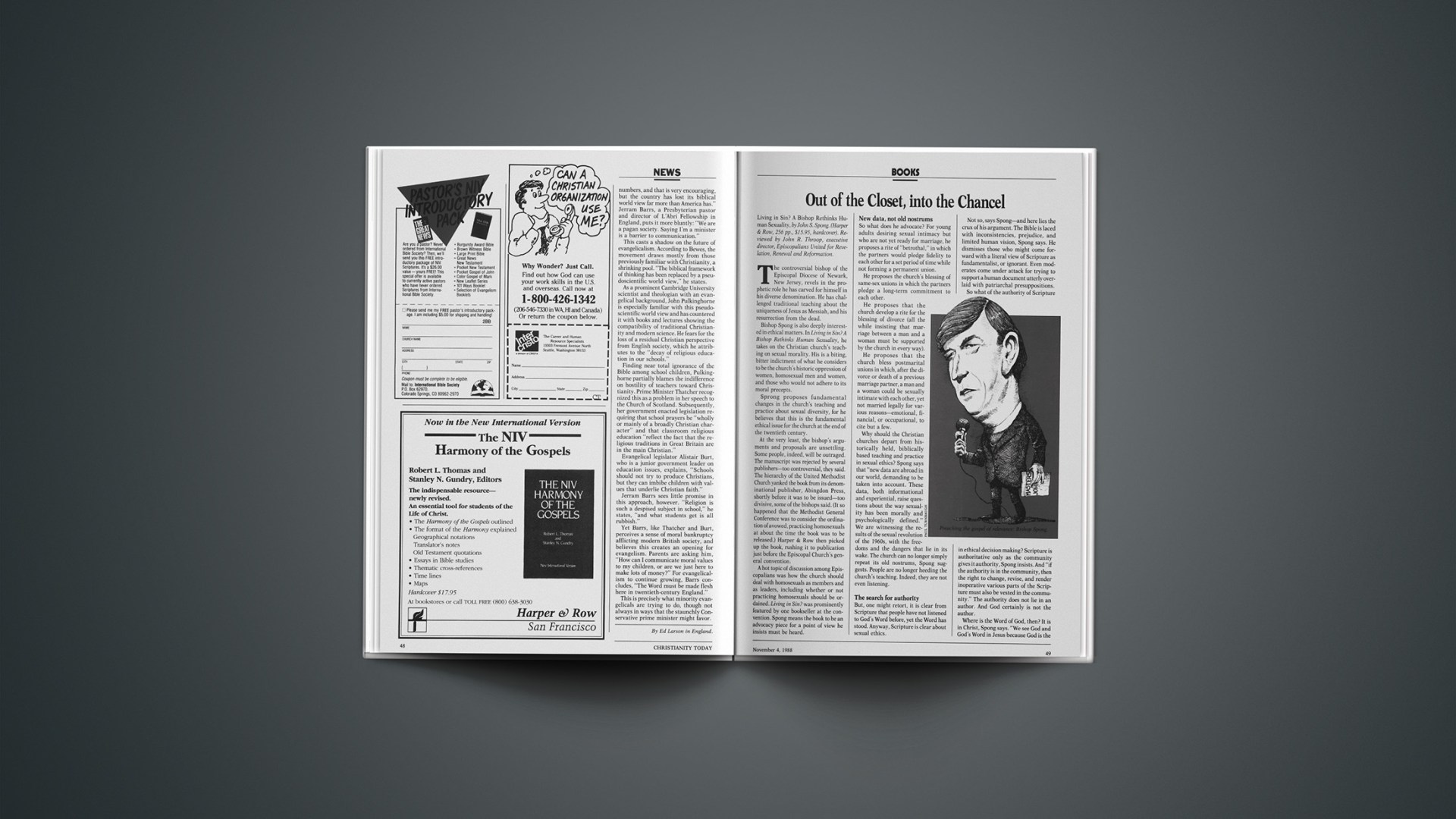
Out Of The Closet, Into The Chancel

Living in Sin? A Bishop Rethinks Human Sexuality, by John S. Spong. (Harper & Row, 256 pp., $15.95, hardcover). Reviewed by John R. Throop, executive director, Episcopalians United for Revelation, Renewal and Reformation.

The controversial bishop of the Episcopal Diocese of Newark, New Jersey, revels in the prophetic role he has carved for himself in his diverse denomination. He has challenged traditional teaching about the uniqueness of Jesus as Messiah, and his resurrection from the dead.

Bishop Spong is also deeply interested in ethical matters. In Living in Sin? A Bishop Rethinks Human Sexuality, he takes on the Christian church’s teaching on sexual morality. His is a biting, bitter indictment of what he considers to be the church’s historic oppression of women, homosexual men and women, and those who would not adhere to its moral precepts.

Sprong proposes fundamental changes in the church’s teaching and practice about sexual diversity, for he believes that this is the fundamental ethical issue for the church at the end of the twentieth century.

At the very least, the bishop’s arguments and proposals are unsettling. Some people, indeed, will be outraged. The manuscript was rejected by several publishers—too controversial, they said. The hierarchy of the United Methodist Church yanked the book from its denominational publisher, Abingdon Press, shortly before it was to be issued—too divisive, some of the bishops said. (It so happened that the Methodist General Conference was to consider the ordination of avowed, practicing homosexuals at about the time the book was to be released.) Harper & Row then picked up the book, rushing it to publication just before the Episcopal Church’s general convention.

A hot topic of discussion among Episcopalians was how the church should deal with homosexuals as members and as leaders, including whether or not practicing homosexuals should be ordained. Living in Sin? was prominently featured by one bookseller at the convention. Spong means the book to be an advocacy piece for a point of view he insists must be heard.

New Data, Not Old Nostrums

So what does he advocate? For young adults desiring sexual intimacy but who are not yet ready for marriage, he proposes a rite of “betrothal,” in which the partners would pledge fidelity to each other for a set period of time while not forming a permanent union.

He proposes the church’s blessing of same-sex unions in which the partners pledge a long-term commitment to each other.

He proposes that the church develop a rite for the blessing of divorce (all the while insisting that marriage between a man and a woman must be supported by the church in every way).

He proposes that the church bless postmarital unions in which, after the divorce or death of a previous marriage partner, a man and a woman could be sexually intimate with each other, yet not married legally for various reasons—emotional, financial, or occupational, to cite but a few.

Why should the Christian churches depart from historically held, biblically based teaching and practice in sexual ethics? Spong says that “new data are abroad in our world, demanding to be taken into account. These data, both informational and experiential, raise questions about the way sexuality has been morally and psychologically defined.” We are witnessing the results of the sexual revolution of the 1960s, with the freedoms and the dangers that lie in its wake. The church can no longer simply repeat its old nostrums, Spong suggests. People are no longer heeding the church’s teaching. Indeed, they are not even listening.

The Search For Authority

But, one might retort, it is clear from Scripture that people have not listened to God’s Word before, yet the Word has stood. Anyway, Scripture is clear about sexual ethics.

Not so, says Spong—and here lies the crux of his argument. The Bible is laced with inconsistencies, prejudice, and limited human vision, Spong says. He dismisses those who might come forward with a literal view of Scripture as fundamentalist, or ignorant. Even moderates come under attack for trying to support a human document utterly overlaid with patriarchal presuppositions.

So what of the authority of Scripture in ethical decision making? Scripture is authoritative only as the community gives it authority, Spong insists. And “if the authority is in the community, then the right to change, revise, and render inoperative various parts of the Scripture must also be vested in the community.” The authority does not lie in an author. And God certainly is not the author.

Where is the Word of God, then? It is in Christ, Spong says. “We see God and God’s Word in Jesus because God is the source of life, and Jesus revealed this God in his very aliveness.” Jesus embraced all sorts and conditions of humanity without judgment and without measure. How do we know Jesus? Not in the confines of the word written, stresses Spong, but in those moments of truth in your life and mine when we escape the narrow, rigid confines of stereotypes and barriers and come to the openness of Christ.

Spong’s ethical source, then, is in the wide brushstrokes of God’s love. He presses for an ethic of “appropriate vulnerability,” in which we are mutually open to one another to give and receive love, to show our inward nakedness and

not be ashamed. Spong says, “Nothing about the argument for vulnerability suggests that marriage is the only context in which sex is deemed appropriate. Premarital or gay and lesbian unions might well fall within the boundaries of appropriate vulnerability. At the same time, sexual activity even inside a marriage might not be ‘an appropriate expression of vulnerability.’ ”

A Deeper Seeing Of Truth

Flannery O’Connor: A Proper Scaring, by Jill P. Baumgaertner (Shaw, 191 pp; $11.95, paper). Reviewed by Harold Fickett, a fellow of the Milton Center at Friends University, Wichita, Kansas, and author of The Holy Fool (Crossway).

Flannery O’Connor, one of the great authors of the twentieth century, is beginning to attract the kind of attention from evangelicals previously reserved for C. S. Lewis. O’Connor wrote an essay in 1955 in which she indicated the relevance of “Christian orthodoxy” to her work. She had a fully supernatural faith, and, as a Roman Catholic, embraced that central core of dogma that Lewis defined as “mere Christianity.” She is one of ours; it is time to claim her. And evidence that evangelicals are doing so comes in the new Wheaton Literary Series volume, Flannery O’Connor: A Proper Scaring, by Jill P. Baumgaertner.

A Proper Scaring is an excellent study of O’Connor’s fiction. It a serves well as a guide to an author whose “work can be extremely puzzling. Baumgaertner understands the faith and mystery at the heart of O’Connor’s fiction, and she demonstrates repeatedly the relevance of Christian orthodoxy to it.

She has a keen eye for meaningful details. And she has done her homework; she is able to marshal the best of O’Connor criticism in support of her arguments.

Puzzling pictures

Baumgaertner’s major thesis is that O’Connor’s fictions work very much like the “emblems” or pictures found in picture books of the seventeenth century, which “literalized a motto, epigram, or scriptural passage to provoke a new response to an old and often too familiar saying.” The puzzling elements in O’Connor’s work are meant to provoke a deeper appreciation, a deeper seeing, of truths to which we have become indifferent and therefore blind. When, for example, O. E. Parker in “Parker’s Back” runs a tractor into a pecan tree, shouting “God Above!” as the machine explodes and he is catapulted into the air, we are meant to see, to re-envision, that any encounter with “the burning tree,” the Cross, has an unsettling effect.

The rewards of reading O’Connor are great and many, but perhaps none is so important as her ability to teach us to see that our contemporary world testifies to the truth of the faith. Her fiction in this respect is much like a parable of Christ: It depicts world problems, so to speak, which ask us to employ our spiritual insight to discern God’s point of view. O’Connor wanted to be a “realist of distances,” meaning that she wanted to depict how first principles, which we often think of as far away, show themselves in the close-ups of daily experience. The pictures that she has left us are so full of light that they can be blinding.

Spong raises questions that are important to consider. In the wake of the sexual revolution, how are we to teach sexual ethics? No church can ignore this question, for any minister can attest to the varieties of pastoral problems that have arisen from sexual license.

The Failure Of Sexual Freedom

The veterans of the sexual revolution are today beginning to settle into marriages and establish families. They remember the promise and know the failure of sexual freedom. They look to the leadership of the church to help them make sense of their jumbled lives, to find healing and holiness.

They will not find Spong helpful. Nor will the church at large, or the secular culture with which he is so eager to make peace. Why not?

First, there is an epistemological problem. Spong seeks to ground his ethics in human experience. He rejects revelation. He wishes to form his God, not conform to God’s self-disclosure in the Word written, or even, as much as he would insist, in the person of Jesus. After all, if the Word written is riddled with gross inconsistencies, where is the truth source? The community? In one’s own fervent personal sentiment? In contemporary experience? What is so surprising in this volume is how unaware and uncritical Spong is of his own inconsistencies, his own bondage to current ideology and intellectual fashion, and how much he trusts science to yield moral guidance.

Second, Spong shows little awareness of the depth of all human sinfulness. The problem, according to Spong, is not sin, but ignorance. What is needed, then, is consciousness raising in our experience, not openness to the living God. What is needed is not repentance, but therapy.

This point of view certainly is nothing new—indeed, it has appeared from time to time in Christian theology, been found wanting, and has been discarded again and again.

Bishop Spong had a great opportunity before him to help the church think and pray (a word that appears rarely in the book) about its sexual ethics. He knows how to use the media. He wants to help the church relate to its cultured despisers. How sad that he so misused this grace-filled trust to write a volume that is so angry, polemical, destructive, and simply untrue to the Bible, church history, and the scientific community.

Bishop Spong invites sexual aberration out of the closet and into the chancel. In the end, we may well have a “relevant” church. Yet we must be mindful of Dean Inge’s insightful warning earlier in this century: “He who marries the spirit of this age will become a widow in the next.”

Paganism Today

The New Paganism, by Harold Lindsell (Harper & Row, 279 pp; $16.95, hardcover), and The Pagan Temptation, by Thomas Molnar (Eerdmans, 201 pp; $11.95, paper). Reviewed by Larry Sibley, who teaches practical theology at Westminster Theological Seminary in Philadelphia.

Twenty years ago it was hard to find a book on the occult in a bookstore. Now whole sections at Waldenbooks or B. Dalton serve up a smorgasbord of esoteric titles—a veritable garbage heap of paganism. How could this happen in Christian America?

The answer, of course, is that America is no longer Christian—if it ever was. The argument of these two books is that the trend that culminated in the mall bookstores of the 1980s began long before the sixties, when most of us began to notice it.

Harold Lindsell’s treatment focuses largely on American culture and gives a text-bookish, sometimes simplistic, introduction to the roots of secular humanism in the old pagan myths and systems of thought and behavior. His definition of paganism is somewhat varied—sometimes meaning anything not Judeo-Christian (Far Eastern cultures, for instance), and sometimes meaning more specifically Greco-Roman polytheism and practices.

He first surveys the biblical documents to establish the doctrinal core that defines Christianity, and follows this with a review of church history up to the Reformation. Lindsell sees the Enlightenment as the turning point that leads directly to the rise of neopaganism and the eclipse of the church’s influence on Western civilization.

He then goes on to cite examples of Enlightenment thinking in the decline of the church, such as liberal theology, negative biblical criticism, evolutionism, and Marxist/liberation theology. The practice of Christians is also affected by paganism. Examples cited focus on sex, drugs, and public education—but mostly sex. Missing, unfortunately, are explorations of pagan influence on the exercise of power and the use of money.

Lindsell’s interest in The New Paganism is to equip the church for survival and even triumph in a world dominated by paganism. His final chapter outlines a strategy for evangelism and education.

There are moments when Lindsell’s documentation leaves something to be desired. However, he has provided the contemporary reader with adequate materials for understanding how we have arrived at our “post-Christian” culture, particularly the fact that the roots of the present dilemma go back before the founding of the country.

Abandoning The Supernatural

Molnar’s treatment shows more carefully drawn distinctions and additional contributing causes to the neopagan revival. The author is a philosopher and thus notices more purely philosophical influences. (Lindsell, a historian by training, sees trends more in terms of events and personalities.)

Molnar states that “pagan speculation … continued throughout the medieval period and … had in fact been incorporated into Christian thought.” He devotes a chapter of The Pagan Temptation to the revival of paganism in the late Middle Ages. Molnar demonstrates that doctrinal developments in the Roman church during this same period, which led to the corrections of the Reformation, were the results of the continuing influence of paganism. The conflict between paganism and Christianity has never let up, he says (and is therefore more complex than Lindsell’s portrayal suggests).

Molnar also digs deeper into the causes of the church’s collapse. He shows how pagan influences during the Middle Ages led Christians to abandon the supernatural and drift into rationalism: The church began to prize thinking more than belief.

But Christians, Molnar argues, must both believe and think. Without the proper balance, God no longer seems present in his world.

Once the church opted for reason without mystery, the corner had been turned. By the early fourteenth century, Christianity was in retreat, unable to survive the shock of the Avignon papacy, the conflict between the popes and Franciscan radicals, the rise of Occamistic philosophy, and secularism.

This loss of God’s presence in the consciousness of Christians opened the church and Western culture to the pagan temptation. Neopaganism offers myths and symbols of the supernatural to fill the spiritual vacuum. Though they are symbols from the supernatural enemy of God, they are potently seductive because of the deadening effect of rationalism among orthodox Christians.

The battle against paganism will not let up until Jesus comes. Even if the bookstore shelves hold more Christian titles in years to come, Satan will not go away, nor will his influences.

These two books, at different yet complementary levels, help sort out how those influences work in the thinking and events of the present age. As such, they are Christ’s tools to help preserve the church against the gates of hell.

England’s Evangelicals

TRENDS

A slumbering church awakes to the challenge of making the gospel relevant to society’s needs.

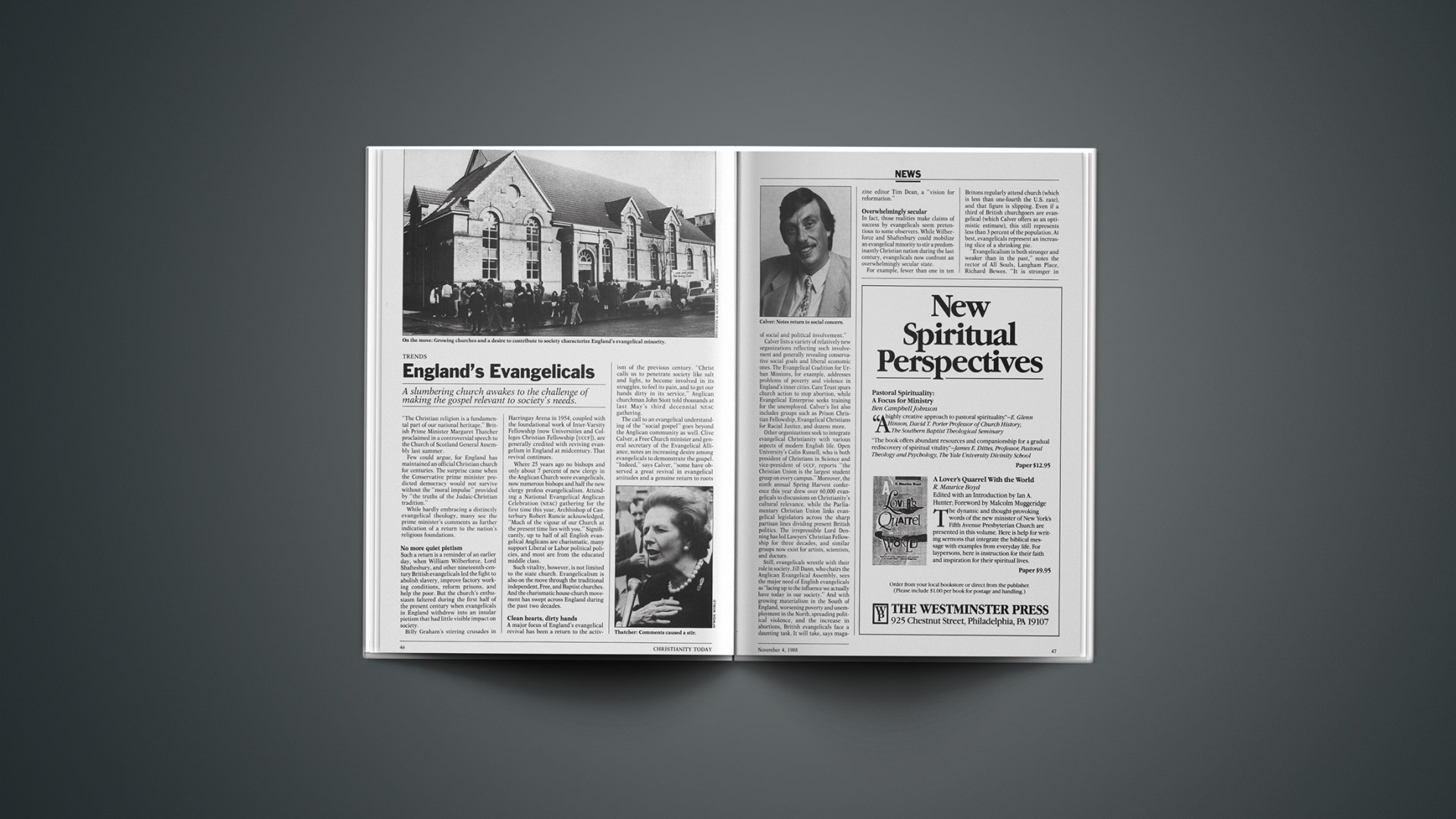
“The Christian religion is a fundamental part of our national heritage,” British Prime Minister Margaret Thatcher proclaimed in a controversial speech to the Church of Scotland General Assembly last summer.

Few could argue, for England has maintained an official Christian church for centuries. The surprise came when the Conservative prime minister predicted democracy would not survive without the “moral impulse” provided by “the truths of the Judaic-Christian tradition.”

While hardly embracing a distinctly evangelical theology, many see the prime minister’s comments as further indication of a return to the nation’s religious foundations.

No More Quiet Pietism

Such a return is a reminder of an earlier day, when William Wilberforce, Lord Shaftesbury, and other nineteenth-century British evangelicals led the fight to abolish slavery, improve factory working conditions, reform prisons, and help the poor. But the church’s enthusiasm faltered during the first half of the present century when evangelicals in England withdrew into an insular pietism that had little visible impact on society.

Billy Graham’s stirring crusades in Harringay Arena in 1954, coupled with the foundational work of Inter-Varsity Fellowship (now Universities and Colleges Christian Fellowship [UCCF]), are generally credited with reviving evangelism in England at midcentury. That revival continues.

Where 25 years ago no bishops and only about 7 percent of new clergy in the Anglican Church were evangelicals, now numerous bishops and half the new clergy profess evangelicalism. Attending a National Evangelical Anglican Celebration (NEAC) gathering for the first time this year, Archbishop of Canterbury Robert Runcie acknowledged, “Much of the vigour of our Church at the present time lies with you.” Significantly, up to half of all English evangelical Anglicans are charismatic, many support Liberal or Labor political policies, and most are from the educated middle class.

Such vitality, however, is not limited to the state church. Evangelicalism is also on the move through the traditional independent, Free, and Baptist churches. And the charismatic house-church movement has swept across England during the past two decades.

Clean Hearts, Dirty Hands

A major focus of England’s evangelical revival has been a return to the activism of the previous century. “Christ calls us to penetrate society like salt and light, to become involved in its struggles, to feel its pain, and to get our hands dirty in its service,” Anglican churchman John Stott told thousands at last May’s third decennial NEAC gathering.

The call to an evangelical understanding of the “social gospel” goes beyond the Anglican community as well. Clive Calver, a Free Church minister and general secretary of the Evangelical Alliance, notes an increasing desire among evangelicals to demonstrate the gospel. “Indeed,” says Calver, “some have observed a great revival in evangelical attitudes and a genuine return to roots of social and political involvement.”

Calver lists a variety of relatively new organizations reflecting such involvement and generally revealing conservative social goals and liberal economic ones. The Evangelical Coalition for Urban Missions, for example, addresses problems of poverty and violence in England’s inner cities. Care Trust spurs church action to stop abortion, while Evangelical Enterprise seeks training for the unemployed. Calver’s list also includes groups such as Prison Christian Fellowship, Evangelical Christians for Racial Justice, and dozens more.

Other organizations seek to integrate evangelical Christianity with various aspects of modern English life. Open University’s Colin Russell, who is both president of Christians in Science and vice-president of UCCF, reports “the Christian Union is the largest student group on every campus.” Moreover, the ninth annual Spring Harvest conference this year drew over 60,000 evangelicals to discussions on Christianity’s cultural relevance, while the Parliamentary Christian Union links evangelical legislators across the sharp partisan lines dividing present British politics. The irrepressible Lord Denning has led Lawyers’ Christian Fellowship for three decades, and similar groups now exist for artists, scientists, and doctors.

Still, evangelicals wrestle with their role in society. Jill Dann, who chairs the Anglican Evangelical Assembly, sees the major need of English evangelicals as “facing up to the influence we actually have today in our society.” And with growing materialism in the South of England, worsening poverty and unemployment in the North, spreading political violence, and the increase in abortions, British evangelicals face a daunting task. It will take, says magazine editor Tim Dean, a “vision for reformation.”

Overwhelmingly Secular

In fact, those realities make claims of success by evangelicals seem pretentious to some observers. While Wilberforce and Shaftesbury could mobilize an evangelical minority to stir a predominantly Christian nation during the last century, evangelicals now confront an overwhelmingly secular state.

For example, fewer than one in ten Britons regularly attend church (which is less than one-fourth the U.S. rate), and that figure is slipping. Even if a third of British churchgoers are evangelical (which Calver offers as an optimistic estimate), this still represents less than 3 percent of the population. At best, evangelicals represent an increasing slice of a shrinking pie.

“Evangelicalism is both stronger and weaker than in the past,” notes the rector of All Souls, Langham Place, Richard Bewes. “It is stronger in numbers, and that is very encouraging, but the country has lost its biblical world view far more than America has.” Jerram Barrs, a Presbyterian pastor and director of L’Abri Fellowship in England, puts it more bluntly: “We are a pagan society. Saying I’m a minister is a barrier to communication.”

This casts a shadow on the future of evangelicalism. According to Bewes, the movement draws mostly from those previously familiar with Christianity, a shrinking pool. “The biblical framework of thinking has been replaced by a pseudoscientific world view,” he states.

As a prominent Cambridge University scientist and theologian with an evangelical background, John Pulkinghorne is especially familiar with this pseudoscientific world view and has countered it with books and lectures showing the compatibility of traditional Christianity and modern science. He fears for the loss of a residual Christian perspective from English society, which he attributes to the “decay of religious education in our schools.”

Finding near total ignorance of the Bible among school children, Pulkinghorne partially blames the indifference on hostility of teachers toward Christianity. Prime Minister Thatcher recognized this as a problem in her speech to the Church of Scotland. Subsequently, her government enacted legislation requiring that school prayers be “wholly or mainly of a broadly Christian character” and that classroom religious education “reflect the fact that the religious traditions in Great Britain are in the main Christian.”

Evangelical legislator Alistair Burt, who is a junior government leader on education issues, explains, “Schools should not try to produce Christians, but they can imbibe children with values that underlie Christian faith.” Jerram Barrs sees little promise in this approach, however. “Religion is such a despised subject in school,” he states, “and what students get is all rubbish.”

Yet Barrs, like Thatcher and Burt, perceives a sense of moral bankruptcy afflicting modern British society, and believes this creates an opening for evangelism. Parents are asking him, “How can I communicate moral values to my children, or are we just here to make lots of money?” For evangelicalism to continue growing, Barrs concludes, “The Word must be made flesh here in twentieth-century England.”

This is precisely what minority evangelicals are trying to do, though not always in ways that the staunchly Conservative prime minister might favor.

By Ed Larson in England.

Abortion, Gay Rights Hit by Loss of Funds

PUBLIC POLICY

The District of Columbia (D.C.) found itself in the middle of two national debates last month as Congress passed a D.C. funding bill with abortion and religious liberty implications. The D.C. Appropriations Bill, signed into law by President Reagan, contains measures to stop government-funded abortions and to exempt religiously affiliated schools from a District law prohibiting discrimination on the basis of “sexual orientation.”

Liberty For Whom?

The religious liberty provision of the bill, sponsored by Sen. William Armstrong (R-Colo.), forbids the District to force religiously affiliated schools to provide funds, facilities, services, or official recognition to homosexual groups. Earlier this year, the D.C. Court of Appeals had ruled that Georgetown University, a Catholic school, had to subsidize and grant “equal provisions” to homosexual groups on the campus in order to comply with the D.C. Human Rights Act (CT, July 15, 1988, p. 72). Now, under this amendment, Armstrong said, “Georgetown, or any other school, will be free to take any position it wishes with respect to homosexual groups.”

A number of national Christian groups supported the amendment, including the Public Affairs Committee of the Southern Baptist Convention, the Presbyterian Lay Committee, the Good News Fellowship, and the Christian College Coalition. At a Washington press conference, Robert Dugan, director of the National Assocation of Evangelicals’ Office of Public Affairs, said the D.C. Court of Appeals ruling against Georgetown had “implications far beyond the District.” Dugan said the issue at stake “is whether religious schools and colleges will be forced to subsidize student groups which promote beliefs and practices antithetical to their religious beliefs.”

No Public Funds For Abortion

The D.C. budget bill also prohibits the District from using either federal or local public funds for abortions, except in situations where the life of the mother is in danger. President Reagan had threatened to veto the bill if it contained provisions for any other abortion funding.

Prolife activists have long criticized the District for the high numbers of abortions performed there—nearly 23,000 annually. District officials said that in 1987, more than 3,500 of those abortions were publicly financed at a cost of more than $ 1.7 million. Currently, 43 states do not allow tax-funded abortions, and under the Hyde Amendment, no federal funds can be used for abortion.

District officials reacted angrily to all these provisions and have threatened legal challenges. Among the most vocal critics has been Walter Fauntroy (D-D.C.), the District’s representative in Congress. Fauntroy, who has no official vote in congressional matters, charged that the bill attacks the District’s ability to govern itself. In 1975, Congress granted D.C. the right to elect a mayor and city council under a “Home Rule” charter, but it retained the authority to “amend or repeal” D.C. laws.

Members of Congress supporting the various provisions denied charges of an attack on D.C.’s home rule. Armstrong said his amendment was “a matter of principle that extends far beyond our nation’s capital, to every city and town, and to every religion, in America.”

Soviet Emigrants: Who Wants Them?

RELIGIOUS LIBERTY

Citizens of the Soviet Union cannot immigrate to the United States unless they have an invitation from a close family member. An expected decision by Soviet officials, however, could change that, and thus clear the path for an increasing influx of Soviet Christians.

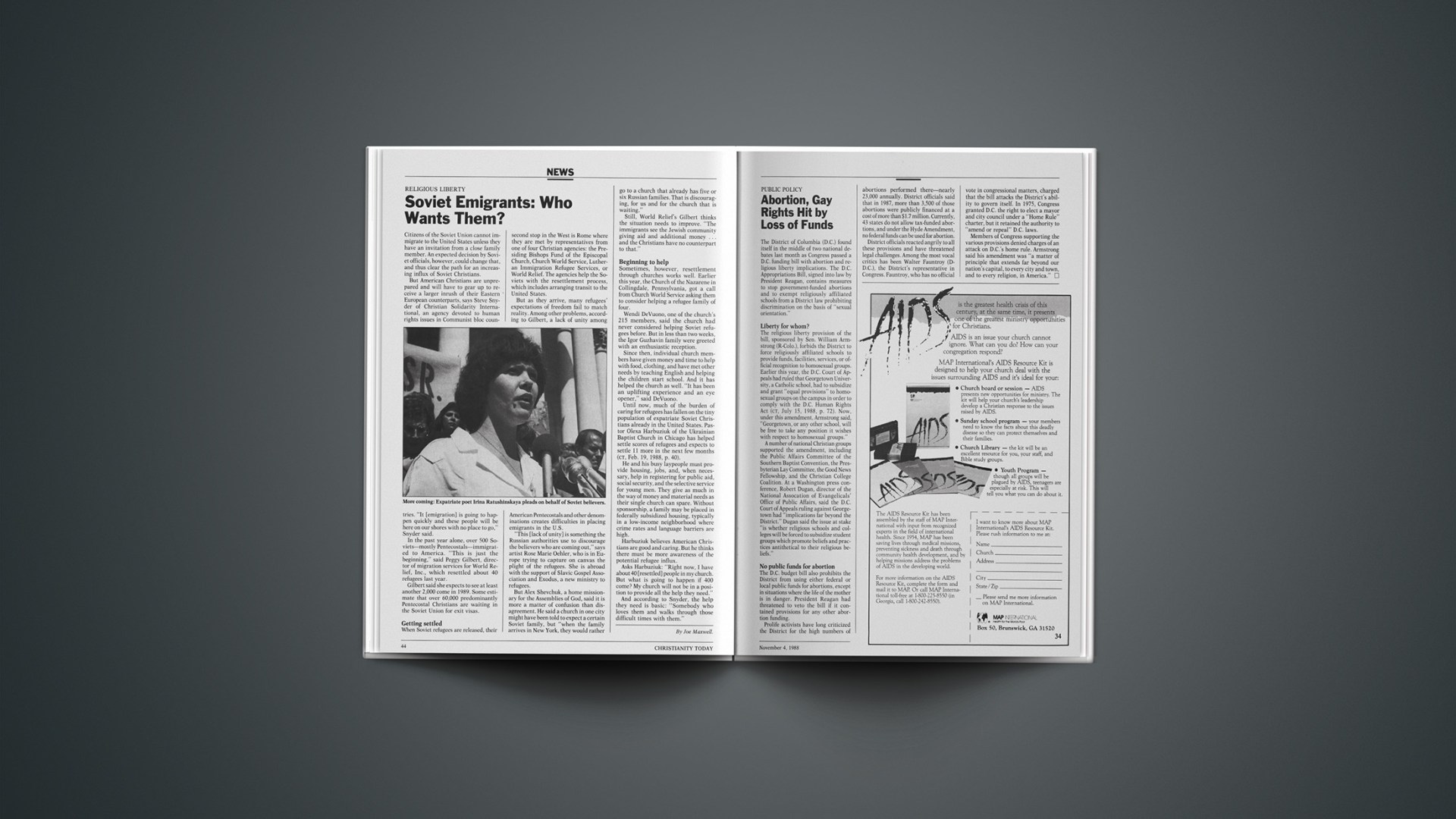
But American Christians are unprepared and will have to gear up to receive a larger inrush of their Eastern European counterparts, says Steve Snyder of Christian Solidarity International, an agency devoted to human rights issues in Communist bloc countries. “It [emigration] is going to happen quickly and these people will be here on our shores with no place to go,” Snyder said.

In the past year alone, over 500 Soviets—mostly Pentecostals—immigrated to America. “This is just the beginning,” said Peggy Gilbert, director of migration services for World Relief, Inc., which resettled about 40 refugees last year.

Gilbert said she expects to see at least another 2,000 come in 1989. Some estimate that over 60,000 predominantly Pentecostal Christians are waiting in the Soviet Union for exit visas.

Getting Settled

When Soviet refugees are released, their second stop in the West is Rome where they are met by representatives from one of four Christian agencies: the Presiding Bishops Fund of the Episcopal Church, Church World Service, Lutheran Immigration Refugee Services, or World Relief. The agencies help the Soviets with the resettlement process, which includes arranging transit to the United States.

But as they arrive, many refugees’ expectations of freedom fail to match reality. Among other problems, according to Gilbert, a lack of unity among American Pentecostals and other denominations creates difficulties in placing emigrants in the U.S.

“This [lack of unity] is something the Russian authorities use to discourage the believers who are coming out,” says artist Rose Marie Oehler, who is in Europe trying to capture on canvas the plight of the refugees. She is abroad with the support of Slavic Gospel Association and Exodus, a new ministry to refugees.

But Alex Shevchuk, a home missionary for the Assemblies of God, said it is more a matter of confusion than disagreement. He said a church in one city might have been told to expect a certain Soviet family, but “when the family arrives in New York, they would rather go to a church that already has five or six Russian families. That is discouraging, for us and for the church that is waiting.”

Still, World Relief’s Gilbert thinks the situation needs to improve. “The immigrants see the Jewish community giving aid and additional money … and the Christians have no counterpart to that.”

Beginning To Help

Sometimes, however, resettlement through churches works well. Earlier this year, the Church of the Nazarene in Collingdale, Pennsylvania, got a call from Church World Service asking them to consider helping a refugee family of four.

Wendi DeVuono, one of the church’s 215 members, said the church had never considered helping Soviet refugees before. But in less than two weeks, the Igor Guzhavin family were greeted with an enthusiastic reception.

Since then, individual church members have given money and time to help with food, clothing, and have met other needs by teaching English and helping the children start school. And it has helped the church as well. “It has been an uplifting experience and an eye opener,” said DeVuono.

Until now, much of the burden of caring for refugees has fallen on the tiny population of expatriate Soviet Christians already in the United States. Pastor Olexa Harbuziuk of the Ukrainian Baptist Church in Chicago has helped settle scores of refugees and expects to settle 11 more in the next few months (CT, Feb. 19, 1988, p. 40).

He and his busy laypeople must provide housing, jobs, and, when necessary, help in registering for public aid, social security, and the selective service for young men. They give as much in the way of money and material needs as their single church can spare. Without sponsorship, a family may be placed in federally subsidized housing, typically in a low-income neighborhood where crime rates and language barriers are high.

Harbuziuk believes American Christians are good and caring. But he thinks there must be more awareness of the potential refugee influx.

Asks Harbuziuk: “Right now, I have about 40 [resettled] people in my church. But what is going to happen if 400 come? My church will not be in a position to provide all the help they need.”

And according to Snyder, the help they need is basic: “Somebody who loves them and walks through those difficult times with them.”

By Joe Maxwell.

Apple PodcastsDown ArrowDown ArrowDown Arrowarrow_left_altLeft ArrowLeft ArrowRight ArrowRight ArrowRight Arrowarrow_up_altUp ArrowUp ArrowAvailable at Amazoncaret-downCloseCloseEmailEmailExpandExpandExternalExternalFacebookfacebook-squareGiftGiftGooglegoogleGoogle KeephamburgerInstagraminstagram-squareLinkLinklinkedin-squareListenListenListenChristianity TodayCT Creative Studio Logologo_orgMegaphoneMenuMenupausePinterestPlayPlayPocketPodcastRSSRSSSaveSaveSaveSearchSearchsearchSpotifyStitcherTelegramTable of ContentsTable of Contentstwitter-squareWhatsAppXYouTubeYouTube