Drunk on Money

“To suppose, as we all suppose, that we could be rich and not behave the way the rich behave, is like saying that we could drink all day and stay sober.” So reads one of the choice epigraphs crowning the chapters of Lewis Lapham’s recent book, Money and Class in America: Notes and Observations on Our Civil Religion.

The quotation is attributed to L. P. Smith, of whose qualifications for social criticism I am ignorant. His common sense is, nevertheless, admirable. And Lap-ham, the editor of Harper’s Magazine, makes a good case for the intoxicating influence of money.

Lapham knows whereof he speaks: In San Francisco he was raised among “people who owned most of what was worth owning in the city”; at Hotchkiss and Yale was “educated among the heirs of certain affluence”; and in his journalistic career in New York, Los Angeles, and Washington, he “met many of the people believed to have won all the bets.”

Sounding like a secular version of the French sociologist-theologian Jacques Ellul, Lapham describes the behavior of the rich as well as their spiritual and social diseases. Where Ellul describes money as a demonic “power,” Lapham calls it a “sacrament” of “our civil religion.” But both would agree, there is something about money that demands—and gets—our worship.

In the service of money, people are reduced. Writing of the rich he has known, Lapham says, “What impressed me was their chronic disappointment and their diminished range of thought and sensibility.” The rich are pampered, and (in all the wrong ways) become as little children, unable to cope with disappointment or delayed gratification. They believe that whatever they want is rightly theirs. (“Motives having to do with money or sex account for 99 percent of the crimes committed in the United States, but those with money as their object outpoint sexual offenses by a ratio of 4 to 1.”) The rich assume that everything and everybody can be valued in shekels, and thus they reduce jobs and workers to the prices they command when bid for in the trading pit.

Perhaps it is the money-induced “illusion of infinite possibility” that accounts for the sexual misadventures of the gilded class. “Among both men and women the incidence of marital infidelity rises in conjunction with an increase in income,” notes Lapham. “Of the married men earning $20,000 a year, only 31 percent conduct extracurricular love affairs; of the men earning more than $60,000, 70 percent.”

With statistics such as those, the moral lapses of nouveau riche televangelists Jimmy Swaggart and Jim Bakker leave us unsurprised.

It seems that, as Lapham and Ellul would suggest, bullion in bulk cannot be made to serve us. We can only serve it. Thus our Lord did not merely moralize about money’s proper use, but uttered a prophetic woe, warning the rich of idol Mammon’s possessive power.

By David Neff.

North American Scene from April 8, 1988

SUPREME COURT

Falwell Loses Hustler Suit

A Hustler magazine parody of Jerry Falwell as an incestuous drunk is not libelous, according to a recent unanimous Supreme Court ruling. The decision overturns a 1984 lower-court ruling that awarded Falwell $200,000 for emotional distress as a result of the parody.

Writing for the Court, Chief Justice William H. Rehnquist said, “In the world of debate about public affairs, many things done with motives that are less than admirable are protected by the First Amendment.” In a statement on the ruling, Falwell disagreed with the Court’s application of the First Amendment, saying, “No sleaze merchant like Larry Flynt [Hustler publisher] should be able to use the First Amendment as an excuse for maliciously and dishonestly attacking public figures as he has so often done.”

SEXUAL POLITICS

Infidelity In High Places

In an otherwise-documented account of religious journalism, author Roy Howard Beck devotes part of his soon-to-be-published book, On Thin Ice: A Religion Reporter’s Memoir, to the kinds of rumors that make church leaders wince.

Beck’s book looks into the personalities and processes at the United Methodist Reporter and National Christian Reporter, as well as the nature of independent religious journalism. But his chapter entitled “Fidelity” relies mostly on unnamed sources and rumor to paint a picture of sexual misconduct—heterosexual and homosexual—among church officials at the Interchurch Center in New York, home of several agencies of mainline denominations.

Responding to charges that he ignored sound journalistic principles in favor of titillating rumor, Beck says he could not quote sources because they would not go public with their charges. “My purpose was not to single out anyone for discipline, but to raise the concern that mainline Protestant churches have the same problems we have seen lately among Pentecostals,” says Beck. He claims to have heard rumors about sexual indiscretions in high church offices for years, adding, “I thought including the chapter was a risk worth taking.”

Advance copies of the book, which will be published by Bristol Books, have already provoked widespread criticism.

GAY RIGHTS

Court Tells Church What To Do

According to the District of Columbia Court of Appeals, a Roman Catholic university must provide support services to a student gay-rights group even though the group’s purpose conflicts with Catholic teaching.

The decision came about after Georgetown University refused officially to recognize and subsidize the Gay Rights Coalition. The university allowed the group to function without recognition or subsidies, however, which is how most of Georgetown’s student groups operate.

The Gay Rights Coalition sued the university, but lost when a trial court ruled that requiring the Roman Catholic school to support the group would violate the U.S. Constitution’s guarantee of freedom of religion. But the D.C. Court of Appeals reversed the decision, holding that the school’s denial of support was based on discriminatory preconceptions about gays. The court admitted such mandated support would interfere with the university’s religious practices, but held that those concerns were outweighed by the government’s interest in eliminating discrimination against homosexuals.

ABORTION

Moving Toward Prolife?

According to a special report issued by the Religious News Service, the 1.6 million-member American Baptist Churches is retreating from its long-time advocacy of abortion rights. This is believed to be a first among mainline Protestant denominations.

Although the denomination’s new position represents a break from its prochoice stance, it does not embrace right-to-life forces. Rather, church leaders describe it as a “middle position” between the two views of abortion. Responding to strong grassroots pressure, a special task force of the denomination prepared the new position, which will be voted on by the church’s policy-making general board in June. Mary Mild, a spokesperson for the task force, said the denomination’s prochoice stance “just didn’t reflect the feelings in the congregations.” Easy approval of the new position is predicted.

RELIGIOUS BROADCASTING

CBN Films A Network Special

A one-hour after-school program produced by the Christian Broadcasting Network (CBN) for a major television network finished among the top-ten-rated shows during the week it was aired earlier this year. The popularity of the show, “Never Say Goodbye,” helped CBS place first among the top three networks in the daytime ratings race for the week of January 17.

The film was cast and produced in Virginia Beach, Virginia, by CBN Cable Productions, a production unit of CBN. It starred Tony Award winning actress June Lockhart, Kim Hauser (“Spenser for Hire” and “The Cosby Show”), and Elinor Donahue, best known for her roles in the long-running “Father Knows Best” series.

CBN’S film department has also produced an after-school special for ABC—“Terrible Things My Mother Told Me.” According to Harry Young, director of program development for CBN, its Virginia Beach location and high quality production facilities are attracting industry film professionals. “CBN is really excited about this new thrust in film production and expects greater things in the future.”

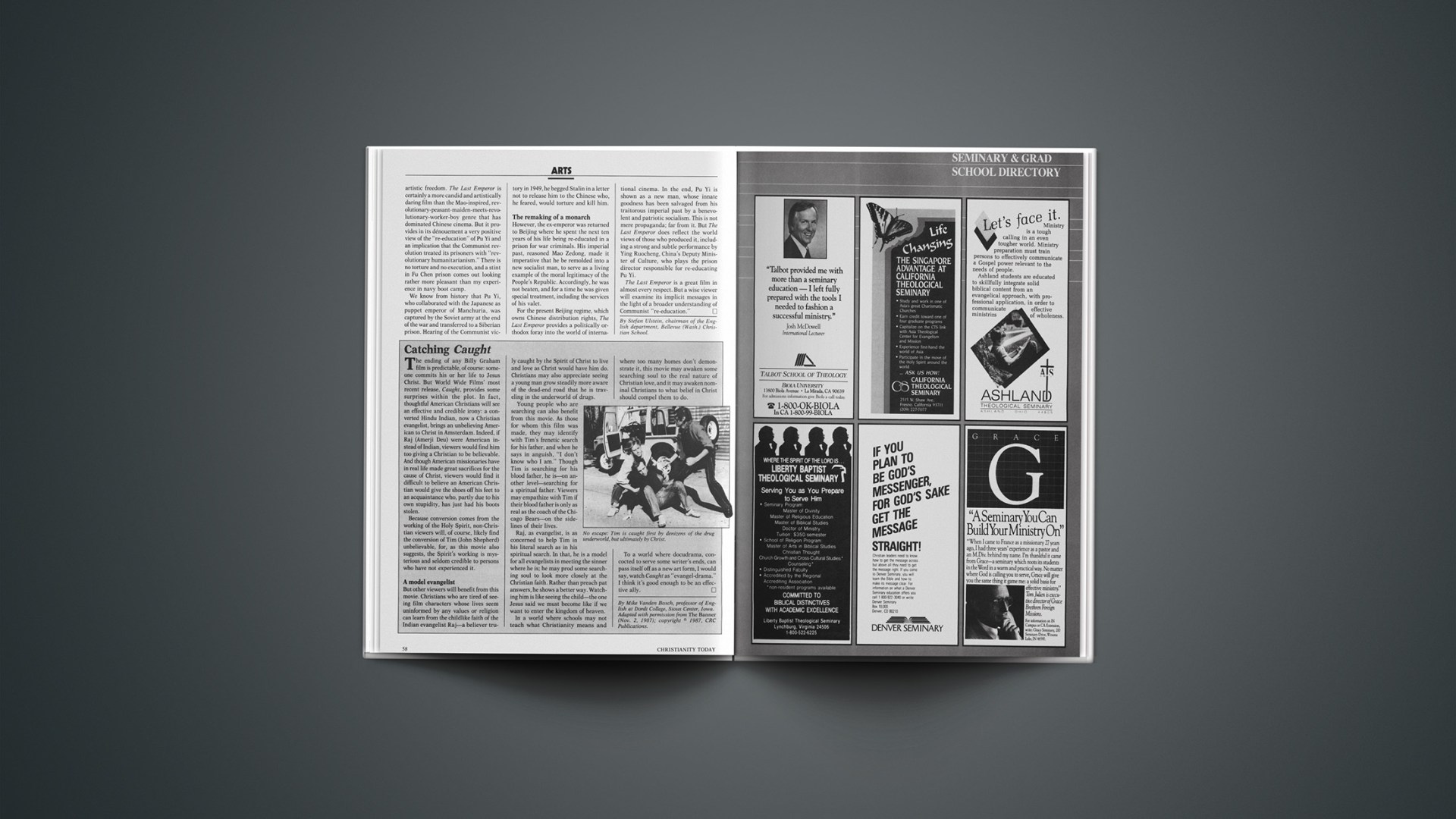
Catching Caught

The ending of any Billy Graham film is predictable, of course: someone commits his or her life to Jesus Christ. But World Wide Films’ most recent release, Caught, provides some surprises within the plot. In fact, thoughtful American Christians will see an effective and credible irony: a converted Hindu Indian, now a Christian evangelist, brings an unbelieving American to Christ in Amsterdam. Indeed, if Raj (Amerji Deu) were American instead of Indian, viewers would find him too giving a Christian to be believable. And though American missionaries have in real life made great sacrifices for the cause of Christ, viewers would find it difficult to believe an American Christian would give the shoes off his feet to an acquaintance who, partly due to his own stupidity, has just had his boots stolen.

Because conversion comes from the working of the Holy Spirit, non-Christian viewers will, of course, likely find the conversion of Tim (John Shepherd) unbelievable, for, as this movie also suggests, the Spirit’s working is mysterious and seldom credible to persons who have not experienced it.

A Model Evangelist

But other viewers will benefit from this movie. Christians who are tired of seeing film characters whose lives seem uninformed by any values or religion can learn from the childlike faith of the Indian evangelist Raj—a believer truly caught by the Spirit of Christ to live and love as Christ would have him do. Christians may also appreciate seeing a young man grow steadily more aware of the dead-end road that he is traveling in the underworld of drugs.

Young people who are searching can also benefit from this movie. As those for whom this film was made, they may identify with Tim’s frenetic search for his father, and when he says in anguish, “I don’t know who I am.” Though Tim is searching for his blood father, he is—on another level—searching for a spiritual father. Viewers may empathize with Tim if their blood father is only as real as the coach of the Chicago Bears—on the sidelines of their lives.

Raj, as evangelist, is as concerned to help Tim in his literal search as in his spiritual search. In that, he is a model for all evangelists in meeting the sinner where he is; he may prod some searching soul to look more closely at the Christian faith. Rather than preach pat answers, he shows a better way. Watching him is like seeing the child—the one Jesus said we must become like if we want to enter the kingdom of heaven.

In a world where schools may not teach what Christianity means andwhere too many homes don’t demonstrate it, this movie may awaken some searching soul to the real nature of Christian love, and it may awaken nominal Christians to what belief in Christ should compel them to do.

To a world where docudrama, concocted to serve some writer’s ends, can pass itself off as a new art form, I would say, watch Caught as “evangel-drama.” I think it’s good enough to be an effective ally.

By Mike Vanden Bosch, professor of English at Dordt College, Sioux Center, Iowa. Adapted with permission from The Banner (Nov. 2, 1987); copyright ® 1987, CRC Publications.

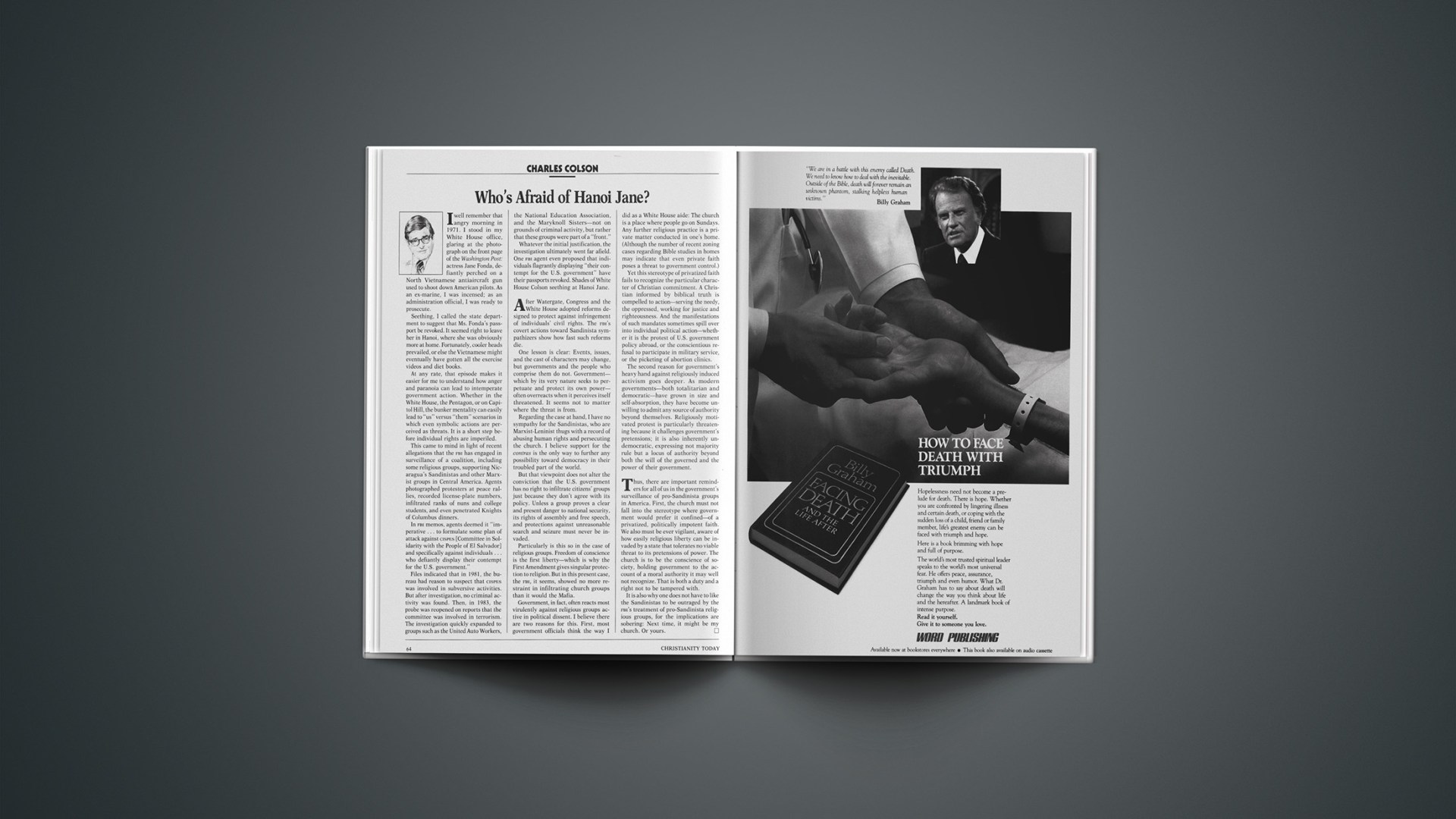
Who’s Afraid of Hanoi Jane?

I well remember that angry morning in 1971. I stood in my White House office, glaring at the photograph on the front page of the Washington Post: actress Jane Fonda, defiantly perched on a North Vietnamese antiaircraft gun used to shoot down American pilots. As an ex-marine, I was incensed; as an administration official, I was ready to prosecute.

Seething, I called the state department to suggest that Ms. Fonda’s passport be revoked. It seemed right to leave her in Hanoi, where she was obviously more at home. Fortunately, cooler heads prevailed, or else the Vietnamese might eventually have gotten all the exercise videos and diet books.

At any rate, that episode makes it easier for me to understand how anger and paranoia can lead to intemperate government action. Whether in the White House, the Pentagon, or on Capitol Hill, the bunker mentality can easily lead to “us” versus “them” scenarios in which even symbolic actions are perceived as threats. It is a short step before individual rights are imperiled.

This came to mind in light of recent allegations that the FBI has engaged in surveillance of a coalition, including some religious groups, supporting Nicaragua’s Sandinistas and other Marxist groups in Central America. Agents photographed protesters at peace rallies, recorded license-plate numbers, infiltrated ranks of nuns and college students, and even penetrated Knights of Columbus dinners.

In FBI memos, agents deemed it “imperative … to formulate some plan of attack against CISPES [Committee in Solidarity with the People of El Salvador] and specifically against individuals … who defiantly display their contempt for the U.S. government.”

Files indicated that in 1981, the bureau had reason to suspect that CISPES was involved in subversive activities. But after investigation, no criminal activity was found. Then, in 1983, the probe was reopened on reports that the committee was involved in terrorism. The investigation quickly expanded to groups such as the United Auto Workers, the National Education Association, and the Maryknoll Sisters—not on grounds of criminal activity, but rather that these groups were part of a “front.”

Whatever the initial justification, the investigation ultimately went far afield. One FBI agent even proposed that individuals flagrantly displaying “their contempt for the U.S. government” have their passports revoked. Shades of White House Colson seething at Hanoi Jane.

After Watergate, Congress and the White House adopted reforms designed to protect against infringement of individuals’ civil rights. The FBI’S covert actions toward Sandinista sympathizers show how fast such reforms die.

One lesson is clear: Events, issues, and the cast of characters may change, but governments and the people who comprise them do not. Government—which by its very nature seeks to perpetuate and protect its own power—often overreacts when it perceives itself threatened. It seems not to matter where the threat is from.

Regarding the case at hand, I have no sympathy for the Sandinistas, who are Marxist-Leninist thugs with a record of abusing human rights and persecuting the church. I believe support for the contras is the only way to further any possibility toward democracy in their troubled part of the world.

But that viewpoint does not alter the conviction that the U.S. government has no right to infiltrate citizens’ groups just because they don’t agree with its policy. Unless a group proves a clear and present danger to national security, its rights of assembly and free speech, and protections against unreasonable search and seizure must never be invaded.

Particularly is this so in the case of religious groups. Freedom of conscience is the first liberty—which is why the First Amendment gives singular protection to religion. But in this present case, the FBI, it seems, showed no more restraint in infiltrating church groups than it would the Mafia.

Government, in fact, often reacts most virulently against religious groups active in political dissent. I believe there are two reasons for this. First, most government officials think the way I did as a White House aide: The church is a place where people go on Sundays. Any further religious practice is a private matter conducted in one’s home. (Although the number of recent zoning cases regarding Bible studies in homes may indicate that even private faith poses a threat to government control.)

Yet this stereotype of privatized faith fails to recognize the particular character of Christian commitment. A Christian informed by biblical truth is compelled to action—serving the needy, the oppressed, working for justice and righteousness. And the manifestations of such mandates sometimes spill over into individual political action—whether it is the protest of U.S. government policy abroad, or the conscientious refusal to participate in military service, or the picketing of abortion clinics.

The second reason for government’s heavy hand against religiously induced activism goes deeper. As modern governments—both totalitarian and democratic—have grown in size and self-absorption, they have become unwilling to admit any source of authority beyond themselves. Religiously motivated protest is particularly threatening because it challenges government’s pretensions; it is also inherently undemocratic, expressing not majority rule but a locus of authority beyond both the will of the governed and the power of their government.

Thus, there are important reminders for all of us in the government’s surveillance of pro-Sandinista groups in America. First, the church must not fall into the stereotype where government would prefer it confined—of a privatized, politically impotent faith. We also must be ever vigilant, aware of how easily religious liberty can be invaded by a state that tolerates no viable threat to its pretensions of power. The church is to be the conscience of society, holding government to the account of a moral authority it may well not recognize. That is both a duty and a right not to be tampered with.

It is also why one does not have to like the Sandinistas to be outraged by the FBI’S treatment of pro-Sandinista religious groups, for the implications are sobering: Next time, it might be my church. Or yours.

Last Emperor, Lost Emperor

I recently took 130 eleventh-and twelfth-grade students to see Bernardo Bertolucci’s Italian/Chinese epic, The Last Emperor. I got the idea from my mother-in-law who told me after she saw the film, “You know, I learned a lot from that film. I guess we didn’t study much about China and Japan when we were in school.”

We still don’t study much about China or Japan in school; in fact, we don’t study much about Africa or South America, either. But movies can help fill that knowledge void, especially serious movies that don’t suffer from excessively revisionist screenwriting. And Bertolucci’s The Last Emperor is such a movie.

In the opening scenes, three-year-old Pu Yi is taken from his parents and whisked off to the Forbidden City. There he is crowned Emperor of Ten Thousand Years, the rulerof half the world’s people. But his reign is short-lived. First the leaders of the infant Chinese republic, then war lords, Nationalists, Japanese, and finally the Chinese Communists rule China.

What Is China Really Like?

To call this movie an ambitious project is like calling the Hindenburg a real big balloon. The multi-million dollar epic was filmed in English by an Italian crew in China. Thousands of Chinese extras, dressed in authentic costumes, were assembled in the Forbidden City, the centuries-old palace of Chinese emperors. The visual spectacle alone makes it one of the most compelling films of the year.

But what makes The Last Emperor so spellbinding is the glimpse it gives us into China, a country that has historically been closed to outsiders. The decadence of the Quing dynasty, the corruption of the palace eunuchs and courtiers, and the chaos of the warlord years come together in a comprehensible time line that runs through the Japanese occupation, the Communist victory, and the cultural revolution, and ends with the reopening of China to the West. Indeed, few movies capture the sweep of history as fully as does The Last Emperor.

But one caveat is in order. All films reflect a political and spiritual perspective, and that perspective bends the reality of events to fit the world view of the filmmaker. Bertolucci has praised the Chinese government—which cooperated fully in the production—for giving script approval while correcting only a few historical inaccuracies. They closed the Forbidden City to tourists while the film crew shot key scenes. Soldiers from the Red Army shaved their heads and wore Manchu queues, and teenagers portrayed the sloganeering Red Guards of the cultural revolution. Such artistic collaboration with a Western director is unprecedented in modern Chinese history.

The impression is that the Chinese have abandoned censorship in favor of artistic freedom. The Last Emperor is certainly a more candid and artistically daring film than the Mao-inspired, revolutionary-peasant-maiden-meets-revolutionary-worker-boy genre that has dominated Chinese cinema. But it provides in its denouement a very positive view of the “re-education” of Pu Yi and an implication that the Communist revolution treated its prisoners with “revolutionary humanitarianism.” There is no torture and no execution, and a stint in Fu Chen prison comes out looking rather more pleasant than my experience in navy boot camp.

We know from history that Pu Yi, who collaborated with the Japanese as puppet emperor of Manchuria, was captured by the Soviet army at the end of the war and transferred to a Siberian prison. Hearing of the Communist victory in 1949, he begged Stalin in a letter not to release him to the Chinese who, he feared, would torture and kill him.

The Remaking Of A Monarch

However, the ex-emperor was returned to Beijing where he spent the next ten years of his life being re-educated in a prison for war criminals. His imperial past, reasoned Mao Zedong, made it imperative that he be remolded into a new socialist man, to serve as a living example of the moral legitimacy of the People’s Republic. Accordingly, he was not beaten, and for a time he was given special treatment, including the services of his valet.

For the present Beijing regime, which owns Chinese distribution rights. The Last Emperor provides a politically or thodox foray into the world of international cinema. In the end. Pu Yi is shown as a new man, whose innate goodness has been salvaged from his traitorous imperial past by a benevolent and patriotic socialism. This is not mere propaganda; far from it. But The Last Emperor does reflect the world views of those who produced it, including a strong and subtle performance by Ying Ruocheng, China’s Deputy Minister of Culture, who plays the prison director responsible for re-educating Pu Yi.

The Last Emperor is a great Him in almost every respect. But a wise viewer will examine its implicit messages in the light of a broader understanding of Communist “re-education.”

By Stefan Ulstein, chairman of the English department, Bellevue (Wash.) Christian School.

Mission Groups Share Data

Leaders of 29 denominations and Christian organizations met recently in Dallas to begin sharing information they possess about the 1.3 billion people around the world who have not heard the gospel sufficiently to accept or reject it. The missions leaders also grappled with the fact that the majority of their missionaries cannot go where most of the unevangelized live.

“This is a historic moment in cooperation in evangelical research,” said Samuel Wilson, senior research associate for the Lausanne Committee for World Evangelization. In the past, missions agencies sometimes concealed plans from one another, competing to be the first to launch work in countries or regions, said Wilson, who also directs research at the Zwemer Institute of Muslim Studies in Pasadena, California. “Now there is a totally different kind of spirit, a healthy spirit that says, ‘We will share information and we will cooperate with one another.’ ”

The meeting was a follow-up to one in September initiated by R. Keith Parks, Southern Baptist Foreign Mission Board president (ct, Nov. 6, 1987, p. 52).

As a result of the meeting, missions-oriented groups will now have access to the SBC Foreign Mission Board data base listing the world’s ethnic-linguistic cultures, or “people groups,” and the extent to which they have been evangelized. This data base is the result of several years of work by missions researcher David Barrett and various SBC Foreign Mission Board staff.

By Art Toalston in Dallas.

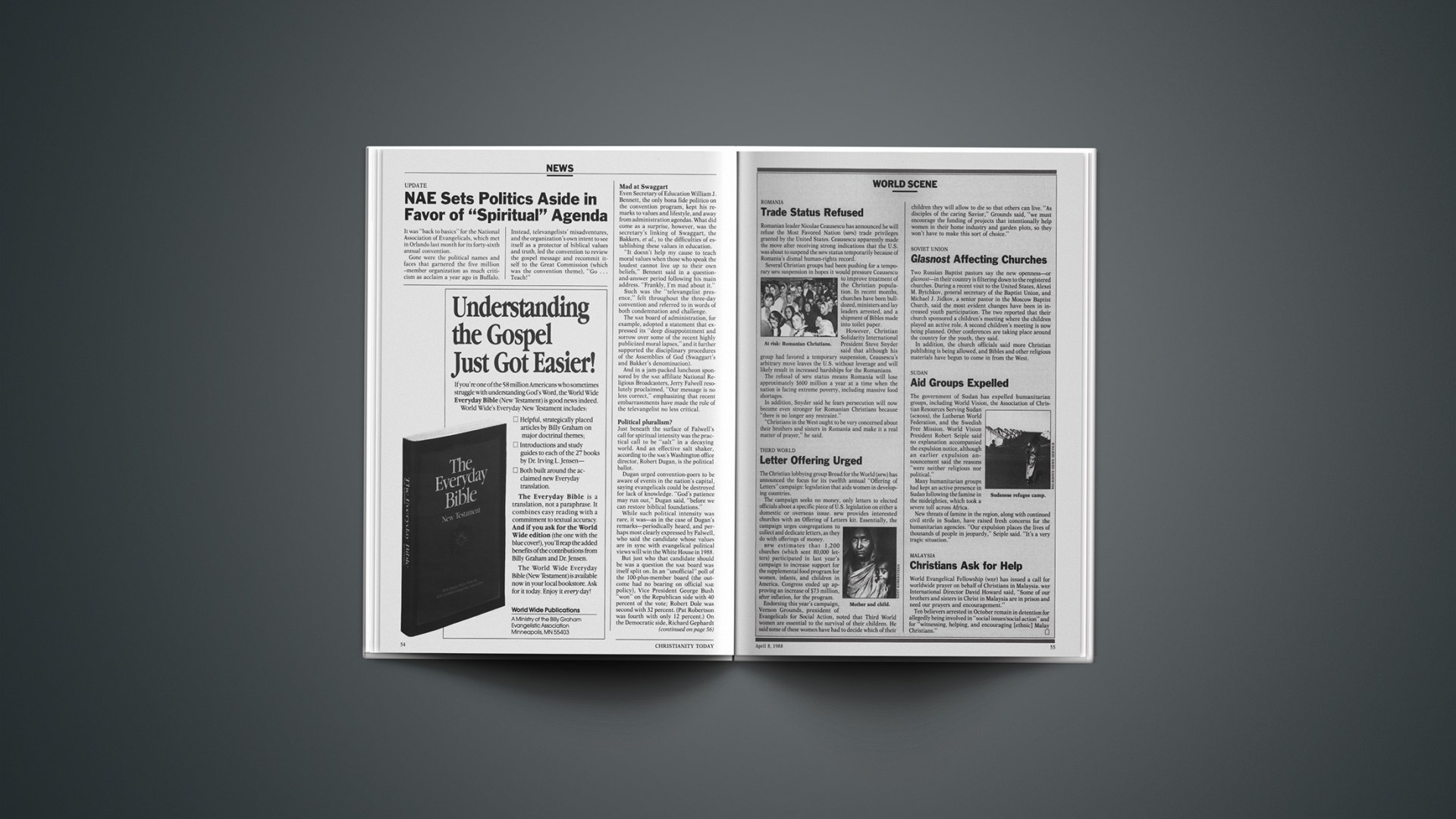
NAE Sets Politics Aside in Favor of “Spiritual” Agenda

It was “back to basics” for the National Association of Evangelicals, which met in Orlando last month for its forty-sixth annual convention.

Gone were the political names and faces that garnered the five million-member organization as much criticism as acclaim a year ago in Buffalo. Instead, televangelists’ misadventures, and the organization’s own intent to see itself as a protector of biblical values and truth, led the convention to review the gospel message and recommit itself to the Great Commission (which was the convention theme), “Go … Teach!”

Mad At Swaggart

Even Secretary of Education William J. Bennett, the only bona fide politico on the convention program, kept his remarks to values and lifestyle, and away from administration agendas. What did come as a surprise, however, was the secretary’s linking of Swaggart, the Bakkers, et al., to the difficulties of establishing these values in education.

“It doesn’t help my cause to teach moral values when those who speak the loudest cannot live up to their own beliefs,” Bennett said in a question-and-answer period following his main address. “Frankly, I’m mad about it.”

Such was the “televangelist presence,” felt throughout the three-day convention and referred to in words of both condemnation and challenge.

The NAE board of administration, for example, adopted a statement that expressed its “deep disappointment and sorrow over some of the recent highly publicized moral lapses,” and it further supported the disciplinary procedures of the Assemblies of God (Swaggart’s and Bakker’s denomination).

And in a jam-packed luncheon sponsored by the NAE affiliate National Religious Broadcasters, Jerry Falwell resolutely proclaimed, “Our message is no less correct,” emphasizing that recent embarrassments have made the role of the televangelist no less critical.

Political Pluralism?

Just beneath the surface of Falwell’s call for spiritual intensity was the practical call to be “salt” in a decaying world. And an effective salt shaker, according to the NAE’S Washington office director, Robert Dugan, is the political ballot.

Dugan urged convention-goers to be aware of events in the nation’s capital, saying evangelicals could be destroyed for lack of knowledge. “God’s patience may run out,” Dugan said, “before we can restore biblical foundations.”

While such political intensity was rare, it was—as in the case of Dugan’s remarks—periodically heard, and perhaps most clearly expressed by Falwell, who said the candidate whose values are in sync with evangelical political views will win the White House in 1988.

But just who that candidate should be was a question the NAE board was itself split on. In an “unofficial” poll of the 100-plus-member board (the outcome had no bearing on official NAE policy), Vice President George Bush “won” on the Republican side with 40 percent of the vote; Robert Dole was second with 32 percent. (Pat Robertson was fourth with only 12 percent.) On the Democratic side, Richard Gephardt polled 37 percent of the board vote, while Tennessee Senator Albert Gore was second with 33 percent. Democratic front-runner Michael Dukakis was third with 16 percent of the vote.

Thus the so-called evangelical voting bloc—while definitely Republican in bias—appeared to be anything but a consensus, and thus NAE’S persistence over the years in defining the role of evangelicals in more than political terms. And thus this year’s convention emphasis on evangelism, discipleship, compassion, and love.

“Forgive us,” Falwell said, referring to the past year’s media-personality immoralities. “We need to be more abandoned to his perfect will.”

By Harold Smith in Orlando.

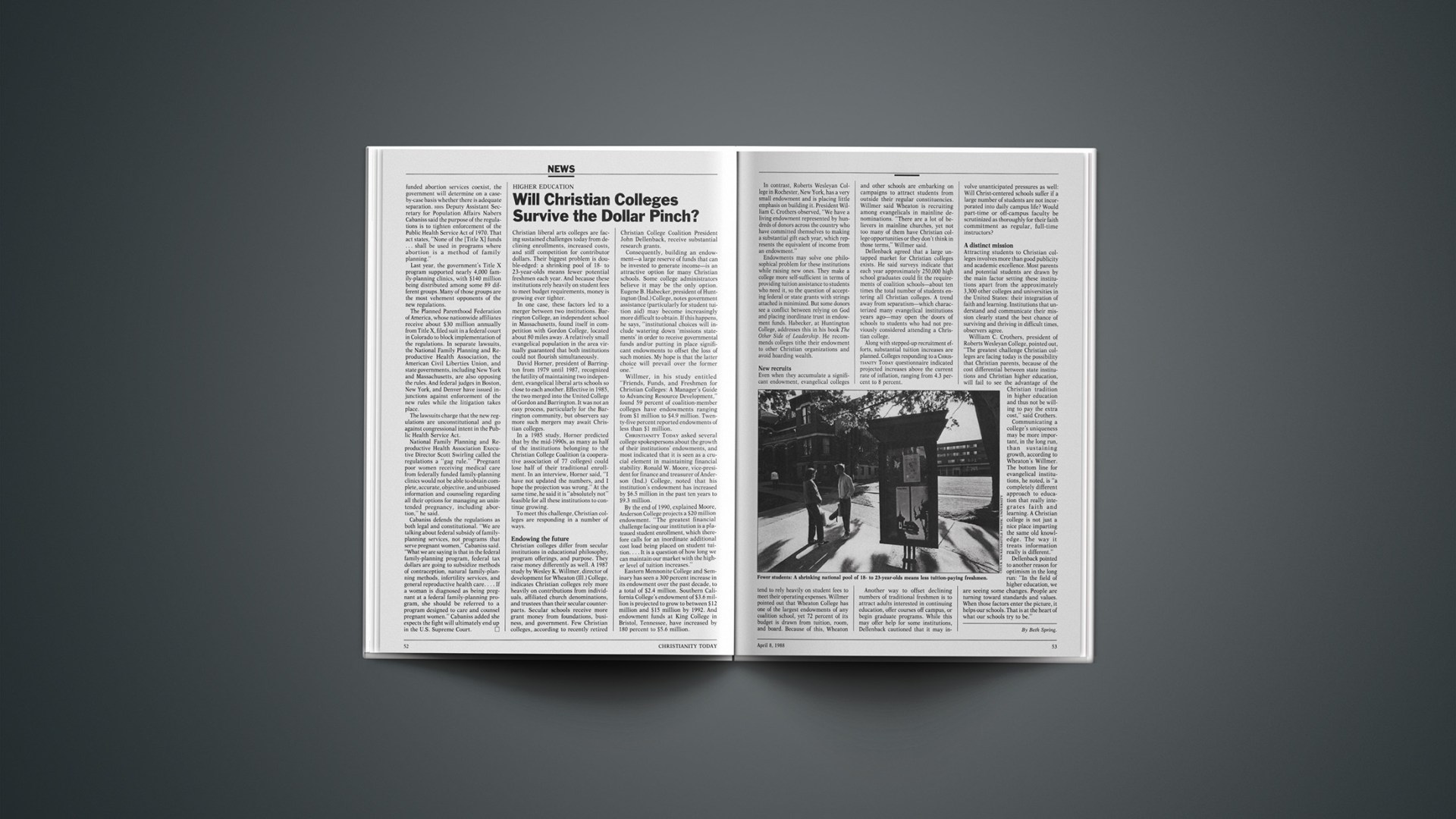
Will Christian Colleges Survive the Dollar Pinch?

Christian liberal arts colleges are facing sustained challenges today from declining enrollments, increased costs, and stiff competition for contributor dollars. Their biggest problem is double-edged: a shrinking pool of 18-to 23-year-olds means fewer potential freshmen each year. And because these institutions rely heavily on student fees to meet budget requirements, money is growing ever tighter.

In one case, these factors led to a merger between two institutions. Barrington College, an independent school in Massachusetts, found itself in competition with Gordon College, located about 80 miles away. A relatively small evangelical population in the area virtually guaranteed that both institutions could not flourish simultaneously.

David Horner, president of Barrington from 1979 until 1987, recognized the futility of maintaining two independent, evangelical liberal arts schools so close to each another. Effective in 1985, the two merged into the United College of Gordon and Barrington. It was not an easy process, particularly for the Barrington community, but observers say more such mergers may await Christian colleges.

In a 1985 study, Horner predicted that by the mid-1990s, as many as half of the institutions belonging to the Christian College Coalition (a cooperative association of 77 colleges) could lose half of their traditional enrollment. In an interview, Horner said, “I have not updated the numbers, and I hope the projection was wrong.” At the same time, he said it is “absolutely not” feasible for all these institutions to continue growing.

To meet this challenge, Christian colleges are responding in a number of ways.

Endowing The Future

Christian colleges differ from secular institutions in educational philosophy, program offerings, and purpose. They raise money differently as well. A 1987 study by Wesley K. Willmer, director of development for Wheaton (Ill.) College, indicates Christian colleges rely more heavily on contributions from individuals, affiliated church denominations, and trustees than their secular counterparts. Secular schools receive more grant money from foundations, business, and government. Few Christian colleges, according to recently retired Christian College Coalition President John Dellenback, receive substantial research grants.

Consequently, building an endowment—a large reserve of funds that can be invested to generate income—is an attractive option for many Christian schools. Some college administrators believe it may be the only option. Eugene B. Habecker, president of Huntington (Ind.) College, notes government assistance (particularly for student tuition aid) may become increasingly more difficult to obtain. If this happens, he says, “institutional choices will include watering down ‘missions statements’ in order to receive governmental funds and/or putting in place significant endowments to offset the loss of such monies. My hope is that the latter choice will prevail over the former one.”

Willmer, in his study entitled “Friends, Funds, and Freshmen for Christian Colleges: A Manager’s Guide to Advancing Resource Development,” found 59 percent of coalition-member colleges have endowments ranging from $1 million to $4.9 million. Twenty-five percent reported endowments of less than $1 million.

CHRISTIANITY TODAY asked several college spokespersons about the growth of their institutions’ endowments, and most indicated that it is seen as a crucial element in maintaining financial stability. Ronald W. Moore, vice-president for finance and treasurer of Anderson (Ind.) College, noted that his institution’s endowment has increased by $6.5 million in the past ten years to $9.3 million.

By the end of 1990, explained Moore, Anderson College projects a $20 million endowment. “The greatest financial challenge facing our institution is a plateaued student enrollment, which therefore calls for an inordinate additional cost load being placed on student tuition.… It is a question of how long we can maintain our market with the higher level of tuition increases.”

Eastern Mennonite College and Seminary has seen a 300 percent increase in its endowment over the past decade, to a total of $2.4 million. Southern California College’s endowment of $3.6 million is projected to grow to between $ 12 million and $15 million by 1992. And endowment funds at King College in Bristol, Tennessee, have increased by 180 percent to $5.6 million.

In contrast, Roberts Wesleyan College in Rochester, New York, has a very small endowment and is placing little emphasis on building it. President William C. Crothers observed, “We have a living endowment represented by hundreds of donors across the country who have committed themselves to making a substantial gift each year, which represents the equivalent of income from an endowment.”

Endowments may solve one philosophical problem for these institutions while raising new ones. They make a college more self-sufficient in terms of providing tuition assistance to students who need it, so the question of accepting federal or state grants with strings attached is minimized. But some donors see a conflict between relying on God and placing inordinate trust in endowment funds. Habecker, at Huntington College, addresses this in his book The Other Side of Leadership. He recommends colleges tithe their endowment to other Christian organizations and avoid hoarding wealth.

New Recruits

Even when they accumulate a significant endowment, evangelical colleges tend to rely heavily on student fees to meet their operating expenses. Willmer pointed out that Wheaton College has one of the largest endowments of any coalition school, yet 72 percent of its budget is drawn from tuition, room, and board. Because of this, Wheaton and other schools are embarking on campaigns to attract students from outside their regular constituencies. Willmer said Wheaton is recruiting among evangelicals in mainline denominations. “There are a lot of believers in mainline churches, yet not too many of them have Christian college opportunities or they don’t think in those terms,” Willmer said.

Dellenback agreed that a large untapped market for Christian colleges exists. He said surveys indicate that each year approximately 250,000 high school graduates could fit the requirements of coalition schools—about ten times the total number of students entering all Christian colleges. A trend away from separatism—which characterized many evangelical institutions years ago—may open the doors of schools to students who had not previously considered attending a Christian college.

Along with stepped-up recruitment efforts, substantial tuition increases are planned. Colleges responding to a Christianity Today questionnaire indicated projected increases above the current rate of inflation, ranging from 4.3 percent to 8 percent.

Another way to offset declining numbers of traditional freshmen is to attract adults interested in continuing education, offer courses off campus, or begin graduate programs. While this may offer help for some institutions, Dellenback cautioned that it may involve unanticipated pressures as well: Will Christ-centered schools suffer if a large number of students are not incorporated into daily campus life? Would part-time or off-campus faculty be scrutinized as thoroughly for their faith commitment as regular, full-time instructors?

A Distinct Mission

Attracting students to Christian colleges involves more than good publicity and academic excellence. Most parents and potential students are drawn by the main factor setting these institutions apart from the approximately 3,300 other colleges and universities in the United States: their integration of faith and learning. Institutions that understand and communicate their mission clearly stand the best chance of surviving and thriving in difficult times, observers agree.

William C. Crothers, president of Roberts Wesleyan College, pointed out, “The greatest challenge Christian colleges are facing today is the possibility that Christian parents, because of the cost differential between state institutions and Christian higher education, will fail to see the advantage of the Christian tradition in higher education and thus not be willing to pay the extra cost,” said Crothers.

Communicating a college’s uniqueness may be more important, in the long run, than sustaining growth, according to Wheaton’s Willmer. The bottom line for evangelical institutions, he noted, is “a completely different approach to education that really integrates faith and learning. A Christian college is not just a nice place imparting the same old knowledge. The way it treats information really is different.”

Dellenback pointed to another reason for optimism in the long run: “In the field of higher education, we are seeing some changes. People are turning toward standards and values. When those factors enter the picture, it helps our schools. That is at the heart of what our schools try to be.”

By Beth Spring.

Abortion, Teen Pregnancy Ignite HHS Battle

The Reagan administration’s Department of Health and Human Services (HHS) has come under fire from many fronts in recent days over teen pregnancy and family-planning efforts. Key conservatives have resigned from an HHS teen-pregnancy panel, charging the group will not promote sexual abstinence for teens, and new regulations designed to separate abortion and the government’s family-planning program have prompted a flood of legal challenges.

Pregnancy Panel Flap

James Dobson, president of Focus on the Family, William Pierce, president of the National Committee for Adoption, and Terrence Olson, associate dean at Brigham Young University (Utah), have resigned from their advisory roles on the Panel on Teen Pregnancy Prevention. HHS Secretary Otis Bowen appointed the panel in September to “help organizations best able to communicate with teens exchange information and enhance efforts to prevent teen pregnancy.” The panel includes representatives from 15 national groups. Dobson, Pierce, and Olson were “resource members” who were to provide advice and consultation to the panelists but would have no vote on recommendations.

In a letter to Bowen, Dobson said the panel was stacked with people who “believe our task as educators is to dispense contraceptives liberally and then teach the young to express their sexuality without producing babies.” Dobson said only four of the panelists “represented the vast number of Americans who favor sexual abstinence among unmarried adolescents.”

Wrote Dobson, “I’ve seen stacked decks before, but this one is ridiculous.”

At a Washington, D.C., press conference, Dobson emphasized studies that suggest that increased distribution of contraceptives leads to increased sexual activity for teens. He also pointed out the increasing health dangers facing sexually active teens. Dobson said the three had chosen to resign from the panel, “rather than endorse a program which we consider irresponsible, dishonest, and giving up on our nation’s young people.”

On his nationally broadcast radio show, Dobson has urged listeners to write to Bowen and the White House of their view that abstinence is the best way to prevent teen pregnancy.

The panel is to issue a report later this year with recommendations on how to prevent teen pregnancy, but Pierce said he believes “local people need to be aware that there may be federally funded programs coming into their areas without some of the strategies that we felt were necessary.”

Abortion As Family Planning

Meanwhile, the new family-planning regulations, which were recently published in the Federal Register, were announced by President Reagan late last summer (CT, Sept. 4, 1987, p. 56). Under the new rules, federally funded family-planning clinics are prohibited from giving women any counseling or referrals for abortion. In addition, in situations where federally funded family-planning services and nonfederally funded abortion services coexist, the government will determine on a case-by-case basis whether there is adequate separation. HHS Deputy Assistant Secretary for Population Affairs Nabers Cabaniss said the purpose of the regulations is to tighten enforcement of the Public Health Service Act of 1970. That act states, “None of the [Title X] funds … shall be used in programs where abortion is a method of family planning.”

Last year, the government’s Title X program supported nearly 4,000 family-planning clinics, with $140 million being distributed among some 89 different groups. Many of those groups are the most vehement opponents of the new regulations.

The Planned Parenthood Federation of America, whose nationwide affiliates receive about $30 million annually from Title X, filed suit in a federal court in Colorado to block implementation of the regulations. In separate lawsuits, the National Family Planning and Reproductive Health Association, the American Civil Liberties Union, and state governments, including New York and Massachusetts, are also opposing the rules. And federal judges in Boston, New York, and Denver have issued injunctions against enforcement of the new rules while the litigation takes place.

The lawsuits charge that the new regulations are unconstitutional and go against congressional intent in the Public Health Service Act.

National Family Planning and Reproductive Health Association Executive Director Scott Swirling called the regulations a “gag rule.” “Pregnant poor women receiving medical care from federally funded family-planning clinics would not be able to obtain complete, accurate, objective, and unbiased information and counseling regarding all their options for managing an unintended pregnancy, including abortion,” he said.

Cabaniss defends the regulations as both legal and constitutional. “We are talking about federal subsidy of family planning services, not programs that serve pregnant women,” Cabaniss said. “What we are saying is that in the federal family-planning program, federal tax dollars are going to subsidize methods of contraception, natural family-planning methods, infertility services, and general reproductive health care.… If a woman is diagnosed as being pregnant at a federal family-planning program, she should be referred to a program designed to care and counsel pregnant women.” Cabaniss added she expects the fight will ultimately end up in the U.S. Supreme Court.

Voluntary Suicide May Make California Ballot

A California campaign to legalize euthanasia is gaining momentum, leading some to wonder if lethal injections for the terminally ill (see sidebar) will become commonplace.

A group known as Americans Against Human Suffering, Inc. (CT, NOV. 20, 1987, p. 57) predicts it will collect enough signatures by the May 15 deadline to place a public referendum on California’s November ballot, which would give the terminally ill a right to end their lives by lethal injection. The proposed Humane and Dignified Death Act would become the world’s first measure legalizing medically assisted suicide.

Growing Acceptance

Public-opinion polls now show that more than 60 percent of all Californians would favor voluntary euthanasia if it were available. And although the California Medical Association opposes the measure, Americans Against Human Suffering says it has evidence that most doctors privately would support such an option as well.

The organization recently released the results of a survey it commissioned of some 600 California physicians who have treated terminally ill patients. According to the organization, over one-half of the doctors said they “considered voluntary euthanasia to be a rational choice for their patients.”

Additionally, the California Bar Association last year voted in favor of a euthanasia resolution, although the organization’s board of governors declined to push such a bill in the legislature.

Under the terms of the proposal, a terminally ill patient certified by two physicians as having less than six months to live would be allowed to request that a doctor administer a lethal injection. The measure would permit a physician to refuse the request, but would also protect any other doctor who complies from being prosecuted in court.

Advocates of the Humane and Dignified Death Act contend that recent advances in medical technology, while extending the lives of patients with fatal illnesses, serve only to delay the inevitable, often at great personal cost to a patient’s dignity and financial resources.

“We are not an antimedical group, but we see advances in medical technology as a two-edged sword,” said Derek Humphry, founder of the proeuthanasia Hemlock Society, in a recent interview with the Christian Science Monitor. “It saves our lives and does wonders for us, yet it can also make our deaths miserable.” Humphry is considered the elder statesman of the right-to-die movement and claims to have helped his wife commit suicide ten years ago after she was diagnosed with terminal cancer.

Other incidents support the notion that voluntary suicide is already occurring. A controversial article in the Journal of the American Medical Association (see box) chronicles a physician’s role in administering a lethal injection to a terminally ill patient. And dozens of recent court battles involving “mercy killings” have infused the bioethics debate with a sense of urgency.

Who Dies Next?

Opponents of the measure fear it will open the door to legalized suicide. “Who comes next?” asks Dave Wilkinson, spokesman for the Right to Life League of Southern California. “Does this mean we’re going to let a handicapped person take his life legally because he gets the message from society that he’s not valuable?” He said the Right to Life League has thrown its support behind the Coalition Against the Death Initiative, one of several California citizens’ groups opposed to the measure.

As with their opposition to abortion, American Roman Catholics have also been bitterly critical of the California measure. Last fall, a bishops’ committee released a report warning of the “danger of using euthanasia to avoid the costs of medical care for the sick and disabled, including AIDS patients.”

Surprisingly, evangelicals have been relatively quiet in their opposition to the Humane and Dignified Death Act. A. Dwight Burchett, government affairs chairman for the California chapter of the National Association of Evangelicals, said the measure “was discussed extensively” last spring when an estimated 400 California pastors met with politicians in a Sacramento legislative briefing. But prior to the briefing, Burchett said he had heard little discussion of the subject in church circles.

One organization that is speaking out on the ballot measure, and that heavily influences the evangelical community, is Southern California-based Focus on the Family. The profamily group, led by James C. Dobson, is planning a program dealing with the subject on its widely heard radio broadcast. The euthanasia bill is also a common agenda item for monthly legislative briefings in Sacramento and Los Angeles that are cosponsored by the organization.

“Our perspective is that this measure probably will make the November 1988 ballot,” says Doug Kay, director of public policy for Focus on the Family. “And I would guess there will be many Christians who will be sucked into the emotional arguments for euthanasia.”

Of the potential for evangelical involvement in the euthanasia debate, the Right to Life’s Wilkinson says: “The Catholics were right on top of the abortion issue from the very beginning, and the evangelicals and fundamentalists came on the scene later. This time I hope we’re not too late.”

By Brian Bird.

“It’s Over, Debbie”

The January 8 issue of the Journal of the AmericanMedical Association included a physician’s account of how he injected a lethal dose of morphine into a patient who was dying from ovarian cancer. Following is an excerpt from that anonymous essay:

Debbie looked at the syringe, then laid her head on the pillow with her eyes open, watching what was left of the world. I injected the morphine intravenously and watched to see if my calculations on its effects would be correct. Within seconds her breathing slowed to a normal rate, her eyes closed, and her features softened as she seemed restful at last. The older woman [one of two attending nurses] stroked the hair of the now-sleeping patient. I waited for the inevitable next effect of depressing the respiratory drive. With clocklike certainty, within four minutes the breathing rate slowed even more, then became irregular, then ceased. The dark-haired woman stood erect and seemed relieved.

It’s over, Debbie.

Apple PodcastsDown ArrowDown ArrowDown Arrowarrow_left_altLeft ArrowLeft ArrowRight ArrowRight ArrowRight Arrowarrow_up_altUp ArrowUp ArrowAvailable at Amazoncaret-downCloseCloseEmailEmailExpandExpandExternalExternalFacebookfacebook-squareGiftGiftGooglegoogleGoogle KeephamburgerInstagraminstagram-squareLinkLinklinkedin-squareListenListenListenChristianity TodayCT Creative Studio Logologo_orgMegaphoneMenuMenupausePinterestPlayPlayPocketPodcastRSSRSSSaveSaveSaveSearchSearchsearchSpotifyStitcherTelegramTable of ContentsTable of Contentstwitter-squareWhatsAppXYouTubeYouTube