Stumbling on the Stump

In the days just prior to Super Tuesday, the Robertson campaign was bogged down by a series of controversial statements by the former television evangelist, and by accusations from a variety of quarters. Below is a summary of some of those issues and the campaign responses as given by Robertson spokesman Scott Hatch:

Campaign Finances

The issue: The Internal Revenue Service is reportedly investigating the financial relationship between the nonprofit, Robertson-founded Freedom Council and Robertson’s presidential effort. Christian columnist Michael McManus charges that the tax-exempt Christian Broadcasting Network contributed $8.4 million to the Freedom Council, which he says illegally used the money to start up Robertson’s presidential campaign.

The response: “The Robertson campaign has received no money from either the Christian Broadcasting Network or the Freedom Council and in no way has obstructed laws established by the Federal Election Commission. It is obvious in reading McManus’s charges that he has an ‘axe to grind.’ If his claims are more than pure opinion and conjecture, we challenge him to provide the proof to the American people.”

Dirty Politics

The issue: The campaign of U.S. Rep. Jack Kemp accused the Robertson campaign of “dirty tricks” after a flier on the candidates’ records incorrectly said that Kemp was propornography. The flier, which was distributed in Iowa and other key primary states, has been traced to a Robertson campaign official in Illinois. Another Robertson campaign official told a group of pastors in Iowa that Kemp was a “womanizer and an adulterer.” (The official later apologized for the manner in which he made the remarks.)

The response: “I can only speak to the former, because I am not aware of the latter. No correspondence concerning the falsified voting record of Representative Kemp was ever planned or carried out by the national staff of Americans for Robertson. Having had numerous similar ‘dirty tricks’ pulled against our campaign, we regret this type of behavior in a presidential election.”

Missiles In Cuba

The issue: In New Hampshire, Robertson said he had been told there were Soviet missiles in place in Cuba. Both the Reagan administration and Cuban leader Fidel Castro denied this.

The response: “Robertson’s desirewas to encourage the American Congress, in its upcoming discussions on the INF treaty, to attach an amendment to ensure on-site inspection of the 1962 Soviet missile bases. There has been ample testimony and what we feel is reasonable doubt raised over this issue. Robertson only wanted to make sure the missiles were not there.”

Knowledge Of Hostages

The issue: On a radio broadcast in Georgia, Robertson said his CBN News team knew the whereabouts of hostages in Lebanon, something the Reagan administration denied having knowledge of.

The response: “In June 1985, CBN News was the first to confirm that the hostages on TWA 847 were in the city limits of Beruit. This information was new, and at the time, appropriate. The information was broadcast nationally on “The 700 Club” and verbally to a state department official. If we had known the exact location—the exact address—we would have certainly informed the administration. But our information was of a general knowledge, which was new information at that time.”

Libel Suit

The issue: Former U.S. Rep. Paul (Pete) McCloskey charged Robertson with lying about his combat duty in the Korean War. Robertson filed a libel suit against McCloskey, who maintains that Robertson’s father, a U.S. senator, used political connections to exempt his son from combat duty. Robertson dropped the suit just days before it was scheduled to go to trial on Super Tuesday. He also agreed to pay McCloskey’s court costs.

The response: “Pat Robertson was given no choice but to drop his case because of the trial date schedule. His attorneys felt scheduling his hearing on the most important date of the 1988 electoral season was grossly unfair. Robertson felt his number-one priority was to represent the millions of Americans who expressed their support for him. He then challenged McCloskey to allow the case to be handled through arbitration—a challenge Representative McCloskey refused.”
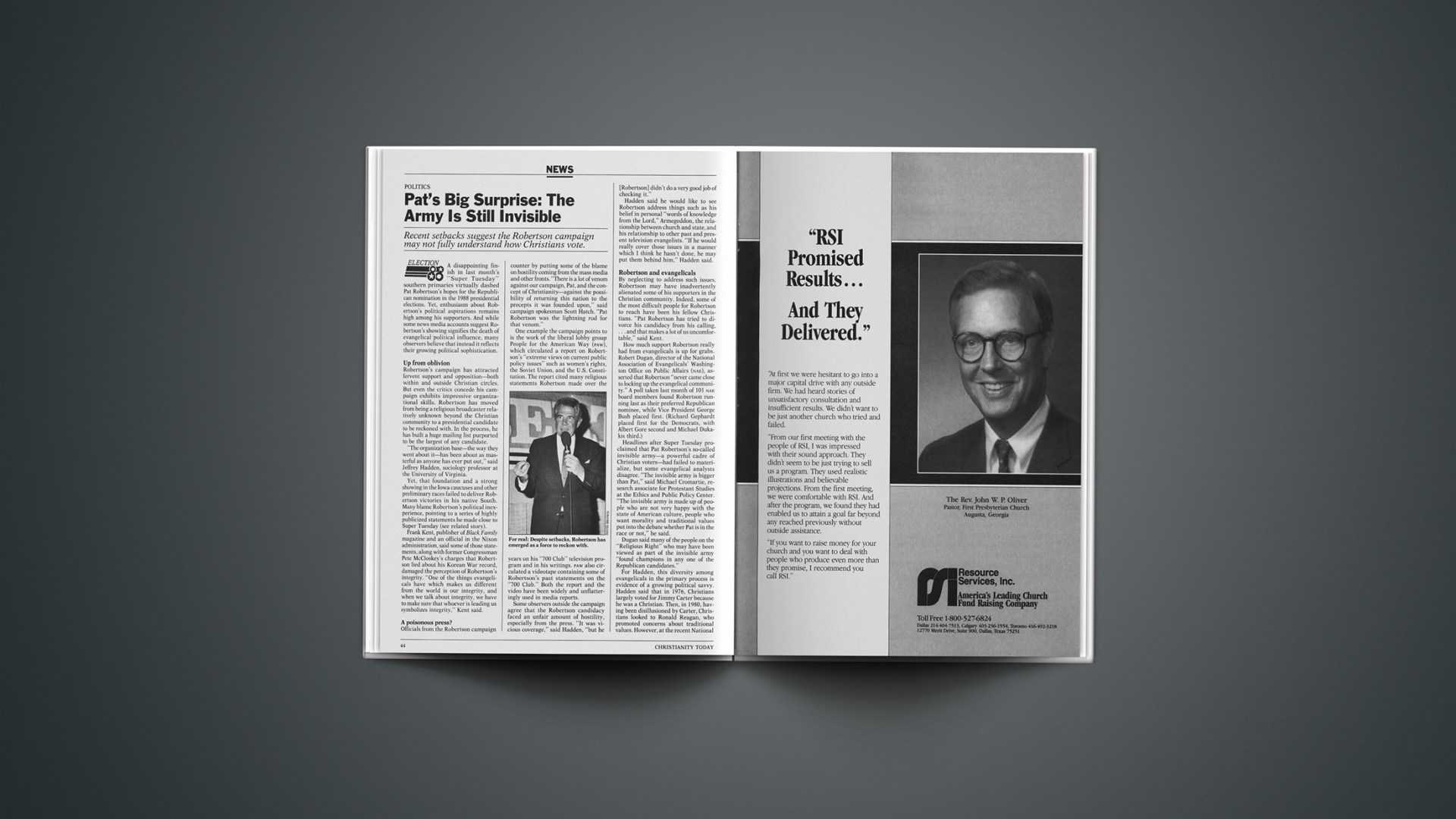
Pat’s Big Surprise: The Army Is Still Invisible

Recent setbacks suggest the Robertson campaign may not fully understand how Christians vote.

A disappointing finish in last month’s “Super Tuesday” southern primaries virtually dashed Pat Robertson’s hopes for the Republican nomination in the 1988 presidential elections. Yet, enthusiasm about Robertson’s political aspirations remains high among his supporters. And while some news media accounts suggest Robertson’s showing signifies the death of evangelical political influence, many observers believe that instead it reflects their growing political sophistication.

Up From Oblivion

Robertson’s campaign has attracted fervent support and opposition—both within and outside Christian circles. But even the critics concede his campaign exhibits impressive organizational skills. Robertson has moved from being a religious broadcaster relatively unknown beyond the Christian community to a presidential candidate to be reckoned with. In the process, he has built a huge mailing list purported to be the largest of any candidate.

“The organization base—the way they went about it—has been about as masterful as anyone has ever put out,” said Jeffrey Hadden, sociology professor at the University of Virginia.

Yet, that foundation and a strong showing in the Iowa caucuses and other preliminary races failed to deliver Robertson victories in his native South. Many blame Robertson’s political inexperience, pointing to a series of highly publicized statements he made close to Super Tuesday (see related story).

Frank Kent, publisher of Black Family magazine and an official in the Nixon administration, said some of those statements, along with former Congressman Pete McCloskey’s charges that Robertson lied about his Korean War record, damaged the perception of Robertson’s integrity. “One of the things evangelicals have which makes us different from the world is our integrity, and when we talk about integrity, we have to make sure that whoever is leading us symbolizes integrity,” Kent said.

A Poisonous Press?

Officials from the Robertson campaign counter by putting some of the blame on hostility coming from the mass media and other fronts. “There is a lot of venom against our campaign, Pat, and the concept of Christianity—against the possibility of returning this nation to the precepts it was founded upon,” said campaign spokesman Scott Hatch. “Pat Robertson was the lightning rod for that venom.”

One example the campaign points to is the work of the liberal lobby group People for the American Way (PAW), which circulated a report on Robertson’s “extreme views on current public policy issues” such as women’s rights, the Soviet Union, and the U.S. Constitution. The report cited many religious statements Robertson made over the years on his “700 Club” television program and in his writings, PAW also circulated a videotape containing some of Robertson’s past statements on the “700 Club.” Both the report and the video have been widely and unflatteringly used in media reports.

Some observers outside the campaign agree that the Robertson candidacy faced an unfair amount of hostility, especially from the press. “It was vicious coverage,” said Hadden, “but he [Robertson] didn’t do a very good job of checking it.”

Hadden said he would like to see Robertson address things such as his belief in personal “words of knowledge from the Lord,” Armegeddon, the relationship between church and state, and his relationship to other past and present television evangelists. “If he would really cover those issues in a manner which I think he hasn’t done, he may put them behind him,” Hadden said.

Robertson And Evangelicals

By neglecting to address such issues, Robertson may have inadvertently alienated some of his supporters in the Christian community. Indeed, some of the most difficult people for Robertson to reach have been his fellow Christians. “Pat Robertson has tried to divorce his candidacy from his calling, … and that makes a lot of us uncomfortable,” said Kent.

How much support Robertson really had from evangelicals is up for grabs. Robert Dugan, director of the National Association of Evangelicals’ Washington Office on Public Affairs (NAE), asserted that Robertson “never came close to locking up the evangelical community.” A poll taken last month of 101 NAE board members found Robertson running last as their preferred Republican nominee, while Vice President George Bush placed first. (Richard Gephardt placed first for the Democrats, with Albert Gore second and Michael Dukakis third.)

Headlines after Super Tuesday proclaimed that Pat Robertson’s so-called invisible army—a powerful cadre of Christian voters—had failed to materialize, but some evangelical analysts disagree. “The invisible army is bigger than Pat,” said Michael Cromartie, research associate for Protestant Studies at the Ethics and Public Policy Center. “The invisible army is made up of people who are not very happy with the state of American culture, people who want morality and traditional values put into the debate whether Pat is in the race or not,” he said.

Dugan said many of the people on the “Religious Right” who may have been viewed as part of the invisible army “found champions in any one of the Republican candidates.”

For Hadden, this diversity among evangelicals in the primary process is evidence of a growing political savvy. Hadden said that in 1976, Christians largely voted for Jimmy Carter because he was a Christian. Then, in 1980, having been disillusioned by Carter, Christians looked to Ronald Reagan, who promoted concerns about traditional values. However, at the recent National Religious Broadcasters’ Convention, Christians were lining up behind a variety of candidates and asking questions about who is electable. Hadden called that “an enormous progession to political sophistication.”

Robertson’s campaign is confident the activism generated by their candidate will continue. “The injection into the political process of tens of thousands of upright, God-fearing, God-loving people is going to have more impact than the term of any one man,” said spokesman Hatch.

In the meantime, Robertson is still expected to have a strong presence at the Republican party convention in New Orleans this summer. “He and his people will have to be treated with respect,” said the NAE’S Dugan. “The party doesn’t want to reject the people who will be an important part of the coalition this fall for the Republicans overall.”

And Robertson’s people are already hinting at future political aspirations. “Comparisons between this candidacy and Ronald Reagan are eerie,” Hatch said. “Remember, it took Reagan four times [to get to the White House]. Like Pat said, … this is just the beginning.”

By Kim A. Lawton.

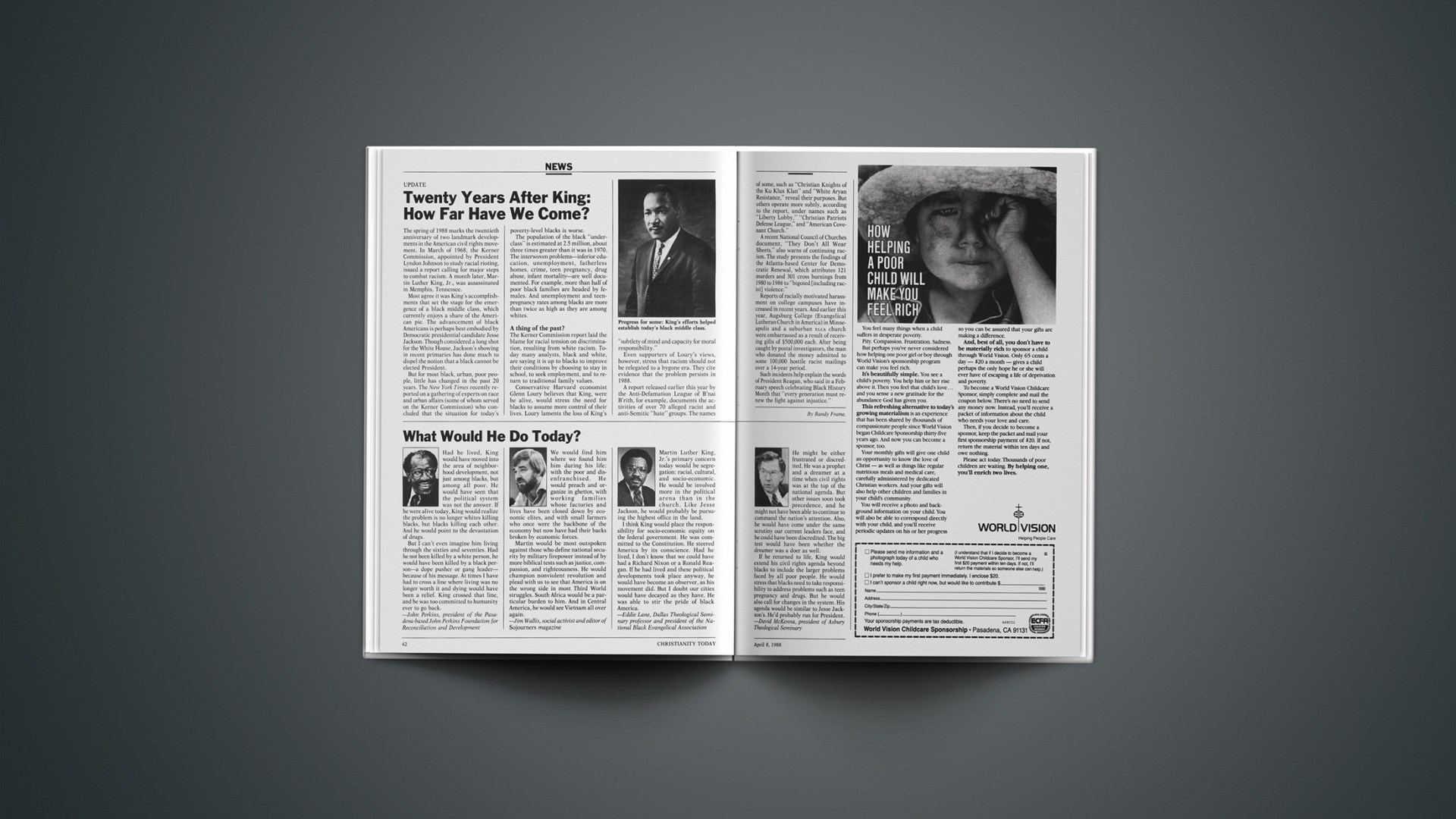
Twenty Years after King: How Far Have We Come?

The spring of 1988 marks the twentieth anniversary of two landmark developments in the American civil rights movement. In March of 1968, the Kerner Commission, appointed by President Lyndon Johnson to study racial rioting, issued a report calling for major steps to combat racism. A month later, Martin Luther King, Jr., was assassinated in Memphis, Tennessee.

Most agree it was King’s accomplishments that set the stage for the emergence of a black middle class, which currently enjoys a share of the American pie. The advancement of black Americans is perhaps best embodied by Democratic presidential candidate Jesse Jackson. Though considered a long shot for the White House, Jackson’s showing in recent primaries has done much to dispel the notion that a black cannot be elected President.

But for most black, urban, poor people, little has changed in the past 20 years. The New York Times recently reported on a gathering of experts on race and urban affairs (some of whom served on the Kerner Commission) who concluded that the situation for today’s poverty-level blacks is worse.

The population of the black “underclass” is estimated at 2.5 million, about three times greater than it was in 1970. The interwoven problems—inferior education, unemployment, fatherless homes, crime, teen pregnancy, drug abuse, infant mortality—are well documented. For example, more than half of poor black families are headed by females. And unemployment and teen-pregnancy rates among blacks are more than twice as high as they are among whites.

A Thing Of The Past?

The Kerner Commission report laid the blame for racial tension on discrimination, resulting from white racism. Today many analysts, black and white, are saying it is up to blacks to improve their conditions by choosing to stay in school, to seek employment, and to return to traditional family values.

Conservative Harvard economist Glenn Loury believes that King, were he alive, would stress the need for blacks to assume more control of their lives. Loury laments the loss of King’s “subtlety of mind and capacity for moral responsibility.”

Even supporters of Loury’s views, however, stress that racism should not be relegated to a bygone era. They cite evidence that the problem persists in 1988.

A report released earlier this year by the Anti-Defamation League of B’nai B’rith, for example, documents the activities of over 70 alleged racist and anti-Semitic “hate” groups. The names of some, such as “Christian Knights of the Ku Klux Klan” and “White Aryan Resistance,” reveal their purposes. But others operate more subtly, according to the report, under names such as “Liberty Lobby,” “Christian Patriots Defense League,” and “American Covenant Church.”

A recent National Council of Churches document, “They Don’t All Wear Sheets,” also warns of continuing racism. The study presents the findings of the Atlanta-based Center for Democratic Renewal, which attributes 121 murders and 301 cross burnings from 1980 to 1986 to “bigoted [including racist] violence.”

Reports of racially motivated harassment on college campuses have increased in recent years. And earlier this year, Augsburg College (Evangelical Lutheran Church in America) in Minneapolis and a suburban ELCA church were embarrassed as a result of receiving gifts of $500,000 each. After being caught by postal investigators, the man who donated the money admitted to some 100,000 hostile racist mailings over a 14-year period.

Such incidents help explain the words of President Reagan, who said in a February speech celebrating Black History Month that “every generation must renew the fight against injustice.”

By Randy Frame.

What Would He Do Today?

Had he lived, King would have moved into the area of neighborhood development, not just among blacks, but among all poor. He would have seen that the political system was not the answer. If he were alive today, King would realize the problem is no longer whites killing blacks, but blacks killing each other. And he would point to the devastation of drugs.

But I can’t even imagine him living through the sixties and seventies. Had he not been killed by a white person, he would have been killed by a black person—a dope pusher or gang leader—because of his message. At times I have had to cross a line where living was no longer worth it and dying would have been a relief. King crossed that line, and he was too committed to humanity ever to go back.

—John Perkins, president of the Pasadena-based John Perkins Foundation for Reconciliation and Development

We would find him where we found him him during his life: with the poor and disenfranchised. He would preach and organize in ghettos, with working families whose factories and lives have been closed down by economic elites, and with small farmers who once were the backbone of the economy but now have had their backs broken by economic forces.

Martin would be most outspoken against those who define national security by military firepower instead of by more biblical tests such as justice, compassion, and righteousness. He would champion nonviolent revolution and plead with us to see that America is on the wrong side in most Third World struggles. South Africa would be a particular burden to him. And in Central America, he would see Vietnam all over again.

—Jim Wallis, social activist and editor of Sojourners magazine

Martin Luther King, Jr.’s primary concern today would be segregation: racial, cultural, and socio-economic. He would be involved more in the political arena than in the church. Like Jesse Jackson, he would probably be pursuing the highest office in the land.

I think King would place the responsibility for socio-economic equity on the federal government. He was committed to the Constitution. He steered America by its conscience. Had he lived, I don’t know that we could have had a Richard Nixon or a Ronald Reagan. If he had lived and these political developments took place anyway, he would have become an observer, as his movement did. But I doubt our cities would have decayed as they have. He was able to stir the pride of black America.

—Eddie Lane, Dallas Theological Seminary professor and president of the National Black Evangelical Association

He might be either frustrated or discredited. He was a prophet and a dreamer at a time when civil rights was at the top of the national agenda. But other issues soon took precedence, and he might not have been able to continue to command the nation’s attention. Also, he would have come under the same scrutiny our current leaders face, and he could have been discredited. The big test would have been whether the dreamer was a doer as well.

If he returned to life, King would extend his civil rights agenda beyond blacks to include the larger problems faced by all poor people. He would stress that blacks need to take responsibility to address problems such as teen pregnancy and drugs. But he would also call for changes in the system. His agenda would be similar to Jesse Jackson’s. He’d probably run for President.

David McKenna, president of Asbury Theological Seminary

Missionaries in Africa Are Not Immune to AIDS

Missionary Stan Young (not his real name) would later describe it as having been handed a death sentence. He had been feeling fine, pretty much recovered from his bout with hepatitis B, when his stateside doctor suggested his blood be tested for the human immunodeficiency virus (HIV)—the AIDS virus. If, the doctor reasoned, Stan had contracted hepatitis B through unsterilized dental equipment, he might have picked up AIDS as well. The disease is epidemic in the African city where Stan and his wife are stationed.

Seated in the doctor’s office days later, Stan was informed he had tested positive for the AIDS virus. Following the shock and devastation came the questions. Would he contract the disease? Should he go back to Africa? Whom should he tell? What would people think?

Hundreds Infected?

At least six missionaries registered with the Johns Hopkins School of Public Health have faced the same dilemma, though AIDS is hardly epidemic in the missions community. Nevertheless, mission agencies are realizing they must develop policies to protect their missionaries and to deal with those who become infected.

The doctor who serves as a medical consultant for Stan’s mission believes hundreds of missionaries may be infected with the virus. Speaking privately because of Stan’s desire for anonymity, the physician admitted that in the absence of medical studies, no one knows for sure how many missionaries carry the AIDS virus.

However, he plans to ask other missionaries when they return on furlough about medical and dental work performed on them overseas. He wonders whether all missionaries should be tested when they return on furlough.

Missionaries most at risk, says another missionary physician, are medical personnel involved in surgery, obstetrics, renal dialysis, dentistry, and laboratory technology. Epidemiologist David Sorley, who has served for nearly 12 years in Africa, says these are the people who must count the cost of serving Christ in areas where the disease is prevalent.

Prevention For Missionaries

Missionaries on regular assignments are at a relatively low risk for contracting AIDS. However, hospitals in most of the developing world still cannot afford equipment for HIV testing of donated blood. Disposable needles, common in the Western world, are unknown in much of the Third World; and reusable needles may not be properly sterilized. In some areas, therefore, missionaries who receive blood transfusions or injections may be at risk.

However, those who travel and work in even the worst-affected areas can do much to lower their risk of infection. Last fall, World Vision produced and distributed an educational manual to field and support offices in more than 50 countries. The organization asked field offices to appoint committees to educate staff as well as other volunteers who work with them on projects. The field office is also to make sure staff members and their families have access to safe injections and a pure blood supply. In many countries this is no easy task.

One much-discussed option in areas where HIV blood testing is unavailable is the “walking blood bank,” a pool of healthy blood donors who could be counted on to give blood in emergencies. The concept is not without its dangers. “Just because a person is a missionary doesn’t mean they don’t have the virus,” warns Dr. Rufino L. Macagba, Jr., manager of World Vision’s International Health Program. “It is a delicate issue, because people would have to be tested regularly in order to ensure a pure supply of blood.”

The “walking blood bank” also presents a moral dilemma to mission agencies. The practice may rekindle the notion of elitism among missionaries. Should you exclude local Christians from the program? asks one mission leader. Yet, as the number of people in the group expands, the danger of infiltration by the AIDS virus multiplies.

Other precautions are more straightforward. Some mission agencies ask staff who travel to carry kits including sterile disposable needles and syringes, and heavy-duty rubber gloves for use in assisting accident victims who have suffered cuts. They tell them not to accept untested blood or blood products unless their life is in danger. “If only one bottle is needed, it probably isn’t needed at all,” says Macagba.

Thorny Issues

Prevention issues may be the easy ones for mission agencies. The really thorny concerns have to do with identifying and handling missionaries who test positive for AIDS. Some agencies are considering mandatory testing of all personnel. Others object to testing on moral grounds or because of the high cost of the tests.

Once a missionary tests positive for AIDS, a whole new set of concerns arises. Confidentiality is a key issue. On one side are those who believe an individual’s right to privacy supersedes even the sending agency’s need to know. At the opposite pole are those who advocate informing everyone who relates in any way to the affected missionary.

To agencies with missionaries who are already affected, this is not an academic question. “We would like to askour missionary to be as open as possible,” says one mission official. “We think it is best to be public about this. But if the missionary doesn’t want it known, what should we do?”

Most mission agencies do not yet have policies on AIDS. A draft document prepared at the conclusion of a conference on AIDS sponsored last fall by MAP International outlines the issues and offers some guidelines to agencies. Dr. Richard Crespo, director of health training for MAP International, organized the conference, euphemistically entitled, “Contemporary Issues in Medical Missions.” The title was deliberately innocuous. The year before, when the conference was first planned, sentiment in the American evangelical missions community was solidly against even discussing the disease.

“The scene has changed dramatically over the last 12 months,” says Crespo. “Now mission agencies are talking about these issues quite openly. There is hardly any negative reaction.”

Most mission agencies still do not incorporate AIDS information and education in candidate-orientation programs. Crespo believes agencies must inform new missionaries about the prevalence of the disease in the areas where they will be stationed. They should know how to prevent infection and what to do if they become infected.

So far, mission agencies report no perceptible decrease in the number of missionary recruits for areas known to be rife with AIDS. Career-missionary recruitment continues at pre-Ams levels. However, some short-term workers have withdrawn their applications after hearing about the prevalence of the disease in the areas they were scheduled to visit.

Most observers believe more missionaries will become infected with the AIDS virus. Testing positive for AIDS is not, however, as Stan first feared, a death sentence. The latest report by the U.S. National Academy of Sciences concludes that between 25 and 50 percent of those who test positive actually contract the disease within five years. It is possible he will never develop the disease.

In spite of the AIDS threat, no one is suggesting missionaries should withdraw from a sick and helpless population. “I am pleased by the pro-active stance of many mission agencies,” says Crespo. “This is a tremendous opportunity for mission agencies to minister to people in need. Christians who are brave enough to reach out and touch these needy people with a word of hope and spiritual renewal are a powerful witness to Christ.”

By Sharon E. Mumper.

AIDS In Africa: Death Is the Only Certainty

Accurate numbers are hard to obtain, but the virus threatens an already fragile continent.

Abou was prepared for death. In the last months of his life the “slim disease” had ravaged his body, trimming 90 pounds from his 175-pound frame. But the 30-year-old African school administrator had received loving care and counsel in the year since the disease that was turning him into a living skeleton had been diagnosed as AIDS. Family and friends constantly jammed his mission hospital room, talking, laughing, and praying.

Last year Abou died, one of a growing number of AIDS victims whose deaths are causing consternation in Africa, and fear for the future of the continent.

Tracking The Virus

At least one million Africans, mostly from central Africa, will die of AIDS in the next decade, according to the authoritative dossier, “AIDS and the Third World,” published by the Panos Institute, an international information and policy studies agency. As troubling as it is, that figure is probably low, the institute admits. In some African cities, a fifth or more of the population is already infected with HIV, the virus that causes AIDS.

Most of the victims are young men and women in their twenties and thirties, the people who fuel Africa’s delicately balanced economies. A disproportionate number are educated professionals like Abou, who are essential to the continued development of Africa. In parts of the continent, says the Panos Institute, the survival of whole industries and economies may be at stake.

The United States still has the highest number of reported AIDS cases—some 70 percent of the world’s total. But this may be due partly to the inaccuracy of statistics available from much of the developing world. World Health Organization (WHO) expert Jonathan Mann estimates that although only 66,000 AIDS cases have been reported to WHO since the beginning of the epidemic, some 100,000 to 150,000 cases have probably occurred. In fact, WHO believes about 10,000 AIDS cases are now occurring every year in Africa.

Several factors contribute to the difficulty in tracking the spread of AIDS in Africa. Some countries have not had the tools to make firm diagnoses; others don’t have a disease-reporting infrastructure. Still others, fearing negative publicity, have been unwilling to acknowledge they have a problem at all.

Early international publicity showing Africa as the source of AIDS angered government health officials, making many nations reluctant to release statistics revealing the extent of the disease. Some governments warned doctors not to speak publicly about the disease. At least one country refused doctors permission even to tell patients they had the disease. In 1982, only one African country was willing to report its AIDS cases to who. By 1985, 7 countries reported cases, and last year, 36 African countries reported their AIDS cases.

Underreporting, though, still hampers efforts to track the virus, who statistics published last fall listed 250 AIDS cases for Congo, while a New York Times reporter in Congo confidently reported the number at 1,200. In fact, no one really knows the extent of the disease.

Yet in the last six months, African countries have shown a new willingness to acknowledge the problem of AIDS, and to institute aggressive educational programs to curb its spread. Congo’s updated public-health campaign has included posters, television round tables, and radio call-in shows. In Zaire, printed literature explaining the cause and prevention of AIDS has been broadly disseminated.

In some African countries, posters and educational materials now proliferate in greater numbers than in the U.S., says Dr. Bill Heyward, chief of the Centers for Disease Control’s International Activities, AIDS Program. He says most African countries now receive some financial support and consulting help from outside groups.

A Heterosexual Disease?

AIDS in Africa, as in much of the developing world, occurs primarily within the mainstream of the heterosexual community. It has grown most rapidly in Africa’s burgeoning urban areas, where traditional values break down under the pressure of accelerated social change.

Prostitutes are thought to be major transmitters of AIDS. Some 80 percent of prostitutes in a Nairobi slum and 90 percent of Rwanda’s prostitutes are suspected of carrying the AIDS virus. In Congo’s coastal Pointe-Noire, whose brothels are frequented by sailors from around the world, 64 percent of prostitutes tested last year were found to have the AIDS virus.

The disease has also hit hard in certain rural areas where traditional social mores permit sexual encounters outside of marriage. In some Ugandan villages an entire generation has already died of AIDS, says one medical missionary. Only very young children and grandparents remain in those villages.

In addition to the sexual transmission of the disease, the generally lower public-health standards in much of Africa contribute to the spread of AIDS. For example, most African countries still do not have adequate blood-testing facilities. Thus, the AIDS virus may spread through transfusions of contaminated blood. The AIDS virus is also thought to be transmitted through unsterilized needles when injections are improperly given to multiple patients. The disposable, single-injection needles commonly used in the U.S. are prohibitively expensive for most African medical centers. Some missionary doctors fear the disease may be spread in mass immunization programs where needles are not properly sterilized.

Tragically, the disease is escalating among infants of mothers who carry the AIDS virus. Some 50 percent of babies born to HIV-infected mothers die within a year. Early last year, the Panos Institute predicted 6,000 Zambian babies would be born to mothers with the AIDS virus in 1987. This compares with some 400 babies and children in the U.S. who have developed AIDS since the epidemic started.

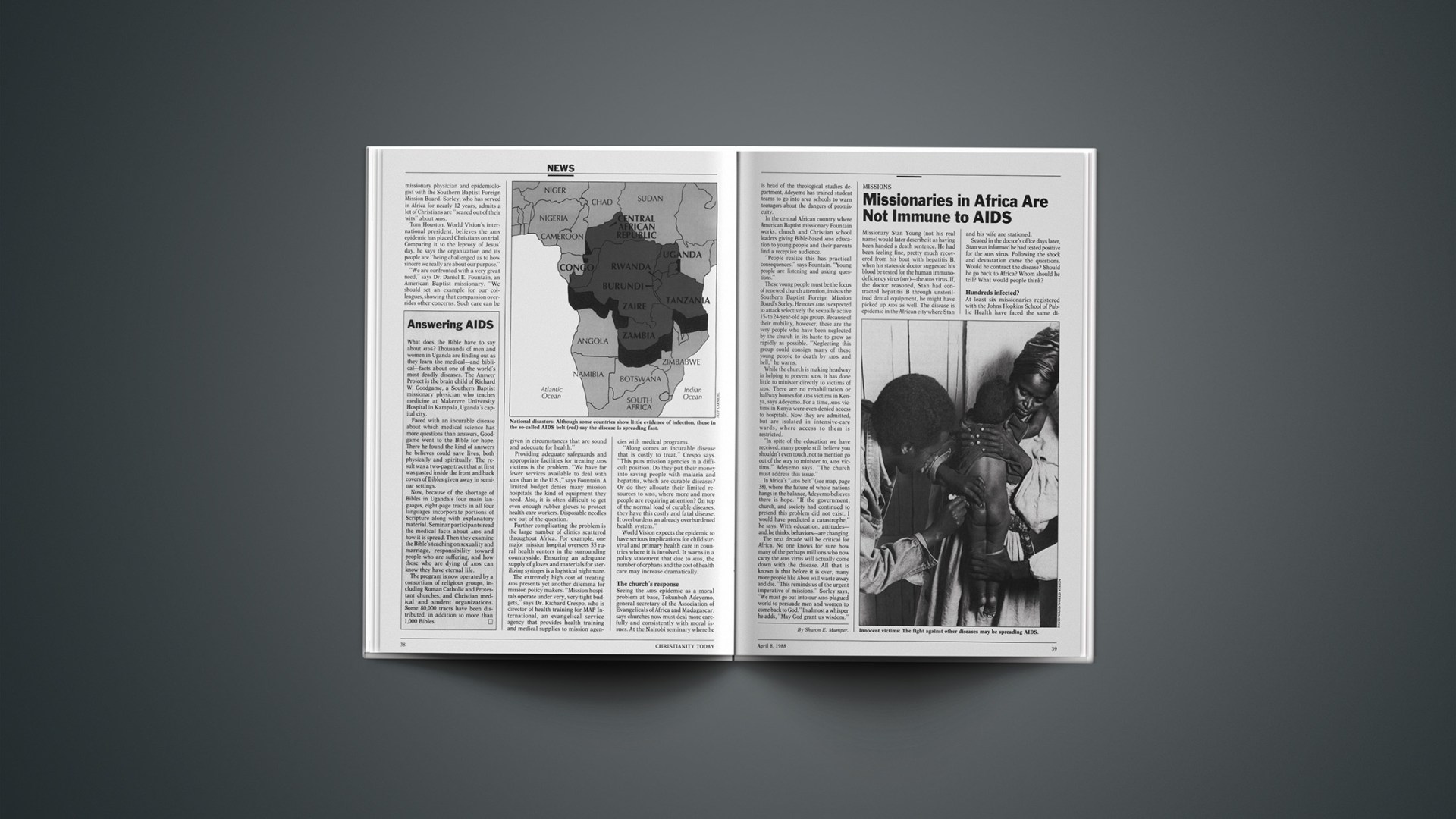
Although some African countries show little evidence of infection, other nations, like those in the so-called AIDS belt (see map, p. 38), are facing crises that amount to national disasters. Most affected are eight countries that stretch east to west across central Africa.

Uganda’s health ministers estimate 10 percent of the country’s population are HIV-infected. The Panos Institute says blood surveys in central and parts of eastern Africa reveal a prevalence of HIV infection greater than in even the worst-hit American cities.

Dealing With Fear

Because AIDS in Africa is not associated with homosexuality and drug usage, the disease does not bear the social stigma it carries in the West. Nevertheless, ordinary Africans are becoming increasingly reluctant to relate normally to its victims.

Some hospital administrators admit they have delayed discussing the disease with their staff. They are afraid medical workers will refuse to work with AIDS patients or will quit rather than face the risks associated with handling potentially infected human blood and body secretions.

Although Christian medical workers also have fears and concerns, mission and church officials believe their faithful ministry can be a testimony to others. “Christians who understand how the disease is transmitted and who have learned to trust God through other hazards can minister effectively in those situations,” affirms Dr. David Sorley, a missionary physician and epidemiologist with the Southern Baptist Foreign Mission Board. Sorley, who has served in Africa for nearly 12 years, admits a lot of Christians are “scared out of their wits” about AIDS.

Tom Houston, World Vision’s international president, believes the AIDS epidemic has placed Christians on trial. Comparing it to the leprosy of Jesus’ day, he says the organization and its people are “being challenged as to how sincere we really are about our purpose.”

“We are confronted with a very great need,” says Dr. Daniel E. Fountain, an American Baptist missionary. “We should set an example for our colleagues, showing that compassion overrides other concerns. Such care can be given in circumstances that are sound and adequate for health.”

The Church’s Response

Seeing the AIDS epidemic as a moral problem at base, Tokunboh Adeyemo, general secretary of the Association of Evangelicals of Africa and Madagascar, says churches now must deal more carefully and consistently with moral issues. At the Nairobi seminary where he is head of the theological studies department, Adeyemo has trained student teams to go into area schools to warn teenagers about the dangers of promiscuity.

In the central African country where American Baptist missionary Fountain works, church and Christian school leaders giving Bible-based AIDS education to young people and their parents find a receptive audience.

“People realize this has practical consequences,” says Fountain. “Young people are listening and asking questions.”

These young people must be the focus of renewed church attention, insists the Southern Baptist Foreign Mission Board’s Sorley. He notes AIDS is expected to attack selectively the sexually active 15-to 24-year-old age group. Because of their mobility, however, these are the very people who have been neglected by the church in its haste to grow as rapidly as possible. “Neglecting this group could consign many of these young people to death by AIDS and hell,” he warns.

While the church is making headway in helping to prevent AIDS, it has done little to minister directly to victims of AIDS. There are no rehabilitation or halfway houses for AIDS victims in Kenya, says Adeyemo. For a time, AIDS victims in Kenya were even denied access to hospitals. Now they are admitted, but are isolated in intensive-care wards, where access to them is restricted.

“In spite of the education we have received, many people still believe you shouldn’t even touch, not to mention go out of the way to minister to, AIDS victims,” Adeyemo says. “The church must address this issue.”

In Africa’s “AIDS belt” (see map, page 38), where the future of whole nations hangs in the balance, Adeyemo believes there is hope. “If the government, church, and society had continued to pretend this problem did not exist, I would have predicted a catastrophe,” he says. With education, attitudes—and, he thinks, behaviors—are changing.

The next decade will be critical for Africa. No one knows for sure how many of the perhaps millions who now carry the AIDS virus will actually come down with the disease. All that is known is that before it is over, many more people like Abou will waste away and die. “This reminds us of the urgent imperative of missions.” Sorley says, “We must go out into our AIDS-plagued world to persuade men and women to come back to God.” In almost a whisper he adds, “May God grant us wisdom.”

Answering Aids

What does the Bible have to say about AIDS? Thousands of men and women in Uganda are finding out as they learn the medical—and biblical—facts about one of the world’s most deadly diseases. The Answer Project is the brain child of Richard W. Goodgame, a Southern Baptist missionary physician who teaches medicine at Makerere University Hospital in Kampala, Uganda’s capital city.

Faced with an incurable disease about which medical science has more questions than answers, Goodgame went to the Bible for hope. There he found the kind of answers he believes could save lives, both physically and spiritually. The result was a two-page tract that at first was pasted inside the front and back covers of Bibles given away in seminar settings.

Now, because of the shortage of Bibles in Uganda’s four main languages, eight-page tracts in all four languages incorporate portions of Scripture along with explanatory material. Seminar participants read the medical facts about AIDS and how it is spread. Then they examine the Bible’s teaching on sexuality and marriage, responsibility toward people who are suffering, and how those who are dying of AIDS can know they have eternal life.

The program is now operated by a consortium of religious groups, including Roman Catholic and Protestant churches, and Christian medical and student organizations. Some 80,000 tracts have been distributed, in addition to more than 1,000 Bibles.

Providing adequate safeguards and appropriate facilities for treating AIDS victims is the problem. “We have far fewer services available to deal with AIDS than in the U.S.,” says Fountain. A limited budget denies many mission hospitals the kind of equipment they need. Also, it is often difficult to get even enough rubber gloves to protect health-care workers. Disposable needles are out of the question.

Further complicating the problem is the large number of clinics scattered throughout Africa. For example, one major mission hospital oversees 55 rural health centers in the surrounding countryside. Ensuring an adequate supply of gloves and materials for sterilizing syringes is a logistical nightmare.

The extremely high cost of treating AIDS presents yet another dilemma for mission policy makers. “Mission hospitals operate under very, very tight budgets,” says Dr. Richard Crespo, who is director of health training for MAP International, an evangelical service agency that provides health training and medical supplies to mission agencies with medical programs.

“Along comes an incurable disease that is costly to treat,” Crespo says. “This puts mission agencies in a difficult position. Do they put their money into saving people with malaria and hepatitis, which are curable diseases? Or do they allocate their limited resources to AIDS, where more and more people are requiring attention? On top of the normal load of curable diseases, they have this costly and fatal disease. It overburdens an already overburdened health system.”

World Vision expects the epidemic to have serious implications for child survival and primary health care in countries where it is involved. It warns in a policy statement that due to AIDS, the number of orphans and the cost of health care may increase dramatically.

By Sharon E. Mumper.

Classic & Contemporary Excerpts from April 08, 1988

Perilous folly

The Marxist promise that utopia will follow the abolition of private property is merely one of the more naïve versions of the Enlightenment’s secular humanism.

Christians know this is dangerous nonsense.

—Ronald J. Sider in Completely Pro-Life

Breakdown

One proud, surly, lordly word, one needless contention, one covetous action may cut the throat of many a sermon, and blast the fruit of all that you have been doing.

—Richard Baxter in Gildas Salvanus: The Reformed Pastor

What price danger?

No one can quantify the risk of transmission [of AIDS] in the population at large. But whether it is one in ten or one in 10,000 for a single encounter, I am tired of people saying that all life is risk.… If someone showed you 10,000 guns and said that only one was loaded, would you pick one up and fire it at your temple if the prize were a toaster?

—Katie Leishman in The Atlantic (Oct. 1987)

So near, yet so far

God … can be received only through appreciation and conscious appropriation. He comes only through doors that are purposely opened for him. A person may live as near to God as the bubble is to the ocean and yet not find him. He may be “closer than breathing, nearer than hands or feet,” and still be missed.

—Rufus M. Jones in The Double Search

God’s gift: Our effort

The paradox of prayer is that it asks for a serious effort while it can only be received as a gift. We cannot plan, organize or manipulate God; but without a careful discipline, we cannot receive him either.

—Henri J. M. Nouwen in Reaching Out

Play it again …

You see or hear something once. You take no particular notice. A second time and you are intrigued for a moment, a third time and you take notice.

The Bible works that way. It does not shriek something, it merely repeats it, showing us something again and again until it begins to register.

—Herbert O’Driscoll in And Every Wonder True

Heaven is a wonderful place

A little girl was taking an evening walk with her father. Wonderingly, she looked up at the stars and exclaimed; Oh, Daddy, if the wrong side of heaven is so beautiful, what must the right side be!”

—Charles L. Allen in Home Fires

Our level best

We have nothing to do with how much ability we’ve got, or how little, but with what we do with what we have. The man with great talent is apt to be puffed up, and the man with little [talent] to belittle the little. Poor fools! God gives it, much or little. Our part is to be faithful, doing the level best with every bit and scrap. And we will be if Jesus’ spirit controls.

S. D. Gordon in The Bent-knee Time

Book Briefs: April 8, 1988

Princeton Piety

Charles Hodge: The Way of Life, edited by Mark A. Noll (Paulist Press, 291 pp; $14.95, cloth).

Part of Sources of American Spirituality, a series spanning a wide variety of traditions, this volume also contains a 44-page introduction by Wheaton College historian Mark Noll, outlining Hodge’s life and thought.

Born in Philadelphia among connections of wealth and influence, Hodge lived in Princeton with few interruptions for over 60 years (1812–78). He was a student in the classical academy, the college, the seminary; and then he was a theological professor whose writings shaped more than one generation of Presbyterian thought.

The bulk of Noll’s introduction covers Hodge’s contribution to Princeton theology and his concept of piety. The selections making up the rest of the book are The Way of Life (1841), a classic of Presbyterian piety, and excerpts from his commentary on Romans, his Sunday afternoon talks to seminary students, and his systematic theology.

Capturing Personality

Through a Glass Lightly, by John J. Timmerman (Eerdmans, 184 pp.; $12.95, paper).

Through a Glass Lightly gives us another academic life. A retired English professor at Calvin College, now in his seventies, Timmerman is a storyteller. The book, in the form of literary essays laced with narrative, focuses on facets of his experience and of the church of which he is a lifelong member—offering a fascinating look into the East Friesian (German-speaking) part of the (predominantly Dutch) Christian Reformed Church.

Timmerman remembers places he lived and people he knew. The last section of the book displays his ability to capture a personality. Brief sketches of colorful acquaintances include novelist Peter De Vries, one of Timmerman’s Calvin College classmates.

Newsworthy Believers

Heir to a Dream, by Pete Maravich and Darrel Campbell (Nelson, 234 pp.; $15.95, cloth) and Terry Waite: Man With a Mission, by Trevor Barnes (Eerdmans, 142 pp.; $4.95, paper).

Someone dies suddenly (as Marvich did in January) and only then do you discover he was a Christian. Or a major player in relaxing Middle East tensions (as the kidnaped Waite was) turns out to be a believer. One turns to biographies such as these to satisfy curiosity about how they came to prominence and how they came to belief.

These straightforward life stories of basketball star Maravich and Anglican envoy Waite are somewhat adulatory, but after you strain out the wonder-struck tone, they do help you understand a person who makes a difference

Maravich became a Christian after success and prominence; Waite, before. They came from very different worlds, which makes reading these books a stretching experience.

Up At 2 A.M

Thomas Merton, Brother Monk: The Quest for True Freedom, by M. Basil Pennington (Harper & Row, 205 pp.; $15.95, cloth).

Sometimes the author of a biography is almost as much the subject of the book as the one written about. So it is here. Pennington is a fellow “strict order” Cistercian, and is able to interpret his brother monk’s ideas and struggles. For instance, chapter 1 recounts the monks’ day: a mixture of work and prayers that begins at 2 A.M. with matins and terminates about 7 P.M. when nighttime prayers lead into silence and sleep.

Chapter 2 summarizes Merton’s thought on true freedom. The reader may be getting Pennington’s ideas as much as Merton’s, but that may not bea defect. Communal life tends toward unity of thought, something most Americans, with their independent ways, cringe at.

Pennington’s theme, the quest for true freedom, is modern. Chapter 3 follows Merton through his early life: 27 years of “freedom,” financially independent and sampling life. He attended English public school, Cambridge and Columbia universities, and crossed the Atlantic 14 times before World War II. The story then moves into 27 years of monastic life where he increasingly found inner, true freedom.

Persistence

God’s Politician: William Wilberforce’s Stuggle, by Garth Lean (Helmers and Howard, 197 pp.; $8.95, paper).

William Wilberforce, the member of Parliament who persisted through 20 years of political infighting to end slavery in Britain, was a key figure in Western public ethics. Like Merton, he was a privileged, bright, talented youth: feasting, talking, and drinking his way through public life. He entered Parliament through a corrupt electoral process. When he became a Christian as a result of Wesleyan influence, he was urged not to withdraw from public life. People like pastor and hymn writer John Newton sensed that he had come to the kingdom for just such a time.

His friendships with other leaders, including the prime minister, led to weekends of talk, strategy, and background work for weekday conflict in Parliament. God used even old school ties to forge a group of public leaders who would work together to end a social evil.

Special Books Edition from April 8, 1988

Power Plays

Power, Pathology, Paradox: The Dynamics of Good and Evil, by Marguerite Shuster (Zondervan, 288 pp.; $22.95, cloth). Reviewed by Mary Stewart Van Leeuwen, professor of interdisciplinary studies, Calvin College.

When I became a Christian in 1971, most of my non-Christian friends reacted either with embarrassment or outright hostility. But not all. The most unexpected response came from a friend who was a second-generation Marxist with secular Jewish roots—someone from whom I would have expected flat rejection of any world view that acknowledged a supernatural realm. Instead, she told me in sober, hesitant tones about an event that had occurred in Mexico a few years before.

She and several other skeptical friends decided one afternoon to climb to the top of a steep bluff the locals pointedly avoided on the grounds that it was inhabited by evil spirits. Their ascent took only a couple of hours; but their descent took until well after midnight. As she explained, it was as if some terrifying, antigravitational force fought them at every step. Then came her bombshell conclusion; “Ever since that day, I’ve had to admit to myself that though I’m still a Marxist, I can never again be a thoroughgoing materialist.”

Contrast this with a scenario in an evangelical seminary just a few years later: an elite club of bright students meeting to discuss one anothers’ papers. Somehow, this particular evening, the conversation turned to the topic of demons. Of some eighteen students present, only two or three (among them, significantly, one raised on the mission field) believed that demon possession is possible. The rest psychologized it away in tones of amused disbelief. Like so many other Christians in the Western world, they seemed functionally materialist in their world view.

In The Peck Genre

Since that time, the “practical materialism” of many educated Christians has been challenged by books such as Scott Peck’s People of the Lie. A distinguished psychiatrist who became a Christian in midcareer, Peck argued persuasively for the inclusion of “evil” as a diagnostic category, and recounted how he gradually came to conclude that for some types of problems, religious exorcism should be sought instead of, or in addition to, psychiatric treatment.

Marguerite Shuster’s Power, Pathology, Paradox is more or less in the Peck genre, although more nuanced and conservative in its underlying theology, and less rich in its use of case studies. In fact, Peck was familiar enough with it in its original (Fuller Seminary) thesis form to have footnoted it in People of the Lie, and he has given enthusiastic endorsement to the book.

Shuster’s title reflects its three main sections. In the section on power, Shuster defines the term as “a union of structure and will.” For her purposes power does not exist without a direction-setting, decision-making consciousness. Human choices are never neutral, though people can try to evade responsibility and meaning by positing a mechanistic universe; or they can try to limit responsibility and meaning by seeing human choices as ends in themselves.

But willy-nilly, the chooser—the person exercising power—is always participating in a greater, spiritual dimension, whether of God or of the Evil One. Our material and social worlds are only superficially that; in reality, they partake of principalities and powers. The reader will recognize Shuster’s affinities with writers like C. S. Lewis and Charles Williams, but the biblical and systematic theology with which she makes her case is much more sophisticated and abstract.

In the section on pathology (in my view the most valuable part of the book), Shuster sets forth the intriguing hypothesis that all pathology arises out of powerlessness, and leads to compensatory power seeking. (Hence the rigidity and lack of spontaneity that characterize so much neurotic behavior.) But in so striving for power, the person risks playing right into the hands of the Evil One, who is characterized by “raw power” devoid of any positive ends.

“Thus pathology—an area of impotence—may be viewed as demonic in its origins and as tending to provoke re-constitutive efforts that are [themselves] essentially demonic. The psychotherapist may easily be trapped into promoting ‘cures’ that are ultimately as bad as the disease. The dilemma is how to remedy powerlessness without succumbing to power-seeking.”

The final section, on paradox, pleads for a radical, “paradoxical” view of health in which, rather than fighting Satan with his own tools, his power is countered by the Word (creational and incarnational) and the Spirit of God operating not through human strength, but through weakness: “Evil is defeated at its roots when we are enabled not to do it, when we are strengthened to bear the suffering of others.… [This] challenges every view of health that would exalt it to the level of a minor deity or would make its major prerequisites autonomy, independence, self-fulfillment, self-esteem, and the like, as over against a focus on right relationships with God and one’s brothers and sisters.”

Excellence And Overkill

In many ways, this book is a scholarly and theological tour de force. Shuster’scommand of the psychological and theological literature is impressive. So is her knowledge of current trends in the philosophy of science. The book’s contents, however, are more than a little marred by its style. To begin with, Shuster gives the reader a full 90 pages of preamble before she even embarks on the themes mentioned in the title.

This first section, entitled “The Elusiveness of Reality,” seems primarily to be an apologetic for the irreducible existence of mind and will, and their connection to an even higher spiritual realm. Her argument ranges across postpositivist philosophy of science, through the empirical literature on the paranormal, to a clinical and theological treatment of demon possession. It makes for fascinating reading, but it is an exercise in overkill.

Second, I am not sure the author ever decided just who her target audience was to be. The first section of the book certainly has the flavor of a doctoral dissertation, and it really requires some knowledge of social science to digest with any ease. The following sections on power, pathology, and paradox more and more take on the ring of sermons, as scholarly argument gives way to confessional proclamation.

Throughout all four sections, Shuster inserts witty but highly intellectual dialogues, reminiscent of The Screwtape Letters, between an “Inquirer” (her own alter ego?) and a “Stranger,” who plays devil’s advocate to all her arguments and is unmasked, finally, as the Devil himself. Shuster seems to want to say something to everyone—and the result may merely be confusion.

Finally, the book lacks the gripping quality we have come to associate with Peck’s work. Aside from occasional dialogues between the “Stranger” and the “Inquirer,” the book is heavy on abstraction, light on case studies, and prone to confusing digression.

Nonetheless, for Christians seeking a sophisticated treatment of the relationships among mind, body, will, spirit, and psychopathology, Shuster’s book is worth the effort it will take to digest it. It is a welcome addition to a growing corpus of scholarly and semischolarly books written by social scientists who, like my Marxist friend, have learned to take the supernatural seriously.

Annie Dillard’s Eyes On Loan

An American Childhood, by Annie Dillard (Harper & Row, 255 pp.; $17.95, hardcover). Reviewed by Philip Yancey.

Annie Dillard writes as if she has not heard all the doomsday talk about people turning from books to TV and VCRs. She writes as if, astonishingly, she believes people still appreciate a clean paragraph, a witty turn of phrase, a precise word set like a precious stone in a gleaming sentence.

She writes an entire book about childhood and adolescence without once using such essential terms as “role model,” “significant other,” “inferiority complex,” and “puberty.” In short, she writes as if a human being is not a predictable product of environment but rather a wondrously free explorer. And, to top it off, she chooses as her frontier of exploration the somber, ordinary streets of middle-class Pittsburgh.

An American Childhood charts new territory for Annie Dillard, and those readers who know her through the Pulitzer prize-winning Pilgrim at Tinker Creek or its denser companion Holy the Firm are in for some surprises. Gone are the abstruse philosophical speculations. Instead, Childhood cloaks its depth in simplicity, and thus may be the most “accessible” of Dillard’s works to date. The writing is lyrical, smooth, hard-edged and yet humorous. It represents an experiment in kenosis, in self-emptying, for she is attempting to reproduce the emerging consciousness of childhood.

Inside The Skin Of A Five-Year-Old

There are two ways to write autobiography. A person like Malcolm Muggeridge surveys his life from the grand, sage overlook of enlightened old age. He interprets the younger years from the perspective of the older (the title itself gives him away: Chronicles of Wasted Time). Dillard takes a different, and far more risky, approach. When she writes about a five-year-old’s nighttime fears, or the tactile impressions of her mother’s hands, she attempts to climb inside the skin of her five-year-old body again and tell us what it was like. Similarly, when she writes about teenage years, she sulks and pouts and lashes out at the ignorant, oppressive world around her.

I found myself enjoying An American Childhood on three levels. First, on a factual level, it gave me insight into the author, one of the most refreshing writers and thinkers of our time. We learn that her father, in a fit of adventure, quit his job and pointed his motor-boat down the Mississippi River toward New Orleans; that Annie got kicked out of school for smoking and landed in a hospital as a result of drag racing; that her love for the world of nature had to compete with her love for baseball and the French and Indian wars. “Works only on what interests her,” scolded one of Annie’s high school teachers. Fortunately for us, nearly everything seemed to interest her.

On a second level, I savored the fine craft of her writing. A few samples:

  • On the essays of Ralph Waldo Emerson: “Platonism as it had come bumping and skidding down the centuries and across the ocean to Concord, Massachusetts.”
  • On middle-class families: “[They] accumulate dignity by being seen at church every Sunday” and “by gracefully and persistently, with tidy hair and fitted clothes, occupying their slots.”
  • On adolescent boys: “froggy little beasts” who somehow “elongated and transformed into princes and gods.”
  • On the Giacometti sculpture Man Walking: “so skinny his inner life was his outer life; it had nowhere else to go.”
  • On the sound of ocean waves breaking: “like poured raw rice.”

Even In Pittsburgh

But in the final analysis, a book like this must succeed o on a more personal level. The best measure is to read it yourself and note how much of your own Childs’ hood swims to the surface. Arthur Miller once said his plays worked only if they caused the audience to see within themselves and exclaim, “That’s me!” I had that strong sensation throughout this book. It is a celebration of life: the ordinary, humdrum life that may go unnoticed by an observer less skilled.

Annie Dillard has finely honed the skills of observation, and in An American Childhood she lends us her eyes. The book opens with a quotation from Psalm 26: “I have loved, O Lord, the beauty of thy house and the place where dwelleth thy glory.” Behold, it dwelleth even in Pittsburgh.

God Dwells In Operating Rooms

Taking the World in for Repairs, by Richard Seller, (Penguin, 239 pp.; $6.95, paper). Reviewed by Rodney Clapp.

Doctors confront death nearly every day, and thus, obliquely, the meaning of life. Religion and medicine can never be finally separated—precisely because of medicine’s potency and its power to quicken human dreams for well-being and even immortality.

Richard Selzer, a professor of surgery and writing at Yale University, lives with an acute awareness of this potency. His sensitivity shows in such earlier works as Mortal Lessons. But it has never been as abundantly clear as in his latest book, Taking the World in for Repairs, published in hardcover by Morrow and newly available in a Penguin paperback.

Through a collection of 12 essays and short stories, Selzer both tells and shows how medicine cannot escape religion (and superstition). “A hospital is only a building,” he admits, “until you hear the slate hooves of dreams galloping upon its roof. You listen then and know that here is no mere pile of stone and precisely cut timber but an inner space full of pain and relief.”

Nor, in an essay titled “My Brother Shaman,” does he shy from the similarities between premodern medicine men and modern doctors. In using its rigorous training as an initiation, in refusing to admit none but the initiated into the operating room (the holy of holies), in the ritual cleansing and donning of special raiment, surgery remains a priestly “pantomime marked by exorcism, propitiation and invocation. God dwells in operating rooms as He does everywhere. More than once I have surmised a presence … something between hearing and feeling.…”

In such a charged atmosphere, the modern physician enjoys tremendous privilege and suffers tremendous burden. Selzer’s title essay recounts the work of a team of doctors who visited Peru for a few intensive weeks of repairing cleft lips and palates, fused fingers, and other maladies. The doctors rejoice when they examine a girl with a webbed hand and determine they can reconstruct fingers. “We smile as though we have just received the best news. And we have. All this while, the girl has been eating our faces with her eyes.”

But the doctors also face acute disappointment. They have only so much time and can give the gift of new hands and mouths to only so many people. When the makeshift clinic turns away one web-handed girl, unable to fit her into the schedule, “Something pale and vague flits from the face of the girl. I think it must be hope. Her head drops down and away. She is trying not to show what is churning inside. But courage has its limits, in Peru as everywhere else, and there are tears. With her single finger she reaches up to wipe them away.”

An Infidel’S Pilgrimage

With his compassion and eloquence, Selzer makes us aware just how strong every physician’s impulse toward prayer must be. How may one be part of working such joy as that of a girl’s new fingers, and not cry out in gratitude? And how may one tell another girl she will not have new fingers, and not beg for help and justice from a source greater than one’s own pathetic powers? In the book’s opening piece, Selzer exposes his own tendency toward prayer and his yearning for faith.

“Diary of an Infidel” records a pilgrimage to the Abbey of San Giorgio Maggiore in Venice. Selzer, it appears, is a kind of Augustinian agnostic, thinking people are either predestined to believe or not to believe at all. For him, faith is something either given or not given, “like perfect pitch.”

Selzer’s narrative abilities turn “Diary of an Infidel” into a suspense story. Will he, or will he not, receive the gift of faith? The monks are subtle evangelists indeed, and the more threatening for it: “Each time [a monk] leaves my room I turn the crucifix on my desk thirty degrees so that, sitting there, I am out of the line of fire. Each time he comes his first act is to turn it back until once again I am a bull’s eye.”

Selzer looks longingly on the happiness of the novices, which can “come from no human source.” And belief nearly overwhelms him as he watches a monk passionately at prayer: “Does he hear the shouts of Roman soldiers, the footsteps of women on the via dolorosa, the hammering of spikes. What must it be like to feel trailing at one’s feet the whole of the gorgeous Christian epic—immaculate, murderous, risen? It is a triumph of the imagination.”

Devout Doubts

But Selzer finds reasons to doubt. The monks balk at medicine. They glory in earlier days when bodily mortification was especially violent. They exemplify a brutal faith, one demanding renunciation of body for the sake of soul, of family and friends, of nature’s wonders. And, dangerously unpredictable, the faith housed by the monastery looms like “an orange cat who might claw the one who reaches out or settle to its belly and purr. You never know. Winning faith is like trying to tame a wild animal.” In the end, Selzer does not learn to pray and cannot believe. So he will simply return to his life—“I shall go on doctoring lest I be tempted to lie down and cherish my sorrows.” He will watch birds, treasure laughter and memory. “And I shall try to find human beings to hold in my arms.”

In his classic The Patient As Person, Paul Ramsey remarks that physicians are the true Hebrews of our age. They recognize the indissolubility of the soul and the body. They affirm the goodness of creation, in nature and in humanity. In Selzer’s case, and again like the Hebrews, we may add a sense of the perilousness of belief: Yahweh is no tamer than a wild animal.

Dr. Richard Selzer does not believe. Yet, if there is such a thing, he is a biblical skeptic. He doubts devoutly, and will enrich any believer’s faith.

God gives us his treasure in “earthen vessels”—Methodist circuit riders and Anglican envoys, monks and basketball stars, members of Parliament and Presbyterian theologians. And we unearth the treasure in diaries, book introductions, personal memoirs, and even biographies. Here Larry Sibley, who teaches practical theology at Westminster Theological Seminary, reports on recent books that put God’s treasure on display.

Border-State Diary

The Heavens Are Weeping: The Diaries of George R. Browder, 1852–1886, edited by Richard Troutman (Zondervan, 575 pp.; $19.95, cloth).

One of the best ways to read history is in diaries—personal journals that have survived from generation to generation. George Browder, a Kentucky farmer and Methodist circuit rider, wrote the diaries on which The Heavens Are Weeping is based before, during, and after the American Civil War. Reading the daily entries, one enters a different world, and emerges with an expanded sense of the people of God.

We see a farmer and pastor balancing two careers: Concerned for his family and the people at the preaching-points under his care, Browder had a difficult but comfortable subsistence from tobacco and other cash crops.

Living in a border state only heightened Browder’s difficulties. Although in many ways more sympathetic to southern reasoning, Browder was on principle doggedly submissive to the northern authorities. His diaries record the dilemma of a man who wanted to submit to civil authorities, even to the extent of registering for conscription, but who hoped he would not have to serve in the Union army.

Baseball and the Atonement

Living vicariously through Jesus and the Oakland A’s.

Spring is a season for silliness and there may be no sillier sight than that of grown men in nineteenth-century uniforms chasing a ball in front of 50,000 shouting fans. But I am a baseball fan—my wife would say fanatic—and this sight (or rather sound, for I normally listen to the Oakland A’s on the radio) gives me renewed life each spring.

To the nonfan, baseball is boring because nothing is happening 95 percent of the time, which is true if you consider anticipation and remembrance to be nothing. However, to the fan, anticipation and memory are 95 percent of the game. More than any other team sport, baseball can be mentally broken down into a jillion distinct confrontations between man and man, man and ball, man and space. These events can be tracked statistically through the decades (even left-handed relief pitchers’ success during the month of May against left-handed first basemen with two strikes against them). In turn, these events can be analyzed and massaged for meaning.

This mental disassembly also lends itself to storytelling, which by necessity takes events one at a time. Just as in a novel one chance encounter may lead to an unraveling of violence, so in baseball one bad break can turn a game around. A fan thinks back, seeing in his mind’s eye that weak bouncer crippling its way into the hole. Moral: small weaknesses sometimes overcome the efforts of titans. In a fan’s imagination, a whole season can turn on one trifling play.

Strangely Moved

The Atonement is one of the most difficult doctrines of Christianity—which is why I turn to baseball for illumination. The primary problem is how one man’s death could reach across 2,000 years to touch another person’s sin. Exactly how can one person carry another’s sins? How can one person’s righteousness lead to another’s forgiveness?

This question was the main intellectual obstacle to C. S. Lewis’s conversion. A long conversation with J. R. R. Tolkien and Hugo Dyson helped him out of the dilemma. He described the conversation’s effect to his friend Arthur Greeves:

What has been holding me back … has not been so much a difficulty in believing as a difficulty in knowing what the doctrine meant.… My puzzle was the whole doctrine of Redemption: in what sense the life and death of Christ “saved” or “opened salvation to” the world.… What I couldn’t see was how the life and death of Someone Else (whoever he was) 2000 years ago could help us here and now—except in so far as his example helped us. And the example business, tho’ true and important, is not Christianity.…

Now what Dyson and Tolkien showed me was this: that if I met the idea of sacrifice in a Pagan story I didn’t mind it at all: again, that if I met the idea of a god sacrificing himself to himself … I liked it very much and was my steriously moved by it: again, that the idea of the dying and reviving god (Balder, Adonis, Bacchus) similarly moved me provided I met it anywhere except in the Gospels. The reason was that in Pagan stories I was prepared to feel the myth as profound and suggestive of meanings beyond my grasp even tho’ I could not say in cold prose “what it meant.”

Now the story of Christ is simply a true myth: a myth working on us in the same way as the others, but with this tremendous difference that it really happened: and one must be content to accept it in the same way, remembering that it is God’s myth where the others are men’s myths.…

Not many of us claim to have been mysteriously moved by pagan myths. Balder, Adonis, and Bacchus are not—I speak for myself—soul stirring. So, unfortunately, Lewis’s line of thought leads me nowhere. I have no doubt that Scripture speaks of Christ’s blood shed on my behalf, and that Anselm’s doctrine of the substitutionary atonement reflects Paul’s teaching that “one died for all, therefore all died” (2 Cor. 5:14). Yet it isn’t hard to ask questions about this that stump the teacher. That the Bible teaches vicarious atonement nobody questions. How the Atonement works no one quite understands.

Yet in a sense we do understand it. The Atonement has not receded into the dusty obscurity of some doctrine. It has kept its powerful intuitive appeal. Hymnbooks are full of it: “And can it be, that I should gain an interest in the Savior’s blood?” “O Sacred Head now wounded,” “Alas! and did my Savior bleed?” “There is power, power, wonder working power in the blood.”

At some level (either above or beyond reason), people respond to the idea that Jesus died for their sins. They are strangely moved by Calvary, not merely as an example of righteous suffering, but as an event where they themselves are implicated, washed clean, and given a new start. They may not understand it, but they respond to it.

At first glance this response seems unlike any other part of our lives. It seems like a peculiarly religious experience, surfacing only at revivals and, for a few like Lewis, in response to ancient myths. But that first glance is misleading. Few emotions are more common than the heartfelt hope that someone else’s virtues directly affect you. I experience it vividly every spring, as do millions of Americans who live and die vicariously through baseball.

Living Through Strangers

Vicarious living through baseball is as hard to explain as the Atonement, and raises a similar question: How can something that the Oakland Athletics do affect me? It struck me last summer, when I was on my way to play on my church’s softball team and found myself fretting that I would miss listening to a crucial A’s game on the radio. There I was, about to play in a real (and competitive) game with my friends—and I cared more about another game to be played by people I had never met. If I muffed a grounder and lost our game I would feel bad, but I would undoubtedly feel worse if the A’s Alfredo Griffin (my counterpart at shortstop) booted his grounder and lost his game.

Of course, I realize that I am exceptionally involved in baseball, but it would be a mistake to underestimate the number of people who feel as I do. The A’s, who have not had a great season in years, routinely draw at least 15,000 fans to each of their 81 home games, as do the Giants across the bay. For six months of the year, there is a ball game nearly every day in the Bay Area (a weak baseball market); and if attendance dips to 10,000, owners rumble about moving the team to Denver.

Sports fans live through their team. They study the sports section each morning. They buy clothes with their team’s emblem. Most of all, they experience incredible elation when their team wins five straight, and stupefying depression when their team loses five straight. Woe to the manager, who must win to please this ominously fickle mob. Fans adore him one day, revile him the next. It’s only natural. They feel their lives are in his hands.

This capacity to give hearts, lives, and emotions to a team or a particular player depends on several factors. Just any old team won’t do. It must have certain qualities, and we must encounter it under certain circumstances.

First, those we give our lives to must be good—remarkably good at what they do. It would not be possible to transfer my affections to a local softball team. Those players through whom I live must be able to do what I cannot do. They must demonstrate grace, power, skill, and sagacity every time they put on cleats. Ideally, they should also be good in a moral sense. True, ballplayers of late have been associated with drugs, alcohol, and greed; but the most-loved players are those you think you would like to introduce to your kids.

A second ingredient is proximity. As a rule, people give their hearts to the team they live closest to. People in my town like either the Giants or the A’s, and if they like the Dodgers you can bet they once lived in Southern California.

Some of proximity’s importance derives from the amount of daily information you can gain. (Just try to find out how the A’s did when you’re in Chicago.) Cut me off from my sports page and my radio, and I stop caring whether the A’s live or die. When I lived in Kenya I was without any but the most rudimentary sports information, and baseball didn’t matter. Even if someone brought a newspaper from home, I couldn’t bring myself to care. I had to live and breathe my team daily in order to live and breathe it at all.

More of proximity’s significance rests, though, in the fragile sense of commonality that comes from living and working in the same town. (“You’re from Fresno? No kidding, that’s where I grew up.”) The smallest patch of common ground is big enough to build a vicarious relationship on: I favor players who went to my college, who grew up in my county, who even once played for the team I have chosen as my own. The more common ground, the easier the vicarious relationship.

Third, vicarious living requires that something important be at stake. I don’t worry how my team does in spring training (except that it indicates how they might do during the regular season). When the games begin to matter,

I begin to care; and my caring is directly proportional to the possibility of success. Should the A’s reach the playoffs and, God willing, the World Series, I will care so hugely that I certainly will not be tolerable company.

Vicarious living is firmly grounded in hope of victory. And by some miracle, hope springs eternal. Every spring even the lowliest team says with conviction, “Don’t count us out.” If they did not, it would not be possible for their fans to live through them. I care because I hope. I care because this year, believe me, the A’s might win it all.

To Our Credit

These same qualities make it possible for Christians to live through Jesus—to believe, much as baseball fans believe that they gain from their team’s success, that Jesus’ death and resurrection are in fact to our credit.

First, Jesus is, of course, very, very good. He did what we wish we could do, but cannot. He constantly demonstrated grace, power, skill, and sagacity. He was also good in the moral sense. Unlike baseball, where doing good and being good at what you do are unrelated, these two qualities were indistinguishable in Jesus. He did what we cannot because he was good as we are not.

Proximity is more difficult to relate. Jesus lacks proximity in the normal sense—he lived on the other side of the globe 2,000 years ago—and who can doubt this makes it difficult for us to believe that his life can be our life? But Jesus does have proximity in another, more essential, sense: he took “the very nature of a servant, being made in human likeness.” He was tempted as we are tempted. Compared to Balder, Adonis, and Bacchus, at least, he is a god we can relate to. And he is a real human being. We share common ground.

The other aspect of proximity, information, is a given of Christian practice. Christians need to pray and read the Bible just as often as baseball fans read the sports page. Fortunately, we need never lose touch with Christ as I did with baseball while in Kenya.

Anywhere and always, we can pray. Those who do lose touch out of laziness, however, will stop caring. They will not live and breathe his life and his death because they do not live and breathe him every day.

The last factor, the importance of the event, makes vicarious living through Christ far stronger than vicarious living through baseball. A baseball fan with a sense of perspective is perennially reminded that he cares more about baseball than he reasonably should; a follower of Jesus with a sense of perspective is perennially reminded that he cares less about Jesus than he should. If there is truth in what Jesus taught, following him is certainly worth the sacrifice of career, family, and security.

A Fan’s Torment

My exegesis of baseball leaves one question unanswered. Baseball’s followers are moved by the hope of victory. Why do Christ’s followers live vicariously through his death? Why is there power in the blood?

Granted that Christ’s death leads to the resurrection, that still does not explain why we (and the gospel narratives) linger over the Passion. Christians have certainly painted far more pictures of Calvary than of the Ascension or of Pentecost. Our hero is no spiritual Rambo. He is the Suffering Servant.

But this is not so unlike baseball. Those who are not fans think, no doubt, that baseball’s appeal is strictly as fun. Not so. Just as much, and more, baseball appeals as suffering. A true baseball fan lives in a daily torment. Losses are agony; and wins give only temporary relief, for you know that defeat is only a trivial mistake away. I almost dread the baseball season, because while over the winter I bask in the joys of anticipation and memory, during the summertime conflict I know I must be miserable much of the time.

My favorite baseball writer, Roger Angell, described the conflict between our wishes and the reality of the game: “What I wish for, almost every day of the summer, is for things to go well—to go perfectly—for the teams and the players I most care about.… We wish for this seriously, every day of the season, but at the same time I think we don’t want it at all. We want our teams to be losers as well as winners; we must have bad luck as well as good, terrible defeats and disappointments as well as victories and thrilling surprises. We must have them, for if it were otherwise, if we could control more of the game or all of the game and make it do our bidding, we would have been granted a wish—no more losing!—that we would badly want to give back within a week. We would have lost baseball, in fact, and then we would have to look around, without much hope, for something else to care about in such a particular and difficult fashion.”

The fan lives by hope, but it is the struggle that captures his heart. The purest fan is the Chicago Cubs fan, who has known much adversity and little else. We love the game most when there is but a paper-thin margin between losing and winning—when each meeting of ball and bat, ball and glove, batter and pitcher, is loaded with significance.

Baseball fans struggle and suffer as their team struggles and suffers, and this, ultimately, is the mythic attraction of baseball. It touches something deeply etched into us. We are not very interested in bliss from beginning to end. The important victories are pulled from the jaws of defeat. Humans care about redemption and salvation, which presuppose degradation and despair. Then, oh, the exhilaration of victory, for which we always hope but so rarely see.

In an age without epic poets, we make such myth with balls and bats. Such myth tells us about our own nature, stuff that biology could not explain. It tells us about the universe we live in, and hints at some of its laws: “Unless the seed dies, it cannot live.” “Blessed are you when men persecute you.” “At just the right time, when we were still powerless, Christ died for the ungodly.”

I am not pretending to have said anything very helpful about how the Atonement works—about the mechanism by which Christ’s righteousness can be transferred to us, and our sins to him. (I think there are some hints here, in that baseball fans are actually affected by their team’s performance only to the extent that they truly identify with the team. They experience the thrill of victory to the extent that they have “given themselves” to the team all season, suffering through everything. Is this identification like what Paul had in mind when he wrote: “Don’t you know that all of us who were baptized into Christ Jesus were baptized into his death? We were therefore buried with him through baptism into death in order that, just as Christ was raised from the dead through the glory of the Father, we too may live a new life” [Rom. 6:3–4, NIV]?)

Trust in vicarious benefits is a fundamental part of our make-up. It is an ineradicable belief of the heart that speaks of something more than we understand. We believe, though we cannot I explain, that our heroes’ victories are our own. Myth shapes itself around these things. So does baseball, as a kind of myth. The shape itself, the true myth made from eternal deeds, is the death and resurrection of Jesus.

The Cross and the Couch

Both Jesus and Freud can alter your ego.

Mark McMinn and James Foster suggest it is important to compare carefully a psychotherapy under consideration with Christian theology. In what follows, educational psychologist Bonnidell Clouse compares the original psychotherapy, Freudian psychoanalysis, with Christian conversion. Her article is an example of how similar investigations may be made of various other psychotherapies.

Sigmund Freud is one of those few pioneers whose ideas have significantly changed the way in which we view ourselves, our families, our friends, and our world. Although not many people would be able to articulate what he actually said, Freud’s conclusions have permeated our culture and given us a vocabulary for discussing and interpreting human behavior.

When we read a novel and agree with the author that a character’s strange behavior is really an expression of an inner, unconscious need, we acknowledge the insights of Freud. If we forget an appointment and wonder if perhaps we may have wanted to forget, we are reflecting post-Freudian thought. When we awaken and wonder what our dream really meant, we are recognizing Freud’s findings that what is dreamed is only a surface manifestation of hidden urges and desires. Regression, compensation, sublimation, and rationalization are all concepts common to our vocabulary, made so by Freud.

As historian Peter Gay puts it, “Freud’s ideas … have entered the collective consciousness and become part of what most of us regard as ‘common sense.’ ” Clearly, we all owe much to Freud and his ideas. But the Christian considering psychoanalysis, a form of psychotherapy based on Freud’s theories, needs to examine Freud’s ideas more closely. Christians undergoing psychoanalysis should know realistically what to expect of it, and how its benefits compare to those of the Christian faith.

Conversion And Psychoanalysis

Those of us who have experienced the redeeming love of God know what it means to be converted. We say we have been born again, or have passed from darkness into light, or have become a new creation in Christ Jesus. Our life is changed, and everything is different than it was before. Whether our conversion was sudden and dramatic like that of the apostle Paul, or slower and deliberate like that of Nicodemus, we know that a remarkable, even exhilarating, event has taken place.

Would it have been the same had we engaged the services of a psychoanalyst? Would we have completed therapy with the same emotions, the same thoughts, the same purpose we now have as children of God?

There are several differences between psychoanalysis and Christian conversion. Psychoanalysis brings unconscious processes into consciousness, where they can be dealt with by the ego. Christian conversion brings both the unconscious and the conscious into the light of God’s Word, where they can be dealt with by an omniscient God. Psychoanalysis uses the method of free association (in which the relaxed client spontaneously says whatever comes to mind); Christian conversion uses the method of confession.

One deals with guilt feelings, the other with guilt. One provides a release from emotional tension enabling the person to come to terms with himself and with the society; the other provides a release from the power of sin enabling the person to come to terms with a holy and righteous God. One brings a cathartic release; the other brings atonement. One puts the ego in charge; the other puts Christ in charge.

Freudian Grace?

Freudian psychology and Christian theology do agree on a basic premise. Both believe the condition of the human race is one of depravity. Each person comes into the world imperfect and in need of salvation.

The concept of sin in Christian theology resembles the psychoanalytic view of irrational passions and instincts insofar as sin is caring for self more than for others. But the Christian understanding of sin goes beyond the psychoanalytic understanding of depravity. Sin is missing God’s standard of perfection as well as failing to meet society’s expectations of good conduct. The Christian knows that the purpose of life is more than learning to cope with a real world, for one can gain the whole world and lose his own soul (Matt. 16:26). The purpose of life is to have a meaningful relationship with the Creator and Redeemer, and this is possible only by salvation in Christ Jesus.

Freudian psychoanalysis condemns more than it forgives; it restricts more than it liberates. Psychoanalyst Erich Fromm put it succinctly when he wrote, “Freud’s therapeutic aim was control of instinctual drives through the strengthening of the ego … there is no place for grace” (italics added).

But without grace, where would we be? Without grace the apostle Paul could not have said of his moral and spiritual struggle, “There is now no condemnation for those who are in Christ Jesus, because through Christ Jesus the law of the Spirit of life set me free from the law of sin and death” (Rom. 8:1–2, NIV).

Neuroses And Sin

In psychoanalysis the person comes to know the self better, and is aided in the search for better mental health. In Christian conversion the person, through Christ, comes to see the self as God would see it and is aided in the quest for spiritual well-being. Both mental health and spiritual health are preceded by anguish of the soul. Conflict occurs when people see what they are really like in comparison with what they should be and would like to be. It is conflict that brings one to the psychoanalytic couch, and it is conflict that brings one to Christ.

But in psychoanalysis the conflict is between the natural desires one is heir to and the cultural restrictions needed to assure the survival of the society. In Christian theology, the conflict is between the old nature that is sinful and the new nature that is righteous.

Both neuroses and sin produce inner turmoil, and both neuroses and sin render the person an unfinished product crying out for completion. But in psychoanalytic therapy the benefits extend only to this life, whereas in the redemption that is in Christ Jesus the benefits extend throughout eternity. An important ingredient of the Christian hope is knowing that our salvation will last forever (1 Cor. 15:19).

What Psychoanalysis Can Do

This does not mean that a person cannot benefit from psychoanalytic therapy. Psychoanalysis is especially effective with long-standing mental disorders. Unlike other treatment procedures—such as behavior modification, short-term counseling, or drug therapy—psychoanalysis is an in-depth probing of personal experiences that have rendered the person anxious, fearful, or depressed. By going to the root of the problem, as psychoanalysis does, fundamental changes in the personality can occur.

Someone who has been reared in an authoritarian home may use psychoanalysis to lighten the burden of an over-condemning conscience. And the benefits that accrue may be indirectly spiritual: One cannot be a useful servant of God or appreciate the freedoms we have in Christ while feeling apprehensive and guilty. (Younger adults, more apt to have been permissively reared, may suffer from narcissistic disorders. Psychoanalysts are adjusting their techniques to meet the needs of these more recent patients.)

Psychoanalysis is both time-consuming and expensive. Several sessions a week for three to five years is not uncommon. The cost alone may be prohibitive, so some people who would profit from analysis must resort to less costly forms of treatment. But compared to therapies that deal only with surface manifestations of long-term neuroses or promise a “quick fix,” psychoanalysis provides more lasting remediation.

Psychoanalysis, then, may help the Christian in the same ways it may help any other person. The Christian should simply recognize the limitations of psychoanalysis and not confuse its methods or results with Christian salvation.

Psychoanalysis saves people from the evil of neuroses; Christianity saves people from the evil of enmity against God. Well-being in psychoanalysis is a state of normalcy in which the unconscious, the conscious, and the conscience are all in the right relationship to each other. Well-being in Christianity is more than a regrouping of forces already present within the personality. It is being made a new creation in Christ Jesus (2 Cor. 5:17).

Bonnidell Clouse is professor of educational and school psychology at Indiana State University, Terre Haute, Indiana. She discusses psychoanalysis and other psychotherapies at greater length in her Moral Development: Perspectives in Psychology and Christian Belief (Baker, 1985).

Apple PodcastsDown ArrowDown ArrowDown Arrowarrow_left_altLeft ArrowLeft ArrowRight ArrowRight ArrowRight Arrowarrow_up_altUp ArrowUp ArrowAvailable at Amazoncaret-downCloseCloseEmailEmailExpandExpandExternalExternalFacebookfacebook-squareGiftGiftGooglegoogleGoogle KeephamburgerInstagraminstagram-squareLinkLinklinkedin-squareListenListenListenChristianity TodayCT Creative Studio Logologo_orgMegaphoneMenuMenupausePinterestPlayPlayPocketPodcastRSSRSSSaveSaveSaveSearchSearchsearchSpotifyStitcherTelegramTable of ContentsTable of Contentstwitter-squareWhatsAppXYouTubeYouTube