

History

What is Eastern Orthodoxy Anyway?

It’s being much-mentioned and much-lauded during all the millennial celebrations, but what, really, is this Christian faith that’s so unfamiliar to most Western Protestants? Here’s an introduction.

Posnov / Getty Images

In this series

The Eastern Orthodox faith is at the center of many of the millennial celebrations, but to many of our readers—specially the Western Protestants—it may be a mysterious, unknown quantity. This article provides a Ukrainian Orthodox adherent’s introduction to his faith, including distinctives in worship and theology.

To most western-hemisphere Protestants, the Eastern Orthodox Church—despite so many media-hyped millennium celebrations revolving around it—is still very much a mysterious unknown, a phenomenon almost altogether outside their experience. So let us take a short comparison-and-contrast journey into what is the oldest continuous Christian tradition in the world.

At the outset we can discern at least one basic difference between Eastern Christianity and most of Western—their differing uses of the word orthodoxy. Whereas for the Western church the word has come to be almost exclusively associated with correct doctrine, for the Eastern church orthodoxy includes correct doctrine but is inextricably rooted in—and invariably grows from—correct worship. Thus to keep our journey properly oriented, we will make frequent reference to the primary compass-point of Orthodoxy-proper worship.

The God We Worship

The Orthodox, like most Roman Catholics and Protestants, worship the triune God of the Scriptures. Orthodox prayers are offered to God the Father, Jesus, God the Son, and to the Holy Spirit. During worship assemblies, the members’ frequent making of the sign of the cross “in the name of the Father, of the Son, and of the Holy Spirit” is an ongoing reminder of the Trinity.

The Orthodox see the doctrine of the Trinity as so significant that, each year in January, when Orthodox priests visit all the members’ homes to bless the residences and those living in them with holy water, the priests sing this hymn in a brief service at every home:

“When Thou, O Lord wast baptized in the Jordan, the worship of the Trinity was made manifest. For the voice of the Father bore witness unto Thee, calling Thee the beloved Son, and the Spirit, in the form of a dove, confirmed His word as sure and steadfast.”

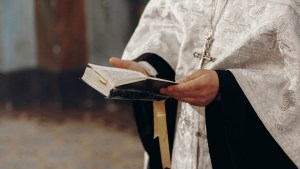
The Orthodox have communal worship assemblies, just as do Catholics and Protestants. The church buildings where the Orthodox meet for these assemblies have three main parts: 1) the entrance; 2) the main open area where the worshippers gather; and 3) the altar, from whence the priest leads the worship. Looking around in an Orthodox church building, a Protestant might be struck by several features that differ from the average Protestant church building.

The Icons

One of the most obvious differences is the pervasive presence of icons, or religious “pictures.” Many Protestants might object at first that the presence of these “images” cannot be reconciled with the Old Testament’s admonitions against idolatry. But the Orthodox who produce and display these icons do not see them as idols—in fact, they would wholeheartedly agree with Protestants that idolatry has no place in Christianity.

The Orthodox do not believe that the icons are in any way substitutes for God. Rather, they believe that the icons’ evocative style and prescribed content better help human worshippers move toward the invisible, triune God who alone is worthy of adoration.

Icons are never painted (actually, written is the term the Orthodox prefer to use to describe the creation of icons) with the intention of them being realistic representations of actual persons; they are always painted stylistically, according to longstanding traditional guidelines, and always with the intention of drawing the worshipper’s attention to spiritual realities above and beyond the icons. The Orthodox refer to icons as “windows to heaven.”

But the Orthodox don’t advocate icons as just another good way of pointing us toward God; they actually see them as better ways of pointing us to God and expressing worship to God than the more strictly abstract styles of expression used in Protestantism. Humility, love and courage are meaningless words, they say, unless these virtues are incarnated in the lives of individuals.

And while they certainly acknowledge the world is fallen, they also affirm that the creation was good and is loved by God, that its fallenness does not mean there’s no place for it in worship, that in fact it can be transfigured and transformed into a means of glorifying God. As one saint wrote long ago:

“Through heaven and earth, through wood and stone, through all creation visible and invisible, I offer veneration to the Creator and Master and Maker of all things. For the creation does not venerate the Maker directly and by itself, but it is through me that the heavens declare the glory of God, through me the moon worships God, through me the stars glorify Him, through me the waters and showers of rain, the dews and all creation, venerate God and give Him glory.”

Thus Orthodoxy sees each believer as endowed with the task of praising God, and believes this should be done in concert with all of creation, including icons.

The Iconostasis and Mystery

Glancing further around an Orthodox church building, a Protestant might be struck by the decorated partition that completely separates (except for three doors in it) the altar from the area intended for the lay-worshippers. Called the iconostasis, this screen is frequently several tiers tall and is thoroughly covered with icons. The iconostasis symbolizes a second fundamental emphasis of Orthodox worship—the mystery at the heart of our adoration of God.

However, some outsiders might postulate that the iconostasis was intended to emphasize the distinctions between the clergy—those who are allowed behind the iconostasis—and the laity—those who are not. But actually, an emphasis on such distinctions is totally contrary to the spirit of Orthodoxy.

The point of the iconostasis is that God cannot be effectively encircled with dogma and definition. God goes beyond the limits of what humans can know, much less define and articulate. And so, on the other side of the iconostasis is the mystery of the indefinable God, a God beyond all our imaginings.

Similarly, the bread and wine, which are transfigured into the body and blood of Christ, are referred to as mysteries, things beyond human abilities of complete definition or understanding. The most appropriate reaction in the face of such mysteries is worship.

The iconostasis serves not only to underline the mystery of God, but also as a vehicle for education and an inspiration to meditation. Every iconostasis contains large icons of Christ and of Mary, as well as of several of the apostles and other saints. Other icons on the iconostasis depict various episodes from Christ’s life, often including His birth, His baptism, His passion, and His resurrection.

These icons now serve a didactic purpose—and have for hundreds of years—by bringing to members’ minds some of the major events dealt with in the Scriptures. This was particularly the case when many of the faithful were illiterate.

The Vestments and Liturgy

At the very beginning of the service, the priest comes out to spread incense around and above the believers, and here again we notice points of difference between Orthodoxy and Protestantism. During the drama of the Liturgy (the main Sunday service), Orthodox priests dress in vestments reminiscent of royalty in order to denote the royal presence of the Lord Jesus Christ at the gathering of the faithful community. This is especially emphasized when the priests face the worshippers.

However, most of the time the priest faces the altar right along with the rest of the faithful. The censing represents the invisible presence of the Holy Spirit, who directs our prayers and sanctifies us by leading us into the truth. It is the intention of the Orthodox that all these various elements of worship help the members participate in worship with the totality of their personalities, and not just intellectually. The Orthodox believe that beauty—whether expressed in the colors and styles of icons, or through the beautiful vestments of the priests, or in the aromatic scents of incense—calls all of the person’s components to prayer.

Let us now look briefly at the prayers themselves. First, one will notice that the texts of the liturgical service contain a synopsis of Christ’s life: from birth, through death, to the resurrection and beyond. One of the most important features of the main Sunday service is its Christ-centeredness. All the major events of Christ’s life are recalled through symbolic actions.

The Liturgy is also punctuated with litanies, sung alternately with doctrinal hymns. Litanies are a combination of two elements: 1) a dialogue between priest and choir, in which they raise our earthly concerns before God; and 2) the congregation singing the major refrains “Lord have mercy” and “Grant it, O Lord.” The hymns cover various doctrinal teachings, and always include some about Christ’s resurrection.

This is important because one of the major objectives of every Liturgy is to allow each believer to experience himself the power and joy afforded by the Lord’s resurrection. It should be noted that some of the hymns also give honor to Mary and certain saints, and it is to this difference between Orthodox and Protestants that we now turn.

The Place of Mary and Saints

The Orthodox include Mary and the deceased saints in their prayers, principally because we believe, along with many other Christians, that the glory of God is humanity redeemed and united to God, not humanity despised and downtrodden. God does not force anyone’s will, but waits patiently on us. Mary, therefore, had the opportunity to refuse God—to say “Not according to your will, God, but according to mine.”

No Orthodox Christian would challenge the idea that Christ and only Christ is our Savior. But there is no question that He included Mary’s cooperation in the salvation process, just as God will not save a person if that person does not wish to be saved.

When the Orthodox sing to Mary as the door of salvation, we are underlining the fact that Mary’s courage and love are vital components of the process through which we are saved. In this regard, and in contrast to the religious paintings of Roman Catholicism, Orthodox icons never depict Mary alone but always with Christ, emphasizing her subservience to Him but not denying the fact that she is His mother.

Regarding the deceased saints, here again the Orthodox have reasons for including them in the service that are, at least to them, theologically persuasive and profound. Orthodoxy adheres to the tenet that ever since the coming of Christ, the partition between time and eternity, between the living and the dead, has been broken.

There is a mysterious unity—referred to by the Orthodox as the “communion of saints”—that exists because of the love that all believers are to show for each other. And just as we show this love by praying for and asking for the prayers of living persons, so can we continue to do this with those who are dead.

Scripture and Tradition

This idea of community, of timeless interdependence, also exhibits itself in the important Orthodox concept of Holy Tradition. Yet because of how important this concept is to the Eastern Orthodox, they are sometimes accused of not being sufficiently biblical—of using tradition to supplant biblical teaching. However, this idea is wholly contrary to Orthodox teaching, which holds the Bible in the highest esteem, and sees it as the book of Christendom.

For the Orthodox, tradition is not a substitute for the Bible, but a necessary supplement to it. The Bible itself needs interpretation, and this interpretation occurs though the action of the Holy Spirit working through the entire believing community.

Such interpretation is never carried out individually, because this would open the door to individual error, fragmentation, and strife—as the fallenness of the world intrudes through the egocentricity that stealthily lurks in each of us. The church guards against this by looking to the believing community as a whole, as expressing itself particularly through the Seven Ecumenical Councils (the last of which was conducted in 787), for proper interpretation.

In other words, there is a repository of commonly accepted wisdom and teaching, the Holy Tradition, which addresses questions and problems that may not be directly and openly dealt with in the Bible. Of course, this teaching can never contradict Holy Scripture. Through this attention to Holy Tradition, Orthodoxy has largely avoided the fragmentation that has plagued Protestantism, while at the same time avoiding the autocratic arbitrariness of the Roman Catholic Church. In Orthodoxy, no single person (aside from Christ), has absolute and infallible authority. This authority is vested in the believing community; this is the heart of the concept of Holy Tradition.

The After-Life and Atonement

As for peoples’ fate in the after-life, the Orthodox Church considers no one, not even Judas Iscariot, as already being damned. To judge someone is not our task—it is God’s prerogative. Therefore, we do not say that any dead persons are already damned, nor do we suggest that any deceased believers—no matter how moral their behavior in life—are without need of further purification or cleansing. The Orthodox Church sees those who have already experienced physical death as being in a state of anticipation of their future fate, of either bliss or suffering. The Orthodox, in keeping with our reservations about over-defining, do not postulate the existence of purgatory along the lines of the Roman Catholic Church. There is no bargaining to be done with God to lessen the suffering of those who are trapped at death in a state of sin. Instead, what Orthodoxy encourages is the desire, in living persons, to be cleansed themselves so that they will be more pleasing to God.

Ultimately, the Orthodox believe that the final fate of each person will only be clearly decided at the final judgment, which will occur after the Second Coming of Christ.

The consideration of cleansing brings us to two related teachings—original sin and atonement. The Orthodox, with their Protestant and Catholic brothers and sisters, affirm that this world is fallen, and because of this we are born into an environment where it is easier for us to do evil rather than good. Though our solidarity with the rest of humanity, we are entangled in a web of deceit, of hatred and of sin. And through our personal contribution, this state of fallenness continues. Original sin points to our solidarity with the rest of humanity and does not, in a strict sense, imply guilt. Rather, it points to our involvement. The Incarnation, Jesus, is God’s supreme answer to the question of personal and original sin. Because through Christ, we are restored to communion with God. The Incarnation and death of Christ are not viewed by Orthodoxy as solely a settling of accounts nor a ransoming (although there are some aspects of this in Christ’s work). The essence of the Incarnation is love. Christ’s work is not just a reversal of sin and death, but also an inauguration of an essentially new stage in the history of man. We now, at last, see clearly what humanity is to become.

Dr. Alexander Melnyk is a professor of bio-chemistry at Vanier College in Montreal, Quebec, Canada, and is also currently a candidate for a master of divinity degree at St. Andrew's College, a Ukrainian Orthodox theological school attached to the University of Manitoba in Winnipeg.

Copyright © 1988 by the author or Christianity Today/Christian History magazine.Click here for reprint information on Christian History.

History

Russian Christianity and the Revolution: What Happened?

Russia and the surrounding Slavic countries were at one time considered among the “most Christian” of nations. So where was the church during the revolution that made the USSR atheistic?

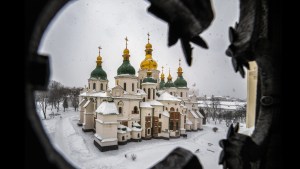
It was once known as “Holy Russia,” a land blossoming with the multi-domed church buildings so associated with the Eastern Slavs’ Orthodoxy, a land pregnant with spiritual heritage and strongly in touch with the oldest traditions of the faith. But around the turn of the 20th century, something drastic happened.

The chief nation of the USSR, the Russian Soviet Socialist Republic, was once considered to be among the “most Christian” nations in the world—a land with a rich, age-old history of churches and monasteries, the wellspring of numerous revered saints and martyrs, with a cherished and abundant legacy of sacred music, iconography and spiritual literature. Yet within less than a year after March 1917, when the last tsar abdicated, a band of militant atheists had seized power; many Russians were looting churches; were mocking religion and religious people unmercifully; were even murdering priests, monks and other believers by the thousands. What had happened?

To ascribe it all to “the Revolution” begs the question. In fact, there had been more than one revolution in Russia in the first decades of the 20th century. The anti-tsarist uprisings of 1905 had resulted in a constitutional government with an elected legislature, the Durma, and had ushered in a period of liberal reform. The revolution of March 1917 had seen the formation of a provisional government composed mainly of moderate liberals, though with a growing number of socialists. Yet none of this directly threatened the church or religion.

Revival, Then … Revolution!

Indeed, during these years Russia was experiencing something of a spiritual revival. Many disillusioned Marxist intellectuals turned to Christianity. Some yearned for a mystical revolution that would transform life itself. One group, which published the collection Vekhi (Signposts) in 1909, sharply criticized the radicalism of their fellow intellectuals. Among its members were the prominent theologian Sergei Bulgakov and the great philosopher Berdyaev. Both within and without the Russian Orthodox Church, writers, artists and other members of the flourishing Russian intelligentsia were seeking spiritual answers to the problems of the individual and society.

For the Orthodox Churches in the Russian Empire, the tsar’s abdication was a chance to free themselves from state control. Accordingly, the clergy, hierarchy and other representatives of the believers held a sobor, or council, which reestablished the patriarchate that had been suppressed by Tsar Peter the Great in 1721. The Russian Orthodox Church (ROC) seemed about to enter a glorious new era.

How, then, could the Bolsheviks—a small, conspiratorial party determined to smash the Church and root out religion—take over the vast empire in November 1917 and turn it into the world’s first atheist state?

Certainly it was not without a struggle. The Orthodox bishops and metro politans were perfectly aware of the Bolsheviks’ aims. In January 1918, the newly elected patriarch, Tikhon, warned the new regime not to persecute the church, and excommunicated all those who might be involved in such activity. During the next two years, at least 28 bishops and countless priests were murdered. The surviving clergy were stripped of their civil rights and subjected to intense economic pressure.

As for the mass of believers, those who had any clear political opinions tended to sympathize with the constitutional democrats, or in the case of the peasants who made up most of the population, with the moderate agrarian socialists—not with the Bolsheviks. But in such a far-flung, poor, and overwhelmingly rural country, most people had little knowledge of or concern for politics, and even less political influence. To take control, the Bolsheviks did not need to convince the majority of the correctness of their views. It was more a matter of seizing control of the major cities, the army, and the means of communication; this they did with ruthless efficiency.

Nevertheless, it took a three-year civil war for them to re-conquer most of the old Russian empire and create the new socialist federation, known from 1922 as the Union of Soviet Socialist Republics. In this conflict, many ROC priests and bishops supported the anti-Bolshevi White Armies, though as early as September 1919 Patriarch Tikhon warned his clergy to stay out of politics, and reminded the faithful that the church imposed no political obligations upon them.

An Unprepared Church

The ROC does not seem to have bee really prepared for the Bolshevik onslaught. For nearly two centuries it had been trammeled by the Holy Synod, an agency of the state set up to supervise the church. Not only was the ROC closely linked with the state—it became virtually a part of the bureaucracy. Close identification of church and state was the expressed policy of Konstantin Pobedonostsev, a layman who headed the Holy Synod from 1889 to 1905. He saw this, essential for strong government. But it prevented the ROC from developing free life or exercising an independent—and therefore credible—moral authority. Furthermore, the ROC failed to adequately prepare its clergy to meet the philosophical challenges of the day. Too often it was seen—not altogether inaccurately—as an obscurantist and reactionary institution.

But in an empire that was only half ethnically Russian, the ROC was on the largest of several Christian churches and the revolution affected each of them differently. The March Revolution provided an opportunity for other predominantly Orthodox peoples, such as the Byelorussians and Ukrainians, to revive their own traditional churches, which had been suppressed by the tsars.

The Evangelicals and Baptists (whose remarkable growth in the 19th century had been due in part to their strong knowledge of Scripture, but who had been mercilessly persecuted by the government) also benefited from the revolulion—at first. The Bolsheviks initially tolerated these movements because they tended to weaken the established Orthodox church. Later, of course, they would try to destroy them as well.

The Masses and the Party

Most of the peasantry—that is, most the population of Russia—remain, passive throughout the revolution and civil war. Life was precarious enough, and opposing any authority, tsarist or Bolshevik, was dangerous. It has also been said that the Russian Orthodox tradition bore a strain of fatalism and other worldliness that made it all too easy for the godless to take over secular affairs.

Of course, the Bolsheviks did find active supporters. For one thing, the legendary piety of the Russian peasant has been somewhat exaggerated. In the latter half of the 19th century, nihilists and radical populists had made inroads in the countryside, often playing upon the latent anti-clericalism of the peasant.

Besides, the village priest, usually a peasant himself, was not always an object of veneration. However devout the villagers might be, they could only see a poorly educated, sometimes morally corrupt priest, who typically had been born into his state as much as called to it, as merely their equal if not their inferior.

Services in the Church Slavonic language, which the people could barely understand, hardly satisfied their intellectual needs, and without adequate education they could receive little spiritual nourishment from the highly formalistic Church rituals. Besides, an institution that represented the autocratic regime was automatically suspect to many.

Thus, even pious Christians could become alienated from the ROC. This did not make them Bolsheviks, but it could make them unwitting accomplices in the struggle against religion.

In fact, the Bolsheviks welcomed those Christians who, thinking their faith was somehow compatible with Marxism, wished to cooperate. These well-intentioned souls seem to have been unaware that Christian notions of morality were incompatible with the Bolshevik creed, because Marxism taught that morals were conditioned by socio-economic relations.

When conditions changed, so did morals. Morality was relative, not absolute. Nor could the imperatives of class struggle be hindered by scrupulous “bourgeois morality.” One might say that the end justified the means—if there were any need for justification. Indeed, their attitude toward their Christian sympathizers epitomized the Bolsheviks’ morality. They apparently calculated that once these “fellow-travelers” had discovered the inherent contradiction in their position, few would have the courage to renounce Marxism in favor of an increasingly disfavored Christianity.

At the same time, the brutalizing poverty of Russian village life must also have won active support for the Bolsheviks. After all, the liberal-democratic Provisional Government only talked about taking land from the rich landowners and giving it to the peasants; the Bolsheviks encouraged them to help themselves. And alas, one of the largest landowners happened to be the Church.

The Bolsheviks did their best to propagate the image of the Church as a wealthy exploiter, even turning the Church’s piety against it. When famine broke out in 1920–21, the Russian Orthodox hierarchy quickly set up a relief fund and contributed generously to it. However, the Church exempted from the collections its sacramental objects, such as the chalices used in divine worship. Seizing on this, the Bolsheviks organized their own relief effort, then commanded the Church to turn over the sacramental objects as well. When it refused, they put several church men on trial for refusing to help the hungry.

One group of Bolshevik supporters cropped up within the Church itself. During the late 19th century, the Russian Orthodox seminaries had become hotbeds of radicalism. Many young priests had embraced socialist ideas, which were reinforced by their resentment of their immediate superiors, the bishops, as well as by their disapproval of their Church’s social and political role. They were joined by intellectuals who had abandoned Marxism but sought to combine Christianity with a radical social ethic.

In the wake of the Bolshevik take-over some of these activists formed the Renovationist Church. Seeing their opportunity, the Bolsheviks manipulated and eventually took control of the Renovationist movement, using it to weaken the mainstream Patriarchal Church. But then the ROC’s Patriarch Tikhon died, and his successor, Metropolitan Sergii, was persuaded in 1927 to declare his Church’s loyalty to the Soviet state. After this the Bolsheviks had no further use for the Renovationists, and suppressed them.

But even if manipulation of sympathizers helped the Bolsheviks take over, what made it possible for them to hold on? It was one thing for them to use the army and police to crush all active opposition. But how could they win over the souls of a hundred million Christian believers? Or did they?

True Believers?

There is no certain answer to this question. According to one theory, Marxist Leninism was a substitute religion that took the place of Orthodoxy in the hearts and minds of the people. With Marx, Engels and Lenin as its “prophets,” Capital and other writings as its “scripture,” with dialectical materialism as its “theology” and the Communist Party as its “priesthood,” Marxist Leninism was a ready-made secular faith. With skillful propaganda and a good deal of coercion, the Bolsheviks simply “converted” the people from one orthodoxy to another. Accustomed to unquestioning obedience, the masses acquiesced.

While it may be true that Marxist Leninism is in effect the official religion of a confessional Soviet state, this theory tends to exaggerate the Communists’ success. Even today, they are still trying to replace Orthodox rituals with artificial Soviet rites. In fact, despite the Stalinist terrors of the 1920s and ’30s, Christianity was not supplanted with the new Soviet creed except in the minds of the few Party members and sympathizers.

Even in the midst of the revolution, church attendance was high. Martyrdom enhanced the Church’s prestige. Later, most Orthodox Churches simply went underground, where the trials of the catacombs revitalized the faith. Today, convinced atheists are still only a fraction of the population.

While the majority seems indifferent to both religion and atheism, some scholars estimate that as much as 45 percent of the people in the USSR are religious believers. This would include some 50 million Orthodox, perhaps as many as three million Evangelicals–Baptists, some 10 million Catholics, and tens of millions of Muslims and other non-Christian religious people.

One indicator of the strength of Christianity in the militantly atheistic Soviet state was the government’s decision to re-establish the lapsed Patriarchate of the Russian Orthodox Church in 1943, in return for the latter’s support of the Soviet war effort and the new Russian nationalist policy. This act, however, revived the traditional alliance of church and state—a partnership beneficial to the hierarchy but arguably detrimental to the faith. In fact, leading hierarchs have sided more than once with atheist of officials against overly active and popular priests. And to many Ukrainians, this year’s government-sanctioned millennium celebrations are but another product of this “unholy” alliance between clerics and the commissars.

The Church’s Dilemma

The unequal and uneasy partnership of church and state leaves rank-and-file believers in a quandary. To defy the hierarchs could divide the Church, but to follow their political line strikes many as hypocritical. The resulting cleavage between the institutional Church and the mass of believers is, of course, just what the Bolsheviks ordered. For it was by such techniques of “divide and conquer” that they were able to subjugate the overwhelmingly Christian Russian Empire.

They weakened the Church from within, playing off laity against clergy, clergy against hierarchy. They compromised the Church in the eyes of the faithful by terrorizing the bishops into loyalty to an atheist state. And after the terror of the ’30s they tried to undermine the spiritual revival—one might say the true, inner revolution in the souls of the people—by propping up a lifeless conservative and statebound church establishment.

The sad and perplexing story of the Bolsheviks’ take-over of Christian land bears number of lessons for us today, lessons far more numerous an multi-faceted than can be discussed in this brief space. They include:

Churches must be prepared to meet the intellectual challenge of Marxism and other secular ideologies, particularly in the socio-economic sphere; on the one hand, they must not be passive or unaware of political developments; on the other they must not be draw into facile alliance with latently anti-Christian movements; they must welcome reform from within, but resist manipulation from without and the list goes on.

A final lesson might be: The Soviets have been in power for just over 70 years, some two-thirds of a century and in that time severe generations of them have carried out radically violent and persistent efforts to extinguish the Christian faith in their realm. Yet today, the survival of Christianity in the USSR—yes, even the flourishing of it—is acknowledged by most of the world community, including many Soviets. And not surprisingly.

After all, Christianity has been the religion of the Eastern Slavs for at least 1,000 years—10 centuries. With that comparison in mind, Christians might see Soviet rule as just one more passing trial that will soon be transformed.

Andrew Sorokowski, having both a degree in law and a master’s degree in Soviet studies from Harvard, is now completing a doctoral dissertation in history at the University of London School of Slavonic and East European Studies. From 1984–87 he was in Kent, England, working with Keston College, a research institute that specializes in reporting on religious life in the Soviet Union and Eastern Europe.

Copyright © 1988 by the author or Christianity Today/Christian History magazine.Click here for reprint information on Christian History.

History

Of Mass Baptisms, National Churches, and the Great Commission

Can a king-ordered mass baptism of his nation’s citizens really bring about their genuine conversion to Christ? What are we to make of Christ’s command to “make disciples of all nations”?

The “conversion” of Kievan Rus’ was a king-commanded, soldier-implemented “Christianization” of a people. So was it valid? Kemmerer says it was, and offers a rationale that focuses on problems with the stereotypical Western concept of salvation and how to carry out the Great Commission.

To come appropriately to this millennium of the Christianization of Rus’ is to come respectfully, to come in awareness that one is contemplating the wellspring of a thousand years of rich spirituality and Christian culture among one of the great families of mankind. All protestations of various nationalists notwithstanding, the Christianization of the Kievan Rus’ c. 988 is, in point of fact, a milestone belonging to all the Eastern Slavs: the Ukrainians, the Byelorussians, and the Great Russians. It is not just a single event, but the fountainhead of a vast historic flow of faith.

It is a living legacy, first for the Orthodox believers who are its original children, but also for the enrichment of all Christians and other men and women of humanity and culture. Those who have a mind to appreciate such things must acknowledge that here are a subject and an occasion worthy of the effort to appreciate them. Yet for all of that, many a Western Christian will find certain difficulties in relating to this millennium of the Christianization of a nation.

Reasons for Misunderstanding

The first and most obvious reason for our difficulties is simply our relative ignorance of the lands, cultures, and histories of the Eastern European peoples. In this regard, Russian history has been rendered more or less alien to us by its cultural isolation from the West. In its early years it drew richly from the magnificent civilization and religion of Byzantium, which played its most vital role in our cultural and religious evolution during late antiquity and the period we tend to denigrate and dismiss as the Dark Ages. It is perhaps the single largest blind spot in our historical education.

More particularly, Western Christians are largely ignorant of how much of their own theology and rite comes from this source. Since the Byzantine connection is so much more significant in the East and in Russia, our ignorance of the one immediately sets us at greater distance from the other.

Then, too, the Mongol invasions which destroyed Kiev in 1240, drew a cultural curtain across the Russians lands, isolating them from the West for more than 200 years. Thereafter, Russia only slowly turned away from its eastern orientation, which left a mark on all of Russian society including religion. Writing in The Historical Road of Eastern Orthodoxy, the late Fr. Alexander Schmemann can say, “The Russian character was completely coarsened and poisoned by ‘Tatarism’,” which he goes on to describe as “lack of principle and a repulsive combination of prostration before the strong with oppression of everything weak.” Unfortunately, as Moscow began to rise to dominance, this quality became imprinted more deeply in its culture and the strong religious nationalism of “Holy Russia.”

When westernization came it came forcibly, in the early years of the 18th century under Peter the Great. By that time, of course, so much of the Western religious tradition had already been formed without any reference to the East or Russia. And in Russia the westernization went only so far. In one sense, it did not deeply touch the Russian soul. The characteristics of autocracy and a type of monolithic, state-sponsored orthodoxy were deeply ingrained, and they continue on even into the present totalitarian regime.

This in particular presents a barrier to Western sympathy, which has been conditioned by liberal and democratic revolutions and our current pluralism. Of course, to point out this grimmer side of Muscovite Orthodoxy takes nothing away from those examples of deep Christian spirituality that interlace Russian history and literature. Still, to put it plainly, Russia stands outside our own cultural and religious traditions. It is not a major player in the Renaissance, Reformation, or Enlightenment periods.

The problem, however, is not that the difficulties for our understanding are so great, but rather that we fail to recognize our own prejudices and lack of sympathy for what is simply foreign to us. It is a problem of historical naivete, an undetected myopia. And there is a particularly marked tendency toward this among Christians, who assume that what is a heavy spiritual issue for them must be the same weight of issue for other Christians in different historical and cultural contexts.

The Mass-Baptism Question

Perhaps there is no better example of this for modern Western Christians than the whole connection between church and state or nation. In the Russian tradition we are presented with this problem from the very beginning, in Prince Vladimir’s mass baptisms in the Dnieper.

According to history, the Kievan-Rus’ people were “converted” after Vladimir delivered an edict that all the citizens of his realm would be baptized or risk becoming enemies of the state and of the prince himself.

What are we to think of such a “conversion”?

To what extent were the common people coerced by threat of the prince’s displeasure? To what extent had they been sufficiently informed? If we have reservations about such a beginning, how shall we view the Christianization that follows? For it does not appear to be evangelism as we think of it in the West.

Here we run up against two frequent characteristics of the Western Christian mind: first, a simplistic and artificial separation between church and state or nation, one that eschews any such government sponsorship; and second, a simplistic insistence on an individualistic salvation, with its corollary being a suspicion of any en masse conversions.

What can be said in defense of this sort of “conversion”? Of course we must admit that politics were part of the motivation for this edict—but how seldom are they not in this world? Christ’s kingdom ultimately is not of this world, but it is in it; and the faithful may often look to God to move the heart of a prince, politician, or leader of public opinion. In this instance, there was a political catalyst, a proposed dynastic marriage, in which Constantinople insisted upon Vladimir’s baptism as a condition for the royal union.

But certainly more was involved here than just politics. The time was right; pagan Kiev was ripe for conversion. Apparently there had been a growing dissatisfaction with the old paganism and a realization that the Kievan state needed to embrace one of the major faiths pressing upon its borders: Islam, Judaism, Western or Eastern Christianity (these last two were distinct and competitive, though as yet not in schism). Adherents of these religions were urging their faiths upon the prince. So, Vladimir sought the advice of “his boyars (the leading nobles) and the city elders,” who suggested that he “inquire about the ritual of each and how he worships God.” Here the Chronicle is quite specific in saying that this counsel pleased not only the prince, but “all the people.” There was a process of popular consultation here, and a careful albeit primitive, inquiry followed.

The Chronicle tells us that of all the different faiths they observed, the envoys were only impressed positively with the Greek Orthodox services they observed in Byzantium. Back in Kiev, it was also noted that the prince’s grandmother Olga, who had been baptized 30 years before, would not have accepted that faith if it had been evil. Thus, the matter was settled for prince, nobility, and people. But it was left with the prince as to how to proceed, which he did about a year later.

The important thing to note is that the prince’s decision did not occur in a vacuum or hastily. Christianity had already been preached in Kievan territory. In fact, a church had existed in the city for more than 40 years. Even the royal house had already been touched (through Olga, who at one time had been regent). Vigorous trade, as well as missionaries, had for decades maintained contact between Kiev and both Eastern and Western Christian communities. However, Kiev was not ready to embrace the new faith until its prince, with the apparent approbation of the nobles and many of the people, set the corporate process in motion.

But if this still seems to bode too great a danger of compromise or domination by Caesar, we may ask, what was the alternative in Kiev c. 988? It is unlikely that that society would have responded to the type of individualistic evangelism practiced by 19th- and 20th-century American Protestant churches. Moreover, the favor of princes and nobles has been a vital part of the advancement of religion from Old Testament times, particularly the advancement of Christianity through both Eastern and Western Europe. Millions have come to a faith in Christ through such doors of opportunity. So, for better or worse, Vladimir stands in the tradition of Constantine and Clovis.

We should also bear in mind that missionaries from St. Patrick to St. Augustine of Canterbury to the present have not tended to pass up opportunities to baptize and teach people, just because they were influenced by their leaders. And, in those cases where Christianity failed to take advantage of such openings, we have perhaps had reason since to regret it. At any rate, the subsequent history of the Kievan Church shows that it was not dominated by the state, but was able to act with Christian integrity, freedom, and power.

Still, there remains the question of nominalism, which many associate with a baptized but unregenerate paganism. Do mass baptisms like that in the Dnieper lead inevitably to an adulteration of the gospel, superstition, and syncretism? Not necessarily.

A Biblical “People Movement”?

There can be valid “people movements” to Christianity. (For that matter, there can be people movements for religious reform or protestations as well. It is highly questionable whether the Protestant Reformation could ever have occurred without such a phenomenon.) This is a fact which has been brought to the attention of Western Christians of late by the “Church Growth Movement.”

Vladimir’s decision, of course, could not guarantee a true evangelization of his people, but it did open the door to the process. What was important was how the opportunity was pursued. As Waskom Pickett’s mission studies in India in the 1930s revealed, a convert’s eventual maturity or weakness had more to do with the quality of his subsequent pastoral care than even his initial motive for conversion.

In all of this, we do well to remember that Christ’s Great Commission to evangelize the earth was framed in terms of discipling, not individuals, but nations. This recognizes the human bond that exists between a man and his family, his community, and his people. The redemption of man’s full humanity requires a type of Christianizing of the whole life and community of man: his work, his law, his culture, and all his relationships.

So Christ spoke of “making disciples of all the nations, baptizing them in the name of the Father and of the Son and of the Holy Spirit” (just as the work was begun in the waters of the Dnieper), and “teaching them to observe all that I have commanded you.” In one sense, that final phrase suggests an unending work, extending the impact of the gospel into every aspect of the nation’s life—culture, law, and politics—throughout history.

For Kiev and the Russian peoples, the process of penetrating the masses and transforming the soul of the people would have to take time. There was no strong, organized pagan resistance from any quarter. In fact, the people seem to have supported the change, at least on the surface, but on another level the old ways died slowly. Fr. Schmemann writes candidly about this:

“Its external elements—the divine service, the ritual—were easily accepted; it charmed the people and won their hearts; but there was danger that they would not see, or even try to see, the meaning or logos behind these externals, without which the Christian rite would in fact become pagan in becoming an end in itself. The soul of the people continued to feed upon the old natural religious experiences and images.”

The task begun among the Eastern Slavs was formidable and ongoing, but the effort to Christianize the people, the expanding nation (the ethnos of Matt. 28:19), was sincere and dedicated. Children from the best families were sent to schools for instruction, and Greek and Bulgarian priests, along with some from the West, labored to lay the foundations of Russia’s own Christianity.

Their success can only be evaluated by the historical record. And by that measure it would seem that Kievan Christianity was indeed marked by a high evangelical ideal and an undoubted spiritual vitality, which has passed on a rich and living tradition to subsequent generations.

Writing in the mid-’70s from within the Soviet Union, the dissident Evgeny Barabanov looks upon this great stream of Russian spirituality and Christian culture:

“In the feats of its saints and pious men, the Russian people have never ceased to behold the unfading light of a higher moral truth, which became the object of a quest that permeates the whole of great Russian literature. And looking back we realize that Christian ideas and ideals lay beneath even those aspects of life and culture which, would seem, were not related to them on the surface.

“We need not mention the heritage which has become an inalienable part the spiritual life of all mankind: the cathedrals and icons, especially the icons of Andrei Rublev; the prayers of Sergious of Radonezh (see The Country-Saving Monk); the archpriests Awakum and Serafim Sarovsk the authors Gogol and Dostoyevsky, Tolstoy and Solovyov; the pleiade of 20th century thinkers; and, finally, those recent innumerable martyrs whose hagiographics have not yet been written an who are remembered by only a few surviving eyewitnesses.”

This is all part of the millennium of the Christianization of Rus’. Although it is outside the Western tradition, the world has grown smaller in these last thousand years and that other great stream of Christianity need no longer seem so far away. For the Westerner who draws from its life and learning, there is much richness to be found, and correctives also for some of the distortions of our own limited perspective.

David M. Kemmerer is the editor of Touchstone, a journal produced by B’rith Christian Union, a Chicago-based organization that encourages a re- examination of the continuity of historic Christian orthodoxy.

Copyright © 1988 by the author or Christianity Today/Christian History magazine.Click here for reprint information on Christian History.

History

The History of Russian Christianity: Did You Know?

In this series

That Prince Vladimir, the Slavic ruler credited with the Christianization of Rus’ (not Russia), allegedly ordered all the inhabitants of Kiev, his capital city, to appear at the river for baptism on a particular day in 988 or they would be considered enemies of the kingdom?

That one reason Vladimir allegedly decided to accept Christianity was because, after hearing defenses of several major religions, he was healed from an eye disease after his grandmother Olga prayed to her god, the God of the Orthodox?

That another alleged reason for Vladimir’s conversion was his emissaries’ report that when they saw the grandeur of the Eastern Orthodox services in Constantinople, they were so awed that “We knew not whether we were in heaven or on earth, for on earth there is no such splendor or such beauty!”?

That believers from the Ukrainian portion of the Soviet Union have for centuries embraced St. Andrew the Apostle as their patron saint, citing several early sources that say that he, the “first-called” apostle, conducted mission work in their homeland c.50–60 A.D.?

That despite the millennium events primarily conducted in Moscow in 1988, the baptism that the millennium celebrates actually took place in the region that is today known as Ukraine, in the ancient city of Kiev (hundreds of miles from Moscow, which hardly even existed in 988)?

That the Ukrainian Catholic Church, which claims direct lineage to the 988 baptism, is today banned in the Ukrainian Soviet Socialist Republic, and its four million adherents are either worshipping “underground” in Ukraine or have scattered across the globe, primarily to the U.S. and Canada?

That the Constitution of the Soviet Union says its citizens are “guaranteed … the right to profess … any religion, and to conduct religious worship”?

That, while statistics from the Soviet Union are very questionable, it seems certain that today some 50 million Soviet citizens are members of the Russian Orthodox church, some 10 million are members of the Roman Catholic Church, and at least another 12 million are members of the Georgian and Armenian Orthodox Churches, and of various Protestant churches?

That adding to the 72 million above the Muslims, Jews, and others, at least 40 percent of the Soviets retain a religious identity, while only 19 million are members of the Communist Party?

That as recently as the late 1950s and early ’60s, during Nikita Kruschev’s policy of “de-Stalinization,” from 7,000 to 10,000 Russian Orthodox Churches—about half of those then open—were closed down and dissolved by government action?

That in some republics of the Union of Soviet Socialist Republics, believers can, with little resistance, evangelize, carry out religious instruction, and publish religious literature?

That clergymen of the Russian Orthodox Church set foot on what is today known as the State of Alaska in 1794, and established Orthodox churches all the way down to San Francisco, Calif., before Alaska was even purchased from Russia by the United States government?

Copyright © 1988 by the author or Christianity Today/Christian History magazine. Click here for reprint information on Christian History.

History

The Orthodox Art/Ministry of Icons

In this series

Stylized religious paintings, such as this one of Christ, are still a significant part of the Eastern Orthodox faith that Prince Vladimir adopted as his kingdom’s official religion c. 988. They are numerous in modern Orthodox Churches. But to the Orthodox they are far more than mere paintings.

In their eyes, icons are a ministry, to the heart as much as to the eyes. They not only see them as works of beauty, and thus carefully preserve and venerate them; they also see the beauty of the icons as turning the believer’s thoughts to the beauty of God. Additionally, they view them as teaching tools and reminders, providing believers with visual aids to help them learn and remember biblical and church history events, as well as the characters and their virtues.

Iconography is definitely not a free-form genre that allows the artists to paint their subjects any way they will. Rather, icons are produced according to strict, widely held standards, by artists who must train for years, learning meticulously the established parameters of what icons can look like. And the painting must be preceded by times of fasting and prayer in preparation for this spiritual work. For more on icons, see the article in this issue, “What is Orthodoxy Anyway?”

Copyright © 1988 by the author or Christianity Today/Christian History magazine. Click here for reprint information on Christian History.

History

The Primary Source of the Millennium Legends/Historical Events

Read for yourself the chief accounts upon which the millennium celebration is based; while these much-loved chronicles admittedly contain a good bit of legend, they are still the best history we have.

These excerpts from what is known by the Eastern Slavs as the Primary Chronicle, written nearly 900 years ago, contain in dramatic prose the chief accounts upon which the millennial celebrations are based: that of the Apostle Andrew visiting Ukraine; that of Olga’s baptism; and that of the great baptism of Kiev.

It is being called, variously (depending upon one’s biases), “The Millennium of Christianity in Ukraine,” “The Millennium of Christianity in Russia,” “The Millennium of Christianity in the USSR,” “The Millennium of the Russian Orthodox Church,” “The Millennium of the Ukrainian Orthodox Church,” and several others.

Yet regardless of their widely varying biases, all the groups participating in the thousands of celebration activities are united in referring to one document as a source for what events are being commemorated: The Primary Chronicle (Laurentian Text), or Tales of the Bygone Years—a compilation that probably first appeared at its current length in 1116, under the name of one Sylvester, but which is widely accepted as being primarily written by a Ukrainian Orthodox monk named Nestor, and added to later by Sylvester and others.

In its nearly 200 pages, this extensive compendium includes stories of the Eastern Slavs history dating from the days of Noah right up until the 12th century, dealing broadly with all the history of Kievan Rus’ but, being authored by a monk, focusing especially on the Eastern Slavs’ “salvation history.”

Regarding the millennium, the celebrants refer most frequently to three of the Chronicle’s accounts: that of the Apostle Andrew visiting the future site of Kiev and other portions of the modern USSR; that of the baptism of Princess Olga, a queen of Kievan Rus’ and the grandmother of Grand Prince Vladimir; and that of Vladimir ordaining Christianity as the official religion of his realm and ordering all the citizens to be baptized. In excerpts taken from the 1953 translation called The Russian Primary Chronicle, edited and translated by Samuel Hazzard Cross and Olgerd P. Sherbowitz-Wetzor (Medieval Academy of America: Cambridge, Mass.), these accounts are presented below, interspersed with editor’s notes of explanation and commentary.

But first, a note about accuracy: While historians from a broad range of perspectives question the accuracy of the details in these accounts, even the most-skeptical historians seem to agree that the Chronicle is generally accurate in its accounts of the general happenings. In the case of the latter two accounts, their general accuracy has been much corroborated by other reliable sources. As for the first account, a persuasive case can be made (see The Soviet Union Celebrates 1000 Years of Christianity) that it probably contains at least a germ of accuracy, though the evidence for it is clearly speculative.

However, it is not speculative that, for at least 800 years, the Chronicle has been a much-loved collection of “the peoples’ stories,” a legacy of history and legend that has been passed proudly down from one generation of Eastern Slavs to the next, even to this very day.

Andrew the Apostle Visits Rus’-Ukraine, C. 50–60

Dating from at least the 4th century, the tradition has been strong and pervasive among Eastern Slavic believers that Andrew the Apostle of Christ, during his mission journeys to the Greek colonies on the Black Sea, visited the territories that were later to become Ukraine and Russia—and possibly left some new converts to Christianity behind. Whether historically verifiable or not, here is definitely one of the “primary” sources of the millennial celebration.

The Dnieper [River] flows through various mouths into the Pontus Sea, which is called the Russian [today the Black] Sea, and it was this sea beside which taught St. Andrew, Peter’s brother.

When Andrew was teaching in Sinope and came to Kherson [an ancient city on the north side of the Black Sea opposite Constantinople], he observed that the mouth of the Dnieper was nearby. Conceiving a desire to go to Rome, he thus journeyed to the mouth of the Dnieper.

Thence he ascended the river, and by chance he halted beneath the hills upon the shore. Upon arising in the morning, he observed to the disciples who were with him, “See ye these hills? So shall the favor of God shine upon them that on this spot a great city shall arise, and God shall erect many churches therein.” He drew near the hills, and having blessed them, he set up a cross. After offering his prayer to God, he descended from the hill on which Kiev was subsequently built, and continued his journey up the Dnieper.

He then reached the Slavs at the point where Novgorod [an ancient city to the northeast of Kiev] is now situated. He saw these people existing according to their customs, and on observing how they bathed and scrubbed themselves, he wondered at them. He went thence among the Varangians [the leading Slavic tribe in the region] and came to Rome, where he recounted what he had learned and observed. “Wondrous to relate,” said he, “I saw the land of the Slavs, and while I was among them, I noticed their wooden bathhouses [or spas or saunas]. They warm them to extreme heat, then undress, and after anointing themselves with an acid liquid, they take young branches and lash their bodies.”

“They actually lash themselves so violently that they barely escape alive. Then they drench themselves with cold water, and thus are revived. They think nothing of doing this every day, and though tormented by none, they actually inflict such voluntary torture upon themselves. In fact, they make of the act not a mere washing but a veritable torment.” When his hearers learned of this, they marveled. But Andrew, after his stay in Rome, returned to Sinope.

This latter story, about Andrew’s observation of the Novgorodians, is the most highly questioned part of the narrative. Scholars suggest it was added into the Chronicle sometime after Nestor, probably by a Kievan who, inheriting the legacy of an an age-old rivalry between the cities of Kiev and Novgorod, wanted to confirm that the Novgorodians were foolish as far back as the 1st century.

The Baptism of Olga, C. 955

Princess Olga (or Ol’ha) is the first woman to have been recorded in Ukrainian history as having openly become a Christian—though it’s very unlikely she was the first Ukrainian Christian woman. But because she was a princess, she was the first Ukrainian woman to have been recorded as a Christian.

She was the wife of Prince Ihor (r. 913–945), a Norseman who was one of the first great princes of the Kievan-Rus’ empire. Also, she was the grandmother of Prince Vladimir who ordained the national baptism.

The Chronicle asserts that she was clever and regal even before becoming a Christian, but that she initially used her cleverness and regal bearing to exact cruel and unexpected vengeance upon her enemies. When she first learned about Christianity is unknown; it is almost certain there were several believers in her husband’s retinue, and she could have learned of it from them. Yet obviously, she did not make her profession of faith known until her husband was several years dead.

How public she actually was about changing from her subjects’ pagan faith to the “new” Christian faith is open to much question; however, according to the Chronicle, she made up her mind quickly and proclaimed it openly, without regard of the consequences to her reputation with her people. This is the Chronicle’s romantic account:

Olga went to Greece, and arrived at Tsar’grad [Constantinople]. The reigning emperor was named Constantine [VII], son of Leo. Olga came before him, and when he saw that she was very fair of countenance and wise as well, the emperor wondered at her intellect.

He conversed with her and remarked that she was worthy to reign with him in his city. When Olga heard his words, she replied that she was still a pagan, and that if he desired to baptize her, he should perform this function himself; otherwise, she was unwilling to accept baptism. The emperor, with the assistance of the patriarch, accordingly baptized her.

When Olga was enlightened, she rejoiced in soul and body. The patriarch, who instructed her in the faith, said to her, “Blessed art thou among the women of Rus’, for thou hast loved the light, and quit the darkness. The sons of Rus’ shall bless thee to the last generation of thy descendants.” He taught her the doctrine of the Church, and instructed her in prayer and fasting, in almsgiving, and in the maintenance of chastity. She bowed her head, and like a sponge absorbing water, she eagerly drank in his teachings. The princess bowed before the patriarch, saying, “Through thy prayers holy father, may I be preserved from the crafts and assaults of the devil!” At he, baptism she was christened Helena, after the ancient empress, mother of Constantine the Great. The patriarch then blessed her and dismissed her.

After her baptism, the emperor summoned Olga and made known to her that he wished her to become his wife. But she replied, “How can you marry me, after yourself baptizing me and calling me your daughter? For among Christians that is unlawful, as you yourself must know.” Then the emperor said, “Olga, you have outwitted me.” He gave her many gifts of gold, silver, silks, and various vases, and dismissed her, still calling her his daughter.

Since Olga was anxious to return home, she went to the patriarch to request his benediction for the homeward journey, and said to him, “My people and my son are heathen. May God protect me from all evil!” … So the patriarch blessed her, and she returned in peace to own country, and arrived in Kiev …

…. and the Greek emperor sent a message to her saying, “Inasmuch as I bestowed many gifts upon you, you promised me that on your return to Rus’ you would send me many presents of slaves, wax, and furs, and dispatch soldiery to aid me.” Olga made answer to the envoys that if the emperor would spend as long a time with her in the Pochayna [region] as she had remained on the Bosporus [Sea], she would grant his request. With these words, she dismissed the envoys.

Now Olga dwelt with her son [the boy-king] Sviatoslav [she was regent to him until he was of age]. And she urged him to be baptized, but he would not listen to her suggestion—though when any man wished to be baptized, he was not hindered, but only mocked ….

The Chronicle goes on to discourse on the blindness of those like Sviatoslav who do not believe, and on Olga’s continuing witness to her son. The Chronicle then recounts several of Sviatoslav’s battle campaigns. Finally, Sviatoslav announces that he is going to move his throne to the Danube region, but the ailing Olga convinces him to stay in Kier until she is dead. Only three days later, according to the Chronicle, she breathes her last. After the beloved lady’s death, . . .

Her son wept for her with great mourning, as did likewise her grandsons and all the people ….

Olga was the precursor of the Christian land, even as the day-spring precedes the sun as the dawn precedes the day. For she shone like the moon by night, and she was radiant among the infidels like a pearl in the mire, since the people were soiled, and not yet purified of their sin by holy baptism … [The Chronicle asserts that] she was the first from Rus’ to enter the kingdom of God, and the sons of Rus’ thus praise her as their leader, for since her death she has interceded with God in their behalf.

Vladimir’s Acceptance of Christianity and the Baptism of Kievan Rus’, C. 988

Despite the Chronicle’s assertion that Olga was “the first from Rus’ to enter the kingdom of God,” there is no question that Christianity was introduced into Kievan Rus’ long before Olga, and certainly before Prince Vladimir. For example, the Chronicle, contradicting itself, says a Christian church existed in Kiev during the reign of Olga’s husband, Ihor. And other records convince us there were many merchants in the area, as well as knights and soldiers, who were either converts to or had an acquaintance with the new faith.

In its rambling narrative, the Chronicle reports several legends concerning the adoption of Christianity as the state religion, as well as several traditional accounts of the baptism of Prince Vladimir. A great irony about the millennium is that no one knows exactly where or when Vladimir was baptized (though it was most likely in 988 or 989, with the baptism of Kiev coming at least one year later—thus making it impossible to have the celebrated baptism of Kiev in 988).

And regardless of the fact that the Chronicle makes the widespread acceptance of imposed Christianity sound simple, it is certain that while some citizens of Kievan Rus’ accepted it peacefully, others resisted and “had to be convinced” by force. This knowledge is tempered by the fact that Vladimir’s acceptance of Christianity was not merely a spiritual move; with his kingdom in such close proximity to the Christian Byzantine Empire, it was also a very political move. Nonetheless, it gave Christianity the prince’s endorsement, and afforded the church with greater resources to carry out her mission. The account begins with representatives from various religions coming to visit the up and-comingPrince Vladimir:

c. 986—Vladimir was visited by Bulgars [from the region of Bulgaria] of Mohammedan faith, who said, “Though you are a wise and prudent prince, you have no religion. Adopt our faith, and revere Mohammed.” Vladimir inquired what was the nature of their religion.

They replied that they believed in God, and that Mohammed instructed them to practice circumcision, to eat no pork, to drink no wine, and after death, promised them complete fulfillment of their carnal desires. “Mohammed,” they asserted, “will give each man 70 fair women. He may choose one fair one, and upon that woman will Mohammed confer the charms of them all, and she shall be his wife. Mohammed promises that one may then satisfy every desire, but whoever is poor in this world will be no different in the next.” They also spoke other false things (which out of modesty may not be written down).

Vladimir listened [intently] to them, for he was fond of women and indulgence, regarding which he heard with pleasure. But circumcision and abstinence from pork and wine were disagreeable to him. “Drinking,” said he, “is the joy of the Russes. We cannot exist without that pleasure.”

Then came the Germans [of the Latin Church], asserting that they were come as emissaries of the pope. They added, “Thus says the pope: ‘Your country is like our country, but your faith is not as ours. For our faith is the light. We worship God, who has made heaven and earth, the stars, the moon, and every creature, while your gods are only wood.’ ”

Vladimir inquired what their teaching was. They replied, “Fasting according to one’s strength. But whatever one eats or drinks is all to the glory of God, as our teacher Paul has said.” Then Vladimir answered, “Depart hence; our fathers accepted no such principle.”

The Jewish Khazars [members of the Khazar tribe were numerous in that region] heard of these missions, and came themselves saying, “We have learned that Bulgars and Christians came hither to instruct you in their faiths. The Christians believe in him whom we crucified, but we believe in the one God of Abraham, Isaac, and Jacob.”

Then Vladimir inquired what their religion was. They replied that its tenets included circumcision, not eating pork or hare, and observing the Sabbath. The prince asked where their native land was, and they replied “in Jerusalem.”

When Vladimir inquired where that was, they made answer, “God was angry at our forefathers, and scattered us among the Gentiles on account of our sins. Our land was then given to the Christians.” The prince then demanded, “How can you hope to teach others while you yourselves are cast out and scattered abroad by the hand of God? If God loved you and your faith, you would not be thus dispersed …. Do you expect us to accept that fate also?”

Then the Greeks [as in Greek Orthodox] sent to Vladimir a scholar, who spoke thus: “We have heard that the Bulgarians came and urged you to adopt their faith, which pollutes heaven and earth. They are accursed above all men, like Sodom and Gomorrah, upon which the Lord let fall burning stones, and which he buried and submerged. The day of destruction likewise awaits these men, on which the Lord will come to judge the earth, and to destroy all those who do evil and abomination.”

“For they moisten their excrement, and pour the water into their mouths, and anoint their beards with it, remembering Mohammed. The women also perform this same abomination, and even worse ones.” Vladimir, upon hearing hearing their statements, spat upon the earth, saying, “This is a vile thing.”

Then the scholar said, “We have likewise heard how men came from Rome to convert you to their faith. It differs but little from ours, for they commune with wafers, called oplacki, which God did not give them, for he ordained that we should commune with bread. For when he had taken bread, the Lord gave it to his disciples, saying, ‘This is my body broken for you.’ Likewise he took the cup, and said, ‘This is my blood of the New Testament.’ They do not so act, for they have modified the faith.”

Then Vladimir remarked that the Jews had come into his presence and had stated that the Germans and the Greeks believed in him whom they crucified. To this the scholar replied, “Of a truth we believe in him. For some of the prophets foretold that God should be incarnated, and others that he should be crucified and buried, but arise on the third day and ascend into heaven. For the Jews killed the prophets, and stills others they persecuted. When their prophecy was fulfilled, our Lord came down to earth, was crucified, arose again, and ascended into heaven ….”

Vladimir then inquired why God should have descended to earth and should have endured such pain. The scholar then answered and said, “If you are desirous of hearing the story, I shall tell you from the beginning why God descended to earth.” Vladimir replied, “Gladly would I hear it.” Whereupon the the scholar thus began his narrative: “In the beginning, God created heaven and earth on the first day …”

Continuing in a blow-by-blow description laced with Scripture references and interesting extra-biblical interpolations, this narrative goes for another 12 pages, moving through the Creation, the Fall, the Flood, the calling of Abraham and Israel, the Egyptian captivity, the Exodus, the taking of the land of Canaan, the Davidic dynasty, the apostasy of Israel, the sending of the prophets with their messianic predictions, the life, death, resurrection and ascension of Christ, the coming of the Holy Spirit, and the spreading of the gospel throughout the world. The scholar concludes thus:

“Now that the apostles have taught men throughout the world to believe in God, we Greeks have inherited their teaching, and the world believes therein. God hath appointed a day, in which he shall come from heaven to judge both the quick and the dead, and to render to each according to his deeds; to the righteous, the kingdom of heaven and ineffable beauty, bliss without end, and eternal life; but to sinners, the torments of hell and a worm that sleeps not, and of their torments there shall be no end ….”

As he spoke thus, he exhibited to Vladimir a canvas on which was depicted the Judgment Day of the Lord, and showed him, on the right, the righteous going to their bliss in Paradise, and on the left, the sinners on their way to torment.

Then Vladimir sighed and said, “Happy are they upon the right, but woe to those upon the left!” The scholar replied, “If you desire to take your place on the right with the just, then accept baptism!” Vladimir took this counsel to heart, saying, “I shall wait yet a little longer,” for he wished to inquire about all the faiths. Vladimir then gave the scholar many gifts, and dismissed him with honor.

c. 987 Vladimir summoned together his boyars and the city elders, and said to them: “Behold, the Bulgars came before me urging me to accept their religion. Then came the Germans and praised their own faith; and after them came the Jews.”

Finally the Greeks appeared, criticizing all other faiths but commending their own, and they spoke at length, telling the history of the whole world from its beginning. Their words were artful, and it was wondrous to listen and pleasant to hear them. They preach the existence of another world. “Whoever adopts our religion and then dies,” they said, “shall arise and live forever. But whosoever embraces another faith, shall be consumed with fire in the next world.’ What is your opinion on this subject, and what do your answer?” The boyars and the elders replied, “You know, oh prince, that no man condemns his own possessions, but praises them instead. If you desire to make certain, you have servants at your disposal. Send them to inquire about the ritual of each and how he worships God.”

Their counsel pleased the prince and all the people, so that they chose good and wise men to the number of 10, and directed them to go first among the Bulgars and inspect their faith. The emissaries went their way, and when they arrived at their destination they beheld the disgraceful actions of the Bulgars and their worship in the mosque; then they returned to their country.

Vladimir then instructed them to go likewise among the Germans, and examine their faith, and finally to visit the Greeks. They thus went into Germany, and after viewing the German ceremonial, they proceeded to Tsar’grad, where they appeared before the [Byzantine] emperor. He inquired on what mission they had come, and they reported to him all that had occurred. When the emperor heard their words, he rejoiced, and did them great honor on that very day.

On the morrow, the emperor sent a message to the patriarch to inform him that a “Russian” delegation had arrived to examine their Greek faith, and directed him to prepare the church and the clergy, and to array himself in his sacerdotal robes, so that the Russes might behold the glory of the God of the Greeks. When the patriarch received these commands, he bade the clergy assemble, and they performed the customary rites.

They burned incense, and the choirs sang hymns. The emperor accompanied the Russes to the church, and placed them in a wide space, calling their attention to the beauty of the edifice, the chanting, and the pontifical services, and the ministry of the deacons, while he explained to them the worship of his God. The Russes were astonished, and in their wonder praised the Greek ceremonial. Then the Emperors Basil and Constantine invited the envoys to their presence, and said, “Go hence to your native country,” and dismissed them with valuable presents and great honor.

Thus they returned to their own country, and the prince called together his boyars and the elders. Vladimir then announced the return of the envoys who had been sent out, and suggested that their report be heard. He thus commanded them to speak out before his retinue.

The royal saints of Rus’: St. Vladimir and St. Olga, his mother, from the Russian Catechism book, written by Ukrainian Stefan Yavorsky in 1723.

The envoys reported, “When we journeyed among the Bulgars, we beheld how they worship in their temple, called a mosque, while they stand ungirt. The Bulgar bows, sits down, looks hither and thither like one possessed, and there is no happiness among them … Their religion is not good.”

“Then we went among the Germans, and saw them performing many ceremonies in their temples; but we beheld no glory there.”

“Then we went to Greece, and the Greeks led us to the edifices where they worship their God, and we know not whether we were in heaven or on earth. For on earth there is no such splendor or such beauty, and we are at a loss how to describe it. We only know that God dwells there among men, and their service is fairer than the ceremonies of other nations. For we cannot forget that beauty. Every man, after tasting something sweet, is afterward unwilling to accept that which is bitter, and therefore we cannot dwell longer here.”

Then the boyars spoke and said, “If the Greek faith were evil, it would not have been adopted by your grandmother Olga who was wiser than all other men.” Vladimir then inquired where they should all accept baptism, and they replied that the decision rested with him.

At this point Vladimir’s religious searchings apparently went on hiatus for a year so he could carry out a siege of the Byzantine city of Kherson. When he received a mysterious message that told him how to cut off the city defenders’ water supply, Vladimir told God that, should he end up taking the city, he would be baptized in gratitude for God’s help. Upon entering the city, he began negotiating with Byzantine Emperors Basil and Constantine for the hand of their sister Anna, thereby intending to cement his possession of the city and a peaceful co-existence with the Byzantine empire. But the two emperors delayed, insisting that he could have their sister only if he were baptized. He insisted that she bring priests with her to baptize him, and they agreed. She went to Kherson, where the narrative picks up:

c. 988—By divine agency, Vladimir was suffering at that moment from a disease of the eyes, and could see nothing, being in great distress. The princess declared to him that if he desired to be healed of this disease, he should be baptized with all speed, otherwise it could not be cured.

When Vladimir heard her message he said, “If this proves true, then of a surety is the God of the Christians great,” and gave order that he should be baptized. The Bishop of Kherson, together with the princess’s priests, after announcing the tidings, baptized Vladimir, and as the bishop laid his hand upon the him, he straightway received his sight. Upon experiencing this miraculous cure, Vladimir glorified God saying, “I have now perceived the one true God.” When his followers beheld this miracle, many of them were also baptized.

The Chronicle alleges that this took place in Kherson, but that “those who do not know the truth say he was baptized in Kiev,” or “in Vasil’ev, while still others mention other places.” When the prince returned to Kiev, according to the Chronicle:

… he directed that the idols be overthrown, and that some should be cut to pieces and others burned with fire. He thus ordered that Perun [the chief idol of the Kievan pagans’ pantheon] should be bound to a horse’s tail and dragged down Borichev [Street] to the stream. He appointed 12 men to beat the idol with sticks, not because he thought the wood was sensitive, but to affront the demon who had deceived man in this guise, that he might receive chastisement at the hands of men. Great art thou, oh Lord, and marvelous are thy works! Yesterday he was honored of men, but today held in derision. While the idol was being dragged along the stream to the Dnieper, the unbelievers wept over it, for they had not yet received holy baptism. After they had thus dragged the idol along, they cast it into the Dnieper. But Vladimir had given this injunction, “If it halts anywhere, then push it out from the bank, until it goes over the falls. Then let it loose.” His command was duly obeyed. When the men let the idol go, and it passed through the rapids, the wind cast it out on the bank, which since that time has been called Perun’s sandbank, a name that it bears to this very day [whenever the chronicler was writing].

Thereafter Vladimir sent heralds throughout the whole city to proclaim that if any inhabitants, rich or poor, did not betake himself to the river, he would risk the prince’s displeasure. When the people heard these words, they wept for joy, and exclaimed in their enthusiasm, “If this were not good, the prince and his boyars would not have accepted it.” On the morrow, the prince went forth to the Dnieper with the priests of the princess and those from Kherson, and a countless multitude assembled. They all went into the water; some stood up to their necks, others to their breasts, and the younger near the bank, some of them holding children in their arms, while the adults waded farther out. The priests stood by and offered prayers. There was joy in heaven and upon earth to behold so many souls saved. But the devil lamented, “Woe is me! How am I driven out hence! … I am vanquished … and my reign in these regions is at an end.”

The Chronicle’s next several pages contain accounts of the people almost unanimously accepting this new Christian faith, and of Vladimir’s oversight of the Christianization of his entire nation, including his initiating the education of the nation’s children and in other ways encouraging the spread of the gospel of Christ throughout his realm.

Copyright © 1988 by the author or Christianity Today/Christian History magazine. Click here for reprint information on Christian History.

History

What the Soviet Constitution Says About Freedom and Religion

The Constitution of the Soviet Union promises its citizens freedom of conscience and religion, as is obvious in this statement from Article 52 of the Soviet Constitution:

“Citizens of the USSR are guaranteed freedom of conscience, that is, the right to profess or not to profess any religion, and to conduct religious worship or atheistic propaganda.”

Of course it does not mention here that the government will foment the production of atheistic propaganda, while harassing those who prefer to conduct religious worship. That would be removing the mask of governmental objectivity that the Soviet government would so like to retain. But the hidden falsehood of such a guarantee of freedom soon becomes clear as one examines other articles of the Soviet Constitution, which show how the Soviet political system was so open to religion-repressing laws like those of Josef Stalin.

From Article 6: “The leading and guiding force of Soviet society and the nucleus of its political system, of all state organizations and public organizations, is the Communist Party of the Soviet Union …. The Communist Party … determines … the course of the domestic and foreign policy of the USSR, directs the great constructive work of the Soviet people, and imparts a planned, systematic and theoretically substantiated character to their struggle for the victory of communism.”

From Article 3: “The Soviet state is organized and functions on the principle of democratic centralism …. Democratic centralism combines central leadership with local initiative and creative activity….”

From Article 39: “Enjoyment by citizens of their rights and freedoms must not be to the detriment of the interest of society or the state.”

From Article 59: “Citizens’ exercise of their rights and freedoms is inseparable from the performance of their duties and obligations.”

“Citizens of the USSR are obliged to observe the Constitution of the USSR and the Soviet laws, comply with the standards of socialist conduct, and uphold the honor and dignity of Soviet citizenship.”

Finally, from Article 50, a statement that echoes the U.S. Constitution—except for a few crucial additions: “In accordance with the interests of the people and in order to strengthen and develop the socialist system, citizens of the USSR are guaranteed freedom of speech, of the press, and of assembly, meetings, street processions and of demonstralinn ” [all italics added—Eds.]

Copyright © 1988 by the author or Christianity Today/Christian History magazine. Click here for reprint information on Christian History.

History

The History of Russian Christianity: From the Publisher

Welcome to our issue commemorating the “Christianization of Rus’.” This is a grand historic occasion, and we open the issue with a grand painting of the event that is being celebrated: Prince Vladimir’s overseeing the mass baptism, c. 988, of the people from Kiev, the capital city of Vladimir’s kingdom of Rus’. This is the painting’s story.

Commissioned by the Ukrainian Catholic Synod of Bishops, the original of this painting measures 12 feet long and 6 feet high and hangs in the headquarters of the Ukrainian Catholic Church’s Philadelphia Archdiocese.

In the center of the painting stands the cross of the Lord draped with a white cloth. To the left of the cross is the main focus of the painting, Grand Prince Vladimir (or Volodymyr), ruler of the regions that are today known as Ukraine. To his right stands his new wife, Princess Anna, the sister of the Byzantine co-emperors Basil II and Constantine, and to the royal couple’s left appear their several sons and the sons’ teacher.

Vladimir’s right hand is on the shoulder of his son, Yaroslav, who, when he ascended the throne, continued fostering the Christian faith in Rus’ and came to be known as Yaroslav “the Wise.” In his hands he holds a parchment scroll containing Jesus’ words from Matt. 28:19: “Go, therefore, and teach all nations, baptizing them in the name of the Father, and of the Son, and of the Holy Spirit … ” The scroll was intended to symbolize Vladimir’s handing the new faith over to the succeeding generations of Kievan rulers.

To the right of the princess stands a group of country maidens, with knights and other residents filling in the rest of the scene. The diversity of costumes are an accurate portrayal of the styles of clothing worn by the Kievan peoples in that day.

Immediately in front of the cross are the bishop and clergy involved in carrying out the baptism, while in the far left of the painting appears the drama of the overthrow of the pagan idol, Perun. Infantry and cavalrymen stand by to maintain order.

In the background is the city of Kiev, with a large group of people coming out to be baptized. In the clouds over the city there appears St. Andrew the Apostle, patron saint of Ukraine. The rainbow signifies an end of the kingdom’s turbulent years.

The ornate cross in Vladimir’s left hand represents not only the Christian faith, but the spiritual richness of that faith which shaped the culture of the Ukrainian and Russian nations for centuries to come. In the foreground appears a group of people receiving baptism. The shield held by the young boy standing in front of the prince bears the symbol of the trident, the royal coat-of-arms that was later adopted as a symbol of the Kievan state. This version of the trident was taken by the painter from coins minted during Vladimir’s reign. Incidentally, the man in the water immediately below the shield is actually a self-portrait of the painter, the late Peter Andrusiw.

There is much we need to learn about Christianity “behind the Iron Curtain.” We hope this issue helps you glean its riches.

Copyright © 1988 by the author or Christianity Today/Christian History magazine. Click here for reprint information on Christian History.

History

The Rich Heritage of Eastern Slavic Spirituality

Though practically unknown to most Westerners, the history of Orthodox spirituality among the Eastern Slavs of Ukraine and Russia is a deep treasure chest of spiritual exploration and discovery.

In this series

In only 460 years (990–1450), less than half the millennium period being celebrated this year, at least several thousand of the Eastern Slavs—and this is based solely on the number taking monastic vows—were exercising themselves in spiritual devotions and service. Here are the stories of only a few of the leading lights.

The spirituality of the Orthodox believers in Eastern Slavic territories, like the spirituality of the entire Orthodox faith itself, is largely unknown to most Western, Protestant readers. But there is much in the history of such spirituality, as the several tales below will demonstrate, that can inspire, stimulate and encourage us.

These biographies are excerpted and condensed from Fr. Louis Bouyer’s book, Orthodox Spirituality and Protestant and Anglican Spirituality, No. III in the series, A History of Christian Spirituality, by Bouyer, Jean Leclercq, Francois Vandenbroucke, and Louis Cognet. Originally published in 1969 by The Seabury Press, the series is now published by Harper &Row Publishing, Inc., and these excerpts are used here by permission of Harper &Row.

Comparing the Primary Chronicle’s accounts of the conversions of Vladimir and Olga with those of characters in other ancient Christian writings, it is worthy of note that the Chroniclers make no attempt to gloss over the previous sinful conduct of the two heroes—as was the case, for example, in Eusebius’s account of the conversion of Constantine. In fact, the Slavic Chroniclers openly discusses Olga’s brutality and Vladimir’s dissolute life, portraying two people who, in Christianizing the realm of the Kievan Rus’, were not prefabricated saints but needed conversion just as much as their people.

This is but another evidence that from the first, “Russian” Christianity was prominently a religion of penitents, penitents who found no difficulty in confessing their grossest sins. This was to mark it with an evangelical character of striking consistency. Of course some distortions arose, distortions so overly penitent that one astute said Russians were incapable of sinning with simplicity.

Yet it is easy to see that even behind the distortions lay a candor and humility that moved many spiritually minded Russian people to own Christ’s phrase, “I have come to call not the righteous, but sinners”—a claim that our over-civilized Christianity may find some difficulty in digesting.

Growing out of this penitent spirit is a rich history of spirituality, of Orthodox Slavic believers reaching for the divine with all their hearts, souls, minds and strengths. Here are some of their stories.

The Praying, Retiring Ascetic

In Russian lands, as in the ancient East, spirituality early on came to center mainly on monasticism. Monasticism was already in existence in those regions well before the baptism of Kiev, but the royal family’s Christianization certainly lent it a significant boost, as the house of Vladimir abundantly extended its interest and generosity to the Petcherskaia Lavra, or the Monastery of the Caves, whose facility still stands on a much-hallowed plot of ground just outside Kiev. The monastery’s founder, St. Antony, apparently began his monastic life in Greece. But the records of his teaching and practices seem to suggest he was more strongly influenced by Syrian monasticism, especially seen in his insistence on penitential asceticism of a kind we are tempted to regard as inhuman.

Born in Lyubech, just north of Kiev, he was unable to settle down in any of the existing monasteries on his return from Greece. After wandering from one to another, he finally established himself in a cave in the side of the hill overlooking the city or Kiev. There, he lived in total solitude on bread and water, digging out his cave with his own hands, watching and praying. Disciples from all sections of society soon gathered ’round him, and proceeded to enlarge the caves and build a church building. He welcomed them, but when there were too many he with drew further up the hill and finished his life in total seclusion. When he died in 1073 (?), the monastery was under the direction of one of his followers, Theodosius, who was actually canonized as a saint before the retiring Antony was.

The Humble Prince-Challenger

In the city of Vasilkov, on an unknown date, Theodosius was born to a well-to-do family that moved shortly afterwards to Kursk, north and west of Kiev. His father died when he was about 13, and he was henceforth under the thumb of a mother who is portrayed by Theodosius’s biographer as a veritable virago, whose one passion was to dominate her eldest son. She was horrified when he began to show pity and love for the poor.

St. Francis-like, he worked in the fields with the serfs, regularly gave his best clothes to the destitute, and dressed in rags himself. One of his favorite occupations was to bake the bread used for the Eucharistic liturgy. Once he tried to leave home with some pilgrims bound for Jerusalem, but he was caught by his mother, punished, and taken back by force. However, this only increased his longing for a life dedicated to asceticism and prayer. He wore chains under his clothes like the ancient Syrian ascetics, and finally, when his mother was away, ran off to Kiev.

There he vainly sought admittance into various ancient monasteries—poor and without recommendation as he was—until at last Antony took him into his caves and gave him a habit. When his mother managed to get on his tracks she went straight to Antony and, affecting anxiety regarding her son, soon melted the good man’s heart. Simple man that he was, he unwisely allowed her to see her son, and once again there was a confrontation scene—though this time her physical roughness was replaced by emotional blackmail. But to no avail. Theodosius gave her no further chance of seeing him unless she herself became a nun in a convent in the city. And, in fact, this is what finally happened.

Shortly after Theodosius’s entry into the monastery, Antony, while in principle remaining its spiritual father, went off to a more distant cave and turned the direction of the community over to a monk named Barlaam. But Theodosius soon won the esteem of the other monks, not so much by the rigor of his asceticisms (though he did practice some rather extreme ones) as by his humility; so that, when Barlaam was summoned by the prince of Kiev to govern the monastery of St. Demetrius, the brothers told Antony that they wanted the new recruit as their abbot.

Barlaam had already begun to lead the growing community out of the caves by constructing a small church building. Theodosius built a larger one and surrounded it with cells and a cloister. In 1062 the monks transferred to these buildings, and the caves were hardly ever used thereafter, except as places of more or less temporary withdrawal, and finally as tombs. Into the monastery thus transformed, Theodosius introduced a more-moderate monastic rule than the extremely rigorous one that Antony had advocated.

But Theodosius did not altogether abandon either rigorous asceticism or the longing for total solitude. Though we are no longer told of the extreme austerities of his youth, it appears that he never slept except seated, and that he returned every Lent to the caves where he had ordered that he should be buried. On the whole, however, monastic life as he lived it found its whole meaning in the ceaseless opportunities it offered for humility closely bound to charity, and for his own personal deprivation for the sake of others.

As the Superior of a monastery whose prestige had grown almost overnight, and as one soon to be the intimate of Kievan princes, he nevertheless continued to dress like the poorest of beggars, and was indifferent to the scorn that this provoked. He preached to his community by example rather than by precept.

When the cook complained that the brothers had not brought in a fresh supply of wood, it was he who quietly set himself to the task while the others were at table. They were so dismayed, on coming out of the refectory, to see him with a hatchet in his hand and surrounded by logs, that they all soon set to work.

But things did not always turn out so well, and it is obvious from reading his exhortations to the brothers that they took things easily where discipline was concerned, knowing that nothing would be said however much they trod on their Superior’s toes. When he heard monks chatting in their cells when they should have been asleep or at prayer, he contented himself with tapping gently on their doors as a warning. And if he summoned them for a reprimand, he would give it by means of a parable that they were quite free to not understand.

However, on one point Theodosius was intractable: poverty. If he discovered superfluous provisions anywhere in the monastery, he had them thrown on the fire at once. But for that matter, the pantry steward rarely had opportunity to put much aside, for the monastery was a center of charity where almost everything that come in was promptly given out again. And when this deliberately improvident economy resulted in shortage, we are told that Theodosius solved the situation by an unobtrusive miracle—a gold piece delivered by an angel, for instance ….

Otherwise he seems to have impressed the brothers especially by the serene continuity of his prayer, and by the way he repelled the assaults of both devils and brigands by the angelic presences he drew to the monastery. An episode in which the saint’s prayer and humility came together with his delightful simplicity occurred once when he was praying in his cell. On hearing someone coming to awaken him he stopped singing and answered only at the third knock, so that the caller might think he had been asleep.

That same simplicity characterized his relations with princes. Not only did he receive them without being any more impressed by their splendor than irked by their importunity, but he accepted their invitations with good grace. That did not prevent him from censuring their pagan recreations that he was able to observe on such occasions, nor from boldly denouncing their extortions. When Prince Sviatoslav (one of Prince Vladimir’s descendants) dispossessed his elder brother Isviaslav, Theodosius consented to resume relations with him. But the monk never hid from the usurper that he looked on his brother as the lawful sovereign, and exhorted him to the end to put his brother back on the throne.

It’s easy to understand how such a humble-but-straight-forward personality made Theodosius a quickly-popular saint. But his sort of moderate asceticism was to have less influence on the later norms of the Petcherskaia Lavra than St. Antony’s rigorous style did. It seems that the moderation of the Lavra became even more relaxed after Theodosius’s death, triggering a counter-reaction of severe asceticism among his more serious successors, who set their eyes on a return to the extreme disciplines of St. Antony.

For example, there was John the Sufferer, who had himself buried alive, and Pimen the Sickly, who was perpetually, intentionally diseased. Another outstanding figure in this ascetic tradition was actually from the time of Theodosius, and set probably the first example of a type of saint that was to become common in Russia: the “fool for Christ.” This Isaac, so possessed with his battles against devils that he eventually sank into hallucinatory madness, was rescued from this by Theodosius. He thereupon took over the vilest tasks of the kitchen until, when seeing that his brothers regarded him as a saint, he simulated a relapse to defer their praise.

The Scholar/Preacher

In the late 12th century there lived the only monk besides Theodosius of whom we have a biography dating from before the Mongol invasions: St. Abraham of Smolensk, who died in 1221. Like Theodosius, Abraham was initially attracted to monasticism by its vow of poverty. But once a monk he developed a passion for study, and was one of the first preachers and writers of old Russia. It was the Bible that interested him, with such commentaries of the Church Fathers as he could get hold of. And among these the apocryphal writings of the first few centuries A.D. seem to have particularly claimed his attention. Their apocalyptical mysticism fascinated him. His preaching, and his personal prayers, seem to have been dominated by the fear of God’s imminent judgment and an impatient expectation of eternal life.

To understand these characteristics and the significance they had for him, we must place them in historical context. Christianity in that day had barely penetrated the pagan masses, and then heretical gnostic ideas, such as a revived Manichaeism, began to mingle with the faith. Against this background, it is not surprising that Abraham’s knowledge and speculations caused him to be suspected of heresy, the jealousy of his unlettered brothers seizing too quickly on what was unusual in his reading and preoccupations. Yet it was a very authentic biblical vein that he had recaptured in his exalted expectation of the Judge and the Savior. His vision of imminent judgment, in fact, gave way to an anticipation of the heavenly city, and a longing for its luminous beauty, to which his taste for the liturgy and for iconography bore equal witness. With St. Abraham it seems clear that the Russian vision of a transfigured world, linked to Christ’ resurrection, was very consciously also that of the world beyond death, as being the only one that could be beyond sin.

Biblical Echoes

If we take the Russian Christian’s early fascination with the image of Christ as the humbled servant, together with the moderated asceticism of Theodosius and the apocalyptic thought of Abraham, we cannot avoid being struck by the resounding echoes of the Bible to be heard. It is certain that the Bible, the liturgy, various great ascetic texts, and the apocryphal writings in which the mostly primitive Christianity is expressed, for many years constituted almost the only literary stock of knowledge in this corner of Christendom. Some have said that the peoples in these regions were especially attuned to these “more simple, straightforward approaches to faith” whatever the reason, it was only slowly and always sporadically that they would be influenced by the more intellectual forms of Greek Christianity.

Whether or not we believe there was a particular affinity between the Slav soul and the Bible, this soul was frequently to give a renewed vision of Christianity—one close to the gospel as well as to the prophets—precisely because of this providential concentration on the Bible illumined by the contemplative aspects of the Greek fathers on the Byzantine liturgy, and an instinctive predilection for Syriac patristics. The relationship of the man of God with the prophets of the Bible, in whatever guise the man of God would take in Russia, was to remain striking feature. Whether monks or bishops the Russes’ ancient teachers in the faith all had a freedom of utterance and an inspired and spontaneous mode expression, whether they were addressing common people or princes.

The Brave Metropolitan

This is also illustrated in St. Philip, a metropolitan of Moscow who was martyred in 1569, during the formation the Muscovite Empire. Addressing Ivan the Terrible during a service in the Cathedral of the Dormition, he said: “Sire, we are offering here a bloodless sacrificed while the blood of Christians is flowing behind this sanctuary.” The angry prince tried to silence him, but he went on, “I cannot keep quiet, for I cannot obey your command rather than God’s. I am fighting for the true and the good, and I shall continue to do so even if I forfeit my dignity and suffer the cruellest wrongs.” Not long after this the leaders of the Church were throttled by the temporal power in Muscovite Russia, which had become the Third Rome.

The Spiritual Prince

Ancient Russian spirituality, like its Latin and Byzantine counterparts, was mainly monastic spirituality. Yet it would be a mistake to think that it therefore neglected the problems specific to lay spirituality. In this, Russia was different from the Western Middle Ages, and even the Byzantine Middle Ages, and the reason for this was first and foremost the strongly evangelical direction of at least one part of Russian monasticism since its very beginnings. Just as it had been with primitive monasticism, the monk in Russia was not so much someone who had a vocation apart, as someone who had a particularly intense vocation to fulfill the simple, basic Christian requirements. This was also probably why the layman saw monastic life less as an ideal life, impossible of attainment, than as a positive incentive to transpose into his own conditions the aspiration to be found there at the height of its purity.

If we judged by the paucity of penitential books for laymen published in Russia in its earliest years, then we would say this mindset was little present. But actually, it was already so prevalent in the culture that little had to be written about it. The extent of this can be seen in a treatise written by a layman for his own sons, the Admonition of Prince Vladimir Monomach, (r. 1113–1125). Though the reflections of a prince and stamped with his personal experience, it is so deeply meditated that it could easily be applied to all men with professional and family responsibilities.

The religion expressed in it is founded explicitly on the fear of God. But we do not have to read far to see that his fear should be understood in the deepest biblical sense of a religious reverence wholly penetrated by Christianity. God, the book says, is the just Judge, and a judge who does not wait for the next life to mete out the retribution fitting to our actions, but uses our actions to bring retribution here and now. But he is also an infinitely merciful Father, who waits only for repentance to bestow forgiveness, and calls it forth by this same forgiveness. Vladimir wrote:

“Verily, my sons, understand how merciful and overmerciful is the loving God; we men, being sinful and mortal, if someone wrongs us, we wish to lacerate him and shed his blood; but our Lord, master of life and death, endures our sins which are above our head, over and over, until the end of our life, as a father, who loves his child, beats it but draws it to him again.”

Furthermore, Vladimir shows a deep awareness of the creation, in which we observe something of the age-old poetic depth of the Slav pagan’s soul. But in Vladimir this element is wholly Christianized, in the vein of an entirely biblical thanksgiving.

We should be totally mistaken if we imagined that these outbursts of religious lyricism, coming so unexpectedly from a realistic politician and warchief, were some form of emotional compensation sought in a vague aestheticism. On the contrary, the theme of this layman’s religion is the necessity for work, for patient and persevering work and study brought to bear on all the tasks for which he is responsible. Indeed, reversing the dictum to which we are accustomed, he says admirably that prayer has value only in so far as it is a higher form of work.

On the other hand, he has a deep sense of the reality of sin, shown in his numerous quotes from the Lenten liturgy and the prayers of repentance proper to it. Repentance, tears and alms are the three weapons by which every man should ceaselessly combat the enemy he carries within himself. Vladimir gives this specific advice to his sons: “If God softens your hearts, shed tears because of your sins, saying: ‘As thou didst pardon the harlot, the robber and the publican, likewise pardon us sinners.’ ”

He does not insist on the recitation of set prayers morning and evening (although he did his best to take part in mattins and vespers as often as possible) but on a short prayer when getting up and going to bed, such as: “Enlighten my eyes, O Christ-God, who gavest Thy beautiful light,” or “Add to me, O Lord, years to years that I may praise God, having repented of my sins and justified my life.” We know he made constant use of his psalter, for he quotes from it frequently. He advises that free time occurring during the day’s occupations be used for a simple return to God:

“When you are riding on horseback and have no business conversation with anyone, if you know no other prayers, call, ‘Lord, have mercy,’ unceasingly and secretly; that prayer is best of all, better than thinking of nonsense while riding.”

He insists with particular force on the elimination of all pride from the heart, and at least one scholar has noted that Vladimir calls God a terrible judge only in the context of the commandment of love for men. Generosity, not excluding (far from it) firmness, seems to him the essential duty of the prince, with the absence of all avarice that meditation on death should bring about. In the list of lay works that he is always mentioning he includes, naturally, war and hunting. But we should note that he inculcates the duty of avoiding all other killing, and makes no secret of his opposition on principle to capital punishment.

It would be difficult to find elsewhere, especially at that time, such a complete and high ideal for the Christian layman.

The Country-Saving Monk

The Mongol/Tartar invasion (1227–1240) produced a general collapse of the political, economic and cultural life of the Russes, especially in the cities where Christianity had known its earliest developments, and where monasteries had been early established. When some form of national life was resumed in the 14th century, centered on the principality of Moscow, the rebirth of religion was closely linked to the rebirth of monasticism. But the monks of this period, at least the most fervent and influential among them, took to leaving the cities and settling in the vast forests of the center the North.

This trend has for many years been attributed to the man who was to become the patron of Moscow and all Russia, St. Sergius of Radonezh (d. 1392). In fact this trend was general and spontaneous, with St. Sergius being no more than an outstanding representative of it; but we can study it more readily in Sergius, because a very remarkable biography was written about him soon after his death. He and his followers had apparently been influenced by their contemporaries in Greece, whom they resembled not only in their taste for solitude but in the intensity of their inner prayer, in which a mystical aspiration now showed itself for the first time in Russia.

Sergius was born to a noble family of Rostov, northwest of Moscow. The family later settled in Radonezh, but the young Sergius, after an encounter with a monk who opened his mind to the things of God, soon left home and settled himself in the solitudes of a forest. He built himself a chapel with a cell, but only became a monk through the intervention of a neighboring priest-monk, Abbot Metrophanes. At first Sergius lived entirely alone, in familiarity with wild beasts and taming a wild bear. Then companions joined him.

Metrophanes had visited them more or less regularly, but when he died they forced Sergius to become Superior of the Lavra they had set up. In the end he had a vast monastery around him, with a church building dedicated to the Holy Trinity; and soon a village started to grow up around the monastery. Like Theodosius, Sergius applied, or tried to apply, a moderate rule. But as he also had Theodosius’s humility (he insisted on wearing rags, bringing endless contempt on his head, as no one could believe such an insignificant-looking man was a renowned Superior) as well as his concern for individual and collective poverty, he does not seem to have been any more successful in imposing authority on his monks.

Finally, when his own brother entered the community and conspired against him, he withdrew into total solitude once more, until he was entreated to return. Yet his influence outside the monastery was extraordinary. The metropolitan of Moscow, Alexis, who was for some time regent of the Muscovite state, often employed him for political missions.

Some of these concerned positive reconciliations between warring princes or cities. But others—foreshadowing a new conjunction between church and state—were not always so positive, as when he laid a city under an interdict because its prince refused to submit to Moscow. But his national glory was due primarily to the blessing and encouragement he gave to Prince Dmitri Donskoy on the eve of the first great Russian victory over the Tartars at the battle of Kulikovo (1380).

However, if the Lavra of the Trinity was a charity center with social works more highly developed than those of many older monasteries, and even a center of national renewal it remained first and foremost a sanctuary for the most fervent prayer. We are not told that Sergius practiced any form of aseticism other than the most humble work and the most complete self-abnegation; but the fervor of his prayer is brought out by his biographer, manifested in certain luminous visions that surrounded his person (such as an angel concelebrating with him, or the radiance of the chalice he had just consecrated).

At the end of his life he shut himself up in total silence. But, of this man of prayer and solitude—a solitude peopled with the crowds who flocked around him—it is an impression of radiant sweetness and matchless goodness that will endure. Despite what the modern Soviet government would like, Sergius’s grave is still the most frequented and the place of most fervent pilgrimage in all Russia, well outdrawing that of V.I. Lenin, the Soviet Union’s founder.

These stories of spirituality among the Orthodox believers of the Russes come only from the period between 988 and 1450; a thousand more stories could be told from this same period, not to mention the years between 1450 and today. But these are in some sense representative. Of course, with the exception of Vladimir Monomach’s, these are stories of monastic spirituality, and largely leave unmentioned the spirituality of the laymen and women of the Russes. Yet these tales should be enough to demonstrate that—for Westerners at least—a vast, practically unknown treasure of spiritual exploration and discovery lies waiting to be found.

Louis Bouyer was a priest of the Oratory in Paris, France, and a professor of spiritual theology at the Institut Catholique. A freguent contributor to French periodicals, he is widely known in the U.S. and Great Britain for his speaking and writing. His works translated into English include The Spirit and Forms of Protestantism; The Meaning of Sacred Scripture; Word, Church and Sacraments in Protestantism and Catholicism; and An Introduction to Spirituality.

Copyright © 1988 by the author or Christianity Today/Christian History magazine.Click here for reprint information on Christian History.

Pastors

BEING MORAL ISN’T ALWAYS ENOUGH

What you may do and what you should do are two different things.

I recently counseled a pastor of many years’ experience. Six months before he came to see me, the husband of a 38-year-old woman from his congregation had died suddenly of a heart attack. The young widow needed grief counseling, so the pastor agreed to see her weekly. The widow (let’s call her Carol) found great comfort in the counseling.

One day she brought Don, the pastor, a small gift-an expensive, gold-trimmed pen that had belonged to her husband. “I just want to show my appreciation for all the help you’ve given me,” she told Don. She felt it would have been her husband’s wish. Pastor Don was a little surprised, but not wanting to offend Carol (and it was a beautiful pen!), he accepted the gift graciously.

Two weeks later she brought her husband’s stereo Walkman and wondered whether Don might not enjoy listening to music when he went jogging. Don protested mildly but again accepted the gift, admitting to himself that the Walkman had been on his list of desirable, but too expensive, amenities.

A week later Carol insisted that Don have her husband’s new golf clubs. “It’s what he would have wanted me to do,” she countered when he at first demurred.

Then she asked whether they could meet twice a week, because she was “getting so much out of the time together.” Without realizing what he was doing, Don acquiesced. Week after week, a few more gifts accompanied Carol, who was becoming increasingly dependent on the time spent with Don.

Early one morning, Don woke with a sudden realization: This relationship with Carol is getting unhealthy, and I’ve been encouraging it! Carol had begun to transfer all her affection and needs from her deceased husband to him. He panicked. How will I ever get out of this mess?

At first he thought he would simply gather together all the gifts and return them to Carol, insisting she see someone else for counseling. But how would she take it? She was fragile. Perhaps she’d even threaten suicide. Don recalled how a colleague once rejected a parishioner who had become attached to him, and she had responded with false accusations that they had been having an affair. Would Carol do this to me? he wondered. In desperation, he sought help from me.

Moral but Not Ethical

An experience like Don’s can creep up on us and catch us unaware. It illustrates that we can be moral while being unethical. I’m sure Paul alluded to this when he said, ” ‘All things are lawful,’ but not all things are helpful. ‘All things are lawful,’ but not all things build up” (1 Cor. 10:23, RSV). Most Christian leaders are highly moral. But they’re not always ethically sensitive.

It’s a strange paradox in Christian ministry: we can be supersensitive to sin and immoral behaviors, but we are often oblivious to the need for ethical boundaries. This partially accounts for the fall of upright, spiritual, and well-intentioned pastors. Christian leaders can be so preoccupied with discerning whether something is sinful that they ignore the trickier question: Is this action a stepping stone to sin, even though it may not be sinful in and of itself?

This is why morality itself isn’t always enough. These days, the integrity of the church is being questioned-and judged-at all levels. Could it be the underlying problem is not so much our lack of morality as it is our insensitivity to, and lack of, broad ethical guidelines to govern the practice of ministry?

Most professions have a code of ethics, a clearly spelled out code that warns how certain behaviors, innocent in and of themselves, may lead to problems and abuses. These codes have been developed over many years, more out of bad experiences than out of any belief about morality or sensitivity to sin. In fact, with many of these codes you would be hard pressed to come up with an absolute moral principle to explain why a behavior is proscribed. Only through analysis of many experiences have people learned that certain behaviors can well lead to a possible sinful or immoral outcome.

For instance, when Don first accepted that pen from Carol, he asked himself, Should I take this gift? He decided to take the gift (and the many that followed) using a simple morality test: Is it a sin to take this gift?

Surely not, he told himself. Don knew the difference between sin and nonsin. There’s nothing wrong with a pen. She’s giving it freely, believing it’s what her husband would want her to do. She probably needs to give the gift as a way of feeling her husband’s belongings are doing some good.

The rationalizations were so effective that Don felt no guilt about the gifts. In fact, he began to look forward to each session, wondering what surprise was in store. He never asked the questions: Is it ethical for me to take this gift? Might my acceptance put me under obligation to Carol? Could she be transferring her needs and affections to me, and would my acceptance of these gifts encourage her dependence?

The Value of a Code of Ethics

How does a code of ethics affect our morality? When most of us think about morality, we think mainly in terms of distinguishing between sin and nonsin. We look for a fairly clean-cut division between the two, a narrow and well-defined line. Some of these boundaries we accept on the authority of Scripture, while others we derive from experience. For example, I don’t need Scripture to tell me that disobeying a traffic signal can be harmful. I know this from experience.

The danger is that the more closely we define moral boundaries, identifying what sin is and is not, the greater the tendency to disengage ethical reasoning. Why agonize over what we already know? The problem, however, is that people don’t stop to discern how a behavior might have a longer-term detrimental outcome. That’s when the wisdom of experience embodied in ethical principles comes in handy.

The most vulnerable leaders, in fact, are those who consider themselves safe because they “know what sin is.” Perhaps belief in our ability to discern sinfulness gives us a false sense of security. It may well make us insensitive to the need for ethical principles.

In seminars and lectures on this topic, I often find myself having to defend this need against allegations of “Pharisaic lawmaking.” I commonly hear, “But I have the Spirit to convict me when I sin, so I don’t need written rules to guide my behavior.”

There, I say to myself, is a person vulnerable to an integrity problem.

To put it all simply: Much we do in ministry is not immoral, but certain behaviors are unethical simply because in the majority of cases they lead to harmful or sinful outcomes.

I think of morality as the edge of a precipice. On the one side is safe ground (nonsin); on the other, disastrous sin. It’s only one step from safety to falling off the cliff. A code of ethics is like a fence erected well back from the precipice edge. It warns all those who come close that this is dangerous territory: CAUTION! PASS HERE AT YOUR OWN RISK.

Given the propensity of the human mind to engage in denial and rationalization, it’s no wonder that many fall off the cliff. Sin blinds us as we approach it, so we are wise to first consider ethical dangers. Perhaps this is what Paul had in mind when he wrote: “All these things happened to them as examples-as object lessons to us-to warn us against doing the same things; they were written down so that we could read about them and learn from them in these last days as the world nears its end” (1 Cor. 10:11, LB).

As I reflect on the many Christian leaders I have known who have fallen, I am struck by the fact that in almost every instance, failure could have been prevented had the person been sensitive to basic ethical principles. Of course there are exceptions-outright stealing or blatant seduction-but these instances are rare. The majority of Christian leaders who fall do so without intentionally choosing this course of action at the outset. They don’t so much disobey their ethics as ignore them.

What are some of the ethical principles we ignore only at our peril?

Foundational Principles

Let’s look again at Don. What rules did he violate? First, he was probably unaware that in all other counseling professions, receiving gifts, other than payment for services rendered, is taboo. Accepting gifts opens the counselor to feelings of obligation. Counselors can be exploited-even manipulated-by those who give a present one day and demand a favor the next. In like manner, counselors may subtly manipulate others into giving things to them. Since pastors are typically not paid by clients for counseling (other than through a salary), the receiving of gifts puts integrity at risk.

Second, Don seemed unaware of how accepting the gifts, especially since they had belonged to the deceased husband, was encouraging Carol to transfer to him her unmet needs. As she became more and more emotionally attached to him, a “dual relationship” was developing. Dual relationships, in which a counselor becomes involved in more than a professional way with a client (typically in close friendship, a business arrangement, or romantic involvement), are severely frowned upon by other helping professions. It’s considered bad practice.

Third, the matter of gifts in general presents a problem. Receiving gifts from parishioners, even substantial ones like cars or stocks, is a common occurrence, especially in wealthier churches. Often it is done without others’ knowing about it.

One pastor recently told me of his concern about accepting a paid vacation to Europe for him and his wife. It came from a parishioner who “just wanted to show his love and appreciation for all I’d done.” The benefactor further justified the gift by claiming, “God told me to share my prosperity with you.”

Six months after returning from this trip, the pastor got wind of some shady dealings by the parishioner. People were demanding the man’s removal from the board of deacons.

What was the pastor to do? How could he turn and attack the man who had been so generous?

By receiving the substantial gift, this pastor had almost forfeited his right (or perhaps his duty) to be true to his calling and to act without partiality. Not that pastors should never be given gifts. I do, however, plead for an ethical sensitivity to the potential consequences.

Fourth, there’s the matter of secrets. Often, gifts or other benefits are given in secret. Don and the pastor who received the vacation didn’t exactly announce their good fortune. Givers urge confidentiality to avoid offending others, so churches are full of secrets-information kept away from others for fear of causing offense.

But secrets are seldom healthy. They destroy community, breed suspicion, and undermine trust. They function to divide loyalties and inhibit love.

Most ethical dilemmas can be avoided if we’re willing to be open and accountable. Extramarital affairs don’t happen when a husband is open with his wife, and pastors don’t compromise themselves when they declare all to a responsible body to whom they hold themselves accountable. As a general rule, I assert that if any behavior requires that a “secret” be maintained, it’s probably ethically questionable.

Principles of Pastoral Ethics

I readily acknowledge that some of the unique roles of the pastor don’t easily lend themselves to ethical codes. Therefore, I’ll try to emphasize basic principles rather than specific behaviors. Full codes of ethics of the American Psychological Association, the American Association for Marriage and Family Therapy, the American Association of Pastoral Counselors, and the Christian Association for Psychological Studies are found in the appendix of Clergy Malpractice by H. Newton Malony, Thomas L. Needham, and Samuel Southard (Westminster, 1986). Let me focus here, however, on four important ethical principles that shed light on how to act in questionable situations.

-The Principle of Accountability. We can trace the crisis of integrity today not so much to blatant dishonesty as to a tendency toward autonomy and independence. There is a natural tendency in all of us to want to avoid being subjected to control by others. If I were a pastor, I’d want to be accountable to a governing or peer group. Accountability to another, even when you are the top leader of an organization or church, is the only way to safeguard against poor judgment, unconscious motivations, and self-deception. And that accountability must be regular, personal, face-to-face, honest, and transparent.

How this is set up will vary. Concerning gifts and favors, for example, it means reporting them to a responsible committee that in turn is obligated to report to the body at large. Being accountable means benefiting from the perspective of a larger group. By agreeing on a general policy, the group can provide guidance on whether the gift or favor is inappropriate. Accountability prevents abuse of privileges and provides a balancing mechanism.

In the realm of sexuality, I advocate an open accountability with one’s spouse or peer group. This is particularly important when counseling the opposite sex, where there is a great risk of transference and countertransference. Professional counselors hold themselves accountable to another when they sense a risk. By discussing their feelings or their impressions of a client, they force themselves to confront deeper thoughts or intentions. It’s amazing how quickly you defuse an attraction or lustful desire for someone else when you force yourself to talk about it to someone to whom you feel accountable.

-The Principle of Confidentiality. Pastors have a primary obligation to respect the confidentiality of information obtained in the course of their work. They reveal information to others only with the consent of the person or when there is a clear danger to the person or others.

I have sometimes cringed when in a sermon a pastor has revealed the contents of a counseling session as an illustration. Permission must be obtained from the parties involved before personal stories are fair game for public discourse. The contents of counseling sessions ought not to be discussed with even a spouse or other staff members without a compelling reason.

Part of maintaining confidentiality is safeguarding records. I suggest that notes and files from counseling be kept in a locked file accessible to only the primary counselor. Such records should eventually be destroyed, not just thrown in the trash. Loose lips and careless practices prove not only destructive to the body, but they also put us at risk of legal action.

-The Principle of Responsibility. All of us need to maintain the highest standards of personal and professional conduct and accept the consequences of our acts. This means refusing to perform any actions outside our training and experience, and readily seeking the cooperation of other professionals when confronted with a problem we cannot resolve. It also means giving the welfare of a parishioner or counselee our highest concern and avoiding a conflict of interest. To avoid those conflicts, sometimes it’s necessary to inform others of the nature and direction of our loyalties.

Recent court actions (for example, the Nally case in California, in which the parents of a young man who committed suicide sued the pastor) show that the standard of care provided by pastors is open to challenge. Pastors bring spiritual aid, but increasingly, they need to understand the genetic factors in some mental illnesses or how medication can provide relief to depressive or schizophrenic symptoms. The competent (and ethical) minister will ensure that parishioners have access to all legitimate forms of treatment.

-The Principle of Integrity. Those persons set apart by the church for specific service (and I don’t mean just ordained clergy) are expected to be without fault (1 Tim. 3:1-13). This probably leads to an unrealistic set of expectations. It is just as well that the work of ministry is covered by much forgiveness!

Churches may tolerate a lot of failure and weakness in pastors, but there has to be a fundamental personal integrity (wholeness, honesty, uprightness) for effective church leadership. To have integrity means to have the honesty to confront the reasons for failure and to take responsibility for that failure. When people question a pastor’s integrity, as opposed to his or her sinlessness, there’s trouble.

The principle of integrity covers many areas. Foremost, perhaps, is the realization that a spiritual leader has tremendous power with people. This power derives from the role and not so much from the person, although a charismatic personality enhances power.

The problem comes with the abuse of that power. Power can be used to influence people into giving you things or into obeying your every command. Cult leader Jim Jones taught us this lesson. This power can be used to seduce an unwitting parishioner who believes you can do no wrong and therefore the affair must be without sin.

Honesty figures into integrity, too. Take, for example, the widespread habit of passing off as one’s own other people’s ideas in sermons. Obviously, we cannot always remember the source of information to give adequate credit, and little of what we create is truly original. But blatant repeating of what others have said-and presenting it as our own-is just plain, old-fashioned plagiarism.

Then there is the area of competitiveness. To be successful as a pastor, it seems, one has to be competitive, and this raises many ethical questions.

A pastor recently told me about his frustration with a nearby minister who had begun a visitation program of his church members, having obtained a list from a disgruntled former member. Before invading the ministerial territory of a colleague, he at least could have shown the courtesy of informing the colleague of his intentions and the reasons for doing so. Ethical sensitivities are not designed to restrict ministry but to avoid hurt and self-destruction. Telling our intentions ahead of time is always a sound rule.

A Personal Responsibility

A healthy concern for morality is not enough to maintain a ministry of integrity. Each pastor has the responsibility to develop a personal code of ethics tailored to his or her unique set of role circumstances.

Simply wrestling with such a personal code begins to sensitize one to the issues. Over time, there begins to develop an “ethical sense”-a natural ability to tell if an action is likely to become a problem.

All told, we need great wisdom and a clear code of ethics so as not to become obstacles to the gospel but rather to uphold a ministry of honesty, integrity, and reconciliation.

Archibald D. Hart is dean of the Graduate School of Psychology at Fuller Theological Seminary, Pasadena, California.

Copyright © 1988 by the author or Christianity Today/Leadership Journal. Click here for reprint information on Leadership Journal.

Apple PodcastsDown ArrowDown ArrowDown Arrowarrow_left_altLeft ArrowLeft ArrowRight ArrowRight ArrowRight Arrowarrow_up_altUp ArrowUp ArrowAvailable at Amazoncaret-downCloseCloseEmailEmailExpandExpandExternalExternalFacebookfacebook-squareGiftGiftGooglegoogleGoogle KeephamburgerInstagraminstagram-squareLinkLinklinkedin-squareListenListenListenChristianity TodayCT Creative Studio Logologo_orgMegaphoneMenuMenupausePinterestPlayPlayPocketPodcastRSSRSSSaveSaveSaveSearchSearchsearchSpotifyStitcherTelegramTable of ContentsTable of Contentstwitter-squareWhatsAppXYouTubeYouTube