The Wireless “Word”

“The gospel went out, and the salvos came back.”

The “fruit” of televangelism, 1988 style? Could be. But what Calvin College professor Quentin Schultze has in mind in this month’s cover story is evangelism by another medium: radio.

“It just so happens,” Schultze told us at an editorial planning breakfast, “that the ‘wireless gospel’ of the twenties, thirties, and forties had as much personality—and occasional controversy—as its video offspring.”

For personality, take Paul Rader, one-time pastor of Moody Church in Chicago. The verve of this man’s radio serve (depicted on our cover) influenced an assortment of significant others, including Charles E. Fuller and Oswald J. Smith. At the same time, M. R. DeHaan’s “Radio Bible Class” presented the no-nonsense listener with a steady diet of dispassionate Bible studies.

But for controversy, there was rabble rouser “Fighting Bob” Shuler. Fully understanding the medium’s power to manipulate, Shuler made money, wrought havoc (especially on the Los Angeles Police Department), and became a precursor of other personalities who would later embarrass the electronic church.

So, as Schultze says: “The gospel went out, and the salvos came back.” Or as an earlier critic put it: “There is nothing new under the sun.”

HAROLD SMITH, Managing Editor

Cover illustration photo from the Billy Graham Center. Artwork by Paul Turnbaugh.

World Scene from January 15, 1988

ZIMBABWE

Rebel Massacre

Sixteen white Christians, including seven women and five children, were hacked to death by a band of antigovernment rebels near Bulawayo, Zimbabwe.

The victims were missionaries working at two farms that make up the Pentecostal Community for Reconciliation. The community was formed to encourage racial reconciliation after a seven-year civil war established black majority rule in the country in 1980.

A 6-year-old boy escaped the slaughter by hiding in the bush, and a 13-year-old girl was released to carry a note to authorities. Home Affairs Minister Enos Nkala said the note stated that the rebels would “fight to the last man [to rid Zimbabwe of] Western, capitalist-orientated people.” Authorities were searching for a bandit known as Gayiguso, who was thought to be the leader of the rebel band that killed the missionaries.

ENGLAND

A Home For Barinov

A Christian magazine has launched a fund-raising campaign to buy a home in England for Christian rock musician Valeri Barinov, who emigrated from the Soviet Union in November.

In its January issue, Christian Family magazine solicits donations to the Home Help fund. The money will help provide permanent housing for the 42-year-old Barinov, his wife, Tanya, and their two teenage daughters. Barinov is known in the West as the composer of a Christian rock opera titled The Trumpet Call. The music was secretly recorded in the Soviet Union and then smuggled out of the country.

Barinov was arrested in 1984 and charged with attempting to cross the Soviet border illegally. He was convicted and sentenced to two-and-one-half years in a labor camp. After completing his sentence, Barinov applied for and eventually received permission to emigrate to the West. He and his family are living with friends in England until they can arrange permanent housing.

AUSTRALIA

No More Legal Limbo

The government of the Australian state of Victoria decided last month that two embryos left frozen since 1981 by a since-deceased Chilean couple should be offered to other childless couples.

The embryos, stored at a Melbourne hospital, had been in a legal limbo since 1983 when Elsa and Mario Rios died in a plane crash. The embryos were produced by in vitro fertilization using ova donated by Mrs. Rios and sperm from an anonymous donor. The Victoria government decided on the fate of the embryos after a California superior court ruled that Mrs. Rios’s mother is the sole heir to her estate. Thus, any children resulting from the implantation of the embryos will have no claim to the Rios estate.

Doctors at Epworth Hospital said the embryos will be made available to a married, infertile woman. They said the embryos’ chances of survival are only 5 percent.

FINLAND

Women In The Clergy

The bishops of the Evangelical Lutheran Church of Finland have decided women can be ordained to the church’s clergy beginning March 6. The March date was set to allow time for the posts of women theologians—or lectors—to be changed to clergy posts.

Some 250 women serve as lectors in Finland’s Lutheran congregations. Individual ordinations will require both the consent of women lectors and the approval of congregational councils. One bishop has already said he will not ordain women into the clergy.

IRELAND

Condemning The IRA

Catholic bishops across the independent Republic of Ireland and British-ruled Northern Ireland have issued their strongest condemnation yet of the Irish Republican Army (IRA). The bishops issued their statement in the wake of an IRA bombing that killed 11 Protestant civilians and injured more than 60 others in Northern Ireland.

“It is sinful to join organizations committed to violence or to remain in them,” the statement read. “It is sinful to support such organizations or to call on others to support them.”

The statement did not mention the predominantly Catholic IRA by name, but Bishop Joseph Duffy confirmed that the message was issued to condemn IRA actions. The outlawed group seeks an end to British rule in Northern Ireland and the union of Northern Ireland with the Irish Republic. Approximately 1 million of Ireland’s 5 million people are Protestant, most of them living in the six-county area that makes up Northern Ireland.

WEST GERMANY

Chastity And Fidelity

A poll conducted by the Hamburg Sex Research Institute indicates that young women in West Germany are rejecting sexual permissiveness in favor of chastity.

The survey, published in Quick magazine, found that one in every three West German women aged 18 to 25 has not had sexual intercourse. Sixty-four percent of those polled considered virginity important, and 96 percent placed great value on sexual fidelity. Quick said young women are increasingly seeking permanent relationships based on love and affection.

Psychologist and sex researcher Reinhart Stalmann contrasted the current trend with the 1970s, when he says “it was considered progressive to jump into bed as early as possible with a boy. There was a kind of group pressure. Now it is again chic to wait for true love. Girls are proud when they are still untouched.”

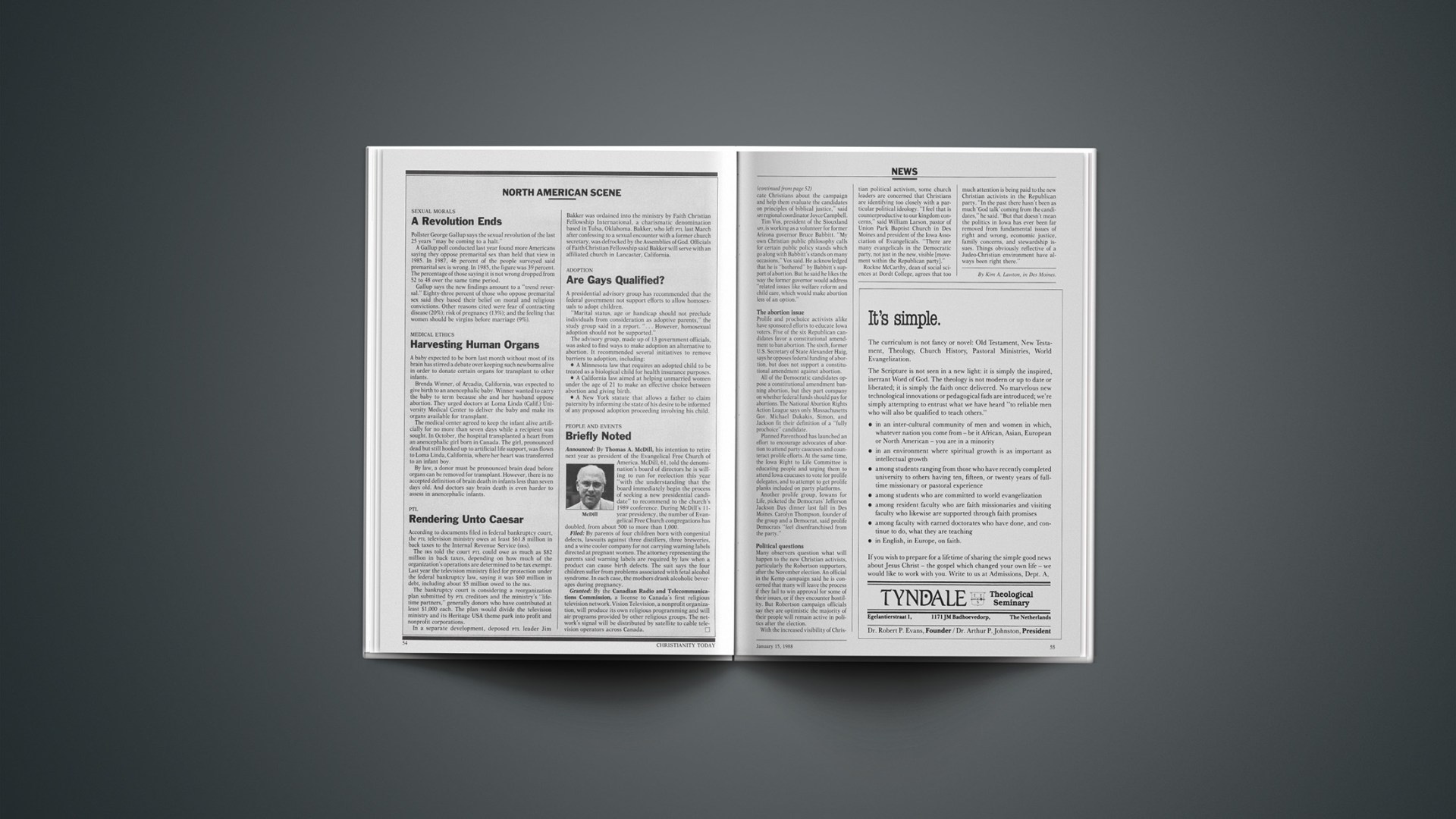
North American Scene from January 15, 1988

SEXUAL MORALS

A Revolution Ends

Pollster George Gallup says the sexual revolution of the last 25 years “may be coming to a halt.”

A Gallup poll conducted last year found more Americans saying they oppose premarital sex than held that view in 1985. In 1987, 46 percent of the people surveyed said premarital sex is wrong. In 1985, the figure was 39 percent. The percentage of those saying it is not wrong dropped from 52 to 48 over the same time period.

Gallup says the new findings amount to a “trend reversal.” Eighty-three percent of those who oppose premarital sex said they based their belief on moral and religious convictions. Other reasons cited were fear of contracting disease (20%); risk of pregnancy (13%); and the feeling that women should be virgins before marriage (9%).

MEDICAL ETHICS

Harvesting Human Organs

A baby expected to be born last month without most of its brain has stirred a debate over keeping such newborns alive in order to donate certain organs for transplant to other infants.

Brenda Winner, of Arcadia, California, was expected to give birth to an anencephalic baby. Winner wanted to carry the baby to term because she and her husband oppose abortion. They urged doctors at Loma Linda (Calif.) University Medical Center to deliver the baby and make its organs available for transplant.

The medical center agreed to keep the infant alive artificially for no more than seven days while a recipient was sought. In October, the hospital transplanted a heart from an anencephalic girl born in Canada. The girl, pronounced dead but still hooked up to artificial life support, was flown to Loma Linda, California, where her heart was transferred to an infant boy.

By law, a donor must be pronounced brain dead before organs can be removed for transplant. However, there is no accepted definition of brain death in infants less than seven days old. And doctors say brain death is even harder to assess in anencephalic infants.

PTL

Rendering Unto Caesar

According to documents filed in federal bankruptcy court, the PTL television ministry owes at least $61.8 million in back taxes to the Internal Revenue Service (IRS).

The IRS told the court PTL could owe as much as $82 million in back taxes, depending on how much of the organization’s operations are determined to be tax exempt. Last year the television ministry filed for protection under the federal bankruptcy law, saying it was $60 million in debt, including about $5 million owed to the IRS.

The bankruptcy court is considering a reorganization plan submitted by PTL creditors and the ministry’s “lifetime partners,” generally donors who have contributed at least $1,000 each. The plan would divide the television ministry and its Heritage USA theme park into profit and nonprofit corporations.

In a separate development, deposed PTL leader Jim Bakker was ordained into the ministry by Faith Christian Fellowship International, a charismatic denomination based in Tulsa, Oklahoma. Bakker, who left PTL last March after confessing to a sexual encounter with a former church secretary, was defrocked by the Assemblies of God. Officials of Faith Christian Fellowship said Bakker will serve with an affiliated church in Lancaster, California.

ADOPTION

Are Gays Qualified?

A presidential advisory group has recommended that the federal government not support efforts to allow homosexuals to adopt children.

“Marital status, age or handicap should not preclude individuals from consideration as adoptive parents,” the study group said in a report. “… However, homosexual adoption should not be supported.”

The advisory group, made up of 13 government officials, was asked to find ways to make adoption an alternative to abortion. It recommended several initiatives to remove barriers to adoption, including:

  • A Minnesota law that requires an adopted child to be treated as a biological child for health insurance purposes.
  • A California law aimed at helping unmarried women under the age of 21 to make an effective choice between abortion and giving birth.
  • A New York statute that allows a father to claim paternity by informing the state of his desire to be informed of any proposed adoption proceeding involving his child.

PEOPLE AND EVENTS

Briefly Noted

Announced : By Thomas A. McDill, his intention to retire next year as president of the Evangelical Free Church of America. McDill, 61, told the denomination’s board of directors he is willing to run for reelection this year “with the understanding that the board immediately begin the process of seeking a new presidential candidate” to recommend to the church’s 1989 conference. During McDill’s 11-year presidency, the number of Evangelical Free Church congregations has doubled, from about 500 to more than 1,000.

Filed : By parents of four children born with congenital defects, lawsuits against three distillers, three breweries, and a wine cooler company for not carrying warning labels directed at pregnant women. The attorney representing the parents said warning labels are required by law when a product can cause birth defects. The suit says the four children suffer from problems associated with fetal alcohol syndrome. In each case, the mothers drank alcoholic beverages during pregnancy.

Granted : By the Canadian Radio and Telecommunications Commission, a license to Canada’s first religious television network. Vision Television, a nonprofit organization, will produce its own religious programming and will air programs provided by other religious groups. The network’s signal will be distributed by satellite to cable television operators across Canada.

History

The Chaining of the Church

What happened to the church between the vibrantly pluralistic 1st century and the legalistic, male-dominated 3rd century?

The earliest Christian writers show us a potent church at work, uniting believers of different races, sexes and economic levels, a church rich in prophecies, healings, exorcisms and powerful preaching by numerous leaders.

But the Spirit began fading through the 200s, until by the time of Athanasius in the 300s the miraculous acts of God were on the wane, the leadership of women had been curtailed, orthodoxy was threatened, and church unity had virtually disappeared. What happened?

The Didache

The Didache was one of several Syrian church discipline manuals that came to define church order in the Near East. This 2nd-century document dealt with the proper conduct expected of and expected toward itinerant ministers who apparently had begun to abuse Christian hospitality.

It is remarkable in many ways, among which is its introduction of a negative Golden Rule: “All which you may wish will not happen to you, you also do not do to another” (1:2). This recasting of Jesus’ words from the positive to the negative serves as a synecdoche for the whole book; the Didache introduced into early church literature the infamous lists of “don’ts” that would come to characterize much of the Christianity that would follow. As a result, Christian freedom was sharply curtailed.

In 1 Corinthians 8 Paul leaves the eating of food offered to idols up to the individual Christian’s conscience, cautioning each Christian to consider those weaker in the faith when deciding how to exercise Christian freedom. But in the Didache, individual conscience has been superseded by ecclesiastical rule: “… keep strictly away from what is offered to idols, for that implies worshipping dead gods” (6:3). What was once a caution is now a rule.

Jesus said to baptize. But the Didache specified how to baptize. The Didache also required fasting of Christians, on Wednesdays and Fridays. Jesus told His disciples that they should not vainly repeat ritual prayers the way the pagans did, but the Didache ordered Christians to repeat the Lord’s Prayer verbatim, three times a day. About 96 A.D., Clement of Rome gently corrected a schismatic group of young upstarts in the letter we call “1 Clement,” but only a few decades later (if that) the Didache was fiercely advocating the practice of shunning those with divergent views.

Indeed, the spirit of the Didache must have been stifling for the average churchgoer.

One exception to this trend is that prophets were not restricted when speaking or acting under the influence of the Holy Spirit. Going overboard in one of its lone concessions, the Didache identifies prophets as the church’s high priests (13:3). The implications of this statement are enormous.

In the New Testament and especially in Hebrews, no one in the church is called a high priest except Christ Himself. But this casual appellation by the Didache effectively ends the priesthood of all believers, for now another high priest is instituted on earth—the prophet. Appropriately, church people are instructed to give these prophets their “first fruits” of money and clothes. The Didache further restricts these offices to males (15:1), despite the fact that, early in the 2nd century, the governor of Bithynia, Pliny the Younger, had found it necessary to torture two female ministers (ministrae) in order to gain more information from them about the activities of Christians (Letters of Pliny X.96).

Spiritual Gifts

Restricting women, as we shall see, directly rebounded on men in the restrictions made by later church orders against unordained male leadership. The inevitable result was that most believers were discouraged from exercising their spiritual gifts.

From Paul’s letters in the lst-century, through Justin Martyr’s in the mid-2nd, we find evidence of the widespread use of spiritual gifts. But the chains that were binding women and laymen were also tightening on the exercise of spiritual gifts in general.

The church had its reasons. About 170 A.D., three self-proclaimed prophets—Montanus, Maximilla and Priscilla—began replacing the Scriptures with their ecstatic utterances. Ecstatic prophecy quickly began to be identified with the lunatic fringe of this heresy. Meanwhile, secular intellectuals like Celsus had begun attacking prophecy in general, so that by the time of Origen and Irenaeus in the 200s, Christians had to defend the exercise of spiritual gifts like exorcism, prophecy and healing (Eusebius 5:7:3–5).

Ronald Kydd, in his interesting study Charismatic Gifts in the Early Church, speculates that from 200 to 260 A.D., the Christian community grew, attracting wealthy congregants and attaining social respectability. As the level of members’ education rose, and as church organization became more formalized, the gifts of the Spirit just quietly slipped away. No one really missed them. In fact, in the view of many orthodox Christians, the heretics had co-opted the gifts.

Those safeguarding the purity of the church could easily argue that the seeds of restricting both women and gifts could be already detected in the New Testament, when Paul restricted women’s participation in churches so that they would not be dishonored by outsiders. The apostle warned in 1 Corinthians 14:23: “If, therefore, the whole church assembles and all speak in tongues, and outsiders or unbelievers [such as Celsus] enter, will they not say that you are mad [as Celsus did]?”

The problem was that the church did not just keep public opinion in mind—it catered to it. This high regard of public opinion, especially as the church became more socially acceptable, along with the worries over church purity, caused the church of the 200s not merely to regulate the use of spiritual gifts and pluralistic leadership, but effectively to eliminate them. Thus the leadership of women and laymen was generally curtailed, and the gifts of the Holy Spirit were largely quenched.

Dr. William David Spencer is pastor of encouragement at The Pilgrim Church of Beverly/Salem, Mass. He also teaches at Gordon-Conwell Theological Seminary.

Copyright © 1988 by the author or Christianity Today/Christian History magazine.Click here for reprint information on Christian History.

History

Paula: A Portrait of 4th Century Piety

This close friend of the scholar Jerome, known for her scholarship and her extreme piety and generosity, was one of the most noteworthy people—women or men—in all the 4th-century church.

One of several Roman noblewomen who supported the work of the scholar Jerome, Paula became his fast friend and colleague. As part of her Christian commitment, she changed her lifestyle from Roman richness to strict asceticism. Noted historian Nancy Hardesty details Paula’s devotion.

“She was squalid with dirt; she mourned and she fasted … her eyes were dim with weeping … the Psalms were her only songs; the gospel her whole speech; continence her one indulgence; fasting the staple of her life.” Thus Jerome (347–420, in Letter 45) describes the piety of his close friend and most generous benefactor: Paula (347–404).

Jerome first met Paula in Rome in about 382. She was one of a group of high-born women who devoted themselves to strict asceticism and benevolent service. The leader of the group was Marcella (325–410), an ardent student of the Bible to whom Jerome referred questions from bishops and presbyters after he left the city. With her friend Principia, she opened the first convent for women. The group included Ascella, Albina, Marcellina, Felicitas and Fabiola.

From Wine to Water

Formerly these women had devoted their lives to family and fashion. Since it was the custom for older men to marry much younger women, most of them had been widowed at an early age. Before becoming Christians, they had dressed in silks, Chinese fleeces and gold brocades. They rouged their faces, darkened their eyes with kohl, plaited blonde hair pieces into their own dark hair, wore gold shoes, and were carried everywhere on litters borne by eunuchs.

But when they became Christians they forsook all that, and adopted simple brown cassocks. They no longer ate meat or sweets, but took only bread and a little oil. Many drank no wine, only water.

Their lives came to revolve around charity—blankets for the poor, money and food for the bed-ridden, burial for the paupers. With the help of Paula’s widowed son-in-law, Pammachius, Fabiola founded Rome’s first hospital.

Paula was the daughter of Blesilla, a descendant of the Scipios and Gracchi families, and of Rogatus, whose Greek family was said to descend from the Greek king Agamemnon. At 17 she married a senator, Toxotius, whose most—famous relatives were Aeneas and Julius Caesar. Together they had four daughters—Blesilla, Paulina, Eustochium and Rufina—and one son, Toxotius, who was just an infant when his father died in 380. Shortly thereafter, through the witness of Marcella, Paula became a Christian.

When the bishops of the Western church gathered in Rome in 382 to determine their response to the Eastern church’s 381 Council of Constantinople, Paula hosted Epiphanius, the bishop of Salamis in Cyprus. Later during the council she met Jerome, who had also attended the Constantinople conference.

She and the other noblewomen studied the Scriptures with Jerome, and adopted the austerities being popularized by Paul the Hermit (whose biography Jerome had written), by Anthony, by the two Melanias, Elder and Younger, and by the others who were fleeing into the deserts of North Africa to devote themselves to God. Paula’s daughter Blesilla, having been recently widowed after just seven months of marriage, began rigorous fasting and other austerities. Within three months she was dead. Some said that the public reaction to her death, directed against Jerome, hastened his departure from the city in 385.

Following Jerome

He urged Paula to follow him, and soon thereafter she and her daughter Eustochium sailed for the East, leaving on the shore her daughter Rufina sobbing and little Toxotius stretching out his hands in entreaty. Jerome notes that while “no mother… ever loved her children so dearly,” Paula “overcame her love for her children by her love for God.”

After visiting Bishop Epiphanius on Cyprus, Paula and Eustochium sailed to Antioch to see Bishop Paulinus. From there they toured the Holy Land, some of the first Christian women to do so. And though it was midwinter, Paula rode simply on an ass.

Among other places, the two women saw “the humble abode of Philip and the chamber of his daughters, the four virgins ‘which did prophesy’ ”; the mausoleum of Helen, queen of Adiabene, “who in time of famine had sent corn to the Jewish people”; “the blood-stained column to which our Lord is said to have been bound when he suffered his scourging”; Rachel’s tomb; and the home of Sarah where they “beheld the cradle of Isaac.” Paula even kissed the stone the angel had rolled away from Christ’s tomb, and “licked with her mouth the very spot on which the Lord’s body had lain.”

Mother and daughter continued into Egypt, visiting all the hermits of the desert, then returned to Bethlehem. There, for three years, they lived in a mud hut while they built a monastery for Jerome to oversee, as well as three convents for women, which Paula eventually supervised. They also built a chapel, and a guest house for pilgrims, the sick, orphans, the elderly, the destitute and any others who were needy.

Paula was one of many Greek and Roman women of this period who gave of their wealth to build the institutional church. Paula was said to own most of the city of Nicopolis near Actium. But once converted, she vowed she would become poor for Christ’s sake. When she had given away her own wealth, she took loans in order to continue her good works. Finally, reported Jerome, “she obtained her wish at last, and died leaving her daughter overwhelmed with a mass of debt.”

Ascetic, Philanthropist, Scholar

From the time of her husband’s death until that of her own, Jerome tells us, she never ate a meal with a man, no matter how holy or venerated he was. She never entered a bath, except when dangerously ill. Even when she suffered from fevers she slept only on the hard ground, covered with a mat of goat’s hair; and most nights she prayed rather than slept anyway.

Jerome’s great work was translating into Latin the Septuagint (the Greek Old Testament) and the Greek writings of the Christian canon. His translation is known as the Vulgate. Paula not only paid his living expenses, she also gathered and purchased the expensive manuscripts and supplies needed for his work. Within her convents, she and the other women copied manuscripts by hand in order to facilitate their use and to preserve them. For the next 1,000 years, nuns and monks were to continue that work, preserving for us not only Scripture and commentaries on it, but also other theological works, and cultural works of the ancient world.

But Paula was more than the scholar’s financial support; she shared with him the work of translation. Having learned Greek from her father, Paula was eager to learn Hebrew from Jerome. He found her an apt pupil, saying she “succeeded so well that she could chant the Psalms in Hebrew and could speak the language without a trace of the pronunciation peculiar to Latin.” She gave him inspiration, intellectual stimulation and critical response. To her and her daughter Eustochium, Jerome dedicated his versions of Job, Isaiah, 1 and 2 Samuel, 1 and 2 Kings, Esther, Galatians, Philemon, Titus and the 12 minor prophets.

Some criticized him for dedicating his books to women, but Jerome responded, “These people do not know that while Barak trembled, Deborah saved Israel; that Esther delivered from supreme peril the children of God … Is it not to women that our Lord appeared after His resurrection? Yes, and the men could then blush for not having sought what women had found.” Ironically, however, a new Roman Catholic edition of the Today’s English Version of the Bible, which is being advertised as “St. Jerome’s Bible,” does not mention Paula once in its lengthy introduction.

An Unusual Couple

Jerome was a very difficult man, and he himself admits that Paula was the only woman who had power to subdue him—she was probably the only person with enough patience to work with him as well. Their friendship illustrates an interesting ambivalence about women in the 4th-century church. Like many of the earlier church fathers, Jerome equated “woman” with “body,” and thus with sexuality and evil. He wrote with total disgust of the life of the average woman. In a letter written about 403 concerning the upbringing of Paula’s granddaughter, Jerome said she should not be taken to the baths, because there she might see the totally revolting sight of a pregnant woman. Indeed, she should not be given baths, because any woman should find the sight of her own body disgusting. He considered marriage, sexual relations, giving birth, mothering children, and attending to one’s hair, clothes or face as repulsive. From reading Jerome’s comments, one might think he despised women.

Yet his descriptions of Paula, Eustochium, Marcella and the other women of their circle are filled with genuine affection, friendship and respect. Once a woman had adopted a celibate lifestyle, became a “virgin” and devoted herself to Christ, Jerome supported her choices and gave her every encouragement. In his several letters to and about women, he often lauds their spirituality as far superior to his own. In his tribute to Paula after her death (Letter 108), he constantly describes her spiritual practices as more rigorous than his own, and cites many occasions when her faith and spiritual wisdom exceeded his.

Paula died at Bethlehem at age 56. Six bishops carried her to a grave near the place where Jesus was born. The whole population of Palestine came out for the funeral—even the desert monks and virgins. For three days they chanted the Psalms in Greek, in Latin and in Syriac, for the sake of this woman who was, as Jerome said, “one of the marvels of the Holy Land.”

Nancy A. Hardesty, a church historian who lives in Atlanta, Ga., is the author of Great Women of Faith (Abingdon) and Women Called to Witness (Abingdon). Her most recent book is Inclusive Language in the Church (John Knox).

Copyright © 1988 by the author or Christianity Today/Christian History magazine.Click here for reprint information on Christian History.

History

Jesus and Women

In His treatment of women, as in many other areas, Jesus of Nazareth was a radical contrast to the standards of His times

The world Jesus entered largely discriminated against women. He rejected the false criteria upon which the double standard was built. He measured men and women by the same standards, the inner qualities of character and not by such accidents of birth as ethnic or sexual differences. He affirmed women by His manner, example, and teaching.

The Manner of Jesus

Jesus included women where Jewish piety largely excluded them. Women were excluded from participation in synagogue worship, restricted to a spectator role, and forbidden to enter the Temple beyond the Court of the Women. A woman was not to touch the Scriptures, lest she defile them. A man was not to talk much with a woman, even his wife. Talk with a woman in public was yet more restrictive.

Jesus brushed aside all such discrimination. He astonished His disciples by talking openly with “a woman” at Jacob’s well (John 4:27). His dearest friends included Mary, Martha and Mary Magdalene. There were many women who ministered to (or with) Him, following Him from Galilee to Golgotha (Mark 15:41).

Having already affirmed Martha by accepting her invitation to dinner, He affirmed Mary’s choice of sitting at His feet to hear Him teach (Luke 10:39). He did not question her right or competence to hear His word, He commended her for choosing “the good part,” declaring that “it will not be taken away from her” (v. 42). Many have sought to take from women like Mary precisely what Jesus affirmed as rightfully theirs.

The story of the anointing of Jesus by “a sinful woman” is amazing (Luke 7:36–50). She showered her love and gratitude upon Jesus, and He affirmed her and her act. Without a hint of impropriety, Jesus let this woman thus touch Him and express her feelings toward Him. The pious Pharisees were scandalized that Jesus let her do this, and would have forbidden it even if the woman had been “good” and not “a sinner.”

Equally amazing is the story of the woman with an issue of blood who touched Jesus (Mark 5:25–34). According to the code in Leviticus, a woman with an issue of blood was “unclean,” defiling everyone and everything she touched (15:19–33). Had Jesus followed this code, He would have denounced the woman for touching Him and demanded her punishment. Instead, Jesus had her stand up and openly identify herself; and then He publicly affirmed her: “Daughter, your faith has saved you; go in peace, and be healed from your scourge” (v. 34). Jesus thus rejected the cruel stigma imposed upon women. He rejected the fallacy that “an issue of blood” is defiling.

The Teaching of Jesus

Jesus also rejected the double standard for marriage, divorce and adultery. He put marriage and divorce in new perspective in answering the question, “Is it lawful for a man to divorce his wife?” (Mark 10:2). It would never have occurred to His questioners to ask, “Is it lawful for a wife to divorce her husband?” Under Jewish law, a wife could not divorce her husband.

Jesus traced divorce to the hardness of human hearts, not to the intention of God. But Jesus did more! He recognized husband and wife as equally free and responsible in marriage and divorce. Significantly, Jesus built upon the story in the first chapter of Genesis (Genesis 1:27, supplemented by 2:24), not the “rib story” as such: “Male and female He made them; for this cause a man shall leave father and mother and be joined to his wife, and the two shall become one flesh.” Marriage thus is a partnership, with no double standard in marriage or divorce.

Jesus corrected current understanding of adultery at two points: 1) adultery begins as lust in one’s heart, not just when overt; and 2) adultery can be committed against a woman (Matthew 5:27–30). Jewish law saw adultery as a sin against a husband, not against a wife. For a husband to visit a prostitute or an unmarried woman was not seen as adultery. Rape of a single girl was a crime, but not adultery. It was considered adultery only if the rights of a husband were violated.

Jesus declared two things in saying, “The one looking upon a woman with a view to lust has already committed adultery against her in his heart.” Although the main point may be that lust itself is adultery, the charge “against her” is innovative. Jesus rejected the fallacy that adultery is a sin against a husband only; adultery can be committed against a woman.

The Risen Christ and Women

According to the Gospels, women were last at the cross and first at the empty tomb, and the first to see the risen Christ. Peter and the other male disciples first heard of the resurrection of Jesus from women. The risen Christ, at the most important juncture for the Christian movement, trusted and commissioned women to proclaim to men the basic tenet of the Christian faith—He is not dead but alive!

The church for the most part has sought to deny to women an equal role in the ministry of proclamation. Jesus had no such reservation before His death or after His resurrection.

The Staggs are the authors of Women in the World of Jesus (Westminster Press, 1979). Dr. Frank Stagg is professor emeritus of New Testament interpretation at Southern Baptist Theological Seminary, Louisville, Ky.

Copyright © 1988 by the author or Christianity Today/Christian History magazine.Click here for reprint information on Christian History.

History

From the Archives: Monica, Faithful Mother

Augustine considered his mother, Monica, a driving force in his own salvation. In his Confessions, he documents her relentless prayers and persuasions. In Book IX, he speaks of her married life with Patricius in Thagaste, a small town in North Africa, thanking God for her powerful Christian witness. Patricius was a pagan throughout his life, but converted to Christianity shortly before his death.

Renata Sedmakova / Shutterstock

Brought up thus with modesty and discipline, she was made subject by you to her parents, rather than by her parents to you. When with the passing years she reached marriageable age, and was given to a husband, she served him as a master. She worked hard to win him to you, preaching to him by her character, by which you made her beautiful, submissively lovable and admirable to her husband.

She so endured his marital infidelities that she never had a quarrel with her husband on this account, for she still looked for your mercy upon him, that, believing in you, he might become chaste. Generally speaking, he was exceedingly kind but also bad-tempered, but she knew not to oppose an angry man by deed or word. If it happened that he had been too thoughtlessly aroused, she would explain what she had done at the right time, when he had cooled down and was calm. In a word, though many married women, who had better tempered husbands, bore on their faces the marks of shameful blows and gossiped among their friends about the way their men lived, she rebuked their tongues, half seriously, half in jest. She would advise them that, from the time they heard the marriage contract read to them, they should consider them documents which made them servants, and that thus, remembering their condition, they should not set themselves up proudly against their masters. And when they expressed amazement, knowing what an evil-tempered husband she put up with, that nothing had been heard or by any means had been made apparent, that Patricius had beaten his wife, or that they had ever fallen into the strife of domestic disagreement, and confidentially asked why, she taught the rule I have mentioned. Those who took notice of it, after a trial, thanked her. The others, kept down, suffered ….

Finally even her own husband, now in the last days of his earthly life, she won to you, and in him as a believer she had no more to complain of those things she endured in him before he believed. She was the servant of your servants, and anyone of them who knew her found much to praise in her while honoring and loving you, seeing that you were at the center of her holy way of life to which its fruits bore witness. For she had been “the wife of one man,” had paid the debt she owed to her parents, had managed her household religiously, had a reputation for good works, she had brought up her children, as often “travailing for them” as she saw them swerve from the path. Finally, Lord, for all of us [he refers to the “household” of Augustine’s friends and colleagues that Monica managed at Cassiciacum] she exercised as much care as if she were the mother of us all, and served us as if we were all her parents.

Copyright © 1988 by the author or Christianity Today/Christian History magazine. Click here for reprint information on Christian History.

History

Women and the Early Church: Recommended Resources – Historical Writings and Pespectives, Scripture Studies, Bibliographies

Historical Writings and Perspectives

Bell, Susan G., ed. Women: From the Greeks to the French Revolution. Stanford University Press,1981.

While coming from a broad sociological perspective, this does contain substantial references to Judeo-Christian perspectives and practices toward women, from the Old Testament period right through the Reformation.

Clark, Elizabeth A. Women in the Early Church: Message of the Fathers of the Church. Wilmington, Del.: Michael Glazier, Inc., 1983.

This excellent collection from the church fathers’ writings regarding women presents some fascinating—and disturbing—points of view. We cite it extensively in “From the Archives” (pp.32–35).

Fiorenza, Elizabeth Schussler. In Memory of Her: A Feminist Theological Reconstruction of Christian Origins. New York: Crossroad, 1983.

A remarkable historical reconstruction, though it doesn’t concentrate exclusively on the early church.

Gryson, Roger. The Ministry of Women in the Early Church. Collegeville, Minn.: Liturgical Press, 1980.

A detailed history drawn from early church documents, it tilts against women’s full participation in church leadership.

Heine, Susanne. Women and Early Christianity: Are the Feminist Scholars Right? London: SCM Press Ltd., 1987.

An irenic analysis of the unique insights that feminist scholars have brought to biblical and early-church historical exegesis.

LaPorte, Jean. The Role of Women in Early Christianity. New York: Edwin Mellon, 1982.

A good collection of primary documents that mention women.

Pomeroy, Sarah B. Goddesses, Whores, Wives, and Slaves: Women in Classical Antiquity. New York: Schocken Books, 1975.

Recounts and analyzes numerous ancient writings referring to women in various roles, and of various economic classes.

Ruether, Rosemary, and McLaughlin, Eleanor, eds. Women of Spirit: Female Leadership in the Jewish and Christian Tradition. New York: Simon & Schuster, 1979.

The first two chapters, by Elisabeth Schussler Fiorenza and Ruether, cover the early church. Fiorenza looks at broad sweeps of theology and heresy. Ruether looks at the people, providing helpful overviews of Macrina, Paula, Marcella, and the Melanias Elder and Younger.

Seltman, Charles. Women in Antiquity. Westport, Conn.: Hyperion Press, 1981.

Spans the records of the ancient Western world to see how women were treated from Athens to Egypt to Crete.

Tucker, Ruth A., and Liefeld, Walter. Daughters of the Church. Grand Rapids: Zondervan/Academie Books, 1987.

An extensive overview of women throughout church history. Pp. 9–10 of this magazine contain an excerpt from an early chapter.

Wilson-Kastner, Patricia, et al. Women Writers of the Early Church. New York: University Press of America,1981.

Much new information is presented in this rare collection of primary writings by early Christian women.

Scripture Studies

Clark, Stephen B. Man and Woman in Christ: An Examination of the Roles of Men and Women in Light of Scripture and the Social Sciences. Ann Arbor, Mich.: Servant, 1980.

A conservative Catholic approach to the biblical data.

Hayter, Mary. The New Eve in Christ. Grand Rapids: Eerdmans, 1987.

This new book takes a non-partisan approach, trying to cut through the shallow rhetoric and misuse of Scripture on both sides of the debate.

Howe, Margaret E. Women and Church Leadership. Grand Rapids: Zondervan,1982.

A solid argument for changing women’s position in today’s churches.

Hurley, James B. Man and Woman in Biblical Perspective. Grand Rapids: Zondervan, 1981.

A traditional approach, though with some modifications, from an evangelical Presbyterian scholar.

Martin, Faith. Call Me Blessed: The Emerging Christian Woman. Grand Rapids: Eerdmans, 1988.

To be released in March, this book offers “not a challenge to Scripture but a challenge to the traditional interpretations of Scripture regarding women.”

Mickelson, Alvera, ed. Women, Authority, and the Bible. Downers Grove, Ill.: InterVarsity Press,1986.

Papers from the Evangelical Colloquium on Women and the Bible, 1984. More than 20 writers contribute, from all sides of the issues. Some new interpretations, some old. A ground-breaking collection.

Scanzoni, Letha Dawson, and Hardesty, Nancy. All We’re Meant to Be. Nashville:Abingdon,1986.

The 1973 classic that set in motion a substantial biblical feminism has been revised. The book was controversial then and may still be, but even staunch traditionalists should admire the authors’ efforts to understand Scripture rather than discard it.

Spencer, Aida Besancon. Beyond the Curse. Nashville: Thomas Nelson, 1985.

An exegetical study of women in the New Testament.

Stagg, Evelyn, and Stagg, Frank. Women in the World of Jesus. Philadelphia: Westminster Press, 1978.

More on the theme they explore in this issue (pp.29–30).

Biographies

Deen. Edith. Great Women of the Christian Faith. Westwood, N.J.: Barbour &Co., 1986.

A reprint of the 1959 standard.

Hardesty, Nancy A. Great Women of Faith: The Strength and Influence of Christian Women. Grand Rapids: Baker, 1980.

Easy-to-read biographical sketched. Hardesty is strongest in the 1700–1900 period, but does include Paula, Marcella and Pulcheria.

Wright, Elliot. Holy Company: Christian Heroes and Heroines. New York: Macmillan, 1980.

A readable collection of biographies of men and women through the centuries, it includes short sections on Macrina and her brothers, Olympias, and Perpetua and Felicitas.

Copyright © 1988 by the author or Christianity Today/Christian History magazine. Click here for reprint information on Christian History.

History

The Problem with Special Women’s Issues

In a brave effort to do what all the king’s horses and all the king’s men couldn’t do, this magazine is attempting to re-assemble and present an accurate account of women’s participation in the history of the church.

But are special issues the way to do that? Is there not perhaps some better way to give women the real place they’ve had in history, noticing the noteworthy ones, including the experiences of women as part of the whole fabric of historical reporting?

To the interested observer, particularly to women who are aware of the “normal” way history is done (by ignoring women), giving women their due is long overdue. It seems a great idea to right the wrongs that for so long have excluded females from the pages not only of history, but of most nonfiction for the general reader. Women wonder what the problem is. Can’t we just do it right from now on?

But to the person who attempts to start “doing it right,” it’s not so easy. How do you locate information about women in history? Because so many of our source materials were written by men, preserved by men, interpreted and reported on by men, women have been sifted out at every level. Few remain in the narratives, and many are genuinely lost to the written record. We know, because we have clues, that women were influencing, participating in, and being uniquely and specifically affected by certain events and situations. But we do not have enough material, most of the time, to write a rich account, to do them justice, to draw conclusions we can support.

If we attempt to redress the inequity by over-emphasizing the participation and influence of a few women here and there, we perhaps overload the importance of those particular women and skew the account. So, in a very real sense, we need a new kind of specialist, a historical detective whose specialty is searching out women (and other forgotten ones) and assessing their participation, influence, and experience in the light of all the data available, both information specifically about them and other information that may relate to them.

There are dangers in any method we may choose in our attempt to balance the longstanding practice of lopsided reporting. If we produce special issues, we set women apart again, plucking them out of the rest of humanity to put them in the spotlight briefly. We wouldn’t have special issues on men’s participation in history; everyone knows men participated in history. Well, everyone knows women did, too—they just never have talked about it much. So now we’re talking about it.

However, singling women out in this way contributes to the very problem women have been fighting against, the presentation of us as “other,” creatures not quite the same as men. It feeds a mentality we have fought so long, that reaches all the way back to Aristotle and his thinking that women are inferior humans by nature—a belief so persistent that it still influences public and private practices that unnecessarily limit women.

We don’t want to be “the other.” We want to be what we are: fully human. But we would also like justice. And justice seems to be best served with solutions that are at least attempting to redress the omissions and exclusions of centuries.

We accept the special issues gratefully and appreciatively—yet warily, because what we really want is to be there in the regular issues. We would like women to be reported on equally with men, not a 50–50 quota, but true to the real world—the world in which we all live and in which our forebears lived too.

Patricia Gundry, a free-lance writer from Grand Rapids, Mich., is the author of Neither Slave Nor Free: Helping Women Answer the Call to Church Leadership (Harper & Row, 1987).

Copyright © 1988 by the author or Christianity Today/Christian History magazine.Click here for reprint information on Christian History.

History

From the Archives: The Acts of Thecla

[The governor] commanded that Paul be bound and carried off to prison until he had the opportunity to hear him more attentively.

But at night Thecla removed her bracelets and gave them to the gatekeeper, and when the door was opened for her, she went into the prison. And giving the jailer a silver mirror, she went in to Paul. She sat by his feet and heard the great deeds of God. Paul did not fear at all, but lived freely in the perfect openness of God. And her faith was increased by kissing his bonds.

As Thecla was sought by her own people and by Thamyris, as she was searched for in the streets like a lost person, one of the fellow-servants of the gatekeeper revealed that she had gone out at night. And they inquired of the gatekeeper and he told them that she had gone to the stranger in prison. They went just as he had told them and found her, bound to him in a manner of affection. And having departed from there, they drew together the crowd and showed it to the governor.

And he commanded Paul to be brought to the platform. Thecla, however, rolled around on the place where Paul had taught when he sat in prison. And the governor commanded that she also be brought to the platform. She went, exultant with joy. And the crowd, when Paul was brought in again, shouted inordinately, “He is a wizard, away with him!” But the governor gladly heard Paul on the subject of the holy deeds of Christ. And taking counsel, he called Thecla and said, “Why will you not marry Thamyris, according to the law of the Iconians?” But she just stood, gazing intently at Paul. When she did not reply, Theocleia, her mother, cried out, saying, “Burn the lawless woman, burn her who is not a bride in the middle of the theater, so that all women who have been instructed by this man may be afraid!”

The governor was greatly affected and having scourged Paul, he sent him outside the city, but Thecla he sentenced to be burned. Immediately the governor arose and went to the theater, and the entire mob went out for the distressing spectacle. But Thecla, like a lamb in the wilderness who looks about for the shepherd, sought Paul. And when she looked at the crowd, she saw the Lord sitting there, as if he were Paul, and she said, “As if I were not able to bear it, Paul came to watch me.” And gazing at him, she kept intent on him. But he went away into the heavens.

And the boys and the virgins brought wood and hay in order to burn Thecla. And as she was brought in naked, the governor wept and was astounded at the Power in her. They spread the wood and the public executioners ordered her to climb on the pyre. She made the sign of the cross, went up on the wood, and they lighted it. A great flame blazed but the fire did not touch her. For God, showing compassion, produced a noise under the ground and a cloud threw a shadow from above, full of rain and hail, and the whole vessel was poured out so that many were endangered and died, and the fire being extinguished, Thecla was saved.

Copyright © 1988 by the author or Christianity Today/Christian History magazine. Click here for reprint information on Christian History.

Apple PodcastsDown ArrowDown ArrowDown Arrowarrow_left_altLeft ArrowLeft ArrowRight ArrowRight ArrowRight Arrowarrow_up_altUp ArrowUp ArrowAvailable at Amazoncaret-downCloseCloseEmailEmailExpandExpandExternalExternalFacebookfacebook-squareGiftGiftGooglegoogleGoogle KeephamburgerInstagraminstagram-squareLinkLinklinkedin-squareListenListenListenChristianity TodayCT Creative Studio Logologo_orgMegaphoneMenuMenupausePinterestPlayPlayPocketPodcastRSSRSSSaveSaveSaveSearchSearchsearchSpotifyStitcherTelegramTable of ContentsTable of Contentstwitter-squareWhatsAppXYouTubeYouTube