



History

The Early Controversies Over Female Leadership

In this series

Church documents from the first few centuries give us glimpses of what women could and could not do. But what were the controversies that made these rules necessary? Antiquities scholar Karen Torjesen traces the development of the church orders, and considers their social subtext.

Those Eccleiastical traditions which have not yet recognized the legitimacy of women’s leadership see themselves as keeping faith with an ancient tradition that explicitly rejected the leadership of women in the church. Their appeal to tradition is largely an appeal to a series of documents called the church orders, which span five centuries.

These church orders, claiming apostolic authority, sought to define the liturgical and ecclesiastical practices of the church. However, each of the church orders was composed at a particular point in ecclesiastical history. They convey, in the language they use and the issues they discuss, the particular concerns of the church at that moment. Although their claim to apostolic authority intends to obscure their roots in particular crises of ecclesiastical history, a careful reading can identify the controversies out of which each new church order was formed.

Recent Studies

The debate over women’s ordination has sparked a number of recent studies of early church orders. Scholarly activity has focused primarily on the types of ministries exercised by women and on the specific nature of their ordination. Scholars have tended to read the church orders exclusively as regulatory documents, excerpting only their authoritative definitions of ritual and practice.

But the church orders are more than legal codes. They are treatises composed to settle controversies over liturgy, discipline and ordination. For the historian, it is the polemical contours of these controversies that provide the most reliable knowledge about the practices of the 3rd-, 4th- and 5th-century churches. The so-called “apostolic teachings” buttress only one side of a dispute. It is the controversies behind them that provide concrete evidence for the practices of the churches of the first five centuries.

Getting at the Controversies

Most scholars have limited themselves to the question, Do the church orders prescribe ordained ministries for women? They conclude that, although women had an important role in the Christian community, they exercised no leadership role. On this reading the only offices held by women were those of deaconess and widow. According to these scholars, the office of deaconess did not develop until the 3rd century, and then only in the East. The office of widow, according to these scholars, was never a true office but only a way of life sanctioned by the church for those dependent on her benevolence.

However, a different reading of the church orders, one that attempts to reconstruct the conflicting positions rather than recite the imposed settlement, provides a different picture of the practices of the churches in the first four centuries. From this vantage point we see women exercising a variety of ministries—teaching, disciplin, disciplining, moving from house to house, entering into public debates, and speaking in the assemblies.

So why were women excluded from church offices? Because Jesus excluded them, says the Didascalia, putting these words in the mouths of the apostles:

“For our master Jesus Christ sent us, the twelve, to teach all nations, but He did not command the women to teach, nor to speak in the church and address the people …. For there abode with us Mary Magdalene and the sisters of Lazarus, Mary and Martha, and Salome and others along with them, and since he did not command them to teach alongside us, neither is it right for other women to teach” (Didascalia XV, translated by A. Voobus).

It must be pointed out that these “apostolic sayings” were created in the 3rd century by authors whose intent was to provide lst-century justification for a disputed 3rd-century practice. These “apostolic sayings” offer a clear statement of the theological justification used for the exclusion of women, but they do not provide insight into the actual motives for the exclusion of women from church offices. Nor do they give a description of the circumstances under which this exclusion seemed necessary. Only a careful study of the controversies that produced—and modified—these documents can provide answers.

From the controversies, we learn that women’s ministries raised questions of propriety. Terms such as “immodest,” “unchaste” and “shameless” spice the discussion and phrases such as “on the streets,” “in public places” and “in the assembly” are sounded in scandalized tones. This begins to give us a feel for the underlying reasons for the eventual exclusion of women from these ministries.

Further, a diachronical study of the controversies echoing in the church orders will allow us to trace the mutations of the issue of women’s leadership from century to century. By beginning our study with the Didache and progressing chronologically through the Apostolic Tradition, the Didascalia, the Statutes of the Apostles, the Constitutions of the Apostles, the Octateuch of Clement and the Testament of Our Lord, we can follow play-by-play the changing fortunes of women’s leadership.

The Didache

The first document of our series is the enigmatic Didache. While its provisions are quite clear, its period and provenance have never been settled to everyone’s satisfaction. More of a consensus has emerged over the place—Syria or Egypt, than over the period—anywhere from the late 1st century to the early 3rd.

According to this church order, the authoritative offices are those of apostle, prophet, and teacher. The function common to all three offices is Spirit-inspired instruction. It is clear that the basis for the authority of those who claim these offices is the possession of the Spirit. Thus it is an authority that is recognized by the church, but not conferred by it. Correspondingly, no rite of ordination is given through which Spirit-inspired persons are installed in their offices. The concerns of the church at this historical moment were those common to groups recognizing charismatic leadership—namely, the problem of credentials. Thus a major section of the Didache is devoted to procedures for distinguishing the true prophets from the false.

It is interesting to note that, although one of the major concerns of the Didache is the problem of leadership, the issue of leadership by women is absent. There are no restrictions placed on the ministries of women, nor are there any specifically women’s offices. Later church orders do restrict women to certain roles, but among the writers of the 1st and 2nd centuries grappling with the problems of leaders (Clement and Ignatius, as well as the Didache), we do not find any suggestion that women’s ministries were controversial.

The Apostolic Tradition

The Apostolic Tradition of the early 3rd century presents a new form of church organization, claiming lst-century apostolic authority. The church has changed since the time of the Didache. We see this in the expansion of the doctrine of the Spirit as it relates to leadership roles.

The authoritative offices are no longer the teaching offices, but the Eucharistic offices. The Spirit is still the basis for the authority, but now the Spirit is conferred by a specific rite of ordination in a narrowly defined way, and for the exercise of specific functions.

In this church order we find the first restrictions placed on women. Widows are not to be ordained. The Apostolic Tradition justifies this on the grounds that widows do not exercise a eucharistic ministry. But the larger context for this restriction is that the particular spiritual gift of authority has been linked to the Eucharistic offices. Not only are widows excluded from the ordinations, but so also are readers, subdeacons, and male and female virgins.

The Didascalia

The Didascalia, a church order composed around the middle of the 3rd century, is the first church order to reflect a major controversy surrounding women’s leadership. The exhortations on the Christian life in the first section of the church order contain restrictions placed on women in their roles as wives. The regulations on ordination and ministry in the second section place similar restrictions on women in their ecclesiastical roles as widows and virgins.

Careful exegesis of the passages restricting women’s functions makes it possible to reconstruct the controversy that led to the formulation of the regulations restricting women’s ministries. The restrictions on widows are as follows: they should be gentle, quiet, peaceful, free of malice and anger, not talkative or gossips or scolds and not fond of controversy. Although these demands placed on widows seem relatively straightforward and seem to be nothing other than echoes of 1 Timothy 5, it is essential to understand what the church order itself means by these restrictions and what it intends to accomplish. The sections immediately following can be taken as an exegesis of these few lines:

“And when she sees anything that is hateful, or hears it, let her be as though she saw and heard it not. Indeed, a widow should care for nothing else except this, to pray for those who give, and for the whole church. And when she is asked regarding an affair by anyone, let her not too quickly give an answer, except only about righteousness and faith in God” (XV).

The text further says that, when a widow is asked any questions regarding the Christian faith, she should not answer, but send the questioner to the leader of the congregation. She is explicitly instructed not to address questions regarding the rejection of idolatry, Christian monotheism, and the nature and scope of the kingdom of Christ. Widows are to refrain from engaging in theological discussion so that they won’t bring disgrace upon the Logos:

“Indeed, when the Gentiles, those who are being instructed, hear the Word of God spoken not firmly, as it ought to be, unto edification of life everlasting—and especially because it is spoken to them by a women—about how our Lord clothed Himself in the body, and about the passion of Christ, they will deride and mock, instead of praising the word of doctrine. And she shall be guilty of a hard judgment for sin” (XV).

That widows were involved in preaching and teaching seems clear from the context. It is precisely such activities that created the conflict.

Another fascinating restriction placed on widows in this portion of the Didascalia is that they are forbidden to speak with other members of the Christian community.

Widows who visited in the homes of other believers were suspected of stirring up controversy and forming factions by their teaching and involvement. Their financial autonomy with respect to the bishop precipitated the accusations both of insolence and greed. They were called immodest simply because they were “roaming about” in public.

The profile of the good widow is sketched in another section. She remains in her house praying day and night. Her eyes are pure and her ears are holy, implying that she is not defiled by reports of scandals. Her feet walk in the way of peace, meaning she is not involved in controversies. In her mouth are no lies, indicating she is not teaching. Widows in the Didascalia are restricted to praying at home because their teaching activities among fellow believers lead to factions and controversies.

The picture of the activities of widows emerging from this church order is impressive indeed—not only preaching and teaching the pagans Christian truth, but also visiting the homes of believers for the purpose of instruction in Christian doctrine. These activities clearly generated conflict in the church. But it is important to be quite precise in determining the nature of this conflict.

Why were widows not just forbidden to teach, but restricted to their homes? Let us compare the regulations governing wives with those governing widows. In the first section of the Didascalia, the Christian wife is contrasted with the wicked woman, who moves freely about the streets of the city seeking men to seduce (III). The Christian wife, on the other hand, does not wear makeup, nor fine fabrics, nor designer sandals; rather she obeys her husband and does not appear in public.

Restrictions placed on Christian women are no different from those placed on women of the upper classes by Hellenistic society. A Pythagorean treatise on chastity affirms that “a woman’s greatest virtue is chastity. Because of this quality she is able to honor and cherish her own particular husband.” Chastity, in this treatise, is a composite virtue and to possess this virtue a woman must fulfill five qualifications for chastity.

The first is preserving the sanctity of the marriage bed. The second is to preserve the cleanliness of her body. The third, fourth and fifth qualifications concern “the manner in which she refuses to leave the house.” A major part of the virtue of chastity is how and when a woman appears in public.

This pagan standard for upper-class women, applied in the first section of the Didascalia to women in their social roles, is then applied in the second section—which contains rules for church offices—to women in their ecclesiastical roles.

The Statutes of the Apostles

The Statutes of the Apostles, a church order of the early 4th century, indicates that the problem of women’s leadership has shifted from the ministry of the widows to the ministry of female deacons. Only three widows were to be ordained—two to function as intercessors and one to minister to women when they were sick and confined to their homes. The ministry of male and female deacons was primarily the ministry of good works, but they also assisted in the eucharistic ministry. This is the focal point of controversy.

An apostolic dialogue created by this church order addresses the problem: “John spoke; have you forgotten, brothers, that our Master, when He has asked for the bread and wine, blessed them and said, ‘This is My body and My blood,’ ‘He did not permit the women to be around us?’ Martha said; ‘It is because of Mary, because He saw her laugh.’ Mary said: ‘That was not the reason I laughed. He said to us before when He taught that the one who is weak will be saved by the one who is strong.’ ”

Clearly the precedent claimed for this minor role for women in the eucharistic service had been the natural assumption that the women had waited on Jesus and His disciples and served them at the Last Supper. But the apostolic sayings make clear that the Last Supper was an exception in this regard and the women were not present even as servers. The social explanation for this is reflected in Martha’s saying that Mary laughed—it is because women lack the necessary seriousness that they were excluded. Mary’s remonstration goes back to the theological point that according to the teaching of Christ the weak (women) should be healed by the strong (men administering the eucharist). In these apostolic sayings we see the primarily social reasons given for excluding women from a minor role in the eucharistic service.

This exclusion of women from participation in the Eucharistic ministry has the flavor of an innovation. The elaborate defense of the practice is followed by the rather poignant question of James, “How can we find for the women any ministry?” To which the church lamely replies, “Well, they can exercise the ministry of good works.” It is interesting to note that the problem of women’s ministries, in light of the restrictions placed on their activities, has become so acute that this church order addresses it directly: What ministries are appropriate for women? The tone of the church order implies that no satisfactory answer had been found.

Octateuch and Testament

The last two church orders we will consider are the Octateuch of Clement and the Testament of Our Lord, both dated in the early 5th century. In these church orders, we see a resolution of the problem of finding a ministry for women. For here we find widows assigned many of the activities that were denied them by the earlier orders. The widows are to exercise a disciplinary function; they are to exhort the women who are disobedient. The women characterized as disobedient were evidently leaders of factions, and teachers in this capacity; for it is said of them that what they put forward is just a lot of talk and nonsense. Furthermore, they are to bring sinful women to repentance and teach them modesty.

The widows are also entrusted with a teaching office. They are to instruct the ignorant (which most likely refers to pagan women), and they are also to teach the female catechumens. They are to visit the homes of other believers, provide for the sick, and support the needy. There is, however, one restriction placed on women in these ministries an—issue is not made of it, but it is assumed—that all of these ministries are to be exclusively exercised toward other women.

These two church orders are remarkable for the tenor of the passages dealing with women’s ministries. The concern of these church orders is not to limit or restrict women’s ministries, but rather to provide women with specific ministries. We sense no controversy here. The church was comfortable with the notion of women exercising the entire range of ministries, as long as they didn’t minister to men.

Conclusion

What can we learn about the leadership of women from these documents? Since there are no controversies over the leadership of women in the church orders of the 2nd and early 3rd centuries (the Didache and the Apostolic Tradition), we learn nothing about women’s ministries in this period. One might conclude from this evidence that women did not exercise any leadership function until the 3rd century. However, recent scholarship (E. Fiorenza, B. Brooten, D. Irvin, F. Klawiter) renders such a thesis highly improbable.

From the middle of the 3rd century on, the controversies over women’s ministries in the church orders teach us much about women’s leadership. Women were evangelizing, baptizing, teaching, interpreting Scripture, doing visitation, functioning as leaders of groups within the church and speaking out in the assembly. The Statutes of the Apostles show that women also shared in the eucharistic ministry.

The church orders from the middle of the 3rd century and following also make clear that these ministries on the part of women generated conflict—conflict that resulted from a sense that such activity was inappropriate for women when measured by the standards of Greco-Roman society. The Didache expresses the concern that women who minister seem immodest or unchaste. The Statutes of the Apostles find women lacking in seriousness and dignity when sharing in the eucharistic ministry. The Octateuch of Clement and the Testament of Our Lord have no problem with women’s ministries, so long as they are directed exclusively to other women. It is interesting to note that each of the church orders attempts to resolve this conflict by restricting women to the private sphere. The widows of the Didascalia (like the wives) are to stay at home and pray. The Statutes of the Apostles offer women the ministry of good works, which is practiced in private. The Octateuch of Clement and the Testament of Our Lord restore all the lost ministries to women, but they are to be exercised only in the women’s quarters. That is a ministry to women and in principle not a public ministry. In each case the attempt to resolve the conflict generated by women’s ministries is an attempt to restrict them to the private sphere.

If, as the evidence seems to indicate, the reasons for the exclusion of women from church offices were primarily societal—that is, that their activities in the church brought them into conflict with the norms of Hellenistic society—then we find ourselves in the odd predicament of having to explain not why women were excluded from church offices, but why they were free to exercise ministries up until the 3rd century. Since Hellenistic norms for the behavior of women remained relatively stable throughout these five centuries, what we need is an explanation for why women’s ministries did not come into conflict with these norms in the first two centuries. What we are looking for is some fundamental change in the character of the church occurring around the middle of the 3rd century.

The early Christian community understood itself to be creating a new social order where family bonds were extended to include the whole “household of faith.” The titles “sister” and “brother” express the familial nature of this new community. Their forms of worship grew out of the family liturgies of the Jewish world. Leadership roles were modeled on the household roles of disciplining, disciplin, teaching and providing. These were all functions of the mistress of an extended household.

At this stage Christian worship took place in the private sphere—the sphere of the household. The activities and ministries of women generally took place within the accepted roles and legitimate identity of women in the private sphere of the household. This had two consequences. Because women played a powerful role in the household of the Greco-Roman, it would have been natural for them to assume functions within the house church that they already exercised in their households. Second, because Christian worship took place in the private sphere, women were not subject to the norms that limited the activities of women in the public sphere.

But in the 3rd century, Christianity began to constitute itself as a public sphere. We see this in a number of ways. Christian worship moved out of homes into buildings that were devoted exclusively to the needs of the worshipping community. The common meal was dropped. Rituals became more elaborate. In the early part of the 3rd century, offices of the church were institutionalized through a rite of ordination and, by the end of the 3rd century, through a distinctive garment. The sphere of Christian worship was becoming a public sphere.

Women’s leadership in the 1st and 2nd centuries would have been exercised in the private sphere, which is the sphere of the household. In this sphere there were no limitations placed on women. Women would have continued exercising these ministries in the 3rd and 4th centuries as well. But around the middle of the 3rd century, Christian worship began to be perceived as taking place in the public sphere. Women no doubt continued exercising the ministries they had in the 1st and 2nd centuries, but suddenly their ministries were controversial primarily because Hellenistic women were not allowed to exercise authority in the public sphere. What follows is a century of conflict over women’s roles until the ministry of women is restored again in the private sphere. But the church by that time had gone public.

Dr. Karen J. Torjesen is an assistant professor of early Christianity and women’s studies at Claremont Gradual School in Claremont, Calif. She has written a book on Origen’s writings, plus numerous other articles for magazines and journals.

Copyright © 1988 by the author or Christianity Today/Christian History magazine.Click here for reprint information on Christian History.
History

Quick Quotes on Women in the Early Church

“What women these Christians have!”
–4th-century pagan philosopher Libanius

“Many women have received power through the grace of God and have performed many deeds of manly valor.”
–Clement of Alexandria

“Every woman who makes herself a man shall enter the kingdom of heaven.”
–the Gospel of Thomas, a 2nd-century Gnostic work

“She was in the front line in condemning the heretics.”
–Jerome, on Marcella

“A woman, however learned and holy, may not take upon herself to teach in an assembly of men.”
–the Synod of Carthage, 398 A.D.

“You are the Devil’s gateway; you are the unsealer of that tree; you are the first forsaker of the divine law; you are the one who persuaded him whom the Devil was not brave enough to approach!”
–Tertullian, to women

“When [the women] came back from the tomb, they told all these things to the Eleven … But they did not believe the women, because their words seemed to them like nonsense.”
–Luke 24:9-11

“These people do not know that while Barak trembled, Deborah saved Israel, that Esther delivered from supreme peril the children of God … Is it not to women that our Lord appeared after His Resurrection? Yes, and the men could then blush for not having sought what the women had found.”
–Jerome, after criticism for dedicating his books to women

Copyright © 1988 by the author or Christianity Today/Christian History magazine. Click here for reprint information on Christian History.

History

Women in the Early Church: From the Publisher

The Questionnaire we sent out recently drew an enormous response. Your counsel is most valuable. You gave us a number of good ideas for specific improvements to the magazine, which we will be implementing in the next few issues (for example, in this issue, at your request, we have expanded the bibliography to include brief comments on the books cited).

Your comments also showed that the overwhelming majority of our readers are broadly within the evangelical camp. You asked us to identify our orientation more specifically. Gladly.

Christian History magazine and its parent corporation, the Christian History Institute, were founded by people of evangelical Christian conviction. Our evangelical commitment continues to drive us forward as we research and report on our rich Christian heritage. Yet we aim to maintain a non-partisan, non-denominational stance, seeking to serve the whole Body of Christ. We feel that faithfulness to Christ means practicing an uncompromising integrity in our handling of history. Accordingly, we do not use only writers of our own background and persuasion. We will publish the work of writers who, in our judgment, best interpret the subject matter at hand.

Further, this quest for truth means that we must be willing to criticize ourselves and our own tradition. Remember that it was the Pharisees’ lack of self-criticism that kept them from recognizing the presence of God in their midst.

Now, about the issue at hand, many readers in the past have urged us to devote a special issue to the role of women in church history. As we began to plan this project, we quickly realized how big it was. We consulted with a number of writers and scholars who have specialized in this field. It became apparent that we would need several issues on women in church history, covering various eras.

We have also taken to heart the comments of Pat Gundry, one of our contributing editors for this issue. She warned us against thinking that one issue, or even a series, could “cover” the subject. Her comments appear on page 4, serving as sort of an Op-Ed introduction to this issue. We appreciate her challenge, and accept it. And still we insist we had to do this series in spite of the pitfalls.

We send this first one forth with some degree of apprehension. We know that we are tiptoeing through an emotionally charged minefield; there is sure to be something to displease everyone. Feminists may be mad at us for not pushing women’s ordination. More traditional readers may see too much of a feminist agenda.

You should find the articles stimulating and worth thinking about—even if you don’t agree with them.

Copyright © 1988 by the author or Christianity Today/Christian History magazine. Click here for reprint information on Christian History.

History

From the Archives: Agnes: the Virgin Martyr

From the bitter persecution of Diocletian (303–305), a heroine emerged. Agnes embodied the two ultimate devotions of Christianity: virginity and martyrdom. Since church fathers often spoke in glowing, almost worshipful, terms of both virgins and martyrs, it was natural that they would hail this young girl, martyred in about 304 A.D. The early-5th-century poet Prudentius takes up the story:

So brave a girl, a martyr famed

Was Agnes, who in Romulus’ home

Lies buried in a tomb. She sees

In death Rome’s towering roofs

And so she keeps her people safe.

She also shields the pilgrims there

Who pray with pure and faithful hearts.

A double crown of martyrdom

Sets this noted girl apart:

Virginity free from any fault,

Then honor from a death she chose.

Hardly old enough to wed,

She was a little girl, they say,

By chance a child of tender years,

But aglow for Christ, with manly heart,

She defied the shameless laws.

For pagan idols she would not

Desert her holy, sacred faith.

First lured by many skillful tricks—

Now the lures of fawning judge,

Now the raging butcher’s threats—

She stood her ground tenaciously,

Of savage strength she freely gave

Her body to the harsh abuse;

She did not flee impending death ….

Copyright © 1988 by the author or Christianity Today/Christian History magazine. Click here for reprint information on Christian History.

History

From the Archives: The Value of Virginity

We are not ignorant of: “Marriage is honorable and the bed undefiled” (Heb. 13:4). We read God’s first judgment: “Increase and multiply and fill the earth” (Gen. 1:28), but just as we accept marriage, we prefer virginity, which is born of marriage. Now will silver not be silver, if gold is more precious than it? … . Although the one-hundred-fold, sixty-fold, and thirty-fold fruits are brought forth from one earth and from one sowing, nonetheless they differ much in number. The thirty-fold refers to marriage … , the sixty-fold to widows … , the one-hundred-fold … expresses the crown of virginity.

Copyright © 1988 by the author or Christianity Today/Christian History magazine. Click here for reprint information on Christian History.

History

From the Archives: Egeria at Thecla’s Shrine

Constantine’s mother, Helena, traveled to Palestine, touring biblical sites and, with her imperial wealth, establishing churches and shrines. Thereafter, it was quite fashionable for Christians to visit the Holy Land. Late in the 4th century, a nun named Egeria made the trek from western Europe and kept a diary of her travels. Not far from Tarsus, she visited the shrine of Thecla, then considered a historical figure.

Since the martyrium of St. Thecla is three days from Tarsus, that is, in Isauria, it pleased me much to go on there, especially since it was so close by…. When I arrived there, I went to the bishop, a truly holy man and a former monk. I also saw there a very beautiful church in the same city.

Since St. Thecla’s shrine is placed above the city on a flat hill, perhaps 1500 feet from the city, I chose to go out there to make the lodging that had to be made. At the holy church there is nothing else except innumerable monastic cells for men and women.

For I found there one of my dearest friends, a person in whose way of life everybody in the east bears witness, the holy deaconess named Marthana, whom I had met in Jerusalem where she had come up to pray. She governs there monastic cells of “apotactites” or virgins. Would I be able to describe her joy or mine when she saw me?

But I should return to my subject. There are a great many monastic cells there on that hill and in the middle is an immense wall that encloses the church in which is the martyrium, for the martyrium is very beautiful. Therefore the wall was put there to guard the church against the Isaurians who are evil and often steal, lest they try to do something against the monastery placed there.

When I had arrived there in the name of God, a prayer was given at the martyrium and the entire Acts of St. Thecla were read. I gave boundless thanks to Christ our God who counted me worthy, though I was unworthy and undeserving, to fulfill my desires in all things.

I stayed there for two days, seeing the holy monastics or “apotactites,” men as well as women, who were there, and after praying and receiving communion, I returned to Tarsus to continue on my route ….

Copyright © 1988 by the author or Christianity Today/Christian History magazine. Click here for reprint information on Christian History.

History

Women of the Early Church: A Gallery

A few of the many

In this series

Anthusa

Anthusa lived from c. 330 to 374 A.D. in Antioch. Widowed at the age of 20, she is remembered for her influence in the life of her son, John Chrysostom, one of the greatest preachers and leaders of the 4th-century church. Her contemporaries tell us Anthusa was cultured, attractive, and from a wealthy family. Yet she chose to not remarry after her husband’s death, deciding instead to devote herself to rearing her two children, John and his sister.

John later wrote that his mother not only taught her children to know and love the teachings of the Bible, but also that her very life was a model of biblical teaching. A student of law, rhetoric and the Scriptures, John was ordained by Bishop Meletius and later became bishop of Constantinople. A zealous missionary himself, he inspired numerous others to serve as missionaries. And he always emphasized that a crucial factor to effective evangelism is for Christians to be living examples of Christ-centeredness. Surely he learned something of this from his mother Anthusa.

Chrysostom is known as the writer of numerous biblical commentaries, and as one of the most articulate and influential spokesmen for Christianity in his era. So much so, in fact, that the Empress Eudoxia tried in Chrysostom’s later years to silence the preacher by banishing him. Chrysostom deeply revered his mother, admiring her prayers and her faith, and cared for her until her death. We don’t know much else about Anthusa, but we know she had great positive influence, at the least by way of her influential son.

Candace

Candace was a queen of Ethiopia, the one mentioned in Acts 8:27 in the story of Philip witnessing to an Ethiopian eunuch who was this queen’s treasurer. Tradition tells us that Queen Candace was converted to Christ through the eunuch’s testimony, and that her conversion caused her to use her office to promote Christianity in Ethiopia and the surrounding countries. She and her husband reigned c. 25–41 A.D.

Cecilia

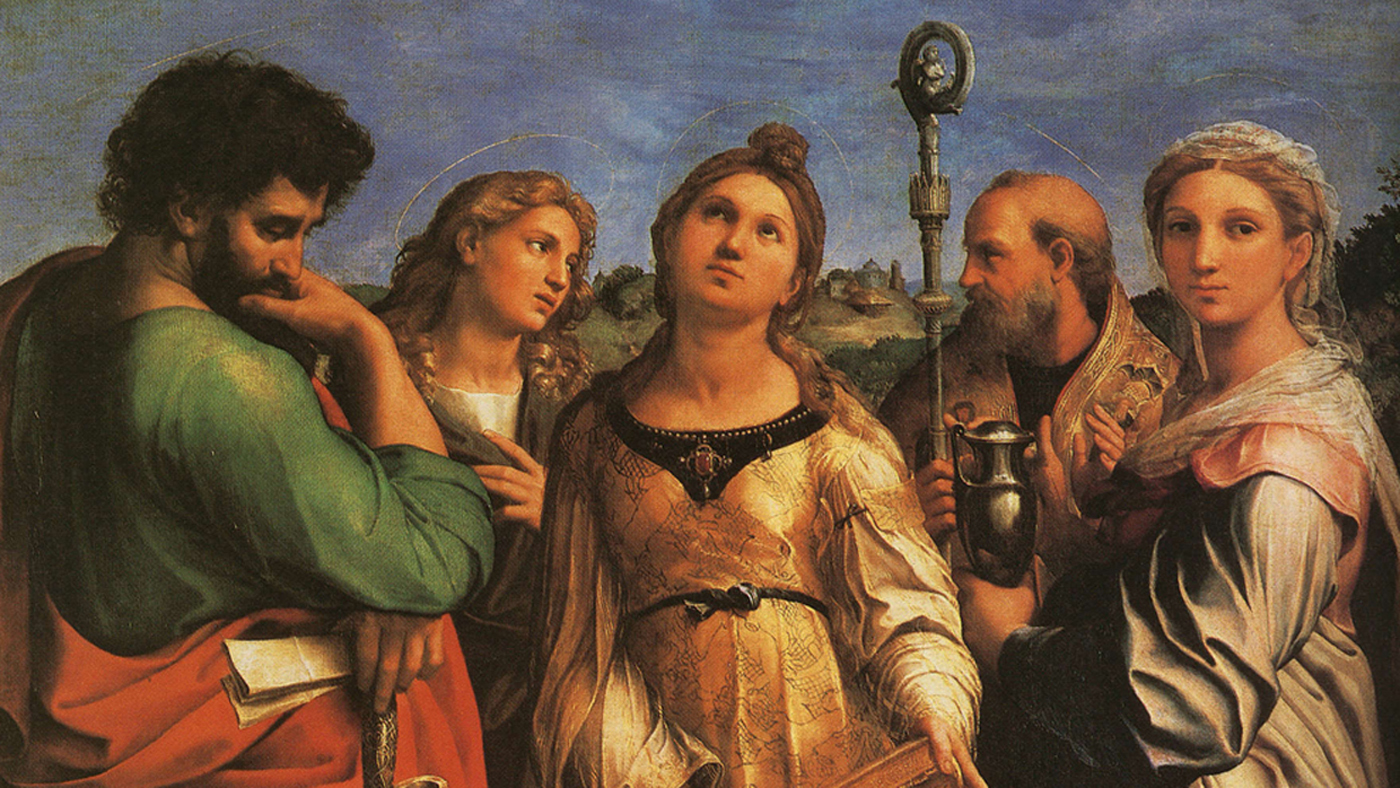
Cecilia was a martyr of the 2nd century, who is remembered not only for the circumstances of her martyrdom but also for her contributions to the church’s music. She is sometimes referred to as a patron saint of music. Tradition says she was the inspiration for the musical maiden described in “The Second Nun’s Tale” in Chaucer’s Canterbury Tales, and the painter Raphael painted her sitting at an organ. Her remains lie beneath the Church of St. Cecilia, at Trastavere in Rome.

According to the records, Cecilia decided at a fairly early age that she wanted to live a life of celibate devotion and service to God. But her parents disapproved of this idea, and thus proceeded to arrange her a marriage with a high-born young Roman. However, only a few hours before the time appointed for the wedding, both the groom and his brother became Christians. This was good news to Cecilia—but also bad news, because in those times of heavy imperial opposition to Christianity it meant the two brothers were almost immediately beheaded. Cecilia’s life was also threatened by the imperial forces, but she was not actually martyred for her faith until later, in Sicily.

Helena

Helena, a 4th-century Christian, is remembered for her influence in the life of her son Constantine, the first Christian ruler of the Roman Empire. She was married to Emperor Constantius Chlorus I, though he later divorced her for political reasons. Still, their son Constantine claimed a share of the imperial throne when his father died.

It was on the eve of the decisive battle in Constantine’s quest for the emperorship that he claimed to have seen the vision that inspired him to become a Christian. After his conversion, Constantine sponsored the church’s first general council at Nicea, designated Sunday as a sacred day, appointed many Christians to high offices in the empire, and avowedly tried to use a Christian approach in the affairs of state. He publicly revered his mother, ordering that all honor due the mother of the emperor be paid to her. He named the city of Helenopolis for her, and ordered the casting of gold medals bearing her image and inscription.

Helena is credited with sponsoring the building of the Church of the Nativity at Bethlehem, as well as the Church of the Holy Sepulchre at Jerusalem. She was one of the first Christian pilgrims to tour the Holy Land, and apparently had a keen interest in finding and restoring revered historical sites, or at least building new church buildings on them. Tradition has it that she was successful in finding the actual sites of Jesus’ birth and resurrection and that she even found the actual cross upon which He died—though this last item is especially questioned by scholars.

Macrina

Macrina, another 4th-century Christian woman, is known mostly today for the great influence she had on and with her brothers who became church leaders in Asia Minor: Basil the Great, bishop of Caesarea; Gregory, bishop of Nyssa; and Peter, bishop of Sebaste. Born to Christian parents in Cappadocia in 327, she and her brothers grew up in Pontus. Their father was an attorney and professor, and their mother, Emmelia, was recognized as “a godly woman.” Their grandparents were also influential Christians. Basil and Emmelia had 10 children, and Macrina was probably the eldest.

Macrina apparently was unusually well-educated for her time; in fact, she may have taught her brothers in their younger years. We know that she, after their mother died, took responsibility for the care and upbringing of young Peter, and that all three of her well-known brothers apparently had great respect for her.

Basil, recognizing her able intellect, arranged for her to receive a theological education—a great rarity for women in those days. Rare as her case was, it was she who reminded Basil, when he returned from some high-level studies in Athens, that he ought to stay humble.

About 355, while still in her 20s, Macrina established a religious community for women in Pontus. The monastic movement was still in its early stages, so this was pioneer work. It’s probable her cloister inspired Basil to start a companion monastery for men nearby, and served as a model for numerous other monasteries and convents.

On the theological front, Arianism was the conflict of the day, and Basil and Gregory both wrote and taught in defense of the Nicene Creed, affirming that Jesus did indeed share the very substance of the Father. What background support Macrina may have given them in this conflict is uncertain. It is certain she was known for her teaching abilities, for organizing the religious community, and for founding a hospital devoted to caring for the needy. The hospital was quite large and gave help to many, often funded by the money Macrina inherited from her parents. In fact, she was so generous with this money that she’s said to have died almost penniless, in 379.

When a frustrated Gregory came to her deathbed (after being banished by an Arian emperor to a backwoods bishopric in Nyssa), she told him that the church needed him, and that he should accept his responsibility for the church as a blessing from God. Apparently taking her words to heart, he served the church for 20 more years, and won the day for the orthodox faith at the Council of Constantinople in 381.

Gregory stayed with her to the last, and then was surprised to find she possessed no garment suitable for burial; she had given all her formal clothing away to the poor. But her gifts to her brothers and the church was greater: her spiritual influence in their lives, her charity to the poor, and a community of women wholly dedicated to the Lord.

Marcella

Marcella, who was born to a noble Roman family in 325, was highly revered by Jerome, the 4th-century translator of the Latin Vulgate version of the Bible. This noblewoman offered her palace as a sanctuary for Christians who were being persecuted, and was active in leading Bible classes and prayer meetings among the other noblewomen.

Though widowed at an early age and having no children, she chose to not remarry and instead devoted herself to serving Christ and the church. When Pope Damasus commissioned scholar Jerome to make a newly revised translation of the Gospels, taking the latest available Hebrew and Greek texts and translating them into Latin, Jerome moved into Marcella’s retreat house palace for the duration of his task. For three years, he depended upon Marcella and her other house guests to critique his ongoing work, which eventually became a classic, the Latin Vulgate Bible.

Marcella founded the first convent for women in the Western church, and gave liberally of her wealth to help other Christians, clearly showing to her fellow noblewomen that greater rewards and fulfillment come from storing up treasures in heaven than from hoarding treasures on earth.

Marcellina

Marcellina was a 4th-century Christian woman who was known for her effective prayer ministry, her teaching abilities, and her influence in the life of her brother, Bishop Ambrose of Milan. He dedicated his book De Virginibus (Of Virginity) to her, in remembrance of her devout prayers and influence on his life. After their father died, Marcellina assisted their mother in providing for Ambrose’s education, and in her later years she resided with Ambrose. A consecrated virgin, she was the recipient of three of Ambrose’s most important letters on theology. He often praised her for her devotion, though he once cautioned her to not be over-diligent in her fasting practices.

Olympias

Olympias, a daughter of the wealthy Count Seleusus, was born near Constantinople in 368. Apparently her parents died when she was still quite young, but they left her a substantial fortune. This drew the attention of many matchmakers, including the Emperor Theodosius, who wanted to be sure that such a large amount of wealth—and the influence that went with it—came to rest in the proper hands.

So while still in her teens, Olympias married an official in the imperial court named Nebridius. But he died less than two years later. The stream of eager suitors resumed, but she chose to not remarry—having decided, as a Christian, that she would devote herself to the Lord and her inheritance to helping the poor.

This decision aggravated Theodosius, who used his royal privilege to seize her fortune and place it in trust until she turned 30. Olympias wrote to thank the emperor for relieving her of the burden of all that money, and insisted that, as executor of the inheritance, he divide it between the church in Constantinople and the poor. Outfoxed by the plucky teenager, Theodosius restored the wealth to her prerogative … and she immediately began to give the money away again, to the sick, widows, prisoners, beggars, and slaves (she even bought hundreds of slaves and set them free).

She became a deaconess of the church at Constantinople, and a good friend of John Chrysostom, the local bishop, who once advised her to give less to the poor because she was making them lazy.

Her loyalty to Chrysostom eventually cost her much. He, a gifted preacher, spoke out against the wanton behavior of the Empress Eudoxia. Incensed at his impertinence, the empress pulled strings in the church hierarchy and, in 403, got John banished-for-life on trumped-up charges. Olympias and many other Christians in Constantinople protested this treatment of their beloved bishop, and hence were physically harassed. Then, when Olympias refused to recognize the new bishop who was appointed, she was banished as well. She was also tried for disrupting the church, and was heavily fined. Later, all her assets were seized and her charitable projects shut down.

Throughout all these troubles, Olympias and Chrysostom managed to maintain a correspondence. In his letters John encouraged her, praising her patience and dignity. He died in 407; within a year she also died, a pauper. But she was remembered as a devoted Christian who used her great wealth unselfishly for the Lord, as a regular student of the Bible, and as a faithful deaconess of the church.

Dr. Mary L. Hammack is a teacher with more than 29 years of experience at the elementary, high school and university levels. She currently works as a freelance writer and curriculum coordinator, and is the author of A Dictionary of Women in Church History (Moody Press, 1984). AND THE EDITORS

Copyright © 1988 by the author or Christianity Today/Christian History magazine.Click here for reprint information on Christian History.

History

Women and the Church Orders: Christian History Timeline

Events

1–90 A.D.

Pentecost (c. 30 A.D.) Spread of faith despite persecution by Nero and DomitianPhoebe

90–200 A.D.

Consolidation of church; spotty, localized persecutionClementJustin Martyr

200–300 A.D.

Sharp persecution, especially in North Africa under Septimius SeverusOrigen, Tertullian make Christianity intellectually respectable. Church becomes more respectable, builds buildings Blandina martyredPerpetua martyredDecius stuns church with persecution; Valerian continues itChurch tries to rebuildOrigen martyred

300–400 A.D.

Diocletian launches Great Persecution (303–310)Edict of Toleration (311)Constantine converts, begins co-regency (313)Constantine makes Christianity the religion of the empire (324)Helena visits Holy Land John ChrysostomPaulaMonica diesJerome in Rome

400–500 A.D.

Alaric the Goth sacks Rome (409–410)Pulcheria rules empireAugustine is bishop of Hippo

Key Writings

Didache (100-200 A.D.) Recognized those with the Spirit, gave guidelines for their ministry. Problem: Credentials of traveling prophetsRestrictions on women: None specified.

Apostolic Tradition (c. 215)Conferred spiritual authority by ordaining bishops, elders, deacons. Problem: Setting apart church leaders and distinguishing their various roles.Restrictions on women: Widows designated as church workers but not ordained.

Didascalia Apostolorum (mid-200s)Regulated Christian life and ministry. Problem: Public image of Christianity? Restrictions on women: Severe, at home and in church. Consistent with Greco-Roman image of the good noblewoman.

Statutes of the Apostles (early 300s)Defines the work of deacons, among other things. Problem: Women deacons taking on too much authority? Restrictions on women: Some women were ordained as deacons, but could not participate in eucharistic ministry, only good works.

Octateuch of Clement: Testament of Our Lord (early 400s)Further defined church ministry. Problem: What are women allowed to do? Restrictions on women: Some are reversed. Women are encouraged to do works of teaching, visitation, etc. But they may only minister to other women.

Copyright © 1988 by the author or Christianity Today/Christian History magazine. Click here for reprint information on Christian History.

History

The Neglected History of Women in the Early Church

A number of prominent leaders, scholars, and benefactors of the early church were women and—despite neglect by many modern historians—the diligent researcher can still uncover a rich history.

ErgSap/Flickr

In this series

Women were the last disciples at the cross and the first at the empty tomb. They remained integral to the work of the church in its early centuries. Catherine Kroeger scours historical data to compile an impressive collection of stories about noteworthy women in the early church.

One of the best-kept secrets in Christianity is the enormous role that women played in the early church.

Though they leave much unsaid, still, both Christian and secular writers of the time attest many times to the significant involvement of women in the early growth of Christianity.

Celsus, a 2nd-century detractor of the faith, once taunted that the church attracted only “the silly and the mean and the stupid, with women and children.” His contemporary, Bishop Cyprian of Carthage, acknowledged in his Testimonia that “Christian maidens were very numerous” and that it was difficult to find Christian husbands for all of them. These comments give us a picture of a church disproportionately populated by women.

Why? One reason might have been the practice of exposing unwanted female infants—abandoning them to certain death. Christians, of course, repudiated this practice, and thus had more living females.

Also, in the upper echelons of society, women often converted to Christianity while their male relatives remained pagans, lest they lose their senatorial status. This too contributed to the inordinate number of women in the church, particularly upper-class women. Callistus, bishop of Rome c. 220, attempted to resolve the marriage problem by giving women of the senatorial class an ecclesiastical sanction to marry slaves or freedmen—even though Roman law prohibited this.

These high-born Christian women seized upon the study of the Bible and of Hebrew and Greek. The circle of Roman women who studied with Jerome in the late 300s showed such scholarship that he thought nothing of referring some church elders to Marcella for the resolution of a hermeneutical problem. By the early 400s, Augustine could declare that “any old Christian woman” was better educated in spiritual matters than many a philosopher.

The women’s spiritual zeal exploded into social service. Fabiola founded the first Christian hospital in Europe. Many other church women encountered severe opposition from their families for spending their wealth so generously in helping the poor. Such selfless ministry became a trademark of Christian women.

In a letter to his wife, Tertullian gives us a glimpse into some of the ministries of church women in his time. He charges her, in case of his own death, to not marry a pagan.

“Who would be willing to let his wife go through one street after another to other men’s houses, and indeed to the poorer cottages, in order to visit the brethren? Who would like to see her being taken from his side by some duty of attending a nocturnal gathering? At Easter time who will quietly tolerate her absence all the night? Who will unsuspiciously let her go to the Lord’s Supper, that feast upon which they heap such calumnies? Who will let her creep into jail to kiss the martyr’s chains? Or bring water for the saints’ feet?”

Women As Witnesses of Jesus

It is no surprise that women were active in the early church. From the very start—the birth, ministry, death and resurrection of Jesus—women were significantly involved. In fact, women were the major witnesses of his crucifixion and resurrection. Matthew, Mark and Luke all record that a significant group of women had followed Jesus in his Galilean ministry, and that they were present at his execution—when the male disciples were conspicuously absent.

All three describe the women’s presence at Jesus’ burial. Luke declares that the women who had followed Jesus from Galilee still followed along as Christ was carried to the tomb. Mark details the care with which Mary Magdalene and Mary the mother of Joses noted where He was laid, while Matthew tells how they kept watch over the sepulchre after the men had left. John tells of the group immediately beneath the cross, three women and one man. John alone preserves the garden interview between Mary Magdalene and the Risen Christ.

The proclamation of the astounding Easter event was entrusted to these women. The angel reminded them that they had already been instructed by Jesus about His death, burial and resurrection. The women remembered and hurried off to tell the men. Their witness remains an integral part of the gospel to this day. The early church considered Mary Magdalene an “apostle to the apostles,” and Luke relied heavily on the testimony of women as he wrote both Luke and Acts.

The involvement of women continued in the first few decades of the church, attested by both biblical and extra-biblical sources. A number of women served as leaders of the house churches that sprang up in the cities of the Roman Empire—the list includes Priscilla, Chloe, Lydia, Apphia, Nympha, the mother of John Mark, and possibly the “elect lady” of John’s second epistle.

In the 2nd century, Clement of Alexandria wrote that the apostles were accompanied on their missionary journeys by women who were not marriage partners, but colleagues, “that they might be their fellow-ministers in dealing with housewives. It was through them that the Lord’s teaching penetrated also the women’s quarters without any scandal being aroused. We also know the directions about women deacons which are given by the noble Paul in his letter to Timothy.”

Was that perhaps the role of Junia? She was mentioned by Paul in Romans 16 as “of note among the apostles.” Some have debated the meaning of this verse, but early tradition holds that Junia was a woman and was considered an apostle. John Chrysostom wrote: “Indeed, to be an apostle at all is a great thing; but to be even amongst those of note; just consider what a great encomium that is … Oh, how great is the devotion of this woman, that she should even be counted worthy of the appellation of apostle.”

Until the Middle Ages, the identity of Junia as a female apostle was unquestioned. Later translators attempted to change the gender by changing the name to the masculine Junias. But such a name is unknown in antiquity; and there is absolutely no literary, epigraphical or papyrological evidence for it.

Paul also mentions Phoebe in Romans 16, “a deacon of the church at Cenchreae.” He calls her a prostatis or overseer. This term in its masculine form, prostates, was used later by the Apostolic Fathers to designate the one presiding over the Eucharist. And Paul uses the same verb, the passive of ginomai (to be or become), as he uses in Colossians 1:23: “I was made a minister.” In the passive, the verb sometimes indicated ordination or appointment to an office. Thus one might legitimately translate Paul’s statement about Phoebe: “For she has been appointed, actually by my own action, an officer presiding over many.” The church in Rome is asked to welcome her and assist her in the church’s business.

The four daughters of Philip appear in Acts 21:9 as prophetesses. Eusebius viewed these daughters as “belonging to the first stage of apostolic succession.”

Another prophetess attested to by extra-biblical tradition is Ammia, who prophesied in Philadelphia during New Testament times, and was received with reverence throughout Asia Minor. The first preserved mention of her dates to about 160 A.D.

2nd-Century Church Women

Just as the letters of Paul abound in references to his female associates in ministry, the Apostolic Fathers also mention women as stalwarts in the faith. Twice Ignatius sent greetings to Alce, whom he calls especially dear to him. He also greeted Tavia and her household; perhaps she was another house-church leader.

Polycarp mentioned the sister of Crescens, who deserved special commendation when she and her brother arrived in Philippi to deliver the letter. The Shepherd of Hermas, written about 148 A.D., gives instructions that two copies should be made of the work and one given to Grapte, “who shall exhort the widows and orphans.” The other copy was to be given to Bishop Clement to share with the elders. It appears that Grapte and Clement represented the female and male leaders respectively.

But Christians were not the only ones prompted to write about the female followers of Jesus. About 112 A.D., the Roman governor Pliny the Younger detailed his efforts to cope with the nascent church in Bithynia. He had found it necessary to interrogate the leaders, two slave women called ministrae, or deacons. These women apparently followed in the tradition of Phoebe.

Spurious Works

Certain female leaders are described as fully historic personages, while others are embedded in legend. Catherine of Alexandria, for instance, reportedly lived in the 2nd century, though the earliest reference to her is in an 8th-century work. The patron saint of scholars and philosophers, she allegedly debated 50 philosophers and won them all to Christ. As a result, she was condemned to death and ultimately perished on the wheel (hence the name of the “Catherine wheel,” a rotating firework).

Her story may have been drawn from that of Hypatia, the noted pagan philosopher also of Alexandria, also of the 2nd century. Hypatia did in fact meet her death at the hands of an enraged Christian mob, and her historicity is beyond doubt. The Catherine story may well be drawn from that of Hypatia, but it demonstrates a willingness in the church to project a woman as a spiritual and intellectual leader.

Spurious works, even if their authorship is in doubt, can still have value in demonstrating certain attitudes. Two epistles erroneously attributed to Ignatius preserve an appeal from Mary of Cassobelae that three members of the clergy, Maris, Eulogius and Sobelus, be appointed to serve in her community so that it might not be devoid of those fit to preside over the Word of God. She begs Ignatius to not deny her request simply because the three are young and two of them newly ordained. Rather, she argues from the Scriptures that youth is no deterrent to a significant ministry for God. Pseudo-Ignatius replies: “Thy intelligence invites us, as by a word of command, to participate in those divine draughts which gush forth so abundantly in thy soul … Thy numerous quotations of Scripture passages exceedingly delighted me, which, when I had read, I had no longer a single doubtful thought respecting the matter… Thou art perfect in every good work and word, and able also to exhort others in Christ.”

He promises to comply with her wishes, citing the fame which had accrued to her earnest dedication to Christ at the time of her visit to Rome during the bishopric of Linus (beginning of the 2nd century). The letter is probably no earlier than the 4th century, but it demonstrates an attitude that was able to gain currency in the early church. A woman of outstanding spiritual gifts purportedly gives direction in the appointment of clergy, and is applauded for the inspiration she affords. The personages may be fictitious, but the appreciation of feminine spirituality is real.

The Legend of St. Thecla

The legend of St. Thecla has endeared itself to modern women as well as to their earlier counterparts. It is the bestknown of the numerous apocryphal stories of early Christian heroines. According to the 3rd- century text of The Acts of Paul, Thecla, a noblewoman, was converted while listening to the preaching of the apostle. Forsaking her old life, she followed Paul and endured persecution, tribulation and great peril. The story resembles the ancient pagan romances in the repetition of hair’s-breadth escapes, the fortitude and nobility displayed by both hero and heroine, and the happy ending. It is, however, a Christianized romance, as are several other of the apocryphal Acts and The Recognitions of Peter.

Thecla appears as a truly heroic character who endures all manner of suffering for the sake of Christ. After her itineration through Asia Minor with the Apostle Paul, she settles near Seleucia, where she teaches, preaches, heals and baptizes. Tertullian, incensed that Montanist women used her as a model, declared that a deacon had confessed that he fabricated the story “for love of Paul.” William M. Ramsay maintained that The Acts of Paul contained an authentic 1stcentury account, which had been outrageously embellished by the 3rd-century deacon. Dennis McDonald has pointed out that, though the story is almost surely fictitious, this does not obviate the existence of an actual female leader of that name.

Both Gregory of Nazianzus and Basil of Caesarea spoke of Thecla as a historical figure. Writing in the 300s, they described her teaching center and hospital near Seleucia. The pilgrim Egeria visited this facility in 399 A.D., and also described its monasteries, convents and assembly buildings, along with the teaching and healing ministries that went on there. The German team that excavated the center in 1908 found the apse still standing above the ground, with the main basilica’s outlines covering a space equal to that of a football field. The excavators also found numerous cisterns, apparently for washing the sick, two other churches, and many fine mosaics. The center apparently was in active use for at least 1,000 years, indicating the presence in Asia Minor of an extremely strong female leader.

Women in Consecrated Orders

Beside the outstanding achievements of individual women stood the ministry of consecrated women in specialized orders. These orders included ecclesial widows, virgins, presbyteresses and deaconesses. Sometimes such women were formally ordained and sat with the rest of the clergy in front of the congregation.

Mary McKenna suggests that the disadvantaged women who accompanied Jesus in his Galilean ministry (Luke 8:23) formed the beginning of the order of widows. The Greek term cheira might refer to any woman who found herself in difficult circumstances. Tertullian complained of a virgin who was admitted to the order of widows at the age of 19! These widows were supported by the gifts of the congregation, and in turn were expected to pray for their benefactors as well as for all other members of the church. Their duties and qualifications were developed from the instructions in 1 Timothy 5. In the Clementine Recognitions and Homilies, perhaps from the first half of the 3rd century, St. Peter, as he prepares to leave Tripoli, appoints elders and deacons and organizes an order of widows.

The widow came to be looked upon as “the altar of God,” both because of her ministry of intercession and because of the gifts that she received. Under no circumstances should she reveal the name of a donor, lest other widows demand an equal gift from the same source or, worse yet, curse the one who withheld such benefices. The Didascalia insisted that neither “the bishop nor a presbyter, nor a deacon, nor a widow should utter a curse,” because widows “had been appointed to bless.”

Widows were clearly part of the ordained clergy in the Testament of Our Lord Jesus Christ, a 5th-century reworking of earlier material from Hippolytus’s Apostolic Tradition. The selection process and ordination service of widows parallels those of deacons, bishops and presbyters. The document applies the title “presbyteresses” to these women, and six times refers to them as “the widows who sit in front.” During communion, they stood by the altar, close to the bishops, presbyters and deacons, and within the veil that screened off the laity. These widows assumed pastoral responsibilities such as instructing female catechumens and the ignorant, gathering those who desired to live a pure life for prayer and encouragement, rebuking the wayward, and seeking to restore them.

Women As Deacons

As Clement of Alexandria made mention of Paul’s reference to deaconesses in 1 Timothy 3:11, so Origen commented on Phoebe, the deacon that Paul mentions in Romans 16:1–2:

“This text teaches with the authority of the Apostle that even women are instituted deacons in the Church. This is the function which was exercised in the church of Cenchreae by Phoebe, who was the object of high praise and recommendation by Paul… And thus this text teaches at the same time two things: that there are, as we have already said, women deacons in the Church, and that women, who by their good works deserve to be praised by the Apostle, ought to be accepted in the diaconate.”

Women deacons appear to be under discussion in 1 Timothy 3:11, although the feminine form “deaconess” did not come into use until about 100 A.D. As late as the end of the 4th century, diaconos might designate a woman as well as a man. The order of deaconesses as distinct from that of widows appears clearly delineated in the first half of the 3rd century in the Didascalia, which declared that the deaconesses should be honored as figures of the Holy Spirit. They could visit believing women in pagan households where a male deacon would be unacceptable. To them belonged the duties of visiting the sick, bathing those recovering from illness, and ministering to the needy. Deaconesses also assisted in the baptism of women, anointing them with oil and giving them instruction in purity and holiness. They could give communion to women who were sick and unable to meet with the entire church. The Apostolic Constitutions even specified that both male and female deacons might be sent with messages outside the city limits. The ministry of the widow was largely that of prayer, fasting, and laying of hands on the sick, while the deaconess, usually a considerably younger woman, undertook the more physically arduous tasks.

Ancient documents show that deaconesses were ordained. The Council of Chalcedon set down requirements for the ordination of deaconesses, and the Apostolic Constitutions includes their ordination prayer.

Women As Elders

The feminine form of “presbyter” or elder occurs frequently, though it is often translated simply as “old woman.” At times the term certainly refers to women who were part of the clergy. The Cappadocian father, Basil, uses presbytera apparently in the sense of a woman who is head of a religious community. Also applied to women is the term presbutis, “older woman” or “eldress.” The old woman who instructed Hermas is called presbytis. It occurs not only in Titus 2:3, but most markedly in Canon 11 of Laodicea, which forbade the appointment of presbytides (eldresses) or of female presidents (prokathemenai).

The masculine form, prokathemenos, indicated the presbyter or bishop who presided over the communion service. Dionysius of Alexandria, who died in 264 A.D., described a martyr as “the most holy eldress Mercuria” and another as “a most remarkable virgin eldress Apollonia.” A variant reading of the apocryphal Martyrdom of Matthew, a 4th- or 5th-century document, tells how Matthew ordained a king as priest and his wife as presbytis, “eldress.” Epiphanius and Theodoret vehemently repudiated any priestly function accruing to the “presbytides.”

Women As Priests?

There are even a few scattered references connecting women to the priesthood. Pseudo-Ignatius’s Letter to the Tarsians commands that those who continue in virginity be honored as priestesses of Christ. The eldresses of Titus 2:3 must be “hieroprepeis,” a term that inscriptional evidence suggests should be translated “like a priestess,” or “like those employed in sacred service.” The Cappadocian Gregory of Nazianzus wrote to Gregory of Nyssa about Theosebia, “the pride of the church, the ornament of Christ, the finest of our generation, the free speech of women, Theosebia, the most illustrious among the brethren, outstanding in beauty of soul. Theosebia, truly a priestly personage, the colleague of a priest, equally honored and worthy of the great sacraments.”

The walls of the Roman catacombs bear pictures showing women in authoritative stances, with their hands raised in the posture of a bishop. The Ecclesiastical Canons of the Apostles specifically forbade women to stand in prayer (24:1–8). But here we see them standing in prayer, exercising a ministry of intercession and benediction, and dominating the scene. To this day, their steadfast faith and ministry still bless us.

Dr. Catherine Kroeger is chaplain and lecturer in the department of religion at Hamilton College in New Hartford, N.Y. Her doctorate is in classical studies and Greek, with a specialization in women in ancient religion, especially women and the ecclesiology of the Apostle Paul

Copyright © 1988 by the author or Christianity Today/Christian History magazine. Click here for reprint information on Christian History.

History

What About Paul?

The Apostle’s writings are foundational to the standard interpretation of what women’s role in the church should be. But examined carefully, his points about women raise several puzzling questions

In this series

Scholars have long wrangled over the meaning of New Testament statements about the relative roles of women and men, and always central to the debate are the Apostle Paul’s outspoken declarations. Was he a pragmatic libertarian, or an imposing legalist, or something in between?

The issue of women in church history bristles with controversy. Two groups fight it out. One holds that women have always, until recent years, had subordinate roles in the church. This was proper, these scholars say, because Paul clearly stipulated that women should be silent and submissive. Obviously, they say, the early church followed his instructions.

But the other group presents an impressive collection of women in leadership roles in the church’s early centuries. It’s surprising, they say, that any women could have such prominence in a maledominated society. They cite Jesus’ tradition-breaking acceptance of women and assume that Priscilla, Phoebe, Lydia, et al., followed in that spirit.

Christianity’s unique “servant-language” doesn’t help much. Following Christ’s example, the church avoided terms and titles that would suggest domination. Its leaders were simply “elders” and “deacons” (servants). That makes it confusing for modern-day detectives. When Paul calls Phoebe a “deacon,” is he referring to a church office she holds? Most other uses of this word in the New Testament indicate church office. But some conservatives say this cannot be, in Phoebe’s case, because Paul elsewhere limits the diaconate to men. We have similar confusion with the two ministrae arrested by Pliny in the 2nd century. Were these just helpers, as some historians assert, or were they “ministers”? The language could mean either.

The two positions thus have radically different views of history, both supported, to some degree, by the evidence. Traditionalists see the church adopting a certain order, based on apostolic teaching. Feminist scholars generally see the free exercise of ministry gifts by men and women in the first century or two.

The debate often sets up as Jesus vs. Paul. The traditionalists often underestimate how radically Jesus broke with the tradition of his day in his treatment of women. The feminists often discount or disparage Paul. And many, many in between wonder why it has to be “either/or.” Doesn’t Paul preach the gospel of Jesus? Is there no continuity?

The Importance of Paul

Paul stands at the start of church history. An understanding of his writings and how they were read is foundational to a good understanding of early-church practice regarding women in leadership and ministry.

Several major questions loom: Was Paul restricting women for pragmatic or theological reasons? He uses theology, but does he use it as proof or merely as illustration? If he is being pragmatic, do his practical reasons continue today, or did they fade in subsequent generations? Was Paul declaring a new order for the church or was he mitigating the effect of a sexist society? Was he placing restraints on believers coming from a libertine culture or was he adapting Christian freedom so that it would not be misunderstood, by those within the church or without?

Wait! say the traditionalists. Why all these questions? Can’t we just take Paul at face value?

The problem is that face value doesn’t work. Paul’s commands are strong and specific, but their very specificity may limit them. There are seeming contradictions, strange allusions, rabbinic reasoning. The pertinent texts, taken together, cry out for a second look.

The Unity Principle

The keynote text in such a re-examination is Galatians 3:28. If this bit of theology is foundational, it forces a re-reading of the other texts on women.

Paul writes, “There is neither Jew nor Greek, slave nor free, male nor female, for you are all one in Christ Jesus.” Paul is talking about salvation, faith in Jesus, being “baptized into” Christ. Galatians is a theological treatise, one of Paul’s earliest. He is not specifically referring to the relations between men and women at home, in the church, or in society. His basic point is that we are all one in God’s eyes. It would be possible to accept this as a spiritual reality and leave it at that. Many commentators do.

But theology has implications. We must ask how this unity of male and female bore itself out in the church and in Christian living. The references to Jews and Greeks and slaves may help.

The Book of Acts shows us the expansion of Christianity from the Jewish world to the larger Greek world. There were some rocky times. Do Gentiles need to become Jews in order to follow Christ? No, it was decided—after some debate. The Galatian churches were apparently in the middle of this controversy, as zealous Jewish believers tried to force the demands of the Law on them.

In many cities throughout the Greek world, the church started in the synagogue and spilled over into the lecture halls or private homes of the Gentiles. Jews and Gentiles together made up the church, and there was some friction.

Elsewhere, Paul talks of Christ as “our peace, who has made the two one and has destroyed the barrier, the dividing wall of hostility … His purpose was to create in himself one new man out of the two” (Ephesians 2:14–15). Yet, Paul was careful not to offend the Jews needlessly. He did not flout the laws of the Temple when he visited Jerusalem with the Gentile Titus. Yet, he was quick to chastise Peter for breaking fellowship with Gentiles in the church at Antioch.

The church also included both slaves and free people. Slaves were numerous in the Roman world, and Christianity was popular among them. Within the church, slaves and their masters had equal rank. In fact, there are instances of slaves becoming church leaders; Callistus even became bishop of Rome (d. 222). Yet Paul does not seek to topple the institution of slavery overnight. He sends the runaway slave Onesimus back home. He commands slaves to be good slaves, to obey their masters

The pattern seems to be this: Paul recognizes the social institutions and says Christians should respect them; but in the church there are new rules, rules of unity. This gives us some interesting groundwork for the male-female relationship. Following the examples of Jew-Greek and slave-free, we would expect that women and men would receive equal treatment in the church, though the relationship at home and in society might need to cater to cultural norms. Thus, the call for wifely submission may have the sense of “As long as you are in a world where women are considered subordinate to their husbands, be a good wife, in reverence to Christ.” (Just as he would say, verses later, “As long as you are a slave, be a good slave.”) As Nancy Hardesty and Letha Scanzoni said in their classic All We’re Meant to Be, the surprise was not that Paul asked wives to submit but that he asked husbands to love and give themselves up for their wives. As with slavery, Paul may have been beginning with the actual world situation in which believers lived and infusing it with Christian spirit.

If this “neither male nor female” was part of Paul’s early teaching, we can better understand the proliferation of women who worked alongside Paul in the cause of the gospel. These were women set free from Jewish and Gentile norms, free to serve God in the church. Lydia, Phoebe and Priscilla are obviously women of intelligence and talent. But newfound freedom can get out of hand, and problems arose in Corinth and Ephesus and perhaps elsewhere. Women seem to have been abusing their freedom, rushing unqualified into leadership, creating disorder in the assembly. Thus Paul would need to correct the situation by ordering silence and forbidding women to teach. Thus Galatians 3:28 would have brought about, in a way, a situation which made Paul’s restrictions in 1 Corinthians and 1 Timothy necessary.

The Silence Principle

Discussing orderly worship with the Corinthians, Paul states, “As in all the congregations of the saints, women should remain silent in the churches …. If they want to inquire about something, they should ask their own husbands at home; for it is disgraceful for a woman to speak in church” (1 Corinthians 14:33–35).

As some commentators have pointed out, women and men probably sat, synagogue-style, in separate sections of the church. When women had questions about the preaching (as they often would, since they were generally untrained in the Scriptures), they would call to their husbands. In the interest of orderly worship, Paul forbids this.

So goes the theory; but Paul uses awfully strong language for that bit of correction. “They are not allowed to speak,” he says, “… it is disgraceful.” The ideas of submission and silence appear elsewhere in Paul’s writing, so it appears that Paul developed a policy on this matter. And, lest we think this was a unique policy for a particular problem in Corinth, Paul says the command applies “in all the congregations of the saints” (though some have suggested that this phrase applies to the previous verse).

It is possible, still, that Paul is looking over his shoulder here, conscious of popular opinion. That is, it was the disapproval and/or misunderstanding of the surrounding Jews and Gentiles that made it “disgraceful” for women to speak in the church, not any theological matter. Paul’s “weaker brother” passages may serve as examples. Who cares whether or not you eat the meat offered to idols? Just be sure your choice does not deter you or anyone else from the most important thing—a relationship with God. Paul’s major concern was the furtherance of the gospel, and if Jews or Gentiles would be turned off by the clamoring—or even the teaching—of women in the church, better to forgo that privilege. Paul’s following comments, “Are you the only people [God’s Word] has reached?” suggests that the apostle may be thinking of the surrounding public.

The Authority Principle

One of the biggest problems we have with 1 Corinthians 14:33 is reconciling it with 1 Corinthians 11. There, introducing this whole section on orderly worship, Paul writes, “Now I want you to realize that the head of every man is Christ, and the head of the woman is man, and the head of Christ is God…. every woman who prays or prophesies with her head uncovered dishonors her head—it is just as though her head were shaved” (1 Cor. 11:3–5).

Note that Paul does not say, “Every woman who prays or prophesies should stop doing that,” as you might expect in light of chapter 14. No, here he acknowledges that women do pray and prophesy in church and merely asks that they cover their heads.

How do you reconcile this with Paul’s prohibition in chapter 14? Some possibilities: 1) Chapter 14 refers to the specific matter of women calling out in a disorderly way, not to their official participation in the service. 2) There are two different types of services in view here, possibly one open to outsiders, in which women were not allowed to speak, and one for the church alone, in which they were. 3) Praying and prophesying, as more freely Spirit-inspired activities, are exceptions to the rule. Women may not lead, read, teach, preach, etc. But if the Spirit moves one to prophesy, who can argue?

But what is this head-covering all about? Paul is drawing an interesting picture here, and punning on the word “head.” Because the “head” of man is Christ, a man should not cover his (physical) head when he worships. Man, as the “image and glory of God,” glorifies God better with his head uncovered. But women’s “head” is man, and thus she should cover her head. Was this so she would be glorifying God and not man? Or is Paul warning the church to avoid the fashions of the pagan priests and temple prostitutes?

Scholars have developed various theories. James Hurley and others have suggested that the text has nothing to do with veils; a woman’s “covering” is her hair, done up modestly over her head. Richard and Catherine Kroeger see Paul in dispute with a head-shaving ritual; since in Christ “there is neither male nor female,” women were trying to look and act like men. Thus Paul says that a shaved head is “a disgrace” and he affirms their womanly appearance.

Once again, Paul uses the language of public opinion in this text. “Dishonor” has to do with reputation; “disgrace” is violation of common decency. “Is it proper. . . ?” Paul asks.

He raises a curious question: “Doe not the very nature of things teach you that if a man has long hair, it is a disgrace to him?” What’s the answer? Well, no. There is nothing in nature that keeps man from growing long hair. Paul must be referring to something else, perhaps the nature of society. And, since society glorifies women with long hair, they should cover it (or put it up), so that God gets all the glory.

Two cryptic comments appear in verse 10. “Because of the angels” has stymied many. Also, the Greek text lacks the word for “symbol of.” It reads, “… woman ought to have authority on [or over] her head.” These phrases have spawned many intriguing theories, too numerous to detail here.

The Headship Principle

Paul talks about the principle of headship again in Ephesians 5: “Wives, sub mit to your husbands as to the Lord. For the husband is the head of the church, his body, of which he is the Savior.”

What does Paul mean by “head” here? Obviously he is speaking metaphorically. The word kephale literally means one’s physical head, but it has a range of metaphorical meanings. In English, our major metaphorical meaning for head is “leader.” The Hebrew roÕsh is used similarly. But that idea is not found in Greek. Alvera and Berkeley Mickelsen have done good work scouting out the likely meaning of kephale here and throughout the New Testament. They suggest several meanings, depending on the context. The most prominent is “source of life.” In Greek one would speak of the “head” of a stream, its headwaters or source. Christ is the source of creation, Paul is saying in 1 Corinthians 11, just as man (through Adam’s rib) is the source of woman. In some cases, the unity of head and body are stressed, as in Paul’s analogy in 1 Corinthians 12: “The head cannot say to the feet, ‘I don’t need you!’ ” The head completes the body, it is the capstone. This is the meaning the Mickelsens favor for Ephesians 5. Paul later cites Genesis 2:24: “… the two shall become one flesh.” In a context of mutual submission (v. 21), Paul is emphasizing the unity of husband and wife and the unity of Christ with his church, they say.

Eve’s Curse

Probably the strongest passage of Scripture restricting women’s involvement in church ministry is 1 Timothy 2:12–15. This too is enigmatic in parts, though its main emphasis is rather straightforward.

Paul is writing to Timothy in Ephesus. His main concerns in this letter are purity of doctrine and purity of conduct, both in the church at large and in the lives of Timothy and other church leaders. False teachers are about. They are perverting the truth, seducing believers into heresy and immorality.

After urging men to avoid quarreling in the church and urging women to dress modestly, Paul says, “A woman should learn in quietness and full submission. I do not permit a woman to teach or to have authority over a man; she must be silent.”

Conservative scholars say that’s that. How much clearer do you want it? Others claim the command is tied to the particular situation in Ephesus at the time.

Catherine Kroeger has investigated the background of the word for “have authority” used here. Authentein occurs only this once in Scripture and seldom in ancient Greek. Some classical Greek writers used it, and then it generally appeared in shady, sordid contexts. It seems to have meant “to gain power through violence and/or sex.”

If that’s what it means, why does Paul use it? Remember that Ephesus, like Corinth, is a cradle of temple prostitution. Consider that, a few decades later, in the nearby town of Thyatira, a “prophetess” named Jezebel earned a special rebuke: “By her teaching she misleads my servants into sexual immorality…” (Revelation 2:20). Could this sort of thing have been going on in Ephesus when Paul wrote? Kroeger points out the existence in that area of forms of Gnosticism, which held strange ideas about sexuality and tried to mix pagan mystery religions with Christianity.

But Paul goes on to explain his command, not on the basis of cultural pragmatism, but on the scriptural account of creation and the fall. While mystery religions could come and go, it would always be true that Adam was created first and that Eve was deceived. Conservative interpreters often maintain that this indicates the principle holds true for all time—women should not teach in church. But let’s look at Paul’s reasoning. Does Adam’s being first make men better than women? Few would say that. Does it make men smarter, better able to teach, closer to God? If it did, then men should start studying from animals, since animals were created first. Does Eve’s being deceived make her more to blame for the fall? No, elsewhere Paul blames Adam exclusively. Does it mean women are by nature more gullible than men? Could be, but that’s hard to prove. Is Paul’s command here an extension of the curse, that men should rule over women? This is one of the better possibilities, but what does the coming of Christ do to change that?

An idea: Perhaps Paul is using Scripture not to prove his case, but to illustrate it. Picture it. God makes man first, puts him in the Garden, tells him not to eat from the forbidden tree. Then he makes Eve. An old Hebrew tradition says that Eve never got the command straight from God; Adam told her. Maybe that’s why she got it wrong when the serpent confronted her. Eve, the receiver of God’s Word second-hand, was thus deceived. Another tradition says she seduced Adam into joining her in sin.

Now fast-forward to Timothy’s time. Women are learning the Scriptures, many for the first time. In Jewish culture, and in Greek society, women generally depend on their husbands for education. What they know, they know second–hand. It’s a time when dangerous heresies run rampant. In 2 Timothy, Paul refers to false teachers who creep into homes and “lead captive silly women,” as the KJV quaintly puts it. The “silly” women are not unintelligent, just unlearned. Like the second-created Eve, they get their knowledge second-hand, if at all. Like Eve, they are easily deceived. Like Eve, they can lead their husbands into sin, possibly through sexual wiles.

Christ brought new freedom to Gentiles, slaves, and women. Understandably, women were eager to use their newfound freedom in the church. But the worst thing that could happen, Paul sees it, is for some converted temple prostitute to take the pulpit and bat her eyelashes and flash her jewelry and spout off some half-baked theology she heard from the Gnostic guru down the street. We’re talking Paradise Lost all over again should learn in silence, Paul says.

The implication of this view is that Paul’s command is very temporary. Once Christian women were as well-versed in the law as men, it would be a different story. In fact, the best application of this passage today might be the football hero or rock star who becomes a Christian and immediately begins “teaching” the faith, through Christian talk-shows, books, and magazine interviews.

Verse 15 remains a problem, for everyone who reads it carefully. The word for “kept safe” usually means “saved,” but that would rewrite Paul’s theology. We are all saved by God’s grace alone, not through childbirth. But are Christian women “kept safe” through childbirth? Many die in labor. “Childbirth” can mean “the birth of a child” and, in the context of the Genesis story, may be a messianic reference to the child of Eve who would crush the serpent’s head, that is, Christ. Perhaps “saved” here means “restored,” or “delivered from the effects of the curse.” Might Paul be saying that women have borne the curse of Eve for millennia, being ruled over by their husbands and often kept in ignorance, but the promised Child, Christ, has brought deliverance from that and other curses? Though now Christian women still suffer the effects of Eve’s curse, and must be forbidden to teach while they are still learning, they will be restored to full participation in church ministry, if they continue to prove themselves worthy of the task, by means of faith, love, holiness, and propriety.

Conclusion

These are mere possibilities presented here, alternate readings of pertinent texts. What did Paul really mean? Did he intend for his commands to stay in effect throughout church history? The church fathers generally assumed that he did, and many moderns agree. But then why does Paul commend his many female colaborers in the gospel? How does that jibe with Jesus’ teaching and practice? And how can we reconcile it with the liberating theology of Galatians 3:28?

Historians, and biblical exegetes, deal with hypotheses, balancing data to get a reasonable picture of what actually went on in the past. Different scholars can reach radically different conclusions, because they balance the data differently.

On the question of women’s involvement in the church, do you start with order or freedom? If you start with 1 Timothy 2:12–14, you will see the creation order prescribing something basic about men and women: Men are to lead. Granting this a great deal of weight, you are forced to find alternate explanations for what seems to be conflicting data. Galatians 3:28 becomes a spiritual truth without any particular application in the hierarchy of church life. Phoebe was a servant, Priscilla an exception. The “deaconesses” mentioned in early church history held subordinate positions—as Paul intended—and the paucity of references to women in leadership indicates that there were few, as was proper.

But if you start with Galatians 3:28 and the unity of men and women in Christ, you read the data very differently. Paul’s theology offered new freedom to women, and many used it to minister effectively. Some, however, misused it, forcing Paul to recommend certain restrictions of female leadership. These were for specific places at specific times, as indicated by the continuing leadership roles of women like Lydia, Junia, etc. Women continued to serve in positions of leadership in the first century or two, but their ministry over time became more and more restricted.

We have been too quick to assume that we understood Paul. Feminists often write him off as a chauvinist. Traditionalists often affirm what they see as his simple logic and desire for order. But, on closer examination, his logic is not that simple (at least to our 20th-century minds), and some of his proposals seem downright disorderly (or perhaps they are proposing a new order). He seems more pragmatist than chauvinist—a fact that should jar idealists in both camps.

We need to keep researching, keep debating, keep sorting out Paul’s teachings on women in the church. We may find more surprises.

Randy Petersen is a free-lance writer from Westville, NJ, and a regular consulting editor for CHRISTIAN HISTORY

Copyright © 1988 by the author or Christianity Today/Christian History magazine.Click here for reprint information on Christian History.

Apple PodcastsDown ArrowDown ArrowDown Arrowarrow_left_altLeft ArrowLeft ArrowRight ArrowRight ArrowRight Arrowarrow_up_altUp ArrowUp ArrowAvailable at Amazoncaret-downCloseCloseEmailEmailExpandExpandExternalExternalFacebookfacebook-squareGiftGiftGooglegoogleGoogle KeephamburgerInstagraminstagram-squareLinkLinklinkedin-squareListenListenListenChristianity TodayCT Creative Studio Logologo_orgMegaphoneMenuMenupausePinterestPlayPlayPocketPodcastRSSRSSSaveSaveSaveSearchSearchsearchSpotifyStitcherTelegramTable of ContentsTable of Contentstwitter-squareWhatsAppXYouTubeYouTube