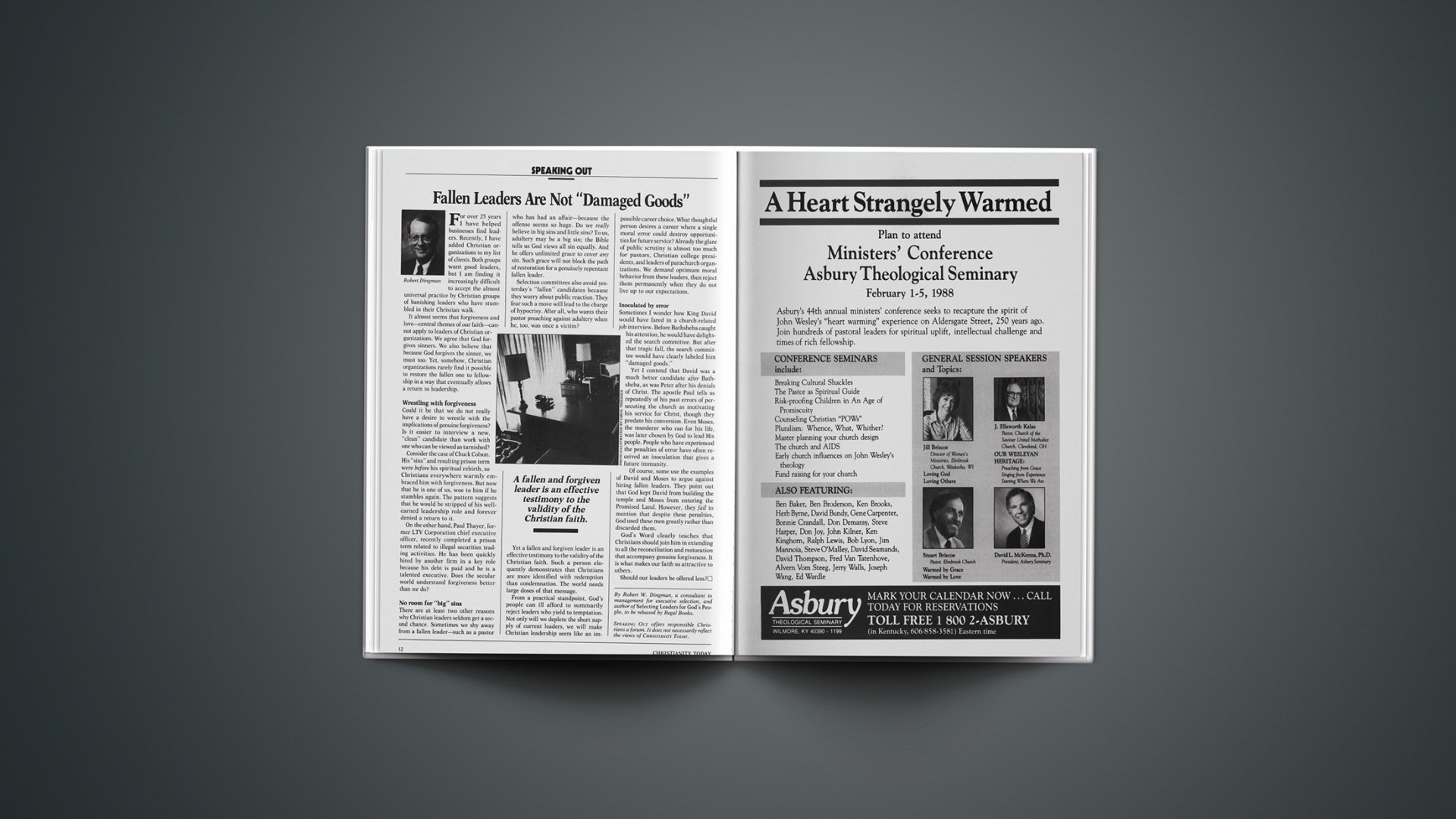
Fallen Leaders Are Not “Damaged Goods”

For over 25 years I have helped businesses find leaders. Recently, I have added Christian organizations to my list of clients. Both groups want good leaders, but I am finding it increasingly difficult to accept the almost universal practice by Christian groups of banishing leaders who have stumbled in their Christian walk.

It almost seems that forgiveness and love—central themes of our faith—cannot apply to leaders of Christian organizations. We agree that God forgives sinners. We also believe that because God forgives the sinner, we must too. Yet, somehow, Christian organizations rarely find it possible to restore the fallen one to fellowship in a way that eventually allows a return to leadership.

Wrestling With Forgiveness

Could it be that we do not really have a desire to wrestle with the implications of genuine forgiveness? Is it easier to interview a new, “clean” candidate than work with one who can be viewed as tarnished?

Consider the case of Chuck Colson. His “sins” and resulting prison term were before his spiritual rebirth, so Christians everywhere warmly embraced him with forgiveness. But now that he is one of us, woe to him if he stumbles again. The pattern suggests that he would be stripped of his well-earned leadership role and forever denied a return to it.

On the other hand, Paul Thayer, former LTV Corporation chief executive officer, recently completed a prison term related to illegal securities trading activities. He has been quickly hired by another firm in a key role because his debt is paid and he is a talented executive. Does the secular world understand forgiveness better than we do?

No Room For “Big” Sins

There are at least two other reasons why Christian leaders seldom get a second chance. Sometimes we shy away from a fallen leader—such as a pastor who has had an affair—because the offense seems so huge. Do we really believe in big sins and little sins? To us, adultery may be a big sin; the Bible tells us God views all sin equally. And he offers unlimited grace to cover any sin. Such grace will not block the path of restoration for a genuinely repentant fallen leader.

Selection committees also avoid yesterday’s “fallen” candidates because they worry about public reaction. They fear such a move will lead to the charge of hypocrisy. After all, who wants their pastor preaching against adultery when he, too, was once a victim?

Yet a fallen and forgiven leader is an effective testimony to the validity of the Christian faith. Such a person eloquently demonstrates that Christians are more identified with redemption than condemnation. The world needs large doses of that message.

From a practical standpoint, God’s people can ill afford to summarily reject leaders who yield to temptation. Not only will we deplete the short supply of current leaders, we will make Christian leadership seem like an impossible career choice. What thoughtful person desires a career where a single moral error could destroy opportunities for future service? Already the glare of public scrutiny is almost too much for pastors, Christian college presidents, and leaders of parachurch organizations. We demand optimum moral behavior from these leaders, then reject them permanently when they do not live up to our expectations.

Inoculated By Error

Sometimes I wonder how King David would have fared in a church-related job interview. Before Bathsheba caught his attention, he would have delighted the search committee. But after that tragic fall, the search committee would have clearly labeled him “damaged goods.”

Yet I contend that David was a much better candidate after Bathsheba, as was Peter after his denials of Christ. The apostle Paul tells us repeatedly of his past errors of persecuting the church as motivating his service for Christ, though they predate his conversion. Even Moses, the murderer who ran for his life, was later chosen by God to lead His people. People who have experienced the penalties of error have often received an inoculation that gives a future immunity.

Of course, some use the examples of David and Moses to argue against hiring fallen leaders. They point out that God kept David from building the temple and Moses from entering the Promised Land. However, they fail to mention that despite these penalties, God used these men greatly rather than discarded them.

God’s Word clearly teaches that Christians should join him in extending to all the reconciliation and restoration that accompany genuine forgiveness. It is what makes our faith so attractive to others.

Should our leaders be offered less?

By Robert W. Dingman, a consultant to management for executive selection, and author of Selecting Leaders for God’s People, to be released by Regal Books.

SPEAKING OUT offers responsible Christians a forum. It does not necessarily reflect the views of CHRISTIANITY TODAY.

What Makes CT Laugh?

Editors of magazines that publish cartoons must frequently ask themselves the question, What’s funny and what’s not? We use several cartoons in each issue of ct, and if we fail to address the What’s funny? question carefully, our readers will answer it for us.

Obviously, our use of cartoons indicates we think some things are funny. And we have good company in that assumption. A quick survey of historical literature shows humor to be a mainstay of the human experience and suggests it always will be. Philosophers disagree on why people laugh. But the fact of laughter? Case closed.

But some things are not funny. It is not just because they are bad humor, but because certain topics do not lend themselves to humor. To borrow a phrase from preaching professor Fred Craddock, there is a point of seriousness beyond which humor cannot and should not go. When the point of seriousness is crossed, we run the twin dangers of rudeness and bitterness, or—in the case of religion—blasphemy.

Many of the tensions of church life and the foibles of our frantic attempts to be righteous lend themselves to humor. It is more difficult, however, to think of humorous treatments of the sacred fundamentals of our faith—Scripture and the person of Jesus, for example.

True, the distinctions between the funny and the not funny sometimes blur. At CT, we circulate potential cartoons to all members of the editorial staff for comment. We get far less agreement on usable/nonusable cartoons from this panel of 12 honest citizens than we get on usable/nonusable manuscripts. Senses of humor differ. And frankly, we don’t always get it right.

So, to guide our judgments, we set forth the following principles:

1. Christians should feel good about humor. Sarah laughed. It was the only way she could come to grips with the incongruity of God promising her a child in her hundredth year. Jesus used humor in his parables. Elton Trueblood, in his book The Humor of Christ, discusses in detail Christ’s use of irony in particular. Trueblood goes on to note that “we get better stories at a conference of Christian leaders than we get anywhere else.” Humor and Christianity do mix.

2. There are specifically Christian benefits to humor. Fellowship is enhanced. Differences in education, social class, and culture melt away in the warmth created by good humor.

Tension is relieved. Sometimes the only relief people in impossible situations can get is from a good laugh. Sarah Cohen, in her book Comic Relief, argues that Jewish humor emerged from the disparity between being God’s chosen people and the harsh realities of immigrant life. As Rabbi Baroka noted, “A clown may be the first in the kingdom of Heaven, if he has helped lessen the sadness of human life.”

Truth is taught. In the intimacy of a local church or in the friendly confines of a magazine like CT, the great paradox of Christianity between faith and worldliness can be better understood through the use of humor. Trueblood recalls Christ’s use of humor in the parables: “Christ employed humor for the sake of truth, and many of his teachings, when seen in this light, become brilliantly clear for the first time.”

3. There is something more important than humor. Ecclesiastes says there is a time to laugh and a time to weep. In Luke, Jesus promises laughter as a blessing, but promises woe for those who laugh inappropriately. Clearly, something is more important than having a good sense of humor.

Perhaps that something can best be described as a sense of dignity about the spiritual life. 1 Timothy 3 uses the Greek word semnotes several times to describe the ideal church leader. A person of dignity (or responsibility) models the best in the Christian life for child and unbeliever alike. A person of dignity fully respects the deity of Christ and displays the awe and reverence appropriate for the created to show the Creator.

When we look at our fellow man or inward at ourselves, humor works. When we look heavenward, dignity replaces humor as the emotion of choice.

TERRY C. MUCK

Letters

Pentecostals: Reviving Neglected Emphases

Congratulations on your quality coverage of American Pentecostals [“America’s Pentecostals: Who They Are; What They Believe; Where They Are Going,” Oct. 16]. Pentecostals have revived neglected biblical emphases; as the various Methodist movements cooled, the Pentecostal movement arose.

To avoid spiritual self-indulgence, to avoid being seduced by American individualism and materialism, Pentecostalism needs to add a biblical version of social justice to its distinctives. With the immense power inherent in its emphasis on the Holy Spirit, Pentecostalism has the potential of becoming a great force for social justice in the kingdom of God here on earth, perhaps surpassing the impact of the Wesleyan movement.

LOWELL NOBLE

Spring Arbor College

Spring Arbor, Mich.

I commend you on the excellent articles on the Pentecostal movement. Perhaps unknown to the photographer, the beautiful lady on the cover of the magazine is Roberta Parham Hromas of Rolling Hills, California. It was taken at the Congress on the Holy Spirit and World Evangelization in New Orleans in July. Roberta is the granddaughter of Charles Fox Parham, who began the World Pentecostal Movement in his Bible school in Topeka, Kansas, in 1901. Roberta, a Pentecostal minister, is the daughter of Pauline Parham, who taught for many years at Christ for the Nations Institute in Dallas. It is noteworthy that the three generations represented in this pioneering family span the entire history of the Pentecostal movement.

VINSON SYNAN, Chairman

The New Orleans Congresses on the Holy Spirit and World Evangelism

New Orleans, La.

I have been a “classical Pentecostal” since my father became a Christian in 1950. Now I read that I am a “classical Pentecostal” because of association with my denomination. I am a “charismatic” because I stress prayer language for daily edification. I am a “Neo-Pentecostal” because I believe in a Pauline system of holiness. I am so confused! I think I will leave the ministry, dust off my construction tools, get my contractor’s license, and put on roofs. But then, what kind of roofs? Shakes, wood shingles, tile, tar and gravel, asphalt shingles …?

REV. TONY BELARMINO

First Assembly of God

Lovelock, Nev.

I appeal to you to give a hearing to the historic Reformed position—the stand of Calvin and Warfield, and indeed of Luther and Augustine before them. The whole Reformed tradition—no negligible factor in Christianity, surely—says no to the charismatic movement.

REV. DAVID J. ENGLESMA

Protestant Reformed Church

South Holland, Ill.

Charles Farah’s article [“What They Believe”] has an historical error. He wrote, “The Assemblies of God, for example, simply added to the National Association of Evangelicals’ doctrinal statement an article holding that they believe in the ‘baptism of the Spirit as evidenced by speaking in tongues.’ ” The Assemblies of God was formed in 1914, its statement of faith drafted in the fall of that year. This doctrinal statement has remained unchanged except for a further delineation of terms. The NAE did not come into existence until 1942.

JULEEN TURNAGE

General Council, Assemblies of God

Springfield, Mo.

In Grant Wacker’s otherwise excellent article, “Who They Are,” there is a terribly incorrect statement. Oneness Pentecostals are defined as “Unitarian.” Unitarians deny the deity of Jesus Christ, while Oneness Pentecostals exalt Christ as being the Mighty God (cf. Isa. 9:6). In actuality, we are the opposite end of the theological spectrum from the Unitarian position. Unfortunately, many CT readers do not understand Oneness theology and will come away misinformed.

RODNEY V. PAMER

Apostolic Crusaders

Barberton, Ohio

Why do we American Christians always ultimately resort to statistics to prove our case? “Any missiologist will tell you that today the church is growing fastest where healing and miracles are stressed,” writes Farah. Yes, and in America it is growing fastest in the very prosperity-oriented ministry of which he and other conscientious charismatics disapprove. If church history has taught us anything, it is that the majority is often wrong. Who was right—450 prophets of Baal or one Elijah?

REV. MIKE BELLAH

The Evangelical Fellowship

Amarillo, Tex.

The Morality Of Safety

For more than 20 years, Christians have debated “situation ethics,” a terribly complicated way of determining right and wrong.

But now that old it’s-okay-if-it’s-the-loving-thing-to-do philosophy can be forgotten. It has been eclipsed by a new, simplified ethic.

The new standard is seen in the current campaign for “safe sex,” which usually means applying condoms rather than self-control. The only moral principle is avoiding physical consequences. If it feels safe, do it.

Proponents argue that pickup basketball games have used this approach for years—no harm, no foul. (They overlook the reason these are called pickup games: smaller players are generally picking themselves off the floor.)

And thousands of drivers have been using radar detectors to practice “safe speeding.” You’re not a lawbreaker if you don’t get caught.

This morality of nonconsequence is pervading all parts of the social fabric. Students can enjoy “safe cheating” on exams—as long as the professor is out of the room. If you are sly enough, why not “safe shoplifting”? With the right connections, maybe even “safe bribery.” Rules are made to be broken, right?

Personally, I’m having trouble living up to the new ethic. I’m not ready to live my life by “better safe than sorry.” Why is it I want something other than immediate consequences guiding my conscience?

Somehow this new morality just doesn’t seem, uh, safe.

EUTYCHUS

Disappointing reviews

I was disappointed in the review of our book The Betrayal of the Church [Books, Oct. 16]. It deals with all the mainline denominations, not just the United Methodist Church. Our objection to the bureaucracies is that they are ideologically committed and not faithful to the gospel of Christ. We do not equate capitalism as “the” Christian economic system. Perhaps the reviewer should reread the book.

EDMUND W. ROBB

Ed Robb Evangelistic Association

Marshall, Tex.

In his review of The Encyclopedia of Religion [Oct. 16], Terry Muck comments: “Unfortunately, no evangelical scholars have written any of the encyclopedia’s articles.… Perhaps the avoidance is something we should address.” However, there are at least four evangelical contributors: Timothy Weber, George Marsden, James Stamoolis, and Edward McKinley—and I don’t think that is the full list. Still, the point is well taken—evangelicals on the whole are not noted for their contribution to comparative religion.

DANIEL G. REID

InterVarsity Press

Downers Grove, Ill.

I wonder at the wisdom of allowing someone to review a book he has not read, or at best only skimmed. Stanley Grenz could not have spent much time studying Integrative Theology [Oct. 16], or he would not have arrived at the very conclusion the book was written to avoid. I also wonder at the wisdom of allowing someone who betrays a nonevangelical theological stance to review an evangelical document. Grenz allows his liberal bias to slip several times. What Joes an evangelical have to say about the book?

RICK HARPEL

Littleton, Colo.

In our judgment, Grenz’s review did a disservice to CT readers and Denver Seminary. What is new in Integrative Theology is the systematic application of the verificational method to theological issues, a method standard for research in many other fields. It may not be the method, but the reviewer’s deficient grasp of it, that is “too simple.”

It is not correct to say we [the authors] hold almost solely a propositional revelation. Grenz overlooked our effort to integrate the data of special revelation with the data of experience, especially in the chapter on general revelation.

Integrative Theology does not assume biblical inerrancy but arrives at the carefully defined view of it drawn from the evidence in primary (scriptural) and secondary (theological) sources. Initially we did not presuppose inspiration, but regarded the Bible as the primary source of Christian thought. From the review, no one would know that after evaluation of alternatives, the conclusion on the reliability of biblical teaching was found more probable because it coherently accounted for the lines of evidence with fewer difficulties than alternative hypotheses.

Neither would readers know that the title “Integrative Theology” differs from “systematic theology” in more than words. Grenz failed to mention that the volume uniquely responds to objections to systematic theology by bringing together values from the disciplines of historical, biblical, systematic, apologetic, and practical theology. At the end of each chapter are a series of review questions and ministry projects to help bridge the gap from studying theology to teaching and preaching sound doctrine. It is a disservice to dismiss Integrative Theology in such a cavalier fashion.

GORDON R. LEWIS

Denver Seminary

Denver, Colorado

That decadent chocolate cake!

Thanks for J. I. Packer’s column on the decadent chocolate cake. [“Decadence á la Mode,” Oct. 2]. As I was reading it I was thinking, the world squeezes us into its mold. Then, at the end, Packer wonders if we were wondering if he had any of the cake. Well, for one, I wasn’t wondering. So I’m wondering why he was wondering if we were wondering!

FRED ARCHER

Shelton, Wash.

We would do well to hear more from James Packer!

REV. TIMOTHY J. COLE

Bridletowne Park Church

Agincourt, Ont., Canada

Whose perspective?

I may pause before sending my students to CT for current news of religious matters. “Striking Down the Textbook Ruling” (Oct. 2) typifies a too-common trait of assuming a single Christian perspective on current issues. The Rutherford Institute, the Association for Public Justice, and the NAE’S Office on Public Affairs speak for some Christians, but not for all. A more accurate article would have quoted the Christian groups (the Baptist Joint Committee, for example) who operate from a different Christian perspective on liberty. The next [News] article by Steve Wykstra on Gustavo Parajon is an example of better journalism.

DERRY SEATON

Fullerton College

Fullerton, Calif.

The article on Mozambique [News, Oct. 2] is mainly from Communist sources. There is no indication that Randy Frame entered Renamo-held territory or interviewed any people there. While this is one of the worst examples I have seen in CT, few of your foreign news articles exhibit really good investigative journalism. Either you should improve your efforts or drop foreign news.

FRANK VOSLER

New Albany, Ohio

Great article!

I applaud Tim Stafford’s article, on “Great Sex …” [CT Institute, Oct. 2]. I found the entire article thorough, biblical, and practical.

ALLEN MARSH

Nampa, Idaho

I found Tim Stafford’s article on sexuality frustrating. There were some good ideas, but it was hard to read. When I first saw the list of scholars you assembled to discuss sexuality, I was excited to see what they had to say. Instead, I found a very long piece by Tim Stafford. It seemed too much of one person’s opinions.

LYNNE M. BAAB

Seattle, Wash.

“Great Sex” is actually pornographic writing. The marginal quotations are especially damaging, for many people may not read the entire text.

WESLEY W. WERTZ

San Diego, Calif.

I have just finished rereading “Great Sex …”; not easily digested, but very rewarding.

CAPT. JOHN M. GORE

Oakton, Va.

The Top Ten

“Why do you read CHRISTIANITY TODAY magazine?”

We’ve asked that question many times, and many times our readers’ response has been the same: News.

We’re not surprised, for over the years the CT news section has provided accurate, objective information on the stories having impact on—and, at times, embarrassing—the church.

And 1987 was no exception.

From Jim Bakker’s downfall to Judge Bork’s defeat, the team of Ron Lee, Randy Frame, Beth Spring (now a contributing editor), and newcomer Kim Lawton has focused its editorial energies on hundreds of potential news stories—both national and international. And with the assistance of over 30 stringers, they have been able to select, develop, and fine tune what they think are the stories our readers should be aware of.

The sheer number of stories that move across our news desks makes the selection of the most significant news stories of any given year no easy task. But for the second year in a row, we have decided to pick our “Top Ten.”

Some of our choices may surprise you, but the bottom-line significance of each is its impact—both immediate and long-term.

Newsmakers. And while we’re on the subject of news, Randy Frame is doing double duty as the magazine’s associate news editor and as editor of “Newsmakers,” a monthly insert for church bulletins. Concisely written, “Newsmakers” highlights the intriguing individuals that Randy (and the rest of the CT staff) run into in the course of their work.

HAROLD B. SMITH, Managing Editor

Ideas

God Isn’t Fair (and I’m Glad He Isn’t)

Columnist; Contributor

When an airplane crashed this summer in Detroit, newspapers quickly dubbed the sole survivor, a four-year-old girl, the “miracle child.” Did God spare her, but not the 154 other passengers, from death? By freak coincidence, a salesperson from Zondervan Publishing House had missed that very flight; did God prompt her, but only her, to avoid the fated airline?

Questions like these surface in the wake of every disaster, turning our focus to the seeming unfairness of life. Why isn’t God more consistent, we wonder.

A few days after the Detroit plane crash I came across a clipping from a three-year-old Time magazine that reported on a terrible fire in England’s York Minster. Some thought the fire, caused by a lightning bolt, was divine retribution: The cathedral was the site of the episcopal consecration of Canon David Jenkins, who had publicly questioned both the Virgin Birth and the Resurrection.

The problem with the York Minster lightning bolt, of course, is that it stands as such an exception. So fire from the heavens hit a famous church—what about all the Unitarian churches that brazenly deny orthodox Christian doctrines, not to mention the Muslim mosques and Hindu temples? If God consistently punished bad doctrine with lightning bolts, the planet would sparkle nightly like a Christmas tree.

That image of God’s finger pointing the way for lightning bolts, however, started me thinking. What if God arranged things so that we would experience a mild jolt of pain with every sin, and a tickle of pleasure with every act of virtue? What if every errant doctrine did indeed attract a lightning bolt, while every repetition of the Apostles’ Creed stimulated our brains to produce an endorphin of pleasure?

Such behavior modification would raise obvious questions about human freedom. Would you obey because you loved God or because you desired pleasure and not pain? But set aside the philosophical koans and consider an even more basic question: Would such a world work? Would a consistent reward/punishment system change behavior?

Consider the tight controls in the concentration camps of totalitarian societies. There, rulers reward good behavior (with reduced sentences and extra food) and punish bad behavior (with lockups, skimpy rations, and fewer privileges). Yet survivors such as Alexander Solzhenitsyn testify that the reward/punishment system simply does not work. Few prisoners develop a happy urge to earn their rulers’ approval. They cooperate grudgingly, if at all, and emerge with an even more jaded view of their rulers.

Remarkably, the Bible itself records a kind of behavior modification experiment on a national scale—God’s covenant with the Israelites. For a time, God resolved to reward and punish his people with strict consistency, as detailed in the Book of Deuteronomy.

Results of Obedience:

  • Prosperous cities, prosperous rural areas;
  • No sterility among men, women, or livestock;
  • Assured success in all farming ventures;
  • Dependable weather conditions;
  • Guaranteed military victories over enemies;
  • Total immunity to diseases.

In summary, the Israelites would “always be at the top, never at the bottom,” and “high above all the nations on earth” (see Deut. 28).

Results of Disobedience:

  • Sudden ruin; violence and crime;
  • Infertility among people and livestock;
  • Crop failure; invasions of locusts and worms;
  • Scorching heat and drought, blight and mildew;
  • Rapine and domination by other nations;
  • Every kind of disease, fever, and inflammation; madness, blindness, confusion of mind.

In summary, “You will become a thing of horror and an object of scorn and ridicule to all the nations where the Lord will drive you.… [I]n hunger and thirst, in nakedness and dire poverty, you will serve the enemies the Lord sends against you” (Deut. 28:37, 48).

What resulted from this covenant, based on a “fair” reward and punishment system? For the answer, simply read the Books of Joshua and Judges back to back. Within 50 years the Israelites disintegrated into a state of utter anarchy. Much of the rest of the Old Testament recounts the dreary history of those predicted curses coming true.

Years later, when New Testament authors referred to that history, they saw those days of consistent reward/punishment in a new light. They did not hold up the covenant as a model of God relating to people with fairness. Rather, they said, the Old Testament Law serves as an object lesson: It demonstrates that human beings are incapable of fulfilling a contract with God. Any covenant (“testament”) requiring consistent reward for our good behavior and consistent punishment for our bad behavior is doomed to fail. We need instead a new covenant with God, one based on forgiveness and grace. And that is precisely why the “New Testament” exists.

It took the most unfair act in history, the execution of Jesus the Christ, to satisfy divine justice in a world full of injustice. That event made it possible for the least deserving of all people—a convicted thief dangling on a cross, for example—to gain an eternity of undeserved happiness.

Yet the primal desire for “fairness” dies hard. Who among us does not sometimes yearn for a more obvious kind of fairness in this world here and now? Who does not secretly hope that good behavior will be rewarded in this life with success and prosperity? And who does not sometimes long for more evident signs of God’s disapproval?

In our desire to apply standards of fairness to a world full of mysteries, we may be tempted to see God’s hand behind such actions as plane crashes, lightning bolts, and AIDS outbreaks. But I, for one, am glad I do not live in such a simple, reward/punishment type of world. Whenever I get tempted, I go back and read again the story of the signed contract with Israel.

Book Briefs: November 20, 1987

Do Christian Colleges Undermine Orthodoxy?

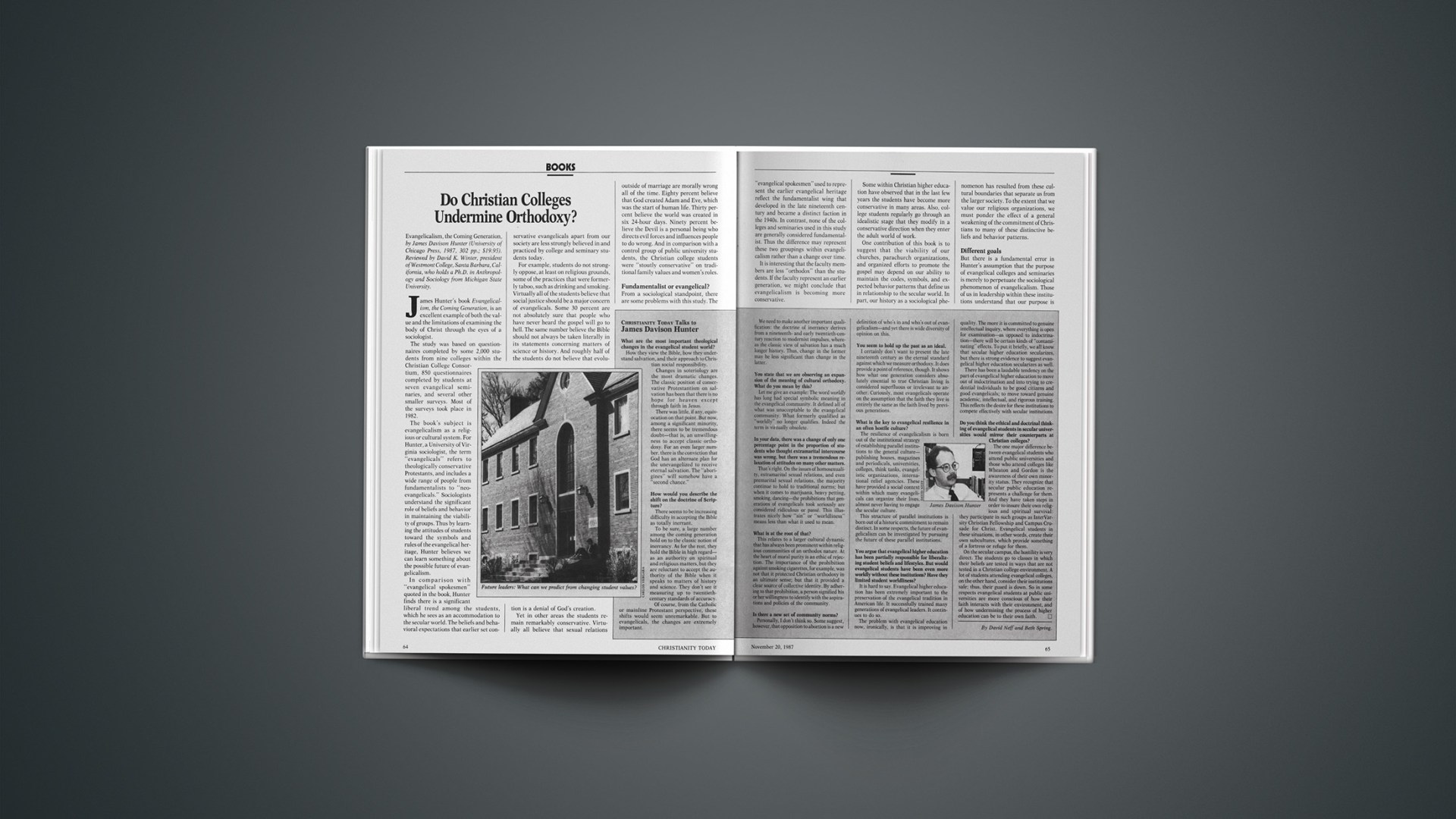
Evangelicalism, the Coming Generation, by James Davison Hunter (University of Chicago Press, 1987, 302 pp.; $19.95). Reviewed by David K. Winter, president of Westmont College, Santa Barbara, California, who holds a Ph.D. in Anthropology and Sociology from Michigan State University.

James Hunter’s book Evangelicalism, the Coming Generation, is an excellent example of both the value and the limitations of examining the body of Christ through the eyes of a sociologist.

The study was based on questionnaires completed by some 2,000 students from nine colleges within the Christian College Consortium, 850 questionnaires completed by students at seven evangelical seminaries, and several other smaller surveys. Most of the surveys took place in 1982.

The book’s subject is evangelicalism as a religious or cultural system. For Hunter, a University of Virginia sociologist, the term “evangelicals” refers to theologically conservative Protestants, and includes a wide range of people from fundamentalists to “neo-evangelicals.” Sociologists understand the significant role of beliefs and behavior in maintaining the viability of groups. Thus by learning the attitudes of students toward the symbols and rules of the evangelical heritage, Hunter believes we can learn something about the possible future of evangelicalism.

In comparison with “evangelical spokesmen” quoted in the book, Hunter finds there is a significant liberal trend among the students, which he sees as an accommodation to the secular world. The beliefs and behavioral expectations that earlier set conservative evangelicals apart from our society are less strongly believed in and practiced by college and seminary students today.

For example, students do not strongly oppose, at least on religious grounds, some of the practices that were formerly taboo, such as drinking and smoking. Virtually all of the students believe that social justice should be a major concern of evangelicals. Some 30 percent are not absolutely sure that people who have never heard the gospel will go to hell. The same number believe the Bible should not always be taken literally in its statements concerning matters of science or history. And roughly half of the students do not believe that evolution is a denial of God’s creation.

Yet in other areas the students remain remarkably conservative. Virtually all believe that sexual relations outside of marriage are morally wrong all of the time. Eighty percent believe that God created Adam and Eve, which was the start of human life. Thirty percent believe the world was created in six 24-hour days. Ninety percent believe the Devil is a personal being who directs evil forces and influences people to do wrong. And in comparison with a control group of public university students, the Christian college students were “stoutly conservative” on traditional family values and women’s roles.

Fundamentalist Or Evangelical?

From a sociological standpoint, there are some problems with this study. The “evangelical spokesmen” used to represent the earlier evangelical heritage reflect the fundamentalist wing that developed in the late nineteenth century and became a distinct faction in the 1940s. In contrast, none of the colleges and seminaries used in this study are generally considered fundamentalist. Thus the difference may represent these two groupings within evangelicalism rather than a change over time.

It is interesting that the faculty members are less “orthodox” than the students. If the faculty represent an earlier generation, we might conclude that evangelicalism is becoming more conservative.

Some within Christian higher education have observed that in the last few years the students have become more conservative in many areas. Also, college students regularly go through an idealistic stage that they modify in a conservative direction when they enter the adult world of work.

One contribution of this book is to suggest that the viability of our churches, parachurch organizations, and organized efforts to promote the gospel may depend on our ability to maintain the codes, symbols, and expected behavior patterns that define us in relationship to the secular world. In part, our history as a sociological phenomenon has resulted from these cultural boundaries that separate us from the larger society. To the extent that we value our religious organizations, we must ponder the effect of a general weakening of the commitment of Christians to many of these distinctive beliefs and behavior patterns.

Different Goals

But there is a fundamental error in Hunter’s assumption that the purpose of evangelical colleges and seminaries is merely to perpetuate the sociological phenomenon of evangelicalism. Those of us in leadership within these institutions understand that our purpose is not only to enable students to appreciate our evangelical cultural heritage, but to encourage the biblical understanding and spiritual commitment that allow them to critique cultural expressions of the Christian faith. In other words, our purpose is to produce “world Christians,” who express their faith effectively in a wide variety of cultures around the world, emphasizing our unity in Jesus Christ and the authority of Scripture, while appreciating the significant differences in behavioral patterns that characterize Christian people and denominations.

This study does not resolve the question whether today’s evangelical students are less or more influenced by society than, say, 50 years ago when both the larger culture and evangelicalism were more conservative. In any case, the contrast with the world we desire is not primarily seen in certain traditional cultural codes, but in integrity, compassion, justice, the love of Christ, and the power of the Spirit.

Because Hunter believes our goal is to maintain an unchanging world view, he concludes that evangelical education is “counterproductive to its own objectives.” But for those of us who are committed only to Jesus Christ and Holy Scripture, his evidence of failure is our evidence of success.

Christianity Today Talks To James Davison Hunter

What are the most important theological changes in the evangelical student world?

How they view the Bible, how they understand salvation, and their approach to Christian social responsibility.

Changes in soteriology are the most dramatic changes. The classic position of conservative Protestantism on salvation has been that there is no hope for heaven except through faith in Jesus.

There was little, if any, equivocation on that point. But now, among a significant minority, there seems to be tremendous doubt—that is, an unwillingness to accept classic orthodoxy. For an even larger number, there is the conviction that God has an alternate plan for the unevangelized to receive eternal salvation. The “aborigines” will somehow have a “second chance.”

How would you describe the shift on the doctrine of Scripture?

There seems to be increasing difficulty in accepting the Bible as totally inerrant.

To be sure, a large number among the coming generation hold on to the classic notion of inerrancy. As for the rest, they hold the Bible in high regard—as an authority on spiritual and religious matters, but they are reluctant to accept the authority of the Bible when it speaks to matters of history and science. They don’t see it measuring up to twentieth-century standards of accuracy. Of course, from the Catholic or mainline Protestant perspective, these shifts would seem unremarkable. But to evangelicals, the changes are extremely important.

We need to make another important qualification: the doctrine of inerrancy derives from a nineteenth-and early twentieth-century reaction to modernist impulses, whereas the classic view of salvation has a much longer history. Thus, change in the former may be less significant than change in the latter.

You state that we are observing an expansion of the meaning of cultural orthodoxy. What do you mean by this?

Let me give an example: The word worldly has long had special symbolic meaning in the evangelical community. It defined all of what was unacceptable to the evangelical community. What formerly qualified as “worldly” no longer qualifies. Indeed the term is virtually obsolete.

In your data, there was a change of only one percentage point in the proportion of students who thought extramarital intercourse was wrong, but there was a tremendous relaxation of attitudes on many other matters.

That’s right. On the issues of homosexuality, extramarital sexual relations, and even premarital sexual relations, the majority continue to hold to traditional norms; but when it comes to marijuana, heavy petting, smoking, dancing—the prohibitions that generations of evangelicals took seriously are considered ridiculous or passe. This illustrates nicely how “sin” or “worldliness” means less than what it used to mean.

What is at the root of that?

This relates to a larger cultural dynamic that has always been prominent within religious communities of an orthodox nature. At the heart of moral purity is an ethic of rejection. The importance of the prohibition against smoking cigarettes, for example, was not that it protected Christian orthodoxy in an ultimate sense; but that it provided a clear source of collective identity. By adhering to that prohibition, a person signified his or her willingness to identify with the aspirations and policies of the community.

Is there a new set of community norms?

Personally, I don’t think so. Some suggest, however, that opposition to abortion is a new definition of who’s in and who’s out of evangelicalism—and yet there is wide diversity of opinion on this.

You seem to hold up the past as an ideal.

I certainly don’t want to present the late nineteenth century as the eternal standard against which we measure orthodoxy. It does provide a point of reference, though. It shows how what one generation considers absolutely essential to true Christian living is considered superfluous or irrelevant to another. Curiously, most evangelicals operate on the assumption that the faith they live is entirely the same as the faith lived by previous generations.

What is the key to evangelical resilience in an often hostile culture?

The resilience of evangelicalism is born out of the institutional strategy of establishing parallel institutions to the general culture—publishing houses, magazines and periodicals, universities, colleges, think tanks, evangelistic organizations, international relief agencies. These have provided a social context within which many evangelicals can organize their lives, almost never having to engage the secular culture.

This structure of parallel institutions is born out of a historic commitment to remain distinct. In some respects, the future of evangelicalism can be investigated by pursuing the future of these parallel institutions.

You argue that evangelical higher education has been partially responsible for liberalizing student beliefs and lifestyles. But would evangelical students have been even more worldly without these institutions? Have they limited student worldliness?

It is hard to say. Evangelical higher education has been extremely important to the preservation of the evangelical tradition in American life. It successfully trained many generations of evangelical leaders. It continues to do so.

The problem with evangelical education now, ironically, is that it is improving in quality. The more it is committed to genuine intellectual inquiry, where everything is open for examination—as opposed to indoctrination—there will be certain kinds of “contaminating” effects. To put it briefly, we all know that secular higher education secularizes, but there is strong evidence to suggest evangelical higher education secularizes as well.

There has been a laudable tendency on the part of evangelical higher education to move out of indoctrination and into trying to credential individuals to be good citizens and good evangelicals; to move toward genuine academic, intellectual, and rigorous training. This reflects the desire for these institutions to compete effectively with secular institutions.

Do you think the ethical and doctrinal thinking of evangelical students in secular universities would mirror their counterparts at Christian colleges?

The one major difference between evangelical students who attend public universities and those who attend colleges like Wheaton and Gordon is the awareness of their own minority status. They recognize that secular public education represents a challenge for them. And they have taken steps in order to insure their own religious and spiritual survival: they participate in such groups as InterVarsity Christian Fellowship and Campus Crusade for Christ. Evangelical students in these situations, in other words, create their own subcultures, which provide something of a fortress or refuge for them.

On the secular campus, the hostility is very direct. The students go to classes in which their beliefs are tested in ways that are not tested in a Christian college environment. A lot of students attending evangelical colleges, on the other hand, consider their institutions safe; thus, their guard is down. So in some respects evangelical students at public universities are more conscious of how their faith interacts with their environment, and of how undermining the process of higher education can be to their own faith.

By David Neff and Beth Spring.

Higher Education’s Shuttered Soul

The Closing of the American Mind: How Higher Education Has Failed Democracy and Impoverished the Souls of Today’s Students, by Allan Bloom (Simon and Schuster, 392 pp.; $18.95, hardcover). Reviewed by Glenn N. Schram, former associate professor of political science, Marquette University.

The thesis of this much-discussed book is by now fairly well known: Although the contemporary American university purports to foster openness, in the sense of tolerance for diverse cultures and lifestyles, this openness is nothing but value relativism by a different name; the universities fail to turn out graduates whose minds are truly open to the wisdom of the ages.

More particularly, students leave our universities without having learned to seek, like Plato and Aristotle, to know through reason what is by nature right—what is right in all times and places, and not just what is thought to be right by one or another culture.

Bloom is a member of the Committee on Social Thought at the University of Chicago and a student of the late Leo Strauss, who, in a distinguished career at that university, trained almost a whole generation of scholars in political philosophy. Strauss and his students generally praise Plato and Aristotle, and view modern thinkers, from Machiavelli to the present, with disdain. And Bloom is no exception, although he is friendlier toward Rousseau than was Strauss himself.

Spiritual Malaise

Bloom’s critique of our universities seems incontrovertible, but whether his proposed solutions are adequate is questionable. He wants to see the classics of literature restored to centrality in a liberal education and the core-curriculum requirements (which the universities abandoned during the student unrest of the sixties) rehabilitated.

But Bloom himself questions whether the universities, in their present spiritual malaise, have the wherewithal to undertake even such modest reforms. And it is here that we come to the heart of the problem: Bloom recognizes the roles of religion and the Bible in a liberal education, but he attaches relatively little importance to them.

It is difficult to know whence the motivation for Bloom’s reforms is to come if not from a spiritual renaissance among faculty; nor is it clear what form a spiritual renaissance could take if it is not to be Christian—Christianity being the religion with which most of us are most familiar. It is also, I believe, true.

The issue extends far beyond the nature of liberal education. Bloom says that, after Nietzsche, we have to speak of “the decline of the West.” And he suggests “that the overpowering visions of German philosophers are preparing the tyranny of the future.” He writes: “The crisis of liberal education is a reflection of a crisis at the peaks of learning, an incoherence and incompatibility among the first principles with which we interpret the world, an intellectual crisis of the greatest magnitude, which constitutes the crisis of our civilization.”

Unfortunately, Bloom fails to develop these points sufficiently. As a translator of Plato’s Republic, he of all persons should know that, according to Plato, when a society becomes dominated by “democratic men” it will sooner or later give way to tyranny.

A country’s having a democratic form of government does not automatically mean that the socially dominant persons have “democratic characters,” marked by the predominance of insolence, anarchy, and sensuality.

But if, as I believe, “democratic men” are emerging in greater numbers in positions of power—including positions in entertainment and the mass media—there is cause for concern, and the only thing that could deflect us from our course toward tyranny would be a religious renaissance, first among our teachers and then among their students.

What’s Ahead for the Church in Haiti?

The downfall of Haitian dictator Jean-Claude Duvalier in February 1986 brought the hope of a better life to many in the impoverished Caribbean nation. However, economic woes have continued, the interim military government has come under increasing criticism, and an atmosphere of violence has taken over many areas of the island nation.

Elections to choose a civilian president are scheduled for later this month, but the weeks leading up to the election have been rife with riots, arrests, strikes, random killings, and the assassinations of political leaders. Claude Noel, general secretary of the Council of Evangelical Churches in Haiti, says the turmoil has interfered with the work of those trying to meet the desperate physical and spiritual needs of the people. CHRISTIANITY TODAY asked Dave Disch, news editor of Light and Life magazine, to interview Noel about the current tensions in Haiti.

How have public demonstrations and the threat of violence affected churches in Haiti?

Several denominations have had to cancel large gatherings and conventions. I usually speak at several gatherings within our church council, but this year I have not been to any. The schools close whenever there is violence, so the Bible schools have to close as well. And a few times we did not hold church services because the roads were barricaded. You couldn’t cross the barricades without risking violence.

What has happened to the church leaders who were associated with the Duvalier regime?

Some of them had to leave, because the people chased them out of town. In denominational churches, the denominations moved those pastors to other areas. We hope they will be able to return after a civilian government is elected.

What about pastors who were not connected with Duvalier? Are they under pressure?

They face political pressure. The people push them to support what they support. If there is a strike, they want everybody to participate, including the church. And when you try to stay out of it, you are in trouble. You cannot remain neutral.

Many times we can’t support what the people are pushing. We oppose anything that involves violence. In our churches, we preach civil liberty. Many of my messages have dealt with the rights of the individual and applying the Bible to Christian involvement in community affairs. But sometimes the people outside want the church to go too far.

Is mission work being hampered?

In general, missionaries have not been molested, but there have been a few incidents. In one case, a crowd of Haitians went into a missionary’s home and ordered him to leave the country. He told them, “I have people to report to in the city, so you have to write me a letter telling me to leave the country and each one of you has to sign it.” They were not willing to do that, so they left. Many missionaries have decided not to stay in Haiti, or if they are outside the country, not to return until after the elections.

Has the Catholic church been involved in the changing political situation?

Catholics played an important role in ousting Duvalier, and some priests are now presenting themselves as the heroes of the revolution. They are not all in agreement, however, about the proper degree of political involvement. That creates problems in the evangelical churches because young people especially are pushing the pastors, telling them, “You see what the Catholics are doing. What are we doing?”

What if this month’s scheduled election is not fair? Would the evangelical churches then take a more public political stance?

If we had proof the election was rigged, we would ask that something be done about it. But you must realize that the different political parties might complain that the election was not fair because their candidates lost. That’s why we would need proof.

What are your hopes for Haiti?

The best thing would be to have a government that could provide work, housing, and food for the people. But we wonder how long it’s going to take for that to happen. We have people from many churches and organizations involved in education and community development in Haiti, but we don’t see much change. I believe the Lord will eventually change the situation. I have talked to many officials in the present government, and I believe they want to see things improve for the people.

Forces Line up to Do Battle over Euthanasia

Opponents of euthanasia have long warned of a “slippery slope” leading to a reckless disregard for the right to life of terminally ill or mentally incompetent patients. And recent events have led a number of these activists to argue that American society is further down that slope than many realize.

Among the developments cited are recent court rulings favoring the withholding of medical treatment—including artificially administered food and water—from seriously ill patients, and the growing potential in several states of legalized physician-assisted suicides by the terminally ill.

Assisted Death

One of the most intensely debated aspects of “active euthanasia” is physician-assisted suicide. Should doctors be allowed to administer lethal injections or fatal medications to terminally ill patients who request them? Active euthanasia is most widely practiced in the Netherlands, where it claims the lives of an estimated 7,000 terminally ill and incompetent patients each year. Although the practice is illegal, Dutch courts permit “mercy killing” as a legal defense for doctors charged with killing their patients.

The practice is highly controversial in the United States, but advocates of active euthanasia are becoming more visible. In California, a group called Americans Against Human Suffering (AAHS) is working to put the issue to a statewide vote in November 1988. Next month, the group will begin collecting the 450,000 signatures needed to place on the state ballot an initiative that would allow physicians to provide a means of death for terminally ill patients who request it.

The proposal, called the “Humane and Dignified Death Initiative,” calls for amending the California constitution so that “the inalienable right of privacy includes the right of the terminally ill to voluntary and dignified doctor assisted aid in dying.” Specifically, the measure states, “In recognition of the dignity which patients have a right to expect, the state of California shall recognize the right of an adult person to make a written directive instructing his physician to withhold or withdraw life sustaining procedures or, if suffering from a terminal condition, to administer aid in dying.” It adds that doctors should not be subject to “civil, criminal or administrative liability” for such actions.

The battle is also being fought on the legislative front, with AAHS lobbying the California legislature to adopt the “Humane and Dignified Death” initiative. Meanwhile, assemblywoman Joan Hayes has introduced a similar measure in the Hawaii legislature. Other efforts are being planned for Arizona and Florida.

The issue of active euthanasia is also being brought up in the courts. In January, the American Civil Liberties Union (ACLU) filed a lawsuit in Colorado requesting that Hector Rodas, a 34-year-old quadraplegic, be provided with a lethal substance that would result in his “comfortable and dignified demise.” The suit was dropped after Rodas indicated he had not requested a lethal injection. But many antieuthanasia groups saw this as the beginning of a series of attempts to get the courts to sanction active euthanasia. “That the ACLU, self-proclaimed defenders of the downtrodden, have made it a quest to help the most defenseless of their clients be killed, is deplorable,” said Mary Senander of the International Anti-Euthanasia Task Force.

Withholding Treatment

While the courts have not yet ruled on the issue of lethal injections, they have been favorable to the withholding of medical treatment. In the landmark 1976 case of Karen Ann Quinlan, the New Jersey Supreme Court granted the family’s request that Quinlan, who was comatose, be disconnected from her respirator. After being taken off the respirator, Quinlan lived until 1985.

Earlier this year, the New Jersey Supreme Court took that decision a step further when it granted a family’s request that the feeding tube be removed from Nancy Ellen Jobes, a 32-year-old woman who was brain damaged as the result of an accident. The court also ruled that the nursing home where Jobes had lived for seven years could be forced to remove the tube, despite the institution’s objections. Jobes was moved to a hospital that did not object to the withholding of food and water, and she died in August.

Similar cases have come up, largely since the American Medical Association took the position last year that “nutrition and hydration” be included in the list of life-prolonging medical treatments that may be discontinued “even if death is not imminent.” Senander, of the International Anti-Euthanasia Task Force, said she believes the “debate on the withholding of food and fluids is ‘greasing the skids’ for lethal injections.”

In response to what they see as a growing threat, anti-euthanasia leaders are vowing to develop a more organized opposition to euthanasia efforts. At a conference last month in Ohio, leaders from 19 states and the District of Columbia signed a “Declaration in Opposition to Euthanasia.” The document states, “We categorically reject euthanasia in American society as it masquerades under the euphemisms of ‘a right to die,’ ‘aid in dying,’ and ‘death with dignity’.… Human beings, young and old, healthy and debilitated, have an inalienable right to food and water, warmth, and competent, compassionate care, and the law and learned professions must recognize and reflect this.” The signers also agreed to begin a “major educational effort” against the California Humane and Dignified Death Initiative, which they said “would impact on the entire nation.”

Addressing Family Issues

As the 1988 presidential election approaches, the family is becoming a bipartisan concern.

In 1980 and again in 1984, Ronald Reagan was elected on a platform that emphasized a host of profamily issues. And as the 1988 presidential election approaches, those same issues remain a focus of public debate.

Republican leaders are urging their party to strengthen its profamily stance, while Democrats, in a shift from past policies, are giving new emphasis to the family as a unit.

A New Democratic Agenda

A report issued last year by the Democratic National Committee’s (DNC) Democratic Policy Commission listed “a commitment to stronger families” as a key party concern. The report, which many observers say was designed to form a “new centrist image” for the party, asserted that “Democrats favor profamily policies that will raise family incomes, help keep families together and provide some assistance to parents in their day-to-day lives.” Among other initiatives, the report favored tax reform, flexible hours for employees with children, and welfare reform.

This fall, two new reports advised Democrats about the political benefits of addressing children’s issues. In his study “Kids as Politics,” Democratic pollster Stanley Greenberg said, “There is expanded openness to a larger governmental role …, especially in the realm of children.” He listed popular programs, including “pre-school health and education, fighting drugs, helping people go to college and helping young people buy a first home.” A separate study, by poll taker Peter Hart, suggested that Democrats could capture votes by focusing on the worries a majority of Americans say they have about their families’ economic future.

DNC spokeswoman Julie Anbender said Democrats have been talking about “family-oriented issues” for years. The issues are the same today, she said, “perhaps now cast in a new light.”

According to Anbender, Reagan was not the impetus for renewed attention on the family. Rather, she said, society itself is more interested in the family. “After the sixties revolution and the change in the family unit and the marriage structure, it [the family] became less important,” she said. “I think society in general is turning back to believing the family is important, and so necessarily both parties will respond to that.”

Anbender was critical of Republican policies, saying they have not benefitted the family. “They may be saying it is important to have policies that are family-oriented, but when you actually look at what policies have been implemented and what the priorities of [the Reagan] administration have been, they don’t seem profamily.”

Maintaining The Momentum

Several Republican leaders, hoping to maintain the momentum they say was begun by Reagan, are attempting to ensure that family concerns stay at the forefront of the GOP. Last month, U.S. Rep. Dan Coats (R-Ind.) announced The Family and Children Project ’88, a Republican social policy that he said is “based on responsibility, character, and family bonds.” Coats, a member of the House Republican Policy Committee and the House Select Committee on Children, Youth and Family, told a Capitol Hill press conference the project will include more than a dozen proposals that will be released by next summer.

The congressman released the first two proposals as he announced the project. One is an effort to encourage early childhood development through a series of community-based educational programs for families. The second is a public housing initiative that would encourage tenant-management programs and make it easier for low-income families to purchase housing. Coats said other proposals will address health, education, welfare, foster care, crime, child care, and family economics.

In an interview, Coats said he would like to see the GOP presidential contenders “steal our ideas.… I very much hope to make this a part of the Republican party platform.”

Liberals have leveled the criticism that Republicans are “all talk, but no action” when it comes to the family, Coats said. “We’re backing up our rhetoric with specific proposals that we believe are sound, conservative, profamily approaches to dealing with the problems.” The project itself charges that “most of the Democrat proposals are just more of the same of what has so seriously failed our nation’s children and families.… [But] it is also not enough for us Republicans to point out that the Democrat proposals don’t work.”

A Bipartisan National Issue

Both parties agree that several broad questions—including housing, welfare, economics, and child care—need to be addressed. Beyond that, however, much of the agreement ends. The two parties differ on issues ranging from who is included in the definition of a family unit to how solutions should be approached.

A main difference between the two is the role of government. Republicans generally favor private initiatives with government encouragement, while Democrats endorse more direct government involvement. As a result, bipartisan efforts are often difficult to hammer out.

Nonetheless, profamily groups are generally pleased with the national attention being given to the family. Family Research Council president Jerry Regier said he is “very encouraged” that the family has become a bipartisan national issue because “that is something many of us have been working toward for a long time.” However, Regier noted that much of the talk may be “election rhetoric.… Everyone who is talking about the family isn’t talking about the same thing, and voters need to be very discerning about whether family values are really being advanced.”

Trying to Tighten the Belt of Financial Accountability

How effective are the efforts of Christian self-regulatory groups?

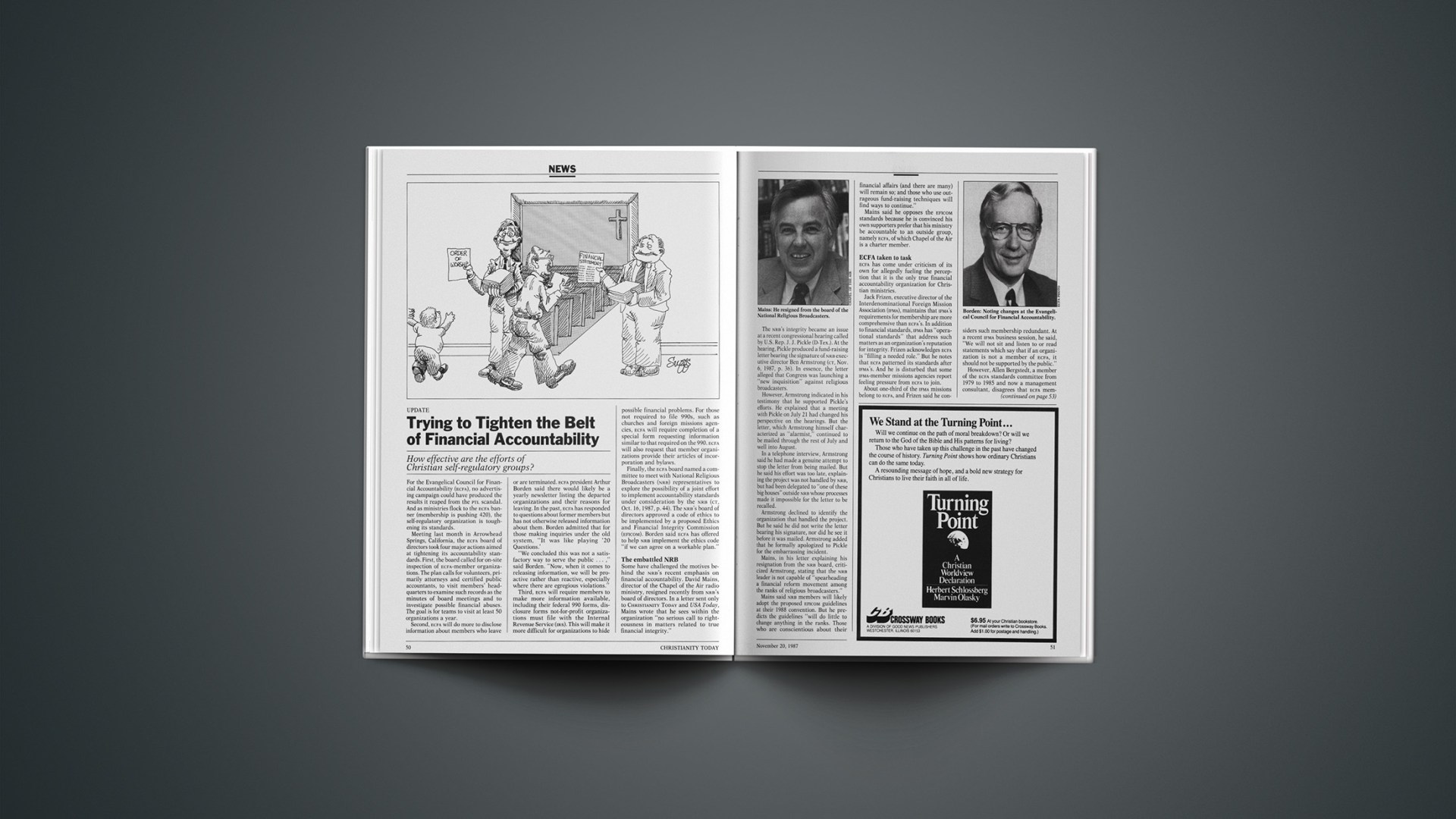
For the Evangelical Council for Financial Accountability (ECFA), no advertising campaign could have produced the results it reaped from the PTL scandal. And as ministries flock to the ECFA banner (membership is pushing 420), the self-regulatory organization is toughening its standards.

Meeting last month in Arrowhead Springs, California, the ECFA board of directors took four major actions aimed at tightening its accountability standards. First, the board called for on-site inspection of ECFA-member organizations. The plan calls for volunteers, primarily attorneys and certified public accountants, to visit members’ headquarters to examine such records as the minutes of board meetings and to investigate possible financial abuses. The goal is for teams to visit at least 50 organizations a year.

Second, ECFA will do more to disclose information about members who leave or are terminated. ECFA president Arthur Borden said there would likely be a yearly newsletter listing the departed organizations and their reasons for leaving. In the past, ECFA has responded to questions about former members but has not otherwise released information about them. Borden admitted that for those making inquiries under the old system, “It was like playing ‘20 Questions.’

“We concluded this was not a satisfactory way to serve the public …,” said Borden. “Now, when it comes to releasing information, we will be proactive rather than reactive, especially where there are egregious violations.”

Third, ECFA will require members to make more information available, including their federal 990 forms, disclosure forms not-for-profit organizations must file with the Internal Revenue Service (IRS). This will make it more difficult for organizations to hide possible financial problems. For those not required to file 990s, such as churches and foreign missions agencies, ECFA will require completion of a special form requesting information similar to that required on the 990. ECFA will also request that member organizations provide their articles of incorporation and bylaws.

Finally, the ECFA board named a committee to meet with National Religious Broadcasters (NRB) representatives to explore the possibility of a joint effort to implement accountability standards under consideration by the NRB (CT, Oct. 16, 1987, p. 44). The NRB’S board of directors approved a code of ethics to be implemented by a proposed Ethics and Financial Integrity Commission (EFICOM). Borden said ECFA has offered to help NRB implement the ethics code “if we can agree on a workable plan.”

The Embattled NRB

Some have challenged the motives behind the NRB’S recent emphasis on financial accountability. David Mains, director of the Chapel of the Air radio ministry, resigned recently from NRB’S board of directors. In a letter sent only to CHRISTIANITY TODAY and USA Today, Mains wrote that he sees within the organization “no serious call to righteousness in matters related to true financial integrity.”

The NRB’S integrity became an issue at a recent congressional hearing called by U.S. Rep. J. J. Pickle (D-Tex.). At the hearing, Pickle produced a fund-raising letter bearing the signature of NRB executive director Ben Armstrong (CT, NOV. 6, 1987, p. 36). In essence, the letter alleged that Congress was launching a “new inquisition” against religious broadcasters.

However, Armstrong indicated in his testimony that he supported Pickle’s efforts. He explained that a meeting with Pickle on July 21 had changed his perspective on the hearings. But the letter, which Armstrong himself characterized as “alarmist,” continued to be mailed through the rest of July and well into August.

In a telephone interview, Armstrong said he had made a genuine attempt to stop the letter from being mailed. But he said his effort was too late, explaining the project was not handled by NRB, but had been delegated to “one of these big houses” outside NRB whose processes made it impossible for the letter to be recalled.

Armstrong declined to identify the organization that handled the project. But he said he did not write the letter bearing his signature, nor did he see it before it was mailed. Armstrong added that he formally apologized to Pickle for the embarrassing incident.

Mains, in his letter explaining his resignation from the NRB board, criticized Armstrong, stating that the NRB leader is not capable of “spearheading a financial reform movement among the ranks of religious broadcasters.”

Mains said NRB members will likely adopt the proposed EFICOM guidelines at their 1988 convention. But he predicts the guidelines “will do little to change anything in the ranks. Those who are conscientious about their financial affairs (and there are many) will remain so; and those who use outrageous fund-raising techniques will find ways to continue.”

Mains said he opposes the EFICOM standards because he is convinced his own supporters prefer that his ministry be accountable to an outside group, namely ECFA, of which Chapel of the Air is a charter member.

ECFA Taken To Task

ECFA has come under criticism of its own for allegedly fueling the perception that it is the only true financial accountability organization for Christian ministries.

Jack Frizen, executive director of the Interdenominational Foreign Mission Association (IFMA), maintains that IFMA’S requirements for membership are more comprehensive than ECFA’S. In addition to financial standards, IFMA has “operational standards” that address such matters as an organization’s reputation for integrity. Frizen acknowledges ECFA is “filling a needed role.” But he notes that ECFA patterned its standards after IFMA’S. And he is disturbed that some IFMA-member missions agencies report feeling pressure from ECFA to join.

About one-third of the IFMA missions belong to ECFA, and Frizen said he considers such membership redundant. At a recent IFMA business session, he said, “We will not sit and listen to or read statements which say that if an organization is not a member of ECFA, it should not be supported by the public.”

However, Allen Bergstedt, a member of the ECFA standards committee from 1979 to 1985 and now a management consultant, disagrees that ECFA membership is necessarily redundant for IFMA missions. Bergstedt said that while IFMA standards may be stricter than ECFA’S, IFMA “simply does not have the resources ECFA has to enforce their standards.”

Bergstedt noted he once had a client who belonged to both ECFA and IFMA. He said the organization was dropped by ECFA for not meeting its standards. However, IFMA continued the mission’s membership.

Frizen said he knew the group to which Bergstedt was referring. He said he is working with the organization to remedy its deficiencies, adding that it is not IFMA’S policy to drop groups that are rectifying their mistakes. Frizen said IFMA is considering ways to strengthen its standards, but he stood by his position that membership in ECFA is unnecessary for IFMA missions.

Mixed Reviews

Bergstedt believes that without ECFA, “donors would be in a quandary as to how to be good stewards.” But Calvin College communications professor Quentin Schultze points out an inherent weakness. Ultimately, he said, “the effectiveness of any self-regulatory group depends on the integrity of its members. There’s just no way of getting around that.”

ECFA’S new standards will minimize the need to depend on member organizations for information. But University of Virginia sociology professor Jeffrey Hadden, who has written books about television ministries, said he is uncomfortable with any group assuming too large a police role. “I’ve seen too many cases,” he said, “in which somebody’s sense of what is right unduly interferes with legitimate organizational functioning.”

Hadden said the pursuit of accountability should be “geared toward fostering a climate in which information is available.” He said religious organizations should realize that “they are also public trusts” and that “folks beyond their immediate circle of supporters have the right to ask questions.”

Schultze said he is pleased with ECFA’S recent moves, but he notes that the steps came only after the church’s reputation had been damaged. “The history of self-regulation,” Schultze said, “is that it comes and goes with [the organizations’] public problems.”

By Randy Frame.

Apple PodcastsDown ArrowDown ArrowDown Arrowarrow_left_altLeft ArrowLeft ArrowRight ArrowRight ArrowRight Arrowarrow_up_altUp ArrowUp ArrowAvailable at Amazoncaret-downCloseCloseEmailEmailExpandExpandExternalExternalFacebookfacebook-squareGiftGiftGooglegoogleGoogle KeephamburgerInstagraminstagram-squareLinkLinklinkedin-squareListenListenListenChristianity TodayCT Creative Studio Logologo_orgMegaphoneMenuMenupausePinterestPlayPlayPocketPodcastRSSRSSSaveSaveSaveSearchSearchsearchSpotifyStitcherTelegramTable of ContentsTable of Contentstwitter-squareWhatsAppXYouTubeYouTube