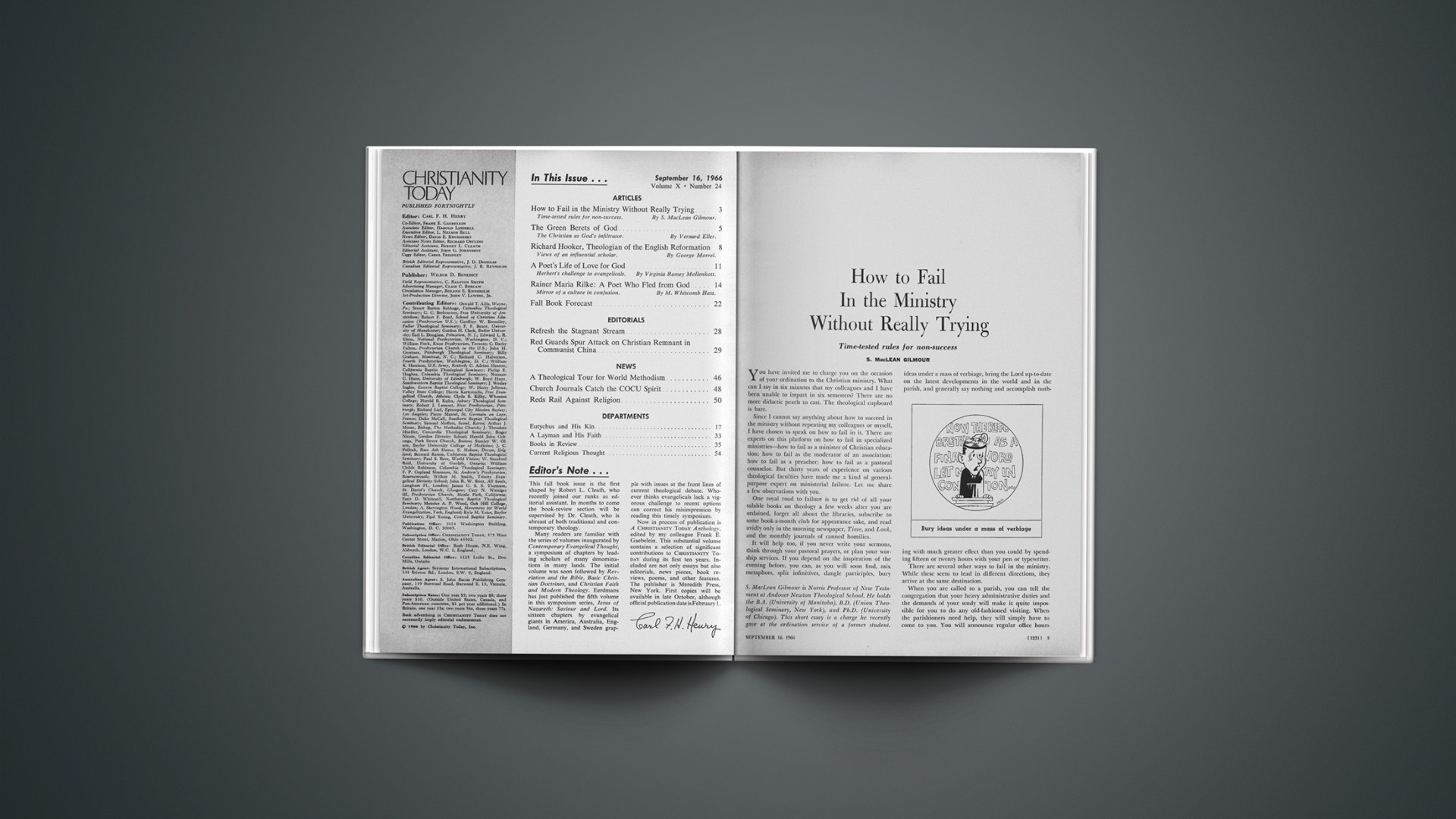
Eutychus and His Kin: September 16, 1966

The problem of a consensus on ‘good’

Perfectly Evident

Back in the good old days (whenever and whatever they were) I was in a situation in which off and on I was invited out to English tea. One of the nice things the English did was to invite at least one person as a center of attraction for the afternoon tea, and the rest of us clustered around. Of course, for undergraduates the center of attraction was usually a cake from home or a box of cookies, but people of greater age and spirit made their occasions on higher levels.

One Sunday afternoon, after enjoying a tea for the better part of an hour, I was introduced to Canon Dick Shephard, who at the time was at St. Martins-of-the-Fields in London and who was known as the leading exponent of pacifism in a day when this was a pretty live issue. I have to make two points here. One is that at this time Canon Dick Shephard was one of the biggest names in Great Britain and was also of world renown. The second point is that I didn’t know he was there until I was introduced to him. He made no effort in any way I could see to “make himself known,” and yet once you knew who he was all kinds of important things clustered around his name. He was listened to in high places, but he never had to raise his voice. Power and effectiveness are not always where we think they are.

On another afternoon I had the same experience with C. F. Andrews of India, who was back in Great Britain for a leave of absence. Again there was no effort on the great man’s part; and yet, as the afternoon moved on, the other guests were increasingly affected by his inner strength and the majesty of his manhood.

When Jesus cured the Gadarene demoniac, the man begged to be taken along in the disciples’ band. Instead of this he received what I think are amazing instructions: “Go tell what I have done for you.” With all the bone-crushing theology around these days, and with all the very evident effort on the part of a great many young theologians to be seen and heard and recognized as being alert and aware, it would be refreshing to have just one of them tell us just once what it is the Lord has done for him. Shephard had it. Andrews had it. The Gadarene demoniac had the right message, apparently. Just what are the rest of us talking about?

EUTYCHUS II

God’S Will And Man’S Brains

I share your concern over any possible attempt to alter mankind through biological tampering (“Are Man’s Brains Now at Stake?,” Aug. 19 issue). Some scientists feel that we are very close to having the knowledge necessary to allow man to shape himself into what he thinks he should be, and they are already thinking about the specifications for the end product. I do not think that your comments are premature and am very glad that you alerted Christians to this possibility.

A geneticist recently told me that he believed that within our lifetime the knowledge would be available to make man into whatever form was considered “good”—in fact, that it would be possible to alter genes to produce any desired characteristic and thereby create a “new” man. He further said that we scientists who are Christians should start now to define “good” so when that time comes we will be ready to influence the direction of the control to produce a man conforming to our definition of “good.”

My first reaction to this was one of concern over man’s ability to influence his own personality, and I questioned whether or not he should even attempt such a thing, just as you did in your editorial. I still question it but somehow feel that there is no earthly power that can force man to refrain from attempting to use any power he has available. There certainly has been none in the past. In the next-to-last paragraph of your editorial you speak of the “incredible powers science is gradually putting into [man’s] hands,” as though science is some indefinite force outside man. The fact is that this power is a gift of God that man has found through study of God’s creation, and there is no reason to believe that man will treat it with any more responsibility than he has any other gift of God. This makes it no less a gift of God through which he reveals to man his wonderful power and the order and wonder of his creation, and I believe it is a gift man should claim through scientific study.

My second reaction was to refer my friend to the New Testament for an example of the perfect man: Jesus Christ himself. That Christ is the measure of perfection for the saints is made clear in Ephesians 4:12, 13. What an advantage it would be if we could start children out with the best that breeding could offer. But this is no answer, because there is no indication that there is any hereditary “goodness” in any of us that manifests itself as an ability to walk closer to God or to be more Christ-like. So we are still no closer to an answer.

It seems to me, however, that the most serious flaw in the suggestion that man can and should control what he becomes is the fact that the suggestion would even be made. It is another way suggested by man to make himself acceptable to God without going by way of Christ. It has become clear that man has not become better when left on his own. His works have not saved him. Still unwilling to yield himself to Christ, he now wants to make himself over so that he may finally become “good”—or is it “God”?

ALBERT L. HEDRICH

Bethesda, Md.

“Putting Brains into Our Christianity,” by Dr. Hope (Aug. 19 issue) was, I am sure, a challenge to every Christian. Along that line, it reminded me of your international conference on evangelism to be held shortly in Berlin. I trust the brains put together at that meeting will, under the guidance of the Holy Spirit, find a method of increasing the outreach of the Gospel in Communist-dominated countries.…

JOHN D. GEISLER

Rochester, Minn.

Strong Language

May I add my compliments on your splendid editorial “Too Many Chiefs” (July 22 issue). Hooray for you; please let us have some more of this and advocate in strong language that we get ourselves “involved” with what is going on around us.

JACOB MAGENHEIMER

Fort Lauderdale, Fla.

Incomplete Picture

As participants in the Seminar on the Authority of Scripture, we believe that the editorial comments in CHRISTIANITY TODAY (July 22, 1966, p. 27) may present a somewhat incomplete picture. It would be wrong to deny or to obscure the fact that serious differences of opinion about the Bible were present.

Two mutually exclusive approaches to the Bible seemed to undergird much of the discussion. One approach held that it was possible to begin with the so-called phenomena of Scripture and from these to arrive at a proper view of the Bible. The other, which we believe to be the scriptural procedure, was to accept what the Bible had to say about itself and to interpret the phenomena in the light of Scripture’s explicit statements. Only upon the basis of the biblical doctrine concerning itself may the phenomena be properly studied.

Inasmuch as we adhere to this latter method, we heartily affirm our belief in the inerrancy of the sacred Scriptures and cannot understand how any Christian can hesitate to affirm such belief, for the Scripture “cannot be broken” (John 10:35b).

Another serious point of difference, which probably emerged as a result of beginning with the phenomena rather than with the express teaching of the Bible, was whether the message of the Bible or what the Bible teaches is to be distinguished from the whole extent of Scripture itself. Are there elements in the Bible which are to be set apart from the teaching of the Bible? We would answer this question with an emphatic negative, for God has plainly told us that all Scripture is “profitable for doctrine, for reproof, for correction, for instruction in righteousness” (2 Tim. 3:16). To maintain otherwise, we believe, is to fall into serious doctrinal error; and yet in the discussions at Wenham this erroneous view was vigorously defended.…

KENNETH S. KANTZER

Dean

Trinity Evangelical Divinity School

Deerfield, Ill.

EDWARD J. YOUNG

Prof. of Old Testament

Westminster Theological Seminary

Philadelphia. Pa.

Please. No Small A

The closing sentence in the news item concerning the NACCC on page 45 of the July 22 issue must have been printed in error. The National Association (please, no small a) is and has been concerned solely with the ongoing of the Congregational way of religious life. We were embroiled in the merger by those who were intent on establishing a new and completely different religious structure. The deviation from the Congregational polity (which was never going to be changed) is becoming clearer almost daily as the involvements of the COCU develop.…

ARCHIE PEACE

National Association

of Congregational Christian Churches

Norfolk, Conn.

No Victory At The Altar

Re “Ecumenism at the Altar” (News, July 22 issue):

If this is the first time a Southern Baptist pastor and a Roman Catholic priest participated together in a wedding ceremony, may I inquire, what does this prove? What is the victory? The article continues, “The bride says she will remain Baptist and her husband Catholic.” The Bible says, Amos 3:3, “Can two walk together except they be agreed?” The Bible says, Matthew 12:25, “Every house divided against itself shall not stand.” Any informed person knows a Baptist and a Catholic marriage is a house divided against itself. The Catholic Church knows this and speaks against such union with much more frankness than Baptists. A Baptist-Catholic marriage is saturated with insecurity from its inception regardless of who officiates or where it is performed. To live under the same roof, eat at the same table, sleep in the same bed does not prove a house is not divided.

What about the children born into this Baptist-Catholic Union? Is it right for any parent to sign away the freedom of an unborn child? Please do not refer me to the recent decision of the Ecumenical Council, which met in Rome. A member of my church married a Roman Catholic this month and prior to the ceremony had to sign the usual agreement to rear the children Catholic, etc., and not to interfere with her husband’s religion.…

A truthful report of this wedding would make interesting reading ten years hence.

H. B. SHEPHERD

First Baptist Church

Fairhope, Ala.

Water Conservation

Unfortunately, very little attention seems to be given to the stewardship of God’s handiwork by … Christians.

You are, therefore, to be commended for your plain and biblical editorial (“Water Is No Luxury,” July 8 issue) regarding the responsibility of the believer toward the world about him and the life which it supports.

P. E. TAYLOR

Vineland, N. J.

The Bible In The University

In the July 8 issue (News) you report correctly, “A court in Seattle turned down the demand of two Bible Presbyterian ministers for discontinuance of a University of Washington course, ‘The Bible as Literature’.” This case is being appealed. In the same issue Prof. Addison H. Leitch reviews An Introduction to Christianity (evidently used at Michigan State University) and states in the concluding paragraph: “Despite the authors’ refusal to support a position, a liberal position comes through.” The Bible may not be taught at public expense as revelation, but from a liberal, higher critical, point of view—well, that’s different!

PAUL DE KOEKKOEK

Seattle, Wash.

Symptoms Of Evil

All that Wolcott says (“India: Reality and Challenge,” June 24 issue) needs to be said, but it is far from all that can or should be said. Such things as allowing Christian girls to marry Hindus or Muslims because there are few Christian men prosperous enough; giving Hindu deities’ names to Christian children at baptism; encouraging Christians to go to law against Christians in direct violation of First Corinthians 6:1–8; permitting Christian brides to indulge in Hindu customs and procedures for personal adornment—these are symptoms of the evils within the Indian Church.…

PERCY SHASTRI

National Director

Indian Campus Crusade

for Christ

Hyderabad, India

All Windows, No Doors

In response to your editorial “Window in Philadelphia” (June 24 issue), I would like to call your attention to the expressed policies of the Westminster Press as stated in chapter 4 of the Board of Christian Education’s annual report to the General Assembly in 1965.…

“To the serious question of why an agency of the church should intentionally help stir up controversy … the equally serious answer is proposed: There is always a need to restate the gospel of Jesus Christ for each age, and when the gospel is stated in a new way it becomes controversial. In such a situation, it is wholesome that not just one side be presented, nor that the thinking in only one denomination be explored. Therefore, the publishing program of the Westminster Press in this area reflects a worldwide ecumenical conversation and is careful to present various sides giving voice to several traditions or outlooks of the faith.” …

I am glad to be part of a denomination which has enough confidence in Christ as Truth to be unafraid to present for study all possible viewpoints and interpretations, and not to seek to present only one-sided indoctrination.

CHESTER O’NEAL

Asst. Pastor

Faith United Presbyterian Church

Monmouth, Ill.

Too Many Confessions

The “Confession of 1967” adopted by the 178th General Assembly is not a bad statement for our day—especially given the wide spectrum of doctrinal diversity within the United Presbyterian Church in the United States of America.…

However, I continue to have serious misgivings about the resultant doctrinal confusion such an amorphous mass as the “Book of Confessions” is bound to produce. My impression is that almost all of the debate has focused on the “Confession of 1967” and that little importance has been attached to the “Book of Confessions” which was a part of the total confessional package approved by the recent General Assembly.

The “Book of Confessions” includes the Nicene Creed, the Apostles’ Creed, the Scots Confession, the Heidelberg Catechism, the Second Helvetic Confession, and the Theological Declaration of Barmen. This collection of creeds was not a part of the original intent that gave impetus to the new brief confessional statement. The concept of a “Book of Confessions” seems to have arisen after the original committee received its instructions.

One must be impressed with the various confessional statements that are included. The variety of backgrounds from which they come will add a richness to the theological foundations of our denomination. I am sure that the reaction of most who read them will be that, indeed, they all are good creeds.…

However, I am persuaded that the total effect of the “Book of Confessions” upon the constitution will be bad—however good the individual documents may be. The Westminster Confession is a part of our particular denominational history as these other documents are not. As a living constitutional document it has been amended. If it does not properly reflect the theological understanding of the church in our day, it may be amended again.

It is to the Westminster Confession that our ministers and other officers have subscribed for more than two hundred years. It is the Westminster Confession that has been particularly representative of the theological thinking of our denomination. It has had more of an influence upon the course of American Presbyterianism than any other confessional formulation. It has been ours in the same sense that the Heidelberg Catechism has been the confessional statement for many of the Continental Reformed churches. If nothing is to be achieved by giving constitutional status to these other fine documents, then there is no need to artificially alter our heritage by implying that these other documents have had the same status in American Presbyterianism as have the Westminster standards.

The proposed “Book of Confessions” is simply too vast for constitutional use. These documents would make a total addition to the doctrinal part of constitution of about 119 pages. Including the Westminster Confession and Shorter Catechism it would mean a section of about 156 pages plus the new confession, as compared with the present 37 pages.

If all of these documents are made a part of the constitution, they will be subject to amendment as is any part of the Constitution of the United Presbyterian Church in the United States of America. There is no such thing as an unamendable constitution. Any body that has authority to adopt law can at a later time, by the same process, change that law. Is it not somewhat preposterous to suggest that future general assemblies with the concurrence of two-thirds of the presbyteries also amend the Nicene Creed, the Scots Confession, the Heidelberg Catechism, the Second Helvetic Confession, and the Theological Declaration of Barmen, in addition to the “Confession of 1967”?

As fine as these other documents are, it must be recognized that in certain areas of doctrine they contradict one another. The legal consequences would be that the denomination would be left with no doctrine at all in such areas. When two laws of equal value contradict each other, the force of both is annulled.

For practical purposes, the law of the church is not simply the constitution as printed but the constitution as interpreted by the courts of the church. In other words, our confessional and doctrinal standards are the Westminster standards in the light of the interpretation that various courts of the church have set upon these standards. Raising all these other confessional statements to the same level as Westminster will have the effect of doing away with the great investment of time and energy that has gone into the decisions of the various judicatories. It will take a long time for a similar body of interpretative opinion to be rendered on the new “Book of Confessions.” This will require time, effort, and resources that could well be expended in more urgent causes.

It has been complained that the Westminster standards are archaic, not up to date. How will including even older and more archaic standards solve that problem? Again, it has been complained that people are not familiar with the Westminster standards. If they are not familiar with a doctrinal statement comprising some 37 pages, how are they to become more familiar with a statement that is certain to exceed 160 pages in length? If … the Westminster documents are inadequate because those in the denomination are generally ignorant of them, is it likely that they will be more familiar with documents that have been much less a part of our heritage?

It has also been stated that the Westminster standards do not adequately represent the doctrinal position of the United Presbyterian Church today. The implication is that in view of what we are—Westminster is not precise enough. How will theological formulations that are much more cumbersome and often less precise solve this difficulty?

The value of the documents contained in the “Book of Confessions” will not be enhanced by making them a part of the Constitution of the United Presbyterian Church in the U.S.A. The “Book of Confessions” should be accepted or rejected on its own merit—not because it is attached to an attractive brief contemporary statement.

FOSTER H. SHANNON

First Presbyterian Church

Ivanhoe, Calif.

Vigorous And Refreshing

Thank you for clear thinking, vigorous style, and refreshing, courageous journalism. Your reports and editorials on ecumenism are timely and trenchant, yet restrained and objective.…

JOHN M. PAXTON

San Bernardino, Calif.
Rainer Maria Rilke: A Poet Who Fled from God

Reflection of the tragedy of a “man-centered pagan night”

Rainer Maria Rilke (1875–1926) has been called Germany’s greatest lyric poet since Goethe and Heine. In mirroring his milieu (which had seen the wave of unbelief in his nation reach and pass its crest in Marx and Freud), he constantly deplored the dearth of seed and soil for a spiritual rebirth among his people. But in that culture that had grown hopelessly confused and confusing he was himself caught; and he sought his escape through music, specifically the music of poetry.

The intellectual climate of Germany, imbued as it was with Hegelian idealism, was too much for Rilke’s own faith. Born of Catholic parents in Prague, and a Catholic in his boyhood, Rilke had an ancestry both Czech and German. He was as much a cosmopolitan as Heine, if not more so. But where Heine was to repudiate at the last the pantheism in which he had been trained under Hegel himself, Rilke sacrificed his native Christianity for a belief in Orpheus, as symbol of the everlasting life of song. For, wasted and desecrated as his faith became, he never quite lost the artist’s fire.

Rilke had only the vaguest notion, of course, of the Orphic mysteries. But the thought of Song (and of only the old divinity’s being able to sing it, since song stays though song’s themes come and go, just as poets come and go) haunted him. Thus he wrote of and to “the singing god” in one of the Sonnets to Orpheus:

Over the thrust and throng,

Freer and higher,

Still lasts your prelude song,

God with the lyre.

Sorrows we misunderstand,

Love is still learning,

Death, whence there’s no returning,

No one unveils.

Song alone over the land

Hallows and hails.

(Translation by J. B. Leishman, quoted in E. M. Butler’s Rilke [Cambridge University Press, 1941]. Used by permission.)

“Still lasts your prelude song!” Rilke’s lifelong nostalgia for the changeless, which the relativist philosophy that supplanted his earlier Christian belief would deny, speaks—or better, sings—over and over in his poetry; and it is this that gives value to his verses. In Rilke’s lines translated by Ludwig Lewisohn as “The Song of Love,” we find the suggestion of a Reality standing at an immeasurable distance from the god with the lyre. The “Great Player” of the imagery is more than abstract song, and more too than Orpheus ever was to his followers.

How shall I guard my soul so that it be

Touched not by thine? And how shall it be brought,

Lifted above thee, unto other things?

Ah, gladly would I hide it utterly

Lost in the dark where are no murmurings,

In strange and silent places that do not

Vibrate when thy deep soul quivers and sings,

But all that touches us makes us two twin,

Even as the bow crossing the violin

Draws but one voice from the two strings that meet.

Upon what instrument are we two spanned?

And what great player has us in his hand?

O Song most sweet!

(An Anthology of World Poetry, edited by Mark Van Doren [Harcourt, 1936], pp. 937, 938.)

The supernatural presences—angels or powers or whatever else they are called—that fill Rilke’s poems from his early Book of Pictures and the Book of Hours to the Duino Elegies, and finally even the Sonnets to Orpheus, owe their extraordinary appeal to the poet’s original Christian heritage. Even in imagery as pagan as Rilke’s appeal to the Heraclitean fire, we find a lurking vestige of the spirit that makes all things new, a twist of the image to include Someone standing beyond the flame who looks on and is master of “the earthly”:

Will the changing. O be enthusiastic for the flame …

That contriving Spirit which masters the earthly,

Loves in the swing of the figure nothing so much

as the turning point.

(Except where otherwise noted, the translations of Rilke’s poetry in this essay are the author’s.) It may be noted that the Heraclitean relativists held to only one fixed principle—that of flux itself—but hardly gave it personal value! In a poem entitled Herbst (“Autumn”) the poet wrote, early in his career:

We all fall. This very hand falls.

And look at others: it’s the same for all of us.

And yet there is One Who holds this falling

With infinite gentleness in His hands.

The reader must ask: What pagan deity ever possessed “infinite gentleness”?

The thirteen poems of Rilke’s cycle Marienleben (“Life of Mary”) appeared in 1913, shortly before the opening of the First World War. The poet’s fatal belief that he dealt with a myth is absent from the cycle itself. Rilke said of the volume: “It is a little book that was presented to me, quite above and beyond myself by a peaceful, generous spirit, and I shall always get on well with it, just as I did when I was writing it.”

The reader may see readily enough why Rilke should have had such satisfaction as well as why he recognized the “given” quality of his poetic appreciation in the Marienleben. For he has reproduced the Christian story in its own terms from the first poem, “The Birth of Mary,” to the last one of the series. The Life of Mary ends with a long tripartite exposition of her death. Mary’s assumption into heaven as described by the angel of the Annunciation, Gabriel, to the Apostle Thomas—in the perfervid imagination of the poet—is tenderly portrayed:

Are you surprised how gently they could bring

Her from these burial clothes?

Could thus retrieve her?

The very heavens are shaken to receive her:

O man, kneel down, look after me, and sing!

“The Birth of Christ,” one of the longest poems of the cycle opens directly and is addressed to the Mother of Jesus:

Had you not such simplicity, this Birth

Could not have happened thus to light

our night

And, after showing the kings proffering their treasures in the cave of Bethlehem, the speaker goes on talking to Mary:

But look within the confines of your shawl

See, even now, He has outdone them all!

The rarest amber ever shipped afar,

Or goldsmith’s pride, or spice on southwinds blowing

Such as these great kings bear, lured by His star,

Pass swiftly, and pain marks them in their going.

But He (you’ll see) brings joy past all men’s knowing.

The short, stark “Pietà” is deeply moving:

My cup of misery brims; without a name

It fills me full

Greatly You grew

Yes, greatly grew

So that this larger pain

Wholly too much for my heart’s compassing

Might thus stand forth.…

The “Consoling of Mary by the Risen One” is in this same vers-libre form. According to an old tradition, Jesus first appeared to his mother on Easter morning. “Oh, first to her!” says Rilke in this poem, which ends,

So they began,

As still as trees in spring,

The endless

And immediate moment

Of their most high communing.

(It is to be stressed here that Mary is “symbol of the spiritual ego giving birth and form to the divine.”)

Not until 1923, ten years after the publication of The Life of Mary, did Rilke produce any more poetry. Then, the Sonnets to Orpheus and the Duino Elegies revealed this poet as, in Kurt Reinhardt’s words, “the late-born heir of the great culture of Europe who on the highest artistic level and in precious language sang the swan song of German romantic idealism and man-centered humanism.” In Germany: 2000 Years, Dr. Reinhardt describes Rilke’s works, before World War I particularly, as reflecting both his search for and his flight from God. “But the road that leads to Thee,” Rilke had said in the Book of Hours, “is fearfully long, and the track laid waste because no one has traveled it for so long.” Nevertheless—and even in the face of the incommensurable distance of Rilke’s own restless search from the Way of faith of a Kierkegaard, for example—we still recognize in his poetry the eternal seeker of the “I” for the “Thou,” the singer of a soul’s undying longing after God. But the German lyric poet was fleeing from God, as Reinhardt suggests, by ways of dream that lead to death.

For although Rilke, after he lost his native Christianity, still held to finite man’s dependence on infinite power, the Heraclitean fire to which he turned as a last personal defense against the despair of materialism assuredly had nothing to offer. The view of nature as a Heraclitean fire is, for the Christian, no more than the pagan imagery of relativism. Only in such a context as that of Gerard Manley Hopkins in his famous poem on this very subject can the ancient symbol carry Christian relevance. For Hopkins contrasts the Heraclitean fire with the “immortal diamond” of the living soul that has been creatured-in-Christ. The concept of the Light that enlightens everyone who comes into this world is of a wholly different order from any concept in Greek philosophy. Hopkins, who also saw the “world’s wildfire leave but ash,” knew himself saved by the beacon shining across his “foundering deck”—that of the “eternal beam” of the Resurrection:

In a flash, at a trumpet crash,

I am all at once what Christ is,

since he was what I am, and

This Jack, joke, poor potsherd,

patch, matchwood, immortal diamond

Is immortal diamond.

(From Poems of Gerard Manley Hopkins, edited by Robert Bridges [Oxford University Press, 1961]. Used by permission.)

Rilke, in turning back to himself, leaves as his final product only the reflection of the philosophical confusion rampant in German idealism. His own life shows in microcosm the course of Christianity’s prostitution that reduced its teachings to various forms of vague personal mysticism.

To compare Rilke’s poetry with that of the seventeenth-century metaphysical poets—notably Richard Crashaw in England, who also celebrated what he called “the universal Song”—is to show something of the distance between them. Where the modern writer’s song is man-centered, Crashaw’s is wholly Christ-centered. (In fact it is Christ who is held synonymous with Song in Crashaw’s 250-line poem, “Hymn to the Holy Name of Jesus.”) Instead of the agony and despair that mark Rilke’s poetry as a whole, we find, in eloquent contrast, a brightness and an ecstasy filling Crashaw’s poems. In this connection it is to be remembered that Crashaw, a contemporary of Descartes, had seen the beginning of the ratio movement that flowered and went to seed in German philosophy. Crashaw’s “Epiphany Hymn” contains references to the pagan “darkness made of too much day”—that of the ego’s “bright meridian night” which the Magi wisely left behind them for the Word which was made flesh in Bethlehem of Judea.

Rainer Maria Rilke’s tragedy, alas, is the tragedy of European culture as it returned to a man-centered pagan night. But the poet who wept for the lack of a spiritual climate in his homeland did not realize that his own betrayal of the faith in which he had been born added to the general desolation, even as he reflected it in his poetry. Plato’s famous quarrel with the poets was, after all, motivated in part by the fact that falsehoods gain a semblance of truth when they are combined with the music of poetry.

The Village Atheist Seeks Conversion

The other day I went to talk to that eloquent exponent of avant-garde Christianity, Bishop Golightly, and found him in his study mulling over his forthcoming bestseller, Is It Time to Throw out the Christ Child with the Baptismal Water? Suddenly, he picked up a New Testament, tore out the Gospels, and tossed them out the window. I greeted him while nimbly dodging a crucifix that followed hard upon the Gospels, and he in turn greeted me by dancing that elevating entrechat, Second Corinthians 13:13.

When we were seated at last, I said, “I am a village atheist. However, village atheists are becoming as old hat as village idiots, so I’ve decided to have a go at Christianity. One must keep up with the times.”

“At all costs,” said the bishop, a deep fervor intensifying the genial glint in his eye. “And it will be to your everlasting—if I may use that outmoded word—your eternal credit that you’ve come forward, despite the handicap of your heredity and environment.”

Quickening to this warm, contemporary approach, I confessed, “I was persuaded to come by a follower of yours, a woman journalist I met at a cocktail party.”

The good bishop’s face clouded. “Persuaded?” he said in awful tones. He struggled to regain his famed equanimity. “Oh, my dear chap, how intolerant of the poor, misguided woman! It’s against my principles to persuade, evangelize, preach, convert, and proselytize, and so forth. In fact, I really can’t say whether I can help you at all. I may be infringing upon your basic right to your own opinions, no matter how ill-informed.”

I knew I should accept this overwhelming logic, but I was already too far gone in my search for salvation. “Then,” I cried desperately, “how in God’s name will you spread the Gospel to me, considering what you’ve just thrown out the window?”

At once the bishop’s face brightened. I sensed we were on the verge of some penetrating analysis, if not some enormous revelation. He thrust a copy of his latest book at me: Christianity Rethought, Reshaped, and Repackaged. “Try this!” he cried. “Paperback, of course. Fourth printing.”

“Not since the Delphic oracle has there been anything like this,” I marveled, after I had scanned the first few pages.

But the bishop seized my arm, giving me, so to speak, a firm grip on reality. “Come, let us have a meaningful dialogue,” he murmured. “Tell me, how is the basic state of your being?”

Moved almost to tears by such profound concern, I answered, “Fine, except for a little sinus trouble. But speaking of things basic, I should very much like to hear some basic Christian doctrine. About salvation.…”

“Doctrine?” the bishop thundered, looking aghast. “Salvation? Are you asking me to violate my agnostic silence about such matters?” And as if to preserve his silence, he fainted dead away.

Stricken with remorse, I rushed about the study, until I found a bottle of wine. I poured a reviving draught down the bishop. “I hope I haven’t used the communion wine,” I said as he recovered. “I shouldn’t wish to use what may become a symbol of Christ’s blood.”

The bishop favored me with a tender, forgiving smile. “My dear sir, avant-garde Christianity isn’t flesh and blood. It’s free! Stark free! A bare skeleton stripped of all non-essentials! Prayer? Out! Virgin Birth? Out! Trinity? Out! Resurrection? Out! Eternal life? Out! Miracles? Divinity? All out!” His beatific smile warmed and melted me until I thought my legs might not support me any more.

“You’ve convinced me,” I said gratefully. “Why, I’ve been a Christian all along and haven’t known it. Thank you so much.”

“I’m sorry I can’t give you any more time today,” he said in reply, “but some gentlemen of the press are coming to interview me on nuclear physics.”

“What a brilliant mind!” I gasped to myself as I walked toward the door clutching Christianity Rethought, etc. I turned back to thank the bishop again, but that versatile man was already engrossed in a new task. He was polishing a large brass ring, and I stopped to watch. After a couple of minutes, he gave the ring a final swipe and then set it firmly on his head. Thus haloed, he returned to his daily labors of enlightening those in peril of believing.—E. N. BELL, Vancouver, British Columbia.

A Poet’s Life of Love for God

George Herbert’s challenge to evangelicals

George Herbert, admired by such men as Samuel Taylor Coleridge and T. S. Eliot, is praised in twentieth-century universities as the greatest poet of seventeenth-century England apart from John Milton and John Donne. Yet in recent decades, as many evangelicals have lost contact with their rich cultural heritage, Herbert’s poetry has fallen into unwarranted neglect in the very circles where it was formerly most cherished.

Praised and quoted by Richard Baxter in The Saint’s Everlasting Rest (1650); respected by other Puritan leaders like Thomas Hall and Peter Sterrey; quoted affectionately by Nonconformist preachers like Philip Henry and his son Matthew Henry; beloved by John Wesley, who adapted no fewer than forty-nine hymns and sacred poems from Herbert’s The Temple (see Elsie A. Leach, “John Wesley’s Use of George Herbert,” Huntington Library Quarterly, Feb., 1953)—in spite of all this, “holy Mr. Herbert” is rarely quoted, rarely read, and rarely reprinted in evangelical pulpits, homes, and publications. And few evangelical pastors have availed themselves of A Priest to the Temple, Herbert’s excellent treatise on the characteristics of the ideal minister. In this day when evangelical leaders are once again emphasizing the relevance of Christianity to every aspect of human endeavor, the time has arrived for a renewed awareness of George Herbert’s mind and art.

Herbert had a lifelong love affair with God. When he was only seventeen, he sent his mother two sonnets that expressed his passionate desire to write love poetry for God rather than for Venus:

Sure, Lord, there is enough in thee to dry

Oceans of Ink …

Each Cloud distills thy praise, and doth forbid

Poets to turn it to another use.

Herbert never did turn his poetry to another use; when he was dying he sent his book The Temple to Nicholas Ferrar, describing the collection as “a picture of the many spiritual conflicts that have past betwixt God and my Soul, before I could subject mine to the will of Jesus my Master, in whose service I have now found perfect freedom.” The dedicatory poem also indicates something of Herbert’s spirit:

Lord, my first fruits present themselves to thee;

Yet not mine neither: for from thee they came,

And must return. Accept of them and me,

And make us strive, who shall sing best thy name.

Turn their eyes hither, who shall make a gain:

Theirs, who shall hurt themselves or me, refrain.

So sincerely did Herbert desire God’s will before his own reputation that he gave his saintly friend Nicholas Ferrar permission to burn his life’s work if Ferrar should think that the poems would not be helpful to anyone.

T. S. Eliot has commented that “people who write devotional verse are usually writing as they want to feel, rather than as they do feel.” (The application to many evangelical prayers, testimonies, and hymns is painfully obvious.) But Herbert is never guilty of “pious insincerity,” of emotional dishonesty or disguise; in poem after poem he confronts the agony of being a man of God who sometimes feels cut off and alone:

O that thou shouldst give dust a tongue

To cry to thee,

And then not hear it crying! all day long

My heart was in my knee

But no hearing.

(“Deniall”)

At times Herbert became angry in his anguish; and for him, as for many twentieth-century Christians, the ultimate anguish lay in feeling useless:

Now I am here, what thou will do with me

None of my books will show:

I read, and sigh, and wish I were a tree;

For sure then I should grow

To fruit or shade: at least some bird would trust

Her household to me, and I should be just.

Herbert longs for a sense of being needed, or “just”—that is, justified for existing because he is at least as useful as a tree is. Tortured and tormented by his longing to do something that he could consider worth-while, Herbert concludes his first poem entitled “Affliction” with the following struggle and resolution:

Yet, though thou troublest me, I must be meek:

In weakness must be stout.

Well, I will change the service, and go seek

Some other master out.

Ah my dear God! though I am clean forgot,

Let me not love thee, if I love thee not.

That is the worst punishment Herbert can think of: simply being permitted not to love God. If he must be unhappy, he would at least like to be useful; but if he must be unused (“clean forgot”), he will simply love God for the sake of loving God. The occasional urge to leave God’s service he does not attempt to deny or to hide; as a matter of fact, in “The Collar” he gives to rebellion perhaps the most intense lyric expression it has ever received. He can afford to be honest about these aberrations, because he believes that “fractures well cured make us more strong” (“Repentance”).

The cure for Herbert’s “fractures” is never intellectual or argumentative; it is experiential, creatively emotional. In the midst of his rebellious ravings in “The Collar,” having suggested the possibility that what he had considered God’s will for him might be nothing but the product of his own “petty thoughts,” his thrashing is suddenly silenced:

But as I raved and grew more fierce and wild

At every word,

Me thought I heard one calling, Child!

And I replied, My Lord.

Just that: no more. Herbert has had an experience of being a member of God’s family; and all he needs is his heart’s reminder that relationship to quell his insurrection.

“The Flower” is a poem devoted to the sudden relief when the sense of alienation from God is dissolved:

How fresh, O Lord, how sweet and clean

Are thy returns!

Herbert goes on to express the human tendency to disbelieve former anguish as soon as it has been removed:

And now in age I bud again,

After so many deaths I live and write;

I once more smell the dew and rain,

And relish versing: O my only light,

It cannot be

That I am he

On whom thy tempests fell all night.

Herbert’s place in the canon of great English poetry is secured partly by his superb and original craftsmanship (at least 116 of his 169 poems are in stanza forms he never repeated!) and partly by his utter honesty, which expands most of his private Christian experience to universal validity. L. C. Knights remarks in Explorations that Herbert’s poems “are important human documents because they handle with honesty and insight questions that, in one form or another, we all have to meet if we wish to come to terms with life” (p. 148). Thus “The Collar” demonstrates that true freedom is never incoherent or purposeless, while “Affliction” demonstrates the painful process of achieving maturity, of overcoming what Helen Gardner has termed “the nerve-center of egoism,” the frantic desire to be useful.

Records of George Herbert’s life support the impression of passionate commitment one gains from his poetry. The best modern biography is Marchette Chute’s Two Gentle Men: The Lives of George Herbert and Robert Herrick, published by E. P. Dutton in 1959. The best edition of his poetry is still The Works of George Herbert, edited with a commentary by F. E. Hutchinson and published by Oxford University Press in 1941.

Perhaps the most important insight that Herbert’s poetry offers the twentieth-century evangelical is his concept of organic Christian living, of the significance of every “insignificant” act when it is performed in submission to the Lord. “Teach me,” he prays in “The Elixir”:

Teach me, my God and King,

In all things thee to see,

And what I do in anything,

To do it as for thee:

Not rudely as a beast,

To run into an action;

But still to make thee prepossest

And give it his perfection.

Here Herbert puts his finger on one of the chief faults of Christians in all ages: the tendency toward activism, toward running hither and yon doing all the “right” things instead of living with a quiet sense of the eternal repercussions of their motives. No action, Herbert implies, can be perfect unless it is performed in the eternal as well as the temporal dimension. Value lies not in external conformity but in deep-dwelling obedience to a Person.

He continues by touching on a second great destroyer of significant Christian living:

A man that looks on glass,

On it may stay his eye;

Or if he pleaseth, through it pass,

And then the heav’n espy.

All may of thee partake:

Nothing can be so mean,

Which with his tincture (for thy sake)

Will not grow bright and clean.

By means of the metaphor of looking either at a window or through it, Herbert dramatizes the shortsightedness of many human beings who have not realized that the heavens can be seen through any window that human life affords: through making or hearing music, through washing dishes, through writing books, through teaching school, through polishing shoes, through talking to friends—through absolutely anything done in willing obedience to God as he makes his will known through reality, through necessity. The secret lies in the parenthetic expression “for thy sake.” That phrase is “the elixer,” the philosopher’s stone that medieval alchemists sought in order to turn base metal into gold. “For thy sake,” added to even the meanest task, transforms it into a many-splendored act of affirmation and of love, appreciated by God even if overlooked by men:

A servant with this clause

Makes drudgery divine:

Who sweeps a room, as for thy laws,

Makes that and the action fine.

This is the famous stone

That turneth all to gold:

For that which God doth touch and own

Cannot for less be told.

These stanzas take on added significance when one realizes that George Herbert came of an aristocratic family and had occupied the important post of public orator at Cambridge University, yet willingly spent the last three years of his brief life ministering to country people in the tiny parish of Bemerton.

Ministering—and writing poetry “for thy sake.” Herbert recognized that writing verse was nothing very glamorous as compared to the career his education and breeding might have secured for him:

My God, a verse is not a crown,

No point of honor, or gay suit,

No hawk, or banquet, or renown,

Nor a good sword, nor yet a lute.

It is no office, art or news,

Nor the Exchange, or busy Hall:

But it is that which while I use

I am with thee, and most take all.

(“The Quidditie”)

The highest calling for each man, Herbert had discovered, is that which God through circumstances indicates that he should pursue:

Peace mutt’ring thoughts, and do not grudge to keep

Within the walls of your own breast:

Who cannot on his own bed sweetly sleep

Can on another’s hardly rest.

Gad not abroad at every quest and call

Of an untrained hope or passion.

To court each place or fortune that doth fall,

Is wantonness in contemplation.

Then cease discoursing soul, till thine own ground,

Do not thyself or friends importune.

He that by seeking hath himself once found,

Hath ever found a happy fortune.

(“Content”)

Know thyself; accept thyself; “till thine own ground,” no matter how humble. In his little-known sonnet “The Holdfast,” Herbert expresses his realization that man has no good gift to give to God anyway, except that which he has been given by God in Christ; and in his marvelous third poem entitled “Love,” Herbert dramatizes the ultimate reality of man’s relationship to God—that man cannot be worthy, cannot even serve at God’s feast, but must “sit and eat,” humbly accepting everything.

Again and again Herbert strikes at the “nerve-center of egoism,” man cannot outgive God, cannot even match God’s love, cannot make himself worthy, yet eagerly offers himself to God and is overwhelmed with yet greater love in return:

I got me flowers to straw thy way;

I got me boughs off many a tree:

But thou wast up by break of day,

And brought’st thy sweets along with thee.

(“Easter”)

In A Reading of George Herbert, Rosamund Tuve remarked that “Herbert’s poetry is personal for the same reason that it is Christocentric; the central principle of life as he in his person has been able to discover it is self-abnegating love. No man discovers this without pain; most of us will never do more than hear about it …” (p. 126; italics mine).

Paradoxically, as Miss Tuve implied, it was precisely Herbert’s Christocentricity that made him most completely himself as a creative individual. In “The Holdfast,” when the speaker is reduced to confessing that he has nothing to offer God and that God alone is his comfort, he finds that he must descend even lower:

But to have naught is ours, not to confess

That we have naught.

Even the confession is God’s! Bothered by this final blow to human pride, the reader is relieved to see Herbert’s admission and resolution:

I stood amazed at this,

Much troubled, till I heard a friend express,

That all things were more ours by being his.

The loss of self-reliance was the beginning of an enriched selfhood; he had lost himself to find himself.

The words of “holy Mr. Herbert” are as relevant to the whole spectrum of twentieth-century Christianity as they were to those seventeenth-century individualists, the Puritans—and to the King they executed. Even more important is the fact that after more than three centuries Herbert is still able to command respectful attention from the world at large because of his honest and precise artistic expression of Christian experience. For evangelicals, Herbert’s example provides an exacting challenge.

Richard Hooker, Theologian of the English Reformation

The convictions of the author of a classical statement of Anglican theology

Anglicans as well as others often claim that the Reformation in England was mainly ecclesiastical and jurisdictional rather than doctrinal. But do the doctrinal writings of the period support this interpretation? Was the reform in doctrine really confined to a vernacular edition of the Bible (1538) and a vernacular liturgy (1549)? Some formidable theological writers give pause to those who accept such a view uncritically.

Thomas Cranmer, a scholar and theologian of solid worth and historic importance, is one figure to consider in reviewing this claim about the English Reformation. Cranmer was a student of Holy Scripture and of the Church Fathers. He was architect of the Book of Common Prayer and is thought also to be the principal author of the Thirty-Nine Articles of Religion, that irenic, scriptural statement of systematic theology found in the back of nearly all editions of the Book of Common Prayer. Then there is John Jewel, whose Apology of the Church of England remains a monument of the sixteenth-century dialogue with the papacy. Jewel’s great work still deserves thoughtful reading by any Christian whose spiritual ancestry can be traced back to British Christianity.

A generation later, after the fires of Smithfield had been extinguished and the martyrs of reformed England had borne their testimony, there appeared a careful, thoughtful, courteous, and peace-loving scholar who is widely acknowledged as the greatest of all English theologians. The remarkable Mr. Hooker was born in Exeter in 1553 or 1554 and thus was a contemporary of Shapespeare. He seems to have been a youth of modest circumstances who through the influence of none other than Bishop John Jewel himself was admitted to Oxford. There in 1579 he became tutor in Hebrew.

In 1585 Hooker was appointed master of the temple, where he was the morning preacher and the Puritan Walter Travers was the afternoon preacher. Travers began to attack Hooker as unsound because Hooker did not urge the acceptance of a more radical Protestantism. Hooker was of a conciliatory temperament and entered this kind of controversy with great reluctance. As Calvin had described himself as “only a timid scholar,” so Hooker said to his bishop that he wished to be “free from noise.”

Yet out of this controversy grew Hooker’s magnum opus, The Laws of Ecclesiastical Polity. This monumental treatise in eight books (three of which were published posthumously) is generally considered the classic statement of Anglican divinity. While it is an argument in defense of the Anglican, or Prayer-Book, point of view against the Puritan point of view, it is very much more than a mere rebuttal; it sets forth a positive and very well thought-out position of its own. The tone of the work is not polemic but conciliatory.

No Mere Echo

To say that Hooker is to Anglicanism what Luther is to Lutheranism or Calvin is to the Reformed tradition might be misleading, but something of an analogy might be found in the relationship of John of Damascus to Eastern Orthodox theology. And yet this analogy has its limits also, for Hooker was by no means merely a synthesizer or collector of previous theological writers. He was a learned patrologist but no mere echo of the Fathers. He valued Thomas Aquinas, but recent efforts (such as that of Professor John Marshall of Sewanee) to make him out to be a Thomist are less than convincing. He was an admirer of Calvin, whom he calls “incomparably the wisest man that ever the French Church did enjoy,” and yet he was obviously not a conventional Calvinist. He was a biblical theologian, and yet one of the most prominent features of The Laws of Ecclesiastical Polity is his argument that not all needed knowledge can be derived from Scripture alone. Hooker was an original, constructive, and independent theologian, gratefully acknowledging sources but not enslaved by them. Just as the English Reformation was itself sui generis, so was its chief apologist, Richard Hooker.

Although Hooker differed from the Puritans in denying the absolute self-sufficiency of Scripture, he agreed with them and with the Reformers generally in asserting the ultimate authority of Scripure over both Church and reason. The supremacy of Scripture as a source of religious knowledge and the complete self-sufficiency of Scripture are not the same thing.

Hooker is famous, of course, for his defense of the role of reason in theology. But this is not so much rationalism as empiricism, an appeal to experience and, perhaps, common sense. Because of our tendency to confound reason with logic, the very word “reason” becomes misleading. While Hooker’s mentality would not deny reason access to historical event underlying the faith, it would not be congenial to the notion of reason as sovereign over Faith.

The incarnation, atonement, and resurrection of Christ are the basis of Hooker’s doctrine. Like some of the Greek Fathers, he keeps the Person and the Work of Christ closely intertwined. Deliverance from sin and death is by participation in Christ: “We are, therefore, adopted sons of God to eternal life by participation of the only-begotten Son of God, whose life is the well-spring and cause of ours” (The Laws of Ecclesiastical Policy, V, 56). Who Christ is underlies what Christ does. His Work is grounded in his person.

Hooker views Christ’s death as an expiatory sacrifice: “… this caused his voluntary death for others to prevail with God, and to have the force of an expiatory sacrifice” (ibid.). The voluntariness of Christ’s death is an aspect of his obedience, and this obedience was an instrument of the restoration of the world. There seems to be some sort of “divine exchange” by which Christ acts for us, or in our stead, and what is his becomes ours: “by removing through the death and merit of His own flesh that which hindered the life of ours” Christ acts on our behalf in such a way that his death becomes the basis of our life, his voluntary helplessness the basis of our deliverance.

Hooker gives Christ the title “Justice,” “because he hath offered up himself a sacrifice for sin.” Justice, sacrifice, and atonement are associated. The sacrifice of Christ is meritorious because of his divine nature; that which sanctified the human nature of Christ also undergirds his sacrifice: “The blood of Christ, as the Apostle witnesseth, doth therefore take away sin, because ‘through the eternal Spirit he offered himself to God without spot.’ That which made it a sacrifice available to take away sin, is the same which quickeneth it, raised it out of the grave after death, and exalted it unto glory” (ibid.).

Does Hooker teach a substitutionary view of the Atonement? Some passages suggest it: “We have redemption, remission of sins through his Blood, health by stripes; justice by him” (Discourse of Justification, 31). Certainly the calamites that befell Jesus are deemed in some way to have taken away our guilt. That Christ’s sacrifice is infinitely meritorious is quite clear; that it broke the threat of the Law and in some sense nullified its claim is also clear. What is less clear is whether this was accomplished because Jesus suffered some specific legal penalty in our stead.

Hooker apparently teaches that Christ died for all and that the benefits of his sacrifice are applicable to the whole world. These benefits, while applicable to the whole world, are in their fullness applied only to the elect. Calvin speaks of election in terms of being “in Christ”; Hooker’s view seems to be similar. Hooker mentions “our being in Christ by eternal foreknowledge,” and says that “through him according to the eternal purpose of God before the foundation of the world, born, crucified, buried, raised, we were in a gracious acceptation known unto God long before we were seen of men: God knew us, loved us, was kind to us in Jesus Christ; in Him we were elected to be heirs of life” (ibid., 31). It is in view of the infinite meritoriousness of Christ’s sacrifice that his people are elected in him. The ground of election and salvation is always in the work of Christ, never in ourselves. Like Calvin, Hooker rejects the idea that election is in view of foreseen works, “for the grace which electeth us is no grace, if it elect us for our work’s sake.” However, he does not teach double predestination.

Safe Till The End

Hooker does teach the perseverance of the saints, and he holds that the security of the Christian soul is found in the work of Christ. In The Certainty and Perpetuity of Faith in the Elect, he maintains that since the blood of none less than the God-Man has been shed for us, this sacrifice cannot have been made in vain and that therefore those who through faith are made its beneficiaries will be kept safe unto the end.

We are therefore delivered from estrangement and alienation, from sin and death, by participation in Christ, who saves us both by who he is and by what he does. To be made partakers of his nature and of the fruits of his sacrifice is the privilege of his elect, a privilege no one can take from them.

How is the risen Christ present to his people? Hooker discusses this question at some length in the fifth book of The Laws of Ecclesiastical Polity. He holds that Christ is not present physically in his natural human body, since ubiquity is not characteristic of a natural human body. He dissents from the German doctrine of the omnipresence of our Lord’s humanity.

Hooker does not mean that Christ’s resurrection was only a disembodied immortality of the soul, or that it was not the resurrection of a transformed and transfigured human body, but that the risen body continued to be a body with its normal characteristic of definite or local presence. Hooker, like Calvin, seeks to defend the complete reality of Christ’s humanity. Nevertheless, since God is omnipresent, Christ’s humanity, according to Hooker, can be said to be omnipresent “by conjunction.” Hooker seemingly wishes to avoid the very appearance of Nestorianism.

The risen Christ must be present in order for men to participate in him. Christ’s life and righteousness are made present to us both by imputation and by impartation. The view of the imputation of the fruits of his victory is closely related to Hooker’s idea of justification, which he develops in the Discourse of Justification. On justification Hooker agrees with Luther and Calvin.

The benefits of the work of Christ are made ours by faith, “for by Faith we are incorporated into Christ.” Although men are sinful in themselves, when they are incorporated into Christ by faith, God sees them in Christ and no longer imputes sin to them. Hooker criticizes the Roman view that justification is on the basis of something inherent in us. He follows Calvin’s line of thought in his distinction between justification, which he associates with imputed righteousness, and sanctification, which he associates with imparted righteousness. “God giveth us both the one justice and the other,” he says, “the one by accepting us for righteous in Christ; the other by working Christian righteousness in us.” Sanctification, characterized by good works, follows justification.

The Life In Grace

In considering how the new life in Christ is appropriated, it is interesting to note that Hooker excludes free will. This point of doctrine comes in somewhat incidentally and implicitly, although he specifically refers to “the Heresy of Free-will.” Life in Christ, then, is a life in grace, built upon the atoning sacrifice of Christ and made available to the believer through Christ’s resurrection and present cosmic Lordship. It is a work of Christ based upon the Work of Christ. By the work of Christ men become partakers of the divine nature so that they dwell in God and he in them. Thus they participate in Christ’s sacrifice and victory.

This participation in the life of Christ is realized by participation in the life of the Church, the Body of Christ, and especially by participation in the sacraments. Hooker retains the objective and community-centered note in this insistence upon the importance of life in the Church and the centrality of the sacramental system. Here again he resembles Calvin, for whom Church and sacraments were of decisive importance.

The spiritual reality of Church and sacraments rests upon the divine promise given in the Word. The Church lives in terms of promise; it is the promise that makes sacraments efficacious. The promise that was fulfilled in Christ’s atonement and resurrection is renewed in Church and sacraments. The magisterium of Church and the virtus of Sacraments rest upon the validity and the power of the promise of the Word.

Hooker recalls that it was to the college of apostles that the promises were given; and the witness and writings, not of isolated mystics, but of this apostolic college and community form the basis upon which Christianity rests. The New Testament and the Church cannot be separated.

Hooker disagrees with the Puritan tendency to treat sacraments as nothing more than subjective symbols, designed to stir men’s memories or emotions. Nor are sacraments intended primarily for instruction. Rather, they are means of grace, although they do not themselves contain grace nor are they efficacious ex opere operato. Their power is not inherent; it is from God. However, sacraments are the normal means by which God bestows grace and hence are necessary: “Neither is it ordinarily His will to bestow the grace of Sacraments on any but by the Sacraments; which grace also, they that receive by Sacraments or with Sacraments, receive it from Him, and not from them” (The Laws of Ecclesiastical Polity, V, 57). One may correctly say that Hooker teaches that sacraments are generally necessary to salvation.

What Is A Sacrament?

Following the lead of the continental Reformation, which defined the term “sacraments” more strictly than did the earlier Church, Hooker counts two sacraments: Holy Baptism and Holy Communion. There are, he says, three elements in a sacrament: the grace that is offered by the sacrament, the element that signifies the grace offered, and the Word that expresses what is done by the sacrament. Calvin says that “Christ is the substance of Sacraments,” and so does Hooker: “We receive Christ Jesus in Baptism once, as the first beginner, in the Eucharist often, as being by continual degrees the finisher of our life.” Participation in sacraments is participation in the life of Christ.

Hooker sees the Eucharist as preeminently a participation in Christ. He rejects both consubstantiation and transubstantiation as inadequate efforts to explain the inexplicable mystery of the presence of Christ. Yet he does affirm that presence as a reality of Christian experience. “The Real Presence of Christ’s most blessed Body and Blood,” he says, “is not to be sought for in the Sacrament, but in the worthy receiver of the Sacrament” (ibid.).

The presence of the risen and living Christ in the heart of the believing communicant is a method of interpreting the Eucharistic presence in terms of event, of divine reconciling action, of divine function and deliverance, of union with and participation in the divine nature.

So then Hooker regards the Holy Communion as a true and real participation in Christ, and not as merely figurative. He holds that the notion of oral manducation is nowhere taught in Scripture, but he strongly affirms a spiritual manducation of which the Holy Communion is an instrumental means. The sacrament is not merely an aid to memory, or a kind of memorial service; it is an act of union with Christ in his divine nature, in his sacrifice, and in his resurrection. In it we are mystically caught up in that great divine Act that took away the sin of the world, for, as Hooker puts it, “these Mysteries do, as nails, fasten us to His very Cross.”

Obviously, then, Hooker was not unfriendly to the continental Reformation, and on many crucial doctrines he came down quite solidly on the Reformed side. Even so he differs from the narrow, legalistic rigorism of the Puritans and recognizes the variety and richness of the ways of God with men. His theology is intensely Christ-centered, seeing in Christ’s incarnation and atoning sacrifice the ground of the victorious life of God’s elect.

The Green Berets of God

With startling relevance, an early church document pictures the Christian as God’s infiltrator in the world

The struggle of the Church to find its proper place in today’s world has produced … words—many words (probably too many) and diverse words (some undoubtedly too diverse). But none of these words are more applicable to the contemporary situation than a few pagefuls written by an early Church Father almost two thousand years ago.

His ancient but superlative portrayal of the Church in the world takes the form of a letter not unlike those of the New Testament. In length it is comparable to the First Epistle of John. It may have been written as close to John’s time of writing as thirty years (i.e., during the first half of the second century). It seems to have come out of the same sector of the Church—Asia Minor. And it exhibits a strongly Johannine flavor and point of view. It is known as The Epistle to Diognetus. The text is readily accessible to modern readers in the Mentor (New American Library) paperback, A Treasury of Early Christianity, edited by Anne Fremantle. However, a better translation, with a more adequate introduction, is that by Eugene R. Fairweather in Early Christian Fathers (Vol. I in the “Library of Christian Classics,” edited by Cyril C. Richardson and published in 1953 in the U. S. A. by the Westminster Press; quotations in this article are from this volume and are used by permission).

The picture of the Church drawn in this letter was best epitomized some eighteen hundred years later. Sören Kierkegaard was probably not thinking of, and perhaps not even familiar with, The Epistle to Diognetus when he suggested that the Church is called to be God’s expediti; but he was thus giving a name to the diognetian concept.

Expediti is a Latin word originating with the military machine that created and ruled the Roman Empire. It means “freed feet,” that is, those who are free of foot, unfettered. The words was used to describe a type of crack army corps, troops specially trained and outfitted so that they could move into trouble spots effectively and quickly, long before ordinary forces. The Roman expediti were, then, the ancient equivalent of modern commandos, or—more modern still—the Green Berets of the United States Special Forces in Viet Nam. This expediti (Green Beret) analogy can be helpful as we analyze The Epistle to Diognetus.

The letter is cast in the form of a response of an anonymous Christian author to a high-ranking pagan inquirer, “His Excellency, Diognetus,” who has expressed serious interest “in learning about the religion of the Christians,” “what God they believe in,” “the source of the loving affection that they have for each other,” and “why this new race or way of life has appeared on earth now and not earlier.”

The author (who may have been the early Christian writer Quadratus and whom, in any case, we shall call by that name) begins with a chapter that describes Christianity through contrast, by differentiating it from pagan idolatry. This seems to have little meaning for the Church today—until we realize that Quadratus’s “pagan idolators” are today’s “secular men.” Because a little later Quadratus will make the point that Christians are so identified with the secular world as to be practically invisible and because this idea suggests an affinity with modern talk about “secular Christianity,” it is crucial that Quadratus be allowed to push his radical distinction between the constitution of the Christian and that of the secular man. This idea deserves particular attention in our “post-Christian” age. Only slight effort is needed to transpose Quadratus’s refutation of deliberate Roman idolatry into a refutation of subconscious secular-American idolatry.

His point is that when men give ultimate value, and allegiance to works of their own hands (read “technology,” “affluence,” “fashion,” or “the secular city”), down deep they know they are prostituting themselves:

[Your idols] are all dumb, after all, and blind. They are without life or feeling or power of movement, all rotting away and decaying. These are the things you call gods, the things you serve. You Gentiles adore these things, and in the end you become like them. That is why you hate the Christians, because they do not believe that these objects are gods. But is it not you yourselves who, when in your own thoughts you suppose that you are praising the gods, are in reality despising them?

Having cleared the ground for Christianity by refuting paganism, Quadratus now continues the process by refuting Judaism. At first (and perhaps second) thought this passage seems not merely irrelevant to the modern situation but positively detrimental to our current efforts in wiping out anti-Semitism. However, further thought makes it apparent that what Quadratus really is shooting at is “religion.” He now is concerned to drive a hard distinction between the Christian and the “religious” man, just as he earlier did between the Christian and the “secular” man.

SONNET OF THE MIDGET CROSSES

To die upon a charred and burning cross

I am unworthy, Lord, the martyr’s name!

To count all this world’s gain but loss,

could my weak soul bear out the Huss-like shame?

Each day holds midget crosses, one by one.

Let me not flinch, as fingers point the match,

and I, the object of my torment’s fun,

behold the blue-white flame leap from the scratch.

And as the wood chars deep within my soul,

burn out the worthless chaff of my desire:

the choking dross of every human goal

be now consumed upon thine altar fire.

And through the midget crosses of each day,

let me now walk the living martyr’s way.

WILMA W. BURTON

“Religion,” he says, represents our human desire and tendency to invent rituals, creeds, and good deeds that will in some sense “buy off” God, inveigle us into his favor, get him into our debt and under our control. All of this is simply a more subtle form of idolatry. To give Quadratus’s words the value they can have for Green Beret Christians, all we need do is leave the Jews out of account and direct his thought toward the whole mass of “church business” that so often passes for Christianity:

[The Jews] arc right in thinking that they adore the one God of all things and honor him as Lord; but since they offer this worship more or less in the same manner [as the Gentiles do to their idols], they are completely mistaken. While the Greeks provide a proof of their own lack of understanding, by making offerings to senseless and deaf objects, the Jews themselves might perhaps consider it folly rather than piety if they only recognized that they were offering gifts to God just as if he needed them.… [The Greeks] think that they are offering something to objects which in reality cannot appropriate the honor, while [the Jews] imagine that they are giving something to him who has need of nothing.

Not secular, not religious, but Christian. And as Quadratus moves now into positive description, he gives what is surely one of the most moving descriptions of the Christian life ever drawn:

For Christians cannot be distinguished from the rest of the human race by country or language or customs. They do not live in cities of their own; they do not use a peculiar form of speech; they do not follow an eccentric manner of life. This doctrine of theirs has not been discovered by the ingenuity or deep thought of inquisitive men, nor do they put forward a merely human teaching, as some people do. Yet, although they live in Greek and barbarian cities alike, as each man’s lot has been cast, and follow the customs of the country in clothing and food and other matters of daily living, at the same time they give proof of the remarkable and admittedly extraordinary constitution of their own commonwealth.

The basic art of the Christian, as of the Green Beret, is infiltration. As the Green Beret “dissolves into the landscape” of the disputed territory he aims to secure, so does the Christian into the disputed territory of this world. Yet, be he ever so inconspicuous, ever so “natural” a part of his environment, nevertheless every move, every objective, every purpose of the Green Beret is oriented elsewhere; his orders come from “outside.” He is not what he appears to be, not a native but an invader. And regarding Christians, this is the same point Quadratus makes as he continues:

They live in their own countries, but only as aliens. They have a share in everything as citizens, and endure everything as foreigners. Every foreign land is their fatherland, and yet for them every fatherland is a foreign land. They marry, like everyone else, and they beget children, but they do not cast out their offspring. They share their board with each other, but not their marriage bed. It is true that they are “in the flesh,” but they do not live “according to the flesh.” They busy themselves on earth, but their citizenship is in heaven. They obey the established laws, but in their own lives they go far beyond what the laws require.

The Green Beret is obviously a man on the spot—the spot of pressure and tension, of danger and vulnerability. It is precisely because he has what it takes to stand the gaff and take care of himself under the most trying conditions that he is chosen to wear the green beret. Quadratus sees that the Christian’s undercover role of being simultaneously in but not of the world also puts him very much on the spot. But at the same time Quadratus puts his finger on the essential difference between the Christian and the Green Beret. Because the Green Beret is a representative of the Armed Forces of Carnal Warfare, his assignment at the trouble spot is to “dish it out.” But because the Christian is a representative of the Unarmed Forces of Suffering Love, his assignment at the trouble spot is not to resist one who is evil but to love his enemies and pray for those who persecute him:

They love all men, and by all men are persecuted. They are unknown, and still they are condemned; they are put to death, and yet they are brought to life. They are poor, and yet they make many rich; they are completely destitute, and yet they enjoy complete abundance. They are dishonored, and in their very dishonor are glorified; they are defamed, and are vindicated. They are reviled, and yet they bless; when they are affronted, they still pay due respect. When they do good, they are punished as evildoers; undergoing punishment, they rejoice because they are brought to life.

The role of the Church in the world, then, Quadratus sums up with a most effective figure of speech. Yet its full impact depends upon a knowledge of how he pictures the human “soul.” He does not think of it, as I suspect most of us do, as a sort of invisible stainless-steel nugget hidden somewhere deep within a person. He sees the soul as an invisible counterpart, a spiritual “shadow-man” that is precisely congruous and coincident with the physical man in whom it dwells.

To put it simply: What the soul is in the body, that Christians are in the world. The soul is dispersed through all the members of the body, and Christians are scattered through all the cities of the world. The soul dwells in the body, but does not belong to the body, and Christians dwell in the world, but do not belong to the world. The soul, which is invisible, is kept under guard in the visible body; in the same way, Christians are recognized when they are in the world, but their religion remains unseen. The flesh hates the soul and treats it as an enemy, even though it has suffered no wrong, because it is prevented from enjoying its pleasures. The soul loves the flesh that hates it, and its members; in the same way, Christians love those who hate them. The soul is shut up in the body, and yet itself holds the body together; while Christians are restrained in the world as in a prison, and yet themselves hold the world together.… It is to no less a post than this that God has ordered them, and they must not try to evade it.

Called to be the Green Berets of God!

In his concluding chapters, Quadratus addresses himself to a question we perhaps too often ignore in our discussion about being the Church in the world—namely, “How do Christians get that way!” We seem to assume that the matter simply is one of our own deciding, that turning to the world is an act for the Church to perform at its own initiative and under its own power. On the contrary, Quadratus insists that the Christian life he has described is not an earthly discovery nor a human accomplishment; it is the work of God himself. “Nor, as one might suppose, did he do this by sending to men some subordinate.… Rather, he sent the Designer and Maker of the universe himself.…”

Now, did he send him, as a human mind might assume, to rule by tyranny, fear, and terror? Far from it! He sent him out of kindness and gentleness, like a king sending his son who is himself a king. He sent him as God; he sent him as man to men. He willed to save man by persuasion, not by compulsion, for compulsion is not God’s way of working. In sending him, God called men, but did not pursue them; he sent him in love, not in judgment.… In the former time he had proved to us our nature’s inability to gain life; now he showed the Savior’s power to save even the powerless, with the intention that on both counts we should have faith in his goodness, and look on him as Nurse, Father, Teacher, Counselor, Healer, Mind, Light, Honor, Glory, Might, Life—and that we should not be anxious about clothing and food.

It is more what has happened to the Christians, their experiencing of God’s loving action in Jesus Christ, than what they do, that qualifies them for the career of a Green Beret. Yet in this experience they find the highest destiny open to human beings, an honor and a glory unguessed even by the wearers of Uncle Sam’s green berets. For the Christians become imitators of God, the God who himself (if I may put it thus) wears the Green Beret.

If you too yearn for this faith, then first of all you must acquire full knowledge of the Father. For God loved men, and made the world for their sake, and put everything on earth under them. He gave them reason and intelligence, and to them alone he entrusted the capacity for looking upward to him, since he formed them after his own image. It was to them that he sent his only-begotten Son, and to them that he promised the Kingdom in heaven which he will give to those who love him. And when you have acquired this knowledge, think with what joy you will be filled! Think how you will love him, who first loved you so! And when you love him, you will be an imitator of his goodness. And do not be surprised to hear that a man can become an imitator of God. He can, because God wills it. To be happy does not, indeed, consist in lording it over one’s neighbors, or in longing to have some advantage over the weaker ones, or in being rich and ordering one’s inferiors about. It is not in this way that any man can imitate God, for such things are alien to his majesty. But if a man takes his neighbor’s burden on himself, and is willing to help his inferior in some respect in which he himself is better off, and, by providing the needy with what he himself possesses because he has received it from God, becomes a god to those who receive it—then this man is an imitator of God.

How to Fail in the Ministry without Really Trying

Time-tested rules for non-success

You have invited me to charge you on the occasion of your ordination to the Christian ministry. What can I say in six minutes that my colleagues and I have been unable to impart in six semesters? There are no more didactic pearls to cast. The theological cupboard is bare.

Since I cannot say anything about how to succeed in the ministry without repeating my colleagues or myself, I have chosen to speak on how to fail in it. There are experts on this platform on how to fail in specialized ministries—how to fail as a minister of Christian education; how to fail as the moderator of an association; how to fail as a preacher; how to fail as a pastoral counselor. But thirty years of experience on various theological faculties have made me a kind of general-purpose expert on ministerial failure. Let me share a few observations with you.

One royal road to failure is to get rid of all your salable books on theology a few weeks after you are ordained, forget all about the libraries, subscribe to some book-a-month club for appearance sake, and read avidly only in the morning newspaper, Time, and Look, and the monthly journals of canned homilies.

It will help too, if you never write your sermons, think through your pastoral prayers, or plan your worship services. If you depend on the inspiration of the evening before, you can, as you will soon find, mix metaphors, split infinitives, dangle participles, bury ideas under a mass of verbiage, bring the Lord up-to-date on the latest developments in the world and in the parish, and generally say nothing and accomplish nothing with much greater effect than you could by spending fifteen or twenty hours with your pen or typewriter.

There are several other ways to fail in the ministry. While these seem to lead in different directions, they arrive at the same destination.

When you are called to a parish, you can tell the congregation that your heavy administrative duties and the demands of your study will make it quite impossible for you to do any old-fashioned visiting. When the parishioners need help, they will simply have to come to you. You will announce regular office hours as a marriage-counselor, logotherapist, faith-healer, or what have you; but you will not get to know your people in their homes, at their work, or at their recreation. That some men succeed in the ministry despite such a program does not invalidate the rule. It works 99 and 44/100 per cent of the time.

Strange as it may seem, you can become almost as successful a failure by reversing this procedure. Just spend all your time pounding the pavements of your parish, taking part in your young people’s, men’s, and women’s meetings, attending congregational, civic, and denominational committees, supporting every good cause anybody proposes, and eating innumerable dinners with the Lions, the Elks, the Moose, and the Republicans. This will alienate your wife and children, undermine congregational initiative, and make you a general nuisance.

Another way to fail in the ministry, though it will take some time, is to empty your spiritual reservoir without making any provision for refilling it. Never read the Bible except from the pulpit or when you are hunting for a text. Pray only in public. Talk all the time. Make yourself the center of every circle you move in. Never take a real vacation (there are always summer pulpits to supply). Eschew the reading of biography like the very devil. In time, even the least discerning of your parishioners will discover that you are an empty cistern.

Preach Doctrine

The truth is, no preaching ever had any strong power that was not the preaching of doctrine. The preachers that have moved and held men have always preached doctrine. No exhortation to a good life does not put behind it some truth as deep as eternity can seize and hold the conscience. Preach doctrine, preach all the doctrine that you know, and learn forever more and more; but preach it always, not that men may believe it, but that men may be saved by believing it.—PHILLIPS BROOKS, “The Idea of the Sermon,” in Lectures on Preaching.

Time fails me to do justice to my subject. I have said nothing about riding a theological hobbyhorse; about using theological jargon like “demythologizing,” “the-death-of-God,” “realized eschatology,” “existentialism,” Sitz im Leben, “dialectic”; about preaching on everything but Scripture. I have not mentioned the contribution to genuine failure that superficial success makes. Nor have I said anything about how to fail by cultivating racial, national, confessional, denominational, or class arrogance. There are some ways to fail in the ministry that you will have to explore for yourself.

But if it is possible to fail ignominiously in the ministry without really trying, it is also gloriously possible to succeed in it. To do so, you must be prepared to give your high calling the best you have. For a successful ministry you could invert most of the rules for failure.

After his ordination a man can keep on with the job of increasing his intellectual and professional competence by a discipline of study and of application of what he learns. (The current euphemism for this essential practice is “a program of continuing education.”) He can learn to preach with power by proper, prayerful preparation and careful concern for the content, style, and biblical basis of what he has to say. He can get to know his people and serve them without becoming an organization man and even without neglecting his home and family. Like the man of the Psalmist’s beatitude—the man whose strength is in the Lord of Hosts—such a pastor can, as he goes through the Valley of Weeping, make it a place of springs.

To a ministry like this your former teachers, your ordination council, and your future colleagues now commend you.

Editor’s Note from September 16, 1966

This fall book issue is the first shaped by Robert L. Cleath, who recently joined our ranks as editorial assistant. In months to come the book-review section will be supervised by Dr. Cleath, who is abreast of both traditional and contemporary theology.

Many readers are familiar with the series of volumes inaugurated by Contemporary Evangelical Thought, a symposium of chapters by leading scholars of many denominations in many lands. The initial volume was soon followed by Revelation and the Bible, Basic Christian Doctrines, and Christian Faith and Modern Theology. Eerdmans has just published the fifth volume in this symposium series, Jesus of Nazareth: Saviour and Lord. Its sixteen chapters by evangelical giants in America, Australia, England, Germany, and Sweden grapple with issues at the front lines of current theological debate. Whoever thinks evangelicals lack a vigorous challenge to recent options can correct his misimpression by reading this timely symposium.

Now in process of publication is ACHRISTIANITY TODAYAnthology, edited by my colleague Frank E. Gaebelein. This substantial volume contains a selection of significant contributions to CHRISTIANITY TODAY during its first ten years. Included are not only essays but also editorials, news pieces, book reviews, poems, and other features. The publisher is Meredith Press, New York. First copies will be available in late October, although official publication date is February 1.

The Artist as a Witness

Can fine art be used in communicating the Gospel? The work of Gordon Kelly with “Creative Christian Ventures” may point to a new breakthrough in this direction.

When Gordon Kelly was suddenly arrested by God in a dramatic conversion in Manhattan in 1951, he was facing a brilliant career as a painter. A graduate of the Art Student League of New York and a member of its faculty, he was closely associated with the late Kenneth Hayes Miller, one of the greatest of American teachers of art. Kelly was well on his way to wide recognition and even fame.

Yet, as he himself puts it, he was a pagan. Though born and brought up in the “churchy” town of Richmond, Indiana, he had never been told about Christ and the Gospel. He began to paint at an early age and, self-taught, won prize after prize. After service in the Air Force, he decided to study art and chose the Art Student League because it had produced more leading American artists than any other school.

Kelly describes his conversion as a mystical experience that stopped him in his tracks. He saw his pursuit of artistic fame as cultural idolatry. The whole direction of his life was changed. He went to the nearest church (the Cathedral of St. John the Divine in New York), told what had happened to him, and was baptized and received into the Episcopal Church.

Kelly’s work immediately took a new turn. He began the study of the Bible and theology which he pursued intensively for seven years and in which he is still engaged. He gave up his teaching at the Art Student League to devote himself to religious art. Lean years followed, during which he worked as house parent at a children’s home in the Bronx, New York, and taught art at Scarborough School, Scarborough, New York. He also designed church publications and church interiors.

About 1959, Kelly began taking his religious paintings to church groups, retreats, and campuses and using them as a basis for stimulating discussion about Christianity and man today. Those who heard him were responsive, and invitations piled up. In 1965, Kelly’s work was sponsored by the Lilly Endowment, Inc. His studio is in Indianapolis. Members of the board of “Creative Christian Ventures, a Christocentric Dialog in Art Forms,” represent a cross section of American Protestantism, including such men as Samuel Emerick (director, Yokefellow Institute), Lawrence T. Hosie (former executive director, Church Federation, Greater Indianapolis), Franklin Littell (president, Iowa Wesleyan University), Charles F. Whiston (Church Divinity School of the Pacific), and Richard Wolff (executive secretary, International Christian Broadcasters).

As a result of his conversion, Kelly has repudiated as a form of idolatry the idea of art for art’s sake. He sees unity as basic to art and links this unity to the Christian concept of agape. He finds in abstractionism a neurotic tendency but also repudiates the trend to meticulous representation of detail in art (see his essay on page 27).

Some authorities, such as Grant Reynard, N. A., rate his work very highly seeing in it remarkable mastery of painting and deep spiritual content. Reynard, who has been president of the Montclair, New Jersey, Art Museum and is now chairman of its art committee, says of Kelly, “His paintings [are] based on a deep understanding of the Bible and the creative technique of the early masters.… Gordon Kelly has given us Jesus’ humanity and God the Son in one person. This may be a large statement, but I hardly know of anyone since Rembrandt who has done this with more spiritual force.”

On the other hand, the kind of religious painting Kelly is doing might well be too traditional for some artists and critics who today are committed to abstractionism. Nevertheless, his pictures make a deep impression and lead to searching conversation about spiritual reality.

Kelly is a member of the board of the Yokefellow Institute, Richmond, Indiana, and chairman of its program committee. He is also a member of the Christian social relations committee and chairman of the committee on architecture of the Episcopal Diocese of Indiana.

Canada: Was Graham ‘Waffling’?

A year ago Chaplain Ben Smillie of St. Andrew’s College, Saskatchewan, launched a scathing attack on Billy Graham through the United Church Observer, official publication of The United Church of Canada. Since then, the Observer (which its editor, the Rev. A. C. Forrest, has made just about the liveliest church magazine in North America) has kept the controversy going.

Forrest defended Graham and associate Leighton Ford against Smillie’s charges. Then, from correspondence, Forrest got the impression that Graham was “waffling” (Webster: to flutter, flap, or be unsteady) and switched sides. The Observer charged Graham with dishonesty, asserting that his syndicated newspaper columns were written by associates. Graham acknowledged outside emergency help but said “in these cases each column was carefully edited by me personally.”

Smillie asked the Anglican and United Churches to withdraw all support from Graham, who is planning major Canadian campaigns for next year’s centennial (see following story). The evangelist, Smillie contended, encourages biblical ignorance by believing in a docetic Christ, “clay-made man, a floating zoo, an amphibious-footed Jesus, a son of God who demonstrated his divinity as a home brew artist … and topped it off with an ascension that looks like a Cape Kennedy blast-off.”

Many Anglican and United Church ministers came to Graham’s defense. Among them was Dr. Ralph Chalmers, professor of systematic theology at Pine Hill Divinity Hall, a United Church theological college (seminary) in Halifax. Chalmers, ardent ecumenist who was nominee for moderator of the General Council, called Smillie’s charges “sectarian liberalism.” “My own ecumenical interests were broadened in the local crusade in 1964,” said Chalmers, who was chairman of the Halifax crusade. “The crusade method, with its preparation in Bible study and prayer, in the formation of fellowship cells, in meetings with many groups, has proven its worth.… Let us support Billy Graham.”

The Observer then went after Graham again this summer, calling for answers to twenty-eight questions on matters ranging from his salary to his belief in the literal Adam and Eve. The questions showed concern about Graham’s use of the terms “apostate,” “false prophets,” and “wolves in sheep’s clothing.” Were these references to United Church men? Graham said he did not engage in passing “judgment on individual churches and clergymen within the United Church of Canada.”

Although Forrest has shifted positions (waffling) during the Graham controversy, the Observer has found Graham worthy of more coverage than any other issue. In spite of the sensation caused by the Smillie-Graham debate, the Observer lost more than 2,500 subscribers during the year, and approximately 21,000 during the last two years.

J. BERKLEY REYNOLDS

The Prime Minister’S Request

While some Canadian churchmen argue the merits of Billy Graham (see story above), Prime Minister Lester B. Pearson and many of the nation’s provincial premiers have asked the evangelist to come north during the 1967 centennial. It is the first time a head of state has invited Graham to come and preach.

Most of the Graham organization’s work there has been handled by Dr. Leighton Ford, an associate evangelist, a Canadian, and Graham’s brother-in-law. Last month, the Ivy-Leaguish Ford spoke to nearly 48,000 people in a fourteen-day series of meetings in Regina, Saskatchewan, during which 550 persons came forward to receive Christ.

Ford’s next crusade will be in Calgary, Alberta, from September 18 to October 2. During the centennial year, he is scheduled to hold services in Edmonton, Alberta; Swift Current and Saskatoon, Saskatchewan: and St. Catherines, Ontario.

Graham’s own Canadian plans for 1967 are unsettled, but his organization is working on crusades in Ottawa, the nation’s capital, Winnipeg, Regina, Calgary, and Edmonton. The most intriguing locale will be Montreal, home of the 1967 World’s Fair. It is Canada’s largest city, sprawling out over the great St. Lawrence River, and has a 90 per cent Roman Catholic population.

Everett M. Dirksen And Prayer

Everett McKinley Dirksen is spending a good part of his seventieth year trying to squeeze through Congress a “voluntary school prayer” amendment to the Constitution.

Despite sophisticated objections from lawyers and many church spokesmen (see previous issue, page 46), the Senate Republican leader clings to the simple convictions that prayer is good, Supreme Court rulings have been distorted, and Congress should do something about it.

Newsweek’s Kenneth Crawford thinks Dirksen’s motivation is a belief that prayer works. In 1947, Dirksen resigned from the House because inflamed retinas impaired sight in one eye and threatened the other. He was told by a doctor to have one eye removed; but on a train trip, after kneeling in prayer, he decided against it. The eye stayed and healed, and Dirksen resumed his political career.

Do The Beatles Beat The Church?

After George Gallup gets the fall elections out of the way, maybe he’ll help answer the pressing question: “Who’s more popular—Jesus Christ or the Beatles?”

John Lennon, 26, a member of the Briitsh rock ’n’ roll quartet that displays more hair than talent, started it all by telling a London reporter, “Christianity will go. It will vanish and shrink. I needn’t argue about that; I’m right and I will be proved right. We’re more popular than Jesus now.…”

When Datebook reported the Lennon Poll on the eve of the Beatles’ summer U. S. tour, it was enough to start record bands and burnings. A publicist whisked to New York to undo the damage. But many ministers were willing to admit that Christianity isn’t all that popular. On tour, Lennon insisted his statement was true but was said in sadness rather than triumph. He added, “I can’t express myself very well.”

Those who read Lennon’s profane, pun-packed, nutty novel A Spaniard in the Works would agree. But the Rev. David Noebel of the anti-Communist Christian Crusade took the book seriously. He thinks its hero, Jesus El Pifco, is actually Jesus Christ, and finds too much Lenin in Lennon.

Beatle-babbling about Christianity has gone on for a couple of years, in such forums as Playboy and the Saturday Evening Post; but the latest remark just hit at the wrong time.

Lennon admits he’s in a stage of spiritual wandering. He told the Washington Post he was bored by Church of England training, went into atheism, and is now influenced by Hugh Schonfield’s The Passover Plot, which contends that the Bible account of Jesus is a hoax.

In recent years the silver-tongued senator from Illinois has been beset by a variety of other ailments. This spring, hours after release from one of many stays at Walter Reed Army Hospital, he declared his prayer crusade in an informal, rambling address before the Washington chapter of Sigma Delta Chi, professional journalism fraternity. Between sips, the senator weaved an elaborate tapestry about the faith of his fathers; told how his parents helped build the Second Reformed Church of Pekin, Illinois (he’s still a member there but considers himself a Presbyterian); and lamented that little children are kept from praying in schools.

By mid-August, Dirksen was on crutches with a broken thigh, grounded during the election campaign by doctors. But the prayer drive was still aloft, and Dirksen, a master tactician, was committed to a Senate roll call on prayer. He had a UNICEF resolution on the calendar and could attach a prayer rider to it if the judiciary subcommittee held up his bill and adjournment seemed near. Dirksen even suggested tacking one on the civil rights bill, possibly as a substitute for the fair housing section. “The right to pray is a civil right, isn’t it?” he asked.

Quakers And Christ

Haverford College history professor Edwin B. Bronner cites development of a non-Christian wing among Quakers and urges more dedication as a countermeasure.

Bronner, in a talk last month before Quakers of the Baltimore-Washington area, said non-Christians have been vocal in yearly meetings in London and on the continent of Europe but have been less outspoken in the United States.

The Washington Post quoted Bronner as saying mainstream Quakers should meet the challenge mainly by making the Christian relationship more meaningful.

St. Paul As Minority Leader?

Hebrew University scholar Shlomo Pines, who is at the vortex of a major debate on the origins of Christianity, arrives from Jerusalem this month for a year at Princeton’s Institute for Advanced Studies. He hopes to continue his analysis of an eleventh-century manuscript by Muslim theologian Abdul-Jabbar that recently turned up in Istanbul. It includes an account of Nazarenes who split from the early Christian Church in A.D. 62 that may date to the fifth century.

Many accept the idea that an early sect denied Christ’s divinity; but Pines, after studying the document, believes that the mainstream of early Jewish Christians considered Jesus a mere prophet and that those who didn’t were a small minority led by Peter and Paul.

Pines also find evidence that leads him to believe original accounts about the Jewish Christians were “lost” and rewritten later from memory and from non-Jewish sources.

Pines, interviewed in Jerusalem, admitted knowledge of research there by Dr. R. L. Lindsey, a Baptist who is translating the New Testament into modern Hebrew. Lindsey is convinced that Mark wrote his Gospel from primary Hebrew sources, not secondary ones as Pine believes, because his word order is typical of Hebrew, not Greek.

Pines’s theory would cast doubt on the reliability of the Book of Acts. It meshes with the idea of many Jewish scholars that Paul, a renegade Jew, corrupted Christianity and made it unacceptable to Jews. In the manuscript’s version, Paul and his followers teamed up with the Romans to drive the Nazarenes to Haraan.

Until Christian scholars can examine the manuscript, or at least see the English translation that will be published soon, they will have to withhold judgment on Pines’s conclusions. But prospects are exciting that the new material will help church historians re-examine the fate of the little-known Jerusalem Christians of the first centuries.

A Christian Quits Iraq

Because he felt he was the victim of religious discrimination, a Christian officer in the Iraqi air force defected to Israel last month—and thus gave the free world one of the Soviet government’s most advanced military planes.

The 30-year-old pilot, whose name was not immediately divulged, was identified as a Roman Catholic who regarded his position in a predominantly Muslim environment as “rather awkward.” He reportedly complained of being passed over in promotions, of feeling insecure during successive military coups, and of suffering from fatigue because of repeated bombing missions against rebel tribesmen.

An air force commander in Israel said he had received a letter from the pilot advising him of the defection plans ten days before. The pilot flew to Israel in a Soviet-built MIG 21, capable of twice the speed of sound. It was believed to be the first of the jet fighters delivered intact to the West.

The pilot said he had spent ten years in the Iraqi air force, including four months in the Soviet Union learning to fly the MIG 21. He had managed to move his family out of Iraq before defecting.

Iraq has an estimated 150,000 Christians in a population of 7,000,000.

Confession Sets off Dispute with Military

Presbyterian Life rushed to the defense of a proposed new confession last month after a flurry of protests over a phrase on political priorities.

An article appearing under bold red lettering, “One Criticism of the Confession Is Irrelevant,” sought to characterize the issue as loyalty to God versus loyalty to country. The article was signed by the new stated clerk of the United Presbyterian General Assembly, William P. Thompson.

At issue are six words in the so-called Confession of 1967, a statement of faith now being voted upon by presbyteries. General Assembly offices have been getting numerous letters arguing that the six words “even at risk to national security” may compromise members’ loyalty to the United States.

The phrase became a major concern for denominational officials this summer after it was learned that at least three military legal officers had advised servicemen who are United Presbyterians that under the present wording they would have to resign their church offices. Some actual resignations were reported, and church officials appealed to the Defense Department to overrule the legal officers.

The phrase appears in the following context:

“God’s reconciliation in Jesus Christ is the ground of the peace, justice, and freedom among nations which all powers of government are called to serve and defend. The church, in its own life, is called to practice the forgiveness of enemies and to commend to the nations as practical politics the search for cooperation and peace.

“This requires the pursuit of fresh and responsible relations across every line of conflict, even at risk to national security, to reduce areas of strife and to broaden international understanding.”

Through an apparent typographical muff, quotation marks were left off the last paragraph in the quoted section, which may further confuse Presbyterian Life readers. The article contends that “the church has always proclaimed that man’s first loyalty belongs to God, and that all human institutions are under His judgment as well as under His providential care. If the church were to consent to silence in deference to the presumed primacy of ‘national security,’ as an overwhelming number of churches did in Nazi Germany, then the church would be guilty of the idolatry forbidden in the Second Commandment.”

Other Presbyterian observers assert that reducing areas of strife and broadening international understanding, however desirable, are neither mandates of the church nor tests of loyalty to God. Indeed, they say, the freedom and standards of the church at times conflict with harmony among nations, as has been the case with Spain and Colombia and, at present, with Southern Rhodesia and South Africa.

The article, published in the August 15 issue, seeks to play down the importance of the question: “Quite regardless of the demands of faith, both waging war and waging peace always entail risk to the nation.” Moreover, “Presbyterians are not required to accept every detail of any confession of the United Presbyterian Church.”

The controversial phrase was debated vigorously at last May’s General Assembly in Boston. A Presbyterian employee of the Pentagon succeeded in toning down the phrase a trifle, but the change failed to satisfy many.

The Confession of 1967 won initial approval at the May assembly and comes up for a final General Assembly vote next year.

Labor Day Notes

Last month President George Meany of the AFL-CIO interrupted surveillance of the airline and newspaper strikes to send to union officials across the nation copies of the Labor Day statements from America’s three major religious groups.

Meany wrote, “I suggest that you discuss these statements with church and synagogue leaders in your area as soon as possible. You may be able to arrange for joint participation in Labor Day ceremonies or for joint discussions this fall of labor and church programs.”

The National Council of Churches’ message, recommended for reading in services September 4, is a summary of an economic declaration from its General Board last February. It heralds the end of the dogma of “confident individualism,” states that legal ownership of resources doesn’t “confer unlimited right to their use,” urges economic policy assuring an “adequate income” for all, and urges “reappraisal of the role of government and its budgets.”

The Synagogue Council of America has a similar recitation of generalizations. But the National Catholic Welfare Conference came up with some gutty material. Along with quoting the Bible (something the Jews also did and the Protestants didn’t), the statement takes a few potshots at organized labor.

NCWC says friends of the unions suspect that “success may have spoiled Big Labor” on doing something about employment bias. It suggests that labor “take a self-critical and ruthlessly honest look” at the growing rift between unions and Negroes, “which is largely of its own making.” (The statement admits management’s record is no better and “may not be quite as good.”)

The Catholic statement also praises union organization among farm workers, a drive that has strong clerical support in the California grape country and has lately spread to the melon lands of Texas. The NCWC theory is that America’s economic balance of various major interest groups is distorted when many Americans such as migrant workers or Negroes are outside the power blocs like Big Labor, Big Business, Big Agriculture.

Abortion At Issue

The abortion trial of nine San Francisco Bay area doctors this fall will highlight a controversy with complicated religious and political overtones that has been smoldering for some time in the nation’s most populous state.

The major issue: Should a doctor perform an abortion when there is a high probability the baby will be deformed? Episcopalians and many other Protestants are lining up on the “yes” side. Roman Catholics and Missouri Synod Lutherans are by and large in opposition.

The present furor began May 20 when the State Board of Medical Examiners filed charges of illegal abortion against Dr. John Shively, obstetrics chief at St. Luke’s Hospital (Episcopal), and Dr. Seymour Smith of non-sectarian St. Francis Hospital. Since then, seven other highly reputable Bay area doctors have been charged.

They are accused of arranging, approving, and performing abortions illegal under the present California law, which permits only those “therapeutic abortions” deemed necessary to save the life of a mother in critical condition.

State prosecution by Attorney General Thomas Lynch, a Roman Catholic now running for re-election, was provoked by recent candor of the medical profession in admitting that some women are aborted for reasons other than life-saving.

Doctors largely favor a more liberal law that would permit abortions if mental health is endangered by continued pregnancy, if pregnancy resulted from rape or incest, for girls under 16, or if there is a substantial risk that the child will be born with serious physical or mental defects.

Hearings last year on the Beilenson Bill to liberalize abortion laws brought to light the increasing number of therapeutic abortions performed by doctors on women who, while pregnant, had contracted German measles in the epidemic that broke out in California a year ago. The disease causes deformed babies in many cases. That bill died in committee, but the current furor should help a new version in the next legislative session.

Delegates to the March convention of the California Medical Association gave overwhelming approval to a resolution supporting a new law “taking into consideration the health of both the mother and the product of conception.” They added that a new law should provide proper control of abortions through established medical staffs or medical society committees.

Those supporting the nine men accused of unprofessional conduct rest their case on a liberal interpretation of the present law and on growing public acceptance of abortion for reasons other than life-saving.

“The public wants this,” said Dr. Edmund Overstreet of the University of California Hospital. “A vast majority of physicians want it. Only a small, organized, die-hard group opposes liberalizing the law.”

His opinion is bolstered by a survey made last year by San Francisco State College. It found 79 per cent of “representative adults” polled favored abortions for women who had German measles in early pregnancy. About 72 per cent favored abortions for women psychologically upset by their pregnancies; 83 per cent favored abortions for victims of rape or incest.

The major target of medical anger expressed all over the state is Dr. James V. McNulty, a member of the state medical board and a leading Roman Catholic figure in Los Angeles. McNulty vehemently opposes any law changes.

Last March, as the medical association appealed for liberalization, McNulty threatened the state’s doctors with a state board crackdown if they persisted in interpreting the present statute loosely.

Several doctors under investigation charge McNulty seeks to push the views of a small minority and thereby dictate an essential aspect of medical practice to a majority of the state’s physicians. They feel McNulty not only has appointed himself a watchdog for his church’s point of view, but also is piqued at the medical association’s determination to push for reform of the law.

McNulty’s defenders point out that the Board of Medical Examiners does not make or interpret the laws. Its legal responsibility is to see that the laws are enforced, and only open and repeated violations caused the board (unanimously) to bring the charges.

“Those who want to change the law have lost the consciousness of life as God’s creation,” says Monsignor Timothy O’Brien, director of health and hospitals for the Roman Catholic Archdiocese of San Francisco. Mainstream Roman Catholic thinking regards life as beginning at the moment of conception; therefore, any interference with the process of pregnancy is regarded as the unlawful taking of life.

The Northern California Conference of Ministers of the Lutheran Church—Missouri Synod agrees. Conference public relations director Arnim Polster, a Daly City pastor, said “human life does begin at conception, rather than birth. To kill that life is murder.”

Polster approves of abortion following rape or incest, because in these cases pregnancy is imposed contrary to consent. But he believes abortion because of the possibility of deformity is a starting point toward euthanasia—the taking of the life of weak, deformed, or suffering persons after birth.

Episcopal Bishop James A. Pike appointed a priest to work for a new abortion law full-time and declared abortions to prevent deformed babies are a “commendable form of civil disobedience.” He advocates such massive, open disobedience of the law that the attorney general and medical board would be deterred from applying the statutory penalty—revocation of license—to so many practitioners.

Joseph L. Zem, administrator of St. Luke’s Hospital, emphasized that the accused doctors were not trying to test the law or engage in civil disobedience. Rather, they were acting under the conviction that the present law permits abortions for women whose mental health is seriously threatened. He said the abortions were performed with the approval of the hospital committee on abortions, and that the police department was notified of each operation.

The attorney general’s hearings against the nine doctors have been held up pending a Supreme Court ruling on a technicality, which is not expected before next month. That would conveniently put the trial after the November elections. Governor Pat Brown, a Roman Catholic seeking re-election against movie star Ronald Reagan, is maintaining silence on the volatile abortion question.

JEROME F. POLITZER

Going against the Grain

It seems to be the clever thing to say, so I think I ought to say it: With the advent of The Pill, not to mention the specific qualities of penicillin, those who engage in extramarital sexual relationships are now safe from “conception, infection, and detection.” Hence it is generally implied that a great many people have been walking the straight and narrow path because they have feared “conception, infection, and detection.”

There are those who are beginning to wonder very seriously whether the old morality can be any more protected in this day of the new morality. By the time the new morality has introduced some very evident rationalizations and justifications (in spite of its horror of such a thought), the old moralities will be pretty well shattered unless we can discover some other basis of authority for ethical action.

For those who are not happy about cynicism in these matters, perhaps it would be good to point out right away that there have been people who have been kept from sexual sin because of the revelations of Holy Scripture. If one is looking for law and order in these matters, what is said in the Bible is perfectly clear. One whole commandment is against adultery; and fornification comes up with great frequency and is constantly condemned.

The slant of mind of the Bible is also interesting in our day of attempted justifications. When Potiphar’s wife attempted to seduce Joseph, he could have refused for all the popular reasons—“It’s not playing the game you know. Potiphar is a friend of mine. We might get caught. It’s bad hygiene. After all, the home is the basic unit of society; and if we do something like this, we will be undermining the foundation of our great land.” But he said none of these things. What he did say was, “How can I do this great wickedness and sin against God?”

The Fifty-first Psalm is assumed to reflect the repentant spirit of David in the matter of Bathsheba, a little matter involving adultery and pregnancy and murder and public disgrace—and all this in the king’s palace. It is one of the marks of the Old Testament religion as contrasted to the religion of the surrounding countries of that day that the prophet Nathan could walk into the presence of the king and say, “Thou art the man,” and not get his head chopped off for his pains. And it is also a mark of the Old Testament religion that the king himself in this psalm cries out in repentance. But notice again what he says: “Against thee, thee only, have I sinned.” He is addressing this solemn psalm to God.

In First Corinthians Paul is writing to people who are part of a society so degraded in sexual license that a good insult in that day was to call a man a “Corinthian.” Paul has to face the problem of sex in that little church surrounded by the Corinthian society. He finally puts his finger on the central problem, as he always does, and points out that the body is the temple of the Holy Spirit of God. “Therefore,” he says, “glorify God in your body.” This is a principle that applies to many areas of life; but we note again that the point of reference is not man but God.

It is my belief that the so-called new morality is more a symptom of our times than a cure. In some instances it may serve to protect and stabilize, but in most instances I doubt it. Some may use it as a “way out” rather than a foundation for moral decision. Furthermore, the new morality may be simply an effort to adjust the Christian ethic to the times.

What seems evident in all this, is that if one wishes to build a sexual ethic on the basis of Scripture there is a strong case and a clear one. I think we may say that historically a great many men and women have found victory in the simple matter of obedience to the law of God as set forth therein. Significantly, this law is harmonious with, and not in opposition to, the true nature of man.

It seems to me that the real situation in our day—even in our churches—is that a man or woman feels relieved from the fears of “conception, infection, and detection,” and that many people no longer know or care what the Bible says on these matters, and that many have absorbed enough of the rationalization of the new morality to assume that even the Church doesn’t look so severely on these matters as it once did. “After all, it’s 1966” is an expression that takes care of a lot of decisions. Nothing really worries us more than being considered “square” or “legalistic” or “Victorian,” or being asked,” What’s wrong with you? You think this is the dark ages or something?”

I think there is still another approach that is worth looking at. If I see the picture rightly, whatever shows up in the Bible as the law of God for the behavior of man is not something God just happened to dream up. Nor is it something that was laid on the line in order to take away our fun. The law of God rightly construed is the expression of the nature of God and so of the nature of reality. We can obey if we wish, and we can disobey if we wish; but as H. H. Farmer once said, “If you go against the grain of the universe, you get splinters.”

A thing may well be true because it is in the Bible, but I think it is more exact to say that it is in the Bible because it is true. Therefore the law of God, being an expression of ultimate reality, is truly related to how things are and the way we are. The laws of God are the directions on the package of life. We can mix up the ingredients any way we want, but what comes out will not be what is pictured for us on the package.

The other thing that seems to be clear about the law of God is that in the last analysis it is for our felicity if not for our pleasure—and not just in a “pie in the sky by and by when you die” way. The Bible is full of descriptions of the “abundant life” but makes it perfectly clear that one gets to the abundant life by the narrow way. The life is not narrow, but the way is narrow. If you are envious of the kind of life someone else lives, you might check his life out at this point: Did he get where he is with a kind of discipline that you yourself refuse to submit to?

There is here then an innerlocking between biblical revelation and natural revelation, between what the great pagan moralist discovered and what the Bible calls revelation.

Read sometime The Call Girl by Greenwald, case studies by an eminent psychologist of about eight women successful beyond words in their profession. The average income for each woman was $35,000 a year. For that kind of money, they must have been beautiful and reasonably intelligent; and with that kind of money they could afford good clothes, leisure, and “some of the good things of life.” With them there was no fear of “conception, infection, or detection.” They knew how to handle themselves and their careers. Yet they all turned to liquor and dope; and finally went down the drain.

Is there something built into the way things are that makes it impossible for one, even an expert, to set himself against the law of God? Is the law of God built into the nature of the very ones who would try to live apart from the law of God?

These girls couldn’t make it. I wonder whether anyone can.

addApple PodcastsDown ArrowDown ArrowDown Arrowarrow_left_altLeft ArrowLeft ArrowRight ArrowRight ArrowRight Arrowarrow_up_altUp ArrowUp ArrowAvailable at Amazoncaret-downCloseCloseellipseEmailEmailExpandExpandExternalExternalFacebookfacebook-squarefolderGiftGiftGooglegoogleGoogle KeephamburgerInstagraminstagram-squareLinkLinklinkedin-squareListenListenListenChristianity TodayCT Creative Studio Logologo_orgMegaphoneMenuMenupausePinterestPlayPlayPocketPodcastprintremoveRSSRSSSaveSavesaveSearchSearchsearchSpotifyStitcherTelegramTable of ContentsTable of Contentstwitter-squareWhatsAppXYouTubeYouTube