The Basic Theology of Evangelism

A Boston minister traces the debilitated power of Protestantism to removal of the Bible from the central place of authority

Evangelism must be trinitarian if it is to be biblical. The Great Commission defines the program of the Church for this age by the authority of the Triune God. The Great Commission is one of the earliest statements of trinitarian creedalism; along with the apostolic benediction of Second Corinthians 13:14, it is the basis of the so-called Apostles’ Creed, which is so clearly trinitarian.

The Bible is our authority. A Bible that is the infallible rule of faith and practice is the reason for the existence of Protestantism. The Reformation rediscovered three major truths that established Protestanism as a return to New Testament Christianity. The first truth, called the formal cause of the Reformation, is that the Bible is the final and infallible authority in matters of faith and practice. This is the principle of sola scriptura. The second truth is justification by faith, called the material cause of the Reformation. This is the principle of sola fide. The third truth is the priesthood of the believer. It is a corollary of the other two. The doctrine of the priesthood of the believer proclaims the freedom of the Christian man, expressing his deliverance from priestly mediation, sacerdotalism, and ecclesiastical control.

The principle of sola scriptura has been rejected by liberal Protestantism. For the liberal the Bible is not authoritative, not dependable, and not authentic. This dismissal of the Bible has resulted from the acceptance of evolutionary naturalism and higher criticism. Evolutionary naturalism, applied to religion, necessitated a view that the Hebrew people evolved religiously from polytheism to henotheism to monotheism to ethical monotheism. In accordance with this presupposition, the Bible is viewed as the record of the evolving of religious experiences of the Hebrew people, and the books of the Bible are re-dated on this premise. Higher criticism joins hands with evolutionary naturalism to bring about this result. Thus Karl Barth, speaking at the University of Chicago, could say, “The Bible is full of errors,” and Emil Brunner could make the Bible a shambles in his Revelation and Reason.

The removal of the Bible from the central place of authority in Protestantism has debilitated its power to evangelize. A liberal Protestantism cannot meet the competition of the Roman Catholic Church. In order to build a power structure comparable to the Roman church, it has embraced the activities of the ecumenical movement. This movement intends not only to unite the various Protestant churches but also to circumvent the Reformation in order to find a basis of theology and tradition for reunion with Rome.

The necessity for a return to biblical authority is the reason for our gathering. We are under the Word. Let us therefore give proper place to the Word of God in all our deliberations. Otherwise, only two alternatives exist. The first is to go on to left-wing rationalism, in which the human mind is the supreme authority in religious matters; the second is to return to Rome, where the church is the final authority in doctrine and ethics.

Biblical evangelism is trinitarian. The Bible honors each member of the Trinity in the theology of evangelism. The New Testament makes it clear that the Father elects, which is predestination; that the Son redeems, which is atonement; and that the Holy Spirit regenerates, which is salvation. Heresies arise from the neglect of one aspect of this trinitarian theology or from an over-emphasis upon one particular facet. Historic Christianity has maintained the elements of trinitarian redemption in balance in the central stream of orthodoxy.

A biblical foundation supports all great movements of evangelism. The Reformation, in a literal sense, was a revival. The leaders of the Reformation embraced the truths of the New Testament and sought to reform the existing church in accordance with these truths. They discovered that the church was unreformable, and they themselves were excluded by excommunication from its membership and benefits. Therefore, Martin Luther, John Calvin, Ulrich Zwingli, and their co-laborers returned to New Testament Christianity, though it meant separation from the Roman Catholic Church of the day. Upon his deathbed in Eisleben, Luther was asked, “Reverend father, do you die in the faith which you have preached and which you have proclaimed?” He replied, “Yes.” The Reformation freed men from the intellectual bondage of scholasticism, from the economic thralldom of feudalism, and from the spiritual slavery to the priesthood. The movement swept the masses into a new sense of freedom. For a time the revival promised to engulf all of Europe.

The Evangelical Revival, under the Wesleys and George Whitefield, occurred two centuries later in the recovery of wide areas of Christian experience that had been obscured. From the Puritans they inherited the emphasis on the indwelling of the Holy Spirit. From the Lutherans they received the truth of justification by faith. They rediscovered the truth of the witness of the Holy Spirit and of personal assurance. They preached on the witness of the Spirit more than on any other subject. George Whitefield’s favorite text was, “The Spirit of the Lord is upon me …” (Luke 4:18). From this emphasis a revival influence spread throughout England to counteract deadness in the Anglican church and the moral corruption of the masses. The result is known as the Evangelical Revival.

The Finney revival of the mid-nineteenth century came from the emphasis upon the Law and the Gospel. Charles G. Finney’s preaching of the law produced conviction, and his offering of the Gospel brought comfort to the hearts of convicted men. Finney’s emphasis was in accord with such great confessions as the Westminster Confession and the Heidelberg catechism, wherein the law is given its proper place in Christian life.

Today the Billy Graham evangelistic meetings emphasize the Bible as the sword of the Spirit. Dr. Graham’s often repeated clause, “The Bible says,” is characteristic of this evangelistic emphasis.

In these various movements evangelism was based upon biblical theology. If we examine this theology, we shall find that it is trinitarian, for each person of the Trinity bears an important role in evangelism.

God The Father In Evangelism

In speaking of the role attributed to God the Father in evangelism, we emphasize the decrees of God, the election of God, and predestination by God. The divine decrees constitute the plan of salvation. This redemption expresses the divine attributes of love, justice, and wisdom. The Bible makes it plain that redemption originated in divine love, that “God so loved the world that he gave his only begotten Son” (John 3:16), that “God sent his Son to be the propitiation for our sins” (1 John 4:10), and that “God was in Christ, reconciling the world unto himself” (2 Cor. 5:19). Grace, then, is God’s love in motion toward our sins.

However, God is just, and justice must be satisfied. In infinite wisdom God devised the means of salvation, which is called the plan of redemption. This plan is expressed in the eternal covenant of redemption. In this covenant the Father agreed to give to the Son a people; the Son covenanted to represent this people by substitution in a life of obedience and in a death of suffering; the Spirit covenanted to apply this efficaciously to men, so that there would be a redeemed people belonging to the Son. This we know from the biblical texts that declare that there is a “kingdom prepared for you from the foundation of the world” (Matt. 25:34), that there is a “lamb without blemish and without spot: who verily was foreordained before the foundation of the world” (1 Pet. 1:19, 20), and that there is a people “chosen … in him before the foundation of the world” (Eph. 1:4). For this reason, Isaiah could say that Jesus Christ “shall see of the travail of his soul, and shall be satisfied” (Isa. 53:11). Christ endured his suffering with joy because of the people who were given to him. Jesus Christ on the cross got a glimpse of the multitudes who were redeemed by his suffering, and he was satisfied.

The decrees of God thus established the end from the beginning and the steps along the way. These embrace the fall of man, the atonement made for sinful man through the incarnation and crucifixion of Jesus Christ (all prophesied in detail), the offer of salvation through universal preaching, and the salvation of those who believe or respond affirmatively to this preaching.

God’s part in redemption is called election. Here there are competing theories. The five points of Calvinism speak of the sovereignty of God, the depravity of man, a limited atonement, irresistible grace, and the perseverance of the believer. Not all Christians share this formulation; but those who do hold it believe that God elected some and passed by others. Calvinism declares that the Gospel must be preached in all the world and that those who are elected will accept the Gospel, believe in Jesus Christ, and persevere in good works unto the end. It also teaches that no one can know who is elect except by the fact that he continues in good works and perseveres unto the end.

An illustration of this is found in the Huguenot piety and perseverance in the face of the terrible suffering these people underwent for a century and a half. The Huguenot movement began under the preaching of Stapulensis in 1524 and was most successful. Calvin had to flee from France and settled at Geneva, from whence he directed the Reformation in France. For a time it seemed as if all France would be won to the Reformation, but then reaction set in under the leadership of the Guise family and the Spanish Inquisition. The Huguenots were persecuted economically, socially, and physically. Numerous massacres occurred, not least of which was that of St. Bartholomew’s Day. Six wars of religion occurred that ended in the defeat of the Huguenots and in their emigration to the Netherlands, to Germany, to England, and to America. These Calvinists were inspired by this stern faith to maintain their spirit through the most terrible suffering.

The second view is that named after Arminius, who taught in the University of Leyden from 1604 till his death. Arminius returned to the pre-Augustinian view of conditional election. God, by his eternal and immutable decree, ordained in Jesus Christ to save those who by the grace of the Holy Spirit believe in Jesus Christ and persevere in that faith and obedience of faith. Christ died for all and each, so that he gained reconciliation and remission of sins on the condition that believers remain faithful. Those grafted into Christ by faith have the means to fight Satan, to win the victory, and to persevere by the Holy Spirit. God fore-knew this faith and elected believers unto salvation.

The view one adopts is of great importance to his evangelistic fervor. The matter of election is no mere question of semantics. The resolution of the matter rests in giving proper place to each biblical emphasis. We must not neglect either emphasis. For my part, I approve a practical synergism of affirming prevenient grace, the responsibility of each individual, and election in Christ of all who believe. Thus I say that salvation is all of God, reprobation is all of man. I cannot throw the responsibility of man’s reprobation upon God.

This raises the question of predestination by God and the invitation to accept Christ. The Bible makes it plain that the Holy Spirit attends the preaching of the Word and enables a sinner to accept Jesus Christ as Saviour. The offer of salvation is real, and God does not mock us. It is the Spirit’s work to attend that offer with life-giving power.

Yet we witness two attitudes toward the giving of an invitation. Some ministers, much used of God, have never given an invitation to accept Jesus Christ and will not permit such an invitation to be given from their pulpits. On the other hand, invitations extended in the ministry of Billy Graham and others have found thousands responding affirmatively to the opportunity to accept Christ. In both instances there have been valid and permanent conversions. We must conclude that we cannot be exclusive in our methodology, nor can we sit in judgment upon those who use a different methodology in evangelism from our own. God is sovereign. God honors his Word when it is preached. He attends it by the ministry of the Holy Spirit, although it may be done in different ways.

God The Son In Evangelism

Evangelism must center in the offer of the person of Christ. It pleased God by the foolishness of the kerygma, or the message preached, to save those who believe (1 Cor. 1:21). The kerygma centers in the incarnation, the crucifixion, the resurrection, and the ascension of Jesus Christ. In the early centuries of the Church, doctrinal controversy centered upon the person of Christ—whether he possessed one will or two wills, whether he had one nature or two natures, whether he was a man upon whom the Christ descended at his baptism and from whom he ascended before his death, whether He was eternal or a demiurge or first creation above all creation.

Finally, at the Council of Chalcedon, the orthodox view of the person of Christ stated that he possesses a full divine nature and a full human nature, in one person, and so will continue to be forever. He is very God of very God, and very man of very man. There is one mediator between God and man, the man Christ Jesus, who gave his life “a ransom for all, to be testified in due time” (1 Tim. 2:6). This is the orthodox view—the view of the Scriptures, of the creeds, and of the confessions of Christendom. Christ was pre-existent, was co-eternal and co-equal with the Father, became incarnate, lived a perfect life, worked miracles, atoned for sin by his death on the cross, arose again from the dead, ascended into heaven, exercises the priestly ministry of intercession, and will come again to reign over his eternal kingdom.

The high view of Christ has always been accepted by evangelical Protestantism and is a prerequisite of evangelism. If we are to have a doctrine of salvation, the full deity of our Lord Jesus Christ and the real humanity of Jesus must be preached. The low view of Christ taken by liberalism cuts the nerve of evangelism and missions. The Revised Standard Version of the Bible unquestionably is a better translation than the King James Version and is more faithful to the manuscripts. My personal objection to it, however, is that wherever the manuscript evidence permitted the translators to present either a high or low view of Christ, as in Isaiah 7:14, or in Micah 5:2, the translators chose the lower view. This does not impinge upon their ability as translators, but it does reflect their presuppositions in the translation. Liberalism has always taken the low view of the person of Christ.

Evangelism centers in the offer of the propitiation of Calvary. The Bible statements of this fact are many (Rom. 3:25; 2 Cor. 5:21; 1 Pet. 2:24; 3:17). Three words are used in these statements. One is peri (translated “for”), meaning “concerning”; another is anti (translated “instead of”) meaning “in the place of”; and another is huper (translated “in behalf of”), meaning “for the sake of.” The Bible teaches that Christ died for us, in the place of us, and in behalf of us.

Various theories concerning the Atonement have been taught, such as the governmental view, the exemplary view, the piacular view, and the view of vicarious redemption. All these emphases are to be found in the Scripture, but they are found as manifestations of the basic teaching that Jesus Christ satisfied the demands of divine righteousness, substituted for us in his act of passive obedience to justice, and thus demonstrated in his life and death a divine justice and love. From this derived the governmental, the moral, and the exemplary views of the Atonement. It is this Gospel of redemption that is able to affect the will; nothing will move men to repentance and faith as does the preaching of the propitiation of Calvary.

Evangelism must emphasize the particularism of the Christian faith. In the teaching of the liberal wing of contemporary theology, we have a universalism which declares that all men are redeemed by Christ and reconciled to God, so that all that remains is to publicize this to them. In an article on universalism Harold Lindsell says: “Now the idea of some non-Christians being ‘in Christ’ has yielded to the conclusion that all men everywhere are ‘in Christ’ even though they may not be conscious of him; men need only to be made aware of this truth.” He quotes W. Norman Pittenger, James A. Pike, Nels Ferré, D. T. Niles, and W. O. Johnson to show that they are universalists in the above sense.

Such universalism is hardly compatible with biblical teaching. The Bible declares that the Gospel must be preached universally, that the death of Christ is sufficient and applicable for all but is efficacious only to those who believe. The Bible emphasizes the responsibility of acceptance of Christ. The plain alternative to this is the state of being lost and of suffering eternal torment. The Bible doctrine of torment and hell has thrust some into the belief in ultimate restorationism after a period of punishment and others to the belief in universalism of atonement and of the application of the Atonement. We must remember that the greatest emphasis upon hell and suffering as the alternative to salvation was made by the Lord Jesus Christ. If we give the proper emphasis to the responsibility of man, we have no problem with the doctrine of hell.

The Holy Spirit In Evangelism

Evangelism is dependent upon the ministry of the Holy Spirit. Contemporary theology discloses a new interest in and emphasis upon the Holy Spirit’s ministry. This applies not so much to the Spirit’s ministry in common grace as to the ministry of the Holy Spirit in special grace. The Holy Spirit restrains the destructive processes of sin and thus enables humanity to maintain an orderly life. The Holy Spirit also is the source of the renewing processes in the churches and in society. The emphasis upon spiritual renewal in the Roman Catholic Church and the various branches of Protestantism is directly attributable to the work of the Holy Spirit. The Spirit has had a part in every stage of redemption, in creation, in revelation, in inspiration, in the Incarnation, in the Atonement, in the Resurrection, in the formation of the Church, in the missionary undertaking, in the prayer life of the believer, in the transformation of the believer into the image of Christ, and so on. His work is a prerequisite to effective evangelism.

Evangelism may be equated with the public proclamation of the good news of the Gospel or the private witnessing to the good news of the Gospel, with the purpose of bringing individuals to faith in and confession of Christ as Saviour. This is called “conversion,” and conversion has two meanings. It may be the active turning on the part of an individual as a response to the Gospel. This is the lesser sense of conversion and is within the ability of the individual. The New Testament uses the word epistrepho in the active tense. Theologically, conversion is often used in the larger sense of being equated with regeneration. This is the work of the Holy Spirit. It is the Holy Spirit who convicts, converts, and transforms the life of the individual. There is no possibility of an evangelistic outreach without the ministry of the Holy Spirit. The twentieth century has seen the growth of the so-called third force, which is the Christian movement emphasizing the person and work of the Holy Spirit.

Regeneration, or the new birth by water and the Spirit (John 3:5), is the requirement for any spiritual and evangelistic movement. Jesus said, “Except a man be born again, he cannot see the kingdom of God” (John 3:3). Too much religion omits the necessity of the new birth. Some theology minimizes the place of evangelism in regeneration. Some Lutherans and Anglicans teach baptismal regeneration. Some Reformed theologians teach that regeneration by the Holy Spirit precedes conversion. The evangelical position is that regeneration is conditioned upon repentance, confession, and faith. This alone stimulates evangelism.

The new emphasis upon the Holy Spirit is centered in the modern charismatic movement as it is seen in all the established denominations, especially the Episcopal, Presbyterian, and Congregational. We must examine the validity of this movement. Some preclude the possibility of such validity by adopting the position that God withdrew these gifts after the apostolic days, so that they have not been the possession and the experience of the Church since. Historically, it is evident that the gifts were withdrawn and ceased to be manifested and practiced for a thousand years. But there is no biblical evidence requiring us to believe that God has withdrawn these gifts. If the curtain came down on the supernatural manifestations of the Holy Spirit with the close of the apostolic era, there is nothing in the Scripture to indicate this. It is a conclusion drawn from history. On that same basis, we would have to retract the theory if gifts of the Spirit were historically manifested in these latter days.

It is irrefutable that the spiritual gifts were a part of the New Testament Christian experience (1 Cor. 12:4–31; 14:1–40; Eph. 4:7–16; Rom. 12:3–8). The manifestation of these gifts was experienced by those who were baptized with and filled with the Holy Spirit in the New Testament age. The claim is made today that these gifts are reappearing in the charismatic movement. Small groups of people are meeting for fellowship, worship, and the expression of these gifts in many areas of the world. Intelligent and responsible individuals have testified to receiving the gifts. Great evangelistic zeal and devotion have been manifested by those who proclaim to possess these gifts. This has created what is called “the third force.”

I believe that we cannot limit God by some preconceived theory that he cannot manifest the gifts of the Spirit in this age. I, personally, have not seen the manifestations of these gifts, especially the gift of healing and the gift of speaking in tongues. Should this movement prove valid and a modern manifestation of the supernatural, it could be an answer to the rationalists in the Church who accept no argument for the biblical faith and who even go so far as to proclaim in the name of Christianity that “God is dead.” God may be giving a supernatural demonstration that will confound unbelief.

A visitation of the Holy Spirit is the greatest need of the Church and of Christians today. Revival in the Church is contingent upon the visitation of the Spirit. We are encouraged to believe that the new emphasis upon the Holy Spirit’s person and ministry may very well be the prelude to revival. My understanding of the Bible is that revival can occur at any time up until the second advent of our Lord Jesus Christ (Acts 3:19–21). If we are to have this revival, we must not wait on the divine sovereignty, placing responsibility for the absence of spiritual visitation upon God. God uses means to bring about his purposes, and our dedication is not the least of these.

Is there any formula for us to fulfill in order to bring revival to reality? An analysis of New Testament experience and of historical revivals would suggest these prerequisites. First, united confession. It is essential that evangelicals confess their fragmentization, their divisions, their suspicions, their impotencies, their faithlessness, and their quarreling. Nothing will break down barriers faster than this. Second, we must have united prayer. The promises of Scripture are based upon such spiritual unity in prayer (Matt. 18:18–20; Isa. 45:11; 66:8). Third, there must be united believing (Mark 11:24; Matt. 21:21, 22). Fourth, there must be united witnessing (Acts 2:1, 11). All these conditions were fulfilled in the pre-Pentecostal prayer meetings of the apostles and disciples. In the proportion in which we fulfill them today, we may experience revival.

As the early and latter rain was promised in ancient Israel (Hosea 6:3) and as God promised to pour out his Spirit upon all flesh (Joel 2:28), we believe that we may experience times of refreshing in this age. Let us have faith in the promise of God, for with God nothing is impossible. Let us act upon this promise, depending upon the Holy Spirit to attend the good news with quickening power.

The Authority for Evangelism

A German New Testament scholar stresses that the Risen Christ determined the manner and purpose of worldwide proclamation

1. The Basis of Authority

a. Authority for evangelism is grounded most deeply and finally in the risen Lord’s Great Commission (Matt. 28:19). He himself commanded the disciples to proclaim the Gospel to all nations and upon baptism to receive those who believe on him into the redeemed fellowship of the new covenant. He thus gave a comprehensive charge which bound not only them but all others as well who stand in his service to win the world for Christ!

This is the great objective he has placed before us. And he himself lends dignity to this command, for to him is given all power in heaven and in earth (Matt. 28:18). Through his disciples and messengers he is still continuing his earthly ministry: “As my Father hath sent me,” he says, “even so send I you” (John 20:21; see also John 17:18). This indicates that evangelism is intrinsic and essential to God’s plan of redemption. It is through evangelism that Jesus’ great prophetic vision is being realized: “And this gospel of the kingdom shall be preached in all the world for a witness unto all nations; and then shall the end come” (Matt. 24:14).

b. In his lifetime Jesus shared with chosen men the tasks committed to him by God, first with the twelve, then with the seventy: they were to proclaim the Gospel, heal the sick, and cast out demons as a sign that God’s Kingdom had dawned.

The ministry of the disciples was confined first of all to the Jews. Then, however, came Pentecost. And now began the fulfillment of Jesus’ promise: “Ye shall receive power, after that the Holy Ghost is come upon you: and ye shall be witnesses unto me both in Jerusalem, and in all Judea, and in Samaria, and unto the uttermost part of the earth” (Acts 1:8). Thus was clearly set forth the plan for spreading the Gospel. This procedure was not born of human genius, nor was it the product of some deliberate, far-flung missions strategy. No, it was the Lord himself who determined the manner and purpose of worldwide evangelism.

c. Through the outpouring of the Holy Spirit the disciples were granted power to carry out their commission. Peter’s mighty ministry on the Day of Pentecost is the first example of large-scale evangelism, and the miracle of tongues documents the beginning of worldwide missions, for representatives of all nations heard the message of salvation in their own language. The Spirit-filled message, in which God’s mighty works were proclaimed, brought about repentance, conversion, faith in Christ, and further building up of his Church. The broadcast seed of the Word yielded much fruit. The Gospel began its triumphal march throughout the world.

d. Then Antioch became the second great missionary center. Here, too, the Church placed itself completely under the effectual power of the Holy Spirit, who commanded: “Separate me Barnabas and Saul for the work whereunto I have called them” (Acts 13:2). As the two accordingly embarked upon their ministry among the heathen, the Scriptures emphasize once again that they were sent out by the Holy Ghost (Acts 13:4).

e. Special blessing, moreover, attended the evangelistic and missionary labors of the Apostle Paul, to whom the risen Lord had appeared on the road to Damascus. The Lord had set him apart as a chosen vessel and had authorized him to declare His Name to heathen nations, to kings, and to the children of Israel (Acts 9:15). This commission was of unprecedented breadth and ecumenical importance, an entrustment that until his martyrdom Paul fulfilled with indefatigable faithfulness, holy passion, and sacrificial dedication.

The Apostle was gripped by a constraint that he could not shake. “Woe is unto me, if I preach not the gospel” (1 Cor. 9:16). He speaks of the incomparable greatness and indescribable glory of his service (2 Cor. 3:10), through which the bright light of the salvation message should illumine the hearts of men (2 Cor. 4:4). In proclaiming the Gospel, Paul did not limit himself to one fixed method—he was anything but a man of narrow vision. Instead, he adapted himself to the spiritual and religious condition of his listeners. Yet he never lost sight of the determinative objective—namely, to win as many as possible to Jesus Christ (1 Cor. 9:19–23). His strongly emphasized self-identification with the Jews and with the heathen was but a point of contact for witnessing to the one and only truth that is equally valid for all men.

The Apostle considered his apostolic office a priestly service; the heathen were to be an offering, as it were, well pleasing unto God and sanctified through the Holy Ghost (Rom. 15:16). He knew, too, that the results granted in his evangelistic work were not due to his own prowess but were to be credited rather to the Lord who has achieved them through him (2 Cor. 3:6). This was true not only of the authoritative message that he proclaimed, but also of the power of the signs and wonders that accompanied his proclamation. Thus through him and in most exemplary fashion, Jesus’ promise that the Gospel would be made known to all the world began to be fulfilled.

f. Besides Paul there were other favored men of early Christianity whom Christ set apart as apostles, prophets, pastors, and teachers (Eph. 4:11). They knew that the Christ of whom they bore witness was Lord not only of his Church but also of the cosmos, the One who fills all the universe (Eph. 4:10), the heavenly Omnipotent One (Pantokrator) whose servants and messengers do his bidding.

g. Throughout the centuries and up to the present day, the Great Commission has retained its power to constrain and engage the Church of Jesus Christ. In him, and in him alone, we, too, find our authority for evangelism.

2. Essentials for an Authoritative Ministry

a. The same spiritual requisites pertain to evangelists as to anyone else who acknowledges Jesus Christ as Saviour and Lord. In conversion and regeneration they must have had a personal experience of salvation effected by the grace of God; they must believe on Jesus Christ with their whole being, must be in constant fellowship with him, by the power of the Holy Spirit must live a life dedicated to the Lord, and in word and deed must show themselves to be living members of the body of Christ. Certainly every Christian has the responsibility of being a gospel witness. This, however, does not make him an evangelist in the true sense of the word. For this he must have a special call.

b. Evangelism is a charisma, a gift of grace bestowed by the Holy Spirit. No one can determine to become an evangelist simply on the basis of his oratorical gifts. Fleshly ambition is absolutely out of place, as is even the desire to assume a leading role in the Church of Jesus Christ. Moreover, even a winning personality, or the ability to fascinate people and to spellbind them, does not make an evangelist. Assuredly God uses a person’s natural gifts and puts them into service. But woe to him who boasts of these gifts! They are meaningful to evangelism only if they are sanctified by God, for it is God himself who by his own free choice calls those who are to proclaim his Word and by the Holy Spirit equips them with the unique gift to become authoritative ministers of the Gospel.

No doubt Apollos had the gift of evangelism. He was a highly endowed man who had outstanding ability in public speaking, was well educated, and was also apt in expounding the Scriptures. His preaching left a deep impression on Corinth. He represents that kind of evangelist in whom strong natural propensities are combined with God’s special gift of grace.

And yet it was the oratorically less gifted Paul who became the outstanding charismatic personality of early Christianity. Characteristic of him was an apostolic consciousness of being sent and a full awareness of the meaning of the spiritual office entrusted to him. Paul was freely the lord of all things; yet like no other he was a servant of Jesus Christ. He was at once humble and regal, a man who never boasted of his privileges and advantages. Once when it was necessary, he even called himself a fool (2 Cor. 11:1–12, 18). He was a man of Christ who felt responsibility only to the Lord (Kyrios) of heaven and followed his instructions. He was accountable to no “missionary committee.”

Paul was not a charming speaker who captivated the hearts of his listeners, nor was he a forceful evangelist by natural disposition. His enemies, while they probably exaggerated the situation and spoke in spite, said of him: “He’s no speaker in any sense of the word!” (“His speech is contemptible”) (2 Cor. 10:10; see also 2 Cor. 11:6). At times his mien was far from impressive and his bearing lacked self-confidence.

In First Corinthians 2:1–4 Paul confesses openly and in all modesty that he came to Corinth, that famous metropolis of the East, with no intention whatever of proclaiming the Gospel with overwhelming eloquence or show of human wisdom. This educated theologian who had been thoroughly trained in the School of the Torah at Jerusalem and besides this was well-versed in Hellenistic culture deliberately made no use at Corinth of this extensive knowledge; his one and only concern was to bear witness to Jesus Christ and him crucified. Unlike the wandering philosophers of that day, Paul did not try to strike an impressive pose; he came, rather, “in weakness,” yes, even “with fear” and “great timidity.” But he bore a message that surpassed all the wisdom of the world and proclaimed it in demonstration of the Spirit and of power. Thus the Gospel and its indwelling power was fully vindicated and actively manifested. Paul knew the danger that threatens an evangelist who seeks personal prominence; to do so undermines the authority of the message.

c. Paul teaches us that our evangelistic preaching must be Christocentric. Obviously we will treat many and diverse themes, for after all we must be aware of our times and preach accordingly. That is, we must know people’s questions, problems, and needs and must come to grips with them. Any evangelist who evades or ignores the current, concrete world in which he lives has failed his calling. He must be ready for questions and answers. This he can do only if he is thoroughly trained, possesses broad knowledge, and is sensitive to every facet of people’s lives. This concern is also essential for authoritative preaching. But evangelism that does not make Christ and his salvation central, that does not press for conversion and definite decision, has fallen short of its purpose. Evangelism without commitment is no evangelism at all but only a kind of religious activity.

d. Paul taught us also how we are to evangelize. What words and concepts we use is no matter of indifference. Repeatedly the Apostle warned against language prompted by human wisdom; philosophical speech, after all, cannot properly delineate the content of the Gospel. Paul therefore emphasizes and stresses that in “comparing spiritual things with spiritual” (1 Cor. 2:13), we must use words given us by the Holy Spirit. By this he means that the manner of our proclamation—yes, even our choice of words—is not a matter of personal determination. It derives from and is pressed in upon us by what we are to proclaim.

Paul was the first to recognize today’s very real problem of “theological communication” (Sprachtheologie) and met it in the only correct way. This, too, belongs to authoritative preaching. Otherwise it becomes very simple to adulterate the Gospel. For our day this simply means that in presenting the redemptive message we cannot take up the modern mode of existential philosophy and theology, whose anthropological purpose limits or obscures the Gospel. Where this sort of approach leads is seen with frightening clarity in Bishop Robinson’s book, Honest to God. German theologian W. Künneth, who believes in revelation, points out in his publication, Von Gott Reden?, that while Robinson has purported to bring the Gospel to “modern” man, in reality he has destroyed the Gospel.

e. Let us cite a concrete example from today’s evangelistic scene. Dr. E. Bieneck is a leading German businessman who is also president of the German YMCA and has an excellent overview of the present situation and of the Church’s impact in Germany. In Bibel und evangelische Kirche (1956) he states: “I can only say, that in the course of my life I have verified time and again that the more simply the message of the cross is proclaimed, the greater are the results; this is true also today.” Billy Graham’s work is the best proof of this fact.

f. If the evangelistic sermon is essentially Christocentric, then it will be properly related to all of Holy Scripture. From this center it will encompass the entire wealth of divine revelation and the fullness of redemption. From this centrality, too, it will derive its authoritative judgment of man and his entire godless, salvationless, and sinful existence. At the same time Christocentric preaching will appropriate scientific findings concerning man, which are very noteworthy indeed, findings that give a kind of insight as well as a measure of practical help. This benefit is undeniable; but redemption in Christ, these findings cannot provide.

3. The Purpose of Authoritative Evangelism

a. Proclamation of the Gospel begins with the idea that there is only one salvation for all mankind—namely, salvation in Christ. For “neither is there salvation in any other” (Acts 4:12). This basic statement establishes the purpose of evangelism once and for all: to win men for Christ. Evangelism therefore is the determinative saving action for a lost world. Through evangelism God offers the world the salvation that in his fathomless love he has prepared in Christ Jesus.

But the Gospel is more than an offer of love; it has a mysterious unique dynamic, for everyone who believes the message of the Cross becomes a power of God (1 Cor. 1:18). Since the Gospel contains God’s entire plan of salvation, it demands obedience (Rom. 10:16). It comes with a universal appeal; God desires that all men be helped and that they come to awareness of the truth (1 Tim. 2:4). Man’s fate in time and eternity depends on his acceptance or rejection of the offer of redemption (2 Thess. 1:8 f). There is no other way of salvation.

b. Evangelism is an imperatively essential task, for opposition to the Gospel grows apace in a most frightening manner.

Today we are experiencing a constantly ongoing process of secularization. The world, as it had been rightly said, is becoming ever more worldly. This state is due to both secret and open revolt from God that culminates in political ideologies and world-views tied up with atheism to the very point of enmity toward God and Christ and persecution of the Church. Without yielding the battle in so many words, even so-called Christian countries abandon faith in God. For many people, God no longer has any practical significance. People live without him and, apparently, make out very well. After all, it is said, God hinders man’s free development.

In truth, however, when a man surrenders his ties to God he does not become really free; rather, he plunges all the more deeply into the grip of satanic-demonic powers. He loses every moral norm and creates his own rules for living, rules that are often his very undoing. Deification of power, of money, of material possessions, of sex brings him not salvation but rather destruction. He falls prey to lusts, passions, and desires and becomes enmeshed in sins and guilt. Our so-called pluralistic society no longer has any determinative life core or centrality; it is subservient rather to the spirit of this world, the spirit that rules the sons of disobedience (Eph. 2:2). While the world indeed mobilizes spiritual and moral forces in opposition, it cannot delay or vanquish the doom that has broken upon mankind in all areas of life.

c. In this situation, the Church of Jesus Christ must rally its powers all the more to proclaim the message of salvation with every possible means. It will not become discouraged even if its witness brings sufferings and martyrdom, for at its side stands the Lord who has promised: “I am with you alway, even unto the end of the world” (Matt. 28:20). Moreover, the Apostle Paul’s declaration will always be valid: “The word of God is not bound” (2 Tim. 2:9; compare 2 Thess. 3:1). Christ himself gathers together his Church through the Word that declares him to be the crucified, risen One who lives forevermore.

4. The Biblical-Theological Basis

Now we come to a very real problem. Because of certain impacts upon present-day theology (by Bultmann and others), the matter of proper and currently relevant proclamation confronts us anew. This matter is of determinative significance not only for preaching in the churches but also for evangelism.

We have already touched on the question briefly but must now interact with it more extensively. In so doing we do not wish to deal in detail with the problem identified by the keyword “demythologizing,” but will rather limit ourselves to intensive discussion of the phase that relates directly to our topic. This actually concerns the method and practical execution of evangelism; in the last analysis it concerns the Gospel itself. This matter is tremendously vital, because preaching today already contains much that is different from what we can subscribe to in obedience to the clear witness of the Word of God.

The best approach to the problem is from the vantage point of a passage in one of Paul’s letters, Second Corinthians 5:19–21, because it plays a big part in helping us orient ourselves about the question under consideration and brings opposing viewpoints to light. Paul’s exposition is dominated by three declarations:

a. The first states: “God was in Christ, reconciling the world unto himself.”

This is the basic statement of the Christian doctrine of salvation as presented by Paul. He ascertains a historical event of revolution accomplished by God that eliminates any and all human initiative and activity. By free decree according to the riches of his grace, God gave his Son to die as the atoning sacrifice for the sins of the world; and in obedience to God’s will, Christ took upon himself the sacrifice that brought redemption to lost mankind. This is the unique, once-for-all, unrepeatable fact, valid for all time.

Although witnessed to throughout the entire New Testament, this event is dimmed in modern existential theology, robbed of its worth, or even denied. But to deny the reality of redemption facts is to pull the very foundation out from Christian faith. For Bultmann, the cross of Christ has meaning only as it serves man’s existential self-realization: I must decide to take up the cross of Christ as my own. Robinson speaks similarly. He does not see a redemptive provision of God in the cross of Christ, puts aside the theory of the atonement, and in his theology comes to the conclusion accordingly that the cross of Christ is only an evidence of Jesus’ selflessness, of a love that gives itself to and unites itself with the ground of being (Seinsgrund). To do this is to rob the cross of Christ of its determinative substance. The statements of the New Testament are falsified to benefit an unbiblically oriented Christology.

The redemptive historical event of Jesus’ resurrection is closely related to the salvation fact of Christ’s death; for if Christ had not risen, then the saving and redemptive work of God would lose its meaning. Therefore Paul declares in First Corinthians 15:17 that if there were no resurrected Christ, then we should still be in our sins. But the apostles do indeed witness, and in full agreement, that God raised his son from the dead.

That there has been no resurrection of Jesus as a historical event is another item of contention among representatives of extentialist theology. This, they say, is mythological speech; to them the concept of a historical resurrection is irreconcilable with today’s scientific view of the universe. This concept must therefore be given up. Only the appearances of the “Resurrected One” are historically ascertainable, they say; but no one can say with certainty of what kind they were and just how they took place among the disciples. It is presumed impossible to speak of an immediate intervention of God; to do so would contradict our modern concept of God, for which the fact of God’s transcendence and personal being have become irrelevant.

Nonetheless—and this is what is so corrupt and deceiving—existential theology does maintain a concept of the resurrection. Christ, so the new interpretation says, was not raised to a new, glorified being but—says Bultmann—was resurrected into kerygma. That is, Christ does not continue to live as a person in a changed form but is ever present in the proclaimed Word.

But how can he be active in proclamation if he does not actually exist, inasmuch as his death ended everything? This “kerygmatic Christ” has no reality whatsoever, nor is he identified with the historical Jesus of Nazareth; rather he is a fictitious greatness of some kind with which there is no fellowship, and to which one cannot pray. That is not the Lord to whom is given all power in heaven and on earth. Bultmann explicitly declares: “I must admit that I consider any talk about the personal aspect of Christ as mythology.” Thus here, too, the redemptive-historical foundation of proclamation is removed. The biblical message is totally falsified. An evangelism that falls for this sort of talk is totally without authority.

b. Paul’s second declaration states: “God has set up among us the Word of reconciliation” (2 Cor. 5:19).

This indicates, further, that God himself has done something also in reference to the proclamation. In that he has established the Word of reconciliation, he has determined the content of the message. He who proclaims, whether he be preacher or evangelist, therefore has no freedom to dispense the divine Word as he will. He is bound to firm instructions. As a “messenger in Christ’s place,” he, like any ambassador, has his orders to carry out in the manner he has been instructed. That is, he is not permitted to project his own religious ideas, concoct more or less clever speculations, or engage in philosophical conjecture.

In reference to our discussion this means that he has no right to interpret the soteriological statements of the New Testament in merely anthropological or existential terms. To do this is to destroy them, for what is “meant” is only that which is there recorded, not that which is read into or out of the texts with the help of a certain exegetical method. The task of proclamation is first of all to witness to the great acts of God; it must tell the world what God has fulfilled in Christ for the redemption of the world. Only when proclamation has presented the basic events of the incarnation, of the cross, and of the resurrection of Christ can preaching say what these facts mean for us. Most certainly that which has occurred extra nos (totally independent of us) has occurred pro nobis (for our good). But it is impossible to speak of the “significance” of the salvation facts—that is, of the meaning they have for us—if they themselves are disregarded or even denied. If this happens, the kerygma becomes a “free-floating” Word. When the kerygma is stripped of its revelational-historical foundation, it simply dangles in thin air.

That to which everything tends, in the last analysis, becomes clear in today’s well-loved and modern German theology’s much-used concept of Wortgeschehen. What is questionable about this? At first glance, nothing. Like many theological slogans of our time, the term das Wortgeschehen is not a particularly happy expression. One could accept it, however, if it indicated that proclamation of the Word is an event brought about by the Holy Ghost, an event that brings about the decisive turning point in the life of someone who accepts it by faith.

But in existential theology much more than this is meant. The Wortgeschehen becomes the central and our only valid salvation event. This has logical consequences. For if the Tatgeschehen (the cross and resurrection of Christ) are declared unimportant for us or made totally devoid of value, then only that proclamation which confronts me relevantly here and now in my concrete existence can have decisive importance. Past history that has lost its redemptive-historical nature by virtue of this new concept of historicity is considered at best but a “redeeming moment” for the present. Because of this interpretation, Bultmann rejects any return to history behind the kerygma.

In the New Testament, by contrast, kerygma means message, proclamation, solemn impartation of facts that have occurred. So Paul understood the message of the Cross. It announced that act of God through which he reconciled the world unto himself. For this very reason it is the power of God (1 Cor. 1:18) that brings redemption and salvation to all who believe (Rom. 1:16). At the same time it is the total sum and substance of divine wisdom (1 Cor. 1:24), which appears as foolishness to unbelievers but which in truth is wiser than all human wisdom (1 Cor. 1:25). Consequently the Apostle tirelessly and zealously proclaims the crucified Christ (1 Cor. 1:22), in whom we have redemption through his blood, the forgiveness of sins (Eph. 1:7). Beyond this Paul witnesses to the unfathomable riches in Christ (Eph. 1:8), in whom dwells the entire fullness of God (Col. 2:9)—that Christ who is the likeness of God, the firstborn of all creation and the firstborn of the dead (Col. 1:14–20); the Lord of all and of the Church, that Lord who at his return in power and glory will usher in the fulfillment of redemption. If evangelism is to be authoritative, it must carry forward this true message of Christ.

c. Paul’s third declaration states: “Be ye reconciled to God.” This is an invitation; it is also a mighty summons to an unregenerate, lost world. It personally addresses each one who hears the word of reconciliation. Authoritative evangelism would not fulfill its task completely unless it confronted men with a final, inescapable decision.

Existential theology likewise knows a concept of decision and takes it most seriously. Its aim is to lead man to “reality,” to a proper understanding of himself, to a true god-willed existence. It speaks, too, of the sin-pardoning grace of God which gives man access to a new future. There is no word, however, of Christ’s atonement as the redemptive-historical foundation of God’s forgiving activity.

Paul does not ask man to reconcile himself to God; man is in no position to do this. In Christ, God has accomplished everything needful for man’s salvation. Lost in his sin and guilt, man needs only to accept the completed reconciliation and apply it to himself. Through conversion which leads him to living faith in God and Christ, a new existence—life in Christ—is given him by grace. Zinzendorf’s watchword is still valid for the evangelist today: “My joy until I die: to win souls for the Lamb.”

If properly understood and not existentially misconstrued, Paul’s three statements in Second Corinthians contain all that belongs to the nature and realization of authoritative evangelism.

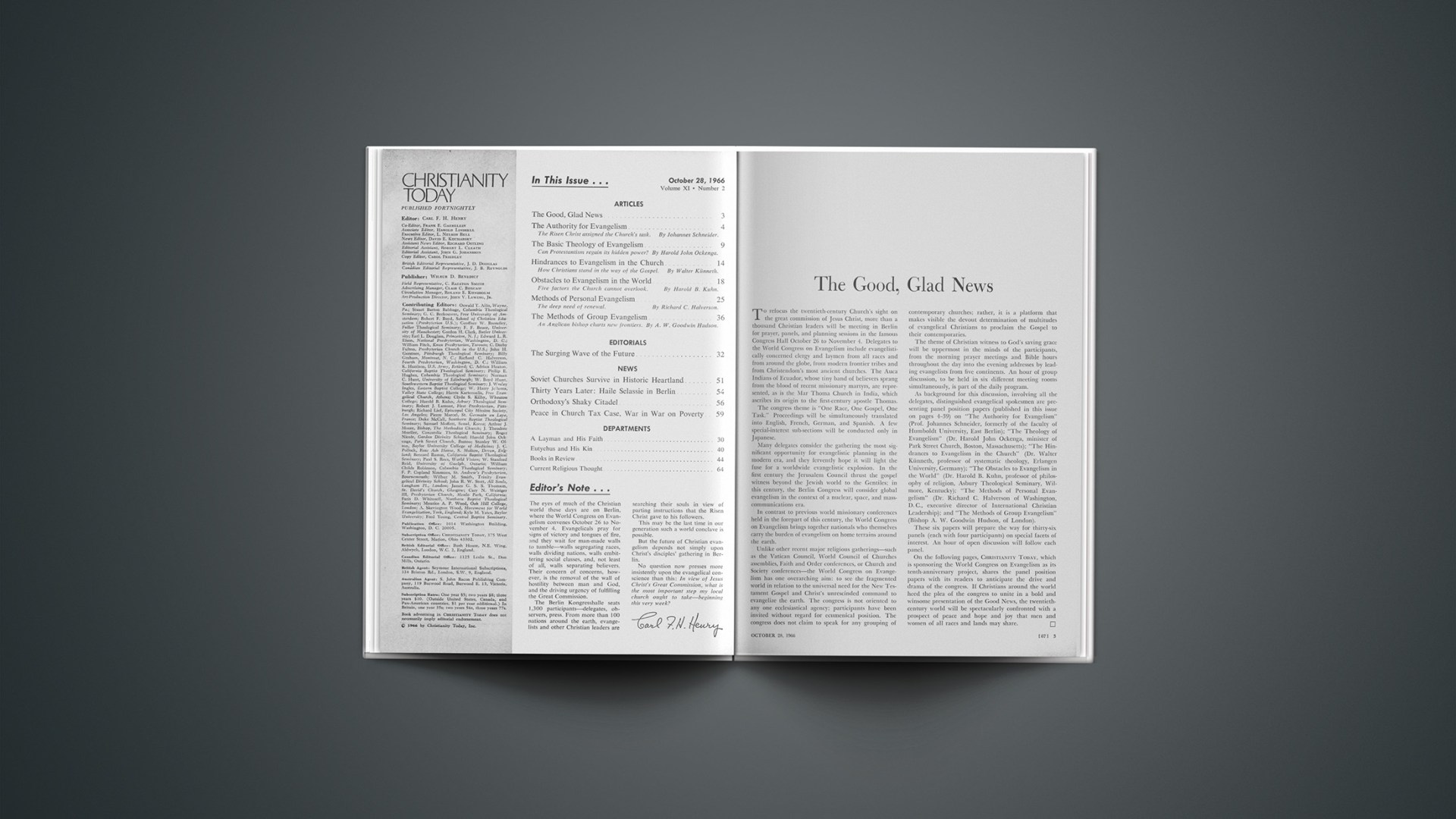
The Good, Glad News

To refocus the twentieth-century Church’s sight on the great commission of Jesus Christ, more than a thousand Christian leaders will be meeting in Berlin for prayer, panels, and planning sessions in the famous Congress Hall October 26 to November 4. Delegates to the World Congress on Evangelism include evangelistically concerned clergy and laymen from all races and from around the globe, from modern frontier tribes and from Christendom’s most ancient churches. The Auca Indians of Ecuador, whose tiny band of believers sprang from the blood of recent missionary martyrs, are represented, as is the Mar Thoma Church in India, which ascribes its origin to the first-century apostle Thomas.

The congress theme is “One Race, One Gospel, One Task.” Proceedings will be simultaneously translated into English, French, German, and Spanish. A few special-interest sub-sections will be conducted only in Japanese.

Many delegates consider the gathering the most significant opportunity for evangelistic planning in the modern era, and they fervently hope it will light the fuse for a worldwide evangelistic explosion. In the first century the Jerusalem Council thrust the gospel witness beyond the Jewish world to the Gentiles; in this century, the Berlin Congress will consider global evangelism in the context of a nuclear, space, and mass-communications era.

In contrast to previous world missionary conferences held in the forepart of this century, the World Congress on Evangelism brings together nationals who themselves carry the burden of evangelism on home terrains around the earth.

Unlike other recent major religious gatherings—such as the Vatican Council, World Council of Churches assemblies, Faith and Order conferences, or Church and Society conferences—the World Congress on Evangelism has one overarching aim: to see the fragmented world in relation to the universal need for the New Testament Gospel and Christ’s unrescinded command to evangelize the earth. The congress is not oriented to any one ecclesiastical agency; participants have been invited without regard for ecumenical position. The congress does not claim to speak for any grouping of contemporary churches; rather, it is a platform that makes visible the devout determination of multitudes of evangelical Christians to proclaim the Gospel to their contemporaries.

The theme of Christian witness to God’s saving grace will be uppermost in the minds of the participants, from the morning prayer meetings and Bible hours throughout the day into the evening addresses by leading evangelists from five continents. An hour of group discussion, to be held in six different meeting rooms simultaneously, is part of the daily program.

As background for this discussion, involving all the delegates, distinguished evangelical spokesmen are presenting panel position papers (published in this issue on pages 4–39) on “The Authority for Evangelism” (Prof. Johannes Schneider, formerly of the faculty of Humboldt University, East Berlin); “The Theology of Evangelism” (Dr. Harold John Ockenga, minister of Park Street Church, Boston, Massachusetts); “The Hindrances to Evangelism in the Church” (Dr. Walter Künneth, professor of systematic theology, Erlangen University, Germany); “The Obstacles to Evangelism in the World” (Dr. Harold B. Kuhn, professor of philosophy of religion, Asbury Theological Seminary, Wilmore, Kentucky); “The Methods of Personal Evangelism” (Dr. Richard C. Halverson of Washington, D. C., executive director of International Christian Leadership); and “The Methods of Group Evangelism” (Bishop A. W. Goodwin Hudson, of London).

These six papers will prepare the way for thirty-six panels (each with four participants) on special facets of interest. An hour of open discussion will follow each panel.

On the following pages, CHRISTIANITY TODAY, which is sponsoring the World Congress on Evangelism as its tenth-anniversary project, shares the panel position papers with its readers to anticipate the drive and drama of the congress. If Christians around the world heed the plea of the congress to unite in a bold and winsome presentation of the Good News, the twentieth-century world will be spectacularly confronted with a prospect of peace and hope and joy that men and women of all races and lands may share.

Editor’s Note from October 28, 1966

The eyes of much of the Christian world these days are on Berlin, where the World Congress on Evangelism convenes October 26 to November 4. Evangelicals pray for signs of victory and tongues of fire, and they wait for man-made walls to tumble—walls segregating races, walls dividing nations, walls embittering social classes, and, not least of all, walls separating believers. Their concern of concerns, however, is the removal of the wall of hostility between man and God, and the driving urgency of fulfilling the Great Commission.

The Berlin Kongresshalle seats 1,300 participants—delegates, observers, press. From more than 100 nations around the earth, evangelists and other Christian leaders are searching their souls in view of parting instructions that the Risen Christ gave to his followers.

This may be the last time in our generation such a world conclave is possible.

But the future of Christian evangelism depends not simply upon Christ’s disciples’ gathering in Berlin.

No question now presses more insistently upon the evangelical conscience than this: In view of Jesus Christ’s Great Commission, what is the most important step my local church ought to take—beginning this very week?

Twentieth-Century Evangelism

Evangelism, rightly called “the lifeline of Christianity” and the central task of the Christian Church, is getting much attention these days. This is especially significant in view of the confident assertion by religious leaders of the thirties that “personal evangelism” was dead.

Of course, not all who are now discussing evangelism are dealing with the historic mandate of the Church to proclaim Jesus Christ as Saviour and Lord. Some are attempting to deprive the term “evangelism” of its clarity and vitality.

There is a tendency to set in antithesis an “evangelism of decision” and an “evangelism of identification.” The implications of this are clear. Evangelism concerned directly with the individual and his spiritual anxieties and hungers is regarded as aloof, unrelated to the realities of the time, and hence irrelevant. We are asked to believe that evangelism that leaves the chancel and moves into the streets (particularly for protests and demonstrations) is now the only type worthy of the name. As the Christian becomes an active part of power-movements for social betterment, we are told, he is best displaying the heart of Christianity.

Granted, the Gospel, when true to our Lord’s example, is concerned with the needs of the poor and the disinherited. Not granted, however, is the contention, often recklessly made, that historic evangelism at its best is insensitive to the needs of those who have been left behind in the march of progress. Even persons who are unenthusiastic about Dr. Billy Graham will, if they are fair, admit that he is vitally concerned about the problems that plague today’s society, such as urbanization and ghetto living.

Part of the problem is to define the task. Has social change made it necessary to view the Church’s mandate to evangelize in a wholly new way? Some will heartily reply, Yes! They will say that if we are to “do the work of an evangelist” in our day, we must focus our attention, not on the spiritual needs of the individual, but on the processes of social change. Presumably we must do this to ensure that such change will be carried out in a way that can be called “Christian.”

In past days, the Church, as witnessing Church, was generally thought to stand in some sense over the world. In the name of its Lord it was to declare an unchanging message centering in the constancy of human sin, the certainty of God’s love and grace, and the urgency of the redeeming ministry of Jesus Christ. Today many influential people are urging the Church to surrender its claim to call all men to repentance (and thus to sit in judgment upon the whole of human life) and to take its place as one of several agencies of power in our society.

Perhaps it is time for the “identifying church” to search its heart and decide whether the demands of its avant-garde reflect any special, contemporary mandate from the Lord of the Church. It might well inquire, in the “morning after” of frustrated anti-poverty programs and bitter demands for “black power,” whether evil in society can be financed or demonstrated out of existence. The liberal church might also ask itself whether it is qualified to undertake a twentieth-century Constantinianism—to assume direct responsibility for directing our society.

Not many will go so far as one worldly prelate who proclaimed that individual evangelism urging personal commitment to Christ was “unchristian.” The more usual attitude is to regard the evangelist who “preaches for a verdict” at the personal level as the “prisoner of an outmoded theology” or as one who “unduly limits the scope and sphere of the Gospel.” No tabulation of ecclesiastical power will determine what is right. True, much liberal “social action” today has been sparked by frustration at the slow progress made by secular agencies. But is not much “action” proving itself to be frustrating? The proponent of “evangelism by identification” must be disturbed to hear that Western assistance to underdeveloped nations is “self-serving” and that acceptance of it is “harlotry with capitalist lands.”

The issue before the Church seems to be this: Are we to accept the New Testament mandate to “preach the Gospel to every creature,” or are we to accept the revised definition of evangelism proposed by ideologists whose views are conditioned almost entirely by a socio-political creed?

If “there is none other name under heaven given among men, whereby we must be saved,” then every man deserves to hear that message regardless of his religious or cultural background. Certainly this proclamation should be made humbly and lovingly; but it must be made, even in the face of a hostile world and an antagonistic Zeitgeist. Certainly the ministering evangelist should, as far as possible, separate himself from considerations of race and color. Certainly he ought to separate himself from the instruments of prejudice and injustice. Certainly he ought to interest himself, and those within range of his witness, in the financial structures that control trade and wealth among nations. But his major concern must be to relate the unchanging Revelation to man’s needs in a changing world.

Methods may vary, but principles remain. The problem of human sin and guilt and anxiety; the imperious need for divine forgiveness; the essential need of lonely man for relation with God through Jesus Christ—these are constant. No religious appeal is permanently relevant if it fails to come to grips with these constants. Accelerated technology makes human need no less urgent; a society conditioned more and more by cybernetics leaves men in no less need of the light and warmth of the Holy Spirit. Indeed, since more and more of man’s basic decisions seem to come from invisible, impersonal sources, personal decision and commitment in “core matters” are the more urgent.

The Cross has more than one meaning. It means hope, and in this we rejoice. But it also means offense. He who will “do the work of an evangelist” must willingly reckon with resistance to his message. He needs only to be certain that his presentation of Christ and his cross is made in love and humility.

The promise, “Lo, I am with you always,” is rooted in the command to evangelize. This should sustain the evangelist in the face of opposition, including that which questions whether his message is relevant for the times. He might also remember that organized Christianity may sink into decay, irrelevance, and finally extinction in several ways, and that one way is thoughtless identification.—

Dynamics of a Decade

A review of the momentous news stories during CHRISTIANITY TODAY’S first ten years suggests that the magazine could have chosen no opening decade more strategic.

Reporting of intellectual, moral, and spiritual news is hazardous because significance often lies as much in broad trends as in specific events and personalities. This, plus the sheer bulk of the news, makes it virtually impossible to compile a useful list of “top stories.” Instead, we point to ten great dynamic forces that affected Christianity and were affected by Christianity during our first decade of publication:

Quest For Racial Justice

As newly independent nations arose, Christian nationals across the world assumed management of their churches as never before. In an era of racial interaction and new freedom, South Africa epitomized white intransigence.

In America, a political revolution began with Negro Christians and drew increasing support as a moral issue from white clergymen. From Martin Luther King’s bus boycott, the movement went on to attack a multitude of sins, but barely touched long-term problems of employment, education, housing, and family stability.

Public shock at police brutality and pressure from churchmen led to major national civil rights laws. While public institutions gradually integrated, the color line within Protestantism generally stood fast. A backlash of bigotry accompanied excesses in the Negro struggle while Gandhian non-violence faded as the reigning rationale.

The Ecumenical Tide

A new spirit of unity on a pan-Christian scale was possible because of a moderating Roman Catholicism. The attitude of Eastern Orthodoxy was more ambiguous. In a decade full of ecumenical “firsts,” intra-Protestant mergers created the new United Presbyterian Church, American Lutheran Church, Lutheran Church in America, and United Church of Christ. The United Church, which cut across confessional lines, lost members during the decade; growth was more typical of Baptists, Pentecostals, and other non-ecumenical independents.

In 1960 Eugene Carson Blake, later chosen general secretary of the World Council of Churches, proposed a dramatic U. S. Protestant merger. By 1966, delegates from nine denominations with 25 million members had approved union principles. In world missions, the International Missionary Council merged with the WCC, and cooperation grew among independents outside the WCC.

The New Face Of Roman Catholicism

Some have said that Pope Pius XII had planned to call a council. It probably would have rapped the Reds, endorsed the past, and promulgated new Marian dogma. But Pope John’s Vatican Council II gave surprising vent to Rome’s liberal element and such thinkers as Küng and Murray. It recast attitudes toward Protestants, Jews, revelation, and church-state relations, and updated church structure and worship. But the ecumenical barricades of mariology and papal infallibility remained tough problems of implementation and such unresolved issues as birth control fell to John’s successor, Pope Paul VI.

Another John, named Kennedy, became the first of his faith elected to the U. S. Presidency. His performance in office assuaged anti-Catholics and contributed to the new interfaith climate.

Shifts In Church-State Relations

Centuries-old patterns of church-state relations changed in many countries. The major spur to this was Vatican II’s religious freedom document, which weakened ancient papal agreements with certain governments. In Catholic Spain and Latin America and in Orthodox Greece, priests berated the government. Lutheran Scandinavia reconsidered the official churches’ status, and in Britain, government ties seemed increasingly an albatross for Anglicanism.

In the United States, the Supreme Court increased separation, if not secularism, with two key rulings on prayer and Bible reading in public schools. But in a contrasting trend, long-standing church-state walls crumbled as Congress gave federal aid to parochial schools, religious colleges, and church-related poverty agencies.

The Cold War’S Move East

As Red China became a nuclear force and a growing threat to world peace, she drew apart from her onetime ally, the Soviet Union. The thaw between the Soviet Union and the West was seen in Khrushchev’s tour of America and the entry of Russian Orthodoxy into the World Council of Churches. Rome was more conciliatory toward Moscow but was unable to become a diplomatic third force between East and West. The United Nations—which was visited by a pope for the first time last year—seemed to wane as such a third force.

A crude anti-Communist reaction survived in some segments of the Church and society, but other Christians were more concerned that the Communist Bloc remained the most challenging unevangelized area on earth. The ambiguous Viet Nam war succeeded World War II and Korea, where the moral issues were clearer; some churchmen opposed the war and favored a new, selective form of pacifism.

Science Tamed And Unleashed

In the decade of Sputnik and of the advent of man in space, science increased its dominance over philosophy and the humanities in the academic world, a trend accentuated by federal aid. Even art forms were increasingly mechanistic, as in electronic music and Op Art.

Scientific advance continued to create crises men were unprepared to handle, in automation, a surplus of unskilled labor, and a surplus of leisure, particularly in America. And science left unsolved the great moral questions created by new knowledge in such fields as medicine and genetic control. Who would make life-and-death decisions, and on what criteria?

An Uneasy Moral Climate

The “new morality” and situational ethics gave an air of respectability to what people intended to do anyway. The new Playboy empire and less urbane pornographers made millions on permissiveness endorsed by some churchmen. Men sought escape from their environment through such exotic means as LSD. More traditional misuse of narcotics continued, as did such old-fashioned problems as alcoholism, gambling, marriage breakdown, and plain dishonesty.

It was easier to lie, cheat, and steal in an impersonal, institutionalized society than in small-town America. A surge in all types of crime accompanied such chilling specifics as mass murders and aimless rioting. The assassination of John F. Kennedy was the worst single crime of the decade; Adolph Eichmann’s trial and execution were a reminder of past outrages.

Secularization Of The Church

An important element in Protestantism struggled to break out of institutional cocoons, often not to proclaim but to serve and to change social structures. The United Presbyterians’ new confession, with its “reconciliation” theme, was symptomatic of the search for the idiom of the age. Secular theology and relativism were exaggerated in the small but much-discussed “death of God” school.

Church lobbies in Washington, D. C., tended to overshadow activities by individual Christian citizens, and political pronouncements from church assemblies became commonplace. The churches also had another important link with the secular world—billions of dollars in equity—and use of these resources was an open question.

Demand For Depth Evangelism

In Christian theology and in evangelism and education, there was marked probing beyond the more obvious elementary issues. The decade’s foremost proclaimer of the Gospel, Billy Graham, led the way by intensifying his preparation and follow-up. Hit-or-miss witness was gradually yielding to what might be called “contextual evangelism,” in which the right to be heard is first won by identifying with needs and attitudes. The proliferation of means of communication brought many new opportunities but generally worked against the personal touch.

The World Congress on Evangelism, with its not-by-design forerunner, the Congress on the Church’s Worldwide Mission, represents a broad new move toward coordinated evangelistic strategy.

End Of A Generation Of Giants

Great religious thinkers died in this decade: C. S. Lewis, then Schweitzer, Tillich, and Brunner. Another major figure who died was Sartre, existentialism’s leading exponent of despair. Giants of Christian thought were at the close of their careers: Barth, Bultmann, Niebuhr, and Maritain.

During these years, neo-orthodoxy declined as an intellectual option, largely because of its wavering sense of divine revelation and biblical authority. In an ecumenical age, major denominations reflected an eclectic, tolerant atmosphere, without indignation even toward heresy. Protestantism was groping for meaning and direction and was uncertain which concepts and personalities would condition the new era.

Personalia

A high churchman, Archbishop Philip N. W. Strong of Brisbane, was elected primate of the Church of England in Australia. He succeeds Dr. Hugh R. Gough, an evangelical who resigned both an archbishopric and the primacy because of illness. The 67-year-old Strong, a bachelor, was born in England and served twenty-seven years as bishop of Papua, New Guinea.

Dr. Ronald Osborn, dean of Christian Theological Seminary, Indianapolis, was named president-elect of the International Convention of Christian Churches.

Alabama-born C. Eugene Kratz was chosen president of Maryland Baptist College, now being built on a 140-acre site forty miles west of Baltimore. Kratz has been a researcher for the U. S. Office of Education and a Southern Baptist educational missionary to Southern Rhodesia. He earned a doctorate from Teachers College of Columbia University in college and university administration.

Miscellany

South Viet Nam’s new constitutional assembly includes 30 Roman Catholics among its 117 members. Buddhist candidates won 34 of the seats, according to Religious News Service. Only two or three of the Buddhists, however, are rated as supporters of the militant monk Thich Tri Quang (see Sept. 30 issue, page 18).

Pollster Louis Harris said last month that U. S. Catholics favor Robert Kennedy over Lyndon Johnson by a 60–40 ratio for Democratic Presidential candidate in 1968. Protestants, he reported, prefer Johnson 53 to 47. Harris said Catholics go for Kennedy over Richard Nixon 66 to 34, Jews for Kennedy over Nixon by 70 to 30, and Protestants for Nixon over Kennedy by 58 to 42.

Methodism’s controversial student monthly motive has agreed to be the magazine for the new ecumenical University Christian Movement (see Sept. 30 issue, page 16). Evangelical Press Association and Evangelical Literature Overseas plan a joint effort to give a push to Christian communications in higher education, including counseling service, promotion of scholarship programs, and exchange of information on career opportunities.

Canada releases a new Christmas stamp this week showing a reproduction of “Praying Hands,” a famous drawing by the German Renaissance artist Albrecht Dürer. The stamp will come in denominations of three cents (rose-colored) and five cents (orange).

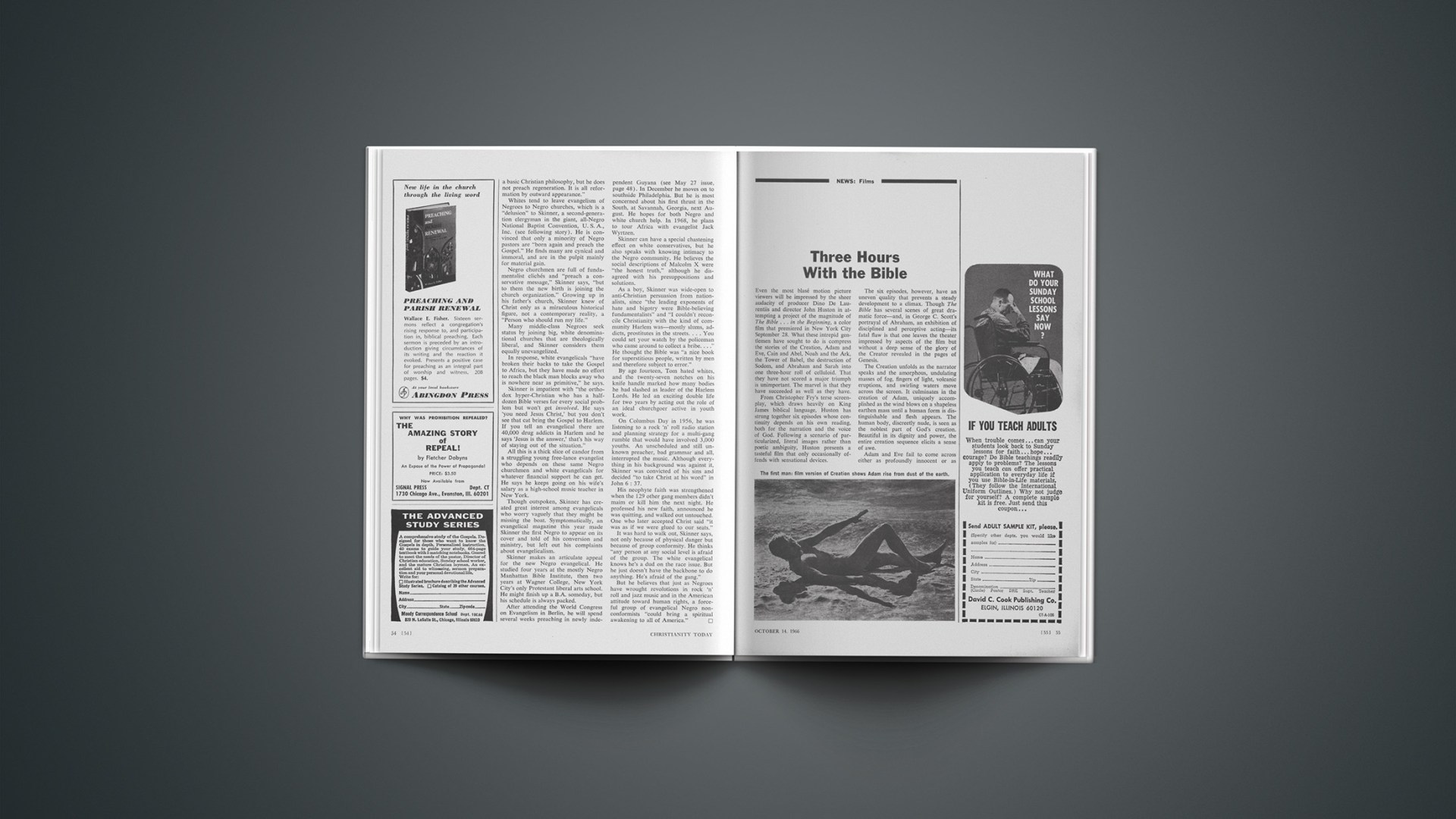
Three Hours with the Bible

Even the most blasé motion picture viewers will be impressed by the sheer audacity of producer Dino De Laurentiis and director John Huston in attempting a project of the magnitude of The Bible … in the Beginning, a color film that premiered in New York City September 28. What these intrepid gentlemen have sought to do is compress the stories of the Creation, Adam and Eve, Cain and Abel, Noah and the Ark, the Tower of Babel, the destruction of Sodom, and Abraham and Sarah into one three-hour roll of celluloid. That they have not scored a major triumph is unimportant. The marvel is that they have succeeded as well as they have.

From Christopher Fry’s terse screenplay, which draws heavily on King James biblical language, Huston has strung together six episodes whose continuity depends on his own reading, both for the narration and the voice of God. Following a scenario of particularized, literal images rather than poetic ambiguity, Huston presents a tasteful film that only occasionally offends with sensational devices.

The six episodes, however, have an uneven quality that prevents a steady development to a climax. Though The Bible has several scenes of great dramatic force—and, in George C. Scott’s portrayal of Abraham, an exhibition of disciplined and perceptive acting—its fatal flaw is that one leaves the theater impressed by aspects of the film but without a deep sense of the glory of the Creator revealed in the pages of Genesis.

The Creation unfolds as the narrator speaks and the amorphous, undulating masses of fog, fingers of light, volcanic eruptions, and swirling waters move across the screen. It culminates in the creation of Adam, uniquely accomplished as the wind blows on a shapeless earthen mass until a human form is distinguishable and flesh appears. The human body, discreetly nude, is seen as the noblest part of God’s creation. Beautiful in its dignity and power, the entire creation sequence elicits a sense of awe.

Adam and Eve fail to come across either as profoundly innocent or as grievously fallen characters. They are played two-dimensionally by Michael Parks and Ulla Bergryd, whose acting ability is less impressive than their splendid physiques. The temptation scene is a dud in its lack of dramatic intensity. But surprisingly, the difficult task of portraying the serpent is carried off quite effectively: Satan has a humanlike form all but hidden in the shadows of the luxuriant Tree of the Knowledge of Good and Evil, on which hangs the glistening golden apple. Conspicuous by their absence are the garments of skins in which God clothed Adam and Eve before they were driven from the Garden.

Richard Harris as Cain offers an unconvincing caricature of the fleeing vagabond who tries to escape his tormenting guilt. In one of the unfortunate bits of sensationalism of the film, lightning strikes Cain causing a mark shaped like the Tree to appear on his forehead.

Noah, played by director Huston himself, is a man of quiet strength with a twinkle in his eye. He gives no hint of being a raging prophet of God’s judgment but is a wise, persistent man of faith who builds his ark despite the taunting of a mob of men, each of whom resembles the Swedish Angel of wrestling fame. Like the Pied Piper of Hamlin, Noah tootles the bright beasts and his drab family aboard the rough-hewn place of refuge. The Noah sequence is disproportionately long, but it is nevertheless entertaining and, with the climactic return of the dove with the fig leaf, inspirational.

The Tower of Babel scene is perhaps the weakest part of The Bible. Nimrod stands atop the high-rise ziggurat and shoots an arrow high into the heavens as an act of pride in defiance of God. Suddenly a great turbulence occurs in the clouds. When Nimrod speaks to his men, they reply in gibberish. The crowds below begin to quarrel, the tower tumbles, and the people flee—all in the space of a few moments.

The picture saves for the last its best episode, the saga of Abraham and Sarah. George C. Scott brilliantly portrays the Patriarch as a man of humanity, virility, and faith. The attractiveness of Sarah (played by Ava Gardner), who at seventy-five appears more like a mature girl of twenty-five, may have contributed to Abraham’s soundness of spirit.

The screenplay takes the liberty of allowing Abraham to show young Isaac the ruins of Sodom where God’s judgment has been rendered. Here the film reaches its dramatic high point as Abraham (using words found in the book of Isaiah) raves before God before obediently ascending the mountain of sacrifice to offer his son. After God interrupts the uplifted blade of Abraham and provides a ram caught in the thicket for the sacrifice, father and son embrace in a touching show of love. Then, true to the form of biblical epochs, the picture ends with the camera cliché of a sweeping view of the crimson mountains at sunset.

The Bible … in the Beginning is not a great dramatic feat, nor is it likely to communicate profound religious feeling. Yet it is one of the better biblical films produced by commercial movie-makers. Some people will be enthralled by it. Others will be less than satisfied. If nothing else, the film should convince all that the revelation of God is better served by the verbal than the visual symbol.

Chronicle Of A Controversy

A Time for Burning, a fifty-eight-minute documentary drama produced for the interdenominational Lutheran Film Associates, New York, will make its debut on 105 National Educational Television network stations on October 17.

The film deals with a struggle that began last fall in Omaha when the Rev. William Youngdahl suggested that ten couples of his 1,100-member Augustana Lutheran Church visit ten neighboring Negro families. While this proposal was being debated in the church council, Sunday school teachers invited a group of Negro teen-agers to Sunday services. The presence of the Negroes raised anxiety, and the pastor’s proposal was shelved. Finally, the pastor resigned.

As this drama occurred, it was captured by a hand-held camera and wireless microphones. The film chronicles the build-up of tensions in public controversy and private conversations among church people and members of the community.

In November, the film will be made available for rental through Contemporary Films, of New York, San Francisco, and Evanston. Illinois.

Where Others Leave Off

For Pete’s Sake, a production of Billy Graham’s World Wide Pictures, Minneapolis, will have its premiere showing this month at the World Congress on Evangelism in Berlin.

According to the producers, this film picks up where most Christian films leave off. Pete, the young adult protagonist, is converted early in the story, and then the camera focuses on the problems that can hit a man after he accepts Christ. The producers say they have attempted to replace the usual happily-ever-after theme with something more realistic, and to show that God has promised, not freedom from problems, but the presence of Himself.

In distributing For Pete’s Sake through commercial movie houses, World Wide Pictures is following a pattern it found successful with previous release of The Restless Ones. In The Restless Ones’ first eleven months (to August 15, 1966), two million persons viewed the film and after its showing, 120,000 recorded decisions for Christ and stayed for personal counseling.

Musical With A Message

Worlds Apart, a ninety-minute color film called by its producers “the first real Christian musical,” will be released on December 28 by Gospel Films, Inc.

The musical will premiere in theaters and civic auditoriums of thirty major cities before being released for rental to smaller groups.

The idea of writing a “musical with a Christian message in it, using a non-biblical story with the typical boy-meets-girl angle and colorful format,” came to top gospel-song writer John W. Peterson several years ago (see Dec. 20, 1963, issue, pp. 31, 32). Peterson has achieved this in Worlds Apart.

Professional talent from movies and television was used throughout the production. The script was written by Turnley Walker, a writer for the Bonanza TV series, and the cast is headed by Lynn Borden, known for her role as Mrs. Baxter in the Hazel series.

The plot and the characters of the film are the stereotypes one expects to find in a light, romantic Broadway musical, except for the working-in of a gospel message.

The hero, Dr. Paul Matthews, is a tall, dark, handsome, Purple Heart-holding physician who is infallibly Christian. Denise Henley, the heroine, is a beautiful, blonde entertainer whose heart is golden but troubled through neglect of God. They fall in love but are “worlds apart” because of different loyalties.

Their final reunion seems to cast God as something of a great Matchmaker in the sky. Perhaps that is the inevitable result of using the captivating and ageless boy-girl formula.

The Disciples in Dallas

The International Convention of Christian Churches (Disciples), meeting in Texas for the second time this century, gave a standing ovation to Martin Luther King, opposed barriers to inter-racial marriage and adoption, and endorsed ICCC civil-rights action.

Despite such daring doings in Dallas September 23–28 and crucial steps toward centralized “restructure,” the Disciples did nothing about the structured segregation within their own “brotherhood.”

Originally, King was to appear alone, but conservative queasiness caused the addition of lawyer Robert Storey, former vice-chairman of the United States Civil Rights Commission, who made a strong stand against King-style civil disobedience. The exciting clash between Storey and King overshadowed the evening’s third star, John Wright of Pittsburgh, first Roman Catholic bishop to address a Disciples assembly.

King said “the church must remove the yoke of segregation from its own body. Only by doing this can it be effective in its attack on outside evils.”

Take the Disciples. They have parallel Negro-white conventions in six states and modified segregation in two others (Tennessee integrated this year). The 587 all-Negro congregations among the 8,000 in the ICCC have their own annual meeting, the National Christian Missionary Convention.

In August the NCMC voted to continue a study of merger with the ICCC, which Negroes also attend. But the NCMC’s jovial leader, Emmett Dickson, said Negroes must “share in the administration,” get more board positions and jobs with church agencies, and generally “share in the exhibition … the drama of the brotherhood.” He says persisting racial lines are as much a matter of Negro clannishness as of white bias.

The NCMC wanted a resolution to urge calling of pastors on a non-racial basis, but the Dallas steering committee turned it down because the NCMC met after the July 25 resolutions deadline. Although a few white Disciples clergymen serve Negro churches, no Negro serves a white church.

After criticism at the convention of segregation at the Disciples’ showcase church, National City Christian in Washington, D. C., the Rev. George Davis reported the 1,100-member congregation now practices open membership and has taken in five American Negroes.

Denominational executives this spring proposed, then withdrew, a motion to require public exposure of racial policies among Disciples churches in cities where conventions are held. But the conventions themselves have long been fully integrated, one reason the denomination has rarely met in Dixie.

In the resolution on inter-racial marriage and adoption, which spurred the most emotional debate of the week, the steering committee eliminated the reference to the denomination’s own National Benevolent Association.

The convention approved a report on staff civil-rights work. This was done despite a petition from 139 Dallas Disciples against “indecorous” political action. “There is enough of God’s work to be done to keep us all busy,” the petitioners said. The Disciples also approved a last-minute resolution deploring the burning during the convention of Negro staffer John Compton’s home in Westlake, Ohio, a previously all-white suburb of Cleveland.

Nobody breathed a word about how race relates to restructure, which passed its first hurdle in Dallas. The centralized design, as expected, was sent to congregations for a quick look (they are supposed to respond within seven months) and is headed for approval, after revisions, at next year’s convention. The ICCC also established a mass assembly of elected delegates from congregations, regions, and agencies, replacing a system of whosoever will may come—and vote. Proponents say this plan, which will begin next year, makes the Disciples a denomination for the first time.

Conservative congregationalists charged that restructure was part of a master plan to get the Disciples into the giant church being formed by the Consultation on Church Union. The restructure chairman, Granville Walker, flatly denied this, but admitted Disciples can’t act on merger without restructure. “Who could unite with 8,000 autonomous congregations and 127 separate agencies?” he asked.

Those agencies are free agents, and each must decide if it wants to come under the umbrella. As for the congregations, leaders admit some will leave the denomination on the restructure issue. The increasingly disloyal opposition claimed that when the time comes for COCU consummation (in Dallas this was estimated to be sometime between 1973 and 1976), less than half the Disciples will go into the huge new denomination. Legal groundwork is being laid in advance on both sides.

Integration: A Rough Road

Methodist officials rejected a plea for unilateral denominational action against poverty and racial inequity in Mississippi and voted $70,000 for the National Council of Churches’ controversial Delta Ministry. Meanwhile, Delta lost its director, 35-year-old Arthur Thomas, who is moving to Washington.

At least two Protestant ministers in Grenada, Mississippi, spoke words of condemnation from the pulpit last month after acts of racial violence against local Negro school children. The Rev. C. B. Burt of the First Methodist Church had almost half of his congregation come to the altar in response to his call for contrition for the violence. The Rev. Emmett Barfield of the First Presbyterian Church also spoke out.

In Macon, Georgia, the minister of a Baptist church and two of his assistants were fired in a dispute over the seating of Negroes. The church is located on the campus of Mercer University, a Southern Baptist school.

Negro Baptists Rap ‘Black Power’

Negro Baptists are split on civil rights strategy, but neither side sees any value in the “black power” slogan now brandished by Negro militants.

The National Baptist Convention, U. S. A., Inc., which takes a dim view of civil rights demonstrations, said in a resolution at its Dallas meeting that power is segregation in reverse and that those who promote it are “guilty of the same type of prejudicial thinking and feeling that they have so long condemned in white segregationists.”

The same week in Memphis, the new president of the Progressive National Baptist Convention, Inc., Gardner C. Taylor, told his denominational meeting that black power is a “sick slogan produced by the diseases of a sick society.” While the black-power “distortion” is an understandable result of denial, he said, “we have come far too far now to change directions. We must march on to an integrated society.…” In Taylor’s analysis of American cultural history and national identity, “black and white have inextricably and irrevocably affected each other.”

Taylor’s unsuccessful bid to unseat Joseph H. Jackson, longtime president of the NBC, led to the 1960 pullout and formation of the Progressive Convention, which supports non-violent civil rights demonstrations. Taylor was the first Negro president of the Protestant Council in New York City.

The NBC resolution said that if black power means only growing political, economic, and educational strength, it is “not needed,” because this is what Jackson has promoted for years. In fact, Jackson this year sounded faintly like a black-power advocate as he said Negroes must develop appreciation of their own race and build a solid Negro-owned business base, even if they have to hire a “white front” to do it. And he said, “We will be better off when we make it known we are not for that type of integration that saddles us with cheap, undesirable white people.”

The convention resolution said that “it matters not how non-violent civil disobedience may be, it is a form of lawbreaking and lawlessness, and it can never be considered a virtue” in America.

A related resolution said the political statements of the National Council of Churches do not speak for the NBC, and that the NBC belongs to the National Council only for fellowship. The 5.5-million-member Negro body is the NCC’s second-largest member and makes up one-eighth of its constituency.

The law-and-order emphasis and condemnation of direct action brought predictable praise from the Texas press and from such white conservatives as Governor John Connally, a convention speaker.

Mrs. Mary Olivia Ross of Detroit, president of the women’s auxiliary, spoke on a pressing subject many rights leaders want to forget—instability and matriarchal structure in Negro families. She said, “The Negro family must add to our society more strong men, brave men, and respectable men. This begins at home. The image of the Negro man must be raised. Family life must be strengthened, for out of the family must come women and men who must shape and guide the destiny of our nation and of the world.…”

“There are too many men without manhood; too many men without maturity; too many men without morals; and too many men without simple manners.”

The 25,000 NBC visitors—who experienced considerably less trouble getting rooms than delegates to previous Dallas meetings in 1891 and 1944—held a memorial service at the site of John F. Kennedy’s assassination.

The Gospel With Candor

In his early teens, Tom Skinner led a blood-lusting Harlem gang. At 24, he is the energetic figure in a pioneering group of Negro evangelicals, aiming his new war of words at two groups:

Fellow Negroes. He says their hope lies not in anti-white bigotry or aimless agitation but in saving faith in Christ like that which ended his gang days.

White evangelicals. He charges they have been “almost totally irresponsible” by avoiding needs of Negroes.

Unlike many evangelists who are out of touch, Skinner has talked at length with such diverse Negro leaders as Martin Luther King and the martyred black nationalist Malcolm X. And last month he was invited to the South African embassy in Washington for a chat with the ambassador.

Skinner was in Washington for two weeks of services in a dance hall run by a rhythm-and-blues radio station. With a voice as big as his athletic, 210-pound frame, he preached, leaning back and forth across the pulpit, gesturing, sometimes squinting. Behind him, murals lit by lurid neon lights depicted Negro aspirations: engineer, doctor, college graduate. Speaking without humor and in the flawless English of an award-winning college actor, he spoke of the social alienation common among U.S. Negroes:

“If I am a son of God, that puts me in the best family stock in the world.… I don’t have to break my neck for human dignity. I’ve already got it.… If you accept Jesus Christ, you belong to the In Crowd.…”

He plays down social insurgence in sermons because he feels that reform may take “sixty years” but that regeneration through Christ can help now.

Skinner has avoided civil rights demonstrations; but without them, he is convinced, “white evangelicals wouldn’t even be willing to consider” questions of racial justice.

What worries him about movements led by King and others is how long they can remain non-violent if they are populated by non-Christians. “Negroes can’t keep turning the other cheek, apart from Jesus Christ,” he believes. “Martin has a basic Christian philosophy, but he does not preach regeneration. It is all reformation by outward appearance.”

Whites tend to leave evangelism of Negroes to Negro churches, which is a “delusion” to Skinner, a second-generation clergyman in the giant, all-Negro National Baptist Convention, U. S. A., Inc. (see following story). He is convinced that only a minority of Negro pastors are “born again and preach the Gospel.” He finds many are cynical and immoral, and are in the pulpit mainly for material gain.

Negro churchmen are full of fundamentalist clichés and “preach a conservative message,” Skinner says, “but to them the new birth is joining the church organization.” Growing up in his father’s church, Skinner knew of Christ only as a miraculous historical figure, not a contemporary reality, a “Person who should run my life.”

Many middle-class Negroes seek status by joining big, white denominational churches that are theologically liberal, and Skinner considers them equally unevangelized.

In response, white evangelicals “have broken their backs to take the Gospel to Africa, but they have made no effort to reach the black man blocks away who is nowhere near as primitive,” he says.

Skinner is impatient with “the orthodox hyper-Christian who has a half-dozen Bible verses for every social problem but won’t get involved. He says ‘you need Jesus Christ,’ but you don’t see that cat bring the Gospel to Harlem. If you tell an evangelical there are 40,000 drug addicts in Harlem and he says ‘Jesus is the answer,’ that’s his way of staying out of the situation.”

All this is a thick slice of candor from a struggling young free-lance evangelist who depends on these same Negro churchmen and white evangelicals for whatever financial support he can get. He says he keeps going on his wife’s salary as a high-school music teacher in New York.

Though outspoken, Skinner has created great interest among evangelicals who worry vaguely that they might be missing the boat. Symptomatically, an evangelical magazine this year made Skinner the first Negro to appear on its cover and told of his conversion and ministry, but left out his complaints about evangelicalism.

Skinner makes an articulate appeal for the new Negro evangelical. He studied four years at the mostly Negro Manhattan Bible Institute, then two years at Wagner College, New York City’s only Protestant liberal arts school. He might finish up a B.A. someday, but his schedule is always packed.

After attending the World Congress on Evangelism in Berlin, he will spend several weeks preaching in newly independent Guyana (see May 27 issue, page 48). In December he moves on to southside Philadelphia. But he is most concerned about his first thrust in the South, at Savannah, Georgia, next August. He hopes for both Negro and white church help. In 1968, he plans to tour Africa with evangelist Jack Wyrtzen.

Skinner can have a special chastening effect on white conservatives, but he also speaks with knowing intimacy to the Negro community. He believes the social descriptions of Malcolm X were “the honest truth,” although he disagreed with his presuppositions and solutions.

As a boy, Skinner was wide-open to anti-Christian persuasion from nationalists, since “the leading exponents of hate and bigotry were Bible-believing fundamentalists” and “I couldn’t reconcile Christianity with the kind of community Harlem was—mostly slums, addicts, prostitutes in the streets.… You could set your watch by the policeman who came around to collect a bribe.…” He thought the Bible was “a nice book for superstitious people, written by men and therefore subject to error.”

By age fourteen, Tom hated whites, and the twenty-seven notches on his knife handle marked how many bodies he had slashed as leader of the Harlem Lords. He led an exciting double life for two years by acting out the role of an ideal churchgoer active in youth work.

On Columbus Day in 1956, he was listening to a rock ‘n’ roll radio station and planning strategy for a multi-gang rumble that would have involved 3,000 youths. An unscheduled and still unknown preacher, bad grammar and all, interrupted the music. Although everything in his background was against it, Skinner was convicted of his sins and decided “to take Christ at his word” in John 6:37.

His neophyte faith was strengthened when the 129 other gang members didn’t maim or kill him the next night. He professed his new faith, announced he was quitting, and walked out untouched. One who later accepted Christ said “it was as if we were glued to our seats.”

It was hard to walk out, Skinner says, not only because of physical danger but because of group conformity. He thinks “any person at any social level is afraid of the group. The white evangelical knows he’s a dud on the race issue. But he just doesn’t have the backbone to do anything. He’s afraid of the gang.”

But he believes that just as Negroes have wrought revolutions in rock ‘n’ roll and jazz music and in the American attitude toward human rights, a forceful group of evangelical Negro nonconformists “could bring a spiritual awakening to all of America.”

Berlin Prepares for World Congress

Evangelicals from around the world prepared to make their way to Berlin this month for the ten-day World Congress on Evangelism beginning October 26. Some 1,200 delegates and observers are expected to be on hand. More than 100 editors and newsmen from throughout the globe have been accredited to the press room.

Evangelist Billy Graham, honorary chairman of the congress, is scheduled to bring a major address and to preside at several sessions. Graham will also hold a public evangelistic crusade in Berlin the week prior to the opening of the congress.

The flood of interest in the congress required a moratorium on delegate and observer invitations in mid-September, six weeks before the start of the meeting. Representatives from virtually all Protestant denominations will be on hand, and there will also be Roman Catholic and Jewish observers.

According to Gil A. Stricklin, director of information for the congress, participants will include representatives of what are probably the oldest and newest Christian churches in the world. Bishop Alexander Mar Theophilus of Adoor, Kerala, India, will attend from the “oldest” church, the Mar Thoma Syrian Church, said to have been founded by the Apostle Thomas in the first century. From what is believed to be the “newest” church, that of the Auca Indians in Ecuador, will come Gikita M. Komi and Yaeti K. Kimo, who participated in the slaying of five American missionaries in 1956 but have since been converted to the Christian faith.

Attendance at the congress is by invitation only. A key basis of selection was the degree of involvement in evangelism, and congress organizers have tried to ensure the widest possible representation. Invitations were extended to persons in 106 countries, including several in Communist lands whose availability is still uncertain. Priority was given to professional evangelists and to those in related teaching and administrative fields.

Editor Carl F. H. Henry of CHRISTIANITY TODAY, which is sponsoring the congress as a tenth-anniversary project, says that “this is no stage-managed conference. No secret strategy has been drawn up for ratification by the delegates, no public declarations have been devised in advance, and there are no projections for the last-minute plotting of organizational maneuvers. The congress will be in the hands of the delegates.”

A special commemorative service is planned for Reformation Sunday, October 30. It is expected to have special significance because of the Berlin locale—near historic sites that the Reformation made famous 4½ centuries ago.

Computers For Christ

“Is it too much to believe,” asks World Vision President Bob Pierce, “that the tools now being used to put man on the moon could have their ultimate purpose in bringing the Gospel to every creature?”

Under a $25,000 grant from World Vision, a group of scientists and churchmen are studying the possibility of doing just that. Their eyes are on the applicability of PERT (Program Evaluation and Review Technique). PERT, originally developed for programming a U. S. missile project, has proved itself a valuable tool in numerous government, industry, and engineering tasks.

The prospects are spelled out in the special October issue of World Vision Magazine, built around the topic “New Tools for World Evangelism.”

Crusade In The Corral

In booming Calgary, the big cowboy capital of Canada, a rodeo stadium known as the Stampede Corral was put to sacred use for two weeks of evangelistic meetings with Leighton Ford. The crusade attracted clergy and laymen from virtually all denominations. Ford, 34-year-old associate of Billy Graham, urged them “to affirm again with courage and clarity and joy the great verities of our faith.”

While the touring Archbishop of Canterbury was telling newsmen in Calgary last month that he didn’t think the Graham type of evangelism was what was needed at present, a Roman Catholic priest was in his church offering prayer for the crusade. And the Anglican bishop of Calgary, the Rt. Rev. George R. Calvert, purple robes and all, was participating in a service at the corral.

The crusade opened under sunny skies with the temperature in the eighties. Some 8,000 persons turned out for the first meeting.

British Follow-Up

Evangelist Billy Graham conducted unprecedented follow-up meetings last month for some of the 42,000 inquirers from his London crusade in June. At Royal Albert Hall, London, more than 5,000 persons gathered on each of two nights to receive encouragement and guidance for their new lives. “The greatest weapon the Devil has in his arsenal is to get you discouraged,” said Graham.

An eight-day “All-Britain Television Crusade” is being planned for next summer, Graham told his audience. The crusade is to reach out from Earls Court Stadium to at least twenty-five closed-circuit television projectors with screens up to thirty feet wide.

After the follow-up meetings, Graham was admitted to the London Clinic for treatment of an infection that had been causing discomfort for about three weeks and had caused doctors to advise him to cancel a trip to Scotland. Statements from Graham’s aides indicate that the infection has been brought under control, and that “doctors feel certain that … after a few days of rest he can resume his normal schedule.”

The canceled Scotland trip was to have been a substitute for a “postponed” visit to Poland. Graham said the Polish government had denied his request for a visa “at this time.” “It would have been a great privilege to help them celebrate a thousand years of Christianity,” he said. “I hope we may be permitted to go at a later time.”

Senate Turns Back Prayer Amendment

Minority Leader Everett M. Dirksen’s legislative prayer crusade suffered a setback at the hands of the U. S. Senate last month. His move to amend the U. S. Constitution to provide especially for public-school prayer fell nine votes short of the two-thirds needed for passage, whereupon the colorful 70-year-old Republican vowed to renew his campaign in the Ninetieth Congress next year.

Also turned back by the Senate was a move by Indiana Democrat Birch Bayh to substitute for the Dirksen amendment a simple resolution expressing the sense of Congress in favor of voluntary public-school prayers. The Bayh resolution, which would have had no legislative effect, got only thirty-three votes. It needed merely a majority for passage. Dirksen forces opposed it.

The votes marked the first official tally of congressional sentiment on the U. S. Supreme Court rulings that barred public-school devotional exercises. Twenty-seven Republicans and twenty-two Democrats voted in favor of the Dirksen amendment. Thirty-four Democrats and three Republicans voted against it. Nearly all the Democrats supporting the measure were from the South. If it had passed the Senate, the amendment would still have needed approval of the House and three-fourths of the state legislatures.

How They Voted

Democrats for: Byrd (Va.), Byrd (W. Va), Church (Idaho), Eastland (Miss.), Ellender (La.), Hill (Ala.), Holland (Fla.), Jordan (N. C.), Lausche (Ohio), Long (La.), McClellan (Ark.), Montoya (N. M.), Pastore (R. I.), Randolph (W. Va.), Robertson (Va.), Russell (S. C.), Russell (Ga.), Smathers (Fla.), Sparkman (Ala.), Stennis (Miss.), Symington (Mo.), and Talmadge (Ga.).

Republicans for: Aiken (Vt.), Bennett (Utah), Boggs (Del.), Carlson (Kans.), Cooper (Ky.), Cotton (N. H.), Curtis (Neb.), Dirksen (Ill.), Dominick (Colo.), Fannin (Ariz.), Fong (Hawaii), Griffin (Mich.), Hickenlooper (Iowa), Hruska (Neb.), Miller (Iowa), Mundt (S. D.), Murphy (Calif.), Pearson (Kans.), Prouty (Vt.), Saltonstall (Mass.), Scott (Pa.), Simpson (Wyo.), Smith (Maine), Thurmond (S. C.), Tower (Texas), Williams (Del.), and Young (N. D.).

All others voting were opposed. Senators who did not vote but announced as paired for the amendment were McIntyre (N. H.) and Moss (Utah). Not voting paired against the amendment was Brewster (Md.) Not voting but on record as opposed to the bill were Bass (Tenn.), Gore (Tenn.), and Metcalf (Mont.). Not voting but endorsing the measure was Dodd (Conn.).

Polls have shown that Americans favor public-school devotional exercises by a wide majority. Most religious lobbyists in Washington, however, fought the Dirksen amendment on grounds that it would tamper with the concept of religious liberty guaranteed now by the Constitution.

Dirksen maintains that his intent is not to override the Supreme Court decisions but to clarify them. The text of his proposed amendment is as follows:

“Nothing contained in this Constitution shall prohibit the authority administering any school, school system, educational institution or other public building supported in whole or in part through the expenditure of public funds from providing for or permitting the voluntary participation by students or others in prayer. Nothing contained in this article shall authorize any such authority to prescribe the form or content of any prayer.”

The proposal differs from the Becker amendment proposed in 1964 primarily in that the latter also sought to protect Bible reading in public classrooms. The 1964 move never came to a vote, and its sponsor, Republican Representative Frank Becker of New York, did not run for re-election to Congress. Some observers feel that Dirksen took up the battle motivated by a personal conviction that prayer saved him from blindness during a serious eye illness nearly twenty years ago.

During debate on his proposal, Dirksen took a poke at the National Council of Churches and promptly drew a telegram of protest from council leaders. Dirksen called NCC leaders “social engineers (who) have been giving too much time to things like the recognition of China instead of to a little soul saving.” He also quoted documents critical of the council. The protest telegram noted this and called it a “regrettable” use by the Senator of his position “to disseminate erroneous and discredited charges.”

Dirksen says his drive for a prayer amendment next year will have the support of a national committee including evangelist Billy Graham and the noted clergyman-editor Daniel Poling.

Expanding A Campaign

Glenn L. Archer, America’s leading campaigner for church-state separation, is worried about repercussions of the Great Society. Archer charges that the first thousand days of the administration of President Johnson have produced a rash of violations of the separation principle. “Never have we had so many legal actions going or the need for so many more,” says the 60-year-old Archer, executive director of Protestants and Other Americans United for Separation of Church and State. Efforts to secularize the Church are aggravating the problem.

To combat the trend, Archer and POAU hope to expand their campaign from a nine-story “Religious Liberty Center” in Washington. Ground is to be broken during 1967, which will be POAU’s twentieth anniversary year. The milestone is also being marked with the release of Embattled Wall, a sprightly, privately published, 161-page history of the organization written by associate director C. Stanley Lowell.

POAU faces a possible showdown, meanwhile, with other religious interests in Washington. For a number of years the churches’ Washington watchdogs and lobbyists have met informally to share information. At one time POAU was initiating the exchange. A more secretive pool eventually developed that included churchmen from New York also intent on preserving religious liberty, and POAU representatives were eased out. The present so-called consortium settles little and wields little influence, but POAU wants in.

A major hurdle for POAU will be to overcome differences with representatives of the National Council of Churches and the Baptist Joint Committee on Public Affairs. The differences are partly due to competition for grass-roots support. Another element is that POAU takes stands on issues solely on the basis of whether the church-state separation principle is violated. The NCC and the Baptists have constituencies that oblige them to weigh countless other considerations.

The Disciples On Viet Nam

President Johnson’s denomination, the Christian Churches (Disciples), decided to hold his hand in sympathy over Viet Nam rather than pat him on the back in support. The President, invited to attend last month’s Dallas convention, didn’t even send greetings to the brethren from his Texas ranch 200 miles away.

Parliamentary wrangling consumed so much time (eighty minutes) that the Disciples never did discuss Viet Nam. They eventually rubber-stamped a steering committee’s substitute motion expressing divided opinions about America’s policy, sympathizing with the President in his “terrifying responsibility,” and urging more relief projects and study.

The committee sidelined a statement giving the President’s policy full support and rejected a past-deadline resolution from the Disciples’ growing neo-pacifist wing that deplored U. S. escalation of the war. The peace group won support for selective conscientious objection without military service. A last-minute resolution endorsed Pope Paul’s call for peace prayers.

Peace, Paul, And Mary

Pope Paul VI’s fourth encyclical, Christi Matri Rosarii, has implications not only for world peace, but also for ecumenics.

The letter, whose title translates “Rosaries to the Mother of Christ,” is about equally divided between an appeal for peace, regarded as the most urgent to come from his pen, and a reaffirmation of the Marian cult, an aspect of Roman Catholic doctrine repugnant to most Protestants.

The pontiff’s concern for peace and his personal devotion to Mary are known, but this is the first time they have been so prominently displayed together.

The encyclical opens with the admonition that “during the month of October prayers to the Blessed Virgin Mary are to be said.” The Pope called for a “more persevering prayer” for peace “by the devout recitation of the Rosary.” The Rosary, he wrote, “is well suited to God’s people, acceptable to the Mother of God and powerful in obtaining gifts from heaven.”

In his discussion of the efficacy of prayers to Mary, the Pope recalled that “during the Second Vatican Council we gave our confirmation to a point of traditional doctrine when we gave her the title of Mother of the Church, a title acclaimed by the council Fathers and the Catholic world.” At the time that title was bestowed, Michael Novak, a liberal Catholic writer, called the move “offensive to other Christians and scandalous to Catholics.”

Public emphasis on Mariology has been deplored by many other liberal Roman Catholics and Protestant ecumenists. Even Augustin Cardinal Bea, president of the Vatican Secretariat for Promoting Christian Unity, has warned against “exaggerated” devotion to Mary. In official Roman Catholic theology, Mary is worthy of hyperdulia, or veneration above all the saints, while God alone is the object of latria, the highest worship and adoration. But the distinction is difficult to see in practice.

In his plea for peace, Pope Paul’s least veiled references were to Viet Nam. “We are threatened by a more extensive and more disastrous calamity that endangers the human family, even as a bloody and difficult war is raging, particularly in areas of East Asia.” He called for “all those responsible” to “strive to bring about those necessary conditions which will lead men to lay down their arms at last, before it becomes too late.… We cry to them in God’s name to stop.”

The cry was not for peace at any cost: “This peace must rest on justice and the liberty of mankind, and take into account the rights of individuals and communities.”

The letter also pointed to other social problems that “are potential material for the greatest possible tragedy.” “For instance there are the increasing race for the expansion of one’s nation, the excessive glorification of one’s race, the obsession for revolution, the segregations enforced on citizens, the iniquitous plotting, the murder of the innocent.”

Following the Pope’s lead, the National Council of Churches and other religious bodies called for a month of peace prayers. For instance, the Rev. Ben Mohr Herbster, president of the United Church of Christ, asked his 6,962 affiliated congregations to do “everything within our power to save the world from holocaust” and to “begin this effort with prayer.”

Near the end of last month, Pope Paul despatched Archbishop Sergio Pignedoli to Viet Nam. According to an early report from unnamed Vatican sources, the diplomat’s visit was to rally support from Roman Catholic clergy and laity for the Pope’s crusade of prayer and peace. At the Saigon airport, Archbishop Pignedoli said that he had come in connection with the Pope’s diplomatic peace campaign but that he was not “an ambassador of that message.”

Yet the veteran Vatican diplomat was met at the airport by South Viet Nam’s Foreign Minister Tran Van Do, and within forty-eight hours the archbishop had asked for a meeting with Premier Nguyen Cao Ky. The possibility of a visit to Hanoi by Archbishop Pignedoli was left open.

EDWARD H. PITTS

addApple PodcastsDown ArrowDown ArrowDown Arrowarrow_left_altLeft ArrowLeft ArrowRight ArrowRight ArrowRight Arrowarrow_up_altUp ArrowUp ArrowAvailable at Amazoncaret-downCloseCloseellipseEmailEmailExpandExpandExternalExternalFacebookfacebook-squarefolderGiftGiftGooglegoogleGoogle KeephamburgerInstagraminstagram-squareLinkLinklinkedin-squareListenListenListenChristianity TodayCT Creative Studio Logologo_orgMegaphoneMenuMenupausePinterestPlayPlayPocketPodcastprintremoveRSSRSSSaveSavesaveSearchSearchsearchSpotifyStitcherTelegramTable of ContentsTable of Contentstwitter-squareWhatsAppXYouTubeYouTube