The Riddle of Aging

Recently I paid a visit to one of my esteemed elder colleagues who is now in a fine church nursing home. When I entered his room he was sitting ramrod straight in a chair, gently, monotonously tapping his fingers on the tray in front of him, a vacuous grin on his face. I greeted him with little hope that he knew me or could greet me. His once-brilliant thought processes were hopelessly scrambled by the ravages of Alzheimer’s disease. I grieve now, for the man he once was and the shell he is now. Why is a man who faithfully and inspiringly taught countless future pastors the intricacies of the Greek New Testament reduced to this?

Not all elders carry such burdens, thank God. Some live in weakness, yes, but remain mentally and spiritually very alert. A friend of ours just celebrated her 101st birthday and still enjoys spirited conversation. But just why is life so arranged that one life should now close with a whimper, while another can still savor the gifts of nature and loving relationships after a century of life? Is there an answer to the riddle?

To claim we know is to claim the impossible, for who can know the mind of God? And that may already be saying too much, for it suggests that in all cases God has ordained old age to be so. And yet, I trust that no matter what the circumstances of our days, we are always in the hands of the Lord (Rom. 14:8).

Still, we struggle for meaning, some sense to it all. If we cannot know the mind of God, we can at least get a picture of how God may be working in all of this.

Most important, we can be sure that he is bearing it with us. In Christ, God on the cross takes our burden, our living in all its rebellion, self-centered gratification, myopic narcissism, and all the consequences that flow from such sinning, and draws us to himself. He does so not by lifting us up, making us like himself, but by making himself to be the Chief of Sinners alongside us. God in Christ is not overwhelmed or destroyed by our burden.

In bearing our sorrows with us, God is still the Redeeming and Transfiguring One. With us, he takes what life gives and grapples with it further to redeem and transfigure it, to bring blessing out of suffering. It may well be that the frail elders, for whom we pray in their suffering, are closer to God than we who pray for them.

In the frail years, life appears to be stripped to its essentials. Gone now are the rich grasses and flowers of the younger days (Isa. 40:6–8). Remaining are the hardy stalks and bare stems of the essential plant. We are once again brought face to face with the fundamental realities of human existence, which, in our affluent, plastic world, we have spent a lifetime glossing over.

These elemental, human essentials are, Douglas John Hall suggests in his recent book, God and Human Suffering (Augsburg, 1985), (1) our essential loneliness as humans, signaling the basic human need for companionship and love; (2) our freedom to be choosing persons instead of instinctual animals, and so both rebellious and loyal in forever ambivalent mixture; (3) our fundamental limits as creatures, not the Creator, depending always upon him and others to sustain us; and finally, (4) the anxiety of awareness, in which we recognize what we are, in fear and hope.

If this is an accurate portrayal, then the frail years confront each of us and society as a whole with our basic humanity, so easily obliterated in a technological, mechanistic world. And these bare stalks and stems of our humanness confront both our elders and the rest of us with our need for God and for one another.

So it is not strange that the most profound fear of elders in these frail years is being abandoned to their suffering by the rest of us and even, finally, by God himself. “Do not cast me off in the time of old age; forsake me not when my strength is spent” is the prayer of the frail elders (Ps. 71:9). To this the answer is clear. The God who created us will not abandon. Even until death he will not leave us; he entered into death with us on the cross of Calvary.

I must confess some impatience and disquiet with those for whom the saga ends on this note of the “suffering God.” A theology of the Cross devoid of a theology of the Resurrection becomes only an ascetic theology, a faith whose only hope lies in our human powers to “make lemonade when life hands you lemons.” The Gospels and the enduring faith of the people of God, on the other hand, make clear that God is not only compassionate, he also has the will and the resources to overcome.

The diminishment of the closing years of life will not ultimately corrode our spirits if there is a durable hope that can transfigure our suffering. We can have this hope in the gospel of the Resurrection. With God’s companionship and this hope, elders can be “as it were, midwife to the abundance that is creation’s promise,” to use Hall’s picturesque phrase. There can be “growth through diminishment” as Eugene Bianchi suggests.

Elders have the possibility of imparting a legacy of meaningful suffering. In the closing months of her life my mother-in-law, who loved beauty in any of its forms, sat through endless days, almost blind, in a nursing home. She who loved to read could read no longer. She who loved to converse could hardly remember herself through a sentence. The last time we visited her she asked again, “What is the use of my life now? I’m no good to anyone; why do I still live?” To this my wife responded, “Perhaps, Mother, there is still something you do for us. You teach us how to die.”

This is the stewardship of suffering transformed by trust and hope, a possibility for all of us who are dying to learn at the hands of our elders: to greet death, to long to greet the Lord, to be ready to receive life at his hands, however he may give it.

By Arthur Becker, author of Ministry with Older Persons (Augsburg, 1986).

Three Who Honor Their Elders

First Evangelical Free Church of Fullerton, California, is a gigantic church where Chuck Swindoll’s preaching is supplemented by programs for every age and interest. David Jobe is the assistant pastor for Senior Adult Ministries, a job he developed after making a proposal while he was a layman.

His energy has sparked a wide variety of activities for the elderly, including twice-a-month support groups for the children of dependent adults, telephone counseling committees, an intergenerational musical (Side by Side), and outreach in local nursing homes. But the heart of their program is a weekly Friday program. It includes a monthly luncheon, a monthly trip, and in the spring and fall semi-monthly “discipleship breakfasts.” Most of the active participants are church members, who live in suburban Orange County.

• Janet Yancey’s seniors program at Chicago’s LaSalle Street Church bears programmatic similarities to Jobe’s—luncheons and trips—but its constituents are very different. She reaches out to a large number of “SROs” (Single Room Occupants) who live isolated, indigent lives. Many have not seen the inside of a church in years. Not only do they get a hot meal in the LaSalle Street Church basement once a week, but they get an education in living together.

“They need to learn to care for people,” says Yancey. “We talk about birthdays, who’s sick, who is in hospitals. I talk about what’s acceptable: You pick up your own stuff and put it in the trash. If you get up to get food, check to see if anybody else wants some. Have you asked your neighbors or friends how they are?”

• Pat Parker works part-time at Pennsylvania’s Drexel Hill Baptist Church, in a job she initiated while taking classes in social work. Initially she offered herself as a volunteer, but the church was enthusiastic and now pays her for 12 hours a week. She offers few organized programs, but puts most of her energies into staying in touch with those unable to participate in regular church services. “I take them Communion. Sometimes I do things like take them out to lunch. Or get them together. I try to link retired people to the frail elderly.”

By Tim Stafford.

The Nursing Home Dilemma

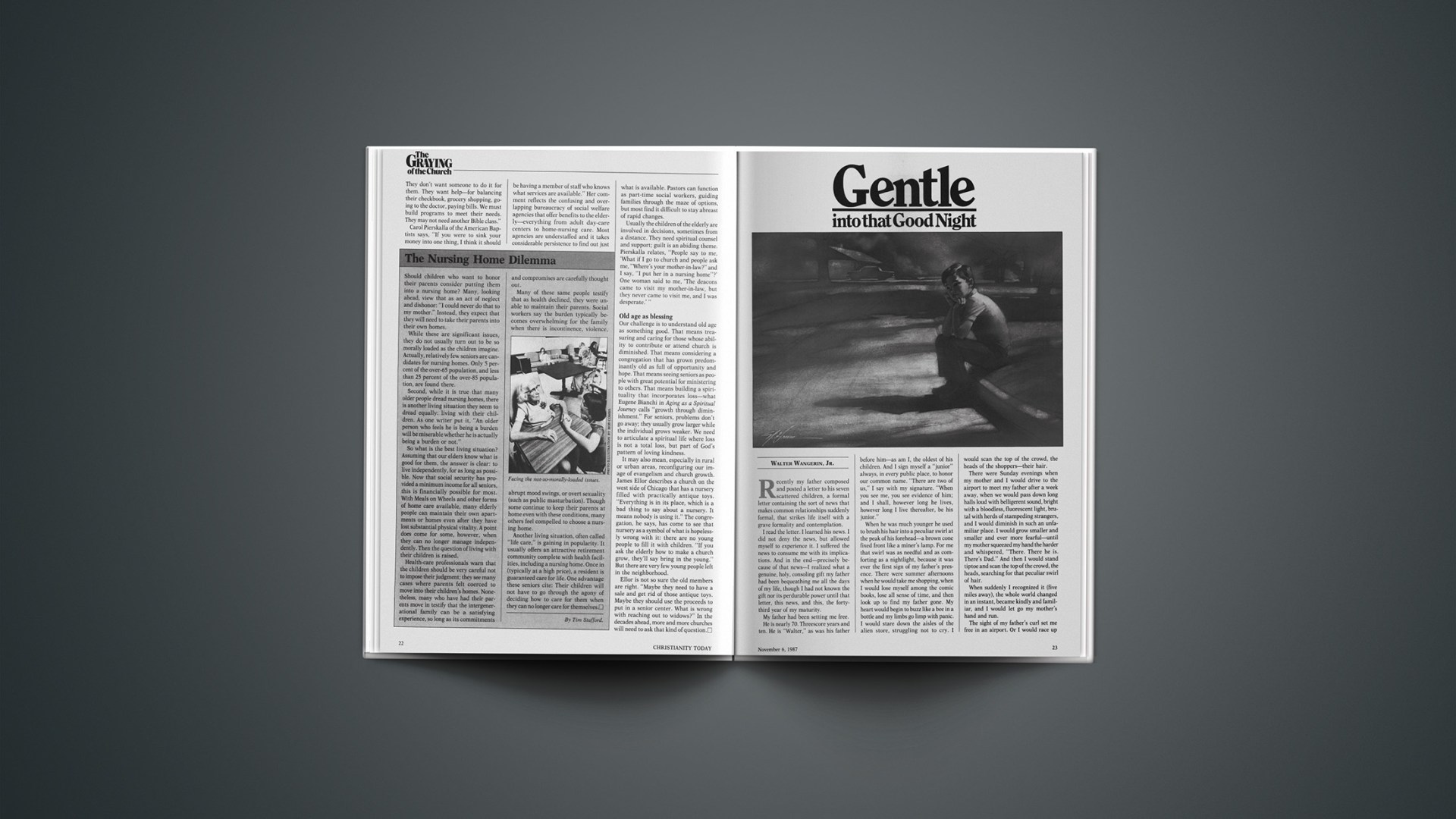
Should children who want to honor their parents consider putting them into a nursing home? Many, looking ahead, view that as an act of neglect and dishonor: “I could never do that to my mother.” Instead, they expect that they will need to take their parents into their own homes.

While these are significant issues, they do not usually turn out to be so morally loaded as the children imagine. Actually, relatively few seniors are candidates for nursing homes. Only 5 percent of the over-65 population, and less than 25 percent of the over-85 population, are found there.

Second, while it is true that many older people dread nursing homes, there is another living situation they seem to dread equally: living with their children. As one writer put it, “An older person who feels he is being a burden will be miserable whether he is actually being a burden or not.”

So what is the best living situation? Assuming that our elders know what is good for them, the answer is clear: to live independently, for as long as possible. Now that social security has provided a minimum income for all seniors, this is financially possible for most. With Meals on Wheels and other forms of home care available, many elderly people can maintain their own apartments or homes even after they have lost substantial physical vitality. A point does come for some, however, when they can no longer manage independently. Then the question of living with their children is raised.

Health-care professionals warn that the children should be very careful not to impose their judgment; they see many cases where parents felt coerced to move into their children’s homes. Nonetheless, many who have had their parents move in testify that the intergenerational family can be a satisfying experience, so long as its commitments and compromises are carefully thought out.

Many of these same people testify that as health declined, they were unable to maintain their parents. Social workers say the burden typically becomes overwhelming for the family when there is incontinence, violence, abrupt mood swings, or overt sexuality (such as public masturbation). Though some continue to keep their parents at home even with these conditions, many others feel compelled to choose a nursing home.

Another living situation, often called “life care,” is gaining in popularity. It usually offers an attractive retirement community complete with health facilities, including a nursing home. Once in (typically at a high price), a resident is guaranteed care for life. One advantage these seniors cite: Their children will not have to go through the agony of deciding how to care for them when they can no longer care for themselves.

By Tim Stafford.

A Talk with Beverly LaHaye

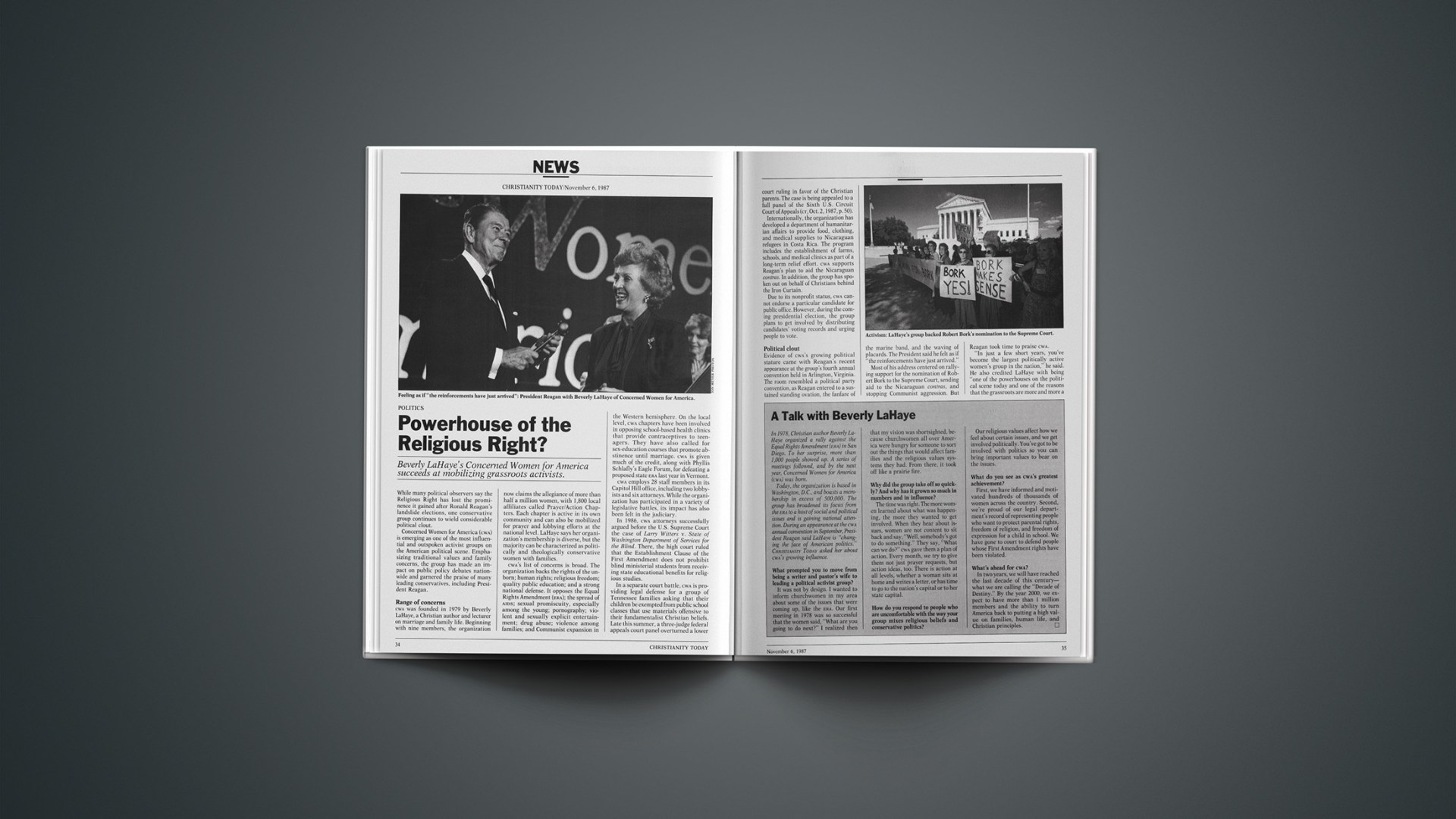
In 1978, Christian author Beverly LaHaye organized a rally against the Equal Rights Amendment (ERA) in San Diego. To her surprise, more than 1,000 people showed up. A series of meetings followed, and by the next year, Concerned Women for America (CWA) was born.

Today, the organization is based in Washington, D.C., and boasts a membership in excess of 500,000. The group has broadened its focus from the ERA to a host of social and political issues and is gaining national attention. During an appearance at the CWA annual convention in September, President Reagan said LaHaye is “changing the face of American politics.” CHRISTIANITY TODAY asked her about CWA’s growing influence.

What prompted you to move from being a writer and pastor’s wife to leading a political activist group?

It was not by design. I wanted to inform churchwomen in my area about some of the issues that were coming up, like the ERA. Our first meeting in 1978 was so successful that the women said, “What are you going to do next?” I realized then that my vision was shortsighted, because churchwomen all over America were hungry for someone to sort out the things that would affect families and the religious values systems they had. From there, it took off like a prairie fire.

Why did the group take off so quickly? And why has it grown so much in numbers and in influence?

The time was right. The more women learned about what was happening, the more they wanted to get involved. When they hear about issues, women are not content to sit back and say, “Well, somebody’s got to do something.” They say, “What can we do?” CWA gave them a plan of action. Every month, we try to give them not just prayer requests, but action ideas, too. There is action at all levels, whether a woman sits at home and writes a letter, or has time to go to the nation’s capital or to her state capital.

How do you respond to people who are uncomfortable with the way your group mixes religious beliefs and conservative politics?

Our religious values affect how we feel about certain issues, and we get involved politically. You’ve got to be involved with politics so you can bring important values to bear on the issues.

What do you see as CWA’S greatest achievement?

First, we have informed and motivated hundreds of thousands of women across the country. Second, we’re proud of our legal department’s record of representing people who want to protect parental rights, freedom of religion, and freedom of expression for a child in school. We have gone to court to defend people whose First Amendment rights have been violated.

What’s ahead for CWA?

In two years, we will have reached the last decade of this century—what we are calling the “Decade of Destiny.” By the year 2000, we expect to have more than 1 million members and the ability to turn America back to putting a high value on families, human life, and Christian principles.

Dropping the Reins at PTL

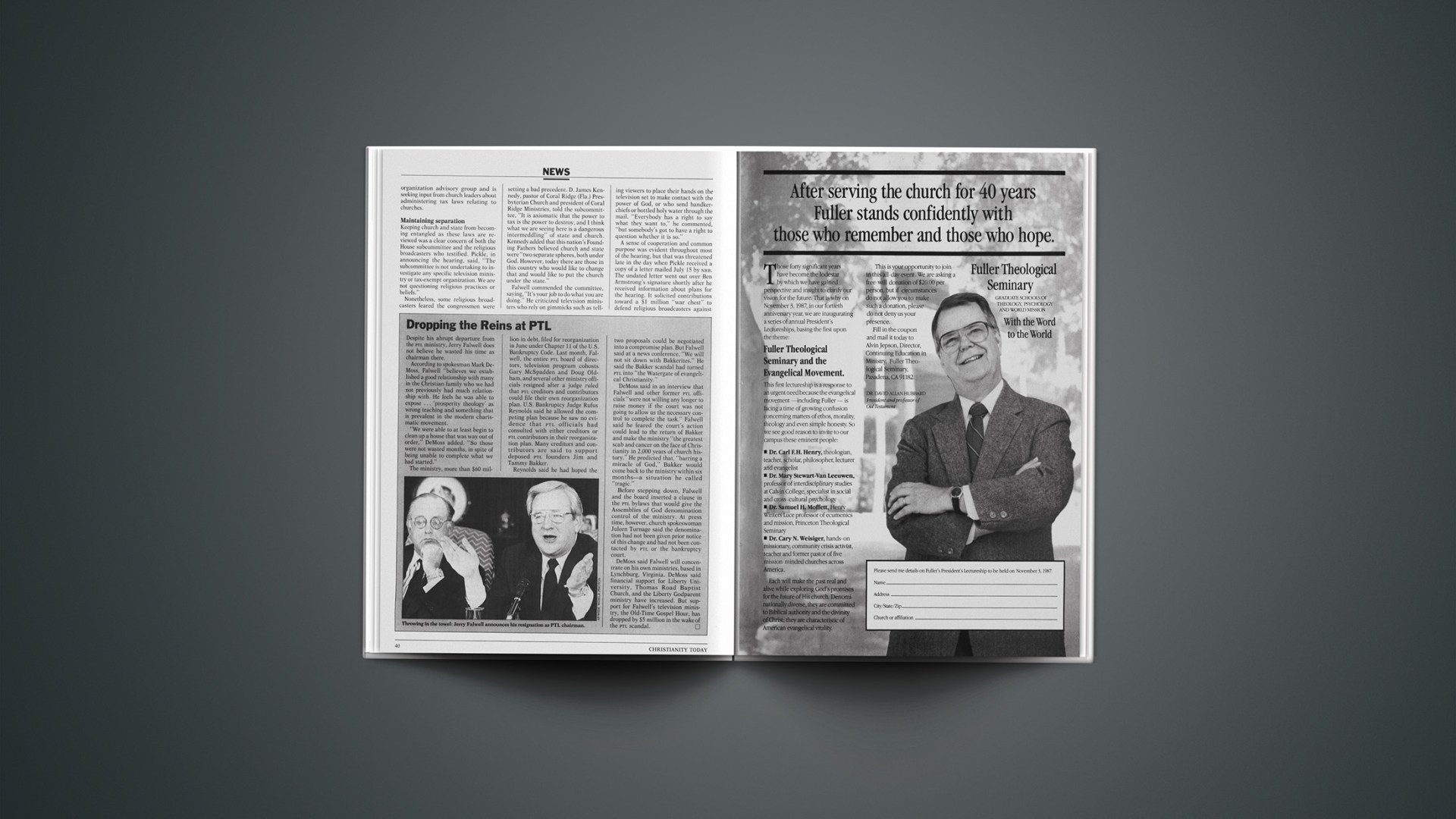
Despite his abrupt departure from the PTL ministry, Jerry Falwell does not believe he wasted his time as chairman there.

According to spokesman Mark DeMoss, Falwell “believes we established a good relationship with many in the Christian family who we had not previously had much relationship with. He feels he was able to expose … ‘prosperity theology’ as wrong teaching and something that is prevalent in the modern charismatic movement.

“We were able to at least begin to clean up a house that was way out of order,” DeMoss added. “So those were not wasted months, in spite of being unable to complete what we had started.”

The ministry, more than $60 million in debt, filed for reorganization in June under Chapter 11 of the U.S. Bankruptcy Code. Last month, Falwell, the entire PTL board of directors, television program cohosts Gary McSpadden and Doug Oldham, and several other ministry officials resigned after a judge ruled that PTL creditors and contributors could file their own reorganization plan. U.S. Bankruptcy Judge Rufus Reynolds said he allowed the competing plan because he saw no evidence that PTL officials had consulted with either creditors or PTL contributors in their reorganization plan. Many creditors and contributors are said to support deposed PTL founders Jim and Tammy Bakker.

Reynolds said he had hoped the two proposals could be negotiated into a compromise plan. But Falwell said at a news conference, “We will not sit down with Bakkerites.” He said the Bakker scandal had turned PTL into “the Watergate of evangelical Christianity.”

DeMoss said in an interview that Falwell and other former PTL officials “were not willing any longer to raise money if the court was not going to allow us the necessary control to complete the task.” Falwell said he feared the court’s action could lead to the return of Bakker and make the ministry “the greatest scab and cancer on the face of Christianity in 2,000 years of church history.” He predicted that, “barring a miracle of God,” Bakker would come back to the ministry within six months—a situation he called “tragic.”

Before stepping down, Falwell and the board inserted a clause in the PTL bylaws that would give the Assemblies of God denomination control of the ministry. At press time, however, church spokeswoman Juleen Turnage said the denomination had not been given prior notice of this change and had not been contacted by PTL or the bankruptcy court.

DeMoss said Falwell will concentrate on his own ministries, based in Lynchburg, Virginia. DeMoss said financial support for Liberty University, Thomas Road Baptist Church, and the Liberty Godparent ministry have increased. But support for Falwell’s television ministry, the Old-Time Gospel Hour, has dropped by $5 million in the wake of the PTL scandal.

North American Scene from November 6, 1987

PASTORAL COUNSELORS

Back In Court?

A California appeals court has opened the door for a new trial in a lawsuit filed against John MacArthur, a well-known Christian author and pastor; his church; and three of his church staff members.

In a 2-to-1 ruling, the appeals court upheld a motion for a new trial filed by Walter and Maria Nally. They have charged that incompetent counseling received at MacArthur’s Grace Community Church contributed to the suicide of their son, Kenneth, in 1979.

The suit, filed in 1980, was dismissed the following year by a California superior court judge. In 1984, a California appeals court overturned the lower court ruling. But in May 1985, a superior court judge dismissed the suit, saying a ruling for the Nallys would have a “chilling effect on the exercise of freedom of religion.”

The Nallys then filed a motion for a new trial, which was upheld in September by a state appeals court. In a 70-page opinion, Justice Earl Johnson said the case “has little or nothing to say about the liability of clergymen for the negligent performance of their ordinary ministerial duties or even their counseling duties except when they enter into a counseling relationship with suicidal individuals.…”

LUTHERANS

Few Protest Merger

The American Lutheran Church (ALC) reports that only 13 of its congregations have pulled out in protest over the church’s coming merger with two other Lutheran bodies. However, as many as 50 other congregations have taken the first step toward leaving the denomination.

The dissident congregations say the Evangelical Lutheran Church in America, set to come into existence January 1, does not hold to the authority of Scripture and will allow too little congregational autonomy. Seven of the 13 former ALC congregations are joining the Association of Free Lutheran Congregations, a Minneapolis-based group that claims some 20,000 parishioners in 155 congregations. Robert Lee, vice-president of the church body, said about 50 other congregations are considering membership.

One former ALC congregation has joined the Lutheran Church-Missouri Synod, and several others are in the process of joining the St. Paul-based American Association of Lutheran Churches (AALC). James Minor, AALC treasurer and organizer, predicts a larger breakaway from the ALC. A total of 863 ALC congregations voted against the church merger, but almost all of those churches have remained in the denomination.

CONTROVERSY

Rejecting An Inquiry

A panel of Episcopal bishops has decided not to investigate charges filed against John S. Spong, the bishop of Newark, New Jersey.

Charges were filed by the Committee of Concerned Episcopalians and the Prayer Book Society. Those organizations took issue with Spong’s support of a diocesan study document calling for debate on whether the church should accept sexual relationships between homosexuals, and between unmarried heterosexuals. The charges also take issue with Spong’s public questioning of the authority of Scripture and certain Christian beliefs, including the divinity of Christ.

The seven-member panel of bishops appointed to study the charges rejected them on the basis that they were filed improperly. Bishop Duncan M. Gray of Mississippi, chairman of the panel, said such charges must be signed by at least ten bishops. (The charges against Spong were signed by three priests and 19 laypersons.)

George T. Smith-Winnes, a member of the Prayer Book Society, called the panel’s ruling “a cop-out.” Meanwhile, Spong has pledged to continue examining doubts about church doctrine, including questions regarding Christ’s virgin birth and physical resurrection. He also said he would support efforts to change church bans on nonmarital sex and homosexual relationships.

MICHIGAN

Episcopal Evangelist

Eighty Kalamazoo, Michigan-area churches representing various denominations sponsored a recent evangelistic crusade led by British-born Episcopal clergyman John Guest. The eight-day event was Guest’s second major city-wide crusade.

“God loves you,” he told the audience. “He loves you personally. It’s not [just] a theological truth. It’s personal.”

Guest, who pastors Saint Stephen’s Church in suburban Pittsburgh, was converted at a 1954 Billy Graham crusade in England. More than 27,000 people attended his Kalamazoo meetings, with more than 800 making first-time Christian commitments or rededicating their lives to Christ.

PEOPLE AND EVENTS

Briefly Noted

Died: Wendell P. Loveless, 95, station manager for Moody Bible Institute’s radio station WMBI from the 1920s to the 1940s; October 3, in Honolulu, Hawaii. Asked last year about his years at WMBI, Loveless said, “When I started, my secretary and I were the radio department.… When I left, about 160 people were taking part in the radio programming.”

J. Stratton “Strat” Shufelt, 77, former minister of music at Chicago’s Moody Church, song evangelist who worked with Billy Graham on a number of his early Youth for Christ crusades in Europe; September 19, in Muskegon, Michigan.

Resigned : From the Southern Baptist ministry, Republican presidential candidate Pat Robertson. In his resignation letter, Robertson stated: “To many of our citizens the election of an ordained clergyman of any faith—Protestant, Catholic, or Jewish—to as high a public office as the Presidency of the United States would, in their opinion, be tantamount to a preference of one religious denomination over all others.”

World Scene from November 6, 1987

MISSIONS

Ready To Share Data

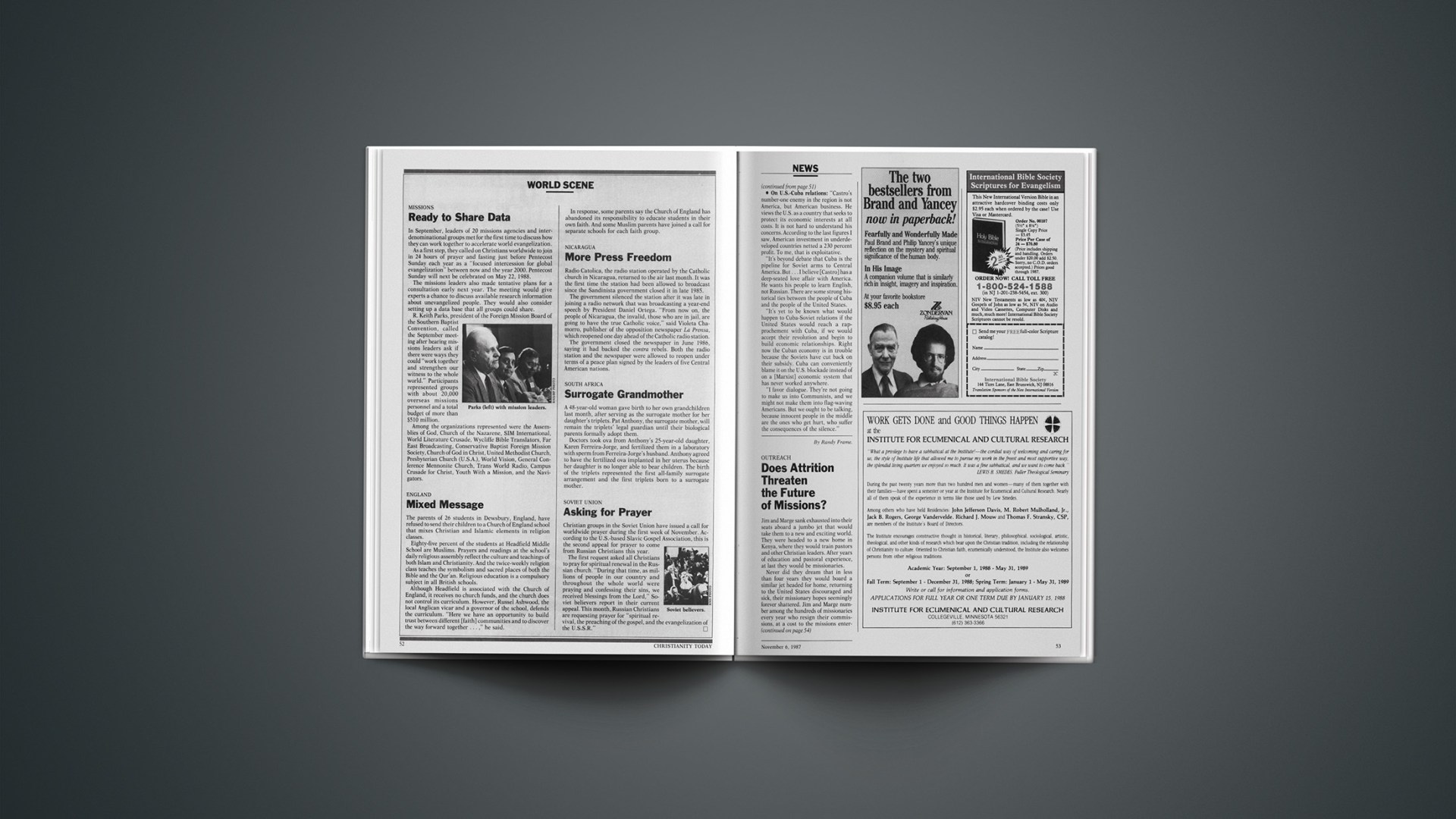
In September, leaders of 20 missions agencies and interdenominational groups met for the first time to discuss how they can work together to accelerate world evangelization.

As a first step, they called on Christians worldwide to join in 24 hours of prayer and fasting just before Pentecost Sunday each year as a “focused intercession for global evangelization” between now and the year 2000. Pentecost Sunday will next be celebrated on May 22, 1988.

The missions leaders also made tentative plans for a consultation early next year. The meeting would give experts a chance to discuss available research information about unevangelized people. They would also consider setting up a data base that all groups could share.

R. Keith Parks, president of the Foreign Mission Board of the Southern Baptist Convention, called the September meeting after hearing missions leaders ask if there were ways they could “work together and strengthen our witness to the whole world.” Participants represented groups with about 20,000 overseas missions personnel and a total budget of more than $510 million.

Among the organizations represented were the Assemblies of God, Church of the Nazarene, SIM International, World Literature Crusade, Wycliffe Bible Translators, Far East Broadcasting, Conservative Baptist Foreign Mission Society, Church of God in Christ, United Methodist Church, Presbyterian Church (U.S.A.), World Vision, General Conference Mennonite Church, Trans World Radio, Campus Crusade for Christ, Youth With a Mission, and the Navigators.

ENGLAND

Mixed Message

The parents of 26 students in Dewsbury, England, have refused to send their children to a Church of England school that mixes Christian and Islamic elements in religion classes.

Eighty-five percent of the students at Headfield Middle School are Muslims. Prayers and readings at the school’s daily religious assembly reflect the culture and teachings of both Islam and Christianity. And the twice-weekly religion class teaches the symbolism and sacred places of both the Bible and the Qur’an. Religious education is a compulsory subject in all British schools.

Although Headfield is associated with the Church of England, it receives no church funds, and the church does not control its curriculum. However, Russel Ashwood, the local Anglican vicar and a governor of the school, defends the curriculum. “Here we have an opportunity to build trust between different [faith] communities and to discover the way forward together …,” he said.

In response, some parents say the Church of England has abandoned its responsibility to educate students in their own faith. And some Muslim parents have joined a call for separate schools for each faith group.

NICARAGUA

More Press Freedom

Radio Catolica, the radio station operated by the Catholic church in Nicaragua, returned to the air last month. It was the first time the station had been allowed to broadcast since the Sandinista government closed it in late 1985.

The government silenced the station after it was late in joining a radio network that was broadcasting a year-end speech by President Daniel Ortega. “From now on, the people of Nicaragua, the invalid, those who are in jail, are going to have the true Catholic voice,” said Violeta Chamorro, publisher of the opposition newspaper La Prensa, which reopened one day ahead of the Catholic radio station.

The government closed the newspaper in June 1986, saying it had backed the contra rebels. Both the radio station and the newspaper were allowed to reopen under terms of a peace plan signed by the leaders of five Central American nations.

SOUTH AFRICA

Surrogate Grandmother

A 48-year-old woman gave birth to her own grandchildren last month, after serving as the surrogate mother for her daughter’s triplets. Pat Anthony, the surrogate mother, will remain the triplets’ legal guardian until their biological parents formally adopt them.

Doctors took ova from Anthony’s 25-year-old daughter, Karen Ferreira-Jorge, and fertilized them in a laboratory with sperm from Ferreira-Jorge’s husband. Anthony agreed to have the fertilized ova implanted in her uterus because her daughter is no longer able to bear children. The birth of the triplets represented the first all-family surrogate arrangement and the first triplets born to a surrogate mother.

SOVIET UNION

Asking For Prayer

Christian groups in the Soviet Union have issued a call for worldwide prayer during the first week of November. According to the U.S. based Slavic Gospel Association, this is the second appeal for prayer to come from Russian Christians this year.

The first request asked all Christians to pray for spiritual renewal in the Russian church. “During that time, as millions of people in our country and throughout the whole world were praying and confessing their sins, we received blessings from the Lord,” Soviet believers report in their current appeal. This month, Russian Christians are requesting prayer for “spiritual revival, the preaching of the gospel, and the evangelization of the U.S.S.R.”

Crucifying Machine

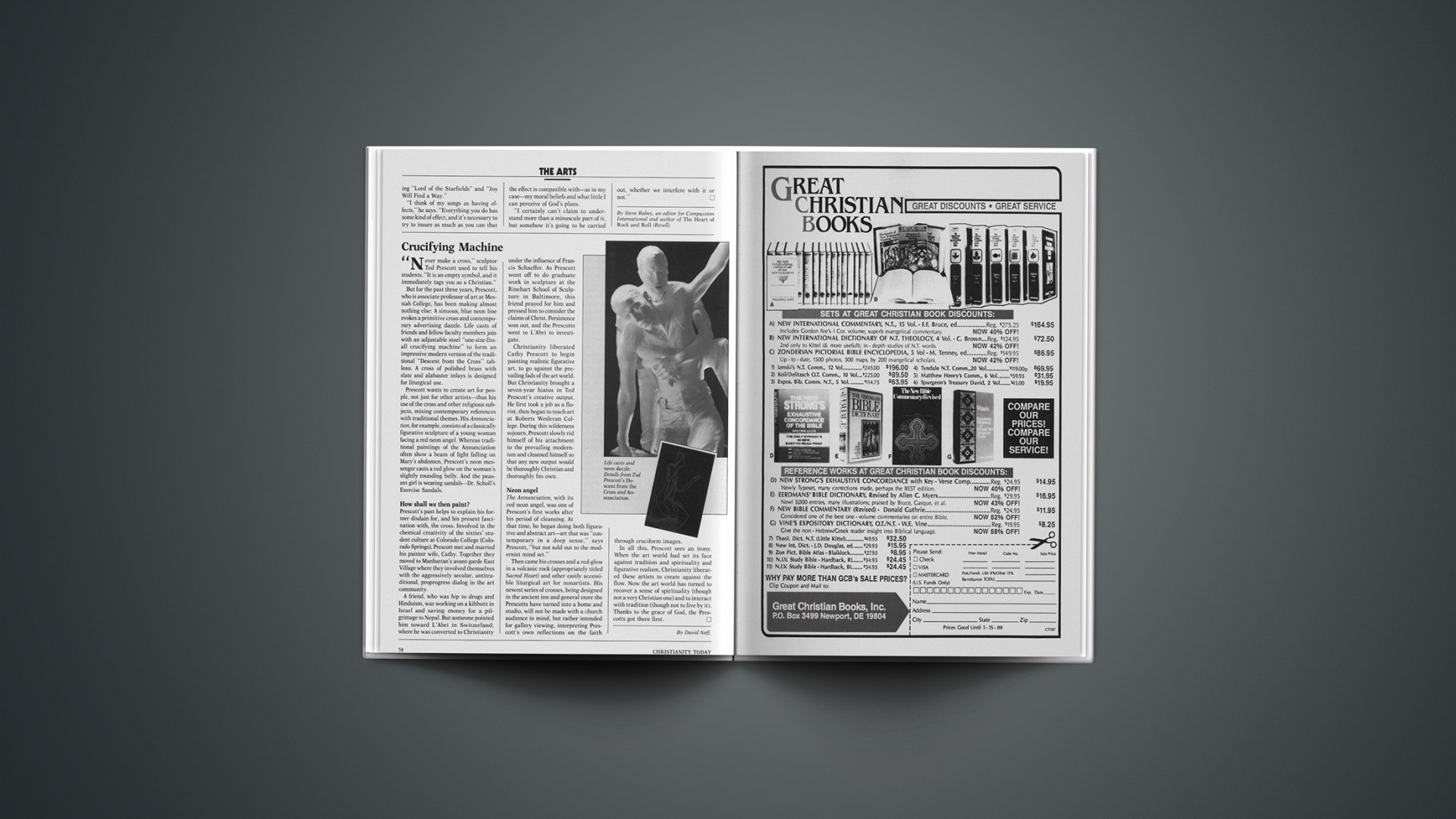
“Never make a cross,” sculptor Ted Prescott used to tell his students. “It is an empty symbol, and it immediately tags you as a Christian.”

But for the past three years, Prescott, who is associate professor of art at Messiah College, has been making almost nothing else: A sinuous, blue neon line evokes a primitive cross and contemporary advertising dazzle. Life casts of friends and fellow faculty members join with an adjustable steel “one-size-fits-all crucifying machine” to form an impressive modern version of the traditional “Descent from the Cross” tableau. A cross of polished brass with slate and alabaster inlays is designed for liturgical use.

Prescott wants to create art for people, not just for other artists—thus his use of the cross and other religious subjects, mixing contemporary references with traditional themes. His Annunciation, for example, consists of a classically figurative sculpture of a young woman facing a red neon angel. Whereas traditional paintings of the Annunciation often show a beam of light falling on Mary’s abdomen, Prescott’s neon messenger casts a red glow on the woman’s slightly rounding belly. And the peasant girl is wearing sandals—Dr. Scholl’s Exercise Sandals.

How Shall We Then Paint?

Prescott’s past helps to explain his former disdain for, and his present fascination with, the cross. Involved in the chemical creativity of the sixties’ student culture at Colorado College (Colorado Springs), Prescott met and married his painter wife, Cathy. Together they moved to Manhattan’s avant-garde East Village where they involved themselves with the aggressively secular, antitraditional, proprogress dialog in the art community.

A friend, who was hip to drugs and Hinduism, was working on a kibbutz in Israel and saving money for a pilgrimage to Nepal. But someone pointed him toward L’Abri in Switzerland, where he was converted to Christianity under the influence of Francis Schaeffer. As Prescott went off to do graduate work in sculpture at the Rinehart School of Sculpture in Baltimore, this friend prayed for him and pressed him to consider the claims of Christ. Persistence won out, and the Prescotts went to L’Abri to investigate.

Christianity liberated Cathy Prescott to begin painting realistic figurative art, to go against the prevailing fads of the art world. But Christianity brought a seven-year hiatus in Ted Prescott’s creative output. He first took a job as a florist, then began to teach art at Roberts Wesleyan College. During this wilderness sojourn, Prescott slowly rid himself of his attachment to the prevailing modernism and cleansed himself so that any new output would be thoroughly Christian and thoroughly his own.

Neon Angel

The Annunciation, with its red neon angel, was one of Prescott’s first works after his period of cleansing. At that time, he began doing both figurative and abstract art—art that was “contemporary in a deep sense,” says Prescott, “but not sold out to the modernist mind set.”

Then came his crosses and a red-glow in a volcanic rock (appropriately titled Sacred Heart) and other easily accessible liturgical art for nonartists. His newest series of crosses, being designed in the ancient inn and general store the Prescotts have turned into a home and studio, will not be made with a church audience in mind, but rather intended for gallery viewing, interpreting Prescott’s own reflections on the faith through cruciform images.

In all this, Prescott sees an irony. When the art world had set its face against tradition and spirituality and figurative realism, Christianity liberated these artists to create against the flow. Now the art world has turned to recover a sense of spirituality (though not a very Christian one) and to interact with tradition (though not to live by it). Thanks to the grace of God, the Prescotts got there first.

By David Neff.

Spying on Henry Hyde at Mass

Religion, a friend of mine joked, is being treated today the same way homosexuality once was: As long as it is practiced only among consenting adults behind closed doors, it is tolerated.

I thought of this irreverent quip while watching NBC’S news coverage of the Supreme Court decision striking down Louisiana’s “creation science” law. The counsel who represented Louisiana argued that the legislature was merely seeking to assure equal discussion of equally valid theories regarding the origins of man; academic freedom demanded no less. Anchor Tom Brokaw appeared frustrated. Finally he growled, “But weren’t many sponsors of this bill religious people—doing this for religious reasons?”

For Brokaw, apparently a person with religious motivations has no business injecting those into public debate; it seems religious convictions might contaminate public policy.

This shocking attitude is held not just by the American Civil Liberties Union and People for the American Way, but by a lot of otherwise sensible people who have been conditioned into believing that public debate should be free of any religious influence.

The U.S. Supreme Court has encouraged this mindset. In 1971’s Lemon v. Curtzman, the Court applied a threefold test of constitutionality: first, a law’s primary effect must neither advance nor inhibit religion; second, it must not result in excessive entanglement of government with religion. Fair enough so far. But the third tenet holds that a law must be adopted with a “secular intent”—and that is where difficulties arise.

It was on this third point, in fact, that the Louisiana law was struck down. The law’s drafters expressly stated a secular purpose—balanced academic teaching—but that expressed purpose was held by the Court to be a “sham.” Justice Brennan argued bluntly in a majority decision that the sponsor’s motivation was religious—hence the law itself was unconstitutional.

My concern here is not to argue the merits of the Louisiana law. It may not have been wisely drafted or advanced true academic freedom. But the grounds on which it was struck down establishes a chilling precedent. If the effect of the Court’s decision is to hold that any motivation for passing a law—be it conservatism, liberalism, Marxism, or whatever—is valid except religion, then we will have perverted religious freedom into a monstrous form of religious repression.

Congressman Henry Hyde offers a firsthand account of what it means to run afoul of this bigotry. In 1976 Congress passed the Hyde Amendment, which barred federal funding of abortion in the Medicaid program. Planned Parenthood, the ACLU, and other groups challenged the amendment’s constitutionality, claiming it imposed “a peculiarly religious view of when a human life begins.” To prove their theory, the plaintiffs’ lawyers asked to review Hyde’s mail for expressions of religious sentiment—such as the suspicious use of “God bless you” at the end of a letter. Their private investigator followed Hyde to a mass for the unborn, covertly making notes as the congressman read Scripture, took Communion, and prayed.

The plaintiffs testified that these observations evidenced a simmering religious conspiracy, claiming that Hyde, a devout Catholic, could not separate his religion from his politics and that the Hyde Amendment was thus unconstitutional.

Planned Parenthood and the ACLU ultimately lost their case. But Hyde later wrote, “Some powerful members of the cultural elites in our country … go to Gestapo lengths to inhibit [religious] expression.”

The authors of a New York law outlawing the use of children in pornography certainly went to lengths to avoid a legal battle like Hyde’s or Louisiana’s. In its preamble, the statute specifically states that the law is not based on any moral or religious considerations. Only by making such a specific disclaimer did the bill’s drafters believe they could avoid a court challenge.

That this bias against religious motivations exists is disturbing enough. But do we really understand where this growing intolerance can lead us—what kind of society we would have if the public square were sanitized of religious values?

The abolition campaign, the reform of inhumane prison and working conditions, child labor laws, education reform, and the civil rights movement: all these sprang from religiously informed motives. What would the history of social justice be like without the likes of William Wilberforce, John Wesley, Lord Shaftesbury, William Jennings Bryan, Martin Luther King? Such leaders were from both the political Left and Right, theological liberals and conservatives alike.

Even such a generally irreligious observer as John Dewey once commented, “The church-going classes, those who have come under the influence of … Christianity … form the backbone of philanthropic and social interest, of social reform through political action, of pacifism, of popular education. They embody and express the spirit of kindly good will towards [those] in economic disadvantage.”

Religiously motivated political activism brings a transcendent moral perspective to the turmoil of contemporary political affairs. While the separation of the institutions of church and state is a vital constitutional safeguard, no one ever intended the religious and political realms to be separated. To do so is to sterilize our body politic and leave it morally impoverished.

For me, Tom Brokaw’s question was hauntingly reminiscent of the celebrated remark of Lord Melbourne in Parliament 200 years ago. Rising in indignation to oppose the abolition campaign led by an outspoken Christian, William Wilberforce, Melbourne thundered, “Things have come to a pretty pass when religion is allowed to invade public life.” Had Melbourne prevailed and Wilberforce been disqualified because he spoke his Christian conscience, the abominable slave trade might not have ended.

Two centuries ago the answer to Melbourne’s challenge was yes: in the name of humanity and justice, religion must invade public life. The answer to Tom Brokaw’s question today should be no less.

Book Briefs: November 6, 1987

Schools That Work

Public and Private High Schools: The Impact of Communities, by James S. Coleman and Thomas Hoffer (Basic Books, 254 pp.; $21.95, cloth). Reviewed by D. Bruce Lockerbie, Staley Foundation Scholar-in-Residence at The Stony Brook School, Stony Brook, New York, and president of Stewardship Consulting Services.

If Thomas Paine were to publish Common Sense, his 1776 pamphlet, today, he would probably have to rename it “Statistics Show” or “A Study Reveals”—especially if he were attempting to treat some topic relating to human behavior, such as politics, religion, or education. Philosophers of old were content to observe human phenomena and rely on their common sense in uttering their wisdom. But today, we must have graphs, statistics, and the jargon of social science to justify any conclusion otherwise deemed unverifiable.

For instance, I read recently this headline in an education tabloid: “Divorce, Joblessness Identified as Primary Reasons for Child Poverty.” The article beneath that headline disclosed that “parental unemployment and divorce are the most common reasons that children fall into poverty, a study of 7,000 families nationwide has concluded.” This study, conducted by a university economics professor with funds from a foundation, followed its subjects for more than a decade.

This is no doubt an interesting way to occupy one’s time and spend somebody else’s money. But does the extensive study tell us anything we could not have figured out for ourselves? Does the scientific-research method of interpreting surveys, polls, and questionnaires improve on our common sense?

Obviously, politicians and educational sociologists believe so, as do many sheeplike citizens. Otherwise, books like Public and Private High Schools: The Impact of Communities would find no commercial publisher. Readers willing to wallow through the peculiar patois of the University of Chicago’s sociology department will discover gems worth reclaiming in standard English. But few nonspecialists will find this book readable, for the fact is that it consists altogether of arcane tables set off from prose as deadening as the graphs themselves. A single quotation will serve to illustrate:

“We suggest that a family’s action in deciding among schools should take into account three elements that we have examined at some length in this book: the human capital in the family (as exemplified by the educational and cultural level of the parents), the social capital within the family (as exemplified by the presence of adults in the household and their degree of interest and involvement in their children’s lives), and the social capital in the local community surrounding the household (as manifested by the degree of intergenerational closure in the community).”

Orientations To Schooling

Coleman and Hoffer, coauthors with Sally Kilgore of the controversial 1982 report High School Achievement, focus this study on students in grades 10 and 12; their research includes public, Roman Catholic, and other non-Catholic private schools. By questioning their sample two years later (sophomores as seniors, seniors now two years out of high school), the authors are able to justify their conclusions relating to the differences among the varieties of American secondary schooling.

Once again, this Coleman report points up the inadequacies of American public education, but not because of the reasons usually given. Rather, this report dramatizes the gulf dividing several “orientations to schooling,” three of which the authors describe. Public schools are “an instrument of the society to free the child from constraints imposed by accident of birth.” Religious schools (exclusively, in this study, Roman Catholic) function “as an agent of the religious community of which the family is a part.” Independent private schools (presumably, in this study, those without religious profession) appeal to the most individualistic inclinations: “The parents search for that school which most closely accords with their values and send their child to this school.”

Given the validity of these differences, which schools are likely to produce the most favorable (forgive the jargon) “achievement outcomes”? No fair! You relied on common sense. Where are your statistics to prove your conclusion?

“To Succour The Desolate”

A Chance to Die: The Life and Legacy of Amy Carmichael, by Elisabeth Elliot (Revell, 382 pp.; $14.95, hardcover). Reviewed by Katie Andraski, a poet and writer living in Belvidere, Illinois.

In A Chance to Die, Elisabeth Elliot challenges the reader to take a good hard look at pioneer missionary Amy Carmichael’s life and let her be a hero for our times.

An illuminating anecdote: When Carmichael landed in Japan after a heartbreaking departure from family and friends and a grueling voyage, there was no one to meet her. The crowd did not understand her. She did not understand it. All she could do was laugh. “All this was part of the going forth unto a land I knew not, and everything was just right, and if things went wrong it was so much the more fun,” Miss Carmichael wrote later.

Several years after her first stint in Japan, Carmichael settled on her life’s work, providing a home for the homeless children of India and children sold into temple prostitution there. The goals she charted for Dohnavur Fellowship, her new organization, were “to save children in moral danger; to train them to serve others; to succour the desolate and the suffering; to do anything that may be shown to be the will of our Heavenly Father, in order to make His love known, especially to the people of India.”

She constantly faced difficulties from the caste system, nominal Christians, her own frailties, and disease. Yet she also testified to God’s support and grace helping her to overcome these trials. Her successes were long and hard in coming. In her own books, she was painfully honest about the rigors of missionary life—much to the dismay of some supporters back home. She also published volumes of poetry that are still read and admired today.

A Chance to Die reveals what it was like to be caught up in the great missionary tide that went out from England during the latter part of the last century. It gives an accurate picture of the mindset that drove people to serve the Lord in foreign countries.

Carmichael’s Muted Flaws

For the most part, Elliot has done a superb job of telling Amy Carmichael’s story. Paced like a novel, the book is entertaining, interesting, and instructive. But Elliot seems worried about whether readers would find in Carmichael the same hero she found. Elliot’s defensive tone made this reader wonder what she had to hide.

Carmichael’s muted flaws become visible in this book. There are, for example, her sudden departure from Japan for Ceylon without regard for her supporters, and her breakup with several families that worked at Dohnavur. But everyone is sinbound. It is a miracle of grace that God can accomplish anything good through us.

Elliot’s penchant for taking pot shots at contemporary thinking is an irritating and intrusive element in this book. For instance, when Elliot compares Carmichael’s courage to current approaches to grief: “If she had been born a hundred years later, she would very likely have been encouraged to be angry, told she had a right to express her sorrow and her bewilderment and her rage, and generally to disintegrate.”

Carmichael’s courage is to be admired. But why use it as a sledgehammer to batter our culture’s way of coping?

But these are minor points next to the Carmichael legacy. A Chance to Die is worth reading because her story challenges comfortable faith, making us look and look again at our own sacrifice and service.

Highlighted

Preserving The Story

Herbert O’Driscoll, rector of Christ Church in Calgary, was for five years the author of the “Back Page” in The Observer, a magazine of the United Church of Canada. These reflections have now been anthologized in And Every Wonder True (Wood Lake Books, 109 pp.; $9.95, paper). In this excerpt, O’Driscoll’s meditation on the Qumran community’s dedication to preserving Scripture leads him to think about Celtic scribes and contemporary translators:

“As I walked about Qumran I couldn’t help thinking of another community which another despairing time in history gave its energy and skills to transform the sacred text of Scripture with brilliant artistry.

In the sixth and seventh centuries, when the lights of the western Mediterranean world seemed to have gone out, many fled that exhausted world and took refuge in the distant, haunted, harsh world of the Atlantic coastlines and islands. There in the crude and isolated shelters monks once again gave themselves to the written word. In fantastic and complex detail they embellished the pages of the Gospels with designs of endless convolution, preserving both the words of the Bible and their devotion to them.

Is it more than a coincidence that as the second half of this eventful century began and the pace of history and of human experience quickened and intensified that we have begun in translation after translation, paraphrase after paraphrase, to again mine the meaning of the timeless story we possess? Is all this an unconscious realizing that ours is a ‘Qumran’ time, an ‘Iona’ time, when our paramount task is to preserve the Story, placing it not in caves or in bogs to survive a dreaded future but in the hearts and mind of all who will listen?”

More Influential Than When He Died

How Karl Barth Changed My Mind, edited by Donald K. McKim (Eerdmans, 186 pp.; $9.95, paper). Reviewed by Gregory C. Bolich, president of the Christian Studies Institute, Cheney and Spokane, Washington, and author of the 1980 book Karl Barth and Evangelicalism.

This volume contains essays from 26 contemporary religious thinkers. Their only real unity is their acknowledgment of Karl Barth’s genuine importance not only in the history of theology, but for doing theology today. If anything, Barth is more influential today than at the time of his death. His influence is claimed by adherents of diverse theological outlooks, including evangelicalism. One of the virtues of this volume is its diversity of perspectives and personalities. Several of the contributors are familiar names in evangelical circles:

• G. W. Bromiley is well known for his translation work, which includes much of what is available in English by Barth. He makes plain that reading Barth firsthand “is an experience that all who make a serious pretence of theology and all who have an authentic concern for ministry should not on any account miss.” Among Bromiley’s lasting impressions are the priority of biblical investigation evident in Barth, the relevance of historical theology, and the arousal of an appreciation of dogmatics. Bromiley provides a sensible and fair appraisal of Barth. Not insignificantly, it is also marked by an attention to often misunderstood areas of Barth’s thought, such as creation and a natural knowledge of God. Nor does he neglect Barth’s character, pointing to his integrity, his mellowing with age, and his enduring faith.

• Bernard Ramm has certainly not ignored Barth. In fact, in recent years some have questioned his evangelical standing because of his open utilization of Barth’s thought. Yet, Ramm confesses, even in the doctrine of Scripture, where he finds Barth most useful, “There are some hard problems to face to make his theory workable.” In Barth, Ramm finds help to correlate biblical criticism and divine revelation, without giving up inspiration or authority, and so gaining a fearless and holistic position on Scripture.

• Donald Bloesch has also interacted significantly with Barth. In his own two-volume Essentials of Evangelical Theology Bloesch is often in dialogue with Barth. He unblushingly confesses, “Besides Luther and Calvin, I count Karl Barth among my principal theological mentors.” From this teacher he has been helped most by “his fresh interpretation of biblical authority.” Of course, this is precisely where Barth has attracted the most evangelical attention, and occasioned the most controversy. Like Bromiley, Ramm, and Pinnock, Bloesch appreciates Barth’s stress on the Bible and the objective character of revelation. Ramm and Bloesch, in particular, see in Barth’s doctrine of Scripture tremendous resources for evangelicals.

Bloesch, like many evangelicals, worries that Barth has left no genuine place for personal, decisive faith and obedience. Despite this imbalance, Bloesch maintains that Barth is “an evangelical theologian who transcends the parochialism of both fundamentalism and a narrow confessionalism.” And, in his opinion, we cannot safely ignore Barth.

• Clark Pinnock, who does not share Bloesch’s or Ramm’s enthusiasm for Barth’s views on Scripture, is the strongest evangelical critic of Barth in this volume. Nevertheless, he rescues something: “His emphasis on the concrete actuality of revelation is obviously biblical and begs to be given a nobler place in our apologetic efforts than it has been given.” Like his evangelical colleagues, Pinnock is neither afraid to confront Barth nor to acknowledge his helpfulness.

• John Yoder’s essay was, for me, both the most provocative and problematic of the evangelical contributions. For him, Barth “is not rehabilitating orthodoxy or establishment,” but moving to “radical churchmanship” along the lines of “the free church vision.” I think Yoder’s essay may say more about himself than about Barth. But without debating this thesis, I wish to point again to the openness of Yoder to Barth, and his ability to discern in Barth’s theology challenging and resourceful insights.

Indeed, openness to Barth while retaining critical awareness seems a fair characterization of the evangelical contributors to this volume. Anyone familiar with these individuals will know their independence from one another. What they demonstrate is that Barth is too important not to be reckoned with, and too helpful not to be used. Barth’s ideas on Scripture, natural theology, and salvation remain critical concerns for evangelical theologians. But today evangelicals are finding creative ways to dialogue with Barth, rather than to lapse into simple (and simplistic) judgments for or against him. That is a healthy development, and this memorial to Barth marks this happy situation.

Apple PodcastsDown ArrowDown ArrowDown Arrowarrow_left_altLeft ArrowLeft ArrowRight ArrowRight ArrowRight Arrowarrow_up_altUp ArrowUp ArrowAvailable at Amazoncaret-downCloseCloseEmailEmailExpandExpandExternalExternalFacebookfacebook-squareGiftGiftGooglegoogleGoogle KeephamburgerInstagraminstagram-squareLinkLinklinkedin-squareListenListenListenChristianity TodayCT Creative Studio Logologo_orgMegaphoneMenuMenupausePinterestPlayPlayPocketPodcastRSSRSSSaveSaveSaveSearchSearchsearchSpotifyStitcherTelegramTable of ContentsTable of Contentstwitter-squareWhatsAppXYouTubeYouTube