Editor’s Note from September 16, 1966

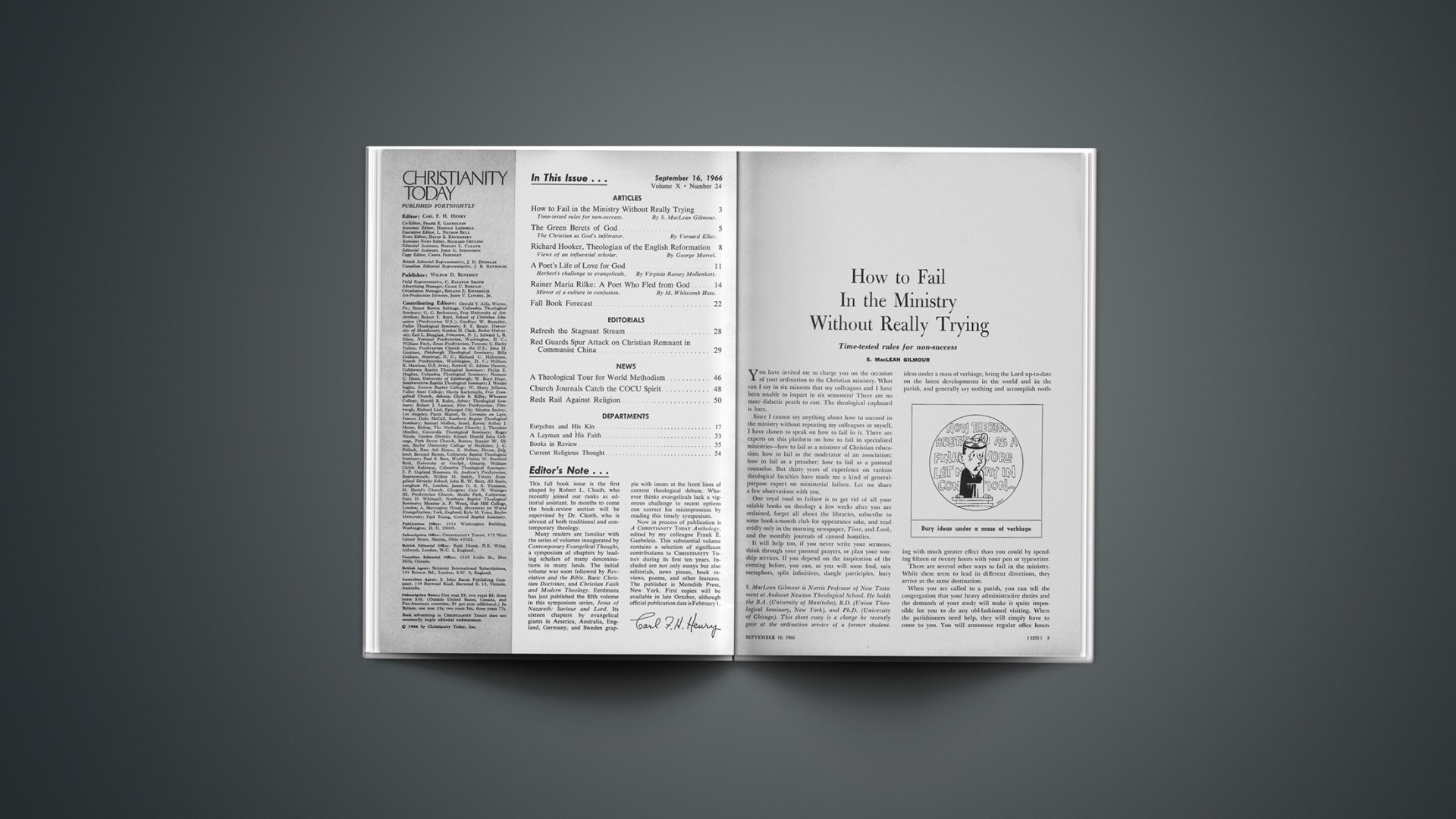
This fall book issue is the first shaped by Robert L. Cleath, who recently joined our ranks as editorial assistant. In months to come the book-review section will be supervised by Dr. Cleath, who is abreast of both traditional and contemporary theology.

Many readers are familiar with the series of volumes inaugurated by Contemporary Evangelical Thought, a symposium of chapters by leading scholars of many denominations in many lands. The initial volume was soon followed by Revelation and the Bible, Basic Christian Doctrines, and Christian Faith and Modern Theology. Eerdmans has just published the fifth volume in this symposium series, Jesus of Nazareth: Saviour and Lord. Its sixteen chapters by evangelical giants in America, Australia, England, Germany, and Sweden grapple with issues at the front lines of current theological debate. Whoever thinks evangelicals lack a vigorous challenge to recent options can correct his misimpression by reading this timely symposium.

Now in process of publication is ACHRISTIANITY TODAYAnthology, edited by my colleague Frank E. Gaebelein. This substantial volume contains a selection of significant contributions to CHRISTIANITY TODAY during its first ten years. Included are not only essays but also editorials, news pieces, book reviews, poems, and other features. The publisher is Meredith Press, New York. First copies will be available in late October, although official publication date is February 1.
The Artist as a Witness

Can fine art be used in communicating the Gospel? The work of Gordon Kelly with “Creative Christian Ventures” may point to a new breakthrough in this direction.

When Gordon Kelly was suddenly arrested by God in a dramatic conversion in Manhattan in 1951, he was facing a brilliant career as a painter. A graduate of the Art Student League of New York and a member of its faculty, he was closely associated with the late Kenneth Hayes Miller, one of the greatest of American teachers of art. Kelly was well on his way to wide recognition and even fame.

Yet, as he himself puts it, he was a pagan. Though born and brought up in the “churchy” town of Richmond, Indiana, he had never been told about Christ and the Gospel. He began to paint at an early age and, self-taught, won prize after prize. After service in the Air Force, he decided to study art and chose the Art Student League because it had produced more leading American artists than any other school.

Kelly describes his conversion as a mystical experience that stopped him in his tracks. He saw his pursuit of artistic fame as cultural idolatry. The whole direction of his life was changed. He went to the nearest church (the Cathedral of St. John the Divine in New York), told what had happened to him, and was baptized and received into the Episcopal Church.

Kelly’s work immediately took a new turn. He began the study of the Bible and theology which he pursued intensively for seven years and in which he is still engaged. He gave up his teaching at the Art Student League to devote himself to religious art. Lean years followed, during which he worked as house parent at a children’s home in the Bronx, New York, and taught art at Scarborough School, Scarborough, New York. He also designed church publications and church interiors.

About 1959, Kelly began taking his religious paintings to church groups, retreats, and campuses and using them as a basis for stimulating discussion about Christianity and man today. Those who heard him were responsive, and invitations piled up. In 1965, Kelly’s work was sponsored by the Lilly Endowment, Inc. His studio is in Indianapolis. Members of the board of “Creative Christian Ventures, a Christocentric Dialog in Art Forms,” represent a cross section of American Protestantism, including such men as Samuel Emerick (director, Yokefellow Institute), Lawrence T. Hosie (former executive director, Church Federation, Greater Indianapolis), Franklin Littell (president, Iowa Wesleyan University), Charles F. Whiston (Church Divinity School of the Pacific), and Richard Wolff (executive secretary, International Christian Broadcasters).

As a result of his conversion, Kelly has repudiated as a form of idolatry the idea of art for art’s sake. He sees unity as basic to art and links this unity to the Christian concept of agape. He finds in abstractionism a neurotic tendency but also repudiates the trend to meticulous representation of detail in art (see his essay on page 27).

Some authorities, such as Grant Reynard, N. A., rate his work very highly seeing in it remarkable mastery of painting and deep spiritual content. Reynard, who has been president of the Montclair, New Jersey, Art Museum and is now chairman of its art committee, says of Kelly, “His paintings [are] based on a deep understanding of the Bible and the creative technique of the early masters.… Gordon Kelly has given us Jesus’ humanity and God the Son in one person. This may be a large statement, but I hardly know of anyone since Rembrandt who has done this with more spiritual force.”

On the other hand, the kind of religious painting Kelly is doing might well be too traditional for some artists and critics who today are committed to abstractionism. Nevertheless, his pictures make a deep impression and lead to searching conversation about spiritual reality.

Kelly is a member of the board of the Yokefellow Institute, Richmond, Indiana, and chairman of its program committee. He is also a member of the Christian social relations committee and chairman of the committee on architecture of the Episcopal Diocese of Indiana.

Canada: Was Graham ‘Waffling’?

A year ago Chaplain Ben Smillie of St. Andrew’s College, Saskatchewan, launched a scathing attack on Billy Graham through the United Church Observer, official publication of The United Church of Canada. Since then, the Observer (which its editor, the Rev. A. C. Forrest, has made just about the liveliest church magazine in North America) has kept the controversy going.

Forrest defended Graham and associate Leighton Ford against Smillie’s charges. Then, from correspondence, Forrest got the impression that Graham was “waffling” (Webster: to flutter, flap, or be unsteady) and switched sides. The Observer charged Graham with dishonesty, asserting that his syndicated newspaper columns were written by associates. Graham acknowledged outside emergency help but said “in these cases each column was carefully edited by me personally.”

Smillie asked the Anglican and United Churches to withdraw all support from Graham, who is planning major Canadian campaigns for next year’s centennial (see following story). The evangelist, Smillie contended, encourages biblical ignorance by believing in a docetic Christ, “clay-made man, a floating zoo, an amphibious-footed Jesus, a son of God who demonstrated his divinity as a home brew artist … and topped it off with an ascension that looks like a Cape Kennedy blast-off.”

Many Anglican and United Church ministers came to Graham’s defense. Among them was Dr. Ralph Chalmers, professor of systematic theology at Pine Hill Divinity Hall, a United Church theological college (seminary) in Halifax. Chalmers, ardent ecumenist who was nominee for moderator of the General Council, called Smillie’s charges “sectarian liberalism.” “My own ecumenical interests were broadened in the local crusade in 1964,” said Chalmers, who was chairman of the Halifax crusade. “The crusade method, with its preparation in Bible study and prayer, in the formation of fellowship cells, in meetings with many groups, has proven its worth.… Let us support Billy Graham.”

The Observer then went after Graham again this summer, calling for answers to twenty-eight questions on matters ranging from his salary to his belief in the literal Adam and Eve. The questions showed concern about Graham’s use of the terms “apostate,” “false prophets,” and “wolves in sheep’s clothing.” Were these references to United Church men? Graham said he did not engage in passing “judgment on individual churches and clergymen within the United Church of Canada.”

Although Forrest has shifted positions (waffling) during the Graham controversy, the Observer has found Graham worthy of more coverage than any other issue. In spite of the sensation caused by the Smillie-Graham debate, the Observer lost more than 2,500 subscribers during the year, and approximately 21,000 during the last two years.

J. BERKLEY REYNOLDS

The Prime Minister’S Request

While some Canadian churchmen argue the merits of Billy Graham (see story above), Prime Minister Lester B. Pearson and many of the nation’s provincial premiers have asked the evangelist to come north during the 1967 centennial. It is the first time a head of state has invited Graham to come and preach.

Most of the Graham organization’s work there has been handled by Dr. Leighton Ford, an associate evangelist, a Canadian, and Graham’s brother-in-law. Last month, the Ivy-Leaguish Ford spoke to nearly 48,000 people in a fourteen-day series of meetings in Regina, Saskatchewan, during which 550 persons came forward to receive Christ.

Ford’s next crusade will be in Calgary, Alberta, from September 18 to October 2. During the centennial year, he is scheduled to hold services in Edmonton, Alberta; Swift Current and Saskatoon, Saskatchewan: and St. Catherines, Ontario.

Graham’s own Canadian plans for 1967 are unsettled, but his organization is working on crusades in Ottawa, the nation’s capital, Winnipeg, Regina, Calgary, and Edmonton. The most intriguing locale will be Montreal, home of the 1967 World’s Fair. It is Canada’s largest city, sprawling out over the great St. Lawrence River, and has a 90 per cent Roman Catholic population.

Everett M. Dirksen And Prayer

Everett McKinley Dirksen is spending a good part of his seventieth year trying to squeeze through Congress a “voluntary school prayer” amendment to the Constitution.

Despite sophisticated objections from lawyers and many church spokesmen (see previous issue, page 46), the Senate Republican leader clings to the simple convictions that prayer is good, Supreme Court rulings have been distorted, and Congress should do something about it.

Newsweek’s Kenneth Crawford thinks Dirksen’s motivation is a belief that prayer works. In 1947, Dirksen resigned from the House because inflamed retinas impaired sight in one eye and threatened the other. He was told by a doctor to have one eye removed; but on a train trip, after kneeling in prayer, he decided against it. The eye stayed and healed, and Dirksen resumed his political career.

Do The Beatles Beat The Church?

After George Gallup gets the fall elections out of the way, maybe he’ll help answer the pressing question: “Who’s more popular—Jesus Christ or the Beatles?”

John Lennon, 26, a member of the Briitsh rock ’n’ roll quartet that displays more hair than talent, started it all by telling a London reporter, “Christianity will go. It will vanish and shrink. I needn’t argue about that; I’m right and I will be proved right. We’re more popular than Jesus now.…”

When Datebook reported the Lennon Poll on the eve of the Beatles’ summer U. S. tour, it was enough to start record bands and burnings. A publicist whisked to New York to undo the damage. But many ministers were willing to admit that Christianity isn’t all that popular. On tour, Lennon insisted his statement was true but was said in sadness rather than triumph. He added, “I can’t express myself very well.”

Those who read Lennon’s profane, pun-packed, nutty novel A Spaniard in the Works would agree. But the Rev. David Noebel of the anti-Communist Christian Crusade took the book seriously. He thinks its hero, Jesus El Pifco, is actually Jesus Christ, and finds too much Lenin in Lennon.

Beatle-babbling about Christianity has gone on for a couple of years, in such forums as Playboy and the Saturday Evening Post; but the latest remark just hit at the wrong time.

Lennon admits he’s in a stage of spiritual wandering. He told the Washington Post he was bored by Church of England training, went into atheism, and is now influenced by Hugh Schonfield’s The Passover Plot, which contends that the Bible account of Jesus is a hoax.

In recent years the silver-tongued senator from Illinois has been beset by a variety of other ailments. This spring, hours after release from one of many stays at Walter Reed Army Hospital, he declared his prayer crusade in an informal, rambling address before the Washington chapter of Sigma Delta Chi, professional journalism fraternity. Between sips, the senator weaved an elaborate tapestry about the faith of his fathers; told how his parents helped build the Second Reformed Church of Pekin, Illinois (he’s still a member there but considers himself a Presbyterian); and lamented that little children are kept from praying in schools.

By mid-August, Dirksen was on crutches with a broken thigh, grounded during the election campaign by doctors. But the prayer drive was still aloft, and Dirksen, a master tactician, was committed to a Senate roll call on prayer. He had a UNICEF resolution on the calendar and could attach a prayer rider to it if the judiciary subcommittee held up his bill and adjournment seemed near. Dirksen even suggested tacking one on the civil rights bill, possibly as a substitute for the fair housing section. “The right to pray is a civil right, isn’t it?” he asked.

Quakers And Christ

Haverford College history professor Edwin B. Bronner cites development of a non-Christian wing among Quakers and urges more dedication as a countermeasure.

Bronner, in a talk last month before Quakers of the Baltimore-Washington area, said non-Christians have been vocal in yearly meetings in London and on the continent of Europe but have been less outspoken in the United States.

The Washington Post quoted Bronner as saying mainstream Quakers should meet the challenge mainly by making the Christian relationship more meaningful.

St. Paul As Minority Leader?

Hebrew University scholar Shlomo Pines, who is at the vortex of a major debate on the origins of Christianity, arrives from Jerusalem this month for a year at Princeton’s Institute for Advanced Studies. He hopes to continue his analysis of an eleventh-century manuscript by Muslim theologian Abdul-Jabbar that recently turned up in Istanbul. It includes an account of Nazarenes who split from the early Christian Church in A.D. 62 that may date to the fifth century.

Many accept the idea that an early sect denied Christ’s divinity; but Pines, after studying the document, believes that the mainstream of early Jewish Christians considered Jesus a mere prophet and that those who didn’t were a small minority led by Peter and Paul.

Pines also find evidence that leads him to believe original accounts about the Jewish Christians were “lost” and rewritten later from memory and from non-Jewish sources.

Pines, interviewed in Jerusalem, admitted knowledge of research there by Dr. R. L. Lindsey, a Baptist who is translating the New Testament into modern Hebrew. Lindsey is convinced that Mark wrote his Gospel from primary Hebrew sources, not secondary ones as Pine believes, because his word order is typical of Hebrew, not Greek.

Pines’s theory would cast doubt on the reliability of the Book of Acts. It meshes with the idea of many Jewish scholars that Paul, a renegade Jew, corrupted Christianity and made it unacceptable to Jews. In the manuscript’s version, Paul and his followers teamed up with the Romans to drive the Nazarenes to Haraan.

Until Christian scholars can examine the manuscript, or at least see the English translation that will be published soon, they will have to withhold judgment on Pines’s conclusions. But prospects are exciting that the new material will help church historians re-examine the fate of the little-known Jerusalem Christians of the first centuries.

A Christian Quits Iraq

Because he felt he was the victim of religious discrimination, a Christian officer in the Iraqi air force defected to Israel last month—and thus gave the free world one of the Soviet government’s most advanced military planes.

The 30-year-old pilot, whose name was not immediately divulged, was identified as a Roman Catholic who regarded his position in a predominantly Muslim environment as “rather awkward.” He reportedly complained of being passed over in promotions, of feeling insecure during successive military coups, and of suffering from fatigue because of repeated bombing missions against rebel tribesmen.

An air force commander in Israel said he had received a letter from the pilot advising him of the defection plans ten days before. The pilot flew to Israel in a Soviet-built MIG 21, capable of twice the speed of sound. It was believed to be the first of the jet fighters delivered intact to the West.

The pilot said he had spent ten years in the Iraqi air force, including four months in the Soviet Union learning to fly the MIG 21. He had managed to move his family out of Iraq before defecting.

Iraq has an estimated 150,000 Christians in a population of 7,000,000.

Confession Sets off Dispute with Military

Presbyterian Life rushed to the defense of a proposed new confession last month after a flurry of protests over a phrase on political priorities.

An article appearing under bold red lettering, “One Criticism of the Confession Is Irrelevant,” sought to characterize the issue as loyalty to God versus loyalty to country. The article was signed by the new stated clerk of the United Presbyterian General Assembly, William P. Thompson.

At issue are six words in the so-called Confession of 1967, a statement of faith now being voted upon by presbyteries. General Assembly offices have been getting numerous letters arguing that the six words “even at risk to national security” may compromise members’ loyalty to the United States.

The phrase became a major concern for denominational officials this summer after it was learned that at least three military legal officers had advised servicemen who are United Presbyterians that under the present wording they would have to resign their church offices. Some actual resignations were reported, and church officials appealed to the Defense Department to overrule the legal officers.

The phrase appears in the following context:

“God’s reconciliation in Jesus Christ is the ground of the peace, justice, and freedom among nations which all powers of government are called to serve and defend. The church, in its own life, is called to practice the forgiveness of enemies and to commend to the nations as practical politics the search for cooperation and peace.

“This requires the pursuit of fresh and responsible relations across every line of conflict, even at risk to national security, to reduce areas of strife and to broaden international understanding.”

Through an apparent typographical muff, quotation marks were left off the last paragraph in the quoted section, which may further confuse Presbyterian Life readers. The article contends that “the church has always proclaimed that man’s first loyalty belongs to God, and that all human institutions are under His judgment as well as under His providential care. If the church were to consent to silence in deference to the presumed primacy of ‘national security,’ as an overwhelming number of churches did in Nazi Germany, then the church would be guilty of the idolatry forbidden in the Second Commandment.”

Other Presbyterian observers assert that reducing areas of strife and broadening international understanding, however desirable, are neither mandates of the church nor tests of loyalty to God. Indeed, they say, the freedom and standards of the church at times conflict with harmony among nations, as has been the case with Spain and Colombia and, at present, with Southern Rhodesia and South Africa.

The article, published in the August 15 issue, seeks to play down the importance of the question: “Quite regardless of the demands of faith, both waging war and waging peace always entail risk to the nation.” Moreover, “Presbyterians are not required to accept every detail of any confession of the United Presbyterian Church.”

The controversial phrase was debated vigorously at last May’s General Assembly in Boston. A Presbyterian employee of the Pentagon succeeded in toning down the phrase a trifle, but the change failed to satisfy many.

The Confession of 1967 won initial approval at the May assembly and comes up for a final General Assembly vote next year.

Labor Day Notes

Last month President George Meany of the AFL-CIO interrupted surveillance of the airline and newspaper strikes to send to union officials across the nation copies of the Labor Day statements from America’s three major religious groups.

Meany wrote, “I suggest that you discuss these statements with church and synagogue leaders in your area as soon as possible. You may be able to arrange for joint participation in Labor Day ceremonies or for joint discussions this fall of labor and church programs.”

The National Council of Churches’ message, recommended for reading in services September 4, is a summary of an economic declaration from its General Board last February. It heralds the end of the dogma of “confident individualism,” states that legal ownership of resources doesn’t “confer unlimited right to their use,” urges economic policy assuring an “adequate income” for all, and urges “reappraisal of the role of government and its budgets.”

The Synagogue Council of America has a similar recitation of generalizations. But the National Catholic Welfare Conference came up with some gutty material. Along with quoting the Bible (something the Jews also did and the Protestants didn’t), the statement takes a few potshots at organized labor.

NCWC says friends of the unions suspect that “success may have spoiled Big Labor” on doing something about employment bias. It suggests that labor “take a self-critical and ruthlessly honest look” at the growing rift between unions and Negroes, “which is largely of its own making.” (The statement admits management’s record is no better and “may not be quite as good.”)

The Catholic statement also praises union organization among farm workers, a drive that has strong clerical support in the California grape country and has lately spread to the melon lands of Texas. The NCWC theory is that America’s economic balance of various major interest groups is distorted when many Americans such as migrant workers or Negroes are outside the power blocs like Big Labor, Big Business, Big Agriculture.

Abortion At Issue

The abortion trial of nine San Francisco Bay area doctors this fall will highlight a controversy with complicated religious and political overtones that has been smoldering for some time in the nation’s most populous state.

The major issue: Should a doctor perform an abortion when there is a high probability the baby will be deformed? Episcopalians and many other Protestants are lining up on the “yes” side. Roman Catholics and Missouri Synod Lutherans are by and large in opposition.

The present furor began May 20 when the State Board of Medical Examiners filed charges of illegal abortion against Dr. John Shively, obstetrics chief at St. Luke’s Hospital (Episcopal), and Dr. Seymour Smith of non-sectarian St. Francis Hospital. Since then, seven other highly reputable Bay area doctors have been charged.

They are accused of arranging, approving, and performing abortions illegal under the present California law, which permits only those “therapeutic abortions” deemed necessary to save the life of a mother in critical condition.

State prosecution by Attorney General Thomas Lynch, a Roman Catholic now running for re-election, was provoked by recent candor of the medical profession in admitting that some women are aborted for reasons other than life-saving.

Doctors largely favor a more liberal law that would permit abortions if mental health is endangered by continued pregnancy, if pregnancy resulted from rape or incest, for girls under 16, or if there is a substantial risk that the child will be born with serious physical or mental defects.

Hearings last year on the Beilenson Bill to liberalize abortion laws brought to light the increasing number of therapeutic abortions performed by doctors on women who, while pregnant, had contracted German measles in the epidemic that broke out in California a year ago. The disease causes deformed babies in many cases. That bill died in committee, but the current furor should help a new version in the next legislative session.

Delegates to the March convention of the California Medical Association gave overwhelming approval to a resolution supporting a new law “taking into consideration the health of both the mother and the product of conception.” They added that a new law should provide proper control of abortions through established medical staffs or medical society committees.

Those supporting the nine men accused of unprofessional conduct rest their case on a liberal interpretation of the present law and on growing public acceptance of abortion for reasons other than life-saving.

“The public wants this,” said Dr. Edmund Overstreet of the University of California Hospital. “A vast majority of physicians want it. Only a small, organized, die-hard group opposes liberalizing the law.”

His opinion is bolstered by a survey made last year by San Francisco State College. It found 79 per cent of “representative adults” polled favored abortions for women who had German measles in early pregnancy. About 72 per cent favored abortions for women psychologically upset by their pregnancies; 83 per cent favored abortions for victims of rape or incest.

The major target of medical anger expressed all over the state is Dr. James V. McNulty, a member of the state medical board and a leading Roman Catholic figure in Los Angeles. McNulty vehemently opposes any law changes.

Last March, as the medical association appealed for liberalization, McNulty threatened the state’s doctors with a state board crackdown if they persisted in interpreting the present statute loosely.

Several doctors under investigation charge McNulty seeks to push the views of a small minority and thereby dictate an essential aspect of medical practice to a majority of the state’s physicians. They feel McNulty not only has appointed himself a watchdog for his church’s point of view, but also is piqued at the medical association’s determination to push for reform of the law.

McNulty’s defenders point out that the Board of Medical Examiners does not make or interpret the laws. Its legal responsibility is to see that the laws are enforced, and only open and repeated violations caused the board (unanimously) to bring the charges.

“Those who want to change the law have lost the consciousness of life as God’s creation,” says Monsignor Timothy O’Brien, director of health and hospitals for the Roman Catholic Archdiocese of San Francisco. Mainstream Roman Catholic thinking regards life as beginning at the moment of conception; therefore, any interference with the process of pregnancy is regarded as the unlawful taking of life.

The Northern California Conference of Ministers of the Lutheran Church—Missouri Synod agrees. Conference public relations director Arnim Polster, a Daly City pastor, said “human life does begin at conception, rather than birth. To kill that life is murder.”

Polster approves of abortion following rape or incest, because in these cases pregnancy is imposed contrary to consent. But he believes abortion because of the possibility of deformity is a starting point toward euthanasia—the taking of the life of weak, deformed, or suffering persons after birth.

Episcopal Bishop James A. Pike appointed a priest to work for a new abortion law full-time and declared abortions to prevent deformed babies are a “commendable form of civil disobedience.” He advocates such massive, open disobedience of the law that the attorney general and medical board would be deterred from applying the statutory penalty—revocation of license—to so many practitioners.

Joseph L. Zem, administrator of St. Luke’s Hospital, emphasized that the accused doctors were not trying to test the law or engage in civil disobedience. Rather, they were acting under the conviction that the present law permits abortions for women whose mental health is seriously threatened. He said the abortions were performed with the approval of the hospital committee on abortions, and that the police department was notified of each operation.

The attorney general’s hearings against the nine doctors have been held up pending a Supreme Court ruling on a technicality, which is not expected before next month. That would conveniently put the trial after the November elections. Governor Pat Brown, a Roman Catholic seeking re-election against movie star Ronald Reagan, is maintaining silence on the volatile abortion question.

JEROME F. POLITZER

Going against the Grain

It seems to be the clever thing to say, so I think I ought to say it: With the advent of The Pill, not to mention the specific qualities of penicillin, those who engage in extramarital sexual relationships are now safe from “conception, infection, and detection.” Hence it is generally implied that a great many people have been walking the straight and narrow path because they have feared “conception, infection, and detection.”

There are those who are beginning to wonder very seriously whether the old morality can be any more protected in this day of the new morality. By the time the new morality has introduced some very evident rationalizations and justifications (in spite of its horror of such a thought), the old moralities will be pretty well shattered unless we can discover some other basis of authority for ethical action.

For those who are not happy about cynicism in these matters, perhaps it would be good to point out right away that there have been people who have been kept from sexual sin because of the revelations of Holy Scripture. If one is looking for law and order in these matters, what is said in the Bible is perfectly clear. One whole commandment is against adultery; and fornification comes up with great frequency and is constantly condemned.

The slant of mind of the Bible is also interesting in our day of attempted justifications. When Potiphar’s wife attempted to seduce Joseph, he could have refused for all the popular reasons—“It’s not playing the game you know. Potiphar is a friend of mine. We might get caught. It’s bad hygiene. After all, the home is the basic unit of society; and if we do something like this, we will be undermining the foundation of our great land.” But he said none of these things. What he did say was, “How can I do this great wickedness and sin against God?”

The Fifty-first Psalm is assumed to reflect the repentant spirit of David in the matter of Bathsheba, a little matter involving adultery and pregnancy and murder and public disgrace—and all this in the king’s palace. It is one of the marks of the Old Testament religion as contrasted to the religion of the surrounding countries of that day that the prophet Nathan could walk into the presence of the king and say, “Thou art the man,” and not get his head chopped off for his pains. And it is also a mark of the Old Testament religion that the king himself in this psalm cries out in repentance. But notice again what he says: “Against thee, thee only, have I sinned.” He is addressing this solemn psalm to God.

In First Corinthians Paul is writing to people who are part of a society so degraded in sexual license that a good insult in that day was to call a man a “Corinthian.” Paul has to face the problem of sex in that little church surrounded by the Corinthian society. He finally puts his finger on the central problem, as he always does, and points out that the body is the temple of the Holy Spirit of God. “Therefore,” he says, “glorify God in your body.” This is a principle that applies to many areas of life; but we note again that the point of reference is not man but God.

It is my belief that the so-called new morality is more a symptom of our times than a cure. In some instances it may serve to protect and stabilize, but in most instances I doubt it. Some may use it as a “way out” rather than a foundation for moral decision. Furthermore, the new morality may be simply an effort to adjust the Christian ethic to the times.

What seems evident in all this, is that if one wishes to build a sexual ethic on the basis of Scripture there is a strong case and a clear one. I think we may say that historically a great many men and women have found victory in the simple matter of obedience to the law of God as set forth therein. Significantly, this law is harmonious with, and not in opposition to, the true nature of man.

It seems to me that the real situation in our day—even in our churches—is that a man or woman feels relieved from the fears of “conception, infection, and detection,” and that many people no longer know or care what the Bible says on these matters, and that many have absorbed enough of the rationalization of the new morality to assume that even the Church doesn’t look so severely on these matters as it once did. “After all, it’s 1966” is an expression that takes care of a lot of decisions. Nothing really worries us more than being considered “square” or “legalistic” or “Victorian,” or being asked,” What’s wrong with you? You think this is the dark ages or something?”

I think there is still another approach that is worth looking at. If I see the picture rightly, whatever shows up in the Bible as the law of God for the behavior of man is not something God just happened to dream up. Nor is it something that was laid on the line in order to take away our fun. The law of God rightly construed is the expression of the nature of God and so of the nature of reality. We can obey if we wish, and we can disobey if we wish; but as H. H. Farmer once said, “If you go against the grain of the universe, you get splinters.”

A thing may well be true because it is in the Bible, but I think it is more exact to say that it is in the Bible because it is true. Therefore the law of God, being an expression of ultimate reality, is truly related to how things are and the way we are. The laws of God are the directions on the package of life. We can mix up the ingredients any way we want, but what comes out will not be what is pictured for us on the package.

The other thing that seems to be clear about the law of God is that in the last analysis it is for our felicity if not for our pleasure—and not just in a “pie in the sky by and by when you die” way. The Bible is full of descriptions of the “abundant life” but makes it perfectly clear that one gets to the abundant life by the narrow way. The life is not narrow, but the way is narrow. If you are envious of the kind of life someone else lives, you might check his life out at this point: Did he get where he is with a kind of discipline that you yourself refuse to submit to?

There is here then an innerlocking between biblical revelation and natural revelation, between what the great pagan moralist discovered and what the Bible calls revelation.

Read sometime The Call Girl by Greenwald, case studies by an eminent psychologist of about eight women successful beyond words in their profession. The average income for each woman was $35,000 a year. For that kind of money, they must have been beautiful and reasonably intelligent; and with that kind of money they could afford good clothes, leisure, and “some of the good things of life.” With them there was no fear of “conception, infection, or detection.” They knew how to handle themselves and their careers. Yet they all turned to liquor and dope; and finally went down the drain.

Is there something built into the way things are that makes it impossible for one, even an expert, to set himself against the law of God? Is the law of God built into the nature of the very ones who would try to live apart from the law of God?

These girls couldn’t make it. I wonder whether anyone can.

Soviets Publish a ‘Bible’

You can’t keep a Good Book down, and even the Soviet Union may be coming to terms with the Bible.

On August 11, the atheistic government released a 456-page compendium of Old Testament stories from the Creation to the Apocrypha. Observers say it’s the first time since the Bolshevik Revolution that Bible material has been available to the public without anti-religious commentary.

Long lines of people waited to buy the book, and the press run of 100,000 copies was sold out “within a few minutes,” reported Henry Shapiro, Moscow correspondent for United Press International. The volume, which he said will become a “collector’s item,” was handsomely illustrated with religious paintings and sculpture by such Renaissance masters as Raphael, Michelangelo, Botticelli, and Rembrandt.

Red-watchers are not sure why the book was published by Politizdat, the government house specializing in political-sociological material for a high caliber audience. But a U. S. government expert on Soviet publishing said one thing is sure: a Politizdat book has the “official O.K.”

The Soviet government may be trying to counter the influx of foreign Bibles caused by grass-roots demand behind the Iron Curtain.

Another explanation could be growing sophistication and luxury. Shapiro reports on a talk between Indian Ambassador Sarvepalli Radhakrishnan (now president of India) and Josef Stalin near the end of the Soviet strongman’s life. The Indian asked Stalin why he did not permit publication of the Bible, which all humanity—religious or atheistic—regards as a great literary and historic masterpiece.

Stalin replied that he had to build a “solid material foundation for this country before such luxuries as Bible-reading” were encouraged.

The volume may be part of a new phase in the government’s war against religion, adopting a sophisticated Bible-as-literature and religion-as-history line to replace former diatribes. A year ago, the Young Communist journal Komsomolskaya Pravda said government repression, rather than creating atheists, drives believers underground. It then explained that “it is pertinent to recall that religion is not an idle fiction. Religion is a historical phenomenon that has existed for thousands of years, up to and including the present.

A similar attitude infuses the preface to the new book of Old Testament stories. Polish editor Zenon Kosibovsky and the Russian translators state explicitly that they are atheists and see no divine inspiration in the Bible. But they consider it “a monument of world literature reflecting the life of many generations of ancient people,” UPI reported.

The Old Testament is approached as a collection of historic documents, popular legends, laws, ritualistic prescriptions, and myths “whose sources relate to varied epochs and social orders.” The Communist editors naturally revel in the revolutionary tenor of many passages.

UPI said Kosibovsky offers numerous footnotes “to explain rationally” the material. Much of them are based on theories of higher criticism familiar to Protestants in the West. But the commentary is limited to the preface and footnotes, Shapiro said, and there is “no apparent effort to change the text or the sense of the story for propaganda purposes.”

By contrast, the Soviets have published hundreds of books and pamphlets in recent years that mix carefully selected biblical material with opinion and ridicule for anti-religious or political purposes.

Asked about recent biblical material published in his nation, a Soviet spokesman at the embassy in Washington, D. C., referred to a French version of the Gospels “with some humor added,” a book of religious commentary by bitter agnostic Mark Twain, and a discussion of the Dead Sea Scrolls.

On a less sophisticated level, Reds around the world have used the Bible’s familiar format and prestige to push their own ideology.

The Missionary Crusader told this summer of three “updated” Bibles in the traditional format available from Communist-front booksellers in Africa. The True Bible, it reports, is published in four languages by the Soviet Academy of Sciences, and “purports to debunk, unmask and expose the lies and falsehoods” of Bibles disseminated by missionaries in the past 150 years.

A second book, The Illustrated Bible, uses mostly illustrations to aim an anti-Christian message at illiterates and semiliterates. A third, Stories from the Bible, has such political cartoons as Cain, an American GI, killing a Vietnamese Abel.

Last Christmas, the South Korean embassy had a New York display including Korean Bibles published with Communist insertions. In Luke, after Jesus gives his disciples very unmaterialistic counsel against being anxious about food or clothing, the following insertion appears:

“The United Nations, having had its name abused by the American Imperialist, has reduced to a belligerent in the aggressive war against the Korean people.”

In Viet Nam, books of Red propaganda have turned up this year in the typical Bible format.

Shapiro’s UPI dispatch said that “with the exception of the few Russians who have seen the limited editions of the Bible published by the Russian Orthodox and Baptist churches, millions have grown up without having seen the Scriptures.” One result: nearly two generations of intellectual leaders in a nation of 225 million souls are “illiterate” on one of the great masterpieces of all time. Such common phrases as Tower of Babel or Mark of Cain are meaningless. Shapiro believes the new book will be a “gold mine” for intellectuals.

An American expert said that the Bible is often quoted in Soviet literature but that the source is almost never given.

M. S. Handler, writing in the New York Times earlier this year, reported what may be a related development—“a slow reawakening interest of Soviet intellectuals in religious philosophy.” Even though they are ignorant of church history and theology, they have been stirred up by reading the influential French Jesuit Pierre Teilhard de Chardin and such non-Christian writers as Sartre. An Orthodox observer told Handler the growing interest in humanism and religious philosophy may present a “potent and dangerous ideological and aesthetic counter-force to Marxism,” whatever happens to the Russian Orthodox Church.

Another trend, Handler said, is a growing “underground church among the peasants and villagers who, deprived of regular churches and priests, are practicing religious rites in secret.” Soviet government restrictions have produced a significant split even in the more visible church. The most sensational development was a challenging plea for religious freedom from two young Moscow priests, in widely circulated open letters to Soviet President Podgorny and aging Orthodox Patriarch Alexei. The letters were printed in Religion in Communist Dominated Areas, a fortnightly prepared by the International Affairs Commission of the National Council of Churches.

The two priests support a cultural view of religion. (“Like a mother to her child, the Orthodox Church gave birth to and weaned the great culture of Russia!”) And they praise the early Bolshevik regime which, “by God’s grace, freed the Russian Church from its long sickness—the degradation of the highest church powers to the level of a governmental office.”

But, they say, things have now dipped to Czarist depths again because the patriarchate has knuckled under to the government in “unconditional submission.” They list the results: official registration of baptisms, which makes Orthodox priests into informers against the faithful; mass closing of churches, monastaries, and seminaries; the virtual end of home and cemetery services; the “anti-evangelical, heartless, and illegal practice of estranging children from the church”; and “the foul intervention of atheists in the appointment of the clergy.”

Alexei has suspended the troublemakers, but they doubtless represent a considerable group that wants freedom from state controls at whatever price.

The NCC periodical reports this high-powered conflict extends beyond Orthodoxy. Next month, it will print documents showing a similar split between Baptists who seek survival by accommodation with the government and those who crave independence.

Personalia

The appointment of Presbyterian minister John Steidl to head adult education in the Episcopal Church has been criticized by some because there were qualified Episcopalians available for the post. Roman Catholic observer Dale Francis says Presiding Bishop John Hines made the appointment, knowing it would be unpopular, to take “his church a little closer to union with Presbyterians.”

A Vatican tribunal upheld the suspension of radical California priest William DuBay (see March 18 issue, page 44) and ordered him to withdraw his Doubleday book The Human Church. He refused, and threatens to sue the church in a civil court if he is not granted a church trial.

On September 15, the Rev. H. B. Sissel leaves as the United Presbyterians’ secretary for national affairs in Washington, D. C. He will direct the Community Relations Board in Dade County (Miami), Florida, which advises county government on relations among religious, ethnic, and racial groups.

The Rev. David Williams McClurken, an Episcopalian, becomes number-two staffer on the Broadcasting and Film Commission, National Council of Churches.

The Rev. Ulysses Grant Murphy, 97-year-old retired missionary living in Seattle, received a scroll from Japan’s Minister of health, Zenko Suzuki, thanking him for his efforts to abolish licensed prostitution in 1899.

James L. Magmer, 43, top journalism teacher at the University of Detroit, applied for leave from the Jesuits and married 28-year-old Lois Olstrom, a divorced X-ray technician. Weeks before, the former sociology chairman at U-D, Father Lawrence J. Cross, had married Joan T. Renaud, a former nun.

Taylor C. Smith will move from New Testament professor at Berkeley Baptist Divinity School to religion professor at Furman University.

Leonard L. Holloway, development vice-president at New Orleans Baptist Theological Seminary, was named president of Mary Hardin-Baylor College, a Texas women’s school.

John S. Tremaine, Methodist church music director in Macon, Georgia, will head up the music program at Asbury Theological Seminary.

Harold L. Longenecker, Baptist pastor who heads the Rural Home Missionary Association, was named president of the Montana Institute of the Bible, Billings.

Miscellany

Some 48,000 Indonesians sat through a Bandung rainstorm on the closing night of a city-wide campaign by Worldwide Evangelization Crusade, and 2,000 responded to the invitation.

Miami’s 2,350-member Northwest Baptist Church led the Southern Baptist Convention in 1965 with 345 baptisms. In Sunday School enrollment, nine of the ten leading SBC churches were in Texas.

The American Jewish Congress is making what it calls the first legal challenge of public school classes held in churches and synagogues. A constitutional petition filed with the New York State Supreme Court opposes the practice in Rockland County’s overcrowded Ramapo School District.

Southern Baptists have contributed $120,000 toward construction of a new Baptist church and seminary in Novi Sad, Yugoslavia, scheduled for completion next April.

The Christian Home League, which emphasizes family devotions, voted this summer to merge with Scripture Union of Upper Darby, Pennsylvania, personal Bible-study campaigners.

A Circuit Court judge in Eugene, Oregon, is hearing a suit from Unitarian minister Carl Nelson and nine others to force removal of a fifty-one-foot cross on a bluff overlooking the university city. A gift to the city from three companies, it is illuminated during the Christmas and Easter seasons by the city-owned electric company.

The Christian Service Corps, first proposed in a CHRISTIANITY TODAY article, is commissioning its first worker, Janet E. Treat, who will teach science for two years at a school for missionary children at Calia, Colombia.

Deaths

EDWARD T. HORN, 78, former chairman of the Muhlenberg College religion-philosophy department and Lutheran missionary to Japan; in Allentown, Pennsylvania.

FREDERICK W. LOETSCHER, 91, professor of church history for thirty-eight years at Princeton Theological Seminary who also taught at Temple University; in Princeton.

ALLAN E. ARMSTRONG, 89, long-time secretary of foreign missions for the United Church of Canada.

DONALD GEE, 75, a Briton prominent in the avant-garde of the Pentecostal movement; in London.

ERNEST L. FOWLER, 58, Latin America Mission pioneer to once-savage Indian tribes in Colombia, shot to death by seven bandits masquerading as policemen who then ransacked his house but spared his wife and two children.

J. Paul Getty, oil millionaire and business writer for Playboy, opened his English mansion to tourists August 7 to raise funds for nearby Guildford Cathedral (Anglican).

Rebel Spirit Jolts Church Colleges

College life has always been characterized by varying degrees of rebellion against traditional thought and behavior patterns. In recent years this insurrectionist spirit has taken on a much deeper dimension than the panty-raiding of old. A counterpart movement, moreover, is now becoming very evident at conservative Protestant colleges all across North America. A survey shows pockets of intellectual unrest on scores of accredited evangelical campuses.

At best, today’s Christian college rebellion is a purposeful crusade against hypocrisy and the status quo. At worst, it breeds among other things the kind of immorality in which, in the case of at least one church-related college, the motels on the edge of the campus do a thriving business.

Either way, college administrators will have their hands full this fall trying to keep students and even some faculty members in line while at the same time trying to placate worried parents and complaining alumni whose support is necessary to keep operation out of the red.

“This thing is everywhere,” says Dr. George L. Ford of Azusa Pacific College. “All the schools are affected. We’re getting the backlash of the Berkeley riot.”

On secular campuses the war in Viet Nam is the big issue. At fundamentalist colleges the most conspicuous agitation is for an overthrow of old taboos. At Northwest Nazarene College, Nampa, Idaho, the student body approached open revolt in trying to win approval for the wearing of shorts and short-sleeved blouses in the dining hall.

But ideological agitation is also showing up at such schools. Says one bitter student at another Nazarene college, “Academically, freedom is impossible on church campuses. The church has great possibilities, but it is turning out nothing but school teachers, insurance men, and radical preachers.”

Spokesmen for the rebel element insist that by and large they do not disown biblical concepts but rather are against phony preaching, against black-and-white codes, and against preoccupation with the abstract. Miss Betty Jane Tutton, a professor of literature at St. Petersburg (Florida) Junior College, contends that students are now asking more radical questions but that evangelical higher education has traditionally been, as she puts it, “insulated from discovery.”

At least part of the turmoil is attributable to the problem of reconciling orthodox Christianity with the various academic disciplines. This gets more acute with the apparent shift of the spiritual dynamic from theology, missions, and music to political science, sociology, psychology, history, and even literature.

“Students are now taught to use the inductive method in everything,” says one Christian faculty member. “They are puzzled when they apply it to matters of religion.”

A complicating factor on most campuses is that a “stinker fringe” tries to capture responsible intellectual exchange for its selfish interest. Occasionally the new morality gains a foothold, and sex-for-the-sake-of-recreation becomes an undercover cause. Christian educators are complaining louder than ever that freshmen arrive with closed minds on sexual morality and with standards assimilated from peer groups in public schools, not from home or church. Failure of parents and pastors to provide proper and adequate sex education for children is considered a major problem.

Dr. Ivan J. Fahs, a scholar at Harvard this year, thinks that the “real rebellion” stems from the personal spiritual problems of the individual student. “Often he is just what we might term a pagan evangelical,” says Fahs, who recently taught sociology at Bethel College, a Baptist General Conference school in St. Paul, Minnesota. “He knows all the labels and all the doctrines but nothing of a personal relationship with Christ. He is rebelling against a God who doesn’t seem to act, failing to realize that his own frustration lies simply in the fact that he has never been plugged in.”

Other evangelical observers take a considerably more optimistic view of the unrest. Incidents such as those in which a well-known evangelist was virtually laughed off two Christian campuses in the East are regarded as indicative of a new spiritual depth that sees through bogus pundits. “He sounded off on Honest to God, then admitted under questioning that he hadn’t even read it,” complained one student.

Administration-invited speakers present special problems, especially when chapel attendance is required. These engagements often have a non-academic rationale, which means that the visitor is seldom in tune with the interests and concerns of students and succeeds only in arousing hostility. An example of this occurred in a Midwestern school recently when a local pastor lectured against the evils of the theater.

“Fifty per cent of chapel services are a waste of time,” declares Dr. Virginia Mollenkott, head of the English Department at Nyack (New York) Missionary College. She says they are frequently “exercises in naïveté” during which students prefer to study and write letters. “The students turn off their hearing aids when someone starts preaching in absolutes.”

At Nyack, leading school of the Christian and Missionary Alliance, the faculty is said to be more avant-garde than the student body. On most campuses it’s the other way around.

Perhaps the most serious aspect of the current unsettledness is that so few are aware of it among “the constituency”—namely, the financial supporters of the college, the parents of students, and the general membership of the sponsoring churches. College administrators almost invariably try to keep the lid on controversial rumblings, fearing that if word gets out the sources of college revenue will be threatened. The resulting information gap makes for an explosive potential.

A few schools seem to be using some imagination and appropriating the rebel spirit to good advantage. Malone College of Canton, Ohio, operated by the Ohio Yearly Meeting of Friends, has now begun annual seminars on social problems. Not long ago about seventy Malone students signed up to tutor Negroes and paint houses in a nearby ghetto as expressions of their Christian compassion.

At Seattle Pacific College, biggest of the Free Methodist schools, inner-city projects also are part of the students’ extracurricular program. At Abilene Christian College (Churches of Christ) the latent energies of many of the 3,000 students are being channeled into direct evangelism through weekend and vacation visitation efforts.

In short, evangelical educators are realizing that today’s students require a type of faculty that provides more than spirituality and piety. Unless students are academically and spiritually challenged to take evangelical initiative, they soon tend to become reactionary and to voice doubts about the adequacy of their own movement.

Campus Roundup

Here is a summary of developments on Christian campuses throughout the country:

Valparaiso. Christ College, the fifth college to be established at Valparaiso (Indiana) University, will open this month on a students-by-invitation-only basis. Says Dean Richard P. Baepler, “We go further than the Honors College idea would suggest by aiming at the involvement of a much larger part of the university community in experimental programs.” The Valparaiso liberal arts college is related to the Lutheran Church—Missouri Synod.

Barrington. Officials at Barrington (Rhode Island) College report they are recasting the academic program “to more effectively express its philosophy of Christian education. The new concept involves Biblical studies as the ‘regulating center’ of the curriculum, with interdisciplinary ‘bridge courses’ designed to demonstrate and communicate the relevancy of biblical truth to contemporary thought and life.” Barrington, located in a suburb of Providence, recently dedicated a $300,000 student union building and plans construction this fall of a $650,000 physical education facility.

Goshen. Like many a church-related school, Goshen (Indiana) College has been hard-pressed for funds to bring about necessary expansion. But President Paul E. Mininger, eager to retain church-state separation, reportedly shunned federal aid appeals and instead asked his faculty to pray. One result was a whopping $1 million from a Michigan couple, Goshen alumni. Goshen is a four-year Mennonite liberal arts college with a graduate-level seminary.

Azusa Pacific. The forty-acre property of Brown Military Academy in Glendora, California, is becoming part of the campus of Azusa Pacific College. Azusa’s main campus is two miles south of the site. The newly purchased addition is located in the foothills of the San Gabriel Mountains.

Reformed Theological Seminary. Opening convocation for the Reformed Theological Seminary in Jackson, Mississippi, will be held next week. The new Presbyterian-oriented seminary will begin classes on a fourteen-acre campus.

Northwestern College. Declining enrollment and financial problems prompted Northwestern College to suspend daytime classes for a year. The school, once headed by evangelist Billy Graham, plans to reorganize and operate under a three-year program beginning in 1967.

Lycoming. Ground was broken this summer for a $4.5 million academic center on the Williamsport, Pennsylvania, campus of Lycoming College. A substantial portion of the cost of construction is being provided by the federal government under the Appalachian Regional Development Act. Lycoming is a Methodist liberal arts college.

Number Nine For C.O.C.U.

The Consultation on Church Union got its ninth full member last month, the first addition since basic principles of mass church merger were proposed in Dallas this spring (see May 27 issue, page 46).

Number nine is the African Methodist Episcopal Zion Church, whose bishops voted to move from observer to participant status. It is one of three Negro Methodist bodies exploring merger on their own. Another of these, the African Methodist Episcopal Church, joined COCU earlier this year.

The addition of AMEZ, which had 770,000 members in a 1959 tally, puts the potential COCU constituency over 24.5 million. It also heightens possibilities for racial integration of American Protestantism from the top, a process that is moving at snail’s pace at the grass roots.

The AMEZ bishops’ board also elected a new president, William M. Smith of Mobile, Alabama.

Evangelical College For Canada

Canada’s first independent, evangelical liberal arts college is scheduled to open a year from this month in Toronto. Keyed to the nation’s centennial, the college is a project of the Association for Higher Education and Evangelism and its magazine, the Evangelical Christian.

Spearheading the drive are the publication’s editor, Elmer S. McVety, a Christian and Missionary Alliance minister, and Dr. John Wesley White, a Canadian associate of Billy Graham. Other supporters are members of the federal and provincial parliaments and several Canadian educators.

Negotiations are now under way with the Canadian government to purchase the site of a former military base as temporary campus for 400 students. The latest issue of the Evangelical Christian uses a picture of Bryan College in Dayton, Tennessee, to show what it hopes the eventual campus will look like.

‘Shared Time’ In Higher Education

In Buenos Aires, Argentina, the Christian and Missionary Alliance has come up with a plan providing young people with Bible training as well as opportunity for study in secular disciplines on a high academic level. The Bible training is available at the newly constructed Buenos Aires Bible Institute, and the schedule of classes is designed to allow students to matriculate as well at the University of Buenos Aires. “But we are being cautious,” says an institute spokesman. “We could easily fill our halls with people who would come merely for the cheap room and board while studying at the university.”

Book Briefs: September 2, 1966

Deep And Sensible

Creative Minds in Contemporary Theology, edited by Philip Edgcumbe Hughes (Eerdmans, 1966, 488 pp., $6.95), is reviewed by Willard H. Taylor, professor of biblical theology, Nazarene Theological Seminary, Kansas City, Missouri.

With the book presses running at an unprecedented pace these days, it takes a “heap of reading” for either the academician or the interested laymen to keep in close touch with the ideological movements of our times. Thus guidebooks like this one are welcome, for they not only compress a man’s thought into a concise statement but also offer some at-hand criticism of it.

Hughes judiciously defines the purpose of the book and, in the judgment of the reviewer, magnificently achieves it. The design is to present “a summary introduction to the principal teaching of some of the religious thinkers who have made an impact on contemporary theology,” which essentially is “the theology of our twentieth century in its great variety of manifestations—Reformed, liberal, evolutionistic, and so on” (p. 5). Hughes tries to avoid such weasel classifications as “modernistic” or “neo-orthodox.”

The scholars chosen to make the surveys appear to be substantially informed in the thought of the men assigned to them. Each contributor falls within the evangelical camp and is openly committed to a strong doctrine of the authority of the Holy Scripture.

Of the thirteen men discussed, seven are from the Continent, four from the British Isles, and two from the United States. One’s first glance at the list evokes the question why certain names are missing, but the editor admits that the selection was difficult and that a second collection of studies is under consideration.

Obviously a reviewer cannot comment in detail on such a diverse study. Several impressions, however, developed during my reading.

First, while an unequal depth of perception is discernible among contributors of the thirteen studies, the general level of understanding is commendably high. The clearest expositions and criticisms are those on Barth, Cullmann, Denny, Dodd, and Tillich.

Second, in keeping with the concerns of conservative thought, the nagging question of revelation and inspiration receives needed attention in the critiques.

Third, in the editor’s attempt to have Catholic representation, he includes Charles Gore, who in my opinion is not a “creative” force in theological circles. And at the risk of being judged anti-Catholic, I will say that I have reservations about the established creativity of Pierre Teilhard de Chardin, also. It seems to me that another decade of exacting theological scrutiny of Teilhard will be necessary before a final assessment can be made.

The word “creative” is the subject of the editor’s highly enlightening introductory article, entitled “The Creative Task of Theology.” In response to the question, When is theology creative?, Hughes comments that it is creative when it neither denies the past nor clings isolatingly to it. “Both the new and the old, this is the framework of theology that is truly creative” (p. 9). What are some of the “old things” which the theologian brings out from his storehouse? (1) “God alone is the Creator of all that exists” (p. 9). (2) Lamentably, man is a fallen creature (p. 10). (3) God has taken the initiative on man’s behalf, and “the grace and mercy and power of God are freely available” for his redemption (p. 11).

Hughes goes on to say that the “substance” out of which the theologian fashions his system is the Word of God, which in this context means for him the Bible. He sees the possibility of creativity at this point, for “the Word of God is indeed the creative force of the universe” (p. 12).

In order for theology to be creative, it must be informed by the Church’s “proclamation of the scriptural message as the Word of the Living God.” Moreover, truth must be related to mankind indeed, to the whole world in which we live. The truth is not “inert and static” but dynamic. When theologians take this aspect of their task seriously, they become creative; and the possibilities are limitless here.

Hughes’s commitment to the Bible is deep and sensible. He questions whether it is right for us “to propound and defend notions concerning the mechanics of inspiration.” He rightly asserts that “to do so is to transpose … the Bible from the area of faith to the area of reason, and in this respect to place it under man instead of under God” (p. 17). And he goes on to suggest that “fundamentalists have developed a somewhat frenetic rationalism of their own and tend, all unwittingly, to conduct their warfare from the same ground as the radicals whom they oppose” (p. 17).

The quality and scope of this volume lead the reviewer to urge the production of another one to cover some of the lesser yet still influential theologians of our times.

WILLARD H. TAYLOR

The Protestant Principle

Protestantism in Transition, by Charles W. Kegley (Harper & Row, 1965, 282 pp., $5.75), is reviewed by James Daane, director, Pastoral Doctorate Program, Fuller Theological Seminary, Pasadena, California.

This book is an attempt to show how Protestantism, with its principle of selfcorrection, appeared in the past, and particularly how it appears today. Kegley, professor of philosophy at Wagner College, Staten Island, New York, is a good writer. His style flows smoothly, without apparent effort. At any given point his thought is clear, although it is not always clear whether his thoughts can be integrated or must finally just coexist beside one another.

Protestantism, for Kegley, is “evangelical catholicity,” a belief in, and a life determined by, the gracious love of God revealed in Jesus Christ. He has some good things to say about the truth of God’s grace and recognizes that grace is not, as in Roman Catholic thought, a substance or thing, nor as in some Protestant thought, a kind of impersonal energy.

The “material” aspect of Christianity, for Kegley, is God’s gracious love for man in Jesus Christ. The “formal” aspect is the Protestant principle: the open spirit that is alert and responsive to God’s continuing revelation of his will in Jesus Christ. Here the book is rather disappointing, not because it presents a position that I do in fact deem a non-biblical view of the Bible, but because it remains vague and even cavalier in attempting to reject what is designated as the fundamentalist literal view of the Bible.

Kegley wants to take the Bible seriously, and he has his finger on the essence of God’s revelation as his love and grace in Jesus Christ. But he gives the impression that he can take care of the claim of Roman Catholics and Protestant fundamentalists “that the Bible is literally and verbally inspired” by reducing this to the caricature that Scripture is supplied, inspired, and dictated even down to the punctuation.” Who holds this view? Or what Roman Catholic or Protestant holds to such a view of Scripture “that one is tied down to an impossible literal quibbling about texts and their unimaginative interpretation”?

Furthermore Kegley does not make plain how he can distinguish the “serious discrepancy” between the Gospel’s “primary message” and its “concept of man, in psychology and the like.” Nor does he make plain how he can say this and also say, “We need … to read the Bible and then to look at the world in which we live in the light of what we read.”

It is surely true, as any responsible adherent of a literally inspired Bible holds and admits, that life and history, science, and indeed all learning, increasingly help us to a clearer understanding of what the Bible actually asserts. But it is equally true that we either interpret the world in terms of the Bible (in which case Kegley is right in saying that “we need … to read the Bible and then to look at the world in which we live in the light of what we read”) or interpret the Bible in terms of the world. It is a case of either/or. But in this book Kegley attempts to do both, and he strives to obtain acceptance of his version of Protestantism (against Roman Catholicism, Orthodoxy, and Fundamentalism) by an appeal to the “Protestant principle.”

The “Protestant principle” as understood by Kegley is not only the duty to examine and correct oneself in the light of the biblical demands; it is also the right to examine and correct the Scriptures according to the intellectual demands of the age.

Doubtless the scientific knowledge of the modern world is far advanced beyond that of the biblical writers. The related but quite distinct question, however—whether the biblical writers did or did not make assertions about science per se—is open for discussion. But the question (which Kegley answers in the affirmative) whether what the Bible teaches about angels falls in the area in which modern man may pass judgment in the name of science is another matter.

Kegley recognizes the basic problem about Scripture raised by his understanding of the “Protestant principle” when in his last chapter he asks how any man can stand over Scripture as both “judge and jury.” His only defense of the right to reject the existence of angels in our world and to reject the nature and psychology of man as reported in the Bible, and of the right to look to extra-biblical sources for truth in these areas, is that Protestant Christianity is a “mature” religion, calling for a mind that is “open” and yet “deeply committed.”

Since the Bible leaves the realm of scientific discovery open to free human investigation, it is indeed a mark of maturity to give science, including its actual achievements, the freedom it needs. But it is quite another matter to give the modern man of any age the right, over against biblical claims, to decide whether the Bible’s teaching about man and his history is truth to be accepted, or historically conditioned untruth to be rejected.

If the Bible witnesses to what God has done in the historical Jesus of Nazareth, then what history is, and what man was, is and can become in history, is not amenable to an open mind, a growing maturity, or a continuing revelation of God’s purposes for man. The biblical view of history, determined by what God has done for man in history through Jesus Christ, determines all subsequent history; therefore no consequent view of man and history may be a standard by which “modern” man may be both judge and jury of the biblical teaching.

The greatest significance of Kegley’s book lies in its demonstrated inability to make its widely held view of the “Protestant principle” intellectually defensible and internally self-consistent. On this level, Kegley’s book is of considerable value. And for its value at this level, I heartily recommend it.

JAMES DAANE

Time For A Hard Question

Church Cooperation: Dead-end Street or Highway to Unity?, by Forrest L. Knapp (Doubleday, 1966, 249 pp., $4.95), is reviewed by Horace L. Fenton, Jr., general director, Latin America Mission, Bogota, New Jersey.

As one who believes that “unity is God’s gift already given, but its visibility is obscured” (p. 9), Dr. Knapp, general secretary of the Massachusetts Council of Churches, has devoted his life to encouraging cooperation among churches. Now, at the present stage of the ecumenical movement, he feels that it is time to ask the hard question that is the title of his book.

And the answer, he admits, is not easy to come by. He is convinced that, important as is spiritual unity, it is not enough. Indeed, he will be satisfied with nothing less than organizational unity; and he longs to see this brought to pass, not only among Protestant and Orthodox groups but with Rome itself. Yet he sees the ever-present danger that the various forms of cooperation among the churches will become destinations in themselves, instead of half-way houses on the road to the unity he pleads for.

Dr. Knapp is concerned, therefore, to examine the basis for such cooperation as now exists, the possibility that the churches may accept such cooperation as their ultimate goal instead of pressing on to organizational unity, and the steps that must be taken if that unity is to be achieved.

To the author’s credit, it must be said that he is not blind to the roadblocks that stand in the way of the goal he envisages. Nor is he a “unity-at-any-price” man, ready like so many others to forget completely the importance of a doctrinal basis for unity. He does not want the Church’s social activities divorced from the Gospel of salvation; such a divorce, he says, does a disservice to the Gospel (p. 179). He admits that even so limited a theological basis as that which appears in the constitutions of councils of churches is too often “printed and left in the inactive file” (p. 211). And he insists that in our search for unity “we ought not to compromise with the truth” (p. 71).

But having said all this, and unquestionably having meant it, the author is still so concerned about promoting the mergers of churches that he seems to see no place where doctrinal deviations become a practical problem. He has apparently turned against the training he received in childhood—“a concept of salvation as being a ransom paid by Christ to purchase our individual freedom from sin or from the devil, and with eternal bliss as the reward” (p. 90). And he is convinced that “if, for example, the banner of ‘pure doctrine’ is again unfurled as a battle cry by those who claim that their own doctrine is whole and pure, the resulting confusion and acrimony will stifle the will to unity” (p. 79).

Indeed, Dr. Knapp seems to minimize doctrinal statements as a basis for unity. He states that there is “a wide difference among churches in their emphasis upon the importance of articulating their theological conceptions in terms of creeds or other forms of statements,” and then says that the “crucial test is not oral acceptance of verbal declarations, or belief or disbelief in the miraculous, but the quality and completeness of living response to the impulses of God’s love and wisdom which come from the Holy Spirit into a community whose heart is open to receive them” (p. 122). The reader can hardly avoid the impression that something exceedingly vague and amorphous is here preferred to any kind of solid doctrinal basis for unity.

So great is the author’s passion for church merger that he expresses the hope that councils of churches will promote and guide concrete steps toward specific unions of churches. He admits that this is heresy in ecumenical circles, and that it has been specifically repudiated by the World Council of Churches (p. 233). One might wish that he—and we—showed an equally strong passion for the purity of the Church, and for the worldwide proclamation of the faith once delivered.

HORACE L. FENTON, JR.

You’Ll Have To Read It

Radical Theology and the Death of God, by Thomas J. J. Altizer and William Hamilton (Bobbs-Merrill, 1966, 202 pp., $5), is reviewed by Addison H. Leitch, assistant to the president and professor of philosophy and religion, Tarkio College, Tarkio, Missouri.

This is a timely book, at least from the standpoint of the publishers and the authors. Along with Honest to God and For Christ’s Sake we now have another vivid title; and, as it is presented on the brilliant red cover, what stands out is “The Death of God.” Publishers and writers are cashing in, so to speak, on the excitement generated by the “death of God” controversy, and one suspects that what we have in this book is a collection of essays by Hamilton and Altizer that were written for various publications over the last few years and are now gathered together to catch the popular market.

This is not to say that these articles are in any way popular. It is hard to believe that anyone with a less specialized education than that of a seminary professor or a professor of philosophy could possibly absorb this book. In many ways it is “far out.” Unless the reader is really conversant with Kierkegaard, Dostoevski, Nietzsche, Barth, Tillich, Niebuhr, and Bonhoeffer, he must do his background reading first before he can imagine himself ready to pass any kind of critical judgment on these essays.

The cartoon line “Nietzsche is dead. Signed, God” is not relevant in this book, for here Nietzsche is very much alive again, along with pantheism, mysticism, and variations of Hinduism and Buddhism. If God is both immanent and transcendent, this book is an attempt to bow out his transcendency.

These writers believe that the death of God is not a matter merely of symbolism or semantics. One quotation will suffice:

This means that we shall understand the death of God as an historical event: God has died in our time, in our history, in our existence. The man who chooses to live in our destiny can neither know the reality of God’s presence nor understand the world as his creation; or, at least, he can no longer respond—either interiorly or cognitively—to the classical Christian images of the Creator and the creation. In this situation, an affirmation of the traditional forms of faith becomes a Gnostic escape from the brute realities of history [p. 95].

ADDISON H. LEITCH

Protestant Hus?

John Hus’ Concept of the Church, by Matthew Spinka (Princeton, 1966, 432 pp., $12), is reviewed by Jerome Louis Ficek, associate professor of church history, Trinity Evangelical Divinity School, Deerfield, Illinois.

In the Czech evangelical tradition in which the reviewer was reared, no human figure outside Scripture was more highly regarded than John Hus—national hero, biblical preacher, reformer, martyr, champion of religious freedom. As it has been observed that the amazing thing about the Jews is that they have refrained from elevating Moses to the rank of deity, so it is astonishing also that Czech Protestants have been able to exercise restraint in not raising Hus to sainthood.

The author sees Hus in some ways as a creature of his time, in the great conciliarist tradition of the late medieval church, holding to Mary’s resurrection and ascension, saints, purgatory and the customary relief of souls therein, transubstantiation, penance, and good works as necessary for salvation. But he also sees him as a reformer, anticipating such principles as the private interpretation of the Bible, the priesthood of the believer, the duty to follow one’s conscience, and the authority of Scripture.

Central to Hus’s teaching at the University of Prague and his preaching in the Bethlehem Chapel was the doctrine of the Church, which he understood to consist of the predestined alone, rather than of all baptized believers. Thus no one is a member of it ex officio. All members of the church militant (Roman, Eastern Orthodox, Monophysite, Nestorian, and the like) have the Spirit of Christ and therefore form the one true, invisible Church. This forward-looking concept of the Church was truly ecumenical in perspective.

The author carefully shows that Hus’s enemies created a false picture of him as a thorough-going Wycliffite in order that the Council of Constance (to which he had been granted safe conduct) might condemn him and have him put to death. Scholars today, both Roman Catholic and Protestant, are convinced that Hus did not hold the Wycliffe views ascribed to him and that time has vindicated him. Many of the reforms he advocated have been adopted by the Roman Catholic Church. As Luther was through the efforts of Lortz, John Hus has been exonerated.

Because it makes him more Roman Catholic than was once assumed, this rediscovery of the Czech reformer is proving to be embarrassing to Protestants. His emphasis on Scripture was rigorous, but he admitted tradition as a source of doctrine provided it was consonant with Scripture. Although he regarded Scripture as the norm and criterion of all doctrine, he did not teach the sola scriptura view of the Reformers. He did not say that the Church is to tolerate nothing not found in Scripture; rather, it is to tolerate nothing contrary to Scripture. The resurrection and ascension of the Virgin Mary he accepted on the basis of tradition. The same was true of saints, purgatory, penance, and the like.

Professor Spinka further develops his refutation of Loserth’s argument that the Bohemian reformer was slavishly dependent upon Wycliffe—first advanced in his earlier work, John Hus and Czech Reform (University of Chicago Press, 1941). He makes use of the research of the French Benedictine Paul de Vooght, which agrees with his own. At first Hus held only to Wycliffe’s philosophical views, especially Realism; but when he became acquainted with the latter’s theological writings he was more discriminating, accepting much but rejecting remanence and antipapalism.

Appended to the volume are Wycliffe’s Forty Five Articles, condemned on July 10, 1412, and the Thirty Final Articles with Hus’s Responses. An extensive bibliography of primary and secondary sources contains references to all the important Czech and Latin studies.

This volume which places Hus in the context of his period in history is a major contribution to historical scholarship. Most of the research has been done in languages not generally known by English-speaking historians. Because of this work, many cherished notions of long duration will need to be abandoned. But as the author says, Hus, who ever insisted that “Truth conquers all,” would not want to enjoy a reputation based upon less than strictly historical grounds.

JEROME LOUIS FICEK

After The Long Walk

Those Who Came Forward, by Curtis Mitchell (Chilton Books, 1966, 281 pp., $3.95), is reviewed by F. Carlton Booth, professor of evangelism, Fuller Theological Seminary, Pasadena, California.

The crusade is over—where are the converts? Will they stick? Will they mature and stand fast in the faith? Have their lives really been changed?

These questions, when posed in ridicule by the cynics, are a biting criticism of crusade evangelism. Yet it is wholly in order to inquire what those people who have professed conversion under Billy Graham’s ministry have done with their lives since. This carefully documented book is the first of its kind to help provide an answer. It is divided into three sections: (1) A discussion of why they came forward; (2) testimonies of more than twenty people who tell in their own words what happened when they came forward and what has happened since; and (3) excerpts from scores of letters that in themselves provide at least a partial answer to the question, “Do crusade converts last?”

In these pages one meets people from London to Los Angeles and from Washington to Winnipeg who declare that what they did was far more than to walk a long aisle in response to Billy Graham’s familiar words, “This is your moment with God. Just get up out of your seat and come. You need Christ, you come.” In doing research for this book, Curtis Mitchell, who also wrote God in the Garden, not only had access to the files of the Billy Graham Evangelistic Association but also talked personally with hundreds of the converts and crusade workers. Here is reading to warm the heart.

F. CARLTON BOOTH

Moral Boomerang

The Corrupted Land: The Social Morality of Modern America, by Fred J. Cook (Macmillan, 1966, 352 pp., $5.95), is reviewed by Arthur E. Holmes, director, Department of Philosophy, Wheaton College, Wheaton, Illinois.

The last ten years have brought to light one sickening scandal after another in business, government, education, entertainment—indeed, virtually every stream of American life. In this volume a New York journalist presents a tragic commentary on the morality of our times, providing documentation about price-fixing, call girls, rigged quiz shows, student cheating, Billie Sol Estes, Bobby Baker, and much more. This is the reductio ad absurdum of an ethic that regards anything as right as long as you can get away with it.

The author presents this as evidence for his thesis that the moral crisis results from the attempt to apply eighteenth-century ideals of rugged individualism, free enterprise, and laissez-faire to our society. These ideals are anachronistic in the age of cybernation; they are myths with which we can no longer face the realities and power structures of society, economy, and government. Cook argues for the administration of prices and production, and the development of technology, for the common good rather than the feeding of private greed. This he sees as a more realistic approach to the preservation of individual liberty and human dignity along with the freedom of business enterprise as against corporation or government dictatorship.

The author is undoubtedly right in saying that much corruption is encouraged by existing social and economic structures, and in particular by the profit motive. Capitalism does not redeem man from sin, and our present institutions can hardly be held up as moral triumphs. He is to be commended for focusing attention on the ethical impact of cybernation and social technology; the Christian Church has too long ignored questions raised by Huxley’s Brave New World Revisited and Whyte’s Organization Man and Cox’s Secular City. Yet the author’s socio-economic determinism, his belief that moral corruption is both caused and cured by environmental conditions, is naïvely unrealistic. While the biblical prophet shows no tendency to perpetuate the status quo and is vehement against graft, greed, the perversion of justice, and the abuse of power, yet he does realize that economic reform and social justice go hand in hand with personal redemption. But Cook’s handwriting is still on the wall: the moral collapse of a civilization presages its decline and fall.

ARTHUR F. HOLMES

Book Briefs

The Secularization of Christianity: An Analysis and a Critique, by E. L. Mascall (Holt, Rinehart and Winston, 1966, 286 pp., $6). In all likelihood the most brilliant critique to date of the Robinson—Ogden—Van Buren secularized school of Christianity.

Index to Periodical Literature on Christ and the Gospels, by Bruce M. Metzger (E. J. Brill, 1966, 603 pp., 50 guilders).

Peace and Modern War in the Judgment of the Church, by Karl Hormann (Newman, 1966, 162 pp., $3.50). Discusses the question whether a war can be morally justified in modern times.

Concilium, Volume 14: Do We Know the Others?, edited by Hans Küng (Paulist, 1966, 180 pp., $4.50). Roman Catholics seek to learn to know “the others,” namely Protestants, Anglicans, and Orthodox.

The Grace of Law: A Study of Puritan Theology, by Ernest F. Kevan (Baker, 1965, 294 pp., $4.95). Substantial study and critical assessment of Puritan theology in the light of recent studies.

Discourse on Thinking, by Martin Heidegger (Harper & Row, 1966, pp., 93 pp., $3.50).

Selected Sermons of St. Augustine, translated and edited by Quincy Howe, Jr. (Holt, Rinehart and Winston, 1966, 234 pp., $6). Sermons selected as representative of St. Augustine’s thought.

God’s Church, by Devere Ramsay (Eerdmans, 1966, 48 pp., $1.95). Excellent for children.

I Think of Jesus, by H. Brokering (Eerdmans, 1966, 87 pp., $3.50). Devotional poetry that sees Jesus in trees and stones.

Evil and the God of Love, by John Hick (Harper & Row, 1966, 404 pp., $6.95). The author rejects the Augustine-Anselm-Reformed “solution” as seen in the Fall of man and argues instead for the Irenaeus-Schleiermacher view that a world of suffering and misery is an appropriate environment for a man in the evolving process of spiritual maturity.

In the Footsteps of Martin Luther, by M.A. Kleeberg and Gerhard Lemme (Concordia, 1966, 224 pp., $3.95). A concise biographical sketch of Luther with many photographs illustrating the geographical and social setting of the Reformation.

The Missionary Wife and Her Work, by Joy Turner Tuggy (Moody, 1966, 191 pp., $3.50). By a missionary-mother.

Let the Children Paint: Art in Religious Education, by Kathryn S. Wright (Seabury, 1966, 168 pp., $4.50).

Abortion, by Lawrence Lader (Bobbs-Merrill, 1966, 212 pp., $5.95). Described as “the first authoritative and documented report on the laws and practices governing abortion in the United States and around the world, and how—for the sake of women everywhere—they can and must be reformed.”

Calvin’s New Testament Commentaries; The Acts of the Apostles, Volume II: 14–28, translated by John W. Fraser, edited by David W. Torrance and Thomas F. Torrance (Eerdmans, 1966, 329 pp., $6). The prince of exegetes in excellent English.

The Social Gospel in America, 1870–1920, edited by Robert T. Handy (Oxford, 1966, 399 pp., $7). The story of the rise and decline of the social gospel in America—as reflected in three of its proponents.

Jesus Christus Wende der Welt: Grund-fragen zur Christologie, by Friedrich Gogarten (J. C. B. Mohr, 1966, 255 pp., DM 26.-). A study in Christology for the serious student.

The Formation of Historical Theology: A Study of Ferdinand Christian Baur, by Peter C. Hodgson (Harper & Row, 1966, 299 pp., $5.50).

Paperbacks

The Divine Command: A New Perspective on Law and Gospel, by Paul Althaus (Fortress, 1966, 50 pp., $.85). A discussion that will provoke thought and critical assessment.

The Protestant Reformation, edited by Lewis W. Spitz (Prentice-Hall, 1966, 178 pp., $1.95). A spiritual biography of the sixteenth century drawn from the letters, treatises, and public confessions of its leading figures. With a good introduction.

Approaches to Reformation of the Church, by D. W. Marshall, et al. (The Evangelical Magazine, 1966, 72 pp., 4s.). A discussion of the various approaches taken in the post-Reformation era to the task of reforming the Church.

Theologians of Our Time, edited by A. W. Hastings and E. Hastings (T. and T. Clark, 1966, 224 pp., 16s.). Short essays on theologians who have contributed to contemporary thought.

Calvin and Politics in Geneva

New light on old themes often forces contemporary scholars to surrender jealously guarded ideas. One of the most closely held but erroneous notions is that John Calvin ran a theocracy in Geneva that controlled all of life and indissolubly united church and state.

Calvin believed in two orders—the ecclesiastical and the governmental. Both are divinely ordained, each having its own function and each its own sphere of influence and power. Calvin sought to protect the rightful authority of the Church and to sustain its spiritual prerogatives. At the same time he refrained from involving the Church in matters belonging to the secular, not the spiritual realm.

New light on old ideas about Calvin, the theocracy, and the Church’s control of the totality of life comes from The Register of the Company of Pastors of Geneva in the Time of Calvin (Eerdmans, 1966, Philip Edgcumbe Hughes, ed.). According to these records, which cover the period from 1546 to 1564, the pastors of the Genevan church, while deeply involved in ecclesiastical and spiritual matters, stayed out of political and economic affairs. No one can read into these records, even by indirection, any effort by the ministers of the church to direct the political and economic life of the community or to influence the decisions of the council, the secular arm of the Genevan government.

Moreover, when Calvin preached—and this he did regularly—he used the pulpit to expound the Scriptures, not to control the political and economic destinies of Geneva. As an individual he had the right to his own opinions and could use the franchise to influence the political and economic order. But for the record it should be stated that Calvin came to Geneva as an immigrant and was not granted bourgeois status until 1559, twenty-three years after his arrival and only five years before his death. Before 1559, then, he could not vote and thus had no part in choosing Geneva’s elected officials.

Anyone who thinks that the Church should become institutionally involved in secular governmental affairs will get no help from the example of Calvin and the other ministers, or from this illuminating Register. Modern churchmen would do well to ponder the evidences and follow Calvin’s example.

Some pointed suggestions for evangelical action in the race conflict

Mounting clamor for “black power,” tensions among Negro civil rights leaders, lawless and inexcusable violence in streets of cities all over the country, brutality in the North unmasking white hostility toward the Negro, as in Chicago—these are warning signs of greater trouble. Meanwhile, a third major civil rights bill about to be debated in the Senate centers attention on jury practices, interference with lawful exercise of constitutional rights, incitement to violence, and housing.

Slogans are powerful and also dangerous. Occasionally they boomerang. Already “black power” has shown both its varying and destructive potential. Unwelcome to a leader of Martin Luther King’s stature because of its overtones of racism and violence, it attracts many a Negro who feels at the end of the road. Appealing because it promises to right old wrongs by direct political action where Negroes are a majority, it is suspect because of its Black Muslim roots. Many government leaders are unhappy about it. Many whites are deeply afraid of it. Yet the call for “black power” will not go away. The recent statement by the National Committee of Negro Churchmen (New York Times, July 31) reminds us that reason and compassion require that it be understood as an outcome of laws unenforced, crimes unpenalized, and personhood and identity denied. But to understand is not necessarily to approve.

What is happening within the civil rights movement may be too complex for precise evaluation now. Some in the racial struggle seem to have made a right-angled turn toward what might become overt revolution. Yet amid all the complexities of the crisis, certain facts are plain.

Chief among these is the empty place within the civil rights movement. It is not necessary to spell out all the causes—ranging from jockeying for leadership, frustration at injustice, and persistent repudiation of personal worth, to lack of personal Christian faith—to realize that a vacuum exists. Emptiness may be very dangerous; we have it on Christ’s own authority that the demonic may enter the empty human heart.

This emptiness confronts Christians with an opportunity unparalleled in recent social history. That Jesus Christ is the answer to the vacuum in the civil rights struggle is as certain as that he is the answer to every other human problem. Nevertheless, what is principially true demands application through humble, realistic, and sacrificial action.

The Cleveland riots were touched off when a Negro was refused a glass of ice-water in a tavern. Taverns do not exist to serve ice-water either to whites or to Negroes; but if the petition was sincere, the denial was also a denial of neighbor love. Few evangelicals are in taverns, but many are lacking in love. Let it be said bluntly: Evangelicals, while maintaining their historic distinction between the corporate church and the political realm, have too long failed to become personally involved in neighbor love. The Church is people. Thus it deals with human problems and reaches people not through committee actions and pronouncements but through what individuals do in expressing love in person-to-person relations.

In the practice of such love, evangelicalism has a long and honored history. But history cannot bear present burdens. And, to our shame, in recent years personal involvement in the hard problems of society has often been left by evangelicals to others who do not give the Gospel priority.

But how are evangelical churches, acting through concerned individuals, to shoulder a share of responsibility in the present crisis? While there are no panaceas, there are answers.

Central to any answer is the necessity for re-evaluating personal attitudes. The Rev. Don De Young, pastor of the inter-racial Elmendorf Reformed Church of Harlem, has said (June 10 issue) that when he began his work he had to give up an ingrained patronizing attitude and learn to come to a different people “in weakness, that the Lord might receive the glory rather than a ‘home church’ or sending denomination.” And thus for the attitude that he was his “brother’s keeper,” he had to substitute with God’s help the attitude that he was, as Luther said, his “brother’s Christ.”

But attitudes not only must be changed; they must also find embodiment in deeds. Jesus made it wholly clear that we must bring forth fruit. Here are some lines of action open to those committed to the principle of non-involvement of the corporate church in political action.

Let evangelical churches prayerfully and repentantly devote one or more congregational meetings to considering their responsibility in the present crisis. Let them ask themselves whether their members ever have a right to pass by on the other side.

Some members might resolve to cultivate friendships with Negro neighbors just for the sake of friendship. Others with special talents might follow the example of a California writer, Budd Schulberg, who is conducting a writing workshop for Negroes in the Watts area. Christian personality and faith can be communicated through programs in the arts and education and also through playground and athletic services. More Evangelical churches could open their facilities to Operation Head Start. Possibilities are numerous.

Or consider the vexed problems of housing. Here neighbor love may quite literally be costly. Yet personal sacrifice pleases God. Surely Christians ought, without legal compulsion, to do what love dictates. And though some may raise constitutional questions about legislating the use of private property, the expression of neighbor love knows no such barrier. The Christian has, of course, an obligation to all his neighbors, but he owes discrimination to none. A similar problem that Christians in the North must now seek to solve in a way compatible with the love of Christ is that of equal opportunity in public education.

But action by white evangelicals has realistic limits. The turn the Negro civil rights movement is taking tends to exclude white participation, liberal or evangelical. Significant is the establishment this summer by the National Negro Evangelical Association of a family counseling center in the Watts area of Los Angeles. The center’s “hot line” will be open twenty-four hours a day, and the program will include a series of weekly youth meetings with refreshments, inter-church programs of evangelism, and a literature campaign. And there is the recent evangelistic crusade held at the Apollo Theatre in Harlem by the Rev. Howard O. Jones, the well-known Negro member of Billy Graham’s team. About 10,000 attended the crusade meetings July 25–31, and 500 made decisions for Christ. (Mr. Jones’s recent book, Shall We Overcome?, combines deep involvement in the justice of the Negroes’ cause with realistic appraisal of their great spiritual need.) Inter-Varsity Christian Fellowship is finding more interest at Howard University, a predominantly Negro school in Washington, than on any other local campus.

With the rapidly changing complexion of our Northern cities through the influx of Southern Negroes, some evangelical churches are considering removal to the suburbs. This problem must be met, not on the basis of expediency or of what is pleasant, but on the basis of spiritual need and opportunity for proclaiming Christ by word and deed.

As for suburban churches, they might well consider supporting evangelical inner-city work with both money and volunteer workers. The American Sunday School Union, after nearly a century and a half of work in sparsely populated areas, has established an urban ministry department for promoting Sunday schools in slum areas teeming with the unchurched. It deserves enthusiastic support. So does Young Life, begun as a ministry to middle-class teen-agers and now active also in Harlem and in blighted parts of other great cities.

Future evangelical vitality in America may depend in good part upon evangelicals’ practice of neighbor love in the racial crisis as in every other part of life. The young generation of evangelicals neither understands nor respects what has come to be middle-class aloofness to human needs. A young assistant minister in a leading evangelical church endeavored to evangelize youngsters in the church’s own community. But because more than half the children were Negroes, the congregation put its foot down. It wanted Negroes evangelized but mainly by Negro churches. As the young man said in his disillusionment, these church members are telling the Negro child, “You need to know more about Jesus Christ and his love, but I can’t tell you about him here.” Such attitudes turn our young people from the faith of their fathers.

Evangelicals need to present to youth and their elders alike the heroic call to practice neighbor love. They should do this just as urgently as they are presenting the challenge of foreign missions and world evangelism. Those who obey the command to take Christ to every man everywhere cannot overlook the lost and hungry sheep on their very doorstep. And if evangelicals are found wanting here, they may discover in eternity that the white sheep are really black sheep.

Death Of A Great Newspaper

“Today is a day of mourning,” remarked publisher John Hay Whitney. A crippling labor strike has spelled death for one of the nation’s great newspapers, the New York Herald-Tribune, long distinguished by literary brilliance and gifted reporting. In 1869 the paper sent Henry M. Stanley to “find” Livingstone, and Stanley returned to Africa at Livingstone’s death. Those who, like this writer, had some modest past connection with the paper in its Stanley Walker era—when top American writers were its rewrite men—share deeply in the sense of loss. The Herald-Tribune died not of old age but of paralysis of its pressmen.

Ideas

Darkness or Dawn: Make Christ Known

As the Christian feels about him the strong currents of contemporary change, he finds himself asking whether our world is heading into the final stages of its long day’s journey into night or facing the dawn of a new day of spiritual resurgence. Are the diabolical forces of man’s rebellion against God that now often masquerade as a quest for authentic human life ushering us into the “post-Christian” era? Or do the uncertainties precipitated by the increasing secularization of life presage a period when men, driven to the sure Word of God, will experience a God-breathed revival of faith in Jesus Christ?

We cannot calculate the course of future events of life in the secular city. Nor can we predict the sovereign action of the Holy Spirit as he moves in the affairs of men. But whether the prospects for penetrating deeply into our world with the Gospel of Jesus Christ are bright or dim, every Christian must seriously assume the supreme task Christ has given his Church: to participate actively in the evangelization of all mankind.

Transition and competing claims have constantly challenged the Church in its witness for Christ. Men have always lived in flux. Historian Kenneth Scott Latourette tells the story that Adam, upon being thrust out of the Garden of Eden with his wife, said, “Eve, I believe we are living in an age of transition.” Yet today’s changing patterns, in which the lengthening shadows of secularization and revolutionary unrest are prominent, make our generation qualitatively different from others in modern history.

Dietrich Bonhoeffer wrote from a prison cell in 1944, “We are proceeding toward a time of no religion at all.” While the German martyr’s claim does not wholly describe our present situation, it is undeniably true for a growing part. More and more people consider a conception of God to be unnecessary to their understanding of life. Such a secularistic view, writes Harvey Cox, “is the loosing of the world from religious and quasi-religious understandings of itself, the dispelling of all closed world views, the breaking of all supernatural myths and sacred symbols.” Men are doubting God more and enjoying life less.

Secularization in the Western World has been fostered by urbanization, overconfidence in man’s scientific prowess, selfish pursuit of materialistic satisfaction, and pragmatic, non-metaphysical habits of thought. But at the bottom of it all is man’s craving to worship and serve “the creature rather than the creator.” The outworking of this impulse is the limiting of human aspirations to this-worldly objectives. And the end result is the enthronement of man in the place of God.

To this secularistic world, Christians must boldly assert that the God-man, Jesus Christ, and not finite, sinful man, is the Lord of history, and that Christ alone provides meaning and salvation for this life and the life to come.

Closely associated with the secularistic trend is an intensified spirit of rebellion against all types of authority throughout the world. Men are on the march to have things their own way. International Communism continues its ruthless, imperialistic drive as it seeks to conquer Viet Nam and extend its power throughout Southeast Asia. Militant nationalistic uprisings occur with great frequency in the underdeveloped nations of the world. Racial strife mounts as people of all colors use violence to try to secure their rights or protect their interests. In the West, lawlessness is seen in soaring crime rates and the use of force rather than courts to settle grievances. The sexual revolution and high divorce rates show the refusal of great numbers of people to abide by principles that would restrict their unbridled freedom.

An indictment in the Book of Job (34:37) applies to contemporary man: “He adds rebellion to his sin; he claps his hands among us, and multiplies his words against God.” Men hell-bent on rebellion present no static target on which the Church can calmly set its sights. Yet believers must carefully aim the Christian message at the revolutionaries as well as the ever-present self-satisfied people. The Christ they proclaim is the conqueror of the sin that gives rise to rebellion.

The growing decadence of our day is further reflected in the sham theology dispensed by influential secularist theologians. Purporting to rescue the Church from irrelevance, these ecclesiastical turncoats tailor their teachings to the empirical standards of natural man. Hailing the secularistic surge and fanning the flames of social unrest, they divest the Gospel of its supernatural elements. They replace the objective revelation of sacred Scripture with subjective human insights as the basis of religious authority.

In the formulas of these theologians, the Trinity is considered outmoded as an expression of the nature of God. They no longer speak of Jesus Christ as the eternal Son of God who became the Son of Man; he is rather “the man for others” chosen by God for a messianic mission. Man’s basic problem, they say, rests not in his willful rebellion against God but in the finitude of his existence, which is estranged from its true essence. In their eyes, the bodily resurrection of Jesus Christ is a psychic experience of faith experienced by the disciples and other believers. And so it goes, ad nauseum.

Such heretical notions, now garbed in up-to-date terminology, surely are not unique to the mid-twentieth century. What is astounding is that such views are being promoted by prestigious leaders in various Christian denominations. And not only are they being paid to advance these non-biblical doctrines; they are also being heralded as courageous, creative thinkers. Tolerance is the watchword of the day in much denominational theology—unless one wishes to be read out of the “in” group.

The threat that secularistic theology poses for our generation is not that its formulations are superior to historic biblical theology. The more conventional “new theology,” like its most extreme form, the “death of God” fad, will eventually fail because it contradicts the teaching of Scripture. But in the meantime, unless it is repudiated by Christian laity and ministers, this theology will rob the institutional church of its life-transforming message and power. If the “new theologians” have their way, the Church will shift its emphasis from calling men to repentance and faith in Christ to using political and social action to change the institutions of society. Contending against a Christ-rejecting world, the Church can ill afford to have a man-made gospel sound forth from its pulpits.

The demonic triumvirate of secularization, rebellion, and false theology could well plunge the world into its darkest hour. But not all prospects are black. The hand of God can be seen in many recent developments.

The crisis in theology is drawing evangelicals together across denominational lines, creating a new unity stronger than that previously seen in this century. Thousands of small trans-denominational Bible study groups are springing up in homes and churches across America. Among Roman Catholic scholars there is a renaissance of significant biblical research. Widespread cooperation of evangelicals is seen in organizations like the National Association of Evangelicals and gatherings like the recent Congress on the Church’s Worldwide Mission. The Billy Graham crusades, far from receding—as was predicted—after the religious upswing in the 1950s, continue even more strongly to galvanize Bible-believing Christians in cities across the world. The upcoming World Congress on Evangelism in Berlin in October promises further evangelical resurgence. The life-transforming power of the Gospel seen in such activities as the Graham meetings, various campus Christian witness programs, evangelical church outreach activities, and personal evangelism is proof that this Gospel is as relevant now as it has always been.

Although the evangelical witness now faces greater opposition and competition than it has for decades, our day is not a time for discouragement. The Christian Church has an illustrious record of performing best under pressure and persecution. The living God is active in the lives of those who move out in response to his command to evangelize the earth.

Whether the world is heading into the final stages of its long day’s journey into night or stands before the dawn of a new day of spiritual awakening, the task of the Christian remains the same: to reach his generation for Christ. The Christian Church must arise and devote its energies to carrying out its evangelistic mission, which was so neatly defined at the meetings of the International Missionary Council at Madras, India, in 1938: “to present Jesus Christ to the world in the power of the Holy Spirit, that men shall come to put their trust in God through him, accept him as their Saviour, and serve him as the Lord in the fellowship of his Church.”

What happens at home can complement the World Congress on Evangelism in Berlin

There is one chance in two thousand that you have been invited to the World Congress on Evangelism. Sorry about that, but the Berlin Kongresshalle can seat only 1,300, and when the seats are divided among participants from more than 100 nations, well …

But this is no reason to feel left out. There is an important role for you in this world focus on evangelistic thrust.

The congress will bring to Berlin leaders from all races and nations who have been bearing much of the burden of world evangelism. These ten days—October 26 to November 4, 1966—should be red-letter days for every Christian concerned with fulfilling Christ’s Great Commission. This is where you come in, if you are one of the 1,999 out of every 2,000 CHRISTIANITY TODAY readers who weren’t invited.

There is no reason to wait for word from Berlin before you take action. Your prayers for the Congress are needed and requested, but there is no reason for you to be content with prayer support alone.

Evangelism had first priority for Jesus. It has first priority on the calendar of evangelical Christianity. Why not make it a first-priority item for yourself? Block off October 26—November 4 on your calendar. Draw a firm red line from Wednesday the twenty-sixth through Friday the fourth. Cancel everything. Set these days aside for a personal, definite, specific evangelistic emphasis. Test your soul-winning potential during those days. Have no other aim that week, and prepare to be amazed at the result.

What specifically can you do? Here is one idea.

First, challenge some group (a committee, class, board, the whole church) to list as many ways of winning the lost as they can. These should not be discussed or evaluated—simply list them. Avoid long discussion of objections, the justification for evangelism, or mass evangelism vs. personal work. Leave the why’s for a while and concentrate on the how and what. Spend twenty minutes listing old and new ways of communicating the Gospel to people. You will end with far more suggestions than can be implemented in a year. The list will be valuable for future use, but the making of the list is valuable in itself. It will dramatize the reason why more souls are not being won. The reason is not lack of knowledge. Nor is it lack of method. It is lack of effort!

To know what to do is not enough. As Shakespeare had Portia say: “If to do were as easy as to know …, chapels would be churches and poor men’s cottages princes’ palaces.” The test of any enterprise is not in the recipe but in the result. Evangelism does not lack discussion; it is in a doldrums for lack of action.

Second, begin immediately to evangelize. Anticipate the days from October 26 to November 4 with positive, specific, and efficient action. These are not times for a wavering sound. Go to where the people are and speak to their need. Love them. Help them. Answer their questions. Share yourself and your personal faith in a saving Lord. This was the apostolic method, this was the method of last year, this will be the method of tomorrow. No matter what vehicle is used, people are saved by grace, through faith, and almost invariably because someone cared enough to share his own experience.

There are many frameworks on which to build a program of evangelism, and their value is not to be minimized. But the lack of an ideal one is no justification for inaction. Depending on your situation, you may choose one plan over many alternatives. A Sunday school class visiting an up-to-date prospect list is a proved framework. Neighborhood captains, block captains, apartment-house captains—these are good systems. Dinners for inquirers, cell groups, luncheon fellowships, coffeehouses, literacy-evangelism among the educationally deprived, direct mail, campus crusades, businessmen’s groups, industrial prayer meetings, home Bible-study groups—these are all good vehicles for person-to-person encounter. Any communication medium that has ever been used for any form of persuasion can conceivably be used to communicate the unsearchable riches of the Gospel. Even revival meetings have been known to reach the lost.

The key is in the doing. Jesus spoke of doing, going—action. There is always something easier to do. You can talk about what you would do if conditions were changed or how you could do it better than someone else if you wanted to. Yet anyone who truly wants to win others can win them. Failure results from lack of effort, not from lack of ability or opportunity.

Suppose you respond to this proposal. Suppose you concentrate your personality, your prayer, your intelligence, knowledge, energy, and ability on evangelism for ten days. It could change your life and the lives of a score of people.

What if only 10 per cent of the 40,000,000 evangelicals in the United States were to block off ten days of their lives for the propagation of the faith? Can you imagine what four million evangelicals could do in ten days of intensive witnessing? Would not 20,000,000 new Christians—one convert per worker every two days—be a conservative estimate? Putting aside all petty distractions, they could take the Great Commission as their own command—“Advance. Conquer. I am with you.”

Evangelism is our cutting edge. It is essential, not only for extension but also for survival. Everyone is “pushing” his product. If evangelicals do not push their faith, they will not make history—they will be history.

Overcome evangelistic indifference. Spiritually and actively identify yourself with the World Congress on Evangelism.

The Mystery of Aesthetics

The distance between good and bad [art] is not perhaps so large as is the distance between good and great.” The words are those of Kenneth Hayes Miller, one of the foremost of recent teachers of painting, whose pupils at the Art Students League in New York include such painters as Reginald Marsh, Isabel Bishop, and Edward Hopper.

A vast number of artistic works may be called good because they are loving gestures toward the divine. But there are also works of art that are sadly superficial and others that are altogether perverse. Superficial appeal to the eye can be fascinating to both artistic innovators and their extensive audiences, and works containing nothing more than such an appeal may be harmless. Quite different, however, are works so full of aesthetic disorders that a parallel can be drawn between their effects upon the aesthetic sensibilities and the effect of narcotics. Addiction to this kind of art seems to atrophy the capacity to enjoy orderly and beautiful works.

Christian artists and Christian users of art are responsible for what they permit to dwell within their aesthetic sensibility. The Holy Spirit insistently teaches us to be discerning. But discernment affronts the casualness of an age without standards that confuses novelty, faddism, and popularity with aesthetic worth. The strenuous requirement of discernment cannot bow to mere popularity.

For the Christian artist to fulfill his high calling in Christ calls for discipline, discernment, and order. This requires that aesthetics be subjected to the mind of Christ, who is himself the truth; such subjection both ennobles man and glorifies God, for as John’s Gospel says, the truth will make us free.

Out of this context, then, we turn to the high mysteries, both religious and aesthetic, that have to do with the center of beauty and being. Here we enter a realm of paradox where lofty demands are made on mind, heart, and spirit.

In God’s insistently loving pursuit of sinful man, his terrible yet lovely game of holy hide-and-seek, there is a stumbling block for those who will not lose their lives in order to find them. As the Father pursues his children, he veils his face first behind the curtain of the tabernacle and then behind the curtain that is Christ’s flesh. Yet we must remember that the children of disobedience choose to make up their own games, and that their works, though seemingly sheep-like, can be like ravening wolves in their effect upon both the religious and aesthetic perceptions.

Christians are free. Therefore, according to Paul, all things are lawful for them, although all things are not therefore convenient. Likewise, all art forms are lawful, but not all art forms are convenient.

Admittedly God bestows talent upon both the just and the unjust. Yet the important thing is not so much the talent but how it is used. Unquestionably a talent used in unity with Christ, and thus in unity with the Father, is more fittingly employed than one used only for self-expression leading to the worship of the creature. For, as Paul says in the first chapter of Romans, the worship of the creature brings darkness to man’s mind and his abandonment to disorder. The result is man’s pathological preoccupation with himself, ending in meaninglessness and despair. The bizarre chaos of some modern art is neurotic evidence of this.

When an artist in this condition turns to religious subjects, he projects his own neurosis. For he does not understand that Christ came into the world to suffer and die. Nor does he know that Christ had power to lay down his life and take it up again, and that no power could be exercised against him were it not given from above.

But a problem arises when one criticizes these fellow artists. Christ accepts their neurotic aberrations as related to his Atonement, thereby rendering all human judgment suspect. Thus these observations about certain aspects of modern art can be offered only as an exercise of discernment, not as a human indictment of fellow artists. This is why Christian artistic discernment must be exercised within the context of Paul’s “lawfulness” and “convenience,” in the hope that love will cover the multitude of sins of all who participate in artistic creation. For we must always be aware that Christ’s agony was suffered within the cup of love whose form is deeper and more wonderful than our mortal understanding can grasp.

Paradox And Aesthetics

Consider now the analogy between holy paradox and high aesthetics. This helps us understand the similarity between the inner dynamics of human living and the mysterious sensation we call aesthetic experience.

Anyone who has studied the Scriptures must realize that God not only reveals himself to spiritual babes but also withholds himself from the wise and the prudent who hold the truth in unrighteousness. Take for example the discourse in the sixth chapter of John’s Gospel, where Christ describes himself as the bread come down from heaven. Here we are confronted with paradox, for in this discourse Christ on the one hand makes the insistent demand that we eat his flesh and drink his blood and on the other hand turns around and says that “the flesh profiteth nothing” and that the words he speaks are “spirit and they are life.” No wonder “many of his disciples … walked no more with him.”

The highest paradoxes, which are related to all other paradoxes, are contained in such words as these: “If any man come to me, and hate not his father, and mother, and wife, and children, and brethren, and sisters, yea, and his own life also, he cannot be my disciple.” In its aesthetic application this saying means that the artist who is committed to express the highest aesthetic experience must hate the parts of a picture for the sake of its unity. Unity is the highest principle of art, just as love is the highest principle in Christian life. The great virtues, if they fail to produce love, profit nothing. Likewise, if the skill of the artist fails to produce unity, it profits him nothing, aesthetically.

There are countless affinities between aesthetic and religious perception. For this very reason, the aesthetic faculty when not surrendered to Christ competes with rather than conforms to the redemptive task. This explains why art and idolatry are often found serving each other. And it also explains, in part at least, why those who in former times have condemned aesthetic forms, both artistic and liturgical, are not without some justification, especially when these forms have been used unrighteously to “serve the creature rather than the Creator.” Nevertheless, wrong use of a gift does not invalidate its right use.

What Is Perception?

As we go on to look more closely at the mystery of aesthetics, we need to clarify the meaning of perception, because perception is crucial to aesthetic experience. We often say of a mysterious event that it apparently happened “without rhyme or reason.” The familiar phrase points to understanding of the mystery of aesthetic perception by suggesting a clue to the two great ways reality comes to have meaning for us.

Following this clue, we may think of “rhyme” as symbolizing that reality resulting from the recurrent events whereby the physical universe and all the complexities of organic life are actively held together in time. Rhythmic patterns created by the times and the seasons, by our heartbeat, breathing, and the other silent processes of life take meaning from their regular occurrence in dependable cycles.

But there are other realities. After God created, he brooded and set up interdependent relationships that require cognitive participation on the part of his creatures. These relationships are essentially connected to meaning. And since meaning is inherent in creation from beginning to end, we are bound to reflect on the past, to relate meaningfully to the present, and to look forward to the ends of life. Thus this cognitive participation in creation is the reason-reality suggested by the words “rhyme or reason.”

Now as we follow this clue, we see that in great art the rhyme-reality, symbolizing the pulsating activity of life, shares the same pattern with the reason-reality, whose elements are composed of the descriptive, philosophical, and spiritual aspects of life. Just as emotional meanings arise from action and thought, so overtones arise from the abstract pattern underlying the outward reality and the story elements in great art. Properly speaking, basic motor activity undergirding and supporting cognition is unconscious. It operates at the level of unconscious habit, freeing the cognitive process.

Now, to elevate the abstract in art to the place where it must be dealt with by the cognitive faculties is to frustrate both the rhyme-reality and the reason-reality. Abstract relationships in painting should be so skillfully and unobtrusively developed as not to call into conscious attention forces other than those out of which uninterrupted reason-reality would flow.

In certain physical or nervous states, we may be suddenly and unhealthily aware, for example, of a fast pulse, or shortness of breath, or other motor disturbances. Likewise, it may be that distortions and conscious abstractions in art could serve a purpose in metaphorizing neurosis. But in religious works of art we must never confuse Christ’s high paradoxical struggles between his flesh and his spirit in the Garden of Gethsemane with neurosis; to do so would show failure to grasp the awesome meaning of his becoming the sin of the whole world and bearing it outside the gate—an event of such dimensions as to stagger the mind.

Let us look again at some paradoxes. Christ says that a man must be born again of water and of the Spirit, if he is to enter the kingdom of heaven. Paul gives us the allegory of the bondmaid and the free woman, Hagar and Sarah, using these two women as prototypes of the two covenants, one given from “Mt. Sinai in Arabia” and the other, relating to the New Israel, given to Abraham by promise. And the essence of the allegory is found within Paul himself, in the conflict he describes of flesh lusting against spirit and spirit against flesh (Rom. 7:15–25).

Here birth in the flesh, which inherits corruption through Adam’s fall, is egocentric and has as its dynamic product lust. But the second birth through the Spirit operates redemptively by the obedience of the second Adam, Christ, who has broken the bondage of the Fall by his perfect obedience, even unto the death of the cross.

When a man is baptized into Christ’s death and resurrection, he is made a new creature with a new dynamic, the indwelling Holy Spirit. This dynamic encounters the law in our members, and the tension creates an internal warfare. It is this warfare that Paul felt when he exclaimed, “Who can deliver me from this body of death?” What saves from “this body of death” is God’s love (agape) in Jesus Christ, which transcends this conflict while at the same time paradoxically fulfilling it. This agape is released in a covenant. Christ says, “This is the new covenant in my blood.” A covenant requires discipline, but in this case a peculiar kind of discipline, a discipline that cannot offend for the sake of love. Christ says, “If you love me, keep my commandments.”

The Higher Gift Of Unity

Turn now to the field of art. On another level, great art forms also have a power, analogous to love, that can deliver them from their own kinds of artistic death. This power is called unity. Unity transcends and fulfills its “rhyme and reason” covenant in a manner similar to the way in which agape fulfills spiritual gifts. Unity, as it transcends the tension between the abstract and the illustrative elements in painting, bestows a higher gift. And when this higher gift becomes operative, the beautiful sensation we call aesthetic occurs.

But we need to look further into the analogy between religion and aesthetics. When religious thinkers fail to take into account transcendent agape, they usually resolve their problems in one of two ways. They either abandon the hope of casting out Hagar and Ishmael and create instead liberal theologies that console the libertine, or else they go around the mountain of paradox and manifest a kind of flint-faced piety. This piety is embarrassed by much in the life of Christ, as when he eats and drinks with sinners or shows his gentle and forgiving concern for women who love much because they have been forgiven much. While God hears the cry of Ishmael and takes pity, many religionists ignore that cry and console themselves with righteous feelings coming out of their legalism. For them it is safe and egotistically fulfilling to come down on either the rationalistic or legalistic side of the paradox. On the other hand, to remain within the tensions of God’s holy paradox requires a giving of one’s life over to the Spirit. This offends our feelings of self-sufficiency, and we recoil from so humiliating a necessity.

What is true in the descent to one or the other side of holy paradox is also true in aesthetics. The artist, unable to bear the tensions required for unity, may be content to practice an art that is abstract or libertine in form. Or he may skirt the mountain of aesthetic paradox by doing no more than meticulously illustrating nature. But it is only out of this tension between rhyme and reason in the bond of unity that the aesthetic child is born. In this bond of unity, rhyme and reason become as it were one flesh. And from this come the sensations of aesthetics. Aesthetic sensation, then, is not so much the perception of beauty as it is the beauty of this unity of tension-mingled perception.

Unity is to aesthetics what agape is to the Christian life. And unity, when exercised in the service of religious works of art, is an aesthetic metaphor for the Holy Spirit. Aesthetically it brings man a feeling of reconciliation and peace such as the world cannot give. In a significant religious picture this is what is at work. And it is this spiritual process that is important rather than whether the picture is specifically religious in subject matter.

There are two ways to arrive at this essential aesthetic unity. One is to use an art form of three dimensions on two, with the picture plane acting as the unifying agent. The work of Raphael and Michelangelo best exemplifies this, which may be called the on-plane formula.

The second, which may be called the in-plane formula, places a tonal veil over the modeling which gives the effect of gathering up three dimensions in a way best exemplified by Rembrandt. This tonal veil is excellent for introspective works, because the forms seem to emerge half-hidden from a rich, mysterious matrix. Moreover, it also seems to convey the deepest unity. How marvelous for a veil to reveal aesthetically a religious presence! Just as the temple veil pointed to the Presence in the holy of holies, so Christ opened the way to the Presence of God through “the veil, that is to say, his flesh,” when he died on Calvary (Heb. 10:20).

It is in this sense that the Christian artist, along with all his fellow believers, cannot but stand amazed at the way in which God can hide and yet reveal himself in his creation.

addApple PodcastsDown ArrowDown ArrowDown Arrowarrow_left_altLeft ArrowLeft ArrowRight ArrowRight ArrowRight Arrowarrow_up_altUp ArrowUp ArrowAvailable at Amazoncaret-downCloseCloseellipseEmailEmailExpandExpandExternalExternalFacebookfacebook-squarefolderGiftGiftGooglegoogleGoogle KeephamburgerInstagraminstagram-squareLinkLinklinkedin-squareListenListenListenChristianity TodayCT Creative Studio Logologo_orgMegaphoneMenuMenupausePinterestPlayPlayPocketPodcastprintremoveRSSRSSSaveSavesaveSearchSearchsearchSpotifyStitcherTelegramTable of ContentsTable of Contentstwitter-squareWhatsAppXYouTubeYouTube