Why Do Americans Distrust Christian Fund Raisers?

Ministry leaders confront unethical practices and commit their organizations to high standards.

A recent Gallup poll found that 40 percent of the American public thinks Christian fund-raising approaches are unethical. “These are not encouraging findings,” said George Gallup, Jr., whose organization conducted the poll for a conference cosponsored by the Christian Stewardship Council (CSC) and the Billy Graham Center.

Gallup, an active Christian layman, told fund raisers assembled in Kansas City that “unethical fund raising is offensive to God and undercuts legitimate fund-raising efforts. Abusive practices have given Christianity a bad name.”

The conference, “Funding the Christian Challenge,” drew more than 600 fund raisers and ministry executives to a program that departed from previous CSC-sponsored meetings. “Our annual event usually focuses on the techniques of fund raising,” noted CSC president Norman Edwards. “But we felt it would be more helpful this year to deal with some of the tough ethical questions inherent in our profession.”

Questionable Practices

Edwards said widespread public attention given to questionable fund-raising practices helped account for this year’s event nearly tripling previous conference attendance. It also accounted for numerous references to television evangelist Oral Roberts’s highly publicized plea for donations. In January, Roberts announced that if he did not raise $4.5 million by March 31, God would call him home (CT, Feb. 20, 1987, p. 43). It was thought that a $ 1.3 million gift last month from a Florida man enabled Roberts to reach his goal.

Keynote speaker David L. McKenna, president of Asbury Theological Seminary, said Roberts’s “death threat” fund-raising appeal has done “irreparable damage.” Gordon Moyes, superintendent of the Wesleyan Central Mission in Sidney, Australia, said Roberts “set back fund raising 20 years.” And theologian Carl F. H. Henry observed that such an appeal “discredits a ministry whose overall message has been that sufficient faith can work miracles.” He said Roberts should “apologize and say, ‘I was wrong.’ ”

Henry also criticized other questionable practices used by evangelical agencies, including misleading direct-mail fund raising, crisis appeals, and exaggerated claims of conversions cited by evangelists. “But fund raisers are merely responding to what the people want,” he added. “Sound, conservatively worded appeals don’t work.”

Conference chairman Wesley K. Willmer, director of development at Wheaton (Ill.) College, said he was not surprised at the criticism of abusive fund-raising techniques. “The majority of Christian organizations work hard to build trust by avoiding any appearance of wrongdoing,” he said, “so there’s a lot of contempt for this type of abuse.”

John F. Walvoord, chancellor of Dallas Theological Seminary, said some of the fault finding is unwarranted. “Certainly, many of us might not agree with some of the methods our brothers use, but I don’t approve of calling attention to that from the pulpit. Besides, much of the criticism from the secular media is aimed at Christianity, not fund raising.”

The conference concluded with ministry executives representing more than 350 organizations signing a covenant statement. The signers committed their organizations to maintain high standards, including concern for donors, the practice of proper disclosure and accountability, and avoidance of unbiblical persuasion in soliciting donations.

“These organizations receive very little criticism, yet they have pledged to improve,” said Willmer. “I’m encouraged by that.”

By Lyn Cryderman, in Kansas City.
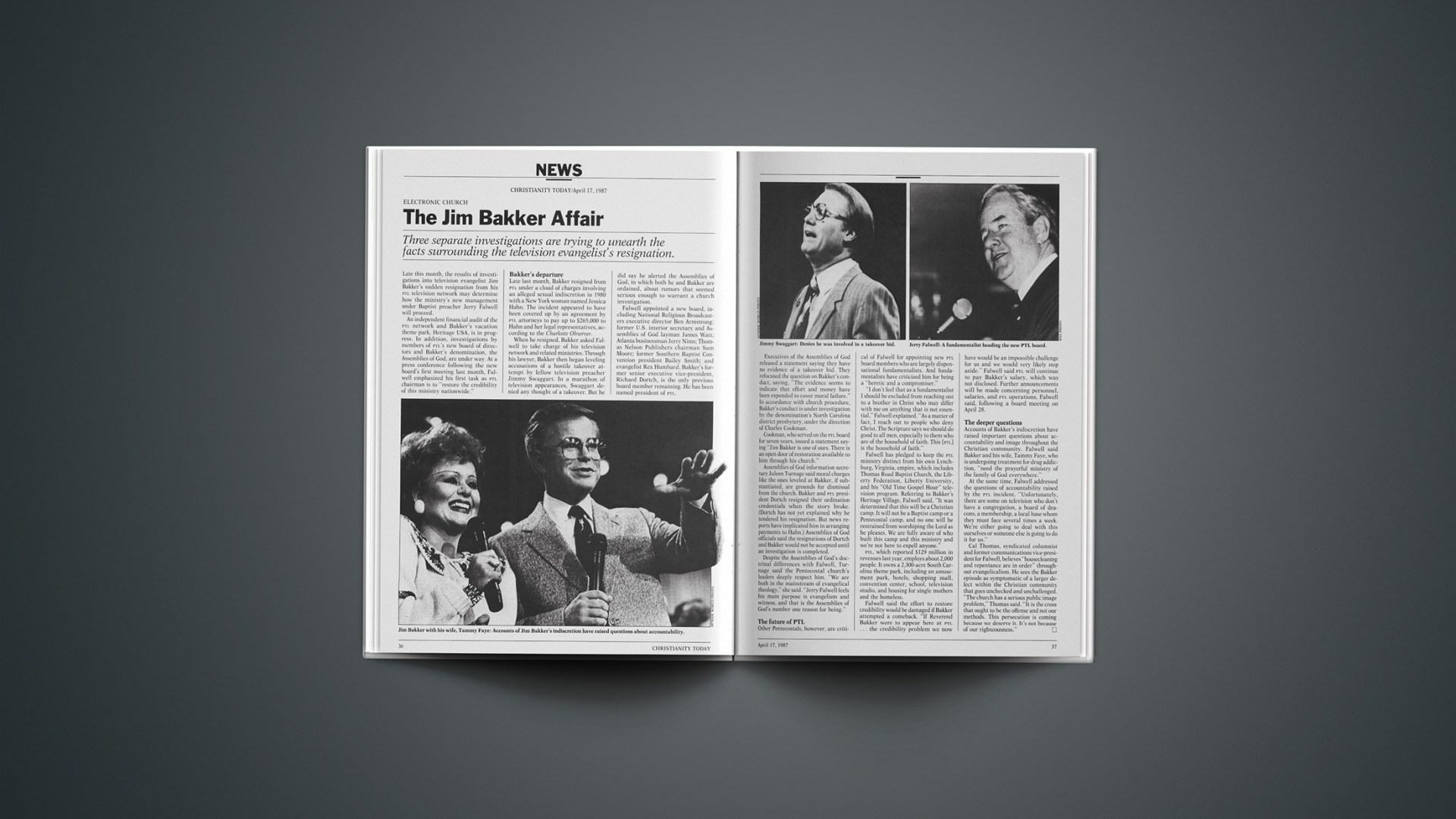
The Jim Bakker Affair

Three separate investigations are trying to unearth the facts surrounding the television evangelist’s resignation.

Late this month, the results of investigations into television evangelist Jim Bakker’s sudden resignation from his PTL television network may determine how the ministry’s new management under Baptist preacher Jerry Falwell will proceed.

An independent financial audit of the PTL network and Bakker’s vacation theme park, Heritage USA, is in progress. In addition, investigations by members of PTL’S new board of directors and Bakker’s denomination, the Assemblies of God, are under way. At a press conference following the new board’s first meeting last month, Falwell emphasized his first task as PTL chairman is to “restore the credibility of this ministry nationwide.”

Bakker’s Departure

Late last month, Bakker resigned from PTL under a cloud of charges involving an alleged sexual indiscretion in 1980 with a New York woman named Jessica Hahn. The incident appeared to have been covered up by an agreement by PTL attorneys to pay up to $265,000 to Hahn and her legal representatives, according to the Charlotte Observer.

When he resigned, Bakker asked Falwell to take charge of his television network and related ministries. Through his lawyer, Bakker then began leveling accusations of a hostile takeover attempt by fellow television preacher Jimmy Swaggart. In a marathon of television appearances, Swaggart denied any thought of a takeover. But he did say he alerted the Assemblies of God, in which both he and Bakker are ordained, about rumors that seemed serious enough to warrant a church investigation.

Falwell appointed a new board, including National Religious Broadcasters executive director Ben Armstrong; former U.S. interior secretary and Assemblies of God layman James Watt; Atlanta businessman Jerry Nims; Thomas Nelson Publishers chairman Sam Moore; former Southern Baptist Convention president Bailey Smith; and evangelist Rex Humbard. Bakker’s former senior executive vice-president, Richard Dortch, is the only previous board member remaining. He has been named president of PTL.

Executives of the Assemblies of God released a statement saying they have no evidence of a takeover bid. They refocused the question on Bakker’s conduct, saying, “The evidence seems to indicate that effort and money have been expended to cover moral failure.” In accordance with church procedure, Bakker’s conduct is under investigation by the denomination’s North Carolina district presbytery, under the direction of Charles Cookman.

Cookman, who served on the PTL board for seven years, issued a statement saying “Jim Bakker is one of ours. There is an open door of restoration available to him through his church.”

Assemblies of God information secretary Juleen Turnage said moral charges like the ones leveled at Bakker, if substantiated, are grounds for dismissal from the church. Bakker and PTL president Dortch resigned their ordination credentials when the story broke. (Dortch has not yet explained why he tendered his resignation. But news reports have implicated him in arranging payments to Hahn.) Assemblies of God officials said the resignations of Dortch and Bakker would not be accepted until an investigation is completed.

Despite the Assemblies of God’s doctrinal differences with Falwell, Turnage said the Pentecostal church’s leaders deeply respect him. “We are both in the mainstream of evangelical theology,” she said. “Jerry Falwell feels his main purpose is evangelism and witness, and that is the Assemblies of God’s number one reason for being.”

The Future Of PTL

Other Pentecostals, however, are critical of Falwell for appointing new PTL board members who are largely dispensational fundamentalists. And fundamentalists have criticized him for being a “heretic and a compromiser.”

“I don’t feel that as a fundamentalist I should be excluded from reaching out to a brother in Christ who may differ with me on anything that is not essential,” Falwell explained. “As a matter of fact, I reach out to people who deny Christ. The Scripture says we should do good to all men, especially to them who are of the household of faith. This [PTL] is the household of faith.”

Falwell has pledged to keep the PTL ministry distinct from his own Lynchburg, Virginia, empire, which includes Thomas Road Baptist Church, the Liberty Federation, Liberty University, and his “Old Time Gospel Hour” television program. Referring to Bakker’s Heritage Village, Falwell said, “It was determined that this will be a Christian camp. It will not be a Baptist camp or a Pentecostal camp, and no one will be restrained from worshiping the Lord as he pleases. We are fully aware of who built this camp and this ministry and we’re not here to expell anyone.” PTL, which reported $129 million in revenues last year, employs about 2,000 people. It owns a 2,300-acre South Carolina theme park, including an amusement park, hotels, shopping mall, convention center, school, television studio, and housing for single mothers and the homeless.

Falwell said the effort to restore credibility would be damaged if Bakker attempted a comeback. “If Reverend Bakker were to appear here at PTL … the credibility problem we now have would be an impossible challenge for us and we would very likely step aside.” Falwell said PTL will continue to pay Bakker’s salary, which was not disclosed. Further announcements will be made concerning personnel, salaries, and PTL operations, Falwell said, following a board meeting on April 28.

The Deeper Questions

Accounts of Bakker’s indiscretion have raised important questions about accountability and image throughout the Christian community. Falwell said Bakker and his wife, Tammy Faye, who is undergoing treatment for drug addiction, “need the prayerful ministry of the family of God everywhere.”

At the same time, Falwell addressed the questions of accountability raised by the PTL incident. “Unfortunately, there are some on television who don’t have a congregation, a board of deacons, a membership, a local base whom they must face several times a week. We’re either going to deal with this ourselves or someone else is going to do it for us.”

Cal Thomas, syndicated columnist and former communications vice-president for Falwell, believes “housecleaning and repentance are in order” throughout evangelicalism. He sees the Bakker episode as symptomatic of a larger defect within the Christian community that goes unchecked and unchallenged. “The church has a serious public image problem,” Thomas said. “It is the cross that ought to be the offense and not our methods. This persecution is coming because we deserve it. It’s not because of our righteousness.”

Classic & Contemporary Excerpts from April 17, 1987

All the wrong questions

The ultimate questions people of our day are asking are these: What is the meaning of life? What is the purpose behind my life and my destiny?

What questions are we evangelicals asking? Is dancing a sin? Should we immerse, sprinkle, or pour? Who is the next logical candidate for Antichrist? While we are busy at conferences and conventions, talking with ourselves about the need for Christian aerobics, or coming up with four new and painless steps to victorious Christian living, the world is taking its business elsewhere—to merchants who apply their philosophy to the deep, essential questions of human life.

—Michael Scott Horton in

Mission Accomplished

Prayer’s alchemy

Prayer makes common things holy and secular things sacred. It receives things from God with thanksgiving and hallows them with thankful hearts and devoted service.

E. M. Bounds in The Best of E. M. Bounds on Prayer

Truth-telling or problem-solving?

Nothing undermines the quality of one’s prose so badly as a dogged determination to be upbeat and problem-solving. Compare, for example, the latest self-help book, Christian or secular, with Corrie ten Boom’s Prison Letters or Bonhoeffer’s Letters and Papers from Prison, and you will see, I think, the difference between problem-solving and bearing witness to the truth.

—Virginia Stem Owens, “On Eating Words” in The Reformed Journal (June 1986)

Brightest and best

The highest Christian love is not devotion to a work or to a cause, but to Jesus Christ.

—Oswald Chambers in The Place of Help

Let’s give God a hand!

Applause is like a wet puppy—once let in the house it is difficult to control. Some aspects of vitality are not appropriate in a worship service. Also, vitality has a short shelf life: applause can become as perfunctory as any other ritual.… Church should provide opportunities for participation that are less directly tied to encouraging performance. Congregations are not audiences, and leaders of worship are not performers. The role of the liturgist (and of the choir, organist and ushers) is to enable the congregation to participate, not to win people’s approval.

—Laurence A. Wagley in The Christian Century (Dec. 3, 1986)

Leaving our expectations with the dog

Beware of the mind-set in looking to see if the church will meet your needs.… When my family is ready to leave for church, we take certain expectations about what we want to receive and leave them home with our dog. Consequently, everything we do receive is a blessing.

—Luis Palau, “Here’s the Church, Here’s the People,” in The Covenant Companion (Feb. 1987)

Masked Christians

I think we are unreal about ourselves, even as Christians, because we are afraid that if people find out what we are actually like inside, behind the mask, find out that we really don’t honestly want to be with them socially as much as we imply, they will not accept us and therefore we won’t be able to fulfill our self-centered needs through our associations with them.

—Keith Miller in

The Taste of New Wine

Our “godly” quest?

Ever since the Garden, we have been indiscriminate suckers for the enticement of omnipotence. We are cerebral voyeurs, unable to accept the idea that some knowledge may lie outside our legitimate purview. At its worst, this insatiable curiosity shows itself in our morbid love for trivialities—we are information junkies who cannot discern relevance from immediacy. But even in more respectable garb, we feed our prurient interests with a “godly” quest for apologetics. We have swallowed the lie that certainty requires exhaustive knowledge. We want to be able to “prove God” so that everyone can really know and quit worrying—especially us. God demands active faith; we seek irrefutable certainty.

—James Sennett in The Wittenburg Door (Aug./Sept. 1986)

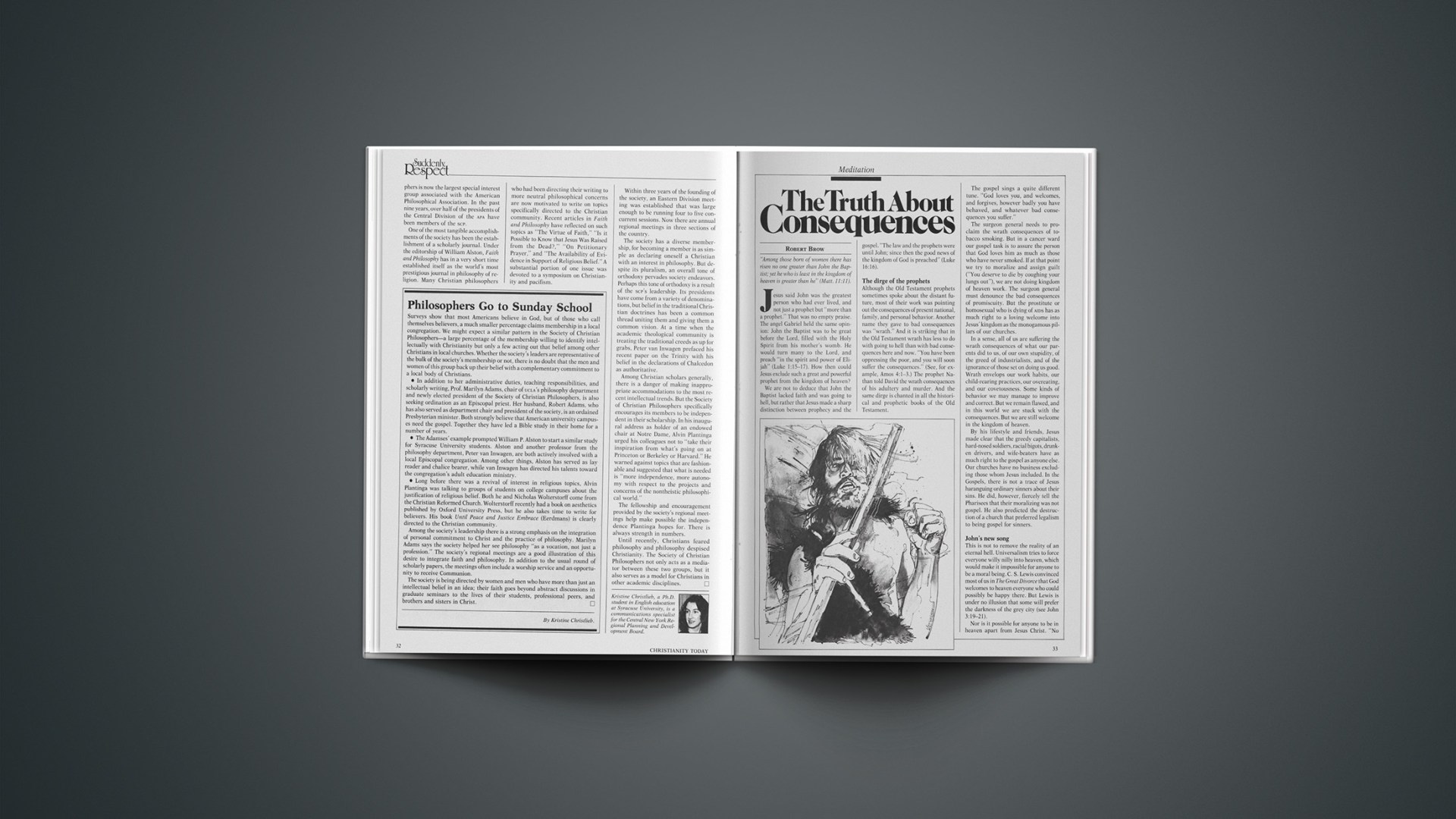
The Truth about Consequences

“Among those born of women there has risen no one greater than John the Baptist; yet he who is least in the kingdom of heaven is greater than he” (Matt. 11:11).

Jesus said John was the greatest person who had ever lived, and not just a prophet but “more than a prophet.” That was no empty praise. The angel Gabriel held the same opinion: John the Baptist was to be great before the Lord, filled with the Holy Spirit from his mother’s womb. He would turn many to the Lord, and preach “in the spirit and power of Elijah” (Luke 1:15–17). How then could Jesus exclude such a great and powerful prophet from the kingdom of heaven?

We are not to deduce that John the Baptist lacked faith and was going to hell, but rather that Jesus made a sharp distinction between prophecy and the gospel. “The law and the prophets were until John; since then the good news of the kingdom of God is preached” (Luke 16:16).

The Dirge Of The Prophets

Although the Old Testament prophets sometimes spoke about the distant future, most of their work was pointing out the consequences of present national, family, and personal behavior. Another name they gave to bad consequences was “wrath.” And it is striking that in the Old Testament wrath has less to do with going to hell than with bad consequences here and now. “You have been oppressing the poor, and you will soon suffer the consequences.” (See, for example, Amos 4:1–3.) The prophet Nathan told David the wrath consequences of his adultery and murder. And the same dirge is chanted in all the historical and prophetic books of the Old Testament.

The gospel sings a quite different tune. “God loves you, and welcomes, and forgives, however badly you have behaved, and whatever bad consequences you suffer.”

The surgeon general needs to proclaim the wrath consequences of tobacco smoking. But in a cancer ward our gospel task is to assure the person that God loves him as much as those who have never smoked. If at that point we try to moralize and assign guilt (“You deserve to die by coughing your lungs out”), we are not doing kingdom of heaven work. The surgeon general must denounce the bad consequences of promiscuity. But the prostitute or homosexual who is dying of AIDS has as much right to a loving welcome into Jesus’ kingdom as the monogamous pillars of our churches.

In a sense, all of us are suffering the wrath consequences of what our parents did to us, of our own stupidity, of the greed of industrialists, and of the ignorance of those set on doing us good. Wrath envelops our work habits, our child-rearing practices, our overeating, and our covetousness. Some kinds of behavior we may manage to improve and correct. But we remain flawed, and in this world we are stuck with the consequences. But we are still welcome in the kingdom of heaven.

By his lifestyle and friends, Jesus made clear that the greedy capitalists, hard-nosed soldiers, racial bigots, drunken drivers, and wife-beaters have as much right to the gospel as anyone else. Our churches have no business excluding those whom Jesus included. In the Gospels, there is not a trace of Jesus haranguing ordinary sinners about their sins. He did, however, fiercely tell the Pharisees that their moralizing was not gospel. He also predicted the destruction of a church that preferred legalism to being gospel for sinners.

John’s New Song

This is not to remove the reality of an eternal hell. Universalism tries to force everyone willy nilly into heaven, which would make it impossible for anyone to be a moral being. C. S. Lewis convinced most of us in The Great Divorce that God welcomes to heaven everyone who could possibly be happy there. But Lewis is under no illusion that some will prefer the darkness of the grey city (see John 3:19–21).

Nor is it possible for anyone to be in heaven apart from Jesus Christ. “No one comes to the Father, but by me” (John 14:6). And “no one” must include children who die in their first hour, retarded persons, and ignorant, relatively good and bad people, and even the best of the world’s prophets. No one, but no one, can move out of the wrath of this world into heaven alone. Some may be surprised when they wake up in heaven that it was through Christ that they got there, but that is the gospel song of the redeemed from every tribe and nation. I assume that John the Baptist is singing that song, but it was not being a great prophet that saved him.

We should also add that the gospel of the kingdom does not deny the importance of justice in our world. Government anywhere is charged with assigning consequences for all kinds of unacceptable behavior (Rom. 13:1–6). We may discuss whether one kind of consequence is a better deterrent, or fairer, or better for rehabilitation, or more humane, or less vindictive, but we should begin by agreeing that some consequences for bad behavior must be assigned. The gospel assures the murderer of forgiveness, but he may still suffer the wrath consequences of being hanged or buried for life in a penitentiary or psychiatric hospital.

Caesar’s Work And God’s

The law and the prophets were until John, but they are still with us. They are essential for any civilized society, and Jesus certainly assumed that Caesar’s task and therefore the prophetic task would continue. But rendering to Caesar should never be confused with the grace of a loving God. Denouncing the evils of oppressing the poor, polluting the environment, warmongering, racial prejudice, and all other forms of chauvinism are evidently prophetic tasks, but Jesus reminds us that they are not gospel.

So we must distinguish between two stewardships: a general stewardship of the world that requires prophetic voices to denounce evil in every nation, business, social institution, and family; and a particular stewardship of the mysteries of God that requires “a kingdom of priests” who care about gospel.

Of course, a church member can be, like our Lord, both a prophet and a priest. For example, a surgeon general may be involved in his priestly task of prayer and worship in church on Sundays, and then go out and engage in law-and-prophet ministry during the week. What Jesus required is that we distinguish the two functions. Our modern church is confusing them.

I am pestered by all sorts of people who want me to turn the church into a conscience-raising school for prophets in the world. On the other hand, I have guilt trippers who want me to root tares out of the church. I have settled that my job in the kingdom of heaven is to be a priest and to train my church members to be gospel priests. I can affirm and approve the need for proclaiming justice in our world, and at the same time say with Jesus that in the kingdom of heaven he or she who is least in gospel ministry is greater than the greatest of prophets.

Robert Brow is the rector of Saint James’s Anglican (Episcopal) Church on the campus of Queen’s University, Kingston, Ontario, Canado.

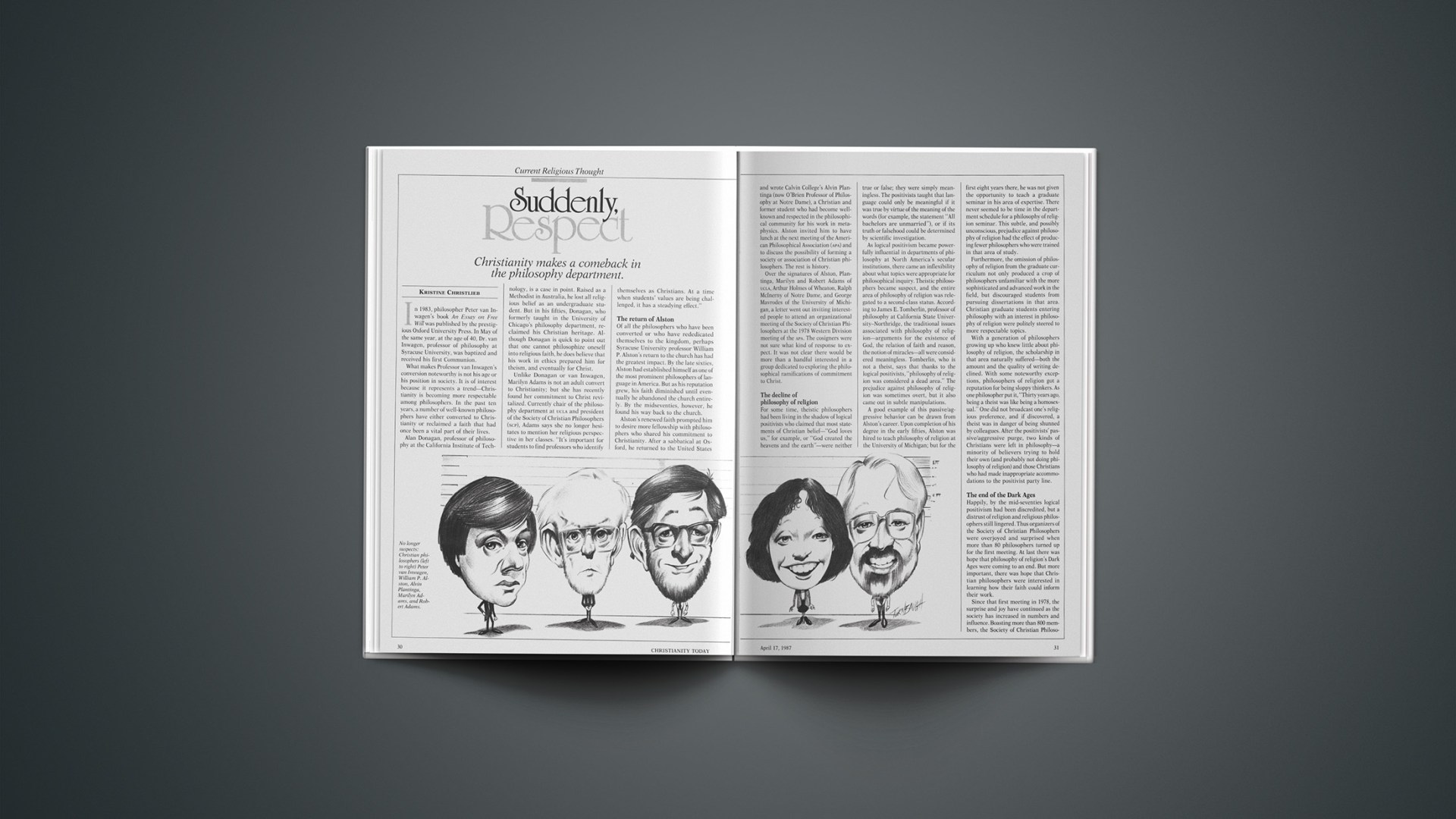
Suddenly, Respect

Christianity makes a comeback in the philosophy department.

In 1983, philosopher Peter van Inwagen’s book An Essay on Free Will was published by the prestigious Oxford University Press. In May of the same year, at the age of 40, Dr. van Inwagen, professor of philosophy at Syracuse University, was baptized and received his first Communion.

What makes Professor van Inwagen’s conversion noteworthy is not his age or his position in society. It is of interest because it represents a trend—Christianity is becoming more respectable among philosophers. In the past ten years, a number of well-known philosophers have either converted to Christianity or reclaimed a faith that had once been a vital part of their lives.

Alan Donagan, professor of philosophy at the California Institute of Technology, is a case in point. Raised as a Methodist in Australia, he lost all religious belief as an undergraduate student. But in his fifties, Donagan, who formerly taught in the University of Chicago’s philosophy department, reclaimed his Christian heritage. Although Donagan is quick to point out that one cannot philosophize oneself into religious faith, he does believe that his work in ethics prepared him for theism, and eventually for Christ.

Unlike Donagan or van Inwagen, Marilyn Adams is not an adult convert to Christianity; but she has recently found her commitment to Christ revitalized. Currently chair of the philosophy department at UCLA and president of the Society of Christian Philosophers (SCP), Adams says she no longer hesitates to mention her religious perspective in her classes. “It’s important for students to find professors who identify themselves as Christians. At a time when students’ values are being challenged, it has a steadying effect.”

The Return Of Alston

Of all the philosophers who have been converted or who have rededicated themselves to the kingdom, perhaps Syracuse University professor William P. Alston’s return to the church has had the greatest impact. By the late sixties, Alston had established himself as one of the most prominent philosophers of language in America. But as his reputation grew, his faith diminished until eventually he abandoned the church entirely. By the midseventies, however, he found his way back to the church.

Alston’s renewed faith prompted him to desire more fellowship with philosophers who shared his commitment to Christianity. After a sabbatical at Oxford, he returned to the United States and wrote Calvin College’s Alvin Plantinga (now O’Brien Professor of Philosophy at Notre Dame), a Christian and former student who had become well-known and respected in the philosophical community for his work in metaphysics. Alston invited him to have lunch at the next meeting of the American Philosophical Association (APA) and to discuss the possibility of forming a society or association of Christian philosophers. The rest is history.

Over the signatures of Alston, Plantinga, Marilyn and Robert Adams of UCLA, Arthur Holmes of Wheaton, Ralph McInerny of Notre Dame, and George Mavrodes of the University of Michigan, a letter went out inviting interested people to attend an organizational meeting of the Society of Christian Philosophers at the 1978 Western Division meeting of the APA. The cosigners were not sure what kind of response to expect. It was not clear there would be more than a handful interested in a group dedicated to exploring the philosophical ramifications of commitment to Christ.

The Decline Of Philosophy Of Religion

For some time, theistic philosophers had been living in the shadow of logical positivists who claimed that most statements of Christian belief—“God loves us,” for example, or “God created the heavens and the earth”—were neither true or false; they were simply meaningless. The positivists taught that language could only be meaningful if it was true by virtue of the meaning of the words (for example, the statement “All bachelors are unmarried”), or if its truth or falsehood could be determined by scientific investigation.

As logical positivism became powerfully influential in departments of philosophy at North America’s secular institutions, there came an inflexibility about what topics were appropriate for philosophical inquiry. Theistic philosophers became suspect, and the entire area of philosophy of religion was relegated to a second-class status. According to James E. Tomberlin, professor of philosophy at California State University-Northridge, the traditional issues associated with philosophy of religion—arguments for the existence of God, the relation of faith and reason, the notion of miracles—all were considered meaningless. Tomberlin, who is not a theist, says that thanks to the logical positivists, “philosophy of religion was considered a dead area.” The prejudice against philosophy of religion was sometimes overt, but it also came out in subtle manipulations.

A good example of this passive/aggressive behavior can be drawn from Alston’s career. Upon completion of his degree in the early fifties, Alston was hired to teach philosophy of religion at the University of Michigan; but for the first eight years there, he was not given the opportunity to teach a graduate seminar in his area of expertise. There never seemed to be time in the department schedule for a philosophy of religion seminar. This subtle, and possibly unconscious, prejudice against philosophy of religion had the effect of producing fewer philosophers who were trained in that area of study.

Furthermore, the omission of philosophy of religion from the graduate curriculum not only produced a crop of philosophers unfamiliar with the more sophisticated and advanced work in the field, but discouraged students from pursuing dissertations in that area. Christian graduate students entering philosophy with an interest in philosophy of religion were politely steered to more respectable topics.

With a generation of philosophers growing up who knew little about philosophy of religion, the scholarship in that area naturally suffered—both the amount and the quality of writing declined. With some noteworthy exceptions, philosophers of religion got a reputation for being sloppy thinkers. As one philosopher put it, “Thirty years ago, being a theist was like being a homosexual.” One did not broadcast one’s religious preference, and if discovered, a theist was in danger of being shunned by colleagues. After the positivists’ passive/aggressive purge, two kinds of Christians were left in philosophy—a minority of believers trying to hold their own (and probably not doing philosophy of religion) and those Christians who had made inappropriate accommodations to the positivist party line.

The End Of The Dark Ages

Happily, by the mid-seventies logical positivism had been discredited, but a distrust of religion and religious philosophers still lingered. Thus organizers of the Society of Christian Philosophers were overjoyed and surprised when more than 80 philosophers turned up for the first meeting. At last there was hope that philosophy of religion’s Dark Ages were coming to an end. But more important, there was hope that Christian philosophers were interested in learning how their faith could inform their work.

Since that first meeting in 1978, the surprise and joy have continued as the society has increased in numbers and influence. Boasting more than 800 members, the Society of Christian Philosophers is now the largest special interest group associated with the American Philosophical Association. In the past nine years, over half of the presidents of the Central Division of the APA have been members of the SCP.

One of the most tangible accomplishments of the society has been the establishment of a scholarly journal. Under the editorship of William Alston, Faith and Philosophy has in a very short time established itself as the world’s most prestigious journal in philosophy of religion. Many Christian philosophers who had been directing their writing to more neutral philosophical concerns are now motivated to write on topics specifically directed to the Christian community. Recent articles in Faith and Philosophy have reflected on such topics as “The Virtue of Faith,” “Is it Possible to Know that Jesus Was Raised from the Dead?,” “On Petitionary Prayer,” and “The Availability of Evidence in Support of Religious Belief.” A substantial portion of one issue was devoted to a symposium on Christianity and pacifism.

Within three years of the founding of the society, an Eastern Division meeting was established that was large enough to be running four to five concurrent sessions. Now there are annual regional meetings in three sections of the country.

The society has a diverse membership, for becoming a member is as simple as declaring oneself a Christian with an interest in philosophy. But despite its pluralism, an overall tone of orthodoxy pervades society endeavors. Perhaps this tone of orthodoxy is a result of the SCP’S leadership. Its presidents have come from a variety of denominations, but belief in the traditional Christian doctrines has been a common thread uniting them and giving them a common vision. At a time when the academic theological community is treating the traditional creeds as up for grabs, Peter van Inwagen prefaced his recent paper on the Trinity with his belief in the declarations of Chalcedon as authoritative.

Among Christian scholars generally, there is a danger of making inappropriate accommodations to the most recent intellectual trends. But the Society of Christian Philosophers specifically encourages its members to be independent in their scholarship. In his inaugural address as holder of an endowed chair at Notre Dame, Alvin Plantinga urged his colleagues not to “take their inspiration from what’s going on at Princeton or Berkeley or Harvard.” He warned against topics that are fashionable and suggested that what is needed is “more independence, more autonomy with respect to the projects and concerns of the nontheistic philosophical world.”

The fellowship and encouragement provided by the society’s regional meetings help make possible the independence Plantinga hopes for. There is always strength in numbers.

Until recently, Christians feared philosophy and philosophy despised Christianity. The Society of Christian Philosophers not only acts as a mediator between these two groups, but it also serves as a model for Christians in other academic disciplines.

Philosophers Go To Sunday School

Surveys show that most Americans believe in God, but of those who call themselves believers, a much smaller percentage claims membership in a local congregation. We might expect a similar pattern in the Society of Christian Philosophers—a large percentage of the membership willing to identify intellectually with Christianity but only a few acting out that belief among other Christians in local churches. Whether the society’s leaders are representative of the bulk of the society’s membership or not, there is no doubt that the men and women of this group back up their belief with a complementary commitment to a local body of Christians.

  • In addition to her administrative duties, teaching responsibilities, and scholarly writing, Prof. Marilyn Adams, chair of UCLA’S philosophy department and newly elected president of the Society of Christian Philosophers, is also seeking ordination as an Episcopal priest. Her husband, Robert Adams, who has also served as department chair and president of the society, is an ordained Presbyterian minister. Both strongly believe that American university campuses need the gospel. Together they have led a Bible study in their home for a number of years.
  • The Adamses’ example prompted William P. Alston to start a similar study for Syracuse University students. Alston and another professor from the philosophy department, Peter van Inwagen, are both actively involved with a local Episcopal congregation. Among other things, Alston has served as lay reader and chalice bearer, while van Inwagen has directed his talents toward the congregation’s adult education ministry.
  • Long before there was a revival of interest in religious topics, Alvin Plantinga was talking to groups of students on college campuses about the justification of religious belief. Both he and Nicholas Wolterstorff come from the Christian Reformed Church. Wolterstorff recently had a book on aesthetics published by Oxford University Press, but he also takes time to write for believers. His book Until Peace and Justice Embrace (Eerdmans) is clearly directed to the Christian community.

Among the society’s leadership there is a strong emphasis on the integration of personal commitment to Christ and the practice of philosophy. Marilyn Adams says the society helped her see philosophy “as a vocation, not just a profession.” The society’s regional meetings are a good illustration of this desire to integrate faith and philosophy. In addition to the usual round of scholarly papers, the meetings often include a worship service and an opportunity to receive Communion.

The society is being directed by women and men who have more than just an intellectual belief in an idea; their faith goes beyond abstract discussions in graduate seminars to the lives of their students, professional peers, and brothers and sisters in Christ.

By Kristine Christlieb.

Kristine Christlieb, a Ph.D. student in English education at Syracuse University, is a communications specialist for the Central New York Regional Planning and Development Board.

The Never-Ending Story

Today’s soap operas seem to be going nowhere, but a Christian view of life knows that someday God will write, “The End.”

Comic Fred Allen used to call television “chewing gum for the eyes.” And according to both the ratings and the revenues, among the most popular brands of visual chewing gum are soap operas.

Daytime soaps are viewed by more than 30 million Americans—if one trusts the ratings. Very likely the audience is much larger; the stigma attached to soap opera viewing may lead respondents to lie about their television habits. Recent estimates of soap opera viewing have ranged as high as 70 percent of the adult population.

Numerous studies have shown that soap audiences are representative educationally and economically of the overall population. Nor are soaps watched only by women, as the stereotype suggests. Daytime soap audiences are 15 percent male, but evening audiences are nearly half men; these statistics are true of television audiences overall. Nor are soap fans typically older citizens. Over half of all college students watch daytime television serials. (More than a few class schedules have been planned around favorite soap operas.)

Evening soap operas have also been a phenomenal success, beginning with the 1979–80 television season, when “Dallas” rose to fifth in the national ratings. For the next two seasons it was the highest-rated program in the country. By 1983 four of the top eleven prime-time programs were soaps: “Dallas,” “Dynasty,” “Falcon Crest,” and “Knots Landing.”

Stories About Us

Why do so many people tune in to a dramatic world where amnesia is the major ailment and where the most common activity next to sex is blackmail?

Certainly improved soap opera writing and production account for some of the genre’s popularity. Today’s serials use more sophisticated lighting and sets, and the scripts are more imaginative, if not of higher quality. Soaps now reflect the technical standards of the television industry, while for decades they were the fast foods on the medium’s menu.

But there may be more to the ascendancy of the soap opera. Like folk art before it, popular art generally reflects something of the people who enjoy it. A program may gain a large following simply because of its entertaining qualities, but it is likely that the success of an entire genre is evidence of the audience’s values and beliefs. Soaps are not only stories for us, but stories about us. They are part of the “sacred” text of the modern canon of popular storytelling.

Waiting For The End

Popular stories have not always been like the soaps. Throughout history, storytelling has had what literary critic Frank Kermode called “a sense of an ending.” This was true of oral narratives composed around various mnemonic devices and passed on anonymously by thousands of tellers. It was true of the biblical stories, which the church compiled and disseminated to tell the story of redemptive history. It was also true of classical drama, from tragedy to comedy, which assumed that the actions of characters would lead to a conclusion predetermined by the writer.

In the modern world, however, the providential character of storytelling is no longer assumed. Stories still have characters and conflict. They usually include action of some kind, although not necessarily of epic proportion. And dialogue is still the major vehicle for creating conflict. But in both popular and fine art today, some types of stories are told with no apparent ending. A good example would be Samuel Beckett’s drama Waiting for Godot in which the main characters sit about listlessly waiting for a nondescript character who never arrives. They appear to be locked in a world where decisive action is impossible and salvation is inconceivable.

Is it possible that the loss of a sense of an ending in some forms of contemporary storytelling reflects significant changes in the modern view of reality? Admittedly, not all types of narrative today lack an ending; most of what is broadcast on television, depicted in film, and performed on the stage today still leads to a conclusion predetermined by an author. But much of popular and fine art does not. And probably the best example from television is the soap opera.

History As Illusion

Like many types of modern narrative, the soap opera challenges the traditional Western world view rooted in Christian optimism about the predetermined flow of events from God’s history-forming hands. Although the viewer anticipates an ending, or at least the termination of various subplots, the conclusion is always delayed. Sometimes action is even reversed, as occurred this year on “Dallas.” Viewers found out that earlier episodes of the program never really happened. Sue Ellen never quit drinking. Donna never lost her baby. Bobby never died. The previous season had all been a dream! Old conflicts, long ago resolved, returned to the show. History was an illusion. Either God plays jokes, or there is no omnipotent playwright for human history.

Soap operas were not always so predictably open-ended. In “Soapland” James Thurber described the early formula: “Between thick slices of advertising, spread twelve minutes of dialogue, add predicament, villainy and female suffering in equal measures, throw in a dash of nobility, sprinkle with tears, season with organ music, cover with a rich announcer sauce, and serve five times a week.”

In these early soaps, such as “The Romance of Helen Trent” and “Our Gal Sunday,” virtuous action was usually rewarded. The story line frequently shifted to hold viewer interest, but along the way evil people were brought to justice or simply left to simmer in the wicked relationships resulting from their misconduct. The heroine’s good deeds usually landed her a handsome husband or an unexpected job offer, while the self-serving actions of villains were implicitly condemned by their consequences. Early soaps had both a sense of justice and an appreciation of virtue.

Moral Ambiguity

Today, however, the outcome of action on the soaps is often morally evil or ambiguous. Virtuous and evil conduct are equally rewarded, depending upon what the producer thinks will hold the interest of viewers. In one of the oddest plot shifts of the soap world, the producer of “General Hospital” instructed the character of Laura that she must fall in love with Luke, who had raped her a year before. It was not a matter of slowly changed hearts and growing reconciliation, but an abrupt shift in the story line.

In modern soaps, infidelities may or may not produce additional dishonesty. Selfless actions could precipitate violence as much as love and gratitude. There is no longer any basis for truly moral and righteous conduct, for the result of human action is entirely unpredictable and often completely inexplicable—except as a device to increase ratings. One female character had a child two years after undergoing a hysterectomy. A man unknowingly married his sister, revealed years before to have been their father’s illegitmate child. The reluctance of the modern soap opera to link virtuous action and just reward reflects many of the values of contemporary society. Moral absolutes seem simplistic and dogmatic, while moral ambiguity appears honest and open-minded.

Similarly, in society there is a widespread sentiment that selfless behavior will not really make a difference in the lives of people, let alone in government, business, or school. Frequently we are more interested in whether or not what we do will “work,” than whether or not it is proper conduct. This kind of pragmatic ethic has spread widely through the culture and through many institutions, including television.

As a result, soap opera characters are inevitably left in an earthly purgatory awaiting a final cleansing that will never come. Their good deeds will eventually be eroded by the capricious effects of time, no matter how hard they try to improve the human condition. And their wicked actions will not be held to a final accounting, for there is no immutable and everlasting overseer of the soap cosmos.

Retreat Into Realism

In one respect, this makes soaps more realistic, because in life virtuous action is not always rewarded, and good things often happen to people who do despicable things. Such claims to realism are made especially of the so-called ensemble programs such as “St. Elsewhere” and “Hill Street Blues,” which in many ways are technically sophisticated reformulations of the soap genre.

But what is behind the realism of the soap opera? In what sense do the soaps actually reflect something of modern life? Unlike the existentialism of a Beckett, the soaps challenge the Christian cosmology by claims to evolutionary naturalism. Soaps do not say that human life has no meaning, but that ultimate meaning is to be found entirely in the natural world. Instead of looking to the beginning or the end of creation for meaning, to the Author of the creation, they look to the creation itself.

In this sense, the soaps belong to the tradition of literary naturalism represented by the works of Zola, Flaubert, and Maupassant, who believed that the artist ought to portray life “as it is” without imposing value judgments. Of course, this is impossible to do, since naturalism is itself a perspective from which to view life. No novel or television program can merely reflect life as it is lived; a story is necessarily someone’s interpretation of experience.

Life Imitates Soap

In an attempt at the utmost in realism, television tried to create a totally naturalistic series—the unusual program, “An American Family,” broadcast on public stations in the early 1970s.

The controversial show chronicled the lives of members of an actual California family in 12 hour-long installments. A producer and two assistants spent seven months with the family, shooting some 300 hours of film. Included were “scenes” where the mother learned of her son’s homosexuality, the wife decided to file for divorce, and the husband moved out of the house. It was all very much like a soap opera and far less like the day-to-day lives that most Americans experience. In fact, members of the family became some of the severest critics of the program, charging that 12 hour-long segments could not capture 300 hours of film, let alone seven months of family life.

Only The Grinding Of The Clock

While naturalism on the tube highlights some of the desires and instincts of mankind, it also paints a world where there typically is no spiritual or supernatural side to life. Behind literary naturalism is the philosophical idea that the whole of reality, including religious truth, can be accounted for in the physical world, which moves along by chance and luck, but never by Providence.

The soap opera depicts an Earth devoid of an imprint from the Creator. There is no clear evidence for the existence of God. There is no unmistakable beauty or order to the creation—only depressing interior sets and an ocassional pass to an outdoor rendezvous. There is little hope for lasting reconciliation among feuding or contentious people—only the sure belief in eventual agony and ongoing uncertainty. There is no cosmic sweep to history—only the grinding movement of the clock. (One woman on a soap spent 17 days in a revolving door while experiencing flashbacks.) Finally, there is no sense of transcendent being in the universe—only the struggle to know and understand other human beings who are similarly unable to hear a voice from heaven.

Naturalism in the soaps is also evolutionary. The soaps locate the significance of human existence in the changes that take place in the natural world, particularly the process of natural selection. Today the only thing that a viewer can count on in a soap is change itself. Change may come slowly, as the frustrated regular viewer of a soap knows, but it will indeed come. New characters and plot shifts will not lead to “progress,” at least in the optimistic sense of the word, but will produce new situations and unpredictable consequences.

In the process of this change, some characters will survive and others will not. Some will avoid nervous breakdowns or adultery, while others will fall victim. Some will gain power over others—through extortion, blackmail, sexual favors—and others will be controlled by those in power. Some soap characters will be killed (and usually not be brought back to life). The world of the soaps, then, is a place of natural change where some fortunate beings will survive, if only for a time, and others will not. Thus, the theme of soap operas is “the survival of the fittest.” (See box below, “Different as Day and Night.”)

Different As Day And Night

The theme of soap operas is “survival of the fittest.” But there is a significant difference between how daytime and evening soaps depict the ongoing struggle.

Most daytime soaps project a world of personal battles between individuals. Lovers fight, tease, deceive, and fornicate. Siblings contend for the attention or inheritance of parents.

In the evening soaps, such as “Dallas” and “Dynasty,” the personal conflicts are typically part of a larger struggle among contending families or businesses. Even J. R.’s wicked sexual advances on “Dallas” are often tied to the vicious competition among oil barons and their corporations. Evening soaps have increased the stakes in the human battle for survival from personal ruin to institutional Survivors: The Darwinian characters of “Dynasty.” destruction. It is not only people who must struggle to survive; all social institutions are part of the evolutionary processes. On the prime-time soap, society itself is part of the natural process of selection.

Wild Kingdom

Soaps are the human equivalent of the nature shows, such as Mutual of Omaha’s “Wild Kingdom” and Marty Stauffer’s “Wild America.” Both soaps and nature shows look to the evolutionary dynamics of the natural world as the meaningful context for the actions of characters. Nature shows do it literally, and soaps do it metaphorically; but the end product is the same—an earthly world of creatures struggling to survive against natural forces. Nature takes its own course, and no individuals or groups will be able to change significantly the direction of history or the destiny of their lives.

On the soaps, there are no heroes whose actions can truly resolve conflict. We might like particular characters more than others. We might even condone the actions of some soap people and detest the nefarious conduct of an adulterer, extortionist, or ungrateful daughter. But all of these characters, regardless of what we think of them, are locked in the same struggle for survival. All actions, whether loving or selfish, virtuous or immoral, are simply attempts to adapt to the social environment.

Like animals on nature shows, soap characters are dramatically impotent; they are unable to mold significantly the natural processes taking place around them. In biblical terms, they worship the lords of money, sex, and social status. And they are thus unable to live in dominion over the creation because they know not the Author of the human story—God himself.

Quentin J. Schultze is professor of communication arts at Calvin College and author of the book Television: Manna From Hollywood?, recently published by Zondervan.

More than a Symbol

That the Cross is of central importance to Christianity is clear even in the language we use. “Crucial” derives from a Latin word meaning “pertaining to a cross,” and “crux” is simply the Latin for “cross.” Whenever we say, “The crux of the matter is this,” or “This is the crucial point,” we are saying, “Just as the Cross is central to Christianity, so is the point central to my argument.”

Of course, the theological centrality of the Cross is seen in the structure of the Gospels, which have well been described as “Passion narratives with extended introductions.” In each one the death and resurrection of Jesus take up a disproportionate amount of space. Everything is arranged to lead up to the climax of the Cross. And Paul can sum up the Christian message in the words “We preach Christ crucified” (1 Cor. 1:23).

However, today people sometimes hold that the essence of Christianity is rather to be found in the Sermon on the Mount, in Jesus’ ethical teaching generally, in the idea of liberation, or the like. And indeed, Christianity is a profound religion and its teaching has many aspects. But if we are to be true to the New Testament, we must see the Cross at the center.

Sinners And The Love Of God

Logically, we must start with the reality of sin. Dwellers in the Space Age often see the human predicament as due to lack of education, wealth, or some other resource, but the Bible says it is due to sin (Isa. 59:2). To look at our modern world—with its wars, crime, violence, and policies that allow mass starvation in many lands and the drug culture in others—is almost to gaze on a classical demonstration of the truth of the Christian contention.

And in the Christian view, sin has even more serious consequences than earthly disorder. The Bible speaks often of “the wrath of God” (Rom. 1:18), and we should not forget that Jesus often warned of hell (Mark 9:43, 45, 47; Luke 12:5). Judgment is both a present reality (John 3:19) and a future certainty (Rom. 2:12). The Bible says we are responsible people and in due course must give account of ourselves to God (Rom. 14:12); we cannot dismiss the evil we do as simply the result of the way we are made, as our fate rather than our fault. We are guilty when we stand before God.

What God’s Love Means

But the Bible also reveals the astounding fact that in the face of our sin, God keeps loving us. He keeps loving because he is love (1 John 4:8, 16); it is his nature to love. And in love he brings about the salvation of sinners (John 3:16; Rom. 5:8). We should be clear about this. Sometimes people see the Father as a rather stem judge, who sentences sinners to hell. Into this picture comes a loving Son who intervenes to save them. But this picture is distorted. Any view of the Atonement that does not see it as coming from the Father’s love is wrong.

It is also unbiblical to see the Father’s forgiveness as operating apart from the Cross. Modern sentimentalists often see the Father as a kindly person who does not take sin seriously. “He will forgive; that is what love means” is the thought. But this is to overlook the strong moral demand that runs through Scripture. The God who demands righteousness of his people is himself righteous. He does not forgive sin in a way that might be understood to mean sin does not matter. God forgives sin by the way of the Cross.

That, of course, involves the Incarnation. Salvation depends on what God has done in Christ. The writer to the Hebrews insists that Jesus was made lower than the angels in order that he might taste death for every one of us (Heb. 2:9). He goes on to emphasize the importance of Christ’s being one with those for whom he died (Heb. 2:11–15). He took human nature, not that of an angel (v. 16). But, of course, the Godhead of Christ was involved too, as we see from the way Paul intertwines the thoughts of the Godhead and the manhood (Phil. 2:5–11; Col. 1:19–20).

Our salvation is due to none less than God. We must never forget that. And it is due to the fact that the Son of God genuinely became man. We must never forget that, either. Only by holding both truths can we accurately understand the work of the Cross.

Theories Of Atonement

View the human predicament as you will, it was in the Cross that New Testament writers saw deliverance. But the New Testament never tells us just how the Cross accomplishes this. Consequently, the church through the centuries has not come to one mind on the matter. That does not mean that any way of looking at the Cross is acceptable: some views are so faulty they lead to an impoverished or even perverted Christianity. It is important not only that we see the Cross as central, but that we understand how it is central.

Historical theories about the way the Cross saves tend to fall under three heads: those that see the Cross as victory, those that see its effect on us as the important thing (the subjective view of the Atonement), and those that see it as in some sense a satisfaction for sin.

The idea of the Cross as victory was understood in the early centuries as a ransom paid to Satan. Sinners rightly belonged to the Evil One, and on the cross God handed his Son over to Satan as a ransom for sinners in hell. Satan was happy to accept, but on Easter Day he found he could not hold Christ, who burst the bonds of hell and rose triumphant. The Fathers sometimes used grotesque imagery as they tried to express this truth, and their theory fell into disuse. But there is a profound truth here. Christ did win the victory, and the triumph of the Resurrection is an important part of our understanding of salvation.

That the Cross does something to us (subjective atonement) is also important. This understanding often stresses Christ’s example. The Cross shows us how we ought to live and how we ought to accept suffering, even suffering unjustly inflicted. Or it may be said that when we look at the Cross we see what sin did to the spotless Son of God. This moves us to repent and turn away from the sort of thing that put Christ on the cross. Or it may be put in terms of love. At the Cross we see how greatly God loves, and we are moved to love him in return.

There is no serious dispute about either the victory of the Cross or its subjective effect. Both of these theories are significant. But the New Testament says the Cross does more, that it is somehow a satisfaction for sin.

The “Rightness” Of Salvation

The satisfaction view of the Atonement was first formulated as a coherent theory in the Middle Ages by Anselm. He saw sin as an insult to the honor of God. He made a distinction between the insult of a private person (who may be ready to forgive an insult or an injury done to him) and a public person (who must consider the integrity of his office).

A king in his private capacity may be ready to overlook an offense, but because the state has been offended as well as the person, satisfaction must be made. God is sovereign over all things, and when his majesty is insulted by our sin proper, satisfaction must be made. Anselm went on to argue that the damage done was so great that no one but God could make satisfaction. Yet since the offense had been committed by man, no one but man could make satisfaction. Anselm concluded that it was necessary for God to become man if salvation were to be achieved.

The Reformers took much the same position, except they kept closer to Scripture and spoke of God’s broken law rather than his offended honor. Broken law (no different from offended honor) meant a heavy penalty, and Christ bore that penalty in our place.

Such a view is currently out of favor. We are often told it makes law, not love, the ruling fact in God’s treatment of his creatures. But this is simply shallow thinking. In fact, love and some kind of law go together, or we do not really have love. How, apart from law, are we to rescue love from caprice? How do we know that the love we see today will not be replaced by hatred tomorrow? Surely it is only because there is something of law about the way love works.

We should also beware of confusing love with sentimentality. There is much more of the latter commodity in the modern world. Genuine love is concerned for the very best for the loved ones, not for their immediate and temporary satisfaction. That will mean sometimes taking the hard way of insisting upon discipline and even punishment.

What the New Testament writers are saying is that God saves us in a way that is right as well as powerful. God does not, so to speak, wave a hand and say, “The moral law is unimportant. Sin does not matter. I love people and therefore their sins need not be dealt with.”

The Cross is evidence that, on the contrary, God insisted that sins be dealt with. Christ died to put away our sins. We may or may not be able to see precisely how the death of Christ upheld God’s law in dealing with our sins, but that does not give us license to shut our eyes to the New Testament’s frequent use of legal categories to describe our salvation. Justification is an important category, and its legal force should not be overlooked.

That Christ in some way stood in our place and was our substitute when he died is clear in many places in Scripture. It appears early when Jesus accepts John’s baptism, a baptism that numbered him with sinners (Matt. 3:15) and that points forward to the death he would die for them. Most commentators agree that the Gospels see Jesus as the suffering servant of Isaiah 53, one who suffers in the place of others.

Jesus himself said he would be “a ransom for many” (Mark 10:45), with the word for (anti) meaning in the place of; it is a substitutionary word. And what else are we to make of the agony in Gethsemane and of the words “My God, my God, why have you forsaken me?” (Mark 15:34)? Many lesser people have faced death calmly, and it is impossible to hold that Jesus’ distress was occasioned by the fear of death. It was not death as such that was the problem, but the kind of death he would die, a death in which he would be forsaken by the Father, a death in which he took the place of sinners.

John records for us the cynical words of Caiaphas, “that one man should die for the people” (John 11:50). He sees these words as a genuine (if unwitting) prophecy that Jesus would die “not for the nation only, to gather into one the children of God who are scattered abroad” (John 11:52). Paul speaks of Jesus as having been made “a curse” for us (Gal. 3:13) and tells us that he who knew no sin, God “made sin for us” (2 Cor. 5:21). He says “one has died for all; therefore all have died” (2 Cor. 5:14).

No Other Way

Was the Cross necessary? Was there no other way of salvation? The deepest thinkers among mankind have always thought that real forgiveness is possible only when due regard is paid to the moral law. C. A. Dinsmore examined such diverse writings as those of Homer, Aeschylus, Sophocles, Dante, Shakespeare, Milton, George Eliot, Hawthorne, and Tennyson, and came to the conclusion that “It is an axiom in life and in religious thought that there is no reconciliation without satisfaction.” Should we not see this as something God has implanted deep down in the human heart? Faced with a revolting crime, even the most careless among us are apt to say, “That deserves to be punished!”

While the New Testament writers do not say this in quite the same way, they emphasize the moral law and insist that Christ has brought about salvation in accordance with what is right. Christ stood in our place and endured what we should have endured. There are other ways of looking at salvation, as we have said. But we must never overlook the fact that sinners have broken the law of God.

It is the witness of the New Testament that Christ saves us in a way that takes that law into consideration. And there is never the slightest indication that anything other than Christ’s atoning work can deal with the problem of the evil that is so much a part of the human situation.

Leon Morris is the former principal of Ridley College, Melbourne, Australia. His many books include The Apostolic Preaching of the Cross (Eerdmans) and New Testament Theology (Zondervan).

The Profound Effects of Christ’s Death

The New Testament only makes sense when we understand the meaning of the Cross. And to see how thoroughly this theme pervades the New Testament, we can consider several words used by its writers to communicate the gospel.

  • Redemption. Originally, redemption referred to the release of prisoners of war. A ransom was paid, and the prisoners were set free. It came to be used to describe the release of slaves (by payment of a price), and among the Jews as release from a sentence of death (again by paying a price, as in Exod. 21:28–30). Sinners are slaves to sin (John 8:34); they are under sentence of death (Rom. 6:23). This way of looking at the Cross sees it as the payment of the price that brings us liberty. It tells us there was a cost to salvation and that now we are free, with the glorious liberty of the children of God.
  • Propitiation. This word means the turning away of anger, usually by the offering of a gift. The Bible is very clear on the fact that God’s wrath is exercised toward all evil (Ps. 7:11; Col. 3:6)—sinners face a dismal future. But Christ’s death has turned away God’s wrath and freed sinners from a dreadful fate (Rom. 3:25; 1 John 2:2; 4:10). These days people do not like the idea of the wrath of God, and most modern translations have milder terms, such as expiation or atoning sacrifice. But this is not the meaning of the original Greek. The King James Version correctly renders propitiation. Whether we retain that translation or use another, we must safeguard the truth that the terrible wrath of God, which is exercised toward all evil, is no longer exercised toward those in Christ.
  • Reconciliation. Reconciliation is a homely word for making up after a quarrel. This is done by taking away the cause of the quarrel; unless this is done, there may be an uneasy truce—but there can be no real reconciliation. In the hostility between God and sinners (Rom. 5:10), the root cause, sin, was put away by the death of Christ, and thus the way was clear for reconciliation. Much the same is the expression “making peace” (Eph. 2:15); indeed, so closely is Christ involved in the process that he can be said to be “our peace” (Eph. 2:14).
  • Covenant. A word that mattered very much to first century Jews was covenant, for they saw themselves as the unique covenant people of God. There are many covenants in the Old Testament, including those God made with Abraham (Gen. 17:1–2, 9–14), and with the people of Israel (Exod. 24:1–8). Unfortunately, the people persistently broke the covenant by their sin, and in time God, through the prophet Jeremiah, promised a new covenant. The new covenant would be inward (for God would write his law on their hearts) and would rest on the basis of the divine forgiveness (Jer. 31:31–34). When Jesus spoke of his blood as inaugurating the new covenant (Luke 22:20), he was saying in effect that a whole new way of approaching God would be opened up by his death. He was saying that the church, not physical Israel, was the true covenant people of God.
  • Justification. Justification was a legal concept. It means that in the settlement of legal disputes the judges were to “justify” those in the right and “condemn the wicked” (Deut. 25:1). Paul makes extensive use of this imagery. He sees sinners as facing condemnation when they stand before God. But he also sees God as taking action in the person of his Son, whereby all legal claims on those sinners who are in Christ are fully met by his death. There is no further claim. They can go free.

There are other ways of looking at the Cross, but this brief list is enough to indicate the profound effects of Christ’s death.

By Leon Morris.

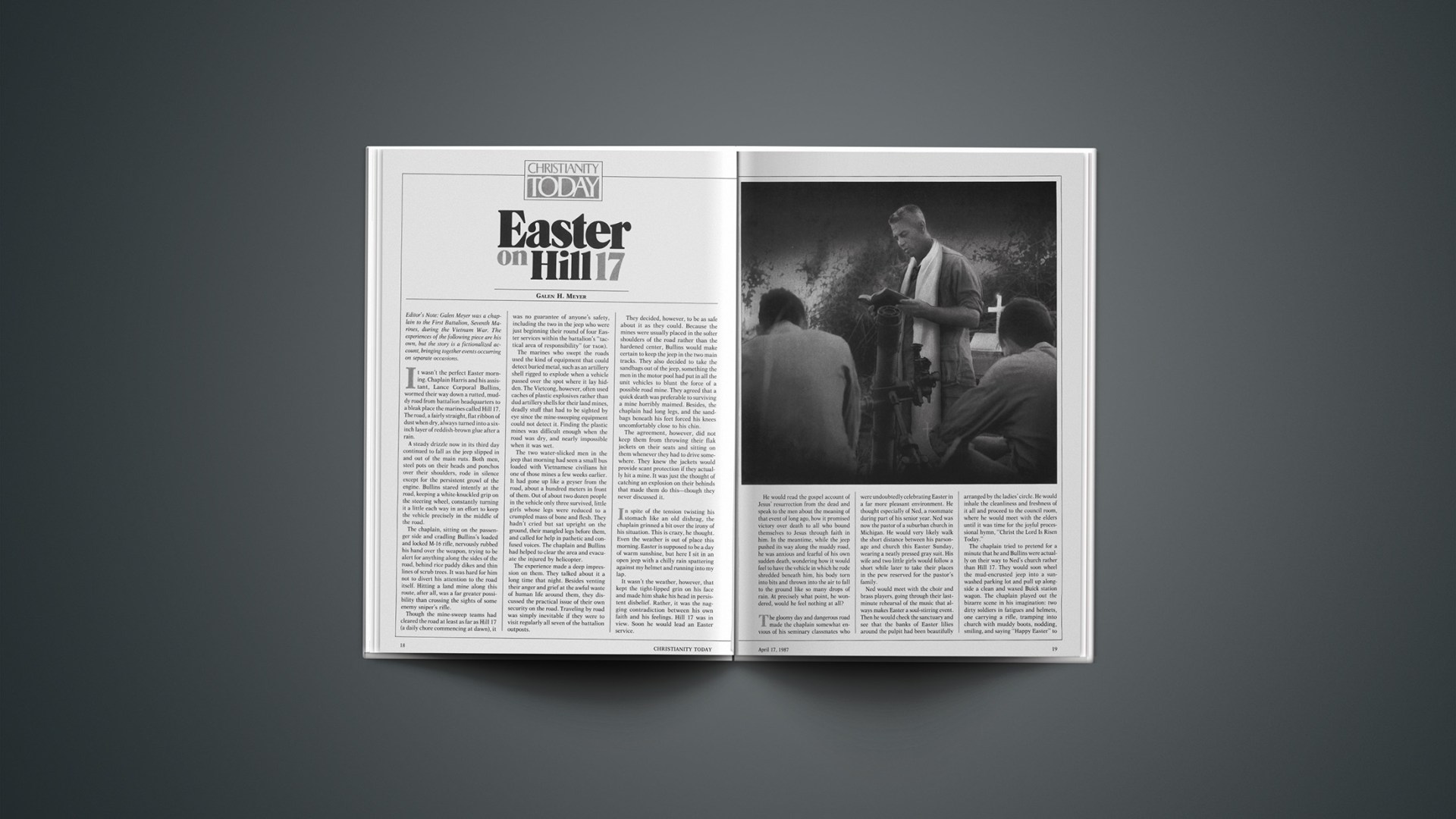
Easter on Hill 17

Editor’s Note: Galen Meyer was a chaplain to the First Battalion, Seventh Marines, during the Vietnam War. The experiences of the following piece are his own, but the story is a fictionalized account, bringing together events occurring on separate occasions.

It wasn’t the perfect Easter morning. Chaplain Harris and his assistant, Lance Corporal Bullins, wormed their way down a rutted, muddy road from battalion headquarters to a bleak place the marines called Hill 17. The road, a fairly straight, flat ribbon of dust when dry, always turned into a six-inch layer of reddish-brown glue after a rain.

A steady drizzle now in its third day continued to fall as the jeep slipped in and out of the main ruts. Both men, steel pots on their heads and ponchos over their shoulders, rode in silence except for the persistent growl of the engine. Bullins stared intently at the road, keeping a white-knuckled grip on the steering wheel, constantly turning it a little each way in an effort to keep the vehicle precisely in the middle of the road.

The chaplain, sitting on the passenger side and cradling Bullins’s loaded and locked M-16 rifle, nervously rubbed his hand over the weapon, trying to be alert for anything along the sides of the road, behind rice paddy dikes and thin lines of scrub trees. It was hard for him not to divert his attention to the road itself. Hitting a land mine along this route, after all, was a far greater possibility than crossing the sights of some enemy sniper’s rifle.

Though the mine-sweep teams had cleared the road at least as far as Hill 17 (a daily chore commencing at dawn), it was no guarantee of anyone’s safety, including the two in the jeep who were just beginning their round of four Easter services within the battalion’s “tactical area of responsibility” (or TAOR).

The marines who swept the roads used the kind of equipment that could detect buried metal, such as an artillery shell rigged to explode when a vehicle passed over the spot where it lay hidden. The Vietcong, however, often used caches of plastic explosives rather than dud artillery shells for their land mines, deadly stuff that had to be sighted by eye since the mine-sweeping equipment could not detect it. Finding the plastic mines was difficult enough when the road was dry, and nearly impossible when it was wet.

The two water-slicked men in the jeep that morning had seen a small bus loaded with Vietnamese civilians hit one of those mines a few weeks earlier. It had gone up like a geyser from the road, about a hundred meters in front of them. Out of about two dozen people in the vehicle only three survived, little girls whose legs were reduced to a crumpled mass of bone and flesh. They hadn’t cried but sat upright on the ground, their mangled legs before them, and called for help in pathetic and confused voices. The chaplain and Bullins had helped to clear the area and evacuate the injured by helicopter.

The experience made a deep impression on them. They talked about it a long time that night. Besides venting their anger and grief at the awful waste of human life around them, they discussed the practical issue of their own security on the road. Traveling by road was simply inevitable if they were to visit regularly all seven of the battalion outposts.

They decided, however, to be as safe about it as they could. Because the mines were usually placed in the softer shoulders of the road rather than the hardened center, Bullins would make certain to keep the jeep in the two main tracks. They also decided to take the sandbags out of the jeep, something the men in the motor pool had put in all the unit vehicles to blunt the force of a possible road mine. They agreed that a quick death was preferable to surviving a mine horribly maimed. Besides, the chaplain had long legs, and the sandbags beneath his feet forced his knees uncomfortably close to his chin.

The agreement, however, did not keep them from throwing their flak jackets on their seats and sitting on them whenever they had to drive somewhere. They knew the jackets would provide scant protection if they actually hit a mine. It was just the thought of catching an explosion on their behinds that made them do this—though they never discussed it.

In spite of the tension twisting his stomach like an old dishrag, the chaplain grinned a bit over the irony of his situation. This is crazy, he thought. Even the weather is out of place this morning. Easter is supposed to be a day of warm sunshine, but here I sit in an open jeep with a chilly rain spattering against my helmet and running into my lap.

It wasn’t the weather, however, that kept the tight-lipped grin on his face and made him shake his head in persistent disbelief. Rather, it was the nagging contradiction between his own faith and his feelings. Hill 17 was in view. Soon he would lead an Easter service.

He would read the gospel account of Jesus’ resurrection from the dead and speak to the men about the meaning of that event of long ago, how it promised victory over death to all who bound themselves to Jesus through faith in him. In the meantime, while the jeep pushed its way along the muddy road, he was anxious and fearful of his own sudden death, wondering how it would feel to have the vehicle in which he rode shredded beneath him, his body torn into bits and thrown into the air to fall to the ground like so many drops of rain. At precisely what point, he wondered, would he feel nothing at all?

The gloomy day and dangerous road made the chaplain somewhat envious of his seminary classmates who were undoubtedly celebrating Easter in a far more pleasant environment. He thought especially of Ned, a roommate during part of his senior year. Ned was now the pastor of a suburban church in Michigan. He would very likely walk the short distance between his parsonage and church this Easter Sunday, wearing a neatly pressed gray suit. His wife and two little girls would follow a short while later to take their places in the pew reserved for the pastor’s family.

Ned would meet with the choir and brass players, going through their last-minute rehearsal of the music that always makes Easter a soul-stirring event. Then he would check the sanctuary and see that the banks of Easter lilies around the pulpit had been beautifully arranged by the ladies’ circle. He would inhale the cleanliness and freshness of it all and proceed to the council room, where he would meet with the elders until it was time for the joyful processional hymn, “Christ the Lord Is Risen Today.”

The chaplain tried to pretend for a minute that he and Bullins were actually on their way to Ned’s church rather than Hill 17. They would soon wheel the mud-encrusted jeep into a sun-washed parking lot and pull up alongside a clean and waxed Buick station wagon. The chaplain played out the bizarre scene in his imagination: two dirty soldiers in fatigues and helmets, one carrying a rifle, tramping into church with muddy boots, nodding, smiling, and saying “Happy Easter” to the startled worshipers assembling for the service. It was ridiculously incongruent, and he laughed aloud. “What’s so funny, sir?” asked Bullins in his Georgian drawl.

“Sorry, Bullins. Nothing at all, really,” the chaplain replied, a little embarrassed. “Let’s just watch the road.”

The two remained silent as they soon left the muddy road to follow a winding trail of crushed rock up Hill 17, a low, flat hill that sat like a great egg yolk on the riceland around it. There was a Combined Action Platoon (or CAP) on this hill. It was made up of 12 marines and one navy corpsman. These men lived close to the Vietnamese peasants and worked with the local Popular Forces (PF’S), in order to provide government security to the area and frustrate the grassroots political strategy of the Vietcong. They were also the men who bore the heaviest share of the responsibility to “win the hearts and minds of the people,” the accomplishment of which would presumably make the U.S. war effort a success.

The men who comprised a CAP, generally volunteers, were a tough-minded bunch. They had to be; this “combined action” business was dangerous. Each CAP operated from a small outpost, always vulnerable to a large-scale enemy attack. Adding to their danger was the fact that the PF’S who actually lived within the CAP compound could never be fully trusted. There were always Vietcong agents among them, making it necessary for all CAP members to be constantly vigilant and keep a PRK-25 radio close by—with its power on—just in case they had to call for air support or other kinds of reinforcement. Even when they gathered with the chaplain for a weekly worship service, the radio hissed in the background.

Still, the men liked this kind of duty at least better than some with which they could get stuck in Vietnam. Sometimes they actually found their work personally gratifying, especially when they offered basic medical services to the people. Most of all, however, they enjoyed their independence as enlisted men, having their own operation apart from the daily supervision of an officer.

The CAP compound itself, constructed mostly of bulging sandbags laid with the precision of an experienced mason, had a stubborn, almost challenging look. Near the center, two 16 × 32-foot tin-roofed hooches hunkered down between thick sandbag walls, nearly as high as the eaves. A number of strategically placed fighting holes with sandbag rims and heavy sandbag overheads looked out over cleared fields of fire. A well-fortified 61 mm mortar pit with its accompanying ammunition bunker was the rivet that fixed the drab outpost to this spot on the planet.

A defensive trench lined with more sandbags zigzagged around the compound, and, outside of that, were stacks of closely coiled rolls of concertina wire fixed with thousands of razorlike blades that threatened to slice into thin strips even the unfortunate sparrow that happened to fly through.

Bullins parked the jeep at the gate to the compound just behind a small crowd of marines and PF’S. He gave the handbrake a sharp yank. A stocky, blond marine in charge of the CAP, Sgt. Harm Peterson, immediately left the group and ambled over to the side of the vehicle with his M-16 casually slung over his shoulder.

“Morning, Padre,” he said as the chaplain climbed out of the jeep and stretched his cramped legs.

“Good to see you, Peterson. Happy Easter!”

Peterson grunted his response, then continued, “Had a little excitement last night. The ambush patrol got lucky and nailed five VC coolies carrying ammo and a couple of 122s. Have a look.”

Sergeant Peterson escorted the chaplain through the crowd of marines and laughing, bantering PF’S to the object of everyone’s attention. There on the ground lay three gray 122mm Soviet-made rockets, each about six feet long and tipped with a black warhead. Next to them lay the bodies of five young men—boys, really—wearing the remnants of Vietcong uniforms or “black pajamas.” The bodies had been mutilated by the claymore mines and rifle fire of the ambush. A dark mixture of blood and mud smeared every part of their faces and bodies. Their wounds lay open and bloodless. The rain continued to fall softly and quietly, perhaps in pity for the dead, trying to wash them clean for burial. But it had no effect.

“Well, Padre,” said Peterson, “that’s the enemy kill. I think we finally got some of the gooks who’ve been setting booby traps around here. The ambush team just dragged them in before you came.”

The five marines who had been part of the team, along with as many PF’S, stood in a cluster across from the chaplain on the other side of the muddied corpses. Wet, dirty, bone-weary and quiet, they met the chaplain’s look with a blank stare. He had been prepared to greet every man on Hill 17 with “Happy Easter.” Now he felt as empty as they of anything to say.

Feeling a sudden impulse to do something, as though the accomplishment of a planned routine would make everything ordinary and acceptable, the chaplain turned to Sergeant Peterson. “Sarge,” he said quickly, “I’ve come to conduct an Easter service. Think we can get the men together up at the mortar pit?”

“Yes, sir,” Peterson replied, “in a little while. We let word out in the village down the hill that we’d killed five VC. We’re waiting to see who comes to cry the most and take the bodies. It’s just one way of finding out who’s connected to the Vietcong around here.”

As Peterson spoke, the chaplain noticed a string of Vietnamese peasants, mostly women, holding on to their round straw hats as they half ran up the slippery trail from the village on the far slope of the hill to the CAP compound. The crowd of marines and PF’S quickly parted as they approached. With a high-pitched wail that belied anything ever said about Asians not feeling the pain of death the same way people in the West do, they gathered around the dead, cradled their heads in loving arms, and wiped the mud-smeared faces with wet sleeves.

Sergeant Peterson, the chaplain, the other marines, and even the PF’S gradually backed away from the scene, allowing the people to have their grief.

Though Peterson wanted to be able to identify the VC connections in the village—for the CAP’S security if nothing else—he was not ready to get that information from the crying face of a widow or mother.

“Come on, Padre,” said Peterson, “let’s go to the mortar pit. I’ll get the men together.”

Bullins and the chaplain headed for the designated spot inside the compound. It was a circular pit about three feet deep and ten feet in diameter, completely lined with sandbags. The mortar, when set up for use, stood in the center on a brace of legs and a heavy base plate. The chaplain was accustomed to using the pit as a small amphitheater in which to hold worship services. He stood on one side and the men sat on the sandbagged edge in a semicircle in front of him.

Soon the chaplain would be reading the gospel’s resurrection account. But while the jeep pushed its way along the muddy road, he was fearful of driving over a buried mine. At precisely what point, he wondered, would he feel nothing at all?

When they reached the pit, Bullins unstrapped the canvas “chaplain’s kit” he always carried on these excursions. Taking out a small silver cross, he placed it on an empty ammo crate set on end in the middle of the pit. It glistened rather brightly in the gloom of the day. Because of the persistent drizzle, he left the rest of the worship paraphernalia in the bag: two short, white candles on silver holders, and a Bible that would normally be placed in an open position in front of the cross.

The chaplain paced slowly around the pit, looking over the Easter account in the Gospel of Luke and trying to organize his thoughts for the service. It was difficult. He could not push from his mind the scene he had just left. He kept glancing at the Vietnamese women, black-clad and wet, some bending over the dead young men, some rocking back and forth while seated on the ground with the torn bodies in their laps, and others simply moving about the rest—but all wailing. It didn’t matter whether the chaplain looked straight at them or in another direction entirely; he could see them even with his eyes shut.

Having secured the captured rockets in the ammo bunker, Sergeant Peterson and nine of the CAP members stepped into the mortar pit with the chaplain and Bullins. Tired and wet, their ponchos useful at this point only for retaining their body heat, they sat down on the edge of the pit with their rifles between their knees. The liturgical formality of an invocation and salutation didn’t mean much around here. The chaplain simply faced the men and began the service by quietly greeting each man personally: “Good to see you, Dex, Rozey, Fred, Miranda, Doc.” So he went down the line as each man responded with a nod or “Good Morning.”

“It’s Easter,” the chaplain said, “when we remember the resurrection of our Lord Jesus Christ from the dead. Today Christians all over the world will celebrate the victory of Christ over the grave, of life over death. Of course, most of them will be meeting in fancier places than a mortar pit. They’ll enjoy lots of grand music, too, I’m sure.” He thought of Ned again. “Out here, things will be different, though. No beautiful church. No choir, organ. No brass instruments. Just the clouds, the rain—and death.”

He looked past the marines in front of him to the black-shrouded women huddled over their fallen sons and husbands, wailing in the same high-pitched moan that chafed his nerves. “Still,” he continued slowly, almost to himself, “if there isn’t a message for us in the Easter story this morning, I don’t know where else to find one.”

With that the chaplain folded his hands and invited the men to join him in a prayer. “O God,” he pleaded, the sound of the women humming in his ears, “we are oppressed by death. It is outside of us and inside of us. We feel like corpses that still move a little and barely think. If you live, please raise us from the dead. Bless us with the experience of your love. Give us just a little Easter joy today. In Jesus’ name, Amen.”

Opening his damp New Testament, the chaplain turned to the Gospel of Luke. Summarizing the last part of chapter 23, he told the men how Joseph of Arimathea requested permission from Pilate to bury the crucified body of Jesus and how certain women from Galilee watched the burial, then went home to prepare spices and ointments for the corpse. He continued by reading from the twenty-fourth chapter:

“But on the first day of the week, at early dawn, they went to the tomb, taking the spices they had prepared. And they found the stone rolled away from the tomb, but when they went in they did not find the body. While they were perplexed about this, behold, two men stood by them in dazzling apparel; and as they were frightened and bowed their faces to the ground, the men said to them, ‘Why do you seek the living among the dead?’ ”

The chaplain usually kept his messages brief, but none were ever as short as this Easter homily. Actually, the steady drizzle and wailing women had nothing to do with the fact that he came so quickly to his conclusion. There simply are times in every preacher’s experience when the Scripture passage itself says all that needs to be said or, for that matter, all that can be said.

The story from Luke’s gospel about the death and resurrection of Jesus needed no intermediary, ordained or otherwise, to weave itself into the lives of the little congregation. The chaplain read it aloud, of course, but even he was only one of the listeners. When the story revealed how Jesus’ body was taken from the cross, everyone in the mortar pit actually saw it in sharp detail, bloody and torn.

It looked remarkably like the body of a friend killed in this war, once warm and lively, eating C-rations, crying, laughing, joking, and cursing, but now with everything vital blown out of it. The body they saw in the story also strangely resembled those for whom they had been sent to Vietnam, both to help and to kill; its face was as Asian as it was American. The chaplain himself was startled enough in his reading of the story to pause and look again beyond the marines to the gate of the CAP compound. The brow and closed eyes of the crucified Christ he saw in his own imagination looked so much like those of one of the ambush victims lying there.

Death out here was not something that anyone could explain away as “just a natural thing” or, worse yet, “all a part of life.” It sat in front of the men like some ugly, snarling monster defying them to take it for anything but what it was: a gross violation of life, a wretched curse that whacked the life out of its victims, leaving corpses behind. They heard its boisterous, cynical “Ha!” in every rifle report and every exploding artillery shell, bomb, and land mine. It was their daily companion. Sometimes it went after them, and sometimes they were its allies.

But if death could not be made more agreeable here, as it might in the polite visiting-room conversation of the funeral home, neither was it possible to clean up the resurrection story a bit and turn it into a religious allegory or metaphor. Clean, well-dressed worshipers in new, spring fashions anticipating a sumptuous Easter ham after the service might need that sort of transformation of the story. But not here.

The wet “grunts” in the mortar pit listened to Luke’s account of Jesus rising from the dead and found it a macabre, bizarre story, full of divine wonder. Just as clearly as they had seen the torn, bloody body taken from the cross and laid in a tomb, so clearly did they see that same body begin to move, regain its warmth, open its eyes, sit up, rub its arms, and walk, squinting, into the bright morning sun.

The Gospel of Luke left its mark on the chaplain that morning, though he would have been hard pressed to explain how with any precision. The most he could say was that it was a feeling of quiet reassurance that, at best, bordered joy.

The feeling did not last, of course, any more than that rare “moment in time” when one is surprised by beauty and hope for the whole miserable universe in the happy chirping of a brown sparrow on a snowy twig. Yet, like the unpredictable but recurring moment, the feeling he first sensed in the mortar pit flitted back into his consciousness periodically in the weeks that followed. Whenever it came, it brought the awful consolation that in the body of Christ, God himself had suffered even the agony of Vietnam. More important, however, it always dropped the tantalizing hint that God’s raising of Jesus from the dead was only the beginning of a cosmic rising and rejuvenation that would include even Vietnam’s broken bodies.

The Easter service ended as informally as it began. After delivering the benediction that God “bless and keep” the small congregation “and make his face to shine upon them and give them peace,” the chaplain shook hands with each man and engaged in casual conversation about the mail, food, home, and the hundred other things that fill a soldier’s mind. When they had left the mortar pit and gone back to their tasks for the day, Bullins wiped the silver cross on his sleeve and put it back in the canvas bag. Then he and the chaplain climbed out of the pit themselves and headed back to the jeep.

The crowd at the gate to the CAP compound had gone. No PF’S were around. Four of the five dead VC had apparently been carried away by the grieving women. Only one woman remained, kneeling in her drenched black clothes, hair wet against her head and face, her round hat on the ground beside her.

In her arms she continued to hold the corpse of her loved one. She was silent now, but still rocked a little back and forth with her burden. The chaplain stopped in front of her. He wanted to say something or do something, but couldn’t. She looked up at him. Nothing passed between them—no words, gestures, nor even that rare, mutual recognition of each other’s sorrow poignantly conveyed through the eyes. Still, the chaplain was struck deeply by the figure before him, cradling her dead. She was a Pietá transformed from Italian marble to Asian flesh.

Not knowing what else to do, the chaplain lifted his right hand and spoke the benediction he had just given the marines. Easter is for her too, he thought, but I don’t know how to tell her. He backed away from her several steps, then turned and joined Bullins in the jeep for the trip to the next service.

Galen Meyer is teacher of Bible and English at South Christian High School, Grand Rapids, Michigan. He is also a chaplain (at the rank of colonel) in the U.S. Army Reserve, and has written for The Banner and Christian Educator’s Journal.

Ideas

The Real Sex Ed Batte

Playboy and Penthouse are teaching kids the “facts” of life.

In all the furor over whether sex ought to be taught in the public schools, one fact is often overlooked: Sex is already being taught to youngsters through the wide distribution of pornography. And recent findings on the effects of pornography on the young ought to mobilize an even greater ground swell of public outrage aimed at publishers of pornography.

Since 1970, pornographers have enjoyed the support of a U.S. presidential commission report downplaying the effects of pornography.

That report “found no evidence to date that exposure to explicit sexual materials plays a significant role in the causation of delinquent or criminal behavior.” Rather, it presented pornographic material as essentially harmless entertainment that often had a cathartic influence upon those who used it. But last July the U.S. Department of Justice issued a two-volume report that reverses those findings.

The Justice Department’s report comes at a time when research has called into question most of the basic conclusions of the 1970 commission. Specifically, it raises questions about the “cathartic” theory espoused by the older report. Experimentation with pornography does not always lead to satiation and boredom (thus serving as a harmless fantasy outlet for those who would otherwise engage in rape or other forms of sexual abuse, so the theory goes). Quite to the contrary, viewing some kinds of hard-core pornography tends to foster imitation. The 1986 report notes that research “shows a causal relationship between exposure to material of this type and aggressive behavior towards women.” Rapists interviewed in prison were 15 times more likely than nonoffenders to have been exposed to hard-core pornography during the ages of 6 to 10.

Where Kids Learn About Sex

Here we are not dealing with so-called adult entertainment. Rather, we are confronted with the favorable treatment of criminal acts against children and women. What is most alarming is that this offensive material may be the most prevalent form of sex education for our nation’s youth. According to Henry Boatwright, chairman of the U.S. Advisory Board for Social Concerns, 70 percent of all pornographic magazines end up in the hands of minors. One member of the commission estimated that the chief consumers of even hard-core pornography are males 15 to 19 years old.

And what lessons do young people assimilate from such instruction? The movies, magazines, and books teach these impressionable youth that women are playthings, that sex has little to do with love and need not be tied to commitment or fidelity, and that sexual activity is appropriate anywhere, with anyone, and at any time.

No wonder the number of unmarried couples living together has quadrupled; abortions among unmarried women more than doubled (500,000 to over 1,200,000 per year); and single-parent families tripled (1,900,000 to 5,600,000). Meanwhile, teenage pregnancy in the U.S. is the highest in the world—over one million each year with more than half ending in abortion.

Though Christians have admirably joined the battle to prevent the wide distribution of pornography, more must be done to combat this calculated effort to educate our youth. Few understand just how serious the purveyors of pornography are in making their message available. The Playboy Foundation, for example, underwrote the formation of the Organization for Free Press to counter efforts against the distribution of pornography. And the public relations firm of Gray and Company proposed to members of a media coalition a $900,000 annual budget to fight the strong opposition that has risen against pornography. The underlying strategy of such efforts is to portray those who oppose pornography as narrow-minded religious bigots, ultraconservative in their attitudes toward life, hopelessly outdated, and determined to destroy freedom of speech and freedom of press in all other areas of American life.

No Time For False Modesty

What do we recommend? The first line of defense against pornography’s vile influence is to instruct our children in a sound and healthful view of sex. This is no time to retreat behind a false sense of biblical modesty. We must take for granted that our children will be bombarded with a hedonistic philosophy of sex, not only from publications recognized as pornographic, but from the flood of material that comes to them incessantly through public advertising, radio, and television (including the “family programs” run at the prime hours of the day). It is far better that our children receive their sex education within the framework of a biblical philosophy of sex as an honorable and treasured gift of God. The Christian home, Christian schools, Sunday schools, church youth groups, seminars, and youth retreats—these are the appropriate places for instructing our children about sex.

Second, we must speak out boldly in our neighborhoods, at parent-teacher meetings, and at local newsstands, drugstores, and book stores. This is an issue on which evangelicals really do have a moral majority. A 1985 Gallup Poll showed that 73 percent of the American people believed explicit sexual magazines and movies influence some people to commit rape or other sexual violence. And 93 percent called for stricter control of magazines displaying sexual violence. We must take the lead in speaking out boldly and fearlessly against this festering sore in our society.

Third, we must be willing to back others who take a stand, joining them in petition drives and boycotts in the fight against stores that display or sell pornographic materials and against television programs that carry debasing sexual themes.

Fourth, we must support studies so that our opposition is based on a clear understanding of the difference between opposition to pornography and opposition to freedom of speech. This, after all, is the final defense of most proponents of pornography. They warn that any laws that bar obscenity will inevitably lead to laws destroying our constitutional freedoms of press and speech. We can combat this defense by educating ourselves (and the public) regarding definitions of pornography and obscenity.

For too long, the public has accepted the myth that pornography harms no one, even the legions of minors who are frequently exposed to it. The Justice report effectively dashes that notion. If the church cares to enter the real sex-education battle, it would be wise to step up the attack on easy-to-obtain smut and accept responsibility for the sex education of our youth.

By Kenneth S. Kantzer.

Earle Fitz’s Bible Blitz

Earle L. Fitz, the four-time mayor of Iowa Falls, Iowa, is unhappy about the current era. “It’s a self-serve age,” says Earle, shaking his head in discontent.

The other day his car needed air in the left-hand front tire. Earle pulled into a filling station, wearing his business suit and loathe to get out into the rain. But the attendant only pointed to the nearby air pump.

Even more recently Earle visited a restaurant. “The waitress told me to have a nice day,” he allows, “but she wasn’t even looking at me when she said it.”

Such shenanigans may get by in the gasoline or food business, Earle observes, but it’s no way to sell Bibles. He should know. For one thing, he is 81 years old and wise for it. For another thing, he is the founder and president of Riverside Book and Bible House, the world’s largest Bible distributor. Last year Riverside, a wholesaler, sold more than $33 million worth of Bibles—straight from its 100,000-square-foot plant in a prairie town with a population of 6,500.

Earle never ceases to be disappointed with poor service, as with the likes of the waitress and the gas station attendant, but he is not surprised. “I built my business by watching what other people do,” he sighs, “and not doing it.”

Earle started out, in the 1920s, as an elementary school teacher. One Christmas he asked his class of 23 children what Christmas was all about. “Santa Claus,” some said; and others, “We have lots to eat.” A single child mentioned the birth of Christ. At that point, Earle decided Christian education was an urgent necessity, and he began selling Bibles and study helps, at first in the summers, then full-time. He has been motivated by a simple philosophy from then to now: “The world would be a better place if every home knew the Lord’s Prayer and the Ten Commandments.”

It was not until 1962, when Earle was in his midfifties, that the John C. Winston Company (now of Holt, Rinehart, and Winston) decided it wanted out of the Bible business. Earle took early retirement. Back home in Iowa Falls, he poured much of his considerable energy into community involvement, serving as mayor in four successive terms, chairing the Chamber of Commerce, and establishing the Iowa Falls (Water) Ski Show, which has drawn up to 30,000 visitors to this river hamlet north of Des Moines.

But not all of Earle’s energy was spent at city hall.

Winston had 10,000 Bibles left over, which Earle bought and sold in a single winter. With that, Riverside Book and Bible House was born in the basement of Earle Fitz’s home, its president at an age slightly later than usual for the start of a second career.

In 1973 Riverside moved to its present plant, formerly a rope factory, a dance hall hosting such big band luminaries as Lawrence Welk and Stan Kenton, and—in the sixties—another kind of dancing establishment: The area now housing the Riverside credit department once held cages with go-go girls in them. As Earle sees it, “We turned a house of sin into a house of joy”

Clearly, Riverside is not typical. What other $30-million-a-year corporation reuses the boxes in which publishers mail it books? Or is heated mainly by a tank-furnace constructed by its vice-president and fueled by wooden shipping pallets?

When you phone one of us answers,” Riverside’s catalog declares on its cover. “Our company is run by people, not by computers!”

Well, to be picky, there is one personal computer, used for advertising purposes. But that’s it. Earle is concerned that a computerized company, with all terminals connected to a single memory bank, might be paralyzed by a single malfunction. He prefers to rely on electronic typewriters. “If one breaks down, we have another in place inside two minutes,” he says.

It is a fact, as visitors can see for themselves by undertaking one of Earle’s somewhat famous “two-bit tours.” The tours begin in Earle’s element, amid 18 telephones ringing with orders from around the globe.

He wears a Harley-Davidson cap, having given up motorcycle riding only in recent years, and moves briskly from one desk to another, snatching up order forms. “Ada, Oklahoma—look at that! Calgary, Canada—unbelievable! San Francisco! New York! Here we are out in an Iowa cornfield, and they’re sending to us for books!”

And he is off. Charging ahead of his guests, pausing long enough to warn of ramps and stairs where visitors half-a-century younger might miss a step, Earle could just as well be leading a blitzkrieg as a tour. Ida Fitz, Riverside’s secretary-treasurer and Earle’s daughter-in-law, recalls a time when an employee, rushing to pass in front of an oncoming tour group, tripped on a telephone cord and sprawled across the floor. Oblivious to anything but the tour, Earle surged on, stepping over the fallen worker as if he were a log in the path.

Despite the apparent danger of death by stampede, employees do not seem overly threatened by the boss’s tours. He is “Earle” to forklift operators and sales managers alike. Employees dress in T-shirts, blue jeans, shorts, sandals—comfortably, in a word. And then there is Toto, a mutt who is jokingly referred to as the senior vice-president and often found lounging under a desk.

None of this to say that little work goes on inside Riverside. “Work works wonders,” Earle believes. On tour, he raptly admires the busy people packing books into boxes. “Everybody’s working, everybody’s happy,” he mutters in passing, as if the first condition is accompanied by the second as sure as rain follows thunder.

He is proud of how well the employees work. On a tour, he is likely to slow to an idle where two women extract mailing plates from indexed files, and declare they operate faster than computers.

“I can give these girls any order, from anywhere, and they’ll have the mailing plate inside five seconds. Watch.” He hands an order form to a woman; she glances at it, whips open one of the small cabinet drawers, and rifles through plates. Earle counts—“One, two, three”—uncoiling a finger with each number, and suddenly the employee yanks a plate, slaps it on the desk. Earle smiles. “She never breaks down, either.”

Reliability is Riverside’s trademark. In the busy Christmas and Easter seasons, telephone operators and salespeople will leave their desks and join the shipping lines, straining to meet Earle’s promise to his customers: The same day your order comes in, Riverside will ship the books out. Confronted by power-robbing midwestern blizzards, Riverside employees have been known to work in the dark, using flashlights and candles. In his eight years at Riverside, an employee can remember Earle’s promise failing only twice.

That might be hard for some gas station attendants and waitresses to appreciate, but Riverside’s dedicated consistency is why bookstore owners from Alaska to Texas find Earle Fitz’s motto—“Service! Service! Service!”—easy to remember.

By Rodney Clapp.

Apple PodcastsDown ArrowDown ArrowDown Arrowarrow_left_altLeft ArrowLeft ArrowRight ArrowRight ArrowRight Arrowarrow_up_altUp ArrowUp ArrowAvailable at Amazoncaret-downCloseCloseEmailEmailExpandExpandExternalExternalFacebookfacebook-squareGiftGiftGooglegoogleGoogle KeephamburgerInstagraminstagram-squareLinkLinklinkedin-squareListenListenListenChristianity TodayCT Creative Studio Logologo_orgMegaphoneMenuMenupausePinterestPlayPlayPocketPodcastRSSRSSSaveSaveSaveSearchSearchsearchSpotifyStitcherTelegramTable of ContentsTable of Contentstwitter-squareWhatsAppXYouTubeYouTube