Can Christians Hand out Gospel Tracts in Airports?

This case is a crucial test of free speech.

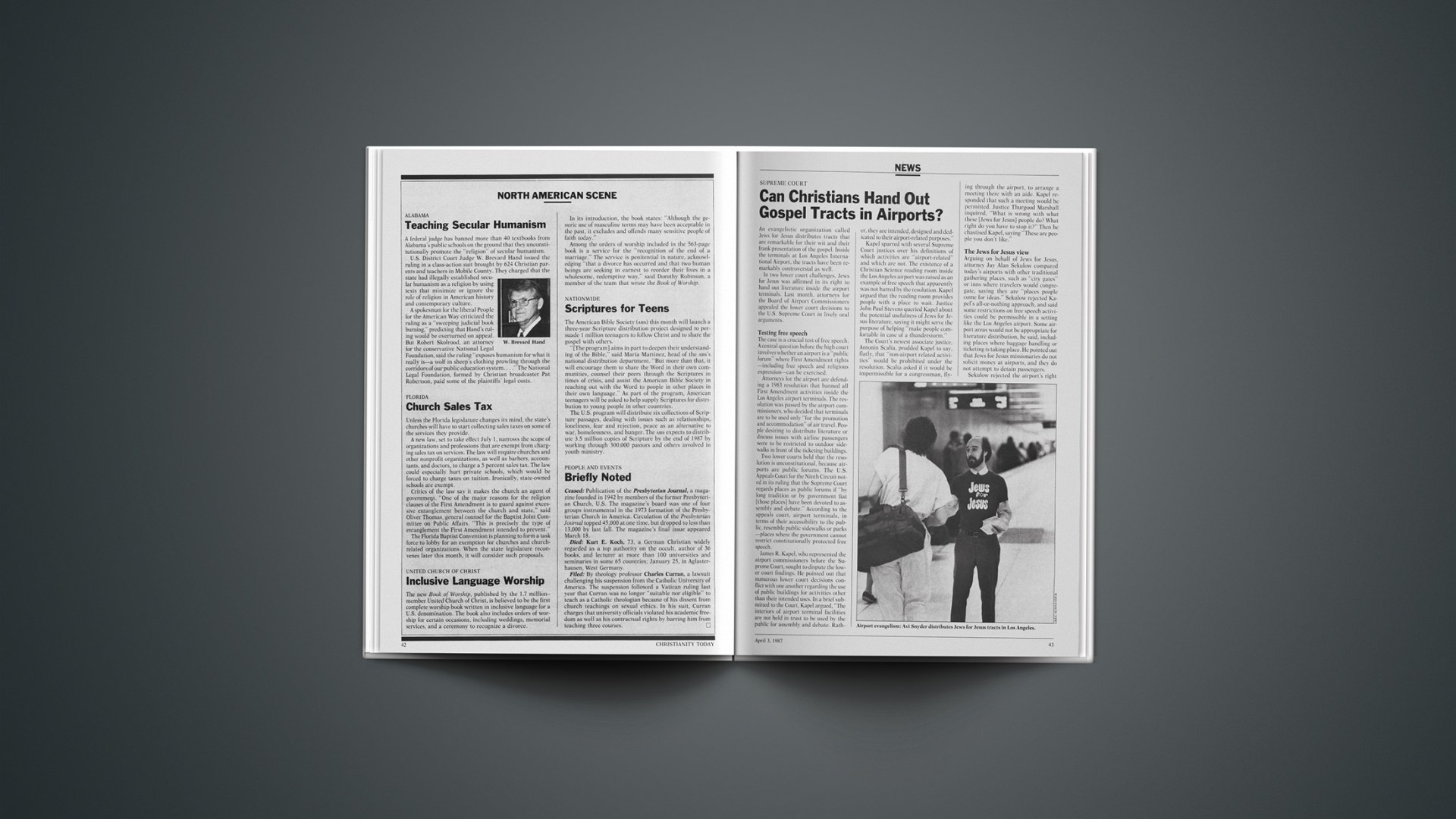
An evangelistic organization called Jews for Jesus distributes tracts that are remarkable for their wit and their frank presentation of the gospel. Inside the terminals at Los Angeles International Airport, the tracts have been remarkably controversial as well.

In two lower court challenges, Jews for Jesus was affirmed in its right to hand out literature inside the airport terminals. Last month, attorneys for the Board of Airport Commissioners appealed the lower court decisions to the U.S. Supreme Court in lively oral arguments.

Testing Free Speech

The case is a crucial test of free speech. A central question before the high court involves whether an airport is a “public forum” where First Amendment rights—including free speech and religious expression—can be exercised.

Attorneys for the airport are defending a 1983 resolution that banned all First Amendment activities inside the Los Angeles airport terminals. The resolution was passed by the airport commissioners, who decided that terminals are to be used only “for the promotion and accommodation” of air travel. People desiring to distribute literature or discuss issues with airline passengers were to be restricted to outdoor sidewalks in front of the ticketing buildings.

Two lower courts held that the resolution is unconstitutional, because airports are public forums. The U.S. Appeals Court for the Ninth Circuit noted in its ruling that the Supreme Court regards places as public forums if “by long tradition or by government fiat [those places] have been devoted to assembly and debate.” According to the appeals court, airport terminals, in terms of their accessibility to the public, resemble public sidewalks or parks—places where the government cannot restrict constitutionally protected free speech.

James R. Kapel, who represented the airport commissioners before the Supreme Court, sought to dispute the lower court findings. He pointed out that numerous lower court decisions conflict with one another regarding the use of public buildings for activities other than their intended uses. In a brief submitted to the Court, Kapel argued, “The interiors of airport terminal facilities are not held in trust to be used by the public for assembly and debate. Rather, they are intended, designed and dedicated to their airport-related purposes.”

Kapel sparred with several Supreme Court justices over his definitions of which activities are “airport-related” and which are not. The existence of a Christian Science reading room inside the Los Angeles airport was raised as an example of free speech that apparently was not barred by the resolution. Kapel argued that the reading room provides people with a place to wait. Justice John Paul Stevens queried Kapel about the potential usefulness of Jews for Jesus literature, saying it might serve the purpose of helping “make people comfortable in case of a thunderstorm.”

The Court’s newest associate justice, Antonin Scalia, prodded Kapel to say, flatly, that “non-airport related activities” would be prohibited under the resolution. Scalia asked if it would be impermissible for a congressman, flying through the airport, to arrange a meeting there with an aide. Kapel responded that such a meeting would be permitted. Justice Thurgood Marshall inquired, “What is wrong with what these [Jews for Jesus] people do? What right do you have to stop it?” Then he chastised Kapel, saying “These are people you don’t like.”

The Jews For Jesus View

Arguing on behalf of Jews for Jesus, attorney Jay Alan Sekulow compared today’s airports with other traditional gathering places, such as “city gates” or inns where travelers would congregate, saying they are “places people come for ideas.” Sekulow rejected Kapel’s all-or-nothing approach, and said some restrictions on free speech activities could be permissible in a setting like the Los Angeles airport. Some airport areas would not be appropriate for literature distribution, he said, including places where baggage handling or ticketing is taking place. He pointed out that Jews for Jesus missionaries do not solicit money at airports, and they do not attempt to detain passengers.

Sekulow rejected the airport’s right to regulate what goes on inside its terminals as long as the activity in question is “compatible” with the airport’s purposes. “Distribution of literature does not interfere with the operation of the airport,” he said. “If the First Amendment activity is compatible with the place where it is conducted, then an open forum is created.”

On this basis, and the basis of transportation centers being traditional gathering places, he said the airport is irrefutably a public forum. He was challenged on this point by Scalia, who said the reverse is the traditional understanding: that if there is a public forum, then any activity taking place in it must be compatible. Either way, Sekulow admitted that compatibility is a factor that would need to be weighed on a case-by-case basis.

After the courtroom session, Sekulow told reporters, “The real question is, ‘How free is speech going to be?’ If an airport is not a public forum, then what is?”

Anticipating A Ruling

Jews for Jesus executive director Moishe Rosen said he is concerned that the Court may partially affirm the lower courts’ rulings, but will allow restrictions to be placed on free speech activities at places such as Los Angeles International Airport. “One by one, we are losing our freedoms,” Rosen said following the oral arguments. He said members of his organization were “stunned” when the Supreme Court agreed to hear the case, since they believed the issue had been settled adequately by lower courts. A high court ruling is expected by July.

Numerous Christian organizations filed friend-of-the-court briefs on behalf of Jews for Jesus, including the National Association of Evangelicals, Christian Legal Society, the Rutherford Institute, and Jesus People USA. At the same time, Rosen said many Christians misunderstood the point of the case. “We’ve received letters complaining that we were suing the government,” Rosen said, when in fact Jews for Jesus is the defendant.

Rosen said the organization’s primary task is evangelism, and tract distribution in public places is a way to involve “ordinary people” in the Great Commission. “The notion abounds that it is fruitless,” he told members of the press. “That’s not so.” Jhan Moskowitz, a Jews for Jesus representative, said the organization distributes literature at airports in New York, Chicago, San Francisco, Toronto, and Boston. He added that they encounter “a hodgepodge of rules and regulations.”

Attempts by Jews for Jesus to hand out tracts at Washington, D.C., airports were thwarted when officials said permits were required. And in front of the Supreme Court, on the day oral arguments were heard, a policeman told Moskowitz he could not hand out tracts on the sidewalk. Moskowitz talked to the officer’s supervisor and obtained permission to continue.

Sekulow said repeated challenges to the freedom to distribute literature in public has led to the formation of a new organization called Christian Advocates Serving Evangelism. It will work to defend the rights of street evangelists to have access to public forums.

Sekulow noted, “What we were able to accomplish—win, lose, or draw—was that the Court heard about the right of free speech and also heard about the gospel. That was just as important as the case itself.” When he is asked whether tract distribution is related to airport purposes, Sekulow says he takes the opportunity to explain what the gospel means: “It is a travel-related message, especially if you consider where your final destination is going to be.”
Afghan Refugees Find Help at the Border

One of every four refugees worldwide is an Afghan.

In December 1979, the Soviet Union sent 35,000 soldiers into the central Asian country of Afghanistan, hoping for a swift solidification of the previous year’s Marxist revolution. But nearly eight years later, Afghanistan has come to be regarded as the Soviet Union’s “Vietnam.”

Despite the help of an estimated 135,000 Soviet troops now occupying Afghanistan, that country’s army, faced with large-scale desertions, has failed to suppress its opposition. Most Afghans oppose the Soviet presence. And those who have taken up arms against the Soviet soldiers, bolstered by U.S. military aid, have proved far more resilient than the Soviets anticipated.

The Refugee Crisis

The prolonged armed conflict has led to the evacuation of some 40 percent of the Afghan population. In fact, one of every four refugees worldwide is an Afghan. Of the 5 million who have fled, nearly 3 million are registered as refugees in neighboring Pakistan.

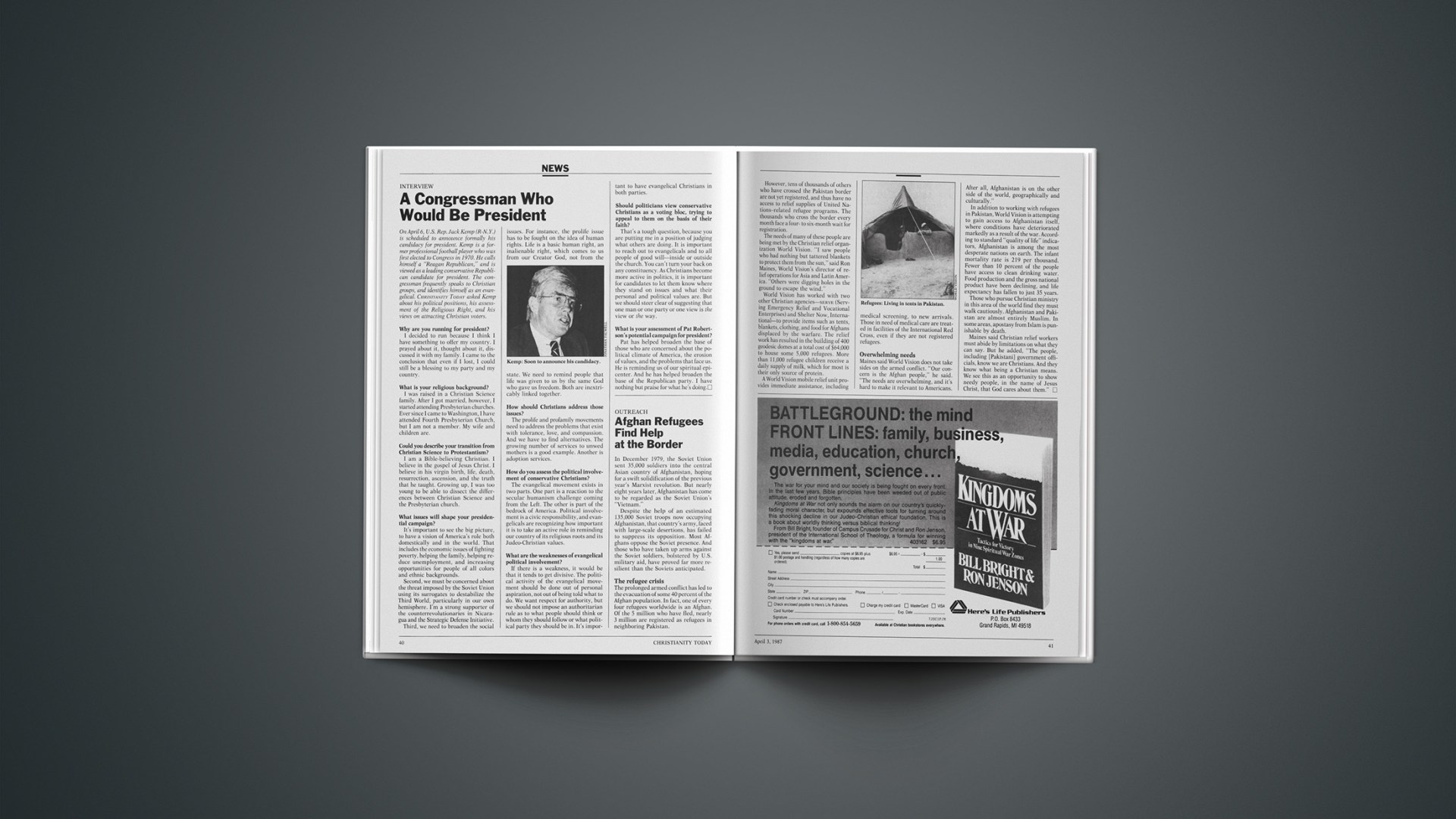
However, tens of thousands of others who have crossed the Pakistan border are not yet registered, and thus have no access to relief supplies of United Nations-related refugee programs. The thousands who cross the border every month face a four-to six-month wait for registration.

The needs of many of these people are being met by the Christian relief organization World Vision. “I saw people who had nothing but tattered blankets to protect them from the sun,” said Ron Maines, World Vision’s director of relief operations for Asia and Latin America. “Others were digging holes in the ground to escape the wind.”

World Vision has worked with two other Christian agencies—SERVE (Serving Emergency Relief and Vocational Enterprises) and Shelter Now, International—to provide items such as tents, blankets, clothing, and food for Afghans displaced by the warfare. The relief work has resulted in the building of 400 geodesic domes at a total cost of $64,000 to house some 5,000 refugees. More than 11,000 refugee children receive a daily supply of milk, which for most is their only source of protein.

A World Vision mobile relief unit provides immediate assistance, including medical screening, to new arrivals. Those in need of medical care are treated in facilities of the International Red Cross, even if they are not registered refugees.

Overwhelming Needs

Maines said World Vision does not take sides on the armed conflict. “Our concern is the Afghan people,” he said. “The needs are overwhelming, and it’s hard to make it relevant to Americans. After all, Afghanistan is on the other side of the world, geographically and culturally.”

In addition to working with refugees in Pakistan, World Vision is attempting to gain access to Afghanistan itself, where conditions have deteriorated markedly as a result of the war. According to standard “quality of life” indicators, Afghanistan is among the most desperate nations on earth. The infant mortality rate is 219 per thousand. Fewer than 10 percent of the people have access to clean drinking water. Food production and the gross national product have been declining, and life expectancy has fallen to just 35 years.

Those who pursue Christian ministry in this area of the world find they must walk cautiously. Afghanistan and Pakistan are almost entirely Muslim. In some areas, apostasy from Islam is punishable by death.

Maines said Christian relief workers must abide by limitations on what they can say. But he added, “The people, including [Pakistani] government officials, know we are Christians. And they know what being a Christian means. We see this as an opportunity to show needy people, in the name of Jesus Christ, that God cares about them.”

A Congressman Who Would Be President

“Even if I lost, I could still be a blessing to my party and my country.”

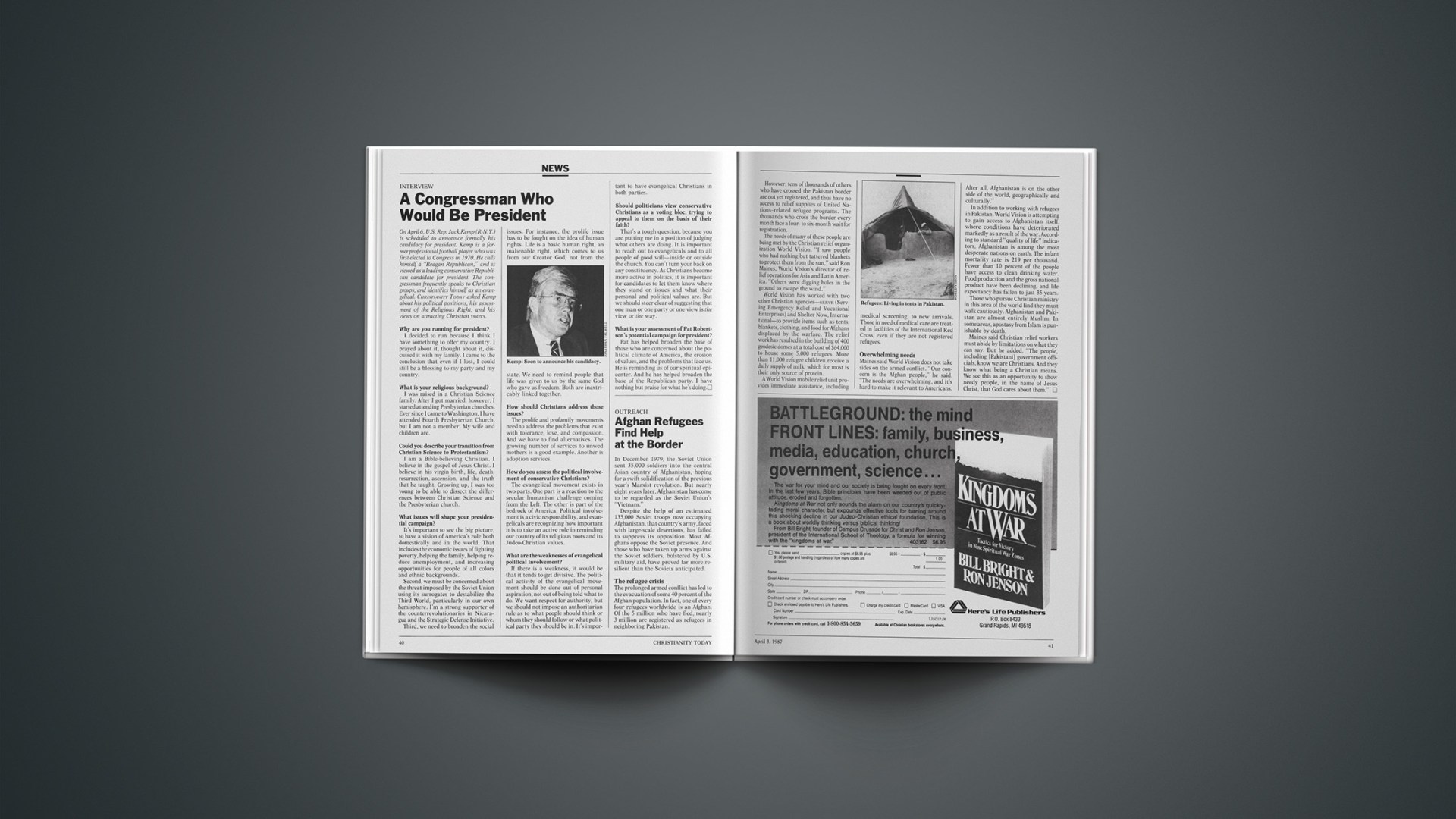
On April 6, U.S. Rep. Jack Kemp (R-N.Y.) is scheduled to announce formally his candidacy for president. Kemp is a former professional football player who was first elected to Congress in 1970. He calls himself a “Reagan Republican,” and is viewed as a leading conservative Republican candidate for president. The congressman frequently speaks to Christian groups, and identifies himself as an evangelical. CHRISTIANITY TODAY asked Kemp about his political positions, his assessment of the Religious Right, and his views on attracting Christian voters.

Why are you running for president?

I decided to run because I think I have something to offer my country. I prayed about it, thought about it, discussed it with my family. I came to the conclusion that even if I lost, I could still be a blessing to my party and my country.

What is your religious background?

I was raised in a Christian Science family. After I got married, however, I started attending Presbyterian churches. Ever since I came to Washington, I have attended Fourth Presbyterian Church, but I am not a member. My wife and children are.

Could you describe your transition from Christian Science to Protestantism?

I am a Bible-believing Christian. I believe in the gospel of Jesus Christ. I believe in his virgin birth, life, death, resurrection, ascension, and the truth that he taught. Growing up, I was too young to be able to dissect the differences between Christian Science and the Presbyterian church.

What issues will shape your presidential campaign?

It’s important to see the big picture, to have a vision of America’s role both domestically and in the world. That includes the economic issues of fighting poverty, helping the family, helping reduce unemployment, and increasing opportunities for people of all colors and ethnic backgrounds.

Second, we must be concerned about the threat imposed by the Soviet Union using its surrogates to destabilize the Third World, particularly in our own hemisphere. I’m a strong supporter of the counterrevolutionaries in Nicaragua and the Strategic Defense Initiative.

Third, we need to broaden the social issues. For instance, the prolife issue has to be fought on the idea of human rights. Life is a basic human right, an inalienable right, which comes to us from our Creator God, not from the state. We need to remind people that life was given to us by the same God who gave us freedom. Both are inextricably linked together.

How should Christians address those issues?

The prolife and profamily movements need to address the problems that exist with tolerance, love, and compassion. And we have to find alternatives. The growing number of services to unwed mothers is a good example. Another is adoption services.

How do you assess the political involvement of conservative Christians?

The evangelical movement exists in two parts. One part is a reaction to the secular humanism challenge coming from the Left. The other is part of the bedrock of America. Political involvement is a civic responsibility, and evangelicals are recognizing how important it is to take an active role in reminding our country of its religious roots and its Judeo-Christian values.

What are the weaknesses of evangelical political involvement?

If there is a weakness, it would be that it tends to get divisive. The political activity of the evangelical movement should be done out of personal aspiration, not out of being told what to do. We want respect for authority, but we should not impose an authoritarian rule as to what people should think or whom they should follow or what political party they should be in. It’s important to have evangelical Christians in both parties.

Should politicians view conservative Christians as a voting bloc, trying to appeal to them on the basis of their faith?

That’s a tough question, because you are putting me in a position of judging what others are doing. It is important to reach out to evangelicals and to all people of good will—inside or outside the church. You can’t turn your back on any constituency. As Christians become more active in politics, it is important for candidates to let them know where they stand on issues and what their personal and political values are. But we should steer clear of suggesting that one man or one party or one view is the view or the way.

What is your assessment of Pat Robertson’s potential campaign for president?

Pat has helped broaden the base of those who are concerned about the political climate of America, the erosion of values, and the problems that face us. He is reminding us of our spiritual epicenter. And he has helped broaden the base of the Republican party. I have nothing but praise for what he’s doing.

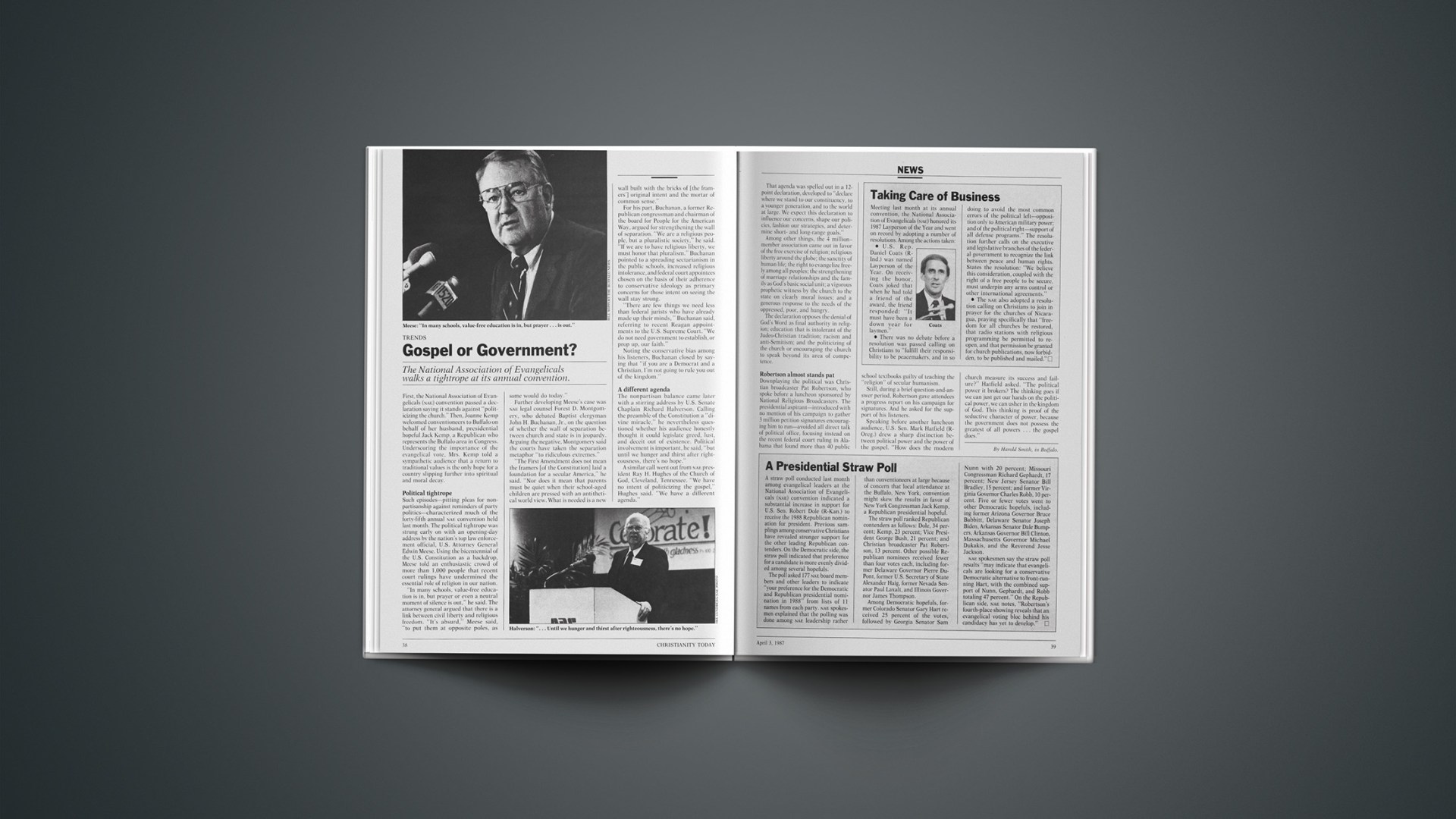
Gospel or Government?

The National Association of Evangelicals walks a tightrope at its annual convention.

First, the National Association of Evangelicals (NAE) convention passed a declaration saying it stands against “politicizing the church.” Then, Joanne Kemp welcomed conventioneers to Buffalo on behalf of her husband, presidential hopeful Jack Kemp, a Republican who represents the Buffalo area in Congress. Underscoring the importance of the evangelical vote, Mrs. Kemp told a sympathetic audience that a return to traditional values is the only hope for a country slipping further into spiritual and moral decay.

Political Tightrope

Such episodes—pitting pleas for non-partisanship against reminders of party politics—characterized much of the forty-fifth annual NAE convention held last month. The political tightrope was strung early on with an opening-day address by the nation’s top law enforcement official, U.S. Attorney General Edwin Meese. Using the bicentennial of the U.S. Constitution as a backdrop, Meese told an enthusiastic crowd of more than 1,000 people that recent court rulings have undermined the essential role of religion in our nation.

“In many schools, value-free education is in, but prayer or even a neutral moment of silence is out,” he said. The attorney general argued that there is a link between civil liberty and religious freedom. “It’s absurd,” Meese said, “to put them at opposite poles, as some would do today.”

Further developing Meese’s case was NAE legal counsel Forest D. Montgomery, who debated Baptist clergyman John H. Buchanan, Jr., on the question of whether the wall of separation between church and state is in jeopardy. Arguing the negative, Montgomery said the courts have taken the separation metaphor “to ridiculous extremes.”

“The First Amendment does not mean the framers [of the Constitution] laid a foundation for a secular America,” he said. “Nor does it mean that parents must be quiet when their school-aged children are pressed with an antithetical world view. What is needed is a new wall built with the bricks of [the framers’] original intent and the mortar of common sense.”

For his part, Buchanan, a former Republican congressman and chairman of the board for People for the American Way, argued for strengthening the wall of separation. “We are a religious people, but a pluralistic society,” he said. “If we are to have religious liberty, we must honor that pluralism.” Buchanan pointed to a spreading sectarianism in the public schools, increased religious intolerance, and federal court appointees chosen on the basis of their adherence to conservative ideology as primary concerns for those intent on seeing the wall stay strong.

“There are few things we need less than federal jurists who have already made up their minds,” Buchanan said, referring to recent Reagan appointments to the U.S. Supreme Court. “We do not need government to establish, or prop up, our faith.”

Noting the conservative bias among his listeners, Buchanan closed by saying that “if you are a Democrat and a Christian, I’m not going to rule you out of the kingdom.”

A Different Agenda

The nonpartisan balance came later with a stirring address by U.S. Senate Chaplain Richard Halverson. Calling the preamble of the Constitution a “divine miracle,” he nevertheless questioned whether his audience honestly thought it could legislate greed, lust, and deceit out of existence. Political involvement is important, he said, “but until we hunger and thirst after righteousness, there’s no hope.”

A similar call went out from NAE president Ray H. Hughes of the Church of God, Cleveland, Tennessee. “We have no intent of politicizing the gospel,” Hughes said. “We have a different agenda.”

That agenda was spelled out in a 12-point declaration, developed to “declare where we stand to our constituency, to a younger generation, and to the world at large. We expect this declaration to influence our concerns, shape our policies, fashion our strategies, course of eighteenth-and nineteenth-century revivals

Among other things, the 4 million-member association came out in favor of the free exercise of religion; religious liberty around the globe; the sanctity of human life; the right to evangelize freely among all peoples; the strengthening of marriage relationships and the family as God’s basic social unit; a vigorous prophetic witness by the church to the state on clearly moral issues; and a generous response to the needs of the oppressed, poor, and hungry.

The declaration opposes the denial of God’s Word as final authority in religion; education that is intolerant of the Judeo-Christian tradition; racism and anti-Semitism; and the politicizing of the church or encouraging the church to speak beyond its area of competence.

Robertson Almost Stands Pat

Downplaying the political was Christian broadcaster Pat Robertson, who spoke before a luncheon sponsored by National Religious Broadcasters. The presidential aspirant—introduced with no mention of his campaign to gather 3 million petition signatures encouraging him to run—avoided all direct talk of political office, focusing instead on the recent federal court ruling in Alabama that found more than 40 public school textbooks guilty of teaching the “religion” of secular humanism.

Still, during a brief question-and-answer period, Robertson gave attendees a progress report on his campaign for signatures. And he asked for the support of his listeners.

Speaking before another luncheon audience, U.S. Sen. Mark Hatfield (R-Oreg.) drew a sharp distinction between political power and the power of the gospel. “How does the modern church measure its success and failure?” Hatfield asked. “The political power it brokers? The thinking goes if we can just get our hands on the political power, we can usher in the kingdom of God. This thinking is proof of the seductive character of power, because the government does not possess the greatest of all powers … the gospel does.”

By Harold Smith, in Buffalo.

Christian Political Activist Launches a New Party

Can CHP bring Christian ethics to bear on Canada’s national political scene?

Saying Canada’s ruling Conservative party has been unresponsive to concerns of evangelical Christians, a Dutch-born political activist is forming a distinctly Christian party.

Ed Vanwoudenberg, a former furniture manufacturer and house builder who has never held public office, said his Christian Heritage party (CHP) will back traditional family values and free enterprise, and oppose abortion. The CHP has already signed up 1,000 members, and has scheduled a founding convention in November.

Building A Base

Vanwoudenberg, who lives in Vancouver on Canada’s Pacific coast, is eager to build a national base for his party. Earlier this year he opened a CHP office in Halifax on the Atlantic coast. And the party plans to open offices in most, if not all, of Canada’s other provinces.

No well-known political figures have endorsed the CHP. But Vanwoudenberg says it is better to have capable candidates running in key legislative districts than to depend on a high-profile figure for influence. His party will try to field at least 50 candidates for Canada’s next national election, to be held at the call of the prime minister and expected as early as 1988. If the CHP signs up fewer than 50 candidates, it will fail to qualify for free radio and television time and for income-tax deductions for party contributions, among other benefits.

Before they can run on the CHP ticket, candidates will have to pass a background check. They will be checked for a criminal record; addiction to alcohol, drugs, or pornography; and level of business ethics. Each candidate will be required to adhere to the party’s fundamental statements, including a commitment to conservative theological and political positions.

Political Goals

Vanwoudenberg says the CHP can bring Christian ethics to bear on Canada’s national political scene, and he believes his timing is right. After 21 years of almost unbroken Liberal party rule, Canadians in 1984 gave Brian Mulroney’s Conservative party a landslide 211 seats out of 282 in the House of Commons. Many evangelical Christians supported the Conservatives, believing they would move the nation away from secularism and socialism. New legislative directions have been slow coming, however, and Mulroney’s cabinet has been marred by scandal.

Some observers say anti-Christian, prohumanist influences are too strong in both the Conservative and Liberal parties for Christians to have a significant impact. The country’s other major party, the socialist New Democrats, has muted the Christian influences that played a role in its founding.

The Conservative party has been the most effective in electing Christians to Parliament. But the CHP has little patience with that party’s attempts to foster a Christian influence within its ranks. Vanwoudenberg cites the Conservative government’s refusal, so far, to fund REALWomen, a profamily, antiabortion organization. The feminist National Action Committee of the Status of Women has received $12 million in federal funding. Vanwoudenberg cites this as evidence that Christians within the Conservative party cannot buck liberal lobbying efforts.

Facing Criticism

The CHP is drawing flak from some Christian politicians who say it is better to work within existing parties. Benno Friesen, a member of Parliament from British Columbia, says Christians should not expect political change to come too rapidly. He pointed out that it took 15 years for former Prime Minister Pierre Trudeau to build an infrastructure that reflected his own moral and ethical values.

The most prominent Christian cabinet minister in the Conservative government, Health and Welfare Minister Jake Epp, agrees with Friesen’s call for patience. He indicated, for example, that REALWomen would obtain federal support once it follows procedures established by the government. Epp added that Christians can be more effective working in established political parties rather than forming a separate party. They need to become “encompassing rather than exclusionary,” recognizing Canada as a pluralistic society, he said.

Fred King, a member of Parliament from British Columbia, points out that evangelical churches could do more to provide a support base for Christian office holders in the existing parties. The Evangelical Fellowship of Canada has made some gains in that area, King said. And he commended his own Canadian Baptist Federation for setting up a political action committee. Said King: “It is a small start, but it plants the seed.”

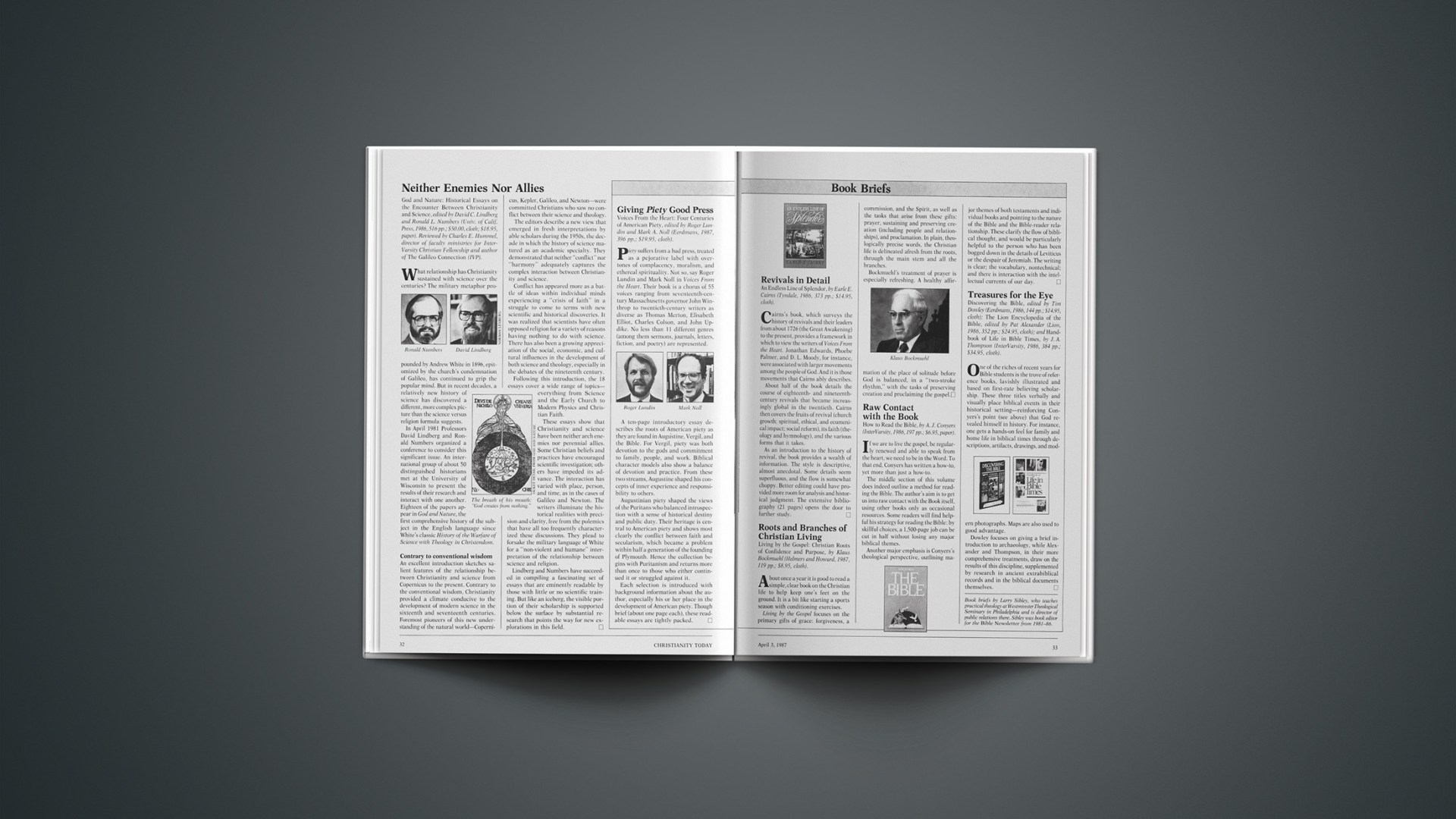
Book Briefs: April 4, 1987

A closer look at Cairns and Bockmuehl

Revivals in Detail

An Endless Line of Splendor, by Earle E. Cairns (Tyndale, 1986, 373 pp.; $14.95, cloth).

Cairns’s book, which surveys the history of revivals and their leaders from about 1726 (the Great Awakening) to the present, provides a framework in which to view the writers of Voices From the Heart. Jonathan Edwards, Phoebe Palmer, and D. L. Moody, for instance, were associated with larger movements among the people of God. And it is those movements that Cairns ably describes.

About half of the book details the course of eighteenth-and nineteenth-century revivals that became increasingly global in the twentieth. Cairns then covers the fruits of revival (church growth; spiritual, ethical, and ecumenical impact; social reform), its faith (theology and hymnology), and the various forms that it takes.

As an introduction to the history of revival, the book provides a wealth of information. The style is descriptive, almost anecdotal. Some details seem superfluous, and the flow is somewhat choppy. Better editing could have provided more room for analysis and historical judgment. The extensive bibliography (21 pages) opens the door to further study.

Roots and Branches of Christian Living

Living by the Gospel: Christian Roots of Confidence and Purpose, by Klaus Bockmuehl (Helmers and Howard, 1987, 119 pp.; $8.95, cloth).

About once a year it is good to read a simple, clear book on the Christian life to help keep one’s feet on the ground. It is a bit like starting a sports season with conditioning exercises.

Living by the Gospel focuses on the primary gifts of grace: forgiveness, a commission, and the Spirit, as well as the tasks that arise from these gifts: prayer, sustaining and preserving creation (including people and relationships), and proclamation. In plain, theologically precise words, the Christian life is delineated afresh from the roots, through the main stem and all the branches.

Bockmuehl’s treatment of prayer is especially refreshing. A healthy affirmation of the place of solitude before God is balanced, in a “two-stroke rhythm,” with the tasks of preserving creation and proclaiming the gospel.

Raw Contact with the Book

How to Read the Bible, by A. J. Conyers (InterVarsity, 1986, 197 pp.; $6.95, paper).

If we are to live the gospel, be regularly renewed and able to speak from the heart, we need to be in the Word. To that end, Conyers has written a how-to, yet more than just a how-to.

The middle section of this volume does indeed outline a method for reading the Bible. The author’s aim is to get us into raw contact with the Book itself, using other books only as occasional resources. Some readers will find helpful his strategy for reading the Bible: by skillful choices, a 1,500-page job can be cut in half without losing any major biblical themes.

Another major emphasis is Conyers’s theological perspective, outlining major themes of both testaments and individual books and pointing to the nature of the Bible and the Bible-reader relationship. These clarify the flow of biblical thought, and would be particularly helpful to the person who has been bogged down in the details of Leviticus or the despair of Jeremiah. The writing is clear; the vocabulary, nontechnical; and there is interaction with the intellectual currents of our day.

Treasures for the Eye

Discovering the Bible, edited by Tim Dowley (Eerdmans, 1986, 144 pp.; $14.95, cloth); The Lion Encyclopedia of the Bible, edited by Pat Alexander (Lion, 1986, 352 pp.; $24.95, cloth); and Handbook of Life in Bible Times, by J. A. Thompson (InterVarsity, 1986, 384 pp.; $34.95, cloth).

One of the riches of recent years for Bible students is the trove of reference books, lavishly illustrated and based on first-rate believing scholarship. These three titles verbally and visually place biblical events in their historical setting—reinforcing Conyers’s point (see above) that God revealed himself in history. For instance, one gets a hands-on feel for family and home life in biblical times through descriptions, artifacts, drawings, and modern photographs. Maps are also used to good advantage.

Dowley focuses on giving a brief introduction to archaeology, while Alexander and Thompson, in their more comprehensive treatments, draw on the results of this discipline, supplemented by research in ancient extrabiblical records and in the biblical documents themselves.

Book briefs by Larry Sibley, who teaches practical theology at Westminster Theological Seminary in Philadelphia and is director of public relations there. Sibley was book editor for the Bible Newsletter from 1981–86.

Special Books Section: April 4, 1987

Lynchburg and Other Cities on a Hill

Lynchburg and Other Cities on a Hill

Cities on a Hill, by Frances Fitzgerald (Simon and Schuster, 1986, 414 pp., $19.95, hardcover). Reviewed by Philip Yancey, editor at large.

What do Sun City, Florida; Rajneeshpuram, Oregon; “the Castro” gay community of San Francisco; and Jerry Falwell’s Thomas Road Baptist Church have in common? Quite a lot, according to Frances Fitzgerald, whose recent book depicts life in each of the four communities.

Her introduction explains that the book came about somewhat by accident. First, she gained an inside look at the burgeoning gay subculture while teaching a class in journalism at Berkeley. While there she heard about Jerry Falwell who, along with Anita Bryant, was leading a campaign against gay rights legislation. Then, while lecturing at Lynchburg College in Virginia, she paid a chance visit to Falwell’s church and was amazed by the vibrancy of an institution so unlike her home church (Episcopal) in New York.

Few writers and social analysts were drawing conscious parallels between the newly evolving gay identity and the fundamentalist subculture, but as Fitzgerald studied each, separately, they seemed to her to share a common pattern. Eventually she came to view them as divergent responses to the tumultuous decade of the 1960s. After seeking out other communities formed around a new vision of society, she settled on the Rajneesh religious settlement in Oregon and on Sun City, one of history’s first attempts at a community composed solely of the elderly.

Fitzgerald sees these four communities as quintessentially American. Can you imagine, she asks, Parisians creating a gay colony or a town for grandparents? Pioneer movements express a distinctly American urge to start all over from scratch and form a new society. “We must consider that we shall be a City Upon a Hill, the eyes of all people are upon us,” said John Winthrop to his Puritan settlers, and almost four centuries later Americans are still constructing hilltop cities.

American Patterns

The last chapter of the book, a rather remarkable essay in itself, identifies kinetic forces common to all four of these disparate communities. Fitzgerald takes us back to an earlier period in American history, roughly 1800–50, when revivalists crisscrossed the Northeast and the Second Great Awakening was producing what we now know as evangelicalism. Fitzgerald finds in these years the emergence of certain patterns still replicating themselves in American culture:

  1. Rebirth. The old-time revivalists, of course, emphasized the conversion experience, and this thirst for rebirth keeps cropping up in American society. Modern Human Potential psychology, for example, stresses the need to strip away neuroses and other “baggage” in order to allow the true person to emerge—innocent, spontaneous, and authentic. In each of Fitzgerald’s four contemporary groups, a member similarly sheds trappings of the past and, through a conversion-type initiation, enters a new life.
  2. Arminianism. The Second Great Awakening, according to Fitzgerald, dislodged Calvinist assumptions about society as a permanent hierarchy, with each individual’s destiny fixed from birth. People gained faith in their abilities both to affect their personal fates and also to reform society.
  3. Perfectionism. Charles Finney took Arminianism to its logical conclusion, thus setting loose powerful forces that would also fuel idealism and utopianism.
  4. Premillennialism. This view of the future, gaining popularity in the early nineteenth century, added a sense of urgency to the efforts of the new reformers. Christ could come at any moment—be prepared!

Fitzgerald goes to some pains to establish a parallel between the scene in Southern California in the 1960s and upstate New York in the 1840s—like California in the sixties, a place and time of extraordinary ferment. She discusses the economic disturbance resulting from, first, the industrial revolution and, later, the technological revolution. That turmoil, along with ethnic immigration and a general cultural upheaval, encouraged groups to band together with a conspiracy-theory view of the world.

Not Just Analysis

It would be a crime, however, to see Cities on a Hill as a book of sociological theory or historical analysis. True, it traverses some of the same territory as New Rules, by Daniel Yankelovich, and Habits of the Heart, by Robert Bellah and friends, books that assess the changing American psyche. But Frances Fitzgerald is a journalist, not a sociologist—one of the very best journalists, in fact, writing today. Fitzgerald’s one previous book, Fire in the Lake, earned her a trophy shelf that would satisfy most authors for a lifetime; it won the Pulitzer Prize, the Bancroft Prize for History, the National Book Award, and the National Institute of Arts and Letters Award.

Except for the introduction and concluding essay, Cities consists of long profiles of each of the four communities. My favorite was the section on the Rajneeshee. Her 135-page rendering of Rajneeshpuram’s inexorable self-destruction offers an effective warning against the New Age movement.

The section on Falwell, although not the strongest in “story line,” will probably prove of most interest to CT readers, for it offers a fine example of how the evangelical/fundamentalist world appears to an inquiring New York journalist. For some readers, the section may suffer from ordinariness. Would not a Pat Robertson or an Oral Roberts have made a better symbol for the meteoric success of American evangelicalism? But Fitzgerald was attracted to Jerry Falwell precisely because of his ordinariness. To her, he represents middle America at its most middling and most American.

She marveled at Falwell’s lack of glitter. “The most sober and conventional of preachers,” he offered television viewers a simple videotape recording of his Thomas Road church service. “The choir behind him sang traditional Baptist hymns and he, strong-jawed and portly of figure, wearing a three-piece black suit, looked every inch the Baptist preacher of the pretelevision era.” Fitzgerald, betraying her New York roots, can’t seem to get over the fact that such a conventional figure could inspire the loyalty of millions of followers and somehow become, according to a U.S. News and World Report poll, the third most-influential person in the U.S. private sector.

Falwell’s Lynchburg

She cannot get over Lynchburg, Virginia, either: “If there is a single public nuisance for the young in this town, it is surely boredom.” Here is her portrayal of a church potluck supper in a local home: “The man of the house—resplendent in a fitted white shirt, cream-colored trousers, and white shoes—watched a boxing match on television with the other men while his wife organized the dishes of ham, baked beans, candied squash, and potato salad the other women had brought with them. At dinner, around a lace-covered table, the guests joked, and made small talk about their gardens, the water system in Lynchburg, the problems of giving a Tupperware party, and the advantages of building one’s house. After dinner, the men and women separated, the men going into the living room and the women upstairs for an hour or so of Bible reading and prayers.”

To Fitzgerald, such a scene seems every bit as strange and exotic as the gays parading in costume down the streets of San Francisco, or the red-robed Rajneeshee sitting in Yoga positions chanting mantras. Yet Fitzgerald does not set out to make fun; she is genuinely seeking the secrets of a community that seems almost invulnerable to seismic changes in the larger culture. In the process, she gives many helpful insights on the phenomenon of “the vast revival tent” of religious broadcasting and on the abrupt migration of evangelicals into the political arena.

Fitzgerald strives admirably to get the facts right, even when discussing such subtleties of doctrine as the conservative rationale against ERA, the scriptural basis for baptism, the “headship” of husbands, the lordship of Christ, and pretribulationism (she falters there, confusing it with the posttribulationist view).

In a refreshing twist, the evangelical heritage is not seen by this secularist as something that must be overcome, but rather as something that still gives life to a variety of forms. In the concluding essay, Fitzgerald draws the four profiles together with her fascinating thesis that the same sociological fuel that runs Jerry Falwell’s movement also energizes the other three.

The conclusion of the book includes a striking image from nature—the molting of eider ducks—that illustrates how groups of people may respond to drastic social change. “Losing all their feathers at the same time, these sea ducks as individuals lose all their capacity to avoid predators both from above and below; so, when they are molting, they join together in huge naked bands, or ‘rafts,’ to paddle and skim the surface of the ocean pretending (for the benefit of larger predatory fish and fowl) that they are one large thing.” Come to think of it, that’s not such a bad analogy for the body of Christ.

A Philosopher’s Lament

Death of the Soul: From Descartes to the Computer, by William Barrett (Anchor/Doubleday, 1986, 173 pp.; $16.95, hardcover; $8.95, paper). Reviewed by Bill Durbin, Jr., a free-lance writer living in Virginia Beach, Virginia.

William Barrett is a distinguished American philosopher now teaching at Pace University in New York. He is credited with introducing existentialism to the United States. In the forties and fifties he was associate editor for Partisan Review, “voice of the New York intelligentsia.”

None of this, however, should intimidate the average reader. In fact, Barrett, in style and sympathies, is a philosopher for the common man. He writes so that the musings of philosophy may be understood in the street, and so that the experiences of ordinary people may enrich philosophy.

His latest book accomplishes this for the soul. Death of the Soul is largely a lament over how far theories of mind and self have come from our everyday experience of these things. In a short space and clear style, Barrett reviews the last 350 years of Western philosophy, a period in which “the labor of a good part of our culture has been reductive: to undermine the spiritual status of the human person.”

His focus is on major philosophers: from René Descartes, who dreamed of mathematical certainty and wrenched conscious man from the machine of nature; through Immanuel Kant, whose reasoned attempts to reconcile moral man with a vast, amoral universe furthered the separation of reason from faith; to present-day promoters of artificial intelligence, whose mechanical models of the mind complete the death of the soul—in theory, that is.

Here, as elsewhere, Barrett fights against the “deranged rationality” infecting our times. His simple point is that philosophy could benefit from a heavy dose of common sense. His major plea is for us to stay in touch with the “I” of human experience, the actual and real person who experiences life as a unity of thoughts, feelings, sensations, and creative ideas, and for whom God is real.

Flowing toward reconciliation

The book flows in the direction of a reconciliation: of man with nature; of philosophy with real life; of past insights with present dilemmas; of scientific understanding and spiritual longing; of God and society. Such a reconciliation would clearly benefit the modern philosopher, nervous about the implications of an immaterial consciousness, and the common man, uncertain of the validity of his faith in a scientific age.

Though the general outline of such a reconciliation is here, the reader’s expectations of it are left largely unfulfilled. Finally, Barrett offers only the promise of a “future work.”

Nor does Barrett clearly distinguish between mind, soul, and spirit—distinctions one might expect from a Christian believer. (The book carries a gentle warning for “those of us who profess to be Christian.”) It may be that such distinctions violate Barrett’s point that the human being has become too divided in theory. Yet one waits to see how his holistic view may differ from those of Eastern mysticism now emerging in our culture.

In any event, Death of the Soul is a delightful and informative survey. Barrett pulls no punches when it comes to criticizing his colleagues “in a period in which triviality has almost become an occupational hazard among philosophers.” His treatment is lucid and occasionally humorous. (Of the diminutive Professor Kant he says: “The good people of Königsberg would have regarded him differently if they had known the thoughts he was harboring.”) And Barrett is never far from the mundane: using his sleeping dog to illustrate the alienation of man from nature and a web-spinning spider outside his window to explain the limits of our scientific theories.

In the end, the book provides sound philosophical and historical reasons for rejecting a prevailing prejudice: that the human mind is like computer software, and the human being may be duplicated in machine. “We do not understand the mind,” This eminent philospher warns, “unless we are able to grasp it as part of the total Being within which the human person exists and functions.”

Neither Enemies Nor Allies

God and Nature: Historical Essays on the Encounter Between Christianity and Science, edited by David C. Lindberg and Ronald L. Numbers (Univ. of Calif. Press, 1986, 516 pp.; $50.00, cloth; $18.95, paper). Reviewed by Charles E. Hummel, director of faculty ministries for InterVarsity Christian Fellowship and author of The Galileo Connection (IVP).

What relationship has Christianity sustained with science over the centuries? The military metaphor propounded by Andrew White in 1896, epitomized by the church’s condemnation of Galileo, has continued to grip the popular mind. But in recent decades, a relatively new history of science has discovered a different, more complex picture than the science versus religion formula suggests.

In April 1981 Professors David Lindberg and Ronald Numbers organized a conference to consider this significant issue. An international group of about 50 distinguished historians met at the University of Wisconsin to present the results of their research and interact with one another. Eighteen of the papers appear in God and Nature, the first comprehensive history of the subject in the English language since White’s classic History of the Warfare of Science with Theology in Christendom.

Contrary To Conventional Wisdom

An excellent introduction sketches salient features of the relationship between Christianity and science from Copernicus to the present. Contrary to the conventional wisdom, Christianity provided a climate conducive to the development of modern science in the sixteenth and seventeenth centuries. Foremost pioneers of this new understanding of the natural world—Copernicus, Kepler, Galileo, and Newton—were committed Christians who saw no conflict between their science and theology.

The editors describe a new view that emerged in fresh interpretations by able scholars during the 1950s, the decade in which the history of science matured as an academic specialty. They demonstrated that neither “conflict” nor “harmony” adequately captures the complex interaction between Christianity and science.

Conflict has appeared more as a battle of ideas within individual minds experiencing a “crisis of faith” in a struggle to come to terms with new scientific and historical discoveries. It was realized that scientists have often opposed religion for a variety of reasons having nothing to do with science. There has also been a growing appreciation of the social, economic, and cultural influences in the development of both science and theology, especially in the debates of the nineteenth century.

Following this introduction, the 18 essays cover a wide range of topics—everything from Science and the Early Church to Modern Physics and Christian Faith.

These essays show that Christianity and science have been neither arch enemies nor perennial allies. Some Christian beliefs and practices have encouraged scientific investigation; others have impeded its advance. The interaction has varied with place, person, and time, as in the cases of Galileo and Newton. The writers illuminate the historical realities with precision and clarity, free from the polemics that have all too frequently characterized these discussions. They plead to forsake the military language of White for a “non-violent and humane” interpretation of the relationship between science and religion.

Lindberg and Numbers have succeeded in compiling a fascinating set of essays that are eminently readable by those with little or no scientific training. But like an iceberg, the visible portion of their scholarship is supported below the surface by substantial research that points the way for new explorations in this field.

Giving Piety Good Press

Voices From the Heart: Four Centuries of American Piety, edited by Roger Lundin and Mark A. Noll (Eerdmans, 1987, 396 pp.; $19.95, cloth).

Piety suffers from a bad press, treated as a pejorative label with overtones of complacency, moralism, and ethereal spirituality. Not so, say Roger Lundin and Mark Noll in Voices From the Heart. Their book is a chorus of 55 voices ranging from seventeenth-century Massachusetts governor John Winthrop to twentieth-century writers as diverse as Thomas Merton, Elisabeth Elliot, Charles Colson, and John Updike. No less than 11 different genres (among them sermons, journals, letters, fiction, and poetry) are represented.

A ten-page introductory essay describes the roots of American piety as they are found in Augustine, Vergil, and the Bible. For Vergil, piety was both devotion to the gods and commitment to family, people, and work. Biblical character models also show a balance of devotion and practice. From these two streams, Augustine shaped his concepts of inner experience and responsibility to others.

Augustinian piety shaped the views of the Puritans who balanced introspection with a sense of historical destiny and public duty. Their heritage is central to American piety and shows most clearly the conflict between faith and secularism, which became a problem within half a generation of the founding of Plymouth. Hence the collection begins with Puritanism and returns more than once to those who either continued it or struggled against it.

Each selection is introduced with background information about the author, especially his or her place in the development of American piety. Though brief (about one page each), these readable essays are tightly packed.

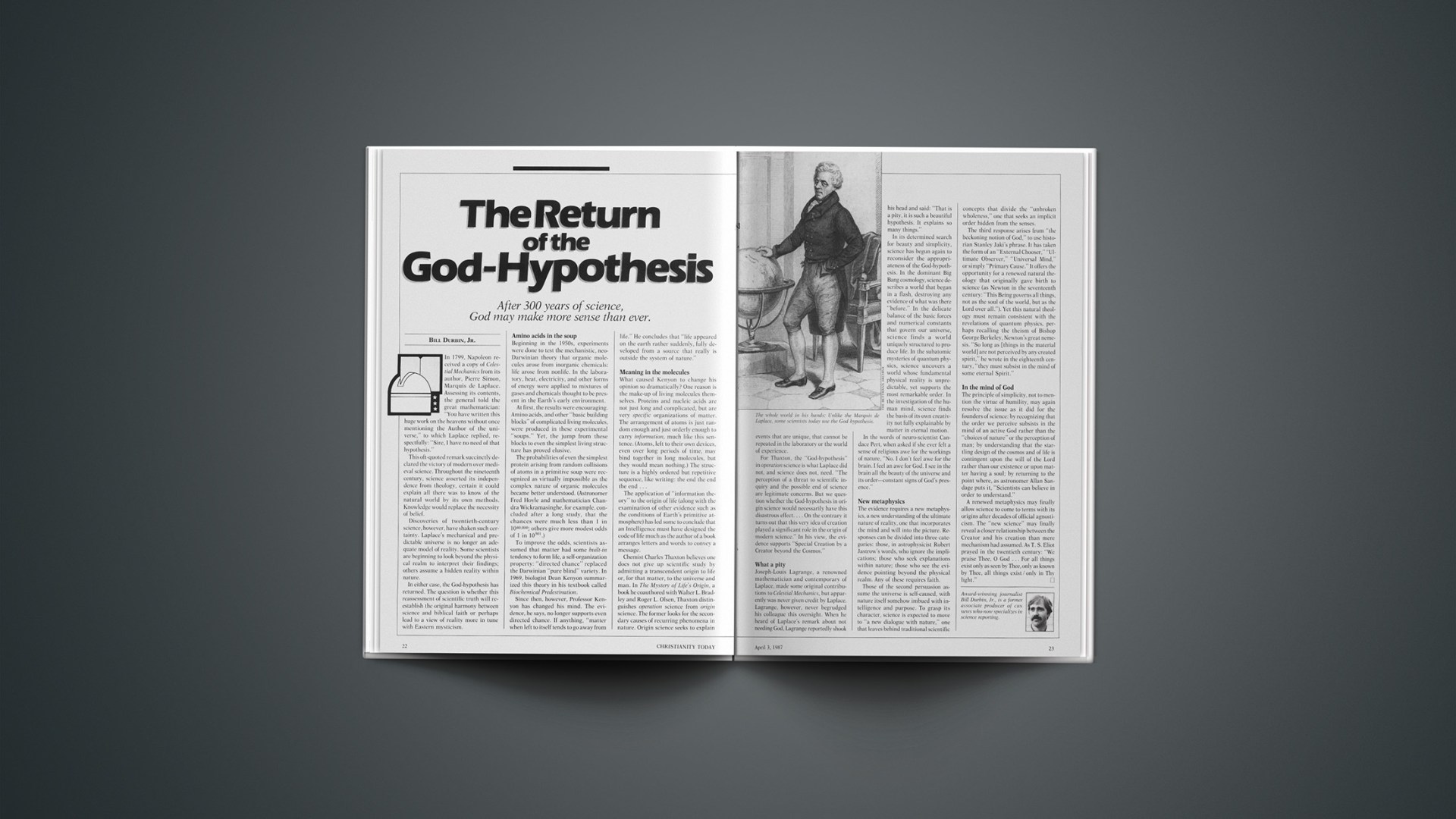
The Return of the God-Hypothesis

After 300 years of science, God may make more sense than ever.

In 1799, Napoleon received a copy of Celestial Mechanics from its author, Pierre Simon, Marquis de Laplace. Assessing its contents, the general told the great mathematician: “You have written this huge work on the heavens without once mentioning the Author of the universe,” to which Laplace replied, respectfully: “Sire, I have no need of that hypothesis.”

This oft-quoted remark succinctly declared the victory of modern over medieval science. Throughout the nineteenth century, science asserted its independence from theology, certain it could explain all there was to know of the natural world by its own methods. Knowledge would replace the necessity of belief.

Discoveries of twentieth-century science, however, have shaken such certainty. Laplace’s mechanical and predictable universe is no longer an adequate model of reality. Some scientists are beginning to look beyond the physical realm to interpret their findings; others assume a hidden reality within nature.

In either case, the God-hypothesis has returned. The question is whether this reassessment of scientific truth will reestablish the original harmony between science and biblical faith or perhaps lead to a view of reality more in tune with Eastern mysticism.

Amino Acids in the Soup

Beginning in the 1950s, experiments were done to test the mechanistic, neo-Darwinian theory that organic molecules arose from inorganic chemicals: life arose from nonlife. In the laboratory, heat, electricity, and other forms of energy were applied to mixtures of gases and chemicals thought to be present in the Earth’s early environment.

At first, the results were encouraging. Amino acids, and other “basic building blocks” of complicated living molecules, were produced in these experimental “soups.” Yet, the jump from these blocks to even the simplest living structure has proved elusive.

The probabilities of even the simplest protein arising from random collisions of atoms in a primitive soup were recognized as virtually impossible as the complex nature of organic molecules became better understood. (Astronomer Fred Hoyle and mathematician Chandra Wickramasinghe, for example, concluded after a long study, that the chances were much less than 1 in 1040,000; others give more modest odds of 1 in 10301.)

To improve the odds, scientists assumed that matter had some built-in tendency to form life, a self-organization property: “directed chance” replaced the Darwinian “pure blind” variety. In 1969, biologist Dean Kenyon summarized this theory in his textbook called Biochemical Predestination.

Since then, however, Professor Kenyon has changed his mind. The evidence, he says, no longer supports even directed chance. If anything, “matter when left to itself tends to go away from life.” He concludes that “life appeared on the earth rather suddenly, fully developed from a source that really is outside the system of nature.”

Meaning in the Molecules

What caused Kenyon to change his opinion so dramatically? One reason is the make-up of living molecules themselves. Proteins and nucleic acids are not just long and complicated, but are very specific organizations of matter. The arrangement of atoms is just random enough and just orderly enough to carry information, much like this sentence. (Atoms, left to their own devices, even over long periods of time, may bind together in long molecules, but they would mean nothing.) The structure is a highly ordered but repetitive sequence, like writing: the end the end the end …

The application of “information theory” to the origin of life (along with the examination of other evidence such as the conditions of Earth’s primitive atmosphere) has led some to conclude that an Intelligence must have designed the code of life much as the author of a book arranges letters and words to convey a message.

Chemist Charles Thaxton believes one does not give up scientific study by admitting a transcendent origin to life or, for that matter, to the universe and man. In The Mystery of Life’s Origin, a book he coauthored with Walter L. Bradley and Roger L. Olsen, Thaxton distinguishes operation science from origin science. The former looks for the secondary causes of recurring phenomena in nature. Origin science seeks to explain events that are unique, that cannot be repeated in the laboratory or the world of experience.

For Thaxton, the “God-hypothesis” in operation science is what Laplace did not, and science does not, need. “The perception of a threat to scientific inquiry and the possible end of science are legitimate concerns. But we question whether the God-hypothesis in origin science would necessarily have this disastrous effect.… On the contrary it turns out that this very idea of creation played a significant role in the origin of modern science.” In his view, the evidence supports “Special Creation by a Creator beyond the Cosmos.”

What a Pity

Joseph-Louis Lagrange, a renowned mathematician and contemporary of Laplace, made some original contributions to Celestial Mechanics, but apparently was never given credit by Laplace. Lagrange, however, never begrudged his colleague this oversight. When he heard of Laplace’s remark about not needing God, Lagrange reportedly shook his head and said: “That is a pity, it is such a beautiful hypothesis. It explains so many things.”

In its determined search for beauty and simplicity, science has begun again to reconsider the appropriateness of the God-hypothesis. In the dominant Big Bang cosmology, science describes a world that began in a flash, destroying any evidence of what was there “before.” In the delicate balance of the basic forces and numerical constants that govern our universe, science finds a world uniquely structured to produce life. In the subatomic mysteries of quantum physics, science uncovers a world whose fundamental physical reality is unpredictable, yet supports the most remarkable order. In the investigation of the human mind, science finds the basis of its own creativity not fully explainable by matter in eternal motion.

In the words of neuro-scientist Candace Pert, when asked if she ever felt a sense of religious awe for the workings of nature, “No. I don’t feel awe for the brain. I feel an awe for God. I see in the brain all the beauty of the universe and its order—constant signs of God’s presence.”

New Metaphysics

The evidence requires a new metaphysics, a new understanding of the ultimate nature of reality, one that incorporates the mind and will into the picture. Responses can be divided into three categories: those, in astrophysicist Robert Jastrow’s words, who ignore the implications; those who seek explanations within nature; those who see the evidence pointing beyond the physical realm. Any of these requires faith.

Those of the second persuasion assume the universe is self-caused, with nature itself somehow imbued with intelligence and purpose. To grasp its character, science is expected to move to “a new dialogue with nature,” one that leaves behind traditional scientific concepts that divide the “unbroken wholeness,” one that seeks an implicit order hidden from the senses.

The third response arises from “the beckoning notion of God,” to use historian Stanley Jaki’s phrase. It has taken the form of an “External Chooser,” “Ultimate Observer,” “Universal Mind,” or simply “Primary Cause.” It offers the opportunity for a renewed natural theology that originally gave birth to science (as Newton in the seventeenth century: “This Being governs all things, not as the soul of the world, but as the Lord over all.”). Yet this natural theology must remain consistent with the revelations of quantum physics, perhaps recalling the theism of Bishop George Berkeley, Newton’s great nemesis. “So long as [things in the material world] are not perceived by any created spirit,” he wrote in the eighteenth century, “they must subsist in the mind of some eternal Spirit.”

In the Mind of God

The principle of simplicity, not to mention the virtue of humility, may again resolve the issue as it did for the founders of science: by recognizing that the order we perceive subsists in the mind of an active God rather than the “choices of nature” or the perception of man; by understanding that the startling design of the cosmos and of life is contingent upon the will of the Lord rather than our existence or upon matter having a soul; by returning to the point where, as astronomer Allan Sandage puts it, “Scientists can believe in order to understand.”

A renewed metaphysics may finally allow science to come to terms with its origins after decades of official agnosticism. The “new science” may finally reveal a closer relationship between the Creator and his creation than mere mechanism had assumed. As T. S. Eliot prayed in the twentieth century: “We praise Thee, O God … For all things exist only as seen by Thee, only as known by Thee, all things exist / only in Thy light.”

Award-winning journalist Bill Durbin, Jr., is a former associate producer of CBN news who now specializes in science reporting.

Cease-Fire in the Laboratory

Working scientists find that science and faith are less and less in conflict.

It is 6 P.M. and Dr. Robert Messing is ready to leave his laboratory in the Department of Neurology at the University of California, San Francisco.

Messing is unusually happy: three days of careful laboratory work have yielded his best crop yet of an enzyme called Protein Kinase C. He began with 2.5 billion PC12 cells, developed from a rat’s adrenal tumor. He ended up, after a series of elaborate chemical maneuvers, with two micrograms of purified material—a mere drop, which the scintillation counter found to have the most active concentration of the enzyme yet. Messing will use this purified sample to test how Protein Kinase C may modulate the electrical signals sent through calcium channels in nerve cells.

A young, curly-headed assistant professor, Messing spends most of his working hours in the laboratory. He is trying to put a small piece into the puzzle of how nerve cells communicate with each other—an electro-chemical process that he says “grows more and more complicated the more we learn. That’s what makes it so interesting—trying to figure out how God put it together.”

As Messing drives his Toyota Camry south toward Foster City on a jammed Highway 101, his mind gradually moves from one set of problems to another. Behind him is a quiet, gleaming laboratory where he unravels the mysteries of biochemistry. Ahead is home, where his wife, Kathy, is having difficulty breastfeeding their third son, Michael. The two older boys, David and Steven, will be clamoring for his attention. A couple whom they know from the Central Peninsula Church have invited them to dinner. By the time Messing pulls into his driveway, he has reoriented himself. Biochemistry may dart into his brain during the evening. But it will almost certainly not enter the dinner conversation.

“It’s real hard to describe my work,” Messing says. “People ask me what I’m doing, and I don’t want to go through a 25-minute explanation. I tell them as much as they want to hear.

“I say I’m interested in how nerve cells communicate, and I’m studying one facet of that which involves calcium channels. And people will say, ‘Oh yeah, you’re supposed to take a lot of calcium to keep your bones strong.’ I say, ‘Yeah, but it’s a little bit different from that.’ The conversation usually ends there.”

Two-Worldism

Living in two worlds, as scientists like Messing do, is common enough in our specialized, technical society. Insurance actuaries or commodities traders don’t discuss their work much with the neighbors, either. But their work is hardly so central to modern society as scientists’ is. Richard Bube, for many years chairman of Stanford University’s materials science department, put it this way: “We live in a culture that takes certain things for granted, such as you find out how things really are by science. I don’t think people think that way. They just grow that way.”

It is odd, and perhaps ominous, that this fount of fundamental understanding is infinitely obscure to most Americans, even very-well-educated Americans. Most of us gel its findings only as they come filtered through newspaper reports, college textbooks, and occasional programs on educational TV. We have little idea how to judge the value of these assertions, how to tell good science from bad science, or how to tell science from sheer opinion. We only know what the newspapers tell us: “Scientists say.…”

Of particular concern to Christians is that science has been widely pictured as anti-Christian. Often science and Christianity are portrayed as at war—a war that began with Galileo, and continues in a battle over school textbooks. Science, which supposedly knows only plain facts and practices only common sense, would seem to threaten the very existence of a religion that depends on faith in the supernatural. At least, it seems to push that faith into the periphery of life—into the realm of opinion—while science dominates the world of “facts.”

People claim many things about science, often things bearing little resemblance to the work scientists do in their laboratories. Thus, as a journalist, I wanted to know how scientists, and evangelical Christian scientists in particular, experience the world of science. Their world and their work are too important to remain obscure, especially to people who seek to claim every realm for Christ. I sought out eminent Christian research scientists in the so-called hard sciences. Most are on the faculties of large universities, and some work in corporate or government labs. (Teachers, engineers, and medical doctors also are trained in science, but their culture is subtly different from that of the research scientists.)

I asked these researchers what it was like to be a Christian in relationship to their fellow scientists. I asked them what it was like to be a scientist in relationship to their fellow Christians.

In hearing them describe their world, I was struck by the degree to which faith and philosophy stay outside their scientific world. Repeatedly, Christians denied experiencing any hostility to their faith; frequently they described scientists as being “like anybody else” religiously. “There are probably as many atheistic truck drivers as atheistic scientists,” says Bube. “Folks are mostly kind of agnostic if you pin them down.” Robert Griffiths, a Carnegie-Mellon professor awarded the prestigious 1985 Heinemann Prize for his work in mathematical physics, told me, “If we need an atheist for a debate, I go to the philosophy department. The physics department isn’t much use.”

How does this square with the picture of science given by, say, Carl Sagan, whose “Cosmos” series proclaimed a kind of materialist triumphalism? To understand why he, or any scientist philosophizing on TV, is out of the mainstream, you must consider how scientists fill their days.

Obscure Questions

Most research scientists work alone or in a small team on fantastically obscure questions that only a handful of people in the world understand. Their language is chiefly mathematical. The ordinary scientist does not think much about his work’s relevance to outside life. His eyes are on the problem; he gets enormous pleasure from wrestling its mysteries to the mat. Even if you could somehow demonstrate his problem’s utter irrelevance—if you could show him that it was kin to the medieval question of the substantiality of angels—he would be little disturbed, except that he would find it more difficult to get funding. He works within a world that supplies its own reasons.

Yet, in a sense, he knows little about that world. One question I asked was, “How much do scientists know about science?” By that I meant, how much do they know about science’s strengths and its limitations, or about its relationship to other ways of seeking truth?

Owen Gingerich is a Harvard-Smithsonian astrophysicist who has concentrated on the history of science since 1971; he was a consultant for Carl Sagan’s “Cosmos” television series, and argued fiercely with Sagan over some of its generalizations. Gingerich is also a founding member of a Boston Mennonite congregation, and has lectured widely for the American Scientific Affiliation (ASA), an organization of Christians involved in science. As both a working scientist and a student of science’s history, he is unusually qualified to discuss the relationship of science to the outside world. To my question, he answered, “Scientific education does not have much to say reflectively about science. Scientists don’t know much about its nature in a philosophic sense, what its claims to truth might be.”

Walter Thorsen, an articulate chemist at the University of Alberta, described scientists more bluntly: “At some point in their younger days they have bought into some idea of what science is, which they got from a book or a course, and for the most part they have not pursued this.”

It follows that, if you took the average scientist and put him in front of a television camera, he would have very little to say. What would he talk about? His work is almost certainly incomprehensibly obscure to his audience. Scientists who do get in front of television cameras are almost invariably from the small minority who have a strong interest beyond science. What they say often reflects the temper of our universities—materialistic, humanistic—more than the conclusions of science. Carl Sagan, when he interprets the cosmos, speaks as an amateur philosopher. He is not speaking for science; he is speaking for himself. The kind of thing he discusses on the air is almost never said within the laboratory. That, of course, does not make it illegitimate. It merely makes it something other than science.

Says Gingerich, “In most scientific environments, there is little opportunity to talk about Christian faith. One would not talk about it easily or very naturally. As a consequence of that, one does not know where one’s colleagues stand in the religious realm. You may have no idea except for one extreme or the other, such as if they are outspoken as atheists. Ironically, people in other places are more likely to know where I stand [because of his ASA lectures] than here at the Center for Astrophysics.”

Gingerich gave one ASA lecture at Rice University, and the entire astronomy faculty turned out, sitting in the front two rows. Among them was one of the world’s foremost experts on nucleo-genesis (the formation of the elements), which Gingerich discusses in relation to divine Creation. Afterwards, Gingerich asked the Rice professors what they thought of his views. “They rather sheepishly said, ‘We really don’t talk about it very much.’ ” Such are not the words of a people at war with Christianity.

Together Again

Within this highly specialized, relatively unreflective world—so different from the Renaissance and Reformation environment in which modern science first emerged—there are indications that science and faith could begin working together again, as they often did before the mid-1800s. Perhaps the most startling symbol of this was Edward O. Wilson, the famous Harvard sociobiologist and self-described “secular humanist,” attending a three-day forum called by Roman Catholic Archbishop James Hickey last year. A report in the Chicago Tribune quoted Wilson as saying, “Theologians are raising more insistently age-old questions on the nature and meaning of humanity and the basis of moral reasoning that scientists can no longer ignore.” To hear Wilson compliment theologians is as surprising as it would be to hear Reagan compliment Gorbachev on his insightful views of Nicaragua.

Modern events have shaken scientific autonomy. Scientists have seen the work of the greatest scientist of this century, Albert Einstein, put to use making nuclear arsenals. The ravages of pollution, the anxieties of a technological world, and the potential for massive accidental destruction (such as the possibility of losing the atmosphere’s protective blanket of ozone because of aerosol deodorants) have created doubts about whether science is a liberating force or a machine out of control. Society’s need for a moral basis has grown more obvious, but equally obvious is science’s inability to offer one. Science offers truth, but not all the truth we need.

Other factors have worked to shake science’s confidence. Historians and philosophers of science, like T. S. Kuhn and Michael Polanyi, have cast doubt on scientists’ traditional understanding of their work. New, strange ideas regarding religion are about. Quantum mechanics has led a few reputable scientists to write books proclaiming “Zen physics,” in which the consciousness of an observer is said to play a role in the interaction of particles. Says chemist Thorsen, “Modern physics is so impossibly weird, and evokes questions about the substantiality of things. It provokes ways of thinking that are very open.”

In short, if you read books about science, particularly in the philosophy of science or the so-called Zen physics, you may get an impression that science is ripe for a reassessment. But within the world of working scientists, these changes do not seem to have had much effect. For one thing, very few scientists read about science. David Cole, a University of California at Berkeley biochemist, points out, “In biochemistry we are swamped trying to read just the material that’s relevant to our work in the lab.” The greatest difficulty in bringing science and theology together may not be antipathy, but the isolation of scientists in their laboratories.

Besides, there is an inherent conservatism in science. Scientists learned their method of problem solving by watching other scientists during their graduate-school apprenticeship. They know it works. If a philosopher tries to convince them that what they think they are doing is not quite what they are really doing, they tend, like all seat-of-the-pants fliers, to treat the philosopher with bemused skepticism. Nor do they favor metaphysical speculation. The physicists I talked to work daily with quantum mechanics, yet all thought that “Zen physics” was sheer bunk. Scientists are cautious about drawing conclusions that reach beyond their data.

In the popular view, science deals in certainties. Watson and Crick, when they discovered the double helix structure of DNA, were discovering the true nature of our genetic material—as real, once discovered, as the River Nile. But in their day-to-day practice, scientists deal very little in certainties. They think, rather, about unknowns. They may spend a lifetime puzzling over one particular question, for which there are a half-dozen reputable, contradictory explanations. Scientists are quite comfortable living with uncertainties. They know, too, that today’s certainties are likely to be improved upon tomorrow. Geneticist Elving Anderson says, “Church people look to science for final proof [in the creation-evolution controversy]. This is a fundamental misunderstanding of what we mean by a scientific test. It is generally easier to exclude an explanation than to prove one. You know your explanation will be improved on in the future. We don’t claim to reach the final truth.”

So the theory of evolution, while it may be taught in high schools as an eternal verity, is not usually thought of that way by research biologists. They see it as a way of looking at their data that is powerful in explaining difficult facts. They are quite aware that large, unanswered questions remain, but they are content to continue to grapple with them. It is an undogmatic mindset that Christians in science would like others, including theologians, to adopt.

Under Fire

Ironically, many Christians in science feel at war only when they are under fire from their fellow Christians, particularly those influenced by the Institute for Creation Research in San Diego, California. This energetic group, led by Henry Morris, believes that the Earth’s age should be calculated in thousands, rather than billions, of years, that its geology may be largely explained by a catastrophic, worldwide flood, and that human beings did not evolve from other creatures. They do not see themselves as opposing science, but as revolutionaries within science, trying to overturn some of the most fundamental paradigms of modern science. John Baumgardner, a staff member with Campus Crusade for Christ before becoming a geophysicist at the U.S. government’s Los Alamos laboratory, is one scientist dedicated to this scientific revolution. He admits it is a daunting task. “If people had really known what I was venturing out to do, they would have said I ought to be locked up.”

Creation-science advocates are often, indeed, regarded by other scientists as kooks. Unlike most of the scientists I talked to, they often feel themselves to be in a hostile environment, particularly if they work in the life sciences. But, Baumgardner points out, so did geologists who suggested only a few decades ago that the continents are in motion. Taking a minority view is seldom comfortable.

Disregarding the merits of the argument, it is worth reporting that nearly all the Christians I talked to sided with conventional science: they accepted the idea of an Earth billions of years old, and the general idea that all life has evolved under God’s direction from less complex forms. They did not find it hard to harmonize this with the biblical accounts of Creation. Elving Anderson, a widely respected geneticist at the University of Minnesota medical school, is probably typical in saying of the San Diego Institute, “They have a laudable motive, trying to take the Bible seriously. Creation science does this for some, and totally destroys it for others, particularly for those in the scientific community who are knowledgeable about the data base and are not moved by arguments purporting to prove recency.”

Ironically, while many scientists like Anderson have found questions of origins a source of friction with other Christians, few have felt them to be a great obstacle in talking about their faith with other scientists. John Suppe, a geologist at Princeton, is an interesting case, for he began his long, lonely search for God as a Princeton faculty member. Vaguely aware of his spiritual needs, he began attending services in the Princeton chapel, then reading the Bible and other Christian books. He eventually committed himself to Christ, and had his first real experience of Christian fellowship in Taiwan, where he was on sabbatical. He told me, “Some nonscientist Christians, when they meet a scientist, feel called on to debate evolution, which is definitely the wrong thing to do. If you know scientists and the kinds of problems they have in their lives—pride, selfish ambition, jealousy—that’s exactly the kind of thing Jesus talked about, and which he came to resolve. Science is full of people with very strong egos, who get into conflicts with each other.

“The gospel is the same for scientists as for anyone. Evolution is basically a red herring. If scientists are looking for meaning in their lives, it won’t be in evolution. I have never met a non-Christian scientist who brought up evolution with me.”

What scientists like Suppe particularly dislike is the polarization the issue creates among Christians. They hate being cast as heretics. Anderson told me, “I prefer to call [creationists] the ‘young Earth’ group. We’re all creationists.” Robert Griffiths said, “It seems to me that a number of Christians have gone out on a limb to say we must interpret Genesis in a particular way, as describing in a literal fashion events 10,000 years old. I regard that as a theory, and one that doesn’t fit the facts too well. If Christians hold different views on the interpretation of Genesis, that doesn’t cause too many problems as long as we respect each other and listen to the things science observes, as well as to theology. What does bother me is when Christian brothers say, ‘You have to believe this way. We’re absolutely sure that our interpretation of the Bible is correct. We have to have that or we can’t have faith.’ ”

Gingerich says, “I think it is a very serious issue to Christians. The creationists are going to give a large impression to young people that there is a serious incompatibility in being a scientist and being a Christian.”

Nourishing Atmosphere

Rather than feeling like an embattled minority in science, many Christians I talked to felt they were working in an atmosphere that positively nourished faith. Several noted that in their university, most of the Christian faculty were in the sciences; they thought it would be much harder to be Christians in the English or philosophy departments. Not that they encounter so many believers within science. It is the atmosphere of science itself that they find helpful.

Bob Kaita, a physicist at Princeton’s plasma physics lab, put it this way: “We as scientists butt up against worlds not of our own making. Scientists more often confront things that tell them no—things that don’t work the way we suppose they should.” Such an atmosphere, he thinks, makes it easier to consider the claims of a historical faith.

Others, noting the profoundly Christian thinking of many early scientists, suggested that a Christian world view underlies the practice of science. “Physics is built on certain moral principles,” notes Bob Griffiths. “You don’t publish data that you didn’t take.” And beyond that, suggests chemist Walter Thorsen, “People who do science often realize there is a profound mystery in the universe, and you finally have to ask why. I believe that in science there is a fundamentally religious drive.”

I was talking, of course, to the most articulate Christians I could find in the scientific community. They seek a life that integrates both science and faith. To them, that means granting science as well as theology a certain authority. Says Thorsen, who was once charged by his Brethren assembly to keep silent on his view of Creation, “Galileo is still relevant. The problem with Galileo was not so much with his model of the solar system, but that theologians perceived science as an area that could lead to truth outside the aegis of the Catholic church. This is a big threat. We have to come to realize that we live in a world where truth can be learned from the world around us. Respect for scientific truth does force you to read the Bible in a different way. I think science has a claim on us.”

“What we all need is constant integration,” says Stanford’s Bube. “To see that there is good science and bad science, good biblical theology and bad biblical theology, and to take the best from both and see them both as ways that God guides us. In order to form a good understanding of our choices in life we may need scientific information. In order to choose a research topic, a scientist may need theological or ethical information. Unfortunately, compartmentalized life is the most common. It’s easier to make simple judgments. You don’t even see what you’re avoiding.”

Sermons and Science

I asked every scientist I talked with what he or she would say to pastors or church leaders about their ministry to scientists. It was reassuring, in a sense, that they had few points to make. While many of these scientists are involved in faculty or student fellowships, and some attempt to lead special courses and lectures in scientific-religious issues, they found their main source of Christian support in a local church. They emphasized to me that scientists’ needs are little different from other people’s.

Most of them, however, quickly volunteered the difficulty they felt in hearing sermons that offered, often in anecdotal form, a “scientific fact” that was sheer nonsense to scientists. Richard Bube says, “I wish we had a routine course on science and Christianity in the seminary curriculum. Failing that, I’d urge pastors not to say things out of folk mythology.”

Beyond that, several mentioned their desire for the church to tackle difficult areas where science and faith converge: issues of medical and genetic technology, for instance. This would require, however, leadership that was well read in both scientific and theological issues.

At a practical level, I was reminded that the demands on the time of working scientists are extremely heavy. David Cole told me, “Christians in laboratory science make poor family men, poor church people, and poor just about anything else. There are powerful demands on time in this work. When people take surveys asking how much you work, and scientists say 65 to 70 hours a week, I believe it. But it’s like anything else. You have to set priorities. You can certainly be a Christian—it’s just that you won’t compete as effectively.”

Bube says, “The commitment required of young faculty may be incompatible with living a Christian life.”

For me, it is important, and impressive, to remember that the scientists I talked to have managed to do both: to compete in an extremely demanding environment, and yet to strengthen their faith, thinking and working to integrate the powers of science with their Christian belief.

In the last century, scientists have become extremely specialized, rarely receiving much of an education outside their own field. By the same token, their fields have become extremely difficult for nonscientists to grasp. Ironically, the most powerful force in modern culture has become increasingly isolated from the rest of our culture. We see this in the church: How many pastors know anything about science? And how many scientists know anything about theology?

Undoubtedly, specialization will hinder any move back to the days of Isaac Newton, who spent more of his life on theology than science, writing about 1,300,000 words on biblical subjects. Nonetheless, it is clearer today than ever before that both fields of knowledge need each other, for they reflect in different ways on a single creation.

Ideas

How Not to Have a Baby

The morality of surrogacy and a deeper discussion of moralism

Nineteen eighty-four was the year that was to have realized George Orwell’s vision of, among other things, the separation of reproduction from love and family life.

Instead, several governmental and private agencies issued strongly worded statements that year opposing the severing of these natural ties through so-called surrogate mothering. In the United States, the National Committee For Adoption saw surrogate mothering as something that would “affect children and parents adversely and divert attention from the need of children to have permanent, stable and secure homes and families.” And in Great Britain, the Warnock Commission’s report to Parliament (which was tolerant of several “alternative procreative technologies”) unequivocally called for strong criminal penalties for agencies and professionals “who knowingly assist the establishment of a surrogate pregnancy.”

Also in 1984, a survey of Psychology Today readers (not known as the most conservative sampling in America) showed that surrogate mothering was the least popular of reproductive alternatives. Only 14 percent of respondents said they would get involved in this risky business; compare that to 84 percent who said they would choose adoption as their option.

Motherhood By Contract

But now, in 1987, the technological optimism of a few lawyers and physicians threatens to overcome the entrenched common sense of both the general public and the committed professionals who work to place children in stable, loving homes.

At this writing, New Jersey Superior Court Judge Harvey Sorkow has not yet announced his decision regarding the fate of one-year-old Baby M (CT News, March 6, 1987, p. 42). But whether he rules that the child be given to William and Elizabeth Stern (who believe their $10,000 womb-rental fee gives them a certain claim on the child) or to the biological mother, Mary Beth Whitehead (who has had a very understandable change of heart, and who has not collected her rent), the decision is likely to be appealed.

Regardless of what issues from that Hackensack, New Jersey, courtroom, a number of common sense considerations convince us that the practice of surrogate mothering should be clearly outlawed—and not merely “regulated” as some of those who feel compelled to capitulate to the technological imperative suggest.

  • Our federal and state governments have outlawed any commercial trading in human flesh—whether it be babies, slaves, or vital organs. A fundamental recognition that people are priceless, as well as the realistic judgment that the presence of money can potentially corrupt any relationship, underlies this legislation. What Christ has bought at infinite price ought not to be commercialized.
  • Scriptural teaching on marriage states that “the two shall become one flesh.” Although biblical and historical exceptions can be adduced (Abraham’s impetuous attempt to fulfill God’s promise of an heir; the medieval church’s tolerance of concubinage to regulate the transmission of property), Christianity’s clear commitment has been to the inviolability of the marriage bond between husband and wife. Introducing a third party such as a surrogate mother, can only promise identity confusion and bad feelings for all concerned.
  • For a child like Baby M, identity confusion is almost certain. What will such a child think of its natural mother who signed a contract to conceive it for the sole purpose of giving it away? The psychological dynamics will be far more difficult than those of the adopted child whose mother wanted to keep it, but couldn’t.
  • For the infertile couple, surrogate mothering poses an extreme risk of relational entanglements that may haunt them for a lifetime. When the child misbehaves (and what child doesn’t), nagging questions are bound to surface about propensities it may have inherited from a mother for whom the parents hold no affection.
  • For the woman who is attracted to the role of surrogate mother—whether through altruism, greed, or financial necessity—there is the pain of severing herself emotionally from the fruit of her womb. If we regularize surrogate mothering in our society, we will either intentionally inveigle many women into emotional torment or we shall develop a class of breeder women who are valued for their unnatural ability to reject their own flesh and blood. Neither option is morally acceptable.
  • Although the Bible teaches that both marriage and offspring are to be desired, neither one is an ultimate good. Some, like Paul, may forgo marriage in order to serve God’s greater purpose. Similarly, couples who find themselves unable to conceive may choose to forgo technological alternatives in order to give love to troubled young people or a home to an adoptable child who may be slightly older, of mixed race, or disabled.

We understand the sense of privation and the drive to give birth that many infertile couples experience. And it is deplorable that these couples face the shortage of healthy adoptable infants caused by teenage parenting and abortion on demand. Yet there are many options available to infertile couples that fall within the acceptable boundaries of God’s purposes. Surrogate parenting is not one of them.

By David Neff

Apple PodcastsDown ArrowDown ArrowDown Arrowarrow_left_altLeft ArrowLeft ArrowRight ArrowRight ArrowRight Arrowarrow_up_altUp ArrowUp ArrowAvailable at Amazoncaret-downCloseCloseEmailEmailExpandExpandExternalExternalFacebookfacebook-squareGiftGiftGooglegoogleGoogle KeephamburgerInstagraminstagram-squareLinkLinklinkedin-squareListenListenListenChristianity TodayCT Creative Studio Logologo_orgMegaphoneMenuMenupausePinterestPlayPlayPocketPodcastRSSRSSSaveSaveSaveSearchSearchsearchSpotifyStitcherTelegramTable of ContentsTable of Contentstwitter-squareWhatsAppXYouTubeYouTube