Editor’s Note: April 18, 1986

Four months after her trip to Israel, Washington editor Beth Spring received a letter from Marwan Abu-Fadda, one of the Palestinian refugees she had met in a camp near Bethleham last November.

“My dreams are crushed,” he wrote. The teaching post he had hoped for now seemed as distant a possibility as moving away from the hovels that house him, his family, and thousands of others on Israel’s West Bank.

Still, the letter writer was not giving up completely. “I have nothing,” Marwan continued, “except a hope to accomplish what I want someday”

Samed: “steadfastness.” All Palestinians (including the Christians there who face not only political tension but religious repression) rely on it to survive a situation many on both sides admit is a war between two rights.

“You feel samed,” said Beth, reviewing her notes taken at the Deheishe refugee camp. In Marwan’s own home, his mother proudly served tea, then Turkish coffee to a total stranger—and an American at that. Only Marwan’s childhood drawings, crafted while a student at Hope School and reflecting Christian themes, interrupted the dusty gray of each wall.

Samed is also on the faces of the children—in the ever-present smiles betraying an uncertain future.

Beth recalls one preschooler “who did nothing but smile at us as we walked through the camp. Finally, I asked our guide, ‘Who is that little girl?’

“ ‘Amal,’ he said.

“ ‘Amal?’

“ ‘Yes,’ he replied, ‘Amal. It means hopeful.’ ”

HAROLD SMITH, Managing Editor

Theology

The Most Surprising Miracle of All

This little Babe so few days old,

Is come to rifle Satan’s fold,

All hell doth at his presence quake,

Though he himself for cold do shake.

—“This Little Babe” Robert Southwell (16th century)

At most, a handful of shepherds witnessed the drama of his birth night. Think of it: The Incarnation, which sliced history into two parts (a fact that even our calendars grudgingly acknowledge), had more animal than human witnesses.

There was indeed a murmur of eucatastrophe, a sudden burst of grandeur. The universe could not let the Visit go unannounced, and for an instant the sky grew luminous with angels. E.T., Cocoon, Close Encounters of the Third Kind—all their special effects crews would fall dazzled before such a scene. Yet, who saw it then? Illiterate peasants who failed to leave their names.

Death

Calvary was less visibly spectacular. The miracle then lay not in what happened but what did not. Jesus did not stop the ugly ritual of violence. Angels stayed away that day, held off from intervention by the Son of God himself. Even God the Father turned his back, or so it surely seemed. He, too, let history take its course, let all that was wrong with the world triumph over all that was right.

“He saved others; let him save himself,” they jeered. This time, this public moment when God appeared downright helpless, the cameras of history were rolling, recording it all. Large crowds watched every excruciating detail of trial, verdict, crucifixion, and death. No one could claim that Jesus did not die.

After Death

When the Miracle of Miracles occurred, only two witnesses stood by: coarse Roman guards, the forgotten men of Easter. They and only they saw with human eyes the stunning scene of the impossible made possible. With an incurably human reflex, they immediately ran to the authorities to report the disturbance.

Later that afternoon, the Resurrection seemed rather hazy and remote—not nearly as significant as, say, the stacks of freshly minted silver before them. Do we ever wonder at the fact that the two eyewitnesses of that great day died apparent unbelievers?

Christmas, Good Friday, Easter: those three days are marked on the calendars of half the world. Despite bribes paid the Roman guards and an elaborate cover-up conspiracy, word got out. A glimmer of faith took hold, and takes hold still.

People blame God for not making faith any easier, for not making himself more obvious. Another look at those three momentous days may shed light on the puzzle of faith. The first event, Christ’s birth, seemed a scandal to all but a few insiders and ragtag guests. The last event, the resurrection, went unobserved but by two, who quickly edited their accounts. Only the middle event, the crucifixion, took place in public, for all the world to see.

How to account for the significance of the cross? It hardly seemed “miraculous” at the time-. Was anything more mundane than another dreary execution by the Roman occupation troops? Even now the day, Good Friday, can slip quietly by, unobserved, a mere prelude to the cymbal sounds of Easter.

Yet, from the cosmos, from the view, say, of an angel just beyond Andromeda, Good Friday was the most surprising miracle of all. The Incarnation was unique, of course, but it had faint parallels. Lesser spirits and celestial beings had flitted in and out of time zones before—consider Jacob’s wrestler and Abraham’s visitors. As for the Resurrection, a few humans had even roused from the dead in Old Testament times, and Jesus had clearly proved his mastery over death. (Ask Lazarus.)

But when the Son of God himself died on planet Earth—nothing like that had happened before or would happen again. Nature itself seemed to convulse: the ground shook, tombs cracked open, the sky went black.

More than death died that Friday afternoon. The apostle Paul said about that day, “And having disarmed the powers and authorities, he made a public spectacle of them, triumphing over them by the cross” (Col. 2:15, NIV). A public spectacle it was, when Christ exposed the very powers and authorities that men and women had staked their lives on, and stake their lives on still.

The most advanced religion of the day judged him guilty, and the most sophisticated government carried out the sentence. Satan’s grand design, hatched in Eden, was accomplished in the name of piety and justice and law. Christ triumphed by exposing those powers and authorities for what they were: false gods who could never keep their lofty promises.

The crucifixion forever set Christ’s followers against the powers of this world. “Jews demand miraculous signs and Greeks look for wisdom,” said Paul elsewhere, “but we preach Christ crucified: a stumbling block to Jews and foolishness to Gentiles” (1 Cor. 1:22–23, NIV). Not much has changed in 2,000 years. Scientists still demand signs and politicians look for wisdom. Now, as then, the cross looms as a stumbling block of faith.

The three events—birth, death, and resurrection—were surely tremors in the cosmos. Yet, carried out so mysteriously, with such a strange assortment of witnesses, they forever complicated faith. They gave just enough reason to believe for those who, like the disciples, chose faith, and just enough reason not to believe for those who, like the Roman guards, chose doubt. That, too, has not changed since Jesus’ time.

The Bit Market Principle

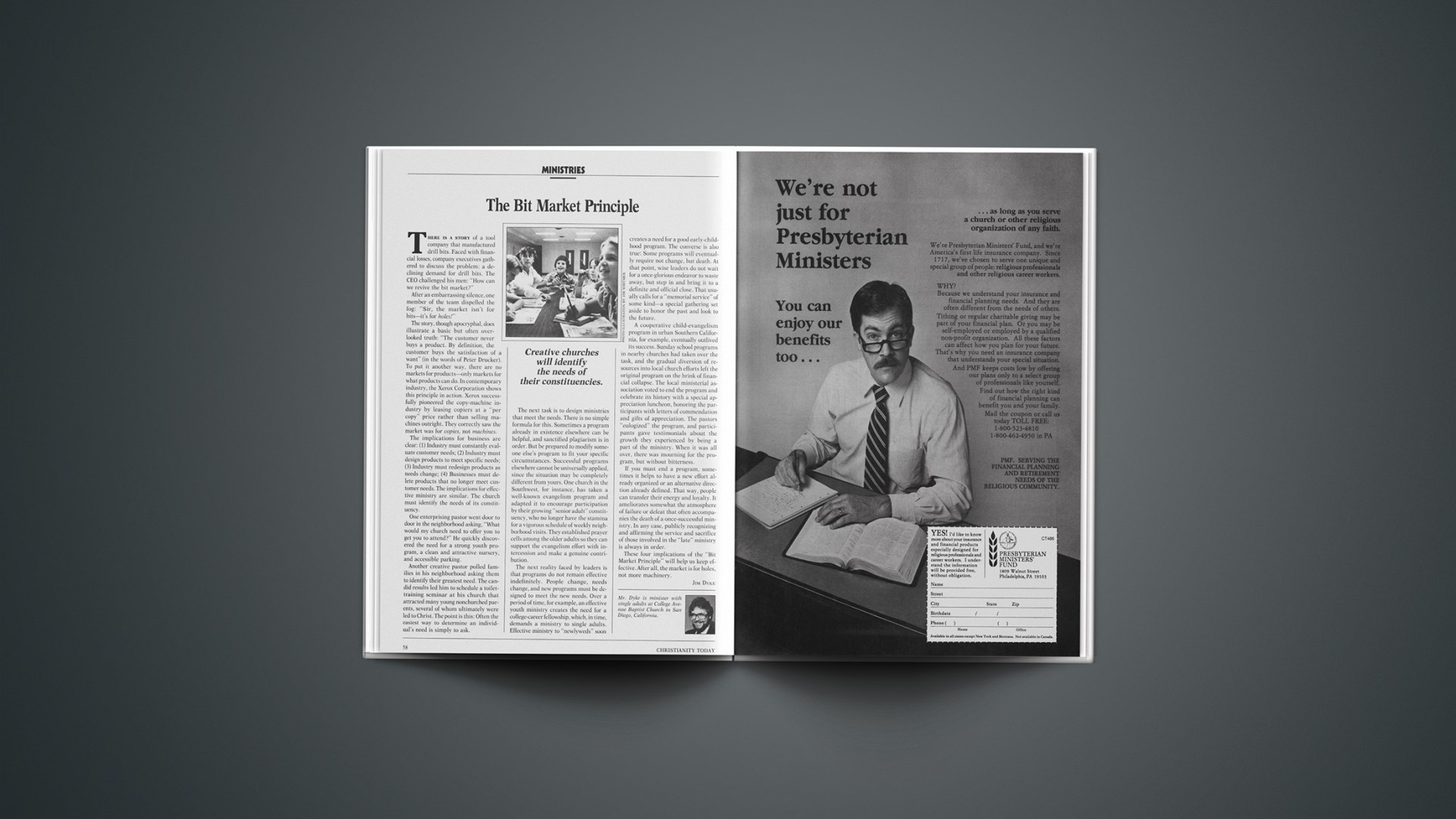
There is a story of a tool company that manufactured drill bits. Faced with financial losses, company executives gathered to discuss the problem: a declining demand for drill bits. The CEO challenged his men: “How can we revive the bit market?”

After an embarrassing silence, one member of the team dispelled the fog: “Sir, the market isn’t for bits—it’s for holes!”

The story, though apocryphal, does illustrate a basic but often overlooked truth: “The customer never buys a product. By definition, the customer buys the satisfaction of a want” (in the words of Peter Drucker). To put it another way, there are no markets for products—only markets for what products can do. In contemporary industry, the Xerox Corporation shows this principle in action. Xerox successfully pioneered the copy-machine industry by leasing copiers at a “per copy” price rather than selling machines outright. They correctly saw the market was for copies, not machines.

The implications for business are clear: (1) Industry must constantly evaluate customer needs; (2) Industry must design products to meet specific needs; (3) Industry must redesign products as needs change; (4) Businesses must delete products that no longer meet customer needs. The implications for effective ministry are similar. The church must identify the needs of its constituency.

One enterprising pastor went door to door in the neighborhood asking, “What would my church need to offer you to get you to attend?” He quickly discovered the need for a strong youth program, a clean and attractive nursery, and accessible parking.

Another creative pastor polled families in his neighborhood asking them to identify their greatest need. The candid results led him to schedule a toilettraining seminar at his church that attracted many young nonchurched parents, several of whom ultimately were led to Christ. The point is this: Often the easiest way to determine an individual’s need is simply to ask.

The next task is to design ministries that meet the needs. There is no simple formula for this. Sometimes a program already in existence elsewhere can be helpful, and sanctified plagiarism is in order. But be prepared to modify someone else’s program to fit your specific circumstances. Successful programs elsewhere cannot be universally applied, since the situation may be completely different from yours. One church in the Southwest, for instance, has taken a well-known evangelism program and adapted it to encourage participation by their growing “senior adult” constituency, who no longer have the stamina for a vigorous schedule of weekly neighborhood visits. They established prayer cells among the older adults so they can support the evangelism effort with intercession and make a genuine contribution.

The next reality faced by leaders is that programs do not remain effective indefinitely. People change, needs change, and new programs must be designed to meet the new needs. Over a period of time, for example, an effective youth ministry creates the need for a college-career fellowship, which, in time, demands a ministry to single adults. Effective ministry to “newlyweds” soon creates a need for a good early-childhood program. The converse is also true: Some programs will eventually require not change, but death. At that point, wise leaders do not wait for a once-glorious endeavor to waste away, but step in and bring it to a definite and official close. That usually calls for a “memorial service” of some kind—a special gathering set aside to honor the past and look to the future.

A cooperative child-evangelism program in urban Southern California, for example, eventually outlived its success. Sunday school programs in nearby churches had taken over the task, and the gradual diversion of resources into local church efforts left the original program on the brink of financial collapse. The local ministerial association voted to end the program and celebrate its history with a special appreciation luncheon, honoring the participants with letters of commendation and gifts of appreciation. The pastors “eulogized” the program, and participants gave testimonials about the growth they experienced by being a part of the ministry. When it was all over, there was mourning for the program, but without bitterness.

If you must end a program, sometimes it helps to have a new effort already organized or an alternative direction already defined. That way, people can transfer their energy and loyalty. It ameliorates somewhat the atmosphere of failure or defeat that often accompanies the death of a once-successful ministry. In any case, publicly recognizing and affirming the service and sacrifice of those involved in the “late” ministry is always in order.

These four implications of the “Bit Market Principle” will help us keep effective. After all, the market is for holes, not more machinery.

JIM DYKE1Mr. Dyke is minister with single adults at College Avenue Baptist Church in San Diego, California.

Books

Classic & Contemporary Excerpts from April 04, 1986

Classic and contemporary excerpts

Enthusiastic Substitutions

Historians of American higher education note that in the last third of the nineteenth century two things happened when colleges introduced intercollegiate sports. One was a marked decline in religious revivals on campuses; the other was a similar reduction in random student rioting. Enthusiasm for sports seems to have replaced both an enthusiasm for God and an enthusiasm for bashing other people around. Not an ideal trade-off, but it has its points.

—Mark A. Noll, The Reformed Journal (Jan. 1986)

But The Greatest Of These …

An Eastern mystic was quoted as saying: “Love one another; be kind to one another. And if you can’t do either, at least do no harm.” Simple. Of course. If it were complex, we could hide behind its complexity and claim inability to live that way because we “just don’t understand.” But because it’s so simple and clear, we ignore it.

—Richard A. Wing, Meditations for the Middle of the Night

Doing Theology

I propose that theologians write theology from the standpoint of the mother in Bombay (or Pittsburgh) whose child has just starved to death. She would not be theology’s primary reader, and her situation would not provide theology’s subject matter. Her rage and grief would provide its angle of vision. From there let the theologian write about God, Jesus Christ, revelation, holy history, new pluralism, living word, love, loving plan, righteousness, church, justice, liberation, the sacraments, self-transcending authenticity, religious experience, possibilities for existence, the Christian triumph over evil, and the resurrection. A theology written from that standpoint would have ceased being a problem to itself.

—John B. Fry, The Great Apostolic Blunder Machine

Real Learning

Education is a bringing out of what is there and giving it the power of expression, not packing in what does not belong; and spiritual education means learning how to give expression to the Divine life that is in us when we are born from above.

—Oswald Chambers, The Place of Help

Jeweled Portals Of Another World

Parables are tiny lumps of coal squeezed into diamonds, condensed metaphors that catch the rays of something ultimate and glint it at our lives. Parables are not illustrations; they do not support, elaborate or simplify a more basic idea. They are not ideas at all, nor can they ever be reduced to theological statements.

They are the jeweled portals of another world; we cannot see through them like windows, but through their surfaces are refracted lights that would otherwise blind us—or pass unseen.

—Walter Wink, The Christian Century (Nov. 5, 1980)

Our “Learned” Culture

I am a television news anchor—role model for Miss America contestants and tens of thousands of university students in search of a degree without an education.

—Ted Koppel, on receiving the “Broadcaster of the Year” award, Harper’s (Jan. 1986)

The Magical Liquid Of Forgiveness

Opaquing fluid is the magical liquid that covers over your errors, your typos, your unfrotunae slpi-ups. You brush on the liquid and start all over again—hopefully this time with no unfortunate slip-ups. Opaquing fluid is forgiveness, an obliteration of a goof with no telltale traces that the goof happened at all. Now, where else will you come across forgiveness like that?

—John V. Chervokas, How to Keep God Alive from 9 to 5

Pray And Post Guard

After their long and weary exile in Babylon the people of Israel were set free to return to their own land. Spurred on by Nehemiah, they began to rebuild the walls of Jerusalem. This aroused the hostility of the pagans around them, who threatened to undo their work. The people of Israel took two essential steps: they prayed to God, and they posted a guard day and night.

Even as they prayed for God’s protection and help, they did what they could. They knew that prayer is not a way to avoid responsibility, it is not a shortcut to success without effort.

—Ron Klug, Bible Readings on Prayer

Bread Of Life

Some days test our sense of humor.

A bread loaf … used to stand on the Communion table.… It had been kneaded from real flour and baked with a mom’s loving touch in a red-hot oven, only to be laquered into permanent staleness to preside for more than a decade over many a celebration of the Eucharist.

One day, without warning, it vanished, … to be replaced by wheat spikes in a vase—hardly what we usually think of as the bread of life.

The bread loaf, it seems, was a casualty of an over-conscientious visiting preacher. In the middle of a Communion service, according to reliable sources, the preacher mistakenly took the mummified bread with both hands, blessed it in the ancient tradition.… Yielding to two hundred pounds of preacher, the crisp shell vaporized with a thunderous explosion before the startled solemn assembly.

Every time we celebrate the Eucharist, I think of God’s words to Ezekiel: “Son of man, you are to tremble as you eat your bread.”

—James Allen Sparks, If This Pew Could Talk!

Atheism And Piracy

If I am an atheist in my heart, making myself sovereign in place of God, and therefore arranging things in accordance with my appetites and needs and fantasies, I become a pirate in society. I relentlessly look for ways in which I can get what is there for my own uses with no regard for what anyone else gets. If I am an atheist in my heart, it is not long before I have become a cancer in the gut of the country.

—Eugene Peterson, Earth and Altar

Books

No Criminal Genes

Crime and Human Nature, by James Q. Wilson and Richard J. Herrnslein (Simon and Schuster, 1985, 639 pp.; $22.95). Reviewed by Reo M. Christenson, professor of political science, Miami University, Oxford, Ohio.

Are some children born criminals? No. Are some born with a greater predisposition to crime than others? Yes. Or so say James Q. Wilson and Richard Herrnstein in Crime and Human Nature.

This formidable book, massively documented (1,385 footnotes) by two topflight scholars who have brought their highly disciplined intelligence to bear on a vast amount of research, represents social science at its very best.

There are no criminal genes, the authors report, but persons who commit frequent crimes are likely to display certain common characteristics early in life. They have an IQ about ten points below average, are hyperactive and unusually impulsive, and discount future unpleasant consequences of antisocial acts that provide immediate gratification. They are abnormally aggressive, become problem children in school by ages eight or nine, and have difficulty establishing strong emotional attachments. And they are overwhelmingly male.

All of these qualities, say the authors, are related in some degree to genetic inheritance. One impressive bit of evidence: “Biological parents who are criminals … tended to produce children who, after adoption, displayed the same sorts of problems.” On the other hand, “Adoptive-parent criminality has little apparent effect on the adoptees’ tendency to break the law.…”

An Excerpt

Shaping Human Nature

“Liberals … think human nature is sufficiently malleable that society, by putting in place the right arrangements, can improve it so as either to prevent crime or rehabilitate criminals.… Conservatives … think human nature is fixed, and so improving mankind by changing its nature is futile.…

We think this dichotomy is largely false.… Liberals may believe human nature can be changed and be willing to try to change it by altering schools, communities, labor markets, or the mass media, but they are often quite reluctant to change it by intervening in the family or by intensified religious instruction. Conservatives may be skeptical of plans to reduce crime by hiring the unemployed or enlarging social welfare programs, but they often are sympathetic to the possibility of changing it by restoring traditional familial virtues and rekindling religious faith. And when the two camps meet to do battle over the one institution about which they share a common optimism, the schools, they differ greatly in their prescriptions.…

Though present-day liberals and conservatives may have different views of human nature, their policy recommendations do not depend centrally or wholly on such differences, but reflect as well differences in beliefs about what constitutes virtue, how large or intrusive the state should be, and the proper balance between liberty and order.”

Affection And Discipline

Wilson and Hermstein take a close look at the various factors that can intensify or moderate personal characteristics that predispose to crime (except, perhaps, for strongly psychopathic personalities). Parental affection is, of course, an important positive element. So is the ability to administer consistent discipline (whether quite severe or mild) by dispensing prompt rewards and penalties for specific kinds of behavior. (They approve of banishing children to their room for brief periods when they misbehave.) Incompetent parents often either do not know how to discipline their children or lack the self-discipline to do so in a consistent way.

Single-parent families produce children more prone to crime, but “the central features of family life—a fortunate biological endowment, secure attachments and consistent discipline—are more important than whether it is a two-parent family, one with a working mother or one in which corporal punishment is frequently employed.”

Schools have much less influence on potential criminality than some might suppose, although both behavior and learning will be improved by the consistent employment of praise and penalities.

Association with gangs also matters less than some might expect. Those attracted to gangs have usually manifested criminal tendencies long before they join up. Moreover, “there is evidence that peer influence may be greatest for the casual, low-rate offender and least for the continuing, high-rate criminal.” The serious, high-rate offender cares less about the opinions of others, including peer approval of criminal acts.

Employment opportunities seem to be of minimal importance; criminals typically seek immediate rewards and have short “time horizons.” Interestingly, while the authors believe the evidence is weak that television stimulates “significant and lasting” aggressive behavior, they think TV addiction may “predispose viewers to immediate gratification”—a quality associated with criminal attitudes. But research has not yet established this or confirmed the intriguing possibility, held by one respected researcher, that “TV affects behavior by selling a life-style that is beyond the limits of most people.”

National Ethos

One of the book’s most valuable findings is that a nation’s fundamental ethos has much to do with the prevalence of crime. Early in the nineteenth century, social observers became alarmed by the rapid growth of crimes and alcoholism, especially among young males who had moved from farms to cities, where they were released from the conventional restraints of family, church, and neighborhood. In both the U.S. and England, wide-ranging efforts were made to instill morality and self-discipline by the creation of Sunday schools, temperance movements, religious revivals, the Children’s Aid Society, and YMCAS. During much of that period, popular magazines also devoted a great deal of attention to character development. Although that was a period of rapid industrialization and urbanization (normally associated with rising crime), both crime and alcoholic consumption fell sharply.

After 1920, cultural leaders shifted their emphasis from self-control to self-expression. Tolerance, individualism, and personal freedom became primary values to be encouraged; rights rather than responsibilities were stressed. And even though the racial and economic opportunities of the sixties and seventies were favorable, and far more money was being spent on education and job training, crime rose dramatically.

Crime and Human Nature has a fascinating section on Japanese culture and the low crime rate it yields. The Japanese are not a very religious people; the following social characteristics seem relevant: a highly homogeneous population; the presence of a “village atmosphere” within large cities, with neighbors knowing one another; a deemphasis of individualism and personal rights but an emphasis upon one’s obligations to family and employer; an IQ about ten points higher than in the U.S. (Higher intelligence seems to enable people more easily to develop concern for the long-term consequences of their actions).

Missing Information

Of special interest to readers of CT, the authors note that “of all the gaps in our knowledge of the causes of crime, the one that has struck us most forcefullly is the lack of systematic studies of the relationship between religiosity and criminality.”

A belief that some people are more crime prone than others poses problems for Christians who believe in a just God. But these problems are no greater than those they have long grappled with. That life is “unfair” is hardly a novel concept. Christians may need to settle for the assumptions that all accounts are not settled in this life and—as someone has said—“Let us never dismiss the possibility that God just may know what he is doing.”

Meanwhile, parents would do well to heed Wilson and Herrnstein’s advice about consistent family discipline. They would also be prudent to pressure the entertainment industry to reflect on what Crime and Human Nature has to say about what happens when self-expression and individualism have supremacy over self-mastery.

Ethnic Minority Membership Increases in Conservative Denominations

Two conservative denominations rank among the top three major Protestant bodies in percentage of ethnic-minority members, according to a survey conducted by the United Methodist Reporter.

Surveying Protestant denominations with more than one million members, the newspaper found that the conservative Assemblies of God and Southern Baptist Convention, and the mainline American Baptist Churches, have experienced the largest increases in ethnic-minority membership during the past ten years. Meanwhile, ethnic membership growth was “stagnant or minor” in most mainline Protestant denominations, said associate editor Roy Howard Beck.

Ethnic membership increased by 48 percent in the Assemblies of God and by 70 percent in the Southern Baptist Convention. The growth resulted primarily “from aggressive evangelism and church-starting efforts,” according to the United Methodist Reporter.

Southern Baptists started nearly 400 black congregations during the past ten years. The Southern Baptist Convention also claims 4,600 non-English-speaking churches, including congregations in which a total of 87 languages is spoken.

The Assemblies of God, which maintains separate Spanish-speaking districts, added 118 congregations in its Gulf Latin American District in the past five years. The denomination has maintained Korean districts for three years, claiming 10,000 Korean members in 70 congregations.

The American Baptist Churches ranked far ahead of other mainline denominations, reporting a 43 percent increase in its ethnic membership. The increase came primarily from black congregations that are dually affiliated with both the American Baptist Churches and a black Baptist denomination.

According to Beck, officials of several mainline denominations said they have difficulty gathering data on ethnic-minority membership because keeping such statistics might be viewed as racist. Because statistics were difficult to compile, some of the data gathered by the United Methodist Reporter were based on church officials’ estimates, Beck said, and thus “findings are likely best used for general comparisons.”

The newspaper reported that the American Baptist Churches leads other denominations in total percentage of ethnic-minority members with 38 percent. Following are the Assemblies of God (10 %); Christian Church (Disciples of Christ) (5 %); Southern Baptist Convention (4.9 %); United Church of Christ (4.9 %); United Methodist Church (4.7 %); and Presbyterian Church (U.S.A.) (2 %).

The American Baptist Churches also leads other major denominations in numbers of minority members, with 610,000. Next are the Southern Baptist Convention, with 590,000; United Methodist Church (450,000); Assemblies of God (125,000); United Church of Christ (84,000); Presbyterian Church (U.S.A.) (65,000); and Christian Church (Disciples of Christ) (57,000).

RELIGIOUS NEWS SERVICE

Where Religious Freedom Is under Attack

Communist countries are not alone in the oppression of religious believers.

Last December, unregistered Pentecostal leaders in the Soviet Union secretly planned to hold a conference in Moscow. But as the 60 participants arrived at various Moscow railway stations, they were individually arrested, held until the following day, and put on trains back to their homes.

A couple of weeks earlier, however, the registered All-Union Council of Evangelical Christians-Baptists had held a seminar at its Moscow headquarters to commemorate the reception of Pentecostal congregations into the union 40 years earlier. Three prominent Pentecostals addressed the gathering.

Those two incidents underscore what many champions of the suffering church de-emphasize: Most nations that restrict religious freedom are not seeking to stamp out the church as much as to manipulate it. Of course, grim exceptions exist. The nation of Albania has carried a commitment to atheistic ideology to its logical conclusion by obliterating all signs of the church. North Korea has followed the same course.

But other Communist-bloc nations practice a mixture of toleration and restriction. Romania is one of the most repressive, imposing government-selected candidates for denominational offices, restricting seminary enrollments, and stifling church growth by refusing to grant building permits—or bulldozing existing structures for minor infractions. The dissemination of information is checked by forbidding the importation of mimeograph machines and photocopiers. Bulgaria and Czechoslovakia are not far behind with their restrictions on religious freedom.

Easing Of Restrictions

In Hungary, as believers involve themselves in drug and alcohol rehabilitation programs, for instance, the authorities are gradually relaxing some strictures. Events of the last five years in Poland have raised awareness of the strong position the Roman Catholic church holds in that country’s society. And its clout increases the maneuvering space for Protestants as well.

The most liberal of the Soviet satellite nations is East Germany, where believers operate seminaries, retirement homes, and conference grounds. They also are allowed to publish their own periodicals and conduct communitywide evangelistic campaigns. Yugoslavia—not part of the Soviet bloc—is also relatively benign.

Outside Europe, China has moved from total suppression to the regimentation of corporate Christianity. And Cuban leader Fidel Castro, who last year attended a Protestant service in Havana with Jesse Jackson, has entered into dialogue with Roman Catholic prelates.

But toleration has its limits. In Communist countries, the faithful forfeit their opportunity to pursue desirable academic and professional careers. In addition, public criticism of government policy and conscientious objection to military service bring swift retribution.

Non-Communist Oppression

Christians are oppressed as well in a number of countries where other religions predominate. Islamic republics such as Iran and Pakistan deliberately make life difficult for non-Muslims. Saudi Arabia does not permit congregations of non-Muslim believers to meet. Other Muslim states provide inadequate constitutional protection for religious minorities, ignore any constitutional protections that do exist, or protect religious minorities while forbidding evangelistic activity among members of the religious majority.

The conversion of Hindus to Christianity is prohibited in the Hindu kingdom of Nepal. The Greek Orthodox church has used its official status in Greece to legally prosecute Christians of other traditions. And in Israel, Orthodox Jews use their influence to suppress Christian faith among that country’s non-Arab population.

Patterns of government intervention in religious activity shift constantly. In the last several years, Spain and Italy have changed from officially Roman Catholic countries to secular states. The African nation of Nigeria joined the Islamic Conference Organization in January. But the public outcry in predominantly Christian southern Nigeria prompted President Ibrahim Babangida to appoint a committee to study the issue.

Popular pressures against religious minorities also wax and wane. A surge of nationalism among Hindus in India could present a threat to both Muslims and Christians. And the recent police insurrection in Egypt is another manifestation of growing pressures by Muslim fundamentalists to force Egypt to become an Islamic state. In a separate incident, four Muslim converts to Christianity were arrested in Cairo. They have been cited for “despising Islam.” At press time, they were still being held, but charges had not been filed against them.

Dictators in countries such as Uganda and Ethiopia have oppressed believers and nonbelievers alike. But prominent churchmen who are seen as potential opposition leaders become special targets for silencing. Peru is an example of a country in which believers have sometimes become pawns in a contest between government authorities and armed rebels.

Finally, Christians are suffering in countries polarized along politico-religious lines. Protestants and Catholics oppose each other in Northern Ireland; and in Lebanon, Muslims and Eastern Rite Christians battle one another.

The wide range of situations in countries where religious freedom is being assaulted calls for sensitivity in response by Christians elsewhere. It is appropriate for American Christians to campaign for the withdrawal of Most Favored Nation status for a blatant persecutor such as Romania. But in other countries, discreet efforts to nurture existing freedoms and to encourage their expansion will accomplish far more than frontal attacks.

Indeed, outside Christian agencies that act before seeking the counsel of believers in lands where faith is restricted can create undue hardships for the people they are trying to help.

HARRY GENET1Genet serves as director of communications for the World Evangelical Fellowship, an alliance of 52 national and regional evangelical fellowships.

Ramifications of Artificial Intelligence

Scientists and philosophers debate the existence and meaning of the human mind.

Can a machine be made to think, learn from experience, become aware of itself, feel emotion, and become a “person”?

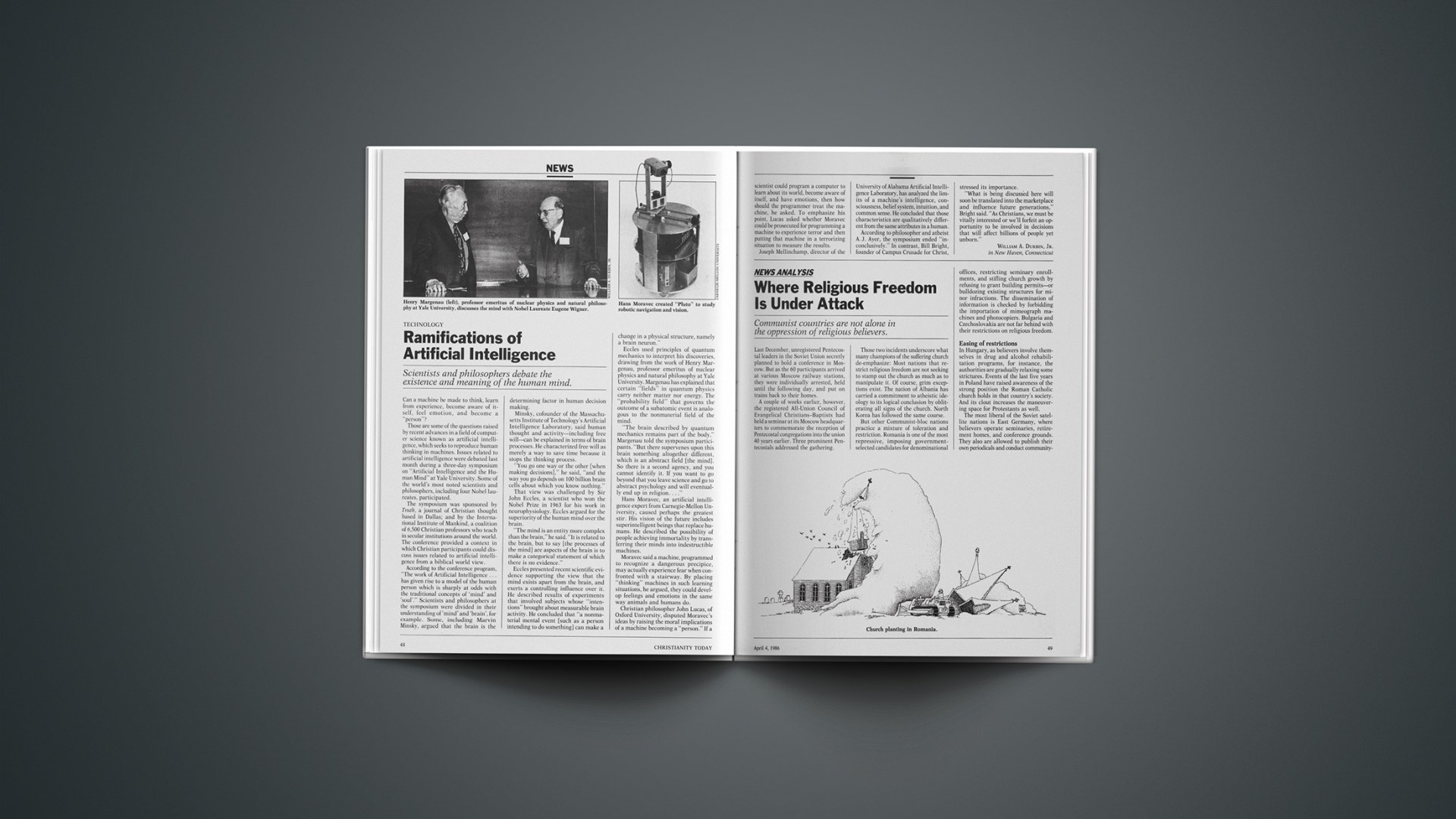
Those are some of the questions raised by recent advances in a field of computer science known as artificial intelligence, which seeks to reproduce human thinking in machines. Issues related to artificial intelligence were debated last month during a three-day symposium on “Artificial Intelligence and the Human Mind” at Yale University. Some of the world’s most noted scientists and philosophers, including four Nobel laureates, participated.

The symposium was sponsored by Truth, a journal of Christian thought based in Dallas; and by the International Institute of Mankind, a coalition of 6,500 Christian professors who teach in secular institutions around the world. The conference provided a context in which Christian participants could discuss issues related to artificial intelligence from a biblical world view.

According to the conference program, “The work of Artificial Intelligence … has given rise to a model of the human person which is sharply at odds with the traditional concepts of ‘mind’ and ‘soul’.” Scientists and philosophers at the symposium were divided in their understanding of ‘mind’ and ‘brain’, for example. Some, including Marvin Minsky, argued that the brain is the determining factor in human decision making.

Minsky, cofounder of the Massachusetts Institute of Technology’s Artificial Intelligence Laboratory, said human thought and activity—including free will—can be explained in terms of brain processes. He characterized free will as merely a way to save time because it stops the thinking process.

“You go one way or the other [when making decisions],” he said, “and the way you go depends on 100 billion brain cells about which you know nothing.”

That view was challenged by Sir John Eccles, a scientist who won the Nobel Prize in 1963 for his work in neurophysiology. Eccles argued for the superiority of the human mind over the brain.

“The mind is an entity more complex than the brain,” he said. “It is related to the brain, but to say [the processes of the mind] are aspects of the brain is to make a categorical statement of which there is no evidence.”

Eccles presented recent scientific evidence supporting the view that the mind exists apart from the brain, and exerts a controlling influence over it. He described results of experiments that involved subjects whose “intentions” brought about measurable brain activity. He concluded that “a nonmaterial mental event [such as a person intending to do something] can make a change in a physical structure, namely a brain neuron.”

Eccles used principles of quantum mechanics to interpret his discoveries, drawing from the work of Henry Margenau, professor emeritus of nuclear physics and natural philosophy at Yale University. Margenau has explained that certain “fields” in quantum physics carry neither matter nor energy. The “probability field” that governs the outcome of a subatomic event is analogous to the nonmaterial field of the mind.

“The brain described by quantum mechanics remains part of the body,” Margenau told the symposium participants. “But there supervenes upon this brain something altogether different, which is an abstract field [the mind]. So there is a second agency, and you cannot identify it. If you want to go beyond that you leave science and go to abstract psychology and will eventually end up in religion.…”

Hans Moravec, an artificial intelligence expert from Carnegie-Mellon University, caused perhaps the greatest stir. His vision of the future includes superintelligent beings that replace humans. He described the possibility of people achieving immortality by transferring their minds into indestructible machines.

Moravec said a machine, programmed to recognize a dangerous precipice, may actually experience fear when confronted with a stairway. By placing “thinking” machines in such learning situations, he argued, they could develop feelings and emotions in the same way animals and humans do.

Christian philosopher John Lucas, of Oxford University, disputed Moravec’s ideas by raising the moral implications of a machine becoming a “person.” If a scientist could program a computer to learn about its world, become aware of itself, and have emotions, then how should the programmer treat the machine, he asked. To emphasize his point, Lucas asked whether Moravec could be prosecuted for programming a machine to experience terror and then putting that machine in a terrorizing situation to measure the results.

Joseph Mellinchamp, director of the University of Alabama Artificial Intelligence Laboratory, has analyzed the limits of a machine’s intelligence, consciousness, belief system, intuition, and common sense. He concluded that those characteristics are qualitatively different from the same attributes in a human.

According to philosopher and atheist A. J. Ayer, the symposium ended “inconclusively.” In contrast, Bill Bright, founder of Campus Crusade for Christ, stressed its importance.

“What is being discussed here will soon be translated into the marketplace and influence future generations,” Bright said. “As Christians, we must be vitally interested or we’ll forfeit an opportunity to be involved in decisions that will affect billions of people yet unborn.”

WILLIAM A. DURBIN, JR.

in New Haven, Connecticut

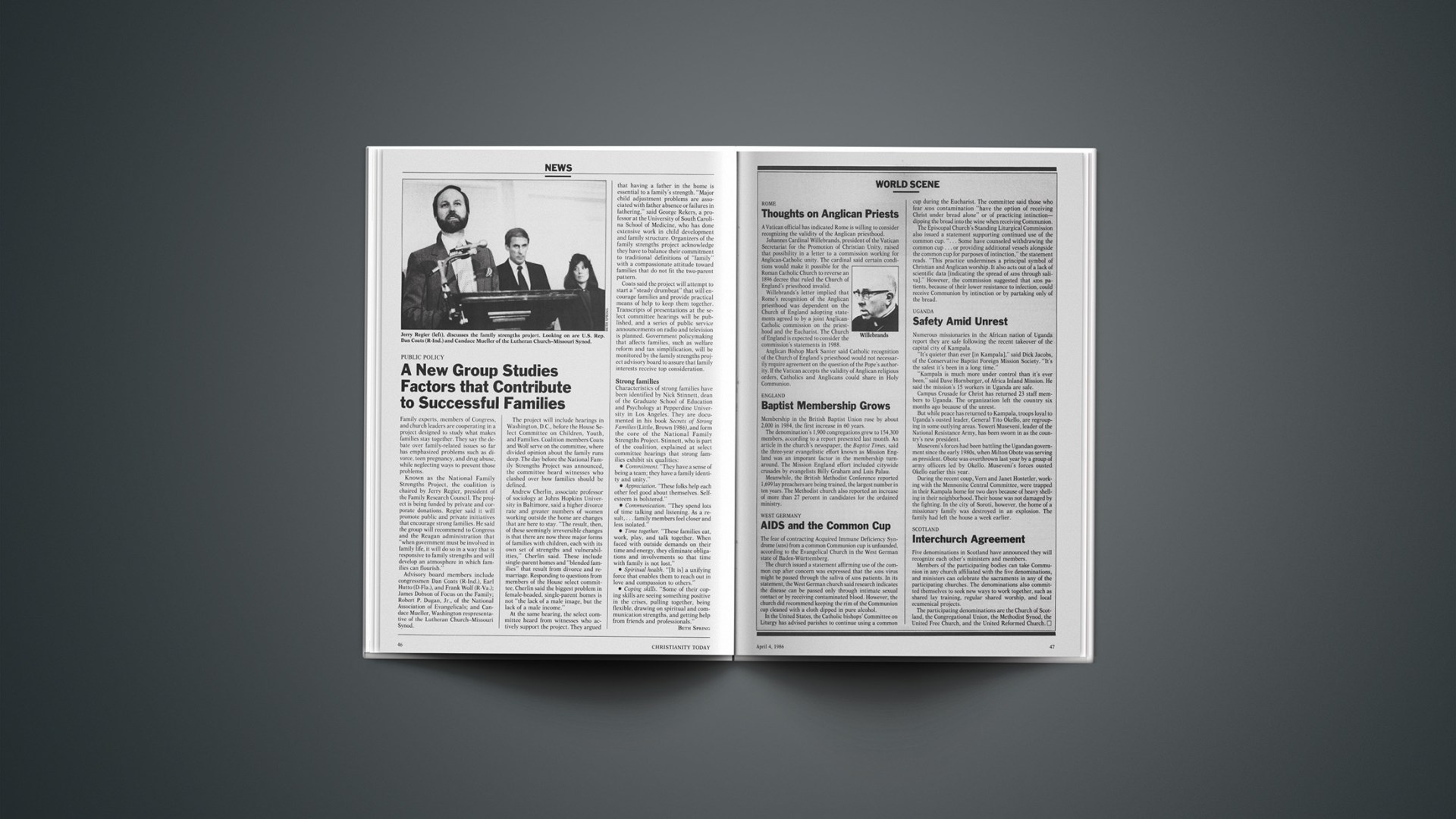
A New Group Studies Factors that Contribute to Successful Families

Family experts, members of Congress, and church leaders are cooperating in a project designed to study what makes families stay together. They say the debate over family-related issues so far has emphasized problems such as divorce, teen pregnancy, and drug abuse, while neglecting ways to prevent those problems.

Known as the National Family Strengths Project, the coalition is chaired by Jerry Regier, president of the Family Research Council. The project is being funded by private and corporate donations. Regier said it will promote public and private initiatives that encourage strong families. He said the group will recommend to Congress and the Reagan administration that “when government must be involved in family life, it will do so in a way that is responsive to family strengths and will develop an atmosphere in which families can flourish.”

Advisory board members include congressmen Dan Coats (R-Ind.), Earl Hutto (D-Fla.), and Frank Wolf (R-Va.); James Dobson of Focus on the Family; Robert P. Dugan, Jr., of the National Association of Evangelicals; and Candace Mueller, Washington respresentative of the Lutheran Church-Missouri Synod.

The project will include hearings in Washington, D.C., before the House Select Committee on Children, Youth, and Families. Coalition members Coats and Wolf serve on the committee, where divided opinion about the family runs deep. The day before the National Family Strengths Project was announced, the committee heard witnesses who clashed over how families should be defined.

Andrew Cherlin, associate professor of sociology at Johns Hopkins University in Baltimore, said a higher divorce rate and greater numbers of women working outside the home are changes that are here to stay. “The result, then, of these seemingly irreversible changes is that there are now three major forms of families with children, each with its own set of strengths and vulnerabilities,” Cherlin said. These include single-parent homes and “blended families” that result from divorce and remarriage. Responding to questions from members of the House select committee, Cherlin said the biggest problem in female-headed, single-parent homes is not “the lack of a male image, but the lack of a male income.”

At the same hearing, the select committee heard from witnesses who actively support the project. They argued that having a father in the home is essential to a family’s strength. “Major child adjustment problems are associated with father absence or failures in fathering,” said George Rekers, a professor at the University of South Carolina School of Medicine, who has done extensive work in child development and family structure. Organizers of the family strengths project acknowledge they have to balance their commitment to traditional definitions of “family” with a compassionate attitude toward families that do not fit the two-parent pattern.

Coats said the project will attempt to start a “steady drumbeat” that will encourage families and provide practical means of help to keep them together. Transcripts of presentations at the select committee hearings will be published, and a series of public service announcements on radio and television is planned. Government policymaking that affects families, such as welfare reform and tax simplification, will be monitored by the family strengths project advisory board to assure that family interests receive top consideration.

Strong Families

Characteristics of strong families have been identified by Nick Stinnett, dean of the Graduate School of Education and Psychology at Pepperdine University in Los Angeles. They are documented in his book Secrets of Strong Families (Little, Brown 1986), and form the core of the National Family Strengths Project. Stinnett, who is part of the coalition, explained at select committee hearings that strong families exhibit six qualities:

Commitment. “They have a sense of being a team; they have a family identity and unity.”

Appreciation. “These folks help each other feel good about themselves. Selfesteem is bolstered.”

Communication. “They spend lots of time talking and listening. As a result, … family members feel closer and less isolated.”

Time together. “These families eat, work, play, and talk together. When faced with outside demands on their time and energy, they eliminate obligations and involvements so that time with family is not lost.”

Spiritual health. “[It is] a unifying force that enables them to reach out in love and compassion to others.”

Coping skills. “Some of their coping skills are seeing something positive in the crises, pulling together, being flexible, drawing on spiritual and communication strengths, and getting help from friends and professionals.”

BETH SPRING

WORLD SCENE

ROME

Thoughts on Anglican Priests

A Vatican official has indicated Rome is willing to consider recognizing the validity of the Anglican priesthood.

Johannes Cardinal Willebrands, president of the Vatican Secretariat for the Promotion of Christian Unity, raised that possibility in a letter to a commission working for Anglican-Catholic unity. The cardinal said certain conditions would make it possible for the Roman Catholic Church to reverse an 1896 decree that ruled the Church of England’s priesthood invalid.

Willebrands’s letter implied that Rome’s recognition of the Anglican priesthood was dependent on the Church of England adopting statements agreed to by a joint Anglican-Catholic commission on the priesthood and the Eucharist. The Church of England is expected to consider the commission’s statements in 1988.

Anglican Bishop Mark Santer said Catholic recognition of the Church of England’s priesthood would not necessarily require agreement on the question of the Pope’s authority. If the Vatican accepts the validity of Anglican religious orders, Catholics and Anglicans could share in Holy Communion.

ENGLAND

Baptist Membership Grows

Membership in the British Baptist Union rose by about 2,000 in 1984, the first increase in 60 years.

The denomination’s 1,900 congregations grew to 154,300 members, according to a report presented last month. An article in the church’s newspaper, the Baptist Times, said the three-year evangelistic effort known as Mission England was an imporant factor in the membership turnaround. The Mission England effort included citywide crusades by evangelists Billy Graham and Luis Palau.

Meanwhile, the British Methodist Conference reported 1,699 lay preachers are being trained, the largest number in ten years. The Methodist church also reported an increase of more than 27 percent in candidates for the ordained ministry.

WEST GERMANY

AIDS and the Common Cup

The fear of contracting Acquired Immune Deficiency Syndrome (AIDS) from a common Communion cup is unfounded, according to the Evangelical Church in the West German state of Baden-Württemberg.

The church issued a statement affirming use of the common cup after concern was expressed that the AIDS virus might be passed through the saliva of AIDS patients. In its statement, the West German church said research indicates the disease can be passed only through intimate sexual contact or by receiving contaminated blood. However, the church did recommend keeping the rim of the Communion cup cleaned with a cloth dipped in pure alcohol.

In the United States, the Catholic bishops’ Committee on Liturgy has advised parishes to continue using a common cup during the Eucharist. The committee said those who fear AIDS contamination “have the option of receiving Christ under bread alone” or of practicing intinction—dipping the bread into the wine when receiving Communion.

The Episcopal Church’s Standing Liturgical Commission also issued a statement supporting continued use of the common cup. “… Some have counseled withdrawing the common cup … or providing additional vessels alongside the common cup for purposes of intinction,” the statement reads. “This practice undermines a principal symbol of Christian and Anglican worship. It also acts out of a lack of scientific data [indicating the spread of AIDS through saliva].” However, the commission suggested that AIDS patients, because of their lower resistance to infection, could receive Communion by intinction or by partaking only of the bread.

UGANDA

Safety Amid Unrest

Numerous missionaries in the African nation of Uganda report they are safe following the recent takeover of the capital city of Kampala.

“It’s quieter than ever [in Kampala],” said Dick Jacobs, of the Conservative Baptist Foreign Mission Society. “It’s the safest it’s been in a long time.”

“Kampala is much more under control than it’s ever been,” said Dave Hornberger, of Africa Inland Mission. He said the mission’s 15 workers in Uganda are safe.

Campus Crusade for Christ has returned 23 staff members to Uganda. The organization left the country six months ago because of the unrest.

But while peace has returned to Kampala, troops loyal to Uganda’s ousted leader, General Tito Okello, are regrouping in some outlying areas. Yoweri Museveni, leader of the National Resistance Army, has been sworn in as the country’s new president.

Museveni’s forces had been battling the Ugandan government since the early 1980s, when Milton Obote was serving as president. Obote was overthrown last year by a group of army officers led by Okello. Museveni’s forces ousted Okello earlier this year.

During the recent coup, Vern and Janet Hostetler, working with the Mennonite Central Committee, were trapped in their Kampala home for two days because of heavy shelling in their neighborhood. Their house was not damaged by the fighting. In the city of Soroti, however, the home of a missionary family was destroyed in an explosion. The family had left the house a week earlier.

SCOTLAND

Interchurch Agreement

Five denominations in Scotland have announced they will recognize each other’s ministers and members.

Members of the participating bodies can take Communion in any church affiliated with the five denominations, and ministers can celebrate the sacraments in any of the participating churches. The denominations also committed themselves to seek new ways to work together, such as shared lay training, regular shared worship, and local ecumenical projects.

The participating denominations are the Church of Scotland, the Congregational Union, the Methodist Synod, the United Free Church, and the United Reformed Church.

Ben Weiss, ‘Behind-the-Scenes Worker,’ Is Dead at 95

When major Christian organizations select board members, they usually choose from the ranks of well-known religious figures or influential business people. Ben Weiss was neither. Yet for more than half a century, he served on the boards of a number of important organizations and was sought after by others.

Weiss was “a balance wheel,” explained Hubert Mitchell, a long-time friend who preached Weiss’s funeral sermon in suburban Los Angeles. He was “a behind-the-scenes worker who could always be counted on, not a glory seeker.”

Weiss, 95, died February 20 in Pasadena, California, following a short, flulike illness. A widower since 1949, he had no children.

Gifted with a brilliant mind, Weiss read and traveled widely. A niece recalled that he could carry on articulate discussions with experts on virtually any topic.

The son of devoutly Protestant French immigrants, Weiss graduated in 1921 from the University of Southern California, where he was a pitcher on the baseball team and played guard on the football team. He went into public school teaching and served for many years as principal of Metropolitan High School i Los Angeles, retiring in 1955 to devote his time to Christian work.

Weiss was active in the Evangelical United Brethren Church, Youth for Christ, Campus Crusade for Christ, assorted mission agencies, and other organizations. He founded the National Educators Fellowship (now Christian Educators Association) to promote contacts among Christian teachers in public and private schools.

“Kids loved him,” said Ted Engstrom, head of World Vision United States and former president of Youth for Christ. “He was always being invited to speak at youth meetings.”

Young people sensed Weiss understood them, said Robert A. Cook, retired president of The King’s College in Briarcliff Manor, New York, and also a former president of Youth for Christ. Cook said Weiss was equally at home with the straight church kids of the 1950s and the counterculture Jesus People of the late 1960s.

“He had a gift for soul winning,” said evangelist Billy Graham. Weiss headed counseling and follow-up work at Graham’s landmark 1949 crusade in Los Angeles. Graham assigned Dawson Trotman, who later founded the Navigators, to assist Weiss. Graham said much of Trotman’s subsequent ministry was based on what he learned from Weiss.

Weiss’s close friends remember him best for his commitment to prayer and personal evangelism. “Whether traveling or going out to eat, Ben always prayed first that God would put him next to someone with whom he could share Christ,” said Cook. “He led many, many to Christ.”

Apple PodcastsDown ArrowDown ArrowDown Arrowarrow_left_altLeft ArrowLeft ArrowRight ArrowRight ArrowRight Arrowarrow_up_altUp ArrowUp ArrowAvailable at Amazoncaret-downCloseCloseEmailEmailExpandExpandExternalExternalFacebookfacebook-squareGiftGiftGooglegoogleGoogle KeephamburgerInstagraminstagram-squareLinkLinklinkedin-squareListenListenListenChristianity TodayCT Creative Studio Logologo_orgMegaphoneMenuMenupausePinterestPlayPlayPocketPodcastRSSRSSSaveSaveSaveSearchSearchsearchSpotifyStitcherTelegramTable of ContentsTable of Contentstwitter-squareWhatsAppXYouTubeYouTube