Where Is Jerry Falwell Headed in 1986?

The leader of the Christian Right tells how political activism has affected him.

Shedding his earlier opposition to political involvement, Jerry Falwell helped found Moral Majority in 1979. The group was organized to oppose abortion and to support traditional family values, a strong national defense, and the State of Israel.

Moral Majority enabled fundamentalists to join forces with those from other religious traditions in addressing social and moral issues. Falwell says Catholics make up the largest constituency in Moral Majority, accounting for some 30 percent of its adherents. The organization also includes evangelicals, Jews, and Mormons.

Last month, Falwell announced the formation of Liberty Federation, an umbrella organization that will address a broader range of public policy issues (CT, Feb. 7, 1986, p. 60). Among other issues, the organization will speak out on the strategic defense initiative, the spread of communism, and American foreign policy toward South Africa and the Philippines. Moral Majority is functioning as a subsidiary of Liberty Federation. Another subsidiary, Liberty Alliance, operates as the educational and political lobbying arm of Liberty Federation.

CHRISTIANITY TODAY asked Falwell to assess the Religious Right in 1986. He also outlines his goals for the future, and tells how he has changed after seven years of political activism.

Has the New Right’s political power crested, or will it continue to grow?

The New Right has been very successful, and its influence is growing rapidly. There is a perception across the country that with Ronald Reagan in the White House, the moral issues are on the front burner, the country is moving to the Right, and we have won the battle.

However, most people in the New Right would tell you they are having difficulty raising funds. That is true for two reasons. First, so many more organizations are raising funds out of the same pool. Second, the perception of safety, which our success has created, hurts fund-raising efforts. You don’t do well in fund raising unless you are in trouble.

Organizations in the political Right are realizing that there are X number of people interested in supporting conservative causes, and they are all asking those same people for money. One of my friends receives at least 30 letters a day from political and conservative organizations. The number of organizations needing money is growing faster than the head count of conservative supporters. So some of these organizations are going to die out.

But these factors have not affected the Christian Right. Our supporters back us out of a spiritual motivation, rather than political motivation. Our budget is $100 million—the largest ever. Our supporters are giving continuously, regardless of who is in the White House.

The New Right has had a positive influence on the Christian Right. They have educated us on many of the issues, giving us political savvy in a hurry. And groups like Moral Majority have spawned hundreds of groups of conservative Christians who are now registered voters. They are speaking to the issues, and they are politically involved. The next step for us is challenging our people to run for office. We probably have 90 to 100 running this year.

Your statements last fall opposing economic sanctions against South Africa raised the ire of many Americans, including religious leaders. Isn’t this a problem that has no simple theological answer?

I don’t know any reasonable Christian who supports apartheid. So we begin from a point of agreement. But there is tremendous diversity on how to solve the problem. I have fundamentalist friends who disagree with my position on South Africa.

I want to see every one of the 30 million residents of South Africa participating in the political process there. And I want to see it happen as quickly as possible. But I don’t want South Africa to go the route of Mozambique, Zimbabwe, and Angola. When colonialism became history in Africa and Europeans moved out instantly, bloodbaths occurred. The citizens of those countries had not had time to develop the expertise to operate a fair and reasonable government.

The gradual move toward reform that South African President P. W. Botha is committed to will eventually bring a participatory government. It will bring an end to apartheid, and provide prosperity without bloodshed.

Now, the African National Congress (ANC) and its arm inside the country, the United Democratic Front, are advocating violence. Half of the 800 people who have died have been blacks killed by blacks. There has been brutality, and you can’t excuse all the conduct of the South African government any more than you can the ANC.

Change can take place. But intervention from outside—from the Soviets or the United States—will create havoc. We need to use economic pressure and a lot of restraint to give them time to do in a few years what it took America 170 years to accomplish.

Your stands on political matters give rise to criticism from both the Right and the Left. How do you live with that kind of tension?

I have a relative position of safety as pastor of Thomas Road Baptist Church, in Lynchburg, Virginia. We have 21,000 members who have grown up with me since the inception of the church 30 years ago. They know where I’m coming from. They have seen my views develop.

Many of them were here when we were a part of the segregated South and had no black members. They were here when our first black member was baptized. They saw our philosophy change, and they saw our commitment to noninvolvement in political issues reversed. They were here long enough to hear the rationale and to see that change is not always bad.

They see the weeks and weeks of information and experience that lead up to the public positions I take. As a result, no matter what may be printed in the newspapers, when I come home I have no reaction to calm down. And with no intention of ever running for political office, I don’t have to worry about opinion polls.

When you espouse a position that you know will be criticized, are you prepared to respond to your opponents?

As a younger preacher, I was far more sensitive to public opinion and criticism. There are two college professors who for 15 or 20 years have taped every message I have preached. They try to find some contradiction or ethnic bias or something. Every time they think they find something, they run to the Washington Post. There were days when I responded to them. But one day I realized that no matter who said what, it didn’t hurt me. My response to this garbage did me far more damage than what my critics said or did to me. So I stopped responding long ago. I operate totally on offense now.

Criticism can help keep us accountable. Who carries out that function in your life?

First, I am accountable to God. Next, I am accountable to a local congregation. As a pastor, I can’t have any scandals. And I can’t have a financial debacle because my congregation must have confidence in me. Third, as an organization, we are accountable to our donors. We are audited by an outside accounting firm every year. All of our donors have access to our financial statements.

How has your role changed since you founded Moral Majority?

Before Moral Majority was formed, I had more freedom to express my opinions. Since then, I’ve had to gradually pull in the ropes and be very cautious on making statements until I’ve weighed the impact on our own camp. The South African debate is probably the most volatile one we have been involved in because there are really good people on both sides of the issue.

I’ve had to pull in my tendency to shoot from the hip. I’ve also had to learn that I can’t talk to anybody outside my own family about sensitive subjects, because my comments invariably appear in print. That’s a hard lesson for a very public, extroverted person like myself.

In Lynchburg, I can stop at a hot-dog joint and talk with the guys I went to high school with. That doesn’t mean I don’t have detractors here. I do. But in this town I’m just Jerry.

It’s totally different when I leave Lynchburg. My high visibility has made me become what I don’t like to be: a private person outside of my home town. That is the most painful consequence of what I do.

Liberty University is a special concern of yours. What are your hopes and dreams for that school?

Liberty University is my way of carrying out the dream and vision God has given me. That vision is to give the gospel to the world in my generation. Television and radio are effective; the local church here is effective; our speaking tours are effective. But my hope for making an impact on the world with this generation and generations to come is to train young people in the things that are vital to the cause of world evangelization.

Now in our fifteenth year, we have 6,900 students. We have 75 majors, and we are fully accredited. Our master’s program is in place, and our doctoral program begins this fall. We’re also planning to start a law school. When you include our elementary and high school, we have 8,500 students. We have a dream of 50,000 students shortly after the first of the century.

There are several areas where Liberty University can reverse the trends that have corrupted society. We have trained 1,000 preachers. We have also trained journalists. We have a large business major, and a large education major. Our students who major in political science are required to work as interns in Washington for senators and congressmen. One of our graduates is running for Congress this fall. One day we will be doing what Harvard has done. We’ll have hundreds of our graduates running for office.

How is God moving you further along the ministry path he has set for you?

At age 52, my spiritual growth is as important as it was 34 years ago when I became a Christian. The study of the Word of God, my personal relationship with God, and my time in fellowship and prayer are as vital, if not more so, now as in the past.

I read a lot—not only the Bible and books about the Bible and men and women of God—but also books like Iacocca and Losing Ground. I try to read all the best sellers that are coming out so the world doesn’t walk past us. I probably read two books a week. I have to make some sacrifices in order to find the time to do that. I’m trying to improve myself. I’m trying to learn. I’m trying as hard to grow now as I did 30 years ago so that I am capable of leading the people that God has put under my ministry.

What would you like your legacy to be?

I’d like to be remembered as a good husband, father, and pastor. That is my first calling. I’ve got three children in school. Two of them are in college, and one is in law school. We do everything together. I may fail in a lot of areas, but, God willing, it won’t be at home.

Likewise, as pastor of Thomas Road Baptist Church, I’m always here on Sunday morning, Sunday night, and Wednesday morning. I won’t miss two Wednesday nights a year. And I don’t miss any Sunday mornings.

NORTH AMERICAN SCENE

PROLIFE DEMONSTRATION

36,000 March in Washington

The annual March for Life brought an estimated 36,000 people to Washington, D.C., last month to protest legalized abortion. The demonstration marked the thirteenth anniversary of the U.S. Supreme Court’s Roe v. Wade ruling that made abortion legal in the United States.

Marchers gathered on the Ellipse behind the White House where they heard an address by President Reagan via a telephone and loudspeaker hookup. “We will continue to work together with members of Congress to overturn the tragedy of Roe v. Wade,” Reagan said.

The demonstrators also heard from members of Congress, including U.S. Sen. Jesse Helms (R-N.C.) and U.S. Rep. Jack Kemp (R-N.Y.). “The success of this movement is assured,” Kemp said, “not only because it’s predicated on those Judeo-Christian values upon which America was founded, but because it is pro-people.”

The demonstrators marched to the Supreme Court building and the Capitol, where they lobbied members of Congress. Ten persons were arrested for demonstrating at the Supreme Court, and 31 others were arrested for protests at two Washington, D.C., abortion clinics.

Proponents of legalized abortion used the occasion to criticize the prolife movement. Eleanor Smeal, president of the National Organization for Women, said her group is planning a major march in Washington this spring in support of artificial contraception and legalized abortion.

UNIFICATION CHURCH

Voices of Dissent

Two newsletters are calling for change in the Unification Church, the cult headed by Korean religious leader Sun Myung Moon.

The newsletters, published by members of the Unification Church, call for greater freedom in personal lifestyles, more democratic participation by members, and doctrinal reform. One of the newsletters, The Round Table, was started last year by graduates of the Unification Theological Seminary in Barrytown, New York. The other, called Our Network, was begun in 1984 to support Moonies who are moving out of the cult’s mainstream.

Our Network editor Aquacena Lopez said most of Moon’s followers live outside the communal centers that serve as bases for the Unification Church’s missionary work. She said those followers feel rejected by Moon’s organization.

David Doose, an editor of The Round Table, said many members oppose the authoritarian style of Unification leaders from Eastern nations, primarily Korea. Another Round Table editor said many Unificationists want Moon’s organization to stress a stronger relationship to historic Christianity.

Doose said a Unification Church newsletter called The Pyramid is being published in part to counter the impact of The Round Table. However, Pyramid editor Dan Stringer said his newsletter is “only meant to articulate the faith of many members.” Stringer, a member of a Unification anti-Communist organization called CAUSA, said many of the dissenters “have not reconciled themselves to authority.… [They] leave themselves little choice but to move on and go beyond the Unification Church.”

TRENDS

Poor Do Worse in 1985

Demands for emergency food and shelter rose sharply last year in most of the 25 cities surveyed by the United States Conference of Mayors.

A report prepared by the organization says the demand for emergency food rose an average of 28 percent during 1985. Officials in 66 percent of the cities said the demand is so great that they must turn people away from their emergency food assistance programs.

Demands for shelter increased in 90 percent of the cities surveyed, staying the same in the remaining cities. Officials in most of the 25 cities said poverty levels remained the same or increased during 1985.

In a separate study, the National Urban League reported that economic and social gaps between blacks and whites in America widened significantly last year. In its annual report, the civil rights organization said income and educational attainment among blacks has declined in relation to whites. Poverty, youth unemployment, and single-parent families among black Americans increased.

National Urban League president John E. Jacob said government figures show that in 1984, the latest year for which figures are available, the median income of blacks dropped to 56 percent of the white median income. In 1970, the figure was 62 percent.

PEOPLE AND EVENTS

Briefly Noted

Damaged: By fire, the platform area of Chicago’s historic Moody Church. Fire destroyed the church’s pulpit, a grand piano, parts of a pipe organ, and the public address system. No one was injured in the blaze. Authorities said an intruder ransacked two church offices and then apparently ignited the fire after pouring a flammable liquid around the pulpit. Damage to the church was estimated at $500,000.

Appointed: To chair the board of World Vision International, Roberta Hestenes, director of the Christian Formation and Discipleship Program at Fuller Theological Seminary. An ordained Presbyterian Church (U.S.A.) minister, Hestenes is the first woman to head the World Vision board in the agency’s 35-year history.

Died: Former Wheaton (Ill.) College registrar Enock C. Dyrness, 83, on January 15, in Walnut Creek, California. A 1923 Wheaton College graduate, Dyrness served on the college’s faculty and administration for more than 40 years.

Presented: To Navajo official Edward T. Begay, a copy of the first complete Bible translated into the Navajo language. The Navajo nation, representing 220,000 native Americans, first received the complete New Testament in its language in 1956. Navajo Bible Translators, with financial support from Wycliffe Bible Translators and the American Bible Society, finished the complete Navajo Bible last year.
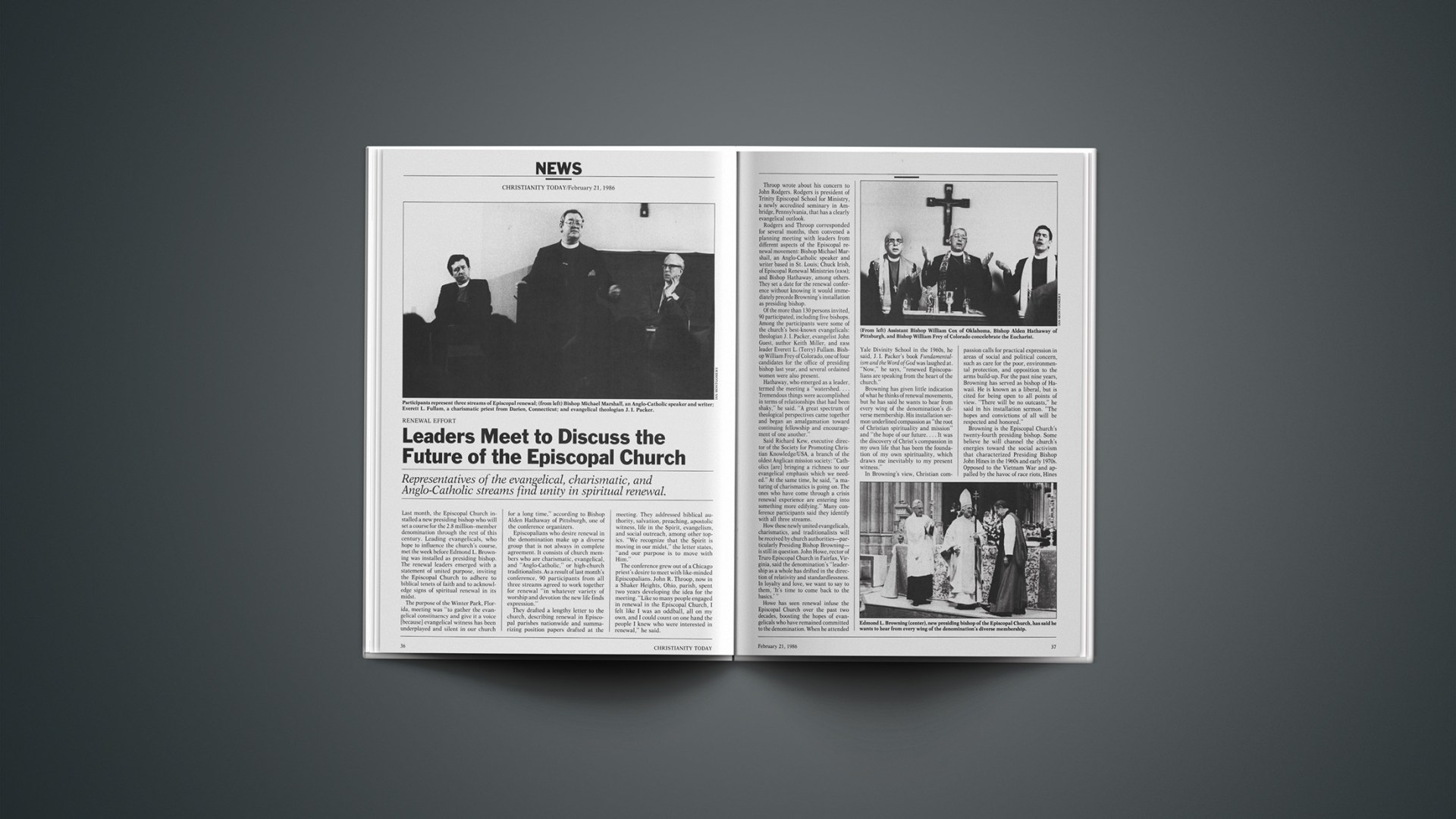
Leaders Meet to Discuss the Future of the Episcopal Church

Representatives of the evangelical, charismatic, and Anglo-Catholic streams find unity in spiritual renewal.

Last month, the Episcopal Church installed a new presiding bishop who will set a course for the 2.8 million-member denomination through the rest of this century. Leading evangelicals, who hope to influence the church’s course, met the week before Edmond L. Browning was installed as presiding bishop. The renewal leaders emerged with a statement of united purpose, inviting the Episcopal Church to adhere to biblical tenets of faith and to acknowledge signs of spiritual renewal in its midst.

The purpose of the Winter Park, Florida, meeting was “to gather the evangelical constituency and give it a voice [because] evangelical witness has been underplayed and silent in our church for a long time,” according to Bishop Alden Hathaway of Pittsburgh, one of the conference organizers.

Episcopalians who desire renewal in the denomination make up a diverse group that is not always in complete agreement. It consists of church members who are charismatic, evangelical, and “Anglo-Catholic,” or high-church traditionalists. As a result of last month’s conference, 90 participants from all three streams agreed to work together for renewal “in whatever variety of worship and devotion the new life finds expression.”

They drafted a lengthy letter to the church, describing renewal in Episcopal parishes nationwide and summarizing position papers drafted at the meeting. They addressed biblical authority, salvation, preaching, apostolic witness, life in the Spirit, evangelism, and social outreach, among other topics. “We recognize that the Spirit is moving in our midst,” the letter states, “and our purpose is to move with Him.”

The conference grew out of a Chicago priest’s desire to meet with like-minded Episcopalians. John R. Throop, now in a Shaker Heights, Ohio, parish, spent two years developing the idea for the meeting. “Like so many people engaged in renewal in the Episcopal Church, I felt like I was an oddball, all on my own, and I could count on one hand the people I knew who were interested in renewal,” he said.

Throop wrote about his concern to John Rodgers. Rodgers is president of Trinity Episcopal School for Ministry, a newly accredited seminary in Ambridge, Pennsylvania, that has a clearly evangelical outlook.

Rodgers and Throop corresponded for several months, then convened a planning meeting with leaders from different aspects of the Episcopal renewal movement: Bishop Michael Marshall, an Anglo-Catholic speaker and writer based in St. Louis; Chuck Irish, of Episcopal Renewal Ministries (ERM); and Bishop Hathaway, among others. They set a date for the renewal conference without knowing it would immediately precede Browning’s installation as presiding bishop.

Of the more than 130 persons invited, 90 participated, including five bishops. Among the participants were some of the church’s best-known evangelicals: theologian J. I. Packer, evangelist John Guest, author Keith Miller, and ERM leader Everett L. (Terry) Fullam. Bishop William Frey of Colorado, one of four candidates for the office of presiding bishop last year, and several ordained women were also present.

Hathaway, who emerged as a leader, termed the meeting a “watershed.… Tremendous things were accomplished in terms of relationships that had been shaky,” he said. “A great spectrum of theological perspectives came together and began an amalgamation toward continuing fellowship and encouragement of one another.”

Said Richard Kew, executive director of the Society for Promoting Christian Knowledge/USA, a branch of the oldest Anglican mission society: “Catholics [are] bringing a richness to our evangelical emphasis which we needed.” At the same time, he said, “a maturing of charismatics is going on. The ones who have come through a crisis renewal experience are entering into something more edifying.” Many conference participants said they identify with all three streams.

How these newly united evangelicals, charismatics, and traditionalists will be received by church authorities—particularly Presiding Bishop Browning—is still in question. John Howe, rector of Truro Episcopal Church in Fairfax, Virginia, said the denomination’s “leadership as a whole has drifted in the direction of relativity and standardlessness. In loyalty and love, we want to say to them, ‘It’s time to come back to the basics.’ ”

Howe has seen renewal infuse the Episcopal Church over the past two decades, boosting the hopes of evangelicals who have remained committed to the denomination. When he attended Yale Divinity School in the 1960s, he said, J. I. Packer’s book Fundamentalism and the Word of God was laughed at. “Now,” he says, “renewed Episcopalians are speaking from the heart of the church.”

Browning has given little indication of what he thinks of renewal movements, but he has said he wants to hear from every wing of the denomination’s diverse membership. His installation sermon underlined compassion as “the root of Christian spirituality and mission” and “the hope of our future.… It was the discovery of Christ’s compassion in my own life that has been the foundation of my own spirituality, which draws me inevitably to my present witness.”

In Browning’s view, Christian compassion calls for practical expression in areas of social and political concern, such as care for the poor, environmental protection, and opposition to the arms build-up. For the past nine years, Browning has served as bishop of Hawaii. He is known as a liberal, but is cited for being open to all points of view. “There will be no outcasts,” he said in his installation sermon. “The hopes and convictions of all will be respected and honored.”

Browning is the Episcopal Church’s twenty-fourth presiding bishop. Some believe he will channel the church’s energies toward the social activism that characterized Presiding Bishop John Hines in the 1960s and early 1970s. Opposed to the Vietnam War and appalled by the havoc of race riots, Hines channeled millions of church dollars into social endeavors, some of which were backed by radical secular groups. Membership and giving dropped precipitously, and when the church chose Hines’s replacement in 1973, it opted for John M. Allin, a low-profile, cautious churchman. His 12-year term saw two major changes occur in the church. In 1977, women were ordained to the priesthood—a development that Allin opposed. In 1979, a new Book of Common Prayer came into use, updating the language and, some believe, the core doctrine of the historic prayer book.

Both of these developments drew some members away from the Episcopal Church and toward affiliation either with Roman Catholicism or conservative Protestantism. Within the church, scattered opposition to women priests and the new prayer book continues. In circles where renewal is occurring, however, these are not central issues. Fleming Rutledge, a woman priest who attended the Winter Park renewal conference, delivered a stirring sermon at the closing Communion service. Another priest, Carol Anderson, told conference participants about her congregation’s work among street people in New York City.

The basics of renewal, spelled out in the letter produced at the Florida conference, include an affirmation of Scripture as “completely trustworthy and sufficient.” Salvation, the conferees agreed, is a gift from God that is appropriated by “repentance, faith, and conversion of life” made possible by the Holy Spirit. The letter states that the Lord’s “actual resurrection from the dead attested his divinity, vindicated his claims, and broke the power of sin and death once for all.”

The letter says “the scriptural promises of supernatural resources to the believer are true,” and “the personal experience of the Holy Spirit quickens worship in the church.” It defines evangelism as a call to “personal commitment through repentance and faith.” Outreach and service are essential, according to the document, because “renewal will die unless [individuals and congregations] continue to move beyond themselves.”

A paragraph penned by theologian J. I. Packer concludes the document, stating, “Where Jesus Christ is known, trusted, loved, and adored; where the sinner is loved but all forms of sin are hated and renounced; where Christ’s living presence is sought and found in fellowship; and where righteousness is done—there the church is in renewal, in whatever variety of worship and devotion the new life finds expression.”

BETH SPRINGin Winter Park

Bishop Alden Hathaway of Pittsburgh

A Renewal Leader from Pittsburgh

According to theologian J. I. Packer, Bishop Alden Hathaway of Pittsburgh is being anointed as a leader in Episcopal renewal—a movement the bishop at one time thought was irrelevant.

In the 1960s, Hathaway served on the staff of a large suburban Detroit church, specializing in human-relations training and proabortion activism. Inner-city riots—the same events that galvanized liberal social action on the part of then Presiding Bishop John Hines—dashed Hathaway’s hopes for his ministry. “A lot of that liberal commitment evaporated over a period of months and years, as the suburbs retreated into themselves and the inner city became polarized. I saw there was something missing from that social-action movement. We were trying to do God’s work using man’s tools, and we concluded that the sin was in the institution, not in our own hearts.”

Hathaway left Detroit and took a job at a parish in the Virginia suburbs of Washington, D.C. The church was split over the Vietnam War, and Hathaway’s best efforts to patch the congregation together had little effect. “I was absolutely burned out, tired of failing, tired of expending my energy and having nothing to show for it,” he said. Then a friend, Jim Hampson, got involved in what Hathaway called “this evangelical business.”

“We’d exchange sermons,” Hathaway said. “He’d write ‘heresy’ all over mine, and I’d write ‘irrelevant’ all over his. We argued and fought.” Hampson challenged Hathaway to submit his ministry and his life to Jesus Christ, but Hathaway resisted the notion. “I knew I had to do that, but it was not a happy thought at all. It was a bitter thought. With my heart I knew I had to get on my knees and confess Jesus, but with my pride I said no.”

At his church, Hathaway had a seminary intern who “preached the Bible, not Watergate.” He knew people were listening more attentively to the intern’s sermons, so he cynically decided, “Okay, you’ll get Bible stories.” He changed his preaching to conform with what he heard from the divinity student, and noticed something happening.

“I found a power and authority that was not my own. I found myself saying things that I didn’t believe or that weren’t credible, but it was touching people in a way I’d never touched them before. And it was touching me, too. It was convincing me of the power of the Word.”

Several months later, Hathaway attended a charismatic conference where he heard the preaching of Everett L. (Terry) Fullam, rector of Saint Paul’s Episcopal Church in Darien, Connecticut. “I heard Scripture being used in a different way. It all pointed to Jesus. In the confidence of that, I laid down my life and received the Holy Spirit. Nothing particularly happened, except I realized I was on the right track, that Jesus was with me. It’s been slow growth ever since then.”

In 1980, Hathaway was elected bishop of Pittsburgh, placing him in the role of overseeing a great variety of priests and parishioners. “I have a diocese with all kinds of sheep in it,” he said. “It’s not my job to sort them; it’s my job to feed them. The only thing I will not tolerate is skepticism on the [divine-human nature] of Christ. We are not a unitarian church, and I don’t buy for a minute that that is a legitimate Anglican position.”

Hathaway is unfazed by the prospect of a major leadership role in the spiritual renewal of the Episcopal Church. He took charge of sending the renewal conference’s letter to Presiding Bishop Edmond L. Browning, and offered to coordinate a meeting of conference organizers to discuss ways to cooperate in the future. “I know I’m where God wants me,” he said, “and I wouldn’t be any place else in the whole world.”

Books

Classic & Contemporary Excerpts from February 21, 1986

Classic and contemporary excerpts

Taking Proper Aim

Shooting above people’s heads doesn’t mean you have superior ammunition—it means you are a lousy shot. Without a sense of love and acceptance, people rarely respond with the kind of commitment that builds for ministry.

Oscar Handlin, quoted in Context

Legitimacy As Abnormality

In the mass-media age, journalism is more than the transmission of neutral information: It traffics in the kind of information and spectacle calculated to embarrass Western leaders.… But the media don’t confine themselves to embarrassing politicians: They also work to create shame about Western history, traditions, and institutions.… Not only our vices but our virtues and values are eligible for assault. Old sexual mores come under fire as much as segregation laws. Christianity is represented as dogmatic, obtuse, repressive: The Pope too is convicted of “gaffes.” Bizarre phenomena like lesbian nuns are treated not as screwballs but as legitimate protestors against onerous restrictions. Every malcontent, no matter how disoriented, becomes a victim.

—The National Review (May 17, 1985)

Mutual Love And Discipleship

Most of us when hearing or using the word disciple are likely to be reminded of the biblical Apostles. Their deepest wish was to emulate Christ. They made him their guide not just because they believed in his teachings but because of their love for him and his love for them. Without such mutual love the Master’s teaching and example, convincing though they were, would never have persuaded the disciples to change their lives and beliefs as radically as they did.

Bruno Bettelheim, The Atlantic Monthly (Nov. 1985)

What We Don’T Know Can Hurt

There is always one fact more in every life of which we know nothing, therefore Jesus says, “Judge not.”

Oswald Chambers, Studies in the Sermon on the Mount

A Guard Against Pride

It is good that we at times endure opposition, and that we are evilly and untruly judged, when our actions and intentions are good. Often such experiences promote humility, and protect us from vainglory. For then we seek God’s witness in the heart.

Thomas à Kempis, The Imitation of Christ

God’S Common Sense

Unfortunately, man cannot for long endure the common sense of God.

Side by side with Christianity, and often mistaken for it, there has always existed a dark Eastern religion of despair. Perhaps it first came out of exhausted and overpopulated India, where the Lord Buddha decided long ago that life was a mess. The religion of despair often achieves a stoical and ascetic nobility, very impressive to those who are impressed by dramatic gestures. Yet it is the very opposite of the true gospel. The Christian gives up his own desires for the love of others; the Eastern ascetic renounces the world because he thinks himself too good for it.

Pride aping love—it is the devil’s best trick.

Joy Davidman, Smoke on the Mountain

What Is Prayer?

Today the bedrock principle upon which any layperson’s approach to prayer should be based is this: pray when you can, where you can, and how you can. But first ask yourself what you mean by “prayer.”

Mitch Finley, “Laypeople Shouldn’t Pray Like Monks,” U.S. Catholic

Upside-Down Vision

Why is it, the older one grows, the more topsy-turvy the wisdom of Christ appears; and yet the more it appears to be wisdom? He seems to be looking at life upside down; he tells us that the poor have security, the mourners will be happy, the sexually deprived will be the most fulfilled. It seems, by the wisdom of this world, as if we got everything the wrong way round. But live a bit, and one discovers that this is not necessarily the case at all. If the world is inverted, then the only way to see it clearly is upside down.

A. N. Wilson, How Can We Know? An Essay on the Christian Religion

What We Can Do—With God

There is an enormous gap between what we think we can do and what God calls us to do. Our ideas of what we can do or want to do are trivial; God’s ideas for us are grand.

Eugene H. Peterson, Run with the Horses

Finding The Instructions

Someone said that the mind is a marvelous instrument. Unfortunately, it did not come with instructions. We could say the same for life. All of life. And the more we miss the key to living a full life, the more people invent guide books that tell us how to “find life.”

Kurt Vonnegut, Jr., God Bless You, Mr. Rosewater

The Beginning Of Hatred

He longed to revenge himself on everyone for his own shortcomings. He suddenly recalled how he had once been asked: “Why do you hate so and so, so much?” And he had answered in his shameless way, “I’ll tell you. He has done me no harm.

But I played him a dirty trick, and ever since then I have hated him.”

Fedor Dostoevsky, The Brothers Karamazov

The Cult Of Mediocrity

I fear that we in the mass media are creating such a market for mediocrity that we’ve diminished the incentive for excellence. We celebrate notoriety as though it were an achievement. Fame has come to mean being recognized by more people who don’t know anything about you. In politics, we have encouraged the displacement of thoughtfulness by the artful cliché.

Ted Koppel, on receiving the “Broadcaster of the Year” award

The Way Of The Cross

Look, it all consists in the cross, and it all lies in dying; and there is no other way to life and true peace within.

Thomas à Kempis, The Imitation of Christ

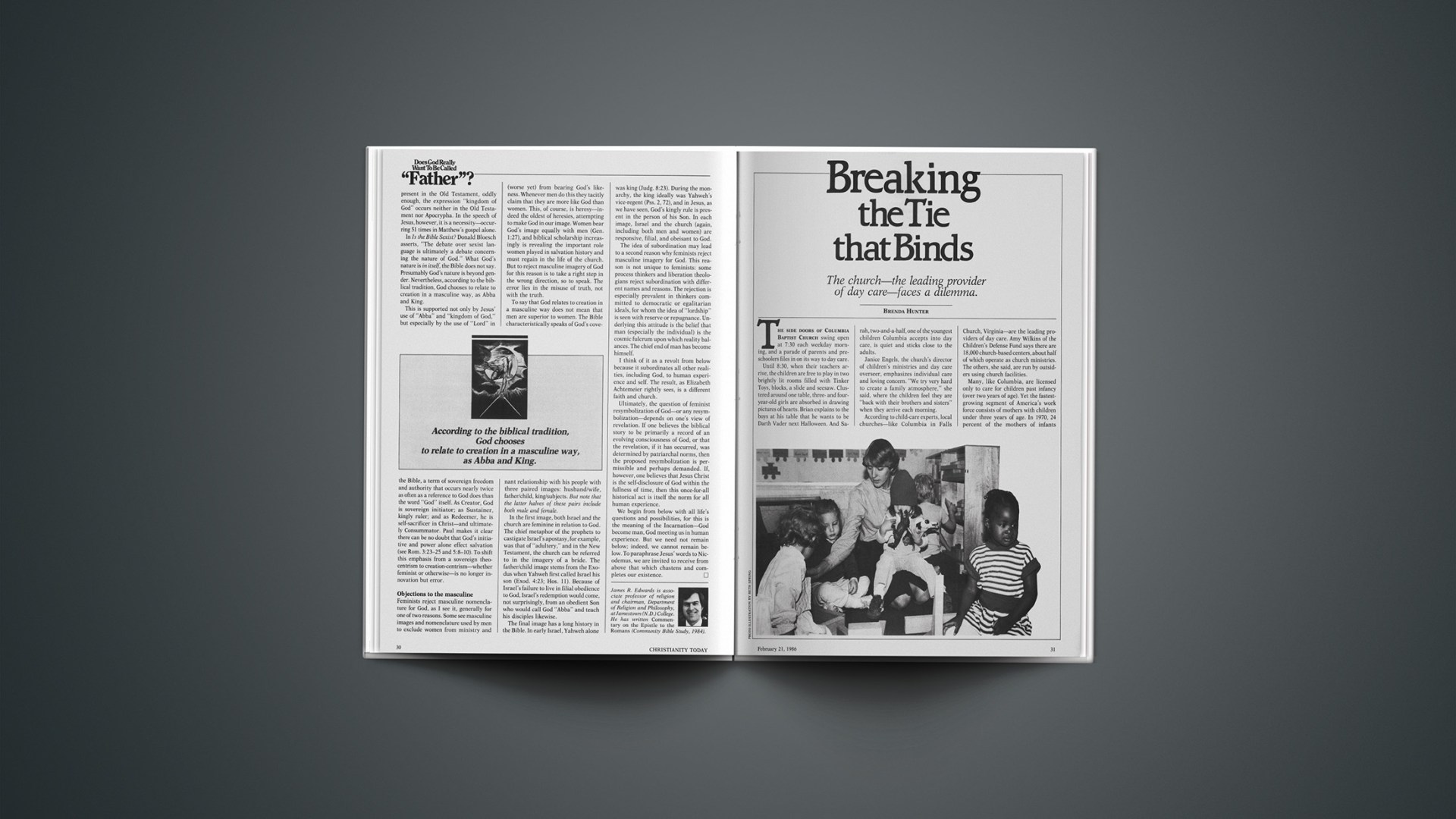
Breaking the TIe that Binds

The Church-the leading provider of day car-faces a dilemma.

The side doors of Columbia Baptist Church swing open at 7:30 each weekday morning, and a parade of parents and preschoolers files in on its way to day care.

Until 8:30, when their teachers arrive, the children are free to play in two brightly lit rooms filled with Tinker Toys, blocks, a slide and seesaw. Clustered around one table, three-and four-year-old girls are absorbed in drawing pictures of hearts. Brian explains to the boys at his table that he wants to be Darth Vader next Halloween. And Sarah, two-and-a-half, one of the youngest children Columbia accepts into day care, is quiet and sticks close to the adults.

Janice Engels, the church’s director of children’s ministries and day care overseer, emphasizes individual care and loving concern. “We try very hard to create a family atmosphere,” she said, where the children feel they are “back with their brothers and sisters” when they arrive each morning.

According to child-care experts, local churches—like Columbia in Falls Church, Virginia—are the leading providers of day care. Amy Wilkins of the Children’s Defense Fund says there are 18,000 church-based centers, about half of which operate as church ministries. The others, she said, are run by outsiders using church facilities.

Many, like Columbia, are licensed only to care for children past infancy (over two years of age). Yet the fastest-growing segment of America’s work force consists of mothers with children under three years of age. In 1970, 24 percent of the mothers of infants worked outside the home. By 1984, that number had reached 46 percent. Infants as young as three weeks old are spending a large portion of their lives cared for by someone other than their mothers.

According to Jay Belsky, associate professor of human development at Pennsylvania State University, “The research evidence is compellingly consistent in demonstrating there is absolutely no adverse effect of out-of-home care, be it in centers or in families, on children’s intellectual functioning.” But the picture is different, he notes, when we look at children’s emotional development or what is defined as the quality of the infant’s emotional bond with the mother.

Testifying before a U.S. House of Representatives hearing on child care services (Sept. 6, 1984), Belsky said, “Today I cannot conclude, as I did in 1978 and again in 1982, that the data show no apparent adverse effects on infant care.”

A Church Dilemma

While day-care ministries began as simple responses to clear-cut needs, the impact of “other-than-mother” child care has presented the church with a dilemma it is ill-prepared to face. At Columbia Baptist Church, where a well-established center has served more than 1,200 children in 16 years, pastor Neal Jones summed up the day-care challenge by saying that “there is the temptation for the church to take on cultural values, but also the temptation exists to do nothing.”

To date, few churches or denominations have grappled with the implications of the psychological research on day care. When Churches Mind the Children, a study of day care in local congregations affiliated with the National Council of Churches (NCC), states that day care arose in the church as a “grass roots phenomenon.” It was a local response to a local need. One of the study’s authors, Eileen Lindner, says NCC churches did not consciously decide to become providers of child care; instead, many saw day care as a way of ministering to the local community.

Churches affiliated with the more conservative National Association of Evangelicals (NAE) have also been concerned with meeting human needs. But, according to Ted Ward, dean of international studies at Trinity Evangelical Divinity School and an expert on the family, these same churches, when faced with need, rarely make policy decisions. Instead, they respond in the manner of the Good Samaritan.

Few NAE-member denominations have an official position on day care. Instead, they leave the issue up to the individual local churches. Charles Beekley, head of Christian education for the Brethren Church, says, “We can formulate and postulate all we want, but each church is responsible for its own program.”

Ted Johnson, secretary of educational ministries for the Baptist General Conference, said there is no definitive stand on day care guiding its 732 affiliated churches. And former Assemblies of God president Thomas Zimmerman said, “We really don’t have a position on day care. Our form of government leaves that more or less a matter for the local church.” He said Assemblies churches are encouraged to meet local needs, and many have provided day care “with a great deal of success.”

In contrast, the Church of the Nazarene has taken a position on day care. According to Mark York, coordinator for Nazarene Christian schools, the church does not view day care as detrimental to children nor would it refuse to offer infant day care. York said Nazarene congregations see themselves as the “extended family of God,” able to minister to both the day-care child and the child’s family.

Affecting The Tie That Binds

What is at issue is the quality of the infant-mother bond. British psychoanalyst John Bowlby has written that “a young child’s hunger for his mother’s presence is as great as his hunger for food.” This hunger helps produce attachment, or the enduring bond that forms between a child and mother during the first 12 months of life.

Bowlby believes this bond forms the core of a child’s personality. The process of developing an attachment to the mother may be disrupted or impaired if the mother is physically or psychologically inaccessible to her child. If this happens, Bowlby believes the child could grow up to be anxious, insecure, compulsively self-reliant, or depressed. While arguments rage among child development theorists about the impact day care has on this bond, numerous studies indicate that the quality of attachment is indeed affected.

Some studies show that day-care children, particularly if they have been in some form of out-of-home care since infancy, are more likely to avoid contact with their mothers after a brief, stressful separation than children reared at home. Certain researchers, including Jay Belsky and Edward Zigler, argue that this may be evidence of insecure attachment. Others, such as Greta Fein and Alison Clarke-Stewart, suggest this is merely a coping style the day-care child has adopted.

Early personality development is viewed as significant because studies show that children who were insecure or who avoided their mothers at 12 and 18 months become hostile, withdrawn, uncooperative kindergarteners. Children found to be securely attached early on became the social leaders of their kindergarten classes: forceful, self-directed, and better able to cope with life.

Other Considerations

Bryna Siegel, a psychologist at Stanford University, who has observed children in day-care centers, day-care homes, and at home with their mothers for more than 1,000 hours, believes the “texture” of the day-care child’s life is different from that of the child reared at home with his mother. “A child at home is always hanging around his mother,” she notes. “He and his mother go many places together—the grocery store, a friend’s home, the park, the library.” In day care, on the other hand, there is more confinement and the risk of an “attenuated experience.” The child has “fewer building blocks with which to put his world together,” Siegel suggests. She is opposed to day care before a child reaches two-and-a-half years of age.

The absence of scientific studies on long-term effects of day care is a concern among researchers. Jerome Kagan, professor at Harvard University, has said of day care’s children, “I think they will be different, but I can’t say how.” T. Berry Brazelton, this generation’s Dr. Spock, has said (Fortune, Nov. 28, 1983) that the effects on character are largely uncharted. Siegel suggests that day care is “altering the cultural fabric.” She speculates that children who grow up lacking a close bond with their mothers will have fewer marriages, fewer nuclear families, and more divorces.

Options For The Church

If long-term effects of day care are unknown, what is the church to do? Many leaders believe day care is here to stay and that the church cannot stop offering such support. But most also agree that it is time for the church to seriously review—in light of psychological findings and scriptural teachings—what it can do to help struggling families.

Ted Ward believes a commitment to day care needs to be fashioned in the context of clearer biblical teaching about values. Meeting needs pragmatically comes second, he said, and influencing national policy to promote family stability is a third priority for the church.

“Christian response begins not when our own is hurt but when the other is hurt,” he said. Day care, he believes, indicates church responsiveness beyond the confines of the white, middle-class, “traditional family.” That attitude, he said, needs additional nurturing.

Also in need of nurturing, according to Ward, is the church’s attitude toward materialism. He believes day care is a response to a more pervasive problem whose root cause is affluence. Says Ward, “Some of the dual-spouse work is unnecessary, but as long as ours is a goods-oriented society, the notion of access to that materialism is part of the national psyche.”

Psychologist Siegel has studied the influence of lifestyle choices on parenting by taking a look at professional women in their mid-30s in California. Many of these married women lived in areas where monthly house payments ranged from $2,500 to $3,500. Many had a live-in nanny, and drove a Mercedes or a Volvo.

“They had simply developed lifestyles that couldn’t be supported by one income,” said Siegel, “and their expensive lifestyles may have predetermined their attitudes toward their babies.” Siegel found that women who go back to work soon after giving birth (by 12 weeks) believe their babies need a lot of material goods to survive the early weeks of life. “This is a far cry from the way women in my mother’s generation viewed their babies. Sometimes their babies slept in a laundry basket or drawer during the early weeks of life.”

As the church challenges its members’ definition of “need,” it can also support the value of mothering. The popular press, with blatant disregard of much developmental literature, suggests that anyone can perform the role of “mother.” This message undercuts a woman’s belief that she is central to her child’s life and emotional development. Feeling alone and unsupported, sometimes by their own churches, many women claim that choosing to devote themselves to child-rearing, even for the first few years, is just too costly in terms of psychological pain. The church needs to counter this cultural message by actively supporting the value of mothering and by providing emotional support for mothers at home.

The church can also provide some measure of financial assistance for struggling two-parent families or single parents who wish to devote more time to child care. Within the community of believers, individual Christians can sensitively respond to instances of genuine need. Such responses will not, of course, begin to cover the needs of all Christian families relying on day care, single parents, or families outside the church’s sphere of influence. But the value of viable Christian community should not be minimized. Not only can it serve those in its midst, but it also can model a totally different approach to human relationships and nurturing than society proposes.

Unfortunately, our very young children cannot effectively articulate their needs. We can be sure, however, that babies’ needs remain the same no matter how our techniques of child-rearing change. Lay Christians and church leaders who feel compelled to meet the growing need for child care have an obligation to assess how day care affects child development—physical, emotional, and spiritual. In this way, the church will help fulfill an important part of its calling and become an advocate for our children.

Theology

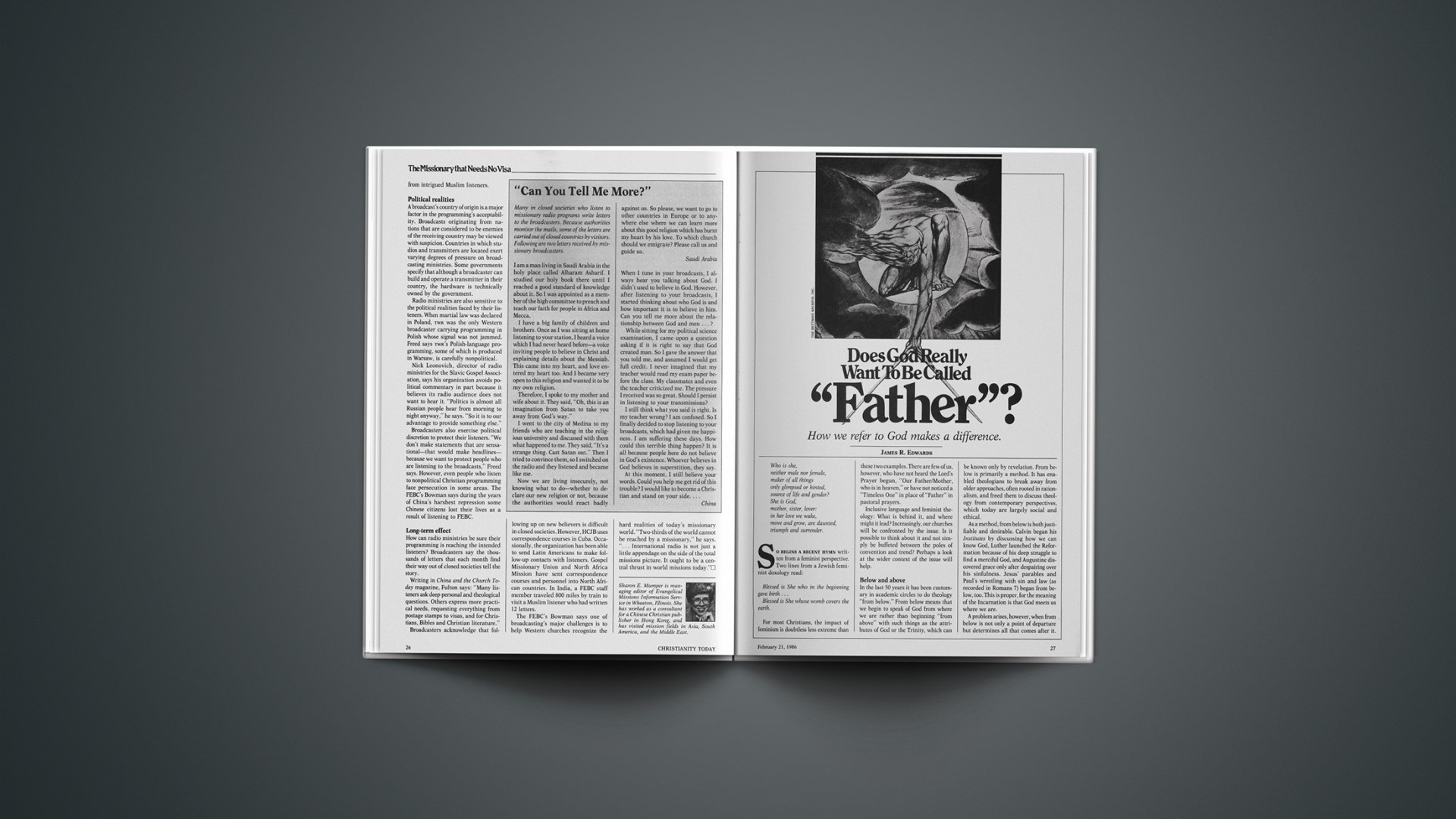
Does God Really Want to Be Called “Father”?

Howe we refer to God makes a difference.

Who is she,

neither male nor female,

maker of all things

only glimpsed or hinted,

source of life and gender?

She is God,

mother, sister, lover:

in her love we wake,

move and grow, are daunted,

triumph and surrender.

So begins a recent hymn written from a feminist perspective. Two lines from a Jewish feminist doxology read:

Blessed is She who in the beginning gave birth …

Blessed is She whose womb covers the earth.

For most Christians, the impact of feminism is doubtless less extreme than these two examples. There are few of us, however, who have not heard the Lord’s Prayer begun, “Our Father/Mother, who is in heaven,” or have not noticed a “Timeless One” in place of “Father” in pastoral prayers.

Inclusive language and feminist theology: What is behind it, and where might it lead? Increasingly, our churches will be confronted by the issue. Is it possible to think about it and not simply be buffeted between the poles of convention and trend? Perhaps a look at the wider context of the issue will help.

Below And Above

In the last 50 years it has been customary in academic circles to do theology “from below.” From below means that we begin to speak of God from where we are rather than beginning “from above” with such things as the attributes of God or the Trinity, which can be known only by revelation. From below is primarily a method. It has enabled theologians to break away from older approaches, often rooted in rationalism, and freed them to discuss theology from contemporary perspectives, which today are largely social and ethical.

As a method, from below is both justifiable and desirable. Calvin began his Institutes by discussing how we can know God, Luther launched the Reformation because of his deep struggle to find a merciful God, and Augustine discovered grace only after despairing over his sinfulness. Jesus’ parables and Paul’s wrestling with sin and law (as recorded in Romans 7) began from below, too. This is proper, for the meaning of the Incarnation is that God meets us where we are.

A problem arises, however, when from below is not only a point of departure but determines all that comes after it. When that happens, we are told we may speak properly of God or the Bible only when such statements agree with human experience.

Take the understanding of Christ as an example. Recent biblical scholarship has concentrated on the human side of Jesus—his identification with sinners, his involvement in the process of liberation, or his death as an example of suffering love. But contemporary scholarship has been reticent about discussing his divine nature—including the performance of miracles and atonement for sin.

On the positive side, understanding Christ from below has helped us not to overemphasize his divine nature at the expense of his humanness, and hence his radical identification with sinners. It has helped us accept that Jesus “pitched his tent among us,” to render the Greek of John 1:14 literally.

A Christology done only from below, however, has the negative effect of limiting Christ to less than the complete biblical report about him. It is like a ham operator who limits his reception to those radio frequencies which he has discovered on his own. If he were more trusting of his manual he could learn other frequencies, which would enlarge his reception from the transmitter.

Promethean Aims

Feminist theology, likewise, starts from below. In doing so it offers promise in providing a new and needed “radio frequency” from Scripture. But it is also dangerous—if Scripture and theology are judged by that “frequency” alone.

Feminist theology concerns itself with woman’s role in Creation, redemption, and the church. Such questions are intensified by the fact that, in two millenia of church history, women have rarely been allowed to tell their own story. Within the Judeo-Christian tradition, half the human race has been spoken for (or to), but essentially deprived of a voice in behalf of its own image, faith, and community.

Feminist theology, however, has gone beyond its origins in women’s suffrage and civil rights. With Promethean intimations it is clamoring for a resymbolization of Christianity, based on categories of feminism. Such theology, to quote Elizabeth Achtemeier of Union Theological Seminary (Va.), is “in the process of laying the foundations for a new faith and a new church that are, at best, only loosely related to apostolic Christianity.” Feminists who desire to change the names of God from Father, King, and Lord, to “Womb of Being,” “Immanent Mother,” “Life Force,” “Divine Generatrix,” or “Ground of Being” are not merely switching labels on a product. They are advocating a shift from a transcendent God to a creation-centered deity. God is no longer our father in heaven, but a “womb covering the earth.”

Tackling The Issue

Donald Bloesch tackles the issue of feminist resymbolizations in a recent book, The Battle for the Trinity (Servant, 1985). Following his earlier Is the Bible Sexist? (Crossway, 1982), Bloesch, who considers himself pro-woman, sees the Achilles’ heel (should we say “Penelope’s loom”?) of radical feminism as determined by and limited to thinking from below (although he does not use that expression). “For nearly all feminists, the final court of appeal is human experience, particularly feminine experience,” he writes. “The Bible … is treated not as an inspired witness to a unique and definitive revelation of God in the history of the people of Israel culminating in Jesus Christ, but as an illuminating record of the struggles of the people of Israel for liberation from political and economic enslavement.…”

Bloesch argues that such resymbolizations of God are, intentionally or not, moving in one of two directions. They lead to making God an abstraction (as opposed to a person) and light-years removed in transcendence. Or, with their insistence on an androgynous Godhead (“God/dess,” “Creator/Creatrix,” “Father/Mother”), they augur a return to fertility worship.

To quote Elizabeth Achtemeier again, “I am sure that much of feminist theology is a return to Baalism.… Many women, in their dedication to the feminist movement, are being slowly wooed into a new form of religion, widely at variance with the Christian faith. Most such women have no desire to desert their Christian roots, any more than many German Christians had when they accepted National Socialism’s resymbolization of the faith in Nazi Germany.”

The crucial question arises when from below conflicts with from above, when our isms differ from God’s Word. Consider this question from Katharine Sakenfeld in Feminist Interpretion of the Bible: “How can feminists use the Bible, if at all?” The structure of the question determines that the Bible is a lesser authority than feminism. But surely this cannot be the proper question. The Bible is not a tool to be used by a special-interest group. What if we rephrased the question, “How can Madison Avenue use the Bible?” or “How can the Ku Klux Klan use the Bible?” Then the Bible would depend on the means and ends of free-enterprise economics or racism.

To be biblically proper we must reverse the question. God does not bear our image; we bear his. It is God’s Word, Jesus Christ, who tells us who we are and what we may become. If the Bible is the record of God’s redemption of estranged and disobedient creation, then all life—and all life’s institutions, philosophies, isms, and ideologies—stand under God’s judgment and grace. In the light of revelation we are revealed for the sinners and idolaters that we are, and in its light we are promised transformation according to the image of Jesus Christ.

The Bible is the story of God’s judgment on all human prospects and institutions, and also of his transformation of them by grace in Christ. It judges all forms of pride and serves none. No endeavors—in this case feminism—stand apart from God’s judgment.

The Relevance Of Barmen

This was precisely what the confessing church intrepidly declared at Barmen in 1934 against the rising tide of the German Christianity. The Barmen Declaration rejected the “false doctrine” that there was a source of the church’s proclamation other than the Word of God, that some areas of life might not belong to Jesus Christ, or that the church might change its message to appease current ideologies (see Articles 1, 2, and 3).

What radical feminists are proposing—and what the church must reject—is that biblical language (and hence thought) about God are simply products of human experience and may vary as conceptions of human experience vary. To this the church must say, with the clarity of Barmen, that it cannot place “the Word and work of the Lord in the service of any arbitrary chosen desires, purposes, and plans” (Article 6).

When, for example, Jesus called God “Father” he was not merely following convention. True, Jewish society of his day was patriarchal (though less so than its neighbors), but this does not account for Jesus’ use of “Father.” Prof. Joachim Jeremias undertook a massive study of the Aramaic behind the Greek patér (“father”). Two of his conclusions belong to the assured results of New Testament scholarship—whether liberal or conservative. First, no evidence has yet been found in the literature of Palestine of “my Father” being used by an individual as an address to God—a remarkable fact considering the Jewish Talmud extends nearly to the length of the Encyclopedia Britannica!

It was the custom in postexilic Judaism to avoid out of reverence the name of God whenever possible. Sometimes, for example, the passive voice was used; or “Adonai” was substituted for the ineffable “Yahweh”; or “blessed be he” was repeated when God’s name could not be avoided. In startling contrast, Jesus not only called God “Father,” but “Abba” (Mark 14:36), an Aramaic diminutive equivalent to “papa” or “daddy.” Not just on certain occasions did Jesus call God Abba, but on every occasion.

This is Jeremias’s second conclusion. The Jews of Jesus’ day would have been scandalized to presume such familiarity with the Almighty and Holy One. Jesus, however, not only addressed God with the warmth and security of a child addressing its father, but he taught his disciples to do the same (Gal. 4:6). Most important for our purposes, the fatherhood of God was determinative for Jesus’ self-understanding—and for that of his disciples. In his study The Teaching of Jesus, T. W. Manson puts it succinctly: “For [Jesus] the Father was the supreme reality in the world and in his own life; and his teaching would make the Father have the same place and power in the life of his disciples, that they too may be heirs, heirs of God and joint-heirs with Jesus Christ.”

“Abba-theology” calls into question a purely transcendent God-concept (“Eternal or Divine Spirit,” “Ineffable Force,” “Omnipotent One,” and so on) as well as an impersonal God-concept, such as “Parent” (with Jesus as corresponding “Offspring”). “Parent” may do for functional objectivity, but “Father” or “Abba” involves the speaker in a relationship of intimacy and trust, as Jesus both exemplified and taught his followers.

Why Not Mother-God?

Some ask, “Why not then a Mother-God concept?” Motherhood, after all, avoids exclusive transcendence and impersonality (perhaps better than fatherhood). Several metaphors in the Bible speak of God in feminine imagery: Wisdom in Proverbs 8, love in Isaiah 49 and 66, or Jesus’ likening himself to a mother hen (Matt. 23:37), or God to a woman cleaning house (Luke 15:8–10). The question is whether or not these occasional images are to be understood as normative teaching about God. While recognizing their partial validity, they are not the norm in Scripture. They are not the preferred speech of the Pentateuch, Prophets, Jesus, or apostolic church. The Hebrew language does not even have a word for “goddess.”

A Mother-God concept is further imperiled because the Judeo-Christian tradition knows nothing of an androgynous Godhead; that is, God does not need a female counterpart to complete his identity. When a female counterpart is present, fertility worship, or neo-Baalism, lurks beneath. Elaine Pagels notes, “Unlike many of his contemporaries among the deities of the ancient Near East, the God of Israel shares his power with no female divinity, nor is he the divine Husband or Lover of any. He scarcely can be characterized by any but masculine epithets: King, Lord, Master, Judge, and Father.”

Today the Unification Church, for example, teaches a bisexual Godhead: “Just as for physical birth, for spiritual birth to occur there must be not only a True Father, but also a True Mother. Consequently, after the crucifixion, God gave Jesus the Holy Spirit as a mother spirit, or feminine spirit, to work with the risen Christ in Eve’s place” (The Unification News, Nov. 1985).

The Kingdom Of God

“Abba” is not the only important theme in Jesus’ language. More significant is the theme of the kingdom of God. The kingdom—or better, the active reign of God—is the dominant theme of the Gospels, the single reality for which Jesus lives, teaches, and dies. God’s reign means kingly rule as well as faithfulness to the covenantal relationship with Israel and the church.

Although the idea of God as king is present in the Old Testament, oddly enough, the expression “kingdom of God” occurs neither in the Old Testament nor Apocrypha. In the speech of Jesus, however, it is a necessity—occurring 51 times in Matthew’s gospel alone.

In Is the Bible Sexist? Donald Bloesch asserts, “The debate over sexist language is ultimately a debate concerning the nature of God.” What God’s nature is in itself, the Bible does not say. Presumably God’s nature is beyond gender. Nevertheless, according to the biblical tradition, God chooses to relate to creation in a masculine way, as Abba and King.

This is supported not only by Jesus’ use of “Abba” and “kingdom of God,” but especially by the use of “Lord” in the Bible, a term of sovereign freedom and authority that occurs nearly twice as often as a reference to God does than the word “God” itself. As Creator, God is sovereign initiator; as Sustainer, kingly ruler; and as Redeemer, he is self-sacrificer in Christ—and ultimately Consummator. Paul makes it clear there can be no doubt that God’s initiative and power alone effect salvation (see Rom. 3:23–25 and 5:8–10). To shift this emphasis from a sovereign theocentrism to creation-centrism—whether feminist or otherwise—is no longer innovation but error.

Objections To The Masculine

Feminists reject masculine nomenclature for God, as I see it, generally for one of two reasons. Some see masculine images and nomenclature used by men to exclude women from ministry and (worse yet) from bearing God’s likeness. Whenever men do this they tacitly claim that they are more like God than women. This, of course, is heresy—indeed the oldest of heresies, attempting to make God in our image. Women bear God’s image equally with men (Gen. 1:27), and biblical scholarship increasingly is revealing the important role women played in salvation history and must regain in the life of the church. But to reject masculine imagery of God for this reason is to take a right step in the wrong direction, so to speak. The error lies in the misuse of truth, not with the truth.

To say that God relates to creation in a masculine way does not mean that men are superior to women. The Bible characteristically speaks of God’s covenant relationship with his people with three paired images: husband/wife, father/child, king/subjects. But note that the latter halves of these pairs include both male and female.

In the first image, both Israel and the church are feminine in relation to God. The chief metaphor of the prophets to castigate Israel’s apostasy, for example, was that of “adultery,” and in the New Testament, the church can be referred to in the imagery of a bride. The father/child image stems from the Exodus when Yahweh first called Israel his son (Exod. 4:23; Hos. 11). Because of Israel’s failure to live in filial obedience to God, Israel’s redemption would come, not surprisingly, from an obedient Son who would call God “Abba” and teach his disciples likewise.

The final image has a long history in the Bible. In early Israel, Yahweh alone was king (Judg. 8:23). During the monarchy, the king ideally was Yahweh’s vice-regent (Pss. 2, 72), and in Jesus, as we have seen, God’s kingly rule is present in the person of his Son. In each image, Israel and the church (again, including both men and women) are responsive, filial, and obeisant to God.

The idea of subordination may lead to a second reason why feminists reject masculine imagery for God. This reason is not unique to feminists: some process thinkers and liberation theologians reject subordination with different names and reasons. The rejection is especially prevalent in thinkers committed to democratic or egalitarian ideals, for whom the idea of “lordship” is seen with reserve or repugnance. Underlying this attitude is the belief that man (especially the individual) is the cosmic fulcrum upon which reality balances. The chief end of man has become himself.

I think of it as a revolt from below because it subordinates all other realities, including God, to human experience and self. The result, as Elizabeth Achtemeier rightly sees, is a different faith and church.

Ultimately, the question of feminist resymbolization of God—or any resymbolization—depends on one’s view of revelation. If one believes the biblical story to be primarily a record of an evolving consciousness of God, or that the revelation, if it has occurred, was determined by patriarchal norms, then the proposed resymbolization is permissible and perhaps demanded. If, however, one believes that Jesus Christ is the self-disclosure of God within the fullness of time, then this once-for-all historical act is itself the norm for all human experience.

We begin from below with all life’s questions and possibilities, for this is the meaning of the Incarnation—God become man, God meeting us in human experience. But we need not remain below; indeed, we cannot remain below. To paraphrase Jesus’ words to Nicodemus, we are invited to receive from above that which chastens and completes our existence.

The Missionary that Needs No Visa

How gospel radio is reaching behind closed borders.

A Christian convert in the Soviet Union found it difficult to keep the good news of the gospel to herself—despite the threat of persecution. After becoming a believer through religious radio programming, she began to make and distribute recordings of the broadcasts. “I gave recordings of several programs to unbelieving friends and relatives,” she wrote in a letter to the Slavic Gospel Association. “Now, praise God, they too have come to the Lord and are serving him.”

In countries where traditional missionary work is banned and religious activity is severely restricted, radio provides a major vehicle for proclaiming the gospel. Unlike flesh-and-blood missionaries, radio needs no visa to enter a country. It is a secret medium. “A Muslim can sit in the privacy of his own home—even use earphones if he wishes—and listen to the gospel without fear for his life,” says Paul Freed, founder and president of Trans World Radio (TWR).

In 1980, half the world’s population lived in countries where religious practice was restricted, according to World Christian Encyclopedia (Oxford, 1982). Today, FEBC Radio International (Far East Broadcasting Company) estimates that two-thirds of the world’s population lives in nations where traditional missionary activity is prohibited.

Countries that restrict Christian activity include those with Communist, Marxist, Muslim, or dictatorial governments. Even some democratic countries—including India, Israel, and Greece—restrict missionary activities. Others, such as Mexico, are closed to religious broadcasting from within the country.

Broadcasters say the mail they receive from listeners in closed societies attests to the effectiveness of evangelistic programming. Due to government restrictions in closed countries, most radio ministries are unable to conduct studies to determine how many people are actually being reached. (However, some broadcasters have been able to do limited audience research.)

“In closed countries, about all you can do is trust that the Holy Spirit will take the words and use them in people’s hearts,” says Ian Hay, general director of SIM International. “… We get letters from some of those places saying they have believed, and saying, ‘You are our only means of spiritual growth.’ Then you know that it is getting through and there is value.” SIM International sponsors radio station ELWA, which blankets Muslim-dominated countries in North and West Africa.

In many closed societies, Christian broadcasts enjoy high credibility among their listeners. “Some pastors have written to FEBC asking us to cover certain problems in our teaching by radio, since what is heard over the air carries a lot of weight,” says Francis Gray, FEBC’s general program director. “In China, FEBC’s teaching over the years has become the yardstick against which other teachings are measured.”

FEBC president Robert Bowman estimates that 1.4 billion radio receivers are in use around the world. With the transistor revolution placing high-quality, low-cost radios within the reach of nearly everyone, TWR’s Freed estimates a potential audience of 80 percent of the world’s population.

Important Role

Clearly, missionary radio is making an impact. According to the World Christian Encyclopedia, 39,750 “isolated radio churches” have been formed in the Soviet Union. The Slavic Gospel Association estimates that some 80 percent of newly baptized Russian believers say their first serious thoughts about God occurred while they were listening to a gospel broadcast. The organization is the largest producer of Christian radio programs in the Russian language.

In the Middle East, a British Broadcasting Corporation survey found that as many as 90 percent of the people in Beirut, Lebanon, listen to Arabic-language programs broadcast by TWR’s station in Cyprus. The survey indicated that some 40 percent of the people in Cairo, Egypt, listen to the same broadcasts.

The FEBC’s Bowman says radio broadcasts have been a major factor contributing to the growth of the church during decades of repression in China. (FEBC began broadcasting into China two months before the Communist takeover in 1949.) Bowman points out that the Chinese church has grown from 1 million to an estimated 50 million in the 37 years since missionaries were banished and religious activities were restricted.

More than 90 percent of China’s rural believers listen to Christian broadcasts, according to an article in Asian Report, published by the mission organization Asian Outreach. “Lay leaders and young people with some education will copy down the radio messages carefully, compile them nicely into notebooks, and then carry them about with them all day to study,” the article said.

Radio broadcasts carry out the work of pre-evangelism, evangelism, teaching, nurturing, and encouraging the planting and growth of churches. As one country after another has closed its doors to traditional missionary activity during the last 40 years, radio has assumed an increasingly important role.

Technological Advances

Broadcasters use both medium-wave (AM) and shortwave radio to proclaim the gospel behind closed borders. Shortwave radio waves are reflected off the ionosphere to a target area on the ground. As they travel back toward earth, they spread out and cover a broad area. A 250,000-watt shortwave transmitter in San Francisco can circle the globe, blanketing the Soviet Union and Eastern Europe.

Medium-wave radio waves, however, move along the ground, providing a stronger and higher-quality signal over a closer and more narrow area. Competing against fewer atmospheric distractions at night, the signal soars higher and covers a broader area.

To obtain the most distance from medium-wave transmissions, broadcasters are using superpower transmitters. With 500,000 watts, TWR’s Bonaire transmitter—off the coast of Venezuela—is the largest AM broadcasting station in the Western Hemisphere. But it is dwarfed by TWR’s 1.2 million-watt AM transmitter in Monte Carlo.

Talk of such technology would have seemed ludicrous less than 60 years ago when missionary radio began with a 250-watt transmitter in Quito, Ecuador. Radio station HCJB beamed its signal from an antenna wire strung between two 80-foot poles, barely reaching the six known radio receivers in the city.

Today, HCJB World Radio broadcasts around the clock, airing several languages simultaneously from 12 transmitters and 28 antennas. More than one million watts of shortwave power reach the Soviet Union, Eastern Europe, North and South America, and Japan, with programming in 13 languages.

TWR—with a combined transmitting power of nearly six million watts—is the most powerful missionary broadcaster in the world. TWR’s ministry has mushroomed since Freed began his radio work on a used 2,500-watt transmitter in 1954. Today, its transmitters in six locations blanket nearly the entire globe with broadcasts in approximately 75 languages.

Programs in some 100 languages and dialects are broadcast from FEBC’s shortwave and medium-wave transmitters in five countries. Begun in 1948 on a 1,000-watt transmitter in the Philippines, FEBC’s broadcasts today are beamed from transmitters with a combined power of 1.6 million watts.

Broadcasters say superpower transmitters are needed to reach remote areas of China and to blanket the Soviet Union, which spans 11 time zones. In addition, superpower transmitters are used because some nations do not abide by laws that limit the number of radio frequencies that can be used internationally. Only signals sent from powerful transmitters can be heard through the cluttered airwaves.

“There used to be international agreements. You would get your channels, and everyone would keep off of it,” says SIM’s Hay. “But now we sometimes get word that Radio Moscow, for instance, has come on right over us, booming on with more power.”

Broadcasters say the Soviet Union jams radio transmissions in an effort to keep undesirable broadcasting out of the country. “At the height of the jamming, the Communist world was spending $4 billion a year on jamming transmitters,” Bowman says. “Today, they are spending about $3 billion a year.”

Cultural Sensitivity

The ability to broadcast to the farthest reaches of a closed society can be meaningless if the programming does not speak effectively to the listeners. “The most crucial need,” says Brent Fulton, of the Chinese Church Research Center, “is for script writers and announcers who can remain consistently relevant to non-Christian listeners, keeping a Christian perspective while … avoiding the temptation to slip into a straight evangelistic approach.”

Fulton’s call for creativity and cultural sensitivity comes at a time when secular Chinese broadcasters are becoming more skilled in their presentations. As a result, greater numbers of creative programs are competing for the attention of Chinese radio listeners.

Essential to effective programming, according to TWR’s Freed, is the use of nationals in producing broadcasts for their countrymen. This philosophy necessitates training personnel from every people group into which broadcasts reach. The search for people who can produce broadcasts for remote language groups takes time. A few years ago, TWR located two members of the Soviet Union’s Kazakh and Kirgiz language groups. The men had become Christians after leaving their homeland and were willing to be trained to produce programs for their people.

“I have observed that some people take American broadcasts and translate them for broadcast [into other countries],” says Hay, of SIM International. “That just isn’t good enough.” He says one of the most successful programs produced for Muslims was conceived by a man in SIM’s Arabic-language studio. Observing that Muslims chant the Koran, the studio asked a converted Muslim to chant Scripture passages. The results were phenomenal, with letters pouring in from intrigued Muslim listeners.

Political Realities

A broadcast’s country of origin is a major factor in the programming’s acceptability. Broadcasts originating from nations that are considered to be enemies of the receiving country may be viewed with suspicion. Countries in which studios and transmitters are located exert varying degrees of pressure on broadcasting ministries. Some governments specify that although a broadcaster can build and operate a transmitter in their country, the hardware is technically owned by the government.

Radio ministries are also sensitive to the political realities faced by their listeners. When martial law was declared in Poland, TWR was the only Western broadcaster carrying programming in Polish whose signal was not jammed. Freed says TWR’s Polish-language programming, some of which is produced in Warsaw, is carefully nonpolitical.

Nick Leonovich, director of radio ministries for the Slavic Gospel Association, says his organization avoids political commentary in part because it believes its radio audience does not want to hear it. “Politics is almost all Russian people hear from morning to night anyway,” he says. “So it is to our advantage to provide something else.”

Broadcasters also exercise political discretion to protect their listeners. “We don’t make statements that are sensational—that would make headlines—because we want to protect people who are listening to the broadcasts,” Freed says. However, even people who listen to nonpolitical Christian programming face persecution in some areas. The FEBC’s Bowman says during the years of China’s harshest repression some Chinese citizens lost their lives as a result of listening to FEBC.

Long-Term Effect

How can radio ministries be sure their programming is reaching the intended listeners? Broadcasters say the thousands of letters that each month find their way out of closed societies tell the story.

Writing in China and the Church Today magazine, Fulton says: “Many listeners ask deep personal and theological questions. Others express more practical needs, requesting everything from postage stamps to visas, and for Christians, Bibles and Christian literature.”

Broadcasters acknowledge that following up on new believers is difficult in closed societies. However, HCJB uses correspondence courses in Cuba. Occasionally, the organization has been able to send Latin Americans to make follow-up contacts with listeners. Gospel Missionary Union and North Africa Mission have sent correspondence courses and personnel into North African countries. In India, a FEBC staff member traveled 800 miles by train to visit a Muslim listener who had written 12 letters.

The FEBC’s Bowman says one of broadcasting’s major challenges is to help Western churches recognize the hard realities of today’s missionary world. “Two-thirds of the world cannot be reached by a missionary,” he says. “… International radio is not just a little appendage on the side of the total missions picture. It ought to be a central thrust in world missions today.”

“Can You Tell Me More?”

Many in closed societies who listen to missionary radio programs write letters to the broadcasters. Because authorities monitor the mails, some of the letters are carried out of closed countries by visitors. Following are two letters received by missionary broadcasters.

I am a man living in Saudi Arabia in the holy place called Alharam Asharif. I studied our holy book there until I reached a good standard of knowledge about it. So I was appointed as a member of the high committee to preach and teach our faith for people in Africa and Mecca.

I have a big family of children and brothers. Once as I was sitting at home listening to your station, I heard a voice which I had never heard before—a voice inviting people to believe in Christ and explaining details about the Messiah. This came into my heart, and love entered my heart too. And I became very open to this religion and wanted it to be my own religion.

Therefore, I spoke to my mother and wife about it. They said, “Oh, this is an imagination from Satan to take you away from God’s way.”

I went to the city of Medina to my friends who are teaching in the religious university and discussed with them what happened to me. They said, “It’s a strange thing. Cast Satan out.” Then I tried to convince them, so I switched on the radio and they listened and became like me.

Now we are living insecurely, not knowing what to do—whether to declare our new religion or not, because the authorities would react badly against us. So please, we want to go to other countries in Europe or to anywhere else where we can learn more about this good religion which has burnt my heart by his love. To which church should we emigrate? Please call us and guide us.

Saudi Arabia

When I tune in your broadcasts, I always hear you talking about God. I didn’t used to believe in God. However, after listening to your broadcasts, I started thinking about who God is and how important it is to believe in him. Can you tell me more about the relationship between God and men …?

While sitting for my political science examination, I came upon a question asking if it is right to say that God created man. So I gave the answer that you told me, and assumed I would get full credit. I never imagined that my teacher would read my exam paper before the class. My classmates and even the teacher criticized me. The pressure I received was so great. Should I persist in listening to your transmissions?

I still think what you said is right. Is my teacher wrong? I am confused. So I finally decided to stop listening to your broadcasts, which had given me happiness. I am suffering these days. How could this terrible thing happen? It is all because people here do not believe in God’s existence. Whoever believes in God believes in superstition, they say.

At this moment, I still believe your words. Could you help me get rid of this trouble? I would like to become a Christian and stand on your side.…

China

The Father of Church Growth

Over the past 50 years, few have influenced world evangelization as much as Donald McGavran.

At the age of 88, a small, bespectacled man with a barren scalp and impish eyes that no longer see to read, Donald McGavran still seems—there is no other word for it—young. He has a young man’s barely restrained impatience to get on with it—“it” being, always, the task of drawing every people group on earth to Jesus Christ.

Harold Lindsell calls Donald McGavran “a giant of a missiologist, a man of spectacular performance.” Carl Henry notes, “His name belongs in the first ranks of those who have shown a concern for the lost in our lifetime.”

Indeed, not many can claim to have singlehandedly begun a movement. Fewer can take credit for a movement as large and vital as church growth, which finds its center in the bustling Fuller School of World Mission that McGavran started in Pasadena, California, 20 years ago.

Not that McGavran is a household name. Missions leaders of a century ago—William Carey, Hudson Taylor—seem far clearer to the imagination. They were public men. McGavran has mainly influenced leaders, not laypeople. His published writings, which fill five shelves, are mostly scholarly works.

Probably no one has worked so hard as McGavran at applying strategy to evangelism. His studies analyze the techniques that lead to church growth, and emphasize that churches usually grow along ethnic or family lines.

The analysis of statistics, careful documentation, sociological theorizing—what do these have to do with accomplishing the works of God? To Donald McGavran, they have everything to do with it. The church-growth movement views evangelism in much the same way that an engineer views an airplane. The first question is, Does it fly? The second question is, How efficiently? As jarring as those questions are in a religious context, so jarring has the church-growth movement been. Church growth does not lack for critics.

Charts And Statistics

A story may illustrate the tension between McGavran’s methods and the expectations of many Christians.

Charles E. Fuller, the radio evangelist who founded Fuller Theological Seminary, had originally wanted a school to train missionaries. Though he was persuaded to start a seminary instead, his deep concern for overseas evangelism did not die. In the sixties he finally asked Fuller president David Hubbard to start a school of missions. McGavran, who already had a full curriculum worked out, made it possible.

McGavran was introduced to Fuller’s loyal radio listeners over the Fourth of July during an annual rally that Fuller held at Mount Hermon, a mountain conference center. The amphitheater was filled—extra chairs were placed up the hillside to hold over 1,000 of the faithful. Fuller’s son Daniel, a professor at the seminary, introduced McGavran as the man to start the longed-for School of Missions. McGavran greeted the audience, and then, characteristically, began to draw charts and quote statistics to illustrate his points. It was not the kind of talk familiar to listeners to the “Old Fashioned Revival Hour.”

“I never saw my father more nervous,” says Daniel Fuller. “The whole time that Dr. McGavran was speaking, my father was pacing the floor, biting his fingernails. As soon as McGavran was done, he rushed out, and without even pausing to say thank you, said, ‘Let’s all sing, “Heavenly Sunshine.” ’ I have often thought, what a paradox that two men who loved foreign missions so much were so different.”

The Early Days In India

When Donald McGavran went to India in 1923, he seemed likely to succeed. A graduate of Yale Divinity School, he was a third-generation missionary to India. He learned to speak Hindi fluently and soon won recognition as an educator in the Disciples of Christ mission. The Disciples, like many missions, had built their strategy around schools.

In 1929 McGavran became director of religious education for the mission. On his first furlough he won a graduate fellowship at Union Theological Seminary, which led to a Ph.D. at Columbia University. On returning to India, McGavran found himself elected field secretary, charged with administering the entire India mission. He was capable, he worked hard, he had ideas, he could express himself. He had moved up with remarkable speed.

But during that second term, while field secretary, his perspective shifted. He began to see the mission’s institutions—schools and hospitals—as interfering with the central work the mission was called to do: evangelism.

One day while walking through the mission compound after church, he encountered an Indian woman who, with her family, had lived and worked on the headquarters compound for many years. He struck up a friendly conversation, in the course of which he asked, “How is it that you have been with Christians for all these years, yet none of you has ever become a Christian?” She told him they probably would have long ago if anyone had cared. No one had ever urged her, or anyone in her caste, to make such a decision.

“That went through me like a knife,” McGavran remembers. He was shaken that a family living on the mission compound had never been asked to take Jesus as Lord. He was working 12 hours a day as an administrator, but he began to spend one night out of every week evangelizing her family and their caste.

McGavran’s circular letters to Disciples of Christ missionaries in India carried increasing appeals to make evangelism a priority. One letter challenged missionaries to set aside just six hours per week for evangelism. In another letter he wrote that “everyone, whether he is particularly suited for proclaiming the message or not, should be out often and frequently, proclaiming the message and trying to win men and women to Jesus Christ.”

At about the same time, he saw his first “people movements”—conversions of people in groups rather than simply as individuals. In scattered areas of India, thousands of people, usually from the lowest class of “untouchables,” were coming to Christ. Missionaries were wary. This phenomenon contradicted their educational strategy, which aimed at lifting the middle and upper classes out of Hinduism one by one. The people movements were anything but educated and individualistic. Missionaries wondered whether they could be spiritually genuine, especially since, in becoming Christians, the untouchables were escaping an oppressive Hindu stigma.

A respected missionary, J. Waskom Pickett, was assigned by the National Christian Council of India to investigate the mass movements. He published a highly positive verdict. McGavran read Pickett’s report, and was able to assist in some of his follow-up research. “As I saw a thousand people being baptized at one time, I said, ‘This can happen with us, too.’ ” But at the time, McGavran’s own mission, like most, was growing at a pace of only 1 percent a year.

So, as field secretary, McGavran began to rock the boat, questioning whether schools and hospitals had taken up so much energy and money that evangelism had been forgotten.

Shedding Liberal Theology

In the same period, and in a much-less public way, McGavran shed his liberal theology. The decisive break came while he was teaching a Sunday school class of relatively uneducated mission workers. The preceding teacher had been very liberal in his approach to Scripture. One morning McGavran asked his class what should be the first question a person asks when he reads a biblical passage. One of the most intelligent men answered promptly, “What is there in this passage that we cannot believe?” He meant that anything miraculous or supernatural ought to be deleted or explained as “poetic.”

“I had never before been confronted as bluntly with what the liberal position means to ordinary Christians,” McGavran says. “It shocked me, and I began at that moment to feel that it could not be the truth.”

When McGavran’s three-year term as mission secretary was up, he was not re-elected. He was known for harping on evangelism, and apparently the mission decided to give him a taste of his own medicine. He was appointed as an evangelist in remote central India.

It was clearly a demotion. Evangelists worked with poorly educated or illiterate people; their children had to board far away from them; they experienced little or no educated society.

For the next 17 years—until the early 1950s—this Yale-educated Ph.D. was found among the illiterate peasants of small, rural villages. He covered a vast area, often by bicycle or on foot, struggling along with a team of Indian evangelists and pastors to start a people movement among the Satnami caste. He saw many conversions and some deconversions. (One night a whole church reverted to Hinduism before his eyes, possibly because of his mishandling of a pastor’s adultery.) During famine he fed hungry people, initiated agricultural development projects, and became an advocate for the poor against their landlords.

As an evangelist he was a qualified success. The church in his area did grow well; but it did not grow at anything like the rate he had hoped. As the time for political independence grew nearer, the ambitions of poor Indians were channeled into political concerns. McGavran’s dream of seeing his own people movement never came true.

Yet those years bore a different kind of fruit: a cluster of ideas. In 1951 he took his vacation in the steaming forest, with nothing but a cook, a gun, and a typewriter for company. He hunted for an hour each day, and wrote the rest. The result was The Bridges of God, a book that set out his primary theses. They formed the foundation for what would develop as the church-growth movement. The book put him back on the map, though not as leader in any existing institution. The Disciples of Christ, while receiving the brunt of his efforts to convince, remained mainly indifferent. So did nearly all other missions. McGavran was beginning a movement, but for many years he would not have a single disciple.

Principles Of Church Growth

The principles of church growth are simple.

1. God wants his lost sheep found. While church growth emphasizes technique, its foundation is a theological imperative. Missionaries, it was generally assumed during McGavran’s days in India, were supposed to proclaim the gospel. McGavran believed that Christ expected more than mere effort. Christ wanted success.

McGavran later wrote in Understanding Church Growth, “Results in terms of men won to Christ have become suspect across wide stretches of the Church.… Missionary writers vie with one another in deprecating mere numbers. The shepherds, going out to search for lost sheep, meet at the gate to announce that they do not intend to notice particularly how many are found.”

McGavran defined good evangelism pragmatically: it would lead numbers of people to become countable, responsible members of the church. The demands of a holy life would take a lifetime for these disciples; the first task was to get them to declare their allegiance, and sense their own identity, in Christ.

McGavran concluded that a great deal of missionary work fell short. He acknowledged varied reasons for that, including the fundamental resistance of some peoples. But he insisted that failure to win men and women for Christ be called failure. Otherwise, how would we ever try anything new? That message stung, particularly those who were not seeing numerical growth but still believed they were doing good.

2. Our choice of method must be based on facts. McGavran’s second principle was a fierce pragmatism. If a technique makes the church grow, he is for it. If not, throw it out.

But these decisions must not be made without evidence. McGavran began in a time when Christian missions had very little statistical information about themselves. Many missions could hardly say whether their churches were growing or not. If they were growing, they did not know how they compared to neighboring missions. They had not cared to find out. They made few distinctions between areas where the church was growing at a breakneck pace and those where the church was only inching forward. McGavran and his disciples have done a great deal of their work simply accumulating and analyzing data about the church.

One of McGavran’s early trips took him to the Belgian Congo, where he visited two different mission stations of comparable size and situation, both with excellent personnel from the same mission. But at one station the church had grown from 3,000 to 33,000; in the other, the church had actually shrunk. When he told this to mission executives, they could hardly believe him. After he convinced them of his statistics, they saw the next logical question: what was one mission station doing that the other needed to learn?

3. Pour your resources into winning channels. McGavran emphasized that missions ought to be as mobile as possible, grabbing at opportunities. If a people were receptive to the gospel, they ought to get all the help possible. McGavran had seen people movements in India falter prematurely, because the mission responsible lacked the resources to maximize the movement’s effect.

4. People like to stay with their own people. Let them do so. Most missionaries had viewed India’s hundreds of languages and castes as an impediment to a church in which there was “no Jew nor Gentile, no slave nor free.” They wanted to encourage one multiethnic church. McGavran came to believe that this laudable goal meant, effectively, barring men and women from Christ. In India, most Christians came from the untouchables; when people from other groups became Christians they joined the untouchable church and became, in a sense, untouchables.

Indian people movements, McGavran believed, made effective evangelism because enough people became Christians at the same time to allow them to stay within their original social group. They did not have to shed their cultural identity. They remained part of their community; their community became Christian.

The church, McGavran saw, did not spread out like ink in water; it usually grew along family lines, or at least within societal boundaries. As an American raised on individualism and the “melting pot” theory of culture, he came to a profound respect for the differences between peoples.

A Study In Persistence

Committed to spreading his ideas, McGavran returned in 1954 to the United States, after 30 years in India. He and his wife lived on the move between Disciples of Christ colleges and seminaries, teaching a variety of courses and speaking in many churches. He wrote many articles and an incredible number of letters. It was not unusual for him to write twice to someone on the same day; sometimes he wrote six letters to a person before he received his first answer.

On the outside, he remained generously pleasant, positive, optimistic. Inside, he grew discouraged. The years passed—and he saw no sign that missions were changing. He and his wife looked at a farm in Oregon and talked of retirement. But they kept on. These years—from the fifties into the seventies—are a study in persistence.

Though McGavran had come to share evangelical thinking about the Bible, he had spent his entire life within the Disciples of Christ, a mainline denomination. His articles were published in World Council of Churches periodicals, and a special consultation sponsored by the WCC considered and largely endorsed his ideas. Yet those churches were gradually turning away from McGavran’s idea of evangelism. Their mission forces would soon shrink drastically as church membership declined.

Evangelical missions, on the other hand, were growing. Though suspicious of McGavran’s theological background, they liked what he said. Gradually, evangelicals discovered him. For several years he addressed summer seminars at Winona Lake, sponsored by the Evangelical Foreign Missions Association. Hundreds of evangelical missionaries were exposed to his thinking.

Yet it was no platform for a movement. Ironically, the man who urged missions to break free from their institutions began to realize that he needed one. Although he was in his sixties, McGavran was still innovating—or at least trying to. He pushed his denomination to set up a Church Growth Institute, perhaps attached to one of its seminaries. None of his schemes proved feasible.

Finally, the president of Northwest Christian College in Eugene, Oregon, a small, unaccredited undergraduate college, took in McGavran and his Institute. He was given a large oak table and a desk in the third-floor stacks of the library. He began with one student. Four years later he had 12.

It was a beginning, but a slender one. Whether it could even continue was much in doubt. The college was so poor that for the first years it could not afford to put a phone near the oak table. When phone calls came in the librarian had to run up the stairs to fetch McGavran. In addition, McGavran turned 67; by the institution’s rules, he would soon be required to retire. That was when Fuller Theological Seminary, an evangelical institution McGavran knew little about, began to consider a School of World Mission.

Effects Of Church Growth

In the 20 years since then, McGavran’s ideas have become a movement, primarily among evangelicals. Fuller has trained thousands of disciples, some of whom have never laid eyes on McGavran. Church growth has also attracted criticism. Such names as John Howard Yoder, Howard Snyder, J. Robertson McQuilkin, Orlando Costas, and René Padilla have offered thoughtful questions.

Many of those questions have to do with McGavran’s theological and biblical assumptions. Howard Snyder, writing in The Problem of Wineskins, says:

“While in essential agreement with the emphasis—which argues forcefully that Christian churches are divinely intended to grow significantly in number—I feel it also needs the corrective of other biblical emphases to keep it from turning into a mere ‘spiritual technology.’ ” Starting as it did from a pragmatic and sociological point of view, church growth has needed to put down deeper theological and biblical roots.

A number of other questions also remain controversial: whether “discipling” and “perfecting”—roughly, conversion and sanctification—can be divided as neatly as McGavran suggests; whether numbers can be an adequate tool of evaluation; whether it is right to start churches along racial and ethnic lines when those lines perpetuate racial and ethnic prejudice; whether church growth has a truncated concept of mission. René Padilla, in his Lausanne address, said, “I am for numbers, but for numbers of people who have heard a presentation of the gospel in which the issues of faith and unbelief have been made clear.…” Some would question whether that is possible in South Africa, for instance, if missions pursue church growth along ethnic and cultural lines.

It is undeniable that McGavran’s thinking has helped evangelical missions recover their central purpose of evangelism—and he has given them confidence they can do it with modern skill. Evangelists are now more aware that evangelism is proclamation that includes communication and persuasion. They pay attention to social conditions that make a person respond (or not respond) to a message. They evaluate evangelism pragmatically as well as theologically, by counting results in active church membership—not by counting decisions or honest effort.

It has become common to think in terms of “people groups,” rather than just individuals. “Friendship evangelism” is directly linked to church-growth thinking in its claim that the gospel flows most easily from friend to friend.

Most significantly, but probably most tentatively, it has become normal to look at evangelism as a complex process that is fruitful not for those who are merely persistent or holy-minded or theologically correct, but for those with the training and the determination to find the right strategy. In any framework you name—crusade evangelism, TV evangelism, literature evangelism, friendship evangelism, whether in the parachurch outreaches of Campus Crusade for Christ or the home missions emphasis of the Missouri Synod Lutheran churches—you find this kind of engineering mindset.

The outworkings of McGavran’s original insights seem far from exhausted. The missionary concern for “unreached people groups,” spread by Ralph Winter and Ed Dayton particularly, is one outgrowth. American church growth, elaborated by Win Arn and Peter Wagner, is making a powerful impact on the North American scene. The latest horizon is “power evangelism”—the use of signs and wonders as a means whereby the church grows. For generations, missionaries to animistic societies have brought back stories of miracles and exorcisms that went with people movements; now Fuller Seminary is associated with the growing interest in prayers for healing in the church—for the manifestations of power that often accompany the growth of the church.

At 88: Still Gripped

Despite all this, McGavran remains, at age 88, gripped by the question: What makes the church grow? He takes an intense interest in news from around the world. He carries on an extensive correspondence. He lectures, though he can no longer read his own notes. He agitates. He sponsors new ideas for strategies in evangelism, particularly in India.

McGavran has fought throughout a long life to take the techniques of evangelism seriously, to study them rigorously. But at his heart is not, and has never been, a love for technique. At his heart is a love for the lost. Ultimately, the church-growth movement will depend on keeping that theological imperative first.

J. Roberston McQuilkin, president of Columbia Bible College, tells of driving McGavran to the airport after a visit to Japan. McQuilkin had come away from their consultations puzzled. “Dr. McGavran, there’s still a mystery here. Among the four denominations that were really growing, each attributed their growth to a different cause. One said it was prayer. Another said it was their organization. Another said it was a movement of the Holy Spirit.”

“There’s no mystery there,” McGavran said. “What do they all have in common? They all expect to grow, and they are going out and doing it.”

McGavran on Missions

You’ve been involved in a great deal of controversy. Would you do anything differently if you had it to do over again?

The church-growth movement has excited criticism from both the Right and the Left. Conservatives say, “You don’t stress the Holy Spirit, the sanctified life, et cetera.” I say, “I assume these things.” Liberals say, “You’re not talking about social justice.” I say, “Christians are doing that. They always have. What they are not doing is winning the world.”

What do you say about the state of apathy in the American church toward missions?

I think that the apathy is a normal congregational position. After all, they aren’t our close neighbors, we don’t see them, we don’t know much about them, we don’t speak their language. And why should we be concerned? That was the universal position of Christian congregations up until 1800, and in many denominations until much later. The Disciples of Christ had no missionary work at all until 1880, 90 years after William Carey. And in those days, you know, churches would spend $100 on themselves and $1 on missions. Even today, the amount given to missions is a very small percentage of total giving.

Yet unless there is attention focused on missions, that extreme apathy is bound to return. That’s the way humans are, it’s the way Christians are. The battle against secularism is going to have to be recognized, and won. Christian pastors are going to have to quit talking and praying as though this were Christian America. This isn’t Christian America. This is agnostic America, it is secular America, it is materialistic America.

Each congregation has to have a group of men and women who are saying that propagation of the gospel is our main concern. We’re going to give to it, we’re going to pray for it. There are plenty of other good things. We don’t say that this is the only good thing. But we are going to do this.

Also, the seminary must cease acting as if missions is something they can deal with in one course, maybe, and that an elective. The feeling is that a good Christian need not be interested in mission. But that must not be the position. Theological seminaries must realize that if they continue on in the present way, the apathy is going to spread. They are spreading it.

What do you hope to be remembered for? Suppose somebody reads a piece 20 years from now that mentions your name and says, “Now who is this McGavran?”

I think what I will be remembered for is emphasizing the heart of Christian mission. There’s a new, fresh breeze blowing through Christian mission. This is not my doing, but I have had a hand in starting it.

The men and women who are leading it, throughout the world, would never have enlisted because of me. They enlisted because they believed that this is God’s purpose. What we are really seeing is a movement of God’s Spirit, and quite a few people have played a part. Back into the center of Christian consciousness there sweeps the fact that the Christian religion has been established in order to open the door of salvation for all segments of the human race, wherever they live.

TIM STAFFORD

Ideas

Violence for Fun

It’s time to stop playing around and fight back.

Just a few weeks ago we celebrated God’s coming to earth, the focal point of history. Hundreds of thousands of children throughout America woke up on Christmas morning and ran excitedly to see what surprises had been left under the tree.

To celebrate the birth of the Prince of Peace, they opened Rambo dolls, G.I. Joes, and a wide variety of other war toys. In fact, the National Coalition on Television Violence reports a 600 percent increase in war toy sales over the last three years. Four of the top five toy lines major in violence, each promoted by its own TV cartoon show. A typical war cartoon averages 41 acts of violence each hour with an attempted murder every two minutes.

Mass exposure to violence is not limited to children, however. On any night of the week, in the comfort of our living rooms, we can—and many of us do—spend an evening witnessing all manner of rapes, murders, and thuggings. The advent of cable television has brought an even greater assortment of graphically violent acts to our fingertips.

As one would expect, researchers disagree on the behavioral effects of exposure to violence. Some say that playing with violent toys is a natural part of a child’s development. But others, including Dr. Arnold Goldstein, director of the Center for Research on Aggression at Syracuse University, disagree. Goldstein claims that it “increases the risks that children are going to use aggression in real-life.… The violent toys serve as a way of rehearsing the violent behavior seen on television.”

At the minimum we can say that war toys, and TV and film violence, affect us in different ways, depending largely on each person’s psychological and moral make-up. We can be thankful that not everyone who sees Taxi Driver will be affected in the same way as was John Hinckley.

However, a substantial amount of research suggests we are influenced by visual media more than we realize or are prepared to admit. What happens, for example, when we see a man being shot in the face in the context of the funniest scene in Beverly Hills Cop, a comical movie? Some experts say that, with our defenses down, violence begins to plant its roots within our latitude of acceptance.

Sexual Violence

There is also a growing concern about the frequency with which violence is being linked with sex. At a recent conference on violence and pornography, I saw a five-minute film clip that pushed me, literally, to the point of nausea. Research psychologist Ed Donnerstein of the University of Wisconsin—Madison, showed an excerpt from the R-rated Tool Box Murders to illustrate the subtlety with which adolescents are trained by the visual media to link sex with violence.

The scene was sexually explicit. It featured a young, attractive woman in a bathtub. A love song played in the background. Suffice it to say it was enough to arouse most males.

But then a large man, wearing a ski mask and carrying a tool box, broke into the house and made his way to the bathroom. His tools were weapons. He pulled out a stud gun, a tool designed to shoot large nails into wood. As the woman tried to escape, he fired a nail that smashed through her abdomen.

With blood pouring from her body, she fell against a chair, by then either dead or about to die. The man drew near and, holding the gun directly against her forehead, shot again. Her eyes stilled as blood raced down her face. The love song continued, uninterrupted.

Here was the intentional juxtaposition of eroticism and calculated, graphic violence. Researchers have established with a high degree of confidence that people who view such scenes register a connection between sex and violence and begin unconsciously to accept the two as belonging together.

Adolescents, whose sexual curiosity is at a peak, are especially vulnerable. Donnerstein pointed out that Tool Box Murders did not come from the pornography industry per se, but that it and other “slasher” films are readily available to (and marketed for) teenagers, as a check at any video outlet will show. He said it was one of ten films recommended as Halloween viewing by the Minneapolis Star and Tribune.

After showing the excerpt, Donnerstein made an observation that unmasked our society’s true attitude toward violence. He said that he had shown the same excerpt from Tool Box Murders on the Phil Donahue Show, but that because the show is on commercial television, a black strip had to be placed over the woman’s breasts. Yet there is no such legal prohibition on the violent elements, including the depiction of her brain being split by a nail.

Evangelicals, too, are far quicker to protest nudity than violence. This is partly because the issue of violence is not as clearcut as pornography. We cannot categorically dismiss all violent actions as immoral. Most evangelicals believe some forms of violence are occasionally appropriate, as in certain police actions or for national defense.

But when it comes to violence in the visual media, we risk underestimating the toll it could be taking on ourselves and our children. I know of a mother who said she was not worried that her children had seen a few “slasher” films because “it didn’t affect them.” But that may be precisely the problem—that it does not affect us anymore.

Loss Of Sensitivity

Researchers have shown that continued exposure to graphic violence leads to emotional desensitization. What we once thought grotesque gnaws away at our minds, seeking acceptance, which it usually finds. As one psychologist put it, “None of us are above the laws of learning.”

Not only is the quality of life affected, but inasmuch as media violence is imitated in the real world, life itself is threatened. With our society’s collective moral conscience so jaded, it is no wonder that the violent act of abortion has come to be regarded as simply another medical procedure.

As Christians, we are to be diligent pursuers of peace, not violence. And no admonition in Scripture is clearer than that we are to work for peace. Peace is fundamental to the gospel. So our striving for peace should be at least as vigorous as our efforts to rid society of pornography.

What Action Is Appropriate?

The issue of violence clearly belongs high on our agenda. We must acknowledge that the problem exists and that it is significant. As pursuers of peace, we must oppose the unwarranted use of force. This includes examining the psychological and sociological effects of the entertainment media’s portrayals of violence. It also means thinking through our moral responsibility, and looking at the place of legal action.

What can we do to rise above the bombardment of media? Some will choose the route of legislation. This may be helpful in containing the problem, but if it becomes the strategic linchpin, the effort is doomed to frustration and perhaps ultimate failure.

The television networks and movie industry know there is money to be made with violence. They will not easily sacrifice profits on the basis of what they consider sketchy evidence, CBS president Gene Jankowski, commenting on the 1982 National Institutes of Health Report “Television and Behavior,” said that “while it concluded that viewing television violence causes ‘aggressiveness,’ it did not find a single study which confirmed that television violence causes behavior that could be characterized as violent in any socially significant way.”

The link between TV violence and the viewer’s behavior is not that tenuous; but suppose we granted his point. We must still face the fact that Jesus challenged people’s attitudes as much as he challenged their behavior. Certainly, our acceptance of violent attitudes in ourselves or others reduces the fervor of our opposition to violence. So we should be concerned about attitudes toward violence quite apart from their connection to behavior.

This suggests that successful opposition to violence, including sexual violence, will particularly center in our homes and churches. As individual Christians, we must assess the degree to which we have been desensitized, perhaps without even knowing it. Sin is more than just committing immoral acts. It includes what we consciously choose to expose ourselves to. In Philippians 4:8, Paul urges us to think about those things that are “pure,” “lovely,” and “good.” We must be sure that our hearts and minds are not damaged by an overdose of subtle influences that work to destroy spiritual health.

So we must re-evaluate our viewing habits and those of our children. Witnessing a violent act is as close as the local theater. It is brought even closer by rental tapes and VCR’s, and by free and cable TV, all of which make the graphic treatment of murder and rape just the push of a button away.

Opposing violence enters at the seemingly trivial level of selecting gifts for our children or grandchildren. Instead of filling their playrooms with toys of violence, we owe it to them to exercise creative options.

In addition, we should protect teenagers from being unconsciously indoctrinated into violence. We have already seen that filmmakers are not above using the sexual curiosity of adolescents to promote a dangerous attraction to violence. We must help them become critical viewers, to recognize subtle powers of persuasion.

Barry Lynn, of the American Civil Liberties Union, addressing a number of comments to the church, writes that “if you cannot persuade persons to reject that which you consider exploitative or unhealthy, do not ask government to impose your will on those same persons.”

We should take this admonition to heart, strengthened by the realization that as we succeed in educating people about violence and pornography, government regulation is rendered superfluous. And a good many producers of such “entertainment” will be looking for another line of work.

RANDY FRAME

Theology

What’s Right with Evangelical Worship

SPEAKING OUT offers responsible Christians a forum. It does not necessarily reflect the views of CHRISTIANITY TODAY.

Liturgical renewal leaders like Robert Webber and Tom Howard claim that many evangelicals are planning to leave the free churches and join a communion in a catholic tradition. What is motivating these people to set out for the Vatican, with perhaps a high tea at Canterbury en route?

Worship, we are told, is the heart of the matter. Howard assures us that he has never met an evangelical who “does not lament the desperate, barren, parched nature of evangelical worship.” He attributes this barrenness to two factors: First, that although evangelicals have some symbols, they are inadequate to conduct people into “the far reaches of spirituality.” Second, that evangelical worship does not meet the highest standards of good taste.

With regard to symbols, it seems odd that these liturgical revivalists proclaim the impotence of evangelical symbolism while forsaking churches that practice what Harvey Cox called the most powerful religious symbol of all: immersion baptism. Though I was only a boy of nine or ten, I remember the overpowering awe that struck me as I waded out of a cold Missouri creek. I knew that the Holy Spirit had met me. Where I now preach, a large baptismal pool, in which hundreds have reenacted the drama of redemption, has become a powerful symbol of grace, ever reminding people of their passage from death to life.

The indictment moves on from symbolism to beauty. These critics think the morning service at the local Bible church is ugly and cannot bring glory to God. Well, there always seem to be people who are unhappy with the sound of the organ or who do not feel they are worshiping unless there are lighted candles. I will not object. Let them have their candles. Send the organist for more training.

But I wish to interrupt those who scurry around to enrich our service with a reminder from A. W. Tozer. He considers the nine symphonies of Beethoven to be the greatest music ever written. “But,” he says, “I know that when I am listening to Beethoven, I am not worshiping God.” While beauty and worship may go hand in hand, they are not the same.

The emphasis on beauty and symbolism, we are told, grows from a concern to have the Incarnation as the ruling motif of worship. Even as God came among us in the flesh, and communicated through material things, so material things become a medium of worship. Who would deny it? Certainly Christ himself ordained bread and wine and baptismal water to provide a focus for our worship.

But, I am uneasy with the constant use of many other liturgical devices. The symbols used point us primarily to the Old Testament temple—with its altars, vestments, sacred space—and to the New Jerusalem in the Book of Revelation, with its lamb, flames, and gold. The past and future orientation creates the illusion that the incarnate Christ is beyond reach in the present. The symbols cease simply to be aids to worship and become essential.

Some claim that Protestantism has been impoverished by its sharp rejection of many things in the catholic tradition. But, says Methodist scholar Gordon Rupp, it was not the aim of the Reformers “to try to turn ordinary people into second-rate mystics but to provide for wayfaring Christians a plain man’s pathway to heaven.”

The incarnate Christ is immediately accessible to those of us who believe through the Spirit and the Word. And this present accessibility is best realized in the worship service through the sermon. When the sermon is preached, the Word is made available and understandable so that the Holy Spirit may make Jesus Christ real to each listener. The care for a wayward child, a concern for someone’s health, an anxiety for a career, and most of all, guilt and shame—all are addressed as the preacher again specifically proclaims what it means that Jesus Christ has come, has died, and has risen for our salvation. While hearing the story and acknowledging its truth again, we are truly worshiping.

The preacher’s person enhances this incarnational thrust, for this is no anonymous symbol portraying the story of redemption in clothing and ritual movement as were the Old Testament priests. No, it matters who the preacher is and whether the preacher is holy, for here incarnation means that the Word is ministered through a particular individual’s personality and piety.

Thus, preaching, not the Eucharist, must remain the central act of worship, for while the Cross is indeed presented at the table, even that sacred meal remains ineffective without the Word.

If our evangelical worship is parched and barren, it is because we have degraded preaching and the preacher. Let us call on these shepherds to lead us once again beside still waters and to shine a light on the pathway to heaven.

FRANKLIN ARTHUR PYLES1Mr. Pyles is editor of His Dominion, journal of the faculty of Canadian Theological Seminary.

Theology

“Do You Believe in Hell?”

The last sermon on hell I heard I preached myself. And that was nearly 30 years ago.

Not that I enjoy preaching on hell (or indeed hearing anyone else preach on the subject). My soul revolts against the very thought of living human beings suffering eternal punishment. And that feeling has been mutual for believers and would-be believers down through the ages.

When the great European theologian Karl Barth lectured in the United States back in 1963, Edward John Carnell of Fuller Seminary posed the question,” Do you believe in hell?” The Swiss theologian replied, “No, I don’t believe in hell; I believe in Jesus Christ.”

While my theological convictions were almost wholly with the evangelical Carnell, Barth had a point. Our love and commitment of soul is not to a doctrine of eternal punishment but to Jesus Christ, our divine Lord and Savior.

Is that surprising? According to the Bible, God himself wishes that no human being should ever perish but, through repentance and faith, spend eternity with him. But, of course, the holy and all-good God of the Bible does not always choose to bring his divine wishes into reality.

What, then, are the rock-ribbed realities of human destiny? Listen to these theologians: Paul Tillich says that all existing humanity, like Christ, will eventually be absorbed into the eternal ground of all being. Nels Ferré puts forth the sentimental hope that in the end love must dissolve all evil. Rudolf Bultmann speaks vaguely of the infinite triumph beyond human history. Emil Brunner despairingly compromises with the annihilation of all who are not redeemed. And Karl Barth opts finally for a radical break with Reformation tradition. In spite of unequivocal scriptural statements teaching eternal punishment, he argues that these are only divine threats to keep us from arriving at such a destiny.

I confess I am deeply impressed by the arguments pro and con of Tillich, Ferré, Bultmann, Brunner, and Barth—not to mention John of Damascus, Thomas Aquinas, Nietzsche, Feuerbach, Bertrand Russell, and their lesser contemporaries. But what do these men really know about life after death? What data support their judgments?

When I come to the all-important religious question of man’s eternal destiny, I prefer Jesus Christ the God-man as my guide and authority to Paul Tillich or to Rudolf Bultmann or to Karl Barth. Above all, I prefer the authority of Jesus Christ to my own blind human guesses based on the most trifling and inadequate data. If Jesus Christ is really our guide, there can be no doubt about what we must believe.

To the amazement of many, the most explicit words in all Scripture, and certainly the most uncompromisingly dreadful, flow from the lips of the divine Son of God, our Lord Jesus Christ. In Matthew 25:31–33, 41, 46 he declares: “And [the Son of man] will put the sheep on his right and the goats on his left. Then he will say to those on his left, ‘Depart from me, you who are cursed, into the eternal fire prepared for the devil and his angels.’ Then they will go away to eternal punishment.”

The teaching of Jesus Christ here is abundantly clear and pervasive. Even if the Gospels are only a remote reflection of the life and teaching of our Savior (which they are not), they show this to be one of his deepest convictions. If they are wrong on this point, they are wrong about everything.

If Jesus Christ is Lord of our life and thought, then we who are Christians are committed to what he clearly believed and taught. C. S. Lewis put it succinctly: “There is no doctrine which I would more willingly remove from Christianity than this [hell] if it lay in my power. But it has the full support of Scripture and, especially, of our Lord’s own words; it has always been held by Christendom; and has the support of reason.”

Apple PodcastsDown ArrowDown ArrowDown Arrowarrow_left_altLeft ArrowLeft ArrowRight ArrowRight ArrowRight Arrowarrow_up_altUp ArrowUp ArrowAvailable at Amazoncaret-downCloseCloseEmailEmailExpandExpandExternalExternalFacebookfacebook-squareGiftGiftGooglegoogleGoogle KeephamburgerInstagraminstagram-squareLinkLinklinkedin-squareListenListenListenChristianity TodayCT Creative Studio Logologo_orgMegaphoneMenuMenupausePinterestPlayPlayPocketPodcastRSSRSSSaveSaveSaveSearchSearchsearchSpotifyStitcherTelegramTable of ContentsTable of Contentstwitter-squareWhatsAppXYouTubeYouTube