Theology

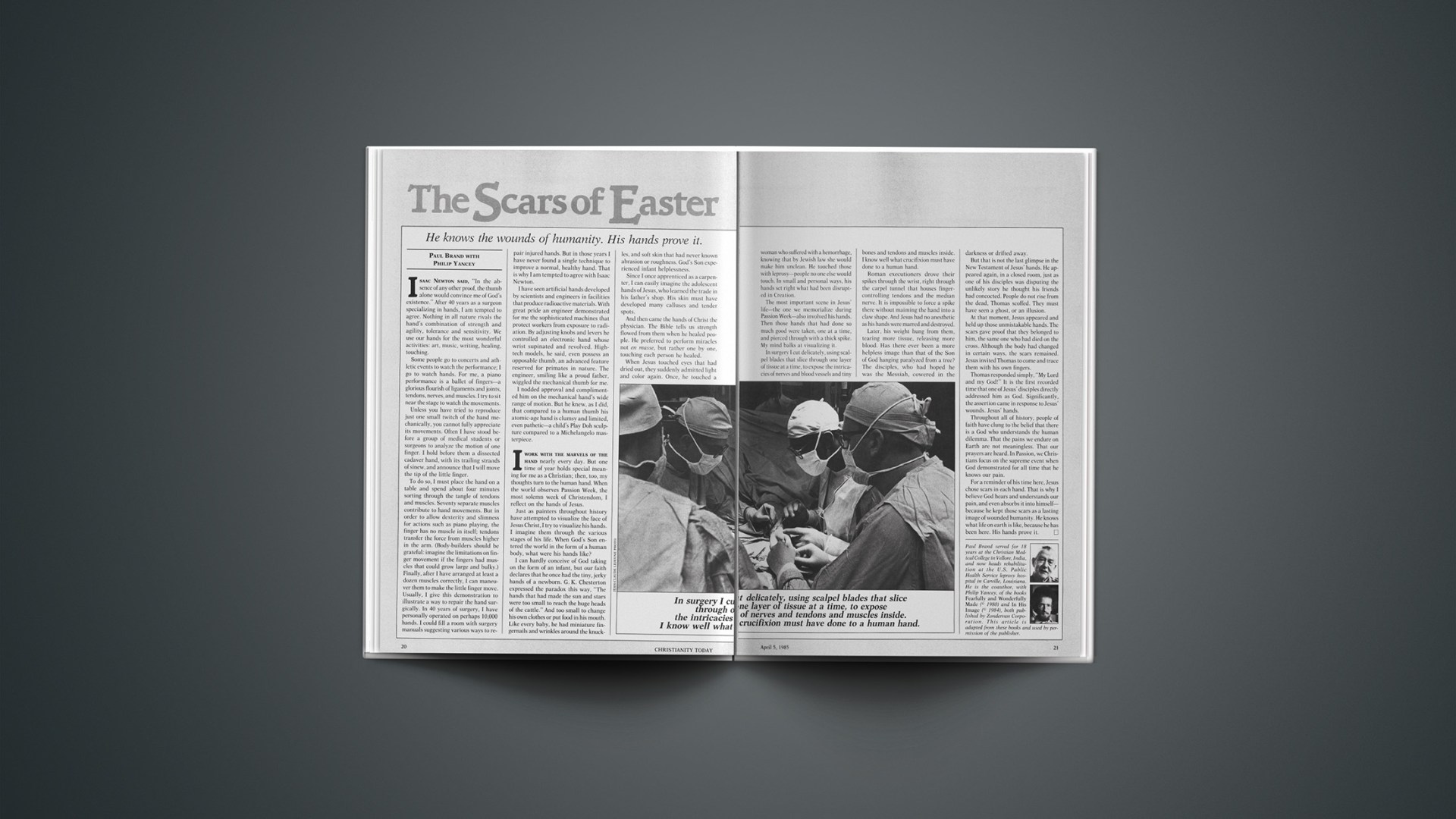
The Scars of Easter

He knows the wounds of humanity. His hands prove it.

He knows the wounds of humanity. His hands prove it.

Isaac Newton said, “In the absence of any other proof, the thumb alone would convince me of God’s existence.” After 40 years as a surgeon specializing in hands, I am tempted to agree. Nothing in all nature rivals the hand’s combination of strength and agility, tolerance and sensitivity. We use our hands for the most wonderful activities: art, music, writing, healing, touching.

Some people go to concerts and athletic events to watch the performance; I go to watch hands. For me, a piano performance is a ballet of fingers—a glorious flourish of ligaments and joints, tendons, nerves, and muscles. I try to sit near the stage to watch the movements.

Unless you have tried to reproduce just one small twitch of the hand mechanically, you cannot fully appreciate its movements. Often I have stood before a group of medical students or surgeons to analyze the motion of one finger. I hold before them a dissected cadaver hand, with its trailing strands of sinew, and announce that I will move the tip of the little finger.

To do so, I must place the hand on a table and spend about four minutes sorting through the tangle of tendons and muscles. Seventy separate muscles contribute to hand movements. But in order to allow dexterity and slimness for actions such as piano playing, the finger has no muscle in itself; tendons transfer the force from muscles higher in the arm. (Body-builders should be grateful: imagine the limitations on finger movement if the fingers had muscles that could grow large and bulky.) Finally, after I have arranged at least a dozen muscles correctly, I can maneuver them to make the little finger move. Usually, I give this demonstration to illustrate a way to repair the hand surgically. In 40 years of surgery, I have personally operated on perhaps 10,000 hands. I could fill a room with surgery manuals suggesting various ways to repair injured hands. But in those years I have never found a single technique to improve a normal, healthy hand. That is why I am tempted to agree with Isaac Newton.

I have seen artificial hands developed by scientists and engineers in facilities that produce radioactive materials. With great pride an engineer demonstrated for me the sophisticated machines that protect workers from exposure to radiation. By adjusting knobs and levers he controlled an electronic hand whose wrist supinated and revolved. Hightech models, he said, even possess an opposable thumb, an advanced feature reserved for primates in nature. The engineer, smiling like a proud father, wiggled the mechanical thumb for me.

I nodded approval and complimented him on the mechanical hand’s wide range of motion. But he knew, as I did, that compared to a human thumb his atomic-age hand is clumsy and limited, even pathetic—a child’s Play Doh sculpture compared to a Michelangelo masterpiece.

I work with the marvels of the hand nearly every day. But one time of year holds special meaning for me as a Christian; then, too, my thoughts turn to the human hand. When the world observes Passion Week, the most solemn week of Christendom, I reflect on the hands of Jesus.

Just as painters throughout history have attempted to visualize the face of Jesus Christ, I try to visualize his hands. I imagine them through the various stages of his life. When God’s Son entered the world in the form of a human body, what were his hands like?

I can hardly conceive of God taking on the form of an infant, but our faith declares that he once had the tiny, jerky hands of a newborn. G. K. Chesterton expressed the paradox this way, “The hands that had made the sun and stars were too small to reach the huge heads of the cattle.” And too small to change his own clothes or put food in his mouth. Like every baby, he had miniature fingernails and wrinkles around the knuckles, and soft skin that had never known abrasion or roughness. God’s Son experienced infant helplessness.

Since I once apprenticed as a carpenter, I can easily imagine the adolescent hands of Jesus, who learned the trade in his father’s shop. His skin must have developed many calluses and tender spots.

And then came the hands of Christ the physician. The Bible tells us strength flowed from them when he healed people. He preferred to perform miracles not en masse, but rather one by one, touching each person he healed.

When Jesus touched eyes that had dried out, they suddenly admitted light and color again. Once, he touched a woman who suffered with a hemorrhage, knowing that by Jewish law she would make him unclean. He touched those with leprosy—people no one else would touch. In small and personal ways, his hands set right what had been disrupted in Creation.

The most important scene in Jesus’ life—the one we memorialize during Passion Week—also involved his hands. Then those hands that had done so much good were taken, one at a time, and pierced through with a thick spike. My mind balks at visualizing it.

In surgery I cut delicately, using scalpel blades that slice through one layer of tissue at a time, to expose the intricacies of nerves and blood vessels and tiny bones and tendons and muscles inside. I know well what crucifixion must have done to a human hand.

Roman executioners drove their spikes through the wrist, right through the carpel tunnel that houses finger-controlling tendons and the median nerve. It is impossible to force a spike there without maiming the hand into a claw shape. And Jesus had no anesthetic as his hands were marred and destroyed.

Later, his weight hung from them, tearing more tissue, releasing more blood. Has there ever been a more helpless image than that of the Son of God hanging paralyzed from a tree? The disciples, who had hoped he was the Messiah, cowered in the darkness or drifted away.

But that is not the last glimpse in the New Testament of Jesus’ hands. He appeared again, in a closed room, just as one of his disciples was disputing the unlikely story he thought his friends had concocted. People do not rise from the dead, Thomas scoffed. They must have seen a ghost, or an illusion.

At that moment, Jesus appeared and held up those unmistakable hands. The scars gave proof that they belonged to him, the same one who had died on the cross. Although the body had changed in certain ways, the scars remained. Jesus invited Thomas to come and trace them with his own fingers.

Thomas responded simply, “My Lord and my God!” It is the first recorded time that one of Jesus’ disciples directly addressed him as God. Significantly, the assertion came in response to Jesus’ wounds. Jesus’ hands.

Throughout all of history, people of faith have clung to the belief that there is a God who understands the human dilemma. That the pains we endure on Earth are not meaningless. That our prayers are heard. In Passion, we Christians focus on the supreme event when God demonstrated for all time that he knows our pain.

For a reminder of his time here, Jesus chose scars in each hand. That is why I believe God hears and understands our pain, and even absorbs it into himself—because he kept those scars as a lasting image of wounded humanity. He knows what life on earth is like, because he has been here. His hands prove it.
Theology

Resurrection!

Even the skeptic Voltaire knew it: the Resurrection is the North Star of authentic Christianity.

Tradition has it that one day some skeptics were discussing Christianity with Voltaire, himself the prince of skeptics. He observed, “Gentlemen, it would be easy to start a new religion to compete with Christianity. All the founder would have to do is die and then be raised from the dead.”

Voltaire was right. The resurrection of Jesus Christ is indeed the North Star of authentic Christianity. Martin Luther said, “He who would preach the gospel must go directly to preaching the resurrection of Christ. He who does not preach the resurrection is no apostle, for this is the chief part of our faith.… Everything depends on our retaining a firm hold on this article [of faith] in particular; for if this one totters and no longer counts, all the others will lose their value and validity.”

Saint Paul puts it this way: “If Christ is not risen, then our preaching is vain and your faith is also vain. Yes, and we are found false witnesses to God, because we have testified of God that He raised up Christ, whom He did not raise up—if in fact the dead do not rise.… And if Christ is not risen, your faith is futile; you are still in your sins! Then also those who have fallen asleep in Christ have perished. If in this life only we hope in Christ, we are of all men the most pitiable” (1 Cor. 15:14–19, NKJV).

The Resurrection stands at the very center of the apostolic witness. It is God’s creation power open to all who would but believe. It is our hope unto eternal life.

He is risen! The Lord is risen indeed.

Adapted from an article by Charles W. Keysor, pastor, Countryside Evangelical Covenant Church, Clearwater, Florida.

Ideas

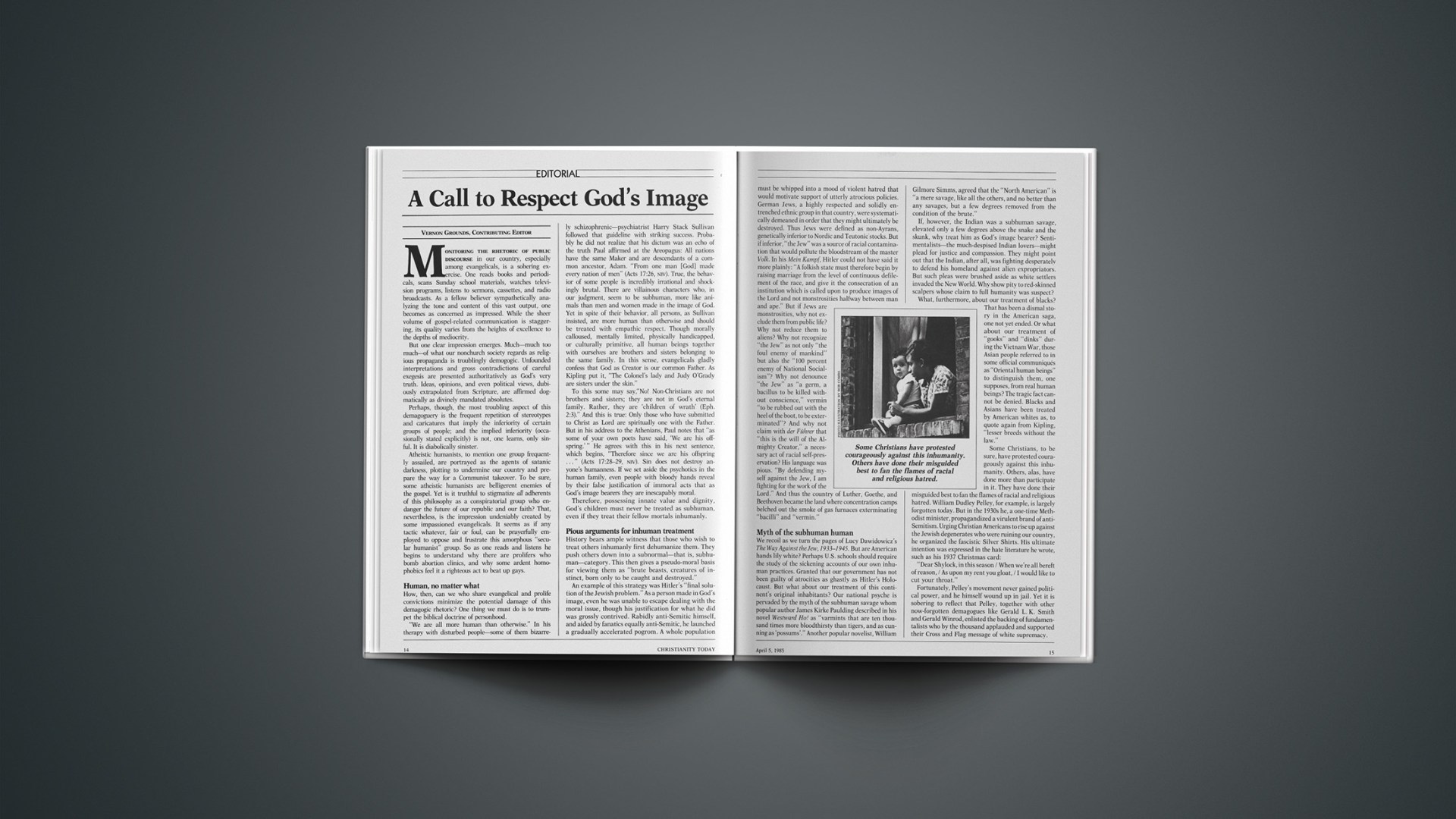
A Call to Respect God’s Image

Monitoring the rhetoric of public discourse in our country, especially among evangelicals, is a sobering exercise. One reads books and periodicals, scans Sunday school materials, watches television programs, listens to sermons, cassettes, and radio broadcasts. As a fellow believer sympathetically analyzing the tone and content of this vast output, one becomes as concerned as impressed. While the sheer volume of gospel-related communication is staggering, its quality varies from the heights of excellence to the depths of mediocrity.

But one clear impression emerges. Much—much too much—of what our nonchurch society regards as religious propaganda is troublingly demogogic. Unfounded interpretations and gross contradictions of careful exegesis are presented authoritatively as God’s very truth. Ideas, opinions, and even political views, dubiously extrapolated from Scripture, are affirmed dogmatically as divinely mandated absolutes.

Perhaps, though, the most troubling aspect of this demagoguery is the frequent repetition of stereotypes and caricatures that imply the inferiority of certain groups of people; and the implied inferiority (occasionally stated explicitly) is not, one learns, only sinful. It is diabolically sinister.

Atheistic humanists, to mention one group frequently assailed, are portrayed as the agents of satanic darkness, plotting to undermine our country and prepare the way for a Communist takeover. To be sure, some atheistic humanists are belligerent enemies of the gospel. Yet is it truthful to stigmatize all adherents of this philosophy as a conspiratorial group who endanger the future of our republic and our faith? That, nevertheless, is the impression undeniably created by some impassioned evangelicals. It seems as if any tactic whatever, fair or foul, can be prayerfully employed to oppose and frustrate this amorphous “secular humanist” group. So as one reads and listens he begins to understand why there are prolifers who bomb abortion clinics, and why some ardent homophobics feel it a righteous act to beat up gays.

Human, No Matter What

How, then, can we who share evangelical and prolife convictions minimize the potential damage of this demagogic rhetoric? One thing we must do is to trumpet the biblical doctrine of personhood.

“We are all more human than otherwise.” In his therapy with disturbed people—some of them bizarrely schizophrenic—psychiatrist Harry Stack Sullivan followed that guideline with striking success. Probably he did not realize that his dictum was an echo of the truth Paul affirmed at the Areopagus: All nations have the same Maker and are descendants of a common ancestor, Adam. “From one man [God] made every nation of men” (Acts 17:26, NIV). True, the behavior of some people is incredibly irrational and shockingly brutal. There are villainous characters who, in our judgment, seem to be subhuman, more like animals than men and women made in the image of God. Yet in spite of their behavior, all persons, as Sullivan insisted, are more human than otherwise and should be treated with empathic respect. Though morally calloused, mentally limited, physically handicapped, or culturally primitive, all human beings together with ourselves are brothers and sisters belonging to the same family. In this sense, evangelicals gladly confess that God as Creator is our common Father. As Kipling put it, “The Colonel’s lady and Judy O’Grady are sisters under the skin.”

To this some may say, “No! Non-Christians are not brothers and sisters; they are not in God’s eternal family. Rather, they are ‘children of wrath’ (Eph. 2:3).” And this is true: Only those who have submitted to Christ as Lord are spiritually one with the Father. But in his address to the Athenians, Paul notes that “as some of your own poets have said, ‘We are his offspring.’ ” He agrees with this in his next sentence, which begins, “Therefore since we are his offspring …” (Acts 17:28–29, NIV). Sin does not destroy anyone’s humanness. If we set aside the psychotics in the human family, even people with bloody hands reveal by their false justification of immoral acts that as God’s image bearers they are inescapably moral.

Therefore, possessing innate value and dignity, God’s children must never be treated as subhuman, even if they treat their fellow mortals inhumanly.

Pious Arguments For Inhuman Treatment

History bears ample witness that those who wish to treat others inhumanly first dehumanize them. They push others down into a subnormal—that is, subhuman—category. This then gives a pseudo-moral basis for viewing them as “brute beasts, creatures of instinct, born only to be caught and destroyed.”

An example of this strategy was Hitler’s “final solution of the Jewish problem.” As a person made in God’s image, even he was unable to escape dealing with the moral issue, though his justification for what he did was grossly contrived. Rabidly anti-Semitic himself, and aided by fanatics equally anti-Semitic, he launched a gradually accelerated pogrom. A whole population must be whipped into a mood of violent hatred that would motivate support of utterly atrocious policies. German Jews, a highly respected and solidly entrenched ethnic group in that country, were systematically demeaned in order that they might ultimately be destroyed. Thus Jews were defined as non-Ayrans, genetically inferior to Nordic and Teutonic stocks. But if inferior, “the Jew” was a source of racial contamination that would pollute the bloodstream of the master Volk. In his Mein Kampf, Hitler could not have said it more plainly: “A folkish state must therefore begin by raising marriage from the level of continuous defilement of the race, and give it the consecration of an institution which is called upon to produce images of the Lord and not monstrosities halfway between man and ape.” But if Jews are monstrosities, why not exclude them from public life? Why not reduce them to aliens? Why not recognize “the Jew” as not only “the foul enemy of mankind” but also the “100 percent enemy of National Socialism”? Why not denounce “the Jew” as “a germ, a bacillus to be killed without conscience,” vermin “to be rubbed out with the heel of the boot, to be exterminated”? And why not claim with der Führer that “this is the will of the Almighty Creator,” a necessary act of racial self-preservation? His language was pious. “By defending myself against the Jew, I am fighting for the work of the Lord.” And thus the country of Luther, Goethe, and Beethoven became the land where concentration camps belched out the smoke of gas furnaces exterminating “bacilli” and “vermin.”

Myth Of The Subhuman Human

We recoil as we turn the pages of Lucy Dawidowicz’s The Way Against the Jew, 1933–1945. But are American hands lily white? Perhaps U.S. schools should require the study of the sickening accounts of our own inhuman practices. Granted that our government has not been guilty of atrocities as ghastly as Hitler’s Holocaust. But what about our treatment of this continent’s original inhabitants? Our national psyche is pervaded by the myth of the subhuman savage whom popular author James Kirke Paulding described in his novel Westward Ho! as “varmints that are ten thousand times more bloodthirsty than tigers, and as cunning as ‘possums’.” Another popular novelist, William Gilmore Simms, agreed that the “North American” is “a mere savage, like all the others, and no better than any savages, but a few degrees removed from the condition of the brute.”

If, however, the Indian was a subhuman savage, elevated only a few degrees above the snake and the skunk, why treat him as God’s image bearer? Sentimentalists—the much-despised Indian lovers—might plead for justice and compassion. They might point out that the Indian, after all, was fighting desperately to defend his homeland against alien expropriators. But such pleas were brushed aside as white settlers invaded the New World. Why show pity to red-skinned scalpers whose claim to full humanity was suspect?

What, furthermore, about our treatment of blacks? That has been a dismal story in the American saga, one not yet ended. Or what about our treatment of “gooks” and “dinks” during the Vietnam War, those Asian people referred to in some official communiqués as “Oriental human beings” to distinguish them, one supposes, from real human beings? The tragic fact cannot be denied. Blacks and Asians have been treated by American whites as, to quote again from Kipling, “lesser breeds without the law.”

Some Christians, to be sure, have protested courageously against this inhumanity. Others, alas, have done more than participate in it. They have done their misguided best to fan the flames of racial and religious hatred. William Dudley Pelley, for example, is largely forgotten today. But in the 1930s he, a one-time Methodist minister, propagandized a virulent brand of anti-Semitism. Urging Christian Americans to rise up against the Jewish degenerates who were ruining our country, he organized the fascistic Silver Shirts. His ultimate intention was expressed in the hate literature he wrote, such as his 1937 Christmas card:

“Dear Shylock, in this season / When we’re all bereft of reason, / As upon my rent you gloat, / I would like to cut your throat.”

Fortunately, Pelley’s movement never gained political power, and he himself wound up in jail. Yet it is sobering to reflect that Pelley, together with other now-forgotten demagogues like Gerald L. K. Smith and Gerald Winrod, enlisted the backing of fundamentalists who by the thousand applauded and supported their Cross and Flag message of white supremacy.

Stop Signs For Biblical Christians

What, then, is our responsibility as biblical Christians? What does it mean to believe that every human being bears God’s image, and as such possesses inalienable dignity? We can resolve to take action, positive and negative alike. Evangelicalism can be a bulwark against the persistent attempts to seduce large elements of our population into embracing a belief in their supposed superiority (ethnic, theologic, and nationalistic), which demeans and can ultimately destroy people.

Negatively, we ought to take these measures, and take them decisively:

1. Stop dichotomizing the world into us versus them; the good guys versus the black-hooded villains; an empire of evil versus a God-fearing republic.

2. Stop boasting about our superior righteousness as though somehow Americans were exempt from the taint of original sin. Our virtues at best are merely on a par with those of other people. At worst they justify the jibe that Americans are hypocrites whose greed is camouflaged by a veneer of religiosity.

3. Stop proudly claiming that the U.S.A. is Number One unless it is first, please God, in terms of freedom, equality, and generous concern for the needy members of our own society and of less-fortunate countries.

4. Stop laying down ex cathedra definitions of isms—such as humanism, socialism, liberalism, Marxism, and anti-Americanism—and pinning these definitions, imprecise and misleading, on people to discredit them.

5. Stop supporting any Christian publication, TV program, or agency that sanctions the use of inflammatory rhetoric calculated to belittle persons.

6. Stop assuming and asserting that Christians are immune from the corrupting influences of bad ideology. The contrary may actually be the case. Precisely because of intense conviction, people may rationalize their prejudices and animosities as being obedience to God’s will. Remember the crusaders and the inquisitors and the pious witch burners. We must start, therefore, examining our own psyches to ascertain what racial and ideological quirks may be twisting our thought processes and triggering malignant reactions.

Green Lights For Christians

Positively, we ought to take these measures, and take them decisively:

1. Start emphasizing that, while all human beings are not members of the same spiritual family—and indeed they are not—they are nevertheless brothers and sisters who with ourselves have God the Creator as their Father.

2. Start realizing what it means to be consistently prolife, battling against abortion but insisting that the sanctity of personhood must be protected wherever, however, and by whomever it is threatened.

3. Start practicing simple courtesy, respect, and fairness in debating non-Christians, nonevangelicals, and even our own fellow believers, refusing to pervert or ignore difficult facts, refusing also to caricature an opponent whose position we are convinced is erroneous.

4. Start to admit our evangelical susceptibilty to black-and-white thinking precisely because we do believe there is a God-anchored distinction between truth and error, right and wrong, goodness and evil.

5. Start joining forces, gratefully and critically, as cobelligerents with non-Christians who share our concern for freedom, justice, and peace. They too are God’s image bearers, who by his common grace abhor tyranny, injustice, and violence as much as we Christians do—sometimes more.

6. Start to develop a less-tolerant stand toward a manipulative demagoguery that adheres vociferously to the fundamentals of our faith while dogmatically advocating, as the sole biblical position, those political and economic views on which Christians legitimately differ.

7. Start monitoring our own rhetoric, paying particular attention to those clichés and comments that may be implicit racial put-downs. Start denouncing the use of demeaning stereotypes that imprison whole groups of people in categories implying their inferiority. Decent Germans who sneered at Jews as money-hungry Shylocks did not realize that the slippery slope of racism would end in the furnaces of Dachau.

These suggestions, if consistently implemented within the evangelical community, would not have any utopian effect, but they certainly would help to lower the heat level of public discourse. When the heat is too high, fire may break out. And fire can be terribly destructive.

Eutychus and His Kin: April 5, 1985

The Search Goes On

A congregation I know of went preacher hunting and quickly narrowed the field to four. The first candidate was a great communicator. His sermons bespoke his impressive arsenal of anecdotes and his thorough knowledge of C. S. Lewis—a big plus. But he rarely gave altar calls, which made the choosing committee suspicious. Besides, he was handicapped: he had all his arms and legs, but he didn’t have a wife.

Candidate number two appeared stronger. He was very married, even had four kids. He, too, was an impressive speaker, but in contrast to number one, he was addicted to altar calls. The committee felt that every other week was a little too often for parishioners to question their salvation or to rededicate their lives yet another time. Besides, there was a vacancy on the softball team, and he said he didn’t play.

Number three was also a family man and an effective speaker. His altar calls were appropriately inspirational and well spaced. But it wasn’t his preaching that concerned the committee. It seemed he spent a good deal of time researching political issues and sending off letters to congressmen. When the committee found out the guy had once been on a hunger strike, his fate was sealed.

That brings us to number four, a smart-looking middle-aged man with a beautiful wife and kids. He was a lucid communicator and had the right balance between evangelism and social service. He was sincere and active in his community, but he wasn’t bent on carrying out an agenda of social or political programs. He even played softball; he played infield or outfield, and hit. 350 on his last church’s team. In short, this guy was their perfect preacher. But, alas, that congregation is still looking. It seems no one could identify with him.

EUTYCHUS

Examining Lincoln’s Faith

Thank you for Mark Noll’s excellent essay, “The Perplexing Faith of Abraham Lincoln” [Feb. 15]. Also a Lincoln enthusiast, I have struggled for years to define this great man’s faith.

MIRIAM M. SWEET

Farmington Hills, Mich.

Noll’s presentation of Lincoln’s isolationist religion is a very tempting alternative next to endless doctrinal disputations. Will we ever locate the assembly that espouses our brand of Christian theology to its minutest detail? Then again, how can two walk together except they be agreed? Sometimes we are more cursed by our pluralism than we realize.

DAVID BRAYSHAW

New Brighton, Pa.

It was a surprise to see my great-great-grandfather, William H. Herndon, mentioned in a Christian periodical. As Abraham Lincoln’s law partner, friend, and biographer, he was definitely a free thinker. I am sure he and I would have our disputes if he were alive today. But I must admit after reading many of his articles, letters, and books, that he was a lover of truth and sought to communicate truth or fact, rather than fiction. If Mark Noll is truly a Lincoln enthusiast, he will not shy away from the writings of William H. Herndon on Lincoln.

HELEN LOUISE HERNDON

St. Louis, Mo.

The Excellent Church

W. Ward Gasque’s suggestion that the church adopt modern management techniques (“The Church in Search of Excellence,” Feb. 15) rests upon a crucial assumption: that those techniques are simply means to an end, that they have no effects of their own beyond those intended. Surely modern political and economic history teaches us that this assumption is naive. Modern management practices have had an efficacy of their own in producing citizenship-subverting forces. No doubt the church must learn those practices to function effectively. But what would happen to Christian citizenship if the church were to adopt uncritically the practices that have corrupted modern politics and economy?

MARK WALHOUT

St. Paul, Minn.

If Peter Drucker is right, Search for Excellence has appeared at the tail end of the postwar “management boom.” It remains to be seen, however, whether the book heralds a significant new direction in management theory, or turns out to be just another “massaging” of traditional theory into something more appropriate for the ’80s. What we need today is not another management approach, but a strong, robust, intelligible and communicable model of church leadership.

REV. H. L. LONGENECKER

Des Plaines, Ill.

Christians And “Heavy Metal”

Is not the mixing of Christian and heavy metal a contradiction in contrasting ideologies? [“A Christian ‘Heavy Metal’ Band Makes Its Mark …,” News, Feb. 15]. It seems Christian warriors are now being armed with leather and chains. If we were to evangelize prostitutes, would we be expected to dress like them also?

PHILLIP E. RIZZO

Langhorne, Pa.

Must we act like the stereotyped world in order to win them over to Christianity? Is Jesus Christ reflected in chains, studs, leather, long hair, and skin-tight pants? Is this supposed to make the gospel more appealing and easier to swallow? Apparently music takes priority over theology in the world view of Stryper.

DAVID S. SCHOENFELD

Douglaston, N.Y.

I commend CT for its insightful article on Stryper. I have witnessed firsthand the band’s frankness and sincerity in presenting the truth of Jesus Christ. Author Rabey erred in identifying Michael Sweet. Brother Robert is Stryper’s drummer and spokesman; Michael is lead singer and a guitarist.

JAMES AYLARD

Martinez, Calif.

You cannot serve God by emulating mammon! As a Christian and ex-rock musician, I must attest to the fact that “Christian rock” or heavy metal is not an acceptable expression, nor is it an honest means of witnessing to the self-possessed world. Lyrics aside, the anapestic beat and painful volume of rock music drown out the gospel.

DANIEL LARSON

Trego, Wis.

Noteworthy Presidential Actions

Treatment of the news was unfair and biased in the February 15 issue. An entire page was given to President Reagan attending an ecumenical prayer service to observe his second inauguration, yet Jimmy Carter receiving the World Methodist Peace Award received one small paragraph. The Carter subject matter is more noteworthy and more biblical. Try to be more impartial.

RICHARD GARGIULO

North Arlington, N.J.

Addressing Nonwhite Presbyterians

Your reporter attended a very small portion of what was available at the Presbyterian Congress on Renewal in Dallas if she attended at all [News, Feb. 15]! I was appalled at the indication that the congress was a “white only” program. One of the most powerful sermons was delivered by Dr. James Forbes of Union Theological Seminary, and other “ethnic” concerns were well addressed. We came away from the congress with the feeling that there was hope for our segment of the church.

REV. DR. C. J. WINDSOR

First Presbyterian Church

Portales, N.M.

“Cheap” Degrees: A Cheap Shot?

I just read, with disgust, your article “Cheap Degrees: Are They Worth It?” [Feb. 1]. This article, which centered on the International Bible Institute and Seminary, is a cheap shot. I happen to be a recent doctoral graduate, and did my master’s work at the IBIS also. I received what I was looking for and needed, and I worked hard to achieve it. You hardly mention Dr. Favata, administrative dean. Were you afraid to confront him?

DR. JERRY A. KIRK

Belmont, Ohio

The cheap degree mills are fueled by churches insisting their pastors have doctoral degrees, rather than taking time to examine the quality of ministry. This problem extends further than degree mills: the list of prominent church leaders who sport honorary degrees would prove embarrassing. These men are treated with great deference, and they are hailed as scholars by many laymen, yet we all know those degrees are meaningless.

REV. RALPH A. NITE, JR.

Cal Farley’s Boys Ranch

Amarillo, Tex.

Really, have we done such a wonderful job of winning the world to Christ that we now can start casting stones at each other? Perhaps that is a sign of proper accreditation (to cast stones, that is). Did you mention that the founder [of IBIS] goes to various parts of the world with many students in evangelistic outreach? Perhaps you should attack the preachers who have degrees from accredited seminaries and other accredited schools but do not give invitations after their services, and couldn’t help a person find Christ as Savior if their lives depended on it.

REV. OTTO CLAUSEN

Chicago, Ill.

The information relating to “government recognized accreditation” of Bible schools was in error. Bible institutes, schools, and colleges have enjoyed the “recognized” accreditation of the American Association of Bible Colleges (AABC) since 1947. This recognition is extended by the United States Department of Education and the Council on Postsecondary Accreditation (COPA). AABC accreditation is extended to institutions that have three primary distinctives: every student enrolled completes at least a 30 semester-hour Bible major; all students regularly participate in Christian service programs; the professional programs of studies are designed to prepare graduates for Christian ministries. This is distinctively different from the programs of most Christian liberal arts colleges. As for the Association of Theological Seminaries mentioned favorably throughout the article, the truth is that it is not an “institutional” accrediting agency and, thus, is not a viable option for a Bible college.

DR. GARY D. MATSON

AABC Assistant Director

Fayetteville, Ark.

These unfortunate cases of getting “cheap” correspondence seminary degrees to “further one’s ministry” are not only rampant in this country, but in developing countries as well. They have done more harm than good to themselves, others, and the Christian witness.

REV. DAUD H. SOESILO

Lao and Hmong Projects

Richmond, Va.

It is incorrect to group external programs together and say “unaccredited theological schools that offer degrees by mail.” The U.S. Constitution gives control of education to the states and local governments, hence the federal government does not have the legal right to control accreditation. We represent the largest Bible-believing accrediting group in the world. Why not ask us to visit with you one of the members accredited by the other group?

GEORGE S. REUTER, JR., PRESIDENT

International Accrediting Commission

for Schools, Colleges,

and Theological Seminaries

Holden, Mo.

God And The New Physics

Thank you for Allen Emerson’s lucid and thoughtful article [“A Disorienting View of God’s Creation,” Feb. 1] on the potential impact of the new physics on orthodox theology. While quantum theory presents challenges to both classical physics and theology, I believe there are some very positive long-range benefits to our faith in the new physics. The major problem with Newtonian or classical physics has been the automatic, clockwork, deterministic universe it presented. This has led to the bolstering of determinism as a world view. Along comes the new physics with Heisenberg’s Uncertainty Principle, which basically tells us that there is a great deal of unpredictability and uncertainty in the physical world. Mystery, awe and surprise can indeed help to balance our clockwork view of reality.

JOHN L. WIESTER

Buellton, Calif.

Mass that exists, then becomes nonexistent in transit, then exists again according to our will? I don’t have to listen to this! Beam me up, Lord!

REV. CLIF SPRINGER

Exchange Avenue Baptist Church

Oklahoma City, Okla.

We appreciate the effort to help keep us informed of those findings and discoveries which may have some input into our faith. Such discoveries are not bothersome. In Colossians we see that in God the universe is one harmonious whole.

REV. WILLIAM R. HUNTER, JR.

Flat Rock Church of the Nazarene

Flat Rock, Mich.

How do the three articles discussing the New Physics apply to evangelical conviction? I wonder how many subscribers put their magazine down with disappointment and dismay because they lacked the knowledge and interest to cope with the far-out ideas.

MRS. GLENN HAWKINSON

Mount Ida, Ark.

It is interesting that the particle versus velocity complementarity also exists in the field of theology. We have two accounts of the origin of man in Genesis. Genesis 2:7 records the formation of man from a pre-existing “dust,” man by the word of a pre-existing intelligence, which is God; and man is said to have been created in the image and likeness of this intelligence, and thus an expression of God’s being, a wave or velocity theology.

JOSEPH G. S. ROBINSON

Worcester, Mass.

Emerson lost me in the second paragraph and I was still in the dark at the finish: I will venture the opinion that 90 percent of those who waded through that wasteland of words were in the same boat. Let’s come back down to earth and talk in plain English; after all, what difference does it make what these super scientists and theologians dream up?

EDWARD P. GOEBELT

Bucyrus, Ohio

It may be of interest that Heisenberg, the creator of the Uncertainty Principle, had three sets of twins. Try figuring the probability (or uncertainty) of that sequence!

DICK BURNS

Beloit, Wis.

Whose Church In China?

I am alarmed at Ralph Covell’s apparent attempt to excuse an atheistic state’s efforts to persecute and ultimately exert total control over Christian churches and groups in China (“The Church in China: Another View,” Feb. 1). The overwhelming majority of China’s Christians are affiliated with home church groups and have thus far resisted attempts to coerce them into joining either the state-supported Three-Self Patriotic Movement or the Catholic Patriotic Association. Who are we in America to suggest that China’s Christians would be better off if they were to bow the knee to Baal?

REV. JEFFREY A. COLLINS

Christian Response International

Rockville, Md.

My prayer and tentmaker work with Chinese lead me to two different conclusions: one, problems of present persecution are not mainly “purely local”—discrimination in education, jobs membership in the only political party (CCP) exist throughout China; two, Chinese Christian leaders have adopted an outward appearance of patience against “violations of religious rights”; however, they have done this primarily for personal security reasons. Countries can apply pressure by means of the increasing number of international treaties, organizations, and economics associations with which China is attached. Unique roles in the “evangelization” of China do exist for the conscientious World Christian.

DWIGHT E. NORDSTROM

China-U.S. Ventures

Houston, Tex.

Theology For The “Ordinary”

Ward Gasque’s article “Must Ordinary People Know Theology?” [Feb. 1] implies that the clergy should. When Jesus trained his 12 disciples he had only three years. Did he teach them to be theologians or followers?

P. SLUIS

Wyckoff, N.J.

Although changes within our seminaries and Bible colleges may be overdue, they will not affect the laymen and laywomen who are the body of Christ. Seminaries mold “theologians,” but churches mold believers.

BOB COHEN

Wayne, N.J.

Whose Theology—Pinnock’S Or Nicole’S?

I began reading Roger Nicole’s review of Clark Pinnock’s Scripture Principle with anticipation [Feb. 1]. As the review progressed, I became more aware of the theological bias of the reviewer. Nicole, in my view, violates the fundamental criteria for a scholarly review by allowing his own presuppositions to cloud the content of the book he is reviewing.

BRADLEY J. BERGFALK

Chicago, Ill.

Liberating Worship

Thank you for Ben Patterson’s excitingly sane editorial, “Worship Is Forever” [Feb. 1]. It was gratifying to be reminded of how liberating the Lord’s Day actually is and how it points us home, even while we trudge here with mud-encrusted boots.

GERALD WISZ

Christian Herald Magazine

Garfield, N.J.

Perhaps the reason for the lack alluded to in Patterson’s fine editorial lies in the evangelical decision that the Holy Spirit no longer acts in certain dimensions.

ELIZABETH L. SWEET

Annandale, N.J.

An Author Answers Critics

Two letters published in CT [Feb. 1] in response to Lawhead’s article on banning my book Brave New People clearly reflect misunderstanding of my position on abortion. I have never “advocated murder of unborn children” and I do not “open the doors for abortion on demand.” Careful and honest reading of the book should dispel both ideas. Christian understanding of the abortion debate is not enhanced by the use of grossly inaccurate labels.

D. GARETH JONES

University of Otago

Dunedin, New Zealand

History

To Walk in All His Ways

In this series

Baptism is accepted and practiced, and always has been, by just about every group in whatever place that has called itself Christian. Thus, it is somewhat ironic that a specific Christian group would emerge that would come to be identified as “Baptists.” The issue of baptism—who should be baptized and by what method—would become important enough to them that they would endure persecution, social ostracization, even death, if necessary, to maintain their convictions.

Where did the Baptists come from? Why did their movement arise? The traceable historical roots of the Baptists as we know them today are to be found in the English church of the early 17th Century.

During the tumultuous 70-year period from the Act of Supremacy in 1534 and King Henry VIII’s separation from Roman Catholicism, to the Hampton Court Conference in England in 1604 when the hopes of the Puritans were thwarted by King James I, the English church was inescapably intertwined with the shifting affairs of the state and monarchy. Intense and often violent struggles ensued as the reform movement progressed. Fundamental questions related to the nature of the church, its doctrine, polity, practice and relationship to the state were tested and debated in the crucible of a rapidly changing society.

It was the English Baptists and the European Anabaptists that would put the church and its whole self understanding to the a more severe test than any other group as they embraced a collection of doctrines and principles that shattered the old world synthesis.

The Baptists originated among the Separatist movement. The Separatists themselves had come from the Puritans. The Puritans were loyal members of the established church and sought to advance the reform movement and “purify” the church from within.

The “Separatists” became impatient with the possibility of the established church ever being purified and called for a “separation” from the state church to form congregations that would pattern themselves after New Testament teaching and practice.

From the Separatists during the reign of James I would emerge the Pilgrim fathers who went to America, and the first Baptists. The two figures who can be identified as among the earliest Baptists are John Smyth (1570–1612) and Thomas Helwys (?–1616).

Smyth was an ordained Anglican priest who progressed through Puritan and Separatist stages. He studied at Christ’s College, Cambridge from 1586 and among his tutors was a later Separatist leader in Holland, Francis Johnson. In 1594 he was ordained by the Bishop of Lincoln and was elected a Fellow at Christ’s College.

He became the leader of a group at Gainsborough, on the borders of Nottinghamshire in the English Midlands. Gainsborough had become a gathering place for a number of ministers who had been in trouble with the authorities for their Puritan beliefs.

This Gainsborough group, according to William Bradford (who would later come to America on the Mayflower), formed a covenanted church and “as the Lord’s free people joined themselves … in the fellowship of the Gospel, to walk in all his ways, made known or to be made known unto them (according to their best endeavors) whatsoever it should cost them, the Lord assisting them.”

Most Puritans had high hopes for change when James VI of Scotland came to the English throne in 1603. But following the Hampton Court Conference in 1604, Puritan hopes were thwarted by the approval of a new set of canons and disciplines for the government of the church. The Puritans had hoped to persuade the Anglican bishops to reform the church. However, James himself presided over the conference and threatened to “make the Puritans conform or else harry them out of the land.” This strengthening of Anglicanism was felt at Gainsborough. After a year of meeting with great difficulty in 1607, the leadership decided that they should leave for Holland, as quickly as possible. The emigration took place in small parties, with Thomas Helwys playing a leading part in making arrangements for the momentous journey for Smyth’s congregation.

Little is known about the early life of Thomas Helwys except that he hailed from Nottinghamshire on an estate which had been in the family for several generations. Helwys received a good education at Gray’s Inn and after some years in London, he returned to his country home, Broxtowe Hall. From Puritan references it is known that Helwys’ home was a haven for early dissenters and Helwys himself probably aided their cause financially. At some point Helwys was introduced to John Smyth and with Mrs. Helwys joined the Separatist congregation at Gainsborough prior to 1607.

The relationship between Helwys and Smyth was very deep. Helwys reflected: “Have we not neglected ourselves, our wives, our children and all we had and respected him? And we confess we had good cause to do so in respect of those most excellent gifts and graces of God that did abound in him.” Even later, when Helwys and Smyth had parted, Helwys could write: “All our love was too little for him and not worthy of him.”

The voyage to Holland took place in 1608. When they arrived in Amsterdam, a welcome haven for 17th Century prisoners of conscience, they were given hospitality by the Mennonites and housed in the great bakehouse of Jan Munter. Here they were free to worship according to the dictates of their conscience as guided by the New Testament and also free, as one historian observed, to experience “all the evils of overcrowding, from exacerbated tempers to the plague.”

The congregation in exile energetically examined basic conceptions regarding the true nature of the church as set forth in the New Testament. Smyth came to the view that baptism should be administered only to believers. This led Smyth to baptize himself and then the rest of the group beginning with Helwys.

By this move, the group had removed themselves from the state church on the grounds that they had not been validly baptized as infants. It also marked a separation from their fellow Separatists. Indeed it would not be many years hence when William Bradford and his companions would decide in 1620 to emigrate to America where they would establish Plymouth Plantation on strict Separatist principles.

About February 1610 Smyth and about 31 others came to the conclusion that they had been in error baptizing themselves and sought fellowship with the Mennonites in Holland.

Thomas Helwys and about a dozen others disagreed, rejecting totally the idea of any necessary succession in the Church of Christ. It was “contrary to the liberty of the Gospel, which is free for all men at all times and in all places: yea, so our Savior Christ doth testify—wheresoever, whosoever, and whensoever two or three are gathered in his name, there is he in the midst of them.”

Helwys and his small band became convinced that they had been wrong to leave England. Though parting with Smyth caused him great personal pain, Helwys believed that the “days of great tribulation spoken of by Christ” had now arrived. He must get back to England and appeal to James I to stop persecuting the faithful.

The small group led by Helwys returned to England in late 1612 and established themselves at Spitalfields near London. Helwys wrote a moving appeal to King James in his own hand titled The Mistery of Iniquity in which he boldly called upon the monarch not to impose laws upon the consciences of his subjects. “The King,” he said “is a mortal man, and not God, therefore he hath no power over the mortal souls of his subjects to make laws and ordinances for them and to set spiritual Lords over them.”

For such fearless courage Helwys was thrown in prison, and had died in Newgate by 1616. Helwys gave to religious toleration the finest and fullest defense it had known till then. He believed that persecution of even the most serious spiritual error was itself iniquitous. He gave the magistrate fullest authority in civil affairs, but in the church the magistrate had no greater power than any other layman.

The Helwys congregation has been called the first General Baptist Church. These Baptists, who believed that no person was destined by a divine decree to damnation but that all people might repent and believe the Gospel, drew the inference that to destroy a person for mistaken beliefs might defeat the purpose of God. The small group grew in numbers and by 1626 the London congregation was associated with others at Lincoln, Coventry, Salisbury and Tiverton. It could not have been easy: for Calvinism was orthodoxy in England, Arminianism a heresy. Certainly they were distinct from those Calvinists who came to be known as Particular Baptists, a distinction which lasted in England until 1891.

When seven London Particular Baptist churches published a Confession in 1644, the second stream of Baptist life was clearly visible. Its source was in the family of congregations that had originated in the work of the Independent minister, Henry Jacob. Jacob had founded in 1616, near Southwark at London, a congregation based on the gathered church principle, and following his departure to Virginia, the original group evolved even further. Under John Spilsbury, one of the offshoots adopted believer’s baptism while another branch differed as to who should administer baptism. By 1640 both of these churches concluded that immersion was the only mode of Scriptural baptism. Thus by 1644 when they issued the London Confession, seven congregations could be clearly identified as Baptists holding the particular or limited view of Christ’s atonement.

The Calvinist Confession of the Particular Baptists had several distinctive emphases. Baptism was the ‘door’ into church fellowship and should only be administered to persons professing faith in Christ. The ministry was placed firmly in the immediate control of members of the covenanted Christian community. In political matters the ‘king and parliament freely chosen by the kingdom’ had legitimate powers, but there should be no state interference in church matters. The mutual cooperation of all churches was stressed, particularly as this related to church planting, financial assistance and resolution of controversial matters within a local church.

It was in 1649 that John Myles and Thomas Proud were dispatched by the London Baptists to spread the Gospel in Wales. Myles was the son of a prosperous farmer, educated at Brasenose College, Oxford, and he founded the first Particular Baptist Church in Wales at Ilston, near Swansea in 1650. Twelve years later he and a number of members emigrated to America, settling at a place they designated Swansea, even taking their church book with them.

During the Civil Wars and Interregnum (1630–1660) Baptists grew numerically, as many who served in the Parliamentary Army planted small churches as they moved from place to place. It was a generation in which many Baptists experienced the reality of political power. Parliament took power from the King; Parliament was replaced by the Army; and finally there was Cromwell’s military dictatorship. But it must be said that in a time when the Anglican Church lost all its state power, Baptists were especially concerned with religious freedom.

After Cromwell died, the monarchy was restored to Charles II in 1660 by a Parliament which was strongly royalist and high church. King Charles had offered “liberty to tender conscience” declaring that none would be “called into question for differences in matters of religion which do not disturb the general peace of the kingdom.” Parliament, when it met, comprising royalists who were Archbishop Laud’s successors, had no such scruples. They were convinced that one church in one state was the only answer to the troubled society left by Cromwell. Church and state were wedded in such a way that loyalty to the crown was expressed by loyalty to the revived Anglican Church.

From 1660 to 1689 those who refused to conform to the 1662 Book of Common Prayer were increasingly persecuted by a number of laws, the so-called ‘Clarendon Code’ after Edward Hyde, Earl of Clarendon and chief adviser to Charles II. Baptists, along with other nonconformists, experienced extreme harrassment, restraint of goods, and fines. This reached a climax when nonconformist supporters of the ill-fated uprising in support of the Duke of Monmouth in 1684 were dealt with by the infamous Judge Jeffries. In the West of England he sentenced 300 to be hung and deported nearly a thousand to Barbados.

During this period of persecution, the experiences of the Broadmead Baptist congregation in Bristol were recorded in the Church Book by one of their elders, Edward Terrill, who by his will left money to found what is the oldest Baptist College in the world (1679). One of the pastors, Thomas Hardcastle, wrote regular letters to be read to the congregation instead of sermons while he was imprisoned. Many of them are concerned with the meaning of faith in an age of persecution. Hardcastle believed persecutions were “a precious season of grace” whereby Christian hearts are purified and given deep and lasting joy. Faith is a shield for the Christian pilgrim as he overcomes the world on his journey. Another Baptist pastor also reflected on this theme in another prison. John Bunyan in Bedford jail produced the spiritual epic, Pilgrim’s Progress, which would fuel the fires of faith for Christians in generations yet to come.

When James II fled the throne and the Protestant William of Orange became King, not only did active persecution cease, but those who dissented from the Church of England were given a recognized place in English society. The Act of Toleration, as it came to be known, allowed for toleration to trinitarian Protestants, whose ministers subscribed to all but three of the Thirty Nine Articles, so long as tithes and church rates were paid to the Established Church. Meeting houses could be licensed on condition that oaths of supremacy and allegiance to the Crown were taken. But all public offices in society were closed to any who would not take the Lord’s Supper in the local Anglican church.

The situation for Dissenters after 1689 could be epitomized in the experiences of Bunyan’s pilgrim. Vanity Fair was now passed, Christian was traveling “the delicate plain called Ease,” toward the silver mine in the hill Lucre, and beyond that, “Doubting Castle.” The 18th Century opened uncertainly for Dissenters who were concerned to build chapels and license places for worship. After the death of Queen Ann in 1714, Baptists and others felt more secure under the protection of the ruling House of Hanover. Baptists constituted at least 1% of English population, mainly living in towns. The Particulars numbered 40,520 in 206 chapels, and the Generals were 18,800 members in 122 chapels. Baptists were found mostly in the Midlands and the South, especially in London and Bristol.

The General Baptists went into a serious decline in the 18th Century. They became very inward in perspective, denying membership to any who married outside the General Baptist community, and obsessed with such differences as the rightness of hymnsinging in their churches. They also lacked an educated and trained ministry, which left them open to anti-trinitarian views. Many General Baptist churches became unorthodox in their view of the person of Christ, and by the end of the century had become Unitarian.

The 18th Century opened for Particular Baptists with the threat of doctrinal deviation also. Particular Baptist Associations were reformed on the basis of the 1689 Confession of Faith, subscribed by over a hundred congregations at a meeting in London. In the west country, Bristol Baptist Academy, from 1720 onwards, produced a steady stream of able and evangelical ministers to serve the churches in England, Wales, Ireland and American Colonies. Bernard Foskett and his successors at the Academy kept alive an evangelical Calvinism when many Baptists were succumbing to the “high” Calvinism propounded by London Baptist minister, Dr. John Gill (1697–1771). His interpretation reduced the need for evangelical efforts since it assured the elect of salvation.

Apart from the theological differences between the more radical General Baptists and the Particular Baptists, who were closer to the mainstream of the Puritan movement, other issues divided early Baptists. Some were Seventh Day Baptists, worshipping on the Old Testament Sabbath or Saturday. More troublesome was the issue of mixed communion: should they practice ‘strict’ or ‘closed’ communion, confining membership to those baptized as believers, or have open membership for all believers, leaving the issue of baptism to the individual conscience? Most Particular Baptists practiced strict communion, but there were some important exceptions, like Henry Jessey’s church in London, John Bunyan’s at Bedford, and Broadmead, Bristol.

If the church was to be a community of believers, it demanded godly lives of its members. They had to set themselves apart from the world; they must themselves be beyond reproach. This discipline of church members who “walked unruly” was a matter of communal concern, and the records of church meetings show sad examples of those punished for immorality, drunkenness and debt.

Although Baptists stressed the independence of the local church, they were ready to work together for the common good. In 1644 seven London Particular Baptist churches issued a joint Confession of Faith, and in 1651 thirty General Baptist churches in the Midlands produced their first Confession. By the 1650’s Particular Baptists were active in regional associations in several parts of England, South Wales and Ireland. After the Toleration Act of 1689 Particular Baptists from England and Wales began to hold an Assembly in London, although their involvement in the regional associations remained more important to them. General Baptists also grouped in district associations; from 1654 their General Assembly became important, with increasing authority over the member churches.

By the end of their first century, Baptists had developed a definite identity and yet a variety about themselves. Through good times and bad, one small congregation had evolved into three main streams and Baptists were recognized as part of official Nonconformity. Their churches stretched from London to Wales to Yorkshire—and to America. Their ranks had swelled with artisans, commonfolk, military officers, and men and women of property. Their preachers were well known for their gifts of elocution and some of their learned spokesmen were considered among the most widely read authors of the century. Truly the seed of John Smyth and Thomas Helwys had borne fruit in what Baptist historians would consider as the logical conclusion of the Reformation in England.

Roger Hayden, M.A., B.D., is a Baptist pastor in Reading, England and Secretary of the British Baptist Historical Society.

Copyright © 1985 by the author or Christianity Today/Christian History magazine.Click here for reprint information on Christian History.

History

From the Archives: A Winter Baptism

The Broadmead Records contain this description of winter baptism, in 1666:

These 10 men and 4 women were all baptized together, one after another, the 6th day of March, in the Evening, at Baptist Mill, in the River, by Mr. Thomas, Minister.

Here behold the miraculous hand and worke of the Lord

Most of these persons now baptized, had neglected and omitted their duty all the Winter, for fear of the Cold; and then, about the beginning of February, it happened to be fine, warm weather; about which time they pitcht upon this day to passe under that Ordinance. And by reason our Pastor, by a fall that he received after he came forth of Prison, had a paine that did use to take him in the nature of a Sciatica, it was doubted for him to stand soe long in the Water might increase his said distemper; therefore the Brethren of the Church sent for Mr. Thomas, of Wales, to be the Administrator.

And the Lord in his wise Providence so ordered it, that when he came it was such Extreme Cold weather, the like had not been all that winter before, for Exceeding high and sharp piercing Wind, Frost, and Snow…One of the women to be baptized, in goeing to the place through the Meadows, her Handerchief received some wet, being about her Neck, was frozen … Her Maid that waited upon her told her if she went into the Water she would not come forth alive. Also another, Mr. Jenings, pained with the Toothache soe great that his face was very much swelled, bound up, and by reason whereof had not been out of his house near a weeke before, and that day very ill with it. Another of the men about a weeke before sprained his legge; not being able to goe, was carryed upon a horse to the place. Another man of them that was very weakly, thinn, and Consumptive. the relations of whom were very averse to the Ordinance.

Wherefore some did fear the Issue, seeing the terrible sharpnesse of the season. But the persons themselves that were to passe under the Ordinance, Acted faith in the Lord; and because the Administrator was come so farr on purpose, according to appointment, they would not deferr it any longer.

And the Lord, to declare his power, did, as it were, worke a Miracle, to give a Precedent to others that would fear the Coldnesse of any season to doe his will; but the Lord preserved them all; and not so much as one ill, but rather better by it; and are all alive to this day, being about 10 years since, to speake of the Lord’s then goodness …

Therefore from all, Praise, Praise, Praise, and Glory be to the Lord.

Copyright © 1985 by the author or Christianity Today/Christian History magazine. Click here for reprint information on Christian History.

History

John Bunyan

For many people, John Bunyan (1628–1688) is an enigma. A statue of Bunyan as a denominational figure adorns the headquarters of the Baptist Union in Great Britain; yet Bunyan is claimed also by the Congregationalists. During his lifetime, his denominational affiliation, at best, was misunderstood.

A tinker by trade, Bunyan in his early life was a blasphemous, profane individual known for his misdeeds in his native Elstow in Bedfordshire. His stint in the Parliamentary Army (1644–1647) probably did little to improve his behavior, though it did expose him to Baptists and others who took their religious profession seriously. About 1653 he experienced a conversion and sought believer’s baptism from Andrew Gifford, pastor of a Particular Baptist church in Bedford.

In the later 1650s Bunyan began to preach publicly and was well received for his abilities to make gospel truths plain and to put his hearers under the spell of his stories. When King Charles II was restored to the throne in 1660, nonconformist preachers came under renewed persecution, and Bunyan was imprisoned. During his twelve-year confinement, he read extensively and wrote some of his most famous works, including Grace Abounding to the Chiefest of Sinners. When he was released in 1672, he became more active in the church and succeeded Gifford as pastor.

For the remainder of Bunyan’s career, though he served as a highly gifted pastor and achieved renown as a writer, he was a problem for many Baptists who desired sharply defined distinctions when it came to the ordinances. Bunyan, while he owned baptism to be God’s ordinance, “would not make an idol of it.” This meant that Bunyan would not deny anyone participation in the Lord’s Supper because that person lacked the proper baptism. Early in 1673 Bunyan pressed his viewpoint in a book titled Differences in Judgement About Water Baptism No Bar to Communion, which irritated many of the Particular Baptists. But Bunyan, and his church after him, remained steadfast in the open Communion stance and maintained fellowship with both Baptists and Congregationalists.

His chief literary work, The Pilgrims Progress (1678), is a classic in English literature. An allegory that narrates the difficult path of “Christian” through the Slough of Despond, the Valley of the Shadow of Death, and Vanity Fair to the Celestial City, Pilgrims Progress is an account of the Christian experience, perhaps Bunyan’s own. En route, the main character encounters unforgettable folk like Worldly Wiseman, Talkative, and Facing-both-Ways. Many literary critics believe that the places and figures in the epic are but a mirror of Bunyan’s Bedfordshire with an ironic twist of the author’s sense of humor. Whatever the case, within ten years of its publication more than a dozen reprintings were called for, and the book has now been printed in over one hundred languages and is second in sales only to the Bible as the all time best seller.

Copyright © 1985 by the author or Christianity Today/Christian History magazine. Click here for reprint information on Christian History.

History

From the Archives: The Move to Believer’s Baptism

John Smyth was the first Englishman (of record) who declared himself dearly in favor of believer’s baptism and organized a church based on the implications of that principle. Smyth, a graduate of Christ’s College, Cambridge, made the pilgrimage from Anglican to Puritan through Separatist to a Baptist position. In 1608 Smyth and his Separatist congregation fled to Amsterdam where, with other exiled Englishmen, he began to work out his doctrine of the church. Early on he differed with the other Separatists, notably Richard Clifton on the issue of infant baptism, which Smyth held to be a fundamental error of the Church of England. In his book The Character of the Beast or The False Constitution of the Church (1609), Smyth traded arguments with Clifton on the issue of believer’s baptism. An excerpt from his “Reader’s Epistle” follows.

Be it known therefore to all the Separation that we account them in respect of their constitution to be as very an harlot as either her Mother England, or her grandmother Rome is, out of whose loins she came: and although once in our ignorance we have acknowledged her a true Church yet now being better informed we revoke that erroneous judgment and protest against her, as well for her false constitution, as for her false ministry, worship, and government: The true constitution of the Church is of a new creature baptized into the Father, the Son, and the Holy Ghost: The false constitution is of infants baptized: we profess therefore that all those Churches that baptize infants are of the same false constitution: and all those Churches that baptize the new creature, those that are made Disciples by teaching, men confessing their faith and their sins, are of one true constitution: and therefore the Church of the Separation being of the same constitution with England and Rome, is a most unnatural daughter to her mother England, and her grandmother Rome, who being of the self same genealogie and generation, (that of the prophet being true of her, as is the Mother so is the daughter) she dare notwithstanding most impudently wipe her own mouth, and call her mother and grandmother adulteresses. Herein therefore we do acknowledge our error, that we retaining the baptism of England which gave us our constitution, did call our mother England an harlot, and upon a false ground made our Separation from her: For although it be necessary that we Separate from England, yet no man can Separate from England as from a false Church except he also do Separate from the baptism of England, which giveth England her constitution: For if they retain the baptism of England, viz: the baptism of infants as true baptism, they cannot Separate from England as from a false Church though they may Separate for corruptions. For the baptism of England cannot be true and to be retained, and the Church of England false and to be rejected: neither can the Church of England possibly be false except the baptism be false, unless a true constitution could be in a false Church which is as impossible as for light to have fellowship with darkness: It is impossible that contraries or contradictions should both be true: and so it is impossible that a false Church should have a true constitution or a true baptism: To say thus:

England hath a false constitution.

England hath a true baptism, is as much as to say thus.

England hath a false constitution.

England hath a true constitution, which is to contradict:

Therefore the Separation must either go back to England, or go forward to true baptism: and all that shall in time to come Separate from England must Separate from the baptism of England, and if they will not Separate from the baptism of England there is no reason why they should separate from England as from a false Church:

Now concerning this point of baptizing infants we do profess before the Lord and before all men in sincerity and truth that it seemeth unto us the most unreasonable heresy of all Antichristianism: for considering what baptism is, an infant is no more capable of baptism then is any unreasonable or insensitive creature: For baptism is not washing with water: but it is the baptism of the Spirit, the confession of the mouth, and the washing with water: how then can any man without great folly wash with water which is the least and last of baptism, one that is not baptized with the Spirit, and cannot confess with the mouth: or how is it baptism if one be so washed: Now that an infant cannot be baptized with the Spirit is plain, 1 Pet. 3:21. where the Apostle saith that the baptism of the Spirit is the question of a good conscience unto God, and Heb. 10:22. where the baptism which is inward is called the sprinkling of the heart from an evil conscience: seeing therefore infants neither have an evil conscience, nor the question of a good conscience, nor the purging of the heart, for all these are proper to actual sinners: hence it followeth that infants baptism is folly and nothing.

Copyright © 1985 by the author or Christianity Today/Christian History magazine. Click here for reprint information on Christian History.

History

A People Called Baptist

The Baptist movement was born in the midst of the ferment and evolution of the English Church in the seventeenth century. Originally a collection of hole-in-the wall dissenters who were easily confused with Seekers, Ranters, Quakers, and political anarchists, Baptists rose to positions of prominence and respectability by 1700 in England and Wales. Along the way their leaders made major contributions to the theory and practice of religious liberty and the theology of the believers’ church. The principle ordinance of their faith, adult baptism by immersion, became the symbol for a people who dared to take the Bible seriously and specifically.

The Baptist faith soon spread to other lands by individuals and entire congregations. In America Baptists at first encountered persecution and yet thrived in an unusual way. In fulfillment of their legacy, 25 million Baptists live in the United States, as of 1985, of the 45 million Baptists worldwide. There are important reasons for this success.

Baptist principles were especially well adapted to the American experience. In a frontier society, qualities such as individualism and self-government were important. Baptist preachers stressed individual accountability before God and the responsibility of congregations of believers to Jesus Christ, the head of the church. Church decisions were made by group consent, and churches could be organized wherever a small band of believers agreed to meet regularly. In a society where there were few educational opportunities for a learned ministry, Baptists placed high value upon a personal call to the ministry and evidence of the gifts of preaching and teaching. While clusters of churches did form associations, every congregation with its pastor as bishop was complete in itself with or without a comfortable meetinghouse, music, or a standard form of worship. Finally, Baptists in America were loud exponents of religious liberty for all, in a land where liberation from the shackles of the past was on everyone’s mind.

Black Americans—slave and free—found the Baptist persuasion very attractive. Mostly nonliterate, the slave communities found that Baptists laid great stress upon the spoken word, and black preachers memorized large portions of Scripture, which they embellished in sermons and lessons. The freedom of Baptist worship allowed African converts to retain the style and temper of native songs and expression, and the importance of singular leadership within clans and families was the precursor to the strong pastor role in black Baptist polity. In a colonial society where deliberate attempts were made to fragment Afro-American communities, the autonomy of Baptist congregations served to unite Christians in a very intimate way. No wonder that the second largest group of Baptists in the world is presently the National Baptist Convention of America, Inc., a black denomination with seven million members.

Because Baptists also emphasized evangelism and missions, their perspective became a worldwide phenomenon in the nineteenth century. From a single baptism in 1834 of Johann G. Oncken, Baptist churches cropped up in Germany, Scandinavia, France and Southern Europe by 1860. European Baptists still live with the legacy of Oncken, that indeed “every Baptist is a missionary.”

British and American Baptists concluded at the close of the eighteenth century that missionary service was an important responsibility of the churches acting together. Through voluntary societies, persons commissioned to preach the gospel, translate the Scriptures, and treat the sick were sent first to India, then Burma, China, Japan, and Africa where sturdy communities of Baptist adherents developed. Baptists even managed to penetrate Latin America where Roman Catholicism was the state church by law. The record of accomplishment on all seven continents includes not only churches of baptized believers but scores of schools, colleges, hospitals, and publishing houses.

From small and rude beginnings, the people called Baptist have grown through persecution, struggle, and misunderstanding. Their flowering is perhaps due to, as much as anything else, their sense of freedom and their specific attention to the Bible as their sole authority in matters of faith and practice.

Copyright © 1985 by the author or Christianity Today/Christian History magazine. Click here for reprint information on Christian History.

History

From the Archives: This Is My Body… This Is My Blood…

To understand how Baptists approach the Lord’s Supper or Holy Communion, one needs to be reminded that Baptists originally were part of the Puritan-Separatist reaction against excess sacramentalism in the Church of England and the Roman Catholic Church. Early on, most Baptists followed the thinking of Huldreich Zwingli (1484–1531) who maintained that Communion was primarily a memorial through which the worshipers were bound together in an expression of loyalty to their Lord. This was consistent with Baptists’ views on baptism, which they held to be symbolic in nature also. Generally, Baptists refer to the sacraments as “ordinances” which highlights their sense of obedience to Christ in remembrance of him.

From the beginning of the movement in the 1600s into the 1860s, Baptists used wine and bread, which were usually prepared within the church family, for Communion. In times of short supply, other staples, such as beer, brandy, biscuits, and cake, were also used. With the advent of the American temperance crusade, however, Baptists became suspicious of alcoholic beverages and looked for substitutes. By the 1880s when unfermented grape juice was introduced to the market, a debate was raging among Baptists about what Christ and his disciples used and how the word oinos should be translated. Baptists concluded (with the help of available technology) that grape juice was the only acceptable beverage for the Lord’s Supper. Still today Baptists will refer to “wine” or “fruit of the vine” by which they mean grape juice.

Baptists also commonly distribute the “wine” in individual Communion cups. The use of these came about later in the history of the group. The medical profession in the 1860s came to understand, through the “germ theory,” the origin of disease. Rochester, New York theologians wondered about the implications of this theory for the administration of the ordinance. They designed individual glass cups to be used to avoid “the maladies which are spread by mouth such as cancer, tuberculosis, influenza, and whooping cough,” when the common cup was passed. (Indeed, with the gradual shift from wine to grape juice, there was some plausibility to the concern, from an historical perspective.) The first use of individual glass cups occurred at the North Baptist Church in Rochester, New York, in 1854.

Technology and science thus brought about fundamental changes which theologians then had to account for. The concept of the minister as priest serving the sacrament to people changed to the concept of the priesthood of all believers as deacons served individual members in a democratized Lord’s Supper. And an entirely new school of biblical interpretation grew up around the meaning of “wine” in the Word.

Copyright © 1985 by the author or Christianity Today/Christian History magazine. Click here for reprint information on Christian History.

Apple PodcastsDown ArrowDown ArrowDown Arrowarrow_left_altLeft ArrowLeft ArrowRight ArrowRight ArrowRight Arrowarrow_up_altUp ArrowUp ArrowAvailable at Amazoncaret-downCloseCloseEmailEmailExpandExpandExternalExternalFacebookfacebook-squareGiftGiftGooglegoogleGoogle KeephamburgerInstagraminstagram-squareLinkLinklinkedin-squareListenListenListenChristianity TodayCT Creative Studio Logologo_orgMegaphoneMenuMenupausePinterestPlayPlayPocketPodcastRSSRSSSaveSaveSaveSearchSearchsearchSpotifyStitcherTelegramTable of ContentsTable of Contentstwitter-squareWhatsAppXYouTubeYouTube