A Test of Tolerance

The case of Father Daniel, the Roman Catholic monk of Jewish origin who was refused a plea to be counted as a Jew by an Israeli Court, is now widely known. The writer of this article is therefore not prompted by a taste for the sensational. By the time this reaches his readers they will have had ample opportunity to reflect on the case for themselves. Naturally, many are puzzled because this is an unusual case and full of complexities. As far as Hebrew Christians are concerned, especially those in Israel, they are more than puzzled; they are perplexed, and with good reason. It is in an effort to sort out the tangle of this case that this article is written.

Hebrew Christians have been aware for some time of the precariousness of their position in Israel. The International Hebrew Christian Alliance has had occasion to consult Israeli officials and seek clarification on some important issues. There was, however, understandable reluctance on their part to embarrass the government before world opinion, particularly because of the internal political complications which tie the hands of the more liberal elements. But since the case of Father Daniel, which received wide publicity abroad, we face a new situation. There is now nothing to hide, and we are able to speak plainly, though without rancor.

It is a feat of providence that the test case should involve no less a man than Oswald Rufeisen (Father Daniel). He was referred to by one of the judges as “this remarkable man,” and with good reason. The man who was refused the right to the Law of Return which applies to every other Jew except the Christian, is a war hero. He has shown a quality of courage during the time of persecution by the Nazis which is seldom equaled (for details see “The Amazing Father Daniel,” Jewish Chronicle, Oct. 4, 1957). Hundreds of Jews now in Israel owe their lives to his daring exploits. If Oswald Rufeisen has been declared an alien because of his faith, there is little hope for the other Hebrew Christians.

The refusal to count Father Daniel as a Jew before law cannot easily be understood against our Western standards. It is only in the complex Jewish situation with the whole burden of the past that the case must be viewed.

When Oswald Rufeisen asked the Israeli court to call upon the Minister of the Interior (Home Secretary) to show cause why he should not be granted Israeli citizenship on the basis of the Law of Return, his appeal was to a secular court. Had it been a religious court which gave a negative answer there would be no surprise. In fact the presiding judge, Moshe Silberg, insisted that the court is guided by secular law, but the verdict was founded upon a religious motive. Here lies the reason for the ambiguity. In this respect the fault is not with the judges but with the law. The government decision which defines a Jew as a person “who declares himself in good faith to be a Jew and is not a member of another religion” is not a secular law, though it is left to a secular court to administer it. The fault on the part of the judges is in trying to rationalize it. In this respect the Minister of the Interior, Mr. Bar Yehuda, acted with greater honesty. In his personal letter to Father Daniel he frankly admitted that in his own opinion Father Daniel was fully entitled to be recognized as a Jew but that he was powerless to grant him the certificate he sought in view of a decision of the government. Mr. Bar Yehuda explained to Father Daniel that a minister cannot act according to his own opinion but rather must act within the limits of the law, though he may press for its amendment (cf. the document presented by the WCC, “Committee on the Church and the Jewish People,” Newsletter No. 1, 1963). The only dissenting judge, Justice Cohn, had all the force of both logic and legal justice on his side when he contended that the question of who is a Jew “is irrelevant to the interpretation of the Law of Return.” He based his view on the fact that in the State of Israel “religious laws are applicable to matters of marriage and divorce only.”

If our contention is justified, then a secular court which administers a religious law acts as a religious court. Here lies the other ambiguity: the court by setting itself the task of deciding whether an “apostate” can be a Jew has already approached its task upon the wrong presupposition. By calling Father Daniel an “apostate” prior to the verdict, it has not only passed a religious judgment but has already prejudiced the case. Justice Silberg could not have been unaware of the difficulty, as can be seen from his appeal to the popular meaning of “Jew” which “precludes the inclusion of an apostate.” But in a civilized country such an appeal is inadmissible. The norm of justice cannot depend upon popular prejudice. This is the very point which Jews have upheld during the time of the dispersion. They asked to be treated not according to the popular image of the populace but according to the laws of equity.

Justice Silberg went on to say that “whatever the theological outlook of a Jew in Israel may be—whether he be religious, irreligious or anti-religious—he is bound by an umbilical cord to historic Jewry, from which he draws his language and his festivals and whose spiritual and religious martyrs have nourished his national pride.” Implied in this sentence is the assumption that these marks of Jewishness cannot be predicated of Hebrew Christians. This brings us to the next aspect of the case.

‘Galut’ Psychology

The case of Father Daniel has taken Jewry by surprise. Jews have been reared in the tradition that “apostates” are ashamed of their Jewishness, that the Church induces them to sever all connections with their people, and that the motive behind conversion is to escape the stigma of being a Jew. Jews thus still think in terms of the Middle Ages and are unable to grasp that they are faced with a completely new situation. The modern Hebrew Christian, both Roman Catholic and Protestant, is not a “career meshummad” (apostate). He suffered at the hands of the Nazis, he has been counted among his people, he identifies himself with them and is proud of being a Jew. Insofar as it does not interfere with his religious convictions, he keeps festivals and holidays and is more Jewish in the religious sense than the secularized Jew.

If Father Daniel were not “bound by an umbilical cord to historic Jewry” he would have remained in Poland and would have tried to hide his Jewish origin. His settling in Israel and his plea for recognition bluntly contradict the judge’s contention.

In fairness to the Jewish people we must be prepared to recognize that inhibitions acquired through centuries of suffering are not shed within a few years.

In the dispersion the Jewish people was engaged in a whole-time fight for survival. Judaism served as the main bulwark against assimilation (cf. Leon Simon, Studies in Jewish Nationalism, 1920). But the Jewish situation has undergone a radical change, and Judaism is not anymore the bond it was in the past. Israel itself is the best example of this change. What keeps Jews together today is not religion but the memory of the past, the historic sense of a common destiny and ethnic loyalty. Justice Silberg exposes himself to grave criticism when he says that “only the very naïve could possibly believe or think that we are creating a new culture in Israel.” Admittedly, there is a vital connection between past and present; yet that connection is in terms of constant transition. Indeed, Israel is creating a new culture, and it is not a religious culture, whether the judge knows it or not. This transition from a religious to a secular culture can hardly be called a “new edition” of the past; it is rather a break with the past. The fact that Justice Silberg and his colleagues are not aware of this shows the extent of their imprisonment in galut mentality.

The problem of Israel lies in the ambiguity of a psychological attitude. On the one hand it is trying to organize itself on democratic principles as a modern state, but on the other hand it is tied hand and foot by ancient taboos and prejudices. The dilemma has been well expressed by Herzl Rosenblum, editor of the Tel Aviv Yediot Aharonot, in a comment which reveals the ambivalence of the situation; “If the court decides he is a Jew, it will be a catastrophe for world Judaism. If the court decides against him, the Gentile public will regard us as a theocracy” (cf. Time, Dec. 7, 1962). Apparently the worthy editor would like to have the cake and eat it, too. At least he is aware of the contradiction. This cannot be said of other writers. Mr. Justus, of the daily Maariv, is an interesting example. In an article entitled “A Brother in Trouble” he says:

Perhaps this is against the principles of tolerance and against the foundations of progressive society, but we do not “love” meshummadim (apostates). Probably our attitude is narrow-minded but we confess without blushing, in this respect we lack broadness of heart. There is no cosy corner for this meshummad in our heart. All the strings of our heart retract in abhorrence. There is only one sentiment there, a sense of outrage.

At the same time the writer avers his faith in democracy and boasts that Israel is a democratic country (Maariv, Nov. 30, 1962).

The Jewish press abroad has been more restrained. The editor of the Toronto The Jewish Standard makes a gallant effort to distinguish between Judaism and Jewishness and admits that logically it should be possible for a Jew to retain his Jewishness in terms of culture while at the same time professing “another religion in place of Judaism.” But he doubts whether such a person could make “an effective contribution to the enrichment of Jewish life,” as if a man’s status as a Jew depended upon such a contribution. (Cf. The Jewish Standard, Toronto, Dec. 1, 1962. Oddly enough the other Canadian Jewish journal, The Canadian Jewish News, sees in the court’s decision an expression of Israel’s adherence to the principle of democratic society—by some remarkably complicated process of reasoning [cf. The Canadian Jewish News, Dec. 14, 1962].)

The extent of Jewish prejudice was revealed to this writer when the most outstanding liberal Jew in Canada took sides against Father Daniel. Rabbi Abraham Feinberg is known as a fearless fighter for human rights and as an upholder of high ideals. But his liberal views break down on the point of Hebrew Christians: a converted Jew can no longer be a Jew; the Israeli court is right (cf. The Toronto Star, Dec. 7, 1962).

A Source Of Embarrassment

There is an understandable reluctance on the part of the Jewish press to advertise the case of Father Daniel. Western culture is sustained by the principles of freedom of conscience, freedom of speech, and freedom of worship. Israel as a Western state is culturally committed to these values. Herzl, though recognizing the religious bond which kept Jewry together, allowed the right of the individual to believe as he liked. In spite of persecution, the founder of Zionism held to European ideals. Writing of the future Jewish State, Herzl professed: “We have learned tolerance in Europe; and I say this without irony” (“Wir haben Toleranz in Europa gelernt. Ich sage das nicht einmal spöttisch” [Theodor Herzl, Der Judenstaat, 6th Auflage, p. 84]). Ben Gurion remained loyal to the Zionist ideal when he promised: “The State of Israel will not be a State of halakha but a State of law” (quoted by Shalom Yaron, counsel for Father Daniel; cf. Jerusalem Post, Nov. 20, 1962). Unfortunately, political expediency has forced the hand of the majority party. Because of the coalition with the orthodox it had to compromise with an ideal. We thus have a situation in which principles of democracy and religious fanticism are in daily conflict.

For the Jewish communities abroad the uneasy compromise achieved in Israel is a source of obvious embarrassment. The reason for this is near at hand. Western Jewry in order to exist has to uphold principles which stand in contradiction to the life and practice of the State of Israel. In the West, especially in the United States, Jewry champions the cause of complete separation of state and church. It does this because it knows from experience that only in a secular society can Jews exist without restrictions (cf. David Danzig, “The New Map of Christianity,” Commentary, Sept., 1961, particularly p. 226). But in Israel the position is reversed. Here, the most vital aspect of life, personal status, is surrendered to the jurisdiction of rabbinic courts.

Further, because of its minority position Jewry in the West upholds the ideals of freedom of conscience and freedom of worship. But in Israel not only Hebrew Christians but even liberal Jews are a persecuted minority.

In the West, especially in the United States, Jews go out of their way to emphasize the “Judaeo-Christian heritage.” But in Israel even counsel for the defense of Father Daniel could speak of a man’s right “to believe in other gods” as if Christians did not profess the God of Israel (cf. Jerusalem Post, Nov. 20, 1962). The moving spirit behind Brotherhood Week, a characteristic feature of American life, is the Jewish community. The purpose is to emphasize our common humanity in spite of differences of creed and race. But in Israel creed is a divisive factor which creates second- and third-class citizens.

It is obvious that what is wrong in one country cannot be right in another.

Hebrew Christian Reaction

Hebrew Christians have known about the precariousness of their position in Israel from the beginning. At the end of the British mandate many left the country, and for this they were bitterly criticized by Israeli officials. Admittedly some left for selfish reasons, but others did so because they knew that there was no room for them in Jewish society. They have been proved right. But this will in no way alter our attitude to the State of Israel and to our people. There is no ill feeling on our part, no bitterness. The price we have to pay for our loyalty to Jesus Christ is part of our Christian profession. Those of us who thought that the 2,000 years of galut have made a difference to the Jewish attitude are better disillusioned. The Master told us that the disciple is not above his teacher (Matt. 10:24 f); if they reject Him they will reject us. We will rather have it that way than be met with indifference. But the main issue is still unresolved. Jesus complained of sinat hinnam—“they hated me without a cause” (John 15:25)—and this applies to us as well.

Causeless hate is a grievous sin. The Talmud tells us that because of it the Temple was destroyed (Yoma 9b). Indeed hatred is a destructive force; this Jews know better than anyone else. The outbursts against Hebrew Christians in the Israeli press are ample evidence of such hatred. The question arises whether the Hebrew Christian will now become what the Jew was in Gentile society—the scapegoat and the whipping boy. Will there be a manhunt for Hebrew Christians who have entered Israel under false pretenses now that they are outlawed citizens? There is no doubt that the ultraorthodox will attempt to promote such a search.

We pray that our Hebrew Christians in Israel will have the courage to persevere not only for their own sakes but for the sake of the Jewish people. It would be a tragedy if Israel became a state ruled by orthodox bigots. It is for this reason that we have to reject Rabbi David Greenberg’s contention that because Father Daniel will become a citizen of Israel anyway, though not on the basis of the Law of Return, there is no need to get excited (cf. Time, Jan. 4, 1963).

This is a curious disregard of facts. The present definition of who is a Jew is only an administrative regulation by the government. In the strict sense of the word it is not yet law. But there is a bill before parliament to give it legal sanction. When this happens all Hebrew Christians who entered the country as Jews will find themselves illegal immigrants. But even now, to all intents and purposes, they are already without legal status. Rabbi Greenberg writes as if Father Daniel were the only Hebrew Christian in the land.

Now, he will perhaps appreciate the reason for “excitement.”

It is my contention that a country which discriminates between man and man, a country which takes a child from his mother because the father was a non-Jew, a country which forces a couple to live out of wedlock because the wife is a Christian, a country which deprives a woman of her citizenship because she was discovered to be baptized—this is a country in danger of losing its soul, which God forbid!

As the Jew was the acid test of Western Christianity, so the Hebrew Christian has become the acid test of Israeli society. As long as we are not allowed to profess our faith without let or hindrance, Israel is not yet a democracy.

The International Hebrew Christian Alliance reiterates the resolution passed by the Executive in 1958 and hopes for better days:

That this Committee, representative of Hebrew Christians throughout the world, emphatically declares that Jews who have accepted Jesus Christ as Saviour and Lord and have been baptized into the Christian Church, have not thereby ceased to be Jews, but remain an integral part of their people. Every member of the International Hebrew Christian Alliance regards himself as a Jew, loving the nation of which he is proud to have sprung, and pledged to its service. In particular Hebrew Christians in Israel declare themselves loyal in every way to the State in which they live and to which they belong.
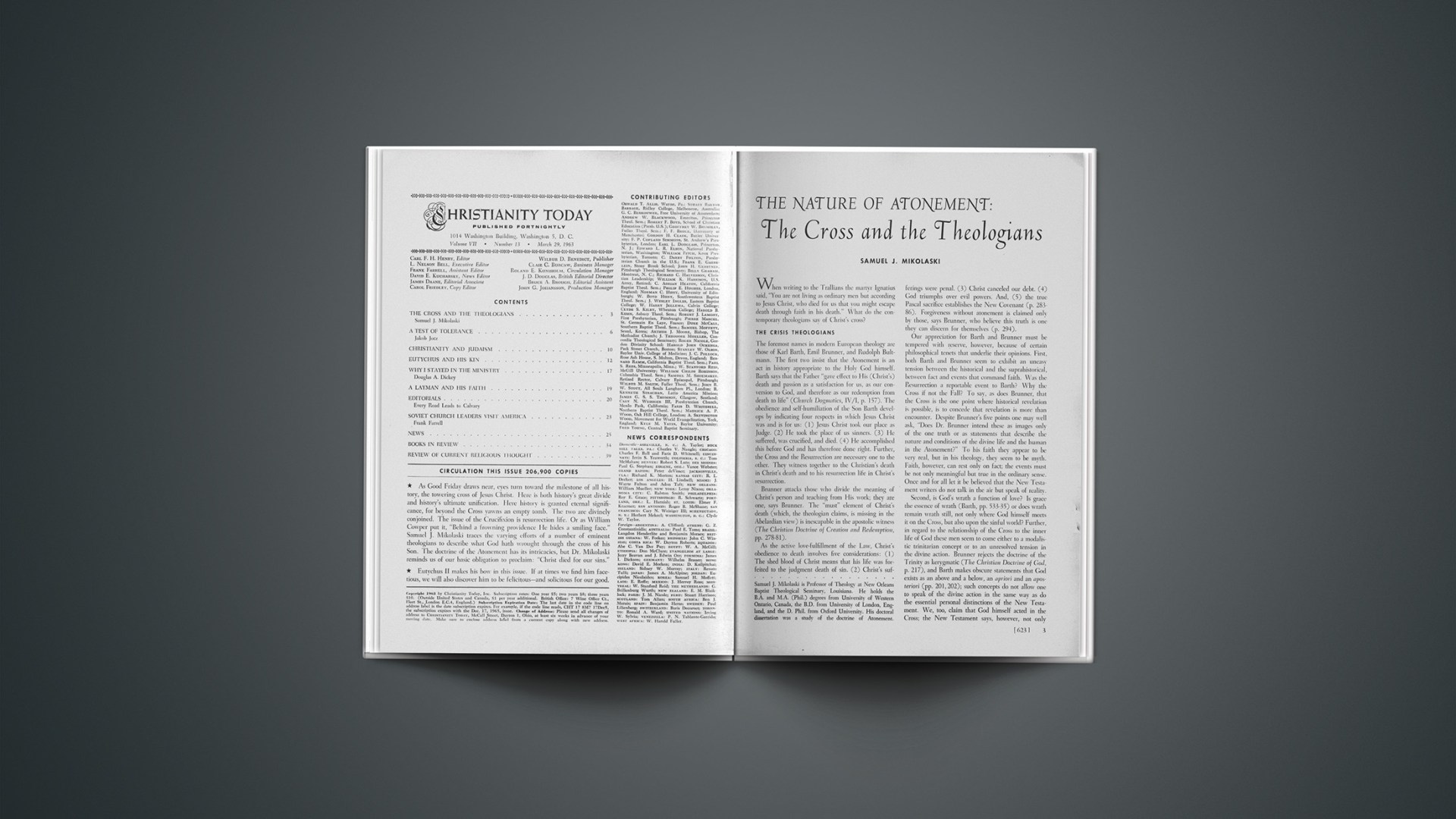
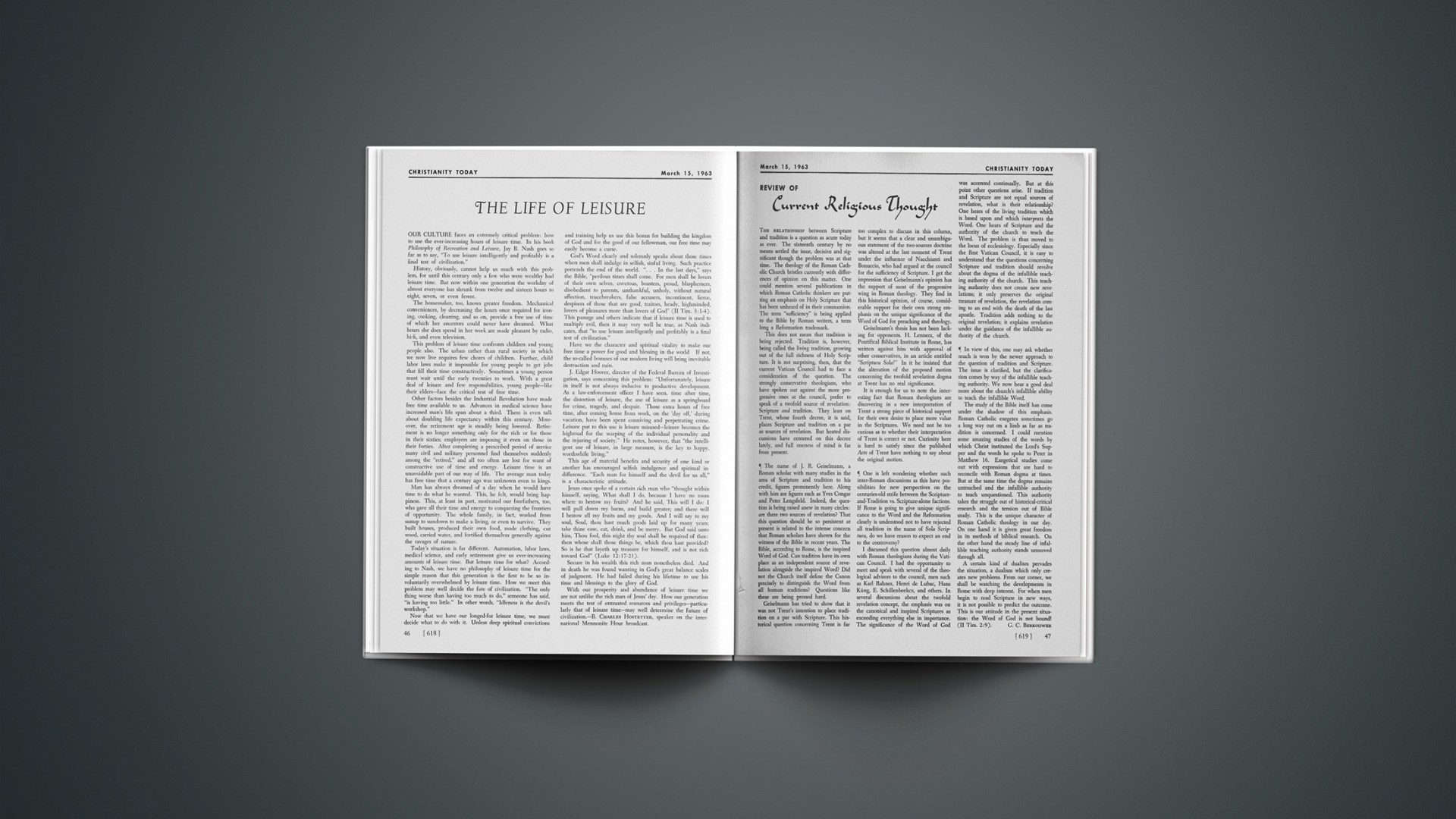
The Nature of Atonement: The Cross and the Theologians

When writing to the Trallians the martyr Ignatius said, “You are not living as ordinary men but according to Jesus Christ, who died for us that you might escape death through faith in his death.” What do the contemporary theologians say of Christ’s cross?

The Crisis Theologians

The foremost names in modern European theology are those of Karl Barth, Emil Brunner, and Rudolph Bultmann. The first two insist that the Atonement is an act in history appropriate to the Holy God himself. Barth says that the Father “gave effect to His (Christ’s) death and passion as a satisfaction for us, as our conversion to God, and therefore as our redemption from death to life” (Church Dogmatics, IV/I, p. 157). The obedience and self-humiliation of the Son Barth develops by indicating four respects in which Jesus Christ was and is for us: (1) Jesus Christ took our place as Judge. (2) He took the place of us sinners. (3) He suffered, was crucified, and died. (4) He accomplished this before God and has therefore done right. Further, the Cross and the Resurrection are necessary one to the other. They witness together to the Christian’s death in Christ’s death and to his resurrection life in Christ’s resurrection.

Brunner attacks those who divide the meaning of Christ’s person and teaching from His work; they are one, says Brunner. The “must” element of Christ’s death (which, the theologian claims, is missing in the Abelardian view) is inescapable in the apostolic witness (The Christian Doctrine of Creation and Redemption, pp. 278–81).

As the active love-fulfillment of the Law, Christ’s obedience to death involves five considerations: (1) The shed blood of Christ means that his life was forfeited to the judgment death of sin. (2) Christ’s sufferings were penal. (3) Christ canceled our debt. (4) God triumphs over evil powers. And, (5) the true Pascal sacrifice establishes the New Covenant (p. 283–86). Forgiveness without atonement is claimed only by those, says Brunner, who believe this truth is one they can discern for themselves (p. 294).

Our appreciation for Barth and Brunner must be tempered with reserve, however, because of certain philosophical tenets that underlie their opinions. First, both Barth and Brunner seem to exhibit an uneasy tension between the historical and the suprahistorical, between fact and events that command faith. Was the Resurrection a reportable event to Barth? Why the Cross if not the Fall? To say, as does Brunner, that the Cross is the one point where historical revelation is possible, is to concede that revelation is more than encounter. Despite Brunner’s five points one may well ask, “Does Dr. Brunner intend these as images only of the one truth or as statements that describe the nature and conditions of the divine life and the human in the Atonement?” To his faith they appear to be very real, but in his theology, they seem to be myth. Faith, however, can rest only on fact; the events must be not only meaningful but true in the ordinary sense. Once and for all let it be believed that the New Testament writers do not talk in the air but speak of reality.

Second, is God’s wrath a function of love? Is grace the essence of wrath (Barth, pp. 533–35) or does wrath remain wrath still, not only where God himself meets it on the Cross, but also upon the sinful world? Further, in regard to the relationship of the Cross to the inner life of God these men seem to come either to a modalistic trinitarian concept or to an unresolved tension in the divine action. Brunner rejects the doctrine of the Trinity as kerygmatic (The Christian Doctrine of God, p. 217), and Barth makes obscure statements that God exists as an above and a below, an apriori and an aposteriori (pp. 201, 202); such concepts do not allow one to speak of the divine action in the same way as do the essential personal distinctions of the New Testament. We, too, claim that God himself acted in the Cross; the New Testament says, however, not only that God came and acted, but that God also sent and gave his Son.

Finally, even aside from the disappointing development of faith’s vitalities (is faith not more than venturesome leap and genuine but comforted despair?) one senses an incongruity between the theological perspective of these men and our situation (the value of their work on the Continent notwithstanding). The English-speaking tradition has been blessed by theologians whom Barth and Brunner seem not to have known. (Brunner shows touches of Forsyth, however, who apparently influenced the young Swiss during his two-year stay in England.) Forsyth had developed the cosmic relevance of the Atonement more fully prior to the work of either Barth or Brunner. Barth’s concept of Judge and Judged had been strongly urged by R. W. Dale in The Atonement (1875), a book that went through 22 editions and enjoyed an enormous circulation; Dale also had probed the moral implications of the atoning act. Who can read Barth on substitution without recalling the brilliant exposition of Dr. Denney in The Death of Christ (1902) where, too, on 2 Corinthians 5:14 he develops far more richly than Barth the concept that we died in the death of Christ, that the Cross achieves something specific that changes the situation created by evil and sin? Moreover, one senses in the English writers a more realistic handling of the historical data of the New Testament; in short, they display a basic faith born of fact that seems to have escaped German theology generally since the time of Immanuel Kant.

Rudolph Bultmann, the New Testament scholar, has attracted attention by his attempt to separate the essential Gospel from what is allegedly peripheral to it (the pre-scientific world-view) through a process called Entymythologisierung, or demythologizing. We are not concerned, he says, with certain historical saving events such as the Atonement and the Resurrection (only primitive mythology could construct these) but with a message of saving history attested to in the sacraments and in the present concrete spiritual perfecting of life.

How then do we decide what is myth and what is not? In Jesus and the Word (1958) Bultmann says that Jesus did not come to atone; nor did he come to win forgiveness, but rather to proclaim it. Why then the Cross, we ask? The Church is wrong, he claims, to see “the event, the decisive act of deliverance, in the death of Jesus, or in his death and resurrection,” insofar as they are regarded as “given facts of history which may be determined or established by evidence” (pp. 212, 213). But do not the events and their interpretation stand together in the New Testament? Paul’s “Christ died for our sins” and “we thus judge” are that kind of statement (1 Cor. 15:3; 2 Cor. 5:14). Any explanation, R. W. Dale reminds us, that fails to grasp the necessary connection between the death of Christ and the forgiveness of sins is a grotesque distortion of New Testament doctrine. Bultmann’s basic and prior premise is that no historical event or fact can be the ground of faith or of the highest spiritual reality. Is it possible to dispose of troublesome scriptures so easily? Bultmann’s “events” bear little resemblance to the full-blooded factuality of the New Testament.

A contrasting perspective by the Swedish theologian Anders Nygren (Agape and Eros, 1932–1938) is based on a restudy of love in the New Testament. It restates the “moral influence” theory of Abelard and, more recently, of Hastings Rashdall (The Idea of the Atonement in Christian Theology, 1915) and R. S. Franks (The Atonement, 1934) in Britain, and of Nels F. S. Ferré in this country.

Nygren attempted to demonstrate the theological unity of the New Testament in the concept of agape (spontaneous love) as against that of eros (self-seeking love). As the nature of God, agape “hallmarks the new way of fellowship with God that Christianity brings” (p. 108). Many scholars, however, resist Nygren’s claim that all that the Law stood for in Israel and for Paul is of the flesh. Nygren seems to confuse the “law-works” idea with the Law of God. If God is love he is also holy, we maintain. Thus when he says that “fellowship with God is no longer for Paul a legal relationship, the only question is whether it is a relationship of love,” it may be noted that a love relationship must in that right be moral also. Unless the Cross meets the issue of condemnation we miss the “must” element of Calvary, as Brunner puts it.

Nygren says that “the agape of the Cross” is a “love that gives itself away, that sacrifices itself, even to the uttermost … it is God’s way to man.” Did the agape need this kind of passion for its proof? While claiming this much, objective views have always demanded more as well—divine action dealing with sin, condemnation, and judgment. But this emphasis is totally missing in Nygren. Calvary, as we know, does more than clear up a misunderstanding about the divine love; it is God’s act to save the world and men on the cosmic scale (Rom. 8:22; Col. 1:20–22). Nygren’s view is too anthropocentric. Leonard Hodgson has pointed out that while the moral influence theory has value, it is blind to those effects of sin which operate outside the sinner’s soul.

The Cross And Propitiation

C. H. Dodd has encouraged those who resist the idea that propitiation means averting divine wrath (therefore undercutting the judgment-bearing and substitutionary aspects of the Cross). According to Dodd hilaskesthai and its cognates should read expiation (of sin) and not propitiation (of God). His findings (Journalof Theological Studies, July, 1931; see also Dr. T. W. Manson, Jan.-Apr., 1945) have been widely adopted by theologians on both sides of the Atlantic. Curiously, scholars have been slow to grapple with critics of Dodd’s thesis, notably Leon Morris (The Expository Times, May, 1951; The Apostolic Preaching of the Cross, 1955; The Biblical Doctrine of Judgment, 1960) and Roger Nicole (Westminster Theological Journal, May, 1955), also E. K. Simpson and Professor R. V. G. Tasker.

The theological claim in Dodd’s system is that we cannot think of God as the God of wrath but of love, something which requires close reexamination in the light of what sin must mean to God. The older studies show this clearly; for example, R. W. Dale, The Atonement; James Denney, The Death of Christ; and P. T. Forsyth, The Work of Christ. Denney (as well as Dale, Simpson, and Morris) has said that the idea of propitiation “is not an insulated idea.… It is part of a system of ideas” (pp. 197, 198); therefore such a vital word cannot be applied at will in new ways without jeopardizing the whole of New Testament theology.

The piacular elements of the Atonement together with those that declare the love and grace of God form a unity. What possible attitude can God take to sin but wrath and judgment? There is no meaning to the universe unless its moral structure is reflected in the righteous dealing with sin in the judgment-death of the Cross. The real question is, “If not propitiation then why expiation?”—for if God’s dealing with sin is a reality then this fact is but part and parcel of the prior reality that God’s wrath comes upon both the sinner and his sin. We dare not banish normative morality from the universe. Only if God cares enough to be angry can we say he cares enough to redeem. If someone rejects words like “anger” and “wrath,” let him choose other terms, but maintain the vital realities of the life of God and of the nature of the world.

The Cross As Sacrifice

The foregoing question ought not obscure the “Back to the Bible” movement in recent studies of the Atonement. In broad terms, this movement stresses that Christ made final and indispensable sacrifice for sin. Scholars working with this approach may be grouped for convenience’ sake as follows:

First, those who stress the vicarious element. These include Oliver Quick, Doctrines of the Creed (1938); Vincent Taylor, Jesus and His Sacrifice (1951) and The Cross of Christ (1956); and F. C. N. Hicks, The Fullness of Sacrifice (1938). The moral quality of Christ’s act of self-offering and the power of this vicarious act to forgive, restore, and heal are in view.

A second more recent perspective comes from those who stress the sacramental character of Christ’s sacrifice. The work of Austin Farrer and of Father Lionel Thornton is deeply sensitive here. In America Robert S. Paul (The Atonement and the Sacraments, 1960), a non-conformist, has probed the relation of the Atonement to the Gospel and the sacraments in a manner reminiscent of P. T. Forsyth.

Third, many have emphasized the Cross as the victory over the powers of darkness; this emphasis is due chiefly to the influence of Gustaf Aulen’s Christus Victor (1931), which tried to resurrect a viewpoint held by certain fourth-century Fathers and later by Martin Luther. It should be noted that McLeod Campbell (The Nature of the Atonement) made creative use of this idea over a century ago.

Finally, some have made a vital attempt to recapture the theological realities of the New Testament as seen in A. M. Hunter (The Unity of The New Testament, 1943) and in D. M. Baillie (God Was In Christ, 1948). Christ’s life and death are a unity in Scripture, they urge, and exhibit God’s purpose to redeem. Hunter sums up this unity as follows: “The Atonement originates in the gracious will of God; it has to do with sin; its means is the crucified Christ whose death is vicarious, representative, and sacrificial; and the spiritual end which it secures is reconciliation or renewed fellowship with God based on a forgiveness of sins” (p. 102).

While the value of these studies is great, one senses, first of all, a tendency to distinguish sharply between representation and substitution. Are not both essential to New Testament theology? we would ask. Why does Hunter discuss huper as the “representative” idea, but ignore anti, the term that conveys the idea of “substitution”? We cannot overlook the fact that Christ did something for us as in our place, something that we could not do for ourselves. Further, to interpret “shed blood” as the offerer’s sharing in the life that is released rather than in the victim’s death tends to disallow the piacular elements of the Atonement. The “sharing-in-the-life-released” idea goes back to William Milligan and Bishop Westcott, though they conceded the penal element of the Cross. Surely the point is that our redeemed life can be only the issue of His saving death.

In the case of the victor idea and of the vicarious element we need to investigate more deeply the theological realities involved. What is the victory according to Dr. Aulen? His explanation might suggest that the principalities and powers are myths; if so, the actual nature of the victory remains unidentified. Similarly, what is a vicarious act? How does the vicarious act of one life bear upon that of another as far as forgiveness, reconciliation, and regeneration are concerned?

It is heartening to note the resurgence of interest in New Testament theology. The work of a generation ago, however, like that of Dale, Denney, and Forsyth, bearing as it did upon both the biblical and theological realities, ought still to command our attention. Much of what is being said today was said by them. The recent book by J. S. Whale (Victor and Victim, 1960) is an excellent, evangelically conceived study, but introduces Paul Tillich’s ontology in such a fashion as to undercut freedom rather disappointingly. Mack B. Stokes’s work (The Epic of Revelation, 1961) shows a balance of Bible exposition and philosophical penetration. The Doctrine of the Atonement (1951) by Leonard Hodgson is a noteworthy volume. Hodgson says that as an objective work, the Atonement deals with evil and sin as radical surd elements of the world. The law is the very condition of personal, moral life; thus the Atonement as God’s act vindicates righteousness and judges the evil. God aims to fashion in creation and to win by redemption a race of free human beings who voluntarily out of love seek and do the will of God expressed in Jesus Christ through the power of the Holy Spirit.

No verbal cure for evil and sin can suffice, nor can any solution that does not take seriously the predicament of sinful men under the wrath of God. As the act of God, the Atonement stands in logical relation to the Incarnation (which is how Christ’s work is relevant to us) and to the Trinity (which is the life to which we are called). We must accept and comprehend, therefore, the double reality that God sent his Son and that God was in Christ reconciling the world to himself. This double reality is what the biblical images declare—each part as an insight generated by the truth contributes to the unity of the whole, namely, that the Cross is the issue of the love of God accomplishing redemption. Certainly it is true that Christ sacrificed himself for us, that he died the death of sin, that he made satisfaction for sin expiating it, that he was the propitiation tor sin, that he died as the substitute for sinners and as the representative of the race, that his blood is the precious ransom price of our salvation that seals the covenant of grace. We need to comprehend these concepts in their bearing on the life of the triune God and upon the race.

Despite the intricacies of the doctrine of the Atonement, that the straightforward preaching of the Cross has the power to save men (1 Cor. 1:18) should be central to faith and theology. Seminarians have the curious habit of studying the Atonement comparatively, like some problem in logic, and sometimes forget to make the Cross the vital spiritual datum that it was to New Testament Christians. Our profession is not that of theological cowboys who rope ideas into theological stalls; rather we are to herald the apostolically interpreted fact that “Christ died for our sins.” Happy is he who believes and has the forgiveness God won for mankind through Jesus Christ the Lord.

END

Review of Current Religious Thought: March 15, 1963

The relationship between Scripture and tradition is a question as acute today as ever. The sixteenth century by no means settled the issue, decisive and significant though the problem was at that time. The theology of the Roman Catholic Church bristles currently with differences of opinion on this matter. One could mention several publications in which Roman Catholic thinkers are putting an emphasis on Holy Scripture that has been unheard of in their communion. The term “sufficiency” is being applied to the Bible by Roman writers, a term long a Reformation trademark.

This does not mean that tradition is being rejected. Tradition is, however, being called the living tradition, growing out of the full richness of Holy Scripture. It is not surprising, then, that the current Vatican Council had to face a consideration of the question. The strongly conservative theologians, who have spoken out against the more progressive ones at the council, prefer to speak of a twofold source of revelation: Scripture and tradition. They lean on Trent, whose fourth decree, it is said, places Scripture and tradition on a par as sources of revelation. But heated discussions have centered on this decree lately, and full oneness of mind is far from present.

The name of J. R. Geiselmann, a Roman scholar with many studies in the area of Scripture and tradition to his credit, figures prominently here. Along with him are figures such as Yves Congar and Peter Lengsfeld. Indeed, the question is being raised anew in many circles: are there two sources of revelation? That this question should be so persistent at present is related to the intense concern that Roman scholars have shown for the witness of the Bible in recent years. The Bible, according to Rome, is the inspired Word of God. Can tradition have its own place as an independent source of revelation alongside the inspired Word? Did not the Church itself define the Canon precisely to distinguish the Word from all human traditions? Questions like these are being pressed hard.

Geiselmann has tried to show that it was not Trent’s intention to place tradition on a par with Scripture. This historical question concerning Trent is far too complex to discuss in this column, but it seems that a clear and unambiguous statement of the two-sources doctrine was altered at the last moment of Trent under the influence of Nacchianti and Bonuccio, who had argued at the council for the sufficiency of Scripture. I get the impression that Geiselmann’s opinion has the support of most of the progressive wing in Roman theology. They find in this historical opinion, of course, considerable support for their own strong emphasis on the unique significance of the Word of God for preaching and theology.

Geiselmann’s thesis has not been lacking for opponents. H. Lennerz, of the Pontifical Biblical Institute in Rome, has written against him with approval of other conservatives, in an article entitled “Scriptura Sola?” In it he insisted that the alteration of the proposed motion concerning the twofold revelation dogma at Trent has no real significance.

It is enough for us to note the interesting fact that Roman theologians are discovering in a new interpretation of Trent a strong piece of historical support for their own desire to place more value in the Scriptures. We need not be too curious as to whether their interpretation of Trent is correct or not. Curiosity here is hard to satisfy since the published Acts of Trent have nothing to say about the original motion.

One is left wondering whether such inter-Roman discussions as this have possibilities for new perspectives on the centuries-old strife between the Scripture-and-Tradition vs. Scripture-alone factions. If Rome is going to give unique significance to the Word and the Reformation clearly is understood not to have rejected all tradition in the name of Sola Scriptura, do we have reason to expect an end to the controversy?

I discussed this question almost daily with Roman theologians during the Vatican Council. I had the opportunity to meet and speak with several of the theological advisors to the council, men such as Karl Rahner, Henri de Lubac, Hans Küng, E. Schillenbeekcx, and others. In several discussions about the twofold revelation concept, the emphasis was on the canonical and inspired Scriptures as exceeding everything else in importance. The significance of the Word of God was accented continually. But at this point other questions arise. If tradition and Scripture are not equal sources of revelation, what is their relationship? One hears of the living tradition which is based upon and which interprets the Word. One hears of Scripture and the authority of the church to teach the Word. The problem is thus moved to the locus of ecclesiology. Especially since the first Vatican Council, it is easy to understand that the questions concerning Scripture and tradition should revolve about the dogma of the infallible teaching authority of the church. This teaching authority does not create new revelations; it only preserves the original treasure of revelation, the revelation coming to an end with the death of the last apostle. Tradition adds nothing to the original revelation; it explains revelation under the guidance of the infallible authority of the church.

In view of this, one may ask whether much is won by the newer approach to the question of tradition and Scripture. The issue is clarified, but the clarification comes by way of the infallible teaching authority. We now hear a good deal more about the church’s infallible ability to teach the infallible Word.

The study of the Bible itself has come under the shadow of this emphasis. Roman Catholic exegetes sometimes go a long way out on a limb as far as tradition is concerned. I could mention some amazing studies of the words by which Christ instituted the Lord’s Supper and the words he spoke to Peter in Matthew 16. Exegetical studies come out with expressions that are hard to reconcile with Roman dogma at times. But at the same time the dogma remains untouched and the infallible authority to teach unquestioned. This authority takes the struggle out of historical-critical research and the tension out of Bible study. This is the unique character of Roman Catholic theology in our day. On one hand it is given great freedom in its methods of biblical research. On the other hand the steady line of infallible teaching authority stands unmoved through all.

A certain kind of dualism pervades the situation, a dualism which only creates new problems. From our corner, we shall be watching the developments in Rome with deep interest. For when men begin to read Scripture in new ways, it is not possible to predict the outcome. This is our attitude in the present situation: the Word of God is not bound! (2 Tim. 2:9).

The Life of Leisure

Our culture faces an extremely critical problem: how to use the ever-increasing hours of leisure time. In his book Philosophy of Recreation and Leisure, Jay B. Nash goes so far as to say, “To use leisure intelligently and profitably is a final test of civilization.”

History, obviously, cannot help us much with this problem, for until this century only a few who were wealthy had leisure time. But now within one generation the workday of almost everyone has shrunk from twelve and sixteen hours to eight, seven, or even fewer.

The homemaker, too, knows greater freedom. Mechanical conveniences, by decreasing the hours once required for ironing, cooking, cleaning, and so on, provide a free use of time of which her ancestors could never have dreamed. What hours she does spend in her work are made pleasant by radio, hi-fi, and even television.

This problem of leisure time confronts children and young people also. The urban rather than rural society in which we now live requires few chores of children. Further, child labor laws make it impossible for young people to get jobs that fill their time constructively. Sometimes a young person must wait until the early twenties to work. With a great deal of leisure and few responsibilities, young people—like their elders—face the critical test of free time.

Other factors besides the Industrial Revolution have made free time available to us. Advances in medical science have increased man’s life span about a third. There is even talk about doubling life expectancy within this century. Moreover, the retirement age is steadily being lowered. Retirement is no longer something only for the rich or for those in their sixties; employers are imposing it even on those in their forties. After completing a prescribed period of service many civil and military personnel find themselves suddenly among the “retired,” and all too often are lost for want of constructive use of time and energy. Leisure time is an unavoidable part of our way of life. The average man today has free time that a century ago was unknown even to kings.

Man has always dreamed of a day when he would have time to do what he wanted. This, he felt, would bring happiness. This, at least in part, motivated our forefathers, too, who gave all their time and energy to conquering the frontiers of opportunity. The whole family, in fact, worked from sunup to sundown to make a living, or even to survive. They built houses, produced their own food, made clothing, cut wood, carried water, and fortified themselves generally against the ravages of nature.

Today’s situation is far different. Automation, labor laws, medical science, and early retirement give us ever-increasing amounts of leisure time. But leisure time for what? According to Nash, we have no philosophy of leisure time for the simple reason that this generation is the first to be so involuntarily overwhelmed by leisure time. How we meet this problem may well decide the fate of civilization. “The only thing worse than having too much to do,” someone has said, “is having too little.” In other words, “Idleness is the devil’s workshop.”

Now that we have our longed-for leisure time, we must decide what to do with it. Unless deep spiritual convictions and training help us use this bonus for building the kingdom of God and for the good of our fellowman, our free time may easily become a curse.

God’s Word clearly and solemnly speaks about those times when men shall indulge in selfish, sinful living. Such practice portends the end of the world. “… In the last days,” says the Bible, “perilous times shall come. For men shall be lovers of their own selves, covetous, boasters, proud, blasphemers, disobedient to parents, unthankful, unholy, without natural affection, trucebreakers, false accusers, incontinent, fierce, despisers of those that are good, traitors, heady, high minded, lovers of pleasures more than lovers of God” (2 Tim. 3:1–4). This passage and others indicate that if leisure time is used to multiply evil, then it may very well be true, as Nash indicates, that “to use leisure intelligently and profitably is a final test of civilization.”

Have we the character and spiritual vitality to make our free time a power for good and blessing in the world If not, the so-called bonuses of our modern living will bring inevitable destruction and ruin.

J. Edgar Hoover, director of the Federal Bureau of Investigation, says concerning this problem: “Unfortunately, leisure in itself is not always inductive to productive development. As a law-enforcement officer I have seen, time after time, the distortion of leisure, the use of leisure as a springboard for crime, tragedy, and despair. Those extra hours of free time, after coming home from work, on the ‘day off,’ during vacation, have been spent conniving and perpetrating crime. Leisure put to this use is leisure misused—leisure becomes the highroad for the warping of the individual personality and the injuring of society.” He notes, however, that “the intelligent use of leisure, in large measure, is the key to happy, worthwhile living.”

This age of material benefits and security of one kind or another has encouraged selfish indulgence and spiritual indifference. “Each man for himself and the devil for us all,” is a characteristic attitude.

Jesus once spoke of a certain rich man who “thought within himself, saying, What shall I do, because I have no room where to bestow my fruits? And he said, This will I do: I will pull down my barns, and build greater; and there will I bestow all my fruits and my goods. And I will say to my soul, Soul, thou hast much goods laid up for many years; take thine ease, eat, drink, and be merry. But God said unto him, Thou fool, this night thy soul shall be required of thee: then whose shall those things be, which thou hast provided? So is he that layeth up treasure for himself, and is not rich toward God” (Luke 12:17–21).

Secure in his wealth this rich man nonetheless died. And in death he was found wanting in God’s great balance scales of judgment. He had failed during his lifetime to use his time and blessings to the glory of God.

With our prosperity and abundance of leisure time we are not unlike the rich man of Jesus’ day. How our generation meets the test of entrusted resources and privileges—particularly that of leisure time—may well determine the future of civilization.—B. CHARLES HOSTETTER, speaker on the international Mennonite Hour broadcast.

Book Briefs: March 15, 1963

Three Views Of One Cross

Key Words for Lent, by George W. Barrett (Seabury, 1963, 133 pp., $2.75) and Words and Wonders of the Cross, by Gordon H. Girod (Baker, 1962, 154 pp., $2.50), are reviewed by Paul S. Rees, Vice-President-at-large, World Vision, Pasadena, California.

What these two works have in common is the Crucifixion theme and a basically similar author’s format. Both are divided into two sections. Where Episcopal rector Barrett devotes the first part of his study to an examination of such salient Christian words as repentance, obedience, commitment, grace, suffering, and freedom, Reformed Church pastor Girod reexamines the Saviour’s seven sayings on the cross. Where Barrett calls Part II “Good Friday” and addresses himself to such topics as “Offended by Virtue,” “Tested by Sacrifice,” and “Healed by His Wounds,” Girod (without titular characterization) discusses the “miracles” of Good Friday: darkness at noon, quaking earth, rent veil, opened graves, the raised bodies of the saints.

Beyond this, however, the similarities between the two authors and their works are not remarkable. If one permits himself to overgeneralize (and who doesn’t?), he will want to say that theologically, Barrett is all putty and Girod all rock. This observation is as fair and as unfair to both men as sweeping generalizations usually are.

Author Girod is a rigid predestinarian who finds in Holy Scripture indubitable support for the view that the number of the “elect” was determined prehistorically and solely by God’s decree and that, accordingly, the death of Christ, far from having significance for all men, has meaning only for the elect, for whom, and for whom alone, it did provide an atonement (“the atonement is not universal; it is not for all men,” p. 57). In harmony with this theological construction it is held that faith (and with it a repentant mind) is not in fact a condition of salvation but a consequence; that is to say, men trust Christ and repent of their sins only after they have been born again by the sovereign act of the Spirit of God (“for if man be truly ‘dead in trespasses and sins,’ he remains such, until the Holy Spirit executes a work of grace in his heart. The Holy Spirit can be nothing less than sovereign, if any man is to be saved. Only after the Holy Spirit has rendered the ‘heart of stone’ into a ‘heart of flesh’ can man respond to the overtures of divine mercy,” p. 81).

It is not the business of the reviewer to defend or refute this particular theological structuring of the sovereignty of God. After all, it is a reading of the case that has been found helpful to knowledgeable Christian thinkers. It is perhaps not beyond the reviewer’s role to express some dismay over the author’s implication, in several places, that any other reading of what the Scriptures teach in respect of God’s sovereignty and man’s responsibility cannot be “evangelical.”

It is a mark of merit that the Girod book is a grappling sort of undertaking. It digs beneath the surface. It takes Holy Scripture, in its narrative and didactic forms, with tremendous seriousness, as is meet and proper. Reflective readers will probably feel that here and there the author has attempted to be so meticulous in exposition that he succeeds only in being overly precise. For example, the quoted words of our Lord, “I lay down my life for the sheep,” are followed by the caution, “Not for the goats, you understand, but for the sheep!” Were they, then, always sheep, and if so, how “evangelical” is such a conclusion?

A long overdue emphasis in a Lenten book appears in Girod’s vigorous references to the wrath of God, the solemnity of divine judgment on sin, and the terrible reality of hell.

George Barrett’s treatment of “key words” embraces several quotations from Paul Tillich, including a featured excerpt from his The Shaking of the Foundations which appears opposite the title Page. “There is a mysterious fact about the great words of our religious tradition: they cannot be replaced.… They must be found again by each generation, and by each of us for himself.”

In themselves these words are innocent. Those, however, who feel that Tillich’s handcrafting of the great Christian words is more a devaluation than a revaluation will find little in this gambit to inspire their confidence.

While it manifestly is not the author’s purpose to give an exposition of the doctrine of the Atonement, the atonement theme is prominent in a chapter called “Tested by Sacrifice.” Here the author takes a disappointingly low and humanistic view of “priesthood” and “sacrifice” under the Old Covenant. In this connection the statement is made, quite categorically, that “what the author of the Epistle to the Hebrews sees is that all such sacrifices are in the end meaningless. They are pathetic efforts that have no reality” (pp. 109, 110).

Dr. Barrett undoubtedly believes that there is a difference between the significance of what happened, for example, on the Day of Atonement in the Jewish year and what happens when a pagan tribe annually offers a bull to appease the deadly anger of the “crocodile” god, but this difference is largely glossed over by the manner in which it is handled.

The book’s best contribution will be found in its ethical and psychological insights, which are marked by soundness and a frequently searching shrewdness. This is enhanced by diction that is graceful and lucid.

PAUL S. REES

Key Roles

From First Adam to Last, by C. K. Barrett (Scribner’s, 1962, 124 pp., $2.95), is reviewed by Walter W. Wessel, Associate Professor of Biblical Literature, Bethel College, St. Paul, Minnesota.

These studies are based on the Hewett Lectures for 1961 and were delivered at three prominent American theological seminaries. They are further evidence of the intense interest today in biblical theology.

The author, who is professor of divinity at the University of Durham, contends that Pauline studies are still important despite the great interest today among biblical scholars in the new quest for the historical Jesus. Paul remains the “one fixed point” from which one may move both forward and backwards in his study of Christian origins and developments. He is the “pole star for him who would navigate the waters of early Christianity.”

The one basic presupposition of the book is that “Paul sees history … crystallizing on outstanding figures—men who are notable in themselves as individual persons, but even more notable as representative figures.” These representative figures who play key roles in the unfolding of the divine purpose are Adam, Abraham, Moses, Christ, and Christ as “The Man to Come.”

The great value of the book lies in the careful exegesis of the Pauline passages which the author brings to bear on his thesis. Professor Barrett is no novice in the art of biblical exegesis and exposition (cf. his commentaries on John and Romans). His treatment of such crucial Pauline texts as Romans 4:1–25 and 5:12–21; 1 Corinthians 10:1–11 and 15:21–56; Galatians 3:19–29; Philippians 2:5–11, and Colossians 1:15–20, is among the best one can find anywhere.

Reading for Perspective

CHRISTIANITY TODAY’S REVIEW EDITORS CALL ATTENTION TO THESE NEW TITLES:

The Zondervan Pictorial Bible Dictionary, Merrill C. Tenney, General Editor (Zonderran, $9.95). A single-volume dictionary by scholars of conservative religious outlook. More than 5,000 entries with maps and pictures.

Expository Preaclzing Witholrt Notes, by Charles W. Koller (Baker, $2.50). A remedy for that ironical moment in the pulpit when the impassioned preacher must pause 1 to see what comes next.

Barriers to Clzristian Belief, by A. Leonard Griffith (I Tarper & Row, $3.50). Compelling answers from a world-renowned pulpit for doubters and skeptics who face honest and pseudo barriers on the road to faith.

Professor Barrett also has some interesting things to say (in connection with his discussion of “The New Creation and the Individual”) on baptism. Even though baptism as a rite is not repeated, it must not be considered a once-for-all act. In substance it must be continually renewed. For baptism “admits not to a settled and final state of salvation, but to the dialectic of death and resurrection; not to the age to come, but to the interpenetration of this age and the age to come, which becomes actual for man who dies and rises daily.”

Parts of the book are hard going, but it is nevertheless to be hoped that it will have a reading wider than that by theological professors only. It contains much solid biblical-theological material that could enrich the preaching ministry.

WALTER W. WESSEL

Done By 65

The Zondervan Pictorial Bible Dictionary, Merrill C. Tenney, General Editor (Zondervan, 1963, 968 pp., with over 700 photos and 40 pp. of maps, $9.95), is reviewed by William Childs Robinson, Professor of Ecclesiastical History, Church Polity, and Apologetics, Columbia Theological Seminary, Decatur, Georgia.

This work is notable in the large number of fresh photographs it makes available. The work is done by 65 scholars of conservative views, several from Wheaton College. Long articles with good pictures are found on such themes as Israel, archaeology, the Dead Sea Scrolls, Jerusalem. The Red Sea is interpreted as the Reed or Marsh Sea. Bus-well gives good brief treatments of the Incarnation and the Propitiation. The article on the Atonement carries the “emptying” indicated in Philippians 2 too far. Current scholarship is relating this phrase to Isaiah 53:12. The high tone of the work and the excellent illustrations will make this a prized volume.

WILLIAM CHILDS ROBINSON

The American Revolution

Mitre and Sceptre, by Carl Bridenbaugh (Oxford, 1962, 354 pp., $7.50), is reviewed by Earle E. Cairns, Chairman, Department of History and Political Science, Wheaton College, Wheaton, Illinois.

Past interpreters of the American Revolution have emphasized its constitutional and economic causes. The scholarly president of the American Historical Association stresses religion as an equally important cause because of the attempt by Anglican missionaries to obtain an Anglican bishop in the Thirteen Colonies against the united opposition of other Protestants. This book thus updates and integrates the theses of the previous books by Alice Baldwin and A. L. Cross on the role of the New England clergy and Anglican missionaries in the coming of the Revolution.

The author combines little-used or newly discovered English and colonial newspapers and manuscripts with excellent biographical sketches, of both dissenting and Anglican leaders, to form a new synthesis. He demonstrates that between 1689 and 1775 the attempt to obtain an Anglican episcopate in the colonies was opposed as a threat to religious and civil liberty and to local control of higher education. Mitre (the Anglican archbishop) was as much to blame as the sceptre (King George III) for the loss of the colonies.

This ecclesiastical struggle promoted intercolonial cooperation and even temporary union of Dissenters in the colonies and close cooperation with those in England. It also stimulated the rise of early American nationalism. It resulted, too, in the Dissenters’ formation of a political pressure group which became expert in propaganda in pulpit, press, and pamphlet.

Bridenbaugh demonstrates that the historian cannot afford to neglect religion in his study of American history. His timely study of past relations between church and state is relevant to the current debate over such things as federal aid to education. One wonders whether future historians might write a similar story of Protestant opposition to the demands of the Roman Catholic Church for financial aid from government.

EARLE E. CAIRNS

A Story Of Invasion

Urgent Harvest: Partnership with the Church in Asia, by Leslie Lyall (China Inland Mission, 1962, 220 pp., 8s. 6d.), is reviewed by James Taylor, Minister, Ayr Baptist Church, Scotland.

This book is the record of impressions the author received while touring all the fields of the Overseas Missionary Fellowship of the China Inland Mission in 1960. One-third of the world’s population lives in the Far East, and Mr. Lyall conveys a sense of the magnitude of the task facing Christian missions working there.

He tells of a painting in a Tokyo park depicting a solitary child: four venerable figures are beckoning to the child—Buddha, Confucius, Lao-tze, and Christ—but the child looks perplexed and undecided. Today the ancient religions, animism, Communism, and Christ are all fighting for the souls of men. Many millions are in the darkness of immorality and indifference. Christian converts seem to mature slowly, and many fall away. Church discipline has to be exercised firmly and frequently. The missionaries experience constant frustration and disappointment.

This book is a valuable record of a fierce battle on the part of faithful, determined missionaries and national Christians to extend the kingdom of our Lord in territory stoutly defended by Satan. We are also given a valuable insight into the strategy, planning, and vision of a modern missionary society.

JAMES TAYLOR

Suspense Story

I Was an NKVD Agent, by Anatoli Granovsky (Devin-Adair, 1962, 343 pp., $4.75), is reviewed by A. W. Brustat, Pastor, Trinity Lutheran Church, Scarsdale, New York.

This is another in the growing list of important documentaries which ought to convince free men of the urgency of bending every effort to remain free.

Granovsky relates his harrowing experiences in Soviet prisons after his father, a faithful Party member, had been liquidated in one of the many Soviet purges. Induced by the natural urge for self-preservation, he reluctantly became an agent of the NKVD. In this narration of his multiplied activities—ranging from the first NKVD assignment to spy on his friends (including Stalin’s son) through deliberately planned killings and sex orgies to his eventual hair-raising escape to freedom—is the intriguing, suspenseful story of a courageous man.

A. W. BRUSTAT

Communion Is The Crux

One Bread, One Body, by Nathan Wright, Jr. (Seabury, 1962, 148 pp., $3.75), is reviewed by William B. Williamson, Rector, Church of the Atonement, Philadelphia, assisted by Eugene F. Lefebvre, Rector, St. Timothy’s Episcopal Church, Philadelphia, Pennsylvania.

It is hard to imagine the need for another book on liturgies, especially another potentially tedious overview of the Holy Communion as the hope of Church unity; yet One Bread, One Body has made a place for itself in the area of liturgical renewal and offers some guidelines for helpful ecumenical interest at an important level.

The Rev. Nathan Wright, Jr., Rector of St. Cyprian’s Episcopal Church, Roxbury, Massachusetts, has written an excellent book for laymen which will serve as a refresher for clergy in the field of liturgies. The chapters of the book are set against the background of the Liturgy of the Holy Communion as found in the Book of Common Prayer of the Protestant Episcopal Church, a fact that in no way causes the book to have interest for Episcopalians only. Mr. Wright has drawn upon various and numerous church scholars (Catholic and Protestant) to support his thesis: the universal acceptance of the Holy Communion as the Church’s chief service of worship, originally commanded by Jesus Christ and followed by the early Church and generations of Christians.

One chapter which is of interest to this reviewer is “Our Part in Christ’s Sacrifice” (12), a concept where Catholic and Protestant thought many times clash. In this chapter the author quotes from many sources; included is the following comment by the noted Scottish theologian Donald Baillie: “Today we can fairly appraise the situation thus: while many Roman Catholics and others of the Catholic tradition may not appreciate fully their role as members of a sacrificing community and while many Protestants may not recognize the presence of the sacrificial principles in their religious thought, many Catholic and Protestant theologians basically agree upon the concept of religious sacrifices” (p. 87). In addition to Presbyterian Baillie, the author mentions the works of the Roman Catholics Dom Odo Casel and Abbot Herwegen; the Anglicans Dom Gregory Dix, A. G. Hebert, and Massey Shepherd; the Lutherans Archbishop Yngve Brilioth and Ernest Koenker; and the Eastern Orthodox scholar Nicholas Arseniev.

Wright holds solidly that the Holy Communion is the great social action of the Church’s worship, a concept which is often forgotten by many in the Reformed traditions.

Here is a book worthy of consideration by all clergy, by all those engaged in Christian education, and indeed, by all Christians who are prayerfully studying those areas where the divided Church might once again demonstrate and thus secure the unity of Christ’s Holy Church. The book helps in this effort by its profuse use of quotations from the Church fathers, the Reformers, and contemporary liturgical scholars; it gives to both clergy and laity statements made by men of their own traditions on the Church’s unique service—the Holy Communion.

WILLIAM B. WILLIAMSON and EUGENE F. LEFEBVRE

Fresh Approach

Apostle Extraordinary, by Reginald E. O. White (Eerdmans, 1962, 209 pp., $3.50), is reviewed by Ian R. Fisher, Scottish Travelling Secretary of the Inter-Varsity Fellowship.

Described as “a modern portrait of St. Paul,” this is not strictly a biography of the Apostle; the author avoids covering ground adequately dealt with elsewhere. His method is to study various aspects of Paul’s life and experience and to apply the lessons to our time. He does this well, and provides the reader with a fresh approach to Paul. One pleasing feature of the book is the profusion and aptness of the biblical quotations. Particularly relevant and challenging is the section on “Paul, Servant of the Kingdom,” where the author illustrates the similarity of Paul’s situation to our own. This and the concluding piece on “Paul and the Secrets of Power” are searching ones for all engaged in Christian work.

Some will disagree with the author’s interpretation of parts of the Epistles (e.g., that of Romans 7 on p. 40), and others will regret his unwillingness to take a firmer line on the Pauline authorship of the Pastoral Epistles (pp. 157 f.). However, these facts do not detract from the general excellence of a book which continually challenges the reader to follow more closely in the footsteps of the Apostle.

IAN R. FISHER

Best Of Suzuki

The Essentials of Zen Buddhism, by Daisetz T. Suzuki (Dutton, 1962, 544 pp., $7.50), is reviewed by Leslie R. Keylock, Research Assistant in Religion, State University of Iowa, Iowa City, Iowa.

Although Zen has many of the characteristics of an intellectual fad in America, it is in a more popular form one of the largest of Mahayana Buddhist sects, with millions of adherents in Japan alone. The venerable apostle of Zen to the West is 92-year-old Daisetz Teitaro Suzuki, professor emeritus of Buddhist philosophy at Japan’s Otani University in Kyoto, whose writings have been appearing at frequent intervals for the past 35 years. Suzuki, who is fluent in Sanskrit, classical Chinese, Pali, Japanese, and English, returned to Japan in 1958 after many years of teaching and lecturing in the United States.

The present work is a compilation of Suzuki’s more important writings between 1949 and 1959, selected and edited by Zen-convert Bernard Phillips. Phillips prefaces the book with an extremely tedious introduction which, to indulge in understatement, suffers acutely when compared to Suzuki’s very readable English style.

The book is intended as an introduction to Zen. Opening chapters attempt to explain the inexplicable, subjective philosophy of this mystical and anti-rationalistic faith. The section on Zen’s history from its ostensible origins in India to its transmigration to China is highly enlightening. Unfortunately there is no comparable chapter on the history of Zen’s development in Japan, where this faith is now most prevalent. (Occasional glimpses of such a history are given, e.g., on pp. 34, 272–75, 400, 462, 477 f., and 481.) The reader wishes that such a chapter could have been included. He also wishes that some of the endless repetition for which Suzuki is so well known could have been eliminated. Nowhere is this prolixity more patent and ironic than in the protracted treatment of “satori,” the existential experience of Sudden Enlightenment which Zen regards as its essential characteristic. Suzuki explains that the many years of meditation which a disciple spends on a series of extremely cryptic “kōans” (Zen’s question-and-answer patterns) under a Zen master in a Meditation Hall are meant to lead to a satori which will initiate him into a life of freedom from the dreaded dualism of intellection and logic. A study of those aspects of Zen which have contributed to the culture of Japan concludes the anthology: the art of tea-drinking, swordsmanship, and Zen painting.

For those interested in a study of that form of Eastern mysticism which has so strongly influenced American “beatnik” creativity, this anthology of Suzuki’s writings is undoubtedly the best volume available.

LESLIE R. KEYLOCK

Diagnosis Without Cure

Guilt: Its Meaning and Significance, by John G. McKenzie (Allen & Unwin, 1962, 192 pp., 21s.), is reviewed by Ian Lodge Patch, psychiatrist, London, England.

Few words evoke such interest from so many quarters, or provoke so many antagonistic points of view, as guilt. Yet much of the disagreement arises from contestants’ failure to recognize that their basic premises are different. Dr. McKenzie sets out first to describe the origins of guilt in the terms of depth-psychology, and then to consider the relationship of guilt to law, ethics, and religion. Much discussion goes on as to whether there are objective standards of behavior underlying the guilt and provoking a sense of “ought.” For Dr. McKenzie this sense of “ought” not only exists but is ultimate, and is itself the evidence of an objective standard. For this reason he finds Freud and Fromm unsatisfactory—they take no account of “ought,” which provides the evidence for sin and the need for the Cross. Psychiatry, of course, has no remedy for real guilt in this sense.

In his chapter on the legal concept of guilt he deals competently with many vexed questions—psychopathy, diminished responsibility, and uncontrollable impulse—but with disappointingly little in the way of conclusions. This inconclusiveness seems to be the main defect of the book. Dr. McKenzie is at home with the ethical, philosophical, or theological discussion of a concept, but his ideas seem remote from the patient laboring under an intense feeling of guilt. Thus there is no discussion of the pathological guilt which dissipates with the treatment of a depressive illness. The reader is left instead with the impression that guilt itself is the root of all evils. As a discussion of a theory, however, the work is stimulating.

IAN LODGE PATCH

Book Briefs

The Forty Days, by Geoffrey R. King (Eerdmans, 1962, 105 pp., $2). Readable, worthy discussion of the Forty Days, usually neglected—and usually numbered from Easter. First American edition.

Seven Words of Men Around the Cross, by Paul L. Moore (Abingdon, 1962, 94 pp., $2). Devotional reflections on six words uttered below, and one alongside, the Cross. Sharp insights combine with wobbly theology.

He Speaks from the Cross, by John Sutherland Bonnell and others (Revell, 1963, 126 pp., $3). Fine, polished essays of uneven value on the words spoken from the Cross.

Christ’s Eternal Invitation, by Robert Talmadge Haynes, Jr. (John Knox, 1963, 62 pp., $2). Devotions in free verse, about people who lived on the edge of Good Friday.

The Compassion of God and the Passion of Christ, by Eric Abbott (Geoffrey Bles, 1963, 96 pp., 7s. 6d.). The Dean of Westminster offers brief scriptural meditations, based on Hebrews 13:20, 21, for the weeks of Lent.

A Book of Lent, by Victor E. Beck and Paul M. Lindberg (Fortress, 1963, 197 pp., $3.25). All about and for Lent: its symbols, customs, and worship, with meditations for the season.

In the Eyes of Others: Common Misconceptions of Catholicism, edited by Robert W. Gleason, S.J. (Macmillan, 1962, 168 pp., $3.95). Eight Jesuits attempt to see themselves as others see them on such matters as Bible study, birth control, private judgment, and the church and politics.

What He Said, compiled by Peter Ruf (Carlton Press, 1962, 116 pp., $4). A concordance of the words of Christ. Overpriced.

Mennonite Exodus, by Frank H. Epp (Friesen & Sons [Altona, Manitoba], 1962, 571 pp., $6). A detailed story of the conflict Between the Communists and the Mennonites in Russia since the Bolshevik Revolution.

Understanding the Lord’s Prayer, by Henri van den Bussche (Sheed & Ward, 1963, 144 pp., $3). A Roman Catholic interprets the Lord’s Prayer within its eschatological framework. Provocative.

The Church at Worship, by Gaines S. Dobbins (Broadman, 1962, 147 pp., $3.25). A professor speaks profitably about the purpose and achievement of worship and its place in the Christian life.

1010 Sermon Illustrations from the Bible, by Charles L. Wallis (Harper & Row, 1963, 242 pp., $3.95). Spotty and of uneven value.

The Holy Bible (American Bible Society, 1962, 1435 pp., $2.05). English Reference Bible, with concordance, eight maps, four pages of alternate readings, and a seven-page list of words whose meanings have changed.

The Children’s Hymnbook, compiled and edited by Wilma Vander Baan and Albertha Bratt (Eerdmans, 1962, 196 pp., $2.95). Good selection of songs, serviceable; with fine artwork.

Lost and Found, by Russell L. Mast (Herald Press, 1963, 102 pp., $2.50). Seven brief well-wrought essays on the “four” lost parables of Luke 15—with application to the lostness of our modern generation.

Symbols, by Ratha Doyle McGee (The Upper Room, 1962, 116 pp., $1). Religious symbols, depicted with their meaning and Scripture reference. Revised.

The Dead Sea Scrolls, by Charles F. Pfeiffer (Baker, 1962, 119 pp., $2.50). Revised and enlarged edition of the author’s previously published popular presentation of the same title.

Matthew-Acts, Volume 6 of Nelson’s Bible Commentary, by Frederick C. Grant (Thomas Nelson, 1962, 518 pp., $5). An excellent commentary if used with a dash of discretion. Based on RSV.

The Epistle to the Hebrews, by Clarence S. Roddy (Baker, 1962, 141 pp., $2.75). Brief, practical commentary on selected texts dealing with main motifs of the epistle. Particularly helpful for study groups and for ministers desiring to preach a series of sermons on this epistle.

But God!, by V. Raymond Edman (Zondervan, 1962, 152 pp., $2.50) Short, warm devotional pieces which counter the human situation with the BUT of God’s Word. Embellished with excellent photography.

Paperbacks

The Prince and the Prophet, by Chester Hoversten (Augsburg, 1963,123 pp., $1.75). Practical Lenten sermons of substance. Better than most.

They Were There … When They Crucified My Lord, by Lester Heins (Augsburg, 1963, 79 pp., $1.75). Brief Lenten meditations in the form of letters addressed to biblical persons.

With Heart and Mind, by Kenneth L. Pike (Eerdmans, 1962, 140 pp., $1.75). An evangelical muses on scholarship and the Christian faith.

Opened Treasures, by Frances Ridley Havergal (Loizeaux Brothers, 1962, 256 pp., $3.25). A brief, moving devotion for each day of the year, bearing the mark of the extraordinary personality and spiritual character of its author.

Lists of Words Occurring Frequently in the Coptic New Testament, compiled by Bruce M. Metzger, (Eerdmans, 1962, 24 pp., $.75). By an acknowledged specialist in the field; the author, assuming that his readers know some Greek, alphabetized the words in accordance with the principles of Georg Steindorff.

The Church’s Back Door: Why They Come and Go

The exit of the church often seems to be as wide open as its entrance. People come and go in wholesale lots. One church reported accessions of more than 1,000 new people in about eight years. The net increase for the period, however, was two people. What had happened?

Are we concerned simply because this kind of situation means a decrease in the size of our church and therefore less prestige and status as a “successful pastor”? Do we worry about its reflection on our professional competence, or rather about the kind of church our ministry has produced?

We are concerned about these people who disappear from the church because we know God has placed them under the care of the congregation. They are not like so many bank notes which we bankers guard until they transfer to central headquarters. Christ died for these persons and intends something far better for them than they now know.

Failure to Conserve Converts

I am bewildered by the fact that so many ministers who want to conserve the fruit of evangelistic efforts do not use those plans already tested by experience, or do not develop any systematic program of their own.

Some denominations have issued excellent graded courses for new members. There are also numerous plans for the sponsoring of newcomers by deacons and deaconesses, by special committees, by church school classes. Many churches that complain about losing members soon after extending the right hand of fellowship admit they have never tried any of these plans. We need to ask whether new people will fall automatically into the ways of a new church, or into a new fellowship. Do the cliques, the classes, the groups, and the committees of the church open promptly and wholeheartedly to these new members?

Too few ministers use sector zone plans for more than coffee-and-doughnut sociability. Only here and there does a plan provide study, a more intimate fellowship, and a way of reaching out to man.

The American Baptist Jubilee Advance program has suggested that one member of the evangelism committee be designated as Fellowship Chairman, to watch over the nurture of new people until they become true members of the worshiping, studying, sharing, witnessing, and serving people of God.

Some Problems Inside

I have no kit of new tricks for conserving church membership. I wonder, however, if some of our difficulty may not be found at the front door—and even inside the church itself. There may be need for us to bring our programming and practice into conformity with our basic theological convictions.

Look at the word “decision.” We urge people to commit themselves, to “have faith,” to “believe on the Lord Jesus.” We are saying, “A choice is yours to make: decide today.” What do we mean by this?

Think of a particular person. What are you implying when you urge him to decide for Christ?

In the first place, you are saying that God is seeking him. You will doubtless tell him it is the Holy Spirit who will work a work of grace in him, who will bring the things of Christ to him. No matter how we put it, we are admitting that unless the Holy Spirit is at work, nothing will happen. Unfortunately our actions sometimes indicate quite the opposite, but this is what we imply by our invitation.

In the second place, we are saying that our friend has only two options. We urge, “Choose life and not death; choose the grace and authority of Christ, not enslavement to self, darkness, and the devil.” He is free to choose, but he needs to know that the choice is his to make—and is of ultimate importance.

Third, our friend must base his choice on sufficient evidence, or else it is not a decision. If I try to ease his task by making the decision less than it is, or by prejudging the evidence for him, the decision is mine and not his.

In the fourth place, our friend must be free to decide without any coercion. He is a person, not a machine to be manipulated. The weight of our beseeching concern, however, may cause him to give assent simply to squirm out from under the pressure we apply. To slip from under pressure, to honor our concern and sincerity is not the same as exercising saving Christian faith. Decision, to be authentic, must be one’s own.

Christian decision means, in the fifth place, that our friend should decide for Christ and not for some easy formula or lovely phrasing about Christ. Let’s be blunt: it is Christ who came to earth, lived among men, died, rose again to take up the burden of walking with us. Our friend will be saved only when he places his guilt and his life in the hands of the Crucified and Risen One.

A sixth thing to remember is that while our friend’s decision is very personal and even somewhat lonely, it is not a purely private affair. Every choice we make is colored and conditioned by society and by those near us. They have a stake in our decision, for they help to make it difficult or simple, right or wrong, creative or destructive. Our friend has such a background, too. What is more, you and I are there. We should epitomize the fact that this decision is possible, and should demonstrate what its outcome is in living faith, devotion, sacrifice, and service.

Unprepared for Alternatives

What happens if these essentials of decision are missing?

Suppose our friend is a student who has not based his convictions on sufficient evidence and preparatory instruction. What will happen when he faces secular or other religious views that challenge his thinking?

Suppose this person is our own son. He has held his father’s faith through the years because this was expected, or because we had determined his faith should be of a particular kind. What will happen when he finds other faiths and ways of life in the world—and in the Church?

Suppose this person is intellectually pleased with our exact formulations. What will happen when everything seems to be falling apart for him and the Living Christ remains only an abstraction?

Suppose our friend’s decision was not ultimate and thoroughgoing. What will happen to him when the issues of life become confused, allegiances are not clear-cut, and he has no understanding of Christ’s Lordship or of the meaning of eternity for the here and now?

This sample of possibilities should be enough to point up what is involved in decision. Some go out from us “because they were not of us”; their decision was not really theirs, or they accepted our appeal to words, to moral action, to social concern, to familial responsibility. They soon discover that such acceptance of us and our words provides no bulwark against the pressures of life.

Narrowing Our Salvation

Another possible area of trouble concerns our familiar doctrine of salvation. We often speak of sarong or winning souls, of the cure of souls. Do we mean by this to divide mattesr from spirit? Or do we mean what the Bible means when it calls man “a living soul”? “As a man thinketh in his heart, so is he” simply states that whatever a man is, he demonstrates in all of life’s relationships.

Perhaps we leave an impression of what God saves that is quite different from what we mean. Or we may forget that we are dealing not with some inner, secret part of man that is unrelated to his existence as a parent, husband, citizen, and church member, but with the person, entire and whole.

This raises the question of our doctrine of man. Is man a bundle of strangely mixed components? Or is he a person confronted by the claims of God in Jesus Christ whose Christian decision has bearing on every facet of life? If man is a total person, we begin to see what God intended in Christ’s incarnation. The Gospel should tread wherever the feet of God’s people walk. Yet too often we keep it safe, very safe—safest of all, many times, in the pulpit. We feel uncertain and frightened when we think how the Gospel in us ought to stride out to meet the scholar, the man of power, the corrupt and the venal, the harlot and the drunkard, the confused and the needy. We are afraid it can’t really be good news out there.

Many fall away from our ranks because we program our training sessions and organize our churches for everything but a realistic witness in daily experience.

A group of churchmen in our nation’s capital once uttered the usual comprehensive platitudes about Christian living, then finally asked what the Gospel really meant in terms of the Berlin Wall, Cuba, Laos, steel, and so on. This was their life, and they sensed that the Lord who once came into this world of religious malpractice, political expedience, civic corruption, racial prejudice, and international tensions to transform lives and to revolutionize society must have something to say and do now through them. The problems of most men are far less dramatic. But salvation is no less essential for the distraught mother, the wayward father, the tested juvenile, the businessman, the farmer, the professional person, even the minister.

The Church Itself

Then let’s look at the Church itself. Nothing in the New Testament indicates that the Church was to be the protector of the status quo, the sustainer of values, the watchdog of budgets and buildings. Rather, the Church was an informal movement of people who went everywhere “good newsing”; it was a dynamic force that challenged religions, governments, and cultures.

This does not minimize the inner task of the Church to sustain and chastise, to strengthen and rebuke us, for this is part of our life together in Christ. But have we properly equipped and deployed our troops? We recognize the spiritual illiteracy of our day but do little to tighten up our teaching procedures. We brush theology aside as something irrelevant to the “real work” of the pastorate.

Many of our people are unspiritual, petty, divisive—incapable of directing the Church, let alone of being witnesses of the Gospel. So said the returns on a recent questionnaire to ministers. Of the 16 functions of a minister to be set in order of importance most of the clergymen placed preaching and visitation at the top of the list. Dealing with special problems, adult work, group work, and training lay people came far down, however. Children’s work was near the top—perhaps because ministers find it easier to work with pliable, responsive children than with adults and their thorny problems.

To the question of God’s purpose for newly won lay people some answered, “Christlikeness,” or “the new person in Christ.” What they meant by these terms turned out to show little understanding of the New Testament guidelines for social, personal, and spiritual maturity, for the service, worship, and witness to which people are called. Have ministers failed in their teaching about the Church and its ministry in the world?

We speak of the Church as the fellowship of the Spirit. “How these Christians love one another,” was an early statement about the Church and something that the new convert today expects to find. But not only have Christians forgotten how to pray with the lost; they have also ceased to pray for and with each other. Our atomistic, individualistic concept of man and salvation has made us a conglomerate of lonely, isolated particles held together by interests often quite secondary to the basic purpose of the Church. To share the life in Christ is something almost alien to us. New Christians, and older ones, too, are often surprised, shocked, disillusioned, and finally alienated by what they find in the Church. True, we may expect too much from the heterogeneity that characterizes most of our churches. The fact remains, however, that we offer so very little of what men have a right to expect from the people of God.

Unless our faith has something important to say to people in the world, unless it presents God’s great and challenging purposes, unless its values go beyond the tawdriness of our day, men will neither listen to our words nor shoulder the work of Christ and the Church with any great seriousness.

We need to check the back door of the church—maybe even the front door—to understand why so many go out from us. The problem is not a simple one: the solution may call for a radical review of our ministry and our life together in the light of the purposes of God.

DONALD F. THOMAS

Program Associate

American Baptist Jubilee Advance

Valley Forge, Pennsylvania

News Worth Noting: March 15, 1963

MISPLACED FUNDS—The average American misplaces more money each year than the per-member contributions to a majority of U. S. church denominations, says President Arthur R. McKay of McCormick Theological Seminary. Cash lost averages $75 per person annually, according to McKay, or more than the per-member giving of 15 of the 23 largest communions.

PROTESTANT PANORAMA—Lay evangelist Howard E. Butt, Jr., will be heard during April on “The Baptist Hour,” Southern Baptists’ international radio worship service. Speaker for May will be Director Paul Stevens of Southern Baptist Radio-TV Commission, and for June Dr. Wayne Oates of Southern Baptist Theological Seminary.

Major curriculum revisions will be introduced next fall at San Francisco Theological Seminary. Changes are designed to provide “all of the necessary overall professional skills while making possible an increased depth of study in specific areas which appeal to a student’s own interests, talents, and capabilities.”

President Franklin Clark Fry of the Lutheran World Federation dedicated a new religious radio station at Addis Ababa, Ethiopia, last month. Engineers say the LWF station will be heard in all of Africa, the Middle East, and through most of southern Asia.

Ten Protestant churches in Spain were reopened recently with permission of Spanish authorities, according to a report by Jose Cardona Gregori, executive secretary of Commission for Protestant Defense. Six others still are closed, Gregori said, and requests to open new churches have been denied.

Nineteen young Protestants, including two clergymen, are said to have been imprisoned in East Germany as part of a Communist anti-religion campaign. Seventeen of the group were sentenced to a total of 52 years in prison. Two others await trial.

Protestant Episcopal Church’s National Council endorsed establishment of a domestic youth conservation corps to help train, educate, and employ “mounting numbers of idle” U. S. teen-agers.

A committee chosen to recommend a headquarters site for the United Church of Christ selected New York City. Final decision will be made by the denomination’s General Council.

MISCELLANY—eports circulating in India claim Great Britain has agreed to Islam’s becoming the state religion of the proposed Federation of Malaysia. The federation would include the present Federation of Malaya, Singapore, Sarawak, North Borneo, and Brunei, with total population estimated to be about 43 per cent Muslim. All five lands belong to the British Commonwealth.

Seventh-day Adventists have conducted 30 “stop-smoking” clinics across the nation. Seventy per cent of those who have attended the five evening sessions at each clinic are said to have broken the smoking habit.

U. S. Army War College at Carlisle Barracks, Pennsylvania, held groundbreaking ceremonies last month for a $423,700 inter-faith chapel center. Completion is expected in June, 1964.

Ontario Premier John Robarts promises more money for the state-aided Roman Catholic elementary school system, but says the province cannot afford to meet the hierarchy’s demand for separate tax-supported secondary schools.

A group of Methodist clergymen, led by the Rev. Leslie Davison, president of Methodist General Conference of Great Britain, met with Pope Pius XXIII, who presented each with a medal commemorating his social encyclical, Mater et Magistra.

A youth from Ghana won to Christ by Southern Baptist missionaries is applying for admission to Mercer University in Macon, Georgia. If the application is approved, he will become the first Negro ever admitted to a Baptist school in Georgia. The Christian Index, Southern Baptist state paper in Georgia, calls for his admission “without any quibbling.”

Evangelist Billy James Hargis, director of the anti-Communist Christian Crusade, is touring the country with former Major General Edwin A. Walker “to alert the American public to the enemy within and without.” The five-week speaking tour, called “Operation: Midnight Ride,” will feature rallies in major cities.

Actor Gregory Peck will accept a citation from National Conference of Christians and Jews in behalf of Universal International Pictures, Inc., producers of the film To Kill A Mockingbird. The film, based on the hest-selling novel by Harper Lee, was cited by NCCJ for an “outstanding contribution to better human relations and the cause of brotherhood.”

A bill designed to permit civil marriage in Maryland was rejected by a committee of the state legislature. Maryland is the only state which bars such a ceremony.

Protestant and Orthodox churches are asked to observe either March 17 or 24 as “Freedom From Hunger Sunday.” The effort is part of an international campaign by the Freedom From Hunger Foundation, recently established by direction of President Kennedy. Protestant appeal was issued by Dr. Henry A. McCanna of the National Council of Churches.

PERSONALIA—Dr. Oswald C. J. Hoffmann resigned as public relations director of Lutheran Church—Missouri Synod to devote full time to being preacher for “The Lutheran Hour,” world’s most widely heard radio program, sponsored by Lutheran Laymen’s League.

Dr. Olin T. Binkley elected president of Southeastern Baptist Theological Seminary to succeed Dr. Sydnor L. Stealey, who will retire July 31.

The Rev. Herman J. Ridder elected acting president of Western Theological Seminary.

Dr. William E. Kerstetter, president of Simpson College, elected president of DePauw University.

Dr. Robert McAfee Brown, professor of religion at Stanford University and a key figure in Protestant-Catholic dialogue, named by World Presbyterian Alliance as delegate-observer to second session of the Second Vatican Council. Brown will replace Dr. James H. Nichols of Princeton Theological Seminary, who attended the first session in behalf of the alliance.

The Rev. Oscar A. Anderson elected president of Augsburg College.

Dr. Keith Bridston named professor of systematic theology at Pacific Lutheran Theological Seminary.

Gervase Duffield appointed associate secretary of the International Association for Reformed Faith and Action.

Dean L. P. Tapaninen named bishop of the Oulu diocese, largest and most northern sector of the state Lutheran Church in Finland.

WORTH QUOTING—“Almighty God, we who spend $10,000 for a bus so our children will not have to walk, and then budget $100,000 for a gym so they can get exercise, do now seek your guidance in all matters, that your creation might be used with wisdom for the welfare of your people.”—The Rev. William Crews, rector of St. Bede’s Episcopal Church, Santa Fe, New Mexico, in an invocation as chaplain of the state legislature.

“American Christians will continue to identify themselves with their brothers behind the Iron Curtain, but many of us cannot help but wonder if the true church in Russia may not be more accurately represented in the 32 Siberian Christians who appealed in vain for help at the American embassy than by those whom the Communist government is not afraid to trust to participate in exchange visits.”—Dr. Robert A. Cook, president of the National Association of Evangelicals.

Deaths

DR. S. C. EASTVOLD, 68, retired resident of Pacific Lutheran University who only a few weeks before his death became acting president of California Lutheran College; in Minneapolis.

ZAREH I, 48, Catholicos of Cilicia, of the Armenian Apostolic Church, spiritual leader of 498,000 persons in dioceses in the Middle East, Greece, and North America.

DR. CONSTANTIN METALLINOS, 71, veteran evangelical leader in Greece and minister of the Free Evangelical Church of Athens.

THE REV. PAUL OLAJOS, 100, believed to be the oldest Protestant minister in Eastern Europe; in Torok Miklos, Hungary.

Court Weighs Religious Exercises

When Chief Justice Earl Warren announced “Number 119—Murray versus Curlett” on the morning of February 27, a packed courtroom and news gallery leaned forward eagerly to hear long-awaited U. S. Supreme Court arguments in two emotionally-charged cases involving public school opening exercises.

Young but balding Leonard J. Kerpelman had the first hour. He represented the Murrays, a Baltimore public school student and his mother who are atheists. They object to a 1905 rule which requires each city school to open with “the reading, without comment, of a chapter in the Holy Bible and/or the use of the Lord’s Prayer.”

Kerpelman argued that the majority (4–3) of Maryland’s highest court had erred in upholding the constitutionality’ of the rule. “What we have here,” he contended, “is a religious ceremony … which is sectarian.” He said it amounts to an “establishment of religion” and interferes with student Murray’s “free exercise” of his religion in violation of the First Amendment, which states: “Congress shall make no law respecting an establishment of religion, or preventing the free exercise thereof.”

Visibly on edge, Justice Potter Stewart (lone dissenter in the highly controversial 1962 decision against the New York Board of Regents’ prayer) asked whether striking down these practices would not interfere with the free exercise of religion of those who favor them.

Kerpelman replied that no one is free to exercise religious practices which amount to an “establishment of religion.” Whereas the Lord’s Prayer “is a beautiful prayer” and the Bible is excellent literature, both being “Christian,” school opening exercises based on them, he said, would prefer the Christian religion.

To illustrate the effect of school opening exercises, Kerpelman, who is Jewish, said his six-year-old daughter believes—partly due to the influence of such exercises—that Jesus is the Son of God. “I’m not too worried,” he added. “I think she’ll get over it, but I would rather she had never come to this belief.”

Of the four attorneys who prepared the brief in favor of the rule, two are Roman Catholic and two Jewish.

First of the three attorneys to argue in favor of the Bible-Lord’s Prayer rule was greying Francis B. Burch, Solicitor of Baltimore. Vigorously he contended that the practice in question, although of religious origin, was not intended as a religious exercise, nor as religious instruction, but was designed “to inculcate moral and ethical precepts of value in a salutary and sobering exercise with which to begin the school day.”

When the tall attorney stated that his case does not involve a state-composed prayer as did the 1962 prayer case, Justice Arthur Goldberg wanted to know if there is a difference between a state-composed and a state-selected prayer.

Burch replied that the Lord’s Prayer, although state-selected, is traditional.

Next, the city’s Deputy Solicitor, George W. Baker, Jr., argued that in no way had the Murrays’ free exercise of religion been interfered with. The rule, he noted, allowed any pupil to be excused. He reminded the court that in the 1943 Barnette case the student who on religious grounds objected to saying the oath of allegiance was exempted but the saying of the oath by others was not abolished.

White-haired Thomas B. Finan, Attorney General of Maryland, who had also filed a brief amicus curiae, addressed the court and answered questions for 15 minutes. At the outset he revealed a point of difference with Burch. He regards the exercises as religious, not merely secular, but nevertheless constitutional because they are part of our national heritage—permitted and held to some extent in no fewer than 37 states.

Asked Warren: What did the mapority of Maryland’s Court of Appeals decide? Answer: that these exercises were in the same category as Congress opening with prayer and such public religious expressions.

Furthermore, Finan contended, if this exercise amounts to an “establishment” of a theistic religion, then to ban it amounts to an establishment of an atheistic, or at least agnostic, religion. Since a court cannot be strictly neutral, it should uphold the long-standing preferences of the majority, he concluded.

During Kerpelman’s rebuttal, Justice William Douglas asked whether a period of silence would be objectionable. Kerpelman did not think so because no child would stand out as different from the others. Remarked Justice Stewart dryly: “One could even think of disbelief in God during this period.” It brought a ripple of laughter.

The second case argued before the Supreme Court last month involved Abington Township, Pennsylvania. A U.S. District Court has held (2–1) unconstitutional (as an “establishment of religion”) a Pennsylvania statute requiring “at least ten verses from the Holy Bible” to be read in public schools at the beginning of each day.

Philip H. Ward III argued for appellants: (1) that the appellees have no standing to invoke the jurisdiction of the Supreme Court because they have not been deprived of life, liberty or property without due process of law, and (2) that the statute’s purpose is only to aid moral training of students, the Bible being the best source to meet this purpose.

Goldberg wanted to know if such a use of the Bible does not denigrate it. “Shouldn’t it be read for what it is—the greatest religious document in the world?” he asked.

At one point Ward undermined the school board position in the Maryland case by declaring he thought the recitation of the Lord’s Prayer was a religious act that was unconstitutional.

Red-haired Henry W. Sawyer III, a Unitarian attorney for the Schempp family of Abington Township, also Unitarian, eloquently argued for an hour long the lines expressed by Kerpelman. He charged: “It is arrogance to equate ‘our’ religious traditions with this book [the Bible],” because it is not the tradition of many Americans. Further, he contended that the Bible teaches religion and morality, that the two cannot be separated, and that the Bible’s morality differs from today’s morality.

The last five minutes went to John D. Killian III, youthful-looking Deputy Attorney General of Pennsylvania. He asserted that to remove the traditional Bible reading from the state’s schools would amount to official hostility to religion on the part of the court. Furthermore, “it would open a Pandora’s box of litigation which could serve to remove from American public life every vestige of our religious heritage.”

Attorney Kerpelman stated afterwards: “This is a constitutional question, not a theological question.” Many observers feel theology is very much involved, but its arguments were conspicuously absent. Even the attorneys favoring the opening exercise regarded arguments from a religious standpoint too legally risky and too weak before the sentiments of the court. They felt their best chance of saving the exercise was to argue that, although religious in origin and purpose, it was now a secular exercise with a secular, that is, moral purpose.

Almost unanimously veteran Supreme Court newsmen privately predicted a 8–1 vote against Bible reading and prayer in public schools. The court decision may not be announced until June.

‘Irreconcilable Views’

Dr. Edwin H. Rian is resigning as president of Biblical Seminary in New York, effective May 31.

Rian cited (1) “apparently irreconcilable views” between himself and “certain members of the Board of Trustees and certain members of the faculty concerning the goal and purpose of the seminary,” and (2) his desire to “spare the Biblical Seminary in New York a prolonged conflict.” Rian has served as president since August 15, 1960.

Protest Resignation

The chairman of Midwestern Baptist Theological Seminary’s New Testament department resigned last month in protest against the school’s dismissal of Dr. Ralph Elliott.

Dr. Heber Peacock, whose resignation is effective July 31, declared in a letter to Dr. Millard J. Berquist, seminary president, “I cannot in good conscience continue to identify myself with a school that has so little regard for basic Christian principles.”

Elliott, chairman of the seminary’s Old Testament department, was dismissed last fall after he refused to withdraw from a second printing his book, The Message of Genesis. The book’s theological viewpoint has been sharply criticized by Southern Baptist conservatives.

Peacock said Elliot’s dismissil was “a dishonorable and unjust attempt to sell the life of one man to buy off the school’s attackers.”

Berquist said the seminary will continue to follow its “progressive-conservative” position and the “historical-critical” approach. “There is no intention to circumscribe our faculty in its use of this approach, followed rather generally in our seminaries today.”

This is the second major seminary controversy in which Peacock has been involved. In 1958, he was one of 13 faculty members dismissed by trustees of the Southern Baptist Theological Seminary at Louisville.

Peacock said he is accepting a position with the American Bible Society in New York as a translation consultant on a West African project.

The Christian Admiral

A renovated hotel on the oceanfront at Cape May, New Jersey, will be put to use by the International Council of Christian Churches “and all others interested in the defense of freedom and our Christian faith.”

ICCC President Carl McIntire announced last month that the eight-story building, formerly the Admiral Hotel, will be the focal point of a 30-acre conference center to be known as the “Christian Admiral.”

The property, which includes 60 feet of Atlantic Ocean frontage, was purchased for $300,000 and will be controlled by Christian Beacon Press, a non-profit corporation consisting of elders and deacons of the Bible Presbyterian Church in Collingswood, New Jersey.

McIntire said another $250,000 will be spent for improvements: The center will be open the year round “to make patriots out of Christians and Christians out of patriots.”

Two Roman Doors?

Four prominent Roman Catholic theologians who figure significantly in the Second Vatican Council’s renewal thrust were scratched from a lecture roster last month at the Catholic University of America, Washington, D. C.

A spokesman said the university “preferred not to invite” the four at the present time. They include Father Gustave A Weigel and Father John Courtney Murray, both noted Jesuit professors at Woodstock College. The other two are Father Hans Küng of Germany, author of the most controversial book about the council, and Father Godfrey Diekmann, vice president of the National Catholic Liturgical Conference.

Their names were stricken from a list of about 15 speakers submitted by the Graduate Student Council to the university administration in January as prospective speakers for the lecture series. Those actually invited were to be determined by the availability of speakers on the dates open on the campus calendar. Prior to issuance of invitations the list was submitted for clearance.

The university was understood as trying to avoid taking sides in a church controversy still to be resolved.

Msgr. Joseph McAllister, vice rector of the university, emphasized that Weigel was not being “banned from the campus” and pointed out that he was still speaking before an undergraduate class where “he can express any view that he wishes.”

The Catholic University of America is described as being in a unique position in that it is America’s only pontifical institution—its rector is appointed directly by the Pope—and it is sponsored by the entire Catholic hierarchy of the United States. Francis Cardinal Spellman is president of its board of trustees.

Meanwhile, The Pilot, newsweekly of Richard Cardinal Cushing’s Archdiocese of Boston, took issue with Catholic University authorities, calling the original decision a “miscalculation.” The Pilot noted that Augustin Cardinal Bea, president of the Vatican Secretariat for Promoting Christian Unity, would soon visit the United States. It said Cardinal Bea had “expressed strong views at the Council, as have many of the Council Fathers, but this should hardly suggest that it is improper that he speak similarly to a wider world audience on these subjects.”

It was announced subsequently that Weigel was being invited to be the university’s commencement speaker in June.

Weigel sought to minimize the significance of the whole episode. He said he does not care for the terms “liberal” and “conservative” to be applied to Catholic theologians.

“I prefer to use the terms ‘open door’ and ‘closed door,’ ” he said. “The ‘open door’ school of thought believes that the church must modify its practices to keep pace with the changing world and the ‘closed door’ schools holds that all change is treasonable.”

According to Weigel, about 60 per cent of the churchmen present for last fall’s council session backed an “open door” policy.

Strictly speaking, a two-thirds majority is needed to pass a measure, but Weigel implied that the support of Pope John XXIII would probably make up the six per cent difference.

Taking Notice

An eloquent defense of Christian origins resounded across the picturesque Vancouver campus of the University of British Columbia in midwinter.

When a pair of philosophy professors won headlines with anti-Christian needling, Lutheran students brought in Dr. John Warwick Montgomery, chairman of Waterloo University’s history department and already one of Canada’s ablest young evangelical scholars, for a rebuttal.

The 31-year-old Montgomery, who became a Christian believer while studying philosophy at Cornell, argued for the validity of the New Testament account on accepted grounds of historical method. His profusely documented lectures raised many an eyebrow among UBC’s 13,600 students, many of whom had long discounted a rational approach to Christian belief.

Montgomery is now writing a five-volume History in Christian Perspective.

Reporting Church Scandals

“You cannot honestly distinguish the immorality of a clergyman from that of a doctor, a policeman, a milkman, or any other,” declared a speaker at last month’s Church of England Assembly. The statement was prompted by a motion from a layman, Dr. E. G. M. Fletcher, a Member of Parliament, calling for restrictions on press reporting in certain ecclesiastical court cases.

The Bishop of Chester, Dr. Gerald Ellison, opposed any suggestion of secrecy in the administration of justice, and added that he thought the public respected the church for bringing scandal into the open. He pointed out also that there had been only three cases this century to which Dr. Fletcher’s motion would be applicable.

Dr. Mervyn Stockwood, Bishop of Southwark, disagreed. He said that Roman Catholics dealt with this sort of problem without publicity, and added that the public “would probably say that the Roman Catholic Church knows how to handle these things very much better than the Church of England.” The three Houses voted separately on the issue: the motion was carried overwhelmingly by the clergy, narrowly by the laity, but the bishops voted 11–9 against it. Because such legislation needs a clear majority in each House, Dr. Fletcher failed to carry the day.

At another session a lively debate took place on whether the New English Bible should be read in church. One layman charged the translators with “sheer murder,” and suggested that they had been under pressure commercially to create something different for purposes of copyright. Dr. Donald Coggan, Archbishop of York and one of the translators, strongly denied this. Professor D. E. Nineham, another translator, pointed out that the Bible sits in judgment on the church, and not vice versa. He rebutted the allegation that the NEB conflicted with Anglican doctrine; if it did, he said, then perhaps Anglican doctrine needed reform.

J.D.D.

Note to Siberians

Note to the 32 Siberians who sought refuge in the U. S. Embassy in Moscow: A handful of fellow Christians in America are trying to answer your plea for help.

A Russian Refugee Committee spearheaded by Anthony Palma, Hollywood playwright, undertook a letter-writing campaign to Secretary of State Dean Rusk urging that the U. S. government use diplomatic means to protect the Siberians from reprisals.

Palma, a Roman Catholic layman, also coordinated an interdenominational telephone effort: some 600 churches in the Los Angeles area and at least one in each of 50 major U. S. cities were asked to support an aid campaign for the Siberian Christians. Now he is crusading for a simultaneous worldwide 10-minute period of prayer in behalf of all who are persecuted because of their religious beliefs.

In Decatur, Georgia, Columbia Theological Seminary students led by John Whitner have pledged nearly $1,000 for the Siberians (suggested uses: legal fees, travel expense, etc., but not a ransom fund).

The National Council of Churches, preoccupied with entertaining a delegation of government-approved Soviet churchmen, has indicated no interest in helping the Siberians. The World Council of Churches, however, in reply to a plea from the Ukrainian Evangelical Alliance of North America, expressed “deep concern.” General Secretary W. A. Visser ’t Hooft said “concrete steps” had been taken in the Siberians’ behalf. He added that there was reason to believe that they were “producing some effect.” He did not elaborate.

British Ecumenism: Anglican-Methodist Merger?

It is not given to thee to finish the task hut neither art thou free to desist therefrom.

With this ancient saying (source unspecified) the much-heralded Church of England-Methodist joint report on church unity was made public February 26 in London, after discussions lasting six years.

Two stages are suggested in the outline proposals for the coming together of the two denominations: first, a period of “some years” during which there would be inter-communion while each retained its distinct life and identity; second, an organic union in one church. It is stressed, however, that if stage one is entered upon it will involve also the obligation to achieve stage two in due course. Details of the 63-page report will be discussed this year by the Church of England Convocations and by the Methodist Conference, and it is expected that these bodies will at once commend the proposals to the study of their respective churches at local levels. By 1965, it is hoped, the churches “may be ready to say through their central constitutional bodies whether they accept the proposals and, if the answer is favorable, how they would wish to proceed to their practical implementation.”

Dr. H. J. Carpenter, Anglican Bishop of Oxford, and Dr. Harold Roberts, Principal of Richmond College (Methodist), were joint-chairmen of the report committee, and of 28 participants five had died or resigned since talks began.

If the achievement of final unity (which would augment the Church of England by more than 25 per cent and bring the combined total of communicants to more than 3,600,000) demands radical changes on the Anglican side, the Methodists have the more immediate difficulty of coping with stage one, which provides for their acceptance of episcopal church government. The report gives 11 pages to a “Service of Reconciliation,” when members and ministers of each church would be formally received by accredited representatives of the other. After the main service in “some central place,” similar services would follow throughout the country. As soon as possible thereafter a number of Methodist ministers, elected by their own conference, would be consecrated as bishops. (For legal reasons this may involve parliamentary legislation.) All future ordinations in the Methodist Church would be performed by bishops assisted by other ministers—and this practice would be “strictly invariable.” Such ordination services would follow the pattern used in, for example, the Church of South India.

NEWS / A fortnightly report of developments in religion

IMPACT ON BLAKE-PIKE TALKS

Will the Anglican-Methodist merger pattern in Great Britain exert any influence on next week’s Blake-Pike talks in Oberlin, Ohio?

Spokesmen for the Consultation on Church Union, which now embraces six U. S. denominations, indicate that the 63-page British report may give American ecumenists some important answers to merger problems.

Attention probably will be focused on how the British propose to reach agreement on the historic episcopate. One source close to the leadership of the consultation predicted that there would be “great interest” in the British plan made public last month.

Meanwhile, a communications official of the United Church of Christ called on the American consultation to lift the “curtain of secrecy” around its talks and admit reporters. In an address at the Pacific School of Religion, Dr. Everett C. Parker said the deliberations need the “disciplining corrective of impartial reporting by competent persons who are not engaged in the heat of the debate.”

Parker’s plea for open sessions failed to elicit any immediate response from the leaders of the consultation.

At one point in the printed service form the following words appear: “Then shall the Bishop lay his hands on the head of each of the Methodist ministers in silence. After he has laid hands upon all of them the Bishop shall say: ‘We receive you into the fellowship of the ministry in the Church of England. Take authority to exercise the office of priest, to preach the Word of God and to minister the holy Sacraments among us as need shall arise and you shall be licensed to do.’ ” The corresponding words to be spoken by the presiding Methodist minister later in the service, after a similar laying of hands on each bishop and priest, are: “We receive you into the fellowship of the ministry in the Methodist Church. Take authority to exercise the office of a minister, to preach the Word of God and to minister the holy Sacraments among us as need shall arise and you shall be appointed to do.”

At the second stage—the achievement of organic union—extensive legal and constitutional changes will be called for in the Church of England, involving a degree of autonomy which that church does not at present have. “It is to be assumed,” says the report, “that the united Church will be free to settle its own forms of doctrine, worship and discipline, to appoint its own officers, and to settle disputes in its own courts with the same degree of freedom from State control as is now possessed by the Church of Scotland.” This principle would require approval by Parliament.

While Methodist local preachers and class leaders would still exercise their gifts as widely as they do at present, lay administration of Holy Communion would cease. The report raises also, but does not answer, the problem of Methodism’s present relations of intercommunion with other non-episcopal churches; such relations might be jeopardized under the new dispensation.

After the nervous scholarly diplomacy of the main report comes the no-less-scholarly but completely forthright “Dissentient View” entered by four of the 12 Methodist signatories: C. K. Barrett, divinity professor of Durham University; T. E. Jessop, emeritus-professor of philosophy at Hull University; Thomas D. Meadley, principal of the evangelical Cliff College; and Norman H. Snaith, noted Old Testament scholar and former president of the Methodist Conference.

Said the weighty minority:

—The report’s section on Scripture and tradition does not recognize adequately the primacy of Scripture. “All Christians have much to learn from the past, but it is their perpetual obligation to bring their inherited customs, institutions, and traditions to the bar of Scripture by which Christ rules in his Church.”

—The report understands “episcopacy” in another sense than its scriptural meaning. The concept of “historic episcopacy,” as understood by the Church of England, is historically incapable of proof and completely without support in the New Testament.

—In the Service of Reconciliation the bishop’s laying on of hands and the words which he speaks are capable of being interpreted as an act of ordination which imparts to the Methodist minister this “extra but essential gift” qualifying him for inter-communion. The fact that Methodists lay their hands on Anglicans does credit to Anglican charity, but is irrelevant. “Methodists have no right to lay their hands on Anglicans, and most Methodists would not wish to do so; they can pray for them without the aid of this superfluous act.” Episcopal laying on of hands implies episcopal ordination, which almost magical view reflects adversely on Methodist ordinations and ministries in the past.

—The word “priest” as a description of the minister is unfamiliar in Methodism, and is expressly connected with sacrificial views of the Eucharist and with the power to pronounce absolution. The New Testament applies the word hiereus to Christ, but never to ministers.

—The minority stresses that acceptance of the proposals means not just inter-communion, but full union. The exclusiveness which bars the Lord’s people from the Lord’s Table would have strengthened its grip. “To move from a Church committed to the evangelical faith into a heterogeneous body permitting, an even encouraging unevangelical doctrines and practices, would be a step backward which not even the desirability of closer relations could justify.”

THE CHURCH’S ROLE IN POLITICS

The best way for churches to bring Christian principles into government is by persuading Christians to become politicians, says former Congressman Walter H. Judd.

“I am against political action by the Christian church or its agencies,” Judd told a meeting of Chicago Theological Seminary’s Board of Associates last month. “I am for political action by Christian persons.”

He stressed that in political matters the church must not try to speak for its members, but must speak to them.

“The proper role of the church,” he said, “is not to try to change government by lobbying in Washington, or by issuing statements on what the government should or should not do; rather its real work is to change men and women in order that they, individually and as groups, may change society and government.”

Judd was a Congregational medical missionary to China before entering politics. He was a Republican member of the House of Representatives from Minnesota from 1943 through 1962.

According to Judd, “it is not the business of the Christian church or its agencies to try to run the state.” The churches’ major “business,” he said, is to “challenge and inspire Christian men and women to take Christian principles into every walk of life—including politics—and put them into practice.”

He called on the churches to encourage their members to:

“—Study issues and candidates in order to be sure of the facts;

“—Come to conclusions in the light of Christian principles and values, Christian ends and Christian means;

“—Join the political party which the Christian thinks is nearest right on the most important issues, and then work within the party to strengthen its position where he believes it to be right, or change it where he believes it to be wrong;

“—Participate in the machinery of his party to help select good candidates—able men and women with sound Christian convictions and courage;

“—Help elect such candidates by himself voting for them and by persuading others to do likewise; and

“—Be willing to become a candidate for public office and serve in such positions as a public service—yes a Christian ministry.”

Five Danger Spots

At a meeting in the White House last month, President Kennedy’s favorite Baptist editor spelled out five areas where the “separation principle seems most often endangered.”

They are, said Dr. E. S. James, “the disposition of surplus property, distribution through church agencies of Food for Peace in foreign countries, use of Peace Corps personnel as teachers in sectarian schools in other lands, use of foreign aid for building public schools in countries where the system is under domination of a religious group, and subsidies to church-related institutions on any level.”

James, editor of the Texas Baptist Standard, said he was “happily disillusioned” as the result of his 40-minute visit with Kennedy. The President has convinced him, James declared in an editorial, that he is a Roman Catholic “who can think independently of exterior forces and act without religious bias.”

“Readers of the Standard know and the President knew that this editor opposed his election in 1960,” the editorial said. “We made it plain then that our opposition was not political but that it was based purely on our sincere belief that no member of the Roman Catholic Church would be free to think and act independently.”

James added that “it was a pleasure to tell the President that he has disillusioned many of us who feared that a Roman Catholic could not make a good President.”

The Standard, largest of the Southern Baptist state papers, played a major role in prodding Kennedy to take a firm stand on church-state issues during the 1960 presidential election campaign. Kennedy’s response in favor of church-state separation was credited with giving him enough votes to carry Texas and other states with large Protestant populations.

Court Dismissals

In action which preceded hearings on Bible reading and prayer in the public schools (see opposite page), the U. S. Supreme Court rejected an appeal by four Congregational churches seeking to nullify their denomination’s merger with the Evangelical and Reformed Church.

The court also dismissed an appeal by Jehovah’s Witnesses seeking an injunction against an Arizona school district which expelled pupils who refuse to stand for the singing of the National Anthem. The case was sent back to a federal district court in Phoenix, however, for a further hearing on its merits.

Also handed down by the court was a decision regarded as important in its effect upon control of obscene literature. Supreme Court observers interpreted the decision to mean that if a jury determines that certain magazines and paperbacked books are obscene because they appeal to prurient interests in light of contemporary community standards, the court will not necessarily intervene although it has permitted similar publications to go through the mails. The interpretation was based on the decision of the court refusing a review to Arthur Goldstein, a Norfolk, Virginia, news vendor who was fined $500 for knowingly having in his possession obscene material.

Facing the Future: The Mantle of Columba

A dozen young men plan to embark at Derry in Northern Ireland in May, 1963. Partly Scots and partly Irish, they will represent several denominations. They will row and sail their craft so as to reach Iona at Pentecost, which this year falls on June 2, for it was on the eve of Pentecost in 563 that St. Columba, sailing from Derry with 12 companions, beached his coracle on the island of Iona, off Scotland’s western coast.

The modern craft will not be a replica of the Celtic one, because the art of building so large a coracle is lost. Instead, as its gift for these centenary celebrations, the Irish Presbyterian Church has offered a splendid boat, whose central mast and crossbar resemble the familiar symbol of the World Council of Churches. After the successful ending of her voyage, she will be in regular service with the Iona community.

To the island itself every branch of the Christian church has been invited. Anglicans will be represented by the Bishop of Durham, in whose diocese lies Lindisfarne, that daughter colony of the Iona monks. The Greek Orthodox will send a representative, recalling the ancient links between Celtic and Eastern Christianity. Members of both established and free churches, from England, Scotland, Wales, and Ireland, are expected—for although in these official celebrations the Church of Scotland will naturally play the host, Iona Abbey is one church in Christendom where every denomination has a legal right to worship. The sermon, on Whitsunday morning, is to be preached by the moderator of the General Assembly of the Church of Scotland (Professor James S. Stewart). In order that the service may be ecumenical, with as wide a communion as is possible, Bishop Lesslie Newbigin of the Church of South India will celebrate the sacrament. Himself a Church of Scotland missionary, Dr. Newbigin comes to the divided West from a younger but reunited Church in the Far East.

After this great act of remembrance, to be relayed across Britain by teams of television cameras, there will be days devoted to the quiet of retreat: to prayer and discussion of the missionary challenge in the present age. And that in turn will lead on to the celebration, a week later, of St. Columba’s Day, for it was on June 9, 597, that Columba died. Special services will be held in most Scottish congregations, and a fleet of steamers will bring more than a thousand people to Iona. They will walk there on an ancient roadway, only in recent months uncovered—a broad road of granite boulders running from the sea to the old monastic buildings, traditionally named “the Street of the Dead.” It was by this road that kings and common folk were brought to burial, in the holy ground beside St. Oran’s Chapel where today a German pilot, his plane shot down in the last war, lies beside what are said to be the tombs of forty-eight Scottish, eight Norwegian, and four Irish kings. This year the living will seek to face the future in the spirit of Columba, as they gather in their hundreds for a vast open-air service of commitment and dedication. The Church’s mission, especially among young people, will be vividly presented by this remembrance of the past.

The Spirit of Columba

Such is the main outline of the plans envisaged. Roman Catholics also will be visiting Iona on pilgrimage. Episcopalians from the Church of Ireland have built a coracle, not quite of the traditional pattern but large enough for the traditional crew. What of the man whose memory has inspired and in part united so many churches from so many lands? Can we, across the intervening centuries, construct some picture of Columba as he was?

Adamnan, his eighth successor as Abbot of Iona, drew the portrait as he saw it a century after the saint had died. Written on the spot, amid the familiar beauty of sea and sand and hill, with personal memories lingering in the community, his work has great historical interest, but it is not a biography as we understand the term today. He called it The Virtues of St. Columba, attempting no more than a jumbled collection of edifying anecdotes. His account of prophecies, miracles, and visions presents the hero as a sort of Christianized Druid, in whose life the magical side predominated. “Forceful” would be too weak a word to describe the character sketched in Adamnan’s pages; Columba was tempestuous with the elemental violence of nature as he calmed the storm, silenced King Brude with the thunder of his melodious voice, or tamed a monster by the shore of Loch Ness. But there was a gentler side to the character of this imperious and wonder-working pioneer; he was united to his monks by deep affection, and when death was near even the old white horse came to lay its head sadly on his breast. And Columba was ardently a man of faith. That fact is clearly written in a few Latin verses which are his sole surviving work. Gradual though his spirit’s growth may have been, divine grace triumphed; in him, as was said of a later Scottish cleric, the old man and the new were both exceptionally strong.

Of royal blood on either side of his parentage, Columba was born in 521. He soon showed such intellectual promise that he was trained for the scholarly monastic life. At Moville, Clonard, and other Irish schools he obtained what was perhaps the best education that Europe could then provide, basically in the Latin Bible, but also with some smattering at least of the classics. Nonetheless, he remained warmly attached to the ancient literature of his native land, regarding the better elements in Druidism as a genuine praeparatio evangelica. The Christian Gospel was to him the fulfillment rather than the enemy of natural religion. Hence came his love of nature, above all his love for the ancient oak groves at Derry; this, the first of many monasteries which he founded in Ireland, was remembered by him to the end of his days with tender longing. And when, at the synod of Drumceatt, more rigorous ecclesiastics wished to suppress the writings of the Irish bards, Columba gave them a spirited and successful defense.

But it was his love of books that brought about his banishment from Ireland. Finnian, his teacher at Moville, had a particularly valuable text of the Latin Scriptures, which Columba copied out by stealth. The enraged owner demanded restoration, and Diarmit, high king of Ireland, gave a celebrated judgment on the law of copyright: “To every cow her calf, and to every book belongs its copy.” Other actions of the king, including a violation of the right of sanctuary, were resented by Columba’s kinsmen, who took the field and at the battle of Cooldrummon, near Sligo, slaughtered 3,000 of their foes. For this bloodshed Columba was held responsible; there was even talk of excommunicating him, and the prick of conscience may have begun the transformation of his character. At least he felt called, like Abraham, to go out from home and kindred on a penitential pilgrimage which would at the same time be a missionary venture. He sailed forth until, at Iona, he found that the hills of Ireland had vanished out of sight.

It was not the first evangelization of Scotland, or even of the Scottish Highlands. Iona was already a Christian center when Columba came. Mungo and others were working at about the same time in the central districts. And more than a century before, Ninian and his followers had begun to penetrate North and East from Galloway. But Columba, by his frequent journeys, his sense of strategy, and his gift for leadership, organized a church which spread from Iona across Scotland and down into the north of England. Though himself only a presbyter, he had bishops under his rule as abbot, and to the Celtic period of Scottish Christianity the name “Columban” is not unfittingly applied.

Sound statesmanship led him to seek the patronage of the pagan King Brude at Inverness. Similar motives directed his part in the election of Aidan as ruler of Dalriada, that petty kingdom in modern Argyll which was to become the nucleus of the Scottish nation. Aidan was the first king in Scotland to be crowned with a religious ceremony; according to perhaps dubious tradition, the same Stone of Destiny which still figures in British coronations was used for his enthronement. Whether or not such details may be true, Columba was at least in some sense a founder of the Scottish kingdom no less than of the Scottish church.

“Instead of monks’ voices shall be lowing of cattle; but ere the world come to an end, Iona shall be as it was.” So runs the old Gaelic saying. For more than 600 years, despite pillage and massacre by Scandinavian raiders, Celtic monks continued to garrison Iona; they were then succeeded by Cistercians until, at the Reformation, the old buildings were abandoned to decay. But early in the present century the abbey church was restored by public subscription, and the rest of the medieval monastery has now been rebuilt by the Iona community under the leadership of Dr. George MacLeod. Some earlier Celtic sites have come to light, including the very cell which Columba may have used. And the island, still haunted by his memory, is again a place of prayerfulness and peace.

G. S. M. WALKER

Lecturer in Church History and Doctrine

Leeds University

addApple PodcastsDown ArrowDown ArrowDown Arrowarrow_left_altLeft ArrowLeft ArrowRight ArrowRight ArrowRight Arrowarrow_up_altUp ArrowUp ArrowAvailable at Amazoncaret-downCloseCloseellipseEmailEmailExpandExpandExternalExternalFacebookfacebook-squarefolderGiftGiftGooglegoogleGoogle KeephamburgerInstagraminstagram-squareLinkLinklinkedin-squareListenListenListenChristianity TodayCT Creative Studio Logologo_orgMegaphoneMenuMenupausePinterestPlayPlayPocketPodcastprintremoveRSSRSSSaveSavesaveSearchSearchsearchSpotifyStitcherTelegramTable of ContentsTable of Contentstwitter-squareWhatsAppXYouTubeYouTube